



Roxane Gay

Franzen doesn’t get Twitter

The author calls it "the ultimate irresponsible medium." But he doesn't understand why people actually tweet

  • more
    • All Share Services

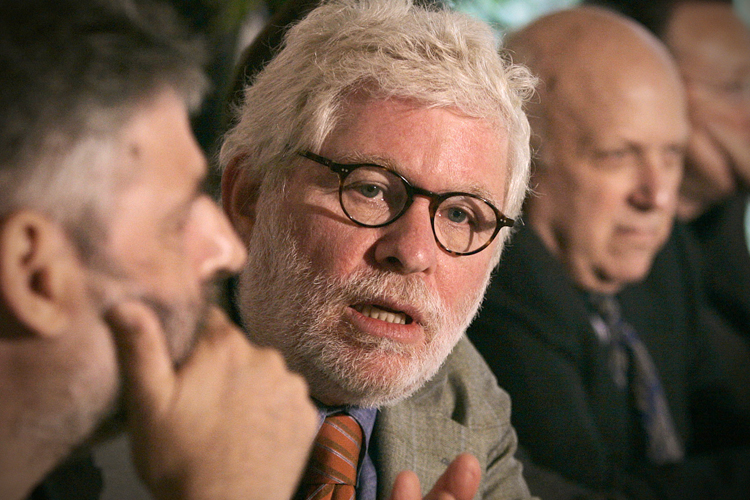
Franzen doesn't get Twitter Jonathan Franzen (Credit: Wikipedia)
This originally appeared on HTMLGIANT.

In some ways, we’ve brought this on ourselves; it is a slippery slope. First you wonder what Angelina Jolie had for breakfast because she was so great in that one movie or whatever and then you’re buying cereal and thinking, “Does Oprah eat Raisin Bran?” Eventually, you even start to give a damn about what famous writers think about the weather or, say, social networking, and someone like Jonathan Franzen revels in his dislike of Twitter and other means of social networking from his Important Writer perch and we respond because if Franzen hates Twitter, does he hate us too? The angst is unbearable and yet it’s all sort of inevitable.

Franzen’s A Great American Writer and all but I don’t give a much of a damn about his opinions on anything (see: Edith Wharton obvi). Or I do. Is it really surprising that Franzen doesn’t care for Facebook or Twitter? His overall comportment does not suggest an affinity for the levity of social networking. I can’t really say I love Facebook, myself. It has become increasingly hard to make sense of the interface and I keep getting invited to parties and readings in Bali and Temecula and I don’t live in those places, so the experience is, at best, fragmented. At the same time, I don’t need to proselytize my dislike unless I’m on Twitter. Who cares? My opinion doesn’t matter nor does Franzen’s, though he is Very Fancy, so in the calculus of mattering, his irrelevant opinion is less irrelevant than mine. Math.

J. Franz talking smack about Twitter, though, them’s fighting words.

Jami Attenberg wrote down some of what Franzen said Monday night at Tulane:

Twitter is unspeakably irritating. Twitter stands for everything I oppose… it’s hard to cite facts or create an argument in 140 characters… it’s like if Kafka had decided to make a video semaphoring “The Metamorphosis.” Or it’s like writing a novel without the letter “P”… It’s the ultimate irresponsible medium.

Is anyone really using Twitter to craft complex rhetorical arguments? What does responsibility have to do with chattering online? It’s like Franzen is saying, “I cannot swim in my car and therefore my car is not useful.” He doesn’t understand what Twitter is for. Of course he dislikes it. He’s working from a place of profound ignorance. His stance is one of those things where you have to say, “There, there, Mr. Franzen, here is your Ovaltine.”

Attenberg smartly concluded that

he doesn’t understand that a lot of writers have to use the medium as a promotional device as well as a way to build networks. He doesn’t have to do anything! He has a publicist who probably has dreams about him every night, whether he has a book coming or not. He is free to write and just be himself, while the rest of us are struggling to be heard and recognized.

Team Franzen has the infrastructure to publicize and promote Franzen. Who knows how he wastes time, but clearly it isn’t online, so he has no need for people to “Like” his pithy Facebook updates or retweet his deepest or shallowest thoughts about, say, yogurt. He has reached a niveau where he can make ill-informed statements about something trivial and in turn we spend the next several hours, days, weeks, parodying, poking and otherwise pondering those ill-informed statements on the very networks he denounces. The circle of life.

When you’ve got it, you’ve got it.

If you attended the bookfair at AWP, you saw four rooms filled with magazines and publishers, and these attendees represented only a sixth of the magazines and small presses out there. It was a total zoo. Also, it was beastly hot. We were being punished. As I stood in the bookfair day after day, talking to writers, I was reminded of how we are all guppies in a very big pond. For those of us among the un-Franzen, there’s an intense amount of competition for any kind of attention. We are guppies together. Most writers write to be read. How the hell do you get read when there is so much to read? Sure, you have to do something interesting but you also need to do a little more. There are countless writers doing interesting things. Excellence isn’t enough. Make your peace with that already. As J. Attenberg says, the rest of are struggling to be heard and recognized but fortunately, there are great options to help us with that.

I was also on a panel at AWP about Literature and the Internet in 2012 with Blake and Kyle and Stephen Elliott and James Yeh. I had no voice so I awkwardly whispered into the microphone a couple times and it was very difficult because I had way more to say. Alas. One of the audience members asked if she needs a blog because she had heard in another panel that she needs a blog. She did not seem to actually want a blog. It was a good question. Last night a friend on Facebook asked if she needs to keep her Google+ profile she never uses. In fact, one of the questions I am asked most frequently is, “Do I need a [insert social networking platform]?” There’s a lot of anxiety out there about what we need to do as writers to reach readers.

Necessity.

What do we need?

I need to stay black and die. Everything else is relatively optional.

What do we need to do as writers?

We need to write. We need to write well and hopefully that will at least get our work into  places where we might be read. We don’t need to do anything else. However, if we want the work to be read by more than say, our parents, we should probably get connected, in thoughtful, non-annoying ways, to other writers and readers.

Social networking is a convenient way of creating these connections in a low-pressure environment. Franzen already has a million connections and a million readers so it is easy for him to sneer intellectually at social networks while using words like semaphoring. I looked up semaphore. It is an apparatus for visual signaling (as by the position of one or more movable arms or a system of visual signaling by two flags held one in each hand).

It’s interesting that Franzen wants to make social networking a conversation about responsibility because it is a little irresponsible to make such deliberately provocative statements a) about something relatively silly and b) without knowing anything substantive about the platforms.

When it comes to the social networking, do what you want. This is not as complicated as we make it. Ignore most of those well meaning articles about writers and social networking. Some of those articles are a little crazy and written by people who want you to Market Yourself and Be a Product.

Do what you like. Do what you want. Don’t stress. This should not be stressful. Social networking should not feel like a burden or obligation or something to be resented.  At the same time, get over the “self promotion is gross” thing. If you don’t like what you write enough to want to tell people about it, in moderation, don’t publish and that problem is solved.

If you want to be on Facebook, do that too but perhaps don’t ask people to like your Fan Page or whatever because if they haven’t already, they probably don’t want to anyway. If you want to be on Google+ with me and like six other people, do that, but know it’s very lonely there and lots of strangers who speak different languages will talk at you in those different languages and it can be confusing. If you want a blog, create one but update it and put more content on your blog than updates about your writing. Find something to talk about. I hear rejection works well or movies. The problem with social networking is not its triviality but rather its half-assedness. Writers feel this “market pressure” to “network” so they create social networking presences they have no idea how to use, that they have no interest in using, and then those presences languish and make the writer look like they don’t give a damn.

Do something where you are willing to show that you give a damn, however you interpret giving a damn.

Twitter is my favorite thing. If you like babbling about nonsense, and current events, and occasionally sharing links to your work, get on Twitter. I love that people willingly listen to me talk about Fage yogurt, “One Tree Hill,” Scrabble tournaments and my writing, in that order. I love listening to you talk about your cats and babies and your drunkenness and all the other things you want to talk about in 140 or fewer characters. I love when you send me things to read because most of the time, those things are great. Most importantly, let’s keep it real—no platform is more conducive to collectively watching an awards ceremony than Twitter.

Franzen approaches social networking with far too much gravitas. If he had been on Twitter during, say, the Grammys, he would better understand what it is all about. He doesn’t want to be on Twitter, though. The desire is not there and it’s not a matter of necessity for him. In that regard, Franzen is modeling the right attitude toward social networking—do what you like.

The anger of the male novelist

Do female writers really have it easier than men? Perhaps the issue is being framed wrong by everyone

  • more
    • All Share Services

The anger of the male novelist Jonathan Franzen and Jeffrey Eugenides (Credit: Time/Adweek.com)

When I read the final paragraph of Teddy Wayne’s essay, “The Agony of the Male Novelist,” I couldn’t help but think about the ecstasy of the male porn star. While male porn stars earn a fraction of what female porn stars earn, they still get to deliver the money shot at the end of a scene.

It is rather difficult to have a reasonable, rational conversation about matters of (in)equity, whether we’re discussing race, gender or sexuality. These issues are the kind where we are so deeply entrenched in our positions we can’t or won’t consider other viewpoints. When someone like Jennifer Weiner points out an inequity in, say, the media coverage of male and female writers, there’s always going to be (and rightly s0) an alternative perspective, but then there’s also going to be someone who will say, “Such is not the case with me, so you must be wrong.” Sometimes, it would be nice to be able to say, “There is a problem that demands attention,” without being shouted down, condescended to, derided or ignored.

In many realms, systemic, pervasive inequalities exist. Publishing is certainly one of those. The correct response to Weiner pointing out that disparities still exist when it comes to mainstream media coverage is not to say, “I’m a man and I am not getting media coverage either.” Making that kind of statement completely misses the point far more than, say, “Jennifer Weiner’s attack on the New York Times.”

When I write about race, gender, inequity and publishing, I am rarely writing about myself. I am not lamenting a lack of opportunities for my own writing. I’m not shaking my fists at the sky wondering when my novel will sell. Thus far, things are going reasonably well for me. There is plenty I want that feels out of reach, but I don’t think The Man is holding me down. When I do want to complain, I go drinking with my friends. I say this to make it clear that in discussing these fraught topics I am, more often than not, looking at historical patterns that are deeply embedded within our culture. We’re still talking about an issue Francine Prose, for example, eloquently addressed in Harper’s in 1998 when she wrote “Scent of a Woman’s Ink.” Personalizing these discussions, as Wayne clearly does, is not necessarily effective. There will always be exceptions (alas, the midlist male novelist) but we cannot ignore the complex reality of the rules to which these exceptions apply.

I’ve read Wayne’s essay several times now and, given the overall tenor and some of the assertions, I want to believe he’s writing satirically, or to deliberately provoke, or that he’s communicating from an alternate reality where “The Help” is “feel-good fare.” I worry such may not be the case.

Weiner is right to point out that there is a real problem with critical media coverage for female writers. She is right to point out that commercial fiction, particularly commercial fiction that deals with the lives of women, does not garner critical respect, attention or acclaim and that our culture tends to look down on women’s stories.

Teddy Wayne is right, too. It is not financially sustainable be a midlist novelist without gainful employment. It is hard to garner critical attention when you’re a midlist novelist, and sometimes, yes, it is particularly hard for a midlist male novelist who writes about masculine topics. Wayne is also very, very wrong to suggest that women have it better in publishing. On the whole, gender disparities exist in terms of who is being published, where and how books are promoted, how those books are covered by mainstream media, and which books receive coveted accolades.

Here’s the truth. In this day and age, the publishing climate is rather untenable for all writers — men, women, writers of color, straight writers, queer writers. Getting your foot in the door doesn’t even mean what it once did. You may get a book deal, but then what happens? What’s an advance, again? Most publishing contracts don’t come with the necessary publisher support to adequately promote a book. It’s difficult to get books reviewed in major publications. Contemporary writers will probably agree that we’re all in this together — mired in the same depressing circumstance, quietly seething about our relative obscurity. Once in a while, we look up and see the bright twinkling star of a prominent, critically acclaimed novelist like Jonathan Franzen or Jeffrey Eugenides wearing his magnificent vest high above Times Square, and think, “When will it be my turn?” Most of us grudgingly accept that our turns may never come for any number of reasons that have little to do with the quality of our writing. The pill is bitter and it is lodged in our collective throats. Teddy, we hear you.

What most writers have in common is desire. We want and want and want and want. We want to write well and prolifically. We want a great book deal that comes with the kind of advance that will allow us to quit our jobs so we can write full time. We want a great editor who becomes our best friend. We want the book that got us the great book deal to become a bestseller. We want critical acclaim and reviews in all the major publications. We want our publisher to send us on a 30-city book tour where we are met, at every turn, by adoring fans holding out their hands. And in the hands of those adoring fans, we want to see our books, open and ready for us to sign. We want to be on the cover of Time magazine with the headline “Great American Writer.” We want the billboard in Times Square. All we want is everything.

Both Teddy Wayne and Jennifer Weiner have expressed their desires, the things they want, as they’ve engaged in this ongoing, necessary discussion about gender, equity and publishing. They both have certain trappings of success. They both want more.

Wayne suggests that because Weiner has achieved a great deal of commercial success, she shouldn’t “complain” — as if he is the arbiter of what she’s allowed to complain about (because he too has it pretty good). Let’s not overlook that it is insulting to suggest that by bringing attention to this problem, Weiner is complaining.

Undoubtedly, Weiner has achieved a level of success most writers, male or female, only dream of. She is a New York Times bestselling author. She has made a great deal of money from her books. She has a very committed fan base. She had a television show on ABC Family. Her books have been made into mainstream movies. Still, she wants more. Do we condemn her for that desire? Is there such a thing as wanting too much? Is it really our place to suggest she should shut up and be happy with her royalty statements? Despite the millions of books she has sold, Weiner cannot parlay her commercial success into the critical reception and media coverage she seems to so eagerly want. Her frustration is palpable, but I credit her for doing something productive with that frustration. At least we’re having this conversation when, historically, few successful writers have had a visible enough platform to bring attention to gender inequalities in publishing and the mainstream media coverage of contemporary fiction.

I don’t agree with everything Jennifer Weiner has to say about this issue. Nonetheless, when Weiner published her updated data on January 17 about the media coverage of contemporary writers, I appreciated the hard numbers she shared. This data (as well as the data VIDA shared last year) grounds the conversation in reality rather than in the wild speculation often shrouding these debates. Weiner’s data set is also incomplete. As others have noted, we need more context to truly make sense of these numbers that consistently demonstrate that books written by men receive more media coverage and critical attention than books written by women. We need to know the gender breakdown of the books published in the same time periods to determine the true disparities.

The incomplete data does not mean we should dismiss Weiner’s findings. Men wrote approximately 60 percent of the books reviewed in the New York Times last year. Overall, the disparity was not as pronounced as I expected, but it could be better. I very much disagreed with Weiner’s hyperbolic assertion that the “disparity between men and women who get that coveted two-reviews-plus-a-profile is still shocking.” The disparity (10 men versus 1 woman) is significant and worth examining, but we’re talking about such rarified air that it’s difficult to make broad conclusions.

What often gets overlooked in this conversation, particularly where Weiner is concerned, is that she shouldn’t be looking for the kind of coverage Franzen gets. She should be looking at the kind of coverage commercial male writers like James Patterson or John Sanford or Clive Cussler receive. There are all kinds of conversations to be had about how fiction is categorized and marketed, but for now, the publishing industry has decided Weiner writes commercial fiction, and as such, there’s a better data set she should be studying. When trying to compare the media coverage of commercial fiction versus literary fiction, the numbers are always going to skew poorly. At some point, the critical establishment decided it wasn’t interested in commercial fiction. I don’t know if that’s ever going to change.

That said, Weiner is not wrong in pointing out that there is a serious problem — and that the problem reflects many of the inequalities women face in society. She is not wrong to insist that we need to talk about this problem — last year and this year and next year and every year until more parity is achieved. Whether you agree or disagree with Weiner, she certainly deserves more respect than she is afforded by most of the people who write about her and her refusal to stop talking about this problem. We only need to look at the first line of Wayne’s essay to get a good sense of the overall attitude people have about Weiner’s perspective. Gender inequity in publishing is, I am guessing, not a favorite topic of Weiner’s. I follow her on Twitter. Her favorite topic is “The Bachelor.” She may well have a chip on her shoulder and a certain amount of self-interest in wanting commercial and critical success. But let’s not pretend Teddy Wayne isn’t walking around with a chip on his shoulder, too. When a man has the kind of confidence to believe he should receive significant coverage in prominent venues, people generally don’t bat an eye. When a woman like Jennifer Weiner has that kind of confidence, she is ridiculed and belittled. Gender troubles are part of a vicious cycle.

The real problem here is that Wayne’s argument lacks supporting evidence. Instead, he relied on anecdotes and empty but seductive rhetoric, which is not enough to support his alternate reality and the somewhat galling assertion that, “For the majority of male literary authors — excluding the upper echelon of Franzen, Jeffrey Eugenides, Don DeLillo and their ilk, plus a few younger writers like Chad Harbach who have scored much-ballyhooed advances — it’s actually harder than it is for women to carve out a financially stable writing career.”

Anecdotes are not enough to support the speculation that women’s book clubs skew heavily toward female writers. How does Wayne know what women’s book clubs are reading? Anecdotes are not enough to justify the reasoning that because women are buying 80 percent of fiction, they must be using that buying power to buy books by women. It’s simple math and common sense — if women buy 80 percent of all fiction, the publishing industry hasn’t entirely collapsed and men are still publishing books, that means women are supporting a diverse range of writers — including the poor, beleaguered male novelist.

Anyone who looks at the media coverage of contemporary writing can easily see that male novelists, even midlist male novelists, receive consistent coverage. On the O Magazine website right now, a story called “11 Books You Never Thought You’d Read (but Will Fall in Love With Instantly)” includes seven books written by men and four written by women. In December, Lev Grossman, on his blog for Time, wrote about seven books he’s looking forward to in 2012. All seven were written by men. Male novelists, many of them midlist, are covered regularly on sites like Salon, Slate, the Daily Beast and in other prominent venues. I could do this all day. There aren’t a lot of scraps for writers in the mainstream media (which is what we should really be talking about), but of the scraps we have, plenty go to men.

What Wayne is truly lamenting in his essay is the agony of the midlist writer, not the agony of the male midlist novelist. And there’s a difference. He is lamenting that he does not have what he so desperately wants. Framing his discussion, such as it were, within the context of gender was short-sighted and gratuitous — and at times dismissive and insulting. His lament is one shared by many talented writers who toil in relative anonymity — who get a “good” book deal and enjoy some of the trappings of success but are still left wanting, wanting so very much. For whatever reason, Wayne chose to close his argument with an unfortunate pornography metaphor, and I’ll do the same. The female porn star may outearn male porn stars, and she may be in greater demand. But while she’s cleaning off the sting of that scene-ender, he’s on an L.A. freeway heading home. That’s nice work if you can get it.

Continue Reading Close