Spring Offer: Get 1 Year, Save 58%

Republican glee over “immunity” decision shows they don’t fear Donald Trump — they desire a dictator

Even though attempted murder is not one of his 34 felony convictions, Donald Trump has never been coy about his longing to kill people. During the 2016 campaign, Trump famously mused in a speech, "I could stand in the middle of Fifth Avenue and shoot somebody, and I wouldn't lose any voters." In 2020, he threatened to murder Black Lives Matter protesters by tweeting, "When the looting starts, the shooting starts." Throughout and after his presidency, there was a steady stream of stories from aides alarmed at how Trump would repeatedly ask if they would kill people for him. He requested bayonets and spikes on the southern border, hoping for grisly deaths of migrants crossing. He had Oval Office meetings in which he demanded the military "crack skulls" and "shoot" lefty protesters. Former Attorney General Bill Barr appeared to confirm reports that Trump regularly ordered him to "execute" government staff for speaking to the media. Barr did pretend Trump wasn't serious, despite how often he circled back to the topic of extra-legal executions. 

Even before he got into politics, Trump's bloodthirstiness was on public display. In the 1980s, Trump demanded the death penalty for five young men falsely convicted of rape, a position he did not back down from, even after they were formally exonerated. (Trump himself was found liable for sexual assault last year by a jury, but does not feel he should face his own recommended punishment.) In 1990, Trump praised the Chinese government for killing peaceful protesters in Tiananmen Square. In the same interview, he lamented that the Soviet Union did not murder enough people, calling the Soviet government "out of control" for allowing more dissent than they had in the past. 

During his time as president, Trump did order the assassination of Iranian General Qassem Soleimani, as a failed effort to distract from his own impeachment trial. But his desire to kill fellow Americans was blocked by the long-standing legal presumption that laws against murder apply to presidents. He also failed on January 6, 2021, but only due to the courage of the police and the Secret Service that held off the violent mob Trump sent after Congress and his own vice president. On Monday, however, the Supreme Court ended 235 years of restraint on a (Republican) president's power to kill illegally. But that's okay, Speaker of the House Mike Johnson, R-La., reassures us. That's because Trump is such a great guy and he would never order the murder of innocent people!


Want more Amanda Marcotte on politics? Subscribe to her newsletter Standing Room Only.


"No one who is elected to that office going to be prone to this kind of crazy criminal activity," Johnson told Fox News, beaming with gaslighting joy. To rub our collective noses in how much he enjoys lying, Johnson also accused the people who are worried about this of "hyperbole" and "madness."

That Johnson is lying is beyond dispute. Of course an elected president can be engaged in "crazy criminal activity." That's how Trump spent most of his time in the White House. The reason Trump asked for "immunity" is he cannot prove his innocence in any of the four felony trials he's facing. He's already been convicted on 34 charges in the trial that finished in May. That Trump is a criminal is the most well-established fact about him. On top of his criminal charges, he was found liable for criminal activity in at least two other civil court cases: The sexual assault of E. Jean Carroll and his recent New York fraud trial. "Crazy criminal activity" is what Trump does. That and golf, which he cheats at

As irritating as Johnson's trolling is, however, it does settle one debate that's been roiling the chattering class for 8 years now: Do Republican politicians back Trump out of fear? Or are they just really stoked over this chance to follow a would-be dictator? Johnson's glee as he wallows in Trump's newly granted powers to commit crimes — even killing — tells the story. It's the latter. 

The prevailing wisdom, alas, has been that it's fear keeping Republicans lined up behind Trump, and not genuine enthusiasm. Sen. Mitt Romney of Utah, one of the few Republicans to speak out against Trump, uses this to excuse his Trump-loyalist friends. He recently told journalist McKay Coppins that fear of "personal safety" keeps Republicans silent. Even when not speaking of violence, Republicans often cite fear of losing their careers as a reason to avoid crossing Trump, the Washington Post reported in February. Anti-Trump Republicans in red states even told NBC News that it's "fear" of MAGA Republicans forcing them to keep their opinions to themselves. 

No doubt Trump uses intimidation to keep party members in line. But his real power comes less from scaring people and more from the widespread longing in the GOP ranks for a right-wing dictatorship. You can see it on Johnson's face in that clip. Even though he's one of the politicians the Washington Post characterized as "afraid," nothing about his smiling face suggests that. He's ecstatic that Trump just got a leg up in his quest to be America's Führer.

People who are afraid of Trump would not be happy that he's been granted the license to kill by the Supreme Court. But Johnson is hardly alone in expressing his elation over this. Politico described the Republican reaction as "giddy," with prominent politicians like Sen. J.D. Vance, R-Ohio and Sen. Ted Cruz, R-Tex., using language like "win" and "victory." Right-wing media is also celebrating like it's their birthday, while, like Johnson, lying to their audiences about how much freedom Trump would have to commit crimes in office. Kevin Roberts, the president of the Heritage Foundation — which is helping run the infamous Project 2025 — responded to the decision by echoing Trump's threats of violence.  He declared, "We are in the process of the second American Revolution, which will remain bloodless if the left allows it to be."

I doubt that most, if any of the people who are lauding the decision do so out of any personal love for Donald Trump. They may be bad people, but they're still human and so likely experience the same level of personal revulsion to the man himself that people who don't care to flatter him report. Trump just so happens to be the available vehicle for authoritarian aspirations that have long been harbored in the GOP, and apparently at much higher levels than many in the media or within the moderate Republican ranks would like to admit. Certainly, the six Republican justices on the Supreme Court had no reason to hand this much power to Trump, unless they wanted to. It appears that, among the leadership ranks of the GOP, there's been a deep-rooted craving for a dictator. Trump happens to be the one that's on offer, so they'll take it. 

We need your help to stay independent

The fascistic yearnings of the GOP are one of the least well-kept secrets in politics, going back to Richard Nixon telling journalist David Frost in 1977 that a president should be able to commit crimes. In the decades since, Republican legal scholars have built up a body of pseudo-intellectual justifications for expanding executive powers to authoritarian levels. As Adam Serwer writes at the Atlantic, this is "the result of decades of work by right-wing activists seeking a permanent conservative political ascendancy." As the New York Times documented Monday, "starting with the Reagan administration in the 1980s," Republican lawyers "developed constitutional theories that would allow Reagan to do what he wanted even if Congress said otherwise."

Through the decades, driven by the Federalist Society, Republicans have consolidated more power into presidential hands. George W. Bush's administration was particularly attached to the idea that he had powers far behind what a good faith reading of the Constitution allowed. "The unitary executive theory provided the rationale for President Bush's agenda to defend and expand presidential powers in a variety of areas as well as to protect the executive branch from what he and Vice President Cheney perceived as an overly intrusive Congress," political scientists Mitchel Sollenberger and Mark Rozell explained in 2013. Trump's next-level criminal behavior has eclipsed the outrages of the Bush era. Still, it was stomach-churning, how they used  "unitary theory" of executive power to justify everything from torturing  prisoners of war to invading Iraq on false pretenses. 

Maybe Republicans should be more afraid of Trump, as former Vice President Mike Pence learned while fleeing for his life from a MAGA mob. The Supreme Court justices appear so blinded by ideology that they didn't consider that a liberated Trump could also order hits on judges who rule in ways he doesn't like. But oversized egos play a big role in Republican politics. One politician after another tells themselves they're smart and strong enough to manipulate Trump, rather than the other way around. That's why we see so many of them audition to be Trump's next running mate, even though the last one was nearly murdered by a Trump-incited mob. 

So no, the Republican yearning for a dictator has never been that hard to see, for those willing to look. What Trump offers is an opportunity. His reckless criminality meant he was willing to push boundaries even the Bush administration was too afraid to touch. His cult-like following among the Republican base gave him power to keep going, despite the pushback. His overt embrace of violence against his fellow Americans provided political cover, allowing Republicans to go along with him while claiming reluctance to reporters. If Republicans were as afraid of Trump as they claim in anonymous quotes, they would have taken one of the many past opportunities throw Trump overboard, such as voting to convict him in the Senate after his second impeachment. They chose not to. Now we know why: Because Trump wants to be a dictator. Republicans want that, too. 

Anticipating a major bird flu crisis, the U.S. government just awarded $176 million for a vaccine

In the ongoing waves of bird flu outbreaks, with the virus spreading to more than 141 herds in 12 states, the risk of another full-blown pandemic like COVID-19 is becoming a distinct possibility. In preparation for just such a disaster, the U.S. government will pay pharmaceutical company Moderna $176 million to develop a vaccine that protects against the H5N1 virus. Moderna will employ the same mRNA vaccine technology that was pioneered to develop COVID-19 vaccines in 2020, as well as the booster shots that have followed.

Moderna is already in the early stages of testing its new mRNA vaccine, meaning that it will be receiving supplementary funds for that research from the U.S. Department of Health and Human Services (HHS). The award was made through an agency organization called the Biomedical Advanced Research and Development Authority, or BARDA.

“We have successfully taken lessons learned during the COVID-19 pandemic and used them to better prepare for future public health crises. As part of that, we continue to develop new vaccines and other tools to help address influenza and bolster our pandemic response capabilities,” HHS Secretary Xavier Becerra said in a statement. “Importantly, we are doing this work in partnership with some of the nation’s leading scientists and clinicians. The Biden-Harris Administration won’t stop until we have everything we need to prepare for pandemics and other public health emergencies that impact the American public.”

Because influenza strains are closely related to each other, the scientists can pivot from the avian flu to a different type of flu if a separate and more serious outbreak emerges. The current concern, however, is about the H5N1 virus. The strain has been virulent across U.S. dairy farms in 2024, even infecting three people, although they all had relatively mild cases. From a medical perspective, the biggest concern about the current bird flu strain is that it can spread from birds to mammals. This suggests that it can not only be transmitted to humans, but is capable of evolving to be particularly infectious.

“The bovine situation is a step up from this, just due to how widespread the virus is, and how many people have exposure to cattle (compared to small mink farms or remote sea lion colonies),” Dr. Tom Peacock, a virologist at Imperial College London and the Pirbright Institute, told Salon in June. “This clearly represents a much larger human-animal interface than the other examples.

Is the COVID summer wave here? Here’s what the FLiRT variants mean for rising infections

If a lot of people suddenly seem sick with COVID to you, you’re not alone. Once more, the disease is on many people’s minds as infections, emergency room visits, hospitalizations and even deaths are all trending up, according to the latest data from U.S. Centers for Disease Control and Prevention (CDC).

It’s not that the COVID pandemic ever fully ended, but our baselines have shifted. A high number of infections, injuries and death have plagued us mercilessly since 2020, but in spite of some relative lulls, the risks of COVID haven’t completely disappeared. Following another winter surge in 2023-2024, most COVID metrics fell during the spring. Now the trend is seemingly reversing, driven by new variants and waning immunity from both vaccines and infections.

So far, it’s too early to say whether the upward trend constitutes a new wave or not. But given that the last four summers have resulted in a steep rise in cases, it’s reasonable to expect history to repeat itself this year, especially as temperatures drop in autumn.

And it won’t surprise many people that our strategies for fighting COVID haven’t changed much: masking in crowds, avoiding others when having symptoms, testing after exposure to those infected (especially if feeling symptomatic) and keeping up with vaccinations are all effective at reducing the spread of this persistent disease.

But it’s also true the pandemic has changed a lot since 2020. SARS-CoV-2, the virus that causes COVID, naturally mutates, just like all viruses. Every time it worms its way into a cell, it hijacks its DNA to make viral copies of itself and explodes out to repeat the cycle. Randomness in these genetic copies regularly occur — sometimes they do nothing or even make the virus weaker. Other times, these mutations give the virus an advantage, making it better at evading immunity, better at infecting, better at spreading and leaving more destruction in its wake.

"A COVID summer wave appears to be underway," Dr. Rajendram Rajnarayanan, of the New York Institute of Technology campus in Jonesboro, Arkansas, told Salon. "Based on current data: Cases are rising in several states, with emergency department visits up 15% and hospitalizations up 25% compared to late May — a pattern consistent with previous summer waves, which have historically occurred due to increased travel and indoor gatherings."

"A COVID summer wave appears to be underway."

SARS-CoV-2 is not and never was benign. It attacks the vascular system, impacting basically every organ including the kidneys, lungs, heart and brain. Using its specialized spike protein like a master key, it can unlock and open the door to any cell with an ACE2 receptor, which turns out to be many cells in the body. This is why it's so effective at replicating inside us, but also why the virus is associated with lung scarring, digestive troubles, blood clots, chronic fatigue and literal brain damage manifesting as headaches, dizziness, anxiety, Parkinson's-like symptoms and other neurological disorders. "Zombie" COVID fragments can linger in the body, causing these issues indefinitely.

A study in May in the journal Nature Medicine examining the medical records of more than 135,000 people with SARS-CoV-2 infection reported that symptoms can persist for years. Often this plethora of symptoms is known as long COVID or (PASC post-acute sequelae of coronavirus disease.)


Want more health and science stories in your inbox? Subscribe to Salon's weekly newsletter Lab Notes.


The current swarm of SARS-CoV-2 variants mostly stemmed from a severely mutated strain nicknamed Pirola (BA.2.86) that was first detected late last summer. Experts predicted it could cause serious issues, but its offspring like JN.1 became the dominant strains through most of 2024. More recently, JN.1 has been usurped by its own kids, specifically variants like KP.2, KP.3 and LB.1, according to the most recent CDC data. These three variants are collectively called the FLiRT variants because of shared traits in specific positions in the spike protein: F switches to L while R switches to T.

These changes may seem small — indeed, they are microscopic — but they can give the virus added ability to evade immunity and increase their transmissibility, making them spread better from person to person. Keeping with the keys metaphor, immunity is a bit like changing the locks when a SARS-CoV-2 virus attacks us. But they are clever locksmiths that keep making new and improved sets of keys.

"The variant LB.1 has the potential to infect some people more easily based on a single deletion in a spike protein," Dave Daigle, the associate director at the CDC's Communications Center for Global Health, told Salon. "This is present in multiple JN.1 lineages."

"However, there is currently no evidence that LB.1 causes more severe disease," Daigle noted. "Most key COVID-19 indicators are showing low levels of activity nationally, therefore the total number of infections this lineage may be causing is likely low. COVID-19-associated hospitalizations and deaths remain low. CDC will continue to track SARS-CoV-2 variants and is working to better understand the potential impact on public health."

We need your help to stay independent

Rajnarayanan said the KP.3 lineage is of "particular concern," because it appears to be more immune evasive than other circulating lineages. "KP.3.1 seems to have appreciable growth advantage over other circulating lineages," he said.

So now we know why cases are seeming to surge yet again. But the big question is whether this will translate to different symptoms or an increase in severe disease outcomes, namely hospitalization and death.

"I don’t think the virus is any less (or likely any more) inherently dangerous now, and it is of course a myth that viruses always evolve to become more benign," Dr. T. Ryan Gregory, an evolutionary and genome biologist at the University of Guelph in Canada, told Salon. "The main reason we are experiencing far less in the way of severe acute infections is that there is a degree of immunity in the population from past infection and (decreasingly) from vaccination."

However, Gregory noted this immunity wanes over time, and the virus continues to evolve immune escape.

"The variant LB.1 has the potential to infect some people more easily."

"Vaccine uptake is abysmally low these days, which means that any immunity that ends up being maintained will mostly come from reinfection," he said. "That means more variant evolution, more chances of getting long COVID, and so on. It is always important to emphasize that severe acute respiratory (the S, A and R in SARS) are not the only issue. There is also long COVID and increased risk of all sorts of cardiovascular, metabolic, neurological and other conditions."

Another outstanding question is whether current or future vaccines can keep up with these new strains of SARS-CoV-2.

"The currently available vaccines target XBB.1.5 (Kraken), which has not been circulating for quite some time," Gregory said. "Those older vaccines work, though not nearly as well, versus JN.1 (and probably less so against KP.2, KP.3 and LB.1)."

The U.S. Food and Drug Administration is likely to approve updated vaccines this fall, advising drugmakers to target the KP.2 strains, according to NBC News. The FDA apparently reversed course after initially recommending vaccine developers target JN.1 instead.

"It looks like the updated Novavax will target JN.1 whereas the mRNA vaccines may target JN.1 or KP.2," Gregory said. "JN.1 itself isn’t very common anymore and the mutations in KP.2, KP.3 and LB.1 definitely matter. So, it would be wise for them to at least include the F456L mutation [referring to the FL in FLiRT] to not start off being so far behind where the virus is by the time the updated vaccines are rolled out."

In the meantime, cases could also be flying under the radar, as we are doing far less testing and surveillance of the virus than in previous waves. Gregory said "we still need to learn is that COVID is not seasonal – there can be waves any time of year, including in the summer. It’s not just the U.S. right now either – there are surges in Europe (summer) and Australia (winter)."

"We are not tracking COVID as comprehensively as before," Rajnarayanan said. "In spite of that we do have several indicators suggest increased transmission: Wastewater surveillance shows rising levels of the virus. Positive test rates are increasing in some areas, like California (from 3% to 7.5%). There's a possibility of underreporting due to reduced testing and surveillance. The change in reporting requirements, especially negative tests are not properly reported."

Though we may not know the true scope of this wave, the advice to protect yourself is the same as before: "If you experience symptoms, get tested and stay home till you are free of symptoms," Rajnarayanan said. "This will help prevent the spread to vulnerable individuals. Mask if you are sick and need to go out (avoid crowded areas). Mask when traveling. Do not mock people who are masking. Be accommodating and courteous."

“Wasn’t just a horrible night”: Democrats say party must be “honest” about Biden’s viability

Democrats are publicly sharing their concerns about President Joe Biden’s re-election and urging his campaign to be open about his condition after Biden’s disastrous debate performance last Thursday.

Sen. Peter Welch, D-Vt., criticized the Biden campaign for dismissing concerns about the president’s health and well-being, Semafor reported. “The campaign has raised the concerns themselves,” he told the outlet. “So then to be dismissive of others who raise those concerns, I think it’s inappropriate."

The senator stressed the importance of having a Democratic candidate strong enough to beat Donald Trump, especially in light of Monday’s Supreme Court ruling granting the president immunity for “official acts.” Though Welch said Democrats respect Biden immensely, the party must do everything it can to ensure victory come November.

“Passivity is not the response that is going to work for us. We all have to be self conscious,” Welch said. “We all have to be acutely aware that our obligation is to the country, even more than the party. That’s the obligation we have — what’s best for the country.”

Sen. Sheldon Whitehouse, D-R.I., expressed similar concern in an interview with 12 News. “I think like a lot of people I was pretty horrified by the debate,” said. “The blips of President Biden and the barrage of lying from President Trump were not what one would hope for in a presidential debate.”

Whitehouse said he was surprised by Biden’s shaky performance, as he hadn’t seen the president in such a state before. If the Democrats are to keep Trump out of office, Whitehouse said they need to take a more aggressive approach.

“I’ve been critical of the campaign all along, so the upside is that this could be the jolt that they need to make a more compelling case against Donald Trump and for President Biden and the goals Democrats want to achieve," Whitehouse said.

Democratic Rep. Mike Quigley, D-Ill., argued that Democrats need to be “honest with ourselves” and accept that Biden’s debate performance “wasn’t just a horrible night,” Politico reported.

Though Quigley said Biden has served the U.S. “extraordinarily for 50 years,” he told CNN’s Kasie Hunt that Biden too “has to be honest with himself” about the viability of his candidacy, as the November election “will have implications for decades to come."

“It probably takes up to a week to get decent polling … I do think that’s probably the only thing out there right now that could change his mind or influence that critical decision that, again, only he can make," Quigley said.

On Tuesday, Democratic Rep. Lloyd Doggett (D-TX) became the first Democratic lawmaker to publicly call on Biden to drop out of the race. 

“My decision to make these strong reservations public is not done lightly nor does it in any way diminish my respect for all that President Biden has achieved,” Doggett said in a statement. “Recognizing that, unlike Trump, President Biden’s first commitment has always been to our country, not himself, I am hopeful that he will make the painful and difficult decision to withdraw. I respectfully call on him to do so.”

We need your help to stay independent

Former Ohio Congressman Tim Ryan also called for Biden to withdraw and for Vice President Kamala Harris to take his place. In an opinion piece for Newsweek, Ryan stated his love and support for Biden while arguing it was time for the president to step down and pass "the torch to the next generation." 

"Joe Biden's debate performance was deeply troubling," Ryan wrote. "But it isn't just about a 90-minute debate and a terrible performance. This election needs to be about generational change — something about which I have been shouting for more than a year now."

He praised Harris's comments in a CNN interview on debate night. "Across cable news stations, the Vice President's performance was stellar, a ray of light in the darkness.

"In short, she is ready for the job. And, more importantly, she deserves a chance to go to the American people and show us her mettle," he wrote.

Despite concern, right now there are no signs that Biden, supported strongly by his family, will drop out of the race.

CNN poll suggests Harris does better than Biden in a race against Trump

Three-quarters of U.S. voters say the Democratic Party will have a better chance of winning November’s election if President Joe Biden isn’t the nominee, a new CNN poll suggests. Even so, the head-to-head numbers have not budged since CNN's last national poll in April, with Trump still beating Biden by 49% to 43%"

Amid calls for Biden’s withdrawal following his weak debate performance on Thursday, the poll shows 56% of Democrats and Democratic-leaning voters said the party has a better chance of winning the election with a candidate other than Biden, a 3 point increase since January, CNN reported.

Pundits, voters and several Democratic lawmakers have shared their concerns over Biden’s health after the debate on Thursday. On Tuesday, Rep. Lloyd Doggett, D-Texas, became the first Democratic lawmaker to publicly call on Biden to drop out of the race.

Vice President Kamala Harris, the most likely candidate to replace the president, fares better than Biden in a theoretical race against Trump, with 47% of voters favoring Trump and 45% favoring Harris, which is within the poll's margin of effor.

Despite this, Harris still scores just a 29% favorability rating among all U.S. voters, with 49% rating her unfavorably. By comparison, 58% of viewers of voters viewed Biden unfavorably. 

Some of the other candidates who have been suggested as replacements for Biden, such as Transportation Secretary Pete Buttigieg and California Gov. Gavin Newsom, are relatively unheard of, according to the survey, with 50% and 48% of respondents, respectively, saying they have no opinion on either candidate.

Meanwhile, Trump’s approval rating among Republican voters has increased by 11 points since April, with 83% saying the party has a shot to win the election with him as the Republican candidate, compared to just 72% in January.
 

Justice Amy Coney Barrett says presidential immunity doesn’t apply to Trump’s fake electors scheme

One of Donald Trump’s attorneys is claiming that the “fake-electors” scheme qualifies as an “official act," thus exempting him from being prosecuted after the Supreme Court's immunity ruling on Monday, the Hill reported

Trump attorney Will Scharf told CNN Monday night that while some of the presumptive GOP nominee’s actions count as private conduct, meaning they can still be charged as crimes by special counsel Jack Smith, he should enjoy immunity for his failed attempt to put forward fake electors in key states following the 2020 election. “We believe the assembly of those alternate slates of electors was an official act of the presidency,” Scharf said, noting that the Supreme Court left that question for lower courts to decide.

But Trump-appointed Supreme Court Justice Amy Coney Barrett, while siding with the 6-3 conservative majority on immunity, wrote in her own opinion that the fake electors scheme should not in fact be construed as an "official act," Mediaite reported

Specifically, Barrett agreed with liberal Justice Sonia Sotomayor’s dissent that acts which take place while a president is in office should be allowed to be introduced as evidence in a criminal trial. Barrett wrote that she disagrees with the belief "that the Constitution limits the introduction of protected conduct as evidence in a criminal prosecution of a President, beyond the limits afforded by executive privilege."

She added that the Constitution “does not require blinding juries to the circumstances surrounding conduct for which Presidents can be held liable.” Essentially, Barrett argues that a jury should be allowed to hear “both the quid and the quo,” even if the quo could not itself be the basis of a criminal charge.

Writing specifically about Trump's fake-elector scheme: "In my view, that conduct is private and therefore not entitled to protection. The Constitution vests power to appoint Presidential electors in the States. And while Congress has a limited role in that process, the President has none.”

Sugary soda and processed meats are just a few ultraprocessed foods that may shorten your life

An unpublished study, presented Sunday at the annual meeting of the American Society for Nutrition in Chicago, found that increased consumption of ultraprocessed foods (UPFs) may shorten lifespans by more than 10%. That percentage went up to 15% for men and 14% for women once the data was adjusted, according to Erikka Loftfield, lead study author and an investigator at the National Cancer Institute.

The study analyzed dietary data from nearly 541,000 participants — ages 50 to 71 — in the US National Institutes of Health-AARP Diet and Health Study conducted in 1995. Researchers looked for a correlation between the dietary data and mortality rates over the next 20 to 30 years. Compared with individuals in the bottom 10% of UPF consumption, those who ate the most UPFs were more at risk of dying from heart disease or diabetes, according to the study. Interestingly, the researchers found no increased risk of cancer-related deaths, a common health consequence that’s been mentioned by prior studies.

“Highly processed meat and soft drinks were a couple of the subgroups of ultraprocessed food most strongly associated with mortality risk,” Loftfield told CNN.

Diet soda contains artificial sweeteners like aspartame, acesulfame potassium, high fructose corn syrup and other additives that aren’t found in raw foods. Diet soda is also associated with cardiovascular disease, type 2 diabetes, obesity, stroke and disruptions to gut health. Processed meats include bacon, hot dogs, sausages, ham, jerky and deli meats. Consuming such products comes with a higher risk of stomach cancers, heart disease, diabetes and early mortality.

The recent study also found that younger and more obese individuals consumed the most UPFs and overall, had a poorer quality of diet. As for limitations, the study noted that the dietary data they used was gathered only once more than 20 years ago.  

“If anything, we are probably underestimating ultraprocessed food consumption in our study because we’re being very conservative,” Loftfield said. “The intake is likely to have only grown over the years.”

Kelloggs and Crumbl join forces for a chocolate chip cookie cereal extravaganza

Love cereal and cookies? It's your lucky day.

As reported by Elizabeth Flood in FoodDive, "WK Kellogg Co. is bringing the indulgent experience of a chocolate chip cookie to the cereal aisle." The new partnership between the cereal juggernaut and Crumbl, the cult-classic cookie chain "represents a fusion of two brands known for their dedication to delivering exceptional food experiences," said Sawyer Hemsely, Crumbl founder, who added, “whether enjoyed for breakfast, as a snack, or as an indulgent treat, Kellogg’s Crumbl Chocolately Chip Cereal aims to delight consumers with its irresistible flavor profile." 

Eric Schroeder with Food Business News notes that the cereal was developed as a collaborative effort between Crumbl’s menu and R&D team, alongside WK Kellogg Co’s product developers.“We’re proud to partner with Crumbl. Crumbl’s unique food, distinct packaging and passionate fan base makes this innovation a great add to our portfolio of iconic cereals," Laura Newman, the Vice President of Brand at WK Kellogg, said in a statement. 

The first flavor of the partnership will be a classic chocolate chip with boxes reaching stores nationwide as early as this summer.

Rudy Giuliani disbarred “effective immediately”: His misconduct “cannot be overstated,” court says

Rudy Giuliani has been disbarred “effective immediately” for his efforts to defraud the country and put up a slate of fake pro-Trump electors, a panel of judges in a New York state appeals court ruled Tuesday, The Hill reported.

The former mayor and Trump personal attorney was initially suspended from practicing law while the New York court weighed discipline proceedings against him, CNN reported. Now the verdict is in: “The seriousness of [his] misconduct cannot be overstated,” the court wrote.

In its decision, the court said that Giuliani “essentially conceded” most facts that support the alleged acts of misconduct. Instead, he argued that he “lacked knowledge” that he was making false statements and claimed to have good reason to “support his claim that the 2020 Presidential election was stolen from his client,” The Washington Post reported.

The court found that the former mob prosecutor “falsely and dishonestly” made claims that thousands of votes were cast in the name of dead people in Philadelphia. He also falsely claimed that people from nearby Camden, New Jersey, were taken to vote illegally in the Pennsylvania city, the court stated.

The New York’s Appellate Division, First Department ruled that Giuliani “flagrantly misused” his position as Trump’s former attorney and his campaign to create “intentionally” false statements “some of which were perjurious, to the federal court, state lawmakers, the public, the AGC, and this Court concerning the 2020 Presidential election, in which he baselessly attacked and undermined the integrity of this country’s electoral process.”

“In so doing, respondent not only deliberately violated some of the most fundamental tenets of the legal profession, but he also actively contributed to the national strife that has followed the 2020 Presidential election, for which he is entirely unrepentant,” it read. 

Arthur Aidala, Giuliani’s attorney, said they were “obviously disappointed,” but not altogether that surprised. He maintained that they “put up a valiant” effort” to prevent the outcome from turning out the way it did but “we saw the writing on the wall,” the Post reported.

A spokesperson from Giuliani's camp blasted the decision, calling it "politically and ideologically corrupted," adding that the former mayor plans to appeal an "objectively flawed decision."

“The Acolyte” proved what female fans knew all along: The powerful sex appeal of the dark side

The dark side of the Force has never been more violent or compelling than in Star Wars’ latest series “The Acolyte.” 

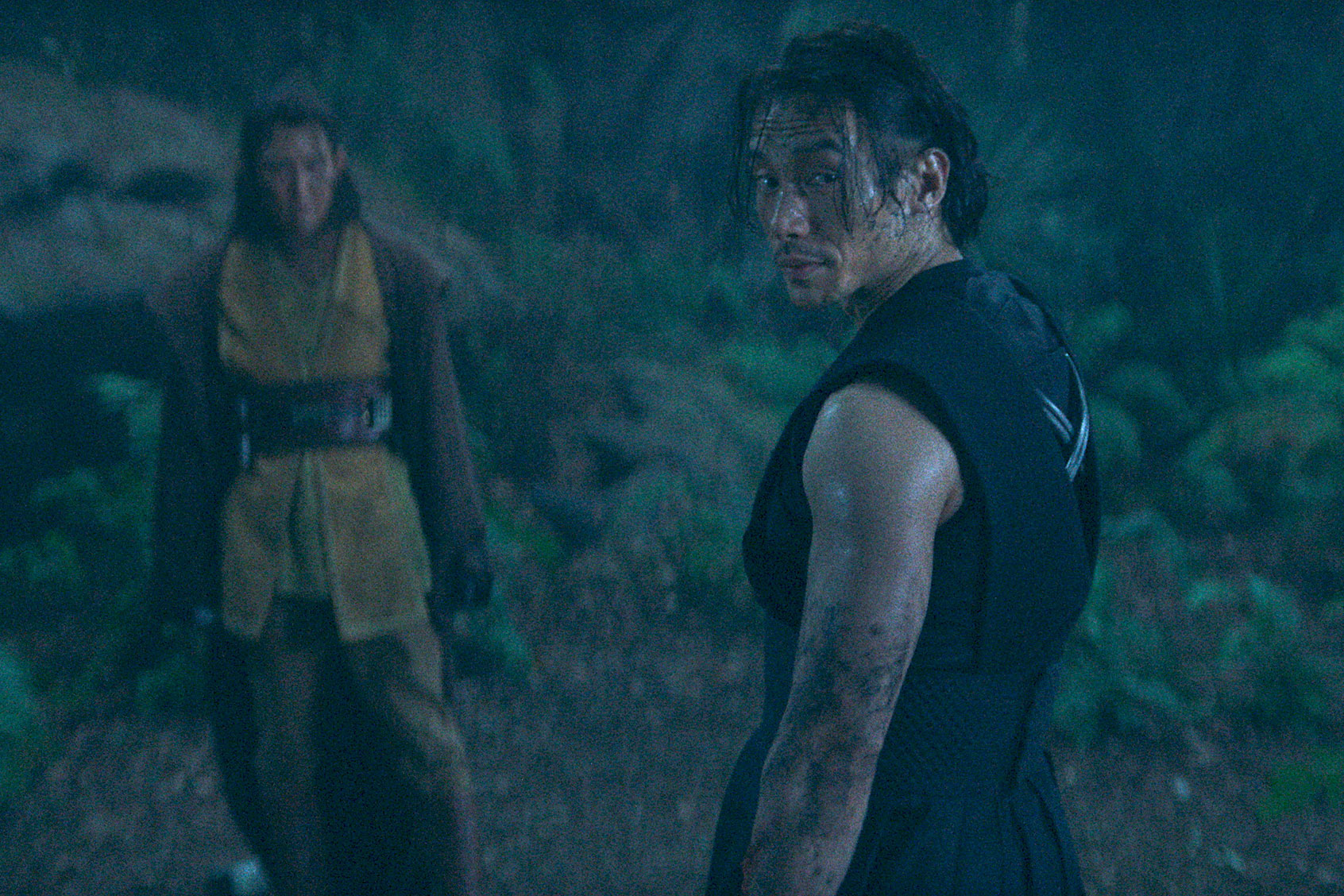
In the June 25 episode "Night," it's revealed that goofy apothecary Qimir (Manny Jacinto) is in fact a Sith Lord master known as the Stranger, who's been secretly training assassin and acolyte Mae Aniseya (Amandla Stenberg) for several years. In a shocking sequence, Qimir brutally kills several Jedi, including stabbing one multiple times in the chest and snapping the neck of another.  What’s been equally surprising are the reactions to Jacinto’s portrayal of the Stranger, or more specifically, how attractive his Sith master alter ego is.

“I now understand what the Kylo Ren girlies were on. This is my Kylo Ren. This is my Adam Driver,” tweeted X user emmailene_

Similar reactions to the Stranger swept the internet, commenting not only on his looks, but also on his smirking, nonchalant response to murdering some of the main Jedi characters, intrigued and horrified in equal measure by how callous he is. People who hadn’t even been tuning into “The Acolyte” or weren’t fans of Star Wars suddenly expressed interest in the show after seeing gifs and fan edits of the big identity reveal, like this one

The online response to Qimir’s true identity reveals a common tension coursing through the Star Wars franchise: is the story serving us dark side allure to entice us to tuning in, or perhaps to distract us – and the main characters – from the dangerous evil associated with the dark side? 

Or are there more layers to the deliberate use of making the dark side characters physically attractive to tell a story from a different perspective?    

Luke Skywalker (Mark Hamill) once chastised Rey (Daisy Ridley) for caving to the dark side for “a pair of pretty eyes” in a deleted scene from the film “The Last Jedi," after he walked in on her touching hands with Kylo Ren (Adam Driver) through the Force. 

The dark side is very, very human, which makes it alluring. And the show knows it.

Indeed, the dark side of the Force can be very seductive. In “The Empire Strikes Back," Master Yoda tells Luke it can “dominate your destiny; consume you it will," referring to the central struggle of the Star Wars saga: the push and pull between the light side and dark, good and evil. These words can also accurately describe how more recent dark side villains, specifically the ones that arrived on our screens in the 21st century, are some of the series' most popular and lusted-after characters. We’re talking about Hayden Christensen’s Anakin Skywalker, Driver’s Kylo Ren, Asajj Ventress from “The Clone Wars,” Shin Hati from “Ashoka,” to name a few. 

In the case of “The Acolyte,” the show is using the female gaze to tell the story from the female perspective, where women are depicted as subjects with agency and drive on the plot, versus the other way around. The female gaze also filters the story and the supporting characters through a lens contrary to the male gaze, which has traditionally objectified women on screen. 

Star Wars: The AcolyteManny Jacinto as The Stranger in "Star Wars: The Acolyte" (Lucasfilm Ltd.)As Qimir fights off several Jedi, he’s ruthless and unafraid to fight dirty. In an extremely skilled  move that dares to challenge the audience’s conceptions of what dark side Force users can do, he splits his red-bladed lightsaber into two separate sabers, using the shorter one to surprise attack his enemies. In another move, he short-circuits a Jedi’s lightsaber by headbutting them while wearing his helmet and uses the Force to move another one onto his lightsaber to kill them. There’s a raw aggression to Qimir’s the Stranger that feels less refined than what we’ve come to expect from the dark side. His confidence is borderline arrogant and his demeanor somewhat unnerving, evident when he casually drops back into his earlier disguised voice in a joking manner in the midst of a serious fight. The dark side is very, very human, which makes it alluring. And the show knows it.

We need your help to stay independent

While the episode “Night” was directed and written by men, the female gaze is nevertheless hard at work in this particular episode. It’s the primary reason why Qimir and unveiling his true identity have become such a big draw for the show, especially for female viewers, practically overnight. It’s not only that Jacinto is depicted in a physically attractive style, depicted with wet, messy hair and showcasing ripped bare arms, an image that feels catered to female viewers specifically. It’s the fact that Qimir is shown on screen from the perspectives of Mae and later, her twin sister Osha (also Stenberg) – and “The Acolyte” never strays from that.

The empathy of darkness

Applying the female gaze to the dark side of the Force takes anger, aggression and power – traits Yoda once called the “seductive” aspects of the dark side – and depicts them literally in the appearance of a villain who is not only frightening but also physically attractive and highly competent. From the female perspective, the temptation of the dark side can come in many forms. 

At the end of the episode, after the surviving Jedi have escaped the battle, we see Qimir drape his cloak over an unconscious Osha in a display of tenderness at odds with his earlier acts of violence. This is an essential aspect of Qimir's appeal. Series creator Leslye Headland said that when she cast Jacinto, she commended his approach to the character because he did it “with the most amount of empathy.” 

Star Wars: The AcolyteManny Jacinto as The Stranger in "Star Wars: The Acolyte" (Lucasfilm Ltd.)Yes, Qimir is terrifying, but there’s also a spark of humanity somewhere in the maelstrom of his violent nature and philosophy that makes him appealing. The dark side of the Force has always been characterized as a raw element of the galaxy that can’t exist without the light side and vice versa. Luke, Anakin, Rey and now Mae and Osha have all been tempted by the dark side and struggled to come to terms with the darkness inside themselves. In the cases of Rey, Mae and Osha in particular, the female gaze depicts their dark side villains with more complexity, one whose inner conflicts and mysteries they can’t help but find compelling. 
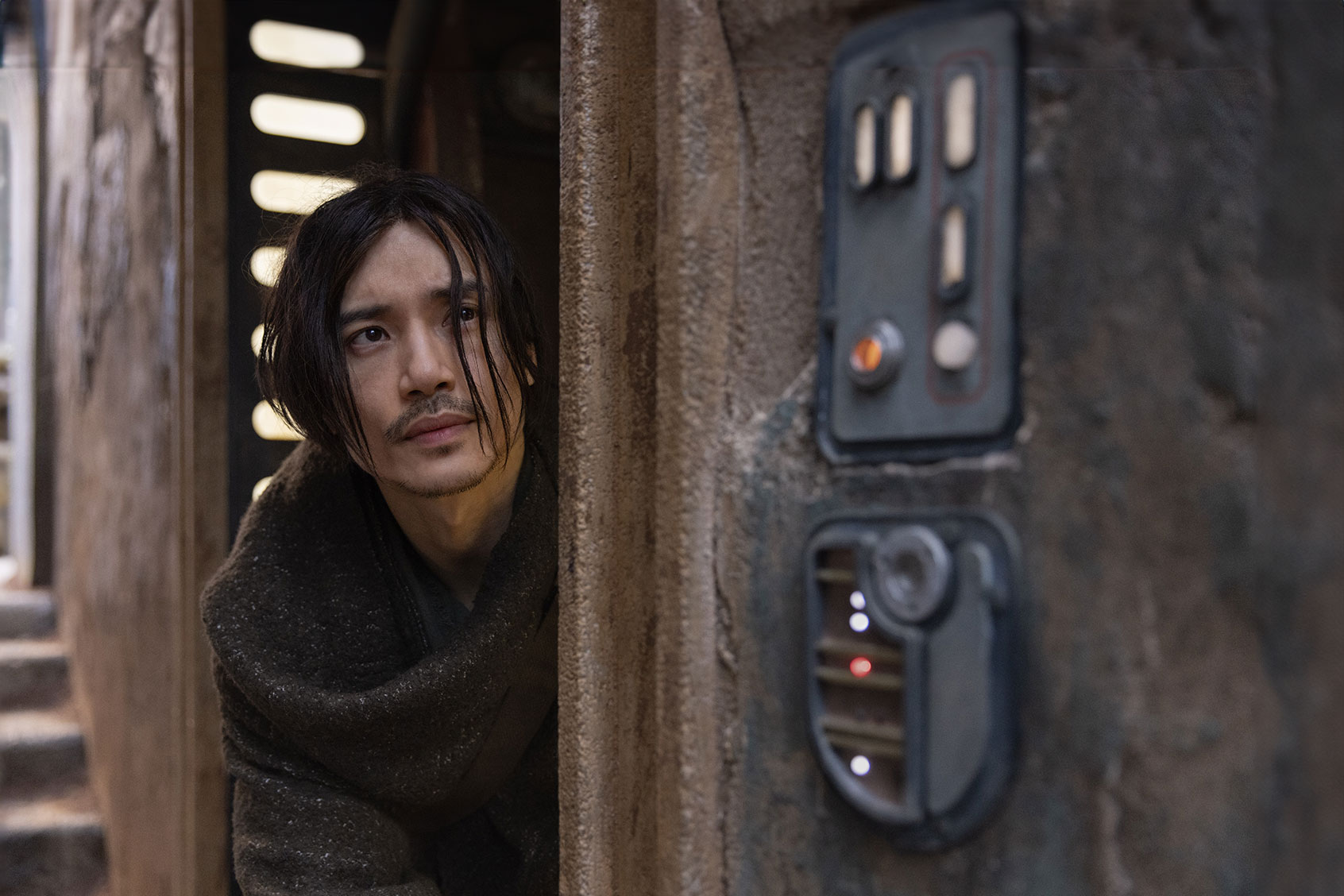
It’s precisely because Qimir is frightening and dark that makes him appealing to women because it implies that he would accept their darkness as well. He’s violent, but he also doesn’t judge Mae when she wants to tap into her darker tendencies, which allows her to be a more well-rounded and relatable character. He later does the same for Osha who, disguised as Mae, can’t help but stare at Qimir with terrified interest when he questions her about killing a Jedi upon their first meeting. 

I'm a loser, baby

The female gaze also favorably depicts the side of Qimir that goes against conventional attractiveness, a characteristic that can only be delicately defined as “loserism.” 

Long before Qimir is revealed to be the Stranger on "The Acolyte," he presents himself as a simple apothecary who’s bumbling along in life and sells shady items for a living. His long side-swept bangs hairstyle is reminiscent of emo individuals in the early aughts of MySpace.com, which contrasts the straight-laced machismo of alpha men whose charm might see them mansplain and talk over women. He’s kind of pathetic-looking in the way quiet guys who sit at the back of the class wearing a hoodie over their heads are pathetic, yet at the same time all the more intriguing for his mystery.

And yet, he can sometimes be approachable. There’s a brief comedic scene when Qimir accidentally falls asleep while waiting for Mae and another moment with a humorous tone where he’s wearing goggles and lightheartedly waves at Osha. But this side of Qimir is still smart and listens to both women when they speak, which leads to Mae employing his help despite slightly distrusting him and Osha finding him scary but interesting. 

Star Wars: The AcolyteManny Jacinto as Qimir in "Star Wars: The Acolyte" (Lucasfilm Ltd.)Loserism is attractive because these people have accepted their seemingly humble identities without seeking external validation, contrasting the typical male hero who might have underlying insecurities that they project onto others. What’s thrilling about Qimir is that it’s unexpected that a galaxy outcast could be so confident and self-assured about his darker and more socially unaccepted traits. 
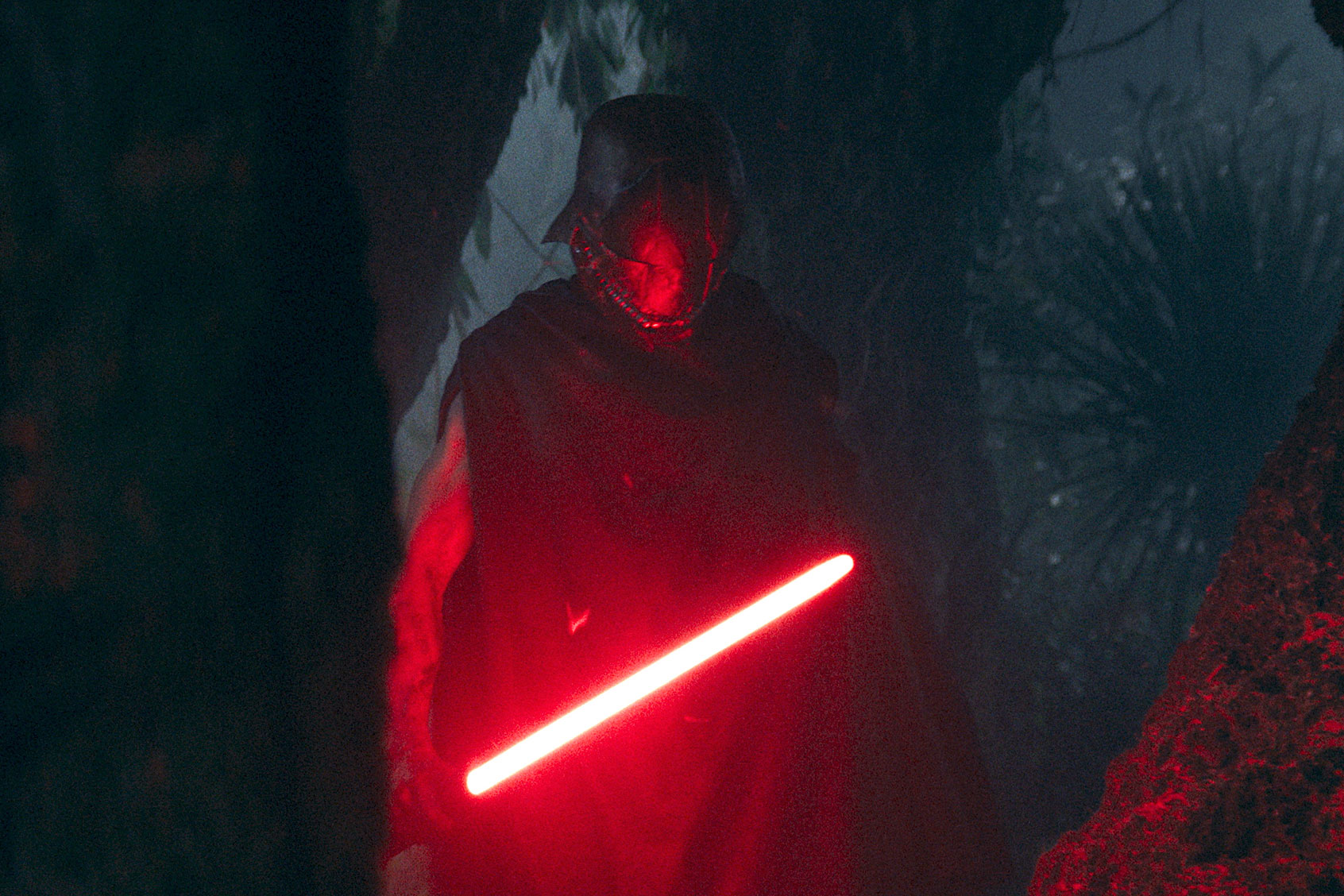
The same loserism can be said about Kylo Ren in the Star Wars sequel trilogy. And in fact, Headland draws a parallel between the two characters when she notes how Kylo Ren's theme plays over the aforementioned Qimir and Osha scene in "The Acolyte."

In "The Last Jedi," when Rey calls Kylo Ren a monster for killing Han Solo (Harrison Ford) in their second Force bonding scene, he responds, “I know,” implying he’s well-aware of his own shortcomings and perhaps guilt-ridden about his choices. When he offers to train Rey not once, but twice, he places himself at her mercy to accept or reject him, which the female gaze depicts as the culminating points of both installments of Rey’s story.

"I’ve accepted my darkness. What have you done with yours?"

While “The Last Jedi” was written and directed by a man, director Rian Johnson always kept the focus of the story on Rey and any scenes she had from her perspective. Kylo Ren not only represented the darker side of Rey’s emotions and temptations, but he also served as a companion who listened to her while she vented about her loneliness. In the hut scene when they touch hands, Kylo Ren is literally washed in soft, warm light as he assures Rey that she isn’t alone. And remember the infamous shirtless scene when Rey connects with Kylo Ren in another Force vision and he turns around in just his high-waisted pants, prompting an immense positive reaction from female fans

That reaction prompted ire from the more conservative side of the fandom, known as The Fandom Menace. These are predominantly male fans of the franchise who don't care for the use of the female gaze that the franchise has undertaken led by Lucasfilm president Kathleen Kennedy but also despise the increased cast diversity, citing it as Disney’s “woke agenda.” Not much has changed since then with the predominantly queer actors of color in “The Acolyte” who also have received online backlash.

Other fans opposing this more female-friendly direction of the Star Wars universe cite the “woobification” of dark side villains like Kylo Ren, whom they claim is “problematic.” They also claim that his actions have been romanticized, which they say is an endorsement of the same behavior in real life, which frankly diminishes the intelligence of the series’ audience and their ability to discern the difference between reality and fiction. 

Kylo Ren is one of the most popular characters from the sequel trilogy. In a stat following the release of “The Rise of Skywalker” in 2019, Kylo Ren was among the Top 10 most searched characters on Google that year, with more than 814,000 average monthly searches. Furthermore, the pairing between Rey and Kylo Ren, known as Reylo, launched an entire subset of modern romantic fiction inspired by them. These facts prove that the female gaze is one of the most marketable tools in the franchise’s arsenal. 


Want a daily wrap-up of all the news and commentary Salon has to offer? Subscribe to our morning newsletter, Crash Course.


The evolution of the dark side's influence

If “The Acolyte” had been told from the male gaze, we’d likely get an in-depth backstory explanation for Qimir and how he came to be the Stranger following his reveal. But don’t expect that with Headland in control. The showrunner stated in an interview with “Entertainment Weekly" that “because it’s Osha’s story, you don’t know much about the Stranger’s background and you’re not really going to learn much about it. But there are a bunch of things in Episode 6 and Episode 8 that are really big clues as to why he is the way he is and why his philosophy is the way that it is.” 

Star Wars: The AcolyteManny Jacinto as The Stranger in "Star Wars: The Acolyte" (Lucasfilm Ltd.)While Jacinto's appearance as the Stranger may be the main draw for some fans, it’s really the way his character is portrayed and how his story is told through the lens of the main female characters that has received the most attention. 

https://x.com/Hissterically/status/1805968540651905359

The impact of the female gaze in “The Acolyte” and on the dark side characters in Star Wars prioritizes the female perspective in a universe dominated by male-centered stories and the embracing of more female fans into this galaxy far, far away, which has long been loudly saturated by male fans. In the original trilogy, Darth Vader is Luke’s villain filtered through the male gaze, representing the father figure that many young men want to please and are also frightened of. Making Rey the main character of the sequel trilogy ushered in a new era for the franchise, welcoming female fans more openly than ever before. Which is why her villain, Kylo Ren, as shown through the female gaze, is moreso her equal and counterpart in the dark side, than a father figure. In both trilogies, Luke and Rey must learn to accept the dark side, rather than push it away or be in fear of it. Similarly, Qimir reflects Mae’s and Osha’s darker thoughts and vengeful spirits, which Mae had given into, and Osha will likely get to experience a taste of it in the next episodes, as teased by being left alone with Qimir at the end of “Night.” 

“I’ve accepted my darkness. What have you done with yours?” Qimir tells Sol during their climatic face-off. It’s a storytelling struggle as old as time. One thing remains true: Judging by the internet’s response, by making the ethos of the dark side as something tempting and also something one must accept to find balance, the female gaze propels “The Acolyte” and elevates the central thesis of the entire Star Wars series: how one must have a balance between the light and dark side of the Force, to its highest potential.

Gazans’ extreme hunger could leave its mark on subsequent generations

As Israel's offensive in Gaza rages on, people across the entire Gaza Strip find themselves in increasingly dire circumstances, with nearly the entire population experiencing high levels of food insecurity, including malnutrition, hunger and starvation. A famine review analysis from the Integrated Food Security Phase Classification reported on June 25, 2024, that "a high risk of Famine persists across the whole Gaza Strip as long as conflict continues and humanitarian access is restricted."

The Conversation asked Hasan Khatib, an expert in genetics and epigenetics, to explain the growing crisis in the Gaza Strip and what history lessons from earlier famines can teach us about the short- and long-term consequences of starvation, malnutrition and food insecurity.


What is food insecurity and how widespread is it in Gaza?

Food insecurity refers to the lack of regular access to safe and nutritious food necessary for normal growth and development and maintaining an active, healthy life. Severe food insecurity is characterized by running out of food and going a day or more without eating, leading to the experience of hunger.

An initiative called the Integrated Food Security Phase Classification, or IPC, managed by United Nations bodies and major relief agencies, was established in 2004 to enhance analysis and decision-making on food security and nutrition.

The IPC classification system identifies five distinct phases of food security:
1. Minimal/none; 2. Stressed; 3. Crisis; 4. Emergency; 5. Catastrophe/famine.

The IPC estimates that 96% of the population in Gaza – 2.15 million people – are experiencing high levels of acute food insecurity, classified as IPC Phase 3 or higher.

Approximately 50% to 60% of buildings throughout Gaza, and over 70% of those in northern Gaza, have been damaged or destroyed, including more than 90% of schools and 84% of health facilities.

Due to the destruction of food production and distribution infrastructure, all households skip meals daily, with adults reducing their portions. The IPC projects that by July 2024, half of the population will be classified as being in a famine, experiencing acute malnutrition or death.

As of June 6, 2024, the World Health Organization reported that 32 patients had died from malnutrition and 73 had been admitted because of severe acute malnutrition in Gaza. Malnutrition can weaken the immune system, increasing the risk of serious illness and death, primarily due to infectious diseases.

And as of the same date, the WHO reported 865,157 cases of acute respiratory infections, 485,315 cases of diarrhea, 57,887 cases of skin rashes and 8,538 cases of chickenpox, all of which can be exacerbated by malnutrition.


How do stress and trauma add to hunger?

Strikes by the Israeli forces across the Gaza Strip have resulted in civilian casualties, the destruction of homes and the displacement of over 1.7 million people since October 2023, including many families who had already been displaced multiple times.

The United Nations Children's Fund estimates that at least 17,000 children have been separated from their parents as of February 2024, and nearly all children in Gaza need mental health and psychological support. Symptoms observed among these children include heightened anxiety levels, loss of appetite, sleep disturbances and panic attacks.

Since Oct. 7, 2023, the United Nations Relief and Works Agency has provided critical psychological support, including psychological first aid, fatigue management sessions and individual and group counseling, to over 650,000 displaced persons, including 400,000 children.

UN Women, an organization focused on gender equality and the empowerment of women, reported that from October 2023 to April 2024, 10,000 Palestinian women in Gaza were killed, resulting in 19,000 children being orphaned. Approximately 50,000 pregnant Palestinian women and 20,000 newborn babies face limited access to health care facilities due to the bombardment of hospitals and health clinics.

In addition, more than 180 women per day are giving birth without pain relief, leading to a 300% increase in miscarriages due to the severe conditions. These dire conditions are causing severe stress and trauma among Palestinian children and women. This combination of stress, trauma and hunger can leave a lasting impact on both the women and their offspring.


What might the consequences be for future generations?

Over the past two decades, extensive research has investigated whether environmental factors such as hunger, stress and trauma can affect future generations that are not directly exposed to them. Pioneering studies of the Dutch famine, which occurred in the Netherlands from 1944 to 1945, found that these types of intergenerational effects were indeed happening.

During the Nazi occupation, food supplies were cut off from the western part of the Netherlands between November 1944 and May 1945, leading to widespread starvation. Decades later, researchers discovered that children and grandchildren of pregnant women exposed to the famine had a higher risk of health problems later in life, including cardiovascular disease, diabetes and other metabolic disorders.

Similarly, the Great Chinese Famine from 1959 to 1961, which resulted in an estimated 15 million to 40 million deaths, is one of the deadliest famines in history. It profoundly affected the physical and mental health, cognition and overall well-being of those exposed to it and their offspring.

Interestingly, our recent research into sheep demonstrated that paternal diet can alter traits such as muscle growth and reproductive characteristics, which can be passed down to two subsequent generations of sheep.

This inheritance of traits is mediated by chemical groups known as epigenetic marks. These epigenetic tags – known as DNA methylation or histone modifications – can originate from external sources, such as diet, or from within our cells. Histones are proteins that help organize and compact the DNA inside our cells.

These changes can control which genes are turned on or off. When exposed to hunger or stress, the epigenetic marks instruct our cells to behave differently, leading to altered traits. Remarkably, some of these epigenetic marks are inherited by offspring, influencing their traits as well.

Stress and trauma have been the focus of extensive research, particularly in understanding how extreme trauma can have biological effects that are transmitted to subsequent generations. Rachel Yehuda, an expert in psychiatry and the neuroscience of trauma, found that experiencing captivity or detention during the Holocaust was linked to elevated levels of epigenetic marks in a gene called FKBP5, which is involved in stress regulation. These epigenetic alterations were also observed in the children of Holocaust survivors.


A Palestinian girl who is a cancer patient with malnutrition speaks of her desire to travel to receive help.


Epigenetic changes can be reversible

Research shows that lifestyle and environmental factors play a significant role in influencing epigenetic marks. So positive changes in these areas can lead to the reversal of some of these epigenetic shifts.

One study showed that stress responses in adult rats that are programmed early in life can be reversed later in life. The researchers supplemented methionine, a methyl group donor that alters DNA methylation, to adult rats and observed that the stress response caused by maternal behavior in early life can be reversed in adult life.

I see an urgent need for the medical and scientific community to investigate the potential long-term impacts of current trauma and hunger on vulnerable populations in Gaza, particularly pregnant women and children. Notably, some of the epigenetic marks responsible for these long-term effects of trauma and hunger are reversible when conditions improve.


Hasan Khatib, Associate Chair and Professor of Genetics and Epigenetics, University of Wisconsin-Madison


This article is republished from The Conversation under a Creative Commons license. Read the original article.

“Entirely wrong”: Experts skeptical of Trump bid to dodge felony convictions after “immunity” ruling

An effort by Donald Trump and his legal team to throw out his recent hush money trial following Monday’s SCOTUS decision is being heavily criticized by legal experts, who are predicting the attempt will fail.

On Monday, Trump’s legal team asked the judge presiding over the case in which Trump was convicted on 34 counts of falsifying business records to throw out his conviction and delay his sentencing, which is scheduled for July 11 in Manhattan. The letter to Judge Juan Merchan cites the Supreme Court granting the former president immunity for “official acts," The New York Times reported.

Manhattan District Attorney Alvin Bragg on Tuesday wrote that he was okay with pushing back the sentencing date to address the issue, even as he dismissed it as being without merit.

In an interview with MSNBC, former Department of Justice attorney Chuck Rosenberg said the former president's attempt to claim immunity was predictable but “entirely wrong.”

"I mean, if you look at the Supreme Court's decision from yesterday … the conduct that underlined in the New York case seems to me to be purely private," he said. "So perhaps Judge Merchan grants them a hearing, but I have a hard time imagining that they would prevail on it."

"This seems to me the type of case that a president ought not be immunized from," Rosenberg concluded.

Other experts agree.

CNN legal analyst Norm Eisen said  in a post on X that the attempt “won’t work.” He pointed out that Trump previously raised claims of immunity in the hush money case when he tried to move the case to federal court, which was denied. Trump argued that the payments in the case were connected to his duties as president; U.S. District Judge Alan Hellerstein rejected the claim. 

"Trump has failed to show that the conduct charged by the Indictment is for or relating to any act performed by or for the President under color of the official acts of a President. Trump also has failed to show that he has a colorable federal defense to the Indictment,” Hellerstein wrote in his July 2023 ruling.

We need your help to stay independent

Trump again tried to claim immunity just three weeks before his trial, a request that Judge Merchant denied and called “untimely.”  

In a last-ditch effort, Trump alos tried to delay the trial based on immunity claims in the First Department of the Appellate Division in Manhattan. Again his request was denied, and Trump abandoned his appeal, Eisen pointed out.

“He’s collaterally estopped,” Eisen concluded, adding that Trump’s actions in this case were “purely personal and political” and had nothing to do with his duties as president, making it unlikely Trump will be granted immunity. 

“In NY the evidence is clear—Trump is absolutely not immune for these personal acts of election interference and false biz records,” Eisen wrote. 

Lawyer and legal commentator Tristan Snell shared a similar conclusion, writing that Trump “will fail” to overturn the conviction in a post on X.  He noted that most of the events Trump is being tried for (with the exception of repayments made to Michael Cohen in 2017) occurred before Trump was even president.

“So repaying your personal lawyer for pornstar hush money is an ‘official act’?” Snell wrote. 

Others poked fun at Trump’s broad interpretation of the SCOTUS ruling, stating it highly unlikely that what he was tried for could be considered an “official act” as president.

“BREAKING: If you were wondering how broadly Donald Trump interprets the immunity just granted to him by a Supreme Court he disproportionately appointed, wonder no more: he now claims the ruling makes *paying off his mistress* an Official Presidential Act,” wrote Seth Abramson, attorney and New York Times-bestselling author, in a post on X.

Rep. Adam Schiff, D-Calif., added: “Trump claims that his prosecution by the Manhattan DA should be delayed because he has immunity for presidential acts. In what world is making hush money payments to a porn star part of the job as president? Trump’s world.”

Clarence Thomas takes a swing at Jack Smith, claiming the special counsel can’t prosecute Trump

After helping grant Donald Trump for just about everything he did as president, Justice Clarence Thomas may also have provided federal Judge Aileen Cannon the excuse she needs to remove special counsel Jack Smith, RawStory reported.

Last month, the former president's legal team and outside right-wing attorneys were granted time by Cannon, a Trump appointee, to argue that Smith's appointment as special counsel was unconstitutional. Smith, a private citizen, was charged by Attorney General Merrick Garland with investigating Trump's mishandling of classified documents.

Thomas, in his opinion on Trump's immunity case, wrote that he agreed with the special counsel's critics.

“If there is no law establishing the office that the Special Counsel occupies, then he cannot proceed with this prosecution,” Thomas wrote, the Washington Post reported. “A private citizen cannot criminally prosecute anyone, let alone a former President.”

Because Smith should not have been appointed, the argument goes, Cannon should dismiss the case against Trump.

Former prosecutor Chuck Rosenberg told MSNBC’s “Morning Joe” that this was a vapid argument. 

"This is an issue that has been litigated many times, and each time, the courts of the United States have determined that special counsels like Jack Smith are constitutionally permitted, that their funding is constitutionally permitted [and] they still are inferior officers to the attorney general of the United States," Rosenberg said.

Record-breaking Category 5 Hurricane Beryl wouldn’t be possible without climate change

In late May, the National Oceanic and Atmospheric Administration, the top hurricane forecasting body in the United States, published a report forecasting the most active hurricane season yet. Now that the season has begun, Hurricane Beryl — the first named hurricane from 2024 — arrived last week, and is already breaking records for its early intensity.

It's the first Category 4 storm to be recorded in the month of June since records first began being kept in 1851. Late Monday night, Beryl strengthened to a Category 5 as its winds increased to 165 mph (270 kph), razing southeast Caribbean islands as it heads toward Jamaica, according to AP News. Experts who spoke with Salon agree on one thing: Hurricane Beryl is powered by global heating driven by burning fossil fuels.

Michael Wehner, a senior scientist in the Computational Research Division at the Lawrence Berkeley National Laboratory, told Salon that the majority of tropical cyclone experts perceive Hurricane Beryl as "a unique, unusual and record-setting storm."

"The unusually warm sea surface temperatures and the developing La Niña conditions play a significant role. Global warming has increased these ocean temperatures adding to the natural variability," Wehner said. "Quantifying the contribution of climate change to the intensity of this storm will require detailed calculations, which will take some time to produce."

"Climate change and, in particular, warming oceans, are fueling ever-more-powerful hurricanes, in the Atlantic and around the world," Dr. Michael E. Mann, a professor of Earth and Environmental Science at the University of Pennsylvania, told Salon. "For each 1°C of warming (which is roughly how much the oceans have warmed) we observe a roughly 12% increase in peak wind speeds, which corresponds to a roughly 40% increase in peak intensity (which is proportional to the third power of the wind speak)."

Adding that this increase is not only detectable "it’s now readily observable," Mann added that this is why "I have endorsed the creation of a new category, Category 6, for the very strongest storms we are now witnessing."

"I have endorsed the creation of a new category, Category 6, for the very strongest storms we are now witnessing."

Scientific data makes it clear that this storm isn't just an anomaly, as these storms would be neither as frequent nor as intense if humans were not overheating our planet by pumping greenhouse gases into the atmosphere.

"We estimate from model simulation studies that for a 2º Celsius global warming scenario, hurricanes in the Atlantic basin will be about 3 percent more intense in terms of surface wind speeds, and about 15 percent more intense in terms of their near-storm rainfall rates," Tom Knutson, a senior scientist from GDFL and NOAA who oversees a website tracking global warming and hurricanes, told Salon.

Although these anthropogenic changes have not yet been clearly detected in observations, "many hurricane metrics have increased in the Atlantic basin observations since the 1970s and '80s — such as rapid intensification, hurricane intensities, number of major hurricanes, and so forth," Knutson said.

It is difficult to isolate the specific influence of greenhouse gas emissions compared to other variables because the different factors have played out over many decades. Despite this limitation, however, the proof is still overwhelming.

"A clear trend and anthopogenic climate change influence has been detected in global sea level and in tropical Atlantic sea surface temperatures; and sea levels over the past century are clearly rising along the U.S. East Coast," Knutson said. "Rising sea levels, all other things equal, will exacerbate coastal flooding from the hurricanes that do occur."

He added, "Future changes in the frequency of Atlantic hurricanes and major hurricanes remain uncertain due to the large range of projections in modeling studies, with some studies suggesting increases and other studies suggesting decreases, for example."


Want more health and science stories in your inbox? Subscribe to Salon's weekly newsletter Lab Notes.


"Rising sea levels, all other things equal, will exacerbate coastal flooding from the hurricanes that do occur."

Dr. Kevin Trenberth, a distinguished scholar at the National Center for Atmospheric Research, further elaborated on how climate change worsens storms like Hurricane Beryl.

"The fuel for a hurricane is the atmospheric moisture: as it condenses it releases latent heat (the heat that went into evaporating the water in the first place)," Trenberth said. "Warmer air can hold more moisture at a rate of about 4% per deg F. The ocean all around is much warmer than normal in part because of climate change and in part because of favorable weather patterns. The later relate to the El Niño over the previous year that focus the main weather action into the Pacific."

We need your help to stay independent

To the extent that scientists are limited in their ability to ascertain the precise extent to which global warming is causing these storms, Knutson explained that it is because monitoring technology has advanced significantly over the past half-century.

"In addition to the confounding effects of natural variability and aerosol driven changes, which make it hard to detect the greenhouse gas-induced warming influence on Atlantic hurricanes, another problem is the changing/improving ability to detect and measure hurricane intensities and annual numbers over time, especially when we try to look at the pre-satellite era before the late 1960s," Knutson said. "This makes it very difficult to explore for century-scale trends due to greenhouse warming influence. An exception is for U.S. landfalling hurricanes or major hurricanes, where the long-term record is more reliable. In that case, there is no clear trend in their number (or the fraction of hurricanes that reach major hurricane intensity) since the 1880s."

As Beryl breaks hurricane records set in 1933 and 2005 — two of the busiest hurricane seasons in modern history — climate experts anticipate that this will be only the first of many super-storms to strike the Western Hemisphere in this summer, not to mention in the future. Our rapidly-heating world is only becoming more ripe for intense hurricanes.

The Intergovernmental Panel on Climate Change Sixth Assessment Report "clearly states that the most intense storms will get more intense," Wehner said. "There is clear evidence since that 2021 report that this is already happening."

Trump’s sentencing on 34 felony counts likely delayed after Supreme Court immunity decision

Former President Donald Trump’s request to delay his July 11 sentencing in the New York hush money trial will likely be granted, Law 360 first reported on Tuesday.

On Monday, Trump’s legal team requested that his conviction in the hush money case be set aside and his sentencing be postponed, following the Supreme Court's "absolute immunity" decision.

In a letter dated Tuesday, Manhattan District Attorney Alvin Bragg wrote that he does not oppose adjourning Trump’s sentencing for at least two weeks.

“Although we believe the defendant’s claim to be without merit, we do not oppose his request for leave to file and his putative request to adjourn sentencing pending determination of his motion,” Bragg wrote. “We respectfully request a deadline of July 24, 2024 — two weeks after the defendant’s requested deadline — to file and serve a response.” 


Carl Bernstein says Biden is “sharp” at meetings but his alarming debate performance “not a one-off”

Journalist Carl Berstein, the former Washington Post reporter who helped reveal the Watergate scandal, said on CNN Monday that sources “very close” to President Joe Biden told him that the Democrat’s debate performance last week is not surprising, claiming that he has appeared similarly low energy more than a dozen times since 2022, The Daily Beast reported.

Bernstein, now a CNN analyst, shared that these concerns with Biden’s age and fitness have shaken the faith of many Biden supporters.

“These are people, several of them who are very close to President Biden, who love him … and they are adamant that what we saw the other night, the Joe Biden we saw, is not a one-off,” Bernstein told CNN. “There have been 15, 20 occasions in the last year and a half when the president has appeared somewhat as he did in that horror show.”

While Berstein didn’t name the concerned parties, he emphasized the importance of their opinions. “What‘s so significant is the people that this is coming from, and also how many people around the president are aware of such incidents, including some reporters, incidentally, who have witnessed some of them,” he said.

Bernstein described a fundraiser just about a year ago, where the president was allegedly standing at podium when he appeared to become “stiff," almost like “as if it were a kind of rigor mortis.” Biden had to be brought a chair, Bernstein said, and he remained seated through the rest of the event.

On the other hand, Berstein added: “I have heard for two years how sharp Joe Biden is during his national security meetings. He has special briefing books on Ukraine, and the situation in Gaza, that go down to very detailed military reports. He has an absolute command of the facts, he’s as sharp as can be.”

The way Berstein explains it, while Biden, 81, has great moments, he also has “inexplicable” ones worth investigating because “we are clearly dealing with two sets of one person,” he told CNN.

Biden’s performance against presumptive Republican nominee Donald Trump has made many Democrats reconsider whether the incumbent should remain on the party's ticket. Meanwhile, Biden and his team, who claimed he had a cold the day of the debate, have been working double time to reassure voters that he can still get the job done.

“Folks, I would not be running again if I did not believe with all of my heart and soul that I can do this job,” Biden told supporters in New York last week after the debate, HuffPost reported.

“All the evidence is about to come out”: Legal experts say SCOTUS ruling could backfire on Trump

The shift from a republic to a rotating tyranny was years in the making but the final blow still managed to shock: A Supreme Court that had just declared it a crime to be poor and homeless ruled that Donald Trump, previously and perhaps soon once again the world’s most powerful man, cannot be prosecuted for anything that a president’s lawyer (or conservative jurist) might spin as an “official act.” Legal experts say the decision effectively legalized executive criminality, ensuring that whoever occupies the White House — at least any Republican — can do as they please with the powers of their office, effectively constrained only by the threat of impeachment, which is hardly any threat at all, or a loss in a free and fair election.

The expansiveness of the decision was indeed not lost on Trump’s attorneys, who immediately sought to overturn their client’s 34 felony convictions in New York — a move dismissed as absurd by many legal experts who may prove to be right but who also, perhaps, have not come to terms with the fact that falsifying business records to cover up a hush-payment to an adult film star ahead of a federal election may now be a core constitutional right.

“The strongest evidence against former President Trump’s claim of immunity is found in the words of the Constitution,” stated the U.S. Court of Appeals for the D.C. Circuit, the court that previously took up the question of “absolute immunity.” Nowhere in the country’s founding document is it ever suggested that the holder of the highest office may have free rein to break the law, so long as as that transgression has so much as a tenuous connection to being president. In fact, as the lower court noted and the Supreme Court ignored, it explicitly states that public officials may be subject to “indictment, trial, judgment and punishment, according to law.”

Despair is not a productive emotion, but there should be no sugar coating the reality that an American president is no longer bound by the laws of this country; not in a meaningful sense, certainly, with any attempt at justice via the courts now likely to be delayed by months if not years of litigation that could always end right back in the hand of a 6-3 reactionary majority.

There is, however, a silver lining — or rather, a consolation prize: When the Supreme Court shredded the rule of law on behalf of a man who tried to overturn democracy, Chief Justice John Roberts and the gang told another judge to figure out whether inciting an insurrection on Jan. 6 to upend an election is part of a president’s official duties.

As The New York Times’ Alan Feuer reported, the Supreme Court’s decision “makes it all but certain” that Trump will not stand trial over his effort to throw out the 2020 vote before voters head to the polls in November; if he wins in 2024, the trial will never come. In the meantime, however, U.S. District Judge Tanya Chutkan can do what Roberts asked and schedule time in court where special counsel Jack Smith could lay out his whole case, complete with testimony from witnesses. She could do so as early as September, resulting in “something extraordinary: a mini-trial of sorts unfolding in the nation’s capital in what could be the homestretch of the presidential campaign.”

We need your help to stay independent

Whatever Chutkan decides is an “official” act is subject to appeal. The Supreme Court already decided that Trump’s pressure on the Department of Justice to fabricate evidence of “voter fraud” is now a president’s right — and that jurors can’t even be informed of the fact that he did it. That doesn’t mean the case is necessarily dead, altogether.

Just as Trump’s New York convictions pertain to acts that had nothing to do with his presidency (while relying, in part, on evidence of a White House meeting that might now be inadmissible), CNN legal analyst Norm Eisen maintains that Trump can still be held accountable for trying to overturn the last vote against him.

“I think a lot of Jack Smith’s 2020 election interference is also going to be able to continue under this new test,” he said Monday, calling Trump’s celebration “premature.” But that’s only if the case survives voters’ next trip to the ballot box. For now, he told Salon, the lower court judge, herself an appointee of former President Barack Obama who previously rejected Trump’s claims of immunity, ought to immediately schedule that “mini trial,” as the ruling “actually calls for fact-finding by Judge Chutkan.”


Want a daily wrap-up of all the news and commentary Salon has to offer? Subscribe to our morning newsletter, Crash Course.


It calls for a lot of it, in fact, as no court has previously had to adjudicate whether a president sending a mob after their vice president to block the certification of an election is subject to the Supreme Court’s newly invented “immunity” doctrine. Former federal prosecutor Barbara McQuade said more than half of Trump’s Jan. 6 case likely “remains prosecutable,” but “it will take us a year in litigation to get there.”

That’s provided that the Supreme Court doesn’t step in again to further “clarify” Trump’s immunity, or that Trump doesn’t take office and order the Department of Justice to prosecute those who sought to prosecute him. The best that anyone can do now is tell the voting public what we already know.

“The Supreme Court ruled that evidence of ‘official acts’ cannot be admitted at a trial on the ‘unofficial acts,’” noted former New York state assistant attorney general Tristan Snell, who helped take down the fraudulent “Trump University.” But that ruling does not bar prosecutors from bringing up all that they’ve uncovered “in the proceeding to determine whether the acts were official,” he observed. “All the evidence is about to come out.”

Evidentiary hearings won’t be justice, which will be sufficiently delayed as to be all but denied thanks to six right-wing justice, half of them appointed by the criminal defendant. But at least we’ll have this: No one, be they Samuel Alito or a swing voter in Wisconsin, will be able to honestly claim that they didn’t know what they were voting for and all that’s at stake in November.

“This is a death squad ruling”: Maddow says SCOTUS immunity ruling goes further than Trump asked for

MSNBC's Rachel Maddow on Monday underscored the gravity of a recent Supreme Court decision that is expected to allow Donald Trump to receive broad immunity from criminal charges for "official acts" taken while in office. The ruling, a 6-3 split along ideological lines, saw Chief Justice John Roberts deliver the majority opinion.

“I really did not expect that they would do this,” said Maddow, a staunch critic of the former president. "Donald Trump and his counsel asked for this 100 percent absolute immunity thing, which was insane. I would say they got 105 percent of what they were asking for.”

"The practical impact of what they have done is to give Trump immunity that even he and his counsel did not ask for," the host added.

Maddow also noted the hypothetical questions posed by Trump's attorney ahead of the ruling, who floated the idea that presidential immunity should cover situations as extreme as a president assassinating a political opponent. 

“This is a death squad ruling,” Maddow argued. “This is a ruling that says that as long as you can construe it as an official or quasi-official act, you can do absolutely anything ― absolutely anything ― and never be held accountable, not only while you are president, but forever.”

“This explicitly immunizes anything the president wants to do through the Justice Department but all but explicitly justifies anything the president wants to do, full stop, to anyone,” Maddow continued. “And that is as serious as it gets.”

https://x.com/MaddowBlog/status/1807923529213522233

This is how Joe Biden can beat Donald Trump like a drum

Compare and contrast. That’s what a political campaign is for; candidates present their vision of where they will take the country, and why you should elect them to do it versus what the other candidate wants to do.

So far, Joe Biden has been running as the candidate who doesn’t lie and tells the truth, who will protect our democracy, and do the things that good Democrats always say they will do – provide health care, protect Social Security and Medicare, support the troops and take care of the vets, and work on the economy so there is equal opportunity for all.

But he’s running against the Donald Trump of 2024, not 2020, or even the soft-focus fascist of 2016. Accusing Trump of lying every time he opens his mouth is stating the obvious, as is accusing him of extremism and racism and all the other terrible isms, including the modern-day fascism of MAGA Republicans.

Listen to what Trump told the 51 million people who listened to or watched the debate last Thursday: “We’re a failing nation right now. We’re a seriously failing nation. What’s taken place in our country, we’re literally an uncivilized country now.”

Compare that to what Joe Biden told his fellow citizens. He did so in a halting, hoarse voice, but his words ring out in a patriotic call to arms and love of country:

We are the most admired country in the world. We’re the United States of America. There’s nothing beyond our capacity. We have the finest military in the history of the world. The finest in the history of the world. No one thinks we’re weak. No one wants to screw around with us. Nobody. The idea that somehow we are this failing country, I never heard a president talk like this before. We – we’re the envy of the world. Name me a single major country’s president who wouldn’t trade places with the United States of America. For all our problems and all our opportunities, we’re the most progressive country in the world in getting things done. We’re the strongest country in the world. We’re a country in the world who keeps our word and everybody trusts us, all of our allies.

Joe Biden should start making ads quoting Donald Trump’s utterly unhinged remarks at his rally in Waco, Texas last year on the anniversary of the FBI siege of the Branch Davidian compound.  Donald Trump had just begun his second run for the presidency, and he wanted Americans to know where he stands.  Joe Biden should make the point that Donald Trump chose that place and that time to tell us how much he hates this country:

“We are a failing nation. We are a nation with the highest inflation rate in 50 years, where banks are collapsing and interest rates are far too high. We are a nation where energy costs have reached their highest level in our history. We are a nation that is consumed by the radical left’s new deal [that] will lead to our destruction.  We are a nation that lost its confidence, willpower, and strength. We are a nation that has lost its way.”

We need your help to stay independent

Here is how Donald Trump sees the greatest and oldest democracy in the history of the world:

We are a nation that is hostile to liberty, freedom, and faith. We are a nation whose economy has collapsed … whose stores are not stocked, whose deliveries are not coming, and whose educational system is at the very bottom of every single list. Large packs of sadistic criminals and thieves are able to systemically rob stores and beat up their customers and workers and leave with armloads of goods with no retribution. Where the authority of our great police has been taken, where their families and pensions have been threatened, and their lives were being destroyed because of the mere mention of the words, ‘law enforcement.’ We are a nation that no longer has a free and fair press. Fake news is all you get, and they are the enemy of the people. We are a nation where free speech is no longer allowed.

Americans love this country. Joe Biden loves this country. Compare and contrast that to Donald Trump and the Republican Party he has remade in his own image. He hates America. He has convinced his MAGA followers to hate this country as much as he does. 

This election is between those who love America and those who are being told every day how and why to hate their own country. People are proud of their hometowns, proud of their families, proud of their schools, proud of their heritage, proud of our history. Pride feels good. Shame doesn’t. Love feels good. Hate doesn’t.

Joe Biden can take this stark contrast between light and dark, between himself and Donald Trump, and he will win the election.

Day two of Donald Trump’s dictatorship

You will obey!

This is the mission statement for authoritarians and autocrats such as aspiring dictator Donald Trump and his MAGA movement. Donald Trump and his agents’ and allies’ revolutionary plans to end American democracy are not secret: they have been publicly announced and are detailed in the Heritage Foundation’s Project 2025, on Trump’s own campaign website as Agenda 47, and throughout the right-wing “news” media disinformation echo chamber. And now blessed by the highest court in the land

These enemies of American democracy would not be so bold if they were not reasonably certain of their success.

In series of recent interviews, MSNBC host and author Rachel Maddow has been trying to warn the American people about the existential danger to their freedom, lives, and safety from Donald Trump, the MAGA movement, and larger neofascist project. As Maddow told CNN’s Oliver Darcey, Trump's threats are no joke: 

I'm worried about the country broadly if we put someone in power who is openly avowing that he plans to build camps to hold millions of people, and to 'root out' what he's described in subhuman terms as his 'enemy from within. Again, history is helpful here. He's not joking when he says this stuff, and we've seen what happens when people take power proclaiming that kind of agenda. I think there's a little bit of head-in-the-sand complacency that Trump only intends to go after individual people he has already singled out. Do you really think he plans to stop at well-known liberals?

Maddow continued:

It also seems pretty clear that some people in politics might think they'll be on the safe side — that they might even benefit from it — if they side with Trump. Ask Mike Pence about how that works out in the end. When Trump invokes the Insurrection Act to deploy the U.S. military against civilians on his first day in office, do you think he then rescinds the order on day two? For that matter, what convinces you that these massive camps he's planning are only for migrants? So, yes, I'm worried about me — but only as much as I'm worried about all of us.

Rachel Maddow is correct. History has repeatedly shown that authoritarian and fascist movements almost always expand the groups of people they target as the enemy or some type of Other. Eventually, these movements target their own supporters in a cycle of escalating violence and suffering, as they finally, as seen in Nazi Germany, consume themselves in destruction. Ultimately, almost all Americans are imperiled by Trumpism and American neofascism.

One of the great failures of the mainstream news media in the Age of Trump (and especially its hope-peddlers, institutionalists, and professional centrists) is treating aspiring dictator Donald Trump and the right-wing’s plan(s) to end multiracial pluralistic democracy as a hypothetical or something imagined and fantastical instead of as a real and present and growing danger.

In their new essay at Slate, Norm Ornstein and Dahlia Lithwick write with uncommon clarity and force about how the news media and the country’s political class have mostly failed in their responsibilities to warn the American people about the imminent dangers and reality of Trumpism and American neofascism:

Americans have a normalcy bias. It leads them to believe anyone who tells them that everything is awesome and that a system is “holding” — even as that system is hanging together by way of dental floss…..And many journalists have a normalcy bias so acute they wouldn’t know how to cover an authoritarian takeover if it meant that one of the two presidential candidates threatened jail for his political opponents—even as he continues to refer to these journalists as “the enemy of the people.” (My emphasis added) It also means that they tend to cover “Trump convicted on 34 felony counts” in terms of “how much would this story make us deviate from covering a normal election?” It turns out that we’re normalizing the abnormal, covering the election as a horse race between democracy and illiberalism without mentioning illiberalism or considering the stakes and the consequences, and repeatedly applying a false equivalence to Trump and Biden…. The signals are flashing red that our fundamental system is in danger. “The system is holding” is not a plan for a knowable future. It never was.

What are the specifics of Project 2025, Agenda 47, and the larger right-wing plot to end American democracy? These plans include removing any checks and balances on Dictator Trump and his regime by purging any members of the bureaucracy who are deemed to be disloyal, i.e. they place the Constitution and the rule of law above personal fealty to Trump and the MAGA movement. The Department of Justice will also be politicized and used to attack the enemies of the Trump regime.

We need your help to stay independent

The Republican Party will basically be made into the country’s official national party. Voting for the Democrats or other political parties that are deemed to be a threat to the MAGA movement will be made prohibitively difficult through voter intimidation, nullification and purges. White Christianity will be made into America’s official state religion. The civil rights of Black and brown people, the LGBTQ community, and women will be severely curtailed. Women will have their reproductive rights and freedoms taken away. There will be mass deportations and concentration camps targeting non-white migrants and refugees. Homeless people and other “undesirables” will also be imprisoned in these camps. As promised, Trump and his forces will target the human “vermin” who are polluting the “blood” of the nation, including but not be limited to non-whites, Muslims, Jews, and disabled people.

The United States military will be ordered to occupy Democrat-led cities and other “blue” parts of the country to combat "crime." There will be a national “patriotic” education program where dissent and intellectual freedom and otherwise challenging “conservative”/neo-fascist orthodoxy and dogma will not be allowed. High-quality public education will be ended and replaced with indoctrination programs to create compliant subjects who lack the intellectual training to be critical thinkers and responsible citizens in a real democracy. Universities and colleges will be targeted with censorship, lawsuits and other efforts to defund and close them down – as well as to threaten and intimidate faculty and administrators – if they do not sufficiently support the Trump regime and the larger right-wing reactionary and revolutionary project.

Freedom of the press and freedom of speech will be severely limited. President Biden and other leading Democrats, Republicans deemed to be disloyal, and any other individuals and groups who are targeted as the enemy will face the possibility of being put in prison for “treason” and then being executed. Donald Trump and his propagandists and other agents and allies have repeatedly made such explicit threats and promises of “revenge” and “retribution”. As part of that project, Trump will pardon the January 6 terrorists (a group he describes as “soldiers” and “heroes”) and other violent right-wing extremists who will then become his personal brownshirts.

Donald Trump will personally exercise control over the United States economy by making himself the de facto head of the Federal Reserve board. Trump, like other autocrats and authoritarians, will use federal tax policy and other laws to reward his business allies. In turn, these business interests will give Trump and his family and other designated recipients vast sums of money. Trump’s first term in office was but a preview of the vast corruption that will take place when/if he takes power in 2025. To that point, at a fundraising event, the former president recently told fossil fuel industry executives to give him one billion dollars. In return, they will be permitted to pollute and ruin the world.

There are prominent voices among the news media and political class (and general public) who will push back that this is all “hysterical”, “doomsaying”, and that “the institutions” and “the rule of law” will stop aspiring dictator Donald Trump and Project 2025 and his Agenda 47 and the other plans to end the country’s democracy. Plus, Trump could not implement his desire to become a dictator during his first regime because he is “stupid” and “disorganized” and his Jan. 6 coup failed, and he is now a convicted felon which all means that the “guardrails held”. And of course, there is this talking point: the American people are basically good! Donald Trump is a bad man! The American people will get it right because they always do in the end!

Such responses and denials are so much hopium happy pill balderdash and immature thinking that are at odds with reality as it actually exists.

The following new interview in Rolling Stone with Trump MAGA operatives should sober up such voices – it will not.

“OF COURSE WE aren’t fu**ing bluffing.” That’s the message one close Trump adviser and former administration official — who requested anonymity to speak candidly — wants to get across to the press and public, when asked about Donald Trump’s 2024 campaign vows of “retribution,” unprecedented force, and militaristic action.

Indeed, this sentiment is shared widely among the upper echelon of Trumpland and the MAGAfied Republican Party, with various officials and conservatives with a direct line to the former president insisting that so-called “moderates” or alleged “establishment” types will be tamed or purged, if Trump retakes power next year.

Rolling Stone spoke with a dozen sources who are playing roles in Trump’s “government-in-waiting” or are in regular contact with the ex-president, including GOP lawmakers, Trump advisers, MAGA policy wonks, conservative attorneys, and former and current Trump aides. They universally stress that the former (and perhaps future) U.S. president and top allies are serious about following through on his extreme campaign pledges. These promises run the gamut from siccing active duty military units on not just American cities but also Mexican territory, all the way to prosecuting and potentially imprisoning Trump foes.


Want a daily wrap-up of all the news and commentary Salon has to offer? Subscribe to our morning newsletter, Crash Course.


Rolling Stone continues, "Yes, we do really want to burn it all down,” says another Republican close to Trump, referring to the so-called GOP “establishment” remnants who may wish to shackle Trump’s hard-right impulses. When asked about potential court challenges in a Trump second term, this source simply replies: 'Who cares?”'

Are you afraid? You should be.

Where is the massive public resistance to aspiring Dictator Donald Trump and the other neofascist forces and enemies of American democracy and freedom? As compared to how Europeans are responding to ascendant neofascism in their own respective countries, the mobilization (or lack thereof) by the American people can reasonably be described as pitiful. On this William Bunch writes at the Philadelphia Inquirer:

With far-right populist movements and strongman leaders on the rise across the globe in 2024, France’s marchers aren’t unique in fighting back. Earlier this year in Germany, large crowds took to the streets to voice their opposition to their country’s up-and-coming ultraright movement, Alternative for Germany (AfD). For many critics in Germany, AfD — with 16% of the vote in recent elections for the European Parliament — carries dangerous echoes of Adolf Hitler’s Nazi Party, which plunged their country into World War II and executed the Holocaust against Jews.

The first part of this story should sound familiar to U.S. voters. Donald Trump’s Republican Party is running in November on a mass deportation proposal that would round up a million or more immigrants in the dead of night and ship them to large, sweltering detention camps on the southern border. Trump’s anti-immigrant plan — a first cousin to the extreme nativism of France’s RN or Germany’s AfD — is just one chapter in a 900-page blueprint for an American dictatorship called Project 2025 that would guide a second Trump administration.

So … where are the protesters?

An anti-democracy comet is heading straight for Washington, D.C., in four-and-a-half months, and in a chilling case of life imitating art, we are living large in the United States of Denial (where, as I write this, the story at the top right of the New York Times home page is about a U.S. couple’s struggle to find a Rome apartment on their $950,000 budget).

The insanity of doing the same thing over and over — begging millions of utterly tuned-out voters to like the (undeservedly, in my opinion) unpopular President Joe Biden and expecting a different result on Nov. 5 — isn’t working. With the American Experiment on the line, the political slogan of 2024 is “Don’t Look Up!”

What’s weird is that it’s not that America doesn’t have a tradition of political protest.

Bunch continues:

So, here’s a crazy idea — what about protesting and, more importantly, organizing before the wrong guy wins? That’s not the American way, I know, but I think the distinctive crisis in 2024 makes a case for changing things up, and maybe taking some inspiration from our friends in Europe. Just like over there, Trump’s MAGA movement — from the mass deportation scheme to plans to call up troops with the Insurrection Act to the candidate’s alarming echoes of Hitler — is a threat like we’ve never seen before. But also comparable is that — much like France’s Emmanuel Macron or Germany’s Olaf Scholz — our traditional neoliberal leader in Biden is neither popular nor inspirational.

There is perhaps a glimmer of hope. The New York Times recently reported on plans being developed and implemented by pro-democracy activists and organizations across the country to resist Dictator Trump and his regime’s agenda.

But such plans will be limited in their success if pro-democracy Americans do not organize and mobilize by the tens of millions, instead of surrendering through tacit consent and learned helplessness and exhaustion or alternatively waiting for the elites and their other leaders and influentials to save them.

[Here is a spoiler: the elites will not save you].

The American people would be wise to prepare for the worst and hope for the best. At this point, given the early 2024 polls, fundraising, and other measures – most notably the enduring if not growing popularity of convicted felon and aspiring dictator Donald Trump, the worst is the far more likely outcome. Given the obvious and growing danger, the American people cannot say that they were surprised or not told what awaits them and their democracy if Dictator Trump and his regime take power. They chose to sleepwalk eyes open into a disaster.

The Supreme Court rules that Donald Trump can be a dictator

If Donald Trump commits a crime in office, writes Justice Sonia Sotomayor in her dissent for Trump v. United States, "he now will be insulated from criminal prosecution. Orders the Navy’s Seal Team 6 to assassinate a political rival? Immune. Organizes a military coup to hold onto power? Immune. Takes a bribe in exchange for a pardon? Immune. Immune, immune, immune."

In conclusion, Sotomayor writes in the final decision of the Supreme Court's term, "Because our Constitution does not shield a former President from answering for criminal and treasonous acts, I dissent." 


The guiding principle of whether a criminal act is "immune" will likely depend on whether the president is a Republican or a Democrat.

Most of the media coverage of Monday's Supreme Court decision was focused on the impact it could have on the felony charges against the former president for planning and attempting a coup in 2020, which led to the insurrection of January 6, 2021. The news on that front is bad. As legal analysts quickly detailed, the six Republican justices shot down many of the charges special prosecutor Jack Smith included in his indictment, and even more broadly eliminated most of the evidence Smith could otherwise bring to court. Even if the case somehow survives, figuring out how to try it now will eat up so much time there's no chance of a trial before the election in November. 

In itself, that would be bad enough. It is yet another reminder that this Supreme Court is a lawless entity whose only legal guideline is "What's good for the Republican Party and their political goals?" But, by helping Trump's presidential campaign, the six Federalist Society-linked justices went a step further, setting up Trump to return to the White House as a dictator instead of a president. For, as Sotomayor writes, "the President is now a king above the law."


Want more Amanda Marcotte on politics? Subscribe to her newsletter Standing Room Only.


A Republican president anyway. For all the people who are semi-joking that President Joe Biden now has a legal right to have the military assassinate Trump, Chief Justice John Roberts gave himself an out. Roberts insists that the president "is not above the law." It can still be a crime if the court determines that the behavior falls outside of "his official acts." But what makes something an official act? Well, that's a little hazy, you see. As Los Angeles Times legal analyst Harry Litman noted on Twitter, the "test" appears to be whether a prosecution presents a serious "threat of intrusion on the authority and functions of the Executive Branch." 

With the nakedly partisan tilt of this court, it's not hard to see what would distinguish a legitimate vs. illegitimate intrusion on a president's authority: his political party.

Biden orders a hit on a political enemy? That's outrageous and therefore cannot be "official." Trump orders a political assassination? Well, he must have had a good reason! As liberal Justice Ketanji Brown Jackson wrote in her dissent, "The official-versus-unofficial act distinction also seems both arbitrary and irrational."

If that sounds hyperbolic, the context shows it is not. Last week, the conservative justices ruled that their opinions of scientific fact should overrule those of legitimate scientific or medical experts hired to work in federal agencies. But what makes something a "fact" in the eyes of the Republican justices was not evidence, but whether or not it fits their pre-existing policy preferences. For instance, in a related case overturning an environment regulation, Justice Neil Gorsuch repeatedly referenced in his decision "nitrous oxide," which is laughing gas, instead of "nitrogen oxide," the toxic emission that causes smog. Now something as concrete as the chemical composition of air pollutants can be legally redefined according to the wishes of a right-wing Supreme Court justice.

There is little hope for a fair or objective measure of what counts as an "official" or "unofficial" executive action. Republicans already speak and act generally as if a president can only be legitimate if he's a member of their party. As Jamelle Bouie wrote in the New York Times on the eve of January 6, Republicans have embraced the view "that a Democrat has no right to hold power." Whatever pretzel logic the Republican justices employ, the guiding principle of whether a criminal act is "immune" will likely depend on whether the president is a Republican or a Democrat. 

It's clear reading this tortured decision by Roberts that he wanted to shield Trump from criminal liability while maintaining the pretense that this is anything but a Republican power grab. The problem is that Trump's crimes are so sprawling and the evidence of his guilt is so overwhelming that a more limited definition of "immunity" that would protect Trump from prosecution wasn't possible. The only way to make the shield big enough to cover every bit of Trump's criminal exposure was to declare "immunity" for every evil thing a president might want to do. 

But, as this decision shows, there was also no way to spare Trump from all the consequences of his past crimes without creating an all-encompassing invitation for all future crimes Trump would wish to commit, at least if he's in the White House. That Trump will go hog wild with such permission is beyond dispute. Trump commits crimes with the frequency most of us bring to tasks like eating meals or using the restroom. Trump has already indicated he plans to be a dictator on "day one." His policy arm, Project 2025, has laid out a blueprint for such a dictatorship, including plans to order the military to shut down peaceful protests, the creation of concentration camps for migrants, and the mass firing of any bureaucrats who refuse Trump's illegal orders. Many of these plans involve committing acts that, prior to this decision, could be prosecuted as crimes. No longer.

Indeed, if Trump makes good on his hints he'll stay past his second term, this could make that president-for-life dream a reality. Another coup would require committing more crimes, but now the Supreme Court said that it's fine for Trump to do that, as long as he does it "officially." 

“No real clarity”: Supreme Court emergency abortion decision leaving Idaho physicians in the dark

Last week, the Supreme Court dismissed a case brought forth by Idaho that challenged doctors' ability to provide emergency abortions to stabilize a patient’s health and life. As a result, for now, Idaho’s near-total abortion ban does not take precedence over a federal law known as the Emergency Medical Treatment and Labor Act (EMTALA), which is a welcome relief for many doctors on the frontlines. 

“EMTALA, as we previously understood it, is now fully functional in Idaho, so we can provide stabilizing, emergency care to pregnant women if that requires an abortion,” Kara Cadwallader, who is a family medicine physician in Idaho, told Salon in a phone interview. “That was the good news, because it's been pretty awful not having that protection in place.” 

But Cadwallader said, what many others have echoed since the decision, that it would have been better if SCOTUS ruled that EMTALA protects everyone. As far as how long, and if, EMTALA will protect pregnant women in Idaho remains unclear — and there are still many scenarios in which doctors feel as if their hands are tied. 

As Salon has previously reported, Idaho has one of the strictest abortion laws in the nation where abortions are nearly entirely banned except in cases of documented rape or incest, or to prevent the mother's death. Physicians in Idaho have previously told Salon that they live in constant fear that they will have to deny a pregnant patient stabilizing care, since the line of “life-saving” care isn’t always entirely clear in an emergency setting. Patients have regularly been airlifted from Idaho hospitals to other states.

"At some point, probably after the election, the Court will hear this issue again."

If health-stabilizing care required an abortion, doctors could face two to five years in prison and lose their medical license. In light of the ruling, for now, health and life saving abortions are technically protected under EMTALA since the appeal from Idaho was dismissed as "improvidently granted,” returning it to the lower courts for further litigation. But many view the move as a delay. 

“The ruling was grounded in the procedure that governed how the case came before the Court and they decided not to decide at this time and just returned the case to the lower courts,” Azaleea Carlea, legal director at Legal Momentum told Salon in a phone interview. “Which means that at some point, probably after the election, the Court will hear this issue again.” 

After Roe v. Wade was overturned by the Supreme Court, the U.S. Department of Health and Human Services stated EMTALA took priority over state laws. Under EMTALA, hospitals and emergency rooms were required to provide emergency abortions even where there were strict abortions laws — like Idaho and Texas. The Biden Administration even sued Idaho, claiming that the state's near-total ban was in direct conflict with the federal EMTALA law. But the state claimed that there wasn’t a conflict because technically it has a life-saving exception. Then in January, the Fifth Circuit Court of Appeals in Texas ruled that emergency rooms aren't required to perform life-saving abortions under EMTALA, which then escalated the case to the Supreme Court.


Want more health and science stories in your inbox? Subscribe to Salon's weekly newsletter Lab Notes.


As Cadwallader said, providers in the state on the frontlines see last week’s decision as welcome relief, but don’t believe the decision provides the much-needed reassurance they hoped could have come out of this decision.  

“This decision to put the case back down to the lower courts does provide some welcome immediate relief for women and their doctors in Idaho,” Susie Keller, CEO of Idaho Medical Association, said at a press conference following the ruling. “But given how much uncertainty there still is in Idaho law, there's still much more work to do to provide that necessary clarity and certainty around protecting the health of pregnant women and to keep physicians practicing in Idaho.” 

One major point of criticism is that the Supreme Court failed to make it clear that EMTALA pre-empts abortion bans like those in Idaho. Carlea said in the opinion of Legal Momentum, the highest court’s decision leaves “a level of chaos and confusion across Idaho and, frankly, across the country.”

The highest court’s decision leaves "a level of chaos and confusion across Idaho and, frankly, across the country."

A definitive decision from the Supreme Court could have made an impact outside of Idaho, too. As Justice Ketanji Brown Jackson wrote in her dissent, the Court “had a chance to bring clarity and certainty to this tragic situation.” “And for as long as we refuse to declare what the law requires, pregnant patients in Idaho, Texas, and elsewhere will be paying the price,” she wrote.

On the ground, doctors are left with a lack of clarity in real-life situations as well. 

“There is no real clarity here, patients and doctors are still in this quandary, in this very nebulous place of as a patient, am I going to receive the necessary medical-emergency treatment that I need?” Carlea said. “It is still not clear, it is still very murky and that's just going to result in more suffering and more discrimination against pregnant patients.” 

In a press conference, Dr. Duncan Harmon, a maternal-fetal medicine specialist at St. Luke’s Health System in Idaho, said there are still many scenarios in which EMTALA might not provide protections for physicians to provide health-saving abortions.

“They have a pregnancy-related condition, which evidence-based medical care would be discussing termination of pregnancy, and those are patients, and we as clinicians must explain to them that even in the lifting of the stay, we cannot provide them evidence-based care in the state,” Harmon said. “And that's where the potential fear in as a clinician exists of criminal prosecution or losing the medical license.”

Cadwallader elaborated and said many pregnancy complications don’t come through the emergency room door as instantly life or health-threatening. 

“Ideally, we would like to treat those before they have severe threats to their health or even their life, we're afraid that if the care we provide causes an abortion and the patient isn't at high-risk for her health or life, then you know we're still facing a jail sentence,” Cadwallader said. “And a lot of the care that is essential to provide comes in that under that category.” 

Cadwallader gave Salon an example of a pregnant patient who has an intrauterine device (IUD). That hypothetical patient would be at high risk for an infection, but taking the IUD out could disrupt the pregnancy.

We need your help to stay independent

“Even if you know she's trying to continue the pregnancy, that could be perceived as causing an abortion, and that would put me at risk for criminal penalties,” Cadwallader said. “Even though we have some security around severe pregnancy complications, the vast majority of them we don't have any clarity.”

Still, physicians are facing the same dilemma as before. 

“You have to err on the side of anything that might cause an abortion in that setting, is we're looking at our career versus going to jail,” Cadwallader said. 

Cadwallader added that issues like OBGYNs leaving the state and patients being airlifted to out-of-state hospitals will remain. 

“I think we're going to see the transfers continue to happen,” she said. “I think we're going to continue to lose OBGYNs and other doctors in our state.”

Killswitch engage: Tumor-bursting nanorobots triggered by acid-sensitive origami switch

Scientists at the Karolinska Institute in Sweden announced in a paper on Monday that they have developed nanorobots which kill cancer cells using a specialized trigger. The technology, first tested in mice, holds promise to one day provide treatment in humans.

Nanorobots are microscopic machines used to perform tasks too minute or delicate for larger devices and can be more precise and effective than certain drugs or other cancer therapies. The Karolinska Institute's researchers developed nanostructures called an origami switch using DNA as its building material. These structures include six peptides (amino acid chains) assembled in the same shape as a hexagon just 10 nanometers in diameter. They act on receptors that line the membranes of all our cells called death receptors, so called because when they are set off, they cause cells to die. Cells that keep growing and don't die are what we call tumors.

By hiding the death receptors within the nanorobot, the scientists were able to program it so that the death receptors are only activated when exposed to cancer cells. In the experiment, this reduced tumor growth by 70%.

"This hexagonal nanopattern of peptides becomes a lethal weapon," study co-author Professor Björn Högberg at the Department of Medical Biochemistry and Biophysics, Karolinska Institutet said in a statement. "If you were to administer it as a drug, it would indiscriminately start killing cells in the body, which would not be good. To get around this problem, we have hidden the weapon inside a nanostructure built from DNA."

The trigger gets pulled when the nanobots encounter a more acidic environment, typical of tumors. Although this research was in mice, they were xenografted with human breast cancer cells. This helps demonstrate that these machines can theoretically work to address human cancers, nonetheless, there are still more many additional research steps needed before it hits the market.

"We now need to investigate whether this works in more advanced cancer models that more closely resemble the real human disease," study first author Yang Wang said in a statement. "We also need to find out what side effects the method has before it can be tested on humans."

John Roberts’ Supreme Court would have let Richard Nixon off the hook

Wherever Richard Nixon is today, I have no doubt he is smiling up at the Supreme Court. Just short of fifty years after he resigned from the White House, the nation’s highest court has come around to Nixon’s view that if the president does something it is by definition “not illegal.”

In May 1977 Nixon articulated this view during an interview conducted by the British journalist David Frost. Talking about the shady things Nixon had done to quash anti-Vietnam War protests and to covertly surveil activists, Frost asked Nixon, “What you are saying is there are certain situations… where the president can decide that it’s in the best interest of the nation or something and do something illegal?”

With a gentle tilt of his head, Nixon responded, “When the president does it, that means it’s not illegal.”

Nixon’s brazen assertion that the president is above the law, or rather that presidential action defines what is or is not law, has long been regarded as an outlier in American history. But no more. 

Monday’s Supreme Court’s decision on the immunity claim brought by former Pres. Donald Trump in the hope of shielding himself from criminal prosecution is nothing short of stunning. It signals that Nixon was something of a prophet and that his outlier view is now the law of the land. 

Not only is the result stunning, so is the reasoning that produced it.

If anyone wades through its dense legal prose, Chief Justice Roberts’ majority opinion, written to express the view of the six conservative justices on the court, they should come away alarmed at the lengths to which those justices were willing to go to protect the twice impeached and now convicted felon who once sat in the Oval Office

A Court supposedly dedicated to “originalism” offers only history lite. A Court that denigrates balancing tests embraced them to help Trump. At the same time, it almost entirely ignored some of the interests that needed to be balanced. 

And there’s more. 

The Court articulated a view of presidential power that guts our system of checks and balances. Roberts’s opinion was entirely focused on the remote possibility that criminal liability might get in the way of an energetic and expansive use of that power. It largely ignores the context that brought this case before it. Given what happened during the oral argument, when the conservative majority piled one far-fetched scenario on another, we should not have been surprised that this court ignored the reality before it.

Instead of focusing on what Trump did and the threat that it posed to the survival of our constitutional republic, Roberts let his imagination free and conjured every possible hypothetical impediment that a president subject to the criminal law might encounter. 

The Supreme Court’s decision means that a president who is obligated to ensure that the law is faithfully executed need not be bound by the very laws that he is duty-bound to enforce. So long as the president is discharging their official responsibilities they are, from this point forward, freed from the obligation to obey the criminal law. 

And, if that were not enough, Roberts made sure that Trump would not be brought to the bar of justice before the election. In place after place in his opinion he refers to the complexity of the findings that now will have to be made by courts where Trump is scheduled to be tried Roberts’s opinion sets up a lawyer’s paradise, ensuring months and years of litigation in the Trump cases. 

And, if Nixon is smiling, Alexander Hamilton and those with whom he worked to craft the Constitution are rolling over in their graves. Their desire to set up a government in which powers would be limited so that they would not be abused suffered a grave setback at the hands of the Roberts court.

The president, Roberts wrote, “occupies a unique position in the Constitutional scheme.” Then, misreading the design and purpose of the Constitution itself, he argues that the Framers “sought to encourage energetic, vigorous, decisive and speedy execution of the laws’ by placing in the hands of a single, constitutionally indispensable individual the ultimate authority that, in many in respect to the other branches, the Constitution divides among many.”

We need your help to stay independent

The Chief Justice claims that there “‘exists the greatest public interest’ in providing the president with ‘the maximum ability to deal fearlessly and impartially with the duties of his office…. (T)he nature of presidential power,” Roberts explains, “requires that a former president have some immunity from criminal prosecution for official acts during his tenure in office. At least with respect to the president’s exercise of his core constitutional powers, this immunity must be absolute.” 

That immunity would ensure that “when the president exercised… authority, he may act even when the measures he takes are ‘incompatible with the expressed or implied will of the Congress’…. And the courts have ‘no power to control the president’s discretion when the acts pursuant to the powers vested exclusively in him by the Constitution.’”  

Justice Ketanji Brown Jackson used her dissent to point out exactly what that kind of immunity means. “Put simply,” she said, “immunity is ‘exemption’ from the duties and liabilities imposed by law…. In its purest form, the concept of immunity boils down to a maxim—' the King can do no wrong’— a notion that was firmly ‘rejected at the birth of our republic.’”

Surely Roberts and his conservative brethren understand the meaning of immunity. That is why it seems disingenuous for Roberts to insist that the Court’s decision does not mean that the president is above the law. 

Or maybe Roberts means that the Constitution authorizes the president to do whatever he sees fit in the exercise of his official duties, even if that means violating the law and committing crimes. 

Recall what Trump said about the nature of presidential power. In his view, Article II of the Constitution means, as the former president put it, “I have the right to do whatever I want as president.”

Let’s think for a minute about what Trump might do if he is returned to the Oval Office. One of the things that he has talked openly about is weaponizing the Department of Justice and prosecuting his political opponents, including the current president, Joe Biden.


Want a daily wrap-up of all the news and commentary Salon has to offer? Subscribe to our morning newsletter, Crash Course.


I couldn’t help but think about that as I read the examples that Roberts gives of the “core powers” of the president, where the president’s immunity will henceforth be absolute.

On page 19 of his opinion, he points out that Jack Smith’s indictment of Trump contains allegations regarding his effort to get the Justice Department to intervene and support his effort to overturn the results of the election he lost four years ago. Those allegations “plainly implicate Trump’s ‘conclusive and preclusive’ authority. ‘[I] investigation and prosecution of crimes is a quintessentially executive function.’”

Then, as if to drive the point home and please the former president, Roberts states that the president has “‘exclusive authority and absolute discretion’ to decide which crimes to investigate and prosecute… “ Trump is therefore “absolutely immune from prosecution” for his effort to get the Justice Department to help in his scheme to stay in office.

Imagine that Trump is returned to the White House eager to launch vindictive or selective prosecutions of journalists, prosecutors who indicted him, judges who presided over his trials, and Biden administration officials. He is now emboldened by a Supreme Court decision that says he would be absolutely immune even if he violated the law in launching them.

Justice Sonia Sotomayor aptly describes the world that Roberts has created. “A president’s use of any official power for any purpose, even the most corrupt, is immune from prosecution.” And as she notes, “The Constitution’s text contains no provision for immunity from criminal prosecution for former presidents.”

Even Hamilton, ever the advocate of energy in the executive, knew the difference between the British King and the kind of American president whose authority he sought to defend. As Sotomayor notes, Hamilton hoped that while the power of the king was “sacred and inviolable,” the “’ president of the United States… Would be amenable to personal punishment in disgrace.’”

She is right to say that Roberts’s opinion shows that “history matters to this court only when it is convenient” and criticize the court for ignoring the public interest in having a president bound to follow the law.

So, where are we left? If we needed more proof, the immunity decision is a reminder that while the Supreme Court may be able to resurrect Richard Nixon, it will not save the Republic. That task is up to all of us. 

Maybe, just maybe, the Court’s decision will remind the voters of why it is important not to let the now-expanded powers of the president fall into the hands of someone who has already announced his intention to be a dictator on day one.