Spring Sale: Get 1 Year, Save 58%

Marco Rubio’s hunt for “anti-Christian bias” is creeping theocracy

Secretary of State Marco Rubio always looks like a whipped dog when he's out in public, especially around his boss Donald Trump, leading many observers to assume he's a reluctant participant in the authoritarian agenda of the White House. Before going full MAGA, Rubio had fashioned himself an opponent of the autocratic oppression Trump embraces. He even used to pretend his family had emigrated from Cuba to flee the dictatorship of Fidel Castro, finding refuge in the United States, where they were "welcomed by the most compassionate people on all the Earth." A lovely story but untrue, as Rubio's parents left before Castro's rise to power. Still, the anecdote leads some to believe that Rubio knows his complicity with Trump's fascist designs is wrong. 

Whatever is in his heart, though, there can be no denying that Rubio is pushing some of the most aggressive policies attacking First Amendment protections for free speech and freedom of religion. Last week, the Associated Press revealed a memo signed by Rubio declaring the power to deport legal immigrants for "beliefs, statements, or associations that are otherwise lawful." Rubio has supported the arrest of legal residents for exercising their right to free speech and has been busy revoking the visas of hundreds of international students who have committed no crime other than disagreeing with Trump's political opinions. One student wasn't even targeted for political reasons, but she does research in biology, a field that the Trump administration looks at with hostility. 

State Department employees are now learning what it's like to live under Rubio's total rejection of the American compassion and freedom he once claimed to admire. Last week, Politico reported that Rubio sent a cable to all State employees, asking them to report on colleagues accused of "anti-Christian bias." Even on its face, this order makes no sense. There is no meaningful anti-Christian bias in the U.S. More than 60% of Americans identify Christians, and most of the remainder are culturally Christian. The total proportion of people in America who subscribe to non-Christian faiths — Judaism, Islam, Hinduism, Buddhism, etc. — is around 7 percent. Some Christians may not like having their beliefs questioned by atheists, but not only is that core freedom of speech, it's far less offensive than Christians asserting that atheists are going to hell. The actual instances of anti-Christian "bias" are so non-existent that Christian right propagandists have to make up stories to get their base riled up.  


Want more Amanda Marcotte on politics? Subscribe to her newsletter Standing Room Only.


Unsurprisingly, a deeper read of the cable shows that "anti-Christian bias" is the cover story propped up to justify Rubio's actual assault on freedom of religion at State. He's giving Christian nationalists at the agency a tool to harass and even purge people who don't share their far-right beliefs. The definitions of "anti-Christian bias" throughout add up to outrage that conservative Christians are expected to treat people who believe differently with fairness and decency. 

For instance, the memo asks for reports of "mistreatment for opposing displays of flags, banners or other paraphernalia," specifically during Joe Biden's administration. It doesn't take a doctorate in bureaucratese to interpret this. Rubio is seeking stories where conservative Christians were told to mind their own business after objecting to a colleague putting up a Pride flag, a Black Lives Matter sign or perhaps a religious knickknack from a non-Christian faith. This might be more comprehensible if, say, any Christians had being told they couldn't wear a cross or have a picture of Jesus on their desk. Instead, what Rubio is suggesting is that Christians have a prevent other people from having the freedom to express views and positions they dislike — and that it amounts to "bias" if they can't control what others do or say. 

Also defined as "anti-Christian bias" is alleged mistreatment for "opposing official media content due to religious objections." Under Biden, the State Department flew the Pride flag, validated the passports of trans people, allowed LGBTQ employees to be out at the office, and expected employees to use the correct name and pronouns for trans colleagues. Under this new policy, if State employees objected to these policies, they are now free to punish those who asked them to show professional courtesy to co-workers. This is not an anti-discrimination policy, but a pro-discrimination policy. Even if few people take advantage of this new policy, there's a real chance that some State employees, afraid of being targeted because they're gay or non-Christian, will leave their jobs rather than live under a constant cloud of stress. 

To add to the Stasi effect, the tip line offers snitches anonymity. So if a Christian nationalist is mad because the person in the office next to them has "she/her" pronouns on her email signature, they can report her for "anti-Christian bias" without having to admit what they did. What's ironic here is that, because of American demographics, most of the people who risk being targeted by these authoritarian policies are either Christian or grew up Christian. But a large part of the MAGA project is redefining "Christian" only to mean people who share a white nationalist, anti-feminist, anti-LGBTQ worldview — and want to use force to bring everyone else in line. 

The Trump administration has been experimenting with using false accusations of "anti-semitism" or "gang activity" to arrest and deport immigrants who are only being targeted for being non-white or non-Christian. On Monday, Trump declared that the goal is to expand the net to "home-growns," which is to say he's suggesting concentration camps for American citizens who don't fit the narrow MAGA definition of what constitutes a "real" American. 

The State Department's snitch program may not go anywhere within its offices. It depends on how many State employees both agree with the fascist goals of the Trump administration and can stomach turning in their coworkers, which may not be many.  But whatever the practical effects of the policy, it should be seen as part of this rapidly expanding, fascist program to penalize, imprison, and even kill people for the "crime" of not fitting a far-right definition of "Christian." One that would be unrecognizable to Jesus Christ, who called on his followers to love their neighbors and welcome the stranger. 

“He’s just disappeared”: What it’s like to be detained by ICE — and why some prefer to be deported

With stories of deportations to El Salvadoran prisons and in secret middle-of-the-night flights dominating headlines, advocates warn that detention in American immigration facilities is a harrowing punishment in itself and one that looms large over many residents of the United States as President Donald Trump’s administration has ramped up its deportation campaign.

Stefania Artega, a co-founder of the Carolina Migrant Network, helps operate a hotline that people in North Carolina and South Carolina can call to report sightings of immigration enforcement in their communities, as well as to access legal resources. She told Salon that recently some have begun calling to report emergencies — before calling the police — because they’re scared that any contact with law enforcement might lead to ICE agents knocking on their door.

“Early on, we got a call from somebody who was hiding in the bathroom from an abusive partner and was unsure if she could call 911 and called our hotline instead,” Artega said.

Fear of calling the police isn’t the only effect of Trump and the Republicans’ deportation campaign. Artega told Salon that, in the communities she works with, children are staying home from school and parents are staying home from work because of fear of ICE and what it could mean for them and their families if they’re detained.

Becca O’Neil, an immigration attorney and co-founder of the Carolina Migrant Network, described a system where detainees enjoy fewer rights than criminal defendants and one characterized by uncertainty. She regularly visits the Stewart Detention Center in Lumpkin, Georgia, one of the largest detention centers in the United States, where she said detainees regularly get stuck for years. Immigrants are typically held in a county jail or a different partner facility before being transferred to a longer-term facility, like Stewart.

“These are people who are being held purely on immigration charges, and ‘charges’ is not even a good word for it. These are simple violations. Nobody’s there on criminal charges,” O’Neil said.

Stewart is a private prison operated by CoreCivic, a for-profit corporation that makes money off detained immigrants, most of whom have no legal counsel. Unlike in criminal court, immigration courts are not required to provide detainees with an attorney. O’Neil said that navigating this system without a counsel can be confusing and difficult, an issue that is compounded for detainees who don’t speak English, Spanish or another language for which an interpreter is readily available.

O’Neil said she knew of one detainee who was kept in Stewart for 900 days while his wife and child were allowed to apply for asylum and live in North Carolina. He later won his case. However, when the government appealed his legal victory, he was forced to stay in jail throughout the appeal; about a year after his initial legal victory, he was still in detention as the appeal was pending.

O’Neil said that the best immediate outcome that people who are detained by ICE can typically hope for is to be released on bond. According to the Transactional Records Access Clearinghouse, which keeps detailed data on immigration proceedings, only about 31% of detainees are released on bond. These rates also vary dramatically based on national origin, with about half of Turkish detainees being released on bond, while just 16% of detainees from the Dominican Republic are released.

Marcela Hernandez, director of organizing and membership at the Detention Watch Network, told Salon that for some detainees who are unable to be released on bond, deportation is preferable to the treatment they receive in detention centers.

“In talking with people inside or supporting people that have been released, folks have reported that there's a lot of medical neglect and overcrowding. Also, when people are trying to organize to get medical support, such as seeing a nurse because they're feeling bad or have a life-threatening condition, or for better food since it's really bad, they have been met with a lot of violence including the use of pepper spray, rubber bullets, beatings and sent to solidarity confinement,” Hernandez said. 

At Irwin County Detention Center in Georgia, detainees were alleged to have been pressured to undergo unneeded procedures like hysterectomies under the first Trump administration. Hernandez said that when detainees attempt to advocate for their rights, they are sometimes transferred to other facilities.

The Detention Watch Network has compiled reports detailing alleged abuses at different detention facilities, like the use of tear gas as punishment for perceived “insubordination,” and the myriad health problems that plague detention centers. One Virginia facility, for example, experienced a mumps outbreak in 2019, which the organization says was exacerbated by unsafe and overcrowded conditions. 

We need your help to stay independent

“We have people that are just enduring the horrible conditions detention to the point where some folks say, ‘I prefer to be deported than to be in these abuses in a detention center.’ Detention serves as a key piece of the deportation systems and is designed to be abusive so people are discouraged from fighting for their case and rights,” Hernandez said. 

At the same time, it’s often difficult for the families of those detained to even figure out where their loved ones are being kept. Matt Cameron, a Massachusetts immigration attorney, told Salon that it’s easier to track a package in the mail than to locate a detained family member.

“I think most people would be surprised to learn that you can't even get anywhere near the basic level of tracking that you could get if you ordered a pair of shoes on Zappos right now, on a human being in the ICE system,” Cameron said. 

Cameron said that he recently had a client who was facing a bond hearing on a Monday and disappeared over the preceding weekend. He said he’d talked to several ICE officers and “no one seemed particularly concerned about he fact that they don’t know where he is and that they don’t know where he’s going.”

“He's just disappeared, and this has been happening a lot. I'm sure you've seen stories. There's always been chaos built into the system, but this is something else,” Cameron said. “There is a detainee locator that you can use online, and if you're wire somebody's details, but that's pretty much functionally useless at this point because they haven't been updating it, and it's always been 24 to 48 hours behind.”

Cameron said that, compared to criminal custody, immigration detention has a lot less certainty for those who are detained. Cameron recounted a story of a client from a Southeast Asian country who was suffering from dementia and held for years, in part because he couldn't afford legal counsel.

“He didn’t know what was going on. He was going in and out of dementia and no one was doing anything about his situation. He was just showing up to the immigration judge, and the judge was trying to do his best to explain his rights and help him through these proceedings. But without a lawyer, especially if you don't know what's going on, it's really hard to know what to do, and I worry there are people like that getting lost in the system all the time, especially now, when we're being so careless about everything,” Cameron said. 

Frankie Miranda, president and CEO of the Hispanic Federation, a nonprofit advocacy group, told Salon that the threat of both deportation and detention is hanging over the Hispanic community in the United States. He noted that it's not just immigrant communities that are affected, citing reports of Puerto Ricans being targeted by ICE.

“First of all, I can tell you that I have family members and people I know that are concerned and are walking around with their passports because they're concerned that the way they look and the language they're speaking in public will be cause for them to be detained,” Miranda said.

In response to a request for comment from Salon, an ICE spokesperson said: "U.S. Immigration and Customs Enforcement law enforcement activities are not conducted based on racial or ethnic profiling. The Department of Homeland Security takes all allegations of racial or ethnic profiling very seriously."

"ICE’s law enforcement actions are taken consistent with DHS and ICE policies, as well as U.S. immigration law, which prohibit the consideration of race or ethnicity when conducting enforcement actions," the spokesperson continued. "Instead, ICE relies on data-driven, fact-based intelligence to identify, arrest and remove criminal aliens from the United States. All aliens in violation of U.S. immigration law may be subject to arrest, detention and, if found removable by final order, removal from the United States, regardless of nationality."

Miranda explained that he’s worried that information that immigrants have given to the government in other contexts, like when paying taxes, may be used against them. The IRS, for example, has agreed to share the taxpayer information of immigrants with the Department of Homeland Security. Some documented immigrants, Miranda said, have expressed guilt because they’ve “provided an enormous amount of information to the government and they feel that they have put their families at risk.”

“Instead of providing resources to clear the backlog, what they have been doing is taking resources away from trusted partners in communities and investing millions of dollars in a campaign to terrorize communities,” Miranda said.

Take back the night: Establishing a “right to darkness” could save our night skies

The technicolor Florida sunset had faded into darkness, and my extended family, assembled from two continents and three countries, gathered on the beach at Longboat Key to look at the stars. We were incredibly lucky that night in 1984, when I was seven, because a satellite came into view. With no clouds and few lights, it moved steadily like a bright little star across the dark, dark sky. We oohed. We ahhed.

Today, some laypeople may still gather to watch a gaggle of newly-launched Starlink satellites, each designed for a lifetime of about 5 years, as they move through the sky like a string of pearls, or a long ellipse of unblinking stars. But the satellites are common enough these days that they often zip through the field of view of astronomers' telescopes, and their radio signals interfere with the signals used by those telescopes. With sunlight reflecting off their solar sails, at times satellites can be brighter than the stars that, from our viewpoint, surround them, and there are enough of them to brighten the night sky.

There is little regulation of such space sources of light pollution. And work to better regulate and limit terrestrial, or ground-based, light pollution, while showing some promising results, is still in its infancy. Could an increasingly popular, intermittently successful legal argument involving what's called the Rights of Nature or more-than-human rights possibly reclaim our planet's dark skies? It sounds like a goth dream, but do we have a legal right to darkness?

Is light pollution really that bad?

It's a small step from annoyance to menace. While satellites offer many benefits, including environmental data gathering, with hundreds of thousands satellites expected to swarm the skies within the decade, we are looking at a genuine threat to the nighttime darkness within which we, and all living things, evolved over hundreds of thousands, in fact millions, of years.

Not that satellites are the only concern. Light pollution from terrestrial sources has been a gradually growing menace to dark skies since the Industrial Revolution, as electrical lighting, explosive population growth, and dramatic increases in industry over the years have steadily brightened the sky while dimming the stars, especially near large urban centers. Since the advent of LEDs, though, the problem has become dramatically worse. The low cost, perceived environmental benefit, and abundant availability of LEDs has led to lights being used in entirely unnecessary ways.

"Ground-based light pollution has been growing with urbanization, but there's an inflection point just a couple of years ago due to the arrival of LED lights, which have made it much easier to make much more light with less energy," astronomer James Lowenthal, also a dark skies advocate and professor of astronomy in Northampton, Massachusetts, told Salon in a video interview. "And not only are they bright, they're very blue … It looks white to your eyes, it looks sparkling while, like an emergency room, operating room kind of light".

"We see the stars less and less than we did just ten, twenty years ago."

White light with that cool, bright white appearance, like intense moonlight, actually contains a higher proportion of short-wavelengths, the blue and green part of the visible spectrum. This cool blueish light is said to have a high temperature (the higher the temperature of light, the bluer it looks to us). In fact, the original LEDs that hit the market around 15 years ago had such a high temperature that when cities and towns installed them in street lights, people were horrified, Lowenthal said, describing "many cases of cities where citizens just revolted against what their city had done." 

As most late-night computer users know by now, probably thanks to someone nagging at them, informatively but in vain, to get off the damn screen, blue light has effects on animal and human eyes, especially on older humans.

"Just as blue sunlight scatters in the Earth's atmosphere and makes the sun look slightly less blue, light from a strong blue, rich white street light enters your eyeball, scatters around in your eyeball and causes a sort of gauzy veil of glare," Lowenthal explained. 

There's more, though. The short wavelength blue light of LEDs bounces around more in the sky, intensifying the brightness of light pollution more than an equivalent amount of less blue light energy. To add insult to injury, our eyes' sensitivity shifts towards the blue end of the spectrum at night. That's why moonlight looks bluish, when it's actually the same color as sunlight.

"And that's actually one of the main reasons that we see the stars less and less than we did just ten, twenty years ago," Lowenthal said.

A few steps short of regulation

As a result of these twin Earth-based and sky-based threats to the skies under which we all evolved, dark sky advocacy became a thing. So have dark-sky preserves, where light pollution is restricted; dark sky certification, which echoes programs such as the UNESCO World Heritage Sites; and dark skies as a marketing attraction. 

The Dark and Quiet Skies report, a 2021 report commissioned by the United Nations Committee on the Peaceful Uses of Outer Space, notes from the first paragraphs the wide scope of dark sky advocacy — from the importance of that astronomical research for protecting the Earth from asteroids or for advancing scientific research that benefits all humanity, to the cultural significance of dark skies. Many Indigenous peoples use the stars for orientation as their ancestors did, and the panorama of stars serves as a "library" of Indigenous knowledge.


Want more health and science stories in your inbox? Subscribe to Salon's weekly newsletter Lab Notes.


"We are adapted to darkness. But I would say not just in a physiological way," Aparna Venkatesan, an astronomer at University of San Francisco, told Salon in a video interview, citing numerous studies on human creativity at night, the rich history of references to darkness in human languages and storytelling, and the prevalence of human origin stories — including the scientific account of the Big Bang — that begin with total darkness.

Venkatesan, with astronomer and dark sky consultant John Barentine, coined the term "noctalgia," meaning "sky grief," to describe "the accelerating loss of the home environment of our shared skies." It's a loss that affects all of us but has intense implications for Indigenous people, for whom access to dark night skies is a vital factor in preserving traditions around navigation and calendaring. It even impacts food sovereignty, as pollinators are impacted by light pollution.

"There's individual rights and community rights, including the rights of future generations and freedom of religion," Venkatesan said. "All of that is true, but I also want to advocate that we are part of the continuum, that darkness lives in our language, our storytelling, our identity, our science, our creativity. Really, much of our human identity rests with darkness."

In response to concerns about terrestrial light pollution, dark sky preserves or parks have been springing up around the world (there are more than 120 in the U.S.), offering a distinct attraction for tourism as well as residents — and the ecosystems that are able to enjoy a kind of life that has become largely endangered, life where circadian rhythms follow the same schedule as our ancestors' did.
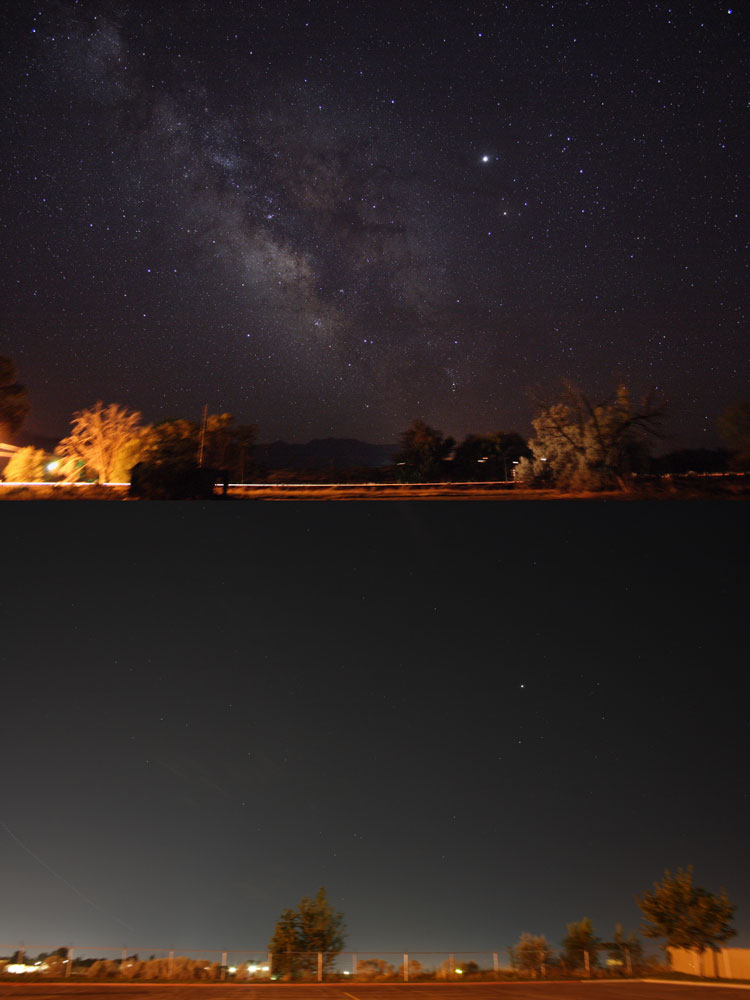
Light pollution country versus cityComparison showing the effects of light pollution on viewing the sky at night (Jeremy Stanley/Flickr/Wiki Commons)International Dark Sky Places is an international program of independent third-party certification of particular areas that apply to become IDSPs. Starting with Flagstaff, Arizona's appointment as the first Dark Sky City in 2001, the organization has certified dark sites, which can be communities, parks or protected areas, on six continents, 22 countries. There are now some 200 of them around the globe, representing 160,000 square kilometers of land on Earth from which you can see clear night skies, glittering heavens, the full starry span of the Milky Way rarely visible from cities or even the average over-illuminated suburb. Some of these are in the remote, austere sites that often serve as ideal sites for astronomical observatories. But not all of them. 

There are practices of light pollution mitigation that can be learned and adopted if everyone in a given community is on board — or brought on board through policy decisions. But getting agreement and motivation to pursue dark sky certification status by working to achieve light pollution reduction targets is easier said than done.

"There are no binding treaties that have to do with the night sky, with that type of environmental protection," Barentine told Salon in a video interview along with Venkatesan. That's even though certain U.N. instruments do mention it—the U.N. Declaration on the Rights of Indigenous Peoples and the underlying treaties establishing the United Nations Environment Programme are among these, he said. "At best, what we might get is a series of recommendations to members states of these different conventions that they could choose to enact if they wanted to." 

"Much of our human identity rests with darkness."

But voluntary standards for light pollution, like voluntary standards for much else where profit and community or ecosystem well-being might be at odds, have a habit of failing to meet the need, of being inconsistently applied, and of simply being ignored. In fact, Ben Price, director of education at the Community Environmental Legal Defence Fund, which assisted in establishment of the world's first community rights of nature legislation, notes that the establishment of minimum protected areas tends to be supported or even promoted by the corporations that cause greatest environmental harm, effectively maximizing the amount of harm that can be done everywhere else. 

The federal Clean Air and Clean Water acts, and similar state laws, likewise set out in law just how much degradation or destruction of the natural world corporations or others can get away with. Partly as a result, environmental damage is far, far worse and natural habitats are far smaller and more fragmented than they were half a century ago, before these pieces of legislation existed.

Price told Salon in a video interview that he enjoyed amateur astronomy as a child and plans to travel to a noted dark sky preserve in the Pennsylvania wilds. "But really, do you have to travel hours and hours to see the stars the way they actually come through?" he asked rhetorically. "Do we really need to have every damn thing on the surface of the Earth lit up?" Or in the sky — Price has also watched satellites and has memories of seeing Sputnik overhead.

Legislation, Price believes, is the answer to bringing back the dark — as opposed to carving the Earth up into little pieces, a few fragments of which might achieve protected status. But with over two decades of work to advance rights of nature at the community level in the United States — nearly 200 communities have adopted CELDF-drafted community bill of rights laws including rights of nature — he believes that the entrenched domination of property rights in the U.S. means that it's going to be an uphill battle.  

The damage done by bright skies

In the law, reparations are often thought of in terms of damages. Well, there's plenty of damage to be redressed. Remember how our eyes naturally become more sensitive to the blue end of the visible spectrum at night? That's just one of the many known and other likely unrecognized ways in which even daylight-waking creatures like us have been conditioned by millions of years of evolving in a world with roughly equal hours of daylight and darkness. 

Nocturnal animals obviously depend on having adequate darkness for the kind of eyesight they've evolved and the nighttime behavior they've evolved to carry out in the dark of night. But diurnal animals like humans, and crepuscular animals, like cats, that are naturally at their most active at dawn and at dusk, also have exquisitely calibrated chronobiology, with hormone patterns that change according to the light and processes that take place during either daytime, when the sun is out, or nighttime, when it's not. 

Research demonstrating the negative health impacts of messing too much with our bodies' ingrained expectations about light and darkness has accumulated over decades. Light pollution is linked to a host of health harms. Exposure to artificial light when we should be asleep alters our production of the important hormone melatonin, increasing risks of obesity, reproductive problems, certain cancers such as breast and prostate cancer, and mood disorders, and negatively affects immune function.

Seine et Marne on march the 6th 2021 at night. Taurus constellation. On this image we can see the effect of the movements of artificial satellites through the sky. On the left we can see the planet Mars, on the right the famous stars cluster the Pleiades (M45). From the bottom right the luminous trail of the satellite STARLINK-1269, and from the top the luminous trail of the satellite STARLINK-1577. (Christophe Lehenaff / Getty Images)It's even worse for animals, who aren't able to make choices like dimming the lights at a decent hour, using a red shift filter on their phones, or installing blackout curtains. Exposure to constant bright light causes pigeons to lose their regular locomotor and feeding patterns, and goldfish that are normally active in daytime likewise lose their own consistent patterns of activity and rest. Abnormal patterns of light and darkness reduce reproductive capacity in male sheep. Both sunlight and moonlight play roles in regulating the spawning and migration of Japanese eels. Outdoor lighting can trap migratory birds and moths.

In fact, even kingdoms of life beyond Animalia depend on darkness. Plants, linked in our minds with light thanks to their ability to turn it into energy through photosynthesis, require darkness, too. Artificial light that hampers nocturnal pollinators reduces plant reproductive success and fruit production. It also puts trees' schedules out of whack, affecting the dates of when leaves bud and how and when temperature triggers leaves to change color (though it also might delay plants' schedules for flowering, budding and leap-dropping otherwise moved forwards as a result of global heating-induced changes in seasonal temperatures.)

Even fungi need darkness, as they evolved to use patterns of light to interact with the world. They sense light with photoreceptors, and while they use them to avoid too much of it so as not to dry out, that's not all they're for. Fungi can have white collar proteins and cryptochromes for detection of blue light, opsins that detect green light, and phytochromes for red light. These photoreceptors also regulate things like sexual and asexual development and metabolism, accumulation of protective pigments and proteins, and growth. Artificial light seems to reduce the diversity of both fungi and beneficial ("good") bacteria living on grassland plant species, destabilize natural bacteria communities in soil, and may cause harmful algal blooms of blue-green algae in freshwater lakes. 

And it isn't just darkness, but specifically the clear view of the stars that dark skies provide that is key to wellbeing for some species. Songbirds that migrate at night calibrate their magnetic compass to the setting sun, then use the stars as a compass. Bull ants use stars to find their way home. The dung beetle, which disperses seeds as it rolls its dung balls, fertilizing topsoil and enhancing biodiversity and engineering its environment, normally orients itself using the Milky Way and the moon. When light pollution or skyglow (light pollution from elsewhere reflected downwards) dims it, the beetle is forced to orient itself by sources of light on Earth. This increases competition within the species as all the dung beetles are attracted to the same artificial light source, or results in them becoming disoriented when they can't find a replacement for the stars. Either way, the result is less of that dispersal that's so important for soil health and biodiversity.

Suing for dark skies

"Now, of course, there is no legal precedent in U.S. courts for non-human entities having rights in and of themselves. When we talk about laws like the Endangered Species Act, it's always about the value of those species to humans, even if it is only our curiosity or our wonder," Price said, noting that momentum is building in other countries towards a less anthropocentric approach. 

"We should draft and enact local [and] state laws," Price argued, "that recognize the right to dark skies as belonging intrinsically to nocturnal life, and not just nocturnal because what happens to life at night, if it's diminished or wiped out is going to have absolutely devastating effects on those creatures and on [that] plant life and so forth that is more active in daylight. It's all connected, and that's the very point of it all."

A rights of nature argument would be about "conveying enough legal recognition to those natural systems that they can at least compete with the Western view of humans being at the legal and environmental apex," where the purpose of the nature is framed as being the benefit of humans, and nature is to be made subservient to us, Barentine said. He has scoured the global legal literature for examples that could serve as precedents for applying legislation to dark skies.

"There has to be a change in paradigms that are at the foundation of how we run our society and the kinds of laws we create."

Some countries have subjected light pollution to law and to judicial review, Barentine said. "And I found some examples of countries that have given a level of consideration to these natural systems that are at least close enough to that, to where you can make the jump and say, if you would protect a river, for example, under rights of nature by giving it [legal] standing … that there's really no reason that you cannot apply exactly the same logic to light pollution."

But the more foundational idea of a legal right to darkness — or, complimentarily, a right to starlight — has not been tested in courts. But rights of nature arguments more generally have found favor with courts in enough jurisdictions that it's definitely no longer a fringe or symbolic legal concept, despite Price's reluctance to be over-optimistic about how quickly change can be achieved.

And the framing of darkness or starlight as a right is not entirely new. In 2009, the general assembly of the International Astronomical Union passed "Resolution 2009-B5", which among other related points, states that "an unpolluted night sky that allows the enjoyment and contemplation of the firmament should be considered a fundamental socio-cultural and environmental right, and that the progressive degradation of the night sky should be regarded as a fundamental loss." And since this resolution built on a 2007 conference called the "International Conference in Defence of the Quality of the Night Sky and the Right to Observe Stars held jointly by UNESCO and the IAU, the idea that it's a sociocultural right might seem to be endorsed by UNESCO, the global body dedicated to such rights.

But there are limits to how far international bodies are willing to go. Noting a "growing number of requests to UNESCO concerning the recognition of the value of the dark night sky and celestial objects," by 2007, UNESCO's World Heritage Centre stated that "the sky or the dark night sky or celestial objects or starlight as such cannot be nominated to the World Heritage List within the framework of the Convention concerning the Protection of the World Cultural and Natural Heritage." Nor, they say, can Dark Sky preserves be considered under the various categories of cultural and natural properties subject to protection — because no criteria exist for them to be considered. And that's still several steps away from an enforceable right. So we're not there yet.

We need your help to stay independent

If a person or group of people are going to go to court on behalf of nature, "it is a stronger case if the complaint is brought by a human person who lives in a place that is affected by that thing. So it would be hard for me to make an argument that I should be the plaintiff in a case involving light pollution in China or Europe or somewhere like that," said Barentine, who lives in Tucson, Arizona, a dark sky city, "but I could be the person who brings the complaint in my part of the United States, because I can argue that I am impacted by this and I have an interest in this ecosystem."

Barentine and colleagues have been developing the concept of a lightshed, analogous to a watershed, a geographical region that may cut across existing legal boundaries but that could define an area within which total light pollution must be kept within a certain limit in order to mitigate harm and limit skyglow.

"If we believe that there's anything like a commons and that there is a public interest in the commons, then I could bring suit on behalf of all people similarly situated. We could define a class of people. I can say that literally, every person who lives in my city is affected in one way or another by this issue, and therefore could stand to suffer a legal injury that we're asking a court to remedy," Barentine said.

While restrictions on local governance in the US and the country's strong legal emphasis on property rights makes it extremely difficult to advance dark sky legislation through a rights of nature argument, Price said that, in theory at least, were a bill introduced this year in the New York legislature that would grant rights of nature to the Great Lakes ecosystem prove successful, it might then be possible to argue in court that documented harms resulting from light pollution must be rectified under that legislation. The proposed legislation would devolve powers to local municipalities and counties to protect the ability of local ecosystems to exist, to flourish naturally, and to be restored when harmed. And as we've seen, humans, animals, and other organisms might have a strong case that we've all suffered harm from too much light when it should be dark, and even too few stars when the sky should be a-glitter with them.

Still, Price thinks that this bill is likely to be a public learning experience more than anything else. 

"There has to be a change in paradigms that are at the foundation of how we run our society and the kinds of laws we create," he said. "It's really people's minds that have to change more than the laws before they can accept these laws." 

But he quoted science fiction author Ursula K. Le Guin on the eventual inevitability of once-unimaginable change. Accepting an award from the National Book Foundation, Le Guin said that "We live in capitalism, its power seems inescapable — but then, so did the divine right of kings. Any human power can be resisted and changed by human beings."

Vance drops Ohio State’s championship trophy during White House visit

The crude nature of the Donald Trump era of politics frequently gives us images that would be too on-the-nose in a work of fiction: the feast of the seven Big Macs, the awkward handling of the Bible in front of St. John's and so on. 

Soft-handed Yalie and "freedom seed" enthusiast JD Vance added one more to the scrapbook on Monday when Ohio State University's football team attended the White House in celebration of their national championship. Vance fumbled the Buckeyes' trophy to the stirring strands of "We Are The Champions."

Vance briefly attempted to resettle the gold-and-steel trophy on its base with the help of Ohio State running back TreVeyon Henderson, before giving up. As other Buckeyes looked on with a mix of shock and embarrassment, Vance left the base on his lectern and held the top of the trophy up for the cameras.

The approximately 30 lb. trophy is meant to separate so that players can hold the top section aloft. But Vance couldn't deny the bad look of butterfingers-ing the championship trophy of his alma mater on the White House lawn. 

"I didn’t want anyone after Ohio State to get the trophy so I decided to break it," he wrote on X.

Trump 2.0 has been packed with awkward photo-ops at the White House. The Trump administration has made headlines in the early going, squabbling with Ukrainian President Volodymyr Zelenskyy and offering corporate sponsorships for the traditional Easter Egg Roll. Vance certainly doesn't hold a monopoly of awkward moments on the lawn, as Trump himself turned the residence's driveway into the backdrop for an automobile ad to bolster the flagging fortunes of his associate Elon Musk.

“We will not surrender”: Harvard pushes back against Trump admin demands

Harvard University is refusing to bow to a list of demands put forth by the administration of President Donald Trump.

In a letter shared Monday, Harvard President Alan Garber rejected a list of institutional changes demanded by team Trump. Garber wrote his university "will not surrender its independence or relinquish its constitutional rights" in the face of threats to its federal funding. 

A letter from the Department of Education sent last week threatened federal grants to the nation's oldest university. It demanded that the university nix any diversity, equity and inclusion programs and combat alleged antisemitism on campus. The letter also asked the college to put in place hiring and admissions reforms that would pass muster with the Trump admin, an obvious Trojan horse meant to usher in more right-wing professors at the institution.

The letter targeted specific programs at the university for special scrutiny, under the guise of fighting antisemitism. These included the university's Middle Eastern Studies and Near Eastern Languages and Cultures programs, as well as the school for Public Health.

“No government — regardless of which party is in power — should dictate what private universities can teach, whom they can admit and hire, and which areas of study and inquiry they can pursue,” Garber responded. "The administration’s prescription goes beyond the power of the federal government. It violates Harvard’s First Amendment rights and exceeds the statutory limits of the government’s authority under Title VI."

Harvard's defiant response came less than a month after Columbia University cratered to the Trump administration's demands to disciple students. The university where detained activist Mahmoud Khalil helped organize pro-Palestine protests caved after the Department of Education threatened to pull $400 million in federal funds.

“Home-growns are next”: Trump proposes sending US citizens to El Salvador prisons

President Donald Trump is looking to extend his program of rendition to include U.S. citizens.

Speaking to reporters on Monday, Trump said he was encouraging Attorney General Pam Bondi to look into ways to send Americans to prisons in El Salvador under an agreement he struck with El Salvador President Nayib Bukele.

"I'd like to go a step further. I said to Pam, I don't know what the laws are, we always have to obey the laws, but we also have homegrown criminals that push people into subways," he said. "I'd like to include them in the group of people to get them out of the country."

The Trump administration deported Venezuelan migrants to El Salvador's CECOT earlier this year, alleging that they were members of the gang Tren de Aragua. Trump claimed the authority to deport the migrants without due process under the Alien Enemies Act of 1798. Since that point, the Trump admin has flagrantly defied judges' orders to halt deportations and return wrongfully deported people.

On Monday, Trump asked Bukele to build more prisons to house Americans accused of crimes. 

"Home-growns are next. The home-growns. You gotta build about five more places,” he said. "It’s not big enough."

When reporters asked Trump if he was really considering shipping citizens to a foreign prison, Trump failed to take the off-ramp.

"What do you think, there’s a special category of person?" he said.

“If they’re criminals and if they hit people with baseball bats over their head that happen to be 90 years old and if — if they rape 87-year-old women in Coney Island, Brooklyn, yeah, yeah, that includes them," he said. "They’re as bad as anybody that comes in."

Pasta al limone is the bright, creamy pasta of spring

Pasta al limone is an exercise in simplicity and restraint — a crash course in emulsification resulting in a bright, silky dish that makes for a perfect weeknight spring meal.

Did that make you want to cook it tonight?

Almost like a citrusy cousin to cacio e pepe, al limone is a bright spot in the canon of Italian and Italian American classics. Lemon is its defining flavor — not tomato, not cheese, not even the pasta itself. However you include it, lemon is what makes the dish the dish.

This is a great recipe to help you get familiar with the power of starchy cooking water, the importance of low heat, and the magic of emulsification. Best of all, it comes together in a half hour or less — and it is delicious.

The dish is all about contrast: toothsome pasta coated in a silky, starchy, creamy, cheesy sauce with a burst of lemon to cut through the richness. It’s a wonderfully balanced interplay of acid and comfort.

To do it right, opt for the highest-quality ingredients. Think: organic lemons, European-style unsalted butter (like Plugra) and authentic Parmigiano Reggiano. The pasta itself doesn’t need to be fancy, though.

Some people like to add extras — basil, spinach, shrimp, ricotta, even crab — but those are distractions. The true magic of al limone shines when it’s stripped down to its essentials. Try it that way, just once. You might not go back.

We need your help to stay independent

The finished dish should be incredibly silky and thick, with perfectly al dente noodles slicked in a rich, lemony sauce. And yes, the starchy cooking water is a key ingredient — it binds the cheese, lemon and butter into something greater than the sum of its parts.

A quick note on cream: while some recipes call for it, I find it can flatten the lemon flavor and add a kind of blunt richness that undercuts the dish. If you must, limit it to a tablespoon or two, no more.

This is exactly why people fall in love with Italian cooking. There’s nothing flashy here — just quality ingredients, a simple technique, and a quietly spectacular final result that’s both luxe and deeply comforting.

Pasta al limone
Yields
4 servings
Prep Time
2 minutes
Cook Time
20 minutes

Ingredients

1 box pasta of your choosing

4 to 5 lemons, zested and juiced (be mindful of those pesky seeds)

4 to 5 tablespoons unsalted butter

1/3 cup Parmegianno Reggiano, grated on a microplane, plus more for garnish


Directions

  1. Get a large pot of water boiling. Once it's boiling, salt well, like the sea. Cook pasta, reserving a full cup of starchy cooking water before draining. Drain pasta just a minute or two shy of al dente.
  2. As the water boils, heat a large saucepan over medium-low heat. Melt butter and add zest, stirring together, about 30 seconds.
  3. Loosely moving the pan in a circular motion, add the lemon juice, plus the starchy water in increments, letting the sauce reduce before adding more. You may not need it all.
  4. Be careful with seasoning here: with the salt in the increasingly concentrated, starchy cooking water, you may not need to salt at all. 
  5. Cook until pan sauce is creamy and thick. Add more lemon, if you'd like. 
  6. Add your cooked pasta and cheese. Stir well, over low heat, for about a minute or two, lightly moving the pan in a circular motion while tossing with tongs. 
  7. Serve immediately, topped with more cheese and a spritz of lemon juice.

Cook's Notes

  • You can opt for whatever pasta you have on hand here. I prefer a long, ribbon noodle here (spaghetti, bucatini, linguini) but a short cut can also work (rigatoni, ziti, penne, even farfalle). Whole wheat pasta could also be a fun swap, which would truly alter the essence of the dish itself. 
  • I also like grating some zest into the butter at the start of the process, adding juice during the emulsification process and then finishing with extra juice and zest just before finishing. Try to utilize the lemon as best as possible. 
  • Ideally, opt for real Parmigiano-Reggiano that you grate yourself  sometimes pre-grated cheeses can clump up when they’re added to hot pans, which is not appealing. Or make the sauce in its entirety before just finishing with some grated cheese atop in the serving bowl itself, without the cheese touching the hot pan at all. Up to you!
  • Supposedly, some "old school" al limones called for provolone, which would probably be stellar to me. Try that one out, too — why not?
  • As far as garnish, you can go with a bit of grated cheese and some extra lemon zest, but if you want to spruce things up a bit, some pangratto (buttered, toasted bread crumbs) works, some finely chopped walnuts or pecans, or some snipped chives or roughly chopped parsley.
  • Sometimes, adding other citrus  grapefruit, orange, even lime  can also help deepen and diversify the citrus-forward flavor profiles here. Yes, it’s called al limone  but adding other citrus can help embolden the flavor.
  • I sometimes avoid oil here altogether, sticking just with some pats of butter to get everything going instead.

“American Psycho” at 25: How Mary Harron turned a misunderstood novel into a masterpiece

We often remember movies, years and decades later, for reasons just and unfair.

Just: "American Psycho," on its 25th anniversary, stands as the wicked feminist satire of 1980s greed and male vanity its Canadian director and co-screenwriter Mary Harron imagined, instead of the vile misogynist fantasy Gloria Steinem crusaded against during pre-production.

Unfair: Scenes like protagonist Patrick Bateman's murder of a colleague set to the Huey Lewis song "Hip to Be Square" carry the movie into the future mostly as social media parodies. The character of Bateman himself, a hollow yuppie in an inferno of his own making, lives in our present climate of "hustle" and toxic masculinity as a role model (by more than one real-life murderer) rather than a warning. The cultural headspace of "American Psycho" memes and bad faith takeaways make it too easy to forget who saw it as more than blood and business cards in the first place. 

The cultural headspace of "American Psycho" memes and bad faith takeaways make it too easy to forget who saw it as more than blood and business cards in the first place.

Praise due then to the visionary work of Harron, who had, a few years before, begun her directing career with "I Shot Andy Warhol," another modern classic about the dangerously close relationship of self-mythologizing and violence. It was Harron's sense of Bret Easton Ellis' 1991 novel of stockbroker/serial killer Bateman as dark comedy playing on the emptiness of greed and male violence born of self-hatred that earned the adaptation its critical acclaim. It was the world Harron and her creative team built for "American Psycho" that made us in the audience remember it so clearly a quarter century later. 

Harron has directed six films, the majority of which concern the real-life famous (2005's "The Notorious Bettie Page") and infamous (2018's "Charlie Says," about the women of Charles Manson's cult). It is "American Psycho," a fictional tale of infamy inside the protagonist's mind and cruelly appointed apartment, that showed Harron as a master visual interpreter of popular literature as well as popular history. And as the filmmaker responsible for one the great sophomore outtings of 21st century cinema. 

The novel "American Psycho" was published in 1991 and takes place in 1987. You filmed it almost a decade later, and it seems like your directing also referenced earlier moments in film history  the '50s-style title sequence Saul Bass was famous for and echoes of Film Noir and Hitchcock.

My initial response when (Producer) Ed Pressman asked me to write a script based on it was that you could do a film set in the '80s, and times had changed enough for it to be a period film. But that was never my absolute goal. Although it's funny at the time, some of the reviews said, “We all know about the '80s. What is new about this?” And to me, I was surprised because it was never about that. It was about the society now as much as it was the society 10, 15 years before.  

I've done a lot of period films. Almost all my films, except for maybe one, have been period. So I have a lot of ideas about how to recreate a period. And one of them is you never make everything in the room from 1986. Even wealthy people have things from different eras, and certainly, people who are less wealthy will definitely have older stuff. 

Gideon Ponte, who was the production designer, said, "It's really kind of early '90s." There are certain little '80s tropes in the restaurants and things, but Bateman’s apartment could be early '90s with that kind of minimalist (look). 

We are looking at the past, but not one specific moment in the past. Like a series of pasts stacked on one another

Yes. 

"American Psycho" is a black comedy and is deeply satirical. Did you accomplish the look of that using a kind of heightened reality, or did you shoot it very literally and let the satire and the comedy be in response to how flat and literal the visuals are?

Honestly, we never had those conversations. I think I find the style while I'm doing it. 

When I was trying to find a director of photography, my husband said, “Why don't you try Andrzej Sekula?” because Andrzej had just done "Pulp Fiction" and the wide angles, the crispness, the certain black comedy, could be right for "American Psycho," which I think it really was. So when I met with Andrzej . . . I don't think I ever said, "It's not quite real. It’s real. The comedy will come this way…” The comedy was going to be how I directed the actors. The thing Andrzej and I were very clear on was that it was deep focus, very crisp, which gave it a kind of hyperreal quality. 


Want a daily wrap-up of all the news and commentary Salon has to offer? Subscribe to our morning newsletter, Crash Course.


I realized after making it that it was hard for me to explain to people that it was not a realistic film. but it was quasi-realistic, and there were moments it would be played fairly realistically, like Jean's character (Chloë Sevigny, who plays Patrick Bateman's secretary) is a realistic person. But there's elements that are very heightened, there's elements of Christian's performance that's extremely stylized, but it all has to work in this world. 

I don't think I would ever sit down when a film was starting and say, “This is what we're doing. this is how it's going to go, it’s this place between realism, or it's this place between poetry and whatever” The exciting thing is to find it as you do it and you'll know as you're working your way through it. And what is most exciting is if you don't entirely know and you're finding it as you go.

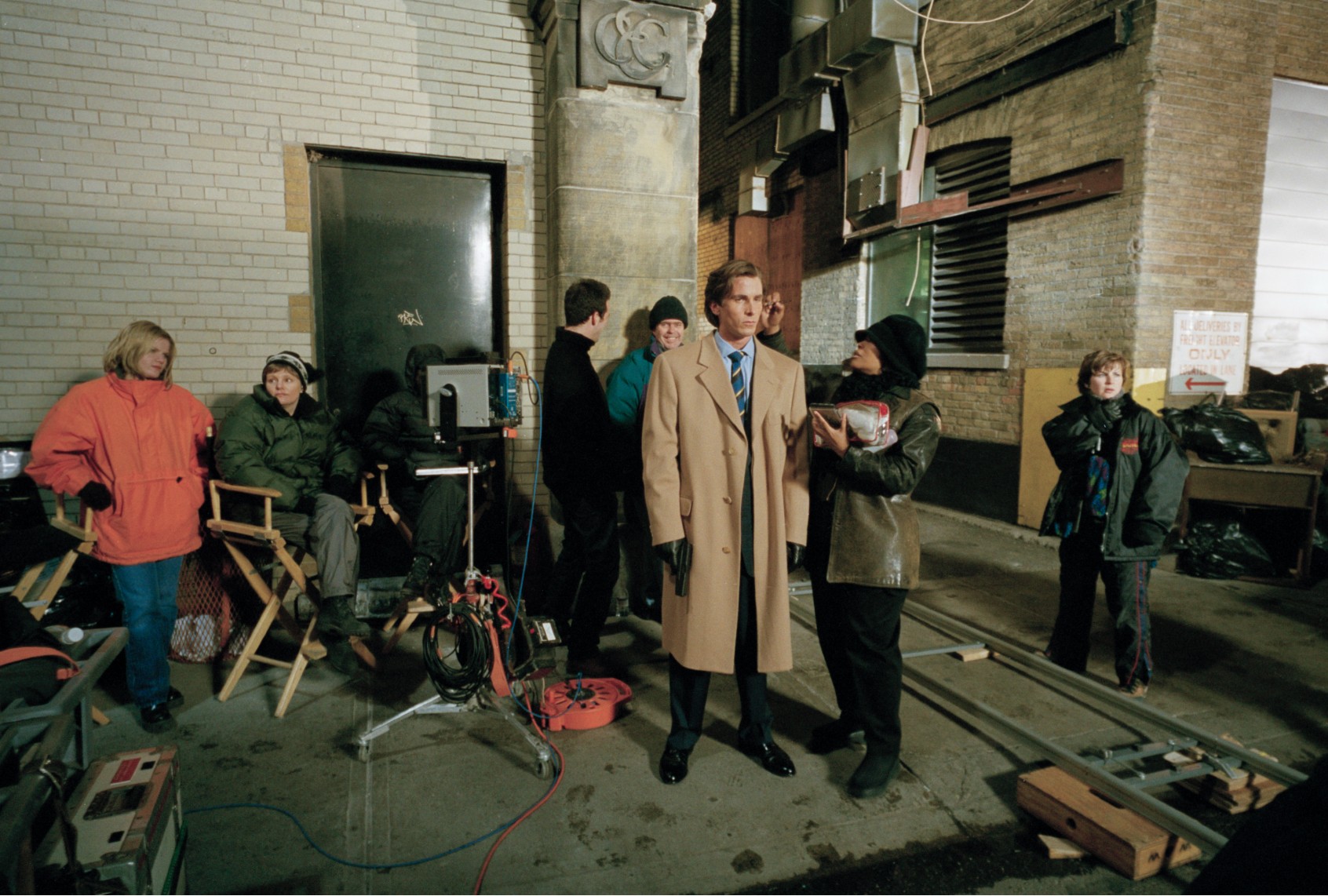
Christian Bale on the set of "American Psycho," based on the novel by Bret Easton Ellis and directed by Mary Harron. (Eric Robert/Sygma/Sygma via Getty Images)I'm so glad we started talking about your creative partnership with Sekula because so much of the making of "American Psycho" seems to be the story of one and one equals three. You and Sekula, you and co-writer Guinevere Turner, you and Christian Bale. These creative duos all seem to add up to what made this movie special.
The person I had more theoretical conversations with was Gideon because we're such good friends, but also because I am also obsessed with production design, and he reminded me recently that what I told him about Bateman's apartment was, "It's where extremely straight and extremely gay meet in the middle."

That's perfect.

I don't even remember saying that, but he obviously remembered it. 

I gave him outlines like a stainless steel kitchen or white apartment. I want it to look like Architectural Digest. Nothing personal anywhere. No photos, no memorabilia, nothing. And that was very important so that you wouldn't sort of personalize Bateman. He becomes more an abstraction of wealth and predatoriness. 

I think my favorite bit of production design in the whole movie is in the apartment, the oversized light box on the wall of what looks like a suit containing no man.

I remember Gideon, actually, we were shooting in another part of the set, and he asked me to come in and look, and he says, "You may think this is too on the nose. Just preparing you. I just want you to look at it and see if you think it works." And I walked in and thought, yeah, it's perfect.

We need your help to stay independent

It's "on the nose" because, of course, there is a recurring theme in the movie that Bateman is not really there. The other characters keep calling him by the wrong name, and he talks about his nonexistence in voiceovers at both the beginning and end of the movie. What does the character of Bateman get out of saying that about himself? Because he doesn't seem to be a person or an entity who does anything without ego. 

If you have him doing it at the beginning, then you know that this is his story and his version of events. What does he get from it? I don't know because, in some ways, it's the voiceover absolutely from the book. 

I think a writer like Bret — in this case, he had written this voiceover — gives the protagonist more self-knowledge than they have, maybe more insight or more eloquence . . . but it's also stating directly something that he undoubtedly must feel about himself, that he's always in panic because he doesn't know who he is or what (he is), there's no core to him. So, it's articulating that.

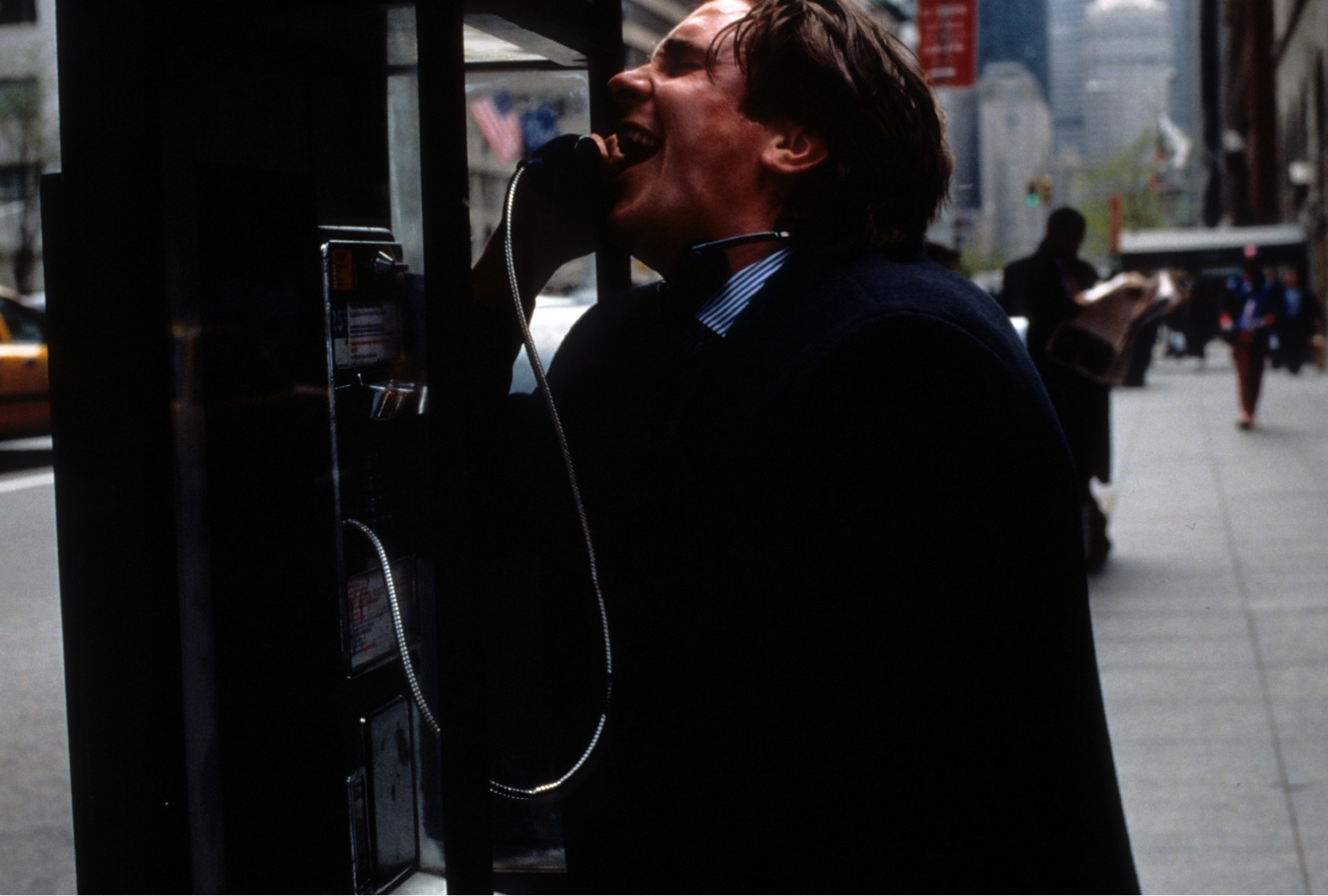
Christian Bale in "American Psycho" (Lion's Gate/Getty Images)Yeah. It seems to be an idea that the movie swirls around, which is that the main character is not really a person, but an empty body that we project the ideas of the film through.

Although there's also all the rage and anger and panic. So he's not just empty. There's a sort of roiling rage and explosion inside him that erupts in the violence. So there's also the panic of feeling like nothing.

You have to have something for the idea of Bateman to push against. I feel like the movie is unfairly criticized for the flatness of the female characters or the actresses' performances, and I think those are the performances that give the movie its humanity.

I don't know where that comes from. Because Chloë (Sevigney) gives a beautiful vulnerable subtle performance and Cara Seymour (as late-in-the-film Bateman victim Christie) is just a great actress who does so much with very few lines, but you're totally aware all the way through that she's hiding her fear and her panic and as she realizes that she's made a very bad decision coming here, and you feel her vulnerability and you long for her to escape 

I like very subtle acting. On the other hand, I love Christian's performance, which is very big and almost slapstick at times but is so perfectly controlled. Somehow they all fit in the same space. Just because Chloë and Cara and the others are doing more naturalism, that doesn't mean they're not good performances. 

And your co-writer, Turner, appearing on screen as a character a hundred miles away from the college student she played in "Go Fish," the movie that made her famous a few years before.

Poor Guinevere! She will never forgive me for making her lie on the bathroom floor covered in blood. Guinevere loves '30s comedy. She's doing a sort of dry '30s comedy performance about rich people.

Can we talk about your writing partnership? You two were working together on the script of what became "The Notorious Bettie Page" when "American Psycho" came into your life. What kind of evolution did your creative partnership go through on this project? 

When the idea to do "American Psycho" came along, I was working on it on my own — the concept of it, which is always something I kind of want to do . . . just sit with the material for a while. I always come up with the first and the last scene in a movie but not what's in-between. But really early on, I thought, I don't like to write on my own. 

"How could anyone tell us what is misogynist? Do you think we don't know what's misogynist?"

Guinevere is really great at dialogue, which I’m not. I like to do structure, really, and concept and world-building. Guinevere would really get this. We would be disturbed by the same things.

Guinevere had just done "Go Fish" and I’d just done "I Shot Andy Warhol" and I felt like together we would be very strong, because how could anyone tell us what is misogynist? Do you think we don't know what's misogynist? We are kind of in the vanguard; at that point, I felt we had both made our statements, in terms of hers being a lesbian film and mine in terms of that it’s also a lesbian (film), but also radical feminist. I think that we could just go in with a lot of confidence, which I think a man would not have had. He would be worried about how he would appear, or second guess, and we just felt like our instincts on this are good.

"American Psycho" is very much about male vanity. I'd love to hear some of the choices or conversations you and Turner had about this.

We were very amused by Bret, being gay, that he had picked up on what was very gay in macho culture. The obsession with looks and fitness and the kind of b***hiness, the way they are criticizing each other. Bret had spotted this and really had an insight into that.

The direction I gave to actors was really moment by moment. Christian came up with this thing during the three-way sex scene when we were rehearsing it, of looking in the mirror and posing. That was his idea and it was really funny.

Guinevere Turner, Samantha Mathis and Chloë Sevigny pose for a portrait to promote "American Psycho" on April 11, 2000, in New York City, New York. (Catherine McGann/Getty Images)You fought hard to cast Bale as Bateman, and you guys were kind of on an island of two people who believed that you had the right idea of how this movie could be made and that you were the right people to make it. 
We both got fired off the movie, and I put a lot on the line for casting him, and I remember thinking before we started shooting, “God, I hope I'm right about this." It was a big leap, but really from the moment we first talked about it I could see that, as with Guinevere, that we had the same sense of humor about it, that he thought it was funny.

I had met with a number of young actors who thought Bateman was cool. No, no, no, he's dorky. He's absurd. I wanted an actor who could see the ridiculousness of it and could have a distance from it. 

(Leonardo) DiCaprio was interested in doing it, and I immediately thought that it was a terrible idea for many reasons.

"I had met with a number of young actors who thought Bateman was cool. No, no, no, he's dorky." 

One of the things about the movie is that a lot of people mistake Bateman for someone else, and you couldn't cast six different DiCaprio look-alikes. He's very distinctive looking. 

I knew it was a terrible idea because he had just come off "Titanic," and this is someone who's the hero and the heartthrob of millions of adolescent girls. You cannot cast him as Bateman. It's so wrong. I knew that this film would never work if I didn't have absolute control over the tone of it. It had to be really really delicately handled because you're dealing with controversial material, but you're also threading a way through satire and horror and fear and real pain and just many, many things. And you have to just get the balance really right. It's not easy to do this kind of tone. I thought I was off the movie forever until they invited me back.

Up to "American Psycho," Bale had played mostly boys and teenagers. Was his transition into adult roles part of what made him right for Bateman? A boy play-acting at being a man? 

No, not particularly. I mean, he came and read for me, and it was based on who he was. I felt that he had a quality that was similar to Lili Taylor (star of Harron's previous film, "I Shot Andy Warhol.") There was something sort of unfathomable about them, in a way that there was something very deep in them as actors. When they're in close-ups on screen, you would never get to the bottom of them.

The way he's very striking and anonymous at the same time.

Exactly. It was based on that. 

So many of your movies are about famous and infamous people, and really any one of them could be held up as a mirror of who we are now because, unfortunately, fame and infamy and the danger of self-mythologizing never go away. And yet, I think you are quite right when you say this is going to be the Mary Harron film that will continually be cited as the most prism-like of the times we live in. What is it like for you as an artist?

There's a point where you don't want to think about yourself too much in that way.

"I think 'American Psycho' is really about a kind of capitalism, a kind of destructive, greedy force that we're still living in. In fact, it's worse now."

I love "Charlie Says." I'm really proud of that movie, and I think that actually has something to say because we are living in a cult, a Republican cult right now. And I feel like Guinevere and I really explored some things there about how people give up their autonomy and their conscience and all that, but it's a tough movie, and "American Psycho" can also be fun to watch even though it's violent.

I think "American Psycho" is really about a kind of capitalism, a kind of destructive, greedy force that we're still living in. In fact, it's worse now. I honestly kind of thought it was in the past era, the Reagan '80s. I detested a lot of that, but honestly, it's kindergarten compared to what's happening now

There's been talk of a remake of "American Psycho." If you had the opportunity to adapt this same material now, rather than 25 years ago, how would you have approached it?

I can't think that way . . . because to me it's done, and that's what I did at the time. I like to move on, actually. I never do the same thing. There are obviously similar things in everything that I've done – but I kind of always want to do something different. I would never do a sequel to "American Psycho" or a remake; it wouldn't matter what you paid me.

Obviously you can't worry about this when making a movie, but I always wonder if directors have a moment of doubt when they look at the project and they say, “This part is designed to be a large set piece and there is a chance that 20 years from now this is all people will remember of this movie."

I mean, no, I don't think about that when I'm making something. You don't know what people are going to choose or what's going to become meme-able or whatever. I'm sort of tired of it, but I also think it's funny. I mean, I have to be more gracious about it, and you shouldn't have to be glad if anything really hits. 

Yeah. I think shortly before he died, David Bowie said, "I've been doing this 40 years, and when I'm gone, people are going to say, "Ziggy Stardust" and "Let’s Dance."

Yes. Yes. Honestly, that'll be me as well. They'll just put "American Psycho," the Huey Lewis scene, his business card scene or whatever on my tombstone, and you have to kind of accept it. I'm sure a lot of people feel that way, but you're always trying to do something different, and you can be proud of things that you've done, and I am.

Republicans’ new food aid plan: States pay more, families get less

As budget cuts, state mandates and new food restrictions converge, a looming crisis threatens to upend the nation’s food assistance programs — pushing millions of low-income Americans closer to hunger. Recent Republican-led efforts to slash funding for SNAP, combined with proposals requiring states to foot part of the bill, could leave the most vulnerable without the resources they rely on for basic sustenance.

Meanwhile, calls for banning "junk food" from the program raise difficult questions about personal choice, public health and the practicalities of enforcement. As these forces collide, the question remains: Can the nation’s safety net survive without unraveling the very fabric of food security it was designed to protect?

Last week, the Republican-led House passed a budget framework that could drastically reduce funding for public benefit programs, including Medicaid and SNAP. Although the plan does not specify exact cuts, it directs committees to slash $880 billion from health programs and $230 billion from SNAP over the next decade. These reductions could lead to a 20% decrease in SNAP benefits and stricter eligibility rules, which would disproportionately impact low-income Americans. The proposed cuts are projected to cause over 1 million job losses and a $113 billion economic loss in affected states by 2026.

Democratic leaders and advocacy groups are warning that these cuts could devastate vulnerable communities, while Republicans argue the plan is necessary to curb government spending. Experts suggest that even if direct benefit reductions are avoided, the sheer scale of the cuts could still result in reduced support for millions of Americans. According to the Associated Press, the Senate is expected to propose its own version of the budget, which includes much smaller cuts and the two chambers will negotiate before a final deal is reached.

Chief among the emerging proposals is a plan to require states to pay for a share of SNAP food benefits, a cost currently covered entirely by the federal government.

We need your help to stay independent

This would mark a fundamental shift in how the country funds its largest anti-hunger program. “Requiring states to pay even a modest portion of SNAP benefits would radically change the program’s funding structure,” the Center on Budget and Policy Priorities warned in a new report, noting that the move would abandon “the long-standing national commitment to provide low-income households a SNAP benefit sufficient to afford a basic healthy diet.” States, already grappling with revenue shortfalls in the wake of a sluggish economy, could be forced to reduce benefits, narrow eligibility or both — effectively shifting the burden of cuts away from Congress and onto state legislatures.

The financial strain could be significant. According to one analysis, if a state like Pennsylvania were required to cover just 10% of SNAP costs, it would have faced a bill of nearly $427 million last year—more than the state spends annually on its entire community college system. And if states fell short of the required match, benefits would shrink accordingly: “An average household could lose more than $1,000 annually in food assistance,” the report found.

The proposal would also erode SNAP’s role as an economic stabilizer during economic downturns, when more families become eligible and state revenues are most constrained. “Mandating that states pay even a small share of SNAP food benefit costs would hit state budgets hard at a time when many states are facing revenue downturns,” the report said. “The painful trade-offs that states would face would only be compounded if this proposal were combined with other Republican proposals to force sizable new costs on states, especially in Medicaid, but also in education, transportation, and other key public services.”

While some proposals target SNAP’s funding structure, others seek to reshape its function — by exerting more control over the food choices of those who rely on the program.

Both Health and Human Services Secretary Robert F. Kennedy Jr. and Agriculture Secretary Brooke Rollins have expressed support for restricting SNAP recipients from using their benefits to purchase soda and other “junk food.” In a private White House meeting with the group Make America Healthy Again — an excerpt of which was obtained by POLITICO — Rollins said sugary drinks are “the top item that food stamps support through taxpayer dollars — going to a group of children who come from lower socioeconomic backgrounds, many of them from very impoverished families. And yet that’s the number one thing our food stamp program is buying.”

"Mandating that states pay even a small share of SNAP food benefit costs would hit state budgets hard at a time when many states are facing revenue downturns."

Some state-level leaders have joined calls for a ban.

In December, Gov. Sarah Huckabee Sanders of Arkansas sent an open letter to Kennedy and Rollins saying current SNAP policies “undermine the health of millions of Americans, on the taxpayer’s dime,” citing rising rates of obesity and chronic illness among low-income families.

She pointed to data suggesting that sugary snacks and beverages make up nearly a quarter of all SNAP purchases — roughly $25 billion annually — and highlighted the potential public health savings of removing soda from the program. Sanders also expressed intent to seek a waiver allowing Arkansas to restrict SNAP purchases and redirect benefits toward fresh, locally produced food.

“As Secretaries, I ask that you work collaboratively across the Administration to prohibit the sale of junk food in SNAP and end taxpayer-funded junk food,” she wrote.

However, proposals to restrict the types of food SNAP recipients can purchase have faced criticism on both practical and philosophical grounds. Detractors argue that such policies would strip low-income Americans of autonomy in their food choices, while also being costly and difficult to implement.

In response to Governor Sanders’s letter, the American Beverage Association — which represents companies including Coca-Cola, Pepsi, and Dr Pepper — warned that restrictions like these “effectively create a two-tiered system in which the right to personal autonomy around diet is conditioned on income and means,” calling it an affront to “America’s commitment to individual liberty and freedom.”

That sentiment is echoed by some SNAP recipients. In an interview with NPR, Natalia Kiyah, a single mother of four who has intermittently relied on food assistance for more than a decade, described soda as an occasional treat — something to pair with pizza during a birthday or family celebration.

"The more choice I have, I feel more dignity," she said. "I feel more secure in who I am — having options — which then makes me a better mom and better mental health. It's all connected."

"No consumer purchases have ever been subjected to this Orwellian level of snooping by the Federal government, and it would set a terrifying precedent of intruding on the most private areas of our lives."

The debate also raises the thorny question of what, exactly, qualifies as “junk food.” That conversation overlaps with a broader and still-evolving dialogue about the health effects of so-called “ultra-processed foods” — and how best to define them. At a February seminar hosted by the Institute of Food Technologists, Dr. Susanne Bügel, a nutrition professor at the University of Copenhagen, noted that the existing NOVA classification system, widely used to categorize food processing, lumps together items as varied as yogurt, bread, and soft drinks. Bügel, who is leading efforts to refine that system, emphasized that many processed foods still provide key nutrients and can be part of a balanced diet. If a SNAP ban were enacted, it’s unclear how the government would draw the line: Would orange juice, for example — high in natural sugars, but also rich in vitamins — be allowed or deemed off-limits?

Even if policymakers could agree on a definition of “junk food,” another question remains: Who would be responsible for enforcing it? When Congressional Republicans proposed a pilot program in 2024 to catalog and restrict SNAP purchases, the National Grocers Association pushed back forcefully. In a letter co-signed by nearly 2,500 business and trade organizations and sent to top congressional leaders, the group warned that such a policy would be a bureaucratic quagmire.

Categorizing more than 600,000 food products — and updating that list annually — would create “needless red tape,” they argued, while doing little to improve public health. “Grocery store cashiers will become the food police,” the letter read, “telling parents what they can and cannot feed their families.”

The letter continued: “No consumer purchases have ever been subjected to this Orwellian level of snooping by the Federal government, and it would set a terrifying precedent of intruding on the most private areas of our lives.”

“Harboring hatred”: Police say Shapiro arson suspect confessed to targeting Democratic governor

The 38-year-old man accused of setting fire to the home of Pennsylvania Gov. Josh Shapiro confessed to "harboring hatred" towards the Democratic politician, prosecutors said Monday.

Early Sunday morning, Shapiro and his family were woken by police after a man broke into the official governor's residence in Harrisburg and set fire to the room where they had just celebrated the first night of Passover.

Police say that the blaze was set by Cody Balmer, who turned himself in on Sunday afternoon, according to The Philadelphia Inquirer. According to authorities, he broke a window at Shapiro's residence and then threw multiple bottles full of gasoline before fleeing the scene.

Balmer, who faces charges of arson and homicide, among other offenses, confessed to "harboring hatred towards Governor Shapiro," per the Dauphin County District Attorney's Office. According to prosecutors, he also admitted that, had he encountered the governor, "he would have beaten him with his hammer," NBC News reported.

Balmer turned himself in on Sunday after police were contacted by a woman claiming to be his ex-girlfriend. Prosecutors said police later recovered a bag containing a sledgehammer and other items "identical to those observed in the surveillance at the Governor's residence."

“Forever the girl accused of murder”: Amanda Knox is finally free to be as weird as she wants to be

"There's a joke I'm working on," Amanda Knox told me. Knox, the American student accused of murder, who spent four years in an Italian prison, is figuring out a one-liner.

"It's blaming Zach Braff for my wrongful conviction because of 'Garden State,'" she explained. "In 2007, the manic pixie dream girl was all the rage, and that's all fine and dandy up until your roommate gets murdered, and then you just become an episode of 'Law and Order.'"

There’s an entire industry that has attempted to tell her story — true crime books, podcast episodes, snarky YouTube videos, think pieces in The New Yorker, tabloid headlines in the British press, a Netflix documentary and even a Lifetime movie starring Hayden Panettiere — but no one has ever summed up the prolonged fascination with Amanda Knox more neatly or darkly than Knox herself. 

"I have felt deeply, deeply punished for being a quirky, silly person," Knox told me.

Even 10 years after an Italian court decisively overturned her murder conviction, the stigma and speculation never went away. When I told a journalist friend recently that I was interviewing her, his first question was, “So, did she do it?” 

There was a time when that kind of comment likely would have affected her more. After prison, Knox told me, "because I was constantly being viewed in the worst possible light, I felt like I had to be perfect, which means I had to be invisible. How do you live your life like that? How do you have a sense of who you are when the thing that you are meant to do is disappear?" 

Watch the video version of this story here:

When I meet Knox at Salon’s New York studio, she appears in no danger of disappearing. Instead, she confidently exudes the slightly eccentric demeanor of the girl she was when her life became a news story over 17 years ago — the one nervously doing yoga in the police station, wearing an "All You Need Is Love" T-shirt to court. She wears bright colors. She smiles often and laughs easily, a very American trait that helped vilify her in European eyes during her trial. She also cries easily. 

She’s here to talk about her latest memoir, "Free: My Search for Meaning,” a vivid and often funny account of her time incarcerated in Perugia and her readjustment to the fishbowl of scrutiny she experienced when she returned home to Seattle after her release. She writes about reclaiming her sexuality after being vilified for it, of facing down her "demons," of despair, and of striking up the unlikeliest friendship possible. 

For Knox, freedom has meant accepting a mantle that her young, manic pixie self could never have envisioned. Being free, she told me, is “not having my name completely cleared, because it isn't. It's not my prosecutor apologizing to me, because he hasn't.” 

Instead, she explained, “To be OK, to be fulfilled, to be free, you need to be able to accept reality as it is.” 

At 37, she's an exoneree, an advocate, podcaster, producer, mother of two young children and occasional aspiring standup comedian. And, she told me, she is also “forever the girl accused of murder." 

"I didn't stop being a quirky girl when I went into prison."

Back in the fall of 2007, Knox was a 20-year-old student from Seattle, studying in Perugia and rooming with a young British woman named Meredith Kercher. Then, less than two months into her stay, “some men made a lot of bad choices and hurt innocent people,” she said.

While Knox was out one November evening with her Italian boyfriend Raffaele Sollecito, Kercher was sexually assaulted and killed in a home invasion. Knox came home to a crime scene. 

"Nothing in my life had prepared me for what happened to Meredith and then what was going to happen to me,” Knox recalled. “I feel like of the two of us, fate flipped a coin and I ended up being allowed to survive my study abroad. And she didn't. There's no rhyme or reason for that.” 

During the initial investigation, Knox cooperated with local authorities, unaware she was actually being interrogated as a suspect. It didn’t take long for Knox and Sollecito to be charged with murder. The story instantly became an international cause célèbre, with American "Foxy Knoxy" cast by the prosecution as a depraved participant in a drug-fueled "satanic" orgy that crescendoed in death. 

The press and the then-burgeoning powder keg of social media ran with it. Knox's whole unscripted persona only somehow served to confirm her image as an American “Luciferina” in college-girl clothing. Even more ambivalent spectators to the media circus tended to write her off as “weird” at best, a damning assessment of a traumatized 20-year-old whose roommate had just been sexually assaulted and murdered.

"Here's this quirky girl who likes to wear hippie clothes and play the guitar and sing and do yoga like no one's watching and she gets accused of murder because she's not normal,” she recalled to me. 

“My quirkiness certainly caught the attention of people. It also was a saving grace for me. I didn't stop being a quirky girl when I went into prison." 

Amanda KnoxAmanda Knox leaves a court hearing in Perugia on September 27, 2008. (TIZIANA FABI/AFP via Getty Images)
Comedian Whitney Cummings remembers watching Knox’s story from afar as it unfolded, long before their eventual friendship. 

“It's clear she's articulate, really smart and self aware,” Cummings told me. “I remember being like, I bet she's funny. If she gets out of there alive, she's going to be hilarious. That's how, especially women, have to cope.” 

"It's just so clear what this case has always been about – the idea of woman-on-woman violence and sex."

Back in Italy, the prosecution’s speculative narrative had worked. Knox was convicted and sentenced to 26 years in prison, Sollecito to 25. Another man, Rudy Guede, whose DNA and prints were found at the scene, was also arrested and convicted. Eventually, Knox and Sollecito's convictions were overturned. Guede, meanwhile, was released in 2021. Last month, an Italian court placed him under “special surveillance” after being charged with domestic abuse by a former girlfriend. It barely made the news.

Knox seemed surprised when I mentioned Guede’s recent charges.

"You are the first person to know that, that I've talked to," Knox said. "No one knows that because it's just so clear what this case has always been about – the idea of woman-on-woman violence and sex. The truth about the person who killed [Meredith] was forgotten for the sake of a product being sold by the prosecution and the media." 

Earlier on the same morning that I spoke with her, Knox had appeared on a British news show in which the hosts questioned if by "dragging it all up again," she was "just continuing the process" of her own "demonization." Guede's name was uttered just once.

Knox is well aware that her demonization endures. She engages with her trolls on social media. And she writes in "Free" about being a member of the "Sisterhood of Ill Repute." So when a heinous crime becomes the thing you'll always be associated with, how do you live the rest of your life? To the eternal fury of her critics, Knox eventually decided that rather than slink away because her quirkiness rubbed people the wrong way when she was on trial for murder, she was going to own it all. 

As she explained it, "I was like, OK, I'm in this box. That box does define me. Can I just use that box as a platform?" 

A turning point came when she was invited to speak at a conference for The Innocence Network, a global organization that works to overturn wrongful convictions. She now serves as an ambassador there.

Marc Howard, founder and president of the Frederick Douglass Project for Justice, commended Knox for the humanity she brings to the project’s advisory council.

Amanda KnoxAmanda Knox at Salon's New York studio (Salon)“She's using her ordeal and suffering to help others, so that we can have a better actual justice system and have fewer errors, but also treat each other in ways that are more humane and compassionate,” Howard said.

Her platform and notoriety are also now her livelihood. "I'm trying to do the very best with what I have and I feel comforted and at peace with that. I'm not confused,” Knox said.

"I was never a true crime person before this — I was a Harry Potter person."

In addition to the current book tour, Knox co-hosts a podcast with her husband, Christopher Robinson, and is currently executive producing – with her friend Monica Lewinsky – an upcoming Hulu limited series based on her experience. 

On a recent episode of her own podcast, Lewinsky said that what drew her to Knox’s story was the familiar tale of “a young woman being feasted on by the world.” 

In our true-crime-obsessed era, Knox has learned to lean into her status as one of its most recognizable figures. 

"I was never a true crime person before this," she said. "I was a Harry Potter person” – the perfect genre for future misunderstood adults. The only reason that's a huge part of my life now is that it's my credentials. It's what I know. It's what I can't help but care about to this day." 

She has grappled with the ethics of the genre, its entertainment factor and her role in it, including examining how to do "true crime with a conscience" on her podcast, where the sister of a missing woman described being "beat down and used for content, and then just thrown away."

Amanda KnoxAmanda Knox at Salon's New York studio (Salon)"We should be thinking about how we give people whose stories have been stolen from them a say in what their story means and how their story is told,” Knox told me. “I think that is a really interesting and intriguing opportunity that true crime allows." 
For Knox, the story she most returns to is her own. Though she told me that "it doesn't matter what other people say and what other people do," she continues to work to completely clear her name (an Italian court recently upheld a slander conviction tied to her case). She still hopes one day for a relationship with Kercher's family, who have repeatedly rejected her overtures, a situation she calls "an unaddressed wound." 

"We are connected by the worst experiences of our lives, and we will forever carry that grief with us," she said. "And I feel like we can help each other. I really do, but that's not up to me."

Knox has, however, reunited with other key players in her ordeal. In 2022, she and Raffaele Sollecito met up in Italy to share the walk together they'd planned for the day that Kercher's body was discovered. And Knox has forged a unique relationship with her prosecutor, Giuliano Mignini, who was part of the team who once called her a witch and a she-devil.” 

"I wasn't satisfied with just imagining this evil boogeyman who had done a horrible thing to me," she explained. 

So she met him on their common ground, appealing to him as a fellow figure who'd been misrepresented in the media maelstrom. 

"I had these fantasies about him doing a press conference and announcing to the world, 'I was wrong, and Amanda's a good person and all of you should be nice to her.' That's not what happened, obviously." 

What did happen, however, was a deep and respectful dialogue with the man she thanks in the book as her "adversary and friend." She wears a dove pendant that he gave her around her neck, the Catholic symbol of the Holy Spirit. 

"I do not believe in demonizing the criminal justice system. It's a necessary entity. But God, it hurts. And God, I'm still scared."

If you look at her closely, Knox carries other subtle messages on her person. In "Free," she writes of the anguish of having her name associated with "killer, slut, psychopath." 

And on her middle finger, she wears a tattoo of a semicolon

"It's a symbol of suicide survival," Knox explained. "It was given to me by a lovely young woman named Daisy Coleman." 

"I very, very vividly imagined my suicide a lot,” she admitted. “I imagined all the ways, to how I would time it out. I had plans." 

And while Knox eventually decided to "make the choice to live," Coleman died by suicide in 2020. 

"I'm so grateful that I have this," she told me, looking down at her hand, "to remind myself of all these young women out there who are not believed and are gaslit to death. That doesn't go away."

Other things don't go away, either. Knox told me about a home invasion she recently experienced when she and her family were staying at a friend's house. She recalled that as her husband went downstairs to investigate, he told her to dial 911.

"I paused," she said, "because the last time I dialed for help, I got sent to prison for something I did not do." 

Later, after the intruder had run off, an officer interacting with Knox’s 3-year-old daughter gave her a small police badge sticker. 

"I wanted to think, what a nice thing, but another part of me was like, it's a lie." 

Her voice cracked with emotion at the memory. 

"I was so conflicted, and I hate that. I do not believe in demonizing law enforcement, and I do not believe in demonizing the criminal justice system. It's a necessary entity. But God, it hurts. And God, I'm still scared." 

Knox has now spent almost half of her life living in the aftermath of what happened that night in Perugia, almost half her life with a harsh spotlight on her every move. So imagine, if you can, enduring everything she has and being able to crack a joke that "Studying abroad will change your life." To be joyful, to laugh, to stay quirky in spite of everything, is a supreme act of defiant survival. 

“She was in this unique bind, which was, you're not allowed to have fun for the rest of your life. And I'm just so glad that she can make jokes and be funny and shine,” Cummings said. 

Having been through the unimaginable, Knox is now ready for everything that comes next. "I feel unstoppable,” she told me. “And as somebody who has grappled with freedom and with having it stripped away from me in so many different ways, deep down in my bones, I am OK. I am free. I have a story to tell."

If you are in crisis, please call the 988 Suicide and Crisis  Lifeline by dialing 988, or contact the Crisis Text Line by texting TALK to 741741

Musk’s DOGE mission goes off target with Republicans

When Donald Trump first hooked up with Elon Musk during the campaign last year, I think most people thought it was just a rather flashy example of a rich guy with mega billions in government contracts putting his money behind a politician who promised to cut taxes and regulations, which happens every day in American politics. Musk had famously become red-pilled in the last few years and was a very important cultural figure since he bought Twitter and made it X, a right-leaning free-for-all. But he didn't seem to have direct political ambitions for himself. He just looked to be having fun performing for the adoring MAGA crowds, and Trump obviously enjoyed having the richest man in the world in his entourage.

Musk's appearances at the rallies were cringeworthy and his speeches were anything but riveting. Still, he put a lot of money into the campaign and launched some provocative tactics, such as offering million-dollar lotteries for people to sign petitions and register to vote. He apparently believed that he delivered Pennsylvania for Trump, and Trump was certainly grateful for the support (although I doubt he believes anyone delivered anything but him.)

If DOGE's mission is to cut spending, Musk's doing a terrible job. If its job is to cause misery, it's a rousing success.

I think we all assumed that he'd go back to doing his usual thing, running his mouth on X and running his companies, once the election was over, but instead he became joined at the hip with Trump who didn't seem to mind. Spending the transition period down in Mar-a-Lago along with businessman and now candidate for governor of Ohio Vivek Ramaswamy, he came up with his DOGE (Department of Government Efficiency) project to cut government spending. It appeared to be just another commission to provide advice on where the cut programs, a Washington perennial that usually goes nowhere. The assumption in those early days was that the Project 2025 people, led by soon-to-be Director of the Office of Management and Budget Russell Vought, would be doing the dirty work, such as implementing Schedule F, the order to make all federal workers into at-will employees.

We need your help to stay independent

It soon became apparent that Musk was staying on to run this new agency while Ramaswamy was ignominiously dumped right after the inauguration, ostensibly because he wrote a very provocative post on X declaring that we needed foreign workers because America “venerated mediocrity over excellence," which hit a nerve with the Trumpers. (Also, no one could stand him.) And I think most of us figured that Musk and Trump would be headed the same way in short order. Would Trump really want this guy around much longer, getting too much attention and waving his money around? As it turns out, Trump has quite liked having the richest man in the world at his beck and call and he even puts up with his precocious little son X, who likes to tell the president to shut up during press conferences.

Musk had actually been thinking about doing something like DOGE since 2023, when he dreamed of gutting the bureaucracy by getting access to the government computers. (He may have some other motives for that as well.) Trump, who is completely ignorant about computers, gave him the keys and said to have at it, so Musk and his people crew have taken a chainsaw to the executive branch for three months now, causing tremendous chaos and trauma and essentially destroying much of what the American people count on their government to do.

Whatever his purpose with all this slashing and burning, he's not getting the job he promised to do done, The New York Times reports:

[Musk] previously said his powerful budget-cutting team could reduce the next fiscal year’s federal budget by $1 trillion, and do it by Sept. 30, the end of the current fiscal year. Instead, in a cabinet meeting on Thursday, Mr. Musk said that he anticipated the group would save about $150 billion, 85 percent less than its objective.Even that figure may be too high, according to a New York Times analysis of DOGE’s claims.

Musk is constantly going on about this tremendous amount of fraud taking place in government programs and while his team is wrecking them quite efficiently, they aren't actually saving any money because there actually isn't this massive level of fraud. In fact, DOGE is largely fraudulent itself as The Times reports:

 [I]t inflates its progress by including billion-dollar errors, by counting spending that will not happen in the next fiscal year — and by making guesses about spending that might not happen at all. One of the group’s largest claims, in fact, involves canceling a contract that did not exist.

If DOGE's mission is to cut spending, Musk's doing a terrible job. If its job is to cause misery, it's a rousing success.

Meanwhile, Musk has been watching his personal fortune shrink by the day and his reputation be blown to smithereens like one of his failed starship rockets. The stock in his car company Tesla, has been sliding precipitously and not just because his baby, the Cybertruck, the worst failure of his career, is dragging down the whole company. (He takes great pride in saying that he did “zero market research whatsoever," and it shows.) He apparently didn't realize that by becoming a right-wing MAGA troll, he would alienate the people who buy his cars. There aren't a whole lot of EV buyers in rural America, home to the MAGA base.

Two weeks ago, Musk found out the hard way that his money can't buy everything. He pulled out all the stops in Wisconsin, spending tens of millions of dollars in a pivotal state Supreme Court race, and lost by ten points, a much bigger loss than expected. The voters were not impressed by his antics or his reprise of the million-dollar lottery gambit.

And now he's found himself on the other side of Trump in the big tariff debacle that tanked world markets and looks like it could easily lead to recession or worse. He's on record saying that he tried to talk Trump out of it and was sparring with Trump's trade adviser Peter Navarro on X, calling him a "moron" and "dumb as a sack of bricks" perhaps not realizing that Navarro is a made man who went to jail for Trump and is the only person in the world who Trump truly bonds with on this issue. Musk's entreaties went nowhere.

So, Musk may be on his way out, finally.

Polls show that only 45% of Republicans hold a favorable opinion of Trump's special advisor. Rolling Stone reports that virtually everyone in the White House finds him irritating, some even questioning if he's high. (His SpaceX reps deny it.) According to Puck's Leigh Ann Caldwell, since his Wisconsin faceplant, Republicans on Capitol Hill are no longer in awe (or terrified) of him either.

Musk's "special employee" status requires him to leave by the end of May, although Trump has recently said that he would finish the DOGE mission (God help us), and we know Trump doesn't care about rules or law so if he wants to stay, he can. But considering recent events, it will not be surprising if he bows out next month on schedule. He's not happy, and Daddy Trump is always just a phone call away if he wants to chat. The long-awaited Musk departure may be upon us. 

America’s happiness crisis is a generational divide

The American people are very unhappy. The Age of Trump and the rise of authoritarian populism in the MAGA movement are both the symptom and the cause of this collective unhappiness. The unhappiness and rage that the American people feel toward the system and the elites put Trump back in power.

However, America is not unique in this regard. The authoritarian populist movement is global. 

The 2025 World Happiness Report from the Wellbeing Research Centre at the University of Oxford, in conjunction with Gallup, details the deep levels of unhappiness Americans are experiencing. The United States now ranks 24th in the world for happiness, a new low for the country. Finland is ranked as the happiest country in the world.

This year’s report provides the following insights about the connections between unhappiness and America’s democracy crisis:

The sharp drop in social trust in the US is consistent with the fact that rising unhappiness has shifted voters almost exclusively towards the populist right (Donald Trump), and not towards the left (Bernie Sanders). The relative decline or stability in social trust in Europe is consistent with the fact that the decline in life satisfaction has split the unsatisfied electorate between the two opposite extremes of the political spectrum, depending on their level of social trust. …

In Europe, citizens with low life satisfaction and low social trust, the ‘anomics’, tend to vote for far-right parties. In the context of the US two-party system, they tend to abstain and withdraw from public life.

The fall in life satisfaction cannot be explained by economic growth, at least not by average national income, as GDP per capita has been on the rise in the US and Western Europe since the mid-2000s. Rather, it could be blamed on the feelings of financial insecurity and loneliness experienced by Americans and Europeans – two symptoms of a damaged social fabric. It is driven by almost all social categories, but in particular, by the rural, the less-educated, and, quite strikingly, by the younger generation. This low level of life satisfaction is a breeding ground for populism and the lack of social trust is behind the political success of the far right.

America’s young people are in a state of despair. If Americans 29 years old and younger were their own country, they would rank 62nd in the world for happiness. The 2025 World Happiness Report explains:

Young adults across the globe face increasing mental health challenges. Once considered one of the happiest phases of life, young adulthood has taken a troubling turn. Young people in North America and Western Europe now report the lowest wellbeing among all age groups. In fact, World Happiness Report 2024 found that the fall in the United States’ happiness ranking was largely due to a precipitous decline in wellbeing among Americans under 30….

Despite the overall trend that young adults report higher social connection than older adults, countries vary on the age-related differences in the quantity of social connection. For example, this pattern is flipped in the United States, Japan, and Australia, where young adults report the lowest social connection among all age groups. In the United States, 18% of young adults (aged 18–29) reported not having anyone that they feel close to, whereas 15% of adults aged 30–44 reported no social connection.

Unlike other nations, young adults in the US also report lower quality of connection than other age groups. Mirroring these patterns, World Happiness Report 2024 also highlighted a decline in the US happiness ranking, largely driven by a drop in wellbeing in the young adult age group. Although not definitive, this provides intriguing preliminary evidence that relatively low connection among young people might factor into low wellbeing among young Americans.

This finding from the 2025 World Happiness Report suggests that a radical intervention is needed to salvage the future of American democracy and society if these trends continue.

In all, America’s democracy crisis and the rise of authoritarian populism and neofascism are much more than “just” an existential political challenge. It is an emotional, spiritual, intellectual, psychological and a larger crisis of meaning for Americans both as individuals and as a people.

"The decline in well-being in the U.S. is most pronounced among young people who are younger than 30. If they were studied in isolation, they would only be the 62nd most unhappy country in the world. Americans who are 60 years old and up are much happier and would be in the top 10 if they were their own country."

I recently spoke with Jan-Emmanuel De Neve, the Director of the Wellbeing Research Centre and Professor of Economics and Behavioural Science at the Saïd Business School at Oxford. Jan-Emmanuel De Neve is also Editor of the World Happiness Report and the co-founder of the World Wellbeing Movement, a coalition of exemplary corporations that help put wellbeing metrics at the heart of business and public policy. He warns that America’s young people are experiencing the equivalent of a midlife crisis and that this will likely mean diminished incomes and wealth, lower social mobility and a lack of overall happiness and sense of well-being as they age, which will potentially cause serious harm to American society in the future.

Jan-Emmanuel De Neve also provides some hope in this global era of crisis, great anxiety and dread. He explains that the 2025 World Happiness Survey shows that people across the world are generally much kinder and caring than is commonly believed.

Given all the things happening in this very tumultuous and perilous time, how are you feeling? How are you trying to make sense of this all?

When you ask me, “How am I feeling?” I immediately think about this on a scale from 1 to 10. At this moment, I would probably say 9. That is the scale we use in the World Happiness Report. But that is a snapshot in time. Yesterday, I would have told you I am feeling like I am a 7 on a scale of 1 to 10. So, when you ask, “How are you feeling?” I'm giving you an emotional state that is very positive right now. But if you're asking me, how satisfied am I with my life, then that is a different question about a type of happiness and perspective that is more stable. I'm obviously worried about the state of the world, but right now, at this very moment, I am sitting in a beautiful park and enjoying it.

In the same society that is experiencing the same great stress, some people are happy and others in the same immediate community and population are unhappy. What do we know about these divergent experiences among people in the same group? 

There is population-level happiness, which means a larger group, community or even a nation. Within that group, we are asking why some individuals and groups are happier than others. This is the science of well-being. What explains these differences? In certain cases, people will be similar in terms of income and health and where they live but be very different in terms of how they feel about their lives. That is where we dig deeper and the explanations for the differences in self-reported happiness may be mental health, personality traits, genetic predispositions, etc. Certain people, because of their predispositions, tend to see the glass as being half full or half empty to begin with. For example, there have been studies of twins where about a third of the variance in the response to the question “How sad are you with your life" or "how happy are you with it right now" is driven by genetic differences.

What is thescience" here? And how do we define "well-being?"

"Well-being" is essentially subjective. It is how you feel your life is going. From there, we get more specific by asking questions such as "how satisfied are you with your life?" "How are you feeling right now?" and then we ask questions such as "Are you experiencing joy? Are you happy right now?" We then ask questions about worry and stress. In essence, we are letting people define what happiness is and what makes them happy. We just take their answers seriously. That's our starting point. In short, the definition of well-being is how people feel their lives are going, and then the science of well-being is the systematic approach to explaining and understanding these differences.

We need your help to stay independent

Is America happy right now?

No.

The average level of life satisfaction in America is lower than seven out of 10 — and that's just an average that hides a huge amount of variation. There are people in America who report feeling very happy or satisfied with their lives, and then there are a whole lot of people, and increasingly more, who are telling us that they're not satisfied with their lives. In this year's World Happiness Report, the United States ranks 24th. The United States fell out of the top twenty in 2024. The decline in well-being in the U.S. is most pronounced among young people who are younger than 30. If they were studied in isolation, they would only be the 62nd most unhappy country in the world. Americans who are 60 years old and up are much happier and would be in the top 10 if they were their own country. In all, Americans are becoming less and less happy and that is being driven by young people falling off of the proverbial and metaphorical cliff in terms of satisfaction and happiness with their lives.

Here is something else that is very worrisome about young people in America and their levels of happiness. There is typically a U-shaped relationship between age and well-being, where young people are happier. Well-being drops over time until a person hits their midlife crisis, which is usually in one's early 40s, when the pressures of life are immense. Then as people age, they tend to become happier again. This holds until the very end of life when physical issues and disability become more common. That U-shaped relationship between age and well-being no longer holds true in the United States. America's young people are now as unhappy as middle-aged people. Youth in America are experiencing their midlife crisis today. But that finding raises a very difficult question: What is going to happen when the midlife crisis actually hits them? Moreover, if America's young people are having midlife crises now, and are that unhappy and dissatisfied with life, then what is going to happen to the future of the country? From the research, we know that lower levels of life satisfaction and feelings of well-being in youth lead to worse labor market outcomes, i.e. making less money later in life.

What explains the severe unhappiness among America's young people as a group?

There is no single explanation. We need to start by examining a combination of explanatory factors. A prominent one is anxiety about the future and the economy and living the American Dream. What will the future of work be like for a 16 or 17- or 18-year-old given the rise of artificial intelligence and the soaring cost of education? Even if you choose medicine or law or engineering, good luck catching up with AI like ChatGPT. Social media plays a huge role as well.

"Americans are becoming less and less happy and that is being driven by young people falling off of the proverbial and metaphorical cliff in terms of satisfaction and happiness with their lives."

Social media does not always lead to positive social outcomes. The World Happiness Report has this troubling finding about loneliness and young people. Social isolation and loneliness are increasing problems in the United States and other countries as well.

Public health experts have gone so far as to describe social isolation and loneliness as constituting a public health crisis in the United States. The extent to which a person eats alone, sharing a meal or not, is a way of measuring social loneliness and social isolation. There's a 53% increase in dining alone in the United States over the last two decades. If you look at youth, you see they've almost doubled in terms of the proportion of dining alone.

What do we know about the relationship(s) between social capital, happiness, social ties and overall well-being?

These notions of social capital, social support, social trust and social connections, more generally, are so much more important than many people expect for their well-being. Our relationships with and connections to others are critically important for our happiness. People tend to focus on wealth, income, health and lifespans, both on an individual and society-wide level. But the quality of our social lives — and the levels of trust we have in one another, most notably strangers — is integral to predicting happiness and well-being.

These social indicators are also important in how they relate to the global democracy crisis and the rise of populism. The fact that we're increasingly alone, as indicated, for example, by less and less sharing of meals, means that our views of the world no longer get tested. Normally, when you meet with strangers or friends and family more regularly, everybody has slightly different views on the world and politics and other matters. In response, we tend to moderate our views and compromise more. But the social isolation in combination with the social media echo chamber increases a given person's radicalization and extremism. Ultimately, people tend to be more polarized when they don't interact in a direct personal face-to-face way with people who have different views than they do. That cycle of political polarization is not easy to break.

What role does happiness or lack thereof play in political polarization and extremism?

What we know from the research is that as happiness and life satisfaction decrease in a population then people start voting against the incumbent party and leader, the status quo, and are generally anti-system in their beliefs. Politicians and other leaders can take advantage of the unhappiness for their own purposes. The link between happiness and well-being and political uprising or radicalization is well-documented. For example, this was seen with the Arab Spring and in other parts of the world as well.

What factors help to explain the dramatic differences in happiness and well-being between the United States, the Nordic and Scandinavian countries, and Europe more broadly?

In terms of wealth, a Finland or a Denmark aren't wealthier than the United States on a GDP per capita basis. But they redistribute the wealth more greatly. The rising tide lifting all boats, the welfare state helping out those that need it the most, takes away a big chunk of the anxiety that typically exists here in the United States because of extreme wealth and income inequality. Another key difference is how life expectancy is stagnant and declining for some segments of the population in the United States, where, by comparison, life expectancy and health are high and improving in Scandinavian and the Nordic countries.

But what is making a big difference between the happiness of the United States and the Nordic countries is social trust. For example, if a person returns a stranger's lost wallet. The belief in the likelihood that a stranger's wallet will be returned is substantially higher in the Nordics, as compared to the United States. That's obviously a proxy for social trust in one another and trust in the institutions. 

What do we know about something as seemingly innocuous as returning found wallets and society-wide levels of trust?

People are generally kinder than we assume them to be. That is one of the big insights from the World Happiness Report and related research. As shown in this year's World Happiness Report, people underestimate the kindness of others by a factor of two. So, in the United States, six out of 10 wallets get returned. The more money in the wallet, the more likely it is to be returned. Only a third of Americans think that wallets would actually be returned. We are underestimating by a factor of two the kindness and benevolence of other people, and that's universal. Even in the Nordic countries, 85% or so of wallets get returned in the Nordics but only 45% of the people think that lost wallets will be returned. This is true for every single country in the world. We are radically underestimating the kindness of others.

What can the average American do, both for themselves and also more broadly, to improve the levels of happiness in this country?

Share your meals with others. Talk to strangers. Put your phone away when you are eating with others and try to have real meaningful conversations with people where you listen closely and pay attention.

RFK’s pledge to discover the “cause” of autism isn’t just a ploy — it’s a war on children’s health

Robert Kennedy can't be bothered to hide his thorough contempt for science. "By September, we will know what has caused the autism epidemic," the Secretary of Health and Human Services (HHS) declared on Thursday, when announcing a supposed "massive testing and research effort." Even a person with only a fifth-grade understanding of science can see the problem: no scientist can promise a definitive "answer" to a complex biological question at the beginning of a study. Nor can anyone confidently declare they'll have that inquiry wrapped up in a few short months, as if they're writing a summer book report instead of conducting a scientific investigation. 

But it's easy enough to make these declarations when you've pre-determined your conclusion, and the only work left is to generate some fake statistics to back up that preordained "discovery." In the spirit of open-mindedness, I suppose I should pretend we must wait to see whatever nonsense is produced before judging it. In the spirit of common sense, however, there is no point in playing dumb. Kennedy has already indicated what he expects the "findings" to be: that vaccines did it, even though all legitimate science shows that is false. To make sure no real science accidentally happens, he has put a non-scientist/non-doctor in charge of this non-study: David Geier, a man who has been fined for practicing medicine without a license. Worse, his "treatments" of children are better described as pointless torture. 

Kennedy's attack on science is despicable. But what may be even worse is his full-blown assault on the health and well-being of American children. His fixation on playing games with the bodies of vulnerable kids has a sadistic and eugenicist edge to it. Before confirming him, Senate Republicans should have listened to Caroline Kennedy, when she called her cousin "a predator" who enjoys "a perverse scene of despair and violence." She discussed how he would get a kick out of feeding baby chickens and mice into a blender to feed his hawks. 

In 2011 and 2012, Geier and his father, Mark Geier, got in legal hot water with Maryland health authorities for running illegal experiments on children that are so weird that I hesitate to recount them here, for fear readers will believe I'm making it up. The two had concocted a nonsense theory, with absolutely no supporting evidence, that autism was caused by mercury in vaccines and precocious puberty. They were so set on this notion that, according to the Maryland State Board of Physicians, they would put young kids on puberty-blocking drugs, often without performing any physical examination at all on the patient. They would also put the children through chelation therapy to remove non-existent mercury from their systems. The children were subject to a battery of blood draws and other tests, but for no purpose. The board found these blood draws had no relationship to the "therapies" prescribed. The elder Geier had his medical license revoked. The younger, who has no medical education and just a bachelor of arts, was fined for practicing medicine without a license. 


Want more Amanda Marcotte on politics? Subscribe to her newsletter Standing Room Only.


The Geiers abused disabled kids, whom they gained access to by manipulating parental desperation. As Dr. David Gorski noted in a recent blog post about the Geiers, there are legitimate uses of puberty blockers in children, for precocious puberty or to reduce gender dysphoria in trans adolescents, but there was no reason whatsoever for these children to take these drugs. Delaying the onset of puberty in kids seems like it's punitive, as if they believe neurodivergent people don't deserve normal sexual development. Chelation therapy is no joke, either, and can cause serious side effects and kidney damage. The relentless blood draws, which don't seem to have any relationship to the "therapies" prescribed, feel like cruelty for its own sake. 

Scientists already know why autism rates have risen. As public health specialist Dr. Atul Gawande told Pod Save America last week, the main reason is "we have become much more liberal about diagnosing people on the spectrum."

Perhaps it's no surprise that Kennedy has a fondness for Geier. Kennedy has a sadistic streak towards children that is not hard to see, for those willing to look. In 2019, Kennedy played a major role in persuading large numbers of Samoan parents to avoid the measles vaccine in their kids, which he glowingly described as a "natural experiment." The result was predictable: measles spread rapidly and children started dying. Kennedy refused to blame the deaths on the measles — heaven forbid anyone decide it's good to prevent a deadly disease — and instead blamed vaccines for the deaths

Kennedy and his anti-vaccine colleagues don't just minimize the dangers of the measles, but often slip into talking about this horrific disease as if it's a good thing to put children through. As I wrote about last week, he celebrated families in Texas who chose infection over vaccination, even though two of them lost daughters to measles. His anti-vaccine group had one set of parents explain why that's a good thing because "she’s better off where she is now." He romanticized measles as a "great week" for kids, because they get to skip school and eat chicken soup. On Fox News on Thursday, he insisted about measles, "We need to do better at treating kids who have this disease, and not just saying the only answer is vaccination."

You don't need to "treat" a disease you don't get, but clearly, Kennedy prefers kids get measles. The "treatments" he recommends have echoes of the Geiers' ugly treatment of children. He's been telling parents to overdose kids with vitamin A, which can cause liver damage. He's been pushing the steroid budesonide and the antibiotic clarithromycin, both of which can have side effects. None of these treatments work, and they all risk making the situation worse. 

Kennedy exploits the language of the "wellness" industry, with its misleading emphasis on "natural" health care and "letting" your body heal itself. What's ironic is that's what vaccines do. Vaccines work by stimulating the body's natural immune response, so that it prevents infection using the body's own resources. All these "treatments" Kennedy touts aren't just ineffective, they're not "natural." They're blitzing a child with often overwhelming amounts of medication, which won't work but could make the kid even sicker. 

Kennedy's claim that his team of non-scientists and quacks will discover the "cause" of autism in a few short months is preposterous on its face. It's worse because scientists already know why autism rates have risen. As public health specialist Dr. Atul Gawande told Pod Save America last week, the main reason is "we have become much more liberal about diagnosing people on the spectrum." There is no concurrent rise, he noted, in the number of cases of severe autism.

This is a good thing. It means more kids have more health care access at younger ages, so they grow into happy, functioning adults. But Kennedy doesn't like that answer, so he ignores the facts. This history suggests one reason why. Despite all his protestations to the contrary, Kennedy does not want American kids to be healthier. He instead seems determined to bring back horrific diseases that do nothing but hurt or even kill children. 

A glimpse into the girlboss era

Hello, girlbosses. Welcome to your company’s networking luncheon for women. It’s the year 2015, we’re less than a year away from electing the first female president and things have never been better for women of all stripes — blondes, brunettes, even redheads.

Wow, would you look at that cutlery and table linens? No, our aren’t triggering hallucinations — those napkins are indeed adorned with phrases like “NEVERTHELESS, SHE PERSISTED HER WAY INTO WEALTH, THEN BOUGHT A SICK LEXUS,” and “WOMEN SLAY THE HARDEST WHEN ACTING LIKE MEN” and “NASTY WOMAN (WITH A SMUDGE OF MUSTARD ON HER CHIN).” And, if I may, quickly — the cups? Look closer! They say “LADIES WHO ARE LIQUID,” because a fierce feminist can — and, perhaps, should? — also be a fierce capitalist. The plates say “BALANCING ACT” — because if you’re not balancing a full-time career and raising three scrappy boys in a Connecticut suburb, are you really doing enough? Also, the tablecloth says “COVER UP” because we wear makeup and constantly mask our true emotions at work. This company has taken no meaningful action to eliminate its gender wage gap.  

Who runs the world? Girls!

Ugh. I love when my yoga instructor, Kayleigh Anne, plays Beyoncé during final savasana. In those moments, it gives me chills thinking about her music being consumed in exactly the way she must’ve dreamed about during those long nights in the studio with Jay.

Clap if you’re happy to be here. (The audience claps.) It’s a thrilling time to be a boss babe, isn’t it? We’re obsessed with HBO’s “Girls,” which will never face a retroactive cultural reckoning for its overwhelming whiteness — then, weirdly, re-age well again, because of how accurate that whiteness ultimately proved to be. And we’re still thinking about "The Help," a groundbreaking film set in 1960s Mississippi that finally approached its subject matter from a white perspective. Nothing — save, perhaps, for Olivia Wilde singing “Fight Song” during Carpool Karaoke, if only that bliss pill existed — is more quietly powerful than a fallopian tube embroidered on a throw pillow. 

We need your help to stay independent

And we have faith that this time next year, Hillary Rodham Clinton — a widely beloved, uncomplicated figure in U.S. politics — will be elected president. Then, by, say, the year 2025, The Wing will have just opened its millionth location, Caitlyn Jenner will have established herself as a liberal icon, Abercrombie & Fitch will be canceled once and for all, sexual violence will have vanished in our new matriarchy, social media will be for women, by women — and, heck, I guess Elizabeth Holmes will be the new Mark Zuckerberg? 

All that abundance awaits. I’ve never been so sure of anything in my life. 

OK, ladies, now let’s get in formation!

Before we shift gears to slay o’clock, I’d love everybody to take a moment and look around at their sisters-in-commerce in the room — or, cis-sters, as you might say, because, yeah, let’s not mince words: This current wave of feminism is extremely weird about trans women. Anyways! Look at a woman. Now, another one. Now look at someone else. Don’t think about how you can compete against her. Think about how you can help her — that way, you can also benefit from her gains, and continue comparing your successes against hers on an endless and repetitive loop. Because remember, ladies: We’re not our network. We’re our net worth.

Sometimes s*** go down when it’s a billion dollars on an elevatooooooor!

By now, you may have noticed the thread and crocheting loops in a small, woven basket next to each of your place settings. That basket was made by a woman in Peru, I’m told, and I pray she was paid a boss babe’s wage.

After our keynote speaker, we’ll spend the rest of our time together cross-stitching uteruses on pillowcases that’ll be sent to wrongfully incarcerated women — and only the wrongfully incarcerated — with each pillowcase bearing an inscription of an inspirational quote from a Fortune 500 CEO. My personal favorite comes from former Hewlett Packard CEO Carly Fiorina: “Quitting law school was the most difficult decision of my life.” 

Remember, ladies: We’re not our network. We’re our net worth

Nothing is more powerful than one woman finding solace in another woman’s words — save, perhaps, for the solidarity between two women experiencing what might feel like the same degree of hardship, given their wildly different lives, but, ultimately, isn’t. 

And sorry, male prisoners — next time you find yourself wanting a cursed feminasty pillowcase, ask yourself why you didn’t do more to help women in the workplace before you found yourself behind bars. Convenient, eh? 

If I were a booooyyyy!

Ladies, don’t forget to enter our raffle! This month’s hot-ticket item is our Staycation basket. It contains a bright pink “BRB, FILING” emery board, two bottles of “I PUT THE ‘HER’ IN MOISTURE AND MY HEAD IN THE SAND” body lotion, and a charcoal facemask. 

And please, help yourself to refreshments throughout the luncheon. In addition to our usual feminasty snack offerings — “shuck the patriarchy” oysters, char-cooch-erie boards and tuna salad — we’re serving roe, as a tasty homage to the protections enshrined under Roe v. Wade. If anyone here is worried that such an indulgence suggests that we’re getting a bit too loose with the purse strings, heed my words: Our catering budget is robust, and we look forward to a bright future of plentiful sashimi and federal abortion safeguards.  

I-I-I-I woke up like this!

Let me address anybody here who thinks that this so-called “girlboss feminism,” in pursuing gender equality, is actually just presenting a uniquely American, capitalist version of feminism that presents the last frontier of gender equity as women pursuing wealth and careerist power above all else. And let me speak directly to anyone who thinks that, sure, while these luncheons are vital resources for marginalized communities to find community and solidarity in the workplace, they’re also going to be about as effective as the schoolyard nerds gathering in a multipurpose room and brainstorming ways they’d like the bullies to stop oppressing them, while the bullies remain on the playground, smoking expensive Cuban cigars. 

To that, I’d say: Disciplinary action awaits — as does our “Reiki through the #Resistance” workshop, this time next week!

Now, allow me to introduce today’s keynote speaker: our company’s CEO, Bradford Littlejohn II, without whom none of us would be here. Brad, take it away. 

Best revenge is your paper!

“Eternally grateful”: Shapiro safe after suspected arson at Pennsylvania governor’s mansion

Pennsylvania Governor Josh Shapiro and his family are safe after an alleged act of arson at the governor's mansion over the weekend. 

Shapiro shared in a statement that he was awakened early on Sunday by Pennsylvania State Police, who informed the governor and high-profile Democrat that a fire had been set at the residence.

"Last night at about 2AM, my family and I woke up to bangs on the door from the Pennsylvania State Police after an arsonist set fire to the Governor’s Residence in Harrisburg," he wrote. "The Harrisburg Bureau of Fire was on the scene and while they worked to put out the fire, we were evacuated from the Residence safely by Pennsylvania State Police and assisted by Capitol Police. Thank God no one was injured and the fire was extinguished."

Shapiro said he was "eternally grateful" to the first responders who helped keep his family safe. The governor, who is Jewish, appeared to be celebrating the first night of Passover at the residence. He shared a photo of his Seder table to social media on Saturday evening with the message "Happy Passover and Chag Pesach Sameach!"

The Pennsylvania State Police confirmed in a statement that they are investigating the fire as "an act of arson."

"While the fire was successfully extinguished, it caused a significant amount of damage to a portion of the residence," they shared. "The Governor and his family were present in a different part of the residence. They were evacuated safely and were not injured."

“He’s going to have a third term”: Bannon tells Maher Trump is sticking around in 2028

Steve Bannon isn't willing to play coy about a potential third presidential term for President Donald Trump

During a stop by "Real Time with Bill Maher," the recently freed-from-prison Trump associate said that Trump will be the next president of the United States.

"President Trump is going to run for a third term, and President Trump is going to be elected again on the afternoon of January 20th of 2029. He's going to be President of the United States," Bannon shared. 

Maher, who recently had a private dinner with the president and came away shocked by the measured way he carried himself, still felt that Bannon's brazen disregard for the Constitution was a bridge too far. He handed Bannon a copy of the Constitution and went over the 22nd Amendment word-by-word. That amendment, ratified in 1951, bars anyone from serving more than two terms in the Oval Office.

 "No person shall be elected to the office of the president more than twice," Maher recited. "And yet you keep talking about Trump's [third term]— maybe you should have this."

Bannon was unimpressed. The former Trump adviser told Maher that Trump has a "team" looking into ways to work around it. Maher was blunt, saying that there's very little wiggle room in the wording of the amendment.

"How can a team do something about that? I don't care if the team is twelve trillion people, the words are still the words," Maher said.

Bannon merely pointed at the litany of lawsuits against the Trump administration and Trump's own appeals to the Supreme Court, telling Maher that the Constitution "is open for interpretation."

Bannon's relativistic take comes after Trump broached the subject of sticking around last month. Trump told NBC's Kristen Welker that he "likes working" and was "not joking" about a third term.

"It is far too early to think about it," he added.

Barricade your heart because “The Last of Us” is on a mission to break it

To date, “The Last of Us” episode representing the apex of what the show is and can be is “Long, Long Time,” which came early in the series' first season. Enough has been written to defend that opinion, along with the awards and nominations backing it up. But its successful execution and reception are worth recalling as the second season starts.  

Had Craig Mazin and Neil Druckmann not deviated from the video game, Joel Miller (Pedro Pascal) and his ward Ellie Williams (Bella Ramsey) would have treated the compound where Nick Offerman’s Bill dwelled like a pit stop. Bill is a minor character in the game, while his partner, Frank (Murray Bartlett), is only mentioned. 

Instead, the series co-creators build an entire life around Bill and Frank to show Joel and Ellie that they shouldn’t limit their goal to simply surviving. 

Humans need a purpose. That’s why those who remain fight for their lives despite nature itself aligning against them. There are trillions of ways to die in “The Last of Us,” one for each Cordyceps spore that turned most of humankind into raging, mindless cannibals. Living must be a practice and choice, or else why bother?

The writers channel the soulful guidance of its best hour to infuse all seven episodes of Season 2, shifting the nature of the story’s existential questions and reasons along the way. Where loyalty and familiar affection fueled Joel and Ellie’s journey West in the first season, the second twists those catalysts into something grimmer and less predictable.

Some of this is preordained. The second season follows the general plot of the 2020 sequel to the original video game. (Druckmann co-created both.) That requires the writers to sort a massive storyscape, including parallel narratives splitting off from the spine. 

There’s simply no way to capably recreate what that game achieves in seven hours of television, so HBO wisely picked up a third season before the second debuted. Someone must have had a hunch that the audience will have very strong feelings about the way this arc lands. 

This season is full of implied questions about heroism and duty.

The road there is rocky, struggling at times to match the first run's narrative flow. A late-season confrontation between a major character and a new mysterious threat is especially clumsy and ultimately unnecessary. But these minor deficiencies are washed away by the gigantic wave of emotion propelling the plot. 

“The Last of Us” leaps Joel and Ellie five years, finding that time has been gentle to them in some ways and cruel in others. Ellie is a headstrong 19-year-old chafing against Joel’s awkward efforts to parent. Joel has committed egregious errors in judgment with the best intentions. The father-daughter bond slowly constructed over their journey from Boston to a medical outpost in Salt Lake City, Utah, barely holds together. 

Pedro Pascal in "The Last of Us" (Liane Hentscher/HBO)Having settled into the thriving Jackson, Wyoming, community led by Joel's brother Tommy (Gabriel Luna) and sister-in-law Maria (Rutina Wesley), their lives are stable. Ellie has a best friend, Dina (Isabela Merced), who joins her in troublemaking while keeping her grounded and is steadily earning the respect of the security team she wants to join, including Jesse (Young Mazino), who’s only a few years older than she is.
Jackson has resources, high walls and a defense apparatus keeping the Cordyceps-infected hordes at bay. It’s also close-knit and small, a fertile environment for slights to fester.

It’s the poignant devastation of knowing one false step or bad decision could reshape your life that knocks us over.

Between this show and “The Mandalorian,” Pascal weathered a season of queasy daddy fantasizing in the pop culture discourse, and it would be foolish to bet against that nonsense's resurgence. But this Joel isn’t the striding figure we met in 2023. 

Now, Pascal conveys the weight that half a decade of parenting, with all its fears and expectations, presses down on someone. From his first moments onscreen, Pascal makes that ache palpable, setting the tone for everything that follows. He’s a 50-year-old playing a man 10 years older, but describing Joel as grizzled shows less in production’s cosmetic aging tricks than the actor’s full-body responses to confusion and hurt. 

This season is full of implied questions about heroism and duty, all of which begin with Joel. He urgently wants to do right by the people around him only to be resented for those efforts; his most brutal, violent act on the show was committed out of love but may part him from Ellie forever. Actions, however nasty and noble, yield reactions you rarely see coming.

We need your help to stay independent

However, it’s Ellie’s journey that centers this second act. Ellie is impatient, angry and reckless. Combining that with her singular immunity to the Cordyceps infection lends a dangerous dimension to her youthful delusions of invincibility.

Saying that we never know what’s waiting around the corner applies to more than the expected jump scares, although this season amplifies their impact when they occur. Rather, it’s the poignant devastation of knowing one false step or bad decision could reshape your life that knocks us over.

Trust that this show’s devotion to its characters’ humanity makes the horrors hit harder.

Contemplative moments in “The Last of Us” ease our connection with these characters and many of the season’s new additions. Some appear in the game, including Jeffrey Wright’s reprising of his character Isaac for the show. Another character, Eugene, is more fleshed out for TV than his console version and played by Joe Pantoliano. 

But a few of the new season’s best characters are wholly original, including Catherine O’Hara’s Gail, Eugene’s gloriously sardonic wife who takes on the mixed bag of being the only therapist in Jackson. 

Alanna Ubach’s Hanrahan was also created for the show and isn’t given much to do, but presumably is set to play a larger part down the line.

"The Last of Us" (Liane Hentscher/HBO)The season's most significant casting is Kaitlyn Dever as Abby. Although a few zealots took issue with Dever’s selection, she lends the right proportion of jaggedness and focus to a complicated figure that needs to sustain our interest for the long term.

Since the video game’s narrative is amply chronicled on your pick of Wikis, you can use any search engine to find out why that is, along with other plot developments. This may also ruin a few definitive surprises for you. The writers aren’t shy in deviating from the original tale, but those who know this mythology recognize that some anguish can’t be bypassed.

Accepting this may help us appreciate how economically yet substantively the season premiere sets the table for what’s coming, including a sucker punch of a set piece to rival any massive battle set in Middle-earth or Westeros. 

If you’re expecting those adrenaline-spiking action sequences to erupt immediately, you may be left wanting by the premiere’s weighted blanket of drama. Trust that this show’s devotion to its characters’ humanity makes the horrors hit harder. You may eventually appreciate that episode’s relative calm. When the world has ended, peace is fleeting.

Moving the action to Seattle brings a lot less of it – it’s a wild, dangerous place strangled in conflict, governed by a military sect that makes Jackson’s militia look like a hippie horse club.


Want a daily wrap-up of all the news and commentary Salon has to offer? Subscribe to our morning newsletter, Crash Course.


“The Last of Us” recreated its terror funhouse version of Seattle in British Columbia. Fair enough; you can’t argue with tax breaks. Still, it is endlessly fascinating to see how Hollywood producers visualize a place that scrubbed the grunge movement out of its cultural ecosystem decades ago. I was especially curious to take in Mazin and Druckmann’s speculative interpretation of what the city I call home would look like once things fall apart.

Their best guess seems about right. Besides being overtaken by moss, ivy and ferns, Seattle’s surviving denizens have evolved from passive-aggressive to plain old aggressive. The present-day Pacific Northwest has a prominent survivalist streak along with a healthy number of, shall we say, weird faith gangs. “The Last of Us” bumps all that wackiness up to 11. 

Given where this journey leads, it’s comforting to know there will be a future for “The Last of Us.” It has earned another season and builds toward a climax that cannot go unanswered. Reaching that destination raises new questions that you may be content to sit with at least until the third season arrives. 

"The Last of Us" premieres at 9 p.m. Sunday, April 13 on HBO and streams on Max. 

And then Jesus said, “America First”

Long before Jesus ever knew of the existence of America, as he wandered through different lands preaching the word of God, he proclaimed, “America First!”

At least, this is what right-wing Christian forces want you to believe. In one breath, they claim to be guided by their core faith values. But in the next breath, these same voices purport that we need to prioritize Americans and forget about people in other countries. 

Now, this line of thinking is fueling some of the most abhorrent, unChristian policymaking this nation has ever seen. The hypocrisy is disgusting. And on top of that, these policies are also hurting Americans

It’s painfully apparent that rightwing forces love to refer to Jesus when it supports their radical interests. They’ve constantly used a twisted version of Christianity to justify dismantling DEI policies, undermining LGBTQ+ rights, destroying women’s right to choose, and dismantling federal institutions that serve vulnerable communities. At the National Prayer Breakfast, for instance, President Trump proclaimed that we need to “bring God back into our lives.”

Apparently, these principles stop at the border. Take for example, the Trump administration’s careless destruction of USAID – an agency that has received staunch bipartisan support for more than sixty years. In one foul swoop, the administration severed tens of billions in foreign aid contracts, leaving troves of life-saving programs in grave danger. Now, programs that feed malnourished children, prevent HIV and malaria, improve access to health care, protect women from violence, and assist disabled children are all in jeopardy – wreaking havoc across the globe. 

Myanmar, for example, which was recently struck by a massive earthquake that killed thousands and toppled buildings, has been deprived of life-saving recovery materials. Meanwhile, in Afghanistan, millions are losing access to crucial humanitarian support — including food and sanitation services. And globally, more than 20 million people, including almost 600,000 children, might lose HIV treatmentNearly 50 million women could lose access to contraception.

We need your help to stay independent

The question isn’t whether these policies will kill people. That’s inevitable. The question is how many lives will be cut short far too early. 

And then there’s the Trump administration’s cruel treatment of Ukraine. Ukrainian president Volodymyr Zelensky has begged for support from the United States to combat Russia’s bloody, brutal, and unwarranted assault. In response, President Trump has demanded that President Zelensky instead be grateful for the support he’d already received, and accept major concessions. Many rightwing supporters – who purport to be guided by Christianity – have followed suit and falsely painted Ukraine as the aggressor.

The list of awful, purportedly “America First!” policymaking goes on. ICE agents are rounding up undocumented immigrants who came to the United States for a better life – tearing families and communities apart. The Trump administration also allegedly coordinated with Israel to block aid to Gaza, where more than 100,000 innocent people have perished. 

As I watch the Trump administration and his cronies continue to make references to God through their policy decisions, I can’t help but be disgusted. How can someone possibly cite the Bible and still claim they are acting in accordance with this sacred text? 

The very same Bible that says, “You shall open wide your hand to your sibling, to the needy and to the poor, in your land." And “Whoever closes his ear to the cry of the poor will himself call out and not be answered." And “Whoever despises his neighbor is a sinner, but blessed is he who is generous to the poor.”

I’ve been thinking a lot about how Jesus would have responded if one of the most powerful nations in the world decided to cut off aid to marginalized, vulnerable countries. Or if the president of a war-torn country cried out for help from a violent aggressor. Or if a leader decided people didn’t deserve a chance at a prosperous life, simply because of the country they were born in. 

Jesus would have told us to care for the poor and oppressed. He would have told us to show decent, fundamental humanity in a world that is full of all kinds of tragedy. And he would have warned us to avoid forces that claim to act in the interest of God, but clearly do the opposite.

And there’s an even grander irony in all of this: These alleged “America First!” policies don’t even benefit Americans. Case in point: American businesses that produced products to support international aid projects have reported significant financial losses and reducing their workforces. And immigration raids are destroying local businesses, families, and communities. All the while, international hatred of America is growing. 

Right-wing voices are certainly allowed to cheer, “America First!” But they’d better leave the Bible out of their mouths. 

Making a war film apolitical is impossible

Imagine: You’re in your early 20s, and your heart has been captured by the soulful eyes of one of today’s up-and-coming heartthrobs. This person has had a couple of big roles but no huge mainstream breakthrough yet, and that fact has made your imaginary kinship even stronger. You want to go support their latest venture because they’re in it, and you enjoy both their acting and the chance to look at them for 90 minutes up on the big screen. The movie you’re forking over $20 for (or more, depending on the location and what snacks you purchase) is a war movie, being touted as “the most realistic war movie ever made.” You don’t really care about that kind of thing. But because the movie stars one of your favorite actors, and because it’s distributed by one of the hottest, trendiest distribution companies, you choose to see it anyway. And maybe, just maybe, a behind-the-scenes image with your favorite actor looking like the picture of masculinity, mugging for the camera while holding a machine gun, played a rousing role in getting you to the theater, too. 

As it turns out, you’ve been the target of a bait and switch. You come out of the theater realizing that your hunky idol had negligible screen time — at least you think so. Really, you couldn’t tell who was who for 78% of the movie. Whether or not you took anything from the film doesn’t matter. You’ve spent the cash to boost this movie’s opening weekend box office, helping to create a new ripple in its larger story. Hundreds of thousands of others will do the same, and the question of what they’ll take away from their experience could have an entirely different answer.

Making a movie is an inherently political action. Realism doesn’t negate that truth, and the fact that Garland and Mendoza have sidestepped any firm commentary on the film’s messaging allows viewers to project their own feelings onto it. Regardless of whether or not it wants to be, “Warfare” is not an apolitical film.

“Warfare,” the new film by Alex Garland, co-directed by Iraq war veteran Ray Mendoza, welcomes and refutes that ambiguity. When A24 released the first trailer for the film — which follows a single, horrific day in the lives of a platoon of Navy SEALs stationed in Ramadi in 2006 — the response was not exactly glowing. A brief scroll through the replies to the trailer on X will show people calling the movie “American war propaganda” and decrying the persistence of war movies in an age when nationalist military narratives have less sway over dwindling enlistment figures than ever.

In response, Garland and Mendoza have stressed the apoliticism of their film in virtually all of the press they’ve done in the run-up to its release. “It’s an exercise in trying to recreate a sequence of events as accurately as possible,” Garland told CNN. He expanded in an interview with Empire magazine, saying, “[The film] is not attempting to telegraph a message. It’s attempting to telegraph information, and it’s telegraphing the information in as honest a way as it can.” While realism is one of the movie’s strong suits, authenticity does not exempt “Warfare” from politicization. When an artist makes a movie, when they roll footage and commit something to film or digital imagery, it is an inherently political action. Realism doesn’t negate that truth, and the fact that Garland and Mendoza have sidestepped any firm commentary on the film’s messaging allows viewers to project their own feelings onto it. Regardless of whether or not it wants to be, “Warfare” is not an apolitical film.

“Warfare” does, however, take great care to remind viewers of what it’s trying to be. The film skirts overt propaganda as often as it can, focusing instead on the bond the platoon shares, both in and out of combat. The film opens with the men banded together, watching the gyrating video for the 2006 Eric Prydz dance hit “Call On Me.” (Hearing this classic in IMAX sound is, admittedly, irresistible.) This ensemble cast includes “Stranger Things” breakout (and future Beatle) Joseph Quinn, “Heartstopper” actor Kit Connor, “Shōgun” star Cosmo Jarvis and a wealth of other names like Noah Centineo, Charles Melton and Michael Gandolfini. The film’s marketing has relied heavily on the real-life relationships forged while filming. This week, the actors showed off their matching tattoos that read, “Call On Me.”

Michael Gandolfini in "Warfare" (Murray Close/A24). But before the action even begins — and before the movie was even released — “Warfare” has already failed its messageless mission. Even in this cinematic simulation, the brotherhood molded by combat is made to look appealing. These men are all having a great time together, blowing off some steam before their next day’s mission. This intensity looks downright appealing to a viewer who craves this bond. This scene may be a memory recreated for the big screen, and its inclusion in the film is ostensibly to give the viewer a sense of their war-torn fraternity. Already, a coded message is being sent, one that Mendoza and Garland will return to in the film’s frustrating final moments.

First, there is war to attend to. Under the cover of night, the platoon walks the streets of Ramadi and chooses a location for their sniper mission. “I like this one, let’s take it,” one of them says before they invade the house and hold an Iraqi family hostage in their home. This family, along with two Iraqi soldiers who function as translators for the American group, are seen only occasionally throughout the remainder of the film. They function as a unit on which viewers can hang their sympathies. Or, perhaps to a more vengeful, xenophobic American viewer, people who got what they deserved. 


Want a daily wrap-up of all the news and commentary Salon has to offer? Subscribe to our morning newsletter, Crash Course.


The next 85-odd minutes are dull, exciting, and dull again. In the hallowed name of realism, Mendoza and Garland include all of the moments of nothing that lead up to a full-on attack from the American enemy. The men are pacing around the home they’ve stormed, waiting for movement. Garland and Mendoza avoid supplying any character backstories but give us just enough of an idea of their personalities so that we can sympathize with them when a grenade is thrown through their sniper window, and their entire operation goes to sh*t. 

But because the audience doesn’t know any of these people or what motivated them to become Navy SEALs, conjuring a genuine emotional attachment to what they endure afterward is all the more difficult. By striving for realism, Garland and Mendoza have relinquished any semblance of cinematic storytelling, leaving the viewer at arm's distance from what’s happening onscreen. It’s a point for their claims that the film is an exercise in realistic recreation but a loss in making a successful moviegoing experience. Despite the movie’s excellent, unnerving, bone-shaking sound design and skillful camerawork, it’s rather exhausting to watch.

Kit Connor in "Warfare" (Murray Close/A24)It’s interesting, then, that this film closely follows Garland’s 2024 drama “Civil War,” which similarly divided audiences but was a far more invigorating and interesting time at the movies. “Civil War” follows a crew of journalists in a near-future dystopia, journeying to the White House to capture the final stages of an insurrection already underway in a country divided. Garland’s screenplay refused to supply concrete details. It was never explained which side was “good” or “bad,” or even what they stood for.

Upon its release, some viewers were exasperated by the film’s purposefully opaque political commentary. I, on the other hand, thought Garland’s reluctance to explain things was a bold and better choice. He allowed “Civil War” to be about the significance of photojournalism and the courage of those who are willing to go into combat to document history without losing the plot by trying to elaborate on specific themes. Garland crafted a dystopia in which to relay that importance, one that looked so familiar that viewers could easily apply it to situations they may be less acquainted with, like the horrific images that have been pouring out of Gaza for the last two years and beyond. The sequences of brutal violence in “Civil War” make the actual politics within the film’s universe pointless. Inhumanity removes the need for a broader explanation. The wreckage left over — and the stark, nauseating images of it — have far more meaning than whatever beliefs any one side uses to justify this violence. 

Mendoza was a war consultant on “Civil War,” and it’s clear that Garland was moved enough by his expertise that he believed “Warfare” could be a pseudo-companion film that extended the former movie’s messages. Except “Warfare” has no messages, remember? Or at least that’s what its writer-directors have told the press. Yes, by even releasing these films so close together, “Warfare” can be seen as the continuation of Garland’s narrative, or at least an attempted one. Except, in “Civil War,” Garland created a picture of journalistic objectivity living within a world rife with recognizable, real-life symbols that he’d scrubbed of their meaning. That’s not possible in a movie like “Warfare,” which has significant historical context and plenty of cinematic depictions of it for the audience to recall during their viewing experience. There will always be a larger political significance to a war movie like this, especially if you’re striving for realism. Because, regardless of the motives of these real-life SEALs, the war this film depicts is inherently political, and there’s no way to make a movie about it without the film itself becoming political too. 

Each member of this innocent family has had their lives forever changed in a flash. And just as fast, they are left alone to pick up the pieces; no resources, no aid, nothing. That is an image that viewers can infer meaning from, and Garland and Mendoza are asking them to form a conclusion by putting it in the film.

All that isn’t even to mention the cast, who have been photographed for promotional images looking like a facsimile of 2006-era masculinity. That’s a disconcerting reality for 2025, a year when traditional modes of masculinity are being resurrected, disseminated and praised while something like tradwife propaganda is overtaking social media algorithms. Perhaps it’s alarmist to conflate the masculinity on display in “Warfare” and its promotional campaign with the rise in tradwife content. You could argue that tradwives are simply a niche interest; these women might not actually be quitting their jobs to become tradwives. But the videos of them acting like 1950s housewives, making them oodles of cash from curious viewers, function as a form of propaganda. They make reducing a woman’s role in the world seem feasible, even fun and relaxing, and successful propaganda often functions like entertainment. While “Warfare” certainly doesn’t make combat look like anything more than gruesome violence, its last few minutes undercut the anti-war messaging and Garland and Mendoza’s apolitical stance.

Will Poulter in "Warfare" (Murray Close/A24)By the end of this deadly mission, the platoon has lost a few men, and the rest have escaped to safety in armored vehicles. The Iraqi family being held hostage gets up and walks through the wreckage of their home. The inclusion of this scene plays to viewers’ sympathies. Each member of this innocent family has had their lives forever changed in a flash. And just as fast, they are left alone to pick up the pieces; no resources, no aid, nothing. That is an image that viewers can infer meaning from, and Garland and Mendoza are essentially asking them to form a conclusion by putting it in the film. Like the photos taken of the violent dystopia in “Civil War,” this final sequence in “Warfare” firmly states that the loud extremities of war are one part of history. What happens to those affected by war — and how their images influence a narrative — is the story that continues long after the battles are over. 

The directors’ statements that the film is not political and has no messaging other than realism are further muddled by the final two frames. Here comes the sequence of side-by-side photos, comparing the actors to their real-life counterparts. The majority of the real-life photos are blurred, presumably for lack of release waiver or safety. Then, we see a photo somehow attained of the actual family whose home was invaded, also with their faces blurred. They, like the SEALs, are victims of American nationalism, being paid their respects by the filmmakers. It’s an interesting inclusion until one other photo follows it: A photo of the cast alongside some of the actual veterans, one of whom has his middle finger raised proudly to the camera. 

We, as the audience, have no way of knowing why this gesture was made, only that it’s placed immediately after the photo of the Iraqi family. It feels somewhat unsettling seeing the two so close together. Hey, maybe whoever took the picture made a harmless jab that got a bird flipped in response. We don’t know for sure, but we can certainly feel strange about it, especially in a movie that tries so hard to leave politics out of the equation. Interesting how just seeing an image of something can conjure a wealth of potentially political messages in a viewer’s head. Maybe Garland and Mendoza should’ve considered that just because something is real doesn’t mean it’s insignificant.

“It died and was risen”: “SNL” mocks Trump tariffs, market turbulence in Easter opening sketch

"Saturday Night Live" uses the cold open as its free space to comment on current events, and last night was no exception. With Good Friday approaching and the markets still upended by President Donald Trump's tariffs, the sketch show's opener inserted Trump into the story of Jesus Christ.

The scene opens with Mikey Day, as Jesus, becoming enraged upon finding moneychangers in the temple.

"I will rid this place of all of its money," Day says as he flips the table.

At that point, James Austin Johnson's Trump walks in from side-stage, causing the scene to freeze. 

"Remind you of anyone?" he asks. 

Johnson's Trump spends the rest of the sketch comparing himself to Jesus — at one point even calling himself "Donald 'Jesus' Trump" — and cracking jokes about the devaluation of the dollar and stock market turmoil caused by his seemingly arbitrary tariffs. 

"Many people are calling me the Messiah," he said. "Because of the mess I, uh, made out the economy."

Like an earlier freeze-frame bit with Lin Manuel Miranda, Johnson's Trump uses to the conceit to poke and prod his fellow cast members, mocking them for the positions they chose to hold and their relative seniority within the cast. 

The Trump prodding didn't end with the cold open, as the show went on to imagine the Trump family fighting their demons at a high-end resort in the glitzy parody "The White Potus." "Weekend Update" turned much of its runtime over to tariff talk as well. 

"President Trump tried to rescue the economy from the disastrous policies of whoever was president last week," Colin Jost cracked of Trump's 90-day pause. "Now, 90 days might not seem like a long time. But remember, Trump has only been president for 82 days and it already feels like a g**damn decade."


Can theater save democracy? It’s not an idle question — it’s happened before

We live in an era when democracy stands in grave peril. Donald Trump and his sycophants are dismantling core institutions in the nation long considered the world’s leading democracy. Although this phenomenon may seem new and shocking, democracy’s broader condition has been frail for some time — and not just in the United States. Indeed, it is precisely the fragility of our institutions that renders Trump’s anti-democratic actions possible.

In today’s representative democracies, most citizens vote for and against proposals they scarcely understand. Ballots routinely present options that have not been adequately debated, weighed against alternatives or accurately contextualized. Some measures are phrased in such misleading fashion that voters end up endorsing outcomes they did not truly intend to support. Other proposals seem to come out of nowhere, forcing voters — who may have come prepared only to choose a president, governor, mayor or whatever — to also make judgments about county commissioners, school board members and so on, whose campaigns may never have attracted media attention or made an impression on ordinary voters. 

I have personally experienced these difficulties at the voting booth, confronted with measures I knew nothing about and propositions worded in such convoluted language that making a clear decision felt nearly impossible. Such uninformed, last-minute decision-making subverts the essence of democracy.

Democracy requires deliberation. As James Fishkin notes in his 2020 book “Democracy When the People Are Thinking,” voting without adequate information, debate and the opportunity of reflective choice is not democratic. Amy Gutmann and Dennis Thompson likewise argue that democracy needs robust forums for deliberation in order to ensure that voters fully understand the questions put before them and have time to consider the consequences of their votes. Beyond straightforward questions of information, citizens must be able to discuss multiple perspectives, weigh outcomes and deliberate thoroughly before casting their votes.

The widespread regret we now perceive among 2024 Trump voters suggests that, in many cases, their decisions lacked the necessary knowledge and consideration of likely consequences. As Hannah Arendt and Hanna Fenichel Pitkin have variously contended, voting is not, all by itself, foundational to democracy. Indeed, without careful deliberation about the consequences of policies, voting can even be anti-democratic.

Real democracy cannot thrive on mere access to information. It demands spaces where citizens collectively discuss the issues they will soon decide, weigh alternatives and think deeply about the implications of their choices. These spaces must exist well before elections, and indeed outside what we normally consider the political system.  

Culture as a pillar of democratic deliberation

Culture is the sphere in which people debate and determine who they are, what they value and the kinds of lives they wish to lead. Properly understood, culture is not a passive backdrop to “real life” but an active domain where communities articulate their shared meanings. A democratic culture allows for robust conversations about values, visions and policies. It becomes a vital pillar of democracy — though not, on its own, a sufficient guarantee of democratic health.

Voting is not, all by itself, foundational to democracy. Indeed, without careful deliberation about the consequences of policies, voting can even be anti-democratic.

Today’s cultural forums rarely possess these qualities. They have largely shifted from sites of critical reflection, mutual engagement and vibrant debate into spaces that emphasize entertainment above all else. Among other things, that has eroded vital opportunities for community-building and thoughtful discourse. With these platforms weakening or disappearing, our capacity for democratic engagement has likewise weakened.

To understand the essential role culture can play in fostering democracy, it is instructive to look back at classical Athens, often considered the cradle of Western democracy. There, the dramatic competitions of the Dionysian festivals — especially the Great (or City) Dionysia — were more than mere religious or artistic performances. They were woven into the fabric of a democratic polis.

Many contemporary classicists emphasize that these festivals were “a central part of the life of democratic Athens,” to quote Robert Connor. In the late 6th and 5th centuries BCE, as Athens shaped and refined its democratic institutions, tragedy and then comedy became integral to how Athenians cultivated democratic values — a matter of deep culture as well as governmental structure. Attendance at the theater was understood both as a civic duty and a means of absorbing moral and political lessons through drama. At the City Dionysia, subject-allies’ tribute was displayed, war orphans were honored with a public parade and civic awards were conferred before the theater audience — turning the entire festival into a vivid reflection of Athenian society.

Tragedy as civic education and political reflection

Athenian tragedy frequently placed recognizable civic dilemmas in a mythic framework, prompting the audience to examine questions of justice, governance and communal values. As Geoffrey Bakewell observes, tragedy “was not merely entertainment but an essential part of the public administration of ancient Athens,” offering a cultural preparation for responsibilities in the Assembly, Council or courts. Plays by Aeschylus, Sophocles and Euripides illuminated how pride, injustice and failed leadership could threaten a community. Aeschylus’ dictum from “Agamemnon” that “through suffering comes learning” captured a key lesson in cultivating empathy and communal judgment.

Certain tragedies explicitly underscored democratic ideals. Aeschylus’ “Oresteia” concludes with “Eumenides,” depicting the establishment of the Areopagus court to replace cycles of vengeance, thus mythologizing the roots of jury trials. Another Aeschylean drama, “The Suppliant Women,” shows King Pelasgus deferring to the Argive assembly when confronted with the Danaids’ plea for asylum. “Let the people together work a cure,” he proclaims, modeling the principle that decisions ultimately belonged to the people rather than a monarch.

Playwrights often staged formal debates (known as “agon” scenes) evocative of Athenian political practice. Sophocles’ “Antigone” and Euripides’ “Suppliant Women” dramatize tensions between personal morality, state power and democratic rights. As Paul Cartledge explains, mythic settings offered raw material for dramatists to explore how a community should bear its collective responsibilities.

In classical Athens, attendance at the theater was understood as a civic duty — and an important means of absorbing moral and political lessons.

Tragedy’s chorus typically represented a collective perspective, that of elders or ordinary citizens whose voices embodied a community’s hopes and anxieties. By the 4th century BCE, Athenian orators even quoted lines from the tragedians in court, knowing that jurors “liked quotations from tragedy,” in one scholar’s words. Philosophers recognized drama’s power too: Although Plato critiqued theater’s emotional pull, he admitted that “the comedy of Aristophanes” had deeply influenced Socrates’ public image. Aristotle later described tragedy’s capacity, through evoking pity and fear, to stir moral reflection in its audience.

Comedy as satire, dialogue and political will formation

While tragedy taught through mythic exemplars, Athenian comedy tackled current politics directly. Satire targeted specific public figures, policies and popular attitudes with a freedom known as “parrhesia,” or frank speech. As Bakewell suggests, if tragedy was integral to civic administration, so too was comedy’s outspokenness integral to democratic accountability.

Aristophanes’ “Frogs” exemplifies this civic function. It depicts Dionysus journeying to Hades to retrieve a poet who can help Athens in crisis, culminating in a contest between Aeschylus and Euripides. In that play, Aeschylus boasts that his earlier work, “The Persians,” helped strengthen the Athenians’ resolve against their enemies — highlighting the idea that art can serve to fortify communal will. The chorus, representing the voice of the Athenian people, responds in language that may sound strikingly contemporary in 2025:

But you here, whom nature made the wisest of all people, should drop your anger and make everyone who fights alongside us at sea a kinsman, a citizen. For if we are too proud, too puffed up with self-worth, especially now, when we’re encircled by the sea’s embrace, in future time we’ll look like total fools.

Comedies like “The Acharnians” and “Lysistrata” critiqued ongoing wars, while “The Knights” ridiculed demagogues such as Cleon. By lampooning powerful figures, comedy provided a constructive means for citizens to challenge leaders in a public, collective setting.

Influence on democratic institutions and discourse

By melding civic ritual with dramatic art, the yearly City Dionysia and related festivals fostered an essential cultural space for reflection and debate, a forum that shaped democratic deliberation. Some plays, such as Aeschylus’ “The Persians” or Euripides’ “The Trojan Women,” mirrored Athens’ real-time concerns by exploring the moral and human costs of war. Comedies urged spectators to question policies and personalities without fear of legal reprisal. The significance Athenians attached to drama is revealed, for instance, in the repeated performance of “Frogs” — an extraordinary honor — as well as the official Theoric Fund that subsidized theater tickets for poorer citizens, ensuring inclusivity reminiscent of the Assembly itself. 


Want a daily wrap-up of all the news and commentary Salon has to offer? Subscribe to our morning newsletter, Crash Course.


These festivals helped cultivate what Simon Goldhill terms Athens’ “civic discourse.” Tragedy offered moral lessons about leadership, justice and collective welfare, while comedy delivered irreverent critiques of politicians and popular mindsets. This shared cultural experience readied citizens to engage in actual political processes with sharper awareness. In the Theater of Dionysus, art and politics converged to nourish an informed, active citizenry capable of guiding Athenian democracy both on and off the stage.

Lessons for contemporary democracy

It is important to distinguish the active engagement with theater suggested by the Athenian examples from the passive consumption of news or social media. Theater offers a vivid platform where audiences can witness potential outcomes of different political choices. Through characters and plot, viewers see how policies, leadership decisions and collective actions might unfold. In this way, theater facilitates a careful weighing of what might happen if a society remains on its current trajectory or, conversely, if it chooses another path.

True theater is, therefore, not entertainment alone. Rather than simply distracting us from daily life, it can inform and deepen our collective deliberation. A purely entertainment-driven environment, by contrast, may erode democracy: When citizens are incessantly preoccupied with amusement and spectacle, they have fewer opportunities to analyze and discuss the societal challenges that confront them.

Democracy, in other words, is unlikely to thrive without theater and other kinds of  cultural spaces that promote critical engagement with political life. Without such platforms, politics itself risks becoming a crude form of theater in which voters effectively become actors or even marionettes, enacting scripts they do not fully understand and whose consequences they have scarcely considered.

For the Athenians, tragedy offered moral lessons about leadership, justice and collective welfare, while comedy delivered irreverent critiques of politicians and popular mindsets.

When citizens are denied robust public forums that enable the constructive formation of political will, they are all too likely to vote against their own material interests. Devoid of communal deliberation, people become easy marks for manipulators who play to base fears or shallow emotional appeals. Theater, at least in its most functional form, compels us to experience and reflect upon potential outcomes of policy choices. It lays bare the consequences of certain actions or votes, reminding audiences of cause and effect in the civic realm.

Political polarization in our own era, marked by echo chambers and divisive rhetoric, further facilitates such manipulation. In order to deliberate thoughtfully, citizens must engage with those who hold different views and remain open to new insights. Only by considering, understanding and critically weighing multiple perspectives can a community arrive at well-reasoned conclusions.

Unfortunately, most contemporary democracies completely fail to foster that kind of public discussion. Although the institutional crisis of democracy has clearly been accelerated by Trump’s return to power, democracy has long been imperiled by the hollowing out of spaces where citizens can examine, compare and refine their political opinions.

Last month’s attempt by the mayor of Miami Beach to close down a local movie theater that was showing the documentary “No Other Land” underscores how deeply political authorities with autocratic tendencies fear critical cultural expressions. That film offers a critical perspective on the Israeli occupation of the West Bank, and banning it amounts to blatant censorship that strikes at one of democracy’s key pillars, free speech or “parrhesia,” as the Athenians knew it. 

In our own time, individuals struggle to find spaces for deliberation, communal learning and building consensus, and theater has largely been transformed into a diverting spectacle by and for cultural elites. This is damaging in many ways, first and foremost because citizens are deprived of opportunities to see the results of ideas played out and to examine the possible outcomes of authoritarianism, isolationism, nationalism or chauvinism.

Without theater — which today encompasses possibilities and forms the Athenians could not have imagined — democracy is deeply imperiled. This danger is already manifest: Many forums for public deliberation have been drastically curtailed. Citizens vote for people and policies they know little about, with little clarity about which outcomes they actually want or what is likely to happen. In many cases, political campaigns do not even propose coherent policy platforms; they merely appeal to voters’ pride, fear or anger, circumventing rational debate.

In the voting booth, we often make decisions without having weighed the pros and cons in any meaningful way. Deprived of any shared process for collective deliberation, we become easy targets for those who seek power above all else. The final stage in this erosion comes when the authorities move to outlaw opinions that deviate from their own. As the most recent actions of the Trump administration indicate — such as the apparent move to scrutinize social media opinions of immigrants or international visitors — we may already have reached that point. When the right to speak frankly is no longer protected even in theaters, in schools or universities and in private spaces, democracy dies.

The tiny tragedy of Peter Navarro: Yeah, he had bad ideas — and then it all went wrong

Let’s give credit where credit is due: Elon Musk and Peter Navarro are mostly right — about each other, that is. Their recent round of MAGA-world backstabbing and catfighting offers a textbook example of what happens when talented or intelligent people (suspending our disbelief here) get sucked into the vortex of He Who Demands the Front Page, the would-be dictator and accomplished attention-whore who once again, and to the entire world’s bewilderment, occupies the White House.

Partway through the dizzying and appalling last two weeks of trade wars, courtroom battles, street abductions and social media posturing, these two Trump factotums wound up in a war of words. The administration’s official position seemed to be “Let them fight,” which is certainly on brand. 

Musk, whose band of roving nerd-assassins is conducting something like a large-scale Stalinist show trial of the entire federal bureaucracy, called Navarro a “moron” who was “dumber than a sack of bricks.” That came after Navarro — who holds the same ill-defined “trade adviser” position he held in the first Trump administration, making him one of the few 2017 holdovers — derided Musk as a “car assembler” who relies on insidious foreign suppliers and is incapable of understanding the sweeping “Liberation Day” tariffs that Navarro may or may not have authored, and which Trump may or may not have recanted.  

If that all seems like too much to process, I hear you. If deciding which of those guys you like less seems pointless or impossible, I feel you. I actually do want to make a case that Navarro is not quite as bad as Musk, or at least is more deeply pathetic. It’s a flimsy case, I must admit, and rests in large part on the inarguable fact that it’s hard for anyone to be worse than Elon Musk. It certainly doesn’t imply any endorsement of Navarro’s disastrous trade-war policies, although there’s no telling how far his ideas got hijacked or mistranslated on their way through Donald Trump’s brain.

The larger lesson here, which applies both to the pro-tariff “moron” and the feckless “car assembler,” is a familiar one: People who may at some point — if viewed through the hypothetical long lens of history — have made useful contributions of some kind have thoroughly debased themselves for temporary access to illusory power. More mystifying still, the person before whom they have prostrated themselves — and who now enjoys watching them snarl at each other like caged and tormented animals — is the most blatantly untrustworthy political leader in the recent history of the world, utterly impervious to reason and driven only by his own whims and impulses.

If we ask why Musk and Navarro have played themselves to such an enormous extent — attaching themselves to someone who is guaranteed to betray them — I'm afraid the moral blindness associated with outsized male ego is clearly involved.

To say that none of this will end well is beyond banal. It didn’t start well either, and at no point on the journey did any of it seem like a good idea. If we ask why Musk and Navarro have played themselves to such an enormous extent — attaching themselves, limpet-style, to someone who is guaranteed to betray them and to an enterprise guaranteed to end in Hindenburg-scale disaster — I’m afraid that the moral blindness associated with outsized male ego is clearly involved. (I know that sounds “woke.” Remind me to erase this article from my history before my next plane trip.)

All three of these people — meaning Musk, Navarro and their malicious puppetmaster — have convinced themselves that they’re right and everyone else is wrong. It’s a relatively common syndrome, but Trump’s flatulent self-confidence is on a different scale than anyone else’s, which may be why he overpowers and absorbs so many lesser egos. Musk and Navarro, deluded as they may be, are self-anointed geniuses in specific areas of commerce, economics and technology. Trump feels certain, in the face of all available evidence, that he’s the ultimate expert in literally everything: aviation, microbiology, flush toilets and, of course, the ecstatic perfection of tariff policy. If those guys have the misplaced confidence of a couple of bright 12-year-olds, Trump has the limitless confidence of a particularly stupid five-year-old.

It’s noteworthy that both Musk and Navarro are, at least nominally, former Democrats who have recently converted — transitioned, we might say! — into MAGA Republicans. The same thing is almost true of Trump himself; he supported abortion rights for decades and donated money to Bill and Hillary Clinton, among other mainstream liberals. But as I’ve suggested, beneath the superficial details these cases are quite different, or at least I believe one of them is.

Trump and Musk are grandiose, self-inflating blimps fueled by massive narcissism and perceived self-interest. Neither of them manifested any perceptible ideology when they supposedly supported liberal candidates or causes, and their right-wing reinvention — while arguably a more natural fit — is in both cases mostly about personal grievance and a lust for power. Their stories, or myths, are well known, deeply unpleasant and at this point largely uninteresting.

Navarro is something else again: He’s highly educated and not especially rich. He lacks any showbiz charisma or personal charm (even of the flesh-crawling Trump-Musk variety) and he doesn’t seem interested in acquiring personal power. He’s a true believer, which may be more dangerous — or at least dangerous in a different way. 

My only explanation for how Navarro ended up where he is today — and remember, he has already gone to prison for Trump, something Musk will absolutely never do — is that he’s kind of a crank and probably has no friends. He didn’t make friends when he was approximately identified with the pro-labor center-left, so he switched sides and made exactly the worst kind of new friend, the kind a doomed protagonist makes in a vampire film or a mean-girl high school melodrama. 

My only explanation for how Peter Navarro ended up where he is today — and remember, he has already gone to prison for Trump, something Musk will never do — is that he's kind of a crank and probably has no friends.

I encountered Navarro in 2012, when he made a minor splash on the documentary film circuit with “Death by China,” a provocative if overwrought manifesto based on his book of the same title. He was a Harvard-educated economist with a faculty gig at the University of California, Irvine, who had run for Congress three times and lost (as a Democrat) and was building a reputation as an early and strident critic of free trade with China. His film was narrated, believe it or not, by Martin Sheen — yes, President West Wing, or whatever the hell his character was called — and in a number of alarming ways it was well ahead of its time. 

"Death by China" and its creator — who struck me in person as disagreeable, stubborn and clearly intelligent — stuck with me for two reasons. On one hand, its narrative was built from unassailable facts and an argument worth taking seriously: A superpower that has outsourced most of its industrial production to a global rival is doomed. On the other hand, Navarro’s attempt to draw analogies between the rising economic power of 2010s China and the industrial buildup of Nazi Germany in the 1930s (!) felt like deranged warmonger propaganda, completely at odds with his modest policy proposals, which were along the lines of renegotiating trade agreements, calling out Chinese human rights abuses and insisting on higher mutual labor standards. 


Want a daily wrap-up of all the news and commentary Salon has to offer? Subscribe to our morning newsletter, Crash Course.


The whole project felt like a sincere but inelegant effort to build a bridge between Cold War-style hysteria, lib-left rights discourse and Springsteen-style post-industrial lament. I wrote at the time that there was no way U.S. manufacturing could be “restored to its 1975 levels with the stroke of a pen,” never imagining that the filmmaker might find himself in position to try it. Navarro's interview subjects, I wrote,

largely come from the same unusual left-right coalition that opposed the 1990s wave of neoliberal globalization in the first place (perhaps the only occasion when Pat Buchanan and Jesse Jackson have ever agreed on anything). We see labor leaders, Rust Belt Democrats, right-wing Republicans, Chinese human-rights activists and a somewhat fringey array of economists, all lamenting the fact that most of the stuff we wear and use every day, from shoes and jeans to laptops, iPhones and TV sets, was made in China.

One can reasonably argue, in retrospect, that Democrats should have taken Navarro’s arguments more seriously, while also acknowledging that his message was contaminated with too much paleocon weirdness. In any case, it took him less than four years to gravitate from Martin Sheen to Donald Trump, which suggests the infection was well advanced. He has been a silent but faithful courtier ever since, and his fingerprints are all over Trump’s incoherent trade war, especially the current 145 percent tariff on most Chinese-made products — although, as of this writing, phones, computers and other electronics have been exempted, which seems like yet another helter-skelter retreat. 

No good outcome is imaginable from here, and I don’t just mean for him: To posterity, if there is any, Navarro will be the slavish MAGA loyalist who served time as an election denier, helped cause a global economic recession and got publicly pantsed by Elon Musk. I’m not suggesting anyone should feel sorry for him, and if his story has a moral it’s one we’ve all heard before.

RFK Jr. is wrecking public health — but we can (and will) survive this

The greatest invention of the Industrial Age isn’t the iPhone or lithium-ion batteries or even the internal combustion engine — it’s public health. Unfortunately for our “see it to believe it” culture, public health works best when it’s practically invisible, just humming along in the background. Thus, there are few things Westerners take for granted more than reduced child mortality, reduced death in child birth and the eradication of history’s most brutal diseases like polio and smallpox.

Thankfully, very few of us know what it’s like to grow up with half our siblings dying from relatively minor infections or experiencing life-long disability from surviving an epidemic. Those days are behind us — or so some of us thought.

For anyone paying the slightest attention, it’s clear our global society is quickly devolving, reverting back to a time before antibiotics and widespread sanitation. It sounds extreme, but little else would explain the fixation on raw milk, for example. A combination of engrained ignorance and political interests is eroding the foundation of something that made our capitalist society possible in the first place. It’s hard to build an international trade empire if your customers are too sick to work or die often. 

Because we are so many generations removed from the people who coughed up bloody bits of the Black Death, it’s understandable human nature why so many of us refuse to acknowledge COVID-19 is a serious illness or think ditching vaccination is wise. Naïvety is intoxicating and no one likes confronting their own ableism or mortality. It’s these forces that are allowing us to grind basic tenets like germ theory and fluoridation into the woodchipper. It’s an astonishing level of reckless stupidity that we will be contending with for generations.

But let’s not get too sentimental about public health either. It’s far from a perfect system. We can think of it like a great oak, with many branches and deep roots. There’s no denying this tree has been poisoned by profit-seeking incentives that have produced giant, twisted branches like Big Pharma or health care insurance middlemen that profit from denying claims. In spite of this, it has helped people live longer, healthier lives compared to those over a century ago — and to fix the issues that plague it, we need to fertilize it, not chainsaw it down. But that’s exactly what we’re doing.

“Public health — and trust in public health — is being eroded in the U.S.,” Dr. Andrea Love, an immunologist and microbiologist, told Salon by email. “We are seeing rejection (and in some instances, legal action) against long-supported and evidence-based public health measures: vaccinations, pasteurization and food safety, water fluoridation. We are also seeing an erasure of investment and funding in research and health care infrastructure that focus on understanding and improving public health. It has been difficult as a scientist, science communicator, and member of this country to see this occurring when we have the most scientific knowledge we have ever had in human history.”

This is the kind of leadership at HHS these days: wasting resources attacking established science while dismantling the systems that protect against epidemics and research treatments.

It’s bad enough that the public is being gaslit about an ongoing measles outbreak that has so far spread across 25 states, infecting more than 700 people, with more than 540 in Texas alone. This epidemic, caused by a virus that was once eliminated in the U.S. in 2000, has claimed at least two lives: two children, one eight-years old and the other only six. The death of a New Mexico man who had measles is still under investigation. 

Despite a recent New York Times headline that suggests this is the "new normal," the resurgence of preventable disease is not a law of nature — it's literally a choice we, as a society, are making.

And so much more illness is on the rise, from Victorian-era diseases like tuberculosis to novel tropical diseases like “sloth fever.” The threat of another pandemic, be it bird flu or another COVID-19 surge are always present. But now Republican leadership wants us to pretend like none of this is happening while firing the people who track these sorts of things and gutting social safety nets like Social Security and Medicaid.

Last month, Health Secretary Robert F. Kennedy Jr. announced “a major restructuring” of the Health and Human Services Department, which has so far resulted in the mass layoff of about 10,000 federal health workers. At least eight top-level managers at the Centers for Disease Control and Prevention have resigned in recent weeks, all while the agency has clawed back $11.4 billion in COVID-19 research dollars and suppressed a report on measles suggesting that individuals get vaccinated. Most recently, the Trump administration forced out Peter Marks, the nation’s top vaccine regulator at the Food and Drug Administration, who wrote in his resignation letter “It is unconscionable with measles outbreaks to not have a full-throated endorsement of measles vaccinations.”

Though Kennedy has recently said that the measles-mumps-rubella vaccine is the best way to prevent infection and spread, this is in sharp contrast to his previous statements denying vaccine efficacy, including last week when he incorrectly stated that some vaccines “never worked.”

Maybe Kennedy wants to give lip service to the MMR shot after attending the funeral of an unvaccinated victim of the Texas measles outbreak, but actions speak louder than words: earlier this month, dozens of free measles vaccine clinics were shuttered in Texas due to federal funding cuts. And Kennedy still won’t let go of this ridiculous notion — debunked again and again — that vaccines are a cause of autism. That hasn’t stopped Health and Human Services from recently appointing a discredited vaccine skeptic to investigate this link. On April 10, Kennedy said we’d “know by September” what has “caused the autism epidemic.”

In a statement, Christopher Banks, CEO and president of the Autism Society of America, responded that Kennedy’s remarks are “both unrealistic and misleading,” adding that such efforts “risk undermining decades of progress and causing real harm to the autism community.”


Want more health and science stories in your inbox? Subscribe to Salon's weekly newsletter Lab Notes.


But this is the kind of leadership at HHS these days: wasting resources attacking established science while dismantling the systems that protect against epidemics and research treatments, not to mention denying people access to health care. The institutions monitoring, treating, researching and informing us about disease are now either broken, underfunded or pushing misinformation. It begs the question: is public health even a thing in this country anymore?

“As it currently stands, public health no longer exists at the federal level,” Dr. Ryan Marino, an emergency medicine physician at Case Western Reserve University School of Medicine, told Salon by email. “It’s still to be seen if this very intentional gutting of our public health institutions, infrastructure and funding will decimate state and regional public health but these ‘cuts’ in spending are likely to mean less services everywhere and for everyone.”

To illustrate how far back this trend goes, professor Sean Valles, director of the Center for Bioethics at Michigan State University, pointed to a 2013 report by the U.S. National Research Council and the U.S. Institute of Medicine, which summarizes the situation in its title: “Shorter Lives, Poorer Health.” Since then, average life expectancy in the U.S. has only dropped further.

“There is some good news, including that drug overdose deaths are finally falling,” Valles told Salon by email. “But the overall picture is dire. As a Commonwealth Fund report puts it, compared to other high-income countries, ‘The U.S. has the lowest life expectancy at birth, the highest death rates for avoidable or treatable conditions, the highest maternal and infant mortality, and among the highest suicide rates.’”

None of this started with the Trump administration, not even the first one, though the decline has clearly accelerated in just a few months. As Daniella Barreto, host and producer of the podcast “Public Health is Dead,” explained, “The Biden administration paved the way for the further destruction of public health when they decided, in a feat of circular logic, that the COVID pandemic was over because they said so. People latched on to that because they wanted it to be true.”

Barreto gave numerous examples, from how testing was severely limited under Biden, which meant less data to track the SARS-CoV-2 virus, to how in 2021 the CDC was lobbied by airline business interests to shorten COVID isolation guidelines or how the agency’s then director, Rochelle Walensky, said that masks were a “scarlet letter.”

“The push for ‘back to normal’ and short-term profits for corporations have come at the expense of everyone’s long-term health, including children’s,” Barreto told Salon by email.

Congress also bears a lot of responsibility for how public health has been starved, Love said.

“Simply because Biden was President did not give him ultimate authority to repair a lot of infrastructure that had been eroded,” Love explained. “For example, the USDA/FDA budget and personnel cuts from Trump's first term have led to reduction in workforce to conduct food safety inspections that aren’t able to be corrected quickly — especially when the Congress did not allocate more funding to these agencies. RFK Jr’s claims that his gutting of health agencies will improve public health are objectively false — we know that things that will improve public health, and halting funding for critical interventions, research, community outreach/education, and global health will do the opposite.”

Love said that by rejecting public health and defunding the scientific research that is its foundation, “we are all going to become less safe, less healthy, and less secure.”

Indeed, many people are at greater risk of disability or death from these policies — not just at home, but across the globe. Trump’s decision to withdraw from the WHO and the dismantling of USAID and other essential programs will have ripple effects. As the CDC puts in their guide to global health security, “In today's interconnected world, a disease threat anywhere is a threat everywhere – and outbreaks can disrupt American lives and livelihoods even if they never reach America's shores.” Which makes a recent finding by the World Health Organization — that almost 75% of U.N. countries have experienced severe disruptions to health services — somewhat rattling.

“The rhetoric from this administration takes the mentality that health is an 'individual' issue, and not shaped by social determinants of health and societal initiatives,” Love said. “Health issues do not adhere to country boundaries, especially when we are talking about infectious diseases. I do worry that this damage will cause generational, perhaps irreparable harm, as the U.S. erasing its own scientific institutions but also the collaborative ecosystem globally will have far reaching effects.”

In Barreto’s opinion, that’s precisely the point. “The extreme cuts at HHS also impact environmental health, sexual health, and sexual violence prevention programs as well as health and safety regulatory bodies,” Barreto said. “I believe this administration is not unaware that the people who will bear the brunt of this are racialized, disabled, trans and otherwise marginalized.”

If top-level public health basically doesn’t function anymore, where does that leave the public? At least 23 states and the District of Columbia are currently suing Kennedy and the HHS, The Guardian reported, “alleging the abrupt terminations of $11bn in public health funding were ‘harmful’ and 'unlawful.’” A judge later blocked these cuts. But more than staunching the bleeding is necessary, as Valles explained that public health improvements take hard work and investment.

“Today, we need to be a period for rebuilding the public health workforce, so that we have the next generation of public health workers of all sorts, from community health workers who help people to sign up for benefits like food assistance for their children, to CDC researchers vigilantly watching for the next pandemic,” Valles said. “Instead, the federal government is now trying to lay off hundreds of probationary employees at the CDC, rescinding some of the layoffs, and now many of them are caught in legal limbo as courts decide whether their layoffs were illegal. Meanwhile, federal grants that support the work of public health around the US are being haphazardly canceled. This is not how to rebuild or reform an effective public health workforce, it is how to destroy one.”

We need your help to stay independent

Love said we need to reclaim the importance of science, which “requires a systemic mindset shift that won’t happen until the misinformation spread by wellness profiteers is clamped down on.” She also emphasized the role of Congress, universities and the media to “push back” on these attacks.

“It needs to be common knowledge what the consequences of these actions will be, even for people who think they aren’t going to be impacted,” Love said. “Without our government supporting these initiatives, we may need to turn to other sources of support. Other countries, philanthropic organizations. But that isn’t a substitute. It’s a band-aid on a broken bone.”

As long as there is a public, there will be public health, Valles said. What shape it takes depends on a lot of things we can’t always control — social determinants of health like income and zip code — so without clear direction on the federal level, we have to begin more locally.

“As a first step, I encourage U.S. readers to learn more about the health of their own communities,” Valles said. “Look up your county in the database of county-level health measures to how your county compares to state and national averages in things like percent of children experiencing poverty, access to opportunities for exercise, and breast cancer mammogram screening rates. If you enter your address on this website, you can see the life expectancy of people living in your neighborhood … Or go to this website to see a map of that data for neighborhoods across the U.S.”

Ultimately, to slow the erosion of public health, it needs to be something that people generally value. It may seem insurmountable to get the Trump administration to reverse course, but it will only be possible if people demand it.

“It’s easy to see what’s happening and feel defeated; it’s objectively awful,” Marino said. “But public health has always been fighting uphill battles without enough resources. And perhaps the hardest part has always been convincing the public to care about public health. I hope that people do not have to suffer and die for people to realize the value that public health provides, even when programs seem so distant. I guess we will see whether people care or not.”