Spring Offer: Get 1 Year, Save 58%

“They’ve told me he’s Jesus”: Unpacking Trump’s empty pseudo-religion

Barring an unforeseen event, Donald Trump will be the Republican Party’s 2024 presidential nominee. Last week, Trump defeated Nikki Haley by 20 points in her home state of South Carolina, and among non-college educated Republican voters, Trump's margin was an astonishing 50 points.

This past weekend, Trump dominated Republican contests in Michigan, Idaho and North Dakota, and will almost certainly lock down the nomination after this week's Super Tuesday primaries in 15 states. In the end, Haley and the other Republican primary candidates were just auditioning for a role in his second regime — despite her protestations against Trump, Haley will likely accept such a position if the ex-president and would-be dictator offers her one.

Yet for all Trump’s power over the MAGA cultists, the Republican Party and the so-called conservative movement, he appears vulnerable in several respects. As seen in South Carolina and other primaries, there are a significant number of Republican voters and right-leaning independents (perhaps 45 percent of the total) who do not support Trump. Polls suggest that as much as one-fifth of Trump's voters say they will be less likely to vote for him if he is convicted of a crime before the November election. Trump is one of the most polarizing figures in American history and, as such, his appeal is limited beyond a core group of enthusiastic followers. This translates to a political scenario in which Trump is reliant on his MAGA followers and neofascist cult members — including his supporters on the Supreme Court — to pursue both legal and extra-legal methods to ensure his electoral "victory." 

Members of the “resistance,” however, must guard against too much "hopium" in celebrating Trump's perceived electoral weakness. A recent analysis in Roll Call observes that "history suggests the vast majority of Republicans will support him, even if they preferred an alternative in the primary or have concerns about his character and candidacy. The bottom line is that party unity in the general election is powerful. In 2020, 94 percent of Republicans voted for Trump and 94 percent of Democrats supported Biden," according to exit polling. 

The most zealous and most extreme of MAGA supporters are white right-wing evangelical Christians, who have sought to identify Trump as a messiah or prophet, blessed and ordained by God as their weapon in an end-times battle against "evil," whose goal is to conquer American society, end multiracial democracy, and transform the country into an authoritarian theocracy. These fantasies and delusions are shared, at least to some extent, by Trump himself. 

In an attempt to make better sense of Trump’s claims of personal divinity, his fascist plans and use of "Christianity", I recently asked a range of experts for their thoughts and insights. 

Marcel Danesi is professor emeritus of linguistic anthropology and semiotics at the University of Toronto. His new book is "Politics, Lies and Conspiracy Theories: A Cognitive Linguistic Perspective."

Trump is a master at creating what Daniel Boorstin called, in the 1960s, “pseudo-events,” that is, events intended solely for publicity and self-aggrandizing purposes. From his angry tirades in front of the television cameras after a court session to his blistering oratory at rallies filled with hateful allusions to whoever stands in his way, Trump has grasped intuitively that pseudo-events, like any form of spectacle or performative fiction, have great appeal, and can be deployed to tap into the tendency of people to react in unison as a group, as audiences in a theatrical setting. Over time the pseudo-events become ritualized. As Neil Postman put it in 1985, since P.T. Barnum, America has evolved into a world in which there is “no business but show business,” descrying the descent of politics into mere performance spectacle.

"When the con-artist despot comes wrapped in piety, he is at his most dangerous. This is a warning found throughout history."

In 1967, French philosopher Guy Debord used the expression “society of the spectacle” in reference to the circus-type fantasy world that had evolved in modernity — a world in which spectacles influenced worldviews, beliefs, and behaviors, rather than rational discourse or logical argumentation. Spectacles obfuscate the past, producing a type of never-ending present. Aware of their power to enfold people’s attention and affect their view of the present, Trump has used spectacles and hate-spewing humor to keep people engaged in his shenanigans.

When the con-artist despot comes wrapped in piety, he is at his most dangerous. This is a warning found throughout history. Trump’s pious façade is not unlike that of Molière’s character Tartuffe in his 1664 play, whose subtitle is "The Imposter." Tartuffe is the embodiment of the master con artist — a pretentious person who fakes religious devoutness, convincing a benefactor that he is a moral person. Once invited into his house, Tartuffe uses every nefarious scheme possible to steal from his benefactor, creating chaos for everyone around him. The havoc that a false-pious hypocrite wreaks is astounding, and a constant threat we all face with Trump lurking in the background.

Before Trump’s rise to power, the mass media hardly paid attention to the radical white evangelicals, generating a perception among its members of media bias toward a liberal secular agenda and worldview. The sense of exclusion that this demographic continues to feel, and the sense that America’s moral standards are decaying, allows Trump, through his Tartuffe-like tactics, to assume his “spiritual leadership.” Once he enters your mind, like Tartuffe did with his benefactor, he will reside there manipulatively, never letting go.

Nothing can pull the radical white evangelicals away from Trump. They are hard-wired to see Trump as the only one who can set things right in America. The radical white evangelicals firmly believe (ordesperately hope) that there will be a moment of vindication that will prove their beliefs to be right. This will happen after Trump becomes leader for life in America, as some have openly stated. Trump perpetrates the same sense of retribution, equating his problems with theirs, cleverly including a reference to an epic apocalyptic battle with the "deep state" that is coming with the election. This rhetoric is dangerous, because it is not limited to online communications among believers but has spread to radical conservatives in the U.S. Congress.

There is only one way to defeat Trump — to make sure that he does not win the election. After a while, communal memory diminishes, and hopefully, dialogue between the divisions sowed by Trump will be bridged gradually on their own.

Federico Finchelstein is a professor of history at the New School for Social Research and Eugene Lang College in New York. His most recent book is "A Brief History of Fascist Lies."

The trope of sacrifice and persecution is serially abused by Trump and his cronies. Nobody outside his cult of personality can really believe that he is like Christ or Navalny or whoever he chooses to identify with, but within the realm of MAGA circles Trump can use hyperbolic comparisons without consequences. These statements not only signal to his declining perception of reality but also the constant attempt to replace reality with his cult.

Not everyone within MAGA circles believes Trump’s outrageous statements about God and Jesus Christ but no one is offended. And of course, if we want to see historical precedents for this sacralization of the leader, the history of fascism tells us a lot about what Trump is doing. He is not original. Trump is simply following the fascist playbook of Hitler and Mussolini.

Robert P. Jones is the president and founder of Public Religion Research Institute. He is the author of the New York Times bestseller "The Hidden Roots of White Supremacy and the Path to a Shared American Future," as well as "White Too Long: The Legacy of White Supremacy in American Christianity."

By my lights, Donald Trump is in a stronger place with the GOP base than he was at this time during his initial rise to power. While he had serious challengers in 2016, he’s waltzing through the GOP primaries this year, largely due to strong support from white evangelical Protestants. Ahead of Super Tuesday in 2016, there was still a robust debate among white evangelical Protestants about whether people who had branded themselves “values voters” could in good conscience vote for a candidate like Trump. People like Russell Moore, then the head of the Southern Baptist Convention’s Ethics and Religious Liberty Commission, made a robust case that they could not. He’s now left his post, in large part because of the conflicts between that stance and the flood of support for Trump among his former constituents.

There are virtually no prominent voices today in the mainstream white evangelical world making a theological or moral case against supporting Trump. Through it all — scandals, lewd behavior and crass language, a conviction for sexual assault, four indictments, you name it — Trump’s favorability rating has never dropped below 60% in PRRI polling among white evangelicals, with churchgoing evangelicals generally registering higher support. According to exit polls, their support for Trump went from 81% to 85% between 2016 and 2020. They are not holding their nose in order to vote for Trump. They are embracing him.

It’s no accident that the theological rationales for supporting Trump have been all over the map. He’s been cast as a modern-day messiah, as white evangelicals’ own King Cyrus, or — my favorite—as a “baby Christian.” This conceptual disarray is a clear indication that these are not rigorously developed religious rationales but rather theological fragments that are serving as backfill to support fealty to Trump. I think this is often missed. Most observers either take the theological language too seriously or dismiss it altogether.

"It’s no accident that the theological rationales for supporting Trump have been all over the map. These are not rigorously developed religious rationales, but theological fragments serving as backfill to support fealty to Trump."

But if you turn this kaleidoscope theology over enough, you can see that it is pointing to something bigger: the worldview of white Christian nationalism, the idea that the U.S. was designed by God to be a kind of promised land for European Christians. This week, PRRI released a groundbreaking survey of support for Christian nationalism in all 50 states. We found that two thirds of white evangelical Protestants — far more than any other religious group — support the basic tenets of Christian nationalism (e.g., that U.S. laws should be based on the Bible; that Christians should exercise dominion over all areas of society). We also found that support for Christian nationalism nearly perfectly correlates with vote for Trump in the 2020 election, particularly among white Americans, all the way down to the state level. Trump understands the power of this appeal, which he’s consistently deployed particularly with white evangelicals and other conservative white Christian groups.

Just last week, Trump told the leaders attending the conservative National Religious Broadcasters Association meeting, “If I get in, you’re going to be using that power at a level that you’ve never used before.” And he wrapped his speech with a flourish: “We have to bring back our religion…. We have to bring back Christianity.” This broad appeal to transforming the country into a white Christian America — more than any particular theological assertion — is the glue binding white evangelicals to Trump.

I’d be surprised if anything puts a serious damper on white evangelicals' embrace of Trump. Even knowing what they know about Trump, in PRRI’s American Values Survey last fall, nearly half of white evangelicals who hold favorable views of Trump overtly declared there was virtually nothing he could do to lose their support. Six in 10 white evangelicals believe the Big Lie that the 2020 election was stolen from Trump, and two-thirds disagree that there is credible evidence that Trump committed serious federal crimes. Actual court convictions seem unlikely to dislodge these preemptive judgments. By promising to usher in a new era of white Christian America, Trump has already lured most white evangelicals into his alternative reality funhouse, and it seems unlikely that many will find their way out.

Gregg Barak is an emeritus professor of criminology and criminal justice at Eastern Michigan University and author of "Criminology on Trump." His new book, "Indicting the 45th President: Boss Trump, the GOP, and What We Can Do About the Threat to American Democracy," will be published in April.

As someone who generally sees the glass as half full rather than half empty, I presently have mixed feelings about the upcoming election, Trumpism and the bipolarity in American politics.

After the first primaries and caucuses, as Trump is about to wrap up the Republican nomination, I am feeling good about the fact that Trump is underperforming as an “incumbent” candidate who has mismanaged and criminalized the presidency once before. I also feel good that the number of never-Trumpers seems to be growing, especially in swing states like Michigan and elsewhere. At the same time, I am feeling particularly good about the fall election because the party is stuck with the man rated by historians as the worst president in U.S. history, rather than Nikki Haley or a ham sandwich. It is also comforting to learn that at least 25% of Republican voters will note vote for Trump in the 2024 general election, and this is before Trump’s first criminal trial begins in Manhattan, with his likely conviction by a jury of his peers coming in early May. That percentage of Republicans will only grow. 


Want a daily wrap-up of all the news and commentary Salon has to offer? Subscribe to our morning newsletter, Crash Course.


I also feel good because not only is Trump a terrible human being and a worse candidate, he is revealing in public places his apparent growing dementia, as evidenced most recently at CPAC and the National Religious Broadcasters Association meeting, where he continued to engage in incoherent rants, awkward moments of silence and disorientation, and often displays cognitive gaffes that will only get worse between now and November. I hope the mass media will begin focusing on Trump’s diseased mind and Biden’s superior performance in office, despite “Sleepy Joe’s" advanced age, as well as on Biden's historical wisdom as contrasted with Donald’s historical ignorance.  

On the other hand, I feel terribly depressed that some 1,500 or more people in attendance at these rallies eat up all the liar-in-chief’s rhetorical nonsense. To put it simply, they love everything that the insurrectionist in chief loves, including Vladimir Putin and deporting Muslims from the country. Likewise, they hate everything the sociopathic Trump hates, such as the “crooked” and “weaponizing” Biden, the imaginary deep state, Volodymyr Zelenskyy and Ukraine.

While I believe that the end is near for Donald Trump, who will go down in flames, along with the present GOP, on Nov. 5, I also believe that Trumpism and the desire for an authoritarian leader or an anti-elite strongman is as strong as ever among most of his deplorable and moronic MAGA base. 

"Not only is Trump a terrible human being and a worse candidate, he is revealing in public his apparent growing dementia, by continuing to engage in incoherent rants, awkward moments of silence and disorientation."

There's no need to deconstruct Trump playing the Jesus Christ persecution-and-victimization card as a means of covering up or denying his corruption and criminality before crowds of sycophantic followers who mostly consist of white Christian nationalists, neofascists and QAnon adherents, and who subscribe to one or more absurd conspiracy theories in lieu of the racketeer in chief's actual conspiracy to steal the 2020 election in plain sight.

What I find particularly rich about the sociopathic fraudster is his ability to consistently pull off the Jesus shtick. Trump has been a non-practicing Christian his whole life, and allegedly changed faiths from Presbyterian to nondenominational Christianity at some point. In reality, he has always been an atheist who thinks that everything associated with religion is “bull***t,” according to investigative journalist David Cay Johnston, who has spent 30 years chronicling Trump. 

In light of the two "favorable" rulings, one in response to Trump's appeal in his half-billion-dollar civil fraud decision and the other on his immunity appeal to the Supreme Court, I am disgusted by the former ruling — which still could be overruled but likely will not — and I very bothered by the Supreme Court making the likelihood of Trump being tried and convicted before the November election far less likely. Most important, I am truly disturbed by the Supreme Court's right wing supermajority so obviously weighing in on Trump's side by not taking up the case and dismissing it in a few days' time. Finally, I'm not sure what these legal decisions will mean for the upcoming election, other than to further intensify things between the two political parties.

Joe Walsh was a Republican congressman and a leading Tea Party conservative. He is now a prominent conservative voice against Donald Trump and the host of the podcast "White Flag With Joe Walsh."

Donald Trump is not a religious man. He’s not anything. He’s incapable of worshipping a god because he’s only capable of worshipping himself. But Trump knows what his supporters believe so he’s spent the past seven or eight years convincing them that he’s Jesus Christ — or a much bigger deal than Jesus and certainly more persecuted than Jesus. If you think I’m kidding, I’m not.

I come from the MAGA base. They’ve told me on a regular basis that no one who’s ever walked this earth has been more persecuted, been treated more unfairly and taken more slings and arrows than Trump. They’ve told me he’s been chosen by God to take all these punches and attacks for them. They’ve told me he’s Jesus. They’ve told me he’s like a god. They’ve told me he’d die for them. They’ve told me no human could endure what he’s endured.

Trump knows they feel this way. So he feeds this narrative. He allows it to grow because he knows it protects him. He knows he can commit crimes, he can lie, he can attack our democratic institutions, he can engage in corruption, he can try to overthrow an election, he can say ugly, cruel things, and his supporters will never abandon him. Because he’s the great persecuted one. He’s their great martyr. He’s replaced Jesus Christ. He can continue to be completely unrestrained, above the law, and un-American and never pay a political price. Because he’s fooled them into making him more than simply a cult leader, he’s fooled them into making him a subject of their most intense, even religious, worship.

“Not the flu”: CDC’s change in COVID guidance could misrepresent risks of virus, experts warn

Last Friday, the Centers for Disease Control and Prevention (CDC) made a major change to its COVID-19 quarantine guidance. The public health agency stated that as long as an infected person is fever-free for 24 hours (without using fever-reducing medicine), and other symptoms have improved, people no longer have to isolate themselves from school and work for five days. 

Before the change in guidance, the CDC recommended that when someone tested positive for COVID-19, to stay home for at least five days to reduce the chances of spreading the virus to others. News about the potential change leaked a couple of weeks ago, and was quickly criticized by many. As Salon previously reported, there was a concern that it could perpetuate America’s problematic "work-while-you're-sick" culture. At the time of the leak, the CDC said there were no updates to its guidance to be announced. Today, we know the full story, including the background data that informed the agency’s decision and the additional steps they recommend people to take to prevent spreading their infections to others once they’ve resumed their usual activities.  

There are critics on both sides of the debate: those who agree with the CDC’s change and others who are extremely concerned about the potential impact it may have on spread of a virus that still hospitalizes and kills thousands of Americans per week. Regardless, it's clear the CDC is attempting to treat COVID-19 like other common respiratory viruses, such as flu and RSV.

“This guidance provides practical recommendations and information to help people lower risk from a range of common respiratory viral illnesses, including COVID-19, flu and RSV,” the CDC states. But some public health experts tell Salon they’re concerned about this misrepresentation and that it could be a bit misleading.

“I don't want people to think that COVID is on par with flu, because it's not on par with the flu.”

Dr. Syra Madad, an infectious disease epidemiologist at Harvard's Belfer Center for Science, told Salon crafting a public health policy is both “an art and a science.” The idea is to create something that the public will follow, which is likely why the agency took a more unified approach. However, from a long-term public health policy perspective, she said it does a “disservice” to public health. 

“Lumping them all up from a better science communication perspective makes sense,” Madad said. “But at the same time, all three are distinct infectious diseases and COVID certainly does carry a higher burden of illness.” 

While hospitalizations and deaths have declined, COVID-19 is still in the top 10 leading causes of death in the United States. Both the flu and RSV aren’t in the top ten. 


Want more health and science stories in your inbox? Subscribe to Salon's weekly newsletter Lab Notes.


“I don't want people to think that COVID is on par with flu, because it's not on par with the flu,” Madad said. “You're seeing many more hospitalizations and deaths with COVID.”

Madad added that the U.S. population isn’t exactly a healthy one either compared to other countries. Notably, the U.S. has the highest death rates for avoidable or treatable conditions. Obesity, diabetes, and chronic cardiac disease, are associated with a higher risk of having more severe COVID-19 infections, too.

Dr. Rajendram Rajnarayanan, of the New York Institute of Technology campus in Jonesboro, Arkansas, told Salon he isn’t “totally happy with the guidelines.”

“This is an effort to simplify respiratory virus guidance so people can understand the rules and follow the rules for prevention — but then the question here is not really about simplifying disease or minimizing a disease,” he said. “COVID-19 is not the flu.” 

“This new guidance really has a great risk of putting people into their daily lives and daily activities while they are still contagious.”

COVID-19 and flu should not be used in the same sentence in a guideline, he emphasized, in part because the guidelines treat COVID-19 like a disease that only spreads when people exhibit symptoms. But it’s estimated that more than half of COVID-19 transmission happens among asymptomatic or pre-symptomatic people — people who feel fine, in other words.

This doesn’t go unnoticed by the CDC, which included this data in their background summary. For this reason, the CDC justifies its decision by suggesting that exposure to infected people in a community is already a common occurrence. Regardless, Rajnarayanan said increased exposure in a community is a major concern. 

“You’re probably going to see more long COVID — because if more COVID is spreading, the risk for long COVID increases,” he said, referring to a condition in which COVID symptoms last for months or even years. “In an effort to simplify, they may actually spread it to a lot of more people and that could become problematic.”

Dr. Kaitlin Sundling, a physician-scientist, pathologist and member of the advocacy group the People’s CDC, told Salon the new guidance “makes the situation worse,” adding that in her opinion, the five-day guidance it is replacing wasn’t sufficient enough. Sundling said she recommends isolating for 10 to 14 days.

“This new guidance really has a great risk of putting people into their daily lives and daily activities while they are still contagious,” she said, adding there is a lot of variation in regards to how long someone is contagious with a COVID-19 infection, citing an article highlighting current variants and the variability of the contagious period. “It is very concerning that this reflects an overall approach to minimizing the impact of COVID when we are learning more and more every day about how COVID is harmful and that we should be protecting ourselves from infection.”

Sundling added that members of the public and employers look to the CDC and other state public health authorities for guidance and support. The change in guidance could send the message to people that they don’t have to rest when they have COVID-19 or worry about spreading it to other people. 

“Nobody wants to get other people around them sick,” she said. “They may come in contact with a large number of other people, including people who may be disabled, elderly and immunocompromised, which may be an even more devastating infection for those people.”

Appropriate paid time off would have been a nice complement to the change in guidance, all experts agreed. While it’s not the CDC’s authority, Madad said the agency could “certainly be better advocates for it.” 

We need your help to stay independent

“They can say, 'well, we can't build a public health policy that eliminates the five day isolation period when we don't have paid sick leave,'” Madad said. 

On a less critical note, Rajnarayanan said he strongly urges people to read the guidance themselves to understand what it is and what it isn’t. For example, as previously noted, the guidance includes data on what influenced the agency’s decision. It also encourages people to take extra steps to prevent spreading the infection once their usual activities have been resumed — such as getting vaccinated, washing hands frequently and using air filtration systems. 

“It doesn’t say if you have COVID-19 today, go back to the workforce right away,” Rajnarayanan said. “It does recommend staying at home until the fever clears, and any other major symptoms. If you have a cough, please make sure that you stay home and then once the symptom clears, I would recommend to wear a good quality mask, if you really have to go to congregate settings.”

Taylor Swift urges fans to vote on Super Tuesday but does not endorse President Joe Biden

Taylor Swift can't save Americans from another contested and politically charged election year but she does certainly have the power to tell her mega fanbase to vote.

The pop star Democrat took to Instagram stories on Super Tuesday to urge her 282 million followers to exercise their right to vote.

In the Instagram story, the singer asked her fans who are eligible voters to head to the polls to support candidates that personally best align with their views and interests. However, the post had no mention of endorsing President Joe Biden and is seemingly less political than her previous statements on elections and politicians.

“Today, March 5, is the Presidential Primary in Tennessee and 16 other states and territories,” she wrote. "I wanted to remind you guys to vote the people who most represent YOU into power. If you haven’t already, make a plan to vote today. Whether you’re in Tennessee or somewhere else in the U.S., check your polling places and times at vote.org.”

The singer has been unintentionally at the center of right-wing conspiracies surrounding her relationship with football star Travis Kelce. The left-leaning couple has been accused by conservatives online of spreading liberal propaganda, calling Swift a "psyop" in cahoots with the Biden administration to secure the President a second term.

In the past, Swift has not been shy about her politics and had denounced Sen. Marsha Blackburn during the 2018 midterms. Swift had also blasted Donald Trump in 2020 and endorsed Biden.

https://www.instagram.com/p/BopoXpYnCes/?hl=en

Amid all the rumors, Kate Middleton spotted for the first time post-surgery

Kate Middleton has not vanished. In fact, she was publicly spotted for the first time in months.

The Princess of Wales, who had major planned abdominal surgery in January was photographed in a car with her mom, Carole Middleton on Monday, People Magazine reported. Middleton's last public engagement was in December and hadn't been seen in public since then . . . until now. 

This alleged sighting of the Princess of Wales couldn't have come at a better time. Her absence from public engagements until Easter, Prince William's last-minute cancellation of his relative's funeral due to "a personal matter," her two-week-long hospitalization and quiet recovery at Windsor have sparked rumors and conspiracy theories online that something worse had happened to Middleton. The speculation ranged from Middleton being in a coma to the implosion of her marriage to William.

However, in a rare moment, Kensington Palace issued a statement defending Middleton's privacy and recovery: "We were very clear from the outset that the Princess of Wales was out until after Easter and Kensington Palace would only be providing updates when something was significant." The spokesperson reiterated the princess is "doing well." 

While the photo of Middleton shows that the princess is in recovery still — it has not done enough to assuage the public concern and confusion about her health. Some online have even alleged that the photos are staged and the person in them is a stunt double.

Last month, in the palace's statement, Middleton said she hoped that the public understood her wish "that her personal medical information remains private."

“Risky”: Legal experts say Supreme Court’s ballot ruling “could lead to another January 6”

The Supreme Court's decision on Monday redirected the potential chaos surrounding efforts to remove former President Donald Trump from the ballot to Congress, igniting concerns among legal experts about the court leaving open as many problems as it resolved.

All nine justices agreed that states cannot disqualify federal candidates under Section 3 of the 14th Amendment, which prohibits anyone from holding public office who has “engaged in insurrection or rebellion” against the Constitution. 

"States have no power under the Constitution to enforce Section 3 with respect to federal offices, especially the Presidency," the justices concluded. “The patchwork that would likely result from state enforcement would sever the direct link that the Framers found so critical between the National Government and the people of the United States as a whole."

The majority gave the power instead to Congress, saying lawmakers could create the procedure for disqualifying insurrectionists from federal office. This decision has sparked debate among legal experts about whether the lack of clarity in the high court’s ruling has left open the possibility of another January 6. 

The five most conservative justices on the court “went off on a gratuitous tangent” and ruled on an issue that they did not have to, Bennett Gershman, a former New York prosecutor and law professor at Pace University, told Salon. 

“In fact, these justices made a shambles of the Constitutional disqualification provision – which is really self-executing – and made it virtually impossible in the short-run to disqualify Trump or any other federal official from office if these persons engage in an insurrection like the insurrection on January 6th,” Gershman said. “Ignoring the text of the provision, these five justices ruled that the only way a federal official could be disqualified is if Congress enacts specific legislation for that purpose. This will not happen, as the five justices well know, at least while Trump is the Republican candidate.”

The only way the insurrection clause can be enforced is if Congress enacts specific legislation, according to the ruling by five justices, he explained. 

“Here is how Congress will enforce the insurrection clause, allow Trump to run for president, and possibly to incite another insurrection: is by remaining deaf, dumb, and blind and by doing nothing,” Gershman said. 

Some experts told Politico that “formal legislation is crucial.” Democrats could insist they have the constitutional right to block Trump from taking office due to his own efforts to avert the transfer of power.

While there is a possibility that Democrats may try to use this clause to keep Trump out of the White House, the more important issue here is that Democrats are “engaging in a fantasy," thinking that they can use this clause instead of relying on the ballot box to prevent another Trump presidency, David Schultz, professor of political science at Hamline University, told Salon. 

“For more than a year they have hung their hopes on the Insurrection Clause and the courts,” Schultz said. “This reveals a real distrust or lack of faith they have in the American electoral system and the American people. It also points to how little faith they have in Biden as their candidate to defeat Trump. It is time for them to realize that they need to either get a better presidential candidate or find a way to defeat Trump with votes. The insurrection clause is simply a fairy tale solution based upon questionable and now rejected legal theory and it is not going to save the Democrats.”

We need your help to stay independent

Even if Democrats were to challenge Trump's electoral votes based on his disqualification under the 14th Amendment, Article II of the Constitution along with the 12th Amendment limit what Congress can do when it comes to the counting of the electoral votes, Schultz explained.  

“Nothing in those two constitutional provisions, the updated Electoral Count Reform Act, or Trump v. Anderson suggests that Congress can simply refuse to count the electoral votes for Trump on January 6, 2024,” Schultz said. 

Congress would have to act in advance of that setting to invoke the Insurrection Clause. It cannot use it on January 6 to simply challenge the electoral votes on that date, he explained. Counting the electoral votes and addressing challenges to them are separate matters from declaring Trump an insurrectionist and precluding him from taking office.

The ruling concluded that the judgment of the Colorado Supreme Court could not stand, but did not say one way or the other if Trump had engaged in insurrection. The decision means that the ballots cast for Trump in Colorado's primary will be included in the count and similar challenges regarding his eligibility in other states are likely no longer legally viable.


Want a daily wrap-up of all the news and commentary Salon has to offer? Subscribe to our morning newsletter, Crash Course.


Shortly after the Supreme Court's Colorado ballot ruling came down, Trump posted on his Truth Social platform: "BIG WIN FOR AMERICA!!!"

The court left open as many problems as it resolved, Schultz said.  However, unless Democrats win a majority in both the House and the Senate, there is “no way” they can use the Insurrection Clause to bar Trump from the presidency. 

There is a possibility the Democrats could do that if they win majorities in November and then act in January to bar him from office before they count the electoral votes on January 6, he added. 

“This is very risky politics and potentially could lead to another January 6 uprising, and it would also fit into the Trump narrative of a stolen election,” Schultz said.

Jon Stewart mocks Trump’s “bigrant crime” comment, calls out bipartisan migrant fearmongering

As the 2024 election cycle heats up, Jon Stewart takes no prisoners calling out Republicans and Democrats for their harmful stances on immigration and the migrant crisis at the southern border.

On Monday's episode of "The Daily Show," Stewart opened snarkily, "We now return to you with your regularly scheduled election year programming." The host was ready to dig into how politicians use immigration as a tool to sway voters one way or another.

A Fox News montage with clips and voiceovers overstating the crisis at the southern border prompted Stewart to yell in fear. He responded, "Yes, every two to four years we are reminded that we have a southern border, and it is porous." Another clip from Rep. Marjorie Taylor Greene on the conservative news channel calling migrants "criminals, rapists, murderers, child predators," was met with boos from the audience. 

"There does seem to be bipartisan agreement that the border is a problem now. There were 300,000 crossings in December alone. That's an all-time high and that is not sustainable," Stewart said. "But Republicans turned down the chance to pass a strong border bill supported by the Border Patrol Union because of how confident they are that fearmongering will be an effective election year strategy. It's all about branding."

In typical fashion, the Republican frontrunner, Donald Trump, has put the responsibility and blame onto President Joe Biden, saying, "We will call it from on 'Biden migrant crime.' It's 'bigrant crime' . . . That's smart, bigrant crime."

Stewart then joked, "I'm not completely sold on bigrant. It really just sounds like a migrant who's open to crossing either border." He continued, "Look there are some undocumented migrants who are committing crimes, some of them horrific. But isn't that true for every demographic? I feel pretty confident there's still a lot of opportunity out there for our American homegrown criminals."

However, this hot topic voter issue in American politics in a crucial election year has motivated both Biden and Trump to head to the border. "It was B***h-ass Cassidy versus the Sundown Kid. And Biden was fired up." Stewart said.

Over the weekend, Biden flew to Brownsville, Texas to campaign and addressed immigration and illegal border crossings. The President said, "We are the United States of America."

Stewart said, "Nailed it! He knew exactly where we are. Yes! He knew what country we were in. Bang, boom. This is the United States of America. I take back everything I said a month ago."

But in a bipartisan move, Biden publicly pled with Trump to come to a middle ground with him, "instead of telling members of Congress to block this legislation, join me or I'll join you in telling Congress to pass this bipartisan border security bill. We can do it together."

"Ladies and gentlemen, the olive branch has been extended across the aisle in a show of genuine desire to solve this complex and vexing issue. Trump, your response?" Stewart said.

Also in Texas, Trump, who repurposed his nickname for Hillary Clinton for Biden said, "Crooked Joe is the blood of countless innocent victims."

“Do you have to say everything that happens in your head out loud?” Stewart said with exasperation. “It’s been eight years. You f**king won! The woman’s been through enough, now you’re going to take away her nickname?”


Want a daily wrap-up of all the news and commentary Salon has to offer? Subscribe to our morning newsletter, Crash Course.


Additionally, Stewart, a New Yorker himself, criticized NYC mayor, Eric Adams, who also shared similar sentiments with Democrats about welcoming migrants to the U.S. But then changed his tune and said that the city had “no more room” after two busloads of migrants arrived in the city from Texas.

“So this is the terrible cycle America is caught in: Democrats whose high-minded values and principles did not survive a contact high with reality, and Republicans whose desire to solve the problem isn’t nearly as strong as their desire to exploit it,” Stewart concluded. “And no one wins.”

"The Daily Show" airs at 11 p.m. Mondays through Thursdays on Comedy Central and streams on Paramount+.

“Not what America wants right now”: Kyrsten Sinema announces she’s retiring

Sen. Kyrsten Sinema, I-Ariz., announced on Tuesday that she will retire from the Senate rather than run for re-election after her party switch.

Sinema, who left the Democratic Party in 2022 after facing internal backlash for siding with the Senate GOP on the filibuster rule they used to kill major pieces of President Joe Biden’s agenda, announced her decision in a video posted to X/Twitter.

“Because I choose civility, understanding, listening, working together to get stuff done, I will leave the Senate at the end of this year,” Sinema said in the video.

“Compromise is a dirty word. We’ve arrived at that crossroad, and we chose anger and division. I believe in my approach, but it’s not what America wants right now,” she added.

Sinema faced the prospect of a three-way race after her party change but her announcement on Monday paves the way for a likely matchup between Rep. Ruben Gallego, D-Ariz., and failed Republican gubernatorial candidate Kari Lake.

Sinema departs the Senate after just one term. In 2018, she became the first non-Republican to win an Arizona U.S. Senate seat since 1994.

Sinema played a key role as a top negotiator on the Inflation Reduction Act and the CHIPS and Science Act. But she faced unprecedented party backlash for backing the filibuster, which Republicans used to torpedo voting rights legislation and other key parts of Biden’s and the Democrats’ domestic agenda.

Every time you cook, you should be deglazing. It’s better for your food — and your dishes

We all need food. We all love food. The bulk of us love cooking. What we don’t all love, though — and the task that is rarely if ever mentioned in aspirational food media — is washing dishes. Underlying every recipe is a silent elephant in the room: No matter how delicious the end result might be, you will be spending some time washing dishes (or outsourcing that responsibility to a designated dish washer). 

There is one go-to culinary technique, though, that kills two birds with one stone (or, if you prefer, "feeds two birds with one scone"): deglazing. While there are variations on how and when to employ this technique based on the type of pan you use or the dish you're making, the robust result will save you both frustration and elbow grease. It scores the same marks on functionality and convenience as it does on flavor. It doesn’t get much better than that.

I've been cooking tons of chicken and caramelized onions lately. In literally every instance, I've deglazed. In 99% of my cookery, I'm deglazing (that sounds like a song lyric to me). 

I recall first learning about deglazing from Rachael Ray back in the early 2000s when I would come home from school and immediately turn on the Food Network — just like every other 12-year-old-boy would often do. Ray's go-to for deglazing was always chicken stock or wine, but I've found that water does the trick as well. If you're not looking to cook with wine or don't have stock on hand, don't shy away from using it instead. 

Technique-wise, deglazing is essentially using that technique to release fond from the bottom of a pan. "Fond" is the crisped, browned bits lightly stuck to the bottom of a pan after cooking something, whether that be a chicken breast, a steak or some frizzled leeks.

The liquid helps to "un-stick" the crisped bits and, depending on how high the heat is, that same liquid — now permeated with the flavors from the bottom of the pan  begins to reduce, concentrating those flavors all the more. That liquid will continue to reduce, eventually turning into a pan sauce or gravy of sorts, which can then be amplified even further through additions of cream, butter, seasonings, fresh herbs and the like. 

We need your help to stay independent

The built-in positive of this approach? That pan is now practically totally clean once you pour out the sauce or gravy. 

Honestly, I’ve deglazed even when I’m not looking to make a sauce or gravy by adding some water to a pan with some burnt-on bits, letting it “cook” for a bit over medium-low heat, then pouring the mixture out into the sink and cleaning the pan like normal. I can’t recommend this enough, especially in any cases in which you may have really done a number on your pots and pans. Also, this shouldn’t be saved only for the stove: If you have a sheet tray with some especially stuck-on bits, put it over your burners, add some water, and see if this method can help out in this case, too (I bet it will). 

If, let’s say, you instead throw a pan with a bunch of caked-on crud into the sink and walk away, that pan will cool and the crud will adhere even further, making the dishwashing a few hours later even more challenging. But if you tackle it right away, while it’s still hot, and use some water to deglaze, I promise that you’ll be thanking yourself later. 


Want more great food writing and recipes? Subscribe to Salon Food's newsletter, The Bite.


I'm not alone. Katie Holdefehr writes for Real Simple that "the trick to cleaning a burnt stainless steel pan without much scrubbing is to deglaze the pan while it's still hot." In the Los Angeles Times, Amanda Natividad concurs, echoing the point (and stipulating that doing this process with water is more of a cleaning technique, while using wine is what makes it actual "deglazing.") Faith Durand's excellent title for her cleaning technique article in The Kitchn sums it up in saying, “Why You Shouldn't Take a Pan off the Stove Until it’s Clean.” 

Ellen Brown's 1989 Washington Post article on deglazing is called "It's Delightful, It's De Lovely, It's Deglazing" and I couldn't agree with her more. Your pots and pans will thank you, too — as will your dish soap, sink basin and elbows, too.

Rita Moreno sends “The View” into hysterics with humorous recipe for a “Trump Sandwich”

In addition to promoting her new movie “The Prank,” Rita Morena had time to share a “wonderful little joke” about Donald Trump during Monday’s episode of “The View.” 

The 92-year-old actress told the show’s hosts that she recently came across a recipe for a deli offering called “Trump Sandwich.” 

“I saw a sign in a deli wall in LA, where I was visiting,” Moreno explained. “And it said: Trump Sandwich. And then it goes on to describe it. Two slices of bread, bolo — wait a minute, two slices of white bread. Bologna, and a very small pickle.”

The cheeky joke earned plenty of laughs, applause and cheers from the audience and hosts. Sunny Hostin praised the recipe with a “chef's kiss!” while fellow co-host Alyssa Farah Griffin called Moreno “an absolute legend.” Ana Navarro quipped that the sandwich “probably sells for $399,” referencing the price of Trump's official sneakers. Elsewhere in the episode, Moreno shared her thoughts about the former president, who is currently seeking reelection as a Republican in 2024: “I am not about to vote for someone who has 91 indictments against him for criminal activities,” she said. “I mean, enough said already. It’s so stupid. Look at all the stuff that Biden has accomplished!”

Navarro, a Republican, agreed, saying, “I’ll take 81 years over 91 counts any day.”

“You’re damn right! Absolutely,” Moreno said. “It’s appalling! It’s appalling.”

Watch a clip from the episode below, via YouTube:

“Fear is the mind killer”: The political lesson of “Dune”

Given the two-and-a-half-year wait between Denis Villeneuve’s first “Dune” and “Dune: Part Two” a lot of us are rewatching the 2021 movie or seeing it for the first time right now. Good thinking, since the plot picks up minutes after the action in the first movie ends.

For a really good time, I suggest sitting down with David Lynch’s 1984 version after watching “Dune: Part Two," solely to appreciate the tonal contrasts.

Lynch presents Kyle MacLachlan’s Paul Atreides as a savior – an outsider easily accepted by the Indigenous people of Arrakis, the desert planet his family was sent to exploit on behalf of the Emperor of the Known Universe. (We’d call him a white savior but in Lynch’s film the Fremen are played by white people too.)

Arrakis is the only planet where the all-important spice mélange can be found, the universe’s most valuable commodity that makes interstellar travel – and therefore commerce – possible. When House Atreides came to Arrakis, they replaced a far worse oppressor, House Harkonnen.

With the Emperor’s blessing and assistance, the Harkonnens turned around and wiped out the Atreides – all except for Paul and his mother Jessica, an adept of a mystical and politically ruthless all-female order known as the Bene Jesserit. TL;DR: everyone effed around and found out. To the Fremen, Paul becomes Muad'Dib, their heralded deliverer, and his victory is marked by Lynch’s Hollywood ending.

“Muad'dib had become the hand of God, fulfilling the Fremen prophecy,” Virginia Madsen’s Princess Irulan says in a serene voiceover following Paul’s triumph over the evil House Harkonnen. “Where there was war, Muad'dib would now bring peace. Where there was hatred, Muad'dib would bring love. To lead the people to true freedom, and to change the face of Arrakis.”

Dune: Part 2Timothée Chalamet as Paul Atreides in "DUNE: PART TWO" (Warner Bros. Pictures)This certainly made it seem as if the good guys won – and it’s true, in some sense. In Frank Herbert’s sequel to “Dune,” Muad'dib does bring peace, if you count annihilation as a type of it. “Love” also translates to mean mandatory loyalty.
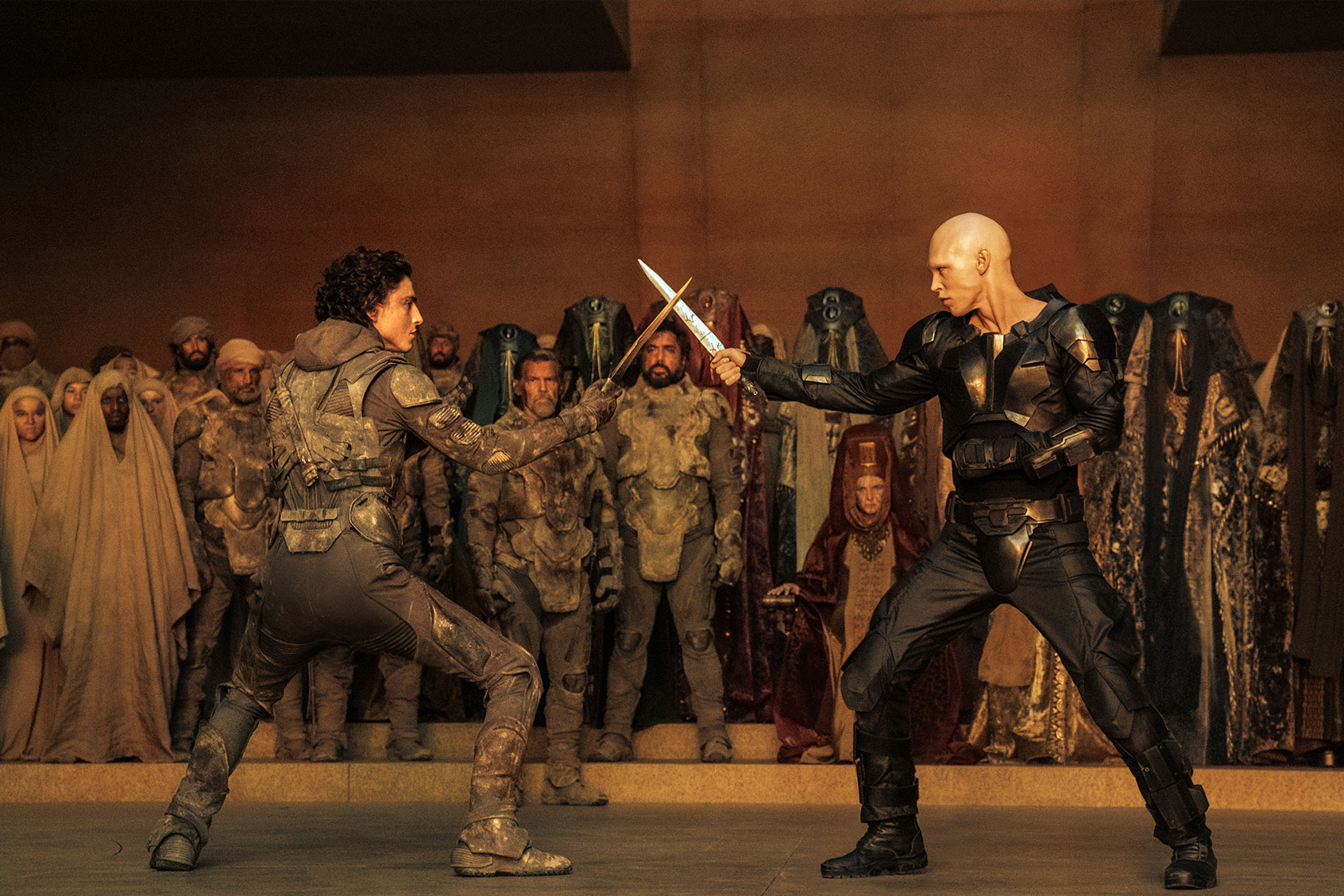
“Dune: Part Two” allows Villeneuve the time to spell this out, steadily transforming Paul from a grieving son into a vindictive authoritarian, seducing us into rooting for him along the way.

That starts with casting the sylph-like Timothée Chalamet as Paul Atreides. The actor may be 28 but he can still play a convincing teenager who fights like a wushu master and looks like a sensitive teen idol, making men and women alike swoon when he rides the biggest sandworm anyone has ever seen. Sexy!

In no time at all Chalamet’s Paul morphs from a loyal Fedaykin commando into a man compelling thousands of desert fighters to upset generations of political order imposed by the Landsraad, a council composed of Great Houses like the Atreides and the Harkonnens.

In Frank Herbert’s sequel to “Dune,” Muad'dib does bring peace, if you count annihilation as a type of it.

Paul shoulders the weight of leadership reluctantly . . . at first. He confesses this to Chani (Zendaya), his levelheaded lover and an avowed agnostic, that doesn’t fully believe in the Fremen prophecy hailing the coming of “Mahdi,” or a messiah, any more than he buys into the Bene Gesserit quest to produce a super-being known the Kwisatz Haderach.

As much as he recognizes signs of those Fremen legends coming true through him he also sees his mother (played by Rebecca Ferguson) manipulating their tribes to accept him as their star. Nevertheless, and to Chani's horror, when the opportunity arises Paul fans the Fremen’s religious zealotry to seize the Emperor’s throne in a vicious shah mat that upends the political balance. 

Dune: Part 2Timothée Chalamet as Paul Atreides and Austin Butler as Feyd-Rautha Harkonnen in "DUNE: PART TWO" (Warner Bros. Pictures)Paul's final line may be the film’s most chilling. When his loyal Atreides soldier Gurney Halleck (Josh Brolin) informs him that great houses won’t recognize him as emperor, Paul turns to Fremen leader Stilgar (Javier Bardem) and says, with a touch of resignation, “Lead them to paradise."

We need your help to stay independent

That scene makes the 1984 “Dune” look like a religious education propaganda film produced in the aftermath of Paul Muad'Dib's holy war.

Reportedly “Dune” author Frank Herbert was a fan of Lynch’s interpretation, although he might have found that Villeneuve’s vision better aligns with the message he wanted to convey through his novels.

As he explained in a 1985 speech he gave at UCLA, “I wrote the 'Dune' series because I had this idea that charismatic leaders ought to come with a warning label on their forehead: ‘May be dangerous to your health.’”

Whenever a sweeping cinematic adaptation like “Dune” becomes the season’s must-see film it’s tempting to search for reasons making a specific era ripe for it to speak to us. Maybe that is appropriate in some cases; I’ve certainly made my share of those arguments.

Then again, nearly 40 years after Lynch’s version we can appreciate its perspective as a function of its time. His “Dune” adaptation was part of Universal Studios’ attempt to ensnare some of the “Star Wars” audience. That places Paul Atreides’ transformation into Muad’Dib on par with Luke Skywalker becoming a Jedi. Next to the brutish Baron Harkonnen and his psychopath nephews, Paul Muad'Dib is downright chivalrous.

However, Herbert’s stories retain their relevance because of the conclusions he drew about charismatic figures back in 1965, when “Dune” was first published as a novel. The years and changing political winds afterward have compelled many readers to categorize the series as both liberal and conservative. In truth, Herbert had no kind words for either side of the partisan divide.

"I had this idea that charismatic leaders ought to come with a warning label on their forehead: ‘May be dangerous to your health.'"

In that UCLA speech, he called John F. Kennedy “one of the most dangerous presidents we had in this century,” citing his charisma as the reason America waged war in Vietnam. The most valuable president in his view was Richard Nixon, “because he taught us to distrust government and he did it by example.”

What happens, then, if a potential leader promises to remove the faulty governance of man from the equation and replace it with what he tells his followers is God’s law?

Villeneuve is said to be working on his answer to that question for a potential third “Dune.” American voters may find out much sooner, if predictions and fears about a surge of Christian nationalists at the polls come to pass. Topping the GOP ticket is a candidate who endorsed a campaign ad claiming “God gave us Trump” and promises to usher in his version of a theocracy even though the man has been heard calling Christians “idiots.”

On Monday the Supreme Court refused to uphold the Colorado Supreme Court disqualification of Donald Trump from appearing on that state’s primary ballots. It may eventually be ruled that he fomented an insurrection against the government whose laws he was sworn to uphold when he was president.

For now, however, the highest court in the land left it to Congress to enforce the 14th Amendment provision prohibiting insurrectionists from holding office. House Speaker Mike Johnson, R-La., a Christian Nationalist, will ensure that doesn’t happen. Lead them to paradise, indeed.


Want a daily wrap-up of all the news and commentary Salon has to offer? Subscribe to our morning newsletter, Crash Course.


“Dune” holds many allegories in its narrative, including within Herbert’s key moral of the story. It’s also pro-environmental conservation and multiculturalist, with the best part of the Atreides’ story being the desire of Duke Leto, Paul's father, to live with the Fremen and respect their mastery of “desert power” instead of subjugating them.

If he had lived that probably would have gone badly too, living up to Herbert’s broader conclusion – this story is not just about one man but all of them. “Why do 900 people go to Guyana and drink poisoned Kool-Aid?” Herbert went on to ask his UCLA audience. “Why do the citizens of an entire nation — most of the citizens anyway — say ‘Sieg Heil’ and murder some three [sic] million Jews and Gypsies? Why do they not question their leaders?”

Some of us are posing such interrogations, but perhaps not enough. Maybe this blockbuster’s perspective can help broaden that vision, if we’re willing to look for what Villeneuve is transmitting besides what he accomplishes through the superb acting and sensory exhilarating visuals and soundtrack.

Dune: Part 2Zendaya as Chani in "DUNE: PART TWO" (Warner Bros. Pictures)To that end, the image “Part Two” leaves us with holds as much significance as the line announcing Paul’s heel turn. While Paul is stalking into the center of the Fremen universe, Chani tries to warn her people that his path is false.

So while most of her Fedaykin confederates heed Muad’Dib’s call the war, a betrayed Chani heads back to her desert and calls a sandworm to ride to parts unknown. Zendaya doesn’t utter a word in that sequence. Her face says it all – she’s disillusioned and angry, but purposeful. She shows no fear. We may disagree on what Herbert meant to say about power and politics through these books, but on that emotion and its effect on our collective intelligence he’s as clear as a desert sky.

"Dune: Part Two" is now playing in theaters nationwide.

“Very strategic narrative”: Trump fans are using AI deepfakes to target Black voters

Racial justice defenders on Monday renewed calls for banning artificial intelligence in political advertisements after backers of former U.S. President Donald Trump published fake AI-generated images of the presumptive Republican nominee with Black "supporters."

BBC highlighted numerous deepfakes, including one created by right-wing Florida radio host Mark Kaye showing a smiling Trump embracing happy Black women. On closer inspection, missing or misformed fingers and unintelligible lettering on attire expose the images as fake.

"I'm not claiming it's accurate," Kaye told the BBC. "I'm not a photojournalist. "I'm not out there taking pictures of what's really happening. I'm a storyteller."

"If anybody's voting one way or another because of one photo they see on a Facebook page, that's a problem with that person, not with the post itself," Kaye added.

Another deepfake shows Trump on a porch surrounded by young Black men. The image earned a "community note" on X, the Elon Musk-owned social media platform formerly known as Twitter, identifying it as AI-generated. The owner of the account that published the image—which has been viewed more than 1.4 million times according to X—included the deceptive caption, "What do you think about Trump stopping his motorcade to take pictures with young men that waved him down?"

When asked about his image by the BBC, @MAGAShaggy1958 said his posts "have attracted thousands of wonderful kind-hearted Christian followers."

Responding to the new reporting, the racial justice group Color of Change led calls to ban AI in political ads.

"The spread of misinformation and targeted intimidation of Black voters will continue without the proper safeguards," the group said on social media, while calling for:

  • Banning AI from political ads;
  • Requiring disclosure of AI use for all other content;
  • Banning deepfakes; and
  • Restoring prohibitions on misinformation and lies about the validity of the 2020 election.

"As the 2024 election approaches, Big Tech companies like Google and Meta are poised to once again play a pivotal role in the spread of misinformation meant to disenfranchise Black voters and justify violence in the name of right-wing candidates," Color of Change said in a petition urging Big Tech to "stop amplifying election lies."

"During the 2016 and 2020 presidential election cycles, social media platforms such as Twitter, Facebook, YouTube, and others consistently ignored the warning signs that they were helping to undermine our democracy," the group continued. "This dangerous trend doesn't seem to be changing."

"Despite their claims that they've learned their lesson and are shoring up protections against misinformation ahead of the 2024 election cycle,large tech companies are cutting key staff that moderate content and removing election protections from their policies that are supposed to safeguard platform users from misinformation," the petition warns.

Last September, Sens. Amy Klobuchar (D-Minn.), Chris Coons (D-Del.), Josh Hawley (R-Mo.), and Susan Collins (R-Maine) introduced bipartisan legislation to prohibit the use of AI-generated content that falsely depicts candidates in political ads.

In February, the Federal Communications Commission responded to AI-generated robocalls featuring President Joe Biden's fake voice telling New Hampshire voters to not vote in their state's primary election by prohibiting the use of voice cloning technology to create automated calls.

The Federal Election Commission, however, has been accused by advocacy groups including Public Citizen of foot-dragging in response to public demands to regulate deepfakes. Earlier this year, FEC Chair Sean Cooksey said the agency would "resolve the AI rulemaking by early summer"—after many state primaries are over.

At least 13 states have passed laws governing the use of AI in political ads, while tech companies have responded in various ways to the rise of deepfakes. Last September, Google announced that it would require the prominent disclosure of political ads using AI. Meta, the parent company of Facebook and Instagram, has banned political campaigns from using its generative AI tools. OpenAI, which makes the popular ChatGPT chatbot, said earlier this year that it won't let users create content for political campaigns and will embed watermarks on art made with its DALL-E image generator.

Cliff Albright, co-founder of the Black Voters Matter campaign, told the BBC that "there have been documented attempts to target disinformation to Black communities again, especially younger Black voters."

Albright said the deepfakes serve a "very strategic narrative" being pushed by a wide range of right-wing voices from the Trump campaign to social media accounts in a bid to woo African Americans.

Trump's support among Black voters increased from just 8% in 2016 to a still-meager 12% in 2020. Conversely, a recent New York Times/Siena College survey of voters in six key swing states found that Biden's support among African American voters has plummeted from 92% during the last election cycle to 71% today, while 22% of Black respondents said they would vote for Trump this year.

Trump's attempts to win Black votes have ranged from awkward to cringeworthy, including hawking $400 golden sneakers and suggesting his mugshot and 91 criminal indictments appeal to African Americans.

The Atlantic diet: How does it compares to its Mediterranean counterpart?

The Mediterranean diet has long been seen as one of the most beneficial diets out there. It's been associated with many health benefits, including lower risk of cardiovascular disease and other chronic diseases (including cancer), better sleep and even good gut health.

But a recent study suggests that a slightly modified version of this diet – named the "Atlantic diet" – may also be beneficial for your health.

The Atlantic diet draws inspiration from the traditional eating habits of people living in northwestern Spain and Portugal. Like the Mediterranean diet, it's characterized by eating local, fresh and minimally processed seasonal foods – such as vegetables, fruits, fish, wholegrain, nuts, beans and olive oil. But unlike the Mediterranean diet, the Atlantic diet also includes moderate amounts of meat and pork products, as well as starchy vegetables such as potatoes.

According to this latest study, the Atlantic diet may reduce the risk of metabolic syndrome. This is the combination of high blood pressure, high blood fat levels, obesity and high blood sugar – all of which can lead to heart disease, stroke and type 2 diabetes.

The researchers conducted what's known as a secondary analysis. This meant they analyzed data from a previous study on the Atlantic diet, the GALIAT Atlantic Diet study, in order to better understand its effects. This was a six-month randomized clinical trial, which included more than 500 participants who were grouped together by family.

As part of the GALIAT trial, families were placed into two groups. One group followed the Atlantic diet. They were also taught about the diet and given cooking classes to help adhere to it. The second group, who acted as the control group, followed their usual diet and lifestyle.

The study lasted for six months. At the beginning of the study and after six months, researchers collected information on participants' food intake using a three-day food diary, as well as their physical activity levels, any medications they took and other variables such as weight if they smoked.

In the initial GALIAT diet study, the researchers found that the Atlantic diet group lost weight – whereas those in the control group gained weight. The Atlantic diet group also saw improvements in their levels of one type of cholesterol – though other types of cholesterol still remained the same. There were also no changes in their blood pressure and blood sugar.         

In the recent secondary analysis of this study, the researchers found that overall, participants who had followed the Atlantic diet had significantly lower risk of developing metabolic syndrome compared to the control group. They also found that following the Atlantic diet lowered risk of obesity, improved waist circumference and levels of cholesterol (specifically high-density lipoprotein).

But though the Atlantic diet had an overall effect on lowering risk of metabolic syndrome, it wasn't shown to have much effect on specific aspects of metabolic syndrome. Specifically, the researchers did not see any benefit from the Atlantic diet on blood pressure, blood sugar and blood fat levels.

Overall, the study shows that consuming the Atlantic diet may be helpful for managing weight – which may in turn lower risk of some long-term chronic conditions (such as cardiovascular disease).


Balanced diet

This is not the first time the effects of the Atlantic diet have been researched.

Previous studies have shown that the Atlantic diet is associated with lower levels of inflammation, blood fat levels and blood pressure among adults living in Spain. Another study also found that Spanish people who paired the Atlantic diet with regular physical activity had a lower risk of cardiovascular disease, lower cholesterol and lower rates of obesity.

But while research does show some potential benefits in adhering to the Atlantic diet, these results may not hold true for everyone.

First, most studies on the Atlantic diet – including this latest one – only included participants of Spanish or white European descent. This means we don't know whether the Atlantic diet will be equally beneficial for ethnic groups who are at greater risk of metabolic syndrome – such as people of south Asian, Black African and Caribbean descent.

It's well established that regularly consuming fruits, vegetables, wholegrains, nuts and fish provides a wide range of essential vitamins, minerals, fibre and antioxidants that are vital for good health. While the Atlantic diet is said to contain plenty of these foods, there's no clear information from this latest study on portion sizes or what quantity of certain foods participants consumed in order to reduce their risk of metabolic syndrome.

Another thing worth mentioning is that the GALIAT study gained a lot of media attention at the time. This may have influenced the particpants' eating and lifestyle habits as a result, making them adhere more strictly to it – making it appear the diet had a greater affect than it actually might in reality.

And, even though participants in both groups had similar characteristics at the start of the study (such as how physically active they were on average, or if they smoked), the researchers were unable to adjust their findings to fully account for all the factors that might influence a person's risk of developing metabolic syndrome.

The participants in the Atlantic diet group were also provided with the food they needed in order to stick with their diet. But in a real world setting, not everyone can regularly access or afford the kinds of foods the Atlantic diet consists of. This makes it difficult to know whether the findings will still stand outside of a controlled environment.

At the end of the day, the ideal diet to follow for improving metabolic health is one that includes a wide range of foods from each of the main food groups: fruits and vegetables, starchy carbohydrates (opting for wholegrain alternatives where possible), protein, dairy or dairy alternatives and healthy fats that you find accessible, affordable, enjoyable, as well as nourishing.

Taibat (Tai) Ibitoye, Senior Lecturer in Public Health and Registered Dietitian, University of Hertfordshire

This article is republished from The Conversation under a Creative Commons license. Read the original article.

Legal experts say Trump’s Jan. 6 architect has a “new perjury problem”: His “goose looks cooked”

Former Trump attorney Kenneth Chesebro, one of the architects in the former president’s fake elector plot, may have a "perjury" problem over his testimony to a Nevada grand jury.

The Washington Post on Monday reported on a cache of documents in the Nevada grand jury probe of the fake elector scheme, including Chesebro's statements to the panel.

Chesebro told the grand jury that he saw "pending litigation" as pivotal to the plot to overturn Trump's 2020 loss. 

“The whole point of the alternate elector plan that we arrived at in Wisconsin is the idea is we make sure that we have the extra three weeks to try to win the lawsuit," the right-wing lawyer said, according to a transcript. "If there isn't any lawsuit then there's no need for this to be done because there's no lawsuit that would be won before January 6th."

However, in an email sent in December of 2020, Chesebro alleged, "I think having the electors send in alternate slates of votes on Dec. 14 can pay huge dividends even if there is no litigation pending on Jan. 6," effectively undercutting his statement. 

"There is no barrier to Congress (here, we're talking the Senate, assuming it's still controlled by Republicans) deliberating on which electoral slate to count,” the email continued, “even if one electoral slate is endorsed by the governor, after all litigation is final — indeed, even if the slate met the Dec. 8 'safe harbor' deadline."

New York University Law Prof. Ryan Goodman highlighted the statements on X/Twitter, warning that "Chesebro has a new perjury problem."

Chesebro's "goose looks cooked," agreed former federal prosecutor Andrew Weissmann, who served on special counsel Bob Mueller's team.

A CNN report recently found that Chesebro concealed a secret Twitter account from Michigan prosecutors that was rife with posts that contradicted statements he made about his role in the ex-president’s election subversion plot.

"Worse yet. Chesebro repeatedly told Michigan prosecutors his view of alternate electors plan was contingent on winning litigation," Goodman tweeted. "New emails coming out of Wisconsin settlement provide strong proof he perjured himself."

“It does not protect parents”: Experts say bills to protect IVF in Alabama isn’t enough

Two weeks after facing a backlash when Alabama’s Supreme Court ruled frozen embryos are legally children, Alabama lawmakers scrambled to put together a new legislation to help protect in vitro fertilization (IVF) clinics from civil lawsuits and criminal prosecution. As Salon previously reported, the February ruling unleashed chaos for families as clinics across the state paused IVF treatments due to concerns about how and if embryos can be discarded, and what happens if transfers fail. 

It is common for multiple eggs to be transferred and fertilized because not all transferred embryos turn into viable pregnancies. IVF patients usually have a few options for their fertilized eggs that haven’t been transferred: to discard them, donate them to research, donate them to another couple or keep them for a future pregnancy. But the Alabama Supreme Court’s ruling raised questions IVF clinics and patients had never asked before: Could they be sued for manslaughter for discarding frozen embryos? Could patients be sued or criminally prosecuted if their own embryo transfers failed?

But last week, Alabama legislators in both chambers passed bills that would give civil and criminal immunity related to IVF providers or those “receiving goods or services related to in vitro fertilization; and to provide retroactive effect.” This happened after nearly 200 IVF patients filled the Alabama Statehouse pressuring lawmakers to get IVF services restarted as soon as possible, as reported by NPR. On Tuesday, Committees in the Alabama House of Representatives and the Alabama Senate will gather to debate a legislation to protect IVF providers and patients from civil and criminal prosecution. The next step is to wait for the Republican Alabama Governor Kay Ivey to sign the protections into law. However, as lawmakers gear up to debate the protections, experts tell Salon the bill is “political theater,” and raise concerns about what the bills do and don’t address. 

"What Alabama did is declare embryos as ‘children’ and then create a law that provides immunity to clinics and providers in cases for wrongful death or harm to an embryo."

“There is a much easier way to protect IVF, which is to actually create a privacy right for patients who need IVF, and then protect their access to these services,” Daphne Delvaux, an employment attorney and founder of The Mamattorney, a platform educating women on their rights at work, told Salon via email. “Instead, what Alabama did is declare embryos as ‘children’ and then create a law that provides immunity to clinics and providers in cases for wrongful death or harm to an embryo.”

Delvaux said that the laws are “nonsensical” and “contradictory” to each other.

“If clinics cannot be sued for wrongful death of an embryo, doesn't that exactly prove our point? That embryos aren't children,” she said. “Because you can still sue for wrongful death of an actual person.”


Want more health and science stories in your inbox? Subscribe to Salon's weekly newsletter Lab Notes.


Indeed, a major concern is that the new protections don't address the most problematic part of Alabama’s Supreme Court ruling: that frozen embryos are “extrauterine children.”

The mid-February Alabama Supreme Court ruling came from a pair of wrongful death cases brought by couples whose frozen embryos were destroyed in an accident at a fertility clinic. A patient allegedly removed embryos from the cryotanks at the Center for Reproductive Medicine in Mobile, Alabama, destroying the embryos of the three couples who were the plaintiffs of the case. The majority opinion said that an 1872 statute allowing parents to sue for the wrongful death of a minor applies to “unborn children” — and that there is no exception for “extrauterine children,” such as frozen embryos. In Chief Justice Tom Parker’s concurring statement, he cited the Book of Genesis. It was the first time the state applied legal personhood rights to an embryo outside of a pregnant person’s uterus. 

“This is a good way to ensure that patients who are facing infertility will not have their care interrupted or denied, that's the benefit of this bill, to just give some clarity that providers won't flee Alabama and not provide IVF services,” Seema Mohapatra, a health law and bioethics expert at Southern Methodist University, told Salon. “But I think that there's a lot of other legal concerns of leaving that a frozen embryo is an ‘extrauterine child.’”

Mohapatra added that it’s notable that the proposed shield law is the “opposite” of what the plaintiffs wanted in the first place, too, “which was compensation for the fact that their genetic material was destroyed,” she said. “It's an effort to protect the business of IVF and assisted reproduction — not questioning whether an embryo outside the body is a person under Alabama law.”

Legal ambiguity, Delvaux said, means that lawsuits will still be brought.

Delvaux said she believes the new legislation, despite providing civil and criminal immunity to those “receiving goods or services related to in vitro fertilization” leaves mothers vulnerable.

It’s unclear who exactly immunity will be granted to and “whether it only protects against actions by the clinics against the patients,” or “by any third party against the patients.” Legal ambiguity, she said, means that lawsuits will still be brought. She noted that the legislature could have easily written "IVF patients," but chose not to be so specific. 

“It also does not protect patients against claims other than wrongful death or damage, like custody claims,” Delvaux said. “This leaves especially women in abusive marriages extremely vulnerable."

When asked what her biggest concern is, she said it’s that mothers could be sued by abusive men for losing a pregnancy in the IVF process.

We need your help to stay independent

“These men would sue her for wrongful death, on behalf of the embryo, and a discovery process would open,” Delvaux said, adding the cross-examination would focus on all of a woman’s actions during pregnancy — what she ate, where she went and who she met. “Attorneys charge multiple hundreds of dollars per hour for legal defense.”

This could push these women into bankruptcy, she said, adding that even the threat of these cases could make women scared and “force them to bend to the man's will.”

“Generally, my biggest concern is that it does not protect parents from allegations and attacks by their partners or even other family members,” she said. “There are no protections when a parent decides to abuse the legal system to rob the other parent of agency about whether they want embryos to be implanted.”

Administration officials watered down VP Kamala Harris’ criticism of Israel in Gaza speech: report

Officials at the National Security Council watered down parts of Vice President Kamala Harris' viral, pointed Sunday speech calling for an immediate six-week ceasefire between Israel and Hamas before she delivered the remarks, three current United States officials and a former U.S. official familiar with the speech told NBC News.

Harris' original draft mounted a harsher critique of Israel regarding the humanitarian crisis in the Gaza Strip and the need for more aid than the speech she ultimately gave, one of the current officials and the former official said. It specifically confronted Israel about the need to permit additional aid trucks into the territory, two of the U.S. officials said, with one describing her initial language as strong but uncontroversial. The changes to the original draft were tonal, rather than speaking to shifts in policy, and Harris' ceasefire comments were reiterating Biden's remarks two days prior and the administration's stance on the war, the current officials added.

"The move to soften Harris’ comments highlights how reluctant the White House still is to aggressively criticize Israel in public as President Joe Biden tries to maintain some influence over the Israeli government and secure a hostage deal," NBC News reported. 

Kirsten Allen, Harris' communications director, said that reports of the Sunday speech being edited to be less aggressive were "inaccurate." In a separate statement to NBC News, Allen further delineated Harris' position on her comments. 

“The Vice President felt it was important to address the dire humanitarian situation in Gaza, given recent developments, and to reiterate our Administration’s call on Hamas to accept the terms of the hostage deal,” she said. 

Trump suggests he could face “extortion and blackmail” if SCOTUS doesn’t grant him immunity

Former President Donald Trump in a series of Truth Social posts on Monday seemed to suggest that he could face blackmail if the Supreme Court upholds a federal appeals court’s decision last month that he does not have presidential immunity from criminal prosecution in the D.C. election subversion case brought by special counsel Jack Smith.

“Without Presidential Immunity, a President will not be able to properly function, or make decisions, in the best interest of the United States of America," Trump wrote. "Presidents will always be concerned, and even paralyzed, by the prospect of wrongful prosecution and retaliation, after they leave office. This could actually lead to extortion and blackmail of a President. The other side would say, 'If you don’t do something, just the way we want it, we are going to go after you when you leave office, or perhaps even sooner.' A President has to be free to determine what is right for our Country with no undue pressure."

"Without Immunity, the Presidency, as we know it, will no longer exist,” the ex-president continued. “Many actions for the benefit of our Country will not be taken. This is in no way what the Founders had in mind. Legal Experts and Scholars have stated that the President must have Full Presidential Immunity. A President must be free to make proper decisions. His mind must be clear, and he must not be guided by fear of retribution!"


“First Amendment sin”: Trump-appointed judge torches Florida’s “Stop Woke” law

A federal appeals court on Monday blocked Florida from enforcing a Gov. Ron DeSantis-backed law that limits how private companies approach workplace diversity and inclusion, The Washington Post reports.

A three-judge panel of the U.S. Court of Appeals for the 11th Circuit upheld a federal judge's August 2022 ruling, determining that the "Stop Woke Act" "exceeds the bounds" of the Constitution's First Amendment right to free speech and expression in its effort to stipulate workplace trainings on race, sex and national origin. 

“By limiting its restrictions to a list of ideas designated as offensive, the Act targets speech based on its content," Judge Britt C. Grant wrote in the 22-page ruling. "And by barring only speech that endorses any of those ideas, it penalizes certain viewpoints — the greatest First Amendment sin."

Florida's Republican-controlled legislature approved the "Stop Woke Act" in March 2022. It was both one of DeSantis' top priorities and a key talking point on the campaign trail before he suspended his presidential bid earlier this year. The legislation bans workplace, public school and university trainings that could spur feelings of shame or guilt about historic actions undertaken by their race or sex, with any breach amounting to a violation of state anti-discrimination laws.

DeSantis had previously framed the "Stop Woke Act" as a means for employees to "stand up against discrimination." In court, he and state attorneys argued that the measure is a prohibition on conduct — requiring employees to attend such trainings — not speech, the opinion noted. But Grant, a Trump appointee, rejected that claim.

“Florida’s attempts to repackage its Act as a regulation of conduct rather than speech do not work,” Grant wrote. “ … Even if we presumed that the act served the interest of combating discrimination in some way, its breadth and scope would doom it. Banning speech on a wide variety of political topics is bad; banning speech on a wide variety of political viewpoints is worse.”

“Fundamentally incoherent”: George Conway says “you can see the terror” from SCOTUS in Trump ruling

Conservative attorney and frequent Trump critic George Conway blasted Monday's Supreme Court decision that saw former President Donald Trump reinstated to the Colorado primary ballot.

The ruling from the court’s conservative majority specified that only Congress, and not states, has the power to enforce the Constitution’s ban on insurrectionists holding federal office, a decision Conway called “fundamentally incoherent” during a Monday appearance on CNN’s “The Source” with Kaitlan Collins. 

“I think they did have a very difficult time with it because I don’t think any of the three opinions make any sense whatsoever,” Conway said. “I think these opinions are fundamentally incoherent and they’re fundamentally arbitrary. And I think it just shows the difficulty the court had in trying to select an off-ramp here. I mean, they totally rejected Trump’s principal arguments, which were that the president is somehow not an officer of the United States, and the other argument, which was that he did not engage in an insurrection.”

When Collins asked the lawyer why the justices did not refute the Colorado Supreme Court’s finding that Trump engaged in insurrection on Jan 6, Conway simply replied, “Because he’s unquestionably an insurrectionist.”

“It would have been absurd for the court to try to redefine what it means to engage in an insurrection,” Conway continued, “and what an insurrection is to try to fit it to get Donald Trump off the hook. And that’s what the court was terrified about. They didn’t want to go there. And you can see that sort of the terror in the opinions, in the concurring opinions.”

“Weird thing to write”: Experts call out Amy Coney Barrett’s “passive-aggressive” shot at liberals

Supreme Court Justice Amy Coney Barrett split from the conservative majority’s reasoning in the Trump ballot case but went after the court’s three liberals in “unusually biting terms,” according to CNN Supreme Court analyst Joan Biskupic.

The court’s majority ruled that states cannot disqualify a presidential candidate under Section 3 of the 14th Amendment — also known as the “insurrection” clause — and only Congress could enforce the provision.

Barrett pushed back on her conservative colleagues for “breaking significant – and in her mind unnecessary – ground in the breadth of their legal reasoning,” Biskupic explained. “But then she admonished the court’s three liberal justices, who also split from the majority’s legal rationale, in unusually biting terms.”

Barrett wrote that “this is not the time to amplify disagreement with stridency.”

“The Court has settled a politically charged issue in the volatile season of a Presidential election. Particularly in this circumstance, writings on the Court should turn the national temperature down, not up,” she added.

Barrett’s concurrence appeared to suggest that the liberal justices highlighted disagreement over the ruling’s rationale.

“All nine Justices agree on the outcome of this case,” Barrett wrote. “That is the message Americans should take home.”

But Barrett’s opinion, which was joined by no other justice, “had the effect of highlighting the tensions between ideological factions and the power of the conservative majority, rather than neutralizing them,” Biskupic explained.

While the liberal justices agreed that states could not disqualify the president because it would “create a chaotic state-by-state patchwork,” they argued that the “majority goes further” by requiring Congress to enact legislation to enforce the Constitutional provision.

“We cannot join an opinion that decides momentous and difficult issues unnecessarily,” the liberals’ opinion said. “The majority is left with next to no support for its requirement that a Section 3 disqualification can occur only pursuant to legislation enacted for that purpose.”

Barrett agreed that the majority did not need to address “the complicated question whether federal legislation is the exclusive vehicle through which Section 3 can be enforced.”

We need your help to stay independent

Biskupic noted that by criticizing the court’s critics, Barrett “appeared to take a page” from Chief Justice John Roberts.

“It has become a disturbing feature of some recent opinions to criticize the decisions with which they disagree as going beyond the proper role of the judiciary,” Roberts wrote last year, warning that “misperception” of the court’s splits “would be harmful to this institution and the country.”

Longtime Harvard legal scholar Laurence Tribe criticized Barrett for her “message” that “we should just chill.”

“I’d stress what Justices Sotomayor, Kagan, and Jackson rightly reminded Justice Barrett and Chief Justice Roberts about: as Roberts rightly wrote in Dobbs, the Court should avoid deciding any more than it needs to decide when ruling on a case,” Tribe tweeted. “To reach out and resolve in advance all sorts of issues that might arise in the future is to take on the role of a super-legislature, not a court of law.”

Slate legal analyst Dahlia Lithwick called out the “weird, passive-aggressive vibe” of Monday’s opinion.

“Everybody is kind of pissed off but telling us over and over again: ‘We’re not fighting! We love each other! The court is working!’ This sense of performing unity and performing minimalism falls really heavily on the four women of the court in their separate concurrences,” she said Monday.


Want a daily wrap-up of all the news and commentary Salon has to offer? Subscribe to our morning newsletter, Crash Course.


MSNBC legal analyst Jordan Rubin called Barrett’s admonition of the court’s liberal minority “a weird thing to write.”

“For one, judges disagree all the time, and the Democratic appointees’ concurrence in Trump v. Anderson is hardly the strongest prose to hit the high court,” Rubin wrote, noting that the late Justice Antonin Scalia, for whom Barrett clerked, “wrote historically nasty opinions.”

“And if anything, calling attention to the manner of disagreement between disagreeing opinions — which is apparent from reading them — serves to needlessly ‘amplify’ any disharmony on the court,” Rubin continued. “Plus, what’s her source for stating that it’s the court’s job to ‘turn the national temperature down’ anyway? She doesn’t cite one. If pointing out flaws in a majority ruling turns up the national temperature — whatever that even means — then that’s a problem with the majority, not the minority pointing out those flaws.”

There is something wrong at the New York Times

Two things — check that, three things — appear to have gone off the rails at the paper we used to call the Gray Lady. First, whoever is in charge of the paper’s polls is not doing their job. Second, whoever is choosing what to emphasize in Times coverage of the campaign for the presidency is showing bias. Third, the Times is obsessed with Joe Biden’s age at the same time they’re leaving evidence of Donald Trump’s mental and verbal stumbles completely out of the news.

Let’s start right there. At a rally on Saturday night in Virginia, Trump confused Barack Obama, who left office seven years ago, with President Biden for the third time over the last six months. “Putin has so little respect for Obama that he’s starting to throw around the nuclear word,” Trump said, as his crowd of rabid supporters suddenly fell silent. “You heard that. Nuclear. He’s starting to talk nuclear weapons today.” You won’t find that verbal stumble and the crowd’s stunned reaction in the Times coverage of the campaign over the weekend. You’ll have to read other publications — for example, Salon or maybe the Guardian — if you want to learn how often Trump is losing his way mid-sentence at rallies and just mumbling incoherently.

The Times on Sunday, however, had this headline ready for your morning coffee: “Majority of Biden’s 2020 Voters Now Say He’s Too Old to be Effective.” It’s another grab from the New York Times/Siena College poll they published on Saturday that is so outrageously flawed, a cottage industry has sprung up to pick apart its methodology and point out its glaring contradictions and straight-up bias. 

A favorite of poll skeptics is its sampling bias. How did the New York Times come up with a polling sample that included 36 percent rural voters when the 2020 proportion of rural voters was 19 percent? Somehow, the poll’s sample of female voters was equally skewed. The poll found Trump winning the female vote by one percent, when Biden carried women in 2020 by 11 points. The Times wants you to ignore that in between, all three of Trump’s Supreme Court justices quarterbacked the Dobbs decision overturning women’s constitutional right to abortion, followed almost immediately by states banning abortion all over the country, many with no exceptions for rape or incest. The Times doesn’t say how it squares its poll numbers with the fact that women turned out in huge numbers to help win referendums confirming a right to abortion, including in such Republican strongholds as Kansas and Kentucky, and handed every special election to Democratic candidates in the bargain. They just want you to believe there’s been a 12-point swing toward Trump among women, with no evidence except, poof!  It happened!

If you’re getting off the subway anywhere near 8th Avenue and 42nd Street, hold your nose. There’s something fishy at the New York Times.

The truly incredible thing is that the New York Times provides the evidence that would cause any other reasonable journalistic enterprise to question the accuracy of its own poll. The poll shows that Trump still has the support of nearly every Republican who voted for him in 2020 — this in the face of the fact that between 30 and 40 percent of primary voters have chosen another candidate than Trump. Those people are not poll respondents. They’re voters. The Times/Siena poll also somehow comes up with 12 percent support among Democrats for Rep. Dean Phillips, who has yet to get more than two percent of the vote in a primary. Even Phillips himself posted a tweet that said “When the NYT/Siena poll shows me at 12%, you better believe it’s flawed. Only 5% even know who I am.” The poll also shows that among respondents who described themselves as unhappy with both candidates, they favor Biden over Trump by 12 points. So Biden has the utterly disaffected vote and carries independents by four points, and he’s losing to Trump by four points? 

It just doesn’t add up.  

We need your help to stay independent

Why is the New York Times missing the red flags in its own polls? More important, why has the paper decided to give its own deeply biased poll results such heavy play? I don’t want to bring up but her emails, but for crying out loud, why is the New York Times so clearly making the same mistakes of bias and emphasis they made in 2016 covering Hillary Clinton all over again? The Times was down on Clinton for months because of her so-called email scandal that wasn’t a scandal at all, and when Russian intelligence leaked Democratic Party emails through WikiLeaks in the fall of 2016, reading the Times you would think that each and every DNC email that nobody bothered reading was a smoking gun. None of the daily drumbeat of manufactured “news” added up to even a pinprick of a scandal, but as the Times did with Whitewater and the rest of the made-up Clinton scandals, the paper simply couldn’t resist filling its front page with negative stories about the Democratic candidate for president.

There are no scandals with the name Biden attached to them, unless you consider the lies Russian spies supplied the so-called impeachment committee with. So The New York Times has apparently devoted half a floor in its Eighth Avenue headquarters to a search for bad news about Biden, and then they reserve a space nearly every day above the fold on the front page for whatever grain of grim garbage the Biden hunters have managed to come up with. They’re probably working on a story on how Biden is losing the pro-choice vote as we speak, while pointing out the wild success of Trump’s “move to the middle” on abortion with “centrist” voters. 

If you’re getting off the subway anywhere near Eighth Avenue and 42nd Street, hold your nose. There’s something fishy at the New York Times.

I trained my cat to travel with me — and now he’s my perfect companion away from home

The first thing I do at the hotel is to set up the room for him: the litter box against the wall a good distance from the door, the feeding station by the mini-fridge, the cardboard scratching post next to the bed. It’s been six hours since Miles and I left our apartment in D.C. for Cambridge, where I’ll be teaching for the next 10 days at a low-residency MFA program.  Miles hops out of the carrier and flops down on the floor next to me. He rolls around, stretches and arches his back while I scratch his belly. 

After a few minutes, he gets up to explore the room, rubbing his cheek and forehead on the carpet and the furniture, returning to me for frequent headbutts and belly rubs. The scent line he’s drawing is as clear to him as red paint would be to me. I don’t move from my spot on the floor until he’s been to every corner and back several times, securing the two of us in the center of his territory. I have a reception to attend, but I take my time unpacking. The space he outlined fills with objects he recognizes from home. By the time I leave, he’s had his first meal, drunk some water, squatted in the litter box to pee, and settled on the couch whose upholstery he won’t be able to resist in spite of the cardboard scratcher I had delivered to the hotel ahead of our arrival. The gap between the woven threads is the perfect size for a cat’s claws to sink into. This is our fourth trip together and the second stay at this hotel. We are in a different room but the furniture, the layout, and the artwork on the wall are nearly identical.

Miles, a 13-year-old Siamese, travels with me for his health. When he threw up repeatedly, stopped eating altogether, and was diagnosed with Feline Inflammatory Bowel Disease, we were four months into the COVID-19 shutdown. The classes I taught at my primary job in Northern Virginia, a 45-minute commute each way twice a week, had gone online, and the 10-day trip I made every six months to Cambridge was replaced by a “virtual residency.” I was home 24/7 to give Miles his pills (he is an excellent pill taker) and supervise the mealtimes when he and Jackson, the Burmese, had to be separated to make sure that Miles was eating only the food prescribed by our veterinarian. 

Inflammatory Bowel Disease is a common chronic condition among cats, managed with medication and diet. Miles had a mild case so he didn’t have to stay on the steroids he was initially prescribed.  After observing him closely for nearly two years, I figured out the perfect protocol. He threw up mostly when his stomach was too full or empty. I could keep the condition in check by feeding him small meals six to eight times a day, a tablespoon of the prescription dry food parceled out one pea-sized piece at a time.

Even after classes resumed in person, no one objected if I asked to attend meetings and hold conferences virtually, so I wasn’t gone all day like I used to be. But then the low-residency program went back off-line. I have two close friends in the building I trust completely. In a true Siamese fashion, however, Miles is a one-person cat. In the past when Beth and Rachel took care of him and Jackson, Miles kept a wary distance while Jackson climbed all over them. The only way I could hold onto my low-residency job, which provided the financial cushion I needed not to worry about extra expenses (caused almost exclusively by my obsession with cats and clothes), was to train Miles to be my traveling companion.

The myth that cats are selfish and dogs are loyal says more about human nature than it does about either species.

Whenever a scientific study contradicts the notion that cats are incapable of loving us, the result is reported in a tone of incredulity: “Your Cat Might Not Be Ignoring You When You Speak”; “If You Think Cats Are Antisocial, Maybe It’s You, Scientists Find,” “Shocker: Some Cats Like People More Than Food or Toys.” I doubt that Americans in 46.5 million households are choosing to live with pets who show no affection. Seeking daily doses of humiliation is not in our national character. The myth that cats are selfish and dogs are loyal says more about human nature than it does about either species. We humans like to see the world divided in half: black and white, male and female, good and evil, canine and feline. If dogs love us, then cats must hate us; all the things that make dogs fun to be around — greeting us at the door, following us through the house, learning tricks — are supposedly off-limits to cats.

I was confident that Miles, who had mastered a repertoire of tricks (come, sit, high-five, jump over a stick, jump through a hoop) through clicker training, the same method used for dogs, would understand that he was better off traveling with me than being left behind. Even so, I didn’t expect him to enjoy a six-hour trip involving a cab ride, a shuttle flight, then another cab ride. Most cats hate riding in vehicles — that, I have to concede, is a real difference between dogs and cats — or being paraded through the airport security gate amid the cacophony of voices and machine noises (“But Miles, I did the TSA Pre-Check so we could stand in the shorter line!”) though Miles would never bolt out of my arms. In his distress, he recognizes me as his sole source of security. Just like when I take him to the vet, he does not dwell on the fact that every terrifying thing that is happening to him is happening because I had planned it. Cats are creatures of habit (what animal isn’t?) and air travel is a huge disruption to their routine. For Miles, however, the habit that overrides all is the habit of trusting me. 

When I return from the reception, Miles comes trotting across the room and lies down at my feet. After a brief petting session, I retrieve his clicker and treats from the drawer above the mini-fridge. “Come, sit,” I say, pointing to a spot on the bed. Miles jumps up and sits. I click and give him the treat made of hydrolized protein that won’t upset his stomach, broken into tiny pieces so he won’t overeat. Then I point to the next spot — the top of the dresser — and repeat, “Come.”  We go around the room until he’s sat on every piece of furniture at my request. This is what we do at home every night, though he’s doing it solo, without Jackson. 

Miles has another small meal, I clean his litter box, we watch the 11 o’clock news, and then he sleeps in my arms, under the covers, as always. For the rest of our stay, he supervises my class preparation from his usual perch on my shoulder or lap; he naps on the couch while I’m out running, teaching or meeting up with friends. We maintain his feeding and clicker-trick schedules. Every fourth day when the room needs to be cleaned (according to some hotel industry regulation), we wait in the hallway. I don’t tell the cleaning lady the real reason I’m asking her not to change the sheets (they now smell familiar to Miles) but then again, there is a lot I ask my cleaning ladies at home to do or not to do, all of it having to do with the cats’ safety or comfort for reasons too complicated or embarrassing to explain. 

An animal who hunkers down in a hotel room with you and helps you maintain the stability of your routine is no less devoted to you than one who eagerly accompanies you on your adventures.

Staying at the hotel isn’t exactly like being home. I text Beth and Rachel several times a day for updates about Jackson.  I make coffee with a Keurig instead of a French press. I eat food from a deli or go out to restaurants with friends and never cook a single meal. And if Miles wakes up thirsty in the middle of the night, he can drink water from the glass on our bedside table rather than from the bowl on the floor. He can’t do that at home, where I use a cup with a lid. But it’s OK. We are on vacation. 

On my morning runs during the pandemic, I often saw two or three humans standing six feet apart, straining to carry on a conversation through their masks, while their dogs played nose to nose at the ends of their leashes.  I understood why my friends said their dogs had saved their sanity. Instead of sitting alone at home all day, scared and depressed, my friends were able to venture out and interact with other still-healthy humans walking their dogs. I encountered plenty of still-healthy humans on the running trail, too, but it wasn’t the same without dogs. Runners sped past each other, mildly annoyed that we had to pull the mask up to our face for the few seconds of physical proximity before letting it hang around our neck where it did not interfere with our breathing. 

Dogs can transform strangers into friends, and they are eager — perhaps even more than you are — for an adventure. They’ll hop into your car and drive across the country with you, and at every stop, they’ll help you talk to people with whom you have little or nothing in common except that you are in the same place at the same time, fleetingly. Traveling with a dog means having at your side a goodwill ambassador and a motivational coach rolled into one. John Steinbeck chronicled his cross-country journey with his dog in "Travels with Charley." In 1960, at the age of 58 and in less-than-perfect health, the author set out to see all of America one last time to understand the changes in the country he had been writing about for decades. A quest of that enormity required a canine traveling companion. 

A cat is an ideal companion, too, but for a different kind of traveler. An animal who hunkers down in a hotel room with you and helps you maintain the stability of your routine is no less devoted to you than one who eagerly accompanies you on your adventures. A cat inspires you to love your home so fiercely that you never need to leave to feel better about yourself or the world, and on the few occasions when you must, he will travel with you and transform any strange place into a temporary home.

That’s what Miles does for me, a reluctant traveler. Although I love hearing and reading about other people’s adventures, I’m not drawn to leaving home just to look around and get to know a new place. I’ve been to most of the major American cities, but only by necessity and for specific purposes — to teach, give a reading, attend a conference, spend time with friends I couldn’t persuade to come and see me instead. When I had a few hours to myself, I did the same things I would do at home: I ran, went bird-watching, visited museums. 

Long before I started traveling with a cat, I was traveling like a cat.

Because these activities were easy to arrange, I ended up seeing more of each city than other people who were teaching or attending the same conference.  Almost all the popular running trails were along a body of water, but the twisty Riverwalk in San Antonio was nothing like the straight shot down the Hudson from the Upper West Side to the Battery Park.  The same warblers, encountered in different seasons from north to south, were nearly unrecognizable. In a dozen museums across the country, I looked for Rembrandt’s portraits, Bonnard’s landscapes, and Georgia O’Keeffe’s flowers.  The lists of birds I could identify and artists whose work I loved expanded over the years. 

Long before I started traveling with a cat, I was traveling like a cat, outlining a familiar territory and filling it in, first with the things I recognized and then with the new things I learned through repeated encounters. This, essentially, is how I do anything that is important to me, including my writing. I take a familiar form — an essay, a short story, a memoir, a novel — and circle its shape, bumping against its boundaries, sorting through myriad memories, impressions, opinions and inventions, until the space contains more than what I knew at the beginning. The best new ideas come to me like a warbler away from our yearly encounter at my home sanctuary. It perches on a nearby branch and waits for me to recognize and claim it.  


Want a daily wrap-up of all the news and commentary Salon has to offer? Subscribe to our morning newsletter, Crash Course.


Steinbeck’s dog, Charley, was 10 years old, which is similar to the human age of 58. A standard French poodle born near Paris, he belonged to an elegant, luxurious breed, though in previous centuries, poodles were used to retrieve game from water. He was the perfect dog to accompany a famous author traveling incognito in a camper named after Don Quixote’s horse. Canine or feline, your ideal traveling companion is also your avatar. 

Even before I open the carrier, Miles knows he is home. He doesn’t have to walk around to reclaim the space. He and Jackson, who’s been waiting at the door, sniff and saunter away from each other casually though for the next day or two, they will chase each other and wrestle more than usual. I unpack and put my suitcase in the closet where the cats — and me, too — can forget about it until Miles and I have to go away again. Jackson clings to me and purrs. I missed him, too, but Rachel’s note says he sat on her lap for hours while she worked from my living room and Beth reports he was the star of the Zoom yoga class she taught, also from my living room.  

Miles is my soulmate, the avatar of my essential self. Jackson is who I aspire (in vain) to be: trusting of friends and strangers alike, open to new experiences. The evening of their reunion is a series of scuffles and truces. By bedtime, the routine of separate meals and joint clicker tricks is firmly in place. The cats curl up together on the bed and wait for me to complete the circle.

Buzzkill: Climate change could destroy the coffee industry. Here’s how we can still save it

Our industrial society is underpinned by drug use, though we don't typically think of it as such. After all, two out of three Americans drink coffee daily, according to the National Coffee Association. The American coffee market is expected to exceed $28 billion in 2024 and the industry creates 2.2 million jobs a year, which in turn generates more than $100 billion in wages for employees.

But just try to imagine a world without coffee in the office breakroom or the long lines wrapping around Dutch Bros. Yet as unthinkable as it may seem, climate change could craft a future in which coffee disappears, or at least becomes far more scarce and expensive.

Experts in this area seem to agree on two things: Climate change is going to make it harder to produce coffee, and coffee production in turn actually worsens the problems of climate change. Jarrod Kath, a professor of agriculture and environmental science at the University of Queensland who has studied coffee and temperature variability, elaborated on how global warming will negatively impact coffee production. Specifically, Kath focused on the two species of plants used to make coffee — Arabica and robusta — and how each one responds differently to rising temperatures.
 
"Robusta coffee is generally thought to be able withstand hotter conditions better than Arabica," Kath told Salon by email, adding that he has previously researched the question of how much better it will be. The conventional wisdom holds that robusta needs an optimal temperature range above 22°C to thrive, but Kath's research has found that those people "are likely overestimating its suitable production range and its ability to contribute to coffee production as temperatures increase under climate change. Robusta supplies 40% of the world's coffee, but its production potential could decline considerably as temperatures increase under climate change, jeopardizing a multi-billion dollar coffee industry and the livelihoods of millions of farmers.”

Similarly, Kath and his team did research on Arabica coffee and discovered that "it is highly sensitive to the air getting drier and hotter." After Kath and his scientists measured the dryness and heat of the air, they learned that "once you reach a critical threshold of vapour pressure deficit that Arabica coffee yields decline rapidly. Several Arabica areas under climate change may see rapid yield declines under climate change."

"I think that coffee serves as a ‘canary in the mine’ of environmental change."

In addition to making coffee more scarce, climate change has also put a target over the coffee industry for a different reason — the fact that it leaves a massive carbon footprint which exacerbates global warming. Amanda McMillan Lequieu, a professor of environmental sociology at Drexel University who has also studied coffee and climate change, elaborated on the nature of coffee's worrying (but elusive) carbon footprint.

"There are many ways to produce coffee, so it's difficult to summarize exactly how much carbon coffee production inmates," Lequieu wrote to Salon. "We do know that the production processes tend to make up 40 to 80% of the total greenhouse gas emissions affiliated with coffee as a commodity. This is because the growth of coffee plants can often be associated with removing other habitats, and with the mechanization of certain components of the harvesting, cleaning, and those two process require some fossil fuel energy, and perhaps most significantly, transportation contributes significantly to the carbon emissions for most tropical commodities consumed in the global north."

Lequieu added, "To be clear, other forms of consumption — say, of meat — contributes more significantly to greenhouse gas emissions than coffee does. Zooming out further, industrial-scale transportation and fossil fuel extraction and usage are the most significant contributors overall."


Want more health and science stories in your inbox? Subscribe to Salon's weekly newsletter Lab Notes.


"It is the poorer coffee farmers that don’t have the resources and capacity to adapt that will face the greatest challenges."

There is one other way in which climate change negatively impacts the coffee industry — by harming the livelihoods of those who depend on it.

"This is my opinion, not based on my research, but my discussion with those I word with in the coffee industry suggest that those with enough resources (e.g. money to invest in irrigation) to adapt to climate change may be fine," Kath told Salon. "It is the poorer coffee farmers that don’t have the resources and capacity to adapt that will face the greatest challenges. If the climate becomes more unfavorable, they may no longer be able to produce high enough yields to make a living income from coffee production. The flow on effects of this at scale and for coffee supply more generally I don’t think are well understood, or at least quantified."

"Under these circumstances," David Kuhn, the lead for corporate resilience at the World Wildlife Fund, pointed out, "it’s important that we examine the whole system while also engaging with local communities to implement solutions that put people and nature at the center of a long-term vision for healthy landscapes. This includes significantly scaling up investments in adaptation and resilience for our communities and nature."

"They are being impacted by climate change now, and the longer we wait, the harder and more expensive it’s going to get," he added.

We need your help to stay independent

As Kuhn also noted, coffee and humans are alike in that they "depend on a healthy environment to survive and thrive." This is demonstrated in the case of coffee by the fact that "the coffee plant requires certain conditions to grow and produce high-quality fruit; the right temperature, the right precipitation, the right soil and all at the right time.

Coffee is also impacted by pests. Climate change is shifting all of this, making things more uncertain, making management decision-making harder and more expensive for producers and putting more stress on the plants and resources."

Lequieu said the coffee and climate change crisis involve far more than the fate of this particular beverage.

"I think that coffee serves as a ‘canary in the mine’ of environmental change," Lequieu told Salon, explaining that this was a key reason why she and one of her students decided to write an article studying it. "Even those of us who feel particularly alienated from where our food comes from often, on a daily basis, interact directly with the fruit of this tropical plant. Even if the quantity of coffee available to everyday consumers doesn't change much initially, as climate change might enable coffee to be grown in other regions of the world when a warming climate creates amenable weather patterns beyond the Equatorial region, we wanted to draw attention to the very real people who will be impacted by coffees decline in traditional growing regions."

“They frankly laugh behind the backs of their own voters”: How Republicans bamboozle rural whites

It's become a tedious trope, the Beltway journalist who goes on a red state safari to ask Donald Trump voters if they still like Trump. It frustrates smart readers because invariably the answer is "yes" yet the rationale is typically incoherent babble. Even that would be fine, if these reporters dug an inch deeper, to get at the various bigotries that are actually driving the MAGA movement. Instead, most of them seem too in awe of redhats sitting in diners, as though they've just encountered a rare species of bird in the wild, to bother interrogating them in a way that reveals anything genuinely valuable. 

If readers see the title "White Rural Rage: The Threat to Democracy," they might think it's more of the same. But this book, by former Washington Post columnist Paul Waldman and University of Maryland, Baltimore professor Thomas Schaller, is a very different animal. Waldman and Schaller believe that rural white people are functioning adults who have agency and are not the childlike ciphers of Fox News. As such, the book refreshingly holds rural white voters to account for their choices, and for willfully gobbling down right-wing propaganda. It calls on rural Americans to take responsibility for themselves, by asking the harder question of what it would actually take to improve their communities. 

Waldman and Schaller spoke to Salon about what rural America actually needs, and why Republican voters stubbornly refuse to admit it. 

This interview has been edited for length and clarity. 

This book got at something that I find frustrating in a lot of the discourse about rural white conservatives. I grew up in a county that had one person per square mile in Texas. I know these people well. I resent how they're discussed in the mainstream media. Almost as if they don't have agency. Your book just really blows a hole through that argument. 

Schaller: In 2016, Kevin Williamson wrote this piece about the white working class in National Review. A very controversial piece. He was asking, don't these people have agency? Aren't they part of the representational system with elected officials? Why don't they ask for more? Are they children? A lot of people took offense to that, and we're not making an argument as aggressive as that. He had a little bit more safe harbor to do that, coming from the right. But we're basically saying that the problem here isn't the Democrats. They always get blamed for not doing enough or not reaching out or not being respectful.

It's really the quality of the Republicans that they're electing. And as Paul has pointed out, it's because of the economic malaise, because of the healthcare maladies and because of the brain drain and people moving out of rural communities. Two-thirds of rural counties lost population between 2010 and 2020. That's incredible. And a majority of counties in the nation lost population between 2010 and 2020. To our knowledge that had never happened between two consecutive censuses. This is creating this rural ruin, as we call it. We understand the anxiety that that creates. The question is, what are you going to do about it?

One option is to blame faraway cities and liberals and minorities and woke and CRT and antifa and college professors like me for all of your problems. You'll be rewarded if you say that. There's a steady diet of conservative talk hosts, from Fox News and OANN and Newsmax, who will tell you that's where all your problems come from. Read Katherine Cramer's book, "The Politics of Resentment," about Wisconsin. That's where they think all the problems come from — Milwaukee and Madison — and that everything that's going wrong in the upper part of Wisconsin is because of liberals in the cities, and Blacks in Milwaukee and the college professors in Madison. That might make you feel good on Election Day, but it's not going to solve your material problems. What rural America needs is to stop waiting on Democrats to rescue them, even though it is Democrats who are bringing rural broadband.

"Conservatives are constantly being told that not only that cities are hellholes and places that are alien to your values, but also if you send your kids to college, which is the path to more economic opportunity for most people, that they are going to reject you and your values."

There was just a piece in the Washington Post about the dramatic decrease of uninsured rates under Obamacare. Biden specifically convinced vaccine skeptics to get vaccines in rural America, with a program he never put his name on. He saved the lives of the people least likely to vote for him. Even though Democrats are doing all this stuff, in the end, rural whites are not going to vote for those Democrats. So they need to start voting for a better class of Republican. 

Waldman: There's an irony in all of those safari articles where reporters go to the diner and find out that the Trump supporters still love Trump. Those are largely coastal, highly educated reporters who, in their own lives, are probably more liberal or at least center left. And yet they have assimilated all these ideas about how Trump Country people have a kind of moral superiority to them and deserve this kind of respect.

So you get a reporter who works in Washington and grew up in Massachusetts, and goes to some place in Appalachia or to Ohio, and has assimilated this idea that these are the real Americans. And even if some of their views might be repellent, I have to treat them with respect because they're the true voice. And that I find deeply problematic. It's always worthwhile to understand people. But too much of that reporting is just deferential. It assumes that these people are the most real of Americans, and therefore their views don't shouldn't be subject to any kind of real moral judgment.

And not only are they more real Americans, but they are somehow still less intelligent. As if they can't be engaged with in any way because they're both above us all morally, but beneath us intellectually. We're expected to handle them with kid gloves. There is no interrogation of their beliefs, where they come from, beyond an assumption they've been brainwashed by Fox News propaganda.

Schaller: They want to get mad at us, at this book, and dismiss us as a couple of liberal professors who live in the D.C. area and went to fancy schools. That's fine. We can deal with it. But when Ted Cruz says, my pronouns are "kiss my ass" or  "you can't limit me to two beers," now he's more insulting. What he is saying is, these voters are so easily won over by performative politics. I can reduce their core urges and reflexes to this. And I don't have to deliver a thing for rural Texas. I don't have to go to these counties. I don't have to live their experiences. I don't. I can go to Cancun on vacation and they'll still vote for me as long as I'll put on a flannel shirt and say, "my pronouns are 'kiss my ass'" and that's good enough to get me reelected.

Nobody is more insulting to rural voters than the people who are giving them nothing and taking their votes. They claim Democrats are insulting, but Democrats are doing something for them and getting none of their votes. But nothing's more condescending than getting votes and doing nothing in return. J.D. Vance, Elise Stefanik and Tom Cotton: All these people were educated at Harvard and Yale. They frankly laugh behind the backs of their own voters to some degree, right? Those are the people who are really insulting. There's an old D.C. adage about stabbing people in the front. Republicans look you right in the eye and stab you right in the front.

We need your help to stay independent

Waldman: You see it in your home state of Texas almost more than anywhere else. Republicans have carefully gerrymandered the state legislative districts, using rural areas as a kind of leverage to make sure they stay in power. Yet there are huge problems in rural Texas that the legislature never addresses. They've got terrible infrastructure problems. They've got problems with the water systems and the electrical systems. Because they refused to accept the Obamacare expansion of Medicaid, rural hospitals are closing all over. There are people in Texas who have to drive 200 miles to get to prenatal care.

There was an interesting study that we cite in the book that found that there were three things that really determined whether a rural area was going to be able to prosper economically: Do you have strong schools? Do you have good broadband that businesses [can] rely on so they can prosper and flourish? Do you have access to contraception so women don't have to have babies before they're ready? If you have those three things in place, then your area can prosper. And those, of course, are three things that Republicans are undermining.

They shortchange the schools and they try to shift money away from public schools into private school vouchers. And in a lot of rural areas, there are no private schools. They couldn't take advantage of that even if they wanted to. Republicans stood in the way of expanding broadband. And of course they promote abstinence-only sex education and make sure that women don't have access to contraception, which I know you have written about a lot. 

I could go on all day about lack of contraception access in a small town. But I want to ask about another hobby horse of mine, and almost no one is talking about it: The brain drain issue. We're seeing a lot of young people growing up and leaving these areas and never coming back. It is an underrated source of the resentment and the anger that we're seeing from rural white people. 

Schaller: It's decimating. Rural America is older on average than any other part of the country. In the suburbs and the city, 40% of people tell their children they should consider leaving. But 60% of rural people tell their children they should leave. The best and brightest students are encouraged by their parents and their teachers to leave and get an education. Some of them may have come back to become a doctor or a lawyer locally. Most of them graduate school and maybe they had loans and they needed to move to the city to make an income to pay it back. And Paul can tell you some stories about Shawna Claw, a woman we met who was running for the Navajo Nation seat, one of the 24 seats in the Navajo legislature. Or Mila Besich, a Latina mayor of Superior, where she went to high school.

Waldman: Everywhere we went, people said there weren't enough economic opportunities. The kids who were smart and ambitious, they decided to leave. So Mila Besich, just a good example: She's the mayor of Superior, Arizona, which is this dusty little town in the desert. When she was getting ready to graduate high school, her guidance counselor told her, you have to get out there. The copper mine is going to be closing. I will do everything I can to get you a scholarship, but there's going to be nothing for you here. She got out, but she came back and she's now the mayor. We heard the same thing from Shawna Claw on this Navajo reservation.

Schaller: Shawna said, you know, I have two kids. My son is in the Air Force and is in Seattle. And her daughter wants to be a cosmetologist, but they don't have a salon on the reservation. So she lives in Phoenix. And we heard the same thing from people in West Virginia: There just aren't really good jobs here. You can get a job at the Dollar Store, but what is that going to do for you?

Part of it is just the basic problem of being in a lower-density area. You could be the best auto mechanic in your area, but if there's only two people a week who need their car fixed, you can't build a thriving business. But some part is the lack of investment. There's an inability to build something in a place where nothing else is getting built. The only businesses that are thriving are the Dollar Stores.

The brain drain is also affecting the personality of rural and urban Americans. Will Wilkinson wrote this massive study called the "Density Divide" in 2019. He showed it's not just that red America and blue America have different economies and there are different attitudes. You can now predict where people score on the basic big five personality characteristics. People who score high on "openness to experience" are more likely to leave rural America. People who score low are more likely to stay. It's creating a personality blue/red divide.

The Trevor Project, which studies LGBQT+ issues, found that 49% of rural youth said that their communities are unaccepting of gays and lesbians. That's about twice the rate in the suburbs and in the cities. That's another reason young people don't want to come back. In addition to few economic opportunities at home, they feel some hostility, especially if they're liberal.

Waldman: That's how it feeds on itself and becomes a cycle. Conservatives are constantly being told that not only that cities are hellholes and places that are alien to your values, but also if you send your kids to college, which is the path to more economic opportunity for most people, that they are going to reject you and your values. That they're going to hear all these alien ideas and that's going to break up your family. And it is sometimes true that you go to college and you get exposed to all these different ideas. It doesn't necessarily mean that they're "woke" ideas, but there are things that you never thought about. A lot of kids do come home from college and say, "You know, Mom, Dad, I don't think you're right about this anymore." People don't like that. 

What's interesting to me about that narrative is both sides of that particular conflict feel like the victims. I'm on one side of that conflict with my own family, and I definitely feel like the victim. I'm not the one who embraces this intolerant worldview or voted for Donald Trump. I don't live in this racist, homophobic, sexist bubble. Their attitude is I was taken away from them by these forces. When both sides see themselves as a victim, it seems very difficult to traverse that conversation. 

Waldman: It's really hard. This is also a media story. News media in rural areas has really been decimated. The newspaper industry is in crisis everywhere, but especially in rural areas. Local papers have shut down. The ones that remain got bought out by some private equity firm and they don't really report on local issues anymore. And they used to cover issues that can bind people together, stuff that that doesn't have to do with partisanship. Questions like, "Are we gonna build a new city hall? " or "Is there going be a festival in in town next summer?"

If that source of information is not there, not only are people disconnected from what's going on in their community, but the only messages that they get, especially from Fox News and conservative talk radio, is all about how they are besieged. That they're surrounded by enemies who want to literally destroy them and their way of life.

We went to Llano, Texas, where they have one of these library controversies over whether there are going to be certain books allowed in the public library. The conservatives that we talked to, they all said, oh, we are the reasonable ones. They said all these crazy liberals want to put this pornographic filth in the library, and we just want to make sure things are age-appropriate. But we also heard from a lot of people there who said that things have just gotten meaner since this thing with the library started. It's just all nasty, and we used to all like each other. Once you have these issues that crop up with these national overtones, it can make it feel like this is something that can't be resolved. That my neighbors, even if it's it's a minority, are my enemies.

We talked to a librarian named Kathy Zappitello in Ashtabula County, Ohio, which is a rural area. It's one of those places that went for Obama twice and then swung hard to Donald Trump. She decided to run for a state rep against somebody who was a homeschooling advocate who didn't have any children in the schools, but had gotten put on the state board of education deciding what's going on in public schools. And Kathy ran against her. Just because she was running for office, people started to come into her library and look for "problematic" books. She said that people would come up to her at some of her events and almost whisper to her, "I support you, but I can't take a sign because if I do, my neighbors are gonna tear it down. I'm afraid of them." There's a bubbling up of real nasty antagonism towards the liberals who live in these areas.

Is there any solution? Is there any hope? Because you guys describe a vicious cycle of rural white people hurting themselves by electing Republicans, and then playing the victim, even though they did it to themselves. 

Waldman: Well, you could argue that the rural whites who have been electing Republicans ought to elect Democrats. But at the very least, they ought to get themselves better Republicans. They need to start demanding more. There's many politically barren places where the Democrats don't go because they're never going to win and Republicans barely go because they know that they're always going to win. That population is not demanding anything of Republicans. Republicans come in at the end of the campaign and say, "Don't you hate liberals? Yeah, me too."  And then they vote those people back into office. They need to start saying to their Republican representatives, "What are you actually doing for us? Are you improving the quality of our lives? Look at our communities and what have happened to them! What are you doing about it?"

If they start doing that, then you going to get some political competition. You're going to get people who are held accountable for whether they provide for the people who elect them. That can actually lead to some positive change. Rural white people need to engage politically and get something that's not just about saying that they're mad at liberals. If they start demanding more of their Republican representatives, then they might actually provide something better and you could have a more active politics in those places.

Schaller: You have people in rural areas saying socialism is destroying their economies. But if you look at why the mom-and-pop shop closed and got replaced by a Dollar General? That's late stage capitalism. That ain't socialism. Right? If you look at why hospital and treatment facilities are closing, it's because rural hospitals don't turn a profit. That's capitalism, pure and simple. The same people who are complaining that socialism and communism are taking over America are watching their communities being decimated by late stage capitalism. And they're pointing fingers at cultural elites in faraway cities.

Somebody needs to go in there and say, pay attention to what's destroying your communities. Pay attention to who did it and who voted for those people because it's not the people that you think it is. Just like the old metaphor at the poker table, if you're not sure who the mark is at the table, it might be you. Which is not us saying that rural people are stupid. We actually think they're quite smart. As I told you, nobody insults them more than the people who take their votes and give 'em nothing in return. They're picking their pockets, electorally and politically. And frankly, they're picking the pockets of their future.

The media is missing the real battle — and Trump’s secret weapon

The real issue about this year’s general election is about to jump out and bite us hard where we don’t want to be bitten.

Members of the Biden administration and campaign staffers, particularly the younger ones, are concerned with all the talk about Trump’s alleged crimes, the election issues and the age of both candidates. They think we in the media are missing the point: Donald Trump won’t accept defeat — again. There will be an insurrection — again. “And this time I don’t know if the country will survive,” I was told. 

The rending of hair and gnashing of teeth has begun.

The television pundits, following last week’s Michigan primary, are dissecting Republican results to show how Nikki Haley is making inroads on Trump’s territory in certain counties and thus would perform better against Democrats. “Once again, a sizable portion of Republicans came out to vote against the unquestioned leader of the party,” CNN noted. Her victory in the D.C. primary is called an “indicator that the real GOP loathes Donald Trump.” The idea there is that the best informed and most literate Republicans live in D.C.

The greater threat is not the mentally compromised Donald Trump but those who are propping him up.

Meanwhile, on the Democrat side of the aisle, some of those same pundits are sounding warning sirens after a substantial number of voters chose “uncommitted” on their ballots in Michigan instead of current President Joe Biden because of the Israel-Hamas war.  Michigan has a large number of Arab American voters and as several publications noted, young voters, progressives and Arab Americans chose not to commit to the incumbent.

Trump supporters, despite the former president’s obvious mental decline, are still backing demented Donnie even as he embraces Russia and cheers racism with bad jokes about seeing Black people in well-lit rooms and attempting to align himself with inner-city youths by selling gold tennis shoes and having a rap sheet.

Marianne Williamson, remember her? She has decided to get back into the race after the silent protest in Michigan from some Democratic voters, while Biden decided Wednesday to go to Walter Reed Hospital for his annual physical to put to rest any concerns about his age and mental acuity.

Trump continues to make headlines and suck the oxygen out of the room with his ubiquitous court appearances while he ponies up sweaty wads of cash to appeal two civil penalties, one for fraud and the other for defamation.

House Speaker Mike Johnson arrived at the White House full of smarm last Tuesday, as the nation tried to avert a partial government shutdown. Johnson said the Democrats were to blame for, well, everything from climate change, which he also claimed doesn’t exist, to zealotry that, like climate change, actually does exist.

Never mind. Johnson showed up after meeting with Biden and other congressional leaders in the Oval Office, and afterward marched to the microphones set up outside the West Wing and told reporters that border security remains a top priority (though he scuttled a bipartisan bill that would address the problem) and that “We must take care of America’s needs first.”

Of course it’s all lies. Johnson is on a short leash and looks like a trained monkey with an organ grinder named Trump. Johnson trashed Democratic budget plans, though the Republican-controlled House has failed to pass a budget and the country is only operating under temporary spending measures that continue the last budget passed — when Nancy Pelosi was speaker of the House.

And if all of that bothers you, it should.

We need your help to stay independent

It should also bother you that Sen. Lindsey Graham, who once said that if the GOP embraced Trump it would crumble to the ground and Republicans would deserve it, bent a knee and puckered up to Trump on Tuesday after the Michigan primary.

Congratulations to President Trump for a decisive win in the Michigan primary. I’m hoping that sooner rather than later the Republican presidential primary will end so we can unite with President Trump as our nominee. He is the candidate who will defeat Joe Biden in the Fall and will get America back on track quickly. It is clear to me that the Republican Party faithful are behind President Trump in all corners of the country. It’s time to move on to the general election,” he posted on “X”.

Trump has called November’s election “judgment day” and declared himself a “proud political dissident” like Alexei Navalny during a speech in front of conservative activists last week. He’s cloaked his campaign in religious imagery and painted an apocalyptic vision of the future if Biden wins a second term.

It’s all or nothing for Trump – and believe me, that’s the operative phrase. He either wants it all, or wants there to be nothing for anyone else should he lose. 

Trump is adamant. “For hard-working Americans, Nov. 5 will be our new liberation day,” he said. “When we win, the curtain closes on their corrupt reign and the sun rises on a bright new future for America.”

In the background, almost silently, and with little fanfare, Vice President Kamala Harris held a meeting on voting rights in the White House last week. This is the real problem — a safe and fair election this November.

“This is very serious. I hope people understand just how serious the potential of this problem is,” a member of Harris’s staff explained on background. “What happens if Trump doesn’t accept defeat — again.”

During the portion of the meeting open to the press, the vice president spoke briefly about the potential for problems this November. She spoke of concerns of those who would try to destroy democracy by “loudly interfering” with the process and launching “attacks on poll workers.”

She spoke about protecting election workers and fighting voter suppression.

It nearly flew under the radar. You certainly haven’t heard many pundits talking about this issue. In fact, there are few stories written about it and few public notifications about it. Yet it looms large. 

The administration faces a problem, in great part because of Donald Trump’s tactics. Six weeks before the last election he infamously told us in the briefing room that if they simply stopped counting ballots there would be no change of power. He questioned ballots that hadn’t been cast yet and he’s continued lying about losing the 2020 election for the last four years.


Want a daily wrap-up of all the news and commentary Salon has to offer? Subscribe to our morning newsletter, Crash Course.


It’s a central theme to his re-election plans, and many I’ve spoken with inside the Department of Justice and the current administration say they are a bit hamstrung because calling attention to the problem could help gin up the opposition by Trump’s militants against the election results. “The only way Trump will accept the election is if he wins,” I was told.

No kidding. But, more importantly, it is the millions of his rabid fans, missing gray matter and in possession of copious amounts of firearms, who are a greater concern. But mention election security? Donald Trump is already screaming “Deep State.” Imagine if the administration starts talking incessantly about election security. Trump will accuse Biden of doing what Trump is actually trying to do: falsify election results like he did in 2020.

Make no mistake, Donald Trump loves that scenario. The threat of violence — without him ever speaking about it directly — is what he believes is his secret weapon to get him back in the White House.

There are those who claim Donald Trump wants to be “President for Life.” There are others who say that claim is ridiculous. The reality is Donald Trump doesn’t think that far ahead — he just wants to stay out of prison and he wants to use his fervent followers to make that possible.

The immediate concern, therefore, is guaranteeing this November the elections remain free and fair. There is already talk, and more importantly, evidence that Russia (i.e., Vladimir Putin) is trying to influence the election.

The greater threat is not the mentally compromised Donald Trump but those who are propping him up. They are younger, more vicious and far more cunning and politically adept. They are the architects who are using Donald Trump.

The Department of Justice and state and local governments need to be more aware of the mounting problem. One of the vice president’s oldest friends and advisers put it this way to me: “This is Donald Trump’s last chance. It is also the best chance in our lifetime that the enemies of democracy have at destroying democracy."

We have to be vigilant that it does not happen.

That, in a nutshell, is the true test we face this fall.