Spring Offer: Get 1 Year, Save 58%

Expert: Media coverage of presidential primaries fails voters — and helps Trump

It's common to hear Americans complain about the media throughout presidential elections. Partisans tend to believe the press is biased against their side. These perceptions may lead people to believe the media can affect how people vote.

Political scientists have found some evidence that media bias can push people to vote for Democrats and Republicans in presidential contests. But we theorize that media influence is actually stronger in primary elections.

Why?

In a general election, most people plan to vote for their party's candidate, meaning a large portion of the outcome is predetermined and there is less room for media influence. Moreover, in a general election, both major party candidates are inherently newsworthy. There may be some discrepancies in how much coverage each person gets, but the media cannot simply ignore one of them.

Primaries are different.

When candidates are from the same party, voters cannot rely on their partisanship to make a choice. Instead, they must sift through candidates within one party and learn about them. Since media have more leeway to focus on some people over others in this context, they help choose which candidates voters hear about in the first place.

And those choices are potentially meaningful.
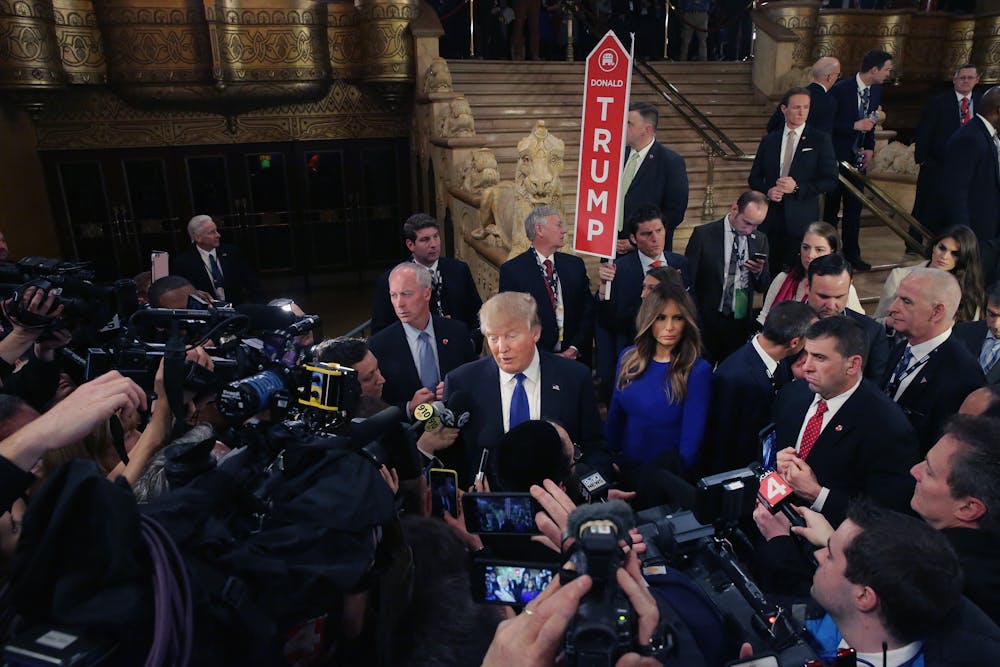
A man in a white shirt, dark jacket and tie talking to a crush of reporters.

GOP presidential candidate Donald Trump greets reporters in the spin room following a March 3, 2016, debate in Detroit. Chip Somodevilla/Getty Images

Patterns of primary coverage

I am a political scientist who researches and teaches about patterns in political media, including how the press has decided which Republican primary candidates to focus on from 2012 until now.

A widely discussed pattern in primary coverage is called "discovery, scrutiny, decline." When a candidate says something novel, they are "discovered" and receive a burst of coverage. This attention brings momentum, making them subject to "scrutiny," which then pushes their polling numbers back down and they "decline." This trend is likely due to the media's appetite for novelty.

The pattern does not hold for all primaries, but explains some on both the Republican and Democratic side. Additional research also confirms that the media leads the public in this dynamic rather than vice versa.

Here are the recent presidential primaries that demonstrate changes in the discovery, scrutiny, decline pattern and the media's process of focusing on some Republican candidates over others.

2012 – the 'Bubble Primary'

The GOP presidential primary in 2012 provides the clearest example of discovery, scrutiny, decline. Though Mitt Romney dominated the polls on average, other candidates – such as Herman Cain and Rick Santorum – would occasionally say something noteworthy, get bursts of coverage, then face scrutiny and decline. Reporter Matthew Jaffe called this the "Bubble Primary," in which a new candidate would float to the top of the pack like a bubble, pop, and then sink.

2016 – Trump dominates

There were muted levels of discovery, scrutiny, decline with some candidates in the 2016 GOP primary. For example, Ben Carson, a political outsider with a unique backstory, received a burst of media attention before the scrutiny process kicked in and he then declined in popularity. This pattern was not the central story of this cycle though.

Ultimately, Donald Trump got the majority of Republican news coverage. His constant provocative statements meant the media kept "rediscovering" him, thereby thwarting the "decline" stage. By the end of the general election, The New York Times estimated that Trump dwarfed every other candidate and received nearly $2 billion in "free media", an estimated amount a campaign would need to pay in ads rates to get comparable coverage.

If the magnitude of his coverage was unique, so was the effect. Whereas media attention drove sustained public curiosity for other Republican candidates – which is different from support – researchers have found that Trump's level of coverage actually increased his poll numbers, which do indicate support. Trump then dominated the news cycle into his presidency.
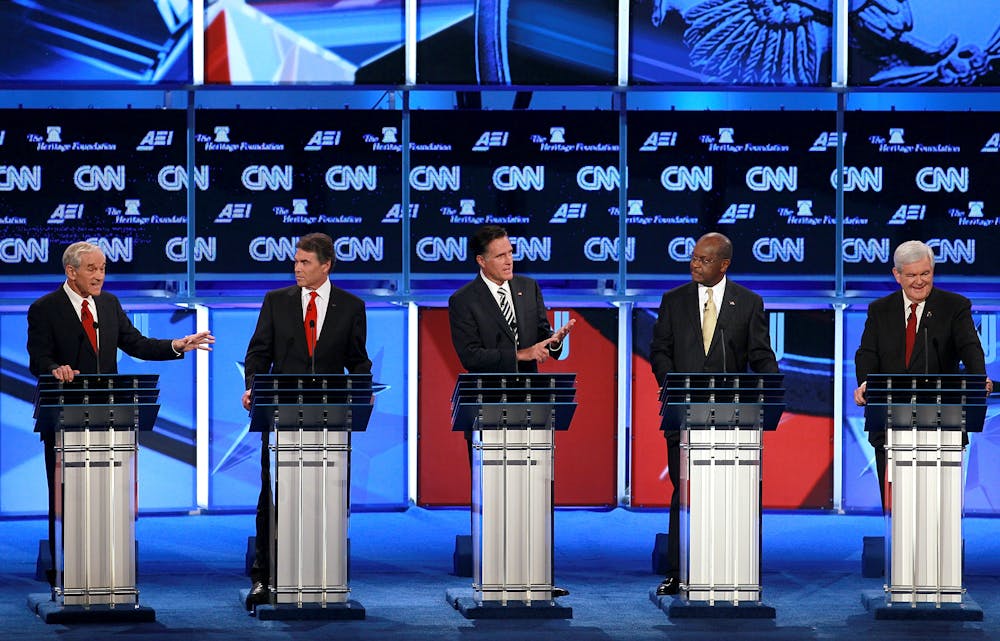
Five men debating each other on a stage behind lecterns.

GOP presidential candidates, left to right, Rep. Ron Paul, Texas Gov. Rick Perry, former Massachusetts Gov. Mitt Romney, former Godfather's Pizza CEO Herman Cain and former House Speaker Newt Gingrich in a debate on Nov. 22, 2011, in Washington. Mark Wilson/Getty Images

2020

The Republican Party canceled some of its primaries in 2020, allowing Trump to run virtually uncontested.

2024

Most of the past discovery, scrutiny, decline patterns have taken place while candidates debated and campaigned in the early primary or caucus states. The 2024 GOP primary has been different.

Eight Republican candidates participated in debates while Trump sat them out and focused his campaign efforts elsewhere. Though these debates generated small moments and poll bumps for some candidates – such as Vivek Ramaswamy in August 2023 – this time period did not produce a series of clear and obvious flavors of the week.

Instead, prominent outlets seemed to have fixated on a – potential – Republican nominee literally years before debate season: Ron DeSantis, the governor of Florida, who did not declare he was running until May 24, 2023. Even though coverage of Trump became more prominent as the primary season picked up in 2023, this early selection of DeSantis is the more unusual story of American media behavior.

"Choosing" DeSantis

In the months after the 2020 election, Fox News asked DeSantis to appear on the network almost every day. New York Times journalists suggested the network was "promoting" his inevitable campaign.

But the New York Times itself published a slew of articles that increasingly sounded like DeSantis was the inevitable nominee, culminating in the 2022 article "Did Ron DeSantis Just Become the 2024 Republican Front Runner?"

The New York Post in late 2022 featured him on their front page with the title "DeFUTURE." Though some reporters hedged their language about DeSantis' prospects, headlines like these are nonetheless signals to the public about a politician's viability, which voters use to make decisions.

The abnormally early focus on DeSantis could have been because he was genuinely newsworthy given his controversial COVID-19 policies, he increased viewership or because, as one Fox producer said in an email, he is "the future of the party." Ultimately, the hype was premature; DeSantis dropped out and endorsed Trump before the New Hampshire primary.

Trump throws a wrench

What can be made of all this?

The media is influential in telling the public who to consider. In 2012, coverage moved in distinct cycles, leading the public to focus on certain Republicans over others. In 2016, Trump benefited from this attention in ways others did not, allowing him to monopolize the spotlight for years and bond with his base.

Trump's dominance – partially a creation of the American press – may have thrown a wrench into somewhat normal patterns of primary coverage, as some outlets then seemed to "discover" a new Republican candidate the moment Trump left the Oval Office.

Regardless of why major outlets selected DeSantis early, Trump has shown that when he is actively campaigning, he comes out on top and other Republicans mostly fade into the background.


This article is republished from The Conversation under a Creative Commons license. Read the original article.

Alabama House and Senate approve bills to protect IVF service providers

The Alabama House and Senate passed bills on Thursday that would "provide civil and criminal immunity to persons providing goods and services related to in vitro fertilization except acts or omission that are intentional and not arising from or related to IVF services.” 

Weeks after the state’s Supreme Court ruled that frozen embryos are people, which led to area clinics pausing services in fear of litigation if a situation arose in which an embryo needed to be disposed of, opinions split on the matter, with even Donald Trump speaking out against the ruling, writing in a post to Truth Social, “We want to make it easier for mothers and fathers to have babies, not harder!"

Speaking on the House floor, Republican state Rep. Terri Collins spoke of the bills saying they "will help us achieve our goal, which is to continue the process for those families going through in vitro fertilization." According to CNN's reporting, The House bill, known as HB 237, passed out of the chamber with a vote of 94-6 with 3 abstentions. A companion bill in the Senate, SB 159, passed with a vote of 34-0.  

From here, the Alabama state House and Senate will vote on a unified version of the bills before handing them up to Alabama Gov. Kay Ivey to be signed off on. 


Give your usual brownie recipe an upgrade with these marshmallow-packed Gillie Whoppers

I have never met anyone outside of my immediate family who knows what Gillie Whoppers are. I am curious if they are called something different in other areas of the country as I'm fairly certain no one related to me created the recipe.

I associate Gillie Whoppers with Easter celebrations, spring picnics and Sunday School parties. Cut into squares and set out on covered decorative stands or individually wrapped in wax paper to carry along on some outdoor adventure, they were a special treat when I was a child, but I appreciate them so much more now that I am an adult.    

A Gillie Whopper is a gollywhopper of a dessert and a chocolate lover’s dream. I get a kick out of introducing them to people, because while Gillie Whoppers are utterly unique, there is a certain familiarity about them. They drop hints of Mississippi Mud Pie or perhaps some special confection purchased in a little town while on vacation.

It's funny how our taste buds can lead us back and bring things up, even sometimes things we might not have ever remembered or thought of for years.

I like watching the flummoxed and thoughtful expressions that wash over the faces of those trying a Gillie Whopper for the first time. It is fun to imagine the internal questioning you can all but actually hear their wonder: Is this candy? What all am I tasting? Is there a layer of fudge? What in the name of everything sacred is this glorious thing? 

My friends unanimously conclude that the Gillie Whopper is something special and seem to enjoy continuing their quests to name all the flavors coming through as they savor each bite. I admit, there is a lot going on, but with a name like Gillie Whopper, they would have to, right?


Want more great food writing and recipes? Subscribe to Salon Food's newsletter, The Bite.


The base of a Gillie Whopper is basically one entire layer of what is my favorite part of a brownie: You know that inch or so of denser, chewier ‘edge’, closest to the sides of the pan, the part that is a little thinner and has a richer, more roasted flavor? Well, that makes up the bottom of a Gillie Whopper. That slightly crusty, chocolatey foundation is scattered throughout with toasted, chopped pecans, and it only takes off from there. It is then topped with melted marshmallows, graham cracker pieces and crumbs and finished with a smooth, rich layer of fudgy chocolate. 

If you want to serve them as an after dinner dessert, you can gussy them up by plating them with fresh raspberries or strawberries, but I think they are best suited for a more casual occasion, or for no occasion at all!  

We need your help to stay independent

Gillie Whoppers
Yields
1 9-inch square
Prep Time
10 minutes
Cook Time
25 minutes (plus 2 to 3 hours cooling time) 

Ingredients

3/4 cup flour

1/4 teaspoon baking powder

1/4 teaspoon salt

2 tablespoons cocoa powder

1/2 cup butter, softened

2/3 cup sugar (or coconut sugar)

2 eggs, best at room temperature

1 1/2 teaspoon vanilla

1/2 cup chopped pecans 

1 bag mini marshmallows

5 to 7 graham crackers, broken into small pieces


Three Minute Fudge Frosting:

1/2 cup brown sugar (or coconut sugar)

2 ounces unsweetened baking chocolate, chips or squares

1 tablespoon butter

1 teaspoon vanilla

1 1/2 cups powdered sugar

Directions

  1. Grease a 9” square baking dish and preheat oven to 350F.

  2. In a small bowl, whisk to combine flour, baking powder, salt and cocoa powder and set aside.

  3. Using a mixer, cream butter until fluffy then add sugar and beat until fully incorporated and smooth.

  4. Add eggs, one at the time, beating with each addition.

  5. Stir in vanilla, dry ingredients and chopped pecans.

  6. Pour into prepared pan and bake for 25 minutes.

  7. Remove from the oven and sprinkle with graham cracker pieces and then sprinkle marshmallows on top. Keep marshmallows from touching sides of the pan.

  8. Return to the oven for a 1 to 2 minutes — just until marshmallows are melted.

  9. Remove from the oven and frost with Three Minute Fudge Frosting (recipe follows).

  10. Cool in the pan on a rack and then refrigerate.

  11. To serve, cut into squares.

  12. To make Three Minute Fudge Frosting: In a small saucepan, add brown or coconut sugar, chocolate and 1/4 cup of water and bring to a low boil for three minutes.

  13. Take off the heat and stir in butter and vanilla, then add powdered sugar. Stir vigorously or beat with a mixer until uniform in color and fully combined.


Cook's Notes

-Fudge Frosting and Gooey Melted Marshmallows: Sometimes the frosting swirls together with the marshmallows, creating a marbled top; sometimes it is goes on more like a layer. Both are equally delicious.

-You can omit the graham cracker pieces completely or substitute them with any simple, crisp cookie pieces. The chopped pecans offer a bit of texture but not enough for me. I like the additional crunch and subtle cinnamon flavor from graham crackers, but I can imagine thin vanilla cookies being very tasty as well.

Expert: GOP primary elections use “flawed math” to pick nominees

Republicans around the country are picking a nominee to run for president. However, their process – designed and run by the party, not government officials – is a mess of flawed mathematics that can end up delivering a result that's in conflict with the person most voters actually support.

As a mathematics professor and co-founder of the Institute for Mathematics and Democracy, I watched this contradictory process play out in 2016, shaping the political landscape ever since. Elements of it are visible again in 2024.

There are many ways bad mathematics interferes with our democracy, as I explain in my forthcoming book, "Making Democracy Count: How Mathematics Improves Voting, Electoral Maps, and Representation." Here's how the Republican primaries can manage to defy democratic ideals and deliver a nominee even though most voters prefer someone else:

Splitting votes among many candidates

In 2016, former President Donald Trump became the Republican choice, having won 44.9% of the votes cast in primaries. That was nearly twice the share of votes won by the runner-up, Ted Cruz, who had 25.1% of the primary votes.

But during primary season, polls suggested that in head-to-head primaries, Trump would have lost not only to Cruz, but also to third-place Republican finisher John Kasich and Marco Rubio, who placed fourth.

In other words, a majority of Republican voters preferred Cruz, Kasich and Rubio to Trump. But none of the three took the lead because of the party's nomination system, which assigned Trump 58.3% of the delegates at the Republican National Convention – the formal process by which the nominee is selected.

An attempt at proportional representation

The Republican Party says its primaries are meant to encourage proportional assignment of delegates to candidates. So if a candidate wins, say, 40% of the votes, she should win as close to 40% of the delegates as possible.

This sounds reasonable, and it aligns with most people's notion of fairness. For primaries taking place before March 15, the Republican Party mandates proportional allocation, but with lots of exceptions that can effectively turn the election into winner-take-all or winner-take-most. After March 15, the exceptions become the norm, pulling the outcome further from proportional representation.

The Democratic Party has a more centralized system and mandates proportionality for all its primaries.

Allocation of delegates

The process begins with the states each receiving a number of delegates that will later be assigned to candidates.

Each state gets 10 at-large delegates, and three delegates for each congressional district it contains. A state can also get additional delegates based on how Republican it is – depending on whether its people voted for a Republican presidential candidate in the previous general election, and on how much of its legislature is Republican.

These allocations can result in inequities. For instance, Massachusetts and Utah, two of the states voting on Super Tuesday, both get 40 delegates. That's because Massachusetts has more congressional districts, while Utah is more Republican.

But Utah has roughly 960,000 registered Republican voters, and Massachusetts has about 440,000. That means for any candidate to get a Utah delegate would require support from at least twice as many voters as that candidate would need to get a Massachusetts delegate.

Assigning delegates to candidates

There are as many as seven different proportional methods used to assign states' at-large delegates, each with its own mathematical problems. And in 21 states, the delegates allocated because of each congressional district are also assigned by the same methods as the at-large delegates.

In other states, the three delegates in each congressional district are all allocated to the winner in that district. And in still other states, the district delegates are allocated with a 2-1 split: The top vote-getter in the district receives two delegates and the runner-up receives one.

Math makes clear that these methods are not proportional representation: Imagine that three candidates in a close race get 33.5%, 33.3% and 33.2% of the votes, respectively. The winner-take-all method would give all three delegates to the top scorer. And in the 2-1 split, the last-place candidate would get nothing.

In some states, the party's rules also allow the method of counting to vary depending on how dominant a candidate's win is. For instance, California is the latest state to adopt the practice in which a candidate who wins more than half the statewide vote gets all of the state's delegates.

Two candidates doesn't make the math clearer

The GOP's system offers other significant advantages to winners as well.

Suppose a state has eight districts with three delegates apiece and in each, Candidate Alice gets 51% of the votes and Candidate Bob gets 49%. If the allocation was 2-1, Alice would get 16 delegates and Bob would get eight.

Then there are the 10 at-large delegates the party assigns to each state. Most proportional methods would split these delegates evenly, with five given to each candidate. That would deliver a grand total for Alice of 21 delegates, and 13 for Bob.

In that situation, Alice would get 51% of the votes but 62% of the delegates. This "winner's bonus" was evident in many states Trump won in the 2016 primary, such as Alabama, where his vote share was 43% but he collected 72% of the delegates. In the 2020 Democratic primary races, Joe Biden won 51.6% of the votes and 68% of the delegates overall.

Winner-take-all is problematic too. Consider Utah and Massachusetts again. If a candidate won Utah by a landslide, and another narrowly won in Massachusetts, they would both get 40 delegates – based on vastly different numbers of actual votes cast by supporters.

An additional barrier

Most states also require candidates to get a certain percentage of voter support before being assigned any delegates at all. Under the Republican rules, some states set this bar as high as 20%. The Democratic Party mandates a 15% threshold for every state.

These thresholds are biased toward more popular candidates and can even cause mathematically counterintuitive delegate allocations.

The combination of winner-take-all and complicated threshold structures is where all hope of proportionality and fairness vanishes. For example, in 2016, Trump won all of South Carolina's 50 delegates by garnering 33% of the votes and all of Florida's 99 delegates with 46% of the votes.

This phenomenon is occurring again in this cycle: In the 2024 South Carolina primary, Trump won 60% of the vote but landed 94% of the state's delegates.

Picking a single winner

Ultimately, the party delegate system has to arrive at a single winner. Somehow, one candidate must win a majority of the delegate votes that are cast at the summer convention. For this year's Republican nomination, this is 1,215 of the 2,429 delegates.

Even if the delegate apportionment reflected Republican voters' preferences in perfect proportion, the system has yet another inherent flaw. Suppose the process gave 35% of the delegates to one candidate, 30% to another, 20% to a third, and then split the remaining 15% between several others. Who should win the nomination?

In a sequential process often called a "brokered convention," various candidates who recognize they cannot win the nomination free their delegates to vote for others. As its name suggests, this method more closely resembles a business deal than a fair election – and it's very far from the eyes of the voters and even more distant from the rigor of mathematics.

There is no unbiased way to pick a single nominee using the GOP's current primary structure. Voters are reluctant to risk wasting their votes by supporting less popular candidates. Candidates who appear weaker exit races earlier because they don't think they can clear the hurdles in enough states. As a result, candidates with small but committed followings can rise to the top – even if most people prefer someone else.

Some alternatives

Math does offer some options for possible solutions that eliminate the flaws of winner-take-all, reduce divisiveness, ensure that each voter has an equal say, and enact the will of a majority.

One way could be using ranked-choice voting, in which people rank all the candidates in their order of preference. A system that would be mathematically most representative and inclusive would involve nonpartisan primaries with some number of top vote-getters advancing to the general election. Both would be held with ranked-choice voting. Alaska and several other states use this method in state elections, but not for the presidential race.


This article is republished from The Conversation under a Creative Commons license. Read the original article.

‘Naked carbs’ and ‘net carbs’ – what are they and should you count them?

According to social media, carbs come in various guises: naked carbs, net carbs, complex carbs and more.

You might be wondering what these terms mean or if all carbs are really the same. If you are into "carb counting" or "cutting carbs", it's important to make informed decisions about what you eat.


What are carbs?

Carbohydrates, or "carbs" for short, are one of the main sources of energy we need for brain function, muscle movement, digestion and pretty much everything our bodies do.

There are two classifications of carbs, simple and complex. Simple carbs have one or two sugar molecules, while complex carbs are three or more sugar molecules joined together. For example, table sugar is a simple carb, but starch in potatoes is a complex carb.

All carbs need to be broken down into individual molecules by our digestive enzymes to be absorbed. Digestion of complex carbs is a much slower process than simple carbs, leading to a more gradual blood sugar increase.

Fiber is also considered a complex carb, but it has a structure our body is not capable of digesting. This means we don't absorb it, but it helps with the movement of our stool and prevents constipation. Our good gut bacteria also love fiber as they can digest it and use it for energy – important for a healthy gut.


What about 'naked carbs'?

"Naked carbs" is a popular term usually used to refer to foods that are mostly simple carbs, without fiber or accompanying protein or fat. White bread, sugary drinks, jams, sweets, white rice, white flour, crackers and fruit juice are examples of these foods. Ultra-processed foods, where the grains are stripped of their outer layers (including fiber and most nutrients) leaving "refined carbs", also fall into this category.

One of the problems with naked carbs or refined carbs is they digest and absorb quickly, causing an immediate rise in blood sugar. This is followed by a rapid spike in insulin (a hormone that signals cells to remove sugar from blood) and then a drop in blood sugar. This can lead to hunger and cravings – a vicious cycle that only gets worse with eating more of the same foods.


What about 'net carbs'?

This is another popular term tossed around in dieting discussions. Net carbs refer to the part of the carb food that we actually absorb.

Again, fiber is not easily digestible. And some carb-rich foods contain sugar alcohols, such as sweeteners (like xylitol and sorbitol) that have limited absorption and little to no effect on blood sugar. Deducting the value of fiber and sugar alcohols from the total carbohydrate content of a food gives what's considered its net carb value.

For example, canned pear in juice has around 12.3g of "total carbohydrates" per 100g, including 1.7g carb + 1.7g fiber + 1.9g sugar alcohol. So its net carb is 12.3g – 1.7g – 1.9g = 8.7g. This means 8.7g of the 12.3g total carbs impacts blood sugar.

The nutrition labels on packaged foods in Australia and New Zealand usually list fibre separately to carbohydrates, so the net carbs have already been calculated. This is not the case in other countries, where "total carbohydrates" are listed.


Does it matter though?

Whether or not you should care about net or naked carbs depends on your dietary preferences, health goals, food accessibility and overall nutritional needs. Generally speaking, we should try to limit our consumption of simple and refined carbs.

The latest World Health Organization guidelines recommend our carbohydrate intake should ideally come primarily from whole grains, vegetables, fruits and pulses, which are rich in complex carbs and fiber. This can have significant health benefits (to regulate hunger, improve cholesterol or help with weight management) and reduce the risk of conditions such as heart disease, obesity and colon cancer.

In moderation, naked carbs aren't necessarily bad. But pairing them with fats, protein or fiber can slow down the digestion and absorption of sugar. This can help to stabilise blood sugar levels, prevent spikes and crashes and support personal weight management goals. If you're managing diabetes or insulin resistance, paying attention to the composition of your meals and the quality of your carbohydrate sources is essential.

A ketogenic (high fat, low carb) diet typically restricts carb intake to between 20 and 50g each day. But this carb amount refers to net carbs – so it is possible to eat more carbs from high-fiber sources.


Some tips to try

Some simple strategies can help you get the most out of your carb intake:

  • reduce your intake of naked carbs and foods high in sugar and white flour, such as white bread, table sugar, honey, lollies, maple syrup, jam and fruit juice

  • opt for protein- and fiber-rich carbs. These include oats, sweet potatoes, nuts, avocados, beans, whole grains and broccoli

  • if you are eating naked carbs, dress them up with some protein, fat and fiber. For example, top white bread with a nut butter rather than jam

  • if you are trying to reduce the carb content in your diet, be wary of any symptoms of low blood glucose, including headaches, nausea and dizziness

  • working with a health-care professional such as an accredited practising dietitian or your GP can help develop an individualized diet plan that meets your specific needs and goals.

Saman Khalesi, Senior Lecturer and Discipline Lead in Nutrition, School of Health, Medical and Applied Sciences, CQUniversity Australia; Anna Balzer, Lecturer, Medical Science School of Health, Medical and Applied Sciences, CQUniversity Australia; Charlotte Gupta, Postdoctoral research fellow, CQUniversity Australia; Chris Irwin, Senior Lecturer in Nutrition and Dietetics, School of Health Sciences & Social Work, Griffith University, and Grace Vincent, Senior Lecturer, Appleton Institute, CQUniversity Australia

This article is republished from The Conversation under a Creative Commons license. Read the original article.

Richard Lewis, comedy prophet: He saw the anxiety era coming, and made it funny for us

Richard Lewis claimed that he abstained from masturbation because he worried he “might give himself something.” It was one of his many comic confessions effectively capturing how anxiety becomes not only a condition but a lifestyle. Attributing his lifelong struggle with worry, fear and insecurity to his family’s dysfunction, he also insisted that his dog committed suicide to escape the perpetual anxiety of the Lewis household. It was a Jewish home in a small town of New Jersey where, before Springsteen, the late comic said, “They had nothing to chant.” They would walk around the streets pumping their fists in the air silently.

His anxiety was, by his own description, a “blessing and a curse.” It was a curse for obvious reasons, along with his belief that it contributed to his alcoholism, but also a blessing because, as he believed, “it made me funnier.”

Richard Lewis died on February 27 of a heart attack. He also suffered from Parkinson’s Disease. The cruelty of that chronic illness affects patients in different ways. On his podcast, Lewis said that Parkinson’s robbed him of the ability to walk, but that otherwise, he was managing — enjoying his marriage, his friends and his work, including his appearances on the final season of his friend Larry David’s sitcom, “Curb Your Enthusiasm,” which is currently airing on HBO.

During an episode of his podcast, “Alive and Unwell,” in August, he opened by saying, “Recording in progress. You ever hear that on your computer? I’m a work in progress; a f**king mess in progress…I’m not an upbeat kind of guy. I’m not defined by my Parkinson’s. I’ve had it for a couple of years, and I’m doing the best I can. It doesn’t define me. There are many people who have it much worse than me now. But for those who have it, or anything, worse, you gotta keep plugging ahead.”

Like most of his comedy, the opening riff was extemporaneous. It was also simultaneously neurotic, a tad depressive, and oddly enough, ambitious. Great art lives in contradiction. Richard Lewis was a great artist, and the contradiction at the heart of his comedy was the combination of anxiety and hope.

Richard Lewis was a prophet of anxiety. Like many great artists, he captured the mood and motif not only of his time, but of a time in the future.

Lewis rarely uttered an overt expression of hope, but he exercised the same hope of the blues musicians he often praised from the stage. The late Albert Murray, in his classic treatise on the musical form, “Stomping the Blues,” argued that through musical performance, the performer expresses pain, while finding the means to live with the pain. When dancing ensues, the performer and the audience mutually stomp the blues of their lives. According to the Murray conception, Lewis was a blues performer. Similar to a blues musician, he always looked cool too — the black suit, Chuck Taylors, a Jimi Hendrix tie, and long, wavy dark hair.

He was also jazzlike. Different from most comedians, he didn’t write bits or routines. Instead, he sketched outlines, and within the confines of his outlined topic, improvised his material on stage. I saw him perform live many times. Every show was radically different. There were times when his unplanned, extemporaneous delivery would cause frustration. He would start with a brilliant topic. Then, something would distract him, and he’d lose the thread. But most of the time his unique comedic style offered the thrill of discovery. His tendency to interrupt himself, mid-topic, led to uncharted comedic ground and demonstrated a sophisticated, active mind at work — an intellect he could not shut off. 

At one show that I attended at a comedy club in a suburb just outside of Chicago, he opened with ruthless mockery of the curtain behind his microphone on the stage. It looked old and unclean. Lewis wondered if his career was in decline, and feared he would soon get sick from the unsanitized surroundings. This went on for 15 to 20 minutes with everyone in the crowd laughing the entire time. About half an hour later, when he was in the middle of a rant against the Republican Party, the sign advertising the club’s name behind him fell to the stage. This lucky coincidence of collapse and error enabled Lewis to end the show with a reprise of his opening lament.

When he discovered a punchline, the audience discovered a new reason to laugh. I would walk out feeling not like I attended a concert but had a hilarious conversation.

His tendency to interrupt himself, mid-topic, led to uncharted comedic ground and demonstrated a sophisticated, active mind at work — an intellect he could not shut off. 

The internal dialogue that I had with Richard Lewis began over 20 years ago when as a high school student I first heard his voice and recognized something of my own. I too suffer from his affliction of anxiety. So, when I would spin one of his comedy CDs, watch a special, or catch an interview on television, I would hear someone describe what sounded like episodes from my life, but only with more energy and comedy than I could muster. His 2001 two-disc release, “Live from Hell,” became a close companion, mainly for the second disc — an unbridled, unscripted conversation with legendary Chicago journalist, Bill Zehme. After a few years, I could almost finish his sentences for him, never growing tired of his recollection of attending a party at a Christian Scientist’s house: “I bolted to the medicine cabinet. They just had drawings of the medicine they would like to take.”

I still recite his explanation for why he could never become president — after visiting Area 51 at Roswell, and seeing men with “vaginas growing out of their heads,” he would have no choice but to start drinking again. He was brilliant when explaining why the cliché “there are no bad audiences” is incorrect: “I’m not going to do well in front of the Klan. So, right away, that’s out.”

He also admitted to “apologizing for everything.” “I’ll be with friends in a restaurant, and I’ll say, ‘I’m sorry we’re having dinner.’” He would worry that they weren’t having a good time, just as he would worry that if he was “having a bad hair day” it meant that he “had a brain tumor.”

He also worried about the future of the United States, consistently making contributions to Democratic politicians, Planned Parenthood and the Southern Poverty Law Center. On the growing influence of the Christian right, he once said, “How dare they talk about the afterlife, and act like I’m going to be in hell playing shuffleboard with Stalin.”

Even emanating out of a car stereo speaker, I heard something of a friend when he inquired with Zehme on multiple occasions to confirm that the recording equipment was properly functioning. It was amusing, but it also signaled a mentality of knowing, even without evidence – even against evidence for that matter – that something is wrong. “Is everything wrong?” Richard Lewis said his mother would say when taking his calls from the road.

I recently made a list of diseases and conditions I’ve self-diagnosed myself with having in the past year. It includes lymphoma, oral cancer, and diabetes. Recently, when inspecting my mouth to monitor an incision from an oral surgery that I had a few months ago, I was alarmed to notice several bumps on the back of my tongue. My heart racing, I rushed to the computer to determine what type of tumor I had. I learned that the bumps were something horrific called “vallate papillae” — a normal part of human anatomy.

Through a comedic and artistic testimony of his foibles, Lewis displayed courageous virtue.

In addition to reaping myself many times, I’ve also become convinced that everyone I love, most especially my wife, suffers from every illness possible, even those that medical scientists have not yet discovered. Speaking of my incredibly loving, patient, but sometimes annoyed wife, she has compared me to Richard Lewis for years. Hours before the public announcement of Richard Lewis’ death, I actually texted her a photo of Lewis shrugging, looking particularly aggravated. My wife replied, “That’s you!”

My wife isn’t the only person in my life to make the comparison. A coworker once told me that if I was older, he would think that Richard Lewis and I were “separated at birth.” A few months ago, a dentist took an angry tone with me, shouting, “you have an infection!” when I asked why I needed antibiotics, even though she had not yet told me that I had an infection. When telling a close friend the story, he said, “This is your most Richard Lewis story yet. The dentist hates you for no reason.”

Lewis often talked and wrote about his mother. Every day, I feel fortunate and grateful to have a kind, generous and graceful mother. Anxiety is multi-generational, however. I recall as a young boy when my mother took me to the doctor, concerned about a hard “growth” on my foot. In the physician’s office, I removed my sock, he gave it a look, put his hand on it, furrowed his brow, and said, “It’s a bone.”

My mother inherited her anxiety from her father — also a wonderful person — who could never sleep when there was a thunderstorm, due to an extreme fear of tornados. He was a veteran of World War 2, and he cut stone in a quarry for a living — a tough guy — but he still had to contend with the demons that come with short nerves.

We need your help to stay independent

Anxiety is all the rage now. There are endless posts on social media from users who report suffering from it. Reddit pages on health anxiety contain thousands of words from various discussion participants. The state of the world — war, climate change, gun violence, the potential end of American democracy — causes millions and millions of people to “doomscroll,” swear off having children, and take medication.

The Wall Street Journal ran a story in August of 2023 under the headline, “The Booming Business of American Anxiety.” Its authors detailed how a flurry of entrepreneurs and multinational corporations have made boatloads of profit by marketing wellness, calming, and “peace of mind” products to increasingly anxious teenagers and adults.

Richard Lewis was a prophet of anxiety. Like many great artists, he captured the mood and motif not only of his time, but of a time in the future. His articulation of insecurity regarding everything from his sexual prowess to his health preceded and forecasted a cultural turn in which everyone is worried about something, and has a forum to share their concerns.

Unlike the average social media scribbler, Lewis transformed anxiety into art. When he transitioned from the stage to the screen, he was most effective in roles that enabled him to apply his comedic and talk show conversation style to the delivery of his character’s lines. Many people will remember his funniest moments on “Curb Your Enthusiasm,” most especially his look of horror when Larry David has a loud argument with a child during a screening of his comedy special for television executives, or his reaction to Larry making a racist joke to a Black dermatologist: “You were like Pat Buchanan’s gym partner.”

He took funny turns in the film, “Once Upon a Crime,” and in his series with Jamie Lee Curtis, “Anything But Love.” His most moving performance was in the 1995 indie film, “Drunks.” He plays a debauched and disheveled alcoholic, revealing an underexplored potential for dramatic acting.

It is easy to imagine Lewis having an entirely different acting career in dramas, most especially because his comedy was full of pathos. David Letterman preferred to have him as an interview guest rather than as a performer. He thought he was funnier in a more casual context, but there was hardly any difference. Lewis’ comedic personality was a unique, seemingly stream-of-consciousness rap blasting out of the depths of his frustrations, pain and disappointments. As Aristotle understood, the line separating comedy and tragedy is thin, but the ancient philosopher contended that tragedy deals with virtue, while comedy deals with “weakness and foibles.”


Want a daily wrap-up of all the news and commentary Salon has to offer? Subscribe to our morning newsletter, Crash Course.


Through a comedic and artistic testimony of his foibles, Lewis displayed courageous virtue. He was honest, sincere, and unafraid to render himself vulnerable to the judgments of his audience.

In 2000, he wrote his memoir, "The Other Great Depression: How I’m Overcoming, on a Daily Basis, at Least a Million Addictions and Dysfunctions, and Finding a Spiritual (Sometimes) Life." It is a deeply funny and moving book; often painfully confessional. After his father’s death, he describes his inability to deal with the unexpected complexity of his grief as transforming him into a “cafeteria of doom.” Even as a child, obsessed with music and comedy, he found his curative: “I had a need to become creative. I had to give birth to myself.”

By giving birth to himself, he eventually triumphed over his addiction. He was sober for 30 years. He also liberated and healed many of his admirers. His life proved the adage, as corny as it might sound, that “laughter is the best medicine.”

It helped Richard Lewis. It also helped those of us in his audience who relate to his stories of woe. The gift of his comedy was not an opportunity to laugh at the world, but to laugh at ourselves. We found freedom in his humor.

The night before the public announcement of Richard Lewis’ death, there was a tornado warning in the Chicago suburbs. I moved our cats into the bathroom and asked my wife to join us. I said, “Here we go. It’s already starting.” I sounded exactly like my grandfather, throwing my arms into the air. “What’s already starting?” she said. “The storms. The threat,” I answered back. “Oh, man…” her voice trailed off. The next morning, my wife said, “You were in Richard Lewis mode last night.” That’s why I texted her the photo of Lewis shrugging. We had a good laugh.

When I was a college student, I attended my first Richard Lewis performance. After he said “goodnight,” I managed to make my way to the corridor leading to the backstage area. I handed him my copy of "The Other Great Depression" and asked if he would sign it. He put his arm around me, said, “Thanks for reading, man,” and jotted something down with a green marker that he pulled out of his blazer. When I stepped into a well-lit area, I opened the book. He wrote, “All the best, and none of my pain.”

Thanks. 

“We were very clear from the outset”: Palace addresses rumors about Kate Middleton’s health

The palace on Thursday addressed the Princess of Wales' health amid an influx of online speculation and conspiracy theories about her condition and the fact that she hasn't been seen publicly since January, when she had planned major abdominal surgery. 

"We were very clear from the outset that the Princess of Wales was out until after Easter and Kensington Palace would only be providing updates when something was significant," said a spokesperson for Kate Middleton, adding that the princess is "doing well," per People. 

Rumors began to swirl after Prince William canceled a public appearance on February 27 for the funeral of his godfather, Constantine II of Greece, the latest in a line of public engagements the prince has curbed. NBC reported that the reason was a "personal matter," while the palace declined to comment on the prince's no-show. Among the conspiracy theories regarding Middleton were that her relationship with Prince William had become strained and that she was in a coma. 

As People noted, the palace's initial statement following Middleton's surgery indicated that it was the Princess "appreciates the interest this statement will generate. She hopes that the public will understand her desire to maintain as much normality for her children as possible; and her wish that her personal medical information remains private." The palace added that it would "only provide updates on Her Royal Highness’ progress when there is significant new information to share." The palace at the time also included a recovery timeline, which estimated up to a two-week post-op hospital stay and no public duties until after Easter. 

France set to enshrine abortion rights in constitution

The French Senate passed a bill Wednesday constitutionally enshrining abortion rights, as reported by Le Monde. The bill is expected to receive final approval by a three-fifths majority of the country's parliament next week. The measure, promised by President Emmanuel Macron, comes partly in response to the 2022 rollback of abortion rights in the United States. The Senate vote was overwhelming, 267 to 50. 

"The Sénat has taken a decisive step, which I applaud," Macron said, adding that he would convene Parliament in a joint session on March 4 for the final vote. "I pledged to make women's freedom to have recourse to abortion irreversible by enshrining it in the Constitution."

Prime Minister Gabriel Attal — a leading contender to succeed Macron in the 2027 presidential election — told Le Monde that the inclusion of abortion in the Constitution is an "immense step forward," and that this day would mark "the political and parliamentary history of our country."

France decriminalized abortion in 1975. Even though there were 50 votes against the measure in the Senate, none of the country's major political parties currently represented in parliament have questioned the essential right to abortion. 

"We're writing history," said Mathilde Panot, the parliamentary party leader of the radical-left La France Insoumise. "The last lock has been broken. France will become the first state in the world to guarantee the right to abortion."


Exxon CEO to world: Climate crisis isn’t our fault, now “pay the price”

As ExxonMobil pursues litigation against activist shareholders who seek to push the biggest of all Big Oil behemoths to tougher environmental standards, CEO Darren Woods knows who to blame for the worsening climate crisis. It's not his company or its major competitors.

In a recent interview with Fortune, Woods argued that the oil industry is not primarily to blame for climate. The world “waited too long” to develop green technologies, Woods said, while defending Exxon's reluctance to invest in wind and solar power to the extent many European energy companies have. He described that as “a hollow argument," adding that Exxon could not "bring any real capabilities to that space" and did not "see the ability to generate better-than-average returns for our investors.” Speaking about the goal to reach "net zero" in greenhouse gas emissions, Woods suggested that it might prove too expensive for consumers, arguing that "people who are generating the emissions need to be aware … and pay the price."

Woods also defended Exxon's lawsuit against activist shareholders, characterizing them as not "real investors."

“We want to cater to the shareholders … who have an interest in seeing this company succeed in generating return on their investments," Woods explained. "We don't feel a responsibility to activists that hijack that process … and, frankly, abuse it to advance an ideology.”

Climate activists have accused Exxon and other Big Oil companies of stifling dissent.

The climate reform movement is "facing steep charges because the industry sees that fossil fuels are losing," Michael Greenberg, founder of the environmental protest group Climate Defiance, told Salon last month. "The industry is pulling out progressively more desperate measures to try to stop the movement."

More than 100K Michigan voters pick “uncommitted” over Biden − does that matter for November?

Joe Biden won the 2024 Michigan Democratic primary, but “uncommitted” ran a spirited campaign.

More than 100,000 Michiganders voted “uncommitted” in Tuesday’s Democratic primary, 13% of the Democratic electorate.

Listen to Michigan organized the uncommitted campaign in Michigan, promoting it as a way to express dissatisfaction with the Biden administration’s public stance in support of Israel’s actions in its conflict with Hamas in Gaza.

The group also set a goal of securing more uncommitted votes than the 11,000-vote margin by which Donald Trump defeated Hillary Clinton in 2016. The total was nearly 10 times that number.

Biden won Michigan in 2020 by 154,181 votes.

While there were no exit polls conducted with Michigan primary voters, preelection polling just before the primary showed Biden’s weakness among potential young voters as well as Arab Americans.

Michigan has the largest Arab, Muslim and Palestinian population in the United States, currently numbering more than 200,000.

More than half of the population of Dearborn, Michigan, is Arab, as is its mayor; it is home to the largest mosque in the United States. One of the leaders of the uncommitted movement is U.S. Rep. Rashida Tlaib from the 12th District, the first Palestinian American woman elected to Congress.

At time of publication, with 98% of precincts reporting a day after the election, vote tallies from Dearborn, the city with the highest percentage of Arab American voters in the state, show “uncommitted” leading there – 6,290 votes to President Biden’s 4,517.

It’s not clear that all of the uncommitted voters were part of the protest. In primaries, some voters will vote uncommitted if they have not yet made their choice or don’t want to disclose that choice for any number of reasons. In 2020, 19,106 Democratic voters in Michigan selected uncommitted, while 21,601 did so in 2016 – even though no protest was attached to those decisions.

What makes the 2024 primaries different from previous contests is that uncommitted voters are being reported in exit polls and by election officials because that designation actually appears on the ballot in some states.

Besides Michigan, which added uncommitted to its primary ballots in 2012, there are uncommitted lines on the ballots in New Hampshire, North Carolina and South Carolina; Florida has a “no preference” line. In Oregon and Washington, citizens will be able to vote for an uncommitted delegate to the convention.

Selecting uncommitted is a way for voters to express dissatisfaction with the candidates whose names appear on the ballot while still participating in the democratic act of voting.

In my view, this form of peaceful protest is an essential element of American democracy and more demonstrative than staying home from the polls.

It is not an option for the fall general election, where the only alternative to a Biden vote for Democrats will be to stay home or vote for Donald Trump.

Given his past record and proposals to exclude Arabs from immigration to the United States, I don’t believe that will be a realistic alternative for many of Michigan’s uncommitted voters.

This article is republished from The Conversation under a Creative Commons license. Read the original article.

Experts: Cannon may have been reversed or “ordered to step aside” if she didn’t reject Trump motion

U.S. District Court Judge Aileen Cannon on Wednesday denied former President Donald Trump's request to see more of the classified evidence federal prosecutors submitted in his Florida criminal trial over his alleged willful retention of national security materials and obstruction of government efforts to retrieve them. That level of access is not usually granted in these cases, the judge determined, noting that withholding the records would not weaken Trump's defense, The Washington Post reports

Cannon, in the nine-page ruling, rejected the request to see the filings under Section 4 of the Classified Information Procedures Act (CIPA), which protects national security secrets of issue in criminal proceedings. She suggested that special counsel Jack Smith may have overstated the CIPA law in his argument against sharing the materials with the defense, noting that Trump's charges do not include transmission of the sensitive information. She added that she understood the law to mean judges have the authority to make that decision themselves. “As best the Court can discern following its rigorous analysis, Defendants’ rights will not be impaired by today’s ruling,” she concluded.

"Judge Cannon's ruling is correct and obvious, and avoids her getting reversed for a 3rd time by the Eleventh Circuit," former Mueller prosecutor Andrew Weissmann wrote on X/Twitter. "Predict she will also reverse herself on full disclosure of witness names/statements (for same reason). Many more motions for her to decide…"

"Had Cannon ruled in Trump's favor she would have [been] plainly wrong," former U.S. attorney Joyce Vance added. "Special Counsel would have had no option but to appeal & she would have been promptly reversed & perhaps ordered to step aside."

Cannon plans to hold a pivotal hearing in the case Friday where she will cover evidence disputes between prosecutors and the defense, the trial schedule and a related spat over proposed redactions in court records. This case is one of four criminal cases Trump has been charged in. 

Judge blocks Texas law allowing police to arrest migrants suspected of being in country illegally

Sign up for The Brief, The Texas Tribune’s daily newsletter that keeps readers up to speed on the most essential Texas news.


A federal judge in Austin on Thursday halted a new state law that would allow Texas police to arrest people suspected of crossing the Texas-Mexico border illegally.

The law, Senate Bill 4, was scheduled to take effect Tuesday. U.S. District Judge David Ezra issued a preliminary injunction that will keep it from being enforced while a court battle continues playing out. Texas is being sued by the federal government and several immigration advocacy organizations.

Ezra said in his order Thursday that the federal government “will suffer grave irreparable harm” if the law took effect because it could inspire other states to pass their own immigration laws, creating an inconsistent patchwork of rules about immigration, which has historically been upheld as being solely within the jurisdiction of the federal government.

“SB 4 threatens the fundamental notion that the United States must regulate immigration with one voice,” Ezra wrote.

Gov. Greg Abbott signed SB 4 in December, marking Texas’ latest attempt to try to deter people from crossing the Rio Grande after several years of historic numbers of migrants arriving at the Texas-Mexico border.

The law seeks to make illegally crossing the border a Class B misdemeanor, carrying a punishment of up to six months in jail. Repeat offenders could face a second-degree felony with a punishment of two to 20 years in prison.

The law also seeks to require state judges to order migrants returned to Mexico if they are convicted; local law enforcement would be responsible for transporting migrants to the border. A judge could drop the charges if a migrant agrees to return to Mexico voluntarily.

In December, ​​the American Civil Liberties Union, the ACLU of Texas and the Texas Civil Rights Project sued Texas on behalf of El Paso County and two immigrant rights organizations — El Paso-based Las Americas Immigrant Advocacy Center and Austin-based American Gateways — over the new state law. The following month, the U.S. Department of Justice filed its lawsuit against Texas. The lawsuits have since been combined.

During a court hearing on Feb. 15 in Austin, the Department of Justice argued that SB 4 is unconstitutional because courts have ruled that immigration solely falls under the federal government’s authority.

The lawyer representing Texas, Ryan Walters, argued that the high number of migrants arriving at the border — some of them smuggled by drug cartels — constitutes an invasion and Texas has a right to defend itself under Article I, Section 10 of the U.S. Constitution, which prohibits states from engaging in war on their own “unless actually invaded.”

Ezra said that he “is not unsympathetic to the concerns raised by Abbott,” but appeared unconvinced by Walters’ argument.

"I haven't seen, and the state of Texas can't point me to any type of military invasion in Texas," Ezra said. "I don't see evidence that Texas is at war."

As they awaited the judge’s ruling, immigrant rights advocates around the state said they are worried that SB 4 could lead to border residents’ rights being violated.

“If allowed to take effect, S.B. 4 will blatantly disregard due process and put our border communities and immigrant communities throughout the state at risk, opening the door for racial profiling, baseless arrests, and unlawful deportation of our families, friends, and neighbors,” said Aron Thorn, senior attorney for the Beyond Border Program at Texas Civil Rights Project.

Edna Yang, co-executive director at American Gateways, said that SB 4 does not fix “our broken immigration system” and it will divide communities.

“It is a law based on xenophobia and racism and it does not make our communities safer,” she said.

David Donatti, senior staff attorney at the ACLU of Texas, said the law would “permanently create a separate system of mass migrant incarceration that is rife with civil rights abuses and wastes billions of taxpayer dollars.

“No state has the right to unilaterally decide who gets to be American,” he said. “Doing so violates the Constitution, undermines human rights, and damages international relations.”


We can’t wait to welcome you to downtown Austin Sept. 5-7 for the 2024 Texas Tribune Festival! Join us at Texas’ breakout politics and policy event as we dig into the 2024 elections, state and national politics, the state of democracy, and so much more. When tickets go on sale this spring, Tribune members will save big. Donate to join or renew today.

This article originally appeared in The Texas Tribune at https://www.texastribune.org/2024/02/29/texas-arrest-migrant-illegal-senate-bill-4-blocked/.

The Texas Tribune is a member-supported, nonpartisan newsroom informing and engaging Texans on state politics and policy. Learn more at texastribune.org.

“The Vince Staples Show” could be the next “Curb Your Enthusiasm”

That Netflix's "The Vince Staples Show" turned out to be hilarious should have been expected, at least by those who have known for years how funny the hip-hop star is, through his dead-pan social media presence or on-screen roles like "Abbott Elementary" recurring character Maurice. But more importantly, "The Vince Staples Show" is also the kind of programming so many Black viewers have been waiting for. At first glance, some might compare it to Donald Glover's groundbreaking "Atlanta," because they're both offbeat comedies made by and about rappers. But in a way, it's more like Larry David's "Curb Your Enthusiasm," for us — a layered, wry comedy about the fictionalized everyday life of a professional artist in Southern California (Long Beach, in Staple's case, compared to L.A.'s westside) navigating absurd situations with dry wit.

Over the years, Hollywood has been working to diversify the African American stories it tells. For the most part, we have moved beyond the days of audiences seeing only a single token Black character — if that — and of performers only being considered for roles such as a driver, maid or burglar. Black-led comedies like "Martin" and "The Fresh Prince of Bel-Air," and more recently, HBO's "Insecure," have been met with great success, not to mention acclaimed dramas like "Power," "The Chi" and "Snowfall," just to name a few, as well as countless biopics and other films. Representation of the depth and breadth of the Black experience matters — we are rich, we are poor, we are cops, we are robbers, we are silly, we are stressed out, we are in love. We are regular people with very regular problems.

"The Vince Staples Show" adds another layer, depicting a Black celebrity as a regular person, not just a glamorous idol, with a penchant for stumbling into situational irony. This begins in the pilot when Vince is arrested and taken to jail. Vince enters the holding cell as a famous rapper to his fans, and a stranger to those unaware of his work. The cops know him too, as law enforcement tends to keep tabs on artists who speak out against police corruption and violence. I know they do because I've experienced it. 

In 2018, I was filming HBO's "The Slow Hustle" with actor/director Sonja Sohn, best known for starring as Det. Kima Greggs in "The Wire." We had just finished hours of filming and were starving, so I recommended a relatively inexpensive restaurant we hit with the crew. About five of us sat down and ate like we'd never seen a meal before. Sonja and I stayed out a little later as we were in the middle of a heated debate about Baltimore, policing, activism, and all of the other themes of her film. I got ready to drop her off for the night, but right before I pulled onto the interstate, loud sirens and bright lights sped up behind my car, drowning out the music of our conversation. 

Loud sirens and bright lights sped up behind my car, drowning out the music of our conversation.

"What do these people want?" Sohn said. 

“A bunch of nothing,” I said.  

I have this joke I like to pull when I get stopped by the police with another person in the car. First, I ball my face up in fear, then look at my passenger and say, "There's a gun under your seat. I can't afford to go away right now. You take the charge, and I'll ensure you're good as soon as you get out."

I didn't want to freak Sonja out, so I kept my joke to myself. But the reality is that I got pulled over so much those days I had to figure out ways to have fun with it. After about a three-minute wait, a stocky, broad-shouldered Black officer eased into the passenger-side window of the car. Sonja eyed the cop.

“Hello, sir. How can I help you today?” I said in my most pleasant voice. 

“Do you know how fast you were going back there?” 

“My apologies, we were filming all day," I said. "I was just trying to get my friend home.” 

“Oh, I know who you are, that's why I pulled you over,” the cop said, looking at Sonja. “You keep playing in those TV shows and making us proud — keep making our department look good. We need you to do that!” 

She and I burst out laughing. 

“And you!” the cop interrupted, turning to me. “Keep writing those books and telling our young brothers the truth. They need to know both sides because it's real out here, and I don't want them to end up with me!”

Was he ordering us to go make art?

“Yes sir,” I said out loud.

We were both thankful that her actual TV fame — and my own situational fame, as an author who writes about Baltimore — delivered us from what could have been a bad situation. I was reminded of that moment when watching the jail scene in "The Vince Staples Show" pilot. Vince's fame delivers him from danger, but it also puts him in difficult predicaments while he waits for bail.

Most of his fellow inmates don't care they're in with a celebrity. They have more pressing issues at hand. But then there's that one inmate, Robb (Christopher Meyer), who takes this chance encounter as an opportunity to get noticed. He begins to perform, but Vince cuts him off mid-track. 

We expect hip-hop artists to be in love with their genre, just like we expect professional athletes to dream about the sport they play all day. But it is just a job for some musicians — it's their 9 to 5.

“I don’t really be f***in with the music like that,” Vince tells him. “You see what that s**t did to Michael Jackson. It's just my job, for real.” 

This bit of irony — a famous rapper giving that response — is an insight into what makes this show particularly funny. We expect hip-hop artists to be in love with their genre, just like we expect professional athletes to dream about the sport they play all day. But it is just a job for some musicians — it's their 9 to 5. So no, Robb, Vince won't be accompanying you to the studio or featuring your vocals on his new album that he probably doesn't even want to make but will because he has to make money to survive.

And then there's Poke (Rafael Castillo), who doesn't care about the music industry, fame, or the police officers giving Vince special treatment. He knows about Vince's popularity, but he sees him as a trophy. This is a side of Black fame that often pops up in the media but is rarely explored in art. A person might make a little money and get a little fame, but not enough to deliver most of their family, let alone whole neighborhoods, into security. At the same time, they still want to spend time in those neighborhoods and break bread with their people, while success also makes them targets of misguided or jealous people who want to do them harm. Poke has beef with Vince that stems back to the neighborhood, and when he sees Vince in jail, he is excited to settle their score. Vince makes bail just in time.

"Curb Your Enthusiasm" also launched its new (and final) season with Larry (Larry David) getting arrested. He travels to Atlanta and ends up in custody for violating Georgia's Election Integrity Act after handing his friend Leon's Auntie Rae (Ellia English) a bottle of water while she waited in line, where she had been for hours, to vote. Larry's holding cell, where he diagnoses another inmate with lactose intolerance, is depicted as much more pleasant than the jail Staples faced. Nobody was going to shank Larry David or sell him on the cell block for a pack of smokes. "The Vince Staples Show" consistently finds new ways to break down race in America, showing how Black people are seen and depicted versus reality.

In another episode, Vince is at a bank trying to get a loan when robbers burst in, and he just happens to be friends with the assailants. (If this scenario played out on "Curb," Larry might not know the robbers personally, but I could see him critiquing their methods.) In this episode, Vince explains to the robber that the consequences of his actions would be different because of his approach and his race. The bank robber realizes this when they get to the vault and it’s already empty.

“How are we the second robbery here today?” the bank robber asks. 

“In all fairness, you're the first robbery here today," Vince replied. "This was a heist.” 

“What's the difference?”

“It's simple: You pull a heist, you George Clooney," Vince says. "You rob a bank, you are Queen Latifah.” 

Other episodes explore the dynamics of Black family cookouts — another coincidental parallel to the current "Curb Your Enthusiasm" season, in which Larry gets himself into trouble at a Black church barbecue — along with annoying low-budget amusement parks and the dangers of being just famous enough to be recognized. The show nods to Quentin Tarantino movies, the decline of O.J. Simpson, and many other cultural references. It's so complex that each of the five episodes deserves more than one watch. 

Larry David's "Curb" is now in its twelfth and final season, wrapping after more than 20 years, off and on. I know many people who did not quite connect with its humor in the beginning only to later fall in love once they got its vision and tone. Netflix only gave us five episodes of "The Vince Staples Show," but hopefully a second season will be announced soon. This brief visit to Vince's world is just enough to leave fans wanting more.

“Trump’s in a corner”: Judge comes down “very hard” after Trump seeks discount on fraud penalty

A New York appeals court on Wednesday denied Donald Trump's request to freeze the $454 million judgment he faces in his civil fraud case, leaving the former president in financial hot water.

Trump's attorneys asked the appeals court to permit him to post a $100 million bond, in which an outside company would promise Trump would eventually pay the judgement because it would be "impossible" for him to secure one for the full amount, the lawyers said, per The New York Times. But a single appellate judge assigned to the petition, Anil Singh, rebuffed the former president Wednesday. 

Trump will make another attempt at pausing the judgment next month with a five-judge appellate panel but remains responsible for posting a bond for the full amount in the interim. Any company willing to provide that bond would require the former president to guarantee cash or other collateral, the Times notes.

Failure to secure the bond allows the New York attorney general's office, which brought the case accusing Trump of defrauding banks and insurers by exaggerating his assets, to collect the $454 million from him. Attorney General Letitia James is expected to give Trump a 30-day grace period, set to expire March 25, after which she could seize his bank accounts and even assume control of his New York properties.

In addition to the $454 million judgment, New York Supreme Court Justice Arthur Engoron hit Trump and his co-defendants with several other penalties. Engoron barred him from obtaining a bank loan in the state for three years and heading a company in the state in that same period, barriers that further complicate Trump's race to secure a bond. 

“The exorbitant and punitive amount of the judgment coupled with an unlawful and unconstitutional blanket prohibition on lending transactions would make it impossible to secure and post a complete bond,” Trump’s lawyers in the appeal.

Singh halted those punishments on Wednesday, which could make Trump's efforts to acquire a bond for the full judgment easier.

Trump's stake in Trump Media & Technology Group, his social media company, could also offer him some financial relief if a delayed merger goes through this year and raises its value to up to $4 billion, the Times reports, but that deal won't finalize before James' grace-period expires. 

In a filing of its own, James' office asked the appeals court to deny Trump's request. 

“There is no merit to defendants’ contention that a full bond or deposit is unnecessary because they are willing to post a partial undertaking of less than a quarter of the judgment amount,” the attorney general’s office wrote. “Defendants all but concede that Mr. Trump has insufficient liquid assets to satisfy the judgment.”

We need your help to stay independent

Real estate comprises the bulk of Trump's net worth, and the total of his judgment in the civil fraud case and the $83.3 million he was ordered to pay earlier this month for defaming writer E. Jean Carroll, reportedly exceeds his available cash. A New York Times review of his financial records found that Trump held $350 million in cash as well as stocks and bonds he could quickly sell. 

"However the case is resolved, Mr. Trump’s request for relief represented a humbling concession from a man whose public image is synonymous with wealth," the Times added. "His conspicuous displays of gold-plated luxury underpinned his rise to tabloid fame, a stark contrast with the current spectacle of his scrambling to avert financial trouble."

Legal experts told the outlet that even if the five-judge appellate panel rejects Trump's request, he could still acquire a larger bond, highlighting that the former president's attorneys did not describe the $100 million bond as his only option. 

“The $100 million bond resembles an opening real estate bid,” Mark Zauderer, a partner at law firm Dorf Nelson & Zauderer and veteran New York business litigator who has secured many appeal bonds, told The Times. “But here, the negotiation will end, because it is the court that will determine the actual dollar amount of security, not Trump.”


Want a daily wrap-up of all the news and commentary Salon has to offer? Subscribe to our morning newsletter, Crash Course.


Tim O'Brien, Bloomberg Opinion's senior executive editor and the author of "TrumpNation," argued that Trump has a slim chance at successfully pausing the judgment and the blame for it falls squarely on him. 

Trump "now has a public referendum on his wealth," O'Brien said during a Wednesday night MSNBC appearance. "He spent 55 or so of his 78 years lying or bloviating about how much money he has, and now when push comes to shove, a man who has routinely said he's a multibillionaire is having trouble scratching up several hundred million dollars to make a court judgment."

The MSNBC political analyst went on to describe how "complex" it would be for Trump to leverage some of his properties, in part, because of the intricacies of his ownership. Two of his most valuable skyscrapers in San Francisco and New York, for example, aren't totally his. Trump, instead, is a minority partner in the buildings. 

"He's not going to be a free agent to sell out his stake without his partner allowing him to," O'Brien said. "Everybody in New York real estate or anywhere else he has a property now knows he is going to be selling under duress if he has to. And he is not going to get a good price for some of these properties.

"He's arrived in this place because he and his lawyers decided fairly early on to try to beat up the judge in this case," he continued. "The judge came down with a very hard penalty, and Trump's in a corner."

The 6 biggest moments from TMZ’s deep-dive into Taylor Swift and Travis Kelce’s buzzy relationship

There are “power couples,” and then there’s Taylor Swift and Travis Kelce — the bombshell pairing that caused Swifties and conservatives alike to lose their marbles.

Rumors about a potential romance between the best-selling pop star and the Kansas City Chiefs tight end began brewing in July of last year, when Kelce was spotted at Swift’s Eras Tour stop at Kansas City’s Arrowhead Stadium. Suspicions quickly grew in September after Swift was seen cheering on Kelce alongside his mother, Donna, at the Chiefs’ game against the Chicago Bears. Since then, paparazzi photos of the couple holding hands and smooching have gone viral across social media. Swift also made more appearances at Kelce’s games — including the Super Bowl — and Kelce even attended Swift’s Buenos Aires concert, where she sent fans into a frenzy after confirming her relationship.

Swift, who was named TIME’s 2023 Person of the Year, told the outlet in December that her relationship with Kelce took off shortly after he put her on blast on his podcast: “By the time I went to that first game, we were a couple,” she revealed. “I think some people think that they saw our first date at that game? We would never be psychotic enough to hard launch a first date.”

Many critics have claimed that “Traylor," Swift and Kelce’s couple name, is in actuality a PR relationship, a public link-up that mutually benefits both individuals. Some conservatives continue to peddle a conspiracy theory that Swift and Kelce's relationship is some kind of ploy meant to benefit Democrats in the 2024 elections. Stans, however, believe the romance is a fairy tale come to life, especially for Swift, whose dating history has long been subjected to public scrutiny.

In the wake of the Swift-Kelce craze, “TMZ Investigates” — the FOX-backed docuseries that takes a closer look into stories of celebrities, crime and pop culture — released “TMZ Investigates: Taylor & Travis: Ultimate Love Story.” The series finale looks into why Swift and Kelce may indeed be end game, although it's less a deep dive and more just a regurgitation of old facts. Helmed by TMZ honcho Harvey Levin, the showcase also features interviews with Mark Cuban, Dr. Phil, Skip Bayless, Heather McDonald and more.

Here are the 6 biggest moments from the episode:

01
Swift and Kelce are going to tie the knot

According to Patti Stanger, host of the Bravo reality series “The Millionaire Matchmaker,” and stand-up comedian Heather McDonald, Swift and Kelce are for sure going to get married.


“If he doesn’t mess it up, she won’t mess it up,” Stanger said. McDonald echoed similar sentiments, saying, “I think they’re going to get married, and I think they’re going to have kids.”


“It seems like someone would be hard-pressed to find a better, at least surface-level, match for Taylor Swift,” said Brittany Hodak, author of “Creating Superfans: How To Turn Your Customers Into Lifelong Advocates.”


The predictions certainly aren’t comforting for conservative critics, who in anticipation of this year’s Super Bowl, fueled baseless conspiracy theories that Swift and Kelce are key players in a secret plot to help President Joe Biden get reelected in 2024. A separate theory also claimed that Swift had played a part in Pentagon psychological operations.


Former Republican presidential candidate Vivek Ramaswamy, political activist Laura Loomer and One America News Network host Alison Steinberg are just a few notable figures who have spurred such allegations.

02
Kelce’s ex-girlfriend questioned his “genuineness” toward Swift

Kelce’s ex-girlfriend Maya Benberry, who he met on his “Bachelor”-inspired dating show called “Catching Kelce,” accused Kelce of being a cheater after news of his relationship with Swift broke out.


“Taylor seems like such a fun girl with a beautiful spirit so I wish her the best of luck but I wouldn’t be a girls’ girl if I didn’t advise her to be smart!” Benberry told DailyMail UK. “I’m sure by now she has mastered the ability to see who is really there for her — and who is just using her.”


“Only time will tell but like the saying always goes, once a cheater, always a cheater.”


Benberry continued, “I don’t know Taylor Swift, but I’m a fan of her music. I don’t feel any way about her dating Travis. It’s cute. … She’s beautiful. She’s successful. We’re in two different lanes.” She also said, “I had him first.”


Sources close to TMZ later revealed that Benberry’s accusations were baseless and she was merely “trying to get her 15 minutes” under the spotlight.

03
Swift-Kelce “works” because they aren’t in the same industry

Dr. Phil, Mark Cuban, Skip Bayless, Patti Stanger and Heather McDonald all attributed Swift-Kelce’s success to the fact that the pair are successful in vastly different fields: Swift in music and Kelce in sports.


TMZ noted that Swift’s prior relationships were unsuccessful because she exclusively dated other big personalities in the entertainment industry, including Joe Jonas, John Mayer, Jake Gyllenhaal, Joe Alwyn and Harry Styles.


“It's impossible to match Taylor's success, and that inevitably gives way to conflict, jealousy, competitiveness, and on and on,” TMZ reporters explained.


Bayless said Swift and Kelce are different because they can relate to each other on a celebrity level. Unlike Swift’s exes, Kelce isn’t competing with her or comparing his success with hers. 


Dr. Phil added that the pair are each other's cheerleaders.

04
Swift and Kelce are both alphas in their relationship

Heather McDonald said Swift is letting Kelce “be the alpha,” which she added is the “smart” thing to do in their relationship: "You know, you always hear about women being criticized for emasculating the man. But no one gives us credit when we purposely masculate our man. And oftentimes, women consciously do that."


Dr. Phil, however, offered a different perspective, claiming both Swift and Kelce are alphas and pointed to their individual successes. Author Brittany Hodak also praised Kelce’s supportive nature, saying he's incredibly secure in both his professional and personal life.

05
Swift and Kelce’s relationship is better than any movie script ever written
“Roger Goodell could not have written a better script if he tried and if he wrote it in the script and tried to sell it to Hollywood, you know, you could see the movie,” said “Shark Tank” star Marc Cuban. “The world’s biggest female pop star comes in and falls in love with one of the best tight ends of all time. The NFL has got to be happier than pigs in mud.”
06
Dr. Phil and Patti Stanger said there are three things that could threaten Swift-Kelce

The first is their busy schedules: “The biggest risk factor I see is that if they both have schedules that are so full that they fight to spend quality time together,” said Dr. Phil.


The second is their long-distance romance, which may be challenging as time goes by. Swift is busy with her music, a new album (called “The Tortured Poets Department”) and upcoming international tours, while Kelce is busy with his own career on the football field.


The final speed bump is the couple’s lack of privacy, which is a consequence of most Hollywood relationships: “Taylor's been in the spotlight since forever, so she's kinda used to it,” TMZ claimed. “But Travis Kelce? He's already experienced the shocking lack of privacy since he began dating her.”

The Supreme Court just suddenly gave Judge Aileen Cannon “even more power”

The Supreme Court’s decision to take up former President Donald Trump’s immunity appeal in the D.C. election subversion case suddenly gave the judge overseeing his Florida classified documents case, “even more power” than she already had, according to Politico’s Kyle Cheney and Josh Gerstein.

The Supreme Court on Wednesday scheduled arguments in Trump’s bid for presidential immunity from prosecution in D.C. for late April, stalling the case for months. The decision came as U.S. District Judge Aileen Cannon, the Trump appointee overseeing the Florida case, is expected to reconfigure the timeline for Trump’s Florida trial as soon as Friday, according to Politico. The Florida trial has been scheduled for May 20 but has long been expected to be pushed back due to delays caused by fights over pre-trial motions and classified evidence.

“A decision by Cannon to push back the Florida case could clog the calendar in late summer, making a 2024 trial in Washington on the federal election charges all but impossible, even if the Supreme Court lifts the freeze in the election case soon after it is argued,” Cheney and Gerstein wrote.

Along with the D.C. case, Trump’s lawyers have also filed a motion arguing that presidential immunity also shields him from most of the charges filed by special counsel Jack Smith in the classified documents probe.

MSNBC legal analyst Lisa Rubin posited that the motion “could have been a decisive factor” in prompting the Supreme Court to take up Trump’s immunity bid.

“And now, the court's decision to hear the immunity question on April 22 will likely influence Judge Cannon's scheduling conference in that case this coming Friday,” she tweeted. “After all, Trump's team will argue, with his immunity defense in the balance, how can she possibly schedule a trial at all? Watch them demand a stay of all proceedings.”

“Grossly partisan move”: Legal analyst spots the “tells” in Supreme Court’s Trump immunity case

The Supreme Court on Wednesday took up former President Donald Trump’s repeatedly rejected immunity claim in the D.C. election subversion case, stalling the trial until at least the late summer or fall.

The Supreme Court agreed to hear arguments in the matter at the end of April. Trump’s claim that presidential immunity shields him from prosecution in the case has already been rejected by two lower courts.

The court paused proceedings in the D.C. case while the litigation plays out. U.S. District Judge Tanya Chutkan, who is overseeing the case, vowed to give Trump an additional 82 days to prepare for the trial. If the Supreme Court issues a ruling by June, the extra 82 days could push the trial date into September, according to The New York Times. There is no certainty a trial could be completed by the election.

Legal experts widely expected the Supreme Court to reject Trump’s appeal after it was shot down in two lower courts. Michael Waldman, the president of the Brennan Center for Justice at New York University Law School, called it a “grossly partisan move by the Supreme Court.”

“It has been captured by a faction of a faction,” he wrote. “The Court effectively granted Trump immunity for his alleged crimes, regardless of whatever ruling they make later.”

MSNBC legal analyst Lisa Rubin said the “most upsetting” part of the Supreme Court order is “the way the question is framed.”

"Whether and if so to what extent a former president enjoys presidential immunity from criminal prosecution for conduct alleged to involve official acts. There are some tells there in the language," she said Wednesday night. "As lawyers, our professional hazard is to parse words too closely. The phrase alleged to. Alleged by who? If you ask Jack Smith, everything they are alleging is outside of Donald Trump's official purview as president by interfering with an election over which a president has no administrative responsibility. Nothing about this is official. Alleged is by him."

We need your help to stay independent

Rubin argued that the Supreme Court was “essentially giving in to his reframing of the question.”

“And then the D.C. Circuit and ruling said that he has no categorical immunity,” she added. “They have reframed it, whether and if so to what extent? They are opening the door to that there is a possibility that a president could have immunity to some subcategory of official actions, but not as to others."


Want a daily wrap-up of all the news and commentary Salon has to offer? Subscribe to our morning newsletter, Crash Course.


Former federal prosecutor Andrew Weissmann, who served on special counsel Bob Mueller’s team, predicted the court will ultimately rule against Trump’s immunity claim but “they have given him the win because the D.C. case, let's just face it, is on life support now.”

“It is really, really hard to figure out how this case gets to trial before the election. I think that's the end result of what they did here. They may ultimately say that he does not have immunity, but, in fact, he will have been given immunity because the case will not go to trial before the election,” he told MSNBC.

"If Joe Biden wins, the case goes forward," he continued. "If he loses, the case is over. It is worth noting the other big picture item. Any normal politician, any person accused of a crime they did not do would want to clear his name. What's happening here is the reason one thinks it is a win for Donald Trump is he is trying to avoid at all costs the facts of what happened that are charged in this indictment, that they do not get represented in court where facts actually matter and people will hear it.”

Good riddance to Mitch McConnell

Senator Mitch McConnell, the political Louisville Lip is finally giving up his spot as the top Senate Republican.

It is a blessing and a curse as Tony Shalhoub would say in “Monk."

It is a blessing because we won’t have Mitch to kick around anymore. His divisive politics have created a rancor unparalleled in American politics until we saw Newt Gingrich and then Donald Trump arrive on the scene. Neither of them would be possible without McConnell and there is no doubt McConnell understands that. “Believe me, I know the politics within my party at this particular time,” McConnell said in a speech on the Senate floor as he announced to the world his pending retreat from the political stage. “I have many faults. Misunderstanding politics is not one of them.”

I agree with the “many faults” portion of that statement. And he does know the low art of politics. 

The curse is that whoever follows McConnell could be worse than him. John Thune, John Barrasso, and John Cornyn are all thought to be prospective successors.

I watched Trump dangle McConnell like a dog on a leash in the Rose Garden on two occasions during his term.

Thune, the second highest-ranking Republican in the Senate is considered “the most moderate” of the three – according to Senate insiders. But that means very little in a party run by Donald Trump. Thune endorsed Tim Scott for president last year and endorsed Trump a few days ago, though he did chastise Trump for Jan. 6. “What former President Trump did to undermine faith in our election system and disrupt the peaceful transfer of power is inexcusable,” he said after the insurrection.

Barrasso, the third-ranking Republican in the Senate is considered the most conservative of the three potential successors and became the second member of the Senate leadership to endorse Trump.

Cornyn, not in the leadership right now but the former Whip, is considered an outside alternative, who Senate insiders say “gives us a compromise candidate who can appeal to both conservatives and moderates.” As if “compromise” is a term any MAGA supporter understands. Ask House Speaker Mike Johnson about that.

As it turns out we have three outhouses, excuse me “Johns” to turn to as a potential replacement for the outgoing Mitch.

McConnell stumbles from a stage he largely built. His was the only seat Ronald Reagan picked up in the 1984 general election, and McConnell did it by pandering, lying and through self-serving abandonment of any pretense of mortality, scruples or professional behavior. He paved the highway of disingenuous and destructive behavior that rules the Republican Party to this day, and while he believes he’s falling on his sword honorably, I’ve never seen anything honorable, professional or redeeming about the man, privately or professionally. 

His political end is wryly humorous since he created the political dysfunction that has brought about his demise. 

He was the first politician outside of my family I ever interviewed. I was the editor of my high school paper at the time and decided part of a special issue we did on Louisville as “The City of the 70s” had to include interviews with McConnell who was the county executive at the time, and Louisville’s Democratic mayor.

The night before I interviewed McConnell, as I’ve often told the story, I called up my uncle Pete, a former member of the local GOP and local Circuit Court Judge who knew McConnell well. He told me of a time McConnell tried to take over the local Republican party, failed, and then threw his co-conspirator under the bus which resulted in McConnell getting the gift of a seat in the party leadership which eventually led to his election as county executive. “Mitch McConnell is about one thing,” Pete warned me over and over again. “What is that?” I asked. “Mitch McConnell,” my uncle replied.

In all the years I’ve known and covered McConnell from near and mostly afar, that statement has stayed with me and it is the most damning, cutting and accurate description of McConnell I’ve heard, before or since.

He swept into power in Jefferson County, Kentucky as a moderate. His office had a human rights commission. He supported abortion, and union labor, and spoke about equal opportunity. 

Hints of McConnell’s long-range goals surfaced in my first meeting with him. He told me then that only the federal government could solve some of the city’s major problems. Even in 1979 he was gunning for greater power. “I will give the press and the public the opportunity to be assured that no undue influence is being exerted on my public policy decisions,” he said. “We need federal representatives in our state who believe that and are responsible to voters’ needs.”

We laugh now, but McConnell actually supported bipartisanship and said those who strictly adhere to party politics were “old-fashioned politicians.” He pushed for mandatory auto emission inspections and said “The federal government ought to deal with this by making Detroit make a cleaner car.”

We need your help to stay independent

In the end, he sold out everything he claimed he stood for in 1979.

McConnell actually didn’t care about the issues. He was a political grifter with a southern smile, a soft handshake and in his later years a warbling cadence and voice that reminded one of a wild turkey with distemper wandering through the woods, lost, proud and very vocal.

In 1984 he ran against a widely popular Democratic Dee Huddleston for Senate and it was there we first saw McConnell’s true, rancid colors.  

Behind in the polls by double digits, McConnell’s team crafted a television ad that featured Kentucky hunters with the aid of baying coon hounds on the hunt through the underbrush and on the steps of the Congress trying to find Huddleston. The ad claimed Dee was never around D.C. to cast a vote. At the time he had one of the highest percentage rates of attendance of any Congressman.

The ad was a lie. A fabrication. But it worked.

And once in office, McConnell turned his back on the moderates to embrace Ronald Reagan and the conservative movement of evangelicals, rednecks, and rubes that was Reagan’s governing coalition. Or as Gene Wilder said in Blazing Saddles; “You know. Morons.”

McConnell has been the far right’s best friend. He never authored a major piece of legislation. His greatest victories came in helping to appoint conservative judges to federal vacancies and guiding the actions of a party that became increasingly obtuse, morally bankrupt and power mad. The Republican Party in many, many ways came to resemble its chief architect: Mitch McConnell.

His greatest achievement, according to McConnell, was blocking the appointment of someone to the Supreme Court until after the 2016 election following Antonin Scalia’s unexpected death. Always true to his hypocrisy, McConnell berated Democrats for considering the same action when Ruth Bader Ginsburg died less than two months before the 2020 election. Compare that to Scalia who died in February of 2016 – nine months before the 2016 election. An argument can be made that Mitch McConnell is the reason Roe v. Wade was overturned. I will never forgive McConnell for that piece of low handed political putrescence.  

Mitch McConnell broke with Trump over the Jan. 6 insurrection and aid to Ukraine. He was a true Reaganite and hated the Soviet Union – and those on his staff, and the senator himself often compared Putin’s government to the Soviet Union. And he wasn’t wrong. He was also capable of understanding the difference between appearance and reality, and while McConnell remains a slimy Republican capable of multiple manipulations, he has always been comfortable in the swamp of Democracy. He sees Putin’s activities – and for that matter Trump’s – as an existential threat to the United States. He wasn’t wrong here either.

Trump of course hates him for it. And true to McConnell’s hypocrisy, he’s rumored to be considering supporting Trump in this year’s election.

McConnell has spent his political life in the confines of D.C., occasionally venturing home to Louisville, where ironically he lives in one of the few remaining progressive old neighborhoods. His home in Louisville’s Cherokee Triangle is one of the few places where, if you are as publicly despised as McConnell is, you can also live reasonably free from death threats – though you will have to endure the occasional woke protester.

McConnell has spent his time holding things close to his vest as he cruised through Washington. He is smart. He is calculating and he made his way through the swamp like a shark, digesting smaller and less capable swamp creatures. He owned the swamp. He certainly made money off of it.


Want a daily wrap-up of all the news and commentary Salon has to offer? Subscribe to our morning newsletter, Crash Course.


Though he built the current Republican Party, his biggest failure was not realizing the sycophants who used him to come to power in the party ultimately were not his allies. They were as narcissistic as McConnell and far more dangerous because they are untethered from the ideals of democracy. McConnell, whatever his flaws, was not. And while none of them are smarter than McConnell, they are more vindictive, younger and cunning.

In his zeal for power, in his desire to lead, he was blinded by his own hubris. The Republicans in the House and Senate who came after McConnell showed him nothing but contempt. McConnell is now the “old-fashioned'' politician he once complained about. These MAGA members, in their hubris, fail to realize McConnell labored to turn the swamp into the sewer the current MAGA party members enjoy today.

President Biden, ever the statesman, complimented McConnell upon hearing he plans to step down from his leadership role. “He and I have trust, we’ve got a great relationship, we fight like hell but he never, never, never misrepresented anything. I’m sorry to hear he’s stepping down,” Biden said Thursday.

I disagree and find no reason to be cordial, or polite to a man whose entire political career was anathema to all I hold dear. McConnell fouled the waters. Lied. Conned.

I watched Trump dangle McConnell like a dog on a leash in the Rose Garden on two occasions during his term. McConnell chafed at this and his beady little eyes bulged with contempt as he had to choke down the filth Trump spewed. But again, McConnell was the architect of it all. And he did swallow.

I have no room for a man whose legacy is the divisiveness I see daily. I feel no sympathy for him. I feel nothing at all for him.

So, goodbye Mitch McConnell. Don’t let the door hit you in your rear on the way out. The hope I take from this is while many of his successors are far more vindictive and potentially more dangerous than McConnell – they are not that smart. Let the exodus of dystopian dimwits begin.  

Dislodging them and showing them the door won’t take 40 years.

Mostly because the U.S. doesn’t have that long to live as a democracy if it does.

With Jan. 6 case, the Supreme Court could take America down the dark road to dictatorship

With the Supreme Court granting certiorari to Donald Trump on his immunity claims regarding the January 6th trial in Washington, we have reached a historic moment. The high court will now review the lower court ruling that a former president isn’t immune from prosecution for crimes he committed in office.  but not until April. If the court agrees with Trumphim, it could lead America down a dark road.

Yes, broadly exposing the president to lawsuits or prosecutions for the thousands of judgment calls a president makes in the line of duty would cripple the presidency. But no one prosecuting Trump claims presidents should be broadly exposed to liability for their official decisions. Instead, the issue is framed by the Supreme Court’s 1982 decision in Nixon v. Fitzgerald. It held that the president is immune from damages liability “for acts within ‘the outer perimeter’ of his official responsibility.” The court has never extended that limitation to the president’s responsibility for a crime. Moreover, the court has never suggested that a president who commits a crime unconnected to his official duties enjoys any immunity at all.

So, what should matter is whether the court believes it could be part of a president’s “official responsibilities” to engage in fraud, intimidation, and violence to overturn an election he lost at the polls.  Trump thinks so. He claims he would be immune even if he used Seal Team Six to murder political opponents and that the only recourse against a president is impeachment and conviction—which he could avoid by hanging on to a mere third of the Senate. 

We need your help to stay independent

The court should be careful. It’s already certain to overturn the Colorado ruling disqualifying Trump from the state ballot.  That would at least have political—if not legal—heft behind it. It would make the Supreme Court seem modest about its powers and supportive of the people’s right to choose their leaders.  

But if a favorable disqualification ruling were joined by a ruling for Trump on immunity, it would take a baleful bite out of the court’s already tattered reputation and the future of our democracy.

Absolute presidential immunity from criminal prosecution would be abominable, and it’s a good bet that a majority of the court will reject it. Yet if a single justice endorses this view—think Justice Thomas— it will place a scrim of acceptability in front of an abhorrent idea.

Trump’s view would effectively hand the president a dictatorship he could impose so long as he hung on to a small—likely hand-picked—faction of the Senate.  Could we vote such a dictator out? Don’t bet on it. Wouldn’t that kind of president feel free to disregard our votes? Couldn’t we expect false claims of miscounts? Voting machines seized and votes suppressed? The sprouting of fraudulent electors?  

Some might think that’s okay because they would be happy with Donald Trump as dictator, but how would they feel if Rep. Rashida Tlaib, D-Mich., got the job? They might, in fact, feel like violence, but then they should get ready for political violence to become the only route to the presidency.  Violence that disrupts every community.  No Dunkin, no Starbucks, no Denny’s. No trash pickup. Closed schools. Canceled ball games—all while someone “representing our values” tries to kill their way to the presidency.

Absolute presidential immunity from criminal prosecution would be abominable, and it’s a good bet that a majority of the Court will reject it. Yet if a single justice endorses this view—think Justice Thomas— it will place a scrim of acceptability in front of an abhorrent idea. If a majority of justices gets within a country mile of it, the court could take America down the dark road to a dictatorship presided over by a predatory president and perpetuated by a cabal of 33 Senators who might represent only 16 states out of 50 and just 33 members of Congress out of 535.

As the court has said in the past, it must step lightly in this area, weighing the constitutional value at stake against the danger of trampling needed presidential powers. In the case of Donald Trump, that means ruling that whatever immunity protects the president, trying to hold onto power by fraud or force threatens matters of the highest constitutional importance while trampling no power we should ever want a president to have. If it adopts this narrow interpretation, the Court could thump Trump rather than the future of democracy. 

After decades of embarrassment, New York finally dumps Trump

New York just told Donald Trump to pay up and get outta town — and while he was at it, to leave his fraudulent businesses behind for the locals to sort out.

After laying on that nearly half-billion-dollar fine (including interest) in the state's civil fraud case and adding a three-year ban on Trump conducting any business in the state, doing any kind of business there, New Yorkers can perhaps find relief from a half-century of embarrassment about “The Donald.”

Should the disgraced former part-time occupant of the White House scheme to further fleece his supporters by hawking golden Trump sneakers along Canal Street or by selling gold foil–wrapped Trump dogs on Fifth Avenue in front of the building he used to control, he can just fuhgeddaboudit.

Despite the city's reputation for incivility, it takes a lot to push New Yorkers to outright rejection. They’re generally a cosmopolitan bunch interested in doing their own thing while looking the other way at the vagaries of humanity and people in general. Trump is such a comprehensively whiny, needy and malicious man-child that most Americans may feel they’ve been locked up with a wildly misbehaving toddler for nearly a decade now. But New Yorkers have had to endure the “personal brand” he created, comprising equal parts of privilege, bull***t and exploitation — all of it wrapped in hugely inflated self-regard, masking obvious pathological insecurity — for half a lifetime now. As far back as the late 1970s, denizens of the Big Apple were being warned on the regular about this malign “user of users” by legendary Village Voice investigative reporter Wayne Barrett

Trump floods the zone with so much crap so often that one must endlessly search for new ways to describe his astonishingly awful behavior, which is, as we surely ought know by now, part of the playbook of fascists. What you find when you check for synonyms for bad behavior is that nearly every word fits him like a (smallish) glove. Just flip alphabetically through the dictionary in your mind and the words pop up: aggressive, amoral, boor, bully, cad, conman, crass, criminal, cruel, disturbed, disorderly, defiant — and each one seeming to augment or amplify the one before. I suppose one bad trait leads to another, and someone like Trump is all-in on bad behavior. He even eats his steaks well done, with ketchup. He infamously cheats at golf. That he is also reportedly a malodorous individual is, unlike his expensive yet untailored suits or his clown-scale red ties, perfectly fitting.

New Yorkers have had to endure Trump's “personal brand,” comprising equal parts of privilege, bull***t and exploitation — all of it wrapped in hugely inflated self-regard, masking pathological insecurity — for half a lifetime now.

That's why so many of his fans like him — he has convinced them he must be a bad man to do good against all the malevolent forces, especially the “deep state” that has “crushed their American dream,” largely meaning government services most American depend on to keep us at least reasonably safe, healthy and prosperous. Of course many of Trump's fans are still flush enough to keep filling his campaign coffers and spending pretty darned freely, including on those $400 garish desecrations-of-the-flag sneakers. Maybe they're hankering for the supposedly great economy that a Vladimir Putin or Viktor Orbán can provide.

Speaking of dictators, remember what some of Trump’s picks to work in the White House — he called them "the best people" — ended up saying about him? Former Secretary of State Rex Tillerson, previously the CEO of ExxonMobil, said Trump was uninterested in briefings, often formed views that had no basis in fact and denigrated our allies. (Tillerson reportedly called Trump "a f***ing moron.") Former Marine general and Secretary of Defense Jim Mattis warned that Trump was the first president who didn't even try to unite the American people, saying he had made “a mockery of our Constitution.” John Kelly, also a former Marine general and second on the long list of Trump's White House chiefs of staff, reportedly called Trump “the most flawed person I have ever met in my life.” 

I could go on, but consider that these accomplished and successful men, picked by Trump for prestigious posts, realized quickly, and to their horror, just how manifestly unfit he was for the highest office in the land, even before — as Dr. John Gartner recently told Salon's Chauncey DeVega — his brain was clearly dementing.

But let's get back to New Yorkers, who also resoundingly rejected Trump at the voting booth in both 2016 and 2020.

After Justice Arthur Engoron handed down that hefty penalty in the fraud case, Eric Trump burbled some nonsense about how his dad had created the skyline of the city. Um, no. The Manhattan skyline was created not by builders of craptastic apartment towers but by visionary architects like Cass Gilbert (Woolworth Building), Shreve, Lamb and Harmon (Empire State Building), Daniel Burnham (Flatiron Building), John Roebling (Brooklyn Bridge), William Van Alen (Chrysler Building), James Renwick (St. Patrick’s Cathedral) and David Childs (One World Trade Center). I lived in New York when the ego-fluffing grotesquerie of Trump Tower was completed on Fifth Avenue. It was never an important element of the skyline; now it's a punchline. 

It's fair to state that Eric’s specious claim about his pop annoyed many people. So let's take this a bit further. Beyond the actions (always louder than words) of Justice Engoron and state Attorney General Letitia James, both of whom grew understandably weary with Trump’s courtroom antics in court, what do other quintessential New Yorkers have to say of him? 

Oscar-winning actor, Manhattan restaurateur and lifelong New Yorker Robert De Niro could be said to know a thing or two about criminals and their motivations. Well, we know what he thinks — that Trump is a loser and wannabe mobster with no moral code: 

Even gangsters have morals and they have ethics. They have a code, and you know when you give somebody your word, it’s your word, because it’s all you have is your word. This guy, he doesn’t even know what that means.

Trump models himself so much on a mob boss that those words from the star of “Mean Streets,” “The Godfather Part II” and “Goodfellas," among numerous other great American films, have to sting.


Want a daily wrap-up of all the news and commentary Salon has to offer? Subscribe to our morning newsletter, Crash Course.


Writer and humorist Fran Lebowitz, in a wide-ranging and, naturally, New York-centric conversation with Salon, described Trump as representing “a level of moral squalor so profound” that even other real estate developers in the city looked down on him. Lebowitz admitted she underestimated his chances in 2016, but she points out that he lost the vote by a massive margin in New York City, even on the formerly Republican Upper East Side: 

Of all the horrible things about Donald Trump, you know one of the things that most bothers me — and perhaps you — is that people outside New York think he’s a New Yorker. No one in New York thinks he’s a New Yorker.

Before you sneer at my using the words of members of the artistic or intellectual elite — as if that were a bad thing — consider that to Donald Trump, the coddled rich kid from nearly-suburban Jamaica, Queens, who dreamed of showing the denizens of Manhattan that he was big stuff — the king of the unwonted comb-over and the unwanted come-on, who bankrupted so many business ventures and then bankrupted the American presidency — those judgments cut to his dark, turbulent core.

Trump himself must be in a New York state of mind these days, and none too happy about it. The first of his four criminal trials, the one about paying hush money to a porn star — and the way things are going, maybe the only one that will actually happen before the November election — is scheduled to begin in a Manhattan courtroom on March 25.

Scientists investigating the “sewage system” of the brain search for mechanisms behind Alzheimer’s

It's well-documented that genetics play a role in the risk of developing Alzheimer's disease (AD), a brain disorder that causes dementia through damage to brain cells and other changes in the brain. Age is a risk factor, too. Worldwide, an estimated 55 million people have the condition, and 500,000 new cases are diagnosed in the U.S. each year. Yet despite this knowledge, there hasn’t been as much progress as hoped to treat and reverse the devastating and ultimately fatal symptoms of cognitive decline caused by the disease. 

Currently, available treatments temporarily improve symptoms of memory loss and issues with thinking and reasoning. However, they don’t entirely stop the underlying decline and death of brain cells.

But two new studies published this week take a look at the brain’s so-called “sewage system,” uncovering more details about its mechanisms that could lead scientists to a new approach in treating Alzheimer’s. In the first study published in the journal Nature, scientists say they’ve discovered that brain cell activity during sleep is responsible for moving and propelling cerebrospinal fluid through and out of the brain. This mechanism essentially cleans the human brain of its debris, which contributes to the progression of Alzheimer’s.

Researchers believe that the debris needs to be thrown out as any build-up of it can lead to neurodegenerative diseases like Alzheimer's.

“This question bothered us for a long time: how do you move the fluid through the dense tissue of the brain?” Jonathan Kipnis, PhD, co-author of the study and a BJC Investigator, told Salon, adding that the brain is unique because unlike other parts of the human body it doesn’t have “lymphatic vessels.”

Kipnis’s team came close to finding these so-called “pipes” to clean the sewage in the brain that existed in the brain’s borders in the dura mater, operating within the glymphatic system, which is driven by force. “What we're showing now is when the neurons are firing together and in synchrony, even though only very few neurons are firing —  because of the synchrony — you have big waves, and that force is what moves the flow through the brain tissue," he said.


Want more health and science stories in your inbox? Subscribe to Salon's weekly newsletter Lab Notes.


Brain cells are responsible for our thoughts, feelings, and physical movements. Together, they form an intricate network that is necessary for memory and problem-solving. However, in order to perform tasks our brain cells need fuel via nutrient consumption. In this process, waste, the so-called debris, is created. Researchers believe that the debris needs to be thrown out as any build-up of it can lead to neurodegenerative diseases like Alzheimer's.

This garbage disposal occurs during sleep, so to to investigate the force behind the cleaning, they looked at the brains of sleeping mice. In their experiment, the researchers identified that the neurons that drive the cleaning process are most active and efficient when the mice are sleeping. In fact, they moved via electrical pulses in synchronized, rhythmic waves signaling peak brain cell function, like Kipnis described. 

When researchers silenced specific brain regions, prohibiting neurons from engaging in those rhythmic waves, they found that the fresh cerebrospinal fluid could not flow through leaving behind trapped waste. 

“Suddenly, that brain region becomes a swamp,” he said. "The fluid is moving in it as efficiently as it would move if neurons were active.”

“Suddenly, that brain region becomes a swamp. The fluid is moving in it as efficiently as it would move if neurons were active.”

In a follow-up experiment, researchers were able to see how the fluid moves. First, cerebrospinal fluid, which surrounds and enter the brain, moving through it all while collecting waste. As it exits the brain, the contaminated fluid moves through a barrier before spilling into the outer tissue layer of the brain, underneath the skull.

“We saw that the movement of flow through the brain region was intensified,” he said, adding that one purpose of sleep is to “cleanse the brain. “And if we can enhance this cleansing process, perhaps it’s possible to sleep less and remain healthy.’

The researchers said not everyone can get eight hours of sleep, and that loss of sleep can have an impact on health — like dementia. Indeed, getting good sleep reduces the risk of dementia. Kipnis said genetics is indisputable when it comes to getting Alzheimer’s. But if anyone lives long enough, they increase their risk of getting the disease. The number of people with Alzheimer's doubles about every 5 years after the age of 65

In the second study, also published in Nature, researchers revealed a key mechanism in which amyloid proteins, which are part of the debris and a hallmark of Alzheimer’s, can be completely removed. Lead author of the study, Mitch Murdock, who is also a doctoral student at the Massachusetts Institute of Technology (MIT), told Salon that previous research suggested this happens while sleeping, “which suggests that there's something about neuronal rhythms and neuronal activity that activates the clearance pathway.” In their study, they tested their idea by relying on neuromodulatory stimulation in mice. 

“What we found is that when we turn on this sensory stimulation, there is an increase in the CSF movement into the brain,” Murdock said. “And this was associated with other cellular players that the field has shown are important for glymphatic clearance including recruiting those aquaporin water channels.”

We need your help to stay independent

Murdock said this study, and the others, emphasize the importance of behavioral interventions. 

“I think the takeaway is the importance of sleep,” Murdock said. “And this is consistent with many other studies showing how sleep and that healthy lifestyle including exercise, diet, social interactions, all promote brain health.”

Kipnis added both studies highlight the importance of “synchronized activity of neurons.” 

“It also could be that different waste will require different waves from different brain regions,” Kipnis said. “I’d I think they are all in agreement of the external forces and external things that really affect how the brain functions and how the brain maintains itself.”

Illinois adds itself to the list of states trying to boot Trump from their primary ballot

Cook County judge Tracie Porter handed down an order to the Illinois election board on Wednesday to remove Donald Trump from the state's primary ballot but then, almost immediately, put her order on hold until Friday with the expectation that he'll surely appeal.

Co-signing similar moves made by Colorado and Maine, Porter is basing the decision to boot Trump on the 14th Amendment’s “insurrectionist ban,” writing, “The court also realizes the magnitude of this decision and its impact on the upcoming primary Illinois elections. The Illinois State Board of Election shall remove Donald J. Trump from the ballot for the General Primary Election on March 19, 2024, or cause any votes cast for him to be suppressed.”

According to the Chicago Sun Times, Caryn Lederer, a lawyer representing the objectors to Trump's place on Illinois' ballot, called the judge's decision a "very important victory" for her group's cause, adding, "[The judge] has reviewed the extensive body of evidence and determined that he's disqualified from the presidency. That is a critical decision that is adding to decisions in Colorado and Maine on this point."

Trump campaign spokesman Steven Cheung responded to the judge's ruling calling it "unconstitutional" and the action of "an activist Democrat judge." 


The Supreme Court is indulging Trump’s immunity claim, further delaying his federal trial

Starting as soon as April 22, the Supreme Court has agreed to hear arguments pertaining to Donald Trump's claim that he is immune from prosecution on charges of plotting to overturn the 2020 election, putting a pause on his fits and starts federal trial until they've reached their decision on the matter.

According to The New York Times, the brief order said the court will decide this question: “Whether and if so to what extent does a former president enjoy presidential immunity from criminal prosecution for conduct alleged to involve official acts during his tenure in office.” As the outlet points out, the Supreme Court's response to Trump's bid for delay has some urgency behind it as the ending resolution will determine whether or not, or how soon, a trial or lack thereof will help or hinder the re-election he's campaigning towards. 

In a statement made to Truth Social shortly after news broke of the latest delay, Trump writes, "Legal Scholars are extremely thankful for the Supreme Court’s Decision today to take up Presidential Immunity. Without Presidential Immunity, a President will not be able to properly function, or make decisions, in the best interest of the United States of America. Presidents will always be concerned, and even paralyzed, by the prospect of wrongful prosecution and retaliation after they leave office. This could actually lead to the extortion and blackmail of a President. The other side would say, 'If you don’t do something, just the way we want it, we are going to go after you when you leave office, or perhaps even sooner.'"

"A President has to be free to determine what is right for our Country without undue pressure," Trump furthers. "If there is no Immunity, the Presidency, as we know it, will 'no longer exist.' Many actions for the benefit of our Country will not be taken. This is in no way what the Founders had in mind. Legal Experts and Scholars have stated that the President must have Full Presidential Immunity. A President must be free to make proper decisions. His mind must be clear, and he must not be guided by the fear of retribution!"

Andrew Weissmann, Co-host of MSNBC podcast "Prosecuting Donald Trump,” commented on the news saying, "Every day of delay operates as granting Trump de facto immunity."

"Why on god's green earth did the S Ct not take the case earlier when the Special Counsel sought review directly from the District Court? They have really played into Trump's hands," he furthers in a post to X (formerly Twitter.)


Where is Kate Middleton? All the online conspiracy theories about the Princess of Wales explained

Kate Middleton has vanished. OK, maybe not literally, but she hasn't been seen publicly since January and seemingly mysterious whereabouts of the Princess of Wales is sparking memes while prompting internet sleuths to dig further into the royal family like something straight out of the "Where's Waldo?"

After undergoing planned major abdominal surgery in January, the princess's last public appearance was at the end of last year in December. Following the surgery, Kensington Palace stated that the "surgery was successful, and it is expected that she will remain in hospital for 10 to 14 days, before returning home to continue her recovery.” 

The surgery meant that Middleton was out of commission for the immediate future with the palace saying that "based on the current medical advice, she is unlikely to return to public duties until after Easter." The palace also added that the princess wished that the public would understand that "her personal medical information remains private."

They concluded that the palace will only give progress updates "when there is significant new information to share" and that Middleton apologizes to everyone concerned about postponed "upcoming engagements."

While is it customary for the royal family not to disclose full details of their medical conditions, this has been the first time Middleton has publicly shared information about her health. Reportedly, she has been recovering in Windsor since she left the hospital two weeks after the surgery.

Moreover, Prince William, who has scaled back his public engagements since Middleton's surgery, canceled a public appearance for the funeral of his godfather, Constantine II of Greece. Scheduled for Tuesday, Feb. 27 in Windsor, William pulled out last minute because of a "personal matter," NBC News reported.

Calleja said that she received the information from "an aide from the Royal Household in a completely off-the-record manner.” The Times reported that the palace has categorically denied the claim.

The palace declined to comment on William's cancelation but said Middleton is doing well. However, the statements, her apparent recovery, and William's sudden absence haven't quelled the growing, constant need to know where Middleton is and what is happening behind the scenes with the royal family's unrelenting personal drama.

Spanish media speculates that Middleton is in a coma

Folks on social media platforms like X and Reddit and various tabloids have all concocted theories about Middleton's break from the public eye and royal engagements. Some have been questioned whether Middleton is even in recovery while others have jumped to the conclusion she must still be in a coma.

It began with Spanish journalist Concha Calleja alleging on the show "Fiesta." When Middleton was released from the hospital at the end of January, Calleja claimed that the princess’s life “was in great danger” after the surgery. She said that doctors had to use life-saving measures. 

Calleja said that she received the information from "an aide from the Royal Household in a completely off-the-record manner.” The Times reported that the palace has categorically denied the claim.

“The doctors had to take drastic decisions at that moment because of the complications that arose,” Calleja said during the broadcast. “The decision was to put her in an induced coma. They had to intubate her. There were serious complications that they didn’t expect because the operation went well, but the postoperative period didn’t go so well.”

“It’s total nonsense,” a palace source told The Times. “No attempt was made by that journalist to fact check anything that she said with anyone in the household. It’s fundamentally, totally made-up, and I’ll use polite English here: it’s absolutely not the case.”

The claims of Middleton being comatose were picked up and circulated nationally by Spanish media, including the country's newspapers like El Confidencial, La Vanguardia and La Razón.

American tabloids and Redditors speculate that Kate and William's relationship is on the rocks 

There have been rumblings for years that the Prince and Princess of Wales have secretly had a rocky relationship. In 2019, In Touch claimed that William was maybe having an affair with one of Middleton's closest friends, Rose Hanbury, also known as the Marchioness of Cholmondeley.

Word on the street was that Middleton had cut ties with her friend and people speculated it was because Hanbury was having an affair with William. British and American tabloids that picked up the story were threatened with legal action by the royal family.

While the affair rumors have been buzzing around for years, the couple's relationship continues to be dissected by people online, especially on Reddit. Some have speculated that the couple's relationship is tumultuous, saying that "William never visited the hospital while Kate was supposedly there" and that tabloids have claimed that the couple is on the brink of divorce. They also cited that William attended the BAFTAs alone and issued a statement about his godfather's funeral and Gaza and Israel war "using his own personal crest rather than one used to represent the married couple."

We need your help to stay independent

The memes

Regardless of the palace's statements, Middleton's absence from the public has led to an internet meme frenzy, with people tweeting #WhereIsKate? and people making up scenarios about who can find her, where she is and what type of surgery she's gotten. Search terms like "Kate Middleton’s health" and "Where is Kate Middleton?" were also trending this week.

One user online explaining the meme tweeted, “'so basically Kate Middleton hasn’t been seen in months like she’s actually missing. word on the conspiracy street is that she’s doing 1 of many things – gone for a BBL, growing out her bangs, lost at the Wonka experience. also she’s possibly banksy.'”

Another said, "You’re telling me that Kate Middleton—the same woman who posed outside the hospital like a freaking supermodel mere hours after giving birth — suddenly requires months of recovery before showing her face? And the British press now magically respects privacy? This feels…sinister."

"There is only one person who can find Kate Middleton," another post said with a gif of Mariska Hargitay as her iconic character Olivia Benson.