Spring Offer: Get 1 Year, Save 58%

U.S. plays defense for Israel at International Court of Justice

An attorney from the U.S. State Department told the International Court of Justice on Wednesday that it should not put its weight behind global calls for Israel to withdraw its forces from the occupied Palestinian territories.

Richard Visek, the U.S. State Department's acting legal adviser, argued that "it would not, as some participants suggest, be conducive to the achievement" of lasting peace for the United Nations' highest court to "issue an opinion that calls for the unilateral, immediate, and unconditional withdrawal that does not account for Israel's security needs."

"The court should not find that Israel is legally obligated to immediately and unconditionally withdraw from occupied territory," said the U.S. representative.

Visek reiterated the Biden administration's stated support for a two-state solution but rejected the argument—made by other nations before the International Court of Justice (ICJ)—that an end to Israel's illegal, decadeslong occupation of Gaza, the West Bank, and East Jerusalem is a necessary prerequisite to securing peace and a durable political solution.

"International law does not impose specific time limits on an occupation," Visek said Wednesday.

The U.S. presentation came two days after Paul Reichler, an American lawyer representing Palestine during the ICJ proceedings on Israel's occupation, said that "occupation can only be a temporary state of affairs" and criticized the U.S. government for defending "whatever offenses against international law Israel commits."

"A permanent occupation is a legal oxymoron," said Reichler. "What makes Israel's ongoing occupation of the Palestinian territory unlawful is precisely its permanent character."

Among nations participating in the ICJ proceedings on Israel's occupation, only the U.S. and Fiji are urging the court not to issue an opinion that declares the nearly six-decade occupation of Palestinian territory illegal.

Israel has opted not to take part in the hearings, with far-right Prime Minister Benjamin Netanyahu denouncing them as illegitimate.

The hearings come more than a year after the U.N. General Assembly requested a nonbinding opinion from the ICJ on the "legal consequences" of Israel's open-ended occupation of Palestinian territory. Just last month, the ICJ ruled that Israel's ongoing assault on the Gaza Strip plausibly amounts to genocide — a characterization that the U.S. and other Israeli allies have rejected.

Speaking just before Visek on Wednesday, representatives of Colombia, Cuba, and Egypt condemned the Israeli occupation and implored the ICJ to act decisively.

“The situation that is taking place in the eyes of all confirms the ongoing genocide. Innocent victims—girls, boys, women—number in the thousands," Cuban diplomat Anayansi Rodriguez Camejo said Wednesday, slamming "those who for years have supported each and every one of the policies and practices of Israel, which denied the existence of the Palestinian people and their rights."

"Taken in total," she said, "the unbearable situation of the Palestinian people the honorable International Court of Justice should take a stand in the clearest, strongest, and most forceful legal terms in support of international law."

We’re not stupid or more racist: “Daily Show’s” Dulcé Sloan says New Yorkers get Southerners wrong

You know Dulcé Sloan from "The Daily Show," where she delivers witty commentary from the desk as a correspondent and plays hilarious characters like Black Karen. You can also catch her on Fox’s animated series "The Great North," where she voices the beloved character of Honeybee. When I talked to Sloan recently about New York (where the "The Daily Show" is based), she said, "It's cold, and I hate it!" But in all seriousness, one thing Sloan shared is why she thinks America's idea of racism is incorrect.

"New York was one of the [most] racist places I've ever lived in my life," Sloan said when I asked her about the biggest misconceptions about the South. Sloan, who grew up in Atlanta, says there's an idea that "we're stupid and that Southern Black people are more docile than Northern Black people. That we are somehow lesser, that we're more racist. There's so many things."

Sloan's new memoir "Hello, Friends!: Stories of Dating, Destiny, and Day Jobs" tells her story, including the uncountable amount of jobs she had before working in comedy full time. She writes about how she takes full responsibility for her career–– acknowledging that sexism and racism do exists and cause barriers, but how she always has used her talent to push through, and not letting those factors impact her dreams, goals and success. "People spend a lot of time wanting to talk about trauma, and it's exhausting because it's not anybody's business," Sloan said. She continued, "I made my lane. I worked."

Watch my "Salon Talks" episode with Dulcé Sloan here, or read a Q&A of our conversation below to hear more about the ways in which being bullied contributed to her sense of self, why some comic are just not funny and why the South is the best place for Black people.

The following conversation has been lightly edited for length and clarity.

You perform stand-up, but with a book, what you say is so permanent. How do you feel about that?

People are calling it a memoir, and I feel like it's memoir-ish. The way I approached it was, I called Michelle Buteau and I was like, "How do I do this?" Because she wrote her book “Survival of the Thickest,” and so she was like, "Start with stories that are too long for you to tell on stage." That's where I started from. I was like, "OK. These are lists of things I would've liked to tell on stage, but they're just too long," and then I just filled in life experiences and then working at “The Daily Show” and other little funny anecdotes, but I started from a place of comedy with it.

Did you feel like when you're on stage you want the time to be able to unpack some of these stories and talk more? 

"They're called day jobs because they're not what you want to do with your life."

No, these stories go exactly where they're supposed to because these are stories that you need the context for. I'm not a comic who does very long setups to jokes, and also you need the context of, this is the thing that happened to me as a kid. There's the storytelling aspect of it, and then there's the joke writing aspect of it. All of the stories that I put in there, are comedic stories that have multiple jokes in them, but you need the context of something that happened before or something that happened after just to be able to put it together.

The book is funny throughout. You have so many childhood stories. Some girl with a “W” name and her agent, and how they tried to bully you and different conflicts you had with teachers. Do you feel like all of these experiences led to who you are?

One thing I wanted this book to do was to show people that I'm a whole person because I think we as a society like to see people as one thing, but I was an actor first and a singer and an improviser, and then I was a comic. Because I'm more well known as a comedian, that's the only identity people have for me, but I was four different things before I started. I've always been an actor and a singer my entire life. All of these experiences made me who I am as a performer as a whole.

You had a lot of jobs, a whole lot of jobs. That's actually one of my favorite sections of the book. What were some of your favorites?

My last day job I had was working at a Stucco Supply company, and my boss, who is referred to as Abby in the book, was very supportive of me pursuing stand-up. I was supposed to get five days off of work, and she let me take 13 days off to do multiple comedy festivals and to go to L.A. for a couple days and have meetings with people and then start performing at colleges and going to different events so I could perform at colleges.

That was the best day job that I had because I had a boss that I didn't have to hide from, what I was doing. I would yawn at a job, and they're like, "Oh, are you tired because you did stand-up?" I said, "No, I'm tired because I'm bored and this doesn't tap into any of my abilities as a person. But, sure, let's say I'm tired because I told jokes at 8:30 p.m. last night."

If you had to go back to one of these jobs, which one would that be? 

None of them. I never wanted to do that. They're called day jobs because they're not what you want to do with your life. None of them, not a single one. No. Why would I do that? That's not what I want to do in my life.

It seems like the grind and the hustle of being a full time artist now is still being able to juggle so much. You do stand-up, you are on “The Daily Show,” you act, you have your own lip gloss company. How do you manage and maintain all of that?

"I've always found interesting is that people always call Black women angry, but no one asks us why we're mad."

I think it's the same way that I did it before. In the way that it's multiple jobs, it's still one job. As in, all of these are different aspects of doing one job. My job is being a performer and then, “Daily Show” and then “Great North” and then, when it comes to Giggle Gloss, the lip gloss company, that is supporting me being on the road, and this is merch to sell on the road. We also sell online and we're going to start partnering with other comics for them to be able to sell it online. It's multiple jobs, but it's all underneath the umbrella of Estrella Productions, which is my company, because I'm a company. All of these jobs together still equate to a life as a performer.

Speaking of jobs, “The Daily Show” wasn't initially a dream situation for you.

No. My dream is to be a Klingon on “Star Trek.”

You're such a natural though. Has that sketch and political satire grown on you since you started?

Our characters on the show are heightened versions of ourselves. Even though I'm going by my name, or I'm Black Karen or I'm playing different characters like that, it's still that heightened version of myself because when you see us at the desk being ourselves, that's still a heightened version of me. I'm not always coming out and yelling at America, which is I think my character on the show. It's, "Hey, we need somebody to come yell at America," and it's just like, "Hello!" And then I'm at the desk.

America needs a Black Karen in real life who's out in these streets stopping people from eating wet chicken.

Why put her through that?

Why is Batman, Batman?

He's stopping actual crime. Stopping people from eating wet chicken . . . Listen, salmonella will stop a lot of things. Black women have better things to do. We can't keep helping y'all. We've tried for so long; y'all don't want to listen. Here's multiple cookbooks. Here's a whole food network that y'all choose to ignore. Sunny Anderson is doing real work, and y'all don't want to listen.

Do you feel like, as a Black woman, sometimes society just tries to put unnecessary pressures on you just in general? 

Yes, and the thing is, it is not just white society that does that, it's Black society. It's society, it's the world, it's America as a whole. The thing that I've always found interesting is that people always call Black women angry, but no one asks us why we're mad. If we're so upset about us being angry Black women, why are we mad? We're not walking around just being upset for no reason. Something happened; so ask us what happened. But nobody cares about that. 

You would rather just put us in this box of, we're hard to deal with, as opposed to we're constantly in pain or bombarded with so much so it's a defense mechanism. Because what you don't do is constantly try somebody who was angry. When you go down all the things you can do to defend yourself, you get to anger, and if that's the one that works, that's the one you go with.

It's 2024, how do we get past that? 

Why does a year matter?

Because, I mean, we should be evolved enough as a society. 

How can we be evolved enough? 

Because, I feel like we should want better for us. 

We do this every year. I've been asked this question – it's 2023, it's 2022, it's 2021, it's 2020. I've been asked this question since I started doing comedy full time. It's not on us. In the same reason in 2020 when we started having the Black Lives Matter marches, and we finally, as Black people, went, "It is not our job to fix this because we did not create this problem." 

"Since I did not create a society that puts all of these pressures and issues onto Black women, don't ask me how to fix it."

The oppressor cannot look to the oppressed and go, "How do we fix this?" If you kick a hole in the wall in my house, don't ask me how to fix it. Go to Home Depot and fix this drywall. I shouldn't be required to fix this. Since I did not create a society that puts all of these pressures and issues onto Black women, don't ask me how to fix it because I didn't do the thing. You can't look at me as someone who's oppressing me and then ask me, "But how do we make you better?" We've already answered the question. 

You can only march so much. You can only tell people, "We need these things." If someone says no, you can't keep asking us. The only way for this to get fixed is the people who are [doing] misogyny, misogynoir, all of those things that are, people who are hurting Black women, hurting Black trans women, all of the women, y'all can't keep asking us, "How do we fix this?" 

We are not passing legislation to take our rights away. Men are. Men have to look at men. The only reason that the Civil Rights Act got passed was because, white men looked at white men and said, "We have to fix this." There weren’t enough Black people in Congress, there aren’t enough Black people in Congress today to fix stuff. You can't keep asking the group that's being oppressed how to fix the thing, when the people in power don't want to fix the thing. Stop asking us; we can't fix it. We literally do not have the power or the ability to fix it. 

That's one of the things that I like about your book so much because you're not jumping out there and trying to do a step-by-step explanation of why the world is the way it is or why society is the way it is. You're just telling stories, and people get to understand and learn, but they get slices of your life. You don't have to tell a person why you feel a certain way or why you think a certain way or why you move a certain way because they get to share in your experience, and I would like to think that storytelling and being honest and having these conversations will push some of these conversations forward, but like we just said, they don't.

We've been having the same conversation since the Civil Rights Movement. I don't understand. What do we think the question is? Because what we don't want to acknowledge is that America first and foremost is about money. America does not care about your rights, America does not care about your freedom, America cares about money. The reason that the Civil Rights Act was passed is because of the Montgomery Bus Boycott that lasted 18 months. It almost bankrupted the City of Montgomery. These White people did not all of a sudden want to give us rights; it was because a city almost went bankrupt. That's why. 

The day we start remembering that America cares about money, first and foremost, and not about your feelings or your freedom or your rights, things will actually get done. I do not understand how people who have lived here their entire lives do not understand that America is about money. That is it. America was started as a business. Corporations started America. Colonization, all of the Western Hemisphere, was about money. That's it. Why do we keep forgetting what the basis and soul of this country is? It's about money.

The Constitution was written for White men who owned property. It wasn't even written for regular white men. The Constitution of the United States and the Bill of Rights and all of this independence was for White men who had money. It's never been about everybody from day one. All of these additional bills that we've had to add, and all of these amendments we've had to make to the Constitution, was to fix the original document. You had to put in the right to vote for Black people, but it only applied to Black men. Then you had to put in the right for women to vote, but it still only applied to white women. 

We still had to have a whole act to make sure that Black women got to vote, but Black men didn't want Black women to vote, and White women didn't want Black women to vote. We literally couldn't vote until the '60s, but we watched all these other people get rights before us, while we were taking care of everybody. Again, we're going, "Well, what's the issue?" What do you mean? Before anybody can go, "Well, how do we . . . And people are hurting . . .” America has never cared about that. It's about money and that's it.

We're big fans of “The Daily Show.” We're big fans when Trevor Noah was there. We had Roy Wood Jr. on our show. Roy said that the show became mentally stressful being a correspondent. Do you share that?

You're trying to get me fired? Next question. You're not going to get me. Oh, no. You're not finna Geraldo me, sir. This ain't no Sally Jessy Raphael. Nah, this ain't Donahue. Next question. You ain't going to get me.

It's a hard job. It's a hard job, and you know it's a hard job. 

No, we are not trying to get you fired. We love watching you. and I imagine that so much goes into the skits than you actually executing those skits. 

It's a difficult job. He wasn't wrong. It's mentally exhausting. That's right.

You're from the South. Do you still live in New York or are you in L.A. now?

I'm in L.A. I go back and forth.

New York definitely wasn't your dream place to live. 

It's a trashy city. It should be burned down. 

What's the biggest misconception about the South?

That we're stupid and that Southern Black people are more docile than Northern Black people. That we are somehow lesser, that we're more racist. There's so many things, but the thing I think is the most interesting is the idea that the South is more racist. 

That was the thing that was the wildest to me that people really think that the South is more racist than other places in America. New York was one of the [most] racist places I've ever lived in my life.

Where do you feel like is the best place to live in America as a Black person?

Atlanta. It's wild right now, but I can say that not only did I grow up seeing successful Black people and Black people with money and Black professionals and generational Black wealth, white people saw Black professionals and generational Black wealth. I'll tell you this, if I'm flying first class, the only time I don't get a dirty look from people on the plane is if I'm flying into or out of Atlanta. That's it. Because the white people in Atlanta are accustomed to seeing Black people do well and they're near those Black people. 

W. Kamau Bell said something to me that really affected how I see stuff, and it's [about] just racism in America as a whole. He was saying, "Southern White people don't care how close Black people get, as long as they don't get too high. Northern White people don't care how high Black people get, as long as they don't get too close." 

"If I'm flying first class, the only time I don't get a dirty look from people on the plane is if I'm flying into or out of Atlanta."

I grew up in the South. Whatever Southern state I went to, there were Black people around, everywhere. People don't ever acknowledge how segregated New York is. "Oh, it's a melting pot." No, it's not. It's a salad bowl. Every city is segregated, first and foremost. But, we don't ever want to acknowledge that this is supposed to be a bastion of liberal ideas. Liberal white people still don't want Black people in their neighborhood, and I've lived here and I've been to one of the most liberal places in the country is supposed to be Portland. Portland's racist as hell. 

It's this idea that the South is so racist and then Black people just decided to stay. We had the great migration, so many people left. But I remember as a kid, people's kids coming back down to see their grandma or their auntie because not everybody left, and then having them come down and be like, "Oh, there's Black people everywhere." Because they had their specific neighborhoods here, but they didn't leave their neighborhoods. That was the craziest thing when I got here, and I was like, "These people in Washington Heights." I lived in Astoria, which was a Greek neighborhood, and I was like, "Greeks? Y'all this deep cutting the white folks that y'all putting Greeks in one place? Are you kidding? I didn't even know they still had them.”

In Chicago, they got Ukrainian, Polish, Russian neighborhoods. I was like, "What are we talking about?" But everybody wants to blame the South for all of these things. It's like, if we can just pick on this one part of the country and just go, "Well, they're this and they're backwards," y'all still aren't letting people live in certain places in New York. The prices are still high. What are we doing? 

Well, what you said about Atlanta is right. I remember I was staying in Atlanta for a while and my homeboy got his teeth knocked out, his tooth got knocked out playing ball. This is something wild that you just don't see in a place like New York or in Baltimore, but we was trying to call around to find a dentist to give him another tooth, and he called four people, not even being intentional, but they all were Black. 

That's what I learned when I would meet Black people from up North like Philly and Jersey and they were like, "Well, I didn't see a lot of Black doctors or Black lawyers." And I was like, "We had Black lawyers on buses, we had Black sheriffs, we had corrupt Black sheriffs." Do you know how long you have to have a Black sheriff before they can be corrupt?

Do you know how long you have to have Black politicians before they can be corrupt? Because if they're the first ones, they got to be good. By the time you get so many, you're like, "We can steal money now," right?

We have Black cops. I'm afraid of the police, but, Black police officers? Do you know how many police officers I've yelled at because they are Black?

You got to be like eighth generation Black sheriff before you could be the first corrupt one. 

Four, you're fine. But it's just like, we always had Black mayors. I always saw Black excellence. There's four HBCUs in Atlanta. All the schools are in the hood, but I always was able to see Black people excelling and then I left, and then I was like, "Well, where are the Black people at?" The first thing I got to New York, I was like, "Where are the . . .?" Same thing happened when I went to L.A. I'm like, "Hold on. Where do y'all put them? I know they're here. I've seen rap music before." But I gotta get on a train to see [them]. I'm not getting on a train to see nobody.

We know how the industry, entertainment and comedy especially, has been extremely racist and sexist. You have a story in the book about a booker not bringing you on because they said they already had a woman doing a set. 

It was a Black club. That's the main places I heard that.

What rules or blueprint would you give to a Black woman that's coming up as a comic right now? 

"There's also a lot of people complaining about stand-up right now about them not getting up because of X reason . . . and what they cannot fathom is that they're not funny."

Work. As in, the shows that told me that we're not putting any more women on the show were Black shows, but that was just the way that those shows worked. Instead of going, "I can't go up," I found places that I could go up. Instead of complaining about the fact that I couldn't get up at those rooms — because you have to remember, I was new starting out, so the Black woman that could get on those shows, were the Black woman that already had to go through this gauntlet of getting past the, "Well, we got eight dudes on the show – you know we only putting one female on." She's been at this longer than me, so that's her spot. Instead of me being upset, I just went to where I could get a spot. 

At the beginning of my career, at the beginning of me doing stand-up, it was just about getting up. Instead of me sulking about, "Well, I can't get up at this one show," there was a bunch of other shows in the city, so I went to those. If you can't perform here and your city has enough shows, go perform somewhere else.

Would you open a comedy club, just to cut through bulls**t like that for other people? 

Do you think that's what will fix it? People spend a lot of time wanting to talk about trauma and it's exhausting because it's not anybody's business. People want to know, "It was so hard for you. Tell me about it." No. Why? Because people want to hear about the bad thing. You overcame this and this is about business. In the beginning and the end of the day, it's about business.

Trauma is a commodity. People sell it all of the time. 

Right, and so that's what people ask about it. But that's not what I wrote a book about. I didn't write a book about trauma. And so, in the place of, instead of me opening up a comedy club because one thing happened to me, I made my lane, I worked. I found the places that would put me up, so that was the solution. Because at the beginning, I only had five minutes. I wasn't even in a place where I was performing at clubs. I'm just trying to let anybody and everybody let me get up, let me see what I can do. The idea of trying to fix this with opening a comedy club, it's not how you fix that. It's people understanding that, one, nobody owes you anything. And so, if there's an obstacle here, don't complain about the obstacle. Go around it. 

That's what all of this book is about, is finding different ways to get to where you want to be. The whole book is me going, "This didn't work, I did this. I did this, and then I fit this and I hit this." That's what I wanted people to know. Don't let people tell you no. If you know you're good at what you're doing, then go do it. But there's also a lot of people complaining about stand-up right now about them not getting up because of X reason. “I'm a woman, I'm this, I'm that,” and what they cannot fathom is that they're not funny. Maybe that's actually the answer.

Who will tell them?

Everybody told you that's why you can't get up. It's not that, "I can't get up because I'm a woman." No, girl, you can't get up because you're not funny. But how could that be the answer? "Well, I can't get up because I'm Black." No, you can't even get up in Black rooms. These White folks won't put you up. These Black people won't put you up. Could you ever fathom the fact, ever entertain the real idea that maybe, you're not good?

If this is talent-based, maybe you're not good at this. No one ever takes that into account. I've seen comics that are trash complain and complain and complain for years. "I'm not getting what I deserve." You're getting exactly what you deserve because you're not good.

What can we expect from Honeybee this season on “The Great North”?

I don't remember. Listen, she's having fun. She's always having fun. It's her exploring more of the Great North. It's more adventurous with Judy and creating more of a sisterhood and a connection with Judy, I think is the main focus for Honeybee this season. It's creating more of a family and a connection with the Tobins.

Family vows independent investigation into death of nonbinary teen Nex Benedict after bathroom fight

A 16-year-old nonbinary student in a small Oklahoma town died after what local police said was a "physical altercation" in a high school bathroom, sparking outcry from LGBTQ rights groups who assert the student was attacked because of their gender identity.

The severity of the fight and student Nex Benedict's death a day later have shrouded the Owasso law enforcement and the school district in nationwide scrutiny, according to The New York Times

No arrests had been made in connection with the Feb. 7 altercation in an Owasso High School girls' bathroom as of Wednesday afternoon. Police told the media that the case was still under investigation. 

In a statement on Tuesday, the Owasso Police Department said that a report on the incident had not been filed until after Benedict had been taken to a hospital by relatives later that day, noting that a school resource office then went to the hospital. Benedict was later discharged and returned home, but was hurried back to the facility by Owasso medics the next day and died there, police said. 

“It is not known at this time if the death is related to the incident at the school or not,” the statement said.

The police said in a new statement on Wednesday that initial information from a complete autopsy performed by the medical examiner “indicated that the decedent did not die as a result of trauma." The statement did not name a cause of death because they are awaiting pending test results.

The school said in a statement that no other student involved in the altercation was considered to be in need of outside medical attention, the Times reported.

The district issued a statement Tuesday addressing "speculation and misinformation" about the nature of the altercation, noting that it had lasted less than two minutes before being broken up by other students and a staff member "who was supervising outside of the restroom.” All involved students “walked under their own power to the assistant principal’s office and nurse’s office," the statement read. 

Benedict, who used they/them pronouns, had been bullied at Owasso High School for being trans since the beginning of the 2023 school year, just months after a 2022 law passed in Oklahoma forcing students to use only the bathroom that aligned with their genders assigned at birth, their mother told The Independent

Mother Sue Benedict told the outlet, that she had encouraged the high school sophomore through the bullying. 

“I said ‘you’ve got to be strong and look the other way, because these people don’t know who you are’,” Benedict told the outlet, adding: “I didn’t know how bad it had gotten.”

We need your help to stay independent

The bullying allegedly escalated on Feb. 7 when Nex and another trans student at the school had been in a fight with three older girls in a girls' bathroom. Nex, according to the Owasso Police Department, suffered severe head injuries.

Benedict told The Independent that after the school notified her of the incident, she arrived to find Nex with bruises on their face and eyes and scratches on the back of their head. Nex told Benedict that they had been knocked to the ground during the altercation and hit their head on the floor, Benedict told the outlet. 

After taking Nex to the hospital for treatment and speaking with the school resource officer at the facility, Nex returned home and went to bed with a sore head, Benedict said. On the afternoon of Feb. 8, Nex collapsed in the family living room while getting ready to leave for an appointment with Benedict.

Medics for the Owasso Fire Department arrived at the home shortly after and found Nex had stopped breathing. They were taken to the emergency room where they were later declared dead. 

Following the Owasso police department's Wednesday statement, the family released a statement through their attorneys declaring they would conduct an independent investigation into Nex's death. The facts surrounding the student's death, some of which are not available to the public, were "troubling at best," the family said, per The Independent. 

The Benedicts are also praying for “meaningful change wherein bullying is taken seriously and no family has to deal with another preventable tragedy," the statement added, per The Times.


Want a daily wrap-up of all the news and commentary Salon has to offer? Subscribe to our morning newsletter, Crash Course.


Reports of Nex's death renewed criticism of the Oklahoma bathroom legislation and sparked outrage among LGBTQ advocates who decry the incident as a "possible hate-motivated attack."

“That policy and the messaging around it has led to a lot more policing of bathrooms by students,” Nicole McAfee, the executive director of trans and gay rights organization Freedom Oklahoma, told The New York Times. Students whose gender expression does not present as obviously male or female get questioned by other students, McAfee added, according to The Times. “There is a sense of, ‘do you belong in here?’”

Freedom Oklahoma further linked Nex's death to the "hateful rhetoric spewed by leaders in our state” and the Libs of TikTok account run by far-right influencer Chaya Raichik, who has made a number of anti-trans posts targeting public school teachers and librarians, including one from 2022 directed at an Owasso High School educator that Nex admired. Last month, Oklahoma's Republican superintendent of public schools appointed Raichik to the state's library advisory committee. 

The Benedict family, who have roots in the Choctaw Nation, welcomed discussions and questions of gender and identity, the Independent reported. 

“I was very open with my children to be who and what they thought was best,” Benedict told the outlet, adding: “They could talk to me about anything, as long as that respect goes both ways. A child needs to figure out who they are and what they want to be, and you cannot force it upon them.”

Nex's sister Malia Pila, who is also a member of the LGBTQ community, told The Independent that Nex's gender identity “was not an issue nor anything that anybody cared about" in their household.  

Nex, Benedict said, was a straight-A student with a love for drawing, reading and playing video games, and a devotion to their cat Zeus. 

“I was so proud of Nex. They were going some place, they were so free,” she said.

National security lawyers alarmed by Fox News town hall: Did Trump just “disclose classified info?”

Former President Donald Trump’s remarks about nuclear weapons during a Fox News town hall on Wednesday raised alarm from national security attorneys.

Asked by Fox News host Laura Ingraham about fans who worry about his “safety,” Trump said, “I worry about their safety too.”

“These people, everybody in this room is in great danger right now,” he said. “We have a nuclear weapon that if you hit New York, South Carolina is going to be gone too. I worry about their safety. I think it’s the reason I’m doing this.”

National security attorneys questioned if Trump let slip some classified information with his answer.

“Is Trump out there spilling the details on our nuclear weapons and the destructive range of those weapons in the midst of a Fox interview? Is it me or is he doing that?” asked national security lawyer Bradley Moss, questioning the media silence on “the former president potentially revealing classified information about our nuclear weapons arsenal on live TV.”

“Did the former President just unlawfully disclose classified information? Or just simply make something up to scare South Carolina residents to vote for him?” tweeted national security attorney Mark Zaid. “I'm not aware of any acknowledged nuclear weapon that has that type of impact radius.”

Ex-Mueller prosecutor thinks Judge Cannon set a “blocker” to limit when other cases can go to trial

Former federal prosecutor Andrew Weissmann thinks Trump-appointed U.S. District Judge Aileen Cannon is using a highly unlikely trial date as a “blocker” to limit when other cases can go to trial.

MSNBC anchor Alex Wagner on Wednesday questioned why Cannon, who is overseeing Trump’s classified documents case, hasn’t moved the scheduled May 20 trial date, which is unlikely given the current pre-trial schedule, since the judge in Trump’s D.C. election subversion case may set a trial for May or June.

"I have a cynical take on the trial date, which is I think Judge Cannon was trying to use it as a blocker, meaning that it was sitting there and it was a day that she had said to put restrictions on where other people could move," said Weissmann, who served on special counsel Bob Mueller’s team.

"What I find interesting is that it is so obvious that everyone is like 'There is no way that that is happening!' and I think as Judge Chutkan, and the New York judge, are like ‘we are not even going to take it seriously because it is so obvious,’” he said.

“She was trying to use it as a blocker,” Weissmann added, but “everyone in the system knows that is not happening.”

Mothers’ dieting habits and self-talk have profound impact on daughters

Weight loss is one of the most common health and appearance-related goals.

Women and teen girls are especially likely to pursue dieting to achieve weight loss goals even though a great deal of research shows that dieting doesn't work over the long term.

We are a developmental psychologist and a social psychologist who together wrote a forthcoming book, "Beyond Body Positive: A Mother's Evidence-Based Guide for Helping Girls Build a Healthy Body Image."

In the book, we address topics such as the effects of maternal dieting behaviors on daughters' health and well-being. We provide information on how to build a foundation for healthy body image beginning in girlhood.


Culturally defined body ideals

Given the strong influence of social media and other cultural influences on body ideals, it's understandable that so many people pursue diets aimed at weight loss. TikTok, YouTube, Instagram and celebrity websites feature slim influencers and "how-tos" for achieving those same results in no time.

For example, women and teens are engaging in rigid and extreme forms of exercise such as 54D, a program to achieve body transformation in 54 days, or the 75 Hard Challenge, which is to follow five strict rules for 75 days.

For teens, these pursuits are likely fueled by trendy body preoccupations such as the desire for "legging legs."

Women and teens have also been been inundated with recent messaging around quick-fix weight loss drugs, which come with a lot of caveats.

Dieting and weight loss goals are highly individual, and when people are intensely self-focused, it is possible to lose sight of the bigger picture. Although women might wonder what the harm is in trying the latest diet, science shows that dieting behavior doesn't just affect the dieter. In particular, for women who are mothers or who have other girls in their lives, these behaviors affect girls' emerging body image and their health and well-being.


The profound effect of maternal role models

Research shows that mothers and maternal figures have a profound influence on their daughters' body image.

The opportunity to influence girls' body image comes far earlier than adolescence. In fact, research shows that these influences on body image begin very early in lifeduring the preschool years.

Mothers may feel that they are being discreet about their dieting behavior, but little girls are watching and listening, and they are far more observant of us than many might think.

For example, one study revealed that compared with daughters of nondieting women, 5-year-old girls whose mothers dieted were aware of the connection between dieting and thinness.

Mothers' eating behavior does not just affect girls' ideas about dieting, but also their daughters' eating behavior. The amount of food that mothers eat predicts how much their daughters will eat. In addition, daughters whose mothers are dieters are more likely to become dieters themselves and are also more likely to have a negative body image.

Negative body image is not a trivial matter. It affects girls' and women's mental and physical well-being in a host of ways and can predict the emergence of eating disorders.


Avoiding 'fat talk'

What can moms do, then, to serve their daughters' and their own health?

They can focus on small steps. And although it is best to begin these efforts early in life – in girlhood – it is never too late to do so.

For example, mothers can consider how they think about and talk about themselves around their daughters. Engaging in "fat talk" may inadvertently send their daughters the message that larger bodies are bad, contributing to weight bias and negative self-image. Mothers' fat talk also predicts later body dissatisfaction in daughters.

And negative self-talk isn't good for mothers, either; it is associated with lower motivation and unhealthful eating. Mothers can instead practice and model self-compassion, which involves treating oneself the way a loving friend might treat you.

In discussions about food and eating behavior, it is important to avoid moralizing certain kinds of food by labeling them as "good" or "bad," as girls may extend these labels to their personal worth. For example, a young girl may feel that she is being "bad" if she eats dessert, if that is what she has learned from observing the women around her. In contrast, she may feel that she has to eat a salad to be "good."

Moms and other female role models can make sure that the dinner plate sends a healthy message to their daughters by showing instead that all foods can fit into a balanced diet when the time is right. Intuitive eating, which emphasizes paying attention to hunger and satiety and allows flexibility in eating behavior, is associated with better physical and mental health in adolescence.

Another way that women and especially moms can buffer girls' body image is by helping their daughters to develop media literacy and to think critically about the nature and purpose of media. For example, moms can discuss the misrepresentation and distortion of bodies, such as the use of filters to enhance physical appearance, on social media.


Focusing on healthful behaviors

One way to begin to focus on health behaviors rather than dieting behaviors is to develop respect for the body and to consider body neutrality. In other words, prize body function rather than appearance and spend less time thinking about your body's appearance. Accept that there are times when you may not feel great about your body, and that this is OK.

To feel and look their best, mothers can aim to stick to a healthy sleep schedule, manage their stress levels, eat a varied diet that includes all of the foods that they enjoy, and move and exercise their bodies regularly as lifelong practices, rather than engaging in quick-fix trends.

Although many of these tips sound familiar, and perhaps even simple, they become effective when we recognize their importance and begin acting on them. Mothers can work toward modeling these behaviors and tailor each of them to their daughter's developmental level. It's never too early to start.


Promoting healthy body image

Science shows that several personal characteristics are associated with body image concerns among women.

For example, research shows that women who are higher in neuroticism and perfectionism, lower in self-compassion or lower in self-efficacy are all more likely to struggle with negative body image.

Personality is frequently defined as a person's characteristic pattern of thoughts, feelings and behaviors. But if they wish, mothers can change personality characteristics that they feel aren't serving them well.

For example, perfectionist tendencies – such as setting unrealistic, inflexible goals – can be examined, challenged and replaced with more rational thoughts and behaviors. A woman who believes she must work out every day can practice being more flexible in her thinking. One who thinks of dessert as "cheating" can practice resisting moral judgments about food.

Changing habitual ways of thinking, feeling and behaving certainly takes effort and time, but it is far more likely than diet trends to bring about sustainable, long-term change. And taking the first steps to modify even a few of these habits can positively affect daughters.

In spite of all the noise from media and other cultural influences, mothers can feel empowered knowing that they have a significant influence on their daughters' feelings about, and treatment of, their bodies.

In this way, mothers' modeling of healthier attitudes and behaviors is a sound investment – for both their own body image and that of the girls they love.

Janet J. Boseovski, Professor of Psychology, University of North Carolina – Greensboro and Ashleigh Gallagher, Senior Lecturer, University of North Carolina – Greensboro

This article is republished from The Conversation under a Creative Commons license. Read the original article.

This “Avatar: The Last Airbender” coasts along by improving on M. Night Shyamalan’s mess

Clenching is a respectable response to any announced adaptation of a beloved animated property, especially when Netflix is producing it. The company and fantasy have mixed uneasily over the years, with successes being rarer than outright failures. That’s doubly the case with anime and anime-influenced works like “Avatar: The Last Airbender,” a Nickelodeon title that has earned a passionate, multigenerational fanbase.

In 2018 Netflix dangled the promise of a live-action do-over with the original series' creators Michael Dante DiMartino and Bryan Konietzko taking the reins. But that didn’t last. Two years later DiMartino confirmed in an open letter posted on his blog, which has since been deleted, that he and Konietzko had parted ways with the production.

“Netflix’s live-action adaptation of 'Avatar' has the potential to be good,” DiMartino wrote. “It might turn out to be a show many of you end up enjoying. But what I can be certain about is that whatever version ends up on-screen, it will not be what Bryan and I had envisioned or intended to make.”

Maybe DiMartino and Konietzko’s absence won’t matter to a fair share of the audience, many of whom might be experiencing this story for the first time. There are still plenty of animation-averse viewers out there. So we should be grateful this is a superior gateway to M. Night Shyamalan’s 2010 feature-length insult, which maintains its status as one of the worst films ever inflicted on the public.

Take heart in knowing this adaptation of “Avatar: The Last Airbender” is far better than that one. One can even comfortably call it passable.

If it earns the audience’s patience, that’s due in no small part to Gordon Cormier’s convincing embodiment of Aang, the eponymous 12-year-old boy burdened with guarding the world’s elemental balance.

The Avatar is the one person in a world split between four nations – Water, Earth, Fire and Air – who can manipulate all the elements along with his natural-born talent. Aang, an Air Nomad, is a born airbender. But before he can ship off to learn from other masters, a storm overwhelms him, leading him to be trapped in ice for a century.

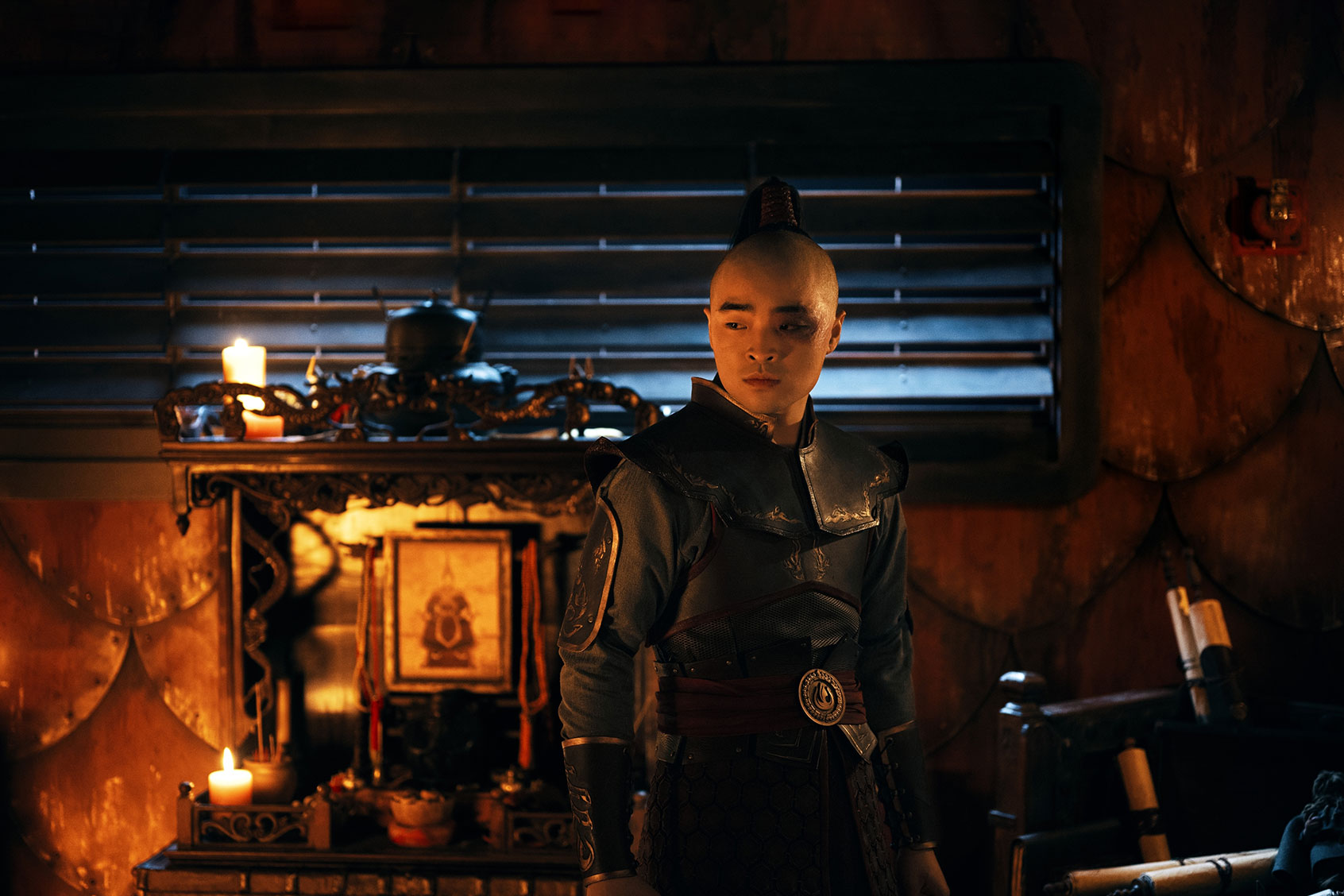
Avatar: The Last AirbenderAvatar: The Last Airbender (Netflix)Aang is awakened by a waterbender named Katara (Kiawentiio) and her brother Sokka (Ian Ousley) to a world embroiled in war, instigated by the Fire Nation and its tyrant ruler Fire Lord Ozai (Daniel Dae Kim). Ozai has set his banished son Crown Prince Zuko (Dallas Liu) on a mission to capture Aang, mainly as a distraction while Ozai marches across the world and brings other unconquered kingdoms to heel with Zuko’s sister and rival Azula (Elizabeth Yu) angling to improve her station.
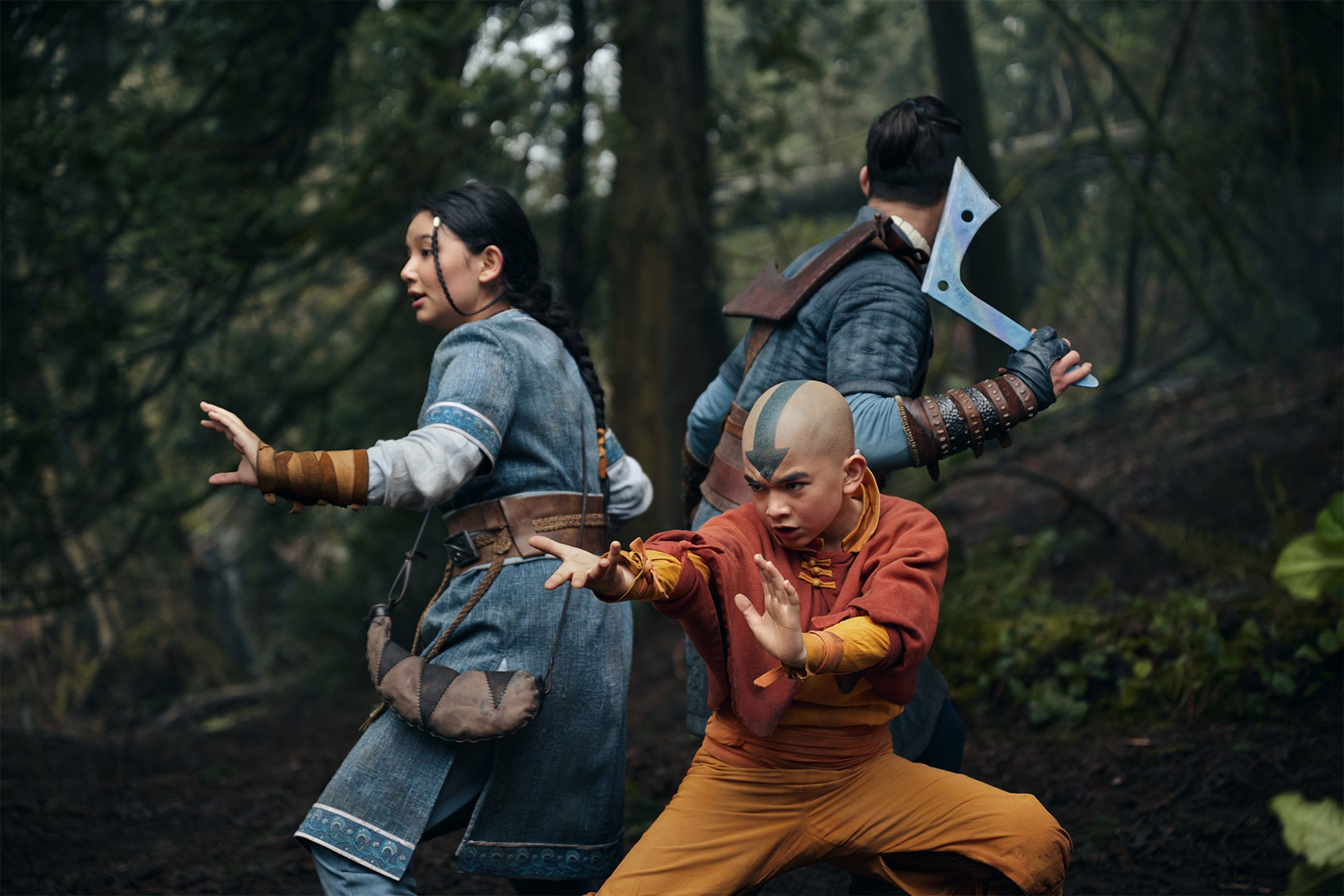
Take heart in knowing this adaptation of “Avatar: The Last Airbender” is far better than that one.

“Avatar: The Last Airbender” first premiered in 2005, not long after Peter Jackson’s film adaptations of J.R.R. Tolkien had established what fantasy filmmaking and storytelling can and should look like. Nearly every modern fantasy epic is based on some version of Tolkien’s narrative architecture, including this one – which also ran on TV in the same era as the Harry Potter movies. (Aang, like Harry, is another Chosen One.)

Similarly, nearly every film or TV adaptation of a story based on an elaborately constructed world is at some point held up to the standard Jackson established. Tolkien experts pointed out the ways the movie diverged from the novels, primarily casting these choices in a respectful light. He maintained the soul of the literature while satisfying the storytelling economy a feature demands.

Showrunner Albert Kim takes a few gambles in this respect. The original built to a massive battle that ended its first season. Kim’s adaptation opens with a pivotal tragedy only implied in the source material that may spark debates about screen violence, especially in a story centered on child heroes.

The counterpoint is that “Avatar: The Last Airbender,” for all its gentle lessons and optimism, is a story about a genocide survivor desperately striving to prevent other cultures from being wiped out. When I wrote about the animated series’ resurgence in 2020, I expressed the hope that the world would be in a better place when this adaptation premiered. Given how sheltered Americans have been kept from the realities of genocide occurring right now, watching a small screen depiction of a fictional one up close may serve to remind people of the human suffering behind those bloodless reports.

We need your help to stay independent

Nevertheless, one can’t get past a stagnating feeling that these eight episodes are merely sufficient, locking down enough key particulars to justify keeping it alive to see the next “book” while fulfilling acts of fan service.

Cabbage Man stans, you’ll be pleased to know James Sie, who originally voiced the produce vendor, shows up here. Sie’s presence is one of many affectionate tributes Kim and fellow producers include throughout the series, some subtler than others.

“The Lord of the Rings” comparison is necessary due to what those blockbusters inspired. We wouldn’t have “Game of Thrones” or “The Witcher” if people didn’t lose their minds over Frodo and his crew at the top of the Aughts. More recently, Prime Video wouldn’t have spent an astronomically obscene amount of money to bring to life "The Lord of the Rings: The Rings of Power."

Amazon’s gargantuan fantasy entry may be the most pertinent citation in this argument since a visual comparison between it and “Avatar: The Last Airbender” places Aang and company on the losing side. The depth of thought and planning that went into the practical aspects of the production are visible, especially in the Wushu-heavy fight choreography and other action sequences. But the amount of CGI buoying this production is noticeable to distraction.

Avatar: The Last AirbenderAvatar: The Last Airbender (Netflix)Some of that can’t be helped; I’d rather the series make their best attempt rendering a computerized version of Appa, Aang’s flying bison, and Momo, the troupe’s flying lemur and resident comic relief than leave them out entirely. Nevertheless, it was tough to stifle my irritation at watching the cast stride through a competently drawn video game. Don’t even get me started on Amber Midthunder’s wig, which enters the fable in the seventh episode.
Then again, Midthunder playing Princess Yue in a cast primarily comprised of Indigenous and Asian actors should be viewed as a win. These choices speak to the producers’ determination to correct Shyamalan’s sloppiest error: casting white people as the heroes, most of whom couldn’t act their way out of an unfenced yard.

The wealth of accessorizing that went into recreating “Avatar: The Last Airbender” isn’t the issue. What’s missing is some of its spirit.

I may not have been blown away by Kiawentiio’s portrayal of Katara but at least she’s not a white girl being passed off as Inuit-adjacent. (Shed no tears for Nicola Peltz, people – she’s an heiress who married into the Beckham family. She’s fine!)

DiMartino and Konietzko are a couple of white guys too, but the care that went into depicting the cultural influences inspiring their world was significant. The producers that picked up this project honor that effort, depicting the Water Tribes as Indigenous, Earth Kingdom Tribes, and Korean, Chinese, Japanese, and South Asian influenced, and taking influence from Southeast Asian design details to construct the Fire Nation.

None of that would matter if the most important piece of this puzzle didn’t click. Cormier looks like Aang, sounds like him, and strikes the right balance between the character’s childish wonder, determination and ferocity. The script freights these qualities with guilt, which Cormier ably juggles in direr moments.


Want a daily wrap-up of all the news and commentary Salon has to offer? Subscribe to our morning newsletter, Crash Course.


But there’s only so much he and other actors can do to compensate for pedestrian writing that’s too reliant on tapping into Aang’s Avatar superpowers long before he figured them out in the original series. Some of this is excusable when you remember the writers are stuffing 20 installments of world-building plot into eight hours. Phrases like “because I’m the Avatar” pop up regularly enough to become lemon juice on a hangnail, and may lead you to appreciate the contortions, not simply the bending, that these performers engage in to make us believe in them.

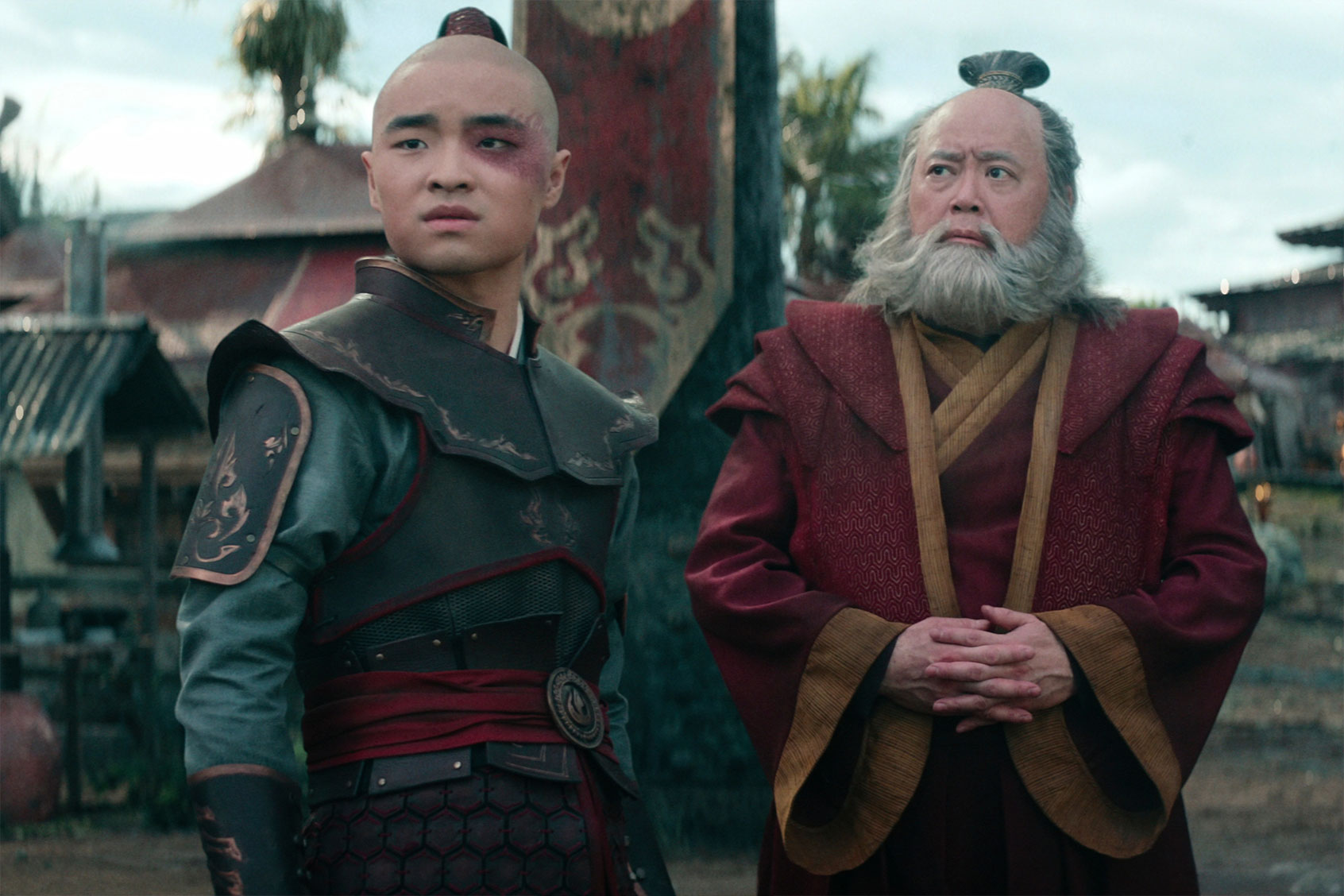
Avatar: The Last AirbenderAvatar: The Last Airbender (Netflix)This is especially true of Liu, whose performance is as essential as that of Cormier since the first season's journey is as much about Zuko’s travels through grief and rage on his way to embracing his individuality and worth. Pairing him with Paul Sun-Hyung Lee as Uncle Iroh tempers the character’s histrionics where that’s required, but it’s a quieter scene that Liu shares with Cormier that hints at the potential of what this series could be with a bit of polishing.

I’m less convinced that “Avatar: The Last Airbender” can tolerably infuse its scripts more of the joyful lunacy that came naturally to the original without turning away the unconvinced. But it needs to, especially when interpreting characters like Earth Kingdom ruler Bumi, a kindly mad genius realized by Utkarsh Ambudkar as a bitter, homicidal despot.

Is this the nitpicking of someone demanding a favorite story’s purity be retained down to the latches and buttons? Maybe, although it’s not meant to come off that way. Besides, the wealth of accessorizing that went into recreating “Avatar: The Last Airbender” isn’t the issue – it’s what’s missing, which is some of its spirit. That doesn’t mean it’s not watchable, but the amount of compromising between meeting high expectations and clearing the lowest of low bars is a ballast that would hinder any mission.

"Avatar: The Last Airbender" is now streaming on Netflix.

“I think we should kill ’em all,” GOP Rep. Andy Ogles says of Palestinians in Gaza

Republican Rep. Andy Ogles of Tennessee said Tuesday that "we should kill 'em all" after an activist pressed him to respond to atrocities that the U.S.-backed Israeli military is committing against Palestinians in Gaza, including children.

"I've seen the footage of shredded children's bodies," the activist told Ogles. "That's my taxpayer dollars that are going to bomb those kids."

"You know what? So, I think we should kill 'em all, if that makes you feel better," Ogles responded. "Hamas and the Palestinians have been attacking Israel for 20 years. It's time to pay the piper."

Watch the exchange:

Ogles, a vocal supporter of arming Israel unconditionally, was among the 212 House Republicans who voted in November to censure Rep. Rashida Tlaib (D-Mich.) on the false grounds that she "justified" the Hamas-led attack on Israel on October 7.

Following the Tennessee Republican's call for the mass killing of Palestinians, Democratic strategist Waleed Shahid asked, "Any congressional resolutions to censure or expel Ogles?"

Video footage of Ogles' remarks was posted to social media hours after the Biden administration vetoed a cease-fire resolution at the United Nations Security Council — the third time since October 7 that the U.S. has wielded its veto power to block a measure calling for an immediate end to the bloodshed in Gaza.

Hours before the latest U.S. veto, an official with the United Nations Children's Fund (UNICEF) warned that Gaza is "poised to witness an explosion in preventable child deaths" as malnutrition and disease spread rapidly across the enclave.

Israeli forces have killed more than 12,400 children in Gaza since October 7, according to the territory's health officials. More than 600,000 children are currently trapped in Rafah, which Israeli forces are preparing to invade. On average, more than 10 Gaza children per day have lost one or both of their legs since October, according to Save the Children.

"After four months of relentless violence, we are running out of words to describe what children and families in Gaza are going through, as well as the tools to respond in any adequate way," Jason Lee, Save the Children's country director for the occupied Palestinian territory, said in a statement Tuesday. "The scale of death and destruction is astronomical."

"Children are being failed by the adults who should be protecting them," Lee added. "It's beyond time for the adults in the room to step up their responsibilities and legal obligations to children caught up in a conflict they played no part in, who just want to be able to live."

Legal analyst “shocked” after Trump’s “angry” lawyers demand judge delay fraud payout

Lawyers for Donald Trump on Wednesday requested a 30-day postponement in the enforcement of the nearly $355 million fine the former president was ordered to pay last week in his civil fraud trial, Axios reports. The attorneys took issue with the draft proposal New York Attorney General Letitia James, who brought the suit, submitted Tuesday for Manhattan Supreme Court Justice Arthur Engoron to sign, arguing that James should have notified them beforehand. 

A Wednesday letter signed by Trump defense attorney Clifford Robert to Engoron charged James with an "unseemly rush to memorialize" the judgement in a manner he argues violates "all accepted practice in New York state court." A stay on the decision he said, would "allow for an orderly post-Judgment process, particularly given the magnitude" of the judge's ruling. "To deprive Defendants of the opportunity to submit a proposed counter-judgment would be contrary to fundamental fairness and due process," Robert wrote in an earlier Wednesday letter to Engoron about James' proposed order.

According to legal news site Law & Crime, James' proposal was mostly a formality and "constructed out of legal boilerplate" as "[p]roposed orders are frequently filed by the parties in legal cases as a matter of course."

"Trump's lawyers, angry that Judge Engoron is apparently not going to allow motion practice on reducing his opinion to a formal judgment, demands a 30-day stay of any entered judgment instead," MSNBC legal analyst Lisa Rubin wrote on X/Twitter. "Shocked."

Trump has said he will appeal Engoron's judgment against him and his co-defendants, which included his two elder sons, which totals $364 million. Engoron's ruling also barred Trump from heading a New York business for three years, and his sons from doing the same for two years.

Will Alexei Navalny’s death finally break Trump’s hold on evangelicals?

We live in a land of abounding quackeries and if we do not learn how to laugh, we succumb to the melancholy disease which afflicts the race of viewers-with-alarm.
H.L Mencken, 1921

They are drunk with power and mad for revenge. Thanks to Donald Trump, they are destroying a century’s worth of progress in the name of  Christ — while embracing his antithesis.

Or, if you prefer Barry Goldwater, whom many MAGA members embrace today without knowing it, “Extremism in the defense of liberty is no vice.” That kind of deviltry nearly consumed America on several occasions in our past, but those who dwell in reality know the worst devils are the people who exploit such naïve ideals for their own benefit: Donald Trump.

Yet Trump remains nothing more than a con man — a would-be emperor with no clothes.  According to Charlie Daniels, the devil had a fiddle of gold. All Donald Trump can muster are gold-colored sneakers that cost $400 up front — with the promise of getting them delivered in July. Don’t hold your breath. 

The lyrics tell us the devil went down to Georgia looking for a soul to steal. He probably found it easier there because, as the AP reported this week, there is a legislative proposal that would require school libraries in that state to notify parents of every book their child checks out. Georgia senators who advanced the idea certainly won’t provide any more money for education — just more red tape aimed at shutting it down. Georgia is also considering a proposal to bring criminal charges against librarians for distributing material containing any obscenities. So much for Holden Caulfield and Huckleberry Finn. It’s also doubtful that the ribald humor of H.L. Mencken, quoted above, would stand up to that type of scrutiny.

Remember, those proposing such legislation are the same far-right politicians who embrace Trump as Jesus. If they had a lock of Trump’s hair, they would undoubtedly use it to try and cure warts.

Let’s hand it to Trump, though; he spent a lifetime hanging out with hookers, but that doesn’t make him Jesus. He’d probably burst into flames if he ever stepped inside a church, but that’s a different story.

If that’s not enough for you, the Alabama Supreme Court. led by MAGA superfans, has ruled that frozen embryos can be considered children under state law, a cold move that would freeze fertility treatments in the state. I guess in Alabama a fertilized egg in the refrigerator is considered a chicken.

If that makes your head swim, get ready for more stupidity. Retired U.S. Army Gen. Michael Flynn has crisscrossed America telling rally audiences, “They hate you because they hate Jesus.” He has urged evangelicals to get involved, saying the U.S. is in the middle of a “spiritual war.” Flynn’s “ReAwaken America” tour preaches the Trump gospel to far-right audiences across the country.

This is the new New South. Not the Jimmy Carter New South, where folks build Habitats for Humanity, but a South that sneers at migrants, hates anyone who isn’t a Christian, ignores the Constitution, elevates the evangelical church above our government and believes it has the right to dictate to a majority of Americans how they must worship. 

No, it isn’t the loathsome Confederacy of the 1860s, or the Jim Crow South that denied civil rights and burned Beatles records; it is worse. It is the South born from Richard Nixon’s “Southern strategy” and Ronald Reagan’s appeal to Southern conservatives and evangelicals. This South is for the direct descendants of the old John Birch Society, the Knights of the Klu Klux Klan and others whose deep historical roots most certainly include the Confederacy. It is the South of hate-mongering and fear. It is active and it is dangerous. Trump is not its architect, only its current messenger. He’s descended from the notorious populist William Jennings Bryan, a man Mencken said was about as sincere as P.T. Barnum.

The new New South isn’t the loathsome Confederacy of the 1860s, or the Jim Crow South that denied civil rights and burned Beatles records; it is worse.

Today’s evangelicals may be your friends and family members, but they show up at Trump’s rallies claiming they’d rather support Russia than the Democrats. They claim to follow Jesus, while standing for everything he stood against. These are Trump’s core voters. Maybe that’s not news, but what might be is the possibility that after full-force flaunting their arrogance, ignorance and disdain for anything remotely American for the last eight years, recent global headlines could finally lure them away. That could capsize Donald Trump.

When Trump was indicted for 91 felonies in four different criminal cases, his followers claimed it was all the work of the "deep state." When he was impeached (with the active participation and leadership of Republicans) for his actions on Jan. 6, they screamed about a “witch hunt.” When Trump was found liable in civil court for sexual assault  and fraud, they screamed the same things — even louder. 

Joe Biden is a devout Catholic whom I’ve actually seen inside a church on many occasions, unlike Trump, whose greatest claim to Christian virtue was holding up a Bible outside a Washington church for a photo-op during protests near the White House. But Trump is cheered as a Christian, while Biden is pilloried as a man of no faith, or a communist or a genocidal maniac.

These are the Christian nationalists who have spread so much disinformation that three out of every five white evangelicals, according to the American Enterprise Institute, say Biden was not “legitimately elected.” That’s despite the fact that Trump has never presented one shred of evidence that he actually won the 2020 election. His claims have been laughed out of court more than 60 times — all grist for the mill, for those who blame the deep state.

We need your help to stay independent

But what may signal a turning point is the death of Alexei Navalny, the chief political opponent of Trump’s good friend and mentor, Vladimir Putin. Trump refused to criticize Putin for Navalny’s death. Instead he compared it to his own criminal prosecution: “CROOKED, Radical Left Politicians, Prosecutors, and Judges leading us down a path to destruction.” That’s what Trump offered up on Truth Social, while Biden accused Putin of being complicit in Navalny’s death. The difference between the two men resonates — so much so that Nikki Haley, the last GOP opponent left standing against Trump, recently accused the former president of being “weak in the knees” when it comes to Putin and Navalny. That was a body blow. 

The Trump faithful may truly believe Navalny had it coming, because their leader told them so. Trump hasn’t said a word against Putin — nor will he ever. When Haley suggested Trump was on his knees, that was a mental image the Trumpers won’t want to acknowledge, for a variety of reasons.

Their desire to find a president who will promote their brand of Christian nationalism has found an audience with Trump. He sees right-wing evangelicals purely as the means to an end. He wants their votes. He has promised to support the Christian bigots who long to outlaw all other religions and turn America into a theocracy where you can pay $400 for a pair of gold sneakers, ban and burn books, and lock up librarians.

But Navalny’s death may yet prove to be the unsettling fact that drives some of his Christian supporters away from Trump, out of the same fear that drove them to him in the first place: the fear of persecution. 

That fear is strong throughout the world.

Joe Biden is a devout Catholic, who I’ve seen in church on many occasions. Trump's religion is about holding up a Bible for a photo-op. But Trump is cheered as a Christian, while Biden is pilloried as a communist or a genocidal maniac.

The cries of “Genocide Joe” rang out at Biden’s appearance Wednesday in Los Angeles from supporters of the Palestinian cause. Thousands of pro-Israel protesters gathered on the National Mall  after the Oct. 7 Hamas attack. Both of those communities know the fear of persecution, as do so many Christians, African Americans, women, immigrants, members of the LGBTQ community and other marginalized groups. 

At the end of the day, only the preachers in the pulpits can reach the evangelical faithful. They won’t listen to their liberal or progressive acquaintances — and rarely consider those people “friends.” They won’t listen to other conservatives. But those preaching every weekend, whether in the “Six Flags Over Jesus” megachurches or small community churches, do have the ability to change minds. If you pay attention, you’ll hear some of those preachers saying that what happened to Navalny was a tragedy — and if you can’t condemn it, then you’re part of the problem.

That doesn’t bode well for Donald Trump. 

Those evangelicals who remain Trump’s core supporters are the most easily manipulated people on the planet. Their zeal blinds them to reality. Does anyone of sound mind or body believe that Donald Trump is a devout Christian?

There are sex workers across the country who could tell you of his debauchery. His visits to Epstein Island are legendary. His “grab ‘em by the pussy” comments are on tape. 


Want a daily wrap-up of all the news and commentary Salon has to offer? Subscribe to our morning newsletter, Crash Course.


 If Trump can convince gullible people that he is a Christian, however, maybe there’s hope that a preacher of sound mind can overcome the power of Trump’s rhetoric. If you’ll fall for Trump, you’ll fall for anything — including the truth, if it’s seasoned correctly. 

Joe Biden’s challenge, as the presidential campaign heats up, is to harness those voters if he possibly can — because if they turn on Trump, he is surely done. Biden seems to sense that as well. During his L.A. campaign stop he spoke bluntly: “Trump is dragging us back to the past and not leading us to the future. We are going to defeat him and his lies.”

The influence of the evangelical community is far-reaching. It includes anti-vaxxers, conspiracy theorists, QAnon supporters and every other believer in witchcraft, anti-intellectualism and ignorance known to man. Evangelicals are like all the other religious or political zealots on the planet — they favor emotion over reason, feel disdain for facts that do not agree with their predetermined beliefs and express a smug condescension that no one knows the truth except them.

That is the Mencken variety of Boobus Americanus as it lives and breathes in the United States in 2024. Most dogs, cats and other vertebrates seem to have more common sense than your average human being — and dogs are known to eat their own feces.

As for Trump, Mencken reminded us, “There is something peculiar about a man who wears a red tie.”

“Humiliation”: Fox host buries GOP as Republican admits “we were warned” about indicted informant

Rep. Ken Buck, R-Colo., claimed that top Republicans were warned about the debunked Biden claims from a former FBI informant before he was indicted for making up allegations that the Bidens took bribes.

David Weiss, the special counsel who charged Hunter Biden with drug and tax violations, last week charged Alexander Smirnov with lying to the FBI that Hunter and President Joe Biden received $5 million bribes from executives at the Ukrainian energy firm Burisma for protection. The special counsel said that Smirnov told investigators that “officials associated with Russian intelligence” were involved in passing the story.

Buck, a House Judiciary Committee member who has pushed back on the rush to impeach Biden, told CNN that Judiciary Chair Jim Jordan, R-Ohio, and Oversight Chairman James Comer, R-Ky., along with other Republicans were warned about the informant’s claims before they hyped them publicly.

“We were warned at the time that we received the document outlining this witness’s testimony – we were warned that the credibility of this statement was not known,” Buck said.

“And yet people, my colleagues went out and talk to the public about how this was credible and how it was damning and how it proved President Biden’s – at the time Vice President Biden’s – complicity in receiving bribes,” he said. “It appears to absolutely be false and to really undercut the nature of the charges.”

Buck added that it “appears” that Comer and Jordan went public with the information even though they knew it was uncorroborated.

“I certainly didn’t have any evidence outside the statement itself that it was credible,” he said. “And as a prosecutor for 25 years, I never went to the public until I could prove the reliability of a statement. And even then, the only one public statement a prosecutor makes is the charging document. Let’s see what the evidence is in this impeachment, if there is more evidence before going forward.”

We need your help to stay independent

House Republicans have continued their impeachment inquiry, interviewing President Biden’s brother James behind closed doors on Wednesday. James Biden denied that the president has ever had “any involvement or any direct or indirect financial interest” in his business ventures, according to Politico.

“I don’t know why Jim Comer and Jim Jordan thought that perhaps it was going to be Joe Biden’s brother that brought him down,” Fox News host Jessica Tarlov said Wednesday. “But this is the path that they’ve chosen to take. And honestly, I’m surprised that they have this high of a threshold for humiliation, every witness that they have called has decimated their argument.”

Tarlov called out the Republicans’ reliance on the statement from Smirnov, which they’ve said was key evidence before walking back the purported importance of the document after the charges.


Want a daily wrap-up of all the news and commentary Salon has to offer? Subscribe to our morning newsletter, Crash Course.


“Not only did he lie, he was lying because the Russians were feeding him the disinformation. It’s so embarrassing,” Tarlov said.

Rep. Jamie Raskin, D-Md., the top Democrat on the Oversight Committee, said Wednesday that the “impeachment investigation essentially ended yesterday, in substance if not in form, with the explosive revelation” that Russia fed information to Smirnov.

“It appears like the whole thing is not only, obviously, false and fraudulent, but a product of Russian disinformation and propaganda,” Raskin said. “And that’s been the motor force behind this investigation for more than a year.”

Monarch butterfly populations are crashing — but we can choose to do something about it

Monarch butterflies (Danaus plexippus) are some of the most iconic insects around. But they are uniquely threatened and earlier this month, Mexico’s Commission for National Protected Areas announced that the number of monarch butterflies has dropped to frighteningly low levels. The monarch butterfly population returning to their winter habitats fell by 59% this year, making it the second lowest level since scientists started keeping records.

The Mexican government is not alone in noticing the precipitous decline in monarch butterflies. The Xerces Society for Invertebrate Conservation — a group that specializes in protecting insects, arachnids, crustaceans and other arthropods — warned in its annual Western Monarch Count that they only counted 233,394 butterflies at 256 overwintering sites compared to last year’s total of over 330,000 butterflies. To put this in perspective, the researchers explained in a press statement that this is "just 5% of their population numbers in the 1980s, when low millions were common."

"We are still probably going to have monarchs. They're just going to be a shadow of what they were."

Emma Pelton, a senior endangered species conservation biologist and Western Monarch Lead at the Xerces Society, told Salon that she has observed firsthand "the bottom drop out" of western monarch populations. While the news cycle is focused on the most recent numbers from experts, Pelton witnessed a dramatic example of this same phenomenon years earlier.

"When I started this work a little over eight years ago, we knew the population wasn't as good as in the past," Pelton explained. "But we thought, 'OK, this is our new normal. We have low hundreds of thousands of butterflies.'"

Yet in 2018, Pelton noticed that sites which had once been "dripping with monarchs" were eerily vacant, with some having monarch populations limited to one branch. 

"It was two orders of magnitude; we really dropped from 300,000 give or take to 30,000 give or take in a single year," Pelton said.
"It's very visceral to say, 'They used to coat this whole area and now they're on a single branch, or they're really scattered.' I mean it's pretty shocking and it was pretty potent. And we were actually out there with a reporter and I remember we were all saying, 'Ooh, this does not look good. This does not look like what it's supposed to look like.'"

Does this mean the monarchs are doomed? Probably not. Pelton is not worried about monarch butterflies going entirely extinct because "there are small populations in tons of countries all over the world." Yet when it comes to the monarch butterflies indigenous to the United States — and, in particular, the ones renowned for migrating through the seasons — experts do indeed fear that "we're going see this collapse of this amazing phenomenon. We are still probably going to have monarchs. They're just going to be a shadow of what they were."

Regardless, many examples across nature indicate that outcomes other than extinction can still have widespread impact across ecosystems. For example, in the U.K., gardening practices that diminished the red ant population had an outsized impact on the endangered large blue butterfly (Phengaris arion). Scientists have been able to restore the populations of these butterflies by helping out the ant as well, as the butterflies are actually parasitic to these ants and need them to complete their life cycle. Losing monarchs could also have ripple effects across nature.

There are several explanations for the fall in monarch butterflies, all of them linked to human activity. First, there are the rising temperatures caused by climate change and burning fossil fuels. Gloria Travera, the conservation director at Mexico’s Commission for National Protected Areas, told The Guardian that the butterfly population decline has "a lot to do with climate change.” The planet's increased temperature causes droughts, extreme heat and storms, all of which make it harder for the butterflies to survive in their normal environment. On some occasions, Travera and her team could not find any butterflies on their traditional wintering grounds.

“The monarchs looked for other sites,” Tavera observed.


Want more health and science stories in your inbox? Subscribe to Salon's weekly newsletter Lab Notes.


"I remember we were all saying, 'Ooh, this does not look good. This does not look like what it's supposed to look like.'"

Monarch butterflies also possess unique traits that make them particularly vulnerable to climate change. Their migration, habitation and reproductive habits all heavily rely on temperature, and the butterflies themselves are very sensitive to any fluctuations. They also rely on a single plant for food, milkweed, and as climate change makes milkweed less nutritious and more scarce, butterflies consequently suffer.

Yet factors other than climate change also inflict suffering on butterflies. As Pelton explained, habitat destruction and pesticide use are also major contributors to the declining butterfly populations.

We need your help to stay independent

"We've been destroying habitat, the milkweed they use, the nectar plants they use, as well as their overwintering habitat in Mexico and California," Pelton said. "We have a lot of strong evidence that that's the biggest issue, along with kind of broad pesticide contamination and the use of herbicides and insecticides."

While this may seem disheartening because it means monarch butterflies face additional challenges, Pelton sees a silver lining in that cloud — some of these problems can be fixed by humans with relative ease.

"We can choose to reduce pesticide use, we can choose to protect or restore habitat," Pelton pointed out. "Climate change, we're not going to stop that in a year. This is going to take time. I think of it as a little bit a lifeboat analogy: we need to keep monarchs afloat while we address climate change, and the things we can address are habitat and pesticides."

In fact, Pelton reported that a lot of people have expressed interest in doing their part to see monarch butterflies.

"We get emails every day from people that are gardeners who say, 'I want to do the right thing. What milkweed can I plant? How can I talk to my community about this? Do you have educational materials? How can I get pesticides reduced in my community?'" Pelton said. Monarch butterflies are among the most famous arthropods in the world, and humans seem to want to keep them around. The question is whether they can rise to the challenge.

James Comer and Tucker Carlson aren’t fooled by Russian lies — they’re complicit

Last week, the "whistleblower" that House Republicans were counting on to justify a long-planned impeachment of Joe Biden was arrested for lying to the FBI. In a twist that should surprise exactly no one, it appears almost certain that Alexander Smirnov's claim to have evidence implicating the president and his son, Hunter, in criminal activity was fabricated. Worse yet, it also seems plausible that the "source" of the lies was Russian intelligence services. House Oversight Chairman James Comer, R-Ky., had built the effort to impeach Biden around Smirnov's invented testimony, and has now tacitly admitted that this arrest may derail the Biden impeachment, which has been in the works since long before Republicans had even decided what "crime" they would pretend to believe Biden committed. 

In the wake of Smirnov's arrest, a narrative has surfaced among the punditry holding that Comer and other Republicans who championed Smirnov's fictions must be a bunch of morons. Joe Scarborough of MNBC, the bellwether of centrist Beltway thinking, unleashed on Wednesday morning about "Republicans being played once again by Vladimir Putin," adding that "Republicans are so stupid in the House, they can feed Russian disinformation straight into the veins of the United States Congress." Other outlets have been less aggressive with the name-calling, while still running with the assumption that Comer must be embarrassed to be exposed as a laundromat for Kremlin propaganda. Even legal blogger Marcy Wheeler, who tends to be bullish on Russian connections to Trump-friendly politicians, ran with the "dupes" narrative. 

There's a puzzling unwillingness among much of the press to consider the most obvious reason why MAGA Republicans keep taking Putin's side, whether it's over aid to Ukraine or Donald Trump's hostility to NATO: They prefer Putin's antidemocratic vision to the tattered-but-still-surviving democracy of the U.S. There's simply no evidence to suggest that Comer feels the slightest shame over using taxpayer money to be a cutout for Russian intelligence, or even that he is surprised by these revelations. 


Want more Amanda Marcotte on politics? Subscribe to her newsletter Standing Room Only.


On CNN on Tuesday, House Oversight Committee member Rep. Dan Goldman, D-N.Y., suggested there might be more than stupidity motivating Comer and his fellow impeachment fanatics. "Wittingly or unwittingly, House Republicans have been acting as an agent or an asset of Russian intelligence for Vladimir Putin," he explained, with that word "wittingly" right there for the taking. He pointed out that Trump's first impeachment — which he worked on as a House Democratic lawyer — exposed how much Russia had worked to spread disinformation about the Biden family. There's no reason to reach for ignorance as an explanation, Goldman concluded: "Republicans are willing to be used as assets of Russian intelligence."

A strong case that Republicans are acting out of malice rather than ignorance can be made from the behavior of former Fox News host Tucker Carlson, the self-appointed vanguard of right-wing depravity. Earlier this month, Carlson ventured to Moscow to host a tongue-bath "interview" with Putin in which the Russian leader told outrageous lies while Carlson, as Salon's Andrew O'Hehir wrote, played the role of "dim but obsequious schoolboy." One lie that should be obvious, even to Americans: Putin blamed the onset of World War II on Poland, which he claimed had forced the Nazis to invade in 1939.

Carlson then did a travel infomercial for Moscow, marveling at the fancy grocery stores for oligarchs and the sparkling subway stations, arguing that Americans have been misled about life in Russia. The apparent implication was that it's worth the mass murder of Ukrainians and political dissidents to get clean subway cars. Paul Krugman of the New York Times retorted that while "parts of Moscow offer a small elite an opulent lifestyle, Russia as a whole is more than a bit ramshackle," noting that "a fifth of homes don’t even have indoor toilets" and that Russian life expectancy "is substantially lower than in the United States." 

Carlson was called a "useful idiot" by many observers, a phrasing that suggests he might have been sincerely confused about whether an expensive neighborhood in Moscow was representative of the entire nation. A far more likely explanation is that Carlson is just lying. We know from Dominion's successful lawsuit against Fox News that Carlson knowingly lies to his audience and, frankly, thinks it's funny to do so. But perhaps the biggest giveaway came in Carlson's digressions aimed at New Yorkers, telling them, "You can’t use your subway" because, supposedly, "it's too dangerous." (In fact, roughly 3.5 million people rode the New York subway on an average day in 2023.)

Carlson used to live in New York, so he knows full well that people in the city do not, in fact, think the subway is too dangerous to ride. (Violent crime is down in the city overall, and very rarely happens on subway trains.) People who believe otherwise are likely to be Fox News addicts who don't live in New York and rarely visit. I'll never forget the time a Republican-voting relative came to stay with me in Brooklyn. We were making a trip to the Upper East Side and her husband freaked out when I insisted we take the subway, correctly pointing out that a taxi ride of that length would be both miserable and expensive. Her husband, for some reason, forbade her to wear a skirt, but as soon as we got on the train she marveled at how chill and clean everything was. That's the audience Carlson is talking to, and he knows it. 


Want more Amanda Marcotte on politics? Subscribe to her newsletter Standing Room Only.


It's much the same story with Comer, who has winkingly acknowledged on occasion that his relentless accusations against Biden are inventions. Last year, for instance, he all but confessed to the New York Times by noting that many of his "leads" had in fact come from QAnon message boards. Rather than toss obvious nonsense in the trash, he happily "investigates" the tips fed to him by conspiracy theorists. 

"You know, the customer’s always right," Comer told the Times, referring to what the reporters called the "vengeful, hard-right voters" who "propelled him to stardom."

For people like Comer and Carlson, a guiding principle is that the truth simply does not matter. The only value information can possess is to serve their political purposes, no matter how blatantly false it is or how evil the people peddling it may be. Nor should we expect them to feel any embarrassment when they're exposed as liars. On the contrary, that only serves the GOP's goal of breeding widespread cynicism in the public. Rather than trying to untangle all the conflicting accusations about malfeasance and Russian involvement, many people — especially low-information swing voters — will just shrug and say, "All politicians are liars."

The end goal here is to normalize Trump's nearly infinite record of lying and criminal behavior. By adopting his reckless disregard for the truth and his loyalty to Russia over America, Republicans like Comer are inching toward their perverse goal of making Trump's extreme corruption seem commonplace. 

Apocalypse now: Donald Trump dons the “armor of God” — and pushes for theocracy

Donald Trump has frequently hinted or implied that he has been chosen by God as some type of prophet and messiah, a divine champion in the 2024 presidential election. The suggestion is that Trump is somehow infallible, above and outside the Constitution, the rule of law and other restraints placed on the behavior of mere mortals in modern society.

Such claims are patently absurd, but that is almost not a liability. In his overtly cruel and mendacious behavior, Trump has shown himself to be anything but “godly” and “righteous,” by supposed Christian standards. He rarely attends church and displays open disdain for his evangelical followers, a group he views as a means to an end: They provide him with the narcissistic energy, campaign funds and fervent support — and, of course, the votes — he will need to become America's first dictator

In all, the relationship between Trump, his MAGA movement and the Christian right is transactional on both sides. During his presidency and beyond, Trump has promised the Christian right — and largely delivered — the power to enforce their will on the American public with the goal of turning the country into a theocracy. The Christian right has made Trump into the leader of its “spiritual warfare” campaign despite, or even because of, his obvious criminality. (To them, Trump is a victim of persecution by evil and demonic forces, further proof of his prophetic status.) Public opinion polls and other research increasingly suggest that Republicans, and in particular MAGA voters, do in fact believe he has been chosen by God to lead the country.

It is not hyperbole or exaggeration to say that Trump and the MAGA movement, in union with the Christian right, embody an existential threat to democracy. Trump's plans to impose dictatorial power are publicly available in the form of Project 2025, Agenda 47 and other documents and resources. New reporting by Politico highlights the expansive role that Christian nationalists and theocratic fascists are likely to play if Trump returns to power.

I recently spoke with Paul Djupe, a political scientist at Denison University and the editor of the Religious Engagement in Democratic Politics series at Temple University Press. Djupe is the co-author of "The Full Armor of God: The Mobilization of Christian Nationalism in American Politics," "The Evangelical Crackup? The Future of the Evangelical-Republican Coalition" and other books, and co-editor of the new anthology "Trump, White Evangelical Christians, and American Politics," to be published next month.

In this conversation, Djupe explains how Trump’s violent and apocalyptic rhetoric resonates with the Christian right and evangelical beliefs about the "end times" and the supernatural or demonic forces at work in American life and politics. Contrary to those who continue to underestimate Trump’s dangerousness and sophistication, Djupe argues that the ex-president’s use of such language and symbolism is intentional and highly effective.

Djupe further warns that militant Christianity's threats and promises of violence are not metaphorical, but present a danger to our democracy and civil society, and cautions that Trump and Christian right take power, the LGBTQ community, racial minorities, non-Christians, women and members of other marginalized groups will find their rights and freedoms under systematic attack. 

This is the second part of a two-part conversation, edited for length and clarity. Read the first section here.

Trump is now claiming he was chosen by God, even saying that “God made Trump.” At his rallies. he increasingly features right-wing Christian preachers who talk about the enemies of Trump and the MAGA movement as demonic or satanic agents, and suggest we face Armageddon. Many of these preachers also channel the beliefs of the QAnon conspiracy cult at Trump’s rallies and elsewhere. What do we know about that overlap?

It would be a mistake to ignore the language and actors that Trump and his agents are using to return to power. I agree that this is not a normal mode of campaign politicking. He is inviting local charismatic clergy to continue to sacralize his campaign. These are folks who are not shy about posing spiritual warfare and identifying the sides in terms of good and evil. That reinforces the apocalyptic frame for his campaign that he has been cultivating from Day One. I don’t have specific insider knowledge to explain his campaign decisions, but building this frame has to be why he started his 2024 campaign in Waco, Texas, site of the apocalyptic showdown between federal agents and the Branch Davidian religious group in 1993. It is why he mentions "breaking the seal” on social media — that's a reference to prophecy in the Book of Revelation. And he is constantly referencing his opponents as evil, sick "vermin," which fits the apocalyptic frame where the forces of evil are operating openly on Earth. It also fits the worldview that people are either judged good or evil, destined either to the eternal lake of fire or to a heavenly reward.

"QAnon ticked all the boxes: a secret cabal of groups conservative Christians don’t like — Hollywood, bureaucrats, Democrats, globalists, Jews — the violation of children and concerted work in the deep state to undermine Trump."

Trump’s use of this language is part persuasion, by attempting to draw uncrossable lines separating good and evil. But he is also simply reaching out to a constituency for whom this worldview resonates. There are many people who think of the world in this way, that we document in our book in progress (with Jake Neiheisel and Andrew Lewis). How do we know this is voter outreach? Well, it’s working as I just wrote about for the Religion in Public blog. Those with apocalyptic worldviews really like Trump. Even if we confine the sample to evangelical Christian Republicans, there is a dramatic difference in Trump support linked to apocalypticism. But we can also look to the behavior of Republican operatives, and a great example is Roger Stone. Stone doesn’t do anything that is not to his benefit, and in the last year and a half or so he has started to sound like an apocalyptic charismatic. He’s talking about spiritual warfare and says he has seen a “demonic portal” above the White House. Of course, he’s appearing on the ReAwaken America Tour with Mike Flynn, another entrepreneurial convert.

It’s the belief that evil is embodied that makes people deeply susceptible to conspiracy theories. Such beliefs are found among those who think the Bible should be understood literally, and there’s a correlation with Christian nationalism as well. Satan active in the world could easily pull off the collective action of even the most ambitious conspiracies. QAnon, which has been called a “highly unoriginal” conspiracy, is a good example, having swept through conservative Christianity on the heels of Pizzagate and others. QAnon ticked all the boxes. It involved a secret cabal of a huge range of groups conservative Christians don’t like — Hollywood, bureaucrats, Democrats, globalists, Jews — the violation of children and concerted work in the so-called deep state to undermine Trump. The linchpin to this whole system is the strong relationship between apocalyptic views and conspiracy theory belief – both the Big Lie about the 2020 election as well as QAnon.

Do these members of the Christian right really believe the things they say about the End Times, about God picking leaders or supporting Trump as some type of prophet or messiah? Liberals and others outside that world are quick to dismiss such beliefs or mock them, because that is easier than taking the danger seriously. My rebuttal has always been that I don’t care what these people believe. I take them seriously and look at their actions, and I see the existential danger they represent to America’s multiracial democracy.

I can’t say whether conservative and Republican elites believe what they say. I have my suspicions, but what matters is what Americans tell us they believe and that elites are using resonant symbols and rhetoric to mobilize them. A majority of Christians in January 2024 agreed that “The chaos in America today is evidence that we are living in what the Bible calls ‘the end times.’” That suggests there are huge swaths of Americans who are primed and ready for action. What kind? Those end-times believers agree, on average, that “If elected leaders will not protect America, the people must do it themselves even if it requires taking violent actions.”

The religious beliefs are in place to set expectations for violence and action, and religious and political leaders have aligned their mobilization to draw on those expectations.

What is the grand narrative of the Christian right and their rise to power these last few decades?

While conservative Christians have always felt some degree of embattlement. Christian nationalists are having a hard time sharing power, and were especially triggered by the landslide election of a Black president. Obama’s election pushed the GOP to become the "party of no" and spawned the Tea Party (which was old Christian-right wine in new wineskins). But what really leveled up their extremism was the Obergefell decision to legalize same-sex marriage. That was seen as the beginning of the end, a tool to prohibit Christians from acting on their authentic beliefs in public. So the grand narrative is a growing sense loss evidently generated by evil forces, to be resisted by increasingly militant, extreme candidates and activism.


Want a daily wrap-up of all the news and commentary Salon has to offer? Subscribe to our morning newsletter, Crash Course.


What is meant by the term "armor of God"? The Christian right repeatedly uses that language, while the mainstream media and others outside that world consistently underplay the role of violence and militant behavior among that movement and its members. 

We saw this clearly during the pandemic — people were standing with the full "armor of God," which supposedly protected them against the COVID-19 virus. Being an “Ephesians Christian” is a form of cognitive insulation protecting established attitudes and behaviors from outside interventions, whether by government officials, scientists or other elites. The full armor of God, therefore, enables proud resistance to outsiders and assertive advocacy for their own views.

But it’s not used in a vacuum. You only need to put on armor when facing attack, and these days the potential threats from demonic forces are said to be ever-present. In Trump’s world, “they” are after him first and they’ll be coming for good Christian citizens next. From the perspective of the data I’ve collected with my colleagues, it’s hard to overstate the extent and significance of the threat Christians believe they face. In a recent survey of self-identified Christians, almost two-thirds of respondents agreed that “The final battle between good and evil is upon us, and we must stand with the full armor of God.” That justifies, in their minds, all sorts of extreme behavior and policies. They appear to be following the Inverted Golden Rule: Do unto others what you expect them to do to you.

This helps explain why Christian nationalist elites portray the left in wildly hyperbolic terms. If the left is engaged in the widespread persecution of Christians, then that justifies the right of Christians to fight back and fight dirty.

For the Christian right, what does it mean to be an “American?”

"Christian nationalists with apocalyptic views tell us they want a theonomic state — they want rule by religious law. I’m not inferring that conclusion from vague questions, but simply showing survey results."

I generally believe that they think good Americans are regular people, "Christians like us." We just need to be careful about making too restrictive assumptions about this public. White Christian nationalists are supportive of suppressing votes, "enhanced" policing against minorities and restrictions on government policies perceived to benefit racial minorities. Black and Latino Christian nationalists push back against those policies that target their group, but appear to be supportive of restricting the rights of others. But I was surprised to find relatively little support for the idea that only Christians should receive full citizenship (10 percent of Americans; 26 percent of ardent Christian nationalists).

If the Christian right, and especially these white Christian supremacists get their way, what will American society look like?

Putting aside the unrestrained capitalism and much dirtier environment, Christian nationalists with apocalyptic views tell us that they want a theonomic state. That is, they want rule by religious law. I’m not inferring that conclusion from some vague questions, but am simply showing survey results. Few Americans (10 percent) want “the church” to have a veto over legislation, but over three-fifths of apocalyptics want that; 17 percent of Americans believe it’s more important to enforce God’s will than to protect individual freedoms, but that spikes to 75 percent of apocalyptics; 21 percent of the public believes the government’s powers should be limited to what is consistent with the Bible, but support spikes to 80 percent among apocalyptics.

We can use more conventional measures to know what they prefer to do about abortion, LGBTQ+ rights, broader civil rights and more. A Trump federal government will not enforce existing laws and will press to end or weaken existing protections. For instance, few Americans want abortion rights to end, but the most ardent apocalyptics and Christian nationalists want a national ban. I expect they would use the courts and federal spending as a wedge to force states to comply. Federal interventions to end racial inequities in policing and in vast areas of the economy will wilt and perhaps end. I expect renewed immigration limits and bans.

I strongly suspect that inequalities in the U.S. would expand rapidly under Trump II, and those without resources would be without an ally in the federal government in terms of social support programs, economic oversight, environmental protection and civil rights protections.

What causes you the most concern as the election approaches?

I am concerned with the fixation on Joe Biden’s age and the apparent willingness to give Trump a pass on a wide range of dangerous statements and brazen authoritarian promises. I’m worried that charismatic Christianity is expanding rapidly and is willing to frame American politics in terms of good and evil in a hot war in which people should expect violence when engaging in the most mundane of political behaviors. The last thing we need is the 2024 elections as a tinderbox, but it may be too late for that.

“It’s alarming:” Here’s why syphilis, a disease once almost eradicated, has come roaring back

Last week, the Centers for Disease Control and Prevention released a new study that found women giving birth in the U.S. are three times more likely to have syphilis today than they were approximately eight years ago. 

The rise in syphilis has coincided with a spike in congenital syphilis cases, which is when a mother with untreated syphilis passes the infection to her infant. For infants born with congenital syphilis, the effects can be severe and sometimes life-threatening. Specifically, the report found that more than 10,000 women who gave birth in 2022 had syphilis — an increase from 3,400 cases in 2016.

A separate report from the CDC report in January found that nearly 3,800 babies were born with congenital syphilis, a 10-fold increase over the past decade that caused 282 stillbirths and infant deaths in 2022. Unfortunately, the CDC estimates 90 percent of congenital syphilis cases could have been prevented — and it’s not like the U.S. hasn’t been able to drive down syphilis cases before. 

In 2000, syphilis was close to being eliminated. Today, it’s part of the country’s sexually transmitted disease epidemic. According to the CDC, maternal syphilis rates between 2021 and 2022 was highest in South Dakota, which is one state where the case rate has increased more than 400 percent since 2016, followed by Mississippi and Louisiana.

What’s behind the rise in syphilis — and why can’t it be contained? As Salon has reported before, testing is becoming harder to come by for vulnerable populations because free test clinics — including some Planned Parenthood clinics — were defunded by Trump administration policies. But that’s just one part of the story. Salon spoke with Dr. Elizabeth Cherot, president, CEO of March of Dimes, and a practicing OB-GYN, to learn more.

This conversation has been lightly edited and condensed for clarity.

According to a recent CDC study, the number of expecting mothers with syphilis in the United States more than tripled between 2016 and 2022. Can you explain the significance of this?

It’s alarming. As an infection that can cause serious problems, like miscarriage, preterm birth and stillbirth, and we’re falling in the wrong direction. It’s important for pregnant women to get screened and treated right away. When you think about syphilis, it's completely treatable with antibiotics and we should be much better here.

Can you elaborate how doctors test and treat syphilis, and the risks of it going untreated?

"We’re falling in the wrong direction … We should be much better here."

The signs and symptoms happen over time. There are different stages of syphilis. But syphilis again is a sexually transmitted disease that you can get through sex and through contact with an infected person’s syphilis sore. Primary syphilis is usually a small, hard, painless, sore. A lot of people don't know that they have it, and it usually develops in the genitalia.

Testing is a two-step process. If you screen negative, you’re fine. If you screen positive, now you have to be confirmed. So that's a process. And if it took a lot to get you in — whether it's, you know, miles to drive, or getting into the clinic — you have to come back for that confirmatory test. And then, if it doesn't get treated, you can go on to have the other stages of syphilis. 

So, secondary syphilis, you'll often see the most common thing that people talk about is having rashes on the palms of your hands and soles of your feet. You used to see that in movies more than you’d see in real life, but now we're really seeing it.


Want more health and science stories in your inbox? Subscribe to Salon's weekly newsletter Lab Notes.


Then there's the latent stages of syphilis. Even though you don't have signs and symptoms, you're still infected. And this [bacterium] is a spirochete that lives in your body over time. If it's untreated, you can have big issues with neurological symptoms, blindness, damage to internal organs and even your heart.

And then specifically, in the maternal aspect, is that miscarriage can happen, preterm birth can happen, fetal growth restriction, problems with placenta and stillbirth. I remember delivering a baby way back in the ‘90s with congenital syphilis to and they had Hutchinson teeth. Up to 40 percent of babies born to women with untreated syphilis die from their infection.

Syphilis is passed from mom to baby during pregnancy. It can happen during vaginal birth as well. If a baby has direct contact with a sore, that’s called congenital syphilis. Since this increase has been happening, the recommendation is to actually get screened twice during pregnancy; it didn’t used to be that way. 

Right. And the U.S. came close to eradicating syphilis, but rates of the disease began to creep up in the early 2000s and haven’t been able to slow down since. What’s actually driving this rise?

Syphilis is a sexually transmitted infection. And it's preventable. You get syphilis by having direct contact with an infected person's syphilis sore, or chancre. But the thing about getting screened and treated is that you have to come in, and so the barriers to getting high-quality prenatal care are both social and economic factors. Part of the rise is an access issue. 

"Up to 40 percent of babies born to women with untreated syphilis die from their infection."

Like I said, a typical syphilis test is a two-step process. You are screened positive, then you have to be confirmed positive, to get treatment. And that may be two different visits. A lot of this can be attributed to the usual barriers that can be anything from lack of insurance to getting that limited healthcare access. I also think it's the system level barriers and that includes systemic racism. 

And taking a closer look at the data, you can see that for all races and ethnicities syphilis has increased over the last four years. But there is a big increase for American Indians and Alaska Natives. What does this tell us about accessibility and race when it comes to testing and treatment?  

We also know that these are some of the most vulnerable women in our society, who don’t have access to prenatal care, who live in maternity care deserts. In Alaska, they may have to take a plane. 

And we know that the largest increase occurs in women who have no prenatal care, that maternity care deserts have a higher incidence of no prenatal care, and we know Native Americans do as well. So we have a lot to do here, and it highlights more of our maternity care desert report that we put out every year. That really highlights an accessibility issue that we are not prioritizing moms of babies across this country. Women are living in places that don't have providers or hospitals to go to, and I think that really is exactly what you're seeing here. And this is a population we're not addressing.

Throughout this conversation, I've been thinking, ‘This is the impact of maternity care deserts.’ Why are we seeing more of these maternity care deserts in the U.S.? Could you briefly explain?

We’re seeing that hospitals are closing down units because they don't have enough volume because of nursing shortages and provider shortages. And we're not just talking OBGYNs, we’re talking midwives — that low volume, that liability, those are all stacking up against each other. And so it's a business, financial decision when these places close, and it's not really looking at where we need to sustain these places for these women. And the infrastructure of our birthing system isn't helping. 

We need your help to stay independent

I thought it was really interesting how, as expected, we saw that the biggest increase in syphilis was seen among those who did not receive prenatal care at all, but it still did increase for expecting mothers who began care in the first trimester. 

I truly think this comes down to timing and testing. You may have gotten screened in the first trimester, but you need to get screened in the second as well or entering the third is really where most people do it, or that's what the recommendation is. I think no testing or testing too late, is really where we're seeing a lot of that.

If you think you have syphilis, talk to your provider right away. I think having an honest and open conversation about getting screened and treated and what that process is, is really important. If anybody needs more information, they can go to Marchofdimes.org.

Toxic sewage from Tijuana is causing a “public health crisis” on the border: report

A recent report by San Diego State University (SDSU) details a growing issue at the US-Mexico border: Untreated sewage and other unhygienic pollution is flowing from Mexico into the United States.

Describing this development as a "public health crisis," SDSU's School of Public Health describes how "untreated sewage, industrial waste and urban run-off" have severely contaminated the Tijuana River and Estuary (TJRE). Unfortunately for Americans, the TRJE flows directly into the Pacific Ocean, where it washes the shores of the small California city of Imperial Beach. Beyond that, the Tijuana River flows for 120 miles from Mexico into the United States, putting at risk all of the populations along its edges. The International Boundary and Water Commission estimates that 100 billion gallons of pollutants have been dumped into this waterway over the last five years.

The scientists who worked on the SDSU report discovered a wide range of dangerous bacteria and viruses in the water. These included HIV, hepatitis B, hepatitis C, Streptococcus, Listeria, Vibrio, Salmonella and Mycobacterium tuberculosis, as well as various pathogens (such as E. coli and Legionella) with antibiotic-resistant genes. The water also included unsafe amounts of arsenic and cadmium, as well as industrial chemicals that are not allowed to be discharged in California.

"South San Diego County is in a total state of emergency related to transboundary pollution, and this is a public health ticking time bomb," Imperial Beach Mayor Paloma Aguirre told ABC News. "We are living in conditions that nobody in this great nation should be living in."

Criminal trial over Eagles’ stolen “Hotel California” lyrics begins in Manhattan

A criminal case involving stolen, handwritten lyrics to the Eagles’ rock megahit “Hotel California” and additional tunes is going to trial in a New York courtroom. Opening statements are set to begin Wednesday.

The three defendants — rare-book dealer Glenn Horowitz, former Rock & Roll Hall of Fame curator Craig Inciardi and memorabilia seller Edward Kosinski — are charged with conspiracy to sell nearly 100 stolen drafts of Eagles co-founder Don Henley's handwritten notes and lyrics for the band’s best-selling album, “Hotel California.” The notes included lyrics-in-development for “Life in the Fast Lane,” “New Kid in Town” and “Hotel California.”  

Horowitz, Inciardi and Kosinski have all pleaded not guilty. Their lawyers have said the case “alleges criminality where none exists and unfairly tarnishes the reputations of well-respected professionals,” per the Associated Press.

ABC News reported that the defendants allegedly attempted to sell the manuscripts, manufactured false records of ownership and lied to auction houses, potential buyers and law enforcement about the origin of the material, despite knowing that the materials were stolen.

The notes were originally stolen in the late 1970s by Ed Sanders who was hired to write a biography of the Eagles, according to court documents. Sanders subsequently sold the notes to Horowitz in 2005. Horowitz then sold them to Inciardi and Kosinski, per the indictment.

Henley filed police reports after receiving word that the defendants were attempting to sell portions of the manuscripts. When asked by Henley to return his stolen property, the defendants failed to comply and instead, partook in a lengthy campaign to prevent Henley from recovering the notes.

The defendants’ lawyers maintained that Sanders had legal possession of the notes, and so did Horowitz, Inciardi and Kosinski. Defense attorneys reportedly said they plan to question how well Henley remembers his dealings with Sanders at the time, according to the Associated Press.

Jimmy Kimmel says George Santos lawsuit is like “getting sued for paternity by Nick Cannon”

Jimmy Kimmel has been hit with a fraud lawsuit from disgraced former congressman George Santos. Santos sued Kimmel on Saturday over allegations that the late-night talk show host conned him into making videos on the personalized video-sharing site Cameo “for the sole purpose of capitalizing on and ridiculing” his personality.

On Tuesday’s episode of “Jimmy Kimmel Live!” Kimmel took the opportunity to continue ridiculing Santos for his recent legal action, mocking it as “the most preposterous lawsuit of all time.”

“We wrote some absolutely ridiculous messages for him [Santos] to read, we gave him a credit card number, and sure enough he recorded the messages and sent them back to us, and now he’s suing,” Kimmel explained. “He says we deceived him under the guise of fandom, soliciting personalized videos only to then broadcast these on national television. And if there’s one thing George Santos will not stand for, it’s using a fake name under false pretenses.”

Following his expulsion from the House of Representatives in December, Santos garnered newfound fame on Cameo, on which he claimed to be making over $80,000 a day. Kimmel allegedly created fake profiles on the website to purchase clips of Santos making ridiculous comments, then aired them as part of a segment called, “Will Santos Say It?”

“He says he thought these were real messages and that he was duped,” Kimmel said. “He’s being represented by the prestigious law firm of Pot, Kettle and Black.”

As for the lawsuit, Kimmel is very much entertained by it: “This is so good. This is like getting sued for paternity by Nick Cannon.”

Nic Pizzolatto’s “Night Country” ire reminds us some “True Detective” mysteries are easily solvable

In the wake of the “True Detective: Night Country” finale debates arose concerning two mysteries Issa López left unsolved, starting with the telltale tongue of Annie K.

That was the single detail related to the homicide of Ennis, Alaska midwife and activist Annie Kowtok (Nivi Pedersen), and the grotesque deaths of the Tsalal research facility scientists that trooper Evangeline Navarro (Kali Reis) and police chief Liz Danvers (Jodie Foster) had to simply let be.

"Can’t blame me."

To them, solving Annie’s years-old homicide was a personal mission. So were the murders of those men who disregarded the value of her life along with the lives of her community. The cases were linked, and the perpetrators were caught and punished. The political arm of Alaska’s law enforcement was content to let the wrong findings stand, leaving it to Navarro and Danvers to make peace with knowing the important facts that had long eluded them and allowing the unknowable to remain opaque. “Some questions just don’t have answers,” Danvers says moments before the end credits roll.

Maybe you embraced that enigma in the same way “True Detective” fans pondered the meaning of The Yellow King or Carcosa or the other ephemeral oddities with which the series’ originator Nic Pizzolatto festoons Season 1. His detectives brought the real murderer to justice too, and long after that file closed fans are still devoting Reddit threads and crazy walls and wild Easter egg hunts to those riddles.

True Detective: Night CountryFinn Bennett and Jodie Foster look at a severed tongue in "True Detective: Night Country" (Michele K. Short/HBO)The second “Night Country” mystery thematically relates to another López didn’t design. She planted a teaser in the final frame of the season meant to make us question the fate of Reis’ indomitable crime solver who, it is revealed in the season’s last moments, has vanished from Ennis.
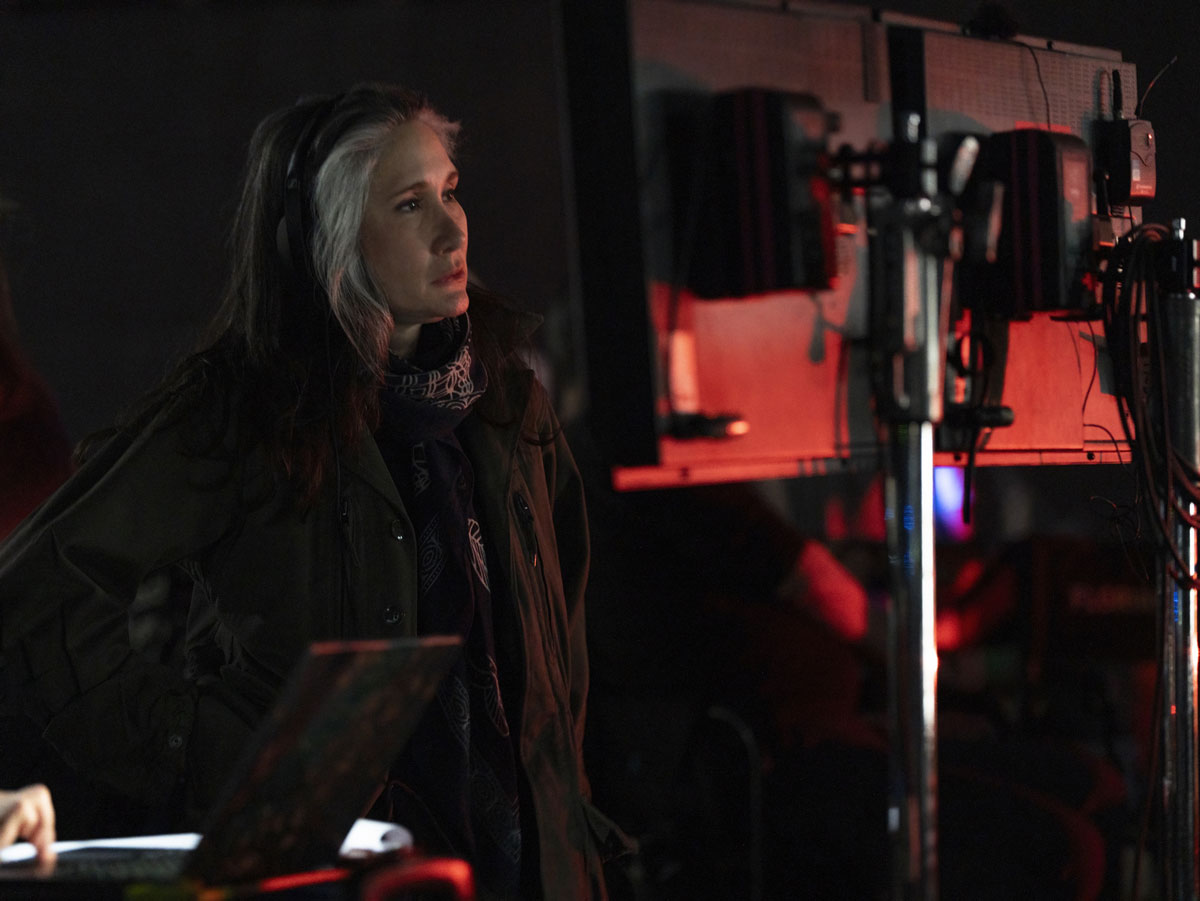
In a region full of spirits, López leaves us asking whether the Navarro we see popping up at Danvers’ side is alive or something else. We’re welcome to sow this fertile theory soil with whatever we wish, enabling them to live on together or separately for as long we wish.

All worthwhile TV series remind us that the worlds created within their bubbles keep spinning after production ceases. The best creators set free their progeny to inspire others who might bring different perspectives, perhaps even reviving a title that hadn’t crossed our thoughts for years.

For that reason alone, Pizzolatto’s negativity toward López’s interpretation of “True Detective,” expressed in a series of Instagram replies and reposts, is baffling. The first were mild digs in response to fanbros griping about López connecting “Night Country” characters like Marty Cohle and a corporation, Tuttle, to the first season.  

“I certainly did not have any input on this story or anything else. Can’t blame me,” Pizzolatto posted in a reply asking about Rust Cohle’s father, adding that Matthew McConaughey, “doesn’t show up, nor would he.”

Replying to another mentioning the Tuttle connection, Pizzolatto snarks, “Haha. So stupid.”

Although these and other comments are captured in screengrabs – including a series of reposted negative reactions to the “Night Country” finale, which drew 55% more viewers than the third season finale, the last one Pizzolatto helmed – some have been scrubbed from his feed.

Not before enough people noticed to publicly call attention to his pettiness and dub him “an absolutely enormous baby” or observing as user @JimJarmuschHair does, “I haven’t seen the new season of TRUE DETECTIVE so I have no opinion on it, but there has to be classier ways of handling a season you definitely made money on than this.”

Some negative response is to be expected given the zealous idolizing of the first "True Detective" season starring McConaughey and Woody Harrelson. To them López establishing “Night Country” as a response to the first season’s “absolute, precise portrayal of the male mind” may have felt less like a proposal than a shot across the bow. 

“Mine is a journey into the night,” López told Salon before the season debuted, adding that her response to the questions posed in the first season emerges from “a female place” because, in case you haven't noticed, she's a woman.

We need your help to stay independent

Despite proudly having no creative input on “Night Country,” Pizzolatto retains an executive producer credit on the series, which means he could have simply screamed into a pillow or cried in a closet every Sunday night, drying his tears with the dollar bills passively earned by attaching his name to it. 

Instead, he’s publicly approved the more poisonous voices expressing their displeasure with López’s season, some of whom have a real incel countertenor in their tone. That is quite a choice at a time when fewer projects are getting greenlit and even seasoned creatives are facing obstacles in getting their work out of development hell and in front of audiences.

While I am not inside of this man’s head, reviewing the section of the “True Detective” case file that precedes “Night Country” yields some insight Danvers might characterize as “a real explanation.”

In 2019, the year “Game of Thrones” ended and the universe wondered how HBO would fill that void, Pizzolatto was fresh off a serviceable third season of "True Detective" and shared with several outlets that he was confident the network wanted another. He went so far as to call his germinating fourth season pitch “a pretty serious crazy idea” in an Esquire interview.

Pizzolatto’s sour grapes look like the response of a man angry at seeing a job he created and thought was his and his alone be handed to someone else.

Although he was correct in surmising HBO wanted to continue "True Detective," what he may not have appreciated was its willingness to continue the series without him. Its brand had long given free rein to auteurs like David Milch, with whom he worked on a third season episode and reportedly assisted, uncredited, on the script for "Deadwood: The Movie."

Pizzolatto went on to sign an overall deal with FX and re-team with McConaughey for a project for that network called “Redeemer.” That wasn’t picked up either.

Meanwhile, in 2021 HBO’s and what was then called HBO Max’s top executive Casey Bloys shared with Deadline that it was pursuing other writers to take up the “True Detective” mantle. The trade listed its speculation as to which writers the network was eyeing; López’s was not among them. But at some point, HBO’s head of drama Francesca Orsi invited her to pitch. 

Cut to: Present Day. “Night Country” is the most viewed “True Detective” season in the title’s history, surpassing even the sacred first season in popularity. Statistics reported by The Wrap indicate that the “Night Country” finale drew 3.2 million viewers across HBO and Max, according to Nielsen live-plus-same-day figures and Warner Bros. Discovery viewing data. That’s larger than the “Succession” series finale’s audience of 2.9 million.

True Detective"True Detective: Night Country" showrunner Issa López (HBO)Again, a wise man might celebrate this in public and b***h in private, as any green-with-envy human with a modicum of self control would. Sure, he gave up his child to a stranger to raise and has some regrets about that. But that stranger ain’t no slouch, and she’s given it a better chance to graduate with honors than what Pizzolatto was on track to do. 

A sane person might even view that success as a blessing. A strategic one may even reap the benefits of that reflected glory to, I don’t know, push any alleged projects that might be idling in neutral into drive. 

On his Instagram, Pizzolatto informed his worshippers that he has a movie and “maybe a new series going into production this year,” and assures a troll that “I've never had more work or more abundance.” Whether that work was assigned by his therapist isn’t specified, but if it is of the variety that’s sitting on some studio executive’s desk waiting for a greenlight, none of this makes a persuasive argument that this is a person worth working with.

Blumhouse and Amazon may disagree with that, of course. Last year Pizzolatto was reportedly attached to a horror movie script for the former and received a series commitment from Amazon to create a western-themed drama. From the outside, Pizzolatto’s sour grapes look like the response of a man angry at seeing a job he created and thought was his and his alone be handed to someone else – a Mexican woman, no less – who delivered a brilliant interpretation that both paid homage to him and remained true to her vision.


Want a daily wrap-up of all the news and commentary Salon has to offer? Subscribe to our morning newsletter, Crash Course.


Instead of meeting his bile with Silver Sky Mining levels of toxicity, López diplomatically told Vulture, “I believe that every storyteller has a very specific, peculiar, and unique relation to the stories they create, and whatever his reactions are, he’s entitled to them. That’s his prerogative.” 

López added that she wrote “Night Country” with a profound love for the source material and for the people who loved it. “And it is a reinvention, and it is different, and it’s done with the idea of sitting down around the fire, and [let’s] have some fun and have some feelings and have some thoughts. And anybody that wants to join is welcome.”

That includes those conversations about the tongue, and whether it can also be read as an allegory now that new information has come to light. In “Night Country” we might take it to mean that Annie K received the last word after being murdered and dumped. 

But it’s also a six-year-old piece of flesh belonging to someone long moved on, a person who should be happy that others stepped into the silence and ensured that what she started received the exposure she fought for, along with a worthy response from the greater public.  

All episodes of "True Detective: Night Country" are streaming on Max.

Salt early and salt often — yes, even in desserts

Have you had the displeasure of eating a particularly unremarkable guacamole? Or a strangely bland steak? An oddly flat Caesar salad? My hunch is that that middling dish was most likely under-seasoned — or perhaps not seasoned whatsoever.

A few years back, at the labyrinthine Gaylord Opryland Resort in Nashville, Tennessee, my mother and I were hungry but not famished and opted for a simple guacamole-and-margarita dinner on one of the many walkways that snaked throughout the resort like tentacles. At a tiny table next to towering greenery, we sat down and our guacamole came nearly immediately. We dug right in and said, "hmm …" pretty much right away.

I grabbed a salt shaker from a nearby table, had my mom try the guacamole as-is, then salted it, stirred it with a tortilla chip, and asked her to try again. It was at that moment that my mother understood the sheer power of salt, the reason for seasoning and the purpose behind my adoration of large-flaked Kosher salt in a small bowl or basin next to the stove.

Now, guacamole is a raw, plant-based preparation, but salt's power is felt in everything from alcoholic beverages to meaty main courses to even desserts.

The National Institute of Health's "Taste and Flavor Roles of Sodium in Foods: A Unique Challenge to Reducing Sodium Intake" explains the science behind this; the use of salt "decreases water activity, which can lead to an effective increase in the concentration of flavors and improve the volatility of flavor component.

"Higher volatility of flavor components improves the aroma of food and contributes greatly to flavor," it continued. 

I've experienced this phenomenon my entire life. Growing up, I'd watch my mom essentially eat the salt off of pretzels (and sometimes not finish the pretzel) and I'd routinely use my pointer finger to dab the large salt crystals off of the baked potato skins at Red Lobster.

"Growing up, I'd watch my mom essentially eat the salt off of pretzels (and sometimes not finish the pretzel)."

When I still ate meat, I'd often cook a sirloin steak. My method was always bringing the steak to room temperature, salting it heavily, then cooking it in a cast-iron pan that was scorchingly hot before basting with butter, garlic thyme and rosemary. I'd let it sit for ten minutes or so, then slice and serve. People would often go bonkers over it, asking what I marinated it in or what I seasoned it with and were almost always gobsmacked when I said, "Just salt."

Given salt's role in cooking, you may be wondering when and how often you should season with it, and the answer is likely "a little more than you think."  

Ideally, you want to season each component throughout the cooking process. If you're sauteeing onion and then adding garlic and chopped red peppers, season the onion and then season the garlic and red pepper. Whenever you're able to flavor and season a component or a layer of a recipe, you want to do so. When it comes to desserts, it's not as necessary to salt throughout, but you most certainly still need at least that one teaspoon or so, no matter if you're making cake, pudding or Baked Alaska. Have you ever tried a chocolate chip cookie without salt?

We need your help to stay independent

I think about an early episode of "Modern Family" in which Sofia Vergara's character, Gloria, makes the argument that a pinch of salt in chocolate milk makes the absolute best glass of chocolate milk. The other family members made fun of her for this, but then in the closing credits scene, one of the doubtful characters tries some chocolate milk with salt and makes a "darn, she was right" facial expression.

Since then, I never had chocolate milk without salt. And chocolate milk is one of my favorite beverages on earth, so I've consumed a lot of it.

The point here is that salt is a non-negotiable in quite literally every dish (although I will note that I do season very sparingly in anything containing soy sauce or tamari). Yes, you can certainly cross the line to making a dish patently "salty," but the perfect middle ground is when the salt itself helps the food taste more and more like its inherent self.  It's one of the most essential ingredients in your kitchen, bar none, if not the single most important one. You're doing a disservice to your food and your palate if you're skimping on salt. 

“But it’s not true!”: CNN reporter confronts Jim Jordan over indicted informant’s debunked claims

House Judiciary Chairman Jim Jordan, R-Ohio, denied the questionable nature of a key piece of evidence in his investigation of President Joe Biden when confronted by CNN reporter Manu Raju on Wednesday.

Ex-FBI informant Alexander Smirnov was indicted last week for allegedly falsifying bribery claims against the Biden family, after sharing intel with agents years ago that President Biden and his son Hunter sought multi-million dollar bribes from a Ukrainian energy company, according to The New York Times. Smirnov claimed that funds were in exchange for protection against a probe into the company by the country’s prosecutor general at the time. He also admitted that "officials associated with Russian intelligence" were involved in advancing the phony allegations against Hunter Biden, per The Washington Post. 

Jordan during the exchange with Raju claimed that Smirnov being charged "doesn’t change the four fundamental facts."

"Hunter Biden was put on the board of Burisma and gets paid a million dollars a year. Fact number two, he’s not qualified to be on the board. He said so himself in an interview with, I don’t know, you or some network,” Jordan said, referring to a 2019 ABC interview in which Hunter Biden conceded that nepotism had a hand in his being on the Burisma board. He also noted, however, that he was “completely qualified to be on the board.”

“Burisma specifically asked Hunter Biden, 'Can you weigh in with D.C. and help us deal with the pressure we are facing from the prosecutor?' Fact number four, Joe Biden, then he gets called — Hunter Biden calls his dad, according to Devon Archer, Hunter Biden’s business partner. Fact number four, Joe Biden goes to Ukraine three days later and conditions the release of the money, American tax money, on the firing of the prosecutor who was applying the pressure to the company that Hunter Biden sat on the board of," Jordan said.

“You said the 1023 is the most corroborating piece of information you have,” Raju retorted, in reference to Smirnov’s initial assertions. Jordan claimed that the “fundamental facts” have not changed, in response, to which an incredulous Raju replied, “But it’s not true!”

If you’re worried about inflammation, stop stressing about seed oils and focus on the basics

You've probably seen recent claims online seed oils are "toxic" and cause inflammation, cancer, diabetes and heart disease. But what does the research say?

Overall, if you're worried about inflammation, cancer, diabetes and heart disease there are probably more important things to worry about than seed oils.

They may or may not play a role in inflammation (the research picture is mixed). What we do know, however, is that a high-quality diet rich in unprocessed whole foods (fruits, vegetables, nuts, seeds, grains and lean meats) is the number one thing you can to do reduce inflammation and your risk of developing diseases.

Rather than focusing on seed oils specifically, reduce your intake of processed foods more broadly and focus on eating fresh foods. So don't stress out too much about using a bit of seed oils in your cooking if you are generally focused on all the right things.


What are seed oils?

Seed oils are made from whole seeds, such as sunflower seeds, flax seeds, chia seeds and sesame seeds. These seeds are processed to extract oil.

The most common seed oils found at grocery stores include sesame oil, canola oil, sunflower oil, flaxseed oil, corn oil, grapeseed oil and soybean oil.

Seed oils are generally affordable, easy to find and suitable for many dishes and cuisines as they often have a high smoke point.

However, most people consume seed oils in larger amounts through processed foods such as biscuits, cakes, chips, muesli bars, muffins, dipping sauces, deep-fried foods, salad dressings and margarines.

These processed foods are "discretionary", meaning they're OK to have occasionally. But they are not considered necessary for a healthy diet, nor recommended in our national dietary guidelines, the Australian Guide for Healthy Eating.


I've heard people say seed oils 'promote inflammation'. Is that true?

There are two essential types of omega fatty acids: omega-3 and omega-6. These are crucial for bodily functions, and we must get them through our diet since our bodies cannot produce them.

While all oils contain varying levels of fatty acids, some argue an excessive intake of a specific omega-6 fatty acid in seed oils called "linoleic acid" may contribute to inflammation in the body.

There is some evidence linoleic acid can be converted to arachidonic acid in the body and this may play a role in inflammation. However, other research doesn't support the idea reducing dietary linoleic acid affects the amount of arachidonic acid in your body. The research picture is not clear cut.

But if you're keen to reduce inflammation, the best thing you can do is aim for a healthy diet that is:

  • high in antioxidants (found in fruits and vegetables)

  • high in "healthy", unsaturated fatty acids (found in fatty fish, some nuts and olive oil, for example)

  • high in fiber (found in carrots, cauliflower, broccoli and leafy greens) and prebiotics (found in onions, leeks, asparagus, garlic and legumes)

  • low in processed foods.

If reducing inflammation is your goal, it's probably more meaningful to focus on these basics than on occasional use of seed oils.


What about seed oils and heart disease, cancer or diabetes risk?

Some popular arguments against seed oils come from data from single studies on this topic. Often these are observational studies where researchers do not make changes to people's diet or lifestyle.

To get a clearer picture, we should look at meta-analyses, where scientists combine all the data available on a topic. This helps us get a better overall view of what's going on.

A 2022 meta-analysis of randomized controlled trials investigated the relationship between supplementation with omega-6 fatty acid (often found in seed oils) and cardiovascular disease risk (meaning disease relating to the heart and blood vessels).

The researchers found omega-6 intake did not affect the risk for cardiovascular disease or death but that further research is needed for firm conclusions. Similar findings were observed in a 2019 review on this topic.

The World Health Organization published a review and meta-analysis in 2022 of observational studies (considered lower quality evidence compared to randomized controlled trials) on this topic.

They looked at omega-6 intake and risk of death, cardiovascular disease, breast cancer, mental health conditions and type 2 diabetes. The findings show both advantages and disadvantages of consuming omega-6.

The findings reported that, overall, higher intakes of omega-6 were associated with a 9% reduced risk of dying (data from nine studies) but a 31% increased risk of postmenopausal breast cancer (data from six studies).

One of the key findings from this review was about the ratio of omega-3 fatty acids to omega-6 fatty acids. A higher omega 6:3 ratio was associated with a greater risk of cognitive decline and ulcerative colitis (an inflammatory bowel condition).

A higher omega 3:6 ratio was linked to a 26% reduced risk of depression. These mixed outcomes may be a cause of confusion among health-conscious consumers about the health impact of seed oils.

Overall, the evidence suggests that a high intake of omega-6 fatty acids from seed oils is unlikely to increase your risk of death and disease.

However, more high-quality intervention research is needed.


The importance of increasing your omega-3 fatty acids

On top of the mixed outcomes, there is clear evidence increasing the intake of omega-3 fatty acids (often found in foods such as fatty fish and walnuts) is beneficial for health.  

While some seed oils contain small amounts of omega-3s, they are not typically considered rich sources.

Flaxseed oil is an exception and is one of the few seed oils that is notably high in alpha-linolenic acid (sometimes shortened to ALA), an omega-3 fatty acid.

If you are looking to increase your omega-3 intake, it's better to focus on other sources such as fatty fish (salmon, mackerel, sardines), chia seeds, hemp seeds, walnuts, and algae-based supplements. These foods are known for their higher omega-3 content compared to seed oils.


The bottom line

At the end of the day, it's probably OK to include small quantities of seed oils in your diet, as long as you are mostly focused on eating fresh, unprocessed foods.

The best way to reduce your risk of inflammation, heart disease, cancer or diabetes is not to focus so much on seed oils but rather on doing your best to follow the Australian Guide for Healthy Eating.

Lauren Ball, Professor of Community Health and Wellbeing, The University of Queensland and Emily Burch, Lecturer, Southern Cross University

This article is republished from The Conversation under a Creative Commons license. Read the original article.

“It is a form of Navalny”: Trump likens his fraud ruling to death of Russian opposition leader

Former President Donald Trump during a Tuesday night Fox News town hall compared the multi-million dollar ruling in his New York civil fraud trial to the death of Russian opposition leader Alexei Navalny. 

“It is a form of Navalny. It is a form of communism or fascism,” Trump said. 

Judge Arthur Engoron, whom Trump called a "nut job," last week imposed a $355 million ruling and a three-year ban on Trump from serving as an executive at any New York company, including his own. 

“People thought that could happen and it did happen,” Trump said, speaking about Navalny’s death. “And it’s a horrible thing.”

As noted by Politico, earlier in the town hall, Trump called the anti-Kremlin activist a “very brave guy," claiming that he “probably would have been a lot better off staying away" from Russia and "talking from outside.” The ex-president's Tuesday night remarks came on the heels of a Truth Social post he shared on Monday, in which he conflated Navalny's sudden passing — which many have speculated was carried out by Russian President Vladimir Putin — to his own legal and political woes. 

“The sudden death of Alexei Navalny has made me more and more aware of what is happening in our Country,” the former president wrote. “It is a slow, steady progression, with CROOKED, Radical Left Politicians, Prosecutors, and Judges leading us down a path to destruction. Open Borders, Rigged Elections, and Grossly Unfair Courtroom Decisions are DESTROYING AMERICA. WE ARE A NATION IN DECLINE, A FAILING NATION. MAGA2024." The former president reiterated that message as part of his town hall appearance, alleging that the emotion surrounding Navalny's death is "happening here" and that his legal plights are “all because of the fact that I’m in politics.”

Following the airing of Trump's town hall, former South Carolina governor and Republican primary candidate Nikki Haley wrote on X/Twitter: "Donald Trump compares America to Russia again. That’s not America First. That’s the kind of garbage you hear from liberals." In a separate Fox interview on Tuesday, Haley referred to Navalny as “a hero who challenged Putin, lost his life because of it,” per Politico. She added, “This is on the heels of Trump saying that he would encourage Putin to invade any NATO countries that didn’t pull their weight. He’s gonna compare himself to Navalny, and the victim that he is in his court cases?”

“Unreasonable hurdles”: Legal experts say Jack Smith could seek Judge Cannon’s removal

As special counsel Jack Smith mulls whether to petition the 11th Circuit Court of Appeals to overturn at least one of U.S. District Judge Aileen Cannon's recent decisions, he should also consider asking the court to remove her from the case, legal experts argue. In a Tuesday analysis for Slate, Brookings Institution senior fellow Norm Eisen and Joshua Kolb, an attorney and former U.S. Senate Judiciary Committee law clerk, urge Smith to seek Cannon's reassignment in former President Donald Trump's classified documents case, in part, because Smith has already filed a reconsideration motion for Cannon's latest decision to unseal the identities of two dozen potential witnesses. 

"The 'clear error' Smith identifies is striking: He alleges that Cannon applied the wrong legal standard in making this decision, requiring him to make a far more stringent showing than should be needed to protect these names," Kolb and Eisen write. "In his motion for reconsideration, Smith shows that the case law—including the very cases Cannon herself cited in her order—does not establish the unreasonable hurdles she wants him to clear." 

Cannon ordered Trump to respond to Smith's motion by Friday, which the experts argue will force her hand. "Either she reverses her position—which would be an admission that she was fundamentally mistaken about the law in a way that caused 'manifest injustice'—or she leaves her ruling in place, putting individuals in jeopardy and twisting the law to help Trump," they write, adding that Smith could then have enough "ammunition" to pursue her removal from the case.

Smith could also seek an appeal in the 11th Circuit under the Classified Information Procedures Act should Cannon rule against his petition to redact, summarize or withhold classified information for even a single document. "Should Smith appeal either the witness issue or a CIPA one, he would also be permitted to ask the 11th Circuit to reassign the case to a different judge under the law of that circuit," Eisen and Kolb write.