Spring Sale: Get 1 Year, Save 58%

Taylor Swift and her fans just broke a record of “seismic” proportions

Taylor Swift and her fans have broken another record — this time of seismic proportions. During Swift’s two-night Eras Tour stop at Seattle’s Lumen Field last weekend, a geology professor from Western Washington University calculated that the concerts “caused seismic activity equivalent of a 2.3 magnitude earthquake.”

Jackie Caplan-Auerbach told CNN that she decided to look into the “Swift Quake” after she saw comparisons to the “Beast Quake” in a Pacific Northwest Facebook group. The “Beast Quake” refers to a 2011 seismic event that occurred after Seahawks running back Marshawn Lynch scored a critical touchdown during a playoff game. Caplan-Auerbach found that the magnitude of Swift’s performances was .3 higher on the Richter scale than the “Beast Quake,” and the shaking was “twice as strong.” There were 72,171 fans in attendance at her Saturday show, shattering yet another venue record, according to The Guardian.

The data from Swift’s two performances is largely consistent, except for the 26-minute delay for Sunday’s show and the two surprise songs that she changes up every night. Swift’s Seattle shows come toward the end of the U.S. leg of the Eras Tour, with only 8 more dates across California left before she heads to Latin America.

Having been in attendance at her May 27 MetLife Stadium performance, I can say that causing an entire stadium to shake is no doubt a part of the Eras Tour experience. Swifties have even been tracking which audience can cheer the longest after she sings “Champagne Problems.” (My show is currently No. 1, having cheered for nearly four minutes straight.) Before the “Swift Quake,” the Foo Fighters and Garth Brooks played shows that reached earthquake levels.

Carlee Russell charged with two misdemeanors for fake kidnapping

Carlee Russell — the 25-year-old Alabama nursing student who landed herself in the middle of a messy kidnapping hoax this month — surrendered to authorities after an arrest warrant was issued on Friday. During a news conference providing updates on the ordeal, Hoover Police Chief Nicholas C. Derzis stated that she’s now facing two misdemeanor charges: false reporting to law enforcement authorities and falsely reporting an incident. Per NBC News, “The charges carried a bond of $1,000 each and are punishable by up to a year in jail and a $6,000 fine if convicted.” Russell was released from jail after posting bond.

On July 13, Russell called 911, claiming to see a toddler walking alone on the side of the highway, vanishing for two days after the fact in what was referred to as a “kidnapping” by a man with orange hair and his female companion, who took nude photos of her. She later admitted to making the whole thing up. 

“Her decisions that night created panic and alarm for the citizens of our city and even across the nation as concern grew that a kidnapper was on the loose using a small child as bait,” Derzis said. “The story opened wounds for families whose loved ones really were victims of kidnappings, some of which even helped organize searches.”


Bud Light maker Anheuser-Busch lays off hundreds of employees following recent campaign fallout

Anheuser-Busch, the parent company of Bud Light, announced that it would lay off around 350 workers across its American corporate staff following the fallout over its campaign involving trans influencer Dylan Mulvaney. Bud Light also recently lost its spot as top beer in the country, being replaced by Modelo Especial. 

“Today we took the very difficult but necessary decision to eliminate a number of positions across our corporate organization,” Anheuser-Busch CEO Brendan Whitworth said in a statement obtained by NBC News. “While we never take these decisions lightly, we want to ensure that our organization continues to be set for future long-term success.” The layoffs would affect less than 2% of the company’s approximately 18,000 employees nationwide. They will not include frontline staff such as “brewery and warehouse staff, drivers, and field sales, among others.” They are also meant to “simplify and reduce layers within its organization,” the company clarified.

The ongoing backlash primarily comes from conservative critics, who shared videos of themselves destroying Bud Light and calling for a nationwide boycott. Last week, Florida Gov. Ron DeSantis threatened to bring forward legal action against Bud Light’s parent company, Anheuser-Busch InBev, for the beer brand’s promotion.

Voodoo Doughnut plans French Quarter location and New Orleans’ Voodoo community isn’t thrilled

Portland-based company Voodoo Doughnut has its sights set on New Orleans — with plans in the works for a new location in the city’s French Quarter — but so far, their reception has not been very sweet. According to a report from Nola.com, leaders of New Orleans’ Voodoo community aren’t thrilled with yet another bastardization of local culture, finding the company’s name and imagery to be offensive. Added on to that, there’s concern that the location will steer shoppers away from well-loved local establishments that have been around for years.

Divine Prince Ty Emmecca, known locally as the King of New Orleans Voodoo, told the outlet that “he and other local practitioners were particularly offended to see images of Voodoo Doughnut’s biggest seller: the signature ‘mascot’ doughnut depicting a chocolate-covered ‘voodoo doll’ with googly eyes and a big red mouth,” telling reporter Tony McAuley, “We have already had to deal with the name being bastardized and appropriated by all kinds of businesses, sports teams or whatever over the years, but I don’t think it’s ever been quite this disrespectful.” The proposed location of the shop is also a concern as it “would allow the owner of the building at 823 Decatur St. to convert the historic Tujague’s restaurant sign to the Voodoo Doughnut name and brand.” 

Comments on the Nola.com article posted to Facebook yesterday are divided on the issue, with some locals sharing their Voodoo Doughnut experience from other cities they’ve lived in or traveled to, and many others stomping down in a clear “stay out” sort of way. If the plans for the location do move forward, some considerations will need to be made. “This is happening at a time when after hundreds of years of appropriating and bastardizing aboriginal, indigenous, African or Native American culture, they are gaining a new degree of respect, particularly among young people,” Prince Ty furthered. “It’s bad timing, and bad all around.”


Stunning images of actively-forming stars captured by James Webb Space Telescope

Scientists operating the James Webb Space Telescope (JWST) announced on Wednesday that it had captured the most detailed images ever of two actively forming stars, collectively known as Herbig-Haro 46/47. Using high-resolution infrared light, the JWST managed to catch images of the distant objects despite being roughly 1,470 light-years away.

NASA scientists are particularly intrigued by these images because of the two “lobes” that can be seen jutting out of either side of the disk where the two stars are gathering mass. The smaller right lobe points in the direction of Earth, and both lobes are ejections of dust that astronomers believe are important to shaping the universe.

“All of these jets are crucial to star formation itself,” the Webb official website explains. “Ejections regulate how much mass the stars ultimately gather. (The disk of gas and dust feeding the stars is small. Imagine a band tightly tied around the stars.)”

These are far from the only amazing discoveries picked up by JWST in its first year of operation. The powerful telescope has also captured the most detailed images of the distant universe, an iconic quintet of galaxies known as Stephan’s quintet and even water vapor on another planet. Speaking with Salon earlier this month, NASA scientist Dr. Michelle Thaller praised the JWST image of Jupiter as “almost like you were at a spacecraft that was orbiting the planet. And you can see all of the different whirls and eddies in the atmosphere, and those are very important for us to study.”

Emmys postponed amid both writers and actors strikes

For the first time in more than 20 years, the Emmy Awards will be postponed due to the writers and actors strikes. The ongoing WGA and SAG-AFTRA strikes have caused an overhaul industry stoppage. (Salon’s unionized employees are represented by the WGA East.)

The prestigious television awards show has only ever been rescheduled in one other instance after the 9/11 attacks. This year, it was planned to air on Sept. 18. Due to the labor dispute, the event does not have a rescheduled date but the New York Times reported that the Television Academy, the organization in charge of administering the Emmys, hopes that it will most likely move to January 2024. Fox, which would be airing this year’s awards, is aiming for an earlier date in November this year.

Fox and the Television Academy said it would postpone the awards if the writers strike continued into the summer. The writers have been on strike for 88 days, beginning in May. Actors have been on strike for two weeks since negotiation broke down between studio executives and the actors union in mid-July which rendered the Emmys all but canceled.

Neither Fox or the Television Academy have made statements on the event’s cancellation but Variety reported that vendors were told the Emmys wouldn’t take place on Sept. 18 as planned.


Whistleblower calls for government transparency as Congress digs for the truth about UFOs

A congressional subcommittee met on June 26, 2023, to hear testimony from several military officers who allege the government is concealing evidence of UFOs. By holding a hearing on UFOs – now called “unidentified anomalous phenomena” by government agencies – the subcommittee sought to understand whether these UAPs pose a threat to national security.

I’m an astronomer who studies and has written about cosmology, black holes, exoplanets and life in the universe. I’m also on the advisory council for an international group that strategizes how to communicate with an extraterrestrial civilization should the need ever arise.

While the hearings brought attention to UAPs and could lead to more reporting from people who work in the military and aviation, the testimonies did not produce evidence to fundamentally change the understanding of UAPs.

UFO oversight so far

The House subcommittee hearing follows a flurry of activity over the past few years. Public interest in UAPs surged in 2017 after three Navy videos were leaked and The New York Times reported on a shadowy UAP program run by the Pentagon. In June 2021, the Office of the Director of National Intelligence released a report on the phenomena. In November 2021, the Pentagon formed a new group to coordinate efforts to detect and identify objects in restricted airspace.

Then in May 2022, a House Intelligence subcommittee held the first congressional hearing in over half a century on military reports of UAPs. Little new light was shed on the true nature of the sightings, but the officials tried to clarify the situation by ruling things out.

While officials noted 18 occasions in which aerial objects had moved at considerable speed without visible means of propulsion, nobody had found unexplained wreckage or records of the military having either received communications from or having fired shots at UAPs. As such, the subcommittee decided that there was not yet enough evidence to claim UAPs are extraterrestrial.

Fravor testified that the technology he witnessed was far superior to anything human beings have.

Most recently, NASA convened a panel in June 2022, which held its first public hearing in May this year. The panel will help NASA advise intelligence agencies and the Department of Defense on how to evaluate mysterious sightings. The panel is considering 800 sightings accumulated over 27 years, with 50 to 100 new reports coming in each month. Sean Kirkpatrick from the Department of Defense said that only 2% to 5% of these are anomalous, and the meeting drew no firm conclusions.

Which brings us to this week’s hearing. Congress is getting frustrated with the lack of transparency over UAP sightings. So the subcommittee is using its overall charge of oversight and accountability to get some answers.

Eyebrow-raising testimony

Three witnesses, all ex-military officers, gave sworn testimony to the subcommittee.

David Fravor was a commander in the U.S. Navy in 2004, stationed on the USS Nimitz, when he and another pilot saw an object behaving inexplicably. Video of the encounter was released by the Department of Defense in 2017 and publicized by The New York Times.

Fravor testified that the technology he witnessed was far superior to anything human beings have. He described objects with no visible means of propulsion carrying out sudden maneuvers that no known technology could achieve.

“What concerns me is that there is no oversight from our elected officials on anything associated with our government possessing or working on craft that we believe are not of this world,” Fravor said.

The second witness, Ryan Graves, was an F-18 pilot for over a decade. While stationed at Virginia Beach in 2014, he says, UAP sightings were so frequent among his crew that they became part of daily briefs. He recounted a situation in which two jets had to take evasive action as they encountered a UAP. The description was striking – a dark gray cube inside a clear sphere – quite different from the classic “flying saucer.”

“If everyone could see the sensor and video data that I have, there is no doubt that UAP would be a top priority for our defense, intelligence and scientific communities.”

Graves founded Americans for Safe Aerospace to create a center of support and education for aircrew affected by UAP encounters. He testified that the group has 5,000 members and has taken information from 30 witnesses. Most are commercial pilots at major airlines. He alleged that all UAP videos since 2021 are classified by the Pentagon as secret or higher. Graves also said that only 5% of UAP sightings by military and commercial pilots are reported by the pilots that spot them.

“If everyone could see the sensor and video data that I have, there is no doubt that UAP would be a top priority for our defense, intelligence and scientific communities,” Graves said.

The real bombshell came from David Grusch, an Air Force intelligence officer who retired with the rank of major. His high level of security clearance meant he saw reports that were unknown to the public. He sought whistleblower protection after claiming that the U.S. government was operating with secrecy and above congressional oversight with regards to UAP – even claiming that crashed UAPs had yielded biological material of nonhuman origin. The Pentagon has denied this claim. He also said he’d suffered retaliation after reporting this information to his superiors and to multiple inspectors general.

Grusch testifies that the U.S. government has recovered ‘nonhuman biologics.’

“I was informed, in the course of my official duties, of a multidecade UAP crash-retrieval and reverse-engineering program to which I was denied access,” Grusch said in his opening statement to the subcommittee. The Pentagon has denied the existence of such a program now or in the past.

Calls for transparency

While none of this testimony brought forward viable evidence of a broad government conspiracy, most UAP data is not made public and is held by intelligence agencies or the Pentagon. Lawmakers from both parties called for more government transparency. When questioned, all three witnesses said that UAPs represented a clear threat to national security.

If these testimonies are truthful, UAPs of advanced technology – whether they originate from a foreign adversary or not – that make routine incursions into U.S. airspace are a cause for concern.

For now, the subcommittee will continue its work. A tangible outcome will probably be an anonymous reporting mechanism to overcome the stigma commercial and military pilots feel when they witness a UAP. The push for government transparency will likely intensify, and subcommittee members hope to have a classified briefing to evaluate the claims made by Grusch.

As a scientist, I’m trained to be skeptical, and I know that most UFO sightings have mundane explanations. Visual evidence is also notoriously difficult to interpret, and even the dramatic Navy videos have been debunked. More and better data will help resolve the issue, but the gold standard is physical evidence. If Grusch’s claims of crashed UAPs are ever verified, that will be the first UAP hearing with a truly dramatic outcome.

This article is republished from The Conversation under a Creative Commons license. Read the original article.

“Unprecedented”: Experts stunned at Trump’s secret docs filing — but worry Cannon “may fall for it”

Former President Donald Trump’s legal team requested to discuss classified information with the former president at his homes as part of his criminal case for convenience, CNN reports, citing a new court filing from the Department of Justice.

Federal prosecutors strongly oppose the proposal and instead want Trump and his attorney to only discuss and handle sensitive materials in his case inside a specially protected space called a Sensitive Compartmented Information Facility, abbreviated to SCIF.

But Trump’s legal team “expressed concerns regarding the inconvenience posed by this limitation and requested that Defendant Trump be permitted to discuss classified information with his counsel in his office at Mar-a-Lago, and possibly Bedminster,” the Justice Department wrote in the filings. “The government is not aware of any case in which a defendant has been permitted to discuss classified information in a private residence, and such exceptional treatment would not be consistent with the law.”

The department noted that a “significant portion” of the classified information the defense will receive ahead of the trial is so highly sensitive that it must only be handled in a SCIF. Many of the documents Trump is accused of illegally retaining are also of that level of sensitivity.

“Defendant Trump’s personal residences and offices are not lawful locations for the discussion of classified information, any more than they would be for any private citizen. Since the conclusion of Defendant Trump’s presidency, neither the Mar-a-Lago Club nor the Bedminster Club has been an authorized location for the storage, possession, review, display, or discussion of classified information,” the court filing reads.

“It is particularly striking that he seeks permission to do so in the very location at which he is charged with willfully retaining the documents charged in this case,” prosecutors added.

We need your help to stay independent

The dispute between the special counsel’s office and Trump’s defense was revealed in a court filing made public Thursday with the DOJ explaining why both parties have yet to reach an agreement on how to protect classified evidence in the case before trial.

Prosecutors have asked the judge presiding over the case, Aileen Cannon, to issue an order that the classified materials in the case only be viewed, stored and talked about in controlled environments under the supervision of an appointed classified information officer.

Former U.S. Attorney Joyce Vance argued that the Trump team’s request shouldn’t even be a consideration for Cannon, who Vance wrote in a post to her Substack is likely aware that the ask is another stalling tactic.

She pointed to federal prosecutors’ renewed Thursday motion for the protective order and acknowledged that Cannon has been urging Trump’s defense and the Justice Department to reach a compromise. But, she argued, Trump’s complaint about the inconvenience of having to view the materials in a SCIF demonstrates his ignorance.

“He wants to be able to see it in the comfort of his own home. Trump still doesn’t get he’s not going to receive special treatment, unless Judge Aileen Cannon gives it to him,” Vance writes. “If she does on this point, look for Jack Smith to appeal immediately and win. Trump’s request flies in the face of clearly established law on handling classified documents—not exactly a shocker given the nature of this prosecution.”


Want a daily wrap-up of all the news and commentary Salon has to offer? Subscribe to our morning newsletter, Crash Course.


She then argued that the Trump team’s request, like many others the former president has made in the case, is really an effort to later delay the trial, predicting that they would level an argument that the defense has not had enough time to prepare for the trial since Trump would be busy with his presidential campaign and the government would not accommodate them.

“Trump is making this argument, not because he thinks it’s a good one—it’s clearly a loser. He’s making it to set up an argument down the road that the trial has to be delayed even further,” Vance explained. “Judge Aileen Cannon, if past is prologue, may fall for it. But the argument is tone deaf, a real failure to read the room, or at least the Special Counsel’s office.”

“Donald Trump, self-described victim, has met Jack Smith, career prosecutor. And Smith isn’t buying it,” she concluded.

Trump’s team has not fully explained their stance in court at this time, nor has Cannon weighed in.

“I’ve never heard of a situation where classified docs could be reviewed by defense counsel and defendant outside of a SCIF. And some of this information is particularly sensitive,” national security lawyer and former Justice Department official Brandon Van Grack tweeted Thursday, calling the Trump defense team’s request “unprecedented.”

“Can’t overstate the brazenness of former President’s request to discuss classified info w/ his attys at Mar-a-Lago and Bedminster, which are the scenes of the crime,” he added. “It’s like a request to re-victimize the U.S. govt/intelligence community.”

“This is Chutzpah with a capitol C,” NYU Law professor Andrew Weissmann said on Twitter in response to the filing.

“https://twitter.com/AWeissmann_/status/1684724823904116737

“This is our first real chance to see where Judge Cannon is on everything. It should be rapidly dismissed without significant argument/litigation,” veteran and former FBI agent Peter Strzok added, echoing Vance’s sentiments. “But under CIPA, an adverse ruling on this is appealable by the government.”

The court filing came the same day that a South Florida grand jury returned an expanded set of criminal charges against Trump and two of his employees in the case. Trump is charged with illegally retaining 32 national security documents, and he, along with his employees — aide Walt Nauta and ex-Mar-a-Lago staffer Carlos De Oliveira — are accused of attempting to obstruct federal investigators’ efforts to retrieve the records. 

The former president maintains he has committed no wrongdoing in the case. He and Nauta have pleaded not guilty and are beginning to review evidence ahead of trial slated for next May. De Oliveira is scheduled to make his first court appearance next week after his Thursday indictment.

New research shows olive oil could help reduce dementia-related deaths

Most people know that in the realm of cooking fats, olive oil is considered a “good fat” because it is high in monounsaturated fatty acids, which can aid in lowering ones LDL cholesterol. But as researchers discussed at the Nutrition 2023 Conference — the American Society for Nutritions’ annual meeting —new findings suggest that olive oil could serve as a tool against dementia. 

Dr. Anne-Julie Tessier, a coauthor of the research and postdoctoral fellow at the Harvard T.H. Chan School of Public Health, said in a news release that opting for “olive oil, a natural product instead of fats such as margarine and commercial mayonnaise is a safe choice and may reduce the risk of fatal dementia.”

As CNN reports, two separate studies were undertaken, the first with 60,600 women and the second with 32,000 men.  The study took place over 28 years, following up with the participants via questionnaires every four years. Over the 28 year period, it was found that, regardless of diet quality otherwise, “eating more than half a tablespoons of olive oil per day was associated with a 28% lower risk of dying from dementia, compared with participants who never or rarely consumed olive oil.” 

The findings of the studies have not been peer-reviewed or published at this point, and the research is still new, Tessier posits that “it is also possible that olive oil has an indirect effect on brain health by benefiting cardiovascular health.” 

That “Oppenheimer” sex scene speaks to a larger problem with Christopher Nolan’s storytelling

Oppenheimer” is the summer blockbuster of the year. The visually and sonically compelling film does a lot of things right from examining the existential dread associated with our feeble humanity and analyzing the moral qualms with human ingenuity and its devastating outcomes that showcase we are the culprits of our own destruction.

But it also does some things wrong too. It has a woman problem. 

Christopher Nolan‘s three-hour-long biopic tells the story of the brilliant quantum physicist, J. Robert Oppenheimer (Cillian Murphy) based on the biography “American Prometheus.” The Oppenheimer we uncover in Nolan’s film stresses that he is a charmer – he’s a womanizer. Nolan wants the audience to know that not only is Oppenheimer one of the most important historical figures in the 20th century, but he also can pull a Communist female Stanford grad student. 

One of the most polarizing aspects of the film is Oppenheimer’s on again, off again relationship with said grad student, Jean Tatlock (Florence Pugh). Some would say the way Nolan portrays the relationship and Jean, and her inevitable death by suicide is indicative of a larger issue with the depiction of women in his films. 

In their first encounter, they quickly find themselves in bed together. In a controversial scene, Jean and Oppenheimer are having sex while he reads Bhagavad Gita, a sacred text in Hinduism. He reads the line, “Now I am become death, the destroyer of worlds,” during the act itself. Hindu right-wing nationalists called the scene an “attack on Hinduism.”

As I was watching the second sex scene with Oppenheimer and Jean, I gasped at how disjointed it felt from the larger story

But that isn’t the only sex scene between the two in the film. Further into the behemoth of a film, in McCarthy-era America, a room full of government officials question Oppenheimer’s former communist ties. He reveals to the board his previous relationship with Jean and how it evolved into an affair. He’s now married to Kitty Oppenheimer (Emily Blunt), who is there in the room as he admits to his extramarital affair. 

Nolan portrays this confession in the most blatant way possible. Without warning or explanation, a naked Jean is seen straddling and having sex with Oppenheimer as he sits in the chair being interrogated. Is it his imagination? Is it Nolan’s one-the-nose way of showing the impact of the confession? Regardless, the audience sees this as the couple going at it while Oppenheimer is staring at the board of men questioning him. It’s creepy. The imaginary Jean even glances directly at his wife – his wife who just found out Oppenheimer had been cheating on her for years. Is this storytelling device attention-grabbing? Absolutely, but not in a good way. 

It’s vital to point out the flaws in a filmmaker’s perspective when it’s used to only service a man’s story and nothing else. As an audience member, the context of the scene and what it does for the larger narrative matters; it is a part of the moviegoer’s entire film experience. And as I was watching the second sex scene with Oppenheimer and Jean, I gasped at how disjointed it felt from the larger story Nolan was attempting to illustrate. Sex scenes aren’t inherently controversial, nor do they have to be, especially if they are filmed with appropriate boundaries and respect toward the actors and characters. But in “Oppenheimer” something about the audience watching the sex scene in the same way the characters in the interrogation room watched it – feels icky and voyeuristic. And also puzzling.

“Oppenheimer” is an engrossing film. Its riveting acting and nonlinear storytelling infused with cinematic shots of the galaxy and stars hold the audience in a trance. Well, that is until you watch that ill-advised foray into filmmaking voyeurism. It completely snatches you out of the film and puts you back into your body.

Moreso, the scene wouldn’t be so jarring if there wasn’t such little Jean in the film. Pugh’s talents are wasted as she attempts to embody an emotionally embattled intellectual. Jean is a seemingly dark, unconventional type of woman from the 1940s. She is studying to be a psychiatrist but also struggles with depression, and it was speculated that she was queer. But we don’t really receive any of this information from the film. We can tell that she’s stubborn, volatile and complicated but we are more or less told that through Oppenheimer’s perspective of her as his love interest. 

This also counts for his wife, Kitty – another female character with unbridled, untapped potential. But of course, she only exists in the roles of love interest, mother and Oppenheimer’s conscience. The film only slightly touches on Kitty’s tragic past, potential mental health issues and rejection of motherhood. Thankfully, Blunt’s acting makes the role feel fuller than it is written to be. 

If we address Nolan’s track record with female characters, he is known for two tropes: Dead Wife and Woman in A Refrigerator. Across the filmmaker’s extensive work, he has a proclivity for fridging, that is killing off a female love interest – in films like “Memento,” “The Prestige,” “Inception” and “The Dark Knight” – as an alluring and tragic backstory for his male protagonists just like he did with Jean. Of course, she is based on a real person, but Nolan’s treatment of her and her tragic death is the same as if she were fictional. The audience is left with very little understanding of Jean, not even with her tragic death. Instead, her most indelible scenes are as Oppenheimer’s sex object or in death, a way to humanize the physicist. (And when Nolan doesn’t get around to killing off his female characters, he sidelines them like Kitty or Elizabeth Delicki’s character in “Tenet.”)

Sure, you can argue the film being named “Oppenheimer” means it’s entirely about him, and all the supporting characters should only act to elevate his story. The script was even written in first person to convey that every character is just a piece in Oppenheimer’s narrative.

We need your help to stay independent

However, just because the story is titled “Oppenheimer” doesn’t mean one has to adhere to such tunnel vision in storytelling. Case in point is another film named for a singular person – that came out on the same day as ” Oppenheimer” in fact – and proves that argument flimsy at best.

“Barbie” does what “Oppenheimer” fails to do.

“Barbie” follows the journey of the human-sized doll (embodied by Margot Robbie) through her existential awakening, crisis and eventual empowerment. But it also spends a significant chunk of its runtime to give her counterpart Ken (Ryan Gosling) space to explore his “neediness, loneliness and identity crisis.” Gary Kramer writes for Salon that Ken “hijack[s] the plot for long stretches and force[s] Barbie to help him, not the reverse.”

BarbieMargot Robbie as Barbie and Ryan Gosling as Ken in “Barbie” (Courtesy of Warner Bros. Pictures)Ken is Barbie’s accessory boyfriend but he isn’t treated as just her accessory boyfriend. In the writing, Greta Gerwig and Noah ​​Baumbach allow Ken ample room for self-discovery. Ken is allowed to explore the human world without the need to be attached to Barbie’s hip. He searches for his purpose and identity. He’s even given a whole musical dance number to dive into his interiority. “Barbie” does what “Oppenheimer” fails to do. It gives purpose and depth to a supporting character’s arc – depth that is entirely crucial to the emotional center, vulnerability and gravitas of a character like Barbie. 
Ultimately, Nolan barely scratches the surface with his female ensemble and doesn’t do their larger-than-life experiences justice. It just feels like a tired attempt to show us Nolan knows women exist but the catch is they do not exist outside of their relationships to men. (Sorry, Bechdel.) Their pain and suffering are a way to transform a man into the protagonist of his story, not hers. 

After four years, “Good Omens” returns for a jolly if rather hollow romp that falls short of sublime

Some TV shows barely justify their existence. Others are original enough to maintain our faith in the medium, making us wonder how they broke through the industry’s inhibiting addiction to existing content.

Then there’s “Good Omens,” a rehash with enough fresh ingredients to explain why it earned a second round despite making a mess of its first. Where to begin? It’s another TV adaptation swimming in a sea of them, this time of a novel co-authored by Neil Gaiman and the late Terry Pratchett. The combined reputations of these widely adored fantasy writers guarantees a returning audience regardless of how well the first season of their show was executed. 

A stronger magnet is the chemistry shared by its stars Michael Sheen and David Tennant. As the angel Aziraphale and the demon Crowley, respectively, the actors have created one of TV’s most watchable duos, which is true even among viewers who aren’t ‘shipping them, fewer though they may be. 

One could cite dozens of shows throughout TV history that have gotten by (and by and by) on less while not being blamed for for wanting better.

Their passionate stans will almost certainly take issue with any pronouncement falling short of celebrating the return of “Good Omens” more than four years after the first season came and went in a confused cloud of razzle dazzle. Maybe a little time off and the shedding of other botched TV projects along with lessons learned from his Netflix hit, reminded Gaiman to value conciseness, economy and a skilled writing partner.

For Season 2 of “Good Omens” the author shares writing duties with John Finnemore, a comic whose radio show production expertise shows through in the focused sensibility of the overall arc. 

Nobody can accuse of “Good Omens” being short on style. 

All the same, life is never entirely prosaic for Aziraphale and Crowley, whose present concerns are informed by past adventures where their paths intersect including sharing marginal roles in the Biblical trials of Job. In these contextualizing side stories Tennant and Sheen’s onscreen partnership truly shines, and that’s probably due in no small part to these flashbacks zooming in on the ways their angel and devil make each other more understanding and human than their omnipotent bosses tend to be.

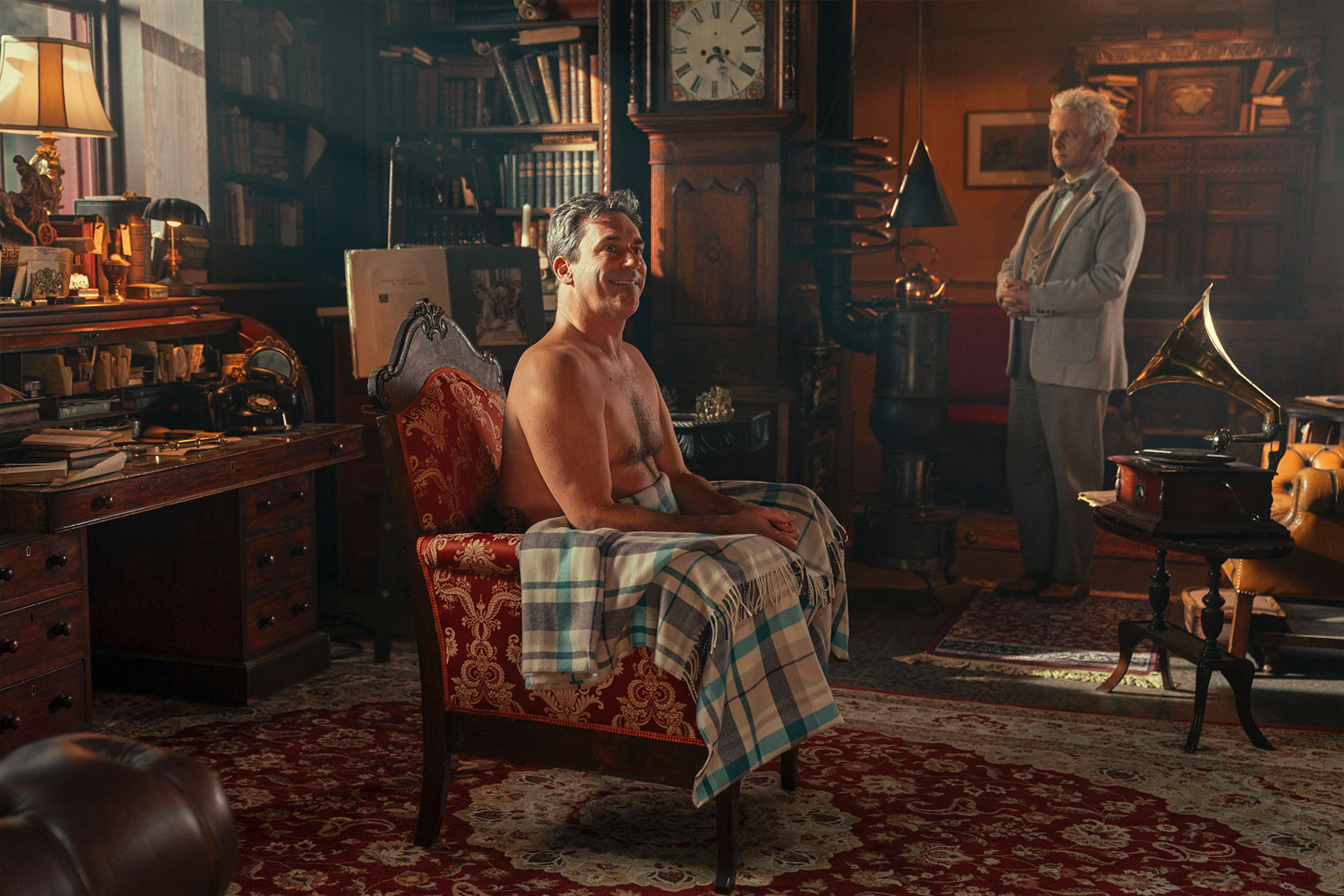
In modern London the beatific bookseller and the fashionable speed demon share expanded screentime for Jon Hamm, returning as archangel Gabriel, and Miranda Richardson as a sharply dressed hellspawn named Shax, with Frances McDormand popping in again as the Voice of God.

Good OmensJon Hamm and Michael Sheen in “Good Omens” (Mark Mainz/Prime Video)In addition to running his bookstore, Aziraphale is divinely generous landlord to a record store owner Maggie (Maggie Service) who, like him, can’t manage to move any stock. Aziraphale doesn’t want to, and that’s the difference, and he’d rather enjoy his tenant’s happiness and musical appreciation than take her money.

We need your help to stay independent

Besides, Maggie comes in handy when a Heaven-sent problem arrives on his doorstep, drawing Crowley’s attention and setting off alarms upstairs and in the basement. Figuring out the why of it all involves a familiarity with music and the human heart, since matching Maggie with her crush on Nina (Nina Sosanya), a nearby café’s owner, becomes crucial to Aziraphale and Crowley staving off wrathful punishments from their respective supervisors,

But it’s not God making the threats. The Almighty’s minions Michael (Doon Mackichan), Uriel (Gloria Obianyo),  Saraqael (Liz Carr), and the blissfully naïve Muriel (Quelin Sepulveda) uphold Heaven’s reputation for bureaucratic rigidity. Sepulveda is especially amusing, and just the right amount of twee, when Muriel is ordered to spend time on Earth dressed as an out-of-place-and-time constable.

The second season of “Good Omens” wasn’t pulled from a void. Gaiman previously said that he and Pratchett jotted down a few ideas for a sequel that they didn’t have time to fully flesh out before Pratchett died in 2015. The puckish energy that permeates every moment also brings to mind Terry Gilliam’s directing style, which is likely intentional since Gaiman had plans to turn the novel into a movie directed by the Monty Python alumnus once upon a time.


Want a daily wrap-up of all the news and commentary Salon has to offer? Subscribe to our morning newsletter, Crash Course.


“Good Omens” doesn’t quite achieve that level of sublimity in these new episodes, alas. A dearth of substance eventually depleted my willingness to invest in the broader mystery beyond wondering what adorable sight gags would be inspired by the next clue or divine/hellish development. This tends to happen when a solid story with an adequate ending is artificially inflated for the sake of wringing more TV out of it. If we’re lucky the results will be as easy on the eye as this show always has been, but eventually the philosophic hollowness becomes impossible to overlook.

Good OmensMaggie Service in “Good Omens” (Prime Video)Between its enchanting sets and impeccable costumes, nobody can accuse of “Good Omens” being short on style or CGI-enhanced supernatural frills. And while these details don’t ruin the first season’s adequate conclusion, where the pair collaborated to avert the Apocalypse, the second’s overall slightness is an insufficient argument for the story’s continuation.

Sometimes, though, a fully baked story is better left standing, flaws and all, instead of unnecessarily stretching out the pieces that work over underdeveloped narrative road.  That is, unless all you want is two actors vamping (deliciously, but tap-dancing nevertheless) through middling material. For many Gaiman and Pratchett readers and viewers, spending more time with their favorite odd couple is heavenly enough. 

Season 2 of “Good Omens” streams Friday, July 28 on Prime Video.


“He has everything to lose”: Experts say indicted Trump aide “has almost no choice but to flip”

The third person charged in the new superseding indictment filed Thursday by special counsel Jack Smith’s office in former President Donald Trump’s classified documents case faces significant legal jeopardy if he does not cooperate with prosecutors, legal experts say.

Carlos De Oliveira, a 56-year-old ex-maintenance worker at Mar-a-Lago, was charged Thursday with four counts in the Justice Department’s probe into the former president’s handling of classified documents post-presidency.

According to the court filings, De Oliveira — along with Trump and his aide, Walt Nauta — has been charged with conspiracy to obstruct justice; altering, destroying, mutilating, or concealing an object; and corruptly altering, destroying, mutilating or concealing a document, record or other object, with the latter two charges “based on allegations that the defendants attempted to delete surveillance video footage at The Mar-a-Lago Club in summer 2022.” De Oliveira is also accused of knowingly and willfully making false statements in his interview with prosecutors.

“De Oliveira’s goose is cooked – on the false statements to FBI, 18 USC 1001,” New York University Law Prof. Ryan Goodman wrote on Twitter, sharing the transcript of De Oliveira’s interview with the FBI included in the indictment. “Just read this damning Q&A in new Indictment. Quite something that he has not pleaded and looked for a deal.”

During an appearance on MSNBC’s “All In with Chris Hayes,” former U.S. Attorneys Joyce Vance and Harry Litman argued that De Oliveira’s best option in the case is to cooperate with authorities.

“De Oliveira was just tailor-made to be a cooperating witness. He has everything to lose, they came at him hard, and I think what it shows is Jack Smith does not bluff,” Litman said.

We need your help to stay independent

Litman went on to predict that Smith’s team had approached De Oliveira about his potential indictment and gave him an ultimatum to either work with the government or face charges.

“He said, ‘No,’ and they’re bringing [charges] quickly,” Litman surmised, adding that De Oliveira “is someone who is hard to understand why he wouldn’t be cooperating against both Nauta and Trump.”

Vance said De Oliveira “is a defendant who has almost no choice but to flip,” explaining that De Oliveira’s charges have 20-year maximum prison sentences and that, if he proceeds, will likely result in him “spending a big chunk of time in prison.”


Want a daily wrap-up of all the news and commentary Salon has to offer? Subscribe to our morning newsletter, Crash Course.


Prosecutors “have him dead-to-center if he does not cooperate. And what do they get if he does cooperate? He is putting Trump front and center in this scheme to obstruct,” she added.

“If they can obtain De Oliveira’s cooperation, that’s probably the final nail in the coffin on this one,” Vance concluded.

But former federal prosecutor Andrew Weissmann, who served on special counsel Bob Mueller’s team, noted that De Oliveira may be banking on Trump’s potential re-election.

“Many reasons why a person may NOT flip, which Smith has to contend with: a witness thinking about his future livelihood if he remains ‘loyal’ to Trump and the potential for the case to go away if Trump (or another ally) is re-elected,” he said on Twitter.

Fly-ing solo: scientists discover genetic on-switch for “virgin birth” in fruit flies

For the first time, scientists have induced facultative parthenogenesis, a form of asexual reproduction, in an animal that usually reproduces sexually.

Commonly referred to as a “virgin birth,” most animals who reproduce this way are small invertebrates, or sometimes, long isolated, such as in a zoo. As detailed in a study published today in the journal Current Biology, scientists were able to identify a genetic cause for virgin birth in one species of fruit fly and turn it on in another.

An estimated 76 percent of fruit flies can exhibit parthenogenesis, but as to why some can and some can’t was a mystery.

Dr. Alexis Sperling, a researcher at the University of Cambridge and first author of the paper, was curious if there was something genetic happening that allowed some fruit flies to reproduce without a partner. To try and find an answer, Sperling and her colleagues sequenced the genomes of two types of Drosophila mercatorum fruit flies, one that needed males to reproduce and another that reproduces by parthenogenesis.

“We’re the first to show that you can engineer virgin births to happen in an animal.”

Through genomic sequencing, the researchers started the process of elimination to figure out which genes turned on during parthenogenesis. Once they identified the genes, they started trying to essentially turn it on in the fruit flies that they knew couldn’t reproduce by parthenogenesis. Eventually, they turned it on in one called Drosophila melanogaster. And it didn’t stop there. The offspring of D. melanogaster were also able to reproduce by parthenogenesis.

“We’re the first to show that you can engineer virgin births to happen in an animal – it was very exciting to see a virgin fly produce an embryo able to develop to adulthood, and then repeat the process,” said Dr Alexis Sperling, a researcher at the University of Cambridge and first author of the paper in a statement. “In our genetically manipulated flies, the females waited to find a male for half their lives – about 40 days – but then gave up and proceeded to have a virgin birth.”

Sperling spent six years to reach the findings of this study, telling Salon in an interview, “It took a very long time, a lot of concentration, a lot of effort and perseverance.”

Parthenogenesis isn’t a biblical miracle. It’s likely a survival strategy for a species.

When parthenogenesis happens, the egg cell in the female’s body divides enough times it needs in order to create half the genes required to procreate. In this process, cellular sacs called polar bodies are created as byproducts that contain chromosomes and can fertilize the egg. Despite the ways it’s often portrayed in the media as a “virgin birth,” parthenogenesis isn’t a biblical miracle. It’s likely a survival strategy for a species, and it’s not always successful.

In 2015, scientists found that 3 percent of a critically endangered sawfish population in Florida were conceived through parthenogenesis. At the time, researchers thought that it could be a survival strategy to prevent inbreeding and prevent harmful mutations from happening. Still, researchers said it would likely lead to the demise of the population, as species need genetic diversity to be resilient.

However, there remain many unknowns about parthenogenesis, particularly the form known as facultative parthenogenesis, which is quite rare and only happens in animals that sexually reproduce. Sperling’s paper expands scientific knowledge about parthenogenesis by showing there’s a genetic component to it, instead of something being inherited.

We need your help to stay independent

“This says that this process can be genetic,” Sperling said. “It could be inferred before, but can’t there was no real proof.”

Sperling said she is excited to see what other scientists do with this information, and how it spurs interest in the topic of parthenogenesis. Particularly, she’s curious to see how it influences work on crop pests, as it seems virgin birth is becoming more common in pest species.

“If there’s continued selection pressure for virgin births in insect pests, which there seems to be, it will eventually lead to them reproducing only in this way,” Sperling said. “It could become a real problem for agriculture because females produce only females, so their ability to spread doubles.”

“Multiple cooperators”: Legal experts say new indictment suggests key ex-aide “flipped” on Trump

Legal experts told The Messenger they believe a former Mar-a-Lago IT director who prosecutors allege played a key role in efforts to delete surveillance footage may have flipped on former President Donald Trump. “It is obvious that Special Counsel Jack Smith and his team have flipped the individual referenced as Trump Employee 4, who gave specific quotations about the conversations he had with Carlos de Oliveira about Trump requesting that the security camera footage be deleted,” former federal prosecutor Mitchell Epner told the outlet. There is no indication that the former aide has entered into a formal agreement but “not everyone who flips pleads guilty,” Epner said. Former Trump White House lawyer Ty Cobb agreed the “damning” communications in the indictment suggest the ex-IT director flipped.

Former FBI assistant director Frank Figliuzzi suggested that “there are multiple cooperators” in the documents case because the indictment references two people’s conversations. “Often those two people are charged in the superseding indictment, they don’t appear to be cooperating,” he told MSNBC. “So someone else has overheard a conversation. The head of I.T. there has likely cooperated because he is the guy they kept coming to saying, ‘Can you delete the server?'”

MSNBC legal analyst Lisa Rubin also cited a new charge against Trump over an alleged Iran war planning document he bragged about at a meeting at his Bedminster golf resort. “The meeting was attended by a writer and a publisher of Mark Meadows’s memoir, as well as two members of Trump’s staff, Liz Harrington and Margo Martin,” Rubin tweeted. “And my guess is that one or more of them confirmed that the document they saw is the one that now constitutes Count 32.”

A sloppy cover-up: New Mar-a-Lago documents charges show Donald Trump is a poor mob boss

Going all the way back to Richard Nixon’s inexplicable decision to record himself committing crimes and then getting his secretary, Rosemary Woods, to take the fall for erasing the most incriminating segment, American political scandals have been defined by a simple credo: It’s not the crime that gets you, it’s the cover-up.

In the Iran Contra affair, for instance, Lt. Colonel Oliver North enlisted his secretary, Fawn Hall, to help him shred damaging documents and President Bill Clinton notoriously dispatched his secretary, Betty Currie, to retrieve gifts that he had given to former White House aide Monica Lewinsky during Independent Counsel Ken Starr’s investigation. Democratic presidential hopeful John Edwards persuaded a campaign worker to take responsibility for fathering the child Edwards had with his mistress while his wife was dying of cancer. In every case, these attempts to cover up their misdeeds by dispatching an underling to do their dirty work were eventually discovered. But these privileged, powerful leaders just can’t seem to help themselves.

The latest in this long line of such cover-ups is, naturally, Donald Trump. The indictment in the Mar-a-Lago classified documents case was for 37 felonies including violations of the Espionage Act and obstruction of justice. The Espionage Act charges apply to his willful withholding of national defense information while the obstruction charges apply to his attempts to cover up what he’d done when the federal government asked for them back.

His loyal manservant Walt Nauta was charged, along with Trump, with five counts of concealing or withholding documents and taking part in a conspiracy to obstruct justice. The government alleges that Nauta moved boxes containing classified documents on Trump’s orders and then lied to federal investigators about it.

We need your help to stay independent

On Thursday, another sad Trump employee. Mar-a-Lago maintenance man Carlos de Oliveira found himself named in a superseding indictment. The charges include “Corruptly Altering, Destroying, Mutilating or Concealing a Document, Record, or Other Object,” and “Altering, Destroying, Mutilating, or Concealing an Object.” The indictment alleges that the day after investigators had requested “[a]ny and all surveillance records, videos, images, photographs and/or CCTV from internal cameras” at Trump’s beach club, Nauta told de Oliveira to meet with a Mar-a-Lago IT employee to tell him that the employee that “the boss” wanted the server containing security footage of the storage room where the documents had been held to be “deleted.” De Olivera did as he was told and the employee replied that he didn’t know how to do that and wasn’t sure he had the “rights” anyway. He told de Oliveira to discuss it with his supervisor.  

He literally wants to keep blabbing about these sensitive documents in the unsecured scene of the crime. Maybe they could arrange to do it in that shower stall where he originally kept them. 

The indictment has records showing that the maintenance man talked to Trump personally numerous times on the phone during this period and CNN reported earlier that de Oliveira was seen in surveillance footage helping Nauta move boxes out of the storage room.

De Oliveira is also charged with lying to the FBI when he told them he’d never seen anything to do with the boxes and although it’s not mentioned in this indictment the prosecutors had some very serious suspicions that de Oliveira had been involved in yet another attempted cover-up:

Trump actually did that gambit decades ago during a tax audit, claiming that important records were destroyed in a flood. This time the computer servers were intact and the federal government got them, offering proof that the records were moved in and out at certain times correlating to the subpoena.

The feds also have all kinds of text and phone records, even a Signal chat, that shows that Trump and his accomplices checking to make sure de Olveira was loyal, as CNN reports:

The new superseding indictment alleges that a little more than two weeks after the FBI’s August search of Mar-a-Lago, Nauta called another unidentified employee and said something to the effect of, “someone just wants make sure Carlos is good.” The employee, prosecutors alleged, assured Nauta of De Oliviera’s loyalty.

On the same day, the employee confirmed in a Signal chat group with Nauta and a representative of Trump’s political action committee — whom CNN has previously identified as Susie Wiles — that the maintenance worker was loyal. 

That same day, “Trump called De Oliveira and told De Oliveira that Trump would get De Oliveira an attorney,” the new indictment says.  

Susie Wiles is a very important figure in Trumpworld and it seems odd that she would be involved in loyalty tests for Mar-a-Lago maintenance men. But then all of this is very mob-like behavior and she is a top consigliere so I guess it makes sense in that context.


Want a daily wrap-up of all the news and commentary Salon has to offer? Subscribe to our morning newsletter, Crash Course.


It should be noted that Trump’s additional count pertains to that infamous Iran military document that Trump is on tape showing around to a couple of writers at his Bedminster Golf Club. I know this will come as a shock but it appears that Trump was lying when he said this:

The feds have the document.

After all this, as if to prove once again that he is completely clueless and without the slightest understanding of the depth of trouble he is in, Trump had the gall to request that he be allowed to discuss the classified documents they seized at Mar-a-Lago and Bedminster instead of an official sensitive compartmented information facility (SCIF) as anyone else would have to do. He literally wants to keep blabbing about these sensitive documents in the unsecured scene of the crime. Maybe they could arrange to do it in that shower stall where he originally kept them. 

The funny thing is that this superseding indictment wasn’t even the big Trump indictment story on Thursday. All day long, the media attention was focused on the Washington, D.C. courthouse where the January 6 case’s grand jury met for over 7 hours as Trump’s lawyers were talking to the prosecutors.

According to CNN’s Kaitlin Collins:

Former President Donald Trump posted on Truth Social saying his lawyers met on Thursday to appeal to special counsel Jack Smith that “an indictment would only further destroy the country.”  Trump’s attorneys went into their meeting with the special counsel Thursday not to argue the facts of the case against indicting Trump, but instead with a broader appeal that indicting him would only cause more turmoil in the country’s political environment, two sources familiar with the meeting said. 

Basically, that’s Trump, as is his wont, once again issuing a veiled threat that charging him would be “dangerous” — saying in so many words, “nice little country you have here, be a shame if anything happened to it.” It no doubt fell on deaf ears. The consensus among the legal observers is that the indictment in the January 6 case is imminent and might even be coming down today.

So far, none of the indictments have provoked anything more than some kooks and goofballs milling around courthouses but an indictment in the January 6 case might be different. Or it might not. In any case, Donald Trump knows that the White House is his ultimate get-out-of-jail-free card and he will do anything to ensure that he wins it. And that’s why he’s in this mess in the first place. 

“So much worse”: Legal experts say new Trump indictment “reads just like organized crime activity”

Former President Donald Trump and two of his aides were hit with new charges in the Mar-a-Lago documents case on Thursday.

A grand jury in South Florida returned a superseding indictment adding four charges to the prior indictment against Trump and aide Walt Nauta. Another aide, Carlos De Oliveira, the Mar-a-Lago head of maintenance, was also added to the obstruction conspiracy charged in the original indictment.

The indictment alleges that De Oliveira told another employee that “the boss” wanted the server with Mar-a-Lago surveillance footage deleted and asked how long the footage was stored.

“What are we going to do?” he allegedly said.

The alleged exchange came after Trump’s team received a subpoena for the security footage, according to the indictment.

The new indictment charges Trump with two new obstruction counts and with allegedly possessing the classified document he was heard discussing in an audio recording of a meeting at his Bedminster, N.J. golf club. Trump in the audio bragged that he had a classified Iran war plan that he could not show others because he hadn’t declassified it. He has since denied that he was in possession of the document.

But the new indictment alleges that he did have it and that it was marked “TOP SECRET” and involved a “Presentation concerning military activity in a foreign country.”

Trump and Nauta pleaded not guilty to the earlier charges against them.

National security attorney Mark Zaid said the indictment “reads like organized crime activity,” citing the “compelling” text messages and video footage cited in the document.

Former Manhattan prosecutor Karen Friedman Agnifilo told CNN that the indictment “reads like a spy novel.”

“That’s what you would do. You would try to… wipe out the video footage,” she said. “I mean, it’s just astonishing that this is what Trump wanted to do! He wanted to destroy evidence of a crime! I mean, that’s really what this is.”

We need your help to stay independent

CNN legal analyst Elliot Williams said that the timeline laid out by the indictment is “devastating.”

“They start communicating about what the boss’ wishes are and immediately took steps to delete this footage,” he said Friday. “All of that is pretty lock, stock and barrel evidence of obstruction of justice.”

Fellow CNN legal analyst and former federal prosecutor Elie Honig argued that the charge related to the Iran document was the “single most important” part of the indictment.

“Those papers he was shuffling, yes, they were classified documents, they’re related to war plans, and DOJ has that document. That is now a new charge in this indictment,” he said.


Want a daily wrap-up of all the news and commentary Salon has to offer? Subscribe to our morning newsletter, Crash Course.


“And that makes that incident so much worse than just Donald Trump exaggerating or bragging or bluffing, as he has suggested,” Honig added. “This means he actually had that classified document in his possession. He was showing it to others, he was bragging about it, he was disseminating it, to use the legalistic word.”

But some legal experts also warned that the new charges could delay the trial in the case.

Defense attorney Ken White told Insider that adding De Oliveira was a “big change” that could “delay things a couple of months.”

“I think it’s an appropriate move,” adding that considerations about the election timeline is “not a legitimate line of inquiry for a prosecutor.”

“One thing is clear from today’s superseding indictment — Jack Smith is more concerned about making the best possible case he can against Donald Trump than he is about rushing to the finish line,” tweeted former federal prosecutor Renato Mariotti. “Adding another defendant can slow things down, but it also strengthens his hand.”

“These people are admitting they lied to you”: Trump’s own men undermine his “delusional” defense

“For those that still believe there was widespread voter fraud, these people are admitting they lied to you.” These are not the words of a Democratic politician or an MSNBC anchor but of a Republican.

Gabriel Sterling, the chief operating officer of the Georgia Secretary of State, has long been one of the few Republicans brave enough to defend democracy in the face of Donald Trump’s efforts to destroy it. Sterling was responding to reports that former New York City mayor-turned-Trump accomplice Rudy Giuliani has conceded that his accusations against two Georgia election workers, Ruby Freeman and Shaye Moss, were “false” and “defamatory.” The two women are suing Giuliani for a ridiculous conspiracy theory he and Trump spread, claiming a video showing the two women sharing candy was actually evidence they were somehow stealing votes for Biden.

For everyone outside the MAGA bubble, Sterling’s comments may sound like a “no duh” statement. It’s obvious to reality-based people that everyone involved in the Big Lie knew it was a lie, and that Joe Biden was the true winner of the 2020 election. It’s important to remember, however, that this fact is still hotly disputed by the vast majority of Republican leadership. Most GOP leaders — who are all also lying through their teeth — like to pretend that Trump and his followers “really believed” the Big Lie. Indeed, most Republican leaders still like to pretend that they themselves find the Big Lie compelling, even if they avoid saying they believe it entirely.

We need your help to stay independent

The bad faith of Trump’s election claims increasingly matters in another arena: The court of law.

We are now over a week into this round of Trump indictment watching after Justice Department-appointed special prosecutor Jack Smith sent a letter letting Trump know he’s under investigation for leading an attempted coup that resulted in the insurrection of January 6, 2021. Such a letter nearly guarantees charges are coming. Further reporting suggests the specific charges will depend on Smith and his team arguing that Trump was deliberately trying to steal an election.

Giuliani’s latest admission is another sign this house of cards is coming down.

Trump, like most Republicans, is still clinging to the defense that he can’t have committed a crime because he supposedly believed that the 2020 election was stolen. “We’ll have fun on the stand with all of these people that say the Presidential Election wasn’t Rigged and Stollen [sic],” Trump wrote on Truth Social Wednesday morning. “THE TRIAL OF THE CENTURY!!!”

On Wednesday, Trump posted a video on Truth Social, where he kept up the ruse. “They don’t go after the people who cheated in the election, they only go after the people who report on, or question the cheating,” he whined. 

The good news is there is already plenty of evidence that Trump and his co-conspirators knew they were attempting a coup, and that, contrary to their public statements, they did not think they were simply try right a grievous wrong. The House committee that investigated January 6 released evidence that Trump knew he was lying, most notably from White House aide Cassidy Hutchinson. “I don’t want people to know we lost, Mark,” she recalled hearing Trump say to his chief of staff, Mark Meadows, on December 11, 2020. “This is embarrassing.”

That Smith seems ready to go forward with indictments suggests he has amassed even more solid evidence that the Big Lie was just that, a lie, and not a sincere delusion. As NBC News reported Wednesday, there are strong signs that Smith is building up a massive pile of evidence that Trump was knowingly lying about the election. Smith has subpoenaed testimony from multiple election officials Trump pressured, as well as fake electors who were involved in his scheme. 

“The special counsel appears to be investigating what President Trump said and did in private to further show that Trump’s public statements and actions about election fraud were not borne out of good faith or [an] honest mistake,” Temidayo Aganga-Williams, former senior investigative counsel for the House Jan. 6 committee, told Salon. 


Want more Amanda Marcotte on politics? Subscribe to her newsletter Standing Room Only.


Giuliani’s latest admission is another sign this house of cards is coming down. Not that Giuliani is giving up on the case entirely. Mostly, it seems his lawyers realize there’s no way they can hide behind the “he really believed it” defense. They are conceding the point in a last-ditch effort to plead that his lies were “free speech” and not damaging. He’s probably not going to get far with that argument, since both women have extensively documented how they’ve had to hide out from deranged Trump supporters, with Moss even testifying movingly about her suffering to Congress last year.  But that Giuliani has given up pretending he was sincerely deluded strongly suggests that it’s a pretense Trump himself will struggle to keep up. 

Here’s hoping for justice for these two women so horribly abused by Giuliani. But for the Trump indictment watchers, this story has even bigger implications, especially in light of reports that Giuliani sat for hours of interviews with Smith’s team under a proffer agreement, which is where witnesses exchange information for limited immunity. Proffer agreements usually means someone has flipped. Giuliani’s lawyers deny that he is throwing Trump under the bus to save his own skin. But this new filing in the defamation case suggests his team has abandoned all efforts to spin their client as a well-meaning dupe who really believed the Big Lie, and instead are in damage mitigation mode. 

One of the most promising signs comes to us via the Washington Post, which reports that Smith’s team has obtained text messages of Meadows joking with White House lawyers in a way that shows they knew full well Trump’s claims of voter fraud were lies. This “is one of many exchanges from the time in which Trump aides and other Republican officials expressed deep skepticism or even openly mocked the election claims being made publicly by Trump,” the Post reporters write. The rest of the article focuses on outward signs suggesting that Meadows may be cooperating, to one extent or another, with Smith’s team. After all, he faces serious legal jeopardy himself, and may be boxed into a deal in exchange for cooperation. 

Despite this, Republicans are still clinging to the dumb-as-rocks talking point that Trump is innocent because he was just so gosh-darned convinced he won the election. Gov. Ron DeSantis of Florida, who is supposedly running against Trump for the Republican presidential nomination, told reporters last week that while he wished Trump had done more to stop the Capitol riot while it was happening, he was skeptical there was real criminal intent. Former vice president Mike Pence, also supposedly running against Trump, told CNN, “While his words were reckless, based on what I know, I am not yet convinced that they were criminal.”

There is little doubt that these men are being deliberately dishonest, and not just because they know full well Trump was knowingly lying about the 2020 election. The reported leaks of what the investigation letter to Trump said make it quite clear that the likely charges aren’t focused on what he said to the crowd on January 6, so much as the nearly two months he spent before that day pressuring government officials to fabricate votes for him or assist in his “fake electors” scheme. 

Most Republicans are well-practiced at sticking to a lie, even in the face of glaring evidence contradicting the falsehood. So we can expect the “Trump meant well” to remain a talking point, even if Smith rolls out a mountain of evidence showing Trump always knew full well that he lost the 2020 election. Still, that pose will be a harder sell once court documents are public and especially if, heaven willing, the trial happens before the election. But even if it doesn’t change the GOP’s relationship to Trump, the wannabe-dictator will have to face down a jury. And “golly, Trump thought he was doing the right thing” is like not going to be an argument that holds up in court. 

Dear Ron DeSantis, slavery was not a job skills program

Florida Gov. Ron DeSantis’s presidential campaign is floundering, but his neofascist Orwellian thought crime campaign against teaching the real history of Black Americans – and America’s real history more generally – is having great success nonetheless, as historian Keisha N. Blain outlines at MSNBC: 

For example, according to the state’s new guidelines, instructors will be expected to teach students that enslaved Black people “developed skills” that “could be applied for their personal benefit.” Instructors are also expected to discuss “acts of violence perpetrated against and by African Americans” when teaching students about mob violence….Rather than offer its students courses that provide a full and honest accounting of the past, Florida is choosing to dishonestly keep its students ignorant of this country’s (and that state’s) history.

These new “educational standards” are actually using the Black freedom struggle to advance a project of white supremacy. DeSantis’ administration and its agents are censoring books they deem to be anti-American, “woke” or contaminated with the “critical race theory mind virus”. Florida is now targeting educators for harassment and intimidation, rewriting school curriculums and threatening to defund departments and courses if they cover subjects that “make white people uncomfortable” or “feel guilty.” They are banning diversity, inclusion, and equity programs, and are attempting to end academic and intellectual freedom at Florida’s universities and colleges as part of a larger plan to destroy liberal arts education (i.e. courses that teach critical thinking). Several weeks ago, for example, the Florida legislature passed a law that makes it illegal for Florida’s colleges and universities to teach the fact that systemic and structural racism exists in American society.

DeSantis and the other Republican neofascists and hatemongers are also, quite literally, trying to erase the LGBTQI community from public life by pushing the moral panic over “groomers” who are targeting children for “recruitment” and “indoctrination.” This Orwellian thought crime campaign is part of a decades-long, very well-financed, and much larger project by the “conservative” movement to destroy and replace the country’s quality public (and private) schools and education with a political indoctrination program (“patriotic education”) that creates subservient and compliant citizens who will be mindless drones for a Christofascist American apartheid plutocracy.  

At the LA Progressive, social theorist and cultural critic Henry Giroux described such “apartheid pedagogy”:

Apartheid pedagogy is about denial and disappearance—a manufactured ignorance that attempts to whitewash history and rewrite the narrative of American exceptionalism as it might have been framed in in the 1920s and 30s when members of a resurgent Ku Klux Klan shaped the policies of some school boards. Apartheid pedagogy uses education as a disimagination machine to convince students and others that racism does not exist, that teaching about racial justice is a form of indoctrination, and that understanding history is more an exercise in blind reverence than critical analysis. Apartheid pedagogy aims to reproduce current systems of racism rather than end them. Apartheid pedagogy most ardent proponent is Florida Gov. Ron DeSantis who has become America’s most prominent white supremacist.

At a recent campaign event in Utah, DeSantis responded to criticism about the new plan to whitewash the teaching of African-American history in Florida by evading responsibility, claiming that he had nothing to do with the new guidelines. DeSantis then proceeded to defend the changes, saying, “They’re probably going to show that some of the folks that eventually parlayed, you know, being a blacksmith into doing things later in life.”

White on-Black chattel slavery was not a “jobs program” that helped Black people develop valuable skills.

We need your help to stay independent

In reality, white-on-Black chattel slavery across the Americas lasted for centuries during which tens of millions (if not more) of Black people were killed, maimed, raped, tortured, and worked to death as their labor (physical, intellectual, emotional, and creative) was stolen from them by white societies and transformed into intergenerational wealth and income for white people as part of a global colonial and imperial project. It is not an exaggeration to describe America’s rise to global power and influence as being built quite literally on the stolen labor, wealth, income, lives and land of Black (and brown) people.

Florida’s new African-American history guidelines are built on another huge lie as well. Black African people(s) had culture, knowledge, skills, and lives before they encountered white Europeans and Americans; Black people (and brown and indigenous peoples as well) were not sitting around doing nothing, existing in some state of primitive debasement and ignorance or living as “noble savages” who were waiting for White “Christian” “civilization” and uplift. Those Black people who survived the living hell of the Middle Passage and then centuries of enslavement and brutalization were not an undifferentiated mass of brutes as conceptualized by the white popular imagination. They were doctors, lawyers, politicians, scientists, teachers, politicians, engineers, blacksmiths, generals, soldiers, artists, poets, writers, artisans, farmers, explorers, businesspeople, philosophers, and people from a range of other backgrounds. White slavers would assess the financial worth and overall economic value of a Black enslaved person(s) based on their skills and expected “return on investment” in a sophisticated system of capitalist markets and finance.

White people didn’t do Black people a “favor” by enslaving them. To have to write such words is absurd and draining; nonetheless, there are many people who believe such a gross and untrue thing.

Moreover, the peoples and civilizations of Africa had technological, scientific, cultural, and other knowledge and experience across a range of areas including agriculture, medicine, engineering, metallurgy, architecture, math, science, the arts and letters, that in many instances was more advanced than the knowledge and skills possessed by white Europeans. In a 2017 interview with NPR, Henry Louis Gates Jr., who is one of the world’s leading authorities on African-American history, makes the following intervention:

The story of Africa has been systematically denied to us for two reasons. The first is slavery. The second is colonialism. Europeans had to invent an Africa as a place of emptiness and barrenness and backwardness in order to justify the enslavement of 12.5 million human beings who were shipped across the Atlantic Ocean between 1501 and roughly 1866.

And then, after slavery finally was abolished – the slave trade – European colonial powers looked at a big empty map of Africa and carved it up like you carve up a pizza pie. And they just passed out slices. They’d say, OK, Germany, you want Tanganyika – here. Senegal, this is for you, France. And what I wanted to do was to tell the story of the great African people and their civilizations….

These were sophisticated societies. And Africans were just as curious about what was on the other side of the proverbial other side of the mountain as anyone else was. The first iron technology in the world was developed in Africa in 1800 B.C., even earlier than in India and the Middle East.

Here’s another amazing thing. Almost all of the gold used in Europe between 1000 A.D. and 1500 A.D. was mined at one of three regions in West Africa. The richest man in the history of the world, according to networth.com, was the emperor of Mali. 


Want a daily wrap-up of all the news and commentary Salon has to offer? Subscribe to our morning newsletter, Crash Course.


Stated much more plainly: white people didn’t do Black people a “favor” by enslaving them. To have to write such words is absurd and draining; nonetheless, there are many people who believe such a gross and untrue thing. There was nothing benign or noble about white on Black enslavement, colonialism, and imperialism and other forms of racial oppression and domination. By definition, there were no “good” or “kind” white slave owners. As Ja’han Jones writes at MSNBC:

In other words — sure, some enslaved people may have honed technical skills under the threat of violence or death from the people who owned them. Some of these enslaved people may have even used these skills in a post-abolition world. But all of these skills were honed in an environment that prioritized and facilitated Black oppression — not Black self-improvement.

With an education system like Florida’s — that both lauds capitalism and prioritizes defending white people from guilt — the natural result is a conclusion that slavery somehow served a moral good.

And the DeSantis administration is trying to impose this absurdity on Florida schoolchildren.

At the Washington Post, Eugene Robinson reminds readers that these discussions of the enslavement of Black people in America transcend history and are not some footnote in a book or curiosity in an archive:

Where to begin? I’ll start with my own family history. One of my great-great-grandfathers, enslaved in Charleston, S.C., was indeed compelled to learn to be a blacksmith. But he had no ability to “parlay” anything, because his time and labor were not his own. They belonged to his enslaver. He belonged to his enslaver.

To pretend my ancestor was done some sort of favor by being taught a trade ignores the reality of race-based, chattel slavery as practiced in the United States. He was sold like a piece of livestock at least twice that I know of. To say he “developed skills,” as if he had signed up for some sort of apprenticeship program, is appallingly ahistorical. As was true for the millions of other enslaved African Americans, anything he achieved was in spite of his bondage.

DeSantis’s Orwellian thought crime war on teaching the real history of Black Americans and the color line must also be located relative to the larger project by the “conservative” movement and white right to undo the gains of the civil rights movement and Black Freedom Struggle – and by implication multiracial pluralistic democracy – by rewriting history (and the present) to create a fictional narrative that intergenerational chattel slavery in America was not unique because “all civilizations in history had slaves” (not true) and that the enslavement of Black people in America is just a version of some type of universal and vague “immigrant experience” (not true).

Other examples of this right-wing racial project include claims such as that Black American slaves were somehow the equivalent of European serfs (not true) or had it “better than white laborers in the North” (not true) or that “Irish slaves” and “poor whites in the South” suffered worse and were more “oppressed” than Black human property (not true).

In a new essay at the Guardian, Tayo Bero elaborates:

In a way, the institutional attacks on public memory that we’re seeing help America get by without having to hold itself accountable for, well, any of it.

Slavery has always been the lightning rod for larger historical anti-Blackness, so if slavery itself isn’t that bad, then what does America truly have to make up for?

Denying the truth about the institution upon which the US was built also softens the hard and violent edges of all of slavery’s grandchildren. Jim Crow, redlining, systematic disenfranchisement, mass incarceration – none of it means that much if we can’t even agree on the very thing that spawned them.

What DeSantis has started in Florida is a steady campaign of lies, obfuscation and political violence that slowly chips away at our shared reality, without which a truly democratic and free society is impossible to achieve.

Fascists and authoritarians do not believe in empirical reality and independent truth. Instead, reality and facts and the truth are contingent, malleable, inconveniences to be twisted and distorted to fit the fascist project and revolutionary struggle. DeSantis’ Orwellian thought crime campaign and targeting of African-American history fits firmly within that mold. To quote the essential Hannah Arendt, “Before mass leaders seize the power to fit reality to their lies, their propaganda is marked by its extreme contempt for facts as such, for in their opinion fact depends entirely on the power of man who can fabricate it.”

MAGA longs to impeach Joe Biden — and un-impeach Donald Trump. It won’t work

Impeachment talk is in the air. As if Americans don’t have real problems that need addressing, the ultra-conservative wing of the House Republican caucus is spending its time pushing Congress down two simultaneous impeachment paths.

First comes the right’s longstanding desire to launch an impeachment investigation of President Biden. As loyal followers of Donald Trump, the MAGA caucus aims to throw as much dirt at Biden as possible, in the hope of sullying his reputation and damaging his prospects for re-election. Calling the tune for the House Republicans, Trump asked last week during a campaign stop in Iowa, “Why aren’t they impeaching Biden? … Why isn’t he under impeachment?”

Second, many of these same MAGA acolytes want to rewrite history by taking the unprecedented and fanciful step of expunging the record of Trump’s two impeachments. Last month, Speaker Kevin McCarthy, desperate to hold onto his slender majority, gave in to those demands when he announced his support for that effort.

That calls to mind a Russian saying from Stalinist times, when rewriting history to suit and flatter a totalitarian leader was de rigueur: “Russia is a country with a certain future; it is only the past that is unpredictable.”

The MAGA cabal dreams of making America’s past as “unpredictable” as Russia’s.

McCarthy’s new impeachment “inquiry” directed at Biden has encountered some resistance on the Republican side of the Senate, where more sensible members seem to grasp what makes political engines backfire: they lack the fuel of evidence.

Even Fox News host Steve Doocy said, “We’ve seen this movie before,” and called hauling out the “I-word” again a “problem.”

Speaking for House Republicans from competitive districts, Rep. Ken Buck of Colorado called McCarthy out as “irresponsible” for chasing a “shiny ball.” 

For his part, Biden laughed it off. He understands that with only fabricated evidence of presidential misconduct, the effort is near-certain to turn off the American majority and dash Republican hopes of retaining control of Congress in 2024.

Politico’s congressional reporter, Olivia Beavers, reported being told Wednesday by a conservative GOP House member that inside the members’ meeting on the subject, “McCarthy was ‘very clear'” that he didn’t have the evidence needed for impeachment.

Then why do it — and why engage in a feeble effort to whitewash the history of the Trump presidency? 

On Tuesday, the day before McCarthy said he would call for an impeachment inquiry, Trump begged by video-tweet, “Congress, please investigate the political witch hunt against me.”  

As CNN reported on July 21, McCarthy feels a need to “placate” Trump. The former president was furious at the speaker last month after McCarthy committed the capital offense of telling the truth. In an interview, he dared to express uncertainty about whether Trump was the best possible Republican presidential candidate in 2024. 

Hell hath no fury like a strongman scorned.

Indeed, in 2021, Trump himself paved the path toward this wishful-thinking exercise in expunging his shameful past when he launched a website that conspicuously omitted the fact, as the Guardian put it, that he was the first president “in history to twice face impeachment trials in Congress.”

History tells us that attempts to erase the truth do not last long. Indeed, American history includes an eerie parallel for Speaker McCarthy’s misbegotten initiative to expunge Trump’s impeachments. That precedent has not withstood the test of time.

American history includes an eerie parallel for Kevin McCarthy’s misbegotten initiative to expunge Trump’s impeachments. That precedent has not withstood the test of time.

In the 1830s, after one Senate majority censured President Andrew Jackson for undermining the Second Bank of the United States, a successor majority later “uncensured” him. As historian Joshua Zeitz explains, historians today “remember Jackson’s role in usurping congressional authority to kill the bank, and they remember Jackson as the first president to face congressional rebuke for his conduct.”

“[M]uch as one cannot mend a broken egg,” Zeitz added, “a congressional resolution cannot revise history.” Even George Washington University law professor Jonathan Turley, a stalwart defender of Republican causes, has affirmed that “[o]nce you are impeached, you are impeached.”

One might share Turley’s assessment and predict that this “expungement” initiative will meet the same fate as Stalin’s unsuccessful efforts to purge the memory of Vladimir Lenin, the founder of the Soviet state. Or conclude that trying to erase Trump’s impeachment is as laughable as the clumsy efforts of Soviet secret police to eradicate murdered “enemies of the state” from photographs, long before photoshopping and Snapseed were gleams in an app developer’s eye. 


Want a daily wrap-up of all the news and commentary Salon has to offer? Subscribe to our morning newsletter, Crash Course.


But that does not make the MAGA desire to cleanse history of facts any less troubling or perilous. It is a reminder of the danger posed by a political party turned into a cult of personality, especially when it controls the levers of government.

The most extreme adherents to Trump’s cult, aided and abetted by the subservient House speaker, apparently don’t want to borrow only Stalin’s whiteboard eraser; they also seek to emulate Vladimir Putin, who has also “created his own version of history, combining Soviet myths …  with stories from the Russian Empire before 1917.” 

In 2018, Putin’s officials “shut down a regional museum of Gulag history in a bid to whitewash the crimes of the Soviet secret police,” according to its founder.

What is happening in the Republican-controlled House is also reminiscent of George Orwell’s “1984,” the dystopian fable adapted from the totalitarian reality he observed. Scholar Richard Cohen recounts that in the tale, the ruling party of Big Brother “could thrust its hand into the past and say of this or that event, it never happened.”

Underlying all this is the autocratic urge for complete control. As Hannah Arendt, the 20th-century political philosopher  tells us in her essay “Truth and Politics,” “[F]actual truth must inform opinions” and is essential to democratic political life.

Historian Heather Cox Richardson has expressed essentially the same thought: An inaccurate picture of the past “means that people … are at the mercy of those who are creating the stories.” Eradicating real history, Richardson argues, is about destroying “the freedom to make good decisions about your life  … the very things that democracy is supposed to stand for.”

Preserving historical truth and American democracy requires seeing the Republican obsession with impeaching Biden and unimpeaching Trump for what it is: an autocratic fever dream. It is yet another reminder that freedom-loving Americans need to understand that giving MAGA Republicans political power puts us on the road toward ending our constitutional liberties.


Misinformation about chestfeeding is swirling online. Here’s what that actually means

Earlier this month, several media outlets claimed that the Centers for Disease Control and Prevention (CDC) updated its guidance on breastfeeding to include information about chestfeeding. However, as Snopes recently reported, information about chestfeeding has been on the public health agency’s website for years. In an email to Salon, Belsie González, a CDC media officer, confirmed that despite the claims in headlines of many conservative outlets, there was no “update to guidance.” 

“Since 2018, CDC has provided information on our website for transgender people who are considering breastfeeding or chestfeeding their infants,” González said. “Guidance on this issue, including a clinical protocol, comes from the Academy of Breastfeeding Medicine – a global organization of doctors that educate health professionals on breastfeeding.”

Yet misinformation persisted claiming that chestfeeding was potentially dangerous to infants. Politicians got involved as Sen. Roger Marshall, R-Kan. wrote a letter to the CDC expressing concerns about how medications used to induce lactation could be dangerous. What led to the attention on chestfeeding remains unclear, yet misinformation is still circling. 

What is chestfeeding?

According to the CDC, chestfeeding is “a term used by many masculine-identified trans people to describe the act of feeding their baby from their chest, regardless of whether they have had chest/top surgery (to alter or remove mammary tissue).”

Jennifer Smilowitz, a faculty affiliate with the University of California, Davis Department of Food Science and Technology, further elaborated to Salon via email: “Chestfeeding is also a general term that can include nursing at the breast/chest, using a tube attached to the nipple to feed the baby infant formula or donor human milk or even non-nutritive sucking for comfort.”

It can be called either chestfeeding or breastfeeding — whatever the person prefers.

It’s common for both cisgender women and transgender individuals to do what Smilowitz described and it can be called either chestfeeding or breastfeeding — whatever the person prefers. Sometimes, when waiting for a person’s milk supply to come in after birth, a lactation consultant might recommend using a tube and attaching it to a nipple shield to feed the baby formula or pasteurized donor milk. This method will keep the baby suckling at the breast and stimulate milk synthesis. Adoptive parents have also sought out ways to breastfeed or chestfeed despite not including a birthing person.

Dr. Andrea Braden, an OB-GYN and board-certified lactation consultant, told Salon via email that “chestfeeding came around when we needed another term for lactation that did not formally exist.”

“Breastfeeding is the old familiar umbrella term for all things breastfeeding and lactation. It was the only term we had for a long time,” Braden said. “However, as a transgender person, we have found that there are words that do not adequately describe their lived experience in their gender identity, so someone who identifies as a man may find the term breastfeeding to not properly describe feeding their baby with their own human milk.”

“Chestfeeding came around when we needed another term for lactation that did not formally exist.”

However, Braden said for a transgender woman, it might be preferable to say breastfeeding.

“There can be confusion where someone who was assigned male at birth would like to lactate,” Braden said. “That is often still called breastfeeding because someone who is a transgender feminine person finds it very affirming to be able to do something that is feminine like breastfeeding.”

Induced lactation

Indeed, as the CDC notes, an individual does not need to give birth to breastfeed or chestfeed. This is possible through a medically guided process called “induced lactation.” Lactation occurs after someone has given birth because a combination of the delivery of the placenta and a newborn suckling at the breast results in a dramatic rise in prolactin, the hormone that makes human milk. Those who haven’t given birth need to experience that rise in prolactin another way.


Want more health and science stories in your inbox? Subscribe to Salon’s weekly newsletter The Vulgar Scientist.


“Induced lactation requires a combination of hormonal treatments (estrogen, progesterone) and sometimes the intake of medications or herbs that may help produce milk. These are called galactagogues,” Smilowitz said. “Closer to the time when the baby is born, patients are then instructed to pump their breast/chest to encourage the production of prolactin. Different clinics or providers may follow different treatment regimens, but this is the general gist of induced lactation.”

Smilowitz said that the success of producing sufficient milk for an infant via induced lactation depends on many factors, and it might not work for everyone. She pointed to a Cleveland Clinic explainer on the process. Many medical providers rely on the Newman-Goldfarb protocol to successfully induce lactation and feed their infants which require patients to take a birth control pill.

As Katelyn Burns wrote in Them in 2018, induced lactation in a non-birthing person is nothing new.

“It’s possible with a medical regimen and clinical support, transgender women can successfully induce lactation and provide milk to their infants.”

“In online forums and on social media, trans women have long shared anecdotal accounts of methods used and success achieved in lactating and feeding their children,” Burns wrote. “As far back as 2010, Dr. Christine McGinn, a trans surgeon who specializes in gender reassignment surgery, appeared on the Oprah Winfrey show in a sensationalized segment that revealed she had both fathered her children and was the sole parent to breastfed them.”

A successful case was published in Transgender Health in 2018 documenting a 30-year-old transgender woman whose partner was pregnant but was uninterested in breastfeeding. The patient hoped to take over the task when their baby was born. After following the basic framework of induced lactation, which included using a galactogogue called domperidone, the patient (who had no gender-affirming surgeries such as breast augmentation) was making 8 ounces of breastmilk a day, two weeks before the baby’s due date. The patient successfully exclusively breastfed the baby for six weeks. At that point, however, the patient began “supplementing breastfeedings with 4–8 oz of Similac brand formula daily due to concerns about insufficient milk volume,” the study reports.

“It’s possible with a medical regimen and clinical support, transgender women can successfully induce lactation and provide milk to their infants,” Smilowitz said. “There have been 3 reported case reports that reported successful induced lactation and only one recently showed that their milk delivered ‘normal’ levels of macronutrients.”

From a physiological perspective, cisgender men “do not have the hormonal repertoire required to produce milk,” Smilowitz said, adding that testosterone can suppress lactation. However, both sexes are born with the basic breast structures at birth — it’s the hormones that make the difference.

“The conditions exist,” Dr. Jack Newsman from The Newman Breastfeeding Clinic and International Breastfeeding Centre, and co-author of the book “Dr. Jack Newman’s Guide To Breastfeeding,” previously told Salon. “Men have milk-producing tissue in their breasts normally.”

We need your help to stay independent

Are there risks to chestfeeding?

Both sexes are born with the basic breast structures at birth — it’s the hormones that make the difference.

Smilowitz said there are no known risks to the infant, and research is still needed to understand how different physiological states influence lactation. However, decades of study have demonstrated that exclusive human milk feeding in the first six months of life is beneficial to the infant. Smilowitz emphasized that even a little bit of human milk is better than none at all.

“One risk to chestfeeding could be low milk production, but that’s not exclusive to chestfeeding,” she said.

As far as induced lactation goes, one potential risk could be the emotional stress experienced from it being unsuccessful. 

“Induced lactation (in non-gestational parents) may not be as successful in individuals who have undergone chest surgery because either their mammary gland tissue which makes milk has been surgically removed and/or the mammary ducts which transport the milk have been removed or damaged during surgery,” Smilowitz said. “Induced lactation in individuals who have not undergone a chest surgery are likely to have higher chances in producing milk because they have more milk-producing cells and intact ducts.”

Smilowitz emphasized this is extremely understudied and warrants extensive research to fully understand the impact of chest surgery on successful induced lactation.

As far as domperidone goes, the Food and Drug Administration (FDA) warned against using it to induce lactation in 2004. This was because there could be cardiac risks to the person taking it. In 2014, a report published by the American Academy of Pediatrics (AAP) emphasized that there’s been a history of “mothers inappropriately advised to discontinue breastfeeding or avoid taking essential medications because of fears of adverse effects on their infants.”

However the AAP also reports “This cautious approach may be unnecessary in many cases, because only a small proportion of medications are contraindicated in breastfeeding mothers or associated with adverse effects on their infants.”

Furthermore, the CDC did note domperidone “is associated with QT prolongation in children and infants.” Notably, these were not breastfed infants, but babies who received oral administration of domperidone

According to the National Library of Medicine, withdrawal symptoms for individuals who take domperidone can consist of insomnia, severe anxiety and depression have been documented in some individuals taking high doses of domperidone daily. Domperidone is not approved by the FDA in the United States. 

Eagles founding member, Randy Meisner, dead at 77

Eagles founding member, Randy Meisner, died at the age of 77 on Wednesday night in a Los Angeles hospital due to complications from Chronic Obstructive Pulmonary disease (COPD). Known mainly as their original bass player, he’s also credited as co-writer and lead vocalist of their hit songs, “Take It to the Limit,” “Try and Love Again,” “Is it True?,” “Take the Devil,” and “Tryin,” recorded and performed alongside bandmates Don Henley, Glenn Frey and Bernie Leadon.

“Randy was an integral part of the Eagles and instrumental in the early success of the band. His vocal range was astonishing, as is evident on his signature ballad, ‘Take It to the Limit,'” the band’s statement highlights. Meisner stepped away from the band in 1977 due to “exhaustion,” reuniting for one night only in 1998 to perform “Take It Easy” and “Hotel California” in celebration of their induction into the Rock and Roll Hall of Fame — a historical moment in which all seven members performed together. In a 2013 Rolling Stone article, Meisner touched upon his departure from the band saying, “I was always kind of shy. They wanted me to stand in the middle of the stage to sing ‘Take It to the Limit,’ but I liked to be out of the spotlight. One night in Knoxville, I stayed up late and got the flu. We did two or three encores and Glenn wanted another one. I told them I couldn’t do it, and we got into a spat. That was the end. . . I really felt like I was a member of the group, not a part of it. The whole thing started to end when we started taking separate limos.” Following his work with the Eagles, he released three solo albums and joined in on a number of other collaborations. Watch his performance at the Rock and Roll Hall of Fame below.


Trump hit with new charges in Mar-a-Lago classified documents case

Court documents made public on Thursday reveal that special counsel Jack Smith has filed additional charges against Donald Trump in the ongoing Mar-a-Lago documents case that include: altering, destroying, mutilating, or concealing an object; corruptly altering, destroying, mutilating or concealing a document, record or other object; and an additional charge of willful retention of national defense information, according to CBS News. A third defendant has also been added to the case, Carlos De Oliveira, who is reportedly the head of maintenance at Trump’s Florida estate. He is said to have helped Trump’s personal assistant Walt Nauta — who was charged last month — shuffle government materials around the property following the Justice Department’s first subpoena for the materials in May of 2022. 

According to AP News, the new charges against Trump detail that “he and aides asked a staffer to delete camera footage at his Florida estate in an effort to obstruct the classified documents investigations.” De Oliveira is accused of draining a swimming pool, flooding a server room containing surveillance video logs. A Trump spokesperson issued a brief statement on the new charges calling them “nothing more than a continued desperate and flailing attempt to harass President Trump and those around him.” The judge in the case, Judge Aileen Cannon, has set a trial date of May 2024.  


A new MCU looms: “Barbie” unleashes the overkill that is the Mattel Cinematic Universe

Barbie” is a hit. No, seriously it has so deeply resonated with the general public that whenever I leave my house in NYC I see a slew of people dressed in pink. It’s surpassed $200 million worldwide box office and is projected to hit the $500 million benchmark soon. The film has obviously connected with the public, and Mattel, Barbie’s parent company, knows it.

Naturally, Mattel CEO, Ynon Kreiz, told Variety the toy company has 14 projects lined up for development, including “Barney,” “Polly Pocket,” “Hot Wheels,” “UNO,” “Thomas and Friends,” “American Girl” and many more. “Barney” – about the simultaneously beloved and most-hated purple dinosaur – starring Oscar-nominated Daniel Kaluuya was greenlit at the same time as “Barbie.” “Polly Pocket” written by controversial “Girls” creator Lena Dunham, starring one-note “Emily in Paris” star Lily Collins was greenlit in 2021.

When I heard the news about a Mattel Cinematic Universe, the audible groan that left my mouth said all it needed to about my thoughts on the expansion of this toy-to-movie adaptation pipeline. We do not need a Mattel Cinematic Universe. A “Barney” movie starring one of my favorite actors doesn’t entirely sound like it’s calling my name even though Kaluuya is the clear selling point. Most of all, my biggest concern is how they’ll be able to make each adaptation into one that stands on its own – instead of another iteration of the last.

“Barbie” worked so well and was able to connect to an audience because of its star-studded cast, director and connection to girlhood nostalgia. There are a lot of things about a “Barbie” movie that could have so easily been horribly cringe and inappropriate. But with Greta Gerwig at the helm of the ship, the film became the poignant satire on the female experience that many gleefully enjoyed. 

Regardless of “Barbie” being this image of a hyper-consumerist world, Gerwig and her impeccable cast choices in Margot Robbie and Ryan Gosling, brought the fucshia, magical Barbieland alive in a sincere, honest way. I never felt like I was being sold a product while I was watching “Barbie.” I felt like I was reclaiming my adolescence and womanhood. That’s the feat of Gerwig’s pen and direction.

But the expansion of the Mattel Cinematic Universe will depreciate Barbie’s artistic value. The “Barbie” film was able to connect because of its unique charms and its dedication to the love of filmmaking. And that special moviegoing experience may be tarnished if the toy company attempts to recreate that same magic for “Polly Pocket” or “Barney.”

We need your help to stay independent

Mattel doesn’t see it that way though. “Barbie” is the company’s first venture into the film world, and it’s set to launch Mattel into an IP-driven machine, bursting with movies, TV shows, stage productions and theme parks. IP-driven movies and companies have been wildly successful in the new digital age of media and entertainment. The Disney/Marvel media conglomerate literally dominates the box office with some of the top-grossing films of all time (such as “Avengers: Endgame”). 

Yes, these movies based on preexisting comic books or sequels of sequels like James Cameron’s $2 billion blockbuster, “Avatar,” are popular but because of their frequency and repetitive nature. However, there seems to be fatigue with the audience. In fact, this summer Disney’s “Indiana Jones and the Dial of Destiny” and DC’s “The Flash” flopped with lukewarm box offices. So the IP model is not a proven formula that lands with audiences 100% of the time.

“Barbie” may be the hope the struggling film industry needed after years of pandemic-related slump but it may have opened the gateway into hell for a business insistent on drowning out creativity and replacing films with disingenuous copies of its original. It’s hard to say what the long-term effects of this type of moviemaking will have on the larger industry but if the dual SAG-AFTRA and WGA strikes tell us anything – even the people involved in moviemaking are sick and tired of this money-making machine and so are we as the audience.

“I was emotionally upset”: McCarthy moved by “Sound of Freedom” and encourages Biden to watch

During a brief from Capitol Hill to address the status of a grab bag of ongoing legal issues involving Donald Trump and his own stance on the matter of impeaching President Biden, House Speaker Kevin McCarthy, R-Calif. wedged in an impassioned review of the QAnon-leaning film, “Sound of Freedom,” which he screened for members of Congress on Tuesday.

“It was difficult. There were moments I was emotionally upset,” McCarthy said with hand to chest, visibly moved by the subject matter. “When you watch and get to the end and you think today, as a policy maker, I would love to sit down and watch this with the president. What is transpiring to these young children? Human trafficking that is going on, let’s not put politics around it. Let’s put these children first.”

As Salon pointed out in last week’s review of the film, “there’s a general lack of clarity concerning most of the plot’s legitimacy,” but that hasn’t stopped the massive hold it’s taken on Republican viewers. “If there’s any beneficiary to this phenomenon perhaps it is Tim Ballard, the former Homeland Security agent and Operation Underground Railroad founder, played by [Jim] Caviezel,” writes Melanie McFarland. “Even that’s debatable since according to multiple reports, Ballard quietly left O.U.R. a week ago, around the time the movie began breaking box office records and reporters started digging into the substance of the allegedly true story on which the movie is based.”