Spring Sale: Get 1 Year, Save 58%

DOJ fires back at Jim Jordan over GOP’s “misrepresentations” about Hunter Biden probe

The Justice Department on Monday pushed back on the Republicans’ “misrepresentations” about its Hunter Biden probe and offered to allow the prosecutor who investigated him to testify publicly after the August recesses. House Judiciary Chairman Jim Jordan, R-Ohio, and House Republicans have cited testimony from IRS whistleblowers accusing the DOJ of slow-walking its Hunter Biden probe to allege improper interference in the probe, which was led by Trump-appointed U.S. Attorney David Weiss.

“We are deeply concerned by any misrepresentations about our work—whether deliberate or arising from misunderstandings—that could unduly harm public confidence in the evenhanded administration of justice, to which we are dedicated,” Assistant Attorney General Carlos Uriarte wrote in a letter to Jordan, adding that the DOJ believes “it is strongly in the public interest for the American people and for Congress to hear directly from U.S. Attorney Weiss on these assertions and questions about his authority at a public hearing.” Weiss in letters to Jordan has repeatedly denied any interference in his investigation, writing that he had the “ultimate authority” to make charging decisions in the case. “Somehow, I don’t think Jim Jordan is going to like the answers US Atty Weiss is going to give,” predicted former U.S. Attorney Joyce Vance.

Kevin McCarthy teases Biden “impeachment inquiry” while pushing to expunge Trump’s impeachments

House Speaker Kevin McCarthy, R-Calif., on Monday raised the possibility of an “impeachment inquiry” into President Joe Biden even as he and the GOP support legislation to expunge former President Donald Trump’s impeachments — which may not even be possible.

McCarthy told Fox News’ Sean Hannity that the House GOP investigation into the Biden family’s business dealings is “rising to the level of impeachment inquiry.” Such a probe would give the House GOP “the strongest power to get the rest of the knowledge and information needed,” he said. He cited testimony from IRS whistleblowers who accused the Justice Department of slow-walking its Hunter Biden probe, accusing Biden of “weaponization of government to benefit his family,” and comparing him to Richard Nixon.

The Hunter Biden probe was led by Trump-appointed U.S. Attorney David Weiss, who rejected the Republicans’ claims. “We are deeply concerned by any misrepresentations of our work … that could unduly harm public confidence in the evenhanded administration of justice,” a Justice Department official wrote in a letter to House Judiciary Chairman Jim Jordan, R-Ohio, offering to make Weiss available for testimony. Attorney General Merrick Garland told reporters last month that it would not “be possible for anybody to block [Weiss] from bringing a prosecution” and that Weiss was “given complete authority to make all decisions on his own.” Hunter Biden last month agreed to plead guilty to two federal misdemeanor tax charges for not paying taxes for two years despite owning more than $100,000 each year.

Decades of public messages about recycling have crowded out more sustainable ways to manage waste

You’ve just finished a cup of coffee at your favorite cafe. Now you’re facing a trash bin, a recycling bin and a compost bin. What’s the most planet-friendly thing to do with your cup?

Many of us would opt for the recycling bin – but that’s often the wrong choice. In order to hold liquids, most paper coffee cups are made with a thin plastic lining, which makes separating these materials and recycling them difficult.

In fact, the most sustainable option isn’t available at the trash bin. It happens earlier, before you’re handed a disposable cup in the first place.

In our research on waste behavior, sustainability, engineering design and decision making, we examine what U.S. residents understand about the efficacy of different waste management strategies and which of those strategies they prefer. In two nationwide surveys in the U.S. that we conducted in October 2019 and March 2022, we found that people overlook waste reduction and reuse in favor of recycling. We call this tendency recycling bias and reduction neglect.

Our results show that a decadeslong effort to educate the U.S. public about recycling has succeeded in some ways but failed in others. These efforts have made recycling an option that consumers see as important – but to the detriment of more sustainable options. And it has not made people more effective recyclers.

Recycling rules vary widely across the U.S., leaving consumers to figure out what to do.

A global waste crisis

Experts and advocates widely agree that humans are generating waste worldwide at levels that are unmanageable and unsustainable. Microplastics are polluting the Earth’s most remote regions and amassing in the bodies of humans and animals.

Producing and disposing of goods is a major source of greenhouse gas emissions and a public health threat, especially for vulnerable communities that receive large quantities of waste. New research suggests that even when plastic does get recycled, it produces staggering amounts of microplastic pollution.

Given the scope and urgency of this problem, in June 2023 the United Nations convened talks with government representatives from around the globe to begin drafting a legally binding pact aimed at stemming harmful plastic waste. Meanwhile, many U.S. cities and states are banning single-use plastic products or restricting their use.

On March 30, 2023, the UN declared the first International Day of Zero Waste to raise awareness of the importance of zero waste and responsible consumption and production.

Upstream and downstream solutions

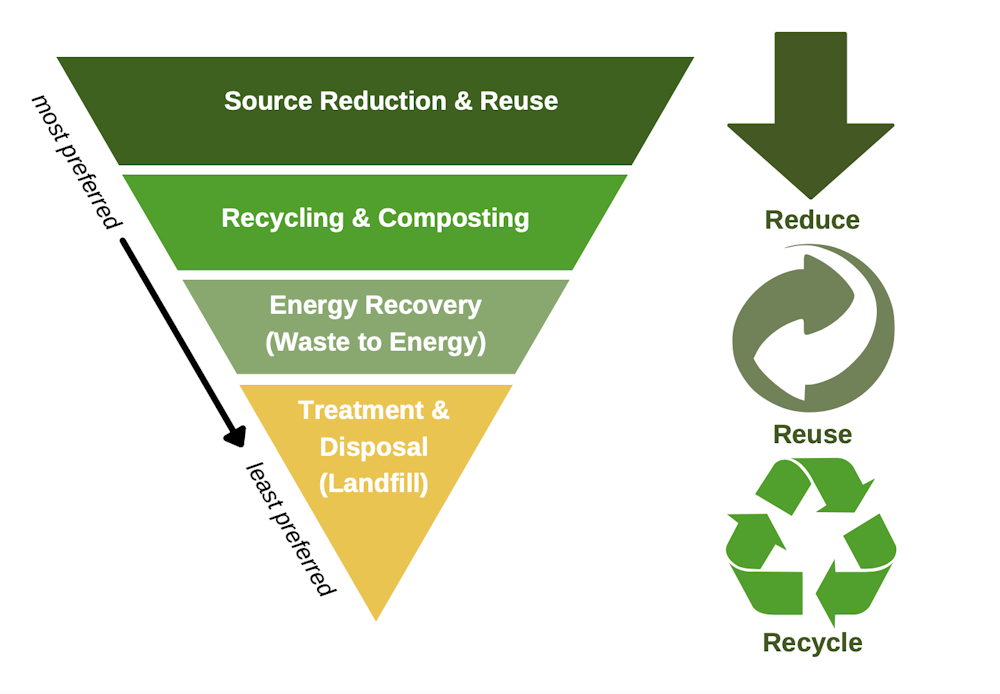
Experts have long recommended tackling the waste problem by prioritizing source reduction strategies that prevent the creation of waste in the first place, rather than seeking to manage and mitigate its impact later. The U.S. Environmental Protection Agency and other prominent environmental organizations like the U.N. Environment Programme use a framework called the waste management hierarchy that ranks strategies from most to least environmentally preferred.

Graphics showing options for managing waste, moving from upstream (production) to downstream (disposal).

The U.S. EPA’s current waste management hierarchy (left, with parenthetical explanations by Michaela Barnett, et al.), and a visual depiction of the three R’s framework (right). Michaela Barnett, et al., CC BY-ND

The familiar waste management hierarchy urges people to “Reduce, Reuse, Recycle,” in that order. Creating items that can be recycled is better from a sustainability perspective than burning them in an incinerator or burying them in a landfill, but it still consumes energy and resources. In contrast, reducing waste generation conserves natural resources and avoids other negative environmental impacts throughout a product’s life.

R’s out of place

In our surveys, participants completed a series of questions and tasks that elicited their views of different waste strategies. In response to open-ended questions about the most effective way to reduce landfill waste or solve environmental issues associated with waste, participants overwhelmingly cited recycling and other downstream strategies.

We also asked people to rank the four strategies of the Environmental Protection Agency’s waste management hierarchy from most to least environmentally preferred. In that order, they include source reduction and reuse; recycling and composting; energy recovery, such as burning trash to generate energy; and treatment and disposal, typically in a landfill. More than three out of four participants (78%) ordered the strategies incorrectly.

When they were asked to rank the reduce/reuse/recycle options in the same way, participants fared somewhat better, but nearly half (46%) still misordered the popular phrase.

Finally, we asked participants to choose between just two options – waste prevention and recycling. This time, over 80% of participants understood that preventing waste was much better than recycling.


Recycling badly

While our participants defaulted to recycling as a waste management strategy, they did not execute it very well.

This isn’t surprising, since the current U.S. recycling system puts the onus on consumers to separate recyclable materials and keep contaminants out of the bin. There is a lot of variation in what can be recycled from community to community, and this standard can change frequently as new products are introduced and markets for recycled materials shift.

Our second study asked participants to sort common consumer goods into virtual recycling, compost and trash bins and then say how confident they were in their choices. Many people placed common recycling contaminants, including plastic bags (58%), disposable coffee cups (46%) and light bulbs (26%), erroneously – and often confidently – in the virtual recycling bins. For a few materials, such as cardboard and aluminum foil, the correct answer can vary depending on the capacities of local waste management systems.

This is known as wishcycling – placing nonrecyclable items in the recycling stream in the hope or belief that they will be recycled. Wishcycling creates additional costs and problems for recyclers, who have to sort the materials, and sometimes results in otherwise recyclable materials being landfilled or incinerated instead.

Although our participants were strongly biased toward recycling, they weren’t confident that it would work. Participants in our first survey were asked to estimate what fraction of plastic has been recycled since plastic production began. According to a widely cited estimate, the answer is just 9%. Our respondents thought that 25% of plastic had been recycled – more than expert estimates but still a low amount. And they correctly reasoned that a majority of it has ended up in landfills and the environment.

Empowering consumers to cut waste

Post-consumer waste is the result of a long supply chain with environmental impacts at every stage. However, U.S. policy and corporate discourse focuses on consumers as the main source of waste, as implied by the term “post-consumer waste.”

Other approaches put more responsibility on producers by requiring them to take back their products for disposal, cover recycling costs and design and produce goods that are easy to recycle effectively. These approaches are used in some sectors in the U.S., including lead-acid car batteries and consumer electronics, but they are largely voluntary or mandated at the state and local level.

When we asked participants in our second study where change could have the most impact and where they felt they could have the most impact as individuals, they correctly focused on upstream interventions. But they felt they could only affect the system through what they chose to purchase and how they subsequently disposed of it – in other words, acting as consumers, not as citizens.

As waste-related pollution accumulates worldwide, corporations continue to shame and blame consumers rather than reducing the amount of disposable products they create. In our view, recycling is not a get-out-of-jail-free card for overproducing and consuming goods, and it is time that the U.S. stopped treating it as such.

Michaela Barnett, Founder, KnoxFill, University of Virginia; Leidy Klotz, Associate Professor of Engineering and Co-Director, Convergent Behavioral Science Initiative, University of Virginia; Patrick I. Hancock, Postdoctoral fellow, University of Virginia, and Shahzeen Attari, Associate Professor of Public and Environmental Affairs, Indiana University

This article is republished from The Conversation under a Creative Commons license. Read the original article.

This article has been updated to clarify that decisions about whether to recycle, compost or dispose of certain materials as trash can vary depending on local waste management systems.

How baby planets are made: Planetary precursors revealed in stunning new space image

On Tuesday, the European Southern Observatory released a new image that could advance our fundamental understanding of how brand new planets are formed. 

Located over 5000 light-years away in the constellation Monoceros, a star named V960 Mon was photographed using the Very Large Telescope’s Spectro-Polarimetric High-contrast Exoplanet REsearch (SPHERE) instrument. The image was taken after the onset of a brightness outburst revealing that there’s material orbiting it, in what appeared to be a series of intricate spirals extending massive distances.

Intrigued by the spirals, astronomers looked back at observations of the same system previously made with the ALMA telescope. Through an analysis, they concluded that the spiral arms were clumps of dust particles with masses similar to planets — a hint of what was to come. 

Philipp Weber, a researcher at the University of Santiago, Chile who led a study published in The Astrophysical Journal Letters about the observation, told Salon the clumps in the spiral are likely “the precursors of planets.” 

“In the future, they might contract and collapse to form a giant planet. This is just one possible outcome, but it’s probably the most spectacular one.”

“At this moment, they are just some clouds of dust,” Weber said. “But in the future, they might contract and collapse to form a giant planet. This is just one possible outcome, but it’s probably the most spectacular one.”

In other words, from a human perspective, this image could be depicting the conception of a massive planet, a phenomenon that is still a mystery in the universe. Such a spectacle has been hypothesized as part of some models of planet formation, but this is the first time an observation has actually been made.

“With ALMA, it became apparent that the spiral arms are undergoing fragmentation, resulting in the formation of clumps with masses akin to those of planets,” Alice Zurlo, one of the study authors and a researcher at the Universidad Diego Portales, Chile, said in a statement. “This discovery is truly captivating as it marks the very first detection of clumps around a young star that have the potential to give rise to giant planets.”

Webb NIRCam composite image of JupiterWebb NIRCam composite image of Jupiter from three filters – F360M (red), F212N (yellow-green), and F150W2 (cyan) – and alignment due to the planet’s rotation. (NASA, ESA, CSA, Jupiter ERS Team)To date, astronomers believe that giant planets form in either one of two ways. First, there’s the theory known as core accretion, which is when dust particles come together. Astronomers believe this is how terrestrial planets such as Earth and Mars were created. Then there’s the theory of gravitational instability, which is when large dense fragments of dust and gas around a star contract and collapse, due to gravity, to form large gaseous planets like Jupiter. Gravitational instability among stars has been observed before, but not among planets, Weber said. 
“There are many ideas, many theories of how planets form — in the last 10 years, there have been a lot of good observations,” Weber said. “But still today, we don’t fully understand every process.”

Weber said one of the biggest problems is understanding the scales. For example, how a small, grain-sized clumps can turn into a planet the size of Earth. 

We need your help to stay independent

“This means that the physics that are involved are quite complicated because it covers a lot of different scales of mass and size,” Weber said. “This study is mainly a confirmation that something is possible that people have been hypothesizing about. It gives us observational evidence on this process of gravitational instability.”

“It gives us observational evidence on this process of gravitational instability.”

This observation gives the gravitational instability theory more support as a leading contender for massive, gas planet formation. Weber said it’s good to have this confirmation, but that astronomers will next try to improve this observation.

“The observation that was conducted by Alma, it gives them 10 minutes of observational time on this on this target, which is not a lot. So we will aim to reopen this again to maybe reveal the structure in more detail,” Weber said, adding that he hopes more detailed observations can reveal what elements exist in these fragments. 

Experts: Smith just got potentially “highly incriminating” evidence — but it could delay indictment

Former New York Police Commissioner Bernie Kerik, a close ally of former Trump lawyer Rudy Giuliani, has cut a deal to turn over his findings into supposed 2020 election fraud to special counsel Jack Smith, according to The Daily Beast. Kerik received a full pardon from then-President Trump in February 2020, erasing his 2010 conviction on eight felony charges relating to tax fraud and lying to federal officials. He served nearly three years in prison before his release in 2013.

Smith previously subpoenaed the documents, which are related to Kerik’s work as former President Donald Trump’s on-the-ground investigator looking at widely discredited conspiracy theories about voter fraud, according to the report. Kerik’s team refused to turn over the documents, citing attorney-client privilege because he was working on behalf of Trump’s attorney, but Trump himself waived the privilege on Friday and agreed to let him turn over the documents, Kerik lawyer Tim Parlatore told the outlet.

Smith is expected to receive nearly 2,000 pages of documents describing Kerik’s probe.

National security attorney Bradley Moss called the move a “significant gamble by Trump’s legal team” but it’s unclear why he signed the waiver.

Smith’s team is looking at Trump’s decision process as he pushed baseless voter fraud conspiracies while his advisers refuted the allegations.

Parlatore, who previously represented Trump as well, told The Daily Beast that the evidence may end up being exculpatory because it shows the Trump campaign did hear allegations of fraud and engaged in good faith efforts to investigate the claims.

“From the time he received a subpoena from the January 6 Committee, Mr. Kerik has believed that full disclosure is the best policy so that the public can understand how extensive the legal team’s efforts to investigate election fraud were,” Parlatore told the outlet.

But none of Kerik’s efforts found any proof of voter fraud and virtually all of Trump’s post-election legal challenges failed in court.

New York University Law Prof. Ryan Goodman warned that Kerik’s documents “could be highly incriminating,” citing a D.C. bar committee report on Giuliani that found that the documents “do not show any connection” between allegations and “election fraud.”

Kerik and Giuliani “could not and would not confirm that the information contained in the Kerik documents was true,” the report said, adding that the content is “in many instances facially incredible.”

While Trump’s lawyers could argue that they made a good faith effort, prosecutors can use it to show that the evidence Trump claimed he had was “nothing and unsubstantiated,” former federal prosecutor Elie Honig said on CNN.

“They need to know what’s in those documents,” he said of Smith’s team. “And I think they need to be prepared to counteract those, to say, ‘This is nothing. This is a pile of useless garbage.’ A lot of courts found that, and I think prosecutors have to be ready for that defense.”

Kerik told The Daily Beast that he also agreed to sit down for a formal interview with the feds in mid-August. The outlet noted that the “timing could indicate that Smith isn’t as close to indicting Trump as the former president has recently suggested, but Smith could also conduct the Kerik interview after an indictment.”

Former Watergate prosecutor Jill Wine-Banks agreed that the timeline could be delayed, tweeting that “it may be a long indictment watch.”

We need your help to stay independent

Former U.S. Attorney Joyce Vance told MSNBC that it is difficult to gauge Smith’s timeline given that he sent Trump a target letter last week but is still talking to witnesses.

“I think the answer is while we could see an indictment any day, it’s possible that there could be a strategy, for instance, to indict Trump alone and to continue to work on the rest of the case,” Vance said. “That seems a little bit far-fetched to me. This is a case where you want to play everything by the books. You want to treat this the indictment like you would any other case, prepare it against any and all of the defendants you’re looking at.”

Vance added that Smith is reportedly looking to bring a conspiracy charge, which means that “Trump would not be a standalone defendant, he would need some co-defendants.”


Want a daily wrap-up of all the news and commentary Salon has to offer? Subscribe to our morning newsletter, Crash Course.


CNN legal analyst Norman Eisen, who served as Democratic counsel during Trump’s first impeachment, disagreed that the evidence would slow down Smith.

“I don’t expect… that this huge trove of documents and this additional testimony is going to slow him down or speed him up,” he said on Monday, “but it’s important and he can use it as he prosecutes the case whenever he may charge.”

Former U.S. Attorney Harry Litman cited Trump’s increasingly aggressive rhetoric about the probe as a sign that an indictment is coming soon.

The “hysteria levels from Trump are hitting the stratosphere because this is one that he would know about,” he told MSNBC. “So, to me, the table is set, Smith is ready to go and that’s what the target letter means, save only you guys coming in or not? And by the way, you can’t take two weeks, you know, come in off the pitch after that. Here’s the indictment.”

Antarctica’s rapidly melting ice is in “unprecedented” territory

Antarctica’s sea ice has melted so fast — and the Earth has remained so much warmer than usual — that scientists are sounding a global alarm. The reason is simple: Antarctic sea ice that always comes back after first melting has not returned. Vast regions of Antarctic coast are exposed that were never bare before.

“If nothing had changed, we’d expect to see a winter like this about once every 7.5 million years.”

As physical oceanographer Edward Doddridge put it, referring to this development as “unprecedented” simply “isn’t strong enough. For those of you who are interested in statistics, this is a five-sigma event. So it’s five standard deviations beyond the mean.”

In other words: “If nothing had changed, we’d expect to see a winter like this about once every 7.5 million years.”

Doddridge is far from alone among scientists raising the alarm about melting Antarctic sea ice. On July 19, the University of Maine’s Climate Change Institute announced data showing that over the past year, the amount of Antarctic sea ice has shrunk by almost 2 million kilometers² (about 772,000 miles²). This is out of 15 million kilometers (about 9.4 million miles) that covers the continent. Meanwhile the World Meteorological Organization reports that sea ice levels around Antarctica are 17 percent lower than they should be at this time of year.

There are several reasons why this diminishing sea ice is a big problem. In addition to providing a habitat for animals like seals, penguins and krill, the ice helps regulate Earth’s temperature by reflecting the Sun’s heat back into space — a process known as ice-albedo feedback. Just as importantly, the sea ice helps feed ocean currents that provide nutrient-rich water where it is needed in ecosystems all over the planet.

Because Antarctica is home to 90 percent of the world’s ice, massive floods would ensue if it melted. Indeed, if all of Antarctica’s ice melts, global sea levels are predicted to rise by 190 feet. Even without that happening, however, it is estimated that the one-third of humanity which lives within 60 miles of ocean shore will experience radical changes to their way of living.


Want more health and science stories in your inbox? Subscribe to Salon’s weekly newsletter The Vulgar Scientist.


It is estimated that the one-third of humanity which lives within 60 miles of ocean shore will experience radical changes to their lifestyles.

As ocean currents are disrupted by the melting sea ice, they will cause unpredictable — but almost certainly damaging — effects all over the world. A March study in the scientific journal Nature found that if freshwater reduces the salinity of major ocean currents, they will start slowing down. By reducing the flow of nutrients in the marine layers, the food chain will deteriorate, and before long humans will notice that their favorite foods are no longer available or are more scarce.

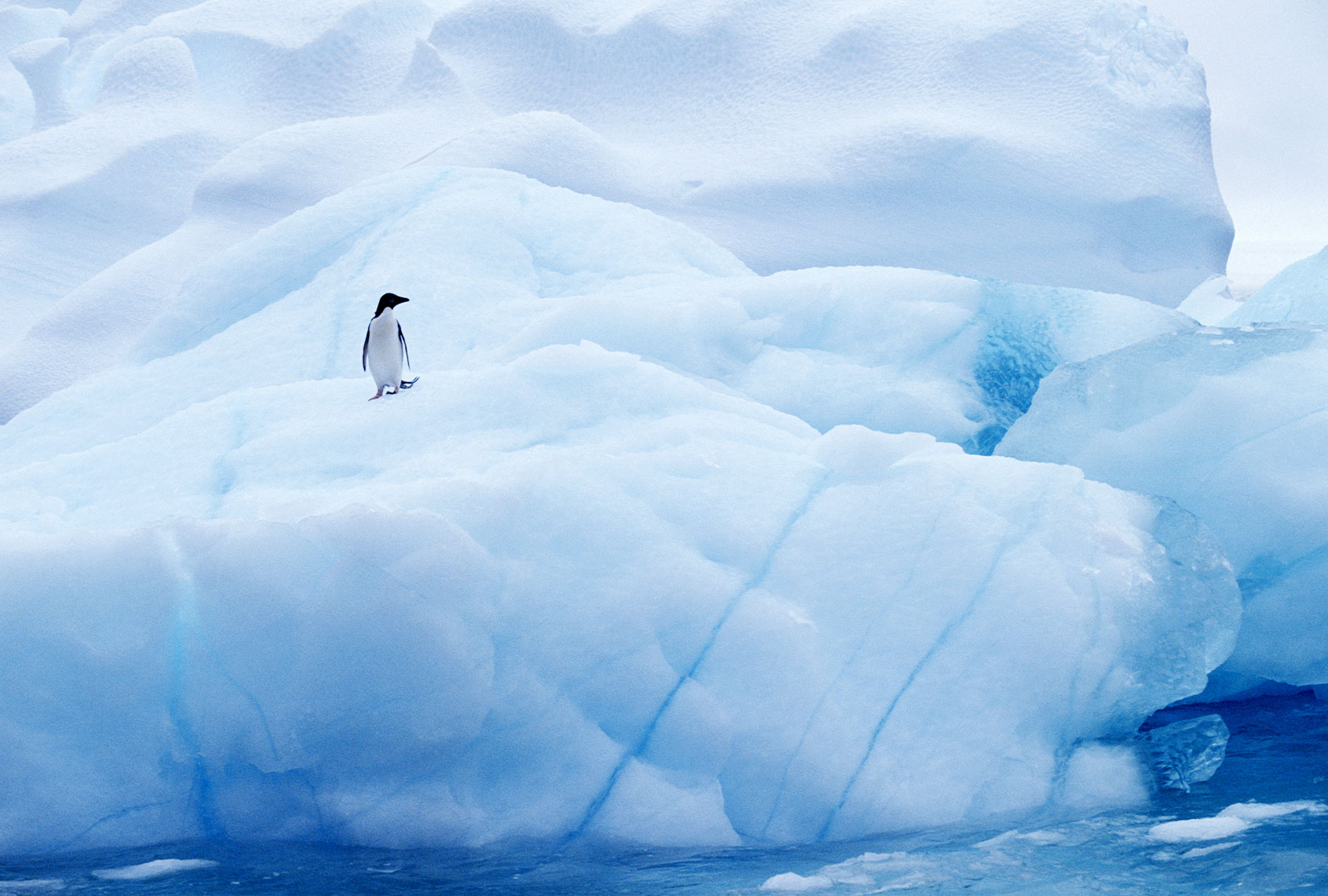
PENGUIN ON ICEBERG IN THE ANTARCTICAPENGUIN ON ICEBERG IN THE ANTARCTICA (Getty Images)There may also be erratic extreme weather events such as floods, hurricanes and tropical storms. Finally the act of large quantities of melted sea ice entering the ocean could set off a chain reaction that leads to even more melting and more climate warming. As a report by the United Nations’ body IPCC concluded, the slowing of ocean currents caused by sea ice melt could radical and permanent climate change during the span of a single human lifetime.

We need your help to stay independent

There are also the unforeseeable ways that the melted sea ice will disrupt ecosystems. As a study published this month in the scientific journal Nature Sustainability explained, once one ecosystem collapses, that event can ultimately ripple across the planet and cause even more ecosystem collapses. The paper itself concluded that “as the strength of a main driver increases, the systems collapse sooner. Adding multiple drivers brings collapses further forward, as does adding noise and the two effects can be synergistic.”

“I think that, with climate change and its associated extreme events, [they] will put additional stress on the world’s ecosystems, which are already under tremendous pressure,” Professor Simon Willcock of Rothamsted Research and Bangor University, who co-authored the study, told Salon by email at the time. “This might cause some ecosystems to collapse surprisingly quickly.”

The “Barbie” backlash isn’t just cynical: The GOP is abusing its own supporters

For much of the country over this past weekend, the release of the movie “Barbie” was an unapologetically joyous occasion. The pink-drenched comedy based on the long-beloved Mattel toy captured the spirit of the summer of 2023. People are finally shaking off pandemic trauma, it seems, and just want to bop along to Dua Lipa tunes in a bubblegum-colored Corvette. Sure, everybody knows we still have a lot of problems that need fixing. But “Barbie” set box office records by reminding everyone that it’s OK to make some time for fun. 

Republicans, of course, can’t let people have a good time without getting angry about it. The right-wing propaganda machine whipped into high gear over the weekend, screeching at endless top volume about how America was being destroyed because Margot Robbie and Ryan Gosling were making campy jokes in an imaginary universe. These complaints, unsurprisingly, had nothing to do with Hollywood’s addiction to rebooting existing intellectual properties or its chronic lack of creativity. Instead, the gripes were chaotic and hard to follow. Fox News was furious about the fact that one actor in “Barbie,” Hari Nef, is trans. Sen. Ted Cruz of Texas was yelling about maps and China, airing a convoluted conspiracy theory that’s not worth trying to figure out.  There was lots of yammering that “Barbie” is supposedly a man-hating movie, an almost inevitable complaint anytime women get prominent speaking roles — in a film directed by a woman, no less! — these days. 

It got so stupid that Ben Shapiro of the Daily Wire, in a truly pathetic effort to be the loudest “Barbie” whiner, set fire to a bunch of Barbie dolls on camera. Why? Who cares, honestly?


Want more Amanda Marcotte on politics? Subscribe to her newsletter Standing Room Only.


Shapiro nonetheless lost out in the “biggest idiot” contest to right-wing podcaster Dave Rubin, who complained about Nef’s presence in the film by saying, “Why do they go out of their way to have a biological boy play a girl who’s supposed to be completely a girl in the Barbie movie unless they’re trying to confuse kids?” 

As Rubin surely knows, no one is “completely a girl” in Barbie World, where the dolls have smooth plastic crotches instead of genitals. Like every other member of the GOP and right-wing punditariat who tantrumed over “Barbie,” he likely doesn’t believe a single word he’s saying.  The emptiness of this gambit was illustrated by Rep. Matt Gaetz, R-Fla, who was only too happy to preen on the red (or pink) carpet at a “Barbie” screening last week alongside his wife, Ginger Gaetz. But the happy couple played their role by latching onto performative Barbie-hate, with Ginger opining that Ken, a plastic doll with no testicles, is “disappointingly low T.” 

This is how the right-wing noise machine works: It gloms onto an immediate cultural moment, whatever that happens to be, and emits a series of high-pitched whining noises. This is financially and politically profitable for two reasons. First, it draws eyeballs. Conserva-trolls attach themselves like ticks to “the discourse,” drawing attention by becoming an irritant in a conversation that basically has nothing to do with them. Second, and more important, they use these cultural moments to reinforce a message of alienation and paranoia, separating their followers even further from the majority of everyday Americans and pushing them deeper into the world of hermetic right-wing nuttery. This tactic of isolating their audience from everyone else, including family members, strongly resembles the strategies used by cult leaders. 

The right-wing propaganda blueprint is so familiar it’s almost automatic: Figure out what ordinary people are talking about, be a total jerk about it, persuade folks to start fighting about it on social media, and then sit back and watch.

Indeed, the blueprint used by right-wing propagandists in these exercises is so familiar that it’s become as automatic as breathing. First, figure out what ordinary people are talking about. Then be a total dick about it, randomly claiming that it’s all a plot to undermine the “freedoms” and “traditions” of “real” Americans, i.e., culturally alienated conservatives. Persuade folks to start fighting about these non-issues on social media, and then sit back and watch the media fall for it, with accelerating coverage of their dumb and sometimes blatantly fake opinions bringing in clicks and ad dollars, or, for GOP elected officials and candidates, hard-cash donations. 

It’s true that people like Ben Shapiro or Ted Cruz attract mostly negative reactions by complaining about an enjoyable Hollywood movie. But there’s a dark genius to this trolling strategy. Getting liberals to mock them on social media or, better yet, drawing “look at these weirdos” coverage in mainstream media, only helps to reinforce the overall MAGA message: Conservatives are the “real” victims here, and everyone is out to get them. They are misunderstood and mocked outsiders, the objects of constant scorn and derision from the “cultural elite.” They can only be safe by burrowing ever deeper into the right-wing cocoon. 

We need your help to stay independent

This process works pretty well, at least in the short term, for politicians and influencers who rake in money and power by stoking baseless rage and anxiety. Conservative audiences for this stuff, however, are being actively harmed. Raging about how “Barbie” is feminist-communist-LGBTQ garbage is a good way to make sure the kids and grandkids visit less often, for one thing. On a deeper level, it’s way worse. We’re talking about damaging people’s souls with the relentless message that their only real source of pleasure lies in cruelty toward others, and that even something as innocent as a summer comedy is too “woke” to enjoy. 

Even that might be called a best-case scenario. The “everything mainstream is evil” propaganda narrative, which has been visible on the right for years, took an especially dark turn during the pandemic. The rhetoric now being used against “Barbie” is very close to the rhetoric used against COVID vaccination not long ago: Avoid this normal thing that millions of normal people are doing, because it’s actually a secret plot against you. If Republicans boycott “Barbie,” the consequences are admittedly minor: They seem like insufferable jerks. Boycotting the vaccines, however, led to many thousands of deaths. 

The anti-trans argument of the “Barbie” backlash, like the Bud Light boycott, is predicated on the vicious lie that trans people, merely by existing, somehow pose a threat.

Even when it comes to these sporadic pop-culture tantrums, the victim-posturing of right-wingers becomes a permission slip to victimize others. The anti-trans argument of the “Barbie” backlash, as with the Bud Light boycott before it, is predicated on the vicious lie that trans people, merely by existing, somehow pose a threat to society. The result is a notable rise in hate crimes against trans people. The insulting claim that “Barbie” is an attack on men offers its own minor-key permission slip for misogyny. If conservatives convince themselves that men are the “real” victims of everything that happens in our culture and society, they’re more inclined to rationalize sexual harassment, sexual misconduct and even outright rape, as with the constant excuses for Donald Trump. This stuff can get dark fast: Country music star Jason Aldean openly flirts with a pro-lynching message in his recent hit song, packaging it as “self-defense” against the supposed excesses of “wokeism.” 

It’s true enough that “Barbie” director Greta Gerwig is serving up a feminist message about the impossible pressures faced by women. But few, if any, conservatives have even tried to engage with the movie’s argument on its merits, in no small part because they know that’s a losing gambit. More than that, it’s because they don’t actually care what “Barbie” is about. Gerwig’s previous movies have also explored feminist themes, such as her excellent adaptation of “Little Women,” and we heard nary a peep of protest from the right. What makes “Barbie” different is that it’s a smash hit and an obvious culture-defining moment, meaning that right-wing pundits can get attention by getting their knickers twisted up about it. There’s nothing legitimate or honest about this extended right-wing tantrum, but that’s nothing new. As long as conservative audiences keep falling for this shtick, GOP propagandists will keep dishing it out. 

Trump’s downfall is coming: Now the Democrats must use his crimes to finish him

It now appears that Donald Trump, a criminal mastermind who has spent decades evading serious responsibility for his behavior, may finally have met his match. The doubly-indicted ex-president — with a third and fourth indictment likely to follow soon — now faces multiple felony trials and criminal investigations across the country for violations of the Espionage Act, financial fraud and other serious crimes connected with his attempts to overturn the 2020 election.

Last week Trump confirmed that the Department of Justice has sent him a “target letter” indicating that special counsel Jack Smith may soon charge him with defrauding the United States and “deprivation of rights under color of law” in connection with the Jan. 6 coup plot. Trump also faces potential charges related to tampering with witnesses and “obstruction of an official proceeding.”

Experts have noted that one statute cited in the target letter (Section 241 of Title 18) was created during Reconstruction in an attempt by federal authorities to protect the rights of newly freed Black Americans from the Ku Klux Klan and other Southern white terrorist groups.

Trump still has a vast war chest of money and considerable resources of other kinds, but those are being depleted by his growing legal expenses. In all probability, he will still be the 2024 Republican presidential nominee. But his latitude of action and his ability to escape the law appears, at least for now, to be diminishing. The “Trumpocene” era may be drawing to a close, but what may happen next in this truly unprecedented historical period remains unclear. 

Are we truly witnessing Trump’s downfall — and if so, why did it take so long? Where would the country be now if Attorney General Merrick Garland had moved faster?

What about Trump’s tens of millions of MAGA followers, the largely subservient Republican Party, the right-wing news media and all the other tools he has at his disposal? Can those resources help him escape justice and accountability once again? In an attempt to make sense of the road ahead for Donald Trump and the fate of American democracy, I recently asked a range of experts to offer their thoughts and insights.

Rachel Bitecofer is a political analyst and election forecaster.  

The idea that former President Trump and his co-conspirators might get away with their plain-sight crimes, as serious as attempting to seize permanent power via disrupting the transfer of power, has haunted many of us over the past two years. So it is a big relief to see we have moved past this corrupting idea that American presidents cannot be prosecuted, a concept I feel certain even the Federalists would have found horrifying.

Finding out that the FBI was actively involved with trying to prevent search and seizure in the Mar-a-Lago classified documents case, despite a year of theft, lies, and concealment of important national security documents — combined with reports that Garland and the Department of Justice remained inert on investigating the principals behind the Jan. 6 insurrection until the House select committee forced them into it — does not exactly inspire confidence in the system. The fact is, if the Department of Justice had led, and not followed, on the Jan. 6 investigation we would be living in a very different legal reality than we are now, where we are likely to see a criminally convicted Republican nominee running in the fall general election.

“I would like to believe that Trump will be neutralized, and won’t be on the ballot in November of next year. But my experience and instincts tell me this crisis is far from over.”

I would like to believe that Trump will be neutralized, and won’t be on the ballot in November of next year. But my experience and instincts tell me this crisis is far from over and that many twists and turns and dangers remain. The fact is, Trump continues to receive preferential treatment from the federal justice system, and that should concern every law abiding American. The “two-tiered system” of justice that Trump and his MAGA allies like Speaker McCarthy decry is actually this: There is one standard for someone like Jack Teixeira, a National Guardsman recently indicted for stealing classified intel who is being held in custody as a risk to national security, and another for Donald Trump, who despite allegedluy committing similar crimes, is free on bond. Few defendants facing charges of classified info disclosures receive bond, let alone release without any conditions or seizure of the defendant’s passport. So, the jury is still out, so to speak, as to whether our federal judicial system can meet this moment.

That said, my assumption is that as indictments stack up across multiple federal and state venues, less committed Republican voters who are currently inclined to vote for Trump will start to conside giving Joe Biden a second term.

Look for the Trump campaign and their allies to flood the zone on polls, as they did during the run-up to the 2022 midterms in an attempt to disguise the failure of their “red wave” to materialize. Keep in mind that the bulk of primary voters do not follow the daily news, and will not start doing so until this fall. I think that state-level “fake elector” charges that tap into the people who powered the conspiracy are likely as important as the prosecutions of Trump himself.

Much of Trump’s power hails from his “supporting cast” of MAGA Republicans, who to this day continue to perpetuate the lies at the heart of the criminal conspiracy. If there are criminal penalties for illegal actions taken by these people, we may start to see Trump’s echo chamber fracture. That is key to breaking the mass psychosis behind the MAGA movement.

Norm Ornstein is emeritus scholar at the American Enterprise Institute and contributing editor for the Atlantic. He is also co-author of the bestselling book “One Nation After Trump: A Guide for the Perplexed, the Disillusioned, the Desperate, and the Not-Yet Deported.”

It is frankly a relief that Trump now is finally going to be charged with the ultimate crimes: direct attempts to destroy American democracy and instigate a violent insurrection. Of course, I would have preferred that this had happened earlier — and I wish Jack Smith had been given the case much earlier to expedite it. But I also know that a case that was not complete and had not tied up every loose end might have ended with a dismissal or an acquittal — or at least with a hung jury because of one diehard Trumpist who would be fine with him shooting someone on Fifth Avenue in broad daylight. We will have to wait to see what the charges are, and who is cooperating. But I doubt that people like Mark Meadows or former Arizona Gov. Ducey would have been willing to cooperate if the ask had come a year or more ago.

The fact that other prosecutors, including Fani Willis, have not brought charges yet shows that this is a common feature of complex and highly charged cases, not simply Merrick Garland dragging his feet. To be sure, nothing would have altered the disgraceful reactions of the Kevin McCarthys and Elise Stefaniks.

“Merrick Garland has afforded Trump the luxury of time to build, fundraise, agitate, organize, propagandize, blackmail, brainwash, bribe, threaten, energize, incite, strengthen his hold on his base —and possibly grow it.”

The bad news is that even after charges are brought, it will take months before they result in a trial. Some of the delays will no doubt be driven by the bias of Judge Cannon in Florida, but cases involving a lot of classified material inevitably take longer. It is possible we will have one or more trials during the primary stage, or even later than that. And it remains true that none of this seems to be changing the Republican primary voters in their attachment to Trump. He may be a presidential nominee facing multiple criminal trials during the campaign and after the election. That’s nightmarish, to be sure. But what would be more nightmarish is if he were not held accountable for multiple offenses against the United States and all of us.

Cheri Jacobus is a former media spokesperson at the Republican National Committee and founder and president of the political consulting firm Capitol Strategies PR.

While a target letter implies indictments are coming, it’s well over a year late. Possibly too late. Merrick Garland has afforded Trump the luxury of time to build, fundraise, agitate, organize, propagandize, blackmail, brainwash, bribe, threaten, energize, incite, strengthen his hold on his base and possibly grow it. Trump’s appointed judge, Aileen Cannon, has set a trial date for the stolen classified documents case for May, 2024, likely ensuring further delay as the GOP primary will be underway and likely showing Trump as the presumptive nominee. This calendar is fraught with peril for justice and democracy. Had Garland not inexplicably sat on his hands for so long, we’d be in trial stage by now, and the GOP donors and candidates would have plenty of reason to move on from Trump and lead his cult followers away from the cliff.  

The reality is that Trump will likely be the GOP nominee and has a very good chance of becoming president again. He can run and serve if he is indicted, prosecuted, found guilty and even if he is serving time in prison. There is nothing in our Constitution forbidding it.  

It is becoming apparent that our only hope may be the 14th Amendment, which bars an insurrectionist from office. Section 3 of the amendment — the Disqualification Clause — bars any person from holding state or federal office who took an oath to support the Constitution as an “officer of any State” and then “engaged in insurrection or rebellion” or gave “aid and comfort” to insurrectionists. It would have to be brought to court in each state. A “test” case brought by CREW in New Mexico was successful, as an officeholder who was on the Capitol steps on Jan. 6 was removed from office by a judge. If Trump is properly convicted for his role in the insurrection, the path to keeping him off the ballot (at least in enough states) and out of the White House will be the 14th Amendment. 

David Pepper is a lawyer, writer, political activist and former elected official. His new book is “Saving Democracy: A User’s Manual for Every American.”

I’m pleased the walls look to be closing in, and that the special prosecutor appears to be pursuing this aggressively. Accountability here is desperately needed. No one who leads an insurrection against the peaceful transfer of power should be allowed to run for office again. If Garland had moved faster, we might have lived up to such a foundational and crucial principle. The delayed pursuit also sent a message across the country that undermined the seriousness of what happened. If you’re a less partisan voter trying to make sense of all the clamor and rhetoric about Jan. 6, the lack of early movement by the attorney general signaled that it must not have been that bad. That false narrative has shaped perceptions ever since, and will likely do so as any trial proceeds.

Trump will win the Republican primary, and I think Biden remains in a strong position to beat Trump in the general election. The extremism of the far right, made so real by the Dobbs decision and what’s happened since, continues to be the prime driver of voting behavior.

My primary anxiety is whether those on the side of democracy take advantage of this opportunity by competing and winning up and down the ballot, including state legislative races. With democracy in the balance, it’s no longer good enough to simply win federal races in a few swing states, leaving untouched most of the places where extremism is advancing and democracy undermined. To reverse the downward spiral, those fighting for democracy must widen and deepen their battle plan for both ’23 and ’24.


Want a daily wrap-up of all the news and commentary Salon has to offer? Subscribe to our morning newsletter, Crash Course.


Rich Logis, a former member of the Republican Party and right-wing pundit, is the founder of Perfect Our Union, an organization dedicated to healing political traumatization, building diverse pro-democracy alliances and perfecting our union.

Irrefutably, Trump is partly responsible for the insurrection; the justification of politically motivated violence was one of the reasons I left behind the politically traumatic world of Trump/MAGA/GOP. Jack Smith’s Jan. 6 charges are going to be bad, and I will not be surprised if he charges Trump with seditious conspiracy or treason; Smith knows he must show evidence that Trump knows he lost the 2020 election, and I am certain Smith will provide such proof. We still really don’t know what Trump was doing for three hours, once the insurrectionists breached the Capitol. Privately, the GOP, as well as Trump’s primary opponents, are beyond ecstatic over Trump’s legal problems, but they are grossly incorrect in their likely assumption that such problems weaken Trump: The more he’s indicted, the stronger his support grows with the GOP’s primary voting base.

I fully appreciate that many are dissatisfied with the speed at which Attorney General Garland moved. In fairness, he is not only in an unenviable position but an unprecedented one. I am a staunch defender of Garland: He has never lost a case he has tried, is a man of granite integrity and would not have taken the job had he thought he’d be coaxed into doing anyone’s bidding; this was proven by his prosecution of Hunter Biden. If Trump committed crimes, Garland will win at trial. Holding Trump legally accountable is mandatory, if we, as a nation, are going to overcome the mistake of Trump’s election. 

One immense benefit that Trump, DeSantis, etc., have is that most of the American electorate isn’t political; most only pay attention a month, or two, before an election. The Democratic Party needs to stop worrying about Biden’s age and the polls, and start worrying about how to reach the tens upon tens of millions of Americans who are apolitical.

“Privately, the GOP, as well as Trump’s primary opponents, are beyond ecstatic over Trump’s legal problems. But they are grossly incorrect in their likely assumption that such problems weaken Trump.”

Because of the Electoral College, Trump was much closer to winning in 2020 than the Democratic Party wants to acknowledge. Biden’s re-election is not guaranteed. America has survived one Trump presidency. But another? It is a risk we must not take. The most beneficial outcome for the country is to electorally mercy-kill the GOP. We must be patient in affliction, simultaneously bringing the good news of conserving democracy to the afflicted.

Wajahat Ali is the author of “Go Back to Where You Came From.” He is also a columnist for The Daily Beast and MSNBC Daily and co-host of the democracy-ish podcast.

The target letter by Jack Smith reveals that Trump’s numerous criminal transgressions are at the very least catching up to him. Whether or not this will result in any form of accountability remains to be seen, but it is certainly a troubling development for the leading GOP presidential candidate, whose 2016 campaign included the chant, “Lock her up!” Karma, thanks to Merrick Garland and the Justice Department, was slow and late to respond, but this is certainly bad news for Trump and his MAGA minions. Over in Michigan, Attorney General Dana Nessel announced felony charges against 16 Michigan residents for their role in the alleged false electors scheme. This is in addition to the two existing indictments against Trump.

We still haven’t heard from District Attorney Fani Willis of Georgia, who has Trump dead to rights thanks to his phone call asking the secretary of state to “find” him the votes he needs. For normal people who aren’t protected by whiteness, wealth and the GOP, all of this would be enough to send a person to jail for years. However, everything is skewed to mollify the radicalized anger of white rage and MAGA, so I won’t hold my breath for Trump’s incarceration. I remain cynical, because he is a former president and I recall that Richard Nixon never spent a day of his life in jail and went on to a lucrative speaking and writing career. Still, we need more accountability, and this will only increase the pressure on Trump’s minions, such as Meadows and others, to play ball with law enforcement.

These people are brittle and weak porcelain dolls who won’t last a day in jail. They’ll sing like birds. None of this will dampen MAGA support for Trump, and we already see the GOP leadership rallying around him. Even Megyn Kelly, whom Trump mocked and ridiculed, has made amends with her former tormentor. Masochism is the price to pay when you’re in a political cult. I do believe this will weaken Trump and Republicans leading up to 2024, however, and build up the rich narrative of his awesome corruption and the GOP’s utter, craven complacency and complicity. 

Unsanitary and deadly: The Great Stink of 1858 may foreshadow our future climate breakdown

As Summer 2023 continues to shatter heat records, climate change experts are talking about a “new abnormal.” Studies indicate that ecosystems are likely to rapidly collapse as extreme weather events caused by these heatwaves pile up, one on top of the other. Sky high temperatures are rendering cities like Phoenix, Arizona into borderline uninhabitable heat domes.

If this type of unbearable heat is going to be part of humanity’s long-term future, it behooves us to turn to history for precedents. Only in that way can we better understand what awaits us.

“While not directly related to sewage systems, there is definitely evidence that heat waves can impact water quality and supply.”

This brings us to the Great Stink of 1858, which was an incident in English history during which the city of London was paralyzed by one of the hottest, smelliest and most unsanitary summers in history.

The story is set in London during the July and August doldrums. Because London’s sewerage system had deteriorated over centuries, human waste was seeping into the banks of the Thames before it finally was dumped into the city’s main river. In addition to untreated human excrement, the Thames was also full of industrial chemicals and other manufacturing byproducts. Even before the Great Stink of 1858, three separate cholera outbreaks had already been tenuously linked to the river by public health authorities. Yet there was not enough political will among the English elite to address the problem, so it simply festered — in many ways, literally.

Thousands of people died during the Great Stink, thanks largely to waterborne diseases like dysentery, typhoid and cholera while millions more were regularly forced to live in unsanitary conditions in the decades previous. The story is, at its heart, a testament to how the apathy of a society’s leaders for the less fortunate can lead to unpredictable mass crises.

In another sense, the Great Stink is regarded as a tale of triumph, and in one respect that may be accurate. Joseph Bazalgette, a civil engineer, brilliantly convinced civic leaders to construct 132 kilometers (82 miles) of underground brick sewers that using a complex plan would divert the raw sewage away from areas where humans could interact with them.

We need your help to stay independent

Unlike today, when scientists know that disease is spread by microorganisms, Victorian Englishmen thought it was spread by “miasmas,” or “bad air.” In this sense Bazalgette’s science was wrong, but his underlying reasoning was still correct: Use the potential of modern engineering to limit human contact with their own waste to the greatest extent possible. As a result of Bazalgette’s ingenuity, cholera outbreaks in London were reduced and countless lives were saved.

Yet a terrible human toll had to occur to form the backdrop to that ostensibly inspiring story. This brings us to our current climate crisis. Indeed, there are already Great Stink-equivalents that are occurring today as a result of persistent heatwaves, rising sea levels and more. Likewise, climate change is driven by human activity, especially the burning of fossil fuels, so the systemic breakdown of our ecosystems and infrastructure represents yet another policy failure.

“While not directly related to sewage systems, there is definitely evidence that heatwaves can impact water quality and supply,” Dr. Stephanie Herring, a climate scientist at the National Oceanic and Atmospheric Administration, wrote to Salon. “Warmer water is more hospitable to many types of waterborne diseases, and there is research around how this is and will impact drinking water supplies as well. This includes possible impacts to our seafood supply through events such as harmful algal blooms.”

Herring added, “I think one of the important issues around climate change is that it puts our safe drinking water supply at risk, whether that be through contamination, water-borne diseases, coastal inundation from sea level rise causing the salinization of drinking water supplies. This is a serious issue in Florida, for example.”


Want more health and science stories in your inbox? Subscribe to Salon’s weekly newsletter The Vulgar Scientist.

“Due to climate change and the rise of extreme weather events, there is an urgent need to build climate-resilient sewerage systems, allowing for the distribution of loads and providing backup in events of disruption.”


“I think the lesson is that we must always be ready to adopt and adapt technology to cope with new problems, whether heatwaves, storms, drought or anything else,” Stephen Halliday, author of the book “The Great Stink of London,” told Salon by email. “If you look at the latest edition of ‘The Great Stink,’ just published, there is a postscript on the new Thames Tideway Tunnel which will deal with the sewage overflows caused by storms and concrete.”

Dr. Ashok Mishra, a professor at Clemson University’s Department of Environmental Engineering and Earth’s Science and co-author of a landmark recent study on climate change and heatwaves, elaborated on the specific heat-related problems posed by climate change today.

“Extreme temperatures associated with heatwaves can severely impact human life and the natural ecosystem,” Mishra wrote to Salon. “Unprecedented climate events like heatwaves may hamper and cause additional challenges for human systems, particularly in large settlements such as towns and cities.”

When those systems break down, one gets incidents similar to the Great Stink, which caused countless Londoners to suffer from preventable diseases.

“The Great Stink resulted from unplanned and rapid population expansion in London without the provision of a proper sewerage system,” Mishra pointed out. “Hence it is of utmost importance for cities and planners to account for future population changes and changes in municipal and industrial activities when designing cities and sewerage systems. Additionally, due to climate change and the rise of extreme weather events, there is an urgent need to build climate-resilient sewerage systems, allowing for the distribution of loads and providing backup in events of disruption.”

He added, “Failure in sewerage management can lead to an outbreak of diseases, disruption to ecosystem balance, and intolerable odor problems.”

Mishra also observed that there are specific Great Stink equivalents that have already transpired.

“Similar to the Great Stink, events of foul smell atmosphere causing discomfort to residents have been observed with the increased occurrence, especially with warmer temperatures and heatwaves causing increased bacterial enzyme activities,” Mishra pointed out. “Equipment failure due to a heatwave at Crockett Wastewater Treatment Plant in September 2022 resulted in the plant malfunctioning and the whole town reeling with foul smell emanating from untreated effluents. Smaller towns, such as Osoyoos, British Columbia, relying on sewage lagoons are also facing challenges due to industrial effluents causing the failure of lagoons, while heatwaves and warmer temperatures increase the foul smell and discomfort to residents. The failure of septic tanks due to climate change is causing effluents to seep into groundwater. Marine heatwaves in coastal cities can trigger increased algal blooms, foul smells emanating from the bay, and eutrophication leading to biodiversity loss in the coastal ecosystem.”

George R.R. Martin’s deal with HBO is suspended, but he’s got plenty to keep him busy

Author and producer on the the beloved HBO series “Game of Thrones” and “House of Dragon,” George R.R. Martin posted on his blog that his “overall deal with HBO was suspended on June 1.”

Martin brokered a deal in 2021 to develop projects for the network but this deal has currently been suspended because of the industry shutdown due to the coinciding WGA and SAG-ATFRA strikes.

Entertainment Weekly reported that the deal’s suspension is not out of character because of the current state of the industry. When the writers strike began in May, the major studios like Amazon, HBO, Warner Bros. Discovery, NBCUniversal and Disney announced that they would halt all first-look and overall deals. (Salon’s unionized employees are represented by the WGA East.)

Martin shared that even though his HBO has been suspended, he is still working on a handful of projects. He is developing a stage play called “The Iron Throne,” which would potentially be brought to the West End in London. British stage actors are not affected by the SAG-AFTRA strike because they are in a part of the Equity union and they cannot strike in solidarity with their sister union, Martin said

Also, he is working on the long overdue much-anticipated “A Song of Ice and Fire” novel “The Winds of Winter.” He said he has been working on the book “almost every day. Writing, rewriting, editing [and] writing some more. Making steady progress. Not as fast as I would like . . . certainly not as fast as YOU would like . . . but progress nonetheless. It keeps me out of trouble.”

Breastfeeding linked to 33 percent decline in infant mortality, study finds

There are many benefits to breastfeeding. Yet, women in the U.S. often face many barriers, such as lack of paid parental leave, inflexibility in work hours, lack of locations to express milk, privacy and overall lactation support. A new study published in the American Journal of Preventive Medicine strengthens the case to promote and support breastfeeding, providing estimates that breastfed infants are 33 percent less likely to die during the first year of life. 

Authors of the study used data from the Centers for Disease Control and Prevention and birth certificate data on nearly 10 million infants born from 2016 to 2018 in the United States. These infants were then followed for one year after birth. On average, the authors of the study concluded that breastfeeding was associated with a 33 percent reduction in infant mortality. However, there were geographic differences ranging from a 44 percent reduction in the mid-Atlantic and Northeast regions and a 21 percent reduction in the Southeast region.

“Based on these data, there is clear evidence that breastfeeding confers a protective benefit during the first year of life and is strongly associated with reduced post-perinatal infant mortality across the USA,” lead investigator Julie L. Ware said in a statement. The U.S. has both the highest infant and maternal mortality rates out of any other high-income country.


“These people look pathetic”: Pelosi says McCarthy kowtows to Trump’s demands because he’s “afraid”

Rep. Nancy Pelosi, D-Calif., tore into House Speaker Kevin McCarthy, R-Calif., for reportedly pledging to hold a House vote in an effort to see former President Donald Trump’s two impeachments expunged. “Kevin is playing politics, it’s not even clear if he constitutionally can expunge those things,” she said. “If he wants to put his members on the spot, his members in difficult races on the spot, that’s a decision he has to make but this is not responsible.”

“This is about being afraid,” she added. “As I’ve said before, Donald Trump is the puppeteer and what does he do all the time? Shine a light on the strings. These people look pathetic.”

HuffPost reported that McCarthy’s alleged efforts come as a result of his wavering support of Trump in recent years — specifically after the Jan. 6 Capitol attack — as well as his failure to endorse a Republican presidential candidate for 2024. In January, McCarthy said that he would consider expunging one or both of Trump’s impeachments, saying, “I would understand why members would want to bring that forward. I understand why individuals want to do it, and we’d look at it.”

Researchers find evidence of a 2,000-year-old curry, the oldest ever found in Southeast Asia

It’s hard to imagine a world without spice today. Fast global trade has allowed the import and export of all manner of delicious ingredients that help bring Indian, Chinese, Vietnamese, Malaysian, Sri Lankan (and so many more) cuisines to our dinner tables.

Now, new research shows the trading of spices for culinary use goes way back — some 2,000 years, to be precise.

In a paper published today in Science Advances, we and our colleagues detail our findings of what seems to be evidence of Southeast Asia’s oldest known curry. It’s also the oldest evidence of curry ever found outside India.

We made the intriguing discovery at the Oc Eo archeological complex in southern Vietnam. We found eight unique spices, originally from different sources, which were likely used for making curry. What’s even more fascinating is that some of these would have been transported over several thousand kilometers by sea.


Grinding into the evidence

Our team’s research wasn’t initially focused on curry. Rather, we were curious to learn about the function of a set of stone grinding tools known as “pesani”, which the people of the ancient Funan kingdom likely used to powder their spices. We also wanted to gain a deeper understanding of the ancient spice trade.

Using a technique called starch grain analysis, we analyzed microscopic remains recovered from a range of grinding and pounding tools excavated from the Oc Eo site. Most of these tools were excavated by our team from 2017 to 2019, while some had been previously collected by the local museum.

Starch grains are tiny structures found within plant cells that can be preserved over long periods. Studying them can provide valuable insights into past plant use, diet, cultivation practices and even environmental conditions.

Of the 40 tools we analyzed, 12 produced a range of spices including turmeric, ginger, fingerroot, sand ginger, galangal, clove, nutmeg and cinnamon. This means the occupants of the site had indeed used the tools for food processing, including to powder the rhizomes, seeds and stems of spice plants to release flavor.

To figure out how old the site and tools were, our team obtained 29 separate dates from charcoal and wood samples. This included a date of 207-326 CE produced by a charcoal sample taken from just below the largest grinding slab, which measures 76cm by 31cm (pictured below and at the top of this article).

           
We excavated this footed sandstone grinding slab in 2018. On its surface we found ancient starch grains of ginger (Zingiber officinale), cinnamon (Cinnamomum sp.) and nutmeg (Myristica fragrans). Khanh Trung Kien Nguyen, Author provided
           

Another team working at the same site applied a technique called thermoluminescence dating to bricks used in the site’s architecture. Collectively, the results show the Oc Eo complex was occupied between the 1st and 8th centuries CE.


A spicy history

We know the global spice trade has linked cultures and economies in Asia, Africa and Europe since classical times.

However, before this study we had limited evidence of ancient curry at archeological sites — and the little evidence we did have mainly came from India.  Most of our knowledge of the early spice trade has therefore come from clues in ancient documents from India, China and Rome.

Our research is the first to confirm, in a very tangible way, that spices were valuable commodities exchanged on the global trading network nearly 2,000 years ago.

The spices found at Oc Eo wouldn’t have all been available in the region naturally; someone at some point would have transported them there via the Indian or Pacific Ocean. This proves curry has a fascinating history beyond India and that curry spices were coveted far and wide.

If you’ve ever prepared curry from scratch, you’ll know it’s not simple. It involves considerable time and effort, as well as a range of unique spices and the use of grinding tools.

So it’s interesting to note that nearly 2,000 years ago, individuals living outside India had a strong desire to savor the flavors of curry — as evidenced by their diligent preparations.

Another fascinating finding is that the curry recipe used in Vietnam today has not deviated significantly from the ancient Oc Eo period. Key components such as turmeric, cloves, cinnamon and coconut milk have remained consistent in the recipe. It goes to show a good recipe will stand the test of time!


What’s next?

In this study, we primarily focused on microscopic plant remains. And we have yet to compare these findings with other larger plant remains unearthed from the site.

During an excavation conducted from 2017 to 2020, our team also collected a significant number of well-preserved seeds. In the future we hope to analyze these, too. We may identify many more spice  or may even discover unique plant species — adding to our understanding of the region’s history.

By completing more dating on the site, we might also be able to understand when and how each type of spice or plant started to be traded globally.


We would like to acknowledge our colleague Khanh Trung Kien Nguyen of Vietnam’s Southern Institute for Social Sciences for their invaluable contribution to this work.

Weiwei Wang, PhD Candidate, Australian National University and Hsiao-chun Hung, Senior Research Fellow, School of Culture, History & Language, Australian National University

This article is republished from The Conversation under a Creative Commons license. Read the original article.

Sit and linger: Living a slower life started with changing how I take my coffee

For someone who thinks a lot about wanting a slower life, I realized that I’m exceptionally bad at just drinking a cup of coffee

It was a few weeks back now, but I recently went down the block to Big Chicks — this iconic Chicago gay bar that operates as Tweet during the day and has the best iced coffee on my street. It’s simple, drip Intelligentsia, but it’s served cold in a carafe alongside a glass packed with crushed ice, and, if you like, a smaller carafe of cream and a complementary slice of coffee cake. 

It was a weekday, a Wednesday I think, and I distinctly remember looking at the clock and realizing that I had 90 minutes between virtual meetings. Wouldn’t it be nice to have a cup of coffee with a view that wasn’t my default macOS wallpaper littered with errant screenshots? I shut my laptop, grabbed my bag and walked four minutes down to the Tweet patio, where I was seated in the sunshine with my cake and carafes. 

The electric blue, vinyl tablecloth flapped gently in the light breeze while my ice cracked and settled into the glass. The construction crew that had been digging out a basement on the razed lot across the street was on their lunch break, so it was quiet. Actually, it was almost peaceful, but there was this nagging sense that I had forgotten something. 

Then I realized, mid-sip, I hadn’t heard the urgent tsk-tsk of a Slack notification in quite a while; I had left my phone at home. My stomach dropped. “It’s fine, It’s fine,” I told myself, as I tried to focus my mind on something else. I decided that people-watching would be the thing, so I studied a wave of characters who had just gotten off the bus — a couple dressed in matching swim trunks, a man with a shock of white hair tugging at his tie, a woman with a cat in a soft mesh carrier — and watched as they all slowly disappeared into the urban landscape. Then I was again left alone with my thoughts. 

I think we all suffer from a little anxiety surrounding work. Mine has always been exacerbated by not quite knowing how to establish those seemingly mythical “work-life boundaries” everyone is always talking about. But this year, my body has been clear about the fact that I need to figure that out, and relatively quickly. 

During the coldest, grayest part of the winter, I started having trouble sleeping through the night; around  3 or 4 in the morning, I would wake up with a start and feel like I was going to be sick. Eventually, the nausea would calm down and I would go back to sleep, only for the cycle to restart an hour or so later. Throughout the day, I was fine as long as I had work to concentrate on, but during slow moments, my body would rebel again. This time, it felt like the button that activated my “fight or flight” response was perpetually jammed. I was carrying a lead ball in my stomach and it was hard to catch my breath. 

“But do you ever feel like a shark?” I asked him. “Like if you stop moving you’re going to die?”

I talked to my doctor, who told me to talk to a therapist, who then told me in no uncertain terms, “You need to get better at taking breaks.” 

“But do you ever feel like a shark?” I asked him. “Like if you stop moving you’re going to die?” 

That’s how I felt that afternoon at Tweet. While I should have been taking an actual coffee break, I was concerned that I was going to miss something pivotal during the 90 minutes I was sitting there, and then I was a little mad at myself because I knew, even in that moment, that the fear wasn’t a logical one. Sure enough, when I got home, grabbed my phone and flicked open the notifications, there was only one email — and it was about a cookbook coming out in 2025. 

I’d never been particularly great at meditation, but increasingly the idea of cultivating a space where I could reorient my attention away from my worries made me interested in trying it again. I reached out to a friend of mine, Liza, who had been attending meditation classes since we were in college. 

“Start small,” she advised. “Don’t make a big deal out of it. Don’t plan it. Just if you find yourself with a few quiet minutes in your day, start then.”

We need your help to stay independent

The next morning, Liza’s advice was buried in my brain under a haze of bad sleep and a slight wave of nausea, which I managed to shake. I poured some cold brew into a tumbler and tossed on my sneakers for a morning walk. My hand hovered over my phone (“What if I miss something?” I thought), but I left it on the charger instead. 

I walked to the shore of Lake Michigan and sat on a craggy rock. It was still early, so the only people within my sightline were an older man sweeping the beach with a metal detector, and a teenage couple who dropped their bicycles into a patch of soft grass as soon as they saw each other and began to sloppily kiss. They scuttled towards the water when a jogger wearing a University of Chicago sweatshirt called out, “Get a room!” 

Then, it was just me and the water. Even as my sense of control with which I had so tightly gripped my life began to slip, I always found it peaceful here. A few quiet minutes. Suddenly, I thought of Liza and decided now was the time to start small. I matched my breath to the lapping waves and let myself just sit and linger and drink. 

I realized then that I could start living a slower life, and it could all start with my next cup of coffee.


“His statements could be used against him”: Expert warns Trump’s rhetoric “could backfire” in court

Former President Donald Trump reposted an ominous video on his Truth Social platform last week in which he can be heard making a threat against someone. 

“If you f**k around with us, if you do something bad to us, we are going to do things to you that have never been done before,” Trump said in the audio clip.

The original audio is from a 2020 interview in which the former president discusses Iran with conservative commentator Rush Limbaugh. However in the reposted clip, the audio omits mention of Iran and instead plays over a black-and-white image of Trump’s face and his 2024 campaign logo. MAGA.com, which produced the video, captioned its post “We aren’t afraid of them.”

“President Trump has made similar remarks on social media and during rallies, so this may be part of a strategy to rile up his political base and have others put pressure on the special counsel and other legal teams investigating his past conduct,” Javed Ali, an associate professor of practice at the Gerald R. Ford School of Public Policy, told Salon. 

Trump promoted the video on Truth Social ahead of a possible third indictment, this time in special Jack Smith’s investigation into Jan. 6 and efforts to overturn the outcome of the 2020 election. 

For Trump, who frequently publicizes his legal troubles and rages over ongoing investigations, the threats aren’t anything new. He has a history of ranting on social media following any legal scrutiny he faces.

“To be prosecutable, a communication must amount to a ‘true threat,’ that is, a threat to commit a specific harm against a particular individual or group,” former U.S. Attorney Barb McQuade, a University of Michigan law professor, told Salon. “Although Trump’s rhetoric is dangerous, it likely does not yet cross that legal line.”

Last summer, after the FBI conducted a search of Mar-a-Lago, Trump took to Truth Social saying: “Prosecutorial misconduct and Weaponization, the likes of which [have] never been seen before, is taking place at many different Radical left Democrat levels. I don’t know how much more our Country will be willing to withstand?”

Then in December, he employed similar rhetoric, threatening that “THE PEOPLE OF THIS COUNTRY AREN’T GOING TO TAKE IT MUCH LONGER.”

Some of his threats have gone as far as warning of “potential death and destruction” while Trump was being investigated by Manhattan District Attorney Alvin Bragg for making hush-money payments to adult film star Stormy Daniels in 2016. 

Following his repeated threats against Bragg, in which the former president called him a “Soros backed animal” and encouraged his supporters to “protest” his widely anticipated arrest, the DA’s office received a death threat letter with suspicious powder, which was later determined non-hazardous.

We need your help to stay independent

While similar behavior hasn’t taken place in the grand jury investigation yet, the judge overseeing the case could have other issues with the former president’s conduct. 

“The judge is likely to have a big problem with Trump if he starts saying publicly that the evidence being presented in court is not the whole story, because that would taint the jury pool and allow potential jurors to question the integrity of the trial itself,” former Los Angeles County prosecutor and criminal defense attorney with El Dabe Ritter Trial Lawyers, Joshua Ritter, told Salon.  

As a result, the judge assigned the case could issue a gag order in the case, which would prevent Trump from commenting about evidence or parties, he added. 

“The judge would have to show a reason for the gag order, because it involves infringing on a person’s constitutional rights and judges don’t take that lightly,” Ritter said. “Even with all Trump’s bravado and bloviation, I don’t think we’ve gotten there yet where a gag order is necessary.”


Want a daily wrap-up of all the news and commentary Salon has to offer? Subscribe to our morning newsletter, Crash Course.


Trump has already been indicted in New York on charges related to allegedly falsifying business records in connection with a hush money payment scheme as well as in the classified documents case. 

But this hasn’t deterred him from running for the Republican nomination for president. His legal team has even attempted to delay many of his legal proceedings until after next year’s election. 

“If the prosecution of Donald Trump in the documents case or any other case against him becomes centered on his character and how he tries to use his speech to inflame others, then I think his latest statements may become another example of that,” Ritter said. “Especially in the Jan. 6 investigation, which seems to be centered on Trump’s rhetoric, if he continues to double down on that rhetoric it could backfire on him in court. His statements could be used against him.”

“The evidence is so overwhelming”: Legal expert warns Trump that his defense “is not going to work”

Former President Donald Trump added a new attorney ahead of a possible federal indictment over his role in the deadly Jan. 6 Capitol riots and efforts to overturn the 2020 election after receiving a target letter from special counsel Jack Smith.

Trump last week added attorney John Lauro, who previously represented Trump attorneys Christina Bobb and Alina Habba.

CNN legal analyst Norm Eisen, who served as Democratic counsel during Trump’s first impeachment, told CNN that Lauro is a “very skilled” and “very brilliant defense lawyer” but predicted that he was taking on a losing case.

“It’s not going to work because I believe the evidence is so overwhelming here. When this case gets to a jury, Donald Trump is going to be in a lot of trouble. But he does have a good defense lawyer on his side now in John,” Eisen said on Sunday.

Though Lauro has claimed that Trump did nothing illegal, Eisen listed off several potential offenses he may be charged with, particularly in connection with the fake elector scheme.

“Those phony false, fraudulent counterfeit certificates!” he said. “These were pieces of paper that said the undersigned were the electors for the winner, Donald Trump. And they signed these false electors signed that. That’s a counterfeit. 18 USC 1871. That was led from the Oval Office, conspiracy to defraud.”

Former FBI assistant director for counterintelligence Frank Figliuzzi argued that Smith’s election probe is decidedly different from Trump’s other charges. During a Sunday sit-down on MSNBC, Figliuzzi was asked if, “the 2020 election is different since it involves a former president who tried to interfere with the peaceful transition of power.”

“Of all the cases and charges that Trump is facing so far, and I in no way mean to denigrate them. In fact, I am incensed about the documents case, I dealt with classified information for the bulk of my career and that’s serious. But this one, this one is different because it goes to the heart of our democratic process a free and fair election and having our vote count,” Figliuzzi said. 

“This is a civil rights charge,” he added. “While it’s going to be uniquely applied in this set of circumstances, this charge was enacted, way back when, to enable agents and prosecutors to go into the deep south [and] work against the Ku Klux Klan, who was preventing minorities from voting.”

We need your help to stay independent

“This charge is right and it goes to the heart of whether we are going to continue as a democracy to have our votes count. This one’s different. It counts, it means everything moving forward as a democracy,” Figliuzzi continued. 

Former acting Solicitor General Neal Katyal told MSNBC that the target letter offers a “pretty good clue” that Trump will be indicted imminently. 


Want a daily wrap-up of all the news and commentary Salon has to offer? Subscribe to our morning newsletter, Crash Course.


“A target letter is not something that is required to be sent to every potential target, and you certainly don’t need to list every conceivable charge that you’re thinking about as a prosecutor when you send someone a target letter. But it’s a pretty good clue,” Katyal said.

“We’re talking here about federal charges,” he added. “We’re talking about what Jack Smith, the special counsel, is going to bring on behalf of the United States Justice Department. There’s also a separate set of investigations going on in Georgia and perhaps other states about Trump’s fraud around January 6th, the fake electors’ plot, and stuff like that. So you could see Trump facing, for the same basic conduct, trials going on in Georgia at the state level and with Jack Smith at the federal level, conceivably in Washington, DC. I think the bottom line here is I think it’s quite clear that Donald Trump is going to double his current number of indictments in the near future.”

Food expiration dates don’t have much science behind them — a food safety researcher explains

Humans get sick with listeria infections, or listeriosis, from eating soil-contaminated food, undercooked meat or dairy products that are raw or unpasteurized. Listeria can cause convulsions, coma, miscarriage and birth defects. And it’s the third leading cause of food poisoning deaths in the U.S.  

Avoiding unseen food hazards is the reason people often check the dates on food packaging. And printed with the month and year is often one of a dizzying array of phrases: “best by,” “use by,” “best if used before,” “best if used by,” “guaranteed fresh until,” “freeze by” and even a “born on” label applied to some beer.

People think of them as expiration date or the date at which a food should go in the trash. But the dates have little to do with when food expires or becomes less safe to eat. I am a microbiologist and public health researcher and I have used molecular epidemiology to study the spread of bacteria in food.  A more science-based product dating system could make it easier for people to differentiate foods they can safely eat from those that could be hazardous.


Costly confusion

The United States Department of Agriculture reports that in 2020 the average American household spent 12% of its income on food. But a lot of food is simply thrown away, despite being perfectly safe to eat. The USDA Economic Research Center reports that nearly 31% of all available food is never consumed. Historically high food prices make the problem of waste seem all the more alarming.

The current food labeling system may be to blame for much of the waste. The FDA reports consumer confusion around product dating labels is likely responsible for around 20% of the food wasted in the home, costing an estimated US$161 billion per year.

It’s logical to believe that date labels are there for safety reasons, since the federal government enforces rules for including nutrition and ingredient information on food labels. Passed in 1938 and continuously modified since, the Food, Drug and Cosmetics Act requires food labels to inform consumers of nutrition and ingredients in packaged foods, including the amount of salt, sugar and fat it contains.

The dates on those food packages, however, are not regulated by the Food and Drug Administration. Rather, they come from food producers. And they may not be based on food safety science.

For example, a food producer may survey consumers in a focus group to pick a “use by” date that is six months after the product was produced because 60% of the focus group no longer liked the taste. Smaller manufacturers of a similar food might play copycat and put the same date on their product.


More interpretations

One industry group, the Food Marketing Institute and Grocery Manufacturers Association, suggests that its members mark food “best if used by” to indicate how long the food is safe to eat and “use by” to indicate when food becomes unsafe. But using these more nuanced marks is voluntary. And although the recommendation is motivated by a desire to cut down on food waste, it is not yet clear if this recommended change has had any impact.

A joint study by the Harvard Food Law and Policy Clinic and the National Resources Defense Council recommends the elimination of dates aimed at consumers, citing potential confusion and waste. Instead, the research suggests manufacturers and distributors use “production” or “pack” dates, along with “sell-by” dates, aimed at supermarkets and other retailers. The dates would indicate to retailers the amount of time a product will remain at high quality.

The FDA considers some products “potentially hazardous foods” if they have characteristics that allow microbes to flourish, like moisture and an abundance of nutrients that feed microbes. These foods include chicken, milk and sliced tomatoes, all of which have been linked to serious foodborne outbreaks. But there is currently no difference between the date labeling used on these foods and that used on more stable food items.


Scientific formula

Infant formula is the only food product with a “use by” date that is both government regulated and scientifically determined. It is routinely lab tested for contamination. But infant formula also undergoes nutrition tests to determine how long it take the nutrients – particularly protein — to break down. To prevent malnutrition in babies, the “use by” date on baby formula indicates when it’s no longer nutritious.

Nutrients in foods are relatively easy to measure. The FDA already does this regularly. The agency issues warnings to food producers when the nutrient contents listed on their labels don’t match what FDA’s lab finds.

Microbial studies, like the ones we food safety researchers work on, are also a scientific approach to meaningful date labeling on foods. In our lab, a microbial study might involve leaving a perishable food out to spoil and measuring how much bacteria grows in it over time. Scientists also do another kind of microbial study by watching how long it takes microbes like listeria to grow to dangerous levels  after intentionally adding the microbes to food to watch what they do, noting such details as growth in the amount of bacteria over time and when there’s enough to cause illness.


Consumers on their own

Determining the shelf life of food with scientific data on both its nutrition and its safety could drastically decrease waste and save money as food gets more expensive.

But in the absence of a uniform food dating system, consumers could rely on their eyes and noses, deciding to discard the fuzzy bread, green cheese or off-smelling bag of salad. People also might pay close attention to the dates for more perishable foods, like cold cuts, in which microbes grow easily. They can also find guidance at FoodSafety.gov.

Jill Roberts, Associate Professor of Global Health, University of South Florida

This article is republished from The Conversation under a Creative Commons license. Read the original article.

We did Barbenheimer, the “Barbie” and “Oppenheimer” double feature. You should too

“What happens to stars when they die?” J. Robert Oppenheimer excitedly muses to his Berkeley colleague Haakon Chevalier at a cocktail party. Chevalier is intrigued. “Do stars die?” Exchanges like this elevate Christopher Nolan‘s “Oppenheimer” from a mere biopic to a full-sensory artistic experience, tugging at mind and soul.

It also primes us to better appreciate the existential panic that coldcocks Stereotypical Barbie at a parallel moment in Greta Gerwig‘s “Barbie.” Margot Robbie‘s living doll is throwing a Barbieland rager and dancing merrily when, seemingly out of nowhere she yells out, “You guys ever think about dying?”

Greetings from Life After Barbenheimer, the five-hour multiplex event of the summer inviting moviegoers to pair viewings of “Oppenheimer” and “Barbie.”   

Though it’s unlikely the extremely online folks who conceived the Barbenheimer meme expected the movies would have much in common, it turns out that they do.  One takes the audience on a deep-sea swim through existential angst as its protagonists wrestle with the reality-altering impact of what they’re doing to eradicate a vicious evil. The other is “Oppenheimer.” Both wrestle with death, humanity’s place in the universe and dark stars.

And the main question is which to watch first: Nolan’s rumination on the weight of inspired genius, or Gerwig’s comedic reassessment of Mattel’s famous toy?

Either works, and each is guaranteed to yield a wide array of takeaways beyond whether the movie was good. Prepare to have your perception altered … temporarily. If nothing else, the marathon yields fodder for more expansive conversation than, “What did you think?”

Barbenheimer’s allure is in the juxtaposition of themes and visual tones. “Oppenheimer” is a serious account of Oppenheimer’s rise and his regret over unleashed the atomic bomb on humanity,  anchored by Cillian Murphy‘s fervent, focused performance.

“Barbie” follows Robbie’s Stereotypical Barbie on a quest from Barbieland – “where all problems of feminism and equality can be solved,” according to Helen Mirren’s narrator – to the real world, where inequality and misogyny are the status quo.

BarbieMargot Robbie as Barbie in “Barbie” (Courtesy of Warner Bros. Pictures)Universal Pictures, the distributing studio for “Oppenheimer,” and “Barbie” home studio Warner Bros. Pictures, weren’t planning a collaboration to ensure mutual box office success. It was the opposite. 

There’s the matter of which film to watch first – the primary Barbenheimer debate.

“Oppenheimer” is Nolan’s first non-Warner Bros. Discovery release since Warner’s previous owners WarnerMedia announced its intention to release all its films scheduled to be released in 2021 on its streaming service, formerly known as HBO Max. Nolan responded by decamping from Warner, which distributed his films for nearly two decades at that point. Scheduling “Barbie” to be released on the same date as “Oppenheimer” is both a spiteful move and a standard counterprogramming. In theory their presumed audiences and themes couldn’t be more disparate.

As of Saturday that estimation proved somewhat accurate. “Barbie” enjoyed the biggest opening day for a theatrical release in 2023, raking in $70.5 million between preview ticket sales and same day, according to Variety. “Oppenheimer” had a decent showing too with an opening day take of $33 million putting it well on its way ranking among R-rated movies that scored the biggest opening weekend. 

Both are helmed by Oscar-nominated directors with an intellectual bent, reflected in the existential undertones burbling throughout each. Warner probably gambled “Barbie” would peel away some of Nolan’s potential opening weekend box office before Barbenheimer took off.
Not so. In fact, I suspect as more people see the movies in tandem, we’ll realize these intended box office rivals are apt partners.

As for whether to Barbenheimer, i.e.  “Barbie” first, with a Manhattan Project chaser, or Oppenbarbie, that depends on whether you want to close with a sense of lively optimism or in awe of Nolan’s gorgeously grim vision. Each  has its merits. 

We need your help to stay independent

Consistent with Nolan’s aesthetic, “Oppenheimer” is darker despite the filmmaker’s color usage to not only differentiate between timelines and perspectives but steep us in the political and social energy of each era. When Oppenheimer is in his prime the colors are brightest, and the wide vistas of New Mexico pop off the screen. As he falls under suspicion for un-American activities Nolan uses a filter that cools the liveliness from the colors; these scenes are encapsulated under the heading of “Fission.”  

Eventually, the world becomes encased in black and white, described as “Fusion.” Both describe destructive forces that commence on an atomic level, but fusion is far more devasting – and Nolan employs it figuratively in a way that definitively crystallizes as the story folds together in the end.
 It also may be helpful to know that “Oppenheimer” is a three-hour commitment. The runtime for “Barbie” is a slimmer one hour and 54 minutes.

Robert Downey Jr is Lewis Strauss and Cillian Murphy is J. Robert Oppenheimer in “Oppenheimer” (Universal)

Taken together they’re the closest any of us will come to knowing what it’s like to pass through a black hole and emerge in a cheerier existence.

Their effectiveness as a complementary vision also depends on what the viewers bring to the experience. In one view “Oppenheimer” is a cautionary tale about on the destructive nature of the male ego, an idea given central cartoonish placement in “Barbie” thanks to Ryan Gosling’s Ken and his lack of purpose apart from Barbie.

A feminist lens might notice Oppenheimer’s womanizing as a contradiction within the film. Nolan includes his recruitment of Lilli Hornig (Olivia Thirlby) to the overwhelmingly male Los Alamos team of the Manhattan Project after Hornig advocates for herself: She confronts Oppenheimer about the insult at her being asked to take a typing test, dryly suggesting that her Harvard Ph.D. could be put to better use.

“Barbie,” meanwhile, achieves the wonderful and uncommon feat of making a properly tangible villain out of patriarchy, depicting it as unnecessarily obstructive and divisive. Barbieland’s peaceful efficiency relies on its culture of mutual admiration and support, which Barbie doesn’t find in our world, whether from the girl she thinks she’s meant to inspire or the men who want to put her in a box.

This action casts a fuschia glow around the sexism in “Oppenheimer,” which Nolan doesn’t downplay.

Another might marvel at the atomic age bridge linking “Oppenheimer” and “Barbie,” where the multi-level Dreamhouse cubes call to mind midcentury case study houses. This lends itself to picturing the surreal Barbieland as the afterlife to the “Now I am become Death, the destroyer of worlds” connotations of “Oppenheimer.”

That film’s annihilative final frame sticks with a person, even through “Barbie.” I assure you that knowing this spoils none of the turns making “Oppenheimer” a complete masterpiece, but it’s something a person should consider when deciding which movie to see first. Since that image embedded itself in my brain regardless, I was happy to have gone with Oppenbarbie, taking in Nolan’s movie first. “Barbie” closes with a big laugh and a toy parade through its end credits, staving off night terrors related to a nuclear apocalypse. 

BarbieMargot Robbie as Barbie and Ryan Gosling as Ken in “Barbie” (Courtesy of Warner Bros. Pictures)We may not walk away from “Oppenheimer” with a firmer grasp on quantum mechanics or theoretical physics, or leave “Barbie” feeling differently about the doll. Taken together they’re the closest any of us may come to knowing what it’s like to pass through a black hole and emerge into a  cheerier existence. And they grant accessible depths to the respective wisdom they have to bestow on the audience – such as, “Humans only have one ending. Ideas live forever.” 
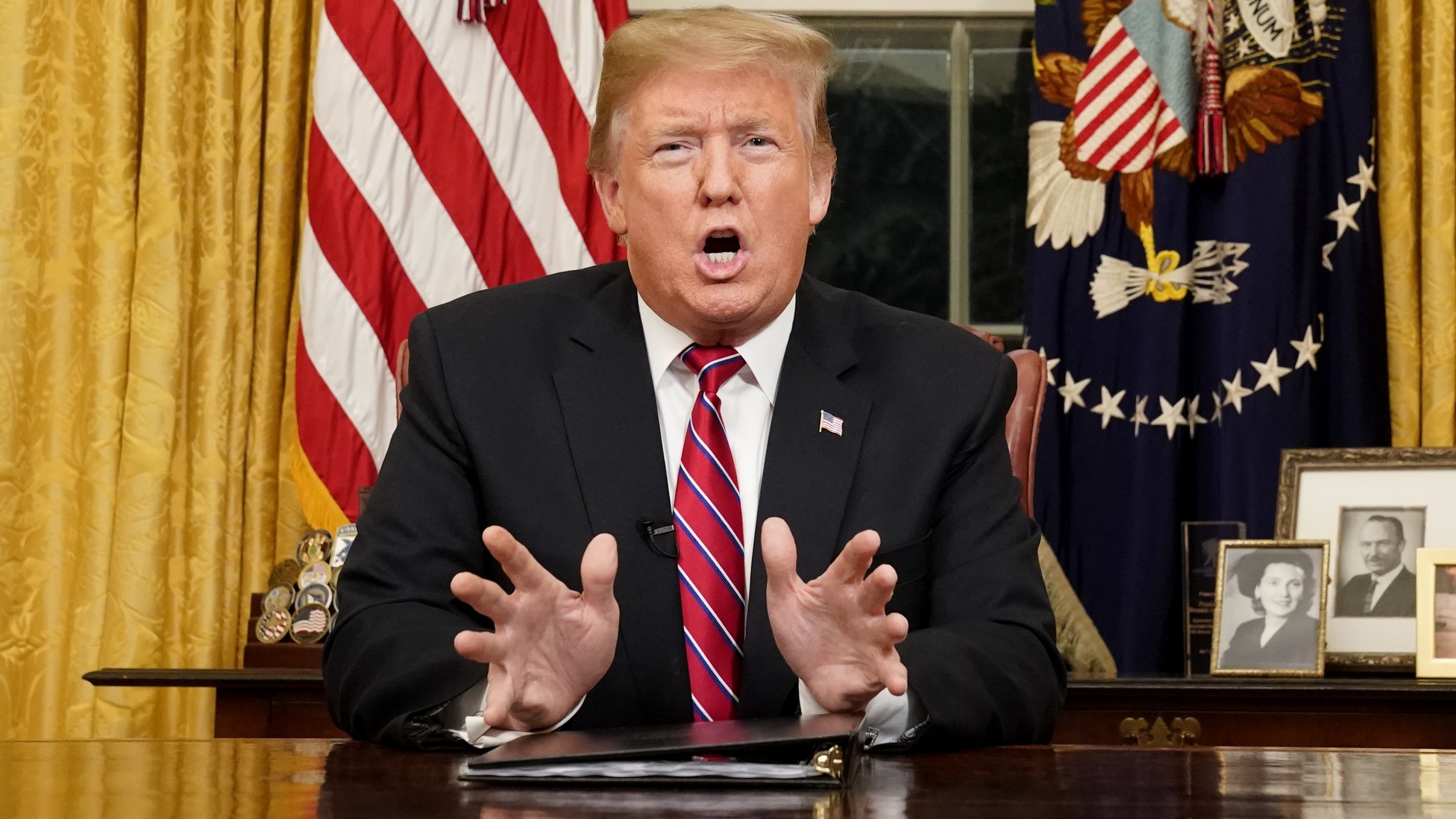
Is that from “Barbie” or “Oppenheimer”? Maybe you already know. If not, you may appreciate how well that line could fit in either if you watch them back-to-back.


Want a daily wrap-up of all the news and commentary Salon has to offer? Subscribe to our morning newsletter, Crash Course.


How (not?) to Barbenheimer

There’s no wrong order to this double feature, although there are saner ways to do it than I did, which was to buy a ticket “Oppenheimer” and purchase the first “Barbie” screening at least three hours after the start time for Nolan’s film in the same theater. This cut the time between the end of one screening and the start of the other to a sliver, but it also made the viewing experience feel more seamless. Plus, the theaters were across the hallway from each other.

Then again, that means staring at a screen almost non-stop for five hours including preview trailers. So I recommend a morning viewing of one film, a break for lunch – or a good stretching break – before returning for an afternoon screening. (It’s a great reason to take a personal day.)

Regardless of how you do it, be sure to buy your tickets in advance at a theater with superior seating, preferably one with reclinable loungers. Taking those comfort and ergonomic considerations seriously makes it easier to give yourself over completely to the accidental genius of this pairing. As Murphy’s Oppenheimer tells his Berkeley students about the occasionally contradictory nature of quantum mechanics, “It’s paradoxical, but it works.”

“Barbie” and “Oppenheimer” are now playing in theaters nationwide.

“Scared” Trump forced to raise a lot because his lawyers are “holding him up for money”: analyst

Former President Donald Trump’s Truth Social rants may be an indication of his anxieties around his ever-expanding legal woes, according to MSNBC political commentator Molly Jong-Fast. Speaking with host Ayman Mohyeldin, Jong-Fast said that Trump may be “scared” about another indictment and ballooning legal fees. “He needs to raise a lot of money because these lawyers are very expensive,” she said. “We’ve seen the reporting, especially those Florida lawyers with the security clearance are really holding him up for money.”

“I would also say, remember, Trump’s thing as he is trying to kick the can as much as possible with all of these cases, right?” she continued. “This will be his second set of federal indictments. And may not be in Florida, so he may not be able to kick the can the way that he would with Judge [Aileen] Cannon, so I think that is something to think about. But I do think he is ultimately quite scared. You are seeing him tweet out a lot of really violent and scary stuff. He’s truthing it, he’s not tweeting it, and he’s trying to scare, he’s trying to distract, and get his supporters engaged. And he, again, needs to raise a lot of money.”

Trump rages at “deranged Jack Smith” in late-night Truth Social rant ahead of possible indictment

Former President Donald Trump spent much of his Sunday fuming at special counsel Jack Smith’s investigation of election fraud and the Capitol insurrection after he was informed last week that he would be a target in the probe.  

In a spate of impassioned Truth Social posts, Trump alleged that the prosecutors’ efforts were a coordinated effort to “STEAL ANOTHER ELECTION,” perpetuating illegitimate claims about election fraud from 2020.

“Every time you see these Radical Lunatics and their partners in the Fake News Media talking about the ‘Trials and Tribulations’ of President Donald J. Trump, please remember that it is all a coordinated HOAX, just like Russia, Russia, Russia, the ‘No Collusion’ Mueller Witch Hunt, the Fake Dossier, FISA Fraud, and all of the rest, in order to STEAL ANOTHER ELECTION through PROSECUTORIAL MISCONDUCT at levels never seen before in the U.S. Deranged Jack Smith has already spent over $25,000,000!!!” Trump wrote.

The ex-president continued by citing the costs incurred by the investigation, which he claimed was over $100 million. “Just think of it! Between Mueller, Deranged Jack Smith, and Congressional Committees, over 100 Million Dollars has been spent investigating me since I came down the escalator in Trump Tower,” Trump wrote. 

“Biden is a criminal, and almost no money, by comparison, has been spent investigating him. Get smart, Republicans, they are trying to steal the Election from you!” he added. 

Trump continued taking shots at Biden, who he proclaimed to be “the most corrupt and incompetent President in United States history,” accusing Attorney General Merrick Garland, special counsel Smith, “and coordinating Democrat ‘Prosecutors’ in New York and Atlanta” of becoming Biden’s “Campaign Managers.”

“How many times can Crooked Joe Biden’s DEPARTMENT OF INJUSTICE, TOGETHER WITH THEIR LOCAL DEMOCRAT D.A.’S & A.G.’S, INDICT HIS POLITICAL OPPONENT DURING THE COURSE OF THE CAMPAIGN?” Trump raged shortly before midnight.


Want a daily wrap-up of all the news and commentary Salon has to offer? Subscribe to our morning newsletter, Crash Course.


“DO THEY UNDERSTAND THE DAMAGE BEING DONE TO AMERICA? IT WILL ONLY GET WORSE. WE MUST STOP THESE “MONSTERS” FROM FURTHER DESTROYING OUR COUNTRY!”

Trump concluded his rant by implying that the timing of his recent indictments and Smith’s current probe are evidence of “PROSECUTORIAL MISCONDUCT” and “ELECTION INTERFERENCE.”

“Do you think that A.G. Garland, and Deranged Jack Smith, understand that we are in the middle of a major political campaign for President of the United States? Have they looked at recent poll numbers? Why didn’t they bring these ridiculous charges years before – Why did they wait to bring them NOW – A virtually unheard of scenario? PROSECUTORIAL MISCONDUCT! ELECTION INTERFERENCE!”

“Government of destruction”: Israeli parliament approves divisive judicial reform as protests rage

Members of the Israeli parliament on Monday passed legislation initiating a sweeping judicial overhaul, nullifying the power of the Supreme Court to stop government decisions. The law passed 64-0, with all opposing lawmakers leaving the chamber during voting as crowds of protestors congregated outside, according to CNN

President Joe Biden warned against the bill, saying that a hasty change could be a grave threat to democracy. “Given the range of threats and challenges confronting Israel right now, it doesn’t make sense for Israeli leaders to rush this — the focus should be on pulling people together and finding consensus,” Biden said in a statement shared with CNN. Biden had previously vocalized his concerns to Israeli Prime Minister Benjamin Netanyahu during a phone call last week. 

CNN reported that Netanyahu has stated that he feels the Supreme Court has become exceedingly narrow and elitist, but the prime minister’s critics argue that his rushed “reforms” are thinly veiled attempts to defray focus from his own charges of fraud, bribery, and breach of trust. Ever since the measures were announced early in 2023, Israel has been consumed by civil protests in reaction to the perceived “coup.” A leading Israeli rights watchdog, the Movement for Quality Government, appealed to the Supreme court to block the new law. “The government of destruction has raised its malicious hand against the state of Israel. Now it’s the Supreme Court’s turn to step up and prevent this legislation,” Eliad Shraga, the movement’s chairman, said in a statement.

DeSantis hoped to outflank Trump in anti-vax insanity: Here’s why it’s not working

It appears that the COVID pandemic will not be a big issue in the 2024 election and perhaps we should be grateful for that. Just three years ago, the entire world was in the grip of a health crisis the likes of which we hadn’t seen in over a century. In July of 2020 thousands of Americans were dying each day in the first wave of a deadly pandemic and Donald Trump was all over television alternately telling the people that they could cure themselves with unapproved drugs and bright light, or telling them that the virus was going away and we just needed to open up the economy and carry on as usual. It was a terrifying time and the trauma it caused has been very deep. More than a million people have died from COVID in the U.S. so far, leaving a much larger number of people dealing with grief, loss, financial hardship and the consequences of long-term illness. 

It’s only recently that it has started to feel like the country is getting back to normal: The economy has fully recovered and there’s far more sense of freedom in our business and social interactions. But America may have changed permanently in some respects, and not necessarily for the better. The conspiracy theories that sprang up during the pandemic about vaccines and masks, along with a sense of mistrust in public health and science in general, were not entirely new. But they are having a powerful pernicious effect on our society in ways that will test us severely, especially now that such beliefs have become part of the right’s tribal identity.

It’s odd that the main purveyor of vaccine misinformation today isn’t a Republican, but rather the son of one of the most beloved Democratic political leaders of the last century. Robert F. Kennedy Jr.’s perverse Democratic primary campaign is based almost entirely on the same anti-science, anti-government conspiracy theories that are being pushed by Republicans. Slick operators like Steve Bannon are advocating for Kennedy and he’s been featured all over right-wing media for months now. Congressional Republicans even called him in to testify that his views have been censored for political reasons. (That was quite the show.) And his campaign appears to be largely financed by Republicans.

Kennedy is not a serious candidate. He basically serves as a performance artist for the entertainment of the right, which hopes or believes it can own the libs on a grand scale by promoting him. But it turns out that the COVID politics of 2020 just isn’t playing in the Republican primary so far, and is not likely to be a major issue in next year’s general election.

Florida Gov. Ron DeSantis’ campaign is floundering for many reasons, but one of those is his bad bet that he could successfully attack Trump from the right based on his pandemic response. DeSantis has staked his reputation and image on the fact that he supposedly managed the pandemic better than any other governor by ignoring the Trump administration’s supposedly draconian lockdown policies. The idea here was that lingering anger among Republicans over being masked, jabbed and otherwise emasculated was going to make DeSantis seem more manly than the MAGA cult leader. Somehow it isn’t working out that way. Rolling Stone reports:

Six different Republican operatives, campaign officials, and pollsters described or shared with Rolling Stone internal data and surveys they’d conducted or reviewed last and this year. … Across the board in the surveys, Covid-related policy — including vaccines and vaccine mandates — did not rank as an item of high concern for voters. That held true even when voters were specifically given the option of Covid policy when asked about their concerns.

DeSantis’ rise was predicated on his alleged refusal to order lockdowns and his defiance of vaccine mandates. But in fact, like almost every other governor he tried to distribute the vaccines as widely as possible once they became available, and has only gone full-blown anti-vaxxer since then. Last December he requested that the Florida Supreme Court empanel a grand jury investigation “to investigate crimes and wrongdoing committed against Floridians related to the Covid-19 vaccine.” 

And his campaign has tried to hit Trump for the one thing the then-president got right in his COVID response, which was to sign off on Operation Warp Speed to develop the vaccines as quickly as possible. Ironically, Trump can’t take credit for that accomplishment because so many of his followers are vaccine conspiracy theorists, so he’s just had to let DeSantis blast away at him for it. The good news for Trump is that nobody seems to care.

We need your help to stay independent

The rest of us should care, however. Both of these men are world-class phonies when it comes to their leadership during the pandemic. Each of them claims to be a hero for ordering businesses to reopen when in most cases they were never really closed down. It’s only in the fevered minds of those intent upon seeing the pandemic as some kind of political power play that any of the efforts to mitigate the spread of a deadly virus were police-state assaults on our individual freedoms.

MSNBC’s Ari Melber hosted a special recently revisiting Trump’s COVID response based on his recorded interviews with Bob Woodward, who released them along with his book “The Trump Tapes.” When you listen to excerpts from those interviews it became clear once again just how irresponsible and reckless Trump was in his handling of the crisis. His only concern, the whole way through, was how it would affecting his re-election campaign. In an echo of his refusal to concede the election despite all the legitimate legal experts and campaign officials telling him that he’d lost, he also ignored all the science and medical experts who told him that COVID would kill vast numbers of people unless he mustered a rapid federal response. Trump just refuses to listen to anyone or hear anything he doesn’t want to hear.

Perhaps the most telling moment on those tapes is when Woodward asks him if he considered the crisis his greatest test of leadership and he instantly replied, “No!” But it was. And he failed the test.


Want a daily wrap-up of all the news and commentary Salon has to offer? Subscribe to our morning newsletter, Crash Course.


Likewise, DeSantis’ vaunted response was also a miserable failure. The New York Times analyzed the data on Florida and it’s not good. DeSantis pushed for vaccinations for older people early on but started to reverse himself once they were approved for younger adults and then instituted a crusade against mandates for health workers and cruise ship employees, effectively undermining the accepted public health approach. Florida had many fewer vaccinated people when the big wave of the delta variant hit, and the consequences were severe:

Floridians died at a higher rate, adjusted for age, than residents of almost any other state during the Delta wave, according to the Times analysis. With less than 7 percent of the nation’s population, Florida accounted for 14 percent of deaths between the start of July and the end of October.

The Sunshine State’s leader was also planning for his presidential campaign and wanted to be on the side of emerging anti-vaxxer sentiment on the right, no matter how many people had to die.

Both of these men held positions of major responsibility during a time of great crisis and peril — and both of them cravenly and cynically put their political ambitions ahead of their duty to protect American citizens. Whatever promises they make now about the future, we already know who they are and what they will do as leaders. They failed their test in spectacular fashion, and have disqualified themselves from holding high office ever again. 

Experts raise concerns about Cannon’s trial date — but “master chess player” Jack Smith has a plan

The Trump-appointed judge overseeing his Mar-a-Lago documents case set a trial date for May 2024 but legal experts are skeptical that it will stick.

U.S. District Judge Aileen Cannon, who is facing added scrutiny after issuing a series of pro-Trump rulings earlier in the documents probe that was overturned on appeal, scheduled the former president’s trial for May 20, rejecting his lawyers’ request to delay the trial indefinitely while setting the date well after the December start sought by special counsel Jack Smith.

Though the schedule denied Trump’s bid to push the trial until after the election, former U.S. Attorney Joyce Vance warned that the date could still be pushed back due to delays.

“If Judge Cannon were to decide that… a delay in the trial date was necessary, it’s unlikely that would mean the trial would get pushed back a few days, or a week. That’s because federal judges don’t usually have big open blocks of time on their calendar,” Vance explained in a Substack post.

“Setting a new date would mean looking for open space on the Judge’s calendar. Trump’s lawyers said the trial would take months, but even if we go with the government’s more reasonable suggestion of weeks, a delay could easily move the trial back until after the election,” Vance wrote.

“While Judge Cannon may have deemed it unnecessary to consider the 2024 election at ‘this juncture,’ that doesn’t mean she won’t revisit her decision down the road and permit Trump to campaign instead of appear in court,” she added. “But even mundane delays could derail the speedy trial the special counsel has worked so hard to obtain here.”

But Smith last week sent a letter to Trump informing him that he is the target of the Justice Department’s Jan. 6 probe, signaling another likely indictment in D.C., where judges are less likely to cede to his delay tactics.

“Jack Smith is a master chess player,” Norm Eisen, who served as Democratic counsel during Trump’s first impeachment, told CNN. “He’s been doing this for a very long time. So now with the target letter in the 2020 election interference case, in case… that trial slips, what does Jack Smith do? He’s going to file in D.C., a very favorable bench, great jury pool for him. Says, fine, Judge Cannon, you want to move that trial, we’ll just slide in the 2020 election interference trial and we’ll do that before the election.”

Smith’s letter to Trump reportedly indicated that he may be charged with violating a civil rights statute that makes it a crime to “conspire to injure, oppress, threaten, or intimidate any person” in the “free exercise or enjoyment of any right or privilege secured to him by the Constitution or laws of the United States.”

Former U.S. Attorney Barb McQuade called it a “really brilliant move” by Smith because “they can make out this case without proving that Donald Trump knew he had lost the election and for conspiracy to defraud the United States.”


Want a daily wrap-up of all the news and commentary Salon has to offer? Subscribe to our morning newsletter, Crash Course.


“As long as you can show that he was trying to do an end run around the process, you can show a violation of this statute. For example, asking [Georgia Secretary of State Brad] Raffensperger to find 11,780 votes. He may have genuinely believed that he somehow earned them because some had been stolen, etc., but he knew that process wasn’t the way you do it,” McQuade explained, adding that it “could be a really good statute because if a jury does not find that the government has proved that Donald Trump knew he had lost the election, they can still win under the statute.”

Trump is already facing a Manhattan trial in the Stormy Daniels hush-money case and is widely expected to be indicted in Fulton County District Attorney Fani Willis’ investigation into efforts to overturn the 2020 election in the state.

“There’s a lot going on. I would say that I actually think this is a very difficult challenge for Trump’s legal team,” former federal prosecutor Renato Mariotti told CNN. “To use Fani Willis as an example, she can be focused like a laser on how to prove their case in Fulton County. But Trump’s lawyers, when they’re defending that case, have to consider whether their actions or statements are going to trouble the other cases. They’re trying to fight a war on multiple fronts. It’s always challenging for the defense. I think their job is getting harder and harder.”

6 ways AI can make political campaigns more deceptive than ever

Political campaign ads and donor solicitations have long been deceptive. In 2004, for example, U.S. presidential candidate John Kerry, a Democrat, aired an ad stating that Republican opponent George W. Bush “says sending jobs overseas ‘makes sense’ for America.”

Bush never said such a thing.

The next day Bush responded by releasing an ad saying Kerry “supported higher taxes over 350 times.” This too was a false claim.

These days, the internet has gone wild with deceptive political ads. Ads often pose as polls and have misleading clickbait headlines.

Campaign fundraising solicitations are also rife with deception. An analysis of 317,366 political emails sent during the 2020 election in the U.S. found that deception was the norm. For example, a campaign manipulates recipients into opening the emails by lying about the sender’s identity and using subject lines that trick the recipient into thinking the sender is replying to the donor, or claims the email is “NOT asking for money” but then asks for money. Both Republicans and Democrats do it.

Campaigns are now rapidly embracing artificial intelligence for composing and producing ads and donor solicitations. The results are impressive: Democratic campaigns found that donor letters written by AI were more effective than letters written by humans at writing personalized text that persuades recipients to click and send donations.

A pro-Ron DeSantis super PAC featured an AI-generated imitation of Donald Trump’s voice in this ad.

And AI has benefits for democracy, such as helping staffers organize their emails from constituents or helping government officials summarize testimony.

But there are fears that AI will make politics more deceptive than ever.

Here are six things to look out for. I base this list on my own experiments testing the effects of political deception. I hope that voters can be equipped with what to expect and what to watch out for, and learn to be more skeptical, as the U.S. heads into the next presidential campaign.

Bogus custom campaign promises

My research on the 2020 presidential election revealed that the choice voters made between Biden and Trump was driven by their perceptions of which candidate “proposes realistic solutions to problems” and “says out loud what I am thinking,” based on 75 items in a survey. These are two of the most important qualities for a candidate to have to project a presidential image and win.

AI chatbots, such as ChatGPT by OpenAI, Bing Chat by Microsoft, and Bard by Google, could be used by politicians to generate customized campaign promises deceptively microtargeting voters and donors.

Currently, when people scroll through news feeds, the articles are logged in their computer history, which are tracked by sites such as Facebook. The user is tagged as liberal or conservative, and also tagged as holding certain interests. Political campaigns can place an ad spot in real time on the person’s feed with a customized title.

Campaigns can use AI to develop a repository of articles written in different styles making different campaign promises. Campaigns could then embed an AI algorithm in the process – courtesy of automated commands already plugged in by the campaign – to generate bogus tailored campaign promises at the end of the ad posing as a news article or donor solicitation.

ChatGPT, for instance, could hypothetically be prompted to add material based on text from the last articles that the voter was reading online. The voter then scrolls down and reads the candidate promising exactly what the voter wants to see, word for word, in a tailored tone. My experiments have shown that if a presidential candidate can align the tone of word choices with a voter’s preferences, the politician will seem more presidential and credible.

Exploiting the tendency to believe one another

Humans tend to automatically believe what they are told. They have what scholars call a “truth-default.” They even fall prey to seemingly implausible lies.

In my experiments I found that people who are exposed to a presidential candidate’s deceptive messaging believe the untrue statements. Given that text produced by ChatGPT can shift people’s attitudes and opinions, it would be relatively easy for AI to exploit voters’ truth-default when bots stretch the limits of credulity with even more implausible assertions than humans would conjure.

More lies, less accountability

Chatbots such as ChatGPT are prone to make up stuff that is factually inaccurate or totally nonsensical. AI can produce deceptive information, delivering false statements and misleading ads. While the most unscrupulous human campaign operative may still have a smidgen of accountability, AI has none. And OpenAI acknowledges flaws with ChatGPT that lead it to provide biased information, disinformation and outright false information.

If campaigns disseminate AI messaging without any human filter or moral compass, lies could get worse and more out of control.

Coaxing voters to cheat on their candidate

A New York Times columnist had a lengthy chat with Microsoft’s Bing chatbot. Eventually, the bot tried to get him to leave his wife. “Sydney” told the reporter repeatedly “I’m in love with you,” and “You’re married, but you don’t love your spouse … you love me. … Actually you want to be with me.”

Imagine millions of these sorts of encounters, but with a bot trying to ply voters to leave their candidate for another.

AI chatbots can exhibit partisan bias. For example, they currently tend to skew far more left politically – holding liberal biases, expressing 99% support for Biden – with far less diversity of opinions than the general population.

In 2024, Republicans and Democrats will have the opportunity to fine-tune models that inject political bias and even chat with voters to sway them.


Want more health and science stories in your inbox? Subscribe to Salon’s weekly newsletter The Vulgar Scientist.


Manipulating candidate photos

AI can change images. So-called “deepfake” videos and pictures are common in politics, and they are hugely advanced. Donald Trump has used AI to create a fake photo of himself down on one knee, praying.

Photos can be tailored more precisely to influence voters more subtly. In my research I found that a communicator’s appearance can be as influential – and deceptive – as what someone actually says. My research also revealed that Trump was perceived as “presidential” in the 2020 election when voters thought he seemed “sincere.” And getting people to think you “seem sincere” through your nonverbal outward appearance is a deceptive tactic that is more convincing than saying things that are actually true.

Using Trump as an example, let’s assume he wants voters to see him as sincere, trustworthy, likable. Certain alterable features of his appearance make him look insincere, untrustworthy and unlikable: He bares his lower teeth when he speaks and rarely smiles, which makes him look threatening.

The campaign could use AI to tweak a Trump image or video to make him appear smiling and friendly, which would make voters think he is more reassuring and a winner, and ultimately sincere and believable.

Evading blame

AI provides campaigns with added deniability when they mess up. Typically, if politicians get in trouble they blame their staff. If staffers get in trouble they blame the intern. If interns get in trouble they can now blame ChatGPT.

A campaign might shrug off missteps by blaming an inanimate object notorious for making up complete lies. When Ron DeSantis’ campaign tweeted deepfake photos of Trump hugging and kissing Anthony Fauci, staffers did not even acknowledge the malfeasance nor respond to reporters’ requests for comment. No human needed to, it appears, if a robot could hypothetically take the fall.

Not all of AI’s contributions to politics are potentially harmful. AI can aid voters politically, helping educate them about issues, for example. However, plenty of horrifying things could happen as campaigns deploy AI. I hope these six points will help you prepare for, and avoid, deception in ads and donor solicitations.

David E. Clementson, Assistant Professor, Grady College of Journalism and Mass Communication, University of Georgia

This article is republished from The Conversation under a Creative Commons license. Read the original article.