Editor:
Updated: Today
Topic:

Bank Reform

Getting the bankers out of the Fed

See ya later, Jamie Dimon. Under the Dodd bill, bankers will no longer be able to choose their own supervisors

AP
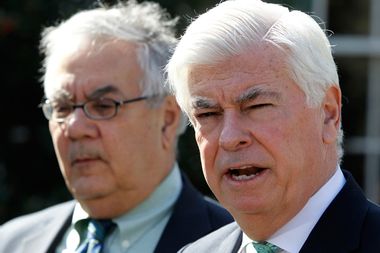
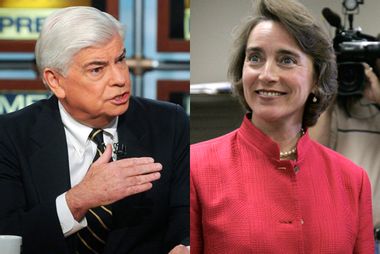
Senator Chris Dodd (left) and Jamie Dimon

Pack up your bags, Jamie Dimon. The CEO of JPMorgan Chase currently serves as a Class A director of the Federal Reserve Bank of New York, which is awfully convenient, considering that the FRBNY is charged with supervising his bank. But if Sen. Chris Dodd's proposed "Restoring American Financial Stability Act" emerges from the legislative grinder intact, Dimon and other Wall Street bankers will no longer have a near-automatic seat on the regulatory body charged with watching over them.

The Financial Times' Tom Braithwaite dropped this intriguing bomb:

The new proposal would bar appointments of Wall Street bankers as directors at the New York Fed.

I hadn't seen this news elsewhere, and it took a little digging to find the relevant text in the bill. And having done so, it's unclear that the bill specifies exactly what the FT is reporting.

Section 1202, on page 1127, "Selection of Boards of Directors of Federal Reserve Banks," tells us that a specific section of the Federal Reserve Act, (12 U.S.C. 304) will be amended by striking paragraphs 16, 17, and 18. If you look up those paragraphs, you will find that they are the enabling authority for member banks of a regional Federal Reserve Bank to elect their own representatives as directors of the bank.

Directors of class A and class B shall be chosen in the following manner: The Board of Governors of the Federal Reserve System shall classify the member banks of the district into three general groups or divisions designating each group by number. Each group shall consist as nearly as may be of banks of similar capitalization. Each member bank shall be permitted to nominate to the chairman of the board of directors of the Federal reserve bank of the district one candidate for director of class A and one candidate for director of class B.

Under the Dodd bill all class A and B directors will be appointed by the Board of Governors of the Federal Reserve System. The Bill also directs that the Board of Governors, "shall establish a public process for soliciting comments relating to the selection of Class B and Class C directors of the Federal reserve banks, to ensure that the interests of agriculture, commerce, industry, services, labor, and consumers are adequately represented."

So I'm not sure the FT has it quite right. As I read the bill, the Board of Governors can appoint whomever they like -- but member banks can no longer elect their own representatives. So as long as the banking lobby wields enough influence to ensure that "acceptable" people are appointed to the Board of Governors, there likely won't be much in the way of unpleasant surprises for Wall Street. But ending the process in which JP Morgan and Citigroup and all the rest are allowed to elect their own CEOs to serve on the regulatory body that oversees them still seems like a positive step. We'll see if it makes it through to law.

Dodd's bank reform bill lumbers into view

The Senate Banking Committee gets a week to digest the 1,336-page bill before marking it up. Good luck with that

Reuters/Jason Reed
Sen. Chris Dodd, D-Conn., unveils his financial reform substitute on Capitol Hill in Washington on Monday.

Sen. Chris Dodd, D-Conn., released his long-awaited draft of a new financial regulatory reform bill on Monday. It is 1,336 pages long, which means, unless you want to crib from the "factsheet" summary released by the Senate Banking Committee, that it will probably require another couple of hours before the regulation geeks can tell us exactly what is inside this monster. (The early word: The Fed will get more power.)

One section likely to be of great interest to both the banking industry and its critics starts on page 492 of the "Restoring American Financial Stability Act of 2010": Title VII, "Improvement to Regulation of Over-the-Counter Derivatives. "

I'm working my way through it, but I was caught up short right at the start. In Subtitle A: "Regulation of Swap Markets," Section 711: "Definitions," part (a): "Amendments to Definitions in the Commodity Exchange Act," sub-section (2), the Act provides a five part definition of what kinds of derivatives are considered "swaps." Part three is characterized by a certain mad financial poetry.

...[T] he term 'swap' means any agreement, contract, or transaction that --

(iii) provides on an executory basis for the exchange, on a fixed or contingent basis, of one or more payments based on the value or level of one or more interest or other rates, currencies, commodities, securities, instruments of indebtedness, indices, quantitative measures, or other financial or economic interests or property of any kind, or any interest therein or based on the value thereof, and that transfers, as between the parties to the transaction, in whole or in part, the financial risk associated with a future change in any such value or level without also conveying a current or future direct or indirect ownership interest in an asset (including any enterprise or investment pool) or liability that incorporates the financial risk so transferred, including any agreement, contract, or transaction commonly known as an interest rate swap, a rate floor, rate cap, rate collar, cross-currency rate swap, basis swap, currency swap, total return swap, equity index swap, equity swap, debt index swap, debt swap, credit spread, credit default swap, credit swap, weather swap, energy swap, metal swap, agricultural swap, emissions swap, or commodity swap.

Whew. I needed a long break just after reading that one sentence, and it was only one part of a definition. How long do you think it will be before the members of the Senate Banking Committee are all fully up to speed on the implications of every new rule in the entire Act?

Dodd unveils plan to tame financial markets

Connecticut senator's bill would allow government to break up firms that threaten the economy

AP/Harry Hamburg
Sen. Chris Dodd, D-Conn., at a news conference in Washington on March 11.

A Democratic Senate bill to tame the financial markets would give the government new powers to break up firms that threaten the economy and would force the industry to pay for its failures.

Legislation unveiled Monday by Senate Banking Committee Chairman Christopher Dodd falls shy of the ambitious restructuring of federal financial regulations envisioned by President Barack Obama or contained in legislation already passed in the House.

But the bill would still be the biggest overhaul of regulations since the New Deal. It comes 18 months after Wall Street's failures helped plunge the nation into a deep recession.

The Connecticut Democrat unveiled the bill at a Capitol Hill news conference.

THIS IS A BREAKING NEWS UPDATE. Check back soon for further information. AP's earlier story is below.

WASHINGTON (AP) -- Combining Obama administration and Republican priorities, the leading Senate author of a sweeping rewrite of U.S. financial regulations is looking for consensus with a proposal that neither side of the political spectrum is ready to embrace.

Sen. Christopher Dodd, the chairman of the Senate Banking Committee, plans to unveil a proposal Monday that expands the powers of the Federal Reserve but creates a consumer protection entity with less authority than President Barack Obama once demanded.

His draft legislation aims to avoid a recurrence of the financial crisis that brought Wall Street to the verge of collapse 18 months ago. It would restrict the size and interconnections of large financial institutions once deemed "too big to fail," tame previously unregulated shadow markets with new restrictions and create a dismantling mechanism for failing financial giants without a bail out from taxpayers.

While navigating in the middle of the road, Dodd has not won the support of Republicans. And Democrats inside and outside his committee, as well as consumer advocates are eager to change his consumer proposals.

"Members have to make up their minds," Dodd said Sunday in an interview with The Associated Press. "While they may not like everything here, I'm not going to give them much room to say we shouldn't do anything."

In looking for common ground, Dodd significantly shifted from financial regulations he proposed four months ago, when he called for a single powerful regulator to oversee all of the nation's banks and for a stand-alone consumer financial protections agency.

Instead, as preferred by the Obama administration, the Federal Reserve would gain oversight of all financial firms -- banks and nonbanks -- that are considered the biggest and most interconnected. For the central bank, the price of such power is losing supervision over smaller bank holding companies with less than $50 billion in assets.

Moreover, to the dismay of liberals and consumer advocates, the Fed would also house a consumer protection entity. That agency would be headed by a presidential appointee and would have an independent source of funds not subject to congressional appropriations. But its power to write regulations would be subject to review by a council of regulators that could veto consumer rules by a two-thirds vote.

John Taylor, head of the National Community Reinvestment Coalition, a consumer advocacy group, said Dodd was "capitulating to the industry's interests."

"He's offering a faux consumer protection agency that holds little promise to be effective in the long run," Taylor said.

In a nod to the White House, however, Dodd is expected to propose that states have enhanced ability to enforce consumer rules. State attorneys general and the Obama administration have called for such authority. Financial regulations approved by the House in December gave states more leeway to write and police their own consumer laws.

That consumer provision veered from the agreement Dodd and Republican Sen. Bob Corker had tentatively reached last week before Dodd decided it was time to stop negotiating and write a bill.

"We probably conceptually maybe agree on 85 or 90 percent of a bill," Sen. Richard Shelby, the top Republican on the Banking Committee, said Monday on CNBC. "It's a question of how do we move it forward." Besides differences with Democrats on consumer protections, Shelby cited "sticking points" on such issues as regulations of complex, previously unregulated transactions and giving shareholders a voice on executive pay.

Obama wants Yellen as Fed vice chair

Source says president of San Francisco Federal Reserve Bank will be nominated for vacant seat

President Barack Obama intends to nominate Janet Yellen, the president of the Federal Reserve Bank of San Francisco, to take over as vice chairman of the Federal Reserve, a person familiar with the selection said Friday.

Yellen is considered a dove on monetary policy, meaning she is more concerned about high unemployment than rising inflation. As vice chair she would be the second highest ranking Fed official.

Fed Vice Chairman Donald Kohn's decision to step down at the end of June opened a third seat on the seven-member board, giving Obama a chance to put a bigger imprint on the central bank. His selections would have to be confirmed by the Senate.

The Federal Reserve can control economic growth, employment and inflation through its power to set interest rates. It also is the country's lender of last resort when banks can't get their money elsewhere -- a tool that the Fed exercised fully at the height of the financial crisis. It also supervises thousands of banks, ranging from large bank holding companies to small state-chartered institutions.

The Fed vacancies have stirred debate over the future direction of interest-rate policy at the Fed. Given the fragile state of the economic recovery and the high jobless rate, Obama may come under pressure to choose people more inclined to keep interest rates low to spur growth and fight unemployment than to raise them to control inflation.

Yellen served as a top economic adviser to President Bill Clinton. She has had a long history with the Federal Reserve system and has been president of the San Francisco Fed since 2004. Before that she was a member of the Fed's Board of Governors from 1994 to 1997.

------

Associated Press writer Jeannine Aversa contributed to this report.

Chris Dodd backbone alert

For the second time, the senator ditches the GOP on bank reform and says Dems will go it alone

AP/Cliff Owen
Senate Banking Committee Chairman Christopher Dodd, D-Conn.

What is Chris Dodd up to? On Thursday, the Democratic chairman of the Senate Banking Committee announced that he will unveil his version of a financial regulatory reform package next Monday, without, reports the New York Times, "yet having a single Republican endorsement."

Negotiations with Tennessee Republican Bob Corker appear to have broken down, possibly over the issue of whether payday lenders should be regulated by a proposed Consumer Financial Protection Agency.

Sound familiar? Just one month ago, Dodd announced that bipartisan talks were at an "impasse" and Democrats would go it alone. Back then, Alabama Republican Sen. Richard Shelby played the role of recalcitrant GOPer. But then, a few days later, word trickled out that Dodd had started negotiating with Corker.

Who's next?

Handicapping the fate of financial regulatory reform at this juncture seems nearly impossible, even for veteran Senate watchers. But there are a few things we know for sure. The bill gets weaker the further it progresses, and it is nowhere near as strong as the bill passed by Barney Frank in the House last December. In fact, according to ace financial regulation analyst Mike Rorty, the evolving Senate bill is beginning to look a lot like a proposed House GOP bill that never made it to the floor.

Corker, reports the Times, said he was "very disappointed" and that Dodd's gambit is likely an attempt to cover his left flank.

"I think what Chairman Dodd is going to do probably is introduce a bill on Monday that is a little to the left of where we were, to try to ensure that he can do as much as he can in the way of getting Democratic support on the committee. And then I think he will move to the right."

Let's try defining "moving to the right": Weakening the Consumer Financial Protection Agency as much as possible, avoiding tough derivatives regulation, and not coming anywhere close to prohibiting banks from the kind of risky bets that precipitated the financial crisis.

The conventional wisdom parrots Corker's position, since the Democrats only control 59 votes in the Senate and thus cannot beat a filibuster. Comparisons with the plight of healthcare reform abound.

But those comparisons are not valid. Whether you blame Republican obfuscation or Democratic compromises with the health industry, the public's attitude toward passing healthcare reform is highly ambivalent. Not so with Wall Street. Senate Democrats have a golden opportunity to put together a solid bill and then force Republicans to filibuster against it, thus placing the GOP in the clear position of defending the interests of the financial industry against the interests of the general public. It would be nice to think that Dodd is finally realizing this. But after watching his zigs and zags over the past few months, during which reform has only become more watered down, it's difficult to feel confident that finally, somehow, the Dems are willing and ready to make a stand.

But let's see what happens Monday.

SNL "presidents" gather for Web video summit

The ghosts of the comedy show's chief executives reunite on FunnyOrDie.com Video

The comedians who played presidents on "Saturday Night Live" have gathered for a comedic summit in a new Web video on FunnyOrDie.com.

The video, posted Wednesday, stars Fred Armisen as President Barack Obama. During the night, he is visited by the ghosts of presidents past, who urge him to push for financial reform.

Will Ferrell reprises his President George W. Bush, Darrell Hammond plays President Bill Clinton, Dana Carvey returns as President George H.W. Bush, Dan Aykroyd plays President Jimmy Carter and Chevy Chase returns as President Gerald Ford.

Jim Carrey, the lone comedian not a veteran of "SNL," appears as Ronald Reagan.

The video, directed by Ron Howard, was made in association with Americans for Financial Reform, a pro-regulation coalition of labor and consumer activists.

Page 1 of 15 in Bank Reform Earliest ⇒

Bank Reform in the news

Loading...

Currently in Salon

Other News