Cintra Wilson

Alice in Fashionland

Love-starved reality TV stars! Food-starved baby-faced models! Clothes that starve the imagination! A first foray into New York Fashion Week.

  • more
    • All Share Services

Alice in Fashionland

While I had always secretly considered myself a closet fashionista, in my dark private moments, the actual honor hadn’t been officially thrust on me until recently, when I started “Critical Shopping” for the New York Times.

Since then I have been on a total-immersion fashion crash course, flung headfirst into racks of swish, slash, trash and occasional genius, and walking out of my house with an increasingly bizarre confidence in the combination of short pants and sockless ankle boots. But there is more to couture, apparently, than just never throwing anything away and making sure everything is black.

This was my first stab at penetrating the glib, fripperous, cutthroat world of New York Fashion Week. I was as blind as a newborn pinky mouse.

I thought there would be an informal hazing before I was allowed into the big white tent at Bryant Park, where most of the shows were held. As Bumble and Bumble deloused my hair, someone would make me sign an affidavit about how many It Bags I’d touched in the last 14 days. A member of the elite Lagerfeld Jugen, in fingerless gloves and brownshirt uniform, would point an infrared pen perilously close to my retina and ask me to pronounce the name “Ghesquière.”

Well, it hasn’t been anything like that — just a big, sleazy, nonchalant prom with a lot of air kissing.

The event, particularly in the swarms around the tent lobby, is oddly informal, and surprisingly unglamorous. The lobby is, in effect, a portable mini-strip mall of installations from companies you wouldn’t expect to have such a visible presence here: for example, DHL shipping, whose booth offers worldwide mailing service and cookies with the company’s logo printed on them. Lycra has a coffee bar (the Lycra BRA-sserie — get it?) full of decapitated, armless mannequins wearing the latest in Lycra’s contributions to the world of lingerie.

The crowds elbowing each other to cram into the shows are largely composed of ill-mannered fashion student cliques with tight little deconstructed jackets, suede slouch boots, thigh-length cowl-neck sweaters and shellacky “Beyond Thunderdome” mullets. These unisex persons will gladly press their elbows into your jaw to better photograph the C-list celebrities being dragged around the room by their handlers, particularly the boys and girls in the cast of the reality TV show “Make Me a Supermodel” who, like Miss America contestants, were forced to loop around the lobby en masse and walk into the shows together, wave at the crowd with toothy, overly bright smiles and try to project something from their eyes besides flinty exhaustion. Once enough cameras had surrounded them, these poor kids would be directed to perform an air-punching group shout of purest TV enthusiasm: “Yeah!!!”

It made for an odd tension; the reality TV kids were clearly dying for big Costco loads of attention, nakedly offering themselves to be loved by a dubious and snotty crowd that found them somewhat deserving of derision. This imperative was confounded, however, by their exoskeleton of black-clad, swaggering producers, cameramen and bully-ish security personnel, who took it upon themselves to casually abuse anyone who got too curious, produced a camera or accidentally walked too close.

Love me!/Back away. Look at me!/No looking at her. Photograph me!/No cameras. (I saw a few of the girls hiding next to the Port-O-Lets later in the day, red-eyed and weak from severe human burnout. It was literally the only place their producers weren’t following them around and trying to siphon more TV energy out of them.)

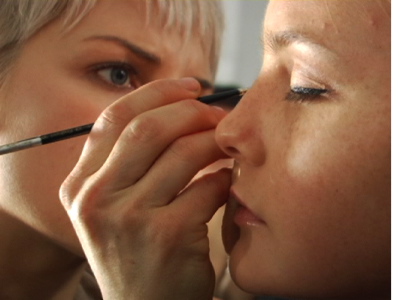
I caught on pretty quickly that the actual watching of models on actual runways, wearing actual clothes, is a pretty tiny part of the whole Fashion Week scene. The insiders prefer the behind-the-scenes action, either backstage, offstage, off-campus (at such tony venues as Harry Cipriani) and at after-parties in bars, the locations of which are closely held secrets that anyone sitting next to you will beg you for directions to.

So I ventured backstage to ask irrelevant questions of the designers and ogle the gorgeous little girls with their hair in curlers: 8-foot-tall high school girls with the bones of model airplanes and the faces of 8-year-old children. Their thighs are the same width as their ankles; their arms no bigger around than a silver dollar. A model named Carly, age 15, quickly became my favorite — an entirely sweet, corn-fed child. She is becoming famous on the runway for jutting out her tiny hips, leaning her shoulder blades to curve at a 30-degree angle over her 6-inch heels, stupefying her already bewildered expression into “someone slipped a Darvon in my Mountain Dew” and stomping down the catwalk looking like a zombie Slovakian sex slave.

The shows I’ve seen in the last few days (and there are many more to come) did have certain themes in common, suggesting either collusion, conspiracy or everyone coming up with the same bright new ideas at the exact same time:

1. Pewter = New Black.

2. Sharkskin, metallic knits and other Lurex-type shiny stuff will soon be glutting the market; think “Frank Sinatra Sings Ziggy Stardust.”

3. The color wheel of today and the foreseeable future is still stuck in the Lost Tomb of Sid and Marty Krofft. Every artificial flavor in the Dirty Sherbet freezer: anemic raspberry, radiator Kool-Aid, bleach-stain canary, Milk of Pepto-Bismol. There were, however, a couple of lighter brown tones I hadn’t seen before, which I took to calling Triscuit and Gerber Veal, since it looked like it came from a baby food jar.

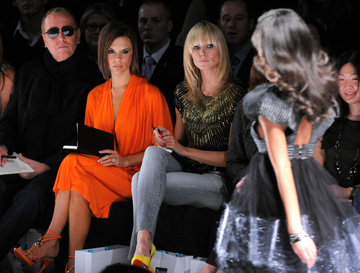
4. Stylist Rachel Zoe (notorious for creating emaciated fashion icons out of Nicole Richie and Mischa Barton, among others) was barely recognizable in the front row of Nicole Miller — I thought she was an Olsen twin. “Raisin Face had some work done,” said a woman next to me who writes a fashion blog in Chicago, referring to Ms. Zoe by her unkind (and now ill-fitting) Perez Hilton nickname. Rachel Zoe’s dress, however, looked like a taffeta yurt.

And so I plunged into the shows with my intake valve wide open, trying to take in as much of the experience as possible.

The Nicole Miller show was my first adventure (and the last time I will ever, ever sit in the back row).

While Miller, who was kind enough to grant me a quick interview before the show, was deeply cool, grounded and friendly, with an impressively quick sense of humor, this collection was not thrilling. Miller, usually known for her slinky, 1940s, body-conscious big-hot-date-night dresses, seemed to have been inspired by a winter car wash in Wisconsin.

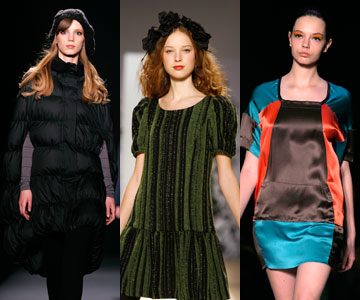
Dark, baggy and quilted prune shapes were topped with thick, black cable-knit sun visors. Colors better left not speaking to each other were thrown into bed together on boxy, two-tone blousons: battleship and butternut; exorcist split-pea and Muppet grape. Not seductive, but practical for avoiding sex and/or hypothermia.

Video: At the tents

Then it was on to the much-anticipated Erin Fetherston, who is surfing a monumental wave of hype. Fetherston drew, by far, the most celebrities to her show. (Most A-listy: Anne Hathaway, looking poised and divine in a beige sequin minidress; most attention-demanding: pothead author/socialite Arden Wohl, in signature flapper headband and off-shoulder tunic.) As for the garments themselves, Fetherston’s catwalk was full of Degas Quaalude Ballerinas, moss-green velvet Hobbit Sluts and Pre-Raphaelite Hippy Brides; these designs were reportedly inspired by the fact that Fetherston had once played Juliet in high school.

I needed to go to the People for a verdict, so I bummed a cigarette from two underage women outside the show, afterward.

“I loved that black dress with the puffy sleeves!” one girl enthused.

“I hated that dress with the puffy sleeves,” I snarled. “I’ve been living in fear that cut would make a comeback. No waist, huge shoulders, like a hefty bag with football pads. I called it ‘Bridesmaid Revisited.’”

“Yeah, yeah, but it’s perfect for me,” said this young lady, who revealed a similar high-necked ivory lace number under her coat. “I like it. It shows my legs and not my tummy or anything else.”

Fetherston will probably do great with those socialites and L.A. types who embrace that “Don’t look like you’re trying too hard” look. Oh, heavens, what time is it? I just rolled out of my bed and threw on some Lapis Lazuli tights and this Klimt-floral gauze thing, teased out my split ends and voilà. Got any Klonopin?

The insufferable people standing in front of the line for the Alexandre Herchcovitch show made me want to commandeer the Mercedes SUV sitting in the tent and pull a Lizzie Grubman.

But the show, in my Humble O, was a revelation: very daring, lots of spirit, tons of artistry, skill and intelligence. There are some designers whose work absolutely leaps out and throttles you with its brilliance; this guy has the voodoo.

He used interesting shapes: odd bells made of black Persian lamb, like small hoop skirts worn around the neck and shoulders, paired with long, black wool gowns with whole surprise sections of sheer silk. I called it “Hunchback of the Breakfast at Tiffany’s.” It was new and a little disturbing. I loved it.

There were bull’s-eye-target spinnaker prints folded into geometric, feudal Japanese shapes: Seven Samurai meets ’80s New Wave, with just a touch of young Nadia Comaneci, and half-remembered shapes from past events you couldn’t quite place. The show was a lavish stomp through a design mind spilling over with fantastic instincts for fusing craft, history and the inspired unimaginable. (Soundtrack: “Sharkey’s Day” by Laurie Anderson. Nice to hear William Burroughs’ voice growling out over the loudspeakers.)

The boxy orange dress Herchkovitch used for his finale I nicknamed “2001 Space Odyssey Stewardess Goes to Prison,” but it forced me to rethink why that might be a bad thing.

Backstage, an exhausted Alexandre looked exceptionally lifeless and boring, slumped on a stool in a skull T-shirt.

He’s a purist, I heard tell. All of his energy, apparently, goes right on the stage — he saves none for himself.

We ended up easily crashing the show of redheaded Ashleigh Verrier, who appears to be a very ambitious young woman. She just graduated from Parsons in 2004, when Saks Fifth Avenue promptly purchased her thesis collection. She seems to be primarily designing for herself: Everything is in a redhead palette — ivory, puce, purple/brown sharkskin, bronze, raspberry, ballet pink and a splat of navy.

Verrier’s models seemed to have been directed to affect a strange, sticky type of prance, as if the entire runway was made of hot Jujubes.

The people sitting next to me agreed: The clothing was made to appeal to women 17 or 70. That’s just too permissive; there is something that feels slightly disingenuous in artistry that is too easily liked by too many.

Verrier’s designs were very safe, very 1940s Winter Fantasy Barbie, with fur and rhinestone details. Of course, there was Verrier’s obligatory rethink of the classic Chanel bouclé suit, onto which she stuck metallic silver ruffles. (This “redesign the classic” stunt is the equivalent of the omelette at a sushi restaurant; the litmus test for certain people that tells them who you are. Or so I have read.)

“Hmmm. Pretty,” women were saying out of the sides of their mouths, after the show, disappointedly.

Pretty is pretty, but during Fashion Week your eye needs a few turnoffs to get truly excited. You crave that intoxicating moment of transgression when disgust flips into lust.

And I am hoping, now, being ever-so-slightly less ignorant of all things Fashion Week than I was a few days ago, to find more original dissonance and less of the mass-market TV baby stuff that seems to have infected this most hallowed and snotty scene with an overdose of homogenizing groupthink. This is, after all, supposed to be high fashion. Sophisticated, like. One hopes to taste, explore and cherish the deeply exclusive and the mighty weird.

Fashion Week, one big sleazy prom!

Cintra Wilson explores the Bryant Park tents.

  • more
    • All Share Services

Fashion Week, one big sleazy prom!

Cintra Wilson explores Bryant Park to find out what New York Fashion Week is all about. Read more here.

Al’s big day

Gore's Live Earth festival rocked, and may rock our world. So long, Hummers. Hello (again), Flower Power!

  • more
    • All Share Services

Al's big day

On Saturday, Al Gore simultaneously took over and saved the world.

It was a historic moment, signifying a vast sea change: the death of the Hummer and the rebirth of Flower Power. Two billion fans, 130 countries, seven continents and Jon Bon Jovi can’t be wrong.

Watching the Gore-backed, star-packed Live Earth festival — which included televised, Web-streamed concerts in New York, London, Johannesburg, Rio De Janeiro, Shanghai, Tokyo, Sydney and Hamburg — there was an overwhelming sense that one was seeing the better angels of the human spirit rise lotuslike through the mud and unfold into a better, sober, new counterculture based on a peace, love, understanding and eco-consciousness. Like the ’60s, only without so much meth.

Al Gore’s barn-burning second act is an effort to raise consciousness about global warming but it is also an affirmation that there are more of us than there are of them — a demonstration that there is a better Western consciousness at work than the one that has inspired such hair-raising international enmity over the last few years. The strong contention held by Live Earth that thinking about the collective good is simply a better way to do business was at least a nice idea, and at best, a potentially empowering paradigm shift.

The concerts themselves assiduously avoided any mention of political agenda, apart from a general, collective resistance to buying into false, corporate-manufactured ideologies. If there was any glaring omission, it was that there seemed to be an outright kibosh on Republican bashing. The concerts were effortlessly positive, and successfully intent on bringing home a handful of specific messages in an eco-conscious “Seven Point Pledge” (e.g., buy fluorescent light bulbs) … all of which could be distilled into the one simple message: Every little bit really does help. You too can contribute to the sum of a unified, greater effort to pass on a healthy planet to the kids.

The concert Gore originally wanted to take place in Washington, D.C., was considered “too hot” politically. From an April Washington Post article: “Sen. James Inhofe (R-Okla.), the ranking Republican on the Environment and Public Works Committee, vowed to block Live Earth from coming to the Capitol, telling the Hill newspaper that ‘there has never been a partisan political event at the Capitol, and this is a partisan political event.’”

It must be remembered that both Bush and Cheney came from the energy industry, and that there’s a link thisclose between the energy policies of the Bush administration and U.S. military strategy.

In early 2001, President Bush’s top foreign policy priority was to address the nation’s “energy crisis” by increasing the flow of petroleum from suppliers abroad to U.S. markets. Hence, the Dick Cheney energy task force was assembled with the help of late Enron CEO Ken Lay. The members of this task force included, according to a document obtained by the Washington Postin 2005, officials from Exxon Mobil Corp., Conoco, Shell Oil Co. and BP America Inc.

Documents turned over in 2003 as a result of a Freedom of Information Act lawsuit by Judicial Watch showed that the Cheney energy task force contained a map of Iraqi oil fields, pipelines, refineries and terminals, as well as two charts detailing Iraqi oil and gas projects. These documents were dated March 2001.

But none of this was mentioned at the Live Earth concerts — it was just a smiley-face, rockin’ good time: proud, happy, respectful and, above all, hopeful — the most feel-good event since villains hijacked America and took us all as prisoners of war on 9/11.

Even the perennially depressed Roger Waters from Pink Floyd was having such a good time he looked as guileless as a 10-year-old.

Shakirab

Chris Rock, who seemed a bit dubious about the whole affair (and made one vast clunker of a laughless joke about Jamaican babies bursting into flame), nonetheless caught the wave long enough to urge his audience to get “smaller-ass cars.”

Alicia Keys, the breakaway star of the event, really torched the roof off with her Category 5, gale-force radiance. Great performing artists can maintain poise while seemingly losing all control: Keys literally quivers from the wild waves of super-soul rippling through her. Her backup vocals on “Gimme Shelter” redeemed the otherwise limp Keith Urban and, if hooked up to a generator, could have powered all of the dryers in Dubai.

Madonna, looking — that bitch! — more gorgeous than ever, really seemed to enjoy herself, and made Wembley Stadium go bonkers. She sent the important message that, given proper vigilance, a woman can push 50 and still get successfully dry-humped in Lycra-Spandex dance-pants.

The somewhat insufferable Melissa Etheridge, singer of Gore’s “Inconvenient Truth” theme song, nearly cleared the stadium by interrupting her songs to offer long-winded lectures about the virtues of biodeisel, but even this was somehow forgivable.

The mainstream global press has seemed intent on under-reporting and undermining Gore’s message and the success of the concert. But the naysayers have been, unsurprisingly, reflective of the corporate media conglomerates that ran the articles.

The News of the World, Britain’s biggest-selling tabloid, detailed estimates of carbon emissions from Madonna’s nine houses, many cars and private jet, calling her a “climate-change catastrophe.” News of the World, of course, is owned by News Corp., which is owned by the shameless Republican propagandist Rupert Murdoch.

The Sunday Telegraph, long considered the “house newspaper” of the U.K. Conservatives (and until recently owned by the disgraced Conrad Black), quoted U.S. reports of Madonna’s alleged financial links to companies accused of being major polluters.

In an interview with NBC’s Ann Curry at the concert, Sting’s wife, Trudie Styler, denounced Chevron, one of several companies that gave detailed energy policy recommendations to the Cheney energy task force, for its recent exploits in Ecuador, illegally dumping toxic waste into the drinking water of three indigenous tribes of people and giving them cancer.

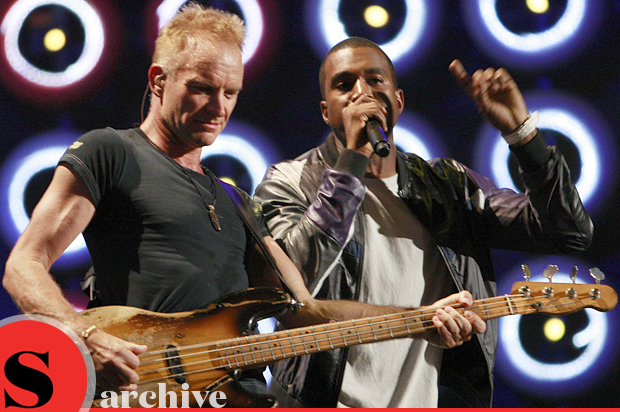
The perennially ageless Sting bumped the mood back up, after his wife’s gruesome news. The reformed Police were joined by a highly excited Kanye West in a duet that was actually moving, because it was sincerely felt:

“We can save the world!”
“Sending out an SOS…”
“We can save the world!”
“Sending out an SOS…”
“We can save the world!”

Counter-insurgency, Gen. Patraeus has said, is about capturing hearts and minds. There was simply no denying the infectious, unforced good feelings of Live Earth. You can only front for so long: Joy is real or it isn’t. This was the kind of love-fest you can’t buy or steal … and even snarky reviews can’t kill.

Outside the hotel in which I was watching the concert on TV, I saw a shuttle-bus driver, having trouble getting out of a roundabout, leave his van running to go argue with another driver. His headlights were on; exhaust was pumping into the heat.

The van driver would not have done that if he had seen that concert. The formula is simple: Pay attention to what you buy and the energy you use. Try to decrease your carbon footprint a little bit.

America will look back with deep shame over the last six years, with a regret as awful as a bad drunk tattoo. The enduring problem of terrorism will require international collaboration; collaboration requires motivations beyond self-interest. But, as hippy-delic as it sounds, the case was made: By loving the planet, we can love ourselves, love each other — and literally save the world.

At the end of the day on Saturday, a certain truth was self-evident: We can do the right things for the right reasons, and the right answer can benefit everyone. Al Gore demonstrated nicely that the truth, however inconvenient, will eventually set you free.

Continue Reading Close

We’ll always hate Paris

The public outrage over Paris Hilton's early release from her L.A. prison cell may be justified -- but why are we expending so much energy protesting the antics of a spoiled media whore?

  • more
    • All Share Services

We'll always hate Paris

“There’s nobody in the world like me. I think every decade has an iconic blonde — like Marilyn Monroe or Princess Diana — and right now, I’m that icon.” — Paris Hilton

“I hate reading! Someone tell me what’s on this menu!” — Paris Hilton

We’ll always hate Paris.

If Marilyn Monroe and Princess Diana were “candles in the wind,” and Anna Nicole Smith was a bonfire in a hailstorm, Paris Hilton, for all her frailness and vulnerability, is a huge, flaming meteor that can penetrate the Earth’s atmosphere, bypass all weather completely and destroy millions of lives wherever she happens to feel like plummeting.

Paris has been one of our most arresting national disasters. She’s too rich, skinny, blond, nude, slutty, drunk, spoiled and famous. She ignores the law and openly flouts our social mores, as if they don’t apply to her.

Proximity to Ms. Hilton is a proven health hazard: She blows all the clothing, morals, inhibitions and self-control of her victims sideways, leaving them emaciated, dehydrated, broke, disoriented and immune to even the most powerful panty-biotics.

Paris has managed to hold herself together comparatively well during severe marathons of hard partying — at least compared with the rest of her friends.

While Paris tiptoed around looking vacuous but relatively docile, La Lohan, Britney Spears, Brandon “Greasy Bear” Davis, Nicole Richie et al. sunk into binge-puking, Mercedes-totaling, infantile oblivions, involving willful and sustained refusal of all food but Vicodin, stints in inpatient rehabilitation facilities that cost $45,000 a week, and unsightly public meltdowns, leading to the consumption of more big bowls of cocaine and opiate painkillers and more trips to rehab (rehab being the new day care for shrieking Hollywood narcissists who can afford never to develop their own maturity, self-control or respect for other human beings).

While Paris is constantly derided for being stupid and whorish, she is, in fact, a post-Warholian pop genius of media manipulation: an extraordinarily talented infamy artist. In an information-saturated age, no publicity is good publicity, but there is enormous money to be made in disgrace. Fame is made of quantity of attention, not quality. More attention (positive or negative) means … you win, even if you’re incarcerated.

Today’s outrage centers on La Hilton’s release from prison, for the “medical condition” of galloping emotional feebleness brought on by advanced, drug-resistant wealth. The release was a tragic P.R. decision. As of the posting of this article, the ball, ridiculously, is still in the air. The sheriff’s office is being held in contempt, and our general contempt for Paris is being held in check until some responsible grown-up is able to resolve this absurd morality farce.

She might have used this 23-day opportunity in the clink to become a black Muslim and great spiritual leader. Or write “Mein Kampf II: Bones for Blondie.”

Or have a scorching lesbian affair with a fellow inmate, captured on a guard’s cellphone (“The Banlieue Is Burning: One Night Just Outside of Paris”). She could have done crafts that would have sold for bajillions on eBay — God’s eyes, potholders. The missed merchandising opportunities alone are heartbreaking: Think of how much bank Martha Stewart made off of her Hard-Time Poncho pattern.

Cries of foul “Celebrity Justice” are ruling this news cycle. Objections poured in from the sheriff’s deputies union, Al “Morally Outraged Again” Sharpton, and attention-seeking Los Angeles city attorneys like Rocky Delgadillo.

“What transpired here is outrageous,” L.A. county supervisor Don Knabe whined to the Associated Press. Knabe said he received more than 400 angry e-mails and hundreds of phone calls from all over the country … apparently from pathetic, boring, homely, forgettable, attention-starved losers with tragically uninteresting lives and nothing better to do than attempt to elevate their own labile self-esteem and moral superiority by vengefully pissing on Paris Hilton.

While much of America was getting its panties in a fist-size knot over Paris’ lack of panties, there were plenty of other things we might have paid attention to. Lookie! The Iraq war! Presto! The “ongoing investigations” of atrocious, illegal acts committed at the highest levels of government! Instead, we are engaging in our new favorite dysfunctional love-hate relationship: Public stoning of the celebrity hooker.

When a starlet is enhanced by too many cocktails and breezy sexual sophistication, it makes her a target, because we get to regard her as indecent.

Nothing shows so well how unkind we are, as a society, than the way we report on our fallen women. Even the cool kids get in on it. At the MTV movie awards, Sarah Silverman remarked that the prison wanted Paris to feel more at home, so it “painted the bars to look like penises … I’m afraid she’s going to break her teeth on them.”

David Letterman hurled his rock: “You know what [Paris' surveillance anklet] means for me? A lot of nasty scratches on my back.”

The prevailing cultural trope of “Kill the slut” has claimed quite a few bodies over the years: Marilyn Monroe. Princess Diana. Anna Nicole Smith.

Linsday and Paris? Run for your lives.

Before the DUI, Paris was being talked about because she liked urinating in hotel lobbies and taxicabs and restaurant booths. This “outrageous” behavior didn’t exactly make her go broke. Paris Hilton charges $200,000 to show up at a party for 20 minutes. This works out to $10,000 a minute to spend time with a woman whom you can’t even sit with on the good sofa.

(Just to give this price tag some sense of proportion, in 2004 the average per capita annual income in Iraq was $422. So it would take the average Iraqi over 20 years to earn one minute with Paris Hilton, or around 24 Iraqis one year to divide and share that one minute with Paris between them — which would just be a complete waste of money unless they could use that one minute to swallow all her jewelry and handbag and shoes.)

Paris has come to embody the angst of our increasing sense of powerlessness — she’s the blonde whom we punish, because we understand her crimes. We don’t really understand all the crimes of the administration — congressional bribes, organized mass deceit via domestic propaganda, policy fixing, violations of privacy and human rights.

Those are too legally complicated. While we were busy ogling Lindsay’s drug binges, Janet Jackson’s “wardrobe malfunction” and Britney’s shaved head, our leaders larded us with misinformation, illegally invaded another country, murdered we-don’t-even-have-any-idea-how-many innocent civilians (not to mention independent journalists), stole a nation’s oil, tortured enemy prisoners, quietly bankrupted our economy and our international moral standing in service to the short con of military Keynesianism, effectively built Dick Cheney his own private Praetorian Guard, and ushered in the most serious threat to American freedom in our history: the very real threat of despotism.

God, that is depressing. Hooker! Where’s the hooker? “If you put Paris in jail, you feel like you haven’t been screwed by the Man,” said a friend of mine. “If Paris goes to jail, there is still a middle class. There’s still an illusion of hope. We’re not the Philippines, yet. There’s still some kind of justice, and we’re not all just fucked.”

You can kick the blonde all you want, but kicking the wrong ass, while momentarily satisfying, really won’t make life better.

Continue Reading Close

Hollywood gets humble

Ellen was 'Ellish in her tacky leisure suits. But at Sunday night's Oscars, Helen Mirren, Jennifer Hudson, Al Gore and the rest restored fame's good name.

  • more
    • All Share Services

Hollywood gets humble

It was a dramatic reversal for these Academy Awards, right from the jump.

This Oscar night was marked by its unusual candor and humility. For once, the red carpet was actually vacuumed, as opposed to simply being a vacuum.

The stars — epitomized by the bountiful and irresistibly deserving Jennifer Hudson — seemed intent on demonstrating that they were all just good, decent, regular folk who happened to have the good sense and thrift to reupholster an old, sturdy and traditional approach to their careers: professionalism. These stars seemed out to rehabilitate Hollywood, after its grisly collapse from a monthlong tabloid overdose, and remind us that fame, when it is functional, is something that arises from actual talent.

Stars are supposed to be abnormally gifted, yet so normal seeming that they are somehow supernormal. It seemed that even the biggest and most perennial stars were working their “normalness” like the family minivan.

Helen Mirren, who has been a star for decades, described herself as “just a girl from Essex”; Forest Whitaker, too, was “just a kid from Texas.”

In a red-carpet interview, Ryan Gosling attributed his good fortune in being nominated for best actor to his mother’s needlepoint sentiment that “if you’re making the decision for money, you’re making the wrong decision.’”

There was refreshing honesty. Leonardo DiCaprio, on the red carpet, commented, apropos of “Blood Diamond,” that it was “rare within the studio system that you get to do a movie with something important to say.”

Ooooh! Hey! What’s going on? That wasn’t the Entertainment Industrial Complex party line! And he wasn’t even arrested or anything!

Welcome to the all-new Celebrity 2.0: We’re exactly like you (only talented).

Seriously: If this is a sea change, it’s a good one, because things were starting to get pretty hideola under the old Hollywood sign.

It is a sign that society has lost its way when our fragile Hollywood coal-mine canaries start imagining, en masse, that they can beat depression and recover their lost charisma if they just remove their eyelids, get another nose job, and eat nothing but methadone for a while.

Nicole Kidman’s motionless face looked like it recently had more needles in it than a saguaro cactus.

“You can’t think of [walking the red carpet] as important … It’s almost a cancerous idea if you allow yourself to need it,” said Will Smith, who, sadly, seemed to be needing it, despite his best efforts. Will Smith is starting to get that not-so-Fresh Prince feeling.

His wife Jada’s forceful, toothy bark laughing evokes neither happiness nor fun, but I do recall seeing similar athleticism in footage of an alligator eating a live pelican.

But Oscar was out to make a difference: This year, he even wore eco-conscious green. Overall, this was a kinder, homier Oscar celebration. It was a little boring and flabby, but well intentioned — just like its host, Ellen DeGeneres.

Ellen took a contrary approach and went for a casual feel … too casual. Her red velour leisure suit would have looked right at home playing the Wurlitzer for the State Farm Senior Golf Classic.

It appears that hosting daytime TV, in some cases, retards the part of the brain responsible for selecting eveningwear. It was a relief when Ellen changed, midway through, into a slightly more upscale, all white, Usher-esque ensemble, but her third and final outfit of the evening looked like she’d bribed it off of one of the busboys at Musso & Frank’s. With bigger mutton chops, she’d have been a dead ringer for Isaac from “The Love Boat.”

There seemed to be a subtle social-consciousness-boosting leitmotif suggesting that the night was occupied by Jodie Foster’s army, and Thesbians were this year’s minority elect.

But I don’t care if you’re male, female, gay, straight, all or none of the above: While getting dressed to host the Oscars, ask yourself: “Can I wear this to go bowling?” If the answer is yes, then you’re much too comfortable and must change.

But OK, she sure does know how to make her audience feel all warm and snuggly, as if they’ve just been swaddled in polar fleece and given a big bowl of chocolatey Klonopin Puffs.

While wandering through the intimidatingly A-list audience, chock-full of her wonky, trademark Yep! I sure am me! silliness, Ellen proved that Ellen is always just Ellen, and always just talks about Ellen.

Exclusively Ellen.

Getting pictures of herself with Clint for her MySpace page! Ho, what a character! Actually dropping a script (and the name of her production company) in Scorsese’s lap! She was just one big Ellen-ball! It was the El-Word all night long, and boy, was she a run-on sentence all by her lonesome. She was all-Ellen-veloping.

Sorry, gals, but when self-effacingness is relentlessly self-referential, it is merely self-ish. Or, in this case, ‘Ellish.

But there were good parts.

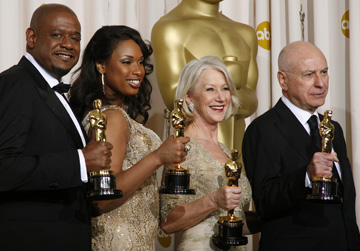
Despite stiff competition, the beloved Alan Arkin was a delirious pleasure to watch accepting the best supporting actor award for his rowdy Grandpa in “Little Miss Sunshine.” His speech was full of sublime values that tuned the collective vibrations a bit higher, on a feel-good level, than Ellen’s navel:

“Innocence, growth, and connection … Joy, trust, community.”

There was undeniably great eye candy. The interpretive-dance shadow-puppet people were a creative, artsy touch, and it was nice to know that at least one professional dance company earned enough money to exist this year.

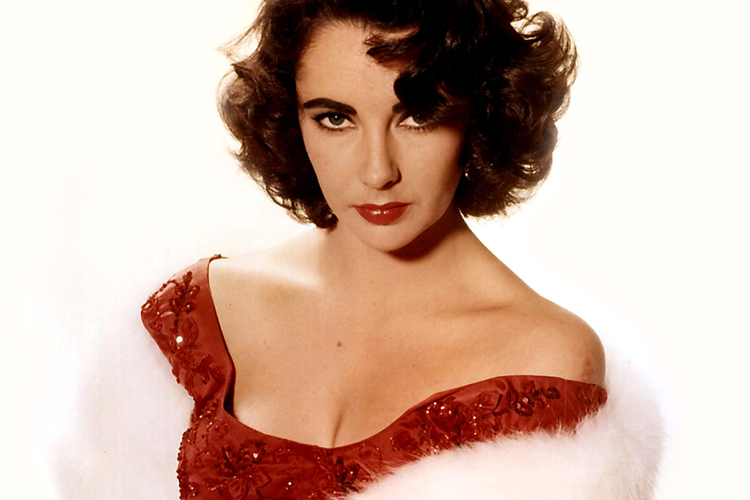
The leading ladies reverted back to the safety zone of old Hollywood glamour, which is never a disappointment or a mistake. Quite a few starlets looked jaw-droppingly beautiful in that mesmerizing, nostalgic, light-giving kind of way, with their bare, pearly shoulders, deep red lips and bejeweled metallic gowns cut in the vintage Dior style that holds a willowy body like champagne in a tall flute.

I am impressed by Anne Hathaway, the ingénue of “The Devil Wears Prada.” She is poised yet dorky, relaxed yet nervous, preternaturally stunning yet somehow approachable-looking. She has a remarkable quality of seeming like the world’s nicest waitress while wearing a Valentino gown made of unborn ballerina fur. According to the laws of physics, she can’t actually exist, yet there she was.

Beyoncé, aka “Bodzilla,” that most wholesome and breathtaking of starlets, seemed like a lightweight to me until “Dreamgirls,” but now I believe she actually has enough personal, autonomous star power to stabilize uranium.

Motherhood seems to have been a good tenderizer for Gwyneth Paltrow, who is no longer apologetically brittle, but curvy and sumptuous. She was ivory, orange and brightly refreshing, like the world’s most expensive Creamsicle. Rachel Weisz, likewise, seems to be enjoying a personal zenith of spectacular comeliness, now that both her inner and outer selves look softer. Best actress winner Helen Mirren was regal, splendid and inspiringly fuckable without even a “for her age” qualifier.

It was nice to see that Penélope Cruz has come a long way from being Tom Cruise’s exotic bird. Even wonder-child Abigail Breslin was visually fantastic, glowing prettily in a dress that made her look like she came in her own Easter basket.

Celine Dion has been my personal punching-diva for years, but I actually think motherhood and nonstop Vegas performances have done her a world of good, in terms of looking less agonized by self-imposed professional discipline clamps. She looked like she was enjoying herself, and like she really loves singing. One cannot deny that her weird pink dress was packed to the rivets with professional mega-chops in prime condition, and an enhanced sense of humanity.

But I need a crying bib to watch Jennifer Hudson. I had to wring out my blouse after “Dreamgirls.”

Hudson is so refreshingly not of that world. She’s a perfect Rosetta stone for the big secret of star power — it’s not about how small your nose is, but how expansively and gracefully you accept yourself, how much of yourself you can lovingly reveal.

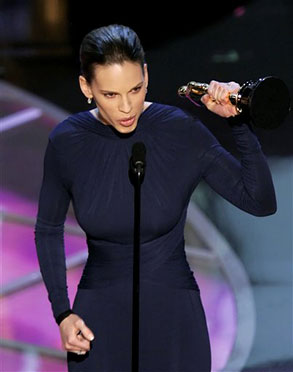
Her win was everything Halle Berry’s 2002 moment should have been: a poised, yet emotional display of the glorious merits of organic virtue. Besides tree-bending vocal prowess, she has that Aretha Franklin thing that raises all the hair on the back of your arms: It’s called Soul.

I believe that proximity to Hudson has made Beyoncé three times the singer she used to be. Through Hudson’s divine example, Beyoncé finally figured out how to “put some stank on it.” The two of them were a typhoon of melismatic emergency, harmonizing together like two police cars in love.

There were a few more low points.

Jack Nicholson, in solidarity with Britney, I suppose … shaved his head, and looked like Mr. Unclean.

Kate Winslet’s dress was a poisonous caterpillar green, I guess so her envy wouldn’t show as much as it has in previous years … but to no avail.

Melissa Etheridge’s heavy, browbeating and pedantic “Inconvenient Truth” theme song won an Oscar — undeservedly, I believe. But it was certainly a step forward for society that she made Oscar history by thanking her wife.

But hey, what is not to like about the Red Sox-like curse of Martin Scorsese finally lifting?

“The Departed” won best picture and best director, and not for nothing: It was structurally perfect, and made by a master.

Was it as good a movie experience as “Little Miss Sunshine”? I think no.

But was it the epitome of film craft? Yes. A technically virtuosic, elegant film machine: a treasure to be celebrated.

Finally, there was one genuinely historic moment: Jerry Seinfeld presenting the Academy Award to Al Gore, who received an A-List standing O in front of a billion viewers. Respect for the office of the American presidency notwithstanding, it should be noted that Sunday night, Hollywood successfully Photoshopped Al Gore’s foot into George W.’s ass.

The plates are shifting, people. The trend is irreversible. At this rate, Texas and the entire Republican Party will be completely underwater by 2008.

It makes a larger cultural sense, this renewed appreciation for the genuine article that these Oscars seemed to reflect.

America has been at war for four years. The big unpopular war that the president and his lockstep administration declared was against the Truth. It seems the American people are engaged in a soft revolution: We are simply refusing to get in the back of that hateful bus anymore. We just like things to be honest.

Helen Mirren commented on societal dissatisfaction with a tone-deaf, disconnected leader in a montage about the queen: “She is so iconic and well known, and yet we don’t know her at all.”

Times, they are a-changin’.

Release the corgis!

Continue Reading Close

Goodbye, Vickie Lynn

No candle in the wind, Anna Nicole Smith was more like a bonfire in a hailstorm -- and we couldn't pry our eyes away from her.

  • more
    • All Share Services

Goodbye, Vickie Lynn

The story of Anna Nicole Smith — dead like Elvis, discovered at the Hard Rock Hotel in Hollywood, Fla. — hit like a massive mudslide, and overwhelmed an already monstrous week of astronaut diapers, the entire Ryan O’Neal family in handcuffs and the Scooter Libby trial, all of which were displaced to secondary positions on Technorati. But the press, as of this morning, still couldn’t find much to say that was nice about her — they were too busy beating up on a woman they perceived as their very own generational whipping blonde.

The yellow press is in shock, as if it can’t believe that the “tabloid life” of the woman Radar referred to as “gossip’s golden goose” is actually over. Its members can’t seem to wrap themselves around the idea that she isn’t theirs to abuse anymore, or that somewhere under the nipple tape and lip gloss, a human being is dead enough, now, to deserve a few seconds of more than just token respect.

TV pundits, deep into the night, were still sniggering over Smith’s personal defects.

Over the evening, she was continually referred to as a “train wreck …”

“Famous for being famous …”

“Former stripper …”

Playboy playmate …”

“Totally out of it …”

The snide, giggling, self-congratulatory Tom O’Neil of InTouch Weekly referred to the recently deceased woman as a “slob” on MSNBC. Repellent E! News hosts Ryan Seacrest and Debbie Matenopoulos were unable to summon even the smallest lick of anything that sounded like sympathy: “How tr-r-rragic. Anything after [Smith's death] seems trivial … but there are other stories today! … In other news, the Kim Kardashian sex tape …” blah blah blah.

MSNBC’s Joe Scarborough asked, again and again: “What was she famous for, aside from being famous?” Radar’s Tyler Gray replied, with raised eyebrow, that Smith was famous primarily because of her “availability for parties … She didn’t come cheap,” he added knowingly, “but she would join the party.”

Richard Roeper in the Chicago Sun-Times tried to summon some kind of intelligent approach:

“The last time I saw Ms. Smith acting, it was on premium cable a couple of years ago. She was in a bathtub, naked, kissing another woman. It was somewhere between soft-core and full-on pornography — and not to be cruel, but she wasn’t even very believable in that performance.

“Nobody ever accused Ms. Smith of having any talent, and to my knowledge she never claimed to have any. She just acted like a star, and she was treated like a star — and the fact that her death has everyone in the media (including yours truly) rushing to write something about her confirms that on some level, she won. She was a star.”

So many stars are doing so badly, trying to withstand the collective hex of unkind limelight, what is really incredible is that there haven’t been more deaths lately. Nothing shows so well how unkind we are, as a society, than the way we report on our falling women. Hollywood has been restless, cruel and itchy, jonesing for a real tragedy. It was getting bored merely humiliating people on “American Idol.” Drug-addled Hollywood strumpets like Linsday Lohan, Courtney Love and Nicole Richie have all been on various deathwatch lists for quite some time, and the tabloids have been licking their chops, waiting to be fed a body.

Vickie Lynn Hogan of Mexia, Texas — the woman Spy magazine once called a “super-duper-model” — was ripe for the taking: She had always been compared to Marilyn Monroe, and she nursed these comparisons, right down to her own sense of victimization by a society that she perceived as having no respect for her, and to her self-fulfilling prophecy that she would die young and tragically.

Naturally, the death of her 20-year-old son didn’t help, and neither did the methadone. It was clear she lacked coping skills. Following the death of Daniel Smith, three days after Anna Nicole gave birth to a baby girl, the tabloids reported that the distraught new mother was so sedated that she needed to be reinformed of his death, again and again, every time she woke up … an excruciating ring of hell.

Even in such times of private agony, prurient interest now follows its victims everywhere. Wherever there’s a cellphone and an Internet connection, the camera can steal a soul.

Doubt and suspicion are landing on Smith’s “husband” and former attorney, Howard K. Stern — and not for the first time. (Vito Carlucci, a private investigator, commented, “Some people keep seeming to end up in rooms where there’s dead people.”)

What seems more likely is that Stern was unable to control anything about Anna Nicole Smith, and unable to protect her from the tragic destiny of her cultural role. He was lamely dazzled by her blondness and breastiness and her collection of Lucite hooker shoes, and appears to have pathetically and submissively loved the woman — but not enough to summon the backbone to stop enabling her self-destruction or stop others from watching it.

Hugh Hefner, at least, had some class, issuing a statement about how much Smith meant to him personally and to the whole “Playboy family.”

Philip Kennicott of the Washington Post, in a thoughtful article, waxed philosophical about Smith’s operatic, societal role as a condemned “courtesan,” speculating that we never really forgave her for the outrageous gall she displayed when she married that super-rich, sick old man in a wheelchair:

“Poor Anna began her climb to fame and riches as a stripper, and in the end, she was a stripper again, seemingly uncontainable by ordinary clothing. She spilled out of her tops, she spilled into the tabloids, she was a mess. Her death gave you whiplash: Time to feel sad for a woman who was never supposed to be more than a source of amusement.”

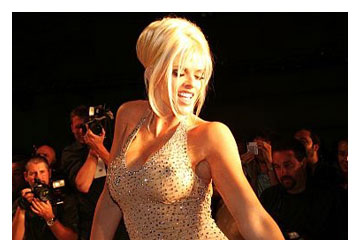
What needs saying — what it seems nobody has yet said — is that when she was able to suppress her demons enough to pull herself together and look her best, she was fabulously gorgeous. Numerous red-carpet moments, the footage of which we now run over and over again like a televised rosary in order to understand her death, reveal this. Anna Nicole was a star because she possessed an unusually large amount of beauty. At her best, she didn’t evoke Marilyn Monroe so much as Anita Ekberg in “La Dolce Vita” — the strapless black dress, mounds of white flesh, piles of blond hair. She was indelicate, but an unstable element nonetheless — not so much a candle in the wind as a bonfire in a hailstorm. But the real similarity between Anna Nicole and Marilyn was their shimmering tension — an unsettlingly powerful physical beauty, collapsing irresistibly in real time beneath the frailties of its hostess. She was entropy porn at its finest.

Our fascinated gaze was her real addiction — and the humiliating media tractor pull between our disgust and our attraction for her was, in all likelihood, both her lover and her murderer. Fame, the only chemotherapy available for the desperate toxicity of narcissism, proves once again that it is deadly enough in its own right to be avoided.

Continue Reading Close

Page 2 of 25 in Cintra Wilson