Jordan Michael Smith

Neocons vs. Islamophobes

There's an ongoing war for the future of Republican foreign policy

John McCain and Michele Bachmann (Credit: AP)

The Muslim Brotherhood, a group that was once thought virtually extinct in Syria, has surprised everyone by staging a comeback.  The Islamist group is, according to Reuters, a “dominant force” in the Syrian opposition. Similarly, in Egypt, the MB has become perhaps the most powerful group in the wake of the Revolution.

This doesn’t sit well with everyone in the American conservative movement, and two factions are vying to define the Republican response to the increased power of political Islam. Leading what might be called the ‘to-hell-with-democracy’ strain of thought is Andrew McCarthy, a national-security columnist for National Review and senior fellow at the Foundation for Defense of Democracies. McCarthy has been relentless in arguing that the MB poses a major threat to America, and that it must be opposed at all costs. McCarthy called Republican Sens. Lindsey Graham and John McCain “the useful-idiot brigade” for meeting with MB members in Egypt. He accused the senators of “helping install an Islamist government in Libya” that he says is composed of al-Qaida members.

McCarthy’s perspective opposes democracy in the Middle East because it could bring parties to power that are less friendly to the United States. It has echoes in the views of Walid Phares, an important advisor to Mitt Romney. Phares said in March that the “Islamist lobby directs U.S. policy in Egypt, Libya, Tunisia and the Middle East.” He told the far-right Newsmax that the Obama administration is creating an “Islamist state” in Egypt.

Other important individuals in the to-hell-with-democracy movement include John Bolton, who is rumored to be up for a top spot in a Romney administration, and who says that Egyptian democracy is bad news; Michele Bachmann, who criticized Obama for not standing by Egyptian dictator Hosni Mubarak; and Frank Gaffney, a former Reagan administration official and head of a right-wing think tank.

There is another faction among the right-wing that is equally powerful, however: the neoconservatives. For the most part, the neocons have embraced the upheaval in the Middle East. “The key is whether a government in Egypt or Tunisia respects the democratic process and doesn’t try to subvert the system,” says Jamie Fly, executive director of the Foreign Policy Initiative, a neocon think tank. “The jury is still out on that, and I think we have to let the process continue and see what comes of it.” Fly believes that there are differing views on Israel and the United States within the MB, and the democratic voices should be encouraged. The organization has urged military intervention in Syria to bolster democratic forces. FPI’s board of directors includes Robert Kagan, an advisor to both presidential candidates, and Dan Senor, an official in the Bush administration. “Paula Dobriansky, leading advocate of Bush’s ill-fated ‘freedom agenda’ as an official in the State Department, recently joined the Romney campaign full time,” the Nation’s Ari Berman reportedly recently. McCain and Graham are similarly bullish on Middle East democracy, rather admirably insisting that the Muslim Brotherhood be given a chance. Even former President George W. Bush has come down on the side of letting the revolutions run their course.

Both factions are vying for the ear of Mitt Romney, and control of the conversation. But the conservative split has its roots not in the era of Middle East upheaval but in the 1980s. During the Cold War, Ambassador to the U.N. Jeane Kirkpatrick famously made the distinction between right-wing dictatorships that could evolve into democracies and therefore should be supported, and left-wing ones that needed to be combated. In truth, Kirkpatrick’s thesis was merely a rationalization for opposing communist governments because they were thought to be inimical to U.S. interests. Ronald Reagan was so impressed with the analysis that he brought her into his Cabinet. And indeed, Reagan’s policy reflected the Kirkpatrick doctrine, as the administration supported brutal right-wing regimes across Central America. At the same time, Reagan provided crucial support for Solidarity in Poland, the movement that was instrumental in taking down the Soviet regime. Czech dissident Vaclav Havel similarly praised Reagan’s anti-Soviet policy.

Conservatives believe both approaches — supporting democratic and anti-democratic anti-Communist movements — were vital in defeating the Soviet Union. And so now they are divided between supporting pro-American dictators in the Middle East, and supporting democracy movements. Both worked against the Communists, they believe. But in, say, Egypt, one cannot support democracy while opposing the MB. Hence the split between the factions in the conservative movement. Which one triumphs in a prospective Romney administration may set the course of U.S. foreign policy for decades to come.

Republican Party: Hawks-only club

The loss of Dick Lugar will hurt most on foreign policy, where he was willing to buck Republican orthodoxy

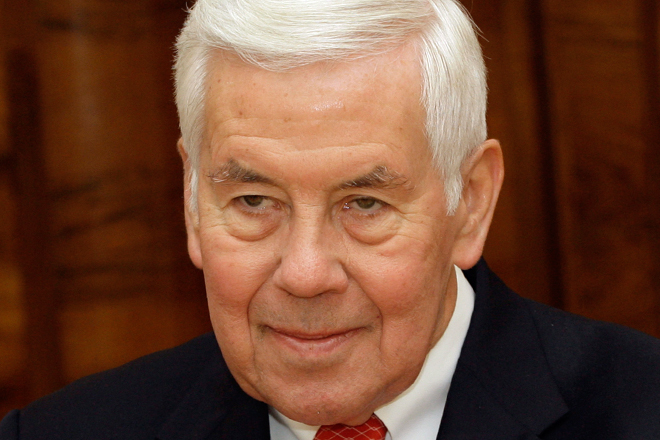
Richard Lugar (Credit: AP/Mikhail Metzel)

Eighty-year-old Republican Sen. Dick Lugar lost his primary on Tuesday night to Tea Party favorite Richard Mourdock. Third-party groups spent $4.5 million on the race, according to the Center for Public Integrity — more than they’ve spent on any other congressional race this season. About two-thirds of that cash was spent defeating Lugar. The biggest player in the race was the FEC-violating super PAC Club for Growth Action, which spent more than $1.4 million.

The longest-serving senator in the state’s history, the “George Washington of Indiana” will be sorely missed. Not for his opposition to abortion rights, the stimulus package and Obama’s healthcare bill, nor for his votes against gay rights and for the flag-desecration amendment. No, what made Lugar matter were his important stances on foreign policy. His demise signals a further radicalization of Republican foreign policy that is already right-wing enough. Even a somewhat moderate Republican has no place in today’s GOP, it seems.

Lugar made a name for himself on international affairs in taking the lead in the Senate to reduce the world’s use, production and stockpiling of nuclear, chemical and biological weapons. In 1991, he initiated a partnership with then-Senate Armed Services Committee Chairman Sam Nunn aimed at eliminating latent weapons of mass destruction in the former Soviet Union. To date, the Nunn-Lugar Cooperative Threat Reduction program has deactivated more than 75,600 nuclear warheads. In 2004, Sens. Lugar and Nunn were rightly jointly awarded the Heinz Awards Chairman’s Medal for their efforts.

Though he voted for the Iraq War, he was one of the first Republicans to castigate President Bush for his handling of the war. “Our continuing absorption with military activities in Iraq is limiting our diplomatic assertiveness there and elsewhere in the world,” he said on the Senate floor in June 2007. Then-Senate Majority Leader Harry Reid said, in reaction to Lugar’s speech: “When this war comes to an end, and it will come to an end, and the history books are written, and they will be written, I believe that Sen. Lugar’s words yesterday could be remembered as a turning point in this intractable civil war in Iraq.”

It wasn’t the only time Lugar broke party ranks on foreign policy. He castigated Republicans for opposing the 2010 START treaty with Russia, saying that voting against the treaty would jeopardize cooperation on reducing further weapons stockpiles. “There are still thousands of missiles out there. You better get that through your heads,” he said to his party members.

Even better, Lugar has been stalwart on calling for the U.S. to increase its foreign assistance budget. Instead of a militarized foreign policy, Lugar looked for ways to make America’s diplomatic activities robust. “Lugar is a national treasure for his perspective on foreign affairs,” P.J. Crowley, the heroic former State Department spokesman, told the Huffington Post in 2011. “Foreign aid does not have the political constituency that defense spending has … and Lugar would be one of those people you would turn to to make the case for maintaining the global perspective on why foreign assistance is so important.”

Not that Lugar’s loss can solely be chalked up to his bipartisan, moderate votes — although those certainly didn’t help his cause. As Geoffrey Kabaservice, author of “Rule and Ruin: The Downfall of Moderation and the Destruction of the Republican Party,” points out, there were other important factors involved. “Lugar is 80 years old, and he’s been in Washington for 30 years,” says Kabaservice. “It was easy to portray him as distanced from his constituents and a creature of Washington.” Lugar also did not foresee the amount of money the right-wing could devote to defeating him, especially in the age of super PACs. “Thank goodness the founder of our country did not face millions of dollars of negative advertising,” he griped last week.

Lugar was not a classic moderate Republican in the tradition of Eisenhower and George Romney, men who accepted the New Deal and were progressive on civil rights; he was simply willing to cross party lines and support Barack Obama on some issues. “Lugar was more of an Establishment Republican, which was certainly an honorable faction,” says Kabaservice. “He was a throwback to a time when bipartisanship was real.”

In practical terms, Lugar’s loss means that U.S. foreign policy will be less civilized, less responsible and less effective. Lugar’s long-standing service gave him a gravitas, and he was seen even by his opponents as a responsible voice. Says Kabaservice: “It will be more difficult for a president to conduct an effective foreign policy without him.”

Continue Reading Close

The Bushies are back

Missed the neocons? Don't worry: Mitt Romney's getting the band together again

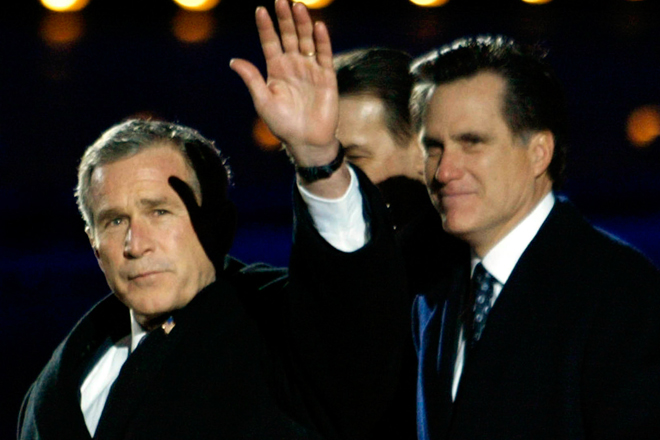
(Credit: Reuters/Win McNamee)

There was good reason for Republicans to cry foul over the Obama campaign’s advertisement highlighting the president’s killing of Osama bin Laden; the GOP has lost its decades-long edge on national security. According to a Washington Post poll, “By a margin of more than 2 to 1, Americans say the president’s handling of terrorism is a major reason to support rather than oppose his bid for reelection.”

Republicans lost their popularity on security issues for one reason: George W. Bush’s foreign policy was a disaster. And yet, the party’s nominee, Mitt Romney, has assembled a foreign-policy team composed almost exclusively of individuals with the same war-always mentality and ideology that served Bush — and the United States — so poorly. In some cases, the exact same men responsible for Bush’s catastrophic national security policies are advising Romney. The former Massachusetts governor could have included some of the pragmatists and realists from the George H.W. Bush administration. Instead, a Romney presidency seems like it would be Bush 43 all over again.

Richard Grenell, who served as United Nations spokesman under Bush, may be gone from the Romney campaign after an uproar over his sexuality, but there are plenty more former Bushies. First off, there are Romney’s “special advisors.” There’s Michael Chertoff, W.’s Homeland Security director. Chertoff oversaw DHS’s failures during Hurricane Katrina, and amassed unprecedented powers of secrecy. Next up is Eliot Cohen, counselor to the State Department for Bush’s last two years and on the Defense Policy Advisory Board for the president’s entire term. Cohen was an adamant supporter of the Iraq War and advised Bush directly on the issue. Or take Cofer Black, the man who infamously said to Bush in September 2011 about al-Qaida that “When we’re through with them they will have flies walking across their eyeballs.” Black went on to become chairman of Blackwater, where he resigned after the company illegally bribed Iraqi officials.

Then there are the 13 “working groups” composed of equally worrisome individuals. The Middle East and North Africa Working Group is co-chaired by Bush’s Assistant Secretary of Defense Mary Beth Long, and Meghan O’Sullivan, Bush’s special assistant and deputy national security advisor for Iraq and Afghanistan. The remaining co-chair is Walid Phares, who never worked for Bush but advised Lebanese warlords in the 1980s. Romney has reportedly promised Phares a top job in his administration, despite his virulently anti-Islamic views.

All told, Romney lists 37 holdovers from the George W. Bush administration — the very same administration he and all other Republican candidates barely referenced during their many debates because it was so discredited and toxic, even to the Republican base.

It didn’t have to be this way. There are, in fact, people in Republican circles who are sensible on international affairs. The Cato Institute, in particular, has experts that could dramatically change the direction of American foreign policy. Men like Justin Logan and Christopher Preble were prescient on Iraq and a host of other issues. Similarly, the Center for the National Interest (formerly the Nixon Center) has a host of solid scholars, including ones like Dimitri Simes and Geoffrey Kemp, who have valuable government experience in the Nixon and Reagan administrations, respectively, and a history of perceptive analysis. Richard Haass, president of the Council on Foreign Relations, would have been another good pick.

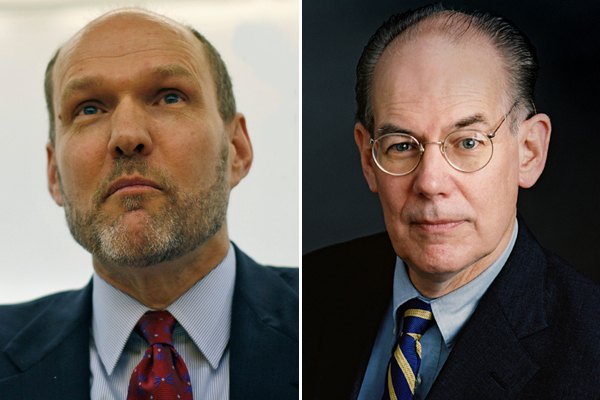
So why aren’t guys like this being tapped? Why is the GOP sticking with a discredited foreign-policy approach rather that looking to its own past for wiser counsel? “Most of the realists and pragmatists have simply been driven out of the Republican Party,” says Stephen Walt, who writes a blog at Foreign Policy and teaches at Harvard. “The neoconservatives have been driving the agenda since Bush was elected and they remain well-entrenched.”

Another factor is that the Republican Party’s base remains strongly militaristic and reluctant to recognize limits on American power. Jon Huntsman’s failed presidential campaign illustrated that problem. The good news is that nobody seems to be calling for nation-building and occupying foreign countries in the mold of Iraq and Afghanistan. But that’s the only lesson that seems to have been learned from the last decade of foreign-policy debacles.

Finally, it may just be that the United States has too much power to change course. While the Unites States has undoubtedly made disastrous decisions in the last decades, it is so powerful that it is largely insulated from the consequences of them. If Romney’s foreign-policy advisor list is anything to go by, a Romney administration would have to teach the U.S. all over again about the problems with trying to police the world. Prepare for Bush redux.

Continue Reading Close

Neocons’ new lie

You thought they were gone, but now they're popping up to claim that Iraq inspired the Arab Spring

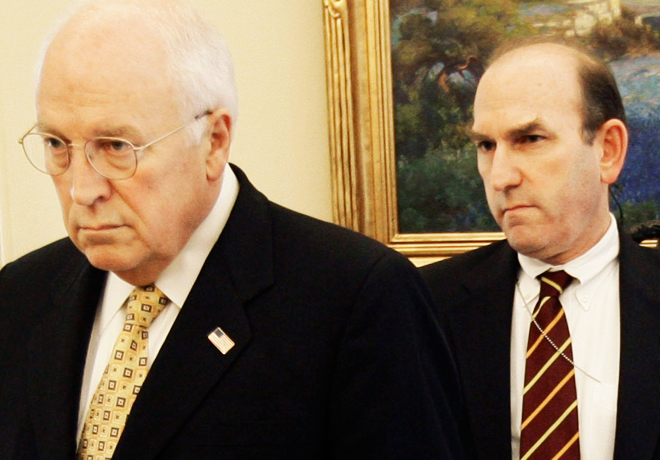
Dick Cheney, left, and Elliott Abrams (Credit: AP/Pablo Martinez Monsivais)

The rulebook for conservative punditry is straightforward. Push for a policy. When it turns into a disaster, defend it. When the defense becomes untenable, ignore it. Finally, when something unrelated but positive occurs, take credit for it.

The newest conservative myth is that the upheavals in the Middle East — called the Arab Spring but occurring too in non-Arab countries like Iran — are a result of the Iraq War. The “freedom” that George W. Bush brought to Iraq had a domino effect on other countries in the region, the argument goes. Neocon Robert Kagan told Salon recently that “there were repeated free elections in Iraq and that undoubtedly had some effect on how neighboring people views their government.” Said Kagan: “I think Egyptians said. ‘If the Iraqis can have elections, why can’t we have elections?’”

Kagan wasn’t the first to make this argument. Bush’s deputy national security advisor Elliott Abrams wrote in January 2011 that “the revolt in Tunisia, the gigantic wave of demonstrations in Egypt and the more recent marches in Yemen all make clear that Bush had it right.” Bush speechwriter Peter Wehner claimed “vindication for Bush’s freedom agenda” when the uprising began. Even Dick Cheney said that “I think that what happened in Iraq, the fact that we brought democracy, if you will, and freedom to Iraq, has had a ripple effect on some of those other countries.”

Few things could be more condescending than the argument that Middle Easterners had never thought of freedom or democracy before George W. Bush began speaking about it. Countries from Algeria to Iran had held elections or saw large-scale protests long before any former Texas governor illegally invaded Iraq.

But the idea that the Iraq War had a galvanizing effect on the freedom movements under way in the Middle East is best refuted by simply listening to the movements’ leaders. Those individuals leading the protests from Iran in 2009 to Syria in 2012 are unanimous: the Iraq War hurt, not helped, the cause of democracy in the Middle East. By unleashing anarchy and a civil war that caused the deaths of hundreds of thousands of Iraqis, the invasion in 2003 actually discredited democracy, if anything.

Here is leading Iranian dissident Akbar Ganji: “Since Iranians, in particular opposition groups, do not want to see a repeat of Afghanistan or Iraq in Iran, they’ve actually had to scale back their opposition to the government … The belligerent rhetoric of Bush didn’t help us [the Iranian democracy movement], it actually harmed us during that period.” In fact, what helped facilitate the large-scale protests in 2009 was the Obama administration’s engagement with Iran. According to Ganji, “the mere fact that Obama didn’t make military threats made the Green Movement possible.”

Or consider Wael Ghonim, who helped foment the Egyptian revolution and was imprisoned for his deeds. Asked if the cause of Egyptian self-determination was helped by the Iraq War, he was succinct: “Not at all.” He continued: “The war in Iraq killed so many innocent people, and it’s not something that any civilized nation should be proud of.” His thoughts on revolution represent the views of almost all Middle Easterners: “People who live in a country are the ones to decide their destiny because they are the ones who eventually pay the price for whatever choices they make.”

Leadership aside, it is clear that few people in the region take seriously the claim that the Iraq War sparked a wave of inspiration, for the simple reason that they see the war as a disaster for the Iraq people. A November 2011 conducted by Zogby found that most people in Iran, Egypt, Jordan, Lebanon, Iran, Saudi Arabia and the United Arab Emirates believed that Iraq was worse off as a result of the American invasion. Even most Iraqis — those who are said to have received the blessing of democracy — agreed that their country was worse off as a result of the war. If those in the Middle East believe the American-led war was a calamity for Iraqis, it is hard to believe they would think it was a model to be emulated in their own respective countries.

Of course, none of this will change the mind of those desperate to retrospectively justify the Iraq invasion. If an Arab Spring had broken out in 2050 instead of 2011, some student of a current neoconservative would have claimed Iraq was the spark the caused the fire. That fallacy may be pleasing for Bush’s intellectuals and policymakers unable to face the consequences of their decision to push for war in Iraq, but those in the region are under no such delusion. Nobody else should be either.

Continue Reading Close

Syrian rebels’ man in D.C.

Radwan Ziadeh has been the loudest advocate in Washington for an intervention to oust al-Assad

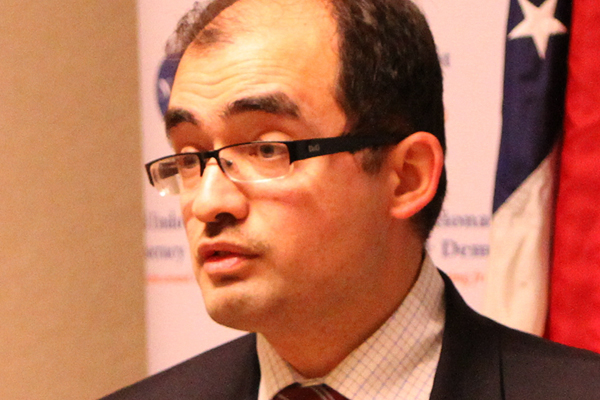
Radwan Ziadeh

Radwan Ziadeh fled Syria with his wife via the Jordanian border in October 2007. He had come to Washington many times before that, for conferences dealing with his work on Syrian politics. But upon returning to his homeland after one Washington visit, the head of the Syria Security Forces told Ziadeh that if he left and returned again, he would be placed in prison. An arrest warrant was issued for him in 2008, and his family was banned from leaving the country. “I only have Skype conversations with my family back home now,” he says.

In Washington, however, Ziadeh has become a crucial figure for those hoping to establish a new Syrian order. In October 2011 he formed the Syrian National Council (SNC), “to unite the opposition and establish an inclusive organization that would include different groups.” It is now the main umbrella group for exiles and opposition groups. Ziadeh has met with Secretary of State Hillary Clinton, influential senators like John McCain and Joe Lieberman, and members of President Obama’s National Security Council. A senior fellow at the Institute for Social Policy and Understanding, a Washington-based Muslim think tank, he writes for publications like Foreign Policy and The New Republic, passionately urging the international community to save his people from their own government. And yet, the gap between Ziadeh’s pleas and America’s interests reveal the limitations of those hoping the United States can act as a savior on the international stage.

Ziadeh is one of a small number of liberal democrats in Arab and Muslim countries who harbor virtually no resentments towards the West in general, and the United States in particular, for its interventions in the Middle East, support for local autocracies and unconditional support for Israel. Like the Egyptian scholar Saad Ibrahim and the Iranian dissident Akbar Ganji, Ziadeh sees the West as a partner and its political institutions as a potential model. Unlike Ibrahim and Ganji, however, Ziadeh believes international intervention is the only thing that can stop the slaughter of his people.

He has credibility as a prescient observer of currents in his native land. In April of 2011, Ziadeh predicted that the Syrian people’s “determination is strong enough today, despite the increase in the number of those killed, and people will continue to participate despite the enormous arrest campaign launched by the security services.” More than a year later, Syrians continue to battle with the government despite a death toll monitors say has topped 10,000.

It certainly helps that Ziadeh had connections in the United States long before the uprising began. He has held fellowships at or been affiliated with everywhere from Harvard University’s Kennedy School of Government to the United States Institute of Peace to the National Endowment for Democracy. It is precisely that comfort in Washington, however, that makes him suspect among his critics. He is derided as a “State Department tool” and a neoconservative puppet on blogs and websites written by Middle Easterners far more hostile to the U.S. It surely doesn’t help that the State Department under President George W. Bush began funneling millions of dollars to Syrian opposition groups beginning in 2006, according to WikiLeaks cables. Syrian dissidents were unwilling to openly accept U.S. money: “[N]o bona fide opposition member will be courageous enough to accept funding,” a February 2006 cable lamented.  But the money still found its way into the country.

Despite the long history of enmity between Syria and the U.S., Ziadeh is confident that the vast majority of his countrymen want the international community to intervene. “Nobody is calling for U.S. troops on the ground,” Ziadeh is quick to say. “Syrians are ready to defend themselves and to force [Syrian leader Bashar al-Assad] to step down.” Rather, calls are coming from within for help as “the only way to stop the killing,” he says. He envisions something like what happened in Libya, where NATO established a no-fly zone and launched an air campaign. “It’s the only way to stop the killing,” he says. “The call for intervention is coming from Damascus, from people on the ground.” The SNC, for which Ziadeh is the spokesman, has daily contacts with citizens inside Syria, and although he admits a consensus is impossible to achieve, he is certain outside assistance is urgently desired.

It is easy to see how “the international community” can become a euphemism for American power, however. A confidential NATO report obtained by the New York Times this week shows that the Libya war was essentially a U.S.-carried effort. “The findings undercut the idea that the intervention was a model operation and that NATO could effectively carry out a more complicated campaign in Syria without relying disproportionately on the United States military,” the Times noted.

In addition, most analysts believe it would be far more difficult to accomplish in Syria what was done in Libya. Former National Security Advisor Zbigniew Brzezinski, for example, supported the intervention in Libya, but cautioned last month that conditions in Syria were far less conducive to a favorable outcome. “There was significant military and political opposition to Qaddafi at a high level, which surfaced immediately when the unrest and the violence erupted,” Brzezinski said, among other differences he noted.

Brzezinski’s comments are echoed by U.S. officials, who have been reluctant to intervene in Syria to a large degree. They also point to the gap between what many activists frequently want from America, and what America is capable of delivering. From Sudan to Syria, human rights campaigners want the United States to stop oppression across the globe. But with a mixed record at best on foreign interventions, and the U.S. badly overstretched as it is, internationally and economically, Radwan Ziadeh may be asking America more than it is capable and willing to give.

Continue Reading Close

Bush aide blasts torture

Philip Zelikow tried to warn Bush on interrogations. Now he's penned an authoritative article on how he was ignored

(Credit: Reuters/Jim Young)

The Bush administration hasn’t heard the last from Philip Zelikow. After the rediscovery last week of his long lost 2006 anti-torture memo, Zelikow, a former State Department official, has written arguably the most damning article yet about U.S. government’s interrogation policies from 2001 to 2009. The article, called “Codes of Conduct for a Twilight War,” will be released in a forthcoming issue of the Houston Law Journal, and was obtained exclusively by Salon. Says Zelikow in an email: “I’m not aware of other accounts that combine historical, policy and legal approaches to” the subject of the Bush administration’s interrogation methods.

Based on published histories and his firsthand observations, and adapted from a lecture delivered in November, the article calls the administration’s rationale for its use of torture — which he nonetheless insists only on calling “extreme interrogation” and “coercive methods” — “radical,” “an amazing contention,” “untenable and extreme,” “unsustainable,” “an unprecedented program of coolly calculated dehumanizing abuse and physical torment,” and, finally, simply a “mistake.” He concludes: “This was a collective failure of American public leadership, in which a number of officials and members of Congress (and staffers) of both parties played a part, endorsing a CIA program of physical coercion without any precedent in U.S. history.”  In fact, “The only defense against criminal prosecution would be that officials acted in good faith reliance on the advice of their government lawyers.”

Part of what makes Zelikow’s analysis so damning and definitive is its judiciousness. The article is deeply empathetic of the uniquely fearful situation under which the Bush administration was initially operating. Zelikow calls the Sept. 11 attacks a “collective trauma” and a “shoc[k] to mass beliefs.” He notes that Bush and others spent time in burn units, morgues and with survivors of the attacks. One traumatic experienced often overlooked — overlooked because it appeared in Stephen Hayes’ stenographic biography of Dick Cheney — was that the vice-president’s daughter was (falsely, it turns out) told that her house with her children in it had tested positive for anthrax. Similarly, Cheney and National Security Advisor Condoleezza Rice were told that they and others had been exposed to an extremely lethal toxin in a particular area of the White House — and might soon die as a result. “The alarms did not stop and they too were not abstract … The pressure on Bush and his senior advisers was so direct because so much of the response had to be invented and improvised,” the article reads.

An additional factor in the power of the article is Zelikow’s credibility and history. Before entering government, he was a civil rights lawyer in Texas battling the Ku Klux Klan and then a highly esteemed Harvard historian specializing in U.S. foreign policy — he co-authored one book with Rice. He then served on the National Security Council under President George H.W. Bush and directed the 9/11 Commission before becoming counselor to Rice at the State Department from 2005 to 2007. He currently volunteers part-time on the President’s Intelligence Advisory Board under President Obama.

Such bipartisan, establishment credentials render the breakdown and conclusion of this article all the more damning. He believes that what should have been a political and moral question — should the United States torture captives? — became strictly a legal matter left up to government lawyers, few of whom had any experience with these issues, and who had to take the necessity of extreme measures as a given. “These lawyers then became secular priests, granting absolution to the supplicant policymakers,” Zelikow writes.

The problems began when the Office of the Vice President and the CIA took central roles in policymaking. Cheney felt himself above the rest of the National Security Council, bypassing Rice and other traditional channels of national security policymaking. Ad-hoc decision-making and improvisation became “a habit of thought,” which seemed initially to pay off in the security of the nation, as well as in Bush’s political standing and self-confidence.

With Cheney and CIA head George Tenet “the key entrepreneurs in setting codes of conduct for the War on Terror,” it was essentially left to their obsequious lawyers to decide, in secret, on the interrogation methods America should employ. Bush even told the Senate’s Intelligence Committee chairman that “the vice president should be your point of contact … [He] has the portfolio for intelligence activities.” Decisions were made to jettison international treaties. By December 2001, the CIA was already interested in reverse-engineering methods “heretofore used only to treat Americans to resist enemy torture.” When a senior al-Qaida member was captured in March 2002, the prototype for the administration’s torture policies was already developed. “So, for the first time in American history, leaders of the U.S. government carefully devised ways and means to torment enemy captives.”

Zelikow notes that “None of the policy or moral issues connected with these choices appear to have been analyzed in any noticeable way.” Perhaps worst of all, no serious consideration was given to weighing the costs of benefits of the torture program, with reference to relevant historical precedents and/or examinations of the respective French, British and Israeli experiences in dealing with captured terrorists. “Bush and Rice should have insisted on this,” Zelikow writes.

The 52-page article observes the successes of Obama’s counterterrorism policies after repudiating the use of torture. On the basis of the empirical evidence then, “[t]here is no evident correlations between intelligence success and the available of extreme interrogation methods,” no matter what Bush and Cheney claim. Finally, “The program’s costs — which include the high-level effort expended in order to establish, maintain, and defense the program — appear on the evidence so far to have well outweighed any unique value the program might have had as a method of counterterrorism intelligence collection.” This is apart from the damage to America’s international standing and corrosion of its traditional values.

Zelikow concludes his analysis by arguing that, although the Obama administration has the right to wage war and use extralegal methods to defeat al-Qaida, its claim of that authority to defeat “associated forces” is unwarranted. “The U.S. government should publish and explain any overarching policy and legal documents that guide and confine the conduct of deadly operation against its foreign enemies … the executive branch of the U.S. government has a duty to articulate the scope of its warfare to the Congress and the public.” The Bush administration’s unprecedented elevation of torture to national policy may be history, but the job to get U.S. foreign policy in line with its constitutional and moral obligations is far from over.

Continue Reading Close

Page 1 of 5 in Jordan Michael Smith

www.salon.com/writer/jordan_michael_smith/index.html