Spring Sale: Get 1 Year, Save 58%

Pro-Trump outlet misreads CDC report: Expert “disturbed” by scientific misrepresentation

For those who find that Fox News isn’t right-leaning enough, One America News Network (OANN) has filled that gap. The cable show and news site, though launched three years before Donald Trump won the presidency in 2016, emerged as a mainstay for pro-Trump propaganda during the course of his presidency. The network notoriously amplified Trump’s meritless claims that the 2020 election was stolen from him. Before that, it has taken Trump-friendly positions on everything from the supposed “migrant caravan” in 2018 to the claim that the novel coronavirus was developed in a Chinese bioweapons laboratory. Trump himself has praised OANN, referring to the organization as a “great network” early in his presidency and urging supporters to follow its coverage as it helped him try to overturn the 2020 election. And, like Trump and many on the right, the network has been eager to politicize the COVID-19 pandemic and public health–related measures designed to combat it. Now, a recent article from OANN features such a shocking misinterpretation of a public health study that it feels almost intentionally bad-faith.

Certainly many right-wing networks have politicized the science of public health; that’s nothing new. But this OANN story, purporting to report on a CDC scientific study, was such a blatant misconstrual of science and statistics that public health experts are horrified at the public health implications of their misinterpreted message. The headline in question? “CDC: Face Masks Don’t Prevent COVID-19, Study Finds Masks Have Negligible Impact On Coronavirus Numbers.”

In the article itself, the OANN newsroom writes that the Centers for Disease Control and Prevention (CDC) “has admitted face masks do little to prevent the spread of COVID-19 amid mounting pressure to lift mask mandates across the U.S. In a new study, the CDC found face masks had a negligible impact on coronavirus numbers that didn’t exceed statistical margins of error.”

The original study from the CDC is titled “Association of State-Issued Mask Mandates and Allowing On-Premises Restaurant Dining with County-Level COVID-19 Case and Death Growth Rates — United States, March 1–December 31, 2020.” (You can find the study here.) It described the impact of state-issued mask mandates between March 1 and Dec. 31 in 2020 in the 2,313 American counties that followed them (comprising 73.6% of the total number of counties). According to the study, COVID-19 case growth rates fell by 0.5% every day within the first 20 days after the mask mandates were implemented in those counties. This was followed by drops of 1.1%, 1.5%, 1.7% and 1.8% respectively within the succeeding blocks of 20 day intervals after the policy was implemented.

Similarly the mask mandates coincided with a 0.7% decrease in COVID-19 death rates every day within the first 20 days after they were implemented. This increased to 1%, 1.4%, 1.6% and 1.9% in the succeeding 20 day intervals.

OANN, by contrast, opens by writing that “the CDC has admitted face masks do little to prevent the spread of COVID-19 amid mounting pressure to lift mask mandates across the U.S. In a new study, the CDC found face masks had a negligible impact on coronavirus numbers that didn’t exceed statistical margins of error.” The outlet claims that the CDC’s study found face mask orders “reduced infection rates by 1.5 percent over the rolling periods of two months each” between March and December 2020. It also claims that “the masks were 0.5 percent effective in the first 20 days of the mandates and less than 2 percent effective after 100 days.” The author(s) conclude with a little bit of implied snark, adding that the CDC “still recommends wearing face masks, although it admitted such mandates do not make any statistical difference.”

Salon reached out to public health experts who strongly disagreed with OANN’s interpretation of the CDC study.

“The OANN journalist has misread the CDC report completely,” Dr. Sten H. Vermund, Dean of the Yale School of Public Health, wrote to Salon. “Both their opening sentences are incorrect. CDC reports that in a very short time period, ‘implementing mask mandates was associated with reduced SARS-CoV-2 transmission, whereas reopening restaurants for on-premises dining was associated with increased transmission.’ The [OANN] journalists use the ‘per day’ statistics to give the false impression that the magnitude of the impact of mask use was small when, in fact, the benefits were remarkably large.”

He concluded, “It is disturbing to see this level of scientific misrepresentation in the press.”

The CDC itself questioned OANN’s interpretation. “The data we now have conclusively show that widespread use of masks is a very effective way to reduce the spread of COVID-19,” the CDC told Salon in a statement. They also noted that OANN’s headline was not accurate, as the study referenced was not about masks: “It is important to note that the study did not examine the effectiveness of masks,” they added.

Dr. Jonathan Zenilman, professor in the department of medicine, division of infectious diseases at Johns Hopkins University School of Medicine, spoke with Salon by phone and openly questioned OANN’s competence.

“I think they’re completely misreading the article,” Zenilman explained. After describing how OANN seemed to misunderstand the significance of the daily drops in COVID-19 cases and deaths associated with mask mandates, he speculated about “if they had anybody who knows how to read these things read this.” Zenilman observed that anyone who has taken college calculus can understand what the CDC is explaining.

“The CDC report is basically reporting on the first order derivative of the curve, the change in the growth rate,” Zenilman told Salon. “It’s not reporting on the actual data. So if the growth rate is decreasing 1.5% per day, that’s going to add up, whereas basically they’re kind of looking at this as, ‘Oh, there’s just 1.5% difference between the two curves.'”

Dr. Russell Medford, Chairman of the Center for Global Health Innovation and Global Health Crisis Coordination Center, wrote to Salon that he is “not sure what they (OANN) are talking about (the study IS statistically significant),” adding that he reads the CDC’s report as meaning the opposite of what OANN says. He interpreted it as saying “mask mandates were associated with statistically significant decreases in county-level daily COVID-19 case and death growth rates within beginning within 20 days after implementation” and that “allowing on-premises restaurant dining was associated with a statistically significant increase in daily COVID-19 case growth rates beginning 41–100 days after implementation and statistically significant increase in daily death growth rates beginning 61–100 days after implementation.”

This is not the first time that OANN has published inaccurate information about COVID-19. In November, YouTube temporarily suspended and demonetized their account after they uploaded a video that promoted a false cure for the disease. YouTube delivered a “strike” against OANN’s account for violating its policy that prohibits claiming that there is a guaranteed cure against the virus.

How anti-vax rhetoric sneaks past Instagram’s content moderation system

In March 2019, long before the COVID-19 pandemic, Facebook announced that it would take steps to “combat vaccine misinformation” on its platforms Facebook and Instagram. The move was somewhat strategic: since the 2016 US presidential election when it was accused of being used to disseminate election propaganda, the social media platform has been more vigilant about the public perception that it has any role in propagating misinformation, whether electoral or public health-related. The platform faced scrutiny in 2019 over its role in helping anti-vaccination movements proliferate — movements which were having an effect on global public health, and which likely led to the announcement. 

Hence, the social media giant’s 2019 announcement as to how they would “tackle” vaccine misinformation, as they wrote. Their actions included depressing the search rankings of Facebook groups that spread vaccine misinformation, and rejecting ads that included such content. 

Obviously, since the pandemic started, the need for dissemination of accurate public health information is even more crucial than it was in 2019. Yet two years since that March 7, 2019 announcement, false claims about the COVID-19 vaccines proliferate on Facebook and its subsidiary, Instagram. The reason has to do with clever influencers and posters who are able to game Facebook’s new rules and restrictions, and a moderation algorithm that hasn’t caught up with the whack-a-mole game of knowing which new hashtags are being used to launder misinformation.

Vaccine misinformation is particularly noticeable within the world of Instagram’s health and wellness influencers. Scrolling through their space, it’s easy to find posts from self-described “wellness coaches” spreading false claims about the vaccine — posts that evade the Instagram pop-up that appears over posts designed to direct readers to credible information from health officials.

“Viruses don’t scare me,” reads one prototypical post from a self-identified “vegan,” “holistic” “home maker” Instagrammer. “But you know what does? aluminum. polysorbate 80. bovine secretion. aborted fetal cell fragments. anaphylactic shock. [. . . ] losing the right to decide what goes in my & my kids bodies. my child growing up in a world dependent on profitable drugs & scared of natural illnesses. losing the freedom to choose what to wear over my FACE.” 

Facebook and Instagram’s content moderation is supposed to result in such posts being flagged and then removed from the platform. But these Instagram users are able to evade the barriers set in place by using syntax tricks, like spelling “vaccines” as “va€€In3s” or replacing the word “vaccine” with the syringe emoji. In other cases, vaccine misinformation spreads via hashtags that don’t include the words “vaccine” or “COVID” at all, but use related hashtags like #healthsovereignty and #wearethecontrol, which were both used in the Instagram post referenced above.

Health information experts tell Salon the continued spread of anti-vaccine information is a two-fold issue. First, the wellness influencers spreading the information — often alongside their holistic healing products and lifestyles — are becoming more savvy in evading content moderation. Simultaneously, this type of content is being promoted by the platform’s algorithm unwittingly.

“They are very shrewd and sly,” said Dr. K. Viswanath, a professor of health communication at the Harvard T. H. Chan School of Public Health. “Right now, these anti-vaccine groups are a couple of steps ahead of the platforms and the platforms have to keep catching up with them, because you and I don’t have that power, that kind of a computational power to stay on top of this — only the platforms that can do this.”

Viswanath said since there’s been public pressure on social media companies to crack down on this spreading vaccine misinformation, he believes they’ve been doing a “better job” than the past — but it’s a hard task to stay on top of.

Posts associated with the hashtag “#wearethecontrol” provide a prime example of how vaccine misinformation evades content moderation. The phrase “we are the control” is a reference to a misunderstanding of how the SARS-CoV-2 vaccine trials worked. As with any scientific study, the Moderna and Pfizer COVID-19 vaccine trials were blind, meaning there was a group that was inoculated with a candidate vaccine and a control group that received a placebo. In most pharmaceutical studies, participants are never told if they received the candidate vaccine or the placebo, even at the study’s conclusion, in order to protect the results and allow for long-term data collection. This is normal, and was true the case of the SARS-CoV-2 vaccine trials. The process of a blind study alerting its subjects to their sorting is known as “unblinding,” a word that the anti-vaccination groups have latched on to. 

There is a scientific argument that letting the unblinded control group get a real vaccine would inhibit long-term data collection as to the vaccine’s aftereffects. Yet many health experts argue it is unethical to not offer the vaccine to placebo participants who — during a raging pandemic, no less — bravely volunteered to participate in the clinical trials for a vaccine. The ethical argument is that these people should be rewarded with the final vaccine if they want it, or at the very least know which one they received. Thus, in December, Moderna announced that it would offer placebo recipients the option of getting the vaccine. In January, Pfizer announced that they would offer their vaccine to any trial participants starting on March 1. That means that, in effect, these vaccine studies were “unblinded” due to the participants’ protest and ethicists’ concerns.

Yet conspiracy theorists wielding the #wearethecontrol hashtag position the unblinding of the trials as some kind of conspiracy. The hashtag is a rallying cry for those who refuse to take the vaccine, and thus are choosing to be the theoretical placebo “control” group. 

“Since all of these companies decided to unblind their trials, I’m willing to forgo my :syringe: & be part of the control group!” one “personal care guru” wrote on Instagram.
Viswanath said this is an example of how anti-vaccine influencers operate, especially in the wellness and holistic living spaces: they position themselves as health experts by using scientific jargon.

“They use scientific language — placebos, VAERS [The Vaccine Adverse Event Reporting System], so if you’re not well-versed in it, and you look at the scientific language, you assume these people know what they’re talking about,” Viswanath said. “This confuses the heck out of people, because they’re using the same terms that are being heard in the papers, and that’s all they need, so in those small seeds of doubt it’s sufficient enough for them to get the hook on people and lead them astray.”

And that’s where the Instagram algorithm comes into play. According to a new report released by the nonprofit Center for Countering Digital Hate (CCDH), an algorithm launched by Instagram in August 2020 — which suggests unsolicited content to users based on previously clicked content — is advancing this kind of anti-vaccine content. The report found that anti-vaccine accounts on Instagram grew their audiences by 4.3 million followers in 2020, in part because people who follow wellness influencers who post “soft” anti-vaccine content were recommended content that contained more overt misinformation.

“What the report shows is that there are two worlds being created — there’s one world where people don’t follow this sort of material at all and don’t follow health accounts and you never see the misinformation being pumped into your timeline,” said Imran Ahmed, the CEO of CCDH. “But if you show a little bit of interest in alternative medicine or wellness, the algorithm thinks ‘oh the highest engagement content we’ve got of this is actually anti-vaxx,’ and it drives that to people.”

Ahmed said he agrees that it’s a mix of the sophistication of these influencers and the algorithm that keeps this content spreading across Instagram. Yet he believes that the social media companies could try harder to moderate the spread of anti-vaccine content. For example, Ahmed pointed out that Robert F. Kennedy Jr., who was spreading anti-vaccine content, was removed from the platform, but plenty of other anti-vaccine influencers remain.

Salon reached out to Instagram asking about vaccine misinformation on its platform, but did not receive a response prior to publication.

David Broniatowski, an associate professor in the Department of Engineering Management and Systems Engineering at George Washington University, told Salon he sees soft anti-vaccine rhetoric being pushed by wellness and health coaches on Facebook frequently. However, Broniatowski said there needs to be more distinction on the platforms between what’s anti-vaccine rhetoric with an agenda, and vaccine hesitancy — which could be simply people expressing doubt.

“We have to be careful not to call everybody who’s got a doubt an anti-vaxxer, because that becomes a self-fulfilling prophecy,” Broniatowski said. He added that platforms may define anti-vaccine rhetoric too broadly in a way that includes other types of ancillary misinformation or hesitancy.

Broniatowski suggested that if the social media platforms are serious about “promoting healthy behaviors,” they could potentially “draw on their expertise” and figure out how to send which messages to which people with the help of credible public health authorities.

“So, if you’re into holistic healing then, you know, you’re not the sort of person where you want to hear ‘science says this,'” Broniatowski. He suggested that perhaps social media platforms could target factual public health information based on a user’s perceived interests. “They could do A/B testing, and draw on their strengths in other areas,” he noted. 

Only Oprah had the empathy and interview skills to take on the damaging British media – and win

Americans and Britons alike are still processing the “what?!” heard round the world, courtesy of the Duke and Duchess of Sussex’s spilt tea during Sunday’s “Oprah with Meghan and Harry” special on CBS.  Now let’s look closely at the context in which that particular bomb dropped.

Meghan, fully open but diplomatic in what she chooses to say, tells Oprah that a member of the royal family had expressed to Harry “concerns” about how dark the couple’s son Archie might be when he was born.

Oprah’s expression in the silent second or two that follows mirrors that of every person of good conscience who heard it with her. The host’s typically serene face slackens in shock – “What?” – then comes the indignation. “Who – who is having that conversation with you?”

Meghan slowly blinks, shifts uncomfortably in her seat, takes a deep inhale and says nothing. Oprah puts her hands up as if to fend off some invisible malice attacking her calm. “Hold up . . . there’s a conversation . . .”

At this Meghan’s anger flares, albeit tempered with regal dignity. “There were several conversations.” Oprah gently pushes her to elaborate: “With you?” she asks. “With Harry,” Meghan replies. “About how dark the baby was going to be?” “Potentially, and what that would mean or look like.”

Then, more silence. Oprah asks if she’ll say who had the conversation with Harry. Meghan pauses again before responding. “I think that would be very damaging to them.”

The next day on the “CBS This Morning” telecast, as Oprah shared scenes that weren’t included in the two-hour special, co-host Tony Dokoupil requested clarification when the mogul said that was the most surprising moment of her conversation with the prince and his bride. Was she surprised that such a thing happened inside the palace, he asks, or that the couple was telling her about it?

Oprah pauses before saying, “I was surprised that they were telling me about it.”

There is an art to the one-on-one television interview few people master regardless of how long their careers may be. On Sunday Oprah reminded us why she’s a part of those ranks, but for very different reasons than other interviewers who sit down with hard-to-pin-down subjects and stick the landing.

Oprah’s reputation for treating vulnerability as a virtue can be a weak spot in her technique, since at times she uses that approach to create the mirage that we’re all friends here — audience, host and guest alike. This was not a David Frost/Richard Nixon-style standoff, and neither was it the same as her 1993 Michael Jackson interview where the goal was to humanize a star dogged by troubling allegations. A closer likeness is Martin Bashir’s 1995 BBC interview with Diana, Princess of Wales. But even there, Bashir adopts a cool, clinical demeanor, relying on Diana’s personality to carry the conversation . . . which it does.

In contrast Meghan and Harry are obviously friendly subjects; Oprah attended their wedding and on “CBS This Morning” said she had been communicating with Meghan since then.

Somehow this felt different that other one-on-ones. At times the conversation took on the shade of plaintiffs appealing to a jury that’s only ever heard the defendants’ point of view. Compassion led Oprah’s tone, although the wall between her and her subjects was palpable and she only probed as far as was necessary.

But the product’s real power rested in the silences between the earthquakes, and in the mutual unspoken sadness and disappointment you could read on each woman’s face. Those spans of quiet added their own truth to the testimony.

With its relatively spare production, beyond its setting in the flawlessly cultivated backyard paradise of one of Oprah’s “friends,” “Oprah with Meghan and Harry” is designed to be a one-shot, surgical rebuttal to all the sniping Meghan has endured in the British press.

Regardless of whether Meghan and Harry truly had no idea as to what Oprah was going to ask them, the Duke and Duchess obviously decided together what they were willing to go on record about, how much they would say about it, and no-go areas. For instance, each makes a point of heaping praises on Queen Elizabeth II and Prince Phillip, with Meghan claiming they remain close even now.

They also take care to draw a distinction between the family and “The Firm” or “The Institution,” whenever they referred to some of the more inhumane moments, such as when Meghan admitted she had suicidal thoughts, reached out to the powers that be to ask for mental health treatment, and was denied . . . because it would not look good for “The Institution.”

Oprah and Meghan also worked the PR angles – as did Harry, who joined the interview in its second hour.

Then there were the bits that made for good, soft-filtered theater, like Meghan’s claim that she never researched how to curtsy before meeting the Queen for the first time, or really anything related to what it meant to be in a relationship with a British prince. There was the off-the-cuff charm of Harry singing “just the three of us” to the tune of Bill Withers’ “Just the Two of Us.” The tiara, however, was Meghan’s recollection of an “a-ha” moment instigated by rewatching “The Little Mermaid” during one of her low points. “I went: Oh my God! She falls in love with the prince and, because of that, she has to lose her voice,” she says, “But by the end, she gets her voice back.”

That this revelation occurs while they’re in the couple’s chicken coop is a magnificent feathering of their “happily ever after.” 

But the level of candor Oprah coaxes out of her the subjects is partly possible because Oprah is a powerful Black woman speaking to another Black woman who is world-famous but disempowered by her royal in-laws. Thus, the interviewer knew when to let the tension do the talking instead of probing wounds until they bled, demonstrating the puissance of eloquent silence. This technique asks the audience to sit with what they had just heard instead of trying to fill the void with more words. 

Therefore, while some commentators suggested Oprah failed to get Meghan and Harry to name names, that’s beside the point. It wasn’t going to happen, for one; Harry knows that turning on his family members would only put his and his family’s safety at a higher risk than it may already be. The larger point rests in the revealing skin color comment. That in itself speaks to a truth each woman and a significant portion of the audience knows, which is that at some point a person’s Blackness erases whatever social or financial status they’ve gained.

Oprah is the richest Black woman on the planet, and she’s been refused service at two high-end boutiques while shopping for handbags. Meghan married a prince and yet his family announced their son Archie would not also enjoy that title. Meghan says this was not her or Harry’s choice, explaining this decision allows the palace to refuse to provide security for Archie. The other explanation, which she doesn’t need to say out loud, is the jaw-dropper that made Oprah say, “What?!”

This is how Oprah and the Sussexes brought a slam-dunk case to the only place that matters in a situation like this, the court of public opinion.

While there were many accusations left unanswered in those two hours and the supplementary bonus clips on “CBS This Morning,” enough was said to leave plenty of room for reasonable doubt in the minds of the American public on Monday morning, with Britain’s impressions following on Tuesday.

In the United States, Meghan and Harry are the living proof that those fairy tales Disney raised children to believe in and “The Bachelor” franchise markets to adults can be true. We love riveting television about royal problems. (Exhibit A: “The Crown.“)

Meanwhile before marrying into the Windsor family, Markle was mainly familiar in the U.S. as the co-star in the USA drama “Suits.” In the U.K. the public saddled her marriage to Harry with expectations that they would modernize the stodgy monarchy, as if two people could do such a thing. Instead she became Buckingham Palace’s tabloid scapegoat in order to make Prince William and his wife Kate, the Duchess of Cambridge, look nobler. She was, as Oprah made her specify, not silent, but “si-lenced.”

But the part in the interview about the predatory, parasitic relationship between Buckingham Palace and the tabloid press is the real game they’re playing here. Harry has long detested the media over its role in his mother’s death, and he admits his fear of history repeating with his wife and child. Then he and Meghan pull the lid off of the cozy symbiosis the “Firm” shares with the media. 

“There is this invisible contract behind closed doors, behind the institution and U.K. tabloids,” Harry explains. “It’s a case of if you, as a family member, are willing to wine, dine, and give full access to these reporters, then you will get better press. . . . There is a level of control by fear that has existed for generations.” 

With this the interview becomes something more than Harry and Meghan alleging a litany of sins on the part of their family. It evolves into Oprah and Meghan and Harry versus the British gossip machine.

While the U.K. media had its own fast reaction to the broadcast on Monday morning, most of the British audience hadn’t seen in the telecast when Piers Morgan weighed on “Good Morning Britain” and declared he didn’t believe Meghan’s shocking admission that she “didn’t want to be alive anymore.”

Backing him up was none other than Megyn Kelly, who you may recall destroyed her NBC News bag by publicly supporting Team Blackface during a Halloween segment on her morning show. Poor things. They hadn’t a clue as to what they were up against.

According to CBS more than 49.1 million viewers worldwide have seen the special so far. Some 11 million U.K. viewers watched the special Monday night, joining Sunday’s 17.8 million-strong American audience. By Tuesday, mid-morning West Coast time, the verdict was in. ITV released a terse statement saying Piers Morgan “decided now is the time to leave ‘Good Morning Britain.'”

Buckingham Palace also released a statement on behalf of Queen Elizabeth II. “The whole family is saddened to learn the full extent of how challenging the last few years have been for Harry and Meghan,” the statement reads. “The issues raised, particularly that of race, are concerning. While some recollections may vary, they are taken very seriously and will be addressed by the family privately.”

Shortly before this on the Palace’s Instagram account, photos of Prince Charles sharing space with Black people suddenly appeared. (On Monday’s “CBS This Morning” Oprah passed along that Harry wanted the public to know neither the Queen nor Prince Phillip made the offending inquiry, thereby narrowing the list of suspects to Charles, William, or, let’s be real here, Camilla.)

Barbara Walters could not have achieved the same result even if she was bringing her A-game. Neither could Gayle King, for that matter, and this is said with the full recognition of King’s sharp interviewing skills. Oprah brings this and empathy, and that’s what won this part of the case. Be assured, there will be several appeals.

For now the public has a better view of who Meghan and Harry are, separately and together. They may also have a more clear-eyed impression of what it means to be a royal in a time of so much social reckoning with regard to race and class.

And I suspect the British media now recognizes what Americans already know and Morgan and the Windsors are learning the hard way. Defending the Queen and taking potshots at duchesses may sell papers, but if you’re going to take aim at Oprah, you best not miss. Otherwise, prepare to be si-lenced.

An encore broadcast of “Oprah with Meghan and Harry: A CBS Primetime Special” airs at 8 p.m. on Friday, March 12.

Lou Diamond Phillips: “My entire career has been fighting against those labels”

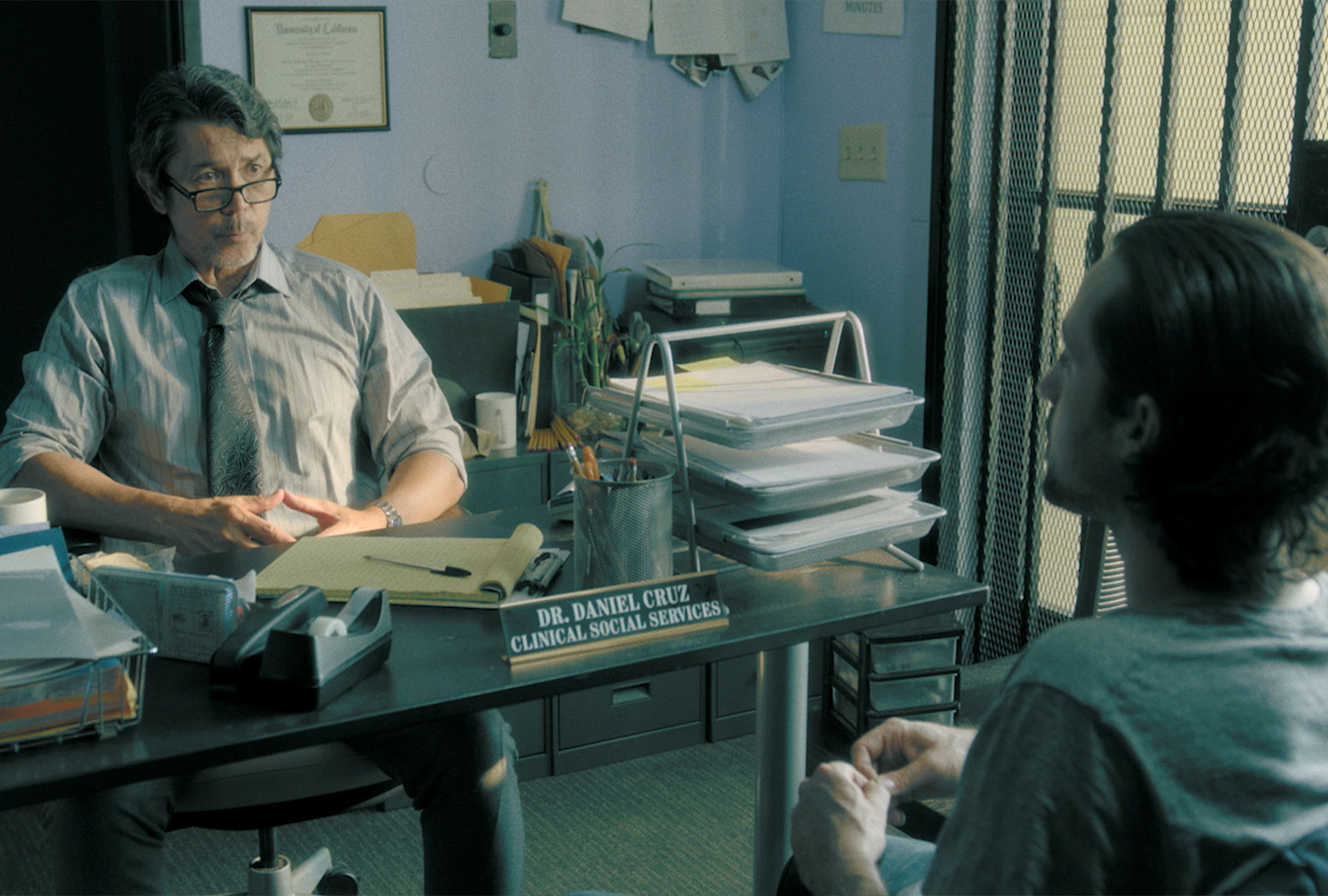
In the slick B-movie thriller, “Adverse,” Lou Diamond Phillips lends an air of gravitas as Dr. Cruz, a therapist who counsels Ethan (Thomas Ian Nicholas, a far cry from his “American Pie” role), a young man on parole for an unspecified crime. Phillips has only a handful of scenes, but he exudes a calm, cool demeanor while Nicholas — along with co-stars ranging from Mickey Rourke to Penelope Ann Miller — veer towards camp.

In “Adverse,” Phillips talks with Ethan about opportunities for underprivileged Chicanos. The actor, who was born in the Philippines, and is one-eighth Cherokee, often plays ethnic roles, but it is his ability to disappear into the characters that makes him so in demand. 

Phillips is currently appearing in FOX’s dark comedy crime series “Prodigal Son.” He even directed an episode of the show that aired earlier this month. Late last year, he published a science fiction/fantasy novel, “Tinderbox: Soldier of Indira.” The actor has not stopped working since the late 1980s, when he came to prominence in “La Bamba” (as Ritchie Valens), “Stand and Deliver,” (for which he won an Independent Spirit Award), and the western “Young Guns” (and its sequel). Over the course of his career, Phillips, has also been a musician in a band (“The Pipefitters”), appeared on Broadway, in “The King and I” (which earned him a Tony nomination) and has written and directed both feature films and episodes of various television series. In his spare time, he plays poker professionally. 

A true shapeshifter, Phillips spoke with Salon about his new film, his hit TV show, and his experiences in Hollywood. 

In “Adverse,” you play a therapist who is charged with helping a character channel his energy and temper. Your character remains calm under pressure. Are you given over to a cool demeanor, do you anger easily? Even in “Prodigal Sons,” your character, Gil Arroyo, seems grounded. 

I can be passionate. It’s difficult to be a director and fly off the handle. You have to have an inordinate amount of patience and understand what the process is. [One of Phillips’ cats, starts meowing; Phillips lets Squeak out of the room]. Sorry, I have five cats, speaking of patience . . . One of the hallmarks of my career is having a certain amount of patience that has allowed me to deal with the slings and arrows and look at the big picture and not get too overwhelmed. That’s been indicative of a few characters I have played.

Gil on “Prodigal Son,” is long-suffering and puts up with a lot and handles it somewhat with aplomb. My character on “Longmire,” Henry Standing Bear, is the definition of salt of the earth; he is a pillar of strength. He is very patient, calm and measured person. Many of the characters I play are aspirational and they remind me of qualities I strive to have in real life. I’m like everybody. You get to that breaking point . . .

Your character, Dr. Cruz, has a speech in “Adverse” about “not being owed anything” and taking opportunities. Given how you don’t seem to ever stop working, is this what drives your work ethic? 

In film and television and theater, it’s aspiration, and reminds us of qualities to live by, and at this moment in time in particular, I think we are dealing with a certain amount of entitlement in the world — certainly in our country. What is owed to you? What you deserve? Privilege. These are deep and wide-ranging conversations. There are basic human rights, that every person on this planet deserves, but when we get into a situation, especially in a country like ours, that is about excess that has privilege, and advantages that the rest of the world does not have, we can fail to look not only outside of our bubble, but also outside of ourselves and see the bigger picture. It’s a pretty hard-nosed speech, but that’s the job of Dr. Cruz — to be a straight shooter and give unvarnished truth, and hold the person’s feet to the fire if they are going to change. It’s not about coddling. I’m a little bit more compassionate and understanding in my real life, being a dad, but these are statements that need to be considered. What do we take for granted? What do we not appreciate? This reflects on my own life, I was a military brat, I grew up in Texas. I’m a little old school in the respect that I think manners have gone by the wayside. A certain work ethic has gone by the wayside. So many people want to be famous and rich. I have called that the “American Idol” mentality. It’s a lottery mentality. Reality television hasn’t helped this one bit. I can have instant fame and riches and gratification for the things I think I deserve. But it takes the work and putting in the time and discipline and perseverance and patience. That’s what attracted me about Dr. Cruz. I can tell the truth and bring some of my own experience to bear, so the gravitas of the character is authentic.

Adverse
Lou Diamond Phillips in “Adverse” (Lionsgate)

You are often cast in ethnic roles. Yet you never seem typecast, shifting between playing Latino and Indigenous characters. Can you talk about how you are perceived racially in Hollywood? 

I am in a very peculiar situation, being of mixed heritage; being part Filipino and Scot-Irish. You never get to see me play Scot-Irish, although my character, Russell Logan in “The First Power,” there’s a little bit of that in there. I have been proud to represent so many different communities and to be embraced by those communities. I always approach those roles with a great amount of respect and a desire to bring dignity to who I am portraying. I have always gone to the source and asked for their blessing. Whether it’s the Latino community and Edward James Olmos, or going to the Lakota and Cheyenne reservations for “Longmire.” I know that I am not 100% authentic in that respect, but I have been a standard bearer for brown people in Hollywood from the beginning of my career and I take that very seriously. Hopefully, I am a conduit to bringing more attention to other artists. 

On “Longmire” I was able to bring Graham Greene and Tattoo Cardinal, and Gary Farmer in. All of those people were my suggestions. “Let’s get the real deal.” I’m an ally, a cheerleader, and a friend. Same with playing Latinx roles. But Hollywood has not always known what to do with me because I don’t fit in their box. Now, there is more authenticity, and that is fantastic. When I started there weren’t that many brown or Asian actors with a name that could be put into leading roles. Now there are so many more, and I’m incredibly happy about that. Are we making the boxes smaller? When I look at “Prodigal Son,” I’m of mixed heritage. Frank Harts and Aurora Perrineau are of mixed heritage. There is a place for that in our art and community as well. I worry about when it comes to the decision-makers who want “this” and only “this,” as opposed to who is the best actor for the role. Are the Korean male or the Puerto Rican female only going to get one chance per year and not be up for other roles? I hope we get to the place where the acting is the primary criteria for the role.

There is idea of tokenism, and that if there is one person of color in a film or series, they have to speak for the entire community? We need multiple people of color representing always!

I have been in that situation where I was up for a major supporting role and an offer was out to an African American male for the lead. If he got the role, I would have gotten the role. He said no. A white guy got the role, so they cast and African American in the role I would have done. I said, “OK, Wow, you’re playing ethnic bingo here,” as opposed to asking: Who is the actor I want for this? 

You had breakout roles back in the late ’80s with a string of critical and commercial hits. How did you see your career unfolding after such a forceful start? You made a bunch of Hollywood films, but also shifted into B-movies (like “Adverse”) Did you find you want to have more control over your work? Or was it difficult to find the work you wanted? 

I have to say that I’ve always felt fortunate because I’ve always been employed. I have been able to work as an actor, or writer, or director. Someone in my position doesn’t get as many at bats as some of my contemporaries do. You don’t get to have as wide a range of opportunity. Careers are cyclical, as Jack Nicholson said. You get the highs, you get the lows. If you have a family and bills, this is what you do for a living — and you have to work. I’ve never been in a position where I could not not work. So, you take the best that is offered to you, or the best you can get. Would I like the opportunity to get the Tom Cruise role? They were not open to me. 

We were talking about the casual racism earlier. If I said, “Hey, I love this script, can I get a shot at it?” They would say, “Hey, we’re not going that way.” I knew what that meant. You never got an opportunity at that. When you don’t, you have to make your own opportunities. I’m taking this role because I have bills to pay, but I will do it to the best of my ability. I will try to elevate the material. I will hold my head up high because I will hold up my end. There have been small films that have overachieved. People think of “La Bamba” and “Stand and Deliver” as great successes — and they are — but they were small films. “La Bamba” was a $6 million negative pickup. It was not a studio film. It was essentially an independent film that was guaranteed distribution. “Stand and Deliver” was made for $1 million originally by PBS, and picked up by Warner Brothers at the Mill Valley Film Festival. 

I made “The 33” with Patricia Riggen and it was undersold, and it underperformed. It had a Mexican-American director, and the most international cast I’ve ever worked with. And yet it didn’t get the kind of support that would have put it into the awards consideration it should have been. I’m a member of the Academy, and they didn’t even send out screeners. They are putting labels on things and making the boxes smaller. My entire career has been fighting against those labels. 

You have focused more of your career on television recently. Are you choosing supporting roles in films like “Adverse” because it fits your schedule, or gives you an opportunity to work with friends? 

I want to do what challenges me and interest me. Thomas Ian Nicholas and I ran into each other at conventions, and he was looking to do something unexpected for him, and it was a young Asian American director, Brian A. Metcalf, so I will always try to support well-meaning films like that. I jumped on, Sean Austin said yes. Then we get Penelope Ann Miller and Mickey Rourke, and all of a sudden, this little film has some caché.

Every few years I want to do films like this. The last time I did it, was a beautiful film called “Filly Brown” which introduced the world to Gina Rodriguez. My buddy Eddie [James] Olmos called me, and his son Michael was one of the directors. Of course, I want to put my name on this and support films with people of color working behind the scenes and finding new and fresh talent and helping to expand that platform.

Where I’m at right now, I’m fortunate. “Prodigal Son” is a hit. Major representation going on there — it is exciting work and the opportunity to direct is fantastic. But quietly, behind the scenes, I wanted to make sure a number of the speaking roles went to people of color. We flipped one of the major roles to an Indian American actor. These are the things we do to make a difference. That is the quiet, perhaps insidious way we change minds to make sure representation is out there and in your face. I am still looking for great roles and writing more. 
 
What prompted you to publish a sci-fi novel last year? 

I have to go back to original inspiration — my wife Yvonne. When we first met, she was showing me her artwork. She did these beautiful manga-style illustrations inspired from Hans Christian Anderson’s “The Tinderbox,” and it was evocative of this post-apocalyptic feudal, Kurosawa kind of world of kings and queens and princesses. My immediate response was, let’s set this in outer space! It’s very “Star Wars,” it has its own mythology. I wrote the screenplay and realized it was far too expensive. No one would give me the amount of money to direct it. So, we decided to write the novel. The hardcover has 30 illustrations by Yvonne. I didn’t set out to write a sci-fi novel. I set it in that world. My hero is brown. If the movie ever gets made, I can hire the best 20 year-old brown actor to get the role. It goes into that philosophy of creating content that will have a life in representation. 

My friend Lauren Wolkstein, who codirected “The Strange Ones,” wants to know if you’ll join her quarantine poker club. Are you still playing?

I’ve been playing on Poker Stars. I was going to go back to the World Series and jump into the main event. The one time I did play, I cashed. It’s a passion. Speaking of patience and discipline, how someone behaves at a poker table is usually how they behave in life. 

Given your career overall, what ambitions do you still have?

I’m doing a lot of writing. I’m adapting a friend’s novel into a miniseries. The experience of working with my wife was wonderful, and the response [to the book] was so great, I’m actually working on the sequel. She came up with the storyline. I want to continue to do what I’m doing, getting wonderful opportunities and not resting on my laurels. I want to direct more. There are some big things I want to direct one day. I can conceive of a role I want because some of the coolest things in my career have come out of left field. It is just being open to those, read everything that comes my way, and actively search out other things. Back in the ’90s, there was a moment I was an offer-only actor. I looked around and wondered, “Why am I not seeing that script? Why wasn’t I part of that project?” When I changed that attitude — I want to see everything and if I have to [audition] I will — that lead to “Courage Under Fire.” I auditioned four or five times for that and finally got the role when they didn’t want someone known. From then on, it’s always been about understanding that there are so many wonderful actors out there and there are a lot of actors in my category. I saw the list for “Prodigal Son,” and I knew if I waited for it to fall to me, I probably wouldn’t get the job. I went in and I read for it. “Here’s what I can do in this role.” That’s what you have to do sometimes. You have to hit the bricks and take that leap. I feel some of my best work may still be ahead of me. Retirement is not in my vocabulary. 

So, there may be a “Young Guns 3” . . . 

That rumor is out there. I actually did read the first draft of the script and it’s quite exciting. In this world of reboots and revisiting things, it could be very interesting.

“Adverse” is out March 9 on digital, on demand, and DVD. “Prodigal Son” airs new episodes on Tuesdays on FOX and is also available to stream on FOX Now and Hulu.

Donald Trump Jr. mocked on Twitter after attacking Meghan Markle

As part of his continuing efforts to remain relevant, Donald Trump Jr. has taken to filming himself delivering “hot takes” where he offers up commentary on the issues of the day for anyone who might be interested.

With that in mind, the eldest son of one-term President Donald Trump felt the need to wade into the interview Oprah Winfrey conducted with Meghan Markle and Prince Harry that has captured the world’s attention in a way that his father’s antics used to.

For the record he stated, “Are we really pretending that she’s a victim of all of this. Has she ever met a camera that she probably didn’t love? Are we really pretending that? I actually feel bad for Harry. He’s like a guy in a hostage video,” during his overamped monologue.

Needless to say, fans of the popular Markle and critics of the president’s son were quick to offer their “takes” of his “take” and the Twitter consensus was: stay in your own lane because nobody cares about your opinion.

You can see a sampling below:


Meghan McCain’s rant on Meghan Markle leaves Whoopi Goldberg visibly stumped

Meghan McCain slammed the British monarchy on Tuesday’s episode of The View, declaring that “the American experiment is the way to go.”

“I do not want to defend the monarchy,” McCain began her rant. “I’m a red-blooded 100% American who celebrates freedom anyway I can and always, so being in a position where I’m supposed to defend the monarchy is uncomfortable.”

Asked what she thought of English broadcaster Piers Morgan storming off his show when questioned over his journalistic treatment of the royal family, McCain –– with her knack for conservative solipsism –– dove headfirst into a highly personalized spiel about what it means to be an American and a patriot to boot.

“My ancestors fought in the American Revolution,” she explained. “I named my daughter ‘Liberty.’ I enjoy going to Mount Vernon to visit the home place of our Founding Fathers.”

It must be remembered that Mount Vernon was, in fact, a slave plantation. At the time of George Washington’s death in 1799, the plantation still held 317 slaves, 90 percent of whom were African-Americans. 

McCain, noting conversations she’d had with friends, pointed to a potential generational difference in how the British feel about the monarchy. “There’s a feeling among some people in the U.K.,” she said, “that they have sort of abandoned Queen and country. And they’re doing it a time when Prince Phillip is ninety-nine years old and literally possibly on his deathbed after getting open heart surgery.”

McCain capped her gloss on the ills of the British monarchy with one of her more eccentric word salads to date, this one infused with a touch of patriotism, history, and feminism combined. 

“We have two American women — Meghan Markle and Oprah Winfrey — who are single-handedly finishing what George Washington and our revolutionary counterparts did. I’m all for it.”

The whole thing left Goldberg so stunned that her facial reaction brought a divided internet together in laughter:

Buckingham Palace finally offers a brief, tepid response to Meghan and Harry’s interview

Buckingham Palace has issued a 61-word statement following Oprah Winfrey’s explosive interview with Prince Harry and Meghan Markle, the Duke and Duchess of Sussex, which aired Sunday night. It said that the whole royal family was saddened to learn the full extent of “how challenging the last few years have been for Harry and Meghan.” 

“The issues raised, particularly that of race, are concerning,” the statement said. “While some recollections may vary, they are taken very seriously and will be addressed by the family privately.” 

It concluded: “Harry, Meghan and Archie will always be much loved family members.” 

This statement, which was issued on Tuesday, was the first since Harry and Meghan’s two-hour interview with Winfrey, during which they made several serious claims. Perhaps the biggest revelation was that Meghan said life as a royal threatened her mental health and left her feeling deeply isolated; this culminated while she was pregnant with her son, Archie, in 2019. She described persistent suicidal thoughts.

“I was ashamed to have to admit it to Harry,” Meghan said. “I knew that if I didn’t say it, I would do it. I just didn’t want to be alive anymore.”

She said she asked a senior royal about seeking inpatient care, but was denied help because “it wouldn’t be good for the institution.” 

Harry and Meghan also indicated that at least one royal family member expressed “concerns and [had] conversations about how dark his skin might be when he’s born,” since Meghan is biracial. Winfrey said during a Monday interview that Harry told her in a private conversation that neither Queen Elizabeth nor Prince Philip were part of those conversations. 

One of the prevailing social media opinions is that it was Prince Charles who expressed “concerns” about his eventual grandson’s complexion — which makes a newly released series of images of Charles posing with Black healthcare workers seem like a transparent play to control optics.

The images were posted on Tuesday afternoon to an Instagram account used by the royal family. The caption reads: “Continuing Their Royal Highnesses’ work to encourage vaccine take-up, The Prince of Wales today visited @jesushouseuk in London.” 

While at Jesus House — a predominantly Black congregation in London that is being used as a vaccination site — Charles seems to have only posed with Black healthcare attendants and visitors. It should be noted that it appears his last public visit to the house of worship was in 2007, during which he gave a speech celebrating the “work of Black majority churches.” 

When asked about the Harry and Meghan interview by a reporter from Sky News, Charles apparently  asked the royal what he thought about the interview but “he did not reply and was ushered out of the building.” 

Meanwhile, another father in the equation was seeking his time in the sun. Thomas Markle — Meghan Markle’s biological father, who has had a contentious relationship with his daughter since it came to light that he’d worked with the tabloids and staged paparazzi photographs — was interviewed on “Good Morning Britain.” 

He said that he would continue speaking to the press until Meghan and Harry spoke to him. 

“If I don’t hear from them in 30 days, I’ll do another one,” he said. “I would love to hear from them. When they decide to talk to me, I’ll stop talking to the press. I’d like to say sorry for what I’ve done but this was two years ago. I’ve tried to make up for it. But these stories in the paper are because I haven’t heard from you.”

He also added that he sided with the British royal family, and did not believe they were racist (it should be noted that Markle has never actually met Prince Harry and it’s unlikely he has ever met any other members of the royal family). 

Biden’s criticism of Trump team’s vaccine contracts is a stretch

“When I came into office, the prior administration had contracted for not nearly enough vaccine to cover adults in America. We rectified that.”

— President Joe Biden, March 2 news conference

During a March 2 news conference on the covid-19 pandemic, President Joe Biden claimed that former President Donald Trump’s administration did not ensure there would be enough vaccines for the American public.

“When I came into office, the prior administration had contracted for not nearly enough vaccine to cover adults in America,” said Biden. “We rectified that.”

Biden then announced he was using the Defense Production Act to facilitate a partnership between two competing drug companies: Merck had agreed to help manufacture the recently authorized Johnson & Johnson vaccine.

The move, he said, would accelerate the timeline for the availability of vaccines: “We’re now on track to have enough vaccine supply for every adult in America by the end of May,” he said, two months earlier than he had previously projected.

It’s been a common political message since the Biden administration took office that the initial vaccine rollout under Trump was “chaotic.” PolitiFact previously rated a claim by Biden’s chief of staff, Ron Klain, that the Trump administration left no vaccine plan behind as Mostly False.

So, we thought it was important to check whether Biden was going too far in alleging that the Trump administration hadn’t contracted for enough vaccines to cover the American public. Let’s see what the contracts, which are public documents, say.

The Operation Warp Speed Contracts and FDA’s Process

As part of Operation Warp Speed, the Trump administration entered into contracts with multiple drugmakers. The contracts were generally signed while potential vaccines were still in clinical trials.

Experts told us this was smart because the Trump administration didn’t know which vaccines from which drugmakers would work, how effective they would be or how quickly they could be produced.

“That was the whole approach of Operation Warp Speed,” said Dr. Amesh Adalja, a senior scholar at the Johns Hopkins Center for Health Security. “Not knowing which one would cross the finish line, the Trump administration took a portfolio approach and invested in multiple vaccines.”

Here’s what the Trump team’s contracts called for drugmakers to supply to the U.S. government:

In all, the amounts agreed to under these contracts total about 800 million vaccine doses, or enough for more than 400 million people.

The U.S., based on U.S. Census estimates, has around 328 million people, of whom about 255 million are 18 or older. (Vaccines are not yet authorized for children.)

So, it appears that the Trump administration’s contracts with drugmakers did cover enough doses to vaccinate the entire U.S. adult population — and then some. By that measure, Biden’s statement is inaccurate.

An important point to remember, though, is that these contract numbers don’t necessarily represent deliverable vaccines. The contracts represent early promises. There were still important hurdles to be cleared before these possible vaccine candidates could be a reality.

Kevin Gilligan, a senior consultant with Biologics Consulting, a firm focused on pharmaceuticals, said that once drugmakers develop a vaccine they must test it through clinical trials with humans and amass enough data to show the vaccines are safe and effective and cause minimal side effects.

The data is then presented to the Food and Drug Administration, which decides whether the vaccine should be authorized for emergency use. Granting an emergency use authorization means the vaccine can then be distributed to the public.

Until recently, the Pfizer and Moderna vaccines were the only two that had reached that point, gaining authorization on Dec. 11 and 18 respectively.

The Trump administration announced Dec. 23 that it would buy an additional 200 million doses in total of both companies’ vaccines.

A Caveat Worth Noting: The Real Numbers Were Lower

A Biden administration press official told KHN that the president was referring only to orders for the authorized vaccines: “When the Trump administration was in office, there were only two approved vaccines (Pfizer and Moderna) and the Trump administration had not contracted for enough of them to vaccinate all Americans. They only had 400 million doses of these authorized vaccines, which is only enough for 200 million Americans. Upon coming into office, one of our first steps was to ensure that we had enough supply secured for every American. We were prepared from Day One.”

On this point, the Biden White House is correct. The U.S. government had in place agreements to buy 400 million doses of the authorized vaccines, which were both two-dose vaccines — not enough for the entire U.S. adult population.

It’s also true that five days after Biden became president, he announced his administration had reached agreements with Moderna and Pfizer to buy a combined additional 200 million doses. That purchase was finalized on Feb. 11 and brought the total U.S. supply to 600 million, or enough to vaccinate 300 million people.

In addition, on Feb. 27, Johnson & Johnson’s vaccine was authorized for emergency use. Under the Operation Warp Speed contract, J&J is supposed to provide 100 million doses to the U.S. by the end of May, but the company is reportedly behind on production. The Biden administration’s move to get J&J to team up with Merck to achieve its production goal will increase vaccine supply.

But, is it fair for Biden to blame the Trump administration for not buying more of the Pfizer and Moderna vaccines once they became authorized for emergency use?

The answer to that isn’t clear-cut, said the experts.

“It’s not totally fair to say the prior administration didn’t purchase enough, since they did move to purchase more doses after the vaccine was authorized,” said Jennifer Kates, senior vice president and director of global health and HIV policy at KFF. “I think the question is should they have purchased it earlier?”

The New York Times reported on Dec. 7 that before Pfizer’s covid vaccine was shown to be highly effective in clinical trials, the company had offered the U.S. government the option to buy additional doses, but the Trump administration declined. Former Health and Human Services secretary Alex Azar disputed the news report, saying during a TV interview that Pfizer hadn’t agreed to a production amount or delivery time for the additional vaccine, so he couldn’t agree to the deal: “I’m certainly not going to sign a deal with Pfizer giving them $10 billion to buy vaccine that they could deliver to us five, 10 years hence. That doesn’t make any sense.”

James Love, director of Knowledge Ecology International, a nongovernmental organization that obtained copies of covid government contracts, agreed that once it was clear the Pfizer and Moderna vaccines were likely to receive FDA authorization, the Trump administration could have taken action to make competing drug companies increase their vaccine manufacturing capacity in the way Biden did with Merck and J&J.

“The U.S. could have forced technology transfer between companies, which meant they would have been assured of additional vaccine manufacturing capacity,” said Love. “The agreements we have now about scaling manufacturing are coming pretty late actually. It takes several months to get stuff up and running.”

But Gilligan noted that the Biden administration had the advantage of hindsight. “Biden inherited the success of vaccine development done under Trump and then expanded on it,” said Gilligan. “And the Biden administration has the benefit of looking back at what was done well and what wasn’t and making the appropriate corrective changes. Hindsight is 20/20.”

Overall, there are questions around whether the Trump administration could have acted more quickly to buy doses or increase vaccine manufacturing capacity. And the Biden administration has certainly taken significant measures to expand supplies.

But it’s stretching the truth to say the Trump administration hadn’t contracted for enough covid vaccines to inoculate the U.S. adult population.

Our Ruling

Biden said the Trump administration “had contracted for not nearly enough vaccine to cover adults in America.”

While Trump was still in office, his administration had agreements in place to buy 400 million doses of authorized vaccine, or enough to inoculate about 200 million people. That wouldn’t cover the U.S. adult population.

However, KHN-PolitiFact reviewed the Trump administration’s Operation Warp Speed contracts and found those included enough vaccine doses that, once cleared for use by the FDA, would inoculate about 550 million people — more than double the U.S. adult population.

Biden’s statement contains an element of truth but ignores facts that would give a different impression.

We rate this claim Mostly False.

SOURCES:

Census Bureau, National Population by Characteristics: 2010-2019, accessed March 5, 2021

Department of Health and Human Services, Novavax contract, July 6, 2020

Department of Health and Human Services, Pfizer contract, July 21, 2020

Department of Health and Human Services, Sanofi contract, July 30, 2020

Department of Health and Human Services, Janssen contract, Aug. 5, 2020

Department of Health and Human Services, Moderna contract, Aug. 9, 2020

Department of Health and Human Services, AstraZeneca Contract, Oct. 28, 2020

Department of Health and Human Services, “Trump Administration Purchases Additional 100 Million Doses of COVID-19 Investigational Vaccine From Pfizer,” Dec. 23, 2020

Department of Health and Human Services, “Biden Administration Purchases Additional Doses of COVID-19 Vaccines From Pfizer and Moderna,” Feb. 11, 2021

Department of Health and Human Services, “Biden Administration Announces Historic Manufacturing Collaboration Between Merck and Johnson & Johnson to Expand Production of COVID-19 Vaccines,” March 2, 2021

FactCheck.org, “Biden’s Misleading Vaccine Boasts,” Feb. 23, 2021

Food and Drug Administration, “FDA Takes Key Action in Fight Against COVID-19 by Issuing Emergency Use Authorization for First COVID-19 Vaccine,” Dec. 11, 2020

Food and Drug Administration, “FDA Takes Additional Action in Fight Against COVID-19 by Issuing Emergency Use Authorization for Second COVID-19 Vaccine,” Dec. 18, 2020

Food and Drug Administration, “FDA Issues Emergency Use Authorization for Third COVID-19 Vaccine,” Feb. 27, 2021

KFF, Distributing a COVID-19 Vaccine Across the U.S. — A Look at Key Issues, Oct. 20, 2020

Knowledge Ecology International, Moderna contract, Dec. 11, 2020

The New York Times, “Trump Administration Passed on Chance to Secure More of Pfizer Vaccine,” Dec. 7, 2020

PBS NewsHour, Alex Azar interview, “Britain Rolls Out a Vaccine, but What Will Distribution Look Like in the U.S.?”, Dec. 8, 2020

Phone interview with James Love, director of Knowledge Ecology International, March 4, 2021

Phone interview with Kevin Gilligan, senior consultant with Biologics Consulting, March 4, 2021

Phone interview with Jennifer Kates, senior vice president and director of global health and HIV policy at KFF, March 4, 2021

Phone interview with Dr. Amesh Adalja, senior scholar at the Johns Hopkins University Center for Health Security, March 3, 2021

PolitiFact, “Trump Vaccine Plan Left Logistics to States, but It Did Exist,” Jan. 27, 2021

The White House, Remarks by President Biden on the Administration’s COVID-19 Vaccination Efforts, March 2, 2021

This story was produced in partnership with PolitiFact. It can be republished for free.

Jim Jordan, GOP fight “cancel culture” (on Capitol’s TV system) while Democrats fight pandemic

Reps. Jim Jordan, R-Ohio, and Rodney Davis, R-Ill., have demanded that House Administration Committee Chairwoman Zoe Lofgren, D-Calif., ensure that Fox News and One America News Network will remain available to members and staff via Congress’ internal television system. The demand, which came in the form of a letter on Tuesday, was in response to a push by two Democrats for cable, satellite and streaming companies to combat misinformation and conspiracies by dropping outlets like Fox News, OANN and Newsmax. 

Jordan — the hardcore Trump loyalist and ranking member of the House Judiciary Committee, known for rarely wearing a jacket — and Davis also demanded that Newsmax, a far-right media outlet that has seen its popularity grow among disgruntled Fox News viewers, be added to the list of channels. A press release from Jordan’s office stated that such a decision would “demonstrate the House’s commitment to rejecting cancel culture.” 

The GOP duo’s focus on which channels Capitol Hill viewers can access is emblematic of the much larger Republican strategy — or reflexive impulse — to focus on hot-button culture issues. Their Democratic colleagues, meanwhile, were busy reassuring reporters that they would emerge united ahead of a forthcoming vote on more coronavirus relief that is expected to pass on party lines.

Just weeks into President Joe Biden’s tenure and their hard-won majority in both houses of Congress, Democrats are aware they’re gambling by proceeding with a nearly $2 trillion package without the backing of a single Republican lawmaker.

But leading Democrats say they’re largely OK with that, betting that public opinion will outweigh the barrage of GOP attacks they are sure to face through next year’s elections for appropriating such a “partisan” and expensive aid bill.

In the meantime, many Republicans have been fixated on trying to rid society of what many conservatives claim is a far more looming political and societal threat: “cancel culture.” 

Democrats say they see this as a welcome distraction.

“House Democrats are the party of crushing the coronavirus and providing relief to everyday Americans,” House Democratic Caucus Chair Hakeem Jeffries, D-N.Y., told reporters Tuesday. “House Republicans are the party of fake outrage, as it relates to Dr. Seuss. It’s a strange thing.”

“Heaven forbid we pass something that’s going to help the damn workers in the United States of America! Heaven forbid!” Rep. Tim Ryan, D-Ohio, said in a passionate floor speech. “Now, stop talking about Dr. Seuss and start working with us on behalf of the American workers.”

Democrats’ steadfast pursuit of yet another hefty spending bill to combat the pandemic — despite zero Republicans voting for their legislation — has been largely driven by two main factors. The first is that millions of struggling families teetering on the financial cliff can be rescued by quickly injecting money into the economy. The second, not unrelated, is that voters really seem to like it.

Public polling has shown that while GOP lawmakers in Congress rebuke the “socialist” and “wasteful” relief, support among regular Americans transcends across party lines, even in a climate of intense partisan division and heightened attention to the details.

A Morning Consult survey showed 7 in 10 independents like the proposal, along with 60 percent of GOP voters. A New York Times/Survey Monkey poll found that three-quarters of independents and 43 percent of Republicans back it. Nearly 70 percent of overall respondents to a Quinnipiac poll said they also like it, along with 37 percent of Republicans. A Monmouth University survey found that more than 6 in 10 Americans support the legislation, including 56 percent of independents and 33 percent of Republicans.

There’s a lot of wobble in those Republican numbers, but what’s apparent is that the plan is far more popular among GOP voters than elected officials. Jeffries was unable to offer an explanation for the disconnect, conceding that it too was “unclear” to him.

The legislation’s relative popularity among Republican voters is striking, given the fierce criticism GOP members of Congress have directed at their Democratic colleagues and the Biden administration for failing to trim down its size and scope to win them over.

“Clearly, when you look at the priorities of Speaker Pelosi, it’s to spend as much money as quickly as possible on her socialist agenda and to turn her backs on those of us who want to work together to confront this virus and to safely reopen our economy and our schools,” House Minority Whip Steve Scalise, R-La., told reporters.

Combating cancel culture has clearly emerged in the early days of the Biden administration as a central theme of Republican messaging. Whatever the downside in the short term, GOP leaders clearly feel this is a winning strategy among its base.

This theme has been dominating airtime in the conservative media world. Fox News, for example, made twice as many references to “cancel culture” over the past week than it did to “COVID relief bill,” according to data from Lexis Nexis reported by CNN.

Piers Morgan quits “Good Morning Britain” after saying Meghan Markle lied about her mental health

ITV presenter Piers Morgan has quit the morning show “Good Morning Britain.”

According to Variety, Morgan shared in a statement that “following discussions with ITV, Piers Morgan has decided now is the time to leave ‘Good Morning Britain.’ ITV has accepted this decision and has nothing further to add.”

Morgan’s departure comes after more than 41,000 wrote in to Ofcom, the United Kingdom’s media regulator, after Morgan said during Monday’s edition of the show that he did not believe Meghan Markle, the Duchess of Sussex, had actually struggled with her mental health. 

In an explosive interview with Oprah Winfrey, which aired on Sunday night in the United States, Meghan appeared alongside her husband, Prince Harry, to discuss their decision to leave the British royal family. Meghan said she described experiencing persistent suicidal thoughts. 

“I was ashamed to have to admit it to Harry,” Meghan said in the interview. “I knew that if I didn’t say it, I would do it. I just didn’t want to be alive anymore.”

Meghan went on to say that she asked a senior royal about seeking inpatient care, but was rebuffed because “it wouldn’t be good for the institution.” 

Morgan made several unfounded claims that Meghan’s assertions were lies. 

“Who did you go to? What did they say to you? I’m sorry, I don’t believe a word she said, Meghan Markle,” Morgan said on the show. “I wouldn’t believe it if she read me a weather report.” 

Morgan wasn’t the only commentator to criticize Meghan. Right-wing radio host Ben Shapiro suggested that she was lying about racist backlash, for instance — but an Ofcom spokesperson told Variety that they had received 41,015 complaints about Morgan’s comments by 2 p.m. U.K. time on Tuesday.”We have launched an investigation into Monday’s episode of ‘Good Morning Britain’ under our harm and offence rules,” they said. 

Then, during the Tuesday edition of “Good Morning Britain,” Morgan stormed off the set during the live broadcast after Alex Beresford stood up for Meghan. 

“I understand you don’t like Meghan Markle, you made it so clear a number of times,” Beresford said. He then indicated that Meghan used to communicate with Morgan, but has since cut him off.

“She’s entitled to cut you off if she wants to,” Beresford said. “Has she said anything about you since she cut you off? I don’t think she has, but yet you continue to trash her.” 

“Okay, I’m done with this,” said Morgan, before exiting the show’s set.

He later returned to the show to clarify his “position on mental illness and on suicide.” 

“These are clearly extremely serious things and should be taken extremely seriously and if someone is feeling that way they should get the treatment and the help they need every time,” he said. “And if they belong to an institution like the Royal family and they go and seek that help they should absolutely be given it.”

He added that it was not his place to question if Meghan was suicidal, as he was “not in her mind.” 

“My real concern was a disbelief frankly,” he said. “That she went to a senior member of the Royal household and told them she was suicidal and was told she could not have any help because it would be a bad look for the family. If that is true a) that person should be fired and b) the Royal family have serious questions that need to be answered.”

In a statement, ITV chief executive Carolyn McCall also issued a statement, saying that they believed Meghan completely. 

“ITV is committed to mental health and wellbeing and working with our charity partners on ‘Britain Get Talking,’ [an ITV mental wellness initiative] which is about encouraging people to talk about their mental health,” the statement said. “It is very important that if anyone has suicidal thoughts that they should always speak out and be listened to.”

GOP Rep. Marjorie Taylor Greene’s latest stunt is trying to stall Biden’s COVID relief bill

Rep. Marjorie Taylor Greene, R-Ga., along with several members of the House Freedom Caucus, announced that they would force roll call votes on a spate of upcoming suspension bills, effectively postponing the votes on thirteen relatively uncontroversial pieces of legislation. 

According to CNN, these measures are typically passed by way of voice votes or unanimous consent. However, forcing a roll call vote on the measures would significantly lengthen the legislative process by up to ten hours due to the COVID-19 health restrictions enforced in the House.

Some of the bills on the table include awarding members of the Capitol Police Force and Washington Metropolitan Police Department with Congressional Gold Medals. 

“The American people deserve to know where their member of Congress stands with a roll call vote,” Greene said in a statement to CNN. “While thousands of illegal aliens are invading Biden’s open border, American kids are losing their education with closed schools, thousands of small businesses have been forced to shut down, the People really don’t care about politicians whining about voting and doing their job for 10 hours.”

According to CNN, the suspension bills –– which aim to address issues like child abuse prevention and treatment, literacy, and credit management –– have nothing to do with issues that Greene is ostensibly protesting. In fact, three of the thirteen bills currently on deck were sponsored by Republicans. 

As Salon’s Ramsey Touchberry reported last week, even many members of Greene’s own GOP are becoming increasingly frustrated with Greene’s antics, which have needlessly stymied necessary votes. “Her act is starting to wear thin,” one aide told CNN.

Rep. Rodney Davis, R-Ill., told CNN that Greene’s effort to stall the bills is fruitless. “I think this is an end result of what the House has become, what the posture of the House has become,” Davis said. “I think what you’re seeing with a lot of the shenanigans on the floor is because so many members have so much time on their hands to be able to go to the floor, and worry about what’s happening with suspension bills rather than moving along, trying to look at legislating into the future.”

Davis also told CNN that loosening House coronavirus restrictions might impede future efforts to stall proceedings like Greene’s. 

“I certainly hope that [House Speaker Nancy Pelosi,] Leader McCarthy, all of us, we can sit down and work out a plan to reopen the House,” Davis continued. “I think that’s going to help us move ahead because when people see light at the end of the tunnel, then they’re going to start planning for that light at the end of the tunnel, planning for the Capitol to reopen again, and leading us back to where we’re still partisan, but we’re not doing it in a way that just becomes sometimes childish.”

House Majority Leader Steny Hoyer, D-Md., and House Minority Leader, Kevin McCarthy, R-Calif., are reportedly working together to set a concrete time for the measures to reach the floor

Other Republicans defended Greene’s push to thwart the proceedings. “I think [Greene] is just doing her committee work,” said Rep. Jim Jordan, R-Ohio. “That is her committee work.”

Last month, The House voted to strip Greene of her committee assignments, ousting her from the House Education and Labor Committee, as well as the Budget Committee. Only eleven Republicans voted to remove her. 

Iowa bills would ban teachers from talking about trans people

A slew of bills being proposed in the Iowa state legislature threaten to cause harm to members of the LGBTQ community, specifically to transgender students in the state’s schools.

Senate File 224, a bill to restrict transgender pupils from using restrooms that match their gender, was voted on and approved in an education subcommittee on Wednesday, which means it will next go to the full Senate Education Committee for consideration for a full Senate vote. If passed, students would be required to use restrooms that correspond to the sex that is listed on their birth certificates instead.

The proposal would be a stark departure from the rights students in the state have been afforded in the past. Iowa has recognized since 2007 the right of transgender students to use restrooms that correspond to their gender.

The bill’s sponsor, Sen. Jim Carlin (R-Sioux City), has proposed the change in rules on the false claim that anti-trans laws somehow protect cisgender women from “sexual predators.” 

“It’s important to note that the concern is not so much with transgender individuals likely to be sexual predators but that sexual predators could exploit such laws by posing as transgender in order to gain access to women and girls,” Carlin said.

However, research shows that such concerns are based on a fiction. One study from 2018, for instance, looking at restroom protection ordinances and rules in Massachusetts, found that “fears of increased safety and privacy violations as a result of nondiscrimination laws are not empirically grounded.” 

A 2015 Media Matters study looked at 17 school districts across the country representing 600,000 students where protections for transgender students existed, and found no cases of the scenario Carlin raised — including in Iowa. The study specifically asked whether any students were “pretending to be transgender to sneak into locker rooms or bathrooms.” Des Moines Public Schools Director of Communications Phil Roeder said there were not.

“We have had no reported incidents of any student abusing our policies or taking advantage of them in any way that would be inappropriate or harassing,” Roeder said.

Indeed, forcing transgender students to use restrooms that don’t correspond to their gender increases harm to students. One survey found that 12 percent of transgender people were verbally harassed while being required to use restrooms aligning with their sex that is listed on their birth certificates.

Meanwhile, another bill that has been introduced in the Iowa legislature threatens to cause harm to transgender students in another way. Senate File 167 would update curriculum in the state to deny teachers the ability to discuss transgender issues at all — even if there’s a transgender student in their classroom. Teachers would have the ability to bypass this rule, according to the legislation, but only if every student’s parents in the classroom first provide written permission.

Such gag orders limit a teacher’s ability to address real issues affecting children, including when it comes to stopping bullying in class or on the playground. A teacher who wants to stop a student from picking on a transgender pupil may think twice about doing so if they can be reprimanded for it, for example.

The bill, if implemented, would undoubtedly cause psychological harm to transgender students. “SF167 is just another way to prevent children from learning about how they may differ from societal norms,” Peyton Downing, opinion columnist at The Daily Iowanrecently wrote. “By denying an education on gender identity, these schools prevent kids from garnering an understanding of who they really are.”

A number of other bills are presently being considered in the Iowa legislature that would similarly hurt transgender students. Senate File 80 would force schools to “out” students to their parents if they choose to use pronouns that are different from the ones listed on their birth certificate. On the state House side of things, House File 184 would deny transgender athletes the ability to compete in sports or on teams which align with their gender. 

Such bills are being introduced not only in Iowa, but in a number of other states as well. Advocates are preparing. As Chase Strangio, deputy director for transgender justice with the American Civil Liberties Union’s LGBT & HIV Project, put it on Twitter, “In Oklahoma, Iowa, and Tennessee we can expect brutal fights to defend trans lives and will need to start gearing up for those fights now.”

Meanwhile, the new presidential administration may seek to challenge the anti-trans bills, should they be passed into law. President Joe Biden issued an executive order last month ordering departments under his purview to find ways to address discrimination against LGBTQ people, including within the Department of Education.

The order does not change any policy in a direct way, but it does provide insight into how the Biden administration may try to defend students against encroachments like the anti-trans bills. The Biden White House, for example, writes in the order that it will interpret Title IX gender protections in education to also “prohibit discrimination on the basis of gender identity or sexual orientation.”

Copyright © Truthout. Reprinted with permission.


A year of coronavirus: Trump is gone. It’s time to let go of the partisan responses to the pandemic

After delaying long enough to cause serious anxiety among prominent public health experts, on Monday the Centers for Disease Control (CDC) finally released their recommendations for people who have been fully vaccinated against COVID-19. The delay was worrisome, especially in light of reports that there was a debate in the White House over how lenient the guidelines should be with regards to what vaccinated people can do. In the end, however, what was settled on was a little more freedom than earlier reports suggested. Not only do the guidelines say vaccinated people can socialize together, as was anticipated, they also indicate that vaccinated people can visit with unvaccinated people – so long as they are all low-risk and from the same house. Mostly described as the “you can hug your grandkids” rule in the press, the guideline also includes increased freedom for things like a vaccinated couple hosting an unvaccinated couple for dinner. 

Many prominent public health experts celebrated the loosening of restrictions on vaccinated people because, as Harvard-based epidemiologist Julia Marcus explained on Twitter, “Vaccines provide a true reduction of risk, not a false sense of security.” Others, such as Dr. Leana Wen, visiting professor at George Washington University’s Milken Institute School of Public Health, remain critical, not because they believe the new guidelines are too generous — but because they are still too strict. 

“While some guidance is better than no guidance, the guidelines are too timid and too limited, and they fail to tie reopening guidance with vaccination status,” Wen wrote in the Washington Post on Monday, arguing that incentivizing vaccination requires shifting public health outlooks “from zero risk to manageable risk” and highlighting “the freedom to return to normalcy.” She recommended that the CDC guidelines allow travel for vaccinated people and that the CDC “provide nuance and risk estimates instead of taking an absolutist approach” on matters such as going to church, going to the gym, or eating out. 

Dr. Wen is speaking sense. It is sense that’s drawn from hard-earned lessons from previous disasters like the AIDS crisis, which taught public health experts that abstinence-only approaches that don’t take into account basic human needs for pleasure and connection are bound to fail, especially in the long run. Unfortunately, these lessons have largely been ignored during the coronavirus pandemic. Instead, Americans have been sucked into an all-or-nothing approach, with your choice of “all” or “nothing” depending largely on your partisan identity. 

Blame Donald Trump.


Want more Amanda Marcotte on politics? Subscribe to her newsletter Standing Room Only.


Early in the pandemic, the former president turned decisively against necessary measures such as closing down public spaces and mask-wearing, out of his twin convictions that the virus was being exaggerated in order to hurt him politically and that re-opening the economy would get him re-elected. The result was that Republicans, both politicians and ordinary people, incorporated indifference to the pandemic into their identities, refusing to wear masks or follow social distancing guidelines. Now, over half a million people are dead — hundreds of thousands more than would have died, except for conservative childishness and the refusal of Republican state and local officials to pass necessary restrictions on public gathering spaces. 

Unfortunately, liberals also played a role in how bad things got.

Trump’s rejection of sensible precautions caused many of his political opponents to run hard in the opposite direction, embracing the lockdowns as if they were a point of personal virtue and inherent good, instead of a temporary and deeply unpleasant measure necessary to contain the virus. Worse, liberals were so protective of lockdowns that even sensible criticisms were ignored, and liberals often acted like, well, cops. They often appeared more interested in lecturing people rather than empowering them through education. There was a lot of social media shaming for any social activity, no matter how safe it was. And in behaving this way, a lot of well-intentioned people made the pandemic much worse.

“Throughout the past year, traditional and social media have been caught up in a cycle of shaming—made worse by being so unscientific and misguided,” University of North Carolina associate professor Zeynep Tufecki wrote last month at the Atlantic. For instance, “visible but low-risk activities” — such as outside socializing — “attract the scolds” and often drive people to riskier but less visible activities by bringing those social occasions inside.  

A lot of people, no doubt in large part because they were appalled at Trump’s refusal to manage risks at all, embraced an absolutist approach, acting as if the only level of acceptable risk was zero. (Though many of those who were absolutists in public were quietly finding outlets of their own — forming a “pod,” getting a masked-up haircut — that they would yell at others for embracing.) But, as Dr. Marcus told Tufecki, “Public health works best when it helps people find safer ways to get what they need and want.” Failure to meet people where they’re at likely led people, lonely and exhausted by the pandemic, to take unnecessary risks, often because they had no sensible guidance on how to manage their risks. 

With a more mature and pro-science Joe Biden in the White House, we finally have a chance to talk about pandemic restrictions like adults, instead of as an endless test of tribalist loyalties proved by, depending on your party, performing recklessness or treating quarantine like it’s a self-deprivation contest. The new CDC guidelines are a step in the right direction away from such absolutism and move towards a more sensible approach to risk management. This is important, because not only are absolutist approaches unfair and not scientifically justified, they reduce trust. Messaging that nothing should change for vaccinated people defies common sense and will cause people to stop trusting anything that authorities say on the subject. 

Sadly, the guidelines are probably still too strict.


Want more Amanda Marcotte on politics? Subscribe to her newsletter Standing Room Only.


The CDC’s conservative stance shows that bad habits are hard to break, especially those developed as a defensive reaction against the negligent approach pushed by Trump. Even worse, there are still a lot of liberals on social media — which constitutes a disproportionate amount of our social lives these days — who are still insisting that anything but maximized loneliness and boredom is somehow wrong. The replies under the New York Times tweet about the new guidelines were a train wreck of hundreds of people insisting that nothing should change for vaccinated people and that everyone should remain under maximized lockdown until herd immunity, and that anyone who wants to visit family or friends after a vaccine is “selfish.”

This attitude mistakes suffering for virtue. It’s also an attitude that will lead to more disease and death. As Wen points out in the Washington Post, “millions of Americans will not get vaccinated unless they see something in it for them.” If people want to reach herd immunity, incentivizing the vaccine by tying it to more freedom is necessary.

Trump’s ability to polarize everything contaminated the public response to the pandemic. But he’s gone now. There’s no honor in misery and we should all want to return to freedom as quickly as we can, safely. With a few more months, at least, to go, it’s time to let go of black-and-white thinking and start embracing harm reduction approaches that allow people freedom, while also reducing the spread of the disease. The new CDC guidelines are a start, and hopefully, soon we’ll be seeing things gradually open up as vaccination rates rise. 


GOP Rep. Paul Gosar called out by House colleague for white nationalist tweet

Rep. Paul Gosar, R-Ariz., tweeted a white nationalist group’s motto on Sunday following his keynote speech at the same group’s event last week. The tweet, captioned “#AmericaFirst,” appears to picture a meme of a sex worker bending down toward a man sitting in his car.

“$50 WHATEVER YOU WANT BABY,” she says. 

“CAN YOU … TELL EVERYONE AMERICA FIRST IS INEVITABLE,” the man replies.

The tweet comes just a week after Gosar attended the America First Political Action Conference (AFPAC) at the request of Holocaust denier and open racist Nick Fuentes, the event’s organizer. “America First is inevitable” is the motto of the white nationalist group “America First,” which Fuentes heads.  

Gosar delivered a twenty-minute speech at the event, declaring that “white people are done being bullied.” Gosar also emphasized that America needs to empower its “white demographic core.”

The following day, Fuentes tweeted a picture of himself at a restaurant with the Congressman smiling. “Great meeting today with Congressman Gosar!” he wrote. “America is truly uncancelled.”

Gosar initially made a half-hearted attempt to distance himself from Fuentes after AFPAC amid outrage that he’d allowed Fuentes to cozy up to him, condemning “white racism.”

He said, “There is a group of young people that are becoming part of the election process and becoming a bigger force,” he said. “So why not take that energy and listen to what they’ve got to say?” Sunday’s tweet appears entirely unrepentant, however, with Gosar ostensibly doubling down on racist extremism. 

Fuentes is one of the most well-known white nationalist organizers in the U.S. His followers refer to themselves as “groypers,” a nod to their memetic mascot, Pepe the Frog. Fuentes’ “Groyper Army” played an outsized role in the Jan.6 Capitol riot, some of whom have since been arrested. Despite there being video evidence of Fuentes rallying his followers to breach the Capitol, however, Fuentes has not yet been detained. Fuentes also attended the “Unite the Right” Charlottesville rally in 2017. 

Gosar’s tweet was met with a mixture of disapproval and confusion from his Congressional allies, as well as users on Twitter. 

“This [is] a tweet from a sitting Member of Congress,” retweeted Rep. Ilhan Omar, D-Minn.

Anti-Trump Republican PAC The Lincoln Project replied with a picture of Oprah Winfrey looking away in disgust with her hands up. 

Gosar, 62, is a former dentist and was elected to the House of Representatives in 2010. He rose to the national spotlight when six of his nine siblings decried his re-election, citing his extremist tendencies.

Watchdog group: Strip Lindsey Graham of Judiciary Committee post over Georgia phone call

A watchdog group has demanded that Sen. Lindsey Graham, R-S.C., a close ally of Donald Trump, be removed from the Senate Judiciary Committee over his attempt to pressure a Georgia election official to reverse the former president’s stunning loss in the Peach State.

The Checks and Balances Project (CBP), a nonpartisan investigative group, has written to Senate Minority Leader Mitch McConnell requesting that Graham immediately relinquish his position on the prestigious Judiciary Committee, which oversees the nomination of federal judges, including Supreme Court justices.

“My question to you is this,” CBP executive director Scott Peterson wrote to McConnell, in a letter sent Monday night that was provided to Salon. “Is it appropriate for a Senator to serve on the Senate Judiciary Committee when he is under investigation for such a serious crime?” 

The Atlanta Journal-Constitution reported last month that the district attorney Fulton County, Georgia, was probing whether Graham had broken any state election laws when the South Carolina Republican phoned Georgia Secretary of State Brad Raffensperger in the days after the November election. Graham, according to Raffensperger, urged him to toss out legal absentee ballots to shrink Trump’s deficit. 

Graham has long denied the allegation, saying that he was simply inquiring about the signature-matching process during the Georgia recount then underway. But Peterson feels the investigation is grounds for McConnell to remove Graham from the powerful Judiciary panel — which he chaired under the previous Congress — at least until the criminal inquiry is concluded.

“Someone who engages in that type of activity doesn’t belong on the U.S. Senate Judiciary Committee,” Peterson told Salon. “In this country, every vote counts. The right to vote is the backbone of our democracy. And instead of fighting for the Constitution and democracy, Sen. Graham called … Raffensperger to try to get him to throw away votes and rig the election.”

A spokesperson for Graham noted that this was CBP’s second effort to target him, the first being earlier this year when the group wanted lawmakers to push Attorney General-designate Merrick Garland to commit to investigating both Graham and Trump. McConnell’s office did not respond to Salon’s request for comment.

When the allegations about the Raffensperger phone call first emerged in November, Graham called the assertions that he tried to alter the election’s outcome “ridiculous.” Raffensperger rebuffed Graham’s alleged guidance, but had he followed it and disqualified ballots that had been legally cast by mail, Raffensperger, who is also a Republican, would himself have committed election fraud.

“What I’m trying to find out was, how do you verify signatures on mail-in ballots in these states that are just the center of attention?” Graham told reporters in November, while attempting to justify the content and context of the Raffensperger call.

Graham’s alleged involvement, which was first disclosed in a Raffensperger interview with The Washington Post, is reportedly part of a broader criminal probe by Fulton County D.A. Fani Willis into whether then-President Trump broke any laws by pushing Raffensperger to “find” enough votes to win him the state.

“I urge you to ask Senator Graham to step down from the Judiciary Committee until all investigations into his conduct in Georgia are complete,” Peterson wrote to McConnell. “If we are to restore public faith in our democracy, this step will go a long way to re-establishing the idea that no one is above the law.”

A Washington insider has an interesting theory about Donald Trump and Lindsey Graham’s relationship

Extremist groups are turning on themselves as prosecutors close in on those who took part in the fatal Jan. 6 riot at the U.S. Capitol and a similar dynamic may be playing out among those who incited the insurrection.

The theory was broken down by former acting Solicitor General Neal Katyal, who was interviewed on MSNBC to answer questions about Fulton County District Attorney Fani Willis hiring racketeering expert John Floyd for the investigation into whether Donald Trump and Sen. Lindsey Graham, R-SC, may have violated the law with efforts to overturn the election results in Georgia.

“Racketeering is often really about violent crimes like murder or kidnapping, but Georgia defines it more broadly to include false statements made to state officials,” Katyal explained.

“And here Trump does have a defense,” he continued. “What he’s going to say is ‘I wasn’t falsifying information, I genuinely believed I had won the election.’ Now ordinarily, that kind of defense wouldn’t pass the smell test, but when you’re dealing with delusion of grandeur Donald, maybe he’s got a defense there.”

“The investigation is not just about Trump. It’s also about Lindsey Graham, Rudy Giuliani, the former U.S. Attorney, Mr. Byung Pak and some others,” he said. “And any of those folks can flip on Trump.”

“And I heard you in last segment talking about Lindsey Graham, why is he still palling around with Donald Trump? Well, one shouldn’t rule out . . . the possibility that he might be palling around with Donald Trump, because he’s hoping Trump will let something slip that Lindsey Graham can use in exchange for a deal.”

You can watch the video below via YouTube

The seven pantry essentials in my Nigerian kitchen

Welcome to Ozoz Sokoh’s (aka Kitchen Butterfly) Pantry! In each installment of this series, a recipe developer will share with us the pantry items essential to their cooking. This month, we’re exploring seven staples stocking Ozoz’s new Nigerian kitchen.

* * *

Seven staple ingredients have followed my seven moves, across four countries, over 23 years, forming the bedrock of my Nigerian pantry. Equipped with these core items, I am confident that a satisfying meal is mere moments away — whether I’m cooking at my mum’s in Warri, on the southern coast of Nigeria; or in my Canadian kitchen with my children; or in my future not-sure-when NYC home.

Conversely, when I’m running low on any of these, you’ll see me in a mad scramble — ordering online, ringing home, calling Nigerian friends who live in Mississauga — even if only for the comfort of having them close by, united by memories of similar pantries. Quite often, they’ll come through with some of my missing items; other times, they’ll offer their best sources or clues on where to find them.

Red palm oil acts as the smoky foundation to all of my soups and stews, sautéed greens and proteins. No other ingredient — with its slightly vegetal flavor and incredibly buttery texture — so perfectly captures the essence of Nigerian cooking, for me.

Upon that base, across my cooking, I add salinity with crumbly akaun (a multipurpose alkaline salt), funk and depth with dried crayfish. I’ll fine-tune a dish with warming dry pepper and my Niger Delta pepper soup spice blend, which teases out floral, woodsy, and minty notes all at once.

Tropical, starchy root vegetable cassava — whether grated, dried, then fermented, or just milled into a fine flour — plays a host of roles in the Nigerian kitchen. It manifests on the dinner table as a soft, spongy dough begging to be pinched and dunked into stews; and on a hot summer afternoon as a creamy, cooling, drinkable cereal. When craving something sweet, I reach for hibiscus, an edible flower that adds tart flavor and a stunning red hue to drinks and fruit-poaching liquid.

These seven staple ingredients, from which I’ve built — and continue to dream up — meals for myself and my loved ones for decades are outlined below and readily available online. My favorite Nigerian grocers online are MyChopChop and OsiAfrik.

* * *

My 7 Nigerian pantry essentials

1. Pepper Soup Spice Blend

In the southern Niger Delta, where I was born and raised, pepper soup is not pepper soup without a mix of spices — erhe (calabash nutmeg), urheri (grains of Selim), alligator pepper (grains of paradise), umilo (coco plum), and gbafilo (rough-skinned plum). Growing up, my grandma, mum, and I would toast, grind, and blend these spices from scratch, yielding a powder that’s at once bitter, sweet, herby, and astringent. Now that I’m older, I buy a premade blend from a company in Warri that very closely resembles the one my grandmother used to make (and this, readers, is how I adult).

Pepper soup is the only traditional “drinking” soup in Nigeria, and though it is called pepper soup, its name hearkens more to its spiciness, for which “pepper” is the closest word in traditional Nigerian languages. Always welcome hot, I sometimes make a cold version, served in a mug, laced with honey and heady with fresh lime juice, perfect for hot weather. This spice blend is not only used for pepper soup but also for ukodo, a pottage based on pepper soup, thickened with yams, plantains, or other tubers.

I also love to fold it into softened salted butter for a spiced compound butter — perfect for slathering on toast, adding to vinaigrettes, or working into cookie, biscuit, and scone doughs. A pinch dashed into creamy desserts and caramels adds a touch of mystery and magic.

2. Unrefined Red Palm Oil

The oil expressed from the fleshy fruit of Elaeis guineensis (a native African palm) is slightly fermented, earthy, and subtly smoky in flavor, with a high smoke point and a strikingly bright orange color due to its high beta-carotene content. At room temperature, it is thick, like softened butter, turning molten with heat.

It is the base oil for most of my cooking and grounds most of my Nigerian soups and stews. I use it to toast nuts and seeds, sauté meats and greens, and perfume luscious vinaigrettes (especially with coconut milk). One of my favorite applications for this vibrant oil is in an enriched bread dough, like brioche, where it lends a saffron color and the flavors of soft smoke, paprika, and vegetal sweetness — think carrots, butternut squash, pumpkin. In Warri in the early 80s, there was a bakery called Mosheshe that offered loaves in this color; I don’t think they used palm oil, but this is my tribute to that memory.

Look for organic unrefined red palm oil — I favor Nigerian or West African brands, particularly those from the east of Nigeria, where the finest palm oil comes from. Avoid refined versions, which are fractionated, stripped of the beta-carotene, and deodorized.

3. Crayfish

I’m not entirely sure how these came to be known as “crayfish,” as they are not at all the same as the lobster’s little cousin we call crayfish in North America. They are, in fact, brown and pink shrimp. Atlantic-caught, sun-dried, and sometimes seasoned and smoked, these little crustaceous creatures pack a big umami punch. As with many other dried, fermented seafood products, Nigerian crayfish are sold whole or ground and are bought as needed, for optimal freshness. They play a pivotal role in almost every Nigerian soup, from egusi and banga to “native Jollof rice” — think of it as a Nigerian paella, where these crayfish join red palm oil and dry fish, perfuming rice in an absolutely heavenly way.

One of my favorite (and one of the simplest) ways of satisfying a crayfish craving is to toast whole, dried crayfish in a dry pan until smoky, then add a pinch of salt, dry pepper, a splash of palm oil, and scent leaf (African basil). Steaming hunks of boiled yam or just-ripe plantain dipped into this oil is divine.

4. Dry Pepper

When Nigerian recipes call for dry pepper, they don’t mean chili powder (which is often a blend of chile peppers plus cumin, oregano, and garlic, among other spices) or black or white peppercorns. Dry pepper is a finely ground blend of dried red chiles (often cayenne, but also bird’s eye or other slim, red varieties). While it isn’t the star of the show, its perky presence is required in almost everything Nigerian that I cook, from stewed beans to grills.

I like to sprinkle a touch over gently fried eggs in the morning — the pristine white becomes beautifully speckled. I welcome the hit of heat when dashed over instant noodles; I’ll often combine it with equal parts Nigerian curry powder, dried thyme, and salt for a spice rub that’s perfect for fish (especially tilapia).

5. Cassava: Garri & Abacha

Garri (also gari) is a cream-yellow, milled, and fermented flour of the starchy root vegetable cassava. It is available in most West African and Brazilian grocers, and appears in many different variations: of flavor (from regular to super fermented and sour), of texture (from super-fine to coarse), and of color (the intensity of yellow varying with the degree of palm oil added). If you’ve ever had Brazilian farofa, garri is simply an untoasted version.

Garri’s applications are endless. I’ll use the flour to crumb and crust proteins, much like cornmeal. Garri can also be gelatinized in boiled water and worked into eba — a soft dough that gets pinch, balled, spooned, and dipped into soups and stews. Or, simply mixed with water, sweetened or salted (or both, if you like), and topped with roasted groundnuts, kulikuli (peanut crackers), or fresh coconut. With a small handful of ice cubes, this is one of my favorite, most refreshing summery treats. Sometimes, I pack small zip-top bags of it in my holiday case, so a taste of home is kept close at all times.

Abacha is the other cassava product that I love — it’s both an ingredient and a dish of the same name. To prepare the ingredient, fresh cassava is peeled, cooked, grated, fermented overnight, then sun-dried.

To make the dish, the abacha is rehydrated and tossed in a dressing called ncha — a sauce of emulsified palm oil, stockfish (dried salt cod), pomo (cow skin; think chicharrón but boiled, not fried), and scent leaf. Think of it as a delightful, multi-textured Nigerian slaw.

African salad is a dish where abacha meets ugba, a shredded fermented oil bean, also with a crunchy-chewy texture, along with garden eggs (similar to Thai eggplant), also tossed in ncha. I often rehydrate abacha in broths and soups, where it can lend body and texture.

One of the best things I ever created is an abacha and coconut salad, inspired by the vibrant flavors and colors of Nigerian street food. It features rehydrated abacha with grated coconut, sweet and hot peppers, herbs, lime juice, and zest, finished with toasted seeds and nuts.

6. Akaun (Potash)

Akaun is perhaps the most versatile pantry item on this list. It is one of several native and traditional alkaline salts used in Nigeria to season, tenderize, emulsify, thicken, preserve vibrancy in greens, as well as add nutritional value to food.

To prep the salt for use, pound it in a mortar, put the powder in a jar, and top it with water. Shake to combine well, then let the sediments fall. I’ll then use this liquid — which functions very much like tenderizing, preserving lye water — in my cooking. These days, many people prefer to use baking soda, but I find nothing delivers the earthy flavors of ukodo like akaun.

Found in West African grocers or online, I keep this naturally occurring sodium- and potassium-rich salt around for making a dry fish condiment, like sardine pâté but with palm oil, pepper soup spice, dry pepper, and boiling water. I’ll also stir a splash into red palm oil to make ncha, the emulsified sauce that gets tossed with abacha; to season my ukodo; and to increase the viscosity in ewedu, or jute leaves.

7. Hibiscus

Hibiscus sabdariffa, or zobo, is an intensely hued, tart, edible flower that you can find in white, rose, and a deep purple-red hue. Sold dry in Nigeria, it’s what I reach for when I’m craving a sweet drink. I toss a handful of rinsed flowers into a pot — along with water, a few coins of dried ginger, whole cloves, and a splash of vanilla. I bring this to a boil, then turn it off and let it steep. The resulting infusion poured over ice, cut with some ginger simple syrup, and topped with herbs (especially scent leaf) is my kind of sweet, aromatic, herby, and refreshingly tart treat. A zobo infusion also makes a mean base for sangria.

The infusion can also be used for poaching fruit — cherries, summer berries, rhubarb, apples, and pears are among my favorites — or reduce it down to a syrup, with your choice of sweetener, to drizzle over pancakes, waffles, or porridge. Don’t discard the flowers after steeping: They are excellent torn into salads, or blended into both savory and sweet sauces.

*** 

And while my pantry is full of much more, these are the things that embody my taste of home — the buttery, floral, spicy, essence-of-the-sea ingredients I couldn’t live without, whether cooking in Lagos or Mississauga. I hope you can see parallels between my pantry and yours, and that this inspires you to try Nigerian cuisine. Start with simple things — like making zobo, and trying pepper soup. Get some abacha and you’ll be wowed by the deliciousness of the salad — I promise!

Like I do when I encounter new cuisines, I recommend reading about it — Yemisi Aribisala’s book, “Longthroat Memoirs: Soups, Sex and Nigerian Taste Buds” is a gem! I also love Lopè Ariyo’s Hibiscus for a contemporary take.

So much information is available online, but here are a few links to favorites of mine—  beginning with my own 11-year-old blog, Kitchen Butterfly, where I map the intersections between Nigerian cuisine and foods of the world; document all aspects of Nigerian cuisines, particularly history and culture; explore ingredients; and reimagine recipes in the #NewNigerianKitchen.

Uzo of Uzo’s Food Labs has an exceptional green thumb and is the queen of urban back gardens, encouraging everyone to “grow one thing.” 9jaFoodie by Ronke and All Nigerian Recipes by Flo are a few essential Nigerian recipe sites that I refer to often. I also love Atim of Afrolems—she’s an explorer, as is her mum, Iquo, of 1QFoodPlatter — an excellent repository of culinary knowledge. Nigerian cuisine is very plant-forward, and Affi does an excellent job of showcasing it on Plant Food Federation.

And that, my friends, is it.

In Nigeria, we welcome you to the table with the words “come and eat” — or in Igarra, my language, “va ri sa” — an invitation to exchange and fellowship.

Related recipes:

10 nifty raised garden bed ideas we’re stealing for our yards

While you’re sitting at home waiting for the snow to melt, why not get a head start on planning your garden for the year? Whether you’re hoping to grow your own vegetables or just spruce up your yard with vibrant spring flowers, one of the best ways to plant them is in raised beds. There are lots of benefits to planting in elevated beds — there’s no tilling needed, you can easily add soil conditioners like compost, you’ll have fewer weeds, and you won’t have to bend down as far to tend to your sprouts. Need we go on?

If you’re wondering how to build a raised garden bed, you’ll be happy to know it’s a fairly simple DIY project. For a basic raised bed, you’ll want to use 2-by-10-inch lumber to create a four-sided box — no need to put a bottom on it, either. The dimensions of the bed can be tailored to suit your space, but you’ll typically want to keep it less than four feet wide to ensure you can reach the center. Once you’ve cut the boards to size, use deck screws to fasten the short walls to the ends of the long walls, and your raised bed is complete! (If that seems a little too hands-on for you, many home improvement stores sell raised bed kits that include pre-cut materials and are quick and easy to assemble.) Before you fill it with soil, you may also want to line the bottom with landscape fabric to block weeds from growing.

However, this is far from the only way to build a raised bed. The gardeners of the internet have come up with plenty of cool, innovative ways to create gardening beds that are both highly functional and attractive, and to be honest, we’re probably going to borrow a few of these ideas to use in our own gardens!

* * *

Give your beds built-in seating

You’re going to end up crouching or sitting around the edges of your raised beds when tending plants and pulling weeds, and we love that these beautiful beds have an extra board attached horizontally to the upper lip, creating a convenient seat to perch on.

* * *

Swap wooden walls for stone blocks

Raised beds are most often made from wood, but there’s nothing that says you can’t use another material instead. This crafty gardener used wall blocks to build beautiful beds in her yard — this method will probably be more expensive initially, but it’s also extremely durable.

* * *

Make your garden mobile

If you have a small outdoor space, you might not be able to install a full-sized raised bed. However, this portable option is the perfect solution — its elevated design offers the same benefits as a traditional raised bed, and it’s even enclosed with wire to prevent critters from munching on your produce.

* * *

Embrace outside-the-box shapes . . . literally

Sure, raised beds are typically square or rectangular, but there’s no rule that says they have to be. This creative gardener created an octagon-shaped bed with a “keyhole” that lets them access the innermost plants. There’s also a compost cage in the center that feeds nutrients to the bed — so cool!

* * *

Build extra-tall beds for improved ergonomics

If bending over to reach a low garden bed hurts your back, you can create taller raised beds like these! They’re a little more complex to build and require more soil to fill, but we think the effort is worth it, as your beds will be more accessible and easy to tend to.

* * *

Try quaint wicker walls to match your patio

How cute are these wicker raised beds? The woven walls are undeniably charming, and they’d look perfect on a patio alongside a set of wicker furniture. If you’re hoping to recreate this look for yourself, Master Garden Products has a whole line of Willow Raised Beds, including several sizes and shapes.

* * *

Make the most of sloped space

Another benefit of raised beds is that they can be built on sloped ground where you otherwise wouldn’t be able to plant. These beds are the perfect example of this, as they’re built alongside a fairly steep staircase, serving as a retaining wall, as well as a spot to plant herbs and veggies.

* * *

Use raised beds to break up your yard

We love that this raised bed is doing double-duty — it’s a convenient spot to plant vegetables or flowers, but it’s also helping to separate the patio from the rest of the yard. The long, narrow design also makes plants easy to access. Win-win!

* * *

Give your beds two tiers

If you’re having trouble reaching — or seeing — the innermost section of your raised bed, you can make it easier to access by building a second tier. Case in point: These square metal beds have a second level that allows you to see the vibrant flowers more clearly thanks to their staggered heights.

* * *

Use a fence as one side

Do you have a sturdy fence in your yard? You can use it as one side of your raised bed, creating a small garden that stretches along the edge of your yard. This is a great solution if you don’t want to sacrifice too much yard space but still want to plant vegetables, flowers, or other greenery.

Trump requests mail ballot after repeatedly pushing conspiracy theories about election fraud: report

The former president who allegedly incited a fatal insurrection with his conspiracy theories about election fraud wants to vote by mail from Mar-a-Lago.

“Former President Donald Trump is set to fulfill his civic duty as a private citizen and vote in the town of Palm Beach’s municipal election. Despite his false claims about mail voting during the 2020 election cycle, Trump requested a mail ballot on Friday for the third time in his Palm Beach County voter history,” The Palm Beach Post reported.

“The request was made nearly a week after the deadline to have a ballot be sent by mail. Mail ballots can be requested through Tuesday but must be picked up in person by the voter or a designee. It is likely that Trump had an associate pick up the ballot in person on his behalf, as he did for the presidential primary last March and for the August primary,” the newspaper reported.

The newspaper noted that as of noon on Monday, Trump’s ballot had not been recorded as being cast.

“Casting a ballot by mail remains popular as the coronavirus pandemic hits the one-year mark. Palm Beach County elections chief Wendy Sartory Link said that as of Friday, her office issued 126,136 mail ballots, more than one-third of the 349,099 residents who are eligible to vote in the municipal elections,” the newspaper reported. “While running for re-election last year, Trump blasted universal vote-by-mail, where elections offices automatically mail ballots to registered voters.”

Trump criticized voting by mail when he cast his ballot in person on Oct. 24.

“It was very secure, much more secure than when you send in a ballot,” Trump said. “When you send in your ballot, it could never be like that.”

Trump’s ballot may be returned until 7 p.m. on Tuesday at the West Palm Beach elections office.

NAACP chief on the lawsuit against Trump: “We have to cut the head off white supremacy”

Two months have passed since Donald Trump’s attempted coup and the lethal attack on the U.S. Capitol.

In that time, the American people and the world have learned a great deal about the events of that day and what led to them.

The FBI now has cell phone records showing that in the days prior to the attack on the Capitol a member of the Proud Boys was in contact with (at least) one person in Trump’s inner circle. Cell phone records may also provide information about whether any Republican members of Congress, as has been rumored, were actually coordinating with the insurrectionists.

At least six Republican elected officials participated in the assault on the Capitol.

Dozens of Capitol police are being investigated for their actions during the Jan. 6 attack.

The “Big Lie” that drove people to storm the Capitol — about the 2020 election being “stolen” from Trump and the Republicans — was facilitated by right-wing fundraising groups and financiers.

Trump appointees at the highest levels, including acting Secretary of Defense Christopher Miller and Secretary of the Army Ryan McCarthy, appear to have prevented the National Guard from intervening in a timely and effective manner to stop the attack on the Capitol.

Academic researchers, data journalists and other experts on domestic terrorism have shown that a great number of the insurrectionists, contrary to stereotypes that hold otherwise, came from middle-class backgrounds, and that the vast majority of the insurrectionists were not members of white right-wing terrorist or militia groups. We also know that it was not an all-male event: White women played a highly influential role in planning, participating in and coordinating the attack on the Capitol.

Terrorism and and other experts have completed new research showing that a disparate collection of right-wing extremist groups participated in the Capitol assault. Military veterans were overrepresented among those who stormed the Capitol, and attackers came from all across the United States, not just from so-called red states

In a just society, Donald Trump, his fellow coup plotters, and their various foot soldiers and accomplices would be arrested, tried, convicted and then imprisoned.

The National Association of Colored People (NAACP), one of the United States’ oldest and most distinguished civil rights organizations is now doing its part to help ensure that justice is served for the horrific events of Jan. 6th. On Feb.16, the NAACP filed suit against Donald Trump and several of his confederates. Common Dreams, in an article republished by Salon, offers these details:

The NAACP, Rep. Bennie Thompson, and a leading civil rights law firm on Tuesday sued former President Donald Trump, his attorney Rudy Giuliani, and right-wing groups for allegedly conspiring to incite last month’s deadly attack on the United States Capitol. 

The suit — filed by the civil rights group and the law firm of Cohen Milstein Sellers & Toll in the U.S. District Court for the District of Columbia — accuses Trump, Giuliani, the Proud Boys, and Oath Keepers of directly violating the Enforcement Act of 1871 by attempting to prevent Congress from performing its official duties on January 6.

The Reconstruction-era law, also known as the Ku Klux Klan Act, originally allowed then-President Ulysses S. Grant to suspend habeas corpus, declare martial law, and deploy federal troops to fight KKK terrorism and enforce the 14th Amendment after the Civil War.

In my recent conversation with NAACP president and CEO Derrick Johnson, he explained why this new lawsuit was necessary to help protect America’s multiracial democracy, and how it fits into a broader effort to confront the country’s centuries-long history of white supremacist terrorism against nonwhite people.

Johnson also reflected on Black Americans’ decision to defend the country’s democracy by forcing it to live up to the promise of the Constitution. He argues that Trump’s presidency and white right-wing terrorism in general are a byproduct function of the way white Americans were enraged by Barack Obama’s presidency and his success as a Black person and an American leader.

This conversation has been edited for clarity and length.

How are you feeling given this moment of great promise and peril? Biden is president, but Donald Trump and his right-wing insurgency are still menacing the country. There is a plague, but Biden and the Democrats are making progress even as the Republicans are trying to stop him — and in doing so, causing great harm to the American people.

We as a country are at an inflection point, where we are going to have to decide whether or not we as a people are going to have a more inclusive society or are instead going to stagnate by being stuck in the past. This inflection point in the country’s history requires us to work hard. We cannot have a democracy and white supremacy. The two things simply cannot coexist at the same time in this country in this moment.

Social media is a type of superspreader for many problems. There are no guardrails there. Those platforms are being used to spread misinformation and create a type of parallel universe that can hurt people. We have seen how social media has hurt American democracy during these last four years and Trump’s presidency.

What does accountability and responsibility look like for the Trump regime’s apparent crimes and the events of Jan. 6?

That depends on who we are talking about. Those people who were involved in the Jan. 6 insurrection were committing crimes of sedition and a failed coup. They should be held and punished to the extent necessary. There has to be an aggressive approach to deal with domestic terrorism in this country. Domestic terrorism has always carried the banner of white supremacist behavior. It was domestic terrorism in the South for many decades against African Americans. Those domestic terrorists were doing the work of white supremacy. Because those white domestic terrorists were not held accountable, white supremacy would spread.

We have to cut the head off the serpent of white supremacy. We should hold the insurrectionists accountable as if they were al-Qaida or Osama bin Laden coming to America and causing havoc. We as a country mobilized and were willing to sacrifice our troops in an effort to defeat international terrorism. We have to do the same thing here with the insurrectionists.

Joe Biden has been president less than two months. Yet there is all this pressure from the mainstream news media, and too many rank-and-file Americans, to just throw the evil events of the Trump regime down some type of memory hole. This is what historians call “organized forgetting.” Why have so many people, especially too many of our white brothers and sisters, succumbed to these fantasies? America remains in a dire political, social and economic crisis.

People want to live as though it was the 1950s, and as if that was some type of perfect time in American history. That era was one that was literally whitewashed and not inclusive of the many different communities, Black folks and others, who constitute America. Domestic terrorism has the face of a white male. Those white males must be held accountable. In America, unfortunately, we throw young black men away in prison and jails for committing much less serious crimes. We cannot have a democracy if we are not honest about what is truly taking place in this country.

There are two images which resonate with me. We saw the image of a Black woman with her child standing in line to vote. She and her child were basically inside of a plastic bubble while standing in a long line to vote — under threat of the pandemic and right-wing terrorism and of course Republican efforts to stop Black and brown people from voting against Trump. The other image was of a black Capitol police officer who saved Mitt Romney’s life and those of other congresspeople as well. That brave Black man outsmarted a right-wing hate mob which was determined to engage in acts of violence, terrorism and death. What did you see in those images?

Those two images represent hope and courage. That woman standing in line, risking her health, enduring unnecessary long lines with child in arm, represents the hope that their ballot and their vote for this country’s democracy could make a difference for their child’s future. Courage was that black Capitol police officer standing up in the face of the insurrectionists who were calling him all types of horrible names. That officer stood up and confronted the insurrectionists attacking the Capitol. He did not run away. Instead, he outwitted them and outsmarted them.

Black folks keep saving American democracy over and over again. When are we going to have that love reciprocated?

For African Americans, this is the only country we know. The United States has become so powerful because of our many investments in this country, which includes forcing it to live up to the promise of the Constitution. Because of our investment as Black people, it is my drive and hope that we see ourselves as owners of the United States government and not victims of it and, as a result of that, work as diligently and as hard as possible so that this government, our country, reciprocates to fulfill our needs and interests. This is not from the posture of being powerless, but instead from the posture of being owners.

The United States has never had a proper reckoning about its history. That denial empowered the evil of Trumpism and his movement. When I saw the insurrectionists attacking the Capitol and waving Confederate flags, carrying their version of “Christian” crosses, and in many cases attacking Black and brown police officers, I saw a 21st-century lynch mob. The attack on the Capitol was an act of racial terrorism. Looking at the rage in those white men’s and women’s eyes, I saw lynchers. I said to myself, “My God, they are channeling their ancestors who hung us from trees.”

Donald Trump, someone who is perhaps the most unqualified person in the history of this country, was elected president. Trump became president after Barack Obama, a Black man, and someone who is perhaps the most qualified person to ever hold that office. President Barack Obama opened up the eyes of many white people to a frightening reality.

The fallacy of white supremacy is that their skin privilege somehow endowed them with skills that they simply did not have. They had nobody else to blame for their lack and nowhere else to turn to explain their inability to function. Many of those white individuals have been and continue to be easily manipulated by rich elites and corporations. That is an old story in America.

Joe Biden has been speaking a great deal about “racial equity.” What does racial equity look like in reality and in terms of public policy?  

In my discussions with the Biden administration, I have explained how there needs to be a Cabinet-level position which advises on how every policy impacts these questions of racial equality. Ultimately, there is no one program or one initiative to satisfy the question of racial equity, because such a large issue is present across public policy. Moreover, these questions of racial equity and justice are intergenerational. We see that in terms of the wealth and income racial gap for example. Such harms were caused by the United States government and need to be remedied as such.

The NAACP is using the Ku Klux Klan Act in an effort to ensure that there are accountability and consequences for the attack on the Capitol and Trump’s coup more broadly. What are the details?

The Ku Klux Klan Act of 1871 was enacted against the backdrop of the Civil War. Southern congresspersons were working to reunify the country. They were facing increasing threats from white mobs and other violent groups, such as the KKK. Many of these white people were former Confederate soldiers who had committed treason against the United States.

The Ku Klux Klan act was passed so that if any individual or organized groups seek to intimidate or harm a member of Congress they would be suitably punished. That is the basis of our lawsuit.

The NAACP filed this lawsuit representing Congressman Bennie Thompson, who is the chair of the Homeland Security Committee. There may be other members of Congress joining the lawsuit.

Our goal with the lawsuit is to do all that we can to hold the insurrectionists accountable. We look forward to the Justice Department or another jurisdiction bringing criminal charges against those who participated in the events of Jan. 6.

If you were to play “doctor of democracy,” what does America’s prognosis look like to you in this moment?  

The patient’s condition is serious but not yet critical. The prognosis is positive. We are witnessing this fight against American democracy because of the success we have had expanding it. I tell people that if we were not moving in the right direction, there would not be so many people fighting so very hard to stop the progress. The status quo is moving in a different direction and there is a great deal of fear of that fact.

One year into the pandemic that changed everything: It’s a time to mourn

It has been one year, this week, since the coronavirus pandemic officially started. The World Health Organization declared a pandemic on March 11, 2020. More than 525,000 American deaths have been lost. It has happened so fast — in the blink of an eye. President Biden and Vice President Harris held a moving candlelight service on Feb. 22 when we passed the 500,000 mark. Since then, the march has carried on. The numbers keep increasing by the day. As the one-year anniversary approaches this week, we need to pause, reflect and grieve the unimaginable losses we have endured.

The number of American deaths from COVID-19 is nearly equivalent to the total number of U.S. deaths in World War II, the Korean War and Vietnam combined. This is an incredibly sad and tragic fact. We must now place the coronavirus pandemic in the same category as these defining events in our country’s history. We cannot simply turn our heads. We cannot say it was “just the flu.” Americans have died at the hands of a disease that is smarter and tougher than our resolve. They have died because our country could not — or would not — save them. Our lack of preparedness, our incompetence and our arrogance have had irreparable consequences.

We are still in the midst of this once-in-a-century public health calamity that has left us full of tears and pain. Tears for the loss of loved ones. Pain for our hesitancy to acknowledge our sorrow — nearly half of all Americans still believe the pandemic is a hoax or is overblown. Pain because so many families must endure their unbearable sadness alone without the full empathy and support of our country.

So many of our fellow citizens cannot grieve their losses because those around them are in denial or, worse yet, believe the pandemic is a political ploy rather than a public health emergency. The coronavirus has been politicized from the beginning. If you are a Republican, you are likely to be a pandemic denier, may refuse to engage in safety measures such as mask wearing and social distancing, and have pushed to reopen the economy at any cost. If you are a Democrat, you believe the pandemic is real and safety health measures are vital — as is massive financial relief for the American people. Want proof that this is politics? Look at the vote in the Senate on the Biden administration’s relief bill — 50-49, right down party lines.

Individuals who have lost loved ones have been caught in the middle of these warring political factions. They have been unable to speak out about their losses openly, easily and genuinely. Instead, they have held their grief inside and handled their despair privately. Their thoughts and feelings have been buried in the sand. It is reminiscent of Vietnam in the 1960s and 1970s, when returning military personnel could not express their feelings publicly because the country was so angrily divided over the war. Those veterans had to grapple with their psychological and medical pain in silence and anonymity.

Our country has begun to grieve the horrific repercussions of this pandemic. Joe Biden is providing national leadership as we move ahead. He must step up to the plate — after all, we look to our president to be a paternal figure who can guide us emotionally at times of crisis and overwhelming anguish.

Now it is time for the rest of us to catch up. We need to stop politicizing this pandemic. The coronavirus is not Democratic or Republican. The factual, scientific truth is that 525,000 Americans have died from a virus that was not contained and defeated by our government. COVID-19 has surged, spiked and spread for the past year. We did not respond with a grand national strategy, for a variety of mostly political reasons. So the virus has kicked our collective butts as the incomprehensible death count has steadily mounted.

Thankfully, vaccines have arrived. We are now hopeful that we can defeat this pandemic with the widespread use of newly developed vaccines that are medical miracles in themselves. Perhaps the politicization of the pandemic will melt away as we see the light at the end of the tunnel.

But as our spirits begin to rise again, it is critical that we not forget about our 525,000 lost neighbors. We must begin to talk about them with gratitude and honor. They have perished in order to save the rest of us. Many of them died alone, without a loved one by their side. Funerals have been curtailed. Each life that has ended was that of an extraordinary and courageous person. They were living, breathing, loving people who have left behind grieving families and a stunned, ambivalent and exhausted country.

Now our country must do its part. Let us continue to have candlelight vigils for these brave Americans. Let us establish a federal holiday in memory of their courage and ultimate sacrifice. And let our political differences disappear so that unity can triumph over division as we share in our national grief.

This one-year anniversary is so sad. Let us mark it with a concerted effort to pause, reflect and remember. In doing so, we will open our arms to the grief of the moment — and our slow process of national healing will take a giant leap forward.

Senate Republicans keep bailing out for 2022, opening the door for more Trumpers

A slew of Republican senators have thrown in the towel. At least five GOP incumbents are planning not to run for re-election next year, making way for a potential seismic ideological shift in the upper chamber.

With most of the outgoing lawmakers considered to be old school, pragmatic conservatives, their GOP colleagues say the institution may be adrift without their leadership.

This exodus may offer Democrats increased optimism that they may be able to hold onto a Senate, despite the long tradition that the sitting president’s party typically loses seats in midterm elections. But on the other side of the aisle, it remains to be seen what path the Republican Party chooses to go down: Does it back candidates who align themselves with Donald Trump, or those who try to distance themselves from him?

The writing is on the wall, argues GOP strategist Susan Del Percio, citing the retaliatory measures numerous state Republican parties have taken against members of their party who voted to impeach Trump. But Del Percio sees danger here: Shifting further to the Trumpian right would further undermine the possibility of substantive policy debate and open the door for more Democratic wins, she said.

“It’s the latest casualty of what Trump has done to the Republican Party,” Del Percio told Salon. “State committees are Trump-controlled. You’ll see people go more and more to the right in who they nominate and support. It doesn’t mean they’ll win the seat.”

On Monday, Sen. Roy Blunt of Missouri became the fifth GOP senator to reveal that he will not seek re-election next year, joining a list of departing colleagues that has swelled in recent months.

Blunt’s revelation meant that one-tenth of the Senate Republican Conference is leaving, a startling statistic that could continue to grow; Ron Johnson of Wisconsin and Chuck Grassley of Iowa have not yet announced their plans for 2022. (Grassley, now in his seventh term, will turn 88 just before the next midterm election.) Zero Senate Democrats have said they plan to retire.

“After 14 general election victories — three to county office, seven to the United States House of Representatives and four statewide elections — I won’t be a candidate for re-election to the United States Senate next year,” Blunt said in a video statement posted to social media. He did not cite a specific reason for his decision to step aside.

A leadership member who often immersed himself in detailed policy negotiations as an institutionalist and conservative lawmaker, the 71-year-old has now joined Richard Burr of North Carolina, Pat Toomey of Pennsylvania, Richard Shelby of Alabama and Rob Portman of Ohio on the list of Republican retirees. 

“It seems that in recent times, it’s all about beating the other person or preventing them from winning, not about putting forward good, sound policies,” Del Percio said. “These are more than just political people like Josh Hawley and Ted Cruz. They cared about what they were doing, and about moving policies forward. It is devastating.”

Most of the departing senators are on the older side, although Toomey is just 59 — relatively young, for the Senate — and they’re all younger than Grassley. This flight of conservatives from federal public office is more likely a byproduct of the fatigue among sitting Republicans created under the Trump era, which saw the traditional, conservative wing of the party diminished, if not conclusively defeated. 

Blunt’s retirement caused at least one election forecaster to shift the Missouri race one rating to the left, from “Safe R” to “Likely R.” It’s hard to imagine states as red as Missouri or Alabama ever going for a Democrat. Then again, Alabama’s 2017 special election, in which Democrat Doug Jones triumphed over Republican Roy Moore, who was accused of repeated acts of sexual misconduct with underage girls, proved it’s possible against the right candidate. In states like Pennsylvania, North Carolina and Ohio, open-seat Senate races are likely to be competitive, and candidates hewing too closely to the Trump mold could alienate all-important suburban voters and galvanize Democratic turnout.

Praise for Blunt from his current and former colleagues came immediately, mirroring that for his fellow retiring Republicans. Lawmakers and aides who had the pleasure of crossing paths with Blunt agreed the Senate is losing a valuable policy wonk, who is generally well liked on both sides of the aisle. Both Senate Minority Leader Mitch McConnell, R-Ky., and Sen. John Cornyn, R-Texas, described his retirement as a “big loss” for the upper chamber. In a statement, McConnell called Blunt “a true leader, a policy heavyweight and a driving force behind both key conservative victories and essential bipartisan work.” Whether his departure offers an unexpected opening for Democrats or another pathway for Donald Trump’s total conquest of the Republican Party, it’s too early to say.


Fox News hosts defend Pepé Le Pew amid claims skunk has been canceled for “adding to rape culture”

Fox News hosts on Monday rushed to the defense of Pepé Le Pew, a Looney Tunes cartoon character which is known for unwanted sexual touching.

The Fox News program Outnumbered covered the topic after Deadline reported that the Pepé Le Pew character had been cut from the animated film “Space Jam 2.” New York Times columnist Charles Blow has argued that the cartoon skunk “added to rape culture.”

“They’re just simply erasing it instead of teaching people about the lesson of personal space,” Fox News host Katie Pavlich said.

Co-host Kennedy Montgomery argued that the “Space Jam 2” scene with Pepé Le Pew “could have been a teachable moment.”

“You can pretty much cancel everything which leaves us as an undifferentiated blob,” she complained.

Guest host Brian Kilmeade accused the media of giving Pepé Le Pew a “bad reputation.”

“There’s no end in sight!” he exclaimed. “Nobody is perfect enough for the masses. I’m not saying he’s a perfect cartoon character, but believe it or not, I’m not looking to cartoons as my role models — to this day, yet — I have yet to see one animated figure that I can really look up to.”

“That’s such a great point,” co-host Emily Compagno agreed. “Nobody is perfect, therefore, you can utilize them as teachable moments.”

You can watch the video below via YouTube:

Republican National Committee to hold part of its donor retreat at Trump’s Mar-a-Lago Club: report

The Republican Party is continuing to find ways to enrich Donald Trump even after he has left office.

“The Republican National Committee is moving part of its spring donor retreat next month to Mar-a-Lago from a nearby hotel for a dinner speech that will be headlined by former President Donald Trump, according to Republicans involved in the planning of the event. The move, which highlights the former president’s continued grip over the GOP, comes amid a spat over the use by RNC and other Republican organizations of Trump’s likeness and image in fundraising, as well as anxiety about how Trump plans to use his influence in the 2022 midterms,” The Washington Post reported Monday.

“The weekend retreat in early April for the party’s most influential donors will be at a luxury hotel in Palm Beach, as in past years. But the RNC has decided to move the Saturday evening portion of the schedule to the former president’s private club to accommodate Trump and guests who would like to visit the site, according to officials, who spoke on the condition of anonymity to describe the plans. The national party will sign a contract with Mar-a-Lago to host the event and will be paying Trump’s club for the use of the facilities and the meal, according to Republicans involved in the planning, who declined to share the size of the fee,” the newspaper reported.

The former president has been living at Mar-a-Lago since leaving Washington, DC on the day of Joe Biden’s inauguration.

On Monday, the former president traveled to Trump Tower in New York City — where he was greeted by a lone supporter.