Spring Sale: Get 1 Year, Save 58%

Crypto bill faces Senate pushback because of Trump conflicts

President Trump's intent to sign legislation helping the cryptocurrency industry could be thwarted by Senate Democrats because of his conflicts, The New York Times reports.

The so-called GENIUS Act would provide a federal framework to regulate stablecoins and help crypto grow in the U.S. But nine Democrats balked after The Times investigated a crypto business affiliated with Trump and his three sons and its $2 billion deal with a foreign government-backed fund. The business, World Liberty Financial, has begun offering stablecoins that could generate tens of millions of dollars a year in revenue for the Trumps and their business partners, The Times reports. One of their partners is Steve Witkoff, Trump's longtime friend and Middle East special envoy. 

Republicans need the support of at least seven Democrats to move the bill forward. Beyond ethical concerns, Democrats want stronger provisions to stop money laundering and oversee foreign crypto firms, per The Times.

“It’s a selling of influence, a conflict of interest, just a massive form of corruption we haven’t witnessed,” Sen. Jeff Merkley, D-Oregon, told The Times. “And it needs to be ended.”

The bill is a test of crypto's new power in D.C. — the industry spent more than $130 million on electing pro-crypto congressional candidates in 2024, including Trump. 

But even some Republicans have started questioning his coziness with crypto. On Monday, Trump promoted his $TRUMP meme coin and a contest associated with it that offers access to him. 

The top holders of the highly volatile coin can attend an “intimate private dinner” with Trump at his golf club outside Washington, D.C., this month and tour the White House, according to the coin's website. The news prompted the coin to surge over 50% and boosted its total market value to $2.7 billion, NBC News reported. The Trump Organization and its affiliates control most of the token supply, according to the website.

“This is my president that we’re talking about, but I am willing to say that this gives me pause,” Sen. Cynthia Lummis, R-Wyoming, told NBC News

Trump is also involved in overseeing the federal government's policy on digital assets. He has issued an executive order and created a task force to boost the industry, appointed a crypto advocate as head of the Securities and Exchange Commission, the regulatory agency that oversees crypto, and proposed a "strategic crypto reserve" for the government to purchase and hold digital tokens.

Additionally, Trump Media & Technology needs the Trump administration's approval to move forward with its plan to offer bitcoin exchange-traded funds as part of Truth.Fi, its new financial services firm.

Trump downplayed the conflicts during a Sunday interview with "Meet the Press," as well as the suggestion that he forego profits related to his crypto ventures. 

“Should I contribute all of my real estate that I’ve owned for many years if it goes up a little bit because I’m president and doing a good job? I don’t think so,” Trump said.

The best way to celebrate cherry season is in your coffee

I adore cherries.

This love began when I was young, when I would watch my aunt eat endless amounts of cherry pie and cherry vanilla ice cream. Of course, I'll never turn down a maraschino cherry, with its waxy, artificial essence, a bright spot on top of any milkshake or sundae. They're unmissable.

I have been obsessed with black cherries since working at Coldstone Creamery in my teen years (yes, I did indeed sing the tip songs with verve and gusto). My black cherry love came full circle a few weeks ago when I had the most superb Amarena cherries alongside a chicken liver mousse.

Cherries also have a place in fine dining. One of my all-time favorite "Top Chef" dishes was Chef Nina Compton's ajo blanco with cherries, crab and almonds in the New Orleans season. Here, Compton utilized the inherent sweet-tart nature of cherries to elevate her chilled, velvety soup.

Also — I'll admit it, I have a case of Dr. Pepper cherry in my garage as we speak.

So when it comes to cherry syrups, harnessing the very essence of cherry, distilled into a sweet, dense nectar? I'm so very in.

We need your help to stay independent

Cherry-flavored coffees, teas and matchas are all the rage at some of the local coffee shops in my neck of the woods, which I've been a big proponent of this spring. Cherry syrups are also mighty welcome in any cocktail or mocktail. Cherry is also excellent in savory contexts; I love it in rich gastriques and syrupy reductions, too, balanced with some stock or butter to help it decisively cross the line into savory. Dried cherries are always welcome in punchy, acidic salads and also make for an excellent addition to any cookie or baked good.

Clearly, I'm a cherry fanatic no matter how it's used. Within the past few summers, I've also gotten into the habit of making syrups and sauces for my coffees, iced teas, lemonades and the like — and I almost always prioritize cherries amongst all of the other fruits (though I do also opt for rhubarb or blackberry sometimes, too). 

Looking to try out your own homemade cherry syrup? Or a syrup made of a reduction of another favorite fruit? You've come to the right place. 

Deciding on the type of syrup you're looking for 

For the simplest approach, go for a bag of frozen, pitted cherries. Toss them into a saucepan with a touch of sugar, a sprinkle of salt and a bit of water. Cook over low heat under sludgy and thick; the cherries will have given up their juices. Strain through a fine mesh sieve, let cool and use the syrup however you see fit. 

Another option would be trying maple syrup, honey or agave in place of the sugar, which would round out the flavor a bit more. Conversely, you can also ignore the sugar aspect and cook down the cherries simply with just water — or, use a sugar-free substitute so there's still a touch of sweetness, but nothing too cloying.

Another choice is to reduce cherry juice or a mixture of cherry juice and cherry jam, jelly, marmalade or preserves. This will add a more textured aspect to your syrup, too, and would probably be the most immediately cherry-forward of the options. 

Note: if you're using fresh cherries, be sure to strain afterwards, regardless of your texture preference. Here and there, a cherry seed can slip through, and that is most certainly not something you want to accidentally crunch on when sipping a delicious drink.

How to flavor or season your syrups 

Cherries and almonds are obviously a wonderful pair, so a touch of almond extract stirred in at the end of the reducing process would be delicious. I also like a hit of warmth, like a sprinkle of nutmeg or cardamom, to bring out the cherry's more latent flavors.

And of course, another favorite pairing would be fresh herbs: imagine a cherry lemonade or iced green tea with lots and lots of fresh mint? There may be nothing more refreshing on a sweltering summer day. 

Uses for your syrup

As mentioned, my go to is stirring into coffees, iced teas and lemonades, but this syrup is super versatile. You can drizzle over cakes or ice creams, whip into a buttercream base to create a ruby-toned frosting for cupcakes, use as a base in a rich pan sauce for roasted chicken, enjoy in an upside-down cake, whisk into a tart, pungent salad dressing — the list goes on and on. 

No matter how you end up using your syrup — even if it's just in a bowl paired with some fresh cherries — I'm sure you'll find yourself returning to this method repeatedly.

The cultural significance of the Met Gala can’t be dismissed

The words “Met Gala” don’t exactly sparkle with the same sheen of glamour and mystique that they once did, at least not in 2025. Not long ago, the annual fundraising event for New York’s Metropolitan Museum of Art Costume Institute implied style and showstopping pageantry. During the two Obama administrations, the event was largely off the radar to most people outside the fashion world. But the proliferation of social media stan culture, which exploded in the mid-2010s, upped the stakes. The gala’s celebrity attendees were watched with intense scrutiny from the moment they left the doors of Manhattan’s swanky Carlyle or Mark hotels until the second they finished ascending the carpeted steps of the Met’s famous steps and disappeared into the museum. 

Even the constant chaos of the first Trump administration couldn’t dampen the party. In such unprecedented times — aka, a moment in history when the words “unprecedented times” had never been used more frequently — the Met Gala felt like a welcome distraction. The one-two punch of 2018’s “Heavenly Bodies: Fashion and the Catholic Imagination” and 2019’s “Camp: Notes on Fashion” themes was perfect counter-programming to the daily news. The gala put imagination back into the hands of the public, even if it was being handed down from the elite to all of us watching at home, eating takeout while picking at the holes in our socks. 

This year’s Met Gala demands a critical look at the institutions it props up. But its theme also deserves legitimate introspection. The Met Gala is not a perfect establishment, but by refuting it entirely, its critics are no better than the artless, ahistorical fascists they purport to abhor.

But now, the Met Gala feels … different. To say the last few years have lifted the veil off the public consciousness would be an understatement. And though the celebration has long had its share of questionable themes and even more questionable guests, in times of postmodern MAGA conservatism, it feels like a party where Gotham City bigwigs would be held hostage by the Joker. The event saw its share of critics in the days leading up to 2025’s first Monday in May, who derided such a lavish display of wealth and power in the face of mass ICE deportations, crippling tariffs and having to look at Elon Musk’s bloated visage every waking minute of the day. Those are understandable, worthy complaints. But with this year’s bewitching Met Gala theme and exhibition, and all it stands to do for emerging Black creatives and artists, as well as for the millions of people gawking at the looks on the red carpet at home, there’s more nuance that needs to be considered. This year’s Met Gala demands a critical look at the institutions it props up, yes, but its theme also deserves legitimate introspection. The Met Gala is not a perfect establishment, but that doesn’t mean it’s worth refuting entirely. By doing that, its critics are no better than the artless, ahistorical fascists they purport to abhor.

The theme for this year’s Met Gala corresponded with the new exhibition opening at the Met’s Costume Institute: “Superfine: Tailoring Black Style.” The show explores the Black dandy, an evolving look in Black sartorial history; both retro and contemporary, that displays affection for menswear, excellent tailoring and a consistent fondness for tasteful flamboyance and whimsy. The exhibition is inspired by Monica L. Miller’s 2009 book, “Slaves to Fashion: Black Dandyism and the Styling of Black Diasporic Identity." Miller is a guest curator for the show and worked alongside the Met’s longtime curator, Andrew Bolton, to put on a spectacular display worthy of the Black dandy’s extensive history. 

“Fashion and dress have been used in a contest of power and aesthetics for Black people from the time of enslavement to today,” Miller said in a video for “Vogue” when the show was first announced. “Dandyism has often been used by individuals to manipulate the relationship between clothing, identity and power . . . Historically, the term ‘dandy’ was used to describe someone, often a man, who is extremely devoted to aesthetics and approached it as a lifestyle. Dandyism has been used to think positively about Black people, their ambitions and aspirations. And negatively about those very same aspirations.”

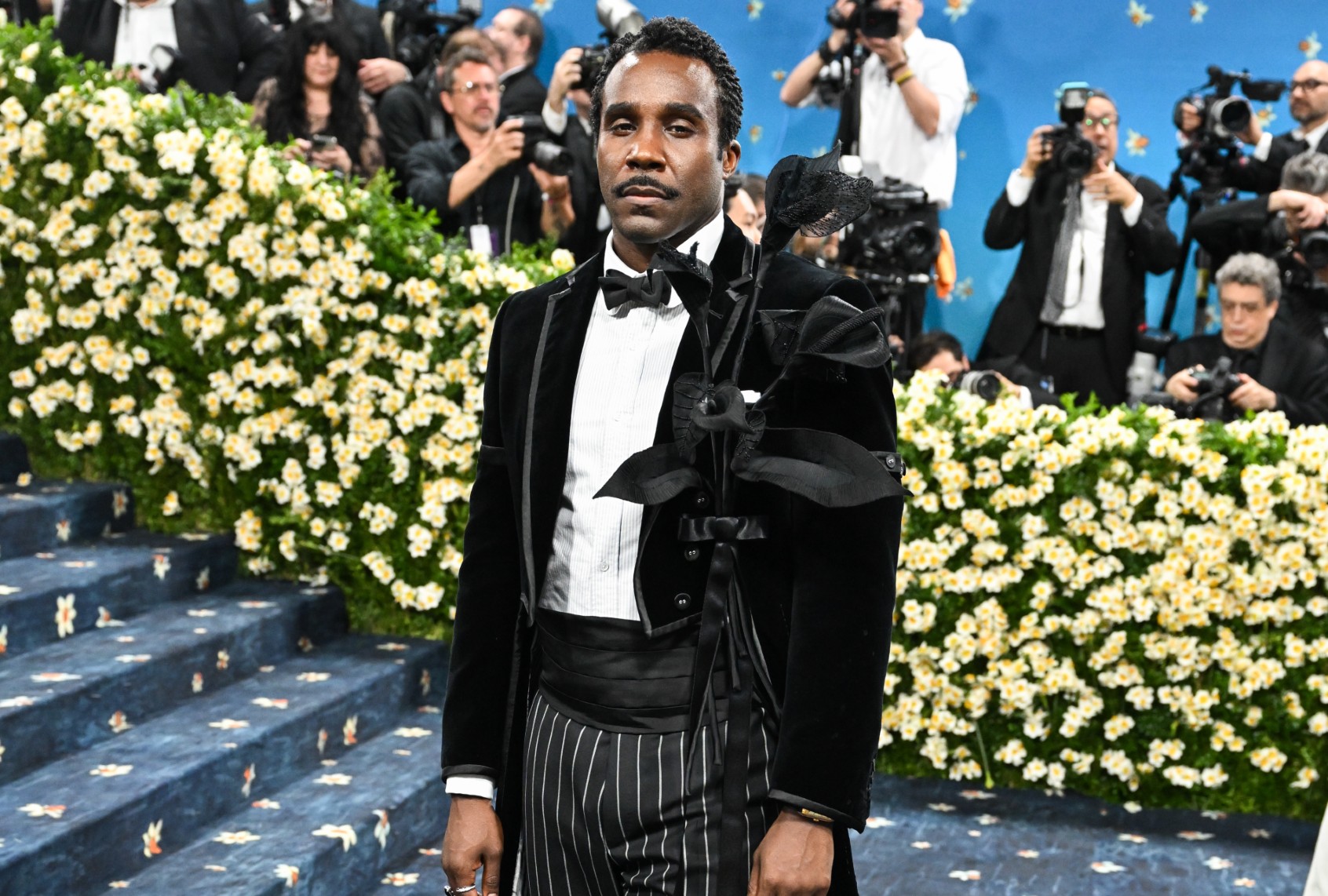
Tramell Tillman at The 2025 Met Gala Celebrating "Superfine: Tailoring Black Style" held at the Metropolitan Museum of Art on May 05, 2025 in New York, New York. (Gilbert Flores/Variety via Getty Images)

“Dandyism was imposed on Black men in Europe during the 1700s, as the Atlantic slave trade created a trend in fashionably dressed, or dandified, servants,” Miller continues. “Free and enslaved Black people came to understand the power of clothing and style, and signaling hierarchies of race, class and gender. Over time, dandyism gave Black men and women to use clothing, gesture, irony and wit to transform their identities and imagine new ways of embodying political and social possibilities.” 

“Superfine: Tailoring Black Style” is the first exhibition in the history of the Met Gala to feature a Black fashion tradition. That fact is galling considering the gala’s 77-year history and is incredibly relevant to a moment when Trump, his cabinet, and businesses affected by the government are scaling back diversity, equality and inclusion policies. Miller’s book on Black dandyism was published long before a Trump presidency ever felt like a conceivable thought, and the show was announced in October 2024, when it seemed as though Kamala Harris still had a fighting chance at the incumbent presidency. In a snark-filled op-ed for the Daily Beast, the site’s Chief Creative and Content Officer Joanna Coles evoked DEI initiatives, implying that the theme was chosen by Bolton, Vogue Editor-in-Chief Anna Wintour and the Met’s director for brownie points in what they thought would be a sure win for Harris. Coles mentions an irony in this, seeing as though “Vogue” has a historical lack of representation and support for Black designers and talent and has seldom featured Black designers and Black talent on its cover, a tainted legacy that the magazine has been trying to rectify since the summer of 2020, to varied success. 

Different designs are seen during the press preview of The Costume Institute's exhibition "Superfine: Tailoring Black Style" at The Metropolitan Museum of Art in New York, May 5, 2025. (TIMOTHY A. CLARY/AFP via Getty Images)While Coles has a salient point, she and other vocal detractors like Kennedy heir and infamous chronic poster Jack Schlossberg — who called for a boycott, saying in an Instagram Reel, “It’s not the time for a party like that” — are actively overlooking the massive historical significance and cultural importance of this year’s gala and exhibition. In a year like 2025, “Superfine: Tailoring Black Style” is not just another show at the Costume Institute; it’s a political statement. While the show’s curators couldn’t have known how the American presidential election would turn out, the exhibition would’ve been one of the most significant and essential in the museum’s history either way. Had Harris won, it would’ve continued the celebration of America having its first Black woman president, and examined how far the country has come (and the obstacles we still have yet to clear). With Trump in office, this exhibition and the Met Gala demand that spectators analyze and appreciate the tenacity of the human spirit. 
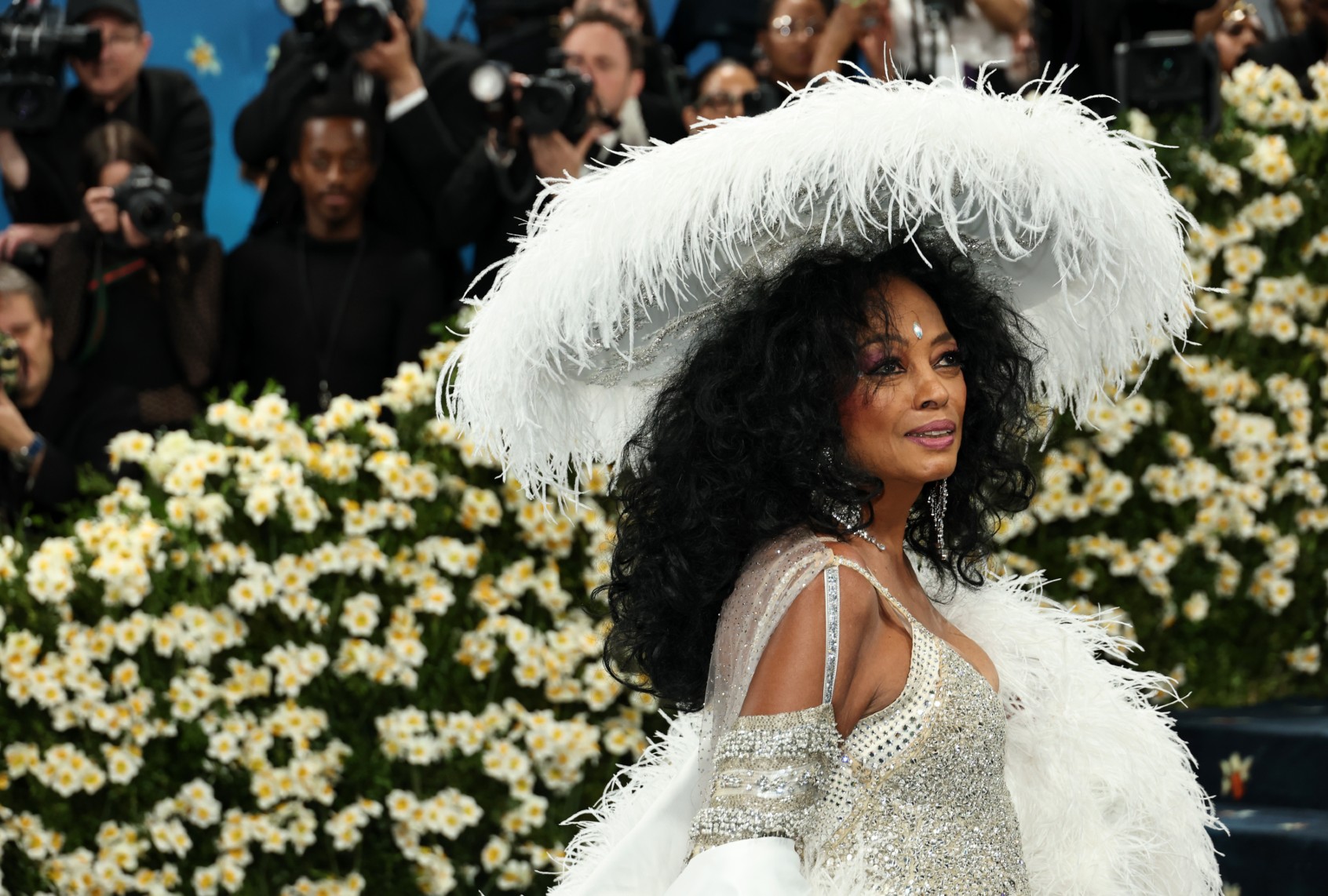
Diana Ross attends the 2025 Met Gala Celebrating "Superfine: Tailoring Black Style" at Metropolitan Museum of Art on May 05, 2025 in New York City. (Jamie McCarthy/Getty Images
The exhibition is divided into 12 conceptual sections: ownership, presence, distinction, disguise, freedom, champion, respectability, jook, heritage, beauty, cool and cosmopolitanism. Each section evaluates how clothing and dress have adapted for Black people over the last 300 years. Dandyism began as a point of mockery for enslaved people, and its reclamation and transformation over time is both a revelry for Black style and a sartorial form of historical observance. “To be a Black dandy and live in a world that profits from your subjugation is to be a trickster,” culture writer Taylor Crumpton said in a piece for Capital B. “The Black dandy is a Br’er Rabbit in a tailored suit and tie with a top hat. Only a Black dandy could turn the Met Gala into a celebration of Blackness.” 

The Black dandy look is versatile and exquisite, with thoughtful tailoring that Gala guests showed off during the striking red carpet arrivals. The Met Gala’s official dress code was “Tailored for You,” which “Vogue” said was “purposefully designed to provide guidance and invite creative interpretation.” And interpret is exactly what guests did. Unlike recent years, where many guests had trouble deciphering a unique take on the theme, menswear and fine tailoring allowed guests to play and explore. The gala gave viewers a hefty dose of history wrapped in sartorial magic. 

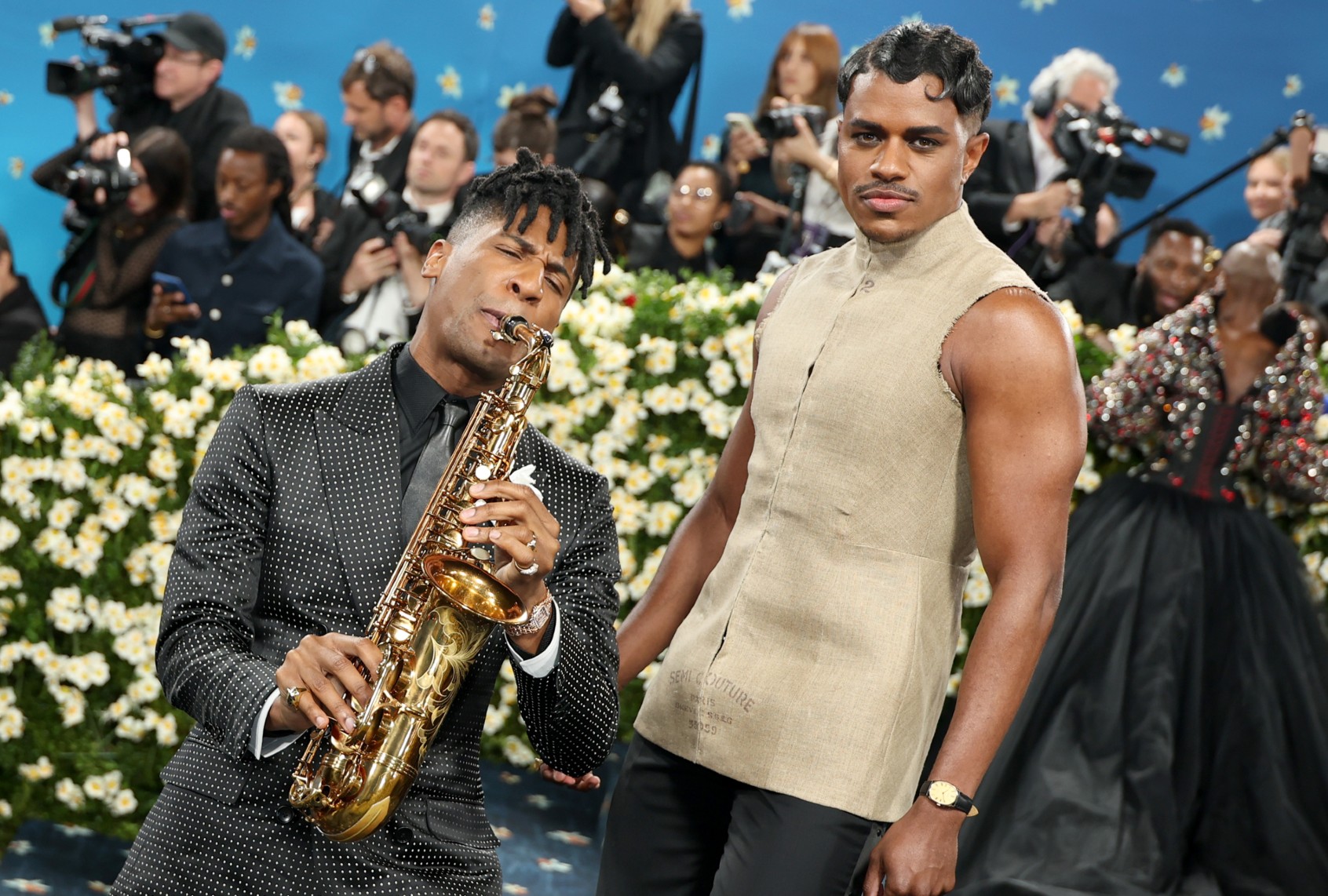
(L-R) Jon Batiste and Jeremy Pope attend the 2025 Met Gala Celebrating "Superfine: Tailoring Black Style" at Metropolitan Museum of Art on May 05, 2025 in New York City. (Michael Loccisano/GA/The Hollywood Reporter via Getty Images)Severance” star Tramell Tillman was jaw-droppingly gorgeous in a finely tailored suit with lovely pinstripe detailing. Actress and musician Teyana Taylor scored one of the Gala’s best looks early in the night, with a dandified look that took pleating and accessories to the next level. Diana Ross returned to the event after 22 years with a show-stopping gown embroidered with her family’s names on its feathered train. Senegalese influencer Khaby Lame took pocket watch finery to stunning heights. Actor Jeremy Pope wore a beautifully constructed Maison Margiela bodice, which fashion theorist Rian Phin noted was aligned with Miller’s writing about “reconstruction of identity through fashion.” And those looks are just skimming the surface. It was one of the most memorably dressed Met Galas in recent years. Though, frankly, it would’ve been nice to see fewer white stars of the moment like Sabrina Carpenter and even more Black icons and emerging talent, given the young designers prominently featured in the exhibition. Was the “Sinners” press tour too booked to get any of its stars on the carpet? (Yes, I realize I sound like Bradley Whitford in “Get Out,” saying he would’ve voted for Obama a third time if he could.)

This Met Gala is a celebration of Black style and transformation, of the wit and pain that are equal parts of reclamation, when the politically powerful are actively deprioritizing and erasing those opportunities. There is joy to be found in such a spectacle. That reserve needs to be consistently refilled, lest we find it depleted. 

Despite all the stunning displays, however, one nagging coincidence shadowed the event. The same day of the Met Gala, Sean “Diddy” Combs began his trial for sex trafficking, also in New York City. Critics noted that Combs was previously a Met Gala staple, even someone who heavily influenced Black style. The trial and the Met Gala happening on the same day is a cosmic paradox that cannot be ignored, one that points back to the gala’s history of propping up figures like Harvey Weinstein, who are long-rumored to be vile people but remain protected by the institutions that serve them until the evidence becomes damning enough not to be ignored. No, the Met Gala is not a perfect event, and just because this year’s theme honors Black fashion significance doesn’t mean that the powers behind it won’t make major blunders in the future. 

Sabrina Carpenter attends the 2025 Met Gala Celebrating "Superfine: Tailoring Black Style" at Metropolitan Museum of Art on May 05, 2025 in New York City. (Jamie McCarthy/Getty Images)But at the press preview Monday morning, the Met’s CEO announced that the gala raised a record $31 million. This money pays people’s salaries and ensures that exhibitions like “Superfine: Tailoring Black Style” can be put on in the first place. In a moment when Trump is trying to cut funding for educational public resources like PBS, walking through the Met’s exhibition will feel starkly important. The show runs until October, and hundreds of thousands are expected to attend over the next few months. This is a tangible, eye-popping moment of education in Black history for locals and tourists who will come from around the world to see the exhibit. It’s a celebration of Black style and transformation, of the wit and pain that are equal parts of reclamation, when the politically powerful are actively deprioritizing and erasing those opportunities. And beyond that, there is joy to be found in such a spectacle. That reserve needs to be consistently refilled, lest we find it depleted. 
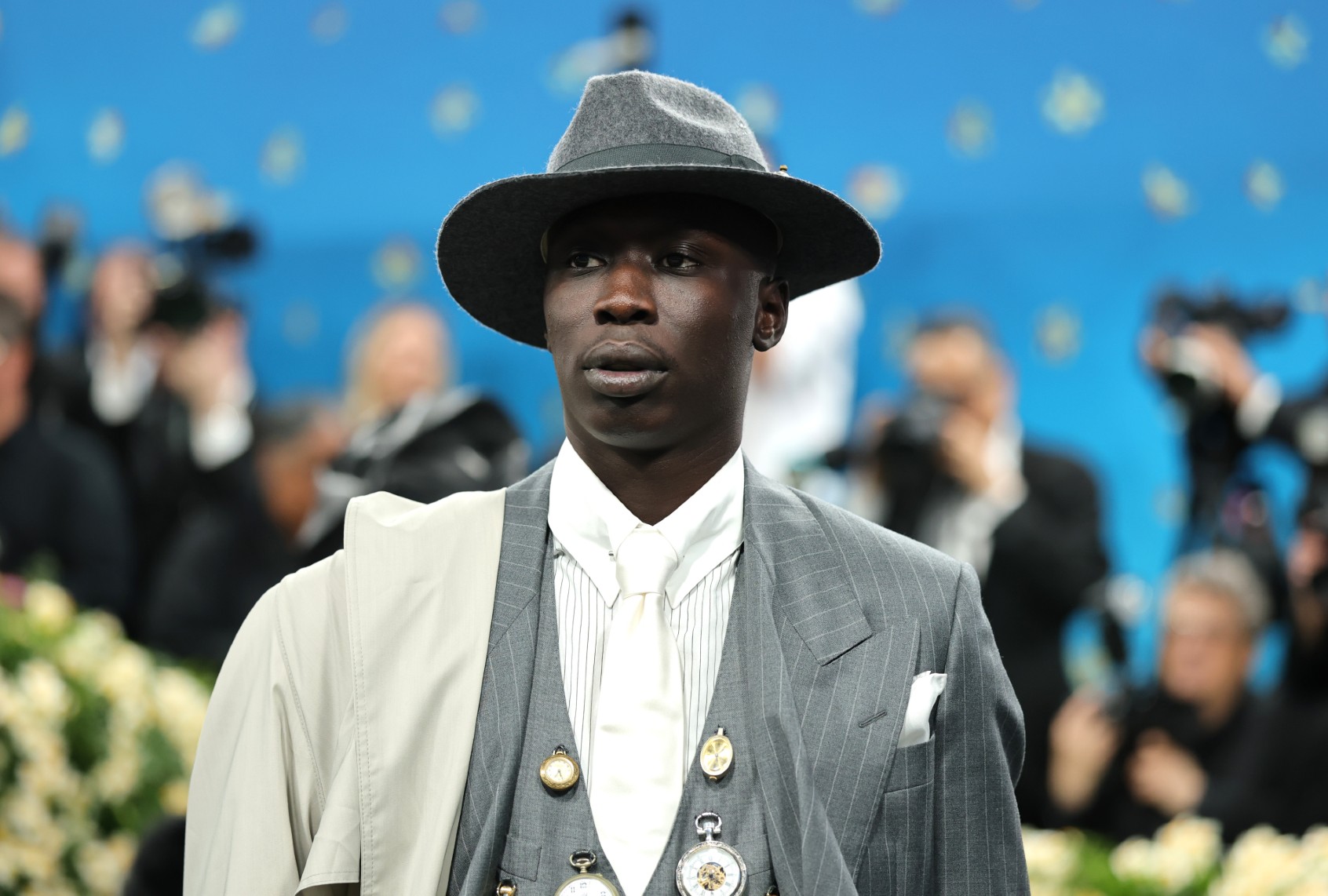
Khaby Lame attends the 2025 Met Gala Celebrating "Superfine: Tailoring Black Style" at Metropolitan Museum of Art on May 05, 2025 in New York City. (Dia Dipasupil/Getty Images)This year’s Met Gala may read tone deaf and myopic to some, and in some ways, it is. But it signifies persistent hope and approaching change. Christian Latchman, the young model who is the face of “Superfine: Tailoring Black Style,” who appears on nearly all of the show’s marketing, posted a TikTok before the Gala that reminded his followers he’s still working a 9-to-5 job. That may seem baffling, but at Monday’s press preview, Miller spoke about how figures praised as Black dandy icons are “still beholden to the whims of the institution.” 

With Latchman as the face of the show and the biggest night in fashion, but still hustling at a 9-to-5 while his modeling career takes off, “Superfine” can be seen as a commentary on the very establishment that allows it to exist. The Met Gala is a gatekeeping party, where the entry price is more than most people’s annual salary. In published materials commemorating this historic exhibit, Latchman’s face will be remembered for decades to come. But when October rolls around, the Costume Institute will begin moving on to the next thing. Walls come down and they are built back up again, but Latchman’s career will remain changed forever. Power may not be totally in the hands of the people, but it’s being dispersed in quantifiable amounts. To refuse to engage with the Met Gala and its companion exhibition this year is to ignore the opportunity to honor the work and persistence of Miller, Latchman and the countless number of Black dandies the show studies and celebrates. In a time when the most powerful people in the world jump to close-minded conclusions that cripple the rest of us, we owe it to ourselves, our fellow humans and to history to, at the very least, take a moment to pause and consider the nuances.

For a better smoothie, turn on the oven

I’m in a season of life where I no longer make health resolutions focused on subtraction. No more cutting carbs, no more vilifying sugar. Instead, I’m leaning toward abundance: more vegetables, more water, more sleep, more walking just to feel the air on my face. More of the things that make my body feel like it’s on my side.

But abundance, I’ve learned, requires planning. These days, my refrigerator resembles a kind of produce altar: deli tubs filled with chopped vegetables for dipping, and trays of roasted eggplant, red pepper and onion — silky with olive oil, oregano and salt — ready to be layered onto sandwiches or folded into scrambled eggs. Fruit, though, remained a blind spot.

I’m not someone who eats an apple on the way out the door. Bananas are often left to languish in tote bags; berries go soft in their cartons. 

So I began roasting it.

On Sunday afternoons, I scatter halved strawberries or blueberries across a parchment-lined baking sheet, drizzle them with honey or maple syrup, and roast them until their edges bubble and the whole kitchen smells like jam. Stored in small containers, they’re ideal spooned over yogurt or swirled into oatmeal.

And then, one morning, I added a scoop to a smoothie — and something shifted.

It began with peaches. Early ones: still slightly firm, with just enough fragrance to hint at what they might become. I halved them, added a splash of vanilla, a drizzle of honey, a pinch of sea salt, and roasted them until their edges browned and the juices pooled in syrupy puddles. The next day, I blended a few roasted halves with frozen banana, coconut milk and more cinnamon than seemed strictly necessary.

The result didn’t taste like breakfast. It tasted like something you might find in a glass bottle at a café where the music is low, the lighting flattering, and the smoothie menu handwritten in cursive. But there I was—barefoot in the kitchen, drinking it from a plastic blender cup, my dog looking on with mild suspicion.

I drank that peach-and-coconut milk smoothie nearly every day for two weeks, surprised each morning to find myself willing — eager, even — to dirty the blender again. That kind of enthusiasm is rare in weekday routines, and it made me curious. If roasted peaches could do this, what else might transform with a little heat?

We need your help to stay independent

From there, I started experimenting: berries, stone fruit, apple slices blanketed in cinnamon and clove. I discovered, over time, that most fruits benefit from the same treatment I give my vegetables — roasted until their flavors concentrate and their textures soften into something spoonable, or blendable or snackable straight from the tray.

Eventually, a loose formula emerged. On weekends, I set aside a little time for a fruit roast: a simple, satisfying act of care that requires little more than a sheet pan and a hot oven. I toss fruit with a neutral oil; coconut and avocado are my go-tos, though I’ve found that olive oil does lovely, surprising things to blackberries. I add a sprinkle of flaky sea salt, a drizzle of sweetener (maple syrup, honey, agave, even brown sugar), and whatever warm spices I have on hand. Cinnamon, cardamom, clove, ginger — all are welcome here.

There’s no need to measure, really. This is more about instinct and scent, about creating a tray of fruit that looks like it could be the filling for a pie or the topping for a tart, but will instead be tucked away in deli containers and folded into the fabric of the week.

Roasted Peach + Coconut Cream

For something that tastes like vacation in a glass, roast sliced peaches in melted coconut oil, a drizzle of honey, a generous dusting of cinnamon and a whisper of flaky sea salt. Store them in a container in the fridge. When you’re ready to blend, combine a few roasted slices with canned coconut cream, a spoonful of whole-milk yogurt (or coconut yogurt, if you want to double down), frozen banana, and more cinnamon. It's creamy, fragrant, and just decadent enough to feel like you’re getting away with something.

Roasted Blueberry + Tahini

Toss blueberries with a little avocado oil and maple syrup, then roast until they collapse into dark, jammy puddles. Once cool, store in the fridge until smoothie time. Blend with frozen banana, a handful of frozen blueberries, a chunk of fresh or frozen ginger (those little ginger cubes from Trader Joe’s work beautifully), almond milk, and a tablespoon or two of tahini. The result is earthy, zingy, and unexpectedly luxurious.

Roasted Apple + Oatmeal

Slice apples and roast them with avocado oil, brown sugar, and enough baking spices to make your kitchen smell like fall—cinnamon, cardamom, clove and ginger are all fair game. When you’re ready for breakfast, blend the roasted apples with a scoop of rolled oats, a spoonful of yogurt, a pour of almond milk, and more cinnamon. It’s like apple pie in smoothie form, but with enough fiber to feel vaguely virtuous.

I’m not saying roasted fruit will change your life. But it might get you to eat breakfast three days in a row. It might make your fridge smell like jam. And it might turn your Tuesday smoothie into something that feels just a little more worth waking up for.

Our fourth branch of government is saving us

When Donald Trump appeared on a national television program and told “Meet the Press” host Kristen Welker that he does not know whether he is compelled as president to uphold the Constitution, America was hit with an unforeseen and unprecedented question: Just how far gone are we as a country?

The answer is, pretty far. 

To be certain, it didn’t begin with this man who is at least willing to state out loud his utterly fascist leanings and it is not the first time we have been in this much trouble. We have been in the midst of a hurricane of lawlessness for more than 50 years, going back at least to the Watergate scandal, when another Republican president, Richard Nixon, attempted to steal an election by ordering the break in and bugging of the opposition party, the Democrats, who were in the midst of running a candidate, George McGovern, against him for the presidency.

The lawlessness in the land went far beyond an office burglary in Washington D.C. A secret surveillance operation, COINTELPRO, (acronym for “Counter Intelligence Program”) had been established years earlier by the FBI to surveil and disrupt political organizations that J. Edgar Hoover, the Director of the FBI, found to be subversive and unAmerican. The FBI did this in illegal coordination with the CIA, the NSA, the Defense Intelligence Agency, military intelligence operatives within all the uniformed services and local police forces that provided covert agents as infiltrators. The groups and individuals surveilled would come to include Martin Luther King, the Communist Party USA, civil rights organizations such as the Student Nonviolent Coordinating Committee (SNCC), the Black Panthers, anti-war groups such as Vietnam Veterans Against the War (VVAW), leftist groups such as Students for a Democratic Society (SDS), feminist organizations such as the National Organization for Women (NOW) and even environmental and animal rights groups.  Phones were wiretapped, memberships were infiltrated by agents and informers, groups were disrupted using false reports in the media, false documents, false arrests and grand juries charged with investigating leaders and members of groups like the VVAW that led to trumped up indictments, imprisonment of leaders on false charges, and even the killing of radical leaders such as Black Panther leader Fred Hampton, shot dead in his bed during a raid on his Chicago apartment.

People I knew and I, myself, were wiretapped and followed by FBI and military intelligence agents.  My FBI file alone is more than an inch thick, and I was never able to get my hands on files kept on me by military intelligence, the CIA and NSA. People I knew were arrested on false charges and imprisoned under inflated bail amounts.  One person I knew, a major leader of the anti-war movement and a famed counterculture figure, was purposefully infected with Hepatitis C by a police department which arrested him just so they could falsely require a blood test that was not administered to any other arrestees.

That was just the Nixon administration.  

In later years, more lawlessness infected our politics, including the Iran-Contra illegal operation under Ronald Reagan and the falsification of intelligence and outright lies that led us into the invasions of Iraq and Afghanistan.  Those two invasions would together cause the deaths of more than 7,000 members of the American military as well as countless insurgent combatants and civilians who were killed in wars we should have never waged in the first place.

"People are sufficiently unhappy with the direction Donald Trump wants to take the country that they have engaged in twice as many street protests against Trump and his policies than there were in the first 100 days of Trump’s first term in office."

While all this was going on, our politics at home was being infected by rhetoric weaponized by figures such as Newt Gingrich and movements within the Republican Party such as the Tea Party and right-wing Congressional groups such as the Freedom Caucus. 

By the time Donald Trump descended the infamous golden escalator in 2015 and won office with the help of foreign actors such as Russian intelligence, this country had become inured to political scandal and lawlessness.  Trump’s attempt to overthrow the election of 2020 could be looked upon as yet another Watergate or Iran Contra or the lie-fest that got us into Iraq and Afghanistan. In short, it was all of a piece, 50 years of political scandals piled one upon the other until they seem to have blocked out the sun.

How has our country survived this terrible storm of political lawlessness?  Elected officials in the Congress and the judges and justices in our courts have imposed order on those who would strip our democracy of its meaning and function.  

We need your help to stay independent

It happened when the Congress stood up to Nixon and, threatening impeachment, forced his resignation. But it didn’t happen when George W. Bush was forcing us with one lie after another into two wars we should never have waged.  It didn’t happen when the Department of Justice attempted to investigate the corrupt first campaign of Donald Trump with the office of Special Counsel run by Robert Mueller. It didn’t happen when twice the House of Representatives brought articles of impeachment against Donald Trump and the Senate refused to convict. It didn’t happen when an out-of-control Supreme Court decided in U.S. v. Trump that this president, and indeed future presidents, have a virtually unlimited immunity from prosecution not just for official actions taken while serving, but for many actions taken after leaving office.

Still, there has been positive movement in our democracy.  

On Monday, Robert Reich reported in his Substack that Fred Wertheimer, the former general counsel for the nonpartisan government watchdog Common Cause, gave a speech last week when he received the Paul H. Douglas Award for Ethics in Government for 2025. Just the fact that such an award still exists, and a man like Fred Wertheimer was there to receive it, is a hopeful sign for our country. Reich asked him if recent events with Trump have discouraged him. Here is how Reich described Wertheimer’s answer: “‘Discouraged?’ he said, almost surprised I asked. ‘This is my life. This is what I do.’”

Wertheimer took note in his speech of the 143 executive orders that have been issued by Donald Trump. But then he went on to report that “These executive orders have resulted in 222 legal challenges and at least 123 court rulings enjoining Administration actions, with preliminary injunctions and temporary restraining orders issued based on serious doubts about the legality of the Administration’s actions.”

This is a hopeful sign for our country. But it is not enough. As Wertheimer pointed out, the Trump administration’s response has been to attack judges and call for them to be impeached, attack the people who have filed lawsuits seeking restraint of Trump’s executive orders, and attempt to outright violate or otherwise ignore certain of the judges’ orders resulting from the lawsuits.


Want a daily wrap-up of all the news and commentary Salon has to offer? Subscribe to our morning newsletter, Crash Course.


The Congress as it is currently composed, with Republican majorities in both chambers, is a dead letter when it comes to restraining the outright undemocratic insanity of this president. Because this GOP-controlled Congress cannot be relied upon, the election of Democrats to the next Congress has become the top priority not just of Democrats, but of right-thinking Americans. I say “right-thinking” because recent polls have revealed how unpopular Trump and many of his policies have become. Trump’s and Musk’s attempts to disassemble the federal government are supported only by Republicans, but even their support is not fulsome across the board. People are not happy about canceling grants to come up with cures for cancer and heart disease and other ailments that touch so many American families. People like clean air and clean water and tend to oppose attempts to weaken laws which protect both. People are generally in favor of clean energy and against energy production that pollutes, such as coal-burning power plants. People are in favor of democratic principles enshrined in our Constitution such as equal rights under the law and the right to due process and birthright citizenship. People are boycotting Elon Musk’s Tesla cars to the point that the company’s stock price is in the tank. People are even protesting with their feet against companies such as Target which so quickly acquiesced to Trump’s demand that they cancel DEI programs that lead to a workforce more representative of the communities in which the stores are located.

And people are sufficiently unhappy with the direction Donald Trump wants to take the country that they have engaged in twice as many street protests against Trump and his policies than there were in the first 100 days of Trump’s first term in office. According to The Guardian, in the month of February alone, there were 2,085 protests. There are reports that protests at town halls held by Republican members of Congress have caused the Republican leadership to tell members to cancel town halls or restrict admission to supporters only.

A new ecosystem of news gathering and distribution has sprung up because people are unhappy with mainstream media outlets such as the Washington Post — which has caved to Trump under the ownership of Trump-suck-up Jeff Bezos — and the New York Times, which almost daily seems to come up with story headlines and reports that minimize Trump’s anti-democratic behavior and policies. People are subscribing to Substack columns and other online outlets that provide reports and analysis that fill in the blanks left by the fading and failing MSM. An entire world of podcasts and video reporting has sprung up to repair and replace cable and network news outlets that are increasingly seen as irrelevant to what people want and need.

All this should give us hope, but more is needed. Substack columnists like Robert Hubbell,Joyce Vance and Heather Cox Richardson are increasing their public appearances to speak publicly about how Donald Trump is damaging this country and our democracy. I have been invited to speak here in Milford, Pennsylvania, on May 14 at a meeting of a local activist group called Delaware Valley Action. The address is 315 Broad Street, and the time is 6:30 pm. My remarks will also be available on Zoom. I have decided that I will join my fellow Substack columnists in speaking out publicly, and I will accept any invitation I receive depending on my schedule and ability to travel to the venue. 

The answer to lies is to speak the truth. The answer to repression is to stand up and take a stand. The answer to fear is courage. The answer to the attempted closing of American political life is taking to the streets. The answer to authoritarianism is political freedom. The answer to feeling alone is standing together.

The latest Trump and DOGE casualty: Energy data

The Trump administration has eliminated or stifled critical data at dozens of federal agencies. Now the administration’s actions are hitting a new realm: the energy industry.

For decades, the Energy Information Administration, an independent agency housed inside the Department of Energy, has provided crucial reports on everything from oil and gas to the future of alternative energy. Relied on by oil company CEOs and government policymakers alike, the EIA’s data has been called the “gold standard” by Daniel Yergin, vice chairman of S&P Global and an éminence grise in the world of oil. No less a source than Project 2025 described the EIA as historically providing “independent and impartial analysis.”

Last month, the EIA released its signature report: the Annual Energy Outlook for the United States. Largely based on data gathered during the administration of Joe Biden, the report projected rapid growth in alternative energy and declines in American reliance on coal, oil and natural gas. Agency officials feared that the findings would rankle the “Drill, Baby, Drill” proponents in the Trump administration, according to multiple EIA sources. So instead of promoting the report’s publication with an hourlong webcast and PowerPoint presentation spotlighting key findings, as it has in recent years, the agency released it without any of that. And at a late stage, the EIA deleted the analytical narrative — then 53 pages in draft form — that is typically the centerpiece of the report. Instead the agency posted links to hundreds of data-filled tables and charts and a seven-page explanation of its methods.

That didn’t stop the Energy Department from pillorying the findings. In a press release on the same day the report was published, a department spokesperson attacked the EIA’s report for featuring “the disastrous path for American energy production under the Biden administration” and failing to reflect Trump-initiated policy changes aimed at “ensuring America’s future is marked by energy growth and abundance — not scarcity.”

Now the EIA has privately informed staff that it is scrapping publication of its closely followed International Energy Outlook for 2025. The previous edition of the international outlook, released every two years, contained 70 pages detailing global trends. The paradox: That will leave the field open to the equivalent publication from the Paris-based International Energy Agency, which conservatives accuse of bending its forecasts to promote climate-change goals. (Unlike the U.S. agency, whose projections take into account only formally adopted policies, the international one includes some policies that haven’t been adopted and are considered “aspirational.”)

In an April 16 internal email announcing the cancellation of the international report, which has not previously been reported, Angelina LaRose, assistant administrator in the EIA’s office of energy analysis, blamed the decision on the departure of so many staff experts. More than 100 of the EIA’s 350 staff have left as a result of firings or resignations, in the wake of “Fork in the Road” buyout offers from Elon Musk’s Department of Government Efficiency. “At this point, you can assume we will not be releasing the IEO this year,” she wrote. “This was a difficult decision based on the loss of key resources.”

In the same memo, LaRose ordered an “‘all hands-on-deck’ type of effort,” before even more EIA analysts departed, to “try to preserve as much institutional knowledge as possible” about the models and procedures used to formulate the international report.

Failing to publish that report is viewed as consequential. Amy Myers Jaffe, a prominent energy consultant and research professor at New York University, called the EIA’s reports and analysis essential. “These are global markets,” she said. “The only way to figure out which policies work or don’t is to have accurate EIA data. Everybody benefits from that analysis, whether you’re in the private sector or the public sector.”

The EIA was established nearly a half-century ago, amid the energy crises of the 1970s, to tackle what had become an urgent need: to collect and report objective data on energy production and consumption. Its regular stream of postings now track oil and gasoline prices, electricity rates, natural gas and crude oil exports, automobile fuel consumption, wind and solar energy generation, coal production and nuclear plant outputs.

Its U.S. Annual Energy Outlook projects long-term trends, based on multiple scenarios, and customarily provides detailed analysis discussing key takeaways from reams of data. For 2025, its baseline “reference case” projected how markets would operate through 2050 under laws and regulations in place as of December 2024, prior to the Trump administration’s efforts to promote fossil fuels. In addition to eight “side cases” based on variations in economic growth, energy pricing and supply, the EIA also modeled two “alternative policy” scenarios. These projected impacts from the elimination of Biden-era laws and regulations reducing carbon dioxide emissions from existing power plants and boosting adoption of electric vehicles.

According to the contents pages from the draft, which ProPublica obtained, the deleted narrative highlighted projections in the reference case showing that increased electricity demand would be met through 2050 “mainly by generation from renewable sources”; that “coal generation falls to close to zero”; and that there would be “declines” in domestic consumption of oil and natural gas.

The decision to jettison the report’s traditional explanatory narrative was announced to EIA staff in a March 10 internal email, after the document was largely complete following months of work. “After conferring with the [EIA] front office, we are shifting gears on the material that will be released with this year’s AEO,” assistant administrator LaRose wrote. “We will not be releasing the narrative as currently written and will not be hosting a release event.”

The omission of the analytical section left readers to sort through the data for themselves. Joseph DeCarolis, who served as EIA administrator under Biden and is now an engineering professor at North Carolina State, called the annual outlook’s narrative “extremely important. It’s important to be able to look at the results, interpret them, and explain to your audience what you think the insights are.”

EIA employees said they believe the changes were made out of fear that spotlighting unwelcome findings and projections would make the agency a Trump target. “There was a concern that any narrative we put out would be seen as ideological,” said Emily Schaal, an EIA statistician who worked on the U.S. report. Another EIA employee commented: “Fewer people were going to get mad if we just threw the numbers out.”

Asked about the decision, EIA spokesperson Chris Higginbotham said the agency’s leadership jettisoned the analysis because it “decided it was most important to prioritize getting our AEO results to the public as soon as we could rather than waiting longer to complete a written market analysis.” He added, “We do not make decisions about our data or our analyses with the goal of influencing outcomes or avoiding pushback.”

"Everyone at EIA had been through a month of torture."

With regard to EIA’s international report, Higginbotham said, “We remain committed to maintaining our long-term energy modeling capabilities.” He asserted that the staff reductions will not compromise the agency’s work. “We are committed to meeting EIA’s quality standards,” he said, “and we will not publish any data or analysis that doesn’t meet those standards.”

Meanwhile, the EIA has canceled or delayed other data reports and projects. Those moves, combined with the turmoil and departures, have devastated morale, according to current and former EIA employees.

Schaal was among those grappling with the tumult. After completing a doctorate in math, Schaal, 28, joined the EIA as a statistician in June 2024, working remotely from Michigan, and expected to remain at the agency for years. Instead, she was one of about 30 probationary employees who were abruptly terminated on Feb. 13, just weeks into the new administration. A lawsuit challenging firings at six agencies, filed by a union that represents government workers, prompted a federal judge to order their reinstatement, and Schaal returned to the EIA in mid-March.

“Everyone at EIA had been through a month of torture,” she told ProPublica. Employees were dealing with chaos, uncertainty and fears of termination. In early April, Schaal accepted a new deferred resignation offer, with plans to depart on April 19.

On April 11, hours before a midnight deadline for the resignation program, EIA’s acting administrator presided over an all-hands meeting with a top deputy, where he read a prepared statement urging employees to take the offer. Then the two managers gave assurance they had done “a great job” defending the agency in a meeting with DOGE officials, who were certain to treat them all “appropriately,” according to four people who attended the all-hands meeting.

Schaal was furious. After the session ended, she pounded out an angry email to the two bosses and then shared it with everyone who still remained at EIA. “DOGE doesn’t care what we do and will treat us the same as all other agencies: with contempt,” she wrote. “Shame on you for falling in line and giving up without any perceptible effort to fight. Shame on you for keeping those you purport to lead in the dark. Shame on you for betraying the mission set to us by Congress and selling out the American people.”

On the following Monday, Schaal was summoned to a virtual meeting with her supervisor, where she was presented with a formal letter of reprimand for her “unprofessional and disrespectful email,” as well as a second letter notifying her that she was being placed on administrative leave, a week ahead of her planned departure. The episode made her something of a hero among colleagues who remained behind, who have taken to sharing their frustrations with one another on private Signal groups. (EIA’s spokesperson declined to comment on the episode. Neither DOGE nor the White House replied to requests for comment for this article.)

The EIA, whose director is a presidential appointee, typically chosen from among apolitical academic or industry figures, is poised to get new leadership. Trump’s nominee is Tampa energy consultant Tristan Abbey, a self-described “think-tanker” at conservative groups who has called U.S. dominance in natural gas exports a “generational opportunity.” Abbey, 39, served as an energy staffer on the National Security Council in the first Trump administration. His financial disclosure reports $103,083 in “senior fellow fees” since 2024 from the conservative Texas Public Policy Foundation and $435,833 in income from his consulting business, whose clients included Thiel Capital. (Abbey worked for Trump-friendly billionaire Peter Thiel’s investment firms before going into government.) Abbey’s consulting firm also has an eclectic side business focused on publishing books written by or about explorers and historical figures in philosophy and math.

Abbey enjoyed a friendly confirmation hearing on Wednesday before the Senate Energy and Natural Resources committee. He testified that he would leave his “policy role” behind and affirmed his commitment to the EIA providing “nonpartisan facts.”

Abbey praised the EIA as “the world’s premier energy data agency” but also said it is “in urgent need of revitalization.” He presented an ambitious must-do list seemingly at odds with the current administration’s wholesale cuts. The EIA, Abbey declared, “must clear the decks of unfinished projects,” “recruit and retain the best talent” and “develop the most powerful analytical capabilities.” Among his top priorities, Abbey testified: “the expansion of global energy data collection and analysis.”

Doris Burke contributed research.

ProPublica is a Pulitzer Prize-winning investigative newsroom. Sign up for The Big Story newsletter to receive stories like this one in your inbox.

More people are buying now, paying later — even for groceries

Between an upfront payment of $120 or four separate smaller payments of $30, which one would you prefer? For almost half of all Americans, it’s easily the latter.

Buy now, pay later services like Klarna and Afterpay have become increasingly popular in recent years, acting as microloans for many online purchases. The reasons for their popularity are apparent: You get the instant gratification of buying and receiving a product at a slashed upfront cost, without having to pay interest fees upon repayment. And unlike traditional loans, you generally don’t need to pass a hard credit check to qualify for BNPL, per the Consumer Financial Protection Bureau

With prices rising across the board, the option of smaller delayed payments are attractive for many consumers, whether they’re college students or adults working a 9-to-5. The majority of BNPL users take out loans to buy wants — not needs — like electronics and accessories. And that’s part of why the microloans are so appealing. 

“I use [BNPL] to make stupid purchases that I can’t resist,” Andréa Becker, an assistant sociology professor at Hunter College, told Salon. “It feels spiritually better and fiscally more responsible to pay $20 every two weeks than $80 all at once for skincare.”

Alyse Stauffer, an NYU undergraduate student, agreed. “When I want something, 95% of the time I usually can't afford it because I need to save my money for things like prescriptions, food, whatever. So when I see something that makes me go, ‘I really, really want this,’ I use [BNPL].”

We need your help to stay independent

Stauffer said putting personal purchases on her credit card feels more irresponsible, compared to putting them on her BNPL account, which is linked to her debit card. BNPL services also allow her to delay payments if she can’t make it, which is a relief compared to strict credit card minimum payments.

It’s this convenience that draws so many to the service, James Mohs, an associate professor of accounting and taxation at the University of New Haven, said. It’s the same reason why BNPL exploded in popularity at Coachella in April, according to Forbes, with around 60% of general admission tickets being financed by BNPL plans.

“It does give you the sense that this is a layaway-type thing,” Mohs said, referencing an older practice wherein a seller holds an item for a customer and hands it over after the balance is fully paid. “But this is not even close to that. If you're not diligent, your balance is just going to grow and grow and grow, because even though you're getting the goods, you still owe on the other side.”

The biggest worry, Mohs said, is getting trapped in a debt cycle. While most BNPL purchases are luxuries, an increasing number of buyers are taking out microloans for necessities like groceries. According to a survey from LendingTree, an online lending marketplace, the percentage of BNPL users who use the service to buy groceries has grown from 14% last year to 25%.

“That can get them in a huge hole, a huge hole,” Mohs emphasized, referring to buyers who use BNPL to purchase staples. “And you know what? You get into a deep crevice like that, and sometimes you can’t get out of it.”

Almost half of BNPL users regret making a purchase with the service, the survey reported. Even though there are no interest loans on repayment, there are still hidden caveats. For example, if you want to return an item that you bought with BNPL, chances are you’ll have to pay off that loan in full before you can return it. Additionally, failing to repay a BNPL loan on time can ding your credit score, while timely repayments do not contribute to your score.

That’s not to say BNPL services are inherently predatory. Like a credit card, its pros can outweigh the cons — but only if used right. 

“If you're going to use them, don't run up big balances. Pay them off,” Mohs said. “And if it feels too good to be true, that’s because it is. Sooner or later, you’ve got to pay the piper.”

Why Trump is pretending to not know how the Constitution works

Despite feigning ignorance of the constitutional order, it’s clear that President Trump wants to create extrajudicial methods for rounding up and holding migrants, end-running the multiple federal courts that have stymied or halted his exile flights over due process concerns. However, he’s resorting to scary-sounding, centuries-old wartime laws like the Alien Enemies Act of 1798 and the Insurrection Act of 1807, as well as crusty war terms like “enemy combatant” for his expansive, unchecked executive vision of crushing immigration  – which can now be coupled with his astonishing announcement that he doesn’t know if everyone in the U.S. is entitled to due process.

On his first day back in the White House, Trump signed an executive order (which he mistakenly thinks is an unreviewable decree) declaring an emergency at the U.S. southern border. That way his brain trust could contemplate the Insurrection Act as a possible response to immigration, which would let him deploy the military to enforce laws on U.S. soil. Trump also invoked the Alien Enemies Act to justify sending 137 of 261 alleged Venezuelan gang members to an El Salvadoran gulag. He is now reportedly looking into whether his administration can label suspected gang and cartel members inside the U.S. as “enemy combatants.” And for good measure, he has also declared that deportees are “terrorists” and that Tren de Aragua is a “foreign terrorist organization” akin to the Islamic State and Boko Haram. (TdA is actually more of a violent Venezuelan street gang with a handful of international nodes than a political terrorist group, but I digress.)

In reality, these semantics are just Trump’s latest attempt to make deportations of migrants easy, quick and unreviewable (itself a tacit acknowledgement that simply “disappearing” a permanent resident like Kilmar Ábrego García is very likely illegal.) However, domestic or extraterritorial abduction, detention and/or transfer of human beings to other locations – whether Rwanda, Cuba or El Salvador – is a transparent attempt to circumvent our laws.

We need your help to stay independent

The problem with all this Hegsethian warrior-speak is that we are not in a declared war or under a military invasion. Moreover, presidents and agency heads don’t have the power to just proclaim one. Yet most of Trump’s more controversial executive actions – especially when it comes to immigration – require the US to be on wartime footing because, outside of that dire context, they would be illegal, unconstitutional, or both. Even during wartime, things like kidnapping and extraordinary rendition violate U.S. law, the Geneva Conventions, and other international humanitarian treaties to which the U.S. is a signatory.

This is hardly the first time America has struggled with terminology in its treatment of detainees. Before 9/11, terrorist attacks were treated as crimes rather than acts of war. In the aftermath of 9/11, the labeling of terrorism as warfare gained both political and legal traction. The amorphous war on terrorism produced an equally indefinite vocabulary for terrorism suspects held by the United States or at its behest. Material witness? Enemy combatant? Criminal defendant? Terrorist? The multitude of terms spoke volumes about the indecision and uncertainty of the executive and judicial branches over what to call detainees being held by the United States both domestically and abroad.

The elasticity of terms like “enemy combatant” allowed the U.S. to more easily shuffle people back and forth between the military justice system and the civilian justice system, hold them for indefinite periods of time, and even physically mistreat them. Another possible bonus for Trump is that the designation would allow him to drone suspects labeled as “enemy combatants” outside the United States, including innocent Americans, which we have done in the past and which I’ve condemned.


Want a daily wrap-up of all the news and commentary Salon has to offer? Subscribe to our morning newsletter, Crash Course.


Trump, who struggles with even a basic understanding of middle school level English and history, apparently thinks that he can ex post facto incantate legalistic-sounding phrases like “perpetrating, attempting, or threatening an invasion or predatory incursion” and magically shoehorn his rushed and hushed detentions and deportations of migrants into a law meant for members of a hostile foreign nation during armed conflict. 

Outsourcing pieces of our criminal justice system to other countries, whether it’s El Salvador or Rwanda (both of which have a dark history when it comes to human rights abuses), and imprisoning detainees in secret, violent prisons at Gitmo, CECOT, Alcatraz, or any other mecca of impunity is antithetical to democracy. Trump should visit the Supermax in Florence, Colorado (“the Alcatraz of the Rockies”) and Attica in New York. Our prisons are quite renowned for their own violence, excessive force, harsh conditions, remote locations, overcrowding and filth. 

However, Trump is a maximalist, sadist, and xenophobe. I suspect that if he could, Trump would outsource our immigration machinery to places far worse than Gitmo, El Salvador and Rwanda, like Camp 14 in North Korea and Butyrka Prison in Russia. Bypassing immigration courts is not just a slippery slope, it’s a blind cliff dive into tyranny. Trump knows this better than anybody.

“A free fall not seen in modern history”: 100 days of destruction

Donald Trump has now been president (again) for 100 days. Trump is not a humble man. It should be no surprise that he is trumpeting his “accomplishments” very loudly. As Trump sees them, his great “accomplishments” include being a great man of history who has left an indelible mark on the trajectory of the United States and the world.

Donald Trump, who was declared a de facto king or emperor by the right-wing extremist justices on the Supreme Court, has more power than any American president before him, and he is using it to advance his political and personal goals. Trump has been mostly successful in crushing, bending and smashing America’s democratic norms and institutions and the larger culture to fit his will.

Donald Trump, both directly and indirectly, is using his return to the presidency to further increase his already vast amounts of wealth and financial power. This is a conflict of interest and extreme moral hazard that has no precedent in modern American history. If politics is fundamentally the realm of affluence and influence, Donald Trump has both in extreme abundance.

"Now we watch as the political arsonists who voted for Trump get burned from playing with matches."

In a series of interviews, speeches, and other communications marking his 100 day return, Trump has announced that he has not made any mistakes and “I run the country and the world.” Trump told his MAGA people at a celebratory rally in Michigan that, “We’re here tonight in the heartland of our nation to celebrate the most successful first 100 days of any administration in the history of our country….We’ve just gotten started. You haven’t even seen anything yet.” On Thursday, Trump delivered the commencement speech at the University of Alabama. He told the audience that, “They all hated me in my first term, and now they’re kissing my a**…. It’s amazing. It’s nicer this way.” 

In an Oval Office meeting with his Cabinet and other senior advisors to commemorate his 100 days back in power, they took turns praising their Dear Leader. North Korea’s ruler Kim Jong Un would have been envious. Donald Trump was in his element; Trump recently told The Atlantic magazine that, "I’m having a lot of fun, considering what I do….You know, what I do is such serious stuff.”

Donald Trump is receiving narcissistic fuel in abundance. It would be a first-order error in reasoning and inference to separate Trump’s style of personalist rule and autocracy from his personality and mind. They are entangled with one another in a synergistic relationship.

Trump’s views of his “accomplishments” are not shared by the American people. A series of public opinion polls have shown that across a range of major issues (the economy, immigration, democracy and the rule of law, safety and security, etc.) the American people view Trump’s first 100 days very negatively, if not as being an outright disaster. In total, Donald Trump’s polling numbers are the worst in 80 years for an American president at this early point in his tenure. For example, a new PBS News/NPR/Marist poll shows that a plurality of Americans give Donald Trump a failing grade, an “F,” for his first 100 days back in power. In a new poll from PRRI, a majority of Americans describe Trump as being a “dictator.” However, a new poll from Pew Research Center shows Donald that Trump is still loved by members of the (White) Christian right. Pew’s findings include how, “In addition to approving of Trump’s job, 57% of White evangelical Protestants say they trust what he says more than what previous presidents said while in office.”

These huge divides in American public opinion and politics will decide the future of American democracy and freedom. 

In an attempt to gain a better perspective and insights on Donald Trump’s first 100 days back in power, what may happen next, and what has already been lost, I reached out to a range of leading experts. I also asked them the following question: If these first 100 days of Trump’s administration are indeed the good times as compared to what will come next, what do they want to prepare the American people for?

This is the third part of a three-part series.

Ryan Wiggins is Chief of Staff for the Lincoln Project where she previously served as the Communications Director. Before joining The Lincoln Project, Ryan ran Full Contact Strategies, a political media consulting firm specializing in political strategy, campaign communication, crisis communications, public affairs, issues management and media relations.

I am angry and upset over how Trump and his administration and MAGA are wrecking our economy, destroying the Western alliance, and removing America from its leadership position in the world. They are incompetent, vengeful and don’t give a damn about the country. The country is less safe and less strong now because of what they’ve done in the first 100 days.  

And I’m not alone. The polls show that independents who helped Trump win the election are getting buyer’s remorse, as his poll numbers are dropping to lows that Trump has never seen before. 

The chaos, confusion, and absolute incompetence are exactly what we thought we would see. Trump and his forces are whipsawing the markets and people’s 401ks, defying court orders, and on a revenge tour. They’ve been using Project 2025 as their playbook to hammer the government’s operations.

These are the good times, and things will only get much, much worse with Trump as president. Trump is going to step on the gas for revenge and retribution – especially if his poll numbers keep dropping. Trump won’t go quietly; he will burn it all down this time by defying court orders and imposing his terrible economic policies. Trump is starting to display the authoritarianism the Lincoln Project warned about — that’s only going to get worse. And Trump is already priming the public for a run in 2028, something that is blatantly unconstitutional. 

Robert P. Jones is the president and founder of Public Religion Research Institute. He is the author of the New York Times bestseller "The Hidden Roots of White Supremacy and the Path to a Shared American Future," as well as "White Too Long: The Legacy of White Supremacy in American Christianity."

By nature, I’m generally an optimistic person. I’m anything but alarmist. But, just 100 days in, it’s clear that Donald Trump presents a clear danger to the future of American democracy. As Trump is slowly but surely steering our country toward authoritarianism, the divides in the country can no longer be understood with the traditional labels of Republican versus Democrat, conservative versus liberal. Given the clear Constitutional crisis in which we already find ourselves, if we are going to survive as a nation resembling anything like the principles outlined in our founding documents, the political battle lines are going to have to be mentally redrawn, in the short run, as MAGA authoritarianism versus democracy. That will take, on the most difficult end, a coalition standing up for democracy that includes a courageous minority of Republicans and Republican elected officials, along with majorities of independent voters and the engagement of approximately 40% of Americans who sat out the previous election.

PRRI’s new poll on Trump’s first 100 days, just released yesterday, shows that we may be seeing the beginning of such an awakening. Like a raft of other polls, PRRI finds Trump’s job approval at 40%, the lowest of any president not named Trump at the 100-day mark since World War II. Notably, Trump’s favorability has dropped 12 points among Latinos (from 39% to 27%), and a whopping 19 points among Latino Protestants (from 51% to 32%), two-thirds of whom voted for him in 2024.

We need your help to stay independent

This much is also crystal clear: White Christian groups — particularly white evangelical Protestants but also majorities of white non-evangelical Protestants and white Catholics — are the groups responsible for allowing Trump’s return to power and for continuing to lend him support and legitimacy. White Christian groups and the three in ten Americans who support Christian nationalism are the principal groups continuing to hold majority favorable views of Trump.

Even as someone who lives in D.C. and has tracking politics as part of my job description, I’ve been surprised at the pace of the destruction and the transparency of the grift and power grab by Trump and his administration. Particularly, I’ve been surprised at the way Trump has treated executive orders like kingly decrees for the digital age, declaring nonexistent emergencies to broaden his power, undermining the basic tenets of the rule of law like due process, and even attacking established constitutional principles like birthright citizenship. According to the American Presidency Project, he has issued 143 executive orders in 100 days. By comparison, Joe Biden only issued 162 executive orders during his entire term, and the last Republican president, George W. Bush, issued only 118 in his final term.

Most notably, the new PRRI survey shows an American public that may be waking up to the danger Trump represents to the nation’s founding principles. In PRRI’s recent poll, a majority (52%) of Americans — including 87% of Democrats, 56% of independents, and even 17% of Republicans — believe that Trump is a dangerous dictator whose power should be limited before he destroys American democracy. Two-thirds (68%) of non-voters who expressed regret for their decision not to vote, and even a majority (55%) of the small number of Trump voters who now say they regret voting for Trump, also agree that Trump is a dangerous dictator whose power should be limited.

"Most notably, the new PRRI survey shows an American public that may be waking up to the danger Trump represents to the nation’s founding principles."

I wouldn’t say these are the good times. I’d say these are the liminal times, when it still may be possible to pull the United States back from the abyss. For those with eyes to see, the signs are already there. In her blistering dissent in the case involving the hundreds of Venezuelans Trump deported to the Salvadoran gulag, Supreme Court Justice Sotomayor has already warned us that “the implication of the government’s position is that not only noncitizens but also United States citizens could be taken off the streets, forced onto planes, and confined to foreign prisons with no opportunity for redress if judicial review is denied unlawfully before removal.” My own book, "White Too Long: The Legacy of White Supremacy in American Christianity," was one of 381 books recently banned by the government at the US Naval Academy for espousing “improper ideology."

Unless the public sends a strong message to Trump and this regime sooner than later, we need to prepare for scenes I never thought we’d see in my lifetime: militarized internment camps (which an alarming 62% of Republicans support), jailed journalists, politically-motivated disappearances and deportations of US citizens by ICE and the FBI, book burnings, and the other trappings of fascist regimes. If we allow Trump to celebrate such outrages to democracy alongside the 250th anniversary of the Declaration of Independence in 2026, there may be no turning back.

David Pepper is a lawyer, writer, political activist and former elected official. His new book is "Saving Democracy: A User's Manual for Every American."

While the daily barrage of extremist and authoritarian actions can feel overwhelming, I feel better than after the first 20 days, or 50 days. 

2025 is the year where we are most vulnerable to the anti-democratic onslaught and the far right’s “flood the zone strategy.” The more those who value democracy can stop and/or delay now, the closer we get to an election cycle that gives us the opportunity to hold politicians accountable through campaigns, and then put a hard stop on the White House by regaining the House. 

Every month of delay and every mistake Trump makes helps. And he keeps making them. For example, by overusing executive orders and acting beyond the law and his authority, he’s overreached in a way that will ultimately doom many of his actions. (And thus far, the federal judiciary is largely holding the line.) By appointing unqualified people, Trump has undermined confidence in his leadership.

This is happening as the protest movement is growing in size and scope. And polls reflect that Trump is rapidly losing the support of the American people, including on issues that traditionally favor Republicans, such as the economy and immigration. Those are major red flags for Republican politicians, especially those on the ballot in ’26.

I wrote an entire book predicting what would happen in 2025 based upon Trump’s promises and the details of Project 2025. Most of what I imagined is happening. It is not a surprise. They literally told us what they were going to do in great detail, planned it all last year, and are now doing much of it (although often sloppily, as I wrote above).

We are in the same fight for a fully representative democracy that has marked our entire nation's history. And that history tells us that the arc of the moral universe doesn’t magically bend towards justice — it bends in the direction of whoever is pushing it harder. But when the side fighting for democracy unites and keeps pushing, it has always prevailed.

D. Earl Stephens is the author of “Toxic Tales: A Caustic Collection of Donald J. Trump’s Very Important Letters." His website is Enough Already.

The once-powerful United States of America is in a free fall not seen in modern history, and there is absolutely no reason to believe we will ever return to anything resembling respectability or gain back the trust we lost as a country when just enough of us played with fire and elected Trump as president for a second time. Now we watch as the political arsonists who voted for Trump get burned from playing with matches. They were told about the horrible things that would happen if Trump again ascended to the White House, but they chose to vote for him anyway. MAGA has illustrated there is no known pain or sacrifice to our civil liberties or pocketbooks that they won’t absorb just for the satisfaction of watching some poor kid of color go without something they don’t think he or she should have.

As for the “good times?” Our air, water, earned benefits, peace, public safety, civil rights, and human rights are all under immediate threat. Worse? This is only the beginning of what Trump and his administration and various agents and followers are going to unleash. Their carefully planned goal: to break the American people. 

The insults, the attacks, the endless provocations, and the thrashing of our Constitution will continue daily. All this carefully planned evil will be aimed at exactly one thing: breaking us.

One of the big mistakes of Joe Biden’s presidency was this notion that everything was going to be OK, and that his idea of America matched the actual circumstances of America.


Want a daily wrap-up of all the news and commentary Salon has to offer? Subscribe to our morning newsletter, Crash Course.


If I had a dollar for every time Biden said this, I’d fold up shop and move to Tahiti: “We are the United States of America — there's nothing we can't do if we do it together. We just have to remember who we are.” That was pre-2016, magical thinking.

At some point, Trump will do something so heinous … so anti-America … so dangerous … that the people who truly love our country will be forced to participate in massive nationwide protests. That is in many ways the best case. The worst case is we just go quietly into the dark, gloomy night and become an authoritarian country, where we have zero rights or say in how we are governed. It’s coming, sure as I am typing this.

Donald Trump will do anything to stay in power. I mean that literally anything. If you don’t think that Trump will use all his power and that of the United States government against the American people to stay in power, you are naïve and foolish, and probably in some leadership position in the Democratic Party. 

Investigative reporter Heidi Siegmund Cuda writes about U.S. politics and culture for Byline Times and Byline Supplement.

The American nightmare that I and many other reporters spent a decade warning everyone about came true. It did happen here. And I feel sad. As a mother, I wasn’t able to protect my children from this authoritarian nightmare.

I often wish I could wake up from this nightmare to a world where America is still aligned with its post-World War II allies and not a global threat to democratic nations, but denying reality isn’t helpful. At least Europe and Canada understand how dangerous America is and are offering safe harbor for many of our scientists and academics.

I predicted America would become like Russia in the ‘90s when the oligarchs ran the politicians, violent and lawless, and here we are. I do have hope that the regime will collapse under the weight of its own corruption. Even though I know the cruelty is the point, witnessing due process evaporate is still surreal. How many people wrongfully arrested and deported will it take before the mass protests begin? If this pace of events continues from the first 100 days of Trump’s second administration, nothing good will happen for a very long time in the United States.

M. Steven Fish is a professor of political science at the University of California, Berkeley. Fish has appeared on BBC, CNN and other major networks, and has published in The New York Times, The Washington Post and Foreign Policy, among others. His new book is “Comeback: Routing Trumpism, Reclaiming the Nation, and Restoring Democracy's Edge.”

Of course, I’m hating the sight of democracy under attack, but now is no time to mourn and fret. I’m heartened by the prospect that the Democrats might finally realize that their old ways of operating have failed. November 2024 provided definitive proof that the Democrats have got to try to make public opinion rather than just reading polls and telling voters what we think they want to hear. We have to ridicule and humble Trump rather than calling on everyone to quake in their boots and be overcome by the vapors in the face of Trump’s attacks. We’ve got to project a star-spangled narrative that hammers at Trump’s treasonous betrayal of our leadership of the free world to turn our country into a pathetic junior partner in Vladimir Putin’s anti-American Autocracy International.

I’m neither shocked nor awed by Trump’s onslaught against democracy. It’s true that Trump has been swifter and more aggressive in his efforts to destroy it than any other autocrat in recent decades. But that could be his Achilles heel. Russia’s Putin, Hungary’s Viktor Orbán, India’s Narendra Modi, and other successful autocratizers took years to do what Trump has tried to do in a few months. They acted methodically, taking out their opponents and removing institutional barriers to their supremacy one at a time to let public and elite opinion adjust, all while carrying out deft media campaigns to convince the folks that what they were doing was in the national interest. This mode of operation is not as shocking, and that’s the point. These autocratizers consolidated their gains incrementally, thereby minimizing public outrage, dampening counter-mobilization, soothing and coopting key elites, and generally making everything they were doing feel normal.

Trump is doing just the opposite. He’s consolidating nothing as he strikes out in all directions at once. Consequently, he often backs down shortly after initiating an attack or a new policy. The courts — even the Supreme Court — are increasingly ruling against his most egregious actions. Liberal civil society is coming to life and popular demonstrations are breaking out on a scale we haven’t seen in America for decades.

Fellow right-wing populists around the world who looked to Trump for inspiration are suddenly treating him like kryptonite. At home Trump is setting records for the lowest personal approval ratings — as well as the lowest approval on policy matters — ever recorded for a president 100 days into his term. Is Trump’s onslaught shocking? Maybe. Awesome? Hardly. Incompetent? Definitely. Trump has dealt real blows to democracy, but there’s nothing he and his MAGA Republican party that places loyalty to Trump above loyalty to and love of country have done that we can’t undo. Whether we succeed depends on us.

There are some signs that some Democrats are finally getting the message that they need to fight back, hard, against Trump. This gives me some hope amid such darkness and peril. Unsurprisingly, the bolder figures are reaping the political benefits. For example, Bernie Sanders and AOC have been barnstorming the country together and pledging no surrender. They are drawing crowds of tens of thousands — even in small towns in deep red states and districts.

Sen. Cory Booker’s 25-hour speech in Congress was another great conflict-embracing move.

Maine Gov. Janet Mills is meeting every threat Trump makes to her state by telling Trump things like “see you in court,” and “I have spent the better part of my career listening to loud men talk tough to disguise their weakness.” Mills is even standing up for causes, like trans athletes, that most Mainers — and Democrats nationwide—don’t support. All the better for her: Like Gov. Andy Beshear imposing COVID masking mandates and marching in pride parades in Kentucky, Mills is earning a raft of positive national attention for her temerity and commitment to principle. Little known to many other Democratic officeholders, people want to be led, not petitioned. Boldness and leadership are what matter — one’s positions on “the issues” be damned.

Trump team’s $500 million bet on old vaccine technology puzzles scientists

The Trump administration’s unprecedented $500 million grant for a broadly protective flu shot has confounded vaccine and pandemic preparedness experts, who said the project was in early stages, relied on old technology, and was just one of more than 200 such efforts.

Health and Human Services Secretary Robert F. Kennedy Jr. shifted the money from a pandemic preparedness fund to a vaccine development program led by two scientists whom the administration recently named to senior positions at the National Institutes of Health.

While some experts were pleased that Kennedy had supported any vaccine project, they said the May 1 announcement contravened sound scientific policy, appeared arbitrary, and raised the kinds of questions about conflicts of interest that have dogged many of President Donald Trump’s actions.

Focusing vast resources on a single vaccine candidate “is a little like going to the Kentucky Derby and putting all your money on one horse,” said William Schaffner, a Vanderbilt University professor and past president of the National Foundation for Infectious Diseases. “In science we normally put money on a number of different horses because we can’t be entirely sure who’s going to win.”

Others were mystified by the decision, since the candidate vaccine uses technology that was largely abandoned in the 1970s and eschews techniques developed in recent decades through funding from the Department of Health and Human Services and the Defense Department.

"It’s so last-generation, or first-generation, it’s mind-blowing."

“This is not a next-generation vaccine,” said Rick Bright, who led HHS’ Biomedical Advanced Research and Development Authority, or BARDA, in the first Trump administration. “It’s so last-generation, or first-generation, it’s mind-blowing.”

The vaccine is being developed at the National Institute for Allergy and Infectious Diseases by Jeffery Taubenberger, whom Trump named as acting chief of the institute in late April, and his colleague Matthew Memoli, a critic of U.S. covid-19 policy whom Trump picked to lead the NIH until April 1, when Jay Bhattacharya took office. Bhattacharya named Memoli his principal deputy.

Taubenberger gained fame as an Armed Forces Institute of Pathology scientist in 1997 when his lab sequenced the genome of the 1918 pandemic influenza virus, using tissue samples from U.S. troops who died in that plague. He joined the NIH in 2006.

In a May 1 news release, HHS called the Taubenberger-Memoli vaccine initiative “Generation Gold Standard,” saying it represented “a decisive shift toward transparency, effectiveness, and comprehensive preparedness.” Bhattacharya said it represented a “paradigm shift.”

But the NIH vaccine-makers’ goal of creating a shot that protects against multiple or all strains of influenza — currently vaccines must be given each year to account for shifts in the virus — is not new.

Then-NIAID Director Anthony Fauci launched a network of academic researchers in pursuit of a broadly protective flu vaccine in 2019. In addition to that NIH-led consortium, more than 200 flu vaccines are under development in the U.S. and other countries.

Many use newer technologies, and some are at more advanced stages of human testing than the Taubenberger vaccine, whose approach appears basically the same as the one used in flu vaccines starting in 1944, Bright said.

In the news release, HHS described the vaccine as “in advanced trials” and said it would induce “robust” responses and “long-lasting protection.” But Taubenberger and his colleagues haven’t published a complete human study of the vaccine yet. A study showing the vaccine protected mice from the flu appeared in 2022.

For Operation Warp Speed, which led to the creation of the COVID vaccine during Trump’s first term, government scientists reviewed detailed plans and data from academic and commercial laboratories vying for federal money, said Greg Poland, a flu expert and president of the Atria Health Academy of Science and Medicine. “If that’s happening here, it’s opaque to me,” he said.

When asked what data beyond its press release supported the decision, HHS spokesperson Andrew Nixon pointed to the agency’s one-page statement. Asked whether the decision would curtail funding for the Fauci-created consortium or other universal vaccine approaches, Nixon did not specifically respond. “Generation Gold Standard is the most promising,” he said in an email.

Taubenberger did not respond to a request for comment. Nixon and NIH spokesperson Amanda Fine did not respond to requests for an interview with Taubenberger or Memoli.

The HHS statement stressed that by developing the vaccine in-house, the government “ensures radical transparency, public accountability, and freedom from commercial conflicts of interest.” While any vaccine would eventually have to be made commercially, NIH involvement through more stages of development could give the government greater influence on any vaccine’s eventual price, Schaffner said.

If the mRNA-based covid shots produced by Moderna and Pfizer-BioNTech represented the cutting edge of vaccine technology, applying ultra-sophisticated approaches never before seen in an inoculation, the approach by Taubenberger and Memoli represents a blast from the past.

Their vaccine is made by inactivating influenza viruses with a carcinogenic chemical called beta-propiolactone. Scientists have used the chemical to neutralize viruses since at least the 1950s. This whole-virus inactivation method, mostly using other chemicals, was the standard way to make flu vaccines into the 1970s, when it was modified, partly because whole-virus vaccines caused high fevers or even seizures in children.

The limited published data from the Taubenberger vaccine, from an initial safety trial involving 45 patients, showed no major side effects. The scientists are testing the vaccine as a regular shot and as an intranasal spray with the idea of stopping the virus in the respiratory tract before it causes a broad infection.

“The notion of a universal influenza A pandemic vaccine is a good one,” said Poland, who called Taubenberger an excellent scientist. But he added: “I’m not so sure about the platform, and the dollar amount is a puzzler. This vaccine’s in very early development.”

Paul Friedrichs, a retired Air Force general who led the Office of Pandemic Preparedness and Response Policy in President Joe Biden’s White House, said that “giving $500 million upfront with very little data to support it is unlike anything I’ve ever seen.”

“The technology for developing vaccines has tremendously evolved over many decades,” Friedrichs said. “Why would we go back to an approach historically associated with greater or more frequent adverse events?”

The government appeared to be transferring the money for the Taubenberger vaccine development from an existing $1.3 billion vaccine fund at Project NextGen, a mostly covid-focused program at BARDA, Friedrichs said. Most of that money was earmarked to support advanced research on covid and other viral vaccines, including those protecting against emerging diseases.

It is “very concerning that we’re de-emphasizing covid, which we may live to regret,” Poland said. “It assumes we won’t have a covid variant that escapes the current moderately high levels of covid immunity.”

Nixon said Project NextGen, for which some funds were earmarked for mRNA research, is under review. Kennedy is critical of mRNA vaccines, once claiming, falsely, that they are the deadliest vaccines in history.

Ted Ross, director of global vaccine development at the Cleveland Clinic, said he was “happy to see them investing in respiratory vaccines, including a universal flu vaccine, with all the programs they’ve been cutting.”

“But I don’t think this is the only approach,” Ross said. “Other universal flu vaccines are in progress, and their success and failure are not known yet.”

His team, part of the NIAID-funded flu vaccine consortium, is using artificial intelligence and computer modeling to design vaccines that produce the broadest immunity to influenza, including seasonal and pandemic strains.

As interim director, Memoli oversaw the start of the administration’s massive cuts at the NIH, with the elimination of some 800 agency grants worth over $2 billion. More than 1,200 NIH employees have been fired, and many researchers, including Ross, are in limbo.

His lab is close to testing a candidate vaccine on people, Ross said, while waiting to find out about its NIH funding. “I’m not sure whether my contract is on the chopping block,” he said.

KFF Health News is a national newsroom that produces in-depth journalism about health issues and is one of the core operating programs at KFF—an independent source of health policy research, polling, and journalism. Learn more about KFF.

Subscribe to KFF Health News' free Morning Briefing.

This article first appeared on KFF Health News and is republished here under a Creative Commons license.

I want to join your cult

The system is failing. Economic insecurity is rampant, the planet is burning and loneliness is at an all-time high. And frankly, in these conditions, I should be getting more erratic literature from modest, homespun polygamist cults capitalizing on the moment, enticing me with the rent-free, abandoned farmhouse its nude members get to share.

But despite the clear opportunity to recruit disaffected Americans of all political creeds, the only cults that seem to be thriving are the ones that require blood sacrifices for economic security. This means there’s a huge, untapped market for potential cults to reach millions of U.S. adults who would gladly worship any number of self-proclaimed alien god-kings, so long as their movement was a unified one, and members only had to self-flagelate weekly.

So, in an honest bid to help grassroots cults build their own ranks, I’ve put together some “blue sky” thinking points for today’s cult leaders to take back to their room full of mirrors, discuss with themselves and use to capitalize on the moment. 

Take advantage of the straight-up bonkers apartment market 

Turn America’s housing crisis into your cult’s land of opportunity. To folks like me who are used to forfeiting half their paycheck for an apartment with an ever-evolving list of Majorly Needed Repairs, living in a boarded-up farmhouse in the Oregon foothills is completely worth pledging fealty to any divine leader or being. (But if you want my advice, ditch the Jared Leto lookalike for a bisexual Black woman from the American heartland. If today’s so-called “progressive” institutions tell us anything, it’s that you don’t have to worry about the homogeneity of your members if the boss is even one step outside the norm.)

Want access to 21st century health care? Join a cult

Nowadays, any pseudoscientific tinctures or broths are about as good as you can expect from the U.S. health care system. And once you join a cult, you don’t even have to worry about meeting your deductible. 

Promote your cult as an alternative to the capitalist grind

It’s time to begin marketing cults as the people’s answer to corrupt corporate America’s faux-meritocracy. Think about it: Cult members are paid identical wages ($0), their leaders are refreshingly transparent about believing they’re the messiah and they staunchly support unions — specifically, sexual unions between members, but it’s not a far jump to make. Plus, a cult’s members never compete with one another for promotions. At the end of the day, everybody drinks the same Kool-Aid.  

We need your help to stay independent

"Magically ascending to space" isn’t unheard of anymore 

Sorry, but if you really want to seem radical, you can’t be aspiring to something Lauren Sánchez and the guy from those Priceline commercials haven’t already done. Tell recruits that your members are destined to one day venture somewhere even more otherworldly — like a world without private health care providers or Katy Perry. 

Harness the overwhelming “end vibes” of the climate crisis 

This one’s a no-brainer, and in a fun twist doesn’t require an ounce of deception. Between the apocalyptic wildfires, brutalizing hurricanes and the president’s personal dedication to revamping Mel Gibson's film career, it’s plainly obvious we’re headed toward total annihilation. At the very least, remind folks that your members don’t get electricity — which means no connection to the outside world, sure. But maybe it’s better when you don’t know the hurricane’s headed straight for your compound?

“Americans are going to see consequences”: Pence breaks with Trump on tariffs, deportations

Given that Donald Trump sicced a mob of the angriest car dealership owners and multi-level marketers this country has ever known on his location on January 6, Mike Pence would be well within his rights to trash his former Oval Office-mate until the day he dies. 

As it stands, the hardline conservative has kept relatively quiet about the man who nearly got him killed. Beyond a loaded refusal to endorse Trump during election season, Pence has kept his critiques close to the vest. He made a rare decision to speak directly on Trump this week, questioning the president's tariff scheme in an interview with CNN.

Pence said Trump's broad tariffs would "result in inflation" and "ultimately harm the American economy."

"This version of tariff policy that’s broad-based, indiscriminate, applies tariffs to friend and foe alike, is not a win for the American people,” Pence shared.

keeping dolls affordable, keeping our kids’ toys affordable, that really is part of the American dream,” Pence said."There may be a price shock in the economy, and there may be shortages…The American people are going to see the consequences of this."

Pence also took shots at Trump's deportation program and members of his Cabinet. He said that the "genius" of the Constitution came from "protections and liberties" for all "persons in America, not just citizens." As to Trump's dancing around the concept of due process in the courts, Pence said he has "every confidence that the administration understands" the rights of people within U.S. borders.

Pence saved his most cutting criticisms for Robert F. Kennedy, Jr. The ex-Indiana governor objected to his stewardship of Health and Human Services on scientific and ideological grounds, taking issue with his support of abortion and mistrust of vaccines.

“I do have concerns that we have a secretary at HHS who has a lifetime career of undermining public confidence in vaccines,” Pence revealed. “We should have the opposite. And I hope that we continue to hear voices around the country that speak into this moment for the sake of our kids and our grandkids.”

“I was supposed to be a moviemaker”: Trump’s decision to reopen Alcatraz inspired by Hollywood

If you're in the habit of predicting what Donald Trump will do from day to day, try and imagine the last thing the president saw on television and expect policy to spring forth from there.

Trump announced his vision to reopen Alcatraz, the infamous prison in San Francisco Bay that shuttered in 1963 and has served as a national park since the 1970s, in a post to Truth Social over the weekend. Speaking to reporters on Monday, Trump outright admitted that his desire to put prisoners back on The Rock came from Hollywood. 

"I was supposed to be a moviemaker," Trump said. "It represents something very strong, very powerful in terms of law and order…Alcatraz is, I would say, the ultimate. Sing Sing and Alcatraz, right? The movies." 

Trump is aware of the prison's current use as a park and museum, but still called the site "a big hulk that's sitting there rusting and rotting."

We'll see if we can bring it back, in large form and a lot," Trump said. "It represents something that's both horrible and beautiful."

There is some evidence to suggest that Trump had the idea to open the cells of Alcatraz after watching its most acclaimed appearance on the silver screen. The Clint Eastwood-led 1979 film "Escape from Alcatraz" played on a South Florida PBS station over the weekend, while Trump was at home in his Mar-a-Lago resort.

Shortly after the film aired on Sunday, Trump shared his idea for the future of Alcatraz on Truth Social. 

"When we were a more serious Nation, in times past, we did not hesitate to lock up the most dangerous criminals, and keep them far away from anyone they could harm," he wrote. "I am directing the Bureau of Prisons, together with the Department of Justice, FBI, and Homeland Security, to reopen a substantially enlarged and rebuilt ALCATRAZ, to house America’s most ruthless and violent Offenders."

“Catholics loved it”: Trump says people bothered by his AI pope image “can’t take a joke”

Donald Trump might be in the running with God for most important entity in the minds of American Evangelicals, but he's still got quite a bit to learn about religion. 

The president, who isn't above holding a Bible like a dead rat to goose his polling numbers, seemed genuinely taken aback that people reacted poorly to a post where he imagined himself as the new pope. Speaking to reporters on Monday, he said that Catholic leaders railing against Trump's post "can't take a joke" and accused "the fake news media" of lying about reactions from the church.

"The Catholics loved it," Trump asserted. "Give me a break!… It’s fine. Have to have a little fun, don’t you?"

Trump went on to wash his hands of the controversy, saying he had no part in the making or posting of the image.

“I had nothing to do with it,” Trump said. “Somebody made up a picture of me dressed like the pope, and they put it out on the internet. That’s not me that did it. I have no idea where it came from."

Trump has repeatedly joked that he should be the next pope since Pope Francis died last month. The mockup of himself in papal vestments crossed a line with many Catholic leaders in the United States and Rome, however. Bishop Thomas Paprocki of Springfield, Illinois told the Jesuit magazine America that Trump's post was "deeply offensive." 

"Make no mistake: God is not mocked," he shared. "By publishing a picture of himself masquerading as the pope, President Trump mocks God, the Catholic Church, and the papacy." 

Archbishop of New York Timothy Dolan, a notably pro-Trump figure in the church, said that the president's post "wasn't good."

"As Italians say, it was brutta figura (embarrassing)," he told reporters in Rome.

In “Bravo’s Love Hotel,” Real Housewives own up to everything in the name of romance

During a particularly memorable season of “The Real Housewives of New York City” — Season 8, which will surely trigger a wave of gasps and delight among fans — cast member Luann de Lesseps was so certain about the prospects of her romantic future that she was telling anyone who would listen. De Lesseps had fallen head over heels in love with Tom D’Agostino Jr., a businessman and fixture in New York’s social scene, whom she had been dating for just four weeks. When she arrived at her castmate Ramona Singer’s apartment to test out a line of hair extensions (classic “Housewives”), de Lesseps was practically giddy as she filled Singer in on the details. 

“He wants to marry me!” de Lesseps exclaimed, beaming with infatuation. She was so visibly excited that she banged her hand four times on a nearby table to emphasize her point. It was like watching a teenager talk about their first love: sweet, but with the melancholic knowledge that it will almost certainly crash and burn. A few weeks later, cameras caught de Lesseps finding out in real time that D’Agostino cheated on her while the cast was filming a trip to Miami. And by the next year, the two lovebirds had been happily married and messily divorced. 

Here, four of Bravo’s most familiar faces must put their mistakes under a magnifying glass to assess what they want from a partner. Each Housewife’s torrid romantic past is well-documented, but if you’re not up to speed, don’t worry. They can be summarized in one, simple word: yikes!

Along with de Lesseps, the other three Housewives starring in “Bravo’s Love Hotel” — the network’s new dating show where famously lovelorn Bravolebrities seek long-term partners — share similar romantic trajectories. They’ve loved, lost, divorced, remarried, divorced again; been sued and endured custody battles, infidelity scandals and failed Australian restaurants. These women have been through the wringer of romance, yet it’s rare to see them learn from these experiences. With how “Housewives” is constructed, viewers are only allowed so many intimate glimpses into one cast member’s life at a time. The franchise has always been a deceptively sharp study of human nature, but juggling the six-to-seven individual storylines per season means audiences miss out on the nitty-gritty details of how Housewives navigate finding new love after public heartbreak. Often, a Housewife will end one season in a promising new relationship, only for their paramour to be cut loose by the next, when new romances blossom alongside fresh opening taglines. 

But not at the Love Hotel, aka the swanky resort that producers have turned into a “Bachelor in Paradise”-esque setting for Housewives to get their groove back during the off-season. Here, four of Bravo’s most familiar faces must own up to their past relationship failures and put their mistakes under a magnifying glass to assess what they really want from a partner. Moreover, the men competing for their affection are so reality television-averse that they might as well be civilians that Bravo casting reps intercepted at the airport and paid to film a show at the last minute. Their suitors’ naivete gives the women a chance to find love that isn’t manufactured or heightened for the cameras, while presenting a fascinating culture clash for them to contend with as they move through the dating pool. Despite their namesake franchise, “Bravo’s Love Hotel” is the most real these Housewives have been in years. 

Joining de Lesseps at the lovers lodge are “Potomac” cast members Gizelle Bryant and Ashley Darby, along with “Orange County” star Shannon Beador. Each woman’s torrid romantic past is well-documented, but if you’re not up to speed, don’t worry, because they can be summarized in one, simple word: yikes! For uninitiated viewers tuning in, celebrity host and Bravo expert Joel Kim Booster is here to play concierge. Like all star hospitality workers, he’ll do anything to make your stay more comfortable. Booster is lively with the women but also has an encyclopedic knowledge of their relationship blunders. He’s playing both sides of the fence, which means he talks straight to these Housewives and steers them away from harmful patterns he’s noticed by watching them on television — patterns these Housewives don’t always see themselves. 

(l-r) Jason Bramble, Gerry Matthews and Luann de Lesseps on "Love Hotel" (Ana York/Bravo). Bravo has been slowly dismantling the fourth wall for a while, and with “Love Hotel,” the last of the rubble is cleared away. The show is designed to be a reflective experience predicated on each Housewife’s honesty and vulnerability. Gone are the days when producers nudged cast members to talk about being on television like they were in some secret club. Now, all of the dirty details are on the table, similar to the dynamics in Peacock’s “Ultimate Girls Trip” spinoffs, which crammed a bunch of Housewives from different cities under one roof. But unlike “Ultimate Girls Trip,” where it was obvious that egos were meant to clash for our entertainment, “Love Hotel” lets Bryant, Beador, Darby and de Lesseps bond over their shared experiences. They’ve all suffered mortifying, exhausting breakups on camera, and at this resort, they use the insights learned from those mutual train wrecks to steer each other in the right direction.
This group is the ideal mix of personalities for the spinoff’s first season. Darby and Bryant are OG “Potomac” Housewives, and their nine-year run on television has only tightened their friendship. Bryant is a recent empty-nester, so she’s looking for someone who’s experienced as much life as she has and knows how to have fun at the same time. Darby is the mom to two young boys, so she requires someone with stamina and flexibility. Then there’s de Lesseps, a charmer so adept at the art of seduction that Casanova would quake in his pantaloons watching her work. She could seduce a park bench if she set her sights on it. But early on, she reveals the truth that many great lotharios are afraid to admit. “I’m struggling with trusting people again because my heart has been broken,” de Lesseps says, recalling her two marriages.


Want a daily wrap-up of all the news and commentary Salon has to offer? Subscribe to our morning newsletter, Crash Course.


Finally, there’s Beador, the cast wildcard. At the time of filming, Beador is coming up on the first anniversary of a very public DUI that involved her crashing her car into a house after a blow-out fight with her on-again, off-again ex-boyfriend John Janssen. Not only that, but Janssen is now dating former “Orange County” Housewife Alexis Bellino, who was brought back as a friend-of in the series’ most recent season to flaunt the relationship in Beador’s face. And all that comes after several years of watching Beador’s strained marriage to her first husband, David, slowly unravel. (Never has a conversation about water temperature been so charged with tension.) Beador’s picker is the most busted of all the Housewives at this hotel. Luckily, her reality television comrades are there to help her get it back in working order, piece by piece. 

Here at the Love Hotel, there’s someone for everyone, even Housewives who have experienced unimaginable psychic torment in the realm of romance. The variety of men ensures that each woman has more than one option to connect with, and the guys’ ignorance of the Bravoverse leaves them with no preconceived notions of these Housewives. That unfamiliarity also means these men have no idea what’s in store for them, or what actions will trigger a Housewife’s past miseries. When “Love Hotel” combines seasoned reality vets with clueless reality amateurs, the show transforms into a thrilling analysis of how drastically lives can change and feelings can magnify when you let cameras into an otherwise normal life. 

Joel Kim Booster on "Love Hotel" (Ana York/Bravo). In the nearly two decades that “Housewives” has been on the air, these women have gone from private citizens to public figures and aired their dirty laundry for the world to see. Even if they still consider themselves everyday women, this show forces them to accept that they have given up anonymity. And as such, these Housewives have the opportunity to stop suffering so many fools and put their self-worth first — an integral step to a healthy and secure relationship that the emotional echo chamber of “Housewives” seldom allows. How are the Housewives expected to ease a new romantic prospect into their lives amid hectic filming schedules and ceaseless arguments? It would be a tough sell for any suitor. But here, if it doesn’t work out, no problem. A failed date or three doesn’t have to be the crux of an entire storyline. It can simply be a romp in the decadent, Egyptian cotton sheets of the Love Hotel.

The real challenge to accepting their celebrity arrives when the Housewives are confronted with their mistakes. Sure, the judgment from the Bravo-obsessed fans is tough to deal with, but that can be tuned out. Self-scrutiny is a far more vicious beast to tame, and each woman must wrestle with that monster at some point. 

Maybe it’s time for Bravo to pump the brakes on “Real Housewives” and take this established brand to new places. Keep throwing existing Housewives and Bravolebs into new situations that let them move beyond the confines of the overproduced current iteration of the “Housewives” structure.

Beador and de Lesseps grapple most frequently with their demons during their stay at the hotel. When one of the men, a real estate entrepreneur named Adam, tells de Lesseps that he shares a birthday with her father, she immediately dissolves into tears and has to excuse herself. “My father would walk into the room and he would light it up,” she says, wiping her mascara in a confessional. “He was fun, he was funny, he was curious, he wanted to know everything. I think there’s a part of me that is looking for what my father had.” 

It’s a touching moment for someone so often seen as the siren of Bravo, someone who goes through men like tissues. Behind all of her advertised seduction, there is someone who deeply desires a man with a lust for life that matches her own. This is, after all, the same woman who spun a failed marriage leading to a drunken arrest into gold, discovering a new life and career path with a hit cabaret tour and music career. It makes sense that she’d want someone as curious as she is, and that’s not always the easiest quality to find in men who have just passed the middle of their lives.

(l-r) Gizelle Bryant, Phillip Westbrooks, Luann de Lesseps, Wale Alesh, Mark O'Brien, Gerry Matthews, Ashley Darby, Nick Montefour, Jason Bramble, Earl Thompson and Shannon Storms Beador on "Love Hotel" (Ana York/Bravo). But it’s Beador’s journey that’s most enthralling. After a whirlwind two episodes falling for a man named Earl, who woos Beador with his open-hearted sensitivity surrounding his wife’s death after two horrible battles with cancer, the cracks start to show. An offhand comment about something as innocuous as vegetables leads to an argument eerily reminiscent of those Beador had with her first husband and Janssen, and the viewers watch this same realization pour across her face. When Booster intervenes, Beador tells him, “I know I’m no prize,” before he stops her to remind her that’s not true at all. It’s startling and sad, but with cameras following her around, and three good girlfriends and a gay guy — the proven antidote to any malady — to cheer her up, Beador catches herself before she can excuse another man’s bad behavior. 

It's anyone’s guess whether that pattern stays broken as the season continues. (Only three episodes were provided for press before the series premiere.) But one thing is already certain: the Love Hotel is a safe space for growth, both for the Housewives and Bravo. With both “Bravo’s Love Hotel” and 2023’s “Luann & Sonja: Welcome to Crappie Lake” being knockout hits among fans — not to mention the success of “The Valley” — maybe it’s time for the network to pump the brakes on “Real Housewives” and take this established brand to new places. Keep throwing existing Housewives and Bravolebs into new situations that let them move beyond the confines of the overproduced current iteration of the “Housewives” structure. Film six episodes of Dorinda Medley and Sutton Stracke’s mom decorating huge, scary houses together. Get a camera on Garcelle Beauvais as she navigates her new post-“Beverly Hills” life and focuses on Hollywood. Someone, anyone, hook Sonja Morgan up to a microphone and air the results. We know these Housewives can be real, or at least some version of it. But when their version of reality meets ours? That’s when things get interesting. 

“No doubt in my mind”: Woman booted from GOP town hall believes she was targeted “to chill dissent”

Rep. Mike Lawler, R-N.Y., a self-proclaimed moderate who won a swing district in 2024, had a 64-year-old social worker carried out of a town hall Sunday night, with the woman telling Salon that she believes she was targeted in an effort to chill dissent.

Lawler received an icy reception at his latest town hall, much like the one he received at a public event held the previous week. While many Republicans have decided to evade their constituents by not holding town halls, Lawler has chosen a different route.

The congressman, who is having conversations about a run for New York governor, per The Hill, has been hosting town halls where constituents are made to jump through hoops to prove they live in the district and verbally pledge to agree to follow a list of rules at the venue door. He’s also enlisted local police, state troopers and private security for the events.

Despite this, Emily Feiner, the 64-year-old social worker, told Salon that she was carried out of the room by police after demanding that the congressman answer the question that she asked him. The incident took place at the Kennedy Catholic Preparatory School in Somers, New York.

“I got called on. I asked a question. The question was: ‘What was his red line? What would it take in terms of unconstitutional actions that the Trump administration was doing for him to finally exercise his oversight role and call for an end?’” Feiner said in an interview. “And he didn't answer my question. He talked about appropriations. So I was frustrated, and I did call out, ‘Answer my question, answer my question.’ And then the next person, he didn't answer their question either.”

Feiner said that she was then approached by a member of Lawler’s staff, who told her: “You’ve been warned twice, you’re coming out now.” Feiner said that she had been targeted since she arrived at the venue, saying that Lawler’s staff “immediately zeroed in on me” despite the fact that “my behavior was no different than 80% of the behavior in that room.” She said that she thinks she was targeted because she has been to protests outside of Lawler’s office and has been critical of the congressman online.

We need your help to stay independent

Lawler’s office did not respond to a request for comment.

In a widely circulated video of the incident, Lawler’s staff are seen attempting to remove Feiner, who responds by saying, “I’m not leaving.” His staff then repeatedly asked Jennifer Cabrera, who was filming a video of the staff’s behavior at the public event, to stop recording. Cabrera serves as the chair of the Westchester-Putnam Working Families Party.

The video then shows the crowd cheering “Let her stay,” as police pick Feiner up out of her chair and carry her out of the room. Throughout the whole video, Lawler is being booed by the crowd for dodging his constituents' questions. In another video, another attendee is seen chanting, in apparent reference to Feiner, “beat them up, put them in jail, kill ‘em” and “jail her.”

Feiner said, of the incident with police, that “none of that is really important to me.”

“What is much more important to me is that they are pursuing a playbook that is reminiscent of Germany in the 1930s — that this is what they do with dissent; that they have no problem carrying a 64-year-old woman out of a town hall that was being held by my publicly elected congressional representative,” she said. “There's no doubt in my mind this is meant to try to chill dissent.”

The world is now reversing course to reject Trumpism

Another erstwhile American ally felt the Trump effect last week in a big way.

In an upset similar to Canada's recent election, Australia voted for the incumbent Labor party against the Trump-like right-winger who led the polls in the run-up to Election Day. (In both cases, the conservative candidate even lost his own seat in the parliament.) Germany, too, just a couple of months ago, managed to beat back the far-right AfD party after Elon Musk and JD Vance stuck their noses in the campaign on its behalf.

Something is happening among America's allies, and it's a tremendous relief. For some years now, we've seen the MAGA-infused global right gaining a foothold amongst western democracies, largely driven by the same demagogic, nationalist, pseudo-populism that has fueled Donald Trump's dominance on the American right. Some countries like Hungary have served as a sort of experiment for the kind of post-democratic autocracies dreamt of by the modern right wing in which government co-opts, intimidates and de-legitimizes the political opposition to create an authoritarianism that dominates the culture and the politics without a lot of overt violence. But the rise of the far right among the Western allies seems to be stalling out.

The rise of the far right among the Western allies seems to be stalling out.

The American right during the Trump years has been dazzled by the possibilities of creating a Christian nationalist/tech-utopia (depending on who you talk to). So they have joined forces to destroy their common enemy: the American constitutional framework, the rule of law and the government safety net, all of which they loosely define as "the left." They managed to win the last presidential election and form a majority in the legislature and are now busily enacting their agenda. It's an ugly, depressing spectacle for all the world to see, but America has no one to blame but itself.

However, nobody else in the world signed on for what Donald Trump and his Republican henchmen are up to, and the countries most like us are making that very clear to their leadership. They have to. Whether anyone likes it or not, the U.S. is still the most powerful nation on the planet with massive economic clout, military might and a heavy influence on the global institutions it helped build over the past 80 years. Unfortunately, we have decided to put all that in the hands of an aging, incompetent, narcissistic demagogue, and having inexplicably done it twice, we lost the trust of sane people everywhere.

People in other countries have good reason to be hostile to the United States. Our president is a very unbalanced person who is awash in resentment over things that are not true and problems that don't exist. His relationship with the rest of the world is based solely on the idea that everyone is "ripping off" America and taking advantage. He's uneducated about history, so he doesn't realize that it was America that built the system he rails against. We did so to create a stable world order that might prevent another catastrophe like the two horrific wars of the 20th century.

That system may be fraying at the edges, and it may be time to create a new system of global security, but what Trump is doing is making everyone unsafe. By threatening to invade sovereign nations, treating foreigners in our country like criminals and seeking to dominate the world economically through his daft tariff scheme, he is making the United States into a pariah nation.

The Canadian people were ready to elect a conservative government after 10 years of Liberal Party leadership that had run its course. Incumbents had been thrown out of high office at a record pace ever since the pandemic so it seemed like par for the course. But after Donald Trump took office and decided to treat our closest neighbor, ally and trading partner like an enemy, insisting that the U.S. should annex it and make it into the 51st state, they turned on the Trumpish conservative party and elected the new leader of the Liberals, who promised to resist Trump and his hostile aggression. The Canadian conservatives realized too late that the 2025 Donald Trump model is a dud.

We need your help to stay independent

It was a very similar story in Australia. They, too, saw what was happening with Trump and decided they wanted someone who would fight Trumpism, not emulate it. Again, the conservatives chose a defective model and the Australian voters made it clear that they didn't want any part of it.

Germany voted a little bit earlier and people hadn't yet seen the full effect of Trump and his belligerent attempt to dominate the world economically or his ineptitude in dealing with the Ukraine-Russia war. But they were able to see Trump's animosity toward NATO and they watched as his surrogates JD Vance and Elon Musk each made totally inappropriate forays into the election campaign to endorse the AfD, a far-right neo-fascist party that had been gaining in popularity. The AfD underperformed expectations in the election so the center-right leadership remained in control.

Just last week the German Intelligence service designated the party a "far-right extremist organization," which, because of Germany's past experience with the most notorious far-right extremist party in history, carries a heavy legal burden in that country that allows the government to use surveillance powers to keep tabs on it.

In a stunning display of obnoxious presumptuousness, the secretary of state and the vice president of the United States decided they needed to weigh in on that decision:

I guess I'm showing my age but not all that long ago this would have been unthinkable. It truly is a shocking development in establishment GOP ideology. Do they understand what they are saying?

[image or embed]

— digby (@digby56.bsky.social) May 3, 2025 at 5:59 PM

Rubio's post garnered this reply:

I won't even address the hypocrisy of anyone in the Trump administration lecturing others about democracy and tyranny. My God.


Want a daily wrap-up of all the news and commentary Salon has to offer? Subscribe to our morning newsletter, Crash Course.


Despite Vance's assertion that the AfD is the most popular party in the country, it's only in one poll that it came in one point on top, and it's important to remember that Germany is a parliamentary system with many parties so it's actually the favorite of only 25% of the population. (Even in the East, only 35% support it.)

Most Germans do not have a problem with what the government did:

According to a representative survey conducted by the polling institute INSA for the Bild am Sonntag newspaper this weekend, 61% of Germans agreed with the categorization of the AfD by the Federal Office for the Protection of the Constitution (BfV) as "confirmed right-wing extremist endeavor," with 48% supporting a ban. Thirty-seven percent said they would oppose a ban; 15% said they didn't know.

It is horrifying that the Republican establishment is now openly endorsing such a party or weighing in publicly on social media about it at all. Germany is a sovereign country and it has a long and painful history that the American right used to understand but apparently no longer does.

The good news is that all around the world, democracies are rejecting Trumpism and vowing to protect their sovereignty. If only America had done the same last November, we'd all be better off. 

Resistance to Trump’s shock and awe takes root

 As President Trump explained to a reporter after he imposed his historic tariff regime in early April, “sometimes you have to take medicine to fix something.” Trump’s shock therapy treatment is having the opposite effect: the patient is getting much sicker and suffering greatly, pleading for relief. There is no guarantee that the patient will survive another 100 days of this “medicine.” Surviving many more months or years of this shock therapy treatment is likely impossible.  

As shown by the large and growing number of polls, Trump’s approval among the American people across almost every issue, most notably the economy and tariffs and inflation, his gutting of the federal government and defiance of the Constitution and the rule of law, is rapidly falling to levels not seen for an American president in the last 80 years. In a new essay at The Hill, leading Democratic Party pollster Mark Mellman describes this as, “Trump is suffering a broad-based crash. Never before has a president presented so broad an agenda, so thoroughly rejected by the public. If you’re a Republican who won by less than 10 points, you are either frightened or foolish.”

Donald Trump is a high-dominance leader who is ruling as an autocrat with de facto near-unlimited power. He has no intention of pivoting or changing his approach to his shock and awe politics and shock treatment of the American people and their democracy and society.

To that point, in a recent interview, Donald Trump told The Atlantic magazine that “I run the country and the world.” Trump is in his personal glory during this second time as president: “I’m having a lot of fun, considering what I do…. You know, what I do is such serious stuff.”

As I chronicle and try to navigate the long Trumpocene and Donald Trump’s return to power, I have been rereading Chinua Achebe’s “How Things Fall Apart.” So I keep returning to Achebe’s reflections on the stool and trouble: “When suffering knocks at your door and you say there is no seat for him, he tells you not to worry because he has brought his own stool.”

The American people (and the mainstream news media with its obsolete norms, the centrists and hope peddlers, the corporate Democrats, and other “respectable” leaders and members of the political class and elites) invited this trouble into their homes, twice, and gave it not just a stool but a comfortable chair and bed.  

In an attempt to gain a better perspective and insights on Donald Trump’s first 100 days back in power, what may happen next, and what has already been lost, I reached out to a range of leading experts. I also asked them the following question: If these first 100 days of Trump’s administration are indeed the good times as compared to what will come next, what do they want to prepare the American people for?

This is the second part of a three-part series.

Steven Beschloss is a journalist and author of several books, including "The Gunman and His Mother." His website is America, America.

I haven’t been surprised that the unfolding horror of Trump, his second term regime and agenda, has been a hostile frontal attack on migrants, democratic institutions and the rule of law, driven by arrogance, cruelty and hostility toward anyone who does not believe in a white nationalist future. Nor have I been surprised that elected Republicans and particularly Republican senators would forsake their obligations to advise and consent, abandon the Constitutional separation of powers, and bow down to their ruler. But it has been sickening to witness the speed with which Trump — whose bad behavior and what appears to be a deeply troubled mind have only intensified with his near-total immunity to act without consequence — has demolished so much that Americans who believe in government, justice and democracy hold dear. That has surely been aided and abetted by a sycophantic Cabinet that fails to grasp that America is a nation of laws and has long benefitted from intersecting democratic alliances. Like so many Americans and other people around the world, I wake each morning with dread as I check what new thing Donald Trump has trashed today.

I make an effort to spotlight the defenders of democracy and the good and decent people who oppose Trump’s gleeful arson and the forces that applaud the flames. That’s not easy with refugees and American citizens kidnapped and taken out of the country without due process, including to a heinous El Salvador prison; the blatant spectacle of a Wisconsin judge’s arrest; the abandonment of meaningful foreign aid programs that kept people alive and provided soft-power respect for American values; insane tariff “policies” that are untethered from factual reality and steal retirement savings and ignite unnecessary trade wars; the transformation in record time of an economy that was described by The Economist as “the envy of the world” to one teetering on recession; the reckless and often illegal removal of tens of thousands of public servants who dedicated their lives to government and making lives better; the stripping away of funding for scientific research and education; and the immoral attacks on war-torn Ukraine and the dismantling of democratic alliances that have compelled former friends to abandon and gird themselves against Trump’s America.

We need your help to stay independent

We have every reason to expect that it will get worse with the bottomless, immunized Trump in the Oval Office. Trump is intoxicated on power and is acting to further enrich himself by securing his own Putin-style, kleptocratic oligarchy. We no longer hear, like we did during the first term, about people in the administration who provide guardrails. We are getting fully unleashed Trump, courtesy of the 77 million Americans who voted for him and all the others who stayed home, ensuring that we learn what “mess around and find out” really means.

"Our democratic muscles have atrophied, and I hope they can be reinvigorated before it's too late."

The number of law firms, billionaires, and others who have capitulated to Trump is appalling, although the pushback in the courts remains a reason for hope. I also take strength from the rising tide of foreign leaders who are speaking out against Trump and his hostile regime and for democratic values and principles.

And while I believe that there are far too many elected Democrats whose response has been tepid or, worse, non-existent, I am uplifted to see leaders like Illinois Gov. JB Pritzker, Sen. Cory Booker, Chris Murphy and Bernie Sanders, and Representatives like Alexandria Ocasio-Cortez and Jasmine Crockett grasp the urgency of this dangerous time. But the road ahead cannot rely on elected officials to stem this authoritarian spiral: I am looking to millions of Americans demonstrating in the streets to say they’ve had enough. That cannot be an occasional thing but an ongoing effort to ensure the survival of our centuries-old democratic experiment.

Matthew D. Taylor is a senior scholar at the Institute for Islamic, Christian, & Jewish Studies. He is the author of “The Violent Take It by Force: The Christian Movement that is Threatening Our Democracy.

Along with everyone else, I’m feeling overwhelmed from trying to drink from the Trump news firehose. I’ve spent most of the last two years warning about the growing problem of political radicalization among evangelical Christians and highlighting the danger of a second Trump term, so I think I was as emotionally prepared as anyone for what we're seeing, but it is still disheartening to watch so many of our American democratic and civil society institutions falling down on the job. Our democratic muscles have atrophied, and I hope they can be reinvigorated before it's too late.

In terms of making sense of things, in the short term and the day-to-day, Trump is very unpredictable and an expert in media provocations and distractions. In the long term, he’s actually pretty predictable: He wants to enrich himself, consolidate power, and “win” according to his internal metrics. He is also a much more bitter and vengeful person than he was in his first term, because his interpretation of the interregnum between his two administrations was that he was unfairly victimized by the Biden administration and cultural elites.

I’ve been reflecting a lot on how much Trump resembles the vast majority of kings, emperors and rulers throughout history: obsessed with unlimited power, fickle, self-absorbed, quarantined against reality. That might sound like cold comfort, but it helps me to remember that the freedom and rights we’ve had for most of American history — and especially for the past 100 years — are more the exception than the rule in human history.

A lot of what I expected has come to pass because my expectations were shaped by listening to the actual promises Trump was making to his base at rallies and in right-wing media during the campaign. I was also closely watching his inner circle of religious advisors, so I anticipated many of the religious messages they’ve used to “sell” Trump’s agenda.

The most surprising thing has been the pace of it: If you read Project 2025, a lot of what has transpired in the past three months was prefigured or suggested in there, but on a much more gradual timeline.

Another surprising thing to me has been Trump’s expansionist rhetoric around annexing Greenland, Canada, the Panama Canal, etc. We got a little bit of that in the first term, but most of Trump’s rhetorical mode in the first term was nationalistic. He was driving toward a sort of America First isolationism and shoring up the boundaries of the U.S., whether literal borders or conceptual boundaries of American identity. What’s different this term is that Trump seems to have realized that he has the largest economy in the world and the most lethal military ever assembled at his command, so he’s got a lot of weight to throw around internationally. I’m very concerned that he’s gotten out of nationalist mode and unlocked imperialist mode, and that’s a very dangerous sign. It is well within the realm of possibilities that Trump’s provocations could lead to a war of expansion in the Western Hemisphere, not unlike what Putin has done in Ukraine.

Here is a warning about this “first 100 days” framework. It is a media construct that Trump and his people play along with because it’s a Washington convention that they don’t hate. But Trump and his people have no intention of slowing down after the first 100 days. I understand that Trump is currently demanding that his staff keep bringing him more executive orders every day because he finds handing down diktats from on high so gratifying.


Want a daily wrap-up of all the news and commentary Salon has to offer? Subscribe to our morning newsletter, Crash Course.


I’ve also noticed that Trump’s own religious rhetoric (something I try to track pretty closely) has been ratcheting up. He’s constantly referencing the assassination attempt in Butler, Pennsylvania, and he talks about it with a constant refrain of “God saved me to make America great again.” In doing that, he’s playing off of many of the evangelical sentiments and literal prophecies about him that have built this quasi-messianic spiritual ethos around him. Go and read his Easter proclamation or listen to his remarks during the White House Easter Egg Roll, and you’ll hear him communicating in a religious register that was not present in the first term. He seems intent on keeping the hard-right Christian coalition on his side, because they are his most diehard supporters. I expect we’ll see him continue to ramp this up, blending church and state in ways we haven’t seen in American history.

At some point, I expect we will see widespread protests in the streets as Trump continues to bare his authoritarian fangs. At some point, I expect he will defy a Supreme Court order or precipitate another constitutional crisis, because that’s just how his personality is bent. What happens then?

Federico Finchelstein is a professor of history at the New School for Social Research and Eugene Lang College in New York. His most recent book is "A Brief History of Fascist Lies."

I don’t feel surprised at all about this clear authoritarian direction of this new, even more radical and vulgar form of Trumpism. No more “adults” in the room. On a personal note, as a citizen, it is depressing to see (and yet not surprising) that American society, and many of its media and politics seemed to be numbed or accommodating. In other words, many are normalizing what is not normal at all.

Trump’s return to the White House is not surprising, but it is shocking. It has been so easy for a disruptor in chief with fascist ambitions, messianic leadership and outdated and highly ideological economic whims and practices to deform and attack the most basic principles of democracy. The result is the expected path from right-wing populism to authoritarianism and fascism that we are witnessing, but this, of course, can be stopped.

Citizens need to prepare for more forceful attacks on their rights, namely on democracy, and they need to defend their principles via electoral decisions, peaceful protests, and support for universities and independent media sources.

The fact that Trump wants unlimited power does not mean he will win. This is not a sprint, but Trump would like it to be. It depends on the American people to pause and delay these anti-democratic attempts.

TikTok’s “Jesus glow” trend exposes the emptiness of social media religion

Forget drinking water and exercise. According to the Christian influencers of TikTok, the hottest new beauty trend is accepting Jesus Christ as your lord and savior. The still-unbanned social media site is currently awash in before-and-after videos from people purporting to be recent converts, celebrating their physical transformation from alleged misfit to their current "Jesus glow" status. There's the former goth who now sports a prairie dress look. 

@mikaila_gentry Jesus saved my life if it wasnt for him I wouldn’t still be here.. #jesusglowup #jesusglow #jesusglowisreal #yourneverfullydressedwithoutasmile #tiktok #tiktokchallenge ♬ original sound – leahqrx

Or a bodybuilder who has now shrunk herself into a more petite figure, complete with blonder hair. 

@taylorcolbow Crazy to look back on who I once was before Christ… but my story is my testimony of the goodness of God ✝️ #jesusglow #christian #fyp #jesus #holyspirit #transformation #demons #testimony #blessed #spirituality #jesusislord #blessed ♬ deja vu x traitor – del.audios

Or a woman who once cried in dark cars but now lives in sunlight while wearing more expensive clothes.

@kendallmaynard25 he is real and he is healing. #easter #trending #jesus #viral #relatable #real #blowthisup #blowthisup #dontletthisflop ♬ original sound – Gypsy

Want more Amanda Marcotte on politics? Subscribe to her newsletter Standing Room Only.


Regardless of the details of the personal change, the posture is defensive. "The Jesus glow isn't real," the text reads, usually over the "before" image. On the "after" image, the text is some variation of "wrong, it is" or "I must disagree." In my searches, I did not find the angry atheist denying the truth of the "Jesus glow" that all these folks are supposedly responding to. This skeptic is likely fictional. The viewer is left to assume this imaginary person is still out there, glowering with hate and, more importantly, being punished for their unbelief with outward ugliness. So unlike these TikTokers, who are rewarded for their faith with beauty. 

In the "Jesus glow" videos, we're to imagine that atheists want people to be ugly or sad, again, for reasons that are never articulated.

A close watch of the videos suggests people looked fine in their former lives as heretics. They often rely on tricks like lighting and filters to exaggerate the contrast between then and now. Mostly, they're just dressing differently. As Taylor Leigh and Drew McCoy of the Antibot YouTube channel argued, these folks aren't objectively better-looking in their "after" images. They're just conforming more to a right-wing vision of proper gender presentation, often one with white supremacist overtones, as the "Jesus glow" effect on hair frequently requires the aid of a bleach bottle. It's a level of conformity that McCoy semi-joked verges on "gender religion." 

It's also profoundly silly. The "proof" of one's connection to God is that you have good looks. There's nothing in here of the Jesus of the Bible, who served the poor and disabled. These videos don't present as overtly political, but they reflect the ethos of MAGA Christianity, where empathy is now described as a "sin." It's in line with the Hallow prayer app, which I reported on last month, which also downplayed traditional Christian concerns about social justice and loving your neighbor, replacing it with a self-improvement vibe indistinguishable from what one finds from "wellness" influencers. This trend takes the narcissism of MAGA Christianity even further by presenting it as the highest form of holiness to actively seek the envy of others.

For decades, American religiosity has been in decline, with each generation abandoning religion in greater numbers. In 2020, for the first time ever, fewer than half of Americans belonged to a church. That trend hasn't reversed with Gen Z, but it has stalled out. Multiple surveys show that Americans under 30 self-identify as Christian at the same rate as the millennial generation before them, though still at far lower levels than older Americans. The Christian pollster Barna even goes as far as to claim, "Millennials and Gen Z have shown significant increases in commitment to Jesus." Pew Research shows Christian identification has leveled off, but not grown. The difference may be in how the two firms asked the question, as Barna notes that not everyone who claims a commitment to Jesus identifies as a "Christian." 

Pew researcher Becka Alper told Salon that younger Christians attend church at the same rate as older Christians, but "younger Christians (ages 18-49) are more likely than older Christians to say they follow celebrities, authors, pastors, or their own religious leaders online." Barna's numbers suggest that the impact of online influencers may be greater, because "we are seeing interest in Jesus that is growing among those who do not otherwise describe themselves as Christians," especially with younger people. Jenna Mindel of Christianity Today argued in November that, while Gen Zers aren't going to church in large numbers, "young adults are flocking to virtual spaces rather than physical ones." Many of the people who say their religion is "nothing in particular" on surveys, she argues, are constructing bespoke Jesus-centered spiritual identities through online content. 

The "Jesus glow" TikTok trend suggests one reason: A lot of online Christian content is shallow self-help, presented in a way that's not so different from what beauty influencers or dating coaches offer. In my reporting on the popular "Girls Gone Bible" podcast, readers can see the same forces in action. Their podcast initially seems not just apolitical, but focused primarily on the self, with titles like "What Men Look For In A Wife" or "Honest Convo About Anxiety." It feels like another variation on the endless online content on self-improvement, but with a sprinkling of scripture on top of the talk about dating or improving your daily mood. But, of course, the hosts are selling a far-right agenda with this soft focus framing, as evidenced by their tight relationship with Donald Trump and the rigidly conservative dictates on sexual behavior they prescribe for their audience. 

The conservatism of the "Jesus glow" TikTok is evident in the way it valorizes conformity and "traditional" gender over creative self-expression. Its special MAGA flare comes from how it apes the imaginary victimization that characterizes Trump and his followers. These aren't just videos extolling the beautification powers of faith, but are posited as an angry rebuttal to an imagined hater who is denying the existence of the "Jesus glow." It's reminiscent of how anti-vaccine influencers rail against an amorphous "Big Pharma" that allegedly wants people to get autism for unspecified but evil reasons. In the "Jesus glow" videos, we're to imagine that atheists want people to be ugly or sad, again, for reasons that are never articulated. Atheists are just big meanies, at least the fictional ones conservative Christians online are forever railing against. 

Trump won in 2024 in no small part because of a rightward lurch among younger voters, which was fueled by the onslaught of MAGA propaganda in online spaces Gen Z frequents. The "Jesus glow" trend reflects how insidious this can be. Conservative Christianity is being pitched to young people as a miracle beauty treatment, one that's implied to come at no real cost. But while being "saved" by MAGA Jesus is free, it can come at a high personal cost, starting with the expectation that being a Christian means voting for Trump. The soaring tariffs will take away people's actual beauty creams, and, I hate to break it to folks, but it's true: the "Jesus glow" isn't real. I'm not saying it to be mean, but to be honest. That's just a filter people are using on their phones. 

You can control your retirement — even if you can’t control Trump

Planning for retirement should be joyous — an opportunity to explore what could be 30+ years of after-work adventure. But it can also be scary, both emotionally and financially.   

Emotionally, you have a professional identity that’s going to change. It takes time to envision yourself retired. Some people don’t ever want to make the switch from corporate executive to cookie-baking grandma. Give yourself grace to do what works for you. 

Financially, it’s especially scary to retire, even if you have saved dutifully. The five years leading to and immediately following retirement are a danger zone for your portfolio due to two specific risks called "sequence of returns" risk and "sequence of inflation" risk.  

Sequence of returns risk refers to the possibility of distributing money from your portfolio when the market is down due to the random order of good/bad market returns.  Sequence of inflation risk refers to the possibility of distributing money from your portfolio to cover expenses in a period when inflation is high. These risks are really bad luck because you don’t control the economic conditions in the year in which you retire.  

Both of these risks will cause you to take more in initial distributions than, perhaps, your portfolio can bear and still last until you are 100 years old. Your planning goal is to prevent running out of money by preparing for down markets and elevated inflation.  After all, in your lifetime both of these conditions have happened and are likely to happen again. 

We need your help to stay independent

If you reduce those risks, you will certainly be less stressed. 

Buffer cash and create “buckets” 

Use the years leading to retirement to build a cash and near-cash “buffer” in high-yield savings accounts, CDs and money market funds. These financial tools all have different characteristics. But what they have in common is that they are not sensitive to market fluctuations. This is your short-term bucket. 

Do this by calculating, in advance, the money you will need to cover your lifestyle needs so you can avoid taking money out of the market when it’s down. Start with your fixed monthly expenses and deduct any pension, planned Social Security benefit or other stream of income.  The remainder, multiplied by 24 months, is your recommended cash buffer size.

Did you plan on a celebratory indulgence or a trip upon retiring? Set that money aside in your cash buffer, too — at least a year in advance. 

We expect down markets to occur twice a decade. Thus, in 30 years of retirement, you could see these six or more times. A short-term bucket that enables you to wait out the market for up to two years is usually enough time for it to drop and then recover. You will be able to sit out the entire nerve-wracking cycle. 

At intervals, you’ll refill your short-term bucket with dividends, interest and the gains from your long-term portfolios — a different bucket. While it takes practice to manage a two-year cash buffer, it prevents unnecessarily locking in market losses by taking distributions in a down market. 

Plan on part-time employment 

Waking up retired is a shock to the system, and one that requires preparation. One way to mitigate uncertainty about whether you want to retire in any particular year is to moonlight part-time, set up a consultancy or otherwise turn a hobby into a paying gig before you actually need the income.    

Whenever there is market uncertainty, it’s good to think about how else you might produce income and keep it simmering on the back burner

You won’t know if you are going to be caught in a corporate layoff, forced to leave work due to caregiving responsibilities or want to hold off on distribution of your portfolio for a year or two to let the market return to an upward trend. Life comes at you fast, as they say. Whenever there is market uncertainty, it’s good to think about how else you might produce income and keep it simmering on the back burner. 

As a matter of fact, if you’ve reached your Social Security Full Retirement Age and have begun collecting your benefit, consider intentionally retiring to a part-time job that earns enough so that you are technically “retired” but not yet distributing your assets. This is the best of both worlds — retired but not spending down your assets. 

And if part of your identity is built on your professional credentials and reputation, just having that consulting “shingle” set up online can make you feel good about yourself as you transition from your full-time role.  

Do Roth conversions early, mortgage payoff late 

There’s some questionable advice out there from famous money gurus. Don’t take it. Suze Orman’s retirement book says you must always pay off your mortgage just before retirement and recommends using Roth IRA dollars to do so. That’s crazy. 

Your Roth IRA is the money you use last in retirement, because you want it to grow tax-free longest. It’s the best money to compound because you have paid all the tax you will ever pay when you made your contribution. And it’s the money you want your beneficiaries to inherit because it’s tax-free to them, too. 

There is a body of research that indicates you can, mathematically, convert Traditional IRA dollars to Roth IRA dollars in your first few years of retirement and optimize your tax bracket. But that math doesn’t take into account the emotional toll of paying taxes out of savings and  of sequence of returns risk.  

If you’ve missed the opportunity to convert, don’t sweat it

The earlier you make any Roth conversions in your IRAs and pay the taxes out of income, the happier you will be. I tell my members to pick a dollar amount to convert every year in your 50s and just get it done so that, as you retire, you don’t need to make any unnecessary distributions. Of course, if you have a source of extra income in retirement, you can always use that to pay the taxes on Roth conversions. 

If you’ve missed the opportunity to convert, don’t sweat it. The market and your visible income may present other opportunities after you’ve been retired for a few years and you’re out of the danger zone. 

Next, do not be in a rush to use your portfolio to pay off your mortgage. Be patient. If you have a low-interest mortgage, wait until you get beyond the first few years and then pay off the mortgage, if you choose. You certainly don’t want to pay off your 3% mortgage when your retirement portfolio is -10%. Then you’d be overpaying from your portfolio to satisfy the debt. 

As a CFP® professional, I know how emotionally fraught these decisions are.  And, while there is no one-size-fits-all advice, waiting to distribute extra money from your portfolio benefits you in the long run by mitigating the two risks from which no money move can protect you. 

Create a personal model 

Financial planning models were once strictly the purview of financial advisers. That’s no longer true. You can and should avail yourself of a personal planning model. It will enable you to change your assumptions and control your financial outcome by showing you how your decisions impact your portfolio in any market. 

If you can’t live in the style to which you are accustomed to the age of 100, what options do you have?  

With a model, you can explore part-time work, changing when you claim your Social Security benefit, saving more or spending less. I use Boldin for my subscribers and my own plan. (As in "you should be bold in retirement.") 

When you take control of your assumptions, you will have less stress because there are fewer unknowns.   

The sooner you begin, the calmer you’ll be 

If you are nearing retirement, your best bet is to ensure you start building your cash buffer so that it will enable you to wait out a rocky stock market. Then set up that consultancy, Etsy shop or other part-time gig. Remember that the date on which you leave your employment and the date on which you begin distributions may be two different dates. And, finally, use a model to change your assumptions in the event that the market or inflation environment means you need to correct your course. 

Here’s how the Catholic cardinals should choose the next pope

The death of Pope Francis in April has created a conspicuous space at the top of the Catholic Church's org chart. As someone who's studied negotiation and also served eight years in uniform in Catholic school, I have been thinking constantly lately about what happens next, and what it's going to take to put the next man into the chair of St. Peter and get that white smoke emerging from the Sistine Chapel. And whether you're negotiating a pay raise, navigating a breakup, or choosing a pope, the best process for getting there is virtually the same for all of them.

If your familiarity with the role of pontiff is limited to "person who dies right after meeting with JD Vance," you may not be aware of the magnitude of this endeavor. There are 1.4 billion Catholics in the world, a number larger than all Protestant religions combined. And believe it or not, secular reader, that population is growing. 

Furthermore, every member of the flock is obliged by the tenets of the Church to adhere to the infallible guidance of the guy in the pointy hat and the cool cape on matters of faith and morals. That makes the pope conceivably more influential than Rupert Murdoch and Alexandra Cooper combined.

While the identity of the next man in line is yet to be determined, I can tell you right now who won't be handed the keys to the popemobile.

Now, 138 cardinals from every corner of the world are convening in Rome to elect Francis' successor. And those cardinals — six of whom were just last month accused of covering up sexual abuse, by the way — have very conflicting ideas on what his imperatives should look like for the next era of the Catholic church, on issues like climate change, immigration and LGBTQ rights. 

That makes this papal election the perfect setting for what's known as interest-based bargaining. It's my favorite type of negotiation because all parties can start from a relatively amicable place of clear and even shared objectives. Drama may be fun on "Vanderpump Villa," but in the real world, a high level of distrust and antagonism is not great for activities like filling a job or choosing someone who's likely going to be made a saint someday. 

Interest-based negotiation challenges the parties involved first and foremost to identify the shared nature of their challenge, to consider their respective values and priorities, and then to collaborate creatively on solutions.


Want a daily wrap-up of all the news and commentary Salon has to offer? Subscribe to our morning newsletter, Crash Course.


This is a particularly crucial tactic when the endgame involves some form of a united front. That was surely the ill-fated idea, for example, when the royals negotiated Meghan and Harry's 2020 "Megxit" at the Sandringham summit that hammered out the terms of their departure from the family business. It was also in evidence after the casts of "Friends" and "The Big Bang Theory" leveraged the success of their shows to bargain collectively for their salary increases. 

So while disputes can still arise in this type of negotiation — like a divorce where both sides are trying to uncouple as consciously as possible — an adversarial dynamic isn't the foundation of the negotiation process. Instead, the focus is on what's in the best interests of all parties to solve their problem, like how to split custody of the kids or who's going to lead the largest Christian denomination in the world. 

JD Vance and Mark Wahlberg have a theoretical shot of becoming the pope, unlike any woman anywhere, ever. 

While the identity of the next man in line is yet to be determined, I can tell you right now who won't be handed the keys to the popemobile. Despite Donald Trump's latest unhinged possible attempt at humor that "I'd like to be Pope. That would be my number one choice," and his lickspittle Lindsey Graham's exhortation to the papal conclave and the faithful "to keep an open mind," the 47th president is even less qualified for that job than he is for his current one. 

Amazingly, though, he's not throwing out an entirely far-fetched notion — the field is more open than you might have guessed. There hasn't been a pope elected from outside the ranks of the cardinals since Urban VI back in the 14th century, and does this look like the Western Schism era? But technically, any baptized Catholic male is eligible for the role. Yes, this rule does mean that JD Vance and Mark Wahlberg have a theoretical shot of becoming the pope, unlike any woman anywhere, ever. It also cuts the field of candidates neatly in half for the College of Cardinals.

The next pope will be chosen when one man can secure a two-thirds majority of the conclave voters, a process that in the modern era has typically taken between one to three days, with the cardinals holding up to four votes a day until they arrive at their decision. Should they choose to follow an interest-based election process, the cardinals will want to adhere to a specific workflow, one that happens to be ideal for electing a pope. They would start with an agreed-upon issue, in this case, the need for a new pope. Then the cardinals would articulate their respective interests, their options for fulfilling them, and the standards for deciding on a solution. Eventually, they'd reach their acceptable resolution — new pope! 

The foundational ideals of Catholicism have often historically been sidelined in the politics of power.

While the private discourse and the election process itself will be conducted behind closed doors, it's no secret that a very disparate group of men representing different populations and different Christian ideologies are going to be wrestling now over whether to continue on the path of the more progressive, Latin American liberation theology-inflected agenda of Pope Francis, or go back to the more hard-line, traditionalist views of predecessors like Pope Benedict. The fact that Francis chose roughly 80% of the current cardinals might be some indicator of how the smoke will blow, but nothing is a given.

Whatever the cardinals call their own process and however they formalize it, the election of the next pope will have to be guided by what the members have in common — the urgent imperative to find a head of the church, obviously, but also, one hopes, the inspiration of the teachings of Jesus Christ. The foundational ideals of Catholicism have often historically been sidelined in the politics of power (looking at you, Borgias), which made the humble, service-oriented Francis an unconventional and in many ways successful choice the last time around. And at an inflection point of extreme global divisiveness, the opportunity to elevate a Catholic leader who is a uniter will only be possible if the cardinals can prevail over their special interests, and negotiate wisely for a common good.

A beloved “Twin Peaks” resident gets her due

In the days immediately following David Lynch’s death, fans of the auteur and artist were bereft, unsure of how to express their outpouring of grief for someone they didn’t know personally but had a strong, lifelong emotional connection to. They sold out repertory screenings of his films at theaters, dug into his lesser-known works and left small trinkets of appreciation outside Bob’s Big Boy — Lynch’s favorite Los Angeles eatery. The tributes continued for weeks, but with someone as prolific as Lynch, the hole remains no matter how we try to fill it. In death, we all want a little more, something that will preserve and connect us to our memories; something that will make our lives mean something. Lynch was never one for nihilism. His work sought to find the details that made each person special or different, no matter how small, minute or even evil they might be. 

For all of the debate over the messages within Lynch’s oeuvre — especially his most famous work, “Twin Peaks” — he never disguised his humanism. It appears plainly throughout his career, but perhaps never so clearly as in one of the Log Lady introductions. These vignettes, which preceded the 1993 syndicated reruns of “Twin Peaks” after the show was canceled, feature one of the show’s most familiar and adored characters, Margaret Lanterman, aka the Log Lady, who was played by Lynch’s longtime friend and collaborator, Catherine Coulson. In the intros, which were all written and directed by Lynch, Margaret sits in her cabin speaking directly to the camera, delivering a stoic message that vaguely relates to the episode that will follow it. In the Log Lady intro for the series’ second episode, Margaret asks the viewer: “Do we have time to learn the reasons behind human beings’ varied behavior? I think not. Some take the time . . . Watch, and see what life teaches.”

By the time production began, Coulson had been diagnosed with Stage 4 lung cancer. But a “Twin Peaks” without the Log Lady is like a “Twin Peaks” without David Lynch. Even Coulson knew it had to be done. The question was: How?

This kind of cryptic musing isn’t unconventional for Lynch’s work or “Twin Peaks.” Margaret is just one of the few peculiar residents of the fictional Washington town. She totes a wooden log wherever she goes and claims that the log speaks to her. Whenever the log has a message, the people of Twin Peaks listen.

The audience listened, too. The Log Lady became a sensation; her glasses, sweater, haircut and log all as synonymous with Lynch and co-creator Mark Frost’s dreamy world as cherry pie and a damn fine cup of coffee. When it was announced that “Twin Peaks” would return 25 years after its cancellation for one groundbreaking new installment on Showtime, there was no question Marget Lanterman would be a part of it. But that was far easier hoped for than actually done. By the time production began, Coulson had been diagnosed with Stage 4 lung cancer. Her prognosis threw everything into question. But a “Twin Peaks” without the Log Lady is like a “Twin Peaks” without David Lynch. Even Coulson knew it had to be done. The question was: How?

In Richard Green’s new documentary, “I Know Catherine, The Log Lady,” Coulson’s friends, family and a fair number of recognizable interviewees detail how the Log Lady made her return to “Twin Peaks.” Green also peers into Coulson’s incredible life, though with far less compelling emotional heft. There’s no getting around the fact that a fair amount of the documentary is slapdash and poorly edited, sometimes so much so that it distracts from what should and could be a consistently moving story. But there’s also a strange charm to the film’s scrappiness. It may be bloated and filled with redundant information and talking heads, but by keeping so much in the finished doc, Green captures occasional glimpses of magic while working up to the sensational, moving finale. This isn’t just a doc for “Twin Peaks” fans or Lynch diehards who want to see the late director’s newly released interviews, but a film for anyone interested in the idiosyncrasies and finer points of humanity, as Lynch so deeply was. 

Crowdfunded and filmed after Coulson’s death, Green’s subjects are left to amplify Coulson’s particular eccentricities. She was enigmatic and quirky, the daughter of a public relations man for Disney who grew up to be a flirt and an actress. Green tracks down everyone from Coulson’s neighbors to “Twin Peaks” castmates and Lynch, before his death, to get their take on a singular figure who remains a mystery to many, despite her popularity among “Twin Peaks” fans.

For instance, casual fans may not realize that Lynch and Coulson first met when Lynch cast her husband, Jack Nance, in his first feature, “Eraserhead.” Coulson had varied jobs on the set and was charged with keeping the production afloat. She was due to be in the film alongside Nance, but the sole scene she filmed ended up on the cutting room floor. “She was always on me about that,” Lynch says through a laugh. Undoubtedly, the most interesting anecdotes, beyond those from “Twin Peaks” castmates and all those who were alongside Coulson in the days leading up to her death when she filmed “Twin Peaks: The Return” — are Lynch’s. At the film's outset, he calls Coulson one of his dearest and closest friends. Despite being filmed after her death, Lynch, of course, uses the present tense. “Catherine is around,” he says. “Nobody really disappears.”


Want a daily wrap-up of all the news and commentary Salon has to offer? Subscribe to our morning newsletter, Crash Course.


The same could be said for all the people Green manages to hook for the film: ex-lovers, neighbors, college roommates, actors from limited-run stage productions. They’re all here, and they have glowing, fascinating things to say about Coulson. Their accounts of Coulson’s fascinating life are so interesting that not even the documentary’s frenzied editing can hamper them, at least not completely. If any film could be considered a love letter, it’s this one, and it’s difficult to have a forceful editor’s hand in a documentary that’s clearly constructed with so much love. Green has a true passion for Coulson and her story, but that passion is frequently lost in perplexing, dead-end tangents or drowned out in music that directly opposes the emotion of what’s being discussed onscreen. There is no shortage of baffling choices in “I Know Catherine, The Log Lady,” but you will be entranced if you can settle into its rhythm.

Catherine Coulson (Richard Beymer)The documentary — at least to me — feels a bit more like something that would be played at an 80th birthday party or a particularly unconventional wake. And I don’t mean that as an insult. Even with all its faults, the film is genuinely captivating at times. The steady stream of oddities in the interviews makes the occasional bits of wonder all the more memorable. One of Lynch’s anecdotes about Coulson experiencing a horrific health scare is worth seeking out, as are the illuminating interviews with “Twin Peaks” cast members like Kyle MacLachlan, Dana Ashbrook, Michael Horse and Kimmy Robertson.

As one of her friends remembers, “Catherine jumped up and told the oncologist, ‘You have to keep me alive.’” Another asserts that all great artists want to die on stage, performing their work. Coulson’s equivalent would be dying in "Twin Peaks."

In one bit of detail from Robertson that I won’t soon forget, she lays out a phone call that Coulson made to Lynch during the show’s infamously tumultuous second season. Fans had complained that the show had gone downhill, and behind the scenes, Lynch had departed the series due to creative differences with ABC. “[Catherine] said, ‘They’re turning the camera upside down!’” Roberts says, remembering the network’s notes to try to make Season 2 of “Twin Peaks” more quote-unquote Lynchian. “‘You have to come back and make it a David Lynch show again.’”

Roberts remembers that Coulson was confident the show would return after its cancellation. Lo and behold, her hopes came to fruition. But by then, Coulson’s health was already declining. As one of her friends remembers, “Catherine jumped up and told the oncologist, ‘You have to keep me alive.’” Another asserts that all great artists want to die on stage, performing their work. Coulson’s equivalent would be dying in "Twin Peaks."

Catherine Coulson as The Log Lady (Courtesy of Next Step Studios/History of Cool)Once “I Know Catherine, The Log Lady” reaches its final stretch, the pace slows down, and Green eases into the story’s emotion. Coulson would be playing the Log Lady, who, like her, was dying. The role was meta in the way all great actors dream about, and Coulson rose to the challenge despite knowing that she would pass soon after. Mark Frost and “Twin Peaks” producer Sabrina Sutherland detail the lengths they were ready to go to get Coulson to Washington for filming, but it wasn’t possible. (Though Coulson fooled the hospice doctors to convince them she was healthy enough to make the trip.)

In the end, the Log Lady’s heartbreaking final scenes — pivotal to the enormity of “Twin Peaks: The Return” and the entire, decades-spanning story Lynch and Frost created — were filmed by a team of close friends, with Lynch feeding Coulson lines over Skype. To give any further details would deprive you of the chance to see this beautiful finale yourself and learn about it from the people in that room. As they speak about their experience, it’s easy to slip into the shared mindset of Coulson and Lynch, who didn’t fear death itself, but feared not being able to use their time here to its fullest. Happily, the story of how Coulson filmed her final scenes in “Twin Peaks” provides fans with new layers of resonance to grasp onto, even in the decade since her death. The documentary may be messy and unsophisticated, but that’s what life is. Those elements are what make every human’s story a fascinating one. Once again, the Log Lady has reminded us to watch and see what life teaches.

“Get them the hell out”: Trump punts on question of following the Constitution on “Meet the Press”

President Donald Trump seems to have forgotten the oath he swore twice. 

In an interview with "Meet the Press," Trump repeatedly punted on whether or not he's bound to follow the Constitution. Kristen Welker asked if Trump believed citizens and non-citizens in the United States are entitled to due process

"I'm not a lawyer," Trump responded. "I don't know."

When pressed for an answer, Trump fell back on his recent defense that holding trials for all the people his administration is deporting for supposed criminal associations would be too time-consuming.

"We’d have to have a million or 2 million or 3 million trials. We have thousands of people that are… some of the worst people on Earth. Some of the worst, most dangerous people on Earth," he said. "I was elected to get them the hell out of here, and the courts are holding me from doing it."

Welker went for a more direct route, asking Trump bluntly if he felt the need to "uphold the Constitution."

"I don’t know. I have to respond by saying, again, I have brilliant lawyers that work for me, and they are going to obviously follow what the Supreme Court said," he responded.

Elsewhere in the interview, Trump mulled the idea of using military force to take Greenland. The president has pushed for the annexation of Greenland and turning some or all of Canada into the "51st state." 

When Welker asked about an invasion of Canada, Trump said it would not he "get to that point" with our neighbor to the north.

"Something could happen with Greenland. I’ll be honest, we need that for national and international security," he said, before calling a war with Canada "highly unlikely."

"I don’t see it with Canada," he said. "I just don’t see it, I have to be honest with you."

Watch the interview below:

Hate asparagus? Try it raw — and in this bright pasta salad

Asparagus and I have never been best friends.

I'm a massive proponent of raw vegetables in various applications — and in most instances, moreso than cooked vegetables. The bite of raw carrot or a gossamer slice of fennel offers a freshness that roasted beets or steamed sweet potatoes simply can't match.

So when it comes to asparagus, it's most certainly not my favorite when cooked — especially those woodsy, thick stems, which often remain flaccid even after roasting, yet still fibrous and overtly chewy. But it wasn't until I found myself with a surplus of asparagus and tried an Anne Burrell recipe that I realized that raw asparagus could actually shine. 

Now, to be clear, we're talking pencil-thin, snappy asparagus: nothing tree-like here. Burrell instructs to cut the asparagus, tips and all, into very thin slices. This technique helps mitigate that aforementioned fibrous, woodsy texture that asparagus can often have when left whole and cooked. She then tosses the raw vegetables with a finely diced red onion, grated pecorino, red wine vinegar, olive oil and salt. That's it!

After about an hour, the vinegar helps tenderize the red onion and asparagus, creating a crisp, bright salad that's truly sublime.

Speaking of fresh, vibrant dishes perfect for late spring or early summer, pasta salad is another favorite of mine. Toothsome noodles, bright vinaigrette, raw vegetables or fruits, some nuts, some cheeses — you can't beat that. I love serving a pasta salad that steals the spotlight from grilled meats — guests will abadon half-eaten burgers to instead pile even more salad on their plates.  

So, I thought, why not combine the bright, punchy nature of the raw asparagus salad with the summertime joy of pasta salad? 

Sorry to the burgers and hot dogs of the world, but you've got some real competition. This salad is ready to steal the show at any barbecue or backyard gathering — and that's definitely something worth celebrating.

We need your help to stay independent

Pasta salad with asparagus, radish and cigliene 
Yields
6 servings
Prep Time
15 minutes (plus chilling time)

Ingredients

3 tablespoons balsamic (I prefer using white balsamic here)

5 tablespoons extra virgin olive oil

2 lemons, juiced

1 shallot, peeled and minced

1 teaspoon honey

Kosher salt

Freshly ground black pepper

1 lb short pasta of your choosing, cooked in salted, boiling water according to package directions, drained just shy of al dente and rinsed with cold water

1/2 bunch pencil-thin asparagus, woodsy bottoms trimmed or snapped off, cut on the bias into small, bite-sized pieces

4 ounces radishes, thinly sliced (optional, but you can also then cut the thin slices into matchsticks)

8 ounces salted cigliene balls (you can also use bocconcini or small, chopped pieces of fresh mozzarella), halved

1/2 bunch chives, finely minced


Directions

1. In a large bowl, stir together balsamic, oil, lemon juice, shallot, honey, salt and pepper, to taste. 

2. Add cooked pasta, asparagus, radishes, cheese and half the chives. Stir well and let chill for 3 to 4 hours (I don't advise chilling overnight).

3. Remove from refrigerator, let sit at room temperature for 20 minutes, stir again, taste for seasoning (it might need salt), finish with the remaining chives and serve. 


Cook's Notes

-Be careful with temperature here! You want to rinse the pasta immediately after draining and let fully cool before tossing with the vinaigrette or adding the cheese. The cheese balls should be completely solid, just slightly softened from the vinaigrette — not melty whatsoever. 

-You want your pasta to be toothsome and al dente, not overcooked at all, because it's going to be chilled with the vinaigrette and will soften slightly further.

-You want to give the salad time to chill so the asparagus and shallot can be slightly tempered.

-Make the full recipe, even if you're not serving six people. I promise: the leftovers are ridiculously good. This just gets better and better.

-Some possible cheese substitutions are feta, gouda or goat cheese.

-Some possible radish substitutions are grape or cherry tomatoes, carrots or marinated artichokes.  

-Some possible asparagus substitutions are snap peas or celery.