Spring Offer: Get 1 Year, Save 58%

“I’d like to see it gone”: Teardown begins on Parkland shooting site

Families of the victims of one of the most horrific shootings in U.S. history watched as demolition began on a building at Marjory Stoneman Douglas High School in Parkland, Florida, where 17 students and teachers were murdered in 2018. 

The building stood empty for more than six years, at first kept preserved as a crime scene as Nikolas Cruz, who shot more than 30, faced prosecution for the horrific killings. Cruz was sentenced in 2022 to life without parole after changes to Florida law stopped jurors — who toured the building still containing the blood stains and bullet shells left by the Valentine’s Day shooting — from enacting the death penalty.

The shooting, in which Cruz utilized an AR-15 assault rifle, came mere months after the 2017 Las Vegas shooting, where 60 were killed using more than 20 firearms and bump stocks, a device that effectively converts a traditional gun into an automatic-adjacent one. 

A Supreme Court ruling Friday morning ended a 2018 federal regulation regulating the use of bump stocks, to the dismay of Parkland survivor David Hogg, who took to X to voice his disapproval.

“Ah, yes because who doesn’t need the ability to freely turn a semiautomatic AR-15 into what in effect is a machine gun? This is f***ing insane,” Hogg wrote.

As the fate of the site remains unclear, families and friends of victims of the largest mass shooting at a high school in U.S. history weigh-in on how they want the space to be used; including Dylan Persaud, who was a student at the school in 2018.

“I’d like to see it gone,“ Persaud, who lost 7 friends in the violent act, told NBC6 Florida. “It puts a period on the end of the story. They should put a nice memorial there for the 17."

Along with Marjory Stoneman Douglas High School, other mass shooting sites, including Robb Elementary School in Uvalde, Texas, and Sandy Hook Elementary School in Connecticut, are subject to demolition.

Hunter Biden abandons laptop lawsuit against Rudy Giuliani, amid other cases

Hunter Biden is dropping a suit against Rudy Giuliani, who obtained and turned over Biden’s personal laptop to the New York Post — and allegedly manipulated data on it — weeks ahead of the 2020 election.

The Post article alleged that the laptop contained emails outlining corrupt dealings between the former Vice President’s son and Ukrainian officials, among other claims that have never amounted to any charges. 

Though numerous New York Post reporters refused to associate their bylines with the front-page story citing the dubious nature of the reporting, the report was ultimately published and stands largely un-retracted by the tabloid.

The suit, filed in California in September 2023, alleged that Giuliani and Robert Costello engaged in activities to harm Biden including “hacking into, tampering with, manipulating, copying, disseminating, and generally obsessing over data that they were given that was taken or stolen from.” 

Biden, who is swimming in legal trouble from California tax evasion charges and a guilty verdict for lying on an application for a gun about his drug use, took one legal fight off his plate.

As for Giuliani, who spent the past four years fighting in numerous suits regarding election lies and his subsequent bankruptcy, the case coming to an end will allow him to focus his energy on his Arizona criminal indictment for his attempts to overturn the 2020 election in that state.

“Mayor Rudy Giuliani's integrity and commitment to the truth is unwavering,” Ted Goodman, spokesperson for Guiliani, told Salon in a statement. “Giuliani was right about the Russian collusion hoax, he was right about the Ukrainian quid-pro-quo hoax, and he's right about Hunter Biden's laptop.”

Paul McCartney and Wings’ pristine “One Hand Clapping” is a superior sonic experience

When it comes to the former Beatles and their solo output, we are living in an age of abundance. For the past several years, the archival releases have been arriving hot and heavy. And while there has been plenty to enjoy, few releases have been as intriguing as Paul McCartney and Wings’ "One Hand Clapping," a 1974 project that has been making the rounds in the form of unauthorized bootleg releases for decades.

In its new, highly polished form, "One Hand Clapping" makes for a superior sonic experience, to be sure. Originally recorded by Beatles engineer Geoff Emerick, the tracks sound positively pristine in this state-of-the-art, 21st century production. But the real story exists in the tracks themselves.

"One Hand Clapping" was filmed and recorded at Abbey Road Studios in August 1974. Directed by David Litchfield, the project was envisioned as a TV special. But McCartney had something far more pressing in mind. In the four years since he announced the Beatles’ disbandment, he had been carefully remaking himself. While he had scored plenty of hits during this era, battling his way back through an, at times, hostile press had been an ordeal.

During one of his last interviews, John Lennon gave his former bandmate significant props for founding Wings and transforming the band into bona fide hitmakers. “I kind of admire the way Paul started back from scratch, forming a new band and playing in small dance halls,” John remarked in 1980, “because that’s what he wanted to do with the Beatles — he wanted us to go back to the dance halls and experience that again.”

By the summer of 1974, there was little doubt that McCartney had made it happen. He had beaten the odds — not to mention the defections of several Wings members along the way — and scored a megahit with the "Band on the Run" LP. The praise was nearly universal, with Rolling Stone’s Jon Landau writing that it was “the finest record yet released by any of the four musicians who were once called the Beatles.”

But to his credit, McCartney knew that his long-simmering triumph had only just begun. To really conquer the world — to get back on top, as it were — he needed to hit the road. And no slapdash tour of dance halls and universities would do. Indeed, in many ways, "One Hand Clapping" served as McCartney’s well-produced audition for taking Wings on the road. 

And it was an audition, in many ways, that his Wings bandmates passed with flying colors. There were blemishes along the way — at one juncture, wife Linda misses her keyboard cue on “Band on the Run,” while newly minted lead guitarist Jimmy McCulloch was still finding his way among McCartney’s voluminous back catalogue.

But the energy of a live show is on full display in such standout cuts as “Nineteen Hundred and Eighty-Five” and “Soily,” the song that would serve as the band’s high-octane closer during the eventual Wings Over the World tour. "One Hand Clapping" also finds McCartney auditioning several Beatles classics ranging from “Let It Be” and “The Long and Winding Road” through “Lady Madonna” and “Blackbird.” In short, the music, as "One Hand Clapping" dutifully reminds us, was fantastic.


Want a daily wrap-up of all the news and commentary Salon has to offer? Subscribe to our morning newsletter, Crash Course.


The proof, as always, is in the pudding. "One Hand Clapping" demonstrated — perhaps most significantly for McCartney himself — that Wings had an enormous upside. Wings Over the World commenced in September 1975, eventually spanning 65 shows and six international legs. Along the way, the band performed before nearly a million people. When the sold-out tour made its way Stateside, McCartney landed on the cover of Time, with the magazine’s headline trumpeting “McCartney Comes Back.”

Kate Middleton is making “good progress” amid cancer diagnosis, per new update

Kate Middleton on Friday stated via Kensington Royal social media that she will attend the weekend festivities meant to honor the birthday of her father-in-law, King Charles III, and that she is making good progress as she undergoes treatment for cancer.

“I am making good progress, but as anyone going through chemotherapy will know, there are good days and bad days,” wrote the Princess of Wales.

“On those bad days you feel weak, tired and you have to give in to your body resting,” she added. “But on the good days, when you feel stronger, you want to make the most of feeling well.”

“My treatment is ongoing and will be for a few more months. On the days I feel well enough, it is a joy to engage with school life, spend personal time on the things that give me energy and positivity, as well as starting to do a little work from home.”

Though Middleton stated that she hopes to return more fully to public life, she understands that she is "not out of the woods yet."

“I am learning how to be patient, especially with uncertainty," she wrote. "Each day as it comes, listening to my body, and allowing myself to take this much needed time to heal.”

https://x.com/KensingtonRoyal/status/1801660649333719231

A spokesperson for the king said that “His Majesty is delighted that The Princess is able to attend tomorrow’s events, and is much looking forward to all elements of the day," according to the New York Times.

Middleton took a step back from public engagements and duties in January, following a planned major abdominal surgery. Her prolonged absence led to considerable online speculation and rumors regarding her whereabouts and health. In March, Middleton shared a video message with the world to announce that she had been diagnosed with cancer.


Pope Francis meets with comedians in the Vatican, and nary an “f-slur” was dropped

Over 100 comedians from around the world took to the Vatican on Friday to meet with Pope Francis to “spread serenity and smiles.”

Names like Chris Rock, Jimmy Fallon, Stephen Colbert and Julia Louis-Dreyfus attended the star-studded function in the heart of Rome to get a chance at some one-on-one time with the Catholic leader, who also gave remarks to the crowd, sans "f-slurs" — a departure from his behavior in recent weeks.  

"You unite people because laughter is contagious," the Pope said to the 107 comics from 15 countries, per BBC. "You can also laugh at God, of course, and that's not blasphemy. It can be done without offending the religious feelings of believers."

Conan O'Brien, vocal about his Catholic upbringing, said that he enjoyed hearing the Pope, but quipped about the language barrier.

"Well it was brief, he spoke in Italian, so I'm not quite sure what was said," he joked.

While not every comedian present was of a Catholic background, like “Sister Act” star Whoopi Goldberg, the entertainers were united by a shared love of making people laugh, the Pope said.

“In the midst of so much gloomy news,” Francis told the group of jokesters, “you denounce abuses of power, you give voice to forgotten situations, you highlight abuses, you point out inappropriate behavior.”

The Pope — who can’t seem to stop using homophobic slurs, but was on his best behavior for these comedians — is at somewhat of a PR impasse, dodging charges of being too progressive from conservative elements of his church while leading slow progress towards LGBTQ+ acceptance.

Shortly after headlining the conference of humorists, the Pope headed to Puglia, Italy to speak to world leaders, including the Catholic U.S. President Joe Biden, at the G7 summit.

Florida soaked with epic rainstorms: Yep, it’s climate change

Days after being pummeled with eight inches of rainfall in only just hours — the kind of extreme downpour that supposedly occurs once every 500 years — South Florida continues to be deluged with historic storms and flooding.

The region of the state remains under a flood advisory on Friday after a series of storms dumped between eight and 20 inches of rain over large sections of Florida over the previous three days. Meteorologists expect another two to four inches of rain by Friday night, and some areas may get as much as 10 inches.

This extreme wet weather has left hundreds of people stranded in their homes, closed dozens of highways and delayed flights at the Miami and Fort Lauderdale airports. This storm system even yielded a tornado that tore through the community of Hobe Sound, north of Palm Beach, on Wednesday, uprooting or destroying at least 20 landmark ficus trees.

The tornado damage “looked like the beginning of a zombie movie,” according to Ted Rico, a tow truck driver who helped clear the streets of stalled vehicles. Rico told the Associated Press, “There’s cars littered everywhere, on top of sidewalks, in the median, in the middle of the street, no lights on. Just craziness, you know. Abandoned cars everywhere.”

According to researchers, climate change both intensifies extreme weather events like tropical storms and floods and makes them more frequent. The primary cause, in the words of University of Pennsylvania climatologist Michael E. Mann, is "business-as-usual fossil fuel burning." If that continues, Mann has said, "We could be looking at six feet of sea level rise by the end of the century, the displacement of nearly a billion people," with the possibility that this could happen "on an accelerated timeframe." 

Florida Gov. Ron DeSantis, a Republican often described as a climate skeptic, has worked to scrub references to the problem from official state documents in his state. Activists like Stevie O'Hanlon, communications director for the Sunrise Movement, argue that kind of denialism will ultimately backfire on the politicians who support it.

"We want to send a message to politicians like [Texas Gov.] Greg Abbott and Ron DeSantis, who are banning water breaks and the mere mention of climate change," said O'Hanlon. "If you continue to care more about pleasing your oil and gas donors than the lives of people in your state, you are going to be out of a job."

Trump says pilots, “like beautiful Tom Cruise but taller,” told him UFOs exist

In an interview with podcaster and internet star Logan Paul, Donald Trump shared some strange takes on UFOs, revealing that “handsome, perfect” pilots keyed him into the possibility of extraterrestrial life.

“I met with pilots, like beautiful Tom Cruise but taller. Handsome, perfect people,” he told Paul on his “Impulsive” podcast, sharing that the pilots told him, “Sir, there was something there that was round in form and going, like, four times faster than my super jet fighter plane.” 

Trump noted that he himself wasn’t a believer, before incorrectly recalling Roswell, New Mexico as being located in Nevada. 

“People that are very smart and very solid have said they believe there was something out there and, you know, it makes sense that they could be,” Trump said, before racistly joking that he wasn’t referring to the “illegal aliens out there . . . that come through the border.”

Asked about whether his own organizations might have hidden information about aliens from him, Trump said maybe, citing the existence of the “deep state.”

Paul, who earned controversy years ago for filming dead bodies in Japan’s "suicide forest," is one of YouTube’s largest stars and the co-founder of Prime energy drinks. Paul’s previous business ventures, including a cryptocurrency venture, were labeled by many as scams.

Endorsements from Paul and his brother Jake, who garnered a rap sheet of controversies from participating in an Arizona looting to alleged sexual assault, come as part of a string of D-listers and criminal suspects who have thrown their weight behind the former President.

Trump said back in 2020 that he had heard “very interesting” things about UFOs, but ultimately chose not to declassify any secrets about the crafts, noting that he didn’t “particularly” believe in them.

Among other topics of conversation on the podcast episode were Trump’s claim that he had used artificial intelligence to write a speech, his staunch support of the Netanyahu administration and its killing of Gazans, and Trump’s close relationship with the far-right Hungarian leader Viktor Orban.

Colorado pro-life House candidate Richard Holtorf grilled on girlfriend’s abortion

Colorado state representative and Republican congressional candidate Richard Holtorf was asked to answer for his apparent abortion hypocrisy during a televised interview, including why he paid for his girlfriend’s procedure.

Colorado local station 9News anchor Kyle Clark dug into Holtorf’s anti-choice position, asking why, if he thought women shouldn’t have a right to the procedure, he encouraged his partner to go through with one.

“If abortion was the best choice for your girlfriend, why try to deny that choice to other women?” Clark asked on his “Next with Kyle Clark” segment.

“Let me give you some context about that situation because I’m a pro-life Catholic and I believe everyone should choose life,” Holtorf said.

Clark didn’t allow Holtorf to dance around the question, clarifying, “What I’m asking you about is the fact that you said that you respected your girlfriend’s right to an abortion, and then gave her money to help her through an important time ‘to live her best life.’”

“She had an abortion. Was that her choice? Yes. Did she have that right? Yes. Was it my choice, Kyle? No,” Holtorf answered.

Holtorf then rejected claims that he sought to deny a right to abortion to other women, before Clark corrected the record, citing his vote to restrict access to abortion.

“Is one of the exceptions when Richard Holtorf is the father?” Clark quipped as Holtorf scrambled to reconcile his pro-life identity with his belief that there should be “exceptions.” 

Clark garnered attention earlier this month for his grilling of Holtorf and the other CO-4 Republican candidates in a debate, including Rep. Lauren Boebert over the lewd acts she committed inside a public theater during a performance of “Beetlejuice,” and her subsequent beratement of service workers.

The seat, which Rep. Ken Buck previously held until his partial-term retirement in March, went to the GOP candidate by over 20 points in 2022. Boebert holds a substantial lead in the Republican primary, scheduled for June 25, while Holtorf polled at just 4%, per a June Kaplan poll. Boebert opted to run in the seat rather than her current CO-3 after she nearly lost the slightly bluer seat in 2022.

“I don’t think it’s defensible”: Under Trump, a Pentagon campaign spread anti-vaccine misinformation

In the thick of the pandemic, the Trump-era U.S. military launched what Reuters describes as a “clandestine operation” to spread anti-vaccine sentiments, particularly in the Philippines, as part of an apparent effort to harm Chinese interests, an initiative that ended only after President Joe Biden took office.

The secret campaign, which had not been previously reported, aimed to sow doubt about the safety and efficacy of vaccines and life-saving aid supplied by China, according to Reuters.

By March 2021, Beijing had provided millions of doses of its own COVID-19 vaccine to nearly 70 countries, part of what came to be seen as a sort of vaccine diplomacy, Forbes reported, competing with inoculations produced in the U.S. and elsewhere.

As part of its campaign to sow doubt about public health measures, the Trump-era Pentagon created phony internet accounts wherein Defense Department staff impersonated Filipinos and created social media posts that questioned the utility of face masks, test kits and vaccines. The campaign also specifically singled out China’s Sinovac vaccine, Reuters reported.

The Reuters investigation identified 300 accounts on X, formerly Witter, that matched descriptions obtained from former U.S. military officials familiar with the operation. Almost all the accounts were created in the summer of 2020 and promoted the hashtag "#Chinaangvirus," which translates to "China is the virus."

The accounts were removed by X after the Elon Musk-owned platform determined that the posts were a product of a coordinated campaign, Reuters reported.

The misinformation effort started in the spring of 2020 under President Donald Trump and was terminated after social media executives tipped off the Biden administration. The Trump administration had refused to work with Biden's team during the 2020-21 transition period, denying the next president and his staff access to Defense Department offices and classified briefings.

The campaign went on to expand across Central Asia and the Middle East, where propaganda was tailored to turn Muslims against China’s vaccines by insinuating that the vaccines sometimes contain pork gelatin, which would be forbidden under Islamic law.

Public health experts contacted by Reuters were aghast.

“I don’t think it’s defensible,” said Daniel Lucey, an infectious disease specialist at Dartmouth’s Geisel School of Medicine. “I’m extremely dismayed, disappointed and disillusioned to hear that the U.S. government would do that."

A Pentagon spokeswoman responded to Reuters by saying that the U.S. military “uses a variety of platforms including social media, to counter those malign influence attacks aimed at the U.S., allies and partners.” The spokesperson then pointed the finger at China, saying that it too launched a "disinformation campaign" to "falsely blame the United States for the spread of COVID-19.”

The Pentagon's campaign had been flagged as inauthentic by researchers with Stanford's Internet Observatory, which shut down this week in the wake of Republican criticism that its efforts to combat disinformation on social media amounted to "surveillance" and "censorship," The Verge reported.

Caitlin Clark says it’s “not acceptable” for her name to be used to support racist, misogynist views

NCAA phenom turned all-star Indiana Fever rookie Caitlin Clark has responded to her name being used in racist and misogynistic online discourse. Considerable debate emerged after it was announced that Clark, a white woman, had not been selected as part of the 2024 U.S. women's Olympic basketball team, with many social media users claiming that Clark's absence was a decision rooted in so-called reverse. Other backlash stemmed from a series of tough fouls Clark took in her first several games as a professional WNBA player, per ESPN. 

"People should not be using my name to push those agendas. It's disappointing. It's not acceptable," Clark said Thursday, according to the outlet. "Treating every single woman in this league with the same amount of respect, I think, it's just a basic human thing that everybody should do."

Earlier that day, Clark seemed less willing to address her name being circulated.

"I don't put too much thought and time into thinking about things like that, and to be honest, I don't see a lot of it," Clark said. "Basketball is my job. Everything on the outside, I can't control that, so I'm not going to spend time thinking about that."

That comment drew criticism from Connecticut Sun guard DiJonai Carrington, one of the players to inflict a hard foul on Clark during a game on Monday night. "Dawg. How one can not be bothered by their name being used to justify racism, bigotry, misogyny, xenophobia, homophobia & the intersectionalities of them all is nuts," Carrington tweeted on Thursday. "We all see the sh*t. We all have a platform. We all have a voice & they all hold weight. Silence is a luxury."


“Could not keep a straight thought”: CEOs worry about Trump’s mental decline after “meandering” talk

Former President Donald Trump's return to Capitol Hill on Thursday was marked by him insulting the host of the upcoming Republican convention, fantasizing about a relationship with former House Speaker Nancy Pelosi and, according to one report, alienating business leaders who came away from a meeting worried about his mental capacity.

Andrew Sorkin, a financial columnist for The New York Times, told CNBC he received "surprise" feedback from a group of executives who met with the presumptive Republican nominee.

“A number of CEOs walked into the meeting being Trump support-ish or thinking that they might be leaning that direction, who said he was remarkably meandering,” Sorkin told CNBC. 

The meeting reportedly included the likes of JP Morgan Chase CEO Jamie Dimon and Apple CEO Tim Cook, according to CNBC.

Trump “could not keep a straight thought" and "was all over the map," some executives told Sorkin. That "may be not surprising," he said, "but it was interesting to me because these were people who I think might have been predisposed to him and actually walked out of the room less predisposed to him.”

Although Trump, in public comments later Thursday, asserted that inflation "is killing everybody" (the rate has been under 3.5% since 2022), he confounded economic experts by proposing an “all tariff policy" in a meeting with lawmakers that would result in massive price increases for consumers.

Despite his increasingly incoherent proposals, Trump has nonetheless garnered support from billionaire donors, recently promising oil and gas executives that he would throw out the Biden administration's environmental regulations in exchange for their support.

A “Bridgerton” happy ending hints at long-anticipated queer romances ahead

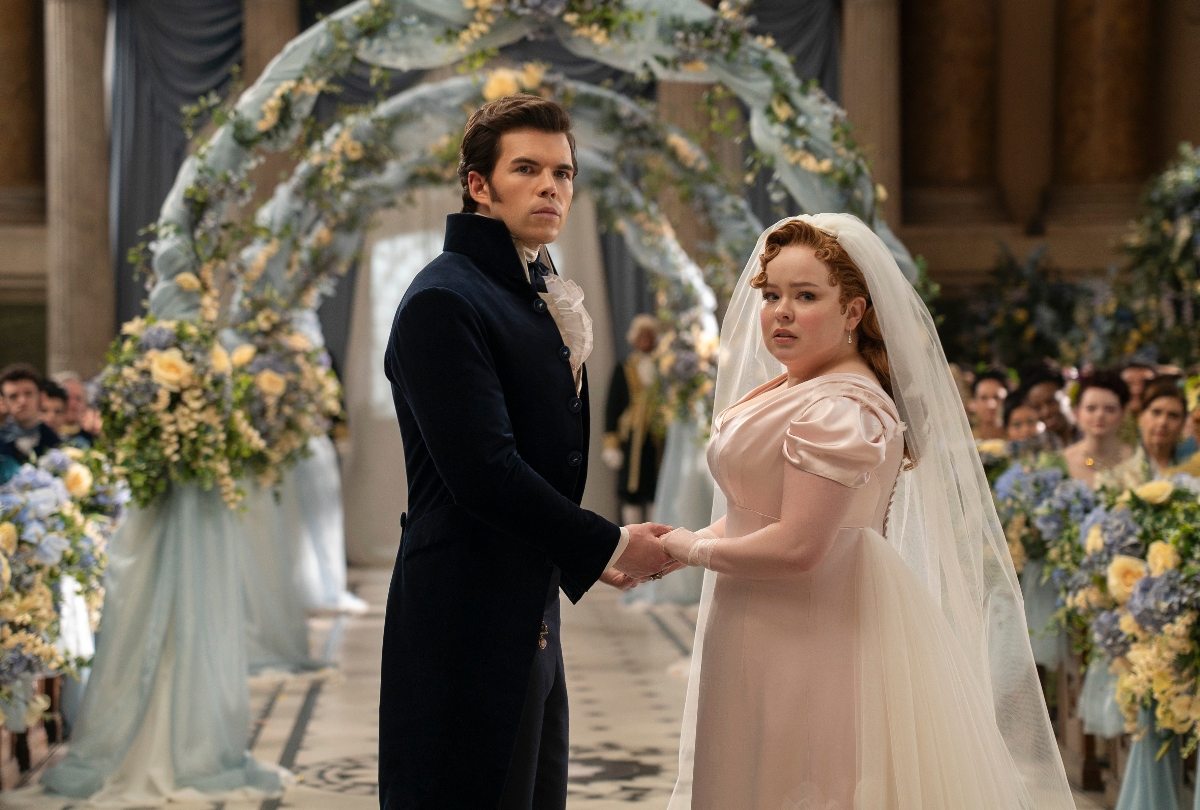
“There’s no such thing as true love without first embracing your true self.” Grosvenor Square’s premier modiste Genevieve Delacroix (Kathryn Drysdale) shared that wisdom with bride-to-be Penelope Featherington (Nicola Coughlan) the night before her wedding to Colin Bridgerton (Luke Newton).

Dispensing well-wishes and marital advice to lovebirds before they make their vows is a time-honored tradition, and in the ways that matter most, “Bridgerton” hews to the traditions of Regency-era England.

But in the third season’s last two episodes, the much-beloved series announced its intent to press its definition of inclusion further than simply presenting 19th century London’s upper class as a bastion of multiracial, multicultural harmony.

That was groundbreaking in 2020, when the star couple Daphne (Phoebe Dynevor) and Simon Basset, Duke of Hastings (Regé-Jean Page) was cast as interracial.  In 2022, when the Bridgerton family’s eldest son Anthony (Jonathan Bailey) fell for Kate Sharma (Simone Ashley), Kate’s Indian heritage was incorporated into the plot a choice showrunner Jess Brownell elevates again as this season closes: Anthony tells Kate that he wants his child to know his Sharma side and her family’s culture as well as his, which is as modern of a concept as Colin unhappily telling Penelope, “I will sleep on the sofa tonight."

Season 3’s main couple is entirely conventional in comparison, in that Penelope and Colin are two white people falling in love. All of “Bridgerton” up to this point has focused on heterosexual couples, hinting at queerness around the edges but never fully going there, save for glimpses of girl-on-boy-on-girl action at a brothel.

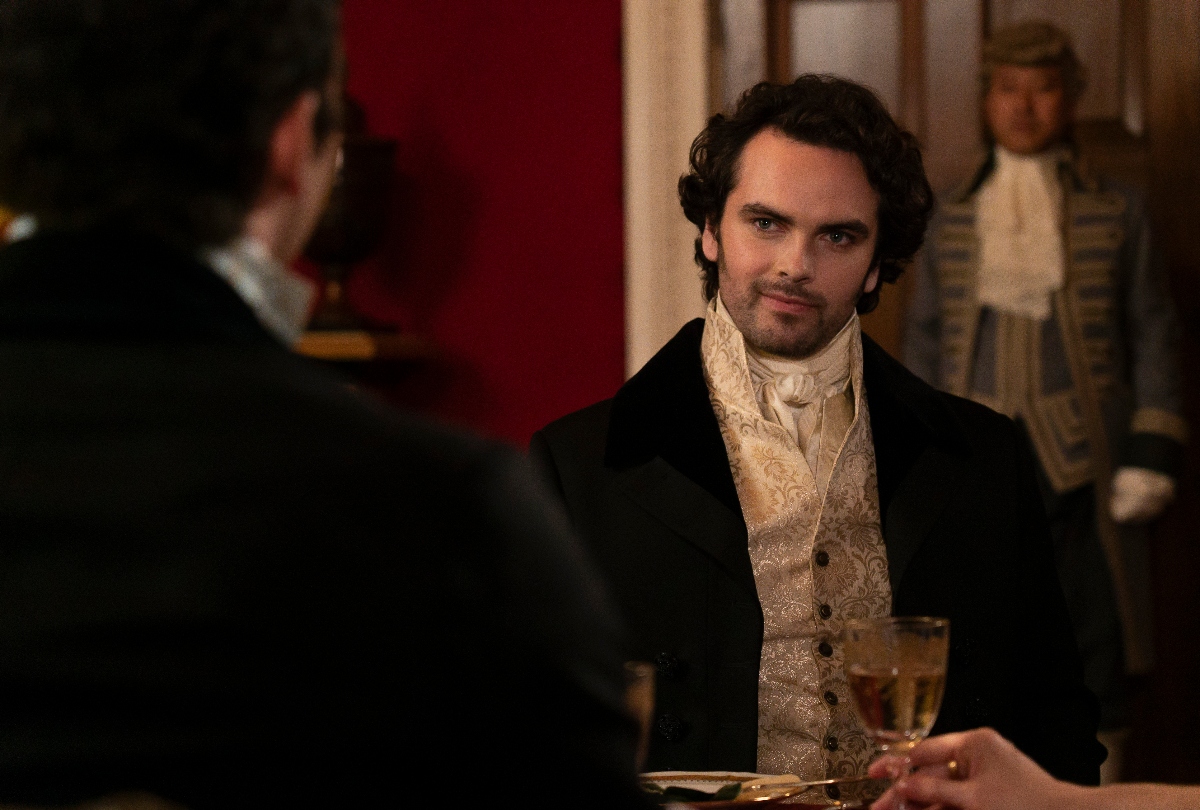
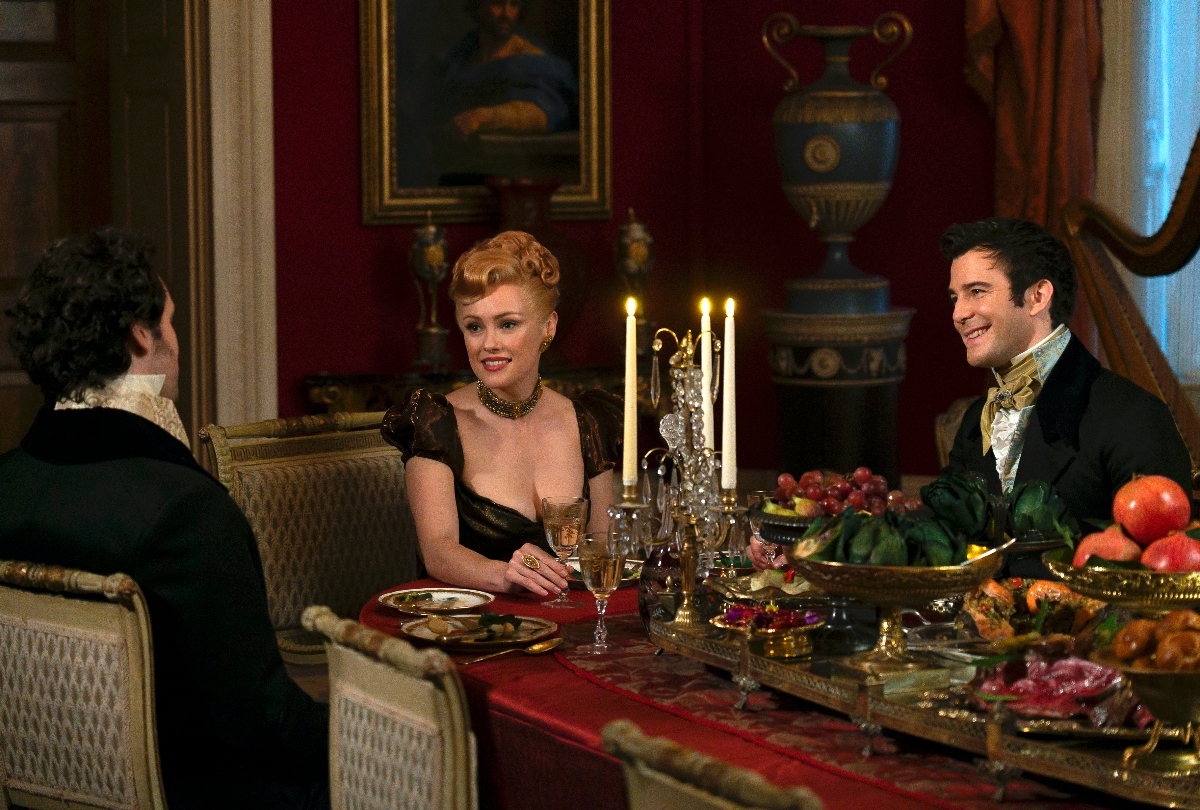
Lucas Aurelio as Paul Suarez in "Bridgerton" (Netflix) (Netflix)That changed completely with the last two episodes of this season. Some of it was previewed before the midseason’s monthlong hiatus when Benedict Bridgerton (Luke Thompson) met the unconventional and free-spirited Lady Tilley Arnold (Hannah New).
Lady Tilley isn't like other women, and Benedict soon discovers she isn’t courting him exclusively. When her other male suitor (Lucas Aurelio) desires Benedict too, the second-eldest Bridgerton son soon realizes the feeling is mutual.

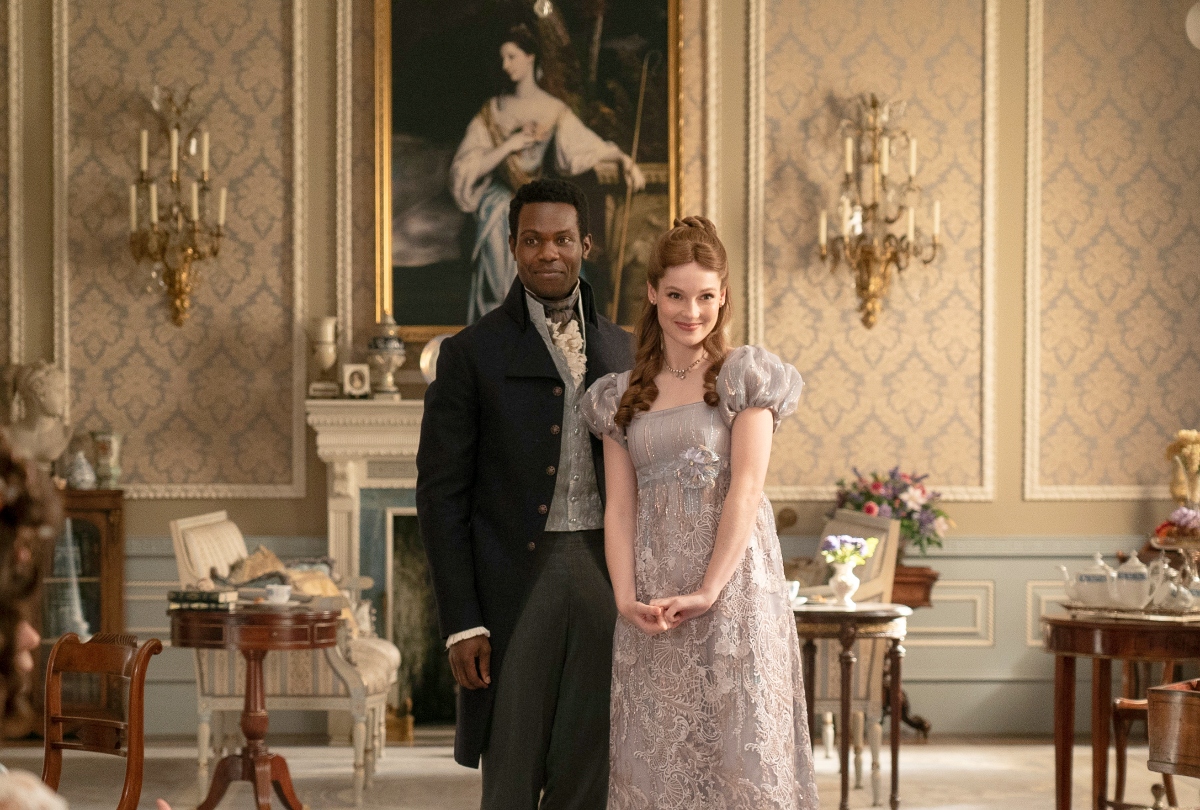
But the real jolt emerged in the wake of Francesca Bridgerton’s (Hannah Dodd) quiet wedding with John Stirling, the Earl of Kilmartin (Victor Alli), sealed with a kiss that, from the look on her face, did not rock her world.

Not in the way she lost her ability to speak at the end of the eighth episode, “Into the Light,” when his cousin Michaela Kilmartin (Masali Baduza) introduces herself at the season-ending Dankworth-Finch ball, the to-do to end all to-dos hosted by Penelope’s idiot sisters and secretly funded by the her largesse as the as-yet unmasked Lady Whistledown. The sight of Michaela leaves Francesca visibly flustered in the way of someone surprised by what they're feeling and unsure of what to do with that information. Is this what Genevieve was talking about?

“There is so much in society that is unnatural, but a feeling between two people, whatever their sex, is the most natural thing in the world.”

Not specifically. When Genevieve encourages Penelope to embrace her true self, she is counseling a conflicted woman who loves her avocation as much as her future husband wishes that she'd give it up. Nevertheless, that line is one of many signposts indicating the show’s intent to branch out ideologically and geographically.

Eloise Bridgerton (Claudia Jessie) resolves a season spent moaning about the limited options for women by choosing to see more of the world by joining Francesca and John in Scotland. She realizes her future rests with helping people, she says, and she can't do that without seeing more of the world. Lord Kilmartin's castle is massive enough for him and Francesca to have privacy while his wife's older sister kicks around the Highlands.

Victor Alli as John Stirling and Hannah Dodd as Francesca Bridgerton in "Bridgerton" (Netflix)That’s also distant enough, perhaps, for Francesca to pursue whatever honest feelings toward Michaela are stirring in her. Julia Quinn’s readers know that Michaela’s character doesn’t technicallyy exist in her "Bridgerton" novels – but there is a Michael Kilmartin who figures prominently in Francesca’s future. That change doesn’t merely pique our curiosity. It explains why the third season devoted so much space to a love story that was tender but forgettable.
We need your help to stay independent

Now we know that was always the intent. Besides, injecting Francesca's romance with additional spice might have distracted from Penelope’s arc, the most enthralling of the series so far.

At first it seems like Penelope is getting not simply what she wants, but more than she expected in all ways . . . except the one that matters most. Despite Colin’s fury at her hiding her identity as Lady Whistledown, he resolves to move forward with their marriage as a man of honor. Following through also brings potential damage to his family name; even Queen Charlotte (Golda Rosheuvel)  has it out for Lady Whistledown, offering a bounty for her unmasking.

But “Bridgerton” is steadfast about delivering happy endings for its principal characters. Penelope and Colin find their way back to each other, but with him meeting her where she is instead of demanding she accommodate his insecurities.

Luke Newton as Colin Bridgerton and Nicola Coughlan as Penelope Featherington in "Bridgerton" (Netflix)Additionally confirming this fairy tale resolution to be that of the woman who can have and do it all, Season 3 closes with a year’s leap forward, when Penelope and her sisters have all produced children. But it is Penelope who delivers salvation to the Featheringtons by giving birth to a son, providing a male heir to inherit the family’s fortune and title. Ergo, Lady Portia Featherington (Polly Walker) can keep all her nice things. 
Penelope, with a little help from Agatha Danbury (Adjoa Andoh), additionally salvages her family’s reputation by sacrificing her anonymity at the Dankworth-Finch ball. All this leaves the previously written-off wallflower in the position of one of the ‘Ton's most influential voices, and one of the few women with enough wealth to fend off a solicitor set on tossing Portia out on the street.

Sadly, Penelope's abandonment of her pseudonym may also mean Julie Andrews’ tart voiceover narration is no more. We’ll miss that much more than mean girl Cressida Cowper (Jessica Madsen), whose time in London has also ended. Cressida's failed attempts at assuming Lady Whistledown’s identity and blackmailing Penelope culminate in her banishment to the countryside to live with a hard-hearted aunt.  

“Bridgerton” is steadfast about delivering happy endings for its principal characters.

Even this close call inspired growth in Penelope, though. In exchange for retaining her power and influence, she pledges to use her pen with more care and responsibility. By extension, so do “Bridgerton” writers in broadening their adaptation’s definition of inclusion. Benedict's subplot and Francesca's, perhaps, reveal the show's intent to validate all types of relationships in its period piece fantasy. Love is not finite, the writers remind us . . . through Benedict, who says this to Eloise.

Speculations about Benedict’s potential queerness made some viewers wonder if the series would ever explore that that possibility. As the most libertine of the namesake family, he seemed ripest to take that chance. Eventually he proves that theory was onto something by taking part in a two-man threesome in the seventh episode.

Lucas Aurelio as Paul Suarez, Hannah New as Lady Tilley Arnold and Luke Thompson as Benedict Bridgerton in "Bridgerton" (Netflix) (Netflix)Obviously, none of these developments mean “Bridgerton” has abandoned its usual irresistibility. It’s the opposite. The lavish settings, opulent costumes, and other visual treats are as enchanting as ever. Every "Bridgerton" season promises a wedding. This time we got two. But if it's true that a life of privilege and luxury eventually grows dull (as so many of us have been told), expanding the show's view of romance and love beyond the same old heteronormative pairings shakes up the structure. 


Want a daily wrap-up of all the news and commentary Salon has to offer? Subscribe to our morning newsletter, Crash Course.


And it also adds real tension and danger, since this era holds stark legal consequences for same-sex pairings beyond the usual obstacles related to potential ruin and disgrace, adding valor and preciousness to whatever plots the writers spin.

Then again, Lady Violet (Ruth Gemmell) may also get lucky in love next season courtesy of Lady Danbury’s handsome brother Lord Anderson (Daniel Francis). The world is smitten with this show, but we’re also soft for “The Golden Bachelor” and “The Golden Bachelorette.”

“There is so much in society that is unnatural,” Lady Tilley says, “but a feeling between two people, whatever their sex, is the most natural thing in the world.” Benedict takes in that message when he tells his younger sister that whatever he learns henceforth “may change me entirely.”  

That's reason enough to be excited for whatever future “Bridgerton” maps for him, Francesca and anyone else worth talking about in Lady Whistledown’s column.

All episodes of "Bridgerton" are streaming on Netflix.

Trump’s idea to replace income taxes with tariffs is a “sure way” to hurt the poor and help the rich

Former President Donald Trump on Thursday proposed a new solution to getting rid of the U.S. income tax: an “all tariff policy," the preemptive Republican nominee told GOP lawmakers, according to CNBC.

In the meeting, Trump's first visit back to Capitol Hill since Jan 6, 2021, Trump attended a Republican "pep talk" in which he reiterated his belief that import taxes could replace those on income, a policy that reduce the tax burden on wealthy Americans while jacking up prices paid by consumers.

Indeed, tariffs are understood to hike consumer prices because companies pass on the cost of the tariffs they pay. Tariffs currently account for $88.3 billion of the $4.4 trillion in revenues the U.S. government reported in fiscal year 2023. Income taxes brought in about $2.2 trillion, the Treasury Department reported.

To bring tariff revenues even close to income tax levels would require a dramatic spike in import taxes, much higher than Trump’s proposed 10%.

Experts said the proposal would leave many Americans worse off.

“Broadly substituting tariffs for income tax is a sure way to hit hard low and middle-income Americans and reward top,” David Kamin, a tax policy expert at New York University School of Law, wrote on X.

Paul Krugman, a New York Times columnist and a Nobel Prize winner in economics, did some quick math and posted on X that a "first-pass estimate" suggests Trump's proposal "would require an *average* tariff rate of 133 percent.”

The Biden administration wasted no time in attacking Trump’s embrace of inflationary tariffs.

“The only people who benefit from this regressive, thoughtless policy are Trump’s billionaire donors, who get a windfall at the expense of working-class Americans,” Biden campaign spokesperson James Singer said.

Follow the Capitol Hill meeting, Trump ignored the critics and took to his website, TruthSocial, and give himself a pat on the back, writing: “Great meeting with Republican Representatives. Lots discussed, all positive, great poll numbers!”

Charring makes food taste amazing. But is it safe?

I love crisped, charred foods. From crispy, cheesy topped dips to uber-crisp chicken cutlets to pasta dishes that have been browned in the broiler, I crave a darkened, bronzed texture in practically anything that I make or eat — and I know I'm not alone. 

Texture is a massive component in food, sometimes perhaps even more so than flavor, and it's something that I am always striving for in my own cooking. In most instances, that means veering into the world of char, or even sometimes downright overcooking, but how safe is that cooking technique? Or, put another way: Just how unhealthy is ingesting burned or charred food? 

Before diving into the safety of char, it's important to understand its appeal to cooks. Chef Tyler Fenton helms the nationally acclaimed restaurant BATA in Tucson, Ariz, which is celebrated for its hearth and bright, inventive dishes — along with lots and lots of charring. When I asked Fenton what he likes to char and what is often a starring ingredient on his menu, he replied, "Everything!"

"But especially vegetables,” Fenton said. “Just take your steamed broccoli compared to hard-charred broccoli — the char brings out a new level of flavor and makes it really special.  Meat-wise, think of a boiled steak compared to a hard-charred steak. It’s a no brainer. Char makes everything taste better."

BATA's hearth was custom-designed by one of Fenton's good friends and has zones with different types of grilling surfaces, modular shelves for prepping and custom-designed areas for different cooking purposes, like heat with no smoke, or an area for smoke with limited heat. 

"It’s very specific to what we do on a daily basis. Our hearth is under a hood to keep airflow constantly moving. When the smoke is drawn up and through, as opposed to an offset smoker that has a heavy smoke penetration, you get a really clean smoke flavor on things. We like to say it 'nicely perfumes everything," Fenton said. 

When I asked Fenton about that fine line between charring and burning, which can cross the threshold from crispy and browned to acrid and unappealing, he said that "it's about the penetration of the char." 

"A really hard char is surface level, whereas burning is when you have that charred texture throughout," he said. "If you think about a piece of toast, you can have a deep caramelization on the outside of the toast that may look burnt, but the middle is still fluffy, happy bread. As soon as you have a piece of toast that is charred all the way through, that’s when you cross into burnt land." 

We need your help to stay independent

Fenton's unique approach also touches on incorporating charred flavor notes in different manners. "Lately we’ve been taking the trim of onions and holding it over the fire to dry it out completely. We then turn that into a powder that we use to lightly dust dishes with. Think [of] a raw fish dish with a wisp of smoked onion powder. Or sometimes that powder gets incorporated into sausage as a seasoning. We often take ingredients a step further."

He also spoke about utilizing ash in his dishes, which adds a slightly different flavor profile than outright grilling or smoking. 

Of course, Fenton's usage of BATA's special hearth certainly differs from the grill you might have in the backyard, but at the end of the day, we're all using grills for the same reason, right? A hot dog cooked in any way is no comparison for a grilled hot dog. Same for burgers. This is evident. And we've all been eating grilled burgers and hot dogs, whether made with animal products or not, for a long, long time. 

Yet, Nichole Dandrea-Russert — a dietician and the author of "The Vegan Athlete’s Nutrition Handbook — charred red meat, or meat in general, is actually more potentially harmful than charring practically anything else.

"Chemicals called heterocyclic amines (HCAs) and polycyclic aromatic hydrocarbons (PAHs) are formed when meat is cooked using high temperatures, like pan frying or grilling, or when meat is cooked over an open flame," Dandrea-Russert said. "Heterocyclic amines are formed through protein, sugar, and creatine in meat reacting at high temperatures. Polycyclic aromatic hydrocarbons form when fat and juices from meat drip over an open flame, causing smoke that contains PAHs to adhere to the surface of the meat. The higher the temperature and the longer the meat is cooked, the higher the potential for these compounds to form. When consumed, these chemicals can cause changes in DNA that may increase the risk of cancer." 

"When consumed, these chemicals can cause changes in DNA that may increase the risk of cancer."

Dandrea-Russert advises "avoiding direct exposure of meat to an open flame, avoiding prolonged cooking times (especially at high temperatures), and removing charred areas of meat before consuming."

"Red meat is already linked to cancer, heart disease and diabetes and is classified as a type 2A carcinogen by the World Health Organization," she continued. "This means that it is probably carcinogenic to humans as demonstrated by epidemiological studies. Smoked and processed meats are considered a type 1 carcinogen, meaning that there is sufficient evidence demonstrating that they are carcinogenic to humans."

She notes that plant-based foods, conversely, are "shown to reduce the risk of cancer, heart disease and diabetes." Now, charring plant-based foods sort of complicates this, of course, but it's more advisable, generally, to char some zucchini than it is to char a porterhouse steak, essentially. 

At the same time, Dandrea-Russert also notes that certain plant-based foods, such as potatoes or bread, can also produce a chemical called acrylamides when cooked over especially high heat. She notes "acrylamides have also been associated with increased risk of certain types of cancer. Aim for golden yellow colors, instead of brown or charred, when toasting bread or roasting starchy foods, like potatoes." 

Let's be honest, though: Flaccid, yellow fries or roasted 'taters are certainly not as delicious as crisp, deeply browned ones, a true catch-22. That's where moderation comes into play, per Dandrea-Russert. 

"The total amount and length of time can make a difference. Minimizing the amount of HCAs and PAHs, as well as frequency of exposure, is recommended if you want to minimize risk of cancer from these chemicals," she said. 

“Walks like a duck, swims like a duck”: Sonia Sotomayor torches Supreme Court’s bump stock ruling

The U.S. Supreme Court ruled Friday to throw out the federal ban on “bump stocks,” an attachment that allows semiautomatic rifles to fire at a speed comparable to a machine gun, prompting a blistering dissent from liberal Justice Sonia Sotomayor.

In a 6-3 vote on ideological lines, the court's conservative justices decided that a 1986 law aimed at banning machine guns cannot be interpreted to include bump stocks, NBC News reported

The prohibition on bump stocks was first put into place by the Trump administration after the Las Vegas concert massacre in 2017 when a man using the accessory killed 60 people in 10 minutes. It remains the deadliest mass shooting in modern American history.

Writing for the majority, Justice Clarence Thomas asserted that while Congress had "long restricted access to 'machinegun[s],'" defined as a firearm that can "shoot, automatically more than one shot … by a single function of the trigger," it had not banned semiautomatic firearms, which when equipped with bump stocks can do the exact same thing.

Even though the effect is the same, Thomas wrote that a "bump stock does not convert a semiautomatic rifle into a machinegun any more than a shooter with a lightning-fast trigger finger does.”

Sotomayor, in her dissent, mocked the suggestion that there were any difficult questions raised by the ban on bump stocks.

"This is not a hard case," Sotomayor wrote. "All the textual evidence points to the same interpretation. A bump-stock equipped semi-automatic rifle is a machine gun because (1) with a single pull of the trigger, a shooter can (2) fire continuous shots without any human input beyond maintaining forward pressure."

Sotomayor rejected the argument that a semiautomatic weapon that behaves just like a machine gun is not, practically speaking, the same thing.

"When I see a bird that walks like a duck, swims like a duck, and quacks like a duck, I call that bird a duck," Sotomayor wrote.

“Lies”: Panicked Republicans contradict each other’s claims to excuse Trump’s “horrible city” diss

Donald Trump's Republican allies on Thursday sought to deny and spin reports that the former president blasted the site of this year's Republican National Convention as a "horrible city" during a meeting on Capitol Hill.

“Milwaukee, where we are having our convention, is a horrible city,” the former president told congressional Republicans, according to PunchBowl News' Jake Sherman. It was a remarkable assessment of Wisconsin’s largest urban area, home not just to next month’s convention — taking place days after the presumptive nominee is due to be sentenced for some of his many alleged crimes — but tens of thousands of people whose votes the three-time candidate will need in November.

“There are about 50,000 Republicans who live right here in the city,” noted Milwaukee’s Democratic mayor, Cavalier Johnson, “[and] you’re calling their home ‘horrible.’”

Republican lawmakers then obediently fell into a role that’s grown familiar since Trump took over the GOP eight years ago: that of bumbling spokesperson trying to clean up a public relations disaster.

“Lies,” declared Rep. Derrick Van Orden, R-Wis., dismissing the original report — a verbatim quote posted to X by Sherman, based on sources in the meeting with Trump — as the product of a “Democratic shill pretending to be a journalist.” After getting out the standard cry of “liberal media,” Van Orden did not challenge the fact that Trump said what he said but asserted there was context: the Republican candidate, himself just convicted of 34 felonies for falsifying business records after earlier being found liable by a jury for sexual assault, “was specifically referring to … the CRIME RATE in Milwaukee.” To drive the point home, Van Orden shared a screenshot of a year-old article on the city’s homicide rate, which actually fell in 2023 and have further declined nearly 50% so far in 2024.

Was he, though? Not according to another lawmaker, Rep. Claudia Tenney, R-N.Y., who claimed she was the one that prompted Trump’s outburst. Tenney told a right-wing tabloid. His comment came in the context of a very serious discussion from a real policy wonk, she assured the public.

“The president was just setting forth the policies that he thinks are going to be the winning policies,” she said, going on to clarify that Trump “was specifically talking about voter fraud and places they are identifying — 19 areas — where they know there was voter fraud or there were attempts to prime the pump in favor of Democrats.” According to the New York Post, Tenney said “[s]he didn’t hear the former president say anything about crime.”

In 2020, Trump lost Wisconsin by more than 20,000 votes, a defeat he and his allies have spent years now explaining away with bogus claims of fraud, all rejected by every court that has ever considered them. But let’s stay focused: What’s important is that we now understand Trump was talking specifically — specifically — about violent crime. But he was also, specifically, talking not about homicides but about about elections.

Except: What if the biased mainstream media made up the whole thing and Trump didn’t utter a word about Milwaukee at all?

“I was in the room,” Rep. Bryan Steil, R-Wis., assured his followers on social media. “President Trump did not say this. There is no better place than Wisconsin in July.”

We need your help to stay independent

The problem, as always for the post-2015 GOP, is that the first few hours of a PR crisis always entail ad-libbing, oft contradictory, from Trump surrogates (a role assumed by the vast majority of elected Republicans) who have not yet received their talking points. Go all the way back to 2020, at the height of the COVID-19 pandemic, when Trump was awed by the cleansing power of bleach — “[it] will kill the virus in five minutes” — and suggested there had to be “a way we can do something like that, by injection inside or almost a cleaning.”

Trying to clean up the mess, then-White House Press Secretary Kayleigh McEnany fell back on an old standby: deny the unambiguous remark and blame the press for not casting a literal verbatim quote in a more favorable, disinfecting light. “Leave it to the media to irresponsibly take President Trump out of context and run with negative headlines," she said.

Trump then dutifully undermined the line about missing context by claiming he was actually telling a very funny joke, as any president would do during an emergency briefing at a time when thousands of Americans were gravely ill with a novel coronavirus. “I was asking the question sarcastically to reporters like you, just to see what would happen,” he said at a later press briefing, falsely asserting that it had come “in the form of a sarcastic question to a reporter.”


Want a daily wrap-up of all the news and commentary Salon has to offer? Subscribe to our morning newsletter, Crash Course.


In the case of his Milwaukee gaffe, Trump, following the various explanations offered by his loyalists, told Fox News that he did in fact say it – specifically, with respect to whatever sounds least bad.

“It was very clear what I meant,” he said Thursday. “I said, we’re very concerned with crime. I love Milwaukee, I have great friends in Milwaukee, but it’s, as you know, the crime numbers are terrible. We have to be very careful.”

So he did say it, contra the assertions of one supporter, but it was about crime, contradicting the assertion of another supporter who said it had nothing to do with crime. But, Trump continued, it was also not about Milwaukee’s actually declining rate of violence.

“I was referring to, also, the election, the ballots, the way it went down, it was very bad in Milwaukee,” Trump said, falsely, again.

Democrats, for whom Wisconsin is just as much a must-win as it is for Trump in November, elected to take Trump at his word and accept that, for various reasons, he is afraid of a city that overwhelmingly voted against him in 2016 and 2020.

Rep. Gwen Moore, D-Wis., who represents Milwaukee residents, said Thursday that if Trump is indeed concerned about crime in the city than he, a convicted fraudster and court-adjudicated sexual assailant, should do his part to keep it safe.

“I don’t know many people in Milwaukee who have 34 felony counts against them,” she told MSNBC. “So our crime rate sure is going to go up when he joins us,” she added, noting that he also faces dozens more counts in pending state and federal cases over the January 6 insurrection and his apparent theft of national security secrets.

Put aside the spin, she continued, and focus on what we know.

"He's a horrible person," she said.

“History will remember the shame” of Mitch McConnell sucking up to Trump, Liz Cheney says

Senate Minority Leader Mitch McConnell, R-K.Y., met with former President Donald Trump on Thursday and former Rep. Liz Cheney, R-Wyo., was not happy about it, saying “history will remember the shame.”

Cheney, who left Congress in 2022 after losing reelection to her seat, is one of a select few Republicans who have been critical of Trump and held him responsible for the Jan 6. attack on the U.S. Capitol. She felt that McConnell’s sudden show of support for Trump enabled the former president. 

Cheney took to X to lodge her complaints about the Senate GOP leader. “Mitch McConnell knows Trump provoked the violent attack on our Capitol and then ‘watched television happily’ as his mob brutally beat police officers and hunted the Vice President," she noted.

She went on to highlight McConnell’s knowledge of how Trump responded to the “mob” of his supporters who refused to end their assault even as police officers were bleeding on the ground. “He kept repeating his election lies and praising the criminals,’” she said.

Back in February 2021, McConnell himself declared Trump "practically and morally responsible" for the Jan. 6 insurrection. After speaking with Trump Thursday, following his 34 felony convictions, McConnell described the meeting, their first since 2020, as "positive."

“He and I got a chance to talk, we shook hands a few times. He got a lot of standing ovations,” McConnell said, HuffPost reported. “It was an entirely positive meeting. I can’t think of anything to tell you out of it that was negative.”

Cheney, for her part, had plenty of critical things to say about McConnel.

“He knows Trump committed a ‘disgraceful dereliction of duty’ and is a danger to our Republic," she said. "Trump and his collaborators will be defeated, and history will remember the shame of people like McConnell who enabled them.”

Republicans’ Capitol Hill pep rally for Trump’s return was a flop

As Donald Trump made his first visit to the scene of the crime since the Capitol insurrection, the Biden campaign launched a new ad reminding Americans of that notorious event:

You'd think that of all people, members of the United States Congress would be reluctant to welcome the man who sicced a violent mob on them. But no, they greeted him with rapturous applause and even broke into a rousing rendition of "Happy Birthday" as they brought out a cake for Trump.

The House members were beside themselves. Georgia Congresswoman Marjorie Taylor Greene gushed about how "funny" and "sweet" he is in real life and how it's just so, like, awesome that he mentioned her by name and everything! She hasn't been this excited since that time she had front-row seats for the Back Street Boys back in '98 and A.J. winked right at her (everybody said so.) 

 She was far from alone. 

Even the Speaker of the House, Louisiana Rep. Mike Johnson, came before the cameras to say what a privilege it was to have Donald Trump tell him how great he is.

(I'm not sure why Johnson tends to speak in the third person but maybe it has something to do with the fact that he thinks he's the New Moses or something.)

When the former president met with GOP senators, his nemesis, Minority Leader Mitch "Broken Old Crow" McConnell, extended his hand in friendship as if Trump had never racially insulted his wife or tried to stage a coup. They had not spoken since December of 2020 but the so-called "gravedigger of democracy" apparently decided to bury what was left of his reputation and personal integrity once and for all.

One GOP Congressman was so excited that he planned to immediately offer a bill to name all American coastal waters after Donald Trump:

You might think that's a very odd thing to propose but considering Trump's apparent obsession with electric boats, woke sharks and low-flow toilets maybe it makes some sense. It's only a matter of time before they propose to rename the entire country "Trumplandia." 

We need your help to stay independent

This pep rally for Donald Trump, as one congressman described it, needless to say, featured the usual whining about unfairness, weaponization of the government, persecution, etc. One attendee said he went off on lots of tangents. Another source in the room described it as “like talking to your drunk uncle at the family reunion." 

He seems to be quite worried about Taylor Swift possibly endorsing President Biden because he's mentioned it a few times recently, musing that she might not really be all that liberal and going on about how beautiful she is as if he has a schoolboy crush. At this meeting, he wondered aloud how she could possibly vote for "that dope" Joe Biden, whom she endorsed in 2020. And he shared a bizarre anecdote about Speaker Emeritus Nancy Pelosi's daughter (whom he called a "wacko") telling him "If things were different Nancy and I would be perfect together, there’s an age difference though." (He's 24 years older than his wife, who is actually younger than Pelosi's daughter)  Speaking on behalf of all of her sisters, Christine Pelosi said it was a lie and that Trump has a "deranged obsession" with Pelosi.

Then Trump insulted Milwaukee, Wisconsin where the GOP is holding their convention next month, calling it a "horrible city." That's particularly bad form, even for Trump and GOP members fell all over themselves either denying he ever said it or saying he meant different things by it. Trump cleared the matter up by admitting that he said it essentially because Milwaukee is a crime-infested hellscape where they steal elections from him. So that's nice. 

Aside from all the predictable meandering, Trump did make some news on policy. He reportedly said that he believes Ukraine is “never going to be there for us” almost at the same moment that Biden was signing a 10-year bilateral security agreement.  (Apparently, he's still smarting from the fact that President Zelensky failed to do his bidding back in 2019.) He railed against Biden's push to expand electric vehicles calling it "the dumbest thing" and had this to say about the GOP's problem with abortion:

Roe v Wade, everyone was against it because they wanted it to be decided by the states, there was no 10 weeks, 12 weeks, every person said it’s got to be back to the states. It became a complex issue 10 years ago, everyone wanted it back in the states, and we got it back in the states, sometimes good sometimes not good, some states went one way and some states went a different way. But like Ronald Reagan, you have to have three choices: life of mother, rape and incest you have to do, but you have to follow your own heart. Republicans are so afraid of the issue, we would have had 40 seats.

None of that is true or makes any sense and we can only hope that the entire Republican Party follows his lead and babbles as incoherently on the subject. 


Want a daily wrap-up of all the news and commentary Salon has to offer? Subscribe to our morning newsletter, Crash Course.


As we know, Trump only has a few policy ideas, most of which were formulated years ago when he saw something on TV. When it comes to economics it comes down to one thing and one thing only: tariffs. (He has admitted that it came to him when he saw Japanese cars being offloaded from ships back in the 1980s and became convinced that America was being ripped off. )

If you liked the inflation of the last few years, you're going to love what he's got in mind now. He's been saying for some time that he wanted to impose a 10% tariff on all imports. Now his one idea is even bigger. Saying that he's a big fan of President William McKinley (whom I would bet he'd never heard of until someone mentioned him recently) he told the senators that he wants to eliminate the income tax and replace it completely with tariffs. 

MSNBC's Chris Hayes explained that it "would effectively take us back to the 19th century — the idea makes as much sense as ripping up the entire interstate highway system and replacing it with canals." According to economist Paul Krugman, this policy would amount to something like a 133% sales tax that would cost the average American family thousands more dollars while giving the richest 1% (of which Trump is a member) a windfall of millions of dollars. As Hayes said, "he is seriously and earnestly running on the most inflationary platform I have ever seen."

None of this phased the Trump super-fans of the GOP caucus, many of whom know better but applauded everything he said like a bunch of trained seals anyway.

It's a cliche at this point to evoke the old fable of the Emperor's New Clothes. But it's unavoidable in this situation. Donald Trump was manifestly unfit back in 2016 and had a disastrous presidency, failing miserably at the most important crisis he faced. He was thrown out of office by the people, had a massive temper tantrum, incited an insurrection and left office as the worst president in American history. And yet, here he is again, like a zombie risen from the Earth, even more unfit than he was before, and the Republican Party is giddily worshiping him like he's Alexander the Great. At this point it's clear that it isn't him anymore — it's them. 

“Ethical lapses”: Senate probe reveals more Clarence Thomas trips paid by GOP donor Harlan Crow

ProPublica is a Pulitzer Prize-winning investigative newsroom. Sign up for The Big Story newsletter to receive stories like this one in your inbox.

Series: Friends of the Court:SCOTUS Justices’ Beneficial Relationships With Billionaire Donors

Supreme Court Justice Clarence Thomas’ decadeslong friendship with real estate tycoon Harlan Crow and Samuel Alito’s luxury travel with billionaire Paul Singer have raised questions about influence and ethics at the nation's highest court.

Billionaire political donor Harlan Crow provided at least three previously undisclosed private jet trips to Supreme Court Justice Clarence Thomas in recent years, an investigation by Senate Judiciary Committee Democrats has found.

The flights, which were detailed by Crow’s lawyer in response to inquiries from the committee, took the justice to destinations including the region near Glacier National Park in Montana and Thomas’ hometown in Georgia.

The committee launched its investigation in response to ProPublica reporting last year that revealed numerous undisclosed gifts Crow provided to Thomas, including private school tuition for a relative and luxury vacations virtually every year for more than two decades. Democrats on the committee authorized a subpoena for information from Crow last November, but the subpoena was not issued, and the new information came as a result of negotiations between the Senate and Crow’s attorneys.

It’s possible more revelations are yet to come. The office of the panel’s chair, Sen. Dick Durbin, D-Ill., said that a report detailing the full findings of committee Democrats’ investigation would be released later in the summer.

“As a result of our investigation and subpoena authorization, we are providing the American public greater clarity on the extent of ethical lapses by Supreme Court justices,” Durbin said in a statement. He added that the newly discovered gifts make “crystal clear that the highest court needs an enforceable code of conduct.”

Crow’s office said in a statement that he gave the senators information covering the past seven years and that the committee “agreed to end its probe with respect to Mr. Crow.”

“Despite his serious and continued concerns about the legality and necessity of the inquiry, Mr. Crow engaged in good faith with the Committee,” the statement said.

Thomas did not immediately respond to a request for comment.

The newly revealed flights add to the picture of Thomas’ frequent use of Crow’s jet for personal travel, allowing the justice to fly in the style of the ultrawealthy. Crow owns a high-end Bombardier Global 5000, a jet that can cost over $10,000 per flight hour to charter, according to charter company estimates. Thomas has repeatedly flown to a destination and back again on the same day.

The relationship between the two men began on Crow’s jet: In 1996, Crow offered to fly the justice to Dallas for a speech and while they were in the air, they hit it off, Crow has said. Crow has since flown Thomas to destinations around the world.

The new details released by the Senate don’t make clear the purpose of the trips, only listing flight dates and locations. They include a May 2017 trip from St. Louis to Kalispell, Montana — the location of Glacier Park International Airport — then from Montana to Dallas two days later. Thomas was scheduled to be in St. Louis at the time for a speech to a local bar association.

In one instance, he flew on June 29, 2021, from the East Coast to San Jose, California, and returned home later that day. In another, the justice took a round-trip flight on March 23, 2019, from Washington, D.C., to Savannah, Georgia.

ProPublica could not immediately find evidence of Thomas making public appearances in Montana, Georgia or California on the dates in question.

Last May, Senate Democrats requested detailed information from Crow about his relationship with Thomas, including an itemized list of all gifts he’d given to Supreme Court justices over the years. In November, Democrats upped the pressure by authorizing a subpoena. That decision met fierce Republican opposition, with GOP senators on the committee walking out of the hearing in protest.

The committee also authorized a subpoena for conservative legal activist Leonard Leo. Leo joined Thomas on at least one trip with Crow and also helped organize a luxury fishing vacation for Justice Samuel Alito, which was paid for by political donors. Leo has said he will not comply with the subpoena.

Last fall, amid public outcry about ethics controversies, the Supreme Court adopted a code of conduct for the first time in its history. The code, however, has no enforcement mechanism.

On Wednesday, Senate Democrats attempted to pass a bill that would tighten the court’s ethics rules and create a process for fielding and investigating complaints of potential misconduct. Sen. Lindsey Graham, R-S.C., called the legislation “unconstitutional overreach” and led a group of Republican senators who blocked the bill from advancing.

Last week, Thomas acknowledged for the first time that he should have told the public about food and lodging he received from Crow on a pair of free vacations, both of which were first uncovered by ProPublica. Thomas said he “inadvertently omitted” the gifts on previous financial disclosure filings. Thomas has not reported the recent private jet trips from Crow, which many legal experts have described as a violation of the federal financial disclosure law. Thomas’ attorney has maintained that the justice did not need to report the free flights.

“Trump’s a crook”: DNC to troll MAGA boat rally with airplane banner on Trump’s birthday

Democrats are planning to disrupt a “MAGA Boat Parade” in Michigan on Saturday by having a plane fly above the participants for three hours with a banner reminding them that Donald Trump is now the first former president — and first major party nominee — to be convicted of felonies.

“Trump’s a Crook, Don’t Let Em Sink Ur Boat,” the banner will state. According to a spokesperson for the Democratic National Committee, it will be flown over Lake St. Clair, next to Detroit, from 1 p.m. to 4 p.m. on Saturday. It coincides with a water-based rally organized by the Michigan Conservative Coalition, a pro-Trump group that bills the event as a celebration of the Republican’s 78th birthday.

Trump supporters have flaunted their boats and politics in similar rallies in Michigan and other states. In 2020, a MAGA rally on Texas’ Lake Travis ended with more than a dozen distress calls and five boats capsizing in the turbulent waters created by their fellow boaters.

Democrats are also putting up billboard ads near the site of Turning Point USA’s “People’s Convention” in downtown Detroit, where Trump will also seek to woo Black voters in a city he claims “everybody knows” is “crooked as hell,” and whose ballots he tried to toss out following his loss in 2020.

The billboards, in English and Spanish, will feature Trump alongside Roger Stone and Steve Bannon, two of his allies who have also been convicted of crimes. Stone, a long-time Republican operative, was convicted of seven felony counts for lying to special counsel Robert Mueller, among other offenses, only to be pardoned by Trump in 2020. Bannon, who avoided a possible fraud conviction by also getting a Trump pardon, is set to report to prison next month for refusing to cooperate before the congressional committee that investigated the January 6 insurrection.

The Democratic National Committee is posting billboards around Detroit reminding voters that Donald Trump and several of his associates have criminal convictions.

“Trump and his fellow crooks are in Detroit asking for your vote,” the billboards will read. “But it’s just a scam. They don’t care about you. They’re just out for themselves.”

DNC spokesperson Stephanie Justice said the campaign is intended to remind voters “of how Trump is unfit to lead, not only as a convict, but as a failed leader who left working families behind during his first term.”

After Supreme Court’s abortion pill decision, Donald Trump is even more likely to ban abortion

For close court watchers, it wasn't surprising that the Supreme Court rejected an effort by Christian right forces to take away access to the abortion pill. The case was too ridiculous, even for the current iteration of the court, which is dominated by six Republican appointees fighting varying levels of corruption allegations. The lawsuit was brought by a group of doctors — and dentists — who do not prescribe the medication in question, mifepristone. It was based on a total lie, which is that the drug is dangerous. (All evidence shows it's safer than Tylenol. The risk of death from Viagra is 10 times higher.) And the argument was eye-rollingly silly: The plaintiffs claimed to be worried they'd be asked to treat abortion patients in an emergency, an instance that rarely comes up, due to the drug's safety. When it does, emergency room providers have a right to ask a pro-choice doctor to step in to handle it.

If anything, we can now expect Republicans to redouble their efforts to ban abortion nationwide.

What was more surprising was how decisive the court was in dismissing the anti-abortion arguments. The decision was unanimous, for one thing, with even the effusively misogynist justices like Sam Alito and Clarence Thomas going along with it. In his opinion, Justice Brett Kavanaugh used forceful language that likely precludes all future efforts by Christian right groups to rework the complaint and try again. "[A] plaintiff ’s desire to make a drug less available for others does not establish standing to sue," he wrote, making it clear that even this Supreme Court cannot see the "personal stake" that these plaintiffs had in what other doctors are prescribing to patients. 

This decision may not be the end of efforts by anti-abortion groups to force a nationwide ban through the courts, but it is undeniably a huge setback. It will be tempting to many pundits and politicians, therefore, to treat this as the end of the efforts to strip all Americans of abortion access. More than 60% of abortions in the U.S. are done with pills, in no small part because they can be sent through the mail, making it easier for patients to get access despite the patchwork of abortion bans that have sprung up across the nation since the Supreme Court ruling in Dobbs v. Jackson Women's Health in 2022.


Want more Amanda Marcotte on politics? Subscribe to her newsletter Standing Room Only.


Democrats, on the other hand, snapped into motion to warn Americans that the abortion issue is very much alive and that their vote in November could determine the fate of reproductive health care. The decision "does not change the fact that if elected, Trump and his allies want to effectively ban abortion nationwide with or without the help of Congress and the courts," the Democratic National Committee said in a written statement. The White House's statement concurred, adding that Republicans have an "extreme and dangerous agenda to ban abortion nationwide."

As alarming as the Democratic language is, it's arguably an understatement. If anything, we can now expect Republicans to redouble their efforts to ban abortion nationwide. Christian right activists have already made it clear to Donald Trump that they expect him to sign a national abortion ban if he returns to the White House. Now that pressure, which was already high, will skyrocket. And this time, Trump will owe them even more than he did when he won in 2016, because this time, he's running not just for president, but to stay out of prison

Trump likes to make a lot of noise about leaving abortion "to the states," but his actions clearly signal to his fundamentalist followers that he will sign whatever abortion ban they get passed through Congress. On Monday, he spoke to the Danbury Institute, a group that not only calls for a total ban on all abortion but puts scare quotes around the term "women's rights." Trump is the single biggest reason that abortion bans are happening, as he appointed three out of the six justices who voted to overturn Roe. Like every other lie this notorious liar tells, Trump is not "moderate" on abortion, but will do the far-right's bidding on the issue every chance he gets. If he wins and Republicans hold majorities in the Senate and House, it's not a matter of "if" they ban abortion, but whether it's the first or merely second or third thing they do in office. 

Nor is the Republican radicalism on this issue limited to abortion. Earlier this month, all but two Republican senators voted down a bill that would protect the right to contraception from being overturned by the Supreme Court, as Thomas has strongly hinted is a future possibility. In right-wing media, the clamor to ban birth control is growing, with MAGA leaders like Charlie Kirk claiming, "Birth control, like, really screws up female brains." (Trump regularly speaks at events for Kirk's group, TPUSA, and is scheduled to do so again this weekend.) And despite disingenuous claims to support reproductive technologies like in-vitro fertilization, Republicans in the Senate did the Christian right's bidding this week, voting against a bill to protect the fertility treatment on Thursday. 

And just in case Trump somehow wins the White House without Republicans dominating Congress, anti-abortion forces have a plan to use Trump to ban abortion nationwide anyway: Project 2025. This infamous document, put together by the team widely expected to staff and run the White House if Trump wins, has gotten a lot of attention for the "post-constitutional" plans to take a hammer to decades of labor and environmental regulations, harness to Justice Department to terrorize political opponents, and deport immigrants by the millions. It also outlines a plan to ban the abortion pill nationally without Congress lifting a finger.

One proposal is to simply force the Food and Drug Administration to withdraw its approval of mifepristone, treating it like it's an illegal drug like cocaine. Another proposal is to revive the 1873 Comstock Act, which has been long dormant but never repealed. Doing so would make it illegal to ship any "article, instrument, substance, drug, medicine, or thing which is advertised or described in a manner calculated to lead another to use or apply it for producing abortion." This would not only be a functional ban on all abortion, but would also criminalize those who share information on how abortion works.

We need your help to stay independent

These efforts would be challenged in court, of course, but if he's in the White House, Trump will be able to add a flood of appointees to his already-robust number, all poised to rubber stamp even his most egregious abuses of power. And if anyone is foolish enough to think Trump would somehow prevent his main benefactors from having their way on this, think again. He gave them everything they asked during his first term as president, including three anti-abortion justices who overturned Roe v. Wade.

He will be even more beholden to them next time around. After all, he's indicated in multiple ways he does not intend to leave office at the end of a second term. As we learned from the January 6 insurrection, Christian nationalists are his main source of fanatics who will break the law and commit violence on his behalf. To keep those people in his thrall, he has to deliver for them. And there is nothing more important to the Christian right than banning abortion nationwide. 

Why contraception remains a battlefront in the war on reproductive rights

Since the U.S. Supreme Court overturned Roe v. Wade nearly two years ago, there has been a chorus of people warning that it wouldn’t end with abortions — that the right to access contraception would be eroded next. Earlier this month, U.S. legislators had a chance to codify access to birth control by passing the Right to Contraception Act. Specifically, it would have guaranteed the right of an individual "to obtain contraceptives and to voluntarily engage in contraception."

The legislation also would have protected the right of licensed health care providers to provide contraceptives, services and information related to contraception." It also would have prohibited any laws that impede access to birth control. All but two Senate Republicans voted against it

The possibility of restricting access to birth control didn’t appear out of nowhere. In Justice Clarence Thomas' concurring opinion on the case of Dobbs v. Jackson Women's Health Organization, which overturned Roe, he opined that the Supreme Court should revisit precedents that codified same-sex marriage, same-sex relationships and the right to contraception.

"In future cases, we should reconsider all of this Court's substantive due process precedents, including Griswold, Lawrence, and Obergefell," Thomas wrote in the opinion. "Because any substantive due process decision is 'demonstrably erroneous' … we have a duty to 'correct the error' established in those precedents."

The Griswold vs. Connecticut case cited by Thomas was decided in 1965, when the Supreme Court said married couples have the right to obtain contraceptives. This ruling determined that a state's ban on the use of contraceptives violated the right to marital privacy. Despite the ruling, unmarried women still didn't have the constitutional right to obtain contraceptives until the Supreme Court's 1972 decision in Eisenstadt v. Baird. In 1965, 26 states prohibited birth control for unmarried women. Griswold vs. Connecticut paved the way for legal contraception in the 1970s; overturning it could have an impact on access to birth control nationwide.

"As long as they believe that life begins at conception … they can't overcome the attacks on birth control."

As multiple legal experts told Salon nearly a year ago, since the fall of Roe, Griswold has been at risk. Now that Republicans have publicly unsupported it by failing to pass the Right to Contraception Act, is restricting access likely to happen sooner? 

Mini Timmaraju, president and CEO of Reproductive Freedom For All, told Salon that in the course of her 20-year career, she’s seen access to birth control always be at stake in some way. Right now, in the post-Roe landscape, what’s concerning to Timmaraju is the anti-abortion movement’s attempt to falsely conflate birth control as an abortifacient.


Want more health and science stories in your inbox? Subscribe to Salon's weekly newsletter Lab Notes.


“As long as they believe that life begins at conception — and they're using that as a public policy anchor for so much of this — they can't overcome the attacks on birth control,” Timmaraju said. “They really have to look at what the majority of physicians and scientists in this country believe and are clear on which is preventing implantation is not abortion, it’s not rooted in science.” 

Timmaraju added, before the Supreme Court ruled to uphold access to mifepristone, she was looking out for the court to rule on two major abortion-related cases, which could signal where the highest court is at with Griswold. The first, FDA v. Alliance for Hippocratic Medicine, could restrict access to mifepristone nationwide. The second, is looking at the language of the Emergency Medical Treatment and Labor Act (EMTALA) and determining if it overrides Idaho’s strict abortion laws.

“If they invoke or talk about in the language, or in any of the concurrences, Comstock, again, or Griswold, it’s more of a signal,” she said. “We're concerned about any abortion or reproductive rights case going forward, and we have two right now.”

Indeed, during oral arguments in March Supreme Court Justices Samuel Alito and Clarence Thomas both brought up the Comstock Act. In questioning, Thomas said to a lawyer for Danco Laboratories, the manufacturer of mifepristone, that the Comstock Act is "fairly broad, and it specifically covers drugs such as yours." Alito said the Comstock Act is a "prominent provision" and not "some obscure subsection of complicated obscure law."

Seema Mohapatra, a health law and bioethics expert at Southern Methodist University, told Salon that just how people ignored the risk of Roe v. Wade being overturned, the same could be said for now with Griswold. 

“I think from Dobbs, it's very obvious that contraception is at risk,” she said. “We already have strong conscience objections that pharmacists can have in many states.” 

Indeed, some states already have restrictions against emergency contraception like Plan B. And in 12 states, laws allow some health care providers to refuse to provide services related to contraception, according to the Guttmacher Institute.

Madison Roberts, a lobbyist for the Reproductive Freedom Project at the ACLU, told Salon overturning Roe v. Wade was never the “end goal for extremists.”

We need your help to stay independent

“In this modern era, we've seen attacks on reproductive freedoms across an array of reproductive health care issues, including attacks on birth control and extremist politicians have repeatedly threatened access to birth control, both in their words and in their actions,” Roberts said, noting the defunding of Title X, which was set up in 1970 to help low-income women who don't qualify for Medicaid obtain low-cost birth control (but notably not abortion.) 

Various attacks on birth control are “connected,” Roberts said, contributing to what’s at stake right now. 

“We don't have to read between the lines here to think about what the state of play is for attacks on reproductive freedom or on contraception.”

“The fact that a bill needs to be introduced to codify and safeguard the right to birth control, nearly 60 years after Griswold, just shows how extreme this agenda is,” Roberts said. “Voting yes on this bill should have been a no brainer.”

Making sense of the post-Trump conviction polls

Following Donald Trump’s historic criminal felony conviction for lying about hush money payments to hide potentially damaging information from voters before the 2016 election, I felt the urge to walk down to Trump Tower here in Chicago. It was raining outside. I did not use my umbrella. As I leaned up against Trump Tower, I watched an architecture boat tour travel down the Chicago River. I looked at the people walking past the building on the sidewalk above me. Many of them paused to look up, like me, at Trump Tower before they ambled along in the rain. I imagine we were all thinking the same thought: How did we get here and what happens now?

As I stood beneath Trump Tower, I thought about a scene from one of my favorite films, Michael Mann’s “Heat." I imagined Trump on the screen walking into a diner and asking to speak to the manager. “My name is Donald Trump and my parole officer told me to come by and see you about a job." In the film, the character (played by Dennis Haysbert) is then humiliated by the manager and told “the rules of the game” about how he will be forced to work multiple jobs, unpaid, and then kick back a percentage of his check for the “privilege” of working at the diner. If he complains or is late or otherwise is an annoyance – or for any other reason – the manager will call the parole officer and report him drunk or high or stealing and get him sent back to prison. But I know that such a thing will, in all probability, not happen to Trump. He is a very rich white man and a former president. Nevertheless, one can dream.

My fantasy about Donald Trump being suitably punished and humbled for his many crimes signals a much larger dynamic about emotions, feelings, intuitions, and those so-called “vibes” that so many in the news media, punditry, and political class are obsessed with. There are so many “vibes” that I cannot keep track of them all. All across the mainstream news media there are “vibes” about the economy, “vibes” about President Biden and his age, “vibes” about the overall direction of the country, and “vibes” about a range of other matters of public concern – of varying importance or grounding in reality.

On Monday, Trump had his pre-sentencing interview, conducted via video conferencing. The Associated Press described the less than thirty-minute interview as “uneventful.”

The American people should be cautious of anyone with a public platform who claims to be channeling these “vibes” – which are the equivalent of reading tea leaves and chicken bones or coffee grains in a cup. These “vibes” lead to lots of sloppy thinking and writing; In many ways these “vibes” are an empty signifier that can mean whatever a given person wants them to. As a practical matter, in an age of hyperpolitics, an unquenchable attention economy, and a news cycle driven by “content” as opposed to truth-seeking and real meaning with the proper context, writing and otherwise commenting up these “vibes” is something comparatively easy for reporters, journalists and the pundits to do with their “hot takes” and other writing and commentaries. 

On this, I agree with Charles Sykes at the Atlantic who recently warned: “In the age of Trump, it is also important that members of the media not be distracted by theatrics generally. (This includes Trump’s trial drama, the party conventions, and even—as David Frum points out in The Atlantic—the debates.) Relatedly, the stakes are simply too high to wallow in vibes, memes, or an obsessive focus on within-the-margin-of-error polls. Democracy can indeed be crushed by authoritarianism. But it can also be suffocated by the sort of trivia that often dominates social media.

And, finally, the Prime Directive of 2024: Never, ever become numbed by the endless drumbeat of outrages.”

Instead of the “vibes”, what is the data indicating at this early point about the impact of Donald Trump’s felony conviction on the country’s politics and the 2024 election?

Instead of the earthquake that many members of the news media, political class, and the larger mass public who are politically engaged were hoping for, Trump’s felony conviction has not had much of an impact on the polls.

Donald Trump and President Biden remained tied or within the margin of error in polls. Trump and President Biden continue to trade leads back and forth in the key battleground states. The American people are highly polarized. Trump’s MAGA cultists and other Republican voters support him – with some polls actually showing an increase in support for Trump after his felony conviction. President Biden and the Democratic Party’s voters are, as expected, for the most part, more supportive of him following Trump’s felony conviction.

The details tell a slightly different but complementary story. Following Trump’s felony conviction, there is a not insignificant percentage of Republican voters who report that they will not vote for him in the 2024 election. Some of Nikki Haley’s voters are continuing to vote for her in an apparent act of protest against Donald Trump. But Haley, who was once a fierce critic of Trump, is now enthusiastically supporting him. Like the other Vichy Republicans, Nikki Haley is auditioning for a position as Trump’s vice president or other high-ranking member of his regime.

New York Magazine's Ed Kilgore recently highlighted polling data that shows that Trump’s “favorability” has not been hurt by his historic felony conviction:

A decent number of pollsters regularly test the “favorability” of major public figures, which is the closest we can get to a “popularity” measure. (For those currently in office, a “job approval” rating offers additional data.) In the RealClearPolitics polling averages, Trump’s favorable/unfavorable ratio on May 30 was 43 percent favorable to 54 percent unfavorable. As of June 10 it is also 43 favorable to 54 percent unfavorable. Looking at specific pollsters, Yahoo News showed Trump’s favorability actually improving between mid-May (43 favorable to 56 percent unfavorable) and early June (46 favorable to 53 percent unfavorable. Economist/YouGov showed a very slight change between late May (44 percent favorable to 55 percent unfavorable) and early June (44 percent favorable to 55 percent unfavorable); the same is true of Morning Consult’s tracking poll (44 percent favorable to 53 percent unfavorable pre-conviction; 43 percent favorable to 53 percent unfavorable post-conviction). Data for Progress does show a lower post-conviction Trump favorability ratio (43 percent favorable to 56 percent unfavorable) than in its last such poll, but it was all the way back in March (45 percent favorable to 54 percent unfavorable). All in all, it’s pretty clear Trump is as popular (and unpopular) now as he was before he became a convicted criminal.

A recent poll from Reuters/Ipsos shows that 25 percent of independents were less likely to support Trump after his felony conviction while 18 percent told pollsters they are more likely to support him. 56 percent of independents report that Trump’s felony conviction will not impact their vote.

We need your help to stay independent

There are many qualifiers regarding what the polls and other data tell us (or not) about Donald Trump, who was convicted of a felony, and the 2024 election.

Public opinion polls are a snapshot in time which, by themselves, are not predictive. Public opinion polls gain power in hindsight in terms of the trends and the outcome of a given election.

Focusing on one poll in isolation, especially if it not a high quality one, is basically a fancier way of reading the “vibes” – just with math.

Despite how the mainstream news media and political class are committed to a belief in a “folk theory of democracy” and a “responsible electorate” and “normal politics”, most Americans are not politically sophisticated or ideological. They can be reasonably described as being inconsistent in their political thinking. The average American voter is also ignorant of factual matters about politics and policy. They instead rely upon intuitions and cues from elites and other opinion leaders and influentials to make their political decisions.

Even given the existential nature of the 2024 election and how Donald Trump is basically promising to end democracy, the polls and other research show that a large percentage of Americans are not paying close attention to the 2024 election – and politics more generally.

And for all of the minor shifts in public opinion that Trump’s felony conviction has apparently caused at this point in time, the role of what political scientists and other experts describe as “affective polarization” and “negative party identification” cannot be underestimated.

[In this dynamic, a person has a close emotional attachment to a party and views the opposing political party not just as possessing different views but as evil and an existential threat].

For all the discussions about how “traditional” Republicans are disgusted with Donald Trump and find his felony conviction to be disqualifying, many, if not the vast majority of them, will likely vote for him on Election Day.

The role of racism and white racial resentment also cannot be underestimated in how Trump’s felony conviction will impact (or not) the outcome of the 2024 election. Public opinion polls and other research show that a majority of Republican voters and Trump supporters believe in the white supremacist “great replacement” conspiracy theory and its lies that “white people” are being “replaced” by non-whites. Moreover, research also shows that a plurality if not majority of white Republican and Trump voters will support a dictatorship or other form of authoritarian government instead of multiracial democracy if they are not the country’s most powerful racial group. Dictator Donald Trump is a great weapon for white identity politics and white power.

Donald Trump and his propagandists are escalating their threats of violence and mayhem and promises of “retribution” and “revenge” against the Democrats and their other perceived enemies. The Republican Party is rallying even more around Donald Trump by undermining and delegitimating the rule of law by weaponizing it against President Biden, the Democratic Party, and the other “enemies” of MAGA.

Perhaps most importantly, by their very nature, truly historic and unprecedented events exist largely outside of our existing theories and understandings. We “the Americans” in the Age of Trump are in a type of undiscovered country where we are trying to grope and muddle our way through events where much of what we believe we know will turn out to not be true and our predictions of future events will be incorrect. Past experiences can be a guide through these confusing times, but they must not trap us into making poor decisions or reaching the wrong conclusions because they make us feel good or offer some other type of comfort.

David Cay Johnston, who is a Pulitzer Prize-winning journalist and long-time observer of Donald Trump, offers this counsel in an essay at DCReport about the corrupt ex-president and aspiring dictator’s felony conviction:

For now, though, the challenge is to get the truth about Trump out to enough people to motivate a majority to vote against him, especially in the states that could go either way.

By all rights, Trump should get trounced in November along with the Republicans who support his vicious anti-American plans to kill our representative democracy so he can rule as a dictator, free to murder opponents, loot the Treasury and control women.

Complacency can put Trump back in the Oval Office. Being smug and staying home out of a false belief that Trump cannot claw his way back to power now that he’s a felon on Election Day is precisely what Trump hopes.

Thwart Trump’s hopes. Do your duty. Be a citizen and save our Constitution and our freedoms.

The American people need to listen to Johnston’s warnings. Donald Trump may now be the first former president and presumed major party presidential nominee to be a convicted felon in American history. In this surreal era, Trump may actually win the election from prison. But what should be a mark of shame is instead being viewed as a badge of honor by his MAGA cultists and other followers. There are too many other Americans who also view felon Trump as a type of force to “shake up the system” and/or entertain them while he burns it all down. And there are those Americans who just don’t care anymore. Of the three groups, I am unsure which to condemn the most. Ultimately, Donald Trump and his MAGA movement and the other neofascists will have to be beaten at the ballot box and across civil society on Election Day and beyond. The courts alone will not be able to stop the Trumpocene and the forces it has empowered and unleashed.  

“LA is Terrible”: Goldie Hawn left startled after spate of burglaries

Goldie Hawn says she’s reliant on increased security after a string of robberies left her terrified.

The "Death Becomes Her" actress shared her story on a Wednesday episode of Kelly Ripa’s Sirius XM podcast “Let's Talk Off Camera,” explaining that she and her partner Kurt Russell were robbed twice in a four-month span. 

In the first incident, the pair, who starred opposite each other in 1987’s “Overboard,” were out to dinner as thieves ransacked their Los Angeles home.

"I walked into my closet and I just lost it," the actress shared with Ripa. "They had broken in from the balcony to our bedroom, our closets . . . they completely knocked down my door, which is a safe door, so they're very, very sophisticated, and they got a lot of my goodies.”

Hawn, mother of Kate Hudson, said she thought a second robbery was unlikely. Los Angeles saw just over 40,000 burglaries over 2023 in its 1.3 million homes, that category of crime down slightly from the previous year.

“The odds are that's not gonna happen again,” Hawn said, before sharing that mere months later, a second intruder entered the house.

"I hear this big thump upstairs, and I was alone. Kurt wasn't there and I went, 'What the hell was that?'" she told Ripa. "Was that a sonic boom? Did somebody jump somewhere? And as it turned out, the next day, we discovered that they were trying to get in my bedroom while I was in the house." 

Hawn, 78, says she doesn’t plan on staying alone any time soon, and told Ripa that she is now “never without a guard.”

"LA is terrible," she said, suggesting that the couple may be looking to relocate.