Spring Offer: Get 1 Year, Save 58%

“I have cognitive problems, clearly”: In 2012 deposition, RFK Jr. said a worm ate part of his brain

Doctors told Robert F. Kennedy Jr. that he had a dead parasitic worm inside of his brain, the independent presidential candidate divulged in a 2012 deposition obtained by The New York Times. 

Experiencing memory loss and brain fog, Kennedy in 2010 consulted with neurologists who initially concluded that a dark spot found in scans of his brain was a tumor. But a doctor at New York-Presbyterian Hospital later told Kennedy that the spot “was caused by a worm that got into my brain and ate a portion of it and then died,” Kennedy said in the deposition. 

Kennedy, unsure of where he contracted the parasite, suggested it may have happened during a visit to South Asia. A doctor without firsthand knowledge of Kennedy's medical history told the Times that details described in the deposition pointed to a pork tapeworm larva.

In his own campaign, Kennedy has assailed the mental fitness of his two opponents, but in the deposition admitted that the worm — and a mercury poisoning diagnosis that came around the same time — had taken its toll.

“I have cognitive problems, clearly,” he said in the deposition, per the Times. “I have short-term memory loss, and I have longer-term memory loss that affects me.”

Kennedy has previously pushed conspiracy theories around vaccines, falsely linking mercury-based compounds in some of them to neurological diseases.

Doctors who spoke with the Times said it’s not possible to be sure whether the parasite and mercury poisoning caused permanent brain damage without firsthand knowledge of Kennedy’s medical records.

There could be a “silver lining” to delaying Trump’s classified documents trial, experts say

Judge Aileen Cannon’s decision to postpone a trial in Donald Trump’s classified documents case could actually make it easier to move ahead with the former president's other criminal proceedings, legal experts say.

According to Neil Katyal, former acting U.S. solicitor general, Cannon’s decision could, in particular, allow special counsel Jack Smith to press ahead with the Jan. 6 case against Trump. The former president has been charged with plotting to overturn the 2020 election, a case that is being handled by a federal judge in Washington, DC.

“The one thing I will say that’s a positive is that if the Supreme Court allows Jack Smith’s other trial of Trump and Jan. 6 to go forward, Judge Cannon’s decision today has now cleared the docket for Trump,” Katyal said in an interview with MSNBC's Alex Wagner.

Katyal added that he believes it’s now “more possible” that a trial over January 6 could go forward, pending a Supreme Court ruling on presidential immunity. That case, which centers on Trump’s alleged conspiracy to use a mob to stop the certification of the 2020 election, had been set to begin trial in March, before the Supreme Court took up Trump's claim of immunity.

Criminal defense attorney Bradley P. Moss, in a post on X, argued that Cannon’s decision indeed has “a silver lining” for other Trump trial efforts.

“She isn't blocking the DC or Georgia election cases from resuming in the late summer/early fall, pending SCOTUS ruling on immunity,” he wrote. The Georgia case, delayed by allegations of prosecutorial misconduct, likewise deals with Trump's efforts to overturn his 2020 loss.

It appears unlikely, though, that the documents case itself moves forward. Katyal noted that Cannon has already had 11 months to begin a trial; in the same amount of time, federal prosecutors tried and convicted Sam Bankman-Fried. That's "atrocious," Katyal argued, but unlikely to be enough for prosecutors to have Cannon removed.

Experts: Cannon’s “bias and incompetence” threaten Trump case as she sets “highly unusual” schedule

It took U.S. District Judge Aileen Cannon almost a year to do what many observers thought was inevitable: kill just about any chance of Donald Trump being put on trial, before the November election, for allegedly stealing classified national security documents and refusing to give them back.

Cannon, a Trump appointee who was selected last June to hear special counsel Jack Smith’s case against the former president, began her Tuesday by pushing back a key filing deadline for the defense team to lay out what classified information it would introduce at a trial. She then issued another ruling delaying a trial indefinitely.

To set a trial date, Cannon wrote, “would be imprudent and inconsistent” with the court’s need “to fully and fairly consider the various pending pre-trial motions,” The Washington Post reported. An indefinite postponement, she continued, is consistent with Trump’s “right to due process and the public’s interest in the fair and efficient administration of justice.”

The next scheduled conference in the case is set for July 22. That means there can be no trial before then – it was once scheduled to begin this month – and probably not before voters head to the polls. If Trump wins the presidential election, he could have his handpicked attorney general kill off the case altogether.

But if Cannon, a former federal prosecutor appointed in 2020, feels overwhelmed by the case and all the pre-trial motions she has yet to rule on, legal experts said she has only herself to blame. Brandon Von Grack, a former Justice Department lawyer who served on Bob Mueller's team, noted, for example, that it’s “highly unusual” for a judge to hold three days of hearings on a defense motion aimed at defining the “scope” of the prosecution’s legal team.

Cannon is also expected to further delay the case by entertaining a defense argument that Trump and his valet, Walter Nauta, are victims of “prosecutorial misconduct and vindictive and selective prosecution,” noted Lawfare senior editor Roger Parloff, who added that Cannon has “already shown herself receptive to these themes.”

Indeed, as The New York Times’ Alan Feuer wrote Tuesday, the delays are not merely a product of a complex case with an unusually high-profile defendant. “Over and over,” he commented, “Judge Cannon … has treated seriously arguments that many, if not most, federal judges would have rejected out of hand.”

We need your help to stay independent

Eric Holder, who served as U.S. attorney general under former President Barack Obama, said Cannon’s behavior has been downright “disturbing,” writing on social media that “this whole process in the documents case has simply not been on the up and up.”

But while liberal critics are quick to point out that Cannon is overseeing a case involving the man who gave her the job she has today, there is an alternative explanation for her behavior: she is also highly inexperienced. As Reuters previously reported, she made several elementary mistakes in a criminal trial she handled last year, such as apparently forgetting to swear in the prospective jury pool and barring the public from observing the selection process, forcing her to later restart the whole process.

But Ty Cobb, who served as legal counsel for the Trump White House before becoming a critic of the former president, told CNN there’s no reason to choose between the two possible explanations for Cannon’s handling of the classified documents case. Why not both?


Want a daily wrap-up of all the news and commentary Salon has to offer? Subscribe to our morning newsletter, Crash Course.


“This is a combination of bias and incompetence,” he argued. “The things she has done here are really inexplicable – and it’s tragic,” he said, predicting that the case will not go before jurors until 2025, if it happens at all. “I think it was always her objective, frankly, to prevent this from going to trial.”

Neil Katyal, former acting U.S. solicitor general, argued that the case is not nearly as complex as Cannon has made it out to be – and that Trump is being treated far differently than any other defendant accused of stealing classified documents, including material related to battle plans and nuclear weapons. Appearing on MSNBC, he said he had “lost any hope of seeing this trial take place before November.”

“This decision, and the handling of this case, start to finish, have been atrocious,” Katyal said. “This is not a hard case, it does not require the amount of delay that we’ve had. The case is pretty simple… a guy stole some documents, he hid them, when the government came and looked for them, he lied and hid them,” he continued. “That’s it. It’s not rocket science. And yet this judge has slow-walked this thing to death.”

More than a trade war: Trump is targeting Mexico

One of the most inane of all MAGA Republican claims is the insistence by militant right wingers and insurrectionists that they are pacifists. Take, for instance, Marjorie Taylor Greene's claim that Republicans "are the party of peace":

Or Trump who often brags that he had no wars while he was president (unless you count Afghanistan and Syria and large numbers of drone strikes in various places.) 

They aren't the only ones. And I think we can all agree that these are not people anyone would normally describe as flower children even though a New York Times columnist once fatuously described the bellicose Trump as "Donald the Dove." These are the most contentious people in politics and they only get away with proclaiming such nonsense because they have mastered the tactic of getting people to believe up is down and black is white. 

They may be peaceniks but they are champing at the bit for a war of their own and it looks like Mexico will be their enemy of choice.

In recent days we've seen this ridiculous argument deployed by members of Congress to justify their refusal to provide military aid to Ukraine as it fights off Russia's invasion. Some Republicans, like Ohio Sen. J.D. Vance, have asserted that Ukraine can't possibly win so any support is a waste of time. Others blame Joe Biden for Russia's invasion, claiming that it wouldn't have happened if he hadn't "stolen" the election. (Trump is the one who trots that out most often.) And then there's just the general Russophilia in the congressional MAGA crowd. But the most common argument is usually that it's none of our business if Russia and Ukraine are fighting over their borders, especially since we have our own border problems to deal with. 

In other words, Republicans equate the movement of migrant refugees to the U.S. with the Russian military moving into Ukraine and killing vast numbers of people to take over the country. You see, asylum seekers, many of them women and children arriving with nothing more than the clothes on their backs, are little different than soldiers armed with tanks and bombs. So as much as the Republicans want nothing more than peace in our time, they reluctantly admit that America has to defend itself against this marauding horde. 

We need your help to stay independent

One of the main "weapons" these invaders are allegedly using is their culture. This would be the Great Replacement Theory, originally promulgated by a French intellectual to gin up European resistance to Middle Eastern refugees. Here in America, the story goes that they are coming to ruin our great culture (taco trucks on every corner!) and vote for Democrats (even though they can't and don't even try.) 

According to many of those same hysterical Republicans, many of these migrants are terrorists. Trump himself has said that he is "100% certain" that we will have a terrorist attack because "you cannot forget that the same people that attacked Israel are right now pouring at levels that nobody can believe into our beautiful U.S.A. through our totally open border." 

But that's not all.

The MAGA right believes that the fentanyl crisis is a war being waged by the cartels and fought by migrants bringing it over the border. Despite the arguments by the experts at the Department of Homeland Security (DHS) that 95% of the drugs smuggled in from Mexico are in vehicles at legitimate border crossings, these armchair generals are sure that many more drugs are brought into the country between the ports of entry by shadowy armed figures dressed in camouflage who are evading the border patrol. (As you know, the Senate passed a bill to hire more people to work the border but Donald Trump ordered the House of Representatives not to vote for it because it would give Joe Biden a "win," so that was that.) 

The fentanyl crisis is real, no one denies that. But the U.S. has been waging a "war on drugs" for decades. (Talk about a "forever war.") Some of it was just political sloganeering, along the lines of "Just Say No," Nancy Reagan's 1980s anti-drug bumper sticker. But a lot of money has been spent over the years and some very dubious policies that often did more harm than good. One such policy was Plan Colombia, a military initiative adopted in the last years of the Clinton administration to combat cocaine trafficking and the Colombian cartels. It didn't work — but then using the American military or the CIA to fight a "war on drugs" never does. 

But that won't stop the hawks like "Donald the Dove" from doing it anyway. They may be peaceniks but they are champing at the bit for a war of their own and it looks like Mexico will be their enemy of choice. Naturally, they won't actually declare war. America doesn't really do that anymore. No, the plan is to send in Special Forces to "take out" the cartels. 


Want a daily wrap-up of all the news and commentary Salon has to offer? Subscribe to our morning newsletter, Crash Course.


This has been on the back burner for a while but as Rolling Stone reported this week, Donald Trump is talking about it quite seriously as something he plans to do very early in his administration should he win in November:

The former president has not presented specific details in public about these plans — for example, how many U.S. troops he’d be willing to send into sovereign Mexican territory. But, the three sources tell Rolling Stone, in conversations with close MAGA allies, including at least one Republican lawmaker, Trump has privately endorsed the idea of covertly deploying — with or without the Mexican government’s consent — special-ops units that would be tasked with, among other missions, assassinating the leaders and top enforcers of Mexico’s powerful and most notorious drug cartels. 

You may recall that former Secretary of Defense Mark Esper wrote that he thought Trump was joking when he told him that he wanted to use patriot missiles to destroy the fentanyl labs in his first administration. (This was in 2020 and he still didn't know that patriot missiles are surface-to-air missiles but whatever.) So I suppose we should be glad that he's dropped that idea as far as we know. Still, this idea of sending in the special forces has since caught on like wildfire in the GOP. 

There are several bills to declare the cartels terrorists, which Trump wanted to do during his first term and authorize the use of force to take military action. Former DHS official Ken Cuccinelli wrote a policy paper that calls for a "defensive war" against Mexico justified on the grounds of drug trafficking and, significantly, migration which is cited often. It says that if these special forces deployments aren't entirely successful the president should send in “elements of the Marines, Army, Navy, Air Force and Coast Guard.” 

All the senators and congressmen agitating for these actions insist that this isn't an invasion but their proposed legislation sure sounds like it's authorizing one. It says the president can use “all necessary and appropriate force” against "foreign nations" if they've "trafficked fentanyl" into the US. What could go wrong? 

Needless to say, Mexican leadership doesn't see it that way, and one must assume the Mexican people wouldn't either. The MAGA leaders, on the other hand, see it as an American prerogative, similar to Russia invading Ukraine for its own purposes. Mexico is the weaker country and so must capitulate and do whatever the stronger U.S. demands or suffer the consequences. The fact that Mexico is our biggest and most important trading partner is irrelevant since the movement doesn't believe in foreign trade anyway. The fact that they are an ally and neighbor just makes it all the more enticing. 

This is what the MAGA "peace movement" is really all about: Might makes right. And they're itching to put it into action.


“Cursing audibly”: Judge rebukes Trump for uttering “vulgarity” during Stormy Daniels testimony

Donald Trump appears to have lost his cool during adult film actress Stormy Daniels’ testimony in his criminal hush money trial on Tuesday, cursing as she began describing the an alleged sexual encounter between the two, prompting a rebuke from Judge Juan Merchan.

“I understand that your client is upset at this point, but he is cursing audibly, and he is shaking his head visually and that’s contemptuous,” Merchan told Trump attorney Todd Blanche during a sidebar, NBC News reported, citing court transcripts.

The sidebar conversation came as Daniels was describing an encounter with Trump at a Lake Tahoe golf course that was sexual in nature, testifying that she spanked Trump with a rolled-up magazine in his hotel room.

Trump, on trial for allegedly falsifying business records to cover up a $130,000 hush payment to Daniels, is barred by a gag order from speaking about witnesses outside the courtroom. Merchan said he would not tolerate any such behavior inside the Manhattan courthouse, either.

“It has the potential to intimidate the witness and the jury can see that,” Merchan told Blanche. “I am speaking to you here at the bench because I don’t want to embarrass him.”

Merchan instructed Blanche to speak with his client, stating that Trump had also “uttered a vulgarity” when Daniels began speaking about “The Apprentice," testifying that the former president repeatedly dangled an opportunity to appear on the show.

Merchan’s warning comes a day after he found Trump in contempt for a 10th violation of his gag order. To date, Trump has been fined for each violation, but Merchan said that jail time will be considered if he violates it again.

Biden admin pauses shipment of thousands of bombs to Israel amid assault on Rafah: report

Anti-war voices on Tuesday welcomed Politico's reporting that U.S. President Joe Biden's administration is delaying "shipments of two types of Boeing-made precision bombs to send a political message to Israel," which on Monday launched a long-awaited invasion of Rafah in the southern Gaza Strip.

"The U.S. has yet to sign off on a pending sale of Boeing's Joint Direct Attack Munitions—both the munitions and kits that convert them to smart weapons—and Small Diameter Bombs," according to Politico, which cited unnamed congressional and industry sources. "While the Biden administration has not formally denied the potential sale, it is essentially taking action through inaction—holding off on approvals and other aspects of the weapons transfer process."

The piece followed Axios reporting Sunday that Israeli officials said the administration "last week put a hold on a shipment of U.S.-made ammunition" and The Wall Street Journal's Monday revelation that it "has held up delivery of Joint Direct Attack Munitions."

The White House has neither confirmed nor denied Politico's report, which came as Biden again conflated campus protests against Israel's war on Gaza with antisemitism. Since Israeli Prime Minister Benjamin Netanyahu launched the U.S.-backed offensive in October, Biden has faced mounting pressure to cut off arms to the country and use his influence to end the bloodshed.

"Reports that the Biden administration is delaying the sale of at least two types of bombs to the Israeli government, in reaction to its disastrous conduct of the war in Gaza, are highly welcome. That conduct is again on international display in Rafah this week, where the Israeli military has begun an invasion that, as we at Win Without War have previously warned, could lead to further horrific war crimes," the group's executive director, Sara Haghdoosti, said in a statement Tuesday.

"Now that this news has leaked, senior administration officials must publicly confirm this policy shift," she said. "If President Biden is taking the overdue but necessary step to condition weapons sales in line with U.S. law and policy and to force changes in Israeli government strategy, he cannot leave his intentions open to miscommunication or spin from those, including Prime Minister Netanyahu, who are continuing this conflict for their own political benefit. The White House must leave no stone unturned in its effort to stop the Israeli government's offensive on Rafah—the hundreds of thousands displaced there do not have more time."

Over a million Palestinians from across Gaza have crowded into Rafah since October, as Israeli forces have killed at least 34,789 people, wounded another 78,204, and destroyed civilian infrastructure in the strip, which has been under Hamas control for nearly two decades. The International Court of Justice has said Israel is "plausibly" committing genocide in the besieged enclave.

While multiple congressional Republicans condemned the Biden administration's supposed move to delay the delivery of the bombs to Israel, critics of the Israeli assault joined Haghdoosti in welcoming the development—which comes on the heels of Congress and the president approving billions more in military aid for Israel.

"Glad to see it. I wish they would've started sending this message thousands of lives ago, as so many urged," Matt Duss, executive vice president at the Center for International Policy, said on social media.

Brian Finucane, senior adviser to the Crisis Group's U.S. program, agreed the move is "good if true" and "an easy step the Biden administration should have taken months ago."

Refugees International president Jeremy Konyndyk, called it an "overdue but welcome development" that "hopefully… signals a pivot to beginning to impose more overt conditionality on U.S. arms transfers."

Politico separately reported Tuesday that according to congressional sources, "the Biden administration's report on whether Israel has violated U.S. and international humanitarian law during the war in Gaza has been delayed indefinitely."

The Israeli War Cabinet—made up of Netanyahu, Defense Minister Yoav Gallant, and Benny Gantz, former chief of the general staff for the Israel Defense Forces—opted to attack Rafah on Monday despite Hamas agreeing to a cease-fire and hostage release deal. Biden previously said that Israel invading the crowded city was a "red line" and is now facing calls to stand by that position.

"The Israeli government has once again proven that it will respect no red lines and that it will go to any lengths to slaughter Palestinians and push them off their land," said Council on American-Islamic Relations national executive director Nihad Awad.

"The Biden administration can no longer enable these genocidal war crimes or Benjamin Netanyahu's brazen flouting of the United States," Awad added. "We urge the Biden administration to condemn the Israeli government's latest crimes, suspend military funding, and use American leverage to secure an immediate end to the genocide."

Hormel Foods voluntarily recalls two of its Planters nut products due to listeria concerns

If you're a big nut fan, you may want to check the brands or products you have in your pantry. As reported by Kate Gibson at CBS News, "Hormel Foods is recalling two Planters products — peanuts and mixed nuts — shipped to Dollar Tree and Publix warehouses in five states because they may be tainted with listeria."

Hormel, based in Austin, Minnesota, voluntarily recalled a "limited number" of the products which "only impacts two retailers in five states," as per the company announcement.

Reportedly produced in factories last month, the 4-ounce packages of both Planters Honey Roasted Peanuts and 8.75-ounce Planters Deluxe Lightly Salted Mixed Nuts have been recalled. According to the company, the recalled peanuts have a "best if used by" date of April 11, 2025, while the recalled mixed nuts have a "best if used by" date of April 5, 2026.  


The announcement states "there have been no reports of illness related to this recall to date" and that anyone who's purchased the product can either "discard the product or return it to the store where purchased for an exchange or full refund." 


“Sausage Race”: 9 of the biggest takeaways from this week’s baseball-themed “Top Chef”

The most recent episode of "Top Chef", titled "Sausage Race," was a bit of a letdown after the highs of the episode prior. In it, the cheftestants were split into two teams and tasked with making an array of sausages — chorizo, Italian sausage, hot dogs, Polish sausage, bratwurst — to then present at a baseball-themed tasting at Milwaukee's American Family Field. 

Franky, I'm never a huge fan of these sorts of challenges; the food is always a bit less inspired and the corniness factor (the wave? really?) always grates. But alas, here are the ten primary takeaways for season 21's seventh episode.  

Note: Spoilers abound, for both "Top Chef" and "Last Chance Kitchen" 

01
 
Kevin remains enormously likable and endearing and adds such a levity to the show — so it was a bummer to see him sent home. I feel like if this season had aired in 2006, though, he would've had Fabio-level popularity. I got such a kick out of when he repeated Gail's comment to him about his risotto with a completely different meaning (she said it was "one of the better risottos" she's had on the show, but Kevin told his team that she said it was "the best" risotto she's had on the show.) Language barrier, perhaps? Either way, I'm very glad he's advancing in LCK!
02
 
I thought the "Last Chance Kitchen" challenge was actually very fun and would love to see it included in the main competition. Kevin played it so smart, especially because you couldn't get a zero for a dish, so contestants could just rack up single points with tiny little dishes, like that final smoked salmon dish he threw together. 
03
 
I was rooting for Kevin in LCK, so I'm glad he's advancing, but the Rasika "story" had such a flat, anticlimactic ending, did it not? In hindsight, it seems like while it's clear she was clearly the winningest cheftestant, her edit still felt a bit contained or streamlined, especially when compared to Danny and Michelle, or even Manny and Dan. 
 
Overall, Rasika seemed a bit inflexible — she wanted to make eggplant and crab and didn't pivot, she wanted to do a five-course meal in LCK and didn't pivot — but her talent is undeniable. I would say she's on the shortlist for a "second chance" or another "All Stars" return, though, no question.
 
I've compared Rasika to host  former contestant-turned-host Kristen Kish, but I wonder now if she could be more of a Melissa: Quiet, talented, unassuming in her first run and then a major contender, and eventual winner, in "All Stars." We shall see. Either way, I look forward to what she'll do in the future. She's young and remarkably talented. 
04
 
I actually thought that Dan might get sent home — or perhaps the "double elimination" option would be used to send him packing alongside Kevin — since it doesn't seem like he manipulated the sausage in his dish in anyway. Regardless, I'm hoping for a Michelle-like comeback for Dan in the next episode! He’s super root-able and I’ve loved most of his dishes.

We need your help to stay independent

05
 
I continue to find the editing and production decisions this year very odd. I'm still befuddled by the way they "introduced" Soo last week — which caused Savannah to think he was a production or hotel worker sent to assist Kaleena with her bags. How anticlimatic and bizarre?
 
It's also interesting to think, again, about how if Soo hadn't won "Last Chance Kitchen," then he wouldn't have actually met the other competitors! He would've just been a phantom cheftestant. 
06
 
Brittany Snow was a peculiar choice for a guest judge. Sure, I guess her being in "Pitch Perfect" was enough to make a loose connection to baseball pitching, and thereby the overall theme of the episode — but it felt forced. It's also never funny or comical to me when a guest judge "jokes" about how unfamiliar they are with food or flavors, but I digress . . . I suppose I was just assuming that guest and "Top Chef" alum Bryan Voltaggio would be sitting at the judge's table this week. 
07
 
Love seeing Danny's dominance of the competition continue with yet another win, as well as Michelle's rising-from-the-ashes arc after last week's showing. They're the clear frontrunners at this point. Also, I'm confused by the lack of immunities going forward, especially considering the new formatting. Does Michelle get anything for winning that elimination challenge at all? 

Want more great food writing and recipes? Subscribe to Salon Food's newsletter, The Bite.

08
 
I find that Manny's dishes almost always look and sound incredible, but it seems like he gets more focus for his friendship with Kevin and his comical, affable confessionals than his food, aside from his winning dish in the first episode. I'm interested to see how he progresses.
9
 
"Restaurant Wars" kick off in the next episode! Who are you rooting for?

Ten years after the Flint water crisis, distrust and anger linger

Flint, Michigan, is less than 70 miles from the Great Lakes, the most abundant fresh water on the face of the planet. It’s laced with creeks and a broad river that bears its name. Yet in 2014, Flint’s drinking water became a threat — not because of scarcity, or a natural disaster, or even a familiar tale of corporate pollution.

Ten years ago this spring, public officials made catastrophic changes in the city’s water source and treatment, then used testing practices that hid dangers. As problems emerged, they failed to appropriately change course. Residents raised repeated concerns about the color, odor and taste of the water but struggled to get a sufficiently serious response, especially from state and federal authorities.

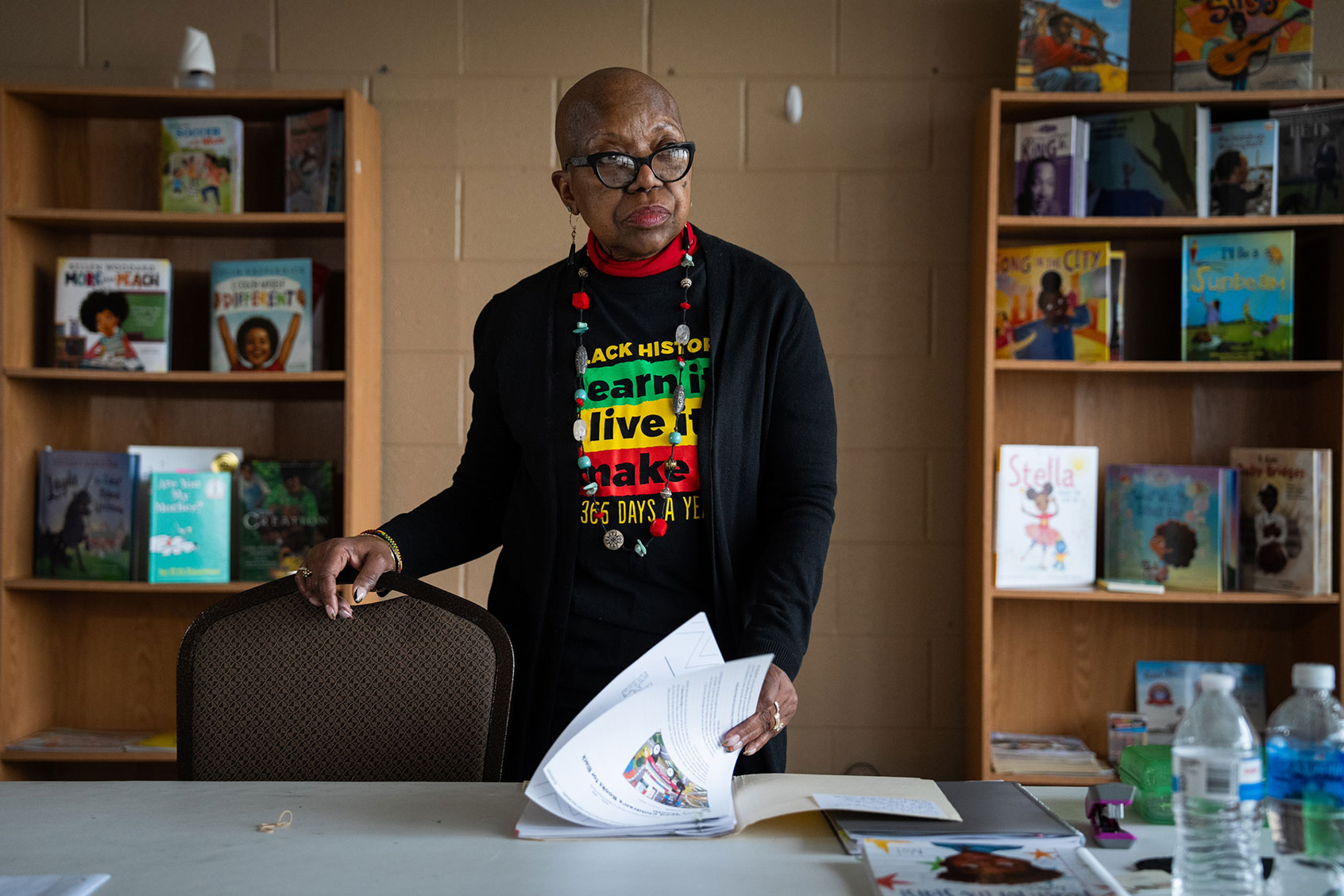
Dr. Jacquinne ReynoldsDr. Jacquinne Reynolds stands for a portrait inside her classroom in Flint, Michigan on Feb. 7, 2024. (Sarahbeth Maney/ProPublica)
It didn’t help that the distressed city was under the authority of state-appointed emergency managers, an unusually expansive oversight system that residents decried. For a crucial period of about 3 1/2 years, local decision-making was not accountable to voters. The result: excess exposure to toxic lead, bacteria and a disinfection byproduct in Flint’s drinking water. An outbreak of Legionnaires’ disease sickened 90 people and killed 12. (The toll is likely higher, as Frontline documented.) The water, now drawn from the Flint River, wasn’t treated with corrosion control — a violation of federal law — so the pipes deteriorated more every day.

At one point, saying the water damaged its machinery, a General Motors plant switched to another community’s system. Flint’s emergency manager and other officials still insisted that nothing was seriously wrong with the water. But if the water was harming machines, many wondered, what was it doing to people?

It took about 18 months, and an extraordinary effort by residents and a few key researchers, before the state reconnected Flint with Detroit’s water, which is drawn from Lake Huron. In the years since, remediation efforts have included replacing corroded pipes, at-home filtration and infrastructure investments, which seem to have yielded promising results. Michigan’s Department of Environment, Great Lakes and Energy said in December that Flint’s water had met federal standards for more than seven straight years. Recent testing followed Michigan’s requirements, adopted in 2018, which are even tougher than federal standards. The state and city are working to resolve deficiencies to the supply system that can affect water safety.

But no one can flip a switch on public trust. And Flint was vulnerable long before the water crisis.

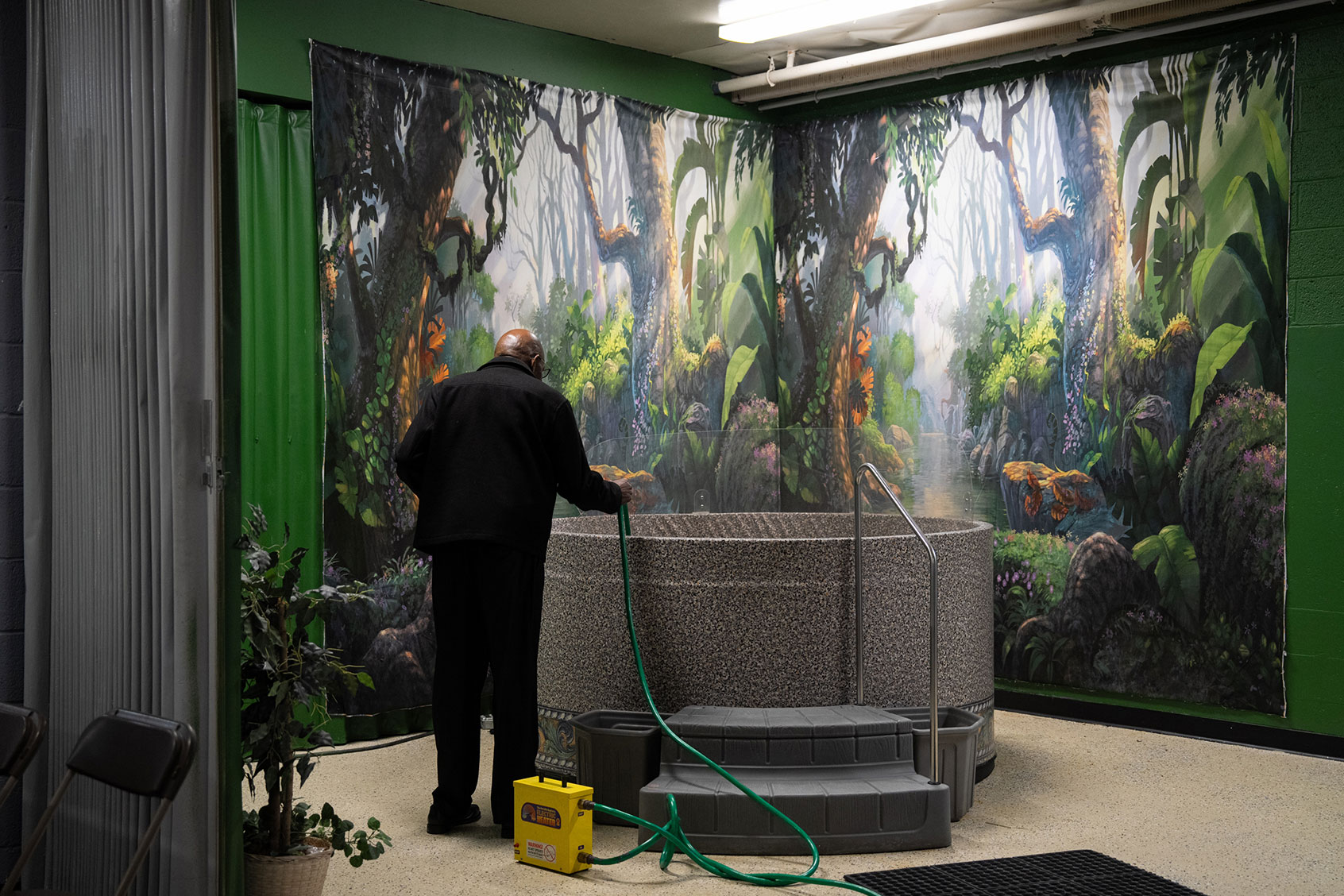
Reverend Robert McCathern stands near a baptism tub at Joy Tabernacle Church in Flint, Michigan on Feb. 8, 2024. (Sarahbeth Maney/ProPublica)
Many point to the crisis as an extreme example of environmental injustice, where people of color and poor people, and especially those who are both, are disproportionately exposed to toxic conditions. A state commission acknowledged that race and class contributed to Flint not having “the same degree of protection from environmental and health hazards as that provided to other communities. Moreover, by virtue of their being subject to emergency management, Flint residents were not provided equal access to, and meaningful involvement in, the government decision-making process.”

The Environmental Protection Agency didn’t use its authority to effectively protect public health in Flint, according to the agency’s inspector general.

That emergency manager law is still on the books. The work to replace the pipes is mostly done — but the city has blown repeated deadlines to complete it. Two state investigations under two administrations led to high-profile criminal charges, including allegations of involuntary manslaughter, official misconduct and willful neglect of duty. Primarily, state officials and employees were charged, including the former director of the state health agency and the former governor. Two emergency managers were also charged; both pleaded not guilty. One has said there was “overwhelming consensus” for the switch, and he was “grossly misled” by state water experts.

No case made it to trial. A new attorney general’s team dismissed the initial cases and started a new investigation. But the second wave of charges fell apart when courts rejected the use of a one-man grand jury to gain indictments.

The Environmental Protection Agency didn’t use its authority to effectively protect public health in Flint, according to the agency’s inspector general. The EPA has denied liability, however, and earlier this year asked a federal judge to dismiss a lawsuit alleging that it failed to properly intervene.

While it was announced in 2020, not one penny of the class-action settlement of more than $626 million has reached residents. With more than 40,000 claims and 30 compensation categories, a special master indicated recently that the initial review should be complete this summer, but there will still be more vetting to do before claims are paid. (Some lawyers and contractors, though, have already been paid preliminary fees and expenses.)

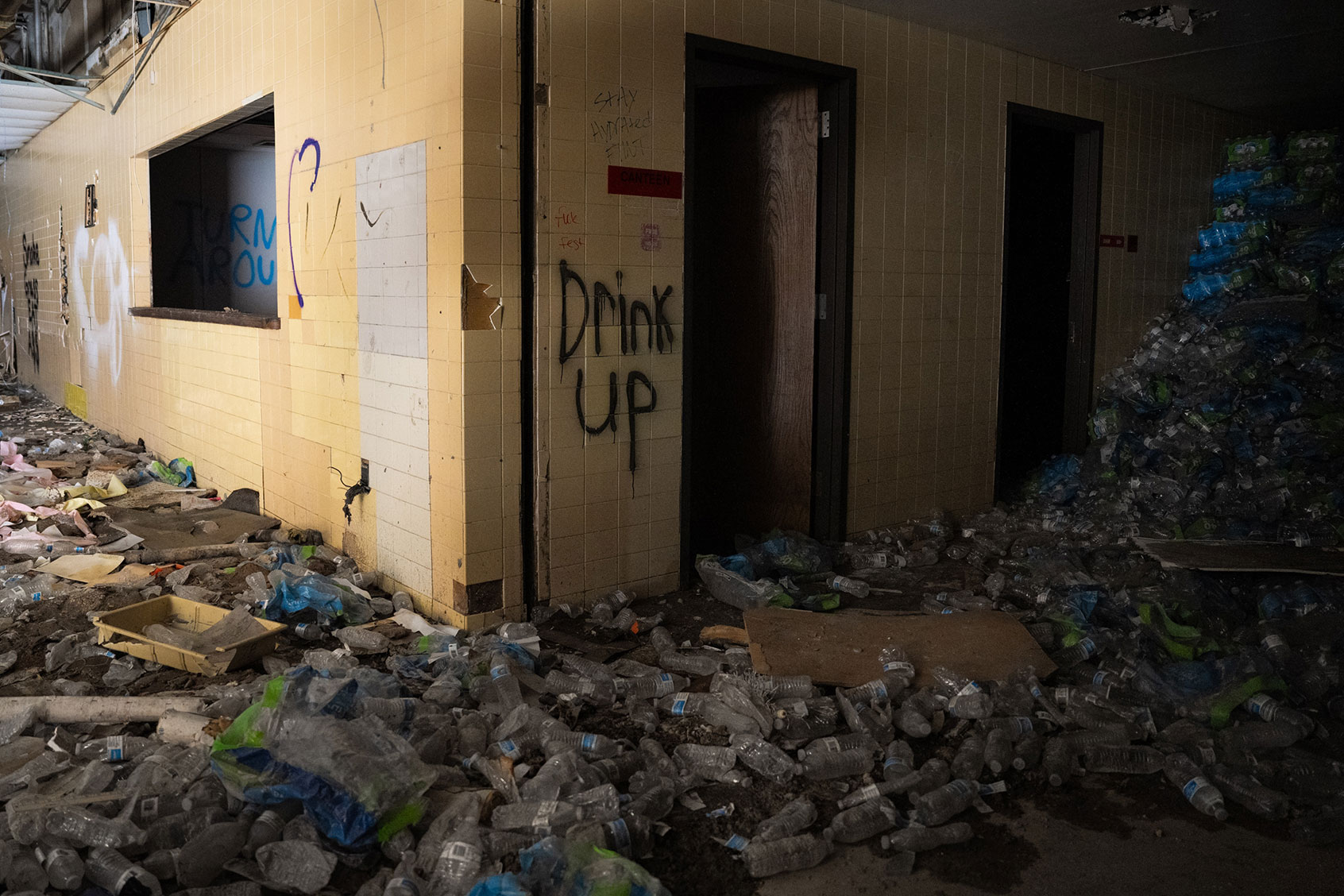
Cases of expired water bottles are left inside of an abandoned Northwestern High School in Flint, Michigan on Feb. 8, 2024. (Sarahbeth Maney/ProPublica)
Water is Flint’s origin story. The city was founded on a riverbank, and water powered its rise. Each spring, the water turns neighborhoods and parks lush. But these days, the betrayal of trust by the very institutions meant to protect residents has made some extra cautious as they look to keep themselves and their community safe. Their relationship with water is forever changed.

McCathern’s church served as a bottled-water distribution site during the crisis, which, he said, strengthened relationships and community trust. But he worries for the next generation, especially their psychological well-being. And he has his own fears too. He said he often smells a “foul odor” from the water. He is apprehensive when showering and usually drinks bottled water, he said, but sometimes lets his guard down to make tea with tap water.

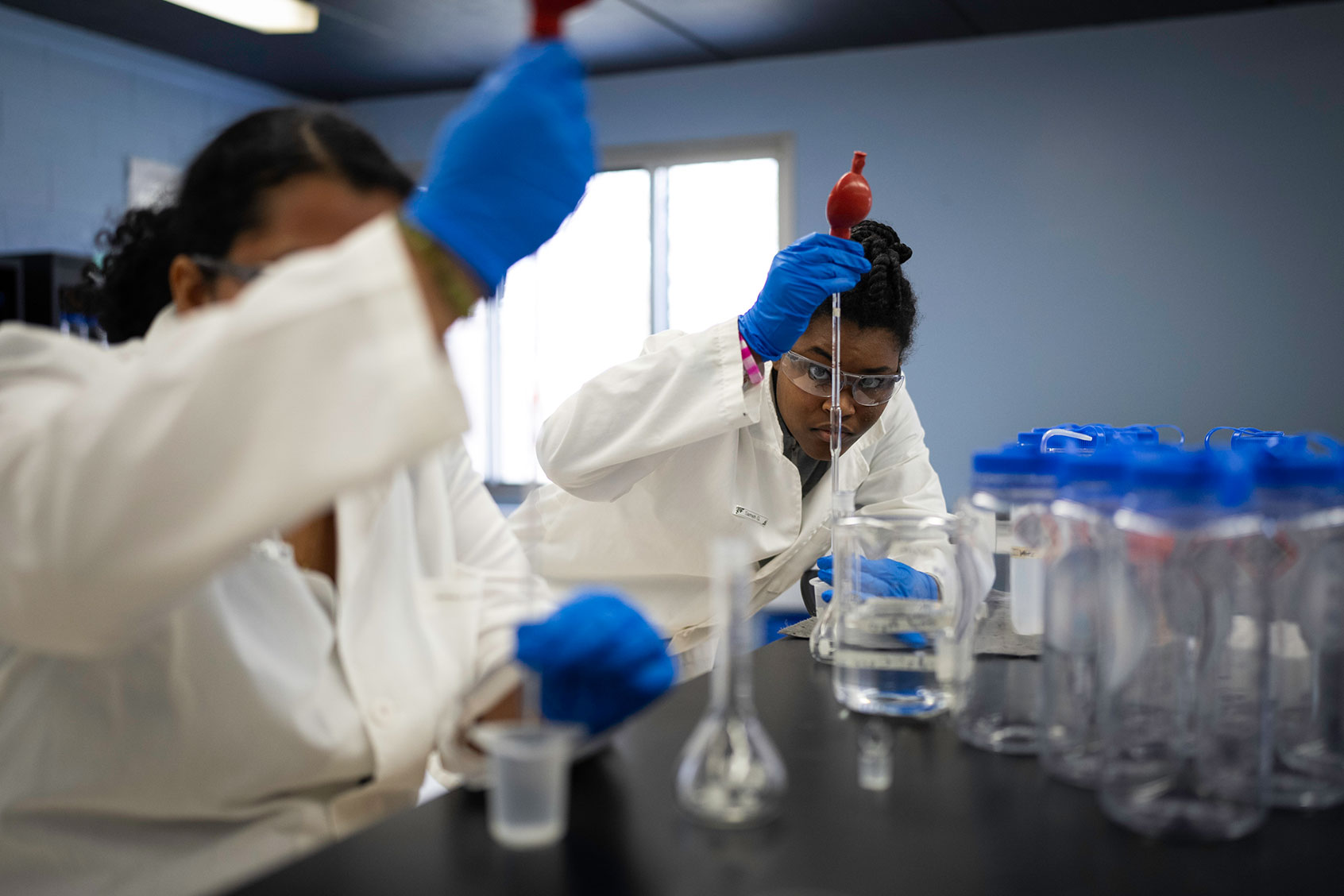
Interns 11th grader Sima G., left, and 12th grader Sameh G. carefully transfer water from pipettes at The Flint Community Water Lab in Michigan on March 20, 2024. (Sarahbeth Maney/ProPublica)
In recent years, McCathern was diagnosed with multiple myeloma cancer. He believes it’s connected to chemicals in the water but will never know for sure. Over his 22 years at Joy Tabernacle, McCathern said, he’s seen an uptick in youth suicide. He wonders about a connection between lead exposure and violence. He recalls sitting at one funeral and thinking, Oh my God, if it produces violent tendencies, that’s not just outward violent tendencies — that’s internal.

An investigation published in Science Advances showed an 8% increase in the number of school-aged children in Flint with a qualified special educational need. But, the researchers indicated, it’s difficult to pinpoint to what extent lead is the direct cause.

A cross-sectional study backed by the federal Office of Victims of Crime found that five years after the onset of the crisis, an estimated 1 in 5 residents — roughly 22,600 people — had met the criteria for clinical depression in the past year. One in 4, or 25,000 people, were estimated to have had post-traumatic stress disorder. According to researchers, only 34.8% of residents were offered mental health services to assist with psychiatric symptoms related to the crisis. Most people used them, if offered.

Medlin said she uses her food stamp benefits on bottled water deliveries from Walmart for Audrina’s bottles. For her first months, Medlin relied on the infant’s father to bathe her at his home outside the city.

Ambitious programs aim to support Flint’s most vulnerable residents. Medlin is enrolled in Rx Kids, which “prescribes” a no-strings-attached payment of $1,500 for pregnant Flint residents and $500 for each month of the baby’s first year. A Medicaid initiative that covers youth up to age 21 and pregnant parents who were exposed to Flint’s water was extended in 2021 for another five years. And the Flint Registry connects people with health services while monitoring the effectiveness of efforts to prevent lead poisoning.

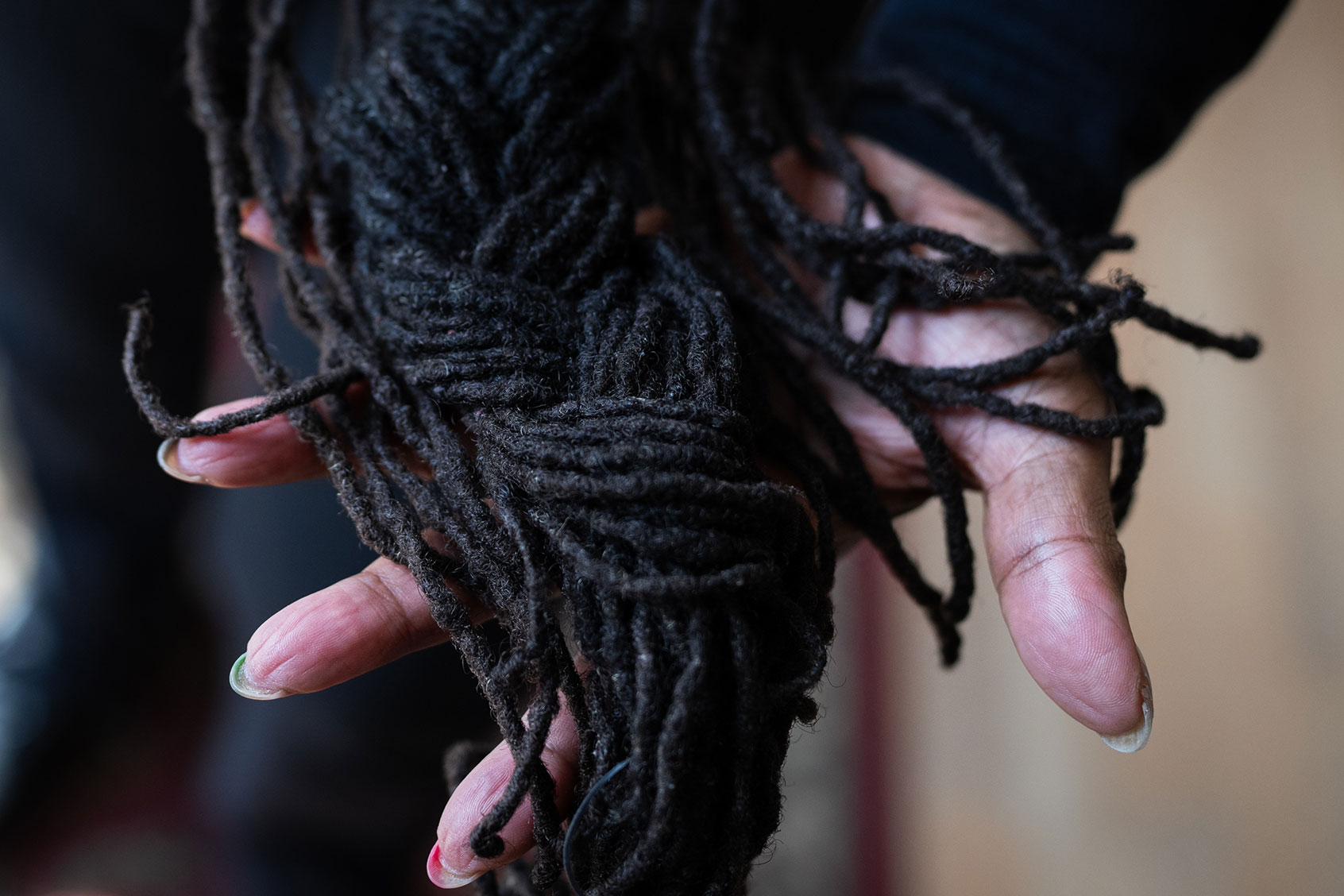
Reynolds is the executive director of a local literacy organization, tutoring children and adults on reading, writing and African American culture. She said her hair began falling out during the water crisis. While she was diagnosed with alopecia, she said, another doctor later told her that the hair loss is likely connected to the water. She too feels like she’ll never know for sure. Because of the lack of information about the water at the time, she didn’t think to track her symptoms.

The water’s effect on hair and skin was among the earliest concerns raised by residents, though a direct correlation has been difficult to prove. A 2016 state and federal analysis — conducted after Flint switched back to Detroit’s system — identified nothing in the current water supply that affected hair loss. A survey of more than 300 residents by academic researchers found that more than 40% of respondents said they experienced hair loss beyond what they considered normal before the crisis. Black respondents reported significantly higher percentages of hair loss. The more physical symptoms respondents reported, the more likely they were to report psychological symptoms.

Having taught and tutored Flint families for decades, Reynolds feels the weight of the community’s unmet needs.

Dr. Jacquinne Reynolds holds her dreadlocks, which she believes fell out due to the water crisis, at her home in Flint, Michigan on Feb. 23, 2024. (Sarahbeth Maney/ProPublica)
Nearly 80,000 people now live in Flint, according to recent census data, a drop of about 20% in the past 10 years. Fifty-seven percent are Black, 34% are white and 4% are Hispanic. Median household income is $33,036. Nearly 38% are in poverty. Population loss and disinvestment make it difficult to maintain a water system, with fewer people paying for infrastructure designed for a much larger city.

Flint had almost 200,000 residents in 1960; it built water infrastructure to support 50,000 more, according to the city’s communications director. It connected to Detroit’s system in the first place because it expected continued growth. Vacancy can worsen water quality because water sits longer in pipes before reaching a tap — a problem made visible when metals from corroding pipes saturated the water more in some Flint neighborhoods than in others.

In addition to service-line replacement efforts, the city offers free filters to residents. Beyond legally mandated testing, a unique community water lab provides residents with a free way to learn about their water. Young people lead much of the work. As lab director and Flint City Council member Candice Mushatt put it, “We’re training the next generation to be prepared in a way that we were not.”

Results range from 0.031 parts per billion up to over 50 ppb of lead from water samples tested in Flint, according to Mushatt. Under federal law, if a community water system reaches 15 ppb of lead, based on the 90th percentile of samples, certain public health measures must be taken. No amount of lead is safe.

Flint residents have emphasized the importance of determining for themselves when justice has been done. In a 2020 paper, a cohort of community advocates wrote that they expect accountability, policy reform and community-driven investments. “And we will be insisting,” they wrote, “as always, that people ask us and our fellow residents before concluding that Flint has been made whole.”

ProPublica is a Pulitzer Prize-winning investigative newsroom. Sign up for The Big Story newsletter to receive stories like this one in your inbox.

“He was bigger and blocking the way”: Stormy Daniels takes the stand and reminds people who Trump is

"The people call Stormy Daniels."

Even though Donald Trump's former lawyer and longtime fixer Michael Cohen is a more important witness in the former president's ongoing criminal trial in Manhattan, the press is just as interested in Tuesday's testimony from the adult film actress at the center of his election interference case. No doubt much of the fascination is salacious, due to the nature of her job and her allegations of a disturbing sexual encounter with Trump in 2006. But much of it is due to Daniels herself, who has proved to be surprisingly charismatic, if at times chaotic, even as she faces a staggering amount of negative attention. 

Mostly, however, Daniels matters for reasons outside of the courtroom and the specifics of this hush-money trial. Daniels' story is yet another reminder of what may prove to be Trump's electoral downfall: His bottomless misogyny. 

Daniels' story is yet another reminder of what may prove to be Trump's electoral downfall: His bottomless misogyny. 

On the witness stand, Daniels reportedly spoke quickly and was apparently quite nervous. Initially, her story of meeting Trump sounded funny. She painted him as a pathetic older man trying — and failing — to impress the younger woman. When he first asked her to dinner, she replied "no," but with an expletive. Her publicist eventually talked her into it, hoping Daniels could leverage the connection into a spot on "The Apprentice." In his hotel room, she described him wearing "silk or satin" pajamas and asked him to put on real clothes. He allegedly used the "don't even sleep in the same room" line when she asked about his wife, Melania, who had recently had a baby. Daniels described Trump as "pompous" and "arrogant." She recounted how she jokingly spanked him with a magazine, hoping to tease him into being less of a jerk.


Want more Amanda Marcotte on politics? Subscribe to her newsletter Standing Room Only.


Then the tone of her story changed, as she described how they came to have sex. Trump waited until she was in the bathroom, Daniels said, and then he stripped down to boxer shorts and a T-shirt.  "The room spun in slow motion," she recalled on the witness stand. When she made for the door, "he was bigger and blocking the way," she said of Trump. She denied it was sexual assault, however, because "I was not threatened either verbally or physically."

Whether or not Trump's sexual encounter with Daniels was consensual in the legal sense, she describes it as unwanted.

"I didn’t say anything at all," she told the court repeatedly. Claiming that she "blacked out" during the encounter, afterward, Daniels said, "my hands were shaking so hard" and "I felt ashamed that I didn’t stop it and that I didn’t say 'No.'"

Following Daniels' testimony on Tuesday, I was struck by how much it has in common with what E. Jean Carroll described in her two recent civil trials, where both juries found that Trump had sexually assaulted her in the 90s. Carroll, too, told of a random encounter with Trump she initially thought to be flirty but not sexual. Like Daniels, Carroll describes teasing Trump, who famously has no sense of humor about himself. In both cases, the women describe Trump becoming aggressive after the light mockery. In Carroll's case, the judge described what happened after as what "many people commonly understand the word 'rape.'" Daniels, to be clear, frames her encounter with Trump differently.

Since the release of the "Access Hollywood" video in 2016, in which Trump can be heard bragging about sexual assault, the Beltway media has repeatedly tried to move on from the story of Trump's legion of issues with women. Indeed, when Carroll's accusations first came out in 2019, the press barely paid any mind. But the story of his rampant misogyny has never fully gone away. There was the Women's March that overshadowed his 2017 inauguration. Then the over two dozen women who stepped forward with stories of being subject to the sexual harassment and assault Trump himself described so vividly. Trump, of course, is more responsible than any other person on the planet for the overturn of Roe v. Wade and the stampede of Republican state legislators banning abortion. He promised to stack the Supreme Court with anti-choice justices, and his three appointees provided the votes necessary in Dobbs v. Jackson Women's Health, which ended the legal right to abortion. While Trump has tried to make moderate-sounding noises on this issue, he keeps inadvertently revealing his anti-choice radicalism. In a recent Time interview, for instance, he indicated that he's fine if states "monitor women's pregnancies so they can know if they've gotten an abortion." 

To feminists, it's obvious that there's a connection between Trump's abusive and predatory behavior towards individual women and his willingness to ban abortion. Forced sex and forced childbirth are on a continuum, rooted in the assumption that a woman has no bodily autonomy worth respecting. But to people who are less well-versed in feminist theory, there's often an assumption that someone as sexually self-indulgent as Trump isn't "really" opposed to abortion. Daniels testified on Tuesday that Trump didn't use a condom. So it's not unreasonable for people to assume he may have relied on legal abortion so women can clean up the messes of his carelessness. 

We need your help to stay independent

That said, there are bits of evidence that even more moderate and conservative female voters are starting to see a connection between Trump's anti-abortion politics and his sexually predatory behavior. On a recent episode of her "Focus Group" podcast, former Republican political consultant Sarah Longwell played fascinating clips from a table of former female Trump voters who are turning against him. Most were appalled at the post-Dobbs abortion bans. But even more interestingly, some of the women drew a connection between anti-choice politics and Trump's personal abusiveness towards women. 

One woman said she objects to Trump's "comments about women," and immediately expressed chagrin that his anti-choice views are "not allowing people their own medical freedom." Another woman even used the word "patriarchy" to object to those who think a woman should not decide. The issue of rape was linked to abortion throughout, as many states — including Arizona at the time — have no exception for rape. (Not that rape exceptions work in states that do have them.) There's still a long way to go, but there are tendrils of hope that more people are seeing that the casual cruelty Trump expresses to women in his personal life goes a long way toward explaining why he doesn't care if they are hurt or even killed by abortion bans. 

A big focus of Trump's relentless whining about this case has been focused on the gag order imposed by Judge Juan Merchan, which forbids Trump from bad-mouthing jurors, witnesses, most of the court staff, or their family members. Judging by his agitation in court Tuesday, Trump would love to get on Truth Social and start firing off abuse towards Daniels. He should, however, be very glad the threat of jail will keep him from doing so. As Longwell's focus group shows, there are already women who are regretting their past votes for Trump because of his misogyny. The more he vents his spleen with abusive language towards women — especially women, like Stormy Daniels, who've already suffered so much at his hands — the worse it will likely be for him. 

The absolute best air fryer chicken breast

I love chicken breasts.

I’ve gone to bat for them many times before, never understanding how or why the “boring” narrative ever got started. There is no other ingredient I cook with more than chicken (well, maybe aside from cheese). It is also far and away the protein that I consume the most.

I love boneless and skinless, I love skin-on, I love bone-in, I love wings — the list goes on and on. 

Something that I’ve started doing lately is a very simple, very quick method that involves two of my absolute favorite things: chicken breasts and the air fryer.

Now, I say “method” because this is much more of a general approach than it is a “recipe,” per se. I’ve found that this is an exceptional method for a quick, hands-off chicken breast that is beautifully crisped, cooked and seasoned  with the added bonus of it cooking away in the air fryer as I work away from the kitchen.


Want more great food writing and recipes? Subscribe to Salon Food's newsletter, The Bite.


It also doesn’t take any longer than maybe 25 minutes  although, if you happen to have an enormous air fryer that holds four-plus breasts, you may have a slightly different experience than I do when I’m using my relatively small air fryer to make one or two breasts.

I'm always a sucker for over-done, uber-crisp proteins, so this might even veer on overcooked for a normal person. Cut back the cook time 5 minutes if you prefer a less crisp chicken.

Eat this on its own, wrap it in your favorite bacon, serve it over greens, serve it alongside rice, dice it and fill a taco, slice it and add to a pasta dish, dice it in buffalo sauce, eat it with guacamole . . . it’s your kitchen, so do as you please.  I’m just leading you to water. 

We need your help to stay independent

Air fryer chicken breasts
Yields
02 servings
Prep Time
 01 minute
Cook Time
25 minutes

Ingredients

2 chicken breasts

Cooking spray and/or neutral oil

Kosher salt

Freshly ground black pepper

Paprika, optional

Garlic and onion powder, optional 

Seasoning salts or blends, optional

Flaky sea salt, optional 

Dried herbs, optional

Directions

  1. Place chicken breasts in air fryer.
  2. Spritz with cooking spray, or conversely, slightly drizzle with a touch of oil.
  3. Season as you see fit.
  4. Cook at 400 degrees fahrenheit for about 20 to 25 minutes, shaking and/or turning the chicken about halfway through.
  5. Finish with a touch more flaky salt.

Cook's Notes

-For this method, I'd go for skinless and boneless, but pick your favorite! I will note that the bone will make the cook time a bit longer and the skin might not crisp up as well in an air fryer as it might in a cast-iron pan, but it'll still caramelize pretty well. 

-I love a spritz or two of cooking spray, usually a generic or avocado oil. 

-The salt and pepper are non-negotiables, but you can never go wrong with paprika and onion and garlic powder.

-I sometimes throw on something else, like cumin or Adobo or seasoning salt, but be sure to cut back on the actual salt if you're using Adobo or a seasoning salt. 

Trump’s trial paints him as a clown — but MAGA sees a boss

“He’s a man. He’s a husband. He’s a father. He’s a person just like you and just like me.”

Donald Trump’s attorney told the jury in the New York hush-money trial those things about his client in an attempt to humanize someone who is one of the great villains in American history. But Donald Trump is not a family man and a “person just like you and just like me.” He is a floating signifier and symbol for the global antidemocracy movement.

Trumpism and the larger neofascist movement represent a political and cultural crisis and reflect something very wrong in the collective emotional, moral, spiritual, and intellectual life of the nation. To begin the grand project of healing America’s democratic culture demands that we seriously engage the political narrative and emotional story that Donald Trump and the other right-wing fake populist authoritarians are telling.

A sad clown can also be a very dangerous clown.

This means that defeating Donald Trump and the malign forces he has empowered will require much more than the normal tools of politics in a democracy like voting or conventional horserace coverage and false objectivity by the news media. Instead of “balance,” the mainstream media must strive to illustrate the stakes of a second Trump regime.

In an essay at The Philadelphia Inquirer, the always insightful William Bunch traveled to a MAGA political rally in Pennsylvania last month and spoke to the people there to bask in the aura of Trump and the community they have constructed around him:

In a sense, Trump himself is almost like the MacGuffin, the plot device that gives these characters an excuse to get together. “We already know what the spiel is, we know what he stands for,” one man, a middle-aged Canadian American executive, told me. So why wait in this massive line? It’s partly that a rally gives supporters a chance to get off the couch, shut down the TikTok app, turn off YouTube, and prove to themselves they are actually not alone in thinking that everything has gone to heck…. That’s why it was so jarring to see that the happiest place on Earth was this mile-long line in Schnecksville. It was a kind of “Trumpstock”: one night of manufactured peace, unity, and shared disinformation, while the gale-force winds of truth blew well above their bubble.

When Alfred Hitchcock reportedly described the MacGuffin as “the thing the hero chases, the thing the picture is all about … it is very necessary,” the famed film director was not talking about Donald Trump. Still, his definition is most certainly an apt one.

In a provocative new essay “Trump’s Torching of America,” cultural critic and theorist Peter McLaren sees in the corrupt ex-president and aspiring dictator a type of evil force akin to the ancient mythological creature Grendel:

In the looming spectre of a Trump triumph in November 2024, democracy finds itself ensnared in a dark and foreboding web. Much like Grendel, the malevolent creature of ancient myth whose lineage traces back to the Biblical figure Cain, Trump prowls the political landscape tormented by a relentless hunger for power and dominance. Like Grendel, who was plagued by the melodic strains of joy emanating from the mead hall of Heorot, built by the noble King Hrothgar, Trump is driven to madness by his inability to tolerate any realm where he is not the supreme arbiter of all actions. With a monstrous fury, he descends upon the halls of governance, unleashing chaos and destruction in his wake through the actions of his lickspittles in Congress, who slavishly do his bidding.

For long and arduous years, akin to Grendel’s relentless assaults on Heorot, Trump’s rampage knows no bounds, laying waste to the very foundations of democracy. With each strike, he devours the essence of liberty and justice, leaving behind a trail of desolation and despair. The poet’s depiction of Grendel consuming his victims whole mirrors Trump’s insatiable appetite for power, as he voraciously consumes all semblance of democratic norms and values. Yet, just as the heroes of old rose to confront the monstrous Grendel, so too must we stand united against the encroaching darkness of authoritarianism. Our collective resolve must serve as the beacon of hope in these tumultuous times, lest the legacy of democracy be forever marred by the shadow of tyranny.

Donald Trump has repeatedly shown that he is attracted to violence and delights in hurting other human beings. A short list of examples includes Jan. 6 and the lethal terrorist attack on the Capitol by his MAGA followers, his racist and bigoted beliefs and behavior, channeling of Hitler with threats to purge the “vermin” from the “blood” of the nation, threats to kill and imprison his perceived political enemies such as President Biden and Hillary Clinton, public admirations of murderous tyrants and dictators, willful negligence in response to the COVID pandemic, being found responsible in a civil court for sexually assaulting E. Jean Carroll and many other examples of antisocial and dangerous behavior.

Trump’s attraction to cruelty, suffering, and violence is reflected in how he often presents himself like a mob boss. In that role, Trump is channeling his own fantasy version of Al Capone, as Samuel Earle explains in a March essay in the New York Times:

In recent months, Donald Trump has been trying out a new routine. At rallies and town halls across the country, he compares himself to Al Capone. “He was seriously tough, right?” Mr. Trump told a rally in Iowa in October, in an early rendition of the act. But “he was only indicted one time; I’ve been indicted four times.” (Capone was, in fact, indicted at least six times.) The implication is not just that Mr. Trump is being unfairly persecuted but also that he is four times as tough as Capone. “If you looked at him in the wrong way,” Mr. Trump explained, “he blew your brains out."

Mr. Trump’s eagerness to invoke Capone reflects an important shift in the image he wants to project to the world. In 2016, Mr. Trump played the reality TV star and businessman who would shake up politics, shock and entertain. In 2020, Mr. Trump was the strongman, desperately trying to hold on to power by whatever means possible. In 2024, Mr. Trump is in his third act: the American gangster, heir to Al Capone — besieged by the authorities, charged with countless egregious felonies but surviving and thriving nonetheless, with an air of macho invincibility….

Commentators have long pointed out that Mr. Trump behaves like a mob boss: The way he demands loyalty from his followers, lashes out at rivals, bullies authorities and flaunts his impunity are all reminiscent of the wiseguys Americans know so well from movies and television. As a real-estate mogul in New York, he seems to have relished working with mobsters and learned their vernacular before bringing their methods into the White House: telling James Comey, “I expect loyalty”; imploring Volodymyr Zelensky, “Do us a favor”; and pressuring Georgia’s secretary of state, “Fellas, I need 11,000 votes.” But before, he downplayed the mobster act in public. Now he actively courts the comparison.

Why is Trump channeling Al Capone? Earle suggests that “Mr. Trump clearly hopes that his Al Capone act will offer at least some cover from the four indictments he faces. And there is a twisted logic to what he is doing: By adopting the guise of the gangster, he is able to recast his lawbreaking as vigilante justice — a subversive attempt to preserve order and peace — and transform himself into a folk hero.”

We need your help to stay independent

Donald Trump is also very funny. And it is that comedic timing, buffoonery and utter disregard for social norms and human decency that are central to his political power and appeal. Trump gives his MAGA supporters permission to be their worst true horrible selves because “they are just kidding” and “fighting back” against “political correctness” and “the left” and anyone who is offended is just “too sensitive” or part of “cancel culture.”

At The New York Review, Fintan O’Toole writes:

Trump is America’s biggest comedian. His badinage is hardly Wildean, but his put-downs, honed to the sharpness of stilettos, are many people’s idea of fun. For them, he makes anger, fear, and resentment entertaining.

For anyone who questions how much talent and charisma this requires, there is a simple answer: Ron DeSantis. Why did DeSantis’s attempt to appeal to Republican voters as a straitlaced version of Trump fall so flat? Because Trumpism without the cruel laughter is nothing. It needs its creator’s fusion of rage, mockery, and poisoned imitation, whether of a reporter with a disability or (in a dumb show that Trump has been playing out in his speeches in recent months) of Joe Biden apparently unable to find his way off a stage. It demands the withering scorn for Sleepy Joe and Crooked Hillary, Crazy Liz and Ron DeSanctimonious, Cryin’ Chuck and Phoney Fani. It requires the lifting of taboos to create a community of kindred spirits. It depends on Trump’s ability to be pitiless in his ridicule of the targets of his contempt while allowing his audience to feel deeply sorry for itself. (If tragedy, as Aristotle claimed, involves terror and pity, Trump’s tragicomedy deals in terror and self-pity.)

Hard as it is to understand, especially for those of us who are too terrified to be amused, Trump’s ranting is organized laughter….

O’Toole continues:

What is new in the development of antidemocratic politics is that Trump brings all this comic doubleness—the confusion of the real and the performative, of character and caricature—to bear on the authoritarian persona of the caudillo, the duce, the strongman savior. The prototype dictators of the far right may have looked absurd to their critics (“Hitler,” wrote Adorno and Horkheimer, “can gesticulate like a clown, Mussolini risk false notes like a provincial tenor”), but within the community of their followers and the shadow community of their intended victims, their histrionics had to be taken entirely seriously. Trump, on the other hand, retains all his self-aware absurdity even while creating a political persona of immense consequence.

This comic-authoritarian politics has some advantages over the older dictatorial style. It allows a threat to democracy to appear as at worst a tasteless prank: in the 2016 presidential campaign even liberal outlets like The New York Times took Hillary Clinton’s e-mails far more seriously than Trump’s open stirring of hatred against Mexicans and Muslims.

Donald Trump’s hush-money and other criminal trials are an opportunity to tear down the strongman facade and character he has constructed, and by doing so, to expose him as just being a mere mortal as opposed to the type of god he imagines himself to be — and that his MAGA people and other supporters see him as.


Want a daily wrap-up of all the news and commentary Salon has to offer? Subscribe to our morning newsletter, Crash Course.


During these first three weeks of the hush-money trial in Manhattan, Trump has slept during court, with his mouth open and head nodding as he appears to fight sleep. Trump sleeping during court shows contempt for the rule of law and the basic idea that he should be held accountable like any other person in a democracy. But not content to just sleep during court, Trump has also reportedly been glaring at the witnesses and menacing them both in person and through posts on his Truth Social disinformation platform, interviews, and speeches.

Some observers have also described Trump as being pathetic and sad, the portrait of a rich old lonely man because his wife and other family members, with the exception of his son Eric, have not attended his criminal trial in New York.

As Donald Trump’s niece Mary Trump, who is a trained psychologist, suggested in a recent interview with MSNBC’s Nicolle Wallace:

He needs to be relentlessly mocked at every turn….We see in the courtroom he's not handling the circumstances well. He's not handling the confinement or the fact that he has no power in this space and that's why….So it would be so much better if he were just forced to wallow in the consequences of his actions,….We see him looking like he's falling asleep. Whether or not he's falling asleep — he's complaining about the temperature. It's something I don't see being paid attention to, but it's important. Donald Trump is there — trapped in that courtroom because of what he did. There are a lot of other people trapped in that courtroom because of what he did. He doesn't seem to care that they're also cold and tired and don't want to be there.

At present, it is very easy for Donald Trump’s detractors and “the resistance” to laugh at and mock him as though he is some type of sad and pathetic clown. This is especially so given that these first few weeks of the hush-money trial have gone so badly for Trump.

But I would remind such voices that a sad clown can also be a very dangerous clown (there are any number of such clowns in horror movies; there is a very infamous serial killer who was also a clown). I would also remind Donald Trump’s critics who are celebrating what they see as his imminent demise from the so-called “walls closing in” that Trump in his various roles and identities such as gangster, comedian, political thug and aspiring dictator, professional wrestling heel, fake billionaire, cult leader, genius, messiah, god, and “president” is unified by one driving force: revenge and corrupt power. Ultimately, Donald Trump contains multitudes and none of them are good. You have been warned. Again.

Florida clarified abortion rules after enacting ban. Doctors say it’s “gaslighting” and unhelpful

One day after Florida’s six-week abortion went into effect, the state’s Agency for Health Care Administration (AHCA) issued clarifying “rules” ​​in the face of what the agency called a “deeply dishonest scare campaign and disinformation” by the media, the Biden Administration, and advocacy groups to misrepresent the new law. 

“The Agency is initiating rulemaking to safeguard against any immediate harm that could come to pregnant women due to disinformation,” the notice for emergency rule stated. “This rulemaking will ensure health care providers establish medical records procedures that will adequately protect the care and safety of both mothers and their unborn babies during medical emergencies.”

When Kara Cadwallader, who is a family medicine physician in Idaho, saw this news come from Florida, she thought this could be helpful. As a physician in a state with a similarly restrictive abortion landscape, Cadwallader told Salon she and her colleagues have been asking Idaho legislators for something similar — clarifications to address emergency situations. 

“And then I read through the actual rules. I think the problem is, they have to be written very precisely from the medical perspective,” Cadwallader said. “The ones that they wrote for Florida, none of those are helpful. They could be. It's like they took one step in that direction, but many of my colleagues immediately picked up on details that didn’t make sense.” 

"In Florida’s attempt to clarify the rules, doctors tell Salon it’s only made the law “more confusing."

According to Florida’s new law that went into effect May 1, 2024, known as the “Heartbeat Protection Act,” it is a felony to perform or actively participate in an abortion six weeks after gestation. The ban has exceptions up to 15 weeks for rape, incest and human trafficking and to save a woman’s life or prevent “substantial and irreversible” impairment. Physicians who violate the law are subject to committing a third-degree felony, fines or loss of medical licenses. 

As detailed in a recent report from Louisiana, which has a restriction abortion law with narrow exceptions, the implications of such bans range from doctors delaying care to doctors using extreme caution to avoid the appearance of terminating a pregnancy —like performing cesarean section surgeries to empty their uterus instead of performing an abortion procedure. In Idaho, pregnant women are now being airlifted out of the state in emergency situations due to physicians being unable to provide what once was considered to be a standard part of care.


Want more health and science stories in your inbox? Subscribe to Salon's weekly newsletter Lab Notes.


As Cadwallader pointed out, clarifying emergency situations could be helpful for physicians in Florida. But in Florida’s attempt to clarify the rules, doctors tell Salon it’s only made the law “more confusing” and that Florida’s attempt to cast physicians and public concerns about the six-week abortion ban as a “disinformation campaign” is a form of “gaslighting.”

“It’s trying to hide from the public that they've created a maternal health crisis,” Cadwallader said. “They don't want the public to know that, because of these laws, women are going to die. Women are going to have to go out of state and die, and it really hits the vulnerable communities hard. And they don't want that information out there.”

Cadwallader said she sees similar tactics in Idaho, such as when the state’s attorney general claimed that a hospital airlifting patients was to make a political statement.

"We've spent significant time training and practicing medicine to be able to provide the best evidence-based care. Trying to distill that into three short rules is never going to really replace that judgment."

Specifically, Cadwallader said Florida’s clarifying guidance around preterm premature rupture of membranes (PPROM) is confusing. PPROM is when a pregnant woman’s water breaks early. The likelihood of a fetus surviving under 22 weeks of gestation is low. At the same time, when a pregnant woman’s amniotic fluid sac breaks during the second trimester, it puts the woman at an increased risk for infections like chorioamnionitis and sepsis.

Florida’s clarifying rules said when a patient receives a diagnosis of premature rupture of membranes (PROM),” the patient shall be admitted “for observation.” From a clinical perspective, Cadwallader said this doesn’t make sense. PROM is when the water breaks at term and the fetus is viable. The standard approach to care is to observe and then induce if contractions don’t start. Cadwallader said Florida’s rules are conflating PPROM and PROM, and this could put pregnant patients in vulnerable situations.

“We don't need a rule about that — that's not dealing with abortion,” she said. “The thing we really want to focus on is preterm premature rupture (PPROM) because that is why all these patients are getting shipped out of Idaho. They have preterm premature rupture.”

The conflation also appeared in Florida’s “myth and fact” sheet that the AHCA shared on social media. Dr. Michael Belmonte, an OB-GYN in Washington D.C. and Darney-Landy Fellow with The American College of Obstetricians and Gynecologists (ACOG) told Salon the rules Florida released “raise more questions than they do provide answers.”

“I think it's really important to understand that rules like these can never apply to all situations, conditions and ultimately can never replace the clinical judgment of healthcare professionals,” Belmonte said. “Because we've spent significant time training and practicing medicine to be able to provide the best evidence-based care, and so trying to distill that into three short rules is never going to really replace that judgment.”

Florida’s clarifying rules also addressed the situation of an ectopic pregnancy and a trophoblastic tumor, which can form during abnormal pregnancies. Belmonte pointed out that the rules didn’t address preeclampsia or severe bleeding and hemorrhaging. 

“I think the focus of these rules are actually on scenarios where the pregnancy is not likely to end in a live birth to begin with — yet their language is primarily on the embryo or fetus rather than recognizing the pregnancy itself,” he said. “The life of the pregnant person has to be central because if you don't have a living pregnant person, you can never have a fetus that survives.”

Rachel Kingery, a media relations specialist at ACOG, told Salon many of Florida’s OBGYNs don’t feel comfortable speaking publicly about the new rules at the moment. She added that when she saw them she was shocked to see such “inflammatory language” come from a state agency claiming that concerns about Florida’s six-week abortion ban was “disinformation.” 

“Clearly when Florida is putting out quotes like that, where we are spreading disinformation, why would someone feel comfortable speaking to these issues?” Belmonte said. 

We need your help to stay independent

When Salon spoke to the Florida Health Department Jae Williams, press secretary of the Florida Department of Health said “we didn’t develop the rules” and deferred comment to AHCA. Instead, the Florida Health Department, he said, “oversee” the licensing of practitioners.

“The rules that you read, those were written by AHCA and AHCA is the agency that will be enforcing that,” Williams said. “The only way even remotely the Department Health is involved” is in “regulating the physicians.”

When asked what “disinformation” provoked the agency to establish clarifying rules, Alecia Collins, deputy chief of staff for Communications and External Affairs of AHCA sent Salon the myth and fact sheet and said the “lies” were listed on the left and “the facts are listed on the right.”

When asked if the AHCA had a medical professional write the rules, Collins said via email “the Agency consulted with doctors and medical professionals when drafting these rules.” When asked about the confusion about PPROM and PROM, Collins said the rule applies to both PPROM and PROM. 

Poll finds fewer Americans are concerned about climate change

Even though humans are experiencing the hottest months in recorded human history, and scientists warn our species is living on "borrowed time," a recent poll found a notable dip in the number of people who view climate change as an urgent issue. 

In the latest poll by Monmouth University, less than half (46%) of the American public perceives global heating as being a very serious problem. While this is still higher than the figure from nine years ago (41% in 2015), it is also lower than more recent polling, which had the figure at over half (54% in 2018 and 56% in 2021). Concern about the urgency of addressing climate change — characterizing it as "very serious" — has dropped among all political groups: Democrats (85% to 77% since 2021), Republicans (21% to 13% since 2021) and independents (56% to 43% since 2021). Voters today by far are more worried about issues like inflation, immigration and reproductive rights.

Americans still overwhelmingly acknowledge that climate change is happening and is caused by our burning of fossil fuels, with nearly three out of four (73%) acknowledging that the world's climate is changing in ways that cause more extreme weather and sea level rise. That figure is within the same range as numbers taken in 2015 (70%), 2018 (78%) and 2021 (76%). By contrast, a 2021 study in the journal Environmental Research Letters found that more than 99% of scientists acknowledge climate change as both real and man-made.

One reason for the lack of a public sense of urgency about climate change is the widespread dissemination of misinformation — which includes both science denialism and downplaying the seriousness of the ongoing problem — on social media.

"We see that [denialism] on social media, where for a number of years we've seen bot armies used to pollute the social media discourse on climate change and environmental sustainability," University of Pennsylvania climate scientist Dr. Michael E. Mann told Salon last month.

How ancient Egyptian tech could save modern libraries from scourge of bookworms

There are dozens of insects and arthropods that fall under the umbrella term "bookworms" — and true to their name, they feed on humanity's pulp fictions (and non-fictions), gnawing through ancient pages and the thinning patience of conservators in libraries and museums throughout the world. But scientists may have just discovered the poison pill needed to drive off these unwelcome dinner guests — a gluten-free option found in ancient Egyptian texts.  

In a recent study from the American Chemical Society's Journal of Proteome Research, researchers analyzing books from the National Library of Medicine archives discovered that gluten-free glues are less attractive to the dozens of pests classed as bookworms. And these glues could also help treasured tomes stand the test of time by reducing deterioration. It all comes down to a particular type of protein.

"This information could help conservators restore and preserve treasured tomes for future generations … understanding the nature of the proteins in these glues and how they affect the adhesives would help book conservators choose the best approaches and materials for their work," the researchers note in a recent release. "Additionally, the proteins in starch glue were particularly durable and flexible, making it a potentially better choice than flour glue for book repairs." 

Flour-based glues come from the insides of wheat grains and include gluten — which bookworms love as much as the rest of us. But glues that are wheat-based, like starch glue, instead lack this tasty gluten inclusion. Wheat-based glues have a long history in bookbinding that originates in ancient Egyptian texts, which experts have partially attributed to the longevity of the world's collection of papyrus documents. 

According to the Metropolitan Museum of Art, the earliest recorded use of flexible, wheat-based starch glues in papyrus-making comes from the accounts of Roman naturalist Pliny the Elder, dating to circa 77–79 A.D. — a publishing process that remained largely the same for about 4,000 years with the earliest excavated scroll dating back to around 2900 B.C.

The problem with that “Idea of You” ending

I've always wanted to be in my own fan fiction. As a teenager who grew up at the height of One Direction's undeniable global fame and Harry Styles' ascension into one of the first British Gen Z heartthrobs, I was one of millions of young teens who wanted to be in an age-gap relationship with the curly haired pop star.

The new Prime Video romantic comedy "The Idea of You," adapted from the novel of the same name, follows this same fan fiction-like blueprint however the age gap between its central characters Solène (Anne Hathaway) and Hayes (Nicholas Galitzine) is reversed. Solène is a 39-year-old gallerist in Los Angeles, who's also a recent divorcée and a mother to a teenager. Her life is flipped on its head when she has a meet-cute with Hayes, the 24-year-old frontman to British boyband August Moon.

The couple has a push-and-pull chemistry until they both give into their desires and indulge in a secret rendezvous across Europe on August Moon's global tour. However, Solène personally grapples with the implications, guilt and shame attached to dating a male celebrity who is 16 years younger than her. It leads to a seesawing on-and-off dynamic between Hayes and Solène, mired in self-doubt and Solène's battle with ageism.

Ultimately, they attempt to rekindle their relationship one last time and this time they do it publicly until it becomes too much for Solène's teenage daughter, Izzy (Ella Rubin). As the world grows fascinated with their age-gap relationship, it forces their breakup to be their last . . . that is until the movie leaps five years into the future when Hayes is 29 and Solène is 44.

After years apart, in true movie magic form, their relationship is now socially acceptable. Their happy ending is almost as believable as the plastered facial hair on Galitzine's youthful face to signify his maturity. As someone who is a sucker for a predictable, rom-com ending, Hayes and Solène's happily ever after didn't move me. In actuality, it only further pushed me to question the authenticity of their age gap and their entire relationship. 

Robinne Lee's 2017 novel, on which the film is based, offers an ending that's a stark contrast to the movie's happily ever after. The book ends with 20-year-old Hayes and 39-year-old Solène at a standstill. Similar to the film, when Izzy's classmates begin tormenting her about her mother's relationship, Solène unilaterally decides it's over. She tells Hayes that she has responsibilities that include her daughter and her career. She is not 20.

"'You love me,' he said. 'You loved me. You said you loved me. Why are you doing this?'"

"And I realized, then, that there was only one way to truly let him go. 'Maybe it wasn’t you,' I said. 'Maybe it was the idea of you.'"

Lee had told Elle that she never considered "The Idea of You" was a true romance novel. It was always supposed to be contemporary women’s fiction.

“I was really shocked when my publisher packaged it more as a romance,” Lee said to Elle, “and then readers who would come to me expecting that it was a romance wanted more, like, ‘Where’s my happy ending? And are you going to write a sequel?’” She continues, “I was like, ‘No, this is a one-off. It’s one story. Not every love story ends happily.'"

The author's vision was clear to me while watching "The Idea of You" because of how all of the action played out. However, I understand that backlash to the absence of a happily ever after is reason enough why screenwriters Jennifer Westfeldt and Michael Showalter altered the ending.

Nevertheless, this shifts the essence and purpose of Lee's intention for "The Idea of You." In the book, the love affair between Hayes and Solène is supposed to act as a gender reversal to all the age-old stories, films and couples in our society between young women and older men. It's supposed to challenge the viewers' perspective on what women looking for love and acceptance in their 40s look like. Lee illustrated that single women in their 40s should have the ability to live their lives without the ageist judgment forced upon them, such as relying on a man for happiness.

We need your help to stay independent

Moreover, the movie's selling point is Anne Hathaway's star quality. Her radiance and comfort as a romantic lead are palpable even with the cringy dialogue and fantastical, instant love between Hayes and Solène. As viewers, we see Solène through Hayes' love-struck eyes. She is so clearly easy to love because of her passion for art, her dedication to motherhood and her community of friends, even though she has trust issues and a complicated history with her ex-husband. But that doesn't mean her relationship with Hayes is the right one or could even stand the test of societal ostracism and misogyny aimed at women who date younger men in real life.

When the movie jumps five years into the future, it asks its audience to wipe the age gap from our minds so that Solène and Hayes can reunite. But it is an inauthentic choice made by its screenwriters because in real life their age gap would be continuously dissected and scrutinized by the public regardless of how old the man is. I mean, Harry Styles was 28 when he began dating 38-year-old Olivia Wilde, and that was criticized. People still vehemently reject the 23-year age gap between Aaron Taylor-Johnson and Sam Taylor-Johnson which started when Aaron was 17 or 18.

Sometimes a happily ever after isn't the right fit for a movie so dead set on taking so much commentary from reality. Solène deserved the personal happy ending that emphasized her embracing agency as a 40-something woman free to make empowered and authentic decisions in love. I don't really think in reality, she would've happily chosen to end up with a 29-year-old washed-up former boyband member.

Judge rejects Trump demand for a “mistrial” after embarassing testimony from Stormy Daniels

Stormy Daniels's testimony on the stand Tuesday appeared to bother Donald Trump, the former president “staring straight ahead glumly" as the adult film star aired embarrassing details of their alleged private moment. During a lunch break, Trump took to Truth Social in outrage, writing: “THE PROSECUTION, WHICH HAS NO CASE, HAS GONE TOO FAR. MISTRIAL!” he wrote. 

Back in the courtroom Tuesday afternoon,Todd Blanche, Trump’s lead counsel on the criminal hush money case, echoed the call for mistrial. Blanche specifically brought up the adult film star’s testimony that Trump didn’t wear a condom during their alleged 2006 encounter. Blanche argued that the claim was prejudicial and claimed that the prosecutors intentionally asked her questions that would “inflame this jury.” 

The “pure embarrassment” caused by her testimony, Blanche argued, would make it impossible for Trump to get a fair trial, saying jurors should have not heard the allegations but that you can't “unring this bell." He added that Daniel’s claim that she “blacked out” before having sex with Trump “is the kind of testimony that makes it impossible to come back from,” NBC News reported

Judge Juan Merchan admitted that he too had issues with Daniels' testimony. He sustained multiple objections from the defense team during Daniel’s testimony and agreed that she needn’t have divulged certain details, at one point appearing quite upset with the prosecution. But he also rejected the Trump legal team's call for a mistrial, maintaining that there are “guardrails in place" and that the defense could have objected to more of her testimony as it was happening.

“I don’t think we’re at the point where a mistrial is warranted," Merchan said.

Manhattan prosecutor Susan Hoffinger later explained that the intent with Daniels' lurid testimony was to illustrate exactly what Trump didn't want the public to know when he allegedly agreed to pay $130,000 to buy her silence ahead of the 2016 election.

Whoopi Goldberg said she was “a very high-functioning addict” and opens up about Marlon Brando

Whoopi Goldberg has lived hundreds of lives.

Since the Hollywood veteran's entry into acting in the 1980s, the actress is one of 19 people to receive the EGOT and the first Black woman to win all four awards. Despite the success, in Goldberg's new memoir, "Bits and Pieces" which was released on May 7, she details years of trials and personal challenges like her years-long battle with addiction.

According to US Weekly, Goldberg revealed that she was dependent on drugs at 16 years old. She said she became sober because of a youth center that became a refuge for young people to "come together and keep themselves from falling into bad things."

But in the 1980s, Goldberg wrote that she had relapsed when she was invited to parties with Quaaludes and “lines of cocaine." Goldberg called herself “a very high-functioning addict.”

“I thought I could handle the cocaine thing. It didn’t seem dangerous. Everybody seemed to have access to it, even on TV and movie sets,” Goldberg said. However, she said the addiction began to "kick my ass" and affected her work.

“Finally, I had one of those slap-in-the-face moments that make you see pretty f**king clearly that you’ve hit bottom," she said. 

On a lighter note, the memoir also details how later she and the late Marlon Brando became friends when he broke into her house and played her piano. When Brando died in 2004, he left Goldberg “a parcel of land on his Fiji island,” which said threw her “for a loop.” Goldberg gave the share of the island back to his family.

“Imbalance of power”: Expert says Stormy Daniels’ damning testimony may be “very damaging” to Trump

Prosecutors called adult film star and director Stormy Daniels to the witness stand Tuesday in Donald Trump’s ongoing criminal trial in Manhattan to deliver testimony that a legal expert said could be “very damaging” to the former president and 2024 Republican candidate.

Daniels detailed how at the age of 27, she met then-60-year-old Trump at a Lake Tahoe resort in July 2006. Prosecutors showed a well-known photo of the two at that resort, where Trump attended a charity golf event. Daniels said at the tournament she met Trump, who invited her to his hotel suite.

Prosecutors questioned Daniels at length about the sexual encounter in Trump's Lake Tahoe hotel suite that led to a $130,000 pay-off to Daniels in the days before the 2016 election – a payment that Manhattan District Attorney Alvin Bragg alleges was part of a criminal scheme to violate election and tax laws and preserve Trump’s presidential bid.

“He was very interested in how I went from being a porn star to writing and directing,” Daniels said of Trump, according to MSNBC host Katie Phang.

She continued: “It was at that point he got really quiet and that I should go on his show, I assume, Celebrity Apprentice, ‘The Apprentice.’”

She said she told Trump: “There’s no way they’d ever let me on TV, there’s no way NBC would ever let an adult film actress on television.”

John Coffee, a law professor at Columbia Law School, said the ongoing trial centers on the nitty-gritty of allegedly falsified business records, and that Trump’s defense team is taking every opportunity to malign the credibility of the prosecution's witnesses – particularly Daniels.

But prosecutors looking to paint a complete picture of the alleged scheme – and the salacious encounter at the heart of it – may want to make clear that known micro-manager Trump knew more about Daniels, and interacted with her more than he has said publicly. 

“It's possible that they want to show that there was some communication in this chain to show that Donald Trump knew who she was and it wasn't a total surprise,” Coffee said.

Trump has denied any sexual interaction with Daniels, accused her of an “extortion plot” and said “she knows nothing about me.” 

Trump is charged with 34 felony counts of falsifying business records, with prosecutors saying that audio recordings, internal business records and witness testimony prove he was scheming to kill damaging stories about extramarital trysts – including with Daniels – ahead of his 2016 campaign. 

Prosecutors are elevating the business records charges to felonies because they allege Trump caused the scheme to conceal an underlying crime. Bragg alleged that Trump tried to “conceal criminal activity, including attempts to violate state and federal election laws." New York’s election conspiracy statute says it’s a misdemeanor to “conspire to promote or prevent the election of any person to a public office by unlawful means.”

Trump denies those charges, as well as the affairs. Each count is punishable by up to four years behind bars. 

We need your help to stay independent

WHAT DANIELS COULD OFFER PROSECUTORS

Coffee said Daniels likely will not offer first-hand knowledge of the dry but crucial financial machinations behind the alleged scheme’s payments and internal record-keeping – details that witnesses for the prosecution, including former Trump financial employees, have begun to delve into this week. 

Nor is Daniels expected to offer insight into whether the Trump hush-money scheme was perpetrated to influence the 2016 election.

“My guess is there is one sentence or two that they'd like to get in front of the jury, because she herself is not a necessary witness,” Coffee said.

According to Coffee, Daniels’ testimony could also shed light on why Daniels had the encounter with Trump – and allow jurors to empathize with her.

Coffee said Daniels and Trump’s tryst could have reflected a casting couch arrangement, predicated on a hope of appearing on his reality television show.

“I'm not saying that's decisive,” Coffee said. “I'm just saying it might make you look a little bit more understandable.”

In her testimony, Daniels said she saw Trump the next night following the hotel encounter at a nightclub. She said that he would call her on average “once a week, sometimes 2-3 times a week, sometimes not for three weeks.”

He called “with an update or a non-update if he didn’t have one, for Apprentice,” Daniels said.

Prosecutors showed jurors phone logs from Daniels’ phone, as well as Trump’s assistant.

Daniels said she once met with Trump at Trump Tower in 2007. 

And she said the last time she saw him was in summer 2007, when she met with Trump in L.A. “because of the Apprentice.”

She said she told him she was on her period when he tried to make sexual advances.

Daniels said Trump called her afterwards: “Yes, a few more times, one time he said he could not put me on [The Apprentice] and was overruled by someone higher up. He tried to call one more time and I did not answer.”


Want a daily wrap-up of all the news and commentary Salon has to offer? Subscribe to our morning newsletter, Crash Course.


EXTORTION CLAIMS

For years, Trump, his supporters and his lawyers have denied the substance of Daniels’ claims and tried to poke holes in her accounts. They have argued Trump was the victim of scheming by others, particularly Cohen and Daniels.

Trump’s lawyers in the ongoing trial referenced “extortion” in their cross-questioning of Daniels’ lawyer Keith Davidson. Davidson also represented model Karen McDougal, who has claimed she had a ten-month affair with Trump. Prosecutors say Trump schemed to pay off Daniels, McDougal and a doorman who falsely claimed Trump had an affair with a housekeeper.

Former National Enquirer publisher David Pecker testified that Cohen told him to pay McDougal $150,000 to buy and kill the story and that "the boss" would reimburse him. Davidson outlined his role in arranging the hush money. Pecker said that he ultimately called off a deal to sell McDougal's story to Trump.

The National Enquirer's owner ended up agreeing in a non-prosecution agreement to pay a $185,000 fine to the FEC for making an illegal campaign contribution. 

Coffee said prosecutors’ decision to call Daniels could fit right into the defense strategy of pointing to the witnesses’ baggage and credibility issues. Prosecutors themselves have drawn out contradicting or unflattering details about witnesses, as a potential way to deflate defense attacks.

“There is some danger that an intense cross examination of her will make her look like a sordid evil woman,” Coffee said.

One point of contention prosecutors have pointed to: In 2018, Daniels signed statements that denied any affair and denied that she received “hush money” from Trump. 

Daniels later said that Trump’s former fixer Michael Cohen “made it sound like [she] had no choice” but to sign those statements.

On Tuesday, Daniels recounted how a man threatened her in 2011 in a Las Vegas parking lot with her daughter and warned her to stay quiet about her tryst with Trump.

Trump’s team has warned jurors that prosecutors would point to Trump’s ongoing interactions with Daniels.

In his opening, Blanche tried to paint those interactions as limited to a potential reality television show appearance: he said Trump “had a series of communications with Daniels” at a time when The Apprentice “was always looking for new opportunities.”

“But ultimately, it did not work out,” Blanche said. 

“You will hear that in the weeks and months leading up to the 2016 election, she saw her chance to make a lot of money: $130,000,” Blanche said. “And it worked. She got an NDA, and Michael Cohen paid her that money. He did that in exchange for her silence. Which, of course, didn’t work.”

Blanche said her testimony would be purely “salacious” and that she wouldn’t provide evidence about the checks and invoices at the heart of prosecutors’ allegations.

Trump’s lawyers asked the judge Tuesday to prevent Daniels from talking in graphic detail about the sexual encounter with Trump. The New York Times reported that the judge “has been sustaining a lot” of those objections and called the level of detail unnecessary. His lawyers asked the judge for a mistrial but were denied.

A POWER IMBALANCE

Still, her testimony painted a picture of a woman reluctant to interact with Trump: she testified about feeling an “imbalance of power" and that she didn’t say no or “anything at all.”

Daniels said that Trump blocked her access to the bathroom door at one point.

She recounted Trump saying: “‘Oh it was great, let’s get together again honey bunch.’ And I just wanted to leave.”

Daniels said she told Trump – a noted germaphobe – how often she was tested for STDs. She also told jurors that she worked at a “condom-mandatory” adult film company. 

Daniels testified that Trump told her not to worry about Melania, who he had married in 2005.

In her testimony, former Trump campaign spokesperson Hope Hicks said Trump was indeed concerned about former first lady Melania Trump’s reaction to stories about extramarital affairs.

Blanche in his opening statements said Trump “fought back… to protect his family, his reputation and his brand. And that is not a crime.”

Daniels, for her part, said she didn’t care about the money offered through the NDA. She said each violation of her NDA would cost her a million dollars.

Daniels unsuccessfully sued Trump for defamation in 2018, when a federal judge found the First Amendment protected Trump’s tweets. Last year, Daniels lost her appeal. 

Also in 2018, Trump’s lawyers said he would not enforce her NDA – which she signed in the days leading up to the 2016 election. Her lawyer said Trump never signed the agreement.

PAYMENTS TO DANIELS

“There is nothing illegal about entering into a non-disclosure agreement,” Trump lawyer Todd Blanche said in his opening statements. “Period.”

Blanche has said Cohen – a disbarred former lawyer convicted of tax fraud and perjury – was “obsessed with President Trump” and wants to see him behind bars.

The Trump camp’s description of the payments to Daniels have shifted over the years, with White House press secretary Sarah Huckabee Sanders denying in March 2018 that Trump knew of any payments.

In May 2018, former New York City Mayor Rudy Giuliani in an interview with Fox News said Trump reimbursed Cohen. 

Trump then said Cohen was reimbursed through a monthly legal retainer – an argument put forth by his defense lawyers in the ongoing criminal trial.

In 2018, Cohen told The New York Times that he paid Daniels with his own money and that neither the Trump Organization nor campaign reimbursed him. Watchdog group Common Cause filed a complaint claiming the payment was an “in-kind contribution” to Trump’s campaign, but the FEC failed to support their general counsel’s recommendation to investigate amid partisan deadlock

Cohen ultimately pleaded guilty to election finance violations, and said the Trump Organization reimbursed him.

In a 2018 interview, Trump said the payments “didn’t come out of the campaign; they came from me."

In her testimony Friday, Hicks said Trump told her that Cohen had paid Daniels to protect Trump “out of the kindness of his own heart.”

But when questioned by a prosecutor if that act was consistent with her interactions with Cohen, she said: “I didn’t know Michael to be an especially charitable person, or selfless person. He’s the kind of person who seeks credit.”

On Monday, former Trump Organization controller Jeff McConney testified that he was told Trump was reimbursing Cohen for an unknown reason. McConney said former Trump chief financial officer Allan Weisselberg told him the payments should be “grossed up” to help cover Cohen’s state, federal and city taxes. 

McConney also said that nine of 11 checks to Cohen came from Trump's personal account, that Trump signed the checks from the Oval Office, and that the accounting department labeled the payments as “legal expenses.”

In millions of homes, high fluoride in tap water may be a concern

The town of Seagraves sits on the high plains of West Texas, not far from the New Mexico border. Nearby, water pumped from the Ogallala Aquifer irrigates fields of peanuts and cotton.

Dissolved in that West Texas water are copious amounts of fluoride. The tap water in Seagraves contains levels of the mineral that many experts believe could have neurotoxic effects, lowering children's IQs. The science on that effect is unsettled, and most experts say better research is needed. But nearly everyone agrees that at some point, high fluoride levels ought to be a matter of greater concern — even if they don't always agree on what that point is.

Many cities add low levels of fluoride to drinking water in a bid to prevent tooth decay, but the policy has long been controversial. Lost in that debate are the roughly 3 million Americans whose water naturally contains higher concentrations of fluoride — often at levels that even some fluoridation advocates now acknowledge could have neurodevelopmental effects.

People in Seagraves and similarly affected communities are unlikely to be notified of those potential risks. Federal and state regulations require water utilities to tell customers receiving high-fluoride water that it could leave brown patches on children's teeth, or even, at high levels, cause a rare skeletal condition.

But, at least so far, the emerging science on neurological effects is not reflected in regulations. Consumer notices rarely, if ever, mention the possibility that fluoride could affect brain development. Nor do they contain advisories for pregnant women, even as many scientists, including some federal government researchers, now say there's substantial evidence that such elevated fluoride levels can be harmful to developing fetuses.

Perhaps nowhere is the issue more pervasive than Texas, where, according to data supplied to Undark by the Texas Commission on Environmental Quality, hundreds of communities have elevated fluoride levels, and several dozen are in clear violation of EPA regulations.


Lost in that debate are the roughly 3 million Americans whose water naturally contains higher concentrations of fluoride — often at levels that could have neurodevelopmental effects.


As a result, children across Texas, and in hundreds more communities around the United States, may routinely be exposed to potentially neurotoxic levels of a common mineral, while their caregivers receive little notification about those potential risks.

In a recent interview, Anne Nigra, an environmental health scientist and drinking water expert at Columbia University, described the evidence of harm as "robust" and "very compelling," even at levels far below those found in Seagraves.

"If I was speaking to someone from one of these communities, and it's someone who was pregnant, or thinking about becoming pregnant, or who had a young child, I would certainly want them to have that information," she said.


In most of the United States, water sources contain little or no naturally occurring fluoride. But in some places, fluoride leaches from rocks into the groundwater. In West Texas, for example, the groundwater of the Ogallala Aquifer soaks through layers of fluoride-rich volcanic ash, hundreds of feet below the arid plains. By the time it comes out of the ground, water there may have concentrations of fluoride upwards of 5 milligrams per liter — more than seven times higher than the levels recommended for communities that add fluoride to their water.

Without specialized testing, consumers could never know it was there. "Fluoride is odorless and tasteless and totally transparent," said Joel Podgorski, a geoscientist at the Swiss Federal Institute of Aquatic Science and Technology. In a 2022 paper, he and a colleague mapped the global distribution of natural fluoride hotspots. Around 180 million people worldwide, they estimated, get water with natural fluoride levels above what the World Health Organization recommends. Hotspots include eastern Brazil, large areas of northwestern India, and pockets of North America, mostly west of the Mississippi River.

There's widespread scientific agreement that ingesting too much fluoride can cause teeth to have a mottled appearance or become pitted, a condition called dental fluorosis. At very high exposures, fluoride can also weaken and deform bones.

The science is less clear-cut regarding effects on brain development. Starting in the 1990s, some studies from China suggested that children exposed to high levels of fluoride tended to have lower IQ scores. More recent research, conducted in Canada and Mexico, has suggested that even lower exposures — of the kind a person gets by drinking artificially fluoridated water at 0.7 mg/L — could be harmful to young children and developing fetuses. That evidence has prompted pitched debates among scientists and policymakers about the consequences of artificial water fluoridation. (The evidence of cognitive harm to adults is sparse.)

But many scientists, including some who say the evidence is inconclusive at lower levels of fluoride exposure, say there's stronger evidence of harm as the concentration climbs.


"If I was speaking to someone from one of these communities, and it's someone who was pregnant, or thinking about becoming pregnant, or who had a young child, I would certainly want them to have that information."


Since 2016, for example, a team of scientists at the U.S. National Toxicology Program has conducted a systematic review of fluoride research. In a recent draft report, they conclude "with moderate confidence, that higher fluoride exposure" — meaning levels at or above 1.5 mg/L — "is consistently associated with lower IQ in children."

"I think that there is pretty convincing evidence that at relatively high doses, fluoride exposure can have some impact on children's IQ," said David Eaton, a toxicologist and professor emeritus at the University of Washington who spent years as an adviser to the National Toxicology Program.

The public "should be aware of the science," said Howard Hu, a physician and epidemiologist at the University of Southern California who has studied fluoride exposure. The evidence of some kind of effect, he said, "is pretty darn strong."


It's not clear how much of that scientific conversation reaches residents of towns like Seagraves, where fluoride levels consistently top the legal limit of 4 mg/L.

The U.S. Environmental Protection Agency sets those limits, and officials there are aware of recent research on fluoride and brain development. During a recent court case, an EPA scientist said that higher levels of fluoride likely had neurotoxic effects — although he did not specify what level constituted a hazardous dose.

Any such concerns are not currently reflected in EPA regulations. Water providers with levels of fluoride above 2 mg/L have to tell consumers about the potential dental issues, and at even higher levels they have to include a warning about skeletal effects. But they're not required to provide any special notifications for pregnant women, or to mention potential neurological effects. Two major medical organizations, the American College of Obstetricians and Gynecologists and the American Academy of Pediatrics, also do not have guidance on neurodevelopmental risks from fluoride.

The EPA has not published a review of its fluoride policy since 2017, and the agency did not directly answer questions from Undark about whether it now believes that higher concentrations of fluoride could pose a risk to children's neurodevelopment. According to a statement emailed by Shayla Powell, an EPA spokesperson, regulations are currently under review, as part of a routine process mandated by federal law. "As a part of this review," the statement said, "EPA will be considering the best available information, peer reviewed science and data" before making a decision about whether to change the rules. That review is expected later this year.

Nigra, the Columbia University drinking water researcher, pointed out that regulations often move slowly. "It's challenging, because, broadly in the public health space, we want to be really, really confident before we start communicating confidently that there are adverse outcomes associated with particular exposures," she said. At the same time, people should be informed about research: "Communities deserve knowledge. They deserve to know the best available scientific evidence."


Many scientists, including some who say the evidence is inconclusive at lower levels of fluoride exposure, say there's stronger evidence of harm as the concentration climbs.


Last year, Nigra and several colleagues published a paper estimating that around 3 million Americans live in places where tap water has natural levels of fluoride above 1.5 mg/L. Those communities, the team found, are disproportionately Hispanic and Latino.

It's not always clear that residents are aware of the issue. ("That's news to me," said the man who answered the phone at the water department in Troy, Missouri, when asked about elevated levels of fluoride in the city's water, which recently ranged as high as 2.85 mg/L.) Some communities take steps to reduce their levels of fluoride. Others do not.

In Texas, tens of thousands of people get water from unregulated wells with high levels of fluoride, according to a 2021 report by Bridget R. Scanlon and Robert C. Reedy, both hydrogeologists at the Bureau of Economic Geology at the University of Texas at Austin. As Reedy put it: "That's kind of the 800 pound gorilla, is all these people who are on their own domestic well system, who are literally flapping in the wind."


Water treatment options exist, including sophisticated filtration systems. They're expensive, though, and operating them can be a challenge. "You buy this Cadillac, and nobody can drive it," said Scanlon. The result is that many small, rural water districts struggle to bring down high levels of fluoride. Many of those communities also deal with high levels of arsenic, which can cause a range of health issues, including cancer.

In Andrews, Texas — population 13,000 — city leaders recently spent $5.5 million on a facility that removes arsenic and fluoride from the water by running it through a porous material called activated alumina, which strips some of the minerals from the water. Mike Aguero, the assistant public works director for waste and wastewater, said groundwater comes into the system at 4.8 mg/L fluoride.

The activated alumina helps them get within the legal limit, but fluoride levels there are still far higher than most other communities in the U.S. The state government, Aguero said, "allows us to put out 4.0 or less." The water delivered to local taps now registers around 3.2 mg/L.


"Most of the people have the attitude of, well, we've been drinking this water ever since we were born, and it hasn't killed us yet."


Aguero grew up in Andrews, and he said the water tastes strange to some people, perhaps because it's so hard. Others have health concerns. Many locals opt for bottled water, Aguero said. Reverse osmosis systems are another option.

Around 2017, Seagraves, Texas, acquired a filtration system, as part of a larger overhaul of its aging water infrastructure. The project's multimillion-dollar pricetag could have represented a large outlay for the town of 2,800, where one in seven residents live below the poverty line. The city received a $3.3 million grant from the EPA, and also took a loan from the Texas Water Development Board.

Some seven years later, though, the filtration system is still not operational, beset with technical issues. And fluoride levels continue to top 4 mg/L, violating federal regulations.

People in Seagraves still drink the water, said Goodger: "Most of the people have the attitude of, well, we've been drinking this water ever since we were born, and it hasn't killed us yet."

This article was originally published on Undark. Read the original article.

“Blood is on your hands, Biden”: Macklemore drops pro-Palestine protest song

Macklemore does not back down in his new pro-Palestine protest song "Hind's Hall," joining the legion of musicians, especially rappers, who use their lyricism for progressive activism.

The Seattle rapper dropped the song Monday evening on social media in response to the ongoing war in Gaza as the death toll skyrockets and Israel escalates an invasion in Rafah. The song also uplifts protests across the country at various college campuses, including Columbia University.

At the center of the song is Hind's Hall, a new name that protesters at Columbia gave to an occupied Hamilton Hall last month. They renamed the hall in remembrance of Hind Rajab, a six-year-old killed by the Israeli military in February. 

The rapper addresses that there is nothing wrong with the student protests, "It’s what they’re protesting/It goes against what our country is funding/Block the barricade until Palestine is free.” The multi-Grammy-winning artist also called out President Joe Biden for enabling the war, “The blood is on your hands, Biden, we can see it all/And f**k no, I’m not voting for you in the fall.”

Macklemore isn't afraid to put the music industry on blast. He even namechecks Drake and the feud with Kendrick Lamar. He raps they're "complicit in their platform of silence."

He continued, "What happened to the artist? What do you got to say?/If I was on a label, you could drop me today/I’d be fine with it cause the heart fed my page/I want a ceasefire, f**k a response from Drake.”

Macklemore said that once the song is on streaming all proceeds will go to United Nations Relief and Works Agency for Palestine Refugees.

“Don’t worry about that”: Stormy Daniels says Trump told her to not be concerned about Melania

In her testimony on Tuesday, Stormy Daniels told the court that former President Donald Trump told her not to worry about his wife, Melania Trump, during their alleged sexual encounter in 2006.

Daniels, an adult film star, described a “very brief” conversation between her and Trump about Melania, saying it took place in his hotel room after they met at a celebrity golf tournament. According to Daniels, she asked Trump about this wife and he told her it wouldn't be an issue.

“Oh don’t worry about that, we don’t sleep in the same room,” Trump said, according to Daniels, as ABC News reported

Daniels went on to describe painful details about their alleged sexual encounter. She divulged that when she returned from a trip to the bathroom, she found the former president sitting on the bed in his boxers and a t-shirt. The bed he was sitting on blocked her exit from the bathroom and it was then that Daniels, who had planned on leaving, realized the situation she was in, she said.

"What did I misread to get here?" Daniels remembered thinking, according to her testimony.

Daniels went on to say that she regretted having sex with the former president while he seemed to have enjoyed it. “Oh, it was great. Let’s get together again, honey bunch,” she claimed he said, NBC News reported.

Daniels said it was difficult for her to get dressed afterward because her hands were shaking. “I just left as fast as I could," she testified.

Daniels added that she experienced regret for allowing the incident to happen. “I felt ashamed that I didn’t stop it and that I didn’t say 'no,'” she explained.


“Hacks”: Deborah Vance is Tom Cruise-approved, joining the list of celebrities with the moist cake

Rosie O’Donnell, Tom Hanks and Angela Bassett are on the list. Brooke Shields used to be on it but not anymore, and according to a 2023 interview with People magazine, she doesn’t know why. Graham Norton has been on the list for years, but his crew kept him in the dark, enjoying his rich reward themselves.

We’re talking about the coveted dessert known as the Tom Cruise cake, a treat that materializes every holiday season on the doorsteps of hundreds of the friends, associates, and anointed randoms deemed worthy by Hollywood’s Last Real Movie Star. 

As of the third season premiere of “Hacks,” this celebrity confectionery clique includes Deborah Vance (Jean Smart), a comedian long scorned by Hollywood who after decades of highly lucrative self-imposed exile is once again the toast of L.A. The cake’s casual presence on a side table in her Montreal hotel room is simply another indicator that she’s made it. Again.

But it’s how the show introduces the status symbol that underlines what a bad mama Deborah knows she is. Contrary to most stars who worshipfully gush about the exclusive goody on Instagram or rave about it during late-night appearances, Deborah leaves the untouched sweet where it probably was when she arrived. 

That way when her spurned protégé Ava (Hannah Einbinder) drops by for a surprise visit, and to get a few things off her chest, the cake announces itself. 

Being Tom Cruise means projecting the image that you’re the best at everything. Including gift giving.

When Ava finds out that she and Deborah are both attending the famous Just For Laughs comedy festival in Québec, the writer decides she needs to confront Deborah as to why she cut her out of her life.  But the sight of the telltale flake-spangled wonder knocks her off her mission.  

“Sorry, is that the Tom Cruise coconut cake?” she asks Deborah, who is once again shocked that her fashion-challenged ex-soulmate recognized this luxury.

“How did you know that?” she says. Ava explains its provenance as one of the world’s most famous cakes, adding Kirsten Dunst’s review calling it one of the best cakes she’s ever had. “And she was in ‘Marie Antoinette’!”

“I guess Tom just saw the special and he loved it,” Deborah deadpans. When Ava asks her how it was, Deborah replies. “Fantastic. I was very funny.”

Haha. Ava meant the cake of course, but her mentor can’t rate its flavor, giving the extremely rich lady excuse that she’s off sugar. “So no one's eating the Tom Cruise coconut cake?” Ava asks, aghast. 

People who have read or heard the rapturous reviews may have been right there with her.

Knowing that the cake everyone in film and TV craves to receive from Cruise is a Bundt, one of the simpler, homier goodies of the baking world, adds to its mystery. Hollywood is associated with excess, fantasy and luxury, leading one to assume that, in “Great British Baking Show” terms, the most famous movie star on the planet would show off by shipping his friends some elaborate showstopper.

But this cake is as humble as its origin story, in that it is baked exclusively at Doan’s Bakery, a family-run business in Woodland Hills, Calif., opened by Karen Doan in 1984.

She and her son Eric make the cakes from a recipe Doan perfected many years ago: a fluffy cream cheese frosting covered in coconut flakes enrobes the moistest sponge in existence.  Putting the cake over the top, reportedly, are the white chocolate chunks blended throughout.

The Doan's specialty might not have ever become a red-carpet royalty favorite if Diane Keaton hadn’t shared one with her “Mad Money” co-star Katie Holmes sometime around 2008. From there the mythology gets blurred. Whether Keaton shared it with Holmes and then-husband Cruise at the time or Holmes shared it with Cruise or Cruise skipped the connect and got it straight from Keaton depends on who is relating this part of the story. 

There are even questions as to whether a bite has ever crossed Cruise’s lips; James Corden alleged Cruise told him he’s never tasted its magic firsthand, which doesn’t make sense unless you remember Cruise’s monastic devotion to his physique. That and the story he told Norton about having to eat so much chocolate cake over three days and 100 takes for a scene in the 1983 movie “The Outsiders” that he erupted like a science fair volcano

We need your help to stay independent

An episode like that would be enough to put a person off cake of all kinds forever. But being Tom Cruise, one imagines, means projecting the image that you’re the best at everything. Including gift giving.

Any commoner can bake and send such a treat as a gift and be considered thoughtful. But to have your cake delivered in a champagne-colored, ribbon-wrapped box to places around the world, to some allegedly by private jet, and know that the receiver will deem it one of the best reasons to remain alive for another year? 

That’s a treat and annual positive publicity stunt that only the star of “Top Gun: Maverick” can afford to enjoy. 

Indeed, Deborah understands what a flex it is to be Bundt-bestowed, But when she says she doesn't intend to eat it, that’s some next-level ego-tripping. And she knows it.

Public knowledge of the Tom Cruise cake stretches back to at least a 2013 episode of “The View,” where co-hosts Barbara Walters and Whoopi Goldberg and their colleagues Sherri Shepherd and Jenny McCarthy make it known that Cruise has so blessed them, proving the claim by bringing one of the delights to the table to consume before a live and envious studio audience.

https://www.instagram.com/p/ClrTfCRPuUF/

One celebrity type on Cruise’s holiday list is the talk show host and others who promote his movies and image. This includes editors and reporters at entertainment publications, and at least one writer who campaigned for Cruise to send him a cake in The Guardian. It was a success. The actor sent two.

Getting a Doan's Bundt cake from Cruise unbidden reinforces the recipient’s high-level social status. 

Cruise also sends cakes to people he’s co-starred with, regardless of how long it’s been since they’ve filmed together. He and Dunst worked together in “Interview with a Vampire,” and she’s been blessed with these drops since he started doing the thing. So has her husband (and Cruise’s “American Made” co-star) Jesse Plemons, which means their household gets double-caked each Christmas.

Hanks outed himself as a cake club member in a January 2023 episode of Mythical Kitchen’s “Last Meals,” where he called the cake “so great you can really only have it once a year, which works out perfectly because I don't order it.”

Why on Earth wouldn’t he? Doan’s Bakery is ostensibly within driving distance of Hanks’ home and the Santa Monica office of his production company Playtone, which also receives one of those ring-shaped coconut clouds. 

Even if it wasn’t, the cakes are also available on gourmet delivery service Goldbelly.com to anyone willing to part with $126. And if that’s too rich for your blood, the copycat recipes are as plentiful on the Internet as the cake’s flaky sprinkles.


Want a daily wrap-up of all the news and commentary Salon has to offer? Subscribe to our morning newsletter, Crash Course.


But Hanks and everyone else on that list knows that maintaining that exclusivity lies not in having a Tom Cruise cake but in having enough of Cruise’s approval that he sends one to you. Awareness of the cake or ordering it may be a type of social currency. 

Getting a Doan's Bundt cake from Cruise unbidden reinforces the recipient’s high-level social status. That’s why both famous and relatively anonymous figures are fond of posting pics on social media as proof of membership.

Deborah tries to use it in the same way, grudgingly agreeing to let Ava have a slice at first before bringing the remainder to her hotel room the next day as a peace offering, signaling her readiness to resume their friendship. 

But when a housekeeper responds to her knock and tells her Ava has checked out, Deborah doesn’t offer the luxurious delight to the woman. She’s a notoriously good tipper, but in her ruthless view, some of life's gratuities are principally reserved for the rarest talents. 

Deborah drags a finger through the cream cheese frosting and savors the sweet paradise flavor that is celebrity-anointed success. Then she tosses the cake in the garbage bag on the housekeeping trolley with a queenly flourish, all without breaking her stride to the elevator. One assumes it's going up.

New episodes of "Hacks" debut in pairs Thursdays on Max.


What Zendaya’s hair in “Challengers” misses reflecting about real tennis

Hair is personal. The memories of my Ethiopian mother meticulously washing, parting and braiding my hair on a Sunday evening after church are still ever present in my adult mind. My butt still stings from sitting on pillows, attempting to mask the hardwood floors of our living room while she would work for hours, crossing three strands of my curly, long hair. She'd repeat the steps over and over until each braid nearly looked like it was crafted by God's hands.

What "Challengers" misses with Tashi's hair is how it is used for the empowerment of Black women in tennis.

That's what hair means to Black women. We all have endless memories of getting our hair done and the people connected to it. This is why hair brings us a sense of community, empowerment and identity. It's a defining physical characteristic for most people but for some Black women, it's a way of life. Some of the most high-profile Black women also take great joy in the pageantry and transformation of their hair. Zendaya is one of those women with her ever-changing red carpet looks – even dyeing her hair for her different movies. She was sporting a new blonde 'do, promoting her new film "Challengers," and then switched it up for Monday's Met Gala.

"Challengers," directed by Luca Guadagnino and written by Justin Kuritzkes, centers on Tashi Duncan (Zendaya), a former tennis wunderkind turned pro-tennis coach for her husband Art Donaldson (Mike Faist), who's trajectory seems promising but is disillusioned with the sport. Their ascension hits a speedbump however when they are faced by her ex-boyfriend and Art's former best friend, burnout tennis player Patrick Zweig (Josh O'Connor), who's never lived up to his potential . . . until now, when the two men face off.

One of the more fascinating aspects of "Challengers" is the main characters' hair. Told through a non-linear timeline that oscillates between the past and present, the film uses different wigs, hairstyles and cuts to signify how time has passed for Tashi, Art and Patrick. But what "Challengers" misses with Tashi's hair is how it is used for the empowerment of Black women in tennis, namely the pioneers of sport like Venus and Serena Williams, gained from their distinct self-expression through their hair. 

How did this happen? The script had originally been written to acknowledge the importance of Black women in the sport. When outlining Tashi's character, writer Kuritzkes said to Variety that as soon as he started writing, “Tashi was always a Black woman." He was inspired to write "Challengers" after watching the infamous 2018 U.S. Open match between Serena Williams and Naomi Osaka. He shared that it felt "ridiculous to create a love triangle set in the tennis world with three American players and not have one of them be a Black woman. Because that is the story of American women’s tennis, if you look at all of the big superstars from the past decade.”

ChallengersJosh O’Connor stars as Patrick and Zendaya as Tashi in "Challengers" (Niko Tavernise / Metro Goldwyn Mayer Pictures)However, not much is made of Tashi's Blackness in the film's storytelling nor dialogue . . . and even less so on the screen. She exists in a space where she clearly is inspired by the Williams sisters, even though she is not monoracial like them. She is biracial like Osaka, who is Japanese and Haitian. But there are no direct indications to her biracial identity other than seeing her Black father and white mother involved in her life. It is implied that she comes from a working-class background, and tennis is her ticket to making her and “her family millionaires.” Race only peeks through the film's white lens when former lovers Tashi and Patrick argue about their complicated relationship dynamics, and Tashi spits out with vitriol, “I’m taking such good care of my little white boys.”
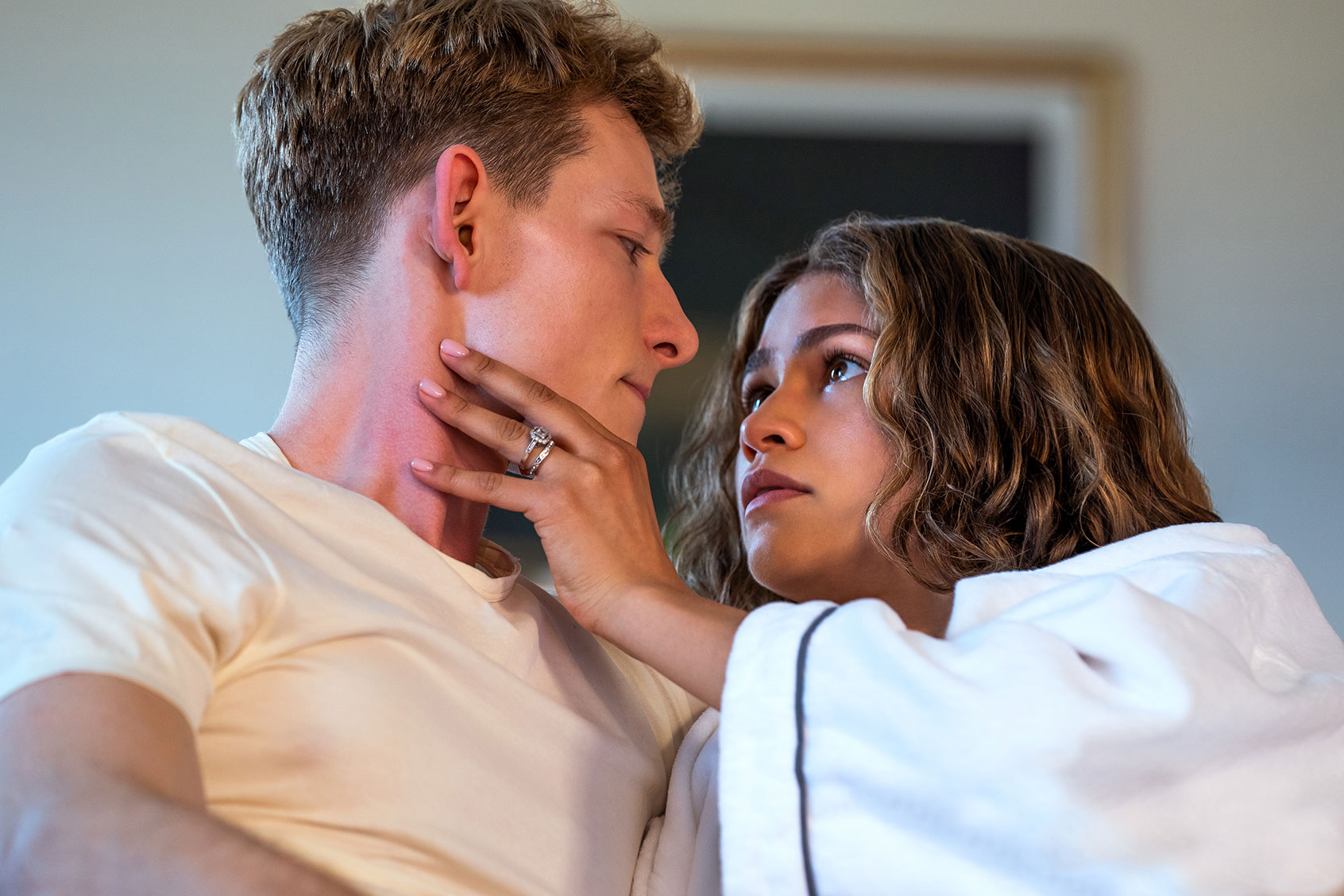
In an interview with Variety, Zendaya said in that contentious moment with Patrick, “It’s very clear to her that she’s coming into a place of privilege and access that she clearly didn’t grow up with, so she enjoys f**king with [Art and Patrick] about it." 

Throughout the movie, Tashi's proximity to whiteness can be seen through the transformation in her hair. While the film tries to implement Tashi as a symbol of representation of past and current Black female tennis players, its white filmmakers and white hair and makeup team only emphasize her whiteness. Hair and makeup heads Massimo Gattabrusi and Fernanda Perez said they had modeled Tashi's hair to resemble white female tennis player Maria Sharapova — instead of the Williams sisters, Osaka or even young new star Coco Gauff.

In Tashi's case . . . the closer she gets to the privilege, access and proximity to whiteness, we see her outer state conform.

As a young rising star, Tashi begins the movie at 18 ready to take on college tennis at Stanford and become a breakout powerhouse. Her hair matches this with a long wavy, dense wig that gets interchanged with her game-day hair, a long, single, tight braid, which Gattabrusi called a "powerful hairdo." While Perez said they drew inspiration from many different tennis players, "But you can see the braid on Sharapova."

After Tashi's career-ending injury, she is in a new phase of life so Gattabrusi said she transitions to a mid-length wig which is looser than her already wavy textured hair. This transition is also where Art and Tashi's burgeoning professional and romantic relationship blossoms and deepens. Finally, in the present day, Art and Tashi are married and seen as a tennis power couple; she has adopted his last name, they have a daughter and her hair is no longer wavy. It is almost fully straightened and sports blonde highlights. "[It] makes her look more mature, more of a mother. And with a different kind of power," Gattabrusi said.

We need your help to stay independent

While it can be empowering for Black women to change their hairstyles, color and cut, in Tashi's case, inadvertently, the closer she gets to the privilege, access and proximity to whiteness, we see her outer state conform to an image of whiteness. Tashi has entered this new powerful phase in her life, wielding control over two white men and their tennis careers. In turn, she loses what made her a force to begin with — her authenticity. 

ChallengersMike Faist stars as Art and Zendaya as Tashi in "Challengers" (Niko Tavernise / Metro Goldwyn Mayer Pictures)This sense of authenticity is seen in the Williams sisters' most memorable hairstyles. From their historic jingling, white beaded braids, to brown microbraids, blonde braids, braid outs, weaves and leave-outs. They've done it all-natural, colorful and even pressed out. But they never lost their sense of self-discovery and expression on the court, especially as the first two Black women to break through a predominantly white sport.

However, in this very same sport, Tashi never achieves the personal success, esteem and great heights the Williams sisters, Osaka and Guaff have garnered in their careers. It leaves her greedily craving power like it is her life force, one that she drains from her "little white boys” who are drunkenly in love with her. While "Challengers" tries to convince us that Tashi has control and is empowered through her hair, especially her final, blonde straight bob look, it actually depicts that she is experiencing the opposite. She is a woman so desperately trying to gain control, or at least hold onto it — all the while losing what makes her her in the process.