Spring Sale: Get 1 Year, Save 58%

Koch money bets on Nikki Haley — but the Mercers may be back on Team Trump

As reported this week, the Koch donor network, specifically its Americans for Prosperity Action fund, has finally decided who to back for the Republican presidential nomination: former South Carolina Gov. Nikki Haley. This was announced as if it was a very significant moment signaling the final blow to the campaign of Florida Gov. Ron DeSantis, whom Haley has nearly overtaken in some polls in the early voting states.

There's only one problem, however. Both Haley and DeSantis are trailing the actual GOP frontrunner, Donald Trump, by 50 points nationally, which means all this hoopla over the Koch endorsement is about who is going to finish a very distant second place. This has to be the saddest example of horserace journalism in history. 

The Koch network does have a lot of money, of course, and according to AFP, they've been running negative ads against Trump since last winter when it was announced that the influential right-wing organization was going to participate in the 2024 election, specifically against Trump. But it took the group this long to decide to back a specific candidate, perhaps because the one considered most likely to beat Trump, Ron DeSantis, isn't their cup of tea. 

The Kochs come out of the libertarian wing of the party which favors immigration and international trade and doesn't care for the idea of using state power to strong-arm business. DeSantis is MAGA, the successor to the Tea Party, which the Kochs bankrolled and astroturfed to victories during the Obama years. He hates everything they stand for (except tax cuts, of course.) 

Haley, on the other hand, is a Koch brother's dream. I'm sure she had them at "going to go after Social Security and Medicare." 

We need your help to stay independent

And here everyone thought that the cacophonous eruption of denials at the State of the Union address last year when President Biden made clear that that was exactly what they planned meant that the GOP had dropped its longstanding determination to end those programs. 

As the New York Times' Paul Krugman pointed out in his column on Tuesday, Haley's a clever shape-shifting politician on the stump, but when you look at her policies, she's a standard-issue corporate right-winger. That, of course, means she doesn't stand a chance of winning the nomination even if she stands the best chance, among all GOP contenders, of beating Joe Biden. To paraphrase a famous Republican defense secretary, you go to war with the Republican base you have, not the one you might wish to have. The GOP base today has no interest in standard-issue establishment Republicans. Her "lane" is the same lane that they all have: hoping for something to happen to Donald Trump. 

The Kochs have a dubious record of choosing presidential candidates anyway. Recall that they had groomed Wisconsin Gov. Scott Walker for years to be their own personal president and were ready to formally endorse him when he suddenly declared he wanted to curtail legal immigration and then flamed out completely, leaving the race before it even started. Their network stayed on the sidelines from that point on. You can be sure that when the primary campaign is over and Trump is the nominee, they won't be spending any of their loot to defeat him in the general election. Like so many others of their ilk, they'll pout and sulk a bit and then slink off to count all the money he saved them with his massive tax cuts for the wealthy. 

But with all the talk about the Koch Network stepping into the arena on behalf ofHaley, there's been hardly a mention of another big bucks right-wing family coming off of the sidelines for Donald Trump. CNBC reported last week that according to "people familiar with the matter," Bob Mercer and his daughter Rebekah are considering getting back in the game after laying out since 2018. And they've got $88 million sitting in their private nonprofit, the Mercer Family Foundation, just waiting to be spent.


Want a daily wrap-up of all the news and commentary Salon has to offer? Subscribe to our morning newsletter, Crash Course.


Just as the Koch network is more ideologically aligned with Haley, the Mercers came out heavily for Trump in 2016, way ahead of most of the rich guys, pumping tens of millions into the campaign. According to Vanity Fair's Gabriel Sherman, they were originally motivated by their burning hatred of Hillary Clinton, whom they believe is a murderer. But once they got involved, their influence on the Trump campaign was huge. 

It's no surprise that the Mercers have decided it's time to come out of the shadows and once again support Trump. His talk of mass deportations, detention camps and expelling the "vermin" has to be music to their ears.

Former Trump adviser and podcaster Steve Bannon said that the Mercers "laid the groundwork for the Trump Revolution," and he was correct. They bankrolled Bannon's publication Breitbart News, which served as Trump's online propaganda arm during the 2016 campaign, and spent millions on Cambridge Analytica, Robert Mercer's data firm, which was reportedly involved in all sorts of chicanery in that election. They were personally responsible for putting Bannon and campaign manager Kellyanne Conway in the campaign. 

But their high-profile involvement also brought the Mercers under intense scrutiny, which they apparently didn't like. They are eccentric people and soured on Trump for vague reasons, stepping out of the public eye after 2017. But they never stopped donating millions to their pet causes and other far-right politicians. And as Salon's Igor Derysh pointed out in this tour de force examination of the Mercers' tentacles in all aspects of right-wing politics, their influence and money were essential to the forces that brought the MAGA movement to its peak moment on Jan. 6. 

And the Mercers have continued to help fund organizations and individuals that helped perpetuate the Big Lie. Derysh quotes Mobashra Tazamal, a senior research fellow at Georgetown University's Bridge Initiative, which issued a report on the Mercers involvement back in 2021:

"By strategically funneling millions into known hate groups, platforms amplifying racism, Islamophobia, and xenophobia, and politicians who pushed forth outright lies of a stolen election, Rebekah Mercer played a role in inciting the violence by providing material support," she said. "The billionaire family has used their extraordinary wealth to bankroll the rise of violent white nationalism in this country."

This is what they believe in. This is what they care about. It's no surprise that they have now decided it may be time to come out of the shadows and once again support Donald Trump. All his recent talk of mass deportations, detention camps, "poisoning the blood of our country" and expelling the "vermin" has to be music to their ears. They figure they may finally be about to get their money's worth.

“Humiliating”: McCarthy visited Mar-a-Lago because “depressed” Trump wasn’t “eating,” Cheney says

Rep. Kevin McCarthy, R-Calif., claimed he traveled to visit former President Donald Trump at Mar-a-Lago after the Jan. 6 Capitol attack because he was “depressed,” former Rep. Liz Cheney, R-Wyo., writes in her new book.

Cheney’s book, “Oath and Honor,” targets the “enablers and collaborators” who were willing to violate their oath to the Constitution out of political expediency and loyalty to Donald Trump,” according to excerpts published by CNN.

“He knows it’s over,” McCarthy told her just two days after Election Day, Cheney wrote. “He needs to go through all the stages of grief.”

But McCarthy that same day went on Fox News and claimed Trump “won this election,” she wrote. “McCarthy knew that what he was saying was not true.”

Following the Jan. 6 attack, Cheney wrote that she learned that McCarthy was worried he was losing his ability to fundraise and secretly flew to Mar-a-Lago just three weeks after the Capitol riot.

“Mar-a-Lago? What the hell, Kevin?” Cheney asked, according to the book.

“They’re really worried,” McCarthy said. “Trump’s not eating, so they asked me to come see him.”

“What? You went to Mar-a-Lago because Trump’s not eating?” Cheney questioned.

“Yeah, he’s really depressed,” McCarthy said.

Cheney wrote that other Republicans were “angry and disgusted” at McCarthy’s visit.

“Some mocked him, circulating the Trump/McCarthy photo along with the clip from the movie Jerry Maguire where Tom Cruise tells Renée Zellweger, ‘You.. complete… me,’” she wrote.

A spokesperson for McCarthy told CNN: “For Cheney, first it was Trump Derangement Syndrome, and now apparently it’s also McCarthy Derangement Syndrome.”

But critics pounced on the book’s claim, mocking McCarthy’s excuse.

“A few weeks ago our 14 year old dog stopped eating.  At no point did our vet say to us ‘you should grovel before him and tell him you think he's the President,’” tweeted Rep. Sean Casten, D-Ill. “But Kevin's gonna Kevin, I guess.”

We need your help to stay independent

“How humiliating,” tweeted the left-wing outlet MeidasTouch.

“Man cannot live on stolen classified documents alone,” quipped conservative attorney George Conway.

MSNBC’s “Morning Joe” crew hammered the former House speaker on Wednesday.

"Kevin McCarthy justifying his trip to Mar-a-Lago by saying three words that nobody has ever said about Donald Trump: ‘He's not eating,’" said host Joe Scarborough. "Now all I can say is this: If Kevin McCarthy's job was to go down to Mar-a-Lago to get Donald eating again, well, he did a hell of a job. Because that ain't been a problem since, wasn't really a problem before. You know, maybe if he said, 'I've got to go down to Mar-a-Lago because Donald is cheating on his wind sprints we'd believe that. But he's not eating, I don't believe it."

"How comforting that when he left, the last vision we saw was the ailing Donald lying in the that bed with an empty bucket of KFC over his head," he added.


Want a daily wrap-up of all the news and commentary Salon has to offer? Subscribe to our morning newsletter, Crash Course.


"On his tummy," chimed in co-host Mika Brzezinski. "That's pathetic."

"Come on – 'he's not eating,'" Scarborough said. "You want to go to Mar-a-Lago that badly. Come on, Kevin, make a better excuse than that."

Major United Nations climate summit will take aim at reducing meat consumption worldwide

It has been announced that reducing meat consumption is the one of the United Nation's Food & Agriculture Organization's top goals in coming years, which will be discussed at length at the COP28 summit in Dubai in December. As Agnieszska de Sousa writes in Bloomburg, "nations that over-consume meat will be advised to limit their intake, while developing countries — where under-consumption of meat adds to a prevalent nutrition challenge — will need to improve their livestock farming."

Food systems amount to about a third of global greenhouse gas emissions, writes de Sousa. The plan will be non-binding, but the FAO aims to 'give a push" to ensure that many countries are aware of the desired changes, which will ideally impact policy, finance and various climate topics and decisions. As Dhanush Dinesh, the founder of Clim-Eat noted, “If we don’t tackle the livestock problem, we are not going to solve climate change. The key problem is overconsumption.”  

In addition to attempting to reduce meat consumption for environmental purposes, another aim is to help to support and better encourage farmers across the globe, as well as placing a focus on sustainability at large.

Other topics involve water usage in farming, food waste, fertilizer and pesticide use and more; the plan will be shared in installments over the coming years. Catering for the event will be 2/3 plant-based, effectively putting the ethos of the summit into effect. 

Most dinosaurs were killed by climate change, not a meteorite, new study suggests

Perhaps the most famous thing about the dinosaurs is the giant space rock that seemingly killed them. Also known as the Chicxulub impact, or the K-Pg event, most people are familiar with the major crash roughly 66 million years ago after a comet or asteroid collided with our planet.

It was one of the most violent upheavals in Earth's entire 4 billion year history. The collision was so massive, it killed approximately 60 percent of life in the oceans and wiped out the non-avian dinosaurs, as well as killing most four-legged animals over 25 kilograms (55 pounds). Though it was massively destructive, in the process, the K-Pg event cleared the way for modern life forms to evolve, including us humans.

The emitted sulfur… reached up to 1800 parts per million — and, notably, occurred just prior (within 0.1 million years) of the K-Pg event.

At least, that is the story most of us have been taught for generations. Yet the truth may actually be more complex. According to a recent study in the journal Science Advances, climate change might have also played a major role in the extinction of the dinosaurs.

The scientists behind that paper determined this by studying the Deccan Traps of western India, which were formed by molten lava after a massive volcanic eruptions 66 million years ago. They wanted to learn how much fluorine and sulfur were burped into the atmosphere as volcanoes spewed one million cubic meters of rock.

After developing a new scientific technique for analyzing this, the researchers determined that the amount of fluorine ejected by these eruptions varied from 400 to 3000 parts per million, enough to radically alter the regional environment but not the entire planet. The same cannot be said of the emitted sulfur, which reached up to 1800 parts per million — and, notably, occurred shortly before the K-Pg event (within 0.1 million years).

"Our data suggest that volcanic sulfur degassing from such activity could have caused repeated short-lived global drops in temperature, stressing the ecosystems long before the bolide impact delivered its final blow at the end of the Cretaceous," the authors write.

If subsequent research reinforces this conclusion, it could rock the foundations of how humans understand Earth's ancient history. Instead of imagining the K-Pg extinction as being singularly caused by a giant object colliding with our planet, the new findings paint a different picture: One in which volcanoes erupted and caused major climate fluctuations, which were then compounded by the devastating impact of the asteroid or comet.


Want more health and science stories in your inbox? Subscribe to Salon's weekly newsletter Lab Notes.


"Volcanic sulfur degassing from such activity could have caused repeated short-lived global drops in temperature"

“Our research demonstrates that climatic conditions were almost certainly unstable, with repeated volcanic winters that could have lasted decades, prior to the extinction of the dinosaurs," McGill University Professor Don Baker, who co-authored the paper, said in a statement. "This instability would have made life difficult for all plants and animals and set the stage for the dinosaur extinction event. Thus our work helps explain this significant extinction event that led to the rise of mammals and the evolution of our species."

As it turns out, scientists have long been aware of the role that volcanoes play in changing our climate. Some scientists hypothesize that the so-called Little Ice Age — a period of pronounced cooling that occurring during the Medieval era — occurred as a result of a cluster of large volcanic eruptions that occurred in close succession. This type of climate change is natural, in sharp contrast to the anthropogenic climate change we are causing by burning fossil fuels.

"At our human timescale (a few years to a few hundred thousand years), most volcanic eruptions have a net cooling effect on the climate," Dr. Yves Moussallam, Assistant Professor of Earth and Environmental Sciences and Geochemistry at Columbia Climate School, told Salon by email earlier this year. Moussallam cited global cooling periods that occurred after the eruption of Tambora in 1815 and Mt. Pinatubo in 1991. "This is because of another gas which is emitted by volcanoes, sulfur dioxide. In the atmosphere SO2 turns to H2SO4 (sulfuric acid) which condenses into little droplets (aerosols). If these are injected into the stratosphere, they can remain there for several months to years and have a net cooling effect on the surface as they reflect part of the Sun's radiation."

In his recent book "Our Fragile Moment," University of Pennsylvania professor of earth and environmental science Dr. Michael E. Mann detailed how the history of life on Earth is inextricably tied to the alterations that occur in its climate. This includes, but is hardly limited to, volcanic eruptions.

We need your help to stay independent

"Life on Earth has been around for 4 billion years, and so for billions of years, conditions have been conducive to life and life has played an increasingly important role on the climate itself," Mann told Salon earlier this year. This includes Snowball Earth, or a theoretical period when Earth's surface was mostly or entirely frozen, as well as mass extinction events that altered the climate from 250 million years ago and the K-Pg event. "Then we zoom ahead to just a few million years ago, and primates are on the scene. At every step, you have climate changing and climate impacting life," Mann pointed out.

At the same time, it is important to note that even though volcanic eruptions may have contributed to climate change when dinosaurs roamed the Earth, that does not mean that volcanic activity is responsible for modern climate change. The science simply does not bear that out claim, which is made by many climate change deniers.

"The burning of fossil fuels and the manufacture of cement releases 37 Gt (billion tones) of CO2 into the atmosphere per year," Moussallam explained. "Volcanoes are estimated to supply globally 0.28–0.36 Gt CO2 per year to the atmosphere and ocean system." By contrast, "Volcanoes hence contribute about 100 times less CO2 than anthropogenic activities."

The bad news is Trump is polling well — but the good news is he’s ready to blow it

Democrats, for very good reason, have been in a poll-induced panic for weeks now. Despite a relatively successful presidency and a booming economy, Joe Biden is falling behind Donald Trump in the polls, often by downright startling margins. On average, Biden trails Trump in national polls by more than two percentage points. And a recent New York Times poll left people who oppose fascism traumatized, showing Trump ahead in five of the six crucial swing states likely to decide the election. It's enough to make a person want to walk into the sea. How can Americans be so stupid? Do they not care about democracy? Decency? Basic self-preservation? 

Of course there's a raging debate about how seriously to take a poll nearly a year before the election. Swing voters tend to be the lowest-information voters, people who aren't paying attention and who often refuse to believe either Biden or Trump will be the nominee. (Both are nearly inevitable, as informed political watchers understand.) Wait a few months for the campaigns to actually begin in earnest and for people to start tuning in, and the picture could change. Or not. Hell, there's a not-small chance Americans really are that dumb, and unable to learn our lessons until it's too late. We wouldn't be the first nation to shoot ourselves in the face, after all. 

Trump is doubling down on the Big Lie as a campaign strategy. 

But this week, a small ray of hope has opened up, because Trump has indicated that he plans to run an incredibly stupid campaign, focused on two of his least popular political views: the Big Lie and his wish to strip health care away from millions of Americans. Even better, his approach to these two toxic issues suggests that, despite his team's efforts to normalize Trump, his psychotic levels of narcissism will always drag the campaign straight back to his ego obsessions, reminding voters what they most dislike about Trump. 


Want more Amanda Marcotte on politics? Subscribe to her newsletter Standing Room Only.


On Saturday morning, Trump took to Truth Social to whine about how he tried to "terminate" Obamacare in 2017, but failed because "a couple of Republican Senators" refused to go along. "It was a low point for the Republican Party, but we should never give up!” he added, making clear that he still considers it a priority to dismantle a law that has insured millions and lowered costs for countless others. 

"It’s hard to think of a more wrongheaded campaign promise than this, on both political and policy grounds," Catherine Rampell of the Washington Post wrote Tuesday. She notes that Trump's first attempt to repeal Obamacare scared "voters straight about what losing it would mean," resulting in a surge of popularity for the legislation, as well as electoral wins for Democrats who ran on safeguarding the bill. 

Trump's words were a gift to the Biden campaign, which has been looking for ways to highlight the president's under-covered efforts to drive down health care costs, from capping the cost of insulin at $35 to tweaking Obamacare to make it easier to get health insurance. But while getting the rate of uninsured Americans down to a record low 8% is a major achievement, it also flies under the media radar, since it's a bureaucratic-sounding news story without much conflict to draw attention to it. But with the Trump vs. Biden angle, the massive difference between the two candidates on health care policy might actually get some coverage. 

In an unrelated but similarly unpopular move, Trump's team also signaled this week that their candidate is fully committed to running on the Big Lie, i.e. that he is the "real" winner of the 2020 election and Biden "stole" it with conspiracies that have been disproved over and over and over again. Despite losing the dozens of frivolous lawsuits filed in 2020 alleging election fraud, Trump's legal team is still at it, making legal motions meant to shore up false claims of a stolen election, even though they know they are doomed to fail. 

On Monday, the Washington Post reports, "Trump’s legal team sought permission to compel prosecutors to turn over information" about the FBI and a half dozen other government agencies "in what appeared to be an attempt to resuscitate his unfounded allegation that President Biden’s election victory was 'stolen.'” On Tuesday, federal judge Tanya Chutkan shot down a similar legal demand to subpoena records and materials from people who worked with the House committee investigating January 6. 

In both cases, the legal filings are vague and baseless, and certain to lead nowhere. Trump's legal team is not really trying to get "proof" of a stolen election, because they know there is none. As the January 6 committee repeatedly showed, Trump is well aware he lost the election, and all claims there is evidence otherwise are lies. The only real reason for such legal time-wasting is to create the illusion that Trump "believes" in the stolen election and is "still fighting." In other words, Trump is doubling down on the Big Lie as a campaign strategy. 

We need your help to stay independent

This was already looking like the case when it came to Trump's various rallies. He often rants that the election was "stolen" and the rallies feature music and pageantry celebrating the Capitol rioters who tried to steal the election for Trump as heroes. As a primary tactic, this makes some sense, since the GOP loves to hear lies about the 2020 election. But creating this paper trail of court filings reasserting the Big Lie suggests Trump isn't winding this down any time soon. So far, he is only escalating his efforts to relitigate the attempted coup as a noble effort to right some grievous wrong. 

In this, he'll probably cost himself some votes. As Democratic campaign strategist Dan Pfeiffer noted in his recent Message Box newsletter, election denial drives down support for Republican candidates by a small but decisive margin in tight races. "Pushing that absurd lie makes one seem like an extremist kook to a broad segment of the electorate," he adds. 

These two issues resonate with voters in a way few others do, in no small part because they threaten people's sense of safety and stability. But it also points to a larger issue with Trump, one that will start to get louder as more voters actually tune into the election coverage: He cannot help but put his ego ahead of what's smart politically. 

With the Big Lie, that's crystal clear. So Trump would be wise to shut up about the Big Lie, allowing voters to forget how bad things got and convince themselves it's okay to roll the dice with him as president again. His narcissism won't let him, however, so he will just keep whining about it and reminding people that he's a direct threat to democracy.

It's the same story with Obamacare. As Rampell notes, "Most Republican politicians have now figured out that talking about health care is a political liability, so they’ve shut up about it." But Trump can't get over perceived slights to his ego, such as when he lost on his repeal bill. He's also hella racist, and cannot stop expressing his ongoing, obsessive anger that Barack Obama ever became president. It's why he keeps forgetting it's Biden who is president, not Obama. Erasing the Black president's signature achievement is a manifestation of this racist fixation. 

It's certainly depressing to contemplate that such a terrible person as Trump could even exist, much less have as much power as he's accumulated. As a long list of psychologists explained to Thomas Edsall of the New York Times, Trump's main character traits are "rageful, grandiose, vengeful, impulsive, devoid of empathy, boastful, inciting of violence and thin-skinned." His behavior suggests both that he's a textbook psychopath and a grandiose narcissist, according to experts who have now spent plenty of years observing Trump. 

The problem is that there are a lot of people, including in the mainstream press, who wish to downplay Trump's obvious mental deficiencies as the imaginings of liberal hysteria. That narrative allows swing voters to suppress their doubts about Trump long enough to vote for him, but only if they aren't reminded of what an off-the-charts jackass he is. But Trump's impulsivity and narcissism are such that he can't help but rant and rave about his imaginary grievances, helpfully reminding people that he is, without exaggeration, the worst. So, as gross as it is, let's hope Trump keeps talking up the Big Lie and how he wants to end Obamacare, long and loud enough so it gets on the radar of people whose memory needs jogging. 

Trump’s aberrant behavior is getting worse. Why are Americans ignoring his decline?

In evaluating his public and private behavior, America’s leading mental health professionals have concluded that Donald Trump is mentally unwell, and likely a sociopath — if not a psychopath. In even more direct terms, Trump has shown himself to apparently have a diseased mind, which in turn amplifies his already corrupt morality and ethics, attraction to violence, and overall capacity for evil. Ultimately, if he were to become president again, such an outcome would be a disaster for both the United States and the world.

In a new essay in the New York Times, Thomas Edsall consulted with mental health professionals from some of America’s most prestigious institutions about this emergency. Their conclusion: Donald Trump’s aberrant behavior is getting worse.

Once again, the American people and their leaders have been warned about the growing danger(s) and too few of them are responding with the appropriate energy and seriousness.

Leonard Class, who is an associate professor at Harvard Medical School, told Edsall that:

If Trump — in adopting language that he cannot help knowing replicates that of Hitler (especially the references to opponents as "vermin" and "poisoning the blood of our country"), we have to wonder if he has crossed into "new terrain." That terrain, driven by grandiosity and dread of exposure (e.g., at the trials) could signal the emergence of an even less constrained, more overtly vicious and remorseless Trump who, should he regain the presidency, would, indeed act like the authoritarians he praises. Absent conscientious aides who could contain him (as they barely did last time), this could lead to the literal shedding of American blood on American soil by a man who believes he is "the only one" and the one, some believe, is a purifying agent of God and in whom they see no evil nor do they doubt.

We need your help to stay independent

Several mental health experts whom Edsall consulted highlighted the role that Trump’s aging brain and apparent cognitive decline are playing in his pathological behavior:

"Trump is an aging malignant narcissist," Aaron L. Pincus, a professor of psychology at Penn State, wrote in an email. "As he ages, he appears to be losing impulse control and is slipping cognitively. So we are seeing a more unfiltered version of his pathology. Quite dangerous."

In addition, Pincus continued, "Trump seems increasingly paranoid, which can also be a reflection of his aging brain and mental decline."

The result? "Greater hostility and less ability to reflect on the implications and consequences of his behavior."

Edwin B. Fisher, a professor of psychology at the University of North Carolina, made the case in an email that Trump’s insistence on the validity of his own distorted claims has created a vicious circle, pressuring him to limit his close relations to those willing to confirm his beliefs:

His isolation is much of his own making. The enormous pressures he puts on others for confirmation and unquestioning loyalty and his harsh, often vicious responses to perceived disloyalty lead to a strong, accelerating dynamic of more and more pressure for loyalty, harsher and harsher judgment of the disloyal and greater and greater shrinking of pool of supporters.

At the same time, Fisher continued, Trump is showing signs of cognitive deterioration:

the confusion of Sioux Falls and Sioux City, several times referring to having beaten and/or now running against Obama or the odd garbling of words on a number of occasions for it seems like about a year now. Add to these the tremendous pressure and threat he is under, and you have, if you will, a trifecta of danger — lifelong habit, threat and possible cognitive decline. They each exacerbate the other two.

Craig Malkin, who is a lecturer in psychology at Harvard Medical School, emphasized what he believes is Trump’s increasingly psychopathic behavior.

If the evidence emerging proves true — that Trump knew he lost and continued to push the big lie anyway — his character problems go well beyond simple narcissism and reach troubling levels of psychopathy. And psychopaths are far more concerned with their own power than preserving truth, democracy or even lives. [My emphasis added]

The conclusions reached by the mental health professionals quoted in Edsall’s essay echo those of their colleagues who I have been in dialogue with here at Salon and elsewhere for (at least) the last seven years.

For example, Dr. Justin Frank, author of "Trump on the Couch," recently warned that Trump has a "a classic God complex driven by a persecutory delusion. His sense of omniscience is compensatory and more disturbing than ever" and "In my opinion, Trump's incessant, word-salad repetition reflects chronic substance abuse or impending dementia, which is consistent with the blank eyes. His blotchy red and puffy face (and constant sniffling) are not new but underscore a clinician's natural suspicion that he is not cognitively healthy. His cartoon character menacing and bellicose posture is second nature to him."

Several weeks ago, psychiatrist Dr. Lance Dodes told me the following about how Trump is behaving in response to his legal peril and trials:

His lengthy history, however, shows the opposite, that he is simply a sociopath, interested only in his personal gains in power and wealth despite the harm to others.

Those who have concluded that he is decompensating are correct, though it would be more precise to say that the decompensation consists of exposing an inability to see reality and violent self-interest that has always been who he is. As many have predicted, as pressure on him continues to rise, his claims of greatness, his inability to accept legal constraints or punishments, and his destructive impulses toward all who have limited him, will increase. Ultimately, he may decompensate to the point of gross paranoid psychosis with even more obvious incitement to riots and civil war rather than accept the reality that he has been finally held accountable.  

I have been very vocal in my criticism of the New York Times and other agenda-setting media about their failures to consistently engage in pro-democracy journalism — a type of journalistic practice that requires that the abnormal is not normalized and that the American people are repeatedly warned about Trumpism, neofascism, and the dangers embodied by other types of anti-democratic politics.

Trump’s plans to become America’s first dictator are creating a cataclysmic synergy between his diseased mind and a fascist political party eager to reduce democracy to rubble and create a Christofascist plutocracy.

Edsall’s new essay, and his writing more generally, is an example of the type of bold public teaching and truth-telling that the New York Times and other elite media should be doing much more of. In fact, the future of American democracy depends on it.

And given how the right-wing disinformation propaganda machine is escalating its war on reality and truth as it shapes and prepares the information space to facilitate Trump’s return to power as America’s first dictator, the New York Times and other such elite media should be even more earnest in such a commitment.


Want a daily wrap-up of all the news and commentary Salon has to offer? Subscribe to our morning newsletter, Crash Course.


As William Bunch writes in his new essay at The Philadelphia Inquirer:

In the ever-shrinking world of a free and fair media, the recent weeks have brought an explosion of untruth and a stepped-up war on reality. With democracy increasingly staring into the abyss both at home and abroad, propaganda and censorship are the double-edged sword of rising dictatorship. And now with violent hacking coming from both sides of the blade, it is indeed an increasing struggle to cling to the dream of truth-flavored sanity. This kind of malarkey is what I find so alarming about our increasingly Orwellian present, and even dimmer future. It’s not just that the newest generation of chest-thumping strongmen are harnessing the electrons of the 21st century to hypercharge their modern Ministries of Untruth, but that the guardians of the actual truth — the newsroom grand poobahs, an American president who claims he ran to save democracy — are passively watching it slip from our hands.

Collectively, the small group of mental health professionals who followed through on their "duty to warn" the American people about Trump and his dangerousness were marginalized, harassed (including death threats) and in at least one example suffered sanctions and loss of employment. Their warnings about Trumpism and the ascendant neofascist movement and the type of widespread harm, including violence and mass death (as seen with the Trump regime’s negligent if not outright criminal response to the Covid pandemic) have proven to be prescient. Trump’s plans to become America’s first dictator are creating a cataclysmic synergy between his diseased mind, with its megalomania and God complex, and a fascist political party and movement that is eager to rubbleize democracy with the goal of creating an American apartheid Christofascist plutocracy.

To that point, Trump and his agents have publicly announced their plans to use the United States military to occupy Democratic-led cities and other "blue" parts of the country as part of a plan to impose martial law. Dictator Trump and his enforcers will attempt to legitimate this attack on the American people’s fundamental civil and human rights by claiming that they are actually cracking down on "crime" in the name of "public safety."

None of this is new. As seen in Nazi Germany and elsewhere, history shows that sick leaders attract sick followers who in turn combine to create sick mass movements that oppress (and do worse to) their fellow citizens as they destroy society. Ignoring these lessons and precedents is a choice – one that is usually fatal.

Sorry, not sorry: The link between gender, autism and over-apologizing

Freelance writer Lisa Jade Hutchings is someone who habitually apologizes. This means that Hutchings, like millions of other people, tends to say she is sorry even there isn't necessarily a reason for her to feel remorse. Many people do the same, but seemingly can't help it. It's an impulse they can't always control.

Although over-apologizing is rarely discussed as being a symptom of a disability, for someone who over-apologizes, their trait can profoundly impact every area of their life. Apologizing too much can annoy your boss or strain a relationship. People who apologize unnecessarily can be viewed as weak or submissive; even worse, they may be dismissed as manipulative or insincere. When they really apologize for something serious, is it wholehearted or another nervous tic?

As experts explained, over-apologizing is linked to a person's past struggles in social scenarios. When a person apologizes too much, it is usually because they have been hurt in past situations that required strong social skills. As a result, it is perhaps unsurprising that one of the groups most likely to tend to over-apologize are neurodivergent individuals — that is, people whose brains do not process information in a typical way. Neurodivergent individuals include those with autism, ADHD, Tourette's syndrome, dyslexia and other similar conditions.

Hutchings was diagnosed with ADHD at the age of nine. It was the early 1990s, a time when ADHD was widely misunderstood and often viewed shamefully. But even after getting a diagnosis, Hutchings says the response was to "medicate someone, put them in the corner, and hope they get 'better.'"

"I grew up not understanding myself for much of my life," Hutchings told Salon. "That, coupled with significant trauma, paved the way for me to become a chronic people-pleaser. It was only later in my mid-thirties, when I received my autism diagnosis that I really started to connect the dots" about many of her neurologically atypical behaviors.

In her case, Hutchings emphasized that "I don't feel I tended to apologize or overcompensate because of being neurodivergent, but rather because neither myself nor those around me understood who I was or my internal operating system."

"Those who are hypervigilant due to anxiety or trauma are very prone over apologizing."

This approach is "how I protected myself," she said. "Thinking back, I have often felt (and still do at times) ashamed of who I was, neurodivergent or not, [and] apologiz[e] to avoid further judgment or harm."

Experts agree that people who constantly feel a need to say they're sorry — whether before a hypothetical offense has been committed or after the fact — often do so as a reaction to past trauma. This is where over-apologizing intersects with neurodiversity: Neurodivergent people are particularly prone to over-apologizing because they are unusually vulnerable to being traumatized due to their poor social skills.

"This can manifest as misreading situations or responding in a manner that can sometimes result in adverse consequences (such as being misread as impolite or abrupt or unkind)," Dr. Ramani Durvasula, a licensed clinical psychologist and professor of psychology, told Salon. "One thing that is essential to remember about neurodivergence is that, unlike antagonistic personality styles where abrupt or impolite statements may be made secondary to entitlement or lack of empathy, for a neurodivergent person the ill-timed or tempo-ed response is not secondary to social antagonism, but to processing issues more often."

Duravsula added that "neurodivergent people who do not have co-occurring antagonistic personality styles will often be quite contrite and apologetic if they are informed that their conduct or words may have hurt someone."

In other words, when neurodiverse people apologize excessively, it is not because of their neurodiversity; it is because of the social consequences that ensue because of their neurodiversity. In general, over-apologizing is a trait that may more broadly indicate other issues with identity and mental health.

"I have often felt ashamed of who I was, apologizing to avoid further judgment or harm."

"Excessive apologizing is observed in people who may have a propensity to excessive self-monitoring, and we may witness this in social anxiety, generalized anxiety, obsessive-compulsive spectrum disorders, anxious/avoidant personality styles and disorders, people who are depressed and prone to excessive self-blame," Durvasula explained. She also said that people will apologize excessively if they suffer from post-traumatic stress or complex trauma, as "part of the fallout of trauma is often to blame the self — and that can be compounded if the world at large also blames the person who experienced the trauma."

This is especially true for people who have been in relationships with antagonistic and narcissistic individuals, and as such "often face interpersonal manipulations such as gaslighting and blame shifting [and] will often blame themselves because of the dynamics of these relationships."

Durvasula is not alone among psychiatric professionals in noticing these patterns among people who over-apologize.

"I agree that for many people [thoughts like] 'I don't know the rules,' 'if people are angry or unhappy, it must be my fault' and deep shame can be factors in apologizing too much," explained Olivia James, a London-based therapist who specializes in trauma and treats high-functioning professionals who struggle with anxiety. After mentioning that she has heard neurodivergent people call into radio phone-in shows and apologize for things they hadn't done wrong, James cited other examples.

"Those who are hypervigilant due to anxiety or trauma are very prone over-apologizing," James wrote to Salon. "Apologizing can function as appeasement, a survival strategy, [telling others] 'I'm not a threat, I mean no harm, please don't attack me.'"


Want more health and science stories in your inbox? Subscribe to Salon's weekly newsletter Lab Notes.


"Excessive apologizing is observed in people who may have a propensity to excessive self-monitoring."

In particular, James noted that women are conditioned to have this type of response.

"Good girl conditioning is a factor for many women," James explained. "We are taught to take up less space and be less demanding than men. Many women apologize too much." Excessive apologizing can also reflect cultural differences, with James noting that "some cultures have more politeness than others and there is a marked difference between England and the Netherlands, for example. Moving to a different culture can lead to problems with calibration."

Dr. Catherine Lord, a professor of psychiatry and education at UCLA's Semel Institute of Neuroscience and Human Behavior echoed the intersection between gender and neurodiversity when it comes to apologizing too much. "I think in general women do this much more than men who aren’t neurodivergent," Lord explained in an email.

Lord agreed that autistic people sometimes apologize excessively, observing that it can be "reflexive, we learn to do it when something goes awry, like saying sorry when you bump into a wall. Some autistic people, like some women, may feel like they are more responsible for something going wrong — which isn’t true, but it becomes automatic. I also think sometimes we say it automatically because it feels like we should say something and we don’t know what else to say (though this isn’t conscious)."

This instinct to apologize as a survival strategy — and because one doesn't know of anything else to say — also exists in victims of child abuse. This brings us to Kim Johnson, a 32-year-old policy writer and patient advocate from Colorado. Johnson wrote to Salon that she had lived a very traumatic childhood in which she frequently moved and described her parents as "both pathological liars and the embodiment of narcissists." From there, she detailed how her habit of over-apologizing can be traced back to their behavior.

"The apologist in me was fostered from an early age by the psychological abuse and gaslighting that I endured," Johnson explained. "When I was incredibly young, my parents conditioned me to apologize when I did not even know what I was apologizing for. There would be instances where I was simply told to 'apologize' — and I would." Johnson claims that she was trained to apologize during family disputes, even violent ones, when she did not feel she had done anything wrong. "As a teenager, when my twin brother and I realized how wrong our lives were, we would have conflict[s] with my parents. The thing was, there was no end, and often, the only way to create that end was to apologize."

Johnson added, "In those moments, I was not saying that I was sorry because I meant it. I was saying that I was sorry as a means to survive."

As Johnson's story demonstrates, the habit of over-apologizing is ultimately rooted in people being conditioned to feel like they must account for themselves, regardless of whether doing so is actually linked to any coherent or rational sense of morality.

We need your help to stay independent

Durvasula ticked off the other factors that might cause someone to excessively apologize because of an asymmetrical distribution of power. These factors include "race/ethnicity, gender, sexual orientation, ability, age, cultural or religious background" and involve people who "may be socialized and conditioned with those holding less power and privilege [to] apologizing as part of imbalanced systems of power."

If you tend to over-apologize, know that there is hope. As Hutchings told Salon, "unlearning the habit of excessive apologizing — which, from my perspective, usually goes hand in hand with trauma — has meant discovering what I must hold myself accountable for (my sphere of influence) and what other people's stuff is (outside my sphere of influence)." She credits her support team including a romantic partner, friends, therapists and family members who "make up my small circle." She also learned to show compassion to herself.

"Compassion is not nice," Hutchings explained. "It is about finding your voice, taking an honest look at a situation (along with your role), and responding to protect your peace while minimizing harm, such as putting boundaries in place — something I still find incredibly uncomfortable."

Coal-powered emissions more deadly than previously thought, study finds

A new paper published in Science shows that particulate matter from coal plants are more harmful than previously thought. The team of researchers from across the United States looked at data from 480 coal-fueled power plants and found that approximately 460,000 deaths in the Medicare population could be attributed to coal emissions, twice the number of premature deaths that was previously reported. The researchers also ranked coal plants by deadliest, and found the top 10 were associated with more than 5,000 deaths. The study estimated that coal-fueled plants in two states, Ohio and Pennsylvania, likely caused more than 103,000 deaths nationwide since 1999. 

“Fine particle air pollution from coal has been treated as if it’s just another air pollutant,” said the paper’s lead author Lucas Henneman, an assistant professor of environmental engineering at George Mason University. “But it’s much more harmful than we thought and its mortality burden has been seriously underestimated.”

There was one bit of good news in the data: deaths from coal were highest in 1999, but by 2020 they decreased by about 95 percent. Researchers emphasized that their study shows that cutting emissions from coal-powered plants, and moving toward clean energy, can save lives of those who live near and far away from the plants. As policymakers continue to weigh the future of the coal industry, the researchers say the results of this study should be significantly weighed. 

“As countries debate their energy sources — and as coal maintains a powerful, almost mythical status in American energy lore—our findings are highly valuable to policymakers and regulators as they weigh the need for cheap energy with the significant environmental and health costs,” said co-author Francesca Dominici, a professor of biostatistics, population and data science at Harvard Chan School and director of the Harvard Data Science Initiative.


“We’re seeing a cognitive decline”: “The View” host Sunny Hostin rips Trump’s public blunders

"The View" hosts have ripped into Donald Trump's public blunders repeatedly mixing up former President Barack Obama and President Joe Biden on the campaign trail.

On Tuesday's broadcast, Whoopi Goldberg posed the question whether Trump is "cognitively impaired" after a slew of mistakes while talking about Biden and Obama. He even wrongly addressed Sioux City as Sioux Falls. Trump said he is not impaired but the hosts strongly disagree.

Former Trump aide Alyssa Farah Griffin said, "He's not as sharp as he was in 2016. Many of us would argue he wasn't that sharp then. You see a real decline in him."

Sunny Hostin agreed. “We’re seeing a cognitive decline, but we’re also seeing some dog whistles from him." But Goldberg chimed in and asked if Hostin thought Trump's blunders were "purposeful," and Hostin agreed.

"He's having the cognitive decline and when he catches himself make mistakes he says, 'Well Obama is really Biden's boss.' That is a dog whistle to the white supremacists in the country that are like, 'I don't want a Black man in charge again,'" Hostin said.

Joy Behr also echoed the same sentiment saying, "He appeals to that racist section of his base that doesn't want a Black guy to get any kind of credit." Watch the full segment below:

“The Hunger Games” gives Rachel Zegler the proper showcase that “West Side Story” couldn’t

Gen Z multi-talented star Rachel Zegler became a sensation for posting a video of herself singing "Shallow" alone in her high school auditorium. The clip went viral, and this attention prompted her to apply to an open casting call for the lead role in Steven Spielberg's new take on the classic "West Side Story." She was 17 when she was cast.

In the retelling of "Romeo & Juliet," she portrays Puerto Rican girl Maria who falls in love with a white boy named Tony (Ansel Elgort) from a rival gang fighting for a corner of the Upper West Side neighborhood San Juan Hill. Naturally, the star-crossed lovers are torn apart by cultural and racial differences, all while singing and dancing their hearts out. Her big break in "West Side Story" garnered a Golden Globe win at 20.

She spends much of the film singing as an act of defiance against an authoritative Capitol.

But even though Zegler's portrayal of Maria was lauded critically, that film was considered a box office bomb and wasn't quite the Hollywood debut she deserved. Instead, I am far more intrigued by her work in "The Hunger Games" prequel "The Ballad of Songbirds and Snakes," in which Zegler plays Lucy Gray, a traveling folk musician and the unfortunate soul who gets reaped to participate in the 10th annual deadly Hunger Games. She's mentored by Coriolanus Snow (Tom Blyth) the younger, blonder version of the man who would someday become the autocratic ruler of the Capitol and all of Panem (portrayed by Donald Sutherland in the previous film trilogy).

Both roles showcase the starlet's successful forays into proving herself as a formidable young actress who can act and sing — and do it so gracefully. But which role allows the actress to really shine? Is it as lovesick Maria or the reluctant musician turned dystopian death game player? Let's compare Zegler's two portrayals.

Musical showcases: Theater vs. folksy range

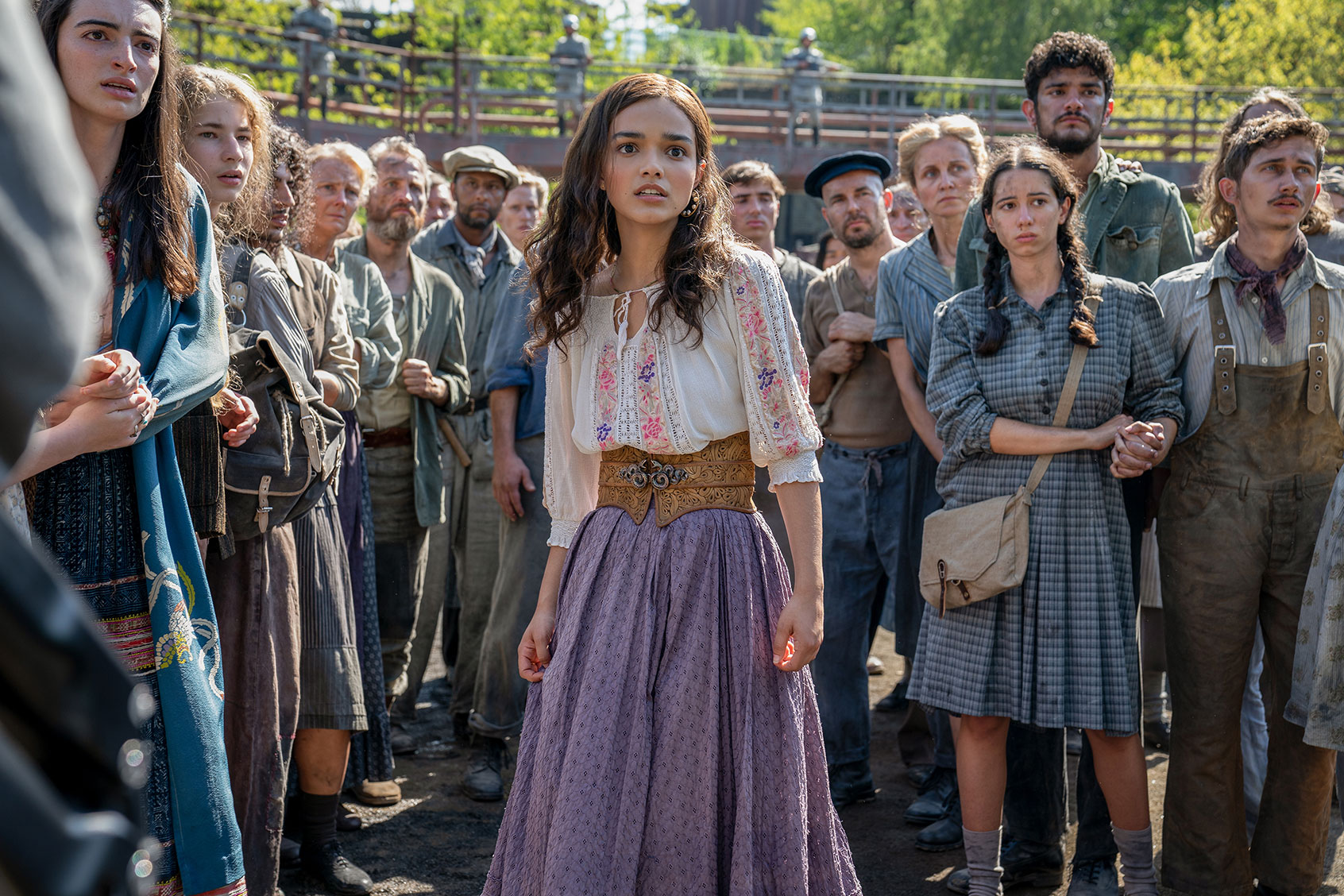
The Hunger Games: The Ballad of Songbirds and SnakesRachel Zegler as Lucy Gray Baird in "The Hunger Games: The Ballad of Songbirds and Snakes" (Murray Close/Lionsgate)"West Side Story" is pure musical magic, and Zegler's training is heavily apparent in her solo "I Feel Pretty" and duet "Balcony Scene (Tonight)." Her soprano is smooth and has the technical skill to convey complicated emotions but also when needed, remain light as air. Singing in this musical theater and almost operatic style comes so easily to her that she outperforms co-star Elgort in their duet on the balcony. It's a shame the film doesn't offer that many solos to show off her classic old Hollywood style of singing, but Maria's passion and love for Tony are felt through Zegler's glistening voice. 

Fortunately, "The Ballad of Songbirds and Snakes" gives the singer and actress more to do – challenging her musical range and abilities in surprising ways. She spends much of the film singing as an act of defiance against an authoritative Capitol. The music in this film is mostly folk and heavily influenced by the South, which allows Zegler to sing with a southern twang, unlike the Puerto Rican accent that drowns her abilities in "West Side Story." The soprano has a full band backing her, and while it may be a different style from what we've heard from Zegler before, her voice has never sounded stronger and more hauntingly beautiful. She even gets to do her own rendition of "The Hanging Tree," the song that Jennifer Lawrence's Katniss Everdeen sang in the original trilogy's "Mockingjay." While Zegler voice might sound sharper and more in line with her style of singing in "West Side Story," "The Ballad of Songbirds and Snakes" highlights her musical range and ability to push outside of the norm for the Broadway actress.

Romantic chemistry: Disconnection vs. trust

The Hunger Games: The Ballad of Songbirds and SnakesTom Blyth as Coriolanus Snow and Rachel Zegler as Lucy Gray Baird in "The Hunger Games: The Ballad of Songbirds and Snakes" (Murray Close/Lionsgate)Alongside her musical abilities, Zegler is the perfect romantic lead, but she and Elgort seem to really struggle to find that spark together in "West Side Story." To me, it isn't really believable that Maria would go to the lengths she did to defy her family for Tony because of the lack of connection between them. Maybe it was because Maria didn't exist outside of her love for Tony. Maybe it was Spielberg who miscast Elgort, who is a whole seven years older than Zegler. Both are pretty people playing each other romantic prospects and are supposed to be so in love they'd die for each other, defying their warring families. But they couldn't convince me they even had a chemistry read before being cast.

This is wildly different from the romantic dynamic I felt in "The Ballad of Songbirds and Snakes." Lucy Gray and Corio are also star-crossed lovers like Maria and Tony but the chemistry is palpable and highly charged. Because Corio is Lucy Gray's mentor, they both know they can't really be together because of their class differences, just like Tony and Maria. And yet, this dynamic works significantly better because Zegler and Blyth's natural chemistry feels lived in and challenging. There is a level of trust built through Corio's mentorship of Lucy Gray, and you can see it in the chemistry between Zegler and Blyth. You can feel the investment they have in each other to make sure they both stay alive. We know it won't end in a happily ever after because we know that Corio grows up to be the dictator President Snow, but even for just the moment it feels real. 

We need your help to stay independent

Range: Lovesick heroine vs. freedom fighter

The Hunger Games: The Ballad of Songbirds and SnakesRachel Zegler as Lucy Gray Baird in "The Hunger Games: The Ballad of Songbirds and Snakes" (Murray Close/Lionsgate)
Ultimately, I am leaning towards "The Ballad of Songbirds and Snakes," when it comes to giving Zegler the best opportunities.

Zegler's breakout moment in "West Side Story" occurs when Tony is tragically killed. Zegler as Maria is devastated and sings to her dying lover, "Only you, you're the only thing I'll see. Forever." Her voice cracks, and she's watching the light die from his eyes. It's heartbreaking. She begins yelling at her brother's friend Chino (Josh Andreas Rivera) to give her the gun that kills Tony. She points it at the Jets and Sharks and tells them, "I can kill because I hate now." Ridden with grief, she walks behind the row of men who have put their differences aside to carry Tony's body to put to rest. It's a powerful scene that allows Zegler to go to an incredibly dark place, as Maria has lost all motivation to continue. Maria starts the film with a hopeful, optimistic spirit but by the end, that spirit is crushed, and Zegler does a beautiful job portraying it even though putting on the character's Puerto Rican accent kills the sincerity sometimes.

Ultimately, I am leaning towards "The Ballad of Songbirds and Snakes," when it comes to giving Zegler the best opportunities to showcase her acting skills and range. While critics may have preferred "West Side Story," Zegler's performance as Lucy Gray gives us a person to root for. Maria's conflict is solely based on being in love with her white boyfriend and rival gang leader. In contrast, Lucy Gray's central conflict is surviving the tyrannical authoritative government that puts children in an arena to die. The motivations are different, and while Lucy Gray also falls in love — she also realizes when it no longer serves her. It's a role that allows Zegler to dig into a more complicated character forced to fight. It allows her range as a trained actress to flourish.

"Songbirds and Snakes" makes sure that Lucy Gray gets her moments in the spotlight — that means Zegler shines bright. During one of the final moments of the 10th Hunger Games, the Gamemaker drops a ton of poisonous snakes in the arena to kill the tributes. Because Corio has given the snakes a sample of Lucy Gray's scent, they won't kill her — but she doesn't know that. As the last tribute standing, she is engulfed by multicolored snakes. The scene made my skin crawl but Lucy Gray doesn't flinch. She sings defiantly as they are trying to kill the last survivor to make a point. She sings angrily:

When I'm pure like a dove,
When I've learned how to love,
Right here in the old therefore,
When nothing is left anymore.

And like Lucy Gray winning the Hunger Games, Zegler wins over the audience — telling us she's here to stay.

Potato growers can use AI to monitor and predict potato nutrition in real time

Potatoes are the premier vegetable crop in Canada, with $1.5 billion nationwide in potato receipts in 2021. The agricultural significance of potatoes is particularly prominent in provinces like New Brunswick, the home of McCain Foods Limited, the world's largest potato processor.

Insights from the 2022 Canadian Potato Acreage Report, produced by the United Potato Growers of Canada, reveal significant changes in how and where potatoes are grown in Canada.

In the eastern provinces, the report found there's been a reduction in seeded acreage. It attributes this phenomenon primarily to higher fuel and fertilizer costs; as a result, potato growers have been looking for nutrient-management practices that optimize crop quality and yields.


Nutrients and yields

Nutrient-management planning holds paramount importance among potato growers. Nutrient deficiencies can limit crop yield and meeting production targets requires environmental management.

The use of fertilizers and other soil amendments needs to be balanced with  mitigating environmental impacts. As the Canadian potato landscape continues to evolve, the delicate equilibrium between production ambitions and environmental protection remains at the forefront of industry considerations.


Providing nutrition

In potato production, the application of nutrients is conventionally achieved mainly through soil treatments with possible foliar feeding of certain nutrients, which involves the application of fertilizer directly onto the plants' leaves.

Prevailing industry practices often involve the concentrated application of fertilizers during the planting or hilling phases, particularly in Atlantic Canada. While this approach may be suitable for certain nutrients, it presents challenges for nutrients required at later stages of potato growth.

As a result, the adoption of in-season fertilizer applications has become attractive to potato growers, serving to ensure a sustained availability of vital nutrients for efficient plant uptake. The practice of tissue chemical testing is a valuable tool for assessing plant nutritional status during the growing season.

By analyzing the chemical composition of plant tissues during the growing season, potato growers may learn how to apply fertilizers at the right rate, time and place.

The process of tissue sampling for chemical analysis is characterized by cautious selection of specific plant tissues. The petiole of the fourth leaf — the stalk that attaches it to the plant stem — from the top is identified as ideal. For accurate assessment, approximately 40 to 50 petioles gathered from across the sample area are required for one report of chemical results.


Tissue analysis challenges

A challenge when conducting tissue analysis lies in the precise selection of the appropriate petiole for sampling. Choosing the wrong petiole can lead to misleading outcomes, obscuring the true nutritional state of the plant.

In addition, the accuracy of tissue testing outcomes is significantly contingent upon the interval between sample collection and subsequent analysis. The potential degradation of samples over time can render results less representative of the true nutritional status at the moment of sampling.

There is also an intense labour requirement involved in gathering petiole samples — this kind of testing requires trained personnel. Therefore, adopting other rapid and efficient techniques for routine analysis to identify nutritional status is needed.    


Spectroscopy assessments

Technological advances in optical sensors and their wavelength ranges has led to wide-ranging applications of spectroscopy to evaluate the nutritional composition of plants using machine learning techniques.

Spectroscopy instruments have been widely researched to assess nutrients in plants based on leaf chemical content such as in fingered citron. Another use is to assess nutrients in degraded vegetation using near infrared spectra.         

However, it is impractical to deploy spectral instruments over a petiole due to their thin shape. That means research is required to find the correlation between the petiole chemical content and leaf spectra.


Real-time measurements

Our research project uses a portable spectrophotometer to rapidly determine petiole nutrient values in a potato field.

The sensed leaf spectral data are analyzed by a machine-learning algorithm — trained on historical data — to estimate petiole nutrients with near real-time results. This process is facilitated by cloud computation and the Internet of Things.

This new approach promises to be a valuable tool for farmers, enabling them to efficiently apply the necessary fertilizers in a timely manner, which will eventually balance between production ambitions and environmental protection.

Reem Abukmeil, Ph.D. Candidate in Agriculture Science (Sensing and automation, Digital agriculture, Precision agriculture), Dalhousie University and Ahmad Al-Mallahi, Associate Professor, Engineering, Dalhousie University

This article is republished from The Conversation under a Creative Commons license. Read the original article.

“They want them to squirm”: Experts say Fulton DA not offering plea deals signals bad news for Trump

Fulton County District Attorney Fani Willis has discussed plea talks or has left open the possibility of talks with all other co-defendants involved in efforts to overturn the 2020 election results in Georgia except for former President Donald Trump, former White House chief of staff Mark Meadows and Trump’s former lawyer Rudy Giuliani, according to The Guardian

The DA has no plans to extend plea deals to the three defendants in the case, two people familiar with the matter told The Guardian. Instead, the prosecutors are opting to proceed to trial, compelling the individuals to face the charges in court. 

Her hope is to encourage other co-defendants to consider the option of becoming cooperating witnesses in the case against the former president, sources told The Guardian. While the decision hasn’t been “communicated formally,” it remains subject to potential changes, especially if there is a shift in the prosecutors' strategy, the news outlet reported. 

But typically with organized crime and racketeering conspiracies, there is either “one or a couple big fish” who pose “enduring risks” if they are not convicted, Nathan Chapman, a professor of law at the University of Georgia, told Salon. The big fish remain “insulated” by little fish who do the “dirty work.” 

In this case, Trump's alleged conspiracy to keep himself in power by any means makes him the mastermind behind the effort to overturn election results in Georgia. By getting lower-level defendants in the criminal enterprise to cooperate, the DA can unravel the intricate web of activities orchestrated by the mastermind. 

“It is easier to get direct evidence against the little fish than the big fish, so you ‘flip’ the little fish to testify against the big fish in exchange for a reduced sentence,” Chapman said. “The risk of not convicting the big fish is that he'll go back to his old ways with new little fish, this time more carefully.”

In August, Trump and 18 co-defendants initially pleaded not guilty to a comprehensive indictment, which charged them with violating the RICO statute in an effort to overturn his 2020 election loss in Georgia. The charges included promoting false Trump electors and tampering with voting machines. 

But prosecutors quickly secured plea deals with lawyers Sidney Powell, Jenna Ellis, Kenneth Chesebro and local bail bondsman Scott Hall. The four of them agreed to plead guilty to reduced charges and avoid jail time in exchange for their cooperation in the case.

We need your help to stay independent

The district attorney's office prefers persuading as many of Trump's co-defendants as possible to cooperate, one source told The Guardian. Prosecutors have formally requested Fulton County Superior Court Judge Scott McAfee to extend the final deadline for plea deals, proposing a deadline as late as June 2024.

The lack of a plea deal for Meadows and Giuliani illustrates that they are either “fairly significant” within the conspiracy or “not credible enough” to seek out as witnesses, Atlanta defense attorney Andrew Fleischman told Salon.

Another possibility could include the prosecutors potentially building evidence against the two co-defendants until they have an “air-tight case” to get them to plead in exchange for testifying against Trump, Chapman said.

“There are probably several reasons to not offer a plea deal—so far—to the biggest fish in this case: the prosecutors are still building their evidence against them,” he added. “They want them to squirm or even proffer a plea deal on their own…”


Want a daily wrap-up of all the news and commentary Salon has to offer? Subscribe to our morning newsletter, Crash Course.


It is also more politically advantageous for Trump to not accept any plea deal prosecutors are willing to offer since the “whole political benefit of the case is trying the thing and getting national media coverage,” Fleischman said.

The most obvious explanation is that the former president won't take a deal before the election, Chapman pointed out, suggesting Trump is using the prosecution to “fire up his base” and continues to deny any responsibility. He would lose both of those if he pleaded guilty.

“Trump wants to avoid any criminal liability, and certainly prison, and he probably believes that his best path forward is to win the general election and allow ‘the people’ to exonerate him,” Chapman said. “So, it would be a waste of time to offer a plea deal to him. Meanwhile, if they wait long enough, there is always the chance he will give them more evidence because he has a very hard time keeping his mouth shut.”

Ted Goodman, Giuliani's political advisor and spokesman, called the report "yet another unethical leak—likely by the prosecutor's office—to create publicity around a phony case where the highly partisan prosecutor’s office in Georgia can't prove any wrongdoing."

"The only deal Mayor Giuliani is making is to tell the truth and unfortunately, every single prosecutor in this case is a partisan Democrat focused on their own political ambitions and keeping President Donald Trump out of the White House," Goodman said in a statement. "Fani Willis is doing great and lasting damage to our country by continuing to weaponize our criminal justice system to keep President Trump out of the White House and to take down the people around him.”

“We got it wrong”: WeightWatchers CEO embraces “life saving” weight loss drugs

WeightWatchers CEO Sima Sistani issued an apology on behalf of WeightWatchers, saying the global company is embracing blockbuster weight loss drugs as it continues to transform its programs and offerings. “What we do best is help people with weight management. That is the anchor,” Sistani told CNN in a recent sit-down interview. “I think we have to be true and authentic to that and who we are.”

WeightWatchers abandoned its weight loss motto in 2018 and rebranded to “WW” to center on its new mission promoting overall health and wellness. Weight loss, however, still remained a major focus for WW as it targeted younger clients (children and teens, specifically) and incorporated weight-loss drugs like Wegovy and Ozempic into its programs. “These medications have shown, and science has evolved to say, that living with obesity is a chronic condition. It’s important, no matter what it means for our business, to just be clear about that. It’s not willpower alone,” Sistani said. “And what we are now saying is we know better and it’s on us to do better so that we can help people feel positive and destigmatize this conversation around obesity.”

Although WeightWatchers is standing by its evolution, several customers and health experts have bashed the company for “not practicing what they preached.” Others criticized the company for prioritizing profits over health by seeking the quick solution of weight-loss medication. Regardless, Sistani said the company’s ongoing changes are a “bold bet that is informed with data and then infused in every single part of what we do.”

"I think we’ve been very intentional about our evolution," she said. "We can ensure that all of our stakeholders see the benefit of this transformation and this change."

“Tanks rolling down Main Street”: Experts warn law won’t stop Trump from deploying military in US

Former President Donald Trump said while campaigning in Iowa this year that he was kept from using the military to quell violence in primarily Democratic cities and states during his presidency. The 2024 Republican primary frontrunner called New York City and Chicago "crime dens," telling his audience, "The next time, I’m not waiting. One of the things I did was let them run it and we’re going to show how bad a job they do,” he said. “Well, we did that. We don’t have to wait any longer.”

The former president has not precisely explained how he plans to employ the military during a potential second term, though he and his advisors have suggested they would have a far reach to call its units. While regularly deploying the military within the nation's borders would depart from precedent, Trump has already foreshadowed his aggressive agenda if he wins, including mass deportations and travel bans imposed on certain Muslim-majority countries, the Associated Press reports

A law crafted early in the nation's history would give the former president — as commander in chief — almost unbridled power to call upon the military, legal and military experts told the AP. 

The Insurrection Act authorizes presidents to summon reserve or active-duty military units to respond to unrest in the states, a power that is not reviewable by the courts. One of its few limitations requires the president to request that participants in the unrest disperse. 

“The principal constraint on the president’s use of the Insurrection Act is basically political, that presidents don’t want to be the guy who sent tanks rolling down Main Street,” Joseph Nunn, a national security expert with the Brennan Center for Justice, told the AP. “There’s not much really in the law to stay the president’s hand.”

Nunn said the act, which passed in 1792, just four years after the Constitution was ratified, is now a fusion of different statutes enacted between then and the 1870s, a moment when local law enforcement had few restrictions.

“It is a law that in many ways was created for a country that doesn’t exist anymore,” he added.

It's also one of the most significant exceptions to the Posse Comitatus Act, which generally bars the use of the military for purposes of law enforcement. 

Trump has openly voiced his plans around using the military at the southern border and in cities struggling with violent crime if he wins the presidency. His agenda has also included employing the military against foreign drug cartels, a measure echoed by fellow Republican candidates Florida Gov. Ron DeSantis and Nikki Haley, the former U.N. ambassador and South Carolina governor. Those threats have prompted questions about presidential power, the meaning of military oaths, and who Trump could appoint to further his plan.

He's already floated the idea of bringing back retired Army Lt. Gen. Michael Flynn, who served briefly as the national security advisor in the Trump administration and twice pleaded guilty to lying to the FBI during its Russian interference probe before being pardoned by Trump. In the wake of the 2020 election, Flynn suggested that Trump could snatch up voting machines and order the military in some states to aid in rerunning the election. 

Attempts to invoke the Insurrection Act would likely garner pushback from the Pentagon where the new Joint Chiefs of Staff is Gen. Charles Q. Brown. Brown was among eight members of the group who signed a memo to military personnel in the aftermath of the Jan. 6, 2021, Capitol attack emphasizing the oaths they took and called the day's attempts to stop the certification President Joe Biden's electoral victory "sedition and insurrection."

Throughout history, presidents have issued 40 total proclamations invoking the law, some of which were done multiple times for the same discord, Nunn told the AP. Lyndon Johnson invoked it three times — in Baltimore, Chicago and Washington — in response to the civil unrest in cities following the 1968 assassination of Dr. Martin Luther King Jr. Dwight Eisenhower sent the 101st Airborne to Little Rock, Arkansas, to protect Black students who were integrating Central High School after the state's governor called the National Guard to prevent them from doing so. 

George H.W. Bush was the last president to invoke the act in response to the 1992 Los Angeles riots that followed the acquittal of white police officers who beat Black motorist Rodney King in a videotaped incident. 

Repeated attempts from Trump to invoke the act could apply undue pressure on military leaders, who could face consequences for their actions even if carried out at the president's behest.

Michael O'Hanlon, the director of research in foreign policy at the Brookings Institution think tank, told the AP that the question is whether the military is being imaginative enough with the scenarios it presents to future officers. Ambiguity is not something military personnel are comfortable with, he said. 

“There are a lot of institutional checks and balances in our country that are pretty well-developed legally, and it’ll make it hard for a president to just do something randomly out of the blue,” O’Hanlon, who specializes in U.S. defense strategy and the use of military force, told the outlet. “But Trump is good at developing a semi-logical train of thought that might lead to a place where there’s enough mayhem, there’s enough violence and legal murkiness” to summon the military.

Rep. Pat Ryan, D-N.Y., the first graduate of the U.S. Military Academy to represent the congressional district that includes West Point, told the AP that he took the oath three times while attending the school and additional times during his time in the military. He added that classes extended much focus on an officer's responsibilities to the Constitution and the people under their command.

“They really hammer into us the seriousness of the oath and who it was to, and who it wasn’t to,” Ryan said, adding that he believed it was universally understood, but the Capitol attack "was deeply disturbing and a wakeup call for me.”

While those connections were troubling — several veterans and active-duty personnel were charged with crimes in connection to the riot — Ryan said he thinks those who feel similarly to the rioters make up a small percentage of the military.

A military officer is also not forced to follow "unlawful orders," William Banks, a Syracuse University law professor and national security law expert, told the AP. Forcing an officer could drum up a difficult situation for leaders whose units are called on for domestic policing since they can be charged for carrying out unlawful actions.

“But there is a big thumb on the scale in favor of the president’s interpretation of whether the order is lawful,” Banks said. “You’d have a really big row to hoe and you would have a big fuss inside the military if you chose not to follow a presidential order.”

We need your help to stay independent

Nunn, who has suggested steps to inhibit the Insurrection Act's use, expounded on that point, explaining that military personnel cannot be ordered to break the law. 

“Members of the military are legally obliged to disobey an unlawful order. At the same time, that is a lot to ask of the military because they are also obliged to obey orders,” he told the AP. “And the punishment for disobeying an order that turns out to be lawful is your career is over, and you may well be going to jail for a very long time. The stakes for them are extraordinarily high.”

During an MSNBC appearance, NBC News presidential historian and author Michael Beschloss urged Americans to take Trump's voiced plans to invoke the law should he win in 2024 "seriously," recalling how some Americans following Trump's 2016 victory said his campaign comments about violence and presidential powers were "just bluster" and that the former president was really a "moderate who loves to make deals."

“Remember that? That was all totally wrong," Beschloss warned per HuffPost. "Take him at his word."


Want a daily wrap-up of all the news and commentary Salon has to offer? Subscribe to our morning newsletter, Crash Course.


He went on to note that Trump has said he'd use the military, unlike his predecessors, to "suppress his domestic opponents" and referenced evidence from the House Jan. 6 Committee's probe that pointed to how frequently Trump "was aching to use the Insurrection Act to send in the American military into a city or a state to crush the opposition."

“This is what authoritarians do. This is what fascists do," Beschloss insisted.

He later expressed surprise that the 2024 GOP primary frontrunner and his allies had been so open with their agenda, arguing the move was likely not in his best interest "because if he wants to get elected next year, it probably makes more sense to him to pretend to be someone who’s more moderated.”

Beschloss then noted that, even with several of Trump's allies threatening to resign in the aftermath of the 2020 election if he invoked the law or abused his presidential power, the former president continued at rallies to hint at his authority to use the law.

"If you elect Donald Trump, we're going to incur the serious danger that all of us Americans are going to be living under a presidential dictatorship," Beschloss concluded. "That's not what our founders intended."

Lowering wine’s carbon footprint starts with the bottle

If you’re looking for a sustainably produced wine at the bottle shop or grocery store, you’ll probably encounter an array of sustainability terms — organic, biodynamic, natural. It’s important to familiarize yourself with what these claims mean (and what certifications are available to corroborate them). But if you’re truly interested in buying sustainable wine, the intricacies of what happens in the vineyard can’t be the only considerations.

Although fertilizers, irrigation and pesticides all play a role in a bottle of wine’s overall sustainability, if it’s greenhouse gas emissions you’re focused on, don’t forget about the vessel it’s packaged in.


The problem of packaging

Sustainability certifications for wine generally don’t account for how the wine is packaged — let alone how far it then has to travel to get to its final destination. But according to a 2022 review of wine industry carbon emission studies, packaging is regularly cited as the top contributor to greenhouse gas emissions, often producing more emissions than grape cultivation and winemaking combined.

This outsized impact of packaging on a wine’s greenhouse gas emissions starts with the manufacturing of the material, which is almost always glass. Glass production involves a lot of heat: The material must reach around 1,700 degrees Celsius before it’s pliable enough to mold into a bottle. This heat, often created using natural gas — plus other emissions from the chemical reactions that occur in glassmaking — creates an estimated 86 million metric tons of carbon dioxide annually.

Total emissions from plastic production are much greater: 1.8 billion metric tons in 2019, according to the Organization for Economic Cooperation and Development. But glass production is significantly more energy-intensive, and a 2020 life cycle assessment of beverage packaging, published in Detritus Journal, found that “virgin” (unrecycled) glass bottles had the highest relative impact for eight of 11 indicators evaluated — including toxic outputs into land and freshwater systems, potential toxic impacts on humans, depletion of fossil fuels and Global Warming Potential, a measurement of greenhouse gas emissions — compared to other options like recycled glass, aluminum and certain types of plastic. (Packaging options other than glass and plastic were found to be the least impactful and the study also recommends a move toward reusable packaging.)

The emissions don’t end there: A product and its packaging are usually made in different places, so transportation is always a factor. While many U.S. winemakers use bottles manufactured on the West Coast, a large percentage are made in China — which means they must travel long distances to reach most of the world’s major wine regions. The bottles are heavy (around 500 to 600 grams), which means they often require more fuel to transport than other kinds of vessels, and they’re also easily breakable, necessitating additional packaging (and therefore, additional weight) to prevent them from shattering.


Experimenting with creative solutions

Some winemakers and packaging manufacturers say there’s a better way. At Protector Cellars, winemaker Alexander Katz packages his wines in aluminum cans — a trend that’s been growing in recent years. Katz chose to use aluminum partially because of its lighter weight (generally, wine in cans weighs nearly a third less than the equivalent amount of wine in a glass bottle) and durability, which means he has to use less protective material for shipping, but also because it’s more likely to be recycled: Though glass can essentially be recycled endlessly, 2018 data from the Environmental Protection Agency indicates only around a third of glass containers in the U.S. actually are, compared to around 50% for aluminum cans.

“There’s a lot of demand for aluminum because it can be very easily recycled back into a new aluminum can…so there’s a lot of incentive to do that,” Katz explains. “Glass, as a material, doesn’t have any value in the waste market.” While U.S. recycling facilities can usually make money recycling aluminum cans, recycling bottles often costs them.

Others in the industry, like the packaging company Packamama, are turning to recycled polyethylene terephthalate (PET). In addition to providing a good use for an abundant and otherwise wasted resource, Packamama CEO Santiago Navarro also wants to make an emissions argument for switching over. The authors of a 2019 article in the Journal of Cleaner Production found, when modeling supply chains for wine industry-standard .75 liter bottles, that producing even a new PET bottle created less than half the emissions of a glass bottle (though other packaging options, like pouches and cartons, had a much smaller footprint than both). Using recycled PET reduces emissions further. Still, there are drawbacks to relying on PET and EPA data suggests recycling rates for PET are no better than for glass.

“The wine industry will be more severely impacted by global warming than most,” says Navarro. “With one ton of raw material, we make just short of 16,000 bottles, and with glass, it would be just 2,000 bottles. Better raw material efficiency costs less and emits less to get it to the manufacturing site.” Packamama bottles also demonstrate the importance of weight and design: They weigh in at 63 grams, considerably lighter than industry-standard glass bottles and are flat to allow them to be more tightly packed, all of which cuts down on costs and emissions during transport.

“There’s a lot of demand for aluminum because it can be very easily recycled back into a new aluminum can…so there’s a lot of incentive to do that."

ALEXANDER KATZ

Winemaker, Protector Cellars

Still others are moving beyond traditional beverage packaging options entirely. One company, Frugalpac, is making “bottles” out of paper with wine contained in a plastic bag inside — a more aesthetically traditional take on bag-in-box wine. According to the company, an independent life cycle analysis by product-testing company Intertek determined that a Frugalpac bottle’s carbon footprint can be up to 84% smaller than a traditional glass bottle and a third smaller than a bottle made from 100% plastic. The 2019 Journal of Cleaner Production article identifies bag-in-box production as having the lowest emissions of all wine packaging options evaluated, though the bags typically end up as litter and the other materials can be difficult to separate for recycling.

So why aren’t all wine producers shifting to lower-emission packaging options? According to Katz, it partially comes down to tradition: “It is a very traditional industry, so [choosing a non-glass packaging option is] a little bit of a risk.”


Making glass better

In the wine industry, there are many practical reasons to choose glass. Although the vast majority of wines are meant to be consumed immediately — within a year or so — some wines are meant to age. Most winemakers agree that glass is, in fact, the best choice for wines that are meant to spend several years in the bottle before they’re enjoyed — plastic, for example, is more permeable for oxygen and leaches chemicals into the liquid over time. Since glass bottles are a non-negotiable for many producers, innovators are looking for better, more environmentally responsible ways to use them.

Oregon-based Revino is pioneering a model for reuse, distributing its easily refillable bottles to wineries in the Pacific Northwest and creating the infrastructure to collect, wash and recirculate them for up to 25 uses. Many participating wineries ship directly to consumers, who are encouraged to return the bottles through the Oregon Beverage Recycling Cooperative; they are given 10 cents for each bottle they return, though co-founder Adam Rack hopes they will be motivated mainly by the environmental benefit.

Working with refillable bottles, Rack notes, requires building buy-in from everyone: making the refilling process as simple as possible for producers, communicating to customers how these bottles differ from those they’re used to purchasing, encouraging participation in local wine economies. Community-building, he says, “is imperative to our mission and is the cornerstone of our business model.”

Until a fully circular wine economy gets off the ground, more sustainable glass packaging is a step in the right direction. Earlier this year, researchers at Pennsylvania State University filed a patent application for a new type of glass that — because of its lower melting point — can be produced with 30% less energy, lowering emissions significantly. In northern Italy, Alto Adige winery Castel Sallegg is exclusively using 100% recycled glass bottles made by Vetri Speciali, an improvement on the typical 50 to 60% recycled glass found in most bottles in Europe (a world leader in glass recycling).

Other glass producers are experimenting with “lightweighting,” making bottles lighter to reduce per-bottle energy use and emissions and lower transport weights. Earlier this year, Champagne Telmont began using bottles from glass manufacturer Verallia that, at roughly 4% lighter than the traditional style, are considered the lightest available bottles for sparkling wine. “Basically, less material is going to be more environmentally friendly,” says Katz. “As a consumer who’s environmentally minded, that’s a big turn-off to me if I pick up a bottle and it’s a very heavy, chunky bottle.”

Still, he says, “There’s a real resistance to changing packaging and even the weight of the packaging — and that’s an easy one.”


The big packaging picture

There are other packaging factors that play into the overall sustainability of a particular bottle of wine, including the stopper. Natural cork is biodegradable and can be commercially composted (or even recycled), while synthetic corks are destined to stick around in the landfill for a long time before they break down into microplastics. Cork oaks regenerate their outer bark and live for hundreds of years, meaning they can be harvested over and over again without having to be cut down — and contrary to a common misconception, are not currently endangered. (Sustainable forest management is an increasing priority, and research suggests that cork forests can actually sequester carbon.)

Aluminum screw caps are also preferable to synthetic corks because they can be recycled, as can the wire cages that come with sparkling wine. Wine capsules (the wrapping around the bottle neck) are sometimes recyclable, but mostly add more waste to the equation.

Although wine labels only account for around 1% of a wine’s carbon footprint, it’s likely that sustainability-minded wine producers will keep even this in mind. Paper labels are biodegradable; plastic labels not only create pollution before, during and after production, but they also adhere so well to the glass that it lowers the value of the bottle once it ends up at a recycling facility. Even paper labels, though, generally arrive on plastic liners (from which they are peeled off), but some are working on this, too: The packaging company Avery Dennison, for example, is making label liners partially from recycled plastic. Though it can be hard for consumers to see small changes like this — unless a winery clearly outlines its ongoing sustainability efforts — they can add up on the producer side.

So if you’re just dropping by the wine store for a simple bottle of red to put on the table Tuesday night, where should you start? In addition to understanding how the wine was produced — emissions aren’t everything, remember — opt for lighter bottles with biodegradable components. If you see a wine in less traditional but lower-impact packaging, give it a try.

Who knows? The next delicious glass of wine you drink may very well not come from glass at all.

This simple trick that will elevate your avocado toast

You can make avocado toast that rivals your favorite coffee shop in under 10 minutes. 

I can’t lie. I bought into the avocado toast craze early — which prompted my close friends to scream things at me like, “Of course, you would order avocado toast; now you need some pumpkin spice cookies and a pumpkin spice-colored indoor scarf to match the socks you wear with your open toe Birkenstocks.” 

I didn’t take offense. After all, I do love Birkenstocks. And feel totally comfortable slipping them on as I grade papers from my memoir students, blast Lil Durk from my portable speaker and take a massive chomp out of a piece of avocado toast. This is a perfect Tuesday for me. 

How we approach, engage and have conversations about food is extremely important  because putting limitations on what we eat is another way of putting limitations on ourselves and the communities we could potentially fellowship with. Unfortunately, I used to be that guy. 

We need your help to stay independent

The annoying friend who asks annoying questions like “why would you eat a green veggie burger,” or “why would anyone ever eat sushi? It’s not even cooked.” 

This thought is hilarious now because I came up around people who would proudly eat a slab of pig ass, but have an aversion to sushi. 

And even though I was insecure and in high school, this behavior was immature, unacceptable and the result of growing up in a family and a community that didn’t try anything that our parents or their parents did not try. Experiencing Indian cuisine was one of the first ethnic foods that forced me to learn and try more. Tikka masala and shrimp saag were close enough to what I was used to while being perfectly different enough to teach me how much I didn’t know. 


Want more great food writing and recipes? Subscribe to Salon Food's newsletter, The Bite.


My biggest problem now is that there are so many foods to try and not enough life to do so. But while I’m here, I make sure that my daughter samples everything from Nigerian jollof and Korean barbeque to my special avocado toast.

My secret? Well, it is elementary; I grate the boiled egg. 

Avocado Toast
Yields
01 servings
Prep Time
05 minutes
Cook Time
05 minutes

Ingredients

1 egg

1 ripe avocado 

¼ teaspoon of salt 

1/2 lemon, juiced

½ teaspoon of ground black pepper 

½ teaspoon of ground red pepper 

1 tablespoon of butter

1 thick slice of sourdough bread

1 tablespoon of butter 

½ cup of shredded white cheddar 


Directions

  1. Boil the egg in whichever style or technique you feel most comfortable with.
  2. While the egg boils, peel and smash the ripe avocado. Mix in salt, lemon juice and both the red and black pepper until smooth and creamy. 
  3. Butter one side of the bread and grill or toast. 
  4. Place grilled side down and top with avocado mix. Grate hardboiled egg on top in a neat pile, top with cheese on top and serve. 

The word of the year is “authentic”: “Squid Game: The Challenge” tests its definition in 2023

For my money, the image that defines the tragedy of Netflix breakout k-drama “Squid Game” occurs in its second episode after the deadly stakes of its competition game show have been revealed and the remaining contestants have been given the option to vote on whether to terminate the contest or to stay.

One woman steps up to the ballot stand and looks for a moment as if she’ll opt to cancel the game. Then she glances up at the piggy bank suspended above her filled with billions in South Korean currency – so much money, and so close! Given the choice between the sure thing of living under the weight of debt or an uncertain outcome, she votes on a chance to either get rich or die trying.

Its corollary in the reality competition series “Squid Game: The Challenge” occurs in the fourth episode and holds lower stakes merely by taking the possibility of violent murder off the table (thankfully). Nevertheless, it similarly conveys the unscripted reality show’s message to and about its audience by showing a well-liked character, a 69-year-old physician named Rick, reacting to receiving an unexpected boon with doubt, confusion and fear.

The people in charge at Netflix entirely missed the first season’s messages concerning late-stage capitalism’s exploitation of the masses.

Given the circumstances this is plausible. He’s dragged a new friend into a room and heartily, happily drawn him into an innocent game while forgetting there are no such face-offs here. When an announcer suddenly reminds him where he is, and one of the guards enters the room, Rick can’t even look at the guy's masked face, gazing downward as he accepts his prize and not entirely believing his good fortune.

But he could simply be acting. A primary departure that “The Challenge” makes from the original scripted series is to include interview segments with competitors whose stories are worth following. Rick distinguishes himself by announcing his strategy is play the part of the lovable old man everyone underestimates, making him “The Challenge” version of Oh Il-nam (Oh Yeong-su), the elderly man who ends up being anything but harmless.

Among other nagging aspects of reality competition brought to the fore in “The Challenge” is the tendency for contestants to lay claim to a character to ensure they’ll get screen time, which is what the producers want and what their unreasonably wealthy bosses demand.

Rick is one of the many folks here playing the game within the game, the one that grants contenders the consolation prize of limited fame even if they don’t go home with the $4.56 million jackpot at the end of the 10th episode.

On the off chance that the gameplay has indeed revealed his truest character along with others, the audience is well familiar with how all reality competition productions are rigged to manipulate our emotions through hero and villain edits, including the preponderance of people who offer themselves up as pawns of the system for a shot at riches.

Squid Game: The ChallengeSquid Game: The Challenge (Netflix)On Monday, Merriam-Webster declared “authentic” to be the word of the year for 2023, explaining in a statement that its choice was driven by stories and conversations related to artificial intelligence, celebrity culture, identity and social media. The company explained in a press release, “Although clearly a desirable quality, authentic is hard to define and subject to debate — two reasons it sends many people to the dictionary.”
Also to Netflix.

To allay confusion, “Squid Game: The Challenge” is a living antonym of authenticity in that it is one of the most thoroughly engineered reality competition shows on TV. Its production team, which includes folks partly responsible for bringing us “The Circle” and “Naked Attraction,” populates the beginning 456-person contender pool with a variety of would-be ringers, including a former “Survivor” contestant (Jessica Lynn "Figgy" Figueroa) and a former K-pop star (Joel Jay Lane).

Of those two Figgy plays among her competitors, claiming in her interview that she wants to offer a feeling of safety to people on this ride with her in the hopes they’ll do the same for her. It’s a considerate concept until we see her bark at someone before a difficult competition that they need to sacrifice themselves for the good of everyone else while making no moves to place herself in danger.

Nobody should be stunned to see the first five episodes of “Squid Game: The Challenge” perched atop the streamer's most-watched titles right now given the worldwide popularity of “Squid Game” after its late 2021 release, along with the comical shock that met Netflix’s announcement of “The Challenge. Many cited the crassness of  turning a drama about a deadly game show that exploits desperate people to entertain a handful of hyper-wealthy sociopaths into a real game show casting real people for the sake of entertainment. Many more agreed and are still watching to see how well Netflix pulls that off.

We need your help to stay independent

Sliced any way,  that choice soberingly signals the people in charge at Netflix entirely missed the first season’s messages concerning late-stage capitalism’s exploitation of the masses. Executive producer Tim Harcourt claims differently in his interview with TV Guide; for him and the other EPs, he explains, “the anti-capitalist allegory is only one very small part of ‘Squid Game,’” much in the way “Star Wars” isn’t just about “swashbuckling rebels overtaking an empire.”

One undeniable aspect of reality television is that its most successful versions thrive on fakery tightly tailored to seem genuine.

Leaving that where it is, its success either demonstrates our ability to hold the drama's cautionary tenet separately from whatever "The Challenge" is trying to achieve or, and this is more likely, that most people don't care that much about keeping the "Squid Game" allegory sacrosanct as long as its offshoot makes us hoot out loud at how ugly people can be when millions of dollars hang in the balance . . . and by a few steel cables.

One undeniable aspect of reality television is that its most successful versions thrive on fakery tightly tailored to seem genuine. No drop of human drama hasn’t been ginned. No display of situational stress is left unheightened (allegedly helped along here by inhospitable and dangerous conditions, initially reported in Variety).

Squid Game: The ChallengeSquid Game: The Challenge (Netflix)

The bargain producers and contestants make with the audience is that they will manufacture addictive drama – only, in this case, it’s the type that leaves us unsure as to how it defines it heroes or villains. Is it the chest-pounding bro who speaks his mind, reminds us that Jesus had to compete (!) and reveals he was raised by a single mother?  Or are we simply meant to appreciate those who know how to create a good storyline, like Rick, or the mother-and-son team of Leann and Trey who claim to be there to share an adventure?

That motive may be true, especially given how Leann is and her hesitance to celebrate other contestants’ eliminations. Those who are unsuccessful at “The Challenge” don’t die, but know their time is up when an ink pack explodes on their chest, at which point they engage in a split-second community theater simulation of a death scene.

Tasteful, no? 

Still, as Leann points out, these are people like her who came to this competition with hopes of winning, and as the numbers dwindle and the jackpot rises, more of the departed will be their friends.

Instead of this enriching the despair of “The Challenge,” which the original “Squid Game” distills into a pointed conclusion, it makes the viewing experience shallower and more irritating. We’ve seen all of these moves before on every show where motivated players aren’t there to make friends, etcetera, etcetera.


Want a daily wrap-up of all the news and commentary Salon has to offer? Subscribe to our morning newsletter, Crash Course.


“The Challenge” injects randomness and chaos into the mix that thwarts the most studious strategists, mainly by throwing people for a loop by changing up certain games and tossing psychological tests into its pressure cooker. And while these elements ensure a certain unpredictability by locking in the show’s addictiveness, they are nevertheless aggravating, hinting at an outcome that may not necessarily be just or satisfying but merely fitting.

Squid Game: The ChallengeSquid Game: The Challenge (Netflix)This is a show arriving in a time when anyone's voice or likeness can be faked, defined by masses of people idolizing showmanship and bombast instead of prizing competency; when forceful, senseless destruction is prioritized over restraint, empathy and human decency; when trust is low and our expectations are generally lower. This could refer to the state of affairs in the United States or in Argentina or in the Israel or in many other governments and societies on the planet. Netflix has a global reach, making "The Challenge" available in all sorts of places where the definitions of heroism and villainy cannot be agreed on.

In that framework “Squid Game: The Challenge” is still by no means an honest game show, but the shared emotional experience of absorbing it may certainly be one of the more authentic vicarious thrills going. The sentiment driving its existence sails wide from the original story’s point. That its creators correctly wagered that the wider audience wouldn’t care about that means it hits its bullseye.

The first five episodes of "Squid Game: The Challenge" are now streaming on Netflix. The next four episodes debut on Wednesday, Nov. 29 with the finale streaming on Dec. 6.

“He can’t hide his soul”: Robert De Niro reads anti-Trump speech he claims was censored at Gothams

Long-time Democrat and staunch anti-Trumper Robert De Niro said his Gotham Awards speech was edited in real-time to censor his anti-Trump comments.

The actor was accepting a Gotham award for the film “Killers of the Flower Moon” Monday night when he realized there were parts of his speech missing from the teleprompter.

“I’m going to go back. I’m sorry. OK, there was a mistake in this. I’ll keep going. Just keep scrolling,” De Niro said.

De Niro circled back and read the beginning of the speech from his phone: “The beginning of my speech was edited, cut out, and I didn’t know about it. And I want to read it. History isn’t history anymore. Truth is not truth. Even facts are being replaced by alternative facts, and driven by conspiracy theories and ugliness."

His speech highlighted injustices in American history and said, "The former President lied to us more than 30,000 times during his four years in office. And he’s keeping up the pace in his current campaign of retribution. But with all his lies, he can’t hide his soul."

He continued his anti-Trump comments, "This is where I came in, and I saw that they edited all that."

Ultimately, the actor refused to thank Gotham Awards: “I don’t feel like thanking them at all for what they did. How dare they do that, actually.”

Koch group endorses Nikki Haley after raising $70 million to defeat Trump

Americans for Prosperity Action, an advocacy organization backed by billionaire Charles Koch and his network of wealthy conservatives, endorsed former United Nations Ambassador Nikki Haley as the Republican alternative to former President Donald Trump on Tuesday morning less than 50 days ahead of the Iowa Caucus. A memo circulated by Americans for Prosperity CEO Emily Seidel described Haley as offering "America the opportunity to turn the page on the current political era," according to ABC News

Though AFP Action did not participate in the 2016 and 2020 presidential cycles, the organization has major resources to put behind Haley's campaign. The group reported raising more than $70 million in its last public filing in June, with $25 million coming from Koch himself and another $25 million coming from one of his nonprofits. AFP Action first unveiled plans to oppose Trump for the GOP nomination in February based in large part on concerns over his ability to defeat incumbent President Joe Biden. Since then, however, the Republican base has rallied behind the billionaire candidate more: he leads his closest opponent in the primary, Florida Gov. Ron DeSantis, by nearly 50 points in national polls, per 538's averages. Haley narrowly trails DeSantis in the national average. 

In early-voting states, where Trump is a relatively weaker frontrunner though still leading by double-digits, Haley and other candidates are hoping an upset could prove they are better options for primary voters across the country. AFP Action believes three in four Republican voters are open to a Trump alternative if they think that person has a better chance of winning. "Early in the cycle, Americans were clear: 70% didn't want Trump or Biden to run," Seidel told ABC News, adding that the group's endorsement is intended to "ensure this opportunity isn't squandered."

Staying sober during the holidays is like waging battle. Bring on the real war against Christmas

It’s my first holiday season without booze since I was 13 and I already want to fight God and hunt my family for sport. Hi. I’m Rae and I’m an alcoholic. 

(“Hi, Rae.”) 

It’s not the seasonal depression or Christmas blues that get to me. It’s the holiday parties full of people you can barely tolerate, even when lit. It’s getting hockey-checked by frenzied consumers in packed shopping outlets while trying to log into your banking app. It’s the migraine-inducing cheery jingles ringing from on high while you cram more work into fewer shifts, just so you can race out the door and drive for hours toward your miserable little hometown, all to be with the collection of personality disorders that’s been posing as your family for 40 years. 

The holidays are a relapse gauntlet for someone who struggles with alcohol, even for us California sober types. And lately that’s especially the case for women. Compounding the problem, the recently sober run this bottled-in-bond obstacle course while facing increased isolation as support networks and therapists head out of town themselves. Like every dry drunk, I’ve been told the key to getting through the minefield with your chip intact is to have a plan and stick to it. Plenty of mental health and addiction experts have offered their tip sheets

Mine includes everyone getting out of my face while I pound sugar like I live in a timeline where size-zero clothes and diabetes never existed. Then I’m leaving town for the closest weed-legal state, with the singular goal of chiefing so hard the local budtender nicknames me “ISS” — because nerds with a death-wish have been trying to get inside and fix me since 1998, but I’m so complicated and high it’ll take two alphabets and a billion-dollar international consortium to make me come down safely. 

We need your help to stay independent

Not all of us are abandoning ship, though. And there are still a few parties to attend before I bounce. Mind you, I’m not an expert in anything except getting paid and being 100% that b****, so this list isn’t reflective of advice from the broader recovery community. Nonetheless, here’s a few helpful hints from Hell-oise on making your holiday party more recovery friendly for the Cali-sober people you love.

Why am I even here?

Is this a party or just a really slow and uncomfortable drinking game? Give me something to do. Where are your dice? Why don’t you have poker chips? Is this a bong? Hey, did you know the counterweight on your record player’s tonearm was set to four freaking grams? I don’t know where you found a cartridge that heavy but you’re gonna shred your wax that way, man. Yeah, no worries, I zeroed it out for you but the anti-skate knob is loose. Where do you keep your screwdrivers? 

The Irish exit

Your freshly dried-out friend actually showed up? Like… not by accident, but intentionally left the house to come here?? Holy hell. Congrats. Even 30 seconds of attendance hits the social-acceptability quota, and a lot of us will probably dip that fast. Don’t make a big deal about it, especially if the food sucks and boozing is the only thing to do. We’ve got a fine-tuned radar for when things are about to get too fun, and you’ve got other guests to worry about — like Ted. He just hasn’t been the same since Annette took his carpet-cleaning business in the divorce, and now he seems to be mistaking your monstera for a urinal.

Mocktails and non-alcoholic booze

If the coffee game is on point, we will love you in ways your parents never did. It’s marvelous of you to have NA-booze options around. Don’t be offended if some of us steer clear; depending on the person and the moment, near-beer can either be a perfect delight or trigger blood-lust level cravings for the real deal. Friend hack: If you keep a bottle of club soda with bar fruit and mixers nearby, we can keep our hands busy making PlaySkool mocktails (what a stupid word) instead of taking apart your spouse’s expensive turntable. 

Mind your business

I’m looking forward to people asking why I’m not drinking so I can see how uncomfortable I can make them. My biggest hope is that they’ll ask if I’m pregnant, and I’ll get to teach them a lesson about asking women That Question. I’ve been practicing my sadly wistful smile in the mirror, along with a softly spoken “not anymore” and just the exact right heel-turn. Werk.

Stop making it weird

So you’re doing Dry January and this is your last hoorah. Or you’re cutting back these days. Or your uncle just got sober. Or you quit smoking and just want me to know you understand how hard addiction is. Good for you — I wish I could launch myself out of this conversation and straight into the sun. Stop trying to relate when you don’t. Stop soliciting validation kudos for your pet false equivalencies. Stop veiling your own discomfort with self-deprecating remarks that tacitly seek permission to drink in front of me. I’m not here to collect sympathy, convert you to the church of AA, nor frown disapprovingly over proceedings from some moral high ground. Stop making it weird already and help me find the damn screwdrivers. 

Solo rolling sucks

Always assume I’m bringing a plus one-ish. Is it going to be a romantic interest? A sponsor? Two be-sequined nuns named Sister Petty Davis and and Sister Velveeta VonTease, who ziplined into your kitchen from our helicopter Uber while lip-syncing “Twerk Your Turkey”? Who knows. But if you’ve got another sober friend or three, invite them. Misery loves company and, if things go well, maybe one of them will start a badass girl gang with me. Maybe she’ll be cold and say she likes my leather jacket. Maybe she’ll tell me she always hated Parcheesi, and that the carpet-cleaning business is boring but it’s good money if you don’t mind the blood stains, and then ask if that’s my chopper and if I want to meet her cats — after all, I’m OK to drive.

An earlier version of this article originally appeared in Salon's Lab Notes, a weekly newsletter from our Science & Health team.

“Fishing expedition”: Judge Chutkan rejects Trump subpoena for “missing” records that aren’t missing

The federal judge overseeing Donald Trump's Washington D.C. election subversion case on Tuesday rejected the former president's request to subpoena a number of people for material compiled in the House Select Committee investigation into the Jan. 6 Capitol attack. U.S. District Judge Tanya Chutkan ruled that Trump “has not sufficiently justified his requests” for records that his attorneys Todd Blanche and John Lauro said last month were identified as "missing" from the archived records of the committee, including video recordings of transcribed interviews, HuffPost reports

The subpoena was intended for seven people, including Rep. Barry Loudermilk, R-Ga., who chairs an oversight subcommittee and has previously claimed the panel “did not transfer or archive numerous records,” and Rep. Bennie Thompson, D-Miss., the Jan. 6 committee chairman who has dismissed those allegations. Thompson said the committee "did not archive temporary committee records that were not elevated by the Committee’s actions, such as use in hearings or official publications, or those that did not further its investigative actions." Even then, Trump's attorneys argued last month that their request has merit. “Needless to say, there is significant overlap between the Select Committee’s investigation and this case, and there is a strong likelihood that individuals discussed in the Missing Records could be called as trial witnesses,” Blanche and Lauro wrote.

Chutkan, however, dismissed the Trump team's motion, indicating that they have not met the burden of proof because they did not "state with any specificity" the information Trump is seeking in the records. “The broad scope of the records that Defendant seeks, and his vague description of their potential relevance, resemble less ‘a good faith effort to obtain identified evidence’ than they do ‘a general "fishing expedition" that attempts to use the [Rule 17(c) subpoena] as a discovery device,” Chutkan wrote in the court filing. The case is slated to go to trial March 4. Trump has pleaded not guilty to all charges.

NY fraud judge rejects Trump’s “inappropriate” witness

The New York judge presiding over Donald Trump's civil fraud trial denied on Monday the former president's request to call a retired federal judge appointed to monitor and potentially dissolve key Trump businesses as a defense witness, The Messenger reports. Manhattan Supreme Court Justice Arthur Engoron appointed former U.S. District Judge Barbara Jones to act as a court-appointed monitor to watch over the Trump Organization in 2022 ahead of the trial. Trump family lawyer Clifford Robert requested she take to the stand Monday, an ask that Engoron promptly rejected. 

“Besides being untimely and inappropriate, Judge Jones and her staff are arms of the court,” Engoron said from the bench, adding that allowing her to testify could raise a conflict of interest. In September, when Engoron issued a ruling dissolving the former president's New York business empire, he assigned Jones to oversee the process of placing Trump's corporations into a receivership. She has previously served as a judge for the Southern District of New York, and state and federal courts in the private sector have sought out her expertise in high-profile cases. In recent years, Jones also acted as a special master in two criminal investigations involving ex-Trump lawyers Michael Cohen and Rudy Giuliani.

"Since Judge Jones almost certainly wouldn't have done Trump any credit in her testimony—you can read her reports about his noncompliance with financial norms and missing required disclosures—you gotta figure getting this ruling from Engoron was the whole aim of calling her," lawyer Luppe Luppen wrote on X, formerly Twitter. According to Engoron's ruling, Jones, in a report dated Aug. 3, 2023, found that Trump's disclosures had been "incomplete" and that his trust had "not consistently provided" all the required certifications of the financial statements' accuracy. 

“Profile in courage”: Report sinks narrative that Pence was “principled man who did the right thing”

Former Vice President Mike Pence told special counsel Jack Smith’s team that he tried to get someone else to certify the results of the 2020 presidential election because he did not want to upset former President Donald Trump, according to ABC News.

Pence, who may be called to testify at Trump’s D.C. election subversion trial scheduled to begin in March, told prosecutors that Trump surrounded himself with “crank” lawyers after his election loss that espoused “un-American” legal theories and nearly pushed the country into a “constitutional crisis,” sources told ABC News.

Pence told Smith’s team he was “sure” he informed Trump that he hadn’t seen evidence of significant election fraud but Trump continued to claim the election was “stolen.”

Prosecutors also obtained Pence’s personal notes that he took after meetings with Trump and others from the National Archives, according to the report.

One of the notes shows that Pence initially decided to skip the Jan. 6 certification of the election results.

"Not feeling like I should attend electoral count," Pence wrote. "Too many questions, too many doubts, too hurtful to my friend. Therefore I'm not going to participate in certification of election."

But Pence ultimately decided he had a duty to show up, sources told ABC News..

Pence told investigators his loyalty to Trump never faltered.

"My only higher loyalty was to God and the Constitution," he said, according to the outlet’s sources.

Legal experts argued that the report undermined the narrative surrounding Pence as a Jan. 6 hero.

“I myself would never want to upset a good friend who wishes to see me hung by an angry armed mob,” quipped conservative attorney George Conway.

“Yet another profile in courage,” tweeted MSNBC legal analyst Katie Phang.

“So much for the view that Pence was a principled man who did the right thing on January 6,” added former U.S. Attorney Joyce Vance.

But George Washington University Law Prof. Randall Eliason argued that the report “arguably boosts this view.”

“If he had stayed away, [then-Senate President Pro Tempore Chuck] Grassley would have been in charge, as may have been the plan for those plotting the coup,” he wrote. “Instead Pence showed up and did the right thing.”

We need your help to stay independent

Smith’s team also repeatedly focused on Pence’s book detailing the events surrounding Jan. 6. In one instance, Pence wrote that he told Trump: “You know, I don’t think I have the authority to change the outcome” of the election on Jan. 6.

Pence told Smith’s team that the comma should not have been placed there and he actually meant to write that he admonished Trump: "You know I don't think I have the authority to change the outcome.”

Pence told investigators that in December 2020 he was still ”very open to the possibility that there was voter fraud,” according to the report. But he said he grew concerned after Trump dismissed the advice of credible attorneys following his loss and instead relied on the advice of Sidney Powell and Rudy Giuliani, whom Pence told investigators "did a great disservice to the president and a great disservice to the country."

Pence said he advised Trump to “simply accept the results” and “take a bow” and then “run again if you want.”

"And I'll never forget, he pointed at me … as if to say, 'That's worth thinking about.' And he walked [away]," Pence told investigators, according to ABC’s sources.


Want a daily wrap-up of all the news and commentary Salon has to offer? Subscribe to our morning newsletter, Crash Course.


Two days later, Trump re-tweeted a post falsely claiming that Pence could disqualify legitimate electors on Jan. 6.

Pence said at that moment, while he was on Christmas vacation, he turned to his wife and said, “here we go.”

A spokesman for Trump, who has pleaded not guilty to all charges, told ABC News: "Tens of millions of Americans, including Vice President Pence, as he repeatedly stated himself, have had grave and serious concerns about the legitimacy of the rigged and stolen 2020 Presidential Election, further proving that the lawless indictment against President Trump should be summarily dismissed."

GOP ready to defund Ukraine war — and that could be catastrophic

How about this: All those orders you’ve placed with Amazon, not just for Christmas celebrations a month from now, but regular stuff, like sets of sheets, and replacement Nikes for your worn-out running shoes, and two new mattresses — the kind that come compressed and rolled up in a box — for new twin beds for your guest bedroom, and a new down jacket for that ski trip to Utah you’re planning for January, and a new coffee grinder to replace the one that gave up the ghost last month…

None of those orders are coming because FedEx and UPS and the Postal Service have stopped deliveries. You drove to Walmart yesterday to stock up on toilet paper and paper towels and canned soup, and it was closed. The gas station over on Broad Street has a sign out reading “NO MORE GAS” and the Wawa convenience store is closed, too.

You turn on the television and all they are talking about is the last wave of cruise missiles that hit oil wells in Texas and Amazon warehouses in Riverside, California, and six skyscrapers in New York City, and one even hit one of the hotels across Lafayette Park from the White House.

The United States is under attack. It doesn’t matter by who, really. Your country has already lost more than 4,000 civilians to the attacks by cruise missiles and ground-to-ground ballistic missiles carrying conventional warheads. National Guard units are scrambling to mobilize. At the 101st Airborne Division out in Fort Campbell, Kentucky, all leaves have been canceled and somewhere north of 50,000 troops have been put on DefCon One alert. C-141 transport aircraft at bases all around the United States are being fueled, and as soldiers arrive by trucks and buses — even Greyhound buses have been commandeered for military use – the jet engines have begun to spool up.  Air Force bases have gone tactical — the only lights along runways are red; everything else is blacked out.

Now the entire city of Atlanta is blacked out. Two power plants supplying electricity to the city were hit and substations in Alpharetta and Kennesaw and Forest Park and other suburbs are sparking and bursting into flames from power surges and overloads. Charlotte just went dark, followed by Pittsburgh and Columbus. 

We need your help to stay independent

The West Coast is starting to report missile attacks. San Jose was hit by a swarm of what appeared to be submarine-launched cruise missiles, taking out the Apple headquarters. Now Seattle has reported a strike on its downtown, followed by a hit on Redmond, Washington, where Microsoft is headquartered. Austin and Dallas are blacked out from power failures that affect both downtowns and the high-tech industries around the cities.

Washington, D.C., is reporting more cruise missile strikes on Fort Meade, Maryland. Power to Dulles Airport and the corridor of defense contractors between Dulles and Arlington Virginia, has been hit repeatedly.

The Capitol has not yet come under fire. The House and Senate chambers are empty, as are the Rayburn, Russell, Hart and Cannon office buildings on Capitol Hill. Members of Congress have been spirited away to bunkers at Fort McNair and tunnel complexes in the Catoctin Mountains in Maryland near Camp David, where an emptied-out White House has sent the president and all of the West Wing and many of the staffers who work in the Executive Office Building.

Do you want to know what is not happening among members of Congress and the president and the rest of his Cabinet? They aren’t squabbling over how much money is going to be spent to defend the United States against this attack. In fact, the House of Representatives just passed what amounts to a blank check supplemental spending bill of $3 trillion to fund the military response that is already underway and repairs to essential infrastructure like the power grid around major cities, including Washington, New York, San Francisco, Chicago and Los Angeles. Defense plants all around the country are ramping up under new defense contracts with the Pentagon to provide ammunition, spare parts, and new fighter jets and bombers and heavy armor like tanks and light armor like armored personnel carriers. Makeshift defenses using National Guard troops and anti-aircraft and anti-missile batteries are being established around oil, wind, and solar infrastructure. Rail infrastructure from rail beds to freight trains to switching yards have been nationalized to enable the movement of military supplies and civilian aid around the country.

The latest pink-cheeked Republican leader in the House and this year’s aging walrus serving as Republican leader in the Senate, along with Democratic leaders in both chambers, have issued a joint statement in support of the ongoing war effort. “No expense will be spared to defend this great nation,” the statement reads, as civilian casualties passed the 100,000 mark.

How about that imaginary scenario, huh? When it comes to an enemy attack on a sovereign nation, it really depends on whose ox is gored, doesn’t it?

What I just described is essentially what happened to Ukraine in the first hours and days following Feb. 24, 2022. Bombs, missiles — both cruise and ballistic — rained down on Ukraine’s two major cities, Kyiv and Kharkiv. Naval artillery fire slammed into the port cities of Mariupol and Mykolaiv and Kherson and Odessa. Miles and miles of combat convoys crossed the borders Ukraine has with Russia and Belarus.  Ukraine’s power grid came under heavy attack. One city after another in Ukraine’s east fell to Russian attack. 

The Russians had more than a year to establish a web of elaborate defenses to protect the land they had seized from Ukraine. They had all that time because U.S. support for Ukraine came in dribs and drabs.

The United States started ramping up, along with its NATO allies, to send military and humanitarian assistance to the first European state to come under attack from another country since World War II. We started by sending 105mm howitzers and 105 mm ammunition; small arms and ammunition; Javelin and TOW anti-tank weapons. It took several months before the howitzers we supplied were upgraded to 155mm long guns with much greater range and accuracy than howitzers. Still more months went by until we began sending HIMARS ground-to-ground rocket launchers, and nearly two years before we began sending ATACMS long range missiles, and even then, we didn’t send them the variant that has a range of 190 miles, but rather the lesser model with a range of about 100 miles. We finally got around to sending our main battle tank, the Abrams M-1, earlier this year, and they only recently began being used on the battlefield. It wasn’t until this April, more than a year after Russia began rocketing Ukraine, that we sent Patriot anti-missile batteries to Ukraine. 

Now, as we approach the beginning of year two of Ukraine’s war against Russian aggression, the war has been stalemated. Russia has been unable to move from its defensive lines of anti-tank mines, trenches, and artillery batteries along the 600-mile front in the war, and Ukraine has not been able to effectively mount its counteroffensive, which began in the spring, because the Russians had more than a year to establish the web of elaborate defenses to protect the land they had seized from Ukraine. They had all that time because U.S. support for Ukraine came in dribs and drabs.


Want a daily wrap-up of all the news and commentary Salon has to offer? Subscribe to our morning newsletter, Crash Course.


And what’s happening back here in the United States, where stores are open for Christmas shopping, your Amazon packages will arrive via UPS, FedEX and USPS this afternoon and tomorrow and the day after that, and where your electricity isn’t out, there’s plenty of food on the shelves of your local Kroger or Stop & Shop, kids are in school and the Real Housewives of Beverly Hills will premiere another episode this week?

The MAGA Republican Party is penny-pinching on support for Ukraine, demanding “concessions” on immigration policy and more money for handling illegal border crossings from Mexico. President Biden’s $106 billion package for aid to Ukraine, Israel and other pressing needs is sitting unattended in Congress as Republicans attempt to link military and humanitarian aid for two allied countries who have been under attack to gain an advantage on an issue they expect will garner them votes a year from now. The White House has asked for an immediate $24 billion for Ukraine. The Congress pushed the government shutdown deadline off until two drop-dead dates in January and February of next year, but they haven’t moved on the immediate crisis in support for Ukraine. Now, according to Sen. Jack Reed of Rhode Island, chairman of the Senate Armed Services Committee, “Ukraine is at a critical point. The Russians are just counting on us to give up and walk away — and then they walk in.”

What country will he invade next? Poland? Lithuania? Latvia? Romania? Bulgaria? And then what do we do?

A year ago, support for helping the fight against the Russians as they flooded across Ukraine’s border was across the board politically in this country. Last week, a CNN/University of New Hampshire poll found that 59 percent of likely voters in the Republican primary support ending all funding for Ukraine aid. Among Republicans supporting Donald Trump in the primary, 84 percent support cutting off all aid to Ukraine.

How can aid to a country that has suffered hundreds of thousands of civilian and military casualties and had a quarter of its territory occupied by Russian soldiers become a partisan issue, you may ask?

The Republican Party is pretending that we are “under attack” by immigrants seeking asylum on our southern border. The immigrants are unarmed, in large measure impoverished and desperate, and all they want is a chance to seek legal protection under our asylum laws. 

The next time Mike Johnson or Mitch McConnell have a press conference, some enterprising journalist should ask them when was the last time either of them missed a meal or had the lights go out because the substation in their neighborhood had been hit by an armed drone.

We are not under attack. Ukraine is, you Putin-loving fools.