Spring Sale: Get 1 Year, Save 58%

“Automatically discharged”: Biden administration announces $39 billion in student loan forgiveness

Two weeks after the Supreme Court ruled that the Biden administration cannot go forward with its planned student loan debt forgiveness program, the Department of Education announced on Friday that it planned to discharge $39 billion in debt for 800,000 borrowers.

The “forthcoming discharges are a result of fixes implemented by the Biden-Harris Administration to ensure all borrowers have an accurate count of the number of monthly payments that qualify toward forgiveness under income-driven repayment (IDR) plans,” Education Undersecretary James Kvaal said in a statement. “At the start of this Administration, millions of borrowers had earned loan forgiveness but never received it. That’s unacceptable.”

Future loan payments for borrowers affected by the errors whose debts were supposed to be forgiven after 20 or 25 years under income-driven repayment plans will be canceled, the Department said. President Biden initially announced a plan to forgive up to $20,000 in federal student debt for tens of millions of borrowers who earn less than $125,000. “I will stop at nothing to find other ways to deliver relief to hard-working middle-class families,” Biden said in a statement after the Supreme Court’s decision was handed down.

“It is disgusting”: Fran Drescher calls out “greedy” Hollywood execs in heated, viral strike speech

Actor and SAG-AFTRA President Fran Drescher went viral for blasting Hollywood executives for failing to avoid a strike and produce a new labor contract for actors in an impassioned speech Thursday. Drescher strongly emphasized that actors are being “victimized by a greedy entity.”

“The Nanny” veteran’s speech fired up the 160,000 SAG-AFTRA members going on strike after 98% of the union’s membership authorized the action in June. The actors will join the Writers Guild of America, which began its strike on May 2, with dual work stoppages creating the biggest shutdown in Hollywood since the 1960s. (Salon’s unionized employees are represented by the WGA East.)

Drescher fired off impassioned remarks about the Alliance of Motion Picture and Television Producers, the entity that makes up Hollywood’s largest studios (AMPTP), saying she was “shocked by the way the people that we have been in business with are treating us.” She continued, “How they plead poverty, that they’re losing money left and right when giving hundreds of millions of dollars to their CEOs. It is disgusting. Shame on them.”

Union and studio negotiations broke down Thursday at midnight when both entities could not come to an agreement after a 12-day extension ended on July 12. A rapidly changing industry learning to adapt to streaming services and advancing artificial intelligence has allegedly left actors struggling and working multiple jobs to stay afloat. The union is demanding higher compensation, including increases in residuals from streaming and health care coverage, as well as guardrails for the role AI will play in the industry.

Drescher said Hollywood executives were “on the wrong side of history.”

“Because at some point, the jig is up. You cannot keep being dwindled and marginalized and disrespected and dishonored,” she said.

“There’s grifting and then there’s Trump grifting”: Trump super PAC paid Melania $155,000

A super PAC aligned with former President Donald Trump made a $155,000 payment to Melania Trump in late 2021, an atypical transaction that was not available in the group’s reports and only came to light Thursday in a personal financial disclosure filing by Trump, The New York Times reports. In the new filing, the money was listed as pay for a “speaking engagement” by Melania Trump sent on Dec. 2, 2021, by Donald Trump’s then-leading super PAC Make America Great Again, Again. 

The super PAC’s report showed two payments made to “Designer’s Management Agency,” which identified Melania Trump as a client on its website, on Dec. 2 and Dec. 3, 2021, for $125,000 and $30,000. The PAC’s filing also denoted the payments as “event planning and consulting,” according to Federal Election Commission records. Charles Gantt, who served as the now-defunct super PAC’s treasurer, told the Times that it had “complied with all applicable reporting obligations.” Another unnamed representative for the PAC said that Melania Trump had been hired and paid for “design consulting” for the group’s 2021 fundraising dinner event and additional services rendered outside of the first contract.

Former New Jersey governor and 2024 presidential candidate Chris Christie called out Trump as “shameless” online Thursday evening. “Trump is shameless. A billionaire using donor money to pay personal legal fees, and now paying his wife more than 2x what the average American makes just to pick some tableware,” Christie tweeted. “There’s grifting and then there’s Trump grifting. Undisputed champs.”

“Shameful moment”: GOPer slammed for “unconscionable” remark about “colored people” on House floor

Rep. Eli Crane, R-Ariz., referred to military personnel of color as “colored people” on the House floor Thursday, drawing the ire of Democrats in the chamber. The Freedom Caucus member dropped the archaic term during a debate over his proposed amendment to the National Defense Authorization Act that would prohibit the consideration of “ideological concepts” like race and gender in military recruitment. After Rep. Joyce Beatty, D-Ohio, who chaired the Congressional Black Caucus from 2021 to 2023, argued that the proposed amendment would impede several civil rights, Crane dismissed her.

“Though that was unbelievably inspiring, my amendment has nothing to do with whether or not colored people or Black people or anybody can serve, OK?” he said. “What we want to preserve and maintain is the fact that our military does not become a social experiment. We want the best of the best; we want to have standards that guide who’s in what unit, what they do.” Beatty rebuked the comment, requesting to have the words “colored people” stricken from the record because they’re “offensive and very inappropriate.” Though Crane later asked to have his remark, which was removed from the record without objection, amended to “people of color,” his request was rejected.  Crane later told The Hill in a statement that he misspoke and affirmed equality among all people. The Congressional Black Caucus asserted on Twitter that Crane’s words were “unconscionable” and that the incident was a “shameful moment on the House floor.”

America is awash in good news — but does that equal a bad election for Joe Biden?

I don’t know if it’s morning in America, exactly, but we can at least see the faint glimmer of dawn on the horizon. Even the relentlessly negative media has started to make note of it — at least some of them, anyway. Sure, we are still seeing headlines by newspapers and cable networks which seem to be determined to temper any positive developments with caveats and forewarnings. But the coverage has shifted a bit in the past couple of weeks and that must be a welcome development for the Biden administration.

Take, for instance, the Politico Playbook from Thursday which starts off with this encouraging paragraph: “President JOE BIDEN is having a good week. A really good week, actually.” It goes on to lay out a whole bunch of good economic news, starting with the fact that the inflation number is now down to 3%, the lowest its been since March of 2021, and observing that in Washington and on Wall St., a consensus is building that the economy may have turned the corner. They did have to add that the Fed may do one more round of interest rate hikes anyway, but the betting is that it will be the last one unless something happens to change the trajectory.

Of course, they also reported that even as they roll out their Bidenomics campaign message, there is still trepidation within the administration about declaring that the crisis has passed because of the Supreme Court’s sabotage of the school loan repayment program and the serious possibility that the MAGA caucus in the House of Representatives is going to shut down the government again, over some culture war nonsense. If they do it, it will likely result in the Republicans being blamed by the public as they always are but they don’t seem to be able to help themselves.

Even taking all that into account, it’s looking good for the economy. As economist Justin Wolfers told Politico:

“The story of almost every recession in modern American history is something bad happened, and it was something bad we didn’t see coming. What could happen between now and 2024? A shit-ton of bad things. You know what else could happen? Good things.”

The four years of Trumpian chaos and terrifying instability followed by an even more terrifying global pandemic have taken its toll. We’re overdue for some good things.

President Biden should be able to make the case that the economy is in much-improved shape and American foreign policy has stabilized. The question is, does any of that really matter to his re-election chances?

This week also featured Joe Biden on the world stage with Turkey on Monday ending its year-long blockade of Sweden’s entreé into NATO. He managed to soothe the frayed nerves of Ukrainian President Volodymyr Zelenskyy and reassure Eastern Europe that the U.S. was not faltering in its commitment to its security. Biden gave a stirring speech in Lithuania to a large, enthusiastic crowd that chanted USA!, USA! at the end. He ended up in Helsinki to welcome Finland into the NATO alliance, drawing a very distinct contrast with the infamous Helsinki meeting between former president Donald Trump and Russian President Vladimir Putin.

So, assuming there isn’t another disaster on the horizon, it would appear that President Biden should be able to make the case that the economy is in much-improved shape and American foreign policy has stabilized. The question is, does any of that really matter to his re-election chances?


Want a daily wrap-up of all the news and commentary Salon has to offer? Subscribe to our morning newsletter, Crash Course.


There has been a very lively debate on that subject over the past couple of years. For instance, “popularism” holds that these things don’t matter all that much in electoral terms and that the Democrats would be better off talking about the political positions they hold that are popular while soft-peddling the ones that aren’t. I’m not sure that precludes bragging about accomplishments but it would certainly indicate that they should focus on the accomplishments that people say they really care about like capping the price of insulin. Others believe that the Party should run on aspirational issues that cater to the base to boost turnout.

The Trump train wreck still dominates everything and is going to overwhelm us as the campaign heats up and these criminal indictments suck up what is left of the oxygen.

More recently, and more to this specific point, there has been a debate over what is called “deliverism” which is the idea that in order to persuade voters that you will improve their lives you have to … well, improve their lives. The authors, David Dayen and Matt Stoller argue in the American Prospect that the reason Democrats aren’t benefiting from the the policies they’ve enacted over the past few administrations is because they weren’t very good policies and they didn’t really do much for people. Others, like Deepak Bhargave, Shahrzad Shams and Harry Hanbury make the case in Democracy Journal believe that voters just aren’t moved by economic policy much at all, mostly because they are ill-informed about what the government does and have been conditioned to see politics through a right-wing frame. More importantly, their worldview today is shaped by “a crisis of what French sociologist Émile Durkheim called “anomie,” or normlessness, arising from the dizzying pace of social, economic, political, and technological change in our times and the weakening of institutions that foster social cohesion.” It’s this, they say, that leads people into the arms of authoritarians like Donald Trump, not economic policy.

I happen to think none of that is particularly relevant to where we are at this moment in American politics. I’m very pleased and frankly surprised at how much the Biden administration has accomplished but I don’t think that’s where people’s minds are even in the midst of economic upheaval. The Republicans have turned politics into an anarchic reality show and that’s all people have the bandwidth to consume. Of course, they are concerned for their own economic well-being just as they are concerned about climate change and education and all the rest. But the Trump train wreck still dominates everything and is going to overwhelm us as the campaign heats up and these criminal indictments suck up what is left of the oxygen.

This means that for this election it’s, once again, all about negative partisanship. The main motivating factor for Democrats is the threat posed by this far-right Republican Party that’s gleefully rolling back long-established rights and granting new ones entitling their own followers to discriminate against anyone with whom they disagree. To the extent there are going to be issues beyond the horrifying prospect of Donald Trump becoming president again, they are all around foundational American ideas about freedom, democracy and personal autonomy being threatened by extremists in the Republican Party.

So, while I would certainly agree that Biden should tout his “kitchen table” accomplishments and educate the public about what they mean to them (if only to assuage the pundits who will, as always, insist that he must have a “positive message”) I think Democratic success will turn on the same thing it’s turned on in the last three elections —resistance to the right wing’s precipitous authoritarian turn. Democrats and Independents may or may not appreciate the good news in the economy or foreign policy. Hopefully, they will. But they are going to come out to vote against Donald Trump and the Republican Party out of fear and anger at what they have done and are prepared to do to this country. Those are valid and important reasons and the strong emotions that drive them should not be denigrated. They may be what it takes to save us. 

“Borders on frivolous”: Legal experts say special counsel filing “embarrasses” Trump’s lawyers

Special counsel Jack Smith’s team on Thursday slammed former President Donald Trump’s bid for an indefinite delay of his Mar-a-Lago documents trial.

The former president’s legal team asked Trump-appointed Judge Aileen Cannon to delay the trial indefinitely, citing his 2024 presidential campaign. Smith’s team, which is seeking a December trial, argued on Thursday that Trump should be treated like any other criminal defendant.

“The demands of defendants’ professional schedules do not provide a basis to delay trial in this case. Many indicted defendants have demanding jobs that require a considerable amount of their time and energy, or a significant amount of travel. The Speedy Trial Act contemplates no such factor as a basis for a continuance, and the court should not indulge it here,” the filing said.

Prosecutors also rejected Trump lawyers’ claim that the Presidential Records Act gave Trump the right to take any secret documents, writing that the argument “borders on frivolous.”

“The PRA is not a criminal statute, and in no way purports to address the retention of national security information,” the filing said. “The defendants are, of course, free to make whatever arguments they like for dismissal of the indictment, and the government will respond promptly. But they should not be permitted to gesture at a baseless legal argument, call it ‘novel,’ and then claim that the court will require an indefinite continuance in order to resolve it.”

Prosecutors also accused Trump’s lawyers of providing a “misleading” picture of the amount of evidence the Justice Department turned over in discovery after they cited the need for more time to review the trove of documents. Though Trump’s team complained that they were handed 800,000 pages of discovery, prosecutors say only 4,500 pages are the “key” documents in the case.

Smith’s team also pushed back on Trump lawyers’ claim that they needed to review nine months of surveillance footage from Mar-a-Lago.

“The Government obtained footage only from selected cameras (many of which do not continuously record) from selected dates throughout the period for which it obtained footage,” the filing said.

Prosecutors also noted that only two of Trump’s lawyers have submitted forms required to obtain a security clearance to view the documents.

“There is no basis in law or fact for proceeding in such an indeterminate and open-ended fashion, and the Defendants provide none,” Smith’s filing said. “In sum, neither the amount of classified discovery in this case nor the timetable for its production is a reason for an indefinite continuance of the trial date,” it added.

Legal experts marveled at Smith’s response to Trump’s team.

“Smith’s team comes out breathing fire in this oppo brief,” tweeted national security attorney Bradley Moss.

“Jack Smith has responded to Trump’s request that the judge forego setting a trial date in the Mar-a-Lago prosecution & it’s a doozy,” wrote former U.S. Attorney Joyce Vance. “Interestingly, he’s no longer President Trump, Smith just refers to him as ‘Trump.’ Just like any other criminal defendant.”

Former federal prosecutor Glenn Kirschner told MSNBC that Smith and his team “don’t mince words” and “they don’t pull punches.”


Want a daily wrap-up of all the news and commentary Salon has to offer? Subscribe to our morning newsletter, Crash Course.


Kirschner said the filing “feels like a sign of the prosecution to come.”

“I think that they are going to continue to insist on a timely trial date, and in fact, on page one of this reading, they highlight how the Trump defense team failed,” he said. “And really, in its most important endeavor, when they filed their pleading on July 10th. They said ‘judge, don’t set a trial date.’ One of the first things Jack Smith pointed out, is that the Speedy Trial Act says the judge shall set a date certain for the trial to begin. So they really just sort of embarrass the Trump defense team’s request and they don’t let up for the ten pages.”

But former federal prosecutor Renato Mariotti cautioned that while Smith’s “arguments are good,” most “judges would be sympathetic to defense counsel who are reviewing over 400,000 documents amidst work on other cases.”

“Most judges would not push this case faster than a typical complex case of its type, which is what Smith is asking for,” he wrote.

Mariotti explained that Trump’s lawyers are using Smith’s push for a fast schedule “against him” by pointing to the “sheer volume of discovery.” Most judges would set a tentative trial date likely around the middle of 2024, he wrote, though delay tactics could push it to 2025 or even 2026.

“That would be true even if the defendant’s name was John Doe and the judge’s name wasn’t Aileen Cannon. But the defendant is Trump, and the judge is Cannon, so I’d be surprised if she doesn’t do at least what most judges would do in this situation,” Mariotti wrote.

“What Smith isn’t saying — but many in the public believe — is that a speedy trial is necessary to ensure that Trump doesn’t subvert the judicial process entirely,” he added. “I don’t think most judges would (overtly, at least) factor that in. Most wouldn’t delay indefinitely either.”

A new, thin-lensed telescope design could far surpass James Webb

Astronomers have discovered more than 5,000 planets outside of the solar system to date. The grand question is whether any of these planets are home to life. To find the answer, astronomers will likely need more powerful telescopes than exist today.

I am an astronomer who studies astrobiology and planets around distant stars. For the last seven years, I have been co-leading a team that is developing a new kind of space telescope that could collect a hundred times more light than the James Webb Space Telescope, the biggest space telescope ever built.

Almost all space telescopes, including Hubble and Webb, collect light using mirrors. Our proposed telescope, the Nautilus Space Observatory, would replace large, heavy mirrors with a novel, thin lens that is much lighter, cheaper and easier to produce than mirrored telescopes. Because of these differences, it would be possible to launch many individual units into orbit and create a powerful network of telescopes.

A blue planet with clouds.

Exoplanets, like TOI-700d shown in this artist’s conception, are planets beyond our solar system and are prime candidates in the search for life. NASA’s Goddard Space Flight Center

The need for larger telescopes

Exoplanets – planets that orbit stars other than the Sun – are prime targets in the search for life. Astronomers need to use giant space telescopes that collect huge amounts of light to study these faint and faraway objects.

A massive circular gold mirror with people standing in the foreground.

The James Webb Space Telescope is just barely able to search exoplanets for signs of life. NASA

Existing telescopes can detect exoplanets as small as Earth. However, it takes a lot more sensitivity to begin to learn about the chemical composition of these planets. Even Webb is just barely powerful enough to search certain exoplanets for clues of life – namely gases in the atmosphere.

The James Webb Space Telescope cost more than US$8 billion and took over 20 years to build. The next flagship telescope is not expected to fly before 2045 and is estimated to cost $11 billion. These ambitious telescope projects are always expensive, laborious and produce a single powerful – but very specialized – observatory.

A new kind of telescope

In 2016, aerospace giant Northrop Grumman invited me and 14 other professors and NASA scientists – all experts on exoplanets and the search for extraterrestrial life – to Los Angeles to answer one question: What will exoplanet space telescopes look like in 50 years?

In our discussions, we realized that a major bottleneck preventing the construction of more powerful telescopes is the challenge of making larger mirrors and getting them into orbit. To bypass this bottleneck, a few of us came up with the idea of revisiting an old technology called diffractive lenses.

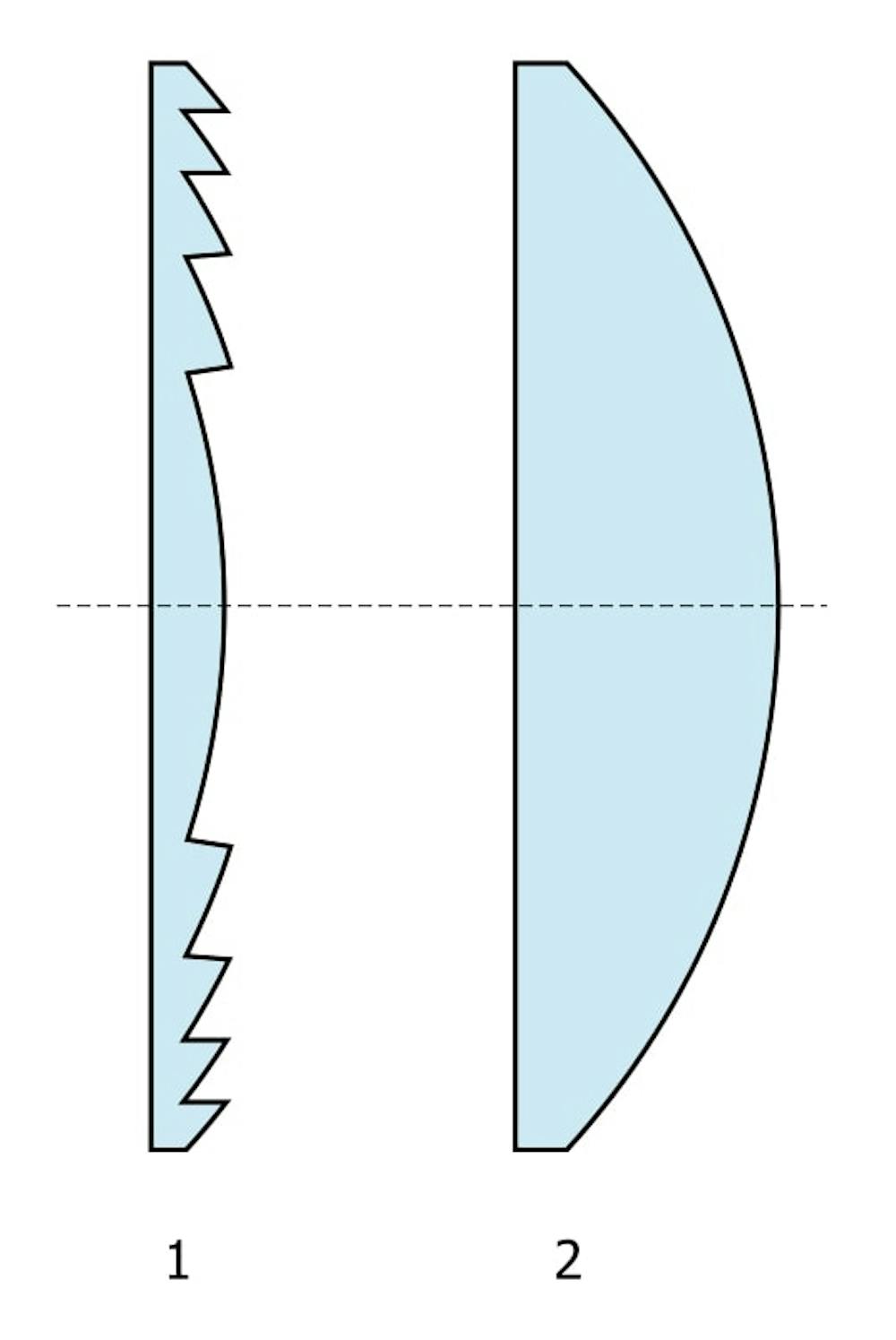
A cross section of two lenses, with the one on the left showing a jagged surface and the one on the right a rounded surface.

Diffractive lenses, left, are much thinner compared to similarly powerful refractive lenses, right. Pko/Wikimedia Commons

Conventional lenses use refraction to focus light. Refraction is when light changes direction as it passes from one medium to another – it is the reason light bends when it enters water. In contrast, diffraction is when light bends around corners and obstacles. A cleverly arranged pattern of steps and angles on a glass surface can form a diffractive lens.

The first such lenses were invented by the French scientist Augustin-Jean Fresnel in 1819 to provide lightweight lenses for lighthouses. Today, similar diffractive lenses can be found in many small-sized consumer optics – from camera lenses to virtual reality headsets.

Thin, simple diffractive lenses are notorious for their blurry images, so they have never been used in astronomical observatories. But if you could improve their clarity, using diffractive lenses instead of mirrors or refractive lenses would allow a space telescope to be much cheaper, lighter and larger.

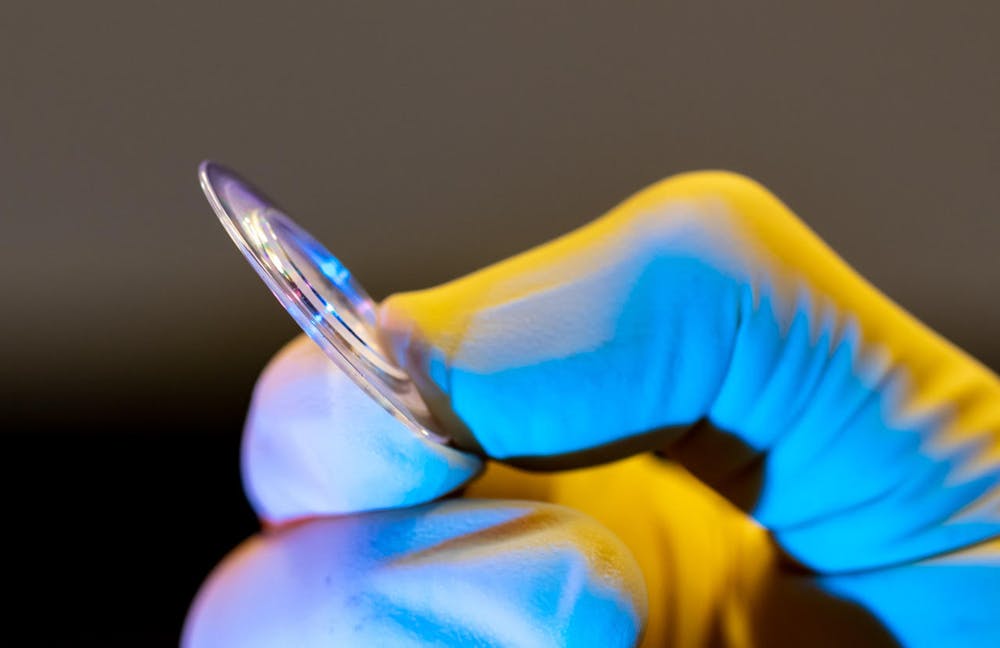
A person holding a round, thin piece of glass.

One of the benefits of diffractive lenses is that they can remain thin while increasing in diameter. Daniel Apai/University of Arizona, CC BY-ND

A thin, high-resolution lens

After the meeting, I returned to the University of Arizona and decided to explore whether modern technology could produce diffractive lenses with better image quality. Lucky for me, Thomas Milster – one of the world’s leading experts on diffractive lens design – works in the building next to mine. We formed a team and got to work.

Over the following two years, our team invented a new type of diffractive lens that required new manufacturing technologies to etch a complex pattern of tiny grooves onto a piece of clear glass or plastic. The specific pattern and shape of the cuts focuses incoming light to a single point behind the lens. The new design produces a near-perfect quality image, far better than previous diffractive lenses.

A triangular piece of glass with subtle etchings reflecting in the light.

A diffractive lens bends light using etchings and patterns on its surface. Daniel Apai/University of Arizona, CC BY-ND

Because it is the surface texture of the lens that does the focusing, not the thickness, you can easily make the lens bigger while keeping it very thin and lightweight. Bigger lenses collect more light, and low weight means cheaper launches to orbit – both great traits for a space telescope.

In August 2018, our team produced the first prototype, a 2-inch (5-centimeter) diameter lens. Over the next five years, we further improved the image quality and increased the size. We are now completing a 10-inch (24-cm) diameter lens that will be more than 10 times lighter than a conventional refractive lens would be.

Power of a diffraction space telescope

This new lens design makes it possible to rethink how a space telescope might be built. In 2019, our team published a concept called the Nautilus Space Observatory.

Using the new technology, our team thinks it is possible to build a 29.5-foot (8.5-meter) diameter lens that would be only about 0.2 inches (0.5 cm) thick. The lens and support structure of our new telescope could weigh around 1,100 pounds (500 kilograms). This is more than three times lighter than a Webb–style mirror of a similar size and would be bigger than Webb’s 21-foot (6.5-meter) diameter mirror.

A spherical object in space with a lens on one side.

The thin lens allowed the team to design a lighter, cheaper telescope, which they named the Nautilus Space Observatory. Daniel Apai/University of Arizona, CC BY-ND

The lenses have other benefits, too. First, they are much easier and quicker to fabricate than mirrors and can be made en masse. Second, lens-based telescopes work well even when not aligned perfectly, making these telescopes easier to assemble and fly in space than mirror-based telescopes, which require extremely precise alignment.

Finally, since a single Nautilus unit would be light and relatively cheap to produce, it would be possible to put dozens of them into orbit. Our current design is in fact not a single telescope, but a constellation of 35 individual telescope units.

Each individual telescope would be an independent, highly sensitive observatory able to collect more light than Webb. But the real power of Nautilus would come from turning all the individual telescopes toward a single target.

By combining data from all the units, Nautilus’ light-collecting power would equal a telescope nearly 10 times larger than Webb. With this powerful telescope, astronomers could search hundreds of exoplanets for atmospheric gases that may indicate extraterrestrial life.

Although the Nautilus Space Observatory is still a long way from launch, our team has made a lot of progress. We have shown that all aspects of the technology work in small-scale prototypes and are now focusing on building a 3.3-foot (1-meter) diameter lens. Our next steps are to send a small version of the telescope to the edge of space on a high-altitude balloon.

With that, we will be ready to propose a revolutionary new space telescope to NASA and, hopefully, be on the way to exploring hundreds of worlds for signatures of life.

Daniel Apai, Associate Dean for Research and Professor of Astronomy and Planetary Sciences, University of Arizona

This article is republished from The Conversation under a Creative Commons license. Read the original article.

How dead is “dead enough”?

It’s always challenging to talk about death. It’s even harder when helicopters are drowning out your conversation. On a flawless Charleston spring afternoon, I was chatting with a palliative care social worker. We were both there to attend a lectureship on the ethics of organ transplantation, but as we stood outside a Medical University of South Carolina building during a break, we couldn’t ignore that our words were being increasingly muffled out by an overhead whirr.

My companion looked upward. “Probably another critical care patient,” she said, clearly accustomed to the sound. Hovering in the cloudless sky over our heads, there was a living person in crisis, someone who might in the very near future become a dead body. I was there learning how fluid the difference between those two states really can appear. In this country, we have spent decades debating when life begins, and the ethical and legal implications of that question. But when does death begin? And what do we do when it looks uncannily like life?

What does it mean to be “actually dead”?

On Friday, Aug. 12, 2022, a Los Angeles Times headline announced “Anne Heche, TV, film and stage actor, dies at 53 from injuries in L.A. car crash.” Salon similarly ran the news that Heche was “dead at 53” after injuries sustained from a car crash. A full two days later, The New York Times reported that Heche “died on Sunday in Los Angeles.” The obituary went on to state that Heche spokesperson Holly Baird had confirmed via email that the actor was “peacefully taken off life support.”

The discrepancy in the death date had arisen because Heche was an organ donor. The Los Angeles Times explained, “As of Friday, Heche was legally dead, but her heart was still beating and her body was kept on life support to preserve viable organs for possible donation.” In a follow-up feature, The Washington Post affirmed that editorially, it “doesn’t recognize brain death.” Obituaries editor Adam Bernstein explained, “It’s black and white. There’s no gray area here. If you’re on life support, you’re still alive. Other publications can make their own judgment about when they’re comfortable publishing. I’m comfortable when someone is actually dead.” Heche’s family concurred with The Post’s call. Baird told me that the actor’s family considers Sunday, Aug.14, “the day the statement went out,” as the date of her passing.

Contrary to what The Post says, the determination of when a person is “actually dead” isn’t black and white at all. At times, it’s a complex judgment call, one that medical, legal, ethical and theological experts — as well as surviving family members and media outlets — don’t always agree upon. For a person who is a registered organ donor, the determination of death starts a clock running for viable procurement. For their loved ones, it’s the life-changing difference between being a wife and a widow, a companion and a mourner, a child and an inheritor. For individuals across a wide span of varying belief systems, it’s a matter of when the person they cared about is still here, and when their soul has departed for somewhere else. And it’s a process that, for almost all of us who are registered organ donors, begins with the casual checking of a box.

Checking the box

The nonprofit Donate Life America estimates that 90% of organ donor registrations in the United States come via state departments of motor vehicles (DMVs). Organ donor icons now appear on 47 out of 50 state driver’s licenses. The advantages of DMV deceased donor registration are apparent, as most American adults carry driver’s licenses. But is checking that box anything like informed consent? When I enrolled in a clinical trial, I had to sign off on 28 pages of detailed information involving numerous potential scenarios. The last time I renewed my driver’s license, I gave more thought to what my hair and makeup looked like in my photo than I did to the end-of-life directive I tacked on as an afterthought.

 Driver's License Of Organ Donor, illustrationDriver’s license of organ donor, illustration (Getty Images/LinaDes/Salon)It’s easy to grant approval for organ donation without actually considering how it might play out. In New York, where I live, the “Become an Organ Donor” information page doesn’t mention the word “death” even once, though it does appear on the bottom of the enrollment form. (However, you can find, if you look around a little, a PDF fact sheet that does explain that your decision to be a donor “will not affect your medical care or treatment while you are alive.”) What definitely isn’t there is a mention of the possibility that your body might be deceased as your heart continues to beat for the purposes of procurement.

Over the past few years, I have thought about what it means to die on a daily basis. My stepfather, mother and mother-in-law have all died, in what felt like whiplash succession. I have watched other people in my life go through sudden and terrifying brushes with mortality. Now, another close friend is nearing the end of what’s been a particularly cruel diagnosis and illness. Meanwhile, I’m doing a doctoral program in medical humanities, focusing on care ethics. Yet for all my personal and scholarly proximity to death, I still have felt deeply in the dark about how and when that light goes out for good. I wanted to understand.

“We’re tied to this idea that death is an event, that it’s a binary.”

That day in Charleston, I listened, riveted, when one of the speakers, Aaron Wightman, MD, MA, observed, “We’re tied to this idea that death is an event, that it’s a binary.” His words left me wondering what it would mean for death to be something else. If a heart is kept beating, if a body is kept warm, is that death? When is a person dead enough to execute their will? To send up a prayer to their spirit? To grieve their absence?

“In a legal sense, death is a binary. One is dead, or one isn’t,” Wightman, the co-director of education at the Treuman Katz Center for Pediatric Bioethics and Palliative Care at Seattle Children’s Hospital, told me a few weeks after the event in Charleston.

The experience of dying, however, is complex, involving different organs and functions that don’t all cease simultaneously. The criteria for evaluating and defining death have evolved over time and continue to do so. And the organ procurement process, along with the ever-advancing technology surrounding it, complicates our understanding of how and when the end of life arrives.

“In a physiologic sense, and in a medical sense, death is a process that occurs over time,” Wightman said. “A declaration of death is made by a clinician during the dying process, but that declaration is informed by definitions of death. These definitions, while appearing objective and unchanging, also reflect value judgments about the time we choose to treat a human being as deceased and potentially as an organ donor. Defining death is a moral rather than purely scientific question.”

Wait, don’t we already know what death is?

The breath stops, the heart stops, the brain stops and rigor mortis soon appears. Death, in the vast majority of circumstances, is a clearcut experience that isn’t up for debate. Yet we humans carry within ourselves the primal hope and the primal fear of someone making the wrong call. Jesus famously contradicted the bad news about his friend Lazarus, and later used the same move on himself, to great success. Edgar Allan Poe’s recurrent literary fascination with premature burial helped spur a 19th-century industry of “safety coffins,” tricked out with bells or escape hatches in case the morgue had been premature. By the 20th century, it was advancements in medicine that created the need for a more surefire assessment of death.

“Defining death is a moral rather than purely scientific question.”

Having an agreed-upon determination of death is crucial in organ procurement because the vast majority of the organs used in transplantation are obtained from the deceased. Transplant ethics in the U.S. are guided by the Dead Donor Rule, which requires that an individual be declared deceased before certain vital organ procurements. Among the body parts that can be donated after death are the heart, pancreas, corneas, lungs, kidneys and liver.

The Uniform Anatomical Gift Act, which provides the legal backbone of the organ donation process in the U.S., was enacted in 1968. That same year, spurred by both “improvements in resuscitative and supportive measures” and concerns that “obsolete criteria for the definition of death can lead to controversy in obtaining organs for transplantation,” a Harvard Medical School committee recalibrated our modern American understanding of the end of life. “A Definition of Irreversible Coma” brought the concept of brain death into the vernacular and put the emerging field of organ transplantation front and center within it.

Since then, language has continued to evolve, and Harvard’s use of the word “coma” there doesn’t align with how we think of it today. In comas or persistent vegetative states, the conditions that spurred galvanizing right-to-die cases like Karen Ann Quinlan’s and Terri Schiavo’s, a person may be able to breathe independently, and there will still be some brain function. In brain death, there’s no brain stem activity.

We need your help to stay independent

A peer-reviewed feature in the December 2020 AMA Journal of Ethics reported that “there have been no legitimate, unconfounded false positive cases of a patient declared dead by neurological criteria according to the practice parameters put forth by the [American Academy of Neurology].” A correctly declared brain-dead person isn’t in a coma; they won’t recover. A 2014 article in the journal Neurology further makes the case for “Why brain death is considered death and why there should be no confusion,” explaining that “In the medical judgment of practicing neurointensivists, neurosurgeons, and all neurologic and neurosurgical societies and academies throughout the world, brain death constitutes death of the person.”

A decade after the Harvard report, the Uniform Law Commission (ULC) set out to create a centrally agreed-upon criteria for death in the U.S. What began as the 1978 Uniform Brain Death Act eventually evolved into the Uniform Determination of Death Act (UDDA), and in 42 years, the bar it set has remained unchanged. In succinct, plain language, the UDDA states that “An individual who has sustained either (1) irreversible cessation of circulatory and respiratory functions, or (2) irreversible cessation of all functions of the entire brain, including the brain stem, is dead. A determination of death must be made in accordance with accepted medical standards.” The UDDA is the standard in 37 states and the District of Columbia, but other states have set their own guidelines.

A great deal in that small text conspicuously comes down to opinion. The ULC notes that “The UDDA is intentionally not entitled the Definition of Death Act. This is because it does not contain an exclusive definition of death.” The word “irreversible” can be a judgment call. (There is some discourse around whether the word “permanent” would communicate the standard more effectively.) And the phrase “all functions of the entire brain” isn’t fully accurate for a variety of reasons, including that there can be lingering activity in the hypothalamus after brain death is declared. This is one of the biggest points of contention about the phrasing of “brain death.”

What is death? Depends on where you die

Further complicating matters, every state has its own language for how “accepted medical standards” are met, and by whom. Decisions can vary from state to state, hospital to hospital, practitioner to practitioner. New York state’s determination of death allows that “Each hospital shall establish and implement a written policy regarding determinations of death” based on UDDA guidelines. Idaho tacks on a criteria to meet “the usual and customary procedures of the community in which the determination of death is made.” And Georgia stipulates that the determination be made by “a qualified physician, by a registered professional nurse authorized to make a pronouncement of death, or by a physician assistant authorized to make a pronouncement of death.”

Meanwhile, New Jersey is the only state that recognizes “the legal right of an individual to claim an exemption from the application of neurological criteria for determining death if such a declaration would violate that individual’s personal religious beliefs.” In other words, a person can be declared brain dead, and their next of kin or health care proxy has the right to disagree. Over the past decade, an increasing number of families — almost always parents pushing back against a determination regarding their children and often in cases involving organ transplant directives — have done so.

In December 2013, three days after hemorrhaging and going into cardiac arrest following a complex tonsillectomy, 13-year-old Jahi McMath was declared brain dead. Children’s Hospital Oakland later released McMath to the Alameda County coroner’s office, and a death certificate was issued. Her family fought the hospital’s decision to discontinue life support, filing a lawsuit in Alameda Superior Court. McMath was eventually moved to an undisclosed facility where, as her family attorney Christopher Dolan put it, she could be kept on a ventilator and “treated like the innocent little girl that she is, and not like a deceased body.”

Over the next five years, McMath’s body continued to grow. It went through puberty, and her uncle told CNN that she was responsive to audio and touch. She was officially pronounced dead of complications from liver failure on June 22, 2018, in the state of New Jersey.

Because McMath was only 13 when she was declared brain dead, she wasn’t bound by any organ donation authorization. But for other individuals in similar cases, there had been a choice — one that became deeply contested. Following a snowboarding accident in 2007, the parents of 18-year-old Ohio teen Gregory Jacobs sued his hospital and the Center For Organ Recovery and Education, alleging that the hospital had hasted his death for the purpose of organ procurement. The case was eventually settled for $1.2 million.

“They said from the neck up he’s dead, but he don’t look dead to me.”

In 2019, 26-year-old Arizona man Ruben Vati was pronounced dead following a drug overdose. His family responded by procuring a temporary restraining order to keep him on life support. Though Vati’s parents claimed on his behalf that he had later “expressed remorse over this decision,” he was registered with the Donor Network of Arizona. The family sued the organization and the hospital to prevent the planned organ donation, and the Network countersued the family, arguing that five patients were awaiting the donation he had authorized in the event of his death. “They said from the neck up he’s dead,” his mother Stela Vati told reporters at the time, “but he don’t look dead to me.”

What Stela Vati endured remains a devastating scenario to imagine: watching over a son who appears alive while doctors tell her that he is dead. Knowing what can be done to keep the appearance of life, should looking dead be a consideration in deciding if someone actually is dead? In an op-ed about McMath published by CNN, bioethicist Robert Veatch urged for the legal system to “let parents decide if [the] teen is dead.”

“Society should show sympathy for mothers who want their children to be kept alive . . . Whether this right to medical support should extend to those considered dead by one standard, but alive by another is the question we face with Jahi McMath,” Veatch wrote in 2014. “If the patient does not suffer, and private funding is available, people should have the right to make this decision for their loved ones.”

In the Neurology article on brain death published later that year, the authors countered that “such a position assumes that the integrity of medical professionals is not compromised in such circumstances. We reject this position as falling outside the scope of conventional thinking about the management of a deceased patient’s body following a declaration of death.”

Why there can be disagreement over whether a person is dead

Clearly, in spite of the UDDA, a declaration of death isn’t always the final word. How did we get in such a murky place? If anyone had a solid answer, I figured it would be Thaddeus Pope, JD, PhD, HEC-C, an attorney and professor at Mitchell Hamline School of Law in Saint Paul, Minn. While I also met Pope in Charleston, I had been hearing about him for years through my academic work in ethics. He’s one of the country’s most influential experts on brain death law, as well as the co-author of “Right to Die: The Law of End-of-Life Decisionmaking.”

Pope replied, professorially, with a question. “So, what does it mean to be dead?” Then he explained, “You can be dead because you’re neurologically dead, or you can be dead because you’re circulatory dead. Very few people die on brain death criteria, maybe 20,000 out of 3 million. It’s an incredibly small number. Almost everybody, when they die, is declared dead on circulatory criteria. The challenge is that I think the general understanding is that it’s some kind of objective scientific truth, that it’s irreversible, that it’s not man-made. And all of those things are not true.”

“We made up brain death. It’s arbitrary.”

“We made up brain death. It’s arbitrary,” he continued. “We drew the line where we drew it. We could have drawn it somewhere else. Worse, every year, there are many cases of brain-dead pregnant people. This shows that obviously, brain death doesn’t mean that the body has disintegrated. The body can still do lots of stuff, even after death. Right off the bat that strikes people as, ‘That doesn’t seem right.’ And it’s not right, because legally it’s supposed to be irreversible cessation of all functions of the entire brain.”

“The line between life and death is less clear than it used to be, more contested than it used to be,” Pope added. “It’s switched from this life and death question to more of a ‘Who has the right to control life-sustaining health care?’ question.”

Pope said he can see a clear rise in challenges to determinations of death over the past decade. “If we charted this starting from the Jahi McMath case,” he said, “you have an amazing number of conflicts in the hospital where they say, ‘Sorry, your family member is dead,’ and the family says, ‘No, they’re not. We don’t believe you.’ Jahi McMath got so much attention that it spurred people to re-examine all of this. Not just the clinicians, not just the ethicists, not just the lawyers, but also the advocates.”

Inevitably, this is where religion gets involved. “You have organizations like Texas Right to Life,” Pope said, “which say, ‘Look, call us. If the hospital tells you that your loved one is dead, we’ll fight for you.'”

While it lacks the single-issue momentum of the anti-abortion movement, death is another topic that has been embraced by religious and political conservative groups. On the Texas Right to Life site that Pope guided me to, there’s an anxious warning about the potentially “fatal consequences for those of us with that little red heart on our driver’s licenses.”

“Despite seeing your loved one breathing, despite seeing them maintain their blood pressure, urinate, squeeze your hand, or cry . . . once a declaration of brain death has been entered, your consent to remove basic medical care like a ventilator is no longer required,” Emily K. Cook writes. “It is at this stage when Texas Right to Life receives many calls from bereft spouses, desperate parents, and helpless children.”

We Americans don’t have confidence in our health care, and often with good reason.

We Americans don’t have confidence in our health care, and often with good reason. In a 2023 Harris poll, more than half of respondents gave their care a C rating or lower. The problems run even deeper in communities of color. A 2021 Deloitte study of Black, Hispanic, Asian and Native American respondents found that “55% reported a negative experience where they lost trust in a health care provider,” and that “After an experience where they lost trust, four out of five participants say there was nothing the provider/health system could do to make them return to the same provider or health system.” If trust and respect aren’t already there, why take a doctor’s word on anything, especially if your own eyes contradict them?

What organ donation is really like

The idea that an eager medical team might want to rush along a diagnosis of death to procure organs is an unsettling thing to contemplate, but it’s understandable why it would resonate emotionally if you already believe the system doesn’t value your life. The truth, however, is that there are ethical guardrails in place to circumvent those conflicts. For starters, an individual’s medical team and the organ procurement organization are distinct.

John Entwistle, MD, PhD, a cardiothoracic academic surgeon at Thomas Jefferson University in Philadelphia, explained the process reassuringly to me shortly after I saw him speak in Charleston. “When you’re checking a [donor registry] box, the most important thing to know is that your diagnosis of death, the management of you, in terms of trying to save your life, will not be affected,” he said. “It does not hurt the process.”

“If anything,” he continued, “I feel that it is easier for health care providers to rationalize aggressive care even in a situation that seems futile when there is the potential that we may be able to save other lives through donated organs. If we can save the heartbeat of our patient, maybe we can save their brain and get a survivor out of that. And if we can’t, maybe we can get an organ donor and help others. If anything, checking the box gives us additional motivation to be aggressive in treatment when things seem hopeless, but it definitely does not diminish the care we provide.”

But exacerbating the trust problem are the confusing semantics of care. We use the phrase “organ donor” for both living donors (kidney and liver donors, for example) and deceased ones. We say we have signed up for organ donation when we have likely registered for organ, eye and tissue donation. Words like “life support” are used to describe equipment and practices for people who have been declared brain dead. (Some ethicists prefer the phrase “organ support.”) And brain death, legally, is death. It just doesn’t always behave like it.

Imagine this: A person you love is in a hospital bed, and all signs point to imminent death. The doctors and nurses you have been working with talk to you about what is happening, and what to expect. Then, to avoid ethical conflicts and coercion, you talk to someone else — a nurse or other liaison from an organ procurement organization — and discuss what happens next. If that person never joined a donor registry, the representative may have a conversation with you about what the person’s wishes would be, and then the decision is up to you.

“When you don’t check the box, you should know that you’re not declining,” said Ana Iltis, PhD, the director of the Center for Bioethics, Health and Society at Wake Forest University, and another expert I first met in Charleston. “You should know that it’s just postponing the decision and giving up the decision to somebody else. I think people need to know what silence means.”

“When you don’t check the box, you should know that you’re not declining. You should know that it’s just postponing the decision and giving up the decision to somebody else.”

But what if your loved one has registered as a donor? If you feel good about it, then this part goes more smoothly. Otherwise, “If a family does not endorse donating the organs,” health care ethicist Yvette Viera explained to me on a blustery evening last winter when I went to see her in New Jersey, “then the conversation may shift to the signed organ donor card. That is considered a valid executed document, and the family will be notified that they actually cannot refuse organ donation or override the donor card of their loved one.” Is it any wonder then that some families exert the only power they can in that situation and challenge the diagnosis of death itself?

Meanwhile, let’s assume your loved one has stopped breathing, and their heart has stopped beating. There’s then what’s known as a standoff period, usually between two and five minutes, depending on the facility’s protocols, for observation without intervention. A brief stillness. The procedures would look a little different for brain death, but either way, let’s say that now your loved one is now deceased. The process of organ procurement begins — and it has to start quickly.

The window of time in which organs can be safely and successfully obtained is relatively short, typically no more than about three days. That can feel like an eternity for a grieving family making final arrangements.

“If somebody is declared dead by neurologic criteria or brain dead,” Viera said, “the body will still be on organ support, breathing for them, providing nutrition, keeping their blood pressure up to optimize the organs before they are removed. During that 72 hours, the body goes through a huge amount of testing and bloodwork to determine the quality of all of the different organs and potential recipients.”

By now, she continued, “The family will have been told by the clinical team that their loved one is dead, and that the machines are keeping the organs functioning for a limited period of time. Keep in mind, when they go and see their loved one, they’re in bed, their chest is rising, they’re perfused and pink, warm to the touch. They don’t look dead. Those are highly critical, emotional times for the family.”

I try to picture the scene. If that was my loved one’s warm hand in mine, how certain could I feel about letting go?

“One of the great hurdles for end-of-life care is that people haven’t thought about death. They haven’t seen death. Except for sudden deaths, death is happening in the hospital.”

“It’s easy to talk about transplants and just how great it is. But the flip side of it is — except for live kidney donation and living donors who give part of their liver — somebody has to die right before transplanting,” Grant Goodrich, PhD, the director of ethics at MUSC Health and one of the organizers of the Charleston lectureship event, recently told me. “In terms of getting organs from donors, much of this is about people coming to terms with death. One of the great hurdles for end-of-life care is that people haven’t thought about death. They haven’t seen death.”

“Except for sudden deaths, death is happening in the hospital. It’s not in public. And so people have no idea of what being really, really sick looks like, what end-of-life care looks like,” he continued. “That feeds also into distrust. Suddenly, they’re on the spot making these decisions with people they’ve never met in a building that’s totally foreign from anything that they’ve ever experienced. It creates a lot of complex challenges.”

Why do we need all these organs, anyway?

There may come a time in the near future when human organ donation is a relic of medical history. In the past year alone, there have been promising breakthroughs for heart and kidney transplants from animals (a process known as xenotransplantation). Meanwhile, advancements in the field of medical devices and other therapeutics have led some health care professionals, like British surgeon Stephen Westaby, to envision the day when “We won’t see any more heart transplants.” But that day isn’t here yet.

The American organ shortage is acute, despite a depressing uptick in the potential pool of donors in recent years thanks to the opioid crisis. Figures from a 2019 review in the New England Journal of Medicine estimate that nearly 18% of deceased donors have died of overdoses, up from only 1.5% in 1999. The Health Resources and Services Administration estimates that more than 100,000 Americans are currently on the national transplant waiting list. Seventeen people die every day waiting for organs.

It’s a crisis that disproportionately affects the most vulnerable. A 2022 review in the International Journal for Equity in Health of disparities in access to heart, lung, liver, pancreas and kidney transplantation found that “Racial and ethnic minorities, women, and patients in lower socioeconomic status groups were less likely to be referred, evaluated and added to the waiting list for organ transplant.”

“Although almost 170 million people are registered to be donors, only three in 1,000 people die in a way that allows for deceased organ donation.”

Exacerbating the shortage is that viable donors are hard to come by. According to 2023 information from Penn Medicine, “Although almost 170 million people are registered to be donors, only three in 1,000 people die in a way that allows for deceased organ donation.” But because “One deceased organ donor can save up to eight lives,” the more people who add their names to donor registries, the more waiting recipients will have a chance. 

It’s a legacy that plenty of us would be proud to leave behind. “His tender heart lives on in someone else because of his never-ending desire to help others,” the mother of Jordan Michael Cummins, who died in 2022, wrote for the United Network for Organ Sharing. The mother of 10-year-old Garrett Brockway, who died in 2013, told the University of Iowa Hospitals and Clinics three years later that “Garrett saved five people, and he’s a hero in our minds. And if other people would be willing to do that and realize it’s not an ugly, scary, bad process, that it truly is a beautiful process, so many more lives could be saved.”

The easiest and most successful method for enlisting donors is through a simple act of routine form filling, probably while fiddling on your phone at the DMV. That simplicity, however, also opens the door for a spectrum of interpretations and ethical challenges.

On the one hand, bodily autonomy should be as clearcut a right as it gets. If I have signed up to be a deceased organ donor and the circumstances of my death qualify me as one, my wishes should be respected. But have I truly been given enough information to make a choice that is in my best interest? In my family’s best interest? Does a fatally injured teenager who has only just learned how to drive need an organ procurement agency, or an advocate?

“The decision to be a deceased organ donor has implications for what happens to them and to their bodies, and therefore to their families around them,” Iltis said. “There are time delays, there are all kinds of things, there are good reasons for those things. But those might matter to some people, and we don’t make that information readily available.”

“I believe in respecting people’s wishes,” Iltis added, “but I don’t think we do a good job of setting people to be up to be able to communicate them. [The DMV registry] allows people to communicate a very crude decision, and then it treats it as if it’s the most important wish they have, their absolute deepest desire. We go from there, but we haven’t set up a system that would allow them to tell us that. I really believe in truthfulness and transparency, and I don’t think we have it.”

“Do people understand what they’re doing when they sign up to be an organ donor? They definitely do not.”

Pope told me something similar. “Do people understand what they’re doing when they sign up to be an organ donor? They definitely do not,” he said. “It’s not like a thing you can understand, this is what death is. It’s hard for a layperson, when they go to the DMV to say, ‘What is that? What does this mean?’ Not even the experts are on the same page on what it means. The general rule has been just make it as easy as possible for people to become donors, which means it’s not careful, and it’s not thoughtful and it’s not informed.”

“If you make it more difficult, the fear is that people are going to go, ‘I don’t understand. I’ll just click no.’ I think, unfortunately, those are two goals that are in conflict,” he continued. “I know that somebody would say, ‘OK, great, we’ll be more transparent. That’s going to cost two thousand fewer transplants next year — whatever the number is.’ I don’t know how to trade those off. I’m always in favor of transparency, and if it causes fewer transplants, then so be it.” 

Samuel Kerstein, PhD, professor and chair of philosophy at the University of Maryland, had a sobering perspective when I spoke to him about the ethical dilemma of rethinking the organ registry process. “So much is at stake here,” he said. “We’re talking about significant extra life that people can live if they get a kidney donation as opposed to being on dialysis. So, taking steps that might discourage donation? That’s serious stuff. That has implications that are tough to accept.”

In my own life, my expectations around organ transplantation have been derived almost exclusively from TV dramas. An early ’80s plot on “St. Elsewhere” featured the sudden death of a character’s wife, a convenient piece of timing for a cardiac patient awaiting transplant. The episode ended with a newly widowed physician holding his stethoscope, intently listening to his late spouse’s heart beating in another woman’s chest. On a 1995 episode of “Chicago Hope,” the frustrated brother of a patient awaiting a heart transplant held an operating room hostage before declaring, “My donor card is in my wallet,” and shooting himself. And on a 2011 episode of “House,” the prickly eponymous medical doctor was permitted to leave prison to work his genius on a lung transplant case. Almost always — in nearly every show, in nearly every movie ranging from serious to comedic — the stillness of death is signaled with the beep of an EKG going steady and its line going flat. That was how I assumed death worked.

Then, a few months ago, I was eating fries at a restaurant in Bruges, Belgium, with some colleagues during a conference on palliative care. One of them, who works at a hospital here in the U.S., started talking about how distressing the end-of-life process for organ donors can be for both surviving loved ones and medical staff alike. There’s a possibility that staff will have to do CPR on the bodies of individuals who have been declared brain dead and are designated for organ donation, she said. This is called organ preserving CPR.

“I can’t code [resuscitate] a dead body, and nobody told me that I had to. That’s a trauma to me.”

“We’ve had some really tough ethical consults with team member physicians, who were like, ‘I can’t code [resuscitate] a dead body, and nobody told me that I had to. That’s a trauma to me. I can’t do that,'” she said. “And does the family even know that this is a possibility?'”

I didn’t know. Whatever I had thought happened when an organ donor dies, I was shocked when I found out.

Redefining death

While our response to end-of-life care and organ transplantation has continued to evolve over the years, our central guiding principle for death has remained the same. Recently, medical practitioners and ethicists have called for revisions to the UDDA, and at the upcoming annual meeting of the ULC in Honolulu later this month, one of the agenda items will be a three-hour session covering “Consideration of the Uniform Determination of Death Act.” But there’s no firm consensus on exactly what an updated criteria for death should be, and a range of possibilities are now on the table. It’s an opportunity for clarity — and contention.

In a 2022 article published in the journal Neurology, Pope, along with several peers from the medical, legal and ethical world, argued that “The concern is that the legal criteria and the medical standards used to determine death by neurological criteria are not aligned.” The authors proposed a revised and less ambiguous “neuro-respiratory criteria” for death: “brain injury leading to permanent loss of a) the capacity for consciousness, b) the ability to breathe spontaneously, and c) brainstem reflexes.”

But a letter to the ULC in June on behalf of the American College of Physicians (ACP) urged a more constrained approach, requesting that the wording be tweaked to read “permanent cessation of circulatory and respiratory functions, or irreversible cessation of all functions of the entire brain” and stating that “a neurorespiratory approach sends a message that death is not a biological reality.” The ACP also advocated for “complete separation of issues regarding the determination of death from issues around organ transplantation.”

Conservative religious groups offer an altogether different stance. In an April op-ed in the Catholic Times, Fr. Tad Pacholczyk took issue with updating the UDDA’s criteria for brain death, stating that “Even to be ‘slightly alive’ is still to be alive.” The American Life League goes a step further, arguing that “Medical and legal elites want the Uniform Law Commission (ULC) to change the Uniform Determination of Death Act (UDDA) to make ‘brain death’ easier to declare, explicitly without consent” (and presumably over family objections). As a counterpoint, they argue that “Death is the cessation of the person’s life on earth. The soul or life force, not any one body part, is the unifying life principle . . . [brain death] criteria are based on bedside observation of lack of functions, presumed to be ‘irreversible’ or ‘permanent, neither of which can be tested empirically. They do not require necrosis or destruction.” They propose the criteria should be revised to determine that “No one shall be declared dead unless respiratory and circulatory systems and the entire brain have been destroyed. Such destruction shall be in accord with universally accepted medical standards.”

“Once our physical life ends, time will be transformed.”

While that wording seems certain to be rejected by most mainstream medical criteria, the League’s use of the word “soul” here is striking. “The precise moment when the soul, the immaterial life force, separates from the body is of paramount importance,” the American Life League states. But if we can’t come to a consensus on when an individual is deceased, how can we even begin to approach the comfort that faith seems to promise regarding the “precise” departure of the soul? And for those who believe that this life is only a preparation for another one, why hang on so fiercely to it?

I posed my questions to Rev. James T. Bretzke, SJ, STD, a professor of theology at John Carroll University, who offered additional perspective. “In Catholic theology, we believe that the soul does not cease when the physical body ends,” Bretzke told me during a recent phone call. “It goes from human life to eternal life. That is a transition. How does that transition occur? I think most of us would say, well, there’s a process. As we close our eyes on physical life, we will open them on eternal life. But is that process of closing eyes and opening eyes instantaneous? Once our physical life ends, time will be transformed. And since we are on this side of that great divide, it’s very hard for us to imagine what this new life will be like. But I think that is the process that we’ll grow into.”

“Dead enough”

Whatever the outcome of any updates to the UDC that may emerge from the ULC in the future, questions over how we declare death are likely to remain. One intriguing workaround is to shift some of the focus from clarifying death to how we understand organ donation.

“A good amount of polling survey data suggests that the two questions don’t need to be linked, organ donation and death,” Pope told me when we spoke. “A lot of people are like, ‘If I’m catastrophically critically ill, you can go ahead and take my organs. I don’t need to be dead. If I’m in a persistent vegetative state, if I don’t meet the criteria for brain death, but I’ve had an anoxic brain injury and I’m never going to wake up, I’m in a permanent coma, that’s good enough. If you want to take my organs, go ahead.” Pope explained that currently, “Legally, that’s not allowed. But the American public, at least a lot of them, are like, ‘Fine, I’m dead enough for me if you need my organs.'”

“The American public, at least a lot of them, are like, ‘Fine, I’m dead enough for me if you need my organs.'” 

In 2014, 42-year-old New Jersey man Dave Adox was diagnosed with amyotrophic lateral sclerosis (ALS), a fatal, progressive and incurable disease of the nervous system that weakens the body’s ability to move, breathe and swallow. Two years later, as his bodily functions were rapidly slipping away, he made a decision about how he wanted his end of life and organ donation to go. Adox and his husband planned for University Hospital in Newark to have his ventilator disconnected. 

But combining a voluntary removal from a ventilator and organ donation raised a red flag for the hospital’s attorneys, who intervened to stop the process. Adox’s primary physician, John Bach, MD, told NPR at the time, “I could have given [him] a prescription for morphine, and he could have been taken off the ventilator at home. But he wanted his organs to be used to save other people’s lives!”

Eventually, with the help of organ procurement organization LiveOnNY and Mt. Sinai Hospital, Adox was able to have the end that he wanted. He died in May 2016 on the hospital’s palliative care floor, and his liver and kidneys were donated.

The idea of connecting medical aid in dying and organ procurement in the U.S. is still far from the norm. But medical aid in dying policies are in place now in 10 states and the District of Columbia — and a majority of Americans support them, according to Gallup. As the example of other nations shows, these two end-of-life issues are inevitably going to dovetail more and more.

In other nations with medical aid in dying, organ transplantation is a more cohesive process. A first-of-its-kind review in the December 2022 issue of the American Journal of Transplantation found that thus far “in Canada, Belgium, the Netherlands and Spain, a total of 286 people who sought euthanasia provided organs to save the lives of 837 people.” Canada, which has had a liberal medical assistance in dying policy since 2016, led the way with 136 donors. “I was rather proud that Canada has done so well in terms of organ donation by MAID patients,” Arthur Schafer, the director of the Centre for Professional and Applied Ethics at the University of Manitoba, told CTV News in January.

Organ transplantation evokes polarizing emotions and ambitious ethical questions. On the one hand, there’s the beneficent notion of bestowing the priceless “gift of life,” the tender slogan of donor advocates imploring, “Don’t take your organs to heaven, heaven knows we need them here.” There’s the action movie narrative of a recent AT&T commercial in which a heroic organ procurement team careens its precious cargo to a waiting hospital medical team.

On the other side, there’s urban legend paranoia of waking up from a party in a bathtub full of ice cubes and one kidney short. There’s the existential drama of questioning if, or when, like the ship of Theseus, enough parts are removed that we might cease to be ourselves. There’s the unsettling anxiety evoked by literature like Kazuo Ishiguro’s “Never Let Me Go,” a novel concerned with the idea of people being bred to be mined for their organs — and whether or not they have souls.

After she was declared brain dead last summer, Heche received an honor walk at her hospital, a tradition in which staff line the route from the patient’s room to the one where the organs will be donated. Speaking to her memory, her son Homer Laffoon issued a statement saying, “Hopefully my mom is free from pain and beginning to explore what I like to imagine as her eternal freedom.”

That phrase has been rattling around my head ever since I first read it. I don’t know what, if anything, is on the other side of existence. Yet if there’s any part of us that experiences that eternal freedom, what happens to it in these liminal places we have created? Where does the spirit go while the heart is still beating? That doesn’t seem very black and white at all, but then again, I don’t write obituaries for a living.

[Death is] not a precise moment — it’s a process. The only sure thing is that one day we’ll all find out for ourselves.

I began writing this story because I wanted to understand what happens to our bodies — and to our souls — in the slippery space between life and death. I wanted to know everything that I had signed myself up for when I made a not particularly well-thought-out choice one day at the DMV. I wanted to know what that icon on my license actually represented. In the end, I wound up with more questions than I had when I started. But when I think about all the fears, anxieties and anger I have carried around the subject of death for so long now, I find something strangely peaceful and beautiful within all the uncertainty. It’s not a precise moment — it’s a process. The only sure thing is that one day we’ll all find out for ourselves.

That should have been good enough, but I had to take one last shot at finding an answer. Not long ago, I called up Arthur Pressley, PhD, associate professor of psychology and religion at my university, Drew. We talked about faith and philosophy for a while, and then I asked Pressley at what point he believes the body finally releases the soul. He paused for a moment before replying, then he answered me. “Oh, God,” he said, “I don’t know.”

GOP war on the FBI: Republican attacks on Chris Wray echo ideology of OKC bomber Timothy McVeigh

Ray Epps quite likely is the least sympathetic defamation litigant in history, at least among those who have a legitimate legal argument. To win his recently filed lawsuit against Fox News, Epps has to convince a jury that he sincerely wanted to overthrow the U.S. government to install a fascist dictator and that anyone who suggests otherwise is a dirty, rotten liar. “I’m exactly the piece of scum my detractors deny that I am,” is a weird legal argument. But such is the topsy-turvy world that we live in. A world where Epps may actually win a big pot of gold. 

For those blissfully unaware of the saga of Ray Epps: He was one of the thousands of people who, heeding Donald Trump’s call, descended on the U.S. Capitol on January 6, 2021, in a violent effort to halt the certification of Joe Biden’s election to the presidency. The night before the riot, Epps was caught on video hyping up the MAGA crowd: “We need to go into the Capitol!” The day of, however, he was seen on video impotently offering to help Capitol police to tell rioters to back down. 

The simplest explanation for his behavior is that Epps, like many newbie criminals, got cold feet once he realized he was in too deep. But, led by the now-fired Tucker Carlson of Fox News, right-wing conspiracists have spun out a fanciful tale about how Epps was secretly working for the FBI in a plot to trick conservatives into rioting. The right’s attention continued for months. So now Epps is suing Fox News. That’s how a modern Republican protects his reputation these days: By getting a court to rule that he was quite sincere when he backed a fascist insurrection. 


Want more Amanda Marcotte on politics? Subscribe to her newsletter Standing Room Only.


The notion that the FBI is a leftist organization out to destroy the American right is, it goes without saying, among the dumbest ideas ever generated by human brains. And yet, FBI Director Christopher Wray — a lifelong Republican and Trump appointee — had to sit in a House Judiciary hearing for five hours on Wednesday while congressional Republicans harangued him with variations of the same conspiracy theory Epps has been subject to. Wray did not conceal his exasperation, repeatedly denying that he’s some secret “deep state” plant out to get conservative America. 

As Steve Benen of MSNBC wrote, the FBI is “one of the single most conservative agencies in the federal government,” and is so biased towards Republicans that “the FBI that went out of its way to oppose executing a court-approved search warrant at Mar-a-Lago.” It’s just that Donald Trump is such an extravagant criminal that he’s forced the FBI to take action on cases like the stealing of classified documents or inciting an insurrection. 

On its surface, these anti-FBI conspiracy theories are further evidence there is nothing too low for Republicans when it comes to running interference for Trump. It’s never that Trump is such a massive criminal that he overcomes law enforcement’s unwillingness to deal with him. No, it must be an anti-Trump conspiracy! The Epps conspiracy theory is more of the same. They can’t admit that Trump is the one who incited the Capitol riot, even though we all saw him do it on national television. Instead, they blame some random dude. 

But watching Republicans vomit conspiracy theories at Wray, the name that came to my mind was not Trump’s, but Timothy McVeigh, the right-wing terrorist who blew up the Alfred P. Murrah Federal Building in Oklahoma City in 1995, killing 168 people. McVeigh and his co-conspirator, Terry Nichols, were motivated by anti-government conspiracy theories that sounded very much like the garbage being peddled by Republican congressmen during Wednesday’s hearing. Like Republicans now, they also weren’t super fond of Attorney General Merrick Garland, as he was part of the prosecutorial team that secured convictions for McVeigh and Nichols. 

Everything that follows, from the gun nuttery to the “globalist” and “deep state” conspiracy theories, comes back to this basic right-wing anger over having to share a country with people that aren’t exactly like them. 

McVeigh’s views would have been right at home with what House Republicans were spouting Wednesday: That the U.S. government is being secretly run by a decadent “elite” that wants to brainwash right wing Americans. In the 90s, conspiracists called the fictional secret leaders the “new world order,” and now they use the term “deep state.” Either way, it’s the same conspiracy theory, and it dates back to the overtly anti-semitic conspiracy theories that motivated the Nazis. Then, as now, what was really driving the right-wing anger was not legitimate concerns about FBI overreach. Instead, the anger was over federal authorities prosecuting white men who thought themselves above law. Back then, right-wingers rejected bans illegal weapons or sex with underage girls. Both were going on with cult leader David Koresh, whose 1993 suicide in Waco, TX, after a gunfight with federal authorities, inspired McVeigh’s domestic terrorism. Now, the anger is over any law that might touch Trump, such as the ones against seditious conspiracy or stealing government secrets. But the thread throughout is some men should be above the law, and the right will burn it all down if the government disagrees. 


Want more Amanda Marcotte on politics? Subscribe to her newsletter Standing Room Only.


In the 90s, McVeigh’s views were seen as fringe, and there was no pushback from Republican leaders when he was sentenced to death. Things have certainly shifted in the nearly three decades since. The January 6 rioters, who also attacked a federal building while drunk on anti-government conspiracy theories, are started to be romanticized as martyrs for the Republican cause. Trump rallies regularly feature videos venerating the riot, complete with music recorded by those sentenced to prison for their role in the attack. During the 30th anniversary of Koresh’s standoff, Trump held one of his pro-insurrection rallies near the site where Koresh and his followers killed themselves by setting fire to their compound. Republicans pretended it was just a coincidence, but most observers understood that Trump, like McVeigh, was invoking Koresh’s memory as justification for denying the legitimacy of the U.S. government. 

This unfortunately gets downplayed in much of the historical coverage of McVeigh’s terrorist attack, but it wasn’t just anti-government animosity that motivated him. As David Masciotra of the Washington Monthly noted in May, “An avowed white supremacist, McVeigh also embraced the ‘Great Replacement Theory,’ which posits that ‘Jewish globalists’ conspire to crush whites by opening the borders to immigrants of color.” 

The basic components of McVeigh’s views are all over Republican politics these days, especially the demonizing language painting refugees as “invaders.” But things have escalated recently with Sen. Tommy Tuberville, R-Ala., doing his damnedest to normalize not just some of the concepts McVeigh believed in, but the identity of “white nationalist.” Tuberville has been trying to bait people into a debate over whether or not white nationalists are being unfairly maligned, by insisting that it’s unfair to say they are “racist.” 

This is a standard rhetorical gambit of white nationalists, who claim it’s not racist to want different races to have “their own” countries. Of course, the argument falls apart if given any scrutiny, as this view requires stripping millions of people of color of their citizenship, at bare minimum. If taken to its logical conclusion, it requires genocidal violence to remove people white nationalists believe don’t belong. Right now, Republican governors like Ron DeSantis of Florida or Greg Abbott of Texas are using trickery to “ship” immigrants out of their states, but it’s not hard to see how, if things keep moving in this direction, gunpoint gets involved. 

In trying to make white nationalist ideas a “debate,” Tuberville, like McVeigh, is fleshing out why anti-government ideology is so appealing to its adherents: They’re racists who would rather destroy democracy than share power with people who look different than they do. Everything that follows, from the gun nuttery to the “globalist” and “deep state” conspiracy theories, comes back to this basic right-wing anger over having to share a country with people that aren’t exactly like them. 

There were 19 children among the 168 that McVeigh killed, and the images of first responders pulling tiny dead bodies out of the rubble are hard to shake from the memory. Because of that, he’s unlikely to enjoy the reputation rehab that Republicans are offering to the January 6 rioters. But watching the clips from Wednesday’s hearing, it’s clear that McVeigh was successful at his goal of mainstreaming his racist and anti-government views. The accusations of “deep state” corruption flung at Wray’s head wouldn’t have been out of place at any of the militia meetings McVeigh was radicalized at, except this time it was on C-SPAN and being paid for by the taxpayers. McVeigh died by lethal injection 22 years ago, but his spirit lives on in the Trumpified GOP. 

Be very afraid: Trump’s “Agenda 47” is no joke

Donald Trump is now describing himself as some type of new avatar for the Spirit of ’76, Founding Father for the 21st century, a defender of liberty and freedom against tyranny. To that point, in fundraising emails and in other communications, Trump is proclaiming that he is waging a great battle against the so-called deep state and “Joe Biden, the Democrats, and their corrupt administration”:

Yesterday, we celebrated the 247th anniversary of our independence as a free nation.

We paid tribute to the great patriots who sacrificed everything so that we could have the chance to be free.

But sadly, our great nation is on the brink of falling victim to the dark forces of tyranny that our Founding Fathers fought so valiantly against.

We now find ourselves in a new quest for independence.

A cabal of unelected bureaucrats, often referred to as the Deep State, are attempting to amass total control over our country and stop you from having a voice in your own government.

There were many times when the cause of our Founding Fathers looked bleak. The odds were certainly not in their favor.

They were standing up to the largest empire the world had ever seen…

…But the cause of freedom proved to be the most powerful force on the face of the planet.

Our Founding Fathers won their David-vs-Goliath battle for liberty and gave us the greatest nation on God’s green earth.

Now, our nation is engulfed in the final battle for America. If we win the 2024 election, we will reclaim our independence, our liberty, and our justice.

But if we lose, then our Republic will be gone for good.

Just as the patriots – who we honor today – refused to surrender, neither can we.

Together, we will save our country and we will MAKE AMERICA GREAT AGAIN

Trump is especially proud that Tucker Carlson, a neofascist and fake right-wing populist, reportedly anointed him as one of the most important leaders in American history, a type of George Washington or Abraham Lincoln. In a recent fundraising email, Trump crowed that:

Tucker Carlson recently said that President Trump’s emergence will go down as the most significant turning point in American politics in 100 years.

In other words, in 2024, YOU can cast the most consequential vote in a century.

Just like Americans before you had the chance to vote for Washington and Lincoln, YOU now stand at a very unique point in our nation’s history to cast a monumental vote to SAVE our Republic and stop our nation’s descent into tyranny.

President Trump’s ascent to the national stage gave a voice to what was once called the Silent Majority.

But, we’re not so silent anymore!

On November 5, 2024, the ENTIRE WORLD will hear our voice as we peacefully take back the reins and put President Donald J. Trump back in the White House.

Trump literally wraps himself in the American flag. For all intents and purposes, he is also carrying a big White Christian cross in his role as MAGA Jesus martyr – although he has not set the cross on fire…yet. His MAGA cultists have repeatedly demonstrated that they most certainly believe that he is their savior and a great – if not the greatest — American president and patriot. 

There are in fact connections between Trump and America’s War for Independence from the British. Contrary to Trump’s fantasies, he is more like the tyrant and demagogue King George III than America’s Founding Fathers and other heroes. To wit: Donald Trump is promising (threatening) to implement what he is describing as “Agenda 47” when he takes back the White House in the 2024 Election.

Agenda 47 would consist of an end to birthright citizenship, further criminalizing transgender people and the LGBTQI community more broadly, expanding the thought crime and other censorship laws to end the teaching of “critical race theory” and to defeat “Woke” and “Black Lives Matter”, attacking academic freedom and replacing it with “patriot education”, implementing a national stop and frisk law, pardoning the Jan. 6 terrorists, putting homeless people in camps or some other designated area under threat of arrest, building high tech “freedom cities”, ending the professional civil service and replacing it with right-wing political appointees and other such partisan agents, gutting the Department of Justice and other parts of the government that opposed Trump’s attacks on democracy and the rule of law, executing drug dealers, starting a trade war with China, and making “peace” with Vladimir Putin by withdrawing support for the Ukrainian people and their freedom struggle. In many ways, Agenda 47 is a continuation of the fascist and other authoritarian policies Trump put in place during his first regime but now made even more extreme and cruel.

For the most part (the Washington Post being a notable exception), the American mainstream media and political class have responded to Trump’s Agenda 47 and its earlier iterations with a combination of laughs, mocking, schadenfreude, and indifference. And of course, there were the obvious jokes about the Jetsons cartoon with its flying cars and futuristic cities.


Want a daily wrap-up of all the news and commentary Salon has to offer? Subscribe to our morning newsletter, Crash Course.


But nothing about Agenda 47 is childish, innocent, or funny. Fascism in its various forms is a revolutionary project that draws inspiration from a fictive past and “golden age” in order to destroy the current order and replace with some type of ideal society based upon the authoritarian leader and the movement. Trump’s Agenda 47 fits that model almost perfectly.

I asked Paul Mason, who is author of the book “How to Stop Fascism: History, Ideology, Resistance” for his thoughts about Trump’s Agenda 47 and the mainstream new media and political class’s failure to take it seriously. Via email he warned:

The key difference between Agenda 47 and the original Trump pitch in 2016 is its total lack of focus on corporate, capitalist goals, and its total focus on fulfilling right-wing populist fantasies. Dud city building projects in the desert, the expulsion of homeless people to tent cities, the pardon of fascist insurrectionaries and a year-long funfair… it’s like a politics designed around video-game fantasies. The good news is, it’s a signal of how detached Trump is even from the libertarian-turned-fascist wing of the American tech elite. It lacks any sense of realism even about the agenda they want – massive deregulation and the marketisation of public services.

The bad news is that it could work. Like QAnon, this collection of fantasies will take on a life of its own and is intended to: you can design your own state fair, state by state, with the Gadsden flags and AR-15 firing ranges. You can fantasize about which particular homeless street you would hose down first, the day after the inauguration. What matters is that serious GOP politicians push back and explain gently to the American people that this is baby talk, and that what stands behind it – should Trump succeed – is the intended collapse of American power and status in the world.

The imaginary cities are about more than just Jetson fantasies – they will be read, quite openly, as white only; and on Federal land they will be designed to abrogate the rights of homeless people – they’re a sop to the fantasies of the seasteaders and the preppers. Like all fascist myths they are designed to animate action in the present rather than actually to get built – just like Hitler’s never built Germania model: it was something to clear slums for and remove populations long before they ever actually planned to build it.

I also asked Jared Yates Sexton, who is the author of the book “The Midnight Kingdom: A History of Power, Paranoia, and the Coming Crisis”, for his thoughts and concerns about Trump’s Agenda 47. Via email he offered this context:

The entirety of what Donald Trump offers, or rather the cronies around him who handle the ideology and focus of his disgusting campaigns, is a reheated version of prior fascist and authoritarian movements. Promises to “clean up” the messes in government while using new technologies to deliver the “future” and powerwash culture.

We’ve seen this before. And we’ll see it again. Whenever demagogues understand an opening that prioritizes cruelty and meaningless hope, they are quick to fill the voice. And the people around Trump understand it is a perfect environment to unleash their wildest and most violent dreams.

Why have the mainstream news media, commentariot, pundits, and responsible political class, failed, for the most part, to correctly assess and respond to Trump’s fascist-authoritarian Agenda 47, and the Trumpocene and America neofascism, more generally?

Beyond moral cowardice, careerism, “bothsideism”, “centrism”, and financial concerns, many people in the mainstream news media and Fourth Estate are uncomfortable with big ideas about society and politics. By training and intellectual orientation, they tend towards incrementalism and serving Power and existing regimes of knowledge and truth. The mainstream media, the Fourth Estate, and larger political class are also limited in their ability to understand the real origins and dimensions of America’s democracy crisis because of a slavish commitment to folk theories of democracy and normal politics where both the Republican and Democratic Party and their voters are imagined as being reasonable and decent people who are equally committed to democracy and the civic health and survival of the nation.

That is no longer true: today’s Republican Party and the larger “conservative” movement and white right view multiracial pluralistic democracy, the rule of law, the Constitutional order, and its governing institutions as illegitimate and corrupt.  They are to be torn down and replaced with a system of competitive authoritarianism and White Christian herrenvolk tyranny of the minority where the Republican fascists and larger right-wing rule for all time and by any means necessary – including violence.

To that point, James Scaminaci III, who is a sociologist and a retired intelligence analyst, briefed me via email on the escalating danger(s) embodied by Donald Trump and his MAGA movement:

Trump is the most dangerous politician in America, perhaps even more dangerous than the treasonous, seditious original Confederates that seceded from the Union. Trump has pursued a Fourth Generation Warfare strategy to delegitimize the federal government, especially but not limited to those with the real power to detect, investigate, and prosecute him for federal crimes up to treason: the FBI, the DOJ, the NSA, the CIA, and the DOD. His objective if he becomes the 47th president is to completely gut these institutions, what the revolutionary MAGA call the “deep state.” He will eviscerate the excepted civil service and completely destroy the rule of law, transparency in government, and efficient, non-partisan bureaucratic institutions. For all intents and purposes, democracy will be over, and the peace and security of Europe and the Asia-Pacific region jeopardized for hundreds of millions of people for generations. He will have destroyed everything our ancestors, including the “Greatest Generation’s” key accomplishments of fostering European and Asia-Pacific stability, prosperity, and peace.

At its core, fascism is a movement and political project that is based on big ideas, a grand vision, and passionate emotions. To not understand those dimensions of fascism means that one is not able to defeat it. Because of that fact, we the Americans are in big trouble. Our leaders have failed us.

Does aspartame cause cancer? “Possibly,” a new WHO report concludes

What do diet soft drinks, sweetened toothpaste, cough drops, sugary cereals, ice cream and yogurt have in common? They may all be sources of aspartame, an artificial sweetener approximate 200 times more potent than the natural sugar sucrose. Invented in 1965 by James M. Schlatter, aspartame has a long history of use in thousands of food products. But apprehension about its safety has also existed alongside this sugar-mimicking chemical.

“The WHO has classified aspartame is a possible carcinogen, while red meat is classified as a probable carcinogen.”

Aspartame is so commonly used that the World Health Organization’s (WHO) International Agency for Research on Cancer (IARC), as well as other United Nations bodies, recently assembled 25 independent scientists from 12 different countries to determine the exact level of risk involved in consuming aspartame.

Their conclusion? According to a report released Friday morning, aspartame is classified in Group 2B, one of four possible labels. This indicates that it is “possibly carcinogenic to humans” and that “the acceptable daily intake of 40 mg/kg body weight.”

The “Group 2B” label is critical to understanding the precise level of danger attributed to aspartame by the WHO. The IARC Hazard Classification system labels a substance as Group 1 if there is “sufficient” evidence to definitely state that is carcinogenic in humans. If there is sufficient evidence that a substance is carcinogenic in animals, but only limited evidence for that in humans, it is put in Group 2A and known as “probably” carcinogenic in humans. By contrast, if the evidence is downright inadequate that something is carcinogenic for either humans or animals, it is put in Group 4.

A Group 2B classification means that the existing body of scientific research reveals a plausible cancer risk from aspartame — but that more research is needed for a definitive conclusion.

“A classification in Group 2B can be reached when there is limited evidence that the agent could cause cancer in humans, but limited or inadequate evidence for cancer in experimental animals,” the report explained. It added that this classification can also be reached “when there is convincing (sufficient) evidence that the agent causes cancer in experimental animals but little or no information (inadequate evidence) about whether it causes cancer in humans; or when there is strong mechanistic evidence, showing that the agent exhibits one or more of the recognized key characteristics of human carcinogens.”


Want more health and science stories in your inbox? Subscribe to Salon’s weekly newsletter The Vulgar Scientist.


“There needs to be more research on the long-term impacts of consuming aspartame and other nonnutritive sweeteners on health.”

There were several reasons why the authors of the report decided aspartame could possibly cause cancer, but not probably cause it. Among other things, there were a limited number of available cancer studies for artificially sweetened beverages in humans (only three) which allowed researchers to assess the potential links between aspartame and a specific type of liver cancer, hepatocellular carcinoma. The results were troubling but inconclusive.

“In all three studies, a positive association was observed between consumption of artificially sweetened beverages and risk of liver cancer, either overall or in important subgroups of the studied populations, but chance, bias or confounding could not be ruled out as an explanation for the positive findings,” the scientists determined. They also found a limited amount of evidence for cancer in experimental animals and overall concluded that the possibility of aspartame causing cancer is serious enough that there should be more experiments on the subject.

For anyone worried about aspartame’s effect on their health, that should be the main takeaway: we have inadequate data showing the chemical is carcinogenic and we need more investigation.

Aspartame’s potential risks don’t come from the chemical itself but instead metabolites that are formed when the body breaks it down. These metabolites include phenylalanine, aspartic acid and methanol. For most people, these chemicals are not harmful in the amounts produced from aspartame metabolism, according to some research. Phenylalanine and aspartic acid are both amino acids used by the body for various functions. However, for individuals with a rare genetic disorder called phenylketonuria, phenylalanine can accumulate and cause health issues, so they are sometimes instructed to avoid it. Methanol, a simple alcohol, is also produced during aspartame metabolism, but the amounts are typically small and in line with what one would consume in a normal diet.

Vasanti Malik, an adjunct assistant professor in nutrition at the Harvard T. H. Chan School of Public Health, explained to Salon that aspartame has been a popular replacement for sugar in hundreds of food and beverage products since the 1980s. It is generally considered safe to consume and that any risk is relative meaning that, even if it were toxic, it probably require a huge amount of exposure. For instance, scientists typically argue that a 132 pound (60 kilogram) adult would need to drink between 12 and 36 cans of diet soda to exceed the daily limits of aspartame.

Yet this does not mean that the matter is open and shut. Indeed, there is research that raises concerns, but overall the studies that have examined the issue of aspartame and health have had important limitations, Malik argued. She concluded that more experiments are needed.
 
“There needs to be more research on the long-term impacts of consuming aspartame and other nonnutritive sweeteners on health over the life course and to understand how (i.e. biological mechanisms) these sweeteners may impact disease risk,” Malik wrote to Salon. Indeed, as she pointed out, aspartame-based foods are not the only ones that require more scientific research.

“The WHO has classified aspartame is a possible carcinogen, while red meat is classified as a probable carcinogen,” Malik told Salon. “I think this classification [for aspartame] will open doors for more focused research to address key evidence gaps that are needed.”

“The Jewel Thief”: 6 bizarre facts from Hulu’s documentary about an “ingenious” criminal mastermind

It’s hard to believe that Gerald Blanchard was capable of executing his many elaborate heists, considering that they all sound like something straight out of a Hollywood blockbuster. 

Known as the “most creative” criminal in modern history, Blanchard orchestrated several frauds across three continents. Blanchard’s early crimes took place in his home country of Canada, where he robbed several local banks and franchises. There was the time Blanchard stole millions of dollars worth of electronics from a nearby Radio Shack, eventually wiping the entire store clean. Another time, he managed to escape from police interrogation by hiding in the ceiling tiles. For Blanchard, engaging in crime was an “addiction” that ultimately pushed him to carry out his biggest — and most legendary — heist ever.

Blanchard’s felonious past is narrated in Hulu’s “The Jewel Thief,” an true-crime documentary that features Blanchard himself. Alongside Blanchard are his family members, close friends and accomplices along with the police officers and detectives who worked tirelessly to catch him. By the end of the documentary, viewers are left to decide whether they believe Blanchard, who claims he’s left behind his criminal antics for good, or his most ardent opposers, who all beg to differ.

“It’s tempting, but my feeling is the police know my MO, so if I were to do anything, I would have to change it up,” Blanchard recently told Rolling Stone about his heisting past. “I still have five or six different MOs I could easily do to off throw the banks. But I live this comfortable life now, and don’t need to worry about committing crimes. . . . [But] you can never say never. It’s a spur of the moment decision, [and] things are always there.” 

Here are the six most shocking revelations from the documentary:

01
Blanchard says he’s always had a “grudge” against the banks
The Jewel ThiefThe Jewel Thief (Photo courtesy of Hulu)

Blanchard was adopted when he was six years old and lived with his mother Carol Phegly and stepfather in “a nice house” in Canada. His living situation, however, quickly grew rough when his mother and stepfather broke up, forcing Phegly and Blanchard to move to Omaha, Nebraska.    


“Omaha, Nebraska, is not the nicest place to live. It’s actually one of the worst, and only the strongest survive,” said Blanchard in the documentary. He recalled hearing his mother cry while on the phone with the bank, desperately asking them to not foreclose the house she lived in with Blanchard and his sister.


“So I’ve always had this grudge against the banks,” Blanchard continued. “We didn’t have milk for the cereal. And I’m not exaggerating, I used to use ginger ale for milk — that’s how bad it was. So I had to go steal milk from the neighbors.” 


“Things weren’t good for us until I learned going to the store, I could steal food from the store, which got my addiction to my life of crime,” he added.

02
As a teenager, Blanchard robbed a Radio Shack on Easter


RadioShackA view of a RadioShack storefront in the Chelsea neighborhood, March 9, 2017 in New York City. (Drew Angerer/Getty Images)

During the ’80s, Radio Shack was America’s hottest and most popular store ever, making it an attractive target for Blanchard and his friends. 


“We literally took so much stuff from the store, millions of dollars every year. And what ended up happening was Easter Sunday, we actually cleared out the whole entire store,” said Blanchard. “We disconnected the alarm. We took everything out with a moving truck. I just became too confident.”


At age 15, Blanchard was charged with Grand Theft and released after just three months.


“I mean I didn’t know what to do,” said Phegly. “I was totally dumbfounded. I could not even fathom that my son was this person they were talking about. He ended up living a double life. So he kept that life away from his family, the people he cared about.”

03
Blanchard’s “ingenious” robbery of a Winnipeg bank
British High Street BankBritish High Street Bank (Getty Images/Craig Hastings)

In 2004, Blanchard carried out an astonishing robbery of a Winnipeg CIBC branch in which he stole $500,000 from the bank the day before its grand opening.


“This is a very sophisticated type break-and-enter; this is not something we saw every day – never saw it in 27 years of my career,” said Mitch McCormick, an officer with the Winnipeg Police Service. The robbery was so brazen that the Winnipeg Police Service launched Project Kite, a task force solely dedicated to catching Blanchard.


As for the execution of his “sophisticated” robbery, Blanchard said it all happened when he flew to Winnipeg to visit family. His grandmother had told him that her bank, the soon-to-be Winnipeg CIBC branch, was slated to close soon. 


“She said they’re closing all the little smaller branches and putting seven or eight smaller branches into this one big mega branch,” explained Blanchard. “And that piqued my interest.”


Members of Project Kite explained that outside of the closed bank was a large sign that read, “Future Home of the Canadian Imperial Bank of Commerce.” At that time, the bank had no security or alarm systems.


To enter the bank, Blanchard posed as a construction worker. He said he went to Home Depot to buy a construction vest and a hard hat. He also bought a $50 baby monitor from ToysRUs, which he hid inside the bank and used to secretly monitor when the ATMs would be brought inside. Blanchard also found a way to bypass the safes in the bank.


“Gerald found a way to manipulate a very sophisticated, well-engineered lock by just manipulating some of the screws that held that lock in position,” said Larry Levasseur, a police officer with the Winnipeg Police Service. “It was ingenious. It was absolutely ingenious.”

04
Blanchard had more than 20 different aliases
The Jewel ThiefGerald Blanchard in “The Jewel Thief” (Photo courtesy of Hulu)

Blanchard said his crimes quickly became an addiction, so much so that he felt compelled to rob every single ATM he came across in Canada. At the time, Blanchard became a person of interest. But he was also able to get away with his crimes due to his various aliases.


“He was interviewed and then released on what we call a promise to appear on paper,” explained McCormick. “And he used an alias, so his true identity never ever came out – until later, when we started running names and doing background.”


A few names that Blanchard went by included Evan C. Howland, James A. Gehman, Danny Anderson and Daniel Wall. It was revealed that Blanchard had at least 22 aliases. Blanchard and the Winnipeg Police soon fell into this cycle, where Blanchard would be caught and then released because the police department didn’t have records for his many false identities.

05
Blanchard parachuted onto the roof of an Austrian palace for a jewel heist
Empress ElisabethEmpress Elisabeth (1837- 1898) wearing a velvet dress and her dog “Houseguard” 1865/66. Photography. (Imagno/Getty Images)

Also known as the Koechert Diamond Pearl, the famed Sisi Star was one of many jewel pins that Empress Elisabeth “Sisi” of Austria wore in her hair. At the time of the theft, the jewel was on display for a special exhibit at Vienna’s Schönbrunn Palace. Although Blanchard initially planned on stealing a crown from the palace, he eventually settled on stealing the jewel, saying he “just thought it was pretty” and inconspicuous enough to easily snatch.


Blanchard claimed he had parachuted onto the roof of the palace, climbed down its side, entered through a window he unlocked while visiting the palace during the day, stole the jewel and replaced it with a gift shop replica. It took officials two to three weeks to realize that the diamond left behind was a fake.


Blanchard eventually pleaded guilty at the Court of Queen’s Bench of Manitoba on Nov. 7, 2007 to 16 charges of robbery and fraud in Canada and additional countries. He had been sentenced in the U.S. and faced a maximum of 164 years in prison for the 16 charges. Ultimately, he was sentenced to just eight years in a Canadian prison.


Blanchard never disclosed who his accomplices were, so only Blanchard was the one to serve prison time. About five months after Blanchard’s arrest, Winnipeg police discovered the Sisi Star in Blanchard’s grandmother’s basement amid a raid of her house.

06
The self-described “former criminal mastermind” is still stealing
The Jewel ThiefGerald Blanchard in “The Jewel Thief” (Photo courtesy of Hulu)

“In my experience, it’s my belief that reform has no place in Gerald Blanchard’s life,” said Sheilla Leinburd, a prosecuting attorney. “I don’t think he’s reformed. I don’t think he ever will be. I think he is the king of man who revels in this type of behavior. And I don’t think, frankly, he could live without this kind of behavior.”


On March 22, 2017, Blanchard and an accomplice were arrested for stealing Playstations from a Best Buy in Burlington, Ontario. Investigators were able to identify Blanchard as a suspect because a car at the scene was rented under his name.

“The Jewel Thief” is currently available for streaming on Hulu. Watch a trailer for it below, via YouTube:


L.A. County Coroner releases Lisa Marie Presley’s cause of death

According to a report from the Los Angeles County Medical Examiner on Thursday, Lisa Marie Presley‘s death in January at the age of 54 was caused by a small bowel obstruction — concluding that she died from natural causes. Per reporting from TMZ, the obstruction was caused by “adhesions that developed during bariatric surgery (gastric bypass) years ago. This is a known long term complication of this type of surgery.” 

Presley’s autopsy indicates that she “complained of abdominal pain on the morning of her death,” and was later taken from her home in Calabasas, California to a nearby hospital, suffering cardiac arrest. 

A toxicology report released moments after the news of her official cause of death indicates that “there were therapeutic levels of Oxycodone in her blood,” along with a second opioid called Buprenorphine, used to treat opioid overuse. These medications are tied to a cosmetic procedure she’d had a few months before her death and it’s noted that “she had a history of ‘overmedicating,’ and was known to forget she had taken her meds and would take them again.” Per TMZ, “The coroner says there was no drug paraphernalia or narcotics found at her home when she was rushed to the hospital [in January]. Her urine toxicology screen was negative.” Lisa Marie was the only known child of Elvis Presley, who died in 1977 after also suffering cardiac arrest at the age of 42. 


Mars rover detects chemicals of life — but it doesn’t prove aliens just yet, scientists caution

A recent study published in the scientific journal Nature reveals the existence of organic compounds on Mars. The good news is this could indicate the existence of life — the bad news is that there are other possible explanations.

Organic compounds are molecules formed from carbon, although they often include other life-associated elements like phosphorus, oxygen, sulfur, hydrogen and nitrogen. Scientists found these compounds after analyzing data acquired by the Perseverance rover after landing in Mars’ Jezero crater in February 2021. The researchers found organic molecules in the Máaz and Séítah formations within the Crater Floor sequences of the crater. The news is significant because it suggests that organic compounds, which are building blocks for life, could exist on the Martian surface, despite the harsh conditions on the Red Planet.

“Our findings suggest there may be a diversity of aromatic molecules prevalent on the Martian surface, and these materials persist despite exposure to surface conditions,” the study explains. At the same time, the scientists are cautioning the public from prematurely celebrating, as there are plausible explanations for these compounds existing that are much more mundane. “As planetary scientists and astrobiologists, we are very careful with laying out claims — claiming that life is the source of organics or possible biosignatures is a last-resort hypothesis, meaning we would need to rule out any non-biological source of origin,” Sunanda Sharma, a planetary scientist at the California Institute of Technology in Pasadena, told Space.com.

State officials told to “carry out their duty” by keeping Trump off 2024 ballot

As part of a campaign to keep former President Donald Trump from serving in public office again because he incited a deadly insurrection, a pair of advocacy groups on Wednesday sent letters to election officials in nine key states.

After responding to his 2020 loss with the “Big Lie” that the election was stolen, Trump is seeking the GOP presidential nomination for 2024—and is leading the polls. This, despite a section of the 14th Amendment barring from office anyone who has taken an oath to support the U.S. Constitution and then “engaged in insurrection or rebellion.”

“The evidence is overwhelming that Donald Trump incited and mobilized the insurrection on January 6, 2021 at our nation’s Capitol,” said Alexandra Flores-Quilty, campaign director at Free Speech for People (FSFP). “The U.S. Constitution is clear that anyone who takes an oath of office and then engages in insurrection is forever barred from holding public office again. Election officials must carry out their duty, follow this constitutional mandate, and bar Trump from the ballot.”

Echoing their April letter to Nevada Secretary of State Cisco Aguilar, FSFP and Mi Familia Vota Education Fund on Wednesday asked secretaries of state and election officials to exclude the twice-impeached former president from future ballots—and highlighted that the 14th Amendment “does not require that Congress, a court, or anyone else, adjudicate the question of Mr. Trump’s ineligibility.”

The new letters were sent to California Secretary of State Shirley Weber, Colorado Secretary of State Jena Griswold, Georgia Secretary of State Brad Raffensperger, Massachusetts Secretary of the Commonwealth William Francis Galvin, Michigan Secretary of State Jocelyn Benson, New York State Board of Elections Co-Chairs Peter Kosinski and Douglas Kellner, Oregon Secretary of State LaVonne Griffin-Valade, Pennsylvania Secretary of the Commonwealth Al Schmidt, and members of the North Carolina State Board of Elections.

“Secretaries of state and state election officials are well within their authority to bar former President Donald Trump from the ballot. We all know that Donald Trump incited an insurrection to stop the certification of the 2020 election,” said Mi Familia Vota national programs manager Irving Zavaleta. “Trump is disqualified.”

As Common Dreams reported last Friday, the groups’ renewed calls for action from state election officials coincide with the 155th anniversary of the 14th Amendment’s ratification. In addition to the letters, they have organized events in key states.

Since being voted out of office, Trump has faced two historic indictments: In April, the Manhattan district attorney charged him with 34 felony counts stemming from alleged hush money payments during the 2016 election cycle, and last month, Trump and his aide Walt Nauta were hit with dozens of federal charges in a classified documents case.

The latter is being led by Special Counsel Jack Smith, whom U.S. Attorney General Merrick Garland appointed last year after Trump launched his 2024 campaign. Smith is also responsible for investigating Trump’s role in the insurrection—which could result in more charges.

“While the U.S. Justice Department, along with state and local authorities, must hold Donald Trump accountable for all crimes that he has committed, secretaries of state and chief election officials across the country must carry out their responsibility to follow the mandate of the Constitution and the insurrectionist disqualification clause and bar Trump from any future ballot,” declared FSFP president John Bonifaz.

“Criminal prosecutions will establish Trump’s liability under the law,” Bonifaz added. “But the enforcement of Section 3 of the 14th Amendment against Trump will ensure that our republic is protected and that this insurrectionist-in-chief is forever disqualified from holding any future public office.”

Trump jokes about Hunter feeding Joe Biden cocaine “to give him energy”

During an episode of “The Rob Carson Show” on Thursday, Donald Trump was asked to comment on the recent discovery of cocaine in the White House, using the opportunity to craft a narrative about Hunter Biden “feeding” some to the president to give him energy. 

“I would say perhaps, who knows, but I think perhaps it was a Hunter deal and they left it for him and he forgot to pick it up, just like he forgot to pick up his computer,” Trump said. “I think that they know exactly who it was, but it sounds like it was left there for somebody to pick up, and I would think it was Hunter.” Believing the Bidens to have been at the White House at the time in which the cocaine was on the premises, Trump went on to say, “I think this could be a re-run of the laptop from hell because he didn’t pick that up. Wouldn’t pick it up. And I think that maybe he didn’t pick up the cocaine too, and feed a little bit to his father to give him energy.”  

The same day that Trump’s interview aired, the Secret Service concluded its probe into the matter of the cocaine, failing to identify a suspect.

FDA approves over-the-counter birth control — but potential cost remains a hurdle to access

On Thursday, the U.S. Food and Drug Administration (FDA) approved an over-the-counter birth control pill, marking the first time an oral contraceptive has ever been available without a prescription in the United States to prevent pregnancy. Known as Opill (norgestrel), the much-anticipated announcement is a historic moment for female health.

“When used as directed, daily oral contraception is safe and is expected to be more effective than currently available non-prescription contraceptive methods in preventing unintended pregnancy,” said Patrizia Cavazzoni, M.D., director of the FDA’s Center for Drug Evaluation and Research in a statement. “Today’s approval marks the first time a nonprescription daily oral contraceptive will be an available option for millions of people in the United States.”

Opill was first FDA-approved in 1973 as a progestin-only medication, which refers to the class of drugs it falls under. Opill works by thinning the lining of the uterus, which can prevent sperm from reaching an egg by thickening mucus in the cervix.

Dr. Alison Edelman, professor and OB/GYN at Oregon Health & Science University, told Salon that she thinks it’s important that the first pill to be available over the counter is progestin-only. Compared to combination oestrogen-progestin pills, progestin-only pills carry fewer risks like blood clots.

“Progestin-only pills really can be used by almost anybody, no matter the age range of a reproductive individual, and then also by a number of disease states,” Edelman said. “So even if you have some chronic medical diseases, taking this pill can help prevent pregnancy and it doesn’t make your disease state worse.”

People who have a history of breast cancer are not advised to take Opill while folks with other forms of cancer should consult with their doctors before use, the FDA advises. In the statement, the FDA said it’s approving over-the-counter use for all people of reproductive age, including teenagers.

“I don’t think I can emphasize enough the landmark nature of this approval for women and people with pregnancy capacity.”

As Salon previously reported, over-the-counter availability will improve accessibility to birth control. A study published in The Journal of Health Politics, Policy and Law in 2021 found that low-income people and people of color are more likely to live in contraception deserts. Despite the significant progress, the U.S. has lagged behind for decades as a majority of the world doesn’t require a prescription to access oral contraceptives.

“I don’t think I can emphasize enough the landmark nature of this approval for women and people with pregnancy capacity in the United States,” Edelman added. “Especially given the changes in our ability to have control over our bodies and our destinies with the ruling of Dobbs last year.”

Dr. Melissa Simon, an obstetrician gynecologist at Northwestern Medicine, called the decision “monumental” in an email to Salon.

“The FDA should be applauded for aligning contraceptive access with science,” Simon said. “Over-the-counter birth control is available in over 100 countries, so the U.S. is substantially behind in availing safe and effective ways such as this oral contraceptive pill to individuals who are trying to avoid pregnancy and plan their families.”

“The FDA should be applauded for aligning contraceptive access with science.”

Currently, there are some details that remain unknown. Exactly when Opill will be available for purchase is unclear, as that is determined by the pill’s manufacturer, Perrigo. In the company’s press release about Thursday’s news, Perrigo said Opill will be available in stores and online at leading retailers across the U.S. in early 2024. Another unknown detail is its cost, which will determine how accessible it is to Americans, despite not requiring a prescription.

In an email statement to Salon, Frédérique Welgryn, Perrigo’s global vice president for women’s health, said the company is “committed to ensuring that Opill is widely accessible and affordable to most women and people who need it .”

“We are also working on a consumer assistance program to help some women and people who would benefit from using Opill, but are struggling to make ends meet,” Welgryn said. “In addition we will work to list Opill with private insurers and Medicaid, and will support efforts, together with the advocacy groups, on obtaining insurance coverage for Opill, which will take more time as OTCs are not currently covered by insurance.”

Edelman emphasized that determining the cost will be incredibly important.

“We really want to make it cost effective,” Edelman said. “I’m somebody who comes from a framework that birth control should be free, but I understand that that’s not the system that we have in place. A lot of countries have contraceptive methods that are free and subsidized, but a lot of other countries have a different system of health than we do.”

“If the price point is set too high, this will prohibit those from lower socioeconomic backgrounds from access.”

Simon said determining cost “is critical to ensuring equitable access” to everyone who wants to benefit from this pill.

“If the price point is set too high, this will prohibit those from lower socioeconomic backgrounds from access,” Simon said. “This is especially important in states that have near total or total abortion bans, where access to and use of contraception to prevent unintended pregnancy is critical.”

Edelman said it’s important to note as well that this news is not a replacement for access to abortion.

“We can provide as much contraception in the world and as much access in the world but, you know, we always have contraceptive failures,” Edelman said. “We have individuals that can’t take contraception and we have things that happen in pregnancy — so this is not going to replace the need for access to abortion. But it’s just one added piece to the puzzle that helps allow people to make choices for themselves.”

Hollywood actors are now on strike too, joining writers on picket lines

The Screen Actors Guild-American Federation of Television and Radio Artists (SAG-AFTRA) is on strike after talks with the Alliance of Motion Picture and Television Producers (AMPTP) failed to produce a new labor contract. In a statement to NPR, SAG-AFTRA said streaming services have “eroded” the way actors get paid and accused studios of refusing to acknowledge “enormous shifts in the industry and economy.”  

Prior to the strike’s Thursday commencement, 98% of SAG-AFTRA’s members had already authorized a strike. Additionally, more than 300 Hollywood stars, like Meryl Streep, Jennifer Lawrence and SAG-AFTRA’s president, Fran Drescher, penned a letter to the union’s Leadership and Negotiating Committee threatening to picket outside if their demands aren’t met. “We hope you’ve heard the message from us: This is an unprecedented inflection point in our industry, and what might be considered a good deal in any other years is simply not enough,” the letter states, per Rolling Stone. “We feel that our wages, our craft, our creative freedom, and the power of our union have all been undermined in the last decade. We need to reverse those trajectories.”

For the first time in 63 years, Hollywood is in the midst of a dual strike, after the Writers Guild of America’s strike began on May 2. (Salon’s unionized employees are represented by the WGA East.) Members of SAG-AFTRA are seeking fair compensation, limits on the use of “self-tape” auditions  and protection of their basic rights, especially as artificial intelligence threatens to replace members and their work.

Texas judge who doesn’t want to officiate gay weddings hopes web designer’s SCOTUS win helps her

Sign up for The Brief, The Texas Tribune’s daily newsletter that keeps readers up to speed on the most essential Texas news.


Since Waco judge Dianne Hensley received a public warning from the State Commission on Judicial Conduct for refusing to perform same-sex marriages in 2019, she’s waged a public battle against the state agency.

She’s long claimed the governmental body violated state law by punishing her for actions taken in accordance with her religious faith. Now, she has submitted a brief arguing that the recent Supreme Court ruling in favor of a business owner who refused services to same-sex couples will help her case.

After Hensley was warned by the judicial conduct commission, she filed a lawsuit claiming the investigation and warning “substantially burdened the free exercise of her religion, with no compelling justification.” She seeks damages of $10,000. She has been represented by the First Liberty Institute, a high-profile religious liberty legal group based in Plano. The legal group also has strong ties to suspended Texas Attorney General Ken Paxton.

Her lawsuit alleges that the commission violated her rights under the Texas Religious Freedom Restoration Act. Her lawsuit was dismissed by a lower appeals tribunal, but last month, the Texas Supreme Court said it will hear arguments on whether to revive the state judge’s lawsuit.

This new brief, submitted last week by Hensley’s legal team, argues that though the Supreme Court used the First Amendment and not state law in the 303 Creative LLC v. Elenis case, the decision is also applicable in her lawsuit. The First Amendment case decided last month said a Colorado web designer cannot be forced by the state to compromise her beliefs and serve same-sex couples.

“303 Creative was interpreting the First Amendment’s Speech Clause rather than the Texas Religious Freedom Restoration Act. Its holding is nonetheless instructive because it rejects the idea of a ‘compelling interest’ in forcing wedding vendors to participate in same-sex and opposite-sex marriage ceremonies on equal terms,” the brief states.

Justin Butterfield, an attorney for Hensley at First Liberty Institute, has maintained throughout the lawsuit that religious liberty is Hensley’s right as a citizen.

“303 Creative affirmed that religious liberty is not a second-class right in America,” Butterfield wrote in an email to The Texas Tribune. “We look forward to vindicating Judge Hensley’s rights in the Texas Supreme Court.”

Hensley was not available for comment on Wednesday.

According to the Texas judicial commission’s 2019 warning, Hensley referred gay couples who wanted her to preside over their marriage ceremony to other people who would officiate. The state’s judicial code requires judges to conduct “extra-judicial activities” in ways that don’t cast doubt on their impartiality on the bench. The commission issued a public warning, saying she cast doubt “on her capacity to act impartially to persons appearing before her as a judge due to the person’s sexual orientation.”

According to Dale Carpenter, chair of constitutional law at Southern Methodist University’s Dedman School of Law, the U.S. Supreme Court case has little to do with Hensley’s case, since one is dealing with private businesses, and Hensley is a government official acting in an official capacity. Carpenter has written extensively on the Colorado case and agreed with the 6-3 Supreme Court decision. He says the two cases are similar in that they include services to a same-sex couple, but “that’s where the similarities end.”

“The service in [Henley’s] case is the service of a government official, so if 303 Creative had involved that government denying services to a same-sex couple, then that’d be a very different case,” Carpenter maintained. “I don’t think 303 helps the judge’s case at all.”

He believes this is the first of a “slew” of cases that will be coming through the state and country that will attempt to expand the reach of the Colorado case and when LGBTQ+ people can be denied certain services on First Amendment grounds.

“This is going to have to be worked through the judicial system, including trial courts and appellate courts, over a period of probably several years at this point because 303 Creative is going to lead us to see many, many more of these cases,” Carpenter said.

Josh Blackman, a constitutional law professor at the South Texas College of Law Houston, says it’s also important to understand that if the Texas Supreme Court were to rule in Hensley’s favor, they “would have to expressly extend the holding of 303 Creative” to her case. This means that Hensley’s case goes beyond the current bounds of what the SCOTUS decision says.

Johnathan Gooch, a spokesperson for Equality Texas and a University of Texas at Austin School of Law graduate reiterated Carpenter’s points on the differences between the two cases, and pointed to Hensley’s position as a purveyor of the law.

“The law of the land is marriage equality. It’s as simple as that,” Gooch said. “If judges and justices of the peace were empowered to only enforce the laws that they agreed with, we would quickly descend into anarchy.”

Carpenter says the implications of Hensley’s case are hard to predict, since the Texas Supreme Court has agreed to hear arguments only on whether to revive the lawsuit, not if the lawsuit has merit. He believes it will be a long time before Hensley’s lawsuit has real effects.

Conversely, Ash Hall, an ACLU of Texas policy and advocacy strategist, believes that the case could be substantial, if the lawsuit is eventually won.

“If Judge Hensley were to actually win this case, it would basically gut a good portion of marriage equality that we got,” Hall said. “Your ability to get married then would be dependent on your ZIP code and kind of what resources were around you.”

LGBTQ+ activists aren’t surprised by Hensley’s attempt to use the SCOTUS case in her favor. Some say a continual onslaught of anti-LGBTQ+ bills passed in the Texas Legislature have left them numb.

“I have nothing to say anymore,” said Verniss McFarland, founder and executive director of the Mahogany Project, which advocates for LGBTQ+ communities of color. “As a Black trans femme person, we are already on the margins. When something like this happens, it’s just like: ‘Oh, this again.'”

Hall says that the ACLU was not surprised by Hensley trying to use the 303 Creative case. They said once the SCOTUS decision was passed down, they all bolstered themselves, preparing for the lawsuits that they knew were on the way.

“Traditionally, that is what has happened: When the courts have ruled in a way that gives people an option to refuse service or discriminate against other people, you get a whole bunch of court cases pertaining to that to see how far they can take it,” Hall said. “It’s not surprising, just disappointing.”

Disclosure: Equality Texas, Southern Methodist University and University of Texas at Austin have been financial supporters of The Texas Tribune, a nonprofit, nonpartisan news organization that is funded in part by donations from members, foundations and corporate sponsors. Financial supporters play no role in the Tribune’s journalism. Find a complete list of them here.


Join us for conversations that matter with newly announced speakers at the 2023 Texas Tribune Festival, in downtown Austin from Sept. 21-23.

This article originally appeared in The Texas Tribune at https://www.texastribune.org/2023/07/12/texas-judge-gay-weddings-supreme-court/.

The Texas Tribune is a member-supported, nonpartisan newsroom informing and engaging Texans on state politics and policy. Learn more at texastribune.org.

Fermented food: 5 ways to make sure it’s safe for eating

A typical west African menu is not complete without a fermented food or drink. These are foods that have been transformed by natural processes involving “friendly” microorganisms like bacteria or yeast. The microorganisms break down the sugars and other substances in the food, which changes the taste and texture and sometimes even preserves the food.

Some examples of fermented foods from the region are those made from African locust beans, such as iru (Nigeria), dawadawa (Ghana), netetu (Senegal) and afitin (Benin). Other products include okpehe (Nigeria), soydawadawa (Ghana), ogiri (east Nigeria) and Burkina Faso’s bikalga and soumbala.

Fermented foods are rich in protein, dietary fiber and essential minerals such as iron, calcium and potassium. Although many of these foods are used as condiments, they also serve as low-cost meat substitutes due to their high protein content and taste.

The alkalinity of these fermented foods helps preserve them, because microorganisms (which cause food to spoil) don’t grow so easily in alkaline substances.

However, there are safety concerns with some of these foods. Risks can arise in the way they are prepared and the quality of the fermentation process.

As a microbiologist, I’ve studied west African alkaline fermented foods and highlighted some safety issues they present. I’ve also suggested ways to make these foods safer.


Food safety risks

Iru (African locust beans) and other legume-based products provide essential amino acids and are a rich source of protein and fibre. Dawadawa contains antioxidants that help protect cells from oxidative damage (cell damage caused by stress).

But one safety concern is the contamination risk from mycotoxins and  bacteria related to poor hygiene.  Mycotoxins are toxic substances produced by certain moulds that can contaminate crops during growth, harvest, storage or processing.

Mycotoxins are capable of causing diseases or even death in humans and other animals. The adverse health effects of mycotoxins range from acute poisoning to long-term effects such as immune deficiency and cancer. Heavy exposure to aflatoxin, a type of mycotoxin, causes liver damage, jaundice, hemorrhage and edema. Lower exposure to aflatoxin over a long time may cause immunosuppression and cancer.

Unregulated traditional practices, which may involve unhygienic utensils and handling, can pose a threat to food safety by introducing bacteria that can survive alkaline conditions.

Also, fermented food products often use salt as a preservative. Consuming too much salt may adversely affect health and worsen conditions like cardiovascular diseases and stroke.  

So, to minimize the safety risks of fermented foods,  it is important to reduce the amount of salt and to store foods properly. Inspect grains and seeds and discard any that look moldy, discolored or shriveled. Avoid damage to grains before and during drying and in storage.

Food safety requires action and cooperation in five areas: agriculture, food technology, nutrition, microbiology and regulations.


Five approaches to safer fermented foods

Agriculture

The quality and safety of fermented foods lies in the quality of the “substrate” it’s made from, such as legumes. Starting a fermentation process with low quality substrates creates a high risk of introducing potentially pathogenic bacteria and fungi or toxins produced by them.  Seeds and other agricultural produce used must be of high quality and certified safe for human consumption.

Food technology

Safe alkaline fermentation requires careful control of production conditions. Inadequate fermentation time and sub-optimal temperature may not produce the enzymes that kill pathogens and prevent toxins.  

Nutrition

Generally, very little research has been done on the nutritional composition of fermented products. There’s a  need for more data on this.  Studies should explore what influences the nutritional content of the products, such as soil characteristics, climate  and the state of maturity at harvest. Data should be collected and analyzed throughout the process, from the farm to processing and consumption stages. A robust measure of nutrient composition would help to formulate recommendations on daily intakes.

Microbiology

The safety of the particular strains of organisms used in fermentation needs more investigation. Molecular and genomics tools could be used to identify the enzyme producing species and strains in these fermented foods.  

Regulation

Food regulations, policies and monitoring are needed in west African countries to overcome local challenges.  Among various interventions, food handlers should be educated by food safety bodies on essential microbiology, hygiene and sanitation as it concerns their products. Monitoring of compliance during production, packaging and storage in the market is essential.

The culinary traditions of west Africa offer a treasure trove of flavors and experiences. Alkaline fermented foods, with their distinctive tastes, textures and aromas, also offer potential health benefits. With high-quality substrates, appropriate starter cultures, the right hygiene practices, optimal pH and temperature in production and proper storage and packaging, consumers can enjoy the region’s fermented delicacies with confidence.

Omololu Fagunwa, Research Fellow, Queen’s University Belfast

This article is republished from The Conversation under a Creative Commons license. Read the original article.

Jonah Hill’s brand of soft boy misogyny is still misogyny

Jonah Hill is Hollywood’s resident nice guy. From his infamous roles in “Superbad,” “21 Jump Street,” and eventually Oscar-nominated “Wolf of Wall Street,” Hill has a reputation for playing loserish, seedy funny guys — but Hill’s fictional life on screen may be bleeding its way into his real life.  

The internet blew up last Saturday Sarah Brady, a semi-pro surfer and Hill’s ex-girlfriend, started posting a slew of screenshots to her Instagram stories of private conversations between herself and a person who appears to be Hill. In these posts, Brady accuses Hill, whom she dated in 2021, of emotional abuse and the weaponization of therapy-speak. The pair only dated for a year but Brady described Hill as “a misogynistic narcissist” and an “emotionally abusive partner.” Hill still has not responded to the allegations.

Online outrage and discourse specifically stemmed from one of the screenshots that detailed a “boundaries list” that Hill allegedly sent Brady for her to follow, which is essentially a list of his deal breakers:

Plain and simple

If you need:
– surfing with men
– boundaryless inappropriate friendships with men
– to model
– to post pictures of yourself in a bathing suit

– to post sexual photos
– friendships with women who are in unstable places from your wild recent past beyond getting a lunch or coffee or something respectful

I am not the right partner for you.

According to the list, the issue Hill found most problematic was Brady’s Instagram posts of surfing while in bathing suits, several of which Hill told her to take down because he believed they were too sexual. Brady also said that it was absurd that a man, who was interested in her because of her profession, expected her to delete photos of her surfing in athletic clothing. The photos in question were posted before they had met. 

The actor has a role to play and he’s played it well over the last few years.

Hill seemingly began dating Brady fully aware of her professional career and interactions with men in professional settings before he took issue and shamed her for “surfing with men” and wearing bathing suits with thongs.

Brady also claimed that Hill’s anger and controlling behavior hindered her career opportunities. She said “[He] ruined my day producing a [photo]shoot for Seea,” a swimsuit brand Brady has been working with. She alleged that he also “made me turn down jobs for other brands.”

And this is a perfect example of soft boy misogyny because its insidiousness is incredibly nonchalant but still piercing. It is a hindrance to women’s personal and professional lives and as casually these demands or instances of control are thrown around – the impact is that it slowly chips away at someone’s sense of self. It chips and chips until the person doesn’t remember they are a full-fledged person outside of the control their “gentle” or “emotionally available” partner is trying to exert onto them.   

The image that Brady paints of Hill is a stark contrast to the persona Hill has built. The actor has a role to play and he’s played it well over the last few years. Let’s take a look at his performance: he has called out paparazzi and press for scrutinizing him for his weight, asked his millions of Instagram followers to no longer make pointed comments about his body and created his own clothing brand where 3 percent of its sales are donated to mental health initiatives. He’s a good guy, he promises you, and we believe him.

Hill’s chronic Nice Guy Syndrome inevitably binds him to expectations the public will demand him to meet. He is one of the very few men in the industry that is transparent about his struggles with mental illness and how it has affected his body image. He even directed a critically acclaimed documentary “Stutz” about his therapy process and the intimate life and backstory of his renowned Hollywood therapist, Phil Stutz. It’s entirely shot in black and white to fit the subject’s seriousness, conveying that Hill is deeply committed to his role as a mental health advocate.

But out of these mental health forays comes the internet’s biggest beef with Hill: his weaponization of therapy-speak and process. In one of Brady’s multiple stories she said, “I too struggle with mental health but I do not use it to control [people] like he did to me.” 

In the onslaught of texts between Hill and Brady, he said, “I have been as vulnerable as possible and I’m telling you I am needing you to step up to the plate.” 

Soft boy misogyny convinces us that its perpetrators are just like us because they themselves are human too.

Someone like Hill has learned the emotional vocabulary of therapy-speak because he has been in therapy for years. Using words like “vulnerable,” “stepping up to the plate” and “boundaries” to soften the blow of his demands puts the onus on Brady to correct her behavior. It paints Brady as a difficult person because she’s selfish and doesn’t consider her partner’s “vulnerabilities” and “boundaries.” In turn, this discounts that his needs are an attack on her agency to work with men, wear a bathing suit to surf or move in her life and the world without shame.

Soft boy misogyny convinces us that its perpetrators are just like us because they themselves are human too. They make mistakes but they seemingly take “accountability” and apologize. They are different from other men because they are in therapy – they do the work and they recognize the roles misogyny occupies in gendered dynamics. They quote Angela Davis. They are self-proclaimed feminists who went to the 2017 Women’s March. And that’s the bait — it’s pretty convincing to hook onto.

The Hill/Brady situation mimics another very public falling out between actress and internet darling Keke Palmer and boyfriend Darius Jackson. Last week, Palmer went to see Usher perform at his Las Vegas residency. Jackson, who is also the father of their new infant, tweeted a video of Usher singing to Palmer with this comment, “It’s the outfit tho. You a mom.”

Of course, Jackson’s tweet fired up public backlash. Rarely does every corner of the internet unite to drag someone but it did for Palmer’s defense. Firstly, why did her boyfriend publicly call her out? Secondly, why was Palmer’s motherhood called into question over an outfit? The consensus was that Jackson publicly scrutinized and slut-shamed his partner because of the fragility of his ego and masculinity and potential emasculation. And yes, Brady, also noted the similarities of her situation to Palmer’s on Instagram. 


Want a daily wrap-up of all the news and commentary Salon has to offer? Subscribe to our morning newsletter, Crash Course.


After the widespread condemnation, Jackson tweeted again: “This is my family & representation. I have standards & morals to what I believe.”

There it is, the moldy core of misogynist men’s arguments for control and domination: traditional family values. Palmer’s and Brady’s situations ring so eerily similar because they are not exclusive to famous women or their A-list celeb partners because even the rich and famous aren’t immune to the traditional patriarchal demands that present themselves in cis heterosexual relationships – nobody is. In both cases, the partners of both women attempted to strip them of their agency and shame them for their individuality whether it be wearing a bathing suit while doing their job or wearing a sheer black dress at an Usher concert. The same individuality, independence and self-resiliency that their partners were attracted to in the first place. 

Good old-fashioned misogyny takes form in a plethora of different shapes but the one thing that remains crystal clear is its intent to stifle and muzzle the agency of women with the choices they make in regard to what they wear, who they interact with and what they do with their daily lives. Soft boy misogyny may be a more subtle version of the systemic effects of overt patriarchal dominance in our society – it is certainly the easiest to digest. It convinces us the nice guy doing the misogyny is harmless because they’re different – they’re emotionally fluent. But it’s just rebranding the same misogyny feminism was created to tackle during the liberation movement in the ’60s and ’70s. At what point does soft boy misogyny pull back the curtain and reveal itself as the monster it’s so hellbent on disguising?


Nearly 100K voter registrations challenged in Georgia — almost all by just 6 right-wing activists

ProPublica is a Pulitzer Prize-winning investigative newsroom. Sign up for The Big Story newsletter to receive stories like this one in your inbox.

On March 15, 2022, an email appeared in the inbox of the election director of Forsyth County, Georgia, with the subject line “Challenge of Elector’s Eligibility.” A spreadsheet attached to the email identified 13 people allegedly registered to vote at P.O. boxes in Forsyth County, a wealthy Republican suburb north of Atlanta. Georgians are supposed to register at residential addresses, except in special circumstances. “Please consider this my request that a hearing be held to determine these voters’ eligibility to vote,” wrote the challenger, Frank Schneider.

Schneider is a former chief financial officer at multiple companies, including Jockey International, the underwear maker. His Instagram page includes pictures of him golfing at exclusive resorts and a dog peeing on a mailbox with the caption “Woody suspects mail-in voter fraud” and the hashtag “#maga.” On Truth Social, the social media platform backed by former president Donald Trump, Schneider’s posts have questioned the 2020 election results in Forsyth County and spread content related to QAnon, the conspiracy theory that holds that the Democratic elite are cannibalistic pedophiles. In January 2023, he posted an open letter to his U.S. representative-elect encouraging “hearings to hold perpetrators accountable where evidence exists that election fraud took place in the 2020 and 2022 elections.”

The March 2022 voter challenges were the first of many from Schneider: As the year progressed, he submitted seven more batches of challenges, each one larger than the one previous, growing from 507 voters in April to nearly 15,800 in October, for a total of over 31,500 challenges.

Vetting Georgia’s voter rolls was once largely the domain of nonpartisan elections officials. But after the 2020 election, a change in the law enabled Schneider and other activists to take on a greater role. Senate Bill 202, which the state’s Republican-controlled legislature passed in 2021, transformed election laws in response to “many electors concerned about allegations of rampant voter fraud,” as the bill stated. Many states allow challenges, but officials in Georgia and experts say that in the past challengers have typically had relevant personal knowledge, such as someone submitting a challenge to remove a dead relative from the rolls. Georgia, however, is unusual in explicitly allowing citizens unlimited challenges against anyone in their county.

At first, voting rights groups were vocal about other aspects of SB 202, such as restrictions on absentee ballots, paying less attention to the 98-page bill’s handful of sentence-length tweaks that addressed voter challenges. The change to the challenges rule was “the sleeper element of SB 202,” said Rahul Garabadu, a senior voting rights attorney at the American Civil Liberties Union of Georgia.

Media outlets have reported on the high number of challenges and numerous cases of voters feeling harassed, impeded or intimidated by being placed into “challenged” status. But the outsized role of the small group of people making the challenges was less clear. ProPublica was able to determine that a vast majority of the challenges since SB 202 became law — about 89,000 of 100,000 — were submitted by just six right-wing activists, including Schneider. Another 12 people accounted for most of the rest. (ProPublica obtained data for all challenges logged in 30 of the state’s 159 counties, including the 20 most populous.) Of those challenges, roughly 11,100 were successful — at least 2,350 voters were removed from the rolls and at least 8,700 were placed in a “challenged” or equivalent status, which can force people to vote with a provisional ballot that election officials later adjudicate.

Challenges from right-wing activists have proliferated in Georgia despite strict federal laws governing how voters can be removed from rolls. That’s in part because state and local election officials have struggled to figure out how to reconcile SB 202 with federal protections. This has resulted in counties handling challenges inconsistently, sometimes in ways that experts warn may have violated federal law, something they say may have been the case with Schneider’s March challenges.

In the run-up to the 2022 election, voting rights advocates warned that some challenges might create insurmountable barriers to people casting a ballot, such as by removing them from the rolls. But there were no published accounts of Georgians who ultimately did not cast a ballot as a result of being challenged. Schneider’s March challenges did lead to this kind of harm in at least one instance: An unhoused voter found his removal from the rolls too high a barrier to allow him to re-register in time to vote.

Schneider would not agree to an interview and did not respond directly to ProPublica’s written questions. In emails, he stated that challenges “only are acted upon” if the elections board approves them and wrote, “I have not been made aware of anyone that couldn’t vote based on anything submitted, if true.”

Even some voters who managed to remain on the rolls were still forced by challenges to fight to remain registered. In Fulton County, which encompasses most of Atlanta, an immunosuppressed cancer patient had to drive nearly two hours round-trip to a crowded hearing to defend his right to vote. At the same proceeding, a Black woman likened her challenge to voter intimidation.

“There is a clear imbalance of power between the individual bringing the challenges and the county and voters,” said Esosa Osa, the deputy executive director of Fair Fight Action, a voting rights advocacy organization. Elections officials and voters, she said, “currently have very little recourse once challenged, regardless of the merits of the challenge.”

Some activists have justified their efforts by claiming that people might exploit flaws in the voter rolls to commit fraud — for example, by voting under the name of a deceased person still on the rolls. Officials in multiple counties told ProPublica that they did not know of any instances of challenges resulting in a successfully prosecuted case of voter fraud. A spokesperson for the Georgia secretary of state’s office said it does not track this data.

ProPublica did find that challenges sometimes identified errors in the voter rolls, which are dauntingly complex databases that are forever evolving as people register, move, die or otherwise change their statuses. Many of these corrections would have happened anyway in the routine maintenance process, officials said and records showed, though sometimes at a pace slower than if activists submitted challenges.

“If all these challengers are finding is inconsequential errors that do not affect election results on the whole, but they’re placing real and harmful burdens on voters, then you have to wonder why they’re really doing this,” said Derek Clinger, a senior staff attorney with the State Democracy Research Initiative at the University of Wisconsin Law School. “It’s doing more harm than good.”

In 2018, Joseph Riggs, a longtime Forsyth County resident who identifies as a Democrat, became homeless after struggling with depression and other mental health challenges and began using a P.O. box as his permanent mailing address during what would be years of instability. Still, he made sure to vote in the 2020 presidential election and wanted to vote in the hotly contested 2022 Georgia senate race because he viewed its outcome as affecting social policy that would impact him.

But that spring Riggs received at his P.O. box a two-page letter from the Forsyth County elections office informing him of Schneider’s March challenge and asking him either to appear at a board hearing at 9 a.m. on a workday in June or to send in paperwork justifying his registration at a P.O. box, changing his registration or removing himself from the rolls. Around the time of the hearing, Riggs was living in a tent in the woods, within walking distance of the part-time jobs he was juggling at McDonald’s, Dollar Tree and a gas station. He worried that attending the hearing would require an expensive Uber ride and force him to take unpaid time off work. In the months beforehand, a state election official had also called Riggs to question him about his registration, he said, making him think fearfully of news reports of people being arrested for violating voting laws. And he said he did not remember seeing the option to send in paperwork. Ultimately, he did not contest his removal from the rolls.

Riggs said that after the county elections board removed him, he doubted that he could re-register because the letter and phone call led him to believe he now had no valid address. (According to the secretary of state’s office, unhoused individuals can solve this challenge by giving a residential address that is the “closest approximation” of the location they shelter at, such as a street corner, and then listing a separate mailing address, such as P.O. box. But Riggs was not provided with this information.)

“I was really angry,” he said. “When you’re homeless, your vote is the only voice you’ve got.”

Barbara Helm, who identifies as a Democrat, said she did not see the letter in her P.O. box notifying her of Schneider’s March 2022 challenge against her, as she had been struggling with addiction and homelessness. Nor did she know at first that she had been removed at the same June hearing as Riggs was called to, though election workers sent her another letter announcing her removal. It wasn’t until she contacted election officials during the in-person early voting period in October that she learned that she’d been removed from the rolls and that the window to re-register had closed.

“A lot of people have fought and died for voting rights,” said Helm. “I didn’t even know” the challengers and board “could do that to you.”

Helm contacted the local Democratic Party about her plight, and its officials took up her case — she was mentioned as an example of voter suppression by Democratic gubernatorial candidate Stacey Abrams in a debate, though not by name, and her voting difficulties were covered in several news reports. Helm was eventually allowed to vote with a provisional ballot, which she believed only happened because of the attention to her case. (A lawyer for the Forsyth County board, Karen Pachuta, wrote to ProPublica that “the receipt of a provisional ballot in Forsyth County is not dependent on any particular person or circumstance receiving media or political attention.”)

A week after the election, Helm showed up to a board meeting to defend her provisional ballot and beg for her vote to count. “It kind of brought tears to my eyes when they approved my ballot,” she said.

Two other voters challenged by Schneider in March 2022 returned residency affirmations, obtained by ProPublica through records requests, in which they explained that they traveled throughout the year as engineers on projects around the nation and used the P.O. box as their residency address in lieu of a permanent one. The board rejected the challenges, allowing them to maintain their prior registrations.

Of Schneider’s initial thirteen challenges from March 2022, eleven were heard at the hearing that June, with the county election board upholding five and dismissing six.

In the lead-up to the 2022 election, the Forsyth County board ruled on about 31,500 challenges from Schneider and another 1,100 from two other challengers. In total, the board approved over 200 of the most serious type of challenge that immediately removes a voter from the rolls, known as “229s” for their section of Georgia code. The board also approved around 900 “230” challenges, which place voters into “challenged” status.

Of the 30 counties for which ProPublica reviewed voter challenges, Forsyth County was the most aggressive in approving them — in ways that voting rights lawyers warned may violate the National Voter Registration Act, a federal law regulating how voters can be removed from voting rolls.

When Joel Natt, the Republican vice chair of the board, sought to approve Schneider’s challenges against Helm and Riggs at the June 2022 hearing, Democratic board member Anita Tucker asked, “Madam Chair and Legal, does that violate the NVRA?”

Tucker expressed a number of concerns, according to an audio recording of the hearing obtained through open records requests. The concerns centered on whether the removals of Helm and Riggs violated the NVRA’s prohibition against removing voters in a systematic manner in the 90 days before a federal election.

In the hearing, Tucker argued that rather than immediately removing Helm and Riggs, “the best right procedure” was the NVRA’s process for voters whose residency is in doubt, which allows voters to remain on the rolls for around four years and protects them against being unable to re-register in time to vote. Tucker also questioned whether the batches of challenges — which had grown to encompass hundreds or thousands of voters, along with PDFs of alleged evidence of their ineligibility to vote, such as documents matching names to addresses outside the county — qualified as systematic challenges, and therefore shouldn’t have been allowed to proceed.

In response to Tucker’s questions, Pachuta, the board’s lawyer, warned, “There’s not clear case law on that. It could very well end up in litigation.” The lawyer explained that “there’s different opinions” on whether the challenges would fall under state code or the NVRA. She then advised that “because it is so close to the election, you have to review these items on an individualized basis.” (The NVRA allows consideration of individualized challenges during the 90-day protected window.)

Natt had originally motioned to remove Helm, Riggs and another voter as a block, until the lawyer advised that this could be construed as systematically processing a mass challenge. So Natt and the conservative board chair, Barbara Luth, reintroduced them one by one. Then the conservative board members outvoted Tucker to remove them from the rolls. Recordings show that the majority continued outvoting the Democratic minority while approving challenges one by one during many meetings. The board did summarily dismiss around 28,500 challenges, all from Schneider, because they were made using a fallible database-matching technique comparing Georgia voter rolls with the National Change of Address system, which a federal court had disallowed as systematic.

“I want to be clear that breaking down the challenges” to do them one by one “is still systematic and likely violating the NVRA,” said Andrew Garber, a counsel for the Brennan Center for Justice’s Voting Rights and Elections Program, who had concerns with the quality of evidence presented and the depth of evaluation.

“The Forsyth board certainly violated the spirit of the NVRA and likely its letter as well,” said Garabadu, the attorney with the ACLU of Georgia, which sent a letter to the board warning that its decision at a September meeting to remove voters within the 90-day window “was made in violation of state and federal law and we urge you to reverse it.”

Pachuta wrote to ProPublica that “I respectfully disagree with the suggestion that considering challenges ‘one by one’ is a violation of the NVRA. Rather, I believe established authority provides that the NVRA allows removals based on individualized information at any time.” She noted that the board spent “hours during its meetings conducting individualized reviews of various data sets to make the best collective decision(s) it could.”

After a ProPublica reporter described Riggs’ experience, Luth, the board chair, said that in the future the board might refrain from removing voters from the registration rolls within the 90-day window and just put voters under a challenged status, though she emphasized it would remain a case-by-case decision. “That’s better than taking them off the rolls,” she said. “That would be where my vote would go.”

Natt, who had argued forcefully at the hearing to remove Helm and Riggs from the rolls, called the removals “a mistake” and said, “We learned from it.” He expressed remorse to ProPublica over their difficulties voting. “I don’t want voters to feel burdened,” he said. “It pained me personally.” He emphasized that the board had been operating with limited guidance from state election officials and that they had no legal choice but to rule on the challenges. “We have to respect the challenger,” said Natt, and “we have to respect the challengee.”

South of the conservative, wealthy suburbs of Forsyth County, in the county that encompasses the liberal center of Atlanta, challenges were handled differently by the left-leaning elections board — but still caused problems for election officials and voters.

By the time Chris Ramsey received a letter requesting him to appear before the Fulton County board and “defend why the challenge to your right to vote should not be sustained,” he was six months into a cancer treatment that had suppressed his immune system. On his doctor’s advice, he had stopped teaching elementary school and had people bring him groceries rather than risk interacting with crowds. But Ramsey felt he had to defend his right to vote. So on a Thursday morning in March 2023, he braved rush-hour traffic from his home on the outskirts of Atlanta to downtown, drove in circles looking for parking, paid $20, trudged three blocks to the meeting and arrived “extremely exhausted,” he recalled. Still, he was angry enough to wait nearly two hours so that he could get his turn at the microphone.

“I’m sorry, excuse my voice, I’m battling cancer,” he said hoarsely. He then proceeded to criticize the Fulton board for summoning him over a clerical error in his address that he’d previously tried to fix. But once he more fully understood that the board had just been following the law that the challenger had invoked, he suspected the challenger of having political motives. Ramsey, who identifies as a Democrat, told ProPublica, “I felt that it was a conservative person trying to make it easier for their politician to get where they need to be.”

Ramsey had been challenged by Jason Frazier, a member of the planning commission for the city of Roswell and urban farmer, who has filed almost 10,000 voter challenges in Fulton County. On a conservative podcast, Frazier described introducing other activists outside of Fulton County to the basics of voter roll analysis. He is also a prominent participant in frequent private conference calls about policing voter rolls hosted by the Election Integrity Network, a conservative organization focused on transforming election laws. During several calls, Frazier gave advice to more than 100 activists from at least 15 states, according to minutes provided by the watchdog group Documented.

The vast majority of the challenges handled in the March hearing that Ramsey attended had been submitted by Frazier, who had challenged about 1,000 people registered at nonresidential addresses, such as P.O. boxes or businesses, and another 4,000 people who he claimed lived at invalid addresses (including one member of the county elections board), most because they had the wrong directional component at the end of their street name — e.g., “SE” instead of “NE.” About a dozen people at the three-hour hearing spoke out against the challengers and Fulton officials’ handling of the challenge process. A woman who introduced herself as a survivor of domestic violence explained her use of a P.O. box as part of her “extraordinary lengths to try to protect myself and not keep my address public.” A mother complained about how addressing the challenge was taking her away from caring for her children.

“I don’t appreciate being collateral damage in this mission to clean up the voter rolls,” Sara Ketchum said to the board. Ketchum, who is Black and identifies as liberal, had temporarily moved for work from Atlanta to Washington, D.C., where she registered for a mailing address, but then returned to Georgia in time to vote. That D.C. mailing address became the basis for the challenge against her, submitted not by Frazier but by another prolific challenger. According to Georgia law, many people, such as university students, military personnel and traveling workers, may be legally registered to vote in one place but have a temporary mailing address while living in another.

Ketchum told ProPublica that she felt the challenge was a type of intimidation, given Georgia’s history of white citizens using voter challenges to suppress the Black vote. “It put in perspective that voter suppression is real and it’s actually happening,” she said.

At the meeting, Frazier defended his challenges. “I’m free labor trying to help the system to make sure everyone can vote,” he said. “I’m not trying to suppress anyone. I just want clean voter rolls for a multitude of reasons,” including to make sure absentee ballots go to the right address. He insisted that challenges needed to be processed in a way that “doesn’t hassle anyone” and blamed election officials for not making it clear that people could have responded to the challenges in ways that did not include coming to the hearing in person.

Frazier did not respond to requests for comment or to a list of detailed questions.

When Frazier himself was challenged in 2022 for being registered to vote at a business address — he sells vegetables from his farm at his house — he decried it as a “frivolous retaliatory challenge” from someone he himself had challenged. The Fulton board did not approve the challenge against Frazier.

Recently, Fulton’s Republican Party has twice nominated Frazier to become a member of the county board of elections, which would give him oversight of its employees and data. But each time the county commission voted to reject him, with one commissioner criticizing him for undermining confidence in the election’s office’s work and calling him “not a serious nomination.” At the end of June, the county GOP sued the board of commissioners, seeking to have a judge force the commissioners to appoint Frazier to the elections board.

A ProPublica analysis suggests that Frazier disproportionately challenged Democrats. Georgia election data does not track party affiliation, so officials use primary voting histories as a proxy. Of the roughly 8,000 challenges by Frazier that ProPublica obtained, about 800 voters had most recently voted in a Fulton County primary. Of those, 78% voted in the Democratic race, compared to 67% of voters across the county. Several other challengers in Fulton County, including the person who filed the challenge against Ketchum, challenged more than 90% Democratic primary voters. (In Forsyth County, the challenges submitted by Schneider show a smaller disparity: 28% Democratic primary voters, relative to 22% for the county as a whole.)

Five of the six most prolific challengers identified by ProPublica, including Frazier, have assisted or been assisted by right-wing organizations, some leaders of which were involved in efforts to challenge the results of the 2020 presidential election.

Frazier has been a prominent participant in frequent private conference calls hosted by the Election Integrity Network, dispensing advice about how to police voter rolls to more than a hundred activists from Georgia and other states. In Gwinnett County, the state’s most populous, a trio of challengers associated with VoterGA, an organization with a stated mission of “working to restore election integrity,” needed dollies to wheel eight cardboard boxes loaded with tens of thousands of affidavits into the election office. Another Gwinnett County challenger targeted about 10,500 registrations using data provided by Look Ahead America, a conservative organization that offered data and guides for a “Ballot Challenge Program” in battleground states.

In response to questions, Look Ahead America released a statement describing how it “provided thousands of volunteers across ten states” with guidance on how to properly submit voter challenges. It also described itself as “a nonpartisan, nonprofit foundation.” Garland Favorito, the co-founder of VoterGA, did not answer ProPublica’s questions about Georgians working with the organization on their challenges and its leadership’s involvement in disputing the 2020 presidential election results. When pressed for comment, he only responded, “Yes it is a provably false blatant lie.” He declined to elaborate. The Election Integrity Network did not respond to detailed questions.

Fulton County removed the most voters from its rolls of any county that ProPublica examined — roughly 1,700 — but did so mostly during the first half of 2022 when the challenges began, before switching course. Cathy Woolard, the board chair at the time, explained to ProPublica that it had made the removals while taking advice from a county lawyer and that removals were “compliant with the law.” After hiring a special counsel with more experience, however, the board switched to placing voters in “challenged” status rather than removing them, in order to “minimally impact the voter” during the 90-day protected window. (The challenges were then resolved after the election.) If Forsyth County’s board had handled challenges in this way, Helm and Riggs would not have had their difficulties voting. “Fulton County’s objective is to make certain that anyone who is able to vote gets an opportunity to vote,” said Patrise Perkins-Hooker, the special counsel who became board chair on July 1. “We prioritized the right to vote for each of our citizens and protected that through the challenge process.”

Nadine Williams, the elections director for Fulton County, said in an email to ProPublica that the challenges had “significantly” impacted her workers “due to the short turnaround time to complete the challenge process.” (SB 202 requires that challenges that place voters in “challenged status” be considered “immediately” by the board and that hearings for challenges that remove people from the rolls be held within roughly a month of being filed.) Officials from multiple counties described processing the challenges as not just time consuming but also expensive, due to the extra demands on staff and the need to hold additional public hearings and send thousands of mailers, plus hire lawyers and technology consultants.

“If this was actually fixing something or finding criminal activity, it might be worth it. But it’s harassing other citizens, distracting us from important work and not achieving the desired result,” Woolard said. Challenges, she said, have “supplanted our priorities with the priorities of a very small group of people who did these challenges.”

Despite requests from some counties for clearer direction, state officials have issued limited guidance for how counties should handle challenges, mostly advising them to rely on their attorneys.

Zach Manifold, the head of elections for Gwinnett County, said that “counties are out there on their own trying to figure out” the potential discrepancies between state and federal law regarding voter challenges. Gwinnett is Georgia’s second most populous county and had the most challenges of any of the 30 counties ProPublica examined. Almost all of them were dismissed for inadequate evidence.

The lack of direction, the overwhelming volume of challenges and the complicated intersection between SB 202 and the National Voter Registration Act have resulted in boards handling challenges in divergent ways and with different impacts on voters — as evidenced by Forsyth and Fulton counties.

Among Georgia election officials, a sense has been growing that something needs to be done about the challenges. About a week before the 2022 election, Georgia Secretary of State Brad Raffensperger said that “we need some reform” on the challenge provision to “tighten that up” due to impacts on election officials, and he suggested that the legislature could change the law in 2023. (In the subsequent session, the Georgia legislature enacted no such measure, though it did pass another election-related bill.) In the February meeting of the State Elections Board, which can issue rules for interpreting election law, its chair, William Duffey, briefly noted that “we have already identified” challenges “as an issue that we need to address,” after a voting rights advocate raised concerns about how they were being handled disparately.

“If you have two different counties handling” analogous “challenges differently, we have an issue,” Edward Lindsey, a Republican member of Georgia’s State Election Board, told ProPublica, emphasizing that county and state election boards need to work together to solve the problem. “It’s incumbent on us to have a consistent system in determining who is and isn’t eligible to vote. That needs to be consistent across 159 counties.”

When ProPublica asked the secretary of state’s office about the inconsistent ways in which counties were handling the challenges, Mike Hassinger, a spokesperson, said: “We’re going to try to get the State Elections Board to issue guidance of some kind to answer all these questions that you have.” He said that county elections board members, who receive a small stipend for their part-time work, “are having to make these decisions affecting people’s franchise” and that the secretary of state’s office was going to encourage the state board to “give them some rules to go by.”

Asked if the inconsistencies ProPublica identified had led to internal discussions about how to update guidance around challenges, Hassinger answered, “Oh, hell yeah. Absolutely.” The secretary of state’s office subsequently issued a statement to ProPublica saying that the office had already been working on creating “uniform standards for voter challenges,” adding, “It is not ProPublica’s findings that prompted us to do so.” In another statement, the office said that it is “thankful” for “ProPublica’s additional information, and have asked the state election board to provide rules.”

Duffey, the chair of the State Election Board, said that he had not received recommendations regarding new rules from the secretary of state’s office and that he had been independently drafting a memorandum that would provide “an analytical process” to allow counties to discern if a challenge should be considered under state or federal law. He explained that past news coverage of voter challenges and complaints from election officials prompted him to ask himself during the 2022 election: “How can a county deal with that? And the fact is, they can’t. There was nobody out there that was trying to help them make the determination of how they ought to process these.”

He went on to say: “As a practical matter, they probably didn’t have enough time to do it differently. But we do now. And now that the election is over, we intend to do that.”

The bacteria and microbes in your gut can affect your body and mental health

The human body is a complex organism, made up of trillions of cells. But not all of them are human — about half of them are fungi, microbes and bacteria. Scientists are starting to understand how and why these communities — referred to as microbiomes — are crucial to the functioning of various body systems.

In this episode of The Conversation Weekly, we speak to three experts who study the gut microbiome: a gastroenterologist, a neuroscientist and a biological engineer.

Their research considers how these microbiomes are important, what the relationship is between microbiomes and well being and how synthetically engineered microorganisms promise new forms of therapies.


Partners in health

Chris Damman is a gastroenterologist and clinical associate professor at the University of Washington, Wash. Damman investigates how microbiomes in the gut — the digestive system from start to finish — communicate with other body systems. He looks at the gut-brain axis, specifically.

Damman points out the importance of the gut microbiome, which “plays an incredibly important role in digesting our food. We have powerful enzymes that our pancreas and our liver and our stomach, our salivary glands make.” he explains.

“But the enzymes that are our bodies can produce only do so much. So the last part of the small intestine, um, and the large intestine, the colon . . . it’s there that the microbiome is like our partners in health, converting fibre into things like butyrate and other short chain fatty acids.”

Studying the composition and balance of the gut microbiome is starting to reveal connections between it and various neurological conditions. Andrea Merchak, an incoming postdoctoral scholar at the University of Florida, studies the gut biome as it affects and is affected by various conditions.

“Somebody with multiple sclerosis is going to have a different microbiome from when they’re perfectly healthy through diagnosis and then through late stages of disease, that microbiome is gonna change.”

Merchak points out that because of the progression of the condition, multiple sclerosis allows scientists to investigate the gut-brain axis.

“It happens over a really long period of time, which means that we have a really long time to intervene, and a really long time to try and stop what’s going on,” Merchak says. “When a person’s first diagnosed, they’re not necessarily at the point of severe disability yet . . . We can see it early and we can try and stop it.”


Engineering the biome

As scientists learn more about the gut biome and its relationship to disease, they’re also starting to figure out ways to impact the gut biome’s composition to produce different and more healthful, outcomes.

Tae Seok Moon, a biological engineer at Washington University at St. Louis, Mo., looks at how synthetic biology can be employed within the gut. He is developing sensors that can help adjust the composition of the gut biome and various microbe communities within it.

“What I want to do is, there are some enzyme that break down or synthesize serotonin,” he says. “In response to the serotonin level, bacteria would have the ability to control the concentration of serotonin by producing an enzyme that breakdown serotonin if the serotonin level is too high.”

Scientists are looking at how manipulating the gut biome can help address various conditions, but Merchak points out that it’s not as straightforward as it sounds.

“We know that if you change what you eat, it changes the composition of your gut microbiome. And so ultimately, if we find beneficial bacteria that we think is going to be promising for a wide swath of people, generally, that’s going to come with a dietary change in order to maintain those populations.”


This episode was produced and written by Mend Mariwany with assistance from Katie Flood. Mend Mariwany is the executive producer of The Conversation Weekly. Eloise Stevens does our sound design, and our theme music is by Neeta Sarl.

You can find us on Twitter @TC_Audio, on Instagram at theconversationdotcom or via email. You can also subscribe to The Conversation’s free daily email here.

Listen to The Conversation Weekly via any of the apps listed above, download it directly via our RSS feed or find out how else to listen here.

Nehal El-Hadi, Science + Technology Editor & Co-Host of The Conversation Weekly Podcast, The Conversation and Mend Mariwany, Producer, The Conversation Weekly

This article is republished from The Conversation under a Creative Commons license. Read the original article.

Geraldo Rivera spills tea about his Fox News firing over “very toxic relationship” with co-host

Geraldo Rivera revealed on “The View” on Thursday that the “very toxic relationship” he had with one of his co-hosts on Fox News’ “The Five” contributed to his termination from the program and subsequent departure from the network. His retirement from Fox, Rivera explained, came before his contract with the network was slated to end, but he decided “if you fired me from the number one show, then I’m going to quit. And that’s basically what happened.”

He dodged “The View” hosts’ attempts to get him to say which co-star he had the sour relationship with, whom Rivera referred to explicitly as “he,” during the appearance, urging the hosts to “check the Internet” to find out. Tensions between Rivera and his former co-host Greg Gutfeld have been widely publicized both on and off air, including when Gutfeld jeered Rivera on Twitter for his comments about former Fox anchor Tucker Carlson’s firing earlier this year. “Sure, and also I thought that it was very unfair that I was not judged objectively in our disputes but rather he was always favored and I was the one — I was suspended, you know, three times,” Rivera said after Sara Haines asked if the toxic relationship was why he was axed from the show. “My appearances, I had two, three appearances scheduled weekly, then biweekly, then monthly, then they kind of disappeared. They were canceled in the last day right before I was supposed to go on, so I was really ticked off.”