Spring Sale: Get 1 Year, Save 58%

“Sir, you’re from Alabama”: “The View” roasts Tuberville’s definition of a “white nationalist”

“The View” hosts shared strong responses to a Republican lawmaker’s recent remark claiming that “it’s some people’s opinion” that white nationalists are racist. During a recent interview with CNN’s Kaitlan Collins about white nationalism in the United States military, Alabama Senator Tommy Tuberville offered a tepid definition of what a white nationalist actually is. “My opinion of a white nationalist, if someone wants to call them white nationalist, to me is an American,” Tuberville told Collins. 

This statement stunned the hosts of “The View,” who discussed the segment on-air on Tuesday morning. “Sir, you’re from Alabama,” Host Whoopi Goldberg said. “You know exactly what we’re saying. You know exactly what we’re talking about. You can’t fool us!” Fellow host Sunny Hostin said that Tuberville has other things his office should be concentrating on, referencing a statistic saying that in 2021, about 60% of Alabama’s population lived below the poverty line. Hostin went on to say that Tuberville’s words make him nothing more than “an example” of his state’s “very, very low education rate.”

After publicly boycotting Bud Light, Kid Rock is quietly serving the beer at his Nashville bar

After publicly boycotting Bud Light, musician Kid Rock has started to quietly sell the brand again at his Nashville bar, according to a new report by CNN. Rock, along with conservative politicians like Dan Crenshaw and Ted Cruz, became a local critic of Anheuser-Busch — Bud Light’s parent company — after the brand partnered with transgender influencer Dylan Mulvaney on an isolated social media campaign in April. “F**k Bud Light, f**k Anheuser-Busch,” Rock said in a viral video before shooting a semi-automatic weapon at cases of the beer. 

However, at Kid Rock’s Big Ass Honky Tonk & Rock ‘n’ Roll Steakhouse, where “CNN This Morning’s” Ryan Young recently visited, Bud Light was available for purchase. “It is not clear if the ban had been lifted or if there ever had been one to begin with,” Young said. 

This is another example of conservative politicians walking back on bombastic public boycotts, a memorable recent example being when former president Donald Trump called for a boycott against Coca-Cola — and was seen weeks later with a Diet Coke on his desk in the Oval Office. Kid Rock has not offered a statement on the CNN report; as of publication, a representative from his bar has not yet returned a request for comment from Salon Food.

“Top Chef” alum Kristen Kish takes over as the show’s new host — starting in this city next season

After 19 seasons of hosting the long-running food competition series “Top Chef”, Padma Lakshmi has officially handed over the reigns to Kristen Kish, the winner of the series’ tenth season. Kish will join longtime judges Tom Colicchio and Gail Simmons in Wisconsin for Season 21. Bravo reports that the main locations will be Milwaukee and Madison. 

“Top Chef is where I started my journey — first as a competing chef, then a guest judge and now as host, I have the honor of helping to continue to build this brand,” Kish wrote in a statement. “I’m thrilled to sit alongside Gail and Tom as we get to know new incredible chefs and see what they cook up. It feels like coming home.” 

Kish was born in South Korea and was raised by her adopted family in Michigan prior to attending culinary school. A veteran of Barbara Lynch restaurants in Boston before winning “Top Chef,” Kish opened an Austin, Texas restaurant called Arlo Grey in 2018. She was also the winner of her season’s “Last Chance Kitchen” competition. The official season announcement reads: “With a backdrop of picturesque landscapes, acres of farmland, miles of shoreline, and vibrant urban communities, the cheftestants will explore the fresh flavors and local bounty of this rising culinary destination. ”


Judge blocks new NYC delivery worker minimum wage increase until hearing is held

As Salon reported last week, a change in the minimum hourly wage for delivery drivers was set to go into effect in New York City was being hotly contested by DoorDash, Grubhub, Uber Eats and Relay, a locally-based delivery app. Now, as CNN reports, a judge has blocked this law from going into effect on the intended date of July 12 “until there is a hearing for a lawsuit filed by DoorDash and Grubhub against the city.”

As previously reported, the change would increase the hourly pay rate to nearly $18 in advance of  another planned minimum wage increase to around $20 in 2025. CNN states that “food delivery volumes still remain higher than pre-Covid levels.” Judge Nicholas Moyne scheduled oral arguments to take place on July 31, essentially restricting the new law form going into effect until at least that date, as noted by CNN. The current minimum wage for NYC’s delivery drivers is just over $7 per hour.

In a statement provided to CNN, a DoorDash spoken person said: “Today’s decision is an early and promising victory for consumers, local businesses, and delivery workers across New York City, protecting them from the harmful and lasting impacts of an extreme earnings standard that resulted from a fundamentally broken process. We hope that this puts us on the path towards the city establishing a more reasonable earnings standard that reflects how these platforms are used by New Yorkers.”


Want more great food writing and recipes? Subscribe to Salon Food’s newsletter, The Bite.


As William Skipworth writes in Forbes, “New York City Mayor Eric Adams announced in June the law would take effect July 12, almost two years after the City Council passed a slate of legislation aimed at improving conditions for delivery drivers in the city.”

Forbes also reports that this is not the first time the city has been sued by delivery companies. Uber, DoorDash and Grubhub sued in 2021 over commissions and DoorDash sued separately over a different rule that sought to increase the amount of data shared between the company and NYC restaurants. 

Detractors of the pay increase measure suggest that it could result in price hikes for consumers, while potentially hindering restaurants’ income. 

Since Moyne’s ruling, Vilda Vera Mayuga — the Commissioner of the Department of Consumer and Worker Protection — said she was “extremely disappointed” in the decision, as noted by Fortune.

“These apps currently pay workers far below the minimum wage, and this pay rate would help lift thousands of working New Yorkers and their families out of poverty,” she said. “We look forward to a quick decision so that the dignified pay rate that workers deserve to earn is not delayed any more than necessary.”‘

A&W class action settlement reached after releasing “falsely advertised” vanilla root beer

A New York judge has preliminarily approved a settlement to proceed involving A&W Concentrate Company and Keurig Dr Pepper Inc. — the makers of the A&W Root Beer and Cream Sodas. As reported by Joseph Lamour of TODAY, the lawsuit takes issue with beverages made by the company labeled with the term "made with aged vanilla" when the soda's flavor actually comes from artificial flavoring. 

The class-action lawsuit, originally filed in 2020, states that the companies' sodas' labels "misleadingly" referenced aged vanilla although "the vanilla flavor comes predominantly — if not exclusively — from an artificial, synthetic ingredient called ethyl vanillin." On June 5, U.S District Court Judge Brian M. Cogan "preliminarily approved" the settlement, as reported by Lamour. Due to this, the two companies "will [now] provide eligible consumers with money they spent on the allegedly falsely advertised beverages." A final approval hearing has been scheduled for Monday, September 18, 2023.

The settlement is intended to apply to anyone in the U.S who purchased or consumed the aforementioned beverages between February 2016 and June 2023. There is no need for proof or purchase. The document reads " "A Settlement Class Member who submits a Valid Claim shall receive a minimum cash payment of $5.50 up to a maximum of $25.00". Consumers may file claims via RootBeerAndCreamSodaSettlement.com, though the website is not operating as of yet. 

Learn about the fight for values-based food purchasing — and recommendations from a new report

While Taylor Farms technically produces fruits and vegetables, the word “farm” in its name is as close as the produce processing conglomerate — the largest in North America — gets to an actual farm. In reality, Taylor Farms is just another stop on the supply chain, processing and packaging fruits and vegetables from various suppliers across the country. Obfuscations like these are rampant in the food industry across the United States and beyond, disguising not only how distant products and production methods are from “natural,” but also pervasive issues such as often-exploitative labor practices or animal abuses.

Increasingly, though, people and organizations around the country are waking up to these realities and demanding change. In 2016, Taylor Farms’ processing facility in Tracy, California, was riddled with dozens of safety violations. It was also the locus of what Doug Bloch, political director of the Teamster Joint Council 7, described as the worst union-busting campaign he’d seen in his decades of organizing. At the time, Taylor Farms was a supplier for the Oakland Unified School District; building on existing efforts by district staff and local parents, Bloch and the Teamsters, Taylor Farms workers and other activists successfully lobbied the district board to cancel its Taylor Farms contract. The success of their efforts hinged, in part, on the district’s stated values, which include equity and integrity.

“The core problem, as I see it, is the anonymity of the food system,” explains Vern Grubinger, an extension professor with the University of Vermont. “All kinds of purchases are being made contrary to the purchaser’s values. We continue to invest in and support the things that are broken in our food system. So much effort is aimed at symptoms when the core problem is the constant investment in the things that we don’t want.” This lack of transparency can be especially concerning when it comes to institutional procurement, the contracts held by entities like cities and universities to purchase large amounts of food.

There is, however, an alternative model: values-based food purchasing. Oakland’s school district didn’t just cancel one contract as a result of local advocacy efforts; they became one of the first bodies to adopt the Good Food Purchasing Program (GFPP), a framework designed to help large institutions shift towards purchases that support local food systems, fair labor practices, animal welfarepublic health and the environment.

Now, a new report looks back on the last 10 years of the effort. “Procuring Food Justice: Grassroots Solutions for Reclaiming Public Supply Chains” was researched and published by the Food Chain Workers Alliance (FCWA) and the HEAL Food Alliance — coalition-based organizations (and national GFPP partners) focused on increasing equity and justice throughout the food chain, in partnership with members of their Good Food Communities initiative. The report assesses both the GFPP’s successes and shortcomings and provides recommendations for, in the words of Jose Oliva — HEAL’s campaigns director, co-founder and former director of the FCWA and an author of the report — making “values-based food procurement the future” for all of us.


Pervasive Corporate Control

As is the case in many sectors, corporate control dominates the agriculture industry in the United States. From the seeds in the ground to the food on our fork, just a handful of corporations control nearly all of the production, processing and distribution of food in the country, from grocery stores to school districts, hospitals, corporate cafeterias and prisons.

Corporate kickbacks handed out by preferred vendors have played a major part in getting us here. Suppliers that sell to food service management companies (the entities that manage institutional food service operations) often provide discounts in order to incentivize continued business. The management companies forward just a small portion of that savings onto the institutions they serve, keeping the rest for themselves. Through these methods and more, corporations “corner institutional procurement markets, using taxpayer dollars to consolidate power,” the report reads. “Their stranglehold on this market means they get away with feeding low-quality food to vulnerable communities, exploiting their workers, and harming the planet — all to increase their profit margins.”

Over the last decade, activists and organizations like those behind “Procuring Food Justice” have strategically identified public procurement as an actionable pathway for wresting back corporate control of food production. By leveraging the purchasing power of public institutions, the goal is to transform the industry from a profit-driven model to one that’s centered on an intersectional understanding of justice and equity.

The billions of dollars that public institutions spend on food “drive the market in a particular direction,” Oliva explains. “If those public institutions were all in sync, if they were all saying, ‘No, we won’t buy food that contributes to global warming,’ or, ‘No, we will not buy food that contributes to labor exploitation or animal abuse,’ and these were the new standards by which all food [procurement] must abide by in order for us to even consider it…It would be revolutionary.”


A Decade of Values-Based Procurement

Developed by the Los Angeles Food Policy Council and inspired by similar approaches to reforming sweatshop practices in L.A.’s apparel supply chains, the Good Food Purchasing Program offers policy and campaign strategies, technical support and other resources for institutions hoping to move toward values-based procurement. The GFPP was first adopted in 2012 by the City of L.A. and the L.A. Unified School District; in 2015, the Center for Good Food Purchasing was created to house it. Today, the center works with 63 public institutions and agencies, including entire municipalities and hundreds of partner organizations across the country.

In 2019, BIPOC organizers and GFPP partners launched a new initiative, Good Food Communities, that aims to address areas where the first iteration of the GFPP fell short, leveraging the program to ensure living wages for frontline workers, adequate infrastructure for BIPOC producers and better environmental protections. “Procuring Food Justice” builds on this work by focusing on justice for frontline food workers, who the report notes are “are predominantly people of color, women, and immigrants” — a reality that was starkly highlighted by the COVID-19 pandemic.

The FCWA and HEAL researched what would become the report from September 2021 to March 2023. The authors and their teams drew largely on the lived experiences and testimonies of those working on the ground in supply chains governed by GFPP agreements: production and warehouse workers in Florida and Illinois; farmers in Minnesota; food aggregators in New York and New Mexico; processing plant workers in Missouri; and other organizers, advocates and academics.

“Public food contracts should not be offered to companies who don’t treat their workers with dignity and respect.”

CHRISTINA SPACH

food campaigns director, Food Chain Workers Alliance

Through this research, “Procuring Food Justice” outlines how, exactly, food procurement works, as well as the exploitation that’s often under the surface. One of the central challenges highlighted is the ongoing need for transparency in the supply chain and enforcement of GFPP guidelines. The report shares the results of a 2022 Warehouse Workers for Justice survey of Chicago-area workers whose employers are required to follow GFPP labor standards. Of the full-time and temp employees surveyed, 55% said low wages meant they sometimes struggled to feed their families; 24% felt their employer didn’t respect their right to unionize; 74% were not provided health insurance by their employers; and 21% felt that calling in sick would put their job at risk.

“This worker exploitation is often invisible to most of us as the public, but is also very rampant in our public supply chains,” explains Christina Spach, the FCWA’s food campaigns director. “Public food contracts should not be offered to companies who don’t treat their workers with dignity and respect.”

The report also notes that policy adoption alone is not enough. Only 21% of the workers surveyed knew about the Good Food Purchasing Program at all and only 7% knew that they were working in a public supply chain governed by it. As Colleen McKinney, director of engagement for the Center for Good Food Purchasing, explains, “Ongoing organizing to make sure that policy is really being implemented…is really critical.”


Charting a Path Forward

Looking to the future, “Procuring Food Justice” ends with policies and best practices for legislators, institutions, suppliers, food service management companies and others working to clean up the procurement supply chain. For example, in light of the Chicago findings, the report notes that suppliers in GFPP supply chains should be required to educate workers about the program, inform them of their rights and protections and provide them with mechanisms to hold their employers accountable.

According to other strategies and recommendations, purchasers can work to ban kickbacks by auditing invoices to ensure they aren’t being overcharged for discounted items. Community advisory councils can be established to enforce values-based procurement practices, taking the task off the plate of administrators who might lack the capacity. These councils can also create a list of Good Food Suppliers to make identifying values-based suppliers easier. Institutions and legislators can push for and create incentives, investments and programs that address the infrastructure gaps facing BIPOC producers — like offering funding for crop insurance or facilitating apprenticeship and training programs — with the goal of increasing access to procurement contracts.

“Policymakers have to take this very seriously and understand that the future of our planet is literally at stake here,” Oliva says. He hopes the evolution of the GFPP will show suppliers they can still profit without harming people, animals or the environment — and predicts that this will increasingly become a factor in institutions’ procurement choices. “There would be a bigger market for your food,” he says, addressing suppliers considering making values-based changes to their operations, “because that’s the direction the market is going in anyway.”

Britney Spears will release her bombshell memoir “The Woman in Me” in October

Britney Spears has revealed the name and release date of her tell-all memoir. Titled “The Woman in Me,” the bombshell book is slated for release on Oct. 24, per PEOPLE. News of Spears’ upcoming literary work first made headlines in February, when Spears secured a massive publishing deal for her memoir following the termination of her court-ordered conservatorship on Nov. 12, 2021. This was when Spears was finally freed from the 13-year-long legal proceeding that denied her of basic freedoms and subjected her to years of mistreatment and exploitation at the hands of her father Jamie Spears.

“Britney’s compelling testimony in open court shook the world, changed laws, and showed her inspiring strength and bravery,” Jennifer Bergstrom, Gallery Books senior vice president and publisher said. “I have no doubt her memoir will have a similar impact — and will be the publishing event of the year. We couldn’t be more proud to help her share her story at last.” 

“The Woman in Me” will be published by Gallery Books, an imprint of Simon & Schuster, and will reveal “for the first time her incredible journey (and) strength at the core of one of the greatest performers in pop music history,” according to a press release. The book is also described as “a brave and astonishingly moving story about freedom, fame, motherhood, survival, faith, and hope” that will illuminate “the enduring power of music and love — and the importance of a woman telling her own story, on her own terms.”


“You want a big mountain to climb”: “The Bear” star on why Cousin Richie is so satisfying to play

As the combustible Richie on FX’s “The Bear,” Ebon Moss-Bachrach is a constantly moving force of nervous energy. In real life, the actor is calm, assured and thoughtful. And for a guy whose defining roles, on shows like “Girls” and “Andor,” have often been lumped together, Moss-Bachrach has showed remarkable versatility, going from investigate reporter in “The Dropout” to jilted boyfriend in “No Hard Feelings.” 

“You want to play somebody complicated,” Moss-Bachrach told me on “Salon Talks,” “somebody who’s striving in some way, who has some work to do, or someone in some kind of crisis . . . You want a big mountain to climb. ” In the second season of “The Bear,” Moss-Bachrach has kept climbing, showing sides of the man at the heart of Chicago’s favorite “Original Berf” audiences couldn’t have seen coming in those early episodes.

Watch Ebon Moss-Bachrach’s “Salon Talks” episode here to hear him open up about how he almost missed his chance at being on “The Bear,” where he was when the show blew up, and how the “geometry” of his face seems to give people a different impression of him.

The following interview has been lightly edited for clarity and length.

Your character, Richie, has gone through a lot of change and transformation. Tell me where we find him when we meet him now in Season 2.

Season 2 begins just a few days after Season 1 ends, so he’s really in a similar place. He lobbied, unsuccessfully, to keep things as they were, to preserve the legacy and preserve the neighborhood beef joint.

“Berf” joint.

Berf joint, exactly. He’s determined to remain part of the new iteration, The Bear, but I think he doesn’t really know exactly where he fits in and is desperately trying to navigate this change and earn his place.

This season, we see a little more of all these characters’ worlds. There’s this recurring theme about beginning again. What does that mean for Richie? 

We get to a place at the beginning of the first season where, faced with the choice of not being able to go there and be a part of it anymore or change, he’s choosing change. But then, what is change? How does he change? What is he supposed to change into? How does he go about that? He doesn’t even know which direction he’s really supposed to walk in, so he starts, in his own unusual way, trying to educate himself.

He has so many blind spots, and he doesn’t even really know how he’s supposed to grow. It’s a lot of introspection, and a lot of stumbling and fumbling around in the dark, literally. When we find him, he’s down in the basement going through old photos and old memories, and taking inventory.

This season is definitely about how to learn new things when you’re not a kid anymore. What does that look like for you when you’re approaching new roles and looking at new opportunities, especially having had this big breakthrough in your career in your mid-40s?

One of the reasons I’m attracted to my job is because of the variety of experiences. I get bored fairly easily, and it’s nice that every job is quite different from the one I’ve had before. That was a main attraction to me to acting, and to working in this way.  

“You want to play somebody complicated.”

I also think in general, in my life, I love new experiences. I love traveling. I like to be out of my element. I like the feeling of testing my abilities of communication with people. If I’m somewhere where I don’t speak the language, it just makes me feel alive and forces me to use my brain in different ways. Perhaps this variety of jobs that I’ve had, and the nature of the life that I wound up living, I’m pretty good at learning new things. Like you say, there are new sets of skills.

I didn’t really have to learn too much for Richie. I didn’t have to learn how to cook because he doesn’t really cook. I had to spend some time in Chicago. So much of him, to me, is someone who adores their city, and feels so much of his identity and his makeup is being a Chicagoan and a White Sox fan. I didn’t really know what that meant, so I had to do research for that. 

But, how do we stay facile and nimble? I think it’s important. I know it’s good for the brain. Routine, as susceptible as we all are to it, and as comforting as it can be, or just a requisite nature of the job and grinds, routine is definitely something to push up against, I think.

You were actually away for two months last year in Greece when the first season blew up. It came out of nowhere. When you started on “Girls,” it was already in the third season. But, this show was different. What was it like for you being away? Were you totally off the grid? 

I wasn’t totally off the grid, but we didn’t really have good internet. There’s a group text of a bunch of us from the show, and I was checking in how everyone was doing. We’re a close group. But I didn’t really have great internet at our little house, so I would have to go down to the cafe, or bar, or coffee shop place. So I would go down once a day, and I would just get these floods of texts. They started generally excited and, “We did it.” Then they started to get serious like, “Oh Ebon, this is actually getting weird and crazy.” 

About two weeks in, after the release, I got a call from an agent who was just like, “This is a real big deal.” It’s incredible. I’m very proud of the show. I love making it, and I’ve made my peace with that there. I’m OK as long as the experience is nice. It’s such a hard industry, but then for it to be received like that is nothing I ever expect, but it’s certainly sweet.

This almost fell through the cracks for you, this opportunity.

In a way. I just was moving my family over to the London for a job, and I had so many practical things going on in my life. For some reason, it slipped through the cracks. Then my agent, Brian Nossokoff, thank god, he reminded me to read this one. He flagged it as something that I’d be loath to miss.

When you read it did you think, “This is special?”

I knew it was special. The writing was really, really strong and very vivid. The characters were written very compelling. And just the voice, it was just a really honed, crystallized thing. I could tell that there was a lot of real life put into it. It’s rare to read a script that has so much energy, just in its draft form.

It’s an energetic show. What is it like for you as a performer?

We don’t live in a very similar energy space. So it’s nice, I get to put on a different suit of clothes, play with a different way of being in the world. I’m fine with the way I am. I don’t feel like I need to emulate him [Richie] too much. But it is nice to get a little bit loud and expressive and volatile, not to censor yourself, to live fully and without being self-conscious in any way. It’s fun. He’s a fun character to play.

What’s it like coming back to this set now when it is a big deal? The expectations are different. What did it feel like to return to this, and how do you return to it knowing you’re going to be looking at the scrutiny this time around?

“I’m happy to just put my head down and disappear into a part that seems really fun and interesting to me.”

Sure, that is a quantity, and there is a little bit of white noise there, but the work of making a TV show is so hard to begin with and requires all your energy. Very quickly, that white noise fades. We’re just trying to get through our day, and make our day. For me, I’m just trying to block out cameras, and block out lights, and block out the fact that it’s snowing outside, and just be here with my scene partner, and just have all of that other stuff fade away. I’m pretty good at turning down the noise. 

It’s not like we showed up and, all of a sudden, everybody’s trailer was twice the size. We had the same crew shooting on the same stage. It was the same. We really just picked up where we left off. I was grateful for that because I really deeply enjoy making the show, and working with the people that I’m lucky enough to work with.

When I Google you, there’s a phrase about your characters that comes up a lot…

I don’t know. There’s a few words.

Dirtbag.”

Well, that’s one of them. There was just this thing in the paper yesterday. I guess there’s some of that stuff. I’m not against that. I’m not the cleanest person myself. I don’t mind a little dirty, dirt, dirtiness. I don’t like putting anybody in too small of a box. I just find that that’s a boring and lazy way to watch stuff.

When I read about things that have been written about your character on “Girls,” or even on “Andor,” or on this show, those words get used. Yet, it seems to me, these are these really complicated and charismatic guys. What is it about those guys that appeals to you? 

Well, you want to play somebody complicated, or somebody who’s striving in some way, who has some work to do, or someone in some kind of crisis. Being at some peace with yourself, that’s what you hope to get for your character at some point, but that doesn’t make for very interesting drama or storytelling. There’s not much to do. You want a big mountain to climb. 

“Routine is definitely something to push up against.”

With the dirtbag stuff, I don’t know. Perhaps my face, the geometry of my face is constructed in a certain way that I look like a dirtbag. Perhaps. I can’t think about it too much. It’s not useful for me to wallow, or spend too much time thinking about that stuff. Desi was a deliciously frustrating character. Because of the nature of that show, it was so talked about, and polarizing, and frustrating to people, that I think that colored the perception of him. 

Yet, I would never think of you as an actor who is typecast or pigeonholed. I was watching “The Bear” while I was watching “The Dropout,” and I honestly didn’t connect that you were on both of those shows. Then I saw the trailer for “No Hard Feelings” and didn’t connect it. I have to ask about “No Hard Feelings,” because I’m so excited about it. Who’s that guy?

He’s an entrance into the story. We see, through his pain, how it reveals a lot about the character that Jennifer Lawrence plays. He’s a deeply hurt and sore ex of hers, who feels like she’s not been very nice to him. So through their few scenes at the beginning you see, “OK, this is the story that we’re in for. This is the trajectory of Jennifer’s character.” 

Like I said before, the variety, I’m happy to just put my head down and disappear into a part that seems really fun and interesting to me. I get bored easy. I like to keep it different. That’s what I think acting is about.

You came to acting a little later. You didn’t start out with this dream, necessarily, your whole life?

No, no, no, no. Nothing like that. But, I did start pretty early. In college. I guess I was like 18, and then working by the time I was 20, 21, something like that.

And, something clicked?

I’m not good at much, so I think, in some ways, it quickly weirdly became the most viable career path for me. I was very lucky early on, and worked with some really wonderful supportive people. Because I was going to school in New York, I could take meetings with agents, so I could do the business end of it too. Were I to be at some school, if was at Oberlin, or something in the middle of nowhere, I wouldn’t really have been able to do something like that. So I just was very fortunate to be in right place, right time, in a certain place in my life, and then passionate and into it enough to not completely f**k it up.

Right. You’ve not f**ked it up for 25 years now in your career. And yet, you’re at a moment now at the top of your game. A lot of other actors would be concerned about being at that age, and this is unprecedented for you in your career. This is the most success, maybe, you’ve had.

I think probably that’s true. When I say things like that though, it makes me feel a little bit like I’m discrediting all these other years where I’ve been doing work that’s been so meaningful to me. But yes, I guess from a public standpoint, I’m probably at the zenith of my — I don’t know what the word would be — forward-facing, or something. There’s a lot of light shining on this show and, because of that, me. So, I welcome it. I’m not against it. As long as I get to keep disappearing into my parts, I don’t think it’ll be a problem.

Climate change is transforming our oceans. Can fisheries management adapt?

Newfoundland’s northern cod was once thought to be an inexhaustible resource. In fact, much of the province’s history and culture continues to be linked with this iconic species. But in the 1990s, the northern cod population here collapsed by more than 99 per cent along with other groundfish species.

In addition to prolonged overfishing, this decline has been attributed to the ecosystem’s decreased productivity during a 15-year-long cold period in the Canadian Atlantic, resulting in less food availability for cod and other groundfish. The northern cod collapse brought about a fishing moratorium in 1992, putting more than 30,000 Newfoundlanders out of work.

In the following years, cod and other groundfish were much slower to recover than expected. Meanwhile, invertebrates such as snow crab and northern shrimp boomed. The soaring snow crab and shrimp fisheries fetched as much as ten times the price of cod.

Managing fisheries in ecosystems that undergo dramatic shifts in species dominance can be challenging — they are a moving target. As we explore ways to sustainably manage the fisheries of these moving targets, we need to have a flexible and adaptable management system, especially in times of a rapidly changing climate that is altering marine ecosystems globally.


Challenges for fisheries science and management

The Newfoundland story highlights a challenge for fisheries science and management. Fisheries catch quotas set by Fisheries and Oceans Canada relative to the baseline of the population of the specific fish species — also referred to as reference points.

Reference points serve as standards to assess the present condition of a fish stock in relation to a preferred (or undesired) state. They guide setting sustainable limits of fishing quotas.

Quotas are set to prevent overfishing. Typically, fisheries targets aim to keep population biomass — the overall population size — at about 50 per cent of the unfished population baseline. In general, a fish population is most productive when it is at this level.

Within fisheries management agencies in Canada, there has been a move to implement “limit reference points”.

These limit reference points mark the fine line between cautious and critical levels. If the fish stock falls below the limit, there is risk of serious harm to a fished population. Limit reference points are typically set between 20 to 30 per cent of the unfished biomass baseline.

If biomass falls below the limit, it is prudent to close the fishery until it recovers — although, in Canada, this decision is subject to ministerial discretion.

However, setting these reference points can be challenging when ecosystems are highly dynamic over time, as seen in Newfoundland. In a highly dynamic ecosystem, reference points based on outdated productivity regimes are ineffective.

Sometimes initial baselines of unfished biomass are no longer achievable under a new productivity pattern. Accounting for changes in productivity can help prevent fish stocks from collapsing.


A cutting-edge solution

The challenge of managing fisheries in highly dynamic ecosystems has a new solution — “dynamic reference points.” Dynamic reference points consider changes in the ecosystem and fish population productivity to inform sustainable fisheries targets and to set limits to avoid overfishing.

Dynamic reference points are a way to adapt fisheries management to environmental changes. For example, if a fish stock is less productive than it was historically and has a lower population size, dynamic reference points account for this change.

By accounting for the influence of the environment and other species on fish stocks, this approach provides a bridge between fisheries management of individual species and an ecosystem-based fisheries management.

Traditional fisheries reference points assume the environment and ecosystem are stable. This might be reasonable in some cases, but as climate change is shifting species ranges and causing greater changes in environmental conditions, ensuring reference points reflect these changes is important to sustainably manage fisheries.


Overcoming barriers

The uptake of this cutting-edge approach for fisheries management practices is not without barriers. Based on our global expert survey, just published, only 10 per cent of reported fisheries used dynamic reference points.

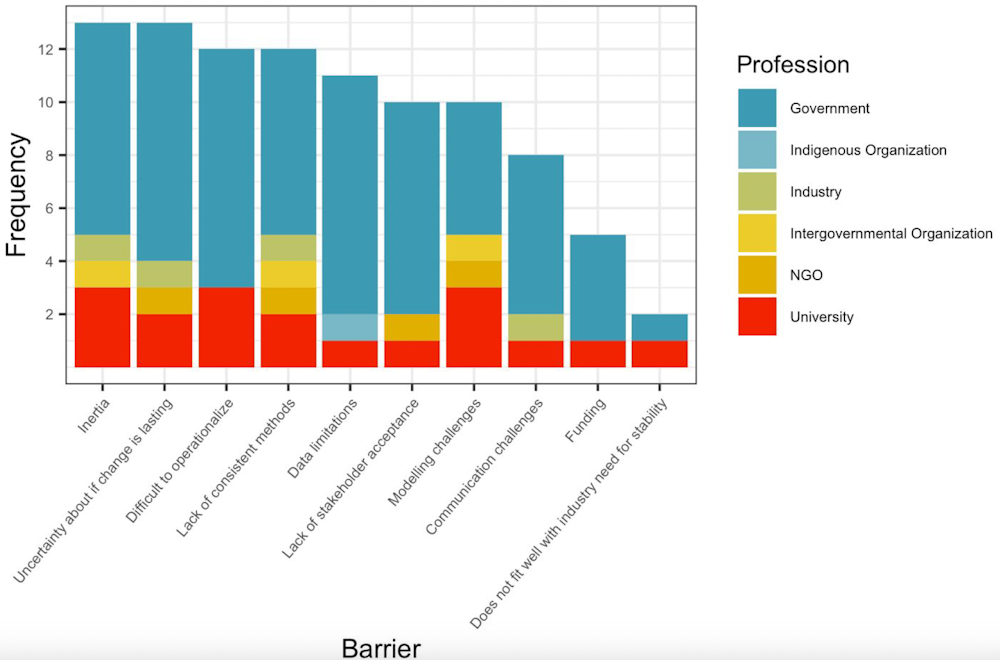
Our study found that institutional inertia and uncertainty about whether changes in ecosystems or fish stock productivity are lasting or not are some of the main barriers to the implementation of these dynamic reference points.


            A bar graph of the barriers to sustainable fisheries tool
The main barriers to implementing dynamic reference points in fisheries management as identified by survey participants (Tyler Eddy), Author provided
           

Government institutions that manage fisheries can be slow to adopt new approaches. This may benefit fishing industries, as they know what to expect. However, as climate change increasingly affects marine ecosystems and the fisheries they support, dynamic reference points provide a solution to adapt to these changes.

Overcoming the barriers to implementation of dynamic reference points is key for fisheries management agencies to effectively respond to highly dynamic ecosystems. While uncertainty about if changes in ecosystems or fish populations are lasting might never be removed, implementing dynamic reference points may promote early detection of — and rapid response to — those changes.

Ultimately, this can help prevent devastating collapses in species such as the northern cod of Newfoundland.

Tyler Eddy, Research Scientist in Fisheries Science, Memorial University of Newfoundland and Andrea Bryndum-Buchholz, Postdoctoral Researcher in Marine Ecology and Climate-Impact Sciences, Memorial University of Newfoundland

This article is republished from The Conversation under a Creative Commons license. Read the original article.

Shiny, happy planet: Newly discovered exoplanet is largest known “mirror” in the universe

Imagine an exoplanet with clouds so shiny, they make it literally the shiniest exoplanet ever discovered by humans. Meet planet LTT9779b, which according to a recent study in the scientific journal Astronomy & Astrophysics is covered in metallic clouds. Located 262 light-years from Earth, planet LTT9779b has an atmosphere made of silicates and metals like titanium. Both these and other details about the distant world were gleaned by the European Space Agency’s CHEOPS mission, or the Characterising Exoplanet Satellite. While Earth only reflects about 30% of the light from our star, the Sun, planet LTT 9779 b manages to reflect 80% of the sunlight from its host star.

“Imagine a burning world, close to its star, with heavy clouds of metals floating aloft, raining down titanium droplets,” study co-author James Jenkins, an astronomer at Diego Portales University in Santiago, Chile, said in a statement. The study purports to “provide the first steps toward understanding the atmospheric structure and physical processes of ultrahot Neptune worlds that inhabit the Neptune desert.”

The “Neptune desert” refers to the region close to a star where no Neptune-sized exoplanets appear — in the case of this particular exoplanet, the star LTT 9779. Generally speaking it is unusual for large gas giants to exist very close to their host star. Planet LTT 9779 b is being dubbed a “ultra-hot Neptune” because it is so unusually close. “It’s a planet that shouldn’t exist,” study co-author Vivien Parmentier, a researcher at the Observatory of Côte d’Azur in Nice, France, said in the same statement.

“With prejudice”: Judge dismisses lawsuit seeking justice for last survivors of Tulsa massacre

The last three known survivors of the infamous 1921 Tulsa Race Massacre announced on Monday that they plan to appeal last week’s ruling by an Oklahoma judge dismissing their lawsuit seeking reparations for the deadly event.

On the night of May 31 and June 1 of that year, a mob of white people attacked Tulsa’s Greenwood district, an exceptionally affluent Black neighborhood sometimes known as “Black Wall Street,” killing more than 300 people and burning down hundreds of Black-owned homes and businesses. No one was ever held criminally liable, and survivors were never compensated for their losses.

“But we will not go quietly. We will continue to fight until our last breaths,” the three survivors — Viola Fletcher, 109, Lessie Benningfield Randle, 108, and Hughes Van Ellis, 102 — said in a statement. Their lawsuit hoped to seek reparations for the long-term effects of the event. But Judge Caroline Wall dismissed the 2020 lawsuit “with prejudice” on Friday, meaning that the ruling is a final and permanent dismissal, and the case cannot be refiled.

“We were forced to plead this case beyond what is required under Oklahoma standards, which is certainly a familiar circumstance when Black Americans ask the American legal system to work for them,” the survivors said in their statement. “And now, Judge Wall has condemned us to languish on Oklahoma’s appellate docket.”

Mike Lindell, the MyPillow guy, auctions off equipment after pro-Trump company losses $100 million

MyPillow is going broke.

The pro-Trump company announced recently that it will be forced to auction off an expansive amount of equipment after networks and prominent retailers severed ties with the sleep company, following CEO Mike Lindell’s controversial claims about the 2020 presidential election. The StarTribune reported that the Minnesota-based manufacturer recently listed more than 850 items — such as sewing machines, industrial fabric spreaders, and forklifts — on the online auction website K-Bid. Lindell revealed that the company has seen a significant plummet in revenue, leading to the consolidation of resources.  Walmart, Bed Bath & Beyond and Slumberland Furniture all stated that they will cease selling MyPillow products as Lindell continues to peddle a false claim about how the 2020 election was stolen from former president Donald Trump.

“It was a massive, massive cancellation,” Lindell told the StarTribune. “We lost $100 million from attacks by the box stores, the shopping networks, the shopping channels, all of them did cancel culture on us.” Lindell was named in Dominion Voting System’s $1.3 billion dollar defamation lawsuit, in which the voting machine and election software company alleged he had slandered them in an effort to demonstrate that the 2020 election had been “rigged.”

In April, an arbitration panel ordered Lindell to pay $5 million to an expert who debunked his fraudulent election data.


Grammys will allow AI-generated music to contend for awards — sort of

The Grammys will now allow music generated by AI to contend for the most important awards in the music industry, but only if a work was primarily created by humans, with some AI-generated components.

The Recording Academy announced several shifts in its eligibility guidelines regarding AI, stating that “only human creators” can win the award. Work with no human authorship isn’t eligible, but work that includes elements generated by AI are possible contenders, as long as the human creator is responsible for this addition to the music, The Associated Press reported.

Grammys CEO and president Harvey Mason Jr. told AP that the industry was evolving because with new technology and so would its biggest awards show. If a lead vocal on a track is performed by AI, he explained, the work would be eligible for a songwriting award but ineligible in any performance category, since a human being is not singing. Mason said the Recording Academy does not want to see technology replace human creativity, but believes it can amplify and augment the creative endeavors of actual people. Humans most contribute the majority of a work that is partly AI-generated work for such a work to be award-eligible, Mason said. The Grammys could see AI-generated work hit the submissions list as early as next year, he suggested: “People are using the technology,” Mason said “It’s going to be involved in a lot of records, a lot of songs, this year. So we’ll see if some of them get nominated or not.”


What is a man? Even Darwin rejected the myth of the “alpha male”

A recently published meta-analysis in the journal PLOS One found that women have historically been hunters. The longstanding myth of hunters versus gatherers, that only men take down large game while women squat to collect plants and nuts seems to be a romanticized notion of labor division between genders. The truth is more complex.

Scouring 150 years of ethnographic data, the researchers discovered that women hunt anything from small to large game in the majority of the 1,400 societies studied. Intriguingly, women’s hunting strategies are more flexible and social than those of men. The “survival of the fittest” ethos — one constantly cited and championed in today’s manosphere podcast world — isn’t as gendered as we believe.

Even evolution’s pioneering scientist Charles Darwin knew that. First off, the term was coined by English polymath Herbert Spencer after he read “On the Origin of Species.” Darwin only began using “survival of the fittest”  in the book’s 5th edition. Still, the catchphrase has trickled down as a historical truism. Strong men, the narrative goes, propagate the species and are most responsible for civilizational successes.

But Darwin wasn’t so sure. A dozen years after his opus caused tsunamis in the biological and social worlds, the naturalist put forward a divergent path for evolution. In “The Descent of Man, and Selection in Relation to Sex,” he speculates that sexual selection wasn’t as simple as “man hits woman with club before dragging her to cave.” In this rendering, women play a dominant role in mate choice, and therefore evolution.

Darwin didn’t rule out natural selection, his original term for “survival of the fittest.” He just didn’t believe it told the complete story

And what drives female behavior, according to Yale ornithologist Richard Prum, is beauty. Yet, as Prum writes, this latter theory has largely been ignored, and outright scorned: “Aesthetic evolution by mate choice is an idea so dangerous that it had to be laundered out of Darwinism itself in order to preserve the omnipotence of the explanatory power of natural selection.”

Darwin didn’t rule out natural selection, his original term for “survival of the fittest.” He just didn’t believe it told the complete story. Being an inquisitive scientist, he kept searching for clues that spell out how we became the animal we are.

Why hasn’t Darwin’s sequel been as widely embraced? Why don’t biohacking podcasters discuss this addendum to the man’s masterwork? A concurrent theory of evolution is a dazzling prospect, especially in an age when contrarian thinking dominates media cycles. 

Biology has largely been dominated by male researchers. While unbiased science is a nice idea, confirmation bias and the fact that we like simple answers have seeped into evolutionary theory. The binary of “a man is a man and a woman is a woman,” and the preselected boxes that each gender has been placed in, has governed social thinking for generations.


Want more health and science stories in your inbox? Subscribe to Salon’s weekly newsletter The Vulgar Scientist.


Darwin wasn’t the only scientist to question our perception of gender roles. Primatologist Frans de Waal is responsible for popularizing the term “alpha male” after reading about the “lead wolf” in wolf research. Writing about alpha males in his 1982 book, Chimpanzee Politics, de Waal quickly observed that American Republicans and business leaders mischaracterized his research. The strong man mentality took hold.

“People overestimate male dominance mainly because they think purely in physical terms, but primate societies are political systems and physical power is only one part of the whole equation,” de Waal says.

A concurrent theory of evolution is a dazzling prospect, especially in an age when contrarian thinking dominates media cycles

Differences between male and female qualities are largely overblown. De Waal cites the work of anthropologist Robert Martin, who said the difference between genders can be accounted for by bimodal differences — statistical, though with a lot of exceptions. Having spent 50 years in the field with chimpanzees, de Waal regularly observed gender fluidity in our closest cousins. Biological sex doesn’t necessarily account for social or physical behaviors.

“I’ve known quite a few individuals among the males who don’t exactly act like males or females who don’t act like females,” he continues. “Individual variability is basically the material of evolution, and that’s the same sort of diversity that we see in human society.”

A certain contingent of the human population has attempted to codify gender with religious certainty

Gender variability isn’t an issue in chimp societies, which are less normative and ideological than our own. Individuals are accepted for what they are, sans moral grandstanding. Deviation is normal.

Importantly, gender norms and roles evolve with societies, be they ape, human or otherwise. Yet a certain contingent of the human population has attempted to codify gender with religious certainty.

This trend is especially apparent in American politics, where men from Donald Trump to, more recently, Robert F. Kennedy, Jr. are lauded as ideal “alpha males,” be it from the brute force of their rhetoric to eight-and-a-half mediocre pushups at the mecca of physical culture. Inevitably, physical prowess is equated with moral fortitude, fueling gendered stereotypes in the image the perceiver wishes to be true.

Whereas aspiring alpha men describing the qualities of alpha men to other aspiring alpha men on Twitter is commonplace, so these same men attempt to define women. Their definitions run a narrow gamut, from a sappy return to 1950’s-era Christian moralizing to an outright refusal to accept that gender diversity has long been a feature of our species. They place all their faith in the boisterous, muscular chimp rampaging through the forest instead of understanding the complex social dynamics at the foundation of the society — or the necessary and powerful role that females play in the construction of the tribe.

All of this begs the question: What is a man? Many experts have struggled with that question, with varying levels of success. They know the roles assigned are written by societies and open to interpretation. They also know these roles evolve and that diversity and fluidity are features, not bugs.

That’s not what you’d learn by listening to non-experts pontificate on longform podcasts. There, you’ll discover all the bullish rhetoric of aspiration with none of the scientific chops. Inquiry and curiosity are absent. No care of scientific holism — and certainly no empathy. Here you find a very specific type of man, one indignant over the fact that society is honoring what nature does best — evolve — and you hear very clearly that he can’t keep up.

“Miscarriage of justice”: Trump’s legal team fights to postpone documents trial indefinitely

Donald Trump’s lawyers are seeking to delay the former president’s Mar-a-Lago documents trial indefinitely, arguing in a filing that starting the trial within six months of Trump’s criminal indictment over his role in mishandling classified documents would be a “miscarriage of justice.”

The filing, which The New York Times reported was submitted a mere half-hour ahead of its Tuesday midnight deadline, also alleged that “The Government appears to favor an expedited (and therefore cursory) approach to this case.” The Justice Department and prosecutors working under special counsel Jack Smith have requested a December 11 trial date, while Trump-appointed Judge Aileen Cannon had slated an unprecedently early date in August. 

“The Court now presides over a prosecution advanced by the administration of a sitting President against his chief political rival, himself a leading candidate for the Presidency of the United States,” the brief, authored by Trump attorneys Chris M. Kise and Todd Blanche, reads.

“Therefore, a measured consideration and timeline that allows for a careful and complete review of the procedures that led to this indictment and the unprecedented legal issues presented herein best serves the interests of the Defendants and the public.”

Trump’s legal team also implied that the trial would be disruptive to his presidential campaign efforts, writing, “President Trump is running for president of the United States and is currently the likely Republican Party nominee. This undertaking requires a tremendous amount of time and energy, and that effort will continue until the election on Nov. 5, 2024.” 

The Hill reported that lawyers for Walt Nauta, the ex-president’s personal valet who was also indicted in connection with the Mar-a-Lago scandal, helped pen the filing. 


Want a daily wrap-up of all the news and commentary Salon has to offer? Subscribe to our morning newsletter, Crash Course.


Mr. Nauta’s job requires him to accompany President Trump during most campaign trips around the country,” they wrote. “This schedule makes trial preparation with both of the defendants challenging. Such preparation requires significant planning and time.”

According to The Times, Trump’s legal team used the troves of discovery evidence provided to them by the government as reasoning for why the trial should be postponed. With the first discovery disclosure containing more than 833,450 pages of material, the former president’s lawyers stated that they would make further requests to the government for additional information. 

“That’s your opinion”: Republican senator insists white nationalists are not racist

Sen. Tommy Tuberville, an Alabama Republican and a celebrated former college football coach, is drawing criticism from colleagues in Congress for refusing to denounce white nationalism. 

Speaking with CNN host Kaitlan Collins on Monday, Tuberville was asked to clarify remarks he made in May in which he appeared to suggest that white nationalists they should not be barred from serving in the military. The senator is currently holding up the appointments of more than 200 military officers because of his personal opposition to the Pentagon’s policy allowing service members to obtain abortions. As of Monday, the U.S. Marine Corps does not have a confirmed commanding officer for the first time in more than a century. 

Tuberville defended himself to Collins by saying, “I’m a senator. I can hold any confirmation I want until we get some kind of confirmation of why you’re doing this,” apparently referring to the Pentagon’s abortion policies.

Collins followed up by asking whether Tuberville agreed that “white nationalists should not be serving in the U.S. military.”

“If people think that a white nationalist is a racist. I agree with that, I agree they shouldn’t,” Tuberville replied.

“A white nationalist is someone who believes that the white race is superior to other races,” Collins said.

“Well, that’s some people’s opinion,” Tuberville insisted. “My opinions of a white nationalist, if somebody wants to call them white nationalist, is to me an American,” Tuberville said. “Now, if that white nationalist is a racist, I’m totally against anything they want to do, because I am 110% against racism. But I want somebody that’s in our military, that’s strong belief in this country, that’s an American, that will fight alongside anybody, whether with a man or woman, Black or white, red, it doesn’t make any difference. And so I’m totally against identity politics. I think it’s ruining this country. And I think that Democrats ought to be ashamed for how they’re doing this, because it’s divided this country and it’s making this country weaker every day.”

Tuberville’s comments have most definitely been noticed by his political opponents:

Rudy Giuliani faces possible disbarment — and here’s why that matters

Facts are stubborn things. That is a lesson that the MAGA crew is learning the hard way.

Exhibit No.1: Rudy Giuliani, Donald Trump’s former consigliere and one of the chief enablers of the Big Lie. Last Friday a committee of the Court of Appeals for the District of Columbia that oversees attorney conduct recommended that Giuliani, a former U.S. attorney and mayor of New York, be disbarred for professional misconduct arising from his efforts to overturn the results of the 2020 election.

The committee, comprising two lawyers and a citizen representative, made its recommendation after reviewing the record of a December hearing on the charges against Giuliani.

The committee’s decision must still be reviewed by the Court of Appeals. But whether or not Giuliani eventually loses his law license, the committee report and recommendation put on record exactly what Giuliani did in service to Donald Trump’s “big lie” and how he abused his position as a lawyer in the effort to thwart the will of the American people. 

Every time America’s institutions stand up for honesty and truth, and record the facts of our turbulent times, they fortify democracy and the rule of law in this country. They make possible not just the informed judgments of citizens today but the judgments that history will one day make as well.

This commitment to honesty, truth and facts is also a foundational principle of the American legal profession. 

As Abraham Lincoln wrote in 1850, “There is a vague popular belief that lawyers are necessarily dishonest. I say vague, because when we consider to what extent confidence and honors are reposed in and conferred upon lawyers by the people, it appears improbable that their impression of dishonesty is very distinct and vivid.” 

Lincoln warned lawyers that they should not “for a moment yield to the popular belief” and urged them “to be honest at all events.” He said that those who “cannot be an honest lawyer, resolve to be honest without being a lawyer…. [and] choose some other occupation.”

What the D.C. bar disciplinary committee’s report makes clear is how far short of Lincoln’s admonition Rudy Giuliani — who once himself prosecuted mobsters and Wall Street con artists — has fallen. 

The committee focused in particular on what Giuliani did in Pennsylvania in the aftermath of the 2020 election. It found that he violated the rules governing the practice of law in that state by “filing a lawsuit seeking to change the result of the 2020 presidential election when he had no factual basis, and consequently no legitimate legal grounds, to do so. His prosecution of the lawsuit also seriously undermined the administration of justice.” 


Want a daily wrap-up of all the news and commentary Salon has to offer? Subscribe to our morning newsletter, Crash Course.


The bill of particulars that the committee offers is detailed and devastating. It is a troubling reminder of all that Giuliani did in the aftermath of the 2020 election in service to Trump. 

The timeline begins the day after the election, when Giuliani agreed “to take charge of post-election litigation challenging the voting results.” As the committee recounts, he “immediately met with other attorneys to prepare to bring litigation in approximately ten states (including Pennsylvania).”

Giuliani made matters worse for himself by telling the court he had “personally witnessed” election fraud and that Democrats “stole an election” in Pennsylvania. “These claims were simply not true,” the report finds.

The path that would eventually lead to endangering Giuliani’s law license began with the filing of complaints in the federal district court for the Middle District of Pennsylvania. Those complaints, which Giuliani helped draft, contained “allegations about widespread election fraud that were important to his national litigation strategy.”

The disciplinary committee found that the complaints “contained only vague and speculative allegations about random and isolated electoral irregularities which did not and could not support [Giuliani’s] inflated legal claims.”

Giuliani made matters worse during oral argument when he told the court that he had “personally witnessed” election fraud in Pennsylvania. He argued that “Democrats ‘stole an election … in this Commonwealth’ and that he had ‘hundreds of affidavits’ supporting his assertion.” 

The disciplinary committee minces no words in its judgment: “These claims were simply not true.” 

It takes Giuliani to task for proceeding with his litigation even though an investigation had “unearthed no evidence of systemic fraud.” It finds that he failed in his obligation as a lawyer when he “commenced litigation without evidence that its core factual claim was true. Respondent based the Pennsylvania litigation only on speculation, mistrust, and suspicion”:

Without such evidence, Mr. Giuliani had no legitimate grounds… to seek an injunction that prohibits Defendants from certifying the results of the 2020 presidential general election in Pennsylvania on a statewide basis . . . and/or [an] injunction that the results of the 2020 presidential general election are defective and providing for the Pennsylvania General Assembly to choose Pennsylvania’s electors.

The disciplinary committee further determined that Giuliani’s conduct violated Rule 3.1 of Pennsylvania’s Rules of Professional Conduct, which states that a lawyer “shall not bring or defend a proceeding, or assert or controvert an issue therein, unless there is a basis in law and fact for doing so that is not frivolous, which includes a good faith argument for an extension, modification or reversal of existing law.” 

Giuliani “sought to upend the presidential election but never had evidence to support that effort,” the report concludes. “Surely Rule 3.1 required more.” The conduct of the defeated president’s lawyer, the committee found, was “prejudicial to the administration of justice.”

In recommending that Giuliani suffer the ultimate discipline of the legal profession, the committee noted the grave damage that his reckless conduct had done to that profession, as well as to democracy and the rule of law in this country”:

Mr. Giuliani’s misconduct was calculated to undermine the basic premise of our democratic form of government: that elections are determined by the voters…. [N]o lawyer — until 2020 — used frivolous claims of election fraud to impede the peaceful transition of presidential power and disenfranchise hundreds of thousands of voters. Mr. Giuliani’s effort to undermine the integrity of the 2020 presidential election has helped destabilize our democracy.

In an essay entitled “Truth and Politics,” the political philosopher Hannah Arendt observed that democracy cannot survive if the people are left to believe that “everything… [is] possible and nothing is true.” Arendt argues that the “freedom of opinion” on which democracy depends is “a farce unless factual information is guaranteed and the facts themselves are not in dispute.”

The D.C. disciplinary committee calls Giuliani to account for his professional misconduct, and also helps to provide the kind of factual information on which democracy itself depends.

That is why the two impeachments and two criminal indictments (so far) of Donald Trump matter. That is why the Jan. 6 select committee’s report matters. That is why the report and recommendation to disbar Giuliani matters.

Republican women learn the hard way: Complicity will not protect you

There’s no rhyme or reason to the given reasons for why the House Freedom Caucus ousted Rep. Marjorie Taylor Greene, R-Ga., last week. She should be right at home in a group established to draw the House GOP to the right. After all, she’s one of the nuttiest members in historical memory, an avid fan of both right-wing conspiracy theories and nakedly fascist rhetoric. The claim that she’s “too close” to Speaker of the House Kevin McCarthy, R-Calif., also doesn’t make sense. As Politico’s Rachel Bade told ABC News over the weekend, fellow Freedom Caucus member Rep. Jim Jordan, R-Ohio, is one of McCarthy’s “best friends.” Plus, most of the 49 members of the caucus in January voted for McCarthy as speaker on the first ballot. Nor does it follow that she was booted for calling Rep. Lauren Boebert, R-Colo., a “little b*tch.” Freedom Caucus members all worship at the altar of Donald “Grab ‘Em By The P*ssy” Trump, and are neither offended by profanity nor misogyny. 

No, there’s a much simpler explanation for why this hyper-right congressional club kicked someone out for the very first time: Plain old sexism.

Greene’s celebrity and ambition clearly alienate the mostly-male membership that still views women either as helpmeets or sex objects, not as equals. This resentment of Greene for trying to rise above her station isn’t far from the surface in most coverage of the controversy. One member whined to CNN that Greene is “bigger than the group,” while excusing Jordan’s similar fame because “nobody has done more for the cause.” Considering how Greene is a fundraising powerhouse for the GOP, this explanation for differential treatment falls apart. 

Greene, like most Republican women, is deaf to the clear lesson here: Complicity will not protect you.


Want more Amanda Marcotte on politics? Subscribe to her newsletter Standing Room Only.


Sure, Republican men will make some space for someone like Boebert, but that’s only because she’s not a real threat. Boebert likes to get a lot of attention but doesn’t have serious leadership ambitions. Greene has designs on being a real power player. She is swiftly discovering that Republican men like the glass ceiling exactly where it is.

Greene’s celebrity and ambition clearly alienate the mostly-male membership that still views women either as helpmeets or sex objects, not as equals.

Recent years have borne witness to an increasingly shrill Republican panic over changing gender norms. It really took off under Trump, a proud sexual predator who even fantasizes out loud about sex with his own daughter. Yet many Republican women seemed shocked when the far-right Supreme Court actually made good on the threat to overturn Roe v. Wade. The subsequent wave of abortion bans has been politically unsettling for the party because it seems like it lost them a small but significant number of female voters who have had enough of the misogyny. 

Sadly, however, most Republican women have stayed put, telling themselves that abortion bans won’t affect them. Now even post-menopausal women are finding they aren’t safe from the surge of overtly anti-woman policies embraced by the GOP. 

Late last month, Gov. Ron DeSantis, R-Fla., signed a bill dramatically curtailing access to alimony and, in particular, ending permanent alimony. In doing so, he’s siding with “men’s rights” activists against the traditional conservative concerns about disincentivizing divorce and adultery. Notably, the people who will be most harmed by this are not feminist women who embrace “modern” lifestyle choices, such as getting an education and having a job outside the home. Typically, permanent alimony is awarded to women who tried to live a “traditional” lifestyle: Older women who spent decades as housewives and who have no marketable skills. 

“I’m really disappointed because I’m a Republican who voted for Gov. Desantis,” Camille Malone Fiveash told ABC Action News. She had been married for over 30 years before, she says, her husband cheated on her. “My ex-husband wanted me to stay home. He wanted to pursue his career and me to take care of the kids and keep the household and everything just perfect for him.”

“I held up to my end of the bargain,” she argued. Of course, the “bargain” was always a lie sold to women to get them to comply with an unfair system. 

“The so-called party of ‘family values’ has just contributed to erosion of the institution of marriage in Florida,” Jan Killilea, 63, told the Orlando Weekly

As feminists have often patiently explained, “family values” is just code for male domination. If protecting male privilege conflicts with protecting families, Republicans will choose the former. That’s why Trump’s status as a thrice-married chronic adulterer has never been a problem for the party of “family values.” 


Want more Amanda Marcotte on politics? Subscribe to her newsletter Standing Room Only.


Yet, the GOP continues to successfully bamboozle shocking numbers of women with promises that complicity will protect them. Witness the rise of Moms for Liberty, a group like many before it that sells conservative women on the idea that they can somehow gain power through embracing submissive gender roles.

Moms for Liberty “have to be understood as a core part of a broader and longstanding reactionary movement centered on restoring traditional hierarchies of race, gender and sexuality — a movement in which conservative mothers have always played a particularly powerful role,” historian Nicole Hemmer wrote for CNN last week

Marjorie Taylor Greene will always find there’s a hard limit to how high the men in her party will let her fly, no matter how much lip service she pays to their sexist values.

The group recently drew national attention when one chapter in Indiana ran a quote from Adolf Hitler in a newsletter: “He alone, who OWNS the youth, GAINS the future.”

Initially, Moms for Liberty tried to justify this by claiming they quoted Hitler to oppose his views. The excuse never made sense, since they clearly do believe owning the youth equals gaining the future. More to the point, the group’s views reflect what Hitler was advocating at the time, which is a claim that women’s “power” runs through home and hearth, instead of the “men’s” realm of public power. (This was captured in the German slogan “Kinder, Küche, Kirche,” which means “children, kitchen, church,” a shorthand to describe a right-wing view of women’s proper role.)

Sure enough, after a few mealy-mouthed disavowals of the Hitler quote to the press, there was “a marked shift in tone around the Hitler” quote at the Moms for Liberty summit in Philadelphia late last month, Kiera Butler, who reported on the convention for Mother Jones, wrote. Speakers lamented that anyone had ever apologized for publishing a quote from Hitler, insisting the group should stand by the choice. By the end of the summit, Lt. Gov. Mark Robinson, R-N.C., was hollering about how “it is time for us to get back and start reading some of those quotes.”

In clinging defensively to this quote, the Moms for Liberty are missing the point. This isn’t just about Hitler being a genocidal maniac, though that really should be reason enough. He was also, crucially, lying to women. The “soft power” that women are promised through the dutiful performance of traditional roles isn’t real power. That’s why women spend decades being obedient housewives, only to be slapped in the face when they want fair compensation. It’s why someone like Marjorie Taylor Greene will always find there’s a hard limit to how high the men in her party will let her fly, no matter how much lip service she pays to their sexist values. Republicans may center hate of blue state feminists in their propaganda, but when Roe was overturned, it was those Republican-voting populations who saw their access to abortions taken first. But, as the popularity of Moms for Liberty shows, there’s always a bunch of Republican women ready to fall for the lie that there’s strength through submission. 

Don’t ignore Trump’s threats of retribution: “As the legal vise tightens, he becomes more dangerous”

It is a fact that Donald Trump is in extreme legal peril. For allegedly violating the Espionage Act and other federal laws connected to that crime, he faces decades in prison. Trump will also likely be indicted for violating other laws across the country, such as in Georgia and Arizona, in connection with his coup attempt and the terrorist attack on the Capitol on Jan. 6. It is now being reported that Special Counsel Jack Smith and the Department of Justice have interviewed and taken other testimony from dozens of witnesses including members of Trump’s inner circle regarding him and his coup cabal’s activities in the weeks leading up to Jan. 6.

The so-called resistance and many others in the mainstream political class and news media who are eager to see Trump punished for his many crimes against democracy and American society more broadly are celebrating what they hope will be swift justice and the end of the Age of Trump. These celebrations, however, are very premature. Donald Trump’s legal peril does not directly translate into political peril. During his decades-long de facto crime spree, Trump has shown an amazing capacity for not only evading responsibility but then surviving and triumphing. A similar dynamic is continuing at present, where the various criminal indictments, arrests, and investigations are only making Trump more popular among his followers, thus cementing his control as leader of the Republican Party and larger neofascist movement and white right.

Although it is not an exact parallel, as one of the first people with a public platform who consistently and loudly warned about the dangers represented by Trump and the MAGA movement in 2016 and before, it increasingly feels as though the mainstream news media and pundit class are making many of the same mistakes that they made seven years ago. 

In an attempt to work through and make sense of these anxieties about Trump’s enduring popularity and power as the frontrunner for the Republican Party’s presidential nomination, the consensus narrative that he is in great peril and his defeat appears to be inevitable, and more general concerns about what comes next for the Trumpocene and America’s democracy crisis, I recently asked a range of experts for their thoughts and insights.

Their responses have been lightly edited for clarity and length.

Steven Beschloss is a journalist and author of several books, including “The Gunman and His Mother.”

Given the number and variety of felony charges already filed, given the number and variety still likely to come flooding in, any normal human would have already collapsed under the weight of it all. The capacity of Donald Trump to carry on demonstrates the power of narcissism and sociopathy to shield a man from the vicissitudes of crime and punishment. His concrete history of avoiding accountability surely strengthens his resolve. So does the willingness of his cult and elected enablers to maintain the lie that it’s all just political persecution toward the Republicans’ leading presidential candidate and likely nominee. So does the systematic effort of GOP-led legislatures to pass laws undermining voting rights and giving hope to a loser that he doesn’t have to actually win to regain power.

With this in mind, I hesitate assuming he can’t possibly win the nomination or conduct his campaign, even if he were in a jail cell. In fact, I believe as the legal vise tightens, he becomes more dangerous—not less so—as he pursues immunity to secure impunity by any means necessary. That places an intense obligation on the media to highlight with great clarity and intensity what his continuing assault on democracy and the rule of law may yield. Trump has already been explicit that he’s bent on retribution. And we’d be foolish to doubt that dark terrorizing force won’t fuel his aggrieved minions, won’t powerfully fuel his drive to the nomination and couldn’t possibly get him to the White House. With enough havoc, nothing is certain, including the survival of democracy and a free press.

Mark Jacob is the former metro editor at the Chicago Tribune.

Members of the news media who want to cover politics as a horse race seem to be declaring Ron DeSantis a failure. I think that’s premature. Eventually, the bottom is going to drop out for Donald Trump, as it does for many authoritarians and criminals. Trump is saying ever-more-dangerous things on social media and will probably get indicted another time or two. He’s not gaining any new supporters, or even trying to. The question is whether Trump’s base forces Republicans to make him their nominee, leading to his likely defeat in November 2024, or whether the GOP wakes up in time to choose someone else.

“The capacity of Donald Trump to carry on demonstrates the power of narcissism.”

The really scary thing is that Trumpism won’t end with Trump. He has trained many Republicans to embrace hateful, anti-American views, and that mindset will likely transfer to another nominee if Trump falters.

I think Trump is a likely loser in a general election, but another Republican might not be. And elections are unpredictable. Given certain circumstances, Trump could win a general election. The election of any Republican to the presidency would be toxic to our country, and the election of Trump would be the worst outcome possible. It could well be fatal to American democracy.

Cheri Jacobus is a former media spokesperson at the Republican National Committee and founder and president of the political consulting and PR firm Capitol Strategies PR.

It’s difficult to envision Trump returning to the White House after twice losing the popular vote and decisively losing the electoral college vote the second time.  But experience tells me that it’s also folly to rely on what passes for “conventional wisdom” in this ongoing era of Trump, which, yes, we are still in, despite his 2020 loss. Trump gains momentum with press coverage, be it “positive” or “negative”. This formula propelled him to the GOP nomination in 2016 despite that overly tried and true “conventional wisdom” predicting otherwise.

Indictments may not be enough. Evidence going mainstream can erode his support in those margins where close elections are won or lost. Sadly, that is dependent on Fox News making a business decision that covering for Donald Trump is bad business. Yet Trump knows that as long as he’s a money maker for cable news TV, SuperPACs who depend on him as the nominee to make money for themselves, talk radio, and creepy dark money funders, he’s golden. Should the traditional Trump-friendly media determine he’s now too risky an investment and proceed to dump him, the GOP will then be free to coalesce around a safer choice.  Trump can’t win the nomination (let alone the White House) without them. However, the longer they wait to do this, the steeper the hill to climb.  Ron DeSantis is a weak candidate propped up by the money crowd – none of whom have ever made a dime as a political strategist. It’s no surprise he’s already deemed a “dud”. 

My ongoing fear that covering Trump, fighting Trump, supporting Trump (even knowing how dangerous and destructive he is to democracy) is still such a lucrative, addictive cottage industry, that those who “can” end him — don’t really want to.  And won’t.

Jennifer Mercieca, professor of communication at Texas A&M, and author of “Demagogue for President: The Rhetorical Genius of Donald Trump.”

We’ve just finished celebrating a national holiday that didn’t feel very much like a celebration. I live in a small conservative town and when I talked to my neighbors (both liberal and conservative), they said that they didn’t feel much like celebrating. I went to a community event and there were few people there. That’s worrisome, because communal celebrations are what hold this nation together. Maybe it’s the weather and climate catastrophe. Maybe it’s the stress of politics and the economy. Maybe it’s the sense that the nation is hanging together by a thread and we’re on the verge of civil war—I don’t know. Most of the nation believes that we’re on the “wrong track” — likely for different reasons. Does that help Trump? Usually, if the nation believes it’s on the wrong track that signals a “change election” year, but a significant part of the nation might believe the nation is on the wrong track because of the lingering effects of Trumpism. And yet right now Trump has a massive hold on the Republican electorate. But, of course, no one has voted yet and we don’t yet know who the nominee will be.


Want a daily wrap-up of all the news and commentary Salon has to offer? Subscribe to our morning newsletter, Crash Course.


My money is on Trump to win the nomination. Will he win the presidency? Polls show that Americans continue to have an unfavorable opinion about Trump (as they have since he began running for president in 2015) and they approve of his indictments. However, Americans also have an unfavorable opinion about Joe Biden—almost as unfavorable as Trump, according to 538 polling. All of that makes it very difficult to predict what will happen in the presidential race. The nation is in a morass. It feels like we’re sinking in quicksand. I suspect folks want to be inspired, not threatened or scared. Maybe we need someone to make politics fun again and give the nation a boost of optimism and communal feeling like Obama did in 2008.

Rich Logis, a former member of the Republican Party and right-wing pundit, is the founder of Perfect Our Union, an organization dedicated to healing political traumatization building diverse pro-democracy alliances and perfecting our union.

Trump’s legal problems further endear him to most GOP primary voters. Trump figured out in 2016 that the primary voters are addicted to politically traumatic mythologies and revisionist history, centered upon gays/sex/marriage/male/Caucasian/Christian theocracy, guns, Obama/racial animus, hysteria, paranoia, and COVID. 2016 showed that national elections are less predictable than most realize. Though I am loath to prognosticate, I believe the GOP is going to be routed in historic fashion next year. But if Trump is the nominee, his chances of returning to the White House are not quite  50/50, but closer to 60/40, due to the Electoral College, and the fact that most voters are apolitical, don’t consume lots of political news and punditry, and only pay somewhat-close attention a month or two before Election Day. The Democratic Party needs to, especially, keep engaged single-issue voters; I anticipate more single-issue voters next year—motivated by our firearm-related public health emergency, the Dobbs decision, impugning of public educators, abridgment of voting rights and climate change inaction—than in any prior election, ever. Furthermore, I want to see the Democrats continue consistently meeting Americans in less densely-populated areas, and show them that the Democratic Party is more committed to improving their quality of life than is the GOP.

Mainstream adult press, and the punditry class, intellectualize their coverage of Trump/MAGA/GOP primary voters; columns and op-eds yearning for someone within the Republican Party to save the party, and save America from another term, almost always, are coming from centrist and center-left media. The press sees Trump and MAGA abstractly, not realistically; though, well-intended, the press naively believes that a party whose official platform includes accepting avoidable deaths and suffering; justification of political violence and a coup d’é·tat against our Constitution and electoral will of the people; and defense of a president absconding with some of our nation’s most closely-guarded secrets, can be saved. The GOP cannot be saved, irrespective of how many times the Washington Post, The Atlantic and The New York Times wish it were so.

I know the GOP cannot be saved because I was deeply immersed in the Trump/MAGA/DeSantis/GOP world during Trump’s 2016 candidacy, his time as president and the months following President Biden’s inauguration. If the mainstream press—who has not lived the traumatic MAGA political life I left behind—spent a singular evening with some of those I regularly broke bread with, methinks the press would not so eagerly insist that some candidate—somewhere—can save the Republican Party. Now is a time when unlikely political alliances—red, blue and purple—must concur on the same goal, in the interests of strengthening our democracy and institutions, and perfecting our Union: electorally mercy-killing the Republican Party. For this, we need the press to reject well-meaning delusions about a GOP salvation that will never come, and embrace a truth and reality that the GOP, long ago, passed the rubicon of integrity and honesty.

Brynn Tannehill is a journalist and author of “American Fascism: How the GOP is Subverting Democracy.”

I believe that right now, Trump will probably return to the White House if the election were held today. The Electoral College favors Republicans, and Democrats need to win the national vote by about 4% to have a 50-50 chance of winning the presidency. Most of the polling out there now shows Biden with a 2-3 point lead over Trump. That’s probably not enough. FWIW: I built an election simulator. It shows Democrats with a 27% chance of winning the White House if they win the popular vote by 2 points, and 37% chance if they win it by 3. Biden’s popularity has diminished, and all it would take is a shift of a point to swing the election the opposite direction. Trump doesn’t look like a loser, because voting in the US is almost completely inelastic: there are very few “true” swing voters. It doesn’t matter what he does: he’ll always be competitive. He could loudly and visibly soil himself during a rally, and his base would dismiss it as a fabrication by the “biased media”.

The media loves Trump, because he’s a spectacle in the same way that a circus car crashing, catching on fire, and all the clowns punching each other in the face to put out the flames is a spectacle. I don’t think they really care anymore what reality is, as long as the articles get clicks.

I’m going to be very interested in the Trump-less debate that will be happening soon. Not because any of them will be the nominee, but because it will be interesting to see what themes they pick up on, because Trump will use audience reactions to adjust his own campaign. If they’re going right to “immigrant invasions”, “great replacement,” and “transgender people are a plague upon America that must be destroyed” and this stuff gets the biggest reactions, Trump will likely take us to a darker place than any of us want to imagine.

Rick Wilson is a co-founder of The Lincoln Project, a former leading Republican strategist, and author of two books, “Everything Trump Touches Dies” and “Running Against the Devil: A Plot to Save America from Trump – and Democrats from Themselves”.

Donald Trump is going to win the Republican nomination. He controls the levers of the party, is out-fundraising every other candidate, and is so far ahead in the polls it’s almost impossible he will be caught.

When it comes to the general election, this election will be close in battleground states much like 2020. Anyone dismissing Trump’s chances lacks imagination and doesn’t have any understanding of our political environment. We remain divided and the election will come down to a small group of voters who aren’t sold on either candidate. 

The media continues to dismiss Trump’s ability to excite his base voters and roll over his opponents. They have not learned anything from 2016 and J6 – they continue to treat him like any other candidate, not fact-checking him and letting him talk. CNN’s Townhall is the prime example of this.

The media needs to talk about his authoritarianism and stop equating him and his opponents. Trump is the greatest threat to the nation right now, and they continue to handle him with kid gloves because they are terrified about how they will be perceived by the conservative audience.

Third parties and independent candidates like those being pushed by No Labels, can swing the election to Trump since they will almost certainly pull away voters from President Biden. No Labels and independents are egomaniacs who have no hope of winning. They are risking the republic for their own personal benefit and revenge fantasies. No Labels in particular is nothing more than a MAGA SuperPAC.

Con science: Experts on why we fall for hoaxes and how to outsmart scammers

Everybody loves a great scam, a hoax, a con. We love to ask, how could someone fall for that? It’s the irresistible premise behind a glut of popular podcasts, bestselling books and docuseries. Whether it’s Bernie Madoff or a Nigerian prince, we’re drawn to the cat and mouse drama of humans trying to get over on other humans. It makes for “great storytelling,” as author Daniel Simons observes. It’s also an experience almost everyone can relate to — the stranger’s sob story that doesn’t quite check out, the email that looks almost exactly like it came from your credit card company.

As Simons and his coauthor Christopher Chabris write in “Nobody’s Fool: Why We Get Taken In and What We Can Do About It,” we’re designed to be relatively trusting creatures. And for the most part, it serves us well to assume our pharmacist is giving us our real medication and that the voice on the other end of the phone is truly our best friend. How then do we balance our social need for a certain degree of mutually presumed integrity with a self-preserving requirement for some street smart skepticism of Greeks bearing gifts? 

Simons and Chabris, who first gained notoriety as the creators of the classic Invisible Gorilla experiment, know a thing or two about how our perceptions can trick us. And in their fascinating new book, they weave outrageous examples of art frauds and fabricated scholarly work with meticulously researched insights into why we fall for these deceivers, how we can avoid becoming patsies and why we shouldn’t take it personally when someone tries to dupe us. “They’re not trying to get you most of the time,” Chabris says. “They’re trying to get someone.” 

This conversation has been edited and condensed for clarity.

As soon as I found out this book existed, I couldn’t wait to read it. Why are we so fascinated with being fooled? What is it about scams and hoodwinking that appeals to us in a visceral way that we want to read these stories, and we want to explore them?

“Scams just inherently have a great narrative structure.”

Daniel Simons: Scams just inherently have a great narrative structure. There’s the evil genius who’s trying to manipulate people. There’s the the victims who are typically portrayed as sympathetic. It’s not the clueless person who got what was coming to them. It was the unfortunate mark who was taken in. And then in most of these sorts of stories, there’s the wrap up. It all comes together in the catching of the criminal.

It has that classic movie narrative. It gets more and more in depth, it gets more and more removed from what reality is, and then it all comes crashing down at once. It’s the classic hubris story of pride before the fall, and then you’ve got the fall, and then you’ve got the schadenfreude about this person getting caught. It has all of those elements wrapped up together, which makes for great storytelling, which is why they’re so appealing to tell and so appealing to watch.

Christopher Chabris: I would add another angle on that, which is that deceptions and frauds and scams are like jokes. You think one thing is true, and then it turns out the opposite is true, or something completely different is actually going on. Kind of like magic. The story reveals that behind the curtain, something different is happening, or something that we assumed or thought we understood was in fact not happening. 

Reading this book and thinking about this moment in our culture, it feels like we are more skeptical and paranoid, and also more gullible and more vulnerable to misinformation. Is this a paradox that you’ve observed? 

Chabris: We have observed that there’s more skepticism, even of research in our own field. On the other hand, there’s also more scamming. We believe that fraud is on the rise. Of course, there’s a little bit of a paradox and that fraud is on the rise only to the extent you can detect it. That leaves more undetected fraud that we don’t know about. 

Partly what’s going on is that people can be very skeptical of one thing, and think that they’re a critical thinker and a skeptic and a contrarian, and yet completely fall for something else. The same people who might be all over you about health claims might be putting all their money into fraudulent crypto companies at the same time. Maybe they believe they’re skeptical about fiat money and the Federal Reserve, so they’ve gone all in on crypto and could wind up in a bad place there. So it’s not that everybody is more skeptical, and everyone’s a better critical thinker. 

“The old three card monte guys had to wait for people to walk around. Now you can reach out and find the three card monte enthusiast, and get them to come to you.”

The scammers are, I would say, getting a little better at crafting scams that will find their audience, find their victims. The old three card monte guys in New York had to wait for people to walk around. Now you can reach out and find the three card monte enthusiast and get them to come to you, instead of the other way around.

Simons: People who hold conspiracy theory beliefs will view themselves as completely skeptical and critical. It’s because they’ve started with a different set of assumptions and committed to them being true. In healthcare, that might be that Big Pharma is evil. Once you are committed to that, and assume that’s always the case, you can make things consistent with that by taking on other beliefs that are just not true. You think you’re being skeptical and critical of Big Pharma, and don’t realize that you’re not being skeptical of the critics of Big Pharma. Anybody who is speaking out against Big Pharma, you assume that they’re telling the truth.

It’s really easy to fall into this circular logic. Once you’ve accepted something as a premise and committed to it, you can be entirely internally consistent and reach more and more outlandish conclusions.

We are all vulnerable to that. We all have sources that we trust, we have blind spots. Talk to me about the things that make us vulnerable to being fooled.

Simons: The first thing to keep in mind is that we have these cognitive habits and tendencies that for the most part work really, really well. It’s useful to rely on familiarity. People you know and have learned to trust are likely to be beneficial to you to trust in the future. It allows you to be more efficient in interacting with the world. If you have always gotten straight information from somebody, you’re probably going to continue to, and for the most part that works really well.

But the habits we have — things like relying on familiarity, focusing on the information that’s right in front of us, or trusting that when something is really consistent, it’s likely to be worth trusting — somebody who’s looking to deceive us is going to capitalize on those. Bernie Madoff got most of his investors from people who were already familiar with him. That that ploy of taking advantage of familiarity, taking advantage of the sorts of habits we have and targeting them is how a lot of deception works. 

“Once you’ve accepted something as a premise and committed to it, you can be entirely internally consistent and reach more and more outlandish conclusions.”

Chabris: This set of habits and tendencies and hooks, as we call them, that we all have, will work in different ways for different people. We all prefer the familiar, but what’s familiar to each of us is completely different from everybody else. We all value precision in claims as compared to vagueness and concreteness as compared to abstractness. 

We’ll each be paying attention to or be interested in some different kinds of topics. Some people might fall for absurdly precise health claims, because they’re not at the stage of life where they really care about their health very much. But there’d be something else that they might really get hooked on using the same kind of hook. And everybody has different assumptions and commitments.

The notion of truth bias is important about what we all have in common. One precondition for scammers and frauds to get in is that we have to at least be willing to entertain that what they say could be true. It seems like there’s something about the architecture of the mind that gives us that bias that we don’t immediately react by saying, “That’s not true.”

We immediately react by maybe tagging something as true, keeping it in mind as true temporarily. If we get distracted by something else, or we don’t have time to do more investigation, there might be a little truth labeling attached to it so that when we encounter it again, we’re maybe started pushing gently down the hill towards deep enough acceptance that we then act on it. The truth bias is necessary for us to get around in the world. You can’t even have a conversation unless you assume that people are actually trying to tell you true things.

“They’re not trying to get you most of the time, they’re trying to get someone.

It’s such an everyday thing, that we don’t even realize we’re doing it. On the one hand, it’s sort of obvious. On the other hand, it’s really important that you know that’s necessary for everything to work. There are some scams that if you look back on them, you’ll say, “How did they possibly fall for that?” If they had disbelieved the very first word of it, or the very first sentence of it, it wouldn’t have gone anywhere.

Many people do disbelieve the very first approach by a scammer or a con artist. But the other universal principle involved is that they’re not trying to get you most of the time, they’re trying to get someone. Therefore, they only need a few people to respond in order to start the ball rolling. That’s the classic principle of the Nigerian [prince] scam. They will send out a million feelers and try to lure a few people into sending the money over and over and over again, which is an intensive process for them. They don’t care that 99% of people just deleted the email or never saw it.

Yet it feels personal when you have been fooled, whether it’s giving $5 to some sketchy charity, or buying that fake masterpiece. I had no idea there’s so much art fraud. 

Simons: That’s true for any largely unregulated market. Art fraud is a high dollar market. There are minimal regulations [and] it can often be used for money laundering. You’re transferring these really valuable objects around. There are other markets that are a lot like that. Crypto has some elements of that as well. Any time you have massive amounts of money moving without a lot of regulation, it’s just ripe for fraud.

So much has probably changed in just the time you sent this book to the printer, so I want to ask about AI and about the rise of deep fakes. Anyone can fake anything at this point. What does that mean in terms of the truth and reality? 

Simons: I don’t think it actually fundamentally changes reality. The problem is it makes it harder to dig out what’s real and what’s not. We have to be prepared for that and aware of that. ChatGPT is pervasive in universities and high schools already. For us, it means that we have to completely restructure how we evaluate students. We no longer can count on generous take-home tests to accommodate for illness and other sorts of things. If we want to actually grade performance, we can’t do that any more, because the chatbots and AIs are good enough to get most of the questions right. We have to be much more creative in how we evaluate. 

In the cases of fraud and deception, I think it becomes really important to figure out ways of preemptively trying to head those off. That’s always the best way to go. It’s always much better to see if you can find a way of preventing fraud in general, as opposed to having to respond to it in the moment when you’re under time pressure, when somebody’s being really effective at using all of these hooks to catch you. Having a way of sending testing in advance is really ideal. 

One of the common scams we didn’t talk about in the book is the kidnapping hoax. This is a pretty common one now. Or it’s also an injury scam. Somebody will call up a parent or grandparent, they’ve done enough research to know who the person’s kids are. And it’s devastating. I think it’s one of the more evil forms of scamming. It’s just preying on people’s fears, their worries and concerns. The question is, how do you head that off? With AI, that’s going to get that much worse, because if there’s enough social content online and audio content online, people can synthesize voices. Imagine how powerful that is, if it sounds like it’s coming from the kid. 

They sometimes will preemptively pay attention. They know the names of local officials, they’ll know your name, they’ll know enough about you to sound familiar and plausible. There are strategies to preemptively block that sort of thing. One is that my family has a passcode. If we ever get a call like that, we know that they’re going to be high pressure. And the first question is, what’s the passcode? And if they don’t know it, hang up.

You talk in the book about ways that we can circumvent some of these cons while still being open and receptive. I want to trust my gut, but my gut is often wrong.

Chabris: There’s no completely perfect solution to this problem. There’s an unending arms race of innovations on all sides unfortunately, of people coming up with new ways to try to scam us and there are many pitfalls for us to fall into. I think of it as a lifelong process to try to become more objective. I don’t want to say less emotional, I don’t think it would be good to become non-emotional, but to become less attached to one’s own pre-existing beliefs and identities. You need to have the emotions for a variety of reasons, and they’re good things.

But the problematic ones are when we let aspects of our identity, which often turn out to be commitments, very strong assumptions — that whatever comes from our political party is correct, whatever people we like say is correct — control too much our interpretation of the information we get. I don’t think it’s easy to detach oneself from that. I think it takes it takes a while, and hopefully reading our book will help. But it’s not an overnight solution. It’s a long, long process. And I do think that people who claim to be completely objective may be fooling themselves a little bit also. There’s a certain style of being a rationalist which is a good direction to go in. But I think sometimes people who claim to be objective and rational have their own commitments that need to be examined a little bit more. Nobody’s perfect in that respect.

Simons: We can’t just turn off our emotions. We’re not going to become Spock or Data. That’s not the goal. One of the key elements of this is to recognize when your emotions are leading you not to question. So when you hear something that you really love, that gels with your beliefs, that’s when you should probably be more critical. Just recognizing that maybe that’s what you say, “But is it really true?” It’s really recognizing that when you find something so appealing that grabs your pulls on your heartstrings, those are the times when maybe you should say, “Let me give it a second thought.” 

Chabris: Dan made a great point, but I think it really does go in both directions. If you find yourself really hating something, you should also question. The more emotion we’re feeling about something, maybe then the more we should look into it. Strong positive emotion is an important time to check ourselves. Probably also when we’re really feeling strongly negative about something, we should we should take a small step back as well. 

Despite Trump pardon, Steve Bannon finds himself in deeper trouble

Steve Bannon, the supposed Svengali of Donald Trump’s 2016 presidential campaign, received a presidential pardon for his actual and alleged federal crimes during Trump’s final days in office. Now Bannon, a one-time White House strategic adviser, is being forced to pay up — literally — for the effort.

On Monday, a New York judge ordered Bannon to pay nearly half a million dollars in legal fees for a variety of services, including the effort to secure his pardon. Bannon was initially sued in February by his former law firm, Davidoff Hutcher & Citron LLP. A partner in the firm, Robert Costello, reportedly angered Bannon by speaking to federal authorities about the House select committee investigation of the Jan. 6, 2021, attack on the Capitol. Bannon is currently appealing a federal court conviction and related four-month jail sentence for contempt of Congress for refusing to appear after being subpoenaed by the Jan. 6 committee.

In her six-page ruling, Judge Arlene Bluth dismissed Bannon’s objections to his former legal representation because, she said, he “did not adequately assert that he timely objected to these invoices.” Under Bluth’s order, Bannon is required to pay $480,487.87 in unpaid bills as well as “reasonable legal fees.”

Kevin Spacey accuser testifies actor forced oral sex on him: “I believe I was drugged”

Actor Kevin Spacey allegedly sexually assaulted a man while they were asleep in Spacey’s apartment, a U.K. court heard Monday, Variety reported. The “House of Cards” actor faces multiple counts of sexual assault by four different men.

Spacey’s fourth accuser explained in a police interview that he and Spacey connected when he auditioned for a show the seasoned actor produced. The man sent Spacey a letter, asking him to meet in person with the intent of mentorship. Spacey responded, and they met in a residential area near Spacey’s apartment. 

At the actor’s apartment, the man said Spacey attempted to hug him around the waist before “he rubbed his face into my crotch.” He recalled attempting to ask Spacey questions about the actors he had worked with to divert his attention. On the witness stand, the man said, “I was taken advantage of, I believe drugged.” He said he woke up the next morning in Spacey’s apartment with his pants unzipped and the actor performing oral sex on him. He said he verbally did not consent, and the actor ignored him. He pushed Spacey away, Spacey gestured for the man to leave and added that the victim shouldn’t tell anyone he was in Spacey’s apartment. According to Variety, Spacey’s attorney, Patrick Gibbs KC, said phone records shows that the man left Spacey’s apartment earlier than he recalled. Gibbs also insinuated that the alleged victim “small gambling problem.” The alleged victim refuted that he brought the claims against Spacey for money.


Trump is railing against yet another Republican governor: “I don’t invite her to events”

Donald Trump once again took to Truth Social to unleash a bitter tirade against a former political ally. This time, the former president and 2024 candidate took a swing at Iowa Gov. Kim Reynolds, a fellow Republican.

On Monday, Trump’s lash-out followed reporting from the New York Times that Reynolds has a close relationship with Trump’s closest primary-race competitor, Florida Gov. Ron DeSantis. Reynolds has also said that she won’t formally endorse any GOP candidates in the primary — as is customary for Iowa governors. 

“I opened up the Governor position for Kim Reynolds, & when she fell behind, I ENDORSED her, did big Rallies, & she won,” Trump wrote in his post. “Now, she wants to remain ‘NEUTRAL.’ I don’t invite her to events! DeSanctus down 45 points!”

Despite Reynolds reserve of formal endorsement, the governor has appeared with DeSantis in all three of his Iowa events, and join DeSantis’ wife, Casey, to launch the voter-courting campaign “Mamas for DeSantis.” 

The true cost of food: High grocery prices are not the root issue

Inflation and skyrocketing grocery bills are highlighting how the cost of food is impacting our wallets. Higher prices cost everyone more, but they make it most difficult for those with low incomes to meet their basic needs.

On July 5, the federal government issued a one-time grocery rebate to help low-income Canadians with rising costs. Eligible families can receive up to $628 to help pay for their groceries.

In 2022, Canada saw the highest rate of food inflation in decades. Although the rate of increase is slowing, Canadian families are estimated to pay up to $1,065 more for food in 2023.

However, by only focusing on how to keep food costs low, we risk ignoring the underlying causes of why people cannot afford food in the first place.


Hidden costs

The price of food at the checkout counter includes the production, processing, distribution and retailing of food. It does not include the cost to health care from diet-related diseases, current and future environmental impacts or social injustices, like underpaying farm workers or using forced child labour.

These are referred to as negative externalities. These are the spillover effects of a food production system that does not consider broader impacts on society.

In 2011, the external cost of agricultural production to the environment in Central and Western Canada alone was estimated to be about $8.9 billion. When externalities are taken into account, the true cost of food in the United States is three times the amount Americans pay.

This means that much of the food we buy is underpriced because of various social, economic and environmental externalities. We may not be paying for these hidden costs at the checkout, but we do so with our health-care costs, poor food quality and social inequalities. People in the Global South and those living with low incomes are disproportionately impacted by these hidden costs.


Putting food costs in perspective

With the current focus on increasing food prices, it may be surprising that Canadians spend relatively little on food. According to a 2016 study — the last year for which data is available — Canada was among five countries in the world that spend the least on food.

In 2022, Canadians spent, on average, 11% of their income on food. Those with the highest incomes spent 5.2% on food, while those living with the lowest incomes spent up to 23% of their income on food. That means those with the lowest income most significantly felt the burden of increased food costs.

The percentage of income spent on food has been decreasing since the 1960s. In 1969, Canadians spent 19.6% of their income on food. While food prices have increased due to the pandemic and inflation, food spending among Canadians has been relatively stable since 2010 at between 10 to 11% of their incomes.

Although the cost of food increases, the most vulnerable people in the food system, farmers and farm workers, receive a small portion of the proceeds. In Canada, agricultural sector wages are below the average, with weekly earnings about 21% less than other sectors. In 2021, U.S. farmers and farm workers received only 7.4 cents of every dollar spent on food. In 2013, they received 10.2 cents.


High food prices are not the root issue

High food prices are not the main reason people can’t afford food. Poverty is. Poverty is a systemic issue, often resulting from poor government policies, income inequality and systemic forms of discrimination.

The average Canadian household experienced a 16% increase in income from 1999 to 2022. However, the amount of money spent on housing increased by 12% and spending on health by 35.6%.

In addition, people with low incomes are increasingly identifying systemic issues, like racism and colonialism, as main barriers to achieving food security. Even with low food costs, racialized people face numerous barriers in achieving food security. Systemic discrimination leads to a concentration of social and economic disadvantages that increase food insecurity rates.

Income inequality in Canada increased substantially during the 1980s and 1990s. That pattern hasn’t changed. Today, the groups most likely to experience low incomes continue to be Indigenous Peoples and racialized Canadians.

According to the last census, 18.8% of Indigenous people lived in a low-income household, compared to 7.9% of the non-Indigenous population. Indigenous communities in Canada face food insecurity at a rate two to five times higher than other Canadians.

The First Nation Food, Nutrition and Environment Study found households that had access to food obtained using traditional practices were more food secure and less likely to have complex health problems such as diabetes and heart disease. For members of these households, access to growing and harvesting food for themselves and their community was more important than lower food prices.


Cheap food comes at a cost

Conventional bananas are one of the cheapest food items in Canadian grocery stores. They have contributed to chronic underpayment of farmers and farm workers, child labour practices, loss of biodiversity and water pollution.  

As a result, conventional bananas have a much higher hidden cost than fair trade bananas. Most of this is attributed to inadequate wages and a lack of social security for farmers and farm workers. By buying fair trade bananas, consumers can significantly contribute to sustainability and greater equity.


            A farmer tending to a banana tree.
A farmer from the Fairtrade International certified banana co-operative in Ecuador. (Fairtrade Canada), Author provided
           

Fair trade produce might be more expensive, however as a result farmers and farm workers receive fairer wages and there is greater transparency throughout the entire supply chain.

The Fair Food Program encourages corporations to buy produce from farms that treat their workers humanely and compensate them fairly. The latest report from The Fair Food Program demonstrates a decrease in injuries, violence and reported sexual harassment among workers of farms that partake in the program.

In the early 2000s, buyers agreed to pay a penny more for every pound of tomatoes, passing it on to farm workers. This went directly to the farm workers, which equated to a 20-35% increase in weekly pay.

The hidden costs of cheap food are disproportionally harming racialized communities and those with low incomes. They also deprive us all of a just, equitable and sustainable food system. Paying farmers and food workers more is an investment in the local economy and a more resilient, equitable and just global food system.

Monika Korzun, McCain Foundation Postdoctoral Fellow at Faculty of Agriculture, Dalhousie University; Ashley Jean MacDonald, PhD Student, Faculty of Agriculture, Dalhousie University, and Donna Appavoo, Contract Instructor, Chang School of Continuing Education, Toronto Metropolitan University

This article is republished from The Conversation under a Creative Commons license. Read the original article.