I recall that September day like it was yesterday -- the explosion so stunning, so memorable. It wasn't 9/11/01, it was 9/29/08 -- a moment when a rare blast of populist democracy briefly singed the economic terrorists who hold the Capitol hostage.
It had been a dark and stormy month of financial collapse, culminating in an attempted power grab. Pushed by his fellow Wall Street Ponzi schemers, Treasury Secretary Henry Paulson -- a former Goldman Sachs CEO -- was threatening Armageddon unless Congress ratified his pamphlet-size decree for a no-strings-attached bank bailout. The straightforward proposal, backed by President George W. Bush and President-to-be Barack Obama, would have turned Paulson into King Henry -- a despot allowed to autonomously dole out $700 billion to any of his business cronies.
This was too outrageous even for a rubber-stamp Congress that had long been ceding power to both the executive branch and the corporate boardroom. And so rank-and-file House Democrats and Republicans, backed by an angry public, overrode their leaders and voted down the measure.
Admittedly, the conflagration was brief. After a few days of industry lobbying, the House ultimately passed the Troubled Asset Relief Program bailout -- but one with at least some mild restrictions. For a time, 9/29’s fleeting blast of defiance appeared to establish a maximum limit to robbery and presidential authoritarianism.
For a time.
Today, the episode -- if considered at all in Washington -- seems merely to have set minimum standards for chicanery. As evidenced by two little-noticed sections of the Obama administration's Wall Street "reform" bill, presidents and their bank benefactors are back to thinking they can pilfer whatever they want -- only now they have learned to camouflage their demands by burying them in the esoterica of lengthier bills.
Finding this latest giveaway means digging all the way down to Sections 1109 and 1604 of the White House's mammoth proposal. These passages look like typical legislative asterisks -- perfunctory "oh, by the ways" inserted by some overeager law school intern in the Treasury Department's basement as a matter of meaningless parliamentary etiquette.
They are anything but.
At a recent hearing, Rep. Brad Sherman, D-Calif., called the language "TARP on steroids," noting the provisions would deliberately let the executive branch enact even bigger, more unregulated bailouts than ever -- and by unilateral fiat.
Whereas the original TARP included some oversight language and power to limit Wall Street bonuses, TARP on steroids includes no specific oversight or executive pay constraints. Whereas TARP permitted the government to underwrite both small and large banks, TARP on steroids allows taxpayer cash to go only to the behemoths (which, not coincidentally, tend to make the biggest campaign contributions). And whereas TARP limited the Treasury secretary's check-writing authority to two years and $700 billion, TARP on steroids would let him spend as much as he wants for as long as he wants.
This last point is what poker players call "the tell" -- the inadvertent tip exposing a scam. Treasury Secretary Tim Geithner's tell came when he publicly said the Obama administration would oppose amendments limiting the new bailout power -- even if the limit was a $1 trillion cap.
The former financial executives inside the Obama administration have labeled their bill the "Financial Stability Improvement Act," and some might say that's like Bush officials oxymoronically calling their own anti-environment initiatives a "Clear Skies" agenda. But that's not a totally fair comparison because there’s an underlying consistency here: While these new "financial stability" powers may destabilize the nation's finances, they would more than stabilize Wall Street’s larcenous profits.
That thievery, of course, has been the big problem all along -- and now, only another 9/29 can prevent it from getting worse.
© 2009 Creators.com
Most ridiculous economics-related story of the week (I know, it's early yet, but it's a short week): A New York Post article by Mark DeCambre suggesting JPMorgan Chase CEO Jamie Dimon as a replacement for Treasury Secretary Tim Geithner.
Yes, Geithner is under fire from legislators from both parties right now, but neither Republicans nor Democrats are likely to be looking for a figure even more deeply embedded in Wall Street than either Geithner or Larry Summers.
JPMorgan Chase has been a prime beneficiary of government bailouts, cheap credit, and the orchestrated devourment of both Bear Stearns and Washington Mutual. The liberal Democrats who are hammering the Obama administration as insufficiently progressive would have a collective seizure if Geithner stepped down, only to be replaced by the CEO of one of the world's largest financial institutions. Nor would Republicans who have suddenly become populist banker-bashers and defenders of the working man be likely to cheer. The political "optics," as Washington-watchers like to say, would be simply awful.
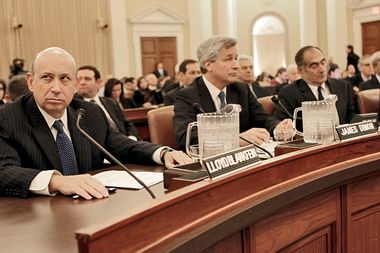
The idea is too dumb for words. OK, maybe not as dumb as Goldman CEO Lloyd Blankfein getting the nod, but still absurd.
What does it mean when a conservative Republican and a liberal Democrat both call for Treasury Secretary Tim Geithner to be fired? Is it a sign that he's lost the confidence of both parties and should be immediately disposed of? Or is it confirmation that he is steering safely down the middle of the river, while the left and the right banks seethe with rage?
This morning, the normally almost supernaturally composed Geithner got into it with Texas Republican Kevin Brady, a pillar of the conservative right, during a Joint Economic Committee hearing in Congress.
The Wall Street Journal's Damien Palleta has the transcript:
Mr. Brady opened up his questioning by telling Mr. Geithner Republicans, Democrats, and the American people had lost confidence in the Treasury Secretary and asked him to resign.
"It is a great privilege to serve this president," Mr. Geithner responded. "I agree with almost nothing you said."
Mr. Geithner then took it a step further: "You gave this president an economy falling off the cliff."
Mr. Brady wasn't done: "Remind me, Mr. Secretary, what post were you holding when President Obama took office?"
Geithner: "I was the President of the Federal Reserve Bank of New York."
Brady then accused him of "shirking responsibility for the design of this bailout."
Mr. Geithner said the government's steps were "absolutely necessary to break the back of this financial panic." He said without the Obama administration's steps, "you would have an economy still falling, not growing."
Meanwhile, last night, Oregon Democrat Peter DeFazio, a staunch member of the House's progressive caucus took some hard swings at Geithner for paying more attention to Wall Street than to Main Street during an MSNBC interview with Ed Schultz. He finished by calling for both Larry Summers and Geithner to be fired, saying with a smirk, "We may have to sacrifice just two more jobs to get millions back for Americans."
Brady, of course, is mad that Congress passed a stimulus bill while DeFazio is furious that the stimulus bill wasn't even bigger. Hard to satisfy both those constituencies... My own opinion is that conservative Democratic Senators are a far greater obstacle to direct government assistance to Main Street than either Summers or Geithner, and I agree with the Treasury Secretary that the financial panic had to be broken with extreme measures or we would be in a much worse position now than we already are. But, as noted by DeFazio, Geithner's performance during the AIG bailout can be easily faulted and the pivot that the entire White House is making towards emphasizing deficit reduction is ill-timed and insensitive to what this country really needs right now.
Ultimately, I seriously doubt whether President Obama will heed either the conservatives or the progressives at this point. I'm betting he continues on with his team intact. But like everything else, the political future of the White House and all his economic advisers can be pinned to one economic indicator -- the unemployment rate. The further up it goes, the hotter the kitchen will get.
Ironic juxtaposition of the day:
From Rasmussen Reports, via Naked Capitalism:
50 percent of Americans say interest rates on their credit cards have been raised in the past six months, as Congress seeks to limit the ability of banks to raise those rates...
77 percent of Americans believe that credit card companies take unfair advantage of consumers with the interest rates they charge. Just 14 percent do not agree.
From a Bloomberg News article detailing the prospects of TARP overseer Elizabeth Warren's brainchild, the Consumer Financial Protection Agency:
"The time for pitchforks and torches is over," [said Scott Talbott, chief lobbyist for the Financial Services Roundtable]. "The focus should be on reforming the system and making it better."
Pity the poor bankers, trapped in their castles while the peasants storm their walls, shrieking blood and murder! It's almost as if the financial industry hadn't been bailed out to tune of trillions of dollars of taxpayer money, or hadn't managed, so far, to successfully neuter every bit of proposed regulatory reform that has come down the pike. From the banking industry's perspective, everybody has just been so unfair. Why do all those mean people keep saying nasty things about us?
Railing against the tone-deaf arrogance of banking industry lobbyists gets old fast. People like Talbott are paid well to say exactly what they are saying, and judging by their success, they're worth every penny of it. But at some point, by their own rhetoric, they will incite exactly the kind of boiling-over rage that they make-believe is currently afflicting them. Seventy-seven percent of Americans, among whom can be counted many who have lost their jobs and homes because of mistakes made by bankers, feel that credit card companies are taking advantage of them. Imagine that! But couldn't it be possible that their real reason for rage is that the time for pitchforks and torches never came?
Most mainstream media reports on special inspector general Neil Barofsky's audit of the Fed bailout of AIG summarized the findings as an implicit remonstration: Tim Geithner's Fed looks bad because it was unable to get AIG's counterparties to agree to a deal in which they received less than what they were owed under the terms of the credit default swaps AIG had entered into. But in the econoblogosphere, it's Rashomon all over again.
Naked Capitalism's Yves Smith exploded in anger, calling the report "far too forgiving" of the Fed, accusing Barofsky of being just "as badly cognitively captured as the Fed is" and declaring that the "uncritical reportage of defenses by the officialdom is annoying."
You get the sense that at this point in the game, Smith would not be satisfied by anything less than a firing squad. What she sees as uncritical reportage others could interpret as "leaving the Fed hung out to dry." For example, the audit reports that Fed was worried about "violating the principle of the sanctity of contract." Come on! The financial world was falling apart and the U.S. government was on the hook for hundreds of billions of dollars in a frantic effort to stave off utter disaster. In that milieu, the supposed sanctity of contracts is a bogus excuse, mere cover for doing nothing. As Smith points out:
Companies that get into trouble renegotiate their obligations as a matter of course. You cannot get blood from a turnip. And the fact that the Feds stepped in to prevent the financial system from collapsing is NOT THE SAME as an open-ended commitment to honor the obligations of a dead company.
Meanwhile, Felix Salmon is feeling charitable today. The fact that the financial world was falling apart, he argues, is reason to cut Geithner and the Fed some slack.
It shouldn't have happened, that's true: for the sake of putting a knife into the moral-hazard trade, some haircut -- any haircut -- should definitely have been imposed, even if it was only the 2 percent that UBS offered to accept.
But the government owned AIG, which created the situation that Germans call Anstaltslast: the fact that state-owned companies simply don't default on their obligations. The government was also battling a major crisis using the only weapon at its disposal: enormous amounts of liquidity. When you're putting out a fire, you don't stop to worry that large amounts of liquidity are going to end up where you don't particularly want them -- the important thing is putting out the fire.
So yes, given a bit more aggression and foresight, the Fed could have tried to cram down a haircut onto AIG's counterparties. But at the time, no one was particularly interested in being harsh to the global financial sector; instead, they were trying to rescue it.
Regular HTWW readers will know that in the past I have been sympathetic to the view that in the mad rush to keep the global economy functioning, mistakes were going to be made. But after reading Barofsky's report, I feel much less inclined to go there. The sequence of events is too blatant: The Fed asked the companies to take a haircut, the companies said no, and there is no evidence that the Fed pushed back at all. What kind of negotiating stance is that? It looks like pusillanimous capitulation.
But not to everyone. To the structured finance lawyer who writes The Economics of Contempt blog, the report vindicates Geithner! (That sound you just heard was Yves Smith popping like an over-inflated balloon.)
[The report] makes clear that the NY Fed did try to negotiate haircuts with AIG's counterparties, but not at all surprisingly, the counterparties (and the French regulators) refused, and the NY Fed was left with no choice but to pay par value. Geithner, contrary to popular belief, didn't have the powers of a bankruptcy court.
Economics of Contempt is relying here on one of the crucial reasons why the Fed's bargaining position differed from, say, the Obama administration's stance with regard to the hedge funds who were refusing to take haircuts in the negotiations over the GM and Chrysler restructurings. In the case of the automakers, the government could say, you're going to get a worse deal from the bankruptcy judge, so you better take this one now. That was a threat with some juice to it. But the whole point of the government bailout of AIG was to avoid a Lehman-like bankruptcy that would take everyone down with it. So, it is true, the Fed's leverage was not terrific.
I am less sure what to make of Economics of Contempt's position that for the Fed to play hardball would be an abuse of "its regulatory authority for purposes of retaliation." I don't think anyone was considering the Fed's attempt to get a haircut as "retaliation." Instead, a more appropriate framing would be that the Fed should be attempting to get the best deal for its taxpayer money. The Fed had moral authority -- We're saving all of your asses, so play ball!
Just such a position is taken by The Epicurean Dealmaker, who imagines a scenario in which the Fed stared down the reluctant banks and shamed them into compliance.
A sample:
I have also been authorized to inform you that we are fully aware of the legal rights and fiduciary duties which constrain each of you to do what you think is best for your firms and your stakeholders. Under normal circumstances, we would be entirely supportive of these obligations. However, these are not normal times. Furthermore, and because these are not normal times, I would like to inform you that the government of the United States of America will take an extremely dim view of any individual or institution which chooses to pursue simply its own interest and its own duties without regard for the consequences to the broad economy, this country, and indeed the entire world. This government has a fiduciary duty too, gentlemen, and I am afraid that it trumps yours.
There's a lot more where that came from, and it makes for very entertaining reading. There's just one problem. For the speech to work in real life, one would have to imagine it being delivered by Tim Geithner.
And I just don't see the Secretary of Treasury as a guy who could deliver, in this or any other reality, a passage like this:
I am not your fucking friend. As far as you are concerned, you should view me as the Angel of Fucking Death. Because the time has come for each of you to do what is right for the greater good. It is time to think about survival, gentlemen -- your own and that of your institutions -- both now and in the future. For let me assure you that the decisions you make in this room today will be remembered. They will be remembered, gentlemen, as long as there is a United States of America. And if, God willing, we all come through this terrible crisis to a safer and more stable world, those people who helped us get there will be remembered. And, perhaps more importantly, those people and institutions in this room which did not help us, which put their own narrow personal and corporate interests before the interests of this nation and its people, will be remembered as well.
The funny thing: Although that speech never was given and never could have been given by the parties involved, it contains an essential truth -- the decisions made during that fateful week will always be remembered. For its role, Goldman Sachs is now widely reviled, and it's very difficult to see how that will change, any time soon.
The Special Inspector General's Report on the A.I.G. Bailout has been released, and while I wouldn't go as far as The Big Picture's Barry Ritholtz, who says the New York Fed was "played for patsies" and calls the whole spectacle "embarrassing and pathetic," the report sure doesn't make the Fed look very good.
The critical issue, again, goes back to the fall of 2008, when AIG was collapsing because it could not pay what it owed to other financial institutions under the terms of the credit default swaps that the insurance company entered to. Could the Fed have gotten a better deal from AIG's counterparties? Instead of lending AIG billions of dollars to pay the likes of Goldman Sachs and Merrill Lynch in full, could the Fed have convinced the banks to take a "haircut" -- to agree to less than they were contractually owed?
The Special Inspector's report indicates that the Fed hired BlackRock Solutions to advise it on options, and BlackRock specifically told the Fed that one of its choices included seeking "a reduction in the amount that counterparties would receive -- otherwise known as concessions or a 'haircut' -- for the total of the CDOs and related swaps held by each of AIGFP's counterparties."
The Fed made a least a semblance of an effort:
On November 6 and 7, 2008, FRBNY assistant vice presidents, vice presidents, senior vice presidents, and executive vice presidents contacted eight of AIGFP's largest counterparties (Societe Generale, Goldman Sachs, Merrill Lynch, Deutsche Bank, UBS, Calyon, Barclays and Bank of America) by telephone. They described a proposal under which each counterparty was asked to accept a haircut from par. Seven of the eight counterparties told FRBNY officials that they would not voluntarily agree to a haircut. The eighth counterparty, UBS, said that it would accept a haircut of 2 percent as long as the other counterparties also granted a similar concession to FRBNY....
At the end of the day on November 7, after FRBNY officials had received negative reactions from seven of the eight counterparties, including the French banks' formal refusal, senior FRBNY officials met with then-President Geithner. After discussing the counterparties' reactions, including UBS's conditional acceptance to give a 2 percent haircut, the officials recommended to President Geithner that the Maiden Lane III transactions go forward without haircuts because it would be impractical to obtain haircuts from all the counterparties. Mr. Geithner concurred, and it was decided that FRBNY would cease efforts to negotiate haircuts and pay the counterparties the market value of the CDOs.
The Report lists a number of reasons why Geithner and the rest of the Fed felt that they could not push harder for haircuts. Chiefly, Geithner did not believe the Fed had enough leverage to get a deal, because their most powerful option -- the threat of default and an AIG bankruptcy -- had already been negated by the initial $85 billion loan to AIG in September, "an intervention that the counterparties understood to mean that the U.S. government would not permit an AIG failure."
In addition, FRBNY was concerned that its use of a threat of an AIG default might introduce doubt into the marketplace about the resolve of the U.S. government in following through on its commitments in support of financial stability. FRBNY officials felt the introduction of such uncertainty might have been dangerous and potentially expensive for the U.S. economy in light of the precarious market conditions in November 2008 and the extraordinary official efforts that had been taken to support market functioning.
There were other reasons: The Fed was worried about the reaction of the credit rating agencies, it was concerned that it was confusing its role as AIG's creditor with its role as bank regulator, and it was "uncomfortable with violating the principle of sanctity of contract."
OK. I'm wrong, again. It is embarassing and pathetic. The Fed was played for patsies. And it was Tim Geithner's Fed.
UPDATE: Reaction to the report: Geithner was vindicated! No he wasn't! It's a whitewash!
"Global economic growth requires the services of big financial firms," concludes JPMorganChase CEO Jamie Dimon at the end of a Washington Post Op-Ed defending the right of banks to be as monstrously huge as they please.
Is that true? Until very recently, modern global economic growth was inseparable from advances in telecommunications and computer networks and transportation technologies that made the world a smaller place and in so doing also made it profoundly easier for smaller entities to find their niche in global production networks. It seems reasonable to assume, unless peak oil crushes globalization beneath its hobnailed boots, that such a trend will continue after the current unpleasantness subsides. Got a computer and broadband access? You are ready to rock, almost wherever you are.
When it is hard to connect one place with another, or one firm with one another, or the user of capital with the provider of capital, then bigness is an advantage. But when such things become easy, where's the size requirement?
Dimon:
To understand the harm of artificially capping the size of financial institutions, consider that some of America's largest companies, which employ millions of Americans, operate around the world. These global enterprises need financial-services partners in China, India, Brazil, South Africa and Russia: partners that can efficiently execute diverse and large-scale transactions; that offer the full range of products and services from loan underwriting and risk management to providing local lines of credit; that can process terabytes of financial data; that can provide financing in the billions.
Dimon argues that efficiencies of scale lower prices. But doesn't competition also lower prices. If a few giant American banks control "the full range of products and services" that America's largest companies need, where does the pressure to keep costs down come from? And do you really have to be a big bank to process terabytes of financial data, or just have access to some big computers? Does it even make sense to depend on one bank for all your credit needs? At the Baseline Scenario James Kwak observes that "the last time Johnson & Johnson issued debt, it used eleven underwriters."
Dimon says banks should be allowed to be as big as they want and that they should also be allowed to fail. That's great. We'd all love to see a big bank allowed to fail when it screws up. The problem, which Dimon avoids addressing head on, is that when a really big bank fails it threatens to take out large swaths of the surrounding landscape along with it. Smaller institutions pose less of a threat. Since it is also easier to be a smaller institution in today's global economy, why fight it?
We own the banks. Now what do we do with them?
As the majority shareholders in failing banks, the American public should push management to cut executive compensation and make more loans to Main Street.
By Robert Reich, Salon
Who caused the economic crisis?
Economist Simon Johnson and "Obamanomics" author John Talbott say there's plenty of blame to go around.
By Simon Johnson and John Talbott, Salon
Does Obama's plan for Wall Street measure up?
Take a wild guess.
By Robert Reich, Salon
The $1 trillion game of chicken
Getting to the bottom of the government stress tests.
By Andrew Leonard, Salon
NPR's Planet Money podcast
A cogent, entertaining way to keep up with the increasingly complex financial crisis.
NPR
Bailout blues: why bank nationalization makes sense
Maybe nationalization is not such an incendiary notion after all.
By Ruth Conniff, The Progressive
The quiet coup
Recovery will fail unless we break the financial oligarchy that is blocking essential reform. And if we are to prevent a true depression, we’re running out of time.
By Simon Johnson, The Atlantic