Egypt
The “NGOs” that spooked Egypt
History shows that the country is right to regard some U.S.-backed aid organizations warily
Egyptian protesters, left, spray burning aerosol over Muslim Brotherhood guards outside the Egyptian parliament. (Credit: AP) Cairo and Washington breathed a sigh of relief last month when Secretary of State Hillary Clinton approved military aid to Egypt. But their hopes for the future proved to be wishful thinking, as Egypt asked Interpol this week to issue red notices for the arrest of six Americans whom the Egyptians accuse of illegally stirring unrest. The Americans are all employees of three ostensibly private groups that Washington funds “to promote democracy” in Egypt and other countries. The State Department paid as much as $5 million in bail for the defendants, all of whom had to pledge to return for subsequent court proceedings. They did not do so, which legally makes them fugitives.
Washington is currently pressing Interpol to deny Egypt’s request, even as other countries in the region regard the American NGOs with suspicion. The United Arab Emirates has just banned one of the American groups, the National Democratic Institute (NDI), and a similar group from Germany, the Konrad Adenauer Foundation. Observers are waiting to see if other countries will issue similar bans.
These attacks – and Washington’s effort to downplay any official role in the supposedly nongovernmental organizations (NGOs) – call into question American efforts to promote change in other countries. They also fuel long-standing suspicions that stem from the earliest days of the Cold War. A little history explains much of the present crisis.
Back in the day, the CIA secretly funded, sometimes created, and often ran supposedly private, nongovernmental organizations to make propaganda and provide cover for covert operations all over the world. The compromised groups included the Congress for Cultural Freedom with over 60 publications and an international news service, the European Movement, and France’s anti-communist trade union federation, Force Ouvrière, which worked closely with the legendary labor activist and CIA operative Irving Brown.
Inherently unwieldy and dependent on the willingness of too many people to turn a blind eye, the elaborate apparatus began to come apart in the late 1960s, undermined by growing opposition to the Vietnam War. Ramparts magazine (for which both of us subsequently worked) and other newly alert media exposed the agency’s use of private foundations, including the Ford Foundation, to channel government funds to a long list of CIA favorites. Congressional investigations led by Sen. Frank Church and Rep. Otis Pike revealed even more, creating what many in the foreign policy establishment saw as a void.
To fill it, the Reagan administration and a bipartisan majority of Congress created the National Endowment for Democracy (NED) in 1983. The new law stipulated that NED would work largely through three newly created “core grantees” – the Center for International Private Enterprise (CIPE), International Republican Institute (IRI) and National Democratic Institute (NDI) – and the AFL-CIO’s Free Trade Union Institute, which had a long history of working closely with the CIA.
Would the CIA continue to run the new apparatus under cover of the State’s Department’s “democracy bureaucracy?” It certainly looked that way in November 1985, when the Center for Investigative Reporting teamed up with the French daily Liberation to reveal that NED had secretly intervened against France’s socialist President Francois Mitterrand. As confirmed by the New York Times, NED gave $833,000 to Force Ouvrière and $575,000 to the right-wing National Inter-University Union, which the original exposé described as “the student arm of a banned paramilitary organization linked to political bombings and assassinations.” NED passed the money through the Free Trade Union Institute (now the Solidarity Center), and the AFL-CIO official handling the grant in Paris was the 74-year-old Irving Brown.
“We’re defending democracy in France,” he told the Los Angeles Times, which reported that the right-wing student group had plastered Paris with posters attacking Mitterrand. When the story broke, the U.S. Embassy in Paris denied any U.S. government role.
Flash forward to the present. Both IRI and NDI claim to be private and independent of the U.S. government. But both receive Congressional funding through the Endowment and directly from the State Department and U.S. Agency for International Development. According to their websites, IRI gets less than 1 percent of its funding from private donors, while NDI gets some additional funding from private foundations as well as multilateral organizations and foreign governments, from the U.K. and Germany to Yemen and Namibia.
Freedom House, the third NGO facing charges in Egypt, appears marginally less dependent on taxpayer money. According to its latest available financial report, the U.S. government provided over 75 percent of its funding. But its independence remains suspect. To cite only one example among many, the Financial Times reported in 2006 that Freedom House was “one of several organizations selected by the State Department to receive funding for clandestine activities inside Iran.” Freedom House confirmed the funding for activities in Iran, but declined to give details.
So what did these not exactly nongovernmental organizations do in Egypt? We put the question to one of their staunchest and most knowledgeable defenders, who asked to remain unidentified. Mostly the “NGOs” provided information to various Egyptian groups on how best to prepare themselves to participate in the various elections, he explained. Much of this information came from the experience of political groups all over the world.
Did the three “NGOs” provide this information to groups affiliated with the Muslim Brotherhood? Yes, they did, and our source considered the collaboration extremely beneficial.
Did the three “NGOs” report back what they learned while working in the field? No, said our source, “they do not do political intelligence work for the embassy.” They are, he insisted, “exactly what they say they are,” by which he meant pro-democracy and nongovernmental.
Will Egyptians – and Americans – believe that a U.S. government-funded “NGO” does not share information with U.S. officials or take its marching orders from them? For many, it’s a hard sell given the nearly 70 years in which the U.S. government and its intelligence agencies have made covert use of real and purpose-built “civil society” groups.
Even more troubling, these government-backed NGOs only cast suspicion on truly nongovernmental groups like Amnesty International and Human Rights Watch, and put at the risk the Egyptians and others who work with them. How pro-democratic is that?
But old habits die hard, and the faux NGOs – even if they are not doing intelligence work — give Washington insight into, contacts with and a degree of leverage over formerly suppressed segments of Egyptian society that are now demanding a voice in who governs their country and how. These include everyone from Islamic groups like The Muslim Brotherhood to the nonviolent activists and computer nerds that Washington helped train and equip.
Does this mean, as many critics allege, that Washington tried to make a revolution in Egypt?
No, that’s much too simplistic. Washington continues to give far more support to old allies in the Egyptian military. From the State Department, CIA, Pentagon brass and military intelligence agencies to “pro-democracy’ NGOs, allied European groups like the Adenhauer Foundation, and various business and professional contacts, the U.S. has a finger in nearly every pie and tries, often without success, to use them all to promote whatever the White House perceives to be American interests in Egypt.
Like it or not, this is how Washington plays the game, and the wholesale meddling will continue unless and until the Egyptians truly decide they would rather run their own country their own way. In an Internet age, the tired tricks of the Cold War will increasingly blow up in Washington’s face, whether in Cairo, Havana or Tehran.
Former BBC investigative journalist Steve Weissman is at work on a book, "Big Money: How Global Banks, Corporations, and Speculators Rule and How to Break Their Hold." More Steve Weissman.
Frank Browning reported for nearly 30 years for NPR on sex, science and farming. He is the author of, among other books, "A Queer Geography" and "Apples." More Frank Browning.
Egypt’s accountability war
The Muslim Brotherhood is pushing the nation's powerful military to reveal its secret business holdings
In this Thursday, March 22, 2012 photo, an Egyptian couple walks past a mural depicting military ruler Field Marshal Hussein Tantawi, on the left side of the face and ousted president Hosni Mubarak, right side, in Cairo, Egypt (Credit: AP Photo/Nasser Nasser) CAIRO, Egypt — The Muslim Brotherhood is mobilizing a more formidable challenge to the privileged status of the country’s military rulers, particularly in the realm of the army’s mammoth, but largely secret, business holdings.
The Brotherhood’s Freedom and Justice Party, which already holds a majority in parliament, continued to solidify its political power last week when it announced that Khairet Al Shater, the group’s former deputy chair, will run for president on the party’s ticket.
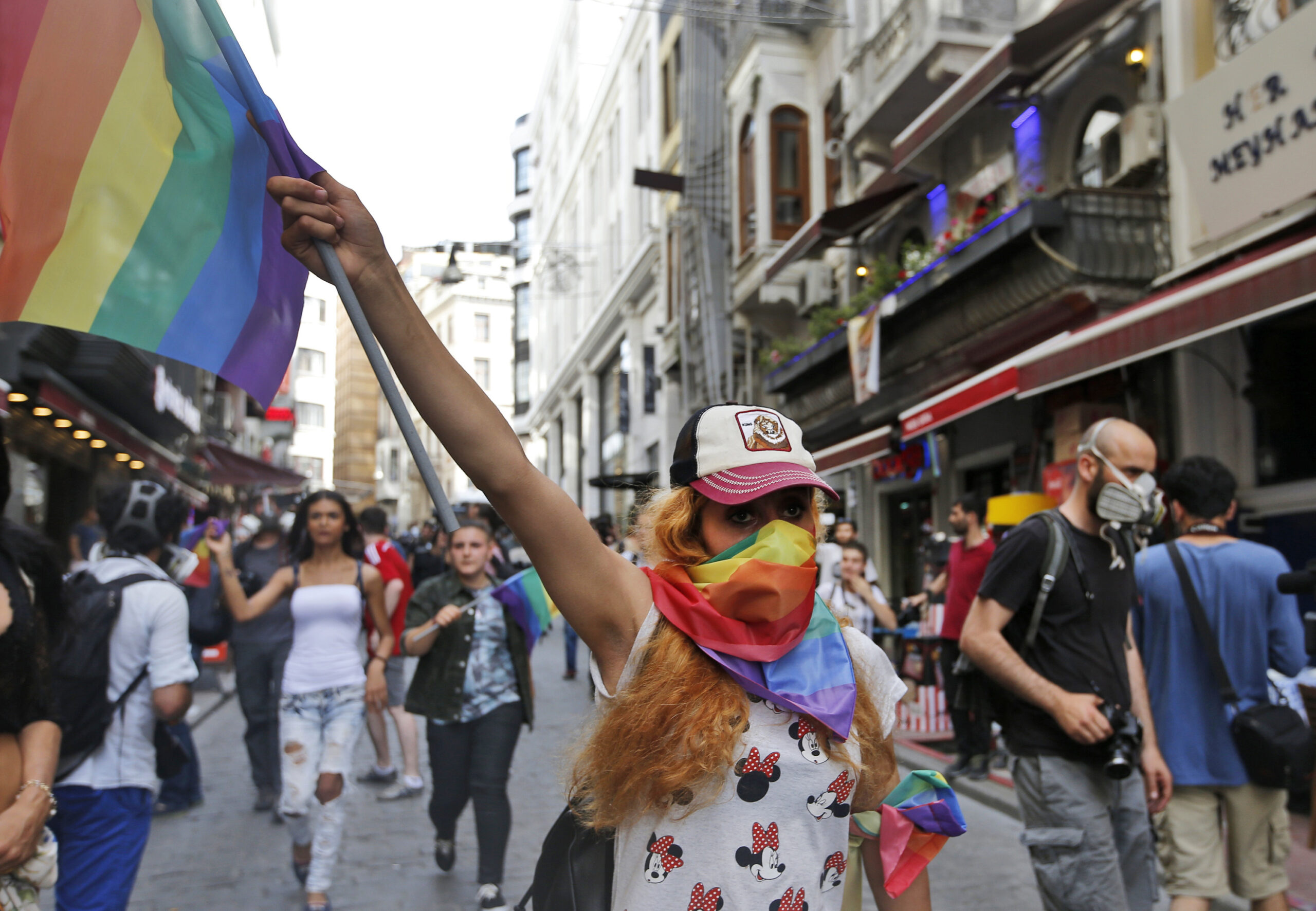
Egypt’s fading LGBT movement
As Islamists gain power, the gay community's hopes for a more open post-revolutionary society are being crushed
Taha Ryad, a 30-year-old gay Egyptian man came from a religious home. Very "out," he is seen here at a going away party for a gay American expat in a Nile boathouse. (Credit: Michael Luongo/GlobalPost) CAIRO — Long before Tahrir Square captured the imagination of the world as the stage for Egypt’s revolution, it was an infamous, clandestine meeting place for gay Cairenes.
Gay men could be seen in Tahrir cruising with knowing glances as they leaned against the guardrails, Cairo’s traffic swirling around them. They were hidden in plain sight.
Michael Luongo is a freelance journalist based in New York, and working primarily in the Middle East and Latin America. Michael has written extensively on LGBT issues in the Middle East and Muslim countries, with experience in Iraq, Afghanistan, Egypt, Gaza & Palestine, Israel and other locations. More Michael Luongo.
Can Egypt reignite the Arab Spring?
Huge protests marked the revolution's anniversary as many dissidents hope to spark an uprising against the army
(Credit: AP Photo/Muhammed Muheisen) CAIRO, Egypt — It may have been the largest demonstration Egypt’s ever seen.
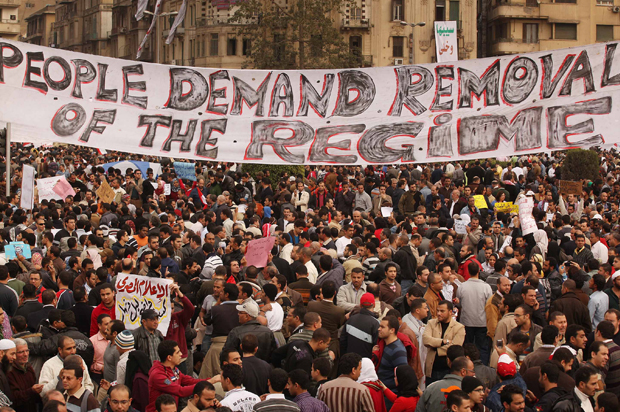
Hundreds of thousands — some boasted a million — descended on Cairo’s iconic Tahrir Square Wednesday to mark the first anniversary of the uprising that toppled President Hosni Mubarak and to call for an end to military rule.
The square was so packed that the crowds spilled onto the bridges and streets that fan out from the plaza and into Cairo’s downtown streets, with chants for freedom thundering against the area’s crumbling, colonial-era buildings.
Continue Reading CloseThe GOP Brotherhood of Egypt
Demonized in the U.S. as radical terrorists, Egypt's Islamists are actually led by free-market businessmen
Khairat Al-Shater, Muslim Brother and free marketeer (Credit: AP/Amr Nabil) While Western alarmists often depict Egypt’s Muslim Brotherhood as a shadowy organization with terrorist ties, the Brotherhood’s ideology actually has more in common with America’s Republican Party than with al-Qaida. Few Americans know it but the Brotherhood is a free-market party led by wealthy businessmen whose economic agenda embraces privatization and foreign investment while spurning labor unions and the redistribution of wealth. Like the Republicans in the U.S., the financial interests of the party’s leadership of businessmen and professionals diverge sharply from those of its poor, socially conservative followers.
Continue Reading CloseAvi Asher-Schapiro is a writer living in Cairo. More Avi Asher-Schapiro.
Growing pains for Egypt’s youthful revolution
One year after Tahrir Square, young people find new thinking, some freedom, and less money
A youthful revolution (Credit: Reuters/Amr Abdallah Dalsh) CAIRO – When massive crowds filled Egypt’s Tahrir Square one year ago chanting for the downfall of former President Hosni Mubarak, observers immediately tagged the movement “the revolution of the youth.” Organizers in their 20s and 30s had encouraged their compatriots to take to the streets and stand up for “bread, freedom, and social justice,” and they played a central role in leading the demonstrations up until the dictator’s demise.
As Egyptians plan to rally and march Wednesday to mark the one-year anniversary of the start of their revolution, nearly a dozen youths from across the political and socioeconomic spectrum told me Egypt had fundamentally changed, although not all agreed that transformation had been for the better. From increased political freedoms to fewer economic opportunities, the uprising has led to both expected and unexpected consequences for Egypt’s youth, who make up 25 percent of the country’s population.
Continue Reading CloseBen Gittleson is a writer living in Cairo. Follow him on Twitter @bgittleson. More Ben Gittleson.
Page 2 of 5 in Egypt