If Cory Booker went on “Meet the Press” on Sunday with the intent of helping President Obama, then his appearance was an utter failure. But anyone who’s followed the enormously ambitious Newark mayor’s career closely knows he’s not one to pull a Joe Biden. He’s just too smart and too smooth to screw up so epically.
More likely, Booker went on the show to help himself and to advance his own long-term political prospects. And on that score, his appearance was a success.
You’ve probably seen or are now seeing the headlines Booker generated by calling the Obama campaign’s attacks on Mitt Romney’s private equity background “nauseating” and likening them to efforts by some on the right to inject Rev. Jeremiah Wright into the campaign.
“Enough is enough,” Booker said. “Stop attacking private equity. Stop attacking Jeremiah Wright.”
He added: “I have to just say from a very personal level, I’m not about to sit here and indict private equity. To me, it’s just we’re getting to a ridiculous point in America. Especially that I know I live in a state where pension funds, unions and other people invest in companies like Bain Capital. If you look at the totality of Bain Capital’s record, they’ve done a lot to support businesses, to grow businesses. And this, to me — I’m very uncomfortable with.”
Playing up Romney’s Bain record is, of course, central to Obama’s general election plan. Romney is running as a business-savvy “job creator” and relying on the public’s tendency to associate private sector success with economic competence. There is no overstating how vital it is for Obama and his campaign to break that link, and to establish that Romney’s real expertise is in making investors rich – not adding jobs and improving the quality of life for middle class workers.
In belittling this strategy, Booker isn’t just breaking with Obama, he’s breaking with just about everyone who’s ever run against Romney – including Ted Kennedy, who used criticisms of Bain’s treatment of workers to pull away from Romney in their 1994 Senate race. Essentially, Kennedy created the blueprint that Obama is now using. Booker is also providing Republicans with a dream talking point: A top Obama surrogate not only disapproves of Obama’s use of Bain, he finds it nauseating!
It wouldn’t be surprising if Booker has already heard from the White House, and surely he’s now in for a world of abuse from Obama supporters. But that hardly means he made a mistake, at least in terms of his own ambition. Financial support from Wall Street and, more broadly speaking, the investor class has been key to Booker’s rise, and remains key to his future dreams.
It’s easy to forget, but before the world met Barack Obama in 2004, many believed that the first black president would be Booker. Armed with Stanford, Yale and Oxford degrees and all of the invaluable personal connections he forged at those institutions, he set out in the mid-1990s to craft a uniquely appealing political biography, swearing off lucrative job offers to move to Newark’s Central Ward and take up residence in public housing. Within a few years, he won a seat on the City Council, where he showed an early and consistent knack for self-generated publicity, most notably with a ten-day hunger strike in the summer of 1999.
That set the stage for Booker’s 2002 race for mayor, an ugly contest against incumbent Sharpe James, an entrenched icon of the city’s civil rights generation of black politicians. James, as any self-respecting Newark mayor would do, leveraged his clout for campaign contributions from city workers, vendors and those who aspired to be city workers and vendors.
Booker, meanwhile, had hardly lost touch with his old classmates, keeping one foot in Newark and the other in Manhattan, where he built on the connections to elite donors that he already had. He called the millions of dollars he raised for the race “love money.” The press – and James’ campaign – took note that almost all of it was from outside Newark, nearly half of it was from outside New Jersey, and a quarter of it came directly from Wall Street.
This helped bolster James’ claim that Booker, who grew up in an affluent suburb, was not an authentic Newarker. That attack resonated just enough to save James, who won in a squeaker. It was a pyrrhic victory, though: Booker had captured national interest – there was a Time profile during the campaign, and an Academy Award-nominated documentary followed – and immediately started campaigning for the next race, while a federal investigation soon swallowed up James. In 2006, Booker was elected with ease, while James was on his way to jail.
Since then, the only question in New Jersey has been when – and not if – Booker will seek to run for statewide office. In 2009, the beleaguered Jon Corzine begged him to run for lieutenant governor on his ticket, an offer that Booker wisely refused. He’s often touted as a potential gubernatorial candidate for 2013, but those who know him say his eye is more on the Senate seat now held by 88-year-old Frank Lautenberg, which will be up in 2014.
This is why it’s not at all surprising to see Booker going to bat for private equity. The allies he’s cultivated on Wall Street and in the financial industry (think, for instance, of his chummy relationship with Michael Bloomberg) have made Booker a prolific fundraiser, and when he ventured into the ultra-expensive statewide game, he’ll need them more than ever. Many of them have turned fiercely against Obama over the past few years, convinced that he’s unfairly targeted them. Booker’s words on “Meet the Press” may have enraged the average Obama supporter, but to the Wall Street class they were probably close to heroic – finally, a big-name Democrat with the cojones to call out Obama on his class warfare!
The Booker calculation, in other words, is probably that the average Democratic voter’s memory of his outburst will fade long before 2014 – but that the average Wall Street donor’s won’t.
The much-ridiculed Americans Elect dream officially died last night, when the third way group released a statement saying that no candidate had qualified for its online convention and that the selection process is now over.
In a way, this isn’t at all surprising. The Americans Elect idea was a complicated one that relied on tens of thousands of Americans registering as delegates and participating in a multi-phase online process that would produce a bipartisan national ticket. It also required prospective candidates to go public with their interest and submit themselves to this process with no guarantee of success. In the end, not enough delegates signed up, and only one real candidate – former Louisiana Governor Buddy Roemer, who was treated as a non-entity during his bid for this year’s GOP nomination – stepped forward.
In a broader sense, though, it is somewhat surprising there won’t be a viable third party candidate in the 2012 presidential race. Toward the end of last year, it was starting to look like the basic ingredients for one would be in place: a wounded incumbent with a sub-50 percent approval rating, a sense that the opposition party’s candidate is an unacceptable alternative, and pervasive popular anxiety.
This was the formula that gave rise to the two third party presidential efforts that got the most mileage in the modern era: John Anderson’s in 1980 and Ross Perot’s in 1992.
Anderson, like Roemer, had originally sought the Republican nomination, although he gained more traction, carrying the mantle for moderate/liberal Republicanism and nearly winning a few primaries. When it became clear that Ronald Reagan would be the nominee, Anderson bolted the party and launched an independent bid. The logic was sound enough at the time: Reagan had the image of a dangerous, trigger-happy extremist, and just 16 years after the Goldwater debacle it was widely assumed that he was unelectable. At the same time, Jimmy Carter’s approval ratings were falling to the low-30s; the sentiment to get rid of him was widespread.
So there seemed to be a gigantic opening for a middle-of-the-road third choice, and sure enough, Anderson showed early polling strength, climbing to over 20 percent in the spring of ’80. He even made it into a one-on-one nationally televised debate with Reagan in September, with Carter boycotting (under the belief that it would further legitimize Anderson and cause him to pull even more votes from Carter). But by October, Anderson’s support was in decline. The sentiment to fire Carter remained strong, but as Reagan gained exposure, swing voters began to regard him as an acceptable alternative, and to see Anderson as a spoiler. Other Anderson supporters defected to Carter, simply to stop Reagan. In the end, Anderson secured 5.7 percent – a number that understates his prominence in the ’80 race.
Perot also capitalized on a deeply unpopular incumbent, George H.W. Bush, whose approval rating had fallen to the low 40s by early ’92. Perot first floated the idea of running on “Larry King Live” in February, and it quickly caught fire with an electorate that was sick of the incumbent but troubled by the scandals that seemed to continually jolt the presumptive Democratic nominee, Bill Clinton. By the late spring, Perot was consistently running in first place in national polls, with Clinton a distant and forgotten third.
But Perot didn’t hold up to scrutiny, while Clinton began repairing the damage to his image. In mid-July, after falling out of the lead, Perot abruptly withdrew, helping Clinton to emerge from the Democratic convention with a lead of well over 20 points over Bush. That lopsided advantage persisted through the summer and into the fall, when Perot reentered the race and qualified for the debates. The Texan’s performance was strong enough that he finished with 19 percent of the popular vote, the best national showing for a third party candidate since Theodore Roosevelt in 1912.
(Perot, of course, tried again in 1996, but while his performance that year – 8 percent of the vote – technically exceeded Anderson’s from 1980, he was locked out of the debates and had little impact on the campaign.)
There are some obvious parallels between today’s environment and the environments that created Anderson and Perot. And when it seemed possible last fall that the GOP would anoint Rick Perry (or another culturally polarizing ideologue) as its nominee, the idea that there’d be a viable third choice this year – whether through Americans Elect or some other vehicle — made sense.
But Mitt Romney’s emergence as the GOP’s presumptive nominee changed the equation a bit. It’s absolutely true, as Jamelle Bouie detailed in the American Prospect this week, that Romney as president would probably end up functioning as an instrument of the far-right forces that lead his party. But, thanks in no small part to all of the moderate and liberal positions he took to win office in Massachusetts years ago, Romney has the image of a moderate, and is often described as one in the press. Plus, his style is often mocked, but that’s because he can seem wooden and awkward, not because he’s unusually abrasive or inflammatory. It’s not surprising he’s been able to substantially improve his personal favorable rating since securing the GOP nomination. The third party formula calls for an opposition party nominee that arouses instant alarm among swing voters, but Romney is pretty close to being a generic Republican candidate.
So there’ll be no Ross Perot or John Anderson this year. But if you still want to have fun with third party mischief scenarios, you’re not entirely out of luck: former Virginia Rep. Virgil Goode is running as the Constitution Party’s candidate; what if he peels off a small but consequential share of the vote in his home state, aka the premier swing state?! There’s also Gary Johnson, who also got the Roemer treatment during the GOP primaries and is now running as a Libertarian. A new poll has him at 7 percent in the liberty-loving swing state of New Hampshire…
Continue Reading
Close
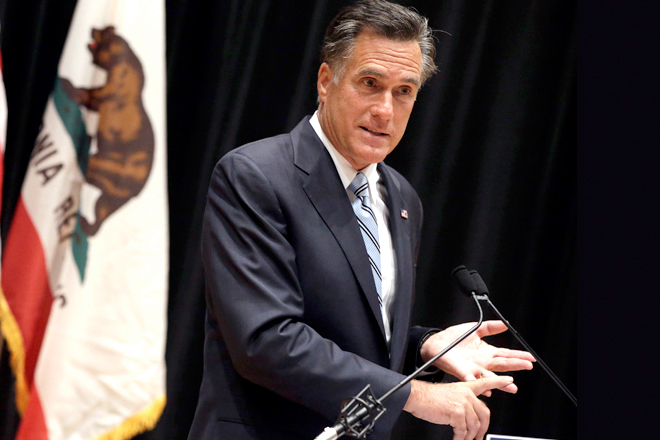
Remember earlier this spring, when Mitt Romney was emerging from the Republican primary “death march” with some of the worst personal popularity ratings for any presumptive nominee of the modern era?
Well, things have changed a bit since then. A new Gallup poll shows Romney’s favorable score recovering from its nadir and pulling roughly even with President Obama. Romney, according to Gallup, is now seen positively by 50 percent of voters, with 41 percent viewing him unfavorably. Obama’s favorable number is 52. Just a few months ago, Romney’s scores were stuck in the mid-30s. The one silver lining for Romney back then was that Bill Clinton had been in a similar spot when he emerged from the 1992 Democratic primaries only to bounce back and win easily in the fall.
If anything, the pace of Romney’s recovery is ahead of Clinton’s. It wasn’t until early July 1992 – three months after he won the New York primary and became the presumptive Democratic nominee – that Clinton’s favorable rating climbed ahead of his unfavorable score. There was a reason for this: The spring months of ’92 were dominated by the Ross Perot phenomenon, which relegated Clinton to afterthought status in media coverage. For months, the slick, scandalized image that Clinton had been saddled with during the primaries endured, but as Perot wilted under the campaign spotlight in June and early July, Clinton finally got a fresh look from the public.
With no third-party distraction, Romney has benefited from that fresh look much earlier. Gallup shows that a big chunk of his improved standing comes from shoring up his own party’s base, with a jump of 22 points in his favorable score among Republicans. Romney’s popularity is also up 11 points among independents, giving him a right-side-up 48-43 percent favorable score with them. Other recent polls have found similar results; Fox’s new survey, for instance, has Romney moving from a net-unfavorable margin of 10 points in March to a net favorable margin of 2 points now.
What this means is that Romney is close to becoming what he’s always aspired to be in this race: The generic opposition party candidate, with popularity neither significantly higher nor lower than it should be.
Mind you, this doesn’t mean that all the pieces are in place and Romney is now on course to win in November. For one thing, the Obama campaign will do everything in its power – and spend tens of millions of dollars — to drive down Romney’s popularity. It’s hard to imagine it dropping back to where it was in March, but a decline of even a few points from where it is now could be a serious problem for Romney. He could also stand to improve his score a few points; right now, it qualifies as adequate, but hardly great.
Ultimately, though, the generic candidate strategy depends on a majority of voters deciding that they want to throw the incumbent out. Romney’s goal is to offend as few voters as possible and to be positioned as an acceptable vehicle for these voters to act on their instincts. On this front, he’s nowhere near as well-positioned as Clinton was in ’92. Clinton was running against an incumbent, George H.W. Bush, whose job approval rating hovered in the high-30s and low-40s. Obama, by contrast, clocks in somewhere in the high-40s.
That’s a significant difference. We all remember Clinton as a master campaigner, but it was Bush’s profound unpopularity more than Clinton’s effortless charm that drove the ’92 result. A generic Democrat, in other words, would have won that race. Obama’s approval rating is low enough now that a generic Republican could win this year’s race, but it’s a much iffier proposition.
Continue Reading
Close
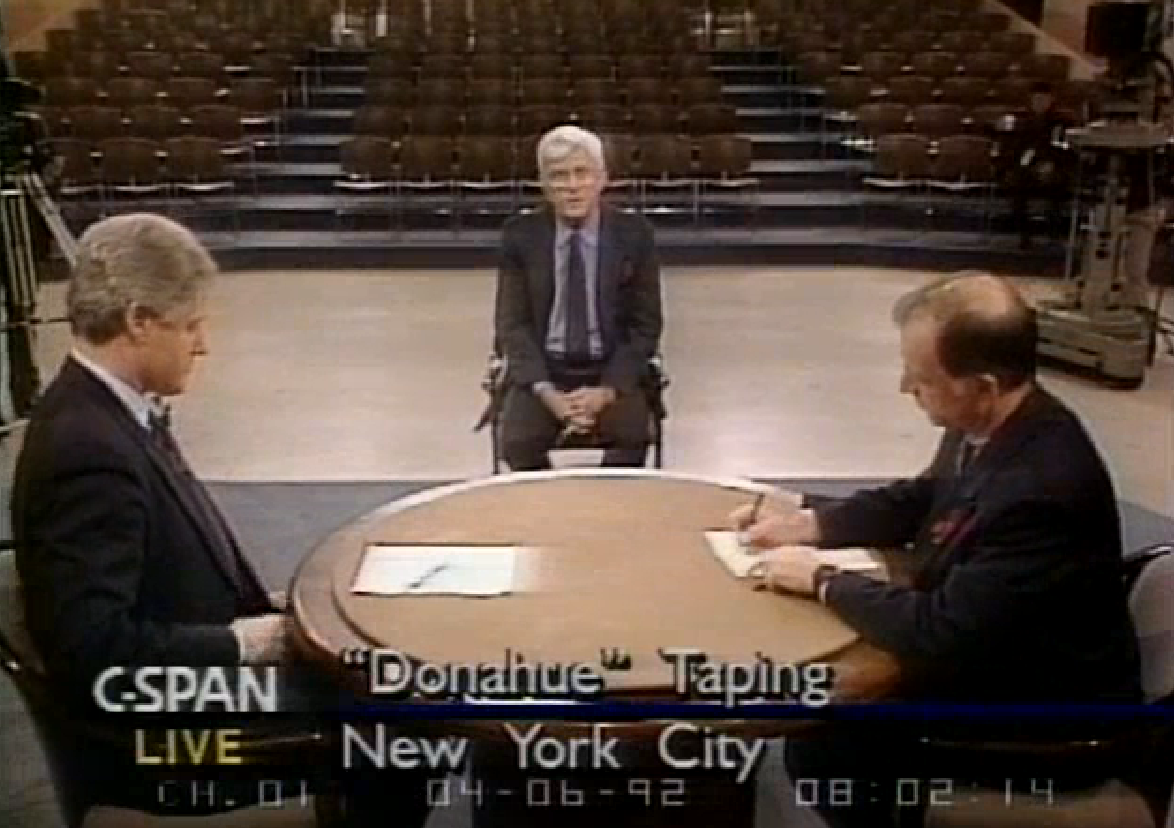
Mitt Romney’s “Bill Clinton strategy” is getting plenty of attention this week, and the idea is simple enough: Make it seem as if President Obama’s policies are so far to the left that they’re outside the mainstream of his own party’s tradition. In a way, it’s a response to Obama’s own use of Ronald Reagan – the conservative president who raised taxes 11 times and denounced debt ceiling brinkmanship — as a measuring stick for how far to the right this era’s GOP has moved.
But unlike Obama, who was a student and young community organizer during Reagan’s presidency, Romney was a public figure when Clinton was in office, running for the U.S. Senate in the 1994 midterm elections. Which means he actually took positions in real time on some of the key actions that formed the basis for Clinton’s presidential legacy – the legacy he’s now holding up as an example of responsible governance.
Nowhere is this more awkward than on the subject of taxes and deficit reduction. Romney this week wove Clinton into a speech that blasted Obama for kicking up “a prairie fire of debt,” claiming that the current president had “tucked away the Clinton doctrine in his large drawer of discarded ideas.” The problem is that Romney actually ridiculed the Clinton doctrine for reducing the deficit as it was implemented.
Romney and today’s GOP often cite the balanced budgets and surpluses that marked the late years of the 1990s, generally crediting them to what was then a Republican-controlled Congress. They’ll also give Clinton a measure of credit, if only as a backdoor means of slamming Obama, by citing welfare reform or some other compromise he struck with Republicans. But there’s really only one thing that Bill Clinton did to erase the deficit: He raised taxes on the rich – against the wishes of every single Republican in Congress.
Clinton’s 1993 budget, which was enacted as the country was emerging from a recession and confronting leftover deficits from the Reagan years, hiked rates on the top 1.2 percent of income-earners and created a new 39 percent tax bracket. Republicans branded it “the biggest tax increase in world history” and screamed that it would kill millions of jobs and plunge the country back into recession. (For a sense of the hysteria they stirred, just watch the video in this post of Newt Gingrich, John Kasich and other top congressional Republicans at the time.) Attacks on the Clinton tax increase became a major component of the GOP’s 1994 midterm campaign strategy – which is where Romney comes in.
Running against Ted Kennedy in Massachusetts, he embraced the ’93 budget as an issue, playing up the tax increases and claiming that it would do nothing to curb deficits because Democrats had refused to make real cuts in spending. When Clinton came to the state in late October to campaign with Kennedy, Romney held a rally of his own with Bill Weld, then the state’s Republican governor. As the Boston Globe reported it:
As Weld led the cheers of “Go, Mitt, Go,” Romney labeled Kennedy and Clinton “the guys who put together the biggest tax increase in the history of the nation” and said they were in Massachusetts “explaining why they need more of your money.”
“It’s fine for Bill and Ted to have their excellent adventure,” Romney said. “But I’d rather be here with Bill Weld showing the voters we care about taxes, about real jobs being created, about being tough on crime and being tough on welfare.”
Romney also bought 30 minutes of television time for an infomercial just days before the election. In it, he warned that if Kennedy were to be reelected “the national debt would be pushed even higher.”
But voters reelected Kennedy anyway, by 17 points, and the deficit was gone just a few years later. The Republican warnings about a second recession never materialized, and as the economy picked up strength, the new Clinton tax rates (on top of the hikes that President George H.W. Bush enacted over his own party’s objections in 1990) produced a revenue windfall and the resulting surpluses — which Romney and Republicans now hail as the work of a Democratic president who, unlike Barack Obama, just didn’t believe in class warfare.
Continue Reading
Close
What may be most notable about the surprise triumph yesterday of a Sarah Palin-backed insurgent in Nebraska’s Republican Senate primary is how routine these sorts of things are becoming.
Deb Fischer’s late charge to victory wasn’t really rooted in ideology. As Hotline’s Reid Wilson points out, she’s actually racked up a (somewhat) moderate record in the Nebraska legislature, and has some personal connections to the state’s leading GOP establishment figures.
But most GOP primary voters probably didn’t know this. Fischer came to the race with little money or name recognition and spent virtually all of the campaign toiling the shadows of her two better-known opponents. The Palin endorsement came just a week before the primary, giving Fischer a sudden jolt at just the right time. It may be that all Republican voters really knew about her was that she was a rancher and a conservative (per the ads she ran), that she had Palin’s support, and that she wasn’t her rivals. And that was enough to pull out a victory that no one saw coming.
So even if Fischer isn’t a classic Tea Party conservative, she still managed to tap into the same basic aversion to establishment figures and appetite for outsiders that has produced some seismic GOP primary upsets in the Tea Party-era. And the fact that it comes just a week after six-term Senator Richard Lugar was crushed by 20 points in an Indiana primary underscores how severely the power of Republican incumbents and establishment heavyweights to beat back primary challenges has been reduced.
There could be some more Nebraska-like upsets in Senate primaries this year, but no other sitting senator is expected to be denied re-nomination as Lugar was. But 2014, when 13 more Republican senators are due to face the voters, could be a different story. After 2010, when primary season chaos derailed the GOP’s hopes of winning back the Senate, there was hope among the party’s establishment that the base’s restiveness would die down and that order would be restored. That hasn’t happened, obviously, so it’s probably time to look at which Republican senators should be – and probably are – sweating the most about ’14:
Lindsey Graham (South Carolina): Graham, a long-time irritant to national conservative leaders, is the face of the compromise-friendly approach to governing that the GOP base is revolting against. And South Carolina is arguably ground zero for the Tea Party revolt, home of Sen. Jim DeMint and the “four horsemen” quartet of true believer House freshmen. Any of them could be a viable primary foe against Graham (and one of them, Trey Gowdy, already beat an incumbent, then-Rep. Bob Inglis, by 42 points in a 2010 primary). Graham has said he expects to get a primary challenge, which seems inarguable.
Saxby Chambliss (Georgia): Chambliss, too, says he expects a primary. His voting record is reliably conservative (a career mark of over 90 percent from the ACU), but he was part of the bipartisan Gang of 6 deficit reduction negotiations last year and argued that tax increases had “to be part of the mix.”
Lamar Alexander (Tennessee): His reputation as a moderate has never quite matched up with his voting record, but the 71-year-old Alexander seems cut from the same cloth as Lugar – collegial manner, lots of talk of cooperation with the other side, occasional breaks with party orthodoxy, and a voting record that’s reliably Republican overall. But his age, his image, and his decades in state and national politics (he was governor from 1979 to 1987 and ran for president in 1996 and 2000) make him particularly vulnerable to an anti-establishment uprising. Alexander could take some consolation from the fact that his fellow Tennessee senator, Bob Corker, escaped a serious primary challenge this year.
Mitch McConnell (Kentucky): One of McConnell’s biggest humiliations came in 2010, when he threw his vaunted home state political operation behind Trey Grayson, only to watch his protégé lose the GOP Senate primary to Rand Paul. A five-term incumbent, the 70-year-old McConnell reeks of Washington insiderdom, so there’s plenty of speculation that he’ll be a primary season target. But there’s good news for McConnell: Paul is now on board with his ’14 reelection effort, and other veterans of Paul’s ’10 campaign are sending similar signals. For now, McConnell seems to be in good shape, but as the Senate’s GOP leader, there’s always a chance his fingerprints will end up on a legislative compromise that infuriates the base.
Pat Roberts (Kansas): He’s old (76) and has been on Capitol Hill for 32 years – the first 16 in the House and the last 16 in the Senate. He’s also a quiet, behind-the-scenes player whose voting record is only now evolving to synch up with the GOP base’s prevailing mood. It wouldn’t be too hard for an opponent to portray Roberts as a tired insider with Potomac Fever. Plus, the Kansas Republican Party is unusually prone to civil war. Roberts could provide an inviting target for, say, Kris Kobach, the youthful Kansas secretary of state who has become the leading national voice of the anti-immigration right.
Thad Cochran (Mississippi): This marks Cochran’s 40th year in Congress. He was elected to the House in 1972, then replaced James Eastland in the Senate in 1978. At the time, Cochran was a trailblazer, the first Republican since Reconstruction to win a statewide race in Mississippi. But the post-civil rights migration of southern white voters to the GOP is now complete, and today Cochran is one of many. If anything, he hasn’t kept pace, with a voting record that’s not quite as conservative as where his party is. A bigger problem, though, could be Cochran’s fondness for earmarks, a key marker of insider-ness in today’s GOP. Cochran might be higher on this list if it weren’t for his weak fundraising and noncommittal answers about running again – strong hints that he’ll end up calling it a career at 77 years old.
Susan Collins (Maine): Collins’ voting record places her decidedly to the left of her GOP colleagues and Maine was home to one of the Tea Party’s signature 2010 triumphs – Paul LePage’s out-of-nowhere gubernatorial primary win (which was followed up by a narrow November victory). Collins, who was first elected in 1996, could be vulnerable if a challenger emerges, but it’s not clear one will – just consider the failure of the grassroots to mobilize against Olympia Snowe before Snowe’s unexpected retirement announcement earlier this year. Plus, Maine loves independents – it’s elected two of them governor since the 1970s, nearly anointed a third in 2010, and is on its way to sending one (Angus King) to the Senate this year. Collins may have the same insurance policy that was always there for Snowe: If things get too rough in her own party, the option of an independent bid will be there.
Obviously, this is a preliminary and speculative list. Some of these Republicans may end up coasting in 2014, and others who aren’t mentioned could find themselves in unforeseen peril.
What’s really worth watching is how the fear of a primary challenge weighs on all of their actions in the Senate going forward. How many of them will mimic Orrin Hatch – who was so spooked by the ’10 defeat of his fellow Utah Republican, Bob Bennett, that he reinvented himself as an abrasive, compromise-hating partisan warrior? Hatch’s primary is in six weeks – and he’s expected to survive.
Continue Reading
Close
George W. Bush may have established a new world record today for the shortest, most awkward public endorsement statement in presidential campaign history:
“I’m for Mitt Romney,” Bush told ABC News this morning as the doors of an elevator closed on him, after he gave a speech on human rights a block from his old home — the White House.
The reason for this strange scene is obvious: Romney and his fellow Republicans want absolutely nothing to do with the 43rd president, lest voters connect the epic financial meltdown that played out on his watch to the economic anxiety they’re now feeling. As Jamelle Bouie explained today, the case that Romney is making for voting out President Obama depends on the public downplaying (or forgetting altogether) that he inherited an economy that was in the throes of a crisis not seen in generations:
In this narrative, the GOP didn’t mismanage the economy into the deepest downturn since the Great Depression. Rather, the economic crisis simply happened, ex nihilo, and Obama did nothing to stop or mitigate it. What’s more, he made things worse, with government spending and an explosion of debt.
The problem for Obama, as Bouie points out, is that there’s real appeal to this story. The electorate tends to exist perpetually in the present tense, with little collective memory or foresight. Republicans began banking on this the moment Obama was sworn in: Just stand against everything he’s doing, and if the economy remains in rough shape, sooner or later the public will hold him responsible, just because he’s the guy in charge. As it turned out, it took only about nine months for Obama’s approval rating to fall under the 50 percent mark, and it’s hovered around there ever since, putting him in danger of losing this fall.
One way the Obama campaign is attempting to counteract this is by challenging Romney’s own economic and job-creation credentials. The presumptive GOP nominee has been relentlessly touting his business (and not government) experience, hoping that voters will assume he knows how to fix the economy because of his private sector success. Polls suggest voters are buying it, at least to a degree, with Romney generally outpacing the president by several points on which candidate would be better on creating jobs and boosting the economy. This is the reason Obama’s campaign unveiled a brutal two-minute attack ad yesterday on Romney and Bain Capital on Monday; the idea is to convince voters that there’s not necessarily a connection between making money in business and understanding how the economy works.
It’s hard to say whether this will work. Romney is fighting back by highlighting jobs that were created through Bain and with a new video that tells the stories of struggling Americans who have been victimized by “the Obama economy.” As Greg Sargent explains, the video is a perfect reflection of both the misleading simplicity of Romney’s message and its potential effectiveness. There’s just a lot the Romney campaign can say and do to deflect from the impact of the Bain attacks.
In this way, Bush’s very brief reemergence today raises the question of whether Obama ought to be invoking his predecessor more frequently and more explicitly, and to make him a more central figure in the campaign. Polls show that voters still remember what happened on Bush’s watch and still hold him responsible for at least some of the country’s current problems. Obama does frequently make reference to what he inherited, and to the failure of the GOP to come up with a new economic platform during its White House exile. But more than anything else, it seems that Romney’s campaign fears being tied to Bush. And Bush, as his elevator trick shows, is willing to help them out by remaining inconspicuous. If Obama’s team wants it, there’s some slack to be picked up.
Continue Reading
Close