Help keep Salon independent

Trump compares “beautiful” Harris to his wife, Melania, in rambling conversation with Elon Musk

During a livestream with tech tycoon Elon Musk, former President Donald Trump appeared to liken Vice President Kamala Harris to his wife, Melania. 

Although the GOP presidential candidate had insults for his political opponent — who he claimed would make a “terrible leader”— he did reserve one compliment for Harris during his two-hour-long friendly interview with Musk on X Spaces, The Independent reported.

“I saw a picture of her on Time Magazine today. She looks like the most beautiful actress ever to live,” Trump told Musk.

“She looked very much like our great first lady, Melania,” he continued, before adding. “She didn’t look like Kamala, but of course, she’s a beautiful woman, so we’ll leave it at that.” 

Trump limited his praise to Harris' physical appearance before launching into his usual attack on women of color, asserting that the former California senator and attorney is unintelligent.

“We need smart people, and people that have the ability to lead. She doesn’t have that ability. Can you imagine her with Chairman Xi,” he asked Musk rhetorically, referring to the China's authoritarian leader. It "would be silly.”

In a statement, the Harris campaign mocked Trump's conversation with Musk, noting that it began after a 40-minute delay due to technical difficulties. The two right-wing billionaires, it said, are “self-obsessed rich guys who will sell out the middle class and who cannot run a livestream in the year 2024.”

“He’s not coming back”: Jon Stewart mocks Trump’s obsession with Joe Biden as Kamala Harris surges

Jon Stewart on Monday's episode of "The Daily Show" roasted former President Donald Trump's attempts to criticize Vice President Kamala Harris, his Democratic opponent in the 2024 presidential election. 

Stewart welcomed viewers who may have been tuning into the show from X/Twitter, after watching a rambling and wide-ranging interview between Trump and tech magnate Elon Musk. "You know, when they started quoting their favorite Maya Angelou passages to each other," Stewart said, before riffing as though he were Musk. "'My interpretation — the caged bird is singing for Bitcoin.'"

Stewart then honed in on Trump's attempted takedown of Harris, a sharp pivot the MAGA campaign was forced to make after President Joe Biden withdrew from the presidential race last month.

The show aired reports that the ex-president has grown increasingly frustrated with Biden's decision to step aside as well as Harris' surging poll numbers.

“A month ago, he was basically already the f***ing president. He had cheated death, started a new ear accessory trend," Stewart said, referring to Trump's bandaged ear in the wake of his assassination attempt. "Back then, people thought his VP selection was a smart choice. He had it all in the bag, and it was taken away.

"But now, instead of enjoying the fruit of six years of Biden attacks, got to start all over again. And the audience has to literally sit through him getting up to speed," Stewart continued, before showing a montage of Trump referring to the Veep as "Kamabla," questioning her race, and accusing her of using AI to fake a large crowd that was seen in countless live photos and videos. The former president even alleged that once, during a nearly calamitous helicopter ride with former San Francisco mayor Willie Brown — whom Harris used to date — Brown disclosed "terrible things about her." Brown denied the interaction ever took place, saying in an audio clip the Stewart aired, "I just assumed he was on a helicopter ride with somebody Black and he made a mistake and thought it was me."

Even Trump's efforts at “trying out some good catastrophizing on Harris" have proved a fool's errand; Stewart said, airing back-to-back video clips of the ex-president reusing insults —  pegged to hypothetical disaster scenarios like a stock market crash, World War III, and the destruction of suburbia — he once directly attributed to Biden. “This is just a remix?” Stewart asked. “Dude, you can’t just find and replace Biden with Kamala. That’s lazy apocalypse-ing.”

We need your help to stay independent

Stewart then delved into Trump's unfounded assertions that Biden will reclaim the Democratic nomination. In one clip from a MAGA rally in Montana last week, Trump said, "I hear he’s going to make a comeback at the Democrat convention. He’s going to walk into the room and he’s going to say, ‘I want my presidency back. I want another chance to debate Trump. I want another chance.’”

“He’s not coming back. He’s not coming back,” the comedian said, as though he were speaking to Trump directly. 

“I get it, you wanted to run against Joe Biden. Just two old dudes going toe to toe fungus. Last Hurrah,” Stewart said. “It’s not fair. Now you’ve got to run against someone who appears healthy and youthful and happy, her vigor standing as a stark counterpoint to whatever front butt thing you have going on.”

“And it’s pretty clear that Biden isn’t going to do what needs to be done to stop this steal,” he continued. “Someone I know loves stopping steals, right? Kamala Harris accepts the nomination next Thursday night, which means it may be time to get the gang together storm the convention, pull an August 22, this time on behalf of Joe Biden. All you need is thousands of supporters who have not yet been sent to jail yet for being part of the last mob, or sent to jail so early in the process, they’re already out.”

"The Daily Show" airs Monday through Thursday at 11 p.m. on Comedy Central and streams on Paramount+

Former Colorado election official Tina Peters found guilty of tampering with voting machines

A former county election official was found guilty by a Colorado jury on Monday of allowing a supposed computer expert to copy highly sensitive voter data from her office in 2020 in an effort to prove Donald Trump's false claims that the election was stolen.

Tina Peters, the former Mesa County clerk, was convicted of tampering with voting machines under her control to try and make it seem like they had been used to rig against Trump in the 2020 election, The Washington Post reported

Peters was found guilty on seven of 10 counts, including several charges of attempting to influence a public servant and conspiracy to commit criminal impersonation.

The jury in Grand Junction took nearly five hours to determine that Peters was involved in trying to breach a machine manufactured by Dominion Voting Systems by helping an outsider gain unauthorized access to the machine in May 2021. The stolen data was later presented publicly at a conspiratorial event hosted by election denier, Mike Lindell, a Trump ally and CEO of MyPillow, The New York Times reported

Peters' outside computer expert was a former pro surfer, Conon Hayes. According to testimony at the trial, Peters identified Hayes as a different person — a county technology expert named Gerald Woods who Peters had recently hired. 

After Hayes gained access to the voting machines, he also gained access to county passwords and sensitive data about Dominion’s software. 

Peters will be sentenced Oct. 3 and could potentially face prison time.

Truth Social tanks as Donald Trump returns to X

Donald Trump’s social media network Truth Social is rapidly declining in value as the former president has started posting on X for the first time in over a year. 

On Monday morning, Trump posted a campaign video to X, followed by several other posts, one of which advertised an interview with X CEO Elon Musk later that day. 

“It will be the interview of the century,” he wrote.

The interview was fraught with technical issues and began more than 40 minutes late. But Trump's return to posting on a competitor is unlikely to help Truth Social's financial situation.

Over a three month period that ended June 30, Truth Social’s parent company, Trump Media & Technology, lost more than $16 million. At $24.60 on Monday, shares in the company sat at their lowest price in months, The New Republic reported, further declining to $23.37 on Tuesday morning. In 2022, shares were at one point trading at more than $97.

Many investors hoped the 2024 election would be a boost for Truth Social, but the company has been on a steep decline since its inception. In its first quarter of this year, Trump Media &Technology lost more than $300 million and only brought in $770,500 in revenue, The Guardian reported

Along with a drop in value, Truth Social is rapidly losing users. When the platform was launched in Feb. 2022, it had around 3.26 million users. In June of this year, it declined to 2.11 million users, a decline of 38%, according to reporting from The Guardian.

“The diminishing audience levels for Truth Social suggest a rejection of the harsh rhetoric expressed by the ex-president and his political allies that is one of the hallmarks of the two-year-old platform,” a rightwing media analyst, Howard Polskin, told The Guardian. 

“If this softness persists, it might portend trouble for Mr. Trump at the ballot box in November,” he added.

“Rising concerns about his age and well-being”: Trump lisps through disastrous livestream with Musk

Former President Donald Trump’s interview Monday night with billionaire supporter Elon Musk was a wreck. Then it actually began.

Slated to start at 8 p.m. Eastern on X, the conversation was subject to a more than 40-minute delay thanks to technical difficulties that Musk attributed, without evidence, to a denial-of-service attack from Democratic partisans (the same who presumably derailed last year’s livestream with Florida Gov. Ron DeSantis). When it finally got underway, it was, as the Arizona Republic’s Bill Goodykoontz commented, “every bit as unhinged and worthless as you would expect.”

There was, predictably, nothing new. After nine years of this, the Republican candidate has nothing new to say — just variations of how he launched his first run for the White House in 2015: lies about immigrants all being murderers and rapists, despite their committing crimes at a significantly lower rate than U.S.-born citizens.

The only thing new here was Trump’s opponent, Vice President Kamala Harris, who the 78-year-old termed a “phony” and falsely claimed was the Biden administration’s “border czar” and thus responsible for an influx of law-abiding migrants from the Americas.

Ultimately, more than two hours passed without a single tough question or interesting response. Musk was slavish in his devotion — at one point, he asked for a job in a future Trump administration, the Pentagon contractor offering his help on cutting government spending — while Trump rambled through his usual talking points, with an apparent lisp that his campaign blamed on listeners’ faulty hearing.

The New York Times summed it up thusly: Trump “repeated a number of false claims, including that the 2020 election was rigged, the criminal cases against him were a conspiracy by the Biden administration to undermine his candidacy and the leaders of other nations were deliberately sending criminals and ‘their nonproductive people’ to America.” Musk, in return, “largely voiced his agreement, offering frequent praise as he proved a sympathetic partner,” having turned one of the world’s leading social media platforms into another Gab or Truth Social, but with even more far-right extremists.

It was, per CNN, the “usual bombardment" of things that are not true, Trump lying at least 20 times about everything from crime (he said it’s going up; it’s gone down dramatically since he left office) to supposedly record-high inflation (it was 2.5% from June 2023 to June 2024).

We need your help to stay independent

If the conversation revealed anything it was that Musk was right — at least back in 2022, when in response to the former president calling him a “bulls**t artist,” the tech billionaire, then a DeSantis supporter, wrote that “Trump would be 82 at end of term, which is too old to be chief executive of anything, let alone the United States of America.”

As USA Today’s Rex Huppke observed, the Trump on display Tuesday night was audibly diminished. “He was rambling, babbling on about crowd sizes and immigration and President Joe Biden and whatever else seemed to pass through his mind,” he wrote. “He was also badly slurring his words, raising questions about his health, and doing nothing to knock down rising concerns about his age and well-being.”

It was the same Trump who ranted incoherently at a press conference last week, fabricating a story about a near-death experience on a helicopter, where Kamala Harris’ ex-boyfriend was supposed to have spent his presumed final moments on Earth conveniently bashing the future vice president of the United States.

The Harris campaign was quick to capitalize on the performance, highlighting Musk’s previous doubts about Trump’s fitness (“Interesting,” the campaign posted on social media, highlight his 2022 comments) before going on to bash them both.

“Trump’s entire campaign is in service of people like Elon Musk and himself,” the Harris campaign said in a statement: “self-obsessed rich guys who will sell out the middle class and who cannot run a livestream in the year 2024.”

“Poornography”: Expert says JD Vance a classic example of the rich trying to speak for the poor

JD Vance has climbed to his current position as former President Donald Trump’s running mate, in part, by selling himself as a hillbilly, calling on his Appalachian background to bolster his credentials to speak for the American working class.

I grew up as a poor kid,” Vance said on Fox News in August 2024. “I think that’s a story that a lot of normal Americans can empathize with.”

Indeed, the book that brought him to public attention was his 2016 memoir, “Hillbilly Elegy.” In that book, he claims his family carried an inheritance of “abuse, alcoholism, poverty, and trauma.”

“Poor people,” he proclaimed in a 2016 interview with The American Conservative, are “my people.”

But there’s a bit of a shell game going on when it comes to Vance’s poverty credentials.

Vance did come from a troubled family. His mother was – like so many Americans, whether they’re poor, middle class or rich – addicted to painkillers. In the book, Vance searches for an explanation for his traumatic relationship with his mother, before hitting on the perfect explanation: His mother’s addiction was a consequence of the fact that her parents were “hillbillies.”

The reality – one that Vance only subtly acknowledges in his memoir – is that he is not poor. Nor is he a hillbilly. He grew up firmly in Ohio’s middle class.

In my forthcoming book, “Poor Things: How Those with Money Depict Those without It,” I detail how Vance’s work is actually part of a genre I call “poornography.” Created mainly by middle- and upper-class people for like-minded readers, this long line of novels, films and plays can end up spreading harmful stereotypes about poor people.

Though these works are sometimes crafted with good intentions, they tend to focus on violence, drugs, alcohol, crudeness and the supposed laziness of poor people.

Peering at all the poor people

When you think about novels and films about the poor, you come upon the great classics: Charles Dickens’ “Oliver Twist,” Emile Zola’s “Germinal,” James Agee and Walker Evans’ “Let Us Now Praise Famous Men,” Jack London’s “The People of the Abyss” or John Steinbeck’s “The Grapes of Wrath.”

Yet all these monuments to the suffering of the poor were written by authors who were not poor. Most of them had little to no knowledge of the lived experience of poor people. At best, they were reporters whose source material was meager. At worst, they simply made things up, recycling stereotypes about poverty.

For example, John Steinbeck had some contact with poor people as a reporter. But as he wrote about migrant camps for “The Grapes of Wrath,” he relied heavily on the notes of Sanora Babb – herself poor and formerly homeless – who traveled to migrant camps throughout California for the Farm Security Administration. Babb’s boss – a friend of Steinbeck’s – had secretly shown the author her notes, without her permission.

Babb would go on to also write a novel based on her experiences, which was bought by Random House. But the publishing house killed it after “Grapes of Wrath” came out, and it wasn’t published until 2004, when the author was 97 years old. That year, she told the Chicago Tribune – correctly, I might add – that Steinbeck’s work “isn’t as accurate as mine.”

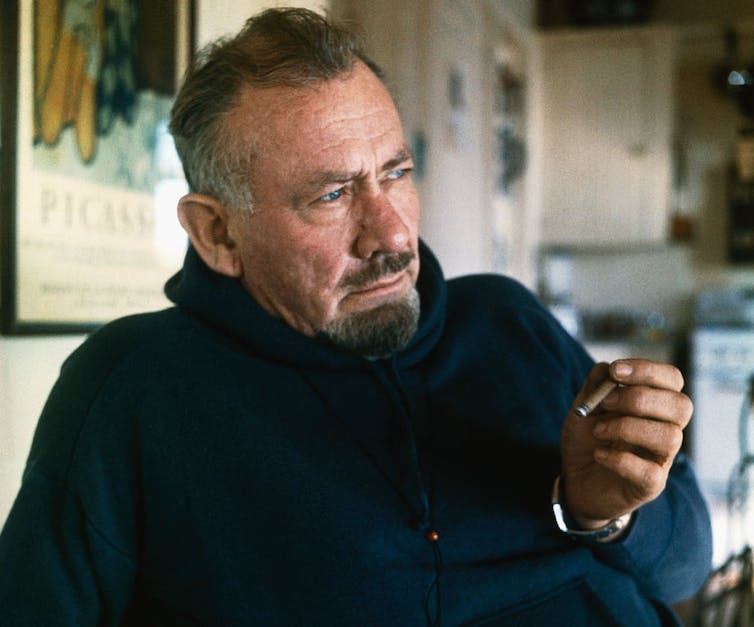
Older man with graying hair and a goatee poses while holding a cigarillo.

John Steinbeck relied upon the notes of Sanora Babb to write ‘The Grapes of Wrath.’ Bettmann/Getty Images

Then there’s London, whose “The People of the Abyss” is seen as a faithful portrayal of the lives of the British poor. But London, who went “undercover” to craft a sordid account of England’s urban poor, nonetheless maintained a comfortable apartment. He kept a stash of money sewed into his ragged coat and conveniently escaped for a hot bath and a good meal while pretending to pass as a pauper. The result is a book laden with put-downs of the English working class, who are cast in eugenicist terms as a degenerate race.

When you look at the books or films created by people who grew up poor, the tone and focus often shift dramatically.

Instead of a fixation on the tawdry side of life, you see works that explore the things that bind all people together: family, love, politics, complex emotions and sensual memories.

You only have to open Richard Wright’s “Black Boy,” Agnes Smedley’s “Daughter of Earth” or Justin Torres’ “We the Animals” to see their protagonists’ appreciation of beauty and ability to experience profound pleasure – yes, all while experiencing poverty.

Wright recalls how, as a child, he would play in the sewer, where he would spend hours fashioning all manner of detritus into toys. The young Smedley loves to stare through a hole in her roof to gaze at the sky. And Mike Gold, author of “Jews Without Money,” sings a paean to an empty, garbage-strewn lot in his neighborhood that doubled as his beloved playground.

Hillbilly cosplay

Vance, on the other hand, fills his book with selections from the greatest hits of “poornography” – violence, drugs, sex, obscenity and filth.

But Vance himself was never actually impoverished. His family never had to worry about money; his grandfather, grandmother and mother all had houses in a suburban neighborhood in Middletown, Ohio. He admits that his grandfather “owned stock in Armco and had a lucrative pension.”

He falsely introduces himself to his Yale classmates as “a conservative hillbilly from Appalachia.” Over the course of the book, he confuses himself – and the reader – by variously saying that he is middle class, working class and poor.

In order to justify his memoir as something more than a tale of a drug-addicted mother and a son who went to Yale, he fashions a grand theory that being a hillbilly does not have to be related to social class – or even living in Appalachia.

To Vance, hillbilly-ness becomes kind of a cultural trait, tied to a family history and identity, not class. His grandmother, he writes, “had thought she escaped the poverty of the hills, but the poverty – emotional if not financial – had followed her.”

Bootstraps redux

In developing his grand theory, Vance takes readers very close to the now-debunked notion of a culture of poverty, in which the poor are responsible for their situation and their attitude toward work is passed along from one generation to the next.

A dependence on government handouts, according to the theory, undergirds this culture. Vance pines for an imagined glorious past of his slice of America. His neighbors in Middletown had lost – thanks to the welfare state – “the tie that bound them to their neighbors, that inspired them in the way my patriotism had always inspired me.”

But Vance finds himself in a dilemma: Are these people simply lazy? Or are they the victims of a system that encourages them to watch TV and eat bad food as they collect welfare or disability checks?

Several times he refers to people who live on welfare as “never [having] worked a paying job in his life.” He seems to fully buy into the notion that people are poor because they are lazy freeloaders.

He “solves” the problem with the age-old critique of poor people: They got there because of “bad choices.” He mentions a friend who although having a job that paid a steady income nevertheless quit it because he didn’t like getting up early.

“His status in life is directly attributable to the choices he’s made,” he writes, “and his life will improve only through better decisions.”

No platform, no voice

And so the GOP’s young standard-bearer for the working classes simply repeats the same bootstrap rhetoric that’s been peddled for decades.

But it’s not simply a question about believing a politician or not. That would be a fool’s game.

Rather, the issue here is what I call “representation inequality,” by which I mean that one identity group – in this case, poor people – don’t get to represent themselves.

What has happened – whether it’s in politics or in publishing – is something called “elite capture,” in which those with cultural capital and power assume the right to speak for and represent the powerless.

In so doing, dangerous stereotypes and tropes get developed with serious political consequences. Just because you drink Diet Mountain Dew doesn’t mean you do get to speak for those in the mountains.

Our political and educational system elbows out most poor people. First-generation students – like myself, and like many of my students at the University of Illinois in Chicago, where I teach – have a harder time staying in school, have more food insecurity and homelessness, and will often not benefit from the normal boost education offers. They tend to have a much harder time ascending the stratified ranks of culture and politics, becoming the published authors and elected officials who might provide representational equality.

As political scientist Nicholas Carnes points out in his 2018 book “The Cash Ceiling,” only 2% of congressional lawmakers worked in manual labor, the service industry or clerical jobs before getting involved in politics. So it’s no surprise that when the wealthy want to pass certain laws, they’re much more likely to get passed.

In July 2024, The New York Times reported that Vance’s Yale law professor and author Amy Chua read an early version of what became “Hillbilly Elegy,” one that was more geared to an academic audience and grounded in political theory. She prodded Vance to change his manuscript, telling him that “this grand theory [about America] is not working.”

I would argue that his “grand theory” about the poor doesn’t work, because the poor – unlike many other identity groups – don’t have a platform to articulate and promote their own needs and political vision.

Instead, we’re stuck with people like Vance, who offer bromides at best and fatalistic narratives of doom at worst.


Lennard J. Davis, Distinguished Professor of English, Disability Studies and Medical Education, University of Illinois Chicago

This article is republished from The Conversation under a Creative Commons license. Read the original article.

There is one big reason why this election feels so different: Donald Trump is lost

If  2020 was the face mask election, this one is turning out to be the Bounty election — you know…the “quicker picker upper” paper towels we need to clean up Trump’s unhinged meltdowns.

Never-Trumper George Conway went on MSNBC “Morning Joe” on Monday to call Trump “a deeply unwell man…a deeply psychologically disturbed individual,” because Trump accused Vice President Kamala Harris not just of lying about her crowd size at a recent Detroit rally, but of faking the crowd altogether, somehow using AI to show the 15,000 or so who were in attendance inside an airplane hanger when Harris’ Air Force Two plane pulled up outside. Trump posted this on his social media platform:

Has anyone noticed that Kamala CHEATED at the airport? There was nobody at the plane, and she ‘A.I.’d’ it, and showed a massive ‘crowd’ of so-called followers, BUT THEY DIDN’T EXIST! She was turned in by a maintenance worker at the airport when he noticed the fake crowd picture, but there was nobody there, later confirmed by the reflection of the mirror like finish on the Vice Presidential Plane.  She’s a CHEATER. She had NOBODY waiting, and the ‘crowd’ looked like 10,000 people! Same thing is happening with her fake ‘crowds’ at her speeches. This is the way the Democrats win Elections, by CHEATING.

The crowd that showed up to fill the airport hangar to hear Harris and running mate Tim Walz, governor of Minnesota, wasn’t fake, nor have been any of her crowds.

What is different about this election is how we’re seeing it through two sets of eyes – our own, and those of the man who after thinking he was cruising to an easy win in November against a frail and fading Joe Biden, now sees himself losing, and he really, really can’t stand it.  

The meme that Trump is “melting down” doesn’t quite get how profound his discomfort and disbelief are at this moment.  The switchover from Joe Biden to Kamala Harris happened so abruptly and went so smoothly, it’s almost as if there never was a Biden campaign. Just three weeks in, Kamala Harris looks like she has been the presumptive nominee ever since the primaries began early this year with Biden at the top of the ticket. If you blinked over the past week, you’d open your eyes to find her someplace else with a crowd at a rally even bigger than the last one. She went from Wisconsin to Georgia to Pennsylvania to Michigan to Arizona to Nevada and back to Michigan again – and that schedule omitted appearances in Raleigh, North Carolina, and Savannah, Georgia that had to be canceled due to the Biblical-style rains of Hurricane Debby.

The other thing that has changed is that Trump has lost his natural-born ability to shock.

This is what Trump was doing during the same week in August in 2016: He held two rallies on August 3 in Jacksonville and Daytona Beach, Florida. On the 4th, he was in Portland, Maine; on the 5th, he held rallies in Des Moines, Iowa and Green Bay, Wisconsin; on the 6th, he was in Windham, New Hampshire; on the 9th, he held rallies in both Wilmington and Fayetteville, North Carolina; on the 10th, he held rallies in Sunrise and Kissimmee, Florida. On and on he went at a pace of a rally every day or every other day with two rally days sprinkled in there once or twice a week.

This past week, aside from an impromptu whine-in to the media at his club/resort/motel in Palm Beach, Trump held a single rally in the state of Montana, which he carried by 16 points in 2016 and 20 points in 2020.  And his rallies haven’t been as well attended this time around. The New York Times noted that his recent rally in Atlanta had plenty of empty seats, the second-tier balcony was nearly empty, and people started leaving the venue halfway through his 90-minute speech.

We need your help to stay independent

The 2020 election campaign was an exception to the rule because of the COVID epidemic, with neither Trump nor Biden holding many rallies. Trump still complains in his rants about the “stolen” 2020 election that Biden couldn’t have won because he “never left his basement.” But this election, it’s back to normal. The word “barnstorming” was resurrected from ancient times to describe the series of rallies held by Harris and Walz last week. What is the word that best describes Trump’s week

Golf. 

A video of Trump disparaging Vice President Harris, referring to her as a “bitch” from the driver’s seat of his golf cart, went viral last week. He without a doubt found a few voters out there on the links of his golf course in Bedminster, New Jersey.  That they had to be members paying thousands in dues to belong to Trump’s own club should let you know how many of them needed persuading to vote for him.

The biggest difference in this election isn’t how many rallies the two candidates are holding, or even that, for a change, the Democrat has been up in the polls instead of the Republican. FiveThirtyEight’s national polling average has Harris up 2.7 points over Trump, as of Monday, a six-point jump over Biden’s showing just before he suspended his campaign.

The difference this time around is that the Democrats have been on offense since the afternoon Joe Biden suspended his campaign three weeks ago. That Biden dropped out was not a surprise to many, but it was to Trump, who quickly called foul and even briefly claimed that the switch of candidates before the Democratic Convention was somehow “unconstitutional,” as if the Constitution of the United States has anything to say about the rules of American political campaigning. The Harris campaign used the element of surprise to maximum effect by being prepared to hit the campaign trail running without any apparent preparation prior to the Biden announcement. 

The Trump campaign was caught flatfooted, or flat golf carted, take your pick. Pundits who only days previously had been consulting medical texts on early-onset dementia in covering Biden were suddenly parsing Trump’s language at his Mar a Lago press conference and finding abrupt jumps by Trump from one subject to another in the middle of sentences and going over his continual references to the fictional Hannibal Lecter for clues to his mental acuity.


Want a daily wrap-up of all the news and commentary Salon has to offer? Subscribe to our morning newsletter, Crash Course.


The kitten heel, as it were, was on the other foot, and Trump’s discomfort was there for all to see.

The other thing that has changed is that Trump has lost his natural-born ability to shock. The flat-out racism of his remarks to the Association of Black Journalists wasn’t shocking to the journalists themselves or to us. Everyone has had to listen to his racism for so long, it was a one-day story, and then the media moved on.  But it’s where the media moved to that matters.  Trump’s rants weren’t as interesting as Kamala Harris’ evident delight at the ebullient cheers at her rallies, her “joy,” as the press began calling it. 

It turns out that the dour, downcast approach of Republicans has a shelf-life, and it has reached its sell-by date.  The Trump campaign isn’t showing energy. It’s operating on a tank full of depression and dismay.

The Harris-Walz campaign appears to have taken the opposite approach, recognizing that people want to feel proud of their country and not only that, better about themselves as citizens. They’re playing Beyoncé to herald Kamala as she and Walz walk out to greet the rallies. Just wait until they start playing Taylor Swift. The Harris campaign is right on the issues, but what her campaign is really about is energy and enthusiasm, and it’s working.

Donald Trump is suffering from a severe case of political whiplash

Donald Trump’s increasingly unhinged attacks on Kamala Harris are an example of personal compulsion as a type of political “strategy.” Because he is a human wrecking ball against American democracy, the rule of law, and human decency, this approach has served Trump very well. His political and personal brand is based on disruption and chaos. His MAGA people see such behavior by Trump as a sign of his “authenticity” and “honesty” instead of as the behavior of a deeply troubled person. Public opinion polls and other research show that supporters of political strongmen and autocrats like Donald Trump are driven by voters who want leaders who will break the law to “get things done” for people like them.

For a variety of reasons, President Biden, as exemplified by his disastrous debate with Donald Trump in June, was having a very difficult time effectively confronting such a human force of destruction and chaos. Enter Vice President Kamala Harris in her new role as the Democratic Party’s presidential nominee.

Trump is continuing to behave in such a way that suggests he is experiencing some type of crisis in his thinking, cognition, and overall mental health.

At this very early stage in the 2024 election, Trump’s personal compulsion as a political “strategy” appears to be encountering serious difficulties against Vice President Kamala Harris. Public opinion polls show a great change in momentum, and Harris is now tied with or leading Trump nationally. She is also tied with or leading him in the key battleground states. The crowds at Harris’ political rallies are growing and enthusiastic. Trump’s MAGA people appear to be increasingly bored. His rallies, while well-attended, are being dwarfed by Kamala Harris’ (and now her vice-presidential running mate Tim Walz’s) crowds.

Trump is increasingly triggered by Kamala Harris’ early success and how she refuses to be intimidated or cowed by him. In all, Trump’s sudden change of political fortunes has left him in a state of confusion, upset and rage. Trump is now saying that Kamala Harris’s crowds are faked, the result of manipulation by artificial intelligence (AI). Trump is lying. The crowds at Kamala Harris’ rallies and other gatherings have in fact dwarfed Donald Trump’s these last two or so weeks since she became the Democratic Party’s presidential nominee. Trump’s claims that he is a victim of a conspiracy by a pro-Harris AI is a sign of his egomania and how he is experiencing a narcissistic injury. It is also an attempt to manipulate his gullible MAGA cultists to further do his bidding.  

If Donald Trump actually believes that Kamala Harris’ crowds do not exist then, as George Conway recently suggested during an appearance on MSNBC, his family should seek out medical help for him. Even Jonathan Chait, the reliable centrist at New York magazine, is sounding the alarm about Donald Trump's apparent challenges with reality and what that suggests about his mental and emotional well-being: "Trump is literally claiming Harris spoke before an empty room, created a false impression of a large crowd, with the participation of the national media that reported on the event as it occurred. He then bootstraps this ludicrous assertion into the charge that Harris is stealing the election and 'should be disqualified.' The most important thing about this Trump claim is that it confirms once again that he is both completely demented — the fake-crowd theory is less plausible than the notion NASA faked the moon landings — and totally unwilling to abide by the democratic rules of the road. It has become tedious to say so, but supporting his candidacy, even if you prefer his policies on taxes or regulation, in any way is deeply irresponsible."

Most importantly, Donald Trump’s lies and/or delusions about Harris’ popularity are an iteration of the Big Lie and a preview of the attacks on her legitimacy and that of the 2024 election if she defeats him.

During an appearance on MSNBC’s “Morning Joe”, conservative political commentator Charlie Sykes warned:

This is pre-election denialism by Donald Trump….It's no mystery, Donald Trump is never going to graciously concede defeat in this election. He's already laying the groundwork for what's going to happen after November. I think this is going to be an extraordinarily dangerous period. He has election deniers in key states, his base is psychologically not prepared for him to lose.

This is a desperate man. Donald Trump will not simply lose the election. Donald Trump knows if he is not elected president, he may be going to jail. He will do and say anything. You see in that tweet, not merely the fact that he is rattled and losing it, but that he is already coming up with his lines for why he can deny the results of the election, how Kamala Harris' nomination is unconstitutional, how this is being stolen – all of that in advance.

No one should be surprised or think that this fever is going to break on Nov. 5. Whatever happens, we are about to head into a very dangerous period in American politics, led by Donald Trump, obviously assisted by Republicans who simply have decided that they're not going to draw the line.

In his decades of public life, Donald Trump has repeatedly shown himself to be a racist, a white supremacist, and a violent misogynist.

Based on information first-hand witnesses, the New York Times is reporting that Donald Trump has been calling Vice President Harris a “bitch” in private.  Based on what Trump’s own nephew alleges in his new book, there is little to no doubt that Donald Trump uses even more hateful language about Harris’ identity as a Black woman in private.

The Times reports:

At the Aug. 2 dinner, Mr. Trump told donors that the news media had been incorrectly suggesting that he had mellowed since the assassination attempt. “I’m not nicer,” he said, according to one person in attendance.

Another said Mr. Trump described himself as “angry,” because “they” — unspecified adversaries that the attendee took to mean Democrats — had first tried to bankrupt him and then to kill him.

Indeed, Mr. Trump has often been in a foul mood the past few weeks. He has ranted about Ms. Harris. He has called her “nasty,” on “Fox & Friends,” and a “bitch,” repeatedly, in private, according to two people who heard the remark on different occasions. (“That is not language President Trump has used to describe Kamala, and it’s not how the campaign would characterize her,” Mr. Cheung said.)

His quickness to anger has left him susceptible to manipulation, even among close allies.

We need your help to stay independent

During a recent series of rallies, interviews and other events Donald Trump is continuing to behave in such a way that suggests he is experiencing some type of crisis in his thinking, cognition, and overall mental health.

For example, during a rally in Montana on Friday, Trump appears to “glitch” and pause as he searches for words and then makes unintelligible noises and strange utterances. This is not a creative use of language as some have suggested. Something is clearly amiss.

Last Thursday, in an attempt to recapture some momentum following a several-day absence from the campaign trail, Trump hosted a press conference/speechifying event at his Mar-A-Lago headquarters in Florida. This did not help Trump’s cause. He was detached from reality—in a manner that was even more extreme than his normally aberrant standards. By NPR’s very conservative count, Trump lied more than 200 times (he does not make “misstatements”):

There were a host of false things that Donald Trump said during his hour-long news conference Thursday that have gotten attention.

A glaring example is his helicopter emergency landing story, which has not stood up to scrutiny.

But there was so much more. A team of NPR reporters and editors reviewed the transcript of his news conference and found at least 162 misstatements, exaggerations and outright lies in 64 minutes. That’s more than two a minute. It’s a stunning number for anyone – and even more problematic for a person running to lead the free world.

Politicians spin. They fib. They misspeak. They make honest mistakes like the rest of us. And, yes, they even sometimes exaggerate their biographies.

The expectation, though, is that they will treat the truth as something important and correct any errors.

But what former President Trump did this past Thursday went well beyond the bounds of what most politicians would do.

Donald Trump would go even further in his attempts to rewrite reality, this time literally, in response to Harris’ early surge of popularity and this whiplash moment since Biden stepped aside.

In a post on his Truth Social propaganda disinformation platform last Tuesday, Donald Trump shared a conspiracy theory-paranoid fantasy that President Biden is going to take back the nomination from Harris at the upcoming Democratic National Convention in Chicago:

What are the chances that Crooked Joe Biden, the WORST President in the history of the U.S., whose Presidency was Unconstitutionally STOLEN from him by Kamabla, Barrack HUSSEIN Obama, Crazy Nancy Pelosi, Shifty Adam Schiff, Cryin’ Chuck Schumer, and others on the Lunatic Left, CRASHES the Democrat National Convention and tries to take back the Nomination, beginning with challenging me to another DEBATE. He feels that he made a historically tragic mistake by handing over the U.S. Presidency, a COUP, to the people in the World he most hates, and he wants it back, NOW!!!

A generous reading of Trump’s conspiracy theory is that it is part of a larger strategy of projection, where he accuses the Democrats of staging some type of internal coup against Harris and that they are the real fascists and enemies of democracy. In reality, Trump is describing what he and his forces tried to do on Jan. 6 and their plans to end American democracy in the future when/if he and they take power. The more likely explanation for Trump’s conspiracism (and paranoia more generally) is that he is increasingly detached from reality because a Black South Asian woman is beating him in the polls—and if she wins the election he may find himself in prison for his many crimes.


Want a daily wrap-up of all the news and commentary Salon has to offer? Subscribe to our morning newsletter, Crash Course.


In total, Trump’s increasingly unhinged (“deranged” is an ever more appropriate word) attacks on Kamala Harris and Tim Walz, and his behavior more generally, reinforces the conclusion that has been reached by many expert observers that something is profoundly wrong with the corrupt ex-president’s cognition, mind, and emotions. Given that Trump is the presidential nominee of one of the country’s two main political parties, this should be a cause of great national alarm and concern among the mainstream news media.

By comparison, the mainstream news media savaged President Biden, a man who is experiencing normal challenges of aging but whose mind remains sharp and his personality normal and healthy, and drove him to step aside as the Democratic Party’s nominee.

The situation is even more serious given Donald Trump’s promises and threats to be a dictator (who will be empowered by a corrupt Supreme Court) and how he is channeling Adolf Hitler and the Nazis.

What if the American mainstream news media exercised even one-tenth of the scrutiny, rumor-mongering and muckraking, personal and professional invective and score-settling towards Donald Trump that they directed at President Biden? America’s political reality at this moment (and throughout the Age of Trump) would likely be much different. In a series of posts on X/Twitter, Washington Post columnist Jennifer Rubin called out this negligence:

Press should report this as incoherent, displaying mental deterioration. He is unwell. The refusal to explain how unhinged he is and instead to normalize is reprehensible

The press was able to describe Biden’s affect, energy, syntax. Why don’t they do it for Trump? It is nothing short of shameful

To make this rather than his mental breakdown is everything wrong with MSM. They are blatantly covering for him. The same paper that had blanket cover of Biden

Here is how to write it: “Donald Trump, in a shocking display of incoherence and break with reality, held a press conference that will reraise fears of his mental competency. Among the blatant lies: His rallies were bigger than MLK, Gov. Walz wants to kill babies and he is ahead.”

No candidate has ever lied this much, this bizarrely, no candidate has had such a tenuous grip on reality. Why haven't RS yanked a clearly disturbed person? Will you hound them to comment on this meltdown? Bring in the shrinks and the historians to explain what he is doing. Do. Your. Damn. Job.

At his website Press Watchers, media watchdog Dan Froomkin highlights how the mainstream news media’s enabling of Trump’s lying and detachment from reality is actually doing the work of the Republican Party’s anti-democracy agenda:

Now that the players have been clearly established, it’s time for the political media to turn to the issues.

And when writing about those issues, it’s imperative that journalists point out the most salient characteristic of the Republican platform: That it’s almost entirely based on lies.

This is not hyperbole. Just listen to Trump’s semi-coherent news conference on Thursday (transcript parts one, two and three.) It was lie after lie after lie. The fact checks (by the New York Times, the Associated Press, and MSNBC) barely scratched the surface.

As it happens, the Trumpian vision for the future is most effectively summarized in one handy document, the official Republican platform.

It is a litany of lies — about the border, immigration, the economy, energy, our international standing, the military, you name it.

It’s one thing when a party makes unlikely campaign promises. That’s normal. But it’s another when the underlying premises beneath those promises is wildly deceitful.

Political journalists at our most powerful news organizations are strongly averse to taking sides in a partisan dispute. They don’t want to be accused of bias. Their bosses tell them to afflict both sides. They consider themselves above the fray.

But when one of the two political parties’ entire argument is so obviously deceitful, from start to finish, it’s not right for journalists to treat them alike.

While the “fact checks” are well intentioned, they aren’t enough. Every article or broadcast segment about where Trump stands on the issues should make it clear that his entire pitch is built on an edifice of lies.

And if those lies are gaining traction in the public sphere, the media has an obligation to correct them. Anything else is dishonest.

He concludes, “Trump and the Republican Party aren’t so much trying to persuade as they’re trying to deceive. These are not disputes about policy. These are deceptive incitements. Indeed, there is very little in terms of actual, detailed policy proposals in the platform – or in Trump’s stump speeches — just broad strokes with no details, based on lies….That’s the message that American political reporters should be conveying to the public. Doing anything short of that is journalist malpractice. It’s aiding and abetting liars.”

Once again, there is no “liberal media.” If such a thing were in fact true, then there would be endless coverage of Donald Trump’s obvious and worsening state of mind and increasingly dangerous behavior. I am not going to hold my breath waiting for the American mainstream news media to practice pro-democracy journalism and to speak truth to power about Trumpism and the larger neofascist danger to the country’s democracy and society. All I want is for the mainstream news media to do their jobs, just the bare minimum at this point, in how they report on Donald Trump and his behavior and what it will mean for the country when/if he takes control of the White House in 2025.

The facts and the proper context for these events are sufficient. The dangers of Trump and his MAGA movement and its forces are that grossly obvious. For the mainstream news media to do anything less if even worse malpractice than we have seen to this point throughout the Age of Trump and the democracy crisis.

Donald Trump’s “fake crowd” lie about Kamala Harris shows how much he’s lost it since January 6

In one sense, Donald Trump's false claim that Vice President Kamala Harris is faking her rally crowd sizes is a continuation of his lifetime of lying about numbers, especially any related to his ego. The first and last lies of his time in the White House were about inflating his popularity. On his first day in office, Trump sent his press secretary, Sean Spicer, out to gaslight the public about the inauguration, saying, "This was the largest audience to ever witness an inauguration," even though photos showed it was a fraction of the size of the crowd that turned out for President Barack Obama in 2009. And, infamously, Trump ended his presidency with the Big Lie that he was the "real" winner of the 2020 election, and not President Joe Biden. Even Friday night, Trump was insisting 90% of the country backs him

His latest fantasy, that the images and videos of Harris rallies are faked by computer generation, is so out there that some wondered if he actually said it. But he did. "There was nobody at the plane, and she 'A.I.’d' it, and showed a massive 'crowd' of so-called followers, BUT THEY DIDN’T EXIST!" Trump wrote on Saturday. This fantasy is even weirder than the past lies about the inauguration or the 2020 election. He seems unaware that the public is starting to realize AI technology falls far short of the promises made by Silicon Valley hucksters. If you want an unsettling photo of a 6-legged cat, AI can do the job, but it cannot generate fake footage and photos on even a fraction of the scale Trump is pretending. 

Trump's AI nonsense is also reminiscent of the favorite coping mechanism Republican talking heads use to dismiss cultural products they don't like, such as Taylor Swift or the "Barbie" movie: that a sinister "elite" is faking the popularity of these phenomena. In this MAGA fairy tale, there is no authentic excitement over "Barbie" or Swift's "Eras" tour. Instead, a mysterious "they" manipulates people, especially young women, into acting out enthusiasm they don't actually feel. 


Want more Amanda Marcotte on politics? Subscribe to her newsletter Standing Room Only.


When "Barbie" came out, MAGA "thought" leader Ben Shapiro insisted that the box office receipts for "Barbie" might be high in the first week due to marketing, but "it’s going to just absolutely fall off a cliff after that," once people supposedly realized they don't actually want to see it. Instead, the movie grossed nearly $1.5 billion in theaters, making it one of the highest-grossing films of all time. MAGA pundits also couldn't accept that pop star Taylor Swift sells out stadiums and dominates the Billboard Hot 100 because people genuinely like her. The self-soothing lies got to laughable levels, including insisting that her music is bad, that she's "homely" and that her boyfriend — literal NFL tight end named Travis Kelce — is a "soy boy." Republicans circulated conspiracy theories claiming that Kelce and Swift's romance is fake, apparently out of a conviction that a cute blonde would never date a popular football player.

Shapiro even drew a direct line between the Swift conspiracy theories and the burgeoning paranoia about Harris. "“I’ve never seen this much manufactured enthusiasm for anyone, outside of maybe Taylor Swift," he whined on Fox News after Harris started packing rallies. For MAGA, it's just emotionally easier to pretend millions are faking their joy, rather than accept the possibility that people feel differently than they do. 

The more conspiratorial this thinking gets, the more it confirms the characterization the Harris campaign offers of the MAGA movement: That they're just plain weird.

For decades, conservative white men have clung to the belief that only people who look like them can truly be great at art, music, sports, movies, etc. That the dominance of white men in the spaces must be due to natural superiority and not because other people were being denied opportunities to shine. When they sneer about "woke" pop culture, the underlying argument is that liberals are only pretending to enjoy performances by women or people of color. But even they struggle to imagine that the outsized success of everyone from Swift to Beyoncé to Simone Biles is built strictly on a handful of "politically correct" try-hards feigning fandom. So instead they toss out more elaborate conspiracy theories, positing that millions around the world are being brainwashed by "elites." The only people deluded here are conservatives. 

The more conspiratorial this thinking gets, the more it confirms the characterization the Harris campaign offers of MAGA movement: That they're just plain weird. It's a movement so crippled by paranoia that they can't accept basic realities, like "people like Taylor Swift" and "the crowds at Harris rallies are real." Instead, Republicans turn to conspiracy theories to refuse the truth. That's why Trump rants about "fake" pictures and videos. But it's also true of the more intellectualized version of MAGA derangement on offer by his running mate, Sen. JD Vance of Ohio. 

Vance got a lot of attention for his comment about "miserable cat ladies" because people found it misogynist, obsessive, and controlling. But the context makes it weirder: he was arguing that "cat ladies" are an uber-class that secretly runs the country. He repeatedly stated that the members of the Cat Lady Cabal "effectively run in this country" and "[w]e’ve allowed ourselves to be dominated by childless sociopaths." It's not just false to say the childless are "sociopaths," as Vance has repeatedly asserted. It's also a weird lie to ascribe such all-mighty powers to the childless. Even if you limit to the Democrats, most political leaders — including President Biden, former Speaker Nancy Pelosi, Senate Majority Leader Chuck Schumer, and current Minority Leader Hakeem Jeffries — are all parents. Harris has stepchildren and her running mate, Gov. Tim Walz of Minnesota, is a father. 

But Vance, like most right-wingers ranting about the "deep state," is implying there's a true elite behind the curtain that is secretly running things. It's just his special flourish to imagine the secret leaders are cat-loving, child-hating sociopaths. It's much easier to attack fictional monsters than real people, since the made-up characters don't fight back. But it's also a result of Vance immersing himself in the fantastical political "philosophy" of pseudo-intellectuals like Peter Thiel and Curtis Yarvin. These folks offer a gussied-up version of the "deep state" conspiracy theory. Yarvin prefers the term  "the Cathedral," but it's the same idea. He claims modern American culture is controlled by an ad hoc conspiracy of academia, Hollywood, politicians, etc. In his telling, these institutions are secretly masterminding our culture to thwart the "natural" desires of people. Left to our own devices, the story goes, people wouldn't like Taylor Swift and they'd be eager to have a dozen children. 

Whatever form it comes in — from AI crowds to manufactured Swift fandom to claims birth control "screws up female brains" — the conclusion is always the same: people don't know what they want. They may think they want the "Barbie" movie and birth control pills, but that's only because they've been tricked by the deep state cat ladies. So MAGA is justified in using force, from banning books in the library to taking away your birth control, as recommended by the authors of Project 2025. Sure, the theory goes, it may look like MAGA is taking away your freedom by telling you what to read, what to listen to, and how to run your sex life. But in reality, they're restoring you to your "natural" desires. You may think you want to vote for Harris, but you were just fooled by AI-generated images. So really, the best thing for democracy is to take it away, right? 

This is getting so weird, it alienates most people who hear about it. It's one thing for Trump to build the Big Lie on a thousand small lies about fake voters and stuffed ballot boxes. That didn't happen here, but it's physically possible and happens in other countries, especially ones run by dictators Trump is fond of, like Russia. But claiming Harris rallies are fake or that a cabal of childless cat ladies secretly runs the country is getting deep into the stupid territory. Blaming AI is so silly, it feels the only move left is for Trump to blame witches. 

Recently, Republican writer Jim Geraghty complained at the Washington Post that "Trump cannot prioritize anything, not even his own long-term interests, above his sense of grievance." Geraghty should rethink his life choices that he would want Trump to be better at campaigning, but he's not wrong on the substance. Trump isn't yelling about computer wizards creating illusions of Harris rallies because he thinks it's a message that will reach undecided voters. He's just so unable to accept his unpopularity that he's resorting to strange conspiracy theories to cope. 

“The courts will not save us”: Experts warn Trump loyalists could enable extreme far-right agenda

When former homeland security and counterterrorism advisor Olivia Troye began her tenure at the Trump White House in 2018, she said she remembers one particularly “horrifying” meeting when civil servants tried to push back against the former president’s policies.

As Trump officials discussed the former president’s plans to ultimately separate 2,700 children from their families at the U.S.-Mexico border, Troye said Trump officials acknowledged that they had “lost track of where the parents are.”

“The response to that was like, ‘Oh, well, they'll figure it out,’” Troye said, recounting the meeting while she spoke at a July panel held at New York University titled: “Autocracy in America.”

Troye, the daughter of a Mexican immigrant who started working on Capitol Hill during the Bush administration, said lawyers and national security professionals spoke up as Trump officials discussed strategies to officially roll out the policy and told them: “You can’t do that, that’s actually not legal, that’s not within our authority.”

“Their response was: ‘So let them sue us,’” Troye said. “'Let them sue us, and let the system catch up to us, and by then, we'll have already enacted numerous things that could damage the system, break the system and overwhelm it.'”

Troye said Trump advisers gained confidence that the judiciary would ultimately side with them, thanks to Trump's appointment of three Supreme Court justices and a relatively high number of federal appeals court judges.

"Everyone's like, 'Oh, well, we've got the judicial system, we've got this," Troye said.

Troye said the Trump officials’ response was cavalier for a policy that ended up having sweeping consequences for thousands of children. “There are legal ramifications, there are actually health consequences, and long-term effects that we're doing to these people,” she said of the policy, which a federal judge halted in June 2018. 

As the November election nears, Troye is among a handful of former Trump officials speaking publicly about their concerns that Trump will face much less pushback from administration officials as he embarks to enact his rightwing agenda in a second term.

"It'll clearly be loyalty over expertise and competency," Troye told Salon. "The loyalty will be the test."

She added: "They learned that they need to place loyalists who will do whatever it takes to push a policy without the concerns and, they would say, the red tape of the civil service… It's going to create great damage."

Troye is also among an estimated group of over 100 federal employees who resigned in protest during Trump’s first term, according to a 2021 study by Washington University in St. Louis School of Law professor Kathleen Clark.

Troye and academic scholars told Salon that Trump and his team have learned from their first term — and have spent years creating an apparatus of conservative nonprofits that have allowed former Trump aides to more deeply flesh out MAGA-friendly policy proposals and come up with lists of loyal potential administration picks.

Experts also told Salon that this time around, they expect the more-experienced Trump team to appoint loyalists to key positions, further limit the power of federal agencies and again try to make it easier to fire nonpartisan civil servants en masse and replace them with steadfast followers.

"He has a big advantage going into his second term that he didn't have the first time around."

"Trump was frustrated in things not being done at the moment he wanted them to be done," Bowdoin College government professor Andrew Rudalevige told Salon. "The lesson he's taken from that is not that the bureaucracy could be helpful in providing substantive support, but rather that they need to be extirpated, effectively, that you need to either do an end-run or simply replace them."

As president, Trump faced an administration of civil servants dedicated to the rule of law, more moderate appointees who questioned his decision-making and loyalists new to the machinations of Washington.

"When he first came into office, he had no experience being president, and the people he surrounded himself with in his administration had no experience doing their jobs," Dartmouth College sociology professor John Campbell told Salon. "That's all changed now. There are people ready to step into positions throughout the administration now that know how to make government work. So, he has a big advantage going into his second term that he didn't have the first time around."

Trump saw record-high rates of turnover in his administration, according to a database maintained by The Brookings Instutition. Trump saw 14 departures from his Cabinet during his four-year term, compared with three in former President Barack Obama's administration and eight during George H.W. Bush's term.

"In 2016 Trump came in not really knowing anyone," Rudalevige said. "He had no background in public service, so he didn't have the normal network of people that presidential candidates normally do have. A lot of folks from the prior Republican establishment wound up getting appointed… A lot of those people wound up horrified by Trump."

Rudalevige said while some employees quit or told Trump his ideas were illegal or unfeasible, others worked with him. He pointed to revelations during Trump's first impeachment trial in 2020 that the Trump administration broke the law by withholding aid to Ukraine. Politico also revealed that Trump's advisers circulated a draft executive order that would have directed the Pentagon to seize and analyze voting records and machine across the country because of alleged "foreign interference" in the November election.

"A lot of cases, they came up with creative and legal ways to do things Trump wanted to do," Rudalevige said. "But that wasn't always possible."

We need your help to stay independent

Republican attorney George Conway, an avowed Trump critic who says he withdrew himself from consideration for Trump's first administration, said Trump believes in steadfast loyalty and pardoning those who break the law while following his orders.

"He understands the need to exclude those people because they kept him from successfully executing the coup that he tried to execute in January of 2021," Conway said at the NYU panel.

A loyal Cabinet and restructured bureaucracy could lead to fewer obstacles this time around for Trump, and better position him to navigate and restructure the bureaucracy that at times stymied his goals.

Trump has vowed to carry out the largest deportation operation in American history, and has floated using detention camps to do so. He also wants to finishing building a wall along the entirety of the 1,900 mile-long Southern border, deregulate oil drilling, require police agencies with DOJ grants to use stop-and-frisk, derail wind energy and clean energy incentives, impose the death penalty on drug dealers and traffickers, replace Obama's sweeping healthcare law, undo a Biden plan to allow people brought to the U.S. as children to enroll in the Affordable Care Act market, undo Biden's protections for transgender people, cut back "excessive regulations" and close down the Department of Education. Experts say his plan to impose tariffs on foreign imports could cost middle-class households $1,700 a year when companies raise prices on products as expected.

In December, Fox News host Sean Hannity asked Trump in an interview: “Under no circumstances, you are promising America tonight, you would never abuse power as retribution against anybody?”

Trump responded: "Except for day one. I want to close the border, and I want to drill, drill, drill.”

Trump then said he'd only be a "dictator" on day one as he later summarized his exchange with Hannity.

“He says, ‘You’re not going to be a dictator, are you?’ I said: ‘No, no, no, other than day one. We’re closing the border, and we’re drilling, drilling, drilling. After that, I’m not a dictator,’” Trump said.

"We're seeing a dramatically restructured and reshaped court for Trump's second term and we're also seeing a Trump administration that has no incentive, really, and no desire to temper itself."

Project 2025 – the 922-page manifesto backed by The Heritage Foundation, over 100 other conservative groups and scores of former Trump officials – lays out a plan to “remove thousands of bureaucrats” and replace them with Trump’s own appointees. The manifesto also calls for placing the Department of Justice and FBI under the president's control, along with scores of rightwing proposals including ending free weather reports from NOAA and restricting access to abortion pills, transgender care and emergency contraceptives.

Trump has distanced himself from Project 2025, and in some ways, the plan goes farther than what Trump has publicly said on key issues.

For example: Trump has declined to comment on access to abortion pills, said Project 2025 goes "way too far" on abortion, said abortion policy should be left to the states and said he strongly favors exception for abortion for rape, incest and the life of the mother. Project 2025 calls for the reversal of the FDA's approval of abortion pills, the elimination of "dangerous tele-abortion and abortion-by-mail distribution" and for improved collection of data and records for every abortion.

Still, Trump cheered the overturning of Roe v. Wade and has repeatedly made false claims about late-term abortions.

Overall, the policy book often offers an expanded vision for pieces of Trump's own platform.

"He put in people that didn't understand how government ran," University of Cincinnati College of Law dean emeritus Joseph Tomain told Salon. "So, this time, the plan would be to install, most importantly, political loyalists. And Project 2025 goes into great detail on how that would be accomplished."


Want a daily wrap-up of all the news and commentary Salon has to offer? Subscribe to our morning newsletter, Crash Course.


Tomain said if Trump prizes loyalty above experience and expertise for hiring, that would stymie the role of agencies in grappling with complex societal issues from climate change to the next pandemic.

And his loyalty-first focus could impact more day-to-day governmental duties popular with broad swaths of society — from who delivers our mail, to how we handle Social Security payments, according to Wake Forest University School of Law professor Sidney Shapiro.

Asha Rangapa, a former special agent in the New York Division of the FBI, said she's worried about an increased likelihood of the kind of warrantless surveillance and fabricated intelligence seen, for example, under the Bush administration.

"There was pressure there," Rangapa said at the panel. "I mean, just imagine that exponentially."

The Trump administration often lost battles over its policies when they ended up in court. The Institute for Policy Integrity at New York University School of Law found the administration lost over three-fourths of those fights from 2017 to 2021.

Shapiro told Salon that Trump could have seen a higher success rate by working better with civil servants — and he said that attitude could still stymie his potential second term.

"They could have made more progress towards their environmental and other views and been more deregulatory had they actually engaged the very people who are really good at this," Shapiro said. "And they would have responded with: 'No, you can't get rid of this environmental regulation because we need it, and there's good proof we need it. But here's what you could do to make it more palatable.'"

Shapiro said he doesn't believe the courts en masse will hand over Trump massive wins that flat-out violate the law.

"I just don't think the court's going to cover up for him," Shapiro said. "Maybe that's wishful thinking."

Still, other observers warn the tide could change in a second Trump term at a time when the Supreme Court has issued a series of rulings in line with Trump's vision: from administrative law decisions further limiting the power of federal agencies, to a landmark ruling extending broad presidential immunity for conduct in office.

"In some ways, the court kept him in check and ruled against some of his agenda and some of his policies," Pomona College politics professor Amanda Hollis-Brusky told Salon. "But we're seeing a dramatically restructured and reshaped court for Trump's second term, and we're also seeing a Trump administration that has no incentive, really, and no desire to temper itself."

"There's not going to be some kind of, like gentleman's agreement to rein in Trump on certain things. I think that is gone."

She continued: "There's not going to be some kind of gentleman's agreement to rein in Trump on certain things. I think that is gone, and it's replaced by nothing but kind of the most pure, raw, worst impulses of Trumpism and in a judiciary system that's no longer able or willing to check him in the same way. So, the courts will not save us."

Trump could also cite the presidential immunity ruling to further push what's known as unitary executive theory — a legal doctrine first cited by the Reagan administration that Vanderbilt University political science professor John Dearborn described as "an expansive interpretation of presidential power that aims to centralize greater control over the government in the White House."

"It basically asserts that the president should control the entire executive power, and therefore have control of the executive branch," Dearborn told Salon.

Dearborn said he expects Trump to launch legal battles to challenge the independence of regulatory commissions and agencies like the Securities and Exchange Commission.

Trump recently vowed to oust the chairman of the SEC on day one of his second term as part of his efforts to court the cryptocurrency industry as donors at the July Bitcoin 2024 conference.

Dearborn said even if Trump doesn't accomplish everything he wants in a second term, he's poised to have a significant impact.

"There's certainly no guarantees they would be able to do everything they want, but if they attempted everything they want and got even a significant part of it, particularly on some of these unitary executive kind of plans, it would not only be a significant transformation of the federal government, but also an attempt at a culmination of a 40-plus year project of the conservative legal movement," Dearborn said.

Minnesota Attorney General Keith Ellison said Trump lawyers didn't appear to understand the intricacies of the Administration Procedures Act when Democratic and sometimes Republican attorneys general sued his administration.

"Now they do," Ellison, a Democrat, said at the panel. "And so, I just think it's important to bear in mind we're not looking at a replay. We're looking at something different."

Troye, the former Trump administration aide, said amid the onset of the COVID-19 pandemic, she recalls Trump officials bullying Dr. Anthony Fauci and former FDA commissioner Stephen Hahn while stymying the release of CDC guidance on gown re-washing.

And she said during meetings on Trump's ban on travel from a list of Muslim-majority countries, she recalled Trump advisers asking the intelligence community for information that would justify adding more countries.

Troye said she had to "go to bat for the intelligence community" and say: "'I'm sorry, our assessments don't support what you're saying, and we won't budge on this growing list of countries that you're using for political purpose while you try to politicize intelligence community efforts from a community that has spent hours and hours coordinating trying to figure out how we navigate this. And in addition to that, you're also hurting our national security. You're hurting our national security standing on the world stage as well, because you're not thinking about the repercussions of what's happening here globally, and how foreign governments are looking at us.'"

The Supreme Court ultimately upheld the travel ban.

Government spends millions to open grocery stores in food deserts. The real test is their survival

Co-published with Capitol News Illinois

This article was produced for ProPublica’s Local Reporting Network in partnership with Capitol News IllinoisSign up for Dispatches to get stories like this one as soon as they are published.

ProPublica is a Pulitzer Prize-winning investigative newsroom. Sign up for The Big Story newsletter to receive stories like this one in your inbox.

Reporting Highlights

  • Stores Don't Survive: The government puts millions of dollars into opening groceries in food deserts. Many struggle to make it.
  • Illinois' Track Record: In 2018, Illinois officials highlighted the opening of six stores through a $13.5 million grocery initiative. Four of them have closed.
  • Search for Interventions: Pricing is a major issue for independent stores. Experts proposed interventions including increased government investment and renewed enforcement of antitrust laws.

These highlights were written by the reporters and editors who worked on this story.

CAIRO, Ill. — More than 100 people congregated in the parking lot of Rise Community Market on its opening day a little over a year ago. As they listened to celebratory speeches, the audience erupted into joyful exclamations: "Mercy!" "Wonderful!" "Wow!" "All right!" Colorful homemade signs raised by local leaders beckoned the crowd to join in: "We!" "Are!" "No!" "Longer!" "A!" "Food!" "Desert!"

For most American cities, the opening of a new grocery store barely warrants a mention. But in Cairo, the government seat of Illinois' poorest county and the fastest-shrinking one in America, business openings are rare. And for residents who for years had to travel long distances to buy food, it was a magical moment.

"Access to healthy foods and fresh produce is not just about groceries. It's about justice," declared Juliana Stratton, Illinois' lieutenant governor, to the cheering crowd that gathered in Illinois' southernmost city.

Cairo, she said, had set the stage for what was to come as Illinois embarked on its new grocery store initiative — a $30 million endeavor to build and sustain new food businesses in distressed small towns and urban neighborhoods. Stratton had assisted Cairo leaders in securing state funds from another source because Rise came before the launch of the grocery program, and she told the crowd it would serve as a beacon: "I want you to know, Cairo, Illinois, this is only the beginning, and you are leading the way."

Within months, however, the store fell on hard times. Rise struggled to compete with national chains on pricing and then faced additional challenges when a walk-in cooler broke a few months later, making it impossible to keep perishables on the shelves between orders. Although sales were initially strong, they slumped as residents fell back into old shopping patterns, patronizing the two nearby Dollar General stores or traveling to Walmart and other supermarkets at least 30 miles outside of town. As fewer customers came in, the store had less money to restock its most popular items. Shelves grew emptier.

Clarissa Dossie, a cashier at Rise since its opening, said that during the worst months, people would come in, look around and say, "Dang, where the groceries at?"

By December, six months after it opened, Rise was in peril.

In early February, shelves were nearly emptyIn early February, shelves were nearly empty. Without enough revenue to stock the shelves, managers were in a tough spot. (Photo by Julia Rendleman)

Over the past decade, state and federal governments have invested millions of dollars in creating grocery stores in food deserts — defined by the U.S. Department of Agriculture as any low-income urban neighborhoods without a grocery store within a mile, and any rural communities without one within 10 miles. These programs continue to expand.

Established in 2011 during Barack Obama's presidency, the Healthy Food Financing Initiative marked the federal government's first coordinated effort to tackle the grocery gap. Since then, Congress has allocated an average of $28 million annually across three federal agencies responsible for its administration. Then in 2021, the program received an unprecedented funding surge to $183 million, boosted by federal pandemic recovery funds to the USDA.

In addition to Illinois, numerous states, including Pennsylvania, New York, California, Ohio, Minnesota and Kansas, have implemented programs of their own, as have several municipalities, including New Orleans and Houston.

The concept appears straightforward: Use government funds to help build stores, shorten the trek for fresh food, and in the process, make people healthier and bolster the local economy. In distressed communities, grocery stores have been shown to anchor business development, help grow the tax base and even boost home values, according to one study of Pennsylvania's program. The converse is also true: "Without the grocery store, communities just have a really hard time succeeding economically," said Christopher Jones, a senior vice president with the National Grocers Association.

But the way Rise Community Market has struggled in Cairo illustrates how these programs fall short. Because what happens after a store opens is just as important — and despite the up-front financial investments, that hasn't been solved at all.

When Subsidies Aren't Enough

Many stores that receive subsidies shutter their doors soon after opening or fail to open at all. Capitol News Illinois and ProPublica examined 24 stores across 18 states, each of them either newly established, preparing to open or less than five years old when they received funding through the federal USDA Healthy Food Financing Initiative in 2020 and 2021. As of June, five of these stores had already ceased operations; another six have yet to open, citing a variety of challenges including difficulties finding a suitable location and limited access to capital.

Illinois' record is similarly disappointing. In 2018, Illinois officials highlighted the opening of six grocery stores that had received startup funds over several years from a $13.5 million grocery initiative of former Gov. Pat Quinn's. Four of them have closed.

Despite the expansion of USDA's program, the federal agency has not studied how long the grocery stores it helps to open actually stay in business or why some of them close. Illinois never did a comprehensive review of its prior program either but as part of its new effort has funded a study of what's causing food deserts, including the challenges facing independent grocers.

Emerging stores struggle for many reasons. Food deserts are, by definition, areas with depressed economies and often declining populations, but certain problems repeatedly bubble to the top.

"The main concern with them is prices," said Dossie, explaining why some Cairo residents haven't done much shopping at Rise. The 32-year-old mother of five was unemployed before she became one of the store's first employees. She shops there to support Rise and because she doesn't have a car, but she wishes it could offer discounts like chain grocers. "I know, me personally, I have a big family and I need to be able to get bulk for a cheaper amount."

Her concerns are backed up by an emerging body of academic research suggesting that the conventional wisdom about how to overcome food deserts — building stores in underserved areas — overlooks the fact that prices matter as much as proximity. For all the benefits the opening of a store can bring to a community, if it can't compete on pricing, it will struggle to survive.

However, it's exceedingly difficult for independent stores to compete on pricing because they must pay more than national chains to stock their shelves. Although the price differences for shoppers may be only nominal for most individual items, they can add up on a full cart.

Until 40 years ago, the federal government actively tried to help with this: Competition regulators rigorously monitored mergers and enforced the Robinson-Patman Act, a 1930s-era law intended to prevent suppliers from offering better pricing to big retailers than to independent stores. By the 1980s, however, some economists argued that allowing big retailers to expand and negotiate favorable deals would bring lower prices for all. The Robinson-Patman Act, and an underlying desire to protect small businesses, remained popular with the public, so Congress never moved to repeal it, but regulators increasingly stopped enforcing it. This era gave rise to a rash of consolidations and a huge building boom by the likes of Walmart and Kroger. And as the power of retail chains grew, more small businesses folded.

A 2023 USDA report shows that four grocery chains now capture a third of U.S. food sales, marking a major shift in how people buy their food. Rural areas have even fewer choices. In more than 200 regional markets, most of them across the Midwest and South, Walmart and Sam's Club claim at least 50% of grocery sales, according to an analysis by the Institute for Local Self-Reliance, which advocates for reversing corporate concentration to strengthen communities. Walmart-owned stores claim 60% of grocery sales in the three-county market that includes Cairo.

Places like Cairo, population 1,600, have paid the price: Its residents have spent more money on gas and rides, or settled for less nutritious options at dollar stores. About 17% of Cairo families don't have a car, according to USDA's food atlas. The town saw little economic benefit from the estimated $6.4 million annually Cairo spent in recent years on groceries, most purchased out of state. (Cairo is a short drive from both Missouri and Kentucky.)

Now, the pendulum appears to be swinging back amid the shock of rising grocery prices. In a 2021 speech, President Joe Biden declared, "We're now 40 years into the experiment of letting giant corporations accumulate more and more power. … I believe the experiment failed." Biden has appointed anti-monopoly advocates, including Federal Trade Commission Chair Lina Khan, who contend that lax enforcement has proven harmful to small businesses, workers, communities and consumers paying higher prices in places where most competitors have been driven out.

Stacy Mitchell, co-executive director of the Institute for Local Self-Reliance, said government funding for grocery stores is important to overcoming high startup costs, but without broader solutions to keep these stores open, "we're throwing money away."

"We have to level the playing field," Mitchell said. "If we don't have the enforcement of fair competition, these stores are going to be squeezed out the same way that many independent grocery stores have been squeezed out."

"Lettuce, Oh My Goodness"

It was the arrival of fresh produce that marked a turning point for Steven Tarver, a longtime resident of Cairo.

"We started getting beautiful things — lettuce, oh my goodness," said Tarver, a friendly community organizer with diamond-studded ears and a hint of a swagger, who helped lead efforts early on to culminate community support behind the idea of opening a co-op.

"Can you imagine at home on a Tuesday, with your skillet going good and that ground beef getting all brown and then you skim all that and you put your McCormick's in there. And then you got your cheese already sitting over there and you got some salsa and you look in the vegetable box and there's no lettuce.

"And you think, 'Man, I can't go around the corner. I gotta go to Walmart — 35 miles away.'"

Tarver's obsession with the lettuce became an inside joke among his neighbors who joined him in developing the store. But for him, it was about way more than tacos. The lettuce symbolized a chance for better health in a county where premature deaths are far more common as in other parts of Illinois. And it served as a salve for the despair that had gripped the town for years.

"Now," he says, "I am lettuce full. I buy lettuce when I don't need it. Because this has been a hot commodity in my world."

More than 3 million Illinoisans — more than a quarter of the state's population — live in food deserts. People of color are far more likely to live far from a traditional grocery store — the result of complex and sometimes racist practices, including unfair lending and persistent financial neglect from both public and private sectors. That's why some advocates resist the "food desert" phrase: They say the situation is not a naturally occurring phenomenon but the result of deliberate policies; they call it "food apartheid."

Many of those dynamics were at play in Cairo, positioned at the confluence of the Ohio and Mississippi rivers and, at one time, a thriving transportation hub. It drew people from across the region to its entertainment venues and retail shops, including dozens of food markets— one on nearly every corner.

Yet the town's fortunes dwindled as river ports were replaced by trains and then interstates elsewhere. The Civil Rights era inflicted particularly severe wounds upon Cairo's Black community as white business owners, refusing integration, abandoned the town.

Like much of rural America, Cairo continued to shrink. But it managed to hang on to a grocery store until 2015, when its last independent store, Wonder Market, closed its doors in the middle of town, not far from where Rise is today.

Then, in the second half of the decade, the U.S. Department of Housing and Urban Development stepped in and demolished several public housing complexes, displacing hundreds of people. Speaking to a congressional panel in 2017, then-HUD Secretary Ben Carson described the community as "dying."

The negativity infuriated people like Tarver. It also fueled them. They courted housing developers and prospective business owners to invest in the town. Some made commitments — one even posted a sign announcing plans for a new grocery store. But all the deals eventually fell through or were short-lived.

When hope of a grocery store evaporated, U.S. Sen. Tammy Duckworth's office reached out to Dollar General on behalf of Cairo officials in 2018 to request the addition of produce at its stores. A corporate spokesperson said that Dollar General informed Duckworth's office at the time that it did not have plans to add produce to either store but would keep the request in mind for the future. Town officials said they didn't hear anything more from Dollar General in the years that followed.

Finally, in late 2021, a team of rural development experts from the University of Illinois Extension and Western Illinois University suggested they could build a cooperative grocery store, a local ownership model that some distressed towns are trying out.

By then, it felt urgent. The town needed a lifeline.

After 18 months of planning, in June 2023, the store opened — with balloons, signs and cheers. The team had raised $750,000 in private donations and government grants to support the store, including $186,000 in state funding from a program to help disadvantaged communities, funded by marijuana sales.

For Tarver, it was also validation that their efforts had paid off and could again.

"It means a lot because it was going to be able to show others that's been talking and downplaying Cairo and saying that 'we don't have' and 'we can't do' that we can if we're given the opportunity," Tarver said. "Now, we could talk about housing, we could talk about a hospital, we could talk about other things and meet some voids."

The Downturn

The frustrations started immediately.

Just before the grand opening of Rise, the two Dollar Generals that had rebuffed requests to add fresh foods to their shelves reopened after renovations, stocked with expanded freezer and refrigerator sections. One of the stores even added an entire row of fresh produce.

A Dollar General spokesperson said in a statement this week that the company made the decision to remodel its two Cairo stores in the fall of 2022 as part of an ongoing, nationwide store improvement program. "We were unaware of any planned grocery co-op when those decisions were made," the company said.

Robert Edwards, Rise's manager, said over the last year he's done his best to keep prices competitive. He even goes into Dollar General and the out-of-state Walmart people most frequent to check what competitors are offering. He works with a wholesaler out of Indiana that purchases in bulk for multiple independent stores, an attempt to leverage the lowest prices they can.

But there are some deals that the store just can't afford to match. "There are things I can go to Walmart and buy cheaper than I can get from my wholesaler," Edwards said, though supplier contracts don't allow him to do that.

He also said some suppliers simply won't mess with a small store. For months, Edwards watched in frustration from the parking lot as a Frito-Lay truck made deliveries at the Dollar Generals just to the north and south of Rise while it refused to stop at the co-op.

He and others stress to residents that the spending at the co-op benefits the community and that the cost of gas to travel 30 miles makes up much of the difference in prices. But the reality is that people, especially large families, are continuing to leave town for most of their shopping.

Edwards closes up after receiving a weekly shipment of groceries.Edwards closes up after receiving a weekly shipment of groceries. (Photo by Julia Rendleman)

The store experienced other problems as well. Eager to fill a void in this one-restaurant town, the co-op board members opened an adjacent cafe that sold hot pizza, fried chicken and sides. But it didn't bring in customers like they'd hoped and bled thousands of dollars instead, forcing its closure in October. It also drained what savings the store had.

Around the same time, the walk-in cooler that the store had purchased secondhand to save money broke, taking with it about $2,000 worth of meat, produce and dairy products it contained. Without the cooler, the store could keep only about 16 gallons of milk on its shelves — a major issue since milk is a key product that brings people into grocery stores.

The store leadership started a GoFundMe, but it raised only about $1,600, a fraction of the $55,000 sought to help replace the cooler and other equipment as well as to restock the store.

Rise was on the brink of closure as bills went unpaid and food orders were skipped. During a reporter's visit in late December, there was very little fresh meat or produce on the shelves: a few pieces of chicken in the meat cabinet, a handful of brown bananas in the produce section, gallons of milk set to expire in the next day or two. And only a few heads of wilting lettuce. People began to lose confidence in the store, driving more customers away.

Workers and community leaders pleaded with people to do what shopping they could there. Theresa Delsoin, an 83-year-old author, teacher and retired Peace Corps volunteer, wanted to set an example: She spent more than $500 at the store between Thanksgiving and Christmas.

"I could go on Amazon and buy a jar of honey from anywhere in the world. But I don't. Because I want to support our store," she said as she prepared salmon croquettes and a few side dishes in her home from food purchased at Rise.

Dossie, the clerk, said people told her she should start looking for a new job. She told them she wasn't giving up and that they shouldn't either: "I'm not jumping ship because we hit a rough patch."

The store tried to entice people in with coupons and special deals. It brought Santa in for the kids. But not enough people were filling up carts. Grocery stores bank on the holidays to carry them through the slower months that tend to follow. That clearly wasn't going to happen at Rise.

A few days before Christmas, Edwards sat in his office at the back of the store and wondered how he'd make payroll for his seven employees. In the end, he delayed his own paycheck so that others could receive theirs on time.

Crucial Stores, Hard Answers

State Rep. Mary Beth Canty, who lives near Chicago and sponsored the bill that became Illinois' grocery initiative, has seen evidence that the investment might not be effective on its own. Last year, to research solutions to food deserts, Canty visited a small supermarket in the tiny town of Winchester, about 50 miles west of the state capital in Springfield, that had been hailed as a success story.

John Paul Coonrod, the store's board president and chair, said he told Canty during her visit that the state's initiative amounted to a "drop in the bucket" for what small grocers need to survive.

Great Scott! Community Market did well at first, but it later lost customers to a Walmart and then a new Dollar General that included a grocery market. It was hard to compete, and the store closed just a few months after Canty's visit — five years after it opened.

Dollar GeneralA Dollar General at the edge of Cairo’s city limits began selling fresh fruits, vegetables and meats the same month Rise Community Market opened. (Photo by Julia Rendleman)

John Shadowens, an economic development educator at the University of Illinois Extension, is part of the state-funded group surveying grocery stores across Illinois to identify their main obstacles to staying in business. At seven forums in recent months, Shadowens heard store owners voice consistent concerns about increasing costs of supplies, utilities and labor due to Illinois' rising minimum wage. However, their primary obstacle, he noted, is their inability to procure food at prices that are competitive enough to attract the customers they need to stay in business.

There aren't any easy answers. The renewed push for more aggressive antitrust action on grocery pricing remains a contentious proposal. And even if it's successful, it's not a fast-acting solution.

A USDA Rural Development spokesperson said the Healthy Food Financing Initiative is helping; in addition to new stores, it has funded farmers markets, delivery services and community groups. For instance, the program recently awarded $1 million to a partnership in southern Illinois working to improve grocery stores' access to low-cost loans.

Illinois' new program has partnered with university experts to assist startups and focuses solely on small, independent stores, unlike the previous one, which also supported the development of discount chain Save A Lot stores, an Illinois Department of Commerce and Economic Opportunity spokesperson said.

And for the first time, government-owned stores in Illinois are eligible to apply for state aid. Chicago is the first major city in the nation to consider this option, though underwriting losses with taxpayer funds is controversial.

Reflecting on discussions with grocery store operators during the research team's travels to various locations across Illinois, Shadowens said he remains hopeful, though he finds it increasingly hard to do so: "We have hours behind the windshield to talk about this: Are we truly helping, or are we providing an autopsy on a patient that's just not dead yet?"

For now, Cairo's store is hanging on. In June, the festive balloon arch that punctuated the store's opening reappeared to mark its one-year anniversary. Edwards, the store manager, said at the member meeting that followed that Rise had received the second half of a philanthropic grant earlier this year, allowing the store to pay off debt, resume regular food shipments and replenish its shelves.

There have been other changes as well. For instance, to replace the shuttered cafe, which required a cook and clerk, the store opened a made-to-order deli at the beginning of the year, which has been more popular among the lunchtime crowd and requires only one employee. In March, after months of waiting, the store was approved to accept government food benefits given to low-income pregnant women and families with young children, commonly known as WIC, which has boosted sales by more than $1,500 monthly.
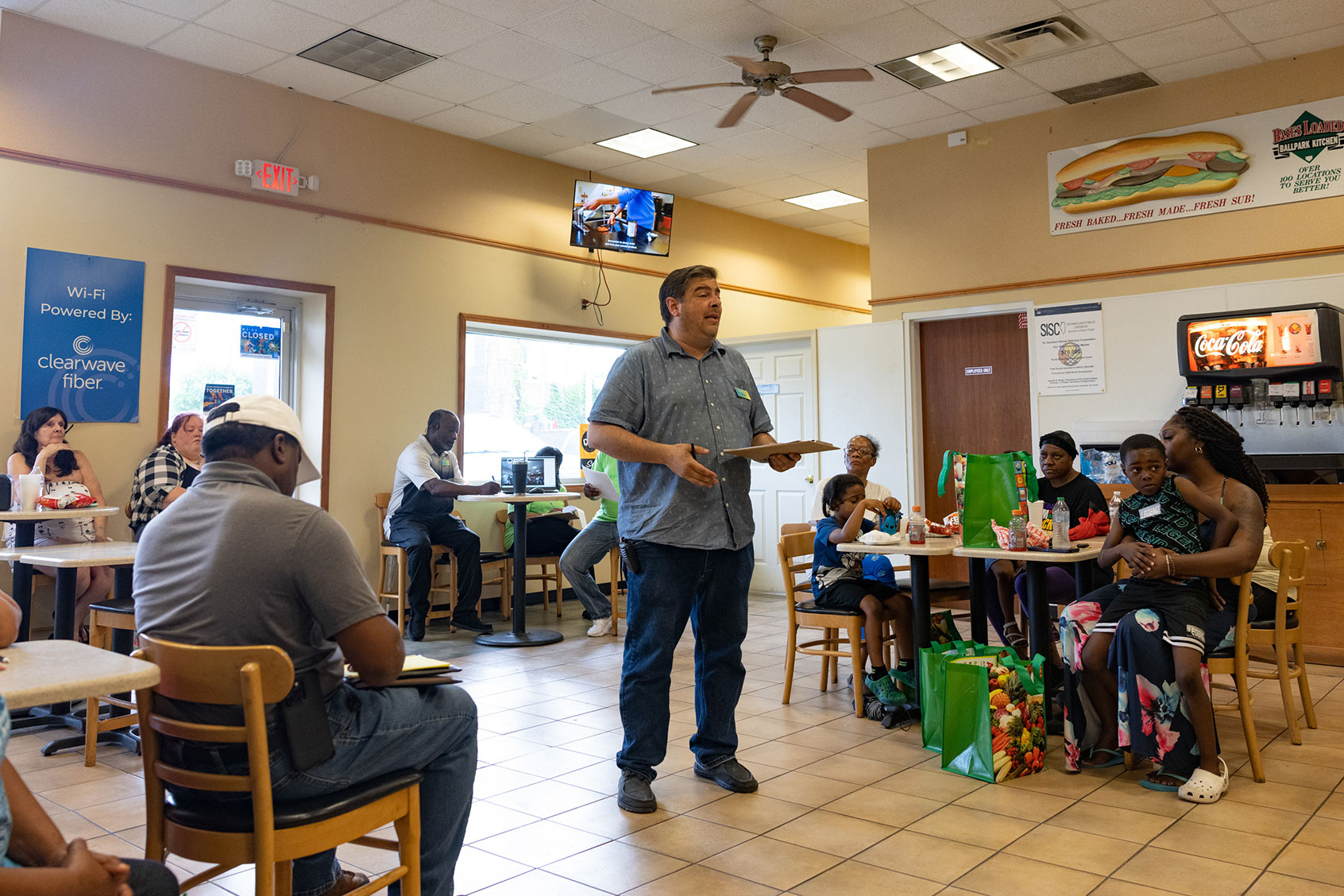
Edwards talks to co-op membersEdwards talks to co-op members at a meeting during the one-year anniversary celebration of the grocery store in June. (Photo by Julia Rendleman)

But sales remain well below where they need to be for the store's long-term sustainability. It takes about $70,000 a month in sales to break even; Rise has averaged less than half of that in the first six months of this year. When you add up the money spent by Cairo citizens everywhere they shop, they're spending an estimated $530,000 monthly on groceries, based on sales data for recent years. (This estimate is derived from overall sales data in a three-county region, adjusted for Cairo.) That means that they are spending only about 5% at Rise, when they'd need to spend at least 13%.

Edwards said he's hopeful the store can reach that point within another year because he understands its importance goes beyond the critical food it provides. It's also a job and economy creator, a hub of community life and a beacon of hope. It's crucial to the identity of a place teetering on the brink. In the first few months it was open, Rise hosted a wedding reception, food tasting event, health care expo, a pumpkin carving contest and, for several Wednesdays, a mobile food pantry organized by a local nonprofit. He gave away just-expired food to people stretched out in a line in the store's parking lot.

"Kroger would never let a food pantry set out in their parking lot giving out free food because it's going to hurt their sales. It did hurt sales on those days," Edwards said. "But we're here to serve the community."
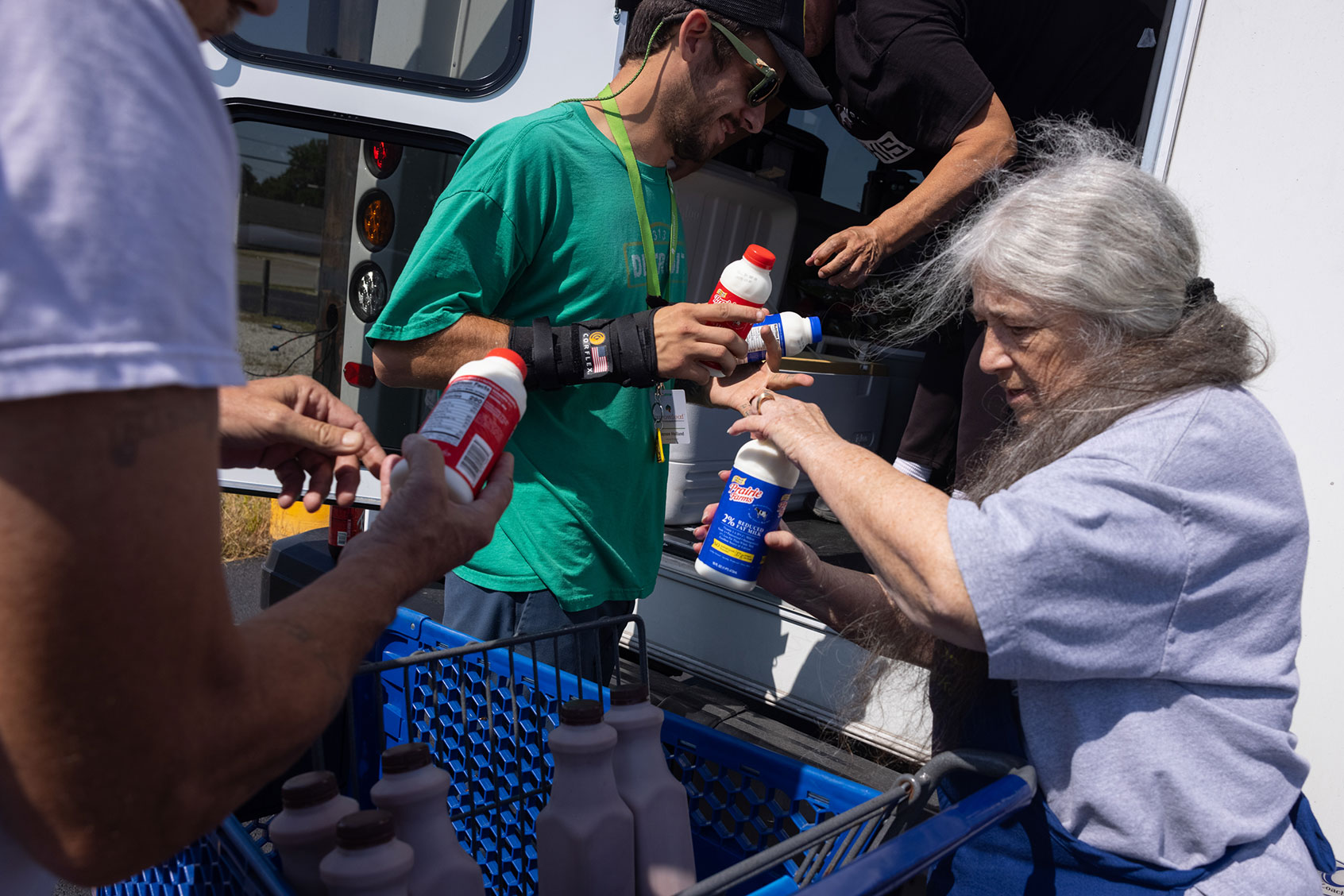
Charmaine CrismonCharmaine Crismon, an employee at Rise Community Market, delivers milk to a mobile food pantry operating from a van in the store’s parking lot in September. (Photo by Julia Rendleman)

Alex Abbeduto, formerly of Capitol News Illinois, contributed reporting. Photo editing by Peter DiCampo.

A portion of the reporting in Alexander County is supported by funding from the Pulitzer Center.

Everything we know about the next two Olympic Games

After two weeks of unforgettable and historic athletic feats in Paris, the 2024 Summer Olympic Games have finally come to a close. For a fortnight, the momentum never ceased. It began with an innovative opening ceremony on the Seine River peppered with artful performances of dance and song, the most notable of which was Celine Dion’s shimmering return to the stage as she sang Edith Piaf’s "Hymne à l’amour.”

Another major comeback was that of legendary gymnast Simone Biles, who earned three gold medals and one silver — becoming the most decorated U.S. gymnast of all time in the process — after withdrawing from the Tokyo Olympics in 2021 over a bout of the “twisties.” Biles and the women’s gymnastics team’s efforts helped tally a final count of 126 medals for Team USA (with 67 of them coming from women!). The U.S. and China tied for most gold medals, with each country garnering 40 apiece. 

While we’re sad that the Paris Olympics are over (what are we supposed to hyperfixate on now?) we’re already looking forward to the next iterations of the international sporting competition, which will take place in the Winter of 2026 and domestically in the Summer of 2028 in Los Angeles. Here’s what you can expect from the upcoming Olympic Games.

Winter Games 2026

The next Winter Olympics will commence less than two years from now in Milan and Cortina d’Ampezzo, an idyllic ski resort in northern Italy. The dates for the 2026 Winter Games are Feb. 6-22, and the Winter Paralympic Games will be from March 6-15.

Situated on the Boite River, Cortina d’ Ampezzo is known for its ski trails situated amid the Dolomites mountain range (it’s notably referred to as the “Queen of the Dolomites”), and high-end dining and shopping. Cortina d'Ampezzo was also chosen to host the 1944 Winter Olympics, which were ultimately canceled because of World War II.

As noted by USA Today, the European location was selected in 2019, after a joint bid by the two Italian cities eked out a win in a bidding competition against Stockholm and Åre in Sweden. NBC reported that this was the first time in Games history that two cities have been granted the opportunity to co-host. 

The opening ceremony will take place at San Siro Stadium, the home venue of soccer clubs AC Milan and Inter Milan. The closing ceremony will be held at Verona Arena, a Roman amphitheater in Verona.

Planned sports for the 2026 Winter Olympics include various forms of skiing (cross country, alpine, freestyle), ice hockey, figure skating, snowboarding, luge, curling, speed skating, bobsleigh and more. Ski mountaineering will make its Olympic debut. 

Summer Games 2028

The countdown is officially on. Four years from now, the U.S. will host the Summer Olympics in Los Angeles, marking the first time the Games will be held on home turf since 1996, when they took place in Atlanta, Georgia and the third time the California city will host the Summer Games (L.A. previously hosted in 1984 and 1932.) The L.A. Games will be held on July 14-30, with the Paralympics will take place on August 15-27.

Several new Olympic sports are set to enter the scene in 2028, with the International Olympic Committee approving the addition of baseball and softball, cricket, flag football, lacrosse and squash. Breaking — also known as break dancing — which made its inaugural appearance in Paris, will unfortunately not be making a return in L.A. 

A number of sporting events will take place in nearby Californian cities. Carson will host track cycling, field hockey, rugby sevens, and tennis. Rowing, canoe sprint, handball, marathon swimming, triathlon, sailing, and artistic swimming, will all be held in Long Beach. Swimming will take place in SoFi Stadium. The University of Southern California is slated to host badminton, while the L.A. Convention Center will be the site of taekwondo, fencing, judo, table tennis and wrestling.

The organizing committee in 2022 stated that more than 15,000 athletes were expected to participate in the Los Angeles Olympics and Paralympics. "I have been really impressed by the progress and creativity of the LA28 team," IOC President Thomas Bach said at the time. "They are using the power of the Olympic Games to inspire young people to get involved in sport."

Regarding L.A.'s notorious traffic congestion, L.A. Mayor Karen Bass in a Saturday press release claimed that the 2028 Summer Games will be vehicle-free. “We’re already working to create jobs by expanding our public transportation system in order for us to have a no-car Games,” Bass said. “And that’s a feat for Los Angeles, as we’ve always been in love with our cars. We’re working to ensure that we can build a greener Los Angeles.”

The Associated Press reported that the city will borrow 3,000 buses from across the country and will ask businesses to allow their employees to work remotely in order to achieve an accessible setup for the Olympics. 

To try your hand at obtaining tickets or volunteering for LA28, you can visit the organizing committee’s website for updates on future opportunities.


Why you should always wash fruit and veg before eating them – and the best technique to use

Eating fruits and vegetables every day is a great way to stay healthy – just make sure you wash them properly first.

While most people are aware of the dangers raw meat and fish can pose to health, many consider fresh produce to be "safe". But each year, one in ten people gets ill by eating unsafe food – and approximately 46% of these cases of food-borne illness come from eating vegetables and fruit.

The fact is most fresh produce is grown in the open where anyone or anything – such as insects and birds – can touch it. This means as well as dirt, unwashed produce may contain a variety of potentially harmful matter – including bacteria, fungi, viruses and pesticides.

Fresh produce may also become contaminated during packaging, preparation or storage. Even produce grown in greenhouses hydroponically can still harbor germs and pesticides.

Washing fruits and vegetables is of real food safety importance. But what's the best way to do it?


Washing your produce

First, wash your hands. This prevents germs on your skin from contaminating the produce you're cleaning.

The simplest and safest way to wash fresh produce is by hand, under cold, running water. Rub the fruits and veggies with your hands to remove dirt, pesticides and some surface germs. Wash until the surface no longer looks dirty. If you're going to soak produce in water, make sure you use a clean bowl instead of the sink – which may be full of germs.

Never wash produce with detergent or bleach, as the skin of some fruits and veg are porous and could absorb these chemicals. This could not only change their taste and texture, but could make them unsafe to eat.

There are some safe chemical methods for cleaning your fruits and veggies (and which you may have already spotted on TikTok. Vinegar and baking soda can both be used to wash fresh produce. They can reduce bacteria and pesticides on the produce.

For vinegar washes, you can use distilled malt, cider or wine vinegars. Use just half a cup of vinegar per cup of water, soaking the produce while stirring occasionally for two to three minutes. Then rinse in fresh cold water for at least one minute.

One downside with using vinegar, however, is that the acetic acid it contains may alter the taste and texture – particularly of soft fruits – if you soak longer than two to three minutes and don't rise thoroughly enough.

For baking soda, around 0.84g of baking soda per 100ml of water – just under six tablespoons (tbsp) – was shown to stop the growth of germs on fresh produce. Soaking for 15 minutes with baking soda was also shown to remove nearly all traces of pesticides from fresh produce.

However, you really only need one teaspoon of baking soda per cup of cold water to wash produce. This will still remove microbes and pesticides without altering the produce's taste. Soak fruits and vegetables in a clean bowl for 15 minutes, stirring occasionally.

As baking soda is alkaline, soaking longer than 15 minutes and not rinsing thoroughly may break down the skins of delicate fruits and vegetables, affecting their texture and flavor.  

Research which compared the effect of washing apples with water alone versus soaking them in baking soda found water was almost as effective as baking soda at removing pesticides. It's also worth noting that most traces of pesticides found in fresh produce are at non-hazardous levels – and the trace levels we consume in the UK are not thought to cause illness.

But one very recent study using apples found pesticides penetrate deeper than the skin. So in addition to washing, the authors suggest that peeling apples before eating can further cut down on any traces of pesticides you may be exposed to.

One downside with peeling is that you miss out on the many valuable nutrients fruit and vegetables skins contain. And, then again, many fruits and vegetables can't be peeled (such as grapes or lettuce).

So based on the body of evidence we currently have available, water alone is still the best way to clean fresh produce. There's no real advantage to using vinegar or baking soda.


Veg vs fruit

Produce with a hard rind (such as squashes) or a firm skin (such as potatoes, sweet potatoes and root vegetables), may be scrubbed with a vegetable brush until clean looking. Tomatoes can simply be rinsed under a running tap for around 30 seconds, rubbing gently with your hands.

To wash leafy green vegetables – such as lettuce, broccoli, cauliflower, kale or cabbage – separate into leaves or florets and individually rinse under the tap, rubbing with your hands for up to a minute. Since lettuce is usually eaten uncooked, it's safer to discard any damaged outer leaves as these are most likely to be contaminated with bacteria.

For fruits, water is again the best way to wash off contaminants. For stone fruits, apples and cucumbers, rinse in cold, running water for up to a minute to remove dirt, microbes and any wax coating.

The high water content of cherries, grapes, strawberries and other berries, makes these fruits particularly perishable. Wetting berries will increase the growth of any germs present and reduce their shelf life. As such, it's best to store these unwashed in the fridge, only washing when you're ready to eat them. Remove any spoiled or moldy berries before refrigerating.  

Any fruits and veggies you aren't going to eat immediately should be blotted with a dry paper towel or put in a salad spinner to remove moisture and reduce germ growth. Then store in a lidded contain in the fridge. It's also a good idea to clean kitchen sinks, surfaces and utensils before washing and preparing your produce.

Note that no home washing method can completely remove or kill all the germs which may be present on fruit and vegetables. Only cooking with heat above 60oC can do this.


Primrose Freestone, Senior Lecturer in Clinical Microbiology, University of Leicester


This article is republished from The Conversation under a Creative Commons license. Read the original article.

Pregnant women are being denied care in emergency rooms, AP report finds

Earlier this summer. The U.S. Supreme Court dismissed a case brought forth by Idaho that challenged doctors' ability to provide emergency abortions to stabilize a patient’s health and life. The federal law is known as the Emergency Medical Treatment and Labor Act (EMTALA). But as Salon reported at the time, dismissing the case provided no real clarity for doctors in emergency rooms across the state. 

Now, a new analysis published by the Associated Press found that dozens of pregnant women are being turned away from emergency rooms despite federal law protecting them and the Biden administration publicly warning hospitals to treat pregnant patients in emergencies. 

According to the analysis, more than 100 pregnant women who sought help from emergency rooms have been turned away or negligently treated since 2022. Two women, one in Florida and one in Texas, had to miscarry in public restrooms. In a separate Texas case, a woman lost her fallopian tube after being denied care for an ectopic pregnancy — even though Texas law technically allows doctors to terminate ectopic pregnancies. 

In another case in Florida, highlighted in the analysis, a woman showed up to the emergency room at 15 weeks pregnant leaking amniotic fluid. According to the AP analysis, the woman also miscarried in a public bathroom after the emergency room doctor listed her condition as “improved” and discharged her. She was later rushed to another hospital, put on a ventilator, and discharged six days later. Preterm premature rupture of membranes (PPROM) is when a pregnant woman’s water breaks early. The likelihood of a fetus surviving under 22 weeks of gestation is low. At the same time, when a pregnant woman’s amniotic fluid sac breaks during the second trimester, it puts the woman at an increased risk for infections like chorioamnionitis and sepsis.

The AP’s review also found “serious violations that jeopardized a mother or her fetus’ health” in states without abortion bans.

Isaac Hayes’ estate threatens to sue Trump for $3 million for illegal usage of “Hold On, I’m Coming”

Donald Trump has been served with the latest cease-and-desist letter from the Isaac Hayes estate. The estate of the legendary R&B singer-songwriter and composer demanded that the former president immediately halt playing "Hold On, I’m Coming” and compensate them with $3 million for all the times he has played it so far.

The letter, sent on Sunday, said that Trump and his campaign played Hayes' song "without authorization from the copyright holder, despite being asked repeatedly not to engage in such illegal use by our client." The complaint also included a list of "over one hundred times" that Trump has played “Hold On, I’m Coming” at his rallies since 2022, Rolling Stone reported.

“As we prepared this letter, there was an additional use in Montana just two nights ago, even with your office apparently aware that you had no permission," the letter stated.

Additionally, while the cease-and-desist demanded that Trump pay for every unauthorized play of the song, the $3 million is “a very discounted fee for the normal license fee associated with this many multiple uses. The normal fee for these infringements will be 10 times as much if we litigate, starting at $150,000 per use.”

The estate has ordered a response from Trump and his legal representation by Aug. 16 or they will take this case to trial.

The family's attorney said Trump has "willfully and brazenly engaged in copyright infringement," BBC reported.

Moreover, Hayes' son, Isaac Hayes III, also stated online Sunday, "Today, on the anniversary of my father's death we have repeatedly asked Donald Trump, the RNC and his representatives not to use 'Hold on I’m Coming' written by Isaac Hayes and David Porter during campaign rallies but yet again, in Montana they used it."

He continued, "Donald Trump represents the worst in integrity and class with his disrespect and sexual abuse of Women and racist rhetoric. We will now deal with this very swiftly."

The song, “Hold On, I’m Coming” was written by Hayes and his writing partner David Porter in 1966. The popular soul song sung by Sam & Dave took the Billboard R&B charts by storm in the '60s. According to Rolling Stone, politicians like former President Barack Obama have previously attempted to use the song leading to tension with the duo's Sam Moore. 

We need your help to stay independent

However, this isn't Trump's first experience using unauthorized music by popular artists at his rallies. Celine Dion and her management issued a statement Saturday about Trump's usage of "My Heart Will Go On" at the same Montana rally. 

"In no way is this use authorized, and Celine Dion does not endorse this or any similar use," the statement said. " . . . And really, THAT song?"

Alongside Dion, Trump has received complaints from artists like Tom Petty, Rihanna, the Rolling Stones, the Village People, John Fogerty, Aerosmith, Linkin Park and Journey.

“Frivolous”: Experts say Trump’s bid to sue DOJ over Mar-a-Lago raid will be “laughed out of court”

Former President Trump has a near-zero chance of ever winning $100 million in damages from the Department of Justice over the FBI's 2022 search of Mar-a-Lago — even if U.S. District Judge Aileen Cannon of Florida ends up weighing a potential lawsuit, legal experts told Salon.

Trump's lawyers filed a notice of claim under the Federal Tort Claims Act, which allows people to seek damages from federal agencies for governmental wrongs. Fox News first reported on the filing, while CNN provided a link to the claim.  

"The tortious acts against the President are rooted in intrusion upon seclusion, malicious prosecution, and abuse of process resulting from the August 8, 2022, raid of his and his family’s home at Mar-a-Lago in Palm Beach, Florida," reads the claim. 

Trump's lawyers claim that FBI protocols require the consent of an investigative target and disclosure to the target's attorneys. And they're arguing the raid was conducted unconstitutionally and with "a clear intent to engage in political persecution."

Columbia Law School professor Jeffrey Fagan called the claim "the epitome of a frivolous" legal filing.

He said such claims have "almost no chance when brought by ordinary criminal defendants.

"There is no standard in caselaw for 'political persecution,' unless he's trying to claim malicious prosecution," Fagan told Salon.

Fagan said malicious prosecution lawsuits are rarely successful.

"Malicious prosecutions are claimed when there is no evidence of wrongdoing by the plaintiff/victim of government excess," Fagan said. "They assume bad faith on the part of the government, which clearly isn't the case here."

A spokesperson for the DOJ declined to comment.

The DOJ has up to six months to respond before the former president’s team can actually file a lawsuit.

Trump pleaded not guilty last year to charges stemming from the discovery of classified documents at Mar-a-Lago after he left office.

The grand jury's indictment includes 32 counts of unauthorized possession and retention of national defense documents, along with counts that allege Trump conspired to conceal documents from FBI investigators.

Last month, Cannon, a Trump appointee, dismissed that case and agreed with Trump lawyers who argued the appointment and funding of the special counsel violated the Constitution. 

In June, Cannon denied Trump's request for what's known as a Franks hearing, which allows defendants to challenge the veracity of a search warrant affidavit.

Cannon said that Trump did not make his case — his lawyers identified four omissions in the warrant, but the judge said those omissions wouldn't have defeated the finding that probable cause existed for the search. 

Cannon also said Trump's motion didn't "meaningfully challenge the presence of probable cause in the affidavit."

We need your help to stay independent

Fagan said it's "unusual" that Trump filed the notice of claim under Florida law, which he said can differ from the federal standard. 

He said if Trump ends up filing a lawsuit, it should wind up dismissed.

But he added: Judge Cannon "clearly has some animus toward the government."

Bennett Gershman, a former New York prosecutor and law professor at Pace University, said it has proved hard to predict how Cannon will rule.

"She has made enough ridiculous rulings in this case that nobody should be surprised if she makes another clinker," he told Salon. "But the claim is so woefully weak that Cannon will almost certainly rule against Trump."

Gershman said even if "mistakes were made" in the search, the evidence would "still be valid and usable."

"Documents can be hidden anywhere as the government claimed in the warrant," Gershman said. "We know documents were found in the bathroom and the ballroom. There is not a whiff of a suggestion that the government acted in bad faith in getting the warrant and then executing it."

Vanderbilt University professor Christopher Slobogin said that assuming the warrant was valid, the FBI did not violate the Fourth Amendment's prohibition on unreasonable searches and seizures. 

"There is no abuse of process or malicious prosecution if the warrant was valid, because that would mean a judge found there was probable cause to be believed classified documents would be on the premises," Slobogin told Salon. "Whether departmental protocols were followed depends on how the FBI carried out the search, but in any event would not warrant damages."


Want a daily wrap-up of all the news and commentary Salon has to offer? Subscribe to our morning newsletter, Crash Course.


UC Davis School of Law professor Gabriel Chin said Trump's notice of claim is "terribly weak."

"This notice of claim has the hallmarks of a protective filing made because the statute of limitations is about to run," Chin told Salon.

Chin said findings of probable cause for a search usually preclude any suit.

"If a lawsuit is filed, it is even more unlikely that any lawsuit would lead to a finding of liability against the United States," Chin said. "You just don't see prosecutors being sued successfully for obtaining valid warrants and indictments, even if the cases do not ultimately lead to conviction."

Chin said punitive damages generally aren't available under Federal Tort Claims Act cases — and he said most courts hold that attorney fees aren't available either.

"It is not clear that there are any other damages Trump suffered—this is not a property damage or personal injury matter," Chin said. "In terms of money damages, this may be a 'no harm, no foul' situation."

Meanwhile, Chin said though underlying criminal case is dismissed, there will be an appeal. If Trump loses, that would preclude any civil victory. 

"The dismissal was based on the illegality of the special counsel appointment, but even if that is right—a debatable claim—the DOJ has other lawyers [who] can prosecute the case," Chin said. "You can't get damages for wrongful prosecution unless the case terminates in your favor, an event which here has not yet and may never occur."

National security attorney Bradley Moss called the notice of claim a "total joke."

“This claim under the Federal Tort Claims Act is a total joke. It was a lawful search warrant that came before Jack Smith was even brought in to run the investigation," Moss told Salon. "The search warrant properly met the legal requirements, a neutral magistrate judge signed off on it, and no judge has concluded otherwise. Mr. Trump cannot even point to any actual damages to property. He is trying to stretch the idea of 'money damages' to encompass his legal fees tied to the subsequent criminal proceedings. It will be laughed out of court."

Moss called the filing a "political stunt for the most part, with the added benefit that if he wins election in November he can then order the Justice Department to pay the claim."

"If he loses in November, he will drop the claim rather than risk possibly being deposed in civil discovery,” Moss said.

Ben Sasse, former University of Florida president, spent millions hiring his Republican allies

The former president of the University of Florida, retired Republican Sen. Ben Sasse, directed millions in university dollars to Republican allies, the Independent Florida Alligator reported.

Sasse, who was university president for 17 months, tripled his office’s spending from $5.6 million to $17.3 million, The Alligator reported. Sasse represented Nebraska in the U.S. Senate before he took the position, which was offered to him by Florida Gov. Ron DeSantis.

The majority of Sasse’s spending was used for contracts with consulting firms and for hiring six of his former Senate staffers and two former Republican officials to remote jobs at the university. 

When Sasse took the position in the fall of 2022, he promised a non-partisan presidency amid protests over his GOP past, claiming he would engage in “political celibacy,” reported WUSF Public Media.  

Sasse hired Raymond Sass, his former Senate chief of staff, as the vice president for innovation and partnerships at a starting salary of $396,000. The position did not exist before Sasse became UF president. 

James Wegmann, Sasse’s former Senate communications director, was hired as UF’s vice president of communications and makes $432,000 a year, The Alligator reported. Both men work remotely from their homes in Washington, D.C.

These hires contributed to a $4.3 million increase in salary expenses compared to UF’s former president Kent Fuchs’ spending.

Sasse also spent nearly $7.2 million in university funds on contracts with consulting firms for advice on how to run a university. The majority of that money was paid to McKinsey & Company, though it’s unclear what specific services the firm provided.

The former senator resigned from his post at UF in July after his wife was diagnosed with epilepsy.

“Abusers are gonna see this film too”: “It Ends With Us” producer on sending a message to everyone

When it went public that Colleen Hoover's "It Ends With Us," the massively popular best-selling book marketed as a romance novel, was going to hit the silver screen, fans were surprisingly upset.

But it wasn't the fact that the book was getting adapted that left them feeling discontented. It was the casting. 

But why? The leads in the film are attractive and conventionally well-liked. Blake Lively stars as Lily Bloom opposite "Jane the Virgin" star Justin Baldoni, who does double duty as the film's director and love interest Ryle Kincaid, who eventually reveals an abusive side. Producer Christy Hall, who also adapted the novel for the screen, had some answers for us.

During Hall's first sit down with Baldoni and Hoover, as she was "auditioning for the job," she pitched one pivotal idea: "I think we need to age them [the characters] up."

It was a decision that caught fans off guard, and criticism over the casting decisions quickly permeated Hoover's sizable fanbase. Baldoni is 40, Lively is 36, and Brandon Sklenar, who stars at Atlas Corrigan, is 34 – all much older than the characters in Hoover's book, which positions the three leads in their early to mid-20s. But while her fans were riled up by the change, the author herself conceded in a June 2023 interview with TODAY that the film's conceptualization was more realistic.

"Back when I wrote 'It Ends With Us,' the new adult (genre) was very popular," Hoover said. "You were writing college-age characters. That's what I was contracted to do. I made Lily very young. I didn't know that neurosurgeons went to school for 50 years. There's not a 20-something neurosurgeon. . . . As I started making this movie, I'm like, we need to age them out, because I messed up. So that's my fault."

"We take great comfort in what feels honest. And Colleen Hoover writes extremely honestly."

Speaking to Salon, Hall elaborated on the reasons behind the change, "I didn't want anyone to just think that Lily's acting this way because of her age. 'She's young, she doesn't quite know how to draw boundaries yet, she doesn't know how to say no because she's youthful, and she still has to become more fully realized . . .' Then it would be more of a coming-of-age story. I didn't want this to be necessarily a coming-of-age story, the reason being that when you are a grown woman you are fully realized. Lily has just launched her business. She knows who she is. She is fun, she is funny, she is smart, she is deeply confident.

"And she now is contending with a version of herself that she is even baffled by," Hall added, speaking to the domestic violence that is central to the story and is loosely inspired by Hoover's parent's marriage.

"It [the abuse] is not because she is young — it is because she is contending with her childhood trauma that has yet to be resolved," Hall continued. "And I wanted to make that very clear distinction. Especially when you think about films about women by women but for everyone . . . I do think a lot of times female protagonists have been very young and bright-eyed and bushy-tailed and very plucky. And their plight is too mature. And I just thought it would be really interesting if Lily is deeply mature and yet these are wounds that still need to heal."

Check out the full conversation with Hall, in which she discusses the difficulty of being judicious when flipping a book to film, the fetishization of violence against women in cinema, and why Taika Waititi couldn't get anyone to play Hitler in "Jojo Rabbit."

The following interview has been edited for length and clarity. 

Colleen Hoover's books are hugely popular. Why do you feel like her stories resonate with people?

I feel like the magic of Colleen is that she's not worried about what everyone else is doing. And I think that's the mark of a true artist. I think artists that really break the mold and really break new ground are the ones — they're not looking to the left, they're not looking to the right. They're not trying to imitate anyone else. They are literally just deeply connected with themselves and with that mysterious unknown that artists commune with. And she's just telling the stories that she wants to tell straight from her heart.  And they are so distinctive and specifically hers. And I think that if you are a Colleen Hoover fan, you're really just in love with Colleen's essence and who she is as a person because I think she bleeds on the page. Even though "It Ends With Us" is not autobiographical — it's a fictional story — but I think she's so brave to unapologetically let the entire world know that it was inspired by true events in her life. And I think that's what people are responding to. We live in a world where truth is being attacked, and it's really hard to know what is real anymore.  And I think that we take great comfort in what feels honest. And Colleen Hoover writes extremely honestly.

What drew you to want to adapt "It Ends With Us" into a film, other than its mass appeal? 

So I had not read the book when I got approached to potentially vie for this job. Justin Baldoni acquired the rights to the book under the umbrella of his production company, Wayfarer Studios. And this was actually supposed to be more of a smaller indie movie that Wayfarer was going to completely do independently. So Justin was aware of my work. I think he'd read a spec of mine, "Daddio," the film that I just wrote and directed. We sat down and he said, "Have you read this book?" and I said,"Oh, I actually have not had the pleasure but I have heard of it obviously. I don't live under a rug but I just haven't I have a chance to crack it open just yet."

And he was like, "Give it a read; you're gonna want to take this job. Give it a read, and let's let's have another conversation but I anticipate that you're gonna come back with your hand held high." So that's exactly what happened. I went away, I read the book, I really went on the journey. I suspended my disbelief and I just embraced every word, every page. I laughed, I cried, and I really fell in love with Colleen Hoover for all the reasons that we were talking about. And I felt deeply inspired that a story like this could it could exist in this packaging because the beautiful magic trick as we all know is that you feel like you're just reading a beautiful love story and then slowly but surely you realize around the time Lily starts to realize that she's a frog in boiling water.

So I went back to Justin and I said it would be my absolute honor to be considered for this job because these are the kind of stories that I believe can have cultural impact. I really believe that art saves lives. That's what drives me, that's what gets me up in the morning. I was taught that as a theater kid that our art saves lives so I went back and said I'd love to do it. But we needed Colleen's blessing. And he said, "Let me set up a Zoom because I can't hire you until she gives the thumbs up." So we got on a Zoom and we bonded because I'm from Oklahoma. So yeah these Midwestern gals just started chatting it up. And there was just a built-in trust, a built-in camaraderie and collaboration. I like to be very transparent on those calls. I don't like to try to just tell the author what think they want to hear. I'm extremely transparent. This is the spine of the narrative as I see it because we don't have as much real estate in a film; these are the things I think we can honor; these are the things I think we need to massage; these are new landscapes for exploration in my opinion; and these are the things that I think might need to be cut and that I don't know if we have time to service. I think we a two-hour Zoom and I laid it all out on the table. I was auditioning for the job but I just wanted to be real, because if she didn't agree with me, if she didn't like my instincts then I shouldn't get the job because that means I'm not the right person. 

The film adheres pretty closely to the book. What was your North Star in adapting it into a screenplay?

The North Star number one for me personally was to keep Colleen happy. If it didn't feel right for her then we needed to look at it again. She was deeply activated throughout the process, which I think is just as it should be. She deserves that right. The second [North Star] was keeping the fans happy. There's a lot of expectation around this book — and by the way external pressures of fan expectation but also then internal pressure And then number three was really just not adulterating the spirit of the book. So even if I had to add scenes that don't exist in the book, I wanted them to feel as if they could have been in the book. I definitely pulled some dialogue directly from the book, but then if I ever had to put words in their mouth that were not from Colleen's pen I wanted to feel as if it was something Atlas would say. So a lot of it was just trying to stay deeply tethered to the foundations of tone, character, all of it that.

I like to really immerse myself in the source material, even knowing that things are gonna change. I like to read the book like five times. I like to almost memorize it where — "Oh I'm page 87 when Ryle says this." I feel like my job is to just completely immerse myself to the point that then even if I'm inventing things they still feel deeply tethered to the feeling. For me, my North Star was that when [fans] were watching the movie to have the same feeling that they were gifted when they were reading the book.

I'm curious to learn how involved you were in the casting process.

"Slowly but surely you realize around the time Lily starts to realize that she's a frog in boiling water."

So I was the first hire. When you're the first hire and you're the first one in and you're building the foundation by way of what's on the page. So writers — screenwriters even television writers in this space — you actually have a lot of pull on casting even long before a casting director is even hiring. And I think that needs to be taken extremely seriously. So for example, not adulterating: I didn't write with any actors in mind. I only wrote with Colleen's characters in mind, and then the task becomes casting people that would best serve the original characters.

And then beyond that, there were a lot of decisions that affected casting that it didn't even occur to me until later. When we were putting a list together, and of course Blake is at the top of the list, and when she said yes we were all doing backflips. But very early on — I actually think it was even in that first conversation with Colleen — one of the things that I wanted to be transparent about was I said, "I think we need to age them."

It Ends With UsBlake Lively stars in "It Ends With Us" (Sony Pictures Entertainment/Jojo Whilden)
What about Blake and her performance made you know that she was the right person to play Lily, other than the obvious aging up?

So let's talk about, "Why age up?" Let's start from the kernel of the idea that led to Blake playing this role. The reason I pitched that we should age them up was, number one — and even Colleen has talked about this during press — I actually think that this was the right decision with Ryle being a neurosurgeon. That takes years and years and years of schooling, and while I was reading it I craved for him to be older.  Well, again what's so fun about adaptation into the cinematic landscape is the book will always exist. My job is to ask myself, “What are some interesting untapped opportunities that we can utilize in the film version?”

So for me, I craved Lily in our version to be older. The reason why was because especially people who have not been victims of abuse — I knew that there would be a lot of victims in the audience but there would be a lot of audience members who have never suffered these realities. And I didn't want anyone to just think that Lily's acting this way because of her age.

It is not because she is young — it is because she is contending with her childhood trauma that has yet to be resolved. And I wanted to make that very clear distinction. Especially when you think about films about women by women but for everyone . . . I do think a lot of times female protagonists have been very young and bright-eyed and bushy-tailed and very plucky. And their plight is too mature. And I just thought it would be really interesting if Lily is deeply mature and yet these are wounds that still need to heal.

Blake is all of those things and then some: she is funny, she is beautiful, she is wise and thoughtful and witty. And she just she’s got this gravitas to her, like this low center of gravity, like she's lived a lot of life. And you can feel that when the camera is right here, these extreme close-ups. I love that Blake's a mom! 

Which of the main characters do you feel was the most interesting to develop? They all have pretty intense backgrounds.

Ryle was probably the trickiest one in terms of, “OK, how are we going to visualize this, how are we going to accomplish this?” This is the reason Justin really wanted to play Ryle from the beginning — to really gift him a humanity. Even on the page, I wanted him to be very lovable, I wanted us to understand why she falls in love with him, especially because we knew we were gonna have to truncate a lot of their love story in the novel. So knowing that, it's like, “OK, we need him to be so lovable, we need him to feel like you know he needs to be that wish fulfillment on the side. This is everything any straight woman could possibly dream of.” 

The audience’s reactions at my screening in New York confirmed that.

And then how do we tackle the abuse? Because again, when you're reading it, you're just depending on the audience's imagination. But when you're visualizing, it's a completely different thing. I remember at one point I was talking to Justin about this, saying, “You know, a lot of victims of abuse are gonna see this film. But a lot of abusers are gonna see this film too.” And I am not going to tell them that there's no hope for them. I'm not going to do that. Because that's not the truth. And look — hurt people hurt people. And yes: Ryle is a villain of this story, in essence. But he's not really the main villain. If there's any real villain in this story, it's childhood trauma. He's contending with his own inner child, the little boy underneath who is suffering a lot of pain that he has yet to deal with.

"If anyone watches this movie and they realize that they are a hurt person that hurts people, that they might also seek help."

So the invitation to this movie is for hope that if victims feel inspired to seek help that is incredible. And I also hope that if anyone watches this movie and they realize that they are a hurt person that hurts people, that they might also seek help. I really wanted to make sure that we had some level of compassion for Ryle and felt like there was still hope for him. Because that's the messaging that I think is extremely important. There's no way forward into a better modern society. How do we evolve as a civilization unless we tell everyone there is help out there if you dare to seek it? I'm not excusing any of his behavior and I do think that if anyone is an unhealthy situation they have every right to leave and probably should leave. But in the aftermath of the person left behind, I hope that they can and would pick up the phone and utilize a lot of the resources that are out there.

What were some of the biggest challenges in tackling subject matter as difficult and as tricky as domestic abuse?

This entire film is in Lily's point of view. We never break from her point of view, and that was a decision that's from the book; we wanted to honor that. And then, for example, the frittata scene. If we decided right then and there to show Ryle actually hit her in that moment in the movie, from that point on — especially people who have never contended with this reality before — I didn't want the entire film to collapse into, “Well, I just saw him hit her. Why aren't you leaving, Lily? It's so clear, and now I hate Ryle.” 

I didn't want people to start judging Lily. It felt really important to stay in her point of view. If Lily is confused, well let's let the audience feel confused. If Lily is being gaslit, let's let the audience feel a little gaslit. And let's even let the audience be like, “No, Ryle wouldn't. There was a weird accident. I don't quite know what happened but he didn't hit her.” It's an invitation to really walk a mile in the shoes of what that can actually feel like. I think Lily has known all along, but it is that moment of catharsis — I mean, look, anyone who has ever been to therapy . . .  we've all had a version of that moment when you finally allow yourself to come face to face with the thing you have always known you just never dared to say out loud because it was too horrible. That's a survival mechanism.

It Ends With UsJustin Baldoni stars in "It Ends With Us" (Sony Pictures Entertainment/Nicole Rivelli)
Did you ever consider including any disclaimers or trigger warnings before the movie?

That's a really good question. I actually can't speak to that. I don't know because this obviously has continued to evolve. It was supposed to be a smaller thing with Wayfarer, then Sony got involved, and it's really blossomed. So I can't imagine that that wasn't a conversation at some point.

I specifically was never yeah a part of this conversation. Though I will say, early on Wayfarer partnered with an organization called No More that was deeply involved in reading scripts and making sure that we got it right. And now on the other side they’re putting out a packet of information for anyone who needs help. They're putting together a bit of a lifeline for anyone who sees this movie if they need a safe place to go gather information.

I know you weren't able to be on set because of the strike but I was wondering if you could speak to any of the decisions that were put in place while writing to protect and hold empathy for the actors and the viewers.

Violence against women in cinema has been fetishized in ways throughout the decades that we need to be very aware of. And I do think that stories moving forward,  it's really important to be extremely thoughtful of look, “We want to tell the story but we also don't want to be part of that.” So those were major conversations. There was a lot of care put around the choreography so everyone felt safe, everything was already talked about beforehand, and everything was agreed upon. We wanted to be on the right side of this of course.

There’s one really poignant moment when Lily and her mom are building the baby crib ,and Lily asks her point-blank why she never left her dad. And her mom says, “It would have been harder to leave. And I loved him.” Lily's able to leave Ryle but not without a lot of difficulty. There are a lot of reasons that can prevent people from leaving their abusers: love, children, potential endangerment. If the film had elaborated on one reason in particular for the purposes of the plot, what would it have been?

I had a longer scene that I wrote between Lily and her mother where they talked more about about that. Lily even tells her, “I didn't understand it, I judged you, I thought you were weak. I promised myself I would never become you. And now I understand you better than I ever have and I'm sorry.”

Why didn't that scene make it in?

Well, you know we really had to be thoughtful about timing. This book is so dense. I think our first few attempts at a cut we were nearing like two-and-a-half to three hours long. You really have to be thoughtful of your act structures and that internal clock. So fullness of that scene did have to be compressed down to that little couplet. But I think that couplet is really powerful and it did what we wanted it to do. And then we had to move on. Originally we spent more time when she goes to Atlas' house, we spent more time with them. In the book, they eloped to Las Vegas and we actually wanted to show them in Las Vegas and running around, There were so many things you want to do yeah but when you really start looking at the realities of what it means to put it into a movie and allow it to be a time that people can really sit back and let it wash over them . . .  because the last thing you want anyone to do in a movie like this is to check their watch. I just want fans to know that we've really tried our best, every decision was not made lightly and this is where we landed. And it is a very sincere offering.

We see the abuse by Lily's father and the origins of her relationship with Atlas play out in flashbacks. Can you talk about approaching the abuse between Lily's parents versus in her own relationship and how you wanted to show that?

So with her parents again a lot of times it's sort of at a distance because we're in her point of view. We're literally in her actual eyeballs. It's memory, and it's memory that is still pretty clear because those were big moments in her life but they're still also a little messy. We're jolted by painful memories. We were trying to capture the visualization of what that can feel like. So the parents' stuff is always in her point of view so that's why it is kind of held at a distance. And it’s always a little bit blurry and fragmented.

When she starts to experience it for herself — again the confusion of, “What the hell just happened? There's no way, because I promised myself I would choose better and I would choose differently.”

"If Lily is being gaslit, let's let the audience feel a little gaslit."

And when she starts to realize, “Oh this is familiar” . . . they're meant to feel slightly different and of the same. It was very purposeful, especially that night when she caught her father on top of her mother when they're on the couch. That is mirrored when Ryle has her on the couch and she's like, “Wait I've seen this before.” That was very purposeful to let them feel like mirror images of each other.

Justin is obviously very attractive, especially judging by the reaction from the crowd when he showed off his abs. There was a big reaction. What do you feel is important about someone who is so seemingly romantic and attractive embodying Ryle in this story?

I will say the brilliance of Justin having the courage and willingness to play Ryle . . .  For example, very famously in “Jojo Rabbit,” no one wanted to play Hitler. Taika [Waititi] tried to cast other people, and everyone's like, “If I play Hitler, I'm never gonna work again.” And then he was like, “You know what, I guess I'll play it.” And by the way, he's brilliant and you couldn't see it any other way — that's exactly as it was meant to be.

But in that same vein, I don't know if there are a lot of actors out there who could actually pull this off, nor would they maybe have the bravery to raise their hand for it. So I tip my hat to Justin. This is a really hard role to tackle but it's deeply important. Like I was saying earlier we really had to get it right. We had to understand why Lily falls in love with him. There has to be a warmth and depth to him so that we can have compassion for the fact that when he was six years old, a horrible tragedy happened and he has yet to get over it. Again, not excusing his behavior; but acknowledging there's a lot of pain that he that now needs to be healed because now it's starting to strike out in ways that he is not proud of and is ruining his life. It’s robbing him of a lot of joy totally — the woman that he loves, his new daughter, all the things.

Look, there's a lot of wish fulfillment in this film. Everyone is beautiful, they're wearing beautiful garments, they live in beautiful places. I do think it's in the spirit of what you feel when you're reading the book. It just feels like a sweeping love story and then it starts to turn. 

As I've said there were a lot of vocal reactions to the film at the theater that I was in. Like when Ryle tries to get Lily to take him back. Or when Lily finds out she's pregnant someone literally screamed, “No!”

Yeah I love that s**t — like back in Shakespeare's time people would throw oranges. So I love it it.

Yeah, it was so raucous. What are you hoping that audiences will take away from the movie that they maybe could not have gleaned from reading the book?

It’s a very, very interesting question. It's hard because I feel like the book is so successful in what it is attempting to do. I think it actually sticks the landing so beautifully that it's difficult for me to have the audacity to believe that we're doing anything other than what I think Colleen has already done.

I guess I would just say that I hope we're moving into a time where people are getting back to the theater. Where you don't wait to see this on your TV in your pajamas by yourself on the couch. You're talking about these reactions; it's communal, it happens in live theater, at any live event really.  Movies were always meant to be enjoyed together among strangers where you're laughing and you're crying and you're screaming at the screen and you jump and your popcorn goes everywhere. It's a very specific experience, and there have been a lot of questions around, “Is this art form going to continue to be consumed in this way?”

And I'm really excited that people are going back to the theater because if the movie does anything that the book cannot, it's just by nature of the medium. Watching this movie is different than reading a book in that you can sit among other people who loved this book as much as you do. Also, strangers who have never even seen it, and you can engage with their reactions — they don't know what's coming next even though you do. And there's an energy that forms. Audiences create their own personalities and there's something really incredible about it. Consuming art with other people makes you not feel alone.

"It Ends With Us" is now streaming on Netflix.


Prince William and Kate Middleton join Snoop Dogg for Olympics video congratulating British athletes

Kate Middleton and Prince William joined a number of British personalities, as well as American rapper and Olympics host Snoop Dogg in a video congratulating Great Britain's athletes for their performances in Paris. The clip was shared to the royals' joint X/Twitter account on Aug. 11 ahead of the Games' closing ceremony.

"Greetings, loved one," Snoop Dogg said at the video's onset, riffing off one of his lines from Katy Perry's hit 2010 song, "California Gurls."

"From all of us watching at home, congratulations to team GB!" the Princess of Wales said in the video, standing alongside her husband, who added, "Well done on all you've achieved. You've been an inspiration to us all."

"Well done @TeamGB, what an incredible journey!" the couple wrote in the post. "Every athlete showed immense dedication, heart and passion. You made us all so proud! Here's to celebrating every triumph at @Paris2024 and looking forward to more from @ParalympicsGB later in the summer."

The royal pair have remained largely out of the public eye – except for appearing for Trooping the Color  – since Middleton revealed that she had been diagnosed with cancer in March, . According to PEOPLE, there were murmurs that they would appear in Paris for the Olympics; however, the pre-taped footage from their contribution to the congratulatory montage — in which the Prince sports a beard — comes during a moment of reprieve from their royal duties while they are away on vacation with their three children. 

“Really going bonkers”: Critics hammer Trump for AI rally claim and “pre-election denialism”

Kamala Harris and Tim Walz are drawing huge crowds at their rallies, but a sour Donald Trump, who has long boasted about his popularity, is falsely alleging that such appearances are not real but a creation of artificial intelligence. While Trump's inaccurate claims have gained traction among supporters on social media, crticis are saying that they reek of desperation.

"Has anyone noticed that Kamala CHEATED at the airport? There was nobody at the plane, and she 'A.I.’d' it, and showed a massive 'crowd' of so-called followers, BUT THEY DIDN’T EXIST!" Trump wrote on Truth Social, referring to a crowd of supporters waiting for Harris and Walz to disembark from a plane in Detroit, before calling for Harris to be disqualified for "election interference."

Trump then shared an image of the crowd, saying it was AI-generated and "proof" of Harris' cheating. However, a Harris campaign official confirmed to ABC News that the photo was taken by a staffer on their iPhone 12 Pro. Other photos and videos of the rally verified by ABC show similar crowd sizes at the event, according to a post by ABC News' Emmanuelle Saliba. The photo shared by Trump on Truth Social appears to be the same but in a different color tone.

David Plouffe, Harris' senior campaign advisor, took Trump to task on X, writing: "These are not conspiratorial rantings from the deepest recesses of the internet. The author could have the nuclear codes and be responsible for decisions that will affect us all for decades."

Trump likes to crow over his crowd sizes. On Thursday, he falsely claimed that he drew a bigger following on January 6, 2021, than Martin Luther King Jr. did in 1963. Though Trump has mustered huge crowds before, often the receipts don't match his words, which provokes him into lashing out. In recent weeks, the enthusiasm at Harris-Walz rallies compared to some of his less-well-attended events has apparently confounded the former president, who is not only doubling down on his crowd size contest but also relying on increasingly risky and baseless attacks against this opponent, including those targeting Harris on her mixed-race ancestry.

To some observers, this is part of an unraveling that is fast revealing the depths of Trump's psychological problems and disconnect from reality. Rep. Ted Lieu, D-Calif., said that Trump is "really going bonkers off the edge into dementia land" for "fantasizing that all these rallies are not real."

We need your help to stay independent

"As I've been yammering about for five or six years now, he's a deeply unwell man," said George Conway, a Trump critic and former husband of Trump advisor Kellyanne Conway, in response to Trump's Truth Social post about crowd size. "He is a deeply psychologically disturbed individual. If he were a member of your family, you'd be … staging an intervention and taking him into a psychiatric hospital."

At the end of his Truth Social post, Trump spun a new angle on his oft-repeated line that Democrats are "stealing" elections, claiming that their fake AI rallies mirror their "cheating" at the ballot box and that Harris should be disqualified from running "because the creation of a fake image is ELECTION INTERFERENCE."

Conservative commentator Charlie Sykes warned that this could be a preview of future efforts to question the legitimacy of the election before it even takes place.

"This is pre-election denialism by Donald Trump," Sykes said. "It's no mystery, Donald Trump is never going to graciously concede defeat in this election. He's already laying the groundwork for what's going to happen after November. I think this is going to be an extraordinarily dangerous period. He has election deniers in key states, his base is psychologically not prepared for him to lose."

“Got absolutely nothing”: John Oliver shreds Trump’s “desperate” attacks on Kamala Harris

John Oliver on Sunday's edition of "Last Week Tonight," called out former President Donald Trump's "desperate" attacks on Vice President Kamala Harris and her running-mate, Minnesota Gov. Tim Walz.

The comedian skewered Trump for calling Harris "Kamabla" but noted that Republicans have reached new heights of vitriol because of Walz's favor with the public. 

"The seeming panic in the Trump campaign right now is perhaps best exemplified by their reaction to Harris’s choice of Tim Walz, your friend’s nice dad, as her VP candidate this week. In terms of general vibe, he’s basically the exact opposite of JD Vance," Oliver said. 

To compare the veteran and former teacher to Sen. JD Vance, R-Ohio, Oliver played a clip of Vance's response to a reporter asking him what makes him smile. Oliver joked that Vance learned how to laugh through reading about it in books or comics, "saw it written out phonetically, and intellectually understood the noises Archie made."

But to Oliver, Walz is the more personable option of the two. "Clearly, you don’t have to ask Walz what makes him smile. You can see it right there or in photos of him doing everything from holding a piglet to getting hugged by kids after signing universal free school meals into law, to him here, seemingly remembering that he isn’t JD f***ing Vance."

The comedian went through Walz's career, highlighting he was a teacher and footfall coach who advised his school's Gay Straight Alliance in 1999 because "it really needed to be the football coach, who was the soldier and was straight and was married," Walz said.

Despite Walz's record, Republicans are attempting to find ways to level attacks on the governor. Oliver said they have branded him "as a socialist, which he isn’t, labeling him as 'Tampon Tim' for providing feminine hygiene products in schools, and even getting angry at the fact Minnesota’s state flag was changed on his watch."

The change of the flag was "mainly as a result of objections to the depiction of a Native American on the old flag" and Walz "wasn’t the one who pushed for the change; he just happened to be governor at the time," Oliver explained.

That still wasn't enough for Republicans to back down from Walz as they began to target his military service. The politician served "24 years in various units and jobs in the Army National Guard." But this week, he was accused of "stolen valor" for allegedly saying he carried a weapon of war in war — which he did not.

We need your help to stay independent

"He never actually saw combat, and the campaign’s said he misspoke," Oliver explained. "But Republicans didn’t stop there with J.D. Vance and others also trying this line of attack." These false statements alluded to Walz dropping out of the National Guard ahead of his unit's deployment overseas.

Again, Oliver stated that wasn't true, "Walz retired in May of 2005. His unit wasn’t ordered to mobilize until July of that year, and didn’t deploy to Iraq until 2006."

As there are 85 days until election day, Oliver said, "it’s going to feel incredibly long. And it’s plenty of time for the GOP to draw up attacks far more vicious and hateful than 'Kamabla,' while also figuring out more inventive ways to attack her running mate."

He concluded: "It does seem telling that so much of their attack strategy seems to boil down to a nonsense word and false accusations of stolen valor, two desperate smear attempts, with one thing in common: they reveal the Trump campaign’s currently got absolutely nothing."

Last Week Tonight with John Oliver airs on Sundays at 11 p.m. ET on Max.

Here’s how a chef and mixologist husband-and-wife team are aiming towards a “sustainable future”

Southern food can be mean something immensely different from person to person. For chef-restauranteur Sammy Wiggins and his wife, mixologist Kassady Wiggins, their focus is pulled towards the coasts.

The authors of a new cookbook "Salt & Shore: Recipes from the Coastal South" and owners of the restaurant Joyce in Los Angeles, the duo is passionate about highlighting the best that the coastal south has to offer, as well as prioritizing zero-waste cocktails and highlighting sustainability.

As they told me, "We wanted to create a culinary narrative that respects the past and looks forward to a sustainable future."

With far-reaching intentions as well as unique ingredient usage, dishes intended for communal and convivial enjoyment and great recipes for cooks who aren't especially well versed in the realm of fish, Monsour and Wiggins are excellent advocates not just for food and cooking at large, but also environmental rights, sustainability, fighting overfishing and the wonder of working with a spouse.

You can purchase Salt & Shore: Recipes from the Coastal South here

Salt & Shore: Recipes From The Coastal South by Sammy Monsour and Kassady WigginsSalt & Shore: Recipes From The Coastal South by Sammy Monsour and Kassady Wiggins (Weldon Owen / Simon & Schuster)

The following interview has been lightly edited for clarity and length.

I love how this book embodies precisely how it's labeled: the perfect mix of "salt and shore," both entirely Southern yet totally coastal-based. Can you explain a bit about the development of the book? 

The development of "Salt and Shore" was a deeply collaborative and immersive experience. We aimed to capture the essence of Southern coastal cuisine by blending our personal experiences, various regional histories and contemporary culinary techniques. We hope while flipping through the pages, readers get a sense of our shared love for the ocean and the bounty it provides. 

How would you define the ethos of “Salt and Shore?” 

The ethos of “Salt and Shore” is about honoring the rich culinary traditions and history of the Southern coast while embracing sustainability and innovation. It’s a celebration of the diverse ingredients from the shorelines, the vibrant communities and the time-honored practices of Southern hospitality. We wanted to create a culinary narrative that respects the past and looks forward to a sustainable future.

Is "coastal southern" your general approach, from the cookbook to your restaurants to home cooking? 

Yes, "coastal southern" is a central theme in our cookbook, restaurants and home cooking. It’s a cuisine that’s deeply rooted in the traditions of the South but is also heavily influenced by the coastal environment. This approach allows us to highlight fresh, locally sourced seafood and seasonal produce; creating dishes and drinks that are both comforting and contemporary. A central theme you’ll see throughout the cookbook is also recognizing the huge and ever-evolving impact other food cultures have had on “coastal southern” cuisine and (of course) in our very own home. 

How do you think your backgrounds influenced your current food perspective, both personally and professionally?

Our backgrounds have significantly shaped our food perspective. Growing up in the South, we were both influenced by the region's rich culinary heritage and the importance of community and hospitality. Sammy’s Lebanese roots inspire flavors and techniques in the kitchen, while Kassady’s African American heritage fuels her commitment to social justice and sustainability.

Professionally, our experiences in various kitchen/restaurant settings and our commitment to sustainability have driven us to create dishes and drinks that are not only delicious but also mindful of their environmental impact.

Sammy Monsour and Kassady WigginsSammy Monsour and Kassady Wiggins (Photo courtesy of Ziv Sade and Sammy Monsour)

I am so interested by the section in the book about algae and microalgae in drinks. I also saw chlorella in the Pawleys Island Palmer. Can you elaborate a bit on that? 

Incorporating algae and microalgae into drinks is part of our commitment to sustainability and innovation. Chlorella in the Pawleys Island Palmer, for example, adds a unique flavor and a boost of nutrients. In the Blue Bayou, blue spirulina adds a depth of flavor unattainable by any other means. These ingredients not only offer health benefits but also reflect our connection to the ocean and our desire to use diverse, sustainable ingredients in creative ways.

"Fish Camp ''is so fun. I love the name of the chapters/categories and the convivial, social nature of those fish fries. Can you speak a bit to that?

The "Fish Camp" section is inspired by the traditional fish fries and social gatherings that are a staple in Southern culture. It’s about bringing people together to enjoy simple, delicious food in a convivial atmosphere. The name and the concept are meant to evoke a sense of nostalgia and community, celebrating the joy of shared, easy-going meals and good company.

I also enjoyed the "stock market" section, with such deeply flavorful, almost home-y dishes, from perloo to gumbo. I wonder if ostensibly more involved, storied dishes like that  are sometimes intimidating for cooks? What are some tips you can give for people looking to cook those dishes?

While dishes like perloo and gumbo might seem intimidating, they are all about layering flavors and taking your time. Our tips for home cooks include starting with high-quality ingredients, following the steps carefully and not being afraid to make the recipe your own.

These dishes are meant to be comforting and home-y, so don’t stress about perfection—enjoy the process and the results. We want these dishes to taste (and feel) good to you at every step, much more than we want them to be “perfect.” 

We need your help to stay independent

What do you think are some of the best ways for the most fish-averse cooks to get into the realm of fish cookery?

For those new to fish cookery, we recommend starting with some of the more iconic, approachable dishes from our "Hand Held" and "Fish Camp" chapters. These recipes are designed to be fun, social and relatively easy to prepare. Dishes like blackened fish tacos, our various fish “burgers,’ or our numerous styles of fish fry are great entry points. They offer familiar flavors and straightforward techniques that build confidence.

Plus, they capture the convivial spirit of coastal Southern cuisine, making the cooking experience enjoyable and rewarding.

How do you recommend reducing food waste for home cooks?

Reducing food waste at home involves planning meals, using leftovers creatively and composting scraps. We also encourage home cooks to embrace the whole ingredient, such as using fish bones for stock or vegetable peels for broths. Being mindful of portions and storage can also help minimize waste. There are quite a few tips on this in the “Libations” chapter—as syrups and ice are an easy way to mitigate a lot of what we think of as food waste.

You're both advocates for environmental rights and sustainability in the kitchens. Can you speak a bit to that? 

Our advocacy for environmental rights and sustainability is a core part of our culinary philosophy. In our professional kitchens (and home kitchen), we have always prioritized sourcing sustainably, minimizing waste and educating our team and customers about the importance of protecting our natural resources. We believe that every small effort counts towards a larger impact on the environment.

How can home cooks help mitigate environmental damages?

Home cooks can mitigate environmental damage by supporting local farmers and fishers, choosing sustainable ingredients and trying to reduce waste. Simple actions like composting, using reusable bags and containers and being mindful of water and energy use in the kitchen can make a significant difference.

Charleston PerlooCharleston Perloo (Photo courtesy of Ziv Sade and Sammy Monsour)

Is there a standout recipe for the both of you in the book? 

A standout recipe for us is the Charleston Perloo, which also graces the cover of the book. This dish is a quintessential example of Southern coastal cuisine, combining rice, seafood and a rich, flavorful broth. It’s a celebration of the Lowcountry's bounty and culinary traditions. The perloo embodies the heart and soul of "Salt and Shore," blending simplicity with depth and history. It’s a dish that’s both comforting and elegant, perfect for showcasing the vibrant flavors and communal spirit of Southern coastal cooking.

The pecan salsa matcha with the grilled tilefish sounds stupendous! How did that component come together? 

The pecan salsa macha is inspired by traditional Mexican salsa macha, which is known for its rich, nutty and spicy flavors. We wanted to bring a Southern twist to this classic by incorporating pecans, a staple in Southern cuisine. The combination of toasted nuts, dried chilies and aromatic spices creates a complex, robust sauce that perfectly complements the grilled tilefish.

This dish exemplifies our approach of blending diverse culinary traditions to create something uniquely Southern and coastal, while paying homage to the vibrant flavors of Mexican cuisine.

I love fish in all iterations, but do you think there's a certain cooking methodology that lets the favor of the fish shine most? Raw? Grilled? Fried? 

Each cooking method brings out different qualities in each species or variety of seafood. Raw preparations like ceviche highlight the freshness and natural flavors, while grilling adds a smoky depth. Frying offers a crispy texture that many enjoy. The best method depends on the type of seafood and the desired flavor profile, but ultimately, the simplest methods often let the seafood shine the most.

As with many a seafood cookbook, there are no desserts. Did you contemplate adding any or did you want to steer clear since there would (most likely) not be any actual fish in those dishes? 

Instead of focusing on desserts, we dedicated an entire chapter to cocktails. We believe that a thoughtful libation sets the tone for the meal and it’s a Southern tradition to welcome guests with a cocktail. This approach aligns perfectly with Kassady’s specialty and her way of expressing creativity.

By emphasizing pre-dinner drinks, we provide a unique and engaging start to the culinary experience. While many cookbooks end with dessert, we chose to highlight the importance of the welcome libation, ensuring that every meal begins with a touch of Southern hospitality and sets the tone for the rest of the meal.

Can you speak a bit to the current state of overfishing? 

Overfishing remains a significant global challenge, threatening marine ecosystems and the livelihoods of those who depend on them. However, it's important to recognize and celebrate the progress made in the United States. Thanks to the science-based regulatory framework provided by the Magnuson-Stevens Act, we've been able to recover our overfished stocks and are now global leaders in wild fisheries management. This act ensures that our fisheries are managed sustainably, balancing environmental, economic and social objectives. It’s a testament to what can be achieved with robust regulations and dedicated conservation efforts and it offers a hopeful model for addressing overfishing worldwide.

Tell me a bit about your new LA restaurant, Joyce? The menu is amazing 

Joyce is a celebration of elevated Southern coastal cuisine with a modern twist. The menu features a zero-landfill cocktail program, sustainably sourced seafood, locally grown produce and inventive dishes that honor tradition while pushing culinary boundaries. It’s a place where guests can enjoy the flavors of the coast in a welcoming, vibrant setting.


Want more great food writing and recipes? Subscribe to Salon Food's newsletter, The Bite.


Could you explain what exactly a zero-landfill bar program is? Does it also offer non-alcoholic drinks? 

A zero-landfill bar program means that we aim to produce no waste that ends up in landfills. This involves composting organic waste, recycling materials and using sustainable, reusable, or biodegradable products. We’ve developed creative ways to mitigate waste, finding secondary uses for produce that’s past its prime—whether bent, broken, bruised, blemished, or overly ripe. It also involves a lot of communication and cross-utilization with the kitchen. We try to mirror flavors on both sides of the menu.

Take, for example, our Mother of Pearl Martini—we roast the top shells of oysters and make a vodka infusion with them and we make an in-house vermouth with past-its-prime white wine, ogo algae (that you can also find on our Ogo Ceaser salad) and lemon peels that have been expressed for another cocktail garnish.  Other ways in which we “close the loop” are through syrups, infusions, shrubs, tinctures and bitters.

Additionally, we offer a range of non-alcoholic drinks crafted with the same care and creativity as our cocktails, ensuring that all guests have delicious, eco-friendly options. This program reflects our commitment to sustainability and innovation, making every aspect of our bar as environmentally friendly as possible.

Could you both speak to the notion of working so closely with a spouse, both in terms of the book and the day-to-day in the restaurant? 

Working closely with each other over the past eight years has been rewarding. It allows us to share our passion for food and sustainability, collaborate creatively and support one another. While it comes with its challenges, the key is communication, respect and finding a balance between our professional and personal lives.

Sea ScallopsSea Scallops (Photo courtesy of Ziv Sade and Sammy Monsour)

What is a formative cooking memory? 

Sammy here. One of my most formative cooking memories is growing up with my Taita, my Lebanese grandmother, who was an amazing cook. She would prepare elaborate feasts featuring freshly made pita bread, stews, hand pies, rice dishes and pastries, all from our homeland where she was born and raised. Helping her make hand pies and spending time with her in the kitchen are some of my earliest, fondest memories. My family celebrates her life and legacy through her treasured recipes, which I cook often at home. It's also Kassady's favorite cuisine for me to cook for her at home. This connection to my Lebanese heritage through cooking allows me to honor my family's traditions and care for my loved ones, keeping Taita's spirit alive in every dish.

Both of our families talk about food before anything when getting together; everything is planned around food. Formative cooking memories for us involve helping our families prepare large, communal meals during holidays. These experiences instilled in us the importance of food in bringing people together and the joy of sharing a meal with loved ones. They also taught us the value of hard work, patience and the love that goes into cooking and ultimately nourishing one another.

Why do you cook? 

We cook because it’s our way of expressing creativity, nourishing loved ones, connecting with others and honoring our heritage. It’s a form of art and a means of storytelling that allows us to share our passion for food and sustainability with the world. Cooking brings us joy and fulfillment and it’s our way of making a positive impact.

What are your top three favorite ingredients to work with? 

Asking us to choose a favorite child? Broadly, our favorite ingredients to work with are unique spices, grass-fed butter, fresh seafood and seasonal produce. These elements allow us to create dishes that are vibrant, flavorful and reflective of the diverse culinary traditions we cherish.

How do the two of you handle menu development, linking the bar program and the food menu so intrinsically? 

When developing our menus, we start with the seasonal and sustainable ingredients available to us, ensuring that both the food and beverage components highlight the best of what each season has to offer. We brainstorm dishes and cocktails that complement these ingredients while creating a harmonious and cohesive dining experience. Linking the bar program with the food menu involves crafting flavor profiles that enhance and balance each other, ensuring that every bite and sip is part of a unified culinary journey.

Our aspiration is to create food and beverages that are delicious, beautiful, crave-worthy and soul-satisfying. We believe that every element, from the welcome cocktail to the final dish, should contribute to an unforgettable dining experience. This holistic approach allows  us to express our creativity fully and ensures that our guests enjoy a seamless and delightful blend of flavors and aesthetics.

“Really, THAT song?”: Celine Dion calls out Trump for using her “Titanic” song at rally

Singer Celine Dion called out former President Donald Trump over the weekend for using footage of one of her hit songs at his campaign rallies without obtaining her permission.

Dion on Saturday posted on Instagram after videos of the song being played at the rally circulated on social media.

"Today, Celine Dion’s management team and her record label, Sony Music Entertainment Canada Inc., became aware of the unauthorized usage of the video, recording, musical performance, and likeness of Celine Dion singing “My Heart Will Go On” at a Donald Trump / JD Vance campaign rally in Montana," the post said.

"In no way is this use authorized, and Celine Dion does not endorse this or any similar use," the statement added, before concluding, "…And really, THAT song?"

The hit notably won the Academy Award for Best Original Song in 1998, after serving as the central song for the soundtrack of James Cameron's 1997 film, "Titanic."

As noted by The Wrap, this was not the first time that the former president has crossed paths — politically speaking — with the French Canadian star. Trump reportedly asked Dion to perform at his presidential inauguration in 2016, which she rejected. Trump's inauguration instead featured performances from Toby Keith, Lee Greenwood, and 3 Doors Down.

Trump, claiming “political persecution,” to sue DOJ for $100 million over Mar-a-Lago raid

Donald Trump, claiming to be the victim of a "political persecution," will sue the Justice Department for $100 million in damages over a raid the FBI conducted at his Mar-a-Lago residence to recover classified documents he took from the White House, as first reported by Fox News.

Trump attorney Daniel Epstein is claiming "tortious conduct by the United States against President Trump" that are rooted in "intrusion upon seclusion, malicious prosecution, and abuse of process resulting from the August 8, 2022 raid of his and his family’s home at Mar-a-Lago in Palm Beach Florida," according to a memo provided to Fox News.

After the raid on Mar-a-Lago, the Justice Department appointed special counsel Jack Smith to investigate the extent of Trump's alleged wrongdoing. He ultimately charged the former president with 40 felony counts, including willful retention of national defense information, conspiracy to obstruct justice and false statements. Trump pleaded not guilty to all counts. The case was brought before Trump-appointed judge Aileen Cannon, who after more than a year of delay dismissed the case altogether on the grounds that Smith was was unlawfully appointed. Smith is appealing that decision.

As part of the pending lawsuit, Epstein alleges that the raid, approved by Attorney General Merrick Garland and FBI Director Christopher Wray, a Trump appointee, was a "clear dereliction of constitutional principles," a departure from "established protocol" with former U.S. presidents, an unconstitutional "abuse of process" that led to legal costs and negative political consequences for Trump, and a violation of the Supreme Court's recent decision to grant presidents immunity from crimes committed as an "official act."

The Justice Department, which declined to comment on the lawsuit, has 180 days from the date of receipt of Epstein's notice to respond and come to a resolution before the case is heard before a federal court.