Spring Offer: Get 1 Year, Save 58%

Republicans and right-wing media outlets are increasingly spreading deceptively edited Biden videos

The Republican National Committee, conservative media outlets and right-wing influencers are peddling deceptively edited videos that they claim show "proof" of President Joe Biden's alleged physical infirmity, according to an NBC News report. These fraudulent clips purport to show the president wandering off, freezing up and sitting on non-existent chairs.

Independent fact checkers and Biden campaign officials have sought to expose the videos, which in some cases entail cutting off a few seconds at the end or trimming off the edges of the image to present an entirely different story from reality. One video that purports to show Biden struggling to find a chair, for example, was cut off right before he sat down at the same time as French President Emmanuel Macron and his wife.

Another video of Biden posing with other world leaders appears to show the president wandering off, but the original clip reveals that Biden was greeting a parachutist who had just landed as part of the ceremony.

The deceptive videos, circulated by outlets like the New York Post and Fox News, exploit voters' concerns about Biden's age, which Donald Trump and other Republicans have consistently used as a campaign attack. This has created headaches for fact-checkers, whose detailed analysis inevitably struggle to get as many eyes as the original, viral videos.

Major social media platforms are not helping. Many of them have eliminated the few existing checks and balances on the spread of false and misleading information, under pressure from Republicans. And the people behind the so-called "cheapfake videos," named for the lack of sophisticated editing techniques used to make them, are unapologetic.

“It’s outrageous that the words ‘cheap fake’ [are] even being used," said Trump campaign spokesperson Karoline Leavitt. "There’s nothing cheap or fake about these videos. They are real clips of Joe Biden acting bizarrely."

Acting legend Donald Sutherland, star of “M.A.S.H” and “The Hunger Games,” dies at age 88

Donald Sutherland, the Canadian actor known for lending his talents to films such as "M.A.S.H" and "Klute," passed away on Thursday at age 88.

Sutherland's son, actor Kiefer Sutherland, shared the news on X/Twitter but did not specify the cause of his father's death.

"With a heavy heart, I tell you that my father, Donald Sutherland, has passed away," Kiefer wrote alongside a photo of himself as a child with his father. "I personally think one of the most important actors in the history of film. Never daunted by a role, good, bad or ugly. He loved what he did and did what he loved, and one can never ask for more than that. A life well lived."

Over the span of his Emmy- and Golden Globe-winning career, Sutherland portrayed a cast of memorable characters. In 1970, he played the surgeon Captain "Hawkeye" Piece in the Korean War dark comedy "M.A.S.H.," which helped propel him into stardom. He helmed Alan Pakula's 1971 thriller, "Klute" as a detective alongside Jane Fonda, and in 1980, was cast in Robert Redford's directorial debut, "Ordinary People," which went on to nab four Academy Awards including best picture. 

The hugely popular "Hunger Games" film series saw Sutherland cast President Snow, the evil leader of Panem, a futuristic civilization with 13 siloed districts and headed by the affluent Capitol. Most recently, he portrayed Judge Isaac Parker in the limited series "Lawman: Bass Reeves" and acted in the psychological drama series, "Swimming with Sharks." 

According to The Associated Press, Sutherland never retired and worked up until his passing.

Pound cake’s “perfect plainness” is amazing on its own, but this special syrup elevates it even more

A pound cake is a pound cake because of its original pound-proportions: A pound of flour, a pound of butter, a pound of sugar, and a pound of eggs (or, perhaps simpler, a dozen) — no leavening ingredients, like baking soda or powder, and no liquids.

A bit of extract, zest, or flavoring was within bounds, but nothing more if you opted to stick with tradition.    

Over the years, pound cakes lost some of their heft as bakers lightened them up. “Pound" measurements were reduced to make room for additional liquids and flavor combinations and leavening agents further lightened and reduced work time in the kitchen. The resulting recipes gave way to what might be the most beloved Southern cake I know. It is for every season and every occasion.

My mother loved few things more than plain vanilla pound cake and I can think of nothing better to sop up the sweet juices of fruit compotes or to serve alongside freshly grilled peaches in the summer. Sliced and toasted, pound cake is also hard to beat for breakfast; its perfect plainness as satisfying as a good biscuit.             

What I am sharing with you today is a family recipe from a new friend of mine who recently retired and moved down to my neck of the woods. I can attest that this recipe consistently yields a deliciously soft and tender cake with a tight crumb and a crusty top, which is everything I want in a pound cake.


Want more great food writing and recipes? Subscribe to Salon Food's newsletter, The Bite.


I love it best served cold from the refrigerator the day after it is made, but so far I have not been able to resist a first slice still warm from the oven, barely ready to cut. It is the best lemon dessert I have had in years, and I have been utterly charmed and smitten with it since she shared it with me earlier in the spring.  

At the heart of my infatuation is the Meyer lemon simple syrup. I want to drink this stuff: It is ambrosial!

Made from fresh squeezed juice and sugar, half is poured over the cake when it first comes out of the oven and the rest brushed or spooned on once you turn it out of the pan. The first time I made this divine nectar, I tasted it for sweetness as soon as the sugar had dissolved and never got out of it from that point forward. I am surprised I had enough left for the cake.

The Meyer lemons I had were small and I underestimated what I would need, which is rare for me. I barely managed to squeeze enough juice out to make what was called for in the recipe. Had I had more of those little Meyer lemons, I would have made syrup to pour into and onto everything from drinks to dressings to ice cream.

The lesson here: Make sure you have plenty on hand. It is nothing short of amazing and is my latest addiction.

We need your help to stay independent

Sweet (Meyer) Lemon Buttermilk Pound Cake
Yields
10-12 servings
Prep Time
20 minutes
Cook Time
1 hour 15 minutes

Ingredients

For cake:

3 1/2 cups flour

1/2 teaspoon baking soda

1 cup solid shortening (I substitute coconut oil)

1 stick butter, softened

2 cups sugar

Pinch of salt

4 eggs, room temperature 

1 teaspoon lemon extract

1 cup buttermilk, room temperature


For syrup:

6 to 7 large Meyer lemons, enough for 3/4 cup fresh juice

Rind of 3 Meyer lemons

1 cup sugar is about perfect, but start with less and add to taste


Directions

  1. In a small bowl, whisk flour and baking soda together and set aside.

  2. Oil and flour a 10” tube pan and set aside. Preheat oven to 325 fahrenheit.

  3. In a large bowl, beat shortening or coconut oil, butter, sugar and a pinch of salt until light and creamy. Add eggs one at a time, beating well after each. Add lemon extract with the last egg.

  4. Alternate between adding flour and buttermilk, starting with the flour, and continue to beat well with each addition.

  5. Pour batter into prepared pan and bake 1 hour and 15-20 minutes.

  6. While the cake is in the oven, make the syrup: In a small saucepan, combine all ingredients over medium-low heat. As soon as it simmers, reduce to lowest heat until all the sugar has dissolved.

  7. Remove syrup from heat (and try to stay out of it so you have enough for the cake.)

  8. Assemble: Once the top of the pound cake is golden, the edges have pulled away from the pan, and the domed top has cracked, it is ready. 

  9. Remove from the oven and place on a rack to cool, but leave the cake in the pan. Using skewers, poke holes all around and pour or spoon about 1/2-2/3 of syrup over the top.

  10. After 15 minutes, turn cake out and onto rack. The bottom will now be the top. Brush remaining syrup over and allow to finish cooling. 

  11. Once cooled, move it to a plate, cover lightly with wax paper and refrigerate. It is not necessary to serve this cake cold, but I like it best that way, especially in the summer.

  12. To serve, simply slice and present on a plate. This cake needs nothing! But of course, a scoop of vanilla ice cream never hurts. 


Cook's Notes

Buttermilk: There is no substitute for real, cultured buttermilk, but if you do not have any, you can use these handy substitutions:

-Replace with full fat plain yogurt.

-Replace with sour cream thinned with a little milk

-Add 1 tablespoon vinegar or lemon juice to every 1 cup of full fat milk. Stir and allow to sit before using.

Coconut Oil as a Shortening Substitute: If you choose this option, make sure your coconut oil is in its solid form when you start, which means it must be no warmer than around 75F. Place in the refrigerator a few minutes to firm it up if necessary.

Gluten-free options: I have made this pound cake using roughly 2/3 whole sorghum flour and 1/3 King Arthur 1:1 Gluten Free Baking Mix with complete success. I double the soda called for in the recipe and leave it in the pan for 20 minutes (instead of 15) before turning it out.notes

Judge Aileen Cannon refused advice from two senior colleagues: step aside

Aileen Cannon defied recommendations from two more senior federal judges in South Florida to step aside in a case on former President Donald Trump’s mishandling of classified documents.

Per the New York Times, two justices, including the Chief Justice of the Southern District of Florida, advised Cannon to remove herself from the case and allow another justice to take hold — but she declined.

Cannon, a Trump appointee, has come under fire for her alleged mishandling of the case for the significant delays and indefinite pauses she created, as well as potential conflicts of interest arising from her relationship to Trump and conservative groups.

The judges’ advice, and Cannon’s refusal to heed it, is an unprecedented complication in an already scrutinized case. Federal law enforcement seized thousands of allegedly illegally held classified documents in Trump’s private home in Florida in August of 2022, but a trial in the case was indefinitely postponed by Cannon.

Experts have noted that Cannon has exhibited some signs of judicial bias in her treatment of the case, such as taking an unusual amount of control over pretrial motions from the case’s magistrate, demanding the prosecution take extra steps in its case, and creating substantial delays as the defendant runs for president.

Special Counsel Jack Smith, who prosecuted the case against Trump, has previously — and largely unsuccessfully — fought Cannon’s actions to block proceedings from moving forward. Some experts have urged Smith to move for removal, but the bar to have the case re-assigned without the go-ahead of Cannon herself is exceptionally high.

Per the Times, Cannon’s refusal to hear out the justices is a violation of judicial norms, as less experienced justices often turn to their more senior counterparts for advice, but Cannon is not bound to follow their advice.

Woman tells investigators that Florida Republican Matt Gaetz paid her for sex

A woman interviewed by congressional investigators said that she received money from Rep. Matt Gaetz, R-Fla., in exchange for sex, sources familiar with the testimony told ABC News. Gaetz, an ally of former President Donald Trump, also allegedly paid others to attend parties where people engaged in sex and drugs, the outlet reported.

Witnesses who spoke with House Ethics Committee staff had previously spoken with federal investigators as part of the Department of Justice's own probe into Gaetz and his erstwhile friend, Joel Greenberg, who was convicted in 2022 of sex trafficking a minor.

According to the sources who spoke with ABC News, the witnesses were shown evidence of Venmo payments that they allegedly received from Gaetz and were asked whether those were for sex.

Investigators from the committee received the Venmo records after subpoenaing the company, the sources said. They also interviewed around a half-dozen women who claimed they were paid to attend those parties by Greenberg, a former Florida tax collector. In 2022, Greenberg pled guilty to underage sex trafficking, wire fraud, stalking, identity theft, producing a fake ID card, and conspiring to defraud the US government. A judge sentenced him to 11 years in federal prison.

As part of his plea deal, Greenberg provided information about Gaetz's involvement in the sex-trafficking scheme. Gaetz has denied ever paying for sex or having sex with a minor, and the previous DOJ investigation didn't result in any charges filed against him. Any payments to women he made, Gaetz has said, was "generosity towards ex-girlfriends" being portrayed as "something more untoward."

"They are doing this to avoid the obvious fact that every investigation into me ends the same way: my exoneration. This is Soviet. Kevin McCarthy showed them the man, and they are now trying to find the crime," Gaetz wrote on X, apparently blaming the former House speaker for seeking revenge over the Florida lawmaker's role in his fall from power. "I work for Northwest Floridians who won't be swayed by this nonsense and McCarthy and his goons know it."

Last April, The Atlantic published an article that features a former Gaetz staffer claiming he liked to show off his sexual conquests and brag about his use of erectile dysfunction pills to staffers and other members of Congress.

On Tuesday, the House Ethics Committee revealed that after the interviews and 25 subpoenas, the bipartisan panel will continue to review allegations that the Florida congressman "engaged in sexual misconduct and illicit drug use" and "sought to obstruct government investigations of his conduct."

“She is so desperate”: The armor and vulnerability of Cressida, “Bridgerton’s” devil in a red dress

"It is Lady Whistledown!" a member of the "Bridgerton" elite exclaims in shock. But it's not the real Lady Whistledown. It's Cressida Cowper (Jessica Madsen), "Bridgerton's" resident mean girl in charge draped in a ruby gown fit only for her — ready to scandalize mamas and the ton at large. 

"She's a fun character to dress because we can be a bit wilder with her and push her."

As Cressida creeps through the crowd at the ball, all of high society's judging eyes are locked on her while Vitamin String Quartet's version of Demi Lovato's "Confident" plays. In British Sign Language, one of the mamas tells her daughter, "She is the devil." 

Cressida smirks at the frazzled reactions. The whispers appear to bounce off of her because she is the embodiment of confidence, starting with her gravity-defying hairstyle adorned with dangling crystals that move with her every step. The real showstopper is her attention-grabbing scarlet gown, from the blood-red rhinestones and cunningly structured sleeves to the giant ruby bow that trails behind her.

"The writers wrote she enters in a red dress. So we were bound by that," costume designer John Glaser said. "She's a fun character to dress because we can be a bit wilder with her and push her. She's interesting but all that fluff and all those extremities are for a serious reason."

Adornment as armor

For Cressida, making a splash through her appearance is both an offensive and defensive play. Like former wallflower Penelope (Nicola Coughlan), Cressida has entered her third season on the marriage mart. Amid the whirl of balls, carriage rides and other social engagements, she needs to attract a husband, which would allow her to escape the tyranny of her father but also keep her family solvent. Like wild plumage on a bird, her looks attract attention while simultaneously making her seem proud and unbothered.

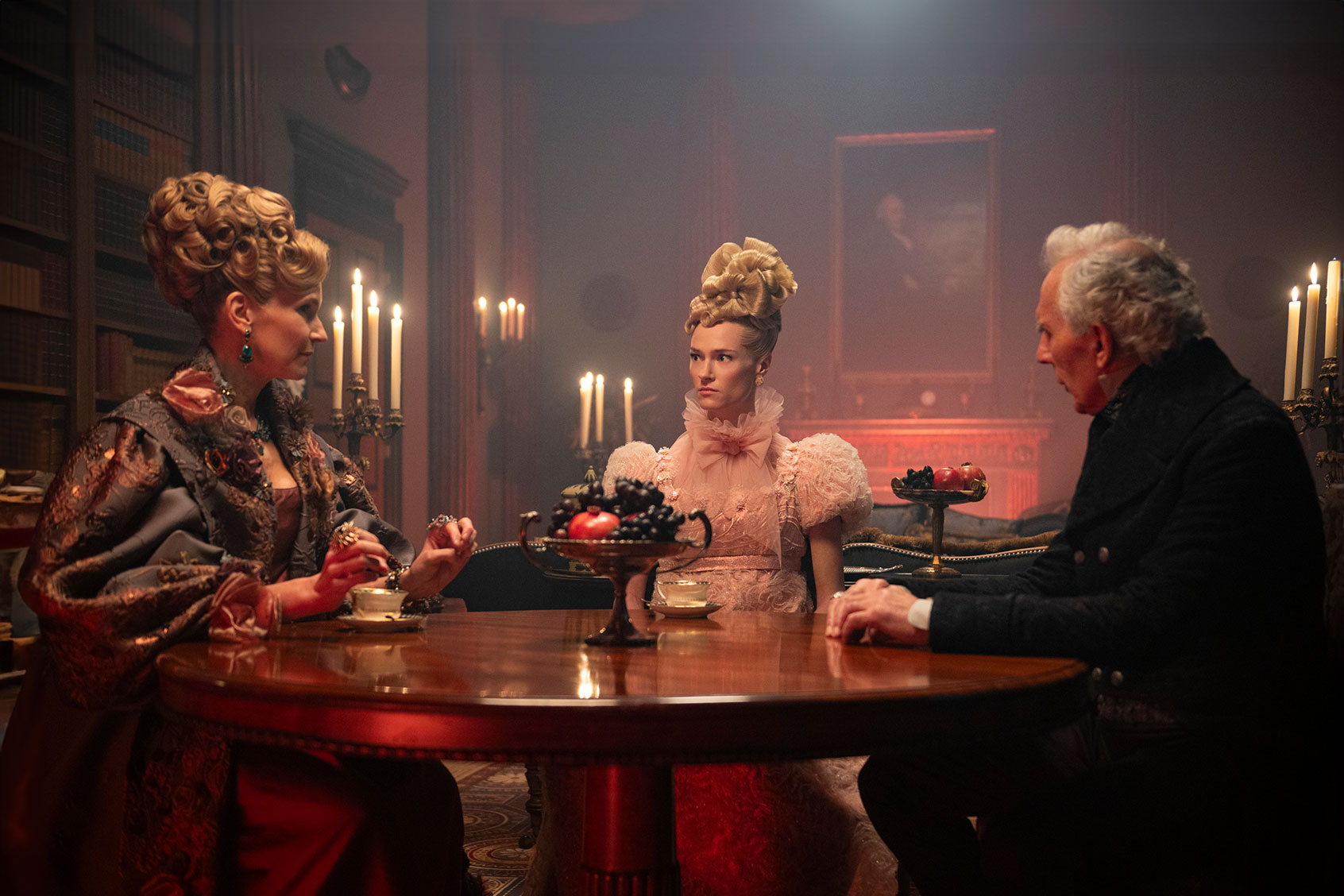
BridgertonJoanna Bobin as Lady Cowper, Jessica Madsen as Cressida Cowper and Dominic Coleman as Lord Cowper in "Bridgerton" (Liam Daniel/Netflix)However, having let another promising suitor slip her grasp yet again, Cressida is without any appealing prospects. As a result, her father betroths her to the elderly and wealthy Lord Greer (Richard Durden) who seems determined to keep his future wife both away from any fun and pregnant with his heirs. At this point, Cressida's elaborate ensembles become even wilder.

"We see it [her wardrobe] as an armor for Cressida for when she's out socially," explained "Bridgerton" women's clothing designer George Sayer. "It's her third season out. She still hasn't found her husband. She's desperate to find one. She's about to get engaged [to Lord Greer].

"We've got this armor but also we see a vulnerability to Cressida that we haven't seen before," Sayer continued. "We see the desperation for her to break out of the Cowper house. We like to think of her as a butterfly in a mausoleum and she's desperate to escape."

Hair and makeup designer Erika Ökvist echoed how Cressida's powerlessness became the impetus to design a look that felt powerful. "Makeup and hair and costume, and especially our hair, big shoulders and all that kind of stuff – it's almost like an armor to protect because actually she's really vulnerable and she will get hurt really badly," she said. "We would try and use shapes that would work together so that the hair and the costume became like a visual symphony. We would feed from each other."

"Bigger is better, and more is more."

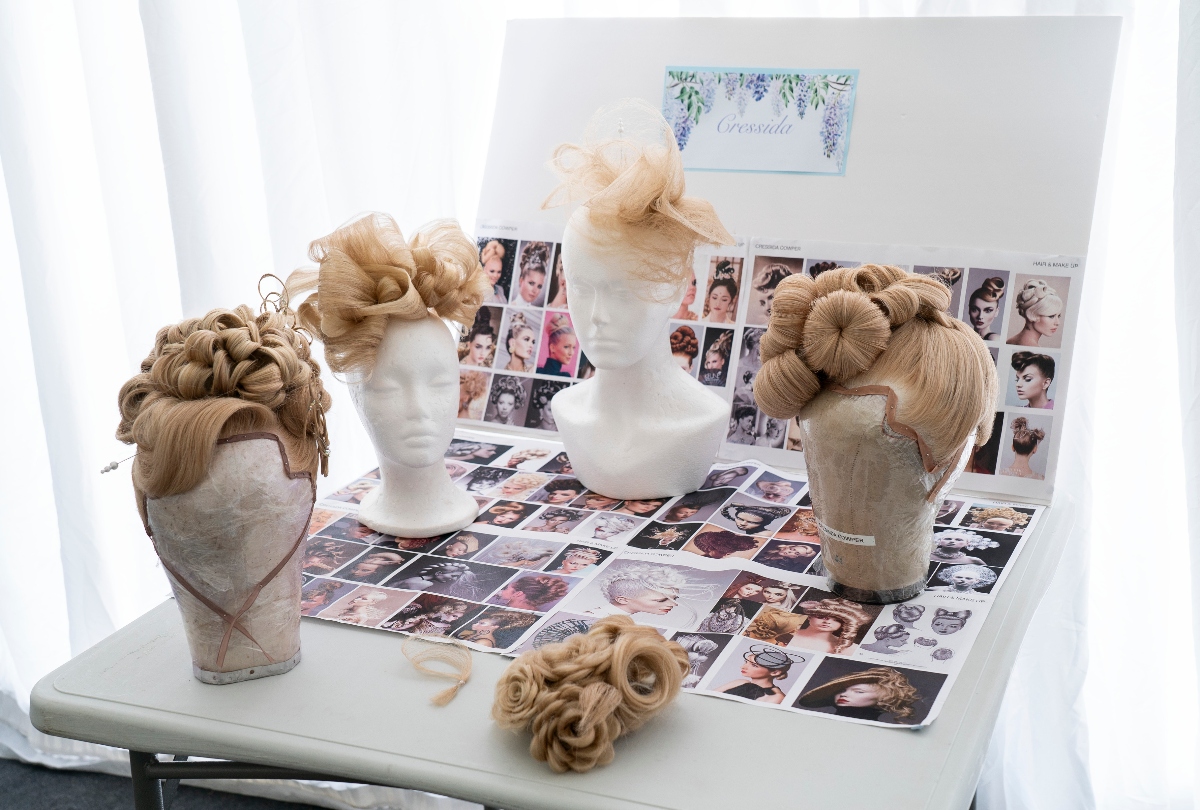
If the outsized ruffles, suffocating collars, multiple bows and endless flourishes seem overdone, then Cressida's hair takes that one step further. Towering sculptures of hair, paintakingly geometric curls and designs that look more at home in an art installation crown Miss Cowper.

"In terms [of] inspiration, where do I start?" Ökvist said. "I can see sea urchins there, and I know that some of the fans have seen toilet roll shapes. Wherever you can get a shape that is avant-garde, but also elegant – it's a little bit like with Cressida as it is with the Queen [Charlotte]: bigger is better, and more is more." 

"Bridgerton" Cressida wigs (Netflix)

The Lady Whistledown gambit

Not resigned to wither away as a brood mare in a loveless marriage, Cressida grasps at Queen Charlotte's (Golda Roshuevel) offering of a hefty monetary reward to whomever can unmask anonymous gossip columnist Lady Whistledown. Cressida boldly claims that she is, in fact, the writer in question. Not only does she want the reward to help free her from needing a moneyed husband, but she hopes that the respect afforded to Whistledown will give her the freedom to act as she pleases in society.

With the help of her clever mother, she debuts her first (fake) Lady Whistledown publication at the Mondriches' ball, which naturally requires an equally dramatic ensemble: the red gown. The dress itself, while eye-catching, is actually far less fussy than her usual style. And therein lies its power.

"If you look at that dress, there's no adornment. It's just shape. It's the most simple, believe it or not, of all," said Glaser. "And if you notice, this is a place again where we could have done a large sleeve, but we thought, how can we get that same feeling of the armor again moving in a different direction?"

Sayer added, "The bodice and the sleeves instead are really pointed. So there's that harder edge. On the sweetheart neckline, it's very angled. The shoulders are really angled."

On the back of the gown, a huge bow comes up as high as Cressida's shoulders. "Even though it's a bow on the back, that bow is to frame her face," said Glaser. "There's no distraction behind her. It's just her face. So you can really see her, what she says and her reaction to things. Because we've seen the big sleeves, that would be expected. So this is a little unexpected. And then we know what she tells everybody. She's empowered herself in a different way."

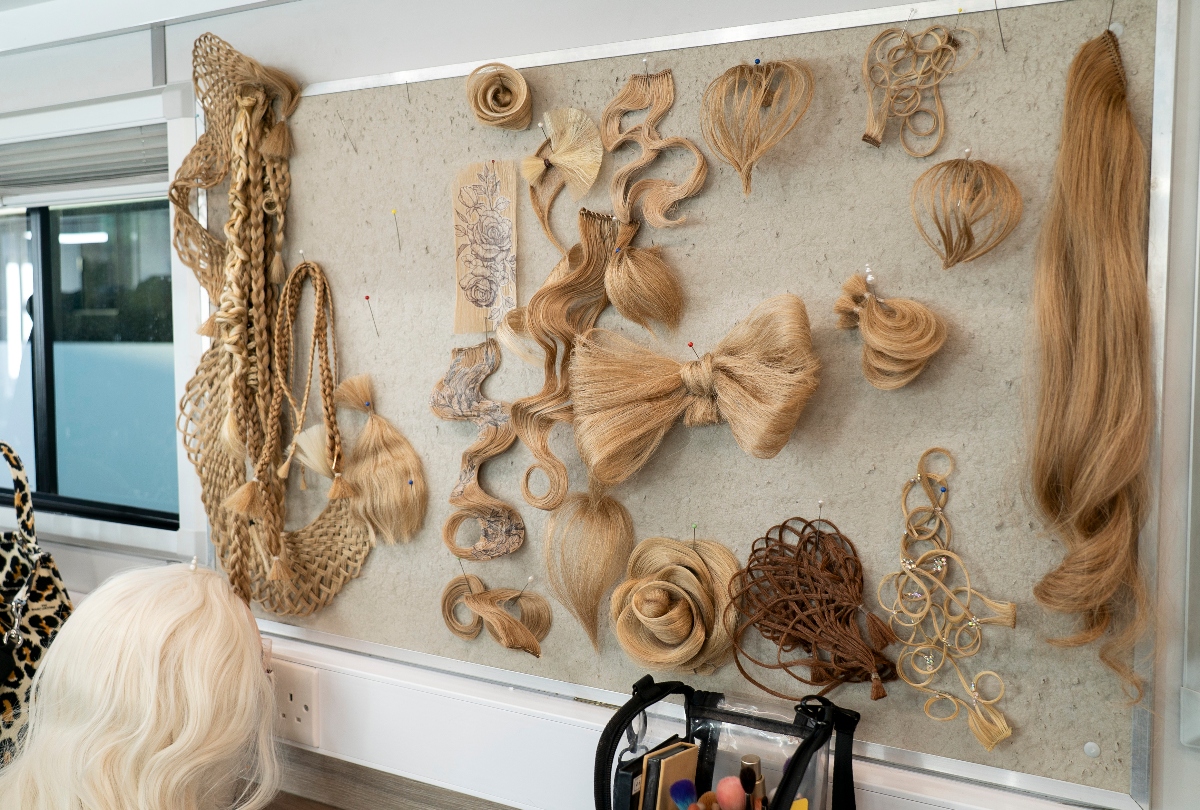
"Bridgerton" Cressida hairpieces (Netflix)

Similarly, Cressida's hairstyle is slightly less elaborate than usual, but achieves some height and breadth as it fans out from her head, echoing the giant bow peeking from behind her back.

"Costume led here, and we just try to make sure that we went as extravagant as the costume,"  Ökvist said. "And sometimes, if the shoulders are really big then maybe we'll go high. So shapes are really important, how they work together with the costume.

 "[Cressida] would have planned this for a long time," she added. "She would have had all of it down to a tee. She would have planned it to think, 'OK, what would the Queen want to see? What will make her impressed?' That's how she would have planned it because this is a way for her to make society see her."

A tragic fragility

The ruse doesn't pay off. Cressida masquerading as the notorious gossip columnist has caused Lord Greer to withdraw his suit, which should have pleased her. However, her father takes this as a sign that she is now no longer useful as marriage material. He plans to send her to live with his sister, the even stricter Aunt Joanna (Anah Ridden) in the countryside as a punishment for sullying the family name. 

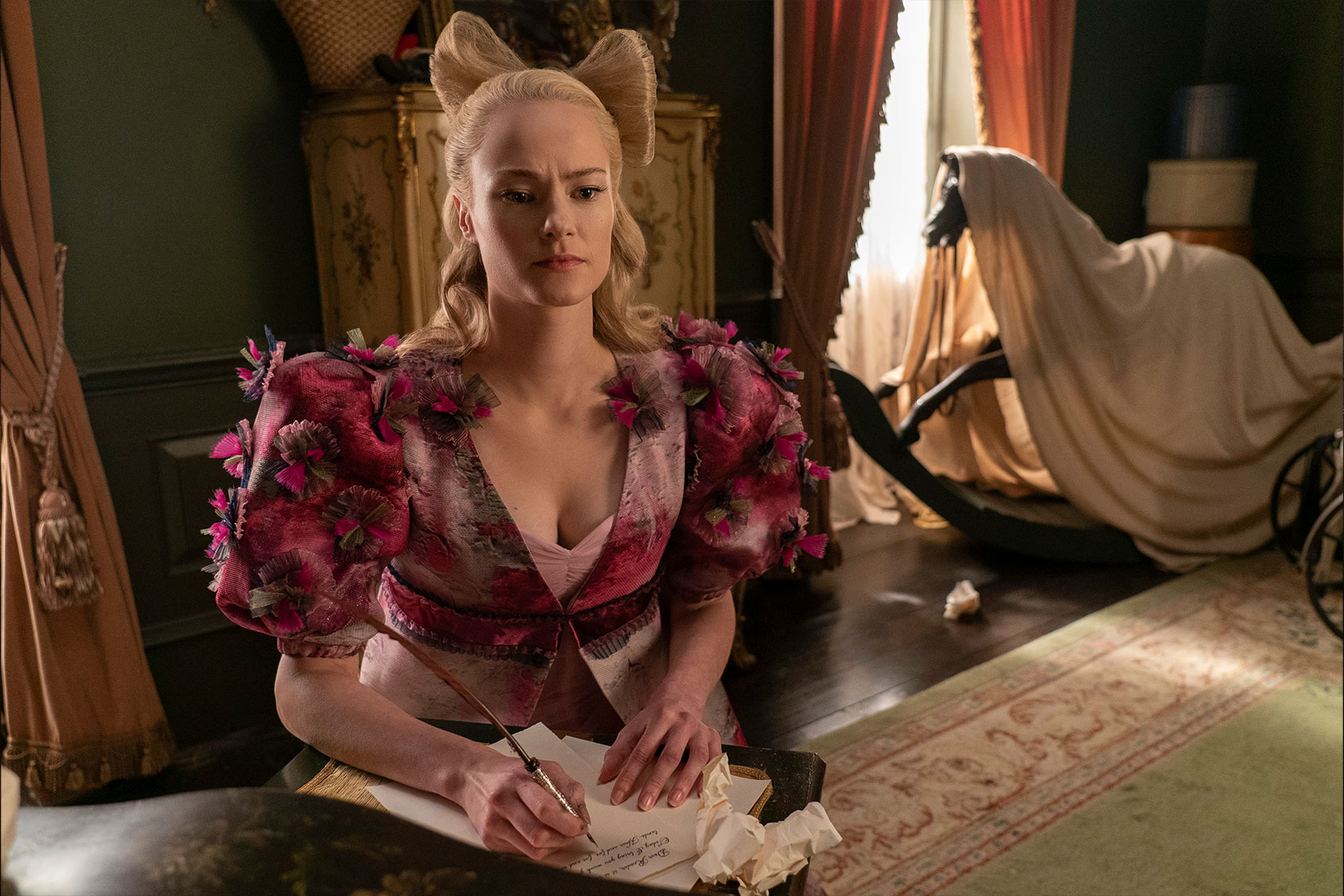
BridgertonJessica Madsen as Cressida Cowper in "Bridgerton" (Liam Daniel/Netflix)Cressida has nothing to lose at this point. Her Hail Mary strategem is to track down the real Lady Whistledown, and she succeeds where others have failed. Cressida discovers it's none other than Penelope Featherington and promptly attempts to blackmail her for double the amount of reward money that the Queen is offering. It's not a kind move, but young, unmarried women whose reputations are ruined don't have many options in Regency England.

"If you're watching the rest of the episodes, you realize very quickly that [Cressida's] actually the most desperate out of all of them," said Ökvist.

Sadly, Cressida is outmaneuvered when Penelope decides to reveal herself as Lady Whistledown at her sisters' ball, in front of everyone else who matters in the 'Ton. Queen Charlotte respects this humble, almost hesitant presentation – far more genuine than Cressida's theatrics – and gives a stamp of approval to Penelope's true identity, allowing her to continue writing her column. Cressida has no more plays left.

This unexpected fragility also reveals itself in her appearance – in the intricate, almost gossamer-thin aspects of her hairstyles. "There's some of her looks that are quite transparent," Ökvist noted. "It is big, it's spiky, but it is really vulnerable, and looks like you can just break it apart."

Ultimately, Cressida is not one of the blessed Bridgertons and finds that breaking the rules does not pay off, earning her countless enemies along the way. She can look back at her one glorious devil in a red dress moment – when she actually felt as if she was calling the shots – but now there's the devil to pay. When Aunt Joanna arrives to gather her niece, Cressida has completely given up.

"After tonight, it shall matter no more," she says.

Raw milk health risks significantly outweigh any potential benefits

Despite an ongoing outbreak of bird flu in dairy cows, the popularity of raw milk has only risen. Advocates claim raw milk has superior health benefits over pasteurized milk. There is little evidence to support these claims, however, and the risk of serious illness is much greater.

Mississippi State University food scientists Juan Silva and Joel Komakech and nutritionist Mandy Conrad explain the difference between pasteurized and raw milk, addressing common misconceptions about the health risks and purported benefits of consuming unpasteurized milk. These questions are more important than ever, since cattle can shed viral material into their milk. Not only can pathogens end up in milk, but at least three farmworkers reportedly have contracted H5N1, the virus that causes avian influenza, in 2024. Farmworkers can get sick by handling infected animals or their byproducts, such as raw milk.


What is pasteurization? Does it destroy nutrients?

Pasteurization is a process that involves heating beverages and foods at high temperatures – over 145 degrees Fahrenheit (62.78 degrees Celsius) – to kill harmful microorganisms, such as bacteria, viruses and parasites. This reduces the total number of microorganisms in the product and also inactivates enzymes that could contribute to spoilage.

The taste, nutritional value and quality of pasteurized products aren't significantly affected by the process.

While pasteurization can lead to some nutrient losses, the changes are generally minimal and outweighed by the benefits. Pasteurization typically causes minor denaturation of proteins and has little effect on fats and carbohydrates. While water-soluble vitamins such as vitamin C and some B vitamins, usually not abundant in milk except vitamin B2, can be partially degraded during pasteurization, fat-soluble vitamins (A, D, E and K, found in significant amounts in milk) are more heat stable and suffer minimal loss.

Thus, nutritional losses in milk due to pasteurization are generally small compared with the significant benefits of reducing foodborne illnesses and spoilage.


Is raw milk healthier than pasteurized milk?

Studies have compared the benefits of raw milk with pasteurized milk and have found little evidence that raw milk is superior to pasteurized milk. The perceived advantages of raw milk are outweighed by its health risks.

First, raw milk does not improve lactose intolerance.

Raw milk also does not have more vitamins than pasteurized milk. Milk is not a good source of vitamin C or other heat-sensitive vitamins, and pasteurization does little to reduce vitamin B2 or riboflavin, which is not as sensitive to heat. Moreover, Vitamin D is added to pasteurized milk to enhance your body's ability to absorb the calcium in milk.

Fortified milk replaces nutrients that may be lost in the pasteurization process. Vitamin D is added to milk to enhance uptake of the calcium found in the milk. No single food is perfect, so it is OK for milk to lack some nutrients, as these can be obtained from other foods.

Some people believe that probiotics – foods or supplements that contain live bacteria beneficial to health – are more prevalent in unpasteurized milk and products made from raw milk. However, raw milk is generally lacking in probiotics and has significantly more harmful bacteria. Probiotics are added to many dairy foods such as yogurt after pasteurization.

Furthermore, a 2011 review of the available research on the health benefits of raw milk found that many of these studies were conducted with poor methods, meaning their results should be interpreted with caution.


What are the health risks of consuming raw milk?

The health risks of consuming raw, unpasteurized milk come from the harmful microorganisms that may be present.

Raw milk has been associated with hundreds of foodborne disease outbreaks. Between 1998 and 2018, 202 outbreaks resulted in 2,645 illnesses and 228 hospitalizations. More recently, from 2022 to 2023, there were 18 outbreaks and recalls associated with raw milk. A number of outbreaks and recalls associated with pathogens in raw milk have already occurred in 2024. In all cases, pathogens in the raw milk that cause human diseases were directly responsible for these illnesses.

Some illnesses from the pathogens in raw milk can have serious long-term effects, including paralysis, kidney failure and death.

Researchers found that areas where raw milk was legally sold in the U.S. from 1998 to 2018 had over three times more outbreaks than areas where selling raw milk was illegal. Areas where raw milk was allowed to be sold in retail stores had nearly four times more outbreaks than areas where sales were allowed only on farms.


Is it safe to eat foods made from raw milk?

Many, if not all, dairy products made from unpasteurized milk are not safe to eat. A number of products can be made from raw milk, including soft cheeses, such as brie and Camembert; Mexican-style soft cheeses, such as queso fresco, panela, asadero and queso blanco; yogurt and puddings; and ice cream or frozen yogurt. Pathogens in raw milk can survive the processes involved in making these types of dairy products and thus be unsafe for consumption.

Only products that undergo a process to inhibit or kill harmful microorganisms may be safe enough to be made from unpasteurized milk. However, the potential for cross contamination of raw and cooked food as well as the survival of pathogens from inadequate processing is high when products are made with raw milk.


Can pasteurized milk still get you sick?

The few reported outbreaks associated with pasteurized milk can be traced to contamination after pasteurization. When handled properly, pasteurized milk is a very safe product.

The U.S. government requires farmers to destroy milk from herds infected with avian influenza. As of June 2024, 12 states have reported herds positive with H1N5, the virus that causes bird flu.

There is currently no evidence that consuming pasteurized milk from infected cows causes illness in people. Based on the evidence available, the Food and Drug Administration currently states that pasteurization is able to destroy or inactivate heat-sensitive viruses such as H5N1 in milk.

Consuming raw milk, however, may pose a risk of disease transmission to people.


Can you gain immunity from H5N1 from drinking raw milk?

Some people believe that drinking raw milk can strengthen their immune system. However, there is no scientific evidence to support that drinking raw milk can improve immunity against disease.

Vaccines train your body to protect itself from future infections without actually getting sick from that infection. They do this by exposing your immune system to very small amounts of dead or significantly weakened pathogen.

Bird flu is spreading among dairy cows in the U.S.

Raw milk contains live H5N1 virus, meaning it could still infect you and make you sick. Rather than contributing to your immunity, raw milk exposes you to the virus at its full strength and can result in severe illness. Any protective antibodies that may be present in raw milk are likely degraded in stomach acid.

Moreover, people who contract bird flu from raw milk run the risk of transmitting it to other people or animals by giving the virus a chance to adapt and improve its ability to spread between people. This increases the risk of more widespread disease outbreaks.

Juan Silva, Professor of Food Science, Nutrition and Health Promotion, Mississippi State University; Joel Komakech, Assisstant Professor of Food Science, Nutrition and Health Promotion, Mississippi State University, and Mandy Conrad, Assistant Clinical Professor in Nutrition and Dietetics, Mississippi State University

This article is republished from The Conversation under a Creative Commons license. Read the original article.

Biden takes lead over Trump in Fox News poll for the first time since October 2023

President Joe Biden can celebrate some good news for his re-election campaign — a new Fox News poll finds the incumbent enjoying the support of 50% of potential voters and a two point lead of Donald Trump.

Surveys taken in late 2023 and early 2024 had shown Trump overperforming other Republicans with a narrow but stubborn lead; that seems to have evaporated as positive views of the economy inch up.

Last month, Trump was ahead of Biden by 1%; in March, he was up by 5%.

The results also show a swing in Biden’s favor with other candidates included: In May, Trump led the pack by three points, while Biden is now up by one.

The decisive shift towards Biden came from independents, who in May favored Trump by two points but now prefer Biden by nine. While independents are evenly divided on whether leadership (59%) and integrity (58%) are extremely important in their decision, they are more likely to say that Biden has integrity (+23) while describing Trump as being a strong leader (+11).

Biden and Trump’s core constituencies remain mostly loyal, with the former president holding a strong lead among men (+15), rural voters (+17), white men without a degree (+30), and white evangelical Christians (+46). Biden matches that with backing from women (+17), urban voters (+23), white women with a college degree (+28), Black voters (+43) and more surprisingly, voters aged 65 and over (+15). Biden’s 73% support among Black voters, however, is below the 79% he had in a Fox poll just before the 2020 election and the 91% he won in the election itself.

The Fox News survey, which had a 3-point margin of error, interviewed a sample of 1,095 registered voters randomly selected from a national voter file by landline, cellphone, and online survey. It was the first conducted by the media organization since a New York jury convicted Trump on 34 felony counts related to falsifying business records.

Five percent of surveyed voters told Fox that Trump’s conviction caused them to switch to Biden, while 4% said that Hunter Biden’s conviction for illegally purchasing a gun led them to support Trump.

Two-thirds of respondents said the economy is extremely important issue. Though only 32% of all respondents say that the economy is in excellent or good shape, that’s the highest number in Biden’s presidency so far in a Fox News poll. Moreover, a majority of Americans (59%) say that they are either getting ahead or holding steady when it comes to personal finances. Voters still trust Trump more on the economy, by five points, but that’s narrower than the 13-point advantage he enjoyed in May.

“We should all pay attention”: Experts identify the “most chilling” part of secret Roger Stone tape

In a conversation at Mar-a-Lago earlier this year, Republican operative Roger Stone thought he was speaking to a fellow MAGA traveler when he boasted that he and fellow dirty tricksters, who were crying “Stop the Steal” months before the 2020 election even happened, are better prepared this time around to snatch victory from the jaws of electoral defeat.

“At least this time when they do it, you have a lawyer and a judge — his home phone number standing by — so you can stop it,” Stone told Lauren Windsor, a liberal documentary filmmaker who was posing as a supporter and secretly recording him as he spoke this past March about what will happen if the Democratic candidate once again receives more votes than the Republican. Stone, who was only spared a three-year prison term for lying to Congress about Wikileaks and Russia thanks to a pardon from former President Donald Trump, said this time he and his ilk are on an “offensive footing.”

In a separate conversation, taking place this past March and first reported this week by Rolling Stone, the 71-year-old boasted that Trump and his allies are already defeating Democrats in court. “We are beating them," he told Ally Sammarco, a colleague of Windsor. He pointed to the Georgia election interference case “falling apart” and referenced U.S. District Judge Aileen Cannon, the Trump appointee overseeing his classified documents case.

“I think the judge is on the verge of dismissing charges against him in Florida,” Stone said. “They’re delayed in New York City and they’re now delayed in Washington.”

When considering anything that comes out of Stone’s mouth, it is worth remembering, again, that he is a convicted fabulist. The far right, of which Stone is certainly a part, loves to project an aura of intimidating competency when the reality is often shambolic: For all the preparation in 2020 — when Trump enjoyed the powers of incumbency, including an attorney general willing to spread lies about mail-in ballots — the Republican campaign against the republic still manifested itself in last-minute filings by Sidney Powell and Rudy Giuliani, nobody’s idea of an “A Team.”

That’s not to say the threat isn’t real, just that no one should cower in the face of bluster from the likes of one Roger Stone, whose prophesy of total victory in the courts has already been rebutted by 34 felony convictions. Unfortunately, as Windsor herself demonstrated in another secret recording of Supreme Court Justice Samuel Alito, insurrectionists do have allies in high places.

“That was the piece that was most chilling for me,” former federal prosecutor Andrew Weissmann told MSNBC, speaking of Stone’s claim to have a MAGA judge’s number on speed dial should “election fraud” (a Republican loss) happen again.

“With Roger Stone, you don’t know how much is bluster and how much is not,” Weissmann said, but “the fact that there would be home phone numbers in the possession of someone like Roger Stone or his acolytes is something that must be causing the United States Marshals significant concern.”

We need your help to stay independent

Joyce Vance, a former U.S. attorney, said Stone’s boasts should not just concern law enforcement but anyone who cares about free and fair elections.

“We should all pay attention,” she wrote, noting on her website that while election lawyers (“Stone is not one”) often reach out to judges when things go wrong on election day — people still waiting in line to vote when a polling station is due to close, for example — it’s not safe to assume this particular Florida man, who wanted to toss out millions of ballots in 2020 and appeared on another tape talking about Democrats he'd apparently like to assassinate, is merely concerned with upholding the rule of law and the right to vote.

“[T]o the extent Stone is insinuating something more sinister, that [Republicans] have judges in their pocket, that’s entirely different, entirely wrong,” Vance wrote. “Perhaps he’s just making it up when he says Judge Cannon will soon dismiss the case against Donald Trump and that they have other judges available during the election. But given his background and history, it would be foolish not to be concerned.”

America is still haunted by the ghost of Ronald Reagan’s corruption

America has always been corrupt.

A nation “discovered” by those seeking fame and fortune at any cost and colonized by religious fanatics who were kicked out of every decent country in Europe. When the early European settlers became entrenched on this continent, they displaced or killed indigenous people and brought with them enslaved human beings whose only sin was being born a different color than their captors.

Our revolution was based on a democracy where conceptually all men are created equal and endowed by their creator with certain unalienable rights, including life, liberty and the pursuit of happiness. The trick was that the Declaration of Independence wasn’t about universal suffrage. Women, enslaved people and indigenous people were left out of the equation.

While some believe that stating that we are a government that “derives its just powers from the consent of the governed” is hypocritical coming from slave-owning, misogynistic forefathers who engaged in a genocidal “Trail of Tears," they would be in error. Our forefathers, flawed as they were, tried to build a “more perfect union.” The words of the revolution and our Constitution, which guaranteed our rights, were not set in stone and did not pass off a flawed culture as a perfect one. The Constitution is a living document and our forefathers were smart enough to see they weren’t all that smart. Their wisdom is seen in their creating of a government that can evolve as our knowledge evolves. 

Thus, individual colonies came together for a common cause – to fight the King of England – a monarch. In doing so, each colony had to compromise, but the leaders struggled to move forward toward a more enlightened future. Some of them could see beyond the horizon of hate and divisiveness to a time when all people participated in government – working together toward a common goal. The progress we’ve made in women’s suffrage, equal rights, civil rights, the separation of church and state along with the freedom to worship as you choose speak to the progress we’ve made.

The Civil War, the Supreme Court decision overturning Roe v. Wade, Jim Crow segregation, anti-semitism, Christian Nationalism, book banning, Japanese internment camps, and burning Beatle records speak to the entrenched ignorance that keeps us divided. 

Famed science fiction author Isaac Asimov spoke about the cult of ignorance and the undercurrent of anti-intellectualism that has been a part of the corrupting fabric of this country since its beginning – the false notion “that democracy means that ‘my ignorance is just as good as your knowledge.’” Thus, disinformation and misinformation have always flourished. It is why many Southerners to this day tell us the Civil War was about “state’s rights” without mentioning that the right they wanted to protect was the ability to own other human beings. It is why today’s far right speaks about the freedom of worship, but really means they want to be free to tell us all how to worship. Our generation's ignorance leads some to say that we are a Christian nation while it leads others to scream the hoary old cliché, “Separate but Equal.” 

The closest we’ve come, in my lifetime, to living up to our ideals was after Richard Nixon was hounded from office.

When asked by a journalist what he thought of Western civilization, Mahatma Gandhi quipped “I think it would be a good idea,” cementing the notion that America has rarely lived up to its ideals. We have often been called a nation of the “Ugly Americans” but we have tried over our history to do better. Martin Luther King reminded us that “the arc of the moral universe is long, but it bends toward justice." He was killed for such radical thoughts.

Bobby Kennedy, who eulogized King in Indianapolis at a speech before a mostly Black crowd during the height of the Vietnam War quoted the Greek playwright Aeschylus, “Even in our sleep, pain which cannot forget falls drop by drop upon the heart until, in our own despair, against our will, comes wisdom through the awful grace of God.” And then he delivered words we should all live by; “What we need in the United States is not division; what we need in the United States is not hatred; what we need in the United States is not violence or lawlessness, but is love and wisdom, and compassion toward one another, and a feeling of justice towards those who still suffer within our country.” He was assassinated less than two months after that speech.

In short, America has always been caught between its ideals and its reality. As T.S. Eliot in his poem “The Hollow Men,” reminded us, “between the idea and the reality, between the motion and the act falls the shadow.” The shadow is the difference between our darkest actions and desires and our belief in justice. 

We need your help to stay independent

There isn’t one part of our government untouched by scandal and corruption. When your nation is founded upon greed and religion, this is to be expected. Nor is any political party free from corruption. When it costs an inordinate amount of money to launch a viable campaign, political candidates must depend upon a donor class that is going to demand something for that money – thus we have trickle-down economics, tax cuts for the rich, a two-tiered justice system and a dissolution of business guard rails which leads to monopolies. The days of trust-busters like Teddy Roosevelt? They’re in our rearview mirror. 

Today we have the Heritage Foundation’s Project 2025, which would destroy the federal labor force, concentrate power into the hands of the few and guarantee authoritarianism in our democracy – think of a King with the power to pull the atomic trigger and you’ll understand. Worse, we have a convicted felon running for president in one political party, a convicted son of a president in another political party. Democratic U.S. Senator Bob Menendez is under indictment for bribery and Democratic Congressman Henry Cuellar is under indictment for bribery, money laundering and unlawful foreign influence. Investigations into Republican congressmen with ties to Jan. 6, meanwhile, appear to have stalled out.

All of this could lead you to believe America is a failed state. There are those like Steve Bannon who desperately need you to believe that. They want you to lose hope. Those who preach this the loudest are among those who need it to be true in order to wrestle authority from the people. Those people include a variety of politicians who claimed the January 6 insurrection was a “peaceful” demonstration, those who swear a “Deep State” exists inside the federal workforce and those who believe that despite 60 court cases proving otherwise that the 2020 election was rigged.

We are at a moment in history where many of us simply cannot fathom what is factual information because of the extreme amount of corruption. Thus, many don’t believe the 2020 election results were real. Others, preening for the Apocalypse and the Rapture, choose the way of disinformation and corruption because it suits their needs.

But listen carefully. If someone is telling you that “only I can solve our problems,” then they are lying. Why? Because they didn’t cause all of our problems. We all did. It will take all of us to solve them.

The closest we’ve come, in my lifetime, to living up to our ideals was after Richard Nixon was hounded from office. In the Bicentennial year of our country, we spoke of togetherness. We listened to the same music. We all wore the same wide ties and platform shoes. We practiced civil rights. During the four years of the Jimmy Carter administration, no one burned records, there was no emphasis on banning books, and the Roe vs. Wade decision meant women were empowered to be responsible for their own healthcare. While Carter was a devout Christian, the Christian Nationalists ran for cover. Then came the dark times ushered in by Ronald Reagan and his allies Roger Ailes and Rupert Murdoch.

For the last 40 years, it has been a slide down a slippery slope into authoritarianism and ignorance. Yet, I naively cling to hope.

Look at it logically. Don’t associate any names to the following statement: The presidential nominee of one party is a convicted felon, a business failure, an adjudicated rapist in civil court who paid off a porn star and advocated grabbing women by their pu**y if you’re a celebrity because you can get away with it and like it. Is there any condition under which such a candidate should be taken seriously for the office of president? That someone is speaks volumes about the corruption inherent in our system.

At the end of the day, you have to listen to the voices of hope, because otherwise you’re giving into the hollow men. Between the conception and the creation and the emotion and the response, the shadow is long and dark – but it is also deceitful and carnivorous. And that way lies madness.

“Trump’s emails transform him into a persecuted martyr”: Daily messages prime MAGA for post-election

Donald Trump, a man who is a convicted felon, Jan. 6 coup plotter, aspiring dictator, and sexual assaulter as confirmed by a court of law, has repeatedly demonstrated that he has a deep attraction to and propensity for violence. As I have been chronicling throughout the Age of Trump, the corrupt and criminal ex-president’s threats of violence and mayhem have been escalating. Since his felony conviction several weeks ago and the possibility, however unlikely, that he will be sentenced to prison, his threats of violence and destruction have only gotten worse. There is no limit or bottom to Donald Trump’s vile behavior — he will only get worse, not better.

None of this is normal. The United States and its people are deeply troubled. 

Trump’s subject heading for one of his recent violence-inciting fundraising emails reads, “I’m on the warpath.”

Trump is also continuing to valorize the Jan. 6 terrorists who launched a lethal attack on the Capitol as part of his coup plot. At a rally in Nevada, Trump “promoted” the MAGA members from “political prisoners” and “hostages” to “warriors:

“Those J6 warriors — they were warriors….But they were really, more than anything else, they’re victims of what happened. All they were doing is protesting a rigged election.”

They were given fair trials in a democracy for their crimes and then found guilty based on the preponderance of the evidence. The Jan. 6 terrorists are not warriors or otherwise heroic. In reality, they are foot soldiers for a fascist cause and enemies of democracy, who their Great Leader, like other authoritarians and autocrats, has contempt for and views as dupes and useful idiots.

We need your help to stay independent

In a fundraising email that should have received much more attention from the mainstream news media, Trump, in another act of projection and stochastic terrorism where he feigns being the victim, basically calls for public executions of his political enemies and anyone else who opposes him and his MAGA movement and the larger neofascist cause. Ultimately, Donald Trump and his propagandists want an American version of the Terror during the French Revolution when tens of thousands of people were publicly executed.

HAUL OUT THE GUILLOTINE!

Remember when that Sicko Kathy Griffin made the rounds parading my BEHEADED head when I was President?!”

The radical-left CHEERED!

Obama and Biden were SILENT!

And the Fake News BLASTED it everywhere!

The SAD and HORRIFIC TRUTH is that this is STILL the Sick Dream of every Trump-Deranged lunatic out there! And it’s not just me they want gone, THEY’RE REALLY COMING AFTER YOU….

Sick Sick Sick!

Donald Trump is referencing comedienne Kathy Griffin who, several years ago, shared an image of herself holding his severed head.

Monday, in another escalation of his endless appetite for violence and menace, Donald Trump reportedly sent out a text message to his MAGA cultists threatening President Biden with a “bloodbath” at the upcoming debate:

IT'S GOING TO BE A BLOODBATH

And I want YOU there when I finish Biden. 

Donald Trump has used this language about “bloodbaths” several times in the last few months. Predictably, the mainstream news media normalized and imposed other more “benign” explanations on Trump’s obvious threats of violence against his perceived enemies and anyone else who does not surrender to him and the MAGA movement.


Want a daily wrap-up of all the news and commentary Salon has to offer? Subscribe to our morning newsletter, Crash Course.


In an attempt to make better sense of Donald Trump’s increasingly violent emails and other communications, and the implications for the country’s democracy and politics (and the safety of the American people), I reached out to several leading experts on national security, terrorism, and propaganda.

Barbara Walter is a professor of political science at the University of California, San Diego, and one of the world's leading experts on civil wars, political violence and terrorism. She is also a permanent member of the Council on Foreign Relations and has consulted for the State Department, the Department of Defense, the UN and the World Bank. Walter's most recent book is "How Civil Wars Start: And How to Stop Them."

If you view videos of Trump campaigning in 2016 you quickly notice that his rhetoric at the time was much less aggressive, negative, and violent than it is today. Many people have asked me whether words affect how people behave. Are Trump's supporters likely to become more aggressive, angry, and violent to match Trump's words? The evidence suggests that they will.

"A Fourth Generation Warfare (4GW) attack on the legitimacy of the Constitution, institutions, and courts needs a 4GW response at the level of moral conflict."

Here's what we know. The research on the effects of violent rhetoric by political leaders is relatively new. However, it generally suggests that violent rhetoric by political leaders can have significant effects on public opinion, social dynamics, and even the behavior of supporters. For example, some research suggests that repeated exposure to violent language from political leaders can desensitize individuals to violence, leading to its normalization in everyday life. Evidence also suggests that violent rhetoric can contribute to real-world violence or aggression. This can include hate crimes, acts of terrorism, or other forms of political violence by individuals or groups who feel empowered or justified by the rhetoric of political leaders. Violent rhetoric can also evoke strong emotional responses in individuals, including fear, anger, or anxiety. All of this suggests that Trump is ramping up statements of violence in order to exacerbate societal divisions, demonize his opponents, undermine democratic norms, and encourage the use of force should he lose the election in November.

Jason Van Tatenhove is an author and journalist who covers violent political extremism. He previously served as the national media director for the Oath Keepers. He documented his experiences with the Oath Keepers in his book "The Perils of Extremism: How I Left the Oath Keepers and Why We Should be Concerned about a Future Civil War." 

The recent rhetoric from Donald Trump, especially in light of his 34 felony convictions, serves as a stark reminder of the political and social fractures within our nation. His narrative, filled with vivid imagery of persecution and warfare, aims to galvanize his base by painting himself as the ultimate victim of an authoritarian regime. Trump’s claims that he has been the target of a witch hunt and his warnings that Biden's administration will come after ordinary Americans next are designed to incite fear and rally support through a sense of shared persecution. These techniques seem tried and true and are working here in America with a generation nursed on pro wrestling and reality TV.

I must ask myself why. You would think that most thinking, rational humans who find themselves in the here and now would realize that those who make the most prominent spectacle of bellowing the loudest from the rooftops about their innocence are, in truth, the guiltiest. Those who scream the system was rigged tried their best to rig and game the system. Those who try to sell us that they are fighting for us, our freedoms, and the American way of life are, in fact, fighting to remain free of legal accountability for their own actions and looking to destroy the freedoms that our forebearers fought for, sacrificed, and died to win for us.

This narrative is not just a political strategy; it’s a call to arms, echoing the divisive and incendiary language that fueled the January 6 insurrection. By positioning himself as the last bastion against an encroaching tyranny, Trump taps into deep-seated fears and resentments, transforming his legal battles into a crusade for the soul of America.

However, it's crucial to dissect these claims with a critical eye. The depiction of America as a war zone under siege by the "Radical Left War Machine" is not only hyperbolic but dangerously misleading. It fosters an environment where extremism can flourish, and civil discourse is overshadowed by paranoia and animosity.

When dealing with people like the individual we are speaking of, it is best to take a step back, turn down the volume (or mute it altogether), and take some time to look at their actions over time. Without all the high-gloss polish and propagandistic spin, the ugly truth of action over time is much easier to see for what it is.

As journalists, our role is to cut through the noise and present the facts. Trump's narrative may resonate with his supporters, but we must highlight the broader context and the real implications of his words. This isn't just about one man's fight against the system; it's about the integrity of our democratic institutions and the need for a collective commitment to truth and accountability.

James Scaminaci III is a former senior civilian intelligence analyst who has written extensively about the Christian Right in America, the Tea Party and the Patriot militia movement, and political violence. 

There are a few major themes of Trump’s emails. First, everything that has happened to me [Trump] is illegitimate. This is the major strategy of Fourth Generation Warfare. The current president, the Department of Justice, FBI, and the federal, state, and local courts are acting illegitimately. Trump reinforces his target audience’s belief that the “Deep State,” that is, those apolitical civil servants, your neighbors and friends, who follow and enforce the country’s laws and regulations, are actually monstrous.

Second, because Christian Nationalists have made Trump into a politician given a God-given mandate to rule, if not Jesus himself, Trump’s emails transform him into a persecuted martyr.

Third, because the Christian/MAGA base feels itself to be persecuted—those “evil,” “satanic” Democrats are anti-God and have driven God from the public square—Trump’s emails emphasizes that the real target of the Biden persecution are Christian/MAGA believers.

Fourth, Trump’s emails play to the sense that Christian Nationalists have that they are in the End Times, that they are engaged in a cosmic war of Good versus Evil, God versus Satan. And that this struggle is already violent. Thus, he claims that the “tyrannical Biden regime’s reign of terror” must end. They’ve “opened fire on MAGA.” They operate a “war machine.” And they’ve turned America into a “war zone.”  And lastly, the emails promise that a Trump victory will result in retribution for all this evil. If you are under this vicious and unrelenting attack, do you not counter-attack after the election?

Of course, you do. Trump is priming the Christian/MAGA base to violently contest a “rigged” 2024 presidential election, overturn the election, and then destroy the apolitical civil service, the rule of law, transparency in government, and wreck the post-World War Two security architecture that has brought stability and economic growth to us and our allies in Europe and the Asia-Pacific regions.

The reality is much different. But, a Fourth Generation Warfare (4GW) attack on the legitimacy of the Constitution, institutions, and courts needs a 4GW response at the level of moral conflict.


“Intentional”: Harvard legal scholar says SCOTUS “deliberately delayed” Trump immunity ruling

The Supreme Court’s delay in deciding Donald Trump’s immunity case makes a trial before election highly unlikely, legal experts say.

Special counsel Jack Smith, who brought the four-count indictment against Trump in August 2023, has accused the former president of conspiring to thwart his 2020 electoral defeat and the peaceful transfer of power to President Joe Biden. 

Laurence Tribe, a constitutional law professor emeritus at Harvard University, said the Supreme Court has dragged its feet.

“it's obvious that the court has deliberately delayed everything,” he said. “It could easily have issued a ruling much sooner.”

Last December, U.S. District Judge Tanya Chutkan rejected Trump’s motion to dismiss the charges on grounds of absolute presidential immunity, which he argues completely shields him from prosecution for any actions taken while in office. Trump has argued the House has to impeach a former president and the Senate has to convict before an ex-president could be criminally prosecuted.

In early February, the D.C. Circuit upheld the judge’s decision and rejected Trump’s claim.

Chutkan also indefinitely delayed Trump’s original March 2024 trial date until courts resolved Trump’s immunity argument.

Trump then asked the Supreme Court to weigh in and offer justices’ “thoughtful consideration.”

In late February, the Supreme Court decided to take up Trump’s immunity appeal. 

“It could have taken the case in December when the special counsel asked it to be heard directly, or they could have declined to take the case after the court of appeals quite comprehensively rejected Trump's appeal, so the trial could be over by now,” Tribe said. “Instead, the court has dragged its feet.”

Hofstra University constitutional law professor James Sample said there was “no legal necessity” for the Supreme Court to take up this case, and Trump’s “dangerous” arguments, in the first place.

“When you compare the Supreme Court's handling of similarly urgent presidential matters in the past, including Watergate and the Nixon tapes and certainly Bush v Gore, the delay that has occurred here is intentional, and it is destructive of our democratic process,” Sample said. “The D.C. Circuit’s decision was thorough. It was by judges appointed by presidents from both parties, and it was correct on the merits, the Supreme Court has effectively interfered in the political process for no reason whatsoever other than for the purpose of interfering."

Claire Wofford, political science professor at the College of Charleston, said it’s “certainly fair” to criticize the court for not taking up the case sooner.

But she added: “If you wanted, there are lots of people you could hold responsible for how long this is taking."

We need your help to stay independent

Attorney General Merrick Garland, for example, has faced criticism for waiting until November 2022 to appoint Smith in the first place. The Washington Post reported that the FBI resisted investigating Jan. 6 for over a year. 

But once the Supreme Court decided to take up the appeal, Wofford said she hasn’t been surprised by how long it’s taken for the court to release a decision on a sweeping constitutional question.

“If you want something to be reasonable and rational and thoughtful and ordered, it doesn't happen quickly,” she said.

Still – the Supreme Court has an undeniable backlog of cases: 23 of 61 cases this term remain unresolved.  

Trump’s lawyer is arguing that the Constitution provides him permanent immunity from criminal liability for his definition of what constitutes a President’s official acts.

Trump has argued that he was simply promoting election integrity – and denies charges that he illegally interfered with the election through a scheme to create and submit fraudulent election certificates and the now-infamous slates of "fake electors" in several swing states. 

Several legal experts said they expect the court will reject Trump’s claim to absolute immunity. 

In January, his lawyer told a court that a president could official order SEAL Team Six to assassinate a political rival and avoid prosecution until impeachment and conviction. 

“There's no prospect that the court will agree that no matter what a sitting president does, even if he orders SEAL Team Six to kill an opponent, that he cannot in the future be criminally prosecuted for it, unless he was first impeached and convicted by the Senate,” Tribe said. “That is a ridiculous position.”

PennState Law fellow Stanley Brand, a former House of Representatives general counsel, agreed: “I don't think that a majority of the court, even the conservatives, are going to buy that he is absolutely immune from any of these charges.”

And Wofford said: “The worst option for those who want to see Trump prosecuted would obviously be the court rules he has immunity for official acts, and that all acts taken here alleged in the indictment were official. But I just don't think there's a majority of justices willing to go to that extreme.”

Tribe said there’s consensus among legal experts about examples of a president duly exercising executive power: “But none of that is involved in this case.”

The question that the Supreme Court decided to take up asks: “Whether and if so to what extent does a former President enjoy presidential immunity from criminal prosecution for conduct alleged to involve official acts during his tenure in office.”

Tribe said the Supreme Court’s decision to frame the immunity question broadly means the public can expect an array of potential, likely complicated options. 

That could include: “sending the case back for further hearings in the District Court, which could lead to a cascade of subsequent appeals,” Tribe said.

The Supreme Court has previously held that presidents are immune from civil suits for their official acts. 

Wofford said she expects some justices will want to tackle the question of what constitutes official acts.

“What makes an act official?” Wofford said. “The court has an option here for many potential legal rules they can use to decide what makes an act official.”

In the 1982 case Nixon V. Fitzgerald, the Supreme Court wrote: “The President's absolute immunity extends to all acts within the ‘outer perimeter’ of his duties of office.”

Wofford said the Supreme Court has also held that “basically, if you can plausibly think it’s an official act, it’s an official act.”


Want a daily wrap-up of all the news and commentary Salon has to offer? Subscribe to our morning newsletter, Crash Course.


Wofford pointed out that at oral arguments, Justice Amy Coney Barrett got Trump’s counsel to acknowledge that certain conduct alleged in the indictment constituted private acts – and that a former president can be prosecuted for private acts. 

Specifically, Barrett asked Trump’s lawyer D. John Sauer if “turning to a private attorney who was willing to spread knowingly false claims of election fraud to spearhead his challenges to the election results” counts as a private act.

She also asked Sauer about Trump allegedly conspiring with a private attorney “who caused the filing in court of a verification signed by petition that contained false allegations to support a challenge.”

And Barrett asked about Trump allegedly directing an effort involving private actors “to submit fraudulent slates of presidential electors to obstruct the certification proceeding."

Sauer said he disputes the allegations, but said those acts “sound private.”

He agreed he wouldn’t raise a claim that those acts “as characterized” were official.

Sauer said that official acts would include meeting with the DOJ to deliberate who will be the AG, communicating with the public and communicating with Congress about “matters of enormous” concern.

Brand said it’s possible there could be consensus among conservatives on the courts to outline what counts as official acts, and then ask the lower courts to determine whether any of Trump’s conduct did constitute official acts.

But relying on courts to make that determination would make a pre-November trial more unlikely. 

Wofford said a pathway to Trump being prosecuted before the November election would require a tight timeline, and consensus among five justices.

"For those who want to see Trump prosecuted, the best option would be if a majority coalesced around this idea that President Trump can be prosecuted for private actions that he took," she said. 

Wofford said that would "leave open the option either that Jack Smith can rewrite the indictment to include the things that Trump's lawyers admitted were private, or the court itself could list the acts that it thinks are private, and then the trial could on president's acts private actions begin immediately."

Tribe said the special counsel could then narrow the case to the fake elector scheme.

“No one doubts that that's outside the president's official powers, that he supported the filing of false allegations of election fraud, that he signed verifications in court filings knowing that they were false," Tribe said. 

Tribe said the special counsel could proceed with trial 88 days from whenever the case is handed down – a length of time that Tribe said Judge Chutkan said Trump should be entitled in order to prepare for trial.

“If that happens, it's at least theoretically possible, though not likely, that there could be a trial of the former president for at least the core of what he is alleged to have done to prevent the peaceful transfer of power,” Tribe said. “That doesn't include all of the crimes that he may have committed leading up to and including January 6, but it includes enough so that before the election occurs, the American people could at least know whether a jury of ordinary citizens is ready to find, beyond a reasonable doubt, that Donald Trump interfered with the legal transfer of power and committed serious federal felonies in doing so.” 

Brand said he doubts that a pre-November trial could happen under that tight timeframe. He said overall, it’s important for the immunity decision to be decided before trial, and expected for the court process to be lengthy.

“Having litigated the immunities involved in the legislative sphere, they always prolong the case, and they take months and months to resolve,” Brand said. “So in that sense, this case isn't unusual from any other immunity case."

Meanwhile, Tribe said it’s possible that Garland will “say it's too close to the election for us to really authorize the special counsel to hold a trial.”

“If he did that, that would, I think, be a tragic error,” Tribe said. “It would essentially allow political considerations to trump the rule of law, and I'm worried that, given how slow he was to authorize special counsel in the first place, and given how judicious and cautious he has been, that Garland might, in fact, essentially, play along with the Supreme Court's unconscionable delay by allowing the case to languish until after the election.” 

And then if Trump wins, Tribe said: “There's no question that he will get rid of the charges by selecting a compliant attorney general who will just do his bidding. I hope Attorney General Garland does not succumb to that temptation.”

The toll of truth: What happens when you expose medical wrongdoing?

Dan Markingson’s mother was worried about him. Her son, seriously struggling with mental illness, had enrolled in an AstraZeneca drug trial at the University of Minnesota. Over the next few months, his condition appeared to deteriorate, even as his mother Mary Weiss begged to get him out of the trial. “Do we have to wait until he kills himself or anyone else before anyone does anything?” she asked in a voicemail to the study coordinator. Three weeks later, in April of 2003, he cut his throat.

Looking back on the tragedy now, author Carl Elliott says, “I still have yet to find anybody who wants to defend it.” But for a long time, it didn’t seem like anybody wanted to do anything about it either. And as a faculty member at the university, Elliott quickly found himself frustrated and, as he writes in his new book, “The Occasional Human Sacrifice: Medical Experimentation and the Price of Saying No,” “rattled.” He started digging around, and in 2010 published a feature in Mother Jones, explosively titled “The Deadly Corruption of Clinical Trials.” 

Now, Elliott, who writes in the book that “It is not in my nature to be confrontational,” has taken his experience as the jumping off point for an unprecedented look at some of the most galvanizing medical research scandals of the past several decades — and the impact they had on the individuals who brought them to light. He delves into the notorious Tuskegee syphilis experiments on Black men in the 20th century, the abuses against intellectually disabled children at the Willowbrook State School in the early 1970s, and four other shocking cases that reveal not just a stunning failure of ethics but a coordinated determination to silence and discredit the individuals challenging them. It's a chronicle of disappointment and loneliness, but also one of, in Elliott's word, of honor. 

I spoke to the author recently about the lessons of the past, the toll of telling the truth, and why one whistleblower says that every one of them is just “an amateur playing against professionals.”

This conversation has been edited and condensed for clarity.

You say in the book regarding people who are whistleblowers: there's a before and there's an after. You frame this book with your own experience. Tell me about your before and after. 

If you had asked me before 2008 or so, “How things were going? Should I look at a job at the University of Minnesota?” I would have said, “Absolutely.” I don't feel the same way anymore, partly because there were lots of things that about the university in the way that the way it operates that I didn't know before. Particularly the way that everything changed for me after I wrote that Mother Jones article.

Compared to a lot of people in a similar position, I felt as if I was relatively well protected. I’m tenured here. I felt like I knew the material really well, because these are issues that I've been working on forever. I also felt as if I was protected because I didn't, at least in my own head, need somebody else to write the story. I could just write it myself. I felt like I had a strong network of fellow travelers, colleagues in the medical school, and particularly in the bioethics center, who would feel the same way about it.

You know, the Markingson case is not hard. It’s not a dilemma. It's just a matter of which abuses you want to highlight in that story. I still have yet to find anybody who wants to defend it. But doing what I did, not just writing about it for a national publication, but also just refusing to let it drop, really earned the resentment of my colleagues and former friends from the academic health center. 

There are there are certain words that keep coming up in this book, and one of them is "loneliness." What often happens when someone points out these ethical violations, the repercussions are immediate and punitive, and the person is isolated. 

It played out differently for almost everybody I talked to in the book. It feels like the further away you are from the scene of the crime, the better off you'll be, morally and emotionally and psychologically. For example, Peter Buxtun, there's a sense in which he's an insider, he's working for the Public Health Service. But Tuskegee is happening in Macon County, Alabama, thousands of miles away. He's not part of the fraternity of doctors that he’s speaking out against. He's not really counting on a career in public health. He's just doing this temporarily, working as a contact tracer in San Francisco. He was probably the single most undamaged figure in the home in the whole book.

But the people like Ron Jones in New Zealand, or the four whistleblowers in Sweden at the Karolinska Institute or Mike Wilkins and Bill Bronston at Willowbrook, or John Pesando at Fred Hutch, these were were very close to the study and very often the patients, and they could see the abuses and the harms in this very immediate way. You talk about Willowbrook and that 1972 news report. I didn't see that film until I was in my fifties, and it still made me cry. Just unbelievable scenes of deprivation and neglect and abuse. Can you imagine what it would be like for Mike Wilkins and Bill Bronston to go to work in that every day, and know that the kids that they were admitting were going to be treated like this? 

Sometimes there's a sense of complicity in it. Even if you're working as hard as you can to improve things, there's also this feeling that you're a part of this. Sometimes just knowing about it makes you feel as if you're a part of it, and you have to tell other people. But there's also the sense of disloyalty that you feel about going outside the group, especially if you have the idea that people are going to be punished that you might know and really, maybe even like. All this is very difficult.

"Every whistleblower is doing it for the very first time, and they're just stumbling around in the dark."

You ask about loneliness. The original title for this book was “Lonesome Whistle,” after the old Hank Williams song, because of that sense of isolation, particularly if you've gone into this whole thing alone, which some people do. Then you find yourself totally isolated. Most of the people I talked to really had no idea where to look for support, no idea that other people had gone through this. It's not like there's a set social script out there for how to blow the whistle.

I use John Pesando’s remark as the epigraph, “Every whistleblower is an amateur playing against professionals.” That’s exactly what it's like, because on the other side, there is a script. There is a script for the PR people and the crisis managers and the attorneys in the organization on the other side. They know how to deal with whistleblowers. They've been through it many times. But every whistleblower is doing it for the very first time, and they're just stumbling around in the dark. And then they find themselves lost and isolated and ostracized. There's often a lot of effort to discredit whistleblowers.

You have someone in the book say that they thought that if they reported this, then it would be fixed. The disappointment of having that be turned on you, I imagine is quite palpable.

It takes a certain amount of idealism to do this. None of the people I talked to struck me as idealistic in any way, but I'm talking to them after the fact. But they often tell a story of this sort of innocence — “I was so naïve back then, I thought that this would happen.” One of the things that you need to think will happen is, if everybody else sees what I've seen, if they know what I know, they're going to feel the same way. They're going to feel outraged and angry and demand justice. And it almost never happens that way.


Want more health and science stories in your inbox? Subscribe to Salon's weekly newsletter Lab Notes.


The authorities don't leap into action. Their colleagues are not grateful. Their friends very often don't want to be seen around them because they're so toxic and radioactive at work. So it is very lonely. It's even lonely in the sense that I think a lot of people who do this struggle to tell themselves a meaningful story about it. Unless there are other people who've been through the same thing that you can talk it through with, you don't really know how to develop that story. If it's just a series of events that are senseless, then it's just very difficult to recover from that. The struggle, in the absence of any real success, is trying to tell yourself a story in which this all has some sort of meaning, and which you can, if not feel good about it, at least make your peace with it. That is not the typical David and Goliath story. 

We can think, Tuskegee, that was one hundred years ago. It's been fifty years since Willowbrook. What is the relevance of these cases right now in terms of what we need to understand about medical experimentation?

A lot has changed. I teach a class on research scandals. We start with the old ones, from the 1950s, 60s, 70s. Then we talk about the post-Belmont Report, post Common Rule studies. Almost everybody agrees the ones that came before the 1970s and were exposed during the 1960s and early '70s, it's almost certain we don't have anything like that now. The motivating force behind a lot of the scandals in the '50s, '60s, '70s was I think largely driven by hubris combined with genuine humanitarian goals, but also the conventional rewards for success in universities — promotion, tenure, prizes, status, more than anything else. 

Those things are still there, obviously, but you have this financial incentive that has come into play since the 1990s. Backing by the pharmaceutical industry, the privatization of clinical trials and the development of contract research organizations by the biotech industry, all of these things have introduced an additional incentive, which is not just about getting famous, it's about getting rich as well. So the shape of the scandals tends to be slightly different. 

We live in an age of misinformation, disinformation, conspiracy theories, paranoia, skepticism. This history of exploitation and abuse and harm is real. How do we then reassure someone who is looking at maybe doing a clinical trial now? How do we approach our medical system with the right due diligence as patients?

I think that's just really hard. I understand the way that question presents itself to people, which is, “What do I do to protect myself?” But I actually think it's not the right question. The right question is, “What can we do to fix the system so that we all have confidence in it?” 

One of the horrible things that I went through when I was writing this book is my father got very sick, and for about a three year period, he was in and out of the hospital all the time. He's a doctor. My brother's a doctor. I have an MD behind my name. This was all happening within my father's practice area in South and North Carolina. I felt as if we weren't there with him at all times, things would just go south, immediately. He was powerless against the system, even a guy with all his medical knowledge.

What would it be like, if you're trying to negotiate this and you have none of that? No power? No education? No money? How are you really supposed to protect yourself? That's why usually, the victims of these trials that have gone bad are vulnerable in some way. They're poor, they're uneducated, they're children that are mentally ill, they're mentally disabled. And one person, or even one family up against this giant medical industrial complex, that's a losing battle. 

"One person, or even one family up against this giant medical industrial complex, that's a losing battle."

What we need is reform of the system, so that we don't have to worry about this. The problem in academic health centers is that reflexive tendency to say, “Nobody can know about this. We have to keep it quiet. If we have a victim coming forward, or we have a whistleblower coming forward, we have to discredit them, so that no one will actually believe what they're saying. If we can't discredit it, then we need to sweep it under the rug. We need to keep it as quiet as possible. We need to settle it, and we need to settle it with a confidentiality agreement so that nobody knows about this. And then, if they do know about it, never apologize. Never compensate the victims. Never admit wrongdoing.”

Not only is it ethically, morally wrong to do that, I think it's also counterproductive. Because how are you supposed to trust the system, when every time something like this comes up, they lie about it? They dissemble and they stonewall the press, and they do every time. You know, people are forgiving, and if you're honest with someone and admit that you made a mistake, and apologize to them for it, very often, that's really all they want. They just want to be able to trust somebody. 

In many of the stories that you write about in this book, we still would not know about these cases were it not for the press. What is the relation then between the whistleblower and getting that story out? And how important is that messenger? 

It's really important, but for the whistleblower, it's a gamble. It can all go south very quickly if you're in touch with the wrong reporter. They may breach confidentiality and out you when you're not planning on that. They might betray you and portray you in a very poor light in the story. They might say they're going to work on it, and stonewall you for years and years and never actually do anything. They may have the story killed by an editor somewhere up the line.

That's what I mean about whistleblowers being amateurs. None of them have any idea how the press works. They don't know the difference between an investigative reporter and a science reporter and a beat reporter. They have no idea of which one they should find. It's just a matter of luck. Almost every story in the book, they were lucky to find good reporters, and in some cases, stunningly effective results. 

In this book you use a word that by your own admission is complicated — honor. We all in our own way have to confront our own ethics every single day. Why is that concept so meaningful to you? 

A couple of things. One, the research oversight system is an honor system. It was set up as an honor system intentionally. We could have had a regulatory system. After Tuskegee, Willowbrook, all those scandals that came out in the early 1970s, there was a big push for a full-blown regulatory system, like you would have in factories or mines.

The medical research establishment did not want that kind of oversight system. They pushed back very hard, and what we got is this peer review system, which basically says, “We will trust researchers to do the right thing.” That oversight system works by telling them to submit a lot of paperwork about what they plan to do. We trust them to fill out the paperwork, honestly, to report their results, honestly, to do what they say they're going to do in the study. It's like an honor code. But any kind of honor code depends on people who see wrongdoing to report it. That's what we don't have in the oversight system. We have an honor code, but we don't really treat it like an honor code. 

We need your help to stay independent

The other thing is that when I first started talking to whistleblowers, there was a way of talking that puzzled me in the beginning. If you asked them, “What led you to do this?” inevitably, there would be something in there about, “Well, how could I look at myself in the mirror? How could I hold my head up? What would I say to my children?” They weren't making a moral argument or talking about the Hippocratic Oath. They didn't talk about professional ethics, they didn't talk about the Bible. Although sometimes people were being harmed and that obviously played a huge part in it, the way they talked about it was about themselves. “How do I live with myself?” Asking the question, “How do I maintain my self-respect, in the absence of respect from anyone else now?” seemed to be at the core of their moral problems. 

At a certain point, it occurred to me, this is the ethic of honor. Honor is all about your obligations to yourself. It's about maintaining your self-respect. I hear it in their stories. I think the reluctance of anybody these days to talk about honor, at least in a positive way, is that it has a very dark side to it. The dark side is violence. The number of wars and mass murders and bar fights and any number of violent encounters that result from someone feeling as if their honor has been challenged, or their self-respect has been challenged, or they've been insulted in some way, is very much part of the honor ethic. I could have used a word like integrity. But what distinguishes the honor piece of it is that it's also important to an honorable person that they be seen as honorable by other people. And this is why discrediting whistleblowers works so well.

New Louisiana law will require Ten Commandments to be displayed in classrooms

On Saturday, Louisiana Gov. Jeff Landry attended a Republican fundraiser in Nashville where he forecasted his plans to require every public classroom in the state to display the Ten Commandments. “I can’t wait to be sued,” he said, per a report from The Tennessean

Now, according to the New York Times, Landry has made those plans a reality as he signed legislation on Wednesday that mandates the commandments be displayed in every public elementary, middle and high school — as well as public college classrooms. The law stipulates that the commandments must be “the central focus of the poster" on display, which may be no smaller than 11 by 14 inches. 

“If you want to respect the rule of law,” Landry said, “you’ve got to start from the original law giver, which was Moses.”

The American Civil Liberties Union of Louisiana, Americans United for Separation of Church and State and the Southern Poverty Law Center released a joint statement, saying the decision infringed on families’ freedom of religion. “Our public schools are not Sunday schools,” the statement said, “and students of all faiths, or no faith, should feel welcome in them.”


“A good song will age well”: Mike Campbell talks Tom Petty, Stevie Nicks’ gift and unearthing tunes

For decades, Mike Campbell made his living as the guitarist, co-songwriter, and co-producer with Tom Petty & The Heartbreakers. His expressive blues-rock riffs lent buoyancy and a deep sense of yearning to the band’s songs, which are as timeless as they are emotionally incisive.

Several years after Petty’s 2017 death, Campbell is still a road warrior as the leader of his own band, the Dirty Knobs. Last week, the group released what might be their best album yet, “Vagabonds, Virgins & Misfits,” which is a combination of new songs and tunes Campbell dug up from his formidable archives and decided to record.

"I seem to write about damaged women that need to be saved."

Petty fans will certainly find much to love about the album, in no small part because it boasts plenty of Campbell’s inimitable melodic guitars and warm, weathered vocals. But the characters within the songs are vibrant and striving — and guests such as Chris Stapleton, Lucinda Williams and Graham Nash add the perfect amount of emotional depth.

Campbell checked in from Philadelphia, preceding shows where he’s planning to jump onstage with Chris Stapleton to collaborate on a cover of Tom Petty and the Heartbreakers’ “I Should Have Known It.” (Stapleton does his own version on the star-studded country tribute album, “Petty Country: A Country Music Celebration of Tom Petty,” which is out June 21.) Throughout our conversation, Campbell is reflective and full of gratitude about both his music and career.

“I’m just like I was when I first picked up the guitar,” he says. “I followed it because I had to, not because I thought I'd ever get rich or famous. But I just love the music. I love the instrument, and I love the songs. I still do as much or better than at the beginning. I'm very blessed of a person. I've had a charmed life, and I'm enjoying every second of it.”

The following interview has been edited for length and clarity.

“Vagabonds, Virgins & Misfits” is your third Dirty Knobs record in four years. To me, it really seems informed by all the touring you've done. In general, there's a real looseness, as well as cohesion and chemistry, that really stood out to me.

I hear confidence. Like you said, we toured a lot on the first few records, and I'm getting my feet leading the band. I hear growth. Also we're still having a lot of fun — so there it is.

Was there anything you wanted to do differently this time around as you were approaching recording the album?

No, there was no conscious effort to be different, just to be better, try to come up with better songs, and refine it, and keep doing what we do.

It's one of those things, if it ain't broke, don't fix it. If it's working, go with it.

Well, you can always fine-tune it. With guitar players, for instance, all the great guitar players . . . I forget who said this, I think it was Clapton or somebody that said, once you get to a certain level, you don't improve exponentially every year like you did when you were a kid. You keep refining your craft and nuance.

That’s kind of we're doing at this age. We're just trying to refine it, polish it up, and mostly have – the songs have stronger characters and just get better. But don't go too far. We're just a rock ‘n’ roll band, so we don't want to go too far off that.

Lyrically, there's a lot of optimism and gratitude that I saw weaving through the songs. But all of the characters are going through these different things in terms of tough times or tough situations until they are able to find the silver lining or a bit of solace. The songs are literary, in a way.

You're right. I noticed that there's a lot of desperate characters. [Laughs.] But a lot of the best songs, even [with] The Heartbreakers, those characters are desperate to get a better life and to get to some sort of redemption and hope through the trouble they're in. That just seems to be a place that I naturally gravitate toward in my mind — and a lot of women, too. I seem to write about damaged women that need to be saved. I don't know why, but they show up.

But the important thing, like you touched on before, is I want to have hope and optimism. Because it's a really wicked world right now, and I think part of our job is to take people's minds to a sweeter place for a little while.

How did you get in the mindset to write these songs? I know that some of them you found on old tapes. But how did you get in the mindset to write these newer songs?

Once you become committed to writing, you're always in that mindset — open for the muse, open for any fraction of an inspiration, a lyric, or a chord, or a melody that might come to you. So I was already in the mindset. There was no specific, "I'm going to write this type of song or that type of song." They just come to you, and you have to follow the muse.

Mike Campbell and his band The Dirty Knobs' album Vagabonds, Virgins & MisfitsMike Campbell and his band The Dirty Knobs’ album Vagabonds, Virgins & Misfits (Photo courtesy of Sacks & Co.)Knowing when the muse is there is so important. When I talk to musicians, some are like, "I need to treat it like a 9-to-5 job where I sit down and write." I've always admired that, because that's a certain skill to have. But when you have an idea, you need to grab onto it while it's there.

I can't write on the clock. The muse will happen at any moment during the day, or in your dreams. I look at it like a 24-hour job, really. But it's not really a job; it's just being open and accepting things when they're given to you. They are like little gifts. Here's this idea from somewhere to you. What are you going to do with it? Well, you're going to respect it and try to make something good out of it.

We need your help to stay independent

What really draws you to be writing about those characters, those damaged women or the people really striving for things?

I think it's just the redemption. Life is a struggle, but we all hope for light at the end of the tunnel. You get through it, and there's a reaffirming reason to live. [Laughs.] You solve your problems, and then you can have some peace and joy for a while. A lot of the Heartbreakers songs, from “American Girl” or “A Woman in Love,” are very similar. 

"Life is a struggle, but we all hope for light at the end of the tunnel."

And the Beatles, too. I like the fact that the Beatles, [with] a lot of their songs, even if there is a dark element in some of the characters, there's always this feeling that you're going to get through this, and things are going to work out, and you're going to be OK. That's just how I'm kind of wired.

Over time, those are the type of songs that prove to be more enduring and timely, because the message is there and everyone can relate to that.

My biggest goal really is to inspire. Tom said that to me once, "Our job is to inspire the listeners, and if we can do something to make their moment feel a little brighter and make them feel good inside, then you've done your job."

I'm curious about the old tapes that you said you dug up that were hanging around. Do you have a big vault of stuff? Are they tapes in a box? What does that look like?

It looks like a wall of cabinets all full with two-inch tape from the last several decades. I have a home studio, and I do write a lot. I used to write more than Tom could deal with. He would pick out the ones if he liked something, but there might be 20 other ones in there that maybe weren't as good, but had some merit. So I stick them on the shelf, and write more, and always try and move forward.

It was actually my wife who said, "You really ought to go back and listen to those." I didn't want to go back to the past, but she said, "You might have overlooked some things." And so it's to her credit that I got my engineer. He pulled out the boxes — and you have to bake them now. If you have old tapes, there's a whole process. You put them in an oven, because they get gummy or whatever over the years. You have to burn that off carefully. Then you can actually play the tape, and then we would transfer them over to digital. When he had like 20 or whatever, I'd sit down and listen to them. 

And so four of the songs, I think, on the new album are from that process. I completely forgot about some of them. I would hear it back, and I’d go, "Oh, I remember this. I'm glad I found this, because this is better than I thought." Those, combined with the new things I was writing, that's how we put the record together.

It's very cohesive. I mean, going back to what you said, that you're like, "I just do what I've always done." You can't tell this was made X amount of years ago, and this was made in the present day. It's a nice continuum.

"Tom said that to me once, 'Our job is to inspire the listeners.'"

Well, luck, really. [Laughs.] But I have to give credit to my co-producer, George Drakoulias, for that. My band is so good in the studio. We don't play the songs many times — one, two, maybe three times, and then move on to the next song. We must have cut 25, 26 songs for this record. Some of them are rock songs. Some of them are ballad-y. Some of them veer into maybe a slightly different genre that may be a Beach Boys feel or something. So I got a little confused: "How do I find the 10 songs on here that fit into one flow?" George was very helpful with that. He said, "Well, these go together. Maybe leave those for the next record." And so he has to have credit for that.

Chris Stapleton, Lucinda Williams and Graham Nash all are on the record adding lovely contributions. What do they all bring to the songs for you?

They've all, in each case, made them better. I wrote the songs, and we were just going to do them ourselves, and then as I'm listening back, me or George might say, "You know, this would be good if another voice came in," or "Chris is in town. He's getting a Grammy up the street. Maybe he'll stop by.” 'Hey. Since you're here, would you like to sing on this verse on this song,' or Lucinda?" 

That song that I did with Lucinda, which is called "Hell or High Water," she just made the song 10 times better, because it's a female perspective, and her voice is so full of ache and soul. It’s much better than just hearing me sing all the way through the song.

And then Graham Nash—I had done an interview with him and I got up to courage — because I'm a huge Hollies fan — [to ask] him, "Would you maybe have time or be open to maybe singing some harmonies on one of the songs?" He said, "Sure. Send it to me." So I sent him the song “Dare to Dream,” and when he mailed it back. It was like Christmas. Like "Wow. Look what he did. He made my song sound like the Hollies,” [with] the richness of the Hollies' vocals, which I could never do on my own. So he brought a lot to it.

Of course, [Heartbreakers member] Benmont [Tench] played some piano on one song. There's nobody better than him. But the guests were kind of afterthoughts. It's not like I intended, "Oh, I'm going to write this song for so-and-so." I usually write the songs for my band, and then, on reflection, ideas come up, "Well, maybe this should be a duet," or whatever. I got some great guests. I'm really proud of them.

I love the Graham Nash song especially. With the Hollies, the vocals and the harmonies are just inimitable.

Yeah. How lucky am I? [Laughs.]

It totally is like Christmas. I love the idea — it’s like, "Here you go. Graham Nash made you a present."

He said something really, really clever when I asked him, because I was very shy, "Could you please?" He looked at me and goes, with a wink in his eye, "Yeah. I'll make your song better." [Laughs.] And he did.

In the credits, you also thank Stevie Nicks for the cool dulcimer. What makes it cool, and how did that come about?

Well, I was rehearsing for the Fleetwood Mac tour several years ago. Kind of seems like ancient history already. Mick Fleetwood, who doodles around on dulcimers and ukuleles and stuff, he had one of that model, and I'd never seen it before. I was coveting it and telling him how great it was, and Stevie overheard me. A few days later, I came in, and she says, "Here's one for you." She went and got me one.

Aw.

And so I thought it was perfect for the cover [art], and I wrote the song “Innocent Man” on that dulcimer. It's got kind of a dulcimer riff in it. So I owe her a lot of credit. She’s amazing.

On the forthcoming Tom Petty tribute, you're playing on “Ways to Be Wicked” with Margo Price. How did that come about that you were able to do that song with Margo?

It was actually George Drakoulias, once again, who was involved with the production of the country tribute album. “Ways to Be Wicked” is an old song from, I think, our second album. I had written the music and gave it to Tom. We recorded it a few times, but never quite caught the fire on the track. So we put that on the shelf.

"It's very Beatles-esque and has some clever musical tempo changes."

Jimmy Iovine, our producer back in the day, he took it to Lone Justice, and they did a great version of it. Then it’s just been in the dust. And then George remembered it and was involved with that [tribute] record. He got Margo, and he said, "Well, why don't you do this song?" 

So he put that together, and I played some guitar and sang a little bit of buried vocals in there. [Laughs.] But I love the song. I think it's a really great lyric from Tom, really sarcastic, and pointed, and clever. It's an exuberant track. It rocks really good. And Margo, she's just a firecracker. She put a lot of life in it. So it's like your children have come back to life. 

That song in particular is one of those songs where people are like, "This is such an amazing song." It's just one of those that just does keep coming back.

One thing I'm really especially proud of in my years and with Tom and now with my band is the songs. A good song will age well. In the Heartbreakers, a lot of the songs I wrote with Tom—"Runnin’ Down A Dream,” “A Woman in Love,” so many of them — "Here Comes My Girl,” they age well. You can hear them years later, and they can still get the feeling and be affected by them. We were fortunate that we had a good catalog of songs, I think better than most bands over that much time. 

Songs are gifts. They're magic. Where do they come from? But if you get a good one, you're very fortunate.

Is there one that you've written with Tom or on your own that you wish would get more attention now?

Well, there is one song. It's called “All or Nothin'” [from “Into the Great Wide Open”] and it's a really powerful song. He wrote some great lyrics to it. We worked on it with Jeff Lynne, and he really liked it. It's got some interesting chords, and I was hoping that song would've gotten a little more attention. It's a deep track that's sitting there.

Another one is “Can't Stop the Sun.” It's very Beatles-esque and has some clever musical tempo changes. Those are a couple. But we have a lot of deep tracks that are good. Maybe they'll surface some and get more attention.

Absolutely — and you never know. You have fans or musicians who are like, "Oh. I love this song." Maybe they do a cover of it. Maybe they start talking about it, and it resurfaces. There are b-sides from bands released 30 years ago that are suddenly viral. It's wild and so unpredictable.

That's cool. That's what I mean. Songs have a life of their own. If they're good, they usually resurface eventually for somebody.

You recently appeared at Carney Fest in Tulsa at the Church Studio where you made your first studio recordings with [early Tom Petty band] Mudcrutch. What went through your mind as you returned to the site 50 years later?

A lot of things went through my mind — mostly how much I miss my brother, Tom, because we started out there. We met Denny Cordell, who got us our first record deal, there. The Church [Studio] is still there. They renovated it, but it pretty much looks like it did back in the day. It was walking in that room where Tom and I first walked in many years ago and had our little dream that maybe we'll make something someday.

All the energy was still there; those ghosts were swimming around in the room. It was kind of emotional. But it was also exciting. I love Tulsa, and at Church, there's a scene at the end of the [“Dare to Dream”] video where I'm on top of the church at sundown. They've got a drone filming the whole skyline of Tulsa as the song fades out. It was very sweet — a little bitter, because I miss Tom. But it was inspiring.

I know you have some touring coming up. Are you working on anything else at the moment besides this new record?

Well, we do have a tour coming up. We are a hard-working band. We're going to go through the Midwest, and we're playing theaters now. We've graduated past the biker bars mostly. And so we're playing nicer rooms, which is great. We’ve got a great opening act for this tour, Shannon McNally from Nashville.

While I'm in New York, I'm going to meet up with my record company, and do a little promo, and kind of try to buzz up the band. We love to play. I can't wait to get out and play these new songs in front of people, and we have the sweetest fans. That's why that first song on the record, it's a real thank you to the people that have supported me on my journey in the last couple of years. [Editor’s note: The song starts with crowd noise.] We're very grateful and excited to see them all again.

It's been really good timing, because everyone is hungry for live music, and connection, and community. And this music is perfect for it.

Live music will never die. The industry has changed a lot. It's not like it used to be. But live music . . . I look at it like we're a rock ‘n’ roll church. You come to our sermon [Laughs] and for a couple of hours, you can forget about wars and politics, and all that, and just be in a place of love, and joy, and redemption with us for a few hours, and hopefully feel better about yourself. We always feel better. We're doing it to heal ourselves, as well.

And that’s the connection you have with the audience, because everyone is in the same place with the same goal at the end of the night.

There's nothing like it. There's no other place in life to get that feeling that happens when you connect, and they connect with you, and the sound is right. Magic just comes in the room and lifts everybody up. It's the spirit of rock ‘n’ roll. It's a beautiful thing. I love my job.

Double punishment: How a “war on drugs”-era SNAP ban contributes to recidivism and racism

In 2015, Barack Obama became the first sitting president to visit a federal prison after touring and spending time with those incarcerated at the El Reno Federal Correctional Institute in Oklahoma. Two years later, he wrote a 56-page commentary in the Harvard Law Review about our country’s “flawed approach to criminal justice” — both during and after people have completed their sentences. 

He concluded the article by writing: “How we treat those who have made mistakes speaks to who we are as a society and is a statement about our values — about our dedication to fairness, equality, and justice, and about how to protect our families and communities from harm, heal after loss and trauma, and lift back up those among us who have earned a chance at redemption.” 

Now, the upcoming Farm Bill could redefine what full redemption actually looks like. 

The RESTORE Act (which stands for the “Re-Entry Support Through Opportunities for Resources and Essentials” Act) would officially repeal a lifetime ban on people with drug-related felony convictions receiving benefits through the Supplemental Nutrition Assistance Program, or SNAP

The original ban was part of a broader welfare reform law that was signed into law by former president Bill Clinton in 1996. Even at the time, the measure was criticized for exacerbating food insecurity among already vulnerable populations, as well as its inherent racism given how studies have shown that Black people are arrested for drug possession at rates nearly four times higher than white people, despite similar levels of drug use. Meanwhile, proponents of the ban argued it was a necessary deterrent against drug use and crime. 

In the ensuing decades, the wide-reaching effects of the SNAP ban have become clearer. In many cases, it's simply a cruel double punishment. 

In 2013, a pilot study was published by the peer-reviewed journal, AIDS Education and Prevention, which found that 91% of individuals who had been recently released from prison were food insecure, with 37% skipping meals for at least an entire day in the month prior to the survey. Last year, ten years after that initial survey, the American Journal of Sociology published a study that linked the SNAP ban to higher rates of recidivism. 

“The food stamps ban hastens time to arrest, particularly in counties with more accessible policies and more generous benefits,” the researchers wrote, continuing, “The findings underscore the importance of inclusive welfare systems for protecting against repeat contact with the criminal legal system.” 

Since Clinton’s ban in 1996, a series of states have either opted out of the ban or amended the conditions, which has led to a real legal patchwork of regulations on a country-wide level. In their report, “Accessing SNAP and TANF Benefits after a Drug Conviction: A Survey of State Laws,” the Collateral Consequences Resources Center summarized the landscape: 

As of December 5, 2023, 25 states and the District of Columbia have opted out of both federal bans, so that people with drug felony convictions may receive both SNAP and TANF benefits for which they are otherwise eligible without conditions imposed pursuant to federal law. Another four states – Florida, Iowa, Maryland, and Utah—have opted out of the ban on SNAP but have modified the ban on TANF to impose conditions. Fourteen states have modified bans for receiving both SNAP and TANF benefits. An additional six states—Arizona, Georgia, Missouri, Nebraska, Texas, and West Virginia—have modified the ban on SNAP but maintain the complete federal ban on TANF benefits. South Carolina is the only state in the Nation that has declined to opt out of or modify either PRWORA ban.

When Senator Cory Booker, D-N.J., first introduced the RESTORE Act — along with Senator Raphael Warnock, D-Ga., and  U.S. Representative Steve Cohen, D-Tenn. — in 2023, he said that denying individuals food assistance based on past drug convictions “only perpetuates cycles of hunger, poverty, addiction and recidivism.” 

“We know that when people receive SNAP assistance, they are better able to successfully reenter their communities after incarceration and not return to the criminal justice system,” Booker said in a release. “I am proud to join my colleagues in introducing the RESTORE Act, which would repeal this harmful SNAP ban and reduce recidivism.”

“There is no excuse for denying returning citizens basic food security,” Warnock agreed. “These Americans have paid their debt to society, so we should be helping them get back on the right track, not putting obstacles in their path. I’m proud to partner with my friends Senator Cory Booker and Representative Cohen on this crucial legislation.” 

We need your help to stay independent

Cohen continued: “The RESTORE Act would repeal the 1996 ban on people with drug felony convictions receiving SNAP, and it would allow them to apply for the program before their release so that they can meet their basic needs on day one, reducing the likelihood of recidivism and increasing the quality of life for people hoping to reintegrate into their communities.” 

SNAP is one of several federal nutrition programs funded through the Farm Bill, which means that any updates to the program need to be addressed in that package of legislation. But in November 2023, Congress voted to extend the current Farm Bill for one year — until September 30, 2024 — which means that any updates to the RESTORE Act are still being considered. 

Partisan disagreements, however, have caused the Farm Bill to stall as Republicans push for more funding for large-scale commodity farmers and less for SNAP, while Democrats basically want to do the opposite. According to Jacob Bogage of the Washington Post, “lawmakers say the probable outcome is a stalemate that would force a temporary extension of existing policies.” 

This would extend the funding of current nutrition programs, but would box out updates like the RESTORE Act. Meanwhile, its advocates maintain the importance of seeing the amendment through. 

“Congress has worked in recent years on a bipartisan basis to repeal counterproductive lifetime consequences of a conviction, such as this, that undermine successful reentry,” Grant Smith, Deputy Director of Federal Affairs at the Drug Policy Alliance, said in a written statement. “We urge Congress to once again take action to repeal the lifetime SNAP drug felony ban by including the RESTORE Act in this year’s Farm Bill.”


“It doesn’t take a big swing”: Expert says “one group” ditching Trump over conviction — independents

Donald Trump's allies have insisted that his criminal conviction in New York would actually help him in the campaign, arguing that the public would buy the former president's claim that the prosecution amounted to political persecution. But a new poll raises serious doubts about that prediction and suggest Trump has lost ground among independent voters since the verdict came down.

A Politico Magazine/Ipsos poll released Monday found that 22 percent of respondents said that Trump's conviction is important to how they will vote and makes them less inclined to support the former president, compared to just 6 percent who said the conviction affects how they plan to vote and makes them more likely to support Trump.

Trump's recent conviction had a similar result among independent voters, with 21% reporting it made them less likely to support him and factored into their voting plans. That percentage is notable given that even minor shifts in independent and swing-voters could sway the election if the race is close.

Such a shift also isn't surprising given what researchers know about "notoriously unpredictable" independent voters, according to Thom Reilly, a professor of public affairs at Arizona State University and co-director of ASU's Center for an Independent and Sustainable Democracy.

"We've clearly seen that [the conviction is] not making a difference with Democrats and Republicans," Reilly told Salon. "So it makes sense that the one group that perhaps it may move the needle on and impact how they vote are independents."

Independents "represent the political spectrum" but seem to be bound together by two prominent "thematic issues," explained Reilly, a co-author of "The Independent Voter," a 2022 book analyzing the rise of the voting bloc. A portion of independents tend to be "anti-corruption," he said, which aligns with an indication that they may be more hesitant to support a candidate who's been convicted of a felony. Those voters have also centralized around "anti-incumbency" as seen in recent presidential elections, Reilly said, pointing to former President Barack Obama's eight-point lead with the voting bloc in 2008 — which became a five-point deficit with independents in his 2012 re-election bid — Trump's four-point lead in 2016 and Biden's 13-point lead in 2020. 

"They seem to be moving, and some of that may be because [they're] just wanting something different, or the problem the parties make when independents may vote in the plurality for their party: they tend to treat them as partisans, and they're not, so they get disenfranchised," he said.

Robert Lieberman, a professor of political science at Johns Hopkins University, told Salon he expects independent voters to be one of the main demographics to determine the outcome of this year's election, especially in competitive states. Whether the former president's conviction will ultimately come home to roost at the polls will depend on how those voters feel — and their likelihood of actually voting. 

"A lot of those voters are probably also people who are among the people who feel, right now, that they're not energized by the choice between Biden and Trump," Lieberman said. Of those whom the poll indicates have been swayed by the conviction, "is it enough to get those people off their couch and to the polling place or to a mailbox to vote" if they otherwise might not have voted? 

A Manhattan jury found Trump guilty late last month of 34 felony counts of falsifying business records to cover up a $130,000 hush money payment made to an adult-film star ahead of the 2016 presidential election to conceal their alleged affair from voters. The former president has continuously denied wrongdoing and the allegations, and has signaled plans to appeal the verdict after his July 11 sentencing. 

We need your help to stay independent

Thirty-eight percent of all respondents to the Politico survey indicated Trump's conviction had no influence over their level of support for a Trump presidency, but among those for which the verdict did have an impact, the results were uneven. Thirty-three percent said the conviction made them less likely to support the presumptive GOP nominee, while just 17 percent said it made them more likely to. 

The results looked similar when specified to independent voters, with 32 percent saying the verdict made them less likely to support Trump and only 12 percent reporting it would make them more likely to support him. The former figure is down four percent from a pre-conviction poll Politico Magazine/Ipsos published in March that asked only how a guilty verdict in the Manhattan case would affect voters' support for the former president. 

Altogether, Politico writes, the latest poll results "suggest that Americans’ views on the Trump verdict may still be malleable — and could get better or worse for Trump."

His sentencing and Manhattan District Attorney Alvin Bragg's upcoming testimony before Congress about the case are among a slew of events that could further influence public opinion before the election, regardless of political campaigns' efforts to do so. Hunter Biden's conviction last week on felony gun charges and a trial on tax charges slated for September could also play a part as they undercut right-wing claims that the Biden administration has "weaponized" the Justice Department against Trump, the outlet notes.

For now, however, some of the results seem to also suggest Americans' are overwhelmingly indifferent about the conviction as far as it pertains to how they plan to vote.

Forty-seven percent of politically independent respondents said Trump's conviction had no affect on their support of the former president or their voting plans in November. That apparent indifference was also reflected by the survey takers overall, with 40 percent of all respondents saying the same.

Other polls from shortly before or after Trump's conviction had similar findings. A late May PBS NewsHour/NPR/Marist poll conducted during the Manhattan trial saw 67 percent of respondents saying the conviction would have no impact on their vote — including 74 percent of independents — while a recontacting survey conducted by The New York Times noted just a two-point decrease in support for the former president among registered voters that still gave him a one point lead over Joe Biden. 

These results mark a stark contrast from earlier surveys of registered voters' expected reactions to a guilty verdict, which often saw not insignificant percentages of respondents indicating in one way or another that his conviction would turn them off from supporting him or voting for him come November. 

Lieberman said he'd always been skeptical of the polls and claims that suggested Trump's conviction would not have a "big impact."

"Unless you're Rip Van Winkle, and you just woke up from a 10 year nap, your views of Donald Trump are pretty well fixed, and an additional piece of information that he was convicted of this thing that pretty much everyone knew he did — it's not really breathtaking new information," he said, arguing that not much is surprising to U.S. voters given the former president has been "at the center of American politics for nine years."

"For the people who support him, this is evidence that the deep state really is out to get him, for the people who hate him, this is confirmation of their previous belief that he's a criminal, and for people in-between, they're still going to be in between," he continued. "Of all the things that we've learned about Donald Trump for the last 10 years, why would this be the thing that kicks them over from indifference to either support or opposition?"


Want a daily wrap-up of all the news and commentary Salon has to offer? Subscribe to our morning newsletter, Crash Course.


In addition to the apparent lack of shock value among the electorate, American's haven't really been paying attention to Trump's prosecution or conviction, Reilly posited — a claim supported by the 55 percent of Americans who reported as much in an early May PBS NewsHour/NPR/Marist poll.

A better litmus test to gauge voter attitudes toward the conviction would come after Trump's sentencing, Lieberman said, both because it offers voters more information about the former president's legal status and is just slightly closer to the election. 

Reilly added he suspects the percentage of seemingly indifferent voters will decrease as more information becomes available and more Americans engage with it.

Even then, the small shifts in voter support seen in current polls, especially among independents, could still signal a massive impact in November that determines the next U.S. president. While 21 percent of independents pulling support from Trump doesn't read as a large portion of the electorate, in a race poised to be as close in margin as the 2020 and 2016 elections, that portion of voters in key districts and swing states could be all that's needed to decide the election for either main-party candidate, Lieberman explained. 

"It's going to be decided by a very small number of votes in a few states that are very close," he predicted. "It doesn't take a big swing of a large number of voters to change the outcome in a state like Pennsylvania, Nevada, Arizona." 

What impact the conviction will have on voters' opinions and November decisions at the ballot box will ultimately come down to the Biden and Trump campaigns' strategies, Lieberman said. 

Biden rolled out a $50 million ad campaign on Monday blasting Trump as a "convicted criminal" while also referencing his civil liability for sexual abuse and defamation, a move that Lieberman said indicates Biden's campaign has some reason to believe some voters will be swayed by "being reminded of that."

"A lot of how this plays will be defined by the campaigns. How much is Biden going to talk about it? That's what people will see," he said. "How much are these ads that he started to run going to take off? Is that one of the things that the Biden campaign is going to want people to remember about Donald Trump when they cast their vote? Or are they going to focus on something else?

"And does Trump want to keep talking about it as part of his list of grievances, or is he going to focus his attention on other grievances?" Lieberman continued, adding: "Which grievances will he and his campaign find most useful to motivate people?"

The warrah enigma: Why Darwin was fascinated by this now extinct coyote-like creature

From 1832 to1835, Darwin made his way through South America aboard HMS Beagle, during which time he made key observations pertaining to wildlife. Though Darwin’s exploits on the Galápagos are widely discussed, his travels in the South Atlantic, and specifically the Falkland Islands, are less well-known. Darwin traveled to the archipelago on two occasions, and his notes dealing with endemic flora and fauna hint at the naturalist’s later thinking on evolution.

One of the more curious aspects of Darwin’s trip to the Falklands relates to the warrah, a wolf-like creature and the sole terrestrial mammal inhabiting the isolated archipelago. How did the animal get to the islands in the first place, and could its presence in the Falklands hint at unexplored history?

I was eager to explore such questions recently, when I retraced Darwin’s travels in the South Atlantic. Flying to the Argentine coastal city of Puerto Madryn, I linked up with the Darwin 200 Initiative, a scientific expedition on the high seas. I then sailed aboard the tall Dutch ship Oosterschelde, as we made our way to isolated islands en route to Port Stanley. Unfortunately, the crew and I were not able to observe the warrah: the animal which had so intrigued Darwin went extinct due to overhunting in 1876, some forty years after the scientist had departed. 

After laying anchor off Saunders Island, located northwest of West Falkland, my shipmates and I hiked to a sparsely populated settlement. There, I met David Pole-Evans, owner of the island. Today, he remarked, people don’t talk about the warrah, though he knows others who have come across warrah skulls. As to how the animals had wound up in the Falklands, Pole-Evans wasn’t sure, though he didn’t believe there had been Indigenous peoples living on the islands prior to European colonization.

"It is very curious thus having a quadruped peculiar to so small a tract of country."

Darwin himself was puzzled about how the warrah (Dusicyon australis), had arrived in the archipelago. Though the creature is sometimes referred to as the Falklands fox, the warrah did not physically resemble a fox or wolf, but rather a coyote or jackal. Could it have been transported to the islands, located less than 300 miles from mainland South America, or did the creature manage to travel on its own? Darwin speculated the creature might have arrived on icebergs.

“As far as I am aware,” he remarked, “there is no other instance in any part of the world, of so small a mass of broken land, distant from a continent, possessing so large a quadruped peculiar to itself.” Darwin wrote that locals had told him the warrah was native and endemic to the Falklands, which provided “indisputable proof of its individuality as a species: It is very curious thus having a quadruped peculiar to so small a tract of country.”

Black-Browed Albatross Saunders Island Falkland IslandsBlack-browed albatross (Thalassarche melanophris) in colony, Saunders Island, Falkland Islands (Getty Images/Image Broker/Michael Fischer)

On the surface at least, the warrah may seem like a mere footnote in Darwin’s travels, though the naturalist’s encounter with the creature would have far-reaching implications. Indeed, the warrah conundrum figured prominently in the development of Darwin’s ideas on evolution by natural selection.

The first time Darwin claimed species evolve and were not fixed entities was in reference to the warrah. The naturalist was impressed by reports of slight differences between the warrahs of East and West Falkland, noting the former was dark and the latter smaller and rusty-colored. Such findings suggest Darwin was starting to reflect on the development of animals in isolation and on islands. Later, the warrah provided Darwin’s only reference to the Falklands in “On the Origin of Species.”


Want more health and science stories in your inbox? Subscribe to Salon's weekly newsletter Lab Notes.


Perhaps the warrah’s trusting nature contributed to its untimely demise. Observing the creatures apparently had no fear, Darwin predicted that “within a very few years after these islands shall have become regularly settled, in all probability this fox will be classed with the dodo, as an animal which has perished from the face of the earth.”

After landing in Stanley and departing from the expedition, I headed to the Historic Dockyard Museum, whose holdings included an exhibit dealing with the warrah. Later, while touring around East Falkland, local guide Linda Buckland told me “Darwin always wrote the warrah was tame and you could get close to it. And very easy to kill and preserve.” Did the demise of the warrah provide a cautionary tale? Preserving wildlife is very important to locals, she said, and unfortunately, “the warrah was lost before we were ever born.”

What is the connection between the warrah and other South American canids?

Curious to learn more about the warrah’s mysterious origins, I caught up with experts over the following days. Archaeological evidence suggests Indigenous peoples of South America may have kept foxes as pets. Indeed, scientists have even discovered foxes buried in human graves from Patagonia, Argentina dating to 1,500 years ago.

After investigating bones, researchers determined the animal belonged to a species known as Dusicyon avus, which disappeared some 500 years ago, perhaps after being outcompeted for resources by more recent dogs. Reportedly, Dusicyon avus ate the same food as its human protectors, suggesting it was tame. Within Indigenous Yagán communities in Tierra del Fuego, foxes played an important role. Indeed, the extinct Fuegian dog, a domesticated form of the culpeo fox native to South America, participated in animal hunts.

What is the connection between the warrah and other South American canids? In 2009, scientists claimed to have cracked the case, asserting the warrah might have reached the Falklands after getting marooned on icebergs — just like Darwin had predicted. After analyzing DNA from museum specimens, including one collected by Darwin himself, researchers argued that humans could not have brought the creature across from South America since the specimens last shared a common ancestor dating to 70,000 years ago, long before homo sapiens arrived in the New World.

Other findings, however, challenge such views. Recent studies, in fact, suggest the case of the warrah has more far-reaching implications, since it touches on questions of Falklands identity and, potentially, pre-European Indigenous presence on the islands. Paul Brickle, a marine ecologist and CEO of SAERI (South Atlantic Environmental Research Institute), believes Indigenous peoples did in fact reach the Falklands long before Europeans arrived.

In an echo of archaeological sites in Patagonia, his team has uncovered evidence the warrah shared a similar diet to humans. Though the warrah is not related to the culpeo fox, its closest relative is Dusicyon avus, the most common canid in Fuego-Patagonian archaeological sites. Based on further genetic analysis, Brickle and his colleagues claim the warrah diverged from Dusicyon avus between 31,000 and 8,000 years ago. If such divergence occurred in South America, the warrah could have been brought to the Falklands by Indigenous Yagán or other peoples prior to European exploration of the South Atlantic. Darwin’s own observation that the warrah behaved in a docile and curious manner may bolster notions the creature was a semi-domesticated form of Dusicyon avus.

Sitting in the scientist’s office in Stanley, Brickle told me, “what is likely to have happened is people would have come across, survived for a couple of generations, and then died out.” He adds the Indigenous peoples would have come over in canoes. On New Island, the westernmost island in the archipelago, scientists have uncovered possible evidence of human settlement consistent with the mobile, sea-faring culture of the Yagán. More recently, Darwin reported seeing dugout canoes on Bleaker Island, in the south of East Falkland. Could the canoes have belonged to Indigenous people?

Emma Brook is a geologist and manager at Falklands College. “I do believe that Indigenous peoples from South America made it across,” she told me, though she would like to see more hard evidence. “The biggest problem,” she continued, “is that such people from Tierra del Fuego and Patagonia really lived symbiotically with the land, and they never really left much of a trace. I think if they did live here, they wouldn’t have been able to survive for very long, because the islands would have been too hostile for them to survive.”

We need your help to stay independent

If we can establish that Indigenous peoples made it to the Falklands, bringing the warrah with them in the process, how should we view the creature’s subsequent extinction at the hands of European settlers? In his own day, Darwin argued that extinction of species over time was simply the inevitable fate of those which could not compete. It goes without saying that such Victorian views are out of date, and society places a high premium on biodiversity and conservation.

And yet, should we view the warrah romantically, as a creature whose disappearance haunts the Falklands? In recent years, scientists have aimed to clone the Tasmanian tiger or thylacine, an extinct marsupial. If it were possible, should we seek the same for the warrah? “They were a non-native predator,” Brickle remarks, adding the creature could represent a threat to birds. In an ironic twist which makes me pause and reflect, the scientist declares “they should not have been here in the first place.”

Fauci: Trump really believed COVID would “disappear like magic”

While speaking with MSNBC host Ari Melber on Tuesday, former White House chief medical adviser Dr. Anthony Fauci provided more insight into what it was like working under Donald Trump during the early days of the COVID- 19 pandemic, notably that the former president believed “it was going to disappear like magic.” 

“[He thought] it's just going to go away because he so desperately wanted it to disappear the way flu disappears as you enter the end of the winter and the beginning of the spring,” Fauci said. “And that’s when I had to publicly get up, which was very uncomfortable for me. I was not happy about criticizing the president or disagreeing with the president. I said, ‘No, it’s not going to disappear like magic at all.’ And when that became clear, that’s when we started talking about hydroxychloroquine, which also was something that had no basis in science.”

According to Fauci, Trump got the idea that COVID could be treated with hydroxychloroquine — an off-patent antimalarial used for autoimmune diseases — from Fox News’ Laura Ingraham. This was despite warnings to the contrary from global health officials; eventually, according to Mediaite, the drug was linked to nearly 17,000 deaths across six countries during the pandemic. 

“But I had to continue to tell the truth,” Fauci told Melbar. “And he said, ‘Why do you keep doing this to me?’ Because it’s the truth. I’m telling the American public the facts. Hydroxychloroquine doesn’t work.”

“A moment of reckoning”: CEO David Calhoun defends Boeing’s safety record at Senate hearing

During a contentious Senate hearing on Tuesday, Boeing CEO David Calhoun, who assumed the role in 2020, defended the company’s safety record following two high-profile crashes and an incident in January when a 737 Max 9 lost a door panel mid-flight. According to the Associated Press, Calhoun began his remarks by apologizing to the families of the crash victims “for the grief we have caused,” noting Boeing’s commitment to focusing on safety. Some lawmakers, however, weren’t convinced by Calhoun’s rhetoric. 

“You are cutting corners, you are eliminating safety procedures, you are sticking it to your employees, you are cutting back jobs because you are trying to squeeze every piece of profit you can out of this company,” Sen. Josh Hawley, R-Mo., said. “You are strip-mining Boeing.”

The subcommittee chairman, Richard Blumenthal, D-Conn., provided a slightly more muted assessment of the proceedings: “This hearing is a moment of reckoning. It’s about a company, a once iconic company, that somehow lost its way.” 

While Calhoun said Boeing has slowed production since the January incident — and encourages employees to discuss safety concerns with their managers — the Senate subcommittee overseeing this investigation released a 204-page report just hours before the hearing. It included “new allegations from a whistleblower who said he worries that defective parts could be going into 737s.” 

The whistleblower, Sam Mohawk, a quality assurance investigator at Boeing’s 737 assembly plant near Seattle, said he worried “noncomforming parts” were ending up in the aircraft and that Boeing had actively hid evidence from the Federal Aviation Administration. 

While Boeing has been granted 90 days from the FAA to further develop a comprehensive plan to address “systemic quality-control issues,” Calhoun has indicated he plans to exit his role as CEO by the end of the year. 

US temporarily halts avocado and mango inspections in Mexico due to security concerns

The United States has paused safety inspections for avocados and mangoes from Mexico after an incident reportedly threatened the safety of U.S. Department of Agriculture (USDA) staff, according to several local news reports. Per Reuters, two staff members were held against their will and physically assaulted during a protest concerning police pay in the municipality of Paracho.

The USDA told Reuters that Mexican exports from the western state of Michoacán have not been blocked. Additionally, avocados and mangos already in transit wouldn’t be affected by the suspension of inspections, which would be paused "until further notice."

“The (safety inspection) programs will remain paused until the security situation is reviewed and protocols and safeguards are in place,” a spokesperson for the agency told the outlet.

On Friday, the USDA told the Avocado Exporting Producers and Packers of Mexico (APEAM) of its decision to halt new exports out of Michoacán temporarily. APEAM President Julio Sahagun Calderon said in a Monday statement obtained by Bloomberg that the organization is working “intensely and in close collaboration” with government authorities to resume exports from Michoacán to the US. The events that led to the pause were “outside of the sector’s control,” he added.

An increase in demand for avocados has caused Mexican cartels to infiltrate the industry — so much so, that gang violence and extortion have exacerbated water supply issues and deforestation in Michoacán, Axios reported. This is the second time the USDA has suspended avocado imports from Mexico. The previous suspension was announced in February of 2022 and lasted a week.

Florida Republicans terrorized a teacher because of a Black Lives Matter flag. She hit back and won

"Jesus himself never condemned slavery," one Florida man said to defend the honor of Confederate leader Robert E. Lee during a March 2021 school board meeting in Jacksonville. "In fact, he said, slaves have an obligation to obey their master," the outraged white man insisted.

A crowd had pounced to keep the students of Robert E. Lee High School, 70% of whom are Black, from changing the name to something less Confederacy-honoring. 

"I was taught that the chiefs of the tribes in Africa sold their people into slavery," an angry white woman said as the white people behind her nodded vigorously. "So don't blame Robert E. Lee. Maybe you should be after your ancestors."

Alarmed by what she was hearing, Amy Donofrio decided to do something. She was a teacher at the school, located in Duval County, which has since been renamed Riverside High School. She knew how sentiments like the ones shared at the school board meeting made her students feel. "Students made it clear that they were dealing with a lot," Donofrio told Salon. "They were walking into our schools facing racism, frankly, from every corner."

Years before, Donofrio had helped her students start a group called EVAC Movement. Once invited to speak at the White House with then-President Barack Obama, by 2021, students in the group were eager to strip their school of a name honoring a Confederate general who personally held over 200 people in slavery

Jacksonville, Florida protest against changing the name of Robert E. Lee High SchoolJacksonville, Florida protest against changing the name of Robert E. Lee High School (Photo courtesy of Amy Donofrio)So Donofrio took photos and videos from the school board meeting, including another one of a man asking, "If this high school is having problems, how long has it been predominantly African-American?" And she expressed concerns to the administration that such comments hurt her students. She would soon be removed from her classroom, publicly targeted by the Republican state government under Gov. Ron DeSantis, eventually fired, and threatened with having her teaching license stripped entirely. 
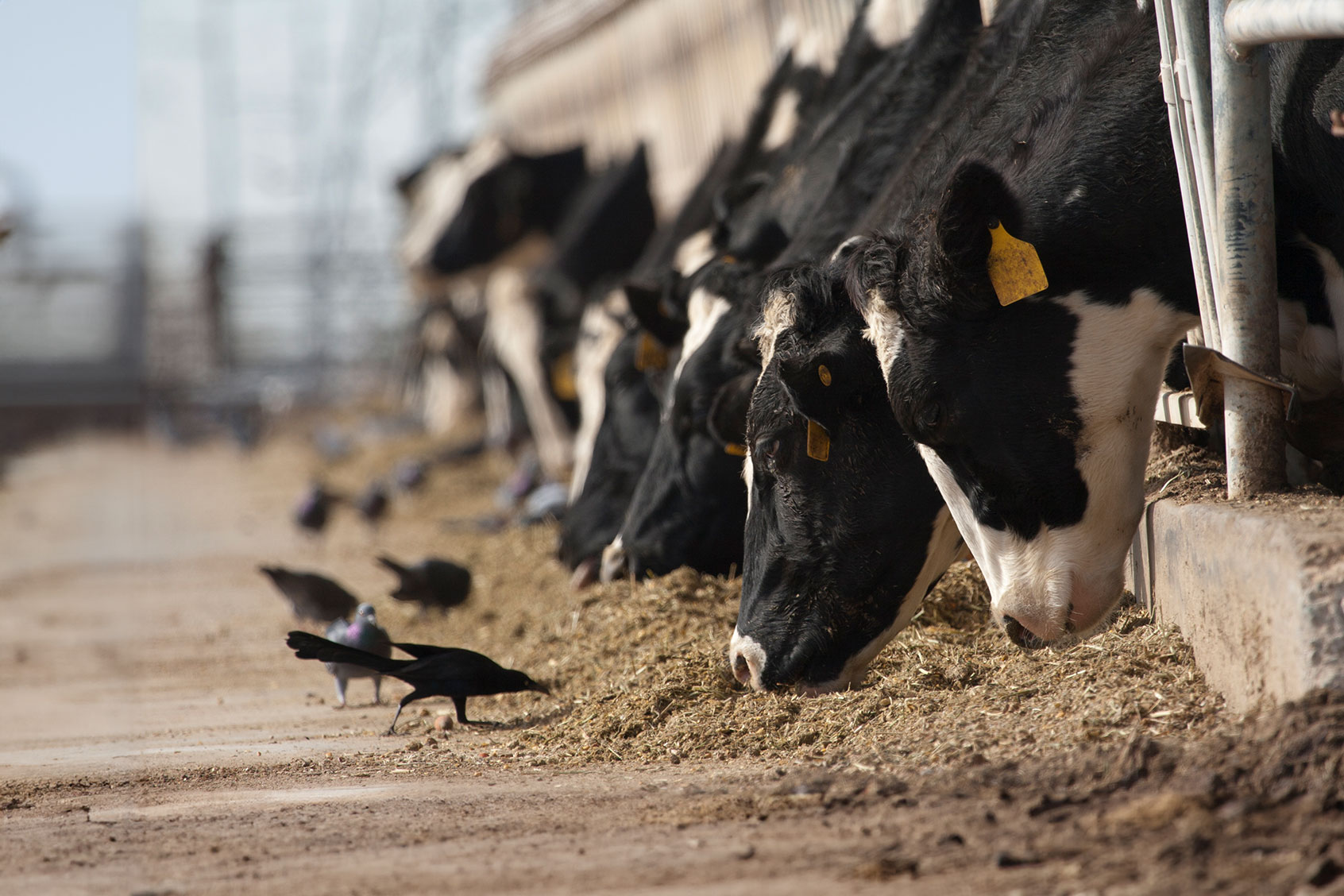

Want more Amanda Marcotte on politics? Subscribe to her newsletter Standing Room Only.


But while Donofrio's life has been chaos in the years since the DeSantis administration made her a target in their "war on woke," she eventually prevailed. A Florida administrative judge just ruled in Donofrio's favor regarding the dispute that created the pretext to harass her: a Black Lives Matter flag she hung in her classroom. 

Donofrio had been hanging the flag for some time before the school board meeting. "Especially as a white woman," she told Salon, it was important to let students "know that they're cared about." The flag, she said, was a simple way to make them "feel safe" so they could "get an education." Administrators had been complaining to her about it but had no policy to point to in order to justify taking it down. However, after the school board meeting, the pressure on Donofrio intensified. Pointing to a new policy barring teachers from trying "to influence students to support or oppose any candidate, party or issue," the administration ordered the flag removed. When she refused, they took it down for her and pulled her out of the classroom, while they investigated whether she had violated school rules. 

The situation quickly escalated. A petition in support of Donofrio circulated by students quickly amassed thousands of signatures and the Southern Poverty Law Center sued the district on her behalf. But the DeSantis administration was determined to make Donofrio the face of "woke" teachers their administration was stirring up fear and hatred towards. In May of 2021, Florida Department of Education Commissioner Richard Corcoran singled out Donofrio during a speech at Hillsdale College, which, as Kathryn Joyce has reported for Salon, is the epicenter of the Christian right's assault on public education. Complaining about "an entire classroom memorialized to Black Lives Matter," Corcoran falsely declared, "We made sure she was terminated." In truth, Donofrio still had her job but was "assigned to paid, non-teaching duties," according to the school district's official statement. Before the summer was over, however, the school board filled Corcoran's wish, firing Donofrio and settling her lawsuit out of court. Still that was not the end of her woes. Within days of her firing, the state opened another investigation, this time into whether Donofrio's teacher's license should be revoked entirely. 

Donofrio feels she was targeted in order to create "an environment of fear" for teachers across Florida. DeSantis was soon promoting a series of policies, such as the "don't say gay" law and the "stop woke" act aimed at prohibiting discussions of racism and sexual diversity that Republicans claimed was inappropriate for public school students. Critics of these bills pointed out that the language about what is and isn't allowed was vague, which Donofrio argues was on purpose. "If somebody high up doesn't like you or disagrees with, you watch out," she said. "The repercussions can stretch into a lot of different parts of your life."

DeSantis, for his part, denied that the bills were meant to lead to widespread book banning, harassment of LGBTQ teachers or students, or the end of teaching about segregation or slavery in history classes. But that is exactly what happened in much of the state. Educational programs about the civil rights movement were canceled. Teachers were forced to lock up their entire classroom library. Books about slavery, the Holocaust, and even 9/11 were banned. Even the dictionary was banned in one school district. The bans and harassment spread to other states. A 2022 analysis from the Washington Post found that Donofrio was not alone: Over 160 teachers were driven out of their jobs by Republican-led attacks on public education. 

All of these machinations helped DeSantis raise his national profile as a right-wing culture warrior but did not help him win the Republican presidential nomination. Despite spending $160 million to defeat Donald Trump, the Florida governor only got 21% of the Iowa caucus votes, and quit the race shortly thereafter. His "war on woke" turned out to be so impractical that he ended up signing another bill in April limiting non-parents to one challenge per month. 

Donofrio, meanwhile, was still fighting to keep her teaching license. Finally, she got a hearing before an administration judge in February and a decision in April. The judge ruled for Donofrio on the issue of the Black Lives Matter flag. Donofrio's "intent to affirm and support her students was clear, and she had a successful history of promoting the physical and emotional well-being of her minority students," the judge wrote. Instead, the judge noted "the School environment became hostile after administration removed the flag," because the principal "had to work hard, meeting with students and making extra efforts to assure students that he supported them and that their lives did indeed matter to him." In June, the final hearing was held, and the DeSantis government lost again: Donofrio's teaching license remains intact. 

We need your help to stay independent

"I feel vindicated, but I also feel sad," Donofrio told Salon. Sad, she explained, because "a lot of teachers have been leaving Florida and quitting schools in Florida because of all of this."

"I think our kids here are worth fighting for," she added, noting that ultimately, teachers alone cannot solve this problem. "We can't just encourage teachers to stand up and stand with our kids without giving them the resources to do it and survive."

Donofrio isn't sure what's next for her. She hasn't gotten her job back at the now-Riverside High School. Still, she said, she's feeling "hopeful" after this legal victory. "I also want teachers to look at the case," she said, "and realize if you stand up for what's right, you can win too. It is possible."

This Juneteenth, it’s time for Biden to honor the federal holiday he created by ending forced labor

For months, Scott Abbey reported to work on the sandwich line of an industrial kitchen. He and his coworkers prepared 20,000 meals each day, which were then sold by a $16.2 billion multinational food and facility services conglomerate. In order to use the restroom at work, Mr. Abbey and his coworkers were forced to wade through urine and feces that overflowed from toilets that were never cleaned. The fecal matter on their shoes traveled with them back into the kitchen, where Mr. Abbey and his coworkers often found rodents around the food they prepared. Mr. Abbey was given a single meal per day and provided no means to challenge either the conditions he suffered or the fact he earned $0 for his work.

Scott Abbey’s story may seem ripped from the pages of history, a relic of the unregulated workplaces in America’s early-industrial past. But Mr. Abbey is an American worker in the 21st century. Why wasn’t he protected by the laws that protect the rights of modern workers? The answer is simple: Mr. Abbey was incarcerated, working behind bars at the Santa Rita Jail in Alameda County, California.

Mr. Abbey’s story is not unique. Thousands of incarcerated people nationwide are forced to work as an implied condition of their sentence. They staff morgues, produce military electronic technology, build office furniture, fight wildfires, and labor in deadly temperatures on former plantations. Carceral labor's products are ubiquitous yet often overlooked. Even the food we eat — from widely known brands like McDonalds, Costco, or Walmart — arrives at our tables thanks in part to carceral labor. Private businesses, recognizing that they can pay an individual behind bars far less than a worker on the outside, exploit incarcerated labor to boost their profits. 

The Thirteenth Amendment's Troubling Exception

As many Americans commemorate Juneteenth this week – a day marking when the promises of the Emancipation Proclamation were finally delivered and the last enslaved people were freed, a day that Black Americans have celebrated for years that Biden recently made a federal holiday – we must shine a light on the shameful exception that allows forced labor to continue in new forms.

Although the Thirteenth Amendment to the Constitution formally abolished U.S. slavery, it includes a terrible exception: permitting slavery and involuntary servitude as “punishment for crime,” allowing governments, prisons, and the companies contracting with them to “hire” and exploit incarcerated workers as they see fit. 

We need your help to stay independent

The Thirteenth Amendment's loophole was first exploited during the wake of the Civil War with “Black Codes” laws enabling the arrest of Black Americans for vague offenses like “vagrancy” and forcing them into involuntary servitude. Through a practice known as “convict leasing,” many imprisoned Black Americans were leased to private companies including railways, mines, and yes, even plantations, where they endured harsh and hazardous conditions. 

Despite the abolishment of convict leasing in 1941, states soon found other insidious tools to exploit Black Americans for free labor in discriminatory policing and mass incarceration. This resulted in Black communities, who make up 13 percent of the United States’ total population but 35 percent of the prison population, seeing a disturbingly familiar picture: hundreds of thousands of Black Americans forced to labor against their will — just as they were before the Civil War.

President Biden Must Act

The United States has made momentous strides toward improving protections and conditions for workers since the Thirteenth Amendment was ratified in 1865. Yet, with each step forward, policymakers have forgotten about the workers who unjustly labor behind bars. This is evident in the lack of express protections for incarcerated workers in laws like the Fair Labor Standards Act, the Occupational Safety and Health Act, and Title VII of the Civil Rights Act of 1964.

The best way to finally end slavery in America is to remove the slavery exception from the Thirteenth Amendment. However, since amending the Constitution is a long-term project, we must pursue short-term solutions as well.

President Biden, who has called himself the most pro-worker president in U.S. history and committed his administration to racial justice, should enforce those laws already on the books inside prison workplaces. 

While Sen. Cory Booker, D-N.J., has proposed legislation to extend critical protections to incarcerated workers, the president need not — and should not — wait for Congress to act. By re-interpreting these statutes to cover incarcerated workers, President Biden can truly stand up for all workers by ensuring that those who work behind bars receive fair pay, labor in safe workplaces, and have a legal remedy when racial or gender discrimination disproportionately siphons the best-paying prison jobs to incarcerated white males.

It is easy to ignore those behind bars. But all of us — including the incarcerated — have the right to basic human dignity. And we are all diminished when the incarcerated are denied those rights. This Juneteenth, it’s time to fully end forced labor in all forms. We must deliver overdue justice to those forced to work behind bars and eliminate one of the remaining vestiges of slavery in this country.

Experts say bird flu is a Pandora’s box. Are we about to open it?

On the heels of the COVID-19 pandemic, a different virus threatens to cause widespread illness and death, bring the global economy to its knees and throw us back into the chaos that we seemingly just emerged from with the virus SARS-CoV-2. That pathogen is, of course, bird flu or avian influenza, especially the H5N1 strain.

While we’re not there yet, nearly all the conditions are ripe for a new pandemic. H5N1 is seemingly everywhere we look. It's in wild birds, factory farm birds, cats, mice and traces of it have shown up in milk thanks to hundreds, if not thousands, of dairy cows that have become the new focal point in this unwinding crisis. But a lot of open questions remain, including if we have the capacity to stop it in time.

Bird flu is far from being a new pathogen. Whispers of a “fowl plague” date back to the late 19th Century, while H5N1 specifically was first detected in 1996 in Chinese geese. A year later, H5N1 virus outbreaks were detected in poultry in Hong Kong, infecting 18 people and killing six. That’s around when virologists and public health experts noticed H5N1 is a particularly nasty bug with broad pandemic potential and have been closely monitoring it ever since. 

Over the years, it has sprung up and disappeared again and again, infecting about 900 people, killing 463 to date. That gives it a severe death rate of 52%, according to the World Health Organization.

But our current situation — the one that is becoming increasingly harder to ignore — really began about three years ago, when bird flu began spreading rapidly in wild birds, massacring millions of them. It alarmed experts who reported it even threatened to wipe out entire colonies of penguins in Antarctica. But it became even more alarming when the virus began spreading more easily in mammals. It killed hundreds of sea lions and walruses, but also began to kill house cats and other wild animals.

Birds peck at food intended for dairy cattleBirds peck at food intended for dairy cattle (Getty Images/Dusty Pixel photography)
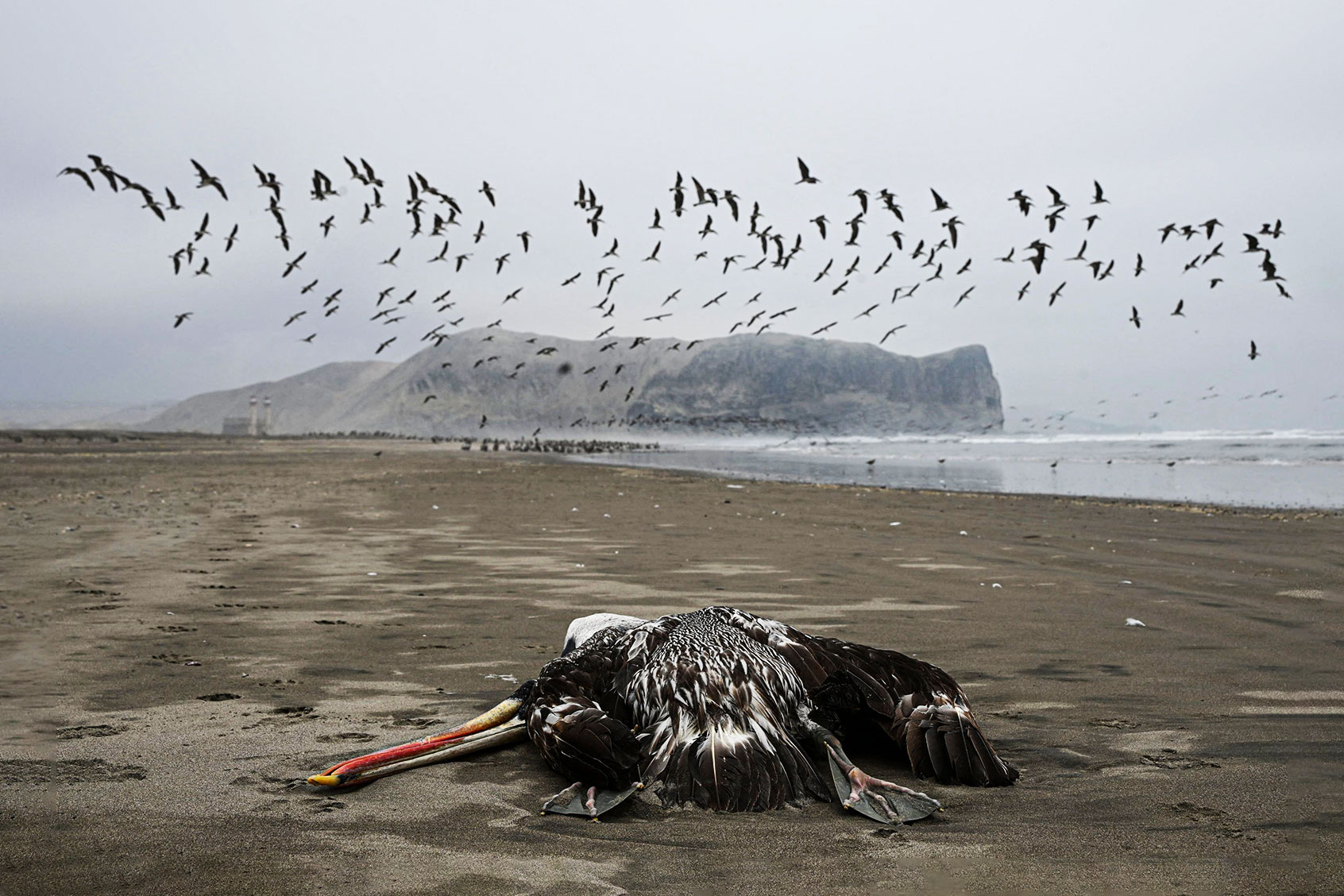
This is concerning because spreading in mammals means it’s more likely to infect humans. The 1918 swine flu virus H1N1, which killed an estimated 20 million people, had both mammalian and avian genetics. For context, SARS-CoV-2, the virus behind COVID, has infected approximately 775 million people globally and has so far killed about 7 million people, giving it around a 1% death rate. (COVID is no longer surveilled as much as before, however, so these numbers are most likely an undercount.)

Recent reports of avian flu in domestic cats and house mice “are certainly worrisome."

And now things in the U.S. have seemingly reached a crescendo, in which dairy cows are harboring the virus, spreading it amongst each other and even killing cows in some instances. So far, outbreaks in more than 100 dairy farms in 12 states have been reported, but experts have said that cases are likely flying under the radar. So far this year, three Americans have been infected by H5N1 viruses that started in cows, and all of them recovered, but some experts say that patients may be avoiding doctors or refusing tests.

Naturally, another pandemic emerging is a huge risk. But how severe is this situation really? And what can be done to make sure it doesn’t reach a devastating worst case scenario?

Is this officially a pandemic yet?

The definition of a “pandemic” varies. An epidemiology dictionary defines a pandemic as one step above an epidemic, which is sudden, widespread occurrence of infectious disease. According to this definition, an influenza pandemic would occur when “almost simultaneous transmission takes place worldwide.”

When H1N1 began to spread in 2009, experts characterized it as a pandemic due to its proliferation across both hemispheres. The WHO has three criteria that must be met in order for a pandemic to be declared: First, it must be a new strain that has not circulated among humans before. So while HIV was a pandemic in the ‘80s, today it is not considered such. Second, it must infect humans and cause serious illness. Lastly, it must spread efficiently among humans.


Want more health and science stories in your inbox? Subscribe to Salon's weekly newsletter Lab Notes.


“B3.13, [the bird flu strain] that's circulating among dairy cattle certainly checks one box,” Dr. Rajendram Rajnarayanan of the New York Institute of Technology campus in Jonesboro, Ark., told Salon. “If we let this strain circulate uncontrolled, then boxes 2 and 3 are not that far [behind.]”

Rajnarayanan added that recent reports of avian flu in domestic cats and house mice “are certainly worrisome.”

Virologist Dr. Angela Rasmussen told Salon she does not believe we are close to a bird flu pandemic yet because there is no evidence of epidemic spread between humans anywhere in the world.

“This has, however, caused a panzootic (pandemic in animals — in this case, birds) ongoing since 2021,” she said.

Katelyn Jetelina, an epidemiologist and author of the newsletter Your Local Epidemiologist, told Salon she agreed. Despite there not being an “official definition of what constitutes a pandemic,” it is generally when there is sustained transmission of humans worldwide.

pelican suspected to have died from H5N1 avian influenzaA pelican suspected to have died from H5N1 avian influenza is seen on a beach in Lima, on December 1, 2022. (ERNESTO BENAVIDES/AFP via Getty Images)
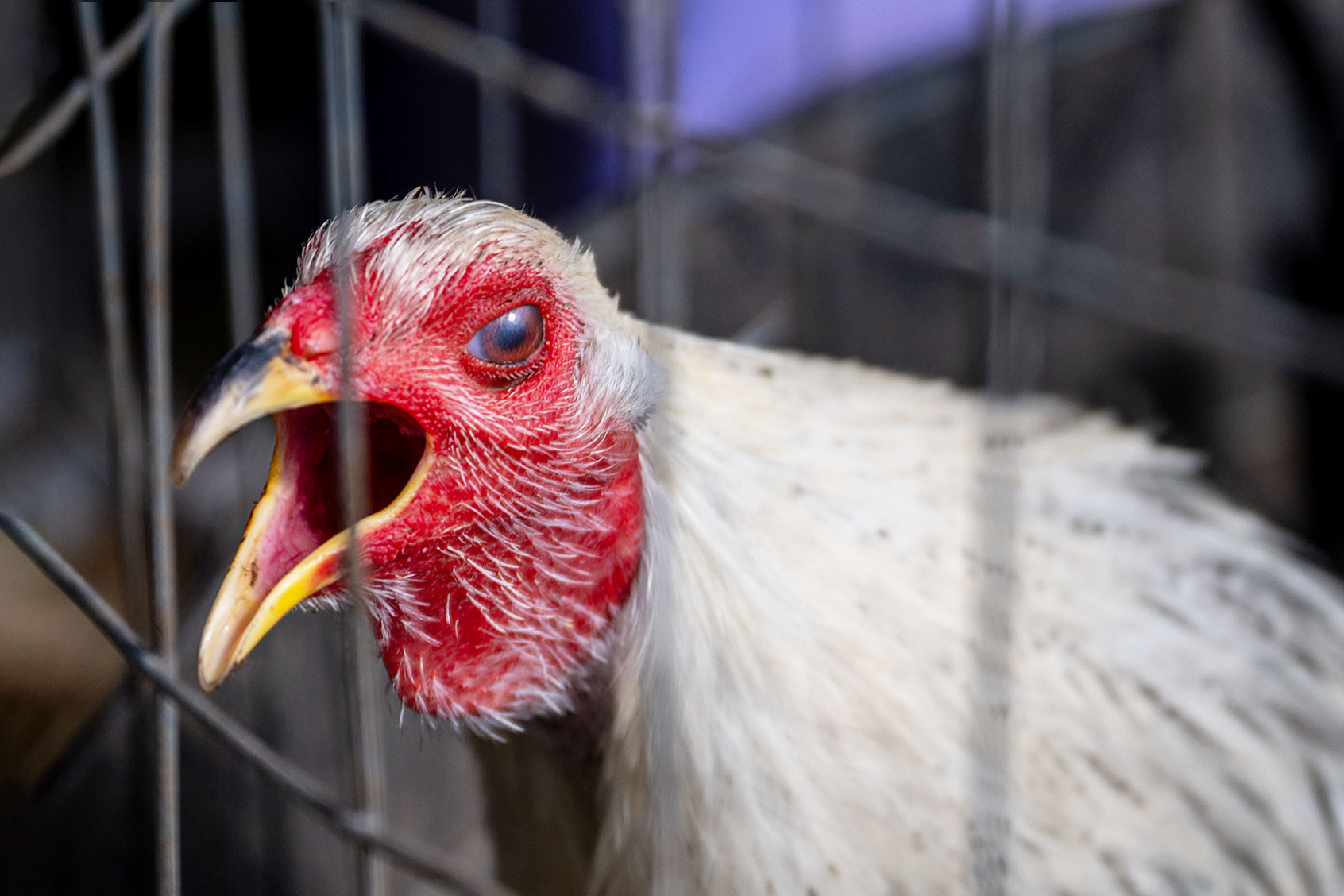
“We are not close to this, given it’s not spreading human-to-human yet,” Jetelina said.

To date, there have only been three human cases of bird flu associated with the outbreak of U.S. dairy cows. Nonetheless, it’s still worrying because in the latest confirmed case, respiratory symptoms were reported (unlike the other two cases), which means the virus could be evolving ways to spread more easily.

“The bovine situation is a step up from this, just due to how widespread the virus is, and how many people have exposure to cattle (compared to small mink farms or remote sea lion colonies),” Dr. Tom Peacock, a virologist at Imperial College London and the Pirbright Institute, told Salon. “This clearly represents a much larger human-animal interface than the other examples. Pandemics occur when the unlikely event of one of these influenza viruses gets the right combination of mutations. It’s a little like buying a lottery ticket — this outbreak is allowing the virus to bulk buy lottery tickets.”

How deadly is bird flu in humans?

According to a report by the Centers for Disease Control and Prevention (CDC) in December 2023, there had been 902 cases of bird flu in humans in 23 countries since 1997. These cases had a cumulative case fatality proportion of greater than 50 percent.

"It’s like buying a lottery ticket — this outbreak is allowing the virus to bulk buy lottery tickets.”"

Notably, the three recent cases that have been associated with the outbreak among dairy cattle in the U.S. have been categorized as “mild.” Only one had respiratory symptoms. Still, experts say that bird flu in humans is “deadly.” To put it in context of the 1918 flu pandemic, experts estimate that it had a 2.5 percent mortality rate.

Rasmussen said this is a difficult question to address, in regards to how “deadly” the bird flu is. 

‘“Deadly’ might depend on the host species. The viruses circulating in cattle appear to not cause severe disease in them and haven't yet caused severe disease in the known human cases,” she said. “The ‘highly pathogenic’ term for avian influenza viruses refers to severity in birds.”

However, she said, we do know that HPAI H5N1 viruses — like the one circulating in cattle — can be lethal in humans.

“We don’t fully understand what determines how severe disease will be in one species or one individual over another and this is an important and critical area of research,” she said.

“I don’t think we know enough [data] yet to make conclusions about this,” Peacock said. “Similar viruses are circulating in wild birds as well in the U.S., for example. There is a lot of variability in reports about how deadly H5N1 is, a lot of this is due to ascertainment issues (i.e. lots of mild or asymptomatic cases never being detected) and it may also be partly due to virus dose and exposure route (inhaling high titre virus contaminating liquids versus getting milk splashed in someone’s eye.)”

We need your help to stay independent

Bird flu has been the cause of death for millions of wild and domestic birds worldwide. It’s also been extremely deadly in seals, sea lions and minks. It has wiped out cats, foxes and even a polar bear. As it stands, it doesn’t seem to be as deadly in cows — which is the host humans are likely getting an infection from, but some cows did get so sick they had to be euthanized.

“It seems that the death rate is far lower in cows than other animals we’ve seen, like birds and cats,” Jetelina said. “Unfortunately, we don’t know why. There is so much we don’t understand about the pathophysiology of what makes it more lethal for one animal than another.”

While it seems that many of the infected cattle have recovered, Rajnarayanan said “there are anecdotal reports of very sick cattle and a few dead and culled dairy cattle.” 

"Testing still seems somewhat random and voluntary. We should be doing more — both in cattle and humans."

Earlier this month, WHO shared that a 59-year-old patient died of H2N2 in Mexico. It was the first laboratory-confirmed case of H2N2 globally, and the first reported case in Mexico. But notable, it is a different strain than the bird flu strain that is circulating in livestock in the United States. (The H and the N in these names refer to specific proteins on the virus, which can significantly differ in how they infect and cause illness.)

More recently, WHO clarified that the man died from separate health conditions, though the patient did test positive for bird flu. Experts who Salon spoke with said they weren’t concerned about this case.

“The H5N2 is concerning because someone died and that is always sad, however, Mexico vaccinates for H5 flu and it is endemic in the bird population,” Dr. Keith Poulsen, an associate professor of large internal medicine at the University of Wisconsin-Madison, told Salon. “Same in Asia; every once in a while we see an outbreak or a single person die — the outbreaks are rare, but are important.”

Is the government doing enough testing?

One of the most prevalent criticisms of the federal agencies tasked with surveilling and curtailing this virus is that testing is scarce, delayed and lacking transparency. 

“Testing still seems somewhat random and voluntary. We should be doing more — both in cattle and humans,” William Hartmann, an assistant professor of anesthesiology and principal investigator for the UW–Madison COVID-19 Convalescent Plasma Program, told Salon.

“I would prefer to see more testing of farm workers and milk,” Dr. Daniel Goldhill, a lecturer in virology at the Royal Veterinary College at University of London, told Salon. “I would like to see serology to see if workers were infected asymptomatically. In terms of virus sequencing data, releasing the sequences is a positive step though more metadata such as sample date and state or farm would be helpful.”

With at least 25 confirmed infected herds, Michigan seems to have the most outbreaks (though recently surpassed by Idaho with 26) but that’s because they are doing more testing than most other places.

“I don't think people were surprised when additional cases were found in Michigan,” Goldhill said. “Other states do not seem to be tracking human symptoms as well as Michigan, so it is possible that human cases have been missed.  Without doing serology testing, we will not be able to know if we have missed cases.”

“States that are testing more are likely to report more cases. Test positivity is the key to gauge the spread,” Rajnarayanan said. In the meantime, “we definitely are not testing enough,” he said.

Are there tests and vaccines ready for the public?

"It's playing with wildfire when you consume raw milk loaded with a viable virus."

Poulsen said commercially available tests are already available.  

“Anyone can buy PCR and ELISA tests,” he said. “They are not idiot proof, like at home COVID tests, nor should they be, because we want them to be accurate. That means trained people with sophisticated equipment with a low error rate.”

He added there is no “CLIA requirement for animal testing,” referring to federal lab standards and private labs can do all the testing they want. There is also no legal requirement to report test results, but there is no way to enforce that effectively. Moreover, he said, the infrastructure is there for testing.

“We are ready and equipped to test,” he said. “We just need industry, the states, or the USDA to allow us to do so.”

Jetelina said that even at-home flu tests will likely pick up H5N1 because it’s closely related to influenza A.

“The big challenge will be fall, as we will not be able to differentiate between [seasonal] flu and H5 unless we have a more specific test,” she said.

“I think that COVID demonstrated both the best and the worst about vaccines,” Goldhill said. “We produced an amazing vaccine but people still died due to vaccine hesitancy and inequitable distribution of vaccines. Current flu vaccines are not as effective as mRNA vaccines were against COVID. It will be interesting to see how well mRNA vaccines work against flu. In any case, it takes a significant amount of time to make a vaccine, during which the virus would be able to spread.”

rooster is held in a cageA rooster is held in a cage on a farm on January 23, 2023 in Austin, Texas. The poultry industry as well as private flocks are suffering a health crisis as the bird flu continues to spread across the United States. (Brandon Bell/Getty Images)

The situation on raw milk

Despite conservative news outlets pushing the sales of raw milk, scientists unanimously agree that it’s not a good idea to drink it. Pasteurization is a process most commercial milk goes through that kills not only viruses but bacteria and other pathogens that may be present in dairy. 

“Raw milk from sick cows has a good load of viable virus, while the exact risk to humans is not known,” Rajnarayanan said. “It's playing with wildfire when you consume raw milk loaded with a viable virus.” 

Notably, cats that consumed raw milk from infected cows died.

 “Even without a H5N1 outbreak in cows, raw milk is not safe because of bacteria that can severely sicken people,” Jetelina said. “There’s a reason why we have had pasteurization for over 100 years —nit works.”

With H5N1, she said, there is added unknown risk.

“We know that it is in raw milk, however how sick it will make people is still under investigation,” she said. “The risks, though, are presumed to greatly outweigh benefits.”

What keeps experts up at night

“I am starting to worry more now,” Hartmann said. “The virus wants to make a successful jump from birds to cows and to humans. It continues to spread in herds [and] has changed in humans to some extent as well. The first two confirmed cases had only conjunctivitis, this last individual developed respiratory illness. Once it gets to the lungs, it becomes much easier to spread. These are reasons to really be alert.”

Poulsen said he is worried that the virus will become endemic in the country’s dairy cattle population, which could create significant long-term health and productivity problems.

“The longer that this virus is allowed to propagate unchecked, the risk of human health problems goes up,” Poulsen said. “I worry now that we are not doing effective surveillance and we are not providing industry with the tools they need to control the disease.”

He added that if the H5N1 variant that is circulating, it becomes endemic.

“We do not want H5N1 that is circulating to become endemic and be in the same position as Asia and Mexico, but we are handling the disease in a similar way,” Poulsen said.

Indeed, most experts expressed a concern that the lack of data and surveillance is a major issue. Jetelina said the government isn’t doing “even close to enough” testing on animals and humans.

“I don’t think it’s because they don’t want to, but rather there are very real challenges on the ground, including lack of trust,” she said. “Building partnerships with the front line is the most urgent thing we need to do to get a better handle on this.”

Rasmussen said part of the issue with testing is that it requires a collaboration between multiple state and local agencies, as well as the USDA and CDC, which don’t always cooperate. It also requires participation and consent from the affected farms.

“As a result it’s hard to know how much testing has been done and how much will be done going forward,” Rasmussen said. “It can differ a lot by jurisdiction.”

Poulsen elaborated and said there are too many “legal and political barriers” to testing, and that the laws differ for poultry and cattle.

“I will start worrying once wastewater H5 levels increase in a location and it starts to correlate with an increase in human cases,” Rajnarayanan said. “If we wait till it starts translating into ER department visits and hospital ICUs, then it will be too late.”