Spring Offer: Get 1 Year, Save 58%

House Republican wants to re-name the U.S. coastline after Trump

The House GOP plans to vote to rename the entire coastline surrounding the United States to the “Donald John Trump Exclusive Economic Zone.”

Republicans in the House, already doing the Trump campaign’s bidding by using the force of the chamber to attack the Biden administration, are working on a new way to idolize the former president, who visited Capitol Hill for the first time since the January 6th attack this Thursday.

Rep. Greg Steube, who represents Florida voters miles away from Donald Trump’s Palm Beach home, plans to introduce his bill to re-name the U.S. Exclusive Economic Zone on official documents, maps, and laws, to honor Trump on Friday, his 78th birthday. The move comes as critics draw comparisons between Trump and other cults of personality.

Though the connection between Trump and the nation’s coastline isn’t immediately obvious, he seemingly demonstrated how much thought he puts into our ocean at a Sunday rally in the famously land-locked Las Vegas, when he broke into a multiple-minute manic monologue, musing on shark attacks and sinking batteries.

Steube, who once used a hearing on mass shootings as an opportunity to share his gun collection, took to X to explain his bill.

“President Trump took several commendable actions for our oceans,” he wrote. “Renaming our waters will serve as a reminder of his many contributions to our nation for generations to come.

The bill comes as House Speaker Mike Johnson seeks to align himself more closely with the former president after far-right representatives attempted to oust him last month. Earlier on Thursday, Johnson bragged at a press conference about Trump’s alleged approval of his job handling, telling reporters that Trump “said I'm doing a very good job.”

Simultaneously, Trump has reportedly sought the House GOP leader’s help to remedy his legal woes, asking him to help overturn his 34-count criminal conviction in New York for falsifying business records to hide hush money payments.

New Hampshire to tighten voting laws, peddling MAGA election misinformation

New Hampshire lawmakers are set to make it harder for eligible voters in the state to register to vote, now requiring proof of citizenship documents — either passport, birth certificate, or naturalization papers — to register.

Republicans in the state’s legislature passed a bill through both chambers to axe the state’s previous citizenship scheme, which permitted an affidavit in cases when citizen voters couldn’t obtain documents. In many other states, a Social Security number or affidavit is commonly used in place of document requirements.

Republican sponsors of the bill echo former President Donald Trump and other conspiracy theorists’ baseless claims that undocumented or noncitizen voting was widespread in the 2016 and 2020 elections. This widely debunked misinformation has propelled numerous states to tighten their voter laws, most directly impacting eligible voters from already disenfranchised backgrounds.

New Hampshire, which already limits voters to exclusively in-person registration, would become one of the most restrictive states in the U.S., the only one to require physical citizenship documentation to register voters.

Per local paper Seacoast Online, New Hampshire Governor Chris Sununu, a Republican, has not publicly stated a position on the bill, which heads to his desk. Sununu recently made news for flipping his stance on Trump, announcing his support for Trump’s 2024 campaign after supporting Nikki Haley and blasting Trump’s argument that he is immune to criminal prosecution. 

The bill will disenfranchise citizen voters, the Nashua, New Hampshire City Clerk Dan Healey told Bolts Magazine

“We’re very concerned with denying eligible voters the right to vote on election day because there’s really no cure in place for them to then be able to vote,” he said. “As far as I can see, it’s unnecessary . . . they’re trying to cure something that’s really not a problem.”

There are several reasons that voters may not have immediate access to proof of citizenship documents, with a recent study from the Brennan Center for Justice finding that around 9% of Americans, and 11% of people of color, don’t have these documents readily available. Nearly 4 million Americans say their proof of citizenship documents are lost or destroyed.

Among other groups who struggle to provide such documents are out-of-state students, recent arrivals and elderly Americans.

Mike Johnson gloats about Trump’s praise, as he leads crusade against Biden officials

Speaker Mike Johnson says Donald Trump sang his praises, amid reports that the former president asked the House Speaker for help with his legal woes.

When asked whether Trump supported his continued speakership, which began last October after a far-right ouster of Kevin McCarthy flew the GOP’s House delegation into chaos, Johnson said that the former president had all good things to say.

“He said very complimentary things about all of us. We had sustained applause. He said I'm doing a very good job. We're grateful for that,” Johnson said, bucking the direct question. “We have to have continuity in leadership, we have to have a plan.”

Trump’s sway on the caucus at times rivals Johnson’s grip, with the candidate reportedly forcing House Republicans to kill a bipartisan border package to boost his own November ambitions. 

Johnson’s apparent focus on currying the favor of the ex-president, who was found guilty of concealing hush money payments in an effort to sway the 2016 election last month, has taken priority over governance, critics say.

“Half the U.S. Congress is now weaponized, obstructing justice, and abusing power to help Trump launder away his criminality,” legal editor Luke Zaleski said on X, referencing reports that Trump asked Johnson for help in his criminal cases. “Trump owns the House. Is America next?”

Per Politico, Trump tasked Johnson with finding ways to “overturn” his criminal conviction. Also on his agenda, besides blocking and stalling bipartisan legislation, is using the investigatory powers of his chamber to attack Trump’s opponent’s administration months ahead of an election. Johnson struck two Biden officials with serious charges, impeaching Homeland Security Secretary Alejandro Mayorkas and holding Attorney General Merrick Garland in Contempt.

Johnson, who took to a New York City courthouse last month to cheer on Trump during his trial, still faces scrutiny from MAGA hardliners, including Congresswoman Marjorie Taylor Greene, who tried to organize his ouster for allowing a vote on aid to Ukraine.

Victims take the spotlight back in Louis C.K. documentary

A new trailer for a documentary highlighting the pattern of sexual abuse perpetrated by comedian Louis C.K. addresses the consequences of serial sexual misconduct in a post #MeToo culture.

"Sorry/Not Sorry,” which debuted at the Toronto International Film Festival last year, drags out the men — Joe Rogan, Neal Brennan and several other peers — who downplayed C.K.’s victims, made excuses for the comedian, or rejected accusations outright. It also dives into C.K.’s rehabilitation, and his Grammy-award-winning special, asking viewers to examine how the comedian was effectively able to profit off allegations of severe misconduct against him, even after admitting to inappropriate behavior.

But the documentary isn’t just about the perpetrator, or the culture of apology in our media landscape, as the trailer clues. C.K.’s victims are given screen time via new interviews, details from the journalists who broke the story, and input from fellow comedians. 

Opening with a clip featuring the disgraced comedian — accused in 2017 of masturbating without consent in front of numerous women — he's shown speaking to Charlie Rose — himself accused of misconduct — who compares C.K. to figures like Lenny Bruce, Bob Dylan, and “philosopher kings.” Here, viewers are reminded that C.K.’s legacy is not as damaged as he’d suggest.

But throughout the project, the testimony of women who had their careers stalled, and who watched as a man who harassed them clung to a prolific career, shines through. Per an interview with the Daily Beast, filmmaker Caroline Suh — who directed "Sorry/Not Sorry" alongside Cara Mones — wanted to highlight the story of the victims, not just the perpetrator.

“What was really so surprising [in making the film] was learning how hard it is to redirect one’s focus from worrying about the men—why Louis did what he did and what happened to him—to asking why it took so long for anyone to care,” Suh told the Daily Beast. “And most importantly, why we don’t really take much time to think about why women get so much punishment for just saying what happened.”

C.K. takes up, like many abusers, the majority of the conversation surrounding his actions. Defenders argue that men like him have had too much of their career taken away, often failing to focus on victims. Last month, fellow comedian Bill Maher amplified these sentiments, saying on an episode of his podcast with Bill Burr that he hoped C.K. would be “welcome[d] back” after he was “canceled.”

"People have done so much worse things and gotten less," Maher said. "There’s no rhyme or reason to the #MeToo-type punishments."

Watch the trailer for ‘Sorry/Not Sorry’ here ahead of its July 12 release.

“I was obsessed”: Jamie Bernstein on sharing Beatlemania with dad Leonard Bernstein

Author, filmmaker and narrator Jamie Bernstein – daughter of legendary composer-conductor Leonard Bernstein – joined host Kenneth Womack to talk about meeting the Beatles, becoming neighbors with John Lennon and Yoko Ono, “Maestro” (which was based on her memoir, “Famous Father Girl”) and much more on “Everything Fab Four.” The podcast is co-produced by me and Womack, a music scholar who also writes about pop music for Salon, and distributed by Salon.

Bernstein, who says growing up with a “larger than life” father certainly “wasn’t boring,” told Womack that her Beatles fandom began at age 11 – and that she and her dad shared an interest in their music. “They were already on my radar, so by the time February 1964 hit [when the band played “The Ed Sullivan Show”] I was obsessed. I was dreaming about them. I was a capital B ‘Beatlemaniac’ and was the exact right age to witness their parade of albums in real time.” 

As for Leonard, who was hosting his “Young People’s Concerts” TV show at the time, Jamie said, “My dad quickly figured out that by including pop music examples on those concerts was a really great way to retain the interest and focus of kids . . . He’d play ‘And I Love Her’ as an example of A-B-A form and all the kids in the audience would go nuts. He put [the Beatles] in the same category with American songbook composers and Schubert for their inventiveness and melodic quality. I learned so much by sharing Beatles music with my dad.” 

She also explained that as the Beatles evolved throughout the ‘60s and became more inventive with their music, “My father was almost as obsessed with ‘Sgt. Pepper’ as I was,” and soon they were poring over every song together, with Leonard even having dinner guests at their home sit down and listen to the albums.

Their joint ties to the Beatles ran deep both before and after “Pepper,” though, with Leonard having toyed with the idea of recording songs based on some of John Lennon’s “In His Own Write” poems, and with his eventual move to the Dakota building in NYC where Lennon lived with his wife, Yoko Ono. It was also where Lennon’s life was violently taken in December 1980. “I was there that night,” Jamie told Womack. “I can't even describe the horror and despair. My dad and I sat together in his studio crying and drinking for hours.” But she also has lighter memories of that time, describing a courtyard potluck at the building where she and her friends had a brief, comical brush with Lennon.

LISTEN:

Now, with the Academy Award-nominated “Maestro” bringing Leonard Bernstein back into the current conversation, Jamie credits writer-director Bradley Cooper (who also played her father in the film; she was portrayed by Maya Hawke) with “really involving” her and her siblings in the creative process to bring a “very intimate and personal story of our family” to life. It also showed “how enormous [Leonard’s] musical imagination was.” Said Jamie, “He wrote everything from operas to rap songs. It’s one of the reasons my dad loved and respected the Beatles so much. They were doing something different on every single recording, and you never knew what they were going to come up with next.”

Leonard Bernstein; Jamie BernsteinAn impudent smile on little Jamie's (Bernstein) face as she sits at her father's (Leonard Bernstein, 1918-1990) side when he works at the piano shows she has no awe of the Bernstein genius. (Getty Images/Bettmann)Listen to the entire conversation with Jamie Bernstein on “Everything Fab Four” and subscribe via Spotify, Apple, Google or wherever you’re listening. “Everything Fab Four” is distributed by Salon.

Host Kenneth Womack is the author of a two-volume biography on Beatles producer George Martin and the bestselling books "Solid State: The Story of Abbey Road and the End of the Beatles” and “John Lennon, 1980: The Last Days in the Life.” His latest book is the authorized biography of Beatles road manager Mal Evans, “Living the Beatles Legend,” out now.

Democrat George Latimer questioned about deleted Facebook post comparing Andrew Cuomo to Emmett Till

George Latimer, the Westchester County politician who has launched a primary challenge against incumbent Rep. Jamaal Bowman, D-N.Y., would like to talk about anything but a Facebook post he made in 2021 that compared the fallout over then-Gov. Andrew Cuomo's sexual harassment scandal to the 1955 lynching of Emmett Till, a Black teenager from Mississippi. 

But on Wednesday, Latimer, already dogged by allegations of racist campaign tactics, was confronted about the post by a caller named Becky on the Brian Lehrer Show.

"When Andrew Cuomo was facing his reckoning for sexually harassing women, and you came to his defense, you had the audacity to compare what Cuomo was experiencing to the lynching of Emmett Till, a 14-year-old child who was mutilated, murdered, and lynched," the caller said. "I'd like for you to respond to that."

In the 2021 post, Latimer wrote in response to allegations that then-Gov. Cuomo sexually harassed multiple women: "In our world, no matter how heinous the crime committed, we presume innocence until guilt is proven. That standard when we adhere to it, protects you and me. When it is not adhered to, when a mob hangs Emmett Till, the quote, 'justice turns out to be a crime itself.'"

On Wednesday, Latimer responded to the question about the post by trumpeting his support among Black leaders.

"What I can tell you is, is that the Mount Vernon Democratic Committee, which is 85% African American, endorsed me unanimously for this position," Latimer said. "I have the support of African-American county legislators, African-American elected officials throughout the county."

Latimer went on to suggest he was being targeted because of the color of his skin, arguing it was not right to say that "you cannot be in office unless you have my identity," prompting an interjection from Lehrer, who noted that the caller did not actually say that.

When Lehrer tried to bring the conversation back to the Facebook post, Latimer responded that he had already deleted it, grudgingly admitting that it was a "foolish set of words" and that it was "hurtful to some people." Lehrer, saying that people deserved to know what the post said, then read it out loud.

Latimer finished the exchange by reiterating his position that Cuomo should not have been asked to resign before a full report on the allegations against him was completed by Attorney General Letitia James. In August 2021, James issued that report, finding that Cuomo had sexually harassed multiple staffers and government workers. Latimer at that point joined other elected officials in calling for Cuomo's resignation, which was tendered by the end of the month (Cuomo still denies he did anything wrong).

Latimer, a staunch Israel supporter who is backed by millions of dollars from the American Israel Public Affairs Committee, leads Bowman in polls heading into the June 25 primary election. Bowman, a critic of Israel, has also been involved in recent controversies, such as setting off a fire alarm that disrupted a congressional vote. The Daily Beast also reported that Bowman promoted conspiracy theories about 9/11 on his personal blog back when he was a middle school principal.

Latimer's primary challenge has won the support of many prominent Democrats, including Rep. Eliot Engel, who Bowman defeated in 2020, and Hillary Clinton, as well as former Rep. Mondaire Jones. Bowman can count on the support of House Democratic Leader Hakeem Jeffries and many progressives, including the Working Families Party, Sen. Bernie Sanders, I-Vt., and Rep. Alexandria Ocasio-Cortez, D-N.Y.

“Race War”: Arizona man indicted on plans for mass shooting at Bad Bunny concert

An Arizona man who planned to commit a racially motivated mass shooting at a Bad Bunny concert was indicted by a federal grand jury on Tuesday.

Mark Adams Prieto was charged with gun trafficking and unregistered possession, as well as transfer of a firearm for use in a hate crime after he outlined his plans to FBI informants he met at a gun show.

“Prieto had discussions with two individuals working with the Federal Bureau of Investigation to devise a plan to commit a mass shooting of African Americans and other minorities to incite a race war prior to the 2024 United States Presidential Election,” a press release from the Department of Justice read. 

The DOJ described Prieto’s plan to attack concertgoers at Bad Bunny’s May 14th and 15th concerts in Atlanta, GA., and said that officers apprehended him on May 14 along Interstate 40, which runs between Arizona and Atlanta.

The indictment alleges that he began espousing “suspicious and alarming comments, including advocating for a mass shooting, and specifically targeting ‘Blacks, Jews, or Muslims’” to the informants before asking one if they were “ready to kill a bunch of people.”

Prieto told informants to shout racist messages including “whities out here killing” and “KKK all the way” during the shooting and added that they should carry out plans ahead of the election. He said of planned victims that “these people don’t belong here in this country anyway,” echoing former President Donald Trump’s rhetoric of an “invasion” of Hispanic immigrants.

The foiled plot comes as white supremacist terrorism trends upward, with the National Institute of Justice reporting that 227 incidents of far-right and racially-motivated extremism have killed more than 520 people since 1990. A report from the Anti-Defamation League noted that the two-year window between 2020 and 2022, with 40 right-wing terror incidents, was the most active in at least three decades.

Fears are further compounded as mainstream political figures move to legitimize racial violence. Criticism poured in last month after Texas Governor Greg Abbott pardoned a man who was convicted of murder after sending messages promising anti-Black violence.

Why doesn’t water help with spicy food? What about milk or beer?

Spicy foods taste spicy because they contain a family of compounds called capsaicinoids. Capsaicin is the major culprit. It's found in chillies, jalapeños, cayenne pepper, and is even the active ingredient in pepper spray.

Capsaicin doesn't actually physically heat up your mouth. The burning sensation comes from receptors in the mouth reacting to capsaicin and sending a signal to the brain that something is very hot.

That's why the "hot" chilli sensation feels so real – we even respond by sweating. To alleviate the heat, you need to remove the capsaicin from your mouth.

So why doesn't drinking water help make that spicy feeling go away? And what would work better instead?


Water-loving and water-hating molecules

To help us choose what might wash the capsaicin away most effectively, it's helpful to know that capsaicin is a hydrophobic molecule. That means it hates being in contact with water and will not easily mix with it.

Look what happens when you try to mix hydrophobic sand with water.

On the other hand, hydrophilic molecules love water and are very happy to mix with it.

You've likely seen this before. You can easily dissolve hydrophilic sugar in water, but it's hard to wash away hydrophobic oils from your pan using tap water alone.

If you try to wash hydrophobic capsaicin away with water, it won't be very effective, because hydrophilic and hydrophobic substances don't mix.

Going for iced water will be even less effective, as hydrophobic capsaicin is even less soluble in water at lower temperatures. You may get a temporary sense of relief while the cold liquid is in your mouth, but as soon as you swallow it, you'll be back where you started.

Instead, a good choice would be to consume something that is also hydrophobic. This is because of an old-but-true adage in chemistry that "like dissolves like".

The idea is that generally, hydrophobic substances will not dissolve in something hydrophilic – like water – but will dissolve in something that is also hydrophobic, as this video shows:


My mouth is on fire. What should I drink instead of water?

A swig of oil would likely be effective, but is perhaps not so palatable.

Milk makes for an ideal choice for two reasons.

The first is that milk contains hydrophobic fats, which the capsaicin will more easily dissolve in, allowing it to be washed away.

The second is that dairy products contain a protein called casein. Casein is an emulsifier, a substance that helps oils and water mix, as in this video:

Casein plays a large role in keeping the fat mixed throughout your glass of milk, and it also has a strong affinity for capsaicin. It will readily wrap up and encapsulate capsaicin molecules and assist in carrying them away from the receptor. This relieves the burning sensation.


OK but I hate drinking milk. What else can I try?

What about raita? This dish, commonly served with Indian curries, is made primarily from yoghurt. So aside from being its own culinary experience, raita is rich in fats, and therefore contains plenty of hydrophobic material. It also contains casein, which will again help lock up and remove the capsaicin.

Ice cream would also work, as it contains both casein and large amounts of hydrophobic substances.

Some studies have also shown that consuming drinks with large amounts of sugar can relieve spiciness.

What about reaching for that ice cold beer?

This is commonly suggested as a suitable approach to stop the burning. At first glance, this may seem a good idea because capsaicin is highly soluble in alcohol.

However, most beers only contain between 4–6% alcohol. The bulk of the liquid in beer is water, which is hydrophilic and cannot wash away capsaicin. The small amount of alcohol in your beer would make it slightly more effective, but not to any great degree.

Your curry and beer may taste great together, but that's likely the only benefit.

In truth, an alcoholic beverage is not going to help much unless you go for something with a much, much higher alcohol content, which comes with its own problems.

Daniel Eldridge, Senior Lecturer in Chemistry, Swinburne University of Technology

This article is republished from The Conversation under a Creative Commons license. Read the original article.

Disney is once again giving money to anti-LGBTQ+ Republicans who passed the “Don’t Say Gay” law

The Walt Disney Corporation, which runs a theme park fiefdom in Orlando and wields outsized clout in Florida politics, is once again donating money to state politicians after a two-year hiatus following the fallout over "Don't Say Gay" legislation.

According to the Orlando Sentinel, the recipients include Republicans who supported the law that banned discussions about LGBTQ+ issues in public schools through third grade, even though the company, under pressure from its employees, previously opposed the measure, officially called the Parental Rights in Education bill.

Disney has now shelled out $87,000 in political donations, according to the most recent campaign filings, most of the money going to political committees connected with state lawmakers, including state Rep. Josie Tomkow, state Sen. Jason Brodeur and state Sen. Joe Gruters, all Republicans who voted for the "Don't Say Gay" legislation.

Disney did not respond to a request for comment.

Despite allegations from the right that it has aggressively promoted liberal causes, Disney did not initially take a public position on the "Don't Say Gay" law, sparking protests from its employees, who urged the company to use its political influence to protect LGBTQ+ workers and their families. In response, then-CEO Bob Chapek called the bill a "challenge to basic human rights," apologized to the employees for not taking action sooner and, beginning in March 2022, suspended Disney's political contributions.

Disney, until then one of the largest political contributors in Florida (giving $55 million over the past 28 years), also vowed to push for the law's repeal, provoking GOP lawmakers and Governor Ron DeSantis to deride it as a "woke corporation," hit back at the company with a law that stripped Disney of its special tax-exempt status, and even pass other measures to punish Disney employees.

Disney sued Florida, arguing that the state was infringing on its First Amendment rights. But the two sides eventually came to a settlement, opening up another round of negotiations over the development agreement between the company and a board appointed by DeSantis to oversee the Disney-run district that encompasses Walt Disney World. Disney, for its part, agreed to drop its two state lawsuits and put the brakes on a federal lawsuit.

Since then, Disney and DeSantis have enjoyed a détente of sorts, with DeSantis cooling his anti-Disney rhetoric and even floating a fifth Disney theme park in Florida. He also appointed his former legislative director, Stephanie Kopelousos, to lead the newly constituted Disney World’s Central Florida Tourism Oversight District (CFTOD), a move apparently designed to appease the company. Kopelousos previously helped insert an exemption for Disney into a 2021 bill pushed by DeSantis to crack down on Big Tech companies, although the exemption was later pulled after the Disney-DeSantis feud broke out.

We need your help to stay independent

Disney, which is anticipating a major, $60 billion expansion in its theme park operations in Florida and across the globe, reached an agreement with DeSantis on Wednesday night, which allows the company to invest $17 billion in planned development at Walt Disney World without interference for the next 15 years.

Moreover, Disney counts on the support of the state to maintain a privileged status that exempts them from a host of taxes, regulations and fees, and allows it to exercise the powers of an autonomous government, including the issuance of bonds and oversight of its own firefighters. Those, of course, are all on the table of ongoing negotiations over the development agreement.

Even before the donations were revealed, the company's potential reversal was previewed in a shareholder meeting in which a proposal to require the company to be more transparent about its donations was voted down. The vote was met with backlash from some shareholders, who feared that Disney might once again give money to Florida Republicans.

“We believe it’s time for Disney to provide accountability to shareholders that it is spending its political dollars wisely and in alignment with its core principles and interests,” Laura Nixon, an official from the Educational Foundation of America, a shareholder group that funds progressive causes, told Florida Politics. “In recent years, Disney contributed over $100,000 to an administration that took aim at Disney’s employees, mocked the company’s values at a national level and then punished Disney by diminishing its tax breaks and degree of self-governance.”

“Deranged obsession”: Nancy Pelosi’s daughter calls out bizarre Trump “lie” at GOP meeting

On Capitol Hill for the first time since he incited an insurrection, former President Donald Trump, speaking Thursday at what one ally termed a MAGA "pep rally," told Republican lawmakers that in another life he might have been in a personal relationship with Rep. Nancy Pelosi, D-Calif., a remark that was immediately denounced as the "deranged" product of an "unwell" mind by one of the lawmaker's children.

"Nancy Pelosi’s daughter is a whacko, her daughter told me if things were different Nancy and I would be perfect together, there’s an age difference though," Trump told GOP leaders at what was ostensibly a policy conference, according to a report from Punchbowl News' Jake Sherman (who added: "I don't know what this means, really.")

Although basically incoherent, the gist — that Trump, turning 78 on Friday, was attempting to boost his own ego by implying he ever had a chance with the 84-year-old Pelosi — was not lost on the former speaker's daughter, Christine, a Democratic strategist.

"Speaking for all 4 Pelosi daughters — this is a LIE," she posted on social media in response to the report. "His deceitful, deranged obsession with our mother is yet another reason Donald Trump is unwell, unhinged and unfit to step foot anywhere near her — or the White House."

Earlier in the day, Nancy Pelosi herself addressed Trump's visit to Washington, calling it obscene in the wake of his assault on democracy.

“Today, the instigator of an insurrection is returning to the scene of the crime. January 6th was a crime against the Capitol that saw Nazi and Confederate flags flying under the dome that Lincoln built,” she said in a statement to Politico. “It was a crime against the Constitution and its peaceful transfer of power, in a desperate attempt to cling to power. And it was a crime against members, heroic police officers and staff that resulted in death, injury and trauma that endure to this day."

Nostalgia’s “Iron Claw”: Why I won’t introduce my son to pro wrestling

"The Iron Claw," an A24 film released late last year, tells the story of the Von Erichs, a family of professional wrestlers who suffered tragic ends under the influence of a dictatorial patriarch and an industry infamous for eating its young. In a pivotal scene, brother Kerry (Jeremy Allen White) returns home after his dreams of Olympic glory in track and field are slashed by the U.S. boycott of the 1980 summer games in Moscow. Kerry’s father, Fritz Von Erich (Holt McCallany), shakes Kerry’s hand and calls him to join the family business.

“I wouldn’t wish wrestling on any of you,” Fritz says. “I only wrestled to provide for you all. And I always hoped you boys would choose another profession. But the Olympics has been taken from you the way professional football was taken from me. The world keeps taking from us, and I’m sick of it. I wanna fight back. And the more of us in it together, the better.”

The question becomes not whether wrestling is good or bad, but whether it offers enough to make exposing my son to its negatives a worthwhile risk.

My son was born in April of this year. Holding him in his first hours of life, I was overwhelmed by how much he had yet to experience. Writers will know the anticipation and terror of the blank page, how many drafts it takes to get something passable, the files littered with abandoned attempts. My son’s story, whatever length it might be, will have a beginning, middle, and end. He gets one shot at this, and for at least the first few years, I’m one of the ghostwriters.

It’s a millennial’s dream, really. The monoculture crumbled within my lifetime. Outside of live sports, I haven’t watched over-the-air or cable TV in 15 years. One of my most important jobs as a father is to curate my son’s cultural plate before he’s ready to fix his own. And sure, there will be vegetables and leafy greens on that plate, but what’s wholesome isn’t always so clear. 

Take gridiron football, for example. When I was a teen playing left bench at my preppy Metro Detroit high school, people knew that football could be dangerous, but they believed that at a proper dosage, there was nothing better for building the character of a young man. They may have been right, as I was molded into a young man who took his coach seriously when he would tout the value of “intestinal fortitude” and then ask things like, “Are you hurt or are you injured?”

The expectation, of course, was that you played hurt, or in my case, practiced hurt. You did this to build toughness, to push your limits. We were told with a straight face, “Life’s battles don’t always go to a stronger or faster man but to the man who thinks he can.” I took this seriously, all while my coaches had never even heard of CTE.

Up until a few years ago, I was ambivalent about whether I would allow my hypothetical future children to play tackle football. I think I was worried about being a hypocrite — both the “do as I say and not as I did” problem, and the sticky wicket of football being increasingly the big thing that unites the American side of my family, if not the USA entire. Tough to imagine how I’d justify telling a child no. Then, some of my high school friends who were smarter, wiser and better football players than me became medical professionals. I asked one friend who I particularly looked up to as one of those “men who thinks he can” whether he would let his sons play. I expected an ambivalence like mine, an answer balancing the physical dangers with the character benefits we’d been sold on all those years ago. His actual response was one hundred percent assured. “Absolutely not.”

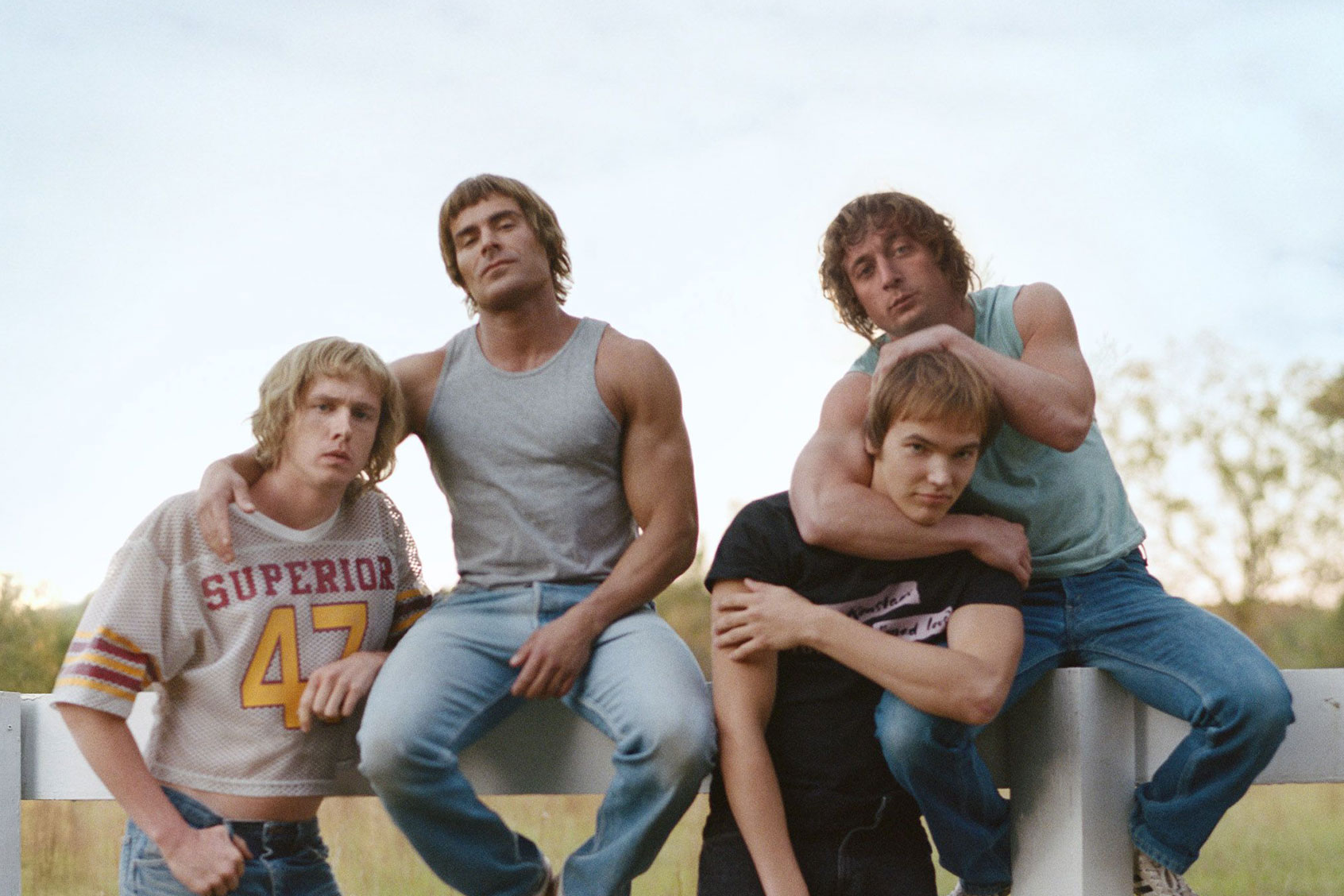
Stanley Simons, Hold McCallany, Zac Efron, Jeremy Allen White and Harris Dickinson in "The Iron Claw" (A24)There’s no family business for my son to fall back on when his Olympic dreams are dashed, and there are parts of American culture that I’m likely powerless to protect him from. However, there is a lot I can gatekeep. I know that there’s risk in exposing my son to professional wrestling, but my gut tells me to fight back against the divide that causes intellectually serious people to dismiss American culture’s most popular performance art. The more of us in it together, the better . . . right?

What’s wrong with wrestling? If you’re even a little familiar, you can likely name a lot of faults. It’s violent. It’s toxically masculine. Its culture promotes overindulgence in a host of life-shortening substances. Many of my childhood wrestling heroes are dead, certified Bad Dudes or both. Even if you want to defend wrestling as storytelling of the body, you must admit that it may never fully escape its role in perpetuating some of our worst, most reductive narratives — racism, sexism, homophobia, transphobia. There’s no defending professional wrestling from these charges. The question becomes not whether wrestling is good or bad, but whether it offers enough to make exposing my son to its negatives a worthwhile risk.

Professional wrestling is theater. It’s astonishing to me how this is still a revelation to so many. Sure, if you ask an average person, they can tell you that wrestling is staged, but when someone who isn’t a fan asks me about wrestling, they’ll often start with something like, “So, it’s fake, right?”

Wrestling payoffs can be the most satisfying in all of fiction.

Pro wrestling is good because it’s fake. I’m sure a fan of wrestling’s counterparts like boxing or mixed martial arts could argue the opposite — as if real fights happened within equiangular polygons under bright arena lights — but I’d push back to say the main reason any of us care about live sports are the narratives that require an entire ecosystem of beat writers and TV networks and podcast bros to prop up. Wrestling has all that too, of course, but it’s not as necessary. Narrative is essential to wrestling, from the one move to the next in the ring, to stories that unravel over the course of decades, even generations. Even poorly written wrestling often has entertaining twists and turns, and wrestling payoffs can be the most satisfying in all of fiction.

We need your help to stay independent

My favorite aspect of pro wrestling’s fakery is that in the last 30 years, wrestling has realized that it’s much more narratively interesting to embrace the fact that its audience is smart to its ruse and to fold that into its stories. Some of the most famous wrestling moments of my lifetime — the Montreal Screwjob, CM Punk’s Pipe Bomb, Mankind versus Undertaker in Hell in a Cell and an uncountable number of ridiculously dangerous stunts that pro wrestlers have attempted over the years — play with metafiction. Wrestling will break its fourth wall intentionally and unintentionally. This has created an underlying tension in every broadcast, in every show at your local high school’s gymnasium. Is what you’re seeing a part of the plan or did something go wrong? Did someone decide to go off script? Imagine watching Shakespeare but you know that every so often Laertes is going to punch Hamlet in the face and that might change the whole story. It happens more often than you’d think.

My son should see this, right? The stories we tell children can be so dull, so safe. Kayfabe, the storytelling in wrestling, intrigues me so much, I wrote a novel about it. Don’t I want my kid to understand what drove me to obsess about this for so long? Why not watch it with him, help him understand the complexity, put things into context, call out the stuff that’s Not Good, both aesthetically and morally? What’s the danger? Well, I remember one of the moral panics of the '90s being that kids were going to emulate their favorite wrestlers or Power Rangers and turn that fighting on their classmates at recess. Anecdotally, I can say that my friends and I absolutely did just that, and I’m not going to deny the ample evidence that’s just a Google search away that will tell you that exposure to media violence as a child has a negative impact. How could it not?

The Iron ClawThe Iron Claw (A24)All I’ll say to this is that a surprising number of wrestling maneuvers are difficult to perform, and useless against someone who isn’t a willing participant. Most moves beyond your standard punches and kicks are just as collaborative as a match’s outcome. You’re not going to Powerbomb someone your size against their will. The danger isn’t so much attacking with the moves as it is screwing them up with inexperienced technique and hurting your dance partner. For comparison, consider that a lot of this country is completely fine with allowing football dads who play Madden a few times a week coach their 6th graders in safe tackling technique — if there even is such a thing.

The most interesting moment in "The Iron Claw" is Fritz Von Erich’s admission to his sons, “I wouldn’t wish wrestling on any of you.” It’s easy to pin Fritz as a two-bit dictator ruling his tiny fiefdom with his iron fist. This line betrays an awareness that deepens the character. He knows the dangers of pro wrestling, yet he pulls his sons into the business regardless. Why? Grievance, pride, and I’d argue, one of the most hazardous and sinister facets of pro wrestling: nostalgia.

For all its strengths, pro wrestling doesn’t feel as good as it did in 2014.

Nostalgia is the cornerstone of pro wrestling. There’s an old meme that pops up every so often of a Q&A in a gymnasium with some retired wrestlers. This nerdy guy grabs the mic, breaks down in tears and yells, “It’s still real to me, dammit.” We make fun of this guy, but this is what every wrestling fan is chasing. When you watch a match, you’re trying to recapture something — when you were a kid watching Bill Goldberg tear through the WCW roster in a superhuman unbeaten streak, when you were in grad school and rediscovering the magic of wrestling watching underdog Daniel Bryan beat Triple H, Randy Orton, and Batista in one night to win the title. It’s why WWE trots out its “legends” at every major event. It’s why my local show at Spring Valley High in Columbia, South Carolina was headlined by The Rock ‘n’ Roll Express, a pair of 60-somethings from Tennessee who peaked three decades ago. Fritz wants to stick it to his haters, of course. He also wants to relive his glory days. He wants his family to relive them too.

As I get older, I become more and more skeptical of nostalgia. It feels good to indulge in the remember whens, but the further I get from the days I’m nostalgic for, the stronger the jones and the weaker the fix. For all its strengths, pro wrestling doesn’t feel as good as it did in 2014, let alone 1999. I doubt that has much to do with the quality of the product or even my ability to appreciate it. It’s my brain feeling all that time slip by and clawing for purchase. I know there’s a black hole event horizon lurking if I’m not careful. Truthfully, part of me wonders whether all my pseudo-intellectual defenses of pro wrestling aren’t a thin veil over an obvious excuse for my nostalgic hits. Are the promo clips I’ve watched on YouTube necessary for this article, or vice versa?

I don’t know if my son could ever enjoy pro wrestling the way I enjoy it. Before he was born, my parents came to visit and my father, the family archivist, brought some newly digitized childhood home videos of my sister and me. We watched more than an hour of this, and it wrecked me. My parents looked so young. So many family members were still alive. Worst of all, I could see how happy it made my dad to share these moments with me, these memories he had worked so hard to capture, keep safe, and preserve across generations of media, and I just couldn’t get there with him. I couldn’t find the joy that he took from it.

The Iron ClawThe Iron Claw (A24)I could show my kid all the important matches from all the tentpole events of my youth. He’d be exposed to all that violence, bigotry, misogyny. He’d be missing out on whatever else we might have been doing or enjoying together, and for what? What my dad has done with our home videos is about the most wholesome thing I can think of. What kind of wedge would I drive between my son and me were I to use him to chase my nostalgia fix through something as unsavory as professional wrestling? To use a metaphor my old football coach might understand, there are a thousand ways pro wrestling can hurt my child. Through nostalgia, it can injure him. 


Want a daily wrap-up of all the news and commentary Salon has to offer? Subscribe to our morning newsletter, Crash Course.


Fritz Von Erich, wrestling fans and Wikipedia-heads will know, isn’t his real name. It’s Jack Adkisson. Inside the ropes, in kayfabe, Von Erich was an evil German brute, a Nazi, crushing opponents’ skulls with his meaty Eastern European hands. In real life, or something like it, Adkisson’s family would rise to fame under that conjured name, and five out of six of his children would pass away tragically — a story so unbelievable that the fictionalized version in "The Iron Claw" only depicts four of the deaths. What’s in a name? Marketing and brand recognition? Maybe. A curse? perhaps. A cautionary tale? For sure. One about a father who claimed to want a better life for his kids, only to march them off into his battles, grievances and memories where the gaping maw of pro wrestling was waiting. Another about one fan among many who loves nothing more than a family dynasty so he can pretend that his youth does, in fact, live on.

I won’t be showing my son pro wrestling. I can only wish that if he does find it on his own, I might learn something new to love about it through his eyes.


A Taylor Swift earthquake in Scotland? Fans at Eras Tour in Edinburgh create seismic activity

Taylor Swift fans in Edinburgh danced so fervently at the singer's Eras Tour last weekend that they created seismic activity in the earth. On Friday, the British Geological Survey's monitoring stations detected activity caused by the more than 70,000-person crowd at Murrayfield Stadium, per The Hollywood Reporter. The organization shared that the most tremulous songs were Swift's "Shake It Off," "Cruel Summer," and ". . . Ready For It?" 

The Edinburgh stay marked the first of Swift's 17 shows in the U.K., which The Hollywood Reporter reported is estimated to generate approximately $1.2 billion for the country's economy. 

This wasn't the first time the pop star's concerts have caused something of a "Swift Quake." In March, Swifties at SoFi Stadium in Inglewood, California, caused earthquake-like activity, according to a study conducted by researchers at Caltech and UCLA. Last summer, a geology professor from Western Washington University determined that Swift's two-night stay at Seattle's Lumen Field led to seismic activity equivalent to a 2.3 magnitude earthquake. 

Are plant-based burgers really bad for your heart? Here’s what’s behind the scary headlines

We're hearing a lot about ultra-processed foods and the health effects of eating too many. And we know plant-based foods are popular for health or other reasons.

So it's not surprising new research out this week including the health effects of ultra-processed, plant-based foods is going to attract global attention.

And the headlines can be scary if that research and the publicity surrounding it suggests eating these foods increases your risk of heart disease, stroke or dying early.

Here's how some media outlets interpreted the research. The Daily Mail ran with:

Vegan fake meats are linked to increase in heart deaths, study suggests: Experts say plant-based diets can boost health – but NOT if they are ultra-processed

The New York Post's headline was:

Vegan fake meats linked to heart disease, early death: study

But when we look at the study itself, it seems the media coverage has focused on a tiny aspect of the research, and is misleading.

So does eating supermarket plant-based burgers and other plant-based, ultra-processed foods really put you at greater risk of heart disease, stroke and premature death?

Here's what prompted the research and what the study actually found.


Remind me, what are ultra-processed foods?

Ultra-processed foods undergo processing and reformulation with additives to enhance flavour, shelf-life and appeal. These include everything from packet macaroni cheese and pork sausages, to supermarket pastries and plant-based mince.

There is now strong and extensive evidence showing ultra-processed foods are linked with an increased risk of many physical and mental chronic health conditions.

Although researchers question which foods should be counted as ultra-processed, or if all of them are linked to poorer health, the consensus is that, generally, we should be eating less of them.

We also know plant-based diets are popular. These are linked with a reduced risk of chronic health conditions such as heart disease and stroke, cancer and diabetes. And supermarkets are stocking more plant-based, ultra-processed food options.


How about the new study?

The study looked for any health differences between eating plant-based, ultra-processed foods compared to eating non-plant based, ultra-processed foods. The researchers focused on the risk of cardiovascular disease (such as heart disease and stroke) and deaths from it.

Plant-based, ultra-processed foods in this study included mass-produced packaged bread, pastries, buns, cakes, biscuits, cereals and meat alternatives (fake meats). Ultra-processed foods that were not plant-based included milk-based drinks and desserts, sausages, nuggets and other reconstituted meat products.

The researchers used data from the UK Biobank. This is a large biomedical database that contains de-identified genetic, lifestyle (diet and exercise) and health information and biological samples from half a million UK participants. This databank allows researchers to determine links between this data and a wide range of diseases, including heart disease and stroke.

They used data from nearly 127,000 people who provided details of their diet between 2009 and 2012. The researchers linked this to their hospital records and death records. On average, the researchers followed each participant's diet and health for nine years.


What did the study find?

With every 10% increase of total energy from plant-sourced, ultra-processed foods there was an associated 5% increased risk of cardiovascular disease (such as heart disease or stroke) and a 12% higher risk of dying from cardiovascular disease.

But for every 10% increase in plant-sourced, non-ultra-processed foods consumed there was an associated 7% lower risk of cardiovascular disease and a 13% lower risk of dying from cardiovascular disease.

The researchers found no evidence for an association between all plant-sourced foods (whether or not they were ultra-processed) and either an increased or decreased risk of cardiovascular disease or dying from it.

This was an observational study, where people recalled their diet using questionnaires. When coupled with other data, this can only tell us if someone's diet is associated with a particular risk of a health outcome. So we cannot say that, in this case, the ultra-processed foods caused the heart disease and deaths from it.


Why has media coverage focused on fake meats?

Much of the media coverage has focused on the apparent health risks associated with eating fake meats, such as sausages, burgers, nuggets and even steaks.

These are considered ultra-processed foods. They are made by deconstructing whole plant foods such as pea, soy, wheat protein, nuts and mushrooms, and extracting the protein. They are then reformulated with additives to make the products look, taste and feel like traditional red and white meats.

However this was only one type of plant-based, ultra-processed food analysed in this study. This only accounted for an average 0.2% of the dietary energy intake of all the participants.

Compare this to bread, pastries, buns, cakes and biscuits, which are other types of plant-based, ultra-processed foods. These accounted for 20.7% of total energy intake in the study.

It's hard to say why the media focused on fake meat. But there is one clue in the media release issued to promote the research.

Although the media release did not mention the words "fake meat", an image of plant-based burgers, sausages and meat balls or rissoles featured prominently.

The introduction of the study itself also mentions plant-sourced, ultra-processed foods, such as sausages, nuggets and burgers.

So it's no wonder people can be confused.


Does this mean fake meats are fine?

Not necessarily. This study analyzed the total intake of plant-based, ultra-processed foods, which included fake meats, albeit a very small proportion of people's diets.

From this study alone we cannot tell if there would be a different outcome if someone ate large amounts of fake meats.

In fact, a recent review of fake meats found there was not enough evidence to determine their impact on health.

We also need more recent data to reflect current eating patterns of fake meats. This study used dietary data collected from 2009 to 2012, and fake meats have become more popular since.


What if I really like fake meat?

We have known for a while that ultra-processed foods can harm our health. This study tells us that regardless if an ultra-processed food is plant-based or not, it may still be harmful.

We know fake meat can contain large amounts of saturated fats (from coconut or palm oil), salt and sugar.

So like other ultra-processed foods, they should be eaten infrequently. The Australian Dietary Guidelines currently recommends people should only consume foods like this sometimes and in small amounts.


Are some fake meats healthier than others?

Check the labels and nutrition information panels. Look for those lowest in fat and salt. Burgers and sausages that are a "pressed cake" of minced ingredients such as nuts, beans and vegetables will be preferable to reformulated products that look identical to meat.

You can also eat whole plant-based protein foods such as legumes. These include beans, lentils, chickpeas and soy beans. As well as being high in protein and fibre, they also provide essential nutrients such as iron and zinc. Using spices and mushrooms alongside these in your recipes can replicate some of the umami taste associated with meat.

Evangeline Mantzioris, Program Director of Nutrition and Food Sciences, Accredited Practising Dietitian, University of South Australia

This article is republished from The Conversation under a Creative Commons license. Read the original article.

Challenge to abortion drug rejected by U.S. Supreme Court

On Thursday, the Supreme Court rejected a challenged restricting access to mifepristone, the first drug used in a medication abortion.

The court’s decision in the case U.S. Food and Drug Administration v. Alliance for Hippocratic Medicine ruled against Alliance for Hippocratic Medicine, an organization of anti-abortion activists backed by the Christian right-wing lobbying group Alliance Defending Freedom, who brought the case forward, with Justice Brett Kavanaugh writing the opinion for a unanimous court.

The court determined that the anti-abortion groups did not have legal standing to sue, but left the door open to future challenges to abortion drugs, according to NBC News.

"Despite this win at the court, the situation regarding access to these life-saving medications continues to deteriorate at the state level," the abortion access non-profit Plan C Pills said in a statement. "Louisiana’s recent bill designating both mifepristone and misoprostol as controlled substances, and Arkansas’ attempts to limit the provision of information to Arkansans about ways to obtain abortion pills in their state, are clear provocations. These unjust actions demonstrate that states will stop at nothing to keep pregnant people from accessing this basic medical care."

The Food and Drug Administration (FDA) approved mifepristone for the medical termination of pregnancy over two decades ago. Since then, the drug has held a well-established safety profile. However, a lawsuit filed in November 2022 alleged that the longstanding FDA approval should be revoked because it was based on incomplete data. Widespread access to the medication, the lawsuit claimed, put women’s health in danger. The plaintiffs, Alliance for Hippocratic Medicine, alleged that the FDA failed to protect women.

In April 2023, a Trump-appointed judge named Matthew J. Kacsmaryk of the U.S. District Court for the Northern District of Texas ruled in agreement with the plaintiffs, kicking off nearly two years of litigation around access to the medication. 

Kacsmaryk’s controversial decision eschewed scientific fact and medical terminology in favor of right-wing activist jargon.

From the beginning, legal critics were quick to note how the lawsuit was anti-abortion propaganda — a political move to further restrict access to abortion post-Dobbs. Since Roe v. Wade was overturned, medication abortions have become more popular. A new Guttmacher Institute report from the Monthly Abortion Provision Study found that there were approximately 642,700 medication abortions in the United States in 2023, meaning they accounted for nearly 63 percent of all abortions.

In a medication abortion, a patient takes mifepristone, which blocks pregnancy hormones, and then misoprostol, which causes uterine contractions. The two-step regimen is also a common treatment in miscarriage management. In 2018, researchers published a study in the New England Journal of Medicine that found using both mifepristone and misoprostol in a two-step process was more effective for managing an early miscarriage than only taking misoprostol. 

However, Kacsmaryk’s controversial decision eschewed scientific fact and medical terminology in favor of right-wing activist jargon. Likewise, his ruling ignored the majority of scientific studies on mifepristone and incorrectly stated that medical abortions are unsafe. After his ruling, the nations’ leading physicians emphasized in numerous amicus briefs that there was “ample scientific evidence” to support widespread use and availability of mifepristone. In February 2024, the peer-reviewed science publisher Sage Journals retracted three controversial abortion studies, two of which had been frequently cited in Alliance for Hippocratic Medicine’s lawsuit. 


Want more health and science stories in your inbox? Subscribe to Salon's weekly newsletter Lab Notes.


The first significant way access to medication abortion could have changed in light of this ruling is the ability for mifepristone to be prescribed by telehealth and by mail. 

Over the last couple of years telehealth abortions have become more common. In data from April 2022 to September 2023, 16 percent of abortions in the U.S. were done via telehealth, according to data by the Society of Family Planning. With those who had a telehealth medication abortion, 43 percent said that telehealth made it possible for them to have a timely abortion as the medicine is frequently delivered by mail.

The option to access medication abortions via mail or telehealth isn’t the only way the ruling could have impacted access to mifepristone. The timeframe that it can be used will shorten from 10 weeks to 7 weeks of pregnancy. This would have restricted access to medication abortion for those who perhaps haven’t even confirmed if the pregnancy is viable yet, or those who need time to gather the resources to even access the medications.

We need your help to stay independent

Additionally, a ruling in favor of the plaintiffs would have reverted access to the pill back to the 2000 label, which will require a ​​higher dosage of mifepristone and a lower dosage of misoprostol. This shift in dosing will ultimately lead to more failures of the medication, and could lead to an abortion patient experiencing more nausea and cramping during the process. Essentially, it would have made the process more miserable and cause more suffering.

“Extremely vigorous”: Biden takes on monopolies like Ticketmaster “far more” aggressively than Trump

Seeking to support embattled American consumers and workers against concentrated corporate power, President Joe Biden's administration has taken a record number of antitrust actions to prevent a few large companies from dominating their respective markets. That stands in stark contrast to his 2024 opponent, former President Donald Trump, who has sought to portray himself as an advocate for regular people but who, in office, used anti-monopoly rhetoric as cover for personal and political vendettas while letting favored corporations off the hook.

In May, Biden’s Department of Justice sued Live Nation, the high-on-the-hog group behind Ticketmaster and its allegedly deceptive sales practices, accusing the company of relying on "unlawful, anticompetitive conduct to exercise its monopolistic control over the live events industry." The move by the Biden administration is one of the latest in an unprecedented string of federal lawsuits against companies, blocking of mergers and opening of antitrust probes, all spearheaded by Federal Trade Commission Chair Lina Khan and DOJ's antitrust chief Jonathan Kanter.

This enforcement of antitrust policy, framed by a set of guidelines released in late 2023, is not just a matter of abstract economics or defying the rich and powerful on principle — it affects the livelihoods of average Americans by protecting them from companies that have means and incentive to maximize profit at consumers' expense.

Trump, despite his rhetorical attacks on "elites," seems to operate on a different set of principles, which in office often boiled down to taking revenge against companies that he perceived to have wronged him, such as CNN. The Trump administration also used the guise of enforcing antitrust laws to go after car makers who agreed to California's strict emission standards; this was paired with a permissive attitude towards companies Trump favored and half measures that appeared designed to build trust-busting credibility without having meaningful impact.

Taking on Corporate Consolidation

Consider Ticketmaster: The Trump administration administration settled with the company after it violated the agreement made when it merged with Live Nation, seeking to prevent the company from using its power to retaliate against venues that don't use its services, but did little to address its alleged price gouging. Unlike Biden’s regulators, Trump's declined to press further action even after Ticketmaster acquired Rival, a competitor, further consolidating its grip on live entertainment.

“Antitrust enforcement during the Biden administration has been extremely vigorous, far more than the Trump administration"

“Antitrust enforcement during the Biden administration has been extremely vigorous, far more than the Trump administration,” Steven Salop, a professor of economics and law at the Georgetown University Law Center, told Salon.

In the case of Ticketmaster, which swallowed up seven competitors between 1985 and 1991 and now controls paid concert access across the country, concertgoers have been forced by lack of alternatives to purchase tickets online and accept opaque, hidden fees that could double the price of the ticket. Although Live Nation acquired Ticketmaster 14 years ago, its disastrous handling of a Taylor Swift concert in 2022 drew fresh scrutiny that eventually provided an opening for the DOJ lawsuit. If the company is found guilty of violating the Sherman Anti-Trust Act, Live Nation will be forced to restructure or split into two or more companies.

It's not just concertgoers who find themselves at the mercy of monopolistic leverage.

The consolidation of food production and grocery retailers after the loosening of antitrust laws in the 1970s has been identified as a prime culprit behind rising costs at the supermarket, with top firms having the power to set unfair prices and manipulate the market in their favor. During the pandemic, food companies exploited supply-chain disruptions and claimed higher production expenses to further hike prices. Such claims didn't seem to account for record corporate profits in the last few years, with companies like Tyson Foods, JBS, and Marfrig all reporting net profit margins of over 300% in 2021.

Tyson essentially admitted as much, bragging to investors that their "pricing actions … more than offset the higher [cost of goods]."

We need your help to stay independent

The concentration of power in the hands of a few large companies also threatens the ability of workers to negotiate adequate wages and safe working conditions.

In 2022, Kroger and Albertsons allegedly used the collusion playbook favored across different industries to weaken Colorado workers' bargaining position by agreeing not to poach each others' strikers during a work stoppage. Their merger would preclude the need to cut a deal, and enable one dominant player to threaten and dictate terms to workers without fear of competition.

At the peak of the inflation crisis in late 2021, the FTC under Biden launched an investigation into top food companies, requesting that they hand over documents that might shed light on "empty shelves and sky-high prices." The report came out in March 2024, concluding that major firms "accelerated and distorted the negative effects associated with supply chain disruptions," which, rather than hurting them, helps "entrench their dominance" in the market.

A month before the report's release, the FTC sued to block Kroger's $24.6 billion acquisition of Albertsons in what could be the largest supermarket merger in American history, which could "lead to lower quality products and services, while also narrowing consumers' choices for where to shop for groceries," according to a commission press release.

Biden's trust-busting

In the last three years, the Biden administration has also grounded a JetBlue-Spirit Airlines merger, sued Amazon for exploiting customers with shady business practices, scotched an attempt by biotechnology giant Illumina to reacquire a cancer screening company, and opened investigations into Nvidia, Microsoft and OpenAI’s dominance over the AI industry. These and other enforcement actions have added up to the most prolific record of any presidential term.

It's had an impact. Unnerved by the prospect of litigation, companies such as Amazon, Lockheed Martin and Berkshire Hathaway backed off from plans to acquire smaller firms. The Biden administration's relentless approach has won applause from a range of consumer advocates, and criticism from the likes of the right-wing Heritage Foundation, which has accused the administration of punishing successful companies and trying to "weaponize" antitrust policy in order to exert more control over the economy.

Corporations had a preview of the upcoming assault in 2021, when Biden announced the nomination of law professor Lina Khan to lead the FTC, an unusually high-profile appointment for that body. Khan had already earned fame in 2017, when the then-law student published "Amazon's Antitrust Paradox" in the Yale Law Review, arguing that American antitrust legal doctrine, with its focus on measuring competition through price and output alone, fails to account for anticompetitive behavior by platform-based business models.

Indeed, while Trump’s regulators focused on the narrow “consumer welfare standard” as the basis for enforcement actions, Biden’s regulators have expanded their interpretation of antitrust law to include harms to workers and producers.

In October 2022, the DOJ successfully blocked a merger between Penguin Random House and Simon & Schuster, arguing that reducing the number of major U.S. publishers from five to four would harm writers. The FTC is using the same tack in its lawsuit against Kroger, whose acquisition of Albertsons would, it says, give them “leverage to impose subpar terms on union grocery workers.” 


Want a daily wrap-up of all the news and commentary Salon has to offer? Subscribe to our morning newsletter, Crash Course.


While Khan is under no obligation to answer to the Heritage Foundation, she has appeared before the House Judiciary Committee, where Republicans have charged her with overseeing a hyper-aggressive, politicized enforcement against the country's biggest companies. They have also claimed she "harassing" Elon Musk, the billionaire owner of Tesla and X, by trying to obtain the company's internal records as part of a probe into its security and privacy policies. Khan noted that the FTC had been investigating X, formerly Twitter, even before Musk took over.

In April, the GOP-led House Oversight Committee also launched an investigation into White House-led efforts to tackle unfair corporate pricing, calling it a "political tool." But Republican criticism has focused on the purported, broader economic motives of the Biden administration, generally steering clear of any specific examples.

Trump's "cruel parody" of antitrust action

Despite a less effective record, Trump's administration did pursue more antitrust actions than his immediate predecessors, capping it off with 28 merger enforcement actions in 2020, the most in a single year since 2000. Those lawsuits had mixed success: While the DOJ lost both merger trials initiated during the Trump years, it gained the advantage in an arbitrated case against Novelis, which tried to acquire its aluminum-producing brethren Aleris, forcing the company to divest the latter’s sheet operations in North America as a condition for the merger.

Though Trump concurred with antitrust advocates that "Big Tech" was concentrating too much power in the hands of a few companies, he was less concerned with economic injustice than his stated belief that they were using their dominance to "censor" conservative viewpoints (studies have shown the opposite to be true).

In general, critics who support antitrust enforcement in principle  but not the practice of selective enforcement have accused the Trump administration of using antitrust law to pursue personal and political grudges. They point to his administration unsuccessfully attempting to block a merger between AT&T and Time Warner, the parent company of CNN, with which Trump has maintained a long-running feud.

"AT&T … is now trying to buy Time Warner and thus the wildly anti-Trump CNN," said a press release from Trump's 2016 campaign. "Donald Trump would never approve such a deal because it concentrates too much power in the hands of the too and powerful few."

Once he became president, Trump prodded officials to follow through with DOJ action against the merger dozens of times as punishment for CNN's unsatisfactory coverage. Concurrently, he waved through Disney's purchase of 21st Century Fox, a deal that represented a massive consolidation in the media market. Unlike the AT&T and Time Warner, 21st Century Fox is owned by right-wing media baron, Rupert Murdoch, who walked away from the sale billions of dollars richer. Trump later congratulated Murdoch on his success.

Sprint and T-Mobile also benefited from Trump's DOJ, which not only approved of a merger between the two companies that reduced the number of major cell phone providers from four to three, but also fended off an antitrust suit brought by a group of states. Most of Sprint's shares are owned by SoftBank, whose chairman, Masayoshi Son, enjoys friendly relations with Trump.

Other companies were not been treated so generously.

In 2019, the DOJ opened a probe into Ford, BMW, Volkswagen, and Honda for signing an agreement with California to raise fuel emissions standards higher than those proposed by the Trump administration, accusing them of scheming to limit competition. The investigation, which The New York Times editorial board called a "cruel parody of antitrust enforcement,” came shortly after Trump posted furious tweets at the car producers for leaving his own standards in the dust. In 2020, a DOJ whistleblower testified that Bill Barr, Trump's attorney general, targeted cannabis suppliers on a rationale "centered not on antitrust analysis, but because he did not like the nature of their underlying business."

While Biden prepares to take on Trump in the 2024 election, his antitrust chiefs are preparing their most intense round of lawsuits and investigations yet, hoping to finish as much as possible before the clock runs out on their boss' first term. Trump, hoping to win a second stint in office, is telling oil executives that he will fast-track their merger deals in exchange for their support. It's true to form for the Republican nominee — antitrust enforcement, or the lack thereof, is politics by other means.

“Lost opportunity”: Unpacking the backlash to Caitlin Clark not being picked for the Olympic team

No. 1 WNBA draft pick and current all-star Indiana Fever rookie Caitlin Clark departed from collegiate athletics this past spring with a sparkling legacy. During her time on the University of Iowa's Division I women's basketball team, Clark cemented herself as one of the all-time greats in NCAA history, garnering the most points, the highest-scoring average, most national scoring titles, most 3-pointers in a season and career respectively, and more.

Given the standout point guard's consistently stellar performances, her being left off the roster for the 2024 U.S. women's Olympic basketball team stoked a bevy of swift and considerable responses.

But it wasn't merely Clark's statistical successes on the court that left fans, players and commentators alike expressing dismay and disapproval at the decision — many argued that Clark's absence would create collateral damage for women's basketball more broadly, figuratively (and potentially literally) undoing gains that her powerhouse presence made for the WNBA. 

In May, the WNBA saw more than 400,000 fans pack stadiums, per NPR. More than half the games were sellouts, making it the highest-attended month for the league in more than 20 years. The league reported that merchandise sales soared to 236% year-to-year. The final game of the NCAA March Madness women's basketball tournament between The University of South Carolina's Gamecocks and Iowa's Hawkeyes averaged about 18.7 million viewers, peaking at a combined 24 million in the final 15 minutes. This marked the first time in history that the women's title game beat out the men's championship game for viewership.

Much of this surge in interest and revenue — which NPR reported to be the highest since the WNBA was first introduced in the late 1990s — can be directly attributed to dynamo rookies like Clark and Angel Reese of the Chicago Sky. 

Online, many social media users have expressed overt frustration. One X/Twitter user wrote, "The only good thing that may come out of the Team USA Olympics committee excluding Caitlin Clark from Team USA is fans may never again have to listen to whiny WNBA veterans complain about their low salaries and lack of visibility for the league because they collectively blew a golden opportunity by not including Clark on Team USA for the Summer Olympics."

"Rant incoming," tweeted Barstool Sports founder Dave Portnoy alongside a video clip sharing his thoughts. "Leaving Caitlin Clark off the women's Olympic team is the dumbest s**t I've ever heard."

Another X/Twitter user argued, "You wanna grow the game, put arguably your most popular player rn on the Olympic stage. Like DUH."

Linda Cohn, an ESPN Sports anchor based in Los Angeles, responded to a tweet noting how a recent game between The Indiana Fever and the Washington Mystics was shifted from the Mystics' typical arena — which accommodates 4,200 — to 20,3565 seat Capitol One Arena, with tickets selling out in half an hour. 

"Yet Caitlin Clark is not selected to the Team USA Women’s Basketball team heading to Paris for the Olympics?!?!" Cohn wrote. "All she does is grow the game, pack arenas, and set rookie records. What a short-sighted decision. Lost opportunity."

Some social media users even claimed that Clark's attendance at the Olympics would be one of the few reasons they'd tune into the Games this summer.

"I don’t know enough about USA women’s Olympic basketball to know if Caitlin Clark’s omission is a snub," wrote one X/Twitter user. "I do know that, right now, she would be the only reason I would remotely care about USA women’s Olympic basketball."

Despite public blowback around the decision, Clark was personally candid in vocalizing her support for the 2024 Paris squad, stating at a recent Indiana Fever practice that she hopes to join the all-star group for the 2028 Summer Olympics in Los Angeles, California. "I think it just gives you something to work for," Clark said to the press, per ABC. "It's a dream. Hopefully one day I can be there. I think it's just a little more motivation. You remember that. Hopefully when four years comes back around, I can be there."

"I'm excited for the girls that are on the team," she added. "I know it's the most competitive team in the world, and I know it could have gone either way of me being on the team or me not being on the team. I'm excited for them. Going to be rooting them on to win gold. I was a kid that grew up watching the Olympics. It'll be fun to watch them."

https://www.instagram.com/p/C8FGTLTRvKN/?utm_source=ig_embed&ig_rid=83943c65-4da4-492c-803a-f9e5adf14801

And while much public opinion skews heavily in favor of Clark's should-have-been participation in Paris this summer, others have firmly argued that the newly minted pro must first pay her dues before foraying into the Olympic arena. 

9News sports reporter Arielle Orsuto claims on X/Twitter that Clark's snub was generating "fake outrage from people who just started watching women’s basketball this year."

"The (historically undefeated) US Women’s Olympic basketball team will be just fine without Caitlin Clark, and she will be just fine waiting another 4 years for her turn," she added.

"Why are we debating Caitlin Clark being on the Olympic team!?!" another X/Twitter user asked. "She . . . just became a pro and has played . . . 12 games. Please give it a rest."

Speaking to USA Today about Clark's omission, Phoenix Suns guard Diana Taurasi spoke about the "different dance you have to learn" as an evolving player pivoting to consistently more prominent leagues. 

"The game of basketball is all about evolving. It's all about getting comfortable with your surroundings," Taurasi, who is returning to the Olympics for a record sixth time this summer said. "College basketball is much different than the WNBA than it is overseas. Each one almost is like a different dance you have to learn. And once you learn the steps and the rhythm and you have a skill set that is superior to everyone else, everything else will fall into place."

Selection committee chair of USA Basketball Jen Rizzotti revealed to the Associated Press in an interview that tenure was a key component in creating the 12-woman Olympic roster, making clear how the organization was careful not to kowtow to public pressure or mistakenly conflate popularity with experience.

“Here’s the basketball criteria that we were given as a committee and how do we evaluate our players based on that?” Rizzotti told the outlet. “And when you base your decision on criteria, there were other players that were harder to cut because they checked a lot more boxes. Then sometimes it comes down to position, style of play for Cheryl (Reeve) and then sometimes a vote.

“It would be irresponsible for us to talk about her [Clark] in a way other than how she would impact the play of the team,” Rizzotti added. “Because it wasn’t the purview of our committee to decide how many people would watch or how many people would root for the U.S. It was our purview to create the best team we could for Cheryl.”

“She’s certainly going to continue to get better and better,” said USA Basketball CEO Jim Tooley. “Really hope that she’s a big part of our future going forward.”

The mistake of conflating historic criminal convictions: Donald Trump and Hunter Biden are not equal

Tuesday was an odd day at the White House. Press secretary Karine-Jean Pierre originally scheduled a press briefing for 2:30 p.m. However, a short time after the noon hour, she canceled it. We were told that President Biden’s scheduled speech at the Washington Hilton about matters grave and somber precluded the need for a briefing that day – though originally both were scheduled to occur.

It was no big deal we were told. Situation normal. Nothing to see here. Move along. The truth was President Biden’s son, Hunter, had just been found guilty of the felony purchase of a handgun that morning, and there was no way the press secretary wanted to face an hour’s worth of questions about that.

The president didn’t either. When he showed up in public, though he spoke for more than 15 minutes, he made no mention of it and took no questions from the in-town press pool. Fox News, Newsmax and every Republican congressman on Capitol Hill (in no particular order) called the president and his administration a bunch of cowards for failing to address the historic turn of events; a son of a sitting president found guilty of a felony. These were the same people who, just last week, didn’t want to talk about the historic turn of events that led to a former president being found guilty of a felony. But since hypocrisy is as common as narcissism in D.C., it is no longer newsworthy to point this out – though we should.

I made it to the briefing room Tuesday only to find Jeanne-Pierre had canceled the briefing, so I headed to the Upper Press offices of the president to find out why. I offered my usual cheerful greetings and turned to see the press secretary at her desk eating something. “Good afternoon,” I said, and before I could ask for a response to the administration being called cowardly by its opponents, a young press assistant jumped up, and closed the door to the press secretary’s office.

Meanwhile, less than five minutes after a jury convicted Hunter Biden of a felonious purchase of a firearm, Second Amendment enthusiasts were dropping me texts and emails.

“This is just the tip of the iceberg with the Biden clan. They’re the most crooked family to ever take power in the United States,” one person wrote. 

“This is all a smoke screen for Biden crimes,” another said. 

“He should be prosecuted to the fullest extent of the law,” one Republican Hill staffer told me.

As misguided as some of the reactions to Trump’s and Hunter Biden’s convictions in the last week have been, we are witnessing the seeds of a revolution against the extremely wealthy and powerful that could bring about universal justice and usher in an era of equal rights for everyone.

It is, without a doubt, the first time I’ve ever heard a Republican wanting to send someone to prison for purchasing a firearm. Hell, they defend murderers and child molesters who purchase firearms. Maybe if Hunter’s last name had been Rittenhouse, they’d have been on his side.

Curiously none of them wanted to talk about Donald Trump being a convicted felon. All of them wanted to claim that the Justice Department’s prosecution of Hunter was for the purpose of going after the Biden “crime family” while simultaneously being controlled by the Bidens as part of a “False Flag” event that is hiding the Biden “Crime syndicate and its plans to go after Donald Trump.”

While it is tempting to wonder which comic book influenced their lives the most, and equally tempting to point out the absurdity of holding up two incongruous events as an indication of a dystopian reality that doesn’t exist, I must confess I grow bored with this particular low-rent comedy. I was never a comic book fan, I demand vetted facts and I’m positive there is something of greater interest going on.

Make no mistake, these people do care about their country. They do believe in the idea of the Constitution – they just don’t know what it is and how it works.

Both Donald Trump’s and Hunter Biden’s convictions are indicative of a deeper problem. Like Peter Finch in the movie “Network,” people are mad as hell and they don’t want to take it anymore. But most of them still can’t figure out what they’re really upset about, so they focus their anger on people of a different color, religion, sex or sexual orientation. It’s easier. But it’s wrong.

We need your help to stay independent

Both Donald Trump and Hunter Biden have excellent cases to review for an appeal. Trump’s boils down to the statute of limitations, and whether or not the felony charge is correct.

Biden has the more interesting avenue. The statute under which he was charged for a felony is vaguely written and there is a great chance it could end up as an appeal before the U.S. Supreme Court on claims that the state charge undermines the rights guaranteed under the Second Amendment. I will simply laugh and watch heads spin as the NRA and Trump supporters may have to shelve their hatred for Biden to support their God-given right to bear arms with bare arms. 

Then again, they won’t. They will contort and twist the facts and claim it was all Biden’s evil genius plan to thwart the Second Amendment by being convicted of a felony. It's the same lack of logic that they employed when a few Trumpers sent me text messages saying Hillary Clinton lost the 2016 election on purpose so the Democrats could impeach Donald Trump. 

In both of the recent criminal convictions it is doubtful either case would have made it to trial if the defendants had different surnames. Lying about drug use on an application to purchase a handgun that was thrown in the trash 11 days later is nothing compared to the people who do far worse every day while purchasing and even using a handgun. Lying about hush money to a porn star wouldn’t get you arrested unless you’re running for president and have years of lying and grifting in your past.

Two juries found them guilty. I trust the process in both cases. I trust the grand juries and the petit juries, the prosecution and the defense. Both men are now convicted felons. I do not believe either should be punished too severely for their convictions. I still think Trump should stand trial for his far worse affronts to the law – and if found guilty should never be allowed outside of a cage for the remainder of his life. Justice would be served.

The deeper issue in all this, and what we rarely talk about is that people are simply fed up with the rich and powerful getting away with everything and they do not know how to vent their wrath. I know most Trumpers believe they are screwed by the “Deep State.” I’ve heard them say the rich get away with everything and the poor pay the price. Their flaw is they believe Trump can deliver them from the evil of which he is a part. That’s kind of like asking a cannibal to become a vegetarian. It ain’t gonna happen. And I’m not talking about the evangelicals or those rich supporters of Trump’s. One group believes their soul is invested in Trump, and the others have their wallets invested in Trump.


Want a daily wrap-up of all the news and commentary Salon has to offer? Subscribe to our morning newsletter, Crash Course.


President Biden should see this as an opportunity and with the right spin on it, he could politically profit from this. 40 years of Reaganomics has produced an angry class of voters. The chants of “Make America Great Again” resonate with millions for a good reason – it’s just that Trump is exploiting those voices for his own gain while the Democrats have given up trying to reach those voters because the Democrats believe those voters have lost their souls to Trump.

There are many Democrats who believe Biden has, thus far, led a vapid and lifeless campaign against Donald Trump. The Democrats say Donald Trump “kills everything he touches” while the Republicans believe Biden puts them to sleep — a sentiment even some Democrats embrace. James Carville is among those who didn’t want Biden to run for a second term, but he is nonetheless supporting the president for a very good reason: Biden has been effective and he’s not a seditious clown.

There is good reason to believe that both sides of the political divide will forever lose themselves in deciding who is more corrupt, who is the greater danger to America and forgetting the greater existential threat to humanity. Authoritarians are thriving in Russia, China, North Korea, parts of Europe, Africa and South America. It is the age-old battle between the haves and the have-nots. We face both the increased chance of a nuclear conflagration as well the threat of a technological Dark Ages where only the rich have access to anything they want and the rest of us are left fighting over scraps.

For one moment stop and consider the battles over health care, education, abortion rights and contraceptives. Does anyone doubt that the rich will have access to the best of all of those no matter what laws we enact or who is in power? 

Perhaps, as misguided as some of the reactions to Trump’s and Hunter Biden’s convictions in the last week have been, we are witnessing the seeds of a revolution against the extremely wealthy and powerful that could bring about universal justice and usher in an era of equal rights for everyone. There’s a thought for a politician to run with – if they dare.

Or, it could just be we are seeing nothing more than the continuation of the destruction of justice, with Hunter Biden paying a steep price he shouldn’t have to pay, and Donald Trump getting away with whatever he wants with a wrist slap, while anyone who opposes the rich and the powerful suffers for their insolence.

Man, I sure wish the White House was more communicative about all of this.

“Politician with robes”: Expert says secret tape exposes Samuel Alito’s “apocalyptic vision”

Secret tapes of Supreme Court Justice Samuel Alito released publicly Monday have plunged the conservative justice and the high court into deeper controversy, exposing a conversation that saw Alito endorsing ultra-conservative hot-takes.

The audio, obtained and first reported by Rolling Stone, came just weeks after reports of far-right-aligned flags being flown outside Alito's home sparked widespread backlash. The reports follow a year of ethics scandal-exposés involving both him and Justice Clarence Thomas. The newly revealed recordings have similarly prompted harsh rebuke of the justice, with legal experts decrying Alito's boosting of Christian nationalist rhetoric on the tapes as unethical

"Justice Alito’s recorded comments aren’t so much revealing as they are confirming," James Sample, a Hofstra University constitutional law professor, told Salon. "They reinforce what we already know: that Justice Alito sees his raison d’etre as being more of an ideological culture warrior more than a jurist. And he’s indisputably winning the wars he is waging."

The bevy of revelations have also intensified public scrutiny of the Supreme Court in the wake of a series of contentious decisions in recent years, including eliminating federal protections for abortion care and gutting race-based affirmative action, and have led ethics watchdogs and government officials to declare that an externally enforced ethics code be imposed on the justices, a call that Senate Democrats renewed by seeking to pass a binding-ethics code proposal Wednesday in light of the new tapes.  

These new tapes mark "yet another self-inflicted wound on the part of the Supreme Court," according to David Schultz, a professor of legal studies and political science at Hamline University. 

"We've seen this gradual deterioration of support for the courts, and it's clearly collapsed after the Dobbs opinion. I mean, none of this is going to turn it around," Schultz told Salon, adding: "It's just going to further erode support for the judiciary. And I hate to say this at a time where you've got [former president Donald Trump] attacking the court system and where you really need people to be defending the courts."

Alito's conversation occurred during the Supreme Court Historical Society's annual dinner earlier this month and was recorded by liberal documentary filmmaker Lauren Windsor, who describes herself as an "advocacy journalist" and has a reputation for secretly recording conservatives. 

Windsor, who attended the event under her real name and peppered Alito with questions aligned with far-right ideology, got the justice to offer up his perspective on the opinions she touted. At one point in their exchange, she received an endorsement from the justice of her argument that ending the nation's political polarization by negotiating with the political left not possibleand that it's a matter of "winning" rather than compromise.  

“I think you’re probably right,” Alito told Windsor. “On one side or the other — one side or the other is going to win. I don’t know. I mean, there can be a way of working — a way of living together peacefully, but it’s difficult, you know, because there are differences on fundamental things that really can’t be compromised. They really can’t be compromised. So it’s not like you are going to split the difference.”

In another instance, Alito said he agreed with her position that the country's Christian population has "got to keep fighting" to “return our country to a place of godliness.”

We need your help to stay independent

Schultz argued that the problems with the exchange are three-fold. First, it presents "almost an apocalyptic vision of American politics" of "dual-contending forces" that Alito appears to hint the resolution to aligns more with a "Christian vision." The second arises from his articulation of this vision, which flies in the face of the "myth" that these "justices are apolitical" and supposed to avoid "abandoning the neutrality."

Third, Alito's statements on the recording also appear to "reinforce both the appearance and the reality that he's voting ideology," that he's not "reading the Constitution neutrally," Schultz continued.

Windsor also secretly taped a conversation Chief Justice John Roberts at the dinner, but his responses to a line of questioning similar to what his colleague received appeared to come in sharp contrast to Alito's, ringing more neutral. 

Roberts, according to The New York Times, instead, pushed back against Windsor's assertion that the court had to return the county to a more "moral path."

“Would you want me to be in charge of putting the nation on a more moral path?” Roberts rebutted. “That’s for people we elect. That’s not for lawyers.”

When Windsor expressed views that the U.S. is a "Christian nation" and the Supreme Court "should be guiding us in that path," the chief justice also disagreed, offering a more pluralistic counterpoint.

“I don’t know if that’s true," he said, adding: “I don’t know that we live in a Christian nation. I know a lot of Jewish and Muslim friends who would say maybe not, and it’s not our job to do that.”

While Schultz said Roberts still shouldn't have addressed the questions, the chief justice's responses reflected a "more classic view" in terms of acknowledging the array of perspectives in the nation even with his orientation as a conservative justice.

"Roberts looks like he's a Chief Justice trying to defend the institution of the Supreme Court by at least coming across and looking somewhat more neutral," Schultz said. By comparison, Alito "looks like he's an advocate now," Schultz argued, adding: "He's the politician with robes."

"Chief Justice Roberts and Justice Alito often reach similar results on the merits," Sample added. "The difference is the extent to which they respect judicial norms."


Want a daily wrap-up of all the news and commentary Salon has to offer? Subscribe to our morning newsletter, Crash Course.


Charles Geyh, a scholar of judicial ethics and law professor at Indiana University's Maurer School of Law, told Salon that, while he was still "troubled" by Alito's responses — calling Alito's rejection of political compromise disheartening — he finds the justice's comments to reflect a different interpretation of Windsor's questioning from that of Roberts.

Alito appeared to answer the questions, not in an official capacity, but as a conservative with matching views, Geyh said, whereas Roberts seemed to interpret the questioning from the perspective of his role as chief justice and the aims of the court.

"From a judicial ethics standpoint, I would have been deeply troubled if [Alito] had made it clear that he was saying the court needs to be turning us in a more godly direction, that the court needs to assert moral authority and move us to a particular place, that he, as a justice, sees it as his role to interpret the First Amendment — more specifically, the Freedom of Religion clause, the Establishment Clause — in a way that turns us to a godlier nation," Geyh, told Salon. "Then, I'd be flinging flares in the air. But I don't interpret him answering the question that way."

A 2002 Supreme Court decision, Republican Party of Minnesota v. White, held that state Supreme Court justices have a First Amendment right to voice their personal opinions on issues in the context of running for a judgeship, Geyh explained, arguing that the same thing applies here insofar as judges having opinions that they're entitled to. 

While allowing his personal views to guide his decision-making on the bench is one of the ethics abuses critics have accused Alito of, especially in the wake of his recent scandals, Geyh argued that Alito's responses on the tape don't offer enough information about how he approaches his role to indicate that his personal beliefs do more than influence his read of the law in close cases as opposed to usurping his approach to his duties and decision making.

"Even if Alito thinks that we need a godlier nation, that doesn't automatically mean that he's going to disregard the First Amendment," said Geyh, who also previously served as counsel to the House Judiciary Committee.

While the justice's remarks do offer insight into his belief and how they may inform his legal views, Geyh continued, it "leads us down a path that's illegitimate if he basically is saying, 'Law be damned, I'm going to impose my personal views.' But if what we're saying is, 'The law is ambiguous. It's unclear how this case should be resolved under the establishment clause or the freedom of religion clause, and I am doing my best to interpret it as it should be understood, and my views inevitably influence the way I think about what outcome's best,' that's not illegitimate. That's just the way the world works in close cases."

Still, Geyh said, in a political climate when activists like Windsor are "arguably playing gotcha games" and the court's legitimacy is suffering in the public eye, in part, because of beliefs "bipartisan politics and agendas" drive the justices' decisions, the recent incidents signify the importance of judges being "cautious" and "ever-mindful of how their conduct has been politicized, and they have politicized their conduct themselves," especially in the case of a "political lightning rod" like Alito. 

"It's not openly, affirmatively unethical for them to do what he did, but I think the preferred course is to stay under the radar, to do what you can to preserve your open mindedness as best you can and not lock yourself in in public statements that imply that you've got an ax to grind," he explained, referencing canon two of the ethics code the Supreme Court adopted last year.

The Supreme Court Historical Society's executive director, James Duff, condemned Windsor's "surreptitious recording of Justices at the event" as "inconsistent with the entire spirit of the evening" in a statement Monday. “Our policy is to ensure that all attendees, including the Justices, are treated with respect," Duff said.

Windsor, however, has defended her actions, explaining that she felt she had no other means of reporting on the justices' true thoughts.

“We have a court that has refused to submit to any accountability whatsoever — they are shrouded in secrecy,” Windsor said, per The Times. “I don’t know how, other than going undercover, I would have been able to get answers to these questions.”

On Tuesday night, Windsor dropped another undercover audio of Alito, recorded by a colleague at the same June 3 dinner.

In the latest tape, the justice appeared to blame partisan funding for the coverage of the Supreme Court's undisclosed lavish gifts and travel, specifically citing ProPublica, which published a series of bombshell reports in the last year on Alito and Thomas' failure to report the gifts on annual disclosures. 

Asked why the Supreme Court is being "so attacked" and "targeted by the media these days," Alito responded plainly.

“They don’t like our decisions, and they don’t like how they anticipate we may decide some cases that are coming up. That’s the beginning of the end of it,” he said, according to Rolling Stone. “There are groups that are very well-funded by ideological groups that have spearheaded these attacks," he added. "That’s what it is.”

The ozone layer is recovering faster than expected, thanks to global cooperation

On September 16, 1987, the international community did something almost unheard of, especially in today's world: It worked together to protect the planet.

"This important milestone demonstrates the benefits of the Protocol for mitigating climate change and stratospheric ozone layer loss."

Ultimately ratified by 198 nations, including every country in the United Nations, the so-called "Montreal Protocol on Substances That Deplete the Ozone Layer" vowed to phase out pollutants that had been eroding Earth's ozone layer.

University of California, Irvine chemists Frank Sherwood Rowland and Mario Molina had proved in the 1970s that a widely-used industrial chemical known as chlorofluorocarbons (CFCs) damaged the environment. (The pair of scientists won the 1995 Nobel Prize for Chemistry for their discovery.) Specifically, they learned when the popular solvent/refrigerant/propellant was released into the atmosphere, it degraded from ultraviolet radiation and therefore released chlorine atoms. Those chlorine atoms in turn broke down large amounts of ozone (O3) in the stratosphere, which had already punched a hole over Antarctica.

Without an adequate ozone layer, life cannot sustain itself on Earth. For that reason — and despite protests from businesses that profited from manufacturing and using CFCs — the international community prioritized preserving this part of the atmosphere. By January 1, 1989, the Montreal Protocol was in full effect… and a recent study in the journal Nature Climate Change reveals it atmospheric levels of ozone depleting chemicals have dropped for first time ever.

Not only does this mean the Montreal Protocol succeeded, it indicates that subsequent efforts to keep it updated also achieved their goals — and it occurred even faster than scientists expected.

While CFCs were officially banned in 2010, a substitute chemical that is also very damaging to the ozone became a common replacement — hydrochlorofluorocarbons (HCFCs). HCFCs are still in the process of being phased out, so it is encouraging to find that HCFC levels as well as CFC levels are dropping in the atmosphere.

Dr. Luke Western, Marie Curie Research Fellow at the University's School of Chemistry, said in a statement that, "the results are very encouraging. They underscore the great importance of establishing and sticking to international protocols. Without the Montreal Protocol, this success would not have been possible, so it's a resounding endorsement of multilateral commitments to combat stratospheric ozone depletion, with additional benefits in tackling human-induced climate change."

“This is a remarkable success story that shows how global policies are protecting the planet,” Veerabhadran Ramanathan, a climate scientist at the University of California at San Diego and Cornell University who was not involved in the study, told The Washington Post.


Want more health and science stories in your inbox? Subscribe to Salon's weekly newsletter Lab Notes.


"The observed reduction in HCFC abundance is sooner than anticipated and may move forward this date for recovery when considered in future projections."

It is all the more remarkable because it shows that humans can bring the planet back to pre-pollution norms. The abundance of HCFCs in the atmosphere is expected to return to 1980 levels by 2080, and the world overall has curbed 98 percent of the ozone-depleting substances being produced in 1990. Just as importantly, the scientists found encouraging signs regarding the globally averaged chlorine content of ozone-depleting substances (ODS) in the troposphere, a figure known as EECI.

"Our latest observations show that the total radiative forcing [a measure of the change in energy balance as a result of a change in a forcing agent like greenhouse gases] and EECl from HCFCs has fallen for the first time," write the authors. "This demonstrates the success of the controls of the Montreal Protocol in mitigating loss of stratospheric ozone and its additional benefits to the climate. In the absence of future increases in ODS production, it was anticipated that Antarctic ozone recovery will occur later this century."

Forget about meeting expectations; the authors point out that we may actually be surpassing them.

As they added, "The observed reduction in HCFC abundance is sooner than anticipated and may move forward this date for recovery when considered in future projections." But to get there will require cooperation, as they note: "Adherence to the Kigali Amendment, Paris Agreement and Global Cooling Pledge should ensure that, in time, the radiative impact of HFCs will follow a similar decline to that observed for HCFCs."

This is not the only occasion when world leaders have successfully worked together. After ecologist Gene Likens discovered acid rain in the 1960s, scientists and social activists joined forces to support necessary environmental regulations. Acid rain, which is defined as rain with a pH between 4.2 and 4.4, can damage property and cause serious health problems.

We need your help to stay independent

During the mid-20th Century, acid rain became prevalent throughout North America as electricity generation and car use became increasingly common; the processes behind both of those technological phenomena emitted sulfur dioxide (SO2) and nitrogen oxides (NOx), which stayed in the atmosphere and joined with precipitation. Fortunately for humanity, experts worked closely with political leaders to amend the Clean Air Act in 1990, with Republican President George H. W. Bush signing into law measures that managed to significantly reduce acid rain in the United States.

Similarly, the international community worked together to ban hydrogen bomb tests after Democratic presidential candidate Adlai Stevenson drew attention to the problem during the 1956 election. Declaring in a speech to the American Legion that there can be no "real peace while more than half of our federal budget goes into an armaments race . . . and the earth's atmosphere is contaminated from week to week by exploding hydrogen bombs," Stevenson was initially condemned by everyone from President Dwight Eisenhower and Atomic Energy Commission chair Lewis Strauss to ordinary scientists.

Yet as evidence piled up that hydrogen bomb tests leave dangerous amounts of radioactive materials in the environment, American leaders joined with their counterparts in the Soviet Union to restrict testing. In the end, Eisenhower and Soviet leader Nikita Khrushchev agreed to a moratorium on nuclear testing and the beginning of a test ban treaty that was later signed into law (in 1963) by President John F. Kennedy.

All of this underscores that the planet we live on — increasingly choked by pollution and emissions from burning fossil fuels — is a choice. Success stories in climate change and the so-called Anthropocene are seemingly rare these days, but they don't have to be.

“Confused and afraid”: Doctors fear Supreme Court may uphold abortion ban with no health exceptions

The lives of thousands of pregnant patients could be at risk if the Supreme Court decides that near-total bans on abortion are consistent with a federal law that requires medical professionals to provide immediate care to anyone suffering a life-threatening condition.

At a press conference Wednesday, doctors warned of dire consequences if the court decides that state-level prohibitions on abortion are consistent with the Emergency Medical Treatment & Labor Act, or EMTALA, which Congress passed into law in 1986. Until now, the law has required any hospital with an emergency room to provide live-saving assistance, no questions asked, including an abortion.

Dr. Jessica Kroll said the worst feeling as a doctor is knowing what a patient needs and "not being able to give it to them." Kroll practices in Idaho, where a state ban on abortion provides no exceptions for the life of a mother. She urged the nation's highest court not to limit doctors' freedom to provide care without judgment.

“If we start piecemeal-ing who we take care of despite what we believe, we cannot take care of people. Our job is to take care of our patients, not to be moral police in the emergency room,” Kroll said at the press conference, organized by the advocacy group Free and Just.

The Supreme Court is now deciding whether states with abortion bans are compliant with that law. Oral arguments in Idaho and Moyle, et al. v. United States were held in April and a ruling could come within days.

If EMTALA is gutted, doctors who choose to terminate a pregnancy during a health emergency could be sent to jail.

The fight over the law was brought to the Supreme Court by Idaho Republicans after the U.S. Department of Justice, citing EMTALA, filed an injunction to prevent the state's abortion ban from going into effect  and to allow patients to terminate a pregnancy when their life is in danger. The Supreme Court accepted the case in January, overturning the injunction and subjecting Idaho doctors to the full extent of the state's abortion ban.

The decision is already impacting healthcare in Idaho, doctors say. Patients needing life-saving abortions now have to be transferred out of state. Since January, the number of patients transferred out of state for emergency pregnancy terminations increased from one in all of 2023 to six in just four months, the Idaho Capital Sun reported.

We need your help to stay independent

Doctors are leaving too. Since the state’s abortion ban passed in 2022, 22% of practicing obstetricians have left the state, which has led to the closure of obstetrics programs across the state, according to a report by the Idaho Physician Well-Being Action Coalition.

“Everyone practicing is confused and afraid and it’s hurting patients,” Kroll said.

When she gets a call to the emergency room from another hospital asking if she can take a pregnant patient, Kroll said she can no longer give a simple answer, despite her inclination to provide all patients with care. She says there are now a “multitude of complexities” to consider.

Dr. Esther Choo, an emergency physician and health policy researcher in Oregon, said those complexities will likely lead to delays in care and medical complications for patients. When a patient comes into the emergency room, a doctor is entirely occupied with identifying the right diagnosis and needed care, she said at the press conference.

“So introducing something non-medical into the environment makes that care even more difficult,” Choo said.  Though this specific case affects pregnant patients, she said any threat to EMTALA is a threat to the standard of emergency medicine in the United States.

“EMTALA is a universal concept and protection. So although we're talking about pregnancy here, and termination of pregnancy, it actually is this foundation to everything that we do,” Choo said. “You don't want to weaken that foundation and have us practicing that with a different kind of setting where emergency care cannot be depended on to provide stabilization across conditions.”

“War on white America”: Ted Cruz-linked Texas group hosting pro-Christian nationalism conference

Sign up for The Brief, The Texas Tribune’s daily newsletter that keeps readers up to speed on the most essential Texas news.


An influential grassroots group with close ties to Texas Republican lawmakers is hosting a conference next month that encourages its attendees to embrace Christian nationalism and resist a Democratic campaign “to rid the earth of the white race.”

Billed as the 15th anniversary celebration for True Texas Project, a far-right activist group that got its start as a North Texas tea party organization, the agenda claims there is a “war on white America,” and elevates theories that white Americans are being intentionally replaced through immigration — a common belief among far-right extremists, including many mass shooters.

“It’s absolutely vital we remember that when they say ‘white supremacy’ or ‘white nationalism’ or whatever the most recent scare phrase is, they literally just mean your heritage and historical way of life,” reads the description for a session on “Multiculturalism & The War on White America.” “It’s a culture war, simple as that. Stop apologizing. Stop backing down. Start fighting back.”

The agenda for the event claims that “forced multiculturalism” and immigration are part of a global plot that has undermined American Christianity, and that xenophobia is “an imaginary social pathology” and term that has been used to discourage “love of one’s own people.” It also features a session that seeks to downplay the antisemitism and racism at the core of Great Replacement Theory, a once-fringe claim that there is an intentional, often Jewish-driven, effort to destroy white people through immigration, interracial marriage or the LGBTQ+ community.

The two-day event includes a birthday party for the organization complete with cake, a toast, music and a “meet-n-greet with some of our new, allied State Reps and elected officials.” It does not list which officials are scheduled to attend. A ticketing site for the event said it is being held at the Fort Worth Botanic Garden, though the Botanic Garden denied that on Tuesday, adding that it "rejects all forms of hate speech, discrimination, or bigotry."

Speakers include retired U.S. Rep. Louie Gohmert, two prominent Christian nationalist authors, and Paul Gottfried, a far-right writer who has for years collaborated with white supremacists and mentored neo-Nazis such as Richard Spencer. Don Huffines, a former state senator and prominent GOP donor, is also briefly mentioned on the lineup, but said Tuesday that he was unaware who else was involved until after the publication of this story, and condemned the event and antisemitism.

"This group booked me several months ago to speak at their birthday party about my usual topics (property taxes, border security, and education reform)," Huffines told The Texas Tribune through a spokesperson. "I will no longer have anything to do with this event. This is a dumb and inaccurate way to promote the Republican agenda. My mission is to keep Texas red and advance liberty and prosperity for all Texans. I was never given a lineup of speakers or topics, and will certainly do a better job of vetting speaking engagements."

Experts on terrorism and extremism said the lineup is particularly concerning because it brings together more mainstream conservative speakers with fringe figures who have close links to neo-Nazis and other far-right extremists.

“These are the type of people that I’m most concerned about from an extremism standpoint,” said Elizabeth Neumann, who served as a senior Department of Homeland Security official for three years under former President Donald Trump. “A number of them have been making arguments — some of them supposedly Biblical — that violence is okay, and that violence is justified by Scripture for the purposes of establishing a Christian nation.”

True Texas Project has for years been a key part of a powerful political network that two West Texas oil tycoons, Tim Dunn and Farris Wilks, have used to push the state GOP and Legislature to adopt their hardline opposition to immigration, LGBTQ+ rights and public education. Dunn and Wilks are by far the biggest donors to the Republican Party of Texas, and have used their influence to purge the party of more moderate lawmakers and survive a high-profile scandal last year over racists and antisemites employed by groups they fund.

Formerly known as the NE Tarrant Tea Party, True Texas Project was integral to the rise of the state’s ultraconservative movement throughout the 2010s, but rebranded after its founder, Julie McCarty, wrote on social media that she sympathized with the gunman who murdered 23 Hispanic people at an El Paso Walmart in 2019 — one of many mass shooters who have been motivated by a belief in Great Replacement Theory.

“I don’t condone the actions, but I certainly understand where they came from,” she wrote.

“You’re not going to demographically replace a once proud, strong people without getting blow-back," responded her husband, Fred McCarty, who is also a True Texas Project leader.

Despite the McCartys’ well-publicized comments, True Texas Project continues to work with prominent elected officials, including U.S. Sen. Ted Cruz, Attorney General Ken Paxton, now-former Texas GOP chair Matt Rinaldi and U.S. Rep. Beth Van Duyne, R-Irving. Last week, the group also released a 90-minute podcast with a group of current and presumptive state lawmakers who are primarily funded by Dunn and Wilks, including Rep. Nate Schatzline, R-Fort Worth, and Mitch Little and Shelley Luther.

True Texas Project did not respond to a request for comment about the conference or some of the speakers' collaboration with far-right extremists. But in an email sent to supporters last week, Julie McCarty wrote that she was excited to talk about “edgy, controversial” subjects such as “white America and the Great Replacement Theory.”

“If you grew up in that wonderful America that you are now lamenting losing, what are YOU doing to curb the tide and bestow that blessing on others?” she wrote. “Much IS expected. Rise up.”

The conference was announced as Republicans continue to embrace once-fringe ideologies such as Great Replacement Theory and Christian nationalism, which claims that America’s founding was God-ordained and that its laws and institutions should therefore be dictated by their fundamentalist religious views.

Recent polling from the Public Religion Research Institute found that more than half of Republicans adhere to or sympathize with pillars of Christian nationalism, including beliefs that the U.S. should be a strictly Christian nation. Of those respondents, PRRI found, roughly half supported having an authoritarian leader who maintains Christian dominance in society.

Neumann, the former DHS official and terrorism expert, said she was disturbed by the stated goals of some of the speakers listed for next month’s conference.

“This is not the version of Christian nationalism that wants to make change through votes and prayer,” she said of the conference lineup. “This is the version of Christian nationalism that wants to do it by force. … I don't see anything on [the schedule] about a legislative solution or a political solution. Everything is, ‘America is being invaded, and now what?”

She and other extremism experts noted that the conference schedule incorporates a variety of separate but overlapping ideologies that have been pushed by the far right, but are rarely packaged together in one conference — let alone one that includes more establishment figures, and is being held by a group with direct ties to elected officials and influential donors. (True Texas Project is billing the event as “the first conference of this kind in America.”)

One of the sessions claims that there is a “war on white America” and that Democrats are trying to “rid the earth of the white race,” mirroring claims of a “white genocide” that have been cited for decades by overt neo-Nazis.

That session is followed by a discussion on immigration and questions such as: “Is the immigrant of today still arriving to tame the land and create something better, or are they just sucking off America’s teat?” The immigration session will be led by Todd Bensman, a Center for Immigration Studies fellow who was crucial to amplifying attention around Colony Ridge, the neighborhood outside of Houston that Texas lawmakers have argued is a hotbed for cartel and immigrant violence, despite pushback from local law enforcement. (The Center for Immigration Studies is designated as a hate group by the Southern Poverty Law Center because of its amplification of white nationalists, though the group disputes that label).

Another session will focus entirely on Great Replacement Theory, and claim that critiques of it as racist are part of an effort by “the progressive Left” to deny that American birth rates are declining at the same time that the foreign-born population increases.

“By tying the Great Replacement Theory to white-nationalist and anti-Semetic violence, the establishment condemns any recognition of ongoing demographic transformation as racist,” the session's description reads. The theory has been cited by a litany of far-right terrorists, including the El Paso WalMart shooter; the gunman who killed 10 Black people at a Buffalo, New York grocery store in 2022; the New Zealand man who killed 51 Muslims at two mosques in 2019; the man who killed 11 Jews at a Pennsylvania synagogue in 2018; and Anders Brevik, a Norwegian man who killed eight people with a car bomb in 2011 before fatally shooting 69 people at a youth camp.

In an email exchange this week, the speaker for that session, Wade Miller, pushed back against claims that Great Replacement Theory is inherently antisemitic or racist, and said that he is “pretty vocal” in his “support for Israel and the right of Jews to defend themselves from terrorists and violent hate.”

Miller, a former chief of staff for U.S. Rep. Chip Roy, R-Texas, also provided a link to a paper he recently wrote for the Center For Renewing America, a group with close ties to former President Donald Trump where Miller is vice president. In it, Miller acknowledges and opposes the use of Great Replacement Theory as a tool for far-right extremists, but argues that liberals have linked the term to racism in order to distract from their attempts to “secure millions of new voters without any ties to the American constitutional order.”

Another session features the authors of two recent pro-Christian nationalism books, Stephen Wolfe and Andrew Isker. In Wolfe’s book — which has become a staple in Christian nationalist circles — he calls for America to have a "Christian prince" and laws that punish blasphemy and false religions, and claims that God is punishing the nation because of feminism — a “gynocracy,” as he calls it, that has destroyed traditional family values. He has previously written that Black people "are reliable sources for criminality” who need more "constraint" through policing, and that interracial marriage is sinful because "groups have a collective duty to be separate and marry among themselves.”

Isker, meanwhile, has for years maintained ties to antisemites. He co-authored his book on Christian nationalism with Andrew Torba, who founded the far-right social media platform Gab and has often collaborated with white supremacists such as Nick Fuentes. (Fuentes, an avowed Adolf Hitler fan who has called for a “holy war” and “total Aryan victory” against Jews, was at the center of a political maelstrom in Texas last year, after The Texas Tribune reported that he was hosted by the then-leader of Dunn and Wilks’ political action committee).

“Something changed after [World War II] where the love of home, hearth, and kin began to be denigrated and replaced with globalism,” reads the description of Isker's session at next month's conference. “This exchange has occurred in the context of mass immigration and forced multiculturalism. Now, love of one’s own people is regarded as xenophobia — an imaginary social pathology.”

In True Texas Project’s upcoming event, extremism experts see the culmination of a decadeslong push by fringe figures to mainstream their views by moving away from the overt racism and extremism that were espoused by their predecessors.

“They play a very long game, and we should not dismiss these groups because they are energetic and they are persistent, and that’s what’s required to move the narrative,” said Wendy Via of the Global Project Against Hate and Extremism. “Some of these guys used to be fringe. But right now, what used to be fringe is about to run the country.”

Few people have been more instrumental in that push than Gottfried, a former humanities professor who has written dozens of books on political history. Gottfried is credited with coining the term “Alt-Right,” which describes a movement of far-right reactionaries, white nationalists and race scientists that sought to intellectualize their fringe views. Led by Spencer, the neo-Nazi who was mentored by Gottfried, the Alt-Right was crucial in mainstreaming extreme views in right-wing circles, but flamed out after its members played key roles in 2017’s “Unite the Right” rally in Charlottesville, Virginia, where tiki-torch wielding neo-Nazis and fascists marched before killing one counterprotester and maiming countless others.

Gottfried is also the founder of the H.L. Mencken Club, which holds an annual conference that has included some of the world’s most prominent extremists, including Jared Taylor, a eugenicist who claims it is unnatural for white people to live alongside non-whites; and Peter Brimelow, whose group VDARE has been crucial to spreading white nationalist writings and propaganda.

In an email to the Tribune this week, Gottfried downplayed concerns about the conference, its embrace of Great Replacement Theory and the comments by True Texas Project’s leaders in the wake of the El Paso WalMart massacre.

“I am going because I was invited to speak, as an octogenarian scholar who has published multiple books on political movements and European and American intellectual history,” he wrote. “If opposing our wide-open borders and the influx of eleven million illegals, including drug dealers and violent criminals, makes me an advocate of the Great Replacement, then I shall have to plead guilty.”

Disclosure: Southern Poverty Law Center has been a financial supporter of The Texas Tribune, a nonprofit, nonpartisan news organization that is funded in part by donations from members, foundations and corporate sponsors. Financial supporters play no role in the Tribune's journalism. Find a complete list of them here.


Just in: Former U.S. Rep. Liz Cheney, R-Wyoming; U.S. Sen. Jon Fetterman, D-Pennsylvania; and Oklahoma Gov. Kevin Stitt will take the stage at The Texas Tribune Festival, Sept. 5–7 in downtown Austin. Buy tickets today!

This article originally appeared in The Texas Tribune at https://www.texastribune.org/2024/06/12/true-texas-project-conference-christian-nationalism/.

The Texas Tribune is a member-supported, nonpartisan newsroom informing and engaging Texans on state politics and policy. Learn more at texastribune.org.

Whistleblower: Microsoft chose profit over security, left US government vulnerable to Russian hack

ProPublica is a Pulitzer Prize-winning investigative newsroom. Sign up for The Big Story newsletter to receive stories like this one in your inbox.

Microsoft hired Andrew Harris for his extraordinary skill in keeping hackers out of the nation’s most sensitive computer networks. In 2016, Harris was hard at work on a mystifying incident in which intruders had somehow penetrated a major U.S. tech company.

The breach troubled Harris for two reasons. First, it involved the company’s cloud — a virtual storehouse typically containing an organization’s most sensitive data. Second, the attackers had pulled it off in a way that left little trace.

He retreated to his home office to “war game” possible scenarios, stress-testing the various software products that could have been compromised.

Early on, he focused on a Microsoft application that ensured users had permission to log on to cloud-based programs, the cyber equivalent of an officer checking passports at a border. It was there, after months of research, that he found something seriously wrong.

The product, which was used by millions of people to log on to their work computers, contained a flaw that could allow attackers to masquerade as legitimate employees and rummage through victims’ “crown jewels” — national security secrets, corporate intellectual property, embarrassing personal emails — all without tripping alarms.

To Harris, who had previously spent nearly seven years working for the Defense Department, it was a security nightmare. Anyone using the software was exposed, regardless of whether they used Microsoft or another cloud provider such as Amazon. But Harris was most concerned about the federal government and the implications of his discovery for national security. He flagged the issue to his colleagues.

They saw it differently, Harris said. The federal government was preparing to make a massive investment in cloud computing, and Microsoft wanted the business. Acknowledging this security flaw could jeopardize the company’s chances, Harris recalled one product leader telling him. The financial consequences were enormous. Not only could Microsoft lose a multibillion-dollar deal, but it could also lose the race to dominate the market for cloud computing.

Harris said he pleaded with the company for several years to address the flaw in the product, a ProPublica investigation has found. But at every turn, Microsoft dismissed his warnings, telling him they would work on a long-term alternative — leaving cloud services around the globe vulnerable to attack in the meantime.

Harris was certain someone would figure out how to exploit the weakness. He’d come up with a temporary solution, but it required customers to turn off one of Microsoft’s most convenient and popular features: the ability to access nearly every program used at work with a single logon.

He scrambled to alert some of the company’s most sensitive customers about the threat and personally oversaw the fix for the New York Police Department. Frustrated by Microsoft’s inaction, he left the company in August 2020.

Within months, his fears became reality. U.S. officials confirmed reports that a state-sponsored team of Russian hackers had carried out SolarWinds, one of the largest cyberattacks in U.S. history. They used the flaw Harris had identified to vacuum up sensitive data from a number of federal agencies, including, ProPublica has learned, the National Nuclear Security Administration, which maintains the United States’ nuclear weapons stockpile, and the National Institutes of Health, which at the time was engaged in COVID-19 research and vaccine distribution. The Russians also used the weakness to compromise dozens of email accounts in the Treasury Department, including those of its highest-ranking officials. One federal official described the breach as “an espionage campaign designed for long-term intelligence collection.”

Harris’ account, told here for the first time and supported by interviews with former colleagues and associates as well as social media posts, upends the prevailing public understanding of the SolarWinds hack.

From the moment the hack surfaced, Microsoft insisted it was blameless. Microsoft President Brad Smith assured Congress in 2021 that “there was no vulnerability in any Microsoft product or service that was exploited” in SolarWinds.

He also said customers could have done more to protect themselves.

Harris said they were never given the chance.

“The decisions are not based on what’s best for Microsoft’s customers but on what’s best for Microsoft,” said Harris, who now works for CrowdStrike, a cybersecurity company that competes with Microsoft.

Microsoft declined to make Smith and other top officials available for interviews for this story, but it did not dispute ProPublica’s findings. Instead, the company issued a statement in response to written questions. “Protecting customers is always our highest priority,” a spokesperson said. “Our security response team takes all security issues seriously and gives every case due diligence with a thorough manual assessment, as well as cross-confirming with engineering and security partners. Our assessment of this issue received multiple reviews and was aligned with the industry consensus.”

ProPublica’s investigation comes as the Pentagon seeks to expand its use of Microsoft products — a move that has drawn scrutiny from federal lawmakers amid a series of cyberattacks on the government.

Smith is set to testify on Thursday before the House Homeland Security Committee, which is examining Microsoft’s role in a breach perpetrated last year by hackers connected to the Chinese government. Attackers exploited Microsoft security flaws to gain access to top U.S. officials’ emails. In investigating the attack, the federal Cyber Safety Review Board found that Microsoft’s “security culture was inadequate and requires an overhaul.”

For its part, Microsoft has said that work has already begun, declaring that the company’s top priority is security “above all else.” Part of the effort involves adopting the board’s recommendations. “If you’re faced with the tradeoff between security and another priority, your answer is clear: Do security,” the company’s CEO, Satya Nadella, told employees in the wake of the board’s report, which identified a “corporate culture that deprioritized both enterprise security investments and rigorous risk management.”

ProPublica’s investigation adds new details and pivotal context about that culture, offering an unsettling look into how the world’s largest software provider handles the security of its own ubiquitous products. It also offers crucial insight into just how much the quest for profits can drive those security decisions, especially as tech behemoths push to dominate the newest — and most lucrative — frontiers, including the cloud market.

“This is part of the problem overall with the industry,” said Nick DiCola, who was one of Harris’ bosses at Microsoft and now works at Zero Networks, a network security firm. Publicly-traded tech giants “are beholden to the share price, not to doing what’s right for the customer all the time. That’s just a reality of capitalism. You’re never going to change that in a public company because at the end of the day, they want the shareholder value to go up.”

A “Cloud-First World”

Early this year, Microsoft surpassed Apple to become the world’s most valuable company, worth more than $3 trillion. That triumph was almost unimaginable a decade ago. (The two remain in close competition for the top spot.)

In 2014, the same year that Harris joined Microsoft and Nadella became the CEO, Wall Street and consumers alike viewed the company as stuck in the past, clinging to the “shrink-wrapped” software products like Windows that put it on the map in the 1990s. Microsoft’s long-stagnant share price reflected its status as an also-ran in almost every major technological breakthrough since the turn of the century, from its Bing search engine to its Nokia mobile phone division.

As the new CEO, Nadella was determined to reverse the trend and shake off the company’s fuddy-duddy reputation, so he staked Microsoft’s future on the Azure cloud computing division, which then lagged far behind Amazon. In his earliest all-staff memo, Nadella told employees they would need “to reimagine a lot of what we have done in the past for a … cloud-first world.”

Microsoft salespeople pitched business and government customers on a “hybrid cloud” strategy, where they kept some traditional, on-premises servers (typically stored on racks in customers’ own offices) while shifting most of their computing needs to the cloud (hosted on servers in Microsoft data centers).

Security was a key selling point for the cloud. On-site servers were notoriously vulnerable, in part because organizations’ overburdened IT staff often failed to promptly install the required patches and updates. With the cloud, that crucial work was handled by dedicated employees whose job was security.

The dawn of the cloud era at Microsoft was an exciting time to work in the field of cybersecurity for someone like Harris, whose high school yearbook features a photo of him in front of a desktop computer and monitor with a mess of floppy disks beside him. One hand is on the keyboard, the other on a wired mouse. Caption: “Harris the hacker.”

As a sophomore at Pace University in New York, he wrote a white paper titled “How to Hack the Wired Equivalent Protocol,” a network security standard, and was awarded a prestigious Defense Department scholarship, which the government uses to recruit cybersecurity specialists. The National Security Agency paid for three years of his tuition, which included a master’s degree in software engineering, in exchange for a commitment to work for the government for at least that long, he said.

Early in his career, he helped lead the Defense Department’s efforts to protect individual devices. He became an expert in the niche field known as identity and access management, securing how people log in.

As the years wore on, he grew frustrated by the lumbering bureaucracy and craved the innovation of the tech industry. He decided he could make a bigger impact in the private sector, which designed much of the software the government used.

At Microsoft he was assigned to a secretive unit known as the “Ghostbusters” (as in: “Who you gonna call?”), which responded to hacks of the company’s most sensitive customers, especially the federal government. As a member of this team, Harris first investigated the puzzling attack on the tech company and remained obsessed with it, even after switching roles inside Microsoft.

Eventually, he confirmed the weakness within Active Directory Federation Services, or AD FS, a product that allowed users to sign on a single time to access nearly everything they needed. The problem, he discovered, rested in how the application used a computer language known as SAML to authenticate users as they logged in.

This is what makes a SAML attack unique. Typically, hackers leave what cybersecurity specialists call a “noisy” digital trail. Network administrators monitoring the so-called “audit logs” might see unknown or foreign IP addresses attempting to gain access to their cloud services. But SAML attacks are much harder to detect. The forged token is the equivalent of a robber using a copied master key. There was little trail to track, just the activities of what appear to be legitimate users.

Harris and a colleague who consulted for the Department of Defense spent hours in front of both real and virtual whiteboards as they mapped out how such an attack would work, the colleague told ProPublica. The “token theft” risk, as Harris referred to it, became a regular topic of discussion for them.

A Clash With “Won’t Fix” Culture

Before long, Harris alerted his supervisors about his SAML finding. Nick DiCola, his boss at the time, told ProPublica he referred Harris to the Microsoft Security Response Center, which fields reports of security vulnerabilities and determines which need to be addressed. Given its central role in improving Microsoft product security, the team once considered itself the “conscience of the company,” urging colleagues to improve security without regard to profit. In a meeting room, someone hung a framed photo of Winston “the Wolf,” the charismatic fixer in Quentin Tarantino’s movie “Pulp Fiction” who is summoned to clean up the aftermath of bloody hits.

Members of the team were not always popular within the company. Plugging security holes is a cost center, and making new products is a profit center, former employees told ProPublica. In 2002, the company’s founder, Bill Gates, tried to settle the issue, sending a memo that turned out to be eerily prescient. “Flaws in a single Microsoft product, service or policy not only affect the quality of our platform and services overall, but also our customers’ view of us as a company,” Gates wrote, adding: “So now, when we face a choice between adding features and resolving security issues, we need to choose security.”

At first, Gates’ memo was transformational and the company’s product divisions were more responsive to the center’s concerns. But over time, the center’s influence waned.

Its members were stuck between cultural forces. Security researchers — often characterized as having outsized egos — believed their findings should be immediately addressed, underestimating the business challenges of developing fixes quickly, former MSRC employees told ProPublica.

Product managers had little motivation to act fast, if at all, since compensation was tied to the release of new, revenue-generating products and features. That attitude was particularly pronounced in Azure product groups, former MSRC members said, because they were under pressure from Nadella to catch up to Amazon.

“Azure was the Wild West, just this constant race for features and functionality,” said Nate Warfield, who worked in the MSRC for four years beginning in 2016. “You will get a promotion because you released the next new shiny thing in Azure. You are not going to get a promotion because you fixed a bunch of security bugs.”

Former employees told ProPublica that the center fielded hundreds or even thousands of reports a month, pushing the perennially understaffed group to its limits. The magazine Popular Science noted that volume as one of the reasons why working in the MSRC was one of the 10 “worst jobs in science,” between whale feces researchers and elephant vasectomists.

“They’re trained, because they’re so resource constrained, to think of these cases in terms of: ‘How can I get to ‘won’t fix,’” said Dustin Childs, who worked in the MSRC in the years leading up to Harris’ saga. Staff would often punt on fixes by telling researchers they would be handled in “v-next,” the next product version, he said. Those launches, however, could be years away, leaving customers vulnerable in the interim, he said.

The center also routinely rejected researchers’ reports of weaknesses by saying they didn’t cross what its staff called a “security boundary.” But when Harris discovered the SAML flaw, it was a term with no formal definition, former employees said.

By 2017, the lack of clarity had become the “butt of jokes,” Warfield said. Several prominent security researchers who regularly interacted with the MSRC made T-shirts and stickers that said “____ [fill in the blank] is not a security boundary.”

“Any time Microsoft didn’t want to fix something, they’d just say, ‘That’s not a security boundary, we’re not going to fix it,’” Warfield recalled.

Unaware of the inauspicious climate, Harris met virtually with MSRC representatives and sketched out how a hacker could jump from an on-premises server to the cloud without being detected. The MSRC declined to address the problem. Its staff argued that hackers attempting to exploit the SAML flaw would first have to gain access to an on-premises server. As they saw it, Harris said, that was the security boundary — not the subsequent hop to the cloud.

Business Over Security

“WTF,” Harris recalled thinking when he got the news. “This makes no sense.”

Microsoft had told customers the cloud was the safest place to put their most precious data. His discovery proved that, for the millions of users whose systems included AD FS, their cloud was only as secure as their on-premises servers. In other words, all the buildings owned by the landlord are only as secure as the most careless tenant who forgot to lock their window.

Harris pushed back, but he said the MSRC held firm.

Harris had a reputation for going outside the chain of command to air his concerns, and he took his case to the team managing the products that verified user identities.

He had some clout, his former colleagues said. He had already established himself as a known expert in the field, had pioneered a cybersecurity threat detection method and later was listed as the named inventor on a Microsoft patent. Harris said he “went kind of crazy” and fired off an email to product manager Mark Morowczynski and director Alex Simons requesting a meeting.

He understood that developing a long-term fix would take time, but he had an interim solution that could eliminate the threat. One of the main practical functions of AD FS was to allow users to access both on-premises servers and a variety of cloud-based services after entering credentials only once, a Microsoft feature known as “seamless” single sign-on. Harris proposed that Microsoft tell its customers to turn off that function so the SAML weakness would no longer matter.

According to Harris, Morowczynski quickly jumped on a videoconference and said he had discussed the concerns with Simons.

“Everyone violently agreed with me that this is a huge issue,” Harris said. “Everyone violently disagreed with me that we should move quickly to fix it.”

Morowczynski, Harris said, had two primary objections.

First, a public acknowledgement of the SAML flaw would alert adversaries who could then exploit it. Harris waved off the concern, believing it was a risk worth taking so that customers wouldn’t be ignorant to the threat. Plus, he believed Microsoft could warn customers without betraying any specifics that could be co-opted by hackers.

According to Harris, Morowczynski’s second objection revolved around the business fallout for Microsoft. Harris said Morowczynski told him that his proposed fix could alienate one of Microsoft’s largest and most important customers: the federal government, which used AD FS. Disabling seamless SSO would have widespread and unique consequences for government employees, who relied on physical “smart cards” to log onto their devices. Required by federal rules, the cards generated random passwords each time employees signed on. Due to the configuration of the underlying technology, though, removing seamless SSO would mean users could not access the cloud through their smart cards. To access services or data on the cloud, they would have to sign in a second time and would not be able to use the mandated smart cards.

Harris said Morowczynski rejected his idea, saying it wasn’t a viable option.

Morowczynski told Harris that his approach could also undermine the company’s chances of getting one of the largest government computing contracts in U.S. history, which would be formally announced the next year. Internally, Nadella had made clear that Microsoft needed a piece of this multibillion-dollar deal with the Pentagon if it wanted to have a future in selling cloud services, Harris and other former employees said.

Killing the Competition

By Harris’ account, the team was also concerned about the potential business impact on the products sold by Microsoft to sign into the cloud. At the time, Microsoft was in a fierce rivalry with a company called Okta.

Microsoft customers had been sold on seamless SSO, which was one of the competitive advantages — or, in Microsoft parlance, “kill points” — that the company then had over Okta, whose users had to sign on twice, Harris said.

Harris’ proposed fix would undermine the company’s strategy to marginalize Okta and would “add friction” to the user experience, whereas the “No. 1 priority was to remove friction,” Harris recalled Morowczynski telling him. Moreover, it would have cascading consequences for the cloud business because the sale of identity products often led to demand for other cloud services.

“That little speed bump of you authenticating twice was unacceptable by Microsoft’s standards,” Harris said. He recalled Morowczynski telling him that the product group’s call “was a business decision, not a technical one.”

“What they were telling me was counterintuitive to everything I’d heard at Microsoft about ‘customer first,’” Harris said. “Now they’re telling me it’s not ‘customer first,’ it’s actually ‘business first.’”

DiCola, Harris’ then-supervisor, told ProPublica the race to dominate the market for new and high-growth areas like the cloud drove the decisions of Microsoft’s product teams. “That is always like, ‘Do whatever it frickin’ takes to win because you have to win.’ Because if you don’t win, it’s much harder to win it back in the future. Customers tend to buy that product forever.”

According to Harris, Morowczynski said his team had “on the road map” a product that could replace AD FS altogether. But it was unclear when it would be available to customers.

In the months that followed, Harris vented to his colleagues about the product group’s decision. ProPublica talked to three people who worked with Harris at the time and recalled these conversations. All of them spoke on the condition of anonymity because they feared professional repercussions. The three said Harris was enraged and frustrated over what he described to them as the product group’s unwillingness to address the weakness.

Neither Morowczynski nor Simons returned calls seeking comment, and Microsoft declined to make them available for interviews. The company did not dispute the details of Harris’ account. In its statement, Microsoft said it weighs a number of factors when it evaluates potential threats. “We prioritize our security response work by considering potential customer disruption, exploitability, and available mitigations,” the spokesperson said. “We continue to listen to the security research community and evolve our approach to ensure we are meeting customer expectations and protecting them from emerging threats.”

Another Major Warning

Following the conversation with Morowczynski, Harris wrote a reminder to himself on the whiteboard in his home office: “SAML follow-up.” He wanted to keep the pressure on the product team.

Soon after, the Massachusetts- and Tel Aviv-based cybersecurity firm CyberArk published a blog post describing the flaw, which it dubbed “Golden SAML,” along with a proof of concept, essentially a road map that showed how hackers could exploit the weakness.

Years later, in his written testimony for the Senate Intelligence Committee, Microsoft’s Brad Smith said this was the moment the company learned of the issue. “The Golden SAML theory became known to cybersecurity professionals at Microsoft and across the U.S. government and the tech sector at precisely the same time, when it was published in a public paper in 2017,” Smith wrote.

Lavi Lazarovitz of CyberArk said the firm mentioned the weakness — before the post was published — in a private WhatsApp chat of about 10 security researchers from various companies, a forum members used to compare notes on emerging threats. When they raised the discovery to the group, which included at least one researcher from Microsoft, the other members were dismissive, Lazarovitz said.

“Many in the security research community — I don’t want to say mocked — but asked, ‘Well, what’s the big deal?’” Lazarovitz said.

Nevertheless, CyberArk believed it was worth taking seriously, given that AD FS represented the gateway to users’ most sensitive information, including email. “Threat actors operate in between the cracks,” Lazarovitz said. “So obviously, we understood the feedback that we got, but we still believed that this technique will be eventually leveled by threat actors.”

The Israel-based team also reached out to contacts at Microsoft’s Israeli headquarters and were met with a response similar to the one they got in the WhatsApp group, Lazarovitz said.

The published report was CyberArk’s way of warning the public about the threat. Disclosing the weakness also had a business benefit for the company. In the blog post, it pitched its own security product, which it said “will be extremely beneficial in blocking attackers from getting their hands on important assets like the token-signing certificate in the first place.”

The report initially received little attention. Harris, however, seized on it. He said he alerted Morowczynski and Simons from the product group as well as the MSRC. The situation was more urgent than before, Harris argued to them, because CyberArk included the proof of concept that could be used by hackers to carry out a real attack. For Harris, it harkened back to Morowczynski’s worry that flagging the weakness could give hackers an advantage.

“I was more energetic than ever to have us actually finally figure out what we’re going to do about this,” Harris said.

But the MSRC reiterated its “security boundary” stance, while Morowczynski reaffirmed the product group’s earlier decision, Harris said.

Harris said he then returned to his supervisors, including Hayden Hainsworth and Bharat Shah, who, as corporate vice president of the Azure cloud security division, also oversaw the MSRC. “I said, ‘Can you guys please listen to me,’” Harris recalled. “‘This is probably the most important thing I’ve ever done in my career.’”

Harris said they were unmoved and told him to take the problem back to the MSRC.

Microsoft did not publicly comment on the CyberArk blog post at the time. Years later, in written responses to Congress, Smith said the company’s security researchers reviewed the information but decided to focus on other priorities. Neither Hainsworth nor Shah returned calls seeking comment.

Defusing a Ticking Bomb

Harris said he was deeply frustrated. On a personal level, his ego was bruised. Identifying major weaknesses is considered an achievement for cybersecurity professionals, and, despite his internal discovery, CyberArk had claimed Golden SAML.

More broadly, he said he was more worried than ever, believing the weakness was a ticking bomb. “It’s out in the open now,” he said.

Publicly, Microsoft continued to promote the safety of its products, even boasting of its relationship with the federal government in sales pitches. “To protect your organization, Azure embeds security, privacy, and compliance into its development methodology,” the company said in late 2017, “and has been recognized as the most trusted cloud for U.S. government institutions.”

Internally, Harris complained to colleagues that customers were being left vulnerable.

“He was definitely having issues” with the product team, said Harris’ former Microsoft colleague who consulted for the Defense Department. “He vented that it was a problem that they just wanted to ignore.”

Harris typically pivoted from venting to discussing how to protect customers, the former colleague said. “I asked him to show me what I’m going to have to do to make sure the customers were aware and could take corrective action to mitigate the risk,” he said.

Harris also took his message to LinkedIn, where he posted a discreet warning and an offer.

“I hope all my friends and followers on here realize by now the security relationship” involved in authenticating users in AD FS, he wrote in 2019. “If not, reach out and let’s fix that!”

Separately, he realized he could help customers with whom he had existing relationships, including the NYPD, the nation’s largest police force.

“Knowing this exploit is actually possible, why would I not architect around it, especially for my critical customers?” Harris said.

On a visit to the NYPD, Harris told a top IT official, Matthew Fraser, about the AD FS weakness and recommended disabling seamless SSO. Fraser was in disbelief at the severity of the issue, Harris recalled, and he agreed to disable seamless SSO.

In an interview, Fraser confirmed the meeting.

“This was identified as one of those areas that was prime, ripe,” Fraser said of the SAML weakness. “From there, we figured out what’s the best path to insulate and secure.”

More Troubling Revelations

It was over beers at a conference in Orlando in 2018 that Harris learned the weakness was even worse than he’d initially realized. A colleague sketched out on a napkin how hackers could also bypass a common security feature called multifactor authentication, which requires users to perform one or more additional steps to verify their identity, such as entering a code sent via text message.

They realized that, no matter how many additional security steps a company puts in place, a hacker with a forged token can bypass them all. When they brought the new information to the MSRC, “it was a nonstarter,” Harris said. While the center had published a formal definition of “security boundary” by that point, Harris’ issues still didn’t meet it.

By March 2019, concerns over Golden SAML were spilling out into the wider tech world. That month, at a conference in Germany, two researchers from the cybersecurity company Mandiant delivered a presentation demonstrating how hackers could infiltrate AD FS to gain access to organizations’ cloud accounts and applications. They also released the tools they used to do so.

Mandiant said it notified Microsoft before the presentation, making it the second time in roughly 16 months that an outside firm had flagged the SAML issue to the company.

In August 2020, Harris left Microsoft to work for CrowdStrike. In his exit interview with Shah, Harris said he raised the SAML weakness one last time. Shah listened but offered no feedback, he said.

“There is no inspector general-type thing” within Microsoft, Harris said. “If something egregious is happening, where the hell do you go? There’s no place to go.”

SolarWinds Breaks

Four months later, news of the SolarWinds attack broke. Federal officials soon announced that beginning in 2019 Russian hackers had breached and exploited the network management software offered by a Texas-based company called SolarWinds, which had the misfortune of lending its name to the attack. The hackers covertly inserted malware into the firm’s software updates, gaining “backdoor” access to the networks of companies and government agencies that installed them. The ongoing access allowed hackers to take advantage of “post-exploit” vulnerabilities, including Golden SAML, to steal sensitive data and emails from the cloud.

Despite the name, nearly a third of victims of the attack never used SolarWinds software at all, Brandon Wales, then acting director of the federal Cybersecurity and Infrastructure Security Agency, said in the aftermath. In March 2021, Wales told a Senate panel that hackers were able to “gain broad access to data stores that they wanted, largely in Microsoft Office 365 Cloud … and it was all because they compromised those systems that manage trust and identity on networks.”

Microsoft itself was also breached.

In the immediate aftermath of the attack, Microsoft advised customers of Microsoft 365 to disable seamless SSO in AD FS and similar products — the solution that Harris proposed three years earlier.

As the world dealt with the consequences, Harris took his long simmering frustration public in a series of posts on social media and on his personal blog. Challenging Brad Smith by name, and criticizing the MSRC’s decisions — which he referred to as “utter BS” — Harris lambasted Microsoft for failing to publicly warn customers about Golden SAML.

Microsoft “was not transparent about these risks, forced customers to use ADFS knowing these risks, and put many customers and especially US Gov’t in a bad place,” Harris wrote on LinkedIn in December 2020. A long-term fix was “never a priority” for the company, he wrote. “Customers are boned and sadly it’s been that way for years (which again, sickens me),” Harris said in the post.

In the months and years following the SolarWinds attack, Microsoft took a number of actions to mitigate the SAML risk. One of them was a way to efficiently detect fallout from such a hack. The advancement, however, was available only as part of a paid add-on product known as Sentinel.

The lack of such a detection, the company said in a blog post, had been a “blind spot.”

“Microsoft Is Back on Top”

In early 2021, the Senate Select Committee on Intelligence called Brad Smith to testify about SolarWinds.

Although Microsoft’s product had played a central role in the attack, Smith seemed unflappable, his easy and conversational tone a reflection of the relationships he had spent decades building on Capitol Hill. Without referencing notes or reading from a script, as some of his counterparts did, he confidently deflected questions about Microsoft’s role. Laying the responsibility with the government, he said that in the lead-up to the attack, the authentication flaw “was not prioritized by the intelligence community as a risk, nor was it flagged by civilian agencies or other entities in the security community as a risk that should be elevated” over other cybersecurity priorities.

Smith also downplayed the significance of the Golden SAML weakness, saying it was used in just 15% of the 60 cases that Microsoft had identified by that point. At the same time, he acknowledged that, “without question, these are not the only victims who had data observed or taken.”

When Sen. Marco Rubio of Florida pointedly asked him what Microsoft had done to address Golden SAML in the years before the attack, Smith responded by listing a handful of steps that customers could have taken to protect themselves. His suggestions included purchasing an antivirus product like Microsoft Defender and securing devices with another Microsoft product called Intune.

“The reality is any organization that did all five of those things, if it was breached, it in all likelihood suffered almost no damage,” Smith said.

Neither Rubio nor any other senator pressed further.

Ultimately, Microsoft won a piece of the Defense Department’s multibillion-dollar cloud business, sharing it with Amazon, Google and Oracle.

Since December 2020, when the SolarWinds attack was made public, Microsoft’s stock has soared 106%, largely on the runaway success of Azure and artificial intelligence products like ChatGPT, where the company is the largest investor. “Microsoft Is Back on Top,” proclaimed Fortune, which featured Nadella on the cover of its most recent issue.

In September 2021, just 10 months after the discovery of SolarWinds, the paperback edition of Smith’s book, “Tools and Weapons,” was published. In it, Smith praised Microsoft’s response to the attack. The MSRC, Smith wrote, “quickly activated its incident response plan” and the company at large “mobilized more than 500 employees to work full time on every aspect of the attack.”

In the new edition, Smith also reflected on his congressional testimony on SolarWinds. The hearings, he wrote, “examined not only what had happened but also what steps needed to be taken to prevent such attacks in the future.” He didn’t mention it in the book, but that certainly would include the long-term alternative that Morowczynski first promised to Harris in 2017. The company began offering it in 2022.


Rudy Giuliani’s mug shot and Steve Bannon’s prison sentence: Why MAGA loves to be seen as villains

Rudy Giuliani and Steve Bannon are once again facing handcuffs and jail cells, and boy do they want people to think they are ecstatic about it.

After a judge declined to indulge more of his delay tactics and ordered Bannon to start his prison sentence on July 1, the former top Trump aide took to his popular "WarRoom" podcast to bloviate at pomposity levels heretofore unimaginable. "The purpose of this is to shut down this show because this show has become such a powerful platform for MAGA and President Trump," he declared, with maximum self-drama. Journalist Jennifer Senior described Bannon's performance for The Bulwark: "He plumped like a sponge in front of the cameras," performing "how pleased he was" at the prospect of playing up his MAGA martyrdom. 

When Giuliani was finally forced to appear in Maricopa County, Arizona this week to be booked on charges related to his efforts to steal the 2020 election for Trump, the former New York City mayor provided the mug shot photographer with a demented grin. 

As Margaret Hartmann at New York magazine wrote, Giuliani has turned himself into "a real-life Batman villain." When a reporter asked if he regrets his alleged crimes (Giuliani is charged with a scheme to steal Arizona's electoral votes and replace them with fake ones) he was gleeful. "I’m very, very proud of it!" 


Want more Amanda Marcotte on politics? Subscribe to her newsletter Standing Room Only.


Both Bannon and Giuliani tried multiple methods to evade law enforcement, suggesting they aren't as pleased as they claim to be. In fact, Bannon is still filing long-shot appeals, trying to avoid prison.

As with the Republican chorus of faux-outrage over Trump's 34 felony convictions in Manhattan, there's very little effort to deny the facts of the crimes in question. This is not really about convincing anyone they're innocent. Instead, it's about celebrating their criminality. As Maggie Haberman and Jonah Bromwich recently wrote in the New York Times, Trump wants to brand himself an "outlaw" by surrounding himself with fellow criminals. For instance, Trump brought former Hell's Angels leader Chuck Zito to trial with him, even though Zito has done time for organized crime and was accused of attempted murder. At a New York City rally during the trial, Trump campaigned on stage with a rapper indicted for attempted murder. "That’s why the Black people like me," Trump infamously said of his Fulton County mug shot.

Most Americans, polls show, do not think being a proud criminal is cute, with only 37% — Trump's immoveable base of support — believing he should stay in the presidential race post-conviction. But the reason Bannon and Giuliani behave this way is obvious: MAGA eats it up. There is no quicker way to get in the good graces of Trump's loyal supporters than to act like a cartoon bad guy. As I've written about before, many Republicans even go so far as to dress like they're the wicked witches and comic book killers you'd see in a Disney or Marvel movie. Others emulate James Bond antagonists, going on lengthy public monologues about all their evil machinations. We see this with Trump aide Stephen Miller gloating about how rounding up millions of immigrants for concentration camps and mass deportation will be "spectacular." Christian nationalist leader Christopher Rufo takes special delight in bragging on Twitter about his plans for book-banning and targeted harassment of academics. 

MAGA mistakes immorality for strength. This is a common refrain with fascists and authoritarians who love to talk a big game about how they need to break some rules — and break some skulls — to get things done. That's why Gov. Kristi Noem, R-S.D., was so excited to tell that disturbing story about shooting her own dog. She portrayed it as "another unpleasant job needed to be done," as if she should be lauded for making "hard" choices that supposedly weaker people can't make.

The mistaking of cruelty for strength is perhaps the most enduring delusion of the MAGA world. This was illustrated in a recent GOP pollster Frank Luntz focus group and published in the New York Times. As one GOP-friendly participant said, he views Trump as "the antihero, the Soprano, the 'Breaking Bad,' the guy who does bad things, who is a bad guy but does them on behalf of the people he represents."

Of course, that guy either didn't actually watch those shows or didn't understand them, because the "antiheroes" on them are actually just selfish murderers who put their families and friends at risk. Nor does he understand Trump, who repeatedly threatens the life and safety of his own followers. People died from COVID-19 because they believed Trump when he said it was a "hoax" they need not take precautions against. People are in prison because they let him encourage them to commit crimes like storming the Capitol. Trump doesn't do anything on "behalf" of anyone else, ever. He only acts to get power and money for himself. 

That's why I flinch at the term "strongman" to describe authoritarian leaders. Yes, it's a term of art to describe their self-presentation, but as a practical matter, the opposite is true: So-called "strongmen" are weak and self-serving. Gullible people tell themselves that because fascistic leaders are loud-mouthed and cruel, they must somehow also be efficient and effective. In truth, that belligerence is a cover for incompetence, as we saw with Trump during the pandemic. Or with Noem, who shot her dog because, ultimately, she is not smart or patient enough to train the animal. 

We need your help to stay independent

Similarly, the claims to be transgressing for a greater cause are simply lies. Most of the time, these authoritarians are just plain old criminals, motivated by greed. We see this with Bannon, who was only spared a likely conviction in another case because of a last-minute pardon from Trump. His alleged crime was defrauding his own followers, taking their money with promises to "build the wall" but then spending it on his luxurious lifestyle. Trump uses the "I'm fighting for you" line constantly in his fundraising appeals, but that money is going strictly to paying his lawyers and helping him secure more power, which he will use to take away rights and benefits from the credulous people who support him. 

Greed and incompetence go hand-in-hand. Authoritarians are too focused on self-dealing to care about things like making the trains run on time. The Republican majority in the House of Representatives is a perfect illustration. Because so many of their members are press-hungry and/or backstabbers, they had a showy and pointless ouster of their Speaker, only to realize they had no one suitable to replace him. While they all claim to want "tough" immigration policies, when they had a chance to pass such a bill, Republicans deliberately tanked it. Why? Because Trump thought doing so would serve his political interests. Over and over, they show they're incapable of governing because they're too busy trying to steal from the cookie jar to actually do the hard work of legislating. 

Not that MAGA loyalists will ever notice the pattern. As I argued in this week's newsletter, the trick to Trump's hustle is appealing to people who think they're savvy but are, in fact, intellectually lazy. They want to believe that it's just "hard-nosed" and "realistic" to back lawless and corrupt fascists. But they won't even see how they're being used and discarded by the villains and criminals they admire. 

One Supreme Court case will leave the US in a crisis no matter the decision

The Supreme Court of the United States is about to decide whether cities can make it a crime to be a person without housing.

In City of Grants Pass v. Johnson, the high court will soon determine whether it's legal for a city to ticket, fine, or arrest people for sleeping in public places with as little as a pillow, blanket, or piece of cardboard. The decision, expected any day now, will be the most significant court ruling on the rights of homeless people in decades.

Unfortunately,  a decision in either direction will do nothing to help solve homelessness.

 If the court finds in favor of Grants Pass, a city in Oregon, it will make the problem significantly worse. Cities will effectively have permission to make it illegal to be unsheltered. Mayors and city councils across the country — already under immense pressure to address the crisis — will likely use the court's ruling to impose even more restrictions on where unsheltered people are allowed to exist.

Criminalization clearly isn't working on a national level. All but two states have anti-homelessness laws on the books. Yet last year, U.S. homelessness shot up another 12%, hitting its highest point since the federal government started keeping track.

There are proven ways to end homelessness. Trying to police it out of existence isn't one of them. Forcibly removing people from public spaces offers local politicians a high-visibility way to make it look like they're doing something to address the growing crisis. But arresting people sleeping outside makes it harder for them to secure work or housing and pushes them further into poverty. Raids and sweeps cause people to lose their personal possessions, like ID cards they need to get social services like counseling or job help. And a criminal record only makes it harder for a person to secure work and housing from reluctant employers and landlords. In fact, formerly incarcerated people are four to six times more likely to be unemployed. If cities don't move people into shelters or permanent housing, arrests and fines will perpetuate a cycle of displacement.

We need your help to stay independent

If the Supreme Court rules in favor of Grants Pass, it will be harder for cities to reduce homelessness. But even a ruling in favor of Gloria Johnson, the plaintiff experiencing homelessness, wouldn't make things any better. It would simply leave the dysfunctional status quo in place. To end homelessness for good, we need an entirely different approach.

First, cities need to collect quality data on their homeless populations. That's not the norm. Right now, cities conduct a count of people experiencing unsheltered homelessness just once a year, in January. But outreach organizations need to know individuals' names, health conditions, histories, and last dates and locations of contact. This information lets cities tailor housing and support services to people's needs, track whether homelessness is actually reducing, and change processes if their efforts aren't working.

Second, the lack of affordable housing plays a major factor in the rise of homelessness. According to Pew research spanning 2017 to 2022, metro areas where rents increased faster than the national average also experienced sharp increases in homelessness. Yet too many cities still have antiquated and discriminatory zoning laws on the books, which severely limit how much low-cost housing can be built. In many U.S. cities, more than 75% of land zoned for residential use is earmarked exclusively for detached single-family homes.

Governments need to incentivize developers to build more affordable housing. Legislation making its way through Congress, for example, would increase tax credits for building low-income housing enough to add 200,000 new affordable units in just two years.

We've seen cities make tremendous progress in solving homelessness with these approaches. Houston — the nation's fourth largest city — reduced homelessness by 63% from 2011 to 2023 by collecting real-time data and moving 25,000 people into housing. Since starting a housing-first program in 2015, Milwaukee has decreased the number of residents experiencing unsheltered homelessness by 92 percent. Cincinnati reduced chronic homelessness by 54% between 2021 and 2023. Mississippi's Gulf Coast region — spanning six counties with 450,000 residents — reduced unsheltered homelessness by more than 40% since 2018, thanks in part to using by-name data and working with police to move from criminalization tactics to more effective solutions.

These are the kinds of investments local officials should make, rather than undertaking showy crackdowns that merely move the problem from point A to point B and back again.

The Supreme Court case won't solve our spiraling homelessness crisis. But it can spark a national conversation about what to do. We have clear-cut evidence that data-driven housing investments are the answer. Now we just need the political will to provide it.