Spring Offer: Get 1 Year, Save 58%

E. Jean Carrol attorney says “all options” are on the table after Trump posts “human scum” rant

Donald Trump has again denied rape and defamation claims against him by writer E. Jean Carroll, posting a holiday rant that garnered the attention of her lawyer, CNBC reported.

In a Memorial Day post on his website, Truth Social, the former president spent little time dwelling on the holiday itself. His “Happy Memorial Day to All” greeting was swiftly followed by attacks against federal Judge Lewis Kaplan and the woman he was previously found guilty of defaming.

Trump extended his holiday greeting to “the Human Scum that is working so hard to destroy our Once Great Country, & to the Radical Left, Trump Hating Federal Judge in New York that presided over, get this, TWO separate trials, that awarded a woman, who I never met before (a quick handshake at a celebrity event, 25 years ago, doesn’t count!), 91 MILLION DOLLARS for “DEFAMATION.” 

Judge Kaplan presided over the May 2023 case in which a jury found Trump liable for sexually abusing the writer in a Manhattan department store in the 1990s. In January 2024, the judge also presided over another civil defamation case, brought after the former president continued attaking Carroll; the writer was awarded $83.3 million in damages in that case, a verdict that Trump is appealing. 

Carroll’s lawyer, Roberta Kaplan, responded to Trump’s post: “We have said several times since the last jury verdict in January that all options were on the table. And that remains true today — all options are on the table.”

Kaplan had previously told CNBC that lawyers "continue to monitor every statement that Donald Trump makes about our client, E. Jean Carroll.”

The Biden campaign did not miss the opportunity to add its two cents, either, noting on X: “Trump posts Memorial Day message with zero mention of fallen American service members, instead calling those who don’t support him ‘Human Scum.’”

“Full panic mode”: Experts say Trump mad he’s “finally being treated like any other defendant”

Donald Trump is not behaving like someone who expects to be found "not guilty." In a series of posts over the Memorial Day weekend, the former president deviated from the norm of honoring soldiers who fought and died for the United States by instead posting on his website, Truth Social, about how unfair it is that standard courtroom procedures are not being bent in his favor.

Posting in all caps, Trump – facing 34 felony counts of falsifying business records to cover up a hush payment to an adult film star – on Monday raged against the order in which closing arguments will be made in his Manhattan trial. It is a "big advantage," he said, and "very unfair" that the prosecution gets to go second. "Why can't the defense go last?"

Whether he knows this and is just riling up gullible followers or if he simply never retained the information his defense counsel could surely provide, Politico's Kyle Cheney noted that Trump is here complaining about a fact of life "in virtually every criminal court." Per Cheney, "Prosecutors typically get a rebuttal during closings because [the] burden or proof lies with them, not [the] defense."

Trump, then, is complaining about an order that exists because of the far higher standard that prosecutors must meet. The defense only needs to sow doubt about the government's case, and it really only needs one juror to entertain the former president's argument that the case is a "witch hunt"; the prosecution must show that its case is not just probable, but prove it beyond a reasonable doubt.

"Trump is finally being treated like every other defendant," said Joyce Vance, a former U.S. attorney who has been following his hush money trial. "[R]eally," she argued, "that's what he objects to."

In another weekend rant about the case, Trump again opined that it was wrong to bring a case against him while he's running for president. If there was evidence of a crime, he wrote, referring to himself in the third person, "it should have been brought seven years ago, not in the middle of his Campaign for President."

We need your help to stay independent

That Trump was not charged years ago is indeed curious. In 2018, while Trump was president, his former fixer, Michael Cohen, was sentenced to three years in prison in part for his role in a criminal conspiracy. As the Department of Justice stated in a press release at the time, Cohen made payments "to silence two women" – Karen McDougal and Stormy Daniels – "who otherwise planned to speak publicly about their alleged affairs with a presidential candidate, thereby intending to influence the 2016 presidential election." The indictment of Cohen states that he did so in coordination with the Trump campaign, discussing "the fact, nature, and timing of the payments."

Trump was not himself charged at the time for a number of reasons, chief among them: He was president of the United States and, after the Cohen case, appointed an attorney general, William Barr, who purged the Department of Justice, forcing out the prosecutor who had brought the charges against his ex-attorney and replacing him with a Trump loyalist.

Since Trump is no longer president, and can no longer pick those charged with enforcing the law, he is now just another man who must stand before and be judged by it. For a man who has long enjoyed impunity, it is intolerable. And while he may be able to evade financial penalties, at least for a time, in this case his actual liberty is at stake: it is not inconceivable that, when closing arguments conclude this week, jurors return a guilty verdict and Judge Juan Merchan decides that this particular defendant deserves some time behind bars.

George Conway, a conservative attorney turned harsh critic of the former president, believes Trump is reacting to his loss of control. "The defendant," he posted on Threads, "is clearly in full panic mode."

“Whiniest pleading”: Trump lawyers claim special counsel Jack Smith behaving like “Thought Police”

Donald Trump’s lawyers looked to pull the old switcheroo Monday when they requested a federal judge to reject the gag order in the classified documents case that was requested by special counsel Jack Smith – and instead find the prosecution in contempt.

Smith’s office last week requested Judge Aileen Cannon, who is overseeing the classified document case in Florida, to impose a gag order on Trump, limiting his ability to publicly discuss the law enforcement search of his Mar-a-Lago resort back in 2022. That came after the former president falsely claimed that the FBI had been authorized to kill him, a claim rebutted by the bureau itself.

On Memorial Day, the presumptive GOP nominee’s attorneys claimed that the gag order request was an “extraordinary, unprecedented, and unconstitutional censorship application,” meant to target Trump’s speech during his run for president, CNN reported. Vehemently contested is the special counsel's suggestion that the gag order be added to Trump’s conditions of pre-trial release, meaning that a probation officer, not a judge, would decide whether the former president’s comments are a violation.

Trump is currently under a gag order in New York state court for his ongoing hush money trial and in Washington, DC for his election interference case.

In Florida, Trump’s defense attorneys argued that the special counsel “improperly” requested a gag order “based on vague and unsupported assertions about threats to law enforcement personnel.” Attorneys also referred to prosecutors as “self-appointed Thought Police,” and claimed they were “seeking to condition President Trump’s liberty on his compliance.”

Trump’s legal team implored the judge to not only reject the gag order but also impose sanctions on “all government attorneys who participated in the decision to file the Motion.”

Randall Eliason, a law professor at George Washington University and former federal prosecutor, suggested the defense arguments were without merit, posting on X: “I think this is the whiniest pleading I've ever read.”

Texas GOP votes for platform that would prevent Democrats from winning any statewide election

Sign up for The Brief, The Texas Tribune’s daily newsletter that keeps readers up to speed on the most essential Texas news.


Republican Party of Texas delegates voted Saturday on a platform that called for new laws to require the Bible to be taught in public schools and a constitutional amendment that would require statewide elected leaders to win the popular vote in a majority of Texas counties.

Other proposed planks of the 50-page platform included proclamations that “abortion is not healthcare it is homicide”; that gender-transition treatment for children is “child abuse”; calls to reverse recent name changes to military bases and “publicly honor the southern heroes”; support for declaring gold and silver as legal tender; and demands that the U.S. government disclose “all pertinent information and knowledge” of UFOs.

The party hopes to finalize its platform on Wednesday, after Saturday’s votes on each proposal are tabulated.

Passed by delegates at the party’s biennial convention, the platform has traditionally been seen not as a definitive list of Republican stances, but a compromise document that represents the interests of the party’s various business, activist and social conservative factions. But in recent years — and amid a party civil war that’s pushed it further right — the platform has been increasingly used as a basis for censuring Republican officeholders who the party’s far right has attacked as insufficiently conservative, including Texas House Speaker Dade Phelan, R-Beaumont, and U.S. Rep. Tony Gonzalez, R-San Antonio.

As the party has drifted further right, its platform has done the same. In 2022, it called for a referendum on Texas secession; resistance to the “Great Reset,” a conspiracy theory that claims global elites are using environmental and social policies to enslave the world’s population; proclamations that homosexuality is an “abnormal lifestyle choice”; and a declaration that President Joe Biden was not legitimately elected.

Many of those planks were also included in this year’s platform, which was debated late into Friday night and presented for a vote Saturday afternoon.

One proposal asserts that illegal immigration is the “greatest threat to American security and sovereignty” and calls for the state and federal governments to devote all available resources to deporting undocumented immigrants.

Perhaps the most consequential plank calls for a constitutional amendment to require that candidates for statewide office carry a majority of Texas’ 254 counties to win an election, a model similar to the U.S. electoral college.

Under current voting patterns, in which Republicans routinely win in the state’s rural counties, such a requirement would effectively end Democrats’ chances of winning statewide office. In 2022, Gov. Greg Abbott carried 235 counties, while Democrat Beto O’Rourke carried most of the urban, more populous counties and South Texas counties. Statewide, Abbott won 55% of the popular vote while O’Rourke carried 44%.

However, some attorneys question whether such a proposal would be constitutional and conform with the Voting Rights Act because it would most likely limit the voting power of racial minorities, who are concentrated in a relatively small number of counties. (The party’s platform also reiterates its previous calls for the repeal of the Voting Rights Act).

The platform also takes a step further some of the party’s previous calls for more Christianity in public life. The 2022 platform proclaimed that the United States was “founded on Judeo-Christian principles,” for instance, and demanded the repeal of federal prohibitions on political activity by churches.

The 2024 platform goes significantly further: It urges lawmakers and the State Board of Education to “require instruction on the Bible, servant leadership and Christian self-governance,” and supports the use of religious chaplains in schools — which was made legal under a law passed by the state Legislature last year.

Though more subtle, another proposed plank could also aid Republicans’ ongoing attempts to further infuse Christianity into public education. This year’s platform also calls for Thomas Jefferson’s “Letter to the Danbury Baptists” to be included in the list of “original founding documents” to be taught in history classes, along with the U.S. Constitution or The Federalist Papers. Jefferson’s Danbury letter is often cited by activists such as David Barton, a Texas pastor and self-described “amateur historian” who has spent decades arguing that church-state separation is a “myth” that has been used to shroud America’s true Christian roots — a claim that has been thoroughly debunked by actual historians and experts, many of them also conservative Christians.

The new platform comes as Republicans increasingly embrace once-fringe theories such as Christian nationalism, which argues that the United States’ founding was God-ordained, and therefore its institutions and laws should reflect conservative, Christian views. Barton’s ideas have been a key driver of that movement, and were repeatedly cited by lawmakers last year during debates over the chaplains bill and in legislation that would have required the Ten Commandments to be posted in public school classrooms. Barton’s group, WallBuilders, was also an exhibitor at this year’s Texas GOP convention, and the party has increasingly aligned with two far-right, fundamentalist Christian billionaires, Tim Dunn and Farris Wilks.

The draft platform also leans into the Texas GOP’s open hostility toward Texas House leadership and Phelan, with positions that would weaken the power of the House speaker and distribute power to the GOP caucus in the House as a whole. One plank advocates for limiting the speaker to two consecutive terms. Another calls for a discharge petition process, which would allow members to send bills to the House floor for a vote even if they haven’t passed the House committee process.

On Friday night, the convention elected former Collin County GOP Chair Abraham George as the next party chair, a vote that is expected to continue the party’s trajectory. During his candidate speech on Thursday, George called for the party to fight Democrats, radicals and “RINO” Republicans who go against “everything we stand for.”

During a speech on the convention stage on Saturday, former gubernatorial candidate and state Sen. Don Huffines carried a printed version of the platform with him. He noted that Republicans have controlled the Legislature and the governor’s mansion for two decades, but the party still struggles to secure its priorities.

“We could get any piece of legislation done anytime we want, but, every session, we struggle to get our platform into law,” Huffines said.


We’ve got big things in store for you at The Texas Tribune Festival, happening Sept. 5–7 in downtown Austin. Join us for three days of big, bold conversations about politics, public policy and the day’s news.

This article originally appeared in The Texas Tribune at https://www.texastribune.org/2024/05/25/texas-republican-party-convention-platform/.

The Texas Tribune is a member-supported, nonpartisan newsroom informing and engaging Texans on state politics and policy. Learn more at texastribune.org.

A Supreme Court held to the lowest standards

Chief Justice Roberts, this is your moment of consequence. History will either laud you for preserving America’s 221-year arc toward justice or it will align you and your Court with tyranny.

You may need reminding that the Supreme Court has no army. You have no police; you lack all mechanisms of enforcement. Your authority depends on America’s trust in the rule of law, which you are allowing Justices Samuel Alito and Clarence Thomas to mockHaving spent nearly 30 years as a federal trial lawyer, under an oath to promote, uphold and defend the Constitution, I feel mocked, as do many of my colleagues. Unlike the partisan zealots on your bench, we took our oaths to heart. Many of us wish we hadn’t.

It is clear Congress will need to step in now to reign in your venal rogues since you apparently will not.

Alito and Thomas, batting for theocracy, have consistently bastardized the Establishment Clause into a tool for inflicting their own religion onto others, exactly the opposite of what Thomas Jefferson counseled.  Men who gave their lives to separate church and state are rolling in their graves at Alito’s Christian Nationalist flag, and Thomas’ voyeuristic obsession with what goes on in other people’s bedrooms. A vitriolic and aggrieved duo, their dissent in Obergefell painted equality in sepia tones of their own bitter resentment: Marriage equality would “vilify” Americans “unwilling to assent” to the “new orthodoxy” of gays living in dignity. Then, feigning originalism in Dobbs, they vitiated Equal Protection, elevating the legal rights of zygotes over those of living, breathing women, citing 12th-century mores when men like Alito burned women like me at the stake. Alito wrote the splotchy, results-driven screed, while Thomas used it to suggest “reconsidering” gay marriage and contraceptives, the pull of other peoples’ bedrooms apparently intact.

This villainous duo appears restless, itching to do more to subvert the rule of law in Trump’s name. They are doing this on the heels of accepting lavish gifts from litigants before the court, and their own dishonest explanations for why they failed to report them. Their revolting lack of ethics, their partisan partiality, and your spineless failure to reign them in suggest that under your watch, the rule of law has become illusory.

Lawlessness in service to the oligarchy

Alito and Thomas monetize their religious fervor with the deep pockets of oligarchs chomping at the bit to see Trump eliminate corporate taxes and pesky regulations. Groomed by Big Oil, the NRA and corporate donors, Alito and Thomas believe their benefactors will profit when the rule of law is gone and resources are up for grabs. While they are correct that oligarchs profit when the rule of law is defeated– it’s why tycoons tend to oppose central governments globally- it seems a refresher in how authoritarianism unfolds is also in order. 

If you allow Alito and Thomas to help Trump facilitate a Fourth Reich, as they both appear wont to do, you and the entire judiciary will be rendered powerless in a matter of months. Enablers only think they’ll be able to control their dictators once in power, as the financiers surrounding every criminal despot throughout history have mistakenly believed. You will rubber-stamp what Trump and his corporate backers want, but inevitably their desires will diverge from your own. At that point, you will have no recourse because there will be no laws except for paper platitudes that serve the dictator’s interests. Query what role for the judiciary will remain thereafter.

If not impeachment, recusal

Impartiality is the sine qua non for any jurist, therefore, the privilege of a lifetime appointment requires strict avoidance of even the slightest appearance of partisanship. Flying treasonous flag(s) at your own home(s), and presiding over cases implicating your own wife’s treasonous conduct, subvert the very premise.

The court took only three weeks to support Trump in the Colorado ballot case, determining that “States have no power under the Constitution” to kick insurrectionists off their ballot, otherwise “state-by-state chaos” would result. This from the same smug lot that created state-by-state medical chaos under Dobbs that left women bleeding in parking lots. 

We need your help to stay independent

Despite your alacrity in the Colorado case, it is taking you months- months– to parse whether a president can assassinate his rivals with immunity from prosecution. Neither of your compromised blackguards recused themselves from these insurrection cases or the case considering whether J6 amounted to obstruction. No matter how you contort justice to serve Trump before this term ends, your decision(s) will not be respected due to Alito and Thomas’ flagrant partiality.

Last year, sir, you assured the American Law Institute that you were “committed to making certain that we as a court adhere to the highest standards of conduct,” and you said that we lawyers should trust the Court to develop its own Canon of Ethics.  But self-policing has proved an epic fail: the Ethics Code you adopted is a toothless joke that said nothing about Alito and Thomas’ malfeasance.

Lowest standards for the highest court?

Federal law on judges’ recusal is clear and unequivocal: “Any justice, judge or magistrate judge of the United States shall disqualify himself in any proceeding in which his impartiality might reasonably be questioned.” Existing guidelines for Supreme Court staff prohibit all employees from engaging in partisan political activity or any “political activity if the activity could reflect adversely” on the impartiality of the court. Remind me, why, exactly, is the highest court subject to lower standards?

Is it, perhaps, because Alito and Thomas’ treasonous conduct, demonstrated corruption, spiteful rulings and contempt for long-established precedent scream partiality from a bullhorn? Alito’s kingmaker claim in The Wall Street Journal that, “No provision in the Constitution gives (Congress) the authority to regulate the Supreme Court — period,” was embarrassing and absurd. Congress funds you. Congress has also been regulating the court, dictating its salaries, dictating its size, and legislating statutory jurisdiction from the beginning. It is clear Congress will need to step in now to reign in your venal rogues since you apparently will not.

After voters speak in November — the ones still allowed to vote, that is — Congress should set term limits, enlarge the court, impose ethics with teeth and investigate these rogues, for starters. Alito and Thomas are not the only ones who can angrily dispense with precedent.

“The Big Cigar” is “a crazy way to tell” how Huey P. Newton escaped to Cuba using a fake movie

Huey P. Newton is an icon in American history but despite his lasting, impactful legacy, he was also just a man. Alongside co-partner Bobby Seale, the two college students founded what would go on to be the revolutionary Black power and liberation group, the Black Panther Party in 1966.

Newton and Seale based their politics on teachings from Malcolm X, socialist and communist ideology and championed the self-determination and defense of Black people by taking up arms. However, while those may be the founding principles of the Panthers, their cause served so much more than their misrepresented, violent tactics. In their Bay Area community, they built a sanctuary for poor Black people, starving and illiterate Black children and created a unified Black community that relied on each other – not the government or larger white America that rejected, segregated and brutalized Black people.

"I just was blown away. I thought it was so funny, that it was a crazy way to tell a period piece."

However, that's only a piece of the story told in Apple TV+'s new series "The Big Cigar." While Newton was a civil rights leader in his own right, he suffered from stints in and out of jail, resulting in the "Free Huey" movement and the federal government's surveillance, infiltration and discrediting of political leaders in a heightened anti-communist, Post-McCarthy era America, known as COINTELPRO. Notable figures the government spied on were leaders like Martin Luther King Jr., Malcolm X and Panther members like the late Fred Hampton and Eldridge Cleaver.

During this tense political and social climate, Newton was charged with the murder of a 17-year-old girl by police. To escape the murder charges and an impending trial, Newton had plans to flee to Cuba. However, in a ploy to get Newton to Cuba safely and evade authorities, one of Newton's friends, an unlikely movie producer Bert Schneider financed a fake film production to aid in Newton's fight for justice. The Apple TV+ series "The Big Cigar," based on a 2012 Playboy article written by Josh Bearman, follows Newton's struggles and triumphs as a leader but also Newton's journey to Cuba with Schneider's help.

Salon talked to the show's executive producer, showrunner and writer Janine Sherman Barrois about how "The Big Cigar"  highlighted how Newton may have been a civil rights leader and icon but also showed "these things that encompass a human being." Read more of our conversation below:

The following conversation has been lightly edited for clarity and length

How did this story of Hollywood producers Bert Schneider and Stephen Blauner creating a fake movie production to aid Huey P. Newton to Cuba come to you? Is it a piece of history you knew before the show came into development?

It's actually something I learned along the way. I went to Howard [University.] I have always been obsessed with trying to do a Black Panther story and I was writing and showrunning "Claws" and I was sitting on the set late one night, and a PA brought me an envelope and said, your agent said you have to read this article by tomorrow. And I read it and it was Josh Bearman's Playboy article about Huey Newton's escape to Cuba with the help of Bert [Schneider] and Steve Blauner and Hollywood. I just was blown away. I thought it was so funny, that it was a crazy way to tell a period piece. It was also educational. It had these pockets where you could dip in and really contextualize the Black Panthers. 

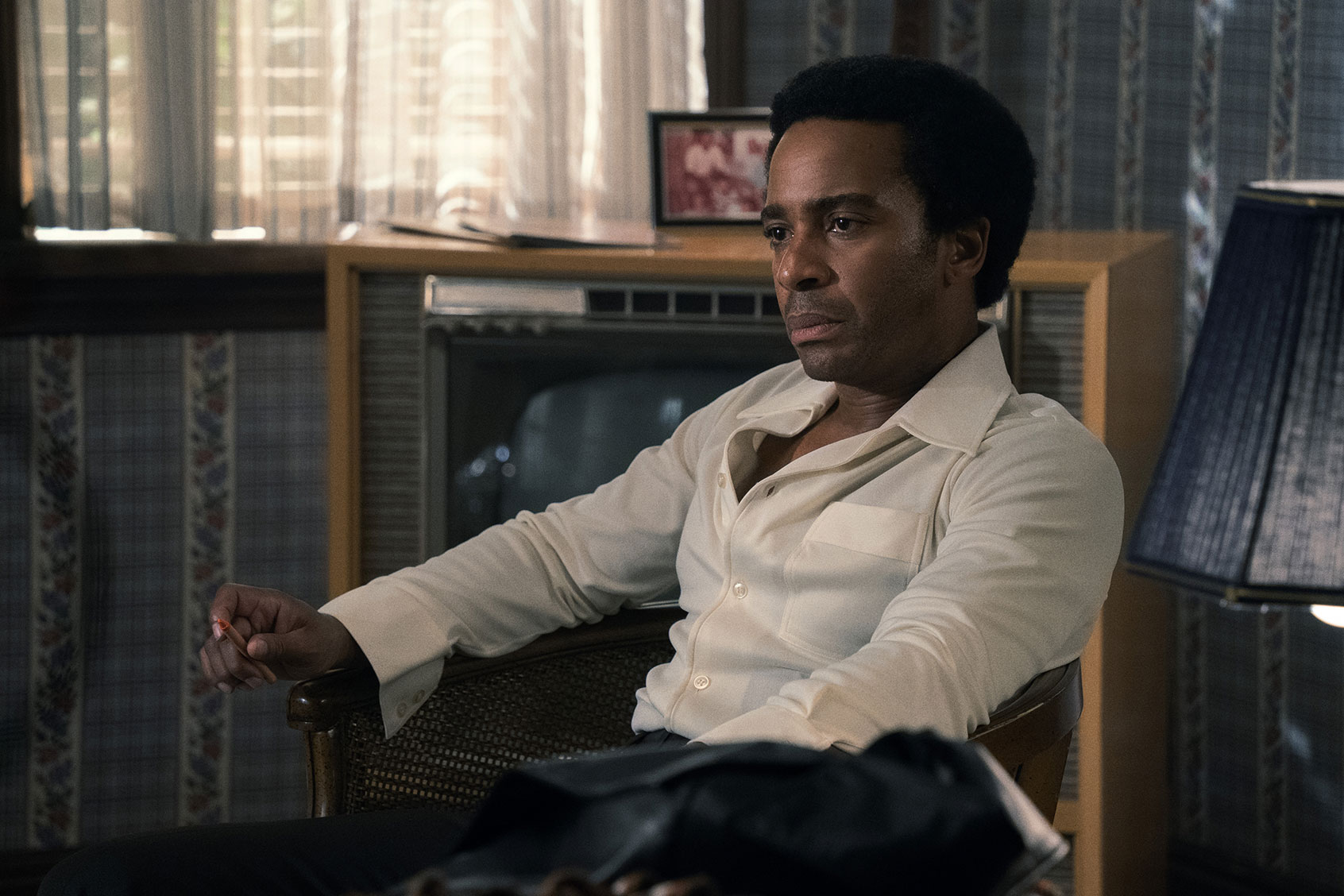
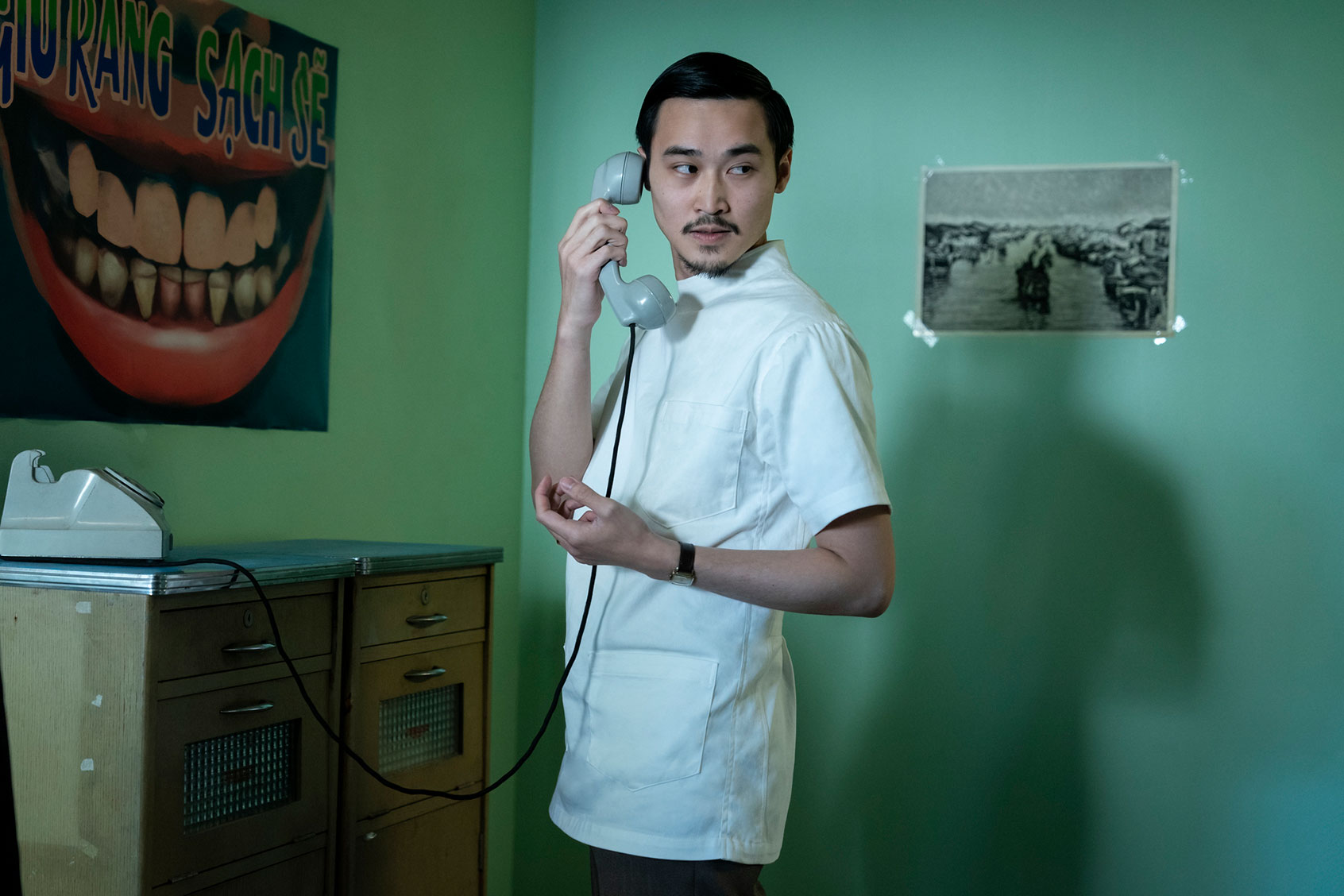
The Big CigarP. J. Byrne in "The Big Cigar" (Apple TV+)Black Panthers like Elaine Brown and Bobby Seale are still alive and doing important work for Black liberation. Did the show consult any of the Panthers?

It's so interesting. So Warner Bros. had optioned the article so we had to use who was in the article and using research from Bearman who had talked to Elaine Brown, David Hilliard, Gwen Fontaine and maybe a few others. Then some other people in our staff had done projects with Panthers, and we relied on that research as well. So it was heavily researched. Ultimately, when we showed it to Fredrika Newton, she was very proud. Clearly, this is not the biopic of the Panthers, this is like a slice of pie, a slice of their history in that it's about Huey's escape to Cuba, but the fact that we were able to let an audience who might not know what Huey and Bobby Seale and all of them, did, those scenes helped bring that story to life.

What was the process like for casting the role of Huey? Did it take a while? How did you finally land on Andre, and why is he the right person to play Huey? 

Andre was truly the only choice to play Huey. We put a feeler out to see whether he was interested. Our agents said not only is he interested, he has an available window at a certain time period. There was no audition, there was sort of an overture, an overture back of, "Yes, I'd be interested," and that it was just a done deal. He is truly one of the greatest actors of our time. He's just a brilliant actor, and he brought all the layers and gravitas to this part. That blew us away every single day on set. It's one of the biggest takeaways of the show for me to have been able to work with Andre and to see his magic daily.

Also, another powerhouse, Don Cheadle directs two episodes this season. How and why was he brought onto the project? What did he bring?

We needed an amazing artist to bring to life the first two episodes. Don is a phenomenal director. He created a vision that took us through basically three time periods. We got him first then Andre. It was Don then Andre locked in. But we had seen his work and his phenomenal movie "Miles Ahead." And then he had also directed episodes of "House of Lies" and "Black Monday" and he just understood the tone. It's a tricky tone because we want to have drama, but we also want to have humor.

Don knew how to handle the tone without letting the humor capsize the drama and the stakes that the Black Panthers were facing. You can't really compare the two. The Black Panthers had their life on the line every single day. Huey Newton was fighting for the Black community, fighting for equality. And he was doing it in a way where there were real stakes. The government was after him. COINTELPRO tactics were being used to try to take him down. We never wanted that to be equated to what it's like to make a movie in Hollywood or come from the privileged background that Bert came from, as a child of the head of a studio. So he just kept his eye on the ball and when you witness the collaboration between Cheadle and Andre Holland and you can see how great he is with actors, as witnessed by the tour de force performance of Andre Holland.

The Big CigarAndré Holland in "The Big Cigar" (Apple TV+)What was the balance you wanted to achieve with depicting Huey as both an iconic civil rights leader and a man?

We wanted to show how a small idea on a college campus of two college kids – of Huey Newton and Bobby Seale – turned into the Black Panther Party. They decided to open law books and use the Second Amendment to their benefit, to police the police, to stop police violence. They then made this decision, Huey, to move the party toward the social programs. We really wanted to show that movement of, this is the way to get equality in the Black community and in poor communities across the country. If we have food in our kids' stomachs before they go to school, they can actually learn better if we have housing programs, medical clinics, all of those things. So while we wanted to show what it was like to emerge as a leader in the movement, we also wanted to show you all of the sort of constraints that were put upon him because he was trying to make change.

So we show his arrest. And then we show that he was in solitary confinement, which we now know, he was there for three years. We know that is a form of torture. He came out of solitary confinement after three years of being exonerated and he became an icon. We wanted to show how not only do you have this idea, but now you're a celebrity, you're an icon in the Black community. There's a "Free Huey" movement and all of the pressure that was headed toward him. That pressure leads with how do you lead the party? How do you keep the party going in the right direction? How do you not become paranoid? In his case, he was paranoid from the COINTELPRO tactics. And how do you move ahead? And so all of these layers were important. We also wanted to humanize them. So many times you see civil rights leaders, they are not humanized. And we wanted to show him laughing, falling in love. We wanted to show him getting married. We wanted to show these things that encompass a human being.

When you wrote for Huey, how did you want to depict how he wanted to use violence for the cause? Did it shift over time? He championed the cause’s more social benefits and programs because he felt like that’s where the future of the party was . . .  

Policing the police with the guns was the way they originally wanted to move the party. We show the transition from when he made a decision that he no longer wanted to police the police with guns, and he wanted to move to the social programs. I think after Lil [Bobby Hutton's] death and after the police continued to come down on the Black community, he made a decision that these arms might not be the way to get revolution. Revolution might be in education. It might be in these social programs. It might be as you'll see a subsequent episode running for office. These were all of the questions and challenges he was facing.

Could this have been the reason why he was misconstrued by his own people and the general public?

A lot of times when people latch on to an image, and we talk about iconography, we talked about what it's like to make an icon when he's sitting in the chair. He's holding the gun and a sphere. That image with the media, and with seeing them marching with guns, made it seem like they are some militant group. What people don't know and what they didn't extract from that in history was that they were using the right to bear arms as a way to protect the Black community. But it was spun like "these crazy Black people are starting a military to overthrow us," and that's not what it was. We show the change in him. But we also a lot of people don't know how gun control laws started. They don't know that there was a moment where the Republicans were totally for gun control, and that was when the Panthers marched on the [California] state capitol when [Ronald] Reagan was there. We wanted to show the movement. And then we wanted to show as you can see in Episode 2 the kind of tension with Eldridge Cleaver, as they were all trying to figure out what was the best way to move forward.

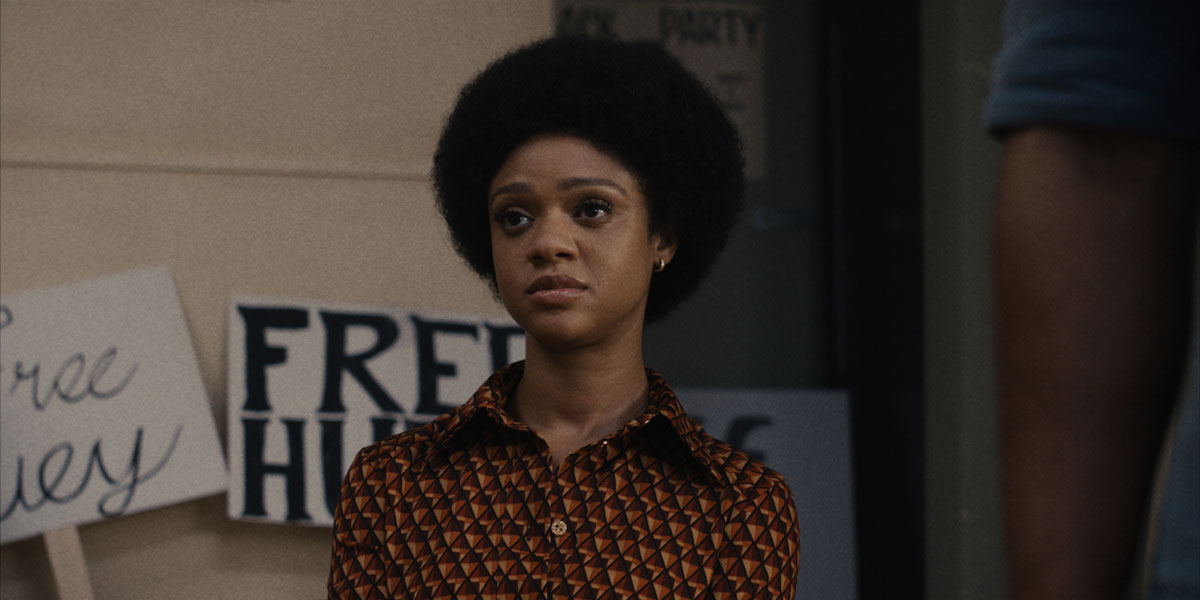
The Big CigarTiffany Boone in "The Big Cigar" (Apple TV+)Huey’s own relationship with women is complicated. He was a womanizer, an addict, and there are reports of domestic abuse within the party . . . How important was capturing all the sides of him?

"Gwen Fontaine, who was also a Panther is the confidant and she is the person who risked her life."

He's a complicated figure. As a woman and as a writer and showrunner I thought it was important that we take a snapshot of who he was as a man. And we definitely show that women were attracted to him. He was attracted to women, we show that. We show the complications with addiction, and we start to scratch the surface of who he was as a person as he struggled with addiction and as he struggled through making change. We're not doing the five-hour biopic on him. We are giving you a glimpse into who he was as a man and hoping that somebody will pick up the baton and dig deeper into not only the whole movement into him and all of the years that he was alive, fighting for us. 

Another interesting part of the show is the women who held the party down. You have fictional characters like Teressa Dixon played by Moses Ingram. She is one of Huey’s closest friends and something more as well. What was it really like for women in the party, and how did you want to portray it in the show?

Well, again, because we had the rights to the article, and we were only doing a bird's eye view of the party. We could not unpack all of the contributions of all the amazing women — that story needs to be done. We wanted to show that when he was making the decision to leave the party, it was getting handed over to women. We wanted to acknowledge that Elaine Brown was going to take over in the party but we didn't dramatize her. We also wanted to show that Teressa was a version of a strong woman that was within the party. You see other characters outside of the bar when the police bite, you see another woman who is actually Don Cheadle's daughter, she exemplifies the strong Black, female Panthers as well.

And then Gwen Fontaine, who was also a Panther is the confidant and she is the person who risked her life. She risked maybe never seeing her kids again. She risked all of that to go with Huey on this journey, to hopefully make it to exile in Cuba. And so we wanted to show that she was a woman who had his ear, but also who was there during this, probably one of the most challenging times in his life. I don't know but that was what I would think but she was there for that. And we wanted to show that love story and show Black love dramatized through this journey.

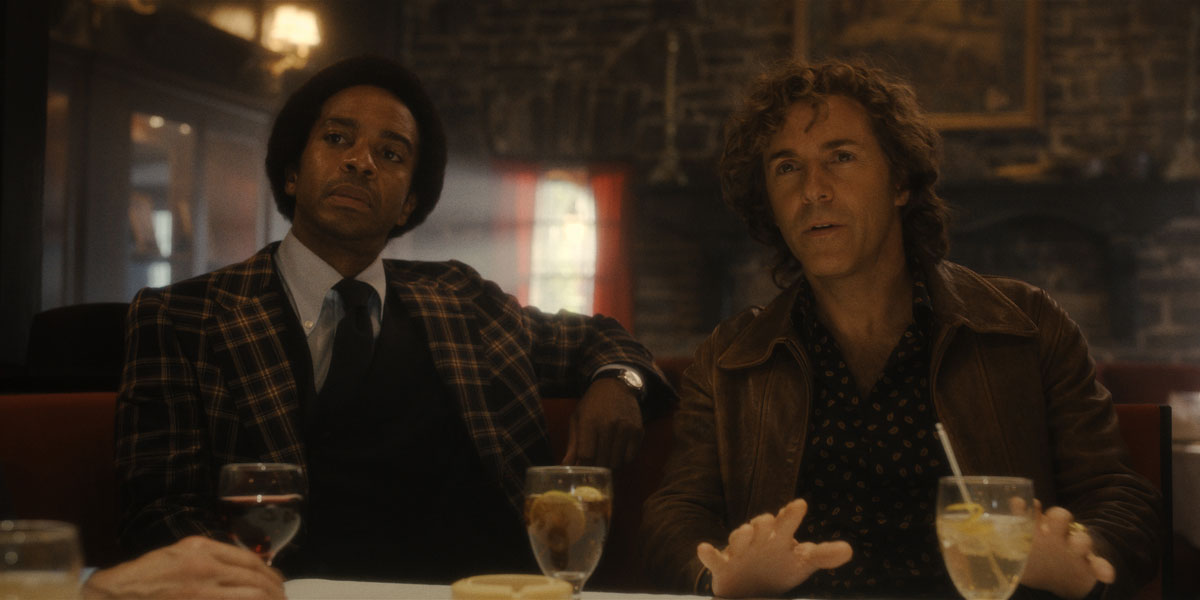
The Big CigarAndré Holland and Alessandro Nivola in "The Big Cigar" (Apple TV+)What were the conversations around Bert Schneider's characterization like? He is this big-shot movie producer, son of the head of Columbia Pictures, who would go on to win an Oscar for the bombshell Vietnam documentary “Hearts and Minds.” 

Huey and Bert, were very good friends, and we wanted to depict Bert as being this rebel who wanted to also make change in Hollywood. He had made these incredible films that had shifted moviemaking, whether you look at "Easy Rider" or you look at "Five Easy Pieces" or any of his films and the documentary, which you see him making through this piece, which is "Hearts and Minds" when she went on to win the Oscar for. There was a lot of people in Hollywood that were watching their TV seeing Black people being killed, seeing the disparity coming out of segregation. There were a lot of people, and those people in Hollywood ranged from everyone from whoever that is, you could say, Billie Holiday wrote songs about it. Diahann Carroll, all of these people – and so Bert wanted to get involved. But he also knew that he came from a privileged life where getting involved does not mean becoming the front and center of something that is not necessarily your story, but he also knew that he couldn't sit on the sidelines. 

So when you see Bert trying to give money, trying to be the word that had not emerged yet in the canon, but an ally. You know what I mean, that's not a word of that time period. But he's just trying to figure out "What do I do? How do I assist, but not get in the way?" And so he approached Huey the way he approached his films and his stars: "I am the producer. I'm gonna give you some money." Like he gave Dennis Hopper money. "I'm gonna give you some money, you go and change the world."

For some people changing the world was making a film. For Huey, it was adding to the finances that were assisting the Panthers. [Bert] at no time gave advice or leaned in on how to make things better for Black America. He understood that Huey was a revolutionary, and Huey was the person in the movement and all the Black Panthers were daily fighting. But he wanted to let some of his financial resources assist where they could assist. So Alessandro [Nivola] brought this really layered performance where you see him kind of ease back. Huey is the star, and he's just trying to figure out what can you do, which is the question I think everyone tries to figure out when they want to make change. It's like, what can you do? That's what you see him ponder through this: It's like, "What can I do? And how can I not get in the way? And how can I also not be looked upon as one of those people who didn't do anything?"

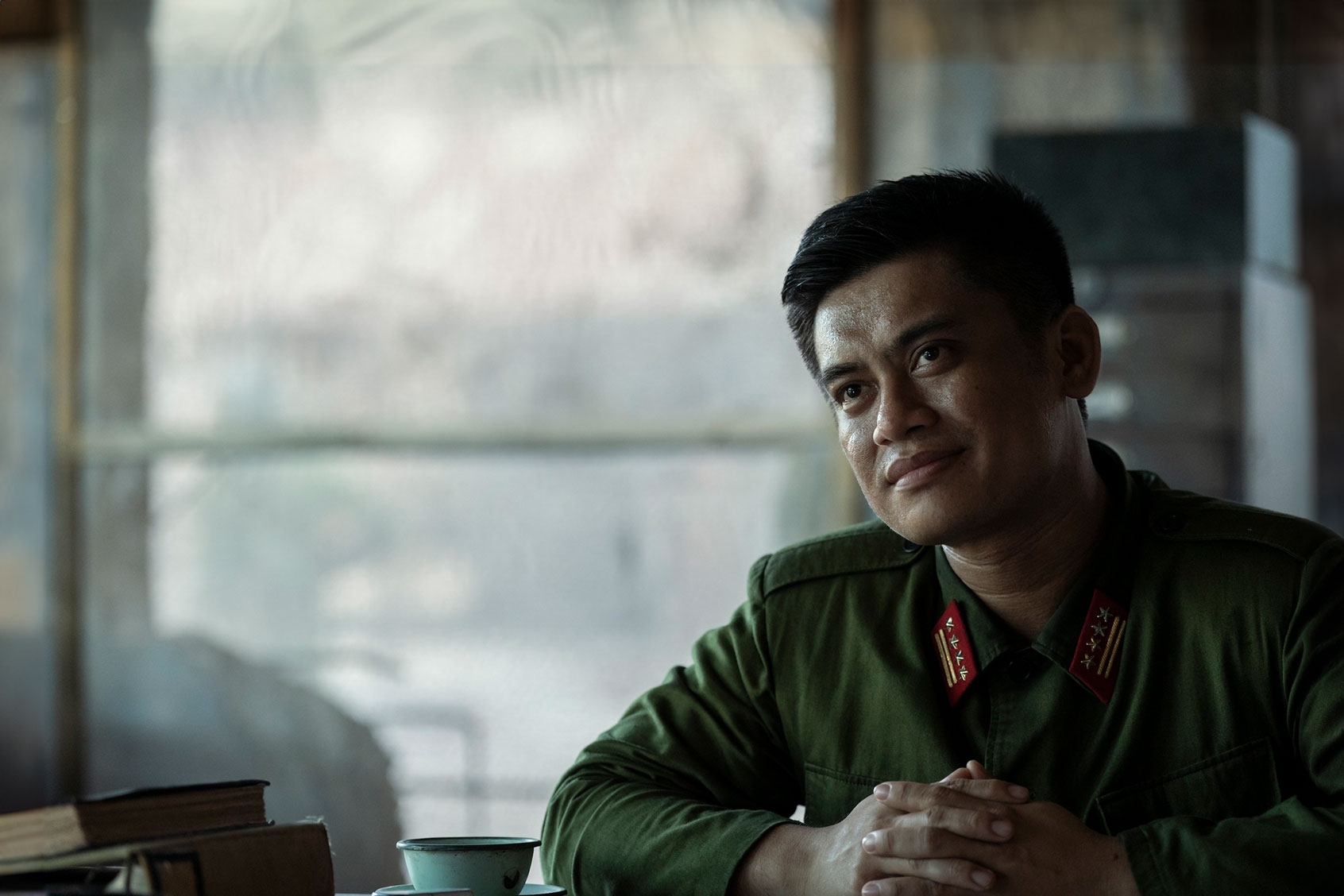
Bert is part of 1975 Oscar’s protest history because he read a letter from a Vietnamese soldier in his speech. What about this was a symbol of his moral center? Did “Hearts and Minds” really change people’s perspectives about the war?

When you look at what he did at the Oscars, when you look at I think there was a fight backstage where he got punished . . . When you look at the [Daniel] Ellsberg stuff, all of it speaks to Bert was a guy who stood up and spoke out when a lot of people were fearful of speaking out on anything. He is part of a long history of people in Hollywood, who at different times use their platforms to speak out against what they perceived as injustices. And so I think you you saw that with us with Black Lives Matter, people putting the black square on or going out into the streets or marching, and I think Bert did that throughout his life. You know, that is part of the reason why, you see these two men became friends because clearly Huey must have seen that Bert was real and his heart was in the right place. I think that's important for I think coming together is part of all of the movements. It's just people have come together at different times.

I feel like we get a glimpse of what filmmaking is like through through Burt's eyes. How does filmmaking amplify the revolution and its messaging?

We as writers, as filmmakers, as directors, as creatives in Hollywood, we might not be on the frontlines daily fighting the way the Black Panthers fought in their community daily and put their lives on the line. But what we can do is tell stories that reflect what was happening in history. Filmmaking has always done that, it has always held up a mirror to society. And in this case, while we try to hold up a mirror so again, someone can make that epic piece and you can get a hint on the Black Panthers, but also that you learned about what it was if you're a revolutionary to have to flee this country and try to run to exile. We wanted to hold that up. But filmmaking will always tell the stories, and as stories are getting challenged in books, and what you can learn about race and whether it's slavery, civil rights, women's rights, LGBTQ+ rights. As those things are getting challenged of what you can learn in school, it's more imperative than ever that kids will be able to access these projects so that they can look further and do a deeper dive, and so that they're not forgotten. 

People's differences in politics can result in many different actions – we see this with protesting today with BLM, Pro-Palestine and the splinter in America’s own left. What did you want to depict about the impact of the Black Panthers?

We wanted to shine a light on their great work — their work continues the baton. It has been passed on to Fredrika Newton, who eventually when Huey gets back from Cuba, he and Gwen eventually get divorced and he marries Fredrika, who was also a Panther. She holds the baton of the Huey Newton Foundation. When you look at the work she is doing in Oakland, and all of the activists in Oakland, you can see that it's imperative for all of us to get involved to help change or make the world better. 

At the end of the show, you flash forward to the reality that in 2024 there are still plenty of reasons why we need to continue to protest and demand justice. Why was it important to look back at the past and show that there is still work to do now in the present?

For the guys, for Jim and Josh, it started 20 years ago, then 12 years ago. I mean they have long standings with it. But for me, this project has been six years. And so it started in 2018. While we were in the writers' room on the show, we went through 2020. We went through Black Lives Matter and we're still in it. We're still in the struggles that came out of Black Lives Matter. It was just important for us to say what they were fighting for back then. That's why they decided to get in the streets; it was to stop violence and in this same vein is why people throughout the world got in the streets after the murder of George Floyd, Breonna Taylor and Michael Brown. It is the same thing that occurred that got people in the streets protesting. We wanted to show you what happened in history but also show you that history sometimes repeats itself. It's up to you to make change in your own community to vote, to get involved, to get active if you want to see the world become a better place.

"The Big Cigar," which premiered May 17, is streaming on Apple TV+ with new episodes released each Friday.

“Straight-up theocracy”: At Texas GOP convention, Republicans call for spiritual warfare

Sign up for The Brief, The Texas Tribune’s daily newsletter that keeps readers up to speed on the most essential Texas news.


SAN ANTONIO — From his booth in the exhibit hall of the Texas GOP’s 2024 convention, Steve Hotze saw an army of God assembled before him.

For four decades, Hotze, an indicted election fraud conspiracy theorist, has helmed hardline anti-abortion movements and virulently homophobic campaigns against LGTBQ+ rights, comparing gay people to Nazis and helping popularize the “groomer” slur that paints them as pedophiles. Once on the fringes, Hotze said Saturday that he was pleased by the party's growing embrace of his calls for spiritual warfare with “demonic, Satanic forces” on the left.

From left: Conservative activists Steven Hotze and Jared Woodfill enter the Senate gallery during the afternoon session of Day 1 of the Ken Paxton impeachment trial in the Texas Senate on Sept. 5, 2023.

From left: Conservative activists Steven Hotze and Jared Woodfill enter the Senate gallery during the afternoon session of Day 1 of the Ken Paxton impeachment trial in the Texas Senate on Sept. 5, 2023. Credit: Bob Daemmrich for The Texas Tribune

“People that aren’t in Christ have wicked, evil hearts,” he said. “We are in a battle, and you have to take a side.”

Those beliefs were common at the party’s three-day biennial convention last week, at which delegates adopted a series of new policies that would give the party unprecedented control over the electoral process and further infuse Christianity into public life.

Delegates approved rules that ban Republican candidates — as well as judges — who are censured by the party from appearing on primary ballots for two years, a move that would give a small group of Republicans the ability to block people from running for office, should it survive expected legal challenges. The party’s proposed platform also included planks that would effectively lock Democrats out of statewide office by requiring candidates to win a majority of Texas’ 254 counties, many of which are dark-red but sparsely populated, and called for laws requiring the Bible to be taught in public schools.

Those moves, delegates and leaders agreed, were necessary amid what they say is an existential fight with a host of perceived enemies, be it liberals trying to indoctrinate their children through “gender ideology” and Critical Race Theory, or globalists waging a war on Christianity through migration.

Lt. Governor Dan Patrick speaks during the Texas GOP Convention Thursday, May 23, 2024 in San Antonio.

Lt. Gov. Dan Patrick speaks during the Texas GOP Convention on Thursday, May 23, 2024 in San Antonio. Credit: Eli Hartman/The Texas Tribune

Those fears were stoked by elected officials in almost every speech given over the week. “They want to take God out of the country, and they want the government to be God,” Lt. Gov. Dan Patrick said Thursday morning.

“Our battle is not against flesh and blood,” Sen. Angela Paxton, R-McKinney, said Friday. “It is against the spiritual forces of evil in the heavenly realms.”

”Look at what the Democrats have done,” U.S. Sen. Ted Cruz, R-Texas, said Saturday. “If you were actively trying to destroy America, what would you do differently?”

[“The house is on fire”: Texas GOP plots its next chapter amid civil war, depleted staff, funding drops]

Controlling elections

The Texas GOP’s conventions have traditionally amplified the party’s most hardline activists and views. In 2022, for instance, delegates approved a platform that included calls for a referendum on Texas secession; resistance to the “Great Reset,” a conspiracy theory that claims global elites are using environmental and social policies to enslave the world’s population; proclamations that homosexuality is an “abnormal lifestyle choice”; and a declaration that President Joe Biden was not legitimately elected.

The 2024 convention went a step further.

It was the first Texas GOP convention set against the backdrop of a civil war that was sparked by the impeachment of Attorney General Ken Paxton and inflamed by scandals over white supremacists and antisemites working for the party’s top funders, West Texas oil billionaires Tim Dunn and Farris Wilks. This year’s convention was also sparsely attended compared to past years, which some longtime party members said helped the Dunn and Wilks faction further consolidate their power and elect their candidate, Abraham George, for party chair.

“What we're seeing right now is a shift toward more populism,” said Summer Wise, a former member of the party’s executive committee who has attended most conventions since 2008, including last week’s. “And the [party’s] infrastructure, leadership, decision-making process, power and influence are being controlled by a small group of people.”

Texas Attorney General Ken Paxton and his wife Senator Angela Paxton wave to conventioneers during the Texas GOP Convention Thursday, May 23, 2024 in San Antonio.

Texas Attorney General Ken Paxton and his wife, state Sen. Angela Paxton, R-McKinney, wave to attendees during the Republican Party of Texas convention in San Antonio on Thursday, May 23, 2024. Credit: Eli Hartman/The Texas Tribune

That shift was most evident, she said, in a series of changes to the party’s rules that further empower its leaders to punish dissent. The party approved changes that would dramatically increase the consequences of censures — which were used most recently to punish House Speaker Dade Phelan for his role in impeaching Paxton, and against U.S. Rep. Tony Gonzales for voting for gun safety legislation.

Under the changes, any person who is censured by the party would be banned for two years from appearing on GOP primary ballots — including judges, who are elected in partisan races but expected to be politically neutral once on the bench. The party also voted to unilaterally close its primaries, bypassing the Legislature, in a move intended to keep Democrats from voting in Republican primaries.

“It’s pretty hypocritical,” Wise said of the changes, which legal experts and some party members expect will face legal challenges. “Republicans have always opposed activist judges, and this seems to be obligating judges to observe and prioritize party over law — which is straight-up judicial activism.”

The convention came amid a broader embrace of Christian nationalism on the right, which falsely claims that the United States’ founding was God-ordained and that its institutions and laws should reflect their conservative, Christian views. Experts have found strong correlations between Christian nationalist beliefs and opposition to migration, religious pluralism and the democratic process.

[Proposed Texas GOP platform calls for the Bible in schools, electoral changes that would lock Democrats out of statewide office]

Wise said she has seen parts of the party similarly shift toward dogmatic political and religious views that have been used “to justify or rationalize corrupting the institution and stripping away its integrity, traditions, fundamental and established principles" — as if “‘God wants it, so we can rewrite the rules.’”

“Being Republican and being Christian have become the same thing,” she said. “If you're accused of being a (Republican in Name Only), you're essentially not as Christian as someone else. … God help you if you're Jewish.”

The “rabbit hole”

Bob Harvey is a proud member of the “Grumpy Old Men’s Club,” a group in Montgomery County that he said pushes back against Fox News and other outlets that he claims have been infiltrated by RINOs.

“People trust Fox News, and they need to get outside of that and find alternative news and like-minded people,” Harvey, 71, said on Friday, as he waited in a long line to meet Kyle Rittenhouse, who has ramped up his engagement in Texas politics since he was acquitted of homicide after fatally shooting two Black Lives Matter protesters.

Rather, Harvey’s group recommends places such as the Gateway Pundit, Steve Bannon’s Breitbart News or the Epoch Times, a far-right website that also had a booth at this year’s convention and is directly linked to the Falun Gong, a hardline anti-communist group.

Such outlets, Harvey said, are crucial to getting people “further down the rabbit hole,” after which they can begin to connect the dots between the deep-state that has spent years attacking former President Donald Trump, and the agenda of the left to indoctrinate kids through the Boy Scouts of America, public schools and the Democratic Party.

Harvey’s views were widely-held by his fellow delegates, many of whom were certain that broader transgender acceptance, Critical Race Theory or “diversity, equity and inclusion” initiatives were parts of a sinister plot to destroy the country and take over its churches.

The culprits behind the ploy differed — Democrats, socialists or “globalists,” to name a few. But their nefarious end goals loomed over the convention. Fearing a transgender takeover of the Republican Party of Texas, delegates pushed to explicitly stipulate that the party’s chair and vice chair must be “biological” men or women.

At events to recruit pastors and congregations to ramp up their political activism, elected leaders argued that churches were the only thing standing between evil and children. And the party’s proposed platform included planks that claim gender-transition care is child abuse, or urge new legislation in Texas that's "even more comprehensive" than Florida’s so-called “Don’t Say Gay” law, which prohibits the teaching of sexual orientation or gender identity in public schools.

Kyle Rittenhouse shakes hands with conventioneers at a meet and greet during the Texas GOP Convention Thursday, May 23, 2024 in San Antonio.

Kyle Rittenhouse shakes hands with conventioneers at a meet and greet during the Texas GOP convention on Thursday in San Antonio. Credit: Eli Hartman/The Texas Tribune

“Our next generation is being co-opted and indoctrinated where they should have been educated,” Rep. Nate Schatzline, R-Fort Worth, said at a Friday luncheon for pastors and churches. “We are in a spiritual battle. This isn't a political one.”

For at least a half-century, conservative Christian movements have been fueled by notions of a shadowy and coordinated conspiracy to destroy America, said Mark Chancey, a religious studies professor at Southern Methodist University who focuses on movements to put the Bible in public schools.

“It's like the boogeyman that won't go away, that gets summoned whenever a justification is needed for these types of agendas,” he said. “They say that somebody is threatening quintessential American freedoms, and that these threats are posed by some sort of global conspiracy — rather than just recognizing that we're a pluralistic democracy.”

In the 1950s, such claims were the driving force behind the emergence of groups such as the John Birch Society, a hardline anti-communist group whose early members included the fathers of conspiracy theorist Alex Jones and Trump. After decades of dwindling influence, the society has seen a revival since Trump's 2016 election. And in the exhibit hall last week, so-called Birchers passed out literature and pamphlets that detailed the New World Order's secret plans for "world domination."

Steve Oglesby, field director for the Birch Society's North Texas chapter, said interest and membership in the group has been on the rise in recent years — particularly, as COVID-19 lockdowns and international climate change initiatives have spurred right-wing fears of an international cabal working against the United States.

"COVID really helped," he said, adding that the pandemic proved the existence of a global elite that has merely shifted its tactics since the 1950s. “It’s not just communism — it’s the people pulling the strings.”

Throughout the week, prominent Republicans invoked similar claims of a coordinated conspiracy against the United States. On Friday, Patrick argued that a decadeslong decline in American religion was part of a broader, “Marxist socialist left” agenda to “create chaos,” including through migration — despite studies showing that migrants are overwhelmingly Christian. Attorney General Ken Paxton echoed those claims in his own speech minutes later, saying migration was part of a plan to "steal another election."

“The Biden Administration wants the illegals here to vote,” he said.

Ella Maulding and Konner Earnest watch as Lt. Governor Dan Patrick speaks during the Texas GOP Convention Thursday, May 23, 2024 in San Antonio.

Ella Maulding and Konner Earnest watch as Lt. Gov. Dan Patrick speaks during the Republican Party of Texas convention in San Antonio on Thursday, the first day of the gathering. Credit: Eli Hartman/The Texas Tribune

As Paxton continued, Ella Maulding and Konner Earnest held hands and nodded their approval from the convention hall’s front row. Last year, the two were spotted outside of a Tarrant County office building where Nick Fuentes, a prominent white nationalist and Adolf Hitler fan, was hosted for nearly seven hours by Jonathan Stickland, then the leader of Dunn and Wilks' most powerful political action committee. They eventually lost their jobs after The Texas Tribune reported on their ties to Fuentes or white nationalist groups.

Maulding has been particularly vocal about her support for Great Replacement Theory, a conspiracy theory that claims there is an intentional, often Jewish-driven, effort to replace white people through migration, LGBTQ+ acceptance or interracial marriage. Once a fringe, white nationalist worldview, experts say that Great Replacement Theory has been increasingly mainstreamed as Republican leaders, including some who spoke last week, continue to claim that migration is part of a coordinated effort to aid Democrats. The theory has also been cited by numerous mass shooters, including the gunman who murdered 22 Hispanic people at an El Paso WalMart in 2019.

Five hours after Paxton and Patrick spoke, Maulding took to social media, posting a cartoon of a rabbi with the following text: “I make porn using your children and then make money distributing it under the banner of women’s rights while flooding your nation with demented lunatics who then rape your children.”

David Barton

Kason Huddleston has spent the last few years helping elect Christians and push back against what he believes is indoctrination of children in Rowlett, near Dallas. Far too often, he said, churches and pastors have become complacent, or have been scared away from political engagement by federal rules that prohibit churches from overt political activity.

Through trainings from groups like Christians Engaged, which advocates for church political activity and had a booth at this year’s convention, he said he has been able show more local Christians that they can be “a part of the solution” to intractable societal ills such as fatherlessness, crime or teen drug use. And while he thinks that some of his peers’ existential rhetoric can be overwrought, he agreed that there is an ongoing effort to “tear down the family unit” and shroud America’s true, Christian roots.

“If you look at our government and our laws, all of it goes back to a Judeo-Christian basis,” he said. “Most people don’t know our true history because it’s slowly just been removed.”

He then asked: “Have you ever read David Barton?”

Since the late 1980s, Barton has barnstormed the state and country claiming that church-state separation is a “myth” meant to shroud America’s true founding as a Christian nation. Barton, a self-styled “amateur historian” who served as Texas GOP vice chair from 1997 to 2006, has been thoroughly debunked by an array of historians and scholars — many of them also conservative Christians.

David Barton, left, of WallBuilders talks with a delegate as he poses for photos at a Texas Eagle Forum reception at the Texas Republican Convention in Fort Worth on June 7, 2012.

David Barton, left, of WallBuilders, at a Texas Eagle Forum reception at the Republican Party of Texas convention in Fort Worth on June 7, 2012. Credit: Bob Daemmrich for The Texas Tribune

Despite that, Barton’s views have become widespread among Republicans, including Patrick, Texas Supreme Court Justice John Devine and U.S. House Speaker Mike Johnson. And his influence over the party was clear at last week’s convention, where his group, WallBuilders, maintained a booth and delegates frequently cited him.

This year’s platform, the votes for which are expected to be released later this week, included planks that urged lawmakers and the State Board of Education to “require instruction on the Bible, servant leadership and Christian self-governance,” and supports the use of religious chaplains in schools — which was made legal under a law passed by the state Legislature last year.

Warren Throckmorton, a former Grove City College professor and prominent conservative, Christian critic of Barton, told the Tribune that the platform emblematized Barton’s growing influence, and his movement’s conflicting calls to preserve “religious liberty” while attempting to elevate their faith over others. The platform, he noted, simultaneously demands that students’ religious rights be protected, and for schools to be forced to teach the Bible.

“What about the other students who aren’t Christians and who don't believe in the Bible?” he said. “This is not religious liberty — it’s Christian dominance.

As Zach Maxwell watched his fellow Republicans debate and vote last week, he said he was struck by the frequency and intensity with which Christianity was invoked. Maxwell previously served as chief of staff for former Rep. Mike Lang, then the leader of the ultraconservative Texas House Freedom Caucus, and he later worked for Empower Texans, a political group that was funded primarily by Dunn and Wilks.

He eventually became disillusioned with the party’s right wing, which he said has increasingly been driven by purity tests and opposition to religious or political diversity. This year’s convention, he said, was the culmination of those trends.

“God was not only used as a tool at this convention, but if you didn’t mention God in some way, fake or genuine, I did feel it was seen as distasteful,” he said. “There is a growing group of people who want to turn this nation into a straight-up theocracy. I believe they are doing it on the backs of people who are easily manipulated.”

Disclosure: Southern Methodist University has been a financial supporter of The Texas Tribune, a nonprofit, nonpartisan news organization that is funded in part by donations from members, foundations and corporate sponsors. Financial supporters play no role in the Tribune's journalism. Find a complete list of them here.

Nancy Leclerc poses for a photo in front of a GOP elephant statue during the Texas GOP Convention Thursday, May 23, 2024 in San Antonio.

Nancy Leclerc poses for a photo in front of a GOP elephant statue during the Texas GOP convention in San Antonio on Thursday, May 23, 2024. Credit: Eli Hartman/The Texas Tribune


We’ve got big things in store for you at The Texas Tribune Festival, happening Sept. 5–7 in downtown Austin. Join us for three days of big, bold conversations about politics, public policy and the day’s news.

This article originally appeared in The Texas Tribune at https://www.texastribune.org/2024/05/28/texas-gop-convention-elections-religion-delegates-platform/.

The Texas Tribune is a member-supported, nonpartisan newsroom informing and engaging Texans on state politics and policy. Learn more at texastribune.org.

David Cay Johnston: “Trump’s bad behavior is going to cost him big in the hush-money trial”

Donald Trump returns today to a Manhattan courtroom where his attorneys are set to conclude their defense in the ex-president’s election interference trial. Trump did not testify in his own defense. 

As leading historian Heather Cox Richardson notes in her newsletter: "Trump's refusal to take the stand encapsulates the MAGA approach to politics. Since the 2020 presidential election, he and his surrogates have made repeated accusations and statements about how the system is rigged against them and alleged there is evidence that proves them right. Crucially, they make those arguments only in front of television cameras or on podcasts and radio. They refuse to make them under oath in a court of law, where there are penalties for lying." 

Donald Trump’s three other criminal trials have encountered significant delays. This means that the only chance to hold Trump somewhat responsible for his decades-long crime spree is a lurid hush-money trial. Public opinion polls and other research show that a guilty conviction in the hush-money trial (or the other three criminal trials) may sway enough Americans to either vote against or otherwise not support Trump in the 2024 election. Many legal experts have concluded that it is much more likely than not, given the extreme preponderance of the evidence and lacking quality of his defense, that Donald Trump will be found guilty in this first, and perhaps only, criminal trial.

That the future of America’s multiracial democracy could ultimately be decided by a jury’s decision in a hush-money trial, is a condemnation of America’s political culture and larger society. Such a reality should cause all reasonable Americans a great amount of anxiety and concern about the future of their country and its democracy.

"Donald Trump's conviction is as close to a certainty as you will ever get in a trial."

Ultimately, Donald Trump’s criminal trial and possible conviction should not be celebrated. That the country elected such a man who was and is demonstrably unfit for the presidency (and who is trying to take back the White House and is now tied with President Biden in the early 2024 election polls) should be a source of national shame and embarrassment.

In an attempt to make better sense of Donald Trump’s hush-money trial, what happens next with the jury and sentencing, if the much-discussed “walls” have finally closed in on Trump and how the corrupt ex-president is processing this reality, and the possibilities of violence by political cultists, I recently spoke with David Cay Johnston. He is a Pulitzer Prize-winning investigative reporter and bestselling author who teaches at Syracuse University College of Law, although he is not a lawyer. He has written three books about Donald Trump, who Johnston has covered for 36 years.

This interview has been lightly edited for length and clarity

Given your decades of experience with Donald Trump, how are you feeling given the imminent verdict in the hush-money trial, and the historic nature of these events more broadly? How are you making sense of this?

Donald Trump hurt his own cause during his hush-money trial. Trump did much the same thing during the E. Jean Carroll defamation trial. Instead of accepting the advice of his counsel — and there's a reason we refer to lawyers as "counsel" — he told them what to do. You could see this in the cross-examinations of both Stormy Daniels and Michael Cohen. Instead of asking the questions that would hurt their claims and credibility in front of the jury and do some real damage, and then sitting down, Trump's attorneys went on and on and on. In the process, they created opportunities that were taken advantage of by both Daniels and Cohen to damage Donald Trump. Trump clearly ordered his attorneys to take that approach.

In my opinion, Donald Trump's conviction is as close to a certainty as you will ever get in a trial. I'm not surprised that he did not take the stand. Trump would never do that. His lawyers would have told him that it was suicide. And had Trump taken the stand and testified he would have absolutely talked himself straight into a conviction. His whole life is built on lies, and he can't keep those lies straight.

What about your emotions?

For me, this is all professional. All I want to do is hold Trump responsible for what he has done. I don't really care about him personally. That's always been my attitude. I cover Donald Trump because 36 years ago, I realized that this guy is going to be a big force in American culture. I started building files on him and carefully covering him for long periods of time. My approach to Donald Trump is to expose and counter his myths with old school, solid, shoe-leather reporting. 

Where are we with the narrative that the much-discussed "walls" are finally closing in on Donald Trump?

If Donald Trump is in fact convicted in the Manhattan criminal case as I expect will happen, we are going to see support for him drop in the polls. Much Trump polling support is soft. There are a lot of Americans who cannot stomach the notion of a convicted felon being president. But at this same time, it's become very clear—to the point that even Utah Senator Mitt Romney is saying this—that a large segment of the Republican Party doesn't believe in democracy, and they're perfectly happy to live under a dictatorship. Now, that tells me that these people do not know what a dictatorship means.

We need your help to stay independent

Let me be very clear here. If the United States becomes a dictatorship there will eventually be firing squads and other massive violence against "enemies" of the state. I know that I’m probably going to be one of the people in front of those firing squads because Trump has said he hates me more than any other journalist. Killing people is what dictators do. Dictator Trump and his successors would be no different. Donald Trump shared a video on his Truth Social site which stated that he was going to establish a "unified Reich." He's since taken that video down and is blaming it on a junior staffer. Trump always wants plausible deniability. But people shouldn't mistake what's going on here. I've been telling people for at least nine years that Trump intends to become America's first dictator. He doesn't know what's in the Constitution. He claims to have the power to do anything—including murdering people—as president. 

How are you assessing the mainstream news media's coverage of the hush-money trial?

I think there's been a great deal of variation in the quality of the coverage and commentary. It's mostly dependent on the quality of a given journalist's knowledge of the law. Most journalists are generalists; they don't know everything. When you see lawyers like Lisa Rubin and Andrew Weissmann, who are being paid by MSNBC, talk about what happened in the courtroom, you're getting a serious discussion. Yes, it may sometimes get more into the weeds than I think is necessary but, you are going to have a very serious discussion. Much of the general interest coverage is by reporters who do not understand the basics of how trials work. In my opinion, the cable stations have done pretty well. By comparison, the three network newscasts have depended entirely on the quality of the journalist covering the hush-money trial.

You have repeatedly said that Donald Trump is basically done for and will be convicted in this first criminal trial. I have had other experts, both on and off the record, counsel that the American people — and those of us publicly discussing and writing about Trump and these trials and the democracy crisis — should be much more cautious given the technical nature of the charges and how mercurial juries can be. Your intervention?

The elements of the hush-money case have all been established at trial. The prosecution has established the falsification of the records, the payment of the checks. They've introduced into evidence, tape recordings showing that Donald Trump knew exactly what was going on. Furthermore, Trump's mindset was not that he was protecting his wife Melania. Trump literally disavowed that as a defense by saying he didn't care, and he tried to delay paying Stormy Daniels roughly a week before the election. Trump's reasoning was that “I won't have to pay her because either I'll be president and I can take care of it or I won't be president and it won't matter.”

"A large segment of the Republican Party doesn't believe in democracy, and they're perfectly happy to live under a dictatorship."

Also, this jury is unusual in a very important way. It is a highly educated jury that includes two lawyers. Of note, there are six alternates. Normally a criminal trial has two alternates. This tells us that Judge Juan Merchan was concerned that there'd be a ringer, a Trump MAGA supporter. If there is a single juror holding out who won't pay attention to the facts, the judge can replace that juror and order the new jury to start deliberations over. On the evidence, the best Donald Trump can hope for is a hung jury. But the judge has already taken care of this by having six alternates.

What is your assessment of Michael Cohen's "performance" during the trial?

I actually thought Michael Cohen did very well on the witness stand. He got some sharp points in on cross-examination because Trump's lawyers instead of sitting down asked all gratuitous additional questions at Trump's insistence. It is common for law enforcement to use criminals to go after other criminals, including people who are hitmen and major drug dealers. My experience as a journalist has been that some of the best sources I've had were people whose reputations were that they lie all the time. Michael Cohen was paid by Donald Trump to lie. But once it became in their interest to tell the truth, these types of crooks have been among the best sources of my entire career, because they had an interest in being truthful with me. Of course, Michael Cohen has nothing but bad things to say about Donald Trump given how the Justice Department under Trump’s administration went after him. Cohen is biased against Trump – and with good reason. But that does not matter. In the end, it is the truth of the matter, not Michael Cohen's attitude. That is what matters to the jury.

What do the reactions of the jury tell us about the hush-money case?

I haven't been in the jury room or the overflow room. So, my reporting here is second-hand. The reporters and journalists who are physically there have said that the jury has been quite attentive and that they've paid close attention to some of the key elements of proving the case. The prosecutors, for example, went through the details of each check. The jurors were paying close attention to those details.  Trump has repeatedly fallen asleep in the courtroom, rolled his eyes and made other facial expressions in disgust. That doesn't go over well with jurors. They feel disrespected as jurors.

Is this strategic? Trump just being his regular horrible self? Something else?

Trump is clearly showing his contempt for the jury. Juries pay attention to how you react, if you're sitting at the defense table. If someone says something important about a case they look to you, the defendant, to see how you react. Are you stone faced? Are you smiling? Are you cowering? Donald hurts himself here. It is important to understand that Donald Trump has no empathy for anyone. That includes his children. We are objects to Donald Trump, not people. That includes the people closest to him. This is a man who has lived a miserable life. Trump's bad behavior in court cost him real money in the second E. Jean Carroll defamation case. Likewise, Trump's bad behavior is going to cost him big in the hush-money trial too. The big question is, how long will the jury be out? Because there are two lawyers on this jury, they're not going to go out and come back in 20 minutes. But I'd be surprised if the jury is out more than one full day, or two at the most. If it goes on beyond that I would be surprised and that suggests something else is going on.

I am a lifelong comic book and graphic novel reader. What is in the thought bubble over Trump's head? You know him. What's going on in his mind? 

How can these insignificant nothings pass judgment on me, the greatest person who's ever lived, the world's leading expert on everything? How dare they!


Want a daily wrap-up of all the news and commentary Salon has to offer? Subscribe to our morning newsletter, Crash Course.


Does Donald Trump really believe such things? 

Donald Trump knows that he is a fraud. He has persuaded himself to believe in the narrative about himself that he has created, however untrue it is. The problem with Donald Trump's personal narrative is that it is a reaction to the monster his father was, to the desperate emptiness inside that he tries to fill with claims that he has all this wealth that he doesn't actually have. Bullying other people is a big part of Trump that makes sense of his life too. Trump has threatened me many times. When Donald Trump is alone at night with his thoughts, he is deeply terrified. The hush-money trial is just the start. Trump knows that at the end of the road, he is going to end up in prison. 

What do you think will happen with the resolution of the hush-money case? 

Judge Merchan, having been so careful all the way through, will follow the normal procedure. He will not have Trump immediately taken into custody. He will order a probation report, which is the standard thing you do before sentencing. Judge Merchan will then set a date for sentencing. Because of the ten criminal contempt charges, Trump may get a harsher sentence than he would have gotten otherwise if he hadn't been so recalcitrant.

What do you think will happen when Donald Trump's fantasies meet the reality of a verdict in the hush-money trial? To reiterate, do you truly believe that Donald Trump ends up in prison? A former president?

Absolutely. But not necessarily for the hush-money case.

The criminal case where Trump will get a prison sentence is the Jan. 6 case. The precedent with the other convictions in the Jan. 6 case and the attack on the Capitol shows that Trump is going to get a prison sentence. As for the classified documents case, that is more uncertain. Who knows what's going to happen with Judge Aileen Cannon, who is clearly biased in favor of Trump. She may get removed at some point. If Trump is convicted and Cannon is not the judge, he will absolutely get a prison term in the classified documents case. There are people saying that the logistics of putting Donald Trump in prison are too difficult. That is not true. There are many ways to put Trump in prison. You can put him in a wing of a prison and close the rest of it. You can put Trump in a military stockade. There are many ways to do this. The Secret Service will be with Trump, and he will be in isolated confinement. In the end, Donald Trump will go to prison and there is a reasonable chance he will either die in prison or be released on a compassionate release basis as his life is coming to an end.

There is a great deal of concern from experts in domestic terrorism, civil wars, insurgencies, and other forms of political violence that if Donald Trump is found guilty there may be significant violence by his MAGA followers and other right-wing forces. Your thoughts?

I'm not worried about that. Because of the successful prosecutions in the January 6 cases, you're not seeing crowds turning up for Donald Trump, and screaming for murder, and other acts of violence. There aren't very many people who are willing to destroy their lives or go to prison for Donald Trump, in what's clearly will be a losing effort. Will there be some violence if Donald Trump is convicted and jailed? Yes, probably. And I feel very badly for what will likely be the members of law enforcement who will be murdered by Trump's followers. But, as a nation we do not back down in the face of speculative threats or even clear and direct threats. That's not what a free people do. That is what cowards do and people who do not believe in the principles of our Constitution. If we see some violence, I believe it will be a "lone wolf" or just a couple of people. There is not going to be an insurgency or civil war over Donald Trump or some effort to overthrow the government at Trump's command. 

Biden’s age gap: As young voters pull away, baby boomers come to the rescue

There’s been a lot of coverage about how Joe Biden is “losing” the youth vote. Depending on the poll you choose to analyze, the age breakdown may show Biden losing 18-29 year-olds by 1 point or more to Donald Trump, or winning them by over 20 points. In 2020, Biden won voters ages 18-29 by 24 points therefore, since he’s consistently polled below that as of late, the general consensus is that the president’s support from this age group has softened.

Perhaps the most important and accurate poll regarding the youth vote is the Harvard Youth Poll, conducted by John Della Volpe, a longtime youth polling expert. He focuses solely on the 18-29 year-old age group. His latest poll from April showed Biden leading Trump by 19 points among likely voters in this age group. This is much more believable than Trump winning these voters by any margin. Still, the poll does show less support than Biden had in 2020.

If it is true that Biden is losing youth support—and it certainly may be—it would definitely be a bit alarming. It’s hard to know for sure this far out from the election and with all the political issues of the day swirling around in the public’s consciousness, including the Israel/Gaza situation. But many Democrats would have to wonder how Donald Trump is attracting more youths than last time, given the Democrats are perceived as the more “youth-friendly” party. Democrats generally have large margins of youth support wrapped up due to their support for more youth-oriented issues like abortion rights, LGBTQ and racial minority tolerance and acceptance, and college student aid. How could they be losing support among this cohort of voters to one of the most intolerant demagogues to run for president in history?

It’s a great question, but perhaps the wrong one to ask. Maybe the best question to ask in what is likely to be the most consequential election in modern history is “How can we gain more support among older voters”?

The turnout and voting habits of young people get a lot of attention every election cycle. And it’s true that if Democrats can maintain their historical level of support and increase turnout significantly among this bloc of the electorate, they are practically ensured victory with all else being equal. But the fact is all things are often not equal, and older voters consistently remain the key to victory. Their turnout is typically significantly higher, and they vote more reliably. And Joe Biden won in 2020 largely due to older people’s votes.

For example, according to the Pew Research Center data, in 2016 Hillary Clinton won the 18-29 year-old vote by 30 points. Joe Biden won this age group by 24 points in 2020, a net loss of 6 points, equating to a total of about 1.5 million voters. But since the turnout for this voting bloc is weak, roughly 50%, and their population is low relative to other age groups, this total amount of voters is easily surpassed in other age groups by similar, or even smaller, point swings.

Among voters 65 years or older, Clinton lost by 9 points in 2016. Biden lost this age group in 2020 by only 4 points, a net 5-point gain. Since the population of this age group is larger and they turn out at a much higher rate, about 75%, the number of voters Biden gained here was significantly bigger, roughly 2 million total voters.


The key to Joe Biden’s victory, therefore, was not the younger portion of the electorate, but the older portion, the group of 65 years or older. 

Biden held steady with Clinton’s share of voters among 50-64 year-olds and actually gained a point among 30-49 year-olds. So his popular vote victory can be accounted for by the larger overall turnout, which increased the total population of voters, and this swing among older voters, plus the small increase in share among 30-49 year-olds. 

We need your help to stay independent

Remember that Clinton actually won the popular vote by 4 million votes, and Joe Biden won by 7 million, an increase in margin of 3 million. When you take into account these age demographic shifts along with the lack of significant third-party candidates in 2020 and the increase in the overall voting population, these numbers make sense.

While it’s worth lamenting the loss of 5 points of the youth vote, and figuring out how to win them back, it can be argued that it’s even more worthwhile to figure out how to increase your margins among older voters. A 5-point swing in the 18-29 year-old vote equates to roughly 1.2 million votes, based on 2020’s turnout. You can wash that away with a 1.5-point swing in your favor among voters aged 50 and up, or with a 1-point swing of those 30 years and older.

There’s been a lot of ink spilled about Biden’s age and how it may be hurting his electoral prospects. But it could be argued that his age is helping him with older voters and therefore may continue to propel him to victory again in 2024. It does seem that those over 65 years old might start taking offense and being more motivated to vote for Biden the more people suggest that older people can’t perform the job of president well simply due to their age.

The crosstabs in many of these early polls are all over the place and tend to make little sense. But it is worth noting that the polls that show the most worrisome outcomes among younger voters tend to show significant improvement among older voters. In the poll I referenced earlier showing Biden losing to Trump by 1 point among 18-29 year-olds, Biden is ahead of Trump among the 65 years or older age group by 3 points. If this actually held in the election, this would be a 7-point swing, or about 2.7 million votes in a turnout similar to 2020s.

We could analyze these polls every which way and spend all day doing it to try to surmise a narrative for the upcoming election, but that is a fool’s errand at this stage in the election cycle. However, one thing you can certainly safely assume about the upcoming election is that older voters will vote at a much higher rate than younger voters. Therefore, small changes in that age group will induce larger election effects. That’s where the key to victory lies.

Suicides are at an all-time high in America. One of the best ways to reduce them is gun control

The ongoing mental health crisis in America is coupled with an escalating suicide crisis that reached record highs in 2022, with nearly 50,000 deaths. Almost 55% of these deaths involved firearms. While gun control is usually discussed in terms of ending mass shootings, it will also stop a lot of self-inflicted violence. One of the best strategies for addressing this issue can saves lives, though it has an intimidating name: lethal means counseling.

"The link between gun control policies and firearms is strikingly clear — less gun control correlates almost perfectly with higher state firearm deaths overall."

Lethal means counseling is when — for the safety of a person in acute distress — firearms and dangerous medications are voluntarily and temporarily stored in secure areas. Many people undergoing mental health crises are at risk of hurting themselves, whether suicidally or unintentionally. Dr. Kurt Michael, the senior clinical director at The Jed Foundation, has seen many cases in which "a person’s access to lethal means is often a primary contributing factor as to whether death is the outcome of a suicide attempt," he said.

Perhaps the best way to illustrate lethal means counseling is through two morbid scenarios: In the first, a 20-year-old person in distress went to their father’s gun cabinet, removed a loaded firearm and shot himself in the head, dying within seconds. In the second scenario, he went to the gun cabinet and couldn't find any weapons. So he used a razor to open up his wrists and was found an hour later, rushed to the hospital and survived, agreeing to seek help.

While this trolley problem is indeed dark, it's a choice many people face every day. Lethal means counseling is a way to make the worst outcomes less likely.

While it is voluntary at first, lethal means counseling still requires a person to lose some of their immediate personal agency. Nevertheless, lethal means counseling seems justifiable because the temporary loss of freedom has the consequence of prolonging their lives. A similar argument can thus be made for mandatory waiting periods, which have been linked by the nonprofit think tank the Rand Corporation with lowered suicide rates as well as lowered violent crime rates. If a person wishes to shoot themselves but cannot easily obtain a gun, it is reasonable to assume they will have more time to reconsider that terrible decision.

Dr. Jacob Smith, an assistant professor of political science at Fordham University who has studied how gun control and mental health policies correspond to firearm fatalities, suggests this does indeed happen quite often.

"In our [2017 Policy Studies Journal] paper, we mostly looked at overall gun control policies and access to mental health rather than specific policies," Smith said, explaining that most states which implement gun control laws do so more with more than one, making it difficult to assess which laws have caused what specific effect. Despite this challenge, Smith and his team still found a definite pattern in terms of how gun control laws impacted suicide rates.

"What we do find in our research is that states with more gun control laws have fewer gun deaths (including those who die by suicide from guns) and for non-suicides (homicides and accidental discharge together), a combination of more access to mental health services and an overall stricter climate for gun control laws correlates with a particularly lower rate of gun deaths," Smith said. Specifically, the team found that more access to mental health care did not correlate with lower rates of suicide by gun; stricter gun control laws, however, had that desired impact.

"This relationship is perhaps due to the fact that many mental health treatments take time to have an effect, while the effect of removing a gun (or preventing one from having it in the first place) is immediate," Smith said, adding that more access to mental health care is still good for other reasons. "It is also very difficult under existing law to remove a gun due to mental illness, but having stricter gun control laws generally can either prevent (assault weapons ban) or delay (through background checks) when one has access to a gun."

The suicide crisis has hit young people especially hard, with suicide rates increasing most among children between the ages of 12 and 17. Magic Wade — an associate professor of political science at the University of Illinois Springfield whose 2023 study for the journal Homicide Studies found small cities have higher rates of gun violence than large ones — says that this is one reason to consider expanding child access prevention laws and increasing purchasing age requirements.

"These also enjoy broad-based support," Wade said. "According to a recent study by Crifasi et al. examining gun policy opinions of Americans from surveys conducted in 2017 and 2019, over 70% of respondents of any ethnicity (white, Black and Hispanics were compared in the study) support, 'Requiring by law that a person lock up the guns in their home when not in use to prevent handling by children or teenagers without adult supervision.'"


Want more health and science stories in your inbox? Subscribe to Salon's weekly newsletter Lab Notes.


"I have observed that many clinicians are hesitant or fearful to talk with their patients about firearms."

In fact, the data suggests that even purchasing a gun can be risky if one is predisposed to suicidality. Wade cited a 2020 study in the New England Journal of Medicine that studies gun owners in California over three decades. It revealed that new gun owners are at an increased risk of suicide first in the initial month and then for a full year after they acquire a firearm. One popular solution among policymakers is to implement an Extreme Risk Protection Order (ERPO) for people experiencing mental health crises. An ERPO allows law enforcement to remove firearms and ammunition from the home of an individual in that situation.

"21 states and the District of Columbia had enacted ERPOs, mostly since 2019," Wade said. "Such policies are still in the implementation phase where they need to be studied and potentially retooled or bolstered to maximize their intended effect. Notably, they are also typically geared toward preventing mass shootings, not suicides, although the latter is a welcome and logical byproduct."

She added that RAND conducted a systematic review of the research which found that ERPOs have “uncertain” effects on suicides and violent crime, although there is currently not enough time to accumulate evidence on their effectiveness. Despite this, Wade pointed out that as of 2023 "over 49 grants totaling roughly $200 million had been allocated for 'the creation and implementation of extreme risk protection order programs, state crisis intervention court proceedings, and related gun violence reduction initiatives'"

While the effectiveness of ERPOs is an open question, experts are more decisive about the effectiveness of other well-established gun control policies.

"If you look at overall gun deaths the link between gun control policies and firearms is strikingly clear — less gun control correlates almost perfectly with higher state firearm deaths overall," said Dr. John J. Donohue, a senior fellow at the Stanford Institute for Economic Policy Research who has done extensive research into gun control policy. "Part of that is gun control itself, part is that states with no gun control tend to have lots of guns in general, and part is poorer states tend to have less gun control."

He added, "Waiting period laws clearly reduce suicide and red flag laws can help if they are used. Beefing up background check systems and moving to universal background checks should also help. Safe storage laws have also been found to work. Not adopting right-to-carry laws also restrains violent crime as RAND has confirmed."

We need your help to stay independent

Yet gun control policies alone will not be enough to stop the rising tide of death. As Michael observed, mandatory waiting periods are most effective for first time gun owners. In many states the average household has seven to ten firearms, and therefore mandatory waiting periods cannot realistically prevent people in crisis from obtaining weapons.

"That is why as a first step, I urge individuals (or parents/guardians of minors) who have firearms to secure all of their firearms voluntarily with family or friends (or trusted others who are not legally prohibited from accepting a transfer of firearms) until the suicide crisis has subsided, especially for those deemed at imminent risk," Michael said. "If out of the home storage is not feasible or preferred, especially for firearms designated in the family’s self-defense plan, a work firearm, or for veterans who are very familiar and comfortable with firearms, I consistently recommend that families store those guns in a locked device, such as a small, push button safe to prevent access from unauthorized users."

Simply put, one does not have to be anti-gun to support policies that save lives. Michael described himself as "both a gun owner and a suicidologist" and as such "comfortable talking about both issues as they are inextricably linked." He says that as long as conversations about firearms are conducted in an apolitical, culturally respectful way, people can be saved on an individual level without government policy. That is where practices like lethal means counseling come into the picture.

"I have observed that many clinicians are hesitant or fearful to talk with their patients about firearms," Michael said. "They either don’t think that they have the qualifications to bring it up or believe that bringing it up will not make any difference in that person’s life. But in reality, culturally-affirming, honest, and empathy-based conversations that are respectful of an individual’s way of life can be life-saving." The goal for health care providers is not to confiscate the patient's guns, but to make sure they will not be used to harm themselves or someone else. In a compassionate system, this should be done in a way that consistently respects the patient's dignity.

"The focus is first on voluntary and temporary secure storage of firearms and respecting the family’s agency and right to self-determination in the matter," said Michael.

Sunny Hostin’s latest beach read draws from “The View” host’s own surprising ancestor discovery

Bestselling author and "The View” co-host Sunny Hostin returned to "Salon Talks" to debut the new novel in her series set in historically Black beach communities. The resort town at the heart of “Summer on Highland Beach" is a real place near Annapolis with ties to Frederick Douglass.

The novel finds Hostin’s protagonist Olivia Jones on a quest to discover her roots. This theme is personal for Hostin, who recently appeared on Henry Louis Gates’ PBS series “Finding Your Roots” to explore her Puerto Rican heritage. In the process, she learned some history about her family’s past that she described as “deeply disappointing.” 

Hostin, who is mixed Black and Puerto Rican, knew some about her mother’s ancestry from Puerto Rico, but wasn’t aware that her family were direct descendants from Spain on that side. "And with being a Spaniard, sometimes you're a colonizer as well," Hostin said in our conversation.

“They were also slave owners and they trafficked in the slave trade,” Hostin continued. “Of course, that was deeply disappointing because I'm someone that talks about reparations a lot. I'm someone who really believes in racial justice and social activism. I'm a direct descendant of people that made their living on the backs of others' misery.” 

She found more to admire in her Black heritage on her father’s side. "They were enslaved for as long as we could find back…. But there was one relative who got the right to vote the first time in the 1800s. And the KKK threatened to kill him if he ever voted again,” Hostin shared. “His name is Dean Harris, and Dean voted nine times."

Towns like the one in which Hostin's novel is set—a historically Black beach community, or HBCC—were created by Black homeowners as safe havens from racism, and remain so today. “Writing this series is important to me because so many people don't know about HBBCs,” Hostin said. “Everyone's heard of HBCUs — historically Black colleges and universities… but they haven't heard about Oak Bluffs or Sag Harbor. … What's fascinating about [Highland Beach] is that it is the oldest historically Black beach community.” 

The mental toll that Hostin's job as an opinionated public figure takes on her is substantial. Going into a contentious national presidential election this November, alongside former president and current candidate Donald Trump’s ongoing legal battles — during which the host has returned to her courtroom reporter roots as a correspondent — Hostin says self-care is essential. “It’s doable and it’s necessary,” she said. "I won't let anything interfere with it anymore."

Watch my "Salon Talks" with Sunny Hostin here on YouTube to hear more about her novel and her take on Trump's trial.

The following interview has been lightly edited for clarity and length.

Olivia Jones, your protagonist, is back.

She is back.

For those who have not met Olivia yet, tell us about her.

Olivia is one of three goddaughters — Perry, Billie and Olivia. They were chosen as chosen family by their fairy godmother, Ama, and her husband is Omar. Olivia is unsure of herself, unsure of her self-worth, has issues with colorism. She is sort of copycatting her godmother's career. Is that really what she wants to do? She's modeling herself so that her godmother likes her the best. She's sort of one of those women. As we follow Olivia, I think [she] comes into her own. 

One of the reasons why Olivia became the protagonist in this series — when I thought it was going to be Ama — is because of the feedback I got from my readers. After writing “Summer on Oak Bluffs,” it was during the pandemic, so I did a lot of Zoom book club tour meetings and everyone wanted to know more about Olivia. They saw themselves in Olivia. They saw the imposter syndrome in Olivia. And I thought, well then, let's write to it. So I write to it in “Sag Harbor.” I thought I gave her her story, but same thing, Olivia! Does she find her biological family and what does that look like and does mother explain herself? 

So it's a lot about Olivia's journey. She has a therapist, Dr. LaGrange. She now knows her worth. She is finding love and most importantly she is finding herself and she's finding self-love and self-care and I think that's something that's missing a lot in our lives, especially today because the world's on fire. I wanted to give people some tools to mirror what Olivia is learning.

There is also a series that's being developed, I believe.

Yes, on Prime Amazon. 

With Octavia Spencer.

Yes.

Do you think the notion of self-care is B.S. or do you believe that it is actually doable?

I think it's doable and I think it's necessary. I was interviewing someone, the medical director of the NFL, Dr. Thom Mayer, who has a book coming out. He is a prolific public speaker, coordinated the 9/11 response and constructed the NFL concussion protocol. He said the interesting thing is we're all used to performing. Athletes — they prepare, they perform. You prepare and you perform, but then you don't give yourself the rest and recovery time that you need. It becomes this huge circle that can lead to not only burnout but failure in the performance part.

And it really struck a chord with me because I've actually written four books in four years and the show is live five days a week. I'm raising two children. I have a husband; my mother lives with us. I have a lot going on. And I don't do enough self-care. I've realized now that I really need to do it. I need to say no more. I need to get a massage now and then. I need to meditate more. I need to walk at least three miles a day because that's what makes me feel good. 

I read a lot and that makes me feel good, but I need to garden more. I need to hang out with my chickens more—that sort of restorative self-care. I think if you don't do it, your performance in life suffers and your relationships suffer as well.

Meditation, they say, is a practice.

Yes, it is.

But then, how do you fit it in? What is your methodology, especially with being so busy?

I've learned it from my son, interestingly enough. He’s 21. He was just home from school and it was early in the morning. It was raining lightly and I looked out of the window and he was sitting in our garden just meditating. And he had a big day that day and I was like, "What are you doing?" And he's like, "I have to take that time to set up my day for success." 

So that's what I do now. I set up my day for success. Yes, I have to be at “The View” very early, but I take out at least 10 minutes to set myself up for success and settle my mind so that I am more open to performing better. I don't pick up my phone first thing in the morning. I used to. I used to do that. Now I get up and meditate for at least 10 minutes if I can. Your mind doesn't have to be quiet actually. I just learned that recently. Your mind can be racing, but you just take the time to try to hone in on something.

Then I start my day and I don't look at my phone until about 7 a.m., which I know for most people sounds crazy because that's still early. But I used to look at my phone at like 5:30, 5:45. I don't do that anymore. And I set myself up and I have boundaries now in terms of time. I write at night so that I can spend the evenings with my family. I get up very early so that I have time to maybe practice yoga or meditate, take my long shower, go feed my chickens, have my matcha latte. I do all these things, these sort of self-care rituals, but I am kind of formulaic about it. I'm kind of crazy about that. I won't let anything interfere with it anymore.

It's not crazy. It's called structure.

Yeah, I’m fanatical about it. 

This generation, Gen Z, people have a lot to say about them, but boy do they know how to put themselves first and care for themselves so that they can be better people.

"I think the kid takes the lead, but I do think that you need to provide them tremendous support."

Since you mentioned your children, what are your thoughts on the college admissions process? Do you have tips for supporting a teenager through this arduous process?

It is really difficult. I think you let the kid take the lead, which is what I did. I think finding deep joy is really important because if you find this deep joy and it meets sort of a deep need in society, you're walking in your purpose. And so my daughter's joyful about art. She's joyful around painting. And of course my husband starts looking up statistics, because he's a doctor, and he's like, "It's the number one degree that leads to unemployment." And I'm like, "Yeah, but she finds deep joy in that and so let's let her take the lead.”

We also provided her any support she needed. I'm a writer, but she didn't want me to review her essays because that's how kids are. So she had some aunties that she felt a little more comfortable with reviewing her work, and that was fine. She had her art teacher at high school looking at her portfolio. She didn't let me pick the ones I thought were the best. She picked the ones she thought was the best. So I think the kid takes the lead, but I do think that you need to provide them tremendous support. 

The SATs and the ACTs are very difficult. I think we can all remember that. And writing these essays, it's pretty difficult. Trying to stand out is really difficult. And so I think if your kid can't or won't take your support, then you have to get the support system of family, friends, teachers and give them that support that they need. And then I think you let go. 

You can advise in terms of what college they're going to. And one thing that we told our daughter was she's going to turn 18 during this process. Well, at the end of the process, actually. Wnd we said, this is the last decision we get to make with you as a family, because once you're an adult, you make your decisions and we'll be your advisors forever. But we make this decision together. 

What are you feeling? Where are you going? What are you thinking? And let's have pros and cons for each school and let's visit all the schools. I didn't even visit one school when I got into college because I just went to the school that gave me the scholarship. Thankfully she's blessed and we're blessed and so it wasn't as much of a factor and we visited all the schools and she made a great choice for herself. I have a lot of friends that kind of pick the school for their kids and it doesn't work out well.

Alright, let your kids be independent.

Yeah, they've got to pick. It's their life.

I'm going to send mine to your house. 

"It's pretty spiritual almost to sit on the porch of one of the greatest orators of our time in American history."

Back to the book. Tell me about Highland Beach, the community near Annapolis where you set this book. It has historical ties to Frederick Douglass.

Writing this series is important to me because so many people don't know about HBBCs — historically Black beach communities. Everyone's heard of HBCUs, historically Black colleges and universities like Howard and Morehouse and Spelman, but they haven't heard about Oak Bluffs. They haven't heard about Sag Harbor and they have certainly not heard about Highland Beach.

Highland Beach is in Maryland, as you mentioned, and what's fascinating about it is the oldest historically Black beach community. It was founded by Frederick Douglass's son as a respite in the late 1800s for Frederick Douglass. His house is across the bay from where he was enslaved. So it is just this beautiful hamlet of a place. And I will tell you what's so interesting and different about Highland Beach, as opposed to Oak Bluffs and as opposed to Sag Harbor, is that Highland Beach does not have hotels, no restaurants, pretty high grass over the water, no Airbnbs. It's generational wealth. Each home is generally passed down to a family member or sold to someone in the community.

So it is very much like the late 1800s. Everyone knows everyone. They don't want a lot of people to visit, I'll be honest about that. It's not a tourism place. They do have the Frederick Douglass Museum, which is in his former home and you can actually walk through and see his typewriter and see his papers, see pictures of his family. I sat on a rocker on his porch. It's pretty spiritual almost to sit on the porch of one of the greatest orators of our time in American history. But it is a special, special place and they've kept it that way. And I knew I wanted to write about it because my friend Erica had a home there that was passed down to her. And I had lived in Maryland for 10 years and it is spectacular. It's a special, special place.

This was a haven for him, safe from racism. Is it still like that today?

It still is today, absolutely. It's predominantly African-American, and I think what happened is that his son and a couple of neighbors, much like Sag Harbor, much like Oak Bluffs, had a vision. They had a vision of how do we create community and create a space where we are welcome in a country where we are not welcome. And I think that was the goal, has been the goal and they have really maintained that goal. That for me was what was most striking. 

I thought I had seen it all when I went to see Erica while I was writing this and when I actually got to speak to the elders. These are octogenarians that have lived there their whole lives and they're telling me stories about Frederick Douglass' great-great-grandson. It was pretty phenomenal that they were their own griots, their own storytellers. It was all up here and they've managed to maintain it. And that's pretty spectacular. And I think it felt very safe to me. I can only imagine Frederick Douglass sort of sitting across from those waters.

Has anything changed there over the years?

It's about preservation. They have Douglass Street with the two S's and all of that. It's changed somewhat in the sense that they are making sure that they're taking care of the streets, they are improving some of the homes. There's a lot of improvement going on, but the character remains the same. 

"Not only is the majority of the family on my mother's side from Spain, they were also slave owners and they trafficked in the slave trade."

This year you had to examine your own identity and your own history.

Oh yes.

Especially your Puerto Rican heritage. You learned on an episode of “Finding Your Roots” some "deeply disappointing" information about your family's past. Can you speak to that?

Sure, my mom is Puerto Rican and we always knew she was Puerto Rican. My grandmother came directly from Puerto Rico and looked indigenous to Puerto Rico. But my mom is very fair, [with] very fair hair, light eyes. And I don't know, I just never imagined that all of her family are really direct descendants from Spain on her father's side. They're all Spaniards. And with being a Spaniard, sometimes you're a colonizer as well. 

We learned that not only is the majority of the family on my mother's side from Spain, they were also slave owners and they trafficked in the slave trade. Of course that was deeply disappointing because I'm someone that talks about reparations a lot. I'm someone who really believes in racial justice and social activism. I'm a direct descendant of people that made their living on the backs of others' misery. 

Then the flip side, I learned that on my father's side, of course, my father's African American, they were enslaved for as long as we could find back because slave records, they weren't as robust as the Spanish records. But there was one relative who got the right to vote the first time in the 1800s. And the KKK threatened to kill him if he ever voted again. His name is Dean Harris and Dean voted nine times. He voted over and over and over and over again under the threat of the Klan. 

I was just so amazed by that . . . I've never missed an election since I was 18. I vote for everything. I vote for constable in my town. I vote for everything. I will not be deterred. I make everyone vote and I drive people to the polling stations. I've worked at polling stations, I've done all these things. And I didn't realize what was calling me to do that. And in Puerto Rico, there's a saying, the blood calls you. And so while I had this on the other side, I had that. And I also found out about my grandmother who truly is indigenous. I'm like 11% Native, Taino, which is a big number for someone. 

Yes, welcome.

I’m 38% European, yes, but also 52% African American and part Ashkenazi Jew as well. I learned all of these interesting things and at the end of it, Skip Gates actually gave me a book of life, but also gave me a wonderful chart that goes back to the 1600s for my mother's father's side of the family, and then my father's side of the family only to the 1800s. 

We also learned that my father's father, the person he thought was his father, was not, and he had someone else who was 96, and he got to meet him over Zoom. How incredible is that? I got to meet a living grandparent through this process. And my father always thought he would die young because the person he thought was his father died young, but this man lived to be 96.

And herein lies the tie to Olivia and her finding out about her biological family.

That comes directly from the pages of my story.

"I will be inside the Trump courtroom every single day after The View."

So many of the issues on “The View” are well suited to your background as an attorney. You said you never miss an election. What are we going to do? Trump is currently facing 34 felony counts for falsifying business records.

I will tell you something that I'm very excited about. I started my career in television as a courtroom reporter. I was, I think, most well-known not for Casey Anthony, but for the Trayvon Martin case. I was in the courtroom each and every day and I got the first interview with the entire family, and Anderson Cooper was gracious enough to let me conduct that interview with Trayvon's brother, living brother, and his mother and his father. Well, I have my press credentials again. 

I will be inside the Trump courtroom every single day after “The View.” I will be letting people know what I think about what's going on. I'm really excited about it. I actually think if you look at the stats, if you look at some of the polling, not everyone believes in the polling, but 71% of Americans believe that if he is convicted, he should go to jail.

You have moderates and independents that are saying, I will not vote for him if he's convicted. And so this trial people are like, "It's not really a big deal. The most important one is the January 6th one. And that's not going to be until after the election." I think this one is a big deal. It's a big deal enough that I'm going to be there. It's a big deal that people are paying attention. And it's a big deal that Donald Trump has already been fined, I don't know, nine or 10 times because he's so angry about being held to account. He's been found in contempt and fined.

Why does he get 10 tries?

Well, most people don't. But he is a former president and there are logistical problems with putting someone in jail. Te judge made it pretty clear that if he has to put him in jail, he will. And I think that makes a statement. No one is above the law. And so this is the first of four trials that he has, and I believe the American people are tuned in watching this. At least I will be.

“Top Chef” contestants had to put their spin on a classic Door County fish boil — but what is it?

While I wasn’t especially fond of this week’s “Top Chef” because of an unfortunate boot, some lackluster food, some odd alumni decisions, and my favorite cheftstant having to jet to urgent care for a deep cut, the episode did indeed elucidate two fascinating Wisconsin food customs that were, up until this week, entirely foreign to me: fish boils and meat raffles.

While the meat raffle is somewhat common sense, the fish boil is . . .  anything but.

As "Torch" — the essential master of ceremonies, kerosene-thrower, master boiler and Fish Boil expert present in the episode — shared, a fish boil involves someone throwing kerosene on a large pot of boiling water (or other liquids) in which fish is being cooked relatively quickly. The kerosene conflagration causes the water itself to boil over, releasing a fireball and enormous amounts of smoke, which in turn also happens to remove all scum and impurities, allowing for the fish to then be served without unappetizing crud decorating it. 

Personally, from a culinary perspective alone, the idea of a fish boil isn't the most appetizing; as Dan noted in the episode, he had been taught that fish should be poached, not boiled. For me, the major issue is the lack of texture. Boiled fish — no matter what it's boiled in or flavored with — is, at the end of the day . . . boiled fish. While the sides allow for some excitement and textural differentiation, the focus of the custom is most certainly on the fish itself.

While the food may not be exorbitantly appealing to me, though, the history of the fish boil itself was really fascinating. 

As host Kristen Kish explained when she told the cheftestants about the elimination challenge, fish boils are a common, cherished occurrence in Wisconsin, particularly in Door County. The challenge itself took place on a beautiful beach complete with Torch acting as kerosene-thrower. (In the Milwaukee Journal Sentinel, Rachel Bernhard writes about her experience in Grant Park Beach when the challenge was filmed, noting that while the beach setting was lovely, the challenge honoring a Door County custom didn't take place in Door County). 

While a traditional tourist custom, fish boils often occurr at various Wisconsin restaurants throughout the year, with many locals enjoying the familiar flavors — and the requisite heat from the boil-overs and the smoke billowing, In this video, Torch, whose real name is Jeremy Klaubauf, explains the custom: a fish boil is "kind of a simple meal: Fresh, locally-caught whitefish that we buy from local fishermen here, boiled potatoes, baby onions, you put melted butter all over it, salt, it's all cooked in a big cauldron outdoors using firewood as your main heat source. [It] would've been done by Swedish and Norwegian loggers back in the 1800s."


Want more great food writing and recipes? Subscribe to Salon Food's newsletter, The Bite.


Some, though, call into question the true origins and inspirations of what became the now widely-known Door County fish boil. In "Sagamité and Booya: French Influence in Defining Great Lakes Culinary Heritage," Janet C. Gilmore of the University of Wisconsin states that while many attribute the fish boil to Scandanavian fishermen, many other groups, such as the indigenous and Native peoples of the area, as well as other European immigrants, all consumed lots and lots of boiled fish at the time. 

"Notably, however, boiling chunks of lake trout and whitefish without much in the way of seasoning or other ingredients was a common meal for the western Great Lakes fishing Indians, Ojibwas, Odawas, and Hurons especially," Gilmore wrote.

This is distinct from a "fish booya," which is  "more like a soup than the fish boil incorporating other vegetables like carrots, onion, corn and celery, as well as even some chicken booyas, which do away with the fish entirely. Gilmore notes that the "booya" culture has a lot in common with succotash, mulligans, burgoos, and even turtle soup, as in a "catch-all, 'everything-but-the-kitchen-sink'" type of nourishing meal.

According to Gilmore, traditional fish boil kettles generally hold two stainless steel baskets, which can be "lowered and raised easily from the boiling water, and which protect the ingredients from disintegrating as they are cooked and then retrieved." 

"The handles of the top basket fit inside the handles of the lower," she wrote. "Potatoes first, and then onions, go in the lower basket, and fish in the upper one. Each ingredient has a different cooking time, with potatoes of fairly uniform size added first, smallish onions second, and fish for the last 5 to 8 minutes or so."

Of course, with so many variables — from smoke, fire, ash, firewood, heat and wind — fish boils can be a particularly challenging task from a logistics perspective, and it's also quite taxing physically, especially with hauling these enormous cauldrons. A traditional fish boil is certainly more streamlined than the dishes we saw on "Top Chef," with simple potatoes and corn on the side. These are obviously classic flavors and ingredient combinations, which bring to mind those steampots that various seafood chains sell, oftentimes containing seafood of all sorts, plus corn, potatoes and sometimes sausage.

We need your help to stay independent

"The salt — about a pound or two for every gallon of water — helps in the boiling process. It causes everything to float, like the fish oils and debris from the vegetables that we don’t want to eat," the Milwaukee Journal Sentinel's Rachel Bernhard wrote. "With the water goes the unwanted oil and debris, and once the fish and potatoes are filtered out, it’s time to eat."

Rumor has it that the fisherman at the "turn of the 20th century" turned to fish boil for simple reasons: It was a cinch to feed a large group this way, with locally caught seafood and classic accouterments. Fish, oftentimes coupled with onions, corn, potatoes or other vegetables, easily became a full, nourishing meal for hungry workers, and also sometimes their families. Bernhard notes that the idea of a fish boil as an event or hosted at a restaurant didn't occur until the 1960s, though, when Door County's Viking Grill and White Gull Inn started to embrace and celebrate the local custom in a restaurant setting for patrons. 

The official Door County website calls them a "one-of-a-kind epicurean event," noting some other sides that aren't as often mentioned, from lemon wedges, coleslaw and bread to "fresh-baked Door County cherry pie" for dessert. Gilmore also acknowledges the spectacle aspect of the fish boil, the way that it became "a bit of public theater" while simultaneously also helping to feed large crowds, host tourists, foster a sense of community and utilize the local fish and produce.

So while I may not be enamored with the food from an epicurean perspective, there's so much more to it: The lore and history of the custom is as rich as can be. As Gilmore wrote, "it is especially important to include the broader region's indigenous peoples, especially in the Green Bay and Upper Peninsula area, the former nexus of the fishing Indian domain, where fish in many forms was once an important ingredient in the one-pot boiled meal."

UPDATE: World leaders “outraged” after Israeli airstrike kills dozens in Gaza refugee camp

An Israeli strike on a camp near Rafah that had been designated as a "safe zone" for displaced Palestinian civilians killed at least 45 people on Sunday and injured more than 200 others, according to multiple media reports and the Gaza Health Ministry. CNN reported that video apparently shot at the Tal al-Sultan camp showed "scenes of horror: charred bodies being pulled from rubble, a man holding the headless body of a child, fire raging from tents in the background."

Reaction from around the world included many expressions of outrage, with the EU's foreign policy chief, the German foreign minister and French President Emmanuel Macron all calling for an immediate ceasefire.

Israeli Prime Minister Benjamin Netanyahu told the Knesset on Monday, according to media reports, that the killing of civilians had been a tragic mistake. "Despite our utmost effort not to harm noncombatants," he said, "something unfortunately went tragically wrong." Earlier Monday, the Israel Defense Forces announced it would launch an investigation into the "circumstances of the deaths of civilians in the area of the strike," under the auspices of a semi-independent fact-finding body.

Israeli officials initially stated that the attack had killed two senior Hamas commanders, and that they had not expected significant civilian casualties.

On Friday, the International Court of Justice ordered Israel to halt its military operation in Rafah. On Monday, German Foreign Minister Annalena Baerbock described the ICJ's rulings as "binding," adding, "of course they have to be followed." Speaking before a special meeting of EU foreign ministers in Brussels, Baerbock continued, “We are currently experiencing the opposite. … At the same time we see that it is no gain for Israel's security, that no hostage will be freed when right now people are being burned in tents. International humanitarian law applies to everyone, including Israeli warfare."

This may represent a significant change in tone. For obvious historical reasons, Germany has long been Israel's closest European ally.

At the same Brussels conference, EU foreign policy chief Josep Borrell criticized Israel for continuing "the military action that it has been asked to stop,” adding that it was "completely unacceptable" for Israeli officials to accuse the International Criminal Court or the ICJ of antisemitism.

Macron, who has held a series of talks in Paris aimed at resolving the Gaza conflict, said Monday that he was "outraged" by reports of the devastating strike on the Rafah camp. "I call for full respect for international law and an immediate ceasefire," the French president concluded.

Nut and seed sources of protein: How to best incorporate into plant-based diets

Proteins are crucial to the body’s development, stabilization and recovery. Ensuring your diet is high in protein is important for the mechanics of the body and finding a suitable source of protein is critical, especially with plant-based diets.

There are several avenues to explore to incorporate these vital building blocks into your meal planning. Some of the most readily available proteins come in the form of nuts, which are also sources of flavor, texture and of course nutrition. Here are three to consider cooking with.


Pistachios

Protein in pistachios amounts to 21% of each nut by weight, a high level perfect for use in vegan and vegetarian diets. Pistachios are a tree nut that have part of human consumption for thousands of years. Native to the Middle East, evidence suggests that humans were cultivating and consuming pistachios as far back at 7000 B.C. The pistachio nut made its way across the globe as part of trade from China to the West, with its culinary etches left on cultures around the globe. It has been used as a source of food, for natural dye and in a multitude of natural folk remedies in history.

America has become the leading harvester of pistachios in the world. American pistachios tend to be harvested mechanically and therefore carry a reduced risk of contamination. In contrast, other nuts harvested more naturally by hand and dried in the sun are exposed to the elements.

Look for nuts that are bright in color with a good smell. Taste nuts upon inspection to ensure they have not spoiled or been exposed to high temperatures when stored or shipped. Always source from a reputable and traceable supplier that can attest to the origins of the nut. Most supermarkets will carry good quality pistachios in the U.S. Buy the shelled, raw variety: You can roast or grind them yourself and use in a variety of culinary applications.

Pistachios can be eaten raw, roasted or even pureed. Versatility leads to its use in an array of cooking methods from pestos to pie crusts, and the nut can even be integrated with certain wheats or grains to offer a vibrant and complex baked dough or filling.

With inherent sweetness, pistachios but can be used for sweet and savory foods. I often make a regular cookie dough and replace a portion of the flour with ground pistachios. This provides a full, rich and sweet flavor. I balance the texture of the cookie mix by adding whole pistachios to give a delicate crunch to each bite.

Store nuts in a cool place (32-40 F and 50-60% humidity) in a sealed container until ready to use, and rotate stock well. They will last around three months in this environment and when refrigerated can last around six months.


Brazil Nuts

I grew up with Brazil nuts playing a part in the ever-filled family nut bowl on the dining room table. The Brazil nut has a large fossil textured segment like shell with a tan nut inside. Contrary to the name, Brazil nuts are in fact the edible seed of one of the longest-living trees native to the Amazon rainforest. The South American seed is harvested for consumption and for oil. Brazil, Bolivia and the Ivory Coast are the three largest producers of Brazil nuts across the globe.

Brazil nuts contain large amounts of antioxidants, which aid in keeping the brain functioning well, and are prized for mineral antioxidant properties, like high a selenium content.

The Brazil nut is well-regarded in the culinary world for a smooth, buttery texture and rich, nutty taste. Brazil nuts can be cooked or roasted and then used to make sauces such as pesto or most commonly added to a trail mix. You will often find the seed in part of a granola mix or even used as a crust. Vegan nut milk and cheese can be made from Brazil nuts, thanks to the smooth texture. On my travels in Northwestern France, I will never forget a crepe stall in a local market that served the most amazing banana, Brazil nut and bitter chocolate crepe. The texture of the nut in contrast to the smooth banana and warm dripping chocolate was amazing.

Source Brazil nuts from a reputable supplier and either buy in the shell or peeled and cleaned. Most large supermarkets or health food stores will carry Brazil nuts both ways. If for snacking, I recommend buying in the shell and cracking piece by piece. If using in larger culinary applications, go for the shelled and bagged variety. Brazil nuts are best stored in a cool dark pantry and will normally last around a month in a sealed container. If needed, refrigeration can extend the lifespan up to a few months.


Walnuts

As a cook, I am a self-confessed walnut “nut.” Although, as with the Brazil nut, the walnut is botanically the seed of a drupe. The stone fruit can be opened after ripening to reveal walnut seeds. The seed has a rich coating that is ripe with antioxidants.

Walnuts come in a few varieties, including the English walnut and the black walnut. The English variety is most commonly consumed globally, and black walnuts grow in large quantities in North America where they are more commonly found. English walnuts taste subtle, buttery and smooth. Black walnuts, on the other hand, have a stronger flavor: a little bitter with a lasting earthy aftertaste.

Omega-3 polyunsaturated fatty acids make walnuts an essential food for brain function and immune system repair. Walnuts are also high in vitamin E and folic acid, which help to support the heart.

The versatility of the walnut makes it the champion of the nut (seed, really) world. Walnuts are used worldwide in sweet and savory applications and work well with other flavor notes such as rich and tart. One of my go-to dishes at home is a simple salad made from bitter endive leaves, sharp and tangy Granny Smith apples, salty Roquefort cheese and a handful of caramelized walnuts. The sugary coating on the walnuts works well to balance the inherent earthy flavor and combines magically to complement the other bold flavors of the dish, not to mention a good crunch with every bite.

Another favorite application of mine is a super simple banana bread loaf made with overripe bananas and a handful of English walnuts for texture and buttery flavor. Use walnuts in lieu of pine nuts in any pesto recipe for an earthy and buttery dressing, and try roasting, grinding and adding to a smoothie.

Always source walnuts from a reputable supplier or supermarket. Walnuts often carry the risk of being tainted by high temperatures, so be sure to keep in a cool, dark environment and they will last for two months. If you are keeping small quantities, place in the refrigerator and keep for three to four months.

Learn more about cooking and baking with plant-based protein in ICE's Health-Supportive Culinary Arts program.

“It’s not about nihilism”: “The Sympathizer” boss decodes the series’ ending revelations

Endings are hard, aren’t they? This question doesn’t come up in my conversation with Don McKellar about the finale of “The Sympathizer.” But it is one he and his co-showrunner Park Chan-wook thought out carefully, striking a balance between accurately interpreting Viet Thanh Nguyen's 2016 Pulitzer Prize-winning novel and appropriately rendering certain turns for a visual medium.

The seventh and last episode of the limited series finds Hoa Xuande's man of two faces, The Captain, returning to Vietnam at last – not as a hero but as an infiltrator, marching across the Laotian border with a band of citizen troopers that includes his best friend Bon (Fred Nguyen Khan). It’s a doomed mission, backed by the CIA almost as a lark. The Captain’s CIA handler Claude (Robert Downey Jr.) knows it and tries to give him out, but he goes through with it anyway, trusting that his so-called heroism on behalf of the Communist regime will be rewarded.

We know that doesn’t happen from the first scene of the story, which rolls out afterward as a traipse through The Captain's memory. But in the finale, as his interrogator tells him, he’s done with the past tense.

The SympathizerQuan Nguyen as Commandant in "The Sympathizer" (HBO)

The present is much harsher, although clarifying. Since “The Sympathizer” is told through the main character’s point of view we come to realize how much he’s left out, intentionally or otherwise. Torture unearths previously undisclosed memories, which The Captain endures out of loyalty to his and Bon’s other “blood brother” Man (Duy Nguyễn).

Somehow, and with no small amount of care, McKellar and Park bring us to the other side of The Captain’s trials without hollowing us out with too many painful scenes. As McKellar explained in a recent conversation conducted over Zoom, despite the plot and stylistic diverges the series adaptation takes from Nguyen’s book, “the metaphor of writing was always there at the beginning, this idea that we're writing our own story,” he said.

McKellar continues, “And that’s meant in both in a negative way because it is subjective, and it's unreliable because we don't have the bigger picture, but also in a more positive way . . . by saying, we have responsibility for our actions. And once we face that nothingness, we can begin to write our story in the story of our people.”

We also talked about McKellar and Park’s decisions to leave certain reveals for the end, discussed the reasons for leaving other horrors out of the picture, and landed on the meaning of “nothing” as this Vietnam post-war story presents the term.

The following interview has been edited for length and clarity.

You and Director Park changed a few plot details from the book – a common practice – but a significant one is leaving the reveal of who The Captain's father is to the very end. Can you talk a little bit about what informed that decision?

I mean, we say very early on, we say that he's multiracial and that his father was white and kids made fun of him. So we know something's going on there. The difference is that because it's a visual medium, we can reveal a face. Because we had Robert [Downey Jr.] playing multiple parts, this is another of The Captain’s psychological projections. Obviously, that's something you can't do in a book because we can't say, "There's something similar about all these characters." That's present in the book, the idea that there's a commonality amongst all these patriarchal characters. To leave one of the reveals for the end is to show that this is psychological too, that these characters are an unavoidable part of The Captain’s heritage, and they all are intertwined. At least in his head.

There’s also the reveal that Man is the Commissar, which restores The Captain’s relationship with him but also changes it. There's been so much that's been built up in the character's mind about Man. Much of what we see of him is in The Captain’s memory, his past tense, only to introduce him in the present as both the person who's protecting The Captain and Bon and torturing them to protect all of them.

"Yes, they’re sailing off into nothingness. But to me, there's still hope."

Yeah. I mean, we always wondered, since audiences are so sophisticated these days, how quickly, how early will they guess the Commissar is Man. Certainly, we wanted to allow the audience to speculate what happened to him, and expect him to show up again.

And then we, we sort of moved the revelation up a little earlier than in the book and tried to make not quite as much of a late surprise. I feel like the audience knew he was going to come back but I'm curious to know how many people guessed it. But you say, he's important because he’s his redemption and also his tormentor. Like everything in the book, it’s a two-sided relationship.

In terms of your partnership with Director Park on this project, can you talk about the give-and-take in terms of each of your interpretations of “The Sympathizer”?

I mean, we always wanted to maintain the complexity of the book, to maintain the humor and the fun.

Early on, Chan-wook wanted to have multiple voices and multiple storytelling devices competing at some times because it is a plot about storytelling. We wanted to foreground all that and make that part of the fun. Especially for Episode 7, we didn't want it to get bogged down in the weight of the philosophy and history, because there's a lot to explain in terms of the mechanism of these reeducation camps that a lot of viewers won't know about.

I was very happy when Viet saw the finale. He said even though it still goes to the dark places, it still has that sort of fun and invention that he said he had when he was writing those chapters. He enjoyed it and he was glad that was maintained. The main thing I got from working with Chan-wook was the pleasure of always wanting the more fun idea, the cooler idea, the more resonant idea.

The SympathizerHoa Xuande as Captain in "The Sympathizer" (HBO)

Yes, and one of his hugest departures was making Robert Downey Jr. play four characters – five by the end. How did you react to that proposal?

It came up because we were talking about how there was something similar in these recurring relationships The Captain has with these older father-like mentor characters — these patriarchal characters, as we call them. These soft older American and French characters who are both antagonists but also offer help and support to the Captain. 

And that's when Chan-wook came up with this idea of a single character playing all those parts, like Peter Sellers in “Dr. Strangelove.” We loved the idea, first of all, because it was playful, and helped sell a tone and allow the audience to enjoy the genre aspects of the show. But also, it seemed to make this deeper point about how the patriarchy works and how his colonial history has many hands.

We need your help to stay independent

I’m going to guess that when people contemplate awards nomination reels, presenting Robert Downey Jr. playing all these characters will be the expected choice. But it strikes me that in the seventh episode, you really get to see Hoa’s versatility packed into one hour. He gets a workout. Much of that is due to your writing in these refrains that remind the audience of the cinematic torture in the Damianos film before subjecting The Captain to the real thing. How much were you mindful of setting up these visual cues throughout the season to bring them back in the finale? 

One of the things we tried to do throughout the series is a lot is rhyming with thematic symbols. Torture keeps coming up again and again, and weird to think of torture as a literary device. It's beyond that. It’s a real part of this history and part of The Captain’s trauma. 

"We always wanted to maintain the complexity of the book, to maintain the humor and the fun."

But yeah, we wanted them to keep ringing in the captain's head until we saw the source of it, which shows the depth of his guilt with the communist spy. That is even tied into his own personal history with his mother and things like that. 

You're right, that it comes down to The Captain in the end. And fortunately, Hoa really delivered. I mean, part of the idea is to say at the end, “We're in another world now,” which is very unusual for a finale. We've hinted at it, but we've never dug in deep with the captain. All those other characters are now in his head, and he's got to deal with himself. So if there's any question, they are supporting characters in his head by the end, and he is 100% the lead.

Returning to the choices that were made in the book that you interpreted differently onscreen, the choices that were made in terms of depicting the torture and The Captain’s state of mind were very effective on a few levels. There’s this confrontation of the way that his mind is protecting what really happened to the communist spy, relating it to the depicted assault of The General’s daughter in “The Hamlet.” In a different era, those scenes may have been more graphic. I'm glad they weren't, to be clear, because the implication lent more of a mournfulness to the whole passage both for the spy and for The Captain.

I'm glad you felt it was effective because that was one of the things we talked about right from the beginning. In the room, we talked about it endlessly, this idea of, “How we can save ourselves from being complete hypocrites by representing the torture and the rape as the Damianos character did?” Like when he says “You were all raped and you should be grateful” — you know, like that. 

That's the way the Vietnamese are always depicted in Vietnam War films: as victims. But we're telling it from the Vietnamese side. We have to get beyond that depiction. So we had to talk about how to represent trauma, like how to represent remembering torture rather than just merely depicting it. 

As you say, it could have been more graphic. It certainly is in the book. I don't feel we pulled back from that. Viet totally agrees with our strategy. If we just depicted it as it was in the book on the screen, it would have been gratuitous.

The SympathizerDuy Nguyen as Man in "The Sympathizer" (HBO)

In the story, one of the main things Viet asks the reader to consider in the end is the whole idea of what the phrase “Nothing is more precious than freedom and independence” really means. What were you hoping viewers would& kind of conclude from that moment as it is shown in the series? 

Again, this is in the book, and it's very important. To me, it's not about nihilism. Maybe Man is leaning that way after everything he's been through. To me, the Man character is kind of a reclamation of the Kurtz character in “Apocalypse Now,” which always had this sort of romantic, Victorian White Man's Burden kind of racism to it because of its history, because of its source in “The Heart of Darkness.” This good soldier lost in a savage land facing the weight of the White Man's Burden, that kind of thing.

From the Vietnamese side, Man’s gone mad too, but by seeing his idealism collapse. So there's a lesson he's trying to The Captain in a deluded way . . . He still has his humanity inside. He still thinks he's doing some good. And the lesson is worth learning.

It's not about, “It's all pointless.” It's more that once you face the nothingness, that’s the beginning of growth. You can start processing it. That's sort of a precondition of consciousness, and you can start moving forward from there. The Captain has been in denial, and so it's a forced existential crisis.

To me, it's hopeful, even though it's insane. But it does allow The Captain to get to a place at the end where he can move beyond his personal hang-ups and start thinking about his people and the bigger picture.


Want a daily wrap-up of all the news and commentary Salon has to offer? Subscribe to our morning newsletter, Crash Course.


The finale closes the same as in the novel, which is that Bon and The Captain sail off into the darkness in a literal sense – into nothingness. What are you hoping the audience will take away from that conclusion?

I mean, yes, they’re sailing off into nothingness. But to me, there's still hope. It's a reconciliation with his people and the ghosts of his people.

I find it optimistic because I know from history that the Vietnamese people did persevere and they did survive, both in Vietnam and in the diaspora. I feel like The Captain will too, and Bon will too. There's something magnanimous about the way Bon forgives his friend without condition, or because he knows that what they've gone through forces people to say things and think things when they know better.

It's about getting beyond ideology, especially in the face of war. And when I think about wars in the world right now, it's about getting beyond “your” side. Once we get beyond the dualism that The Captain is mired in, we can start experiencing real empathy and real humanity.

All episodes of "The Sympathizer" are available to stream on Max.

Severe Memorial Day storms leave at least 20 dead across U.S. mid-South

Amid early suggestions that another difficult summer lies ahead for North America, a series of devastating storms as well as a severe heat wave have hit several states in the central and southern U.S., leaving at least 20 people dead.

Most of the deaths have resulted from tornadoes in Texas — where seven people were killed in a trailer park in Cooke County, according to the AP — and Arkansas, where eight people died in different parts of the state. Kentucky Gov. Andy Beshear declared a state of emergency, announcing in a post on X that three people had died in that state amid “multiple reports of wind damage and tornadoes.” Two people have also been killed near Tulsa, Oklahoma, reportedly after a storm devastated the site of an outdoor wedding.

The AP reports that more than 600,000 people across 12 Eastern and Southern states are without power as of Monday morning. 

Just south of the storm systems, a near-record heat wave is bringing midsummer temperatures to late spring in parts of South Texas and South Florida. Miami hit a record high temperature for the date of 96℉ on Sunday, and the heat index near the Texas-Mexico border is expected to near 120℉ on Monday.

The spring of 2024 has already been "a historically bad season for tornadoes, at a time when climate change contributes to the severity of storms around the world," reports the AP. Weather authorities reported 300 tornadoes in April, the second-highest number ever recorded for that month.

The storm system that hit the mid-South is now moving east, with states from New York to Alabama likely to encounter severe weather on Memorial Day. 


Watch: Nick Carter accuser in girl group Dream reveals alleged assault in “Fallen Idols” doc

A new clip from Investigation Discovery's upcoming docuseries, "Fallen Idols: Nick and Aaron Carter," shows one of the women who has accused Backstreet Boys It boy Nick Carter of sexual assault explaining her decision to come forward about her reported experience.

Melissa Schuman, former member of the late '90s and early-aughts pop girl group Dream is featured as a key participant of "Fallen Idols," which runs as a four-part docuseries over two nights this Memorial Day. In 2017, around the height of the #MeToo movement, Schuman published a blog post claiming that Carter had raped her at his apartment in Santa Monica in 2003. At the time, Schuman and Carter had been cast in a movie together. 

In the "Fallen Idols" footage, Schuman shares how she decided to chronicle the details of the alleged assault on her computer, at first electing to not publish it. But eventually, she does, and the fallout is not what she expected.

In addition to investigating the allegations against Nick Carter, "Fallen Idols" will also examine younger brother Aaron Carter's struggles with mental health and substance abuse, as well as the Carter family's reportedly strained dynamic. 

"Fallen Idols" airs on ID  and streams on Max on Monday, May 27 and Tuesday, May 28.

The compelling trend of watching Gen X dance like nobody’s watching

One evening last July, during my summer break from a worthwhile but costly stint in graduate school, I did the most “I moved back in with my parents” thing I’ve done in the last year and change of living at home: I offered to be a designated driver for my parents' high school reunion. 

It wasn’t a chore – I was happy for my parents. They'd be catching up with friends from a bygone era at an old haunt of theirs: a beachfront tiki bar-dance club with frothy, tropical drinks, raucous conversation, and a steady stream of Italian-Americans — the kind of atmosphere that irrevocably signals that you’ve reached the threshold of the Jersey shore. 

A gentle breeze drifted in from the ocean on my right, wrapping itself around my pre-teen sister and me where we were seated on the boardwalk in plastic chairs, picking at the last vestiges of our cotton candy and caramel apples. The sky was growing steadily bluer by the minute. Over the toss of the tide and an arcade full of screaming children, I could hear the opening bassline of New Order’s “Blue Monday” emanating from inside the tiki bar. 

Somewhat insufferably and unoriginally, I often find myself more preoccupied with thoughts of other periods throughout the 20th century than the now. Sure, there’s the existential dread fomented by these trying times that makes contemplating the present and future near impossible on most days that end with "y." But I’m also intensely fascinated by the cultural and sociopolitical contexts that defined those decades. When my grandmother passed away over the winter, the only good thing to come of it was the troves of sepia-toned photographs and personal items that were unearthed from her storage. It felt like sifting through the treasures inside Ariel’s’ underwater grotto; even the tiniest trinket was etched with perfect, arcane meaning.

My parents, children of the ‘70s and teens of the ‘80s, have always been relatively tight-lipped about their high school days, at least when my four siblings and I were younger. The main way they've communicated those years of their lives with us has been through music, much of which is deep cuts from first-wave bands like Depeche Mode, The Cars, The Talking Heads, and more. 

Naturally, as the five of us have grown and dabbled in our own intermittent spates of degeneracy, we’ve become more privy to our parents' young adult lore. When a high school friend of theirs visited our home recently, she assuredly told my siblings and me, between deep sips of pinot grigio, “You guys don’t know your f***ing parents.”

Tectonic plates shifted and the rapture came and went before I had time to come down from her simple yet utterly astounding observation. She was right. At least in the context she was talking about, outside of old disposable camera photographs, I had no clue who these people really were, despite their lives’ obvious interlacing with my own. 

How was it so easy to forget that they were people before they were my parents?

This question has been simmering at the front of my mind for the past week, a time during which I’ve consumed dozens of TikToks and Instagram reels of Gen Z-ers like myself asking their Gen-X parents, “How would you dance to this song in the ‘80s?” The song in question is Bronski Beat’s debut single, “Smalltown Boy,” a synth-pop hit with unmistakable falsetto yowls and striking lyrics, which describe a young gay man who is forced to leave home after being harassed over his identity. 

The videos, which have circulated widely across social media, are incredibly wholesome: The question is asked, and moms and dads are immediately luminous, momentarily transported to another time before they fall into an all-too-familiar rhythm. The clips I’ve seen have ranged from Jennifer Garner doing a variation of Molly Ringwald’s signature “Breakfast Club” punch-kick combo (surprisingly, instead of her "13 Going on 30" favorite, “Thriller”), to dads in skinny jeans dropping their best moonwalk and moms going full disco-mode while throwing their arms from side to side. 

I scrolled through reel upon reels this past weekend, smiling to myself with the quiet knowledge this trend had inadvertently served as a unique reminder of our parent's personhood, not as our guardians, but as people independent of that association.

https://www.instagram.com/p/C7F1aEdr__l/?hl=en&img_index=2

https://www.instagram.com/reel/C61L1ZfgTag/?hl=en

This observation was encapsulated quite profoundly by one Gen-X Threads user, who directed a few thoughts at “younger respondents” underneath a video of one middle-aged mama absolutely boogieing down. 

“We don’t ‘revert’ for a few minutes during a song/dance or however we used to express ourselves regularly,” the commenter said. “We may forget or feel put upon by our responsibilities but we remain whole inside with memories of freedom to express without consequence. We don’t become other people as we age.”

“'She’ is the same ‘she’ that first danced to this tune in a club 40 odd years ago. Older sure, wiser, we hope, but always constantly ourselves.”

On Reddit, one Gen-X parent confided to the thread that she not only loved the videos but also “secretly hope my kid will ask me to be in one lol.” LOL indeed!

We need your help to stay independent

Perhaps it's the power of music, from its sheer emotional appeal to its lasting psychological impact, that also functions as a common thread between the kids watching and the parents dancing. According to Gen-Zers like me who are similarly infatuated with the trend and also suffer from bouts of temporal and generational dysphoria, the trend, as one X/Twitter user puts it, is “proof our generation is lame af.”

“80s dancing parents is the new sea shanties. I want one hundred thousand videos of this,” another person tweeted, citing TikTok’s obsession with sailor’s work songs in 2021. 

Watching videos of the ‘80s dance trend also made me yearn for what truly reflected a simpler time. “Dance like nobody’s watching” seemed to have really meant something back then.

Devoid of cell phones and social media and all its many drawbacks, the ‘80s seemed like a far more uninhibited era, as evoked by the dancing specifically. Many of the moves observed in the videos are jerky, and erratic, which would be delineated as awkward or nerdy by today’s watered-down standards. And yet, it’s undeniably passionate, injected with beauty and vigor that might just be inspiring Gen-Z to bust out the Cabbage Patch or the Roger Rabbit at their next nightclub appearance.

Our parents aren’t preserved in amber – they’ve aged and changed. And they were meant to. If our caregivers still acted the way they did in their most hormonally frenetic heyday, sans a fully matured frontal lobe, I’m certain a lot more of the proverbial sh**t would have hit the fan. 

But as one person wrote on X/Twitter,  “The groove will always remain within you.” 

And that’s true. I’ve seen my parents be moved by the beat at countless concerts, thrum on the steering wheel-air drums, and rock out in our kitchen while making dinner my entire life. But when I recently asked them how they would’ve danced to “Smalltown Boy” back in the day, they smiled and politely declined to show me. And that’s OK; I didn’t mind. Maybe some memories should be reserved only for them, for the people they were before they were before they became my mom and dad.

Researchers decode how elephants form “sentences,” lending insight to their complex communication

African savannah elephants (Loxodonta africana) are the world's largest living land-based animals, reaching a height between 10 and 13 feet (roughly 3 to 4 meters) and weighing between 4 to 7 tons. One in particular, Doma, is the most dominant male in his group. Yet he seems to have developed this superiority as much through charisma and kindness as from sheer girth. All the other elephants in his herd run to him at the first sign of trouble; during calmer times, they willingly present him with their rumps in a seeming sign of submission.

"I could feel the rumbles echoing in my body and smell the elephants (and even secretions!) so close."

One day Doma's popularity's with a particularly playful female led to a special moment for a human — Vesta Eleuteri, a PhD student at the University of Vienna's Department of Behavioural and Cognitive Biology, who witnessed a Doma moment of courtship quite intimately.

"I found myself a meter away a greeting between Doma and Kariba and could feel the rumbles echoing in my body and smell the elephants (and even secretions!) so close," Eleuteri told Salon. "It felt like it was easier for me to feel what they were feeling in that moment."

Eleuteri has learned quite a bit about what elephants feel and think, thanks to the research she and a group of fellow scientists performed on semi-captive elephants at the Jafuta Reserve in Zimbabwe. In the study, published this month in the journal Communications Biology, Eleuteri's team determined that elephants communicate with each other in complicated ways using "multimodal communication" and specific to who happens to be in their audience.

As they rumble, flap their ears, rub their trunks, release sex pheromones and engage in other silent visual, audible and tactile gestures, the massive animals are not engaged in chaotic nonsense behavior, as some previous scientists have argued. Instead, they are putting together sophisticated "sentences" to express detailed thoughts.

"We also found that elephants greet by appropriately targeting visual, acoustic and tactile gestures at their audience depending on the audience's state of visual attention," Eleuteri said. "For example, if we're in a noisy bar and I want to tell you 'let's leave' and you are looking at me, I might use a visual gesture, but if you are not, I might touch you. The ability to target visual gestures was previously shown from captive elephants towards a human. So finding this capacity between elephants, although quite expected for people who know elephants, was also novel."

Just like humans use verbal, written and body language to communicate, animals across species use different senses to send messages. A large number of primates use a mixture of senses — sight, sound, touch, taste, smell and so on — in order to communicate. Birds and crickets are known to do this for courtship rituals, while squirrels and insects do so to ward off predators. There are some species of flies that use a combination of vibrations, chemical signals and visual and acoustic displays in order to mate, while some chimpanzees employ specific syntheses of vocal expression and gesture to get attention.

Yet even within the diverse spectrum of animals that communicate with more than one sense, elephants are something altogether special. Dr. Paula Kahumbu, CEO of the charitable organization Wildlife Direct and star of the Disney+ series "Secrets of the Elephants," told Salon last year that she recalled seeing herds of elephants suddenly stop walking and freeze "still as statues" for seemingly no reason. Yet there would in fact always be a good cause, as indicated that one elephant might be waving its ears.


Want more health and science stories in your inbox? Subscribe to Salon's weekly newsletter Lab Notes.


"I still have hope that elephants will manage to survive and there are amazing people working hard for elephants and their future."

"What is happening when they stop and they all stand still is they're all listening," said Kahumbu. "They'll be listening with their feet. They'll be listening with their trunks, which they rest on the ground. They'll be listening with their ears. Then they will rumble. Some of their rumbles we cannot hear because it's happening in a sound frequency that we cannot detect. The matriarch or the biggest bull will make a decision about what to do next."

She added, "It could be we're gonna go left, we're gonna go to that mountain, or we're gonna wait."

Elephants have such complex communication that they may even have names for each other, as Salon has previously reported. A study published last August, though not peer-reviewed, comes from eight researchers across the U.S., Kenya and Norway and offers promising insight into how non-human species communicate with conspecifics, or other members of the same species. “Here, we show that wild African elephants address one another with individually specific calls,” the authors wrote.

Although they possess impressive intelligence, elephants are still quite vulnerable as a species. Roughly 10 million African elephants roamed that continent at the turn of the 20th century, but only 400,000 are left in Africa today. They are threatened by ivory poaching, habitat loss, climate change and other ecological problems humans have created for them. Elephants that have had bad interactions with humans than go on to develop further negative relationships with local communities. It is increasingly difficult for conservationists to protect the species in the wild. But Eleuteri refuses to give up hope about the elephants' future.

"Despite the dire situation, I still have hope that elephants will manage to survive and there are amazing people working hard for elephants and their future," Eleuteri said. "I think it's important to raise awareness on how special, ecologically important, and how threatened elephants are to reach a wider group of people who can help them directly or indirectly."

Does decoding elephant language bring us one closer to someday being able to talk directly to elephants? Probably not, Eleuteri explains.

"Well, humans already communicate with elephants in a similar way they do with dogs," Eleuteri said. "Whether we will be able to decode their communication and use it to communicate directly with them is something I am not sure about. I like to think that some things will remain a mystery."

Heroes or “losers”: Trump taints Memorial Day with divided memories

To many, Memorial Day is a vague acknowledgment of loss. For admiral John Kirby, White House national security communications adviser, Memorial Day boils down to remembering Major Jaimie Leonard. U.S. Army Major Leonard, a former Warwick. N.Y. resident, died in Afghanistan in 2013.

“The last time I saw her was in Afghanistan at some base, somewhere,” Kirby wrote in a piece that ran in the Warwick Advertiser 11 years ago.

“Hey, sir” Kirby recalled her yelling to him when he saw her for the last time, “Embrace the suck yet?”

It is, as Major Leonard described it, a common phrase in the Army from soldiers trying to deal with the vicissitudes of Army life. It is, according to Kirby, a trooper’s way of not merely accepting military hardships but embracing them to the point of pride. Army life may be tough but the trooper is tougher.

Major Leonard, according to Kirby, was a woman of incredible optimism and good humor. She died at the hands of someone in an Afghan uniform. “I don’t know all the details. I don’t want to know all the details,” Kirby wrote.

Her death moved him dramatically and does to this day. “That’s what Memorial Day means to me, Brian,” he explained.

Trump has never served in the military and actively avoided service.

To Kirby and those who’ve served, Memorial Day is a recognition of what it means to be an American and the responsibility of citizenship. It is something the rest of us should never forget.

For me, it is about the honored thanks I give to members of the 41st Combat Support Hospital with whom I spent time during the first Gulf War. I remember them as I do every Veterans Day. Armed only with a camera and microphone, I deployed with them to Saudi Arabia and spent time with them in “Cement City,” where I saw the open burning pits that cost President Biden the loss of his eldest son. I interviewed a member of the unit who feared he would die in the conflict,so we videotaped his marriage proposal to his girlfriend. When we returned to San Antonio, we played it for her and she smiled, cried and accepted his proposal. He survived. They were married. I also remember videotaping one medic’s baby daughter before we returned to deploy with the unit into Iraq. He had never met his infant daughter. We gave him that opportunity.

Of all the work I’ve done, the two documentaries that I produced for a local NBC affiliate before I was 30, “Good to Go” and “Texans at War,” are some of the most personally meaningful and heartfelt things I’ve ever had the pleasure to work on.

Most of the soldiers I’ve met, in a variety of conflict zones during the last four decades, have all had a sense of humor about their plight, while also taking their responsibilities seriously. They are among the best of us. I’ve known those who’ve sacrificed themselves for the greater good, those who’ve looked after their fellow troopers as family, and I know they all firmly believe they are upholding the greatest principles of citizenship and democracy. They do so for low pay, in dangerous working conditions and do so separated from their families for months at a time. While serving overseas in a conflict zone, members of the military are as far away from American life as possible, yet will give their last breath to defend it. Among the members of the military I’ve known are those seeking U.S. citizenship, those who are first generation born in this country, and those who saw the military as a way to have “the good life,” I’ve been told.

One soldier I interviewed who later died in Afghanistan told me, “I will make whatever sacrifices I have to make to give my children a chance to grow up without having to worry about being in poverty.”

Jackie “The Joke Man” Martling spent two weeks entertaining troops in Iraq with country rocker Bo Bice, in 2008. “We signed photos hours after each show and talked to everyone for hours after each show. And every member of every audience was incredibly appreciative, beyond my imagination,” he told me. “Our time overseas entertaining the troops was the most American I’d ever felt.”

Then there is comedian Tom Arnold. His grandfather fought as a member of the 42nd Rainbow Division in World War II. He saw action in the Ardennes (the Battle of the Bulge) and served as a medic who helped liberate more than 30,000 people from the Dachau concentration camp. “He seemed a little crabby when I was a kid,” Arnold remembered of his grandfather. “But you can understand.” Arnold said his grandfather told him “how awful and shocking” Dachau was and how it “changed everyone” who ever saw it firsthand. “We cannot forget,” he added.

We need your help to stay independent

We can never forget the sacrifices our veterans made, even if we sometimes question the political decisions — namely during the Vietnam War — that put our veterans in harm’s way in the first place. We owe it to ourselves to be able to do both. 

Abraham Lincoln said it best in the Gettysburg Address from November 19, 1863:

The world will little note, nor long remember what we say here, but it can never forget what they did . . . It is rather for us to be here dedicated to the great task remaining before us – that from these honored dead we take increased devotion to that cause for which they gave the last full measure of devotion – that we here highly resolve that these dead shall not have died in vain — that this nation, under God, shall have a new birth of freedom – and that government of the people, by the people, for the people, shall not perish from the earth.

For years I have marveled at the sense of humor, sense of responsibility and dedication of our men and women who bear arms. I have, like many, sometimes questioned the futility of political motives that led to their deaths. But I cannot forget what it is that they did and still do; how some of them made me laugh or cry — how truly and purely American their efforts have been.

And so, it’s even tougher this Memorial Day to watch Donald Trump. 

Former White House Chief of Staff John Kelly confirmed last October that his old boss, Trump, repeatedly insulted wounded veterans, dead American soldiers from World War I and U.S. service members killed in Afghanistan and Iraq.  Trump called those who gave their “last full measure of devotion” a bunch of losers. He denigrated Gold Star families. He called the 1,800 marines killed during the bloody Battle of Belleau Wood in World War I “suckers” for dying in action. It was, at the time, one of the largest battles in U.S. history. It took a month to liberate the woods, and is the source for two very famous quotes; “Retreat? Hell, we just got here,” and "Come on, you sons of bitches. Do you want to live forever?" It is noteworthy that Kelly is a former Marine Corps general.

Trump has never served in the military and actively avoided service. His “bone spurs” memes are still popular on social media. He insults those who have served. He has no empathy for those who’ve sacrificed. He trivializes their pain. He doesn’t understand what it means to sacrifice and he cares nothing for America, only himself.

Yet some veterans still support Trump – conveniently forgetting that Trump has insulted service members who died serving our country and openly supported those who would destroy our democracy.

This Memorial Day, please remember that. 

Don’t “fall in love” with your travel destination

I cringe when I read that so-and-so fell in love with someplace.

Come on, I think, you can do better than that.

“I fell in love with _____!” (Fill in the location of your choice — everyone does.) It’s the most over-used sentence in travel writing. I’ve been to Wales 30 times in 40 years, yet I’d rather have my tongue pierced than say I fell in love with it. Editors and publicists often try to push me into the love corner, but I snap and growl, as cornered creatures do.

I know I sound grouchy. But only because I want to get this right.

I love a woman — my partner of 36 years. I love a dog — my Welsh Corgi of three years. My parents are dead, but I still love them. I also love ice cream and seasons 1 and 3 of “Ted Lasso.” And I’m OK with all that. Love is an elastic verb.

When I was 23 and an American graduate student in Wales, the rolling pastures of Ceredigion at dusk, sweet-smelling of dung and the day’s photosynthesis, quiet with sheep and centuries of secrets, teetering on the edge of darkness, silence, and poverty, brought me to my knees with an aching need to do more than testify to their existence. More than take a photo or write a description. I needed to know the Welsh countryside in time as well as space. I strained against the edges of mortality to grasp the whole of it in a way off limits to humans. I felt compelled to imagine, to resurrect all those who’d stood alongside the darkening fields before me, tending animals, dreaming of home, praying to gods whose names were unknown to me.

Up until I was 20, when I studied in Paris, I thought I’d find my place in France. It turns out I found Marguerite instead.

Is this love? Is love wanting to scream in frustration because even though all you did was watch the sun set over a line of receding hills, it felt like the planet was offering you a gift you didn’t have the age or wisdom to be able to accept?

I don’t know, but it’s where I draw the line. To say I fell in love with Wales collapses the relationship of person and place into something sentimental and two-dimensional, in a way that saying I fell in love with my partner, Marguerite, does not. Maybe that’s because when we apply love to people we understand that the verb “love” turns and twists like a multidimensional kaleidoscope — we’ve all seen the colors and patterns change, been dazzled, furious, confused, contented. And we know what “I love mint chocolate chip” means, too. We understand that “love” contracts in that sentence to convey something like flavor lust + icy mouth feel = ten minutes of happiness. And nothing more.

Love of place is just as complex as love of people, but we’re not used to excavating all that the word can mean when we say, “I fell in love with Wales.” There’s a whole lot more going on than a hearty appreciation of sheep, interlaced, rolling hills and Iron Age forts.

Up until I was 20, when I studied in Paris, I thought I’d find my place in France. It turns out I found Marguerite instead. France — a place I deeply admire — embraces centrality. Paris is the center of France and France is (arguably) the center of the universe. I didn’t articulate any of this at the time, but a previously unknown, murky appendage in my brainstem lifted its head and howled disagreement.

When I arrived in Wales three years later, it changed its tune. Wales is central to … well, nothing. As I wrote in my 2023 book, “The Long Field – Wales and the Presence of Absence, a Memoir,” the very name “Wales” is a Saxon word meaning “Home of the Foreigners.” The name Wales calls itself, in Welsh, is Cymru (KUM-ree), which means “Home of Fellow Countrymen.” The difference between the two is the difference between “Us” and “Them.’ To the world at large, after Wales became the first colony of the future English empire in 1282, it was defined as a negative: This is the place where we are not. It became the home of “Them.”

Ever since, the view from its minority rung on the UK geopolitical hierarchy has been alternative. A strong social­ist bent in politics, nonconformist in religion, working class. The Welsh language has been a marker of difference, too. Far more so than other Celtic strongholds in the British Isles — Ireland, Scotland, the Isle of Man, Cornwall — Wales has hung on to its tongue, about which shifting opin­ions have formed over the years. It’s preserved our identity; no, it’s held us back. Whichever you believe, Welsh remains stubbornly spoken in shops, on TV and radio, in kitchens and government conference rooms throughout the country.

The landscape’s clarity sliced through my memories of over-built New Jersey, slicing down to the mental bedrock beneath — a primary place of understanding where memory and concept conjoin.

As a young woman lurking on the edges of Welsh sheep pastures, I sensed Wales’ marginality before I understood it. While there was a grandeur to the geography, the towns’ and farmhouses’ lack of studied prettiness—a hallmark in England—testified to Wales’ exclusion from generic British prosperity. It was far from London; it was hard to get to; it was different. And you know what? That felt familiar. I was a middle-class kid from New Jersey, but like a poultice, this ancient, colonized country drew out an answering difference from my bones.

I grew up as part of an American anti-establishment generation against the backdrop of the Vietnam War, Watergate, and the feminist movement. All of that led me to shy away from the center and naturally embrace the edge. Not to mention my hunch, shoved into the depths of my psyche, that I might be gay.

Marguerite and I had already met in Paris, but it was Wales’ nearly two-millennia-old embrace of its alternative path in the UK — the place where people speak “that funny language with no vowels” (not true: “w” and “y” are vowels in Welsh, so it actually has more vowels than English), where there are more sheep than people, where Americans don’t visit—that suggested to me that an alternative path might not be so bad. More than that: it helped me realize I’d already been on one, all my life.

When I went home to New Jersey after grad school friends demanded a sentence about my experience. “School was OK, but I loved Wales,” would’ve sufficed. Yet every time I gave in and said something along those lines, I felt like I was betraying the extraordinary experience the Welsh call cynefin. (I was relieved that my family never used the “L” word; they just called my connection to Wales, “Pam’s Welsh thing,” as in, “Is Pam over her Welsh thing yet?”)

When I was researching “The Long Field,” Gillian Clarke, the former National Poet of Wales, introduced me to the word cynefin. (Pronounce it Kun-EV-in. In Welsh a single f is pronounced as a — it takes two fs to make the noise in “fight” — and the emphasis is always on the penultimate syllable. Even speaking English the Welsh stress the second-to-last sound. I love the soft way they skid into “seven,” pronouncing it SEV-un, dragging out the “ev” and swallowing the “un.” When they say that I hear the tide receding.)

Gillian wrote in an email, “Cynefin is the word used for the way a sheep passes on to her lamb, generation after generation, the knowledge of the mountain, the exact part of the mountain that is hers.” I understood why that would matter to the lamb, but not to me. Then Gillian continued: “Or it can mean that sudden sense you have that you belong to this particular place though you may never have set foot in it before.”

Ah ha! I understood. Cynefin is a way of describing the threshold where the interior imagination meets the outside world — the place where love resides.

It wasn’t just marginality that coaxed cynefin from me in West Wales. It was the landscape, too. I’d grown up in suburban New Jersey, where the geography of the planet is hidden beneath a barnacled crust of 20th-century houses, highways, and shopping malls. As a child I felt there was nothing to hold me in place — no anchor in space or time to keep me from floating away. And then I went to rural Wales and found a world with few trees and a distant horizon. A place where you could climb a hill and understand instantly how the earth had been made, where the glacier had passed and how rivers sculpted out valleys. The landscape’s clarity sliced through my memories of over-built New Jersey, slicing down to the mental bedrock beneath — a primary place of understanding where memory and concept conjoin. And that place looked like Wales. I’d always seen it in my mind’s eye, and now here it was beneath my feet. I remember writing in my book, “I felt I’d found the key to a map I’d carried in my head since I was a little girl but had never before been able to read. And until I could read that map, I’d had no perspective on my species’ place on the planet,” and shivering with the understanding I’d never written truer words.

Surely this is love—but I didn’t fall into it. Falling is just too easy. Although cynefin may be sudden, it requires preparation. There has to be longing first, and a fiercely imagined “geography of the soul,” as novelist Josephine Hart calls it, before there can be cynefin. And only once you’ve felt it comes the real effort. I had to work for decades to earn the right to love Wales. I had to learn its language—well…let’s say I had to try to learn it — and its myths and history, to read its poets and novelists, to listen to its hymns and folk songs and bands, descend into its mines and walk its paths. Let its rain soak my hair and creep inside my bones. If anything, my love for Wales has been more of a climb than a fall. I suspect it’ll take a lifetime to reach the summit.

How student activism shapes the struggle for a better world

I’ve spent most of my life as an advocate for a more peaceful world. In recent years, I’ve been focused on promoting diplomacy over war and exposing the role of giant weapons companies like Lockheed Martin and its allies in Congress and at the Pentagon as they push for a “military-first” foreign policy. I’ve worked at an alphabet soup of think tanks: the Council on Economic Priorities, the World Policy Institute, the New America Foundation, the Center for International Policy and my current institutional home, the Quincy Institute for Responsible Statecraft.

Most of what I’ve done in my career is firmly rooted in my college experience. I got a bachelor’s degree in philosophy at Columbia University, class of 1978, and my time there prepared me for my current work — just not in the way one might expect. I took some relevant courses like Seymour Melman’s class on America’s permanent war economy and Marcia Wright’s on the history of the colonization of South Africa. But my most important training came outside the classroom, as a student activist.

Student activism: Columbia in the 1970s

As I look at the surge of student organizing aimed at stopping the slaughter of Palestinians in Gaza, I’m reminded that participation in such movements can have a long-term impact, personally as well as politically, one that reaches far beyond the struggle of the moment. In my case, the values and skills I learned in movements like the divestment campaign against apartheid South Africa of the 1970s and 1980s formed the foundation of virtually everything I’ve done since.

I was not an obvious candidate to become a student radical. I grew up in Lake View, New York, a rock-ribbed Republican suburb of Buffalo. My dad was a Goldwater Republican, so committed that we even had that Republican senator’s “merch” prominently displayed in our house. (The funniest of those artifacts: a can of “Gold Water,” a sickly sweet variation on ginger ale.)

Although I fit in well enough for a while, by the time I was a teenager my goal had become all too straightforward: get out of my hometown as soon as possible. My escape route: Columbia University, where I expected to join a vibrant, progressive student movement.

Unfortunately, when I got there in 1973, the activist surge of the anti-Vietnam War era had almost totally subsided. By my sophomore year, though, things started to pick up. The September 1973 coup that overthrew the democratically elected socialist government of Chile’s Salvador Allende and the ongoing repression of the Black population in apartheid South Africa had sparked a new round of student activism.

My first foray into politics in college was joining the Columbia University Committee for Human Rights in Chile. It started out as a strictly student organization, but our activities took on greater meaning and our commitment intensified when we befriended a group of Chilean exiles who had moved into our neighborhood on New York’s Upper West Side.

In 1974, I also took time off to work in the New York branch of the United Farm Workers‘ boycott of non-union grapes, lettuce and Gallo wine. I ran a picket line in front of the Daitch Shopwell supermarket at 110th and Broadway in Manhattan. One of my regulars on that picket line was an older gentleman named Jim Peck. It took a while before I learned that he had been a central figure in the Freedom Rides in the South during the late 1940s and early 1950s. He had first been arrested for civil rights organizing in 1947 in Durham, North Carolina, alongside the legendary Bayard Rustin. He and his fellow activists, Black and white, went on to ride buses together across the South to press the case for the integration of interstate transportation. On a number of occasions, they would be brutally beaten by white mobs. In my own brief career as a student activist, I faced no such risks, but Jim’s history of commitment and courage inspired me.

When I got back from my stint with the United Farm Workers, the main political activity on the Columbia campus was a campaign to get the university to divest from companies involved in apartheid South Africa. We didn’t win then, but we did help put that issue on the map. Ten years later, a student divestment movement finally succeeded, and Columbia became the first major university to commit to fully divesting from South Africa. That modest victory, part of sustained anti-apartheid efforts on college campuses and beyond, would be followed nationwide by Congress’ passage of comprehensive sanctions on the apartheid regime, despite a veto attempt by then-President Ronald Reagan.

The main political activity on the Columbia campus was a campaign for divestment from companies involved in apartheid South Africa. We didn’t win, but we helped put that issue on the map.

Many of us kept working on the anti-apartheid issue after graduation. I remained a member of the New York Committee to Oppose Bank Loans to South Africa and, for a while, was also a member of the collective that put out Southern Africa Magazine in support of the anti-apartheid struggle and liberation movements in southern Africa. In New York, our mentors and inspirations in the anti-apartheid movement were people like Prexy Nesbitt, a charismatic organizer from Chicago, and Jennifer Davis, a South African exile who edited our magazine and went on to run the American Committee on Africa. For that magazine, I helped track companies breaking the arms embargo on South Africa as well as multinational corporations propping up the regime, an experience that served me well when I went on to become a researcher in the world of think tanks.

From student activist to think-tank expert

By that time, I was fully engaged politically. As I approached the end of my four years at Columbia, however, it slowly dawned on me that I was going to have to get a real job. The good news was that, in my brief career as a student activist, I had learned some basic skills, including how to craft an article, give a speech and run a meeting.

The bad news was that I had absolutely no idea how to find gainful employment. So I went home to Lake View for a while and my mom, who was a member of the International Typographical Union, gave me a crash course in proofreading and how to use official proofreading symbols. On the strength of those lessons, I got a job at a New York print shop, where I spent a miserable year proofreading magazines like Psychology Today, Modern Bride, Skiing, Boating and pretty much any other publication ending in -ing.

Then I got lucky. A friend had just turned down a job, mostly because the pay was so lousy, at the Council on Economic Priorities, a think tank founded to promote corporate social responsibility. But my expenses at the time were, to say the least, minimal, so I took the job.

The focus of my first CEP project was economic conversion, a process designed to help communities reduce their dependency on Pentagon spending. It had been launched by Gordon Adams (now Abby Ross), then finishing "The Iron Triangle," an immensely useful analysis of the military-industrial complex. While at CEP, I wrote about the top 100 Pentagon contractors, the top 25 arms exporting firms and the economic benefits of a nuclear weapons freeze. My goal: produce research that would help activists and advocates make their case.

We need your help to stay independent

And so it went. Other than a stint in New York State government from the mid-1980s through the early 1990s, I’ve been a think-tank analyst ever since. At the moment, most of the issues I’ve advocated for, from reducing the Pentagon budget to cutting nuclear arsenals, are heading in exactly the wrong direction. By contrast, though, the issues I worked on as a student did indeed make progress, though only after years of organizing. South Africa’s apartheid regime actually fell in 1992. In 1975, California Gov. Jerry Brown pushed through a state law guaranteeing the right of farmworkers to organize. In Chile, Pinochet was ousted thanks to a 1988 national referendum and lived his last years as an international pariah, even spending 503 days under house arrest in the U.K. on charges of “genocide and terrorism that include murder.”

The main difference between the successful solidarity movements I participated in and the other political movements in which I’ve played some small part was that both the South Africa divestment campaign and the United Farm Workers boycott took their leads from people and organizations on the front lines of the struggle. Solidarity movements contributed in a significant fashion to those victories, but the central players were those front-line organizations, from the African National Congress and the Black Consciousness Movement in South Africa to UFW organizers working in the fields of California.

The student movement for Gaza

Which brings me back to the state of current student activism. I live 10 blocks from the main gates of Columbia University, the site of one of the more active student organizations pressing for a ceasefire in Gaza and an end to government and institutional support for Israel’s brutal military campaign there, which has already killed nearly 35,000 people and left many others without medical care, adequate food or clean water. The International Court of Justice has already suggested that a plausible case can be made for the Netanyahu government being guilty of genocide. Whether you use that term or simply call Israeli actions “war crimes,” the killing has to stop, which makes me proud of those Columbia student activists and deeply ashamed of the way the leadership of my former university has responded to them.

This April, when the president of Columbia called in riot police to arrest students engaged in a peaceful protest, she inadvertently brought a whole new level of attention to activism about Gaza. Students at scores of campuses across the country started similar tent cities in solidarity with the Columbia students and protests that had largely been ignored in the mainstream media are now drawing TV cameras from outlets large and small.


Want a daily wrap-up of all the news and commentary Salon has to offer? Subscribe to our morning newsletter, Crash Course.


Opponents of the student demonstrators, whose real goal is to get them to stop criticizing Israel’s mass slaughter of civilians in Gaza, have hurled claims of antisemitism at them that largely haven’t distinguished between actual acts of discrimination and cases of students feeling “uncomfortable” due to harsh — and wholly justified — criticisms of the Israeli government. As Judd Legum underscored at his substack Popular Information, there was no evidence of antisemitic acts by the students running the pro-ceasefire encampment at Columbia. Individuals and organizations outside the student movement seem to have been responsible for whatever hate rhetoric and related incidents have occurred.

Genuine antisemitism should be roundly condemned, but confusing it with criticism of Israeli policies in Gaza will only make that job harder. And keep in mind that the Republican politicians hurling charges of antisemitism at students protesting repression in Gaza are, ironically enough, closely linked to actual antisemites.

To cite just one example, House Speaker Mike Johnson, who visited the Columbia campus last month in a purported effort to express his concern about antisemitism, has long promoted the racist “great replacement theory,” which holds that welcoming nonwhite immigrants is part of a plot to undermine the culture and power of white Americans. That theory has been cited by numerous perpetrators of racial and antisemitic violence, including the attacker who murdered 11 worshippers at the Tree of Life Synagogue in Pittsburgh in 2018.

Despite attempts to slander those student activists and divert attention from the devastation being visited on the people of Gaza, activists associated with groups like Jewish Voice for Peace and Students for Justice in Palestine continue to build a vibrant movement that refuses to back down in the face of attacks by both college leaders and prominent donors. Such leaders have, in fact, interfered with student rights of assembly and free speech, suspended them for making statements critical of Israel and used the police to break up protests. As the repression accelerates, with a surge of campus expulsions of protesters and the arrest of more than 2,500 students at more than 40 universities nationwide, the student activists continue to show courage under fire of a kind I was never called on to exhibit in my days in college. In the process, they have echoed the even larger protests of the anti-Vietnam War era.

If you were to look at a list of what the administrations at Columbia and other colleges and universities have done to student protesters in these weeks, without identifying the institutions doing it, you might reasonably assume that theirs was the work of autocratic regimes, not places purportedly dedicated to free inquiry and freedom of speech.

If you were to look at a list of what the administrations at Columbia and other colleges have done to student protesters in these weeks, without identifying the institutions, you might assume it was the work of autocratic regimes.

A number of universities — including Brown, Evergreen State, Middlebury, Rutgers and Northwestern – have agreed to meet various student demands, from making formal statements in support of a ceasefire in Gaza to providing more transparency on university investments and agreeing to vote on divestment.  Meanwhile, President Biden has pledged to impose a partial pause on arms transfers to Israel if it launches a major attack on the residents of the vulnerable enclave of Rafah. But far more needs to be done to end the killing and begin to provide reparations for the unspeakable suffering of the Palestinians in Gaza, including a cutoff of the supply and maintenance of all the American weaponry that has been used to support the Israeli military effort.  Student organizing will continue, even in the face of ongoing efforts to smear the student rebels and divert attention from the mass killing of Palestinians. Those students remain remarkably (and bravely) determined to end this country’s shameful policy of enabling Israel’s devastating assault and they are clearly not about to give up.

Today’s campaigns and tomorrow’s

One thing is guaranteed: The commitment of this generation of student activists will reverberate through the progressive movement for years to come, setting high standards for steadfast activism in the face of the power of repression. Many of the activists from my own years on campus have remained in progressive politics as union organizers, immigration reform advocates, peace and racial justice activists or even, like me, think-tank researchers. And don’t be surprised if the ceasefire movement has a similar impact on our future, possibly on an even larger scale.

Face it, we’re living through difficult times when fundamental tenets of our admittedly flawed democracy are under attack, and openly racist, misogynist, anti-gay and anti-trans rhetoric and actions are regarded as acceptable conduct by all too many in our country. But the surge of student activism over Gaza is just one of many signs that a different, better world is still possible.

To get there, however, it’s important to understand that, even as we rally against the crises of the moment, suffering both victories and setbacks along the way, we need to prepare ourselves to stay in the struggle for the long haul. Hopefully, the current wave of student activism over the nightmare in Gaza will prove to be a catalyst in creating a larger, stronger movement that can overcome the most daunting challenges we face both as a country and a world.

“The house is on fire”: Texas GOP civil war is backfiring on the far right

Your donation to The Texas Tribune will help investigative journalism that impacts state policies and politics. It is the last week of our Spring Member Drive, and our newsroom relies on readers like you who support independent Texas news. Donate today.


In one of his last speeches as chair of the Republican Party of Texas, Matt Rinaldi declared victory.

“We’ve changed the game,” he told members of the Texas GOP’s executive committee in February. “The biggest con that has been propagated against grassroots Republicans is that you have no other job other than to be a cheerleading society for anyone with an R next to their name.”

Rinaldi has indeed accomplished what he set out to do in 2021, when he was first elected chair. Whereas most of his predecessors focused on traditional party duties — courting donors, recruiting candidates and voter outreach — Rinaldi has turned the chair into a bully pulpit, using it to attack and purge more moderate Republicans and help usher in a dark-red wave in this year’s primaries. But when he steps down as chair this week, he will leave behind a deeply divided organization, with a decimated staff, that is increasingly dependent on two ultraconservative megadonors who have played key roles in the party’s ongoing civil war.

Last year, the Texas GOP’s fundraising dropped to its lowest level since 2017, and the number of corporate and individual donors to the party’s state account sank to their lowest levels in at least a decade. The party currently has just five employees — compared to 50 at the same point in 2020, the last presidential election year.

In its most recent federal filing, in April, the party reported having $2.7 million on-hand — three-quarters of what it had at the same point in the 2020 cycle, when adjusted for inflation. And much of the funds reported by the party in April have already been spent to cover the estimated $1.8 million cost of this week's convention — which is projected to operate at a $38,000 loss for the party, executive committee members were told at a Wednesday financial briefing.

As its donor base has shrunk, the party has increasingly relied on two West Texas oil tycoons, Tim Dunn and Farris Wilks, who have for years funded attacks by the far right on fellow Republicans, pushed for hardline restrictions on immigration and LGBTQ+ rights, and faced recent scandals over avowed white supremacists and antisemites working for their political network. In the decade before Rinaldi became chair, the party received $310,000 in donations from Dunn, Wilks or their political action committees. Since then, they have given more than $1.2 million to the party — and last year, as Rinaldi increasingly used his position to attack their political enemies, the billionaires made up a quarter of the party’s total donations.

At the same time, some Republicans say, they’ve seen a noticeable drop in solicitations from the party for donations.

“I have gotten precious little under [Rinaldi’s] leadership asking for funding — precious little,” Andi Turner, a Republican lobbyist, said on a recent podcast. “And having done fundraising for a major organization in this state, I can tell you that if you're not asking every month, then you get what you deserve.”

The party’s divisions and proximity to Dunn and Wilks have turned the race to replace Rinaldi into a referendum on his tenure, and whether to continue its direction by electing his endorsed candidate, Abraham George, as the party’s new leader. Earlier this year, Texas GOP Vice Chair Dana Myers announced her candidacy for chair, saying the party was in a “state of disarray, fractured by internal divisions and marred by turmoil.”

In his late campaign announcement last week, Travis County GOP Chair Matt Mackowiak blasted what he said has been “five years of neglect, dishonesty, self-dealing, and blatant anti-Semitism.” And at a candidate forum days earlier, Houston-area businessman Ben Armenta argued that the party’s “chaos” has come at the expense of voter outreach initiatives and stronger partnership with grassroots groups.

The party “has not gotten the grassroots the resources it needs,” Armenta said. “Everyone is on the frontlines, waiting for the supplies to get there.”

Rinaldi did not respond to interview requests, but downplayed some of those concerns on a recent podcast. The party’s tiny staffing levels, he said, are due to cuts to regional employees who were replaced with contract labor. Other employees, he said, were working at the direction of the Republican National Convention, which scaled back in reliably-red states. That’s a “good sign” of the Texas GOP’s strength, Rinaldi said. He has similarly downplayed the party’s broader infighting, saying that it has good relationships with most elected leaders — save for House Speaker Dade Phelan and the Beaumont Republican’s “closest lieutenants.”

Longtime party members disagree.

“His time as chair is going to be seen as the time when the Republican Party no longer came together,” said Derek Ryan, a veteran consultant and adviser to GOP campaigns. “There is a certain portion of the party and electorate that is thrilled by that, and there are financial backers that are thrilled by that. And they may be effective right now at getting their agenda through. But is it coming at a cost in 2024, 2026 and beyond?”

“Win elections and beat Democrats”

As the party’s executive director from 1997 to 2004, Wayne Hamilton was on the frontlines of the fight against generations of Democratic dominance over the state. Hamilton credited the GOP’s rise to close collaboration between the party, Govs. George W. Bush and Rick Perry, and a coalition of business, socially conservative and grassroots groups.

“The party was focused at the time on what the party is supposed to do, which is win elections and beat Democrats,” said Hamilton, who later served as a national political director for Perry’s 2012 presidential bid and campaign manager for Gov. Greg Abbott in 2014. “We worked with anybody who would work with us.”

By 2008, however, the Republican Party of Texas was insolvent, with nearly $750,000 in debt that had accumulated over more than 15 years, as the party borrowed from future election cycles to cover convention costs, salaries or to pay outside groups that assisted with fundraising efforts. Deep in the red, the party and its new chair, Steve Munisteri, spent the next few years beefing up their outreach to donors, consolidating and streamlining its fundraising initiatives and working closely with officials such as Abbott and U.S. Sen. John Cornyn, R-Texas.

“Our teams were always over at their teams’ shops,” Munisteri said in a recent interview. “The way I tried to govern was to bring all the factions together, find the common ground and create good dialogue and cooperation between the elected officials, the donors and the grassroots.”

Under Munisteri, the Republican Party of Texas sent out more than a million mailers each election cycle, created a network of phone-bankers and set up “victory centers” in major cities and predominantly Hispanic regions of the state. Aided by anti-Obama anger and the tea party movement, the party saw stunning results. From 2010 to 2015, Texas Republicans picked up nearly 1,200 seats across the state, grew their narrow advantage in the state Legislature into a supermajority, and zeroed out the party’s debt.

Former Republican Party of Texas Chairman Steve Munisteri atthe Texas Republican Convention in Fort Worth on June 7, 2014.

Former Republican Party of Texas Chairman Steve Munisteri at the Texas Republican Convention in Fort Worth on June 7, 2014. Credit: Bob Daemmrich for The Texas Tribune

By the time Munisteri stepped down as chair in 2015, that political marriage was showing early signs of acrimony. As tea party lawmakers and groups gained influence — often with major funding from Dunn and Wilks — they increasingly accused fellow Republicans, namely then-House Speaker Joe Straus, of being weak conservatives, and attacked them for working with House Democrats on bipartisan legislation.

Meanwhile, Dunn and Wilks continued to build their influence. In 2015, they were crucial to then-Sen. Ken Paxton’s election to attorney general. And in 2017, Rinaldi and other lawmakers funded by the billionaires formed a new group, the Texas House Freedom Caucus, that continued to attack House leaders from the right, laying the groundwork for the party’s eventual civil war.

Hot topics

At each of the party’s biennial conventions, delegates debate and approve its platform, a sprawling outline of conservative policy priorities which has for years been viewed as a bellwether for broader Republican sentiment.

And for years, party leaders cautioned that the platform should be understood not as an end-all-be-all list of Republican stances, but as a broad set of positions that reflect the party’s diverse coalition of business, activist and grassroots groups.

“It's false to represent that each one of those platform planks necessarily represents … the view of the majority of the delegates, let alone a majority of Republicans," Munisteri said in 2014, amid criticism of the platform’s calls that year to repeal the Voting Rights Act, endorse conversion therapy for LGBTQ+ people and end in-state tuition for undocumented immigrants brought to the U.S. as children. “The Texas Republican Party has millions of people who vote for it, and every individual Republican has their own views on issues."

That’s changing, however, as the state’s ultraconservatives continue to consolidate power. While the platform has always trended toward the right — the 2014 platform also called for the end of hate crimes laws and the restoration of Confederate symbols — by 2022 it had turned into what Jim Henson, director of the Texas Politics Project at the University of Texas-Austin, called a “Frankenstein assemblage of up-to-the-minute GOP hot topics.”

That year, the platform included calls for a referendum on Texas secession; resistance to the “Great Reset,” a conspiracy theory that claims global elites are using environmental and social policies to enslave the world’s population; proclamations that homosexuality is an “abnormal lifestyle choice”; and a declaration that President Joe Biden was not legitimately elected.

Over the same time — and reflecting the party’s ongoing division and purity tests — the platform has begun to shift from merely a compromise document, and into a vehicle for punishing dissent. In just the last year, it was cited in censures of three prominent Republican officeholders: Phelan and outgoing Junction Rep. Andrew Murr, both of whom were central to Paxton’s impeachment; and U.S. Rep. Tony Gonzales, of San Antonio, over his vote for a bipartisan gun law in the wake of the school shooting in Uvalde, which is in his district.

Heading into this year’s convention, a Texas GOP committee also adopted language requiring state and county chairs to reject ballot applications from any official censured in the two years prior, a move that would give the party unprecedented sway over who can run in GOP primaries. “The party apparatus has gone from being the means of sorting out tensions within the Republican coalition to being an ally of the more extreme and ideologically driven factions, interest groups and organizations within the party,” Henson said.

State GOP Chairman Allen West speaks at a  Texas Republican Party rally on the east side of the Capitol Grounds on January 9, 2021.

Former state GOP Chairman Allen West speaks at a Texas Republican Party rally on the east side of the Capitol Grounds on January 9, 2021. Credit: Jordan Vonderhaar for The Texas Tribune

That was evident by 2020. Furious that the party’s convention was virtual because of the COVID-19 pandemic, delegates ousted then-Chair James Dickey and replaced him with Allen West, a former Florida congressman who has long flirted with conspiracy theories.

In a recent interview, Dickey downplayed West’s election as a sign of the party’s shift, instead blaming his defeat on elected Democrats in Houston who fought against allowing the convention to be held in person there because of the pandemic. “It was a very unpleasant experience,” he said. “And as happened to President Trump, incumbents don't fare well in unpleasant experiences.”

West was an immediate lightning rod. He suggested that “law-abiding states” should secede from the United States after the U.S. Supreme Court shot down Texas’ lawsuit challenging the 2020 presidential election results. He pushed for the Texas GOP to have an account on Gab, a social media website frequented by neo-Nazis and other far-right extremists. He appeared at a convention for QAnon conspiracy theorists, and repeatedly used some of the movement’s best-known slogans. He referred to the party’s then-vice chair, Cat Parks, as a “cancer” (Parks is a cancer survivor). And he repeatedly blasted Abbott, at one point leading protests outside the governor’s mansion over his pandemic orders.

In June 2021 — barely a year after he was elected chair — West stepped down, and soon after announced his campaign against Abbott for governor. The Texas GOP’s executive committee met soon after to choose between four potential successors that included David Covey, the former Orange County GOP chair who is currently in a runoff against Phelan; and Rinaldi, a West ally who had remained involved in party affairs after losing his House seat to a Democrat in 2018.

Rinaldi won, and immediately called for unity. "We cannot lose Texas — and will not lose Texas — if we work together," he said in his victory speech

Rinaldi's reign

The reconciliation period was short.

After running unopposed for a second term in 2022, Rinaldi began to stoke a broader civil war. As other donors pulled back their giving, Rinaldi further aligned the party with Dunn and Wilks, using his powers to attack the billionaires’ Republican opponents and to help them survive a series of high-profile scandals and potential setbacks.

In March 2023 — and hours after leaving a small, private donor retreat with Rinaldi and Dunn — Rep. Bryan Slaton, a Royse City Republican who was heavily funded by the West Texas oil billionaires, invited a 19-year-old intern to his downtown Austin apartment, plied her with alcohol and had sex with her. Rinaldi was later criticized for what some said was a delayed and muted response to the allegations against Slaton, who the Texas House later expelled unanimously.

State Rep. Bryan Slaton, R-Royse City, on the House floor at the state Capitol during session in Austin on April 25, 2023.

State Rep. Bryan Slaton, R-Royse City, on the House floor at the state Capitol during session in Austin on April 25, 2023. Credit: Evan L'Roy/The Texas Tribune

The Sergeant at Arms of the Texas House removes state Rep. Brian Slaton's name card from the House voting board after the House voted to expel Slaton at the state Capitol in Austin on May 9, 2023.

The Sergeant-at-Arms of the Texas House removes state Rep. Brian Slaton's name card from the House voting board after the House voted to expel Slaton at the state Capitol in Austin on May 9, 2023. Credit: Evan L'Roy/The Texas Tribune

He spent the next three months vociferously attacking House leaders for impeaching Paxton, a key ally whose two largest donors are Dunn and Wilks. And when some Republicans publicly worried about the party’s paltry fundraising, the then-leader of Dunn and Wilks’ main political action committee responded with insults and assurances that the billionaires would make up the gap.

“Quit being such an obvious lackey,” Jonathan Stickland, who was at the time president of Defend Texas Liberty PAC, wrote in one social media exchange. “[The party] will have everything it needs.”

In the wake of Paxton’s acquittal by the Texas Senate, Rinaldi, Stickland and other allies of the billionaires’ political network vowed scorched-earth revenge against anyone who supported the impeachment.

Those retribution plans were disrupted two weeks later, when the Texas Tribune reported that Stickland had hosted notorious white supremacist and Hitler admirer Nick Fuentes for several hours. Rinadi was spotted outside the meeting, but denied knowing Fuentes was inside. Subsequent reporting by the Tribune uncovered deeper ties between the network and avowed antisemites. As other Republicans condemned the meeting and called for the party to cut ties with Defend Texas Liberty, Rinaldi attacked critics of Stickland and his billionaire funders — while quietly working as an attorney for Wilks.

State Rep. Jonathan Stickland, R-Bedford, on the House floor on May 25, 2019.

State Rep. Jonathan Stickland, R-Bedford, on the House floor on May 25, 2019. Credit: Miguel Gutierrez Jr./The Texas Tribune

Left: Nick Fuentes, center, is seen exiting the offices of Pale Horse Strategies with Chris Russo, founder and president of Texans for Strong Borders, right, in Fort Worth, Texas on Oct. 6, 2023. Right: Texas Republican Party Chairman Matt Rinaldi is seen entering the same offices on the same day.

Left: Nick Fuentes, center, is seen exiting the offices of Pale Horse Strategies with Chris Russo, founder and president of Texans for Strong Borders, right, in Fort Worth, Texas on Oct. 6, 2023. Right: Texas Republican Party Chairman Matt Rinaldi is seen entering the same offices on the same day. Credit: Azul Sordo for the Texas Tribune

The series of scandals did not hinder Dunn and Wilks’ political network. After spinning off a new PAC, Texans United For a Conservative Majority, ahead of this year’s GOP primary, the billionaires saw massive electoral gains that will likely give them more control than ever over the state Legislature. Rinaldi endorsed most of their candidates and, 10 days after primary day, announced he would not seek a third term as chair.

Hamilton, the former Texas GOP executive director, said the last few years have made him increasingly worried that current infighting and purity tests have made Republicans vulnerable. After seven years as the party’s executive director — the longest-ever tenure — and stints on Abbott and Perry’s campaigns, Hamilton started Project Red TX, a grassroots group that recruits and supports candidates in south Texas, which he says has been almost entirely neglected by the party.

Today’s party, he said, is a “night-and-day” contrast from two decades ago, when a united coalition of Republicans worked together to flip the state’s political landscape on its head and cement a generation of GOP dominance.

“It’s becoming more of an advocacy group — similar to an industry group, business group or sector group — rather than a functioning campaign organization,” he said. ”It leaves a big void. … Meanwhile, the house is on fire.”

When delegates choose this week between six candidates to replace Rinaldi, they will do so at a convention replete with signs of the party’s new alignment. The leader of Dunn and Wilks’ political network, Luke Macias, will lead the group that nominates party representatives to the Republican National Convention; the convention’s sponsors include Wilks’ development company and three other groups funded by the billionaires; and the event schedule features a breakfast hosted by the Dunn family, and five events — by far the most of any other figure — hosted by Sen. Bob Hall, an Edgewood Republican who has received $853,000 from the billionaires.

Among the frontrunners in the race is George, whose endorsements by Rinaldi and his allies have helped him overcome backlash after reports that he was intercepted by police last year as he left his home with a loaded gun to confront a man he believed was sleeping with his wife. George, the former chair of the Collin County GOP, has said that he wants to expand the party’s fundraising and is running on a platform to, among other things, “defeat the Austin swamp.” But Republicans broadly agree that his election would continue the party’s current direction under Rinaldi. And they are, yet again, divided over whether that’d be great or cataclysmic.

“Rinaldi made it very clear that if you think the party has been doing just perfectly the last two years, then George would be the candidate to support,” said Dickey, the former chair who is supporting Mike Garcia in the race. “I think it is clear from the amount of candidates that have stepped up that there are concerns about doing just that.”

Delegates listened to proposed amendments to the legislative priority list during the 5th General Meeting of the 2022 Texas State Republican convention on Saturday.

Delegates listened to proposed amendments to the legislative priority list during the 5th General Meeting of the 2022 Texas State Republican convention on June 18, 2022. Credit: Briana Vargas for The Texas Tribune


We’ve got big things in store for you at The Texas Tribune Festival, happening Sept. 5–7 in downtown Austin. Join us for three days of big, bold conversations about politics, public policy and the day’s news.

This article originally appeared in The Texas Tribune at https://www.texastribune.org/2024/05/23/texas-gop-matt-rinaldi-republicans/.

The Texas Tribune is a member-supported, nonpartisan newsroom informing and engaging Texans on state politics and policy. Learn more at texastribune.org.

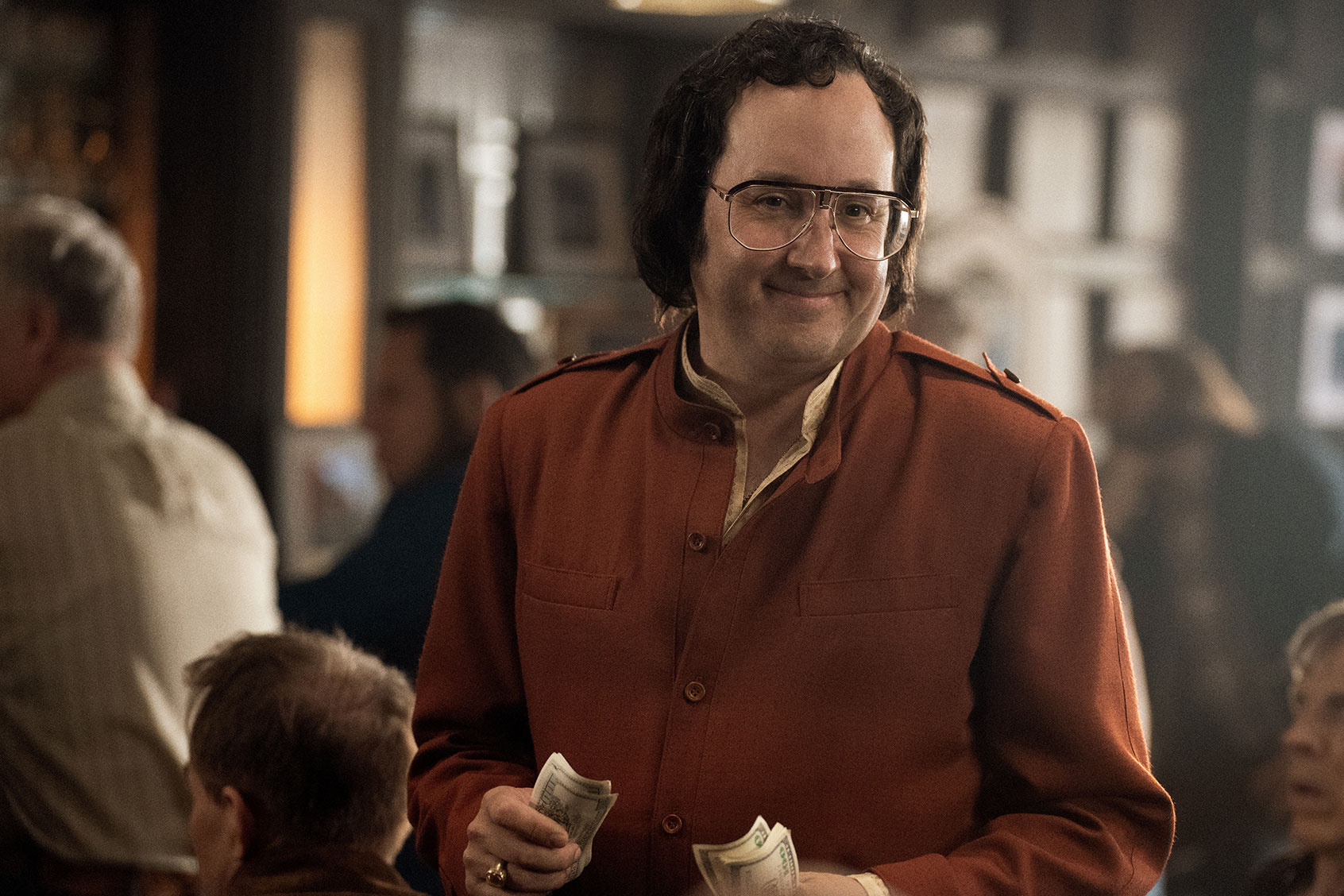
“Keep getting your 3% every four years”: Trump negs booing Libertarians at national party convention

Donald Trump gave what CNN calls one of his shortest speeches this weekend to a crowd of raucous, booing Libertarians.

With signage on the screen behind him that read, "Become ungovernable" in a grafitti-style font, it seemed that everyone took that directive to heart during the party's national convention in Washington, DC on Saturday night. While Trump made several attempts to try and win over the crowd, some were not content to just incoherently grumble but also took to active name-calling. Rolling Stone claims that "Liar!" and "Panderer!" were called out, while The Daily Beast notes that one inspired person called Trump "Swamp creature!"

Trump's main tactic was focused on gaining their support to defeat Joe Biden. 

"That is why I have come to extend a hand of friendship to ask for your partnership to defeat Communism, to defeat Marxism and to defeat Crooked Joe Biden who is destroying our country," he said, emphasizing a spirit of partnership against the common enemy.

He also attempted to sway the crowd with promises, such as hiring Libertarians should he win. "I’m committing to you tonight, that I will put a Libertarian in my Cabinet, and also Libertarians in senior posts."

Then there was the promise to commute the sentence of Ross Ulbricht, founder of the darknet market site Silk Road, who was sentenced to life in prison after being convicted on multiple counts including distributing narcotics and conspiracy to commit money laundering in 2015. His conviction has become a cause célèbre in libertarian circles. During Trump's first term, however, he had refused to commute Ulbricht's sentence.

Perhaps hoping to appeal to a sense of lawlessness, Trump also tried his hand at commiserating with the crowd over his criminal indictments. "If I wasn't a Libertarian before, I sure as hell am a Libertarian now," he quipped.

But the boos kept coming, especially when Trump suggested that the Libertarians should actually nominate him for president.

"Whoa, that's nice, that's nice," he said to the rising cries of dissent, before changing tactics and throwing shade. "Only if you want to win. Maybe you don't want to win . . . If you want to lose, don't do that. Keep getting your 3% every four years."

That 3% refers to the popular vote percentage Libertarians have won in past U.S. presidential elections.