Spring Offer: Get 1 Year, Save 58%

Judge in Trump election case says Jan. 6 defendants are “dangerous people,” not political “hostages”

U.S. District Judge Tanya Chutkan, who is preparing to oversee Donald Trump's election interference trial, dismissed on Wednesday claims by the former president and his allies that Jan. 6 defendants are "hostages."

As the Associated Press reported, Chutkan's remarks came during the sentencing hearing of Anthony Vo, a 31-year-old Indiana man who has expressed little remorse for storming the U.S. Capitol with his mother.

Instead of victims, Chutkan said, Jan. 6 defendants are "being kept [in jail] because they are dangerous people."

Some 1,265 people have been charged in connection to the insurrection, with more than 450 accused of assaulting or resisting police and other government employees.

Trump, whose false and inflammatory claims of a stolen election helped spark the violence on Jan. 6, has continued to express strong support and even raised money for his imprisoned followers. "Some people call them prisoners. I call them hostages," Trump said in January. "Release the J6 hostages, Joe [Biden]. Release them, Joe. You can do it real easy, Joe."

Following Trump's lead, some Jan. 6 defendants have remained defiant. During his trial, Vo himself attended the so-called "Freedom Corner," a nightly vigil for defendants held outside their prison in Washington, D.C.. Chutkan ruled that attending the vigil was a violation of his release conditions.

Vo, who calls himself a "J6 wrongful convict" on social media, was contrite right before his sentencing, claiming that he was "sorry for everything" and "wasn't there to overthrow the democratic process or anything." But he was openly hostile in the wake of his conviction last year on four misdemeanors related to unlawfully entering the U.S. Capitol. In a January post on X, Vo asserted that "there was zero jury of peers and 100% a kangaroo court."

Chutkan was unswayed by Vo's in-court change of heart, deciding his actions merited nine months behind bars. The judge has put a string of Capitol attackers behind bars over the last three years, overruling the comparatively mild sentencing recommendations of federal prosecutors. According to the Associated Press, she has described incarceration as an appropriate punishment for criminals who not only tried to overthrow the democratic process but also violently assaulted around 140 Capitol police officers.

Chutkan is slated to preside over Trump's own trial, which has been delayed as the Supreme Court hears his argument that he is immune to prosecution.

RFK Jr. fires staffer who said the campaign could help Trump in November

An activist working for the campaign of Robert Kennedy Jr. has been fired after publicly admitting that the independent presidential candidate could help return former President Donald Trump to the White House.

In a video first reported this week by CNN, Rita Palma, at the time working to get RFK Jr. on the New York ballot, said that her primary goal was to prevent President Joe Biden from winning reelection. “If I wake up on Nov. 6 and Trump wins, I’m not going to be overly upset,” said Palma, who previously voted for Trump twice.

After the remarks attracted attention, the Kennedy campaign sought to distance itself from Palma, first describing her as a mere "consultant" who was not speaking on behalf of the candidate. But her views were not likely to have come as a surprise: As The New Republic noted, Palma attended the Jan. 6 insurrection, which she billed on social media as "99.9 peaceful," and was adamant that the 2020 election was "rigged."

Democrats have feared that the Kennedy campaign could indeed hurt Biden in November. Although the candidate has espoused a range of views that should make him more attractive to potential Trump supporters — from denying the efficacy of vaccines to portraying Jan. 6 rioters as political prisoners — his famous last name still has cache among left-leaning voters.

While Palma had previously been open about her fondness for Trump, Amaryllis Fox, the campaign manager for RFK Jr., claimed that she had misstated her job title and had subsequently been canned.

"We terminated her contract for misrepresentation immediately upon seeing the longer video in which she gave an inaccurate job title and described a conversation that did not happen," Fox said in a Wednesday evening post on X.

“She’s on to something”: NY AG Letitia James suggests Trump lawyers may have “withheld” evidence

In the financial statements he used to overstate his wealth and obtain more attractive terms from the banks he defrauded, former President Donald Trump asserted that his Manhattan penthouse measured at no fewer than 30,000 square feet of prime real estate. The reality, first revealed by Forbes, is that the dwelling was actually just a third of its stated size.

It was not, of course, an honest mistake. During Trump’s civil fraud trial last year, New York Attorney General Letitia James presented a 1994 document, with the Republican candidate’s signature on it, stating that the three-story apartment was actually under 11,000 square feet. Asked about that on the stand, Allen Weisselberg, the long-time chief financial officer for the Trump Organization, professed ignorance: Yes, he’d read the email containing that document, but he said he never opened the attachment.

Oh well, these things happen.

Except, as Weisselberg himself now concedes, the former CFO of the Trump Organization is a liar. Last month, he pleaded guilty to perjury and admitted to giving false testimony during the 2023 trial – which ended in a $454 million judgment against Trump – and was this week sentenced to five months behind bars.

That guilty plea drew renewed attention from New York’s top prosecutor. In a letter to the judge who oversaw the civil fraud case, dated April 4, the attorney general noted that Weisselberg’s plea agreement with Manhattan District Attorney Alvin Bragg contained a reference to an August 2016 email exchange in which the former CFO and another employee of the Trump Organization discussed the size of Trump’s penthouse – and explicitly verified that it was but “10,996 square feet,” as reported by Courthouse News Service.

That damning exchange wasn’t shared with James and her team ahead of the 2023 trial, however. And while she still won the case, she’s not the letting it go.

In an April 9 letter, addressed to Judge Arthur Engoron and reported by Business Insider’s Laura Italiano, the attorney general’s office rejected defense arguments that any discovery issues with the civil fraud case are now moot. “Mr. Weisselberg has admitted that he perjured himself during discovery and the trial in this action,” Senior Enforcement Counsel Kevin Wallace wrote. “The Court is well within its authority to determine if Defendants and their counsel facilitated that perjury by withholding of incriminating documents.”

As Italiano reported, James, upon discovering the withheld evidence, asked for a forensic review of the Trump Organization’s electronic data to be conducted by the former judge who was installed as a monitor there after fraud came to light. But Trump’s lawyers have been fighting the request, arguing it would be an “astonishing” expansion of the monitor’s authority.

We need your help to stay independent

The conflict is unlikely to result in any new repercussions from Trump himself. His lawyers, on the other hand, could face sanctions if they are found to have knowingly withheld evidence during the discovery process.

Joyce Vance, a former U.S. attorney who teaches law at the University of Alabama, believes James wouldn’t be bothering with this fight for nothing.

James seems to believe Trump’s lawyers withheld something from her,” Vance wrote on X. “Given her track record, it’s clear she doesn’t make claims like this unless she’s on to something.”

Weisselberg’s conviction on two counts of perjury is what drew attention to the 2016 email exchange. But that’s not the only way that conviction might cause migraines for Trump’s lawyers: it also means the former Trump executive won’t be of much use, as a now twice-convicted liar, at Trump’s upcoming trial over “hush payments” and falsified business records.

The prosecution of Allen Weisselberg is something of a twofer, on the justice front,” former federal prosecutor Glenn Kirschner commented Wednesday. “First, he’s being held accountable for new crimes he’s committed: multiple counts of perjury. And two, he’s being neutralized as a possible defense witness who could come in and try to nefariously help Donald Trump wiggle out from under the charges.”

Weisselberg's personal lawyer suggested as much, indicating Wednesday that his 76-year-old client is done committing crimes and would now like to slink back into obscurity.

“Allen Weisselberg accepted responsibility for his conduct," attorney Seth Rosenberg said in a statement, "and now looks forward to the end of this life-altering experience and to returning to his family and his retirement."

A total eclipse of Donald Trump: First felony trial could finally humble him

“So the universe is not quite as you thought it was. You’d better rearrange your beliefs, then. Because you certainly can’t rearrange the universe.”

  • Isaac Asimov “Nightfall” 1941

Total solar eclipses over the heartland of America are rare. But they are totally normal celestial events.

Donald Trump isn’t rare these days; unfortunately, we see him every day.  But his actions are increasingly abnormal. They’re getting that way because next week he’s potentially facing the first of four criminal trials which could lead to prison time for Trump. Three times a judge has denied him a motion that would delay his trial.

While philosophers may opine about the recent solar eclipse with far more erudition than I, let me simply say that it’s doubtful we took the hint. I know Trump didn’t. He has no ability to express humility.

With the efficiency and simplicity of someone flicking on and off a light switch, I witnessed from the birthplace of John Mellencamp (Seymour, Indiana if you can’t look it up) what millions across the country saw: The sun was turned off and then on, plunging us into total darkness and then back into the bright light of day three minutes later.

It was an awesome display of celestial mechanics, but pales in comparison to the mechanics of the justice system holding Donald Trump accountable for his disruptive, divisive and illegal activities. Much as the ancient viewers of total solar eclipses once were, Trump today is in the pit of despair – and he’s melting down.

His emails to followers are pointed and accusatory. He complains Biden will fundraise off of his courtroom drama while Trump campaigns and fundraises off his courtroom drama. “None of these BIDEN TRIALS should be allowed to take place during my campaign. They’re all rigged and political,” Trump wrote in one recent dispatch.

It’s everyone else’s fault. The fix is in. As much as the celestial mechanics of a total eclipse are commonly known, so are the reactions of Donald Trump when someone tries to hold him accountable for something he’s done.

The total eclipse of the sun should bring about a bit of humility. The Universe doesn’t care about our petty squabbles. It certainly doesn’t care about Trump – as much as he would like to think he’s the center of the Universe. His hubris and arrogance aren’t rare in a society that ignores science and puts people ahead of property and competition ahead of cooperation. That’s probably Trump’s mantra.

This week the demonic angel of despair and divisiveness remains as angry and as scared as I’ve ever seen him. I doubt there’s a safe ketchup bottle within 100 miles of Mar-a-Lago. Trump is scared out of his befouled shorts. His former CFO Allen Weisselberg got sentenced to five months in jail after committing perjury in the former president’s civil fraud case. Think he’ll talk? I don’t know but, according to those in Trump’s orbit, the Donald is worried. After his third attempt to delay his trial in Manhattan was denied, there’s no doubt Trump has slipped a cog.

But, let’s be honest, Donny Darko isn’t the only one.

This week a Robert F. Kennedy Jr. campaign official was exposed for promoting false claims that the 2020 election was rigged. At the same time, Rita Palma, a New York activist working for Kennedy boasted that his candidacy is a way to block President Biden from being re-elected.

Marjorie Taylor Greene, meanwhile, still wants to dump Michael Johnson, the Republican House speaker, because he won’t anoint her queen and offer subservience to her lunacy.

And finally in today’s Top Ten list, “Weird things we’d like to blame on the eclipse but can’t” sponsored by David Letterman, the New York Times came out with a blistering analysis of Donald Trump that claims he “grossly distorts his opponents’ records” and “exaggerates and twists the fact”, often turns his criminal cases into rallying cries, makes up unverifiable claims, continues to scream about the “rigged election” and describes the United States as a “Nation in Ruins.”

That’s news? It sounds like every day I spent covering Trump during his presidency.

We need your help to stay independent

As much as evangelical Christians, astrologists, numerologists, Big Foot hunters, those who believe in spirits, fairies, conspiracy theorists, and alien hybrids would love to give credit to the eclipse for what they see as signs of society’s apocalypse, the fact is we’re back to blaming ourselves – or at least Donald Trump — for this nonsense.  I’m waiting for some MAGA member of our technologically medieval society to burn their own village as a show of support or frustration – you know, much like University of Kentucky basketball fans do whenever their team loses a coach or wins or loses an important ball game.

The facts show that all of this creepy news is due to the fact that Donald Trump has been normalized by too many members of the press. It’s as if we’re shocked and what has been going on with Trump for the last decade is new to us.

Jim Acosta mentioned Tuesday on CNN that he was stunned that Trump faces no backlash for accusing Biden of using cocaine before a recent speech and former and former Republican presidential candidate and CNN analyst Joe Walsh backed up Acosta, saying it is part of the “normalization” of Trump by the pressThe New York Times offering insights into Trump that aren’t actually anything new underscores how we’ve simply and collectively forgotten that Donald Trump is a slithering slimeball. 

He denounced a near-total ban on abortion in Arizona while proudly claiming responsibility for the Supreme Court overturning Roe v. Wade which enabled the state action in Arizona. He’s selling $60 Bibles while being unable to recite a single verse in it.

We in the media continue to treat him as a legitimate candidate while half of the electorate agrees. Every time Donald Trump goes after a judge, a jury, witnesses or his charges, we cover it – but curiously we never mention Judge Aileen Cannon. Trump never goes after the judge in the Mar-a-Lago documents case against him. “That’s because she’s a MAGA sycophant,” a prosecutor close to the case explained. Maybe that’s worth reporting a little more often. 

Perhaps we should be covering Trump based on the facts – and not the blathering, bloviated nonsense he spouts on a daily basis. I don’t care about the wild and dramatic ramblings of the demented former president. The fact is Trump has more reasons to fear the coming months than Middle Age peasants feared a solar eclipse. The eclipse, while humbling, isn’t a threat to our existence. Next week Trump will face a case in court that is a threat to his existence – even though it’s considered the weakest case against him.

The truth is much different.


Want a daily wrap-up of all the news and commentary Salon has to offer? Subscribe to our morning newsletter, Crash Course.


While he faces charges related to insurrection, election denial, and classified documents that sound extremely frightening, and are, there is no doubt about the facts in the Manhattan district attorney’s case against Trump. They are solid. Rock solid. 

I worked with Michael Cohen for many months on “Revenge,” his latest book that deals with the facts that have led to the charges against Trump in New York. Trump paid off Stormy Daniels for her silence. He didn’t want people knowing he’d been having fun with her. He used Cohen to pay her and he did it to hide that fact from potential voters. While you can pay off anyone you want, it was hiding the payoff that really hurts Donald. In the state of New York it’s a misdemeanor. But it became a felony when it became tied to a federal election.

Having researched this for months, it’s obvious what was done and why. And right now, Trump will do anything to keep from facing those charges because he knows exactly what he did. If you’ve ever seen “My Cousin Vinny” you also know that through discovery Trump has all the factual information that will be presented against him. 

On background, one of the people close to the prosecution maintains that “Trump is toast.”

His only hope is to find one juror who loves him and will see it his way. In Manhattan, that’s not a likelihood. So, the next few weeks Donald will remain extremely tense, cornered and frightened. And we all know the danger of cornering a New York sewer rat.

“Defense?” my source said on background, “It’s in de-backyard. He has no defense and he knows it.”

Other than hoping for a sympathetic juror, Trump’s best effort in court will be in trying to discredit Michael Cohen – who made the payoff for him. Trump has already tried to do that as often as the sun rises, and has been successful fewer times than I’ve personally witnessed a total solar eclipse. 

The reason why he has been unsuccessful is because of the paper trail that Trump can neither deny nor explain away.

Donald Trump is, for the first time, facing something he can’t wish away or pay off.

In the Science Fiction Novella “Nightfall”, Isaac Asimov postulates how a civilization would face a solar eclipse in a multiple star solar system that only experienced night once every two thousand years.

“It's one thing to predict [the complete breakdown of civilization]. It's something else again to be right in the middle of it. It's a very humbling thing,” a character in the novel noted.

The recent total solar eclipse didn’t lead to a breakdown of civilization – and we aren’t in the middle of one.

But Donald Trump is and the Manhattan case against him will be the first of four blows from which he will likely not recover. It should be “a very humbling thing.”

US billionaires have doubled their wealth since 2017 Trump tax overhaul

Over the past years in the U.S., everyday Americans have been increasingly crushed under greed-driven inflation and debt, with homelessness hitting record highs. But as this modern affordability crisis has rocked households across the country, billionaire wealth has skyrocketed — and has now hit an all-time high, a new analysis reveals.

As of this month, the U.S.’s 806 billionaires are worth a collective $5.8 trillion, meaning that they control 1 in every 25 dollars of American wealth, according to an Americans for Tax Fairness report released Monday.

Due in part to the 2017 tax overhaul by Republicans, led by Donald Trump, this small group has seen an explosion of wealth in an extremely short amount of time.

Since the 2017 Tax Cuts and Jobs Act, U.S. billionaire wealth has doubled, from an already staggering $2.9 trillion. In 2017, none of the richest Americans were centi-billionaires, meaning that they did not have over $100 billion; now, the top 10 U.S. billionaires are all centi-billionaires, according to the report.

As of April 1, Jeff Bezos was the richest person in America, with $198 billion, while Michael Bloomberg was the least wealthy of the top 10, controlling $106 billion. Each of the top 10 billionaires, whose wealth springs from either finance or tech, has experienced a growth in wealth since 2017, with Elon Musk seeing an 850 percent increase.

Due to this influx to the very top, these 800 individuals now collectively control 1.5 times more wealth than the entire bottom 50 percent of American households, who share $3.7 trillion between 65 million households.

“Billionaire wealth doubling in just over six years is a clear signal that too much of America’s resources are flowing to the super wealthy,” said David Kass, Americans for Tax Fairness executive director.

While everyday Americans pay taxes on this wealth and contribute to crucial programs like Social Security with every paycheck, many of these billionaires use sophisticated methods to avoid tax bills, with some paying effective rates as low as 0.1 percent in recent years despite their staggering gains.

These tax avoidance methods are on top of the built-in advantages that the U.S.’s statutory tax rates already offer the rich — and the Trump tax cuts have superfueled the growing wealth gap in the U.S. in recent years. Some of the most impactful policies that affect individuals from the tax cuts, the report says, include cutting the top income tax rate from 39.6 percent to 37 percent, doubling the estate tax exemption under which dynastic wealth is not taxed and weakening the Alternative Minimum Tax, which was designed to ensure that wealthy taxpayers pay a certain tax rate to fend off abuse of loopholes.

A modest capital gains tax on just the $3 trillion gain that billionaires have added over the past six years, by contrast, could pay for forgiveness of all student debt, expansions of Medicare and the Affordable Care Act, free preschool, and more over the next 10 years, the report says.

Instead, Republicans are currently seeking to intensify the factors driving the growth of the wealth gap and push even more trillions toward the top. At the end of 2025, many of the most sweeping tax cuts will expire, but Republicans are seeking to make the Trump tax cuts permanent.

This regressive policy would massively benefit the rich; an analysis last year by the Institute on Taxation and Economic Policy found that the richest 1 percent of Americans would see an average tax cut of $25,650 in one year if the cuts were made permanent, while the poorest 20 percent would see an average tax cut of $100.

“The last thing we need to do now is permanently extend the Trump tax cuts,” Kass said. “Permanent extension of high-end tax cuts would cost trillions of dollars we could invest in working families and communities and would worsen the nation’s economic inequality that the latest billionaire figures so prominently highlight.”

Kari Lake and her fellow Republicans can’t run from Arizona’s draconian abortion ban

As far as symbols of what the GOP intends for American women, the revival of an abortion ban that predates women's suffrage could not be more fitting. The Arizona Supreme Court decided on Tuesday that the state should enforce a law outlawing all abortions, under criminal penalty of two to five years imprisonment, "unless it is necessary to save her life." The law was passed in 1864, which was not just before Arizona was a state, but 55 years before women obtained the right to vote. The symbolism of that, plus the electoral implications going into a presidential election, means this news is explosive even beyond the high levels of outrage that meet every Republican ban on abortion since Roe v. Wade was overturned in 2022. 

Anger from the majority of voters over the loss of abortion rights isn't dissipating like Republicans thought it would, and now GOP politicians in the Grand Canyon State are scrambling. The most prominent of these, of course, is election denier Kari Lake, who, while still refusing to admit she lost the race for governor in 2022, is running for Senate. She wants everyone to think she's unhappy that Arizona women's medical care will be determined by a law written while many doctors were still rejecting germ theory. Claiming to "oppose today's ruling," Lake called on the actual governor, Democrat Katie Hobbes and "the State Legislature to come up with an immediate common sense solution."

This, however, is not what she was saying when she was running for governor in 2022, and lordy, there are tapes. Specifically tape of her, during a debate, championing the 1864 law. 

"I think the older law is going to go into effect," Lake said, insisting "life begins at conception" and bluntly stating, "I don't think abortion pills should be legal." 


Want more Amanda Marcotte on politics? Subscribe to her newsletter Standing Room Only.


Lake is far from alone in terms of being caught in her contradictions. Despite all the GOP claims to oppose the 1864 law, on Wednesday, Senate Republicans blocked an effort to repeal the law. So far, they're being silent as to why, but it's not hard to suss out: The loud denunciations of the court's decision are bad faith political theater. In actuality, Republicans plan to go forward with resurrecting an abortion law that predates modern medicine. 

This conundrum is going to haunt Republicans throughout the election. It's hard to explain prior disingenuous claims equating abortion to infanticide, while currently spouting "but hey, sometimes it's okay" stances. Former Gov. Doug Ducey misleadingly claimed that the court ruling "is not the outcome I would have preferred," contrasting it with a 15-week ban he signed in 2022. A local talk radio host immediately pointed out that Ducey's law reified the 1864 law

It's true: Ducey's law explicitly states that it does not "[R]epeal, by implication or otherwise, section 13-3603," which is the 1864 law. As pro-choice activists pointed out at the time, this was no accident. The 15-week ban was always a stalking horse for a total ban. The point was to give the Supreme Court an excuse to overturn Roe, at which point Ducey and his allies expected the pre-suffrage bill would kick in, banning abortion at any stage. 

Rep. David Schweikert stepped into a similar trap, tweeting, "I do not support today’s ruling" by claiming, "This issue should be decided by Arizonans, not legislated from the bench." He immediately was reminded that he was ecstatic about the Roe overturn. 

Hiding behind legalistic hair-splitting about "states' rights" may have worked in the pre-Dobbs days, when most voters shrugged off such talk as irrelevant and esoteric. Now that people are paying attention, the contradictions are showing themselves. The "abortion is murder" stance was always bad faith, but now it's impossible to wriggle away from. If you do think it's "baby-killing," then why should it be legal in some states and not others? But if you now admit it's not baby-killing, you have confessed that it was always about misogyny. 

That's why Republicans have fixated on this notion that a 15-week limit can be a fallback position. That's not the escape hatch they are hoping it will be, however. Almost 95% of abortions occur before 15 weeks, which means such a law will infuriate the Christian right, which is most interested in banning abortions of choice. The few abortions that will be outlawed, however, will mostly be the traumatic cases that have dominated the news cycle since Dobbs. Republicans will still get a constant drumbeat of stories of women bleeding out in E.R. parking lots, mothers forced to give birth to dead babies, or child rape victims who didn't know they were pregnant until they started to show. And they'd also alienate their most loyal supporters.

As Paul Waldman wrote in his newsletter, we have electoral evidence that this "compromise" doesn't work. Virginia Republicans backed a 15-week ban in November's elections, he writes, but "[v]oters weren’t impressed, and Democrats won the state House to take total control of the legislature."


Want more Amanda Marcotte on politics? Subscribe to her newsletter Standing Room Only.


It's telling that even Donald Trump didn't think he could pull off the 15-week punt. Instead, he tried to square this impossible circle by releasing a statement that implied he wants to leave it to the states, while actually signaling to the Christian right that he will ban abortion nationwide. This worked to an extent, especially in terms of bamboozling the media into misreporting what he actually said. But President Joe Biden's campaign has aggressively responded by resurfacing a seemingly endless number of clips of Trump taking credit for ending Roe, including during his supposedly "moderate" video speech. 

Now, Trump is reverting back to his favorite tactic, which is just plain lying, by denying he'd sign a federal abortion ban. This may work for him, because low-information voters keep getting distracted by his lifelong promiscuity, not understanding that's rooted in his lifelong belief that rules are for other people. Even then, though, he will be dogged by this issue because Biden and Democrats seem determined to keep rolling tape, showing Trump bragging about ending Roe, claiming to be "pro-life," or announcing that "there has to be some form of punishment" for women who have abortions. 

For Lake and other state-level Republicans, overcoming those past statements will be much harder. Perversely, Trump's reputation as a glib liar shelters him somewhat from his past claims to oppose abortion as a moral matter, which exactly no one believes. (But that he wants to hurt women with abortion bans should not be doubted. He's just generally a fan of inflicting pain on women.) For every other Republican, however, video like Lake saying she believes "life begins at conception" makes this difficult indeed. Has she decided she no longer believes that? If so, what changed her mind? If not, then why is she now suddenly okay with what she has frequently suggested is murder?

The contradictions could be easier for Republicans to ignore if the issue wasn't at the forefront of the election. But both because voters care very much and because Democrats plan to hammer this at every turn, there's no hiding from the fact that GOP positions on abortion don't make sense. Or to be more exact, they do make sense, but only if you assume abortion bans are about controlling and punishing women, rather than confusing claims about "life." And that is why voter disapproval seems to be hardening into outrage against anti-choice politicians. 

The right tried to rain on South Carolina’s NCAA victory with transphobia. Dawn Staley won’t let up

As a second consecutive record year for women’s college basketball reached another landmark conclusion this weekend, South Carolina head coach Dawn Staley displayed to hardcore fans and casual viewers alike why she is one of sports preeminent ambassadors — and it wasn't solely because of what her players accomplished on the court, but how she acted off of it. 

The day before her South Carolina team won the NCAA National Championship over Iowa, led by sensation Caitlin Clark, the 53-year-old Coach Staley received her normal set of game-related questions during the final press conferences in Cleveland. Then a little-known reporter named Dan Zaksheske from the Fox News’ sports website Outkick decided it was necessary to not “stick to sports” — something Outkick begs of athletes to do only when they agree with those athletes — and asked Staley her opinion on transgender athletes in women’s collegiate sport, using the deliberately offensive “biological males in women’s sport” framing before finally quieting down to allow Staley to respond

It’s one of many current culture wars that Republicans, and those adjacent to them, have a major thirst for.

Taken aback at the bizarre timing of the intentionally inflammatory inquisition, the superstar coach gathered herself to remark on the highly polarizing issue.“Man, you got deep on me there,” she said to Zaksheske. Staley then delivered a response as impressive as any strategy she gives any of her players. 

“I’m under the opinion of: if you’re a woman, you should play. If you consider yourself a woman, and if you want to play sports or vice versa, you should be able to play,” she calmly replied. “Do you want me to go deeper?” 

Apparently a little disappointed and startled that he didn’t get a more explosive soundbite from Staley, Zaksheske pressed on., “Do you think transgender women should be able to participate?”

Staley cut his stumbling off. 

“That’s your question that you want me to ask, I give you that” she charged. “Yes, yes! So now the barnstorm of people are going to flood my timeline and be a distraction to me for one of the biggest days of our game and I’m okay with that.”

And with that full defense of transgender athletes, Staley of course received that backlash from the conservatives she predicted. 

Alabama Sen. Tommy Tuberville, a former NCAA football coach, went to Outkick to pile on Staley.

She just followed the line. She didn’t want to disrupt people’s thoughts about her. She’s obviously an activist along with being a coach because there’s no earthly way she could believe, ‘OK, I want to coach girls against men.’ There’s no way she could believe that, but she said it for that reason. Just don’t understand the direction a lot of these people are going. Stand up.

She should be standing up for all those young girls, those young women she was coaching. She just won a national championship and talk about the good things. We’ll take anybody on, but it’s really not right for men to come over and say they want to play in women’s sports. It’s not right. And it’s unfair, and it’s unsafe.

Megyn Kelly and Rep. Nancy Mace, R-S.C., also gave their unsolicited transphobic views. Mace called it "absolute lunacy.” Kelly, still basking in the honor of being replaced by Ronna McDaniel as the worst hire in NBC News history, labeled Staley and anyone who holds the same supportive views a "disgrace for abandoning our daughters." 

Former respected ESPN anchor turned right-wing sports darling Sage Steele fumed that Staley “didn’t have the courage to speak the truth” and that “Dawn knows damn well that she never be a Hofer (Hall of Famer) if she played against men.” Steele then further rambled that “It’s irresponsible and unfair for her and other retired female players in all sports to confidently say that they’re now ok with this” and tagged LGBTQ star couple Sue Bird and Megan Rapinoe in her post.

Recent University of Kentucky swimmer turned staunch anti-transgender advocate Riley Gaines labeled Stanley “entirely incompetent or a sellout” on “Fox & Friends” after rage posting repeatedly Saturday and Sunday on Twitter about the coach’s words. She had no shame in saying Staley “would trade” any one of her players “for a mediocre boy with an identity crisis.” Gaines’ transphobia gained her a national platform in right-wing media after she finished technically tied for fifth place two years ago to Harvard’s transgender swimmer Lia Thomas at a college meet

And of course, sports conservatives’ insane outrage over anything they disagree with will always come loudest from Outkick’s failure founder Clay Travis. Basking in the joy of his reporter’s irrelevant, controversial question to Staley instead of the actual championship basketball at hand, Travis continued to show why he is a daily waste of space more than blank lines on looseleaf paper. He claimed that Staley was part of a “cult” of “women athletes cheering the erasure of women from athletics by men pretending to be women.” He of course highlighted the comments from Steele and Mace, and even retweeted a ridiculous transphobic response from a retired NBA player.

We need your help to stay independent

Both Gaines and Travis pestered Staley’s Twitter account by repeatedly tagging her into their anti-trans athlete vitriol, leading to Staley sensibly blocking them during an otherwise joyous weekend for her. And why should she waste any of her energy, during the most important time of a special season, on miserable clowns that she will never want to know? 

Zaksheske, Steele, Gaines, Travis and the rest of their conservative ilk can’t accept the fact that there are currently zero transgender basketball players in Division I women’s hoops and that Staley nor the three other coaches at this year's Women's Final Four have ever coached a transgender player. And though an exact figure on the number of collegiate transgender athletes is currently unknown, it has been estimated as of 2022 that of the 200,000 athletes in NCAA women’s sports, only 50 of them are trans-identifying according to transgender researcher and runner Joanna Harper. 

Yet that infinitesimal number of trans woman athletes hasn’t stopped heartless conservatives and transphobes from showing in the last several years how much they loathe the LGBTQ+ community, continuing their disingenuous labeling of "#SaveWomenSports" as full on trans hatred. 

Over two dozen states have either banned or proposed to ban transfer athletes from participating in women’s sports since 2020, not just at the college level but also in high schools. We have also witnessed that the National Association of Intercollegiate Athletes, a college sports organization of roughly 241 small schools that is smaller than the NCAA, is more than okay with the anti-LGBTQ wave. They recently voted unanimously to ban transgender athletes from participating in women's sports starting next school year. 

It’s one of many current culture wars that Republicans, and those adjacent to them, have a major thirst for. And they will choose to force their intrusive ideology anywhere they see fit, even during a golden weekend for women’s basketball and women’s sports. 

But in calmly dealing with their divisive agenda, Staley, who is very proud of her Christian faith, exhibited the excellence of real Jesus-like love inside of her that has propelled her to both a legendary playing and coaching career. It’s the type of Christianity from Staley that the rabid right are incapable of, where one can love God and simultaneously fully embrace every person for who they are. 

Of course that wasn’t the sole moment of Staley excellence at the Rocket Mortgage Fieldhouse building this past weekend. After that press conference, the proud Philadelphia-born and raised native sang and danced to one of that city’s iconic songs, Boyz II Men’s “Motown Philly,” in front of the crowd during her team’s final practice. The great, relaxed Black girl joy of that moment was the spirit required for her South Carolina players to perform in front of the landmark televised audience in women’s National Championship game history and clinch a revenge victory over Clark’s Iowa after losing to them in devastating fashion in the semifinals last year. A perfect 38-0 record to become only the 10th team in women’s college basketball history to finish a season undefeated is what Staley’s team achieved in Cleveland this past weekend. No amount of right-wing trolling over trans athletes should take away from that. 

24 million viewers watched the women’s national championship at one point, with 18.7 million on average tuning in to set a wonderful new record. Although Clark’s immeasurable popularity is the top reason for the enormous viewership, what Staley has done in transforming South Carolina into the premier powerhouse in the sport certainly played a pivotal role.

Sick, hot world: Climate change favors disease vectors, threatening to unleash more pandemics

Global heating has so profoundly altered our planet that some experts argue it's no longer about a changing climate and instead about a changed climate. In other words, the hotter, more chaotic world predicted by climate scientists is part of our present, not just our future. And those changes extend beyond rising sea levels and heat waves to how diseases spread and impact society.

For example, climate change is a breeding ground for intensified cholera outbreaks — one of only many diseases that could become full-fledged pandemics as humans continue to overheat the planet by burning fossil fuels.

Cholera patients experience many symptoms, ranging from unpleasant to deadly. Once a mosquito bite transmits a dangerous Vibrio cholerae strain like O1 and O139 to a human, that person will experience painful leg cramps, insatiable thirst and constant nausea punctuated by vomiting. An infected individual usually feels restless and spends a lot of time defecating watery diarrhea. Even healthy adults will die within a few hours if they do not get the correct treatment, with hundreds of thousands suffering that fate every year.

This is in spite of the fact that, as the Harvard Global Health Institute's faculty director Dr. Louise Ivers said, the disease is "completely preventable and also treatable."

Cholera is a particularly horrible consequence of this trend, generally afflicting those least responsible for global warming, given that Western nations disproportionately release the most carbon emissions.

"Typically the people who are affected by cholera are impoverished, distant from medical care, underserved communities — those without access to clean water and sanitation are the most vulnerable," Ivers said. "Those with food insecurity also have a disproportionate risk of death."

Given that cholera disproportionately impacts marginalized communities, it is perhaps unsurprising that Ivers (who works directly to address the Haitian outbreaks) described it as an "underreported pandemic." It has been circulating since the 1960s, and in Haiti alone it took 10,000 lives while impacting almost 1 million others from 2010 to 2018. The outbreak returned a few years later. Global heating is only making things worse.

"My team and I have cared for thousands of patients with cholera over the years. It is a dramatic and painful death – and totally unnecessary."

"Climate change is important for cholera in that extreme weather events can cause displacement of people and also disruption of their safe water supplies through flooding, putting pressure on water sources making people vulnerable to pathogens in the water, effectively this is increasing the dispersal of pathogens," Ivers said. "We see routinely that cholera peaks in Haiti during seasons when rainfall is highest. We see that some Vibrios are very susceptible to environmental temperatures and the impact of that directly on Vibrio cholerae is being studied."

Ivers added, "As a doctor, my team and I have cared for thousands of patients with cholera over the years. It is a dramatic and painful death – and totally unnecessary."

Other pathogens are also likely to benefit from global heating. Dr. Ben Beard, deputy director of the Division of Vector-Borne Diseases at the Centers for Disease Control and Prevention (CDC), said that climate change will create a number of conditions conducive to dangerous pathogens: Longer and warmer summers, shorter and milder winters and increasingly frequent/unusually severe extreme weather events (such as heat waves, storms and droughts).

All of these climate alterations can cultivate pathogens like viruses, bacteria, fungi and parasites by helping them spread and multiply more quickly, widening their geographical distribution and influencing behaviors such as when they feed and their preferred choice of host.

Beard noted that the geographic distribution for mosquito and tick vectors is already expanding, including blacklegged ticks (Ixodes scapularis) responsible for Lyme disase or yellow fever mosquitos (Aedes aegypti) that don't just carry their namesake illness but also dengue, Zika and Chikungunya.


Want more health and science stories in your inbox? Subscribe to Salon's weekly newsletter Lab Notes.


"We found that 58% (that is, 218 out of 375) of infectious diseases confronted by humanity worldwide have been at some point aggravated by climatic hazards."

"As environmental conditions change, it is likely that certain diseases will appear in areas where they previously had not occurred," Beard said. "Likewise, we might expect that some diseases may become less common in places where they had been of great importance."

In the case of tick-borne diseases, for example, Beard noted that the geographic ranges have already expanded in recent years for ticks that spread Lyme, anaplasmosis, ehrlichiosis and spotted fever rickettsiosis.

"While the exact reasons for the geographic spread of ticks and the diseases they carry are unclear, a number of factors may contribute," Beard said, such as how "the spread of Lyme disease over the past several decades has been linked to changes in land use patterns, including reforestation in the northeastern United States."

For example, suburban developments that attempt to shove civilization into recently wild areas put humans in close contact with tick hosts like mice and chipmunks. It is hardly unusual in the modern era for human activity to inadvertently cause pathogen-carrying animals to more closely interact with our own species. Climate change is just one more example of that happening.

Ivers referred Salon to a pair of papers from the journal Nature, both of which illuminate the growing threat of a climate change-induced pandemic. In a 2022 paper titled "Climate change increases cross-species viral transmission risk," they projected how 3,139 mammal species will shift their geographical ranges by 2070 due to climate change and human use of wild land, with their study including a number of possible outcomes. The authors anticipate that species will repopulate at higher elevations while interacting with each other in new ways, as well as entering so-called "biodiversity hotspots" with lots of various organisms. Inevitably this will bring them into highly populated areas, particularly in Asia and Africa, "causing the cross-species transmission of their associated viruses an estimated 4,000 times."

The other 2022 paper by Nature, titled "Over half of known human pathogenic diseases can be aggravated by climate change," involved scientists investigating empirical examples of how each known human pathogenic disease responds to ten different types of climatic hazards sensitive to greenhouse gas emissions.

"We found that 58% (that is, 218 out of 375) of infectious diseases confronted by humanity worldwide have been at some point aggravated by climatic hazards," the authors wrote. "16% were at times diminished."

We need your help to stay independent

If there is any good news, it is that the problem of addressing pandemics caused by climate change can be solved. It will simply require the same kind of concerted, science-informed human activity that got our species into this mess in the first place.

"Addressing the continuing and increasing threat of diseases spread by mosquitoes, ticks and other vectors requires a multi-faceted approach at federal, territorial, state and local levels," Beard said. "To prepare for, prevent and respond to this growing threat, human and ecological surveillance and research need to be expanded; state, local and federal capacity enhanced; safe and effective prevention tools validated for use; and public and health care provider awareness increased."

Beard added, "Everyone can play a role in helping prevent themselves and their loved ones from vector-borne diseases by preventing mosquito bites by wearing EPA-registered insect repellents and taking other prevention steps."

In addition to treating the vectors of these diseases directly, Ivers also urged people to tackle two of the roots of the problem — humanity's overuse of fossil fuels and the consequent climate change and systemic social inequalities.

"Our generation has an important role to play in mitigating climate change — and that includes the healthcare industry which is responsible for 8.5% of the US’ greenhouse gas emissions — and adapting," Ivers said. "We should be building the health systems that we need to respond not just to pandemics but also to the most basic health needs of the global population. In some ways the call to action around climate change is an opportunity to truly transform health systems to meet the needs of people now and in the future."

Ron DeSantis soft-launches plans to fundraise for Donald Trump

Rolling back the tape on Republican Gov. Ron DeSantis' relationship with Donald Trump as it's played out over the past several months — especially when the two were engaged in a race against each other for the presidential bid, prior to DeSantis dropping out — there's been more than a few instances of Trump berating DeSantis publicly, calling him Ron DeSanctimonious and joking that he walks like he's wearing ice skates. That being said, DeSantis is planning to fundraise for him, regardless. 

During a private retreat last weekend, three anonymous sources quoted by NBC News and other outlets say that DeSantis expressed these plans to donors at a gathering on Saturday at South Florida’s Hard Rock Hotel and Casino. With one of those people emphasizing that he had pledged to support Republicans up and down the ballot — “including presidential” — when he dropped out in January. 

And while several attendees at the gathering were said to have given their thumbs up to this — with one commenting, “I would say the majority in the room would now be willing to help Trump” — it's unclear if Trump would even be receptive to his help. 


Marjorie Taylor Greene still frustrated with Mike Johnson after meeting to discuss policy issues

Rep. Marjorie Taylor Greene (R-Ga.) and Speaker Mike Johnson (R-La.) came together on Wednesday for their first one-on-one meeting since Greene filed a motion to vacate the Speakership last month. And although the two discussed a number of the policy issues that initially led to Greene's decision to file that motion, they walked away without a resolution to the rift.

Speaking to reporters outside of Johnson's office, Greene said, “We didn’t walk out with a deal. I explained to him that, and he acknowledged, that as a Republican member of the House, I pretty much have the best view of how the base feels and what Republican voters want . . . I don't want to cause harm to our conference. This is something that's going to take time."

According to ABC News, Greene left the meeting still frustrated with Johnson's handling of additional aid for Ukraine and the reauthorization of the Foreign Intelligence Surveillance Act (FISA). Additionally, she continues to be tripped up by Johnson working with Democrats to avoid a government shutdown.

"We need an open rule to make FISA reauthorization as transparent as possible," she said in a post to X (formerly Twitter) following the one-on-one. "The people claiming we need warrantless spying on Americans to keep our country safe should be focused on securing our border and deporting the terrorists already here! That’s what I’m focused on."

Trump fails to delay hush-money trial with last-ditch legal challenge

In their latest bid to scuttle former President Donald Trump's impending hush-money trial, the Republican candidate's lawyers filed a two-page notice of petition on Wednesday that accused presiding Judge Juan Merchan of overstepping his authority. By Wednesday evening, that effort to delay the trial was rejected.

CNN reported that Trump's lawyers were challenging Merchan's order preventing the former president from arguing at trial that he enjoys absolute immunity. They also took issue with the judge's refusal to recuse himself on the basis that his daughter works as a Democratic political consultant. According to The New York Times, a judicial ethics panel concluded that the daughter's employment did not constitute a real conflict of interest.

Specifically, Trump's legal team was asking a New York appeals court to indefinitely delay jury selection in the case, set to begin April 15, while it challenges Merchan's rulings, according to the Associated Press.

Hours after it was filed, an appellate judge, Ellen Gesmer, had already rejected the Trump team's arguments, The New York Times reported.

Merchan had ruled last month that Trump did not invoke the presidential immunity argument in time to use it at trial, writing: "This Court finds that Defendant had myriad opportunities to raise the claim of presidential immunity well before March 7, 2024."

The Supreme Court will hear arguments later this month regarding Trump's claim that, as a former president, he cannot be prosecuted.

In the Manhattan case, Trump faces charges of falsifying business records in order to hide $130,000 in hush-money payments to adult film actress Stormy Daniels, who has said that Trump cornered her in his hotel room before the two had sex. The trial, scheduled to start on Monday, threatens to upend Trump's presidential ambitions by revisiting the sordid tale and potentially rendering a guilty verdict that could send him to prison.

Trump's lawyers have made it clear that the former president does not wish to have his day in court any time soon, especially before the November election. They have fought to delay the hush-payment trial at every turn since the indictment was filed in March 2023. Earlier this week, they asked the court for a delay so that Trump could challenge a gag order issued to prevent him from commenting on witnesses, prosecutors, jurors, and the judge's family. They also filed another petition that sought to move the trial from Manhattan. Both requests were denied.

“They’re still playing games”: Ex-prosecutor warns Trump may face asset seizure over invalid bond

The $175 million bond Donald Trump posted in New York last week appeared to be the former president's saving grace, bringing the enforcement of the more than $460 million judgment in his civil fraud case to a halt pending his appeal. But the New York attorney general indicated soon after that all that glitters is not gold. In a filing last Thursday, New York Attorney General Letitia James, who brought the suit against Trump, expressed her concerns with the bond, writing that she "takes exception to the sufficiency of the surety" given to Trump and the other defendants. 

James then gave Trump and the bond provider, Knight Specialty Insurance Company, 10 days to file a motion to "justify" the bond, proving that the company is financially capable of paying it.

The skepticism the attorney general's filing outlines appears to demonstrate her distrust for Trump given the nature of the case she brought against him and its findings, Bennett Gershman, a Pace University law professor and former New York prosecutor, told Salon. 

"After litigating and winning cases involving Trump’s dishonest business practices, including phony charities and a phony college scam, and then winning a $465 [million] lawsuit in which Trump was found [liable] of massive fraud, AG James doesn’t trust anything Trump does or says," Gershman said. "It’s really that simple."

Experts told CBS News that the surety bond was missing typically necessary information, including documents related to power of attorney for Knight Specialty, a financial statement from the company and a certificate of qualification from the Department of Financial Services. 

The New York Supreme Court directed the company last Wednesday to refile its posting, which it did that Thursday prior to James' challenging the bond, CBS News notes. Knight Specialty's updated filing included a joint limited power of attorney signed by the chairman and president of the subsidiary's owner, Knight Insurance, Don Hankey and Amit Shah, respectively, as well as a financial statement showing the company's surplus to policyholders amounts to $1 billion. 

Former Assistant New York Attorney General Adam Pollock told Salon that the initial bond was "completely procedurally and substantively flawed" because it failed to "secure the judgment." The updated filing, though "slightly better," still falls flat, he explained. 

Knight Specialty does not have a license to issue surety bonds in New York and is not listed in the Department of Financial Services database because it is "not a New York insurer," Pollock said. New York law CPLR 2505 requires an insurance company be "authorized to execute the undertaking within the state," CBS News notes. 

The company will also be unable to submit the required certificate of qualification because the Department of Financial Services only issues that documentation to New York insurers, Pollock said, pointing out that the bond filing also seems to indicate that Trump, abnormally, will "make good" on the bond rather than the insurer. 

Shah told CBS News that the company is authorized to issue a surety bond in New York through the Excess Line Association of New York, adding that ELANY permits the company to issue bonds from its home state of Delaware, where it is allowed to write surety bonds. ELANY's communications manager John Rosenblatt, however, told The Daily Beast that “Knight Specialty Insurance Company is not on the ELANY voluntary list” and that the government-created nonprofit has “no knowledge of the specific transaction at this time.”

We need your help to stay independent

Knight Specialty also does not appear to fulfill a qualification under New York insurance law requiring companies put no more than 10 percent of its capital at risk, CBS News notes.

In order to post the bond, the company would have to have 10-times the bond total in "surplus capital," amounting, in this case, to $1.75 billion in available money, Pollock explained. In its updated filing, Knight Specialty indicated it has $138 million of surplus on its own and included a financial statement for Knight Insurance, which lists a $1 billion surplus to policyholders. 

"The problem with the consolidated financials is that they don't claim that all the consolidated entities are all responsible for this bond," Pollock said, adding: "If I told you that, me and all my friends have enough money to back your car insurance, you probably want to know who are my friends and have some written commitment from my friends that they're also going to back your car insurance. Otherwise, it's kind of meaningless that I have a bunch of friends with money."

Shah told CBS News that that restriction does not apply because the company is not a New York insurer — which Pollock notes flouts the legal requirement — and that Knight Specialty has over $1 billion in equity. 

As the attorney general's deadline closes in, the stakes rise for Trump, experts suggested. Gershman, Pollock and Syracuse University law professor Gregory Germain said that a failure to meet the deadline would allow the attorney general to begin executing the judgment, seizing and liquidating Trump's assets including real estate holdings, bank accounts and stocks. Pollock added that James "should" if that becomes the case.  


Want a daily wrap-up of all the news and commentary Salon has to offer? Subscribe to our morning newsletter, Crash Course.


But Germain said he thinks James doing so is "unlikely." He expects Knight Insurance will clarify that the affiliated policyholders described are backing the bond and have the financial resources to pay. The court, he added, may also "direct the New York insurance commissioner to review the qualifications of the bonding company and report back."

Trump isn't completely out of luck if he fails to meet James' deadline, Gershman and Pollock added. In normal situations, a civil defendant has nine months to carry out an appeal after giving notice, which allows them to post a bond at any time during that timeframe that would stop the enforcement, Pollock said. If the court doesn't find that Knight Specialty sufficiently "justified" the bond, he speculated, it may revert the $175 million reduced bond — which was contingent on being posted in 10 days — and put Trump on the hook for the full sum. 

A hearing is scheduled to discuss the bond and its potential issues on April 22. 

Knight Specialty is "going to have to try to argue that the bond is valid. This is going to be very hard for them because it's not," Pollock said, noting that Trump's bond situation is "unprecedented."

"This is a trial about Trump's financial chicanery, and after he found Trump liable for persistent fraud in his finances, amazingly, they're still playing games with the bond that they filed in the appeal of that," he added, predicting that presiding Judge Arthur Engoron is "going to have very little patience here."

Kit Harington confirms there will be no Jon Snow “Game of Thrones” spinoff

Winter, unfortunately, is not coming.

In a new interview with Screen Rant, actor Kit Harington shared that the spinoff series based on his "Game of Thrones" character, Jon Snow, is no longer in active development at HBO.

"I hadn't really ever spoken about it, because it was in development," Harington said during a sit-down to promote his upcoming film, "Blood for Dust."

"I didn't want it leaked out that it was being developed, and I didn't want the thing to happen where people kind of start theorizing, getting either excited about it or hating the idea of it, when it may never happen. Because in development, you look at every angle, and you see whether it's worth it," he said.

He continued: "And currently, it's not. Currently, it's off the table, because we all couldn't find the right story to tell that we were all excited about enough. So, we decided to lay down tools with it for the time being. There may be a time in the future where we return to it, but at the moment, no. It's firmly on the shelf."

We need your help to stay independent

It was announced in June of 2022 that Harington was slated to reprise his Emmy-nominated role as Snow, presumably tracing his trajectory post-retreating beyond the Wall after slaying the tyrannical queen, Daenerys Targaryen (Emilia Clarke). Clarke in 2022 shared with the BBC that the spinoff was Harington's idea, saying, "It's been created by Kit as far as I can understand, so he's in it from the ground up. So what you will be watching, hopefully, if it happens, is certified by Kit Harington."

"Yes, it was Kit Harrington who brought the idea to us," George R. R. Martin, author of the books on which the wildly popular series is based, wrote in a blog post at the time. "I cannot tell you the names of the writers/showrunners, since that has not been cleared for release yet … but Kit brought them in too, his own team, and they are terrific."

Though a Snow sequel will not be taking place, there are several other GOT-adjacent series set to premiere. "House of the Dragon," a prequel that details the reign of House Targaryen 172 years before the Mad King's overthrow and the birth of Daenerys, will see its hotly anticipated second season this June. Martin will write and serve as executive producer on a separate prequel, "Knight of the Seven Kingdoms: The Hedge Knight," which will center on a story about a knight and his squire and will star Peter Claffey and Dexter Sol Ansell.

A logline obtained by The Hollywood Reporter reads: "A century before the events of 'Game of Thrones,' two unlikely heroes wandered Westeros … a young, naïve but courageous knight, Ser Duncan the Tall (Claffey), and his diminutive squire, Egg (Ansell). Set in an age when the Targaryen line still holds the Iron Throne, and the memory of the last dragon has not yet passed from living memory, great destinies, powerful foes, and dangerous exploits all await these improbable and incomparable friends.”

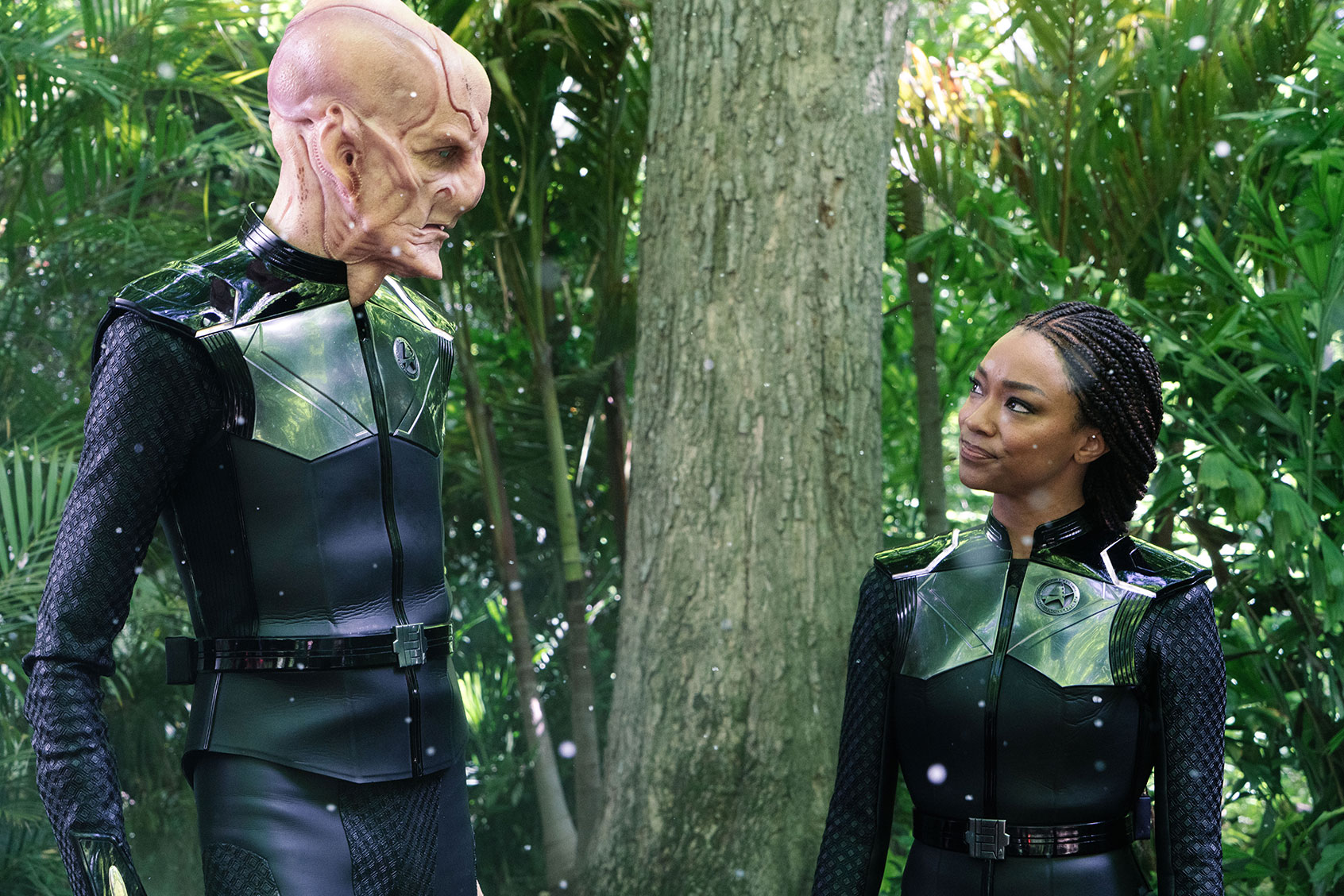
“Star Trek: Discovery” makes a case for Michael Burnham as the last great Starfleet captain

Michael Burnham's "Star Trek" journey was destined to be among the franchise's toughest and most complex. Some of us knew this from the moment Sonequa Martin-Green was cast to play her, especially Black women who are sci-fi geeks. We have never been few, but until recently, we were far less visible than we are now.

To some, this visibility symbolizes everything that has supposedly gone wrong with this franchise and others. The reach of "Star Trek: Discovery" goes even further by assembling a truly inclusive cast that blew apart the original series' longstanding heteronormativity.

All this further angered culture war trolls and self-appointed arbiters of what is so-called "real" "Star Trek." These people have a vested interest in downvoting any such divergences from what has gone before.

Mainly it was — as it continues to be — the purists who wrote off "Discovery" as "not Trek" during its first season in 2017. Looking back from its final season — and from the perspective of Burnham's 900-year journey — we can say that despite how its thematic shading looked to us then, "Discovery" never abandoned Gene Roddenberry's optimism. It has simply evolved its interpretation.

In the first season, not even Burnham would believe this to hold true. A human raised on Vulcan by Spock's father, Sarek, and as his sister, Burnham earns her first officer role through superior conduct and logic, divorcing herself from sentiment.

Burnham's smug sense of rectitude gets her superior officer killed. She is charged with mutiny, stripped of her rank and sentenced to life in prison.

Star Trek: DiscoverySonequa Martin-Green as Burnham and Callum Keith Rennie as Rayner in "Star Trek: Discovery" (Marni Grossman/Paramount+)But her record provides her with a second chance aboard the U.S.S. Discovery as a specialist who eventually proves herself to be resourceful and reliable enough to gain a pardon, reinstatement and medal of honor.
From there, she stops a rogue galactic A.I. from annihilating the Federation and leaps nine centuries into the future (thereby largely freeing herself and the show from restrictive canon) to find a universe where Starfleet as it used to be is a dream, and the Federation and its ideals are broken.

"Discovery's" swansong season finds Burnham in the year 3191, with enough of the Federation's trust to take on a highly classified mission alongside Captain Rayner (Callum Keith Rennie), who has already earned the same commendations as Kirk and Picard. His reputation precedes him, in other words. Their quest relates to a Picard-era discovery that Starfleet fears can be used to eradicate all humanoid life in the universe.

"Discovery" never abandoned Gene Roddenberry's optimism. It has simply evolved its interpretation. 

Their success should place her on par with the greats, an honor that showrunner Michelle Paradise and the show's co-creator Alex Kurtzman have been driving toward all this time.

Some indicators of that goal aren't as obvious as others, like the sequence in which Rayner defies Burnham during an away mission, trusting in his overconfidence instead of her strategic acumen. His snap judgment endangers a planet's civilian population, leaving her to fix the crisis he has created.

Women watching this — especially Black women, I would wager — might have experienced a slight rage triggering in their soul that was mollified by Burnham pulling the very Obama-esque move of asking Rayner to replace her trusted friend Saru (Doug Jones) as her first officer. (The job was coming open, anyway; Saru is shifting into diplomacy mode and getting married.)

This is the move of a great leader. Then again, like Kate Mulgrew's long underappreciated Captain Janeway, it may not be appreciated by the fandom for many, many years.

Burnham's arc contradicts what we know about the great Starfleet captains profiled in this franchise, most of whom are white and male.

Burnham's arc contradicts what we know about the great Starfleet captains profiled in this franchise, most of whom are white and male, though if that were the extent of what differentiates her from the rest, it would barely be worth mentioning.

Records of their histories come to us as snippets of dialogue from secondary characters or contextualizing conversations from what the official logs have to say about past missions. We hear about who served under whom, granting legitimacy to the likes of, say, Christopher Pike to claim the captain's chair long before Anson Mount made us ecstatic to see that happen.

Burnham's path to the helm's command begins with what should be a life- and career-ending mistake. It's constantly defined by humility and doubt. No one is harder on Burnham than she is on herself — and nobody takes as many risks with their career or reputation to keep their crew alive. Her optimism is one guided by the hope that all obstacles can be overcome and all outcomes are possible, including for herself.

Despite all of this, it will take a lot of convincing for some people to consider Burnham among the top ranks of Starfleet captains in those occasional fan polls that tend to place Jean-Luc Picard or James T. Kirk in the top positions, though Captain Pike has offered stiff competition since "Strange New Worlds" first aired.

Star Trek: DiscoveryDoug Jones as Saru and Sonequa Martin-Green as Burnham in "Star Trek: Discovery" (Michael Gibson/Paramount+)A predictable response, since "Strange New Worlds" aligns with the old-school "Star Trek" tone.

But our relatively newfound love of Pike and that show wouldn't be possible without "Discovery" venturing into the unmapped asteroid field that is the public's willingness to boldly go back to a dormant franchise in a wildly disunified era.

This doesn't merely refer to the role of "Discovery" introducing Mount's Pike, in addition to launching every other new "Trek" spinoff along with the streaming service currently known as Paramount+. It did all this along with shouldering the more precarious mission of serving as the franchise's vanguard in a cynical age.

If you love "Lower Decks" and "Strange New Worlds," this is in part due to the producers' listening to the fandom's programming desires accordingly. Notice, for example, how unlike the first season of "Picard" is from the third. Initially, "Picard" tried to do something different with the beloved character. It ended his adventures by reassembling the band for the spectacular last ride their films denied them. The new "Star Trek" series have a goal of delivering something for everyone, including kids. "Discovery" helped its custodians figure that out.

We need your help to stay independent

And if you love "Discovery," its devotion to showcasing those who long felt unseen in this franchise may kindle that affection. "Discovery" gave us an Asian woman as a Starship captain in Michelle Yeoh's Philippa Georgiou and a happily married duo to root for in Wilson Cruz's Dr. Hugh Culber in Anthony Rapp's Paul Stamets.

It introduced Tig Notaro in its second season as Jett Reno, a decision for which everyone should be grateful. The third gave us the franchise's first transgender and non-binary characters in Ian Alexander's Trill Gray and Blu del Barrio's Adira Tal.

Through it all, we have also entirely fallen for Mary Wiseman's Sylvia Tilly, a woman who also knew a few things about self-doubt and, therefore, values being understood.

What some would cite as humanizing traits, others might write off as maudlin, along with the fact that Burnham was able to experience a fully realized love affair that began with a partnership of equals with a courier named Booker (David Ajala).


Want a daily wrap-up of all the news and commentary Salon has to offer? Subscribe to our morning newsletter, Crash Course.


It's only one of the many ways that "Discovery" is consciously disparate from "Star Trek" as we have long known it, daring to change everything from the look of the Klingons to its star character's role in igniting a war between them and the United Federation of Planets.

That was then. Hundreds of years after that moment, Captain Burnham has figured herself out, proving to the many who doubted her that she deserves to be there.

She has traveled the longest road through imposter syndrome of any Starfleet captain — most of a millennium, actually — and we have witnessed every major moment that forged her. Burnham may never win the major "Star Trek" popularity contests for favorite captains, but without a doubt, she's the last great one we may ride with in this universe.

New episodes of "Star Trek: Discovery" stream Thursdays on Paramount +.

Schweppes Zero Sugar Ginger Ale recalled after investigation reveals it’s a full sugar product

Pepsico Inc. of Purchase, NY, is recalling certain Schweppes Zero Sugar Ginger Ale cases following an internal investigation that revealed the carbonated beverage actually contains "full sugar." The recall was initiated on March 9, 2024, and is ongoing, per an official notice posted by the US Food and Drugs Administration (FDA).

Approximately 233 cases of Schweppes Zero Sugar Ginger Ale Caffeine Free 7.5 FL OZ (221 mL), each containing 6 packs of 4 cans (24 cans total), were recalled. The products were shipped to Maryland, Pennsylvania and West Virginia.

Consumers are urged to either discard the recalled products or return them to the place of purchase.

The recent recall is just one of many food recalls that have been announced by the FDA these past few days. On March 12, Spices USA Inc. of Hialeah, FL, initiated a recall of Tasty-Sawa cinnamon due to elevated lead levels. The recalled products were distributed in the U.S in Florida, Georgia and North Carolina, as well as in Trinidad and Tobago and Guyana.

On March 18, Naturz Organics USA LLC of North Brunswick, NJ, initiated a recall of certain Naturz Organics Organic Pea Protein bags due to possible Salmonella contamination. The recalled products were distributed to one consignee in Wisconsin.

Former Trump CFO Allen Weisselberg gets 5 month prison term for perjury

Former Trump Organization Chief Financial Officer Allen Weisselberg admitted Wednesday to lying under oath in order to shield former President Donald Trump from New York prosecutors, CNBC reported. The judge of a Manhattan criminal court sentenced him to five months in prison after he was convicted of two counts of perjury in the first degree.

Weisselberg, 76, is expected to begin his incarceration on Rikers Island immediately.

The former executive's trip to the infamous jail is his second in two years. In 2023, Weisselberg spent three months there after pleading guilty to charges that he participated in a tax fraud scheme cooked up by Trump Organization executives.

The perjury charges stemmed from a civil business fraud case brought against Trump, his company, family and associates by New York Attorney General Letitia James. The state accused the defendants of inflating Trump's wealth on financial statements so they could make deals with otherwise reluctant lenders and insurers while securing more attractive interest rates. Weisselberg, for his part, falsely claimed last October not to know the value of Trump's Manhattan penthouse, which according to the Associated Press was presented on financial statements as being nearly three times its actual size.

Weisselberg admitted to making false statements in a May 2023 deposition and his testimony during the October trial. "Allen Weisselberg accepted responsibility for his conduct and now looks forward to the end of this life-altering experience and to returning to his family and his retirement," his attorney, Seth Rosenberg, said in a statement.

Manhattan District Attorney Alvin Bragg  who filed the perjury charges against Weisselberg and is prosecuting Trump on charges of falsifying business records to obscure "hush payments"  turned up emails that show Weisselberg's intimate involvement in the penthouse scheme. With Trump's loyal deputy now headed to prison, Bragg is hoping to catch larger quarry in a trial set to begin Monday.

EPA puts first-ever limits on “forever chemicals” in drinking water

"Forever chemicals" live up to their name and take inconceivably long to break down. You definitely don't want these substances in your body. Technically known as PFAS (short for "per- and polyfluoroalkyl substances"), they are linked to ailments like high blood pressure, liver disease, lowered sperm count and various cancers. Unfortunately, PFAS are also in hundreds of common household products, from microwaveable popcorn bags and nonstick cookware to food boxes and takeout containers, from receipt paper and waterproof clothes to umbrella coatings and dental floss.

Inevitably, PFAS have also seeped into our water supply. To address this, the Environmental Protection Agency announced on Wednesday that it will impose strict limits on how many PFAS can be in our drinking water, requiring utilities to reduce them to their lowest measurable levels.

EPA Administrator Michael Regan told the Associated Press that "the result is a comprehensive and life-changing rule, one that will improve the health and vitality of so many communities across our country." The EPA estimates that it will cost $1.5 billion annually to implement the rule but that it will prevent nearly 10,000 deaths over decades while reducing the prevalence of many serious illnesses linked to PFAS consumption.

While environmentalists praised the new policy as a step in the right direction toward PFAS removal, it is only the beginning. PFAS are present everywhere in the environment, and as Dr. Katie Pelch of the Natural Resources Defense Council told Salon last year, it will not be easy to fix.

"Even if we turned off the tap on all of our production of PFAS today, we have already severely contaminated our environment," Pelch said. "So we need solutions that help remove PFAS from the environment, remove PFAS from drinking water and from all of our contaminated land and air. We need to set safe drinking water standards while also removing PFAS from all of our consumer and industrial products where they're not essential."

“There’s a lot we don’t know”: Why public health experts are worried about bird flu

The Centers for Disease Control and Prevention (CDC) issued a health alert last week about a confirmed case of H5N1 in a human.

In late March, a worker on a commercial dairy farm in Texas developed a case of pink eye and later tested positive for the highly pathogenic avian influenza Type A H5N1, also known as "bird flu" or avian flu.

Though the farm worker had no symptoms other than eye inflammation and wasn't hospitalized, they were isolated and received an antiviral treatment, according to the CDC. The public health agency suspects the patient got infected from a sick dairy cow.

While bird flu is nothing new, this is the first time officials have confirmed that the virus has jumped from a cow to a human, and the line of transmission suggests it's easily transmitted between cows. The last time a human tested positive for H5N1 was in April 2022 in Colorado, when an individual got infected from poultry.

The fact that it jumped from cattle to human is unsettling, experts say, and a cause for alarm. But not necessarily because H5N1 will turn into a pandemic this year.

"There's a lot we don't know," virologist Dr. Angela Rasmussen told Salon. "We don't know essentially what kind of risk the cows themselves present."

It seems "clear" that cows can present a risk to each other, Rasmussen elaborated, but what kind of a risk this poses to cow health isn't completely understood. And neither is what kind of a risk this poses to human health.

In birds, HPAI is highly contagious and deadly. The big concern is that the more it jumps from animal to animal, or animal to human, the more likely it is to mutate to better infect humans. Of course, RNA viruses like influenza and SARS-CoV-2, which causes COVID-19, are always mutating. Every replication in a hosts' cells presents a chance for a mutation to emerge. While viruses technically aren't alive, it's their nature to mutate and evolve as they infect hosts' cells and replicate. This is how they reproduce. Thus, understanding how H5N1 in mutating is critical in assessing the potential risk to both animal and human health and how close the U.S. could be to a bird flu pandemic.

While viruses technically aren't alive, it's their nature to mutate and evolve as they infect hosts' cells and replicate. This is how they survive.

Fortunately, bird flu doesn't appear to be jumping from human to human, public health officials say. According to the CDC, the current risk these viruses pose to the public remains low. In fact, the CDC sequenced the genome and compared it to other sequences from cattle, wild birds and poultry. It found no major changes, except one: The human sample had a mutation called PB2 E67K, which is known to connect virus adaptation to mammalian hosts. It has been seen before in people infected with H5N1.

"It is the enzyme that basically copies the virus when it's replicating and that has been associated with mammalian adaptation, but it's only one out of a collection of these mutations that are associated with mammalian adaptation," Rasmussen said. "So that kind of suggests that when the virus was transmitted from the cow to the person it picked up this mutation."

However, Rasmussen emphasized that this "doesn't mean that the virus is better adapted to transmitting between mammals," which is good news. "It just means — as we would expect — it is in a second mammalian host species," she said. "And so it's picking up adaptations that we've already seen that are associated with mammalian adaptation."

Dr. Rajendram Rajnarayanan of the New York Institute of Technology campus in Jonesboro, Ark., also believes the risk for human-to-human transmission is low. However, he's concerned about the virus transmitting to other mammals on a farm, such as pigs.

We need your help to stay independent

Pigs, Rajnarayanan said, can get infected with multiple viruses at a time. This could make it easier for the virus to mutate into a new one that could more easily jump from mammal to mammal, like say, from one human to another.

"It needs a mixing pool, like pigs," he said, "to efficiently infect the human airways and then invade different parts of the body and then cause more serious damage."

In the U.S., there haven't been any recent known cases of human-to-human transmission. While they have occurred in other countries, these cases didn't spread beyond close contacts and were contained before becoming an epidemic. Certainly, the consensus among scientists is that the latest case of bird flu isn't a panic-inducing threat to human health right now. It could be in the future, especially if it eventually infects a host like pigs.

"The likelihood of bird flu becoming a pandemic in the next century is probably pretty good."

"The likelihood of bird flu becoming the next pandemic in the next year is probably pretty low," Dr. Linda Yancey, infectious disease specialist at Memorial Hermann Health System in Houston, told Salon. "The likelihood of bird flu becoming a pandemic in the next century is probably pretty good."

However, this doesn't mean that individuals shouldn't change their behavior. In light of news of the infection, people should refrain from drinking unpasteurized milk.

"It's super important to make sure you're not drinking unpasteurized milk," Yancey said. "Our milk supply is extremely safe. We pasteurize it, but occasionally you'll get people who, for whatever reason, drink unpasteurized milk."

Indeed, one concern top of mind for experts is the potential impact on the milk supply chain. Rasmussen is also worried about the potential economic impact.


Want more health and science stories in your inbox? Subscribe to Salon's weekly newsletter Lab Notes.


"We don't even really appreciate the full extent of how many cows might be affected," Rasmussen said. "It looks like this is associated with dairy cattle, rather than beef cattle, but there is some crosstalk between those two industries."

This is normally a time when Rasmussen would tell the public to get their vaccines. While there are avian flu vaccines under development, none have been approved for use in humans yet. Notably, according to the CDC's health alert, in the strain identified in the Texas case, there is no indication that bird flu has developed antiviral drug resistance, meaning that even without vaccines certain drugs could possibly work against it.

Still, the CDC is asking healthcare workers across the country to look out for signs of bird flu and consider it as a possibility when patients have been exposed to sick or dead birds, livestock or other animals a week before an onset of symptoms. Humans are also advised to stay away from sick or dead animals.

"This has actually been a crisis in the animal population globally for the last three years," Rasmussen said. "If people want to translate their concern into action, I would strongly suggest advocating for taking more steps and putting more of an investment into pandemic preparation."

Mississippi “Goon Squad” cops sentenced to state prison terms of 15 to 45 years for racist attack

Six white ex-cops in Mississippi who pleaded guilty to attacking and torturing a pair of Black men were sentenced Wednesday to state prison terms ranging from 15 to 45 years.

The men, who were active members of the Rankin County Sheriff’s Department when they committed their crimes, had previously received similar federal sentences, the Associated Press noted. They will serve their terms concurrently.

“The state criminal sentencing is important because historically, the state of Mississippi has lagged behind or ignored racial crimes and police brutality against Blacks, and the Department of Justice has had to lead the way,” Malik Shabazz, an attorney representing the two victims, said Wednesday.

The attack on Michael Corey Jenkins and Eddie Terrell Parker took place in January 2023, when the officers – members of a self-styled “Goon Squad” – burst into their home in Braxton, Mississippi, without a warrant, after receiving a report that the victims were living there with a white woman, NBC News reported.

At one point, one of the officers staged a mock execution, jamming a gun into Jenkins’ mouth and firing twice – the second time releasing a bullet that broke the victim’s jaw.

Officers also beat and sexually abused the men. The incident garnered national attention given the brazen, racist nature of the assault.

“I never knew the ones that were sworn to protect and serve would be the ones that [I] needed protection from," Parker said in a statement, as reported by CNN. "My life was not perfect, but it was mine. I doubt I will ever be able to experience it again.”

Nearly a year after USDA approval, lab meat is still off the menu

In March 2023, Florida lawmakers passed a bill that would make it a misdemeanor to develop or sell lab-grown meat. The initiative joined a growing number of similar efforts from conservative lawmakers around the country, with lawmakers in Alabama, Arizona and Tennessee all introducing similar bills. Other states, like Montana, North Dakota and Wyoming, have passed bills banning the products (also called “cultured meat” or “cultivated meat”) from being labeled as “meat” at all — a cause that’s been taken up by senators at a federal level, many of whom are also advocating to ban lab meat from school lunch programs and federal food procurement.

Objections to cultivated meat have been varied, with politicians citing concern for U.S. ranchers, questions about health and safety and, increasingly, conspiracy theories about attempts to control the U.S. food supply. The idea that powerful actors want to take meat away from Americans echoes previous claims that the Green New Deal — a proposed package of climate policies that suggested reducing agricultural emissions — was an attempt “to take away your hamburgers.”

Lab meat has emerged as yet another flashpoint in our country’s culture wars — wars that have long included debates about the role of meat. This hand-wringing would give the impression that cultivated meat is poised to radically disrupt the way we eat, but so far, it’s a mostly speculative threat to our meat-heavy diets.


The industry’s stops and starts

In the real world, lab meat hardly exists: In the U.S., you can’t order it in a restaurant or buy it in a store. As food journalist Joe Fassler reported from an interview with the founder of a cultivated meat company, conversations about getting products to market now happen in terms of decades rather than years. Given the billions of dollars investors have poured into cultivated meats in the last decade, it’s safe to say there’s a lot more in the industry’s way than fearmongering and political obstructionism.

For decades, scientists have speculated about growing meat without actually using animals. And in the last ten years, that’s become possible. Cultivated meat is created by growing livestock cells in a nutrient-dense fluid, then layering them in a way that approximates muscle fibers. As researchers have moved cultivated meats from science fiction closer to reality, the concept has attracted the attention of both food system reformers, some of whom see it as an opportunity to move away from the environmental destruction associated with conventional meat production, and investors, who have enabled a few prominent startups to develop early products. In those regards, the situation mirrors the early days of plant-based meat alternatives.

In June 2023, the U.S. Department of Agriculture announced it had approved for sale two lab-grown meat products, both cultivated chicken, from California companies Good Meat and Upside Foods. Those approvals came with high-end restaurant partnerships: Upside’s chicken soon appeared at San Francisco’s Bar Crenn, sister restaurant of Michelin-starred Atelier Crenn, and José Andrés’ China Chilcano began serving Good Meat’s chicken in D.C. These tasting menu appearances seemed like a smart, prestigious way to help legitimize the products: If Dominique Crenn and José Andrés took cultivated meat seriously, they could convince consumers who would otherwise turn their nose up at it. This isn’t an uncommon rationale in the culinary world, with Eleven Madison Park’s chef Daniel Humm explaining the restaurant’s controversial pivot to a vegan menu as a demonstration that vegan food should be taken seriously.

But both restaurants have since stopped serving cultivated chicken.

This muted opening was the result of neither poor reviews nor consumer skepticism — the chicken was positively received by chefs and diners alike — but rather the highly limited availability of the ingredients. With the restaurant only able to source 16 one-ounce portions from Upside every month, Bar Crenn’s cultivated chicken never made it onto the regular menu. China Chilcano offered its cultivated chicken dish on a tasting menu with only six available reservations per week, and even then, Good Meat’s low production eventually forced the restaurant to drop portion sizes.

If this trickle-down strategy was intended to inspire and normalize, it has more or less backfired. The failure of producers to supply enough cell-cultured chicken for even a few high-end restaurants ultimately has helped underscore what cultivated meat and fine dining have in common: inaccessibility.


The reasons for the growing pains

As we’ve explored in the past, cultivated meat is exceptionally challenging to create. Researchers have made huge strides on a number of fronts, including reducing dependency on animal products and improving the quality of meat they can produce — especially when it comes to growing cells in organized fibrous structures to mimic actual muscles and cook like whole cuts of meat. Texture problems have been a big sticking point for plant-based fake meats, which remain mostly confined to imitations of ground and processed meat products.

But for all the progress that’s been made in the lab, transitioning to actual production at scale has been a huge problem. As an investigation into Upside’s California facility revealed in September 2023, the company’s products are still essentially made by hand, with the facility’s largest equipment going unused as workers instead layer cell sheets one by one in small bottles — a stark departure from the company’s claims that the facility was capable of producing 50,000 pounds of meat a year. Upside’s planned Illinois production facility is on indefinite pause. Things at Good Meat don’t seem to be going much better, with an announcement that its California facility will shift focus from making meat now to developing new cell lines that could be better suited to large scale production in the future.

Cultivated meat on the whole isn’t necessarily stuck in the mud, even if whole-muscle cuts are proving difficult: Products like hot dogs and chicken nuggets are much simpler to make with existing technology because the process doesn’t require nearly as much structuring of the cultured cells. Last year, Upside announced its intentions to expand in this direction with chicken nuggets, but the company has not received regulatory approval for anything but its whole-muscle chicken. Even if cleared for sale, however, it’s unclear whether those nuggets would fare well: They would be much more expensive than regular chicken nuggets, and for the small number of consumers interested in more ethically produced nuggets, existing plant-based alternatives are close enough to scratch the itch.


Will lab meat scale up fast enough to make a difference?

Current capacity issues could eventually be overcome, but the industry will need a lot more cash — and where that comes from is up for debate. Cultivated meat was a prime beneficiary of the last decade’s cash-flush investment market, but that’s largely dried up in recent years. Some food system reformers have advocated for public funding, arguing correctly that the conventional meat industry only reached its current scale with the help of widespread public investment in everything from research to infrastructure to subsidies.

But this argument unintentionally gets at the central problem with positioning cultivated meat (and other meat alternatives) as a cure to industrial meat’s problems: Consumer behavior is not the central pillar holding up the meat industry. If anything, our increasing meat consumption is the product of a government subsidy system that keeps producing more and more meat at lower and lower prices.

Attempts to keep producing meat at our current scale while reducing its environmental impact have largely failed: Industry scientists have defended industrial agriculture using questionable emissions analyses and argued for band-aid solutions like methane digesters; on the other end of the spectrum, regenerative agriculture limits livestock’s impact on the environment, but uses a lot of grazing land to do so and produces a lot less meat, even when scaled up. In this context, using alternative products to undercut meat consumption is a tempting strategy.

If cultivated meat were ready to go today, it could help scale down animal agriculture without asking people to give up eating as much meat as they’re accustomed to. But with a likely decade-long lag before the industry is really ready to compete with conventionally raised meat, it’s not something to bet on. This means that reducing the amount of meat we produce and eat must, for the moment, be the top priority if we’re going to stave off the worst impacts of the climate crisis. Dismantling the subsidies that enable our excessive meat consumption should come first.

Even if the initial result is just that meat becomes more expensive, we know this has a big impact on meat consumption: Surges in meat prices (tied to high feed costs) in 2008 and 2020 pushed meat consumption down considerably. Making meat less affordable may not be a popular prospect, but it’s certainly one that we can adapt to. The long history of vegetarianism worldwide — and its popularity in the U.S. during previous periods of economic hardship — shows that people’s food preferences are malleable when they need to be.

Swiss seniors win first-ever human-rights case on climate change

A group of elderly Swiss women made history on Tuesday when they became the first plaintiffs to win a climate-related victory in the European Court of Human Rights.

Representing a group of more than 2,000 individuals known as KlimaSeniorinnen — a Swiss German shorthand term for "Senior Women for Climate Protection" — the women successfully argued that because of their age and sex, they cannot leave their homes during heat waves without suffering health attacks. 

Court President Siofra O'Leary ruled that the Swiss government has not met its own targets for cutting greenhouse gas emissions and has not set a national carbon budget, thereby putting it at fault.

"It is clear that future generations are likely to bear an increasingly severe burden of the consequences of present failures and omissions to combat climate change," O'Leary said.

KlimaSeniorinnen members told the press they hadn't pursued this case for themselves, but rather for future generations whose basic human rights will continue to be violated by the climate crisis.

"Some of us are just made that way. We are not made to sit in a rocking chair and knit," KlimaSeniorinnen member Elisabeth Stern, 76, told BBC News. "We know statistically that in 10 years we will be gone. So whatever we do now, we are not doing for ourselves, but for the sake of our children and our children's children."

Two other climate-related cases were less successful. A former French mayor who argued that climate inaction puts his town at risk of being submerged in the North Sea saw his case dismissed because he no longer lives in France. A group of Portuguese young people who argued that extreme heat and wildfires made it impossible for them to play outside or go to school, and had caused them severe anxiety, were told to pursue their case in Portuguese courts first.

MAGA operatives behind 2020 voter suppression robocalls will pay up to $1.25 million in penalties

Two right-wing operatives with a history of peddling conspiracy theories are now facing the consequences of orchestrating a more real conspiracy of their own.

Jacob Wohl and Jack Burkman agreed to pay up to $1.25 million to the office of New York Attorney General Letitia James after being charged with overseeing a 2020 election robocall campaign aimed at suppressing Black voter turnout, NBC News reported. The speaker on the robocalls identified herself as "Tamika Taylor of Project 1599," and falsely told around 5,500 Black voters in New York that casting ballots by mail would alert creditors and put the them on a public database used by police departments to track down people with outstanding warrants.

"Don't be finessed into giving your private information to the man, stay safe, and beware of vote by mail," the speaker warned on the call.

Wohl and Burkman were already facing criminal charges in Michigan and Ohio for the robocall scheme when the New York attorney general filed charges in 2021. She initially hoped to make the pair pay up to $2.7 million in penalties. Amid the ongoing New York lawsuit, the Federal Communications Commission slapped them with a $5.1 million fine in June 2023.

The deceptive robocall was one of many plots headed by Wohl and Burkman with the aim of promoting Donald Trump and the MAGA movement's political interests. The New York Times reported in 2018 that they were behind a series of emails that offered women money in exchange for smearing then-Special Counsel Robert S. Mueller with sexual misconduct claims.

"Wohl and Burkman orchestrated a depraved and disinformation-ridden campaign to intimidate Black voters in an attempt to sway the election in favor of their preferred candidate," James said in a press release. "Now they will pay up to $1.25 million to my office, the National Coalition on Black Civic Participation, and the individuals who were harmed by their scheme." The press release later states that one voter suffered "severe anxiety and distress," later withdrawing their voter registration.

Under the terms of the agreement, Wohl and Burkman are responsible for $1 million in damages, though the amount can be reduced to $393,000 if $105,000 of the damages is paid by December 31, or increased to $1.25 million if they miss that deadline.

Gypsy Rose Blanchard files for divorce from husband Ryan Anderson after two years

Gypsy Rose Blanchard officially filed for divorce from Ryan Anderson on Monday after announcing her split from her husband last week.

The couple met via letter correspondence while Blanchard was still incarcerated for the 2016 second-degree murder of her mother, Clauddine "Dee Dee” Blanchard, and were married in July 2022. After her early release from prison last year, Anderson and Blanchard looked happier than ever on a press tour promoting a new Lifetime docuseries, "The Prison Confessions of Gypsy Rose Blanchard," that chronicled her story as a victim of abuse and Munchausen by proxy, her time in prison and eventually meeting and marrying Anderson.

However, there were signs that the couple was struggling. Blanchard deleted her public social media accounts that had amassed a whopping 10 million followers at the advice of her parole officer. In a statement obtained by People Magazine, Blanchard stated, "Unfortunately my husband and I are going through a separation and I moved in with my parents home down the bayou. I have the support of my family and friends to help guide me through this. I am learning to listen to my heart. Right now I need time to let myself find… who I am."  

According to a court clerk, Blanchard filed for a divorce in Lafourche Parish, Louisiana. The reason why Blanchard has filed for divorce has not been made public yet. Neither Blanchard or Anderson have responded to a request to comment, the New York Times reported.

“You have to forgive yourself”: Anne Lamott on loving, fighting and not fearing death

Anne Lamott is not afraid to die.

Death is as guaranteed as hunger and fatigue. We know it's coming, but we still diet, plan and medicate ourselves with hopes of extending our time on earth. Why do we fear the inevitable?

I spoke with Lamott recently, ahead of her 70th birthday about the publication of her 20th book, Somehow: Thoughts on Love,” published this week by Riverhead. In her new essay collection, the memoirist and author of the seminal writing manual "Bird By Bird" writes freely about a topic many of us run from. “I've had so many people [die] in my lifetime, starting with my dad when I was 23, and then my very best friend when I was 37, and then my mom and friends my own age,” Lamott told me. 

“I am a believer, and for me, death will be a rather significant change of address, but I'm not afraid of death," she said.

A New York Times bestselling writer, Lamott is the author of “Hallelujah Anyway: Rediscovering Mercy,” “Help, Thanks, Wow: The Three Essential Prayers,” “Small Victories: Spotting Improbable Moments of Grace,” the influential parenting memoir, “Operating Instructions: A Journal of My Son's First Year,” among others. She is the recipient of a Guggenheim Fellowship and her words have appeared in many publications, including The Washington Post and here at Salon

Lamott's latest collection explores the subject of love beyond romance to include the many different ways we do or do not experience it: The love we have for our parents, our siblings, our friends, our professions, the love we are responsible for sharing with our community. Lamott writes about her efforts to supply the unhoused with soap and hair care products, an endeavor that ended up being surprisingly difficult, and the care and patience it takes to watch a friend die.

Throughout the book, Lamott balances meditations on death with recognition of the love we can name and cultivate while we are still here. She also addresses, as she has in an earlier book, the fall-out from her 2015 retweet of a transphobic remark, "this gigantic public mistake I made," as she characterizes it below. After making amends, the episode resurfaced several years later, leading to a university keynote address being canceled after students spoke out and a fundraiser she offered to host for the LGBTQ community coming under scrutiny. Both events ended up happening, as she writes in an essay exploring internal and external paths toward an internal cleansing of shame through love. 

In a recent conversation, Lamott and I discussed how her definition of love has evolved over the past 30 years, what heaven on Earth would be, how to fight productively and why forgiveness is a cornerstone of her faith.

Our conversation has been lightly edited for length and clarity.

Congratulations are in order, first and foremost. You have this great body of work, different ideas and thoughts that belong to the universe forever. In "Somehow: Thoughts on Love," you approach the topic of love in many different ways. I think about my own definitions of love before I had a child four years ago, and so much has changed since. How has the idea of love evolved and changed for you over the last 30, 40 years?

Well, that's a great question. I mean, it takes a whole book to answer it, but I think I got sober in 1986 — 37 years ago — and I think that was when the plates of the Earth shifted underneath me. And I very slowly began to have a different relationship with myself. I stopped being so mean and judgmental and disappointed and loaded, and I just started to understand that I was just like almost everybody else. I wasn't worse than or better than. I was just this kind of screwed up person who screws up. Sometimes if you're a writer, you screw up in public, so you screw up with 100,000 people aware of that. Other times it's at the dining room table.

And when that happened for me, this friendliness towards myself, I think love started really changing. Because I started understanding what other people were going through in their lives. Even if they had so many blessings, it's just hard here. Life is hard and weird, and people with whom we can't live without die. How do we survive an un-survivable loss?

And being a parent or being an auntie or an uncle is so, so joyful and it's so fraught. It's scary, and some patches of time are hard and sometimes they're devastating. And other times, some days are just too long. So I started having a lot more compassion, beginning with myself and then spreading out into the bigger world.

"My book begins with something my husband says, which is that everything true and beautiful about life can be discovered on a 10-minute walk."

I want to share a story with you, a big realization moment for me. I was in high school and in an argument with my girlfriend at the time. I ended the argument because I had to get to the post office. I thought, "You know what? I'm having such a bad day. Parking spots are too tight. It is just a horrible day." So I decided I'm going to do something nice for somebody.

I'm walking into the post office and a homeless guy asks for some money. And I'm like, "I'll buy you something to eat, man." Mind you, I'm 18 years old, right? I come back out, and he's like, "What's up, man?" I said, "Oh, yeah, yeah, yeah. I will go to the chicken spot across the street, right? I'm going to grab you something to eat, man." And he said, "All right, cool." And as I crossed, walking away, he's like, "I only eat white meat, none of that dark meat." So I said, "What the …?" And I laughed it off. But then it dawned on me: We're so messed up as a society. Why would I think this man wouldn't have an opinion just because he sleeps in front of a post office? I thought about that when reading about your experience giving out bags [of supplies to unhoused people] and the conversations you were having.

Let me tell the story for people who haven't read the book. The book is based on the premise that if you want to have loving feelings — which is what heaven I think is like here on Earth — you do loving things. You take the action and the insight follows. So I just love your story. My book begins with something my husband says, which is that everything true and beautiful about life can be discovered on a 10-minute walk.

So you get out of the car and you walk to the post office. You could see everything in the world that is really sweet and lovely, people waving to you from across the street and the daffodils that are up right now, et cetera. So the first chapter [of my book] is about these bags that we gave away at my church for the unhoused people in our community. And it had all of this stuff that might be hard to get if you don't have any money or a house to live in, like some body wash or some floss, a really nice beanie to keep your head and ears warm, two pairs of warm socks. And so it was about me being asked by my church to give a bunch of these bags out to the homeless people in the area. The story is really about the deep surprise the people [reacted with when] I set upon to give them these bags.

I'm 70, and my teeth were shifting, and I had to wear this Invisalign retainer and I lost it. Oh, I tore the house apart. I tore the car apart. I tore the whole world apart, couldn't find it. And finally, I thought to drive past this woman and her child who were asking for donations outside of Safeway. I'd given them a bag [of supplies from the church], which they hadn't had a clue what to do with. I asked if I could peek inside. And by God, there it was at the bottom. I mean, that is the miracle of grace if you ask me.

And so I was explaining to the mother, who didn't speak very good English, and her son who did, that [the retainer] was very expensive and I was so grateful, I couldn't even believe it. And then the son did this magical moment. He looked at me and he made the universal sign of, "Give me some money. Hand it over." And so I just got it. It was like I'd stepped on the cosmic banana peel, and these people had helped me back up. Of course, I shelled out some more money and some food. 

These stories give us the opportunity to reflect on situations in our own lives. I think the book does a great job of showing how we are all connected in so many ways. And I was upset when I got to the end of the chapter with Tim. Can you give our readers some insight into the conflict between you and Tim?

Yes. And I want to hear why you were upset. So I had this man I was mentoring who was much younger than I am, and sober not quite as long. And he had done a kind of confession on paper and was telling me writing stuff that was plaguing him: Things he was jealous of, people he had resentment towards, and the main person was this very close friend of his. I don't get it because Tim is this beautiful, evolved human being.

And he started telling me all this stuff that the woman had done to him. And for some reason — it was just like a brain fart or something — but it seemed like a good idea to just jump right in and tell him all the stuff that I didn't like about her or that I thought was dangerous. And he listened and it was mostly to say, "Don't worry about it. She is a handful." And so then a couple of hours later, he called me and said he didn't want me to be his mentor anymore. And he said, and I quote, "I don't want to turn out like you."

So the story is about what on Earth you do when a very beloved friend says something like that to you. If you translate, it means, "I find you sort of repellent and I don't want to turn out like you are." 

Who am I, and how can I get back on my feet after somebody has seen what I'm suddenly convinced is the truth of me?

All my life, all these years, I've thought if you got to know me too deeply, you'd run for your cute little life screaming, because I'm so scary and disgusting on the inside. And [I believed] Tim alone could see this, and everybody else had been seduced by my persona or my neediness or whatever.

So the story [in the book] is about how do you get out of that kind of hole? Of course, what you do is you cry and you pick up the 200-pound phone and you look around and you fish out your husband and you let people in on the devastation. But anyway, so tell me what you were going to say.

The beauty of that essay was that you have a very special friend who encourages you to give it time. In that time lies grace. I was upset because . . . now, if you're a licensed therapist or something, it is one thing. But you had a human response. You saw a person in need. Maybe over time, you felt like you would've handled the situation differently because you [and Tim] did get to reconnect, you got to your phones.

But for me, don't tell me this stuff if you don't want my truth. You don't want my answer, then don't pour into me. Because [I'm] going to be a friend and say, "Look, she doesn't deserve you. You shouldn't be treated like that. You deserve better." What's wrong with that?

Well, I don't know. It's really complicated. My response to having somebody feel that way about me and make me think that they were revealing the truth about me was to start fawning and to beg. As you know from the story, begging their forgiveness and cashing in my SEP IRA and giving them all my money, and the dog, and my next grandchild. And this brilliant friend said, "That would be a detour away from the gold flecks in the mind of what you're going to get out of this." And I said, "Well, I just want to apologize and go." And she just said quietly, "Maybe tomorrow."

My husband coddled me and fed me and stuff like that. And the next day I called the same friend. I said, "OK, now today I just want to go over there. I want to just beg for forgiveness. I just want him back." And my friend said again, "Maybe tomorrow." 

By two or three days later, inevitably you're better than you were. You're starting to get that the person is not uniquely seeing the truth about you. The person had their own possibly neurotic or knee-jerk reaction and it got all over you, and that was their stuff. And your stuff is to own it and to say, "Boy, I can't believe I said that to you. I know how much you care about this friend of yours, and I'm really sorry. And I hope that this too passes." Which let's face it, everything does eventually. I wrote a book of spiritual essays, most of which appeared first at Salon, called "Grace (Eventually)," and it's the eventually that kills you, the waiting to feel a lot better about things.

"There are people who will never forgive me, who will bring it up, who will get me canceled, who will get talks canceled, who will say it wasn't enough."

The door at Salon is always open for you.

Oh, thank you, love. I was there for 10 years in the early days when David Talbot was the editor, and then when Joan Walsh was the editor. Ah, my heyday.

When you go on tour, is it going to be mostly talks or will you be giving readings as well?

I go onto these stages and I feel the audience. It's really like a tide pool. They're expecting something from me and I'm just looking out at them and I'm getting what the vibe is.

I'm going to like 17 cities in 17 days and almost everywhere I go, people feel lost and hopeless. They feel just devastated by Trump and by MAGA, and they feel devastated by climate change and they feel scared to death in their own families. They've lost or are losing their teenagers or their grown kids to drugs or alcohol or mental illness. And so I usually come from that understanding that people feel.

I wrote the book because I wanted there to be one place where everything I know, everything I'm almost sure will work for my son and grandson when I'm gone, no matter what the climate looks like, no matter what democracy looks like, because it always worked before: Community, love, activism, nature; deep, deep, deep, friendship; self-love, divine love. Each piece is one of those realms.

And so when I get to each city, I figure out what's going on in the audience. The pieces are all pretty funny, I think. And so I'll find something to read that seems to have to do with where that city and that audience is. And then I'm doing a lot of interviews. A lot of the time people are interviewing me on stage, but then the audience gets to ask a lot of questions for 20 minutes. Everybody's favorite thing is the Q & A. I try to keep it not too long if I do a reading or the interview so that people can ask what's really on their heart. They often want to ask about writing because of "Bird by Bird," but whatever they want to ask, I'm happy to answer.

The essay where you talk about the cycle of an argument or a disagreement between you and your husband was so poetic, and it was so beautiful, and it's just so relatable. I can just imagine the crowd saying, "How can we turn these one-hour, two-hour disagreement cycles, into 15 minutes? How can we?"

Yeah, I know. I wish I knew exactly where that was. I'd love to read it. It's sort of funny, but I can tell it. What happens is my husband is a know-it-all. Like you, he's like six-three. He's a large guy. The ground shakes. And so he'll say something that gets under my skin or hurts my feelings. I am very sensitive; I just came this way. On this side of the grave, I'm going to be overly sensitive. In the 1950s, my parents had a book called the "Overly Sensitive Child," to try to help them with the nightmare of having a child who was so sensitive.

Anyway, so now Neal's got me on his hands, so I shut down and then he doesn't understand it. I start to cry, and then I leave the room. And he stomps around. The earth trembles in the living room, and I sit in our bedroom bitterly grabbing the kitten and holding her to me.

And by the time he finally comes in, I become very quiet — deadly, scarily quiet. I've weaponized my silence. And then he gets out his psychic battered old briefcase with these old briefs that he's been shaking for 68 years. And then I kind of stare at him with this corpse-like look. And then he stomps off again. And then he has a moment of clarity, usually about an hour and a half later, that he's completely doomed without me. And he comes back and now he's teary, and then my cold stone heart melts. And then we sit down and we do what you do in any good relationship. You have those really awful, really hard, really deep talks, and you say, "I'm really sorry for my part."

It is beautiful. It's beautiful.

Thank you, thank you, thank you.

You also write about cancel culture and what you went through with the university. And I wondered if you think, with the way things currently are, if we are doing it wrong? 

Yeah, well, you jump through a lot of hoops and you are contrite and you try to make it right.

Somehow, I twice have written essays about this gigantic public mistake I made. I wrote about it in an earlier book, I think in "Hallelujah, Anyway," and again in "Somehow." I publicly was contrite. It's about 50 percent better. But you know what? There are people who will never forgive me, who will bring it up, who will get me canceled, who will get talks canceled, who will say it wasn't enough. You have to read the piece in "Somehow" and decide whether you think it is or not.

You are obviously a very celebrated author and intellect, but you're also spiritual, very religious, a Christian. Forgiveness is the foundation of Christianity. So it's not like you don't have a body of work that explains that. Has intellectualism ever caused conflict with your Christian beliefs?

Well, I am a Sunday school teacher. It's mortifying to be a Christian in the modern era because it's like Gandhi said, "I love Christ, but it's the Christians I can't stand." And I pretty much feel the same way.

I am a Sunday school teacher and I teach forgiveness. It's just a tiny family church. It's like three kids or four kids. And I teach them that Earth is forgiveness school. That's what you're here for, to forgive horribly. At some point, you have to forgive yourself.

And so I know that that is the path. And I have to say that it's a lot harder for me than I would hope. I'm often not forgiven because I have a public life and it's really easy for people to express their unforgiveness of me on social media and in the newspaper and in the magazine.

Bad things happen, for me, very publicly. But I never give up on forgiving other people. And it really, really hurts me that people don't forgive me, but — work in progress. Please be patient. And I always say I'm Reform. I'm Reform Christian, and like you, I'm doing the best I can on any given day. And as I said, some days are just too long. 

You talk about death in the book. We all know it is a part of life and we all go through it and it happens around us. How often do you think about your own mortality, your own life and journey? 

I'm not afraid of my own death. I am a believer, and for me, death will be a rather significant change of address, but I'm not afraid of death. I've had so many people in my lifetime, starting with my dad when I was 23, and then my very best friend when I was 37, and then my mom and friends my own age — and I write in this book, in "Somehow." about the impending death of a very cherished friend who had been well about 20 minutes before she was all of a sudden terminal. I mean, sometimes it feels like there's a sniper in the trees picking off the young and the beautiful. Well, I hate to name names, but Henry Kissinger lived to be almost 100.

I mean, I think it's a terrible system, but it's the system currently in place. And if I were God's West Coast representative, things would be different, but it would be the end of the world if my son or grandchild or my younger brother died. I don't know how I would bounce back, but I know I would because I have seen this. The cycle is life, death, and then new life over and over again. And again, that system doesn't really work for me. But I know because I've seen the miracle of people resurrecting from un-survivable losses. My best friend lost her child two years ago, her 23-year-old child who was the most fabulous, precious young man you can imagine. And it was the end of the world. You don't minimize that; it's like an anvil dropped on the family, crushed them. But you don't also minimize the resurrection. She and I'll go to Target later today. That's my plan for after I'm done with this.

And little by little, grace — it meets you exactly where you are, the spiritual WD-40, wherever you are in a pile of ashes on the ground, and it picks you up and it puts you in its wheelbarrow and then it doesn't leave you off where it found you. And one day at a time, love is sufficient for the family to have healed. They're going to always feel grief-struck. You're not supposed to get over certain losses. The culture tells you that you will, and it's the great palace lie.

But at the same time, your life is bright again and it's sweet, it's soft, and it's full of love and blessing. And grace does that last. I'd give anything if this boy were still alive. But you know what? He's not. And so I'm not as afraid as many people are because I've been through this. I've been called in by families to be there for them and their loved ones at the hour of their death and in the months before their death. And so I feel like, you know what? I can promise you it's going to be gentle. There's nothing to be afraid of. It's going to be a surprise and it's going to be filled with tender mercies and sweetness. It just is.

Do you look at your old work?

No, I don't. That's a great question to end on if we're ending.

About 25 years ago, I was on "The Rosie O'Donnell Show." And you are too young for VCRs, but my son —

I remember VCRs.

OK, so my son recorded it — he was about 10 — on a VCR. And when I got home from New York, we listened to it together. When it was over, he turned to me and he said, really gently, "Mommy, do you have a speech impediment?" And I have never bounced back from that.

I've recorded about 15 of my own books. I can tell you, as God is my witness, I've never listened to a word. I don't go back. My son recorded the audio of me reading "Bird by Bird" just last year for the first time. It had been read originally by an actress. And so I had to hear myself reading it out loud. But no, I'm not going to go back and listen to it.