Spring Offer: Get 1 Year, Save 58%

“Mary & George” may be shallow, but it’s also a lusty, wickedly fun gallop through history

Mary Villiers wasn’t born to power. She had to scheme her way there from the dirt, learning what she was up against on the way up. An early episode of “Mary & George” shows how vicious those lessons could be as Julianne Moore’s Mary first stares into the face of Lady Elizabeth Hatton (a scene-stealing Nicola Walker).

Mary hasn’t a clue who she’s tangling with, assuming manners and etiquette will get her by. Then the good “lady” opens her mouth to offer her thoughts on the late “virgin” queen with whom she shares a name.

“Why must she be touted as some magic hymen savior of all mankind?” Elizabeth says, adding she still would've achieved everything all the same “if she’d eased onto the old coil of flesh.”

“’Coil of flesh’?” Mary repeats with a lilt of admiring intimidation that fails to win over her guest.

“Whatever nomenclature you prefer,” Elizabeth offers, accentuating her speech with oozing hauteur. With that, the good lady drops her act to make it clear in so many words, some with four letters, that she only showed up to shred Mary and her family in person.

Mary & GeorgeJulianne Moore in "Mary & George" (Starz)Mary is taken aback, but she's a quick study — and Moore uncurls her wordless look of insult into determination, comforting her children with a mother’s soothing assurances moments after the offending guest stalks off.  Mary's true self shows up later as she quietly processes her next move with her partner in her lifelong con, her second son George (Nicholas Galitzine).

History well told is rarely dry, yet so many tales of court intrigue either conflate seriousness with the stiffness of starched collars or bloat the action with too many anachronisms. Like ice cubes melted in white wine, they water down the narrative and probably didn’t belong there in the first place. When they do, that means you’re probably watching “Bridgerton” or another show styled by history rather than mapping it.

This is as much Mary’s story as George’s – more hers, truth be told.

“Mary & George” strikes a desirable balance, delivering a little of the unexpected and uncouth in welcome spots, especially where the randy bits are concerned. The dramatization of George and Mary Villiers’ rise in King James the VI and I’s court calls for it, along with its leads' flawlessly pitched portrayals. That’s expected from Julianne Moore and acclaimed Scottish actor Tony Curran.

But Galitzine’s ownership of George may be something of a surprise to those who know him mainly as the closeted prince in "Red, White & Royal Blue," the pretty prize in Amazon’s “Cinderella” or “Bottoms”’ vain football star. A relative newcomer, he establishes his brightness has a place in the same section of their sky.

Still, this is as much Mary’s story as George’s – more hers, truth be told. Although Galitzine pulls the light from his first scenes, the first few hours are a growth process as George speedily evolves from an insecure young man doing his mother’s bidding to a pleaser to a player at court.

We need your help to stay independent

This is also a love story, in case the ample nudity wasn't enough of a clue, although one less concerned with romance than status, along with the agency and impunity that comes with having a royal’s favor.

Mary & GeorgeNicholas Galitzine in "Mary & George" (Starz)Mary is an unsympathetic woman whose bare ambition coaxes her to round her cragginess into more graceful shapes that still cut, as all to underestimate her come to comprehend.
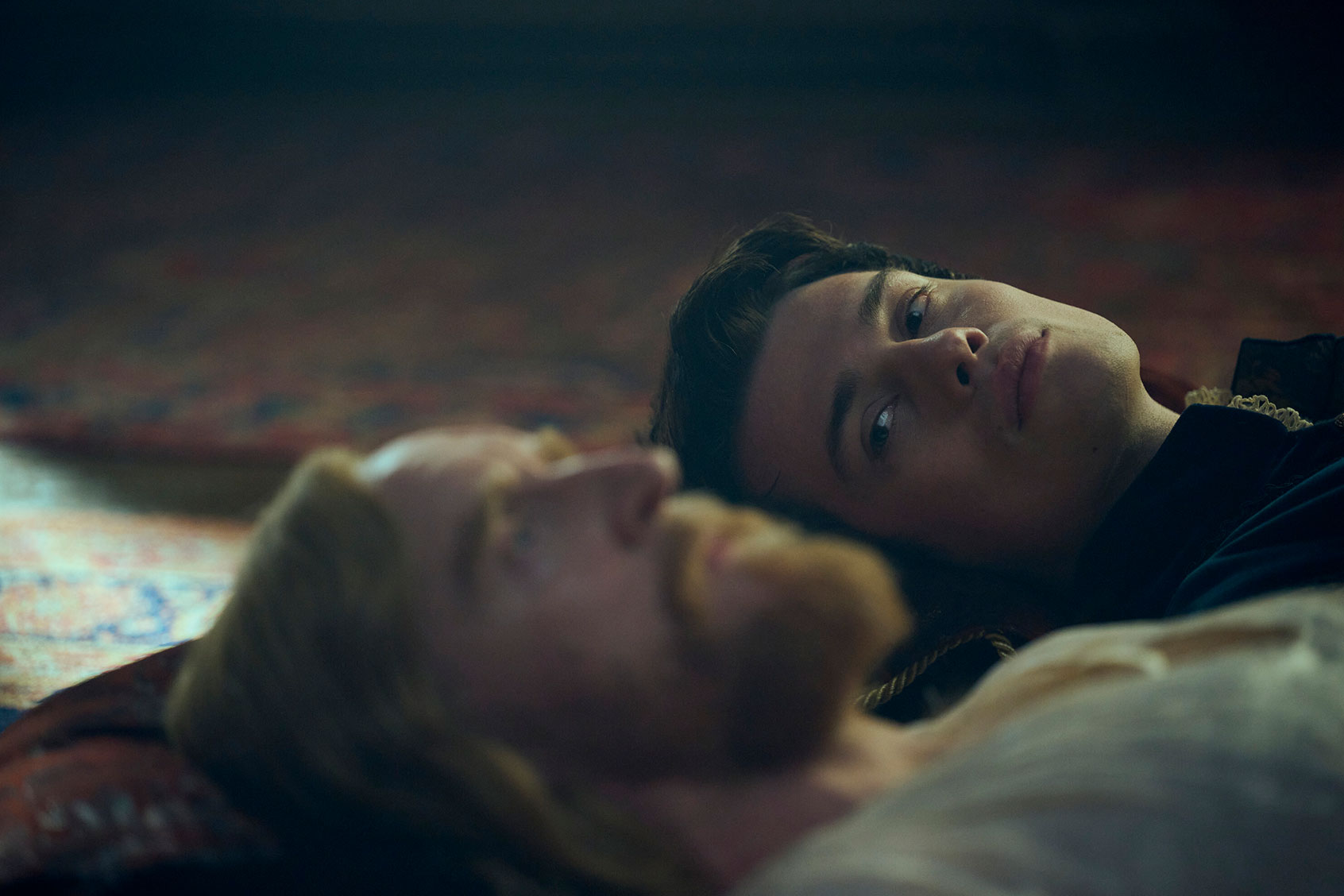
She announces her intentions for George the moment he’s born by refusing to cut him free of her, and that bond holds throughout their lives except in the moments whenever politics hint distance is the better path.

This is also a love story, in case the ample nudity wasn't enough of a clue, although one less concerned with romance than status.

Tradition dictates that George, her second born boy, inherits nothing. But George is blessed with angelic looks, and that changes her calculus. Mary funds a trip to France where George’s mentors train him to speak well, dance and be a top-shelf, sexually adaptable courtier. Soon he and Mary become a threat to the Earl of Somerset (Laurie Davidson), the king’s current favorite.

But if you’ve seen the poster, you already know George eventually makes headway with King James (Curran) in bed and mood, imposing his and his mother’s influence on society and England by extension.

Mary & GeorgeTony Curran and Nicholas Galitzine in "Mary & George" (Starz)Series creator DC Moore correctly assumes the audience shares James’ prioritization of entertainment over statecraft while toeing the line between severity and silliness, a measure of control imposed, if not demanded by the story’s bawdiness.


Previews of “Mary & George” push its spiciness, as any drama casting Galitzine as a libidinous figure would. Moore’s Mary gets to enjoy herself too instead of being limited to grimacing through political marriages to boring wealthy men, which is refreshing.  She takes pleasure and comfort with a sex worker named Sandie (Niamh Algar) who recognizes Mary’s capabilities and hitches her fortunes to hers while eventually recoiling from her inhumanity.


Want a daily wrap-up of all the news and commentary Salon has to offer? Subscribe to our morning newsletter, Crash Course.


Yet their relationship, such as it is, is one of the most genuine and stable in “Mary & George.” It’s also an example of the plot’s relative shallowness and scripts more concerned with verbal blood sport than teasing out its characters’ interiority.

Moore fills in those blanks, as does Curran, whose James explodes with lust in one moment only to deflate into a lonely pathos at a second’s notice. His is the most agile and unrestrained performance in a cast tasked with binding their moods in etiquette. (This also makes a scene where Moore’s Mary blows her composure in polite company simultaneously agonizing and hysterical.)

The real selling point, aside from the sensuality, is Mary’s caustic quickness. By the time her final husband of convenience realizes his role is vestigial, he can’t muster enough ire to make her flinch. “This whole family belongs in Sodom,” he says angrily, to which Mary replies, unbothered, “I don’t fancy another move.”

Moore bathes the story’s sentiment in Mary’s worldview, an alluring combination of libertine and pragmatic with little desire to win friends, only influence – the type of woman Bravo’s Andy Cohen would kill to cast if she didn’t arrange for his end first. Don’t scoff — stripped of its velvet and luster this is that type of pleasure, only guilt-free, as the woman who inspired it would claim to be.

"Mary & George" premieres at 9 p.m. Friday, April 5 on Starz.

Dark money-backed No Labels drops third-party presidential bid despite raising millions

Less than a month after No Labels announced it would nominate a "unity ticket" for the 2024 presidential election, the group said Thursday that it is abandoning its longshot third-party White House bid.

"No Labels has always said we would only offer our ballot line to a ticket if we could identify candidates with a credible path to winning the White House," the group said in a statement. "No such candidates emerged, so the responsible course of action is for us to stand down."

As Common Dreams reported last month, No Labels—whose own leader has admitted is "not in it to win it" but rather to "give people a choice"—has poured millions of dollars in dark money contributions into a quixotic run that critics like MoveOn executive director Rahna Epting warned could "swing the election to Donald Trump," the twice-impeached former Republican president and presumptive GOP nominee, 91 federal and state criminal charges notwithstanding.

No Labels had floated former Republican Maryland Gov. Larry Hogan and former South Carolina Gov. Nikki Haley, a failed 2024 GOP presidential contender, as possible "unity ticket" candidates. However, the group ultimately found no takers.

Top No Labels donors include billionaire and multimillionaire Trump supporters like Nelson Peltz, private equity executive Stephen Schwarzman of Blackstone, and former 20th Century Fox CEO James Murdoch. Louis Bacon, the billionaire CEO of hedge fund Moore Capital Management, donated $1 million each to No Labels and the Republican Party after giving the maximum allowable contribution to Sen. Kyrsten Sinema, formerly one of the conservative Democrats in Congress and now an Independent.

Even with all that financial backing, No Labels' path to the ballot has been dubious. MoveOn has urged states to investigate the group for allegedly misleading voters through deceptive canvassing methods that result in their disenfranchisement.

The U.S. two-party system has been criticized for monopolizing political power at the expense of democracy and voter choice by actively working to thwart all viable third-party and independent candidates. However, political pragmatists note what they say is the folly of running unwinnable races.

"Third-party candidates are the fools gold of this election," MoveOn said on social media, adding that neither No Labels nor conspiracy theorist Robert F. Kennedy "have ballot access in all 50 states and mathematically cannot win."

"They can only play spoiler," the group added.

However, while Democrats and Republicans often automatically gain ballot access, the two parties are largely behind state laws that create often insurmountable barriers for third-party and independent challengers.

Other progressives also welcomed the news of No Labels' withdrawal—but with a warning. Melanie D'Arrigo, executive director of the Campaign for New York Health, quipped on social media that No Labels was quitting "to spend more time with their lobbyists."

"Billionaires pump millions into No Labels, and in return, their politicians push policies that transfer wealth from the working-class back to billionaires," she added. "Just because they aren't running a presidential candidate doesn't mean they aren't still a serious threat to democracy."

NY AG Letitia James gives company that guaranteed Trump’s bond 10 days to “justify the surety”

New York Attorney General Letitia James on Thursday filed a notice seeking more information about the company that backed former President Donald Trump’s $175 million bond in his civil fraud case, according to NBC News.

The firm, Knight Specialty Insurance Company, is not admitted in New York and James "takes exception to the sufficiency of the surety to the undertaking" given to Trump without a certificate of qualification, the filing said.

James asked Trump or KSIC to "file a motion to justify the surety bond," or provide more information about the collateral Trump put up within 10 days.

Don Hankey, the head of KSIC, said the bond was fully collateralized with cash from Trump’s company, according to the report. Hankey had been negotiating to post a $557 million bond with the Trump Organization before an appellate court lowered the bond to $175 million.

Trump had to post the bond to appeal the $464 million civil fraud judgement against him and his company. He is still on the hook for the full amount if he loses the appeal. A hearing is scheduled for April 22.

“He looks forward to vindicating his rights on appeal and overturning this unjust verdict,” Trump attorney Alina Habba said on Monday.

Books are trash too: Remember to throw them away during spring cleaning

Trashing books has the power to save the publishing industry.

Spring cleaning has become a universal time to declutter our lives, chucking everything we no longer need. Those jeans you can't fit anymore and maybe will never be able to fit again. Your iPhone 3, unless you are an archivist who is planning to have an exhibit based upon technology that we'll never use again. And your mail, go through it. You don't need to save the red light ticket from 2023 because if you didn't pay it by now, I'm pretty sure you already paid to remove the boot or took care of it when you paid your 10 other tickets from Motor Vehicles. 

I try to do this every year and have to say that I am getting better with time because, in 2024, I purged some items that were near and dear to my heart, items I never thought I had the heart to get rid of: books. Yes, I got rid of books. 

Before you begin tearing me apart, I did not throw all the books in the trash; only about 30, and the rest of the books will be donated to an organization in Baltimore called The Book Thing, which frequently hosts giveaways. But yes, there are now about 100 books erased from my library, and I am so happy for several reasons. I'll start by addressing the elephant in the room, which you and I both know but up until now would never say. So, imagine me standing on top of a soapbox, dead center in the middle of a crowd of about 1,000 people, yelling at the top of my lungs, "All books are not created equal!"

This is when you may click off of this article, storm out of your room, slam the door behind you or become ambitious by writing a nasty letter to my editor. But before you do that, let me just tell you a little bit about my process and the books that are currently sitting at the bottom of my trash can. 

Most of the books that made it into my donation pile were celebrity memoirs that were beautifully written and surprisingly inspiring. 

My system isn't intricate or complex at all, as it is solely based on two general rules that are summarized in these questions:

Is this book so good that it deserves to be read by someone who can be inspired as well? 

Is this book so bad that I would never want to punish another person by mistakenly having it fall into their hands? 

Most of the books that made it into my donation pile were celebrity memoirs that were beautifully written and surprisingly inspiring. For full transparency, I never got into celebrity memoirs until I was given assignments to cover them for work – and then became more interested in the genre when I started writing them myself. Gabrielle Union has a beautiful memoir, as does Viola Davis, Chelsea Handler and Chef Kwame Onwuachi, to name a few. These books are hysterical, informative and most importantly, easy to read. 

My opinion could be biased, but those books are often written by highly talented writers who don't always get the promotion or backing behind their books that they deserve. So ghostwriting is the only way they could eke out a decent career. Many of the celebrity memoirs I have are directly connected to people I covered for work over the years; however, I buy them for myself from time to time, and they don't need to be a part of my library. I've learned the lessons, I will not revisit. They take up space, and we are spring cleaning, so it is time to pass them on. 

We've had all kinds of literary crises in my hometown of Baltimore. As a writer with some local success, I donated boxes of books like "Beloved" by Toni Morrison, "The Fire Next Time" by James Baldwin and "Their Eyes Were Watching God" by Zora Neale Hurston.

Your bookshelf should be beautiful enough to make it onto someone's Pinterest page. I don't even know if people still use Pinterest, but if they do then your bookshelf should be on there. You shouldn't have a bookshelf that has nothing but books. You need a cute little woven basket, or a little statue from your ceramics class or maybe that plaque you got from work from being employee of the month or something, but you got to spice it up, you got to make it look good and you're not going to do it if you're holding on to that celebrity memoir that you are never going to open again.

Some of the classics should be donated as well. We've had all kinds of literary crises in my hometown of Baltimore. As a writer with some local success, I donated boxes of books like "Beloved" by Toni Morrison, "The Fire Next Time" by James Baldwin and "Their Eyes Were Watching God" by Zora Neale Hurston. These are books that our young people need to read; they need to see themselves in the history of this country, they need to see themselves in the present, and they need to see themselves in the future. We have an opportunity to do this if we stop hoarding books.

And then there is the trash pile.

If we hate some artwork, hate some of the food from some fancy restaurants that are supposed to be great, and hate the design, fabric, and everything related to some of the furniture we feel shouldn't have been created – then why can't we hate books? There's an awful stigma that we hold on to when talking about books that we need to release immediately. Your favorite singer's sophomore album can suck, but a book can't? So now everyone can write? 

Why must we sit up on our high horse and act like books are the one thing you can never get rid of? This could not be further from the truth, and I'm embarrassed that it took me so long to figure this out. Books can be trash just like that horrific excuse for artwork you made at some Sip and Paint you attended on a corny date night. 

So, as I did my spring cleaning, I threw away a book called "eBay for Dummies" because what is this, 1990? I trashed a book about a faultless preacher who saved his entire congregation because red flags flooded the first paragraph, and I tossed out a lovely tale about a pop singer who was forced to sell bricks of cocaine for the Mexican cartel as she soared up the R&B charts. There was also a collection of old college books that should have been in the dump a long time ago as well, like that Business 101 book that taught you nothing about business, and any book that was written by the professor, who you also had to buy the book from – and about 90% of your pity purchases. This is the part where you can call me a terrible person, but this is also how we can save the publishing industry. 

 A pity purchase is a book that you bought because you felt sympathy for the person selling it – and yes, as a person who wrote eight books, I have definitely been on the other side of pity purchases. These purchases often happen at empty readings or book fairs where you sit alone at your table with that big stack of work that you poured your heart and soul into, Sharpie in hand, ready to sign as everyone walks past you. People will walk past you for hours, but then from the shadows emerges a grandma with two big watery slits for eyes that glisten and gleam as she slides towards you and says something like, “I can't believe you wrote a whole book, sonny. I’ll buy one!" And you quickly pull it away from the stack. You sign it because you know once your signature is in that book that she can't take it to the bookseller’s brick and mortar and return it, that book is hers, and she stuck with it for life. And from this transaction you received that one little piece of hope, that makes you feel like you're writing and career aren't entirely worthless. That grandma gives you the industry to push forward. But maybe she can't do that if her bookshelf is full of 300 pity purchases . . . so we must purge. 

The point is that you got the sale, so you don't have to punish the person by expecting them to read it or hold on to it. It is totally cool if grandma throws that book in the trash because it belongs to her; she bought it. 

I feel so good now that I have cleaned off my bookshelves. And guess what? Not only do I have space to make my shelves look cute enough to be on someone's Pinterest page, but I can also make some more pity purchases — the kind of pity purchases that keep our industry alive. 

So do yourself a favor this spring and go throw some books away. 


“They had to cut her off”: Report says server denied booze to “overserved” Boebert at Trump event

Rep. Lauren Boebert, R-Colo., was cut off from alcohol at a December fundraiser headlined by former President Donald Trump, according to CNN.

Boebert, who faces a difficult election battle after switching districts and coming under fire for vaping and groping at a Denver theater, was told by a server that “they would not bring her any more alcohol,” multiple witnesses told the outlet. One witness said that the server told Boebert they believed she had been “overserved,” according to the report.

"She also was trying to take pictures with Donald Trump and eventually Donald Trump's security detail stepped in and asked her to stop doing that, according to those who witnessed it that I spoke to,” CNN reporter Melanie Zanaon said Friday.

"So just to be clear, basically: She went to a fundraiser in New York City with Donald Trump, got so drunk they had to cut her off?” questioned anchor Kasie Hunt. “And then tried to take repeated pictures with Trump, and then they had to tell her, 'Hey lady like tone it down,' according to the witnesses?"

"This is how it went down and I want to remind viewers here that this came a few months after she got in trouble and had to apologize for her conduct at a Denver theater where she was watching a performance, a musical performance of Beetlejuice, she got kicked out for vaping and being loud, and there's security footage of it,” Zanaon said.

“There was much more than vaping,” Hunt quipped.

“I’m very worried”: Legal experts concerned Judge Cannon’s ruling may set up “dismissal” at trial

The judge overseeing former President Donald Trump’s classified documents case on Thursday rejected his bid to dismiss the case under the Presidential Records Act but left open the door to revive the issue during trial.

Trump-appointed U.S. District Judge Aileen Cannon shot down his motion claiming that the Presidential Records Act gave him the right to take classified materials home to Mar-a-Lago, writing that the PRA “does not provide a pre-trial basis to dismiss” the document and obstruction charges.

But Cannon left open the door to revive the issue during the trial, rejecting special counsel Jack Smith’s request to rule quickly after she had both sides submit jury instructions that appeared to lend credence to Trump’s PRA claim.

Cannon wrote that “to the extent the Special Counsel demands an anticipatory finalization of jury instructions prior to trial, prior to a charge conference, and prior to the presentation of trial defenses and evidence, the Court declines that demand as unprecedented and unjust.”

She said her request for proposed jury instructions “should not be misconstrued as declaring a final definition on any essential element or asserted defense in this case.” Rather, it was a “a genuine attempt, in the context of the upcoming trial, to better understand the parties’ competing positions and the questions to be submitted to the jury in this complex case of first impression,” she insisted.

Despite winning on the Presidential Records Act motion, Cannon has “actually given him kind of a loss here,” New York University Law Prof. Ryan Goodman told CNN.

“I think this is not what Jack Smith wanted to hear. If she had ruled now that these could be his personal documents, then Jack Smith can appeal that and have the 11th Circuit reverse her,” he explained.

By refusing to issue a ruling on the jury instructions, Cannon “preserved the option of still presenting scenario one to the jury—in particular if at trial there is evidence that they are ‘personal’ or the defendant declared them to be ‘personal,’” former Mueller prosecutor Brandon Van Grack explained, leaving Trump with a “potential out.”

We need your help to stay independent

Cannon’s refusal means she “might wait until AFTER a jury has been sworn-in and jeopardy attaches,” tweeted MSNBC legal analyst Katie Phang. “Once jeopardy attaches, a criminal defendant cannot be tried a second time for the same crime.  This is exactly what Smith is trying to avoid by having Cannon rule on the jury instructions at this stage. Cannon is sticking her finger in Smith's face and telling him to do something about it.”

“If Cannon instructs the jury incorrectly and Trump is found not guilty as a result, Smith *could not appeal* the not guilty verdict,” agreed former federal prosecutor Renato Mariotti.

Former Watergate prosecutor Jill Wine-Banks predicted that Cannon may be “setting up a post-jury being seated dismissal when jeopardy has attached so her dismissal cannot be appealed.”


Want a daily wrap-up of all the news and commentary Salon has to offer? Subscribe to our morning newsletter, Crash Course.


The order makes a “mess” of the case and suggests there is “no way that this case was gonna get tried before the election,” argued CNN legal analyst Elie Honig, adding that it “forecloses” on Smith’s opportunity to seek to remove the judge if she ruled against him.

“This is why I think Jack Smith is concerned with today’s ruling,” he said. “Although he won in the sense that the court did not dismiss the charges, if I’m Jack Smith – and I think Smith feels the same way – I’m very worried about this defense going to a jury because it’s confusing, because it’s complicated, because it’s technical. And prosecutors always want to tell a simple, straightforward story. And frankly, defendants want to muck things up. And as much as I think this defense lacks merit, I do think it could confuse a jury in a way that would worry me as a prosecutor.”

Smith could still seek to kneecap Trump's defense before the trial, however.

"The next fight will be motions in limine, where DOJ will say Trump should be excluded from arguing this defense at trial," predicted national security attorney Bradley Moss.

Nissin Foods incorporates a classic breakfast food into their iconic Cup Noodles

In a press release from Nissin Foods, it seems the rumors are true: Cup Noodles is releasing an Everything Bagel with Cream Cheese flavor, writing that "the instant ramen leader delivers an unexpected twist on the classic staple with its new limited-edition flavor." The product will exclusively be available at Walmart, though it's currently sold out on the official Website.

The flavor combines "noodles with sesame seeds, poppy seeds, garlic, dried onion and caraway seeds in a rich cream-cheese flavored sauce." The product requires nothing else but water and four minutes in the microwave. It should also be noted that this is not a soup with broth — it's more of a noodles-and-sauce sort of deal.

Priscila Stanton, Senior VP of Marketing at Nissin, says "consumers have been adding a dash of Everything Seasoning to their ramen since the craze took off and we took inspiration from our consumer base to give everyone's favorite noodles a creamy twist."

Nissin first released instant ramen back in 1958 and their products have remained in high-demand since, with the signature styrofoam containers becoming a sort of iconic emblem of instant ramen over the years. The affordable staple has become even more cherished in recent years as its pricing remains relatively static among sky-rocketing food prices practically everywhere else.

Marjorie Taylor Greene is out for Republican blood

Speaker of the House Mike Johnson, R-La., has twisted himself into a pretzel trying to please his fractious caucus and he's starting to show the strain. Unfortunately, the people of Ukraine are currently paying the price as he struggles with what appears to be a cage match against Georgia Rep. Marjorie Taylor Greene, who is making it clear that she intends to blow up the House of Representatives in an election year if she doesn't get her way. 

The state of play remains what it's been for weeks now. The Democratic-led Senate passed a tortuously negotiated bipartisan bill that included funding for Ukraine and the border months ago. But the Republican-led House rejected it upon orders from Donald Trump, who openly admitted that his motives were purely to benefit his campaign. 

Since then Johnson has been running around in circles insisting one day that he won't bring any Ukraine funding bill to the floor and the next day suggesting that he has an agreement on Ukraine that would include a provision that would seize frozen Russian assets and categorize the Ukrainian aid as a loan, an idea first floated by Donald Trump and Sen. Lindsey Graham, R-S.C., As of Thursday, Johnson was back to insisting that there must be more border security or it's a no-go. Nobody seems to be sure what, if anything, is going to come to the floor. 

Greene, meanwhile, is having a monumental temper tantrum, ostensibly because Johnson managed to avoid shutting down the government by making a deal with Democrats to keep it funded through next fall. The idea that Johnson would further fund U.S. aid to Ukraine has infuriated Greene so much so that she's filed a motion to vacate the chair and seems ready to call for the vote with the GOP's now minuscule majority and turn the body into chaos once again.

The only thing that could shame a Republican in the MAGA era is to be seen as having been saved by Democrats.

In an interview with Manu Raju of CNN on Wednesday, Greene let fly, claiming that Republican voters are “furious that our so-called Christian conservative, Republican Speaker of the House did this to them." She went on to compare Johnson to Senate Minority Leader Mitch McConnell, saying “people are fed up with Republicans that say one thing and turn around and literally join the flock and just continue the same old crap everybody’s tired of." She said Johnson has "literally turned into Mitch McConnell’s twin and worse. He’s a Democrat. There’s not even any daylight between him and Nancy Pelosi at this point.” I'm not sure she could have insulted the Republican leader any worse. 

There are quite a few members of the MAGA caucus who are extremely hostile to Ukraine aid but Greene seems to be making it a red line issue for her — even though Trump himself has tried to ease away from his hardline position by offering up the loan idea. Greene told CNN that the idea is "the biggest bunch of heaping, steaming pile of BS." She's not wrong. It's a meaningless, irrelevant policy that only someone as inept and out of his depth as Trump would have the nerve to propose. Graham knows this, too, but he wants to get aid to Ukraine, as does Johnson, and they see it as a way to appease Trump by giving him the ability to tell his followers that he's the very stable genius running foreign policy. Apparently, many Democrats are willing to let him have that if it means getting this whole thing over with. 

We need your help to stay independent

Greene is so worked up that she went to the one place where she knew she'd find a fellow Ukraine hater and Vladimir Putin aficionado: Tucker Carlson's podcast on Elon Musk's X. (How the mighty have fallen.) There she went even further in her condemnation of Johnson:

GREENE: But now Mike Johnson has made a complete departure of who he is and what he stands for, and to the point where people are literally asking, is he blackmailed? What is wrong with him because he’s completely disconnected with what we want? 

CARLSON: Do you think he is being blackmailed? 

GREENE: I have no idea. I can’t comprehend, Tucker, what radically changes a man…

Carlson added that he thinks Johnson and McConnell may be being blackmailed over issues in their personal lives.

It's hard to imagine how she's going to deal with Johnson in their scheduled meeting today after all that but it's pretty clear that she's very close to calling for his ouster under the assumption that it's what Republican voters are begging for. 

She doesn't have a lot of support in the caucus, however.


Want a daily wrap-up of all the news and commentary Salon has to offer? Subscribe to our morning newsletter, Crash Course.


CNN's Jake Tapper noted the other day that Rep. Don Bacon, R-NE., said of Johnson's predicament, “he’s got a gun to his head right now, but we need to have a Churchill, not a Chamberlain right now. He could be on the right side of history.” Tapper tartly remarked, “I’m not sure that Marjorie Taylor Greene knows who Churchill or Chamberlain are." That is almost certainly the case. 

Johnson's problems with Greene are complicated by the fact that he's going to have to rely on Democrats to not only vote for the Ukraine bill but possibly to save his speakership should she decide to go for it. According to Axios, some Democrats are pushing their advantage by demanding humanitarian aid not just for Ukraine and Gaza but also for Sudan, Haiti, Bangladesh, Afghanistan, Venezuela and Lebanon. Many of them also don't like the idea of seizing frozen Russian assets and are opposed to a GOP demand to lift an administration pause on liquified natural gas exports. It's clear that cobbling together a bipartisan bill in the House won't be easy even without Marjorie Taylor Greene's hissy fit. 

If Greene decides to go ahead and call for Johnson to vacate the chair, the big question is whether a few Democrats will cross the line and save his bacon. Newly elected centrist Rep. Tom Suozzi, D-NY, says he won't vote for removal and there may very well be a few others in swing districts who believe this will endear them to their constituents. That's just how "moderate" Democrats roll. 

But that will probably be the end of Johnson's short reign anyway. From that point on his power as speaker will be gone — the only thing that could shame a Republican in the MAGA era is to be seen as having been saved by Democrats. He will be the speaker in name only. It remains to be seen if Greene will lose power or gain it as a result of her actions and I'd say it's 50-50 either way.

Stay tuned. 

“Screws up female brains”: MAGA leaders are conditioning Republicans to back birth control bans

Charlie Kirk, the head of the MAGA propaganda behemoth Turning Point USA, recently unveiled a novel theory as to why young women tend to vote for Democrats. Unwilling to admit that women can think for themselves, Kirk floated the theory that birth control pills cause brain damage.

"Birth control like really screws up female brains," he falsely claimed before a crowd at a recent church event streamed on the far-right site Rumble. Claiming the pill "increases depression, anxiety [and] suicidal ideation," he then blamed women's voting patterns on hormonal contraception. "It creates very angry and bitter young ladies and young women," Kirk argued. "Then that bitterness then manifests into a political party that is the bitter party. I mean, the Democrat Party is all about 'bring us your bitterness and, you know, we’ll give you free stuff.'”

As with most things MAGA leaders say, Kirk's claim is so misleading that it can only be called lying. First, of course, accusing Democrats of being "bitter" is rich coming from MAGA, whose entire pitch is bitterness. More importantly, he's lying about the pill. A tiny percentage of women have mental health issues with birth control. The most rigorous research shows it affects half a percent, or 1 in 200 women on the pill. Granted, Kirk was so bad at basic studies like math that he dropped out of community college at age 18. Still, even the biggest nimrod can grasp that half of a single percentage point is not a big number. 

But of course, Kirk is not sincerely mistaken and he certainly isn't concerned about the wellbeing of women, which all reputable research shows is dramatically improved by having control over their fertility. Kirk's doctor cosplay is part of a much larger and semi-coordinated strategy among right-wing leaders to demonize birth control and train the GOP base into believing that restricting, or even banning, contraception is justified. 

As the Washington Post reported last month, right-wing activists have been flooding social media with the same lies that Kirk was echoing in this video. It's a well-financed disinformation campaign, getting a major boost from MAGA billionaire Peter Thiel, who has aggressively financed teams of messengers to falsely claim that hormonal birth control "tricked our bodies into dysfunction and pain." Doctors report that the tidal wave of misinformation about birth control is creating a health care crisis, including women who "come in for abortions after believing what they see on social media about the dangers of hormonal birth control." 

Anti-choicers haven't given up hoping that fake science will beat reproductive rights.

Of course, the real reason MAGA leaders don't like birth control is they oppose the freedom and opportunities that it has afforded women. Kirk barely bothers to hide that this is his real agenda. In the very same talk, he also tries to threaten women who hold out for Mr. Right instead of settling for Mr. Incel: "In their early 30's they get really upset because they say the boys don't want to date me anymore because they're not at their prime," he claims, echoing the unevidenced revenge fantasy that dominates misogynist message boards. 

In reality, of course, the median age for marriage is creeping up to almost 30 for women, up from age 20 in 1960. If women become unmarriageable at 30, it wouldn't be the case that it is the age when most of them are getting married. Kirk is just pulling the tired old right-wing trick of trying to spin his desire to control women as "chivalry." It's the same line we've heard in so many ways: That freedom is bad for women, because they supposedly don't have the mental capacity to handle it, and wouldn't they just be happier under male control?


Want more Amanda Marcotte on politics? Subscribe to her newsletter Standing Room Only.


The angry male masses may enjoy the fantasy of women regretting their choice not to just give up and settle for a Trump voter. But even anti-feminist activists know that it's a hard sell, both politically and legally. So instead of openly admitting that sadism fuels their desire to restrict birth control, it's repackaged as "protecting women" from imaginary health risks. 

It's a well-financed disinformation campaign, getting a major boost from MAGA billionaire Peter Thiel, who has aggressively financed teams of messengers to falsely claim that hormonal birth control "tricked our bodies into dysfunction and pain."

It's the exact same playbook that the right has been using for decades to argue against abortion rights. Before Dobbs v. Jackson Women's Health, Republicans relentlessly passed laws making it harder to get an abortion — such as mandatory waiting periods — with false claims that these were medically necessary restrictions. In 2016, a more liberal Supreme Court shot down some of those restrictions on the grounds that the "science" used to justify them was made up nonsense. But anti-choicers haven't given up hoping that fake science will beat reproductive rights. The abortion pill challenge pending review by the Supreme Court, for example, is based on three articles that were eventually retracted. In reality, of course, medication abortions done without the drug in question are more painful and dangerous

Even some of the most anti-abortion justices, such as Amy Coney Barrett, sounded skeptical about banning a safe pill based on "alternative facts." Which is why it's no surprise that the two most loudly MAGA members of the court, Samuel Alito and Clarence Thomas, started instead to talk up the Comstock Act, an 1873 anti-sex law that stopped being enforced decades ago but was never repealed. Talk about reviving this law has grown louder in right-wing circles, mainly because they see it as a way for Donald Trump, if he regains the White House, to unilaterally ban abortion without having to ask congressional Republicans to take an unpopular vote. 

We need your help to stay independent

For the far-right, the beauty of the Comstock Act is it sidesteps all these pesky questions about health and safety. Instead, the law bans not just abortion, but pretty much anything associated with human sexuality, from contraception to nudes in art. The law forbids shipment of every "obscene, lewd, lascivious, indecent, filthy or vile article, matter, thing, device, or substance." It was used to prosecute not just abortion provision, but people who sold "obscene" books and materials, including literary works like "Ulysses" by James Joyce and art like nude paintings of the goddess Venus. All sex education, even for married couples, was outlawed. It also banned not just birth control, but simply sharing information on how to prevent pregnancy, which means it would cover even those "wellness" sites that make misleading claims that period-tracking is effective contraception. 

Anthony Comstock, the infamous prude who was behind the law, was much like Charlie Kirk, in that his misogynist intent was never far beneath the surface. He frequently bragged about how many women he'd driven to suicide by relentlessly prosecuting them for helping other women get reproductive health care or explaining the mechanics of sex to newlyweds. Within the first five years of the bill, he gloated, he had forced 15 women to take their lives. He tried, but failed, to do this to Planned Parenthood founder Margaret Sanger, repeatedly targeting her for arrest for teaching women how to prevent pregnancy. (Sanger did not, despite anti-choice propaganda claiming otherwise, offer abortion.) 

But conservatives know it's not popular to loudly champion a law written by a man who once claimed, "Books are feeders for brothels." So instead, we're getting this tsunami of hand-wringing about the imaginary damage that birth control is doing to women, who are forever presumed by conservatives to be too dim to be trusted with their own decisions. The malevolence is never that hard to see, however. "Concern" that women who have sex will end up lonely cat ladies is less a reflection of sincere trepidation and more a bit of wish-casting. Conservatives long for women to be so punished, even as their anger reflects a deeper understanding that women are actually doing pretty well with this freedom and equality thing. 

“There’s social status in breaking social norms”: When the corrosive effects of Greek life spill out

Investigative journalist Max Marshall’s new book "Among the Bros: A Fraternity Crime Story" is much more than just a “true crime” story about young rich entitled (white) men acting badly. Instead, it is a story that embodies the much larger problem of how elite white men are taught at a very young age that they are above the law and generally can act with impunity. These attitudes, values, behaviors, and beliefs are at the heart of many of America’s greatest problems.  

A nationwide drug ring operating out of the Kappa Alpha fraternity at South Carolina’s College of Charleston was caught trafficking millions of dollars in Xanax and other drugs including cocaine, LSD, ketamine, and MDMA. The criminal enterprise ended in spectacular fashion in 2016 with one person being murdered, several students dying from drug use, and one of its leaders being sentenced to prison for ten years. Most of the leaders and members of the Kappa Alpha-based drug ring, however, suffered no serious consequences for their alleged crimes.

"They were still made up of wealthy kids from elite families, but they now asserted their rule by breaking the rules."

Beyond its sharp and darkly humorous writing and propulsive narrative, Marshall’s book is also a rich sociological text about the subculture of elite fraternities and sororities at America’s most exclusive (and predominantly white) universities and colleges. As he details in "Among the Bros," it is not an exaggeration or distortion to describe “Greek life” as an institution on to itself, one that operates according to its own rules, and in many ways controls the social lives of its members and the larger university and college community.

In this conversation, Marshall reflects on white privilege, gender and masculinity, and the culture of crime and other antisocial behavior that operate not just in the events depicted in "Among the Bros," but as signaling to much larger problems across the Greek life system at many of the country’s universities and colleges. He also shares his concerns about how these “leaders of tomorrow” (as shown by how the vast majority of America’s leading politicians and other influentials) are products of the Greek life system and its most problematic values and training.

We need your help to stay independent

Marshall explains how popular culture’s understanding of Greek life as being some version of the movie "Animal House" is largely obsolete. The debauchery and chaos depicted in that movie are almost innocent and childlike compared to what is happening today.

What has the journey been like with the book?

It took about four years, 200 interviews, and a few thousand police documents, but the weirdest phase has been “book publicity.”

Has that novelty worn off?

Absolutely. You can only answer the same question so many times before you just push the “what led you to write this book?” button.  But I still hope that the act of writing will always feel novel to me. If I ever delude myself that I’ve become an “expert” at writing, it might be time for the urn.

Your book resonates with and reflects our larger society — especially in the Age of Trump and how we got here – this is so much more than “true crime."

I mostly agree, but I also don’t want to create too big a  “lowbrow/middlebrow” distinction. (Crimes always reflect our larger society.) But you’re right, you can’t write about a multi-million-dollar fraternity Xanax network without touching on all kinds of cultural pressure points, especially when nearly everyone involved gets away with it. 

After all the discoveries — millions of Xanax pills, student deaths, waterboarding, sweetheart legal deals, etc. — we still haven’t seen very many consequences. Most of the boys got suspended sentences, the Kappa Alpha Order is back on campus, and Sigma Alpha Epsilon never left. The fraternities even have public Instagram accounts, and last time I checked their parties look bigger than ever. 

What is the world of Greek life like? What are its rules, both stated and unstated? What do outsiders to that world not understand?

If you ever watch a Hollywood depiction of Greek life, you’ll usually see too much Abercrombie and hair gel. You’ll also see the elite fraternity members wearing sweaters and sucking up to the Dean, while the down-on-their-luck chapters throw the craziest parties.

In reality, it’s flipped. The “best” chapters — the ones with the wealthiest members — have the wildest behavior, and the lower-status chapters take things like philanthropy and academic standing more seriously. For the guys who can get away with it, there’s a lot of social power in saying, “I can black out four nights a week, sleep with girls from all six top sororities, skip class for pledge errands, and my family connections will still get me a better internship than you this summer.” 

I am not a joiner. But I also understand, deeply, the power of networks and social capital in determining one’s life trajectory and where it ends up or not. What are the types of personalities that are most compelled to participate in Greek life? What do we know about them?

Fraternities have always been a really efficient way of creating a separate campus for the ruling class. American colleges didn’t even need Greek life (as it’s currently comprised) until the 1800s, when middle-class students from rural backgrounds arrived wanting to learn how to be preachers. I’m not being glib when I say that the founding idea for fraternities was basically: let’s form a secret drinking club and not invite the random farm kids.

From there, they grew in influence. There’s the statistic from the Cornell Greek Life website that we ended up using on the back of the book: “While only 2 percent of America’s population is involved in fraternities, 80 percent of Fortune 500 executives, 76 percent of U.S. senators and congressmen, 85 percent of Supreme Court justices, and all but four presidents since 1825 have been fraternity men.” Greek alumni also give something like 75% of all money donated to universities.

From New Haven to Mississippi, there’s also a false sense that kids are “tricked” into joining these clubs and then thrown into a basement to be traumatized. But like you suggest, there’s a pretty clear reason for joining. Members of Alabama SAE or Ivy at Princeton have the same motivations: the best parties, the best-looking people, the best connections to do whatever you want when you graduate.

Reading your book, I kept thinking of "Animal House," which is one of my favorite movies and really a type of social history of a particular place and time in America.

It’s not an exaggeration to say that "Animal House" saved fraternities. Next to the '60s counterculture, fraternity guys looked like relics of the sweater-wearing, song-crooning past. In 1970, fraternity membership hit an all-time low. Then in 1978 comes this movie that shows two competing fraternity chapters: Kevin Bacon’s Omega Theta Pi, representing the old snooty ways, and John Belushi’s Delta Tau Chi, showing a wild new future. The Omegas made punch and cookies and called the Dean “sir,” and the Deltas burnt stuff and seduced the Dean’s wife.

After that, America’s real-life fraternities had a new way of branding themselves. They joined the counterculture in terms of smoking weed and having lots of casual sex, but they didn’t have to join it in terms of ‘fighting the power.’ (Caitlin Flanagan writes about this with her usual brilliance.) They were still made up of wealthy kids from elite families, but they now asserted their rule by breaking the rules. After "Animal House," fraternity membership boomed, and things ramped up from there. There’s a quote from the website Total Frat Move that I threw in the book: “Greek life today makes Animal House look like a Pixar movie."

"Among the Bros" is not a story of just a few bad actors. It is a story of a criminal culture.

This wasn’t a centralized drug ring like the first season of HBO's "The Wire." These boys never formed a hierarchy with foot soldiers reporting to lieutenants, who sat under capos, and on and up. 

Instead, they basically operated a multi-level marketing scheme. You had different kids buying unpressed alprazolam powder from Chinese labs via the dark web, and then they installed their own pill presses in beach houses and dorm rooms. These guys could make Xanax for a few cents a pill, and then they could sell it in bulk for about a dollar a pill. Then the pills moved from campus to campus, often through the fraternity system, with the price going up each time the counterfeit Xanax changed hands. (I met some customers who spent as much as $10 for a pill.) 


Want a daily wrap-up of all the news and commentary Salon has to offer? Subscribe to our morning newsletter, Crash Course.


One of the dealers told me he really wished he could’ve put the experience on his resume, because he learned so much about sales, marketing, inventory, pricing strategy, and all the rest. He said, “at the end of the day, it’s still a business.”

How is gender operative in "Among the Bros" and the larger Greek life system? What of fraternity “boys” and sorority “girls” vs “men” and “women?" These people are adults, not children. Yet, they are infantilized.

When journalists write about Greek life, they often call fraternity members “fraternity men.” Never in my life have I heard someone in a fraternity use that phrase. It’s always “fraternity boys,” “sorority girls,” and lots and lots of “kids.” I think you’re right to suggest that this language helps keep them from facing adult consequences. Also, given that so many of them grew up on a highly structured, meritocratic hamster wheel, you could argue their college years are more childlike than their childhoods.

If the men involved in the Charleston drug ring were not rich and upper class, and instead were working class or even middle class, never mind Black or brown, would they have been able to get away with these crimes on such a grand scale?

It’s not news to anyone, but it’s still amazing what a well-paid criminal defense lawyer can get you out of. If you have an attorney who can throw resources at a case and play golf with the judge and prosecutor, you’re in a pretty sweet spot. DUIs can disappear, drug dealing charges can get kicked down to simple possession, and multi-million-dollar drug networks can become “my client got caught up with the wrong group of friends and really regrets it.”

What happens when these baby gangsters encounter real gangsters and professional criminals? When fantasy is punched in the face by reality?

I noticed two competing fantasies among the guys who sold Xanax in fraternities. Some of the boys had the idea they weren’t really drug dealers; they were just “middlemen.” They bought something for one price and then sold it for a slightly higher price. (One guy compared it to working in commercial real estate.) Of course, they’re actually just describing the daily work of a drug dealer. Unless you’re farming poppy seeds, everyone in a drug network is a “middleman.”

The other fantasy went the opposite way. Some of the boys thought they lived inside [Grand Theft Auto]. They said things like “I was on my John Gotti,” got bottle service at LIV in Miami, bought a grenade launcher that didn’t have any grenades, or watched a lot of YouTube documentaries about Big Meech. I guess it’s not surprising, but these were the fantasies that sometimes ended in violence. One of the main characters in the book was killed right after watching "The Wire" on the couch. When he got shot, his housemate was playing Call of Duty in another room. He said that compared to the reverb-heavy explosions in the game, the real gun made a numb pop.  

What role do women play in the story?

On the one hand, this is a book about all-dude friend groups. The main characters are all guys, and most of the time everyone in the room is male. The book touches on the College of Charleston controversy surrounding Alison Bechdel’s "Fun Home," but it for sure fails the Bechdel Test.

On the other, many of the book’s best reporting sources were women. The College of Charleston is nearly 70% female, and those alumnae opened up my understanding of this whole story. They illuminated things about the boys that the boys would never illuminate about themselves. For example, here’s how one woman described why College of Charleston fraternity kids put Xanax in their punch at date parties: 

“For guys, blacking out means there’s no pressure. Then girls won’t say, ‘He tried to sleep with me, but he has a wack penis and couldn’t get hard.’ It’s just like, ‘Oh, he was on Xanax.’ … Sometimes, I waited until sunrise for their penis to start working, and they’d start talking about their feelings. They'd be like, ‘my mom this and my mom that, and my dad and my brother and whatever.’ And I’m like, ‘I’m not even adding to the conversation. I’m literally a free therapist.’”

What is "Among the Bros" an example of in terms of its broader meaning for American society and culture in this moment and more broadly?

In my freshman year of college, I had a professor who wrote a lot about Imperial Rome. One class he told us that elite, late-Roman families sent their sons to Greece to finish up their educations. This might be apocryphal, but the Greeks apparently complained that the Roman “study abroad” kids got too drunk, looted ancient artifacts, and peed in the fountains. The boys got away with it because all they had to do was say cīvis Rōmānus sum.

I think that’s about where we are in America. (Maybe it explains the TikTok trend.) We’re far past Weber’s “Protestant Work Ethic,” and we’re onto the decadence of a late empire. There’s social status in breaking social norms, in playing the heel. I’ve come to feel that in powerful places, it’s almost like the goal is to show just how much you can get away with.

Nothing true under the sun: Why solar eclipses are a breeding ground for conspiracy theories

As a total solar eclipse approaches North America on April 8, Americans are gearing up for a spectacular celestial event. But some individuals are using the eclipse as a way to float unhinged conspiracy theories. 

Alex Jones, for example, is claiming that the government is planning to use the event as a practice run for declaring martial law during the eclipse, which will allegedly be enacted if former president Donald Trump wins the 2024 presidential election. And of course, it’s not just Jones. As Quartz reports, there are quite a few people on TikTok claiming the solar eclipse will mark the end of the world, drawing nonsensical parallels to biblical events. And apparently Carbondale, Illinois (population 25,000) is predicted to be doomsday's epicenter, because it sits the center of an X of the totality paths from both this year's eclipse and the one that graced North America in 2017.

But like Miranda Priestly once said: "Florals? For spring? Groundbreaking." The same can be said for conspiracy theories for a total solar eclipse. The two go together like peanut butter and jelly. In fact, humanity has a long history of stirring up conspiracy theories around the time of a solar eclipse — and this year is no different. 

“There are so many of them,” cult mediation specialist, Patrick Ryan, told Salon in a phone interview. “There are the purveyors like Alex Jones, who make money off these, then religious folks, who put together a story that can somehow make sense of the world, and it's not new.” 

Indeed, apocalyptic beliefs circling around a solar eclipses have existed since the beginning of mankind.

"When unexpectedly the sun went away in the middle of the day, of course that was seen as a sign from the heavens that we were doing something wrong on Earth."

According to NASA, one of the oldest recorded eclipses in human history may have been on Nov. 30, 3340 BCE, as petroglyphs were found at the Loughcrew Megalithic Monument in County Meath, Ireland. While little is known about what they understood about the solar eclipses back then, various religious and historical texts have mentioned them. In the Book of Joel, it is written "the sun shall be turned into darkness, and the moon into blood,” before the lord comes — which has continuously been interpreted that solar eclipses can be a sign of end times. As journalist David Baron wrote in his book, "American Eclipse: A Nation's Epic Race to Catch the Shadow of the Moon and Win the Glory of the World": “For millennia, total solar eclipses have awed, frightened and inspired.”

“This certainly goes back to ancient times before we understood what was happening,” Baron told Salon. “When unexpectedly the sun went away in the middle of the day, of course that was seen as a sign from the heavens that we were doing something wrong on Earth."


Want more health and science stories in your inbox? Subscribe to Salon's weekly newsletter Lab Notes.


Baron said that back in the sixth century BCE, there was a war that had been going on in Asia Minor for six years.

“When the soldiers saw the sun go away in the middle of the day, they took this as a sign that they needed to lay down their weapons,” he said. 

In 1878, an eclipse prompted similar fears of end times. While much of the world knew what to expect, some people in a small town in Texas didn't know the eclipse was coming. A frightened man who thought the world was ending killed himself and his son because he didn’t want to see the end of the world. But now people know what’s going on, and what to expect. And we've seen conspiracy theories come and go. Why do they still persist?

“A total solar eclipse is the most awe-inspiring spectacle in all of nature,” Baron said. “It puts you in touch with just how tiny and insignificant we are in the face of forces.”

People are frequently looking for more meaning in life and such a big event like the total solar eclipse can make people feel quite small and insignificant in the world. 

The scale of the solar system and our universe can boggle the mind, he added. Witnessing a total solar eclipse can put people in touch with a “majesty of nature” that doesn’t compare to other big events. For people prone to magical thinking and conspiracy theories, it’s not hard to see how one can jump from a total solar eclipse to conspiracy theory territory. Ryan, who works with people recovering from cults, said some individuals are frequently looking for more meaning in life, and a big event like the total solar eclipse can make people feel quite small and insignificant in the world. 

“If we have this special knowledge that we've gained, that these things mean something specific, then we're part of an elite group of people,” Ryan explained. “Those are the things that drive these; it’s just like QAnon and all the other conspiracies that we've been faced with.”

Research published in the journal Psychological Bulletin recently found those prone to conspiracy theories were more likely to be insecure, paranoid, emotionally volatile and impulsive — but it's not just personality traits that make people more vulnerable. Baron said it's important to remember the facts. 

We need your help to stay independent

“But when you think about it, from the perspective of the clockwork of our universe, it's nothing more than the alignment of three bodies,” Baron said. “The earth, the moon and the sun, and a shadow being cast on the earth — that’s it.” 

Baron added that almost every total eclipse sees narratives of end times. But that’s not necessarily the majority.

“I think they tend to get attention because they're saying things that are a little outlandish,” he said. The best strategy, Ryan said, is to just kindly ignore people with conspiracy theories around the total solar eclipse and not take them too seriously.

“Arguing with people that hold those beliefs, I don't think it's helpful,” he said. “I think the main thing is to show them respect; unless somebody is going to do something horrible to themselves when it comes, it’s going to be an hour and it’s going to be gone.”

Roseanne Barr warns of baby blood-drinking Democrats in bizarre communiqué from Mar-a-Lago

Roseanne Barr was front and center at a Mar-a-Lago fundraiser for Kari Lake’s Arizona Senate campaign this week, and took it upon herself to deliver a terrifying warning to college students via a strange video where she urges them to drop out, or find their lives ruined at the hands of Democrats.

In the clip, Barr holds what looks to be a glass of white wine, praising Trump's DJ skills before beginning her horrific communiqué amidst the Republican revelry.

“How’re you doing? I’m here at Mar-a-Lago supporting Kari Lake,” says Barr, sounding a bit buzzed. "And it was a fantastic evening and our Trump is here, being the DJ, and I’ve just danced and everyone’s amazed." 

Here comes the twist.

"So I’m just going to say to you, please drop out of college, because it’s going to ruin your liiiiiives,” Barr continued. “Do me a favor, drop out, they don’t teach you nothing good, uh, email me or Twitter me or whatever you call me, and I’ll help you with your life, but you gotta get out of college, because it isn’t nothing but a bunch of devil-worshipping, baby blood-drinking, Democrat donors.” 

Watch here:

Judge Cannon not going for Trump’s Presidential Records Act claim in documents case

In a three-page order handed down on Thursday, U.S. District Judge Aileen Cannon rules that Donald Trump cannot escape prosecution with his claim that the Presidential Records Act turned sensitive government documents into his own personal property after departing the White House at the end of his term.

In her decision, made days after special counsel Jack Smith stated in a filing that Cannon's hypothetical jury instructions in the former president's classified documents case were based on a "fundamentally flawed legal premise,” asking the Trump-appointee to "promptly" decide whether the "unstated legal premise" undergirding her order represents the court's view of a "correct formulation of the law," she declined his demand to reveal her legal thinking on the matter quickly, writing, "to the extent the Special Counsel demands an anticipatory finalization of jury instructions prior to trial, prior to a charge conference, and prior to the presentation of trial defenses and evidence, the Court declines that demand as unprecedented and unjust.”

In a post to Truth Social this morning, Trump railed against Smith in this matter while sticking up for Cannon, writing, "Deranged 'Special' Counsel Jack Smith, who has a long record of failure as a prosecutor, including a unanimous decision against him in the U.S. Supreme Court, should be sanctioned or censured for the way he is attacking a highly respected Judge, Aileen Cannon, who is presiding over his FAKE Documents Hoax case in Florida. He is a lowlife who is nasty, rude, and condescending, and obviously trying to 'play the ref.' He shouldn’t even be allowed to participate in this sham case, where I, unlike Crooked Joe Biden, Hillary Clinton, and all the rest, come under the Presidential Records Act. I DID NOTHING WRONG, BUT BIDEN DID, AND THEY LET HIM OFF SCOT-FREE. HOW DID THAT HAPPEN, JACK? A TWO TIERED SYSTEM OF JUSTICE. ELECTION INTERFERENCE!"

“I would NEVER pay for this”: Celebs fume after Musk restores blue checks for “influential” users

X, the platform formerly known as Twitter and currently headed by tech magnate Elon Musk, has seemingly restored blue check marks for a number of high-profile users. 

Prior to Musk’s takeover, Twitter’s blue checks signified a form of verification for celebrities, professional athletes, politicians, and other well-known public figures. Once the head of SpaceX and Tesla assumed ownership of the popular social media platform in October of 2022, he stripped all users of the badge, only issuing them to those who paid $8 per month for X Premium. 

However, as of Wednesday, multiple X users deemed “influential members of the community” saw the reinstatement of their blue verification checks to their accounts despite not paying the monthly fee. Musk teased the new rollout of badges on March 27, tweeting, “Going forward, all 𝕏 accounts with over 2500 verified subscriber followers will get Premium features for free and accounts with over 5000 will get Premium+ for free.”

The return of the blue checks came at the chagrin of several celebrities. 

“What happened? I didn’t pay for this. I would NEVER pay for this,” “Community” and “Drake and Josh” actor Yvette Nicole Brown wrote on X. “When did the Blue Check mark start getting passed around again?!”

Oscar-nominee Jeffrey Wright took to the platform to share his dismay with the return of verification statuses, citing a screenshot of a notification that he had received a complimentary subscription to X premium. 

“As an influential member of the community on X, we’ve given you a complimentary subscription to X Premium subject to X Premium Terms by selecting this notice,” the notification read. “X reserves the right to cancel the complimentary subscription in its sole discretion.”

“Translation: Pay $8? Kidding. Help me. But don’t say anything too free speechy about me or my Garbage Tower of Babel s**tsite,” the "American Fiction" star wrote.

“The Wire” creator David Simon offered a candid and crude take on the situation.

"Yo, Elon, take this blue check and scratch your taint with the long end of it,” he tweeted. “Does anyone out there know how to turn this f**ker off?

According to a report from The Associated Press, a number of AP staffers also received badges they did not pay for or request. 

A similar scenario occurred last April, when Musk ostensibly reassigned — and in some cases, outright gifted — blue checkmarks to accounts with more than a million followers. 

"On my soul i didn't pay for twitter blue, u will feel my wrath tesla man," tweeted rapper Lil Nas X.

"I did not pay for Twitter blue you f**king pig," RuPaul's Drag Race alumn Trixie Mattel wrote.

Author Neil Gaiman set the record straight with his followers, telling them, "For the curious, I'm not subscribed to Twitter Blue. I haven't given anyone my phone number. What a sad, muddled place this has become."

Legal experts: DA can now use “highly relevant” evidence after judge rejects Trump’s “absurd” motion

The New York judge overseeing Donald Trump's upcoming Manhattan hush-money trial on Wednesday rejected the former president's request to delay the proceedings pending the Supreme Court's presidential immunity decision, tossing one of several of Trump's remaining bids to delay the trial and tanking his effort to exclude key evidence from being used during it. 

New York Supreme Court Justice Juan Merchan ruled that Trump's request was untimely, emphasizing that his legal team had "myriad opportunities" to voice the immunity concern before they did so last month, which was long after the pretrial motions deadline in the case had passed.

That March 7 filing's timing "raises real questions about the sincerity and actual purpose of the motion," the judge wrote in the six-page decision, according to The Associated Press.

But Merchan was "too kind" in his assessment of the Trump team's filing, argues Bennett Gershman, a Pace University law professor and former New York prosecutor. 

The judge "should have said that the motion is frivolous, unprofessional, and made in bad faith," he told Salon, adding that "if Trump’s lawyers seriously believed their motion had any merit, they wouldn’t have waited until days before the trial to make it. Indeed, they could have made the motion many months ago."

Trump's motion to delay the trial based on an immunity claim shows both the Trump legal team's "incompetence" and "contempt for professional ethics," Gershman continued, calling the claim "so ridiculous" that it's "difficult to take it seriously."

"It merely demonstrates the desperate efforts Trump’s lawyers are making to stop the trial no matter how crazy" their arguments are, he said.

Attorneys for the presumptive GOP presidential nominee had asked Merchan to pause the trial indefinitely until the Supreme Court resolved the immunity claim Trump raised in his Washington, D.C. federal election interference case. The Supreme Court is slated to hear arguments on the matter on April 25, 10 days after jury selection in the Manhattan case is scheduled to begin.

The former president argues that he's shielded from prosecution for conduct alleged to include official acts he made while in office. Though his lawyers have not vaulted that claim as a defense in the hush-money case, they have argued that some evidence — including Trump's social media posts about his ex-attorney and fixer Michal Cohen — from during his presidency should be excluded from the trial because of his immunity protections.

"Frankly, I cannot conceive how public tweets during Trump's presidency, that are offered to show his awareness and participation in the cover up of alleged criminal matters that occurred prior to election, would be inadmissible in a case brought after the presidency," Syracuse University College of Law professor Gregory Germain told Salon.

Trump's "baseless" argument, he added, also fell flat in its citation of Nixon v. Fitzgerald, "which held that a former president cannot be sued in a CIVIL matter for official acts taken while president." That case has "nothing" to do with what's at issue in Trump's, Germain explained, noting that the 1974 U.S. v. Nixon decision requiring then-President Richard Nixon to turn over secret tapes he made in the Oval Office to the court "seems clearly to reject Trump's evidentiary claim."

We need your help to stay independent

In his Wednesday ruling, Merchan went on to note a distinction between the immunity claim in the D.C. case, which he notably referred to as the "Federal Insurrection Matter," and the hush-money case. 

In D.C., Trump is attempting to use presidential immunity to have his charges dismissed on the grounds that he has "absolute immunity from federal criminal liability,” Merchan wrote, according to the AP. Meanwhile, in the hush-money case, he said, Trump is trying to bar evidence of what prosecutors allege was his "pressure campaign" against Cohen and other witnesses. 

The Manhattan district attorney's case against the former president hinges on allegations that Trump falsified his company's internal business records to conceal the nature of payments to Cohen, who helped Trump hide negative stories during his 2016 presidential bid. At issue, in particular, is the $130,000 Cohen paid adult film actress Stormy Daniels to prevent her from going public about an extramarital sexual encounter she claimed she had with Trump in 2006. 

Specifically, Trump in the motion sought to have all his communications about the matter while in office excluded. One tweet, for example, from 2018 described Cohen's brokering of an "NDA" with Daniels as unrelated to his campaign. 

"Mr. Cohen, an attorney, received a monthly retainer, not from the campaign and having nothing to do with the campaign, from which he entered into, through reimbursement, a private contract between two parties, known as a non-disclosure agreement, or NDA. These agreements are…..," Trump's post read, per Just Security Journalism Fellow Adam Klasfeld


Want a daily wrap-up of all the news and commentary Salon has to offer? Subscribe to our morning newsletter, Crash Course.


The prosecution, however, wants to use this kind of evidence to show that Trump publicly "made misrepresentations" about "the nature" of the hush-money payments and that he was "conscious of and participated in" the cover up, Germain explained. 

Such communications would be "highly relevant" in proving Trump's "consciousness of his guilt by trying to conceal damaging proof against him from these witnesses," Gershman added. "Consciousness of one’s guilt is strong proof of a person’s criminal intent, which is the critical element necessary to convict Trump of trying [to] silence Daniels and Cohen from exposing the criminal conspiracy to keep the salacious information from voters shortly before the 2016 election."

Trump's claim that the tweets and other communication in question constituted "official presidential acts," Gershman said, "is absurd."

Trump has pleaded not guilty to all 34 felony counts of falsifying business records against him and has denied having a sexual encounter with Daniels. His lawyers argue the payments to Cohen were real legal expenses and not part of a cover up, the AP notes.

The hush-money case was originally set to go to trial on March 25 but was postponed after the former president's legal team complained about a last-minute document drop from a prior federal investigation into the conduct that resulted in Cohen's imprisonment. 

In the grand scheme, Germain said he doesn't believe Trump's evidence-immunity motion in the hush-money case "is really about the evidence being used at trial."

It "is about Trump trying to delay the trial until after the election, in the hope that he wins the election and could claim immunity from criminal prosecution during his presidency," he said. "It strikes me as a very weak last-minute attempt at delay."

Biden calls for immediate ceasefire in Gaza following deaths of seven aid workers

In the aftermath of the Israeli airstrike on an aid convoy in Gaza on Monday, which killed seven workers from the charity World Central Kitchen, President Joe Biden spoke to Israeli Prime Minister Benjamin Netanyahu on Thursday to further plans for an immediate ceasefire in an effort to end humanitarian suffering.

Asking for Israel to take steps to address civilian harm, Biden “made clear that U.S. policy with respect to Gaza will be determined by our assessment of Israel’s immediate action on these steps,” according to a statement from the White House. Per reporting from The Wall Street Journal, Israel didn’t immediately comment in terms of receptiveness to Biden's vision for how things should play out from here.

In a summary of the brief call issued by the White House, they detail the following:

President Biden spoke by telephone with Prime Minister Netanyahu. The two leaders discussed the situation in Gaza. President Biden emphasized that the strikes on humanitarian workers and the overall humanitarian situation are unacceptable. He made clear the need for Israel to announce and implement a series of specific, concrete, and measurable steps to address civilian harm, humanitarian suffering, and the safety of aid workers. He made clear that U.S. policy with respect to Gaza will be determined by our assessment of Israel’s immediate action on these steps. He underscored that an immediate ceasefire is essential to stabilize and improve the humanitarian situation and protect innocent civilians, and he urged the Prime Minister to empower his negotiators to conclude a deal without delay to bring the hostages home. The two leaders also discussed public Iranian threats against Israel and the Israeli people. President Biden made clear that the United States strongly supports Israel in the face of those threats.

Jason Aldean to perform at CMT Music Awards despite “Try That In A Small Town” controversy

Jason Aldean is slated to perform at the 2024 Country Music Television (CMT) Music Awards despite generating considerable controversy last summer with his hit, "Try That In A Small Town" — which was criticized as being pro-gun and pro-lynching. The video, which shows images of a burning American flag and fights between police and civilians (which some have claimed is a criticism of the Black Lives Matter movement) is juxtaposed with lyrics like, "Got a gun that my grandad gave me / They say one day they're going to round up."

The country singer denied the claims in a tweet posted in July, writing, "These references are not only meritless, but dangerous." Aldean added that the song "refers to the feeling of a community that I had growing up, where we took care of our neighbors, regardless of differences of background or belief. Because they were our neighbors, and that was above any differences."

He continued, "My political views have never been something I’ve hidden from, and I know that a lot of us in this Country don’t agree on how we get back to a sense of normalcy where we go at least a day without a headline that keeps us up at night. But the desire for it to – that’s what this song is about."

Though CMT initially played the song's video on its channel following its release in July of 2023, it was ultimately pulled following backlash from the NAACP and others. Now, at Sunday's awards show, Aldean will perform his song "Let Your Boys Be Be Country," which is also nominated for Video of the Year. 

More than 200 aid workers have been killed in Gaza, making famine more likely

Seven aid workers from the food aid charity World Central Kitchen were killed in Gaza on Monday night when their convoy was attacked in a confirmed Israeli drone strike. This puts the death toll among humanitarians at over 200. Most of them have been Palestinians. Gaza is the most dangerous place in the world to be an aid worker.

It is also the most dangerous place to be a civilian. Delivering, as well as receiving humanitarian assistance can be deadly. In February, Israeli soldiers fired into a crowd gathered to collect flour, killing over 100 in what has been dubbed the "flour massacre".  

Humanitarian aid workers and people receiving aid should be protected and not targeted. Even wars have rules. The safe access of humanitarian relief to civilians in need is covered by the fourth Geneva convention. Despite this, attacks on aid workers in conflict areas are becoming more frequent around the world.

The safety and freedom of movement of humanitarian workers is essential to allow aid to reach those in need. In practice, this is implemented via what is known as "deconfliction", where organizations provide armed forces with location details and movement plans of workers, as well as real-time communication during humanitarian operations to ensure their safety.

World Central Kitchen were reportedly coordinating their movements with the Israeli Defense Forces and their route had been pre-approved. Aid workers have since pushed for improvements to the deconfliction system, including improved lines of communication and "command and control" within the Israeli military.


Suspended operations

World Central Kitchen suspended its operations in Gaza after the attack. The seven staff members had unloaded 100 tonnes of aid from a ship before they were killed.

World Central Kitchen pioneered this maritime logistics corridor from Cyprus to a jetty south of Gaza City as road access to the Gaza Strip has been severely limited by Israel, despite growing fears of starvation. Another World Central Kitchen ship returned to Cyprus after the attack without being unloaded. For now, aid by sea is suspended.

UN organizations, which provide around 80% of the aid in Gaza, have suspended night-time operations in response to the attack. Several humanitarian organizations have paused their operations altogether as conditions have become too dangerous for their staff. Others are reevaluating their processes.

This is worrying, as UN experts have warned that widespread famine is expected in Gaza. Charity Oxfam has said people in the north of the Strip have been trying to survive on 245 calories per day – less than that provided by a can of beans.

Israeli authorities severely restrict the ability of humanitarian organizations to reach people in need in the Gaza Strip. Humanitarian aid currently enters only through two crossings (Rafah and Kerem Shalom) in the south. Movement of aid to Gaza's northern region has been particularly difficult, prompting efforts to deliver aid by sea or air drops.

            Map of Gaza showing the difficulties of access for humanitarian aid.
The problems with getting aid to the people who need it. United Nations Office for the Coordination of Humanitarian Affairs (OCHA)


Air drops, expensive and operationally difficult, are seen as a last resort. In March, a failed parachute resulted in a dropped pallet of aid killing five people in Gaza.

In another incident, at least 12 people drowned trying to retrieve items that fell into the sea. Fights have broken out for the goods dropped in this way as there is no organized delivery on the ground.

Bringing aid into Gaza by ship is more efficient. World Central Kitchen's first vessel carried around 200 tonnes of food, around ten times as much as a C-130 aircraft typically used for air drops can carry. But the problem of distributing the supplies around the Gaza Strip remains.


Need for humanitarian access

Safe and unhindered access for humanitarian goods and workers is vital for the survival of so many in Gaza. As an occupying power in Gaza, Israel is legally responsible under article 55 of the fourth Geneva convention for "ensuring the food and medical supplies of the population" by bringing "in the necessary foodstuffs, medical stores and other articles if the resources of the occupied territory are inadequate".

Israel has banned the UN's Palestinian refugee agency UNRWA from delivering aid to northern Gaza over allegations that some UNRWA staff took part in the October 7 Hamas attack. UNRWA has refuted the claims. Australia, Canada, the EU and others have since reinstated funding for UNRWA that they initially suspended. But some other countries, including the UK and US have yet to reinstate their funding. As UNRWA is the largest humanitarian agency with 13,000 staff in Gaza, this hinders relief operations significantly.

In March, a daily average of 161 aid trucks have crossed into Gaza per day, around three-quarters of which have carried food. This remains well below the operational capacity of both border crossings and the target of 500 trucks per day.

There is currently more than 280,000 tonnes of aid goods ready to be moved into Gaza according to the global Logistics Cluster, a humanitarian coordination mechanism led by the World Food Programme. More than 1,300 UN and NGO trucks have been verified and are ready to move into Gaza from El Arish in Egypt. The bottlenecks are the border crossings and lengthy processes involved in checking trucks and cargo.

Israel has been accused of deliberately using bureaucracy to obstruct aid supplies to Gaza.

In January, the International Court of Justice ordered Israel to take action to prevent acts of genocide, but stopped short of calling for an immediate ceasefire. In March, the UN security council passed a resolution calling for an immediate ceasefire. Ultimately, a ceasefire is the only way to ensure aid can enter Gaza at scale and be distributed to those in need safely.

The attack on the World Central Kitchen convoy has sparked global outrage. UN secretary-general Antonio Guterres said "it demonstrates yet again the urgent need for an immediate humanitarian ceasefire, the unconditional release of all hostages, and the expansion of humanitarian aid into Gaza".

After 33,000 deaths in Gaza, maybe the deaths of six foreign humanitarians will finally trigger a more concerted global effort to reach a ceasefire deal.

Sarah Schiffling, Deputy Director of the HUMLOG (Humanitarian Logistics and Supply Chain Management Research) Institute, Hanken School of Economics and Foteini Stavropoulou, Senior Lecturer in Operations and Supply Chain Management, Liverpool John Moores University

This article is republished from The Conversation under a Creative Commons license. Read the original article.

The average human brain size is growing — but that doesn’t exactly mean we’re smarter

Humans owe our impressive intellect to our large brains, which are unusually sophisticated thanks to evolution. The first surge in our brain size occurred between 2 million and 800,000 years ago, when our species' increase in territory and physical size caused our brains to literally grow. As the climate changed between 800,000 and 200,000 years ago, human brains became even more complex so people could adapt to their new environments. The neocortex in particular expanded during this time, since this region of the brain controls higher-order brain functions including language, motor commands, sensory perception and spatial reasoning.

“Larger brain structures like those observed in our study may reflect improved brain development and improved brain health.”

Yet while these past periods of growth occurred over thousands of years, a recent study in the journal JAMA Neurology reveals that the human brain has in recent years grown considerably on a mere decade-by-decade basis.

It all comes down to the town of Framingham, Mass. Since 1948, scientists have observed more than 5,200 participants across three generations to learn about their cardiovascular health. Over time the so-called Framingham Heart Study yielded a bounty of information about heart-related health matters, ranging from the importance of diet and exercise to the use of medications like aspirin. Yet the researchers behind the new article looked instead at brain-related data, drawing from a cohort of 3,226 participants born between 1925 and 1968. The MRIs of these patients revealed that, as each decade progressed, the comparative brain sizes of the human subjects became larger and larger.

"In summary, our results indicate that [intracranial volume], white matter volume, and hippocampal volume as well as cortical surface area have increased over decades of birth ranging from 1930 to 1970," the authors explain.

While this data may make it seem like humans are simply getting smarter, the news here may actually be even more hopeful. Diseases like Alzheimer's, strokes and other cognitive impairments continue to bedevil doctors seeking a cure. Because research indicates that "early life environmental influences are more likely contributors" than genetics to intracranial volume and brain size, it seems reasonable to assume that improvements in quality of life during the mid-20th century caused the growth in human brains.

These bigger brains are healthier brains — and that, in turn, may offer a clue as to how this research can be used to treat brain diseases.


Want more health and science stories in your inbox? Subscribe to Salon's weekly newsletter Lab Notes.


"Brain volume is very weakly related to any measure of intelligence."

"Life course perspectives emphasize the impact of early life experiences on brain health that also translate into larger brain structures and reduced risk for later-life dementia through improved reserve," the authors write. "Similarly, efforts to improve cardiovascular health during adulthood that occurred over the time duration of this study are associated with reduced incidence of cognitive impairment and dementia, indicating that modifying these factors could also serve to improve resistance to late-life dementia."

Dr. Charles DeCarli, the lead author of the study and a distinguished professor of neurology at the University of California, Davis, explained in a press statement that a bigger brains seem to be less vulnerable to the ravages of neurodegenerative diseases. Salon reached out to DeCarli for comment and did not hear back.

“Larger brain structures like those observed in our study may reflect improved brain development and improved brain health,” DeCarli said. “A larger brain structure represents a larger brain reserve and may buffer the late-life effects of age-related brain diseases like Alzheimer’s and related dementias.”

Jeremy M. DeSilva, an associate professor of anthropology at Dartmouth College who was not involved in the study, told Salon that the new research has important social justice implications.

"This study suggest that a key organ is sensitive to poor environmental conditions, which should motivate us as a society to reduce food insecurity, especially in children," DeSilva said. DeSilva also said that a 2018 study from South Korea in the American Journal of Biological Anthropology had the same findings — brain volume increasing from generation to generation — but expressed skepticism about whether human brains overall have grown by nearly 7%. DeSilva said that "it is well-established that brains shrink as we age" and that "while the authors controlled for age, it is almost certain that the difference in brain size between the different cohorts is because of this phenomenon."

Although he acknowledged that improvements in nutrition could have resulted in brains getting slightly larger, "I’d be surprised if it was as large as the nearly 7% they report in their study."

Even if that is happening, DeSilva said that this would not mean humans are getting smarter.

"Brain volume is very weakly related to any measure of intelligence," DeSilva said. "For example, Einstein’s cranial capacity was 1,291 cc, smaller than the average cohort in this study and he was, well, Einstein. Additionally, Pleistocene humans and Neanderthals had larger brain volumes than humans today but there is no evidence that they were substantially more intelligent than we are."

Instead of suggesting human brains are growing as we become smarter, the study's main contribution to the field of brain science is in offering hope that its findings could one day treat dementia. Indeed, this is the third 2024 study that has offered scientists new ways of understanding how to treat Alzheimer's.

A pair of studies, both published in the journal Nature earlier this year, further illuminated the link between sleep quality and brain health. One study found that brain cell activity while people sleep moves cerebrospinal fluid around the brain, cleaning it of waste products including proteins like amyloid beta and tau, which can build up and cause Alzheimer's disease. This waste is then flushed out of the brain through a "sewage" infrastructure known as the glympathic system. The other study determined that some of the debris produced by the brain's function can be removed — at least, in mice — by stimulating the neural pathways to bring about activity similar to that which occurs during sleep.

We need your help to stay independent

“What we found is that when we turn on this sensory stimulation, there is an increase in the [cerebrospinal fluid] movement into the brain,” Mitch Murdock, a doctoral student at the Massachusetts Institute of Technology (MIT) and lead author of the study, told Salon at the time.

If this trio of 2024 studies is any indication, the scientific world is rapidly discovering that brain health is not predetermined by our genes but very much controllable through human actions. While it will take time to develop the technology necessary to cure Alzheimer's and other brain diseases, the recent research at least improves our collective understanding of these conditions – and, therefore, what people can do to prevent them.

"While such factors as greater educational achievement and medical management of vascular risk factors may explain part of [why dementia rates have declined recently], early life environmental differences also likely contribute," the authors said.

Congressional maps challenged as discriminatory will remain in place for 2024 elections

ProPublica is a Pulitzer Prize-winning investigative newsroom. Sign up for The Big Story newsletter to receive stories like this one in your inbox.

With the Republicans holding just a two-vote majority in the House of Representatives, voters will go to the polls in November in at least two congressional districts that have been challenged as discriminatory against people of color.

After months of delays and appeals, courts have decided in the last two weeks that the maps in South Carolina and Florida will stand, giving Republican incumbents an advantage.

Last month, the U.S. Supreme Court declined to take action on South Carolina’s 1st Congressional District. In January 2023, a three-judge federal panel had declared it an illegal racial gerrymander that must be redrawn before another election was held. In Florida, the congressional map has faced long-running discrimination lawsuits in both state and federal courts, with one state judge ruling that a district near Jacksonville disadvantaged voters of color. A higher court overturned that judgment, but an appeal from voting rights and civil rights groups is still pending before the state Supreme Court, which has said it could be months before it rules.

A decision about another contested district in Utah is pending with the state Supreme Court and seems unlikely to be resolved before the elections, according to Mark Gaber of the Campaign Legal Center, who represents plaintiffs in a partisan gerrymandering lawsuit.

Put in place in 2021 after the last federal census, the controversial maps were used in multiple elections during the 2022 election cycle.

“The long, extended delays are a real problem, for voting rights and particularly for Black voters,” Gaber said.

The cases illustrate how difficult it is to reverse gerrymandered voting maps. Even when lower courts find election maps illegal and give state legislatures months to make corrections, appeals and other delaying tactics can run out the clock as elections near.

Federal courts have been reluctant to make mapping changes too close to elections because of a vague legal idea known as the Purcell principle, based on a 2006 court case from Arizona that found that voters may be confused by late changes in polling places or election procedures.

The U.S. Supreme Court cited Purcell in 2022 when it left an illegal congressional map in place in Alabama for midterm elections while it considered a Republican appeal. Black voters cast their ballots under a discriminatory map, and when the Supreme Court finally decided the case in 2023, it reaffirmed that Alabama’s map violated Section 2 of the Voting Rights Act and must be redrawn. A new map is now in place for 2024, which could result in the election of a second Democratic representative for the state in November.

The Supreme Court made a similar call in 2022 in a Louisiana redistricting case after a federal court struck down the state’s congressional map. Voters cast ballots in 2022 under the challenged map. Since then, the state Legislature has redrawn the map and created a second majority-Black district that could help Democrats gain another seat in Congress.

The exact cutoff for applying the Purcell principle has not been defined, but conservative Supreme Court Justice Brett Kavanaugh, who has cited it in his opinions, has said the principle reflects a “bedrock tenet of election law.”

The delayed rulings and actions in Alabama and Louisiana and a ruling this week in Washington state have favored Democrats. On Tuesday, the Supreme Court declined to stop a new state legislative map from going into effect in Washington, where a lower court had found discrimination against Latinos in the Yakima Valley. Republicans had filed an emergency appeal since the new map disrupts four legislative seats currently held by the GOP.

In South Carolina in early 2023, a three-judge federal panel unanimously found that the GOP-controlled state Legislature drew an illegal racial gerrymander in the 1st District near Charleston, discriminating against 30,000 Black residents who were moved out of the district.

Republican lawmakers have acknowledged they wanted to maintain firm GOP control of a swing district, currently held by Rep. Nancy Mace. But they have denied discriminatory intent. ProPublica reported that Democratic Rep. James Clyburn, the state’s most influential Black elected official, gave detailed confidential input through one of his aides during the creation of the state’s maps.

Clyburn offered Republicans a draft map that included his recommendations for how to add voters to his largely rural 6th District, which had lost a significant Black population, and move unpredictable pockets of white voters out of his district.

On NBC’s “Meet the Press” on Sunday, Clyburn denied playing a significant role in a Republican gerrymander.

“When someone picks up the phone and asks you, ‘What are your suggestions as we’re about to get these lines drawn?’ I offered my suggestions,” Clyburn said.

Adam Kincaid, the director of the National Republican Redistricting Trust, said Clyburn’s comments suggest he is “trying to get in front of ” a Supreme Court decision that will uphold the Legislature’s maps. “I think Mr. Clyburn believes South Carolina is going to ultimately win,” he said.

The case is now at the Supreme Court. The court heard oral arguments on Oct. 11, then went silent as South Carolina’s filing deadline for June primary elections loomed.

In recent months, lawyers for GOP legislators asked the Supreme Court to abide by the Purcell principle and allow the challenged map to stand for 2024. Lawyers for the South Carolina NAACP argued there was plenty of time to implement a corrective map.

After waiting for the Supreme Court to act, the same lower court that found the district discriminatory ruled that the map would have to remain in place after all, saying it wanted to avoid voter confusion. “The ideal must bend to the practical,” the court said.

The South Carolina case shows how the Supreme Court’s “inaction can be as consequential as an adverse action,” said Wilfred Codrington III, an associate professor at Brooklyn Law School who has written on the Purcell principle and its impact on voting rights.

Civil rights advocates condemned the court’s unwillingness to make a timely decision, which by default gives a competitive election advantage to Mace. “No one believes they were just too busy to rule in time. It’s an intentional partisan maneuver,” tweeted Lynn Teague, vice president of the League of Women Voters of South Carolina, which has been active in the redistricting case.

In the Florida case, a federal three-judge panel on March 27 upheld an election map pushed through the Legislature by Gov. Ron Desantis. The decision allows elections to proceed this year while a separate state case awaits resolution.

The federal panel said plaintiffs failed to prove that the state Legislature was motivated by race when it approved a Desantis-engineered plan moving Black voters in the 5th District into four majority-white districts. The 5th District seat is currently held by Republican Rep. John Rutherford, who has no Democratic opposition.

Desantis’ redistricting plan has been mired in controversy since 2022, when he vetoed the Republican Legislature’s plan and redrew the map with advice from national Republican consultants. A key feature of the Desantis plan was redrawing the majority-Black 5th District near Jacksonville.

A state judge previously struck down his map as a violation of the constitution, which provides additional protections for voters of color. An appeals court overturned the judge’s ruling, but the Florida Supreme Court has agreed to hear the case.

The Utah case involves a challenge to the state’s Republican Legislature for repealing a voter-passed initiative setting up an independent redistricting commission and then passing a partisan gerrymander that splits up communities around Salt Lake City. Utah has four congressional seats, all held by Republicans.

“We’re still waiting to hear from the court whether the claims that we raised are viable, and we're hopeful,” Gaber said. “But I do not think there’s a likely chance of a decision that would affect this year’s elections.”

Kincaid, who coordinates national Republican redistricting strategy, said it’s unclear whether court decisions to use contested districts will allow the GOP to maintain its narrow control of the House.

“Democrats and their liberal allies have spent hundreds of millions of dollars to try to sue their way into congressional and legislative majorities,” Kincaid said. When the House majority is decided in November, he said. “I would rather it be us than them.”

From “Shogun” to “Dune,” Hollywood is now discrediting the white savior

In the second episode of FX’s limited series “Shōgun,” English sailor John Blackthorne (Cosmo Jarvis) is ordered to kneel and, at the behest of a Japanese lord (Tadanobu Asano), repeats “I am a dog.” The silly line, delivered at the height of a serious moment, is comedic, but it is also powerful: here is a white man, who had ambitions of establishing a Western foothold in Japan, instead at their mercy and forced to abase himself. It’s not something you see every day in Hollywood.

Instead, the narrative usually goes something like this: white protagonist meets a person (or persons) of color; this person is dealing with poverty, racism or oppression; the white protagonist swoops in and —  despite never having to deal with these issues — saves the day. If it sounds like the plot of 1962’s “To Kill a Mockingbird,” 2016’s “The Great Wall,” or 2018’s “Green Book,” that’s because it is. The white savior trope has haunted Hollywood for decades, perpetuating the idea that white people are synonymous with both good and capable, while people of color are reduced to victims, sad struggling figures that are unable to help themselves.

This narrative, catering to assuaging the guilt of a white audience while also centering them, is a one that sells: “Mississippi Burning,” “12 Years a Slave” and “The Last Samurai” have all received awards for this very trope — which makes “Shōgun,” as well as Denis Villeneuve’s “Dune: Part Two,” striking departures. Both of these recent, large productions are finally holding up a mirror to these so-called heroes, a trend that sees entertainment subverting the white savior trope. 

“Shōgun” is the latest adaptation of the 1975 best-selling James Clavell novel and chronicles what happens after Blackthorne’s ship crashes onto the shores of Japan, embroiling him in that country's inner political tensions. At first glance, the story seems like it delivers the same tired white savior trope. Here comes the white man looking for riches in Japan only to save the ignorant Japanese from being manipulated by the Portuguese. But FX's 2024 series, created by Justin Marks and Rachel Kondo, overturns this expectation, namely by playing up Blackthrone’s character as a brutish clown.

A running theme and punchline in the series is [Blackthorne's] humiliation.

This is made clear in the very first episode when Blackthorne is reduced to screams, tantrums and flying spittle. He’s practically incapable of answering any question without yelling. When he’s being questioned by the Japanese after landing in their country, he finds the person set to translate for him is none other than a biased Portuguese priest (whose people are at war with the English). In response, Blackthorne – stomping, flailing and neck veins popping – yells, “I will not be spoken for by Catholics!” Of course, no one, save for said Catholic, can understand what he’s saying, which makes him look all the more comedic and ridiculous.

ShogunCosmo Jarvis as John Blackthorne and Anna Sawai as Today Mariko in "Shogun" (Katie Yu/FX)Another example: When Blackthorne is set before the young Japanese lord Kashigi Omi (Hiroto Kanai), he’s told it’s custom to be polite in Japan, but he responds by calling Omi a “poxy little bastard.” “I will piss on this whole damn country!” he declares shortly before Omi then proceeds to . . . pee on him. 

In the book, he is also urinated on but Blackthorne lets it happen willingly instead of being forced down in the mud as he is in the show. Marks and Kondo’s alteration frames Blackthorne as brash and clueless. Not to mention, a running theme and punchline in the series is his humiliation.

We need your help to stay independent

Also, take his heroic moments, which often come at the direct expense of his pride. In Episode 3, Blackthorne helps save the lord of the Kanto Region Yoshi Toranaga’s (Hiroyuki Sanada) plot to escape Osaka . . . by making a fool of himself. To distract the Captain of the Guards (Luis Seki Chi) from inspecting the litter that Toranaga is hiding in, Blackthorne steps in, once again shouting nonsensically. (“A woman’s virtue is her glory!”) The over-the-top performance works, though it further characterizes Blackthorne as silly, comedic relief. He looks even more uncouth next to Toranaga and Toda Mariko (Anna Sawa) who both excel at being clever yet composed. 

Opening up the story’s perspective to include Toranaga and Mariko, another departure from the original book as well as the NBC’s 1980s miniseries, ensures Blackthorne is the foolish foil to his smooth Japanese counterparts. As Sanada, producer and actor in the show, tells Salon, this was done purposefully: “This time, we created the script, not only through the telling [of] the story through the blue eyes, [but] more Japanese lenses to explain our culture or the story. [. . .] Most of the audience will see Feudal Japan, 1600 Japan through [Blackthorn’s] eyes at the beginning. And little by little, they [are] gonna start understanding what I am thinking, what [the] other Japanese characters [are] thinking.” 

The series portrays Blackthorne as a “class clown,” as Vulture calls him, in order to undermine his authority as a white savior. Whereas the show pokes fun at its protagonist to do this, “Dune: Part Two” undermines its hero by turning its savior into a villain.

Dune: Part 2Timothée Chalamet as Paul Atreides in "DUNE: PART TWO" (Warner Bros. Pictures)“Dune: Part Two” picks up where the first film left off. Paul Atreides (Timothée Chalamet) is hiding out with the Fremen, the people indigenous to the desert planet Arrakis, just as the Harkonnens, the violent nation at war with the Fremen, seeks to completely wipe them out – Paul along with them. But thanks to the machinations of the creepy, all-women order, the Bene Gesserit, a faction of the Fremen, believe in the prophecy of the Lisan al Gaib, which foretells an outside ruler coming in and liberating them – and who but Paul, the new pasty outlier amongst them, checks all these heroic boxes?

“Dune: Part Two” undermines its hero by turning its savior into a villain.

Like “Shōgun,” “Dune” is based on a book written by a white guy, Frank Herbert. Depending on who you ask, Herbert’s 1965 novel either continues to uplift or cautions against the white savior as the plot revolves around a central white figure who meets the indigenous Fremen (which draws direct inspiration from the Middle East) and saves them from oppression. But Villeneuve's film falls emphatically into the latter interpretation. “For [Herbert], the book was a warning about charismatic leaders, and he wanted Paul to be more perceived as a dark figure,” the director tells Inverse

As such, Villeneuve purposefully sets up Paul to seem like he’s embarking on the usual hero’s journey before subverting this expectation. At first, we side with Paul as he ingratiates himself with the Fremen. The director notably cast the nomadic people as mostly people of color, aligned with the source material and as opposed to David Lynch’s own, white-washed 1984 adaptation of the novel. This makes Paul’s, the white outsider’s, quest to ingratiate himself with  the Other all the more stark. 

He does what so many white figures before him have not: shed his ethnocentrism to appreciate their culture. He learns to walk like them, appreciate the beauty of their land, even ride on the biggest worm of all. All the while, his humility and aversion to power seduces us into cheering him on, as it does for Chani (Zendaya), a staunch nonbeliever in the prophecy, who falls for Paul, too. Throughout the film, Chani insists that the Fremen should have a Fremen leader because “the prophecy is how they enslave us.” She consistently reminds her people that the Fremen need the Fremen, and if there was to be a leader, it would be one of their own. And for the majority of the movie, Paul agrees with her.

But all this is quickly discarded when he goes south. He drinks the Water of Life, announces himself as their savior, and then mounts a war-ending attack on the Harkonnens. The change of heart is as abrupt as his proclamation that he will marry the emperor’s daughter Princess Irulan (Florence Pugh), whom he has never met until that moment. Villeneuve clues audiences in on how to read the about-face by quickly following the announcement with a shot to Chani, whom Paul told not even one minute earlier that he would love forever. The audience is meant to feel as Chani looks: betrayed, furious and heartbroken. 

Dune: Part 2Zendaya as Chani in "DUNE: PART TWO" (Warner Bros. Pictures)Paul’s descent into villainy is further compounded by the way in which he wins the war for the Fremen. “This is how we’ll survive, by being Harkonnens,” Paul tells his mother (Rebecca Ferguson). If modeling yourself after the bloodthirsty villains who planned on completely annihilating an indigenous culture wasn’t an indication of an evil, tyrant arc, Paul’s embracing of all-out violence does. After defeating the Harkonnens, Paul is told the other Great Houses do not acknowledge him as the new Emperor, so he tells his loyal followers to “lead them to paradise.” In short, off with their heads!

Of course, there’s also a cruel irony to his new leadership. Paul finds out the truth of his lineage after drinking the water of life: he is the grandson of Harkonnen’s vicious ruler Vladimir Harkonnen (Stellan Skarsgård). In the end, the Fremen still bow to a member of their oppressor class. Paul may have defeated the enemy, but at what cost? 

Like “Shōgun,” “Dune: Part Two” set up what appears to be all the trappings of a white savior only to undermine them, and in both cases, this subversion is well received. In its first six days, “Shōgun” amassed over 9 million global streams, a premiere that outpaced even “The Bear” sequel on Hulu domestically. The “Dune” franchise similarly pulls in the numbers as the sequel is the highest-grossing movie of 2024 so far, raking in over 500 million viewers worldwide. 

The so-called post-pandemic age has seen people growing increasingly less trusting of leaders.

The new wave of rethinking white leaders makes sense for 2024, another election year for the U.S. in which the top contenders are . . . wait for it . . . white people. Trump’s and President Joe Biden’s campaigns to let voters of color know their presidency would help them is already underway. Recently, the Democratic Congressional Campaign Committee announced its $35 million campaign targeted at recruiting voters of color. But, just as the popularity of "Shogun" and "Dune" indicate, people aren’t buying into this narrative as much anymore. An NBC News poll found Black opposition to Biden has risen from 12% in 2020 to 20% in November, with other communities of color feeling similarly disenfranchised There’s even a campaign, Listen to Michigan, that pledges to vote uncommitted rather than voting for Biden — unless he changes his continued support of Israel’s genocide against Palestine. 

In general, the so-called post-pandemic age has seen people growing increasingly less trusting of leaders. In its place, things like mutual aid, a collective form of care that stems from BIPOC communities, has seen a surge in popularity. Perhaps Blackthorne and Paul can serve as a reminder to politicians and directors that white people can’t and don’t save communities of color. We each, all of us, take care of one another instead.

Joe Biden says he’s “outraged and heartbroken” after Israeli strike kills World Central Kitchen team

President Joe Biden said he is “outraged and heartbroken” after an Israeli airstrike reportedly killed seven World Central Kitchen humanitarian workers in Gaza early Tuesday morning. In a statement made Tuesday, Biden hailed the workers as “brave and selfless” and called their deaths “a tragedy.”

The president continued, stating that Israel “has pledged to conduct a thorough investigation into why the aid workers’ vehicles were hit by airstrikes.” The workers were reportedly traveling in a “deconflicted zone” in two armored cars branded with the WCK logo and a soft skin vehicle when they were struck, WCK explained in a separate statement. The workers were from Australia, Poland, United Kingdom, a dual citizen of the U.S. and Canada, and Palestine. 

“Even more tragically, this is not a stand-alone incident. This conflict has been one of the worst in recent memory in terms of how many aid workers have been killed,” Biden added. “This is a major reason why distributing humanitarian aid in Gaza has been so difficult — because Israel has not done enough to protect aid workers trying to deliver desperately needed help to civilians. 

“Incidents like yesterday’s simply should not happen. Israel has also not done enough to protect civilians. The United States has repeatedly urged Israel to deconflict their military operations against Hamas with humanitarian operations, in order to avoid civilian casualties.”

The United States, Biden said, is “pushing hard” for an immediate ceasefire as part of a hostage deal. Back in March, the United Nations Security Council passed a resolution calling for an immediate ceasefire after the US declined to use its veto power. The vote prompted Israeli officials and top advisers to Prime Minister Benjamin Netanyahu to cancel a planned visit to Washington, widening the rift between two longtime allies amid Israel’s military operations in the Gaza strip.    

Elsewhere in his statement, Biden said he spoke with chef José Andrés to convey his deepest condolences and continued support for Andrés and “his team’s relentless and heroic efforts to get food to hungry people around the globe.” Andrés is the founder of WCK, the not-for-profit organization that provides fresh meals in response to humanitarian, climate and community crises, per its official website. Following the attack, Andrés wrote on X (the platform formerly known as Twitter) that he is “heartbroken and grieving for their families and friends and our whole WCK family.”


Want more great food writing and recipes? Subscribe to Salon Food's newsletter, The Bite.


“The Israeli government needs to stop this indiscriminate killing,” his post continued. “It needs to stop restricting humanitarian aid, stop killing civilians and aid workers, and stop using food as a weapon. No more innocent lives lost. Peace starts with our shared humanity. It needs to start now.”

Andrés reiterated his sentiments in a New York Times guest essay published Wednesday. Specifically, he said the deaths of the seven aid workers were the “direct result” of Israeli policy in its conflict with Palestine.

“The seven people killed on a World Central Kitchen mission in Gaza on Monday were the best of humanity,” Andrés wrote, adding that Israel should “open more land routes for food and medicine” to Gaza. He also dismissed Netanyahu's apology for the strike, instead calling it a “direct attack” on aid workers who coordinated movements with the Israel Defense Forces (IDF). "It was also the direct result of a policy that squeezed humanitarian aid to desperate levels,” Andrés said. 

“You cannot save the hostages by bombing every building in Gaza. You cannot win this war by starving an entire population,” he wrote.

Trump melts down on Truth Social over Jack Smith “attacking” Judge Aileen Cannon

Former President Donald Trump on Thursday said special counsel Jack Smith should be “sanctioned or censured” for “attacking” the Trump-appointed judge overseeing his classified documents case.

Smith this week pushed back on a recent order from U.S. District Judge Aileen Cannon that seemed to give credence to Trump’s legally dubious claim that the Presidential Records Act allowed him to take the documents home to Mar-a-Lago. Smith in a filing said that Cannon’s order to submit proposed jury instructions based on Trump’s interpretation of the law was based on a “fundamentally flawed legal premise” that has “no bearing” on Trump’s charges and asked Cannon to rule before the trial so he can appeal if she rules against him.

“Deranged ‘Special’ Counsel Jack Smith, who has a long record of failure as a prosecutor, including a unanimous decision against him in the U.S. Supreme Court, should be sanctioned or censured for the way he is attacking a highly respected Judge, Aileen Cannon, who is presiding over his FAKE Documents Hoax case in Florida,” Trump wrote on Truth Social Thursday morning.

“He is a lowlife who is nasty, rude, and condescending, and obviously trying to ‘play the ref,’” Trump claimed. “He shouldn’t even be allowed to participate in this sham case, where I, unlike Crooked Joe Biden, Hillary Clinton, and all the rest, come under the Presidential Records Act. I DID NOTHING WRONG, BUT BIDEN DID, AND THEY LET HIM OFF SCOT-FREE. HOW DID THAT HAPPEN, JACK? A TWO TIERED SYSTEM OF JUSTICE. ELECTION INTERFERENCE!”

Legal experts widely say Smith is likely to prevail on appeal if Cannon rules against him and some even think the 11th Circuit Court of Appeals may remove her from the case after previously shooting down two of her rulings. But while Cannon has come under fire for potentially aiding Trump by delaying the trial, CNN legal analyst Elie Honig warned that if Smith moves to remove Cannon, it "will delay this more than anything that’s happened so far."

“It was glorious technicolor”: Memoir by Ziggy Stardust’s hairdresser is an engrossing, raucous read

David Bowie didn’t invent Glam Rock. That sparkly honor is generally credited to T. Rex’s Marc Bolan, who created a sensation when he sang “Hot Love,” decked out in a flashy silver ensemble, on the BBC’s "Top of the Pops" in 1971. But the Thin White Duke wasn’t far behind. Within a matter of months, he would emerge as the movement’s standard-bearer in the form of his flamboyant alter ego Ziggy Stardust.

In "Me and Mr. Jones: My Life with David Bowie and the Spiders from Mars," Suzi Ronson captures the origins of Bowie’s Ziggy persona in glittering detail. Fed up with school at age 15, she enrolled in the Evelyn Paget College of Hair and Beauty. Scant days after taking up hairdressing in a southeast London salon, she finds herself face-to-face with 57-year-old Peggy Jones. 

For Ronson, Mrs. Jones seems like just another client. “She’s a woman of about my mum’s age, wearing a tweed skirt with sensible shoes and the ever-present English cardigan. Her hair is thick and I’m sure it will take forever to dry. Like most other customers, she starts talking about her family the moment I get started. ‘My David is such an artistic boy,’ she says. ‘He’s always been that way, plays guitar and piano. He doesn’t have a lot of time to see me but I’m so proud of him.’”

And that’s when Mrs. Jones dropped a bombshell. “He was in the Top 10, you know.” The song was “Space Oddity,” the proud mother announces to Ronson with a smile. Her curiosity piqued, Suzi makes her way into the orbit of Bowie and his wife Angie.

In short order, Ronson is overseeing Bowie’s makeover from longhaired popstar into Ziggy Stardust. The musician once described the androgynous, otherworldly character as “my Martian messiah who twanged a guitar. He was a simplistic character . . . someone who dropped down here, got brought down to our way of thinking, and ended up destroying his own self. Which is a pretty archetype storyline” (Tim Morse, "Classic Rock Stories," 1998).

As it happened, Ronson’s makeover proved to be the icing on the cake when it came to establishing Ziggy’s alien image. Indeed, she would never forget the moment she caught a glimpse of the album cover for "The Rise and Fall of Ziggy Stardust and the Spiders from Mars." “I gasp. My haircut is on the album cover,” she recalled. “David looks out of this world.”


Want a daily wrap-up of all the news and commentary Salon has to offer? Subscribe to our morning newsletter, Crash Course.


Riding on Glam Rock’s satiny coattails —  and a new look, courtesy of Ronson — Bowie transformed himself into an international star. In the process, Ronson found herself traveling the world in Bowie’s touring party, an all-male affair that included her future husband, guitarist Mick Ronson

In her thoroughly engrossing memoir, Ronson shares one raucous episode after another as the globetrotting musicians and their fish-out-of-water hairdresser crisscross the globe. But that was then. These days, “my life flashes by in photographs,” she writes. “The day I met [Bowie’s] mother; the day I met Angie; the day I met him; the day I did that iconic Ziggy haircut; the first time I saw them play. My life was all black and white until I met David, and afterwards it was glorious technicolor, as bright as the hair on his head.”