Spring Offer: Get 1 Year, Save 58%

Expert: Trump “defamed” E. Jean Carroll again on Truth Social while sitting in same courtroom

Former President Donald Trump fired off more than 30 posts in 40 minutes targeting E. Jean Carroll as his second defamation trial got underway Tuesday as the two appeared in the same room together for the first time in years, according to CNN. Trump lobbed a flurry of attacks at Carroll and the federal judge presiding over the ex-columnist's defamation trial against the former president. "I am waiting to get into the courtroom for the Carroll proceedings, but the bizarre advantage of still being outside is learning Trump has yet again defamed Carroll on Truth Social," MSNBC legal analyst Lisa Rubin reported.

In one post, which he later reposted, Trump wrote, "Can you believe I have to defend myself against this woman’s fake story?!” over a video clip of Carroll. He also authored several posts raging at the writer and U.S. District Court Judge Lewis Kaplan, who last week applied restrictions on what Trump and his lawyers could discuss during the trial, dubbing Carroll's lawsuit "attempted extortion" in one and in others accusing Kaplan of hating him and calling on the judge to "put this whole corrupt, Crooked Joe Biden-directed Election Interference attack on me immediately to rest." Trump also shared more than a dozen screenshots of what appear to be posts about sex from Carroll's social media accounts.

"Trump's Truth Social account is mass attacking E. Jean Carroll while he sits (phoneless) in court and prospective jurors are beginning to gather," Politico's Kyle Cheney wrote on X, formerly Twitter, citing Politico reporter Erica Orden. "We'll see what, if anything, Judge Kaplan has to say about this…" Orden added. Last Wednesday, Kaplan barred Trump and his team from — among other matters — denying he sexually abused Carroll, holding that "the material facts concerning the alleged sexual assault already have been determined, and this trial will not be a ‘do over’ of the previous trial."

Costco is getting rid of its churro — and may be replacing it with a food court item its fans hate

A new year means new updates to Costco’s lauded food court menu. Some changes have been met with favorable feedback, like fans celebrating the return of raw onions as a topping on Costco’s hot dogs. But recently, the wholesale retail giant has been leaving its fans gravely disappointed and unfortunately, that’s how many are feeling after Costco quietly replaced a popular sweet treat with another.

Back in December, rumors began circulating that Costco had removed its beloved fan-favorite churro and added a double chocolate chunk cookie to take its place on the menu. Reddit users were convinced that the $1.49 deep-fried choux pastry dough treat was gone for good after more stores nationwide began introducing a 750-calorie Chocolate Chip Cookie.    

“My brother (Costco employee) just told me they were getting rid of the churros at the food court and replacing them with cookies,” wrote one Reddit user last month. “Not sure what sort of cookies, I asked if they would be similar to the ones in the bakery but he didn't have much information. Was wondering if anyone else had heard this rumor or had seen signs of this happening already.”

A few folks confirmed that the news was true, claiming Costco had “found a company to make the cookies” and that agreements were finalized. The cookies, they said, would show up in early 2024 along with chocolate ice cream, which one user alleged would appear before summer.

The “all butter” cookie with bittersweet and semisweet chocolate is indeed real and expected to arrive in all U.S. stores by the end of January, Axios reported. The cookies sell for $2.49, which is a dollar more than the churro and 50 cents more than a slice of pizza. According to Axios, each cookie weighs approximately 6 ounces each. They are served warm and best enjoyed warm to ensure that the hefty chocolate chunks are nice and gooey.     

Thus far, the chocolate chip cookies have garnered mixed reviews from longtime food court fans. Many were elated that the churros were gone and excited to try the cookies.

“I'm sorry, but the churros became obsolete when the ‘50% more expensive,’ ‘new’ and ‘much less improved,’ ‘twisted’ version appeared during [C]ovid,” one user said. “Those were so terrible I couldn't even choke it down and had to toss most of it against my strict parental upbringing that we must finish EVERYTHING we are served.” Similarly, another user wrote, “I love Costco, but their churro is genuinely one of the worst I've ever had. There's basically zero flavor and I feel like I'm eating tasteless dough.”


Want more great food writing and recipes? Subscribe to Salon Food's newsletter, The Bite.


Others, however, mourned the churros and were skeptical about the cookies:

“God I miss the churros from 20 years ago,” said one Redditor, while another asked where they could find fresh, warm churros now that Costco will no longer be carrying them.

It’s too early to tell whether the chocolate chip cookie will be a major hit or not. Those who have tried it said they felt sick after eating a whole cookie in one sitting. “That's usually what happens when you consume 750 calories of fat and sugar in 5 minutes,” wrote one user in response. Others were shocked that the cookie, which doesn’t look incredibly massive in photos, is able to contain a whopping 800 calories.

Costco hasn’t officially confirmed any information regarding the cookies.

“Judge Kaplan is taking exactly zero s**t” from Trump lawyer hours after Carroll trial begins

Donald Trump's lawyer Alina Habba is hurting the former president's case with her performance thus far in his second defamation trial from E. Jean Carroll, one legal expert suggests.

Just hours after jury selection in the trial began Tuesday, Trump's attorneys have already seemed to draw the ire of presiding U.S. District Court Judge Lewis Kaplan by complaining about restrictions he issued in the case in a scathing order last week.

In one instance Habba voiced her gripes, according to Politico's Erica Orden, and Kaplan replied, "Ms. Habba, I have heard you. I’ve considered what you have to say. And I have ruled. That’s it. In my courtroom, when a ruling is made, that’s the end, not the beginning, of the argument."

"Every other lawyer already knows this. Habba has to be reminded," attorney Bradley Moss wrote of Kaplan's remark on X/Twitter.

Habba went on to ask Kaplan to adjourn the trial so Trump did not have to choose between attending his mother-in-law's funeral and the trial. 

“I am asking you, sir, now for a one-day adjournment of this trial” Thursday to “allow my client to be there so that he can be present for every day of this trial as he has a right to be,” Habba said. 

“I am not stopping him from being there,” Kaplan replied. 

“No, you’re stopping him from being here, Your Honor,” Habba insisted.

“The argument is over,” Kaplan shot back.

"Judge Kaplan is taking exactly zero s**t from Trump & his lawyers in the Carroll case," tweeted CNN legal analyst Norm Eisen.

Moss said Habba's behavior "is called performing for the client. It's not helping."

Moss urged law students to "ensure that if you are ever in court you do not mimic the behavior of Mr. Trump's lawyers. This type of commentary and disdain for the judge does not help your case."

Capitol Police investigating Roger Stone comments about assassinating two House Dems: report

Capitol police are looking into comments made by far-right lobbyist and fervent Trump supporter Roger Stone for discussing the assassination of two Democratic members of Congress, per a new report from Mediaite. 

The outlet last week shared an audio recording of Stone's comments about House Judiciary Committee Reps. Eric Swalwell, D-Calif., and Jerry Nadler, D-N.Y., which he made while speaking to former NYPD officer Sal Greco. 

“It’s time to do it,” Stone said to Greco. “Let’s go find Swalwell. It’s time to do it. Then we’ll see how brave the rest of them are. It’s time to do it. It’s either Swalwell or Nadler has to die before the election. They need to get the message. Let’s go find Swalwell and get this over with. I’m just not putting up with this shit anymore.”

Stone denied making the remarks, claiming that the audio “poorly fabricated AI generated fraud all because I am loyal to [Trump]," per Mediaite's report. Greco in a statement to Mediaite did not refute the veracity of the audio, saying, “I don’t think your reader is interested in ancient political fodder.” Mediaite also reported that Greco was fired from the NYPD in 2022 for his connection to Stone. 

While the FBI declined to comment when reached by Mediaite, the publication reported that a source had indicated that the FBI is aiding Capitol police in the probe. Stone, who was criminally convicted at the federal level in relation to former special counsel Robert Mueller's investigation into Russian interference in the 2016 election, had his sentence commuted by Trump before he was sent to prison. As noted by Mediaite, Nadler, not long after the audio between Stone and Greco was recorded, stated that the House Judiciary Committee would be investigating why Stone's sentence was commuted by the Trump administration. 

"The Roger Stone assassination plot recording may seem like the ravings of a wannabe gangster. It’s not," said Rep. Swalwell. "This is what Trump and his real-life thugs do: they try to intimidate opponents and will always choose violence over voting. Because I’m one of Trump’s loudest critics, Stone put a hit out on me. This threat, and other threats of violence by Trump and his supporters, must be taken seriously by not only law enforcement but also by my colleagues." He continued: "Both parties, not just Democrats, must condemn this violence. Unity will always be the best antidote against further violence. Finally, Stone said that I and Trump’s enemies need to ‘get the message.’  Well, I and the voters have a message for Stone and Trump:  we are still here and we are not going away until we bury MAGAism and make sure America’s democracy endures."

How the lunchpail became — and remains — a symbol of the working class

While running for the Mississippi governorship in 1975, Charles Finch — better known to his constituents as Cliff — endeavored to establish himself as “the workingman’s candidate.” One day each week while on the campaign trail, he’d work alongside the state’s laborers: operating construction equipment, digging ditches, pumping fuel, pricing groceries and even installing a car engine. 

To Finch’s credit, this wasn’t a complete political put-on. In the 13 years between his service in World War II as a howitzer gunner and his graduation from the University of Mississippi School of Law, Finch worked as a bulldozer driver, a log hauler, a campus police officer, a dragline operator and a cotton measurer, so he wasn’t exactly a stranger to manual labor. 

In an interview with TIME Magazine, Finch described taking breaks while on the job sites he visited: “When I sit down and open up my lunch box with that man or that woman who has been working side by side with me, sweating just like me, they know that I am sincere.” 

Finch encapsulated that sentiment in a motif that he carried through his campaign, a lunch pail bearing his name; it’s a design that was eventually used during his term as governor, appearing on some employees’ badges and car tags. However, he was far from the first to draw a connection between political ideology and how Americans carried their food to work. For generations, the lunch pail has been a symbol of the working class — something generations of politicians have played into, up until today.

Following the Industrial Revolution, fewer Americans worked at the family farm, where going home for lunch every day was a viable option. In the Smithsonian National Museum of American History exhibit “Taking America to Lunch,” the curators have gathered what they refer to as the “first generation” of American lunchboxes: a striking red coffee tin that’s been outfitted with a spindly handle, a green cigar box with latch and an illustration of the turtle on the side, and lots and lots of metal buckets. 

“American industrial workers have often carried their lunch in plain metal buckets,” the exhibition notes read. “Since the mid-19th century, miners, factory workers, dock hands, and other laborers have used sturdy dinner pails to hold hard-boiled eggs, vegetables, meat, coffee, pie, and other hardy fare.” 

We need your help to stay independent

Eventually, plain buckets gave way to specially designed lunch pails and lunch boxes made with workers in mind. For instance, in 1887, John Robinson, a Black inventor from West Virginia, filed a patent for a pail. In his application, he wrote: 

Be it known that I, John Robinson, a citizen of the United States, residing at Coal Valley, in the county of Fayette and State of West Virginia, have invented new and useful improvement in dinner pails of which the following is a specification. My invention is an improvement in dinner pails for workmen; and it consists in the peculiar construction and combination of devices that will be more fully set forth hereinafter.

Robinson’s updated pail had separate compartments for food and liquids and was designed so items within could be heated using a small lamp. Then, according to the Smithsonian, in 1904, “‘thermos’ vacuum bottles began keeping workers' drinks hot or cold until the noon whistle blew,” and that same decade they began designing lunchboxes, too. 

In the ensuing years, the lunch pail’s association with manual laborers was solidified. By the time the Herman Miller furniture company introduced cubicles in 1964 — thereby unintentionally condemning generations of future workers to an eternity of sad desk salads with windowless views —the term “lunchpailers” (or just “pailers”) had been in circulation for about a decade to refer to 9-5ers who worked outside an office, according to “The Oxford Dictionary of American Political Slang.”

While lawmakers like Cliff Finch certainly positioned themselves as lunch-pail Democrats — generally defined as prioritizing no-nonsense, yet traditionally liberal policies that benefit working-class Americans — that term wouldn’t gain much political traction until the mid-1980s and early '90s, at which time that particular strain of politician was already being declared a dying breed. 

In a November 1988 New York Magazine story headlined “Mount Losemore” about some Democrats who worried “that their political party has become a permanent left-wing minority faction,” writer Joe Klein declared Hubert Humphrey, the former vice president and Minnesota senator, “the last of the lunch-pail Democrats.” 

“No doubt the senator also knew his way around the alphabet of federal programs,” Klein wrote. “But it was his curiosity about people, the joy he took from talking with them, that made him a master politician.” 

"This strategy was problematic in a number of ways, not least because it wasn't particularly convincing."

Just a few years later, Al Gore was criticized by some for attempting to hearken to Humphrey’s approach in the 1992 election. As political commentator and “Independent Nation: How Centrists Can Change American Politics” author John Avlon wrote in 2004, Gore was “determined to cast himself as an old school, labor lunch-pail Democrat in the tradition of Hubert Humphey and Walter Mondale. This strategy was problematic in a number of ways, not least because it wasn't particularly convincing.” 

These days, “lunch-pail Democrat” isn’t so much a salient political label as it is a political ideal against which to measure contemporary candidates. When Hillary Clinton knocked back whiskey shots in an Indiana bar called Bronko's Restaurant and Lounge while on the 2008 presidential campaign trail, some saw her as “transforming into a white lunch-pail populist,” while others simply saw a caricature of what politicians think working-class Americans want from them. 

In 2012, the late political commentator Ed Schultz declared Joe Biden “the face of the lunch-bucket Democrats” during an MSNBC panel. “He's been their connection,” Schultz continued. “He understands their uprising, he is the middle class, he grew up middle class."

How many Americans take their lunch has, of course, radically changed following the pandemic, as more and more of the office set work from home at least some of the time. In a survey of remote workers by Restaurant Business, nearly half reported they made lunch at home, while delivery and leftovers were both popular follow-up options. Regardless, no lunch pail in sight. As to whether or not the “lunch-pail Democrat” remains, that seems a question perhaps best answered by this upcoming election cycle. 


Senators strike bipartisan deal to expand Child Tax Credit: 15 million kids “will be better off”

Top legislators in Congress on Tuesday announced a bipartisan compromise that would expand the child tax credit and revive some Trump-era business tax breaks, NBC News reports. House Ways and Means Chair Jason Smith, R-Mo., and Senate Finance Chair Ron Wyden, D-Ore. struck the $78 billion deal after months of negotiations in a bitterly divided Congress. “American families will benefit from this bipartisan agreement that provides greater tax relief, strengthens Main Street businesses, boosts our competitiveness with China, and creates jobs," Smith said in a statement.

The agreement would work to aid families struggling financially or with multiple children by bolstering refundable child tax credits and raising the credit's $1,600 refundable limit to account for inflation. The new policy, according to an analysis by the liberal-minded Center on Budget and Policy Priorities, would help around 16 million children in low-income households. The deal also gives three expired 2017 tax breaks for businesses new legs, allotting $33 billion to benefits related to research and experimental costs, interest deduction, small-business expensing and bonus depreciation. Wyden expressed his hope that the deal will pass by Jan. 29, the beginning of tax filing season, as Congress races against the clock to avert another potential government shutdown at the end of this week. 

“Fifteen million kids from low-income families will be better off as a result of this plan, and given today’s miserable political climate, it’s a big deal to have this opportunity to pass pro-family policy that helps so many kids get ahead,” Wyden said Tuesday in a statement. “My goal remains to get this passed in time for families and businesses to benefit in this upcoming tax filing season, and I’m going to pull out all the stops to get that done.” 

“Never a good sign”: Top Trump lawyer withdraws ahead of E. Jean Carroll trial

A top attorney on Donald Trump's legal team on Monday withdrew from two of the former president's unfolding trials in Manhattan, The New York Times reported.

Joe Tacopina, a lawyer known for handling high-profile cases, bowed out of Trump's criminal trial in which he stands accused of falsifying business records to cover up a hush money payment to adult film star Stormy Daniels in the final stretch of the 2016 presidential campaign. The lawyer also departed from the case in which writer E. Jean Carroll is appealing the verdict in a lawsuit she brought against the ex-president after he was already ordered to pay her $5 million when a jury in May found him liable of sexually abusing and defaming her.

The Times reported that Tacopina has a proven track record of taking on prominent legal cases, defending the likes of former Yankees player Alex Rodriguez, rapper A$AP Rocky, and Fox News host Sean Hannity, who on his show referred to Tacopina as one of the "greatest defense attorneys of all time." Speaking to the Times, Rodriguez spoke highly of Tacopina from the lawyer's time representing him during his suspension from Major League Baseball for the use of performance-enhancing drugs, though he did not comment on anything related to Tacopina and Trump. 

“He’s not a person that just phones it in; he lives it,” Rodriguez said. “When he defends you, he defends you like you’re family.”

Tacopina declined to comment when asked about his decision to withdraw and the reasons behind which remain unclear, the Times noted. Trump campaign spokesperson Steven Cheung skirted around Tacopina's departure when asked for comment, only noting that Trump "has the most experienced, qualified, disciplined, and overall strongest legal team ever assembled.”

"That's never a good sign for a criminal defendant," attorney Bradley Moss tweeted after Tacopina's departure. 

Tacopina's withdrawal from Trump's cases comes amid a tumultuous year of legal battles for the former president as he navigates four criminal indictments, with what is perhaps the most notable of which — the federal trial alleging that Trump attempted to subvert the 2020 presidential election — set to begin in March. 

We need your help to stay independent

Trump and Tacopina, despite maintaining a seemingly amicable relationship throughout Tacopina's tenure on the ex-president's legal team, ostensibly butted heads in December over the fact that Trump did not attend the trial for E. Jean Carroll's rape and defamation suit last year, per Tacopina's advice. On December 7, Trump took to his Truth Social platform to rant after one of the Democratic Party's largest financiers and LinkedIn co-founder Reid Hoffman donated $250,000 to a super PAC supporting 2024 Republican presidential candidate and former South Carolina Gov. Nikki Haley. 

"This disgusting Slob, a Democrat Political Operative, is the same guy who funded a woman who I knew absolutely nothing about, sued me for Rape, for which I was found NOT GUILTY," Trump ranted on Truth Social. "She didn’t remember the year, decade, or much else! In Interviews she said some amazingly 'inconsistent' things. Disgraceful Trial—Very unfair. I was asked by my lawyer not to attend—'It was beneath me, and they have no case.' That was not good advice." 


Want a daily wrap-up of all the news and commentary Salon has to offer? Subscribe to our morning newsletter, Crash Course.


Hoffman has helped to fund a number of anti-MAGA candidates and causes, and helped financially support Carroll's lawsuit against Trump.

Trump recently told the Times that he wishes to testify in the new Carroll defamation trial. Tacopina's withdrawal from Trump's legal team comes only a day before jury selection is slated to begin. 

Trump repeatedly slandered Carroll after he was found liable, continuing to refute her accusations and denying all wrongdoing. Last week, U.S. District Judge Lewis Kaplan delivered an order barring the former president from denying that he sexually abused the longtime columnist in the 1990s, clarifying that the upcoming defamation trial proceedings would not be restating or debating whether he assaulted her. “In other words, the material facts concerning the alleged sexual assault already have been determined, and this trial will not be a ‘do over’ of the previous trial,” Kaplan said in the 27-page order.

GOP strategy to avoid attacking Trump mocked as Vivek Ramaswamy drops out after “biggest blowout”

Biotech entrepreneur and conservative author Vivek Ramaswamy officially bowed out of the 2024 presidential race on Monday, handing GOP frontrunner and former President Donald Trump an endorsement on his way out. Ramaswamy finished fourth by a wide margin in Iowa's Monday caucuses — behind Florida Gov. Ron DeSantis and ex-South Carolina Gov. Nikki Haley's respective, close second and third place finishes. The 38-year-old novice politician said he ended his campaign because he couldn't see a path forward in the contest, “absent things that we don’t want to see happen in this country," The Associated Press reported

Trump “will have my full endorsement for the presidency,” Ramaswamy told a crowd of his supporters at a Des Moines hotel, adding: "And I think we’re going to do the right thing for this country. And so I’m going to ask you to follow me in taking our America First movement to the next level.” Ramaswamy suggested Haley and DeSantis "follow suit" and teased his likely appearance with Trump on Tuesday in New Hampshire. In his victory speech, the former president praised the Ohioan, saying Ramaswamy did a "helluva job," despite having attacked him in a Truth Social post Monday morning. 

Politics experts mocked Ramaswamy and Trump's other Republican opponents for their political strategies. "Turns out ignoring the frontrunner and his countless vulnerabilities is not, in fact, a winning strategy," longtime Republican strategist Brendan Buck wrote on X, formerly Twitter. "The GOP ad gurus who spent tens of millions on ads that did everything except critique Trump covering themselves in glory tonight," added Tim Miller, a political consultant and MSNBC analyst. "They had no choice! If they criticized Trump they would’ve gotten slaughtered, they say! Congrats on the biggest blowout loss in caucus history."

“Election interference”: DeSantis fumes as networks call Iowa early with just 0.54% of votes counted

The Associated Press and television networks that projected former President Donald Trump as the winner of the Iowa caucus came under fire for calling the race before most votes were even counted.

The Associated Press called the race just about 30 minutes after voting began, projecting Trump as the winner with only nine of 1,657 precincts reporting results, or 0.54%, according to Axios. Fox News, NBC News and CNN all projected Trump as the winner before 9 pm as well.

Many Iowans at caucus sites had not yet had a chance to vote when smartphones and TVs began to buzz with news of Trump’s win, according to The New York Times. Though Trump’s win was widely expected, even his own campaign did not have time to open the doors at his victory party when the race was called earlier than expected, according to The Messenger.

“Are you kidding me?” Rep. Chip Roy, R-Texas, a Ron DeSantis ally, complained to reporters in West Des Moines. “They haven’t even started voting yet and heard all the speeches and A.P. calls it?”

The DeSantis campaign, which spent millions on a second-place finish that didn’t see the Florida governor win a single Iowa county, accused the networks of “election interference.”

“Absolutely outrageous that the media would participate in election interference by calling the race before tens of thousands of Iowans even had a chance to vote,” tweeted DeSantis spokesman Andrew Romeo. “The media is in the tank for Trump and this is the most egregious example yet.”

The criticism wasn’t limited to the Republican runner-up.

“Oh come on you cannot call a race before the voting is over, let alone before it starts,” tweeted Sen. Brian Schatz, D-Hawaii.

“It was a massive mistake for these media outlets to call the race before voting was clearly done,” tweeted Jonah Goldberg, editor-in-chief of The Dispatch. “Not saying it changed basic contours of the results. But just incredibly myopic & misguided given years of talk about media overreach, democracy, rigging, etc.”

Polling guru Nate Silver said the call “doesn't show a lot of concern for the democratic process.”

“We may have a disputed outcome in November, or for that matter in future primaries/caucuses,” he wrote. “Networks provide an important check if e.g. partisan state officials refuse to call races. So this is actually fairly high stakes. Why blow your credibility tonight?”

We need your help to stay independent

Iowa Republican Party Chairman Jeff Kaufmann said it was “highly disappointing and concerning” for networks to call the race “before the overwhelming majority of Iowans had even cast their ballot.”

"One of the key differences between the Iowa Caucus and a standard primary election is that Iowans have the chance to listen to presidential candidates or their surrogates and deliberate to make an informed decision," he said in a statement. "There was no need to rush one of the most transparent, grassroots democratic processes in the country."

The AP defended its early call, saying it was based on an analysis of early returns and a survey of voters who planned to caucus Monday night, both of which “showed Trump with an insurmountable lead.”

“Initial results from eight counties showed Trump with far more than half of the total votes counted as of 8:31 pm. ET, with the rest of the field trailing far behind. These counties include rural areas that are demographically and politically similar to a large number of counties that have yet to report,” the outlet said.


Want a daily wrap-up of all the news and commentary Salon has to offer? Subscribe to our morning newsletter, Crash Course.


Fox News host Bret Baier also defended his network’s call, saying they had enough data to make a call once the doors closed for the caucus sites.

Fox relied on a “rolling poll of caucus-goers, as well as the raw total of votes coming in, once that was overwhelming on the analysis of that, we could make the call in the caucuses when the doors closed for the caucuses,” Baier said in a clip flagged by Mediaite. “That is when the official time is to be able to characterize the race. And so that’s how that develops that early. Again, there’s a lot of controversy around it because people were inside and obviously had their phones, but that’s how the rules go for Iowa.”

Fox News analyst Brit Hume also defended the call.

“The reason why people worry about calling these races too soon is that in some places, people haven’t voted,” he said. “That makes a lot of sense in a general election where people walk in to catch about and leave, and if they hear about it ahead of time, they may decide not even to bother. But we’re talking here about people who come out on a cold night to gather at the caucus site, and the doors have closed and nobody can get in. And, you know, and so their opportunity to vote remains. It’s hard to believe that very many people would say, oh my goodness and the race has been called I’m going home. I don’t think so. So I think, you know, it’s the impact of it seems to me to be the premise is doubtful.”

Biden’s economic troubles aren’t bad vibes – they’re “micro-insults”

Many people are upset with the economy and don’t care what the macroeconomic measures (GNP, inflation rate, job numbers) say. They watch the meter as they fill their gas tanks and stare unbelievingly at the total at the grocery store for just a few bags. (This video from the Canadian comedy program “This Hour Has 22 Minutes” is a hilarious take on the feeling most people, including me — and, yes, not just in this country — have buying groceries these days, especially when your in-laws have requested a freaking charcuterie board.)

Everyone also knows that American workers have been incredibly productive for the past 50-some years, but since the reign of Ronald Reagan have not had anything near their fair share in that national productivity. In fact, according to our local St. Louis Federal Reserve, our share has been on a general downward trajectory for decades.

What many people don’t know (or refuse to believe) is that Democratic presidents have outperformed Republican presidents in economic growth measures throughout the modern era — often dramatically. From President Jimmy Carter’s single term through Trump’s single term, four Republican administrations (Reagan, George H. W. Bush, George W. Bush, Trump) saw about 16.7 million jobs and three Democratic administrations (Carter, Clinton, Obama) saw 44.6 million jobs created during their time in office. (If you exclude Reagan, Republican job gains through Trump’s one term are a paltry 1.3 million.) President Biden's gains so far have come because he is actively investing in the future of the country.

Oh, and by the way, of the last eleven recessions, ten have occurred under Republican presidents. Democrats tend to find themselves moving their personal effects into the White House when the economy is in bad shape.

Scroll through the charts from my hometown Fed and look at real GDP growth, unemployment rates, or any other major measure of economic activity, and it gives the lie, often whopping, to the silly, but entrenched, notion that Republicans are better stewards of the economy. Republican numbers are often, I suppose appropriately, in the red.

It’s worth noting that the country lost 2.7 million jobs during Trump’s “always winning” term (yes, a figure mostly impacted by the pandemic) and we have already picked up nearly 15 million jobs so far in Biden’s first term. Since Republicans are forever calling Democrats big spenders, take a glance at deficit spending — but maybe only a glance, because if you are a Republican voter you won’t be happy.

Biden’s economy three years in is so strong, in so many ways, that Trump has taken to whining that it’s really his economy. On top of that, he says that he hopes the economy tanks this year (so, what, he wants his economy to fall over?) and says that the stock market will crash if he doesn’t win in 2024. As usual, for the former guy, it doesn’t matter what the facts are or how many Americans might get hurt. (If it somehow hasn’t been clear to you up to now, as far as Trump’s concerned the country can ROT IN HELL, so long as things work out well for him.)

Furthermore, your locally located Republicans, in Congress and state houses, are historically to blame for most of the economic woes of the middle and working classes, acting like Dickensian villains while also relentlessly attacking Medicare, Social Security, health care reform, food stamps and workers’ rights in general. They ensure that Americans remain far behind other wealthy countries in terms of helping out young families. Republicans love to psychologically project and deride Democrats for being “elite,” but it is always Ivy-league conservatives, winking and good-ole-boy drawling, who use the levers of government to provide help for corporations and the wealthy (generally cutting their taxes, leading to those large deficits). 

You say Republicans are looking for your interests, in the working class, and creating policies to bolster the middle class? Excuse me while I echo my much, much smarter friend Tripp, who attended one of the best high schools in St. Louis (Ladue) and likes to remind me of that fact: 

Please!

As a 2021 analysis by the New York Times noted, the usual reasons Republicans offer up for the dramatic improvements in economic performance under Democratic presidents don’t hold water. Democrats, Republicans argue, “juice” the economy by spending more (shades here of Trump’s “Biden’s doing it on purpose” argument or whatever the nonsensical conspiracy theory is), but historically Republicans have had higher deficit spending. After discounting various arguments, the writer concludes that something pretty simple, but critical, is the possible answer:

Democrats have been more willing to heed economic and historical lessons about what policies actually strengthen the economy, while Republicans have often clung to theories that they want to believe — like the supposedly magical power of tax cuts and deregulation. Democrats, in short, have been more pragmatic.

Recently I made a few of what I thought were fairly innocuous remarks in Salon about how the economy was doing, and what I wrote triggered a fair number of people. In the piece, I tried to make it clear that my own family was making accommodations to high costs and that many younger people, like our daughters, were up against feeling they could not get their lives started. But none of that ameliorated the outrage. (I expect many of those people just read the headline, which I did not write. When I saw the word “amazing” there, I didn’t think it was wrong but I did wince, knowing the reaction that would be coming.)

Economics is often called the “dismal science,” and let me tell you, most of those messages were also pretty dismal. I don’t even think I was much on the bleeding edge of the news, but whatever. (I suspect many of my correspondents never read past the headline.) 

Since that commentary ran, the news about our economy has gotten only better. To mention only a handful of positive things: under Biden’s leadership we have had the best recovery from global inflation of all the G7 countries; unemployment is at historically low levels; wages are now outstripping inflation and many states have raised the minimum wage for the first time since 2009 (and federal workers now have a $15/hour minimum wage). Much of the administration’s debt-relief plan for students burdened with college loan debt was thwarted by those Dickensian villains sitting on the Supreme Court, but the Biden administration announced on Friday that it was accelerating a new loan forgiveness program to “to act as quickly as possible to give more borrowers breathing room.” Biden’s team has gone after the service and convenience “junk” fees extorted from the public when they purchase things like tickets, hotel rooms, and flights. And the economic and security benefits of the CHIPS and Science Act, the Infrastructure and Jobs Act, and the Inflation Reduction Act are just now starting to be realized, with much of the work being targeted to economically strapped areas of the country. Biden has been a historic champion of labor from the White House, supporting collective bargaining and visiting striking auto workers on the picket line. Even if a company works by the franchise model and tries to disclaim responsibility or tries to misclassify employees as independent contractors so the company can skirt providing benefits, the Biden administration has held firm.

We need your help to stay independent

So the overarching economic news is finally starting to break out. It has been so solidly positive of late (and reported on by a corporate media that seemed, like Trump, to be just dying for the recession they’d predicted) that Republican leaders have now taken to saying Biden is creating a good economy on purpose. Or something like that. They’re pushing some clap-trap about a conspiracy to fix the economy to benefit Biden. Likely, they cannot comprehend a politician doing anything beyond nonsensically jabbering about “supply-side” trickle-down economics to help the poor and working class. They are so used to being motivated only by self-interest, they’re projecting their self-disdain onto Biden.

But getting back to the economy, one person who wrote me — who I’ll call Phil because that’s his name — made a point I hadn’t thought of: It’s not just that things cost more these days, it’s also how poorly treated we are as consumers by companies every day. As customers, we find ourselves more and more being treated like unpaid employees.

We have macroeconomic measures such as gross national product and the rate of inflation and employment figures, yes, but we need to also come up with some standard economic measures on how companies are profiting by underserving their customers — even to the point of making them do all or much of the work involved in the purchase.

How about Annualized Self-checkout Time or that classic measure of governmental ineptitude, Wait Time at the DMV? Can the Fed track those things, please?

Perhaps the most absurd example of this was exposed by John Oliver’s team in a truly depressing (and, as usual, strangely hilarious) piece on the purposeful and dangerous understaffing of the various permutations of Dollar stores, where customers often feel a human urge to help out to stock shelves, if only so they can get down an aisle crammed with boxes or not see food needing refrigeration go bad. As Oliver points out, Dollar stores are everywhere and are often the only choice people have in rural areas not quite large enough to have a Walmart drop in to destroy their town’s grocery and hardware stores.

Economic micro-insults include such things as:

·  The drudgery of self-checkout often with security stops at the door. (Can you find the piece that said, hey, you didn’t train me to do checkout?)

·  Few or no people to help you find what you need (Dollar stores being the extreme examples of a trend).

·  The deep downgrading of the flying experience in just my lifetime, with no downgrading of the cost. Travel used to be almost glamorous; now, it’s a bus ride sitting in cramped seats next to often surprisingly casually dressed people

·  That “shrinkflation” caused by companies is keeping prices the same but making food products smaller.

·  The continuing devolution of service stations. It’s not enough for hugely profitable oil companies to make us all pump our own gas. No, they also want to charge us to scramble around to put air in our tires (if the machine is even working), and they often don’t offer window cleaning mix or paper towels. (I now have a portable tire inflator and keep a few working towels — rinsing and reusing them as possible — and a spray bottle of vinegar and water in the trunk.)

·  The interminable wait times to get any help on the phone, while being forced to listen to some horrible music with that intermittent jarring message telling us that our call is important to the company. (The music choices of many companies, especially insurance companies, tell me they’d really rather I give up.)

·  The endless confrontational tipping, for little to no service. (The New Yorker just ran an excellent piece on how tipping has entered into so many areas of commerce — read it and you’ll learn what the acronym TIP stands for and why Abraham Lincoln’s son Robert was just your typical capitalist.) 


Want a daily wrap-up of all the news and commentary Salon has to offer? Subscribe to our morning newsletter, Crash Course.


Well, now even I’m pissed about the “Biden economy” — except, of course, none of it is the president’s fault, not even the typically horrid experience at DMVs, which are run by states or even outsourced to other companies. Presidents also have mostly nothing to do with the cost of gas or food, but no one cares to know that. 

As Phil noted to me, companies have us all working in small, often time-consuming ways to help them meet their profit goals. There’s no training for these roles, and if you need help — well, good luck with that. Phil highlighted the stress that results:  

“Any political initiative to reduce junk fees is welcome, but "time theft" is as big an irritant. The imperative for a four-day workweek isn't so much that it would provide an additional day off, but it would supply the time to perform all the tasks that corporate America has shed on to the consumer. It goes unreported that voters have two budgets, one financial, and one that has to do with the time it takes to get things done. Both induce stress.”

These daily micro-insults may largely go unnoticed, but it’s felt, which may express itself in increased road rage or “Karen” behavior (i.e., aggressive assertiveness from women that men get away with all the time) or misbehavior on airlines. But mostly, we blame everyone in charge for this “economy” of corporate greed we all have to deal with.

So, yes, President Joe Biden’s economy has indeed largely turned the macroeconomic corner, with production up, inflation down to 3.4% for 2023 (among the best of large economies worldwide), but there’s still a housing shortage and landlords are taking advantage of that low supply by lording it over people with high rents. New cars cost a small fortune. And most of us are ignoring requests for charcuterie boards.

As Phil notes, we should bear in mind how all those micro-insults each of us faces every day make us feel about the economy in general, no matter who’s president. We should all also seriously consider which party is historically more adept at improving our macroeconomy in the face of the micro-insults economy.

With Donald Trump’s Iowa landslide, evangelicals reveal who they really are

Despite the best efforts of the mainstream media to portray the Republican Iowa caucus as a real competition between Donald Trump, former Gov. Nikki Haley of South Carolina, and Gov. Ron DeSantis of Florida, the result was exactly what anyone reading the polls expected: a massive win for Trump. It usually takes at least an hour to call the Iowa caucus, but the state was called by the Associated Press in fewer than 40 minutes after the caucuses began. Despite all the hype about Haley's last-minute gains, or the possibility that the weather might tilt the outcome (Monday's was the coldest caucus ever), the result was what all statistical odds showed: Trump walked away with it. He more than doubled the support he got in the Hawkeye State in 2016's caucus.

Much of the "maybe someone else will win" hype was driven by capitalism, of course. As with sports, the uncertainty of outcome drives cable news ratings and news site clicks, creating financial pressure on journalists to sell the Iowa caucus as a nail-biter instead of a preordained outcome. But in truth, I think a lot of journalists half-convinced themselves that voters would break to a non-Trump alternative at the last minute for a simple reason: The Republican Party in Iowa is controlled, more than in most states, by evangelical voters.

Much of the "maybe someone else will win" hype was driven by capitalism.

Over the past eight years, we've all watched as evangelicals have grown ever more fanatical in their love of Trump, a thrice-married adulterer who bragged about committing sexual assault. Still, many pundits cling to this fantasy that American evangelicals are morally upright people who actually mean all that talk about chastity, charity and Christian values. It was always a silly notion, of course, as the evangelical movement has long shown itself more interested in right-wing politics than in feeding the poor and healing the sick. But the romantic fantasy about an American heartland replete with simple but good people had powerful sway over the imaginations of the chattering class.


Want more Amanda Marcotte on politics? Subscribe to her newsletter Standing Room Only.


Iowa does have a long history of choosing Republican candidates who offer a snapshot of how conservative Christianity sees itself at the time. In 2000, George W. Bush won with a "compassionate conservative" message that papered over the sadism that fuels anti-abortion and anti-LGBTQ politics with paternalism. In 2008, former Arkansas Gov. Mike Huckabee won with his aw-shucks persona barely concealing the malice that fuels him. By 2012, evangelicals were done pretending there was kindness in their authoritarian worldview. They granted former Pennsylvania Sen. Rick Santorum — who couldn't conceal his enmity if he tried — the victory. Texas Sen. Ted Cruz beat Trump in 2016. Both men are hateful trolls, but Cruz doesn't cheat on his wife, and in 2016, evangelicals were still wary of being accused of hypocrisy.

Many pundits cling to this fantasy that American evangelicals are morally upright people who actually mean all that talk about chastity, charity, and Christian values.

DeSantis made his play for Iowa with the Cruz playbook of being Trump without the embarrassing chronic adulteries. DeSantis secured the endorsement of Bob Vander Plaats, an evangelical leader whose endorsee has, until this cycle, won every Iowa caucus Vander Plaats weighed in on. DeSantis was also endorsed by Iowa's Gov. Kim Reynolds, a popular politician in the Bible-clutching GOP mold. The Florida governor leaned hard into the issues that traditionally excite evangelicals, with his "don't say gay" law and loudly complaining that Disney is too "woke." He courted pastors around the state.

None of it worked, much to Vander Plaats' embarrassment. But that doesn't mean that Trump's win represents some big break in Iowa's evangelical-centric voting patterns. Just like every Republican winner of the Iowa caucus for over two decades, Trump is an avatar for the current mood of white evangelicals. They are done pretending to be "compassionate." The mask is entirely off. Evangelicals are not the salt-of-the-earth types idealized by centrist pundits. They are what feminists, anti-racists and pro-LGBTQ activists have always said: authoritarians who may use Jesus as cover for their ugly urges, but have no interest in the "love thy neighbor" teachings of their purported savior.

Forget Jesus. The real lord of the evangelical movement has shown his grimacing orange face to the world, and it is a nasty one. There's a temptation among pundits, who want to retain their view of the humble Iowa evangelical, to write this alliance between Trump and the Christian right as purely transactional: He gets votes, and they get their anti-choice/anti-gay policies so long as they just ignore the stuff they supposedly don't like about Trump.

Just like every Republican winner of the Iowa caucus for over two decades, Trump is an avatar for the current mood of white evangelicals.

But this image of evangelicals as reluctant Trump supporters doesn't comport with reality. Trump often gets a rapturous reception with evangelical audiences and is frequently memorialized in fan art that depicts him in a near-messianic light. Trump shared such a video recently, called "God Made Trump," which portrays the allegedly butt-smelly former president as the Second Coming. A recent poll of Republican voters shows that 64% rate Trump as a "person of faith," putting him higher in their rankings than Sen. Mitt Romney, R-Utah, former Vice President Mike Pence or any of Trump's opponents in the GOP presidential primary. Only 13% of Republicans agreed President Joe Biden is a "person of faith," even though — unlike Trump — Biden regularly attends church, prays and showcases a basic understanding of the tenets of Christianity that Trump has publicly rejected, such as the concept of Christian forgiveness.

As religion reporter Sarah Posner wrote for MSNBC, "Trump is now the leader of the Christian right." Garrett Haake of MSNBC found when he interviewed Trump supporters, they were eager to compare their stinky orange leader to Jesus.

@msnbc Trump supporters sit down with NBC News' Garrett Haake to discuss how they feel about the former president's legal challenges. One man goes so far as to compare #Trump ♬ original sound – MSNBC

"I say when Jesus died, he died for us," one Trump supporter told Haake. "So when Trump is facing all these things, he's doing it for us in our place."

This embrace of a proud sinner who almost certainly doesn't believe in God comports with a lot of other cultural shifts in evangelical culture. As the New York Times recently phrased it in a delicately worded headline, "Trump Is Connecting With a Different Type of Evangelical Voter." One big difference between evangelicals in the past and the ones today? The latter often don't even bother with worship services. As religious pollster Ryan Burges recently demonstrated, more than 40% of self-described "evangelicals" go to church once a year or less.

As Ruth Graham and Charles Homans of the New York Times explained:

Being evangelical once suggested regular church attendance, a focus on salvation and conversion and strongly held views on specific issues such as abortion. Today, it is as often used to describe a cultural and political identity: one in which Christians are considered a persecuted minority, traditional institutions are viewed skeptically and Mr. Trump looms large.


Want more Amanda Marcotte on politics? Subscribe to her newsletter Standing Room Only.


They spoke to many self-described "evangelicals" in Iowa who don't attend church. Instead, their religious identity is built through "podcasts and YouTube channels that discuss politics and 'what’s going on in the world' from a right-wing, and sometimes Christian, worldview." The primary religious figure in that world is not any pastor, theologian or even Jesus himself — it's Trump.

“Trump is our David and our Goliath,” one evangelical told them.

For years, progressive academics and activists have argued that the "evangelical" identity in white America was constructed less around spirituality and more around a very racist, sexist set of political preferences. It's why evangelicals are rabidly anti-abortion and hostile to birth control and sex education, even though the Bible doesn't even mention those topics. It's why they center homophobia in their theology, even though same-sex relations are treated as roughly as sinful as getting a tattoo in the Bible. It's why they hype patriarchal marriage as the end-all, be-all of their faith, even though Jesus explicitly regarded it as a secondary concern to salvation.

As author Tim Alberta, a conservative Christian-turned-Trump critic, recently argued to the Bulwark, this evangelicalism is not so much Christianity as a "competing religion" based not on the Bible but a grievance-centric faith of people angry that the "demography and the kind of cultural hierarchy" of the past — that is, white supremacy and male domination — is being challenged.

None of this is new to evangelicalism in America. As historian Randall Balmer has laid out, the religious right emerged directly as a reaction to the civil rights movement, as a way for segregationists to justify their racism on the grounds of faith rather than bigotry. The architects of modern American evangelicalism, such as Jerry Falwell, often got their start by pushing the view that the Bible demands the separation of the races. The infrastructure of the modern evangelical movement, especially its schools, grew up as a way to establish white-only spaces after the federal ban on most forms of racial discrimination.

Trump may not believe in faith or salvation, but he sure believes in racism and sexism. That Iowa evangelicals turned out to back Trump isn't a betrayal of their values. It reveals the values that always fueled their movement. It's just the last bit of plausible deniability has faded away.

Trump’s monetization of the White House is not over

Documents released by the House Democrats on January 4, 2024 and reported by the New York Times last week “revealed” that during his first two years as president, Donald Trump’s “businesses received at least 7.8 million from 20 foreign governments” in overseas transactions with most of it coming from China.

This reporting was not only old news, but it barely scratched the surface of what we already knew about Trump’s monetization of the White House for the benefit of the Trump Organization as well as family members, thanks at least in part to the investigative work of the Times, the Washington Post, the nonprofit government accountability group CREW, and the authors of The Grifter’s Club

In any case, the indicated number of dollars, as the saying goes, accounts for only the tip of the corrupt iceberg of Trump’s grafting operation during his one term in office. In other words, those particular financial violations of Article I, Section 9, Clause 8 of the Domestic Emoluments Clause by Trump and his numerous businesses were not really central to the enterprise’s overall syndication of revenue generation. The real “cash cow” was mostly about pay-to-play and those monies came from overlapping domestic and international sources.

Though Trump campaigned in 2016 to end the Washington insider culture of lobbying and favor-seeking, he actually “reinvented it,” as the Times reported shortly after he left office, “turning his own hotels and resorts into the Beltway’s new back rooms, where public and private business mix and special interests reign.” The line between the Trump Organization and the Trump administration was so thin that it is still unclear where the former president’s public responsibilities ended and his private financial interests began. 

“Unlike any other modern president, Trump has forced the American people to ask if the decisions and policies his administration is implementing are because they’re the best policies for the nation, or because they personally benefit him – either helping his businesses directly or by special interests spending money there” the Times wrote. 

What is crystal clear is that the Corrupter-in-Chief, in terms of personal benefits, was able to monetize or convert the office of the presidency into one of his most successful grifts for himself and family members, including son-in-law Jared Kushner who was the recipient of more than $2 billion to his fledgling firm from a fund led by the Saudi crown prince.  

Following his election to the White House, Trump pledged to recuse himself from running the operation of the Trump Organization but he did not do so. In The Swamp That Trump Built, the New York Times found that over 200 companies and special-interest groups and foreign governments obtained benefits from patronizing and spending monies at his various properties. 

Among Trump’s fringe benefits was the granting of 67 foreign trademarks to his businesses, including 46 from China. With political interests at stake, sixty of those business customers found them advanced by bringing nearly $12 million into the Trump family businesses during the first half of his presidency. 

We need your help to stay independent

The diversity of the patrons showing up at the Trump bazaar spanned the global spectrum and competing special interests were busy trumping one another there. Either way Trump and the family holdings made out like bandits as they doled out funding, laws, and land. Some of those winners and losers included, according to the Times, “foreign politicians and Florida sugar barons, a Chinese billionaire and a Serbian prince, clean-energy enthusiasts and their adversaries in the petroleum industry, avowed small-government activists and contractors seeking billions from ever-fattening federal budgets.”

By September 2020, the missing firewall between his businesses and the presidency had revealed 3,403 conflicts of interest or about two conflicts per day. These conflicts included foreign government officials conducting business or staying at Trump properties as well as other taxpayer and campaign spending at Trump businesses. They also involved Trump and family members or other politicos promoting an array of monetizing scams or rackets to raise capital.

After 1,341 days in office: 88 political events had been held at Trump properties, including 13 foreign government events; 130 special interest groups events; 145 foreign officials and 141 members of Congress had visited a Trump business for a total of 344 times. Most of these visits (284) were to the Trump Hotel in D.C. 

Topping the list of pay-to-play was Senate Judiciary Committee Chairman Lindsey Graham, with 27 visits, followed by Sen. Rand Paul (18) and Reps. Matt Gaetz (17), Kevin McCarthy (17), Jim Jordan (13), and Chief of Staff Mark Meadows (13).

Not insignificant were the top 10 political committees spending money at Trump properties as well:

  1. Trump Victory, $2,282,630
  2. Republican National Committee, $2,425,472
  3. Donald J. Trump for President, $2,307,127
  4. America First Action, $600,322
  5. Republican Governors Association, $412,721
  6. Great America Committee, $237,967
  7. Protect the House, $232,837
  8. Senate Leadership Fund, $94,626
  9. Republican Attorneys General Association, $85,205
  10. National Republican Congressional Committee, $81,367

Want a daily wrap-up of all the news and commentary Salon has to offer? Subscribe to our morning newsletter, Crash Course.


During this period Trump paid 503 visits to Trump businesses mostly to his golf courses (303), costing the American taxpayers at least one million dollars spent at the properties as well as more than $100 million to shuttle him to his properties. In addition to Trump, some 334 administration officials visited his properties for a total of 885 times.

First family members and senior advisors Jared Kushner and Ivanka Trump respectively visited Trump properties “more than any other executive branch officials with 39 and 36 visits.” Following them were runner-ups Vice President Pence with 33 visits, former Counselor to the President Kellyanne Conway with 27 visits, and Secretary of Treasury Steven Mnuchin with 23. Other visitors worthy of “dishonorable” mention were Wilbur Ross (19), Dan Scavino (19), Mick Mulvaney (18), Richard Grenell (17), and Sarah Huckabee Sanders (17).

All total, 145 foreign officials from 75 governments had visited Trump properties with officials from Turkey leading the pack. At Trump’s vaunted “Winter White House,” Mar-a-Lago, the former president had hosted Chinese President Xi Jingping, the then-Japanese Prime Minister Shinzo Abe, and lastly the former President of Brazil and failed insurrectionist Jair Bolsonaro. The Xi visit was the most successful promotional event in the history of Mar-a-Lago and an unparalleled moneymaker for Trump.  

Lastly, in his inimical and corrupt way Trump had turned his pardoning power into another revenue generating stream for making money off the presidency, with opening bids for a pardon or clemency consideration starting at $50,000 with no guarantees of success. We learned more recently that according to court documents filed in a civil complaint last May 2023, a former aide to former Trump attorney Rudolph Giuliani says that Rudy had told her in 2019 that he and the president were “offering to sell presidential pardons for $2 million apiece,” and that they were splitting the money. Imagine what a second Trump term could sell off.

Those were the days: A later-than-expected 75th Emmy Awards looks back as its wins show gains

There was no way for the 75th Emmy Awards to feel current. Delayed by the double strikes by the Writers Guild of America and SAG-AFTRA – the former ending on Sept. 27, 2023, the latter lasting until Nov. 9, 2023 – the 75th's batch of hardware honors a season that’s been over for most of a year. The top wins, though predictable, felt appropriate because they were unforgettably good.

But consider best comedy winner “The Bear” as an example of what I’m talking about. The FX not-a-comedy took home wins for best comedy, best actor for Jeremy Allen White and best supporting actress and actor for Ayo Edebiri and Ebon Moss-Bachrach. Anyone who saw Season 2 would find no reason to quibble with those victories.

The main reason to celebrate was to notice who was heard and how.

Here’s the thing – these honors were for work done in the show’s first season. It’s unclear whether that would have felt any less strange in September 2023, but watching it happen in 2024 feels like we’re playing catch up.

Succession” winning best drama also felt right but distant from when its stunning season aired. Individual awards for Matthew Macfadyen, Sarah Snook and Kieran Culkin, with series creator Jesse Armstrong and director Mark Mylod clinching awards for the stellar “Connor’s Wedding” episode, were spot-on too. That also aired last April.

Beef” slaughtering the limited series categories was also preordained, along with the individual wins for its stars Steven Yeun and Ali Wong, who became the first woman of Asian descent ever to win an Emmy for a lead role.

Factor in the writing and directing clinches for creator and showrunner Lee Sung Jin, these were good wins. So was Quinta Brunson’s win in the best actress comedy category for her work in “Abbott Elementary,” making her the first Black woman honored in that category in more than 40 years. (Isabel Sanford, star of “The Jeffersons,” took home the award in 1981 before her.)

Between chronological disconnect and the general sense that there was no way for this Emmy to win an awards season pageant it had no choice but to crash, the producers made the smartest choice possible given their circumstances.

They took a loving gaze backward to the "good old days."

A somewhat ironic thought, given the Emmys’ scheduling on a day meant to honor Martin Luther King, Jr., and the strong showing of diverse winners in major categories in which “Succession” was not nominated. This Emmys telecast’s strengths were not expressly about who ended up with hardware, however. The main reason to celebrate was to notice who was heard and how.

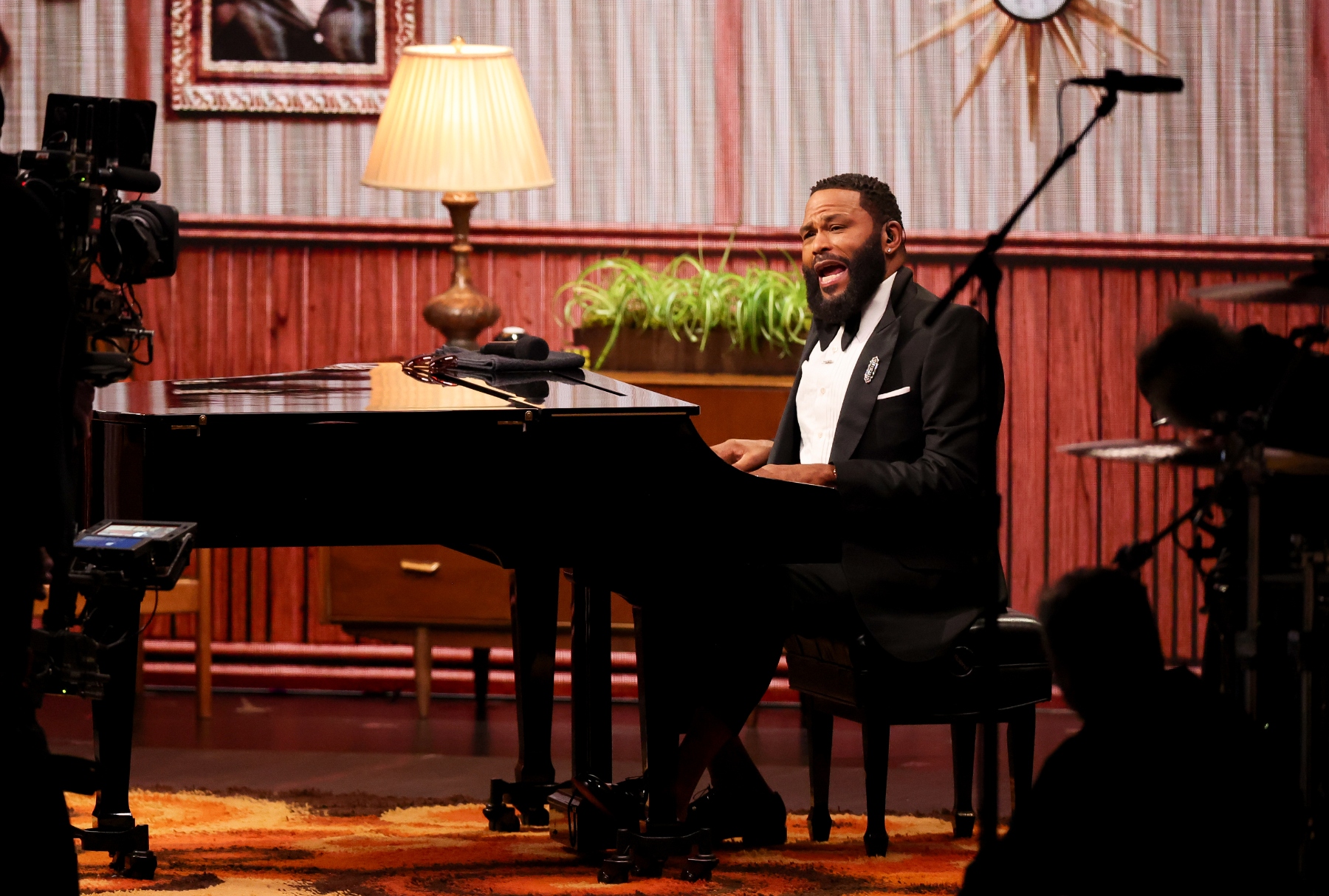
Emmys host Anthony Anderson hinted at nostalgia driving the night by opening the evening with an homage to “Mister Rogers’ Neighborhood” and TV themes, including “The Fact of Life” and "Good Times," along with “In the Air Tonight” – which was not the theme to “Miami Vice,” but might as well have been.

Anthony Anderson at the 75th Primetime Emmy Awards held at the Peacock Theater on January 15, 2024 (Christopher Polk/Variety via Getty Images)From there the Emmy brought in talent to accompany the accessories, bringing pieces of familiar sets to life for the actor presenters to hand out awards. The “Martin” cast did a bit in the sitcom’s famous living room. Most of the surviving “Cheers” cast (minus Woody Harrelson) reassembled in a recreated version of the bar. Lorraine Bracco and Michael Imperioli opened their envelope copy of Dr. Melfi’s office on “The Sopranos.”

This bought the show a share of goodwill in this time of awards show fatigue, especially a week after an abysmal Golden Globes outing that crawled forth for too long.

Contrast this with the enthusiastic standing ovation for Christina Applegate, the night’s first presenter, representing disabled performers by being her humorous self as she addressed the impact that multiple sclerosis has had on her. Addressing the crowd Applegate deadpanned, “You’re totally shaming me by standing up; it’s fine. Body not by Ozempic – OK, let’s go!”

Later Niecy Nash-Betts marked her limited series best supporting actress win for “Dahmer—Monster: The Jeffrey Dahmer Story” – her first after four nominations — with a legendarily self-affirming declaration.

“Listen, if a drag queen wants to read you a story at a library, listen to her.”

“You know who I wanna thank? I want to thank me,” she said. “For believing in me and doing what they said I could not do. I want to say to myself in front of all you beautiful people: ‘Go on, girl with your bad self. You did that!’” on behalf of all the Black women who have been underheard and overpoliced. At this she invoked the names of Glenda Cleveland, who she played in "Dahmer," alongside Sandra Bland, who died while in police custody, and Breonna Taylor, who was shot to death by law enforcement officers.

Weaving politics into awards show telecasts tends to raise conservatives’ blood pressure, but this broadcast was noteworthy for the space such moments received. RuPaul Charles, whose show “RuPaul's Drag Race” is a five-time best reality competition winner and is the most awarded host in Emmys history with eight wins, holding the record for most wins by a person of color, used his return to the Emmy stage to speak out against the right-wing demonizing drag.

“Listen, if a drag queen wants to read you a story at a library, listen to her,” he said. “Because knowledge is power. And if someone is trying to restrict your access to power, they are trying to scare you. So listen to a drag queen!”

We need your help to stay independent

“Last Week Tonight” scribe Sofia Manfredi acknowledged the show’s producers for backing them up during the strike, along with the Writers Guild of America as she accepted the Emmy for best writing for a variety series. “The strike felt long,” she said. “It did not feel lonely.”

Even "Succession's" Armstrong, a white guy who created the biggest drama on TV, took a swing at the right wing media ecosystem. “This is a show about family, but it’s about when partisan news coverage gets intertwined with divisive right-wing politics,” he said, adding drolly, “And after four seasons of satire, as I understand it, that’s a problem we have now fixed. So we can now depart the stage.”

Monday’s Emmys also contained many genuinely moving moments, such as Brunson breaking into tears at receiving her award from Carol Burnett, acknowledging what it means for Burnett to pass that torch to her.

Edebiri following her charming Globes acceptance speech with this shout-out to her parents felt like a moment of true gratitude. “Thank you so much for loving me and letting me feel beautiful and Black and proud of all that,” she said. “It’s probably not, like, a dream to immigrate to this country and have your child be like ‘I want to do improv!’ But you’re real ones.”

Jesse Armstrong, Sarah Snook and Kieran Culkin accept the outstanding drama series award for “Succession” onstage during the 75th Primetime Emmy Awards on January 15, 2024 (Monica Schipper/WireImage)It wouldn’t be an awards show without weird self-congratulatory pageantry, including the variety special win for "Elton John Live: Farewell From Dodger Stadium," which officially places the icon in the EGOT circle. Since Fox hosted the Emmys this year, that meant suffering through an awkward “Ally McBeal” inspired dance number, along with an extended complaint by FX’s “It’s Always Sunny in Philadelphia” cast. They pointed out that despite starring in TV’s longest-running sitcom, they’d never gotten any Emmys nominations or been asked to present before Monday's event.

Still, this Emmys was defined by expediency – some of it in the comedic set-up of foregoing the usual play-off music. “This year, I’ve got something that nobody can ignore: my mama,” Anderson said referring to his “We Are Family” co-host and, yes, his actual mother Doris Bowman, mic'd up and sitting in the audience. “When you see my mama coming, thank Jesus and wrap it up.”

Bowman wasn’t playing. 

When supporting actress drama winner Jennifer Coolidge adorably yammered on too long and thanked “all the evil gays” while accepting her award for “The White Lotus,” Bowman rose from her fifth-row seat and cut her off with, “Baby . . . baby . . . I love you, baby, but time!”

People either found this very charming or, if they happened to be humorless, rude. When John Oliver accepted the best variety sketch series Emmy for “Last Week Tonight” he intentionally began listing the names of British soccer players to goad Bowman’s playful wrath, only to immediately thank Jesus before zipping offstage.


Want a daily wrap-up of all the news and commentary Salon has to offer? Subscribe to our morning newsletter, Crash Course.


Employing Anderson as a light touch – cartilage binding one segment to the next instead of a showstopper – was the right play. This was a very Norman Lear Emmys by inference and reference; the "All in the Family" living room made an appearance the show, and its creator topped an "In Memoriam" segment that tastefully wove the "Friends" theme refrain into its melodic lament. Incorporating past casts and sets throughout the broadcast as opposed to pausing to show montages of archival footage kept the action feeling alive instead of stilted, enabling viewers to remain a part of the action instead of removing us from it.

This also had the effect of reining in the stilted scripts, leaving more room for the winners and a couple of performers to bring their personalities into the telecast. Pedro Pascal paused before presenting the award for drama supporting actor to respond to Culkin jokingly telling him to “suck it” at the Globes by explaining why his arm was in a sling.

“I'd like to take just a second and make this about me. A lot of people have been asking about my arm,” Pascal said. “It's actually my shoulder. And I think tonight is a perfect time to tell everyone that Culkin beat the s**t out of me,” as Culkin pretended to coldly stare up at him from his seat.

I’m going to guess those lines weren’t in the teleprompter, but the bit played spectacularly because Pascal is charming and Culkin committed to it too. Such moments gave this highly scripted 75-year celebration a touch of spontaneity that broke up the museum tour.

If you’re a TV nerd, a solid walk through history that manages to be entertaining can be a gift. It reminds the audience of why TV is worth celebrating and the winners of the history that came before them.

An outro featuring a clip of King’s “I Have a Dream” speech provided a final reminder of where we are on 2024's calendar, along with the meaning of these wins in the wider span of TV’s existence. And if some of these victories felt late, that’s fair. The Emmys will get another shot at bringing the institution up to date sometime this fall.

Expert: Wayne LaPierre leaves financial mess at NRA — beyond the one that landed them in court

Wayne LaPierre, the National Rifle Association’s longtime leader, plans to retire by the end of January 2024. He cited “health reasons” when he announced his departure three days before the organization’s civil fraud trial got underway in Manhattan.

New York authorities have accused the NRA, LaPierre and three of his current or former colleagues of squandering millions of dollars the gun group had obtained from its members.

As a nonprofit accounting scholar who has followed the NRA’s finances for years, I believe the organization is not only at a legal crossroads but also at a financial one.

NRA business model

To see why the NRA finds itself in this difficult spot, it helps to first see how its business model allows for only a small margin of error. Despite the nonprofit’s long history– it was founded in 1871 by Civil War veterans who fought for the Union – the NRA has never had enough money stowed away to inoculate it from financial problems.

Consider the NRA’s circumstances in terms of its unrestricted net assets, which reflect the money an organization has available to spend after accounting for its commitments to donors.

Comparing this with the scale of an organization’s annual budget can provide a sense of how much of a rainy day fund is on hand.

In 2015, the NRA had unrestricted net assets that constituted just 9% of its total expenses. In contrast, that same year, the AARP, another long-standing social welfare organization with millions of members, had unrestricted net assets that amounted to 87% of its expenses.

In other words, the NRA’s coffers reflected a circumstance more in line with an employee living paycheck to paycheck than an heir living off a trust fund. For this reason, the NRA has always relied on its members’ annual dues to cover its costs, and it is less able to weather financial storms that can last years.

The controversies over the NRA’s spending and the organization’s political entanglements that have swirled around since 2016 constitute that kind of turbulence.

Declining financial fortunes

Following its substantial spending spree during the 2016 election cycle, the NRA found itself needing to dig out of a hole, with a budget deficit of more than US$40 million.

Subsequent years saw fluctuations in spending along with ongoing challenges to generate sufficient revenues to keep up with spending.

In recent years, the organization’s approach to its budget shortfall has been to cut costs, or at least some of its costs.

Spending on programming went from nearly $176 million in 2017 to just $73 million in 2022, its most recent reporting year.

Its traditionally core programs have taken the biggest hit: Spending on education and training fell from $7.7 million to $3.2 million; law enforcement support dropped from $3.8 million to $1.8 million; recreational shooting slipped from $7.2 million to $5.1 million; and field services declined from $11.9 million to $1.3 million.

Back in the red

The NRA hasn’t cut all of its spending, however.

During the same time frame, the NRA’s budget for administrative legal costs ballooned, from $4 million in 2017 to over $40 million in each of the past three reporting years, with this amount hitting $43.7 million in 2022.

The organization’s shrinking programming budget helped eliminate its deficit, at least for a time.

Thanks to its reduced spending, the NRA was able to finish the year with a surplus in both 2020 and 2021. However, that surplus, which came from slashing costs – particularly those geared toward core programs for members – proved short-lived.

The organization has also seen the ranks of its members dwindle. Fewer members mean less revenue from dues. In 2022, revenues were down by more than $100 million from their 2017 levels, a drop of more than one-third.

The declining revenues meant that, despite its trimmed-down budget, the NRA was back in the red in 2022 and again facing a negative unrestricted balance in net assets.

What’s next?

The NRA, in short, is in a financial spiral. Its shrinking budget has begotten a shrinking member base, leading to an even smaller budget. It may be hard to stem.

The organization has pared what it spends on its programs to the bone.

While there are no easy answers for what the organization can do about its financial predicament, it’s not the only pressing question the organization faces.

How long will the NRA’s remaining members stay loyal to it? When will high legal costs subside enough to ease the budgetary pressures? What does a smaller NRA mean for its ability to flex its political muscle?

Despite its many challenges, the NRA’s imminent changing of the guard does offer an opportunity to make more drastic shifts in its priorities, spending approaches and the pitches it makes to members and donors.

Further, with its large legal budget being the last remaining area ripe for cost cutting, perhaps the NRA’s next generation of leaders will set the stage for the organization to rid itself of its oversized legal burdens and refocus on core programs.

What is clear, however, is that financial constraints will dictate much of whatever course the new leadership seeks to chart.


Earlier versions of these charts ran in a related article on March 23, 2023.

Brian Mittendorf, Professor of Accounting, The Ohio State University

This article is republished from The Conversation under a Creative Commons license. Read the original article.

“The coup, for now, is over”: Activist sworn in as Guatemala’s president despite right-wing scheme

Anti-corruption activist Bernardo Arévalo was sworn in as Guatemala's president early Monday after months of fierce opposition from the Central American nation's right-wing political establishment, obstruction that progressive campaigners and other leaders in the region decried as a coup attempt.

Arévalo's inauguration was scheduled for Sunday afternoon, but the proceedings were delayed for hours as conservative legislators stonewalled efforts to select new congressional leadership.

The delay, part of a sustained push by right-wing forces to derail the transfer of power, sparked fury in the streets, with Arévalo backers—including Indigenous groups and the country's youth—mobilizing as it appeared that the president-elect's opponents were launching a last-ditch attempt to stop him from taking office.

Leading government officials from other Latin American nations expressed alarm over the delay and said in a joint statement that "the will of the Guatemalan people must be respected."

Reuters reported that Arevalo's inauguration was "thrown into disarray after the Supreme Court allowed opposition lawmakers to maintain their leadership of Congress, and forced members of the president's Semilla party to stand as independents, further diluting its presence."

"Semilla holds only 23 of the 160 seats in Congress," the news agency noted. "Arevalo's authority, however, got a boost after prominent Semilla lawmaker, Samuel Pérez Álvarez, was unexpectedly elected as the Congress president."

Sunday's chaos capped off a drawn-out fight by Guatemala's entrenched and corrupt political establishment to prevent a reformer from taking power. Arevalo has been described as the most progressive Guatemalan president since Jacobo Árbenz, who was ousted in a U.S.-sponsored coup in 1954.

Following his landslide victory in August, Guatemala Attorney General Consuelo Porras—an ally of former President Alejandro Giammattei who was appointed to a second four-year term in 2022—launched an aggressive legal campaign to halt Arevalo's ascent to the presidency, alleging that he and his party engaged in various forms of election fraud.

Arévalo, who also faced credible death threats and assassination plots, rejected such accusations as part of a high-level coup attempt and said he would push for Porras' resignation.

"In the 20th century, coups involved tanks, bayonets, soldiers, and lasted two or three days," Arévalo said in an interview with The New York Times last month. "The coups of the 21st century are carried out with members of Congress, with lawyers, in the courts. It's more sophisticated, takes much more time, it's done with the pretense of institutional continuity."

On Monday, in his first act as Guatemala's president, Arévalo "visited the site outside the attorney general's office where Indigenous protesters have kept vigil for more than three months, demanding authorities respect the vote and that Porras step down," The Associated Press reported.

"It fills me with deep honor to assume this lofty responsibility, showing that our democracy has the necessary strength to resist and that through unity and trust we can change the political panorama in Guatemala," Arévalo said in his inaugural address. "There cannot be democracy without social justice, and social justice cannot prevail without democracy."

Set a goal to lose weight this year? Experts explain how to do it right to make it stick

It's the time of year for motivational stories. A "new year, new you" narrative, one that's often accompanied by inspiring videos from the gym of a person's dramatic weight loss progress. And if those transformational tales have moved you to make some changes in your own body, here are a few things you should understand: Weight is only one imperfect metric of health, attractiveness and happiness. There are a multitude of compelling physical and mental health reasons to exercise that have nothing to do with your size. And finally, as a 2017 report in Diabetes Spectrum notes, "Most, but not all, study data indicate that exercise alone plays a very small role in weight loss." Or as a colleague observed to me recently, "You don't lose weight in the gym; you lose it in the kitchen."

It's simple math — and so much more. To lose one pound, you need to shed 3,500 calories. Now let's say on a typical morning I run three miles, an aerobic exercise that burns more calories than stretching or strength training. That's about 300 to 350 calories. That's it. Then I'm going to go eat breakfast. "The old saying that you can't outrun a bad diet is annoying to hear, but it's true," says Dan Gallagher, a registered dietitian with Aegle Nutrition.

"Most people are exercising for maybe half an hour, which only burns a small fraction of the calories you consume each day," notes Gallagher. "You have to pay attention to your caloric intake if you want to lose weight and build muscle, unless you'd like to run 10-plus miles every day to work off what you choose to put in your mouth." 

We need your help to stay independent

Another reason exercise alone won't work for weight loss is our human capacity to adapt. "Our bodies will eventually reach a plateau with exercise where they will not burn more calories," explains Lauren Thayer, a registered nurse at Health Canal. "Some research even says that working out does very little for weight loss. The body's metabolic adjusts constantly and those who perform high intensity workouts daily and those who are sedentary have a very similar daily energy expenditure." A 2016 study out of the journal Cell Biology backs this up, noting, "People who did more than moderate activity had nothing to show for it in terms of increasing the amount of energy they expended." That's where food comes in.

"The old saying that you can't outrun a bad diet is annoying to hear, but it's true."

"While gym videos flood our feeds in January, there's a tendency to overlook the importance of diet in the weight loss equation," says Andrew White, a certified personal trainer and co-founder of Garage Gym Pro. It's not just about overvaluing exercise; it's about not always being realistic about food. "Many people believe they're eating less than they actually are," says White. "Portion control and understanding calorie content are vital. A food diary or app can be incredibly eye-opening in this regard." 

Similarly, unless you're Michael Phelps in his prime, you can't treat an exercise plan as a hall pass to eat more. "After a good workout, there's a temptation to reward ourselves with high-calorie foods, which can counteract our efforts in the gym," says Andrew White. "It's easy to overestimate the number of calories burned during a workout and compensate by eating more. This can negate the calorie deficit needed for weight loss. The cornerstone of weight loss is consistently consuming fewer calories than your body burns. This doesn't mean starving yourself but rather making smarter, healthier food choices." 

Or you may find yourself getting hungrier, especially if you're going hard on a new workout and strict diet plan. "It is 2-fold," explains Kimberly Gomer, a Miami dietician and nutritionist.  "One is the increase in hunger that some people get from exercise (and accentuated if they are also restricting calories). Another issue is that when the body is challenged through exercise, to maintain homeostasis, the body will increase hunger hormonally by sending out hunger cues like ghrelin. Studies have shown that it is very easy to 'out eat' your workout."

In my own life, doing yoga and training for races have over the years have undeniably affected how my body looks and performs, but even intense, regular exercise has rarely affected the numbers on a scale. Things that have made me lose weight? Cancer, COVID and depression, and I can recommend none of them. Just as exercise alone isn't a magic bullet for healthy weight loss, neither is just eating less — as anyone who's been sick, stressed or on a stupid diet can attest. But it does matter. "Exercise is important for health heart and muscle growth," explains which in turn helps weight loss by creating more metabolically active tissue that burns fuel, instead of storing it as fat," explains Brittany Placencia, a nutritionist and the founder of Simple Plate Nutrition.

"Having enough protein, healthy fats, and fiber at each meal and snack is the key to satiety and balanced blood sugar levels, the weight loss trifecta"

Beyond that, while it might not make for as compelling content as a clip of someone lifting victoriously at the gym, building consistent habits and consuming appropriate portions of nutritious food are the way to go. "Having enough protein, healthy fats, and fiber at each meal and snack is the key to satiety and balanced blood sugar levels, the weight loss trifecta," says Placencia. "For example, instead of snacking on an apple alone, which seems like the healthy thing to do, pairing it with peanut butter gives the snack healthy fats and protein along with the fiber from the apple. This will keep you satisfied for longer than the apple alone and will allow your blood sugar level to have a lower spike. Paring the right foods (protein, healthy fat, fiber) will help decrease a spike in blood sugar, allowing more time for your body to burn fuel, not store it."

I'm not suggesting that you need to lose weight, or that just being smaller is a realistic or healthy goal for anybody. What I am saying is that if for whatever reason you have decided you want to lose weight, you're going to need to take in fewer calories, and choose them wisely. "Long-term success comes from integrating balanced eating habits and regular physical activity into your lifestyle," says Paula Sierzega, a triathlon athlete and blogger. "To really make a lasting change, it's about finding that harmony between what you eat and how you move. After all, your body deserves a lifestyle it can sustain and thrive in."


Fani Willis accuses TrumpWorld of playing “race card” with improper relationship allegation

Fulton County District Attorney Fani Willis on Sunday pushed back on TrumpWorld allegations of misconduct during a speech at Georgia’s Big Bethel AME Church ahead of Martin Luther King Jr. Day. Willis’ remarks came after Ashleigh Merchant, a lawyer for Trump co-defendant and former campaign official Michael Roman, alleged that Willis engaged in an “improper” romantic relationship with special prosecutor Nathan Wade, a private attorney Willis brought on to the case.

“I’m a little confused. I appointed three special counselors. It’s my right to do, paid them all the same hourly rate. They only attack one,” Willis said in her first public remarks on the matter, according to The Hill. “I hired one white woman, a good personal friend and a great lawyer, a superstar, I tell you. I hired one white man — brilliant — my friend and a great lawyer. And I hired one Black man, another superstar, a great friend and a great lawyer.”

Willis did not mention Wade by name but defended his “impeccable credentials.”

“The Black man I chose has been a judge for more than 10 years, run[s] a private practice more than 20 [years]. Represented businesses in civil litigation … served a prosecutor, a criminal defense lawyer, special assistant attorney general,” she said. “How come, God, the same Black man I hired was acceptable when a Republican in another country hired him and paid him twice the rate?”

Willis predicted her opponents would accuse her of playing the race card. “God, isn’t it them who’s playing the race card when they only question one?” she said. “They’re playing the race card when they constantly think I need someone from some other jurisdiction in some other state to tell me how to do a job I’ve [done] almost 30 years. I’m just asking, God, is it that some will never see a Black man as qualified, no matter his achievements?”

“Played it too cute”: MAGA bromance over as Trump attacks Vivek Ramaswamy on Truth Social

Former President Donald Trump lashed out at GOP primary challenger Vivek Ramaswamy, who calls himself an “America first” candidate while praising Trump. The fury came after Trump’s campaign got upset over Ramaswamy’s photo with a group of supporters wearing “Save Trump, Vote Vivek” shirts bearing Trump’s mugshot in an apparent reference to Ramaswamy's pledge to pardon the former president.

“Vivek started his campaign as a great supporter, ‘the best President in generations,’ etc. Unfortunately, now all he does is disguise his support in the form of deceitful campaign tricks,” Trump wrote on Truth Social on Saturday. “Very sly, but a vote for Vivek is a vote for the ‘other side’ — don’t get duped by this. Vote for ‘TRUMP,’ don’t waste your vote! Vivek is not MAGA.”

Trump lashed out at Ramaswamy again on Monday ahead of the Iowa caucus, warning that a “VOTE FOR VIVEK IS A WASTED VOTE.”

“I LIKE VIVEK, BUT HE PLAYED IT TOO ‘CUTE’ WITH US,” he wrote.

Florida Gov. Ron DeSantis, a fellow primary foe, mocked the situation on Monday after Trump threw Ramaswamy “under the bus.”

“I’ve never seen a candidate run for an office and basically campaign for another candidate in the same race before, and that’s what’s happening. But the minute he wasn’t useful, you know, they dropped the hammer on it. So that’s just kind of the way, way they are,” DeSantis said.

“Damn, lady!”: “Brothers Sun” team on that ending, Michelle Yeoh’s “torture” input and what’s next

Just before the turning point in Netflix's action comedy series "The Brothers Sun," Michelle Yeoh's character Eileen Sun stabs a needle under her husband's fingernail while he's comatose in the hospital. Apparently, that twisted bit of cruelty was all the Oscar-winning actor's own idea.

"She had to make sure that he was really in a coma and not faking it," director Viet Nguyen told Salon. "It was f**king Michelle Yeoh's crazy as dark f**king idea to pull out a f**king needle and stab him under his his fingernail. I was like, 'Damn, lady!'"

"It's a power move."

In the episode "Country Boy," Mama Sun (Yeoh) is back in Taipei, having been separated from her husband Big Sun (Johnny Kou) for 15 years. While he's been running Taiwan's Triad group the Jade Dragons with his eldest son Charles (Justin Chien) as his enforcer, Mama Sun has been leading an unassuming life in the U.S. as a nurse, raising their other son Bruce (Sam Song Li). When an assassination attempt lands Big Sun in the hospital, that kicks off a series of events in "The Brothers Sun" that sends Charles to the U.S. and eventually sends Mama Sun back to her home country on a mission.

Nguyen said that the hospital scene hadn't originally included the fingernail detail. 

"I don't even remember anymore, but it wasn't that," he said. "I mean, it might have been something similar where she scrapes him with something sharp. But this is such a specific torture thing, right? Maybe I'm just not dark or crazy. But, no, let's get the needle out and stab him under the fingernail, which is so jacked." 

Despite the harm inflicted, Big Sun's heart rate never wavers on the monitor. Satisfied that her husband is indeed out of commission, Eileen unleashes all of her pent-up frustration and anger out to his still and listening body. Not only is she upset that he never informed her of her sister's passing in her absence, but she also tells him, "I'm here to take the only thing you love: your empire." 

It turns out her trip to Taipei wasn't as a loving spouse trying to reassure the Jade Dragons' business partners; it was to win them to her side before she returned to America.

"It's also such a great scene for her as an actor," said Nguyen. "He's probably treated her a certain way all of their lives, and she hasn't seen him in a while. And he's on his deathbed, according to her, and for her to just kind of let go a little bit and say, 'You know what? F**k you. This is how I really feel.' It's a power move." 

Surprise! Big Sun was faking the severity of his condition and heard everything but doesn't let on until she leaves the room. He eventually follows Eileen to the U.S. When he tries to convince the Triad leaders to rally behind Charles as the Dragon Head — the leader of all the Triad groups ––Big Sun learns that his wife has planned her own coup. Outraged by Eileen's betrayal, he decides to exact his revenge by having Charles kill Bruce in front of her.

That plan also fails, and Bruce has his revenge . . . by shooting his father and sending him to the hospital once again. The parallel opportunity for cruelty is apparent in this final scene when Mama Sun enters his room, but this time as a nurse who knows how to alter his chart.

"I'm not going to kill you because I want you to suffer," she tells him, like a master villain unveiling her plan. "Everyone will think you're diabetic. You'll get regular injections of insulin. It will make you weak, unable to move, unable to speak . . . and it will hurt."

"When Mama Sun betrays him, he doesn't just say to Charles, 'I'm gonna have you kill mom,'" said Nguyen. "He wants something more painful than death, which is he wants Bruce dead. He wants Mama Sun to see her son dead, which is just such a terrible thing that we felt like, Mama Sun killing Big Sun didn't feel equal or right. So we wanted for her to do the same thing, basically, get her revenge, which is putting him in this sort of diabetic coma."

Mama Sun's reconciliation with Charles

Justin Chien in "The Brothers Sun" (Netflix)

"He definitely still has that ingrained sense of duty to his family that he can't escape."

In the end, Eileen boards a private plane to Taipei to try to build the Jade Dragons back up, and Charles decides to return with her. It's an intriguing choice for someone who has tried to escape his upbringing as a killer, turning to "The Great British Bake-Off" and making pastries as a way to soothe his soul. He's even landed a commercial-grade kitchen and perfected his churro recipe. With his goal within reach, why would he return?

"Charles gets asked to do the most terrible thing [to kill his brother], and it shakes him. He's not able to do it," co-creator Byron Wu told Salon. "His only other way out is to confront his dad, and he's not really able to really do that either. We've taken him to the step where he is able to entertain the idea, but he's not ready yet to fully leave that life. So he has to go back to Taiwan and be with mom. It's the only step for him."

Charles might have another reason to accompany Mama Sun.

"He's been without his mom for 15 years, right? So long that he's just starting to see his life, he's trying to see who he might have been with mom around. And so he wants to go and see what that life would've been like. It's catching up on a lot of lost time as well. He still has that duty to him that he can't just leave mom to tackle Taiwan alone; she's been gone for all that time. He knows that he knows better. He knows that landscape. He can help. He definitely still has that ingrained sense of duty to his family that he can't escape."

Meanwhile, improv-loving younger brother Bruce was able to pull the biggest power move of all – he's the one who in the end captured Big Sun and sent him to the hospital. Bruce tricked his unsuspecting father by confronting him head-on with a gun. Although Bruce doesn't kill his father that's not part of the plan. Sending his father to the hospital with a gunshot would allow the police to apprehend Big Sun and build a case against him based on one Triad leader's testimony. Bruce was able to defeat his father without killing.

"Bruce learns how much power he really holds and he exerts power in his own weird way," said Wu. "And he gets his dream car; we see him drive off in it. We kind of get the sense that he's definitely taking a step forward, and we want to let the audience get more of a feeling of his growth."

While a mid-credits scene sets up a possible second season – with the Triad informant possibly being targeted – Wu hasn't solidified any plans yet.
 
"[Co-creator Brad Falchuk] and I have have talked about it and thought about it for a little bit," Wu said. "Knock on wood. Let's hope we can do it."

Nikki Haley, MAGA and the Confederacy: Time to purge these myths

Nikki Haley is not a racist. She showed formidable leadership as South Carolina governor, in the aftermath of the 2015 mass shooting at Emanuel African Methodist Episcopal Church in her state. But as a former MAGA activist now working to persuade people to leave the MAGA movement, I see Haley's recent comments on the Civil War and slavery in a particular light. They reflect the intense white fright pervasive in MAGA supporters as a result of continuous demographic change, and they affirm that a demythologization of historical nostalgia is necessary. 

There is more at work here than just "MAGA voters are racist." Most with whom I once congregated and broke bread were not. I won’t label white racial hysteria on the right as “complicated,” but those suffering from white panic are often unaware that the conclusions they’ve drawn are largely molded by those deliberately sowing racial discord. This sowing has occurred since Day One of our nation.

Our species is change-adverse, generally speaking. Anxiety about America’s dwindling white population does not necessarily mean those who are anxious are racists or white supremacists. Furthermore, our species also tends to perceive change as happening more rapidly than it actually occurs in reality.

MAGA and far-right mythologies exploit these natural fears in apocalyptic terms. I'm not defending ignorance, but MAGA-friendly politicians and pundits traumatize their voters and audiences, seeking to make them desperate and panicked that the visible changes around them are occurring too quickly. Such mythologies do not merely change one’s identity; the effects go much further than that. These mythologies change something inside people — the unseen parts, like our souls. Some pernicious alteration occurs. I am living proof, however, that such alterations need not be permanent; those defending Haley’s comments have likely been transformed in such a way by MAGA messaging and right-wing ideology.  

More than any other nation in world history, America’s identity and ethos are rooted in mythologies. Many will say that those with the most influence are those who control the information flow; I don’t entirely disagree, but I’d argue that those who control the shaping and inculcation of history may wield the most influence. And let’s remember that influence can be for better or worse. 

MAGA politicians and pundits are shameless, and while competing with shamelessness is a Herculean task, it is not always a Sisyphian or impossible one. When I was myself a devoted MAGA member, I allowed myself to view the world wholly through perceptions, not reality. Those who process the world around them that way are far more susceptible to falling prey to traumatic right-wing mythologies

It is easier to succumb to right-wing desperation and panic-inducing rhetoric than most realize. I maintain that the singular biggest mistake the Democratic Party has made over the last generation has been it’s complete buy-in on the premise that demographics is destiny. Broadly speaking, the center-left was convinced that this political manifest destiny would push right-wing mythologies to the fringes or extinguish them completely. This was a grave error, which only helped keep such mythologies at the forefront of the GOP’s political offering

We need your help to stay independent

MAGA voters are overwhelmingly white, and are well aware that America will become a majority-minority nation within the next few decades, if not sooner, given our historically low birth rates and decreasing life expectancy, the latter virtually unique among developed nations. Politicians and pundits whom the MAGA community follow have traumatized their followers to conclude that the imminent minority status of white people also means they will become a marginalized group. 

Though I cannot know what is in the hearts of the MAGA movement’s political trauma merchants and elected leaders, including Nikki Haley, I doubt they actually believe most (if any) of what they say. As if on autopilot, Haley regurgitated the revisionist-history talking points of the cult of the Lost Cause of the Confederacy. It is often said that history is written by the victors, but this is not quite accurate when it comes to American teachings about the Civil War. That war’s losers, and its Lost Cause mythologizers, continue to influence our perception 160 years later, as evidenced by Haley's answers. 

It is often said that history is written by the victors — but that's not quite accurate when it comes to American teachings about the Civil War.

Predictably, Haley entered into her sunk-cost fallacy phase overnight; rather than attempt to clarify her whitewashing, she accused Joe Biden and the Democrats of planting, as a mole or stooge, the gentleman who asked her about the Civil War. (For a guy the right wing claims is suffering from dementia, Biden appears agile at rigging elections and infiltrating Republican town halls). 

I dislike “gotcha” questions, but the Civil War question posed to Haley was no such thing. But the trauma, desperation and white panic inflicted on MAGA voters (including me, formerly) render them easily convinced of the existence of myriad “Big Plot” conspiracies concocted by Democrats, RINOs, globalists and other malignant actors. If Haley thinks that was a “gotcha,” she’s egregiously unprepared to manage conflicts with Russia, Iran or North Korea. 

Although Haley acted correctly in working to remove the Confederate flag from the South Carolina statehouse in 2015, after the mass shooting perpetrated by a Lost Cause supporter at the oldest Black church in the American South, she has never been entirely comfortable with that decision. Her unfortunate but unsurprising whiff on the Civil War question offers a valuable lesson: America needs not a Great Awakening but a Great Demythologization — on white fright, on the Second Amendment, on “we’re a republic, not a democracy” (spoiler alert: we’re both), on unbridled, unregulated, free-market “bootstrap” capitalism as a miracle elixir. Economic anxiety, I will remind everyone, was one of the primary reasons Trump won in 2016.


Want a daily wrap-up of all the news and commentary Salon has to offer? Subscribe to our morning newsletter, Crash Course.


Because they have been traumatized, and made desperate and panicky, many MAGA voters — who are mostly good people, and had some valid reasons for supporting Trump — don't see the contradiction about race that is directly in front of them. In my conversations with fellow MAGA members, I don't recall any that dismissed the abhorrence of slavery. There was, however, considerable apprehension about the increase in national conversations about anti-Black racism begotten by the election of Barack Obama and then by George Floyd's murder. 

The MAGA creed proclaims that Black people have long since achieved equal rights, but rationalizes that America’s “culture” and “values” — code phrases for a system in which white heterosexual Christians hold virtually all positions of power and influence, political or otherwise — are irreversibly disappearing. This is the contradiction MAGA members can’t see, because they are emotionally, morally, spiritually and financially invested in a mythological America of yesteryear — the supposed apogee of our greatness — and it is immensely difficult for them to see that they have been manipulated into racial desperation and panic. 

It doesn’t help that much of our national press may never recover from the shock of missing the grassroots support for Trump in 2016, and so we get endless apologias for Trump, along with a delusional, obsessive media yearning to save the GOP from Trump. (The right wing’s “liberal media” myth has provided an enormous return on investment.)  

As I said earlier, America’s identity is defined by mythologies. Some are aspirational, like the continued perfection of our Union. Some are traumatic, like extolling the Confederacy as a noble Lost Cause, and omitting slavery as the Civil War’s principal cause for a revisionist narrative about states’ rights. Fewer Americans today revere the Confederacy than did in prior generations, but to better understand why these traumatic mythologies still hold power, we must gain a more complete understanding of the past. 

For those with friends or family still in the MAGA movement, I’d say this: To some extent they’ve been made this way; racial desperation and panic are almost certainly factored into their support. Please do not give up on them; when I left MAGA, I was able to repair relationships with those I had regarded as enemies. I'm living proof that those in MAGA can leave it behind. It’s not painless, but it’s liberating. Self-forgiveness and inner peace are possible. 

If you’re a MAGA supporter reading this right now, know that I do not consider you racist, stupid, uncouth, evil or lacking in integrity. You do not deserve ostracism, but you have been led astray. Only you can save yourself; it is never too late. 

“Even if you vote and pass away, it’s worth it”: Trump urges Iowans to vote sick in subzero temps

Former President Donald Trump on Sunday urged Iowa voters to turn out to vote despite subzero temperatures across the region. Trump told supporters in Indianola that it was imperative to vote for him to “save America from crooked Joe Biden” amid concerns of low turnout as wind chill temperatures are expected to fall as low as 35 below zero.

"You can't sit home. If you're sick as a dog, you say: 'God I gotta make it.' Even if you vote and then pass away, it's worth it," Trump said. "If you're sick, if you're just so sick, you can't, 'darling, I don't think I can.' Get up. Get up. You get up, you're gonna vote," he added, imitating a woman urging her husband to vote. "'Yes, darling,’ because ultimately, we know who calls the shots right?"

Trump assured his supporters that the caucus locations would “all be safe,” adding: "But you gotta get up, you gotta vote, because it has nothing to do with anything but taking our nation back, and that's the biggest thing there is.” The final Des Moines Register poll showed Trump leading with 48% of likely Republican caucusgoers, with former United Nations Ambassador Nikki Haley at 20% and Florida Gov. Ron DeSantis at 16%.

MLK biographer Jonathan Eig: Americans are “missing the point of the King holiday”

Dr. Martin Luther King Jr. was one of the greatest champions of American democracy.

His accomplishments, along with the other leaders and foot soldiers of the long Black Freedom Struggle and civil rights movement, include securing voting rights for African-Americans and others deprived of the franchise, ending de jure segregation and tearing down the Jim and Jane Crow white supremacist terror regime, and ensuring that the fundamental human and civil rights of all people, on both sides of the color line, are protected by law in America. Historians and other experts have correctly described these accomplishments as constituting a third American founding and a second Reconstruction.

Dr. King was assassinated in 1968 while supporting a strike by sanitation workers in Memphis because he represented a fundamental threat to the white racial order and American apartheid. Unfortunately, while pushed back by the civil rights movements of the 1960s and 1970s, these same forces were never defeated in American society. Instead, they adapted and evolved to maintain their power and influence.

With the Age of Trump, ascendant neofascism, and reinvigorated white supremacy the same social and political forces that martyred Dr. King are now reversing the gains of the civil rights movement. 

Dr. King famously said, “The arc of the moral universe is long, but it bends toward justice.”

Donald Trump, his MAGA people, and the other American neofascists and right-wing reactionaries are determined to bend that arc of justice backward and then tie it in a knot to destroy the country’s multiracial pluralistic democracy.   

To better understand Dr. King’s legacy (and lessons from his life) in this time of democracy crisis and white backlash, I recently spoke with Jonathan Eig. He is the author of six books, including his most recent, King: A Life, nominated for the National Book Award and chosen by President Obama as one of his favorite books of 2023. Eig’s previous book, Ali: A Life, was honored with a 2018 PEN America Literary Award.

This conversation has been edited for clarity and length.

How are you feeling given this tumultuous time? There is an upcoming presidential election where the literal future of the country's democracy will be decided and the neofascist antidemocracy movement. Jan. 6 and King's holiday are within weeks of one another.   

It's crazy. And it feels like we are really missing the point of the King holiday when we treat it like a day to celebrate King and we ignore the fact that all these other things are going on.

"Racial justice and the teaching of Black history are under fire."

Racial justice and the teaching of Black history are under fire. There are people with Confederate flags who stormed the Capitol on Jan. 6 and more people calling the insurrection an act of patriotism. The real meaning of the King holiday is to remind us of the potential of this country to be one of justice and equality and brotherhood and nonviolence. If all we are doing is talking about King's dream, then we are missing much of the point. 

What is the state of [King's] dream? What is the dream? How do we actually make it concrete?

We should have a scorecard for the dream. We should look every year at how much progress we're making on income inequality, war, poverty, and racism for example. If we had a scorecard for King's dream, we could see clearly that we've lost ground in the last few years with voting rights under attack, with racism, war, and income inequality. Ultimately, if we had a report card for King's dream, we wouldn't be getting great grades right now here in the United States.

How do you assess the state of that glorious struggle for real multiracial democracy and why so many people actually believe that Dr. King shows up, gives a speech, and then everything is okay with the Black and brown children all living happily together? It is all so much ridiculous magical lazy thinking. 

We need to remember that every time King talked about his dream, and every time there was a sense of progress being made, there was a backlash.

There is the "I Have a Dream" speech and then what happens? Several weeks later there is the 16th Street Baptist Church bombing. The FBI produced a memo saying that given King's "I Have a Dream" speech we must now rate him as the most dangerous man in America when it comes to race.

After Obama's election, we have the rise of Trump.

There is always a backlash and a struggle. King famously said that "the arc of history bends toward justice." But King did not say that it bent by itself. King said we have to get out there and bend it. 

Where are we with that long arc of justice and history?  

"Ultimately, if we had a report card for King's dream, we wouldn't be getting great grades right now here in the United States."

Well, if you look at it close up, and that's how we live our lives close up day to day, it looks like the long arc is bending in the wrong direction where we are losing the ideals and principles of democracy. When King came along in 1955 and spoke at that first meeting of the Montgomery bus boycott he promised that the Black people of America might help make this country live up to the dream of democracy, live up to the promises of the Constitution and the Bill of Rights, and truly make this a country of where all men are created equal and entitled to the pursuit of life, liberty and justice. But the arc is long, and we have to step back and hope that what we are experiencing now in the country is a temporary setback and that we are going to continue to bend that arc in the right direction.  

When you think about King, what do we see looking very closely versus what we see from a mile away, that much bigger picture?  

I believe that when we look up close, we see how much King struggled and how difficult his life was and how unhappy he was much of the time. When you step back, and look at how much King was able to achieve, you see how much one person could change the world, how much hope he could give, and how much he could help people overcome their fears and their anxieties and their sense that they were all alone. King absolutely made an enormous difference in people's lives on an individual and societal level. I like to step back and focus on that. 

We need your help to stay independent

 Learning from Brother King, what did he explicitly say about democracy in his writing and speeches? How did he conceptualize democracy? 

King thought that democracy is the great gift of America to the world and that even with its flaws, such as the sin of slavery and the aftermath of slavery and the long stain of white supremacy, he continued to believe that democracy was the best form of government on Earth. But King also believed that democracy in this country had to change. To that point, King believed that as long as we were focused too much on wealth and on materialism democracy was never going to live up to its potential. During the last years of King's life, in particular, he talked a great deal about reimagining the American democratic experience and American capitalism. King believed that social programs should be boosted greatly as well as income and job guarantees. King was clearly not satisfied with the state of American democracy. 

Dr. King and his legacy has been so deradicalized, homogenized, and literally whitewashed to such a point that Trump and the other neofascists and white racial authoritarians, "conservatives", and white supremacists are now claiming his legacy and work — even though they are fundamentally against everything that King fought and died for. How did we arrive at such an obscene moment in this country?  

It's absurd. It's infuriating. It's intentional. There are people using King for cover as they express their racist views, and feeling like if they quote, Dr. King saying that "we should be judged by the content of our character," for example, that he must then have been against affirmative action. That is absurd. King supported affirmative action. The problem is that this disingenuous and absurd behavior goes back a long time. The same government that harassed and attempted to destroy King is the government that has created this holiday to honor him. And in doing so, some would say these institutional forces have intentionally watered down King's message, and deradicalized him. As Harry Belafonte said to me, we don't like radicals when they're alive, we only like them when they're dead. We can water down their radical messages and talk about the I Have a Dream speech, but then strategically forget about the fact that in the first half of that speech, King talked about police brutality and reparations. Too many people soften and try to make themselves comfortable with King's message. King would not allow it if he were alive today to see what was happening. He would raise a ruckus.  

What has been gained and lost by the sacred canonization of Dr. King and his elevation into the pantheon of American heroes? 

What's been gained is that American society has an appreciation that Black Americans played a huge role in shaping this country, and we should have holidays, and we should have curricula that celebrate and teach and contextualize Black history. We should honor our black heroes. But the loss is that in doing so we capture only the safe version of King, the version that makes us comfortable. Again, too many forget that King was a radical. We need to remember King as he lived. We need to go back and reread King' s actual words. And not just the "I Have a Dream speech", but the words where King described America as "the greatest purveyor of violence on Earth" among others. 

How is the loss of that entire generation of leaders and activists who were with King — and on the ground hope warriors as well, the foot soldiers — of the civil rights movement and Black Freedom Struggle — impacting us today?  

It is still a movement of millions. Just because we're losing those elders doesn't mean that we can't create a new generation of change warriors and social activists — and I think we are. I believe that it is harder for them today to get the kind of recognition and massive audience that King had because the media is so divided. The echo chambers and how people just listen to what they want to hear also makes it much harder. But that doesn't mean people aren't out there doing the same kind of hard work like King and others in the movement did. 

How has your journey with Dr. King, getting to know the human being through his writing, his work, his friends, and other people closest to him, impacted you?  

I came into it with this fairly superficial idea of who King was. As I went on the journey, I came to appreciate just how much King suffered for what he did. When you sit with Belafonte and John Lewis and Reverend James Lawson and Reverend Bernard Lafayette and Jesse Jackson, and you hear what it was like to be around King, you learn how much he struggled. You hear how difficult this all was for him. It's really worth remembering that King had the same kinds of doubts that we have today. He too doubted whether he could make a difference. He persevered despite all those doubts. King wasn't always the man on the monument. King wasn't always standing tall and proud with his arms folded across his chest as if he had conquered the world. Much of the time, King felt like he had failed and yet he kept going.

There is the forward public facing King and that strength and then there is the private man and his struggles and his pain. There are great lessons there for the fight today to save American democracy and to make a better society because so many of us doing that work are already exhausted and the struggle is just beginning. 

King was hospitalized at least a half dozen times for what he called "exhaustion." But his friends and family referred to it as depression. King was just beat up by this experience of being in the struggle, and having to be at the forefront of it all the time and having people expect so much of him. King felt the burden on his shoulders, and yet he kept going. One of the ironies is that the FBI recordings and surveillance really help us to better understand King's own personal struggle because we can read the transcripts of his conversations. We can see what King was saying to his friends in his private and darkest moments, that "I feel like no one's listening to me anymore" and "I can understand why the media is turning on me. Why isn't anybody signing up for this Poor People's Campaign that we're organizing?"  King is full of doubts, and he's taking it very hard. But he keeps going, and in fact, he doesn't just keep going, he doubles down. King really commits to the most radical elements of his approach when all of his friends are saying, okay, you know what, let's just scale back, let's just stick to where we're most effective. Let's work on voting rights in the South. And desegregating lunch counters and restaurants because that's what we're best at. And King says, I can't do it, I got to do what's right, over and over again. He has to live up to his religious ideal and not just do what's pragmatic.

What was one of King's greatest moments of doubt about the struggle and the future of this country? How did he get himself through it or not?

"King was clearly not satisfied with the state of American democracy." 

Chicago was certainly one of those great moments of doubt. King felt like he had a responsibility to come to the North, and take on the more subtle, and in some ways, insidious forms of racism and segregation that he saw in the North. King got beaten up, literally, he was hit in the back of the head with a brick or a large stone. King left Chicago without really accomplishing much of what he sought to accomplish. He took a beating there. What does he do? He keeps going. That's when King starts speaking out more on the Vietnam War and planning the Poor People's Campaign so that he can address the issues that he saw in Chicago — but on a national level.  

 I'm very uncomfortable with the idea of heroes. To the degree there are a few heroes I honor and find inspiration from, I embrace their full complexity and flaws, their failings and ugliness along with the beauty. They are not perfect. No one is. How did you balance your depiction of Dr. King and his flaws and greatness?

I just set out to tell the truth and to present the whole story. I knew that King's heroism would shine through because he's one of our greatest and most courageous heroes. But I felt like if I didn't own up to his failures and his weaknesses then I wouldn't be honest with my readers. I felt like if I just got the balance right that people would respect him and love him and admire him more. As you said we're all flawed, and we all make mistakes. To see King accomplishing what he did, in spite of those flaws and doubts and fears, makes him even braver. Let's consider some of King's flaws. He was not good at recognizing the contributions of women. He did not elevate women's rights to the status of the other rights that he was fighting for. King missed out on opportunities to have women, including his own wife, play a more active role in the civil rights movement. Does that take away from what he did accomplish? No. It just means that he had blind spots like the rest of us. Maybe if King had lived long enough then he would have continued to learn from those smart, passionate, fearless women who surrounded him, including his wife. You can also look at King's failures and look at the mistakes he made in places like St. Augustine and Albany, and even in Birmingham. But what's important isn't that King made mistakes, but that he kept doing the best he could.

It has been more than 50 years since Dr. King's martyrdom. What trajectory was he on with his life and work?

It's very hard to say obviously. I asked some of King's friends that question. Would he have gone into politics? Would he have gone into education? Been the president of a university? Teaching theology? We just don't know. But you know, what they all agreed on was that he would have remained a radical. If you look at some of the examples of the people who were around King, you see Andrew Young and Harry Belafonte and John Lewis each taking different paths. But in a very real sense, they remained as radical as ever. Sometimes they found more practical ways to go about their work. I asked John Lewis what would have become of King? And he said, “All I know is he would have kept fighting. Lewis also told me that King would still be saying what did that day in Montgomery, after the Selma to Montgomery march, that we're still waiting for justice and we're still fighting for justice, and how long will we have to wait? Not long. As long as we keep working, it won't be long.” 

CRASH COURSE

Dr. King was one of the most unpopular people in America at the time of his assassination. If King had continued doing that social change work, he would be public enemy number one right now in the eyes of Trump, the MAGA movement and the larger Republican fascists and "conservative" movement. Trump and his forces would likely have declared Dr. King an enemy of the state. 

Those sentiments help to explain why King was assassinated because that's the image that had been crafted in part by the federal government and by the media. They went after King and made it seem like he was a threat to American society. 

The real history of Dr. King and the civil rights movement and long Black Freedom Struggle is literally being whitewashed and erased and rewritten in a type of Orwellian thought crime regime across the red states (and parts of the country) to "protect" "white people's feelings". This is not new, and its roots are very old in the white rage and white resistance to King and the civil rights movement and progress along the color line. 

I see it coming from the same place that J. Edgar Hoover was coming from: It's a fear of change. People who have power have a reason to fear change, because they might have to share some of that power that they've been hoarding, that they've been using to take advantage of others. That's repugnant to them. What do you do when you fear change? You try to keep people from getting educated. You try to keep them from learning the truth around them and that's what we're seeing right now in America. It's the same thing. J. Edgar Hoover recognized that if King and the civil rights movement succeeded that democracy might have to open its doors to some people who've been standing on the outside for a long time. What we're seeing today is the same idea that we don't want to share power.

How has the time you spent with Dr. King in writing this book impacted you?

This work and journey have made me think a lot more about faith and our relationships to faith and what we're really meant to spend our time doing. We overlook the fact sometimes that King was really driven by his belief in God. I don't know that I've ever believed in anything enough to risk my life the way he did. But it's a great reminder that as King said, if you don't have something that you believe in that you're willing to die for, then you're not really living for anything. So, I've just been spending a lot of time thinking about what it is that I want to live for. It's a challenge.  

What would a celebration and honoring of the real Dr. King's life and legacy look like on his holiday? 

It would be a drastic change. It would be a day of marching for what you want to see happen in this world. It would be a day of prayer for some people. It would be a service for other people, but it would be a day where you set out to change the world in whatever way you can — and that doesn't mean buying discount tires.

When we lost Dr. King, what did we lose? 

We lost a person who lived up to his ideals, who showed us that you could live for something bigger than yourself. We lost a moral leader. Somebody who never really put himself first. We lost one of our greatest drum majors for justice.

MLK’s dream fulfilled: Why the labor movement is suddenly surging

As we celebrate the life and legacy of Dr. Martin Luther King on what would have been his 95th birthday, I’m reflecting on how much further we have to go to achieve his vision of racial and economic justice. These two goals are intertwined—you can’t have one without the other, and you can’t achieve either without organized labor pushing for dignity for all workers.

 It’s no secret that the labor movement has recently encountered a surge in public attention. The first union leader in more than 60 years just became the senator of California: Laphonza Butler, former President of our long-term care union here in California. And from Hollywood to Detroit, workers joined together across the country to make their voices heard, which has people on both sides of the aisle taking notice. 

I was born into the labor movement, with parents and grandparents who were leaders in the United Farm Workers union. My grandmother, Jessie De La Cruz, was one of the first female leaders of that union.  I‘ve had the privilege of working for nearly three decades in the world of organized labor, including in my current role as the president SEIU 2015—the largest union in California representing nearly 450,000 long-term care workers. 

Most care providers are women of color and the long-term care industry has been shaped by long-standing racist and sexist policies that led to a lack of investment in these frontline workers. In California, in-home care workers are 80% women, 74% people of color, and 47% immigrants. During my time at SEIU 2015, mobilizing with our care providers who are historically overworked and underpaid, I’ve seen the popularity of unions ebb and flow, as they are shaped by macroeconomic factors, cultural moments, and the ever-evolving political landscape. 

Despite my steadfast belief in the power of organized labor to achieve meaningful progress for workers, I would have never envisioned a day in which the sitting President of the United States would show up to a United Auto Workers picket line. Even more encouraging, the majority of Americans support union workers and in light of recent high profile strikes, Americans are far more likely to side with union workers than with the companies involved. In today’s divisive political climate, there is naturally strong partisan politics at play in all issues including union and labor movements. But I think we are missing the larger picture by making support of unions a political issue. 

I’ve seen the popularity of unions ebb and flow, as they are shaped by macroeconomic factors, cultural moments, and the ever-evolving political landscape. 

At the end of the day, the core mission of organized labor is two-fold: to bring awareness to the realities and challenges that working Americans face every day and to harness the collective power of workers to achieve meaningful change in their lives, their industries, and their communities. It's not just about negotiating better contracts or benefits; it's about improving the lives of working people and their families. It’s based on the simple notion that more change can be made when you advocate together rather than alone.

Unions are surging in popularity across party lines because working people are tired of receiving poverty wages and struggling to make ends meet. In fact, a recent poll of Republican voters—who historically have supported unions less—showed that 41 percent of these individuals now believe “unions are a positive force that help workers and reduce corporate power.” This is a monumental shift in public opinion.

And it’s an exciting time for labor. We have an opportunity to work together and set the ground rules for future political involvement in organized labor—and that is: if you are an elected official, regardless of party affiliation, you need to get behind working-class people and cultivate the support of union members.

We need your help to stay independent

Despite public support for unions, membership is dropping. In 1970, unions represented nearly 30 percent of private sector workers. Today, they represent just six percent. That massive decline in organized labor coincided with a period of growing inequality and civil unrest in our country, which left everyday people and working families behind.

Today’s moment presents an opportunity for unions to play a role in realizing the American Dream. But in order to grow union membership and sustain the public momentum the labor movement has cultivated in recent years, political leaders on both sides of the aisle must recognize unions as more than just a publicity stunt or campaign stop. Instead, they need to pass legislation that makes it easier for workers to organize and prioritize the interests of workers instead of corporations. It is not enough just to say you are pro-union—elected officials need to act on it by addressing the fundamental issues of fair wages and safe working conditions through their policy choices and actions. 

We are all in this fight together, regardless of race, religion, political party, or any other demographic divide. Until our country and economy start working for everyone, we will continue to see widespread strikes across the country, and in turn, more political involvement from both the right and left to cultivate support for these workers. 

As Dr. King said at the Illinois AFL-CIO Convention in October 1965, “The labor movement was the principal force that transformed misery and despair into hope and progress.” We know that the labor movement continues to be that principal force.

Now is the time for elected officials and candidates for public office to meet the moment and publicly support the labor movement and pro-union policies. In the end, we know what workers want—quality and affordable health care, respect and dignity at work, living wages, a secure retirement—and elected officials must take action. Bipartisanship and unity around supporting our workers and their families is more possible than ever, it’s time to make it a reality.

WIC at 50: Why the momentous occasion comes at a precarious time for the program

Fifty years ago, on an unseasonably mild January morning, the first clinic in the country that would administer the Special Supplemental Nutrition Program for Women, Infants, and Children, or WIC, opened in Pineville, Kentucky out of the Bell County Health Department. The small wood-paneled building — which now sits up the street from the Dollar General, in the shadow of Pine Mountain — was packed that day. Betty Hopkins, a now-retired nurse who worked at the clinic, described it as such: “It was like hoopla.” 

In the decades since, WIC has continued to grow and to serve huge swaths of the American population, including about 6.3 million participants each month in the fiscal year 2022.

“Few could have imagined then the impact WIC would have over the ensuing 50 years,” said Georgia Machell, the interim president and CEO of the National WIC Association. “WIC has transformed the lives of millions of women and young children over the past half-century: reducing poverty and hunger, providing women with critical pregnancy care and breastfeeding support, and ensuring young children have the nutrition and healthcare services they need for a healthy start in life.”  

However, according to Machell, this momentous anniversary comes at a precarious time for the program As such, her observance of the occasion comes with a warning: “As we rightly celebrate WIC’s past, we must also take great care to protect it today.” 

Congress is back in session for 2024, however, as was the case before they went on break in December, the members need to agree upon and then approve the budget for the new fiscal year, or risk a partial government shutdown starting on Jan. 20. As of last Monday, congressional leaders had agreed on an overall budget for funding the government. Now, they must write the legislation required to fund different government agencies, including the United States Department of Agriculture, which administers WIC. 

Put another way, a deeply divided Congress has less than two weeks to pass four appropriations bills, which has led food security advocates to voice concern over whether programs like WIC will garner the support they actually need in order to meet an anticipated increase in demand for services. 

As Salon reported in November, generations of largely conservative politicians have attempted to decrease the reach of programs like SNAP and WIC because their participants — specifically low-income Americans of color — are viewed as fraudulent, lazy and undeserving, a stereotype that was only further cemented by the popularization of the phrase “welfare queen” by Ronald Reagan during his 1976 presidential campaign (only two years after the federal implementation of WIC). 

We need your help to stay independent

"There's a woman in Chicago,” he infamously said during a campaign speech. “She has 80 names, 30 addresses, 12 Social Security cards. She's got Medicaid, getting food stamps, and she is collecting welfare under each of her names. Her tax-free cash income alone is over $150,000.” 

In a December press release, the USDA itself wrote that WIC costs are higher this year than last year, in part because more eligible people are signing up for the program meaning, per the organization, that “more pregnant women, new mothers, infants, and children are getting access to nutritious food and important health resources they need to thrive” 

“However, in the two Continuing Resolutions enacted so far this year, Congress did not provide the additional $1 billion in estimated funding needed to ensure WIC can serve all those who seek its services in fiscal year 2024,” the release continued. “It is critical that Congress provide additional funding for WIC in the January appropriation. The longer Congress puts off fully funding WIC, the greater the risk to mothers, babies, and children seeking nutrition and health support from the program.” 

 "It is a promise worth keeping — today, tomorrow, and for all the days to come."

This is a sentiment that is echoed by Machell of the National WIC Association. 

“WIC helps care for more than half of babies born in the United States,” she said. “But an ongoing funding shortfall increases the risk that states may have to start turning prospective participants away, or that current participants may have their benefits reduced. In a time when rates of hunger, poverty, and maternal mortality are all rising, a commitment to securing WIC’s future has never been more critical. Congress simply must come through with the additional dollars WIC needs to carry out its critical mission.” 

She continued: “For decades, the promise of WIC has been that the program will be there for anyone who needs it. It is a promise worth keeping — today, tomorrow, and for all the days to come.”