Spring Sale: Get 1 Year, Save 58%

“Lost 25 pounds and grew one inch”: No one’s buying Trump’s self-reported 215-pound weight

Former President Donald Trump’s self-reported height and weight during his surrender to authorities in Georgia Thursday quickly sparked questions of their validity. The quadruple indictee listed his height as 6-foot-3 and weight as 215 pounds while being booked at the Fulton County Jail, digits that varied vastly from his previously reported numbers. During Trump’s Manhattan arraignment earlier this year, he told police he stood at 6-foot-2 and weighed 240 pounds. The difference between the measurements would mean he “lost 25 pounds and grew one inch since his arraignment in April,” noted Mediate’s Aidan McLaughlin.

The self-reported figures also butt up against his last recorded weight during his presidency, according to The Messenger. The White House physician in 2019 listed his weight as 243 pounds, which was up by four pounds from his 2018 measurement. The outlet noted that Mark Meadows, Trump’s former chief of staff who is two inches shorter than the former president, reported his weight at 240 pounds during his surrender, which would make him nearly 25 pounds heavier than Trump. MSNBC’s Chris Hayes noted that Trump’s self-reported measurements are identical to speedy star NFL quarterback Lamar Jackson.

CNN panelists discussed Trump’s weight with incredulity Thursday night as the anchors wondered how the jail and the former president arrived at that number. “So, he’s lost 25 pounds since he was president, is what we are understanding,” host Jake Tapper said, “because he was, I believe, Dr. Ronny Jackson said he weighed something like 242 for his official physical, which people at the time were skeptical of that number.” Fellow anchor Dana Bash noted that “it doesn’t look like they put him on the scale.” The panelists also questioned Trump’s self-reported hair color — “blond or strawberry” — with Tapper asking, “How does ‘strawberry’ end up on a questionnaire?”

Ex-prosecutor: Fani Willis’ strategy pays off as indicted fake electors “point the finger” at Trump

A Georgia Republican indicted alongside former President Donald Trump in the sprawling Fulton County racketeering case blamed Trump and his campaign for his role in the fake elector scheme.

State Sen. Shawn Still, the only Republican lawmaker indicted by a grand jury earlier this month, “as a presidential elector, was also acting at the direction of the incumbent president of the United States,” his attorney Thomas Bever argued Thursday in a court filing flagged by Politico. “The president’s attorneys instructed Mr. Still and the other contingent electors that they had to meet and cast their ballots on Dec. 14, 2020.”

The filing came as Still, like several other defendants, seeks to move his case to federal court, arguing that he was acting under the direction of a federal officer — the incumbent president. The attorney also argued that he is immune from state prosecution under the Constitution’s Supremacy Clause.

Still’s filing echoes arguments made by fellow co-defendant and former Georgia GOP Chairman David Shafer, whose attorneys also said in a filing that he and other electors “acted at the direction of the incumbent President and other federal officials.”

Still’s attorney said in the filing that Shafer called a meeting of prospective electors at the Georgia Capitol building on December 14, 2020, where a Trump attorney told them it was necessary for them to meet to preserve the campaign’s challenge of the election results in the state.

“Per the attorney’s advice and under the belief that the contingent vote was necessary to preserve the right to lawfully contest the election, Mr. Still cast a contingent ballot in his capacity as a contingent presidential elector,” the filing said.

We need your help to stay independent

Legal experts said that the developing dynamic was likely part of Willis’ strategy when she charged Trump alongside 18 other defendants.

“One of the advantages of charging many defendants is that their defenses are often inconsistent. Willis had to expect that the fake electors would point the finger at Trump and his attorneys,” tweeted former federal prosecutor Renato Mariotti.

“When defendants start pointing fingers at each other, it usually spells trouble for the higher ups,” agreed former U.S. Attorney Harry Litman, calling it an “increasingly dicey legal situation for Trump.”

Shafer’s attorneys similarly sought to move the case to federal court, arguing that he was acting at Trump’s direction.


Want a daily wrap-up of all the news and commentary Salon has to offer? Subscribe to our morning newsletter, Crash Course.


“Attorneys for the President and Mr. Shafer specifically instructed Mr. Shafer, verbally and in writing, that the Republican electors’ meeting and casting their ballots on December 14, 2020 was consistent with counsels’ advice and was necessary to preserve the presidential election contest,” his lawyers argued.

Georgia State Law Prof. Clark Cunningham told CNN on Wednesday that Shafer’s argument “could be devastating for the former president.”

“Shafer explicitly places the entire responsibility for the fake electoral scheme squarely on Donald Trump,” he told the network. “He says, ‘I was acting at his personal direction.’ He does that because he’s trying to get into federal court under a law that says even if you’re not an officer of the United States, if you are acting under the officer’s direction, you can get to federal court. He is making that statement to get to federal court, but at the same time implicating Trump directly in the fake elector scheme.”

Most recent ex-president arrested for fourth time: What the hell country is this?

Once in a while, as I peruse the morning headlines, I can’t help but ask myself: What would I have thought if I’d seen these stories 10 years ago? I’m always shaken by what it looks like from that perspective. It’s not as if shocking events hadn’t taken place in the decade before that. The 9/11 attacks came as a total shock and the financial crisis of 2008 was as close as I’d ever come to experiencing cataclysmic economic dislocation. But those, at least, were on par with historical world events like Pearl Harbor and the Great Depression, so there was a sense that they were not entirely unprecedented.

On Thursday I read headlines that former President Donald Trump was turning himself in to be arrested for the fourth time, two of those arrests stemming from his attempt to overturn the election in 2020, another for stealing classified documents and yet another for illegally paying hush money to a porn star with whom he’d had an affair. Other headlines tell me that the first Republican presidential primary debate was held without the frontrunner in attendance — that frontrunner being Donald Trump, the man with the four felony indictments. Today that seems like just another day in American politics. In 2013, I would have laughed at the sheer absurdity of the entire premise. But ever since Trump won the Republican nomination in 2016, nothing has ever been normal in American politics — and it’s getting weirder every day.

Wednesday night’s GOP debate looked, on the surface, like relatively normal political spectacle. Eight candidates qualified for the stage, some familiar faces along with others who are new to national politics. The production was standard issue campaign-season material. But the fact is that Donald Trump leads this entire pack by north of 40 points, so he didn’t consider it necessary to show up. Although the candidates on stage largely acted as if he didn’t exist, Trump hung over the event like a giant orange specter, and must have laughed uproariously as all but two of the other contenders pledged to vote for him even if he is convicted on any of the criminal charges he now faces. 

Florida Gov. Ron DeSantis yelled and grimaced throughout the debate, presumably because he’d been coached to be aggressive and to “smile” as much as possible, lot and that was as close as he was able to come. As usual, DeSantis said chilling things about invading Mexico and summarily executing people “stone cold dead” along the border. Then he told the most bizarre abortion anecdote I’ve ever heard:

I know a lady in Florida named Penny. She survived multiple abortion attempts. She was left discarded in a pan. Fortunately, her grandmother saved her and brought her to a different hospital.

At first I thought DeSantis was claiming that a woman named Penny had been forced to have an abortion and then was left “in a pan,” which made no sense. Then I realized that this Penny was actually supposed to be an aborted fetus who made it to another hospital and somehow lived to tell the tale. Jezebel reports that this is an oft-repeated but unverifiable story told by a woman from Michigan (not Florida) named Penny Hopper, who claims she was born alive in 1955 after a botched 23-week abortion and whose legend has fueled “a whole string of so-called ‘Born Alive’ bills in state legislatures and Congress.”

But DeSantis didn’t leave much of an impression anyway. He was upstaged by the newcomer, biotech entrepreneur Vivek Ramaswamy, who understands that the Republican base loves anyone who owns the libs with a bit of style. Trump may not have been there in the flesh but Ramaswamy channeled him effectively enough, getting the rest of the pack to gasp like anxious old ladies at every outrageous thing he said. The MAGA base won’t make him president, of course. He’s just a bit too … exotic. But they liked his performance a lot.

As I perused all those crazy headlines on Thursday morning, I noticed something curious. There was almost no mention of Trump’s “counterprogramming” initiative, his interview with Tucker Carlson on the platform formerly called Twitter, now X. It was set up as a big slap in the face to Fox News by Trump, Carlson and Elon Musk. The idea was that people would be more excited to see the two political stars together than a bunch of wannabes who haven’t got a chance. Maybe they were, but that’s an unproven premise. 

Trump claims that his interview broke all records and that more than 100 million people watched it. He posted a right-wing article on Truth Social claiming that his chat with Carlson was the most watched interview ever, “beating Oprah and Michael Jackson.” That was a lie, of course. It clocked more than 180 million views on X, which only describes how many times it showed up in someone’s feed — including multiple views by the same users — and says nothing about how many people actually watched it. Engagement numbers offer a somewhat more useful clue. Yahoo News reports:

As of this writing, Carlson’s interview with Trump has been reposted (formerly “retweeted”) 171,800 times, quote-posted (formerly “quote-tweeted”) 14,500 times, liked 578,100 times, bookmarked 46,500 times, and has been replied to around 47,000 times. Not especially low numbers. It’s undeniable that Trump has a lot of supporters, many of whom swarm on Twitter.

Well, those aren’t especially high numbers either. Many celebrities generate much bigger numbers than that when they promote a new album or movie. Fox News reports that the Republican debate garnered 12.8 million viewers, which is perfectly respectable considering that the frontrunner wasn’t even there.


Want a daily wrap-up of all the news and commentary Salon has to offer? Subscribe to our morning newsletter, Crash Course.


Did Trump say anything particularly notable in his interview with Carlson? Not by his standards. The former Fox News superstar kept pushing the ex-president to endorse political violence, asking if he thought the U.S. was moving toward civil war. When Carlson asked whether “the left” might try to kill Trump, the latter described his opponents as “savage animals” and turned to the subject of Jan. 6, 2021: 

[P]eople in that crowd said it was the most beautiful day they’ve ever experienced. There was love in that crowd, there was love and unity. I have never seen such spirit and such passion and such love, and I’ve also never seen simultaneously, and from the same people, such hatred of what they’ve done to our country.

I assume “they” in that last sentence refers to the “savage animals” of the left. And yes, he’s right: His supporters really do hate them. That much is obvious by the violence being perpetrated by Trump’s followers against perceived foes on a regular basis.

As Trump rhetoric goes, that’s nothing. He’s said much worse things than that many times over. But once again I have to refer back to myself in 2013, when I would have been stunned to see those two men casually discussing possible civil war and heightened political violence the way Republicans once talked about tort reform or capital gains taxes. Like a lot of Americans, I’ve grown numb to that now. I don’t even want to think about what I might see if I could look 10 years further down the road from here. 

“He literally just surrendered”: Trump declares “never surrender” in first tweet in years

Former President Donald Trump’s first tweet since the aftermath of the deadly Jan. 6 Capitol riot was his mug shot from Fulton County Jail. “ELECTION INTERFERENCE!” the post said. “NEVER SURRENDER!” 

But Trump “literally just surrendered to law enforcement,” wrote former federal prosecutor Renato Mariotti. “This is a picture of you, surrendering, my guy,” quipped Crooked Media’s Brian Beutler. Trump in an interview with Newsmax Thursday night described being booked in jail as a “terrible experience” even as he said he was “treated very nicely.” Trump also claimed he’d “never heard the words ‘mug shot’ — they didn’t teach me that at the Wharton School of Finance.” Trump’s campaign immediately started selling $47 t-shirts featuring his mug shot after he was booked. Donald Trump Jr. also promoted a series of Trump merch bearing his mug shot, vowing that all profits are “going to be donated to the Legal Defense Fund to fight the tyranny & insanity we’re seeing before us. Unlike many, I won’t try to profit from this but will do what I can to help.”

Tribal health workers aren’t paid like their peers. See why Nevada changed that

FALLON, Nev. — Linda Noneo turned up the heat in her van to ward off the early-morning chill that persists in northern Nevada’s high desert even in late June. As the first rays of daylight broke over a Christian cross on the top of a hill near the Fallon Paiute-Shoshone colony, she drove toward her first stop to pick up fellow tribal members waiting for transportation to their medical appointments.

Noneo is one of four community health representatives for the Fallon Paiute-Shoshone, which the tribe said includes about 1,160 enrolled members. The role primarily involves driving tribal members to their health appointments, whether in Fallon, a city of just under 10,000, or Reno, more than 60 miles west. Noneo said she and her colleagues have also taken patients as far away as Sacramento, California, and Salt Lake City, round trips of nearly 400 and 1,000 miles, respectively.

Public health experts contend the role Noneo and others like her fill is an integral part of ensuring people receive the care they need, especially for chronic illnesses, by helping close gaps in areas with medical provider shortages. Besides transporting patients to their appointments, community health representatives provide health education, patient advocacy, and more. Noneo said she and her colleagues spend a lot of time helping young mothers and elders, checking on the latter, taking them to get groceries, or delivering their medication.

Yet, most state Medicaid programs don’t recognize or pay for services offered by health workers, such as Noneo, who work on tribal lands. That’s despite their work being essentially the same as that of “community health workers” in nontribal communities, a classification many state Medicaid programs cover.

Most state Medicaid programs don’t recognize or pay for services offered by health workers, such as Noneo, who work on tribal lands.

In Nevada, that disparity recently changed when the state began allowing workers on tribal lands to qualify for Medicaid reimbursement as community health workers. Tribal leaders say the Medicaid payments supplement existing personnel funding by covering the individual services the workers provide. That in turn should allow tribes to train and hire more community health representatives, which could expand health and support services for tribal members.

Only two other states, South Dakota and Arizona, treat community health representatives serving Native American populations as eligible for the same Medicaid reimbursement as their similarly named counterparts in nontribal areas, according to Michelle Archuleta, a community health representative program consultant for the federal Indian Health Service. However, she said, the tribes the CHRs work for have not begun billing the states’ Medicaid programs.

“There’s a really robust evidence base that is growing every day that community health worker interventions can be effective in reducing health disparities, particularly in communities of color.”

The Community Health Representative program, established by Congress in 1968, is among the nation’s oldest community health workforces. It’s jointly funded by each tribe and the IHS, an agency within the Department of Health and Human Services responsible for providing health care to members of federally recognized tribes. As of 2019, more than 1,600 of these tribal linchpins worked in the United States, according to the IHS.

Last year, the Centers for Medicare & Medicaid Services approved Nevada’s plan to make community health workers who complete training and certification requirements eligible for Medicaid reimbursement when they assist with chronic disease management and prevention.

And in December, leaders with the Nevada Community Health Worker Association helped tribes make sure their community health representatives would receive the necessary training for certification. The association would “fully support” tribal clinics submitting their community health representative training for recognition in the state and it would not require a change to state law, said Jay Kolbet-Clausell, program director for the group. For now, community health representatives are receiving double training to be able to file for Medicaid reimbursement.

Training and certification requirements for community health workers vary widely by state and employer, as workers are often hired by hospitals, local organizations, health departments, or federally qualified health centers. But a movement has been emerging across the country to bring more uniformity to those requirements and formalize the roles, said Sweta Haldar, a policy analyst with the Racial Equity and Health Policy program at KFF.

As part of this process, states are expanding coverage for community health workers under Medicaid. According to a brief Haldar co-authored, 28 of 47 states, and Washington, D.C., reported having policies that allow Medicaid reimbursement for services provided by community health workers. Arkansas, Georgia, and Hawaii did not respond to KFF’s survey.

“There’s a really robust evidence base that is growing every day that community health worker interventions can be effective in reducing health disparities, particularly in communities of color,” Haldar said.

Studies have also shown that community health worker programs are effective in improving health outcomes for people with chronic conditions and that they reduce health care costs.

Soon after Nevada implemented its program, about 50 community health representatives completed the requirements. Another cohort of 20 finished the curriculum later, said Kolbet-Clausell. The goal is for those who have completed the recent training to help their peers through it, they said.

Even before the tribal workers were included in the community health workforce, one of its greatest strengths was its diversity, Kolbet-Clausell said. In Nevada, the 2022 student group was made up of greater shares of people who are American Indian or Alaska Native, Hawaiian or Pacific Islander, Black, Hispanic, or from rural areas than the state’s general population. They said it’s likely one of the most diverse health programs in the state.

Community health representatives such as Noneo are typically tribal or community members themselves, which, public health experts say, allows them to connect more easily with the patients they serve and better connect them to health care.

For example, the first person she picked up that June morning was her cousin, who had a 6 a.m. dialysis appointment.

Kolbet-Clausell said they’re optimistic about the growing workforce and the support it’s getting from state leaders.

“Five, six years ago, there was a lot more resistance,” they said, because lawmakers saw the efforts to expand the community health workforce as simply spending more money. “But this actually just benefits rural communities as much as it benefits underserved urban communities. It serves everyone.”

Back in Fallon, Noneo reflected on her 27 years as a community health representative for her tribe as she prepares to retire in September. She has been there with her fellow tribal members through important and hard times in their lives — like driving an expectant mother to Reno to deliver a baby, taking people to receive treatment for mental health crises and addiction, and bringing patients to their dialysis treatments on her week off around Christmas so they wouldn’t miss their appointments.

The most challenging part of the job, she said, is experiencing the loss of someone she has regularly seen and provided years of services for.

“We all have compassion,” she said. “In this kind of job, you have to have that.”

After decades of shuttling patients, Noneo has the work down to a steady and familiar rhythm. Four hours after dropping off her cousin for dialysis, Noneo picked her up at the clinic as she dropped off the next dialysis patient. On a clipboard, she logged the hours and mileage for each appointment.

Vivek Ramaswamy’s 15 minutes are here: His surge of support shows all the GOP base wants is trolling

When talking about businessman Vivek Ramaswamy’s performance at Wednesday night’s debut Republican presidential primary, the adjectives that burbled up in both press and social media chatter were not what one would traditionally consider flattering: Annoying. Irritating. Glib. It was the consensus view among serious people that the guy is a jackass. It wasn’t just liberals on MSNBC rolling their eyes at a man who was as smug as he was stupid. The other Republicans on the stage seemed genuinely miffed at his presence. This means that Ramaswamy had a banner night with the people he was trying to reach: The MAGA audience.

Obviously, he won’t be replacing Donald Trump in their hearts, nor does he have any interest in trying, but for the redhat crowd, all that matters is “triggering the liberals,” a group so widely defined it now encompasses not just Democrats but any Republican who still believes in quaint ideas like basic decency. We should be grateful that Ramaswamy’s method was merely to act like an overcaffeinated version of Sen. Ted Cruz, R-Tex. In 2027, the attention-seeking trolls that worm their way on the debate stage may have to escalate to flashing their genitals and heiling Hitler to garner that sweet, sweet outrage that is the nectar MAGA feeds upon. 

Because he talks fast and radiates “debate me, bro” energy, Ramaswamy has been dutifully described as “smart” by the GOP voters telling journalists why they like the guy. Anyone who actually listens to the content of his rhetoric, however, notices right away that he sounds like a thudding idiot. For one thing, there are his conspiracy theories, from declaring that “the climate change agenda is a hoax” during the debate to his unsubtle hinting at 9/11 myths on the campaign trail. His supposed “policy” ideas, meanwhile, seem recycled from the gibberish of right-wing memes. And, of course, the average 3rd grader has a better understanding of history, which is especially rich since one of Ramaswamy’s “proposals” is requiring a civics test of voters under 25. 

Of course, he contradicts himself constantly, saying one thing and then denying he said it the next minute. The Washington Post gently described all this as “contradictory image and statements.” I would call it “contempt for reality.” As the GOP debate Wednesday showed, Ramaswamy’s tendency to couple fatuousness with supreme confidence makes it irresistible for people on both the left and right to use up some of their short, precious lives by “correcting” his many, many dumb statements. He even got yelled at by Republicans on the debate stage for talking out of his ass, and that’s a crowd that has a strong tolerance for high arrogance/low information rhetoric. 

Ramaswamy’s tendency to couple fatuousness with supreme confidence makes it irresistible for people on both the left and right to use up some of their short, precious lives by “correcting” his many, many dumb statements.

But, as Ramaswamy’s grinning during that debate suggested, there’s nothing sincere about the performative moronics. Everything out of his mouth, from 9/11 conspiracy theories to Trump pardon talk, must be understood as bait. Like a cat throwing your stuff off a shelf, all that matters is getting a reaction. Every time he’s “called out,” Ramaswamy and his growing audience are high-fiving each other. They achieved the goal of getting under the skin of “elites,” a group defined not by money or status — Ramaswamy has both — but mainly as people who read books.

That’s why the only rejoinder during the debate that stung even a little was when former Gov. Chris Christie, R-N.J., called Ramaswamy “ChatGPT.” Because yes, Ramaswamy’s mile-a-minute right-wing nuttery sounds exactly what you’d get if you asked language learning software to recreate the comment section of Breitbart. It doesn’t make sense and isn’t meant to make sense. Trying to be coherent just gets in the way of the goal, which is trolling. 

Indeed, Christie’s own residual longing for intelligibility ended up mucking up his own otherwise sick burn of Ramaswamy. After the ChatGPT crack, Christie immediately went after the younger man for plagiarizing Barack Obama’s famous 2004 self-description as a “skinny kid with a funny name” during the debate. Christie certainly seemed to feel good about himself, but in truth, he walked right into a trap. I have little doubt Ramaswamy was hoping people noticed he swiped Obama’s line, and Christie was on hand to make sure they didn’t miss it. Appropriating Obama’s joke was another troll stunt, an attempt to tarnish a beloved historical moment by rubbing MAGA goo all over it. But of course, the effort is wasted if people don’t see what he’s doing. 

What decent people struggle to understand is that it’s all by design when people like Ramaswamy thumb their noses at consistency, rationality, and factual reality. Good people respect these things, believing society works better if there’s a shared respect for reason. But for trolls like Ramaswamy — and Trump — not making sense is the point. As never-Trump Republican pollster Sarah Longwell told “Pod Save America” after the debate, Ramaswamy is a “chaos agent” that appeals to the Trump base “that likes insane people.” 


Want more Amanda Marcotte on politics? Subscribe to her newsletter Standing Room Only.


Just look no further than Trump’s supposed counterprogramming to the debate, an interview with Tucker Carlson that was rolled out on Twitter. It was 45 minutes of indecipherable babbling, a black hole of despair for people who want words to mean things. As Maggie Haberman of the New York Times wrote, it was “mostly stream-of-consciousness commentary on politics and the state of the nation, drifting from topics such as the death of Jeffrey Epstein and the challenges of low water pressure to what President Biden’s legs look like on the beach.” The clips I saw were reminiscent of being cornered at a party by someone high on cocaine. But Trump’s fans don’t care and probably didn’t watch anyway. Trump’s word salad is taken as a dominance play, a demonstration that he is too powerful to be constrained by concerns of coherence. 

What the MAGA base gets out of this is pathetic but not mysterious.

Neither Trump nor Ramaswamy have any respect for the MAGA fools who fall for their trolling-the-libs-and-RINOs act.

“Neener neener, look at these nerds who care,” is a cheap way to feel superior. It’s the revenge of the mediocre, to paint sincere concern about the world as sanctimony. The irony of this is that the audience is so caught up in the theatrics of trolling that they don’t notice that they’re the actual marks in this particular con job. Neither Trump nor Ramaswamy have any respect for the MAGA fools who fall for their trolling-the-libs-and-RINOs act. They just see a bunch of rubes who are easily manipulated into handing over their money. And both would know how to zone in on easy-to-grift victims, since before politics, they made their way through the world through shady business tactics. 


We need your help to stay independent

Trump’s mistake was in actually winning the nomination and presidency. Real power is dangerous for a sociopathic con man because, as we saw in the attempted coup, they get it into their head they can defraud the nation like they defraud their foolish followers. So far, Ramaswamy seems to have more modest goals, mainly being the next Ben Shapiro or Candace Owens, shameless hucksters who make a killing by selling validation to bigots.

Of course, that makes it also hard for everyone outside the MAGA bubble to get too upset by the right-wing propaganda scam. Who cares if some cynical demagogues part foolhardy bigots from their money? But the process is ramping up hatred and tearing at the fabric of democracy, so alas, we are forced to care. But we could do a little better at not taking the bait. Call out the game — the “ChatGPT” swipe was a good one for that — without getting mired into arguing over arguments the trolls themselves don’t even believe in.  

Biographer warns Trump will turn criminal trial into a circus: “He is imagining himself as Superman”

In many ways, Donald Trump is remarkably easy to understand. As shown by his decades of public and private behavior, he is driven by what appears to be pure rage, lacking any real emotional control or self-regulation beyond what is necessary to momentarily appear “normal” as a means of fulfilling his short-term goals and needs. Such a pattern of behavior fits with how mental health and other professionals have consistently described Trump as being a sociopath if not a psychopath, possessing “dark charisma” in his role as a political cult leader and someone who is deeply attracted to violence and corrupt power.

Trump’s pathologies – especially his paranoia and projection – were on full display during his “interview” with Tucker Carlson Wednesday night. Trump’s ability to intimidate and menace those who would potentially dare to oppose him was also manifest during the first Republican 2024 primary debate, which aired at the same time.

As I observed on Twitter, these Republican candidates are a “Bunch of people trying to out MAGA King MAGA Donald Trump. Why vote for the cheap imitators? Trump is going to destroy these people.” In fact, Trump is already destroying Ron DeSantis and his other potential rivals for the nomination, who are for all intents and purposes just auditioning for cabinet positions in his second regime.

Donald Trump is not a riddle or a puzzle. He is who and what he says and presents himself to be. However, given Trump’s diseased mind and demonstrated lack of critical self-reflection, he may not even understand his own inner drives and motives. To make sense of such a dangerous mind requires skilled outside observer(s), who Trump trusts enough to speak (relatively) honestly and candidly within his limited ability to do so.

Michael D’Antonio is one such person. He is the author of the biography, “Never Enough: Donald Trump and the Pursuit of Success“. His other books include “High Crimes: The Corruption, Impunity, and Impeachment of Donald Trump” and The Shadow President: The Truth About Mike Pence”.

We need your help to stay independent

In this wide-ranging conversation, D’Antonio explains that Trump is increasingly dangerous and not broken or cowed because of his criminal trials and upcoming election. D’Antonio also warns that televising Trump’s criminal trials will serve as an opportunity for the ex-president to perform and grandstand as he exerts even more power and control over his MAGA followers.

The interview has been lightly edited for clarity:

Donald Trump is much more than a man; he is a character and a symbol. That is how fascism and other such political imaginaries function. Signaling to that, several years ago you told me something that I refer to often as it was so profound and insightful. You said that Trump told you that he is a character in his own story and that he is writing it and is also the main character. Given Trump’s multiple criminal indictments — 91 counts so far — and the real possibility of going to prison, how is Trump feeling right now? He is not 100 percent in control of his own narrative anymore.

I believe that Trump is scared. And I also believe that he is imagining himself as Superman suffering under the effects of kryptonite. This is one of the dramatic moments of the story where Superman is on the ground, and his cape is pulled around his shoulders. The reader of the comic book is thinking, “Oh, no, I hope Superman can get up!” Trump imagines himself as Superman in that moment, trying to figure out how to get up, stand tall and defeat this army of enemies. Trump actually told me that his life is a comic book.  He thinks of himself as the star of that comic book story. Donald Trump is also someone who dreamed of being a dramatist. Trump wanted to produce, write, and direct films. Trump has a natural storytelling ability — but his stories are more like comic books and cartoons than film.

What is Donald Trump’s personal kryptonite?

Trump’s kryptonite is the withdrawal of attention, such a vacuum would destroy him. Psychologically, it would be a nightmare for him. In the course of these upcoming criminal trials, Trump’s big mouth and talking too much is endangering him. But he’s already established the record that the prosecutors want. Trump has already implicated himself in these conspiracies. I don’t know if he needs to say anything more to get in trouble. The judges who are hearing these cases are likely not going to put him in jail for violating their instructions. But Trump’s talking too much is going to get him in trouble during the actual trials.

You wrote a biography about Trump. You literally sat across from Trump and got to know him on a human level. How are you feeling watching these truly historic events unfold?

I long ago became afraid for our country and afraid of him. In fact, I was afraid of Trump when I was dealing with him. He has a menacing way about him. Trump easily flips between charm and menace. I believe that those are the only two speeds that are in his gearbox so to speak. Trump wants to charm you; if he can’t charm you, he will bully you. Cognitively, it is really hard for me to accept that he is going to be held accountable for his behavior. Prosecuting Trump does not constitute accountability. Convicting Trump is what accountability requires. I have my doubts. These prosecutors have a more difficult task than many people understand. Looking at Georgia for example, Fanni Willis has done a tremendous job, and the narrative of Trump’s alleged criminality that she has documented is very important. But with that number of defendants, 19 including Trump, the trial has the potential to be a circus and if there is anyone who can perform at a circus it is Donald Trump. Trump will get on the trapeze, and nobody will be able to get him off.

As I have written about extensively, Donald Trump is a professional wrestling heel and a supervillain. He is a gifted performance artist. As I see it, Trump also has great comedic timing. He knows his audience and how to give them what they want. That is a real skill. Help me work through the following dilemma: Trump’s trials need to be televised for the good of the nation. He and his MAGA movement are a sinister threat to the nation’s well-being and the American people, and the world needs to see him put on trial and suitably punished. However, I am deeply concerned that Donald Trump is a master performer and that he will put on a spectacle during the trial and that will fuel his followers even more. How are you thinking through the puzzle?

I agree with you. Your observations are especially true if Trump is put on the stand. Everybody seems to think that no defense lawyer would allow him to testify. But I can imagine Trump insisting on it, saying that “I can handle this better than you can handle it”. Trump has said that he is a better lawyer than anyone who’s ever represented him. He is the same man who when president said that he is a better general than all of his generals. Donald Trump is a man who believes there are no limits to his own abilities. Trump could also take the stand during his trial as a type of political play. This is one of the challenges of putting Trump’s trials on television. Trump could be martyred on live television as far as his followers are concerned.  He knows how to play that role. I have to imagine that Trump considers himself to be Christ on the cross. Again, many of his MAGA followers would think of him the same way. There is so much peril, in every direction, by putting Trump on trial and televising it.

I can imagine Donald Trump being on trial and he stands up and gives a Hitler-like speech where he claims to be a martyr, some type of fascist MAGA Jesus-God. Trump tells the camera, speaking directly to his followers that, “I’m being sacrificed for you!” Those themes are already omnipresent in his speeches, fundraising emails, interviews and the like.

It has to make him more powerful. It is a stretch to believe that these trials will be resolved before the 2024 Election — but the one in Georgia may be. Fanni Willis seems to be determined to move quickly. Imagine Trump being able to use his being put on trial in a campaign commercial or online propaganda film. If the authorities won’t let Trump have the video footage, then he could use reenactments or drawings of the trial. Trump would be the narrator. He would say something like, “You saw them come after me. You saw how I prevailed and defeated them. So, if I can vanquish this enemy, and they were gathered all around me, how can I not defend America from all the threats that she faces?” Many of Trump’s followers would be even more energized than they already are. The religious right is also waiting for that type of drama where Trump is the martyr and victim. It is a great opportunity for them to rally around him.

What is Trump’s capacity for critical self-reflection? What is his interior life like during this moment? Does Trump really understand the seriousness of the danger that he’s in in terms of being in prison for the rest of his life or sentenced to home confinement? What do you think is going on inside his mind?

I do not believe that Trump would allow himself to think about it deeply for more than a minute or two at a time. Reflection is for weak people. Weak people obsess over what’s happening to them. Real men don’t do that! Real men take action and vanquish their enemies! Also, Trump has a profound inability to take in and make permanent anything that is not useful to him, anything that’s inconsistent with his sense that he is right about everything. Where these legal cases are concerned, he may tremble a little bit for a moment. Remember, Trump is a man, who in his mind, is at war 24 hours a day. In the end, Trump will just go back to thinking about himself as a man in a foxhole as a way of avoiding what is happening to him that is unpleasant or upsetting.

Trump is a fabulist with a troubled relationship to reality. What happens to such a man and personality when and if he is held accountable under the law? When he can’t bend reality to his will, and his fantasies can’t save him?

I’m thinking about Paul Manafort. If you recall, he had the most expensive suits. He actually had to sell some of his wardrobe to pay restitution. When he was prosecuted, he lost the money and the clothes, and he was brought down low. Manafort was reduced to being a guy who looked like a man who was psychologically, physically and spiritually defeated.

I don’t know if this is what would happen to Trump and if he would suffer the same kind of collapse. And I don’t think he has the type of goodness inside of him that would allow him to adapt to an outcome he would consider tragic, meaning his being convicted and put in prison or somehow confined. Trump could be reduced to a pathetic presence. Few of us who are good human beings would take pleasure in that. We would be relieved for our country. It would be justice but seeing Trump reduced so low and made so pathetic but wouldn’t be something, in my opinion, that a reasonable person would relish. It would be yet another tragic aspect of Trump’s presence in our national life.

What do you think it will do to us, the American people and the nation, to see Trump put in prison, humiliated, and brought down like that? He is a former president with all of the symbolic gravity and meaning that has with it.

I’m really afraid that our country’s democracy crisis is not going to end even if Trump is removed from the scene. The United States, like every other country, has an authoritarian element to its political personality. If Trump is put in prison — which would be justice done — such an outcome would be a scandal and an outrage to10s of millions of people. It is reasonable to be nervous and afraid. My big hope is that Trump’s followers and the other people who are authoritarians and fascists, will lose hope and energy if Trump is gone and just go back to their regular lives. That would allow the rest of us to go back to our lives and have some sense of normalcy. Being on guard against Trump and his movement and what it represents is exhausting.

As we are learning more about Jan. 6, Trump and his cabal’s crimes, and what will inevitably come out during the trials, has anything surprised you so far?

When he ran the Trump Organization, it was a very simple vertical operation with him at the top. There were only a handful of operatives who had any authority and responsibility. Trump does not trust many people. In the case of Jan. 6 and the alleged coup plot, the number of people he trusted to make the conspiracy happen was far greater than he’s engaged with in the past. What I find particularly shocking is how Trump was able to get attorneys to do his bidding as part of this alleged plot. Presumably, these are people who passed the bar, took constitutional and criminal law courses, and had responsibilities per their oaths as officers of the court. These attorneys were seeing a conspiracy, and then they willingly took part in it. It is a testament to Trump’s persuasive and bullying capabilities. Trump is a man who, for a certain kind of person, inspires attachment and loyalty. What’s very strange to me is that Trump has made it very clear that he will betray you if necessary, and that he will not reward you as promised. Yet, the world is full of people who are going to try to earn Trump’s loyalty at their own peril.

Considering Trump’s reaction to the indictments and his lashing out, is he crazy like a fox? Just disturbed? I am of the opinion that this is part of a concerted propaganda and larger communications strategy. Again, Trump knows his public and voters. He is tied with Biden in many polls and basically tied in the Electoral College. Trump is going to be the Republican nominee and he is destroying DeSantis. This is going to be a very close presidential election.

There are occasions when Trump is very calculating and smart. He tests boundaries and ideas to see what he can get away with. For example, calling Fanni Willis a “racist”. She is a black woman just doing her job, but is somehow a “racist” against him and his followers for daring to prosecute him? Calling Fanni Willis a “racist” is pretty rabid and crazy. If it doesn’t work out to Trump’s advantage, he will evade and deny saying it. Or claim he was misunderstood or was just kidding. Trump is almost like a comedian who tries out bits at local comedy clubs before they go on tour because they want to see what works. Trump sees no benefit in taking responsibility for anything. Responsibility is for suckers; evading it is what a champion does. And Trump considers himself a champion, of course.

As has been well-documented, during his time as a real estate and casino developer, Trump behaved like and viewed himself as a type of mobster. He had close affiliations with organized crime in the New York area. Now Trump is being charged under the RICO laws — which were created to bring down the mob. The universe does have an ironic sense of humor as the saying goes.

I wonder if Trump may actually believe that charging him under the RICO laws is actually a good thing. If Trump is a person who admired wise guys and thought of himself as the equivalent of a mafia don, and the authorities are now using a legal means that was devised to go after the mob to go after him, then Trump is going to think, in his twisted mind, that “Well, I’m gonna fight like a mobster.” That explains the jury intimidation and the witness intimidation by Donald Trump. He wants to put potential jurors and potential witnesses on notice that if they go after him, he’s going to go after them. The same is true with prosecutors and judges. Trump believes that if he can intimidate and threaten them and get his way then he is a Mafioso — “Dapper Don”. 

This is an amazing and almost unbelievable story. Imagine Donald Trump’s saga is a movie and there is the obligatory scene where Trump calls you, his biographer, from prison. He is seeking your counsel. Would you pick up the phone? What would you say to him?

I absolutely would take the call. I think only a fool would not take the call in that circumstance, because Trump is still someone who has been president, and he’s going to be famous and infamous forever. If Trump were to say to me, “Mike, I finally realized what happened and I’m finally really suffering for it”. I would tell him that you’re experiencing your own humanity for the first time in your life, and you’re understanding what it’s like to care. Now, you may only be caring about yourself. But I suspect that you’re also caring about your legacy, which means that you’re caring about what people think about you and what the future holds for your reputation. Maybe what you can do to redeem yourself a bit Donald, is to tell the truth, the whole truth, and nothing but the truth and perhaps the truth will set your mind free. It certainly would do a lot for the country.


Neptune’s strange clouds are disappearing, revealing the weird seasons of the ice giant

The ice-giant Neptune, the most distant and third largest planet in our solar system, is a distinctive dark blue ball of gas, which may appear calm but is actually throttled by a chaotic atmosphere. It’s actually the windiest place in our solar system. Despite earning the label “ice-giant” in part because of its massive size (and also because it is primarily composed of elements heavier than hydrogen and helium), Neptune is far enough away from Earth that our astronomers continue making new discoveries of this enigmatic world.

For example, researchers from colleges like the University of California, Berkeley, Stanford University and the University of Leicester believe they have finally cracked a mystery that has bedeviled astronomers since 2019: The enigma of Neptune’s vanishing clouds.

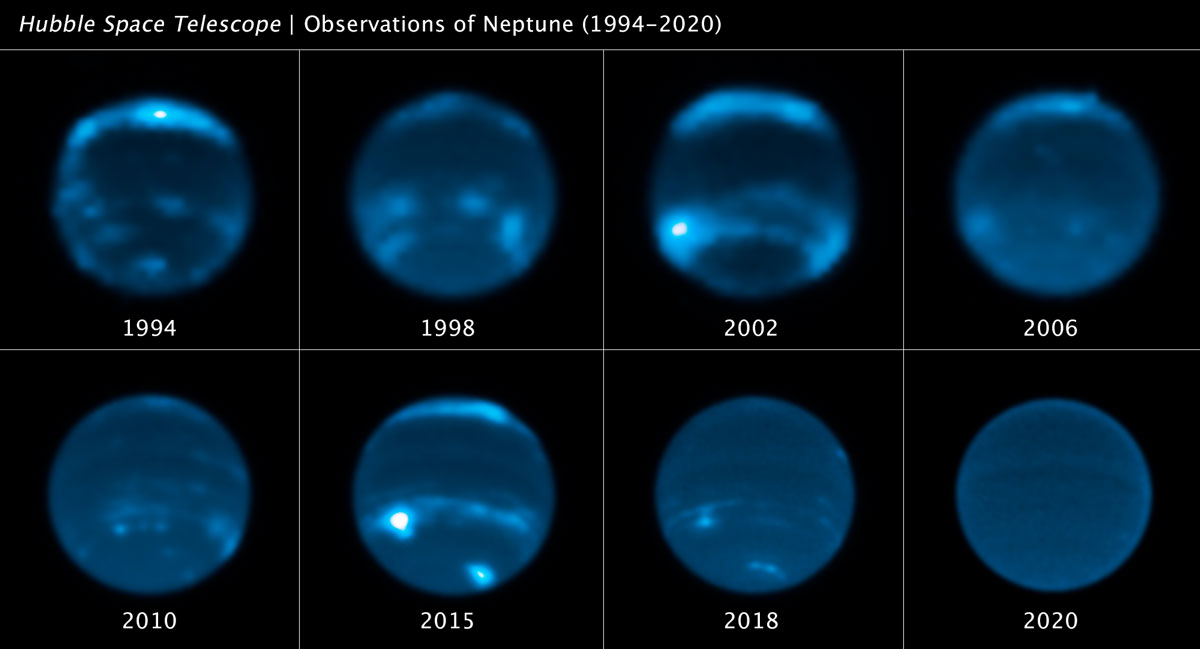
The culprit, the authors hypothesize in a recent paper in the journal Icarus, is the ultraviolet rays that the Sun emits throughout the solar system. They drew from archives of near-infrared observations of the eighth planet from both the Keck and Lick Observatories and the Hubble Space Telescope between 1994 and 2022, documenting how cloud activity evolved during that time. They establish a positive correlation between cloud activity and the amount of electromagnetic energy emitted by the Sun at a very specific wavelength, which is known as Solar Lyman-Alpha irradiance.

“The clear positive correlation we find between cloud activity and Solar Lyman-Alpha (121.56 nm) irradiance lends support to the theory that the periodicity in Neptune’s cloud activity results from photochemical cloud/haze production triggered by Solar ultraviolet emissions,” the authors concluded.

This sequence of Hubble Space Telescope images chronicles the waxing and waning of the amount of cloud cover on Neptune.This sequence of Hubble Space Telescope images chronicles the waxing and waning of the amount of cloud cover on Neptune. (NASA, ESA, Erandi Chavez (UC Berkeley), Imke de Pater (UC Berkeley))


Want more health and science stories in your inbox? Subscribe to Salon’s weekly newsletter The Vulgar Scientist.


“I was surprised by how quickly clouds disappeared on Neptune.”

“Even now, four years later, the most recent images we took this past June still show the clouds haven’t returned to their former levels,” Erandi Chavez, the study’s first author and a researcher at the Harvard-Smithsonian Center for Astrophysics, said in a NASA statement. “This is extremely exciting and unexpected, especially since Neptune’s previous period of low cloud activity was not nearly as dramatic and prolonged.”

The study’s most prominent author elaborated on the significance of that low cloud activity.

“These remarkable data give us the strongest evidence yet that Neptune’s cloud cover correlates with the Sun’s cycle,” Imke de Pater, emeritus professor of astronomy at UC Berkeley and senior author of the study, said in an additional NASA statement. “Our findings support the theory that the Sun’s UV rays, when strong enough, may be triggering a photochemical reaction that produces Neptune’s clouds.”

“I was surprised by how quickly clouds disappeared on Neptune,” de Pater added. “We essentially saw cloud activity drop within a few months.” Right now, it’s not clear when or if they’ll return.

This is not the only recent big news to come for fans of the frigid behemoth. The European Southern Observatory recently used their Very Large Telescope (VLT) to observe a dark spot on Neptune, the first time that has ever been done with an Earth-bound instrument. Patrick Irwin, Professor at the University of Oxford in the UK and lead investigator of the study published in the journal Nature Astronomy, explained in a statement that “I’m absolutely thrilled to have been able to not only make the first detection of a dark spot from the ground, but also record for the very first time a reflection spectrum of such a feature.”

The dark spot is likely he result of mixing hazes and ices. Next to the dark spot was a smaller, brighter spot that is actually a previously unknown cloud species.

“In the process we discovered a rare deep bright cloud type that had never been identified before, even from space,”  study co-author Michael Wong, a researcher at the University of California, Berkeley, said. Clearly, there is more to learn about Neptune, but a mission may not arrive there until 2049.

In and out in roughly 20 minutes — Trump’s arrest in Georgia was not, in fact, like everyone else’s

In less time than it takes the average person to have a shower, former president Donald Trump breezed in and out of the Fulton County jail on Thursday evening, emerging freshly arrested and booked on 13 felony counts in relation to his involvement in overturning the results of the 2020 presidential election.    

According to The Atlanta Journal-Constitution, Trump arranged for a metro Atlanta bonding company to handle his $200,000 bond, which stipulates that he’s not to:  

  • Violate any federal, state or local laws
  • Intimidate any codefendants, witnesses or victims in the case. This includes on social media.
  • Communicate with codefendants about the case’s facts except through counsel

Booking information released by the Fulton County Sheriff’s Office lists the details of Trump’s charges, along with two pieces of information that social media took particular interest in — his height and weight, which is listed as 6′3′’ and 215 pounds.

As Salon reported earlier on Thursday, Trump “abruptly shook up his Georgia legal team just hours before he was expected to be booked at Fulton County jail, replacing prominent attorney Drew Findling with high-profile attorney Steven Sadow.” This was viewed by experts as a huge mistake, but judging by the way in which Trump grinned and flashed the thumbs up sign while stepping off of his plane en route to literal jail, he made a good effort at seeming unbothered, per usual.

While Trump was given preferential treatment in that he wasn’t made to wait the average 12 hours an arrest and booking would normally take — and he also wasn’t given any sort of cavity search or general wellness check — he did have a mug shot taken, which many people have been waiting a very long while to see. 

Trump is the first president in U.S. history to receive one.


Want a daily wrap-up of all the news and commentary Salon has to offer? Subscribe to our morning newsletter, Crash Course.


From here, inmate No. P01135809 heads back on his plane, leaving reporters at the scene with parting remarks pleading innocence, despite a great amount of evidence to the contrary.

“I did nothing wrong.”

Mark Meadows surrenders in Georgia after attempts to avoid arrest were rejected

After his request to avoid arrest by way of pushing his case to federal court was rejected on Wednesday — via a ruling handed down by Atlanta-based U.S. District Court Judge Steve Jones — former White House chief of staff Mark Meadows surrendered at the Fulton County jail in Georgia on Thursday afternoon and was later released after paying a $100,000 surety bond. 

Once a top aide to Donald Trump — who’s expected to turn himself in later this evening — Meadows faces two charges: violating Georgia’s Racketeer Influenced and Corrupt Organizations (RICO) Act and soliciting the violation of oath by a public officer. According to CNBC, “Meadows’ bond sheet forbids him from speaking with any other co-defendant or witness about the facts of the case. It also prohibits any effort to intimidate witnesses or co-defendants ‘or to otherwise obstruct the administration of justice.'” 

As highlighted in CNN‘s coverage, “Meadows was Trump’s final White House chief of staff, and he played a key role in exploring ways to overturn the 2020 election. In addition to the infamous phone call with Raffensperger, he attended a December 2020 White House meeting where Trump considered using the military to seize voting machines.”

Netflix’s “Painkiller” exposes the real drug dealers – and they’re not the ones in a jail cell

Netflix’s “Painkiller” loudly addresses the extremely huge elephant in the room. The opioid epidemic is the white people’s version of the crack epidemic, but worse – because it’s legal. 

The limited series “Painkiller” is a dramatized, scripted take on the Sackler family‘s role in the rise of the opioid epidemic and the collection of people who benefited. Written and directed by Pete Berg, “Painkiller” follows a colorful cast of characters whose ambition, greed, curiosity and pain actively crowned Purdue Pharma’s OxyContin. 

Edie Flowers (Uzo Aduba), a fictional federal investigator, guides us through the world headed by Richard Sackler (Matthew Broderick). It is she who discovers the rise of the drug, connects with the doctors, both good and bad, warns her colleagues about the drug and takes the pharmaceutical company head-on. Edie also has a run-in with two wildly ambitious pharmaceutical reps, Shannon Schaeffer (West Duchovny) and Britt Hufford (Dina Shihabi). 

Shannon and Britt, known as the OxyContin Kittens, are charged with the task of persuading doctors to buy and subscribe to more and more oxycontin. They do this by dressing sexy, flirting and mastering countless talking points that fraudulently promote the drug’s supposed safety and effectiveness. Edie sees right through this and identifies them as what they really are – drug dealers. 

We get a better understanding of the deeper meaning behind Edie’s mission when we meet her brother Shawn Flowers (Jamal Grant). Shawn is incarcerated. During a prison visit in the third episode “Blizzard of the Century,” he and Edie talk about his past as a crack dealer. Shawn uses immaturity and the need to make money as an excuse, but Edie calls them out for selling their mom drugs that turned her into “a vegetable.” 

As Edie reflects on the conversation, the show breaks into a brilliant montage displaying authentic archival images of the crack era. We see former DC mayor Marion Barry, who was caught in a crack bust denouncing the drug, along with politicians like George Bush – who many feel handled the rise of crack poorly – people smoking crack in the streets, Black people being harassed, police officers running down users and public protest against the drug.

Edie’s unique perspective not only forces viewers to see her brother in the same light as the Kittens but also to understand that the two young women are far worse. We only see Shawn Flowers in an orange jail suit. He represents the policing of Black people caught up in the drug trade. 

There’s something extra evil about tricking people into taking drugs that they don’t need.

Shannon and Britt bounce around from party to party with their designer handbags, bragging about their colossal commission checks. The two women also lie to doctors as if it’s a sport. Shawn’s definition of accountability doesn’t match his sister’s; however, the system held him accountable because he’s in jail. Shawn was also a child when he peddled the drug, not an adult, who was touted as being a respectable professional like Shannon and Britt. 

People who come to buy crack don’t need a prescription from their doctor; the dealer isn’t telling them that it’s the safest drug on the market; as a matter of fact, there’s no persuasion at all. There’s something extra evil about tricking people into taking drugs that they don’t need. People addicted to crack have been one of the biggest deterrents of the drug; however, opioid users can often blend in with everyone else, which helps people like the Kittens act like it’s not synthetic heroin. It is, and they sell it and will not see a jail cell because of their race, status and society’s inability to tell the truth. 

“Painkiller” teaches us that drug users and dealers come from all different races, tax brackets, ethnic groups and genders, even though the system always finds a way to police Black people and poor people in general. 

It’s time we transfer that same energy to the real criminals.

Attorney: Trump can “expect a humiliating experience” at Fulton jail if he’s treated like others

If former President Donald Trump is really treated like any other person charged with crimes when he’s processed at the Fulton County Jail in Georgia as local sheriff Patrick Labat promised, he’ll likely be in for a “humiliating experience,” Atlanta-based lawyer Michael Harper told Insider. Harper, who has sued the jail multiple times on behalf of the families of men who died while in custody, said that the facility’s intake area is huge and that detainees are typically booked in front of others undergoing the process.

“He can expect a humiliating experience,” Harper told the outlet Tuesday. “Just being searched, photographed, and fingerprinted amongst other people.” If all is as usual at the jail, Trump will likely be “surrounded by people charged with everyday crimes” like murder and rape, he said. “This is not a federal prison of white-collar criminals here,” he added, noting that the jail is “certainly not the accommodations Donald Trump will be used to.” Harper explained that the typical booking process can last hours as detainees move from station to station and are subject to a physical search, a full-body scan and a medical intake screening before having their mugshot taken and being fingerprinted.  

Harper has sued what he called “the worst county jail in Georgia” three times since 2018, including for the family of 35-year-old Lashawn Thompson, who died last year inside a filthy cell, a case that helped prompt a Justice Department investigation into the facility’s conditions. A Georgia grand jury indicted Trump and 18 co-defendants over their alleged conspiracy to overturn Trump’s 2020 election loss in the state. The former president was granted a $200,000 bond on Monday and is expected to turn himself in to authorities at the jail Thursday evening.

Starbucks’ Pumpkin Spice Latte returns for its 20th year, along with new fall menu

Pumpkin spice latte season has officially begun, now that Starbucks is officially bringing back the PSL  alongside their revamped fall menu on August 24. Customers can expect to enjoy a handful of long-time favorites, including Pumpkin Cream Cold Brew, Apple Crisp Oatmilk Macchiato, Pumpkin Cream Cheese Muffin and Owl Cake Pop. They can also enjoy two new seasonal beverages, an Iced Apple Crisp Oatmilk Shaken Espresso and Iced Pumpkin Cream Chai Tea Latte, as well as the all-new Baked Apple Croissant.

For those who are fans of all things apple and cinnamon, Starbucks’ Iced Apple Crisp Oatmilk Shaken Espresso is an absolute must-try. The beverage features notes of apple, cinnamon and brown sugar, that’s then topped with oat milk. The “warm, gooey taste of apple crisp” alongside a warm cup-of-joe “meld perfectly to unveil a cozy beverage customers have come to know and love at Starbucks each fall,” said Starbucks beverage developer Billy Altieri in a recent press release.    

There’s also the Baked Apple Croissant, which Starbucks said is “made with layers of croissant dough wrapped around a warm apple filling, topped with sugar and baked to a golden finish.” Pair the Iced Apple Crisp Oatmilk Shaken Espresso with the croissant and you have the perfect fall pick-me-up!

Of course, we can’t forget Starbucks’ Iced Pumpkin Cream Chai Tea Latte, a new drink that was inspired by a popular customer and barista customization. It features a creamy chai tea latte base topped with pumpkin cream cold foam and a dusting of pumpkin spice.

Starbucks noted that fall food and beverages are available for a limited time, while supplies last. 


“Wrong on the law, wrong on the facts”: Fani Willis blasts Jeffrey Clark’s “misunderstanding” of law

Fulton County, Ga. District Attorney Fani Willis sharply responded to former Trump Justice Department official Jeffrey Clark’s emergency motion seeking to delay his arrest until a federal judge hears his motion to remove the case to federal court, just ahead of the noon Friday deadline she set for him and his 18 co-defendants in the sweeping indictment accusing them of plotting to overturn the 2020 election. Willis argued that Clark’s request stems from “an apparent misread of the applicable statutes, a misapprehension of the binding caselaw, and a fundamental misunderstanding of criminal procedure.” U.S. District Judge Scott Jones on Wednesday rejected Clark’s motion, ensuring that he will face arrest this week.

“Defendant Clark boldly asks this Court for expeditious action when he himself has shown no urgency,” Willis’ office writes in the response, noting that Clark waited a week after his indictment to even notify the court that he intended to argue for the case to be transferred and request the stay over having to quickly travel to Atlanta. “As inconvenient as modern air travel can admittedly be, whatever nuisance involved in the defendant securing a flight to Atlanta within the window provided is self-evidently insufficient justification to invoke this Court’s authority to enjoin a State felony criminal prosecution,” Willis said. 

She later called out Clark’s justifications for making the requests, boiling them down to his “displeasure at the prospect of inconvenient travel” and hope to avoid passing any time at the Fulton County Jail. Clark “seeks to avoid the inconvenience and unpleasantness of being arrested or subject to the mandatory State criminal process, but provides this Court no legal basis to justify those ends,” the response concludes. “Defendant is wrong on the law, wrong on the facts, and the Motion should be denied.” 

Legal experts: Jan. 6 architect made a “risky gamble” — but Fani Willis just “called his bluff”

Fulton County District Attorney Fani Willis proposed an Oct. 23 trial start date in the Georgia 2020 election interference case involving former President Donald Trump and his allies after lawyers for one of the co-defendants filed a motion demanding a speedy trial.

The aggressive filing from Kenneth Chesebro, the mastermind behind the plan to send fake electors to Congress from states Trump had lost, surprised legal experts. “He is making a risky gamble,” New York University Law Prof. Ryan Goodman wrote on X, formerly Twitter.

When defendants make such requests at the district attorney’s office, “that’s a declaration of war,” Chris Timmons, a former Georgia prosecutor, told Salon. 

“Basically, what you’re saying is I’m ready to go to trial and I want it tomorrow if I can get it,” Timmons said. 

A speedy trial request is typically filed in situations where a client, who is innocent, is in custody and can’t get a bond, he added. 

“I suppose this makes sense if you’re Chesebro,” Georgia State University Law Prof. Anthony Michael Kreis wrote on X. “He has fewer fingerprints on things in Georgia specifically than the others— his charges are all conspiracy-based. But the removal question complicates: isn’t clear that the removal of one defendant doesn’t mean the removal of all.”

Chesebro is charged with racketeering and other offenses, including conspiring to commit impersonating a public officer, conspiring to commit forgery in the first degree and conspiring to commit false statements and writings.

Willis responded to Chesebro’s speedy trial demand on Thursday calling for the trial for all 19 Fulton defendants to begin in October, according to a court filing — five months earlier than the March 4, 2024, start date she initially proposed last week.

MSNBC legal analyst Katie Phang called the response “Willis calling Kenneth Chesebro’s bluff.”

“While most defendants seek to delay the day of reckoning for various reasons, on occasion, they seek to enforce their right to a speedy trial,” former U.S. Attorney Barb McQuade told Salon. “Some want to clear their name and move on. Others hope to catch the prosecution flatfooted and unprepared for trial.” 

McQuade pointed to the example of former Sen. Ted Stevens, R-Alaska, who invoked his right to a speedy trial. The case fell apart when it was revealed that the government had violated rules related to sharing evidence during the legal process. This may have happened as a result of the government’s rushed efforts to prepare.

Former U.S. Attorney Joyce Vance wrote that Chesebro “thought he was calling Willis’ bluff on her readiness to go to trial.”

“He was not. Willis is not here to play,” she added.

Ultimately, the final decision on timing lies in the hands of Fulton Superior Court Judge Scott McAfee, who was assigned to the case randomly just last week.

We need your help to stay independent

However, “this is a very powerful move,” on Chesebro’s part, Clark Cunningham, a law professor at Georgia State University, told Salon. 

“His demand now forces the trial in this case to take place before the end of this calendar year – for all defendants, unless one or more other defendants can succeed in a ‘motion to sever.'”

Former President Donald Trump’s attorney immediately moved to sever his case after Willis’ filing on Thursday.


Want a daily wrap-up of all the news and commentary Salon has to offer? Subscribe to our morning newsletter, Crash Course.


There could be a strategic advantage for other defendants Timmons pointed out. Chesebro could be tried on his own or with a couple of other defendants, and everyone else is “severed out.”

For Chesebro, this suggests that he’s ready to go to trial and “has nothing to hide,” Timmons said. 

“The other thing is you may not be tried with other defendants,” he said. “So, if you’re concerned that you’re in a trial with Donald Trump and that the case against him is going to be so massive that you just sort of get swept up in it, and the jury comes back [finding everyone] guilty on everything, you might have a better chance if you’re on your own. Then the jury has to consider you as an individual.”

However, filing the speedy trial request on Chesebro’s part is still a big deal, “it’s punching somebody in the mouth,” he said. “It is a game changer that shifts the entire timetable and everything else in this case.”

Get revved up for “Gran Turismo,” the summer’s suspenseful thrill ride based on a true story

“Gran Turismo: Based on a True Story” provides arguably the most exhilarating rush of the summer. This feel-good drama, based on a true story, chronicles the experiences of Jann Mardenborough (Archie Madekwe), a young gamer who becomes a force to be reckoned with on the professional racetrack circuit. (The real Jann Mardenborough actually drove in the film’s racing scenes.) And if that is not rousing enough, the film includes what may be the greatest use of Kenny G in any film, ever. 

There is an undeniable thrill and incredible suspense during the racing scenes in “Gran Turismo.”

Danny Moore (Orlando Bloom) is a Nissan marketer who comes up with the crazy idea that they should have a contest to find the best/fastest “Gran Turismo” gamer (aka “sim” driver) to compete on the racetrack in real life. Since the video game is the accurate simulation of racing, how about putting the proverbial rubber to the road? Danny’s idea “to reignite the dream to drive” is met with both interest and skepticism. There is no reset button on the course, and not only can a driver be killed, but they can also kill others as well. Danny, however, thinks with the right chief engineer, a gamer can be trained to perform well on the course — and even win. 

However, Danny struggles to find someone to help him, eventually asking Jack Salter (David Harbour), a former driver who laughs at the idea before he decides to accept it. Upon meeting the 10 candidates who qualify in a contest, Jack’s version of a pep talk is that he is there to prove they can’t do it. He is tough and gruff and committed to breaking these gamers. Harbour leans into the role with relish; Jack takes his work seriously, and, as such, the film does, too. 

Jann gets accepted into the academy, but he crashes his car with Jack inside, which may lead to his expulsion. Instead, he proves himself worthy when he rightly insists his brakes were glazed. (For non-racers, this is when the temperature exceeds the brake pad limits.) This, along with some fancy driving, helps the gamer and his coach develop a kind of mutual respect. Their relationship is very father/son like, which is good, as Jann has some issues with his own father, (Djimon Hounsou), who wants Jann to stop eating, sleeping and gaming, and instead get a real job. But Jann has wanted to race since he was 5, and until this unprecedented opportunity, he has had to channel his passion through the game. Jack recognizes that whereas Jann’s father resists it.

Director Neill Blomkamp (“District 9“) uses video game visuals to tell this story, without oversteering, as he shifts from the simulated world to the real world. There are icons that help show Jann’s place in his various races, and there are moments that show how he applies some of his innate skills at the game to his efforts on a course, like “finding the line” to pull ahead of his competitors in a crucial race. (Though PlayStation is a producer, the film is less a commercial for the video game than it is a 135-minute commercial for Sony and Nissan). 

We need your help to stay independent

Jack counsels Jann that other drivers, such as the handsome hotshot Nicholas Capa (Josha Stradowski), will look down on “sim” drivers. This is the film’s elegant way of depicting the kind of discrimination that Jann experiences as a biracial, working-class, non-professional driver in an exclusive sport. Jack even tells Jann, “No one thinks we can do this,” before a big race, emphasizing the low expectation folks have for him. It encourages him to prove he belongs. (The film’s subtext is all about belonging.) And this is precisely why Jann’s efforts to get his FIA license — which requires him to finish in no less than 4th place in a qualifying race — are so exciting and gratifying. 

Thoughtful moments provide “Gran Turismo” with a beating heart under its revving engine.

Even if viewers know the facts of the story, there is an undeniable thrill and incredible suspense during the racing scenes in “Gran Turismo.” The races are electrifying and intense and as the sound revs louder and the images move faster; it is impossible not to get caught up in the action and white-knuckle it rooting for Jann to place in a race. Blomkamp creates a “you-are-there” feeling at times, and the speed is severe. One of the nicest touches has the gamers getting in an actual car and banging against the headrest as they accelerate — something that doesn’t happen at a computer monitor. And scenes depict Jann feeling the immense G force as he drives. A scene that features a stunning crash is sure to elicit gasps from viewers. 

Gran TurismoDavid Harbour in “Gran Turismo” (Columbia Pictures)

Blomkamp digs into the emotions when Jann has a setback, but this narrative pit stop does not feel corny or contrived. Jann works through his emotions about racing with the wisdom and support of Jack, and he finds some comfort from his girlfriend, Audrey (Maeve Courtier-Lilley). Meanwhile, he stalls in dealing with his father. These scenes make Jann three-dimensional and allow him the opportunity to process all he has achieved — and all he still hopes to do — as he is faced with a tough situation and difficult decisions. And these thoughtful moments provide “Gran Turismo” with a beating heart under its revving engine. A tearful exchange between father and son late in the film is quite touching, in part because Hounsou, a consummate actor, just sells his heartfelt speech.

Archie Madekwe is ingratiating as Jann, capturing his anxiety as well as his enthusiasm. He is more modest than cocky, which makes him sympathetic (if possibly saintly). In contrast, Orlando Bloom is a bit aggressive as Danny, which renders him unlikable, but he does not have much to do here. The film’s real secret weapon is David Harbour, who wonderfully underplays it as Jann’s guide and advisor. Whether he is in Jann’s ear on the course, recounting his own experience at Le Mans, or describing the feeling that racing gives him, Jack provides a strong sense of control and precision, and he keeps the film grounded.   

Mardenborough’s story is remarkable, and it is extremely well told here. Even viewers who don’t like video games will want to break out the champagne for “Gran Turismo.” The film is a winner.

“Gran Turismo: Based on a True Story” opens nationwide Aug. 25.


Why planting trees to offset carbon emissions doesn’t really work, according to experts

By burning fossil fuels, humans release billions of tons of carbon dioxide into the air each year. Plants naturally absorb these greenhouse gases to photosynthesize. But our overconsumption of energy, especially among the ultra-rich, is overwhelming this natural system and cooking the planet. If you want to cancel out these carbon emissions, why not just plant more trees?

That’s a billion-dollar idea that birthed the carbon trading system in which companies or individuals can purchase carbon “offsets” like planting trees to balance out carbon emissions. It’s ballooned into a $2 billion industry since it started some 35 years ago, but new research suggests many projects intended to offset deforestation aren’t reaching the net-zero emissions they promise and are actually making climate change worse.

Writing in Science, researchers found about 6% of 89 million carbon offsets certified through the largest voluntary carbon credit trading program, Verra, were actually associated with emission reductions. Overall, REDD+ (reducing emissions from deforestation and forest degradation) projects in the study claimed three times more offsets than they actually generated. With each credit representing one ton of carbon dioxide removed from the atmosphere, that means millions of tons of carbon weren’t actually canceled out through this system.

Meanwhile, another 47 credits from 18 sites across six countries measured in this study remain on the market, said study author Thales A. P. West, Ph.D., of Vrije University Amsterdam.

“Many projects don’t seem to be reducing deforestation at all, which also means that they shouldn’t be selling carbon credits at all,” West told Salon in a phone interview. “We’re not even in the ballpark of something that would be considered acceptable.”

In 1989, the electric company AES Corp kicked off the carbon trading market by planting 50 million trees in Guatemala to offset emissions released in the construction of a new power plant. As carbon offsets grew more popular, an entire market in which those who couldn’t plant their own trees could also pay others to protect standing ones or invest in renewable energy was born. Over the years, some began to question the efficacy of this market. Verra began administering the Voluntary Carbon Standard (VCS) to set industry standards and ensure companies promising carbon offsets delivered. 

“Many projects don’t seem to be reducing deforestation at all. We’re not even in the ballpark of something that would be considered acceptable.””

To reach the goals of the Paris Agreement and reduce global warming to no more than 1.5 degrees, emissions must reach net zero by 2050. Being able to continue emitting carbon while offsetting it elsewhere seems like a plausible solution to reach this “net zero” scenario, but the industry has continued to be criticized as a hyper-financialization of climate policy that lacks oversight, with some questioning whether it is scalable, just, or fixable.

Offsetting carbon also “reinforces global inequalities” because high-income countries are able to pollute and buy themselves out, while low-income countries end up bearing the responsibility of reducing emissions, wrote Julia P. G. Jones, Ph.D., a professor of conservation science at Bangor University in England in a commentary published with the study.

“Misleading offsets carry negative consequences for the climate because they are not offsetting the emissions released, for forest conservation because they are not reducing deforestation as much as claimed, and for the future finance of forest conservation because the reputational risks of being tainted by accusations of greenwash may deter future investments,” she wrote.

Offsetting carbon also “reinforces global inequalities” because high-income countries are able to pollute and buy themselves out, while low-income countries end up bearing the responsibility of reducing emissions.

The VCS estimates how many credits can be generated based on a baseline number that describes how much of an area would be deforested in the absence of the project. West says the discrepancies in the promised versus actual carbon offsets generated in the study seem to be due to the flexibility that the VCS allows for in creating these baselines and incentives for project developers to exaggerate them to create more carbon credits.

“The problem is that, theoretically, these methodologies are flawed,” West said. “Even if you’re developing your project and trying to do what is right, if you’re following the wrong recipe, you’re going to get the wrong result in the end.”

In a technical review published in response to the research, Verra argued the methodologies of the study (and a separate investigation by The Guardian that had similar findings) were flawed. In a statement provided to Salon, a spokesperson emphasized their mission is to protect the world’s forests.

“While REDD+ projects have indeed achieved enormous impact to date, we recognize the areas for improvement in the current system and are committed to fostering that ongoing evolution,” the spokesperson wrote. “That’s why we’ve been actively working since 2020 on a new consolidated REDD methodology. This methodology, to be released later this year, directly addresses many of the concerns raised and builds upon our extensive, decades-long experience in forest-based climate solutions.”

In the study, the authors suggest adopting system-wide baselines that are set by government agencies. The VCS is seen as a more flexible means to set up projects without as many bureaucratic steps as other verification programs like the Voluntary Gold Standard (VGS), which also requires projects to show that they benefit local communities.

We need your help to stay independent

The voluntary carbon market is projected to grow to five times its current size by 2030 and be worth between $10 to 40 billion. Before then, this study shows that “major changes are needed in how credits are calculated,” according to Jones. 

“Yet this alone will not protect tropical forests,” she added, emphasizing that reducing carbon emissions on the front end is necessary to stop deforestation and global warming.

“With a concerted effort, it should be possible to halt tropical deforestation and its concomitant carbon emissions,” Jones said.

Calories and kilojoules: how do we know the energy content of food and how accurate are the labels?

Everything we consume contains energy our bodies use to move, grow and maintain health. To work out how much energy is in different foods and drinks, we need to first look at a few core concepts.

Firstly, you’ve probably heard of the units of measurement for energy — calories — as well as the metric equivalent, which is joules. One calorie is defined as the amount of energy required to raise the temperature of 1 gram of water by 1℃.

In human nutrition, the amounts of energy needed to maintain health, and to fuel a body, are much larger than the tiny singular calories used to heat up a gram of water. So, the term “calorie” in nutrition commonly refers to a kilocalorie (or kcal), which is 1,000 calories. When you see the word “calories” on a nutrition label, it’s likely referring to kcals.

The energy stored in food and drinks is released when the body breaks down one or more of the four macronutrients inside the food (carbohydrates, proteins, fats, alcohol). The body then uses that energy for activities such as keeping our heart beating, our lungs breathing and our muscles moving.

When energy in food is estimated, it is the amount of energy food and drinks provide for these bodily processes. The four macronutrients provide different amounts of energy:

  1. 1 gram of carbohydrate provides about 4 kcal of energy
  2. 1 gram of fat provides about 9 kcal of energy
  3. 1 gram of protein provides about 4 kcal of energy
  4. 1 gram of alcohol provides about 7 kcal of energy.


How are calories estimated?

There are two ways to estimate the amount of energy in food and drinks.

The first is called “bomb calorimetry”. This gold-standard method involves placing a small sample of food or drink inside a device known as a bomb calorimeter. The food is burned in the presence of oxygen, releasing heat.

The amount of heat released is directly related to the amount of energy in the food, allowing a calculation to be made. This method is most commonly used for foods rich in fats and is considered the most reliable (but expensive) method.

The second method, the Atwater system, is a much less expensive method for estimating energy content. It is more commonly used when calculating energy of most food and drinks sold in supermarkets. Named after legendary food researcher Wilbur Atwater, this system uses a standard conversion factor for each macronutrient found in food and drinks. By estimating the amount of each of the four macronutrients, an approximate calculation of the total energy can be made.

However, this method requires detailed knowledge of the ingredients within composite foods (such as muesli bars or hamburgers) — which may reduce accuracy. There is also a margin of error to expect with the Atwater system, because it assumes each ingredient is always the same in composition.

For example, a cup of oats grown in one part of the country won’t necessarily have the exact same nutritional content as another cup of oats grown elsewhere, due to climate and soil differences. So, this system is an estimation based on an average.

Importantly, both methods estimate the amount of energy in food and drinks. But the actual energy our bodies extract from these foods and drinks can vary due to factors such as individual differences in digestion and absorption, as well as food processing and cooking methods.


Why do foods have calories written on them?

In Australia, it’s a legal requirement for packaged food items to have a nutrition information panel that displays the number of kcal it contains.

However, homemade food items sold at places like a fresh market may not be required to provide a nutrition information panel. This will depend on the type of food being sold and the scale of the business operation.

Fresh foods such as fruit, vegetables and meat also don’t require a nutrition information panel. To find out the number of kcal in them, you can either run an experiment with a bomb calorimeter or look up an estimated value in an online nutrition database.

Food composition databases such as CalorieKing compile information about the energy and nutrient content of various foods. Dietitians and other health professionals often use these databases to estimate the energy content of foods to inform dietary recommendations.


Different international standards

Both kJ and kcal refer to energy — they are just two different units of measurements (such as how inches and centimeters are two different units for measuring length). Kilojoules (kJ) is part of the International System of Units (SI).

Australia, New Zealand and some parts of Europe use kJ. The United States and the United Kingdom use kcal. To convert between calories and kilojoules you use the conversion factors:

  • 1 kcal = 4.184 kJ
  • 1 kJ = 0.24 kcal (about ¼).

For example, if you have a packet of chips with an energy content of 200 kcal, you can convert it to kJ as follows: 200 kcal × 4.184 = 836.8 kJ.

As for how many calories are acceptable to eat, the Australian Guidelines for Healthy Eating estimate the average adult requires about 7,000kJ or 1,670Kcal every day. However, differences in age, gender, size, health and physical activity will influence how much energy a person needs.

To estimate your personal energy requirements, you can use this nutrients and dietary energy calculator.

Lauren Ball, Professor of Community Health and Wellbeing, The University of Queensland; Emily Burch, Dietitian, Researcher & Lecturer, Southern Cross University, and Katelyn Barnes, Postdoctoral Research Fellow, School of Human Movement and Nutrition Sciences, The University of Queensland

This article is republished from The Conversation under a Creative Commons license. Read the original article.

Jim Jordan launches probe into Fani Willis while “nobody is paying attention”

The Republican-led House Judiciary Committee launched a congressional inquiry into Fulton County District Attorney Fani Willis after her indictment of former President Donald Trump last week over his efforts to overturn the 2020 election, CNN reports. The committee sent Willis a letter Thursday asking whether she communicated or coordinated with the Department of Justice, which has indicted Trump in two other cases, or whether she used federal funding to carry out her years-long probe of him and his associates. 

The letter, authored by House Judiciary Chairman Jim Jordan, R-Ohio, argued that the committee has authority over the state case. Jordan accused Willis of having political motivations, pointing to her creation of a new campaign fundraising website just days before the Georgia indictment, and bemoaned her requirement that all 19 defendants have mugshots taken in processing. “You did not bring charges until two-and-a-half years later, at a time when the campaign for the Republican presidential nomination is in full swing,” he wrote, lamenting that she requested a 2024 trial date “the day before Super Tuesday and eight days before the Georgia presidential primary.”

Jordan gave Willis a Sept. 7 deadline to turn over any documents and communication related to the committee’s request. Willis has previously denied coordinating with the special counsel’s office and asserted that her probe was not politically motivated. Meanwhile, Rep. Marjorie Taylor Greene, R-Ga., has floated the idea of opening a state-level inquiry into Willis to state officials as Republicans push numerous ideas to defend the former president. “Nobody is paying attention other than the people who are obsessed with Trump,” a senior Republican lawmaker told CNN.

Say goodbye to summer with a cool, sophisticated apricot tortoni, the perfect end-of-summer dessert

Fresh apricots are a late-summer fruit where I live in the coastal South and have always signified summer’s grand finale. Even their deep sunset-orange hue says fall is right around the corner — hold on, relief from this heat is coming. 

I think this Apricot Tortoni is the perfect crossover dessert for late summer and early fall and a nice departure from the many lemon and berry variations I crave throughout June and July. By now, near the end of August, I am ready for something different — different flavors, different weather, a different wardrobe!

But what I am most ready for is cooler temperatures; though I’m afraid sweater weather is still a fair distance away. 

This frozen tortoni is refreshing yet somehow cozy — perfect for this time of year. Because of the almonds and almond extract, you might think you taste Amaretto. There isn’t any, but the taste still conjures up chillier evenings sitting fireside curled up with an after-dinner coffee. 

The toasty, slightly salty, almond-y crumb provides texture and a contrast of flavor to the other sweet, creamy layers; and the fresh but more complex taste of the apricot preserves gives each bite a sharp pop. The preserves, set off by the whiter shades of the cream and crumb, also create lovely swirls of color and are just the pumpkin-y shade of orange your autumn-desiring self wants to see. I love the way it looks. 

We need your help to stay independent

Once the kids are back in school, cooler weather is soon to follow, right? Surely any day now this relentless heat wave that has flip-flopped all over the country with its ever expanding heat dome — at times solidly stretched from coast to coast — will have to come to an end. I can almost smell the pumpkin spice and apple cake, but there is a chance I am hallucinating because of this heat!

Summer 2023 was one for the record books for sure, between El Niño, solar fluctuations and a massive underwater volcanic eruption (?!?!?), there is a lot to unpack and wrap your head around if you want to understand why this year’s heat has felt so different from years prior. I have tried to educate myself as I sweltered these last months in southern Alabama. I read about the Tongo volcano, what’s happening with the sun and how we are entering into the strongest El Niño we have had since 2016.

I admit, my self-study proved to be pretty darn anxiety-producing.


Want more great food writing and recipes? Subscribe to Salon Food’s newsletter, The Bite.


My friend, a landscaper who works outside everyday, told me last week we have two more weeks of this intense heat. He spoke with great conviction, like he knew it to be true as he brought his hand to his Mother Mary pendant, so I am counting the days and hoping he’s right. 

In the meantime, Christina Tosi’s book title, Dessert Can Save the World has inspired me to keep whipping up treats and refreshments as my way of shifting the energy in my small corner of the world. It’s the idea that there is a ripple effect from acts of kindness, of making someone’s day better, or in my case, sharing something delicious and homemade that creates a shift away from feeling overwhelmed by all the scary stuff happening in the world. It doesn’t make any of it go away per se, but it provides space for a well-needed break.

I won’t say this Apricot Tortoni can save the world, but it will bring you and whoever you share it with a reprieve from all the media headlines that stress and unnerve because all of that will be set aside while you eat and enjoy this incredibly delicious dessert. 

Apricot Tortoni
Yields
10 servings
Prep Time
15 minutes (plus at least 3 hours freezing)

Ingredients

1/2 cup sliced almonds

3 tablespoons salted butter

1 1/2 cups vanilla wafer crumbs

1 teaspoon almond extract

3 pints vanilla ice cream

1 jar apricot preserves (10oz to 12oz)

Cool-Whip or sweetened whipped cream with vanilla 


Directions

  1. Toast almonds in butter, then mix with cookie crumbs and extract and set aside.

  2. Set out ice cream and allow to soften.

  3. In a 9″ square baking dish, layer the following: 1/3 of almond crumb mixture, then 1/2 softened ice cream, then 1/2 the apricot preserves. 

  4. Repeat layers a second time, sprinkling the last 1/3 of almond crumb mixture on top. 

  5. Cover and freeze until firm. (2-3 hours)

  6. Remove from freezer and top with whipped cream. Cover and return to freezer.

  7. Once frozen and ready to serve, cut in squares and plate. 


Cook’s Notes

-This recipe is easily halved. Use just 1 pint of ice cream and slightly less than half of apricot preserves. Layer into a loaf pan, approximately 9″x5″. Spoon out in “slices” the width of the pan.

-Dairy-free and Gluten-free: This is a great choice when you need something dairy and gluten free. There are plenty of gluten-free vanilla wafers, dairy free ice creams and dairy free whipped cream on grocery store isles and/or freezer cases. You will miss none of the flavor of the original recipe and your guests who require non-traditional ingredients will be blown away. You can also make your own whipped cream from coconut cream, but you will need to sweeten it and add vanilla. If making your own coconut cream, make sure your cream is cold and your bowl is too. notes

DOJ cites Musk tweets, sues SpaceX over discrimination

The U.S. Department of Justice filed suit against SpaceX on Thursday, alleging the spaceflight company discriminated against asylum seekers and refugees in its hiring practices between 2018 and 2022. The lawsuit cites remarks made by SpaceX owner Elon Musk on Twitter.com (now known as X), and in YouTube videos — alleging SpaceX actively discouraged the applicants and “wrongly claimed” restriction under export control laws. The suit follows prior DOJ probes into SpaceX, starting in 2020.  

Our investigation found that SpaceX failed to fairly consider or hire asylees and refugees because of their citizenship status and imposed what amounted to a ban on their hire regardless of their qualification, in violation of federal law,” DOJ Assistant Attorney General Kristen Clarke said in an Aug. 24 statement. “Our investigation also found that SpaceX recruiters and high-level officials took actions that actively discouraged asylees and refugees from seeking work opportunities at the company.” 

SpaceX did not immediately reply to Salon’s request for comment. 

“This is a mistake”: Legal expert says Trump just abruptly dumped “the best lawyer he had”

Former President Donald Trump abruptly shook up his Georgia legal team just hours before he is expected to be booked at Fulton County jail, replacing prominent attorney Drew Findling with high-profile attorney Steven Sadow.

Sadow, a well-known lawyer in the state, will assume the role of lead on the case for Trump, who was indicted last week over his efforts to overturn the results of the 2020 election in Georgia, according to ABC News.

“I have been retained to represent President Trump in the Fulton County, Georgia, case,” Sadow said in a statement. “The President should never have been indicted. He is innocent of all the charges brought against him. We look forward to the case being dismissed or, if necessary, an unbiased, open minded jury finding the President not guilty.

“Prosecutions intended to advance or serve the ambitions and careers of political opponents of the President have no place in our justice system,” he concluded.

Findling served as Trump’s lead attorney in Fulton County District Attorney Fani Willis’ years-long investigation into the former president and his allies’ alleged efforts to subvert the 2020 election in the state. Another attorney on the case, Jennifer Little, is expected to maintain her role and work with Sadow.

Georgia State Law professor Anthony Michael Kreis warned that it may not have been a good idea to swap lawyers ahead of Thursday’s booking.

“I’m not here to offer Trump advice… this is a mistake IMHO,”  Kreis said on X, formerly Twitter. “Drew Findling was the best lawyer he had.”

Based on Sadow’s statement, Kreis predicted that Trump’s defense in the trial would amount to “a dual legal defense/campaign event.” 

“Sure hope he demanded full payment upfront,” quipped national security lawyer Bradley Moss.

We need your help to stay independent

For now, Trump’s remaining legal teams, which are managing federal cases brought by special counsel Jack Smith and another state case from Manhattan District Attorney Alvin Bragg, will remain intact, the sources told ABC News.

The former president is one of 19 defendants charged in Willis’ expansive racketeering indictment, which accuses the group of Trump lawyers and associates  — along with a swath of unindicted co-conspirators — of orchestrating a conspiracy to reverse Trump’s 2020 election loss. Trump maintains that his actions were not illegal and has assailed the probe as politically motivated.

According to The New York Times, nearly half of the 19 defendants had been booked at the Fulton County Jail as of Thursday morning. Trump, whose bail was set at $200,000 on Monday, is expected to turn himself in to authorities in Fulton County Thursday evening. 

Three defendants in the case — former Trump lawyer Mark Meadows, former Justice Department official Jeffrey Clark and former Georgia GOP chairman David Shafer — are requesting to have their cases moved to federal court. Kenneth Chesebro, another defendant, filed a speedy-trial demand on Wednesday, under which the trial for all 19 people charged would be required to begin no later than Nov. 3, a date far earlier than what prosecutors in Willis’ office sought. Her office has requested that arraignments occur the week of Sept. 5.

Trump has gone through a number of lawyers during his decades in New York’s real estate scene and more recently in his political career. He’s gained a reputation around his refusal to pay his legal counsel for their work but is paying his representation in his ongoing criminal cases. The payments have come from his political action committee, Save America’s, funding, which is comprised of donations his supporters made in the aftermath of the 2020 election after he appealed to them through widely debunked claims of voter fraud. 

Sadow is considered one of Atlanta’s most talented criminal defense attorneys by many in its legal community. He, like Findling, has represented celebrity clients, including rappers T.I., Rick Ross and Gunna as well as R&B singer Usher.

His representation of Gunna revolved around another high-profile racketeering case. In December, the rapper, whose real name is Sergio Kitchens, pleaded guilty to a racketeering charge in the Fulton County gang case against Atlanta hip-hop collective Young Slime Life, or YSL, founded by rapper Young Thug. As part of his plea, Kitchens admitted that YSL functions as a street gang, a spokesman for the Fulton County District Attorney’s Office told the Times.


Want a daily wrap-up of all the news and commentary Salon has to offer? Subscribe to our morning newsletter, Crash Course.


As part of the agreement, Kitchens entered into an Alford plea, which permits defendants to maintain their innocence while pleading guilty. He was sentenced to a five-year prison stint but was released after one year of the sentence was commuted to time served. The other four years were suspended.

Other noteworthy clients of Sadow’s included Howard K. Stern, the boyfriend of Anna Nicole Smith, who was accused of participating in a prescription drug conspiracy before her death. Stern’s conviction in the case was later overturned.

Trump chose Findling to lead the Georgia leg of his legal team last summer. The self-proclaimed “#BillionDollarLawyer” with a reputation as a skilled attorney has also represented high-profile clients, including Cardi B, Gucci Mane and the Migos. 

Before his hiring, Findling was a frequent critic of Trump on social media, referring to him in 2018 as “the racist architect of fraudulent Trump University.”

As a lawyer for the former president, Findling has since fervently defended him. Ahead of Trump’s Georgia indictment he and the rest of his team filed a series of motions aiming to have evidence collected by a special grand jury thrown out, and to have Willis removed from the case. But his efforts were futile as the courts ruled that Trump lacked the legal standing to back the challenges because he had not yet been charged.

Sadow has also previously taken a stance against the former president, writing in a 2017 Twitter exchange that he was “not a DT supporter.”

Though he called Sadow’s hiring a “smart move,” former federal prosecutor Elie Honig suggested that Trump’s constant cycling through representation could create future chaos for his various legal teams in a Thursday morning appearance on CNN. 

“Yeah, so it’s a smart move,” he began. “You need a local lawyer and this case is going to play out in Georgia. It’s smart to get someone who knows the court system and who really frankly can relate to the jury. Juries look for that and they can sense is this person from here? Is this someone we are going to inherently believe? That’s a factor.”

“Donald Trump does have to make sure — he has four pending cases — he has to get his legal team in order,” Honig continued. “You can’t shuffle in and out lead lawyers on each case sort of on a whim, you know, the way some White House staff were shuffled in and out on a whim.”

“This is different,” he said. “Those lawyers are going to spend hundreds, thousands of hours getting to know all of the nuances of this case. If you just cashier one to another, you are setting yourself up for a major failure. If I was advising him on all of these I’d say pick your lead guy on each case, stick with him, let him do his job.”

Many young people are devastated by climate change. But from despair springs action, study suggests

When speaking with Salon in 2021, twenty-six-year-old climate activist Kidus Girma expressed anxiety about the future of the planet — but, at the same time, some hope that he might be able to play a tiny part in making things better.

“I’m thinking about what we need as human beings, and what my small role in that is, and what the big role is for all of us,” Girma told Salon at the time.

“Even in the absence of direct climate-related experiences, distress about climate change is affecting young people’s aspirations.”

While it may seem paradoxical to both despair for the future and hope that one can change it, a recent study in the journal PLOS Global Public Health demonstrates that this attitude is quite common among young people today. Indeed, after surveying over 500 British young adults (between the ages of 16 and 24) for their views on climate change and life more generally, the researchers from Imperial College London and the University of Queensland found respondents feel motivated even as they also harbored negative thoughts about the future.

“Our work suggests that emotions linked to climate change may inspire action-taking, which has implications for how we communicate about climate change,” the authors write after pointing out that, despite the ongoing COVID-19 pandemic, respondents remained “distressed about climate change.” They added, “Our findings also highlight the need for targeted, climate-aware psychosocial support to sustain young people’s climate engagement and mental health simultaneously.”

The study authors sent out survey questions that asked respondents to discuss “general mental health, subjective wellbeing and climate distress” by ranking their emotions along existing scales. They found that young people were more likely to feel “climate distress” if they had observed their natural environments change for the worse, believed they lacked control over their future, were frustrated over their own inactivity and/or felt shame or guilt about their own behavior. These same individuals with high climate distress (10.1% of the total sample) said that they worried about climate change more than any other topic, including relationships, careers, personal finance and politics.

“It is now well established that the impacts of climate change go beyond geophysical changes,” the authors explain. “Our findings highlight that — even in the absence of direct climate-related experiences — distress about climate change is affecting young people’s aspirations, breeding distrust and frustration with decision-makers, and potentially curtailing their personal growth.”

Not surprisingly, all of these developments also create and exacerbate anxiety disorders, although those who engage in climate activism do often feel better after doing so.


Want more health and science stories in your inbox? Subscribe to Salon’s weekly newsletter The Vulgar Scientist.


“The emotional responses that drive engagement in climate activism appear to have short-term positive impacts such as finding supportive communities and hope in collective action.”

“The emotional responses that drive engagement in climate activism appear to have short-term positive impacts such as finding supportive communities and hope in collective action,” the authors conclude. “We do not know whether maintaining climate distress may have negative consequences in the longer term.”

A 2017 report by the American Psychological Association defined “eco-anxiety” as “a chronic fear of environmental doom.” Although eco-anxiety is not a diagnosable mental health condition, it is widely used by mental health professionals as an informal term for people depressed or anxious about the future due to climate change. A 2021 study in The Lancet Planetary Health found that out of more than 10,000 people surveyed in 10 countries — all of them between the ages of 16 and 25 — more than 45 percent described climate change distress as negatively affecting their daily life and ability to function while 75 percent were “frightened” of the future and 50 percent described feeling guilty, helpless and powerless.

“The psychosocial demands of the climate crisis also call for an examination of how our clinical formulations and treatments can reinforce counterproductive extracting, hyper individuation, monetizing, producing, consuming, and commodifying self-identities and values,” Gary Belkin, the former executive deputy commissioner of the New York City Department of Mental Health and Hygiene, wrote in an editorial for the American Psychiatric Association’s newsletter Psychiatric News. At the same time, there is also a converse phenomenon of individuals reacting to climate change by feeling anxiety but repressing it. Therapist Arielle Cook-Shonkoff broke down those divergent responses for Salon last year when discussing patients in Sonoma County, California coping with that state’s now-frequent wildfires.

“In nearby communities directly impacted by wildfires, like Sonoma County, my colleagues are treating many more clients for climate-related mental health issues: PTSD, anxiety, depression, trauma,” Cook-Shonkoff wrote. “And yet, a mere 40 miles away, in the Bay Area, there is an ‘out of sight, out of mind’ mentality. If people don’t have to think about it, then they won’t.”

Gut microbes are the community within you that you can’t live without

The age-old adage “you are what you eat” holds profound truth. Nearly every molecule in your body is absorbed from what you eat and drink. Your food choices are directly linked to your physical, emotional and social health. And scientists are learning that your gut health and the microbial communities within you have a significant role to play in orchestrating these processes.

The gut microbiome takes the components of food that you cannot digest, like fiber and phytonutrients, and transforms them into signals that regulate how hungry you are, how strong your immune system is, and even how you’re thinking and feeling. It’s as though the communities in your gut microbiome are an orchestra for your health, and you conduct their symphony through food.

I am a gastroenterologist who has spent over 20 years studying how food affects the gut microbiome and overall health. The research is increasingly clear: A gut-friendly approach to nutrition is important for happy and healthy communities both inside and out of your body.


Communities within and without

The fascinating research on the gut microbiome takes us on a journey into the depths of the intestine, where trillions of microorganisms blur the lines between other and self.

The term holobiont describes the combined lives of the microbiome and its vessel, working symbiotically to support each other’s well-being. This relationship is represented at its extreme in the intestines of termites and cows, where microbes transform uniform, low-nutrient diets of wood or grass into complete nutrition replete with vitamins and other essential nutrients for health.

When people eat certain foods, like those rich in fiber, they too harbor similar relationships with their microbiomes. You provide your microbes with food and a safe place to live, and they in turn fortify your diet with vital molecules such as vitamins, short-chain fatty acids and neurotransmitters that are key for regulating your metabolism, immunity and mood.

Just as food illuminates the importance of the microbial community within you, it also shines a light on your social community. Food is one of the foundations of culture, serving as the basis of many gifts and shared experiences. You have first dates over drinks and meals, connect with your colleagues over lunch, and share dinners with your family and friends. Food is a type of social glue that helps bind communities together.

As you feed your microbiome to cultivate a thriving community within your gut, you also figuratively and literally feed your social community when you break bread with friends and family.


Convenient fixes sacrifice community

Convenient, fast, affordable ultraprocessed foods have some enormous benefits in helping feed a growing population and enabling an ever-quickening pace of life, but the latest research is showing that there may be collateral damage.

Compared with ancestral diets, industrialized diets may be contributing to less diverse microbial communities in your gut. Diversity is important for generating key molecules like butyrate that regulate appetite and mood. As a result, your microbiome becomes less good at regulating hunger and emotions.

Your social community may also be suffering as result of this disrupted microbial community. In fact, studies on various model organisms have found that microbes can mediate behaviors as diverse as mating and aggression by regulating responses to stress. Food and microbes may affect social behavior in people as well.

Processed foods do serve a purpose. They are convenient and affordable and can be especially useful for people and families with busy lives and limited time to cook. But some are healthier than others. Adding back missing nutrients like fiber and polyphenols to processed foods can help make them healthier, and these can complement a diet of less-processed foods.


Wisdom cultures around the world

Anthropological research suggests that traditional diets are a particularly important contributor to health and longevity. Communities in Costa Rica, the Mediterranean and Japan that follow traditional diets have many individuals who live for over 100 years. The Mediterranean and Okinawan diets have consistently been shown to contribute to better health, including lower rates of obesity and other metabolic diseases.

These diets involve traditional food choices and combinations as well as natural food processing and preservation techniques. Combining corn with lime, an ancient process called nixtamalixation, for example, increases vitamin availability and decreases grain toxins.


Nixtamalization is used to make traditional tortillas.


Fermentation transforms food through live microbes that consume simple carbohydrates, generating antimicrobial chemicals that help preserve food. It also decreases toxins and increases the levels of vitamins and minerals available for absorption. Fermented foods have been shown to grow diverse microbial communities in the gut, decrease inflammation in the body and reduce the risk of chronic disease.

Communal eating is also intricately woven into the social fabric of traditional communities. The longest-lived communities around the world tend to eat at least one of their meals together as a family, and eating together is linked to health benefits including weight regulation and lower depressive symptoms.


Reembracing community

Here are a few simple tips to help you eat well and grow your communities — holobiont, family, friends and all:

  1. Eat the four phonetic food F’s: fiber, phytonutrients, healthy fats and ferments. I developed this simple way of categorizing foods to streamline the often complicated advice on how to eat well from the perspective of growing a healthy microbiome. It is also independent of cultural background, as these four categories are common elements in the diets of diverse and long-lived populations around the world.

  2. Learn the wisdom of traditional food preparation from people who still hold that knowledge. Consider taking a cooking class or spending time in the kitchen learning from a relative or a friend. Then re-share what you learn with your loved ones while preparing and enjoying your own meals.

  3. You don’t have to be perfect. Even a step toward a healthier meal a day and a communal meal a week can be beneficial.

It may at first seem daunting to carve out time to follow these deceivingly simple tips. But with a bit of patience and perseverance, they could be inspiration to improve your and your community’s health and wellness.

Christopher Damman, Associate Professor of Gastroenterology, School of Medicine, University of Washington

This article is republished from The Conversation under a Creative Commons license. Read the original article.