Spring Sale: Get 1 Year, Save 58%

“Disgrace”: AOC rips Biden’s “indefensible and embarrassing” reversal on trans athlete protections

Rep. Alexandria Ocasio-Cortez on Thursday was among the progressives denouncing the Biden administration’s newly proposed rules for transgender student athletes, which critics said would open the door to discrimination at all age levels despite the U.S. Department of Education’s statement that “categorically” banning trans athletes from teams that align with their gender identity would be illegal under the rule.

Elementary age students would generally be permitted to play on sports teams according to their gender identity rather than their sex assigned at birth, but universities and K-12 schools would be given “flexibility to develop team eligibility criteria that serve important educational objectives, such as ensuring fairness in competition or preventing sports-related injury,” according to the Education Department.

“Considerations may be different for competitive high school and college teams,” which would be given discretion to limit participation of transgender students, the department said.

Ocasio-Cortez, D-N.Y., called the proposed policy, a reversal of an executive order President Joe Biden signed on his first day in office in 2021, “indefensible and embarrassing,” and urged the administration to promptly “walk this back.”

Biden’s earlier order said that under the U.S. Constitution children “should be able to learn without worrying about whether they will be denied access to the restroom, the locker room, or school sports,” noting that Title IX of the Education Amendments of 1972 prohibits discrimination on the basis of gender identity or sexual orientation at schools that receive federal funding.

“To put it mildly, this is extraordinarily disappointing and a total reversal from a position the Biden administration has taken since Day One,” said Slate journalist Mark Joseph Stern.

Some advocacy groups applauded the administration for prohibiting blanket bans on transgender athletes, with GLBTQ Legal Advocates and Defenders (GLAD) saying the rule “affirms the importance of giving transgender students the chance to play sports.”

“The proposed rule prohibits the kind of categorical bans adopted in too many states that are hurting transgender students and that send a dangerous message to all students,” said Jennifer Levi, senior director of transgender and queer rights at GLAD.

But Lambda Legal, which represented a transgender girl who the U.S. Supreme Court ruled Thursday should be permitted to play on her school’s girls’ cross country and track team for the time being, raised concerns that the so-called “flexibility” given to schools under the law would not “properly eliminate the discrimination that transgender students experience due to the pervasive bias and ignorance about who they are.”

“These students must have full and equal chances to participate because participation in athletics provides many long-term benefits for young people, including important health benefits, and chances to develop leadership skills, discipline, and self-confidence,” said Sasha Buchert, senior attorney at Lambda Legal. “Given the importance of the opportunity to participate in athletics to students’ educational experience, we look forward to submitting comments and working with the administration to further remove those remaining bigotry-based barriers to full and equal participation by transgender youth.”

Buchert told The New York Times that anti-transgender lawmakers “would absolutely seek to apply this across the board… whether we are talking about a 6-year-old playing soccer or someone playing varsity volleyball”—a fear that Florida Education Commissioner Manny Diaz confirmed as he told the newspaper, “This won’t fly in Florida. We will never allow boys to play in girls’ sports.”

Emma Grasso Levine, Title IX policy and program manager for the Know Your IX project at Advocates for Youth, called on the Biden administration to ensure that, following a 30-day public comment period, “the final version of this Title IX regulation goes farther to eliminate discriminatory practices in schools.”

“In alignment with Title IX’s promise, it is the responsibility of the Biden administration to eliminate all transphobic, discriminatory barriers that are currently taking root in school policies,” said Levine.

Alejandra Caraballo of the Harvard Law Cyberlaw Clinic said the proposed policy “is worse than [the Biden administration] doing nothing” about transgender sports bans.

The policy was proposed as at least 20 states have passed laws barring transgender students from playing on sports teams according to their gender identity, and right-wing lawmakers across the nation are seeking to bar transgender youths and adults from accessing gender-affirming healthcare, which medical experts say significantly reduces depression and suicidal ideation in transgender people.

A new study links 45 health problems to “free sugar.” Here’s what that means, and how to avoid it

“Sugar is bad for you” is an old health axiom, but the depths to which sugar can harm one’s body has perhaps not yet been fully tabulated. Indeed, according to a new study by the prestigious medical journal BMJ, sugar consumption is linked to 45 different ailments. Yes, you read that right: forty-five different health problems all exacerbated by or correlated with eating that sweet white powder.

From obesity and type 2 diabetes to seven types of cancer and 18 endocrine/metabolic outcomes, sugar has already been found to have addictive qualities, so much so that it is common for people to binge on it.

But not all sugars are created alike, and the bad stuff is something that’s known as “free sugar.” According to Dr. James DiNicolantonio, the Associate Editor of British Medical Journal’s (BMJ) Open Heart and a cardiovascular research scientist and doctor of pharmacy at Saint Luke’s Mid America Heart Institute in Kansas City, this refers to any sugar that does not come from a whole food (or a food that has been processed and refined as little as possible). This is contrast to sugars from foods that have been in our diet for a long time, and which occur naturally typically — say, in fruits like apples or vegetables like carrots.

As such, the white crystalline sugar you put in coffee or the high fructose corn syrup in your soda and fast food has free or added sugars. A delicious and untampered orange or banana, which humans have long been accustomed to eat, does not have them.

“If you think about it, added sugar really isn’t a single substance. No one is eating just tablespoons of sugar. They are most likely eating that added sugar in highly processed or ultra-processed foods.”

This distinction, however seemingly slight, makes a world of difference when it comes to your health. As the BMJ study revealed after reviewing 73 meta-analyses of 8,601 unique scientific articles about added sugar, they found significant links with 45 different adverse health outcomes. These include asthma, cancer, depression, type 2 diabetes, gout, heart attacks, hypertension, obesity, strokes and tooth decay.

As DiNicolantonio explained to Salon, added sugars are linked to a wide range of health issues because they appear in three-fourths of packaged foods, including soft drinks and fruit juices, and comprise anywhere from one-fourth to two-fifths of the total caloric intake of children and roughly one-seventh of the total caloric intake of adults. This “overconsumption drives type 2 diabetes, fatty liver, obesity, kidney disease and cardiovascular disease,” DiNicolantonio told Salon.

Most people who consume over 30 to 40 grams of added sugar consistently will “increase their risk for numerous health issues,” DiNicolantonio concluded. “For those who are more active (i.e. athletes) they can get away with eating more sugar, but ideally most of their sugar intake should come from whole food.”


Want more health and science stories in your inbox? Subscribe to Salon’s weekly newsletter The Vulgar Scientist.


So why is sugar so versatile in its ability to damage the body? Part of it is because sugars are not typically consumed alone, in the form of cubes or powder; that means studies into sugar consumption can’t completely isolate the substance from the other things they are often mixed with. In other words, we are not really talking about just one substance. Hence, any study about the impact of added sugars on human health is effectively discussing all of the common unhealthy foods that usually join those added sugars.

The overconsumption of added sugars “drives type 2 diabetes, fatty liver, obesity, kidney disease and cardiovascular disease.”

“If you think about it, added sugar really isn’t a single substance,” Dr. Alexandra DiFeliceantonio from Fralin Biomedical Research Institute at Virginia Tech Carillon told Salon by email. DiFeliceantonio was not involved in the study. “No one is eating just tablespoons of sugar. They are most likely eating that added sugar in highly processed or ultra-processed foods. Those foods may contain other additives, high-levels of fat, or other substances that are linked to poor health outcomes. So, it’s not that this one substance, sugar, is causing all these problems, but that this substance is present in a whole host of foods that are contributing to these health issues.”

DiFeliceantonio clarified that sugar could be causing some health problems on its own, but noted that it is “more likely a combination of factors.”

Dr. Nicole Avena, an assistant professor of neuroscience at Mount Sinai Medical School and a visiting professor of health psychology at Princeton University who studies human health but was also not involved in the study, offered advice on how people who are health-conscious can protect themselves from added sugars.

“I think it’s really a good idea to do a food diary,” Avena suggested. “Do one or two days where you eat like you typically would and write down every single thing you eat — down to what condiments you’re using — and you can really get a clear picture then of how much sugar you’re actually consuming. And a lot of people are shocked when they do this because they think they’re eating a relatively healthy diet. But when you start to break it down and look at the salad dressings, look at the condiments, even things like nuts that people think of as a healthy snack, but it often has added sugar in there.”

DiNicolantonio also urged consumers to consider healthy substitutes for their favorite sweets.

“The best way to beat a sugar craving is to find healthy alternatives that provide a little natural sugar — like berries, an apple, or even a little raw honey or maple syrup,” DiNicolantonio opined.

Kansas ban on trans athletes could include “genital inspection,” critics say

The Republican-controlled Kansas state legislature has overridden a veto by Gov. Laura Kelly (D) to enact a law that will block transgender girls and women in the state from participating in sports that correspond with their gender.

GOP lawmakers had been attempting to pass a trans sports ban for nearly three years, but Kelly vetoed the legislation every time. This week, however, Republicans — joined by one Democratic lawmaker — overrode her most recent block of the bill.

“It sort of breaks my heart,” Kelly said in response to the override. “It certainly is disappointing.”

Parents of trans children in the state expressed deep worry over the bill’s passage.

“It’s a scary time to be raising a trans child in Kansas. We may face the very real threat of having to move,” Cat Poland, a lifelong Kansan and the parent of a transgender teenager, told PBS NewsHour.

Anti-trans lawmakers “just keep taking the next, the next step, the next step, until where are trans people supposed to go? Where can they can exist to be safe and live happy and fulfilling lives?” she went on.

In her veto message last month, Kelly said that the trans sports ban was “all about politics,” adding that restrictions on trans athletes will “harm the mental health of our students.”

The new law will only allow trans girls and women in the state to participate in sports if they play on male teams. The bill does not ban trans boys or men from participating in men’s sports, as the bill’s supporters cynically claim that it is meant to “protect” female athletes — an especially disingenuous argument given that female athletes could potentially be subject to intrusive exams under the new law.

“The sports ban has never sincerely been about protecting women’s sports,” said Micah Kubic, the executive director of the ACLU of Kansas. “Rather, it arises out of the same gender discrimination, stereotyping, and paternalism that has held back progress for cisgender women athletes for centuries, and will now open up all girls and women to potentially invasive examinations just to be able to participate.”

Many critics of the law have pointed out that its enforcement could require “genital inspections” of student athletes, including children, who are suspected to be transgender — a process that could be traumatizing. During discussion on how the law’s provisions would be enforced, Rep. Barbara Wasinger, the Republican sponsor of the legislation, said that it would require athletes who don’t provide a birth certificate to undergo a “sports physical.”

When asked if that would mean a genital inspection requirement, the GOP lawmaker said she couldn’t “recall” if that was the case.

State legislatures, particularly those controlled by Republicans, have introduced more than 450 anti-LGBTQ bills since the start of this year, many of them targeting transgender youth, including trans sports bans, trans bathroom bans, and restrictions on gender-affirming care, which advocates say is often life-saving.

“This is an organized attack on queer rights with the ultimate goal of elimination,” said Allison Chapman, a legislative researcher and advocate for trans rights.

Trans advocates and their allies have responded to far right legislative attacks by organizing demonstrations across the country — including in Topeka, Kansas, Truthout’s Zane McNeill has reported.

“We are here and we will not allow ourselves to be erased,” the Trans Radical Activist Network said in response to the myriad of bills attacking trans people.

“This is fascism, full stop”: Congressional progressives condemn “racist” Tennessee expulsions

Progressives in the U.S. Congress reacted with outrage Thursday after the Republican-dominated Tennessee House voted to expel two lawmakers who joined protesters in demanding gun control legislation during a demonstration inside the state Capitol last week.

“This is fascism,” said Rep. Rashida Tlaib, D-Mich. “Expelling your political opponents for demanding action on gun violence when children are dying is disgusting.”

Rep. Summer Lee, D-Pa., similarly called the expulsion of state Democratic Reps. Justin Jones and Justin Pearson “straight-up fascism in its ugliest, most racist form.” Jones and Pearson are both Black; a vote to expel their colleague Rep. Gloria Johnson, who is white, fell short.

“There is no justification for ousting two legislators who were protesting with and for their constituents,” Lee said in a statement. “That two Black men were expelled for standing up against the murder of children—but not their white counterpart—says it all. People are dying because Republicans want to put politics over the lives of the people they represent. They ask for safety for themselves, but not for school children, and they’ll sacrifice the lives of our loved ones for their lobbyists.”

“Now is not the time to be on the sidelines,” Lee added. “We better fight back before it’s too late.”

Thursday’s expulsion votes, held as furious demonstrators gathered inside the Capitol to protest the move, came less than two weeks after a mass shooting at a school in Nashville left three young children and three adults dead.

The expulsion resolutions were led by Republican Reps. Bud Hulsey, Gino Bulso, and Andrew Farmer, fervent opponents of gun control. Hulsey and Farmer have voted to further weaken Tennessee’s firearm regulations on a number of occasions in recent years, earning them high marks from the National Rifle Association.

“This is fascism, full stop,” Rep. Jim McGovern, D-Mass., tweeted following Thursday’s votes. “MAGA Republicans are no longer content with inaction on gun violence—instead of thoughts and prayers, they want to silence and expel politicians who speak up to protect children. I vehemently condemn this racist, undemocratic assault on freedom of speech.”

Tennessee Republicans—who likened the peaceful Capitol protests in the wake of the shooting to an “insurrection“—justified the removal of Jones and Pearson as a defense of decorum. Last week, Jones, Pearson, and Johnson took to the podium on the state House floor without recognition to show solidarity with those demanding legislative action in response to the massacre in Nashville—the 129th mass shooting in the U.S. this year.

But the claim that the expulsions were necessary to protect chamber norms was widely rejected as a cover for authoritarian political retribution, particularly given Tennessee Republicans’ past refusal to remove lawmakers accused of sexual misconduct and other wrongdoing.

“For years, one of your colleagues, an admitted child molester, sat in this chamber—no expulsion,” Jones said in a floor speech on Thursday, referring to former Republican state Rep. David Byrd.

Johnson filed resolutions to expel Byrd in 2019 and 2020, but the GOP-controlled chamber declined to act. Byrd went on to win reelection in 2020.

“We had a former speaker sit in this chamber who is now under federal investigation—no expulsion,” Jones said in his speech. “We have a member still under federal investigation—no expulsion. We had a member pee in another member’s chair, in this chamber—no expulsion. In fact, they’re in leadership, in the governor’s administration.”

Rep. Alexandria Ocasio-Cortez, D-N.Y., joined her fellow House progressives in decrying the Tennessee House’s actions and predicted the expulsions will only galvanize youth activism.

“Republicans may think they won today in Tennessee, but their fascism is only further radicalizing and awakening an earthquake of young people, both in the South and across the nation,” the New York Democrat wrote on social media.

“If you thought youth organizing was strong,” she added, “just wait for what’s coming.”

“When you are changed as a person, you cook differently”: “Top Chef” winner Kristen Kish opens up

Great food and flavors should open up our minds to different cultures and parts of the world, even when we’re cooking at home. Chef Kristen Kish explained on “Salon Talks” how having a willingness to get out and explore what actually makes your food taste good became a driving force behind her new National Geographic show, “Restaurants at the End of the World.”

Many know Kish as the first woman of color to win Bravo’s “Top Chef,” the chef/partner of the Arlo Grey restaurant in Austin and host of “36 Hours” on the Travel Channel. In “Restaurants at the End of the World,” Kish travels to Maine, Panama, Brazil and Norway in search of cooks that are as fascinating as the ingredients that grow there. Kish discovers how food can grow in places you won’t believe, like in the middle of the sea, tucked away in body parts of exotic animals or growing on the side of mountains. 

“The food, of course, is delicious, and there’s a great story behind it,” Kish said of her time filming the show. ” For me, the most interesting part and the most impressive part is meeting and hanging out with these people and just understanding who they are.” As she reflected on the entire experience, Kish says she sees food in a whole different light. 

Watch my “Salon Talks” episode with Kristen Kish here, or read a Q&A of our conversation below to learn more how working on the show changed her cooking style and food philosophy forever.  

The following interview has been lightly edited for clarity and length.

How did you make it to “Restaurants at the End of the World?”

There’s a journey involved. Our amazing creative department wanted the journey to start when I got off the airplane. It was meant to have this long trek in order to get somewhere. When a show title is “Restaurants at the End of the World,” you can only assume that it takes a little bit of time to get there. the team found these magical places that were worth exploring, and most of them took two or three flights, and/or a boat ride to get me all the way to this place. It was a trek, but it’s definitely a journey.

You have worked in some pretty difficult kitchens and you’ve said that those experiences have made you a better chef. What’s a difficult kitchen? 

“I have changed as a chef simply because I have to think more about other things than just the food.”

Well, how much time do we have? There’s so many different kinds of kitchens and styles of kitchens, and so I think what may be difficult for me could be something really easy for somebody else. You have to find the right spot for you and how you like to learn and how you like to work. So for me, it was a bit difficult. There were challenges being a woman in the kitchen coming up during the time I was. Had some challenges. Mostly, from all those different challenges and difficulties, I definitely learned what I didn’t want. I was able to weed out the things that weren’t working to help me narrow in on what I actually wanted.

I like places where people scream, “Where’s the cilantro?! Where’s the cilantro?!” That’s the kind of kitchen I would want to be in.

See, I don’t like that. There’s people that thrive in that. Truly, there’s people that need that kind of feedback in order to feel like they’re learning something. I’m not that kind of chef and I personally will shut down. The second anything goes above a decibel that my ear can’t handle, I shut down and I’d probably leave.

You go to the next level in your show. You’re climbing mountains and you’re deep sea diving. Has that always been a part of who you are or did you have to develop into this super chef?

It’s definitely not on the things of must-haves when you’re trying to be a chef by any means. But I think for me, when traveling comes about, I do like to explore. I’m very curious. I like a little bit of adventure. My risk assessment has definitely changed just as I’ve gotten older. I’m a little bit less inclined to do the more dangerous things, but having National Geographic setting things up and making sure I’m safe, and having a safety net both literally and figuratively, really helps me dive in, pun intended, without too much fear. I’m set up for success in all the right ways. So with all that, all those different layers of preparation, I feel eager to do these adventurous things.

Does it make the food more meaningful?

For me, it tastes better, or I’m more eager to try something that had all that effort or something behind it. 

You eat some really delicious-looking food on the show and also have conversations with some fascinating people. What are some of the most memorable moments for you?

“Conflict is inevitable, whether you’re in a kitchen or not.”

I think a lot of the memorable moments for me lie in the people, less about the food. The food, of course, is delicious, and there’s a great story behind it and it takes effort to get there, but for me, the most interesting part and the most impressive part are meeting and hanging out with these people and just understanding who they are, where they came from, and how they’re actually developing these restaurants cut off from the supply chains. I think the people are the most interesting portion of all this. Just hearing a different perspective, whether we see eye to eye on it or we don’t. I mean, that doesn’t really matter, it’s just being able to experience someone else’s life with them.

The why people do things always makes it that much more interesting. You got the chance to hang out in polar bear territory, but was there anything that was so wild that the producers asked you to do and you’re like, “Okay, no, I’m not jumping out of the airplane.”

For these first episodes, there was nothing that they asked that I was like, “I don’t know.” I will say one of the things that bothers me a lot are mosquitoes.

What’s their purpose? Do they have a purpose?

I don’t know. Just to annoy humans and leave giant welts on people’s bodies. So when they’re like, “Let’s go hiking in the jungle,” that for me is more terrifying than, “Hey, let’s go diving where that polar bear just was spotted.” So the mosquitoes for me, biggest challenge.

How have you changed since going on these trips and these adventures?

I’d like to think that I’m a relatively empathetic human being and that I have a drive and curiosity for other people. I’d say that this is just solidifying that and really grounding it in the fact that I do really enjoy walking in the shoes of somebody else and learning something new in the process. Because what better way to learn about a place, someone’s history, someone’s culture, their likes, their dislikes, than to do it right there with them? To be able to have the great fortune of being able to do that by way of food, in something that I am incredibly passionate about, I think there’s no greater combination of human storytelling and great food.

As a viewer, I felt like you knew some of the people forever. 

“I don’t necessarily need you to cook like me. I’d rather you take the base and outline of something that I love and know very well, and then start messing with it.”

When we start filming, I’m there in every city for roughly, it’s about a 10-day period, so that includes a little bit of travel on both ends. But I’m filming with them six days a week, I have a day off, and mostly I hang out with them. So the adventure doesn’t stop. Being able to build that rapport and that friendship truly only aids us in becoming better on camera together and helping them tell their stories. If the camera turns off, then the adventure definitely does not stop. They keep taking me around.

We know Anthony Bourdain was trained in the kitchen, and over the years his show created a whole lane for him in his career. Do you feel like your identity as a chef has changed since the taping of the show?

Sure. Television was never my goal. It just kind of happened and things started rolling. It started with “Top Chef” and going on competing and then things just started to happen. And so we have icons and true curators and creators of food and travel space like Anthony Bourdain and someone to look up to. I mean, he’s just absolutely phenomenal. Absolutely phenomenal. 

But I think I have changed as a chef simply because I have to think more about other things than just the food. When you’re out there, like I’m saying, we’re dealing with food, and food is a vehicle to help tell a story, but really we’re creating a relationship with another human being. And I think that already takes you out of the kitchen and exercises a lot of different skills that you tap into. Because, not for nothing, when you’re stuck in a kitchen and you’re cooking day in, day out, seven days a week with no days off, human interaction is with your coworkers. And the idea of being able to adventure out and learn about people is a little less frequent.

How do chefs deal with conflict with those relationships? Every chef has a different philosophy.

Every single person is different. No matter what kind of kitchen you land in or what kind of team you’re working with, everyone’s bringing their own flavor and their own personality to their environment. You got to find the people that you want to be around, that you’re fueled and it’s like the same kind of matching energy. Conflict is inevitable, whether you’re in a kitchen or not in a kitchen, or whether you’re a chef and you’re not a chef, but I think it’s about having constructive conflict and understanding that everyone can have a different point of view and opinion and that’s okay as long as we respect the other side.

If we all agreed in this world, to some extent, there’d be less dynamic conversations in the world. But also on the other side, if we were able to actually talk about differences in a less divisive way, we’d actually get more accomplished. You got to find that middle ground. But I don’t need to be surrounded by people that all agree with what I have to say and that’s okay as long as they respect what I have to say.

I’m not a chef, but I am a snob when it comes to egg sandwiches and how I make my crab cakes because I’m from Baltimore. If you don’t have your own crab cake recipe, they won’t call you a Baltimorian.

There are certain dishes that you just don’t mess with, whether that’s generational or in your family or if it’s something you’ve developed on your own that you feel very proud of. I love trying those dishes because there’s so much personality and storytelling and depth in those things. We could probably share a crab cake and talk eight hours about why you do what you do and why you love your version of the crab cake, and then we can go and taste another one.

I won’t let you jump in the harbor to get it ’cause the water is kind of funky.

I would do it for you!

What’s your one dish that you don’t want anyone to mess with?

I think coming from a perspective of a professional chef and having recipes, I develop recipes that are meant to be played with. I don’t necessarily need you to cook like me. I’d rather you take the base and outline of something that I love and know very well, and then start messing with it and make it your own. Because food is, everything has already been done before.

Most techniques have already been done before, but what hasn’t been done is imparting your story in something maybe that I created or me imparting my story in something you created. Then we’re creating something completely different. That’s the beauty of food, it can bring and merge all these different kinds of people together.

Beyond entertainment, do you have any goals for viewers of your show? Do you want us to be more experimental with what we eat and where we go?

“There were challenges being a woman in the kitchen coming up during the time I was.”

I think the beauty of “Restaurants at the End of the World” is the fact that it is restaurants at the end of the world, and I am a chef and we are dealing with people that are cooking food for people. Really all intertwined and weaved through that story is just seeing how someone else does what they do. And I feel like whatever you can take away from it, whether that be a human thing or whether it inspires you to get more creative in the kitchen, or whether that inspires you to go diving with polar bears, whatever you want to take from it, I hope that someone can find something in it because I believe that there is something for everybody in this show.

Like feeding sac cocktails. What is that?

Ptarmigan is an arctic grouse that has this feeding bag in its throat. Over the summertime, they’ll pick berries and little things off the fauna, and all the things, save it, and if they can’t find food during the winter, they’ll regurgitate it and then swallow it for survival. You got to do what you got to do to survive. The chef decided to take that, because he didn’t waste any part of the animal, and infuse it in a gin and then make a cocktail out of it. I am all for using all parts of the animal, but I was like, “Do we have to this?” And for him, it was a yes.

I’m guessing that won’t make it to Arlo Grey.

I personally did not like the flavor, however, I was impressed by the innovation and creativity.

Are any of these new recipes or experiences going to make it back to your restaurant?

I don’t think in terms of an actual dish on my menu, but you will see it because, as a chef, when you are changed as a person, you cook differently. And I think it will evolve and things will kind of come about as time goes on. Maybe it won’t be as obvious to me or the diner, but certainly being changed as a human definitely does change you and how you decide to cook.

“Shocking” Fox filing is “almost an admission” of guilt for Jan. 6 Capitol riot: Morning Joe

Fox lawyers asked a judge to bar references to the Jan. 6 Capitol riot from its upcoming trial in Dominion Voting Systems’ $1.6 billion defamation lawsuit, according to newly unsealed filings obtained by CNN.

“Dominion’s defamation claim has nothing to do with the Capitol riot,” Fox lawyers argued in the filing. “And any reference to the Capitol riot will only unfairly prejudice the jury against Fox, inflame passions, prevent a fair trial, and taint any resulting verdict.”

The attorneys acknowledged that the threats against Dominion employees were “horrific and absolutely inexcusable” but argue that “allowing Dominion to discuss specific threats and their effect on employees is virtually guaranteed to arouse the jury’s sympathy and provoke a desire to punish Fox for the actions of unrelated third parties.”

During a Friday segment of MSNBC’s “Morning Joe,” host Joe Scarborough called the filing “shocking.”

“I mean this is almost an admission that they believe reasonable jury members would blame them for January 6. It’s incredible, as if MSNBC said to a judge, ‘you can’t mention 9/11’ or if CNN said ‘you can’t mention Pearl Harbor.’ … This is so crazy!” he said.

“Well, it’s almost as if the lawyers representing Fox News in this case know that if the obvious line is drawn between the lies that were told on their network and elsewhere about the 2020 election being stolen, in this case, specifically about Dominion’s voting machines being used, connected to satellites that change the votes from Donald Trump to Joe Biden or whatever the conspiracy theory is,” co-host Willie Geist replied. “I’ve lost track that if a jury drew that line, that it would be quite obvious that they participated in that. We’ll see if a judge allows that to be excluded from the case. But it would seem like what’s actually at the heart of this case in terms of Dominion.”


Want a daily wrap-up of all the news and commentary Salon has to offer? Subscribe to our morning newsletter, Crash Course.


Delaware Superior Court Judge Eric Davis, who is overseeing the lawsuit, sided with Fox during a hearing last month.

“I don’t see January 6th as relevant in this case,” he said.

“I know that probably shocks everyone, but in developing this case and developing the opinion and developing the decisions, this court is very focused on a specific time, and I am aware of only one statement that was made subsequent to January 6th, and I don’t think it related to January 6th,” he added.

Senate Judiciary chair vows committee “will act” over report revealing Clarence Thomas “corruption”

Senate Judiciary Chairman Dick Durbin, D-Ill., vowed action in response to a bombshell ProPublica report detailing how Supreme Court Justice Clarence Thomas accepted luxury trips and other gifts from billionaire GOP megadonor Harlan Crow.

ProPublica’s report detailed how the conservative justice and his wife, Ginni Thomas, have for over two decades “accepted luxury trips virtually every year from the Dallas businessman without disclosing them.” Crow, a real estate magnate, has long supported GOP candidates and causes.

The report also detailed how the costs incurred by the travel may violate federal law: “These trips appeared nowhere on Thomas’ financial disclosures. His failure to report the flights appears to violate a law passed after Watergate that requires justices, judges, members of Congress and federal officials to disclose most gifts, two ethics law experts said. He also should have disclosed his trips on the yacht, these experts said.”

In the wake of the report’s release, Durbin lambasted Thomas in a statement, promising that “the Senate Judiciary Committee will act.” 

“The highest court in the land shouldn’t have the lowest ethical standards. Today’s Pro Publica report reveals that Justice Thomas has for years accepted luxury travel on private yachts and jets and a litany of other gifts that he failed to disclose,” Durbin said. “This behavior is simply inconsistent with the ethical standards the American people expect of any public servant, let alone a Justice on the Supreme Court.”

Durbin said the report “demonstrates, yet again, that Supreme Court Justices must be held to an enforceable code of conduct, just like every other federal judge. The Pro Publica report is a call to action, and the Senate Judiciary Committee will act.”

Other Democrats did not mince words in calling for Thomas to step down or face impeachment.

“This is beyond party or partisanship,” Rep Alexandria Ocasio-Cortez, D-NY, said in a Thursday tweet. “This degree of corruption is shocking – almost cartoonish. Thomas must be impeached.”

Rep. Rashida Tlaib, D-Mich., echoed her sentiments, writing, “Public trust in the Supreme Court is at an all time low and Justice Thomas has secretly accepted luxury trips from a billionaire mega-donor while doing the bidding of right-wing extremists from the bench.”

“Thomas must be impeached and SCOTUS needs a binding code of ethics,” she added.


Want a daily wrap-up of all the news and commentary Salon has to offer? Subscribe to our morning newsletter, Crash Course.


Sen. Tina Smith, D-Minn., asserted that Thomas’ alleged duplicity is evidence that the “Court is broken,” and that the “constitutional remedy” is to “expand the Court.”

“Clarence Thomas has proven what we’ve suspected all along — the Supreme Court is beholden to right-wing corporate interest groups and billionaire mega-donors,” she tweeted.

Crow, in a statement to ProPublica, said that he and his wife have been friends with the Thomas’s since the late 1990s, asserting that “Justice Thomas and Ginni never asked for any of this hospitality.”

“We have never asked about a pending or lower court case, and Justice Thomas has never discussed one, and we have never sought to influence Justice Thomas on any legal or political issue,” he said. “More generally, I am unaware of any of our friends ever lobbying or seeking to influence Justice Thomas on any case, and I would never invite anyone who I believe had any intention of doing that. These are gatherings of friends.”

“Top Chef” heads to the English countryside to mess with our emotions (and celebrate)

This was, unquestionably, my favorite episode thus far this season.

“Top Chef” is at its best when the elite level of the food and cookery is matched by genuine, emotional stories. Gail’s empathizing with Gabri to the point of tears was a moment like that for me.

But first (cue Julie Chen-Moonves): Let’s focus on the Quickfire!

Do you know the origins of the word “honeymoon?”

This episode begins with some amazing Victoire content (yet again), contrasting her bright, positive nature and talent with the immense challenges she’s endured in her life. After speaking Italian with her husband on FaceTime, she reveals that she’s experienced homelessness and poverty. Again, it’s almost striking to note just how compulsively, incredibly “root-able” and likable she is.

Amar Santana and Victoire Gouloubi in “Top Chef: World All Stars” Episode 5, “Holiday Vacation” (David Moir/Bravo)
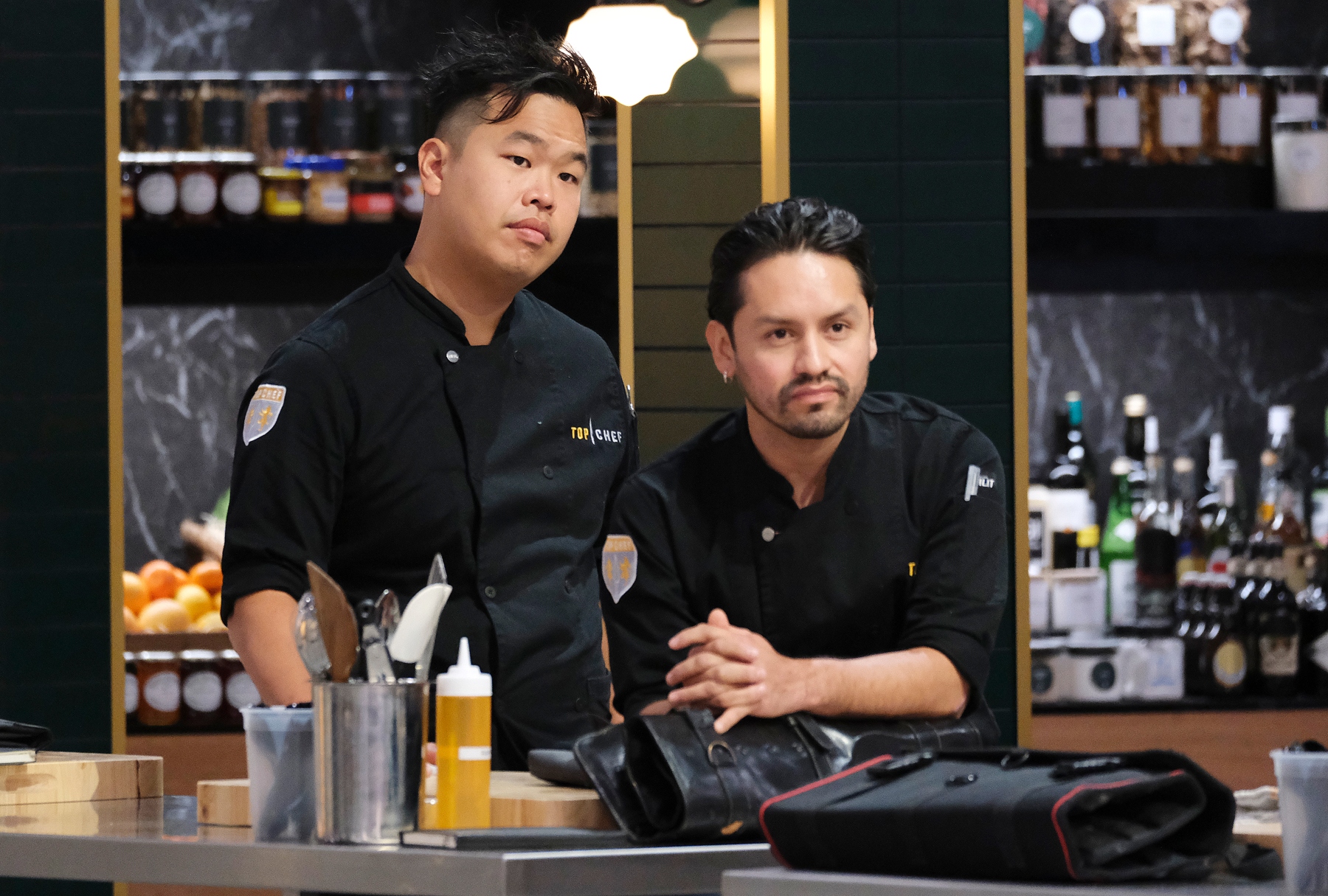
This episode begins with some amazing Victoire content (yet again), contrasting her bright, positive nature and talent with the immense challenges she’s endured in her life.

The celebratory mead and honey-centric Quickfire challenge is fun: I’ve always been fascinated by mead, and the guest judge seems so earnest. Buddha’s mentions he’s using manuka, and specifying the honey is so important because the floral notes can differ so much from honey to honey. I wish there more details about the honeys offered and how to use honey, such as Nicole’s note about its viscosity and how it can change so much once cooked. I like the idea of whipped feta to “balance the sweetness of the honey and mead” a la Charbel.

Padma’s dropping Begona’s dish is a fun moment . . . and how cool is it when Begoña calmly picks it up and flips it right-side-up with her fish spatula? Tom wins (apparently his first ever win?) for his dish, which is based on something he once made for his way cooler and smarter (and probably taller) brother’s wedding: pine honeyed duck with honey “caviar,” created courtesy of carefully deployed agar. 

Buddha Lo and Gabriel Rodriguez in “Top Chef: World All Stars” Episode 5, “Holiday Vacation” (David Moir/Bravo)

We’re going to the countryside (sponsored by VRBO!)

The built-in, blatant product placement of “Top Chef” at large has always cracked me up and this episode doesn’t let me down: It’s basically a VRBO commercial for a good 50% of the episode (at the same time, though, how beautiful is that VRBO house?) 

The built-in, blatant product placement of “Top Chef” at large has always cracked me up and this episode didn’t let me down . . .

The challenge involves cooking in the Kent countryside and creating a celebratory and/or holiday-based dish. Truthfully, I’m a bit confused during the shop with 1,000 pounds split among the chefs (I’m not a numbers person), but I’m glad it all works out: Everyone can afford everything they need, with enough leftover to buy a bonus celebratory bottle of tequila. Priorities!

As everyone hoops and hollers about the vast house for the night (24 beds!), it also dawns on some of them that the kitchen situation may be . . . less than ideal. There’s only one large oven and no more than six to eight burners. Obviously, that doesn’t leave much room for 11 cheftestants to comfortably work on their dishes. Because of this, Begoña and Charbel discuss sharing the frying oil, with Charbel frying his dish components first before letting Begoña use the same oil afterwards. Right away, the standard “Top Chef” fan can deduce that this arrangement may indeed result in something that might impact the food — or the elimination. 

I love how everyone shares their holiday memories, the wide range of holidays represented (from Eid to Hannukah), and the varying foods that mean so much. Buddha and Amar “borrow” from other countries, while people like Victoire, Sylwia, Ali and Sara use very personal food memories and connections for their food.

Also, how fascinating that Victoire leaves her mask on during the entire cooking process . . . not for COVID purposes, but to prevent her from having any allergy issues re: raw nuts. Let’s not have a repeat of last week’s epipen emergency.

Also, I’d like a look at Sara’s journal where she tracks how each chef has performed, showing that only she and Buddha have never been in the bottom . . . until this episode. Considering Buddha finally has that dubious honor for his underseasoned salmon salad, that means Sara is now apparently the only person who hasn’t found herself in the Bottom 3 thus far. Foreshadowing? 

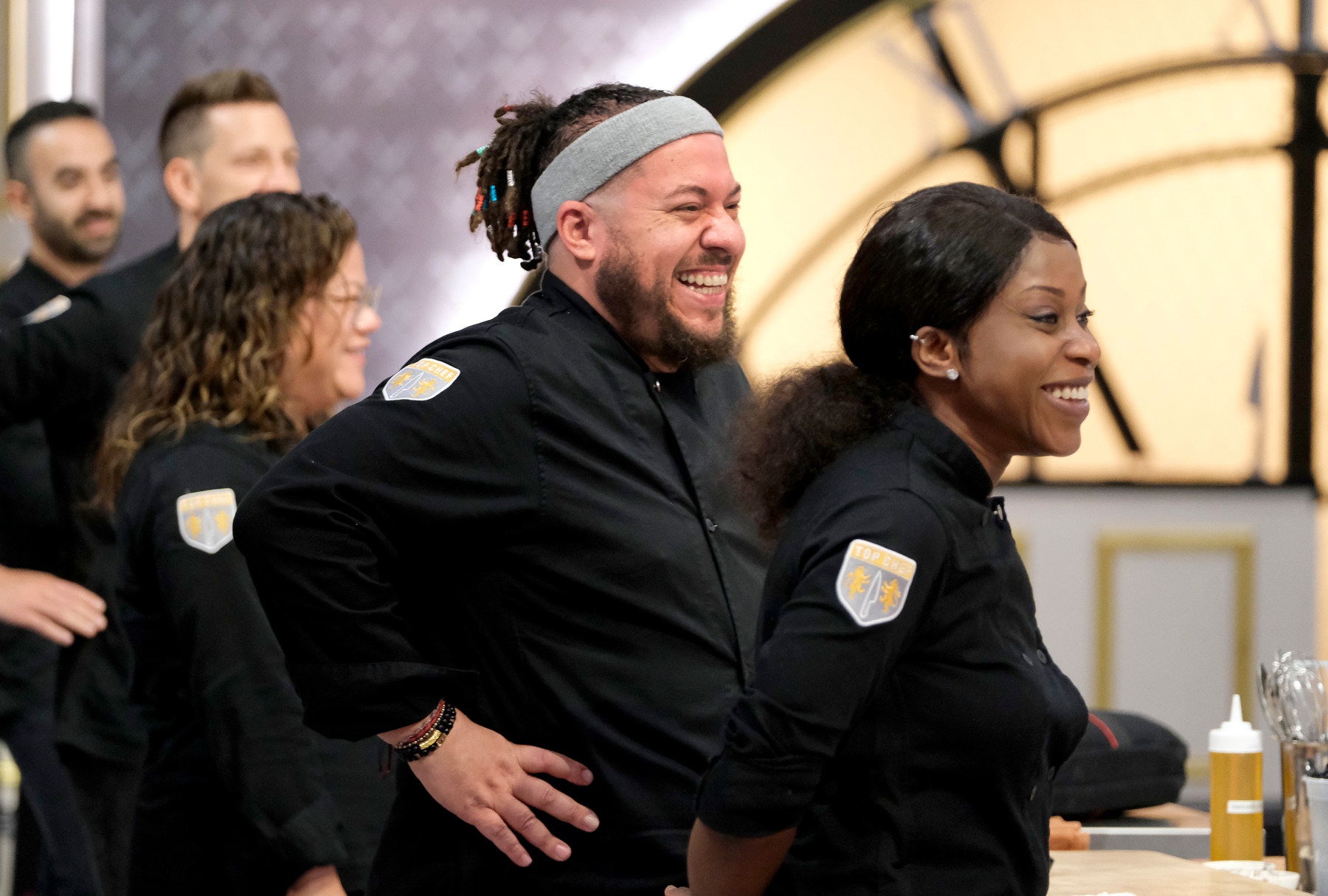
Contestants and judges all sit down to eat on “Top Chef: World All Stars” Episode 5 “Holiday Vacation” (David Moir/Bravo)
The celebratory meal 

The food this week doesn’t especially bowl (har har har) me over, but I love the sound of Sara’s creamed greens with biscuit gravy (plus the story), Victoire’s bean stew (a Congolese dish called madesu), Charbel’s eggplant fatteh with tahini yogurt, pomegranate and crispy pita. Plus I love the cook on Gabri’s fish — even if his mole verde leaves a bit to be desired. 

Our Top 3 are Amar with his lamb dish (the marmalade sounds amazing), Ali’s amazing mezze platter with kebabs and patties and Victoire’s exquisite bean stew. Ali acknowledges his winner’s streak but in his now trademark modest manner, which is such a contrast to how German Tom performs when he’s a winner.

I find the “pairs” of friendships in this season — Begoña and Gabri, Sylwia and Victoire, Amar and Ali — to be such a fun, sweet component of the show. 

Amar takes the win; in his follow-up celebratory confessional, he even jokes that he’ll invite Ali (alongside his family) to his VRBO trip. The pairs of friendships in this season — Begoña and Gabri, Sylwia and Victoire, Amar and Ali — are such a fun, sweet component of the show. 


Want a daily wrap-up of all the news and commentary Salon has to offer? Subscribe to our morning newsletter, Crash Course.


One of the biggest takeaways for me this episode is Buddha’s angry reaction and bitter attitude post-judges’ table, which we have not seen from him before. Begoña’s energy has seemed a bit off the past two episodes, and her incohesive dish conceptualization (and the Charbel/oil issue) clearly puts her into a certain headspace, but Buddha’s disgruntlement is . . . unusual, as well as off-putting. And I’m not the only one to feel this. In the stew room (aka the outdoors), the other cheftestants, primarily German Tom and Sara, push back a bit on Buddha and Begoña’s unhappy commiserating. I wonder if Buddha’s attitude post-judges’ table will continue. He had a pretty easy road to the win in his first season in Houston, but this group brings a much higher level of competition.

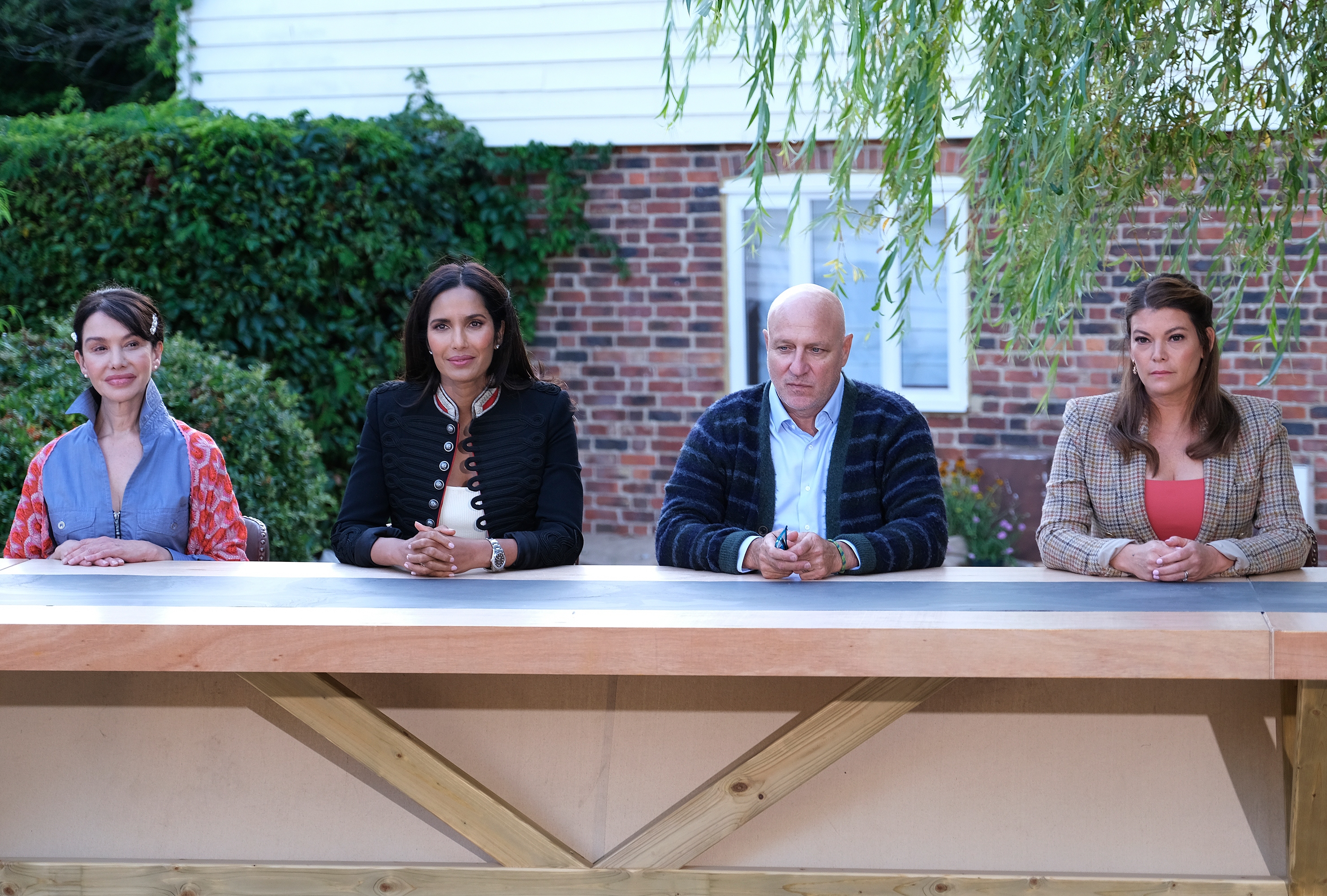
Judges Martha Ortiz, Padma Lakshmi, Tom Colicchio and Gail Simmons in “Top Chef: World All Stars” Episode 5, “Holiday Vacation” (David Moir/Bravo)

After dinner mints 

I’m so glad Gabri isn’t eliminated; his story really resonates with me (as it, clearly, also did with Gail). I also love seeing Nicole compliment Padma on how she’s a “good eater.” There’s obviously a power imbalance at play in meals like that, but it’s entertaining to watch how Padma and Gail especially are able to just hang and eat before switching into “judge” mode. What must it be like when the cheftestants eat along with the judges? This allows the cheftestants to also glean their own thoughts from the cookery and seasoning and dishes, and I wonder if that also may have factored into Buddha’s little fit once he tasted the others’ food.

German Tom had immunity from his earlier win, and therefore he’s safe from elimination deven though his dessert is clearly too dense. Usually that cake “gimme” would have probably been a source of contention, but aside from that throwaway of Sara dunking on it (and various mentions of the cake’s density), it seems to go unnoticed. Tom is fascinating: He’s so light, joking and jovial, but he doesn’t seem to handle certain criticism or adversity well. He was dismissive after getting feedback after last week’s biscuit Quickfire, he doesn’t seem to care about the quality of the cake in this episode, and the preview of him in the next episode doesn’t bode well either. 

Padma speaks in such a warm, effusive manner towards cheftestants she feels especially fond of and I’m starting to see that with her treatment of Victoire; checking on how she feels, speaking Italian to her and in this segment, talking at length about how she truly loves the stew  and how she’s so looking forward to more food from the Congo. I agree with Padma: Victoire’s story is an amazing one, and I am so excited to see if she could be our victor. I’m not sure if there’s a more deserving person there. 

I agree with Padma: Victoire’s story is an amazing one and I am so excited to see if she could be our victor. I’m not sure if there’s a more deserving person there. 

Lastly, I wouldn’t be surprised if Begoña is our first “Last Chance Kitchen” victor this season and re-enters the competition next week.

On to next week!

“Top Chef: World All Stars” airs Thursdays at 9 p.m. on Bravo and streams next day on Peacock.

Republicans caught off guard by the left’s ferocious backlash

For as long as I can remember, Democrats have been on the defensive about enacting their agenda because it was assumed that it would engender a backlash among “the silent majority,” as former president Richard Nixon called it, or what modern Republicans call “Real America.” Reacting to the counter-culture of the 1960s and the massive social changes it engendered, the left wing of the Democratic Party was always admonished by the centrist and conservative wings not to go too far or too fast. The media even blithely asserted that “America is a conservative country” as if it were an act of God. This article of faith hobbled progress for a very long time and empowered the Reagan Revolution through the Tea Party and Donald Trump’s MAGA movement.

Nobody ever seemed to consider that enabling the right wing to become more and more extreme over the course of many years might engender a backlash of its own. It appears as if that time may have finally come — and it’s clear the Republican establishment doesn’t know what to do about it. The question is whether the Democratic establishment does either.

We started out with former president and current GOP presidential frontrunner being indicted in New York over the payments of hush money to conceal information that might have damaged his chances in the 2016 election. It’s a huge story but it’s not unanticipated nor is it the last prosecution Donald Trump is likely to face in the coming months. The most interesting aspect of it remains the fact that the Republican establishment is circling the wagons around him once again while Republican voters seem determined to push him to the nomination. This is despite the fact that he will be under indictment on felony charges in at least one case and probably more, proving once again that no amount of norm-busting, corruption or criminal behavior is a deal breaker with his cult. Trump has trained them to believe that it’s all an elaborate conspiracy against him.

But this week also showed that something else is afoot. Yes, Trump is a galvanizing force in Democratic politics going all the way back to the massive, global Women’s March in 2017. His grotesque behavior motivated millions of people, especially women, to organize and it paid off in every election since then. Donald Trump has been dragging the GOP down for years but they just can’t quit him. However, the party’s rapid descent into extremism is bigger than Trump and the backlash is continuing to show itself in ways that are shattering the status quo.

The swing state of Wisconsin has been a battleground for years with a polarized electorate that has had power swinging back and forth between the two parties with razor-thin margins. It was assumed that the high-stakes election this week for Chief Justice of the Supreme Court would be similarly tight. The future of the outrageous gerrymander that makes Republicans massively over-represented in the state legislature was at issue but, most importantly, abortion rights were front and center. Abortion has been illegal in the state since last June when the Supreme Court overturned Roe v. Wade and an archaic law banning abortion that had been on the books since 1849 was no longer moot. The hard right legislature and the conservative state Supreme Court wasn’t going to fix that.

The election turned on those two intersecting issues. Abortion rights and democracy were on the ballot with the first being denied as a result of the Republicans manipulating the map to un-democratically seize more power than the people voted for. The anti-abortion candidate (a Trumper, by the way) lost by 10 points, a miracle in that polarized electorate. With good organization by the state Democratic Party — which saw a huge uptick in 18-29-year-old voters, a big gender gap and even, surprisingly, inroads among white, non-college-educated voters — abortion rights and democracy advocacy carried the day.


Want a daily wrap-up of all the news and commentary Salon has to offer? Subscribe to our morning newsletter, Crash Course.


Meanwhile in Chicago, just as in Los Angeles earlier, the progressive mayoral candidate won despite widespread expectations that the centrist “law and order” candidate would prevail as a result of right-wing fear-mongering about crime. (The head of Chicago’s Fraternal Order of Police, a Trumper, threatened that 1,000 police officers would walk off the job if Brandon Johnson, the eventual winner, was elected.) The stale “law and order” handwringing didn’t work in 2022 and it didn’t work this week — and it’s yet another sign that the extremism of right-wing rhetoric and policies is turning off voters. Backlash.

The GOP is an authoritarian, extremist political party that is out of the mainstream of American life.

And then there was the grotesque display we witnessed in Nashville, Tennessee on Thursday when the Republicans expelled two Black lawmakers, Justin Pierson and Justin Jones, for staging a protest for gun safety legislation on the floor of the House. Here’s an illustration of what took place: an odious, condescending comment delivered by a Republican House member who is clearly hard-pressed not to go full Bull Connor and address his colleague as “boy”:

Jones said it plainly:

A third member, Rep. Gloria Johnson was also subject to expulsion but they came up short by one vote. Johnson knows exactly why this happened:

After six people, including three little children, were shot down in a Nashville school, citizens protested the state’s insanely loose gun laws that allowed the shooter to legally obtain firearms despite a history of mental illness. The anti-democratic Republicans (yes, Tennessee is ridiculously gerrymandered as well) essentially scoffed at their concerns, attacked their colleagues’ First Amendment rights and then showed the entire country in living color that they are unreconstructed racists on top of it by instituting the political death penalty against two Black legislators for a minor rules violation.

In this instance, we are seeing the burning issue of gun violence converge with the issue of democracy and systemic racism and while it hasn’t yet been fully demonstrated, the fact that the two ousted legislators are also quite young, as are most of the protesters, makes me think we are on the verge of seeing another backlash developing. Look at the age of the protesters:

This dispatch from a local Tennessee journalist suggests that some Republicans sense that too:

The GOP is an authoritarian, extremist political party that is out of the mainstream of American life. As NY Rep. Alexandria Ocasio Cortez tweeted after the events in Nashville on Thursday:

Republicans may think they won today in Tennessee, but their fascism is only further radicalizing and awakening an earthquake of young people, both in the South and across the nation. If you thought youth organizing was strong, just wait for what’s coming,

Backlashes go both ways and this one is coming from the left. It’s about time. 

Gender-affirming care and its long history in the US

In 1976, a woman from Roanoke, Virginia, named Rhoda received a prescription for two drugs: estrogen and progestin. Twelve months later, a local reporter noted Rhoda’s surprisingly soft skin and visible breasts. He wrote that the drugs had made her “so completely female.”

Indeed, that was the point. The University of Virginia Medical Center in nearby Charlottesville had a clinic specifically for women like Rhoda. In fact, doctors there had been prescribing hormones and performing surgeries – what today we would call gender-affirming care – for years.

The founder of that clinic, Dr. Milton Edgerton, had cut his teeth caring for transgender people at Johns Hopkins University in the 1960s. There, he was part of a team that established the nation’s first university-based Gender Identity Clinic in 1966.

When politicians today refer to gender-affirming care as new, “untested” or “experimental,” they ignore the long history of transgender medicine in the United States.

It’s been nearly 60 years since the first transgender medical clinic opened in the U.S., and 47 years since Rhoda started her hormone therapy. Understanding the history of these treatments in the U.S. can be a helpful guide for citizens and legislators in a year when a record number of bills in statehouses target the rights of transgender people.

Christine Jorgensen, who received gender-affirming treatments in the 1950s, was one of the first trans celebrities in the U.S. Bettmann/Getty Images

Treating gender in every population

As a trans woman and a scholar of transgender history, I have spent much of the past decade studying these issues. I also take several pills each morning to maintain the proper hormonal balance in my body: spironolactone to suppress testosterone and estradiol to increase estrogen.

When I began HRT, or hormone replacement therapy, like many Americans I wasn’t aware that this treatment had been around for generations. What I was even more surprised to learn was that HRT is often prescribed to cisgender women – women who were assigned female at birth and raised their whole lives as women. In fact, many providers in my region already had a long record of prescribing hormones to cis women, primarily women experiencing menopause.

I also learned that gender-affirming hormone therapies have been prescribed to cisgender youths for generations – despite what contemporary politicians may think. Disability scholar Eli Clare has written of the history and continued practice of prescribing hormones to boys who are too short and girls who are too tall for what is considered a “normal” range for their gender. Because of binary gender norms that celebrate height in men and smallness in women, doctors, parents and ethicists have approved the use of hormonal therapies to make children conform to these gender stereotypes since at least the 1940s.

Clare describes a severely disabled young woman whose parents – with the approval of doctors and ethicists from their local children’s hospital – administered puberty blockers so that she would never grow into an adult. They deemed her mentally incapable of becoming a “real” woman.

The history of these treatments demonstrates that hormone therapies and puberty blockers have been used on cisgender children in this country – for better or for worse – with the goal of regulating the passage from girlhood to womanhood and from boyhood to manhood. Gender stereotypes concerning the presence or absence of secondary sex characteristics – too tall, too short, too much body hair – have all led parents and doctors to perform gender-affirming care on cisgender children.

Enforcement of binary gender norms has led to unwanted medical interventions on intersex children.

For over half a century, legal and medical authorities in the U.S. have also approved and administered surgeries and hormone therapies to force the bodies of intersex children to conform to binary gender stereotypes. I myself had genital surgery in infancy to bring my anatomy into alignment with expectations for what a “male” body should look like. In most cases, intersex surgeries are unnecessary for the health or well-being of a child.

Historians such as Jules Gill-Peterson have shown that early advances in transgender medicine in this country are deeply interwoven with the nonconsensual treatment of intersex children. Doctors at Johns Hopkins and the University of Virginia practiced reconstructing the genitalia of intersex people before applying those same treatments on transgender patients.

Given these intertwined histories, I contend that the current political focus on prohibiting gender-affirming care for transgender people is evidence that opposition to these treatments is not about the safety of any specific medications or procedures, but rather their use specifically by transgender people.

How transgender people access care

Many transgender people in the U.S. have deeply complicated feelings about gender-affirming care. This complexity is a result of over half a century of transgender medicine and patient experiences in the U.S.

In Rhoda’s time, medical gatekeeping meant that she had to live “full time” as a woman and prove her suitability for gender-affirming care to a team of primarily white, cis male doctors before they would give her treatment. She had to mimic language about being “born in the wrong body” – language invented by cis doctors studying trans people, not by trans people themselves. She had to affirm she would be heterosexual and seek marriage and monogamy with a man. She could not be a lesbian or bisexual or promiscuous.

Many trans people still need to jump through similar hoops today to receive gender-affirming care. For example, a diagnosis of “gender dysphoria,” a designated mental disorder, is sometimes required before treatment. Many trans people argue that these preconditions for access to care should be removed because being trans is an identity and a lived experience, not a disorder.

Transgender people undergo more evaluations to obtain gender-affirming care than do cisgender people.

Feminist activists in the 1970s also critiqued the role of medical authority in gender-affirming care. Writer Janice Raymond decried “the transsexual empire,” her term for the physicians, psychologists and other professionals who practice transgender medicine. Raymond argued that cis male doctors were making an army of trans women to satisfy the male gaze: promoting iterations of womanhood that reinforced sexist gender stereotypes, ultimately ushering in the displacement and eradication of the world’s “biological” women. The origins of today’s gender-critical, or trans-exclusionary radical feminist, movement are visible in Raymond’s words. But as trans scholar Sandy Stone wrote in her famous reply to Raymond, it’s not that trans women are unwilling dupes of cis male medical authority, but rather that we have to strategically perform our womanhood in certain ways to access the care and treatments we need.

The future of gender-affirming care

In many states, especially in the South, where I live, governors and legislatures are introducing bills to ban gender-affirming care – even for adults – in ignorance of history. The consequences of hurried legislation extend beyond trans people, because access to hormones and surgeries is a basic medical service many people may need to feel better in their body.

Prohibitions on hormone therapy and gender-related surgeries for minors could mean ending the same treatment options for cisgender children. The legal implications for intersex children may directly clash with proposed legislation in several states that aims to codify “male” and “female” as discrete biological sexes with certain anatomical features.

Prohibitions on hormone replacement therapy for adults could affect access to the same treatments for menopausal women or limit access to hormonal birth control. Prohibitions of gender-affirming surgeries could affect anyone’s ability to access a hysterectomy or a mastectomy. So-called cosmetic surgeries such as breast implants or reductions, and even facial feminization procedures such as lip fillers or Botox, could also come under question.

These are all different types of gender-affirming procedures. Are most Americans willing to live with this level of government intrusion into their bodily autonomy?

Almost every major medical organization in the U.S. has come out against new government restrictions on gender-affirming care because, as doctors and professionals, they know that these treatments are time-tested and safe. These treatments have histories reaching back over 50 years.

Trans and intersex people are important voices in this debate, because our bodies are the ones politicians opposing gender-affirming care most frequently treat as objects of ridicule and disgust. Legislators are developing policies about us despite the fact that most Americans say they do not even know a trans person.

But trans and intersex people know what it is like to have to fight to access the care and treatment we need. And we know the joy of finally feeling comfortable in our own skin and being able to affirm our gender on our own terms.


G. Samantha Rosenthal, Associate Professor of History, Roanoke College

This article is republished from The Conversation under a Creative Commons license. Read the original article.

Tennessee Three — minus one— expelled: Republicans remove all doubt that they oppose democracy

Between climate strikes and gun safety demonstrations, we are living in the heyday of children’s protests, in ways unseen since Mother Jones led an army of children to protest child labor at the beginning of the 20th century. While it’s been drowned out by the coverage of Donald Trump’s Manhattan arrest, protests in Nashville, Tennessee in recent days have been eye-popping in both their intensity and the age of the participants. A sea of children, some elementary school age, have repeatedly flooded the Capitol to demand better gun safety laws after a recent school shooting left six people murdered, three of whom were small children. Gun deaths of children have climbed 50% in the past two years, making it the number one cause of death for people under 18

The child protesters are both peaceful and enjoy popular support, even in the red state of Tennessee. (Recent polling shows a strong majority of Tennessee parents want red flag laws and background checks.) However, Tennessee Republicans were clearly offended at the very concept of having to face their own constituents, especially such young members of the public. The Republican Speaker of the House Cameron Sexton compared the protest, which caused no injuries or property damage, as “equivalent, maybe worse” of the insurrection at the national Capitol on January 6, 2021.  

As usual with Republicans, every accusation is a confession.

It is not the peaceful protesters in Nashville who are aligned with the fascistic forces that stormed the Capitol on January 6. It’s Sexton and other Republicans. They immediately went on to prove this true by holding a vote to expel three members of the state’s Democratic caucus for daring to agree with the protesters. To add insult to injury, the Republicans eventually decided to only throw out the two Black members while leaving in the white one, underscoring how much the GOP war on democracy is fundamentally about white supremacy.


Want more Amanda Marcotte on politics? Subscribe to her newsletter Standing Room Only.


Republicans offered a thin pretext for expelling state representatives Justin Jones, Justin Pearson and Gloria Johnson, who have been dubbed the “Tennessee Three” by progressive activists. Republicans accuse the three of breaking the legislature’s decorum rules by chanting alongside the protesters. (Johnson was apparently saved from expulsion because she apologized.) Exactly no one believes this excuse.

This is just the latest, and one of the starkest, examples of how Republicans across the country have, under the leadership of Donald Trump, flat out rejected democracy. They may be using the tool of bureaucratic power instead of violence, but they share the same beliefs as the January 6 insurrectionists: Only Republicans are legitimate Americans, and Democratic voters — especially if they are people of color — should have no say in choosing their own leaders. 

The Tennessee vote is part of a larger trend of Republicans becoming more unapologetic by the day about their opposition to democracy. Republicans in Oklahoma censured their nonbinary Democratic colleague last month for aiding a protest at the state capitol. In Florida, Democratic state lawmakers were charged this week with trespassing on the state capitol after protesting Republicans’ newly-passed 6-week abortion ban. 

Republicans see the voters as an enemy to be defeated. 

Even when Trump was attempting a coup, he hid behind conspiracy theories about a “stolen” election, to prop up the illusion that he supports a democratic system. But now that fig leaf is being tossed aside. Just last week, when debating a bill that would make it easier for legal voters to cast ballots in Minnesota, Republican state representative Matt Bliss complained that the bill “brings us closer to a democracy, which, you know, that’s not a good thing.” 

On Tuesday, Milwaukee County Circuit Court Judge Janet Protasiewicz beat the Trump-linked candidate Dan Kelly for a seat on the Wisconsin Supreme Court, in a race that drew national attention precisely because democracy in Wisconsin is on the line. It’s not just that Kelly was likely to throw out the results of a 2024 presidential election if President Joe Biden beats Trump. It’s that the state is so badly gerrymandered that Democrats cannot win a legislative majority, no matter how many more votes they get than Republicans. In 2018, for instance, Democrats got 53% of the votes but only 36% of the seats in the state legislature. Protasiewicz, who won by a 10-point margin, explicitly campaigned by promising to restore democracy to the state. 

She may not get a chance.

Already, Republicans in the state legislature are considering impeaching Protasiewicz, using their illegitimately obtained power to shield themselves further from the will of the voters. They’re putting even less effort than the Tennessee Republicans into crafting a pretext. Republican Assemblyman Dan Knodl made vague noises about “corrupt” lawmakers, without bothering to explain why Protasiewicz would qualify. But we all know the reason: Protasiewicz is a pro-choice, pro-democracy judge. That renders her illegitimate in the eyes of Republicans. 


Want more Amanda Marcotte on politics? Subscribe to her newsletter Standing Room Only.


During the 2022 midterms, many Democratic candidates shied away from talking about the Republican threat to democracy, fearing that the issue is too process-oriented to appeal to voters. Whether that’s true or not, moves like the expulsion of the Tennessee Democrats are taking the democracy issue out of the realm of abstraction and showcasing exactly why Republicans have taken this anti-democratic turn: their arguments are losers.

Republican views on everything from climate change to reproductive rights are increasingly unpopular with the voters. Rather than moderate their policies to appeal to more people, however, Republicans are responding by following Trump’s lead: Looking for ways to keep voters from having a say. 

These actions are just an escalation of an already robust GOP war on democracy that has only gotten worse since January 6. It involves efforts to intimidate election officials until free and fair elections are impossible to conduct. It involves relentless gerrymandering and voter suppression. In states where voters have turned out for ballot initiatives to protect abortion rights, health care access, or the minimum wage, Republicans react by trying to take that process away entirely. Republicans see the voters as an enemy to be defeated. 

As I wrote yesterday for Salon, Republicans are having an especially rough time of it this month, as they are repeatedly reminded most Americans don’t support them. Most Americans want Trump to suffer legal consequences for his crimes. Most Americans want legal abortion, access to health care, and stronger gun safety laws. Most Americans think banning books is bad and drag queens are fun. Most Americans are repulsed by QAnon-linked nuts like Georgia Rep. Marjorie Taylor Greene.

The strangest thing about the expulsion of the Tennessee Democrats is that it seems like an unwise move on its surface, as it only served to draw more national attention to the gun protests while reminding the public that Republicans are anti-democratic bullies. It makes more sense in light of the bad week that the MAGA movement had, between Trump’s indictment and the Wisconsin election. In a very real sense, the Tennessee Three are scapegoats. Their expulsion is a petty act of revenge from Republicans who refuse to accept the will of the voters. 

“He is visualizing burning things and blowing them up”: How Trump may be coping with being caught

As a person ages, they become more their true self; Donald Trump has been engaging in criminal and other antisocial behavior for decades. In many ways, Trump is one of the most successful criminals in American history. Crime helped Trump to become a billionaire. Crime helped Trump to takeover the White House in 2016. Crime helped Trump to almost succeed in his Jan. 6 coup attempt and the ongoing and escalating attempts by the Republican-fascist party and MAGA and “conservative” movement to end America’s multiracial democracy.

With his indictment in New York this week, and the other more serious cases looming over him in connection to election fraud and interference, as well as stealing top secret and highly classified federal documents, this is the first time in Trump’s life that he is facing real and substantial – and potentially life-altering – consequences for his pathological and corrupt behavior.

Dr. Justin Frank is a former clinical professor of psychiatry at the George Washington University Medical Center and the author of “Trump on the Couch: Inside the Mind of the President.” In this wide-ranging conversation, he explains how Trump is likely responding on an emotional and psychological level to being arrested on Tuesday and facing the prospect of true accountability for his decades-long crime spree. Dr. Frank also explores how someone with Trump’s antisocial personality (and resulting attraction to violence and death) behaves when they are confronted by the law and other powerful forces who are (finally) trying to stop them.

This interview has been lightly edited for clarity.

When I looked at Donald Trump being arraigned in New York, in particular, that one moment when he glared at the news reporters and cameras, I saw his true self. That was the real Trump: he looked violent, enraged, and like a killer from a horror movie. As you know I use the correct moral language when discussing fascism and the likes of Trump and his movement. Trump was revealing, even more, his true evil self. As a therapist and a human being what did you see?

I agree with you. That moment did in fact reveal the true Donald Trump.

But here is the complexity: There is really more than one real, or true, Donald Trump; people are multilayered. At his core, what we see in that moment with Trump in Manhattan was that he knows he is a criminal who has finally been caught and may be held responsible for his wrongdoing. To be even blunter, Trump looked like a predatory animal that had been caged. “Evil” is not a psychoanalytic term, but that was his affect in the moment. What I also saw that was very striking in that moment was that Trump looked like he was full of self-pity, he was defeated and alone; he seemed to realize that nobody feels sorry for him. As we’ve seen time and again — with Michael Cohen, for example — Trump does not merit or inspire sympathy in those he treats badly. 

“I don’t know exactly what will happen with the likes of Trump because such human predators are usually denied bail or committed to a hospital for supervision — and medication.”

Trump in his defeat is also an example and reminder of Sigmund Freud’s theories about the life instinct and the death instinct. The death instinct is about how people take pleasure in destruction, to destroy and hurt others. Trump is possessed by his death instinct.

What does someone like Donald Trump do when they’re finally reined in? In Trump’s case, he is being held criminally responsible and perhaps even faces removal from society. Trump is a predator. How do such people react when they are caged, either literally or metaphorically?

Predators can massively regress in such circumstances and lose even a modicum of self-control. They lash out and need to be restrained for their safety and that of their caregivers. That’s why we have secure padded cells (euphemized as “quiet rooms”) inside locked wards in mental hospitals. When a predator is cornered, he generally exhibits paranoia, because one of the things that a predator tries to resist is his paranoid anxiety. When a predator is hunting or otherwise looking for a target he becomes hypervigilant for danger. When Trump is cornered, as he is now with this felony case, he will become increasingly paranoid or defeated. I don’t know exactly what will happen with the likes of Trump because such human predators are usually denied bail or committed to a hospital for supervision — and medication.

How would you assess Donald Trump’s emotional maturity level? 

First, Trump never grew up. He is a child, emotionally. Trump’s emotional maturity level is perhaps that of a teenager, a 13-year-old who has just hit puberty and wants to fight people and destroy things. In fact, Trump’s emotional maturity may actually be closer to a ten-year-old. The deep problem with Trump is that he is a bully. Trump is also a coward. The combination of those traits is very dangerous. Trump is also a “pervert,” meaning in the original sense of the word, that he has turned away from truth. Moreover, Trump is actually the ultimate pervert in that sense: he hates the truth, i.e. the media is lying about him, “fake news,” the Big Lie about the election, etc.

One of the truths that Trump turns away from is that other people are human beings who should be respected because they have feelings and inherent dignity and worth. But for Trump, people are either useful to him or seen as threats or prey.  

How does Donald Trump manage his anxiety and stress? What sort of self-soothing or coping behaviors does he engage in to compensate?

Again, Trump is dominated by the death instinct which includes pleasure in being destructive. A person who has that temperament is going to manage his anxieties and fears and other stress by escalating fantasies of destructiveness. In Trump’s mind, he is visualizing burning things and blowing them up. He is fantasizing about hurting other people. Those fantasies of harm and destruction bring him great pleasure. A person like Trump may be fantasizing about committing acts of mass murder.

If Trump were a mafia boss, he would get his consiglieres to act on his behalf. For Trump to truly be calm and at peace he would need to rule the world, to dominate everyone and everything around him. Trump lives to make other people scared. He will also not let himself feel dependent on, or need, other human beings.


Want a daily wrap-up of all the news and commentary Salon has to offer? Subscribe to our morning newsletter, Crash Course.


When I saw Trump on Tuesday at the courthouse, he looked like a very lonely and pitiable man. Is he even capable of understanding how loathed, unloved, and despised he is by the American people? He wasn’t even able to summon up a decent size crowd of MAGAites to rally for him outside the courthouse.

He is more dangerous now that he is under threat.

Even Trump’s wife, let alone the rest of his family, didn’t accompany him to his arraignment. Trump imagines that he is loved and supported by the American people. He’s a person who is dominated by a need to spoil or attack what’s good in other people — and he does it all without an ounce of guilt. Trump views relationships and the world in a transactional way. Everything is about winning and losing. That is the way of the world for someone like Trump. Trump really does not have any real, honest friendships. You either sycophantically support and agree with him or you’re written off.

Most people have violent fantasies. How does someone like Trump manage his violent fantasies versus actually following through on such thoughts and impulses? 

People underestimate Trump’s predatory nature. He is more dangerous now that he is under threat. Trump needs to be locked up because he has real problems with controlling his violent fantasies and impulses. Trump lacks internal self-regulation.

How does Trump process being in a situation where his lying and other pathological behavior will likely be of little use in saving him? Such behavior will almost certainly backfire in court.

He knows that in court, he must keep his mouth shut. And he’s surrounded by lawyers who tell him to shut up. Trump can’t control himself; he has to be controlled externally. He needs to be in a secure facility.

A person like Trump may be fantasizing about committing acts of mass murder.

I think Trump actually has to numb himself in court. I do not believe it is possible for Trump to actually process everything that is happening to him right now. Trump would not be able to function in court if he did not somehow turn off his hate and rage. Trump is a predator but he is also a type of paper tiger. He is grandiose, all puffed up. That is not separate from his viciousness, it actually colors it. When you’re grandiose and a predator, you feel you can do anything. But part of that belief is based on an unrealistic idea of yourself. Trump’s magical thinking reflects those beliefs and impulses. “I alone can fix it.” Those are statements made by a pathologically grandiose person. When you’re a killer, your life fantasies are not built on facts and reality. Donald Trump’s main weapons are his wealth, his bullying and his menacing quality. His intelligence also remains a weapon.

The hush money case is basically about women and sex. Is this triggering some type of hostile sexism and misogyny given Trump’s long pattern of hating women and dozens of alleged rape and sexual assault cases.

In my opinion, at his deepest level, Trump is afraid of women. He sees all women as inherently dangerous and, perversely, as predators. Trump triumphs over those fears by attempting to conquer and dominate women. When Trump pays women with hush money, for example as with Stormy Daniels, he is demeaning them and trying to turn them into prostitutes.

Donald Trump wanted a perp walk when he was arrested in New York. He also wanted a real mugshot taken. Neither of those things happened. But now Trump is selling t-shirts emblazoned with a fake mugshot of his face. Does he really understand the seriousness of what is happening with these alleged crimes and how he could actually end up in very serious trouble given the other charges he is potentially facing?

On a certain level, Trump may know that he is alone and feeling lonely. Because of that deep self-pity, Trump is very happy to use a fake mugshot image as a way of taking advantage of other people and getting money from them — but on his own terms. By selling his own mugshot, Trump is actually reversing, in his mind, the feelings of humiliation he would experience from having his mugshot taken by the police. He’s made a choice. It’s about having power. As compared to how he looked in court, Trump has control over the fake mugshot. Donald Trump can turn any loss — in his mind at least — into a gain. In his mind, Trump can do anything he wants. 

Trump ended his historic day on Tuesday at Mar-a-Lago with what was billed as some type of great and powerful speech to rally his followers. What were your thoughts about Trump’s speech?

Trump feeds on the unconditional love and adulation of his audience. It inflates him. He becomes more alive at Mar-a-Lago. Other people’s fantasies of Trump make him feel powerful. But even there, Trump did not look as lively as usual. He was defeated on Tuesday. His need for narcissistic fuel was critical after being arraigned and he couldn’t be completely satisfied in the usual ways. Trump is desperate.

Trump is a fabulist. He can also be reasonably described as delusional and mentally pathological. What happens to such a personality when reality comes crashing down on them? How does such a mind resolve the cognitive dissonance?

There are people in similar situations who do kill themselves. Trump will not do such a thing. He is too mean to die because his death instinct still gives him pleasure from hurting other people. He will do anything he can to satisfy his urges. But I see Trump as dead inside. He is more allied with his death instincts than his life instincts.

Trump will shrivel in the end. He has a fantasy that he is like Houdini and that he can always escape. He can’t imagine being held accountable for his alleged crimes and other wrongdoing. With this arraignment and the more serious cases that Trump is also facing, this is the first time in his life that it is dawning on him that he cannot escape like in a fantasy.

When he is alone or otherwise has a moment to process all that is happening with being the first U.S. president to face a criminal trial after leaving office and the other far more serious potential indictments that are waiting for him, what is he thinking about? Is he capable of critical self-reflection?

Trump is not capable of critical self-reflection. He is embracing his fantasies in whatever form they may take. He is incapable of feeling guilt. Being in front of an appreciative audience or sending out more screeds online, attacking people or hiring more lawyers are Trump’s ways of trying to feel alive and to distract himself from the reality of the situation. Donald Trump is acting like a cornered animal. He is however, a very intelligent animal. As an acolyte of the late Roy Cohn, Trump is skilled in devising legal strategies. His attacks on Judge Merchan make him feel better, but they also serve a purpose. He hopes that Merchan will buckle under pressure and recuse himself from the case, thereby creating, at the very least, a delay in the proceedings and the prospect of a more sympathetic court.

Is he afraid?

Yes, this is the first time Trump has really felt fear of what may happen to him if he loses in court. He is actually facing serious consequences for his behavior. Trump is also very afraid of being humiliated and mocked if he is convicted and sentenced. I agree with you that he is unlikely to be imprisoned, but the experience of being seen, and shamed, for who he really is, could be impossible for him to bear.

“The groomer of beers”: Conservatives vow to boycott Bud Light over partnership with trans activist

“Grandpa’s feeling a little frisky today,” Kid Rock said at the start of a video he posted Tuesday on Twitter. Clad in a MAGA hat and sweatshirt advertising the first annual Kid Rock Fish Fry, there were also tears in his eyes.

“Let me say something to all of you,” the musician continued, “and be as clear and concise as possible.”

Kid Rock then spent the next seven seconds shooting an MP5 submachine gun at a display of Bud Light 12-packs he had ostensibly set up about 50 feet away. As cans of beer exploded — Kid Rock managed to leave an entire case unscathed — he turned back to the camera. “F**k Bud Light,” he said, “and f**k Anheuser-Busch.” Before the 35-second clip faded to black, he also flipped off the camera.

You may be wondering why the 52-year singer (or redneck cosplayer, depending on your persuasion) took the time to tearfully schlep a folding table topped with beer onto a field. Though Kid Rock doesn’t offer an explanation in the video, it comes after other right-wing pundits have labeled Bud Light “the beer of groomers” over the brand’s partnership with transgender influencer and activist Dylan Mulvaney.

It’s the latest instance of a conservative public figure calling for a bad-faith boycott against a food brand they feel has been drafted into the culture wars. These boycotts are often comically short-lived, such as when former President Donald Trump called on his supporters to skip drinking Coca-Cola after the soda manufacturer spoke out against restrictive voting laws in its home state of Georgia — only for online sleuths to quickly point out a half-drunk bottle of Diet Coke on his desk just a few days later. Each week, it seems as though conservatives have a new nemesis, from Ben & Jerry’s and Coke to M&M’s and Oreo.

Because of the perceived futility of the culture war the right is waging, it’s perhaps easy to dismiss Kid Rock’s video as laughable. But as transgender individuals face increasing threats of violence and legislation that could result in them being barred from receiving supportive health care, it’s clear that the message from Rock, as well as conservatives like him, is no joke.


Hungry for more great food writing and recipes? Subscribe to Salon Food’s newsletter, The Bite.


As Billboard reported, Mulvaney, who documented her transition in a viral “Days of Girlhood” TikTok series, teamed up with Anheuser-Busch to promote the brand’s Easy Carry Contest.

“Happy March Madness!!” Mulvaney wrote in an Instagram post. “Just found out this had to do with sports and not just saying it’s a crazy month! In celebration of this sports thing @budlight is giving you the chance to win $15,000! Share a video with #EasyCarryContest for a chance to win!! Good luck! #budlightpartner.”

Mulvaney also revealed in her Instagram story that the company had sent her a single commemorative can with her face on it to celebrate Day 365 of her transition. As Miles Klee noted in Rolling Stone, this was a single can of beer featuring Mulvaney’s likeness that “didn’t even appear on the grid.” In fact, “you had to look at her Instagram stories to see it.”

https://www.instagram.com/p/CqgTftujqZc/

“Apart from stumbling across this online ad, your typical Bud drinker would never know of such an endorsement,” Klee added. “But prominent reactionaries currently engaged in a war on trans people have social networks that allow them to quickly amplify and exaggerate this kind of thing to each other.”

Indeed, before Kid Rock had even posted the video, Fox News had amplified the purported controversy. Days later, the outlet published an article describing how “many people mocked Bud Light over the partnership.”

Indeed, before Kid Rock had even posted the video, Fox News had already the purported controversy.

An earlier story published on April 2 included comments from conservative commentators pushing back against the alleged “gender propaganda,” including John Cardillo. “Who the hell at @budlight thought it was a good idea to make a grown man who dresses like little girls their new spokesperson?” Cardillo asked on Twitter. “Brands have to stop listening to their woke creative teams and get in touch with their consumer demographics.”

“Might genuinely be the weirdest thing I’ve ever seen in my life,” said Stephen Miller, contributing editor of The Spectator. Derek Hunter, a columnist for Townhall, called Bud Light “the groomer of beers.”

Anheuser-Busch told Fox News that the company works with “hundreds of influencers across our brands as one of many ways to authentically connect with audiences across various demographics and passion points.” It added that Mulvaney’s commemorative can “was a gift to celebrate a personal milestone and is not for sale to the general public.”

Later, country singer Travis Tritt also announced that he planned to ban Anheuser-Busch products from his tour hospitality rider, referring to the list of requests an artist provides to concert venues, including food and drink.

“I was on a tour sponsored by Budweiser in the 90’s. That was when Anheuser-Busch was American owned,” he wrote on Twitter. “A great American company that later sold out to the Europeans and became unrecognizable to the American consumer. Such a shame.”

“Other artists who are deleting Anheuser-Busch products from their hospitality rider might not say so in public for fear of being ridiculed and cancelled (sic),” Tritt continued. “I have no such fear.”

It’s far from the first time that a public figure on the right has vowed to boycott a product amid newfound allegations of wokeness. For example, after Oreo released a new advertisement depicting a young man practicing his coming-out speech — which was paired with a $500,000 donation to PFLAG — right-wing talking heads like Greg Kelly and Ben Shapiro said they would abstain from the snack. As Kelly put it in an unhinged Twitter rant, “I do not like gay cookies.”

If this purported culture war feels cyclical — it is.

If this purported culture war feels cyclical — it is. Those events took place in April 2022, almost exactly a year ago to the day. (It’s perhaps worth noting that Trump also called for his boycott of Coke in April 2021.) As I wrote in January while covering (once again) Tucker Carlson’s ongoing rage aimed at M&M’s for desexualizing its anthropomorphized candy mascots, conservative commentators like the Fox News host rely on said culture wars for content. Thus, it’s incumbent upon them to fan the flames.

Carlson’s gripes over whether he would still want to “have a drink” with the chocolate cartoon characters are superficial, however, in comparison to the discourse surrounding Mulvaney’s partnership with Anheuser-Busch. By highlighting comments calling Mulvaney a “groomer,” Fox News perpetuated a dangerous anti-transgender narrative to its audience.

Similarly, Kid Rock’s tearful post may inspire a certain kind of superficial schadenfreude for some liberal viewers. It’s an objectively ridiculous way to respond to a one-off beer advertisement. However, as right-wing personalities like Carlson stoke fears of alleged “trans terrorism,” Kid Rock’s gun-centered video takes on a much darker meaning.

As Billboard reported, Fred Guttenberg, the father of a child who was killed during the Parkland shooting in Florida in 2018, blasted the singer for “glorifying the kinds of war weapons often employed in mass shootings.”

“Hey @kidrock, this dad is ‘feeling a little frisky today,'” Guttenberg tweeted, sharing a post that showed his late daughter attempting to evade the school shooter. “Let me be ‘as clear and concise’ as I can with you. This is my daughter Jaime (under the black oval) and these are the students running over her for safety to avoid getting shot by the AR 15 that killed her. F–K YOU!!!”

Republicans move to repeal a tax that only affects the richest 0.1 percent

The vast majority of the Senate Republican caucus united last week to introduce a bill that would permanently repeal the estate tax, targeting one of the few provisions in the U.S. tax code that solely affects the richest 0.1 percent of Americans.

Led by Sen. John Thune, R-S.D., the top Republican on the Senate Subcommittee on Taxation and Internal Revenue Service Oversight, 40 Republicans reintroduced their bill to ensure that ultra-rich individuals seeking to hand off tens of millions of dollars — or more — to their heirs can do so completely tax-free. The extremely regressive proposal has been a longtime goal of Republicans, who have already massively watered down the estate tax in past years.

Currently, the estate tax threshold is $12.9 million, and nearly $26 million for couples. Amounts under this are exempted from taxes. This is nearly triple the threshold from 2016 and earlier, as Republicans more than doubled the estate tax cutoff in their major tax overhaul in 2017. The threshold is now so high that it is estimated that less than 0.1 percent of Americans are subject to the tax.

Evidently, these tax cuts are still not enough for Republicans, who had tried to repeal the tax altogether in 2017. In a press release on the bill, Thune, Senate Minority Leader Mitch McConnell, R-Ky., and Sen. Mike Crapo, R-Idaho, attempted to couch their support of the repeal in efforts to supposedly support farmers — claims that reveal themselves to be a farce when more closely examined.

“For years I have fought to protect farm and ranch families from the onerous and unfair death tax,” Thune said. “Family-owned farms and ranches often bear the brunt of this tax, which makes it difficult and costly to pass these businesses down to future generations.”

Thune’s statement is a misrepresentation of the truth. The vast, vast majority of “family-owned farms” are not subject to the estate tax. In 2020, a mere 0.16 percent of farm estates owed the tax, according to data from the Economic Research Service of the U.S. Department of Agriculture. This is an exceedingly small number of farms. As the Tax Policy Center estimated, only 50 farms total paid any estate tax in 2017, and this research was done before lawmakers doubled the threshold.

The criticism of the estate tax in defense of farmers is disingenuous for another reason, as Inequality.org pointed out in a blog post this week. The tax code “already has provisions that protect the very few families with farms and businesses subject to estate tax,” wrote Institute for Policy Studies associate fellow and senior adviser for Patriotic Millionaires Bob Lord. “If the bill sponsors truly cared about family farms, ranches, and businesses, they could have proposed legislation to expand these protections but leave the estate tax intact.”

In reality, deep-pocketed lobbyists with the Farm Bureau have long been pushing a repeal of the estate tax — and the group’s deep ties to big business and Wall Street are well documented.

Perhaps not coincidentally, repealing the estate tax would complete the loop of tax avoidance for the wealthiest Americans. The bill targets the “die” part of “buy borrow die,” a common tax dodging scheme used by the wealthy to avoid paying taxes; it is part of the reason that the wealthiest Americans are able to pay little to no taxes year over year.

In the practice of buying, borrowing, and dying, the rich first pour their wealth into assets like stocks, building up a large portfolio. Those assets are then used as collateral for taking out large loans with low interest rates — lower than, say, the income tax rate — that become a wealthy person’s spending money. Then, they die, and hand off their wealth to the next generation, maintaining their dynasty for decades to come.

At very few points do taxes come into the buy, borrow, die equation. Buying and keeping stocks doesn’t incur a tax bill. Taking out loans allows the wealthy to claim very low incomes to skirt income taxes. The estate tax is essentially the only guarantee, and even then, the wealthy have come up with extreme loopholes to dodge the estate tax, too. Republicans, then, are hoping to make tax avoidance even easier by legalizing it entirely; Lord has pointedly labeled the bill the “Billionaires Pay Zero Tax Act.”

The proposal stands in sharp contrast to progressives’ views on taxation. Pointing to extreme and growing wealth inequality, progressives have been calling for increasing taxes on the rich and specifically targeting their wealth and stock portfolios, rather than endlessly allowing the “buy” and “borrow” portions of the cycle.

“Up where they woke”: Fox News and others panic about “Little Mermaid” lyric changes

Only a few months ago, some Disney fans and conservatives alike were angered by the closing and planned revamping of the popular attraction “Splash Mountain.” The ride is being redesigned at both Disneyland and Disney World, incorporating Disney’s Princess Tiana in its theme and doing away with associations with “Song of the South,” the 1946 Disney musical. According to USA Today, Disney CEO Robert Iger described “Song of the South,” set in the post-Civil War plantation era and including harmful racist stereotypes, as “just not appropriate in today’s world.”

Now conservatives have another song to be angry about. Several songs, in fact, as news has emerged that the upcoming live action film of “The Little Mermaid” will include new tunes and changed lyrics for old ones. The lyrics in question include consent and young girls speaking up.

That’s making quite a splash, and in a confusing climate of censorship, book banning and paranoia about so-called wokeness, some viewers are drowning in misplaced outrage.  

In 1989, “The Little Mermaid” changed the future and fortunes of the Walt Disney Company, bringing the animation giant back to its rightful place on top, and bringing in the dough: making over $84 million in box office returns in its initial domestic release. The film has since grossed $235 million worldwide. Based on Hans Christian Andersen’s tale, “The Little Mermaid” tells the story of a redheaded mermaid princess named Ariel, who falls for a human prince she spots on land (a place she has always been infatuated with), and makes a dark deal with a sea witch named Ursula to become human and be with him.

Over the past few years, multiple Disney animated films have received the live-action treatment, including “Beauty and the Beast” starring Emma Watson. With a planned May 2023 release date, “The Little Mermaid” is the latest. When the project was announced, a racist backlash ensued over the casting of Black actor Halle Bailey as Ariel. Meanwhile, thousands of parents posted reactions of their children rapt at the teaser trailer, as Bailey sings. 

A new, full trailer has been revealed, and so has more information, including the fact that there are brand-new songs in the upcoming film. In an interview Wednesday with Entertainment Weekly, the famed composer of the original “The Little Mermaid,” Alan Menken, spoke of collaborating on the new film with “Hamilton” creator Lin-Manuel Miranda. Miranda wrote the lyrics and Menken has composed a trio of additional songs, including one for Ariel that Menken described as “lilting,” and a “power ballad” for human Prince Eric.

“The little mermaid used to sing ‘up where they walk, up where they run.’ Now she might sing ‘up where they woke!'”

As for the existing songs? They’ve undergone a change too. Speaking with Vanity Fair, Menken was asked if any aspect of the original film was changed. He answered, “There are some lyric changes in ‘Kiss the Girl’ because people have gotten very sensitive about the idea that [Prince Eric] would, in any way, force himself on [Ariel]. We have some revisions in ‘Poor Unfortunate Souls’ regarding lines that might make young girls somehow feel that they shouldn’t speak out of turn, even though Ursula is clearly manipulating Ariel to give up her voice.”

“The Little Mermaid” 2023 (Disney)

The writer did not press Menken to elaborate, but conservative outlets took the news — a mere paragraph in a much longer article — and ran with it. “‘Little Mermaid’ lyrics get ‘woke’ update,” FOX News reported: “The little mermaid used to sing ‘up where they walk, up where they run.’ Now she might sing ‘up where they woke!'”

Lis Power pointed on Twitter, “It’s not even that song they’re changing!

The original “Kiss the Girl,” where human-turned Ariel and Prince Eric float in a boat and various animals encourage him to kiss her, includes lyrics like “You’re dyin’ to try,” and “Yes, you want her/Look at her, you know you do/Possible she wants you too.”

But the next section is perhaps ripe for some tweaking: “There is one way to ask her. / It don’t take a word./ Not a single word.” Well, it might take two words: Can I? Would inserting that sentence really corrupt the whole song?


Want a daily wrap-up of all the news and commentary Salon has to offer? Subscribe to our morning newsletter, Crash Course.


As for “Poor Unfortunate Souls,” Ursula has some zingers about being seen and not heard when it comes to being a young girl: “On land it’s much preferred for ladies not to say a word,” and “It’s she who holds her tongue who gets a man.” But the sea witch has a vested interest here, wanting to take Ariel’s voice as payment for giving the mermaid legs. 

Should we return to the original fairy tale, when Ariel has to murder the prince with a dagger or die terribly?

And that’s the problem with this whole hubbub. We don’t know. The film hasn’t been released yet. The songs, new or old and improved, haven’t been heard by the general public. When it came to the outrage over altered parts of Roald Dahl’s books, we already knew what the changes were. And we already knew words like “fat” had been altered with no attention paid to context (and meanwhile, sensitivity readers were blamed).

Context is everything. It’s nuance that places like Fox News struggle with in their rush to criticize everything about Disney (if we want to keep “The Little Mermaid” totally pure, should we return to the original fairy tale, when Ariel has to murder the prince with a dagger or die terribly?). But the world, both above ground and under the sea, is rarely so simple.

“Despicable”: Idaho becomes first US state to restrict interstate travel for abortion care

Idaho Gov. Brad Little on Wednesday made his state the first in the U.S. to restrict interstate travel for abortion care by signing legislation that aims to prevent minors from traveling to obtain an abortion without parental consent.

The Republican-authored law, H.B. 242, creates a new crime of “abortion trafficking” and establishes a minimum two-year prison sentence—and a maximum of five years—for anyone found guilty of committing it.

The law defines a perpetrator of “abortion trafficking” as “an adult who, with the intent to conceal an abortion from the parents or guardian of a pregnant, unemancipated minor, either procures an abortion… or obtains an abortion-inducing drug for the pregnant minor to use for an abortion by recruiting, harboring, or transporting the pregnant minor within this state commits the crime of abortion trafficking.”

“It shall not be an affirmative defense to a prosecution… that the abortion provider or the abortion-inducing drug provider is located in another state,” the measure’s text states.

Little has said the law, which would empower Idaho’s Republican attorney general to override local prosecutors if they refuse to enforce the restrictions, does not bar adults from traveling to obtain abortion care for themselves.

Current Idaho law bans nearly all abortions, meaning the new measure will, in practice, impact those traveling within Idaho to assist a pregnant minor in obtaining abortion medication from out of state and those crossing state lines to help a minor receive abortion care.

As HuffPost’s Alanna Vagianos noted, the law “could apply to a grandmother driving a pregnant minor to the post office to pick up a package holding medication abortion or target an older brother driving a pregnant minor to a friend’s house to self-manage an abortion at home.”

With the draconian restrictions set to take effect in less than 30 days, abortion rights groups are vowing to fight as other states are likely to follow Idaho’s lead. Last July, Senate Republicans blocked legislation that would have protected the right to travel for abortion nationwide.

Planned Parenthood Alliance Advocates West said Wednesday that “yet again, Idaho’s governor disregarded constituents and signed H.B. 242 into law, creating the nation’s first crime of so-called ‘abortion trafficking,'”

“This legislation is despicable, and we’re going to do everything in our power to stop it,” the group added. “This bill criminalizes an adult assisting a young person accessing abortion care with the intent of concealing the abortion from their parent. While most young people include their parents in the decision to get an abortion, some are in dangerous, abusive situations.”

“Idaho lawmakers have slipped under the radar with some of the strictest anti-abortion laws in the country,” the group continued. “Now, they’re using an incredibly serious term like trafficking to talk about young people traveling with trusted adults to access a legal procedure in another state.”

Idaho healthcare providers and advocacy organizations, including Planned Parenthood and the ACLU, announced Wednesday that they are suing Idaho Attorney General Raúl Labrador over his claim in a recent legal opinion that Idaho law prohibits medical providers from “either referring a woman across state lines to access abortion services or prescribing abortion pills for the woman to pick up across state lines.”

“Idaho law requires the suspension of a healthcare professional’s license when he or she ‘assists in performing or attempting to perform an abortion,'” Labrador wrote.

The advocacy coalition opposing that interpretation warned Wednesday that it “goes far beyond Idaho’s law and is an extreme attempt to prevent healthcare providers from giving information to patients and to prevent Idahoans from accessing legal health care in another state.”

“This is a five-alarm fire,” said Rebecca Gibron, the CEO of Planned Parenthood Great Northwest, Hawai’i, Alaska, Indiana, Kentucky. “Banning abortion wasn’t enough for anti-abortion extremists in Idaho; they now want to ban where you go, what information you’re legally allowed to obtain, and even what health care providers can say.”

“Attorney General Labrador’s opinion is an egregious extension of Idaho’s abortion ban. We won’t stand for it,” Gibron added. “Everyone across the country should be paying attention to this extreme attempt at government overreach to control our movements in and out of the state, control free speech, and access to information. This opinion should worry you even if you don’t live in Idaho.”

How Narcan can saves lives and xylazine can lead to overdose risk

The U.S. Drug Enforcement Administration issued a warning on Mar. 21, 2023, about an increase in trafficking of fentanyl adulterated with xylazine, which can increase the risk of overdosing on an already deadly drug. Xylazine is increasingly appearing within the U.S. supply of illicit opioids like fentanyl and heroin. The agency noted that it has seized mixtures of xylazine and fentanyl in 48 of 50 states.

Xylazine, commonly referred to as tranq, is a drug adulterant – a substance intentionally added to a drug product to enhance its effects. Illicit drugmakers may include xylazine to prolong opioid highs or prevent withdrawal symptoms.

As a physician who cares for people who use fentanyl, I worry about the ways xylazine increases their risk for overdose. I worry even more that misunderstandings about xylazine can make bystanders less likely to administer the lifesaving drug naloxone (Narcan) during an overdose. If you suspect an overdose, calling emergency medical services and administering naloxone are still the critical first steps to saving a life.

Learning what to do when someone overdoses can help save a life.

Tranq overdoses and fentanyl

Xylazine was originally developed as a veterinary anesthesia. It was first identified as an adulterant in heroin supplies in the early 2000s. Although xylazine is not an opioid, it induces opioidlike effects, including sedation, slowed heart rate and small pupils, similar to the effects produced in people by its pharmaceutical cousin clonidine. Xylazine use is also associated with serious skin and soft tissue ulcers and infections.

The use of opioids with sedating medications like xylazine increases the risk of fatal overdose. Historically, people who use drugs have been unaware that xylazine is in the drug supply and are unable to tell whether they have been exposed to it. Routine hospital drug testing does not detect xylazine, further complicating surveillance.

Xylazine overdoses rarely occur in isolation. Xylazine detection in heroin- and fentanyl-associated deaths in Philadelphia has grown from less than 2% before 2015 to more than 31% in 2019. Similarly, one study of 210 xylazine-associated deaths in Chicago from 2017 to 2021 found that fentanyl or a chemically similar substance was detected in 99.1% of overdoses. This data underscores the key role that fentanyl plays in causing fatal overdoses in cases where xylazine is found, and anecdotal evidence suggests the problem is only increasing.

Naloxone and xylazine

Unfortunately, increasing awareness of xylazine has contributed to the myth of “naloxone-resistant” overdoses. Unlike overdoses with opioids only, patients experiencing xylazine-associated overdoses may not immediately wake up after naloxone administration. While naloxone may not reverse the effects of xylazine, it is still able to reverse the effects of the fentanyl it is often mixed with and should be used in all suspected opioid overdoses.

The critical goal of administering naloxone is to prevent patients from dying of dangerously low breathing rates. Bystanders who suspect an overdose should always call 911 to bring in experts in case treatment is required.


Kavita Babu, Professor of Emergency Medicine, UMass Chan Medical School

This article is republished from The Conversation under a Creative Commons license. Read the original article.

Watermarking ChatGPT, DALL-E and others could help protect against fraud and misinformation

Shortly after rumors leaked of former President Donald Trump’s impending indictment, images purporting to show his arrest appeared online. These images looked like news photos, but they were fake. They were created by a generative artificial intelligence system.

Generative AI, in the form of image generators like DALL-E, Midjourney and Stable Diffusion, and text generators like Bard, ChatGPT, Chinchilla and LLaMA, has exploded in the public sphere. By combining clever machine-learning algorithms with billions of pieces of human-generated content, these systems can do anything from create an eerily realistic image from a caption, synthesize a speech in President Joe Biden’s voice, replace one person’s likeness with another in a video, or write a coherent 800-word op-ed from a title prompt.

Even in these early days, generative AI is capable of creating highly realistic content. My colleague Sophie Nightingale and I found that the average person is unable to reliably distinguish an image of a real person from an AI-generated person. Although audio and video have not yet fully passed through the uncanny valley – images or models of people that are unsettling because they are close to but not quite realistic – they are likely to soon. When this happens, and it is all but guaranteed to, it will become increasingly easier to distort reality.

In this new world, it will be a snap to generate a video of a CEO saying her company’s profits are down 20%, which could lead to billions in market-share loss, or to generate a video of a world leader threatening military action, which could trigger a geopolitical crisis, or to insert the likeness of anyone into a sexually explicit video.

The technology to make fake videos of real people is becoming increasingly available.

Advances in generative AI will soon mean that fake but visually convincing content will proliferate online, leading to an even messier information ecosystem. A secondary consequence is that detractors will be able to easily dismiss as fake actual video evidence of everything from police violence and human rights violations to a world leader burning top-secret documents.

As society stares down the barrel of what is almost certainly just the beginning of these advances in generative AI, there are reasonable and technologically feasible interventions that can be used to help mitigate these abuses. As a computer scientist who specializes in image forensics, I believe that a key method is watermarking.

Watermarks

There is a long history of marking documents and other items to prove their authenticity, indicate ownership and counter counterfeiting. Today, Getty Images, a massive image archive, adds a visible watermark to all digital images in their catalog. This allows customers to freely browse images while protecting Getty’s assets.

Imperceptible digital watermarks are also used for digital rights management. A watermark can be added to a digital image by, for example, tweaking every 10th image pixel so that its color (typically a number in the range 0 to 255) is even-valued. Because this pixel tweaking is so minor, the watermark is imperceptible. And, because this periodic pattern is unlikely to occur naturally, and can easily be verified, it can be used to verify an image’s provenance.

Even medium-resolution images contain millions of pixels, which means that additional information can be embedded into the watermark, including a unique identifier that encodes the generating software and a unique user ID. This same type of imperceptible watermark can be applied to audio and video.

The ideal watermark is one that is imperceptible and also resilient to simple manipulations like cropping, resizing, color adjustment and converting digital formats. Although the pixel color watermark example is not resilient because the color values can be changed, many watermarking strategies have been proposed that are robust – though not impervious – to attempts to remove them.

Watermarking and AI

These watermarks can be baked into the generative AI systems by watermarking all the training data, after which the generated content will contain the same watermark. This baked-in watermark is attractive because it means that generative AI tools can be open-sourced – as the image generator Stable Diffusion is – without concerns that a watermarking process could be removed from the image generator’s software. Stable Diffusion has a watermarking function, but because it’s open source, anyone can simply remove that part of the code.

OpenAI is experimenting with a system to watermark ChatGPT’s creations. Characters in a paragraph cannot, of course, be tweaked like a pixel value, so text watermarking takes on a different form.

Text-based generative AI is based on producing the next most-reasonable word in a sentence. For example, starting with the sentence fragment “an AI system can…,” ChatGPT will predict that the next word should be “learn,” “predict” or “understand.” Associated with each of these words is a probability corresponding to the likelihood of each word appearing next in the sentence. ChatGPT learned these probabilities from the large body of text it was trained on.

Generated text can be watermarked by secretly tagging a subset of words and then biasing the selection of a word to be a synonymous tagged word. For example, the tagged word “comprehend” can be used instead of “understand.” By periodically biasing word selection in this way, a body of text is watermarked based on a particular distribution of tagged words. This approach won’t work for short tweets but is generally effective with text of 800 or more words depending on the specific watermark details.

Generative AI systems can, and I believe should, watermark all their content, allowing for easier downstream identification and, if necessary, intervention. If the industry won’t do this voluntarily, lawmakers could pass regulation to enforce this rule. Unscrupulous people will, of course, not comply with these standards. But, if the major online gatekeepers – Apple and Google app stores, Amazon, Google, Microsoft cloud services and GitHub – enforce these rules by banning noncompliant software, the harm will be significantly reduced.

Signing authentic content

Tackling the problem from the other end, a similar approach could be adopted to authenticate original audiovisual recordings at the point of capture. A specialized camera app could cryptographically sign the recorded content as it’s recorded. There is no way to tamper with this signature without leaving evidence of the attempt. The signature is then stored on a centralized list of trusted signatures.

Although not applicable to text, audiovisual content can then be verified as human-generated. The Coalition for Content Provenance and Authentication (C2PA), a collaborative effort to create a standard for authenticating media, recently released an open specification to support this approach. With major institutions including Adobe, Microsoft, Intel, BBC and many others joining this effort, the C2PA is well positioned to produce effective and widely deployed authentication technology.

The combined signing and watermarking of human-generated and AI-generated content will not prevent all forms of abuse, but it will provide some measure of protection. Any safeguards will have to be continually adapted and refined as adversaries find novel ways to weaponize the latest technologies.

In the same way that society has been fighting a decadeslong battle against other cyber threats like spam, malware and phishing, we should prepare ourselves for an equally protracted battle to defend against various forms of abuse perpetrated using generative AI.


Hany Farid, Professor of Computer Science, University of California, Berkeley

This article is republished from The Conversation under a Creative Commons license. Read the original article.

Experts call out “racist and sexist undertones” in Trump’s attacks on judge and family

When former President Donald Trump was arraigned in a Manhattan criminal court on April 4, 2023, Judge Juan Merchan warned him to “refrain” from making social media posts that could incite violence or “jeopardize the rule of law.”

Hours before his arraignment, Trump reposted a since-deleted photo that featured him with a baseball bat alongside Manhattan District Attorney Alvin Bragg.

After Trump pleaded not guilty and was released from custody, he attacked Merchan and the judge’s family during a speech at Mar-a-Lago.

This isn’t the first time Trump has criticized those trying to hold him accountable.

He previously harshly spoke out against Bragg, the prosecutor leading the criminal case against him, calling him “corrupt” and a “radical left, Soros backed, district attorney.”

And he has targeted Merchan, claiming that the judge “hates” the former president and that he “strongarmed” one of Trump’s associates into taking a plea deal.

Trump has also questioned the integrity of the U.S. legal system itself, writing that it’s “impossible” for him to get a fair trial in New York City, presumably because the city’s population is heavily Democratic.

We are scholars of the presidency and U.S. courts. In our 2019 book, “The President and the Supreme Court: Going Public on Judicial Decisions from Washington to Trump,” we studied how presidents talk about court cases in their public statements.

We found that presidents criticize judicial decisions infrequently. And when they do, they tend to respectfully object to the decisions courts make rather than try to undermine their legitimacy or attack individual judges.

Trump, however, is not known to follow norms and does not abide by this one.

Here are three things to know about how Trump’s words regarding his criminal indictment can undermine the rule of law and confidence in the U.S. judicial system.

1. Trump’s attacks are bad for the rule of law

For a few different reasons, the language Trump uses to criticize those he perceives to be his legal enemies often has racist or sexist undertones and can undermine faith in the U.S. legal system.

Indeed, some studies suggest that Trump’s attacks on legal and political institutions may do just that.

For instance, research demonstrates that public approval of the Supreme Court dropped following Trump’s tweets calling U.S. District Judge James L. Robart a “so-called judge” after he halted Trump’s travel ban in February 2017.

We think that the country is not well situated to absorb further decreases in support for the rule of law. Americans’ faith in legal institutions has dropped dramatically in recent years because of various complex factors, including controversial Supreme Court decisions.

Public disapproval of the Supreme Court is at all-time high, with 58% of Americans disapproving of the court as of September 2022. This marks an increase of 18% of Americans who disapproved of the court from a decade earlier.

Similarly, people’s confidence in the criminal justice system has dropped over the past several years, with 43% of Americans indicating in 2022 they have very little confidence in the way the country handles crime. When former President Barack Obama’s term began in 2009, only 25% of people said the same.

If public support for the rule of law weathers the storm and serves as a check on Trump’s brand of vindictive politics – as it has been on past abuses of presidential power – then American legal institutions will prevail.

But if Trump’s relentless, aggressive attacks convince large swaths of the public that he is being unfairly treated, this may lead to their questioning all kinds of other legal decisions. The end result may be a further drop in confidence in the rule of law, at least among Trump’s supporters.

2. These attacks can be dangerous

Physical threats on judges and other court personnel are at an all-time high.

Some of this increase can be linked to Trump’s time in the White House, if not his behavior directly. Over the course of his presidency, the U.S. Marshals Service reports that inappropriate communications and threats against judges, prosecutors and other protected persons increased by about 50% – from 2,847 in 2017 to 4,261 in 2020.

Robart received a wave of threats after he granted a restraining order against Trump’s travel ban in 2017 and Trump tweeted about Robart. In response to Trump’s public attacks, Robart’s personal information was leaked on the internet and the judge received more than 100 death threats.

3. Trump’s criticisms are in a league of their own

When both Republican and Democratic presidents have criticized legal decisions they don’t like, they have generally followed a common playbook. Typically, presidents express respect for the judicial branch and the rule of law and explain their disagreement. They do not single out people and resort to personal attacks.

President Bill Clinton, who faced indictment for lying to a grand jury in 1998, followed this playbook when he took responsibility for his “personal failure” during an address to the nation, and referred questions about the investigation to his lawyers. Although he opposed an independent prosecutor, he never criticized the prosecutor’s legitimacy.

Conversely, Trump routinely violated this norm by personally attacking individual judges and courts instead of expressing principled disagreements about their decisions based on a different understanding of law.

His propensity to attack the legal system even predates his presidency.

In 2014, he tweeted that the South African judge in the Oscar Pistorius case was “a moron.” Pistorius, an accomplished runner, was found guilty of murdering his girlfriend.

During the 2016 presidential campaign, Trump used racially tinged language when attacking the judge set to overhear the fraud trial of Trump University. Trump claimed that District Judge Gonzalo Curiel would be biased against him because he was of Mexican descent and Trump was planning to build a wall between the U.S. and Mexico.

Given Trump’s long history of these type of vicious personal attacks on members of the legal community, it seems unlikely that we will see a radically different Trump now that he faces criminal charges for the first time in his career.

While this may help Trump raise more money for his presidential campaign, it may cost the country some faith in the rule of law, while putting legal officials in danger.


Paul M. Collins Jr., Professor of Legal Studies and Political Science, UMass Amherst and Matthew Eshbaugh-Soha, Professor of American Politics, University of North Texas

This article is republished from The Conversation under a Creative Commons license. Read the original article.

AOC says Clarence Thomas “must be impeached” over “almost cartoonish” corruption

Rep. Alexandria Ocasio-Cortez said Thursday that right-wing Supreme Court Justice Clarence Thomas should be impeached by the U.S. House in the wake of ProPublica reporting that exposed the judge’s billionaire-funded luxury vacations.

“This is beyond party or partisanship. This degree of corruption is shocking—almost cartoonish. Thomas must be impeached,” Ocasio-Cortez, D-N.Y., who demanded Thomas’ resignation last year amid a separate ethics scandal, wrote on Twitter.

“Barring some dramatic change,” she added, “this is what the Roberts court will be known for: rank corruption, erosion of democracy, and the stripping of human rights.”

The new investigative reporting revealed that Thomas has taken trips funded by billionaire real estate magnate Harlan Crow “virtually every year” for more than two decades.

Thomas did not disclose any of the vacations, which experts and watchdog organizations said is likely a violation of federal law.

“Thomas failed even to follow the obscenely weak ethics standards on the books for Supreme Court justices,” Jeff Hauser, executive director of the Revolving Door Project, said in a statement.

“If the information in this report is correct—and there is no reason at all to believe that it isn’t—and if the point of the United States judiciary is still to neutrally interpret and uphold the law, then it is obvious what should happen next,” said Hauser. “The House of Representatives must immediately draw articles of impeachment against Justice Clarence Thomas.”

This isn’t the first time Thomas has come under fire for failing to adhere to federal disclosure requirements, which were recently strengthened for Supreme Court justices and other federal judges thanks to a pressure campaign led by Sen. Sheldon Whitehouse, D-R.I.

Between 1997 and 2007, Thomas failed to disclose income that his wife, right-wing activist Ginni Thomas, received from the conservative Heritage Foundation and other sources. The justice amended his disclosures in 2011, claiming he misunderstood the filing instructions—an explanation that watchdogs met with skepticism.

And while ProPublica‘s reporting offered the most detailed look yet at Thomas’ relationship with Crow, the ties between the two were spotlighted more than a decade ago by The New York Times, which noted in a 2011 story the billionaire “has done many favors for the justice and his wife… helping finance a Savannah library project dedicated to Justice Thomas, presenting him with a Bible that belonged to Frederick Douglass, and reportedly providing $500,000 for Ms. Thomas to start a Tea Party-related group.”

Brett Edkins, managing director of policy and political affairs for the progressive advocacy group Stand Up America, said Thursday that Thomas’ repeated failure to disclose gifts from Crow represents “a shameless abuse of power and an affront to the American people.”

“Sadly, these actions are part of a pattern of corruption that betrays Thomas’ deep-seated contempt for the rule of law. No one is above the law—not even Supreme Court justices,” said Edkins. “Our highest court must be held to a higher ethical standard. Congress has a constitutional duty to act quickly by passing a Supreme Court code of ethics and investigating the full extent of Justice Thomas’ wrongdoing.”

The Supreme Court is the only court in the U.S. that does not currently have a binding ethics code, opening the door to the kinds of conflicts of interest that have plagued the powerful judicial body for decades.

Hauser argued that because the House is highly unlikely to launch impeachment proceedings given the GOP’s control of the chamber, Senate Judiciary Committee Chair Dick Durbin, D-Ill., should “immediately begin extensive investigations into Thomas’ violations of ethics laws and norms as well as the broader collapse of the Supreme Court’s integrity.”

“Anyone who believes that the law is only legitimate if it applies to everyone should understand and endorse that Durbin must immediately investigate these allegations, that the House must immediately draw articles of impeachment, and that if this information proves accurate, Thomas must immediately leave the bench,” Hauser said. “Moreover, it should be indisputable that the judiciary as a whole, and the Supreme Court especially, needs far stronger ethical rules and enforcement.”

In a statement, Durbin said that Thomas’ behavior is “simply inconsistent with the ethical standards the American people expect of any public servant, let alone a justice on the Supreme Court.”

“The ProPublica report is a call to action,” he added, “and the Senate Judiciary Committee will act.”

10 ways to make a tiny kitchen work for you

Look inside my small (and I mean really small) kitchen and you might not instantly guess that I love to cook. But I’ve never let a lack of space stop me from making any recipe, be it a homemade lasagna or an elaborate birthday cake. With careful planning, the right organization tools and a few tips, a galley kitchen like mine can actually be the best kind of kitchen because everything you need is right at hand.

Here’s how to make the most of your cooking space — no matter how tiny — and set yourself up for stress-free meal prep.

1. Clear The Countertops

In a small space, you must be vigilant about what resides on the countertops; only things that are truly used daily should be there. I know it’s not convenient to pull out the food processorstand mixer or blender every time you want to use it, but if space is limited, it’s worth the mild inconvenience to leave countertops clear. You can make room for those excess countertop items in drawers and cabinets by moving the rarely used items out of the kitchen altogether (I’m looking at you, extra-large Le Creuset Dutch Oven). In my own kitchen, I decided to ditch my utensil crock and moved all my spatulaswooden spoons and tongs to a drawer to regain precious counter space.

2. Base Cabinet Drawers > Shelves

Since you’ll be stashing as much as you can away from the counters, you want to make sure you can easily access these items. I find drawers make it much easier to reach the back of a cabinet than a plain old shelf. If you’ve got a mix of drawers and shelves, the things you reach for most should be in the drawers, while those less frequently used tools, like special cake pans, can go on the back reaches of shelves. If you don’t have many lower drawers, consider installing pull-out cabinet shelves, which are as close as you can get to retrofitting drawers into your existing cabinets. In my own kitchen, I placed an order for more interior drawers for the IKEA cabinets I installed eight years ago — it’s never too late for improvement!

3. Consider Decanting

This is controversial, I know, but I am in favor of decanting pantry items into glass jars. Yes, it is fussy, but in a small space I find that they fit much more neatly into cabinets than a mishmash of boxes and bags, which amounts to less chaos overall. I up-cycle tomato sauce jars and the like, but for things that need to be stored airtight, you can’t beat old-school clip-top jars.

4. Use Your Vertical Spaces Strategically

The walls of your kitchen have great potential for additional storage, but you’ll need to be careful not to overwhelm your space with too many things hanging from the wall. A wall-mounted magnetic knife rack is smart because it takes up so much less room than in-drawer knife storage or a knife block — plus it keeps your knives within reach. A hanging rail is also always wise (IKEA’s Kungsfors rail is a classic budget option, but for something luxe, I am gaga for deVOL’s brass rails).

There are dozens of other ways to go vertical: Screw cup hooks into the underside of upper cabinets and hang your mugs next to the coffee maker; install a hook and hang a wire fruit basket to reclaim the fruit bowl’s real estate; buy strong magnetic hooks and stick them to your range hood (we have a mesh strainer hanging from ours). But don’t employ all of these tricks or your kitchen will feel cramped.

5. Utilize Any Awkward Gaps

If you have the type of kitchen cabinets with a gap between the top of the cabinet and the ceiling, you can probably put that awkward space to good use. Display your prettiest serving bowls up there or place baskets in the under-utilized space to store things like paper towels, non-perishables from a wholesale club and party supplies. I’ve even seen someone install a shelf supported by simple wooden wine racks. Psst! You can also place some nice baskets on top of your fridge if you’ve got unused space there.

6. Put Your Appliances To Work

Today there’s almost no end to the magnetic organizers you can add to your fridge. And for good reason — in a small kitchen, it’s smart to use this vertical surface to store things. In my own apartment, we have a magnetic paper towel holder, scissors that came with their own magnetic holster and a few magnetic hooks for potholders. Author Marie Vijoen has her spices stylishly stuck to the front of her fridgeYamazaki makes beautiful magnetic accessories, including this sleek refrigerator rack (if there were enough room on the side of my fridge to use this, I would totally get it).

If you’re really short on counter space, you might also use your stove for storage. Consider an over-the-stovetop cutting board, which covers two of your burners to create additional workspace (while you’re not cooking, of course!). You can also stick a magnetic hook to the front of your range to hold pot holders. I’ve never used one myself, but I took note when Melanie of the blog A Small Life shared a link to a magnetic stove shelf that lets you use the top of your range like a mini shelf — genius!

7. Streamline The Sink

Pare back what’s stored around the sink to reduce clutter and make it easier to clean. For example, we have only one soap dispenser and just wash our hands with dish soap. If you don’t use your scrub brush daily, tuck it under the sink. Don’t do many dishes by hand and have a relatively large sink? An over-the-sink dish rack will free up the counter space next to the sink; you can stash a microfiber or wool dish drying mat beneath the sink for those times when you have a larger number to hand dry.

8. Become A Minimalist Cleaner

The under-the-sink area is often a dark hole crammed full of clutter. If you reduce the number of products you use, it will go a long way towards making the most of this space. Instead of three different spray cleaners, maybe you can use a single all-purpose option. If you have multiples of certain categories of cleanser, use them up before restocking. Another favorite trick: Take the roll of garbage bags out of its bulky box.

9. Edit Your Batterie De Cuisine

While we’re talking about paring back, I should mention that decluttering your cooking and food storage tools is the fastest and easiest way to make your kitchen feel more spacious. If you have the time and inclination, do a thorough assessment of every object in the kitchen. Could you store it somewhere else? Might you get rid of it altogether? In an attempt to tame my food storage containers, I’ve temporarily boxed up many of my containers to see how many I really need.

10. Be Realistic About What Your Kitchen Can Do

This last one has nothing to do with how you set up your kitchen, but everything to do with your chances of success cooking in it. When planning a menu, ask yourself if you can realistically make everything in your small kitchen. When we entertain, I almost always opt for one-dish meals like a lasagna or tray of enchiladas to ensure that my kitchen is not in chaos when guests arrive. If I’m planning a big celebratory meal, you better believe I will ask a guest to bring dessert or buy one at a bakery. Not asking too much of your kitchen is key to mastering the art of cooking in a small space.

Judge says Murdoch can be forced to testify — experts say he may spill Fox secrets out in the open

Fox Corp. executives Rupert Murdoch and Lachlan Murdoch could be forced to testify in the defamation suit against Fox News and Fox Corp,  a Delaware judge said Wedneday.

Delaware Superior Court Judge Eric Davis said in a pretrial hearing that lawyers for Dominion Voting Systems would need to issue trial subpoenas to force their testimony.

“They are relevant to the case,” Davis said. “If Dominion wants to bring them live, they need to issue a trial subpoena, and I would not quash it. Both parties have made these witnesses very relevant.”

Dominion’s attorneys indicated in a letter to the court that they want the Murdochs to testify, as well as former House Speaker Paul Ryan, R-Wis., who sits on the board of Fox Corp.; and Viet Dinh, a Fox Corp. executive.

Unless Dominion proves that Rupert Murdoch was instrumental in influencing Fox’s coverage, his testimony wouldn’t necessarily “add that much to the case,” Lyrissa Lidsky, a constitutional law professor at the University of Florida, told Salon.

“But one of the interesting things here, that Dominion has been doing, is fighting its case in the court of public opinion and so the Murdoch piece of the case is part of them litigating the case in the court of public opinion,” Lidsky said.

Lawyers for Fox News and Fox Corp. have argued that Rupert Murdoch and other executives shouldn’t have to testify in court as they have already provided filmed depositions and their live appearances would “add nothing other than media interest,” The New York Times reported

But Dominion remains eager to have the Murdochs testify because their involvement in Fox News’ election coverage is a key element of their case against the company. 

“Live testimony is preferred to deposition testimony at trial,” said former U.S. Attorney Barb McQuade, a law professor at the University of Michigan. “Some deposition testimony is barred from a trial under the hearsay rule, though I think his most damaging statements would be admissible as admissions. Still, transcript snippets can be framed as being taken out of context. Hearing it from the horse’s mouth is far more compelling.”

On Tuesday, Fox’s lawyers said in a letter to Judge Davis that the lawyers had agreed to make some of the high-profile Fox employees available to testify in the case, including Tucker Carlson, Sean Hannity, Jeanine Pirro and Bret Baier, as well as the former host Lou Dobbs. They also said the chief executive of Fox News Suzanne Scott would be available to appear for the trial.

Dominion in its $1.6 billion defamation lawsuit alleges the network’s hosts and executives damaged its reputation by airing false claims after the 2020 presidential election suggesting the election software company supposedly changed or deleted votes to help President Joe Biden get elected.

Pre-trial discovery in the litigation has already offered evidence revealing that Fox’s on-air personalities and top executives engaged in an internal critique of the election lies that former President Donald Trump promoted, but continued to air his conspiracy theories anyway.

“The reason that defamation cases are difficult is that public figures must prove not only that a statement was false, but that the publisher knew it was false or acted with reckless disregard as to its falsity,” McQuade said. “Based on reporting, it appears that Dominion has evidence that executives and hosts at Fox knew that claims about Dominion machines being used to commit fraud were in fact false and aired them anyway.”

Normally, a defamation suit is about one news story, pointed out Lidsky. But this case is about multiple news stories including several journalists and involving leadership all the way to the “very top of the news organization”.

“[Dominion is] endeavoring to show that both, individual reporters within Fox and the entire news organization, was out there selling a false narrative about Dominion, knowing that it was false or recklessly disregarding that it was false,” she added.

Fox News has argued that they were merely reporting on the allegations, which is protected by the First Amendment.

“This case is and always has been about the First Amendment protections of the media’s absolute right to cover the news. FOX will continue to fiercely advocate for the rights of free speech and a free press as we move into the next phase of these proceedings,” a Fox News spokesperson said in a statement.

Dominion alleged in its lawsuit that the right-wing channel “recklessly disregarded the truth” and accused Fox of wanting a “license to knowingly spread lies.”

In his deposition for the case, Rupert Murdoch even acknowledged that some hosts “endorsed” false claims. 

Internal messages also showed that top hosts, including Tucker Carlson, Sean Hannity and Laura Ingraham derided the stolen election claims in private text messages but continued to air them in an effort to keep viewers from turning their attention to competing networks. 

Last week, Davis issued a summary judgment ruling that it was “CRYSTAL clear” that Fox News and Fox Business had made false claims about the company.


Want a daily wrap-up of all the news and commentary Salon has to offer? Subscribe to our morning newsletter, Crash Course.


However, proving “actual malice” can be a difficult standard to meet so news organizations are given “breathing space” even when reporters make mistakes, Lidsky said.

But at the same time, Lidsky added she has never seen a case with so much evidence providing a look behind the scenes of the decision-making processes at a news organization. 

“As a First Amendment scholar, as a media law scholar, as somebody who really thinks there’s constitutional value in having a free and independent press, I hope this doesn’t further damage the media as a whole in the eyes of public opinion,” Lidsky said. “Even the idea that’s been prominent in our First Amendment jurisprudence [is] that the press plays a special role in informing the public about things they need to know as citizens. In First Amendment case law, there’s a constant strain that says that a well-functioning press is essential to democratic self-governance.”

So far, details in the case have been “juicy,” (like Carlson admitting he hates Trump), but not really relevant to the legal issues, pointed out McQuade. 

“What will matter is evidence that officials at Fox knew that what they were reporting was false,” she said.

Berry French toast casserole is a picture perfect Easter breakfast

Sometimes, a recipe comes along that solves a lot of problems: This is one of those for me. It is super easy and people go nuts for it. It’s also really pretty and it travels well.

It’s foolproof — the kids like it and the adults are impressed by it. And you can turn the leftovers into an incredible dessert: perhaps one of the best bread puddings you’ve ever tasted.

Whether you make outstanding French toast with the greatest of ease or — like me — have rarely made a slice that wasn’t soggy, burnt or somehow both, this French toast casserole is something you will want to try. Not only is it far less time consuming to make than French toast, but it is absolutely divine.

Whip up some bourbon (or rum or whiskey) sauce to slather over it for later and you have yourself quite the delicious dessert. I have to hand it to my sister, Amy, who came up with that a few years ago . . . it is nothing short of genius.

Breakfast casseroles were a game changer for helping to make holiday mornings run more smoothly. As one of Santa’s helpers, working alongside my sister and brother-in-law until the wee hours of the morning, we were always sleep deprived and dragging by the time the girls got us up at daybreak on Christmas Day. It didn’t take us long to figure out a breakfast casserole was the way to go. We made hash brown casseroles, grits casseroles, biscuit bottomed casseroles . . . you name it, we made it. 

My Christmas work earned me a spot on the Easter Bunny Help Squad, back alongside my sister and brother-in-law, on the night before Easter. It was probably around year four that this French toast casserole became a lasting part of our Easter mornings. 


Want more great food writing and recipes? Subscribe to Salon Food’s newsletter, The Bite.


This casserole isn’t too sweet and it keeps you satiated and energized for your Easter egg hunt, church service or whatever your day brings. To put it simply, having breakfast made the night before is a godsend; it also means that you get to relax and enjoy your coffee with everyone else. There’s no better way to spend your holiday than out of the kitchen.

You can use any berries you like in this, but we choose blueberries most of the time. They plump up beautifully as they bake and provide a piquant contrast to the rich cinnamon flavor. French bread is called for as it holds up nicely in this overnight custard bath, but you can use any dried out, stale bread you like.

Also, be sure to remember that this should rest in the refrigerator for at least a few hours, if not overnight. This also makes it especially convenient in the morning. Just pull it out and throw it in the oven. As easy as pie

This casserole turns out perfectly every time — never dry and never runny. I know you, your family and friends will love this as much as we do!

Berry French Toast Casserole
Yields
08 servings
Prep Time
10 minutes
Cook Time
50 minutes

Ingredients

1 loaf of French bread (I use baguette)

1 small container of blueberries

8 large eggs

2 1/4 cups milk (or plant-based milk of your choosing)

1 teaspoon ground cinnamon, divided

1 1/4 cup coconut sugar or brown sugar, divided

1 tablespoon vanilla extract

1/2 cup all-purpose flour or alternative flour of choice

2 to 4 tablespoons butter


Directions

  1. Butter a 9 x 13 casserole dish.

  2. Cut French bread into small pieces and put into dish.

  3. Dot throughout with blueberries.

  4. Whisk together eggs, milk, 1/2 teaspoon of the cinnamon, 3/4 cup of the sugar of your choosing and vanilla until all of the sugar has been incorporated.

  5. Pour egg mixture over the bread and berries.

  6. Cover with wrap and refrigerate overnight or for at least several hours.

  7. Preheat oven to 350 degrees Fahrenheit.

  8. Remove casserole from refrigerator and let sit at room temperature for 30 minutes. 

  9. While oven is heating and casserole is out of the refrigerator, make topping: Combine flour with remaining sugar and cinnamon.

  10. Using your fingers, a fork or a pastry cutter, mix butter into dry ingredients until it you’ve achieved a crumb-like texture. You may need more or less butter. 

  11. Sprinkle topping over casserole evenly and bake for 50-55 minutes.

  12. Cut into squares or wedges and serve. 


Cook’s Notes

-If you choose to make bread pudding from the leftovers, which I cannot recommend enough, simply add one of the following sauces to a warmed square of French Toast Casserole:
 

Bourbon Caramel Sauce:

1/2 cup brown sugar

1 stick of butter

Bourbon and heavy cream, to taste

Dissolve sugar in butter over low heat. Add bourbon and cream, cooking just until warmed.


Bourbon or Whiskey Sauce:

1 stick of butter

1 cup of sugar

1 egg, beaten

1-2 oz Bourbon or whiskey

Mix together butter, sugar and egg and place over low-medium heat until sugar dissolves. Add bourbon or whiskey and remove once warmed.


Brandy Sauce:

1 cup sugar

1/2 cup butter

1 egg, beaten

2 tsp vanilla

1/4 cup brandy

Mix all but the brandy together over low-medium heat until sugar is dissolved. Add brandy and remove from heat once fully warmed. 

“Beef” serves up a sizzling hot, blackly comedic revenge story to feed our ongoing anger

One day in the future academics may view “Beef” as a convincing TV distillation of the early 21st-century’s collective mood, a lingering and worsening state of society-wide pandemic anger. Hyperbolic? Maybe. But I challenge you to find another series that channels the spectrum of fury as wildly, beautifully and crazily while, for the most part, maintaining its focal clarity.

“Beef” begins with an eruption in a hardware store parking lot when in the middle of a day that isn’t going his way, Danny Cho (Steven Yeun) nearly backs his shabby truck into Amy Lau (Ali Wong). She reacts by laying on her horn and blocking his way with her luxury mini-SUV.

Danny is a contractor who can’t seem to turn his luck around and is at the end of his tether. Amy’s problems are the opposite – she’s a successful plant influencer and entrepreneur on the verge of selling her business for millions. She’s also buckling under the pressure of closing that deal and sustaining her enterprise singlehandedly. God forbid she shows outward signs of being at her breaking point. That would damage her cultivated illusion that she is a serene, polished success who proves that women can have it all.

That brings us back to that parking lot and Amy stalling at Danny’s rear bumper just to prove a point. Then after driving a few feet, she flips him off. He sees red and gives chase, driving through oncoming traffic and mauling someone’s flowerbeds. Once she outmaneuvers him, Amy drives off. Not before Danny gets her license plate number.

So commences a long enmity that kicks off with sophomoric if brazen tit-for-tats and steadily metastasizes over weeks and months, crossing state lines and heating into a feud that pulls their families into its chaotic vortex.  Appropriate to the speed at which Danny’s and Amy’s states flare from steady to forehead vein-popping Armageddon, “Beef” episodes are violently short, lasting around half an hour apiece.

“Beef” empathizes with its antagonists without condoning what they’re doing to each other.

The tricky proposition of a show like this is striking an even keel in terms of explaining its characters’ anger but refraining from either justifying it or wallowing in the psychological mire that caused it. In the same way that few of us want to be reminded of the low-level despair that’s had us in its grip for the last three (or is it seven?) years, the notion of watching two strangers freak out at one another for five grinding hours has little appeal.

But this is where “Beef” proves its worth as an apt artistic conduit, processing our culture’s low-grade, constant negativity into something bizarre and hysterical. Creator Lee Sung Jin and his writers empathize with their antagonists without condoning what they’re doing to each other and everyone unlucky enough to be caught downwind of their acrimony.

Danny’s and Amy’s road rage is a symptom of other stressors in their lives; that much is plain and probably easier to see on Danny’s side of the street. He shares a shabby apartment with his younger brother Paul (Young Mazino) who doesn’t work. Danny can barely keep his business afloat, securing odd jobs where he can.

But Danny made a promise to buy his parents a home, which they keep reminding him is taking far too long. Amy, on the other hand, has a tastefully designed modernist lair in a nice part of town that she paid with by working so constantly that she never sees her daughter. Her husband George (Joseph Lee) is the son of a famous artist, something her mother-in-law Fumi (Patti Yasutake) loves reminding Amy of while casting disapproving glares in her direction. 

Wong excels at showing all of that in Amy’s intense, too-cheerful smile. The contrast the actor creates between her wild and sharply artificial gaze and her grin transforms her teeth into bleached gravestones, especially when that faux glee bursts forth right after she’s exploded at a fresh slight.

Steven Yeun in “Beef” (Andrew Cooper/Netflix)Yeun’s performed madness is a coiled snake to Wong’s wolverine; he grants Danny a slower burn that detonates after his frustration has dried up. Maybe that’s because we’re accustomed to him infusing a deep sadness in his performances as opposed to the rocket-fueled mania we see here.

Whatever it is, he allows us to feel Danny’s exhilaration in his spite. “Sometimes rock bottom is your trampoline!” he triumphantly tells Paul following a morsel of payback he thinks is enough to close the book on this quarrel. But that puffed-up confidence only makes the valley steeper and more extreme to navigate.

“Beef” is not pure comedy even if its leads and co-stars like David Choe, who plays Danny’s criminally minded cousin Isaac, play it that way for much of its run. Rage has many sides, most of which are relatives to sorrow, and the script shows an understanding of that, ennobling Danny and Amy’s stories with substance and grace even as the extent of their wrongdoing intensifies.

That makes the story a thoughtful study of the ways stifled emotions slowly poison us, whether that repression is a generational inheritance or a foolhardy choice. Lee’s George represents that second idea, creating a curious contrast between him and Danny. George is a stay-at-home dad and unconditionally supportive of his wife, and he refuses to indulge his ire.


Want a daily wrap-up of all the news and commentary Salon has to offer? Subscribe to our morning newsletter, Crash Course.


“Anger is just a transitory state of consciousness,” George says assuredly, explaining why he can calmly clean up one of Danny’s first calling cards. But to Amy that makes him look like a soft boi with an Oedipus complex instead of “the better man.”

No matter how good we have it, misfortune always rolls downhill with the rest of the feces.

Lee and his writers aren’t content to impugn people like George or its other privileged figures because of their station; Amy isn’t a villain because she’s rich any more than Danny is bad for struggling, failing and eventually committing immoral acts to live up to the heavy expectations on his shoulders.  

And there are people in their world who never lose their temper because they can have anything they want. Maria Bello is stupendous as Jordan, a woman with enough wealth to not care about anything or anyone’s feelings. Amy is rich, but not Jordan rich, reminding us that no matter how good we have it, misfortune always rolls downhill with the rest of the feces.

Although Lee and the writers ably use the episodic format to mimic the ways chronic wrath escalates, “Beef” gets messy at the end, testing the credibility of the extremes to which animosity can drive a person. It contorts its way back to its sense via the warmth Yeun and Wong surface in passages whether their characters collapse into their frailty and exhaustion, but not without mangling some of the goodwill those scenes engender in the process.

This only happens long after the opening joke has fermented past intoxication to something sour, bitter yet stubbornly delectable, an imperfect yet satisfying dish of panger and worth enduring the burn.

“Beef” is currently streaming on Netflix.