Spring Sale: Get 1 Year, Save 58%

Trump’s MAGA takeover of education may backfire with parents

Donald Trump tends to deflect attention from his witlessness by talking a lot, spewing a continual stream of hot air signifying nothing but narcissism and hate. It's a strategy now adopted by the people writing his stampede of executive orders, which read less like legal documents and more like Facebook rants written by a newly pardoned J6er on his 8th glass of Wild Turkey. But Trump has a tell: The more he talks, the less he has to say. And it seems this may also hold for his executive orders. The most verbose executive orders are likely the ones with the least power to effect change, a fact Trump's minions are trying to hide by overwhelming people with verbiage. 

So it was with an executive order with the typical hyperventilating title "Ending Radical Indoctrination in K-12 Schooling," which clocked in at a miserable 2,391 words, all devoted to solving a "problem" that exists only in the imaginations of right-wing activists. "In recent years, however, parents have witnessed schools indoctrinate their children in radical, anti-American ideologies while deliberately blocking parental oversight," the document breathlessly claims. It goes on to allege that "innocent children are compelled to adopt identities as either victims or oppressors solely based on their skin color" and even that "young men and women are made to question whether they were born in the wrong body." Yep, they are accusing your local schoolteacher of badgering your cis kid until they turn trans, which is not how any of this works. It's a genuine surprise the authors of this order held back from claims that teachers summoned demons or practiced witchcraft, though you know they say that stuff to each other off the clock. Trump, after all, infamously repeated during his campaign the lie that "they’re allowed to take your child when he goes to school and turn him into a male — to a female — without parental consent.”

With MAGA, every accusation is a confession, and no more is this true than in claims that it's the left who wants to "indoctrinate" children. That much is immediately proved in this document, which is reams and reams of orders to force children into silent submission to a far-right point of view. Teachers are threatened with arrest if they allow a trans student to dress how they like or use the name of their choice. Schools are commanded to replace fact-based history with "patriotic education principles," which is unsubtle code for fake histories that minimize slavery and valorize historical white supremacists. There's plenty of intimidating language about not teaching "gender ideology," which is the scare term for accepting trans people exist. This is just more mandatory indoctrination, of course, because it means that if a kid asks about trans people, a teacher would be forced to lie and claim they are delusional, which cuts against the long-standing findings of the psychological community. 


Want more Amanda Marcotte on politics? Subscribe to her newsletter Standing Room Only.


So that's all gross and evil — but it's not entirely clear how much legal weight this screed has. As Dana Goldstein at the New York Times reports, "States and localities provide 90 percent of the funding for public education — and have the sole power to set curriculums, tests, teaching methods and school-choice policies." What federal funding exists "goes out to states in a formula set by Congress, and the president has little power to restrict its flow." State and local officials in blue states and cities are already telling Trump where to shove his executive order.

The most verbose executive orders are likely the ones with the least power to effect change, a fact Trump's minions are trying to hide by overwhelming people with verbiage.

The executive order asks how much money "can legally be rescinded as a penalty for teaching curricula that President Trump finds objectionable," explained the California Department of Education director of communications, Liz Sanders. "We can give the Trump Administration that answer right now: nothing." She noted that it is "against federal law for the White House to dictate what educators can and cannot teach" by threatening funds. 

This "order" really should be understood more as a messaging document. In one way, that still makes it very dangerous. Fueled by far-right groups like Moms for Liberty, Republican-controlled states and localities have already been waging war on the local schools by banning books, trying to force queer students and teachers back in the closet, and bullying teachers into replacing real educational materials with right-wing propaganda. With this boost from Trump, they may get more emboldened, though it's hard to imagine it getting worse in places like Oklahoma, Florida, and Texas

But even in deep-red states, the efforts to remake public education in MAGA's image have been getting a lot of pushback. In Oklahoma, the Trumpified state superintendent keeps pulling stunts like trying to force students to pray for Donald Trump or mandating Bible study in the classroom. Often, these stunts fall flat, such as when the Oklahoma state attorney general blocked the mandatory prayer and local school districts simply refused orders to hold Bible study in class. In Texas, the state tried to bribe school districts into adopting the Bible curriculum by offering more money to school districts that use it. But with state civil rights and education groups threatening to sue, districts will likely see it's not worth the relatively small kickback, even if they were tempted. Georgia also tried to lure schools into offering Bible study classes. But there was almost no student interest, so most school districts didn't bother. Only 10% of the schools offered the classes. And out of over a half-million Georgia high school students in 2019, only 740 took the class. 

The likeliest response of most school districts will be to ignore Trump's "order." Any that are foolish enough to obey might find that they've got a much more formidable opponent than the bloviating fascist in the White House: local parents.

As I learned covering a school curriculum fight swing county in suburban Pennsylvania in 2023, parents will often put up an extraordinary fight to wrest control back from right-wing ideologues. It's not because they're "woke" and want to "indoctrinate" children with leftist ideals. Many of these parents were not especially political people, especially compared to their conservative opponents, who were rabidly ideological. Their concerns were kids having a real education and a safe environment to learn in. I didn't get the sense that parents were overly worried their kids would be "indoctrinated" by the right-wing propaganda that Republicans were pushing on the school district. Instead, they were worried about what kids weren't learning if teachers were wasting time with fake lessons about a MAGA fantasy of the past. These parents had their eyes firmly on college applications and future employment opportunities, which they feared would be harmed if their kids didn't get a well-rounded education that taught them the truth about the world. They wanted a robust library so kids could enjoy reading, not one where books kids would actually read were pulled from shelves for being "woke." As one parent said of the Moms for Liberty school board members they were seeking to oust, "These are not serious people." It wasn't about culture war for these parents, but about making sure their kids weren't wasting their time at school. 

One reason I suspect a lot of school boards have simply ignored the Bible study and other unserious dictates from MAGA Republican leaders showboating for the cameras is that they know that many parents have their backs, often even in more conservative areas. This also is a reminder to demoralized liberals that resistance to Trumpism on the local level does matter and is surprisingly powerful. The fight over education can be a powerful way to demonstrate that Trump is a paper tiger, and if people stand up to him, he will often lose. He tries to distract from this reality with chest-thumping and talking — oh so much talking — but there is power in simply saying no to him and watching his ability to force his will falter. 

“Americans were sleep-marched into fascism”: Signs of creeping authoritarianism we can’t miss again

Donald Trump’s first weeks back in office have been a whirlwind of chaos and political destruction. This is by design and one of the central features of the “shock and awe” strategy that Trump and his allies have been planning for years, as detailed in Project 2025 and Agenda 47, to undermine American democracy and replace it with a form of autocracy if not outright authoritarianism. This strategy is being rapidly enacted through such actions as the almost 100 executive orders, like voiding the 14th Amendment, declaring a national emergency for Trump’s mass deportation plan, gutting the Department of Justice — seemingly as part of a plan to get revenge on his personal “enemies” — firing inspectors generals en masse, reversing 60 years of progress in civil and human rights and freezing federal loans and grants. 

The Democrats, mainstream news media and the American public have been left flummoxed, confused and overwhelmed, as Rolling Stone details:

Late last year, as Donald Trump and his transition staff crafted executive orders, pardons, and a multi-front policy blitz designed to create “shock and awe” at the dawn of his second term in the White House, they were confident that the American people would ultimately let them get away with it — no matter the initial media or political backlash.

According to two advisers who spoke with the president-elect in advance of his inauguration, Trump was betting that a “flood the zone” approach could overwhelm a demoralized Democratic Party and oversaturate the media ecosystem. Trump and his officials were confident the general public would grow numb — and stay numb — to this opening onslaught.

So far, the judiciary has responded as an initial check. Its effectiveness in standing against Trump's assaults, however, remains very much in doubt.

This strategy of chaos and confusion is more than “just” a political strategy, it is a reflection of, and amplified by, Trump’s personality, character and mind. Trump’s followers and allies are excited by the chaos, because to them it is an example of a man of action and vitality; a great leader who is channeling the will and energy of the MAGA movement. The appearance of constant action, of being human dynamos, is a common tactic of authoritarians and fascist leaders.

Writing at the Columbia Journalism Review, Jon Allsop summarizes the difficulty the mainstream news media is facing in responding to Trump’s unprecedented attacks on the Constitution, the rule of law, the country’s institutions and the American people’s collective sense of normalcy:

But journalistic attention…  is not in practice an infinite resource, and so the more of it that Trump seeks, the less of it there is to go around; in other words, if he benefits from ruling our attention, so he does from dividing it. Whether this is intended or not, it has the effect of slipping historically radical and abnormal policies and behaviors past us before we can get a firm grip on them — and Trump, as I’ve written before, certainly seems to have an instinctive, decidedly old-school grip on the finite nature of journalistic attention. (It was no surprise, when he fired all the inspectors general last week, that he did so late on a Friday night.) On Thursday, I wrote that Trump’s second term so far “feels less than his first like an exercise in pure attention domination: government by radical, planned executive order, and less so by tweet.” … It’s not necessarily that there’s less chaos or rage-posting this time around, but it does make up a lesser share of the things the press should be paying attention to. Not all of that stuff is dominating our attention. And again, it’s reasonable to see this as being by design.

Donald Trump and his administration and its enforcers are only going to increase the rapidity and ferocity of their efforts to remake American society in service to their revolutionary project. To that point, Roll Call reports that “at a House GOP retreat Monday evening in Florida, [Trump] compared himself with mobster Al Capone, saying the gangster 'was not investigated as much as your president was investigated.'” Earlier in the day, his Truth Social account posted an image of the president wearing a Capone-style fedora with a sign reading “FAFO” — short for “F**k around and find out.”

Ultimately, Donald Trump is having fun at the literal expense of the American people. For him, as for other autocrats and those in their orbit, the cruelty is the point.

In an attempt to make sense of Trump’s historically disruptive first weeks in office and what happens next, I reached out to a range of experts.

Federico Finchelstein is a professor of history at the New School for Social Research and Eugene Lang College in New York. His most recent book is "A Brief History of Fascist Lies."

What is going on was to be expected but this does not mean that it is less striking or horrible. I don’t feel surprised about this Trumpist mix of lies, stupidity and extremism. As experts on fascism and populism know, these kinds of leaders typically use their first days in power to downplay legality, increase demonization and in the case of fascists, or wannabe fascists like Trump, even deportation and persecution. What we are witnessing is an attempt to set the tone to render acceptable what is usually in normal democracies regarded as unacceptable. They want to numb the population to idiotic statements, fascist types of lies and unpredictable and illogical actions. For instance, the surreal exchange with the Colombian president and the use of tariffs to negotiate non-economic political spectacle. And yet, unlike full-fledged fascists, Trump’s first days in power are also somehow unarticulated and uncoordinated and even tamed by the fact that the leader is clearly not a smart person. This level of ignorance at the height of the US government is, of course, shocking but expected.

"What we are witnessing is an attempt to set the tone to render acceptable what is usually in normal democracies regarded as unacceptable."

There is a numbing effect. There is a Trump fatigue among the 48% that voted against Trump. And also, on the many that decided not to vote against him. Trump won with 49% of the vote. This, of course, cannot give the legitimacy to be unconstitutional and a wannabe dictator and yet he tries. This is something they know, and this is why they regard these first weeks as so important. American Greenland? Gulf of America or the taking of the Panama Canal? This is the kind of stuff we can expect from Trump: extreme nationalist propaganda and lies that possibly can become a reality if nobody else cares. Eventually, lies are confronted with reality and more citizens will be confronted with this. In other words, Trump was supported because of fake promises and propaganda when this is more evident, his legitimacy will decrease.

Belief is driving the Trumpist cult. Not evidence but belief. Belief is key to this extreme political religion. And the spectacle of it all, a sort of Jerry Springer show in the White House, is also part of longstanding rituals of violence and persecution. It is not exclusive of many Americans to be often mesmerized by these illogical forms of thinking and its propaganda and spectacles. But many did not vote for Trump for this but actually for economic reasons. I think sooner or later many of them will realize how they believe in fake promises and lies. The question is how soon…

As I stated recently, the new big lie is that Trump won in a landslide and this authorizes him to turn the world upside down. This is the big confusion being promoted right now. In a democracy, winning elections does not give you a blank check to erase the past or legality. Trumpism launched a coup, and illegality cannot be erased by votes or pardons or the fake rewriting of history. When this happens, democracy is downplayed and dictatorship is on the horizon. This is what Trump promotes, the new big lies of his full legitimacy.

Anthea Butler is a professor of religious studies and Africana studies at the University of Pennsylvania. She has been a guest on MSNBC, CNN, PBS and the BBC, and her essays have been featured in the Washington Post, the New York Times, the Guardian, the Religion News Service and MSNBC. Her most recent book is "White Evangelical Racism: The Politics of Morality in America."

Buckle up folks, it's going to be a bumpy ride.

As someone who has been speaking, writing, and cajoling people about the dangers of a Trump administration since Jan. 6, 2021, I am not surprised about the rapidity with which everything is moving forward. After all, I was speaking about Project 2025 in December 2023. To be effective in pushing back against what is happening (with the knowledge that we may not be able to stop everything), I think the first question you should ask yourself is, what are you willing to do to help your neighbor, your colleague, or someone you don't even know? Second, you should think about what you can do on a local level to organize where you are. Part of the very big problem is that the guardrails are off and all the people in charge of them are being fired. You should not expect business as usual. Third, with all of the agencies being siloed or silenced, expect food issues to become more prevalent, you won't know the status of bird flu or any other pandemic. Trump has discussed dismantling FEMA right before the tornado and hurricane season and in the wake of the fires in Los Angeles. 

We need your help to stay independent

Knowing all of this, I think it is important to say that no matter how down or defeated by all of this, you should prepare yourself to either think about ways to participate, organize and strategize locally. It is important and the only way to prepare to push back in the midterms … if we even have midterms. 

Dr. Justin Frank is a former clinical professor of psychiatry at the George Washington University Medical Center and the author of "Trump on the Couch: Inside the Mind of the President."

Trump’s 2025 inauguration feels different from 2017 because this time the people Trump named to his Cabinet are known entities. But they are more to the right of him than in 2017 — if such a thing is possible — and largely unqualified. This makes it clear that Trump is incapable of compassion and that signals great danger for American lives in his second term. He remains at best a very paranoid, immature person now holding an office that demands thought and care. But for him, the priority is mostly about personal vendettas. He refuses — or is unable — to stop and think, which is the source of genuine strength of character. He appears to be motivated primarily by hurting people.

There are two kinds of collective emotions from the left in response to Trump’s rapid decrees and firings in the first week. The first, as I see it, is one of fear and insecurity. It reminds me most of a Ferlinghetti line from a poem: “We have despair to spare.” That is how many are feeling, including some of my patients. The second reaction reminds me of Moliere who described a sudden retreat into home life, to plant our gardens, as it were. I think this apathy, born of fear and despair, will recede over time and people will begin to organize and stand up to Trump. Obviously, the emotions of his MAGA supporters are basically enthusiastic.

"We got here because people don’t read history books anymore, which led to collective amnesia about reality."

What does his return to power reveal about the American people and their national character? America doesn’t have a single national character. Those who voted for Trump felt enriched by his inauguration. They appreciate his defiance and his unique qualities of overtly expressed aggression, dissatisfaction, and outrage. Now Trump is celebrating what he feels is a mandate, dominated as he is by his own grandiosity. And part of America is grandiose, with our long history of shouting “USA! USA! USA!” and the conviction that “We’re number one!” The other half of America didn’t even watch the Inauguration and has only recently resumed paying attention to the news. Many, hopefully, are preserving their energies; gathering strength for future battles against fascism.

The first week has been exhausting, and I’ve taken more naps than in recent memory. But at the same time, I have faith, by which I mean confidence, that many of those who voted for Trump will regret that choice as their lives, and the issues that matter to them, are negatively impacted. Of course, I don’t wish for economic ruin or damage to fellow Americans, but I am concerned that restrictions on freedoms and even martial law could be in our future. I believe most MAGA followers didn’t want either of these things and will be shocked, disappointed and angry if this comes to pass. One week of this presidency is already too much: my psychiatric practice has shifted dramatically to people feeling discouraged and frightened about losing their jobs. I’m too busy trying to help others to look at my own feelings.

Investigative reporter Heidi Siegmund Cuda writes about U.S. politics and culture for Byline Times and Byline Supplement. 

Americans were sleep-marched into fascism. Those who ignored the election are finding out about the dire reality and stakes of this situation. This is a life and death matter. Where I live in Southern California we just suffered through the worst fires in our history and the response from the Trump administration was to weaponize our tragedy against our Democratic leaders. They are coming for any politician with empathy, who takes their public servant oath seriously — anyone who gets in their way of unbridled greed. Welcome to West Russia, where the oligarchs run the politicians and all are bandits who steal from the poor to give to the rich.

I got out of the US before the inauguration, because I didn’t want to be around such a spectacle again. So, I’m traveling through Europe, warning people wherever I go not to let what happened to America happen in their countries. I find myself sobbing each time I think about the US. And I am distressed that people in my circle still do not see it for what is — an organized crime network succeeding in turning America into an authoritarian hellscape. I am distressed that Democrats talk about two years from now and four years from now, oblivious to the fact that we just had our last free election.

The real problem is America has not been occupied by a foreign military so there’s no lived experience of what happens when oligarchs sink their fangs into a country. I documented 22 countries attacked by Russia in the exact same way America has been attacked — each of these countries has a main oligarch and multiple oligarchs beneath them whose job is to destroy democracy. America is not unique, just really naive.

We’re going to have to go through some things as a nation and a people. As I wrote in an elegy for my country, we got here because people don’t read history books anymore, which led to collective amnesia about reality. They like their politics and professional wrestling reality TV show, featuring supervillains behaving badly. They won't like it when their neighbors start disappearing.

We got here because of a judicial coup. It’s a mistake to think the majority of people are bad or wanted this, Trump won with less than 32% of all eligible voters. About a third of any population wants authoritarian leaders, they want their strongman to tell them what to do. The majority that doesn’t want billionaires to deliver them to austerity, or tell them what to do, better learn to get along and start working together. The regime will last as long as the people tolerate it.

There was a time when I believed that social media, which delivered us to this disaster, could be turned into public utilities. That ship has sailed. Get off it if you want a happy life. Psychological operations are being waged on the population in order to control it, and we are on our own to defend ourselves and our loved ones. Nothing will get better until we learn how to fight an information war.

Start with small acts of resistance and stay close to trusted allies.

Volcanoes on a moon of Jupiter erupted larger than Lake Superior

The acid yellow moon Io that orbits Jupiter may be less than 30% the size of Earth, but is considered  the most volcanic body in our solar system. As demonstrated by explosive news from NASA on Tuesday: Io’s southern hemisphere contains a hotspot of volcanic activity so massive, it is larger than Lake Superior.

Detected by the Juno probe's Italian Space Agency’s Jovian Infrared Auroral Mapper (JIRAM), Io’s volcanic region produces enough energy that it contains the equivalent to six times the total output of all power plants on Earth. While Io’s surface includes at least 400 volcanoes with varying levels of activity, none even come close to what astronomers observed with the new feature. Indeed, the fact that there were so many hot spots spaced so closely together suggests that there is a vast underground magma chamber system.

“Juno had two really close flybys of Io during Juno’s extended mission,” Scott Bolton of the Southwest Research Institute in San Antonio, the mission’s principal investigator, said in a statement. “And while each flyby provided data on the tormented moon that exceeded our expectations, the data from this latest — and more distant — flyby really blew our minds. This is the most powerful volcanic event ever recorded on the most volcanic world in our solar system — so that’s really saying something.”

The NASA scientists consider JIRAM’s discovery of this new hot spot to be one of the most significant findings of Juno’s mission. As NASA explains, the source of Io's "torment" is thanks to being "extremely close to the mammoth gas giant, and its elliptical orbit whips it around Jupiter once every 42.5 hours. As the distance varies, so does the planet’s gravitational pull, which leads to the moon being relentlessly squeezed. The result: immense energy from frictional heating that melts portions of Io’s interior, resulting in a seemingly endless series of lava plumes and ash venting into its atmosphere from the estimated 400 volcanoes that riddle its surface."

“While it is always great to witness events that rewrite the record books, this new hot spot can potentially do much more,” Bolton said. “The intriguing feature could improve our understanding of volcanism not only on Io but on other worlds as well.”

Indeed, volcanoes are thought to be critical for life to form, so studying them on other bodies in our solar system can inform that search elsewhere in the universe.

Scientists unlock how Zika virus hijacks our skin to be a “mosquito magnet”

Zika, a mosquito-borne virus first identified in 1947 in a Rhesus macaque monkey, continues to perplex scientists in many ways nearly 80 years later. While many people with a Zika virus infection won’t have symptoms, it is very dangerous to pregnant women. That’s because an infection during pregnancy can cause microcephaly, which is when a baby's head is much smaller than expected, and other congenital malformations like limb contractures, high muscle tone, eye abnormalities, and hearing loss. There is no treatment or vaccine.

While Zika has been reported in more than 90 countries, surprisingly little is known about what exactly drives Zika transmission success. A new study published in Communications Biology shows that Zika causes metabolic changes in human skin that transform it from a barrier to a magnet for mosquitoes, furthering the scientific community’s understanding of the virus.  

“Our findings show that Zika virus isn’t just passively transmitted, but it actively manipulates human biology to ensure its survival,” Dr. Noushin Emami, co-lead author of the paper, said in a media statement.

Dermal fibroblasts are responsible for maintaining your skin’s physiology and wound repairment. But when a Zika infection occurs, the new research found that instead of acting as a protective barrier it turns into a “magnet for mosquitoes,” effectively encouraging mosquitoes to bite. It does this by altering the gene and protein expression of the dermal fibroblasts. Researchers relied on a technique called meta-proteome analysis, which studies the interaction of genes and proteins within an organism, to reach their conclusion.

"The possibilities are as intriguing as they are urgent."

Nearly a decade ago, researchers became increasingly concerned with studying Zika after a major outbreak occurred in Brazil. The devastating epidemic results in an estimated estimated 1.5 million infected, and over 3,500 infants with microcephaly by January 2016. While there haven’t been any comparable epidemics since, Zika still remains a concern across the world.

Most recently Zika infections have been on the rise in India, mostly in Maharashtra. While related cases of microcephaly or Guillain-Barre syndrome have yet to be reported, infections were the highest they’ve been since 2021. The number of cases in pregnant women was unknown. The World Health Organization said while the presence of Zika wasn’t unusual, the increase in cases compared to previous years is atypical. Researchers are concerned that cases of Zika will increase as a result of climate change. One study found that warming temperatures increase the risk of transmission 10 to 20 percent in Brazil over the next 30 years, another found that climate change could bring Zika to Europe. As the world heats, the regions where mosquitoes can comfortably proliferate increases, underscoring the need to develop treatments against Zika.

“As Zika cases rise and Aedes mosquitoes expand their range, understanding the mechanisms by which they gain a transmission advantage could unlock new strategies for combating arboviruses,” Emami said. “This could include developing genetic interventions that disrupt the signal transmitted through the skin which seems to be so attractive to mosquitoes. The possibilities are as intriguing as they are urgent."


Want more health and science stories in your inbox? Subscribe to Salon's weekly newsletter Lab Notes.


The study adds to growing research improving the biological underpinnings of Zika, which could eventually lead to a vaccine or treatment. A study published January in the journal mBio found that the Zika virus hijacks a host protein called ANKLE2, which is a key protein in brain development. Priya Shah, associate professor in the departments of Microbiology and Molecular Genetics and of Chemical Engineering at the University of California, Davis and senior author on the paper, told Salon in a phone interview the research was a culmination of research that started nearly a decade. 

“We showed that ANKLE2 is really important for accelerating Zika virus replication in human cells, in a broad range of human cells, so liver neurons and even placental cells, which are all tissues that Zika virus can infect,” Shah said. “We also showed that ANKLE2 is important for replication in the mosquito cells, and we showed that ankle two is important for replication of other related viruses.”

We need your help to stay independent

This could be the basis for a future vaccine or treatment.

“We know that ANKLE2 is important for virus replication and that if we remove ANKLE2 from cells artificially using genome editing, we can reduce virus replication,” Shah said. “What would be really great is if we could show that breaking this protein interaction that we originally started with is also important for virus replication.”

If scientists could find a way to create specific mutations to break the protein interaction, it could be a lead on a future vaccine — but it is a difficult problem to solve, Shah said. 

“I think it's probably going to be a while,” Shah said. 

People-pleasing with money? Here’s how to stop

Loaning money to a relative or co-signing on a car loan — when you're barely squeaking by. Throwing money at lavish gifts to impress others. Pretending you make less than you do because you don't want to appear pompous or better than others.  

These are all examples of "financial fawning." A fairly new concept in the financial therapy world, it essentially describes people-pleasing behavior that can be rooted in trauma. 

A concept coined by Trauma of Money, a psychoeducational program that offers trauma-sensitive approaches to money, financial fawning (which as initially known as "financial codependency")  is defined as "the need to appease behaviors."

As Trauma of Money describes, "Financial fawning is when money is used as a tool to seek security and attachment. This response often manifests as people-pleasing, excessive accommodation, and prioritizing others' needs over their own, even at the expense of their well-being. We may use our money as a "please love and accept me'  fund in order to avoid conflict and /or prevent being abandoned, rejected, or shunned." 

What financial fawning can look like 

There are many forms in which financial fawning can be expressed. According to Trauma of Money, common examples include: 

Underearning. Not asking for what you're worth at the workplace. Subconsciously, you might want to please your boss by not asking for "too much" or potentially making more than your peers. 

We need your help to stay independent

Overspending. You might spend lots of money over the holidays to curry favor among your friends and family. Or at a recent weekend brunch, a friend can't foot the bill and you covered their share even though you didn't really want to.

Not accepting money. Otherwise known as financial rejection, you've likely had a hard time accepting cash gifts or denying yourself lucrative business opportunities. This might seem like a head-scratcher, but it could be an attempt to look modest or not greedy. 

Workaholism. You may be prone to overworking, maybe to people-please your boss to avoid getting fired, or maybe to make money so that you can support those in your life, or maybe to avoid difficult emotions. While you might take a lot of money, you might keep less of it because of poor financial boundaries. 

Taking on other people's financial problems. This can look like co-signing or covering the utility bills for a family member who has asked for financial assistance. 

Financial avoidance. Has it been a while since you checked your debt load or your bank balance? Because you're mentally and emotionally fatigued by financial fawning, your financial well-being — and the practice of good habits — may get neglected. 

Lack of financial boundaries. You might take on financial risks (i.e., co-signing for someone and putting your own financial well-being at risk) to please others. 

Indulging others. When it comes to couples and financial fawning, this can involve taking on an uninspiring job so your other partner can have a "fun job" or a leisurely life, explained Ed Coambs, a certified financial planner and financial therapist who specializes in working with couples and founder of Healthy Love and Money. You might also give them permission to pamper themselves or indulge in an expensive hobby to keep them happy. 

Reasons behind financial fawning 

Sometimes financial fawning is a trauma response. Like the other trauma responses — flight, fight or freeze mode — you might exhibit financial fawning as a learned response or an expectation you grew up with.

"Fawning is often connected to people-pleasing or co-dependent behaviors"

For example, you might have been raised in a family or culture where if you're doing better financially than others, you can't let others suffer, and it's your responsibility to help those who are faring worse. 

"Fawning is often connected to people-pleasing or co-dependent behaviors," said Saundra Davis, a master certified coach in financial planning and founder of Sage Financial Solutions. "For instance, if it's from an early wound, and you fear you're going to lose the love of your family, that could be linked to trauma." 

"The person is going to comply because, for some reason — maybe in their history or even in the present — being compliant is safe," she says. "But sometimes, the behavior could be how you were raised." 

Interestingly, while it looks like you're trying to meet the other person's needs by complying, you're actually trying to get your needs met, Davis said. This might stem from a childhood wound or codependency, where making someone else happy makes you happy.

There are a lot of reasons why someone might financially fawn, Davis said. For example, maybe you're lending money to people when you're already in financial distress, but are driving to loan them money because you care about them, feel responsible for them or feel guilt. "Sometimes it's a function of how we've coped and how we've managed our distress in the past," Davis said. 

To grow and become emotionally mature and healthy, we need other people who can mirror us accurately and understand our emotional experiences, Coambs said. "So if we grow up in an environment where people don't quite understand us, or parents use money to keep us happy, the message becomes, 'To soothe relationships, you use money.'" 

Financial fawning or generosity?

As Coambs explains, you might be financially fawning when you have problems with your finances and you feel resentment or frustration. "There's also usually an imbalance in the pattern," Coambs said. "If you're really focused on trying to make your partner happy financially, but your partner is not doing that." 

"If you're experiencing resentment or remorse or shame or anger or anxiety after you do something, that's probably a sign that it's financial fawning," Coambs said. "But if you're doing it to be nice and you feel cheerful, grateful, relieved, a sense of love — then you're being generous." 

Another way to look at financial fawning? There's a disconnect between the intended outcome and the real outcome of how you actually feel. "Fawning comes from this desire to be seen as a good person," Coambs said. "They don't want to be seen as rude or harsh or unsupportive or uncaring. So they'll violate their own boundaries.".

The downside of financial fawning 

As you might expect, financial fawning can negatively impact not only your finances but also your emotional and mental health. It might hurt your credit score, cause you to rack up unnecessary debt or derail your financial goals. 

"Often when we think we are helping, we're sometimes harming"

By not adhering to what feels good to you, you're not making money choices that are in accordance with your values, goals and what's right for you. 

"Often when we think we are helping, we're sometimes harming," Davis said. For example, let's say you're constantly bailing out your adult child. In turn, they're not learning to solve their own problems and are developing a codependency with you. "At that point, you may be facilitating a behavior causing more harm than good."

How to set boundaries 

"Healthy couples are mutually supportive and respectful of each other's financial needs and desires," Coambs said. "But they're also not sacrificing their own wants and desires." 

For romantic partnerships, invite your partner into a conversation, Coambs said. "Let them know, 'Hey, I'm growing. I'm learning. I'm seeing that I have this pattern that when I want to make you happy, I'll say yes to something money-related.'" 

If you start saying "no" out of the blue when you've been saying "yes," unless they're very emotionally mature, they're likely going to be upset, Coambs said.

To establish better boundaries with yourself and your money, consider doing some introspection on what has been causing you stress, anxiety, resentment or anger in your financial behaviors, patterns and dynamics with the people in your life. 

As Trauma of Money explains, offering yourself compassion can give you greater space. And when you have greater space for yourself, you have more access to choice. From there, work on establishing clear boundaries with yourself and others. Then slowly build tolerance to feel safe to establish, communicate and enforce those boundaries. 

You can also seek help from a professional, such as someone from the Financial Therapy Association. "A third party can provide the relational support and safety a client needs so they can practice and do it without worry," Coambs said. 

Lady Gaga and Bruno Mars surprise the Grammys stage to raise money for California wildfire relief

Just days before the Grammys, rumors began to swirl that Lady Gaga and Bruno Mars were tapped to perform at the ceremony last minute. But though the duo’s last collaboration, “Die with a Smile,” became a global smash hit — rising to the top spot on the Billboard Hot 100 last month — it seemed like its lyrical content might be out of place for a telecast dedicated to fundraising for Los Angeles wildfire relief. 

The speculation continued over Grammys weekend, with fan sites positing that Gaga and Mars would perform a cover of Michael Jackson’s “Earth Song” at the show. Host Trevor Noah confirmed at the top of the show that Gaga and Mars would be serenading the audience, but conveniently left out what they’d be singing.

After Chappell Roan set the stage for a moment of reflection with her stirring acceptance speech for the highly anticipated Best New Artist award, Noah introduced a montage of footage that reminded audience members and viewers at home about the severity of the Los Angeles wildfires. When the montage concluded, lights went up on Mars and Gaga, swaying on stage to perform a cover of The Mamas & the Papas’ classic “California Dreamin.” For her first performance at the Grammys since 2022, Gaga sported a '60s-era knitted beanie and a long, lacey dress, while Mars looked equally fitting in a straw fedora and bell-bottomed suit.

But Gaga and Mars’ song wasn’t the Grammys only tribute to Los Angeles. Billie Eilish and her brother and collaborator Finneas dedicated their performance of “Birds of a Feather” to Altadena County. Elsewhere, Noah announced that CBS and the Recording County were putting their money where their mouth was, donating cash to the MusiCares Fire Relief fund and allotting ad space to small Los Angeles businesses affected by the wildfires. 

While Gaga and Mars’ rendition was also a winking bit of “Die with a Smile” promo, ahead of their Best Pop Duo/Group Performance category — which they won, with Gaga championing trans rights in her acceptance speech — it also exemplified the Recording Academy’s intention to take on more social responsibility. While there are no current figures for how much relief money has been raised during the telecast, users on social media have pointed out that Los Angeles businesses receiving airtime during the show have already made significant jumps in their audience. For a city that will be contending with the devastation for a long time to come, every bit counts. 

Kanye West and Bianca Censori shock the Grammys red carpet before departing the event

Kanye West and his wife Bianca Censori are once again turning heads and dropping jaws, this time at the 67th annual Grammy Awards

After a hiatus from flashy red carpets, West and Censori arrived hand-in-hand to walk the Grammys step and repeat. West was low-key in black sunglasses and a matching tee, while Censori sported a black fur coat — but not for long. After a few steps down the carpet, Censori took her coat off to reveal a sheer slip, barely disguising her nude torso.

For the rapper and his wife, shock and provocation are part of the game, but their startling red carpet look allegedly had event security scratching their heads, too.

After they finished posing for photos, Entertainment Tonight reported that Censori and West were denied entry and asked to leave, before being escorted out of the event by security. Shortly after the post about the couple being escorted from the Grammys went live, it was deleted from the Entertainment Tonight Instagram account. 

A source close to the Grammys told Variety that West and Censori were not asked to leave, but simply arrived to walk the red carpet before getting in their car and departing the event entirely.

Which version of the story is true is still unclear, but it’s just the latest in a string of strange behavior from the rapper. Earlier this week, West unfollowed everyone on Instagram besides Taylor Swift, with whom West has a contentious relationship. (To say the least.) 

Invites to the show are extended to all nominees, and West is among tonight’s nominated artists for his work on “Carnival,” featuring Playboi Carti & Rich The Kid  — nominated for Best Rap Song. 

West has also been posting up a storm on X after previously being banned from the platform for antisemitic remarks. His latest posts include polaroids of him and Censori before walking the Grammys carpet. Whether this pattern marks a proper return to music from West is yet to be determined, but it’s certainly enough to make headlines and stir controversy in the meantime.

The 2025 Grammy winners list

The 67th annual Grammy Awards showcase a mixed bag of buzzy newcomers and record-breaking favorites competing for the gold in their nominated categories on music's biggest night.  

Hosted by comedian Trevor Noah for the fifth straight year, Beyoncé's country turn in "Cowboy Carter" and Taylor Swift's autobiographical heartbreak in "The Tortured Poets Department" ran a tight race for Album of the Year, and a new generation of pop singers like Chappell Roan, Sabrina Carpenter and Charli XCX got a fair shot at waking up on Monday morning with a new trophy for their shelf. But not everyone can go home a winner. 

Between performances by Billie Eilish, Cynthia Erivo and Stevie Wonder, there were plenty of surprises and an equal amount of shocking losses. We break it all down below.

Record of the Year
"Now and Then" — The Beatles 
"Texas Hold 'Em" — Beyoncé 
"Birds of a Feather" — Billie Eilish  
"Good Luck, Babe!" — Chappell Roan 
"360" — Charli XCX 
"Not Like Us" — Kendrick Lamar WINNER
"Espresso" — Sabrina Carpenter
"Fortnight" — Taylor Swift featuring Post Malone 

Album of the Year
"New Blue Sun" — André 3000
"Cowboy Carter" — Beyoncé WINNER
"Hit Me Hard and Soft" — Billie Eilish 
"The Rise and Fall of a Midwest Princess" — Chappell Roan 
"Brat" — Charli XCX
"Djesse Vol. 4" — Jacob Collier 
"Short n’ Sweet" — Sabrina Carpenter
"The Tortured Poets Department" — Taylor Swift

Song of the Year
"Texas Hold 'Em" — Beyoncé 
"Birds of a Feather" — Billie Eilish 
"Good Luck, Babe!" — Chappell Roan 
"Not Like Us" — Kendrick Lamar WINNER 
"Die With a Smile" — Lady Gaga & Bruno Mars
"Please Please Please" — Sabrina Carpenter 
"A Bar Song (Tipsy)" — Shaboozey 
"Fortnight" — Taylor Swift featuring Post Malone 

Best New Artist
Benson Boone
Doechii
Chappell Roan WINNER
Khruangbin
Raye
Sabrina Carpenter
Shaboozey
Teddy Swims

Producer of the Year, Non-Classical
Alissia
Daniel Nigro WINNER
Dernst “D’Mile” Emile II
Ian Fitchuk
Mustard

Songwriter of the Year, Non-Classical
Amy Allen WINNER
Edgar Barrera
Jessi Alexander
Jessie Jo Dillon
Raye

Best Pop Solo Performance
"Bodyguard" — Beyoncé 
"Birds of a Feather" — Billie Eilish
"Good Luck, Babe!" — Chappell Roan 
"Apple" — Charli XCX 
"Espresso" — Sabrina Carpenter WINNER 

Best Pop Duo/Group Performance
"The Boy Is Mine Remix" — Ariana Grande, Brandy and Monica 
"Levii’s Jeans" — Beyoncé featuring Post Malone 
"Guess featuring Billie Eilish" — Charli XCX and Billie Eilish 
"Us" — Gracie Abrams featuring Taylor Swift 
"Die With a Smile" — Lady Gaga and Bruno Mars WINNER

Best Pop Vocal Album
"Eternal Sunshine" — Ariana Grande 
"Hit Me Hard and Soft" — Billie Eilish 
"The Rise and Fall of a Midwest Princess" — Chappell Roan 
"Short n’ Sweet" — Sabrina Carpenter WINNER 
"The Tortured Poets Department" — Taylor Swift 

Best Dance/Electronic Recording
"She’s Gone, Dance On" — Disclosure 
"Loved" — Four Tet 
"Leavemealone" — Fred Again.. and Baby Keem 
"Neverender" — Justice and Tame Impala WINNER 
"Witchy" — Kaytranada featuring Childish Gambino 

Best Dance Pop Recording
"Yes, And?" — Ariana Grande
"L’Amour de Ma Vie [Over Now Extended Edit]" — Billie Eilish 
"Von Dutch" — Charli XCX WINNER
"Make You Mine" — Madison Beer 
"Got Me Started" — Troye Sivan 

Best Dance/Electronic Music Album
"Brat" — Charli XCX WINNER
"Three" — Four Tet 
"Hyperdrama" — Justice 
"Timeless" — Kaytranada 
"Telos" — Zedd

Best Rock Performance
"Now and Then" — The Beatles WINNER
"Beautiful People (Stay High)" — The Black Keys 
"The American Dream Is Killing Me" — Green Day 
"Gift Horse" — Idles 
"Dark Matter" — Pearl Jam
"Broken Man" — St. Vincent 

Best Metal Performance
"Mea Culpa (Ah! Ça ira!)" — Gojira, Marina Viotti and Victor le Masne WINNER
"Crown of Horns" — Judas Priest 
"Suffocate" — Knocked Loose featuring Poppy
"Screaming Suicide" — Metallica 
"Cellar Door" — Spiritbox 

Best Rock Song
"Beautiful People (Stay High)" — The Black Keys 
"Dilemma" — Green Day
"Gift Horse" — Idles 
"Dark Matter" — Pearl Jam 
"Broken Man" — St. Vincent WINNER 

Best Rock Album
"Happiness Bastards" — The Black Crowes
"Romance" — Fontaines D.C. 
"Saviors" — Green Day 
"Tangk" — Idles 
"No Name" — Jack White 
"Dark Matter" Pearl Jam 
"Hackney Diamonds" — The Rolling Stones WINNER 

Best Alternative Music Album
"What Now" — Brittany Howard 
"Charm" — Clairo 
"The Collective" — Kim Gordon 
"Wild God" — Nick Cave & the Bad Seeds
"All Born Screaming" — St. Vincent WINNER

Best R&B Performance
"Residuals" — Chris Brown 
"Here We Go (Uh Oh)" — Coco Jones
"Guidance" — Jhené Aiko
"Made for Me (Live on BET)" — Muni Long WINNER
"Saturn" — SZA

Best R&B Song
"Here We Go (Uh Oh)" — Coco Jones
"After Hours" — Kehlani 
"Ruined Me" — Muni Long
"Saturn" — SZA WINNER
"Burning" — Tems

Best R&B Album
"11:11 (Deluxe)" — Chris Brown WINNER
"Vantablack" — Lalah Hathaway  
"Algorithm" — Lucky Daye
"Revenge" — Muni Long
"Coming Home" — Usher

Best Rap Performance
"Enough (Miami)" — Cardi B
"When the Sun Shines Again" — Common and Pete Rock featuring Posdnuos 
"Nissan Altima" — Doechii
"Houdini" — Eminem
"Like That" — Future, Metro Boomin and Kendrick Lamar
"Yeah Glo!" — Glorilla 
"Not Like Us" — Kendrick Lamar WINNER

Best Rap Song
"Like That" — Future, Metro Boomin and Kendrick Lamar
"Yeah Glo!" — Glorilla
"Not Like Us" — Kendrick Lamar WINNER
"Asteroids" — Rapsody and Hit-Boy
"Carnival" — ¥$, Kanye West, Ty Dolla $ign and Rich the Kid featuring Playboi Carti 

Best Rap Album
"The Auditorium Vol. 1" — Common and Pete Rock 
"Alligator Bites Never Heal" — Doechii WINNER 
"The Death of Slim Shady (Coup de Grâce)" — Eminem 
"We Don’t Trust You" — Future & Metro Boomin
"Might Delete Later" — J. Cole 

We need your help to stay independent

Best Country Duo/Group Performance
"II Most Wanted" — Beyoncé and Miley Cyrus WINNER 
"Break Mine" — Brothers Osborne 
"Bigger Houses" — Dan + Shay 
"Cowboys Cry Too" — Kelsea Ballerini and Noah Kahan 
"I Had Some Help" — Post Malone featuring Morgan Wallen

Best Country Song
"Texas Hold ’Em" — Beyoncé 
"I Am Not Okay" — Jelly Roll 
"The Architect" — Kacey Musgraves WINNER
"I Had Some Help" — Post Malone featuring Morgan Wallen
"A Bar Song (Tipsy)" — Shaboozey 

Best Country Album
"Cowboy Carter" — Beyoncé WINNER
"Higher" — Chris Stapleton
"Deeper Well" — Kacey Musgraves
"Whirlwind" — Lainey Wilson 
"F-1 Trillion" — Post Malone 

Best Latin Pop Album
"Funk Generation" — Anitta 
"Orquídeas" — Kali Uchis
"García" — Kany García 
"El Viaje" — Kany García
"Las Mujeres Ya No Lloran" — Shakira WINNER 

Best Música Urbana Album
"Nadie Sabe Lo Que Va a Pasar Mañana" — Bad Bunny 
"Ferxxocalipsis" — Feid 
"Rayo" — J Balvin 
"Las Letras Ya No Importan" — Residente WINNER 
"Att." — Young Miko 

“Make good on your campaign promise”: Democrats pen angry letter to Trump over high food costs

Democratic lawmakers are accusing Donald Trump of failing to act on his repeated promise to lower grocery prices on his first day in office. The lawmakers, including Sen. Elizabeth Warren and 20 congressional Democrats, vocalized their disappointment in a scathing letter signed last Sunday. 

“We write to ask about your Administration’s plan to lower food prices for American families. Americans, in the first days of your new presidency, are facing egg shortages amidst an avian flu outbreak and still-high prices at the grocery store,” the letter, which was first obtained by NBC News, read. “During your campaign, you repeatedly promised you would lower food prices ‘immediately’ if elected president.”

Back in August, Trump pledged to “immediately bring prices down, starting on day one” — a promise he’s continued to make throughout his campaign. The president also vowed to increase domestic oil production (“We will drill, baby, drill,” he famously said) in hopes of making food more affordable for Americans.

In an interview with NBC News’ Kristen Welker, Trump touted his fight to lower food costs: “Very simple word, groceries… When you buy apples, when you buy bacon, when you buy eggs, they would double and triple the price over a short period of time, and I won an election based on that. We're going to bring those prices way down.”

“I'm looking to make our country great. I'm looking to get — bring prices down,” he added.

Now, more than a week after his inauguration, Trump has yet to fulfill that promise. Fast-flation — a portmanteau of "fast food" and "inflation" — continues to wreak havoc as fast food chains introduce brand-new value menu offerings to win over financially-conscious customers. Egg prices are also at an all-time high due to an ongoing bird flu outbreak that’s killing chickens nationwide. Same with meat prices, which have been affected by extreme environmental conditions and natural disasters.

In their recent letter addressed to Trump, Democrats attacked the president for focusing on the wrong issues in the first week of his term. 

“But during your first week of office you have instead focused on mass deportations and pardoning January 6 attackers, including those who assaulted Capitol police officers,” they said. “Your sole action on costs was an executive order that contained only the barest mention of food prices, and not a single specific policy to reduce them.

“To make food more affordable, you should look to the dominant food and grocery companies that have made record profits on the backs of working families who have had to pay higher prices. These companies often exploit crises like pandemics and avian flu outbreaks as an opportunity to raise prices beyond what is needed to cover rising costs,” the letter added.


Want more great food writing and recipes? Subscribe to Salon Food's newsletter, The Bite.


Democratic lawmakers urged Trump “to make good on your campaign promise to lower food prices for American families. Therefore, we ask that you respond to this letter with additional clarity on your plans to lower food prices.”

In response, the Trump administration said the president has already taken necessary steps to reduce food prices nationwide.

“President Trump immediately took action on day one to unleash American energy, which will drive down costs for families across the country,” Anna Kelly, the deputy White House press secretary, said in a statement, per NBC News. “He has already ended the failed economic policies of the past four years that skyrocketed inflation, which were rubber-stamped by Elizabeth Warren.”

The complete list of Democrats who signed the letter is as follows: Sens. Elizabeth Warren (Mass.), Cory Booker (N.J.) and Ron Wyden (Ore.) and Reps. Jim McGovern (Mass.), Ro Khanna (Calif.), Hank Johnson (Ga.), Seth Moulton (Mass.), Sheila Cherfilus-McCormick (Fla.), Chellie Pingree (Maine), Rosa DeLauro (Conn.), Greg Casar (Texas), Chris Deluzio (Pa.) Yassamin Ansari (Ariz.), Norma Torres (Calif.), Bonnie Watson Coleman (N.J.), Jesús “Chuy” García (Ill.), Maxine Dexter (Ore.), Danny Davis (Ill.), Steve Cohen (Tenn.) and Gabe Amo (R.I.) and Del. Eleanor Holmes Norton (D.C.).

FDA classifies Lay’s recall as Class 1 due to undeclared milk allergen

Last month, a recall was issued for Lay’s Classic Potato Chips sold in Oregon and Washington due to the potential presence of an undeclared allergen: milk. The FDA has since classified the recall as a Class 1 risk, similar to a recent recall reclassification involving a Costco product.

A Class 1 recall is the highest level of severity. As Claire Moses wrote for The New York Times, the 6,344 recalled bags are now under the FDA's "highest level of severity," which "warns of potentially serious or even deadly consequences from consuming the product."

The undeclared milk could cause severe reactions in individuals with milk sensitivities or allergies. The affected bags were sold in Oregon and Washington from early November until the recall was issued on December 16 or 18. These bags have a "guaranteed fresh" date of February 11, 2024. According to Moses, no other varieties or flavors have been recalled, and only these specific bags sold in Oregon and Washington are affected.

As of this writing, no adverse reactions have been reported from consuming the impacted chips.

“Seventh-string QB”: Carville calls Harris a benchwarmer trotted out for “Super Bowl” election

James Carville has heard all the muttered "good games" of Democrats following their November loss and wants to swap out their unearned Gatorade baths for eye-opening, ice-cold water. 

The long-time Democratic strategist and talking head said that the Democratic Party fumbled the 2024 election, leveling particular sharp criticism at the coronation of Kamala Harris without a primary. Stopping by PBS' "Firing Line with Margaret Hoover," Carville said the choice to run the vice president was akin to subbing in a "seventh-string quarterback" to a "Super Bowl" election.

"You can’t you can’t address a problem unless you’re honest about a problem," he said. "And none of this was inevitable. Never should have happened.” 

Carville went on to say that no one but blindly loyal fans cares who the conference champion was on any given year.

"If you don’t win the god**mn election, you’ve done nothing! Zip, nada. You don’t count," he said.

Carville harped on a point that he's been pushing since the election, saying the way forward is aggressive and populist. The way Carville sees it, forcing Republicans to vote down broadly popular initiatives can help define the party moving forward. On Friday, he begged the Democrats to jettison their allegiance to norms and civility.

"[They think] we've got to be, you know, nice to people," he said. "Screw that! Run over them."

Watch the episode below: 

“Top Chef” returns, heading to Canada with 15 exceptionally talented chefs competing for the title

Top Chef” is returning sooner than you think — and this time, it's off to Canada!

A trailer, full cast, new details, and the premiere date have been released, with Kristen Kish, Tom Colicchio and Gail Simmons returning to lead the iconic cooking competition.

Season 22 features what’s arguably the most accomplished group of cheftestants in the show’s history. The 15 new competitors have received notable recognition, including James Beard Awards and Michelin accolades. This season will be filmed across Canada, with competitions held in Toronto, Calgary, Montreal and Prince Edward Island.

Season 22 will be taking place throughout "perennial judge" Simmons' home country of Canada (the competition was primarily filmed in Toronto, Calgary, Montreal and Prince Edward Island). As a Bravo press release notes, each episode this season will be "supersized" and the winning prize is the largest in the history of the show: $250,000 provided by Saratoga Spring Water. In addition, the winner receives Delta SkyMiles Diamond Medallion Status, a $125,000 flight credit, a Food & Wine Magazine feature, an appearance at the annual Food & Wine Classic in Aspen, plus — for the first time — an exclusive, headlined dinner hosted at the James Beard. House in New York City.

In addition, the winner will also "have the opportunity" to present at the James Beard Restaurant and Chef Awards in Chicago. Furthermore, this season, every single Quickfire offers the opportunity to win a cash prize; between the Quickfires and the elimination challenges, there is "more than $150,000 in total up for grabs."

Lastly, the show will feature near-endless appearances from the most accomplished in the worlds of culinary arts, culture, food, television, film and the arts, plus a bevy of "Top Chef" alum and frequent guests, of course.

We need your help to stay independent

Here’s the full list of new cheftestants:

  • Chef Anna “Anya” El-Wattar, Chef at Birch & Rye, San Francisco
  • Chef Paula Endara, Executive Chef at Granddam & Lost Palm, Lexington, KY
  • Chef Tristen Epps, Chef/Owner at Epps & Flows Culinary, Houston, TX
  • Chef Corwin Hemming, Private and Pop-up Chef, Brooklyn
  • Chef Katianna Hong, Chef/Owner of Yangban, Los Angeles
  • Chef Lana Lagomarsini, Chef/Owner of Lana Cooks, Harlem (previously appeared on Netflix’s Pressure Cooker)
  • Chef Henry Lu, Chef/Co-owner at JŪN and byKIN, Houston (JŪN was co-founded by Top Chef alum Evelyn Garcia and recently earned a James Beard nomination)
  • Chef Vincenzo Loseto, Chef de Cuisine at Press, Napa
  • Chef Zubair Mohjir, Founder/Executive Chef at Lilac Tiger, Coach House, and Mirra, Chicago
  • Chef César Murillo, Executive Chef at North Pond, Chicago
  • Chef Massimo Piedimonte, Chef/Owner at Cabaret l’Enfer, Montréal
  • Chef Bailey Sullivan, Chef di Cucina at Monteverde, Chicago (co-owned by Top Chef alum Sarah Grueneberg)
  • Chef Kat Turner, Executive Chef/Partner at Highly Likely, Los Angeles
  • Chef Shuai Wang, Chef/Owner at Jackrabbit Filly & King BBQ, North Charleston
  • Chef Mimi Weissenborn, Executive Chef at Sur Lie, Gather & Catface Café, Portland, ME

“Top Chef: Destination Canada” premieres Thursday, March 13, on Bravo, with episodes available the following day on Peacock. We'll be counting down the days — be sure to check back after the premiere and throughout the season for coverage, including technique explainers, reviews, recaps, interviews, deep-dives and more.

“Deep state puppet”: Musk causes federal chaos with oversight agency, social media callouts

Elon Musk's government-by-tantrum has caused no end of confusion and chaos in the opening weeks of Donald Trump's second term. 

Earlier this week, the billionaire's newly created Department of Government Efficiency seemingly seized control of the Treasury Department's payment system. The money-distributing wing of the country's finance department is responsible for distributing around $6 trillion on behalf of the federal government annually. 

Taking to his social media platform X, Musk bashed Treasury Department officials for doing their jobs and issuing payments. 

"The @DOGE team discovered, among other things, that payment approval officers at Treasury were instructed always to approve payments, even to known fraudulent or terrorist groups," Musk wrote. "They literally never denied a payment in their entire career. Not even once."

David Lebryk, who had worked at the Treasury for more than 30 years and briefly served as the acting head of the department, resigned earlier this week over Musk's access to the department

Elsewhere in the federal government, Musk is flexing the muscle of his brand-new agency with a broad mandate. Two senior officials with the U.S. Agency for International Development were placed on leave after they refused to turn over classified documents to Musk's agency. The Cold War-era cudgel aimed at winning over the hearts and minds of the developing world stonewalled Musk's auditors when they requested documents they did not have clearance to view. The two officials, John Vorhees and Brian McGill, were required by law to turn the request down but still found themselves disciplined.

On social media, Musk called USAID a "criminal organization," adding that it was "time for it to die." 

Over in the legislative branch, Musk is using his megaphone to place pressure on lawmakers. He called Republican Senator Todd Young a "deep state puppet" in a since-deleted post to X after the Indiana congressman scrutinized Trump's pick for Director of National Intelligence, Tulsi Gabbard.

Standing on guard: Canada retaliates against Trump tariffs

Canadian leaders showed the stereotypically friendly country isn't going to grin and bear President Donald Trump's 25% tariffs.

Outgoing Prime Minister Justin Trudeau said Canada would impose their own tariffs on $20 billion worth of American goods. 

Trudeau said on Saturday that American liquor, fruit, clothing, appliances and materials like plastic and lumber would be subject to new duties. In his speech, Trudeau painted Trump's tariffs as a betrayal, citing decades of cooperation between the two countries. 

“During the day the world stood still, September 11, 2001 when we provided refuge to stranded passengers and planes, we were always there, standing with you, grieving with you," Trudeau said. "American people, together we’ve built the most successful economic, military and security partnership the world has ever seen, a relationship that has been the envy of the world.”

The Canadian leader encouraged citizens to boycott American products in favor of locally produced goods.

“It might mean checking the labels at the supermarket and picking Canadian-made products. It might mean opting for Canadian rye over Kentucky bourbon, or foregoing Florida orange juice altogether," he said. "It might mean changing your summer vacation plans to stay here in Canada.”

The premiers of Ontario and British Columbia announced restrictions on U.S.-made liquor in their provinces. 

Ontario's Doug Ford instructed state-run liquor stores to remove American spirits, wine and beer from their shelves and halt all wholesale sales of U.S. alcohol to restaurants. British Columbia's David Eby specifically targeted Trump's base, instructing his province's liquor stores to stop buying alcohol from "red states."

“Common Side Effects” animates the dream of a cure-all and the reality of Big Pharma’s corruption

“Common Side Effects” says a lot about what ails us, from its pharmaceutical executive’s blasé attitude about his customers’ health to the devouring greed of those who would rather kill for money than aid the sick. Around every corner its hero Marshall sees his demise, all because he's found the cure to the world's diseases in a small cap and stem known as the Blue Angel.

All this started with its creators Joe Bennett and Steve Hely vibing about ‘shrooms. Hely, who previously worked on “Veep” and “American Dad,” wrote a book about his travels through South America that touched on his experimentation with ayahuasca. 

Bennett’s short-lived “Scavengers Reign” won passionate critical acclaim by realizing an alien planet bursting with life and mortal peril, a fertile setting for a visionary animator. 

When they came up with “Common Side Effects,” Bennett recalled in a recent interview, he was thinking about their prominence in alternative medicine, where proponents tout the efficacy of Lion’s mane and Reishi mushrooms. “I was just like, 'Why isn't this more of a thing?'” Bennett said. “And why do these guys feel like they're sort of pariahs within the science community?”

Given the conspiracy tones of its little guy versus Big Pharma Goliath plot, one might commend Bennett and Hely for cooking up “Common Side Effects” in time to connect to our collective rage at our broken healthcare system run by shameless oligarchs.

The reality is that it’s been in the works for years. Adult Swim greenlit it in June 2023, with “King of the Hill” creators Mike Judge and Greg Daniels signed on as executive producers. Of course, our profit-driven healthcare system has been failing us for decades. 

“We don't have any particular preachy agenda,” Hely said. “We're just trying to explore characters caught up in a system that often pushes us in strange directions where it's like, how did we end up doing this? Why are there shares of a pharmaceutical company being swapped on the stock exchange and people are speculating on it? I mean, all kinds of paradoxes emerge out of seemingly normal human systems that trap us.”

If "Common Side Effects" were to be adapted into a live action story, nobody will be dream casting Dave Franco as Marshall Cuso, voiced by Dave King. Marshall is a schlubby nature-lover who discovers an exceedingly rare mushroom in a hidden Peruvian valley that can eliminate any disease. He’s also a disheveled neckbeard who's easily dismissed as a crackpot, and is therefore expendable. 

Common Side EffectsCommon Side Effects (Adult Swim/Warner Bros.)

When he’s not trying to shame Reutical and its CEO Rick Kruger (executive producer Mike Judge) for their poor environmental practices, he’s eluding mercenaries contracted to kill him before he can make his discovery public and put them out of business. The DEA also assigns Agents Copano (Joseph Lee Anderson) and Harrington (Martha Kelly) to watch him, although they soon question why the government wants this potbellied plant nerd so badly. 

Like “Scavengers Reign,” “Common Side Effects” explores the weave of our relationship with nature and what can happen if we abuse that connection. In Bennett’s other show, the unfamiliar planet’s ecosystem fights back. Here, he explained, he and Hely wanted to lean into the folly of human incompetence, “pitting the natural world versus the synthetic and our attempts to sort of reproduce something and ultimately not really ever getting it right.” 

However, Marshall is smarter than everyone expects him to be, on an intellectual par with the real figures he’s partly based on, like famed mycologist Paul Stamets – especially his bucket hat, which he and Marshall have  in common — and John Laroche, the horticulturalist who Susan Orlean profiled in her 1998 bestseller “The Orchid Thief.”

Common Side EffectsCommon Side Effects (Adult Swim/Warner Bros.)
His weakness might be in trusting his one-time high school lab partner Frances Applewhite (Emily Pendergast) with his secret when they cross paths after a Reutical shareholders meeting. Frances, you see, is employed by the company and angling for a promotion. But Marshall’s discovery is bigger than something so petty. And for Bennett and Hely, its effects grant them a way to animate surreal beauty into a meaningful thriller. In addition to dreaming up lush psychedelic sequences, "there are some scenes of showing sort of processes inside the body and stuff like that in a way that would be difficult to do with live action,” Hely said. 

Mushrooms are also having a moment. Sure, fungi caused the apocalypse depicted in HBO's blockbuster “The Last of Us” (which is returning for a second season in April) but it’s also a marquee star of the wellness industry. Microdosing psilocybin has been mainstreamed, and psychedelics have been incorporated into spa retreats.

Bennett saw opportunities beyond the artistic adventure of a story about magical medicinal fungi. “Scavengers Reign" tapped into a heartbeat and a consciousness on a planet where all life is interconnected, he said, “and that certainly came from thinking about just how mycelium works, and studies showing how trees can talk to each other.”

On a more mundane level, he and Hely wanted to speak to a frustration nearly every American has experienced. 

Seven or eight years ago, Bennett said, he watched his mother wage battle with providers to make sure his grandfather had the care he needed while he was in hospice. “It was just such a backward, messed up thing, and it was exhausting too, for my mom,” he remembered. 

So what if there were a cure that legitimately eliminated our reliance on big pharma?

Hely likes to think “Common Side Effects” offers a hopeful vision. “In the world, as we talked about, there’s stress and everybody's out there dealing with their health problems and their family's health problems and the bureaucracy,” he said. “If we just made something that's a little fun and a bit of an escape, that's cool. But you know, if we get people thinking about the systems that we're trapped in and the ways that we get caught up and pushed in directions that may not be true to our hearts, that's cool too.”

"Common Side Effects" premieres at 11:30 p.m. Sunday, Feb. 2 on Adult Swim.

“Mountain people are resilient”: Chef Ashleigh Shanti on Black foodways, Hurricane Helene and more

Chef Ashleigh Shanti, along with 12 other “Top Chef” alumni, received coveted recognition from the James Beard Foundation last week. Shanti was nominated for Best Chef: Southeast — which includes Georgia, Kentucky, North Carolina, South Carolina, Tennessee and West Virginia — for her Asheville fish fry restaurant, Good Hot Fish.

Shanti’s new cookbook, “Our South: Black Food Through My Lens,” explores Black and Appalachian foodways, highlighting the resilience of the people, the significance of the culture and the ingredients and dishes that connect generations.

A contestant on “Top Chef: Houston” in 2022, Shanti was previously nominated for the James Beard Rising Star Chef award. Since settling in Asheville, she has focused on Good Hot Fish, which she describes as a “modern-day fish camp” celebrating Black ingenuity, fish fries, ancestral influences and the richness of regional food traditions.

In “Our South,” Shanti writes, “Southern Black cooking means more than we’ve come to believe … while hot buttered cast-iron-pan cornbread and crunchy, juicy, lard-fried chicken have their roles to play, they are far from the entire story.” Her book spans the full spectrum of Appalachian and Southern Black cuisine, covering the backcountry, lowlands, midlands, Lowcountry and homeland.

She also references Malinda Russell, the first Black American to publish a cookbook. Russell’s “A Domestic Cook Book: Containing a Careful Selection of Useful Recipes for the Kitchen,” published in 1866, served as an inspiration for Shanti. “Like Malinda Russell, I, too, am on a quest for freedom—to be freed from the confines of what is expected of me, cooking while Black in twenty-first-century America,” she wrote. 

Salon recently spoke with Shanti about Good Hot Fish, "Top Chef," Hurricane Helene, Black foodways, Appalachian food traditions, her favorite ingredients and more.

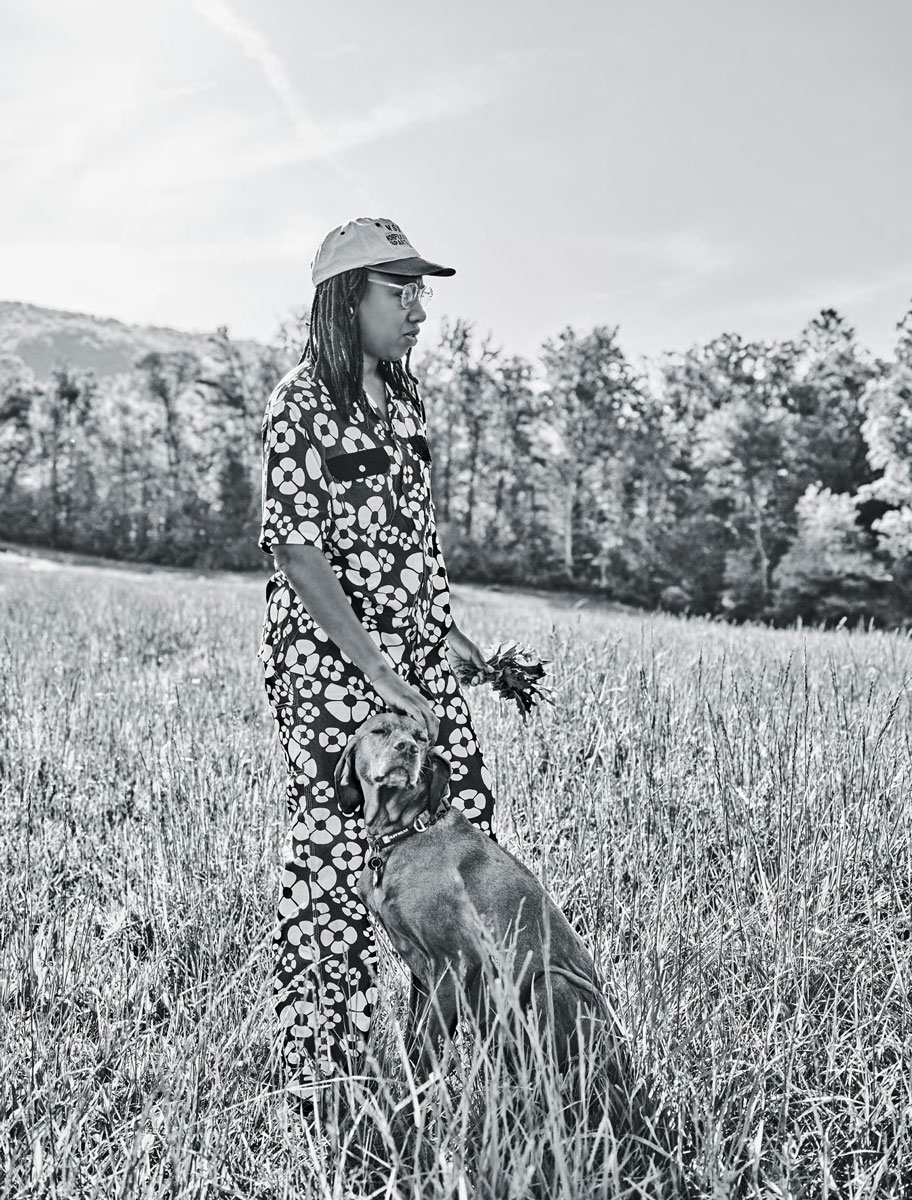
Chef Ashleigh Shanti and her dogChef Ashleigh Shanti and her dog (Photo by Johnny Autry)
The following interview has been lightly edited for clarity and length. 

For those unaware of your journey since competing on "Top Chef," can you break it down for them? 

Since competing on "Top Chef: Houston" in 2021, I’ve written my first cookbook, "Our South" and turned my pop up Good Hot Fish into a brick and mortar in Asheville, North Carolina.

What stands out for you as a formative moment that got you into cooking or food at large? 

Standing at the feet of the women in my family for Sunday dinners and holidays. As a kid, the kitchen was always the gathering place in my family and I distinctly remember food serving as the great unifier for all of us.

What would you say are your three most used ingredients? What is your favorite cooking memory? 

My three most used ingredients right now would have to be cornmeal, seasoning meat and sorghum molasses. My favorite cooking memories are our outdoor family fish fries.

What’s your biggest tip for cutting down on food waste? 

I reduce food waste by creatively utilizing every part of the ingredients I use. If it’s a vegetable, I’m using it from seed to stem — pickling or fermenting some parts, stewing other parts and saving its cooking liquid for another use.

How do you practice sustainability in your cooking? 

At Good Hot Fish, we only use sustainable seafood that comes from our coast. We use the MSC [Marine Stewardship Council] Blue Fish Guide to Sustainable Seafood as our standard 

Do you have a favorite recipe in the book? Or even just a favorite section or chapter?

I live in Asheville, North Carolina and post Hurricane-Helene, this community has become even more special and meaningful to me. I’m glad I got to capture its beauty and the sense of community that exists in this special region [in the book].


Want more great food writing and recipes? Subscribe to Salon Food's newsletter, The Bite.


Is there a recipe in the book that you think is perfect for a beginner cook? Or is there a more involved recipe in the book that you think would make for a great weekend project? 

Leather Britches makes for a great community-building project!

How would you say your identity informs your cooking? 

As a Black chef, the lens in which I cook is so vast, being not only influenced by my family’s foodways, but the African Diaspora is also so rich — and its impact is reflected in so many different cuisines, not just my own.

Can you speak a bit to how the Black and Appalachian foodways have influenced you, both personally and professionally? 

Appalachian foodways are unique and not often highlighted as a type of Southern cuisine. Post-Jim Crow era, many freed Black people found place in the mountains of Southern Appalachia which has contributed to the richness of food traditions here.

You posted a message on Instagram last month after the hurricane, highlighting the resilience of "our Appalachian mountain town"  could you speak a bit to that?

Mountain people are resilient. This is a place where many different cultures and backgrounds unite and come together to look out for one another as a community. 

For anyone unfamiliar with Good Hot Fish, how would you sum up its ethos? 

Good Hot Fish is a modern-day fish camp nestled in the Southside of Asheville, a place where small Black business once thrived. Our space pays homage to that and highlights fish fries being at the center of black community gatherings.

Is there a number-one go-to, hottest menu item at Good Hot Fish? Or do you have a personal fave? 

The Cabbage Pancake is one of our most popular items and it’s a dish that has followed me throughout my career, so it’s taken on many different forms, each one better than the last.

Chef Ashleigh ShantiChef Ashleigh Shanti (Photo by Johnny Autry)

What does the cookbook title "Our South" mean to you? 

In writing my first cookbook, it was an important moment for me where I felt like I finally held ownership of my own stories and the name reflects that.

"Our South" delves into five distinct geographic regions. How do these regions differ in terms of ingredients, flavors and culture? 

Cooking seasonally being one of the cornerstones of Southern cooking, a lot of readers will find diversity in the ingredients that are found in certain regions that you won’t see in others. 

For instance, ramps are distinctly Appalachian.

We need your help to stay independent

Are there any particular key ingredients in the cookbook that you think are most important or significant within Black foodways? Do you have a number-one favorite ingredient to work with?

The book highlights a list of kitchen essentials that every self-respecting Southerner should have in their pantry. It’s where I recommend readers start their Southern cooking journey.

Could you speak a bit to how you bridge history and modernity through your recipes, highlighting and honoring the past but bringing it to the future? 

The historic recipes I’ve been thankful enough to have access to leave a lot of room for creativity with measurements, like “palmful’ and “a little bit.” A lot can be left up to interpretation which is where I get to turn my “chef brain” on.

What's next for you, ideally?

I am knee-deep in reopening Good Hot Fish after a six week-long closure due to Hurricane Helene. My community is my biggest focus. 

In the future, I’d like to see a few more Good Hot Fish locations throughout the South. 

“We’re not going to be the ‘Stupid Country’ any longer”: Trump fumes at WSJ op-ed bashing tariffs

If we've learned anything over the last decade, it's that Donald Trump is never "above" an argument. 

In a post to Truth Social on Sunday, the president shot back at a Wall Street Journal op-ed criticizing his tariffs on Canada and Mexico. He called the paper a shill for the "tariff lobby" and "always wrong" before saying that two of our biggest trade partners had been engaging in a "decades-long ripoff of America" prior to the tariffs he ordered on Saturday. 

"The USA has major deficits with Canada, Mexico, and China (and almost all countries!), owes 36 Trillion Dollars, and we’re not going to be the 'Stupid Country' any longer," he wrote. "MAKE YOUR PRODUCT IN THE USA AND THERE ARE NO TARIFFS!"

The Wall Street Journal pointed out that Trump's tariffs double back on the deal that Trump himself negotiated during his first term. 

"The U.S. willingness to ignore its treaty obligations, even with friends, won’t make other countries eager to do deals," they wrote. "Maybe Mr. Trump will claim victory and pull back if he wins some token concessions. But if a North American trade war persists, it will qualify as one of the dumbest in history.”

Trump countered that his tariffs would usher in a "Golden Age of America" even if they might cause pain to U.S. consumers.

"THIS WILL BE THE GOLDEN AGE OF AMERICA! WILL THERE BE SOME PAIN? YES, MAYBE (AND MAYBE NOT!). BUT WE WILL MAKE AMERICA GREAT AGAIN," he wrote. "IT WILL ALL BE WORTH THE PRICE THAT MUST BE PAID. WE ARE A COUNTRY THAT IS NOW BEING RUN WITH COMMON SENSE — AND THE RESULTS WILL BE SPECTACULAR!!!"

Trump administration’s communication freeze restricted access to critical bird flu information

For the last four years, the H5N1 virus, also known as bird flu, has been ravaging wild bird populations, spilling over into other species and infecting poultry and dairy cows. At least 67 human cases have been reported, each one slightly raising the chances of another pandemic like COVID-19. Researchers and public health officials have been putting forth efforts to better understand how bird flu is passed between species to keep it from mutating into something that could become a virus with pandemic potential. 

However, the Trump administration has blocked the release of some of the information used to protect against H5N1 and understand this risk, including studies that show how frequently veterinarians who treat cows had been unknowingly infected.

Veterinarians and public health officials say this and other information frozen in the “immediate pause” on communication issued by the Trump admin that has caused widespread chaos and confusion in federal agencies is critical to ensure that bird flu doesn’t spiral out of control and turn into a full-blown pandemic.

“There was a serology study that was going to be reported about veterinarians with direct contact to cattle,” said Dr. Abraar Karan, an infectious disease physician at Stanford University. “That would be very interesting information because many of us that are working in this space have suspicions that there are undetected spillovers happening.” 


Want more health and science stories in your inbox? Subscribe to Salon's weekly newsletter Lab Notes.


In California, by and large the nation’s largest supplier of milk, as well as the epicenter of the bird flu crisis, more than 70% of dairy herds have been infected. Roughly half of the bird flu infections that have occurred in humans in the U.S. to date have occurred in people working on dairy farms in California. Earlier this month, the first human death in this bird flu outbreak was reported in Louisiana, though this person was exposed through a backyard flock.

“We want to know what the risk is here, especially with this new highly pathogenic avian influenza strain now being reported at a California duck farm, H5N9,” said Crystal Heath, a veterinarian and executive director of Our Honor, a nonprofit that supports veterinarians. “Are we at a higher risk than even dairy workers because of the nature of our work? Should we be ramping up PPE [personal protective equipment]?”

"Many of us that are working in this space have suspicions that there are undetected spillovers happening.” "

The results of these studies were due to be presented in the Centers for Disease Control and Prevention’s Morbidity and Mortality Weekly Report, which has not missed a publication since it began. Other results from a study exploring whether the virus could be transmitted to pet cats was also scheduled to be presented but was not, as reported by KFF Health News.

The delays come as a result of a memo sent during President Donald Trump’s first day in office, in which the acting secretary of the Department of Health and Human Services (HHS) Dorothy Fink asked that no information be shared with the public and no engaging in any public speaking events until they have “been reviewed and approved by a Presidential appointee.”

The Trump Administration also issued a memo that froze federal funding for research programs, schools, and other organizations that rely on federal dollars only to rescind it a couple of days later.

In a statement, a CDC spokesperson told Salon that the HHS issued that this was a “short pause to allow the new team to set up a process for review and prioritization,” and that exceptions can be made to this announcement but that those will be determined on a case-by-case basis.

We need your help to stay independent

Together, the flurry of action from the White House in Trump’s first week of office also led to the cancellation of various scientific meetings and led to delays and confusion for researchers in the process of getting grants approved to study things like bird flu. 

Experts say the communications freeze comes at a time when surveillance and public outreach should be increasing due to the continued spread of bird flu across the country. The recent appearance of the new strain of bird flu, H5N9 in ducks in California, is the latest development that shows the virus is changing in pertinent ways. That’s because this indicates that the virus has most likely already undergone a process of viral reassortment, in which the virus evolves into becoming something more dangerous to humans.

“The [Trump administration] said the pause is to set up a process for review and prioritization of communication,” Heath told Salon in a phone interview. “But based on Trump’s handling of COVID-19 during the prior administration, I am worried that their process for review and prioritization could pose an even greater threat to public health.”

The Substack invasion: When the tech bros came for journalism, everything changed

As I said to journalist Eoin Higgins at one point during our recent conversation, in this case the call is coming from inside the house. I didn’t just mean that one journalist was interviewing another — about a book that is, itself, largely about the world of journalism — although that’s true enough. Or even that three articles that originally appeared in Salon (by way of Higgins’ previous gig at the Institute of Public Accuracy) now appear in his new book, "Owned: How Tech Billionaires on the Right Bought the Loudest Voices on the Left," although that’s true too. (One such Salon article is linked below.)

What I meant was that Higgins and I (who have never met in person, for the record) feel uncomfortably close in some ways to the subject of his book, which tells the story of how the semi-legendary crusading journalists Glenn Greenwald and Matt Taibbi gradually drifted toward the MAGA-friendly right, and made lots of money in doing so. It’s not just the story of two cantankerous dudes becoming far more cantankerous — although, as Higgins himself suggests, that’s undeniably part of the story — but it’s also not some MSNBC propaganda narrative about dissident left-wingers actually being paid shills for Russia (as has been suggested, I believe, about both of those guys).

Where the discomfort comes in is that Higgins and I are both precisely the kind of civil-libertarian leftists who agreed, to a significant degree, with the scathing criticisms that Greenwald and Taibbi (among others) directed at the liberal-Democratic consensus during the Obama years and the first Trump term. Higgins was a friend and admirer of Greenwald’s in particular; I knew Greenwald less well (although I was a staff writer for Salon when he was a columnist here) but have defended his prickly perspective on several occasions and have avoided criticizing him in print. Neither of us knew Taibbi well, but his ferocious reporting on the George W. Bush administration and the financial crisis of 2008, for Rolling Stone and elsewhere, created a reputation that has now diminished nearly all the way to nothing.

Once it became impossible to follow these two into the lucrative tech-bro spaces of Substack and the so-called intellectual dark web — where they joined other media refugees like former New York Times columnist Bari Weiss — the painful question emerged of what had happened and why. Some answers were entirely too obvious (ka-ching); others seemed too painful. 

Greenwald became a regular guest on Tucker Carlson's Fox News show during its latter months on the air; Taibbi wrote up the "Twitter Files," apparently convincing himself that a trove of internal corporate records personally curated and delivered by Elon Musk somehow qualified as a scoop. As Higgins tells the story in “Owned,” which at times feels like one of those thrillers where you can’t quite work out who the good guys are, all of this was part of a much larger pattern — a campaign by some of the richest men in the world to control the flow of information, especially when it was about them. With Donald Trump back in the White House and Musk apparently in control of the federal workforce, a sinister new chapter appears to have begun. Let’s let Eoin Higgins take it from here.

This interview transcript has been edited for clarity and length: For instance, I’ve placed our discussion of Substack at the top even though it occurred toward the end of our conversation.

Substack plays an important role in this story, and even to media professionals its appearance and prominence over the past few years were startling and unexpected. So tell us how that platform came into being and what it represents in your book. 

Sure. Substack is a newsletter service. It was started, I think. in 2017. It's basically, like, a successor to Blogspot. It's where people can write whatever they want. And in this case, it has a great UX system. It looks great. It has streamlined subscription and revenue generation. It's a very slick, very good product. In 2019, I believe, tech billionaire Marc Andreessen led a funding round and put a lot of money into it. With that money, Substack was able to start giving paid deals to writers to entice them from their jobs, to come over to Substack and write there. Effectively, what happened is that they peeled off some mainstream writers, and they started to find that the politics of the people there began to tilt right, especially on some socially conservative topics like trans rights, which has been kind of the big one.

I see the transphobia stuff as part of the story, but the bigger part of the story is the peeling off of these established writers from the publications that they wrote for previously, which devalues the publications with their departure. It decentralizes media in a way that is not inherently negative in a vacuum, but when it's being pushed by someone like Andreessen — someone who does not like the media, because the media can be critical of him — you have to wonder what the reasoning is. I believe that was the reason: an attempt to decentralize the media and kind of break it down.

Right. So just to summarize that briefly, it was both an attempt to foreground more right-wing voices, accidentally or otherwise, and an attempt to disempower or undercut more traditional forms of media.

Yeah, I mean, that's totally my belief. 

Well, here you are, Eoin, with this book about this Big Tech attack on media hitting less than a month into the second Trump administration. You couldn't have planned that any better. Did you actually predict all this?

Honestly, no. When Bold Type Books pitched me on doing this, they said, we want someone to write about Glenn and Matt, and you've been suggested by a number of people as the right person to do this. I was like, yes, of course, but I would also like to make it about how tech billionaires were investing all this money into alternative media. Not alternative media like Salon, but alternative media like Substack and Callin and and all this stuff, in order to create a media ecosystem that favored them, one that would act almost like a PR arm for them.

Substack "peeled off established writers from the publications that they wrote for previously, which devalues the publication. … It decentralizes media in a way that is not inherently negative, but when it's being pushed by someone like Marc Andreessen, you have to wonder what the reasoning is."

At the time, it wasn’t that explicit, but I said, I would also like to dig into these guys, I want to talk about where the money is coming from. They were like, yeah, that sounds great. So I wrote it pretty quickly, and we were going through the editing process. The draft was done in February 2024, and I was like, let's try and get it out before the election. They were like, OK, that’s not going to happen. That's not how publishing works.

I complained about that, but they convinced me that this was the right way to go. So we set the publishing date, and Joe Biden was still the nominee. Then, when Kamala Harris came in, I was like, this is good for the world, but not necessarily good for my book, right? [Laughter.]

I was really involved with pushing for an earlier date, and it turned out that I was completely wrong. I should have listened to them in the first place. I felt like there was no way that Trump would get elected again. I just didn't think there was any way that people would want to do that again. I think I just misjudged how bad things had been during Biden. I had a massive blind spot there. 

So now the book is coming out — and look at what Elon Musk is doing, look at the Peter Thiel stuff. The tech stuff has started to become more important than the media stuff, although I think it’s really important to understand the media stuff, the information ecosystem that these people have created around them. So this is hitting at this time where, you know, a lefty, independent book focused on media criticism probably would not have the same buzz.

Yeah, and you somewhat anticipate my next question. Why write a book about two journalists who, as famous or notorious as they may be in our profession, are not widely known to the general public? The answer, in some ways, is that that’s not what your book is really about. But I’d like to hear your answer.

Well, I think that Glenn and Matt are well known to a certain age cohort. I think people who were in college between about 2005 to 2015 definitely know who these guys are. Not because of their Twitter accounts and their punditry, but because of the work they did. Specifically, I mean, Glenn's reporting on Edward Snowden, that was world-changing stuff. That’s in the history books forever. No matter what else he ever does, he's always going to be known for that. It’s not a footnote. 

Matt Taibbi is less prominent, but certainly people who were in school or who were young in general during the financial crisis are aware of him. I have a lot of friends who are apolitical, you know, working people who don't have the same deranged interest in politics that I do, right? They’re just not interested. But they know who these guys are.

That’s interesting. I wouldn’t have guessed that. 

Well, because they're my age, they're in their mid 40s, right? Writing a book about the tech takeover of media — I mean, you could sell that book now, but when I was contracted to do this, there wasn't the same huge interest in it. So using the journeys of these two people who are highly influential was a good way of exploring the themes around tech and control of information in the media. So I would gently push back on the idea that they're not that well known, but maybe the point you're getting at is that they are not nearly so influential now, right? And that's definitely true.

"Glenn Greenwald's reporting on Edward Snowden, that was world-changing stuff. That’s in the history books forever. No matter what else he ever does, he's always going to be known for that. It’s not a footnote."

Their influence was starting to wane a little when I started to write the book, but I've been surprised by how far they've fallen off the radar, over the last year-plus. With Taibbi, the big thing was the "Twitter Files." He got some headlines out of that, but people aren't really paying a lot of attention to him anymore. Glenn is siloed off on Rumble, which is good for him money-wise, but his audience has to be shrinking at this point. I mean, there's not a lot of people who are interested in that platform. I don't want to say he doesn't have a large audience, but it’s no longer a hugely influential audience. I think The Intercept needed him. That’s undeniable, if you look at the way things have gone for them since he left. But the reverse is also true. He needed them as well, and I think they both are worse off now. 

Yeah, I agree with most of that. I definitely agree with you on Greenwald's importance when it comes to the Snowden revelations, and that speaks to why you were the person to write this book. If you understand the metaphor, the call is coming from inside the house, right? You understand the worldview that these guys, at least at one time, appeared to represent. You’re not coming at them from the outside, from an MSNBC perspective or a mainstream Democratic perspective. You’re not going to accuse them of being Russian agents. You’re more closely aligned with these guys than a lot of their critics would be.

Yeah. I mean, totally. When I was in college — I went to college late — that was when Glenn had just started to write for Salon. And, like, immediately, he was speaking to me, I was a fan. And my good friend in college, who I used to talk about this stuff with a lot, he felt the same way about Taibbi. I was totally locked in. I think I describe myself in the book as a civil libertarian leftist, and I still am. The specifics of my political belief system are based in my reaction to the War on Terror under George W. Bush. For someone like that, for someone with my views, who better to express that, at that time, than a polemicist like Glenn Greenwald, who was able to put that stuff into words and take the fight to the people who were spreading the mainstream message of war and authoritarianism?

Your book strikes me, in a way, as a companion piece to Spencer Ackerman’s "Reign of Terror," which is probably the best single work on how the post-9/11 era and the War on Terror changed this country. Do you agree with that? 

If you're gonna say that my book is a companion to Spencer's, that's a huge compliment. Yeah, a lot of the front half of the book is my response to the War on Terror, which was what Glenn was addressing at the time. I’m obviously not neutral, right? I'm being very clear that I agree with him. I still agree with him about a lot of this stuff. 

There's a moment, and this is quoting Glenn, when he’s talking about how his friendship with Rachel Maddow fell apart, and he says, "I thought we believed the same things, and then she just became this establishment voice for this kind of state power, War on Terror stuff, as long as as it was the Democrats doing it." I think there's a lot of truth to that. I understand that frustration, just as I understand Matt’s frustration in "Hate Inc." when he talks about how Maddow and MSNBC are damaging to their audiences.

But where they both start to lose me is that if you're going to say that MSNBC is as damaging as Fox, I'm going to need to see more evidence for that. Because with Fox, I mean, it’s about the audience. If you're radicalizing the audience of Fox News, the results are going to be a lot worse than if you radicalize a liberal audience, quite frankly. So if you line those two up and make a parallel comparison, the way that Taibbi does explicitly in “Hate Inc.,” and like both Glenn and Matt did for a long time — before they both came to this conclusion that, actually, the big problem is the Democrats — I think you're kind of playing yourself at that point. You’re not really thinking clearly.

It was almost painful to me to read those early sections of your book, because the critique that both of those guys, and especially Glenn, have offered about mainstream Democrats capitulating to certain ideas about state power and mass surveillance — I mean, that's all true, right? I imagine you and I are in accord on that. And the unanswerable question that I have is, OK, if you make that critique, where does the loss of perspective come in? How do you decide that the enemy of your enemy has to be your friend now, and that somehow the Republican side is less guilty of, you know, truly noxious things? I don't get that part at all. 

Yeah, I don't know how that really happens. I mean, I can talk about how I see it happening, and I will. But I think there's a more interesting question that you're asking, which is, like, how does that happen psychologically, right? My answer to that is also, I don't know. I wish I knew, because I can kind of lay out the facts on what happened.

"There's a moment when Glenn is talking about how his friendship with Rachel Maddow fell apart, and he says, 'I thought we believed the same things and then she just became this establishment voice for state-power, War on Terror stuff, as long as as it was the Democrats doing it.'"

With Glenn, I see somebody who aligned himself with liberals during the the latter Bush years and made a career for himself doing this, pushing back on the civil-liberties infringements and the authoritarianism of the Bush regime. Then he watched liberals, over eight years, just abandon all of that because of their partisan affiliation with Barack Obama. OK, so I'm with him on that 100 percent. Like, there's no question. That’s why, in most of my political writing, I'm so harsh on Democrats, because I just don't care about Republicans. I think they're a lost cause. I don't care, right? I mean, they can cause a lot of damage. They matter in that way, and  should be criticized in that way. But I'm not criticizing them, because I don't expect anything else. 

And then Trump becomes president. I don’t think Glenn was a supporter of his, right? But what he didn't like, which was the same as me and the same as almost everybody I quote in the book favorably, was the Democrats becoming obsessed with Russia and refusing to address any of the things that got us the point where Trump got elected in the first place. They squandered two-plus years where they could have been fighting back against the Trump agenda on, you know, conspiracy theories and pretending that there was some vast overseas plot to overthrow the U.S. That was a massive, massive mistake. That was a disaster. 

But Glenn took this and instead of having it become, hey, let's continue to resist state power irrespective of who's in power, he became completely obsessed with Democrats and liberals and the way that they were responding. He’s always had some right-winger to him, you know, some conservative beliefs. That's very American of him. Most Americans aren't one or the other, right? That's fine. But he basically decided that liberals were the problem, and I think the attention that he got from that, and the way that he got flattered and worked by the alt-right media machine, including Tucker Carlson and Fox News, and then the tech guys, I think that just solidified it. And then when he found that there was an opportunity, he took it.

Meaning an opportunity to go to an independent platform — Substack, in this case — and make a lot of money doing so? 

Yeah. I feel like that had been building for a while, and when it happened, it wasn't super surprising. Even then, I held out some hope. You know, I was still friendly with him on a superficial online level. But he just went too far in a direction that I couldn't follow, and then I started to see him as this character who was more interested in his own advancement than in any of the principles that he had built his career on. Maybe I was finally seeing him for who he really was, you know? A lot of people would probably argue that.

As far as Taibbi goes, I mean, he also rejected the Russiagate stuff in probably harsher terms than Glenn did, which earned him a lot of anger from liberals. Then the #metoo scandal hit [regarding allegations from Taibbi's earlier career in Russia] and I think he just slowly drifted to the right. You know, I think he was always regarded with suspicion by some people on the left. Liberals were eager to have a reason to be done with him anyway. So that was kind of a perfect storm and by 2020, COVID kind of drove him insane. Maybe that happened before COVID, but now the stuff he's saying, it's just completely out to lunch. He's just an anti-vax conspiracy theorist. He seems to be really flailing, trying to find any kind of audience that he can at this point, like with the “Twitter Files.” He obviously thought that was going to be his noted moment, and it just didn't hit. 


Want a daily wrap-up of all the news and commentary Salon has to offer? Subscribe to our morning newsletter, Crash Course.


That was so lame. I don't know how somebody who worked as a professional journalist for so long could think that was really going to work, or could fail to understand that he was being played, or was willfully playing himself. 

No, I don't either. I've always maintained that while there wasn't much in there that was earth-shattering, it was really interesting to see how they made decisions. But it's not world-changing reporting, and then when you find out that Elon Musk cherry-picked this stuff, and there was other stuff Matt couldn't look at. I think it just wasn't there. That was another disappointment in a career that had increasingly become about disappointment. And you know, then the right was willing to support him and be friendly to him, so he just embraced their beliefs.

One thing your book winds up being about, maybe by accident, is the importance of ideology. You make the argument that neither of these guys was strongly motivated by ideology. Maybe Greenwald had an ideology, kind of, and people interpreted it in different ways at different times. But I think we can say that neither of these guys was a committed leftist for ideological reasons. I’m not the kind of person who thinks that's the most important thing in life, and I bet you’re not either. But that’s part of the story here, right? 

"They’re both Gen X, right? Like, they just have this kind of nihilism. I can say that, because I'm on the cusp. … I do think there is something kind of nihilistic: 'Don’t sell out, man,' even as you're selling out. That kind of thing."

Yeah. I mean, as it turned out, Glenn didn't really believe in a lot. I think he is committed to the cause of Palestine, or at least committed against Israel. I don't know if that's because of deep belief, but I don't see any reason to read him in bad faith on that. Similarly, I don't know if his belief in free speech is based on a belief that everybody should have the right to speak, or if he just likes fighting for people whose speech is seen as repulsive. But, you know, his rants are pretty fungible. He's very happy to turn on people and say the opposite thing that he said a few months or a year ago. I think he's just kind of self interested.

As far as Taibbi goes, I mean, I say this in the book, but they’re both Gen X, right? Like, they just have this kind of nihilism. Yeah, I can say that, because I'm on the cusp. [Laughter.] I'm not a millennial talking about Gen X from afar. I don’t want to make it sound totally self-important, but I do think there is something that's kind of nihilistic: “Don’t sell out, man,” even as you're selling out. That kind of thing.

There's a quote by Glenn in the epilogue. I gave him a whole block quote because I just thought it was so interesting. He was describing Taibbi, but he was kind of describing himself too, talking about getting more conservative as you get older. I really thought that was kind of a perfect way to describe a lot of what happened.

When I was reading over the transcript, I was like, if this was just some guy, a lawyer or whoever, who had the same politics Glenn had during the Bush administration and was now in his mid-50s, who hadn’t had this history of being a big-time journalist and writing books that sold hundreds of thousands of copies — if this was just some guy saying this, it makes sense. You get more conservative as you get older, and maybe you decide that liberalism has gone too far once it starts to annoy you to the point that you start feeling uncomfortable. You know, there's nothing particularly unique about that. I think that does have something. I don't think it's everything. I think it’s something.

It's definitely something. Any final words?

What I would like your readers to do, whether they are fans of Glenn from his days at Salon or after, or they are opponents of Glenn and Matt, whichever they are, I invite them to come into this with an open mind. I have a defined point of view that I think comes through in this book, but I also pride myself on being as fair as possible. Matt wouldn’t talk to me, but I gave Glenn every opportunity to push back on what people are saying. I don’t know whether Glenn comes off well, but we spoke for nearly three hours, and you definitely get his side of the story.

So you hit the jackpot? Here’s what to do with a large payout

Most of us are closer to homelessness than becoming a billionaire. According to a recent Bank of America survey, almost half of Americans believe they live paycheck to paycheck

Coming into a large chunk of cash is a nice thought, and for some people it actually happens. A few folks are lottery winners and rolling in cash, while others get large payouts through an inheritance or a refund. 

Regardless of how the windfall arrives, knowing how to manage it is essential; otherwise, you could struggle to make ends meet and possibly be worse off than you were before. Here’s how to handle your money if you end up with a hefty payout.

Understand where the money is coming from

How you receive your money could impact how you handle it, particularly if it's inherited, said Elizabeth Buffardi, a financial planner, founder and president of Crescendo Financial Planners.

"Money is emotional even in the best of times," she said. "Very often, [clients] tell the story of how hard the relative had to work to accumulate it and they want to make sure they honor that hard work by making sure they put it to good use.”

Stephen Kates, a financial planner and principal financial analyst at Annuity.org, says you might need different types of accounts, depending on how you receive your money.

"If the money is in the form of a check or cash, it will be easy to deposit," he said. "If it’s an inheritance, you may need to open the right type of account to hold the assets."

Kates says if you inherit something like a retirement account, you’ll need to open an IRA to move those funds into. If you inherit stock, you’ll need a brokerage account.

Get good advice

Not every financial expert is the same. The kind of payout you get and how much you get can impact where you get help.

"Some people need someone to manage the money they have received," Buffardi said. "Some people are looking for more advice like paying off a mortgage, student loans or credit card debt.  Some people want a holistic overview of everything they have."

If you’ve never talked with a financial adviser or planner, it’s hard to figure out where to start. Consider the help you need and remember that your circumstances might not necessarily be the same as someone else’s, which means the type of help you get may not be the same, either.

"If you will be receiving a large amount of money, you should seek out a financial adviser to help you plan how to invest and manage those assets," Kates said. "You may also need to speak with an attorney or accountant to handle legal or tax responsibilities. With substantial assets, employing a team of advisers may be the difference between generational wealth and dwindling resources."

"If you will be receiving a large amount of money, you should seek out a financial adviser to help you plan how to invest and manage those assets"

Look first for a fiduciary financial advisor. A fiduciary is legally and ethically obligated to put your best interest first. Some financial advisers would rather give advice that earns them the most money may not be right for you. 

Also look for a fee-only financial adviser. These advisers and planners get paid a flat rate for their services rather than a commission. Advisers who get paid by commission might be more inclined to sell you products or services that earn them more money, even if those things aren’t necessarily best for you.

Avoid debt and regret

Managing your money depends on several factors, including how much you receive and your long-term plans. Kates suggests starting with an emergency fund and paying down debt.

"Building an emergency fund insulates you from other unexpected expenses or financial issues in the future," he said. "Credit card balances or personal loans can be especially draining on your finances," so you may want to tackle paying off high-interest debt sooner rather than later.

Large purchases might sound fun, but they aren’t always responsible — especially since they might put you in a worse financial position than before.

"The worst thing you can do with your windfall is make spontaneous financial decisions"

"These should be limited to planned and vetted choices," Kates said. "The worst thing you can do with your windfall is make spontaneous financial decisions. Plan and evaluate what money is available for spending after you have shored up the other aspects of your finances."

Buffardi suggests managing money one step at a time. Like Kates, she encourages an emergency fund first. After that, it’s up to you.

"What is the goal of this money?" she asks her clients. "Sometimes, clients know exactly what they want to do and sometimes they are overwhelmed by all the choices that they don't know where to start. If they don't have specific goals, I like to go step by step to figure out where they are and how we use this new money to make things better."

Avoid talking to lots of friends and family about your recent influx of money. Money can cause a lot of strong emotions, even among partners and relatives. Do your best to work out a plan with a trusted financial adviser or planner, even if that means expanding your team based on recommended advice.

Bihar, India banned alcohol nine years ago. It’s failing just like American Prohibition

Late last year, I was in Bodh Gaya in the northern Indian state of Bihar, the birthplace of Buddhism, on the first night of Diwali, the Hindu festival of light. Candles and colored lights radiated a warm glow over the walls of this riverside neighborhood. I purchased a firework intriguingly labelled “The Hulk” and set it down next to an abandoned one-story house, which was being occupied as a drinking and gambling den. The twenty-odd men inside were playing a game of cards, surrounded by plastic cups and green bottles filled with a liquid that was hardly lemonade.

However, I’d accidentally left the firework upside-down, and instead of exploding upwards it exploded sideways, engulfing me in a whirlwind of brightly-glowing stars. Cries of dismay sounded from the derelict house as the cloud of sparks flooded inside, interrupting the game and burning a small hole in one man’s shirt. The local children, at least, were amused. I was given a stern look and apologized. An hour or two later, more shouts emanated from the house. One of the players, who’d apparently been caught cheating, bolted through the side door, pursued by an angry, drunken mob. 

It's scenes like this that led Bihar to ban booze in 2016. With a population of nearly 130 million – roughly the same as the entire country of Mexico – this single state in India now has the most people living under dry laws than anywhere else on the planet. The parallels with early 20th century Prohibition in America – gangsters, feminists, minorities, corruption, doctor’s notes, speakeasies and moonshine – are strikingly similar.

“People will drink. Who can stop anybody from eating and drinking what they want to?” says Sudha Varghese, founder and director of Nari Gunjan, an NGO devoted to uplifting women in marginalised Bihari communities. “If they’re not producing [alcohol], then they are drinking happily in plenty. They forget whatever restrictions there were. You don’t go to a public place to buy, now it comes to your home.”

Indian drinking culture dates back to earliest recorded history. Toddy, for instance — a sweet, refreshing, vinegar-smelling drink made from the sap of palm trees in southern India — has been known since ancient times. And in the epic tale, the “Ramayana,” the hero Rama indulges in wine with his wife, Sita.

Prohibition is intertwined with the birth of the modern Indian nation itself.

But while Western society is divided by class, race and gender, Hindu society is also divided by an elaborate caste system: there’s castes of merchants, cobblers, jugglers and acrobats, who’re not supposed to mingle or intermarry. On the top are Brahmins, the priestly class; while at the bottom are Dalits, a caste so lowly you’re not even supposed to shake hands with them. The caste you're born into determines the rest of your life, and lower-castes endure daily discrimination in terms of jobs, education and social standing. Over a third of lower-caste Indians are illiterate, compared to roughly a fifth on average. According to Hindu customs, warriors and kings may only imbibe on special occasions, while Brahmins must remain teetotal. The lower you climb down the caste ladder, the more people drink, and for Dalits there are few taboos at all.

Bottles of liquor being destroyed Liquor Ban Bihar IndiaBottles of country liquor being destroyed on March 31, 2016 on the outskirts of Patna, India. (AP Dube/Hindustan Times via Getty Images)

Prohibition is intertwined with the birth of the modern Indian nation itself.

Drinking grew more popular under colonial rule, becoming a rallying point for the independence movement, who boycotted the British-owned liquor industry. Proponents of prohibition argued that drinking culture was alien to India – while that’s debatable, the colonials filled their coffers with the liquor tax and certainly encouraged it. Mahatma Gandhi, who was famously teetotal, saw it as another way for the Man to keep the Brown Brother down.

“If I were appointed dictator for one hour for all India, the first thing I would do would be to close without compensation all the liquor shops [and] destroy all the toddy palms such as I know them,” he once said.

In 1947, India won its independence and Gandhi was assassinated by a Hindu fanatic angry at his outreach to Muslims. In the new nation, prohibition seemed like a shortcut to fix all their social problems. Upper-caste Hindus considered drinking a scourge to be eradicated, and were undeterred by Prohibition’s abject failure in America, a land they considered beyond saving anyway. Dalits, Christians and Parsis (those who practice Zoroastrians, an ancient religion from Persia) argued that drinking was not anathema to them and in fact part of their customs. Furthermore,  most who drank did so occasionally, while hardcore winos would switch to dangerous moonshine. But no one wanted to contradict Gandhi’s memory and so prohibition was enshrined into India’s new constitution, though in practice it was only implemented in a handful of states such as in the great city of Bombay, currently known as Mumbai.

What the naysayers predicted is exactly what happened in the end. Just like the rise of the Mob during American Prohibition, Bombay’s booze ban led to the rise of the powerful Mumbai mafia, whose illicit distilleries in Dharavi, the swampland slum from “Slumdog Millionaire,” churned out hundreds of litres of hooch each night. Distillers threw rotten fruit and molasses waste in the gallon to brew with ammonium chloride to produce something called “snake juice,” which was collected by lepers and taken around the city. 


Want more health and science stories in your inbox? Subscribe to Salon's weekly newsletter Lab Notes.


Lepers made ideal runners, as the cops didn’t wanna touch them, and if they ever did come close enough to slap on the handcuffs, the lepers were often missing fingerprints (as well as the fingers themselves.) The lepers carried the hooch to speakeasies known as “aunty bars”, often operated by families from Goa, an enclave colonized by the Portuguese and converted to Christianity. The Goans paid monthly protection fees to Bombay’s finest to be left alone and given advance warning of raids. But enforcement was lax anyway, not least because the police themselves liked a tipple.

Not everyone had to chug ghetto grog. Wealthier Indians could afford fancy scotch smuggled by sailors. Since alcohol withdrawal can be fatal, chronic drunkards could show a doctor’s note for a prescription. And the rules didn’t apply to gora (foreigners) either, of course. But in 1963, Bombay lifted prohibition to save “the people from ruining their health by drinking illicit liquor, which was in most cases worse than poison.” 

Bombay’s noble experiment was repeated, and repealed, in several other Indian states.

"Women cannot say that because of the ban there is no domestic abuse."

As was partly the case in America, the charge towards prohibition was led by women’s movements. Women throughout India have long called for liquor bans to reign in their drunken husbands, who squandered all their earnings drinking the toddy bar dry before stumbling home and assaulting them. India is a relatively sober place compared to the West (average alcohol consumption of 4.9 litres per capita, compared to 9.2 in Europe and 7.5 in the Americas), but those who drink tend to get absolutely hammered: according to the WHO, 93% of alcohol consumed in India comes in the form of hard spirits, and drinkers are overwhelmingly men.

Bihar’s anti-alcohol campaign began in the rural village of Konar in 2013 where a group of sixty or so angry women, outraged at seeing their children sipping leftovers which had been left lying around, demanded their local wine shop be closed, and when the owner refused, shut the door with a padlock. The protests spread to other villages, with female vigilantes smashing bottles of naughty water like a desi Carrie Nation.

Bihar is one of India’s poorest states but also has perhaps the greatest women’s participation in politics. The Jeevika organization, which connected women’s groups across the state, mobilized a quarter of Bihari women into calling for alcohol to be outlawed. Courting the female vote, the state’s Chief Minister Nitish Kumar made the dry law a bedrock of his re-election campaign and signed the Bihar Prohibition and Excise Act in 2016.

The policy appeared to have some initial success. Drinking dipped substantially – after three years, by 41% among men and nearly 70% for women – and families had more disposable income: in the first year of prohibition, the sale of saris surged 1,715%. 

According to certain studies, domestic abuse and drunken brawls have become less common. But as we’ve seen, drinking persists.

“Women cannot say that because of the ban there is no domestic abuse,” Sudha shook her head. “I don't see that as a big positive effect of the ban. Maybe one or other of the men who used to drink a lot, come and beat up their wives, [but] those women who were abused for various reasons, they are abused today also.”

Part of the reason is Bihar is surrounded by “wet” states. Bootleggers simply stock up there and drive back, hawking their wares for two or three times the price. Bootlegging attracts youngsters seeking easy money, and the jails are overflowing with small-time bootleggers unable to afford bail, leaving their families behind without breadwinners. Just like the United States, where low income and Black people are disproportionately punished by the war on drugs, which was engineered with racist overtones, so in Bihar the lower-castes suffer more than two-thirds of prohibition arrests. The Dalit community in particular relied on the alcohol trade before the ban, and the lack of opportunities in one of India’s poorest states has left many resorting to bootlegging.

“Producing and selling [alcohol] is the livelihood for very poor people who are landless and assetless, and this is the only option they have to earn their daily food,” Sudha explained. “They are not living in luxury. And the administration, the excise department, they have to show results. Why are people drinking so much? So the department goes raiding and makes life miserable for these people. They beat them up, they will take anything they find in their houses and they collect money from them; extortion.” 

Arrests are also common — mostly men, but some women also. Female runners are particularly prized since they’re less likely to arouse suspicion, strapping bottles beneath their saris. Sudha says people need to be given alternative livelihoods independent of alcohol trafficking.

“But that is not a priority for the government. They have no skill to go into another livelihood, they have no capital to do that,” Sudha said. “They are helpless. You catch them, beat them, take them to jail. They are rotting there, nobody is there to help them with legal aid. So what about their human rights, their right to live with dignity? And who is benefiting from this ban on liquor? I think it is only the police benefiting from it.”

Bootlegging is enabled by the overstretched police force and crooked cops taking payoffs from the booze racket. In November, Bihar’s prohibition was sharply criticized by a judge, who ruled it was little more than a racket for cops to shake down bootleggers at the expense of the poor, who languish in prison while kingpins watch the money roll in. 

We need your help to stay independent

Given the scale of corruption, opposition leaders and local conspiracy theorists have accused Chief Minister Kumar of deliberately passing the law to profit the booze barons – the classic bootleggers and Baptists scenario, in which both law-abiding moralists and amoral racketeers benefit from prohibition. During Kumar’s previous term he’d actually loosened restrictions in the state, doubling the number of liquor stores before suddenly closing them all when it became politically expedient. So what happened to all that demand, his critics ponder.

According to the latest survey from the Ministry of Health, roughly 17% of men continue to drink. That’s the portion willing to admit it, at least – the real number could be far higher. But there are similar levels of drinking in neighboring Uttar Pradesh, a wet state, throwing the necessity of prohibition into question.

“There are two categories of people after the ban,” explained Dr Abhitesh Tripathi, who runs a clinic in northwest Bihar. “The rich people who can afford the high price of [imported] liquor that is available to them by some illegal means. And the second category are very marginalized and poor people who are drinking country liquor which is produced in the villages. The problem is that liquor is not regulated and the production is [substandard.] The original alcohol content is ethanol, but the country liquor contains methanol and the people who survive that may be left with lifelong blindness and other injury like liver damage.”

Country liquor, or moonshine, is made from mahua fruits fermented with sugar then occasionally mixed with cheap methyl alcohol. Brewers often check the quality by seeing if it catches fire – if it lights, it’s alright! Mass poisonings are not uncommon, and victims are so scared of arrest they don’t call for help. 

“Even though [prohibition] has not been very successful, they are not going to accept it and take it back because it’s become a matter of pride,” said Dr Tripathi.

Sounds familiar.

“I’m not surprised by the hate”: Transgender Army pilot falsely tied to plane crash speaks out

A transgender Black Hawk pilot for the Virginia Army National Guard spoke out on Saturday after she was falsely accused of being behind the controls of a helicopter that collided with an American Airlines flight on Wednesday.

Rumors swirled about Jo Ellis following the crash near Washington, D.C., and a campaign of hate was amplified when President Donald Trump attributed the crash to DEI policies.

Ellis told CNN's Michael Smerconish that she “was not surprised by the hate.” 

“This is my reality and now that I'm more visible, more comes,” she said. 

Asked about whether President Donald Trump’s comments on DEI and the crash were partially responsible for the frenzy, Ellis said they were triggering an anti-trans backlash.

“I've heard anecdotes from many in the trans community saying they have been targeted since the comments of the president,” Ellis, who has served in the military for 15 years, said. “This is really putting people's lives at risk.”

Ellis also spoke out against an order from the White House putting her and other transgender service members at risk of losing their jobs, telling Smerconish she “believe[s] in a meritocracy.”

“I have met all the standards to serve. I came out while it was allowed and part of policy,” she said. “In my mind, I still meet those standards today.”

Ellis' initial response to the rumors was a “proof-of-life” video on social media. In the clip shared Friday, she called out the attempts to tie her to the crash. 

“It is insulting to the families to try to tie this to some sort of political agenda. They don’t deserve that. I don’t deserve this,” Ellis said.

The incident wasn’t the first time the far-right tried to pin blame for an incident on transgender women. Last year, conspiracy theorist Alex Jones attempted to pin a Trump assassination attempt on a transgender woman. Before that, a GOP congressman Paul Gosar baselessly accused a trans woman of being behind a school shooting in Uvalde, Texas.

Watch the full interview here:

“How much would it take to beat y’all?”: ESPN’s Smith considers 2028 run to save “pathetic” Dems

The Democratic Party is still reeling and rebuilding from November, opening the door for unexpected candidates to weigh a run in 2028. And they don't come much more unexpected than ESPN linchpin Stephen A. Smith.

The sportscaster is known for having a quick take on just about everything, but he was taken aback to learn that he'd captured two percent of the vote in a survey of candidates in a hypothetical 2028 primary from GOP pollster John McLaughlin. Smith came out ahead of one-time candidate Beto O'Rourke and Illinois Gov. JB Pritzker.

Smith responded to the poll during an episode of his eponymous talk show on Friday, leaving the door open for a run if Democrats continued to miss the mark.

“I doubt I'll ever run. It's not me. I live a pretty good life and I don't want to ruin it by getting involved in politics,” Smith said. “​But I've got to tell y'all something: the Democratic Party looks so pathetic after this election, I might entertain running,” 

The NBA analyst ruffled feathers earlier this month when he leveled heavy criticisms of the Democrats in an appearance on “Real Time with Bill Maher." Smith said the party’s failure was understandable, given that it didn’t offer voters anything during the last four years.

"What voter out there can look at the Democratic Party and say, 'There's a voice for us, somebody who speaks for us?'” he asked Maher.

“I voted for [Kamala Harris,] a lot of people voted for her, but in the end, we end up feeling like damn fools,” he added. “If you had a primary, the likelihood is she would not have been the Democratic nominee.”

Watch Smith’s full remarks from Friday here:

“There is no common ground with fascists”: Progressives rip Klobuchar’s call for bipartisanship

Sen. Amy Klobuchar, D-Minn., is drawing criticism from online progressives after claiming the party should focus on attempts to “find common ground” with the Trump administration

An interview with the New York Times published Saturday drew instant backlash on social media. Klobuchar claimed in the snippet shared to those platforms that “if there is a middle of all of this hot mess of division, Americans want us to work together when we can and find common ground.”

"It is very clear that, if there is a middle of all of this hot mess of division, Americans want us to work together when we can and find common ground," Sen. Amy Klobuchar tells the Opinion writer Michelle Cottle.

[image or embed]

— New York Times Opinion (@nytopinion.nytimes.com) February 1, 2025 at 8:41 AM

Journalist Karoli Kuns told Klobuchar in a post to Bluesky that Democrats “don’t want that. We want you to preserve the Republic and that means jamming them every way possible.”

Missouri Democratic organizer Jess Piper echoed the sentiment, claiming that “there is no common ground with fascists.” 

Democratic communications strategist Murshed Zaheed urged Democratic leaders, especially Klobuchar, to “lead an all-out resistance.”

“You cannot find common ground with fascists. If you are trying to find bipartisanship w fascists get the **** out of the Democratic Party,” Zaheed wrote in a post to Bluesky.

Another user pointed to the naivety of Klobuchar’s remarks, claiming that those in the Trump administration “[don’t] want to work with you ever again,” while those on Klobuchar’s side “want you to stand in their way.”

Other users said Klobuchar’s analysis was proof of, as one historian put it, “breathtaking failure to meet the moment” by Democratic Party leadership.

“This constant drumbeat of “hold the center” needs to f**king end,” journalist Walker Bragman said on Bluesky. 

Legal writer Jay Willis wrote the Senator “[made it] clear in the newspaper of record that she is not up to the job of leading the Democratic Party.”

The outcry wasn't entirely fair to Klobuchar who turned immediately after the quote in question to discuss real ways of gumming up the worst actions of the Trump administration. 

"When they start violating the law and firing inspectors general without following the law, when they start illegally cutting off funding for home heating and other things that people need to live, we are going to stand our ground," she said before switching to kitchen-table issues that could revive the Democratic base after their November drubbing. "We have to suggest some game-changing ideas as the Republicans fight within their camps, of Elon Musk versus Steve Bannon, we have to be out there holding them accountable, but also putting forth a positive agenda."

The backlash came just days after a slate of Democratic governors, including Minnesota Gov. Tim Walz and five others, demanded Senate Democratic leadership push harder against Trump and his assaults on the federal bureaucracy, per the New York Times.