Editor: Mark Schone
Updated: Today
Topic:

2010 Elections

Did Democrat Owens really win in NY-23?

Though he's already been sworn in to the House, Bill Owens' lead over his conservative opponent is shrinking

The night of Nov. 3rd was a dark one for Democrats, but there was one little ray of hope: The outcome of the special election in New York's 23rd Congressional district. In an area that had been a bastion of Republicanism since the Civil War, Democrat Bill Owens beat Doug Hoffman, a third-party candidate who'd garnered so much support from conservatives that he was able to push the official Republican candidate, Assemblywoman Dede Scozzafava, out of the race.

This morning, however, a different story began to emerge. Although Hoffman was reportedly down by 5,335 votes when he conceded the election last Tuesday night, a recanvassing of the county’s 11 districts has Hoffman trailing Owens by just 3,026 votes -- 63,672 to 66,698. The largest voting error was found in what was supposed to be Hoffman’s stronghold, Oswego County. Election night reports there showed the Conservative Party candidate holding onto a slim lead of 500 votes; the revised results have Hoffman’s margin at 1,748.

The results of the recanvassing mean that the election will be decided by a count of absentee ballots. More than 11,000 were reportedly distributed.


The whole matter is further complicated by the fact that Hoffman conceded the election last Tuesday night. This allowed Owens to be sworn into office last Friday, and to cast a much-needed vote in favor of the House Democrats’ healthcare plan the very next day. The Hoffman campaign has begun investigating its legal options.

While the news of Owens’ narrowing margin of victory (accompanied by at least one suggestion of foul play) won't have Democrats jumping for joy, it probably won’t make much of a difference. There are only 5,400 absentee ballots left to be counted, meaning that Hoffman would have to win an astonishing 80 percent of the absentee vote in order to overcome Owens’ lead. On top of that, Republican Scozzafava was likely still in the race when many of those ballots were cast, making the odds that Hoffman could claw his way back even slimmer.

Why Democrats must pass healthcare reform

I side with kill-the-bill progressives for the long term, but I say pass the bill in the short term. Let me explain
AP/Susan Walsh
President Obama makes a statement at the White House Tuesday, as Treasury Secretary Timothy Geithner (left) looks on.

As we were editing Salon's Bogus Stories of 2009, I couldn't help thinking about the current impasse, among liberals, over the healthcare reform bill. It wasn't just that Sarah Palin's death panels were a bogus story -- yet one that hijacked the healthcare debate for weeks. Right now a fledgling bogus story can be seen on cable news every hour or so: The Democratic Party is about to self-destruct over healthcare reform.

Unfortunately, this could be one of those bogus stories that the media help turn into a self-fulfilling prophecy.

You can't watch cable news lately without some mainstream commentator hyping the infighting among progressives, usually in superficial and inflammatory terms. Chris Matthews described netroots opponents of the healthcare compromise as folks who "get their giggles from sitting in the backseat and bitching." CNBC's John Harwood told them to stop taking "hallucinogenic drugs," and Time's Joe Klein exhorted them (once again) to "grow up." From the other side, MSNBC's Dylan Ratigan blasted liberal reform-bill backer Rep. Debbie Wasserman-Schulz so hard he had to apologize to her, and Keith Olbermann promised to go to jail rather than buy insurance as the bill would mandate.

Even as progressives engage in an important and fascinating debate over strategy and policy regarding the healthcare reform compromise likely to pass the Senate, it's being covered as a clash of personalities: the "netroots/nutroots" vs. the pragmatists; the wonks vs. the activists, Jane Hamsher of FireDogLake vs. the Washington Post's Ezra Klein.

Of course, a few people on the netroots left have pushed their own specious story lines, comparing the sides in this debate to 2002's liberal split over the Iraq war. As someone who passionately opposed the war (to MSM ridicule) and thinks the coming healthcare reform compromise, while disappointing, is a deal worth making, I reject simplistic lefty schematics.

If you can only read one thing about this debate, read Glenn Greenwald's breakdown of the real fissures the bill is exposing within the party (where he finds merit in Jake McIntyre's 2002 Iraq vs. 2009 HCR positions). There is a genuine and justified concern among progressives that this bill enshrines an alarming corporatist Democrat view of "reform": Make nominally liberal social-service expansions safe for the private sector. That is absolutely what is going on.

But that's as far as the Democrats and the progressive movement have taken us to date. We have a lot more work to do. In my opinion, left and center Democrats need to compromise now, make good on their campaign promise to pass the bill and insure millions more people. And then progressives need to challenge the corporatist pillars of the party in rhetoric, legislation, and in elections, in 2010 and 2012, and beyond.

That's why when it comes to the current healthcare reform bill, I'm with the bill's opponents in the long term, and its liberal supporters in the short term. In the long term, I think the work progressives have done pushing for the public option has already made the bill a better bill. They will likely get more good policy provisions in conference committee. But their opposition is also crucial as a long-term organizing, party-development strategy. It's profoundly frustrating that there's no one on the left who has the clout of Sen. Joe Lieberman, I-Aetna, or Ben Nelson, D-Mutual of Omaha. Without being willing to walk away from the table, it's hard to convince the other side you mean business. I understand why some progressives are still demanding that congressional liberals leave the table if the Senate compromise is the only play possible.

I made this point throughout the summer, when liberals like Newsweek's Jon Alter, along with Matthews, were arguing that the left should surrender the public option immediately to ensure the passage of other healthcare reforms. As I said at the time, I don't know who taught those guys to play poker. If you give up on your ideals six months before the final vote, you can't expect to get much from last-minute negotiations.

I'm aware I'm violating my own rules by starting to publicly cast my lot with the backers of compromise. But I'm doing so to ensure there isn't a self-destructive rush to declare the bill wholly evil on the left. I have said it before: I'm disturbed by the stampede to abandon President Obama, and the Democratic Party, by people who sold Obama as the only progressive choice in 2008 -- people like my friends Tom Hayden and Arianna Huffington. Occasionally, I'm tempted, like the self-congratulatory folks who want to superimpose the divisions over the Iraq war, to do the same thing with the 2008 primary -- except Jane Hamsher and I were on the same side back then: on the side of staying neutral and not anointing one candidate the only progressive choice. And Taylor Marsh, who backed Clinton, opposes the likely compromise bill. So there are no simple, let alone simplistic, ways to think about this compromise.

I do believe that the lefties who bought or sold the idea that Obama was the only true progressive in '08 bear a special burden for the current disillusionment among Democrats. Obama mostly campaigned as a centrist Democrat; it was exciting (and a valid reason to prefer him) to have our first African-American nominee, but it wasn't the coming of social democracy in the U.S. I think people who sold Obama that way will be helping to dig progressives out of a ditch for years to come. It would have been great if both leading Democrats had to fight for progressive votes, but a lot of leading progressives bullied Clinton supporters and bowed to Obama prematurely.  

But one person bears a much bigger burden for this confusion than Obama propagandists, and that's Obama himself. He's breaking two campaign promises by backing this bill: He (wrongly, in my opinion) opposed the individual mandate in 2008, while correctly backing the public option. Now he's selling out on both. The latest insult is the president telling the Washington Post on Tuesday: "I didn't campaign on the public option," when in fact it was a staple of  his policy papers and Web platform.  It's an astonishing statement. His supporters are right to chastise Obama. But I don't think defeating the likely compromise is a smart way to do it.

Obama's disappointing failure to push the public option aside, I think Democrats should back the bill. For one thing, the party has to start delivering on its promises.  I agree with Tom Harkin: The likely bill (there is still no actual bill) establishes healthcare as a right, not a privilege. It expands Medicaid to at least 17 million currently uninsured Americans, and grants subsidies to many millions, perhaps 10 million, more. It makes insurance companies pay out 80-85 percent of premium dollars on care. State exchanges may also be able to accomplish something close to a public option (although that is still not clear). And while the individual mandate (and accompanying fines) is of concern without a public option, Jonathan Cohn lays out how much families from 100 to 300 percent of the poverty line will be helped by the bill, and it's extraordinary. Finally, there is no universal healthcare without a universal, individual mandate. So the progressives who are trying to sell that as the lefty "compromise" are wrong.

So, yes, I expect I will support the compromise that emerges from the House-Senate conference committee. I hope House progressives get more concessions -- more and higher subsidies for working- and middle-class Americans, more incentives for insurance companies to compete and lower costs. But in the end, I'm with Harkin and socialist Sen. Bernie Sanders: This bill helps tens of millions of people. It moves us down the road to a genuine and legitimate public health infrastructure. It can also convince people on the fence that Democrats deliver on their promises.

But I won't participate in demonizing the bill's progressive opponents. We will need one another later on. I think the would-be so-called bill-killers are wrong -- but they're not evil, juvenile, self-destructive, solipsistic or any of the other epithets thrown around mainly by lifetime centrist Democratic apologists. They are the people who are trying to stake out a left-wing frontier to balance the likes of Lieberman, Nelson, Blanche Lincoln and Mary Landrieu, and all the Blue Dog Democrats in the House. The MSM -- and some offices in the White House -- still chuckle at the insurgent left, especially the netroots, as immature and impotent. That's a great way to encourage compromise, by the way. To the extent anyone who wants this bill to pass is still peddling this pernicious point of view, they might want to stop it.

Ultimately, I believe liberals aren't convincing when they threaten to pull a Lieberman and kill this bill, because everyone knows they care about people too much. It's a classic Solomonic choice: Put Medicare expansion or the public option in the bill, and Lieberman will kill it, because he killed his conscience long ago. Give Bernie Sanders $25 million in community healthcare clinics, as well as Medicaid or subsidies to get 20-plus million Americans healthcare -- even without a public option -- and Sanders is going to see the real human beings really helped by real healthcare. He's not going to hold out for ideological principle, and everybody knows that.

And, sure, it's hard to for liberal Democrats to negotiate with those who are making this all about ideology. But it's easier to sleep at night. This bill, if it passes, is not the end, but a beginning. I want it to pass, but I respect those who come down on the other side.

The end of Giuliani's political career?

The former New York City mayor won't run for Senate, will reportedly stay in private sector

Former New York City Mayor Rudy Giuliani will reportedly announce Tuesday that he's decided not to run for the Senate seat currently held by Democrat Kirsten Gillibrand. He'd already opted not to run for governor against incumbent David Paterson.

Things can change down the line, of course, but for now this seems to be the end of Giuliani's career in politics, and the obituaries are being written.

He did seem to have a shot at becoming either senator or governor, but at the same time he also had quite a bit of baggage to deal with, including the recent guilty plea of his friend Bernie Kerik. And certainly any hope he has of being influential in the political world from the private sector would have faded if he suffered another embarrassing loss like the one he faced in the Republican presidential primary last year.

Florida Gov. Charlie Crist, version 2.0

Facing a tougher-than-expected primary campaign, the governor tacks right

If you just compared it to the sentiments being expressed by other Republicans, the statement that Florida Gov. Charlie Crist released in response to a Senate vote in favor of a Democratic healthcare reform proposal wouldn't seem that unusual.

"I am thoroughly disappointed that votes on an issue affecting 1/6 of the American economy were traded in for sweetheart deals and a rushed vote in the middle of the night," Crist said. "The plan will cripple state economies and add half a trillion dollars in new taxes on top of half a trillion dollars in Medicare cuts. All of this translates to increased health costs on the backs of American taxpayers and decreased benefits for our seniors: That is not reform."

Again, nothing out of the ordinary. But it is an interesting contrast with where Crist was less than a year ago. Back in February, he was supporting the Democrats' stimulus package -- even helping President Obama sell it.

Obviously, the two issues are different. But there's a bigger difference, one probably more responsible for the shift in the governor's thinking. At the moment, he's running for Senate; he was expected to win the seat easily, but has been plagued by his primary opponent, former state House Speaker Marco Rubio, who's been surprisingly successful hitting Crist from the right.

DNC pounces on GOP senators

Dems take less than 24 hours to use vote against military funding to pound GOP senators Video

Well, that didn't take long.

This morning I wondered how long it would take the Democrats to use the Senate Republicans' blockage of troop funding as a way to stall healthcare reform. Not even a full day.

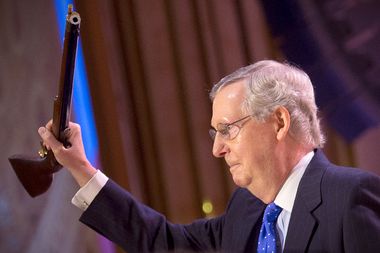
It's not great, but it's simple and does what it's supposed to do. Here's the new ad already running on the cable nets calling Mitch McConnell and pals to the carpet: 

Joe Wilson's fame lives on

The South Carolina Republican who shouted at President Obama makes some end-of-year lists

WASHINGTON -- A year ago, no one outside of South Carolina -- and not that many people in South Carolina -- had heard of Rep. Joe Wilson. One brief outburst later, he's a conservative hero, speaking at tea party rallies at home and in Washington and inspiring the GOP faithful to join him in the Republican crusade against the Obama administration and all it stands for (socialism, mostly).

But the news isn't all good for the gentleman from the Palmetto State. That is, not unless you subscribe to Oscar Wilde's belief that the only thing worse than being talked about is not being talked about. While Wilson's "you lie!" shriek at President Obama in September helped him rake in the dough, it also enshrined him as the year's most potent symbol of berserk overreaction to Obama's agenda. Which can cut both ways; Democrats are eyeing him as a target in next year's House races, and his opponent, Rob Miller, has raised nearly $1 million just from one Web effort to help him out.

Wilson's also finding himself popping up in quite a few year-in-review recaps as December draws to a close. Dictionary publisher Merriam-Webster named "admonish" its 2009 word of the year, because it received the most intense search traffic of the entire English language after the House voted to, well, admonish him. (For the record, the dictionary defines the word as "to express warning or disapproval to especially in a gentle, earnest, or solicitous manner," which is about right for the toothless resolution on Wilson.)

That wasn't it. Time magazine named Wilson's outburst number three in the year's top 10 political gaffes. Yale University is listing "you lie!" in its book of memorable 2009 quotes (alongside Kanye "I'm going to let you finish, but Beyonce had one of the best videos of all time" West and South Carolina Gov. Mark Sanford's spokesman's claim that his boss was "hiking the Appalachian Trail").

Obama's next big speech to a joint session of Congress -- the 2010 State of the Union -- won't come for another month or two. But given all the notoriety for Wilson, will some other GOP backbencher feel moved to shout during that one, too?

Blue Dog vulnerability in 2010

Crystal Ball's Isaac Woods looks at how many, and which, Blue Dogs might be in trouble next year

Though attention this week is squarely on dissenters and holdouts on the Senate side, Isaac Wood of UVa's Crystal Ball has a nice, detailed post about the status of House Blue Dog Democrats, how they voted on healthcare bill, and in general who among these 52 Blue Doggies may be vulnerable next November.

Short summary: Wood and the Crystal Ball rate 21, or fewer than half the 52, as safe incumbents running for re-election. In the other 31 cases there is a mix of members retiring (3), running for other office (1), plus 27 who are running for re-election in districts where the underlying demographics have Republicans licking their chops. "In fact, over a third of Blue Dogs hail from districts Obama won last November," writes Wood. 'While the coalition is often portrayed as a group of Southern congressmen who must vote conservatively or risk losing reelection, nineteen members represent districts Obama carried, with seven representing districts in which Obama won over 60 percent of the vote."

OK, so what can we expect come November for this group, which includes a lot of southerners, yes, but many outside the region? Well, if we presume the historical, 16-seat average loss for a president's party in the House during that president's first mid-term, and given that the 52 Blue Dogs are almost exactly one-fifth of the caucus' 258 total members, that would mean a loss of 3 Blue Dogs--if their vulnerability were no greater or less than Democrats generally.

But, of course, they are more vulnerable. Partly this may be a result of their voting records. Woods looks at their roll call on the House healthcare reform bill. Twenty-four voted against, providing 24 of the 39 nay Democratic votes, or 62 percent of nay votes; whereas they provided just 28 of the Democrats' 219 aye votes, or just 12 percent of ayes. But voting against healthcare is going to be the safe electoral move for some of them.

Part of it is that a disproportionate share of them are so-called "McCain-Democrats," those who won in districts that President Obama lost in 2008, as Woods points out. And therein lies a strange political calculus for the president--having to fight harder to save the seats who backed him and his legislative agenda at far lower rates.

Page 1 of 21 in 2010 Elections Earliest ⇒

2010 elections in the news

Loading...

Recommended Reads

The Republican comeback of 2010
The midterm elections are only two years away. Can the Democrats defend their gains?
By Thomas Schaller, Salon

Five things the Virginia election results don't mean
Tuesday's Democratic gubernatorial primary might seem like a first glimpse at the 2010 election. But it's not.
By Mike Madden, Salon

The Specter of a shrinking GOP
Arlen Specter's defection likely means a filibuster-proof Democratic Senate majority. Choose your metaphor -- rats, ships, small tents -- but will the last Republican to leave please turn out the light?
By Mike Madden, Salon

Michael Steele is here to stay
Plenty of conservatives want to eighty-six him. But the P. Diddy-loving RNC chair isn't going anywhere.
By Mike Madden, Salon

The Reintroduction of Kirsten Gillibrand
After a shaky first hundred days, the junior senator from New York is trying to start over.
By Stephen Rodrick, New York Magazine

Patrick picks Obama aide for his 2010 campaign
Massachusetts Governor Deval Patrick is tapping David Plouffe, the architect of Barack Obama's presidential campaign, to help run his bid for reelection next year.
By Matt Viser, The Boston Globe

Who can possible govern California?
San Francisco Mayor Gavin Newsom’s latest ambition is to succeed Arnold Schwarzenegger as the governor of California.
By Mark Leibovich, The New York Times

Currently in Salon

Other News