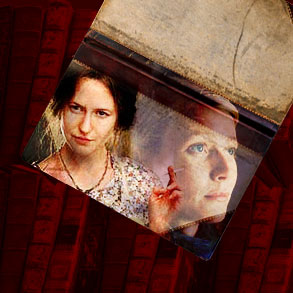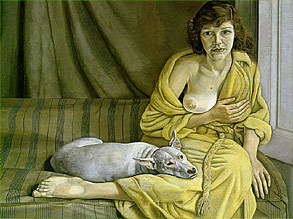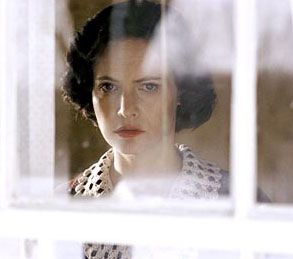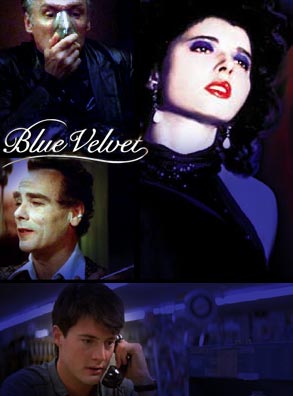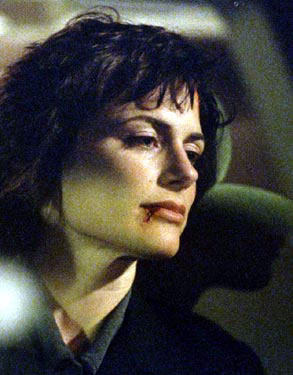
It’s not that I think Michael Haneke’s “The Piano Teacher” is a great film — or even, beyond doubt or argument, a good one. Still, it will be released on VHS and DVD in early November, and it seemed to me as I watched it alone (as it were), in my room as opposed to a public space, that it had become an intriguingly different film. Then, as I thought about the very strange and rather aloof ways in which it hovers over such topics as high art and pornography, soaring romantic love, and abnormal sexual behavior, I began to see it as a model for the way sex can (and cannot) be handled in modern cinema.
So this is the first of two reflections on “The Piano Teacher” — coming to your private place soon.
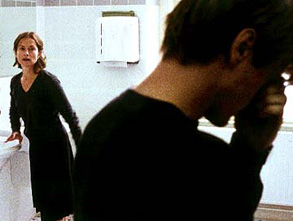
Erika Kohut lives in Vienna but speaks French — like all the film’s characters. In one synopsis of the film, I saw that Erika was said to be “pushing 40.” But since Erika is, in every shot as far as I could see, Isabelle Huppert, then I’m bound to conclude that Erika is 45, which was Huppert’s age when the film was released. And it’s not just that she is Isabelle Huppert — she also looks like Huppert. By which I mean to say that Erika has graciously yielded to the stardom and what you might call the severe, or the austere, or the harsh, or the numb beauty of Isabelle Huppert. We can leave that decision for the moment, I think, but it is clearly important that Erika is a movie star.
What else do we know about Erika? Well, she has a father, but he is dying and he is apparently insane — though nothing is offered as to the coloring of his disturbance. Erika has a mother, with whom she lives in a small apartment. I’m not sure that it is technically small, but it is not large enough for the emotions of these two women. There is a quiet but raging animosity between them. At the same time, nothing begins to explain why Erika has not moved away to live on her own. This omission is all the more apparent in that, spiritually, Erika seems to have such a need to be solitary or removed. So her mother is a daily ordeal, and a denial of privacy.
Erika teaches piano — not just children whose parents yearn for the gentility of pianistic skill in their young ones, but at the Vienna Conservatoire. She teaches people who may become great pianists. She is strict, humorless, demanding in all of this, and she seems to identify with the immaculate rendering of such masters as Schubert and Schumann, models to whom all students must aspire. The look on her face when the music is being played — and this is Ms. Huppert’s eloquent, graven face — is sublime but unrelenting, like that of an implacable nun.
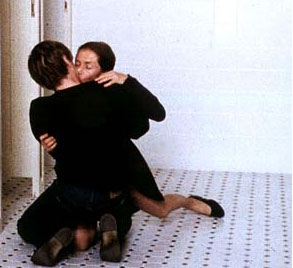
On the other hand, Erika has a strange, furtive “private” life. In the bathroom of their apartment, while her mother is shouting out that dinner is ready, Erika, in her robe, steps into the bath, and then using a mirror, she applies a razor blade to her sexual parts. We do not see where or what she cuts. But afterwards there is blood in the tub that she must clean away, scrupulously, before dinner.
Then in her own time (as it were), after days at the Conservatoire, and before nights at the apartment, she visits pornographic establishments (this is Vienna) and at a drive-in movie hunts for a young couple making love in their car. She crouches down beside the vehicle and apparently works at some rite of self-gratification, something between masturbation and urination. She runs away when she is discovered.
These things are observed without any attempt at explanation or moralization — of course, this tends to make them all the more private or insular. But we are in something like the same privacy, watching in our room, and we are likely to wonder why Erika is like this. Or whether she is happy or unhappy.
She has a new student, Walter. He is a promising student, but all he promises Erika is to say that he loves her and desires her. She is prepared to deny access, but then she gives him a letter in which she says that he can have her if he will follow exactly the several instructions she gives him for her masochistic satisfaction. He is offended, or shocked. He refuses the contract. But he is too much drawn to her and, very soon, will attempt to find a way to negotiate his love and her relentless code of sadomasochism.
We are going to have to watch. (To be continued.)
Did you notice how, last weekend, “The Banger Sisters” creamed “The Four Feathers”? Well, “creamed” is hardly the word, because neither film really did very well — not compared to the way the restaurant I was in emptied out at 8:50 p.m. on Sunday as people hurried home to see “The Sopranos.” Still, I’ll bet Goldie Hawn let Kate Hudson know which film had done better — albeit, in the nicest, girly, giggling way. Which leads me to the stunned reflection that, honestly, doesn’t Goldie have more of a future than her daughter? I mean, so long as Goldie has such a lock on not growing up, what space is left for Kate? Except to play fatuous English girls with names like “Ethne.”
Don’t misunderstand me. I see Kate Hudson as a lovely, decent, wholesome young thing, a credit to her upbringing and all the solid sense talked at the Goldie-Kurt Russell dinner table. But just think of those feathers! While Kate Hudson is handing out a white feather with all the demure, depressed, constipated disapproval of a Victorian miss who wants her idiot officer husband honorable, if anyone had ever offered the young Goldie a feather she’d have used it to tickle Dick Martin to the point of delirious orgasm. I mean, that Goldie was a wild thing.
Goldie Hawn will be 57 in a couple of months’ time, an age at which most Hollywood babes and sexpots have yielded to the sad generalization that young American men are afraid of older women, and don’t want to get close enough to be able to admire all the craftsmanlike work that may have been done on them. I say “may” because I’m personally quite prepared to believe that Goldie is as taut as she is because of years in the gym, eating right and laughing a lot. I interviewed her about 20 years ago and she laughed all the time and wriggled in her chair in the way of those people who can manage a full workout in a coach seat. And she was a knockout — and a terrific businesswoman.
I don’t see any need to accuse Goldie of being a great actress — though she was terrific in “Sugarland Express,” very good in “Shampoo” and one of the few actresses who seemed to be capable of telling Woody Allen to stop being silly in “Everyone Says I Love You.” I don’t really want to have to go back over too many of the amiable comedies she has been in over the decades. But I do ask you all to notice the acuity of Hawn the producer, the clever Hollywood operator who has managed to produce “Private Benjamin,” “The First Wives Club” and several other films, and who simply holds her place in Hollywood when more earnest actresses and more beautiful women grab their few years of stardom and run.
In “The Banger Sisters,” Goldie Hawn and Susan Sarandon (who is only a year younger than Goldie) defy that wistful orthodoxy down-in-the-mouthed by so many Hollywood women — that there are no parts for mature women. And it’s patently true. While our veteran actors as they get to be 60 blithely snatch up much younger women — on-screen and off — American women of a similar age who dare to possess a sex life, romantic feelings, an awareness of power and money, and a good bod are reckoned to be witches, or insane, and very dangerous.
You can say that Goldie Hawn has been awfully cute with her “maturity”; that she remains, at heart, that hand-painted bikini-girl from “Laugh In,” the one whose collapse into laughter whenever a man spoke to her promised all kinds of physical abandon. Well, why not? Anyone who takes the trouble to keep company with sexy old ladies knows that kittenishness (like boyhood) can go on forever — just don’t forget the kitten has claws.
So I don’t ask Goldie Hawn to play Hedda Gabler or Lady Macbeth (not that it wouldn’t be fun), but if ever anyone had the nerve in America to make a movie about a Donna Juanita, a woman beyond the age of child-bearing, but crazy about sex, Goldie Hawn could do it. Do you remember the way she seemed both amazed and turned on by all those strange new holes that kept appearing in her body in “Death Becomes Her”? Look at Goldie Hawn’s eyes — they’re still standing up on stalks, as if she’d just seen her first male member.
Continue Reading
Close
The actress Kim Hunter died last week, at the age of 79. She had an unsettled career, intruded on by the blacklist, her steady attachment to New York and the theater (she lived for years in an apartment above the Cherry Lane Theater), and by her unwillingness to be merely glamorous or available. But she made several odd films, and she is memorable in all of them: “A Matter of Life and Death,” “The Seventh Victim,” “Lilith.” And yes, she was in all the early “Planet of the Apes” films. But the obituaries used just one role — her Stella, next to Brando’s Stanley, in “A Streetcar Named Desire.” Yet they didn’t spell out how crucial she was to that extraordinary 1947 opening.
To understand that story, you have to get a grasp on the relationship that existed between the playwright, Tennessee Williams, and his director, Elia Kazan — before either of them was anywhere near as famous as “Streetcar” would make them. Williams was shy, stricken, poetic, not terribly ambitious, not a very effective career-maker, who had fashioned a play that explored American sexuality more deeply than he perhaps understood. He was also as openly gay as the 1940s permitted. In so many ways, Kazan was his exact opposite: brutally candid, murderously ambitious, aggressive and manipulative, and very heterosexual. And Kazan was a new kind of director in that he felt a passionate need to express himself in his productions — the plays he directed had to be ones in which he found himself.
Kazan had brilliant, pointed instincts. He read “Streetcar” and felt a great deal of what was going on, including the way in which Williams had written a kind of homosexual fantasy in which gentleness and refinement (Blanche DuBois) are raped by male energy (Stanley Kowalski). To put it crudely, Kazan intuited the ways in which Williams was getting off on his own play. So he looked for ways in which his own drive might be released.
Williams had written a play in which the invalid Blanche was far and away the central figure, a character on the way to the madhouse because of the passions she is trying to contain and deny beneath a mannered, ladylike exterior. Kazan never altered or eliminated that, but he offered an alternative: of Stanley and Stella as a vital young couple who feel invaded by Stella’s fusspot sister. After all, Blanche descends on them for most of a hot New Orleans summer in what is a tiny apartment; she tries to manipulate Stella and she condescends to Stanley. She gets her comeuppance and she cannot break the raw, primal, sexual bond (the legitimate heterosexual bond) that unites Stanley and Stella, and which has made them pregnant. The astonishing impact of the play in 1947 stems from that unspoken conflict in attitudes between the writer and the director.
Read the play and you will discover that, in terms of lines, the role of Blanche is about six times larger than that of Stanley. In subsequent decades, as the play has been revived, so the role of Blanche has carried the production. The play is now accepted as an attractive vehicle for actresses from Ann-Margret to Claire Bloom to Jessica Lange. Yet in the original production, Kazan neglected his Blanche (Jessica Tandy). There were discreet complaints from Ms. Tandy and her husband, Hume Cronyn. But Kazan had taken the startling step of telling the whole cast that the pulse of the play would come from Marlon Brando’s Stanley.
You can argue that was further proof of Kazan’s insight. He had seen the young Brando on the rise in New York, he angled for him to get the role of Stanley and he surely foresaw the coming sexual sensation. But none of those things should obscure the way Elia Kazan wanted a drama with which he could identify. He wanted Stanley as the new, ugly American, the crude Polack shocking polite society, breaking down the walls, asserting himself in terms of lust and desire. For that is how Kazan — darkly ugly, a self-conscious outsider, born in Constantinople — regarded himself in American society.
So he nursed and protected Brando. He was patient as the mumbling young actor struggled to find Stanley. He helped find the right tight jeans for him to wear. He urged a new stress and need into the play (without ever tampering with the text or alarming its author). And he had a love affair with Kim Hunter, Stanley’s Stella. Why not? Such things are very common in theatrical productions, and Kazan was by then notorious as a womanizer. It’s not the reason why Kim Hunter got the role of Stella, or even why she was so good in it. But as Williams’ play ends, Stella yields to Stanley, no matter that he has been instrumental in the destruction of her sister and in the trampling on old DuBois values. Sensuality carries her down the stairs to Stanley’s sweaty embrace. We know the scene and his cry. But only a few recognized how far Elia Kazan had found a story about himself within the rich, ambiguous play of “Streetcar.”
Continue Reading
Close
What is a Morvern Callar? A shy water bird sometimes seen (or only heard) in the Scottish isles? Some kind of intrusive fundraiser on your phone system? Or the soothsayer in a new quietist religion that is drifting through south London?
None of the above: Morvern Callar is a young woman who lives and works as a supermarket shelf-stacker in some dismal Scottish town. She’s also the leading character in the new film by Lynne Ramsay (“Ratcatcher”), which, strangely, was not chosen for the New York Film Festival, but which I want to recommend.
Ms. Callar seems to wake up one morning to find her lover dead. We never learn why he’s killed himself, and Morvern isn’t unduly involved in that matter. It’s odd, too, that the young man has no friends or relatives who call in, wondering what’s become of him or the novel he was writing. But the novel is there on his word processor, the very place where a farewell note to Morvern urges her to send the book to publishers. She does so — but only after deleting his and putting her own name on the title page.
But the young man leaves a bit of money, too, enough for her to take a holiday in Spain with her girlfriend, Lanna. She has a hotel fling there with a young man, she deepens her rapport with Lanna, and she seems aroused by the heat and mystery of Spain. There’s a feeling of the world opening. But she is also sought out by two London publishers who offer her 100,000 pounds for “her” novel. She goes back to Scotland and then sets out for London.
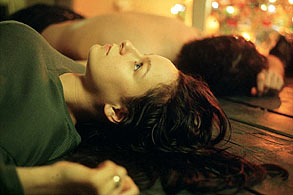
A lot of things don’t happen. Neither she nor we get any sense of what the novel is like. She never reads it, let alone attempts to stretch herself into the role of being its author. And she never comes close to being found out. What happens to the body of the young man, you may ask? Well, Morvern cuts him up in bits and pieces and buries them in the wild Highland hills, unobserved. That this story situation is so fanciful, or dream-like, is undercut by the intimate naturalism of the filming, by the way Morvern so often lounges around naked or in her underwear, and by the vacant radiance of Samantha Morton in the central role.
Now if you add the story evasions (or gaps) to the extensive nudity, you might suspect that this is an independent movie short on ideas, except for those about getting made. Not so. This is actually a deeply felt story about a young person coming to life (despite the trigger of death), and it’s about feelings, or a kind of spirituality, that transcend narrative details. That said, I don’t think it would have a chance of holding the screen were it not for Ms. Morton. She played the pre-cog Agatha, in “Minority Report,” and she has the potential to be a very considerable actress, no matter that she is hardly pretty in a conventional sense, let alone glamorous. There are times with this movie when the gap between Ms. Morton and the regular concept of “movie star” leaves the picture like a kind of reflective diary or a communion between Morvern and her inner thoughts.
Except that that’s not quite right, either, for there are moments when she is ravishing in a film that seems to offer that kind of beauty (as much inner as outer) as the adventure or the test of maturity toward which Morvern Callar is tending. There could easily be another film growing out of this situation (it comes from a novel by Alan Warner), one that could reach as far as London, and end in wild comedy or grave tragedy. Morvern Callar might become a better novelist than her boyfriend. She might be exposed as a fraud. But for the moment of this intriguing, very sensual, truly introspective film, she is on the cusp, wondering how far she can carry the experiment with self. Samantha Morton may mean more to us one day than Lynne Ramsay; still, “Morvern Callar” is a fascinating picture and I look forward to seeing it open in American theaters.
This article has been corrected since it was first published.
Continue Reading
Close
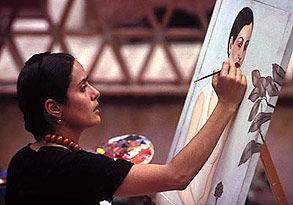
The “long-awaited” “Frida” comes to the screen with alarming attributes: eight writers and no less than 16 people serving as some kind of producer. Well, yes, it is hard to make a motion picture, but generally it is harder still if you have that many people competing for credit. Admittedly, there is only one director, Julie Taymor, and only one person playing Frida — Salma Hayek, who is also one of the producers. A lot will be said, quite properly, about the determination with which Ms. Hayek got this film made, as a burning passion, a labor of love, a life’s dream, etc. Such things are all very well, and worthy. But they do not find a way past this conundrum: Salma Hayek is one of the most beautiful people on the modern screen, and Frida Kahlo did not look like that.
The platoon of executives on “Frida” signals how many people have wanted to make this picture — and it also inadvertently indicates the common fallacy that great or celebrated lives are made for the movies. Frida Kahlo was a woman and an artist, and in recent years there are those who find that concurrence so intoxicating they’re ready to greenlight a picture deal, without realizing that a life is not always a story. Frida knew famous people — Diego Rivera, Trotsky and Tina Modotti (possibly a finer artist, as well as a more interesting life). Frida strove against handicap: As an adolescent, she suffered a drastic accident that damaged her insides and scarred her for life. I can believe that she was sexually active nonetheless, but I think it’s clear that she was just as obsessed by physical pain (her most faithful lover and companion, perhaps).
Frida often painted herself, which is a problem for any biopic because if the movie is to use the paintings then it is obliged to hire an actress who at least resembles them. Years ago, it was a great coup in “Lust for Life” that Kirk Douglas looked a lot like Vincent van Gogh. But “Lust for Life” was a very melodramatic, sentimental view of the artist. I think it is a safer rule that the best biopics (and it is a very vulnerable genre) start with actors who do not resemble the subject. Only then can the story start. I suspect that Ed Harris was drawn to Jackson Pollock in the first place because he reckoned they looked alike. Well, in a way. But that bit of luck is nothing if the actor doesn’t understand the painter, and if the artist’s life is as messy and inconsequential as Pollock’s.
I daresay Salma Hayek loves Frida’s paintings and the idea of the real woman as a heroine of her times — a Latina who refused to settle for the passive role Mexican society required for women. But there are moments in “Frida” (in a big motion picture with Salma Hayek there have to be), when the actress shrugs off her clothes and engages in the antics of love and sex. These are stunning moments. Salma Hayek is a dream of carnality, radiant in the sun-drenched color scheme that Julie Taymor has employed. Alas, it is so much a body made of peaches and cream that one never feels the pain in the body. And this Frida Kahlo has no mustache.
I seek no point about hormones, sexuality or personality in referring to the mustache. I am not interested in how far it does or does not affect conventional attractiveness. But I have seen enough photographs to know that the real Frida Kahlo had a silky black mustache. And I have to guess that Hollywood and even the valiant Ms. Hayek decided that that was a no-no.
Why? The question intrigues me all the more in that I read recently about how John Ruskin (1819-1900), the English art critic, probably failed to consummate his marriage because of his horror at discovering that his wife had pubic hair. Ruskin was richly educated. He had a fine mind and an exceptional sensitivity. He was accustomed to the nudes of art that were flawless — i.e., the women had hair on their heads only. Literally, he did not know in advance that women have pubic hair. Thus, his profound aesthetic bumped into the tangle of reality.
The movies nowadays take pubic hair for granted, though as I recollect, in “Frida,” Salma Hayek keeps one gorgeous thigh folded over the other, so not too much shows. But pubic hair is eroticized in much the same way that the flow of a woman’s long hair is a metaphor for passion. So why can’t Hollywood live with some facial hair? Why does some semi-religious horror remain about the prospect of beauty with a mustache?
There is a great painting by René Magritte in which the outline oval of a woman’s face is filled in with the beard and mustache of pubic hair. I suppose its shock value is at least as disturbing as it is arousing. Yet we have come to terms — men, I mean — with pubic hair, with armpits full of hair (I recall the 1963 Joseph Losey film “Eva,” in which Jeanne Moreau had not shaved her armpits, and the feeling of liberation). Isn’t the idea of a woman needing to find a private place where she can apply a razor edge to her own natural private places absurd and alarming?
“Frida,” we will be told, grew out of a deep respect for the “real woman.” Yet all the writers and producers couldn’t let the truth on her upper lip show.
Continue Reading
Close
I’m writing about “Auto-Focus” for several reasons — it will be playing at an important film festival over the Labor Day weekend; I think it’s a picture that deserves and will receive a lot of talk; and because I can’t get it out of my head. Not that it’s an obvious turn-on or inducement. Indeed, I heard that someone else who saw it early came away with the shuddering remark, “It’s a film that leaves you never wanting to have sex again!” Well, I don’t quite share that view, though I can understand it. After so many decades of pictures that serve as titillation or foreplay, perhaps we’ve lost touch with the whole question of fear and loathing?
There is an odd way in which “Auto-Focus” is akin to aversion therapy. Though something larger than just sex, I think, is being undermined. It’s likability.
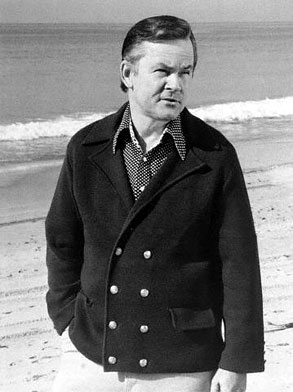
This is the story of Bob Crane, a rather mild, smooth, empty actor and a very likable guy — or so he wanted us to believe. I’ll go further: I think he was desperate to believe it himself. The story is set in the ’60s, at which time Crane has just come off a modest success in the “Donna Reed Show,” playing — what else? A very likable guy. Bob is happily married in “Auto-Focus” in the way people in “The Donna Reed Show” or its intervening commercials were happily together. By which I mean to say that no stone is ever allowed to disturb the bland surface of their life.
Well, Bob has a big break coming up: He is offered the lead role in “Hogan’s Heroes,” a situation comedy set in Stalag 13, a German prisoner-of-war camp. There are some worries at the network that the show could be in bad taste, but we know long in advance that “Hogan’s Heroes” is going to be a solid five-year hit and the making of Bob Crane.
As he rises in the ratings, he meets John Carpenter, a rather goofy studio hanger-on who is always offering the latest in camera and then video equipment. He hits on Bob in a hero-worshipping kind of way, and their friendship slips very gradually into the easygoing pornographic sessions John likes to shoot. Indeed, Bob is John’s star: a stud and a celebrity who will attract Playboyish babes, and the color in John’s drab life. It’s a touching friendship in which the closest Bob’s bland surface comes to realizing John’s true feelings is when he sees John’s reaching hand in one of their films getting very close to Bob’s private parts.
Bob’s marriage and family life are wiped out by his mounting obsession. A second, sexpot wife can’t ring the bell. It isn’t that Bob is exactly sex-crazed as that he doesn’t have the time, the energy or the likability left for the real thing. After “Hogan’s Heroes,” there’s less of Bob Crane — he’s seen as a dissolute “celeb” guesting on daytime cookery shows and doing dinner theater. He’s going nowhere, and shows no sign of deserving better — for his own notion of a likable guy is exactly the kind of empty, easy good looks that no one really wants to see twice (unless they get elected president — and even then?).
Technically, I believe the murder of Bob Crane in 1978 (he was just 50) is unsolved. All we see in the movie is bludgeon, Bob’s head and a spray of blood on the wall, before the tabloid shot of the ex-star dead in his bed. In the movie’s structure, there’s no doubt that the killer was John Carpenter, miffed that Bob was going to try to give up pornography for good — whatever that is.
The ending is by far the weakest part of Paul Schrader’s brilliant picture because no john in his right mind would believe that Bob was capable of, or wanted to try, getting out of the sweet hole he had dug for himself. The most stunning thing about “Auto-Focus” — and here I must praise Greg Kinnear as Crane (and Willem Dafoe as John) as much as Schrader — is the portrait of a kind of soulless amiability that is too feeble for anything else in life, yet also too conservative, too prim, too pious to ever think of recognizing itself as perverted, depraved or a sex fiend! Bob Crane is thoroughly all-American, and the thing that I find so arresting in this film is the oblique but merciless portrait it provides of just how derelict a regular American guy can be.
There will be some who say that “Auto-Focus” is very nasty and dark and prurient. But it’s not, really it’s not. How could it be when the style, the attitudes and the ideology are all from regular ’60s network television? Unless you’re going to decide that sort of thing was … sick? “Auto-Focus” is a great departure for Schrader in that, in its icy, Day-Glo way it is a comedy, in which all the acid is ironic. So Bob Crane doesn’t burn in hell (and Schrader has used hell before), he just goes serenely sour — like creamy milk.
Continue Reading
Close