James Hannaham

Clarence Thomas is not a sellout

Blacks who challenge affirmative action and other "black orthodoxies" are not betraying their race. Or so argues author Randall Kennedy.

  • more
    • All Share Services

Clarence Thomas is not a sellout

“Being black is a little like being a communist.” I recently found myself making this odd comparison in order to encourage independent critical thinking in a black student of mine who had embarked on a term paper about Saartjie Baartman, the so-called Hottentot Venus, and perceptions of black women’s bodies in Western culture. I was referring to the Soviet-style communism of the ’70s and ’80s, in which Russians perpetually scrutinized one another to ensure that everyone strictly adhered to party line — at least in public. Of course, communists had a habit of purging traitors violently, whereas black Americans normally draw the line at denouncing them verbally, but I meant to invoke this principle in stark terms so that my student would understand.

I wanted to get across to her that black critical thinkers often face an extra step in the writing process — we have to separate what we think from what our comrades of color expect us to believe, presume we believe, or would rather we didn’t discuss in racially mixed company, in public, or at all. For us to reason independently of Negro orthodoxy — especially to criticize sacred cows of black America like affirmative action — means risking banishment from the black community. The threat of getting kicked out of blackness (impossible as that sounds), or at least being seen as outside black solidarity, looms large. Not even Harvard Law professor Randall Kennedy, who has touched the hem of revered civil rights champion and Supreme Court justice Thurgood Marshall’s robe, has escaped the wagging finger of blame. He too has been called a sellout. More than once.

Kennedy was once feisty enough to have written a book about the N-word without fear of repercussion (for which he was called a deserter by fellow Harvard professor Martin Kilson, writing in the Black Commentator). In his new, compact examination of heresy in black culture, “Sellout: The Politics of Racial Betrayal,” he’s less bold, and he takes care to reassure readers of his position within acceptable black thought. In one of many long footnotes, Kennedy defends his use of the terms “Negro,” “colored,” “black,” “African American,” and “people of color” in the book: “I realize that vigorous political struggles have shaped the history of these terms and that today some of them … are seen as either antiquated or insulting. In my view, words take their meaning from the context in which they are used.”

In essence, he apologizes for varying the word he uses to describe his subject, a self-justification necessary in very few other writing situations. If he were writing about spoons and he wanted to call them utensils, he wouldn’t need this qualification. But cutlery can’t jump up and label you an Uncle Tom. Kennedy’s defensive move will seem all too familiar to anyone whose audience is partly composed of touchy black folks ready to pounce. (I’m bracing for it right now. How dare you call us “touchy”!) For Kennedy, writing a treatise in which he defended the selective use of the word “nigger” might have been risky, but calling a book “Sellout” is a whole other level of peril: It means asking colored people to mistake it for a memoir, and to hide the cover if we dare read it on public transportation for fear of raised eyebrows.

Fortunately, it’s no how-to manual. Kennedy’s chapters are dense, stuffed with facts and anecdotes, compressed almost beyond belief. His second and third chapters move the reader through roughly 177 years of black sellout history in approximately 50 pages. Since this history has been suppressed almost by definition, it has the advantage of offering a fresh look at a rarely considered aspect of black history. I’m pretty sure that the slave commended by his masters for helping to thwart the 1739 Stono Rebellion, in part by killing rebellious fellow bondsmen, has never shown up on any of those black history calendars full of noble-looking portraits of heroes, even though he was named July. You can bet that the words of William Hannibal Thomas, the first black man to attend Otterbein College, have never been trotted out at graduations, sermons, or rallies. Thomas’ 1901 screed, “The American Negro: What He Was, What He Is, and What He Will Become: A Critical and Practical Discussion,” posits that “the negro represents an intrinsically inferior type of humanity, and one whose predominant characteristics evince an aptitude for a low order of living.” Anyone who, like me, has a morbid fascination with deliberately forgotten corners of history and wrongheaded, outdated belief systems like W.H. Thomas’ will wish that Kennedy had expanded these chapters, perhaps into their own jaw-dropping, crazy book.

Instead, Kennedy devotes a lengthy chapter to a contemporary Thomas — Supreme Court justice Clarence, that is — whom the author describes as “the most vilified black official in the history of the United States.” Rhetorically, Kennedy holds the cantankerous judge at arm’s length and pinches his nose even as he defends Thomas’ right to argue against the black Politburo and clarifies the negative position on affirmative action for which most blacks hate him. “For all his deficiencies … Justice Thomas is a jurist with his own ideas,” Kennedy concedes. “They are ideas with which I often disagree. But they are his ideas.” For this former Rhodes scholar, it isn’t just Thomas’ denunciation of affirmative action as reverse racism — “There is no sillier idea than this in all of American law,” writes Kennedy — that black folks resent, but that Thomas benefited from the program and then called for its abolition, essentially closing the door behind him.

On the issue of whether Thomas qualifies as a sellout, Kennedy is surprisingly generous:

Those who prosecute Thomas for racial betrayal assert that he is guilty of more than being wrong. They imply or assert that he deliberately harms Black America, or knows that he does so without a justification or excuse, or pursues a dangerous course of action without heed of consequences … It is one thing to charge someone with hurting the cause of African Americans. It is another to charge someone with knowingly or willfully hurting the cause. It is the knowingness and willfulness that makes “selling out” so reprehensible.

By narrowing his definition of who qualifies as a betrayer of the race to extreme cases –for example, “an African American member of a black uplift organization who reveals its secrets to anti-black adversaries out of malevolence” — Kennedy allows “Uncle Thomas Reptilious,” as one reporter called the justice, to squeak under the gate.

As an elegant and open-minded exercise in argument, one has to admire Kennedy’s defense — judging by Kennedy’s examples, nearly all of Thomas’ critics eventually get around to calling for his death. Kennedy is right to advocate for more nuance in the definition of the party faithful and the race traitor — he even makes a solid argument for those who exposed planned insurrections as a strategy to avoid violence — but he couldn’t have made it harder to swallow than requiring his audience to redeem Clarence Thomas in the process.

Even so, I agree with Kennedy that the sullen justice has the right to criticize affirmative action programs despite having used them to get a leg up. In fact, his firsthand experience might have had the potential to make him a better judge of its strengths and weaknesses. But Thomas, armed with that silly idea, wishes to abolish these programs wholesale, not modify or improve them. He may be responding to the blowback of insecurity that affirmative action kids sometimes suffer, the nagging suspicion that one can’t truly compete without that leg up. Thomas may even be expressing that anxiety in his zeal to annihilate race-based institutional decision making. However, I’ve often suspected that Americans who wish to abolish affirmative action also find these programs embarrassing because they make certain uncomfortable truths about our country and white privilege visible. Within legal bounds, most U.S. citizens, regardless of color, find it perfectly acceptable to use whatever unfair advantage they have to get ahead –longtime friends on search committees, uncles with hiring ability, puffed-up résumés, glamorous Internet profile pictures. Mild corruption’s fine as long as it remains hidden and doesn’t interfere with the perception that our country is a meritocracy. Playing dirty is part of our national heritage; we began this country by all but evicting its Native American leaseholders. White people have affirmative action, too — and predictably, it works a lot better than the black version.

Though Kennedy doesn’t touch on this aspect of Thomas’ opinions about affirmative action, “Sellout” does a great deal to complicate the politics of racial betrayal and opens up a space between dissent and disloyalty, where a critical consideration of that set of beliefs we think of as tenets of black American identity doesn’t have to make anybody the next William O’Neal, paid by the FBI to deliberately disrupt the activities of the Chicago Black Panthers. Or even the next Charles “Rat Killer” Barnett, who informed on Alabama civil rights leaders to Birmingham police chief Bull Connor, a Ku Klux Klan member notorious for breaking up protests with fire hoses and attack dogs. (Somebody needs to make a calendar out of that rogues’ gallery.) While Kennedy won’t foment anything on the scale of black perestroika, “Sellout” does a provocative job of nudging us toward a little more glasnost.

Flirting with disaster

Will Amy Winehouse's self-destructive behavior make her a music legend -- or will it just kill her?

  • more
    • All Share Services

Flirting with disaster

We’re all expecting Amy Winehouse to die. It seems inevitable, given the ferocious soul singer’s combination of youth, chutzpah, talent, substance abuse and bad taste in men. The diminutive vocalist has just received six Grammy nominations for her second album, “Back to Black,” a set of Motown-influenced ballads of codependency, but her real-life struggles with drug abuse have almost become more newsworthy than her music.

In recent weeks, with the object of her codependency, husband Blake Fielder-Civil, imprisoned on an assault charge, the 24-year-old Winehouse’s self-destructive behavior has made her a paparazzo’s wet dream. She has canceled a slew of appearances, including an American tour, which is perhaps for the better, since she’d taken to berating her audience, forgetting lyrics — and, some suspect, doing drugs onstage. (One recent photo shows a white substance in her nostrils.)

Offstage she’s fared little better. Photos of Winehouse with a scar over one eyebrow and her toes bleeding through her dance shoes raised her audience’s concern for her health, and last week, a photo of a barefoot, wincing Amy in a bra, traipsing down a frigid London street, signaled another low point in the downward spiral of the rising star. How low can she go? we ask, holding our breath.

Try to contextualize her nascent career and her appetite for self-destruction, and you’ll see the ghosts of rock casualties float up — especially those who got whacked by the reaper relatively early in their career: Janis Joplin. Kurt Cobain. Jimi Hendrix. But you’ll also think of Pete Doherty, frontman for punk revivalists the Libertines and Babyshambles, who knows how to turn his fuck-ups into photo ops, writing a diary from jail, staging a crack binge for a promo pic. While Cobain might have referenced his depression by singing about its positive side (in the Nirvana song “Lithium,”) Winehouse romanticizes her addictions, insisting that they’re the wellspring of her creativity.

She may be a tragic talent, but she’s also playing the part of the tragic talent. Her anti-recovery anthem “Rehab,” written about the time when a former management company attempted an intervention — she fired them for it — invokes R&B singers Ray Charles, a fellow addict, and Donny Hathaway, who committed suicide at 33.

Despite the stagey, self-consciously retro pedestal that producer Mark Ronson has placed it on, Winehouse’s frank, confessional songwriting and expressive contralto have convinced her audience that the most important part of her job isn’t anything as crass as “making art” or “writing songs.” Instead it appears that Winehouse merely sings her pain, the way Mary J. Blige claimed to do until she started singing about how she wasn’t going to sing about her pain anymore. The artist who sings the blues without living the blues is no legend, and Winehouse is determined to achieve that status if it kills her, based on her reference points.

As the latest in a long tradition of Brits working in a black American idiom, Winehouse recognizes that otherness is part and parcel of the blues, but that her Jewishness is a liability — play it up too much and you’re perceived as an oddity, like Jewish reggae rapper Matisyahu. So, as Shel Silverstein once asked of an aspiring bluesman, “What do you do if you’re young and white and Jewish … and the only levee you know is the Levy who lives on the block?”

Winehouse answers that question by digging deep for scraps of authenticity. In addition to foregrounding her knowledge of R&B history in her lyrics, she mines her personal experiences for material, naming names, keeping those names in the news, and in the process, all but eliminates the barrier between biography and artistic expression, tabloid and Billboard. Only a complete novice could wonder what her songs mean, to which events they refer, or about whom they are written. Meanwhile, she acts out and “keeps it real” by defending her drug and alcohol addictions, and by standing by her jailed ne’er-do-well husband. The whole package smells like a bizarre simulation of a familiar black stereotype.

Which brings us back to that self-conscious retro thing. Because for all the real-life detail, hip-hop name checks, and off-the-cuff profanity Winehouse spills into her lyrics, not to mention her lifestyle, it’s still hard to shake the sense of fakery, if not fuckery, as she’d sing it, involved in the whole enterprise, the nagging suspicion that Winehouse might really be Sarah Silverman in water-soluble tattoos, wacky eyeliner and a ratty hair-don’t having another tasteless joke at our expense.

To turn your failures into pop songs is to make commodities of them — which trivializes them a bit, no matter how sincerely you intended your audience to take them when you started out. The humor in “Rehab” lies in the mismatch between its infectious Motown beat, bright Stax horns, and its message of defiant dysfunction. Everybody dance to my misery, it seems to shout. By definition, you want to recover in recovery, but Winehouse joyfully declares her lack of interest in any treatment. Notably, she isn’t critiquing the quasi-Christian methodology and terminology of 12-step programs or the agony of cold turkey, but the entire concept of getting over your jones.

A literal Jones — Sharon Jones — has also provided Winehouse with a backdrop suitable for her to play out her rhapsody in black. For the new record’s backup band, Winehouse hired the Dap-Kings, known for backing Jones, a 51-year-old black American who finally received attention for reviving the funk idioms of yesteryear with her 2005 album “Naturally.” Jones and the Dap-Kings sound like a band from the ’70s in part because they lived through the ’70s without changing their style, even after it became passé. Winehouse’s newest release, however, required them to reach further back than their expertise — to the ’60s — and the pastiche sounds as thick as Lauryn Hill’s “Doo-Wop.” Winehouse’s “Tears Dry on Their Own,” the most derivative song on “Back to Black,” is the long-lost fraternal twin of Marvin Gaye and Tammi Terrell’s “You’re All I Need to Get By,” and while all pop songs crib bits and pieces from familiar sources, Winehouse is almost as much of a magpie as Tricky, who turns samples into a personal signature. Her hip-hop potty mouth is the only clue that she hasn’t discovered the secret of time travel.

Anxiety of influence fuels Winehouse’s particular brand of blue-eyed soul, and soul bad-girl behavior, but the artifice of her persona may save her from taking her unfortunate muse too seriously. Of course, there’s no guarantee that flirting with disaster won’t kill her anyway. While 12-step groups suggest to struggling addicts, “Fake it till you make it,” Winehouse’s credo might be, “Fake it till you snuff it.”

Even so, the truly out-of-control suicidal pop star, like Cobain or Ian Curtis of Joy Division, hurtles senselessly, unstoppably, toward self-annihilation. Curtis canceled Joy Division’s first American tour by hanging himself. Winehouse canceled hers by calling off the dates. So there’s hope. Tellingly, she claims to have written the bulk of “Back to Black” in a burst of creativity while separated from Fielder-Civil. Despite what her public image would lead us to believe, it takes hard work to spin your misery into Grammy-nominated gold. If she’d been truly incapacitated by her husband’s absence, she wouldn’t have written a damn thing.

Continue Reading Close

Fantasies in black and white

If even most African-Americans believe the black poor are primarily responsible for their own plight, does that make it true?

  • more
    • All Share Services

Fantasies in black and white

Senior NPR correspondent Juan Williams saw a big story in a certain dry statistic earlier this month. As Williams wrote, “53 percent of black Americans now agree that ‘blacks who can’t get ahead are mostly responsible for their own condition.’” Williams was quoting a poll on the attitudes of black Americans released Nov. 13 by Pew Research Center/NPR. The Pew poll also found that 61 percent of blacks believe that the values of lower-class blacks have become “more different” from those of middle-class blacks in recent years. African-Americans now seem to agree with a majority of whites that black poverty is a problem of individual responsibility rather than a social issue.

But if virtually everyone believes something, does that then make it true?

Whites especially seem to think the races have reached equal status — a whopping 71 percent agree that blacks who can’t get ahead are responsible for their troubles. Yet for every poll trumpeting that Americans believe we’re moving toward racial equality, there’s a sociological study proving that the opposite is happening. The same week the PEW/NPR study was announced, the Wall Street Journal reported that blacks born into the middle class are “far more likely than whites to earn less than their parents … Children of black parents earning in the middle 20 percent of all families in the late 1960s had a 69 percent chance of earning less than their parents, the study found. For white children, that chance was just 32 percent.”

Disillusionment may hold some middle-class blacks down, but poorer folks still get caught in circumstances beyond their control. In 2002, University of Wisconsin sociologist Devah Pager (now at Princeton) demonstrated that white men with criminal records can get low-wage jobs more easily than black men who have never been incarcerated. Another experiment reported on in the WSJ demonstrated that people whose résumés sported Anglo names were 50 percent more likely to receive interviews than were those with black-sounding ones. It’s almost funny to imagine some human resource department comparing identical résumés from Ashley Weston and LaQuinda Mae Bullock and trying to rationalize poor LaQuinda out of a job. But to say that LaQuinda’s responsible for her unemployment because she used her real name on her résumé is to miss the point.

Consider also that LaQuinda may have been born into difficult circumstances — again, not her choice. A poor child, living in a ghetto, let’s say, has to struggle to get a decent education, let alone the sort of elite schooling that leads to many lucrative professions. Even more infuriatingly, some schools flatter black students into an inflated opinion of their abilities, and this only compounds their frustration later. LaQuinda’s parents, who are probably working long hours for low pay (giving the lie to the idea that laziness creates poverty), may not have had time to fight for her education. The fact that a few determined and talented people can make it out of these conditions hardly means that if we shipped a crate of elbow grease to the ‘hood, there’d be a pipeline of blacks going straight to Princeton.

The poor are held back by economic circumstances, but poor blacks are further held back by social factors, including racism, isolation, insufficient cultural capital, crime and lack of assets. Many never get the opportunity to acquire the kind of skills that whites take for granted as a ticket to success. That may seem like a free-will deficit, but the sort of information you need to get ahead isn’t always common knowledge — in fact, a great deal of it is designed to keep outsiders, including poor and working-class whites, at arm’s length.

Still, it’s apparently comforting for both blacks and whites to imagine that racial discrimination no longer hinders success. Salon’s Gary Kamiya uses the post-9/11 shift in black-white dynamics to suggest that race is “dying,” given that most American nightmares feature Arab Muslims, not blacks, as the bad guys. But it’s as likely that American attitudes on race are morphing, not dying. Somehow, the hostile, suspicious targets are still brown people. Sept. 11 may have represented a “timeout” from race for some black Americans, as Kamiya suggests, but ask anyone who even looks Middle Eastern — or as some might say, like a “sand nigger” — if he or she has seen a relaxation of racist attitudes in the past six years.

Furthermore, Kamiya’s suggestion that “tough love” from middle-class blacks at boys clubs can significantly change the ghetto is based on a fairy tale of American individualism, not the practical reality of a place that lacks capital and political power because it has been systematically isolated. The day a black family — Cosby or not — moves into a white neighborhood and the property values go up as a result is the day race will really have died. Not surprisingly, Kamiya sees figures like Tiger Woods and Barack Obama as “proof” that anyone can realize his or her American dream, ignoring the fact that you have to be Barack Obama to get there: middle class, handsome, charismatic, devoid of slavery’s racial baggage, a Columbia and Harvard Law graduate, with the contacts that let you raise millions of dollars. Even most white people can’t do that!

Pretending we’re closer to racial justice relieves black folks who, like Williams, have achieved a great deal of professional success in predominantly white fields. They may think that they’ve broken down doors for future generations without considering that those doors can easily be reassembled and nailed shut behind them. The older generation assumes that the overt racism of yesteryear was harder to combat than today’s smiley-faced version; therefore, if a young person can’t make it, she must be from a single-parent family, lack gumption, listen to rap music or suffer the influence of some other conservative bugaboo. But nowadays it takes a university study to prove that racism affects hiring practices, not just a sign outside reading “No coloreds need apply.”

Shouldering the have-nots with all the responsibility for their downward mobility also reassures those who are better off that they have achieved their prosperity through hard work, which keeps them from feeling guilty about their indulgences. Believing the poor are simply lazy or have “underclass values” allows comfortable Americans to feel superior to the less fortunate, and to smugly promote a strict work ethic as the only tonic for indigence while avoiding the truth about wealth transfer. A number of scholarly studies are finding that one of the biggest reasons for the persistence of the immense economic gap between whites and blacks isn’t rap, absent fathers or Ebonics, but unearned income and equity. Call it the “parent economy,” as described by Brandeis law professor Thomas M. Shapiro in his 2004 book “The Hidden Cost of Being African American.” Essentially, says Shapiro, inheritance, gifts and financial backing create a safety net for middle-class white people that does not exist for the majority of blacks. Shapiro found that in 1999, only 25 percent of white families lived in “asset poverty” (which he defined as having a “private safety net” of less than $4,175 for a family of four), whereas 54 percent of blacks did. Shapiro also found that blacks were more likely to take care of their parents than to receive an inheritance from them.

Liberal whites tend to feel guilty about receiving gifts or “free money” from parents and, if they accept these benefits, don’t consider them “real” income, as Shapiro notes. People with trust funds rarely speak openly of their existence, let alone their premiums. So this segment of the economy goes largely unacknowledged. This isn’t to say that whites should reject inheritances and parental gifts — salaries aren’t allowing any workers to save the way they used to — but merely that ignoring or denying the difference that factors like unearned wealth make in the racial gap distorts everybody’s perception of economic inequality. What’s more, even underprivileged people of color who try to address the equity gap head-on risk being misled by check-cashing services, credit card companies and subprime-mortgage lenders.

To accuse anyone of laziness after falling for one of these schemes only adds insult to injury, because it sure isn’t poor black folks who control those institutions. But maybe our national myth of self-determination has such a strong hold on us that we’re willing to wallpaper a fantasyland of racial economic equality over the real America.

Continue Reading Close

“It’s Britney, bitch”

Spears calls us out in her new album, "Blackout," giving bad sex a half-assed hard sell. Do we still want a piece of her?

  • more
    • All Share Services

Britney Spears begins “Blackout,” her first album of new material since 2003′s “In the Zone,” with the defiant, unnecessary assertion, “It’s Britney, bitch.” What did she call us? Surely anyone who has seen a magazine in the past five years knows that she is our bitch. Our head-shaving, drug-abusing, rehab-escaping, ProTools-needing, coochie-flashing, K-Fed-marrying, K-Fed-divorcing, child-welfare-endangering, bonkers-going, MTV Video Music Awards-appearance-flubbing bitch.

The tsunami of tabloid news she has generated — so much that blogger Chris Crocker’s cri de coeur in her defense generated its own backlash — initially makes it a relief to realize that even during a maelstrom of overexposure, Spears managed to record at least one new hit, the electroclash-influenced “Gimme More.” Michael Jackson was not as resourceful during his crises, but then again, he writes his own material, so personal trauma can directly affect his output.

For Spears, work might have meant text-messaging songwriter/producers of the moment like Farid “Fredwreck” Nassar, Kara DioGuardi, the Neptunes and others, taking direction from the impressive team assembled to create her brand, and keeping her name in the papers. She has always outsourced the basic creative components of her music — all she needs to do is show up at some point and do something reminiscent of singing or dancing, like her zombieish turn at the MTV Video Music Awards.

Her record company would no doubt like us to consider this album a bold assertion of Spears’ identity and, by extension, relative sanity. “Crazy” is acceptable in pop, clinically insane is not. But the self-consciously stylish tin-can beats on “Blackout,” referencing every ’80s synth phenom from Trio to Berlin and smothered with vocal tics cribbed from Beyoncé and Christina Aguilera, actually testify to Spears’ absence, and point to the irrelevance of her modest contribution to the process of building her brand. With so many hot producers competing with one another, what you hear on “Blackout” are not songs so much as commercials for songs — a team of professional songwriters frantically overselling and spinning the image of a celebrity who has essentially left the building. Spears could recoup a lot of the impression of vacancy if she could write a hit herself or, more important, pull off a dance sequence or public appearance without seeming utterly out of it. Her celebrity, like Madonna‘s, was built on visual teases like the Catholic school uniforms in her first hit video, “… Baby One More Time.” There’s something unsettling about a celeb so out of control releasing an album so competent. “Blackout” makes a good case for the Britney brand without curtailing the downward slide of the Britney person.

“Piece of Me” exemplifies the creepy, puppetlike quality of the record. Its lyric is composed of mild rejoinders referencing the controversy — “I’m Mrs. Extra Extra This Just In/ I’m Mrs. She’s Too Big, Now She’s Too Thin” — in the mode of “American Life,” Madonna’s low-selling, cranky analogue to Woody Allen’s “Stardust Memories.” But Spears, pushing one note throughout, severely undersells the toothless lyrics and unremarkable, quasi-French techno beats in a mechanized voice, singing “You want a piece of me” as a statement of fact instead of a challenge to fight. We’re left with the sensation that, yes, Spears is aware she has been in the news.

And whereas Madonna wrote the book on sex, Prince wrote the Bible, Janet Jackson preached it, and Aguilera translated it, Spears has yet to read it. “In the Zone” made a special, if calculated, effort to burn off whatever residual Mouseketeer stigma remained with her, and for a moment we believed that a white chick from Louisiana would admit to being our slave. But “Blackout’s” attempts at sexual liberation ache with desperation: In “Get Naked,” Spears, presumably drunk and/or high at 3 a.m., accosts someone leaving a party with unsexy lines like, “Baby I’m a freak and I don’t really give a damn” and “I’m crazy as a motherfucker.” Maybe you’d better sleep this one off, Britney. Stop unbuckling our belt. Likewise, the “more” she pleads for in the Peaches-esque “Gimme More” is publicity, not sexual pleasure: “Cameras are flashing while we’re dirty dancing/ They keep watching.” Then there is the atrocious, patently ridiculous “Hot as Ice.” Not only does any 3-year-old know that ice is not hot, any 23-year-old knows that declaring yourself cold, even indirectly, even accidentally, isn’t the least bit arousing. No matter how much you coo and preen.

Spears’ career has never felt quite so prostituted before. Her blank, low-energy vocals, punctuated by a gasp here, a moan there, don’t help sell many of these commercials. The combination of her lackluster, faxed-in performances — the vocal equivalents of her MTV dancing — with off-putting horny come-ons creates a trashy atmosphere that sounds like lots of fun on the first couple of listens. In fact, it sounds like exactly the record she should make right now, given the erosion of her public image. But there’s nothing empowering or inspiring about this extravaganza; her producers are simply talented enough to create greater demand for their own product while bypassing the issue of Spears’ nonattendance. And by having her unenthusiastically give bad sex the hard sell, they callously drop off Spears in cheap hooker territory on their way to the next superstar.

Continue Reading Close

Obama: Don’t pander to homophobes

In a bid for the black church vote, the candidate is about to tour South Carolina with antigay gospel singer Donnie McClurkin at his side. He doesn't need to.

  • more
    • All Share Services

Obama: Don't pander to homophobes

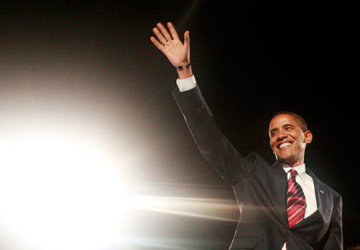
Sen. Barack Obama‘s decision to tour South Carolina with gospel entertainer Donnie McClurkin, a self-proclaimed “former homosexual” who believes it is his mission to turn gays straight, suggests that Obama can’t live without the support of the homophobic contingent of the black community and the black church in particular. But African-American politicians have already proved that black support is not contingent on homophobia. Few people remember that in 2004, the only presidential candidate besides Dennis Kucinich to support gay marriage was the Rev. Al Sharpton — both a mainstream black leader and a minister. Sharpton, Jesse Jackson and Obama have all spoken out in favor of gay rights and against black homophobia. So does including McClurkin on his “Embrace the Change” tour signal a retreat on Obama’s part? Can tacking on an appearance by the openly gay Rev. Andy Sidden make up for McClurkin? (And wouldn’t you love to be backstage on this tour?)

It may be that the realpolitik of the black church operates more subtly than the Obama campaign has yet understood. There has always been a certain degree of “give” between sacred and secular black culture. The overly serious demagogues are almost always cut down to size by larger-than-life fictional counterparts. For every Rev. Willie Wilson, the homophobic Washington, D.C., minister who claimed that lesbianism was “about to take over” the black community, there’s a Sherman Hemsley playing hothead Deacon Ernest Frye on the sitcom “Amen,” with black viewers laughing along. For every Donnie McClurkin, there’s a pop-culture hero like Tyler Perry’s drag matriarch Madea. The media tends to use the black church as a barometer of community standards, but I think in real life, black people compartmentalize more than they get credit for, the way many Irish Catholics balance their deep faith with their deep irony. Preachers may denounce gays on Sunday, but on Saturday night, a certain percentage of the congregation rented “Madea’s Family Reunion,” or danced and drank all night listening to R. Kelly’s “Trapped in the Closet.” Black culture can accommodate everything from the Winans and McClurkin to Richard Pryor and Prince, who gets away with bawdy liberalism, gender-bending and old-time religion, too.

Black American churchgoers may absorb homophobic rhetoric, and preachers may promote fear and misunderstanding, like Wilson, who claimed of lesbianism, “It ain’t real.” (As if he would know.) But the more general message of the black church seems to be that one should love the sinner and not the sin, and that Jesus can change homosexuals. These mandates may be misguided, but they are thankfully nonviolent, thanks to the legacy of Dr. King. Moreover, few black evangelicals here pounce on the issue with as much intolerance and vitriol as the religious in Nigeria or Jamaica, for example, where the church promotes violence against gays and homo homicide is even celebrated in the campaign songs of political parties. The ersatz black Jerry Falwells and Jesse Helmses, like Wilson, Chicago’s Bishop Eddie Long and Los Angeles’ Bishop Noel Jones, don’t represent mainstream black thought the way those who touched the hem of MLK’s garment, like Jesse Jackson, do.

Note that the backlash at Sidden’s inclusion has not come from black church organizations so much as gay groups criticizing Obama for retaining McClurkin. McClurkin, for his part, hasn’t even pulled out in response, though Obama has virtually done somersaults to justify McClurkin’s inclusion. On Thursday, as the tour began, Obama supporters from the African-American religious community and LGBT campaign leaders collaborated on a letter to the public that attempted to clarify their candidate‘s decision to keep McClurkin onboard, stating, “We believe that the only way for these two sides to find common ground is to do so together.”

Obama’s gay advocates obviously support him regardless of this fumble. But his gay critics are right to ask why he thinks getting homosexuals to sit at the same table with antigay and allegedly “ex-gay” Christians represents some kind of balance. Had McClurkin been a Holocaust denier, my money says Obama would be “embracing a change” in his tour’s entertainment lineup, lickety-split.

It shouldn’t surprise anyone that Obama is playing to both sides — that seems to be what he’s best at. He means well, but you know what they say about the highways in hell. However, adding Sidden to the mix without giving McClurkin the shaft was enough of an afterthought to incense the gay community without fixing the problem. Did Obama overestimate the depth of the black community’s homophobia and unintentionally solidify the stereotype about him — that he’s the white man’s black candidate? Well, if Sharpton refuses to pander to the homophobic faction of the black church, why should anybody else?

Continue Reading Close

Why bathroom sex is hot

Larry Craig is the latest politician to get caught with his pants down. So what is the eternal allure of sex in a stall, and does it make you gay?

  • more
    • All Share Services

Why bathroom sex is hot

When Idaho Sen. Larry Craig says, “I’m not gay,” I believe him. But that doesn’t mean he wasn’t cruising for sex last June when he was arrested in a bathroom at the Minneapolis-St. Paul Airport on charges of disorderly conduct. Surely any homosexual worth his capri pants saw the loopholes in Craig’s televised declaration of non-gayness, amplified by the presence of his wife. Even some straight folks, wised up after the scandals of Ted Haggard and Mark Foley, must have noted that Craig did not add a qualifying phrase like, “Nor am I bisexual,” “I’ve never had sex with a man” or even one of those oldies but goodies like, “Doing what I did doesn’t make you gay,” “I was so drunk!” or “I’m only queer for some guys.”

As Haggard and Foley could perhaps have told Craig, bathroom stalls may be tight quarters, but the closet is big enough to fit plenty of religious, conservative Republicans. (In fact, they seem to be crowding everyone else out lately.) What no straight Republican man has the balls to explain — no matter how much Democratic gay sex he’s had — is the eternal appeal of cottaging.

“Cottaging” is the British term for soliciting sex in public bathrooms. In England, stall doors usually extend to the floor — like little cottages, how quaint! — providing maximum privacy for enterprising fellows. I’m calling it “cottaging” because the American expression “cruising” is far less specific: Cruising can take place anywhere (well, maybe not so wantonly on a construction site) and doesn’t even require reciprocation. The term also reminds me of the playwright Joe Orton, whose published diaries, made into the movie “Prick Up Your Ears,” contain many accounts of potty coitus, and his fellow Englishman George Michael, one of the few men outed and publicly shamed for soliciting sex in public bathrooms to make a music video satirizing the incident afterward.

It seems logical that closeted men — that included Michael before his arrest — would seek out anonymous, fleeting encounters, typically in the most transitory sorts of restrooms, at truck stops, airports and other areas of high pedestrian traffic. But this cultural phenomenon is not limited to closeted men or even Catholic priests. So why would openly gay and bisexual men who have access to more comfortable venues like their homes, and the option of attending events such as the Black Party, an annual public sex extravaganza disguised as a dance, indulge in restroom tricks?

Men are sluts. Gay men who have embraced their slut (not technically an “inner” one) may feel they have less at stake when participating in a bit of lavatory horseplay, but the transgression and fear of being caught add an extra thrill to the experience, as Michael has admitted. Some gay men are also turned on by servicing straight guys, perhaps especially while in service stations. And no one cares about your “orientation” in a lavatory — in there, it’s all business.

While I’ve never done it in a public bathroom (no, really!), I’ve been to lots of sex clubs and orgies, which I’ve always found cleaner and comfier. Video booths in porno shops could be a safe substitute for bathrooms, too, but if you’re caught in a porno shop, you can’t say you were just taking a leak. In all cases, though, the protocol is the same: A dude will grab you by the biscuits, and you can either let him continue or gently remove his hand. You may not blurt out, “Hey! Get your hands off me!” like a friend of mine once did in a back room, before he was snappily reminded of where he was. In clubs where men walk around in towels, suitors will gently tweak your nipple to gauge your interest, a greeting another friend dubbed “the Chelsea handshake.”

Most homosexual men spend our formative years in the closet, and once we come out, we tend to deny that closetedness has its pleasures — and damned juicy ones, truth be told. Having a secret, perhaps double, life gives you a sense of importance, of life as drama, a sense you’ll probably relish if you find yourself elected governor of New Jersey. Sex feels otherworldly, forbidden and scary, like you’ve gone so deep into the closet that you’ve arrived in Narnia. For this reason, some openly gay men end up seeking out closets within outness: the closets of sex and/or drug addiction, fetish scenes, knitting circles — it can get crazy.

But at first it’s not easy for queer goslings in the U.S. to find the gay world. (In a few other countries it’s much easier. I’ll never forget my astonishment at how many gay bars in Holland are outdoor cafes, one of which screams “Gay Life” in large letters across its facade; in middle America, gay bars are still in unmarked storefronts with tinted windows.) One of the first ways you learn to find other gay Americans is to listen closely when straight people denounce homosexuals. If a relative grumbles about “faggots doing it in the park,” you might think to ask, as innocently as possible, “Faggots? Really? I’ve never heard that. Which park? What are the cross streets?” After which you’ll go there in the dead of night and find some sense of community, however narrowly focused. If a senator in your state is involved in a scandal, you might search the Internet to find his hunting grounds, even if he’s not your type.

Newbies quickly learn that tapping your feet while sitting in a stall is a good way of letting other cruisers know you’re on the prowl. This may be what alerted the officer who nabbed Sen. Craig, and since foot tapping is such an ordinary activity, I suspect that once it becomes common knowledge, straight men will learn to keep their feet frozen stiff in the stalls. Or not.

But even these explanations for the enduring joy of cottaging seem overwrought, since what motivates a lot of men sexually is simply the prospect of easy prey with no room for intimacy. If there’s one thing for which straight men envy gay men, aside from that fashion-sense stereotype, it’s that we have institutions that promote no-strings sexual encounters, and that on nights when we haven’t gotten lucky by last call, we can stop off at a sex club, a bar with a back room, a park or a public bathroom to find like-minded guys, usually at no charge beyond admission. So if you’re a slut and all you want is a mouth on your dick, it might not matter to you whether that hole’s wearing lipstick, a goatee or both.

Imagining that closeted gay men are the only ones involved in bathroom sex is naive, since it assumes that homosexual acts are synonymous with homosexual identity, which is silly. One hardly needs to be reminded of the many hyper-masculine settings with a reputation for fostering homosexual behavior: prisons, armies, the high seas, the Village People, etc. (Historian B.R. Burg has argued that the 17th century buccaneers of the Caribbean engaged exclusively in homosexual behavior. Take that, Johnny Depp!)

There’s an age-old phenomenon known as “trade,” an exchange between two men, at least one of whom is ostensibly heterosexual, in which the recipient of a blow job or the active partner in anal sex can walk away from his hanky-panky with plausible deniability. In other words, he can console himself with the belief that he is “not gay,” because for some reason (misogyny, let’s say) a lot of men think that whoever gets penetrated is “the woman,” or more womanlike.

Which brings us back to Sen. Craig. Though the Idaho Statesman has cataloged a series of incidents that point to homosexual pickups dating back to 1967, he’s sticking to the straight story, unlike Ted Haggard, who admitted partial guilt, confessed completely and then claimed to have been “cured” after three weeks of so-called reparative therapy. So unless we can get a full, graphic report on who was planning to do what to whom in that airport bathroom stall, the senator is free to believe that he is not gay, and has never been gay. Until then, we’ll all be tapping our feet.

Continue Reading Close

Page 7 of 7 in James Hannaham