Let’s see. America is pulling out of a recession. The military-industrial complex is humming along. Healthcare is far from being reformed. We might as well pretend it’s 1984.
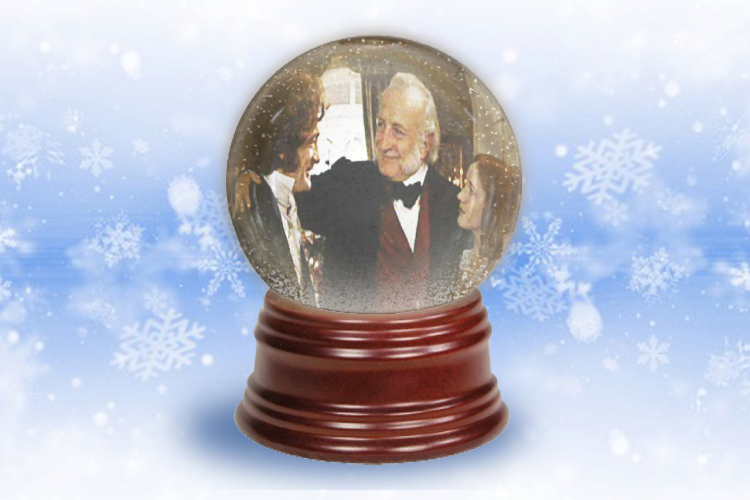
And in that case, let’s pause and pay due homage to a movie that many of us either missed or overlooked the first time around. A television movie, of all things, that through some convergence of inspired casting, rich production values, and deep but unfussy textual fidelity became the definitive version of a beloved literary classic.
Only we’re just now figuring that out.
When you ask ardent Dickensians to name the best version of “A Christmas Carol,” they will invariably close ranks around the 1951 Alastair Sim adaptation. I was one of those partisans myself. I turned up my nose at Reginald Owen and Albert Finney, I scoffed at Michael Caine and Patrick Stewart, I rolled my eyes at the mere mention of Bill Murray and Kelsey Grammer, I resisted even the myopic charms of Mr. Magoo. It was Sim or nobody.
It helped, of course, that Sim’s was the version I had grown up with and the version that, with its chiaroscuro stylings, seemed closest to the dark spirit of Dickens’ rather unsentimental original (and John Leech’s original drawings). Best of all, it had Sim himself, whose magnificently expressive face could, as needed, explode toward heaven or sag to the very pits of hell. (Surely, Dr. Seuss took a good hard look at the Scottish actor’s puss before sketching the Grinch.) For many Dickens lovers, it’s impossible to hear a line like “There’s more of gravy than of grave about you” or “You were always a good man of business, Jacob,” without hearing Sim’s inflections, delivered in a voice that reminded one colleague of “a fastidious ghoul.”
Yes, I was a Simmian down to my sinews, until I sat down last year to watch the film in the company of my 8-year-old son — and experienced a rude shock. There was no question that Sim’s work held up, but — how do I say this? — for the first time in the film’s nearly 60-year existence, I felt I was watching an old movie.
The print was muddy. The supporting cast abounded in the Old Vickery that characterized so much postwar British acting: that rather plummy relish in the thespian’s craft that, in the case of Kathleen Harrison’s housekeeper or Miles Malleson’s Old Joe, becomes too much of a not-always-good thing. Scene after scene, from the Cratchits’ Christmas dinner to the flashbacks of Scrooge’s youth to the scroungers trolling through Scrooge’s clothes, seemed troweled on just a bit too hard, as if the filmmakers were afraid we’d miss the point. (As if we could miss the point.)
But what troubled me the most, I think, was that my son, a movie lover, was left unmoved by the whole enterprise. That hit me where I lived. As a writer who drew enough inspiration from Dickens’ story to write a novel in homage, I’ve always believed that “A Christmas Carol” must, above all, entertain. If the vehicle is reduced to no more than its message, we might as well boil it in pudding and bury it with a sprig of holly through its heart.
So it became a point of honor to find a version of Dickens’ classic that would resonate for my son and his generation, just as Sim’s film had once done for me. I won’t say I searched high and low, exactly, but there’s a lot of both high and low in the Scrooge canon. At least a dozen stage productions of “A Christmas Carol” sprang to life within a year of the book’s 1843 release. The first film version was a 1901 British silent called “Scrooge; or, Marley’s Ghost.” Eight additional films appeared between 1910 and 1928, starring once-esteemed theatrical actors like H.V. Esmond and Russell Thorndike and Seymour Hicks. Hicks, in particular, made something of a career of Scrooge, trotting him out more than 2,000 times on the stage, then convoying him to the silent screen in 1913, then dragging him back 22 years later for a talkie version.
It’s easy to see Scrooge’s allure as a part. Given the chance to be both villain and hero in the space of 90 minutes and to leave an audience gulping on its own humanity, most actors will slay every grandmother they ever had. Which is to say that on television, radio and stage, Scrooge has been essayed by the likes of Lionel Barrymore, Ralph Richardson, Fredric March and Basil Rathbone. More recently, Shakespearean veterans like Derek Jacobi and Simon Callow and Michael Hordern have had their crack at him, and with producers now spinning out endless gender- and race-based variations, James Earl Jones, Cicely Tyson, Vanessa Williams and Susan Lucci have stepped nervously into the old template. Did I mention Vic Damone and Buddy Hackett?
In short, “A Christmas Carol” has spawned a thick tangle of camp and classicism. And who would have guessed — and who could not be pleased — that the actor to emerge most gloriously from the morass would be a West Virginia native and Marine Corps veteran best known for playing homicidal U.S. generals?
An actor, moreover, who came to Scrooge at a peculiarly vexed moment in his own career. In the late ’60s and early ’70s, George C. Scott rode films like “Petulia” and “Patton” and “The Hospital” to a position of lonely and bitter pre-eminence. He was, like Brando, a force of nature disguised as an actor. And like Brando, he had a genuine and visceral loathing for his own gift. To make matters worse, he had a fondness for alcohol, a knack for antagonizing directors and fellow cast members, and a volcanic persona that made him nearly impossible to cast.
And so, after his glory years, Scott’s filmography descended with alarming speed into the bizarre (“The Day of the Dolphin,” “The Savage Is Loose”), the hokey (“The Formula,” “Firestarter”) and the occasional bit of indentured servitude (“The Hindenburg”). By 1984, his greatest triumphs were more than a decade behind him, and even his truest and bluest fans could scarcely imagine him salvaging his career by climbing into Ebenezer’s old nightshirt. Certainly not at the behest of a hack director like Clive Donner, whose recent oeuvre had included the likes of “The Nude Bomb” and “Charlie Chan and the Curse of the Dragon Queen.”
I actually remember groaning when I read that long-ago TV Guide listing: George C. Scott IS Ebenezer Scrooge, or some such nonsense. I knew, or at least I thought I knew, exactly what I was in for. “A very special television event,” in which Scott would swallow every scrap of scenery within reach and would himself be swallowed by oblivion.
But something else happened. At some point in preproduction, Scott and Donner and adapter Roger O. Hirson decided they were going to make not “A Christmas Carol” but “The Christmas Carol.”
Whereupon fact gives way to speculation. Did the filmmakers go straight back to Dickens? To the book that so many people think they’ve read without actually having read it? Did they realize how shadow-laden it really was? Did they set out to show us that what we “knew” about Ebenezer Scrooge was wrong?
Well, here’s what we can say about the makers of the 1984 “Carol.” They trusted Dickens’ language to carry the story. They drummed up enough financing to create a persuasive depiction of early-Victorian London, right down to the bonnets and fenders. And they chose an uncommonly fine supporting cast. Edward Woodward, soon to be a transatlantic star courtesy of the network drama “The Equalizer,” makes possibly the sexiest-ever Ghost of Christmas Present. Roger Rees, fresh from Dickens duty in the miniseries of “Nicholas Nickleby,” brings winningly shy accents to the historically bland role of Scrooge’s nephew Fred. And David Warner, too often cast as a slot-eyed villain (like the manservant-thug in “Titanic”), transforms Bob Cratchit into a true proletarian, a man who doesn’t so much espouse goodness as depend on it.
Thanks to the work of these players, we grasp something of what Dickens was trying to get across, that virtue is eternally at war, that it can give way at every point. As a result, scenes that were once soppy-saggy with tears turn strangely bracing. In the hands of Susannah York, for instance, Mrs. Cratchit’s lament for Tiny Tim becomes a plain, true, helpless expression of grief, all the more moving for its restraint.
Well, Cratchits and ghosts come and go, one might argue, but every “Christmas Carol” must rise or fall with its Scrooge. And on this point the 1984 version most emphatically ascends.
We can talk, if we must, about George C. Scott’s technique. Start with the accent: not an immaculately Streepian production but an internalized Englishness that commands from the first note. There’s the lovely underplaying of Scrooge’s villainy, which has lured many an actor into the slough of hamminess. The charm of the closing scenes, in which Scrooge’s newfound joy seems to be stealing up from behind him and grabbing him by his collar.
But in my mind, this particular Scrooge rises to greatness in the graveyard scene, where the sight of his name on a gravestone prompts the famous cri de coeur: “I am not the man I was! I will not be the man I must have been! … I will live in the Past, the Present, and the Future. The Spirits of all Three shall strive within me … Oh, tell me I may sponge away the writing on this stone!”
Here it is: the dreaded “moral,” in which all of Dickens’ didactic chickens come home to roost. But in the hands of the classically trained Scott, it is the wail of a wasted soul. And not just a soul. With due respect to the motion-capture technology of Jim Carrey’s 3-D theme ride, what makes this scene so riveting is that we’re watching a real face — a face like a ruined abbey — and a lived-in body and a burnt-out voice. A human being with a history of passion.
Scott, unlike Alastair Sim, was a tragedian at heart. And perhaps it’s not too much to suggest that, at some half-conscious level, he used Scrooge’s dilemma to relive the tragedy of his own life: the missed opportunities, the squandered potential. Hadn’t he once supped at the table of the gods? Hadn’t he once had the force and imagination to play King Lear, Prospero, James Tyrone, Willy Loman? Where had it all gone? And how?
Charles Dickens wrote “A Christmas Carol” quickly — in six weeks, in a fever of inspiration. He said afterward that he felt the Cratchits “ever tugging at his sleeve, as if impatient for him to get back to his desk and continue the story of their lives.’ And it is because the Cratchits and the other characters were so real to him that they remain so real to us. “A Christmas Carol” succeeds not because of its message (which Dickens recycled to markedly less effect in his later Christmas tales) but because, through all its supernatural agentry, we feel ourselves in the presence of flesh and blood. And that is just what George C. Scott, in his last great performance, gives us. An Ebenezer Scrooge with hands, organs, dimension, senses, affections. A Scrooge who, when you prick him, bleeds.
Tennis great Martina Navratilova of the U.S. returns a shot to Monica Seles during their demonstrative match at the BCR Open Romania tennis tournament in Bucharest September 16, 2007.
A famous multimillionaire athlete falls in love. He invites his new girlfriend to live and travel with him; he registers hundreds of thousands of dollars worth of property and assets in her name; he lavishes her with gifts, assures her of his undying love and even goes so far as to marry her in a private ceremony. Eight years later, the athlete has cast his wife out of his life, denied her every financial claim and left her with little more than the clothes on her back.
Here’s a question. Would any court in the land deny this wife restitution? And in the court of public opinion, would anyone take the side of a husband so stingy and unfeeling?
Let us now switch the husband’s gender. He is now a she: a lesbian tennis star willing to use the legal system to extract herself from another unhappy relationship. This makes the case more complicated, to be sure, but it does nothing to alter the injustice. And, if anything, the outrage should be greater.
In the past week, Martina Navratilova has been sued by a former lover, Toni Layton, who claims she was unceremoniously dumped and is now owed millions of dollars in damages and spousal support. Layton claims she and Navratilova had agreed “to evenly share all funds and assets earned and obtained by either while together.” These assets apparently include four multimillion-dollar homes.
By now, the suing of athletes by ex-lovers has become a staple of tort law, but unlike Roberto Alomar or Michael Jordan or Chris Bosh, Navratilova is able — and has been willing– to take advantage of a legal double standard that is both sexist and homophobic. And the gay community should be first in line to oppose it.
I say this with some regret because I have enormous admiration for Navratilova. She is one of the two or three greatest women ever to play the game of tennis. She has transformed society’s understanding of athleticism. And she has been candid and unapologetic about her sexuality at a time when most gay athletes, male and female alike, still have to be dragged from the closet.
But her current legal troubles remind us that even gay icons have some growing up to do when it comes to gay relationships. We cannot know whether all the assertions in Toni Layton’s lawsuit are true. We can say, however, with some certainty that the two women lived together as a couple, that they celebrated their relationship in a ceremony in New Hampshire, that they shared property and assets, and that Navratilova is much the wealthier of the two. If this were a no-fault heterosexual divorce, the law would unequivocally side with Layton, awarding her alimony and some division of property.
But the law, of course, still has different standards for same-sex relationships, and Layton has been forced to file a “domestic partnership” lawsuit in the deeply inhospitable legal climate of Florida, which has traditionally taken a dim view of alternative lifestyles. Barring a settlement, then, Navratilova stands to emerge from her most recent long-term relationship with little more than bad press and some whopping legal fees. If, that is, she can convince a court that her relationship with Layton doesn’t rise to the contractual level of heterosexual marriage.
This stratagem is not new to her. In 1991, Navratilova’s ex-lover Judy Nelson sued her for $7.5 million in spousal benefits — or, as the slavering tabloids used to call it, “galimony.” To buttress her case, Nelson argued that the two women had engaged in not one but two marriage ceremonies and had filmed a video will together.
Nelson also got vocal support from another Martina ex, Rita Mae Brown. In her memoir, “Rita Will,” Brown writes that her sympathies shifted toward Nelson during a pretrial hearing in which Navratilova’s lawyers argued (Brown’s words) that “Martina and Judy had had a contract for sex,” which “amounted to prostitution and therefore was against public policy.” By demoting same-sex relationships to the level of a roll in the hay, Brown argued, Navratilova “could inflict colossal damage on every gay person in the United States.”
Brown’s motives in entering the case were suspect — she had famously shot out the back window of Navratilova’s BMW after a quarrel, and she herself enjoyed a brief liaison with Nelson — but politically she was on target. The only way Navratilova could escape her financial (not to mention moral) obligations was to argue that her gay relationship did not carry the same legal standing as a straight relationship.
What was cynical then has become indefensible now. Martina Navratilova can no longer cast herself as an apostle for gay rights while using a homophobic legal code to deny her ex-partners alimony. This is more than bad behavior, it is bad precedent. And it comes at the worst possible time.
Very soon — sooner than anyone could have guessed — gay marriage will become the law in much of the land. A great deal has been written about whether straight America is ready; less has been written about whether gay America is ready. Not just to be held to the same contractual standards as heterosexual couples but to believe (after years of being told otherwise) that their relationships really are of equal standing. And to go on believing it when those relationships collapse.
In reporting on Toni Layton’s lawsuit, Britain’s Daily Mail used the following headline: “Martina Sued for Millions by ‘Wife.’” I hope and expect that those archly condescending quotation marks will one day disappear, but it is the job of the gay community to make them go. If we want our relationships to be taken seriously, if we want the legal sanction of marriage, we must be ready to stand by our contracts and our obligations — no matter how expensive or inconvenient it is and no matter what example is set by our culturally designated “heroes.” Equality has its blessings. It also has its price.
“Consultants are people who borrow your watch and tell you what time it is,” business executive Robert Townsend once said, “and then walk off with the watch.”
Townsend didn’t live long enough to witness the ascent of über-consultant Malcolm Gladwell, who walks off with considerably more than a watch: $40,000 a speech, by most accounts, and an annual income in the neighborhood of $1 million. Buoyed by two runaway bestsellers, “Blink” and “The Tipping Point,” Gladwell has positioned himself as a roving ambassador between cultural and corporate America, penetrating boardrooms and living rooms, providing bullet points for cocktail parties and management seminars, and changing not just the things we talk about but the way we talk about them.
But in this new era of belt-tightening, everyone must expect some cost-benefit analysis, and so, in our best consultant-speak, we ask: How much value does Malcolm Gladwell really add?
Well, he saves us from having to read the unfiltered prose of Thomas Schelling. Not to mention the many other academicians whose work Gladwell has synthesized and synopsized. A New Yorker staff writer and, before that, a science writer for the Washington Post, Gladwell is extremely skilled at translating arcane research into common-man language. But what truly separates him is his ability to repackage that research into formulas so tidy and attractive they burrow straight into the zeitgeist.
Gladwell didn’t originate the phrase “tipping point,” but he made it part of our discourse. To a lesser extent, he did the same thing with “social epidemics” and “thin slicing” and “mavens” and “connectors.” Even people who haven’t read the books still use these terms as a matter of course. Part of the thrill, then, of opening Gladwell’s latest volume, “Outliers: The Story of Success,” is to see which catchphrases we can master before the rest of the world catches up.
In this respect, at least, “Outliers” disappoints. “Meaningful work” and “practical intelligence” aren’t quite as sexy as “the law of the few” and “the stickiness factor.” But this may be because Gladwell is less interested in erecting new constructs than demolishing old ones. Specifically, he has his gun sights set on the “genius” theory, which I assumed had gone out of business around the same time as history’s “great man” theory but which, according to Gladwell, is still warping our notions of success and failure.
“People don’t rise from nothing,” he writes. “They are invariably the beneficiaries of hidden advantages and extraordinary opportunities and cultural legacies that allow them to learn and work hard and make sense of the world in ways others cannot … It is only by asking where they are from that we can unravel the logic behind who succeeds and who doesn’t.”
In other words, don’t ask how Bill Gates got so smart. Ask what unique set of circumstances allowed him to harness his smarts toward world dominion. “Successful people don’t do it alone,” the author tells us. “Where they come from matters. They’re products of particular places and environments.”
The mission of “Outliers,” then, is to map the “ecology” of success. And so Gladwell teases out the divergences between IQ scores and achievement. He shows how codes of family honor pass virtually intact from northern England to the Cumberland plateau. He studies the conditions by which the Beatles were able to hone their craft over thousands of hours in Hamburg nightclubs. He assesses the class barriers that allowed legendary physicist Robert Oppenheimer to succeed (despite having tried to poison a tutor) while blocking the advancement of an obscure working-class autodidact named Chris Langan.
The first thing to be said about all this is how entertaining it is. Gladwell’s curious and eclectic temperament yokes together subjects that, at least on the surface, seem unrelated: “Rice Paddies and Math Tests,” to quote one chapter title. On top of that, Gladwell is a superb anecdotalist who couches his case histories as intellectual whodunits. We begin with a puzzle: Why did so many Korean Air planes crash between 1988 and 1998? We eliminate various red herrings: bad morale, procedural violations, flight crews smoking on the tarmac. At last comes the pleasantly shivery moment when Gladwell pulls open the curtain to reveal the solution. Korea’s exceptionally deferential culture prevented first officers from challenging captains’ decisions in the cockpit. The whole story has been so ingeniously constructed that, as soon as you’re done, you want to call someone and tell him what you just learned.
It’s when Gladwell begins to extrapolate from his anecdotes that he demands a certain indulgence. “Outliers,” for instance, offers a fascinating portrait of a group of eminent New York Jewish lawyers, all of whom were born around 1930. As Gladwell points out, this accident of birth date gave them several distinct advantages. Thanks to demographic shifts, they went to underpopulated public schools, where they received more attention from teachers. They were then able to get inexpensive college and legal educations. Barred from mainstream WASP firms, they were forced to specialize in proxy fights, an area of law that WASPs wouldn’t touch. This, in turn, gave them a huge competitive advantage 20 years later when hostile takeovers began to sweep across the corporate landscape.
So far, so good. But Gladwell also finds special significance in the fact that the lawyers’ parents were in the garment trade, which, for all its backbreaking rigors, he characterizes as “meaningful labor.” Why? Because it offered “autonomy, complexity, and a connection between effort and reward.” Moreover, this labor taught the next generation that, in Gladwell’s rather sentimental formulation, “if you work hard enough and assert yourself, and use your mind and imagination, you can shape the world to your desires.”
But it’s precisely by using our minds and imaginations that we begin to see the holes in Gladwell’s conclusions. Did Jewish immigrants take up the garment trade because it was meaningful? Or because it was the only trade open to them? Did they really believe, over the course of their hundred-hour workweeks, that they were shaping the world to their desires? And if their work was so meaningful, why did they urge their children to escape into white-collar professions at the first opportunity? And what about the so-called non-meaningful workers (e.g., day laborers, domestics, construction workers)? Did any of their children become lawyers?
Similar questions pop up in Gladwell’s discussion of Asia’s math superiority. He makes useful points about the simplicity and transparency of Asian numbering systems, but then he heads straight back to the rice paddies, where extreme but, yes, meaningful labor shapes the dogged work ethic that would later forge math champions. But if that’s the case, why don’t we see a comparable level of math prowess in West Africa, where rice has been cultivated for centuries? Or, for that matter, the Carolinas?
The problem with having your theory in hand from the beginning is that you have to slough off whatever data don’t fit. There is, in fact, a small-print proviso attached to each of Gladwell’s theoretical constructs: “Except when it doesn’t.” “The Tipping Point”: A small-scale social shift can generate sweeping societal change … except when it doesn’t. “Blink”: Great decision making happens on impulse … except when it doesn’t. (Or, in the case of racial profiling, shouldn’t.)
Gladwell’s “Outliers” model — the idea that success is shaped by environment, not genetics — has two additional problems. First, it is insufficiently predictive. We can easily see that favoring people with January birthdays over people with September birthdays, as Canadian hockey leagues do, can have consequences. But how could anyone have predicted that postwar Jewish lawyers would be rewarded for their expertise 20 years down the road? Or that, 20 years after Bill Gates was born, the advent of the personal computer would turn programming geeks into masters of the universe? These are historical accidents, for which it is impossible to prepare. Success, in these instances, is simply a byproduct of luck.
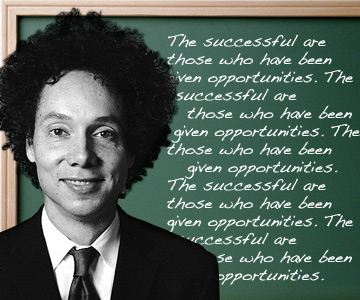
This leads us to the second problem with Gladwell’s model: It is every bit as deterministic as the “genius” model. “The successful are those who have been given opportunities,” he writes, “and who have had the strength and presence of mind to seize them.” But opportunity is as much out of our control as genetics. What if the opportunity doesn’t come? If, as Gladwell suggests, we are prisoners of our ethnic or cultural legacies, what if we are of the wrong ethnicity or the wrong culture? How can we ever hope to succeed? If, on the other hand, we can overcome these environmental barriers through relatively quick fixes, as Gladwell suggests elsewhere, then how significant are those barriers?
Gladwell’s books would be more intellectually honest if he simply dispensed with his frameworks altogether, but then, of course, he wouldn’t be the cultural figure he is now. Like “Freakanomics” guru Steven Levitt, Gladwell promises to unravel our knottiest problems with the simplest of paradigms. By turning the macro into micro, he frees life of its chaos.
Gladwell, in short, is in the hope business. “People are experience rich and theory poor,” he told the New York Times. “People who are busy doing things — as opposed to people who are busy sitting around, like me, reading and having coffee in coffee shops –don’t have opportunities to kind of collect and organize their experiences and make sense of them.” He has been so devoted to helping them with this meaningful work that he has perhaps missed one of the signal ironies of our recent financial meltdown, which is how little it was predicted by theory. Indeed, some of our greatest theoreticians were caught dozing in their endowed chairs. (Even Alan Greenspan was forced to recant his lifelong devotion to Ayn Rand.) Economics has never been theory poor, and theory has never been a substitute for thought. Theory’s failure, however, has placed a much higher premium on humility.
De Palma's '80s cult classic is trash, many scoff. But the lowdown, seedy movie with Al Pacino as a Cuban thug influenced pop culture from gangsta rap to "Miami Vice."
It’s a tough mission that critic Ken Tucker has set himself in “Scarface Nation”: to apotheosize and assay and cogitate over a movie that … is not very good. At all. At least not by the critical standards we grown-ups are supposed to apply to the film form. We’re supposed to hoist our delicate noses in the air and point out that “The Godfather” saga and “The Sopranos” series are far more profound depictions of the mobster soul than this “Scarface” creature and that “The Wire” is an infinitely more complex study of crime’s intersection with poverty and that pretty much everything accomplished by Brian de Palma’s 1983 cult classic has been done more subtly, more thoughtfully, more humanely by someone else.
Oh, screw it: A quarter-century after its birth, “Scarface” lives on, for all its vulgarity. Or is it because of its vulgarity? “There is something unshakably low-down and seedy,” writes Tucker, “disreputable and sneaky, about ‘Scarface’ as a piece of art, an antistatus that only adds to its pervasiveness and longevity.”
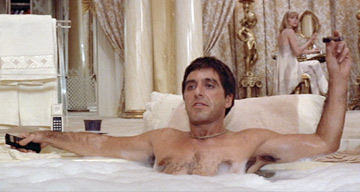
Piece of art, did he say? The same movie where Al Pacino buries his face in pile-high drifts of coke and emerges looking like a white-nosed coati? The movie with that trashy robo-disco Giorgio Moroder score that already sounds as dated as the theme from “Love Story” and the tapestry of profanity so dense you can actually watch a two-minute version of “Scarface” consisting entirely of the word “fuck” and find it every bit as intelligible as the full-length film?
Oh, sure, have your laugh, says Tucker. “‘Scarface’ absorbs ridicule and overexposure and just keeps on going.” Very much like its protagonist, Tony Montana, a Cuban thug exiled to Florida in the 1980 Mariel boatlift. Crafty and ambitious, Tony enlists as a soldier with Miami drug kingpin Frank Lopez (Robert Loggia) and bides his time until he can eliminate his boss and claim the boss’s mistress (the affecting Michelle Pfeiffer). But even as he becomes king of the local drug trade, he grows crazier and more paranoid, and at film’s end, having killed or alienated his loved ones, he’s left alone to stage-manage the spectacle of his death. And what a death! A Christ-like swan dive into a swimming pool, from which Tony ascends not to heaven, as Tucker writes, but to “the kingdom of pop, where all things exist in an eternal present.”
“Scarface” was only a modest commercial success when it was first released. The reception from critics was frosty: Even Pauline Kael, a longtime water-carrier for de Palma, dismissed the film as “an allegory of impotence.” Many viewers were repelled by the movie’s language and violence (at one key juncture, Tony is forced to watch his friend dismembered by a chain saw) and by the overkill that seemed sewn into the film’s very fabric. The final sequence, by way of example, features what appears to be the entire population of Colombia pouring into Tony’s ineffectually guarded mansion. As the film’s screenwriter, Oliver Stone, puts it: “That’s a Hong Kong action-film shoot-out before its time, right?”
Something else before its time: de Palma’s decision to dispense with film noir shadows. “If a violent act is going to occur,” he instructed cinematographer John A. Alonzo, “the surroundings should be bright, not dark.” The resulting pastel, keyed to Florida’s neon colors, signified a new order of moral rot and would soon be encoded and formalized via “Miami Vice.”
“Scarface” is nothing, finally, without the catchphrases that Stone salted so liberally into his script. Some seem to issue from a street-MBA program: “Don’t get high on your own supply … First you get the money, then you get the power, then you get the women.” Some have the flavor of personal credo: “I bury those cock-a-roaches … All I have in this world is my balls and my word.” My personal favorite is Tony’s admiring assessment of Miami: “This town like a great big pussy, waitin’ to get fucked.”
But undoubtedly the line that has given “Scarface” its permanent place in pop culture comes when Tony straps on a bazooka roughly the size of a mature oak and prepares to rain down death. “Say hello to my little friend!” he snarls. Although, by the time it makes it past Al Pacino’s lips and tongue, it sounds more like “Say yello to my lee-ul fren.” Either way, it’s irresistible: an explosively funny exercise in phallic worship.
We can see, then, that the phrases “Tony Montana” and “cinematic treasure” are never going to be yoked in the same sentence. “Scarface” owes its immortality, anyway, not to traditional tastemakers but to a devoted cult of young black and Hispanic men (a few women, too) who seized it for their own. Its arrival coincided with the gangsta phase of rap and hip-hop, and the film’s various tropes — “the ostentatious jewelry, the glorification of drug-taking as well as drug-selling, and the images of women as near-naked arm-candy” — have been staples of music videos ever since. As one observer put it, “All these rappers are out there rapping about how much money they got, and all the drugs they sell — that’s who they’re emulating: They’re living their little Tony Montana dream.”
Tony’s second-class status, coupled with his ruthless pursuit of the American dream, spoke with ferocious directness to a whole generation of street kids, not to mention celebrities. Snoop Dogg watches the movie at least once a month; Sean “Diddy” Combs has seen it at least 63 times; Shaquille O’Neal celebrated his 34th birthday with a Scarface party. No episode of the MTV series “Cribs” is complete without some musician pointing pridefully to a Scarface photo collection or a set of Scarface window blinds or an exact replica of Tony Montana’s white sofa.
This cross-cultural identification has exacted a rather large price, as Tucker is careful to note. The misogyny that drives so much gangsta rap, for instance, derives in part from de Palma’s reduction of women to “disco dollies and white-silk fantasy figures.” And the dubious ethos that Tony Montana supposedly lives by manages to obscure the fact that he’s a coldblooded killer. “How many young lives — urban and suburban — might be less caught up in criminal behavior had ‘Scarface’ not codified a certain set of rules to live (and die) by?” asks Tucker.
Tucker’s a bit too eager, maybe, to paint a trail of blood from “Scarface” to the ghetto, but I confess that just when I thought he was overstating the film’s influence, a Netflix ad popped across my computer screen, and there it was: Tony Montana in his white disco suit. “Chi Chi!” I nearly cried in homage. “Get the yeyo!” Today, Al Pacino’s ravaged face glowers forth from T-shirts, shower curtains, shirts, jerseys, hooded jackets. “‘Scarface,’” writes Tucker, “is the only movie that is its own franchise.”
An editor-at-large with Entertainment Weekly (who, I should disclose, once favorably reviewed a book of mine), Tucker does an expert job of tracking “Scarface’s” provenance, from Armitage Trail’s 1930 novel to Howard Hawks’ 1932 film version (a far more concise work than de Palma’s remake and, in its day, nearly as controversial) all the way to “The Untouchables” and such end-of-the-pipeline effluents as comic books, video games and ringtones. Tucker is an astute and persuasive and deeply informed cultural observer, and in “Scarface Nation,” he has tucked just the right amount of tongue into his cheek.
The only thing he couldn’t convince me of was the movie’s esthetic value. “A great shallow masterpiece of pop,” he calls it, “a work of diverse, mongrel artistry.” I take this to be a nice way of saying “trash.” Lively trash, to be sure, but when Tucker goes on to suggest that “As soon as you see it, you want to experience it again,” well, that’s when I get off the bus. I’ve seen it twice, and each was enough to last me a decade.
What makes it so exhausting, I think, is Pacino. He’s in virtually every scene, and like Paul Muni, who played Tony in the original film, he is in hock to his own ambition. His performance suggests that it’s not enough to be good, a great actor must be Great. This determination is so at odds with the pseudo-operatic silliness of “Scarface” that it produces camp at fairly regular intervals.
Contrast the extravagant surface effects of this movie with Pacino’s minimalist work in the second “Godfather” installment, where he limns the death of Michael Corleone’s soul with such precision that your own soul seems to freeze in response, and you’ll see that something truly sad died with Tony Montana: a great actor’s bullshit detector. All things considered, I can just about forgive Scarface. I’m not sure I can forgive “Scarface.”
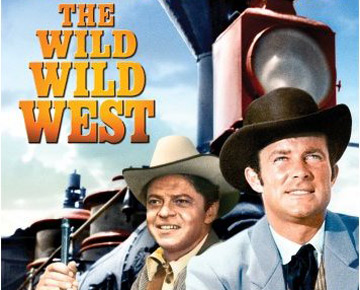
What does it look like to have an African-American in the White House? Pop culture has offered versions awful and great, from Sammy Davis Jr. to Chris Rock.
If Barack Obama wins Tuesday, he might begin his victory speech by thanking Dennis Haysbert.
At least Dennis Haysbert seems to think so. Months ago, he declared that his portrayal of a black president on Fox’s “24″ series had paved the way for the real-life senator from Illinois. “If anything, my portrayal of David Palmer, I think, may have helped open the eyes of the American people. And I mean the American people from across the board — from the poorest to the richest, every color and creed, every religious base — to prove the possibility there could be an African-American president, a female president, any type of president that puts the people first.”
He may be on to something. As one of “24′s” most dedicated and ambivalent fans, I have always marveled that a single program could accommodate both Dick Cheneyesque interrogation techniques and the liberal wet dream that is David Palmer. Unassailable in his goodness, ironclad in his resolve, Palmer is only incidentally a black man, and he is, not so coincidentally, everything you could want or need in a commander in chief. In the checks-and-balances universe of “24,” a figure of such virtue cannot live indefinitely, and in the opening episode of Season 5, David Palmer was duly sent to his reward. His legacy lived on, fitfully, in younger brother Wayne (D.B. Woodside), who overcame his wicked-pol origins (and his goatee) to become the Bobby to David’s JFK. “24″ is hyper-adrenalized pulp, but pulp can be as good a teacher as art — better, maybe — and it’s hard to deny that six years of the Palmer brothers have inured a whole segment of Fox America to the sight of black faces in the Oval Office. But, in fact, the Palmers are just the latest milepost in a long road of acculturation that has taken several curious detours along the way.
To the audiences of the early 20th century, perhaps the most defining image of black power was provided by “The Birth of a Nation” (1915), which shows the Reconstruction Legislature of South Carolina overrun by barefoot black legislators — an open reproach to everything white civilization holds dear. Given the prevailing political climate, it’s no wonder that the idea of a black president, before it could be broached anywhere else, had to be considered through the prism of fantasy.
In 1926, a Brazilian children’s author named Monteiro Lobato had to look far into the future — the year 2228, to be exact — to imagine an African-American president. In Lobato’s obscure, half-prescient novel, “O Presidente Negro (The Black President),” a politician named Jim Roy, leader of the Black Association party, actually succeeds in claiming America’s highest office, only to be undone by a coalition between the incumbent white president and a white feminist named Evelyn Astor. Roy is murdered in short order, leaving his race to be sterilized into extinction by “the Aryan super-civilization.” See where ambition gets you?
Fantasy of a different order is on view in “Rufus Jones for President” (1933), a bizarre Vitaphone musical short in which a black mother (the great jazz-blues singer Ethel Waters) dreams that her little boy (an immediately recognizable Sammy Davis Jr.) has been elected president. A modern viewer barely has time to register the aspiration before recoiling at the racial slurs that were common to that day: black voters lured to the polls with free pork chops; Rufus celebrating his victory with a half-eaten piece of chicken; a presidential platform that calls for unlatching chicken coops and planting watermelon vines close to the fence.
From bulging eyes to happy feet, scarcely a single racist trope is omitted from this 23-minute film. But perhaps the most disturbing sight is Davis, whose grown-up clothing and prematurely aged face give him the appearance less of a child than of a midget. It’s as though the filmmakers understood that the only way to make a black president pass with Depression-era audiences was to shrink him into freakish insignificance.
Rufus’ minstrel trappings have long since faded away, but the freak principle has proven more tenacious. Luc Besson’s 1997 sci-fi epic, “The Fifth Element,” features professional wrestler Tommy “Tiny” Lister Jr. as a 300-pound space-federation president who conveys his thoughts via grunts and glares. President Dwayne Elizondo Mountain Dew Herbert Camacho (Terry Crews), the free-world leader of Mike Judge’s futuristic satire, “Idiocracy” (2006), is yet another professional wrestler, who opens his State of the Union address with the word “Shit!” followed by: “I know shit’s bad right now with all that storm and bullshit. And the dust storms. And we runnin’ out of French fries and burrito covers.” In both movies, the joke is essentially unchanged from the days of Rufus Jones: These are the last guys in the world — or any world — you’d want to vote for.
The same might be said of Mays Gilliam, the D.C. alderman of “Head of State” (2003) who is tossed into the presidential race as a sacrificial lamb so that a more deserving candidate can win four years down the road. (The film is a kind of downscaled black version of Michael Ritchie’s “The Candidate.”) Star-director Chris Rock at least takes the honorable course of showing that Mays’ street wisdom and common-man empathy make him at least as deserving of high office as the white stuffed suit he’s running against. It’s telling, though, that one of the bigger laughs in an undernourished movie comes when Rock is first asked to run for president of the United States. “The United States of what?” he cries.
For a soberer assessment of how Mays’ scenario would play out, you have to turn back the clock to 1964, when high-minded pulp writer Irving Wallace published his bestselling novel “The Man.” Wallace’s hero, Douglass Dilman, begins the story as a cipher and token: A black politician who has chosen not to make waves and whose reward is to be appointed Senate president pro tempore. With the sudden deaths of the president, vice-president and House speaker, laws of succession unexpectedly thrust Dilman into the Oval Office, where he has to choose between obeying the directives of his white advisors or hewing to his own stubborn path.
“The Man” is many things — overlong, overplotted, deeply in earnest — but it is most vividly a window into Kennedy-era racial pathologies. Dilman’s mulatto mistress could pass for white, and his grown daughter is already passing. His son is embroiled with black radicals, one of whom tries to assassinate Dilman for being a traitor to his race. Dilman himself confesses that he is “afraid of being black,” and in a plot move straight out of “Birth of a Nation,” his white social secretary accuses him (falsely) of trying to rape her. Even the author, whose liberal sympathies are never in doubt, occasionally falls prey to the era’s unthinking racism, as when he pauses to consider Dilman’s “thick lips” reciting the presidential oath.
On the basis of trumped-up evidence, Dilman’s enemies manage to get him impeached, but he is saved from conviction by the vote of a single white senator, who has belatedly come to appreciate Dilman’s integrity. (The trial, ironically enough, is based on the proceedings against Andrew Johnson, who was a prime demolisher of the Reconstruction.) At the end of Wallace’s book, Dilman has survived his ordeal, but just barely, and his survival is, in effect, all the honor he can expect.
When Rod Serling adapted “The Man” to the screen in 1972, the political climate had changed sufficiently that he could promote Douglass Dilman from survivor to competitor — a genuine leader who, after standing up to his white rivals, vows to win the presidency through “legitimate” electoral means. In the final sequence, Dilman strides onto the floor of his party’s convention to declare his candidacy, and in our last image of him, he is framed against the American flag with the cheers of his supporters ringing in his ears. His political future is unclear, but his moral victory is certain.
It’s a great mystery that “The Man” has never been released either on video or DVD. Quite apart from its timeliness, it’s a smart, literate and well-crafted movie –Serling jettisoned most of Irving’s narrative excesses — and James Earl Jones’ lead performance is a thing of some beauty: unblustery, charming, even delicate. In effect, Jones has the same impact on skeptical viewers that Dilman has on the American electorate. Your only question at film’s end is whether anyone can be president if they don’t look and sound like James Earl Jones.
From there, it’s a short journey to Morgan Freeman’s duly elected president in “Deep Impact” (1998), a commander in chief of such unquestioned authority that he can impose martial law the way other presidents declare commemorative holidays and, without triggering a single riot, can inform the American people that all but a million of them will be demolished by an asteroid seven miles wide. “May the Lord bless you,” he tells his flock. “May the Lord keep you. May the Lord lift up his divine countenance upon you and give you peace.” It’s no surprise that Freeman came in second in a recent Moviefone poll of best movie presidents (behind only Harrison Ford in “Air Force One”). No surprise, either, that Dennis Haysbert should adapt many of the same cadences for his David Palmer.
There is, of course, a trap built into this template of perfection. The unspoken message of “The Man” and “Deep Impact” and “24″ is not just that black presidents can be better than the whites around them but that they must be. This quieter strain of racism may be what Dave Chappelle was rebelling against with his “black President Bush,” a ghetto caricature so outrageous it becomes an affront both to Bush and to Morgan Freeman.
These cultural models of black presidency — Chappelle vs. Freeman, iconoclasm vs. iconography — say a great deal about the tightrope that African-American political candidates have had to walk all these years. But, in fact, these sharply opposed narratives may also spring from the same source: a deep-rooted skepticism that America can ever truly shake off its racism, that American voters can ever look at a black and white candidate in the same way.
“They has kings your age,” Rufus Jones’ mother tells him. “I don’t see no reason why they can’t have presidents. Besides, the book says anybody born here can be a president.” In the very next breath, and without any obvious awareness of her contradictions, Mrs. Jones is singing: “Stay on your own side of the fence/ Don’t try to cross the line … Stay on your own side of the fence/ And no harm will come to you.”
Tuesday, America at last has a chance to kick down that fence. And to brave whatever comes. And, in their own strange way, television and the movies have shown us how to make it happen.
If nothing else, Margaret Atwood has a gift for timing. Her 1986 futuristic dystopia, “The Handmaid’s Tale,” arrived at the precise cultural moment when theocracy was starting to look scarier than nuclear holocaust. And her latest work, a book-length essay called “Payback: Debt and the Shadow Side of Wealth,” comes just as Wall Street is undergoing a holocaust of its own. While the recent bailouts have come too late to figure in Atwood’s analysis, they loom large over anyone reading it, and they impart a sheen of black humor to Atwood’s poker-faced thesis: “A great many people are spending more than they’re earning. So are a great many national governments.”
To put numbers on it: As of 2004, U.S. citizens were carrying, on average, 14 percent more debt than income; as of last month, the U.S. government owed China something on the order of $1.3 trillion; as of, well, now, the total amount of our national debt is more than $10 trillion. So maybe the time has come, as Atwood suggests, to examine “debt as a human construct … that peculiar nexus where money, narrative or story, and religious belief intersect, often with explosive force.”
In other words, if you’re expecting tips from Suze Orman, kindly head for another shelf. “Payback” is a hop-and-skip journey through Atwood’s teeming brain, and anyone familiar with the Canadian writer knows this is a lively place to be. Over the course of a couple hundred pages, we jostle against sin eaters and the Code of Hammurabi and Genghis Khan and goddesses of justice and the Antinomian heresy and the spiritual twinship of debtors and lenders.
We also learn quite a lot about the devil, who has been among mankind’s busiest creditors, and we get a healthy sampling of Atwood’s straight talk express: “Among the first things that people were able to pawn were other people … Hell is like an infernal maxed-out credit card that multiplies the charges endlessly … There are two kinds of taxation systems: ones that are resented, and ones that are really resented … Taxes are like zebra mussels: once they’ve been introduced, they’re very hard to get rid of.”
Oh, sure, anyone can come up with a good aphorism or two, but I can’t think of anyone who has explained the subprime mortgage crisis quite as cogently as Atwood: “Some large financial institutions peddled mortgages to people who could not possibly make the monthly rates and then put this snake-oil debt into cardboard boxes with impressive labels on them and sold them to institutions and hedge funds that thought they were worth something.”
Where Atwood particularly excels (not surprisingly) is in showing how strongly debt figures in some of our most beloved Western fiction. “When I was young and simple,” she writes, “I thought the nineteenth-century novel was driven by love; but now, in my more complicated years, I see that it’s also driven by money, which indeed holds a more central place in it than love does, no matter how much the virtues of love may be waved idealistically aloft.”
“Vanity Fair,” seen in this light, becomes a case study in debtor’s refuge. “The Mill on the Floss” is a parable of “the trickle-down theory of revenge.” That fiery gypsy Heathcliff may have loved and lost Cathy, but he paid her back by snatching up her encumbered estate. (As Atwood drolly notes, “The best nineteenth-century revenge is not seeing your enemy’s red blood all over the floor but seeing the red ink all over his balance sheet.”) As for that philandering Madame Bovary, Atwood writes, “Emma isn’t really punished for sex but for shopaholicism. Had she but learned double-entry bookkeeping and drawn up a budget, she could easily have gone on with her hobby of adultery forever — or at least until she got saggy — though she’d have done it in a more frugal manner.”
There is enough of this witty and discursive analysis to make you genuinely curious about where Atwood is heading — and to make you wish, finally, she hadn’t headed anywhere. For in the final pages of “Payback,” the mystery of debt is quite summarily solved, and the solution is far less interesting than the problem.
“All wealth,” declares Margaret Atwood, “comes from Nature.” If that capital N hasn’t already tipped you off, we have arrived, gears screeching, in the meadowlands of the Canadian Green Party, where money is an illusion and the only debts we truly owe are to Mother Earth. In service of this theory, Atwood has cobbled together an embarrassingly inane revamping of Dickens’ “Christmas Carol,” in which “Scrooge Nouveau” is visited by three “spirits of Earth Day.” (I wish I were kidding.) The scenario climaxes in a utopian vision of quite startling banality: “All religious leaders have realized that their mandate includes helping to preserve the Almighty’s gift of the Earth and have condoned birth control; there are no more noisy, polluting gas-powered leaf blowers or lawn mowers; and global warming has been dealt with at a summit during which world leaders gave up paranoia, envy, rivalry, power-hunger, greed, and the debate over who should start cutting down the carbon footprint first, and rolled up their sleeves and got on with it.”
No monocropping, no overfishing. No tall buildings to get in the way of migrating birds. If kiddie troubadour Raffi could imagine the future, this is what it would look like. Many of us, of course, share Atwood’s hopes for an environmentally sustainable society; what we are less likely to share is her Luddite aversion to modernity. “Mankind made a Faustian bargain,” she intones, “as soon as he invented his first technologies, including the bow and arrow.” She approvingly notes the example of “earlier peoples” who “felt they had to pay back what they’d received. This is where the idea of sacrifice came from: human sacrifice, in certain South American tribal cultures, is still referred to as ‘feeding the earth.’”
Which humans would Atwood like to feed to the earth? My guess is those tweedy, pencil-necked economists who tell us that “borrowing is actually laudable because it turns the wheels of ‘the system,’ and that spending lots of consumer money keeps some large, abstract, blimpish thing called ‘the economy’ afloat.” Well, yes, it does. That’s part of the problem. Atwood never really distinguishes between “bad debt” (credit cards) and “good debt” (college loans, mortgages). The niceties of Keynesian economics, of microfinancing ventures, of the ways in which financial entities act as both borrowers and lenders … these are either beneath or beyond her.
What’s left, in the end, is a vague spiritual itch. If, as Atwood believes, creditors are every bit as morally compromised as debtors, then the only way to restore the world’s balance is to forgive whatever is owed us — to wipe every slate clean. She has in mind the Old Testament concept of Jubilee, which called on Hebrews to cancel all debts every 50 years, but for some reason, she never mentions the international Jubilee campaign, a liberal coalition dedicated to erasing all developing-world debt. Nor does she mention debt-for-nature swaps, which have channeled millions of dollars of canceled debt into conservation projects.
No, Atwood has her eyes on a bigger prize. She wants to balance the books for all moral debts. In her book’s looniest moment, she imagines a revisionist history of 9/11 in which America forbears to avenge itself against al-Qaida. “We realize that acts of vengeance recoil upon the heads of the inventors,” says Atwood’s imaginary president, “and we do not wish to perpetuate a chain reaction of revenge. Therefore we will forgive.”
Atwood at least understands how unrealistic this scenario is. What she doesn’t understand is that forgiveness, in order to be meaningful, requires a party willing to be forgiven — and conscious, moreover, of needing forgiveness. To put it mildly, al-Qaida meets neither of those criteria. Does Atwood really imagine that America’s refusal to retaliate would have swayed Osama bin Laden from his course? Dropped him to his knees in a paroxysm of self-reproach? Eliminated any future terrorist threat to U.S. citizens?
If so, she is guilty of both intellectual and imaginative failure. There is no reason why a novelist of her gifts can’t give us new perspectives on micro- and macroeconomics. But, at crucial moments, Atwood forsakes artistic engagement for ideological reflex, and she ends up pretty much where she began, more certain in her certainties. If poets really are the unacknowledged legislators of the world, the time may have come for a recall vote.