Walter Shapiro

How Obama might just win Ohio

In the state that broke Democratic hearts in 2004, favorable poll numbers and a wave of early voters could point to victory.

  • more
    • All Share Services

How Obama might just win Ohio

The Buckeye stops here. Ohio is where Democratic dreams died four years ago as John Kerry came up 120,000 votes short of winning the state’s 20 electoral votes and the White House.

But this year all the signs and portents are pointing in the opposite direction. Barack Obama has led in the last 11 published statewide polls, breaking the 50 percent threshold in the most recent survey released Thursday. Unlike 2004, the Democrats control the levers of state government, with Secretary of State Jennifer Brunner now portrayed by the Republicans as being as overtly partisan as her notorious GOP predecessor Ken Blackwell.

With all this good fortune, no wonder prominent Democrats are nervous. “This is not over until 7:30 on the night of Nov. 4 when the polls close,” said Columbus Mayor Michael Coleman, an early and avid supporter of Obama. “I know the other side will do all they can — say anything — to discourage the vote and to sway voters and persuade them. I hope it doesn’t get any nastier from the other side. And we have to turn out our vote. Voter turnout is the key.”

That explains why the downtown Veterans Memorial building on the banks of the Scioto River has the frenzied look lately of O’Hare Airport on the day before Thanksgiving. Shortly after 2 on Thursday afternoon, more than 700 residents of Franklin County (Columbus and its close-in suburbs) were patiently standing in the early-voting line that snaked up a long staircase and across the second floor before finally reaching the nirvana of the polling stations. Jerry Garner, an African-American engineer who supports Obama, clocked his wait at precisely two hours and 12 minutes. A deputy sheriff monitoring the good-natured queuing joked, “I feel like I’m at Disney World.”

Even though once reliably Republican Franklin County has been trending Democratic in recent years (Kerry won here by 48,000 votes in 2004 while Al Gore eked out a 5,000-vote margin in 2000), the early-voting center seemed like an intergenerational Obama rally. From partisan social workers to suburban librarians to cellists from the imperiled Columbus Symphony, this was a Tina Fey — not a Sarah Palin — crowd. McCain, in fact, will be in Columbus Friday afternoon accompanied not by Palin but by a political figure more apt to appeal to independents in Ohio’s largest city — Arnold Schwarzenegger.

After conducting an informal entrance poll for almost an hour, I encountered exactly one John McCain voter. Monica Ralph, a nurse at the Ohio State University hospital, said, “I’m generally a Republican, but it was a hard choice. I’m not in love with any of them.” Ralph was part of a three-generation tableau on the line since she was accompanied by her daughter Meghan Gilbert (also a nurse at the OSU hospital) and her grandson Elliott. But the two younger generations of the family are fleeing their GOP heritage. Gilbert, who voted Republican in 2004, explained, “Bush did this to me on his own. But I’m pretty excited about Obama, though.” As for the sleeping Elliott, who is 5 months old, his mother proudly announced, “He’s definitely a Democrat.”

An examination of the party identifications of the 30,000 Franklin County early voters through last weekend by the Columbus Dispatch found that roughly 50 percent were registered Democrats, 45 percent were unaffiliated with any party and just 5 percent were registered Republicans. Even when absentee ballot requests (a GOP specialty) were included in the Dispatch’s calculations, registered Democrats still dominated the pre-election balloting by a 2-to-1 margin over registered Republicans.

This is the first year that in-person early voting has been permitted in Ohio, so there are no easy comparisons of turnout figures. Due to a shortage of voting machines in Franklin County in 2004, Election Day waits of as long as four hours were common; anecdotal evidence suggested that thousands of potential Kerry voters went home without casting a ballot. This time around, not only is the Obama campaign encouraging early voting, but Democrats are apt to be motivated on their own to come down to the Veterans Memorial to beat the Election Day traffic.

Still, with all the caveats in the world, the cheerful bedlam at the Veterans Memorial reminded me of caucus night in Iowa when for the first time (but not the last) the Obama campaign demonstrated that it could boost turnout to unimagined levels.

Republicans argue — and they make a plausible case — that the Obama campaign is doing nothing more than convincing its base to ballot early. As Jon Seaton, the McCain regional campaign manager who oversees Ohio and Pennsylvania, said in a Thursday afternoon interview, “If all you’re doing is turning out people who will vote on Election Day anyway, it doesn’t matter much. A vote is a vote.”

About 100 hours before the first Election Day votes are cast, political mavens (campaign insiders, reporters and committed voters) are all simultaneously drowning in a sea of potentially misleading data and are parched for the only information that truly matters — actual voting returns. So it is easy to vibrate from constantly hitting the refresh button on the computer in quest of new polls to concocting elaborate theories of the campaign based on anecdotal information.

This period of uncertainty, when the debates are over, the campaign strategies set and the bombshells presumably dropped, is disorienting in normal presidential years. But this campaign — and here both Republicans and Democrats can agree — has been anything but normal. So that may explain why sitting in Columbus (ground zero for the 2004 campaign) feels a little like being onstage in a production of “Waiting for Godot.”

How John McCain ran against himself

The maverick of days past might be deadlocked with Obama now if he hadn't let the Republican right hijack the Straight Talk Express.

  • more
    • All Share Services

How John McCain ran against himself

Just over the horizon lies an alternate universe in which John McCain is locked in a tense nail-biter of a presidential race with Barack Obama, one in which the polls gyrate daily and “too close to call” describes most of the contested political landscape. To create this what-if Republican fantasy, only one thing needs to be changed — and that mystery element has nothing to do with a mythical Barack Obama scandal or an inexplicable surge in George W. Bush’s approval ratings. All that would have been required to achieve electoral parity and a plausible road map to the White House would have been for the Republican nominee to have transformed himself into … (Warning: Mind-bending content ahead) … the John McCain of the 2000 primaries.

That was the fabled McCain who wooed reporters with nonstop rolling press conferences about the Straight Talk Express, who electrified independent voters in the New Hampshire primary with his clarion call for political reform and who late in the campaign denounced Jerry Falwell and Pat Robertson as “agents of intolerance.” Make no mistake, McCain 2000 was an unabashed hawk (“rogue-state rollback” was his bellicose mantra) who never deviated from conservative orthodoxy on abortion (though he did give off the impression that rolling back Roe v. Wade was about 993rd on his list of life ambitions). Whether that candidate was the authentic McCain or an impromptu confection whipped up for a gullible press corps, the result was one of the most beguiling losing campaigns in modern political history.

This time around, the septuagenarian Arizona senator shrewdly (or cynically) decided from the outset that he would get right — very right-wing — with the Republican base. In mid-2006, when he still dreamed of replicating the front-runner juggernaut of the Bush campaigns, McCain paid homage to Falwell himself by giving the commencement address at Liberty University. Even though McCain was one of only two Republican senators to oppose the Bush tax cuts (liberal Lincoln Chafee was the other), he implausibly championed the cause of making them permanent.

McCain presumably believed that these sharp policy reversals were necessary to win the GOP nomination. But, in truth, McCain triumphed because fortune looked his way with a broad grin. (Never underestimate luck in politics — think where Obama might be if, say, Hillary Clinton had aggressively contested the caucus states after Iowa.) McCain narrowly edged Mitt Romney in the 2008 New Hampshire primary because, according to exit polls, he was strongly favored by Republicans and independents who felt “dissatisfied” or “angry” with Bush. Where South Carolina had been McCain’s primary of broken dreams, it became in 2008 his political land of enchantment: Fred Thompson lured just enough social conservative votes away from Mike Huckabee that McCain squeaked to victory.

While alternative history is inherently speculative, a reasonable case can be made that McCain could have won the 2008 Republican nomination even if he had not pandered to Falwell and had not abandoned his fiscal conservatism to compete with Romney on taxes. The victory formula would have been built around McCain’s biography, his unorthodox style, his unstinting support for the surge in Iraq and the general feeling that eight years earlier the GOP made a tragic mistake with Bush. In short, McCain could have come out of the GOP primaries prepared to run against Obama as a true maverick rather than a generic Republican railing against socialism. All it probably would have taken are these four steps.

Run as a deficit hawk

A major reason why McCain has appeared so inept in the face of the financial meltdown is that he lacks a coherent economic philosophy. It defies logic that McCain could simultaneously be so outraged by congressional earmarks and so cavalier about giveaways in the tax code. Green eyeshade budget arithmetic may not make economic sense on the cusp of a deep recession, but it does appeal to traditional conservatives alarmed that the national debt has doubled under Bush. Remember McCain was a candidate who said during the 2000 Republican primaries, “I won’t take every dime of the surplus and spend it on tax cuts that mostly benefit the wealthy.” The Arizona senator also opposed the Medicare prescription drug bill because there was no way to finance it. A McCain tough on tax cuts and frugal about unfunded domestic programs might have had the credibility to turn his crusade against pork-barrel spending into a true test of political character.

Remember that Karl Rove drove the GOP to ruin

The Rovian philosophy that presidential politics revolves around mobilizing the conservative base in 2004 came within 120,000 votes in Ohio of costing Bush the White House. And that was when the Republican brand and Bush himself were comparatively popular. From the Falwell folly to the Sarah Palin pyrotechnics, McCain (the Sequel) has been far too politically obsessed with worrying about what social conservatives think of him. The answer should have been obvious — the evangelicals and home-schoolers prefer McCain to Obama, if unenthusiastically. Rather than trying to arouse the base with ominous references to Bill Ayers, McCain should have realized early on that such shrill tactics do not play well with independents and moderates who were his original presidential constituency. As far as declaring war on the New York Times and shunning the reporters who once lionized him, that tactic only makes political sense if McCain’s ultimate goal is to win an anchor job on Fox News when the campaign is over.

Risk a convention walkout over the V.P.

Behind-the-scenes reports hint that McCain picked Palin in pique over warnings that the GOP delegates would rebel over the selection of apostate Democrat Joe Lieberman or even pro-choice Pennsylvania Republican Tom Ridge. Campaign strategists are so afraid of televised controversy that they never considered that the best way to demonstrate political independence is to actually do something bold when the entire nation is watching. Had McCain taken on the social conservatives in a convention floor fight, voters would still be talking about the GOP nominee’s maverick moxie. At the 1948 Democratic convention Harry Truman (aka McCain’s patron saint) stared down a Dixiecrat walkout over the party’s civil rights plank. At a time when Palin’s picture will soon appear next to the metaphorical definition of albatross, it is clear that McCain should have taken his lumps with Lieberman or risked a ruckus over Ridge. Even Romney would have allowed McCain to argue that Obama is not ready for the rigors of the Oval Office without triggering derisive laughter.

Repeat and repeat: “I am not George Bush.”

Yes, McCain finally uttered those magic words during the final debate. And he ripped into Bush for his initial blundering conduct of the Iraq occupation, his doubling of the national debt and his neglect of climate change in an off-message post-debate interview with the conservative Washington Times. But this is pretty late in the game to break with a president whose performance in office is given a thumbs-down rating by three-quarters of the voters. McCain’s belated criticisms are akin to Thomas Jefferson writing the Declaration of Independence in 1815. As McCain knows well, there is a persuasive conservative case to be made against Bush for his free-spending big-government fiscal recklessness, for his trampling of constitutional norms (from vice-presidential sanctioned torture to White House signing statements) and for his record of incompetence from New Orleans to Baghdad. Instead of wasting time at the GOP convention on chants of “Drill, baby, drill,” that was the moment to try out cries of “Bye, Bush, bye.” If all the loyal Bushies stayed home in November in protest, McCain might lose as many as a dozen Texas votes in the greater Crawford metroplex.

The Bush stigma may be so indelible that it is possible that not even the return of Ronald Reagan could save the 2008 GOP nominee from voter backlash. But unlike, say, Adlai Stevenson or Barry Goldwater, McCain probably cannot even derive satisfaction from knowing that he ran an uplifting campaign in an impossible political climate. That is the apparent problem with McCain’s Faustian bargain — it has brought him neither honor nor votes. McCain (the Original) might not be winning right now, but the odds are that the race would be far closer in 2004 Democratic states like New Hampshire, Pennsylvania, Wisconsin and Minnesota. If nothing else, the candidate who led the McCain Mutiny in 2000 might be going out as a Happy Warrior not as a political chameleon who has lost any sense of his true identity.

Continue Reading Close

Where the road ends for John McCain

His Straight Talk Express bolted out of New Hampshire eight years ago. Now the candidate is running on empty.

  • more
    • All Share Services

Where the road ends for John McCain

After being resurrected twice in New Hampshire primaries, John McCain finally appears to be running out of Granite State miracles. Fergus Cullen, the state GOP chairman, was trying to put the best possible face on a bleak political landscape here, when he said over lunch on Thursday, “McCain’s doing his job keeping it competitive here in New Hampshire.” It is telling when “competitive” is the most upbeat adjective that a party chairman can muster.

That verdict was offered before the Boston Globe released a New Hampshire poll Sunday, which showed Barack Obama leading McCain by a lopsided 54-to-39 percent margin in a state that John Kerry carried by just 9,000 votes in 2004. “What we’ve found is a depletion of enthusiasm among Republicans,” said University of New Hampshire pollster Andy Smith, who conducted the survey for the Globe. “Some of the more marginal Republican voters are now not getting through the ‘likely voter’ screen.”

With the press corps writing McCain’s epitaph, why should New Hampshire and its puny four electoral votes matter? Until the Wall Street Whirlpool, this seemed like the 2004 blue state that McCain had the best chance of snagging for the Republicans. In fact, if Obama won New Mexico, Colorado and Iowa (all carried by Bush in 2004) while McCain prevailed in New Hampshire, it would produce a 269-to-269 tie in the Electoral College. But that scenario seems like a distant dream.

It’s been more than a month since any New Hampshire poll gave the lead to McCain, although virtually all the other surveys show Obama ahead by single-digit margins. These numbers appear to vindicate the McCain campaign’s decision to curtail its New Hampshire advertising. McCain did appear at a Manchester rally last Wednesday. He conjured up memories of his 2000 and 2008 primary victories, declaring, “I can’t think of any place I’d rather be as Election Day draws close, than running an underdog campaign in New Hampshire.”

McCain spent the weekend radiating all the signs of a candidate riding on a wing and a prayer. He spent a good chunk of his Sunday morning appearance on “Meet the Press” arguing with Tom Brokaw not about issues or Obama’s record but the intricacies of polling methodology (“It all depends on the voter turnout model”). Campaigning in New Mexico Saturday, McCain mocked Obama for reportedly permitting his transition team to draft a first cut of an inaugural address: “I want him to save that manuscript of his inaugural address and donate it to the Smithsonian so they can put it right next to the Chicago paper that said Dewey defeats Truman.” When a presidential nominee starts talking about that famously wrong 1948 Chicago Tribune headline, it is a sign as funereal as ending a rally with Dylan’s “It’s All Over Now, Baby Blue.”

Symbolism — rather than outlandish Election Night scenarios — explains the enduring fascination with McCain and New Hampshire. This is where the Straight Talk McCain myth was born in the 2000 primary, as an avalanche of independent voters carried the underfunded Arizona senator to a landslide victory over George W. Bush. New Hampshire is also where McCain retreated after his front-runner campaign bandwagon crashed in the summer of 2007. Only after McCain defeated Mitt Romney in last January’s primary did he regain his footing on the path to redemption.

Part of McCain’s problem in New Hampshire is guilt by association. Bush’s approval rating in New Hampshire has dwindled to near invisibility (20 percent) in the Globe poll. Embattled Republican incumbent Sen. John Sununu is running a television commercial that accuses his opponent, former New Hampshire Gov. Jeanne Shaheen, of lavishly praising Bush in 2002. While the Sununu spot is supposed to suggest that Shaheen is a political weather vane, it is nonetheless startling for a conservative Republican to portray a mainstream Democrat as the pro-Bush candidate. In the Globe poll, Sununu trails Shaheen by a hefty 49-to-36 percent margin.

Another reason why New Hampshire voters do not seem to be buying the McCain the Maverick brand is that the makeup of the state’s electorate has dramatically changed since the 2000 primary. The University of New Hampshire’s Smith estimates that 32 percent of the New Hampshire voters this November either did not reside in the state in 2000 or were too young to cast ballots. These recent migrants to New Hampshire, along with voters in their 20s, are significantly more likely to identify themselves as Democrats than the state’s traditional voters. These demographic shifts help explain why the Democrats behind Gov. John Lynch swept the 2006 elections, winning control of the lower house of the Legislature for the first time since 1922, and defeating the state’s two Republican congressmen.

But, in the end, what may matter most is that McCain has failed to run a campaign that appeals to New Hampshire’s quirkily independent voters who prize bipartisanship, fiscal conservatism and social moderation. This is not a state apt to be won with Sarah Palin (a 39 percent favorable rating in the Globe poll) and scare tactics about Bill Ayers. Instead, this is the state at the beginning and the end of the road for the GOP nominee. John McCain’s presidential dreams were born in the snows of New Hampshire in 2000 and almost certainly perished amid the autumn foliage eight years later.

Continue Reading Close

The punditocracy’s Seven Biggest Blunders of the 2008 election

Guess what? The Conventional Wisdom has blown it again in handicapping Obama vs. McCain in the homestretch.

  • more
    • All Share Services

The punditocracy's Seven Biggest Blunders of the 2008 election

This has been a campaign season when the conventional wisdom has fared about as well as Bob Barr’s prospects for moving into the Oval Office.

During the primaries, the political prediction business — all those glib quasi-certainties spouted by TV talking heads and embedded in the opening paragraphs of newspaper and magazine articles — gave us such fantasies as Rudy Giuliani masquerading as a serious presidential candidate and mistakenly consigned John McCain to the GOP dust heap. Remember when Hillary Clinton was prematurely anointed as the nominee or the dire warnings that a protracted Clinton-Obama primary fight would, in a typical burst of Democratic self-destructiveness, cost the party the White House?

Of course, that was all long ago and everyone involved in these bum calls has been sent to their rooms without supper. But what about the errors of the last two months — the equally fallacious theories about the fall campaign that have been the stuff of Sunday morning round tables and newspaper Op-Ed pages? Granted, we at Salon have sometimes stumbled on the road to omniscience. But that shared sense of humility does not dampen our glee in pointing out the punditocracy’s Seven Biggest Blunders, homestretch edition.

1) The Cult of Sarah Palin

McCain’s choice of a running mate on the eve of the Republican National Convention set off a wave of emotions that quickly veered from “Sarah Who?” to “Sarah Wow!” Even amid the initial gooey-eyed gush, there were dangerous signs that the McCain team had done a sloppy job in researching her background. But the boffo convention speech, the giddy poll numbers and Palin’s rock-star crowds gave rise to half-baked theories about the veep pick’s ability to transform the presidential race and even snare a chunk of the feminist vote. After the disastrous Charlie Gibson and Katie Couric interviews, however, the Palin pick seemed less a moose-hunter’s delight and more like stale (Dan) Quayle. A Pew Research Center national poll released this week found that 49 percent of voters now hold negative opinions about Palin, compared to 32 percent voting thumbs down in mid-September. The Pew survey discovered that a stunning 60 percent of all women under the age of 50 currently have negative feelings about Palin.

2) Steve Schmidt Is a Genius

When McCain took the lead after the GOP convention in many national polls, the immediate reaction was to lionize top strategist Steve Schmidt for imposing order and discipline on the unruly campaign. But, in truth, Schmidt’s ascension probably only intensified a problem that has dogged McCain from the outset — a focus on day-to-day tactics over long-term strategy and a coherent rationale for the campaign. McCain often dominated the daily news cycle, but failed to dominate the hearts and minds of voters. Many in the Obama campaign believe that the turning point in the race came when McCain dramatically suspended his campaign on the eve of the first debate in order to fly to Washington to join in the ineffectual dithering over the economic crisis. Schmidt’s war-room mentality (he ran the rapid-response team for the Bush-Cheney campaign in 2004) may have been ill-suited for a political year when McCain needed a Big Idea to compete with Obama.

3) The Price at the Pump Will Fuel the Mood of the Voters

The headline on the Aug. 20 Quinnipiac University national poll is enough to prompt instant nostalgia: “Gas Prices Gaining As Americans’ Biggest Worry.” Brooding about a $100 fill-up seems so overwrought two months later with a financial system in tatters. Who would have ever guessed back then that oil prices would drop below $70 a barrel before Election Day. The moral, of course, is that voters choose a candidate based on what is bugging them in November, not August. The danger in political soothsaying is to blithely assume that external events will not reshape the political landscape before Election Day. Things always happen, though rarely as dramatically as September’s Wall Street whirlpool.

4) Obama Should Have Taken the Money … and Run

Obama could have received a check from the federal government for $84 million as soon as he officially accepted the nomination. That is what McCain did in accepting public financing — a decision that ruled out directly raising private money for his own campaign. Obama, by contrast, gambled that he could do better on his own by becoming the first presidential candidate in modern history to spurn public financing for the fall campaign. But right after the conventions, the Obama campaign appeared to radiate a whiff of desperation on the fundraising front. Meanwhile, Republicans were gloating. Not for long, though. Obama, of course, raised a staggering $150 million in September (or about $208,000 every hour), and McCain is being badly outspent in almost every major media market. An important symbolic moment in the campaign came when word seeped out that Obama was buying ads in video games — an epic illustration of too much money chasing too few undecided voters.

5) Obama Was Guilty of Hubris in Trying to Expand the Map

In late June in Washington, Obama campaign manager David Plouffe narrated a PowerPoint presentation for the press in which he boldly sketched out all the ruby red Republican states that the Obama campaign intended to contest. Plouffe faced a host of skeptical questions about Obama making heavy investments in Virginia and Indiana, states that the Democrats had not carried in 40 years. Over the summer, both Democrats and Republicans alike were puzzled that Obama continued to contest North Carolina, even though McCain had a hefty lead in the polls. Sure, there were a few wrong calls (Plouffe saw Alaska as “competitive” in the pre-Palin era). But Obama is now forcing McCain to devote the bulk of his dwindling resources to defending once-safe GOP states like Missouri, Indiana and North Carolina, while Virginia has moved into the leaning Obama category.

6) Down-ballot Democrats Will Flee From Obama

This was a constant trope during the primaries, and continued into the summer: Democrats, particularly in red states, would cut and run from the party’s ticket faster than you could say “Barack Obama and his liberal allies.” Oklahoma Rep. Dan Boren made headlines in June when he vowed not to endorse Obama; other House members from conservative districts were expected to do the same. One economic collapse later, and instead, it’s Republicans — in such Democratic strongholds as, ahem, Nebraska — who are fleeing McCain. Incumbent GOP Rep. Lee Terry, whose Omaha district is being targeted by both presidential candidates as a possible source of one electoral vote, ran newspaper ads this month featuring a hypothetical “Obama-Terry voter.” It turns out that to most Democrats, the pluses of an unprecedented turnout organization, wild enthusiasm among supporters and a gazillion dollars in campaign ads outweigh the minuses of a weird name and a liberal voting record.

7) The Hillary Holdouts Will Never Come Back

During July and August, just about the easiest way to get on television was to announce that you were an angry Hillary voter who would never, ever support Obama. Of course, political science studies dating back three decades show that party loyalty invariably trumps hurt feelings by the time November rolls around. Guess what? For all the PUMA (Party Unity My Ass) nonsense that filled the airwaves over the summer, the Pew Research Center poll this week shows that Obama is beating McCain by a 91-to-5-percent margin among self-identified Democrats. So while independent-minded blue-collar voters who may have opted for Clinton in the primary are still being wooed by the Obama campaign in states like Pennsylvania, virtually all the dyed-in-the-wool Democrats have (surprise!) returned to the fold.

But that’s Conventional Wisdom for you. Often wrong, but never in doubt.

Continue Reading Close

Why is Barack Obama now electable?

From the youth vote to Sarah Palin's outdated embrace of the rural mystique, Salon's panel of demographers and consumer trend experts talks about how America is changing.

  • more
    • All Share Services

Why is Barack Obama now electable?

Cable TV and newspaper Op-Ed pages are full of pundits and campaign strategists using the latest election polls to opine glibly on the mood of America. Bored with this kind of bloviating, Salon decided to do the exact opposite — and use the mood of America as a way to generalize about the election. We assembled three leading demographers and trend analysts to talk about which major nonpolitical factors are shaping the electoral environment — from population shifts to major changes in public attitudes. We asked them about the state of America on the eve of one of the most epochal elections in modern history.

Demographer Cheryl Russell is the former editor in chief of American Demographics magazine, the editorial director of New Strategist Publications and the author of the just-published “Bet You Didn’t Know: Hundreds of Intriguing Facts About Living in the USA.”

Consumer-behavior guru Ann Clurman is the executive vice president for trends and futures consulting at the Futures Company, the firm produced by the merger of two other forecasting firms, Henley Centre HeadlightVision and Yankelovich. She is the coauthor of the 2007 book “Generation Ageless: How Baby Boomers Are Changing the Way We Live Today … and They’re Just Getting Started.”

Peter Francese, who founded American Demographics magazine, is an expert on demographics and consumer marketing. He serves as demographic trends analyst for the advertising agency Oglivy & Mather.

I spoke with Francese, Clurman and Russell by phone. The following transcript of the conversation has been edited for brevity and clarity.

  – Walter Shapiro

Salon: Welcome to you all. The whole idea of this conversation is, instead of generalizing about the country from the election, we have brought together three demographics experts and trend analysts to talk about how to generalize about the election from what they know about the country.

So where to start? Leaving the Wall Street meltdown aside for a few minutes, how would each of you say the country was different than it was four years ago?

Peter Francese: My feeling is what’s different than four years ago, and it’s only a little bit different, is the continuing concentration of income at the top of the income scale. Before the financial meltdown, there was enormous concentration of income in the top 20 percent, top 10 percent, top 5 percent of the income scale. And that distorted the picture of really what America is when the top 20 percent of households in America take home half of all the income earned. And I think there’s been an increasing bitterness and anger about that, but I do think that the top 20 percent has suffered rather mightily over the last several weeks.

Salon: I want to come back to that in a second because I want to talk about how life has changed in the last four to six weeks because of the financial meltdown. But I was just curious, Ann and Cheryl, what leaps out at you about how the country has been changing in the last four years?

Ann Clurman: There has been a very well-known shift in power from marketers to consumers. Consumers have been really good at celebrating how smart they are, how empowered they are. We’ve been picking that up for at least a decade. What I think is really significant is what we’re calling “personal authenticity.” And what that was, that kind of reached a critical mass in 2004, it was a coming together of a number of values and trends that we described as consumers really working on internal clarity of their values. Not only were they kind of trying to understand what was really important to them, they began to develop the courage to act on [those things]. And part of that meant moving out of your comfort zone — and I think that is very important to what’s happening today. But also, this desire to get life right became a passion. What we’re seeing today is a massive shift beginning to surface and that shift is not just being caused the last four or five weeks.

Salon: I’m curious what Cheryl has to say to the same question.

Cheryl Russell: I want to put a word in here for the demographics. There is this slow, inexorable change in our country toward much greater diversity. You might not be able to bank on the stock market, but you can bank on demographic change. And that change means that the United States is going to be a minority majority country according to the Census Bureau by 2042. And what’s happening is that every year we become more and more diverse and the voices of blacks, Hispanics, Asians and other minorities are becoming more powerful. And in this election I think this is playing out big time.

Francese: That is an absolute fact.

Salon: I’m going to put the financial crisis on hold for a minute and ask, Could the America of 2000 or 2004 embrace a Barack Obama for president? Was America ready four or eight years ago for a mixed-race presidential candidate or was it just that Obama happened to come along in 2008? Is he a lagging indicator that America is changing or is this the first year where it’s possible to imagine someone like Barack Obama being elected?

Clurman: Let me take the first crack at that. I know that demographics are critical and I’m going to leave that to the other experts. I’ve been thinking long and hard about this and my answer would be no, it wouldn’t have happened in 2000 and 2004. First of all, critically, the changing demographics. Secondly, we have to look at the last eight years. I don’t know what word you want to use for it — I was going to say “heinous.” Thirdly, the youth vote. That’s a huge demographic shift, the coming of age of the millennials or the Gen Ys, or whatever you want to call them, and their feelings about all of this. I also want to go back to what I said earlier, which is, people are much more willing to move outside their comfort zone. And while I do believe unfortunately a lot of people are still uncomfortable with Sen. Obama’s candidacy, they’re going to go for him because they understand it’s time to change the discussion.

One of the things we are telling our marketing clients, and one of the things I think Obama’s people understand really well, is stop talking about what doesn’t work, stop yearning for a time that was, stop talking about, “Gee, I wish we could still do this.” With the new realities, we can’t. That’s old language. The language we need to use is changing the discussion entirely and to ask new questions. We tell everyone, “Think outside the box,” and my argument would be, “Change the box in general.” Apropos of this, I just got one of those breaking news e-mails, and apparently Advertising Age has named Obama the marketer of the year.

Russell: I agree with Ann. The times create a candidate. What we see playing out in the election today, it’s really a long-simmering battle between the generations. It’s the battle between the way things used to be and the way things will be. And everybody thought for a long time that the boomers would be the warriors in this battle. But in fact, boomers are actually, or many boomers are, conservative, so that battle never really played out fully. But now, it is their children, the millennial generation, that is on the front line of this battle.

Salon: What do you mean precisely by the millennial generation?

Russell: The millennial generation is basically young adults, technically anyone under the age of 32 this year. But basically it’s the young-adult population. When you’re talking about voters, you’re talking about the “18 to 29″ voters, the 18-to-31-year-old vote. So the older generations in 2000 and 2004 still had the upper hand numerically. But this year maybe the younger generations and the new voters will have the numerical upper hand. The financial crisis has driven many of the older people more in alignment in their attitudes with the younger generation. We may see it play out on Nov. 4 that the new way has the upper hand. But that remains to be seen because there are a lot of issues involved with the youth vote and the minority vote.

Salon: I want to come back to the youth vote in particular in a minute.

Francese: Let’s never forget that Barack Obama would never have had a chance to become president of the United States were it not for the Internet. And that four years or eight years ago, the power of the Internet wasn’t where it is today. He has raised most of his money off the Internet. He has energized the youth vote using the Internet.

Salon: But so did Howard Dean four years ago.

Francese: Not to the extent that Obama is doing it. Obama is an expert at marketing, if you want to call it that. And I think that his use of it to raise money and to energize his proponents has really put him head and shoulders above John McCain, who does not know how to do that. And so I think that it’s that power, but there’s a second item too. Through the appointment of several high-level Cabinet members in the Bush administration, Condoleezza Rice for example, and Colin Powell, the ascendancy of Colin Powell and Condoleezza Rice has made Americans comfortable with black Americans in positions of high, high responsibility and of power. Seeing Condoleezza Rice negotiating around the world with world leaders has made many Americans comfortable with the idea of black people in leadership positions. None of that was possible eight years ago.

Salon: Everyone keeps raising good points I want to come back to. But the thing I don’t want to get lost is the question I was going to ask at the outset. Peter talked about income inequality as being one of the big changes in America in this decade. Ann talked about American consumers, particularly baby boomers, wanting to get their lives right. Now we have a situation where no one thinks we’ve gotten the economy right — something like 9 percent of the American people think we’re on the right track. How has this changed attitudes and just your sense, even demographically, of what are going to be both the short- and the long-term effects of this current crisis?

Francese: I will just jump in here quickly and say that one of the things I think is going to happen is it will lower the rate at which people are able to buy homes. And so the percentage of homeownership among millennials for a while, at least until the recession is over and credit is easier, is going to [drop]. We will see more young adults living at home with their parents than we might have. Because that happens in almost every recession that I’ve ever tracked. I think it will have a measurable effect on the structure of American households and how they live.

Russell: I really agree with what Peter is saying. This financial crisis and the feeling that things are going in the wrong direction have been a long, long time in coming. If you look at men’s incomes, men’s earnings, among men who work full time, their earnings peaked in 1986. That’s more than 20 years ago. So for the past 20 years, why have household incomes been increasing? For one reason only: the working woman. And now, virtually every woman who is going to go to work is at work. That boost to household incomes is over. The only other remaining boost to household incomes is that we have the baby boom generation right now in peak earning years and that has kept the numbers from falling. For example, when the Census Bureau released its 2007 income statistics, household income increased slightly. The only reason for that increase was the baby boom generation in their peak earning years. People are realizing they are not getting ahead, and they don’t see any improvement in the future, and that is one of the reasons they want change.

Salon: So the political slogan should be: Are you better off than you were 20 years ago?

Russell: People think they’re better off because their wives have gone to work. So they’ve said, “My household income is higher than my parents’ was back then.” That’s true, but it’s only true because you have more earners and more workers. Every household has more workers than it used to.

Francese: And four years ago they thought they were wealthier because their houses were worth so much money. Not anymore.

Clurman: We’ve been tracking what we call our economic anxiety scale since last January. And of course there’s hardly anybody who says they don’t have any anymore … [As early as] January 2008, people were beginning to take some stock of what was going on. And I also want to make the point that one of the major, major shifts that we see coming right now — and it’s just beginning to surface — is a shift toward owning some of these problems that we face.

I think what’s happening is, as the economic ground is shifting under consumers’ feet, they’re kind of waking up to all the other stuff they’ve been blocking. Like we don’t really save any money; our kids don’t really do well on an international basis when it comes to adding and subtracting. We’ve got two gas guzzlers in our garage and we may only need one. People are beginning to wake up, and in some very recent data we have, we found that 73 percent of people say that our society gives a pass too easily. People are going to stop pointing fingers at everybody else and starting pointing them at themselves.

Francese: That’s why Barack Obama did so well in that last debate where the last thing he said [was], we’re all going to have to make sacrifices. I think that resonated incredibly well with an awful lot of Americans.

Clurman: It really does. I think one of the reasons people are not quite as hysterical about what is going on is that they realize a lot of other people are in the same boat. Everybody is getting hit hard here. It’s very interesting. We call it the “new responsibility marketplace,” but it’s kind of not here yet. It’s coming, and slowly but surely we’re going to see this rolling out. People are realizing on some level that it’s time to pay their proverbial piper.

Salon: Just to clarify, you think that people understand the magnitude of the problem?

Clurman: They understand on some level. Some people who are up there intellectually understand this problem, but I think on some gut level, people understand that we have got a lot of really serious problems and what’s happening is the economy has acted as a lightning rod for some serious thought about where are we going. Global warming, I forgot to mention that one. What’s happening to the planet, what’s happening to our lives.

Salon: But I don’t see people going to find scapegoats.

Clurman: That’s why there’s an accountability and responsibility happening. What we saw in ’91, during that recessionary period, we saw the baby boomers looking at the world collapsing around them and pointing fingers and whining and saying, “This isn’t my fault.” And now what we’re seeing, because the times are different and the demographics are different, what we’re seeing is people looking around and saying, “We’ve got some serious issues here and we’ve all got to take some modicum of responsibility.” It’s not enough to just change your light bulbs [from incandescent to fluorescent]. We’ve got to do something more about what’s fundamentally wrong here.

Salon: So maybe the headline is “The baby boomers have grown up”?

Francese: Don’t count on it.

Salon: What I want to do is come back to the other end of the group who hasn’t really grown up. Is there a demographic reason why 18-to-29-year-old voters seem more vocal, seem more involved, seem to be turning out in greater levels in any election that I can remember since the 1970s?

Russell: We’ll see if they turn out. They consistently disappoint. Hopefully this time they will turn out and boost their voting rate above, I think in 2004 it was about 42 percent.

Salon: I am someone who has always thought that one of the truths about American politics is the youth vote always disappoints. I find myself slowly moving to the other camp, but I will quickly go back to my heritage of being a skeptic if it doesn’t materialize. I’d be interested in what the history has shown.

Russell: The youth vote has been declining. It did increase in 2004 over 2000. There was a big leap from 32 to 42 percent in the 18-to-24-year-olds. We could see another increase again. But more important, the thing that’s happened in that youth market is the increase in the number of those voters. Since 2000, the number of 18-to-29-year-olds has grown by 4 million people, because that large millennial generation has filled the age group. So you have this greater number of people; you have a much more diverse population there than among the older generation. Only 60 percent of the 18-to-29-year-olds are non-Hispanic white. So you have a lot of people identifying with Sen. Obama and encouraged to take part, participate more because they see someone who is running for president who is more like themselves. I think a third factor in the youth vote is the Internet. The Internet makes a network out of young adults.

Francese: Like Facebook.

Russell: Everything that a young adult does, everything that happens to them today, is immediately communicated to the entire network of young adults, and that kind of communication power has amplified their voice.

Francese: There’s a fourth item that I want to add to that. That is the vast number of young women who are going to college. The best-educated man in America is 55 years old. But the best-educated woman is only 35. So women are going to college at significantly higher rates than men, and there are many, many more young college-educated women than there ever were before in American history. And so that higher education translates into higher Internet usage, higher awareness of what the political scene is. I think that we are all going to be pleasantly surprised, including the three reasons Cheryl just gave, that the youth vote will surprise us pleasantly this time and not stay true to form and stay away.

Clurman: You’ve talked about youth being more interested and more galvanized since any point since the ’70s, but we also need to understand that there’s a fundamental difference here. In the ’60s and ’70s, a lot of it was all about idealism. I think what we have today, in addition to all those wonderful demographics we heard about, these kids are very practical. Very pragmatic. This isn’t about, be all good and all be altruistic and if we all make sacrifices, everything in the world will be fine in two weeks. This is a very practical, pragmatic group that understands, it’s hopeful pragmatism, if you will, and that requires taking some action.

Salon: Is it that women were just going to college at a disproportionately low rate and that they’ve just caught up with men? Or is there something else going on with gender roles?

Francese: No. There are a couple of reasons, in my view. One, we’ve obviously over the last 30 years made the switch from a manufacturing, construction-based economy which favors men who are not college graduates to an office-based employment category in which most people now work in offices and that favors women. Women can work in offices equally as well as men. And they are actually a majority of the professional managerial workers according to the Census Bureau data. They’re 51 or 52 percent. Women are just as capable of taking managerial and professional jobs and doing them just as well as men but those jobs usually require college degrees. So women, who mature earlier in life than men, do go to college in greater numbers, significantly greater numbers. That’s a fairly recent development.

Russell: I totally agree with what you’re saying, and actually the percentage of women who go to college out of high school has been significantly higher than men for the last 10 or 15 years as women poured onto college campuses. It’s totally true that women are much more educated than men. And if you look at married couples today, in 2007 for the first time among married couples, the percentage in which the husband is more educated than the wife is lower than the percentage in which the wife is more educated than the husband. There’s been a real change in family life.

Francese: That changes the power structure within the household in terms of who makes the decision about one thing or another. If anything is going to allow household income to rise, it’s the increasing educational attainment of the women breadwinners in that household.

Salon: I’m sitting here in Indianapolis, and one of the things that fascinates me is that the normally conservative suburbs of a city like this are trending a bit more Democratic, a bit more toward Barack Obama, because the standard 35-year-old college graduate who might be working for Eli Lilly here is more liberal on social issues than the Republican Party has been for the last 25 years. Are there demographic trends to buttress this?

Francese: Certainly I agree with that statement, but those people are also working in offices with black, Hispanic, Asian professional individuals and if it’s Eli Lilly, if it’s a large corporation, they have diversity programs, so they’re more comfortable around minorities than someone who is 65 who may have never worked in an office or for a corporation where there were professional black, Hispanic, Asian individuals.

Clurman: I think the biggest dividing line is the age issue rather than the education. And the older generation holds the more traditional attitudes. The younger generations, for them race is not as big a factor. If you look at the age breakdown for the support for Obama, the older generation was first heavily toward McCain, and then the financial crisis moved it more toward Obama.

Russell: Ann, when you say older can you define what you’re talking about?

Clurman: At this moment I’m talking about 65-plus. That generation is the one that was raised in a different time with different attitudes.

Salon: Is there anything — in terms of trend analysis or demographics — that either campaign is doing in not an individual ad or one comment but as a consistent theme that makes you think, “What country do they think we’re living in?”

Francese: Sarah Palin is the classic example of that. What country does she think we’re living in? If you listen to what she says at various rallies, she’s talking to a very small segment of American voters who really are going to vote for someone that they think is like them. But in fact her anti-intellectualism does not play well in most suburban and other areas. Her constant play to people who she thinks are sort of put upon by the more intelligent, the more well-educated part of the society, and her constant talk about the fact that Obama is an elitist of some sort, is really misguided in the sense that it may appeal to a small group of people who feel aggrieved because they don’t have the education to get ahead in this information-based society. But it is politically foolish in my view.

Russell: I think it has real tones of Spiro Agnew. It seems to me very, very dated. That whole anti-intellectual –

Francese: Anti-media –

Russell: Exactly.

Salon: The nattering nabobs of negativism.

Russell: Sarah Palin is playing on the rural versus urban battle in the United States. Americans have a love affair with the rural, but in fact most Americans are urban or suburban today. Unfortunately, our political system is set up so that the rural areas have a great deal of political power, in the Senate. I think that trying to play up this rural vote can be effective because so many Americans relate to it. But ultimately, the suburban and urban voter should numerically take precedent.

Francese: Only 20 percent of Americans live in rural areas.

Russell: Still, playing to the rural roots of America has worked well in politics over the years, and she’s just continuing that line.

Francese: Except that she’s pandering, because she’s doing it in a negative way. She’s saying the rest of the world is somehow bad. If you live on the coast, you’re somehow an effete snob, that kind of negativism. It’s one thing to glorify the rural roots, as Joe Biden has championed his rural roots –

Salon: His rural roots were in Scranton, Pa., which were basically more hardscrabble small-city roots.

Russell: Every presidential campaign in recent history has played up this rural connection.

Francese: But they’ve played it up in a positive way. They don’t play it up by bashing people who are not rural; they merely say this is a fine way of life.

Russell: I think one of the criticisms of Obama being from Chicago is the rural versus urban fight.

Salon: Is there anything else that strikes you, non-Sarah Palin related, as awry in terms of what the candidates are talking about? Cheryl, in your book, I saw based on poll analysis that 65 percent of the American people consider themselves moderates. That certainly isn’t the tone in politics or on cable television.

Russell: Right, most Americans are in the middle of the road. But there’s been such a partisan split in the media that’s taken place, with the different cable channels focusing on different camps and talk radio, that it’s driven a wedge between Americans when in fact there’s very little difference between most of them.

Clurman: One thing, and I haven’t been following this judiciously, but I do remember in the beginning there was a little bit more boomer bashing.

Salon: Done by Barack Obama.

Clurman: Exactly, and I thought that was a huge, huge boo-boo. And it seems to me they have walked away from that, which I think was smart to do.

Salon: Our generation may be slightly fading but it is politically risky to put us in the crosshairs.

Clurman: There are 70 million-plus boomers, and boomers vote in high numbers, and technically Obama is a boomer. I was just stunned when I saw that in the beginning, because these people who are running this are so smart. What are they thinking? And I guess that a lot of their polling told them to walk away from that.

Russell: The youngest boomer today is 44, so he’s definitely a boomer, and boomers are the largest voting bloc still. In this election, 38 percent of votes are going to be cast by baby boomers in November. And that is larger than any of the other generations that will be voting.

Salon: Is that partially because boomers are now at the age where they vote very heavily, or is that all population based?

Russell: Both factors are involved. The number of boomers, and that voting increases with age. Interestingly, the millennial generation we’ve been talking about is 19 percent of the vote this year. And that’s up from 13 percent in 2004. Generation X is 20 percent, and the older generation, which is people older than boomers, 63-plus, is 23 percent. The millennial generation, in terms of the size of its vote, is almost as large as the older generation.

Francese: That’s new. That’s one of the reasons Barack Obama has a chance.

Salon: And that is as good a place to end as any. Thank you all for providing us with a different way to look at the election.

Continue Reading Close

Turning Indiana blue

Put off by the McCain-Palin ticket, suburban Republicans are backing Barack Obama -- who might score a rare Democratic win in the Hoosier State.

  • more
    • All Share Services

Turning Indiana blue

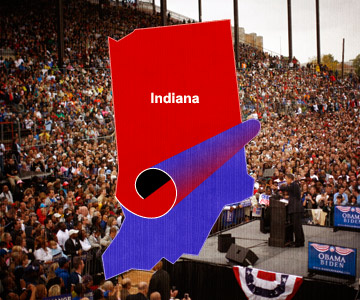
In presidential elections since the Depression, Indiana has been the lone industrial state where the elephants always roam. For all the talk of independent Hoosiers, the state has gone Republican in 16 of the last 17 races for the White House, with Lyndon Johnson in 1964 the sole exception. In 2004, the networks began painting Indiana Republican red exactly two minutes after the polls closed with the breathless verdict justified by George W. Bush’s eventual 60 to 39 percent rout of John Kerry.

So what was Sarah Palin doing in the northern Indianapolis suburb of Noblesville Friday afternoon motivating the GOP faithful? Why are Barack Obama and the Republican National Committee advertising heavily on Indianapolis television? How come most recent polls (there have been only a handful of statewide surveys this month) show Obama within striking distance of the lead? Why has Indiana become 2008′s most unlikely battleground state? 

Obama’s unexpected strength here cannot simply be attributed to the Chicago media market, which reaches only about 20 percent of the state, or a heavy African-American vote (Indiana is 86 percent white). The hotly contested May 6 primary, which Hillary Clinton won by a 51 to 49 percent margin, did attract 1.27 million Democratic voters, about 300,000 more Hoosiers than turned out for Kerry four years ago. Indiana — whose economy more revolves around manufacturing than that of any other state — has also lost 150,000 factory jobs since 2000, and its 6.2 percent unemployment rate in September was close to a 20-year high. “What has changed in Indiana,” says Dan Parker, the Democratic state chairman, “is that in manufacturing towns, people are voting less on social issues and more on the loss of jobs.”

But if Obama wins the state, more than anything it will be due to the best voter-contact operation Indiana has ever seen. Even Murray Clark, the Indiana Republican chairman, says with grudging admiration in his voice, “Obama’s done these things right. That’s how he nearly beat Hillary in the primary.”

Ignored for decades by presidential candidates, Indiana in 2004 boasted a dubious distinction — the lowest turnout rate among registered voters (57.4 percent) of any state in the union. Had the Obama campaign been pinched for cash instead of raking in a jaw-dropping $150 million in September, Indiana probably would have remained the Midwest’s leading flyover state. Instead, buoyed by the primary turnout, the Obama team saw opportunity amid the decades of neglect. As Emily Parcell, the Indiana Obama coordinator puts it, “Unlike Iowa, where every election is hard fought and where a good field operation can add only about 3 percentage points, there is a much greater opportunity for a good field operation here. Hoosiers are not used to Democrats coming to their door. They’re not used to being told about early voting.”

Finding Democratic voters in fast-growing suburban Hamilton County, just north of Indianapolis, seems as unlikely as spying a herd of giraffes frolicking in a mall parking lot. In 2004, Bush rolled up the kind of victory in Hamilton County that Vladimir Putin might envy — obliterating Kerry by 51,000 votes with a 74 to 25 percent margin. Yet Obama has two storefront offices in the county (among 44 offices statewide) and is running an aggressive canvassing operation. This unusual commitment of resources is not lost on the Republicans. “Obama’s campaign has targeted the Doughnut Counties” — local lingo for the eight counties that ring Indianapolis –”particularly Hamilton County,” says Clark, the GOP chairman. “They are targeting upscale voters, particularly women.”

About a dozen Obama canvassers headed out Saturday morning from the newly opened campaign headquarters in affluent Carmel; I accompanied Barbara Kirk, a retired psychotherapist wearing a black Obama T-shirt with a peace sign in place of the “O,” and Beth Maier, a photographer who just moved to Indiana with her husband, a medical scientist. They were making the rounds in the Smokey Ridge neighborhood, where houses list for about $500,000. Carmel, where 89 percent of all high school graduates attend four-year colleges, is not anything like a typical Indiana community. But this is an area where the downside of the Bush era’s hard-right tilt of the Republican Party can be observed — as upscale moderate voters who might be attracted to John McCain for economic reasons recoil because of the social conservatism symbolized by Palin’s presence on the ticket.

Laurie Dwyer, a youthful looking 62-year-old woman wearing a Citadel T-shirt (her husband’s alma mater), is just this sort of repentant Bush 2004 voter. “I don’t say that I’m a Democrat or a Republican,” Dwyer told the Obama canvassers, after admitting that she would be voting for their candidate. “I just think that McCain did us all an injustice by choosing his running mate. McCain has made so many mistakes running his campaign, who knows what he would do as president.” Offered an Obama lawn sign, Dwyer, presumably thinking about the reaction of her neighbors, said softly, “I better not.” (Her precinct went for Bush in 2004 by a vote of 780 to 247.)

A few blocks away, Bruce Babcock, a lifelong Republican and a retired executive with a Fortune 100 company, had no reluctance about advertising his newfound political allegiance with an Obama sign. “Bush has not done a very good job. And the Republicans don’t deserve another chance at all.” Babcock’s last words were designed to underscore that he has no animus toward McCain: “They’d have to resurrect Lincoln to get me to vote Republican.”

There is a danger in political reporting of extrapolating too much from anecdotal evidence. And a candidate’s canvass list should never be confused with a random sample, though it can be an effective way to identify up-for-grabs voters. But my personal theory (and it explains my fascination with Hamilton County) is that affluent Republican suburban voters may be the leading edge of a pro-Democratic political realignment that could represent Karl Rove’s lasting gift to the GOP.

Take John Salter, a 35-year-old doctor and 2004 Bush voter who stressed to the canvassers that he was in the income bracket (above $250,000 a year) that would pay higher taxes under Obama than McCain. Still, his words and tone suggested that he was leaning toward voting Democratic. “In the end, I care about my money,” Salter said. “But I like it when Sen. Obama says that we all have to do our part. And maybe my part is to pay more taxes.”

Make no mistake, McCain is going to win Hamilton County (the largest of the suburban Indianapolis counties) by a hefty margin. But the error that Kerry made in battleground states like Ohio in 2004 — a miscue that may have cost him the White House — was to concede suburban and rural counties to the Republicans and concentrate on maximizing the Democratic vote in urban areas. Shaving, say, 50,000 to 100,000 votes off the Republican edge in the Doughnut Counties could help make for a long night of vote counting in Indiana. Brian Howey, the founder of Indiana’s most influential political journal, predicts, “If Obama wins the state, it will be as narrow as Hillary’s primary win.” Howey is impressed by the vigor of Obama’s ground effort in Republican areas: “These are tools that will offset the racial factor –or whatever you want to call it — in southern Indiana.”

 Conservative Democratic voters in the Ohio River towns like Evansville and Madison may prove an insurmountable obstacle to Obama’s dreams of joining LBJ, Franklin Roosevelt and Woodrow Wilson as the only Democrats to carry Indiana in the past 120 years. As Jennifer Hallowell, the former executive director of the Indiana Republican Party who is now overseeing the McCain campaign’s efforts here and in Wisconsin, argues, “There are a lot of Democrats in southern Indiana who are socially conservative and fiscally conservative. Barack Obama is a liberal. His message is not going to appeal to a majority of Hoosiers.”

Both Halloway and Clark suggested, without spelling out the details, that the McCain campaign intends to invest greater resources in Indiana during the closing two weeks of the campaign. Still, the day after Palin’s visit to Noblesville (in Hamilton County), associate editor Russ Pulliam wrote in a column in the Indianapolis Star, “McCain opened the door to Obama in Indiana by taking the state for granted.” There were no McCain ads visible (at least to me) on Indianapolis television over the weekend, although an RNC spot lambasting Obama for his lack of “executive experience” (unlike, of course, fellow senator McCain) was in full rotation. By my reckoning, I saw four different Obama ads in two days, with the most frequently aired commercial featuring Indiana’s Barney Smith, a laid-off RCA worker from Fairmont, repeating the same catchphrase that he used in his speech to the Democratic convention, “It’s time for a president who puts Barney Smith before Smith Barney.”

 It is intriguing that the Friday afternoon Palin rally, which drew about 20,000 people to a partly open-air music arena, was almost exclusively designed to motivate the GOP’s conservative base. With the seats under the pavilion (as opposed to standing room in the rear) mostly reserved for volunteers who made at least 100 phone calls, the McCain campaign estimates that 90,000 telephone pitches were made in advance of the Palin visit. As Clark explained, “There were not a whole lot of voters who will be persuaded to vote for McCain because of Palin coming here, but there are a lot of ancillary benefits.”

The Palin event itself was surprisingly pallid, with few new attack lines from the vice-presidential candidate, whose amplified voice does not carry well in an outdoor setting. Maybe Hoosiers are unusually polite, but there was not even a hint of an ugly undertone to the rally, besides the good-natured ritual booing the first time Palin referred to the “mainstream media.” But Palin’s predictability had its appeal to the GOP faithful. “She was exactly what I see on television all the time,” said Regina Jackson, a manger for a product development company, who lives in Pendleton in Madison County, just to the east of Hamilton County. “What I like about her is that her message is always the same. It never changes.” Less than two months after being vaulted from obscurity onto the national ticket, Palin is already into her greatest-hits phase.

With its 11 electoral votes, Indiana — like Virginia and North Carolina (which were closer and more contested in 2004) — is a Republican state that McCain simply cannot afford to lose. But Democrats here are still in a pinch-me-I’m-dreaming mood as they find themselves on the front lines of a battleground state. “We’ve never had attention before,” marvels Dan Parker, the state chairman. “We’ve been attention starved.” While overcoming a 500,000-vote deficit from 2004 remains a daunting challenge for Obama, many Hoosier Democrats would be privately thrilled if on Election Night, Indiana sits there for a few hours in the middle of the television maps — neither red nor blue — as it takes a long-awaited star turn as “Too Close to Call.”

Continue Reading Close

Page 2 of 47 in Walter Shapiro