Spring Sale: Get 1 Year, Save 58%

“Cobra Kai,” “Bill & Ted”: comebacks redefine middle-aged masculinity, but where are the women?

There are certain film roles that can define an actor’s career. Ralph Macchio has starred in over 25 films, yet he is most identifiable as the teenage Danny Larouso in “The Karate Kid” (1984). Similarly, Alex Winter has had a long career as a director and actor, but is best known as high school student Bill S. Preston, Esquire in “Bill & Ted’s Excellent Adventure” (1989).

The recent popularity and role reprisals by these actors: Winter in “Bill & Ted Face the Music” (2020) and Macchio in “Cobra Kai” (2018–), combined with celebrities reading aloud the scripts of old teen film classics via Zoom suggests nostalgia. It is also an opportunity to revisit and consider the nuances of characters and gender roles with greater maturity and a wiser perspective.

Dads today

Generation X, born 1965–1980, were in their adolescence when these two films premiered. Both movies present a version of teenage masculinity that was in remarkable contrast to male adult roles in action films of that time. In the 1980s, tough muscular bodies were pictured on screen in films such as “Rambo” (1982, 1985, 1988), “Conan the Barbarian” (1982), “Bloodsport” (1988), and “Die Hard” (1988).

While the young male protagonists in The Karate Kid and Bill & Ted possess purposeful strength, they display a vulnerability, a gentle resilience, a sense of humour with suburban heroism. (Indeed nerd teen archetypes meet tough jocks in detention in 1985’s “The Breakfast Club”.)

Their hero’s journey is relatable yet undeniably epic. The films depict the story of the underdog, of young males who don’t quite fit into the mould and, significantly, are fine with this.

There is a desire to learn, whether from history, as in “Bill & Ted”, or from older characters sharing their wisdom, as in “The Karate Kid”. Accordingly, the phrase “wax on, wax off” became popular shorthand for a stern lesson in patience and skill development.

Now, as the characters return to our screens older and in the 21st century, there are still lessons to be learnt.

Rather than entering a mid-life crisis — popularly depicted with older males seeking renewed vigour in the embrace of young mistresses or new sports cars — these middle-aged characters convey the opportunity to relive, redo and revisit past triumphs.

The role reprise is also an opportunity to transform the tribulations of the past. Indeed, “Cobra Kai” is more focussed on Macchio’s onscreen karate opponent, Johnny Lawrence, played by William Zabka. Now a “deadbeat dad”, Johnny reboots the Cobra Kai dojo and his sense of purpose.

As adult characters, now husbands and fathers, the midlife narrative can navigate an updated definition of masculinity. They may be comeback dudes, but they are also dads. In both the new “Bill & Ted” movie and the “Cobra Kai” TV series, the characters’ children have the opportunity to actualise the dreams of their fathers.

“Be excellent” but it’s also complicated

The 1980s films challenge toxic masculinity. The teen protagonists are undeniably nice, likeable guys who try to do the right thing. Bill and Ted are guided by a moral imperative to “be excellent to each other”.

The famous quote summarises a positive life mantra and shows how good and bad are clearly defined in the original films. The middle aged comeback vehicles show a more mature understanding of the moral complexities of life.

In reprising their roles, the notion that Macchio, Zabka and Winters have aged does not act as a hindrance but a point of identification for Generation X audiences. There is a strong connection to viewers’ own past lives. Seeing the actors again on screen is akin to seeing long lost friends at a high school reunion.

Macchio and Zabka remind us of the high school tensions that are painfully never quite resolved. Seeing Winter with Keanu Reaves’ Ted provides a joyous reminder of the strong bonds of same-sex friendships of our youth. And like a high school reunion there is a lot of reminiscing about the way things were compared to what life is like now.

What about the comeback mothers?

Significantly, there are fewer female role revivals to remind us of the character growth related to womanhood.

Iconic teenage female actors seem more likely to have comebacks in supporting roles as mothers, rather than as the protagonists.

Examples here are Molly Ringwald in “The Secret Life of an American Teenager” (2008-2013), Holly Marie Combs in “Pretty Little Liars” (2010-2017) and Winona Ryder in “Stranger Things” (2016-).

Perhaps the current success of “Bill and Ted”, and “Cobra Kai”, could see Molly Ringwald’s iconic role in “Sixteen Candles” (1984) remade as Fifty-two Candles? Similarly, is it time for an update of “Legally Blonde” (2001) to Legally Grey?The Conversation

Panizza Allmark, Associate Dean of Arts, Associate Professor Media & Cultural Studies, Edith Cowan University

This article is republished from The Conversation under a Creative Commons license. Read the original article.

Sherlock Holmes and the case of toxic masculinity: what is behind the detective’s appeal?

Sherlock Holmes is the most famous detective of all time. Since he was imagined into creation in 1892 by the young Scottish doctor Arthur Conan Doyle, there has been hardly a decade in which a play, television series, film or book about Sherlock Holmes has not been produced.

In 2010, a fresh take on Sherlock Holmes burst onto British screens. This contemporary “Sherlock”, starring Benedict Cumberbatch, inspired a whole new level of fandom and increased sales of the original books by 53%. People were especially taken with Cumberbatch’s flirty sex appeal. Hot on his heels came an American version, “Elementary”, in 2012.

In both adaptations, Sherlock’s brilliance and skills of deduction are unmatched. While I really enjoyed these shows, I was taken aback by Sherlock’s rudeness, exasperation, his disparagement of others, his desire to dominate and his latent violence. I saw Sherlock as a toxic man. Not knowing the books, I wondered where this came from, so I began reading them.

Male Victorian power

In one of the early stories, A Scandal in Bohemia, Doyle describes Holmes’s perspective of women:

All emotions […] were abhorrent to his cold, precise but admirably balanced mind. He was, I take it, the most perfect reasoning and observing machine that the world has seen […] He never spoke of the softer passions, save with a gibe and a sneer.

This is one of the very few descriptions of the character’s personality, which suggests that male brilliance relies on being totally unemotional. This conforms to the Victorian ideal of “muscular Christianity“, the idea that a healthy, muscular masculine body would lead to a healthy mind, and “manliness” enacted over social class and gender.

Although the concept of toxic masculinity sounds contemporary, it actually has roots very firmly in the past. Masculinity researchers have defined toxic masculinity as a performance of “traditional” male gender roles exhibited by a tendency to dominate others, a predisposition to violence, and to be emotionally cold and distant. It can also be expressed through highly competitive behaviour, or the desire to be the sole source of information — someone who thinks they are right about everything in every sphere. Men like Donald Trump, for example.

Holmes is obviously not akin to Trump. To start with, Holmes is a genius, and he hardly exhibits the same level of toxic behaviours that Trump does. But there are elements there. This is unsurprising, given that some of these features are seen in the original text: Conan Doyle wrote Sherlock Holmes at a time when traditional masculine values were openly venerated.

Nevertheless, when I was asked to write a book chapter on toxic masculinity in popular culture, I immediately thought of “Sherlock” and “Elementary” as useful examples. I felt that was an area that had not yet been explored in academic research, yet I felt it palpably on the screen.

Conan Doyle himself refers to Holmes as a machine, and some academics have suggested that his lack of emotion is both alien and mechanistic. But the recent TV adaptations are contemporary portrayals of Sherlock Holmes, so the original “mechanistic” man of the books has necessarily been updated.

Arguably, his poor social skills, sneering and derision of others are played for laughs: he needs to be likeable, after all. In the BBC version, he also refers to himself as a sociopath and Watson apologises for his “borderline Aspergers” — this, as I have previously argued, makes him seem more human.

Yet such comments and armchair diagnostics are contentious, not least because true sociopaths would never refer to themselves as such. All this left me thinking about the kind of man Sherlock might be, when divorced from his brilliance at detection. So I began to analyse elements of Sherlock’s behaviour that might be construed as toxic: in particular coldness, lack of emotion, shutting people down, jibes and sneers.

A toxic Sherlock?

These are some of the classic signs of toxicity, and both contemporary TV adaptations of Sherlock Holmes are full of them, with greater incidences in “Sherlock” than “Elementary”. For example, the BBC Sherlock often tells people around him to “shut up” to allow him to concentrate, or because he finds them annoying.

He takes every opportunity to deride the police, often insisting on being the sole source of information. He is always exasperated at other people’s lack of brilliance: “Dear God what is it like in your tiny little brains? It must be so boring!” While superiority might be a common trait in brilliant people, what makes it toxic is that Sherlock projects himself as totally unique, creative and the answer to everyone’s problems, while putting everyone else down.

“Elementary” presents a quietly different, though no less toxic Sherlock. Here he is a pedantic Englishman, who corrects everyone’s grammar, overrides other detectives, and is disparaging to women and men. This is a more self-aware Sherlock than Cumberbatch’s. But he remains domineering, and imperious: “I am smarter than everyone I meet Watson, I know its bad form to say it, but in my case, it’s a fact.”

Toxic masculinity is a contentious issue and some consider it to encompass traits which contribute to the dominance and brilliance of some men. Arguably, Sherlock Holmes is widely understood as the most brilliant detective of all time.

In this context, I found it disappointing that the toxic elements of Sherlock’s character were not further challenged in the TV shows. While he is not actually violent, unlike many toxic men, and the characters around him do call him out on his behaviours, especially Watson, his intelligence is still understood through his toxic masculinity — especially in “Sherlock”, where it is presented as sexy. I find this problematic, especially in the context of contemporary society, where we frequently see toxicity demonstrated by men in power.

Ashley Morgan, Masculinities Scholar, Cardiff Metropolitan University

This article is republished from The Conversation under a Creative Commons license. Read the original article.

Oppression in the kitchen, delight in the dining room

The holidays are approaching, and among the many treats of the season are chocolate and hot cocoa. While these traditions provide a hefty dose of sugar, there’s a bittersweet side to chocolate’s history, too.

This year, at Stratford Hall Plantation in Westmoreland County, Virginia, a plantation museum where, as a historian, I work as the director of programming and education, we ushered in the holiday season with a chocolate program. We highlighted Colonial chocolate-making and its historical ties to American slavery.

This sober look into our nation’s past helps illuminate those whose labor and contributions have been long ignored, and examines the darker attributes of this favorite sweet. There is no better place to set in context the history of chocolate and slavery than at a plantation where cocoa was processed and served by enslaved laborers.

Hot commodity for the elite

Americans have enjoyed chocolate since the Colonial days, when they would sip the rich cocoa as a hot drink. Cocoa made its way to North America on the same ships that transported rum and sugar from the Caribbean and South America. The harvesting and shipment of cocoa, like other plantation crops, was an integral part of the transatlantic trade and was heavily reliant on the labor of enslaved Africans throughout the diaspora.

Beginning as early as the 17th century, cocoa was shipped into the Colonies, and by the early 1700s, Boston, Newport, New York and Philadelphia were processing cocoa into chocolate to export and to sell domestically. Chocolate was popular in the coffeehouse culture and was processed for sale and consumption by enslaved laborers in the North.

Farther south, in Virginia, cocoa was becoming a hot commodity as well, and was so popular that it is estimated that approximately one-third of Virginia’s elite was consuming cocoa in some form or another. For the wealthy, this treat was sipped multiple times a week; for others it was out of reach.

At Stratford Hall, Dontavius Williams demonstrates Colonial chocolate-making as Caesar would have done it.

On plantations throughout the Colonies, during the 18th century, cocoa was making its way into the kitchens and onto the tables of the most wealthy families. The art of chocolate-making – roasting beans, grinding pods onto a stone over a small flame – was a labor-intensive task. An enslaved cook would have had to roast the cocoa beans on the open hearth, shell them by hand, grind the nibs on a heated chocolate stone, and then scrape the raw cocoa, add milk or water, cinnamon, nutmeg or vanilla, and serve it piping hot.

Christmas contrast

One of the first chocolatiers in the Colonies was an enslaved cook named Caesar. Born in 1732, Caesar was the chef at Stratford Hall, the home of the Lees of Virginia, and in his kitchen sat one of only three chocolate stones in the Colony. The other two were located at the governor’s palace and at the Carter family estate, belonging to one of the wealthiest families in Virginia.

Caesar was responsible for cooking multiple meals a day for the Lees and any free person who came to visit. He was talented, cooking elaborate and refined meals for Virginia’s gentry. He also learned the art of making chocolate. It is unknown where or how he learned this art. His predecessor, an indentured Englishman named Richard Mynatt who cooked for the Lees during the 1750s, may have learned chocolate-making from other cooks in Virginia and passed it on to Caesar. Or perhaps the Lees, with their obsession with culinary arts, took Caesar to watch the art at one of the coffeehouses in Williamsburg, or even at the governor’s palace.

Chocolate and Christmas had a unique relationship to enslaved cooks throughout the Colonies. While the special treat sweetened the season for the white families, the enslaved communities living and laboring in field quarters had a very different experience on Christmas.

The work was oppressive in the plantation kitchens at Christmas time. The field laborers were typically given the day off, while those working in the big house kitchen and as domestic laborers were expected to work around the clock to ensure a perfect holiday for the white family. The biggest task at hand was to cook and serve Christmas dinner, and chocolate was a favorite addition to the three-course formal dinner.

Caesar would have had to direct the execution of such a feast. Oyster stew, meat pies, roasted pheasant, puddings, roasted suckling pig and Virginia ham are some of the many dishes that would be served in just one course. The night would finish with the sipping of chocolate: toasted, ground and spiced by Caesar, and served in sipping cups made specifically for drinking chocolate.

Detail from a 1782 inventory of Phillip Ludwell Lee's estate, listing the name of chocolatier and chef, Caesar.

Detail from a 1782 inventory of Philip Ludwell Lee’s estate, listing the name of chocolatier and chef Caesar. Stratford Hall, Author provided

Stress and fear during holidays

But it is Caesar’s art of chocolate-making that gives his story distinction. As one of the Colony’s earliest chocolatiers, his status as an enslaved African American puts his story on the map of American culinary history.

Decades before the two well-known enslaved chefs, Monticello’s James Hemings and George Washington’s Chef Hercules, became known for their culinary skills, Caesar was running one of the Colonies’ most prestigious kitchens inside of Stratford Hall, and making chocolate for the Lees and their guests.

Caesar lived in the kitchen, and his son, Caesar Jr., lived nearby and was the postillion – a formal position dedicated to riding the horses that drew the carriages. When Christmas came, Caesar may have had his son help out in the kitchen along with other enslaved cooks and waiters.

The stress of cooking the most important dinner of the year was combined with the fear of what was to come on Jan. 1. New Year’s Day was commonly known as heartbreak day, when enslaved folks would be sold to pay off debts or rented out to a different plantation. Jan. 1 represented an impending doom, and the separation of families and loved ones.

One can imagine, after cooking a lavish three-course meal, that Caesar, as he transitioned to the grinding of chocolate for the Lees to sip, worried about the sadness that would soon take over the community.

Caesar disappeared from the records by the end of the 18th century. By 1800, his son Caesar Jr. was still owned by the Lees, but as that year ended, Christmas came and went, and Caesar Jr. was put up for collateral by Henry Lee for payment of his debts.

The world Caesar lived in was one fueled by the Columbian Exchange, which was built from enslaved labor and rich with culinary delights: pineapples, Madeira wine, port, champagne, coffee, sugar and cocoa beans. These items traveled from plantation to dining room via the Atlantic trade, and were central to securing the reputation of Virginia’s plantation elite. The more exotic and delicious the food, the more domestic fame one would reap.

Having cocoa delivered directly to your home, and having a chocolatier in the kitchen, were exceptional. It was through Caesar’s culinary arts that Stratford Hall became well-known throughout Colonial Virginia as a culinary destination.

Kelley Fanto Deetz, Visiting Scholar, University of California, Berkeley

This article is republished from The Conversation under a Creative Commons license.

Did 2020 mark the demise of yoga in America?

Did the pandemic kill yoga? Or was Americans’ decades-long fascination with the Indian physical and spiritual practice already due for a seismic reckoning?

Ever since yoga’s rise in popularity over the last two decades, it has been at the center of discussions around race and cultural appropriation in the wellness industry. Western yoga fitness class providers have been criticized for largely catering to the upper-middle class; indeed, one hour-long yoga class in coastal American cities can run between $20 and $35.

The west’s co-optation of yoga has been long-scrutinized. Despite that, the yoga industry has until recently only grown in the U.S., in part due to social media, and the increase in scientific studies around its benefits — like how it can calm a person’s nervous system or improve sleep quality. Many American public schools now incorporate it into their physical education curricula. 

When the coronavirus pandemic took hold in March, yoga studios — like other fitness businesses — closed overnight. Small spaces with people placed less than six-feet apart from each other were a sure recipe for coronavirus transmission.

At first, many yoga teachers and businesses moved their fitness classes online, when state stay-at-home orders were believed to last only a couple weeks. But ten months later, not every yoga studio has been able to survive. According to a Yelp economic impact survey published in September 2020, the fitness industry has seen a 23 percent increase in closures since July 2020, with 6,024 total closures; 2,616 of those are permanent. Anecdotally, I’ve seen permanent numerous yoga studio closures in the San Francisco-Bay Area, which is where the first yoga center in America opened.

Rachel Brathen, a teacher of yoga and the author of the book “Yoga Girl,” told Salon via email that she’s observed the yoga industry change a lot during the pandemic.

“Of course, not being able to gather in community has been a massive shift, and teachers and studios are struggling all over the world,” Brathen said. “As a response to that, more and more classes are being offered online.”

But does yoga online lose a bit of its appeal? Similar to the allure of group fitness, yoga has satisfied social and spiritual needs that were dissolving in an increasingly lonely and divided society. Now everybody is at home doing yoga, alone. Brathen said she’s been amazed by the “versatility,” but it’s a bit of catch-22.

“Online classes have also drawn in new practitioners — sometimes a yoga studio can unfortunately be an intimidating place, but with offerings online people may feel more comfortable trying something new and stepping outside of their comfort zone,” Brathen said. “But at the same time, yoga asana is such an intimate and physical practice, and I fear we have lost some of that connection by losing the aspect of community.”

Jessica Benhaim, owner of Lumos Yoga & Barre, a boutique studio in Philadelphia, told Salon via email that she doesn’t believe yoga in America is “over” but that “Zoom fatigue is real.”

“People have eliminated many things that moved online that are not necessary for their job/work,” Benhaim said. She believes that many of us spend so much time in front of our computers already, and don’t want to do spend more time in front of a screen to do a fitness class. 

Back in the pre-pandemic era, many of us sought out a yoga practice to feel physically, mentally and emotionally better.

“Yoga is a thoroughly mainstream activity, something seemingly impossible only twenty years ago, and speaks to a sincere desire to feel better and seek a mind-body connection within the materialism of corporate capitalist society,” wrote Sarah Schrank, in a 2014 essay in AMSJ. Schrank believes the contradiction innate to commodifying yoga is a conflict Americans “can live with.”

But for how long?

The yoga industry has weathered many reckonings before. Lulumeon, a yoga-centric clothing brand, positioned itself as a New Age Nike, before publicly tumbling in part due to a CEO scandal and stories of its cult-like toxic positivity culture. When #MeToo erupted in Hollywood and spread across the world, numerous allegations of abusive yoga teachers surfaced, emphasizing the need for clear anti-sexual harassment policies in fitness studios.

But this time around, yoga faces more than a mere economic crisis. Culturally, the yoga industry faces two more reckonings: one with race and one with the QAnon conspiracy movement.

After protests erupted around civil rights and race in America, conversations about appropriation resurfaced in the yoga industry. Collectively, it faced a moment of reflection on the whiteness of America’s yoga industry.

Meanwhile, as the New York Times first reported, this year has revealed a peculiar overlap between yogis and QAnon followers. The overlap became so unsettling that a group of yoga influencers denounced it in a collective Instagram post.

“Too many folks, including many of my dear colleagues, have bought into their divisive and outrageous messaging for me not to speak out,” the statement read. “Please be aware of QAnon’s ill informed, sensational and exploitative posts on your feed and educate yourself about QAnon’s history before you share these posts with others.”

There are theories in New Age communities that Donald Trump is a “lightworker,” accelerating a “shift in consciousness” on Earth.

Hence, some in the industry believe it was due for a serious change.

“I think yoga as it was pre-pandemic in the USA needed to change; there were many people who did not feel that yoga studios were welcoming or affordable for them,” Nancy Alder who teaches yoga online, told Salon via email. “

And others think yoga as it was pre-pandemic is over.

“What we think is yoga in America is over; the idea of the studio and business model of yoga in America is over,” Cheryl Albright, an owner of Soul To Soul Yoga and All Ages Therapy Services in Sarasota, Florida, told Salon via email. “I personally think this will be a good shift and what comes next hopefully will be better and more accessible to the masses, not just those of privilege.”

The lonely legacy of Spam

Table for One is a column by Eric Kim, who loves cooking for himself — and only himself — and seeks to celebrate the beauty of solitude in its many forms.

* * *

“Spam is the ultimate loner food,” said the chef Esther Choi, who lives in a one-bedroom by herself in New York City. Working late hours to keep the lights on at all of her restaurants, Ms. Yoo and two Mŏkbar locations (with one more on the way), Choi doesn’t get to cook meals at home for herself very often. But when she does, she turns to the simple things: fried Spam, eggs, and Hetbahn, a single serving of Korean microwavable rice. “Even though I’m a chef and I can make anything in the world,” she said, “when I’m by myself, those are the things I want to eat.”

This is a common fugue for many Asian Americans: Spam, eggs, and rice. The nostalgic valances that stem from that salty, pink block of luncheon meat go way back for some of us, not least because it represents a very specific experience: what it was like growing up in America with immigrant parents. Choi remembers, for instance, only eating Spam when her mom and dad were out for the night, usually at work. On such evenings, she and her sister were in charge of feeding themselves and their younger brother. Spam was an obvious choice, not least because it was so easy to heat: Just slice the block into thin rectangles and sear in a dry pan until crispy on both sides, like bacon. (No oil needed. There’s plenty of fat in the product itself.)

The thing is, you don’t need to cook Spam (though it’s certainly the best way to eat it). The canned meat is completely shelf-stable, thanks to salt, sugar, and one preservative, sodium nitrite. As for the other ingredients, contrary to popular belief, there really aren’t that many more. According to the “Oxford Encyclopedia of Food and Drink in America,” Jay Hormel invented Spam (an alleged portmanteau of “spiced ham”) in 1937 “as a way to peddle the then-unprofitable pork shoulder.”

Recipe: Spam & Egg Deopbap for One

So there’s the pork, of course, which is ground, plus ham and water. And in 2001, potato starch was added to bind the mixture and to prevent the characteristic layer of gelatin that sat on top of the can for decades until then. For years Hormel Foods Corporation has been fighting the maligned reputation that its star product is somehow “mystery meat” when really it’s just six ingredients plus water. (Spam’s latest campaign is “Don’t knock it ’til you’ve fried it.”) As its entry in the “Oxford Encyclopedia” states, in the very second sentence at that: “Spam is popular in Hawaii and Guam and among many families in the American heartland but is viewed by many others as the symbol of everything that is wrong with American processed food.”

For Korean-American multidisciplinary artist Jaime Sunwoo, whose play “Specially Processed American Me” (aka S.P.A.M.) is set to premiere in late 2021 to early 2022, there’s a glaring reason why Spam is so synonymous with stigma. “It’s a food that many Americans associate with hardship, poverty, and army rations,” she said. “So after the war, they just got really sick of eating it. That’s why you get sketches like “Monty Python and the word for email you don’t want.”

During World War II, the United States Army received 150 million pounds of pork luncheon meat, or what soldiers jokingly called “ham that didn’t pass its physical,” “meat loaf without basic training,” and “the real reason war was hell.” Even as Americans grew tired of eating it, Spam sales increased after the war. “The overwhelming success of Spam is what drove this collective intolerance to it,” Sunwoo said. It’s no wonder that the Hormel product is now beloved in places where U.S. soldiers were stationed, like Guam, Hawaii, Japan, the Philippines, and South Korea.

For Sunwoo, “Specially Processed” is an opportunity to explore this disjuncture between American and Korean perceptions of Spam, what she calls “one of America’s most misunderstood foods.” “Through this project, I learned about my relatives from North Korea for the first time,” she said. “My dad was born in Pyongyang, and my maternal grandmother in Kaesong. Spam kind of gave me permission to collect a more formal oral history. I asked my grandma about her experiences eating Spam during the Korean War. For her, it was like mana from the heavens. She was so hungry, and to have that was the most delicious thing.” But whenever Sunwoo’s grandmother (now 93 years old and residing in Washington State) takes a bite of Spam, there’s something missing. It doesn’t taste as great. “There are so many other things to eat now,” Grandma Chongyol said. “So why would I eat Spam?”

Why do people eat Spam? This query alone garners 177 million search results on Google. First of all, a lot of easy cooking comes from it. The first dish Sunwoo ever learned to cook was her mother’s Spam fried rice, confettied with freezer-aisle peas, carrots, and corn and topped with a fried egg. Second of all, it’s delicious (if you know, you know). When fried in a skillet, Spam is a coalescence of salty, sweet, crispy, and chewy. When braised, such as in a seething budae jjigae, it mellows out and becomes supple, kimchi-stained. In musubi, it’s the ideal counterpoint, both in flavor and in texture, to the sticky rice and crunchy nori.

For many Asian Americans, eating Spam in America — wonderful though it is — can sometimes feel like an othering experience, bringing with it all of its complicated cultural associations. The greatest irony might be that the Minnesota-based Hormel product is an American foodstuff, born and bred. But when you’re 10, you don’t have the words yet to explain to your classmates the social and historical nuances of why Spam has a completely different reputation in your parents’ home country than it does in the States, and that, as an Asian American, it has the ability to transport you home wherever you are in the world. As Sunwoo said, “The reason we gravitate toward Spam so strongly is because we only eat it at home.” Home food is inherently more intimate, more private, and thus has more potential to be intricately riddled with secrecy, even shame.

When Bettina Makalintal, a food and culture writer at VICE, moved from the Philippines to Philadelphia at age 5, it took her a while to eat Spam publicly. But in the privacy of her home? “It always felt like a treat,” she said. “If my mom wanted to make something that was a little easier, a little less labor-intensive, it would be: rice, eggs, and canned meat. These were the times that we had Spam.” For Makalintal, the combination made sense: breakfast for dinner. Who wouldn’t want that? “In retrospect, I recognize that those were our bare-minimum meals,” she said, “something I ate at home and enjoyed. But in secret. I had a lot of white friends growing up in P.A. and none of them ate it. Or if they did, they didn’t talk about it. So it was something I privately enjoyed and didn’t talk about until I was, I don’t know, 19 or 20. That’s when I realized Spam was tied not just to Filipino culture, but also to other Asian cultures.”

This discovery of Spam’s ubiquity in other Asian-American households, including the shared stigma, was a turning point for Makalintal. By embracing Spam fully, she was able to reclaim not just one of her favorite childhood foods, but also parts of her identity. “I realized at that point in my life what Filipino-American food meant to me, i.e., Spam is something I really like, so why am I afraid to talk about that? Ever since then, I was more publicly appreciative of my Spam eating.”

https://twitter.com/bettinamak/status/1258378158186921987

Similarly, for the chef Jenny Dorsey, founder of nonprofit think tank Studio ATAO, Spam was for years something that made sense to cook and eat in the privacy of her home. “It was the non-perishable staple in our house,” she said. Her parents would buy whole cartons of Spam on sale at Costco. “Not only was it cheap and filling, but it also had that salty, porky flavor we loved. So whenever we weren’t able to get fresh pork, my mom would substitute it with Spam. She’d use it as the salt in her cooking, like in a congee. It was a way to save money and be economical, but not feel that you were hard up in any way.”

“Also,” she added, “it’s just so good with rice.” The first things Dorsey stocked up on at the genesis of the COVID pandemic in March were Spam and rice. They’re still in her pantry, all different flavors. “The regular one is best, of course.” With her stash, Dorsey makes a lot of rice dishes like Spam fried rice, kimchi fried rice with Spam, and Spam porridge. There’s a reason that rice, especially unadulterated steamed white rice, is such an ideal partner with the spiced ham product: It’s comfortingly bland, offering moments of relief from the salty, fatty pork. The two were meant for each other. If rice is a balm, then Spam is a stalwart, providing comfort for Dorsey during a time when she needs it most. “It feels nourishing,” she said. “Not just physically nourishing, but mentally nourishing, as well.”

Chef Lucas Sin, who contributed a recipe to “The Ultimate Spam Cookbook (a branded release from Hormel that came out this year), remembers developing a taste for spiced ham as a latchkey kid and realizing its potential as an ingredient to cook with. “The more time you’re left alone as a 12-year-old, the more you start developing an awareness of how to prepare these items in a good way,” he said. “Noodles al dente, taken out at just the right moment. A crispy, rendered side of Spam. I remember that being a pivotal moment for me, when I engaged with food for the first time in a thoughtful way. When I realized that, hey, you can be thoughtful about how you’re cooking for yourself.”

Sin suggests the same for adults: Cut those scallions on the bias. Garnish that plate for yourself. If anything, it’s even more important that you pay attention to these details when it’s just you, yourself, and Spam. “My ideal meal,” he said, “on the rare occasion, before I started cooking seriously was Nissin Demae Iccho instant noodles from Hong Kong, some scrambled eggs, and a pan-seared slab of Spam.” The reason it works, he said, is the high gelatin content, not unlike what happens when you smash a burger. While you’re melting that gelatin, getting as much Maillard as you can, the pork crisps up and the salty-sweet flavor of the meat is brought out by that heat. “It’s the perfect product in that way,” he said.

A newfound sense of pride in Spam buoys this younger generation of cooks. For many in the Asian-American diaspora, openly loving the canned meat product means openly loving one’s culture, history, and skin, as well. There’s indelible comfort to be found in knowing that you’re not alone in this shared journey toward self-acceptance.

One of the richest aspects of Sunwoo’s “Specially Processed workshops is the “Submit a Story” feature on her website, where participants can hive-mind their own Spam thoughts and recipes, and see their experiences live among a sea of others who have gone through similar things, especially as children of immigrants. In many ways, Spam is what the food critic Soleil Ho defines as assimilation food, or “food that’s made to close the gap between homes: a critical need when one lives in exile.”

As Choi told me at the start of my reporting, as we both headed into what would become the longest exile of our lives: Spam is the ultimate loner food.

Are holiday gift cards a boon or a trap for struggling restaurants? Owners say it’s both

In March, at the start of the pandemic, it seemed like everyone (myself included) was buying up gift cards for their favorite restaurants. It was a way to invest in local businesses while their kitchens were either closed or restricted in the services they could provide

As Mother Jones reported, those purchases were never going to be enough to “save” the restaurant industry — that is going to take a major government bailout, as well as tax and rent relief — but they were a “way of sending a restaurant a micro-loan and a gesture of good will.” The idea at the time was that many customers wouldn’t redeem those gift cards once normalcy returned. 

As we now know, almost no one truly comprehended how long the pandemic would last. Now, surviving independent restaurants are facing January, which traditionally marks the beginning of a “dead season,” even in typical years. Coming off months of holiday spending and indulgent food, customers are (in normal-ish circumstances) newly resolute about financial responsibility and cooking at home more often; the restaurant industry suffers at least a moderate hit as a result. 

According to a study by the market research company NDP Group, between 2013 and 2019, traffic during the month of January was 6% lower than the average month and 11% lower than the peak month of June. 

That can often creep into February and March, said AuCo Lai, chef de cuisine at Barn8 Restaurant and Bourbon Bar in Goshen, Kentucky, about 20 miles from downtown Louisville. 

“People tend to think that because we have New Year’s and Valentine’s Day, that it’s going to be super busy, but it’s not. Those are just two single days out of two months,” she said. “Valentine’s Day actually tends to function at a loss for most restaurants because we try to put on a really beautiful show with an exciting menu. It’s a special occasion that folks save up for, but sometimes there’s not enough money left after their meal to leave a decent tip, or they end up going with a smaller option to create a longer and more memorable experience. So the money that comes in is not as great as you would think.” 

Restaurants plan for this slump, focusing on delivery options, promoting seasonal specials with low food costs and higher profit margins, or dipping into savings from busier seasons. 

This period also coincides with an increase in customers using the gift cards and certificates that they received over the holidays (market research shows that most people tend to redeem them within 180 days, if they use them at all). 

Usually, that’s fine, said Lai. In most years, restaurants can handle the balancing act that is navigating stagnant profits and preparing meals that were paid for weeks or months in advance, meaning no cash on the day of service. But this hasn’t been anything like a typical year. 

In September, the National Restaurant Association released a survey showing that nearly one in six American restaurants — a total of 100,000 — have closed permanently or long-term due to the restrictions on service that were enacted to stop the spread of the coronavirus. Nearly 3 million industry employees are still out of work and the industry is on track to lose $240 billion in sales for the year. 

With that in mind, what would it mean for already struggling restaurants if people began redeeming their gift cards come January? Should customers hold off if they want their favorite restaurants to survive, during a season that is always notoriously slow? 

Chefs and restaurant owners say it’s a matter of timing. Some are finding innovative solutions in preparation for the new year. 

“Gift cards, to me, are always a complicated thing,” Lai said. “In small bursts, it always helps out restaurants. [Right after the purchase], it’s income, and there’s not necessarily money that’s going out because it hasn’t been redeemed yet. Once it’s redeemed, it’s credit.” 

Lai said she’s watched customers who purchased gift cards for Barn8, which opened right before the start of the pandemic, redeem them and then return to the restaurant over and over again. That’s an ideal situation. But in this precarious moment, every meal paid for with a gift card credit feels a little bit like a gamble. 

“Hopefully they will return and continue to spend money with us,” Lai said. “But at the same time, it’s like, OK, we basically have to give away this product for ‘free’ and this labor for ‘free’ right now because they’ve bought this credit already.” 

Larger independent restaurants like Barn8 have more of a buffer, Lai said, but everyone is experiencing budget challenges right now. 

As a result, some restaurant owners and chefs, like Edward Lee, are trying to find ways to incentivize customers for holding off on redeeming their restaurant credit. Lee is a Brooklyn-born chef and restaurateur who owns four restaurants in Louisville and Washington, D.C., where he is currently based. 

“All restaurants are hurting right now, and while a boost in sales from gift cards is valuable, business is not going to look much different in January and February,” said Lee. “So having a lot of customers redeeming their gift cards in the first few months of 2021 could actually hurt a restaurant more, since those first few months are traditionally the slowest times of the year.” 

To get ahead of this, Lee launched a “restaurant bonds” program for his upscale restaurant 610 Magnolia. The bond is an ingenious hybrid of a gift certificate and savings bond: The longer a customer holds onto it, the more the value increases, up to an additional 50% rise in value if they wait until October 2021. 

“We sell a ton of gift cards every December and typically most of them get redeemed in January and February, which is fine, but in this pandemic year, that model would not work for most restaurants,” Lee said. “I still want to sell gift cards, but I needed a better model, because we’re strapped for cash and having the gift cards redeemed too soon would hurt our business.”

Lee said he was inspired by the idea of old-fashioned war bonds. 

“I mimicked the concept but just made it sensible for the restaurant industry,” he said. “While we might not be at war, for independent restaurants this is a desperate time, and I thought this might resonate with both restaurant owners and customers.” 

According to Lee, more than 100 restaurant owners from across the country have reached out to him for more information about the program, and many are planning to implement it in their own businesses. “I hope we can all make it through the next few months,” he said. 

For customers whose favorite restaurants aren’t implementing a bond system, Lai said they should still feel comfortable using the gift cards in their wallets — but, if possible, she encouraged them to spread out their gift-card spending across multiple visits or orders. 

“Maybe don’t put your entire check on that gift card. Save the remaining balance for another visit,” Lai said. “Or if you can, consider matching the amount on the card — if your card is for $20, try to spend an additional $20. It can make a difference.” 

Kimbap: Colorful Korean rolls fit for a picnic

Kimbap translates to seaweed (“kim”) rice (“bap”), and it is decidedly not “Korean sushi,” as some may describe it. Yes, it’s technically rice wrapped in seaweed with fillings, but the comparison stops there. Kimbap’s ingredients are distinct and particular to the dish: marinated vegetables, fried egg, ground meat and fish cake, to name a few. My friend’s mom says the ingredients should represent the color spectrum – a feast for both the eyes and the taste buds.

Growing up in a Korean household, there were good meals and really good meals. And then there were the meals that sparked a specific kind of joy because it felt special even though it was just another Tuesday evening.

Whenever I saw my grandma prepping ingredients for kimbap, dinner immediately became something to look forward to. Various marinated vegetables and fillings were arranged on large plates, ready to be rolled up tightly with seasoned rice and seaweed into colorful – and delicious – vehicles of flavor. Now that I understand the work involved in making kimbap, I appreciate my grandma’s labor of love even more. It also helps that she has that magic touch.

Unlike many Korean dishes for which all the ingredients go into a stew pot or fry pan, and the taste is adjusted along the way, homemade kimbap requires some more planning – it’s not something you can casually decide to make for dinner after digging through the fridge. If you have the time and means to put in the work, though, you’ll reap the fruits of your labor (and have some fun along the way).

There are many potential fillings for kimbap, but the traditional ones are carrots, spinach, danmuji (yellow pickled radish), fried egg, odeng (fish cake) and marinated beef. All the fillings must be prepped separately, whether cooking and seasoning the vegetables or cutting the fried eggs into long strips. The rice is also seasoned with a bit of salt, sugar, vinegar and/or sesame oil. Because each component is seasoned in some capacity and each ingredient is so different flavor and texture-wise, the end result is a rich multi-dimensional experience.

After the fillings are prepped, they’re rolled up in rice and seaweed on a bamboo mat. The whole process is an art – rolling the kimbap evenly and tightly, avoiding bulging or tearing, and using the right ratio of rice to fillings. Finished kimbap are cut into 1/2-inch-thick slices, revealing a festive and colorful cross-section. In my house, my grandma was the only one who made kimbap – not only did she season everything just so, but she also rolled them beautifully and consistently.

Though delicious in any setting, kimbap is a typical picnic food. It’s easy to transport and just as fun to eat. During biannual Korean church picnics growing up, I remember kimbap being a common shared food as families ate and socialized together. It’s also considered boon-shik, a category of Korean food consumed as casual, cheap and crave-worthy street snacks.

Like many foods, the exact origins of kimbap are not super clear. One theory posits that kimbap was born out of the Japanese occupation of Korea during the first half of the 20th Century when Koreans adapted the Japanese roll and made it their own. For example, Koreans opted for sesame oil to season the rice for kimbap while the Japanese used rice vinegar. Or perhaps kimbap was a natural evolution of eating rice wrapped in seaweed with side dishes, a practice stemming from the Joseon era (1392-1910). Whatever the real origins are, kimbap has become a beloved snack, picnic and on-the-go food in Korean culture.

Nowadays, people have gotten creative with kimbap fillings: cheese, tuna, fried pork cutlet (donkatsu), fish eggs and kimchi are just a few potential options. Triangle (sam-gak) kimbap is a popular on-the-go option, similar to Japanese onigiri with a singular filling inside. Because kimbap is so time-consuming to make, most people opt to buy it from stores or restaurants whenever the occasion arises. No matter where you get it though, the satisfaction factor is still there.

My dad and I are firm believers that the best part of kimbap is the end pieces because of the large filling-to-rice ratio (very important!). And the best way to eat kimbap has become somewhat of a tradition in our family – coating day-old pieces of kimbap in egg and frying in a pan. The sizzle is enough to make your mouth water, and the hot layer of fried egg revives the dried rice and somehow melds and amplifies the flavors of the fillings. It’s like a kimbap encore; I love fresh kimbap, but I think pan-fried kimbap takes it to the next level.

Whether lovingly made by my grandma or by an ajumma (aunt-like figure) I don’t know in Manhattan’s Koreatown, kimbap will always be a welcome treat – one that evokes nostalgia and never fails to be immensely satisfying. The vibrant colors, unique flavors and varying textures provide a one-of-a-kind culinary experience in each bite. Try grabbing a roll of kimbap for your next picnic – you’ll never look back!

By Joy Cho, Institute of Culinary Education alum and writer

Actually, “Bridgerton” sex is not good sex

Dear gentle reader, surely you have heard about “Bridgerton,” the Netflix Regency-style romance executive produced by Shonda Rhimes. Social media has been in a buzz over it since its Christmas Day premiere as fans discuss the fashion, the drama, and — most of all — the love scenes.

We really need to talk about those love scenes, because I regret to inform you that the sex depicted within … is bad.

Nobody should want to have sex like that. Ladies, you deserve better – and for that matter, so do you gentlemen.

“Bridgerton,” created by Chris Van Dusen, should not be treated by the curious as a “how to” manual for sex, or romance, or anything about the human condition.

Still, the show is noteworthy for adding some spice to a very vanilla genre. Sex plays a prominent role in Julia Quinn’s “Bridgerton” romance novels, so when the very polite socialite Daphne (Phoebe Dynevor) marries the noble Simon Basset, Duke of Hastings (Regé-Jean Page), it should not have shocked anyone that their wedding night was depicted with some detail.

To wit: They stop at an inn and eventually retire to separate rooms. Then they’re drawn to one room, and then each other. The room itself is alight in the golden glow of candles and hangs with rich fabrics and dark woods. Behind the action a stringed instrument keens in a low register and a piano riff trembles in a gentle minor key. They disrobe. She lays down. He asks her if she touched herself; she’s shy.

He maneuvers her hand down there. She looks pleasantly shocked. Then he stands up and takes off his pants so she can get an eyeful of what she’s working with. Apparently that is sufficient, because then he mounts her, informs her that “this may hurt a moment” … then badda bing, badda boom, he starts pumping away like a bunny hopped up on cold brew coffee. Afterward he rolls off of her and finishes in the sheets – more on that later – as the tender music fades out.

“How do you feel?” he asks her.

“I feel…” she pauses, then gasps, “wonderful!”

“Is there a more romantic notion?” coos the series’ narrator Lady Whistledown (voiced by Julie Andrews) in the next episode. “To retreat from society together, finally leaving watchful eyes behind?”

Yes, there is a more romantic notion. It is called foreplay.

In a ribald montage that follows, Daphne and Simon get it on vis-à-vis all manner of jack-hammering – ramming it here, jamming there, pounding those guts like there’s no tomorrow with very little in the way of a prelude. He sticks his head under her skirts while she leans against a ladder in a dark spot at the end of a marble hall and her breath catches. And every time I kept on thinking about the famous classroom scene from “Monty Python’s The Meaning of Life” where John Cleese admonishes an eager student during a sex ed class:

“What’s wrong with a kiss, boy? Hmm? Why not start her off with a nice kiss? You don’t have to go leaping straight for the clitoris like a bull at a gate – give her a kiss, boy! … Nibbling the earlobe, kneading the buttocks, and so on and so forth! So: we have all these possibilities before we stampede toward the clitoris!”

Really, Cleese’s whole highly NFSW speech should have been played in Van Dusen’s writers room.

As anyone who has seen “Bridgerton” knows, the miserable look of newlywed humping is only part of their problems in bed. Simon’s insistence on, ahem, early withdrawal is at the center of a significant twist in the series. (There’s also an alarming scene that has touched off vigorous conversations about consent and rape.)

However, we’re here to discuss a truth that should be universally acknowledged by now: that bad love scenes are miserably common on TV and in movies, two mediums dominated by the male point of view.

This leads to a lot of explicit depictions of sex that are decidedly anything but sexy or, as we see here, interpretations of “lovemaking” that tend to be obscured by setting. When Daphne and Simon do it on the steps of a garden folly in the rain, sensuality is presented to the viewer in the form of the situation as opposed to the act itself, which is secondary.

We’re not meant to be aroused by Simon giving Daphne oral pleasure as much as we are to be turned on by the fabulousness of the accoutrements – the dream of wealth demonstrated in a silk gown, the fantasy of being wanted by such a handsome, tender man who owns such a big house! And this follows every cliched notion about what men think women want with regard to visual stimulation to the letter: for the viewer, gawking at Simon’s naked torso should be foreplay enough. Works for Daphne right?

It doesn’t have to be this way, and more frequently than before, it hasn’t been. Even while “Game of Thrones” turned nudity and sexual exploits into triggering scenery for the sake of base titillation, a number of shows used sex as integral to their narrative and the psychological expansion of their characters. “Masters of Sex,” not surprisingly, centralized eroticism and explored how it shapes the power differentials between men and women. Sex tangles the plots in “The Americans” and bungles relationships in “Girls” and “You’re the Worst,” and those are just a handful of shows where intimacy isn’t treated as an afterthought.

Although sex is a frequent guest in serialized entertainment, sensuality that caters to women is as rare as a snow leopard sighting. Seeing “Bridgerton” fall down on this front, then, is especially disappointing – doubly so in a time when examples of series that excel in depicting intimacy are readily available.

“Outlander,” for one. The drama staked out its territory with its famous 2014 wedding episode where Claire and Jamie spent as much time talking about who they are and what they want as they did with slowly drinking in each other with their eyes. The entire episode was an exercise in methodical tantalization, as much for the couple as for the viewer. They even took their time getting to the first kiss, and once they finally did, we melted.

That was years ago; how about 2020? The year that was yielded “Normal People,” Hulu’s tender heartbreak of a series about a pair of high school kids whose secretive love affair is depicted in passages that are so erotic as to make a person watching it alone feel like a pervy spy. Chalk that up to the actors’ white-hot chemistry, carefully choreographed movements, and realistic lighting. Marianne and Connell don’t need candles glowing or manipulative melodies to convey the urgent hunger they have for one another. It is laid bare in front of our eyes.

“Bridgerton” wraps pleasure in brocades and high ceilings and sugar, with the belief that this is enough to arouse the viewer who is as starved to gaze upon vicariously erogenous pleasure as they are to feast on the sight of a prettier world. It is not.

Presumably there will be another season, which the producers should accept as a license to be bolder with its eroticism. If the goal is to immerse us in romance and sensuality, then take time and get those private moments right. Trust that slowing down will only make people want to binge more.  

A love letter to scallops, the world’s most perfect food

Over the years, I have decided that scallops are a favorite special occasion food that doesn’t, as it turns out, require too much work to make delectable. Before this realization I was kind of lukewarm when it came to these bivalves. The truth is — and I say this to everyone, so forgive me if you’ve heard it before — that anything we really don’t like is probably a food scar. Someone prepared the thing poorly, often under- or over cooking it, and it is up to us to come to terms with that reality and charge forward: brave and hopeful that there can be a fantastic experience to be had, just around the corner. This approach has served me well over time and scallops have been firmly in my “passionate about” department ever since.

Scallops swim using an adductor muscle, which clicks their two iconic shells together, propelling them through the water at the ocean floor. It is this meaty muscle that when shucked, appears in dining rooms and frying pans around the world to great delight. Male scallops are only white, but female scallops’ adductor muscles turn a rosy hue when spawning, and are sought after by chefs and savvy home cooks for their sweeter, richer flavor.

When scallops are harvested by boat, it’s usually a fishing vessel with an enormous chain mail mesh pouch that gets lowered into the ocean by pulleys, and then dragged — or dredged — across the ocean floor. Scallops harvested in this way are referred to as dayboat scallops, since often the vessel is out only for a day. The tricky part with this fishing method is that there is often considerable bycatch — unintended species, also trapped inside the pouch, who perish in the harvesting process.

Dayboat scallop fishing off the coast of the Atlantic in the U.S. is said to be slightly less harmful, since the ocean seabed there is more frequently disturbed by natural wave action and the current, which cannot support sensitive seabed species and habitats. If this factor is important as you source scallops, know that any scallop dredge fishery hoping to be viewed as sustainable must show evidence that it operates this way.

Another way in which scallops are harvested, and a real sustainable method, is what is known as diver scallops. Exactly as it sounds, these scallops are hand-harvested by scuba gear-clad divers from the shallows so as not to disturb the ocean floor’s ecosystem and sea bed habitat. These scallops are the premium choice, and are always dry packed, so no additional fluid dilutes their flavor when cooked. They do cost more, but know that your dollars support a smart, sustainable harvest process and get you the freshest, plumpest meat possible.

You can enjoy scallops any number of ways. Here is a series of seasonal preparations I have prepared for guests at our Hudson Valley bed and breakfast, Catbird Cottage. Some absolute favorites will be included in my forthcoming cookbook, so that everyone can revel in this love affair.

* * *

Spring

First, two spring-feeling crunchy salads incorporating creamy avocado, which pairs beautifully with burnished scallops. The first of these salads features colorful radishes, shaved fennel, and crunchy flake salt.

The second, one of my all-time favorite recipes, with avocado, celery and parsley leaves, and capers.

* * *

Summer

Here’s a celebration of summer full of seasonal bounty, including purslane, corn sauce, and nasturtium flowers.

* * *

Fall

Scallops with Castelvetrano olives, pasta, and dill: It’s a summer-into-fall dish to inspire.

Transition fall into winter using cold-weather fruits (such as pomegranate and persimmon) in a lush, yet still refreshing ceviche.

* * *

Winter

This warming bouillabaisse is perfect for winter, and tastes powerfully of the sea.

And finally, rich, creamy beans scented with saffron and topped with tender seared scallops and bright dill.

* * *

Recipe: Seared Scallops & Creamy Saffron Beans

Prep time: 15 minutes

Cook time: 1 hour 20 minutes

Serves: 2

Ingredients:

For the beans

  • 1 cup dried navy beans
  • 3 shallots, peeled, ends trimmed, and sliced into thin rings
  • 1/2 teaspoon to 1 teaspoon red pepper flakes, depending on your penchant for heat
  • 1/4 teaspoon saffron threads
  • 1/8 teaspoon smoked paprika
  • 1 tablespoon good olive oil
  • 1 pinch kosher salt, plus more to taste

For the scallops

  • 3 to 5 diver scallops per person, depending on their size
  • 2 teaspoons ghee
  • 1 tablespoon to 2 tablespoons good olive oil
  • 1/4 cup fresh dill fronds or parsley, to garnish
  • 1 pinch kosher salt, plus more to taste
  • 1 pinch freshly cracked black pepper, plus more to taste

Directions:

  1. Soak beans the night before, with enough cold water to submerge by 2 inches, about 2 cups.
  2. Sauté shallots in olive oil in a large saucepan until translucent and beginning to brown, 8-10 minutes, stirring occasionally.
  3. Drain beans into a colander. Add the saffron, chili flakes, and paprika, and stir in the beans until combined. Add enough water to cover by 1/2 inch and bring to a boil. Lower heat, cover, and cook until tender, about 70 minutes.
  4. Once the beans are tender, season with 1/2 teaspoon salt. Stir to combine, taste, and add more as needed. This step is best done at the start of the day, where the beans can sit in their liquor for a few hours, soaking in their liquid to enrich the overall texture. This can also be done a day in advance, left to sit at room temperature with the lid ajar.
  5. Arrange scallops on an absorbent paper-lined tray and pat dry. Season with salt and allow to sit at room temperature an hour before cooking.
  6. Heat a large cast iron skillet over high heat. Turn to medium-high once hot, add a tablespoon of oil and swirl to coat. As soon as the oil pulls to pan edges, add half the scallops, keeping space between them to avoid crowding. Cook for a minute, then add half the ghee, dragging it between the scallops using a knife or tongs as it foams. 
  7. Sear scallops in two batches, 3 minutes on the first side to develop a golden crust, then turn to the second side and baste with the hot fat, tipping pan towards you to collect spoonfuls and pouring over scallops repeatedly, for about 30 seconds. Scallops are ready when they are bouncy when pressed with the back of a large spoon. Transfer scallops to a plate and repeat with the second batch, adding the remainder of oil and ghee to cook as you did in the first batch. 
  8. As the scallops finish cooking, reheat beans if you allowed them to sit, adding any accumulated juices from the scallops plate and stir to incorporate. Ladle beans into shallow bowls and nestle in the scallops. Add a few grinds of freshly cracked pepper, scatter herbs on top, and eat at once.

When a little bit of poison is good for you: Inside the theory of dose response

“For if one drinks much from a bottle marked ‘poison,’ it’s almost certain to disagree with one sooner or later.”
—Lewis Carroll, “Alice’s Adventures in Wonderland”

In the early 16th century, a Swiss physician named Paracelsus changed the course of the healing arts with his theories on chemical treatments for disease. A literal renaissance man given the era, he was part scientist, part alchemist, and part philosopher. Three hundred years before the advent of Pasteur’s germ theory, Paracelsus advised patients to keep their wounds clean to avoid infection. His study of chemicals revealed both their curative and harmful properties, and he noted that any treatment turns toxic once the dose is high enough. Paracelsus’ simple yet profound insight that “the dose makes the poison” challenged the prevailing wisdom that poisons were inherently toxic. He noted that the known poisons of the day were substances that were toxic at low-doses. Yet, dilute these substances enough and they could be rendered harmless or, in some cases, even beneficial.

This theory is now known as dose response. It has become one of the key frameworks of environmental science, modern medicine, and public health. Put simply, it states that the larger the dose of a chemical or exposure, the greater the magnitude of its effect. Thus, low doses of a toxin can have zero to minimal effect, while large doses become deadly. For therapeutic chemicals, or “drugs,” benefits initially rise with increasing doses before crossing a threshold toward toxicity, or overdose.

In modern medicine, dose response theory is foundational for both toxicology and pharmacology, and also carries over to the worlds of microbiology, virology, and oncology. Although in each scenario, the theory is labelled “dose response,” its application differs according to the properties of the substance. In recent months, for example, dose response has been hotly debated alongside speculation on the exposure risk of COVID-19. What is the potential for virus exposure via the groceries you buy? What about the mail delivered to your home? Could you get sick from takeout food? The answer lies in the question: how much ‘dose’ is required to get ill?

A brief history of dose response theory

For many chemical substances, the dose response theory of toxicity depends on five important variables that predict a subject’s response to an exposure:

  1. The dose or amount;
  2. The chemical properties of the substance;
  3. The time over which the substance is administered;
  4. The characteristics of the subject that receives the dose; and
  5. The extent to which the subject is able to eliminate or metabolize the substance through the processes of digestion, metabolism, and excretion.

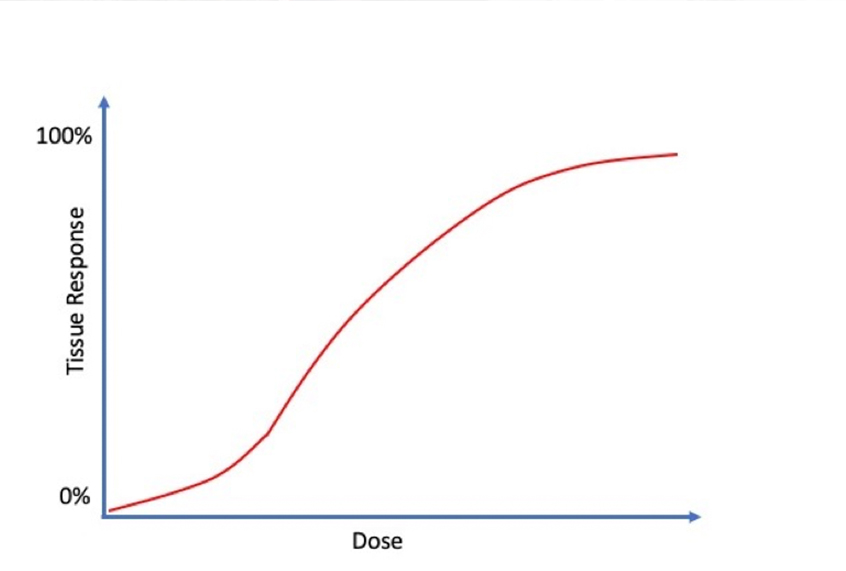
If you plot the administered dose of a substance versus its effect on a living organism, you often get a “dose response” curve that typically resembles the letter ‘S’.

As you can see in the curve, low level exposures may have no effect on an organism up to a certain threshold. For example, many adults are familiar with the toxic effects of drinking alcohol — just ask any college student how they feel on Sunday morning. Ripe bananas also contain trace amounts of alcohol, but few individuals eat a banana and worry about their ability to drive home. While a certain dose of alcohol causes intoxication, it has no harmful effect beneath its toxic threshold. As intoxication rises past a second threshold, its effect turns deadly.

Poisons and the canary in the coal mine

The “canary in a coal mine” is a well-known idiom that has a historical antecedent. In the early 20th century, miners brought captive birds with them into the mine shafts. The humble canary would fall dead as a result of increasing toxins — particularly carbon monoxide — in the air.  Being a small creature with rapid respiration and a fast metabolism, toxins accumulate in a bird’s system much faster than they would in larger animals. Thus, the miners received advanced warning of an exposure of which they would otherwise be unaware. In other words, the canary had a lower dose response threshhold than humans.

Animals that are prone to showing toxic effects and serve as harbingers of environmental degradation have come to be known as “sentinel species.” Cats are susceptible to mercury poisoning, crayfish to water pollution, and bees to air pollution. Even in antiquity, people recognized that when the plague arrived, the rats were the first to die.

The dose also makes the medicine

If the dose makes the poison, it also makes the medicine. For medicines, small doses will have minimal to no effect. Larger doses begin to demonstrate their beneficial effect above a threshold — often referred to by clinicians as the “effective” or “therapeutic” dose. Increasing doses from this threshold increases the magnitude of the therapeutic effect up until it approaches toxic levels. This range is known as the therapeutic window.

Acetaminophen, for example, is safely metabolized by liver enzymes within its therapeutic window. Metabolism is a multi-stage process that, at an intermediate stage, generates a toxic metabolite known as N-acetyl-p-benzoquinone imine (NAPQI). If a person has chronic liver disease, or if they take too much of the drug, NAPQI accumulates in their bloodstream and eventually causes permanent liver failure. 

Over several centuries, medical researchers have used a process of trial and error to find therapeutic functions of substances long regarded as toxins. The bark, leaves, and seeds of the yew tree (Taxus baccata) have been known to be poisonous for centuries. The witches’ brew from Shakespeare’s “Macbeth” even cited “slips of yew, silvered in the moon’s eclipse” as a main ingredient. Yet, the compound Paclitaxel, derived from the same plant, treats opportunistic infections in AIDS patients as well as a variety of cancers.

For cancer chemotherapy treatments in particular, one must walk a fine line, using the toxicity of a substance to preferentially destroy cancer cells without killing the patient. In this way, tumors are similar to sentinel species. The rapid rate of cellular metabolism that makes cancer cells dangerous also makes them susceptible to toxic exposures as they more quickly incorporate the dose. Cancer treatments then exploit the differential uptake of chemotherapy between healthy and tumor cells to deliver a targeted dose.

Is dose response theory always right? 

Paracelsus’ doctrine may have been profound, but does that mean it is universally correct? There are at least four cases that complicate dose-response theory as succinctly stated by Paracelsus:

Carcinogens. It is generally believed that there is no “safe” dose for exposure to cancer causing agents and hence, carcinogens are inherently poisonous. Although the likelihood of cancer increases with the exposure dose, a single mutation to a single DNA base pair can be enough to result in cancer.

A cancerous cell, through its uncontrolled growth, escalates its own dose. The seemingly harmless single cancer cell divides to give rise to two such cells, then four, then eight, triggering a geometric expansion towards a cancerous tumor.

Even this line of reasoning however, is disputed by additional nuance. Communities that live at high altitudes are exposed to greater levels of cosmic radiation. Assuming a linear relationship between carcinogen dose (UV radiation) and cancer even at low doses, one would expect these communities to demonstrate higher rates of certain cancers. Yet, no such evidence exists to reveal this expected cancer cluster. This has led to the hypothesis that low-doses of radiation stimulate mechanisms in the body that serve to repair DNA damage. The body’s mechanism for culling dead or dangerous cells may effectively limit these micro dose exposures before they give rise to cancerous masses.

Bioaccumulators. In 1958, after noting rising mortality in birds of prey following the widespread spraying of insecticide in New England, conservation biologist Rachel Carson identified the agricultural pesticide DDT as the highly toxic culprit. This finding was published in her influential book Silent Spring. Because raptors were at the top of the food pyramid, the fish they preyed on had in turn eaten smaller fish, which had nibbled on plants contaminated by runoff. At each level of the feeding chain, DDT levels became further concentrated in the organism.

This process, known as “bioaccumulation,” arises from the fact that some toxins cannot be metabolized or excreted, and thus become increasingly concentrated up the food chain. Consequently, although there may be a safe dose for a single exposure, bioaccumulation results in the exposure becoming more pronounced over time until a harmful dose is reached. Applying this principle of bioaccumulation to people, particularly those who eat meat and are, therefore, exposed to higher accumulated doses, led to the wide-scale ban of DDT in the US and other high-income countries.

Endocrine Disruptors. Compounds that disrupt the human endocrine system are another example where the apparent simplicity of the dose response curve begins to break down. Endocrine disruptors are chemicals that are similar in structure to the hormones circulating in the human body. Hormone imbalances can have dire health consequences, particularly for the human fetus. Fetal exposure to a microdose of a certain sex hormone can lead to the malformation of sex organs, while the same dose exposure would have zero impact on an adult. Even stranger, the dose response curve for endocrine disruptors may be “non-monotonic” — that is, not show a consistent relationship between increasing dose and increasing effect. Small doses may yield significant effects, medium doses may have no effect, and high doses again may show an effect. Any number of puzzling curves have been proposed by toxicologists and researchers in order to explain these phenomena. They all call into question the dose response relationship conceived of by Paracelsus.

Viruses and bacteria. Like cancer, viruses and bacteria have the innate capability to escalate their own dose. A single viral particle that infects a host cell can make millions of copies of itself. This implies that, in theory, there is no lower limit or no truly safe dose. Yet, like cancers, we also do not typically see this play out. Some noroviruses may cause an infection in 50% of people exposed to as low a dose as 20 viral particles. Meanwhile, other viruses and bacteria may be harmless, or in some cases symbiotic, at much higher numbers. The human gut, for example, is a celebration of the therapeutic benefit of many bacteria and even some viruses that work to maintain the body’s homeostasis.

What about for the novel coronavirus?

Studies of swab samples demonstrate that New York subways are populated by all manner of viruses and microbes, including everything from anthrax to the plague. And yet exposure of millions of subway riders to these pathogens do not lead to clinical cases of exotic diseases. Similarly, more and more evidence suggests handling a bag of groceries with traces of SARS-CoV-2 virus is not going to make most people sick.

Although in theory there may be no safe dose, as a practical matter, many humans are quite resilient to all kinds of exposures. Recent evidence demonstrates that wearing masks protects wearers by reducing the exposure dose of COVID-19.

Of course, some of us may be the proverbial ‘canary in the coal mine’ for certain exposures based on our increased susceptibility to the disease. And in the case of many chemicals on the market today, we are all canaries in the coal mine. The experiment, as it were, is ongoing.

Audio: Trump pressures Georgia’s secretary of state to “find 11,780 votes”

President Donald Trump tried for over an hour to pressure Georgia Secretary of State Brad Raffensperger (R) to overturn the results of the 2020 election.

The telephone call, which was described as “rambling” and “incoherent,” was first reported by The Washington Post on Sunday.

According to the report, Trump tried to convince Raffensperger to reverse the election results by both flattering and berating him.

Take advantage of our limited time offer. Go ad-free for just $2 a week. Support independent journalism.

“The people of Georgia are angry, the people in the country are angry,” the president explained at one point. “And there’s nothing wrong with saying, you know, um, that you’ve recalculated.”

“Well, Mr. President, the challenge that you have is, the data you have is wrong,” Raffensperger replied.

“So look. All I want to do is this,” Trump later explained. “I just want to find 11,780 votes, which is one more than we have. Because we won the state.”

“There’s no way I lost Georgia,” he added. “There’s no way. We won by hundreds of thousands of votes.”

On Sunday, Trump admitted in a tweet that he had spoken to Raffensperger.

“I spoke to Secretary of State Brad Raffensperger yesterday about Fulton County and voter fraud in Georgia. He was unwilling, or unable, to answer questions such as the ‘ballots under table’ scam, ballot destruction, out of state “voters”, dead voters, and more. He has no clue!” Trump wrote.

The tweet was immediately flagged by Twitter as possible misinformation.

Raffensperger responded by saying that Trump’s claim was “not true.”

Mike Pence “welcomes the efforts” of Ted Cruz and Josh Hawley to block election certification

Vice President Mike Pence on Saturday said he “welcomes the efforts” by some Republicans to ignore the results of the 2020 election, which was won by President-elect Joe Biden.

On Saturday, Sen. Ted Cruz (R-TX) said he would be joined by ten other GOP senators who will be objecting to the results in a joint-session of Congress.

The scheme has fractured the Republican caucus and is even opposed by Senate Majority Leader Mitch McConnell (R-KY).

CNN’s Jim Acosta on Saturday tweeted a statement by Pence chief of staff Marc Short.

“Vice President Pence shares the concerns of millions of Americans about voter fraud and irregularities in the last election,” Pence said, even though there has been no evidence of fraud that would alter the outcome.

“The Vice President welcomes the efforts of members of the House and Senate to use the authority they have under the law to raise objections and bring forward evidence before the Congress and the American people on January 6th,” Pence argued.

Republicans fear Trump’s loyalty tests will haunt the GOP in Georgia’s Senate runoffs on Tuesday and in the 2022 midterm elections.

How to cut an avocado (without cutting your hand)

Learning how to cut an avocado is simple, fun, and yields a whole fruit’s worth of smooth, creamy green goodness. If you love avocado but don’t quite know how to approach preparing it at home, we’ve got some time-tested tips for breaking into this beloved staple of the produce aisle. Soon you’ll be slicing and dicing avocado for guacamole, sandwiches, burgers, salads, toast (or, if you’re looking to breathe new life into the concept, avocado toast salad, or simply eating it on its own with a sprinkle of salt and lemon juice.

How to tell if an avocado is ripe

Slicing a perfectly ripe avocado is much easier than slicing an overripe or underripe one. Squeeze the avocado gently — almost barely — toward the middle (where the center of the pit would be located) to avoid bruising it. If it yields under the slight pressure of your fingers, it’s ripe and ready to eat. If it buckles, it may be overripe (but still likely good to eat), and if it doesn’t yield at all, it may need another day or two on the counter before it’s at peak deliciousness.

Using a knife

To slice an avocado with a knife, hold the avocado in your nondominant hand, make the initial cut into the avocado until you hit the pit, then rotate the avocado in your hand, slicing lengthwise around the pit, keeping contact with it, until you’ve cut all the way around. You can also make the initial cut, then place the avocado down on a cutting board and keep it steady with your nondominant hand while you slice around the pit. It doesn’t have to be perfectly even, but you do want to complete the cut where you began it for a clean, easy separation.

Using both hands, gently twist the halves in opposite directions, and they’ll begin to come apart. One half will contain the pit. Lightly tap the pit in its center using the sharp edge of the knife, then hold the avocado half in your nondominant hand, rotate the knife slightly to wedge the pit out of the flesh, and lift it away on the knife blade. The pit will be slippery, so instead of trying to pull it out of the blade using your hand, place the pit on the cutting board with the knife at a 45-degree angle and apply slight pressure until the pit is released. You can use a kitchen towel to hold the pit steady while you do this, if necessary.

When the pit has been removed, you can discard it or sprout it for a fun zero-waste project. Hold each avocado half in your hand or place on a cutting board, flesh side up, and carefully score slices down its length, or down its length and across if you’re making cubes. No need to create sculptural marvels here — leave that to the pros. Avoid making the slices and cubes too thin or small or they may turn to mush as you try to turn them out.

When you’ve created the slices or cubes desired, invert the avocado and push gently on the roundest part of the skin to release the slices or cubes You can do this directly onto the cutting board (if using them to top soup, burgers, or sandwiches) or directly into a bowl for salad and guacamole or even the jar of a blender for a smoothie. Continue to push gently on the outer skin all the way around to release the avocado flesh.

Repeat with the other half or store it to use later.

Other ways to cut an avocado

There’s more than one way to cut an avocado, and several tips and tricks to get the exact slices you’re looking for. If perfect presentation is the focus of your dish, follow the above steps until you’ve got two avocado halves ready for slicing, and then instead of slicing into the flesh (stopping when you hit the peel) place both halves face down on a cutting board, slice through the skin and flesh, then peel the skin away from each avocado slice just before serving to help it retain its structure and keep the outside layer bright green.

You can also abandon both the pitting method and slicing lengthwise method entirely and just slice the avocado crosswise into rings, especially if you won’t be using the whole avocado right away (this method helps prevent the oxidation that turns the flesh brown and mushy).

Using a tool

Avocado slicing tools are sold online and at specialty kitchen stores, though keep in mind they’ll take up drawer space to perform one function that you could do with a sharp kitchen knife in any of the aforementioned ways. Separate and remove the pit from the avocado halves, hold one half in your nondominant hand, and “scoop” the flesh from the peel using the tool (which is shaped specially for this purpose). The flesh should release easily from the peel in even slices. Repeat with the other half.

What is avocado hand?

Believe it or not, people end up in the emergency room all the time with what surgeons have dubbed “avocado hand” from underestimating the sharpness of their knives, the thinness of the avocado’s skin, or a combination of both. Your hand is indeed quite vulnerable while holding the avocado half you’re slicing into, so exercise abundant caution—no, even more caution than that—the first dozen or so times you attempt this technique. Don’t be afraid to rely on your cutting board more than your bare hands until you’re intimately familiar with the slippery ins and outs of avocado butchery.

* * *

Put your sliced avocado to work: Bacon-Stuffed Burgers with Pimento Cheese and Avocado

Home alone: A New Year unlike any other, tinged with grief and loneliness — and hope

It’s the unavoidable bromide of this deranged, solitary-confinement holiday season: The New Year can’t possibly be as bad as the old one. 

Not an unreasonable belief, and let’s hope to Christ it’s true. Unhappily, 2021 shows every sign of getting a whole lot worse before it gets better, and I don’t think any of us understands how much damage has been done, or how long it will take to restore some semblance of normal existence. (Never mind the larger moral or existential question of whether the “normal” of a year or so ago was even remotely normal, or is worth restoring at all.)

I don’t particularly want to talk about politics right now, but we can’t get away from it, can we? Right away, in the first week of the New Year, we have two Senate runoff elections in Georgia that will supposedly prove “decisive” (spoiler: they will not), followed immediately by the poisonous spectacle of Republicans in Congress backing Donald Trump’s last-ditch effort to reject the Electoral College votes. Or at least pretending to do that — maybe a few of those guys are actual Trumpian true believers, but Josh Hawley and Ted Cruz and most of the others are just shameless, cynical assholes, bathing in the Leader’s oily residue and hoping to imbibe some of his magic.

I did not and do not hold out much hope for the Biden administration, which will finally and laboriously assume power on the 20th of this month. But whatever possibilities it might hypothetically have contained for a period of “healing” and “normalcy” — that word again! — have been systematically destroyed by the most dysfunctional presidential transition in American history. I can see no way to overstate this: We are not just talking about a uniquely toxic outgoing president (although that’s true) or a political party whose agenda is now entirely destructive and anti-democratic (that’s true too). We are talking about the greatest military and economic power in world history as a failed state. That’s not Joe Biden’s fault, and you have to feel some compassion for the guy. He strikes me as hopelessly ill-equipped for this scenario, but I don’t claim to know who would do better.

On a personal level — well, first of all, there’s nothing special or noteworthy about my own situation, except that I can perceive it reflected back at me in millions of other stories from people around the world. My mother is in her 90s, frail but reasonably healthy, and lives in a senior residence thousands of miles away. For obvious reasons, I haven’t seen her since February, which is easily the longest we have ever gone in our entire lives without sitting together over cups of coffee or glasses of wine exchanging sardonic complaints about the world. 

Even at an age she never expected to reach, my mom favors strong cappuccino and glasses of inky, almost black California zinfandel. No girly, sugary bullshit drinks for her. I once told her about a friend of mine who worked in a San Francisco restaurant where the backstage lingo for a decaf was “why bother,” and the term for a decaf espresso was “why fucking bother.” She threw back her head and brayed with loud, WASPy laughter — my mom is one of those people whose voice is so distinctive you can pick her out within seconds, in a room of 300 people. I should tell her that story now; in the big-picture sense, her memory is decent but there’s no way she’ll remember that one. 

She and I are people of privilege — I don’t dispute that for a second. Her residence is comfortable, by some standards even luxurious. It resembles a medium-upscale Wyndham resort where all the guests are over 75. The food ranges from OK to surprisingly good; the furnishings have an off-the-rack, quasi-Continental glamour suggestive of “The Grand Budapest Hotel.” The people who work there are professional and caring; they genuinely like my mother, who is witty and on good days considerate and largely lucid (sardonic asides and all). She has herself told me that she lives exactly like the deposed ruler of some insignificant Balkan nation, whom the new regime has decided not to bother shooting.

None of that dispels the cloud of unnamable dread that travels around with me every waking moment of every day, and sometimes invades my dreams: I don’t know whether I’ll ever see her again. At her age, she could die tonight or next week or next month, and on her better deposed-ruler days she would tell you cheerfully that nobody ought to get terribly upset about that. Of course I feel vaguely guilty, because that’s the currency of our age: So many people have suffered far worse. She doesn’t have COVID — her residence has had no known cases — and she is eligible to be vaccinated within the next few weeks. She is just a brittle white lady, still herself, still my mom, but gradually slipping away in comfortable, torturous loneliness. 

There’s another layer to that persistent cloud of dread and sadness, but I don’t want to say a whole lot about it right now. One of my closest friends, a high school classmate and longtime former roommate, has been hospitalized with COVID-related illness since before Thanksgiving. His prognosis is not good. A handful of people reading this will already know who this is: Among other things, a remarkable creative mind and enormous spirit, with a network of friends and collaborators that spans the globe. As all those people will agree, he should be famous. But that’s an indictment of the world and the engines of celebrity and how we judge worth and value, not of him.

This guy rescued me once, almost literally, when we were young adults and my family situation had suddenly imploded. He has been a role model and mentor, a drunken late-night confidant and intellectual sparring partner. We mirrored each other sometimes and challenged each other sometimes, and I know we both believed we’d have more chances to do those things in the years ahead. We keep on thinking that stuff, right? Like a bunch of idiots. Until the time runs out, as we knew it would, and we stand there acting surprised.

On Christmas Eve, I watched “The Muppet Christmas Carol” with my two teenage kids, which we used to watch together during every Christmas of their childhood. It was an indulgence in early-onset nostalgia, sure, driven by the enforced togetherness of the pandemic year. (Another thing I have to be immeasurably grateful for.) In fairness, the movie is a faithful and loving adaptation, with numerous throwaway gags and lovely grace notes. When Kermit the Frog (as Bob Cratchit) tells his family around the Christmas table that “life is a series of meetings and partings,” I pretty much lost it. That particular reality is redeemed in narrative terms — Scrooge repents and Tiny Tim doesn’t die after all — but the observation stands, and we all know how the story ends in the long run.

My friend has underlying health conditions from an earlier illness that made him especially vulnerable to this virus. My mother is just very old, and basically had to be locked into her former-despot studio apartment while the plague raged outside. There is nothing unusual about their stories or their circumstances, not in the herd-immunity, failed-state Trumpian reality of the United States or anywhere else. I think that makes the sadness and loneliness of this new year easier to bear. There is no hierarchy of grief; we all share it. We are apart, yet connected. Life is a series of meetings and partings. We will be together again.

“Search Party” and the Bruce Lee-inspired “Warrior”: Here’s what’s on HBO Max in January

The New Year is upon us! And while many use this as an opportunity to look forward to new and innovative things, there’s also something really comforting about indulging in things that feel undeniably classic — a crisp glass of Champagne, a simple bowl of pasta and a good movie. 

Some fantastic options that are available on HBO Max this month. There’s “The Arrangement,” the 1969 film starring Kirk Douglas, Faye Dunaway and Deborah Kerr, which focuses on a successful Madison Avenue executive whose mid-life breakdown and failed suicide deeply impacts his wife, stress compounded by his affair with a much younger woman.

Rewinding a bit further, check out 1945’s “Anchors Aweigh,” which stars Frank Sinatra and Gene Kelly as a pair of sailors on leave who try to help a movie extra become a singing star. Stream “My Dream Is Yours” — starring Doris Day as a young unknown who scooped up by a talent scout — for a thematic double-feature (and maybe tack on “A Star Is Born,” also coming to the platform this month, for good measure). 

I also love “Guys and Dolls,” and “On the Town,” both of which are available until Jan. 31. 

“Warrior,” Jan. 1

After Bruce Lee’s death in 1973, his daughter found a collection of handwritten notes detailing ideas for a treatment for a show about the Tong Wars in San Francisco in the 1870s. Nearly 50 years later, that series finally made it to small screens as “Warrior,” which originally aired on Cinemax. 

While it wasn’t renewed for a third season (at least on Cinemax), the first two seasons are coming to HBO Max. It opens on Ah Sahm (Andrew Koji), a Chinese immigrant with an American grandfather, arriving in San Francisco. Ah Sahm catches the attention of Chao (Hoon Lee) when he is overseen handily getting rid three police officers looking for immigration papers. Chao takes him to the Hop Wei tong, offering him to its leader, Father Jun (Perry Yung). 

He eventually is taken to a brothel run by Ah Toy (Olivia Cheng); while there, he inquires after a woman whose photograph he brought from China. It turns out that it’s his sister Mai Ling (Dianne Doan), who, after escaping her violent husband in China, is now the wife of rival tong leader Long Zii (Henry Yuk). 

“The High Note,” Jan. 2

In this sun-soaked “go for your dreams” film, Dakota Johnson plays Maggie, the assistant to the imperious ’90s pop culture diva Grace Davis (Tracee Ellis Ross). Grace is being urged to hang up the idea of releasing new material and finally assume a Vegas residency, but she’s reticent and contemplates a new record. To that end, Maggie dreams of being a record producer and has secretly assembled a cut of Grace’s new live album. 

Meanwhile Maggie meets David, a cute musician (Kelvin Harrison Jr.), at a hip grocery store, and sets her sights on transforming him into a successful act. Will anyone see their dreams become a reality? Well, this is a very feel-good movie, which — after this dumpster fire of a year — provides a nice breather. 

“The King of Staten Island,” Jan. 9

Shortly after “The King of Staten Island” released on video on demand in June, Judd Apatow spoke with Salon’s D. Watkins about the film, which stars Pete Davidson as a wayward tattoo artist who lives in the wake of his father’s death. The film is lightly biographical as Davidson’s actual father, Scott Matthew Davidson, died while responding to the 9/11 attacks. 

“Pete plays a guy named Scott who lives with his mom and his sister, and his sister is going away to college,” Apatow said. “Now he’s going to be living alone with his mom. He’s in his mid-20s. He’s kind of a loser. His mom hasn’t dated since his dad died. He was a fireman who died in a hotel fire. Suddenly she starts dating another fireman, and it forces Pete to confront everything in his life that he’s been avoiding about why he’s not doing well.” 

“The King of Staten Island” features an all-star cast including Marisa Tomei, Steve Buscemi, Bill Burr, Pamela Adlon, Bel Powley, Ricky Velez, Maude Apatow and more. You can listen to more of Watkins and Apatow’s conversation here

“Tiger,” Jan. 10

This revealing, two-part documentary takes viewers through the life of legendary golfer Tiger Woods. It begins with his start in the game as something of a childhood prodigy, whose dedication to the sport catapulted him to fame and success — then explores his downfall when his numerous adulterous affairs became media fodder. This led to one of the most legendary comebacks in sports, when Woods won the 2019 Masters. “Tiger” provides an in-depth look at the highs and lows of Woods’ life and legacy. 

“Search Party,” Season 4, Jan. 14

There’s a lot happening in the fourth season of the hit show, “Search Party.” A psychotic stalker named Chip (Cole Escola) is holding Dory (Alia Shawkat) prisoner and is determined to make her believe that they are best friends. 

Elliot (John Early) has become a far-right conservative talk show host, while Drew (John Reynolds) is trying to escape his dark past by working as a costumed cast member in a theme park. Portia (Meredith Hagner) is taking a different tack, and is starring in a film about the trial — although not as herself. 

“Painting With John,” Jan. 22

In this irreverent update of the Bob Ross formula, John Lurie — the co-founder of musical group The Lounge Lizards — takes viewers into his home where he displays his watercolor techniques and talks about what he’s learned in life. It’s a mix of original music, art and cheeky life lessons. 

“Euphoria Special Episode Part 2: F**k Anyone Who’s Not a Sea Blob,” Jan. 24

This episode is a follow-up to the December special which focused on the aftermath of Rue (Zendaya) being left by Jules (Hunter Schafer), her best friend-turned-romantic interest, at a train station after she backs out of their drunken plan to run away and live in another city. In “F**k Anyone Who’s Not a Sea Blob,” we see the fallout from Jules’ point of view. 

“The Little Things,” Jan. 29

Academy Award winners Denzel Washington, Rami Malek and Jared Leto star in John Lee Hancock’s suspenseful psychological thriller about two California sheriffs and their growing obsession with a suspect while embroiled in the search for a killer who targets women.

Here’s everything coming to HBO Max this month. 

Jan. 1

“12 oz. Mouse, Seasons 1 & 2”
“42nd Street”
“All the President’s Men”
“Apple & Onion, Season 1B”
“The Autobiography Of Miss Jane Pittman”
“Batman Begins”
“Batman Beyond”
“Batman Beyond: The Return of the Joker”
“Batman: Bad Blood”
“Batman: Death in the Family”
“Batman: Hush”
“Batman: The Animated Series”
“Blade”
“A Better Life”
“Charlie and the Chocolate Factory”
“Dog Day Afternoon”
“Check It Out! with Steve Brule”
“Chinatown”
“Codename: Kids Next Door”
“The Color Purple”
“The Conjuring”
“Courage the Cowardly Dog”
“Craig of the Creek,” Season 2
“The Crocodile Hunter: Collision Course”
“The Dark Knight”
“The Dark Knight Rises”
“Dim Sum Funeral”
“Ed, Edd n Eddy”
“El Amor No Puede Esperar (Aka Love Can’t Wait)”
“Happy Feet”
“The Electric Horseman”
“Escape from New York”
“The Exorcist”
“Flashpoint”
“The General’s Daughter”
“Gossip Girl”
“Green Lantern”
“Green Lantern: The Animated Series”
“Gremlins”
“Gremlins 2: The New Batch”
“The Grim Adventures of Billy & Mandy”
“Happily N’Ever After”
“Happily N’Ever After 2: Snow White”
“Happy-Go-Lucky”
“He Said She Said”
“Heaven Help Us”
“The Infamous Future”
“Jay And Silent Bob Strike Back”
“The Jellies”
“Justice League Dark: Apokolips War”
“Kong: Skull Island”
“Little Con Lil”
“Loiter Squad”
“Ma”
“Mad Max 2: The Road Warrior”
“Mad Max: Fury Road”
“Magic Mike”
“Mao Mao, Heroes of Pure Heart”
“March of the Penguins”
“Margaret”
“Miracle On 34th Street”
“Miss Firecracker”
“Mulholland Dr.”
“Mystic River”
“Nitro Circus: The Movie 3D”
“No Country for Old Men”
“The Notebook”
“Ocean’s 8”
“Ocean’s Eleven”
“Ocean’s Thirteen”
“Ocean’s Twelve”
“Pee-wee’s Big Adventure”
“Piter”
“The Producers”
“Pulp Fiction”
“Purple Rain”
“Ready Player One”
“Revenge Of The Nerds”
“Revenge Of The Nerds II: Nerds In Paradise”
“Revenge Of The Nerds IV: Nerds In Love”
“Rollerball”
“Se7en”
“Shallow Hal”
“Snowpiercer,” Season 1
“A Star is Born”
“Superman: Doomsday”
“Superman: Man of Tomorrow”
“Superman Returns”
“Swimfan”
“This Is Spinal Tap”
“The Three Stooges”
“TMNT”
“Tom Goes to the Mayor”
“The Trouble With Spies”
“Underclassman”
“V for Vendetta”
“Van Wilder: Freshman Year”
“Walk Of Shame”
“Warrior, Seasons 1 & 2”
“Willard”
“Worth Winning”
“You Can Count On Me”

Jan. 2
“The High Note” 

Jan. 4
“30 Coins” 

Jan. 8
“Patriot’s Day”
“Scream”
“Squish”

Jan. 9
“The Alienist: Angel of Darkness,” Season 2
“Ben 10”
“The King of Staten Island”

Jan. 10
“Miracle Workers,” Season 2
“Tiger”

Jan. 12
“Against the Wild”
“Against the Wild 2: Survive the Serengeti”
“Alpha and Omega 5: Family Vacation”
“Alpha and Omega 6: Dino Digs”
“Batkid Begins: The Wish Heard Around the World”
“Blue Valentine”
“Book of Shadows: Blair Witch 2”
“Earth Girls Are Easy”
“An Elephant’s Journey”
“The Escape Artist”
“Get Carter”
“Hecho En Mexico”
“Hellboy: Blood and Iron”
“Hellboy: Sword of Storms”
“Hellboy: The Dark Below”
“Jennifer Lopez: Dance Again”
“The Killing of a Chinese Bookie”
“The Kingdom of Dreams and Madness”
“La Mujer de Mi Hermano”
“Leapfrog Letter Factory Adventures: Amazing Word Explorers”
“Leapfrog Letter Factory Adventures: Counting on Lemonade”
“Leapfrog Letter Factory Adventures: The Letter Machine Rescue Team”
“Leapfrog: Numberland”
“Lost and Delirious”
“Love and Sex”
“Lovely & Amazing”
“The Man Who Would Be King”
“Meatballs”
“The Men Who Stare at Goats”
“A Mermaid’s Tale”
“Mistress”
“Mother’s Day”
“Mud”
“Never-Ending Man: Hayao Miyazaki”
“Night is Short, Walk on Girl”
“No Eres Tu Soy Yo”
“Norm of the North: King Sized Adventure”
“Ollie & Moon”
“Other Parents”
“Pinocchio”
“Promare”
“Reservoir Dogs”
“Ride Your Wave””Righteous Kill”
“Sprung”
“The Spy Next Door”
“Tender Mercies”
“Thanks for Sharing”
“Turtle Tale”
“The Visitor”
“Vixen”

Jan. 14
“Search Party,” Season 4 Premiere

 Jan. 15
“Stephen King’s It”
“One Flew Over the Cuckoo’s Nest”
“Poltergeist”
“Re:ZERO -Starting Life in Another World”
“Real Time With Bill Maher,” Season 19 Premiere 
“Roots”
“Si Yo Fuera Rico”
“The Wayans Bros”

 Jan. 16
“Eve”
“Kill Bill: Vol. 1”
“Kill Bill: Vol. 2”

Jan. 19
“Everwood”

 Jan. 20
“At Home with Amy Sedaris”
“C.B. Strike”
“C.B. Strike: Lethal White”

Jan. 21
“Gomorrah”
“Looney Tunes Cartoons,” Season 1

Jan. 22
“The New Adventures of Old Christine”
“Painting With John”

Jan. 23
“Don’t Let Go”
“Person of Interest”

Jan. 24
“Euphoria Special Episode Part 2: F*ck Anyone Who’s Not a Sea Blob”

Jan. 26
“Babylon 5”
“Real Sports With Bryant Gumbel” 

Jan. 29
“¡Animo Juventud!”
“The Little Things”
“What I Like About You” 

Jan. 30
“The Mummy”
“The Mummy Returns”
“Pushing Daisies”
“The Scorpion King”

 Jan. 31
“Axios,” Season 4 


One in three US rivers have changed color since 1984. Here’s what this means

A new study reveals that roughly one out of three large American rivers have appeared to change color since 1984, with many of the bodies of water seeming to slowly turn yellow and green — and scientists tell Salon that this could mean some very bad things for human health.

Analyzing approximately 15.9 million satellite images taken over a period of more than three decades, researchers at the University of North Carolina at Chapel Hill, the University of Pittsburgh and Colorado State University discovered that of the more than 108,000 kilometers (roughly 67,000 miles) of rivers at least 60 meters (197 feet) wide studied throughout the country, 56% appeared predominantly yellow and 38% appeared predominantly green. While rivers often change color based on the seasons and flow regimes, the scientists found that one-third of rivers had experienced long-term “significant color shifts” between 1984 and 2018. (If you want to see what has happened with your local river, there is a handy interactive map here.)

“One thing to remember is that rivers are not necessarily turning ‘yellow’ or turning ‘green,'” Dr. John Gardner, a co-author of the study (which was published earlier this month in the scientific journal Geophysical Research Letters), wrote to Salon. “If you recall to visible light spectrum R-O-Y-G-B-I-V (red, orange, yellow, green, blue, violet), a significant ‘red-shifted’ trend simply means that there is a trend towards the red yellow end of the spectrum, which could mean a river is changing from green-blue to green. Similarly, a ‘blue-shifted’ trend means a river is trending towards the blue/green end of the spectrum, which could mean a river is changing from yellow-orange to yellow, or green-yellow to green.”

As Gardner pointed out, there are a number of things that can cause these seeming color shifts. When a river appears yellow, the likely culprit is suspended sediment; when it appears to green, the probable cause is algae; and if a river is blue… well, as the cliché goes, the chances are that means you’re dealing with “relatively clear waters.”

The end result is that “if a river changed from green to yellow, that would likely be caused by some combination of less algae and more suspended sediment. Potential drivers of such changes are numerous, spanning changes to the river channel itself to how entire landscapes are managed.” Gardner observed that increased construction due to urbanization, increasing river flows and agriculture can increase suspended sediment and make a river appear more yellow, while a decrease in nutrients and light can reduce algae and make a river appear less green.

“A lot of the rivers that are rapidly turning yellow tend to be near the upstream ends of reservoirs,” Dr. Tamlin Pavelsky, who also co-authored the paper and works with Gardner in the Global Hydrology Lab, wrote to Salon. He cited as one example the upstream end of Lake Mead on the Colorado River, which he said has changed color because of sediment being deposited into reservoirs, “building up a ‘delta’ and making the river extend further into the reservoir. When this happens we transform a relatively blue/green environment (a reservoir) into a relatively yellow environment (a river).”

He added, “What’s causing some rivers to become greener is a little less clear. It could be that they are transporting less sediment; there’s evidence that this is the case in U.S. rivers overall, and we’re working on a detailed analysis using satellite imagery. It could also be because they’re experiencing increasing growth of algae, or both.”

Both scientists cautioned against drawing definitive conclusions about whether these color changes present risks to human health, noting that because of the numerous variables which can cause rivers to change color, the question of whether a color change indicates danger depends on the specifics of why a specific river has altered its hue.

“Interpreting color changes in terms of human health threats can be tricky, because color integrates so many different signals,” Pavelsky explained, listing dissolved organic matter alongside algae and sediment as possible causes of rivers changing color. “In general, though, some rivers that are becoming greener may be experiencing increased algal growth, which can sometimes be harmful to humans.” He also said that rivers which are turning yellow “may be experiencing increases in how much sediment they’re transporting, which can be an indication of more erosion of soil from upstream areas or other changes in the characteristics of the river caused by human activities” such as those connected to dams and reservoirs.

Gardner echoed these observations, telling Salon that “I do not believe there are any immediate threats to human health (due to long-term changes in river color).” Although nature already has put dissolved organic matter, sediment and algae in most rivers, “too much or too little (depending on the river) can be harmful for ecosystem and human health.” He pointed to the Ohio River in 2015 as an example of a situation in which algal blooms “can decrease oxygen concentrations which fish need to breathe and can also produce toxins.” By contrast, “many pollutants (such as mercury) move attached to suspended sediment, but generally in the large rivers included in our study, there is too little suspended sediment which is problematic for coastal wetlands which need river sediment to keep pace with sea level rise.”

He emphasized that “we only measured color, which is the combined effect that sediment, algae, and dissolved organic matter has on how water appears to the human eye. Therefore, we cannot exactly say what is changing river color and if it is problematic for human (or ecosystem health).”

Salon also reached out to climate scientists who said that the new study’s findings can, in certain cases, be linked to man-made global warming.

“There are a number of human impacts that are leading to these,” Dr. Michael E. Mann, a distinguished professor of atmospheric science at Penn State University, told Salon by email. “Runoff pollution in the form of agricultural fertilization can lead to algal blooms (typically cyanobacteria) that turn the water yellow, green or red. But climate change is also a factor. Warmer waters lead to anoxic conditions that favor algal blooms. So in short, the changes that are reported here are a consequence of multiple environmental insults by human activities, including climate change.”

Dr. Kevin Trenberth, a Distinguished Senior Scientist in the Climate Analysis Section at the National Center for Atmospheric Research at the University Corporation for Atmospheric Research, made a similar point to Salon, writing that “no doubt the dominant source of the changes relates to more people in more places doing more things” like changing how they use land, building dams and changes that interfere with nutrient flows into rivers. He said that “climate change effects are no doubt also in play but are likely somewhat lesser in amount,” citing as examples changes in rainfall patterns, the rapidity at which snow melts and the increase in wildfires.

Texas’ move to control coal ash pollution could shield industry from tougher rules under Biden’s EPA

Texas may soon get authority over the disposal of ash from coal-fired power plants, a change that could insulate coal companies from tougher rules expected under a Biden administration.

A proposal introduced by the U.S. Environmental Protection Agency this month would allow Texas to regulate coal ash instead of the federal agency. The move comes just after the EPA this year weakened the Obama-era rule on coal ash pollution amid other rollbacks and rule-making maneuvers cementing the Trump administration’s environmental agenda.

Coal ash is a byproduct of burning coal for power generation. The ash is typically dumped into detention ponds or pits and can leach toxic chemicals, such as arsenic, lead and mercury, into groundwater. All of the coal power plants in Texas have coal ash disposal sites that are leaking contaminants, according to data analyzed by the Environmental Integrity project in 2019.

President-elect Joe Biden’s reported pick to head the EPA, Michael Regan, currently leads North Carolina’s environmental agency and has a record of cracking down on coal ash pollution: In North Carolina, he fought to obtain a huge settlement over an 80 million ton coal ash cleanup by Duke Energy — the largest coal ash contamination cleanup in U.S. history.

But if Texas gets authority to implement the coal ash rules before Biden’s new EPA chief has a chance to strengthen the standards, the program could act as a temporary shield for the industry because the state would need to work through a lengthy process to modify already-issued registrations to coal companies.

“It’s always better for industry if the state has control instead of EPA,” said Abel Russ, a senior attorney for the Environmental Integrity Project who helped draft the organization’s comments on Texas’ coal ash program. “States are typically more favorably inclined to what industry wants. That’s true not just in Texas, but across the country.”

Oklahoma and Georgia are the only two states that currently have approval to operate the EPA’s coal ash program. Texas’ program won’t be effective until at least February, when the public comment period ends.

The Texas Mining and Reclamation Association, an industry group that represents coal and other mining industries in the state, supports the proposal, arguing that state-level environmental regulation is more effective.

“This system is designed to give decision-making authority to a level of government that is closer to the people and recognizes that states are in a better position to address specific problems as they arise,” said Michael Nasi, an Austin lawyer, on behalf of the industry group.

Getting control from the EPA 

High-profile accidents involving coal ash in recent years, highlighted by the failure of a coal ash impoundment in Tennessee that spilled a billion gallons of coal ash slurry, put pressure on the EPA to introduce tougher standards. Before 2015, there were no requirements for coal companies to properly line the pits where they dumped the toxic ash — nearly 130 million tons of which was generated in 2014.

Under former President Barack Obama, the EPA for the first time introduced standards on what experts say are poorly lined pits and ponds containing coal ash across the nation. But in 2016, the EPA under President Donald Trump began to delay and then walk back that proposal, and the agency was soon directed by Congress to create a program allowing states to operate the federal standards instead of the EPA. That set off a multi-year effort in Texas to wrangle control away from the federal agency, but first, Texas had to change its rules.

During the 2017 legislative session, state lawmakers earmarked $390,000 per year to fund four full-time Texas Commission on Environmental Quality employees to seek the federal approval for a state program they would then manage. In 2019, the TCEQ created the coal ash management program, which became effective in May of 2020.

Finally, in September, Texas was ready to apply to the EPA for approval of its newly created coal ash regulation, which would issue state registrations to companies that last for the life of a facility.

Molly Block, an EPA spokesperson, said the agency is required to approve the applications from states that want to take over coal ash regulation if their application meets federal coal ash standards. And while the EPA said it retains authority to require Texas to change its standards if stronger federal rules are implemented later, companies that already have a state registration would not need to meet any new standards until the state requires them to.

Texas would first need to revise the state’s program to meet tougher federal requirements, according to the TCEQ. Then, the agency would need to complete a separate process to modify the registration for each of the 17 facilities that produce and dispose of coal ash — a potentially time-consuming task.

Gary Rasp, spokesperson for the TCEQ, said in a statement that the TCEQ has the authority to amend any registration if good cause exists, such as a change in state rules.

“We have 17 facilities with similar but unique situations, so we would work with the EPA and each impacted facility to bring the facilities into compliance,” Rasp said.

The EPA must review state programs within three years after any change in federal regulations, and the agency has the authority to withdraw approval if the state program is not as protective as federal requirements. The EPA will retain its authority to inspect coal ash facilities. That’s why Nasi, the Texas Mining and Reclamation Association lawyer, said the industry group’s stance is that coal ash standards in Texas will be as protective as federal rules.

The EPA proposed the Texas program for partial approval this month. Because sections of the federal program were being challenged in court by both industry and environmental groups — including a rule allowing unlined coal ash pits to operate, a proposal overruled in court — Texas did not apply to assume all of the EPA’s oversight authority. That means facilities in Texas would have to comply with some federal and some state requirements if the state’s application is approved.

Coal ash contamination 

A 2015 regulation known as the “Coal Ash Rule” that Trump’s EPA has partially rolled back required companies to report how much contamination was found in groundwater surrounding coal ash ponds and pits. The rollbacks loosen the requirements for public reporting of the data.

In Texas, an Environmental Integrity Project analysis of that public data found that all of the coal power plants in Texas were leaking contaminants including arsenic, boron, cobalt and lithium into groundwater near the coal ash pits at unsafe levels.

The report also found that almost none of the impoundments where plants dispose of coal ash are properly lined to prevent leakage into groundwater — a requirement of the Coal Ash Rule.

One analysis of coal ash pollution data by environmental groups found that people of color and low-income residents are more likely than white or wealthier residents to live within three miles of the most contaminated coal ash sites.

The toxic mix of mercury, arsenic and lead leaking from the ponds or pits can pollute groundwater and drinking water supplies, as well as contaminate surrounding soil. At a Christine, Texas, ranch, owners have claimed that coal ash pollution from San Miguel Electric Cooperative’s coal-fired power plant has destroyed huge swaths of their land, creating dead zones of vegetation. More than 40 percent of the people living within three miles of that plant are not white, according to an Earthjustice analysis.

But while a Biden-led EPA is expected to roll out tougher rules on that kind of pollution, it will be difficult to reverse approval of Texas’ program now that the EPA has set it in motion, said Russ, of the Environmental Integrity project.

“If the Biden administration wants to do something different, they’ll have to explain why they’re changing positions from the proposal,” Russ said.

He noted that the EPA will also have a long list of rules to re-implement nationwide, and Texas’ proposal may already be too deep into the process to justify spending the political and administrative resources needed to reverse it. The Trump Administration has taken aim at rolling back more than 100 EPA rules, according to a New York Times analysis.

“It’s not impossible,” Russ said, but “you have to prioritize.”

This article originally appeared in The Texas Tribune at https://www.texastribune.org/2020/12/29/texas-environment-coal-ash-epa-biden/.

The Texas Tribune is a member-supported, nonpartisan newsroom informing and engaging Texans on state politics and policy. Learn more at texastribune.org. 

Don’t act surprised: Donald Trump was never going to accept the election results if he lost

Though the media took his denial of election reality as a shock, President Donald Trump was never going to accept the results of this year’s election unless he was declared the winner. He said so himself years ago.

This is the elephant in the room, the undeniable fact that demolishes his credibility when he says he was actually reelected — and, incidentally, the reason why both he and the people backing his unprecedented post-election temper tantrum will be remembered by history as forever losers. Indeed, long before the 2020 election, Trump’s go-to response to even the possibility of losing any election has been to accuse the other side of cheating.

During the 2016 Republican presidential primaries, after he lost the Iowa caucuses to Sen. Ted Cruz of Texas, he claimed that he wasn’t actually defeated in the Hawkeye State because Cruz “stole it.” He also argued that Cruz’s supposed “fraud” was so egregious that “either a new election should take place or Cruz results nullified.” Although he moved on from his claims about Cruz after he ultimately won the GOP nomination, Trump accused Democratic nominee Hillary Clinton of doing dishonest things “at many polling places” without providing any evidence. He repeatedly insisted that the election was “rigged” against him, a point that Clinton raised during one of their debates when she observed that he even accused the Emmys of being “rigged” against him when he was snubbed for his work on “The Apprentice.” During that same debate he refused to answer a question about whether he would accept the 2016 election results if they went against him, merely saying he would keep America “in suspense” and “look at it at the time.” At an Ohio rally weeks before the election, Trump said that he would only accept the results of the upcoming election “if I win.”

Although Trump defeated Clinton because of his Electoral College victory (306 to 232 — at least before certain electors defected — which coincidentally is the same margin by which he lost to former Vice President Joe Biden in 2020), he lost in the popular vote by 65.9 million votes (48.2%) to 63 million votes (46.1%). Once again, he blamed fraud. He told his supporters that “I won the popular vote if you deduct the millions of people who voted illegally,” although he provided no evidence of any large number of people voting illegally, much less the 3 million necessary to account for his popular vote deficit. Trump eventually created a voter fraud commission to look into the claim of illegal voting, but it was disbanded after the members found no evidence of widespread voter fraud.

Trump pulled the exact same stunt in 2020. After getting himself impeached for trying to pressure Ukraine into smearing Biden, Trump found himself running against the former vice president anyway, and polls repeatedly showed Biden with an advantage over the incumbent. Because Biden voters were disproportionately likely to vote by mail as a result of the pandemic, Trump tried to preemptively cast doubt over the reliability of mail-in voting, even though his claims were rejected in court and debunked by experts. This laid the groundwork for him to later claim that there were “vote dumps” against him during the 2020 election because, as he knew, mail-in ballots tend to be counted after in-person ones, meaning that news outlets reporting on the results would initially show Trump having large leads before all of the Biden votes began to erode them. In a similar vein, Trump also tried to kneecap the Post Office, a move that critics claimed was motivated by a desire to hinder mail-in voting. (Trump later admitted that he took money away from the Post Office so the US “can’t have universal mail-in voting.”)

He also repeated the same “if I lose, it’s rigged” rhetoric he employed in 2016. At an August rally in Wisconsin, Trump told his supporters that “the only way we’re going to lose this election is if the election is rigged.” In one of his debates with Biden, the president made a number of unsubstantiated claims about voter fraud, from claiming 80 million mail-in ballots could not be securely sent in and citing examples of normal human error when it comes to managing mail as evidence of a widespread conspiracy against him to falsely claiming pro-Trump poll watchers were being banned in Pennsylvania and postal workers were selling ballots in West Virginia. Shortly before the election, Trump told Fox News’ Chris Wallace that he would not “give a direct answer” about whether he’d accept election results that were unfavorable to him, instead arguing “I’m not going to just say ‘yes.’ I’m not going to say no and I didn’t last time either.” He also told Wallace that is not a “good loser” before adding that “mail-in voting is going to rig the election.”

On Election Day, Trump prematurely claimed that he had won and on the day after the election tweeted, “They are finding Biden votes all over the place — in Pennsylvania, Wisconsin, and Michigan. So bad for our Country!” He repeated this two days after the election, telling reporters that “I’ve been talking about mail-in voting for a long time. It’s really destroyed our system. It’s a corrupt system. And it makes people corrupt even if they aren’t by nature, but they become corrupt; it’s too easy. They want to find out how many votes they need, and then they seem to be able to find them. They wait and wait and then they find them.” Then, exactly as anticipated, he falsely claimed that votes were being “dumped” as mail-in ballots revealed he had actually lost despite the in-person ballots initially giving the impression he was winning. After every vote was counted, it was revealed that 81.3 million Americans voted for Biden (51.3%) and 74.2 million Americans voted for Trump (46.9%).

To be clear, this is not the only reason Trump’s claims of having been robbed lack all credibility. At the time of this writing, Trump has lost 59 of the cases he has brought to court supposedly alleging voter fraud (many actually did not do so but were merely presented to the public as if they did), with many of the judges who ruled against him being fellow Republicans, including some he appointed. (The only legal case he won had nothing to do with voter fraud but about how much extra time first-time voters in Pennsylvania could get to confirm their identifications in order for their mail-in votes to be counted.) Overall more than 90 federal and state judges have rejected Trump’s legal challenges to the Election Day results. His own attorney general William Barr, who was a notorious toady, admitted that after a thorough investigation he did not uncover any evidence of fraud that could change the 2020 election results. (Trump fired him for this, of course.) The Supreme Court unanimously declared that Trump’s fraud accusations had no merit, a decision that included the three judges appointed by the president himself. Republican leaders in the swing states of Arizona, Georgia, Michigan and Pennsylvania have refused to overturn their results because they know it would be illegal for them to do so.

At this point the president and his legal team have resorted to gish galloping, or attempting to win an argument by overwhelming an opponent with an excessive number of spurious claims — that all of these Republican and/or pro-Trump judges and officials are part of a giant conspiracy to steal the election from him, that large numbers of dead people voted, that Dominion voting machines changed results, and so on — in the hope that they will not be able to keep track of and thereby comprehensively debunk all of them. As my colleague Amanda Marcotte has written, there is evidence that many Trump supporters don’t even sincerely believe that the election was stolen, but are making intentionally bad faith arguments out of a mixture of partisanship, wounded pride, a desire to delegitimize President-elect Joe Biden and the hope that they can perhaps help the president pull off a coup.

Yet they would not be doing this if Trump himself had not set the example that it is okay to deny an election’s results unless you are declared the winner. All of the lawsuits, the outraged tweets and the “Stop The Steal” protests boil down to that single fact. Trump spent years before his presidency arguing that if he did not win an election, it would not count. Now he and his supporters are simply following that authoritarian argument to its inevitable, hateful conclusion.

Amid surging worldwide poverty, planet’s 500 wealthiest got $1.8 trillion richer in 2020

Bloomberg’s year-end report on the wealth of the world’s billionaires shows that the richest 500 people on the planet added $1.8 trillion to their combined wealth in 2020, accumulating a total net worth of $7.6 trillion. 

The Bloomberg Billionaires Index recorded its largest annual gain in the list’s history last year, with a 31% increase in the wealth of the richest people.

The historic hoarding of wealth came as the world confronted the coronavirus pandemic and its corresponding economic crisis, which the United Nations last month warned is a “tipping point” set to send more than 207 million additional people into extreme poverty in the next decade — bringing the number of people living in extreme poverty to one billion by 2030. 

Even in the richest country in the world, the United States, the rapidly widening gap between the richest and poorest people grew especially stark in 2020.

As Dan Price, an entrepreneur and advocate for fair wages, tweeted, the 500 richest people in the world amassed as much wealth in 2020 as “the poorest 165 million Americans have earned in their entire lives.”

Nine of the top 10 richest people in the world live in the United States and own more than $1.5 trillion. Meanwhile, with more than half of U.S. adults living in households that lost income due to the pandemic, nearly 26 million Americans reported having insufficient food and other groceries in November — contributing to a rise in shoplifting of essential goods, including diapers and baby formula. About 12 million renters were expected to owe nearly $6,000 in back rent after the new year. 

Tesla CEO Elon Musk enjoyed a historic growth in wealth last year, becoming the second richest person in the world and knocking Microsoft co-founder Bill Gates down to third place. Musk’s total net worth grew by $142 billion in 2020, to $170 billion — the fastest creation of personal wealth in history, according to Bloomberg. 

Amazon founder Jeff Bezos is at the top of the list, with a net worth of $190 billion. Bezos added more than $75 billion to his wealth in 2020, as the public grew dependent on online shopping due to COVID-19 restrictions and concern for public health. 

While Bezos and a select few others in the U.S. have amassed historic gains in personal wealth in the last year, the federal government has yet to extend much in the way of meaningful assistance to struggling Americans. The Republican-led Senate on Friday continued to stonewall a vote on legislation that would send $2,000 checks to many American households.

Senate Majority Leader Mitch McConnell denounced the proposal as “socialism for rich people” even though the plan includes a phaseout structure and only individuals making up to $115,000 per year — not those in the highest tax brackets — would receive checks. 

“Surging billionaire wealth hits a painful nerve for the millions of people who have lost loved ones and experienced declines in their health, wealth, and livelihoods,” Chuck Collins, director of the Program on Inequality and the Common Good at the Institute for Policy Studies, told Bloomberg this week. “Worse, it undermines any sense that we are ‘in this together’ — the solidarity required to weather the difficult months ahead.” 

Retired generals aren’t supposed to lead the Pentagon: Here’s why

By all accounts, retired Army Gen. Lloyd Austin, President-elect Joe Biden’s pick to lead the U.S. Defense Department, is eminently qualified to be secretary of defense. A man who achieved the rank of four-star general and succeeded at every turn during his 40-year career, Austin displayed valor and courage while serving the country for nearly half a century.

Ironically, though, Austin’s lengthy military career has created a sticking point in his confirmation process. The law requires a service member to be out of uniform for at least seven years before assuming the civilian role of secretary of defense.

Austin left the Army just over four years ago, making him technically ineligible for the post. Congress would have to waive the waiting period in order to confirm him, something it has only done twice since 1947, most recently in 2017.

Austin’s nomination is historic. He would be the first African American to lead the nation’s military establishment, a step toward broadening the Pentagon’s largely white male leadership ranks.

Yet the fact that Austin’s extensive military experience is clouding his prospects raises the question of why the seven-year delay exists in the first place.

Civilian control over the military

The formal legal delay dates from the end of World War II, but the concept behind it harks back to the nation’s origins and lies at the heart of the American military tradition.

The Founders had personally experienced an empire’s use of a standing army and therefore viewed large military forces as the hallmark of authoritarianism and an inherent threat to democracy. They believed that generals’ influence over how armies are used must always be subordinate to those officials directly accountable to the people.

Samuel Adams wrote in 1768 that “even when there is a necessity of the military power, within a land, a wise and prudent people will always have a watchful and jealous eye over it.” In 1776, the Virginia Declaration of Rights asserted that “in all cases, the military should be under strict subordination to, and governed by, civil power.” That document became an inspiration for the Declaration of Independence and, later, a model for the Bill of Rights.

When it came to the Constitution, the Founders specifically prescribed civilian control over the military by assigning the president the role of commander-in-chief while giving Congress the power to set the military’s rules and budget.

In the wake of World War II, Congress worried that the American public had increasingly fallen under the spell of charismatic generals like Douglas MacArthur, buying into the argument that greater autonomy should be given to the heroic captains of battle. As MacArthur saw things, the prerogative of proven warriors should not be checked by civilians who know nothing of war.

Congress disagreed and created the waiting period to limit career military officials’ eligibility to run the newly created Department of Defense. A 10-year gap in service – later shortened to seven years – would allow a general’s “star to fade” to an acceptable level, reducing their influence over the public.

Many defense secretaries have been veterans but not career soldiers – like Chuck Hagel, who had been a soldier in the Vietnam War in 1967 and 1968, decades before he led the Pentagon for President Barack Obama from 2013 to 2015. Others have been scholars, politicians and leaders of business or industry, like James Forrestal, appointed the first defense secretary in 1947, who had worked on Wall Street before joining the government.

Their leadership skills and experience were developed at least as much outside the military as within it.

“A specialized society separate from civilian society”

As a major in the Army National Guard, I am familiar with the mentality of career military officers.

During my nearly 20 years as a military lawyer, I have never heard a senior officer tell a superior he or she couldn’t accomplish a mission. In the mind of a colonel or general, there is literally nothing that cannot be achieved with a well-disciplined group of soldiers, smart tactics and an ample supply of funding and equipment.

This can-do attitude is part of the career officer mentality – but so is a certain intolerance for dissenting opinions. The foundational premise of military management is a unity of command and a single voice of authority. Senior officers typically have little patience for opposing views or consensus-building. Diversity of thought is not celebrated; contrarian views are not welcome.

As the Supreme Court has observed, “the military is, by necessity, a specialized society separate from civilian society.” It is an institution that has “developed laws and traditions of its own during its long history,” a body where, in the end, the “law is that of obedience.”

Might Austin receive the third waiver?

Retired Gen. George Marshall received the first waiver of the waiting period in 1950. Marshall made a candid observation during the nomination process: “As a second lieutenant, I thought we would never get anywhere in the Army unless a soldier was secretary of war. As I grew a little older and served through some of our military history … I came to the fixed conclusion that he should never be a soldier.”

Considered uniquely qualified to oversee U.S. forces in the Korean War, Marshall was eventually confirmed on the condition his tenure would be limited to one year. Congress stated at the time that “no additional appointments of military men to that office shall be approved.”

It took nearly 70 years for the second waiver to be granted, to retired Gen. James Mattis in 2017. His confirmation faced early resistance from senators, especially Democrats, because Mattis had left the Marines just four years earlier. In reluctantly voting to confirm Mattis, Sen. Jack Reed, a Rhode Island Democrat on the Senate Armed Services Committee, cautioned that “waiving the law should happen no more than once a generation.”

Austin is now poised to become the third recipient of a waiver. He professes to have acquired a civilian mindset since leaving active duty, but the rationale underlying the waiting period remains as vital and relevant as ever.

An Army is not a deliberative body,” the Supreme Court once observed.

Giving career members of this body the authority to decide how America’s blood and treasure are spent should be the exception, not the rule.

Dwight Stirling, Lecturer in Law, University of Southern California

This article is republished from The Conversation under a Creative Commons license.

Attacking homelessness after COVID’s end

Long before the pandemic hit, California’s homeless issues were startlingly obvious. Even as state politicians and city leaders ignored the problems or placed them well down their lists of priorities, the unhoused population, particularly in larger cities, was growing apace. By 2019, California’s homeless numbers were estimated at more than 151,000 having risen by 16.4% from just one year earlier.

The fallout from COVID-19, with its job losses and crushing financial pressures, is expected to push those numbers dramatically higher when the federal Department of Housing and Urban Development releases its Annual Homeless Assessment Report to Congress, likely later this month. Already, though, 2020 will be recalled in part as a year in which homelessness became the object of significant attention in California, with initiatives operating on several tracks simultaneously.

It was the advent of the virus, and the threat of its spread, that intensified the attention and drove significant amounts of funding. So what happens now?

The answer to that question, as you might expect, is almost literally all over the map.

In San Francisco, city supervisors are pushing a measure to expand their shelter-in-place hotel program for the unhoused, although it’s not clear that they have the votes to protect against a mayoral veto. Down the peninsula, San Mateo County officials have been approving the outright purchase of hotels in an effort to create a more lasting solution.

Los Angeles, with its countywide estimate of more than 66,000 homeless, has tried a wide range of ideas, including an eye-opening effort to use “tiny home” villages to relocate COVID-vulnerable people into individual shelters (eye-opening because of the cost). But in L.A. as elsewhere, the lack of a coherent vision or policy suggests that, once the money runs out, lots of folks are going to lose their short-term housing situations and move back to the streets.

That grim prospect may be one reason why Sacramento Mayor Darrell Steinberg, a longtime advocate for the unhoused, is trying to keep the issue in front of decision-makers at the highest levels. Steinberg and others are going to need state and federal funding if they want to create stable solutions to the housing crisis in the state. 

Apart from funding, there could be a credible role for state and federal agencies to play. Local action will always matter, but in a recent Los Angeles Times op-ed, Steinberg, a Democrat whose institute consistently traces the linkage between mental health and homelessness, applauded two programs launched by Gov. Gavin Newsom during the pandemic. Each could prove useful in the years to come.

The first, Project Roomkey, used $162 million in state funds to lease thousands of hotel rooms as temporary shelter, with priority given to those homeless who were considered most at-risk for contracting COVID-19. An extension of that idea, Homekey, combines $550 million in federal relief funding with $50 million from the state to help counties and local public entities buy structures – hotels and apartments, most often – and convert them to “permanent supportive housing,” as Steinberg put it in the Times.

The impetus for both programs was the virus itself, as health officials worried that COVID-positive homeless people would become vectors of mass infection. But Steinberg and innovative leaders like San Francisco Supervisor Matt Haney, who has campaigned for more aggressive and lasting answers on his own city’s housing issues, also see these as potential vehicles of change over the longer haul.

“The humanitarian disaster that we face is the fact that there are still thousands of people on the street during a pandemic, as it worsens, as it gets cold, without safe and adequate housing,” Haney said during a supervisor’s meeting last week. He introduced a measure that would prevent San Francisco from closing shelter-in-place hotels until the Federal Emergency Management Agency, which supplies most of the funding, officially terminates its Public Assistance Program.

* * *

It’s no surprise that at nearly every point, funding becomes a central question. Newsom’s Homekey program is operated substantially out of federal aid, and there’s simply no guarantee of continuation on that front. With Senate Majority Leader Mitch McConnell (R-Ky.) blocking Senate action on a new stimulus and relief bill unless he receives what he wants – GOP-backed legal immunity for businesses – another round of federal money is on hold.

That doesn’t only hurt Homekey, of course. No funding means no relief for individuals, many of whom are also facing the looming end of federal and state eviction protections. Back rent, often months’ worth, is going to be coming due for people who remain out of work and without renewed federal assistance. California’s homeless numbers almost certainly are about to swell again.

Steinberg sees the homeless issue in 2020 for what it was: a medical emergency that prompted action from state and local government entities that otherwise would likely not have been prodded into such movement. Thus, he says, there’s a need to “provide the urgency around homelessness that the pandemic provided.”

Among his ideas: legislation establishing a legal right for unsheltered people to come indoors, as well as a requirement at all levels of California government to reduce homelessness by a specified amount over a reasonable period of time.

“This nation expanded access to health care through the Affordable Care Act,” the Sacramento mayor wrote. “We need to think about housing and homelessness in the same way – as a national issue that local governments cannot address alone.”

That may be the only way that help, in the form of longer-lasting state and federal action, will be summoned. California’s homeless issue needs to be viewed in its true light, as an ongoing and debilitating public health crisis whose reach will extend even beyond the long grasp of the pandemic. What 2020 has done is place the problem in a more immediate and urgent mode. It should remain there.

Copyright 2020 Capital & Main

On the frontlines of pandemic suffering

As autumn fades and winter looms, the dire predictions public-health experts made about Covid-19 have, unfortunately, proven all-too-accurate. On October 27th, 74,379 people were infected in the United States; less than a month and a half later, on December 9th, that number had soared to 218,677, while the 2020 total has just surpassed 15 million, a number no other country, not even India, which has a population three times that of the U.S., has surpassed.

And now, it seems, the third wave of the virus has arrived. As recently as late October, the embattled Dr. Anthony Fauci, the nation’s leading infectious disease expert, warned that “we are in for a whole lot of hurt” and that infections could reach 100,000 a day. As it happens, he was wildly optimistic. A little more than a month later, there were more than twice that many. Is it possible, however, that the current surge is due in part to increased testing, as President Trump and others have regularly claimed? Here’s the problem. Even if that theory were true, it can’t account for the spiraling death toll, which is now more than 300,000 and could hit 450,000 by February, according to Robert Redfield, the head of the Centers for Disease Control and Prevention. Nor can it explain the daily Covid-19 hospitalizations, the first round of which peaked at 59,712 on July 23rd, dropped pretty steadily to a low of 28,606 on September 20th, and then started to soar, reaching 106,671 on December 9th.

Though big-picture statistics like these should help us grasp the staggering magnitude of our current public-health crisis, what they don’t reveal is the searing effects it’s had on the lives of millions of Americans, even those who have managed to evade the virus or haven’t seen friends or family fall ill or die from Covid-19. The pandemic has been especially hard for those on the front lines: doctors, nurses, and other hospital workers who experience battle fatigue and despair while besieged by suffering and deaths, visceral reminders of their own vulnerability.

In society at large, precautions — lockdowns, social distancing, limits on festive gatherings — necessary to keep Covid-19 at bay have increased loneliness and social isolation. Contrary to early expectations, reports of abuse and violence within families haven’t actually spiraled, but experts suggest that may be because the victims, confined to their homes alongside their tormentors, are finding it harder to seek help and fear reporting what’s happening to them. As for children, teachers are no longer seeing their pupils in person as regularly and so are less able to spot the typical warning signs of mistreatment.

Thankfully, the pandemic has yet to increase this country’s already alarming suicide rate, but the same can’t be said for levels of stress and depression, both of which have risen noticeably. School closures and the move to online learning have forced parents, particularly women, to scramble for childcare and to work less, even though many of them were barely getting by while working full-time, or stop working altogether, often a genuine disaster in poor families.

Not surprisingly, people who have been laid off or had their work hours reduced have fallen behind on their mortgage and rent payments. Although various federal and state moratoriums on such payments, as well as on evictions and foreclosures, were enacted, such protections will eventually end. And the moratoriums don’t negate renters’ or homeowners’ obligations to settle accounts with their bankers and landlords somewhere down the line (which for many Americans may, in the end, prove an impossibility).

Food and the pandemic

Apart from the illness and death it causes, perhaps the most poignant consequence of Covid-19 has been the way it’s increased what’s called “food insecurity” across the United States. That ungainly term doesn’t refer to the chronic food scarcity and undernourishment, which afflicts more than 800 million people in poor countries, but rather to the disruption of people’s typical food-consumption patterns. The U.S. Department of Agriculture (USDA) distinguishes between what it calls low food security (“reduced quality, variability, or desirability of diet”) and the very low version of the same (“multiple indications of disrupted eating patterns and reduced food intake”).

Surveys by the USDA and the Census Bureau show that both variants have risen steeply during the pandemic. Just before the coronavirus struck, 35 million Americans, 11 million of them children, experienced food insecurity, the lowest figure in two decades. This year, those numbers are projected to reach 54 million and 18 million respectively. In 2018, 4% of American adults reported that at least some members of their family did not have enough to eat; by July 2020, that figure had hit 11%, according to a study by Northwestern University’s Food Research and Action Center, and will only increase as the pandemic worsens.

Income supplements provided by the $2.2 trillion CARES Act that Congress passed in March in response to the economic problems created by Covid-19, increases in the government’s Supplementary Nutritional Program (SNAP), and the Pandemic Electronic Benefit (P-EBT), which helps parents whose children no longer get free or subsidized school lunches, have made a difference — but not enough to make up for lost or reduced income, lost homes, and other disasters of this moment. And sadly, any follow-up to the CARES Act, assuming Congress reaches some kind of agreement on its terms before the current legislation expires at the end of December, will almost certainly be far less generous than the original law. The SNAP increases already excluded the poorest seven million households that were then receiving the maximum amount, and the new increases now under discussion in Congress would add less than one dollar to a four-person family’s maximum daily benefit. P-EBT expired in most states at the end of September, in some as early as July.

That food insecurity has “skyrocketed,” as the Center for Budget and Policy Priorities puts it, during the pandemic despite government assistance shouldn’t come as a surprise. Millions of people have lost their jobs. Some have seen their earnings diminished because of furloughs, wage cuts, freezes, or reduced working hours. Others have looked for jobs in vain and finally given up (but aren’t included in official unemployment statistics). Millions of adults have children who no longer receive those free or subsidized lunchesbecause of the switch, in whole or part, to online teaching. Worse yet, as pandemic-induced firings, layoffs, and wage cuts have reduced incomes, and so consumer purchasing power, food prices, especially for meat, fish, and eggs, have only risen. Such costs have increased for other reasons as well. The pandemic has disrupted supply networks, national and international. Leery consumers, anticipating shortages or seeking to reduce trips to grocery stores to avoid being infected by Covid-19, have also resorted to panic buyingand the stockpiling of food and other necessities.

Who you are and where you live matters most

Of course, not everyone has been hit with equal force by rising food prices. Americans high on the income ladder can absorb such extra costs easily enough and, in any case, spend a substantially smaller portion of their income on groceries. According to the USDA, adults with incomes in the top fifth of society spent 8% of their income on food last year; for the bottom fifth, it was 36%. The first group also obviously has a lot more money available to stock up on food than that bottom fifth, so many of whom have also become jobless or seen their paychecks diminish since the pandemic started. In March, for example, 39% of those making less than $40,000 had already lost their jobs or had their paychecks reduced, but only 13% of those who earned $100,000 or more, and that gap continued into the fall.

Not surprisingly, then, the bigger the hit people took from the Covid-19 recession, the more likely they were to experience food insecurity, which is why aggregate statistics on the phenomenon and other societal problems attributable to the pandemic can be misleading. They tend to mask the reality that its effects have been felt primarily by the most vulnerable, while the others have been touched much more lightly, or not at all.

The variations are rooted in ethnicity and location as well as income level (and the three tend to be closely linked). A USDA report classified 19% of Black households and 16% of Hispanic households as food insecure in 2019, compared to 8% of their white counterparts. By this summer, food insecurity had increased significantly across the board, afflicting 36% of Black, 32% of Hispanic, and 18% of white households. While the pandemic has certainly made matters worse, African Americans had the highest rate among those three groups even before it started. This was especially true of counties — the U.S. has more than 3,000 of them — in which they were in the majority. In 2016, those particular counties accounted for a mere 3% of the national total, but 96% of them had “high food insecurity,” as the Department of Agriculture defines it, as well as a poverty rate more than twice the national average (12.7% that year).

Native Americans have had the worst of it, however, since many of their families lack access to running water and plumbing (58 per 1,000 households compared to three per 1,000 for whites). Nearly 75% of Native Americans must travel more than a mile to reach a supermarket, compared to 40% of the population as a whole, and the disruption of supply chains has only diminished their food security further relative to other ethnic communities. Even prior to the pandemic, counties in which they (or Native Alaskans) constituted a majority were among those with the highest levels of food insecurity. Not coincidentally, in 2016, the poverty rate in nearly 70% of Native American-majority counties averaged a whopping 37%.

In other words, while every group has suffered in this pandemic year, race matters — a lot — when it comes to the degree of suffering.

So does income. In coronavirus-stricken America, only 1% of adults with an annual income exceeding $100,000 surveyed by the Census Bureau this summer responded that, during the preceding week, their household “sometimes or often did not have enough to eat.” Compare that to 16% of those making $25,000-$35,000 and 28% of those earning less than $25,000.

Finally, food insecurity during the pandemic has varied by location as well. Ten states (and the District of Columbia) had the highest rates, ranging from Mississippi (33.5%), which stood atop this group, to Alabama (27%), which had the lowest. In between, in descending order, were Washington, D.C., Nevada, Louisiana, New York, New Mexico, Florida, Tennessee, and North Carolina.

Food banks and pantries: on the front lines

The other day, a close friend described to me the daily scene at a food distribution center in New York City’s Harlem neighborhood. Well before trucks laden with food pulled up early in the morning, he said, the lines had already started forming, hundreds of people waiting patiently in a queue that encircled the block. And that’s just one of many neighborhoods in New York where this is all too typical these days. In Queens, for instance, one pantryregularly faces a demand so steep that lines can extend for eight blocks. Try to imagine what the waiting time must be. All told, 1.5 million people in the city, unable to buy the groceries they need, rely on food pantries, and New York is anything but unusualPhotographs abound of cars lined up by the hundreds, even thousands, at food pantries in major cities around the country.

Feeding America, a non-profit organization that supports 200 food storage centers and 60,000 pantries nationwide, reports that the country’s food banks have provided the equivalent of more than 4.2 billion meals since March, a 50% increase compared to a year ago and 40% of the people who come to such pantries are first-time visitors. A Consumer Reports survey of grocery shoppers found that nearly a fifth of them had turned to a food pantry since the pandemic began (half of whom hadn’t sought such help at all in 2019). In March, before the first wave of Covid-19 began to peak, 18 million Americans already used food pantries; by August, that number had climbedto 22 million, even though an additional 6.2 million people had received benefits from SNAP (the food-stamp program in common parlance) between March and May alone. By early July, 37.4 million people had signed up for SNAP compared to 35.7 million for all of last year.

Little wonder, then, that food banks, facing a tsunami of demand, have struggled to stay stocked amid rising prices, shortages, reduced donationsfrom big chain supermarkets, and disrupted supply chains. It’s also become even harder for them to raise the money they need to operate. Not a few have buckled under the strain and many have been forced to shut down. Pantries have also had a hard time mustering volunteers, in part because seniors, particularly vulnerable to the virus, made up a significant segment of such helpers. Not surprisingly, then, food banks and pantries have battled to function or simply survive in these months, while also having to implement an array of cumbersome and costly safety measures to keep volunteers, staff, and clients infection-free.

Despite their heroic role, such food banks and pantries are the equivalent of the proverbial finger in the dike. For Covid-induced food insecurity and hunger to decline significantly, the third wave of infections will have to subside and Congress will have to offer more effective aid. The Trump administration’s recent proposal, blessed by Senate Majority Leader Mitch McConnell, to provide a one-shot $600 check to all adults (whether they’re unemployed or not) certainly isn’t. At the same time, vaccines will have to be produced in sufficient quantities and distributed rapidly. (We are far from ready on that front.) All this in a country where striking numbers of people look askance at vaccination — in a December survey only 63% of Americans said they would be willing to get vaccinated against Covid-19 — and are also drawn to conspiracy mongers whose appeal has grown, thanks in part to social media.

Once the virus is vanquished or at least brought under reasonable control, the economy can be reopened. Then, many of the nearly 11 million at-present unemployed people will perhaps have a shot at working again or having their employers end reduced hours and cut wages.

Here’s hoping that these various stars align by summer 2021. We can then revert to pre-pandemic normalcy, even though that state of affairs was marked by substantial poverty — 34 million people last year — and rising inequality.

Copyright 2020 Rajan Menon. To stay on top of important articles like these, sign up to receive the latest updates from TomDispatch.com here.

The forgiveness tour: How letting go of a grudge healed me

I needed a new shrink to get over my old shrink. After a heated falling out with Dr. Winters, my addiction specialist for 15 years, I couldn’t work, eat, or sleep. I was afraid I’d never be able to trust another confidante. Then, at a charity event, I met Vatsal, an Indian-born psychiatrist. I was intrigued by his Eastern aura. He seemed more cosmopolitan than Dr. Winters the WASP. Vatsal had a higher degree than Winters’ Ph.D. in clinical psychology. He’d finished a doctorate of medicine, internship, and residency, like my father. Although Vatsal focused on medical consultations, he agreed to a talk therapy session, a week later. There I spilled the details of the triangle with Dr. Winters that led to our rupture, hoping Vatsal could untangle the estrangement before I relapsed, or worse.

“I can’t figure out why he lied about treating my student when he promised not to,” I said, still distressed about his deception six months later.

“It sounds like he made boundary mistakes,” Vatsal offered, adding “But if you build up a man inappropriately, he has to fall.”

“Is that an Indian saying? Sounds Yiddish. You’re saying Winters is just human?” I liked that Vatsal was respectful of Winters as a fellow professional, recognizing that I’d revered him. Googling, I’d seen that Vatsal was married with two kids, like my old head doctor. Neither had pictures up, so patients were freer to project whatever craziness they wanted.

“When he helped you quit smoking, drinking and drugs, you imbued him with supernatural power.” Vatsal spoke slowly, paternal, though we were both in our forties.

“Yes, it seemed like magic,” I conceded.

I hoped this new doctor could unravel my hurt. Yet I felt like I was cheating on Winters, whose cozy Greenwich Village office was filled with embroidered pillows and paintings. Vatsal’s sterile midtown space had no artwork or soft light, just a bright fluorescent overhead. “You need a lamp with a dimmer switch,” I suggested. Then I shared my recent nightmare of riding erratically in an orange Cadillac, Winters at the wheel. I couldn’t get out of the car.

“Even your dreams have been in therapy,” Vatsal mused.

I jotted that down in my notebook. “You know, my first car was an orange Cutlass that my dad got me for my sixteenth birthday. I bumped into two guys I was in love with at a party. Freaked, I totaled it on the way home.”

“Were you okay?” Vatsal asked.

“Not a scratch. My father saw me and just said ‘Thank God you’re okay.’ In Freudian dream analysis, driving represents sexuality. Did I tell you Winters was born in August, a Leo like my father? You into astrology?”

“You sure you don’t have ADD?” Vatsal asked.

“I don’t.”

“I was joking. You speak so quickly,” he explained.

“You speak so slowly.” I laughed.

Good, he was chilling me out. I wanted the Winters saga to go back to being a swashbuckling fable about the heroic Addiction Doctor healing me. I needed it to be funny again, not scary and tragic.

That night at home, I received an email from Winters. It felt like male radar, the way an ex would call minutes after you meet their potential replacement. “Things are not how you see them. I have never wanted to do anything but help you,” he wrote.

I didn’t know how lying to me about seeing my student Haley behind my back could help anything. Catching her coming out of his office was a mind-blowing shock that led to our six-month fight. But his tone wasn’t combative anymore. I scrolled down to see his email was responding to a question I’d sent in September: “Don’t head doctors take the Hippocratic oath to do no harm?” I wished he’d just say “I’m sorry. I screwed up. I shouldn’t have lied to you.” Being trustworthy was his job.

I didn’t know what I was seeing wrong. I imagined him rereading my old emails to discover why I’d disappeared. I’d hoped deleting him would help. But my blood still felt knotted inside my veins. I shared Winters latest message with Vatsal at our next session, confessing how I’d been so enraged at Dr. Winters’ continual lies that I’d even put a Yiddish curse on him.

“Listen, you’ve lived through more emotional cycles with him than anybody else,” Vatsal said. “You trusted him, loved him, idolized him, felt betrayed, hated him, killed him off. Now you’re in mourning.”

I scrawled that down, grateful Vatsal saw the intensity of the betrayal.

“It will be intriguing to learn the last chapter,” he said.

“What if, after fifteen years, we never speak again?” I asked.

“This is not the ending,” Vatsal said. “Here’s a metaphor: a commuter was enraged when a woman in an SUV stopped abruptly to get something in the backseat, almost causing an accident. He didn’t know the driver’s infant was choking. Similarly, there is something you don’t know about Dr. Winters’ life that will shed light on why he hurt you.”

My leg jiggling, I felt frustrated by what I couldn’t see, wondering how Vatsal could be so sure something was missing. Was he psychic? “What religion are you?” I asked.

“My family is Hindu.”

“Is that view Hinduistic?”

“Well.” He paused. “I was an immigrant who came to America as a baby. When my parents settled in Tennessee, there wasn’t even a Hindu temple there. So my outlook is informed by being an outsider. In Western medicine, there’s often one established paradigm. With an Eastern bent, we”re open to more possibilities, to seeing a bigger picture.”

“Do you think that’s what Winters meant by ‘Things are not how you see them?’ Do you think he could tell me something that would fix us?”

“Is that what you want?”

“I want him to understand why I’m upset, explain the reasons he lied to me and saw Haley, dump her forever, and offer to return to being my shrink. Then I’ll say no.”

“The Rolls-Royce of endings,” Vatsal smiled.

I hoped that didn’t really mean: fat chance.

At our next appointment, I was thrilled to find an Art Deco lamp with a dimmer switch. “You’ve been enlightened!”

“It’s not symbolic. I just needed better lighting in here.”

“You could be my new shrink,” I proposed.

“I barely do talk therapy,” he said. “Being a diagnostician is what interests me.”

“I could feign narcolepsy?”

Perhaps pitying me, Vatsal offered to be a temporary consultant for six sessions. During those, he was non-judgmental, asking about the good Dr. Winters had done, readjusting my focus. He reminded me that things could coexist: Dr. Winters could be a brilliant, generous, kind person who helped me for fifteen years, while also hurting me for reasons that I — and he — didn’t yet understand. I could tell Vatsal felt whatever Winters did was pardonable.

I asked my colleague Puloma more about Hinduism’s take on forgiveness. Pulling strings through her Hindu mother’s Canadian Vedanta chapter, I felt honored to be granted a phone conservation with her Swami.

“I heard that forgiveness is a cardinal virtue for Hindus,” I said.

“There are many schools of Hinduism,” he answered. “Truth is One, but the wise speak of it differently.”

“If someone offended me but won’t apologize or repent, would you advise forgiving him anyway?” I asked.

“For us, God is imminent in everyone—even the person who offended you. Holding resentment against him — and thus God — keeps you stuck in what we call the Veils of Maya, which we see as ignorance and delusion, away from enlightenment.”

“So I can’t see the whole picture?” I repeated Vatsal’s theory.

“Yes, we are often mistaken about what we think we are,” he said. “Holding onto anger is poison; forgiving is nectar. An angry grudge is like lighting a fire that destroys the place where it’s lit. It burns your own heart first.”

I was moved by his words. My heart was still burning. To fight my ignorance and delusion, I had to douse the internal flames and undo the Yiddish curse I’d cast on my doctor in September. I lit a salt flower candle, placing it atop “The World’s Religions” paperback on my desk. Swaying to Macy Gray’s “On How Life Is,” I read aloud Eastern karmic principles of ricocheting goodness and Confucius’s reminder to hold onto kindness more than wounds. I thought of the Jewish and Christian concept of the Book of Life, where all deeds were recorded, hearing Dr. Winters say, “You can be very right and very alone.” I decided his past kindness outweighed his desertion, deeming our bad blood over.

I willed my memories back to the best of my one-time advisor while whispering goodbye. After six months of feeling enraged, I didn’t need him — or my anger towards him — anymore. Regardless of whether I’d ever see him again, I forgave him, surpassed him, and left him to move on.

The Veils of Maya were lifted. Or maybe male radar struck again, letting him know I was totally out the door, because right after my forgiveness dance and last Vatsal session in March, I received another email from Dr. Winters.

“I’m sorry, Sue,” he wrote in a different tone. “I never meant to hurt you.”

Tears stormed my eyes as I read: “Obviously I screwed up. But I would welcome the chance to meet with you one more time to share important thoughts.”

My heart pounded as if demanding six months of pain be released from the prison of my chest. The good Winters was back. Like an addict glimpsing free heroin, I had a manic urge to see him again. But I was afraid, not trusting my instincts. Before I succumbed to his spell and ceremoniously forgave him to his face, I emailed my loyal shrink chorus, double checking.

“Listen to what he has to say, then decide,” Vatsal suggested.

“Different tone, more contrite,” my Michigan psychotherapist friend Judy texted. “Something shifted.”

“The huge importance of his thoughts is familiar,” sniffed my Jungian astrologer, a.k.a. Stargazer. “But hear the guy out.”

When Aaron came home, I showed him the email I’d printed and read eighty times.

“I’ll come with you,” he offered. “Or wait outside if you want.”

That night we watched “Damages,” a legal thriller on TV, holding each other for an hour on the couch without speaking, as Winters once mandated we do to calm me during withdrawal symptoms from nicotine. After a gut-wrenching scene where a terminally ill father doesn’t get to say goodbye to his son, Aaron whispered. “You have to forgive him in person.”

“For closure?”

“Because he was kind to you for many years.” He kissed my forehead. “We probably wouldn’t be together without him.” Something about the father’s farewell on television had moved him. Aaron had never recovered from losing his dad five years earlier. Compared to the enormity of that loss, forgiving an apologetic, still-living paternal figure was a no-brainer.

“I’ll go see him alone.” Then I had second thoughts about seeing him at all.

“What if he argues why it’s important for him to treat Haley and wounds me all over again?” I asked Vatsal.

“At the least his words will unlock the mystery,” Vatsal answered. “And you hate mysteries.”

I did. I was the type who read the last page of a thriller first, to get rid of the agony of not knowing. I’d scan reviews of TV and film whodunits before deciding if I’d watch, which drove Aaron insane. Vatsal implied that truth equaled healing. What if it was the opposite?

“Is it real forgiveness if I only say I forgive him after he says he’s sorry?” I asked Stargazer.

“Sue, forgiveness is overrated,” he repeated. “Holding grudges can be smart and self-protective.”

“I know,” I nodded. “And if it’s a fake or confusing apology, it could undo all the progress I’ve made. I’ve been fine without him for six months.”

“You haven’t been without him at all,” Stargazer argued. “You punched him when you kick-boxed, injuring yourself. You scrawled about him in your journal, fought him in your head, analyzed him with other shrinks, priests, rabbis, and gurus. You were with him more than you were before.”

Damn. I’d almost convinced myself that living without Winters for 180 days meant I was over him. Seeing him again could be risky. It might be impossible to get what I craved: an apology that would make sense of it all. I heard Vatsal’s voice reminding me there was something I didn’t know, an essential puzzle piece missing. I waited several days to answer the email — an eternity for a recovering addict. I’d finally learned impulse control. Only quitting Winters could teach me how to manage my fierce addiction to him.

Dessa breaks down her Beatles influences: On “Come Together,” the “Eight Days a Week” magic and more

Rapper and singer-songwriter Dessa recently joined host Kenneth Womack to discuss the “collaborative authorship” of the Beatles and more on the final episode of season 1 of “Everything Fab Four,” a podcast co-produced by me and Womack, a music scholar who also writes about pop music for Salon, and distributed by Salon.

As a former record executive and longtime member of the indie hip hop collective Doomtree, Dessa has released three solo albums and also published two books. Growing up with a mother who had a “world-class singing voice,” Dessa describes her younger self as a “depressive, kind of loner, stoner kid” who liked to sing, but didn’t know that she wanted to do it as a career.

Her father was a professional musician and “huge, huge Beatles fan” who had plenty of the band’s albums in his collection. Dessa recalls wanting to sing along to them but “hyperventilating before I’d press play on a Beatles song … I’d never heard Paul or John inhale, I thought you had to do a song all in one breath.”

She was also particularly struck by “Eight Days a Week” as a child, recounting to her mother that it was “factually wrong,” but then coming to appreciate that “a writer or artist could knowingly depart from the empirically observed world in order to make a larger point,” which the Beatles often did in their lyrics.

Dessa also tells Womack that when it comes to songwriting, “I really like distinct structure – when the verse sounds really different from the chorus.” They discuss solitary versus collaborative authorship and the dynamics between artists, a running theme in the Beatles’ story. But most of all, she appreciates that “so much in their catalog is very much about our relationships with others.”

Listen to the entire conversation with Dessa, including her desert-island Beatles album, plus an exclusive clip of her song that was inspired by “Come Together” on “Everything Fab Four”:

Subscribe today through Spotify, Apple PodcastsGoogle Podcasts, StitcherRadioPublic, Breaker, Player.FMOvercastPocket Casts or wherever you get your podcasts.

“Everything Fab Four” is distributed by Salon. Host Kenneth Womack is the author of a two-volume biography on Beatles producer George Martin, the bestselling book “Solid State: The Story of Abbey Road and the End of the Beatles,” and most recently “John Lennon, 1980: The Last Days in the Life.”