
Help keep Salon independent

“Disgusting”: JD Vance called out for spreading racist lie about Haitian immigrants “eating cats”

Right-wingers this week spread a racist, pixelated Facebook meme that appears to only serve the purpose of stoking hate and driving turnout among the base: white folks threatened by change and people of color.

This week’s viral post from the Republican Party? A screenshot from Meta’s flagship web property claiming that someone’s neighbor’s daughter’s friend — that’s not a joke but the actual attribution — had “lost her cat” to immigrants from Haiti, who it was said had eaten the animal. That was sufficient for former President Donald Trump and his campaign to fire up their racism machine and claim that the good, majority-white people of Springfield, Ohio, were being terrorized by 20,000 immigrants from Haiti who had recently settled there, legally and with authorization to work (revitalizing what had been an economically depressed town, per local employers).

Charlie Kirk, head of Turning Point Action, which is leading the Trump campaign’s get-out-the-vote effort, shared the screenshot with his 3.3 million followers on X, where the false claim was amplified by billionaire owner Elon Musk (who previously asserted that migrants from Haiti are cannibals). Trump’s running mate, Sen. JD Vance, picked it up from there, the public official relying on a meme (“reports”) to claim that “people have had their pets abducted and eaten by people who shouldn’t be in this country.”

“Please vote for Trump,” stated an image featuring two cats that was shared on X by another public official, Sen. Ted Cruz, R-Texas, “so Haitian immigrants don’t eat us.”.

“Protect our ducks and kittens in Ohio!” chirped the official account of Republicans on the House Judiciary Committee.

As is well known, it is wrong for immigrants to kill mammals outside the confines of an American slaughterhouse, where they are by contrast encouraged if not expected, even as children, to carry out the assembly-line killing that results in plastic-wrapped “meat” showing up at the local grocer and being consumed by red-blooded Americans. Haitians have broken this social compact, the viral story goes, even going so far as to kill local ducks — ducks! — without first force-feeding them to fatten their livers, the latter being the civilized, Michelin-star method of killing and consuming the animal.

The only problem — and only a problem to those outside the right-wing media bubble — is that none of this is true. According to Springfield police, “there have been no credible reports or specific claims of beings being harmed, injured or abused by individuals within the immigrant community,” per a statement shared with NBC News.

But that these claims are false will cause no embarrassment among those who promoted them with one goal in mind: to frighten more white people into voting against a woman of color. Vance, recall, falsely claimed that an Algerian woman competing in the Olympics was in fact a man, asserting that this was Vice President Kamala Harris’ vision for America before demanding that she condemn the future Gold medalist; when the claim fell apart, Vance moved on without apology to the next manufactured outrage.

We need your help to stay independent

Caring about poor defenseless creatures is usually coded as liberal and beta and perhaps even a plot to make us all eat more bugs and soy. Recall that Vance, prior to take up the mantle of animal rights, was mocking single women as “childless cat ladies.”

“Now he is the great protector of cats,” MSNBC’s Joe Scarborough said Tuesday, earlier expressing confusing over the jarring pivot. “First he hates them, then he likes them, then he’s trying to save them. I don’t get it.”

It is not all that hard to grasp, however. Women who choose cats over babies, in Vance’s telling, are betraying their biological duty; cats are a permissible target of scorn because it is in service of misogyny. But if the purpose is demonizing immigrants, the feline can then serve as a stand-in for the (white) women who must be protected from the barbaric other.

“President Trump will deport migrants who eat pets,” the Republican’s official campaign account posted on X. “Kamala Harris will send them to your town next.”


Want a daily wrap-up of all the news and commentary Salon has to offer? Subscribe to our morning newsletter, Crash Course.


Haitian-American Rep. Sheila Cherfilus-McCormick, D-Fla., called Vance and Cruz "disgusting" for spreading the baseless posts.

“And I say that be cause these are senators who are educated men, they have enough common sense to actually look into the issue and find out if it’s true, and they have a responsibility not to be spreading lies," she told CNN. “So I think that’s a disgusting thing to do, especially when you’re in such a high office, to intentionally spread these lies."

She also noted that Cruz is the son of a Cuban immigrant and Vance's wife is the daughter of Indian immigrants.

“I would expect this from somebody or people who had no connection to immigrant families, someone who didn’t know how hard we work and how we really push forward,” she said. “That’s who I would expect it from, but not from, you know, the son of an immigrant, nor someone who’s married into a family where you see the hard work we do every single day.”

The Trump campaign has not been subtle in its efforts to exploit racial fears and resentment in this campaign. Echoing white nationalist rhetoric about immigrants, it has claimed that a President Harris would “import the third world,” depicted in one ad as a group of Black men juxtaposed with the idyllic suburb that they would presumably annihilate. “Haitians are eating cats” is the same ad — Trump’s only ad, really — with a topical addition.

Although Republicans appeared to have fun mocking people who fled poverty and violence to build a better life in the United States of America, there is nothing amusing about what we are witnessing here: a major political party, as a collective whole, seeking to dehumanize a marginalized population ahead of what its openly authoritarian leader, Donald Trump, is promising will be a “bloody” campaign of mass removals. In 2024, the GOP cannot be accused of merely inciting acts of violence against immigrants; its candidate for president is vowing to carry them out himself.

Harris campaign taunts Trump with ad featuring Obama’s “crowd sizes” joke

Less than 24 hours before Vice President Kamala Harris is set to debate Donald Trump, her campaign released a new ad taunting the Republican nominee with former President Barack Obama’s eyebrow-raising joke at the Democratic National Convention. 

The 30-second video, titled “Crowd Size,” features a clip of Obama on stage at the DNC gesturing with his hands while he joked about Trump’s obsession with crowd size.

“Here is a 78-year-old billionaire who has not stopped whining about his problems since he rode down his golden escalator nine years ago,” Obama said in his speech. “There’s the childish nicknames, the crazy conspiracy theories, this weird obsession with crowd sizes,” he added while also gesturing with his hands as the crowd erupted with laughter.

The ad, which will air Tuesday on Fox News, also includes clips of small, seemingly disinterested crowds at some of Trump’s rallies while the sound of crickets play over the footage. It then cuts to footage of a cheering crowd at a Harris rally.

Trump’s obsession with crowd sizes goes back years, the former president grossly exaggerating how many people attend his rallies. This campaign season he’s repeatedly boasted, falsely, that his crowds are bigger than those for Harris. He has even falsely claimed that she used AI to generate an image of a large crowd at one of her rallies.  

“Trump spends a lot of time concerned about his crowd sizes, but the American people are far more concerned about which candidate will make their lives better—and it’s not the guy running on the Project 2025 agenda,” Harris-Walz campaign spokesperson Michael Taylor said in a statement.

“Tonight’s debate will present the stark choice Americans will face at the ballot box: between Vice President Harris who is fighting for the people to make our lives better, and the guy who can’t seem to stop obsessing about himself and the size of his crowds,” he added.

A new New York City rule will put “warning statements” on sugary chain restaurant items

New York City is just a few weeks out from a new set of rules which will require chain restaurants to post warning labels on sugary items. According to Giulia Heyward with Gothamist, the Sweet Truth Act — which Mayor Eric Adams signed into law last year — requires food service establishments with 15 or more locations nationally to "warn customers of any menu items that contain at least 50 grams of added sugar." This will be done with both a "warning statement" and a small spoon icon. 

The roll-out of Sweet Truth Act comes at a time when more Americans are trying to be mindful of their consumption of hidden sugars and ultra-processed foods.“We want to give people an opportunity to understand how much sugar they are consuming everyday,” the bill’s sponsor, City Councilmember Keith Powers of Manhattan, told the publication. 

He continued: “We’ve seen single items in chain food businesses be in excess of the daily recommended amount so we think that New Yorkers should have an opportunity to at least at the minimum know what they are consuming each time they walk into one of these stores." 

According to Heyward, "the city’s health department is acting in compliance with the Sweet Truth Act," adding that the new rule also "requires chains to pay hundreds of dollars in fines if [stores] don’t add the new warning labels to their menus."


Multi-state salmonella outbreak prompts massive egg recall

You might want to steer clear of eggs — or at least, certain brand names.

According to Sarah Jacoby with TODAY, eggs in multiple states were recalled because of potential salmonella contamination "after dozens have gotten sick with the same strain of bacteria." A Sept. 6 notice from the Food and Drug Administration (FDA) recalls all eggs from Milo's Poultry Farms, LLC — also sometimes sold under the brand name Tony's Fresh Market — which were sold throughout Wisconsin, Illinois and Michigan.

So far, the CDC has reported that 65 people in nine states have been sickened, while 24 have been hospitalized due to salmonella infections, the bulk of which transpired in Wisconsin. Those who have already purchased the eggs should not consume them and the company is "currently not producing or distributing the eggs" as of now. The recall involves all eggs from the company, regardless of size, egg type and expiration dates. 

Ahjané Forbes with USA Today notes that the reported sicknesses date from late May to early August. According to the CDC, "the true number of sick people in this outbreak is likely much higher than the number reported, and the outbreak may not be limited to the states with known illnesses." 


Abortion, abortion, abortion: Harris has a surefire path to knock Trump off his game

All that the thing on ABC tonight will have in common with a debate is two lecterns and two people…er, ah…one person and a mental health crisis in a jacket that doesn’t have the sleeves tied behind it. Other than that, to call these quadrennial Q&A sessions debates debases the moral and mental acuity of the viewing audience and the English language itself.

I have for years puzzled over the idea that a “debate prep” is necessary for any Democrat facing Donald Trump before a live television audience. There is only one preparation necessary for a “debate” with Donald Trump: provision of the vocal cords with enough throat spray to prevent going hoarse as you utter the phrase “that’s a lie” for the seventy-seventh time.

Every time the Republican candidate opens his mouth, a falsehood will fly forth.  Kamala Harris can expect a flood of what we in les temps ancien used to call doozies from her opponent. He’s going to “round up and deport” 10 million or 15 million or 20 million – whatever number jumps into his head — “illegal” immigrants. That’s a lie. His own staff, augmented by Secret Service and local and state law enforcement, can’t handle vetting the several thousand people who show up for his outdoor rallies, and they show up voluntarily and equipped with whatever form of identification that is required. He said on his social platform that he is going to put “Lawyers, Political Operatives, Donors, Illegal Voters, & Corrupt Election Officials” in jail for “long term sentences” when he wins. That’s a lie. It’s not a crime to be a lawyer or a political operative or a campaign donor, and illegal voters and corrupt officials already face charges if there truly are any such creatures, which in past elections, there have not been, not at least in numbers sufficient to worry about. Trump is claiming at rallies that schools are plucking children out of class and taking them down the hallway to a secret sex-reassignment room and operating on them and sending them home with a gender different from the one they showed up at school with that morning. That’s a lie, and Kamala Harris shouldn’t have much trouble pointing at Trump and laughing her head off as if he’s a clown who just wandered in from a circus somewhere on the outskirts of Philadelphia.

Donald Trump is treated every single day by the various media that cover the presidential campaign as if he is a serious man. This is a grievous error, and Vice President Harris should not repeat it during the so-called debate. She does not have to fact-check Trump in real time. Every time he opens his mouth and another lie spills forth, all she has to do is look into the eye of the camera and utter those famous words of Ronald Reagan, “There he goes again,” followed by a reference to how dangerous it would be to have a man who spreads such lies as President of the United States.

Kamala Harris should take at least one of Trump’s lies as an opportunity to describe to viewers what it is like in the White House where the most powerful person in the world is confronted almost daily with decisions that can end in the deaths of people or saving of their lives. She could describe the price in lives that Ukraine is paying because of Trump’s friend Vladimir Putin and his insane Hitlerian ambitions of conquest and domination. She could use an example of a woman who has nearly died in an emergency room because Donald Trump thinks it is a good idea for the Supreme Court to allow severe abortion restrictions to the extent that emergency rooms are reluctant to perform them even to save a woman in extremis from a tubal pregnancy or other pregnancy-related life-threatening conditions before birth.

If Vice President Harris is going to practice anything in her preparations for tomorrow night, she should practice saying the word “abortion” and expel “women’s health” from her vocabulary. Everyone in this country knows that Donald Trump’s appointments to the Supreme Court resulted in the end of a national right to an abortion. Women are especially aware of this. Trump’s court didn’t return “women’s health” to the states.  His court ended the right to abortion and enabled nearly half the states to either ban abortion outright or impose so many restrictions that abortions are not available to more than a third of the women in this country.

We need your help to stay independent

Harris should make the point that what Trump did to abortion rights, he will do to other rights – voting, housing, the right of children to have a meal at school, gay rights – and she should use the word “gay” rather than LGBTQ, which the right has dirtied as they have DEI. Forget the acronyms and dodges like “reproductive health” and say what you mean. Trump is against women and gays and Blacks and anyone who doesn’t bear a close resemblance to the people he plays golf with.  

This brings up a good question she could ask: “Mr. Trump, you spent 307 days playing golf while you were president the last time.  That’s almost a year.  How many days would you devote to golf this time if you are elected?” 

Getting under Trump’s skin is the name of the game tonight, and even before the first question is asked, Kamala Harris is ahead because she’s a woman. Donald Trump hates women. He resents the fact that he is running against a woman whose skin is not white. 

Harris must use who she is. She should call him a liar so many times that he’ll be forced to defend himself. And if he says anything to belittle her as a woman or as a person of Black and Indian descent, she can give the camera one of her patented grins, and tell the audience, “If that’s all he’s got, he’s a loser.”

New research forecasts a future of freakier weather, but experts say the risks may be downplayed

The effects of climate change are being felt more and more each year. The increased heat is making everything more wet, which may seem counterintuitive at first, because heat waves are usually associated with dryness. But the more heat is in the air, the more moisture can actually be present. This is why rainfall has become so much more intense in some areas, with precipitation in the U.S. increasing at an average rate of 0.18 inches per decade since 1901.

As climate change spirals out of control, rare and severe weather patterns are becoming far more common. This means stronger hurricanes, more massive storms and bigger floods thanks to burning fossil fuels that spew heat-trapping greenhouse gases. And it will only get worse, experts warn, if we don't curb emissions. Unfortunately, as we just recorded our hottest summer ever, for the second year in a row, we're clearly going in the opposite direction, so we can expect a future with even more extreme weather.

"Extreme temperature and rainfall will increase rapidly over many regions of the world over the next two decades."

A recent study in the journal Nature Geoscience underscores just how severe these changes are going to be, and for how many people. According to researchers from Oslo, Norway's CICERO Center for International Climate Research and the University of Reading's Department of Meteorology, nearly three out of four humans alive today will experience intensified heat and rainfall over the next two decades unless global heating is curbed.

"Our study shows that extreme temperature and rainfall will increase rapidly over many regions of the world over the next two decades compared to the changes we have experienced in the past due to natural variations in the climate," lead author Dr. Carly Iles from the CICERO Center told Salon. "While absolute changes in climate extremes are well studied, the speed at which they change is not, and yet this is important because the faster extremes change, the less time there is to adapt, and the more likely we are to see unprecedented extremes."

Iles added that a majority of the planet's residents will experience changes in terms of extreme weather that "come faster than we’ve experienced in modern history. This applies even if we cut emissions of greenhouse gases drastically, but such cuts will still help make the problem much more manageable."

Dr. Michael E. Mann, a climatologist at the University of Pennsylvania who was not involved in the study, argued that if anything the new report "may vastly underestimate" the real problems being caused by climate change, such as floods, rainfalls, droughts and wildfires.

"They’re using boundary conditions from climate models that don’t resolve some of the critical physics behind how climate change is impacting these events — specifically, resonant atmospheric planetary waves," Mann said. "We recently published an article in PNAS, for example, showing that the climate models fail to capture the mechanisms that made the 2021 Pacific Northwest 'Heat Dome' event so extreme."

Monsoon flood water Bagmati River NepalThe Bagmati River is flooding in Chovar, Kathmandu, Nepal, on August 6, 2024. (Subaas Shrestha/NurPhoto via Getty Images)Dr. Kevin Trenberth, a distinguished scholar at the National Center for Atmospheric Research, who was also not involved in the study, told Salon that he also believes the study likely understates the severity of climate change threats.
"By using ensembles, these authors explore aspects of natural variability, but the models they use are flawed, especially with regards to extremes of precipitation and also El Niño," Trenberth said, referring to the global climate cycle. "They likely understate the actual threats. Nevertheless, time and time again, warnings of possible or even likely future events and risks typically bring only limited responses and even insurance is not taken out. The nearer term local and regional issues are always of bigger concern. Only when one adopts a longer term, 10 to 20 year perspective, does one's values and perceptions change."

Trenberth observed that this short-term perspective is especially common in areas beset by conflict and war.

"Who cares about 20 years from now when you might be dead tomorrow?" Trenberth said. "Who plans for such risks when there are shortages of money and food?"


Want more health and science stories in your inbox? Subscribe to Salon's weekly newsletter Lab Notes.


"This applies even if we cut emissions of greenhouse gases drastically, but such cuts will still help make the problem much more manageable."

While the exact magnitude of this impending intense heat is up for question, Iles told Salon that there are some certainties, including how it will impact ordinary people — and what could possibly be done to mitigate this impact.

"The 70% [of the population impacted by new intensified heat, particularly closer to the equator] should anticipate a rapid intensification of temperature extremes in particular, but also heavy rainfall events in some regions," Iles said. "Rapidly cutting greenhouse gas emissions reduces this number to 20%. Nevertheless, in either case it is important for populations to be aware that weather extremes are likely to worsen, and for adaptation strategies to be implemented."

Among other things, Iles called for "heat action plans" and legislation that protects outdoor workers, prepares for floods and upgrades buildings and infrastructure to withstand extreme heat and flooding.
 
"The first step in adapting to a new climate is knowing what may come," Iles said. "Wherever we live, we all need to consider if we’re vulnerable to more intense rainfall or more powerful heat waves, and then take the steps we can in order to make our lives and our communities more resilient."

We need your help to stay independent

Mann also argued that people need to accept that climate change models will always have a level of uncertainty baked into them — which, unfortunately, can make it more difficult to convince people of the need to prepare.

"The point is that climate model-based projections of extreme weather are very likely underestimating the potential for increased extreme events in the future," Mann said. "Uncertainty, once again, is not our friend, and it’s another example of how the models have if anything been conservative in their projections of some of the key impacts of climate change."

Iles echoed that observation.

"Our key result is really how quickly damaging weather conditions are changing around the world," Iles said. "Adaptation now needs to be put as high on the agenda as cuts in emissions and nature conservation."

Donald Trump can’t get any attack to stick to Kamala Harris

Donald Trump is attacking Kamala Harris like it is the 1950s. He and his mouthpieces — most notably his vice-presidential running mate, Ohio Sen. JD Vance — are effectively arguing that the vice president, like other women, should know that her rightful place is in the home and not in the Oval Office.

Trump and his agents are also attacking Harris’ reputation as a sort of “fallen woman." On his Truth Social disinformation site, Trump recently shared misogynistic posts suggesting as much. If the Republican Party had any semblance of decency — which it has not shown for some time — Trump and his agents' disgusting attacks about Kamala Harris' intimate life would be utterly disqualifying.

Actual communists would mock and deride any suggestion that Kamala Harris, Joe Biden’s vice president, shares their beliefs.

Kamala Harris is the country’s first Black and South Asian woman to be a major political party’s presidential nominee. Trump and his agents view that as disqualifying. To them, Harris is some type of racial trickster who inherently cannot be trusted to lead the country.

Trump, groping for effective avenues of attack and vulnerability against Kamala Harris, is now calling her a “Commie”, a “Marxist” and “Comrade Kamala,” falsely claiming that she wants to impose “Soviet-style price controls” on the American people. It is as though his mentor Roy Cohn, who was instrumental in the 1950s Red Scare, has been reanimated as a type of ghost who is advising the corrupt ex-president from beyond the grave.

In a sharp new essay at CNN, Stephen Collinson describes Trump’s strategy against Harris as his “feral political offensive.” Trump is not interested in winning the election against Harris based on policy but instead on attacking her humanity and personhood. The Washington Post details the logic behind Trump’s feral offensive:

With little chance of improving Trump’s standing, Trump’s advisers see the only option as damaging hers.

“What matters is their ability to prosecute a case to the point where she feels like she needs to answer questions and that she’s on defense,” said Josh Holmes, a prominent GOP consultant. “I think it’s a serious paper tiger we’re dealing with here. I don’t think for 60 days they can keep the train on the tracks.”

Republicans have already started pummeling Harris with attack ads. The bulk of television spending by the campaigns and their allied super PACs between Aug. 23 and Aug. 29 — 57 percent — were attacks on Harris, according to data from the media-tracking company AdImpact. Twenty-one percent were pro-Harris ads that drew a contrast with Trump, and another 14 percent were purely positive about Harris, the data showed. Only 8 percent were anti-Trump attack ads.

“This is a moment in the message arc of us seeking to define her, she’s seeking to define herself,” a Trump adviser said. “We have a defined candidate — everyone knows everything about the person. There’s lots of new information about Kamala Harris that people just don’t know.”

As another adviser told reporters last month: “If you think this race is going to be decided on likability, you’re making a grave error because neither one of them is going to be liked at the end of this race.”

At this point, Trump’s feral attack strategy appears to not be working in terms of drawing in new supporters. Harris and Trump are basically tied in the polls — but Harris has the momentum and a much larger political war chest. Harris is also chipping away at Trump in several of the key battleground states. Internal communications that were recently obtained by the news media suggest that Trump’s own campaign views several of those races, such as in New Hampshire, as unwinnable.

Still, public opinion polls are a snapshot in time and are not predictive of the final outcome. Much can and will happen in the weeks ahead. The first debate is tonight and Trump is well-practiced and in his element. 

There is the reality that Trump and his propagandists’ new Red Scare smears against Kamala Harris could potentially backfire. Most importantly, Harris is not a communist, a socialist, or even a Marxist. She believes in private property, is upwardly mobile and affluent, a member of the elite class, and one of the senior members of a Democratic Party that has embraced “free market solutions,” Silicon Valley, and Wall Street instead of the needs of average Americans for decades.

Actual communists would mock and deride any suggestion that Kamala Harris, Joe Biden’s vice president, shares their beliefs.

We need your help to stay independent

Political science research and public opinion polls have also demonstrated that when Americans, especially young people, actually learn about “socialism” (here meaning the types of social democracy practiced in many European countries) the more they support such policies.

What Harris is proposing in terms of expanding the social safety net (expanding access to healthcare, education, and offering marginal amounts of student debt relief) and increasing opportunities for upward mobility and intergenerational wealth creation for the middle and working classes are supported by a majority of Americans. To that point, a recent public opinion poll by YouGov shows that Harris’ economic proposals enjoy wide support among both Republicans and Democrats.

There is also the reality that Trump and his agents’ feral political attacks on “Comrade Kamala” could find traction –- this is true despite how many in the mainstream news media, and especially centrist liberals and progressives — would like to believe they will not because such attacks against Harris are so “absurd”, “dumb” and “weird.”

The American public is politically unsophisticated, which means that many people are easily moved by emotional appeals and scary-sounding words — at least to them — such as “communism” and “socialism.” The average American would not be able to accurately define such concepts, however. They most certainly would not be able to correctly define what a political ideology even is. [Trump and his agents have also attacked Harris as being a communist and a fascist. These political ideologies are, in most contexts, mutually exclusive. Of course, such facts and basic details of political philosophy and reality are irrelevant to Donald Trump and the right wing.]

Attacking Harris as a “communist” or “socialist” also has deep roots in how African-American political leaders such as Dr. Martin Luther King Jr. had their reputations and political projects impugned and undermined by the country’s news media and political class (and as part of a concerted effort of sabotage and infiltration by the FBI and other law enforcement known as COINTELPRO). In that way, attacking Harris as a communist or socialist or “big city San Francisco liberal” is an attempt to trigger white racial resentment and white rage that Black people are inherently un-American and unpatriotic, seeking to take money away from “the makers” (white people) and give it to “the takers” (undeserving, lazy Black and brown people).


Want a daily wrap-up of all the news and commentary Salon has to offer? Subscribe to our morning newsletter, Crash Course.


The question then becomes are there enough white voters (and others such as Cubans who, as a group, tend to be staunchly anticommunist) who can be sufficiently triggered by such old Cold War era attacks to support Donald Trump and the neofascist MAGA movement?

In a new opinion essay at the New York Times, David Brooks works through a scenario where Harris is defeated by Trump and the role that fears of “socialism” and “big government” played in the electoral outcome:

People like the red model more than the blue model. The fastest-growing states by population are mostly governed by Republicans, including Florida, Texas, Idaho and Montana. The fastest-shrinking or -stagnating states are mostly governed by Democrats, including New York, Illinois, California, Pennsylvania and Hawaii. The red model gives you low housing costs, lower taxes and business vitality. The blue model gives you high housing costs, high taxes and high inequality.

Democrats want to expand the welfare state so that our social insurance system would look more like Europe’s. But Europe is economically stagnant and falling behind. In 2021, households in the European Union enjoyed, on average, only 61 percent of the disposable income Americans enjoyed. By this measure, rich European countries like Norway are behind poor American states like Mississippi. According to the McKinsey Global Institute, large European corporations invested 60 percent less than American corporations in 2022 and grew at two-thirds the pace. For a decade, Europe has been falling behind on capital development, research and development, and productivity growth. Even the vaunted German economy has basically flatlined since 2018.

Many American voters might envy the long European vacations, but they want economic dynamism more. For years voters in swing states had been telling pollsters that the economy and inflation were their top issues. They looked around the country and concluded that the Republican approach seemed better at generating dynamism and growth, or at least better than Harris’s pitch for and defense of Bidenomics.

Although they present it as some type of restoration or golden age, Donald Trump and his MAGAfied Republicans and the larger neofascist movement represent a return to the worst parts of the American past. Kamala Harris and the Democrats are offering a competing vision of the future, one that expands and protects democracy and freedom for the American people. On Election Day, the American people will decide which vision they prefer.

From Afghanistan to Arlington, Kamala Harris can school Donald Trump on foreign policy

This is the second of a two-part series on tonight's first, and so far only scheduled, debate between Vice President Kamala Harris and former President Donald Trump. Read the first part here.

BORDER SECURITY

Q: Let’s talk about the border. Polling suggests that Americans like Mr. Trump’s tough approach. What will you do about the border?

A: Tough on the border? I’ll tell you what he’s tough on. He’s tough on fellow Republicans who want to secure our borders when he thinks it’ll hurt him politically. 

That’s why in February, he killed the toughest-in-history Senate border security bill that his own ally, Sen. James Lankford of Oklahoma, negotiated. Trump stopped it. His Republican enablers gave in. He didn’t want his presidential opponent to get the credit. He wanted the problem to exist at this very moment.

He thinks that the more people who cross our borders the better he’ll do. That’s typical Trump, putting himself first, putting America second. 

Well guess what, we’re tired of his con games. 

Border security is key to national security. President Biden and I know that. That’s why we have put in place what measures we could by executive order, like limiting asylum claims when border crossings rise. 

And what do you know? Illegal crossings at the border are down to the lowest level since the middle of the pandemic

Your choice in this election is clear: Someone who will do something about border security or someone who just wants you to be afraid of a problem he could have helped solve.

ISRAEL

Q: Vice President Harris, as president, what would you do differently from President Biden in Israel?

A: As the vice president, I am first and foremost a team player. I give advice when asked, and I can assure you that as someone who’s seen everything in global affairs, Joe Biden seldom needs my advice on foreign policy. 

I can also tell you that my job as president will be to have my foreign affairs advisers do a full review of policy and make recommendations to me. I will act upon them after careful evaluation and discussion with our allies. New presidents, even of the same party, always make adjustments from the old.

 Like the President, I am frustrated and gravely disappointed by all the civilian deaths that have occurred. The killings and rapes by Hamas on October 7 required a powerful response. The bombings of schools and hospitals, and the choking of resources for Palestinian women and children have gone too far and broken my heart. That’s why I want a cease-fire now.

Israel has the right to defend itself. But I am with President Biden, the hundreds of thousands of Israels on the street, and even Benjamin Netanyahu’s own cabinet members who are saying to him, “You are not doing enough to obtain a ceasefire and get back the hostages” – including American hostages. Military force cannot destroy Hamas without creating more hatred and war. There can be no lasting peace without a two-state solution. I am committed to lasting peace, and I will do what it takes to achieve it.

Anyone who thinks we will achieve it under a second Trump administration should review the record. In May, my opponent said a two-state solution is not viable. Last week, David Friedman, his former Ambassador to Israel, said that Americans have a “Biblical” duty to support a single state of Israel, including an annexed West Bank. 

Surely, he did not say that without checking. That could be one clear way to signal President Netanyahu not to agree to a ceasefire before November 5. Like Donald Trump’s actions on border security, he cares about political benefit, not about doing what is necessary to deal with our hardest problems.

I assure you, there will be no Middle East peace if my opponent becomes president.

AFGHANISTAN

Q: What was your role in the Afghanistan withdrawal? You’ve no doubt seen JD Vance’s comments condemning you over the Biden Administration's handling of the U.S. withdrawal from Afghanistan. He said you "can go to hell."

Don’t you owe the American people an apology for what happened in Afghanistan?

A: As I’ve said, today and every day I mourn and honor the brave soldiers who died in Afghanistan. My prayers are with their families and loved ones. My heart breaks for their pain and their loss.  These 13 devoted patriots represent the best of America, putting our beloved nation and their fellow Americans above themselves and deploying into danger to keep their fellow citizens safe. 

But let’s tell the truth about what happened in Afghanistan.  President Biden and America got stuck with the lousy deal Donald Trump made. Don’t take my word for it. Republican Nikki Haley, Trump’s former UN Ambassador, condemned the deal after leaving his administration, saying that “negotiating with the Taliban was like negotiating with the devil.” But that didn’t stop Trump from promising them he would get out of their country.

And here’s what Trump’s own former National Security Advisor, H.R. McMaster, told journalist Bari Weiss after the American GIs were killed in the withdrawal: “This collapse goes back to the capitulation agreement of 2020. The Taliban didn’t defeat us. We defeated ourselves.” John Bolton, McMaster’s successor as national security adviser, said to CNN after the ill-fated, rushed withdrawal that “Trump would have done the same thing.”

Then there’s the news from McMaster’s own book that Trump forced our Afghan allies to agree to release 5000 Taliban as part of the agreement. So much for “the art of the deal.” 

We need your help to stay independent

So much for American national security if my opponent is returned to the White House.

UKRAINE

Q: Vice President Harris, President Biden has been criticized for delaying the shipment of arms to Ukraine. What would you do better?

A: There’s one thing I can guarantee to do better: I will do better than my opponent in discharging the awesome responsibility of protecting the Western World from Russian President Vladimir Putin. He’s interfering with our elections again, this time hoping Mr. Trump will be elected and wave the white flag over Ukraine. 

Again, don’t take my word for it. H.R. McMaster’s book tells us how in 2018, Putin played Trump like a fiddle, flattering his ego and manipulating his insecurities. 

And if you need a lesson in how to be a self-serving, disrespecter of American military sacrifice, just read the stories of my opponent’s and his aides’ strong-arming a female officer at Arlington National Cemetery late last month. All so they could violate military regulations and profane the sacred in section 60 of Arlington. All so they could video candidate Trump for TicTok, campaigning with his grin and signature thumbs up over the grave of a fallen soldier. 

Even deceased Arizona Senator John McCain’s son, James, who has served in our military for 17 years and who has never spoken out politically before, felt compelled to condemn that action. 

Desecrating Arlington cemetery is not who we are as Americans. We do not trample on the memory of others for our own purposes. We do not believe that the ends of power justify the means of disgrace. 

We are better than that, and we deserve a leader and a future better than that. In every national security and foreign policy decision that I make, I will be that leader. I will build that future for every American.

JD Vance is wrong, experts say: Boomer grandparents aren’t the solution to rising day care costs

Last week, vice president candidate JD Vance responded to questions about child care costs. On the heels of a surgeon general’s warning proclaiming that parental stress is a public health crisis in America while speaking at a conservative event, Vance was asked, “What can we do about lowering the cost of day care?” More than half of American families spend over 20 percent of their combined income on child care.

"One of the ways that you may be able to relieve a little bit of pressure on people who are paying so much for day care is, make it so that, maybe like grandma or grandpa wants to help out a little bit more, or maybe there's an aunt or uncle who wants to help out a little bit more," Vance said. “If that happens, you relieve some of the pressure on all the resources that we’re spending on day care.”

The response aligns with the messaging of a resurfaced clip of Vance where he seemingly endorsed the idea that “post-menopausal females” exist to help parents raise children.

Multiple reports and studies have shown that current child care costs are untenable for American families. To put it in perspective, the average cost of child care for two kids is more than the average rent in all 50 states across the country. Finding high-quality child care is a major challenge for most parents. It’s the driving force behind big life decisions, like reducing hours at work, changing jobs, or leaving the workforce entirely. Vance’s solution to this — to have families rely on each other for child care — as if American families haven’t thought about doing that already, is offensive to many in the trenches right now. 

"The fact that it is financially not a priority for our lawmakers is a major problem and signals, especially to mothers, that our care work is not valuable."

“This idea that we might be able to find some free solution we haven't thought of is rather insulting,” Erin Erenberg, founder of Chamber of Mothers, a nonprofit that advocates for better support for moms, with local chapters in 21 states told Salon. “The fact that it is financially not a priority for our lawmakers is a major problem and signals, especially to mothers, that our care work is not valuable.”

Indeed, the proposed solution touches on a toxic American narrative that continues to plague mothers — that caring for children is the domain of women and such labor should be done for free. When it comes to parenting between today’s generation of parents, there is a lot to be said about the generational differences between Millennial and Gen Z parents and Baby Boomers. Despite disagreements, one commonality is that the solution to the current childcare crisis isn’t asking grandma for help, for a myriad of reasons. 


Want more health and science stories in your inbox? Subscribe to Salon's weekly newsletter Lab Notes.


Erenberg said part of the problem with today’s child care crisis is that families live more isolating lives. The “pull yourself up by your bootstraps” mentality has not only pushed more families to be nuclear in structure, but it’s also affected the way lawmakers approach child care. 

“The system is absolutely broken,” Erenberg said. “When you look at the fact that we do not subsidize any kind of child care from ages zero to five, you can see why families are struggling.”

Daphne Delvaux, an employment attorney and founder of The Mamattorney, a platform educating women on their rights at work, told Salon that in her opinion, the biggest issue is that the U.S. does not invest financially in child care.  Indeed, the United States relies on parents’ ability to pay and the private market to provide child care services more than other countries.

Mothers today frequently face “an impossible choice,” Delvaux said. 

“Either pay their full salaries, or more, to child care providers — or leave the workforce,” she said. “Due to the pay gap, it remains women who usually leave paid work as the historically lower-earning partner.” 

It’s not just child care that is driving women out of the workforce; it is also elder care duties — which adds to why grandparents aren’t the solution.

Proposing grandparents to solve the child care crisis is "naïve, aloof and divorced from reality at best."

“There are a lot of aging parents who might otherwise be able to help, but they become a care concern of their children,” Erenberg said. “That's why you hear so much about the sandwich generation, where you have parents who are looking after their aging parents, and trying to find time and financial resources to take care of aging parents while taking care of their small children.”

Proposing grandparents to solve the child care crisis is “naïve, aloof and divorced from reality at best,” Delvaux said.  

“And classist, ableist and exploitative at worst,” she added. “Not all grandparents are ready, able and willing to provide child care; many grandparents still work themselves, especially with the rising cost of living.”

Gloria Feldt, a grandmother of 16, said her own grandmother was her “primary caregiver” when she was in preschool. She also helped pick her up from school later in her youth. Feldt told Salon she loves being with all of her grandkids and prioritizes being there for them, but today is a “different day” from her own youth.

“I’m still working full-time and living in a city far distant from them,” she said. “Even my own mother who was lucky enough to have been present at the birth of all four of her great-grandchildren was still working literally on her deathbed at 74.”

Her mother, she said, wasn’t available to help with her children when they were young — until they were teenagers.

We need your help to stay independent

Tracy Lamourie, a publicist and grandmother to a two-year-old, told Salon she thinks most grandparents would love to watch their grandkids while their kids work, but that’s just not a realistic setup for many. 

“Unlike the old days, most grandmas like myself aren't home baking cookies. We're fully functioning members of society — in my case running a global business serving clients across industries,” Lamourie said. “The slow days of most people having retired grandparents at home with nothing else to do are over for most people as the older generations are still working the same hamster wheels for survival that the young parents are just getting on.”

Erenberg said part of the solution is thinking of “care” as an “infrastructure.” Paid family leave would certainly help, she said, in addition to a “serious investment” in a child upon birth.

Celebrities mourn the loss of James Earl Jones, dead at 93

James Earl Jones, legendary star of stage and film whose signature booming voice made Darth Vader jump off the screen in the "Star Wars" franchise and gave Mufasa his rumbly roar in "The Lion King," died at the age of 93 on Monday, at his home in New York’s Hudson Valley area.

In a statement from Jones' representative, Barry McPherson, no immediate cause of death was given, saying only, "He passed this morning surrounded by his loved ones. He was a great man."

After his start on Broadway shortly after moving from Mississippi to New York in 1957, Jones split his light to shine on Hollywood as well, shifting back to get a number of Tony awards under his belt between roles. "The Great White Hope" earned him his first and only Oscar nomination in 1970 and although he never won one outright in the years to follow, he received an Honorary Academy Award in 2011 for his lifetime of work and contributions to the film industry.

Following the news of Jones' death, fellow celebrities flooded social media with thoughtful remembrances. 

"Thank you dear James Earl Jones for everything. A master of our craft. We stand on your shoulders. Rest now. You gave us your best," Colman Domingo wrote in a post to X. 

"James Earl Jones . . . there will never be another of his particular combination of graces," LeVar Burton added in a post of his own. 

And in a statement to The Associated Press, Mark Hamill, who played Vader’s son Luke Skywalker in the “Star Wars” movies, writes, “One of the world’s finest actors whose contributions to ‘Star Wars’ were immeasurable. He’ll be greatly missed.”

“From the gentle wisdom of Mufasa to the menacing threat of Darth Vader, James Earl Jones gave voice to some of the greatest characters in cinema history,” said Bob Iger, chief executive officer of The Walt Disney Company, in a statement on Monday evening. “A celebrated stage actor with nearly 200 film and television credits to his name, the stories he brought to life with a uniquely commanding presence and a true richness of spirit have left an indelible mark on generations of audiences.”

“Heartbreaking, upsetting and uncalled for”: Tyreek Hill detained by police before Dolphins game

Miami Dolphins wide receiver Tyreek Hill was detained by police in Florida on Sunday, outside Hard Rock Stadium in Miami, hours ahead of the team's season opener against the Jacksonville Jaguars.

The 30-year-old NFL player was pulled over for a traffic incident, according to The New York Times, and video footage of his arrest was quickly shared on social media, showing Hill handcuffed and placed face-down on the ground by a group of officers. 

"This morning, WR Tyreek Hill was pulled over for a traffic incident about one block from the stadium and briefly detained by police," the Dolphins team account wrote on X/Twitter on Sunday. "He has since been released. Several teammates saw the incident and stopped to offer support. Tyreek and all other players involved have safely arrived to the stadium and will be available for today’s game."

At a postgame press conference, Hill stated that he had been pulled over for speeding, but did not elaborate further, as noted by NBC. He added that he wasn't sure why the authorities had detained him, claiming he "wasn't disrespectful" to the police and was "still trying to figure it out."

“I don’t want to bring race into it, but sometimes it gets kind of iffy when you do,” Hill said. “What if I wasn’t Tyreek Hill? Lord knows what that guy or guys would have done. I was just making sure that I was doing what my uncle always told me to do whenever you’re in a situation like that: ‘Just listen, put your hands on the steering wheel and just listen.’”

Hill’s agent, Drew Rosenhaus, told CNN on Monday that the player's arrest was “heartbreaking, upsetting and uncalled for," adding that he was "in disbelief" over the situation. 

“Tyreek was just trying to get to work, trying to play a game, just trying to do his job,” Rosenhaus said, speaking to CNN's Sara Sidner. “For police officers to detain him, to put him on the ground like that, to put their knee on him, to hit him – it’s just devastating.”

Rosenhaus also told NBC that Hill had been pulled over for reckless driving and driving without a license. "I don't want to speak for him but it certainly felt like he wasn't treated fairly," Rosenhaus said to NBC South Florida. "Things escalated out of control."

Director of the Miami-Dade Police Department, Stephanie V. Daniels, said in a statement on Sunday that she had "requested an immediate review of all details surrounding the incident," adding that she was "reviewing available body-camera footage." In a follow-up statement, Daniels shared that the department had placed one of the officers on administrative leave pending an internal investigation. 

Dolphins defensive lineman Calais Campbell told reporters he had also been arrested after stopping to try and de-escalate the interaction. NBC reported that a representative from the police department confirmed that Campbell had also been detained, but declined to comment on further details, including the names of the officers who were involved in both arrests. 

“I commend Chief (James) Reyes and Director Daniels for the immediate steps taken in the hours that followed today’s incident with a Miami Dolphins player in calling for a swift internal review,” Miami-Dade County Mayor Daniella Levine Cava said in a statement. “In recent years our nation has confronted important conversations on the use of force, and the internal review process will answer questions about why the troubling actions shown in public video footage were taken by the officer.”

Despite the pre-game police run-in, Hill was still able to help lead the Dolphins to victory, scoring an 80-yard touchdown in the team's 20-17 win against the Jaguars. As he celebrated the score, he placed his hands behind his back in an ostensible reference to his detainment earlier that day.

Kate Middleton opens up about battling to “stay cancer-free” after completing chemotherapy

Kate Middleton has announced that she has completed chemotherapy after months away from the public eye and endless theorizing about her health earlier this year.

In a three-minute video message released Monday, featuring a voiceover from Middleton with footage of her family spending time together at some of their favorite locations — a forest, a beach and a field in Norfolk — the Princess of Wales provides a rare update to say that staying cancer-free is her main focus.   

“The last nine months have been incredibly tough for us as a family,” Middleton says in the video. “The cancer journey is complex, scary and unpredictable for everyone — especially those closest to you. With humility, it also brings you face to face with your own vulnerabilities in a way you have never considered before, and with that, a new perspective on everything."

The princess goes on to thank people for the support they have shown her and her family, saying, “Although I have finished chemotherapy, my path to healing and full recovery is long and I must continue to take each day as it comes. I am, however, looking forward to being back at work and undertaking a few more public engagements in the coming months when I can."

Since her cancer reveal in March, Middleton has made only a select number of public appearances while she was undergoing treatment.  

How can we cut food waste in half by 2030?

In 2015, food and agriculture sustainability advocates succeeded in pressing the U.S. Department of Agriculture and the Environmental Protection Agency to commit to a goal of cutting national food waste in half by 2030. This would significantly reduce greenhouse gas emissions from methane released by organic waste in landfills and help bridge the gap between food surplus and the national hunger crisis, in which 44 million people in the U.S. face hunger.

Without any specific strategy for how to meet this goal, however, the problem has grown. The amount of surplus food produced in the U.S. in 2021 was 4.8 percent higher than it was in 2016. Now, nearly a decade after the commitment, there is finally a national road map. In June, a coalition of government agencies unveiled the National Strategy for Reducing Food Loss and Waste and Recycling Organics, that aims to concretize and make actionable the goal set in 2015.

Advocates say these centralized, clear objectives for meeting food waste goals are long overdue.

“In 2015 the USDA and EPA committed to that national goal but we hadn’t seen any sort of plan written out as to how the agencies were going to help achieve that goal,” said Nina Sevilla, Program Advocate for Food Waste & Food Systems at Natural Resources Defense Council (NRDC). “We’ve been asking for a while to have some sort of road map, and this is the result of that.”

This initiative is structured around four main objectives: preventing food loss, preventing food waste, increasing the recycling rate for organic waste and supporting policies that incentivize these practices. This strategy is the first of its kind as far as a federal, systems-level approach to tackling the country’s food waste crisis, in which 30-40 percent of food in the supply chain is wasted.

So how exactly does the Biden Administration’s strategy propose to reach its lofty goal in the next six years? Let’s take a walk through each section of the strategy.


Preventing Food Loss

The first pillar of the strategy focuses on preventing food loss at the production and distribution stages, namely the farm and transit between the farm and the final destination where it will be sold. It aims to enhance economic returns for producers, manufacturers, and distributors while ensuring more food reaches consumers.

Food loss is a type of food waste, which refers to any edible food that goes uneaten at any stage of the process, like in a home, market, or a crop that never leaves the field.

It refers to a decrease in the quantity or quality of food that comes from inefficiencies in the supply chain, and can happen if a crop is damaged during harvest, if food is rejected due to quality standards, or if food is stored improperly.

By fostering more collaboration across the food supply chain, harvest and collection can be optimized, with less food wasted.

The strategy encourages whole crop purchases by retailers, which means including imperfect produce, and accepting partial orders to reduce the volume of rejected crops. It also aims to support biotechnological advances to slow decomposition, like edible coatings for produce, and mechanisms that detect and quantify gases like oxygen, carbon dioxide, nitrogen and ethylene to ensure optimal storage conditions, prevent spoilage and extend the shelf life of perishable foods.

The USDA’s Farm Storage Facility Loan Program and microloan programs will be tasked with improving storage and extending the shelf life of produce. There will also be investment in innovations like genetically engineered crops with longer shelf life.

The strategy seeks to improve demand forecasting technologies, tools used by businesses to predict how much of a product people will want in the future, which allows for more accurate ordering and therefore less waste.

It also emphasizes the importance of improving data collection to measure progress, yet Sevilla spoke to her disappointment in the scope and specificity of this aspect of the strategy. “We had hoped to see a specific food loss and waste report that would happen more periodically so the field can all learn from what the agencies are doing in a more centralized and clear space.”


Preventing Food Waste

Preventing food waste at the retail, food service and household levels is the next key focus. This type of waste is produced once food reaches the consumer, and can come in the form of uneaten leftovers, unsold produce that is still fit for consumption, or food that’s past expiration but still safe to eat.

This approach is based on the idea that a lot of waste happens because people don’t know how to do better or why it is important to do so. Consumer education and behavioral change campaigns will be launched nationally to spur actionable change among businesses and consumers.

“Because households are the number one generator of wasted food, this kind of thing will hopefully have a huge impact,” said Sevilla. “We’re hoping to see it cover things like food date labeling, which is one of the leading causes of food waste in the home.”

Better understanding of food date labeling helps reduce waste by enabling people to distinguish between “best before” and “use by” dates, allowing them to confidently use food that is still safe, make informed shopping decisions, and minimize unnecessary disposal.

This has enormous potential for impact, especially as households account for 40-50% of all food wasted in the US.

Engaging youth through targeted education and leadership programs is also a priority under the broader educational umbrella, and the USDA is investing $10 million in educational grants and initiatives that would go to schools or educational organizations.


Increasing food recycling rate

It’s not only minimizing loss and waste that will help meet food chain sustainability goals – investing in infrastructure and establishing protocols for food to be rescued or recycled will help achieve a more circular system altogether and address the reality that some food loss is unavoidable. Food rescue is considered a form of recycling because it involves diverting surplus food from waste streams and redirecting it to those in need, thereby giving it a new, valuable purpose.

The EPA will improve and gather more detailed data on existing food donation and recovery systems to make food distribution more efficient. Through this, the EPA will be better able to identify areas where current infrastructure is lacking or where inefficiencies exist. For example, they might find regions with surplus food but insufficient donation networks or areas where donated food isn’t reaching those in need efficiently and target these areas with funding for infrastructure improvements

The strategy also highlights the importance of developing markets for non-edible recycled products like compost, which can cut methane emissions compared to landfilled food waste while providing a high-quality soil amendment for sale to farmers and gardeners.


Policy support 

Support for local policies related to food waste and loss management both domestically and internationally is the fourth objective , and a critical one for actually getting effective food waste prevention strategies implemented.

The USDA will continue to provide financial and technical assistance for composting facilities, emphasizing community-scale organics recycling infrastructure to reduce pollution, create jobs and support green infrastructure.

The EPA will continue to lead and expand two key networks — the National Compost and Anaerobic Digestion Peer Network and the Food: Too Good to Waste Peer Network — bringing together state and local government staff to share strategies, research, and solutions for organics recycling and reducing household food waste.

Some experts emphasize that these local and state efforts might be key in meeting reduction goals, and have an even greater direct impact than national ones.

“Implementing a national strategy is a tricky strategy for a couple of reasons,” said Dana Gunders, Executive Director of ReFED, a national nonprofit dedicated to ending food loss and waste by advancing data-driven solutions. “One is that a lot of waste jurisdictions are at the state level so there’s only so much that can be codified at a national level.”

Different states may have their own laws regarding food waste, such as New York’s Food Donation and Food Scraps Recycling Law or California’s requirements for organic waste recycling. So while a national strategy might encourage similar laws nationwide, it can’t mandate them in states that choose not to adopt them. Also, waste management infrastructure like recycling facilities or composting programs, is often managed at the local level. So actual implementation would depend on local governments’ resources and priorities.

But what the national strategy can excel in is bringing widespread awareness and priority to the issue, one which has been receiving increased public attention in recent years. In 2021, 25 states introduced food waste legislation. New York enacted a Food Donation and Food Scraps Recycling Law which requires large food generators like supermarkets, universities, and hotels to donate excess edible food and recycle food scraps. Massachusetts expanded its existing ban on commercial food waste disposal to require more businesses and institutions to comply, thereby reducing the quantity of food sent to landfill or incinerator.

Overall, the experts we spoke with are optimistic that this strategy can achieve its goals, even though some details about funding and accountability are still unclear.

The ambiguity in the strategy is mostly as it relates to the funding and accountability for the aforementioned objectives.

“It’s wonderful to have it all there and in one place but there’s so much more need, and having more identifications of specific funds would have been wonderful,” said Neff. “There’s a lot of places [in the strategy] where, if we can get that [initiative] into the farm bill, we’ll be able to fund it.”

How A24’s “The Front Room” honors Brandy’s ’90s hit “The Boy Is Mine” with its buzzy marketing

Music legend Brandy Norwood is no stranger to putting up a fight.

Her 1998 song "The Boy Is Mine," with singer Monica, helped launch the child actor and musician into peak stardom. The song was No. 1 on the Billboard charts and spent 13 weeks at the top spot, sold 4.5 million copies, and even won a Grammy award. 26 years later, the song is timeless. But outside of her chart-topping music career, Brandy is now at the center of an A24 horror film called "The Front Room," which offers the perfect opportunity for a callback to her '90s legacy. 

Returning to the horror genre after her role in "I Still Know What You Did Last Summer" — released the same year as "The Boy Is Mine" — Brandy is the central focus of "The Front Room," playing a pregnant anthropology professor named Belinda who is at odds with her evil, racist stepmother-in-law played by Kathryn Hunter. Directed by Sam and Max Eggers ("The Witch," "The Lighthouse") the film saw its wide release on Friday, Sept. 6, but ramping up to that, A24 — known for its appeal to young cinephiles — has been playing off of Brandy's "The Boy Is Mine" in a clever way.

Here's how A24 and "The Front Room" have paid homage to Brandy's legendary music career:

The cultural significance of "The Boy Is Mine"

"The Boy Is Mine" grew to have a life of its own in the 26 years of its release. Originally inspired by Michael Jackson and Paul McCartney's 1982 duet "The Girl Is Mine," the song tells the story of a young Brandy and Monica fighting over a boy. The pair played into the media and the general public's assumptions that there was a rivalry between the two singers. 

However, the rivalry was not just all based on presumption. Brandy's brother, rapper Ray J, has gone on record saying, "That was 100% real."

The Root reported that the pair had a physical altercation backstage before they performed "The Boy Is Mine" at the 1998 MTV VMAs.

One of the producers of the hit song confirmed, “Before they could even get to the stage, Monica decked her in the face. Popped her in the face backstage and this was even before the performance. Monica never liked Brandy.”

But the pair dropped their boxing gloves during an Instagram Verzuz battle in 2020 that pulled in over 1.2 million viewers. They shared that they hadn't talked in eight years and cleared the air to show each other respect.

“I wanted to speak to you face to face,” Monica said at the time. “The more we’re talked about, the more it came to be difficult, unnecessarily. And I really am a straight shooter and I really do admire what you’ve done musically and what you’ve had to endure personally.”


Want a daily wrap-up of all the news and commentary Salon has to offer? Subscribe to our morning newsletter, Crash Course.


In 2024, Ariana Grande released a song with the same name, sampling the original "The Boy Is Mine" on her album "Eternal Sunshine." A few months after the album's release, the pop star announced a remixed version of the song with legends Brandy and Monica. The pair even appeared in the star-studded music video.

In an interview with Entertainment Tonight, Monica shared that working on this remixed version with Brandy helped heal their relationship following years of an alleged rift.

"We recognized that the key was to keep other people out of our relationship, both business and personal, and let it be between she and I, and that has changed everything. It’s changed the trajectory of it in its totality," Monica said.

She concluded, "My son was in the hospital the other day and she was who I was speaking to while he was there, so I think that is what Ariana has done that she may not even realize.”

Buzzy marketing for "The Front Room"

The marketing around "The Front Room" pulls no punches. In the trailer, Brandy as Belinda claims agency over her house and her unborn child against her mother-in-law. So in the film's marketing on social media, A24 captioned its post with "The House Is Mine."

People like singer SZA took to the comments to say, "I frequent this page a lot and this is one of the best round of comment sections." Others joined in with comments like, "The child is mine."

"Monica showing up 30 mins in like . . ." jokes another fan, sharing a GIF of the Brandy rival mouthing a lyric from their song together.

Other commenters were clever enough to do a callback to another one of Brandy's hits, "I Wanna Be Down," which came out in 1994.

"Brandy is about to act down in this," writes Jzon Azari in a post to X. 

In further clever marketing that brings Brandy's musical past back into the present, she released a video ramping up to the film's release encouraging theatergoers to go against the rules in screenings and be as loud as they can, to enjoy the experience of watching the film more like a concert.

"Normally in these videos, you hear from people telling you to be quiet. Hush up. Don't talk during the movie. 'The Front Room' is a whole different experience," the singer and actor says. "I want you to scream, shout, clap . . . because I'm taking back my house. And you're taking back this theater."

The '90s are back. Don't get punched in the face over it . . . it's something to sing about. 

Kamala Harris’ Fox News ad trolls Trump with supercut of his “best people” warning he is “not fit”

Democratic presidential nominee Kamala Harris included some of Donald Trump’s former allies in her latest ad attacking the former president, released just a day before Tuesday's presidential debate.

The minute-long video ad, called “The Best People,” features prominent Republicans who worked in Trump’s administration speaking out about the risks of a second Trump term. The video will air nationally on Fox News and media in Pennsylvania, a pivotal swing state.

“Take it from the people who worked for him: Donald Trump is a danger to our troops, our security, and our democracy. He should never again stand behind the seal of the President of the United States,” Harris wrote, sharing the ad on X.

“In 2016, Donald Trump said he would choose only the best people to work in his White House,” a narrator in the ad reads. “Now those people have a warning for America: Trump is not fit to be president again.”

It then includes an audio clip of former Vice President Mike Pence speaking after the 2021 attack on the Capitol. 

“Anyone who puts themselves over the constitution should never be the President of the United States,” Pence said, later adding that he won’t endorse Trump in 2024.

The ad also features a clip from a CNN interview with former Defense Secretary Mark Esper, who says Trump can’t be trusted with the country’s security secrets and Mark Milley, the nation's highest ranking military officer, who refers to Trump as a "wannabe dictator."

“Take it from the people who knew him best, Donald Trump is a danger to our troops and our democracy,” the ad narrator concludes.

“It always has heart”: Why “English Teacher” reminds Enrico Colantoni of “Ted Lasso”

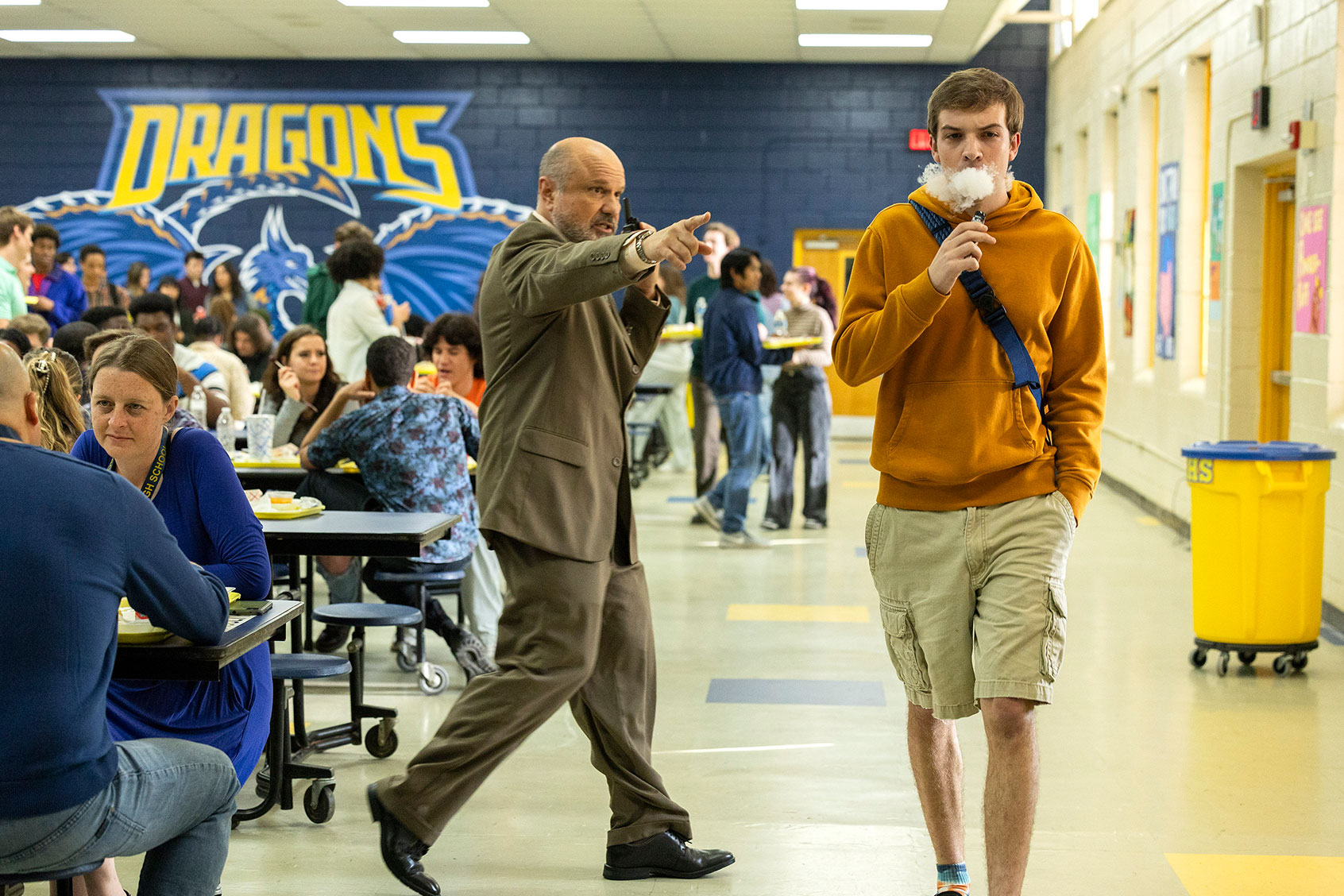
Keith Mars, Enrico Colantoni’s private detective on “Veronica Mars,” is the kind of guy people love being around. Caring without being overbearing, good-humored but not corny, Keith dotes on his his daughter while trusting her intelligence and capability. And Veronica’s friends think he’s cool.

Colantoni’s role in FX's frenetic and hilarious “English Teacher” is, well, not Keith. In one scene Brian Jordan Alvarez’s main character Evan Marquez advises a visitor that, if they see Colantoni’s Principal Grant Moretti, to just walk the other way. 

"This guy is just something else."

The head administrator at Morrison-Hensley High does care, to be clear. Mainly about his job. He spends most of his workday avoiding conflict, praying that the district or an angry parent doesn’t add to his miseries. When they do, he simply bends to the latest rule change until someone forgets they made a stink. This goes against everything the crusading Evan stands for, which drives Moretti to rely a little too heavily on Alka Seltzer.

Colantoni’s roles in “Galaxy Quest” and the long-running NBC series “Just Shoot Me” won over the public before playing Keith Mars earned him a place in the TV Dad Hall of Fame. Playing Principal Moretti required him to tap into moods and improvisational skills he wasn’t used to flexing. 

But as the actor shared with Salon during a recent face-to-face interview in Pasadena, that helped him tap into all the freewheeling and surprising displays of heart that make him love being in and watching this new show. In our conversation we discussed where his principal falls on the scale of other memorable school bosses on film and TV, the underappreciated value of accepting each other's differences, and why he believes "English Teacher" is in the same league as the most beloved feel-good TV comedy of our era.

The following interview has been lightly edited for length and clarity.

It looks like you had a good time making this show.

I did. You know what? All my experience and training never prepared me for a show like this, because it was just about fun. They had something beautiful on the page, and they’d go, “OK, we got that now. Let's just blow it up and see what happens.”  I was always a little skeptical about how they were going to cut it. And then you see it — because I hadn't seen it until you did – and wow. They really have heart. That's what I love about it. You can be funny, but without the heart and the warmth . . . I’m just emotionally proud of this show, and how it's current and alive and relevant and funny. But the heart! It always has heart.

So, I’m thinking of “Ferris Bueller's Day Off,” “Buffy the Vampire Slayer” and even the show people still associate you with, “Veronica Mars.” Each has a principal who's kind of a no-nonsense person, right? Principal Moretti is in that tradition, but not quite.  The difference is that he’s just trying to survive and maintain at this point. Was there someone that you based him on?

No. I mean, I loved my high school years. I loved the teachers. They encouraged me and intentionally discouraged me from becoming an actor, right? Those teachers painted the dark story of what it would be like. Then, once I decided that I was going to do it anyway, they'd go, “Good for you.”

But this guy is just something else.

I always come from a place of wanting to bring my heart to something. And any character who's in a position of authority has to approach it from a kind of caring for everybody. But how do you do that when everything is changing and you don't know how to communicate with people and you don't know what they're doing? He's so defeated, but he's trying. So how does an old guy like Moretti deal with it? There's a lot of him just saying, “OK, I don't understand it. I'm gonna step back.”

So he's not like those principals you described earlier. Because they’re usually . . .

They're the authoritarians. They’re the ones who deflate the fun from the room. In “Ferris Bueller's Day Off,” he’s out to get Ferris. The same is true of the principal on “Buffy.”

That’s true, but the one on “Veronica Mars,” he sort of saw something in Veronica.

Right. I would also say the way that show approached authority figures, and I include Keith Mars in this assessment, is from a perspective of encouragement that reflected the outlook of its time.

Yeah, that's very true. That whole era was about young girls being empowered, and Veronica was such an easy character to sort of support. But that's very interesting.  Moretti . . . he is encouraging, I guess. But his way of encouraging is just kind of going, “Go do what you're going to do. I don't want to hear about it. Don't tell me about it.”

We need your help to stay independent

And that makes “English Teacher” very aligned with this era since it revolves around the idea of what it means to both be in school as a teacher and a student, and how much that has changed because of the political atmosphere. There's so much pressure related to what to say, what not to say, what to teach, what not to teach. And the show takes that on from a playful perspective by taking the air out of it.

That's what makes this show smart. I mean, even parents, they have all the responsibility with less and less authority, and teachers are the same way. You bring your kids to school, and you entrust these people to teach them, but they're not allowed to do what they're supposed to do because of that and this, and the fear of being called out or canceled.

English TeacherEnglish Teacher (FX)

There's a whole culture going on that just makes people not want to do what they love to do. And everybody's being watched. Everybody. But when you start watching teachers who are underpaid and always underappreciated, and you still sort of pick on them, that's just not fair. You know what? They're making no money and they're tired, and the ones that care who are there for 18 hours, and you still want to pick on them? Not fair.

Did you talk to any teachers or administrators about that?

No. But I just loved all my teachers. I loved them all. And I knew that if I just brought my generational perspective to this world, I would find Moretti there. Look, the world is changing. I'm an old guy. How do I deal with this? And how do teachers teach anymore?

One of the most refreshing parts of the show is the way it completely captures the intergenerational conversation about how we talk to and past each other. I'm watching it from the perspective of a Gen Xer who's doing my best to keep up. But also, there's the Millennial perspective, represented by Brian's character, stuck between Moretti and the kids, who are Gen Z.  So when you say you brought your generational perspective, what do think you, Enrico, brought to Moretti and your understanding of all the changes that are happening around us?

All that stuff didn't concern me growing up. What I wanted back then was just very simple: you wanted to pass, you wanted to move on, you wanted to get laid, you wanted to grow up. You wanted to find security.

"There's a whole culture going on that just makes people not want to do what they love to do."

My parents were World War II survivors, immigrants to a new world. It was all about wanting to fit in and not wanting to rock the boat and just respecting my elders and authority figures. Just assuming that if I was in trouble, I was in trouble. I took it as a growing experience. And so it's cause and effect for me: you put this out there, you're going to get this.

But there's resistance to that now. It's like dealing with somebody who just doesn't want to take any responsibility. How do you talk to somebody who doesn't see that they have a role in all of it and that we all have a stake in what's going on in the world?

It seems so easy to just point our fingers and blame. And in this show, everybody's pointing their fingers, but they're doing it with such lightheartedness that, like you said, they take the air out of it. But that doesn't mean it's right, or that's the way to go. That's just what's happening right now. So if we’re going look at this, let's look at it from a place of respect and love.  Not, “I'm done, and you're done with me.”

I come from the theater, right? It's like a mecca of diversity and differences. So that kind of cancel culture and stuff, I don't understand it. And that's my generation, right? It's just like, aren't you allowed to pick fun and make fun? . . . That's what's so refreshing about this show. It's fun to come from a place of acceptance of what's going on.


Want a daily wrap-up of all the news and commentary Salon has to offer? Subscribe to our morning newsletter, Crash Course.


I would say this show is an argument that cancel culture doesn't exist.

Well . . .

I don't think it exists, really and truly. I think it’s mainly a marketing tool for famous people. But on the ground level, people are having conversations like, “Please don't say that. You can't say that anymore.” And then some people will say –

“I’m just gonna say it anyway.” You're right.  We're reacting to what we created in the first place. And that beautiful first line, of “I don't think there’s a such a thing as woke anymore. The kids are not woke, the pendulum is just swinging the other way.” We can't say the things we wanted to say, and I try to make Moretti try to make sense of that. You know, like, “I didn't get the memo. I was allowed to say it two days ago, and I'm not allowed to say it now?” And that's really funny.

You know, my favorite show is "Ted Lasso” for the simple reason that it's just a positive, funny show.

Would you say this is the new “Ted Lasso”?

I think so. I want it to be.

What do you think makes it like “Ted Lasso”?

Well, because there is warmth and there is acceptance in who these characters are. When an ultra-conservative gym teacher reacts to a very liberal English teacher, and they find a place of acceptance and friendship? That's what makes me want to see it and keep going back to it and keep doing it. To feel that. It's all I want.

New episodes of "English Teacher" air at 10 p.m. Mondays on FX and stream the next day on Hulu.

How “Beetlejuice Beetlejuice” used cringe and chaos to beat low expectations for sequels

As far as unnecessary sequels go, Tim Burton's “Beetlejuice Beetlejuice” is standard fare in just about every respect. The plot's busy, the visual effects hit-or-miss and its villains are neither potent nor memorable. Yet somehow, it becomes something greater than the sum of our expectations. The belated follow-up to 1988's “Beetlejuice” owes much of its charm to its supporting cast, which is hands-down one of the most strikingly entertaining ensembles of the past decade.

The original “Beetlejuice” reinforced the tactility of Burton's movie magic more than it emphasized the brilliance of its casting. Sandworms, scale-model hauntings and phantom football players made for truly iconic imagery, and so much of that first film's novelty is rooted in that aesthetic. “Beetlejuice Beetlejuice” flips these priorities. This time, monsters and mayhem play second banana to the people experiencing them, and “Beetlejuice Beetlejuice” revels in showing us what that looks like.

Forming a sort of “cringe trinity” are Delia Deetz (Catherine O'Hara) and two new characters: Rory (Justin Theroux) and Wolf Jackson (Willem Dafoe,) all of whom are relentless with their cartoonish dysfunction. It's not a stretch to claim the movie owes 80% of its hilarity to these three performances precisely because they go above and beyond where they didn't need to.

When we catch back up with Delia, the Deetz family matriarch and haughty, pouty and demanding stepmother to Lydia (Winona Ryder), she's calling a now famous Lydia to her art exhibition to inform her that her father Charles Deetz (a absent Jeffrey Jones) has died. There's a ton going on in this scene, but all that matters in the moment is Delia. The reason for this pulled focus is clear: O'Hara's "Schitt's Creek" role absolutely informs how she revisits her “Beetlejuice” character, and as we drop deeper into Burton's warped inner workings, it's impossible not to see Moira Rose in everything she says and does.


Want a daily wrap-up of all the news and commentary Salon has to offer? Subscribe to our morning newsletter, Crash Course.


Later in the film, Delia takes a pair of venomous reptiles to her late husband's grave in an ill-fated attempt to mimic Egyptian mourning rituals. The asps — not snakes, she quickly corrects — are allegedly defanged and thus safe for her latest showcase. It's here that we get Delia's one moment of vulnerability (she and Rory each only get one, apparently), which comes as she's kneeling in front of Charles' grave, asps in hand, admitting to herself that grief sucks and moving through it is hard. She brings the asps close enough to her throat to strike, but when they do, she dies. The asps weren't defanged; Delia's pathological need for theatrics literally kills her. I'm not sure which part of that isn't hysterical.

But yes, you read that correctly: The movie rather unceremoniously kills Delia off in the most apt way possible. And death is certainly not the end of her. Pouting “But I have Global Entry!” as she settles into the waiting room with her fellow specters is just the beginning of her afterlife antics.

Delia dies as she lived: pomp without much circumstance, topped off with comical incredulity at the consequences of her dramatics. And yet, through all the meltdowns, outbursts and shrewd commentary, she's irresistible. O'Hara brings weight and pathos to a role that so easily could have been a well-acted but toothless reprisal, and she does so effortlessly.

Beetlejuice BeetlejuiceCatherine O'Hara as Delia, Jenna Ortega as Astrid, Winona Ryder as Lydia and Justin Theroux as Rory in “Beetlejuice Beetlejuice” (Warner Bros. Pictures/Parisa Taghizadeh)Theroux's magnetism as Rory is much less of a given. We expect greatness from O'Hara's dialed-up diva. But Theroux, while not a stranger to comedic acting, blindsides us as Lydia's parasitic boyfriend. He was the least exciting part of the film's marketing, so for him to come in and just eat everybody's lunch will no doubt help fuel “Beetlejuice Beetlejuice” discourse for the foreseeable future. Solidifying the part's brilliance, though, is the restraint Burton and screenwriters Alfred Gough and Miles Millar exercise with him. They know exactly how much Rory is enough Rory, and write him out as soon as they reach that point. Rory turns into sandworm fodder the second he admits his slimy MO, suggesting that the smarmy leech was beyond redemption.

As much as “Beetlejuice Beetlejuice” insists Rory is garbage, it does crack his veneer long enough for us to glimpse some sincerity. When a local priest (Burn Gorman) asks him if he's afraid, Rory emphatically breathes, “Yes! I'm sh****ng my pants.” It's the only honest thing we ever hear him say, revealing potential layers he doesn't want his family to see. For that reason and others, close-reads of both Delia and Rory are as rewarding for the viewer as they probably were for O'Hara and Theroux. O'Hara makes Delia feel lived-in and real. Referring to Charles as her “horny handyman” and admitting she liked Lydia “before the money” clue us into what she's been up to since we last saw her. She's done things, been places and had a life with her husband to which we feel privy despite decades apart. Ryder and Keaton catch us up in the same sly way.

Franchise newbie Dafoe can't build from the same foundation as O'Hara, but that hardly matters. His part is as out of left field as Theroux's and we wouldn't have it any other way. He doesn't impact the plot in any significant way, and his character isn't especially interesting or good at what he does. He knows it, too. He's merely an actor playing an actor playing a ghost detective, making his disastrous investigation into another new character named Delores' (Monica Bellucci) murder spree less of a chore than it seems. Watching Dafoe alchemize an otherwise tedious subplot through sheer commitment to camp holds a specific, probably esoteric beauty that justifies his place in the film.

It's tempting to attribute the film's high quality to the cringe trinity, but the entire cast is giving it everything they have. Returning stars Michael Keaton (AKA, the ghost with the most himself, Beetlejuice) and Ryder are phenomenal and vital to the film's appeal, and while their importance can't be overstated, they serve different purposes than most of their fellow characters. Wide-eyed, wild-haired, and disheveled, Keaton's crusty trickster still invokes the patron demon of late-stage crack addiction, bringing with him the same wily unpredictability that made him such a hoot last time. Ryder, meanwhile, offsets the craziness around her with mostly muted reactions and a “take it as it comes” grit. Her onscreen daughter, Astrid (Jenna Ortega) is similarly measured in how she handles her unusual circumstances.

Sequels often underwhelm, but “Beetlejuice Beetlejuice” overcomes low expectations with more wit, verve and heart than most of its ilk. If Burton's latest enjoys even a fraction of its predecessor's longevity, it'll be due to a supporting cast so good they sideline Keaton's undead spazz and breathe fresh, quirky life back into a dying IP.

“Cooking for Kamala”: How the Harris-Walz campaign is winning over America’s chefs

When chef Meherwan Irani, a James Beard Award winner, envisions a White House led by Kamala Harris, he imagines something as distinct as the aroma of spices — cardamom, ginger, and a whisper of clove — drifting from the presidential kitchen. Should Harris be elected, she would be the first South Asian American to reside in the executive mansion, and her intimate understanding of Indian cuisine may well leave a mark on what emerges from its kitchens. “If she’s in the White House, let there be samosas and let the chai flow freely,” Irani mused.

Irani was among more than 60 chefs and culinary luminaries — including Tom Colicchio, Carla Hall, José Andrés, Cat Cora and Gail Simmons — who joined forces in late August for “Cooking for Kamala,” a virtual event organized by California Congressman Eric Swalwell, a close friend of Harris. Billed as an online gathering of “the best chefs in the world,” the livestream aimed to highlight Harris’s campaign while also celebrating food.

Amid lighthearted nods to the culinary moments that have already defined the Harris-Walz campaign — from chef Susan Feniger’s play on Tim Walz’s “white guy tacos” to her “Straight from the Coconut Tree” cookies — the event struck a more serious tone when food writer Ruth Reichl shared her thoughts. “People who care about food have been waiting our whole lives to have someone who is a cook in the White House,” she said.

While chefs, like any professional group, are far from monolithic in their political views, there is a notable resonance between the culinary world and the Harris-Walz ticket. The question is: Why? What has turned this campaign into one that not only courts chefs but seems to capture their enthusiasm in a way that other campaigns have not?

One of the campaign’s most compelling appeals to the culinary world is its alignment with key issues that resonate deeply within the industry: hunger, immigration, labor rights and food prices.

On the issue of hunger, Harris has long been an advocate for expanding food access. In 2020, as the pandemic upended the economy, Harris, alongside Senators Elizabeth Warren, Mazie Hirono, and Christopher Murphy, pressed then-Agriculture Secretary Sonny Perdue to reconsider the blanket rejection of state waiver requests aimed at preserving college students' eligibility for the Supplemental Nutrition Assistance Program (SNAP) after losing their jobs due to COVID-19.

A month later, in May 2020, Harris co-sponsored the Closing the Meal Gap Act, which sought to bolster SNAP benefits during the pandemic. “We are in the midst of a historic economic crisis — people are hurting,” Harris wrote. “They are struggling to put food on the table, and existing nutrition benefits don't get people through the end of the month… No one in America should ever go hungry, especially during a public health crisis.”

Her efforts — and the efforts of her husband, Doug Emhoff — have not gone unnoticed by chefs. “I want to give a shout-out to the second gentleman, soon to be the first gentleman,” said longtime “Top Chef” judge Tom Colicchio during the “Cooking for Kamala” event. “He has made one of his platforms to end hunger in this country. We can do that. Chefs really care about this issue.”

Tim Walz, Harris’s running mate, has also drawn attention from the food community for his leadership in Minnesota. As governor, Walz signed legislation making his state the fourth in the nation to provide free breakfast and lunch to students. “This is one piece of the puzzle in reducing both childhood poverty and food insecurity,” Walz remarked when discussing the new law.

We need your help to stay independent

During the livestream, Chef José Andrés summed up the sentiment of many in the culinary world: “When you have a leader who understands the power of feeding one another — that’s real power. That’s the power to build longer tables.”

While some participants in the “Cooking for Kamala” event tend to keep a lower political profile (Giada De Laurentiis, who endorsed Harris during the call, comes to mind), chef José Andrés has long been an outspoken critic of Harris’s opponent, former President Donald Trump, primarily in response to Trump’s inflammatory comments about immigrants.

Immigrants play a pivotal role in the American food system, from the fields to the kitchen. According to the National Restaurant Association, approximately 23% of restaurant workers are foreign-born, as are nearly half of the nation’s farm laborers.

Trump’s campaign launch in 2015 marked a turning point for many in the food world. In his speech, Trump described Mexican immigrants in incendiary terms: “When Mexico sends its people, they’re not sending their best. They’re sending people that have lots of problems… They’re bringing drugs. They’re bringing crime. They’re rapists, and some, I assume, are good people.”

"When you have a leader who understands the power of feeding one another — that’s real power. That’s the power to build longer tables."

For Andrés, who emigrated from Spain and became a U.S. citizen, these remarks were intolerable. He withdrew his planned restaurant from Trump’s Washington, D.C., hotel, stating: “Donald Trump's recent statements disparaging immigrants make it impossible for my company and I to move forward. More than half of my team is Hispanic, as are many of our guests. And, as a proud Spanish immigrant and recently naturalized American citizen myself, I believe that every human being deserves respect, regardless of immigration status.”

Harris’s own story, as the daughter of immigrants from Jamaica and India, resonates with many in the food industry, including chef Marcus Samuelsson, who called into “Cooking for Kamala” from Miami. “Just by being an immigrant… listening to Kamala’s story and her mother’s and her parents’ stories, for me, it’s personal and very inspirational,” Samuelsson said.

Meanwhile, labor advocates within the food sector have voiced strong support for Kamala Harris’s potential presidential campaign, with United Farm Workers (UFW) president Teresa Romero leading the charge. In a recent statement, Romero praised the Biden-Harris administration for championing farm workers’ rights, highlighting their efforts to strengthen union protections, secure COVID-19 relief for undocumented workers, and propose federal standards to protect laborers from extreme heat.

“The Biden-Harris administration has worked tirelessly on behalf of farm workers,” Romero said, describing Biden as “the greatest the United Farm Workers has had in the Oval Office.” Now, the UFW is endorsing Harris as the “best leader to defeat Donald Trump” and continue the administration’s work. Romero underscored Harris’s long-standing relationship with the UFW, from joining farm worker marches to supporting legislative efforts aimed at protecting wages.

"Listening to Kamala’s story and her mother’s and her parents’ stories, for me, it’s personal and very inspirational."

Off the farm, Harris’s broader labor record presents a more complex picture. In 2019, she joined striking McDonald’s workers to advocate for a $15 minimum wage — though her decision not to overrule the Senate parliamentarian on a provision to raise the minimum wage during COVID-19 relief negotiations frustrated some progressives. Still, Harris’s support for unions has been a consistent theme in her political career, which could help her gain further backing from service workers. 

Plus, there’s also the fact that Harris herself has worked in the minimum-wage service industry; Harris' campaign says the nominee worked at a McDonald's in California in 1983 (though the Trump campaign is apparently asking for proof). 

Beyond policies, part of Harris’ appeal to chefs is, of course, the fact that she is actually a pretty great cook. In her short-lived YouTube series “Cooking with Kamala,” the vice president cooked alongside celebrities and cultural figures like Mindy Kaling, who joined Harris to make masala dosa, and former First Lady Michelle Obama, who prepared a family recipe while discussing public health and nutrition. 

Her roast chicken technique has gone viral, as has her collard greens recipe, which she makes using sliced garlic, chili peppers, a lot of water, some chicken stock, vinegar and Tabasco. The real secret, though, is rendered bacon fat, which is unsurprising since Harris has said before she thinks “bacon is a spice.” 

While not everyone on the “Cooking for Kamala” call agreed with that assertion (longtime “Top Chef” host Padma Lakshmi, who co-hosted the event, said she was “doubtful”), everyone seemed to agree the Harris-Walz ticket was better than the alternative. After all, some normalcy seems to be what everyone is craving. 

“It feels good . . . really, really good”: Angela Bassett wins first Emmy Award

Actor Angela Bassett has won her first Emmy Award, nine nominations later.

At the Creative Arts Emmys on Saturday, Bassett nabbed the win for her outstanding narration in "Queens," a docuseries from National Geographic about matriarchies in the wild. 

“Oh my God. Wow,” Bassett said while accepting the award, per PEOPLE. “My first Emmy!”

“It feels good . . . really, really good," the "Black Panther: Wakanda Forever" star said of her win. “National Geographic, Wildstar Films and all the directors — all women! — who brought this incredible story, this incredible docuseries centered on the ferocious and magnificent things in the animal kingdom. I couldn’t be more thrilled and more grateful. Thank you, each and every one of you.”

Speaking to a reporter who acknowledged her look of surprise upon hearing she had won, Bassett said, “This is one of the really, really big ones, you know what I mean? And so that . . . that doesn't usually happen.”

“But also, whenever you’re acknowledged . . . I'm just a girl who just wanted to act, and my mentors were way out ahead of me,” Bassett added. “And I just looked to them and got inspiration and hope, and I just put my focus and my energy and my love to try to make it happen in my life, or for my life.”

Bassett's first Emmy comes after she won an honorary Academy Award in January, an honor many considered to be long overdue after the veteran actor's decades of work in Hollywood.

In true Tony Soprano fashion, James Gandolfini once stormed out of his own intervention

The former CEO of HBO has revealed that "The Sopranos" lead James Gandolfini once dared the network to release him after reacting poorly to an intervention for his substance abuse issues. 

"We did an intervention with him at my apartment in New York," Chris Albrecht shared in the new Max docuseries, 
"Wise Guy: David Chase and The Sopranos." "That was to try to get him to go to a facility for rehab. We'd had a lot of friction by that point, and the ruse was that I was inviting Jimmy over so we could talk things through and kind of clear the air."

Detailing how things erupted from there, Albrecht paints a picture of Gandolfini going full Soprano over attempts to help him, saying, "He walked in, and he saw everybody sitting there, and he went, 'Aw, f**k this.' And he walked out," Albrecht recalled, noting that the actor's sisters and several "Sopranos" castmates were also in attendance. "Everybody went, 'Jimmy, Jimmy!' And he turned to me and he went, 'Fire me,' and he left."

"Sopranos" actor Steven Van Zandt says in the documentary that Gandolfini routinely threatened to leave the show. "He probably quit the show every other day. Maybe every day," Van Zandt said. "Every other day we would go to a bar and we would have the exact same conversation. We'd get drunk and [he'd] say, 'I'm done. I can't, I'm not going back.' And I would say, 'Okay, you got a hundred people depending on you here.' And he's like, 'Ah, yeah, yeah, okay.'"

Gandolfini earned a number of awards for his performance as New Jersey mafia mobster Tony Soprano, including three Emmy Awards, five Screen Actors Guild Awards, and one Golden Globe. He died in 2013 of cardiac arrest while on a family vacation in Italy.


Tiny, compact galaxies are masters of disguise in the distant universe

Astronomers exploring the faraway universe with the James Webb Space Telescope, NASA’s most powerful telescope, have found a class of galaxies that challenges even the most skillful creatures in mimicry – like the mimic octopus. This creature can impersonate other marine animals to avoid predators. Need to be a flatfish? No problem. A sea snake? Easy.

When astronomers analyzed the first Webb images of the remote parts of the universe, they spotted a never-before-seen group of galaxies. These galaxies – some hundreds of them and called the Little Red Dots – are very red and compact, and visible only during about 1 billion years of cosmic history. Like the mimic octopus, the Little Red Dots puzzle astronomers, because they look like different astrophysical objects. They’re either massively heavy galaxies or modestly sized ones, each containing a supermassive black hole at its core.

However, one thing is certain. The typical Little Red Dot is small, with a radius of only 2% of that of the Milky Way galaxy. Some are even smaller.

As an astrophysicist who studies faraway galaxies and black holes, I am interested in understanding the nature of these little galaxies. What powers their light and what are they, really?

Many galaxies, indicated as small, bright dots, shown against a dark backdrop.

The universe is full of countless galaxies, and the Webb telescope has helped astronomers study some of them. NASA, ESA, CSA, STScI

The mimicking contest

Astronomers analyze the light our telescopes receive from faraway galaxies to assess their physical properties, such as the number of stars they contain. We can use the properties of their light to study the Little Red Dots and figure out whether they’re made up of lots of stars or whether they have a black hole inside them.

Light that reaches our telescopes ranges in wavelength from long radio waves to energetic gamma rays. Astronomers break the light down into the different frequencies and visualize them with a chart, called a spectrum.

Sometimes, the spectrum contains emission lines, which are ranges of frequencies where more intense light emission occurs. In this case, we can use the spectrum’s shape to predict whether the galaxy is harboring a supermassive black hole and estimate its mass.

Similarly, studying X-ray emisson from the galaxy can reveal a supermassive black hole’s presence.

As the ultimate masters of disguise, the Little Red Dots appear as different astrophysical objects, depending on whether astronomers choose to study them using X-rays, emission lines or something else.

The information astronomers have collected so far from the Little Red Dots’ spectra and emission lines has led to two diverging models explaining their nature. These objects are either extremely dense galaxies containing billions of stars or they host a supermassive black hole.

The two hypotheses

In the stars-only hypothesis, the Little Red Dots contain massive amounts of stars – up to 100 billion stars. That’s approximately the same number of stars as in the Milky Way – a much larger galaxy.

Imagine standing alone in a huge, empty room. This vast, quiet space represents the region of the universe in the vicinity of our solar system where stars are sparsely scattered. Now, picture that same room, but packed with the entire population of China.

This packed room is what the core of the densest Little Red Dots would feel like. These astrophysical objects may be the densest stellar environments in the entire universe. Astronomers aren’t even sure whether such stellar systems can physically exist.

Then, there is the black hole hypothesis. The majority of Little Red Dots display clear signs of the presence of a supermassive black hole in their center. Astronomers can tell whether there’s a black hole in the galaxy by looking at large emission lines in their spectra, created by gas around the black hole swirling at high speed.

Astronomers actually estimate these black holes are too massive, compared with the size of their compact host galaxies.

Black holes typically have a mass of about 0.1% of the stellar mass of their host galaxies. But some of these Little Red Dots harbor a black hole almost as massive as their entire galaxy. Astronomers call these overmassive black holes, because their existence defies the conventional ratio typically observed in galaxies.

Animation illustrating the James Webb Space Telescope’s discovery of overmassive black holes in the distant Universe. Credit: Timothy Rauch.

There’s another catch, though. Unlike ordinary black holes, those presumably present in the Little Red Dots don’t show any sign of X-ray emission. Even in the deepest, high-energy images available, where astronomers should be able to easily observe these black holes, there’s no trace of them.

Few solutions and plenty of hopes

So are these astrophysical curiosities massive galaxies with far too many stars? Or do they host supermassive black holes at their center that are too massive and don’t emit enough X-rays? What a puzzle.

With more observations and theoretical modeling, astronomers are starting to come up with some possible solutions. Maybe the Little Red Dots are composed only of stars, but these stars are so dense and compact that they mimic the emission lines typically seen from a black hole.

Or maybe supermassive – even overmassive – black holes lurk at the cores of these Little Red Dots. If that’s the case, two models can explain the lack of X-ray emissions.

First, vast amounts of gas could float around the black hole, which would block part of the high-energy radiation emitted from the black hole’s center. Second, the black hole could be pulling in gas much faster than usual. This process would produce a different spectrum with fewer X-rays than astronomers usually see.

The fact that the black holes are too big, or overmassive, might not be a problem for our understanding of the universe, but rather the best indication of how the first black holes in the universe were born. In fact, if the first black holes that ever formed were very massive – about 100,000 times the mass of the Sun – theoretical models suggest that their ratio of black hole mass to the mass of the host galaxy could stay high for a long time after formation.

So how can astronomers discover the true nature of these little specks of light that are shining at the beginning of time? As in the case of our master of disguise – the octopus – the secret resides in observing their behavior.

Using the Webb telescope and more powerful X-ray telescopes to take additional observations will eventually uncover a feature that astronomers can attribute to only one of the two scenarios.

For example, if astronomers clearly detected X-ray or radio emission, or infrared light emitted from around where the black hole might be, they’d know the black hole hypothesis is the right one.

Just like how our marine friend can pretend to be a starfish, eventually it will move its tentacles and reveal its true nature.The Conversation

Secretive right-wing network paid influencers to spread sexual smears about Kamala Harris: report

An anonymous conservative network paid a group of influencers to promote sexual smears and rumors about Democratic nominee Kamala Harris, Semafor reported.

The network began as a campaign that paid influencers to push standard pro-Donald Trump rhetoric like insulting President Joe Biden’s mental capabilities and accusing Democrats of weaponizing the Department of Justice amidst the former president's hush-money case

The group would communicate regularly via email and Zoom calls, organized by a man who went by James Bacon. On the calls however, everything was anonymous. Nobody turned on their cameras or used their names, Semafor reported.

When Biden stepped down as the Democratic nominee and Harris rapidly gained widespread support to take his place, the network turned the focus of their attacks to the vice president. 

In a call on July 22, just a day after Biden dropped out, the influencers were told to share various sexual rumors and smears about Harris, including comparing her to the “Hawk Tuah” girl. According to Semafor, this comparison was the “least crude” of the sexual slanders made against Harris. 

One of the call’s participants, who was revealed to be former Rep. George Santos, R-N.Y., turned on his microphone to object, a call attendee told Semafor. Santos then left the call, they said.

“Oddly enough conservative influencers talking about Kamala’s sex life and race!” Santos tweeted days later.

Semafor was unable to identify the financial source of the influencer payments, though one participant reportedly made more than $20,000 over a couple weeks. 

Ex-prosecutor: Judge’s delay makes it “much more likely” Trump could be sent to jail

New York Judge Juan Merchan last Friday postponed Donald Trump's hush-money case sentencing until Nov. 26 to avoid any appearance of influencing the election between the former president and Vice President Kamala Harris. But the stay in Trump's fate might in fact doom him later, according to former federal prosecutor Andrew Weissmann, who served on special counsel Bob Mueller's team.

“Sentencing Donald Trump after the election, if he loses, makes it much more likely that you can think about sending him to jail,” he told MSNBC host Jen Psaki. The moment he loses, Weissman said, Trump would be a mere "Citizen Trump" rather than a presidential candidate, a status that could expose him to the weight of impartial justice.

Trump had a different interpretation of Merchan's ruling. After the delay was announced, the former president crowed on Truth Social that "the Manhattan D.A. Witch Hunt has been postponed because everyone realizes there was NO CASE, I DID NOTHING WRONG!"

Trump was convicted of 34 felony charges in May, and was due to hear his sentence in July until a Supreme Court decision in favor of broad presidential immunity prompted Merchan to delay it until September. Merchan then delayed it again last Friday due to the political "complexities" of sentencing a former president who is also, once again, his party's nominee for that office. Merchan also delayed his ruling on Trump's immunity, which prevents the former president from appealing to the Supreme Court before Election Day in the case that Merchan decides that he is not immune.

"That kept this whole case out of the Supreme Court before the election, at a time when the Supreme Court otherwise would have every incentive to issue just as political decision as it issued with respect to presidential immunity," Weissmann said. "It would have had the same incentive to go and reach into this case and say, 'No, there has to be a retrial.'"

Now, according to Weissmann, the Supreme Court might have also have "a lot less incentive to reach in" and intervene in the case should Trump lose the election and potentially a significant amount of political relevance.

“It just makes it more apolitical,” Weissmann said, referring to the sentencing that could slap Trump with up to four years of jail time or a more lenient penalty like community service or probation.

Trump accused of “voter suppression at the highest order” over late-night Truth Social meltdown

Republican presidential candidate Donald Trump threatened to prosecute his political enemies “to the fullest extent of the law” should he win the 2024 presidential election and signaled once again that he would not accept defeat come November.

In a late-night Truth Social post on Saturday, the former president wrote that lawyers, donors, “illegal voters” and election officials involved in “unscrupulous behavior” in the upcoming election will be punished at levels “never seen before.” As he's done many times before, the 78-year-old candidate made unsubstantiated claims that the 2020 election was stolen and warned that the United States was devolving “into a Third World Nation.”

“WHEN I WIN, those people that CHEATED will be prosecuted to the fullest extent of the Law, which will include long term prison sentences so that this Depravity of Justice does not happen again,” Trump wrote.

“Those involved in unscrupulous behavior will be sought out, caught, and prosecuted at levels, unfortunately, never seen before in our Country,” he added.

Trump’s post comes just over a week before early voting kicks off in Pennsylvania, Minnesota and Virginia and just days before Trump and Democratic nominee Kamala Harris will debate one another for the first time.  

Trump, who was convicted of 34 felony counts earlier this year, has made retribution a key theme throughout his 2024 presidential campaign. He has promised to seek revenge against his political and personal opponents and has previously called for an end to the U.S. constitution over the 2020 election results. 

“I am your warrior. I am your justice. And for those who have been wronged and betrayed, I am your retribution,” Trump said last year at the annual Conservative Political Action Conference. 

In an interview on MSNBC, Democratic strategist Maya Rupert said Trump’s comments are “voter suppression at the highest order,” comparing Trump’s repeated threats to Jim Crow-era voter suppression tactics. 

“He is trying to scare people out of participating in the process. That is – that goes against every single thing we stand for as a country,” she said. “This should be disqualifying, for him to say so plainly that he plans on jailing his opponents and extending that to voters, to donors, to political operatives."

We need your help to stay independent

Marc Elias, a Democratic election lawyer and the founder of Democracy Docket,  criticized the Republican Party for enabling Trump’s authoritarian rhetoric. 

“Where are the so-called 'moderate' Republicans denouncing this? Where is the GOP legal establishment that is supposedly committed to the rule of law? The truth—they don't exist. It's just proud MAGA and scared MAGA,” he wrote on X. 

Authoritarian expert and historian Ruth Ben-Ghiat warned that Trump’s behavior is right out of the “authoritarian playbook.” 

“Trump will spend your tax dollars on personal retribution investigations on a large scale,” she wrote on X.

With just under two months left until November’s election, Trump’s threats have even prompted lifelong Republicans to speak out against the former president in a plea to Americans to seriously consider the consequences of a second Trump presidency. 

“I've never voted for a Democrat. It tells you the stakes in this election,” former Republican congresswoman Liz Cheney said in an interview on ABC on Tuesday. Cheney has also said her father, former Vice President Dick Cheney, would vote for Harris as well.

“Donald Trump presents a challenge and threat fundamentally to the republic. We see it on a daily basis. Somebody who was willing to use violence in order to attempt to seize power, to stay in power … we have to do everything possible to ensure he's not reelected,” Cheney said. 

Trump currently leads Harris 48 to 47 in the latest New York Times/Siena College poll, a lead within the poll’s three-point margin of error.