Spring Offer: Get 1 Year, Save 58%

Target caves to right-wing backlash, says it will not sell Pride Month merchandise in many stores

Target will not be selling its infamous Pride Month Collection in about half of its stores following conservative blowback over the LGBTQ-themed merchandise. 

The retailer has sold LGBTQ merchandise every month of June for over a decade. But in recent years right-wing activists have targeted the corporation, leading to in-store protests. Pride merchandise will still be available online.

"Target is committed to supporting the LGBTQIA+ community during Pride Month and year-round," Target told USA Today in a statement.

Target will still feature some of its Pride collection in “select stores'' based on “historical sales performances,” USA Today reported. In practice, that likely means Pride merchandise will only be sold in half of Target's 2,000 stores, Bloomberg reported.  

Boycott threats from conservative activists, as well as intimidation of its employees, was based in part on Target’s sale of clothing for transgender people, including bathing suits, as well as Pride merchandise for children.

"The reaction is a signal for us to pause, adapt and learn so that our future approach to these moments balances celebration, inclusivity and broad-based appeal," Christina Hennington, Target's chief growth officer, said last summer.

Advocacy groups are condemning the company for backing down.

“Target’s decision is disappointing and alienates LGBTQ+ individuals and allies at the risk of not only their bottom line but also their values," Kelley Robinson, president of the Human Rights Campaign, said in a statement, per NBC News.

“Doctor Who” producer Russell T. Davies is bringing more joy to the Whoniverse “to find hope”

Doctor Who” producer Russell T. Davies marvels at the fact that 25 years ago he was barely blinked at for casting three white heterosexual men as the leads of his groundbreaking series “Queer as Folk.” The premise itself, he reminded me in a recent Zoom conversation, was considered “radical, wild and new.” 

Not long after its debut, he recalls being confronted in a Manchester club by a gay actor who demanded to know why Davies didn’t cast him in the show. “And when I said, ‘Well, I don't know you. I don’t who you are,’ he went, ‘That’s the point.’”

“I’ve never forgotten that lesson, standing there at two in the morning on the dance floor in Manchester,” Davies added. Casting Ncuti Gatwa as the 15th incarnation of The Doctor is proof. But so is the existence of Captain Jack Harkness, one of the best-loved characters in the Whoniverse, who happens to be openly bisexual.

Gatwa’s Doctor is sexually fluid too, dropping a line about sharing a “long, hot summer with Harry Houdini” during his Time Lord’s first Christmas special, which also introduces his first companion Ruby Sunday (Millie Gibson). They bond over being orphans, alone together in the universe but also blessed with accepting, chosen families – hers living throughout the U.K., his flung across time and space. 

The trait that draws them together more fiercely is their appreciation of a good time regardless of the danger. Ruby’s taken with the 15th Doctor from the first sight of him giddily spinning on a nightclub’s dancefloor. 

Was that an intentional echo from Davies’ past, perhaps answering that man’s question all the years? I’m embarrassed to admit I didn’t think to ask that after he shared that anecdote. What’s certain is that he means it when he said, “I learned from my own stuff, and from talking to people. I do listen.”

Gatwa’s announcement as Fifteen was met with overwhelming elation compared to the balance of celebration and sexist trolling that exploded following Jodie Whittaker’s reveal as the 13th Doctor and the first woman to step into the role. This followed years of Davies’ predecessor Steven Moffat fending off questions about whether he’d take the bold step of breaking the line of white men who have played the role. 

The answer was no; he left that job to Whittaker’s producer on “Broadchurch” Chris Chibnall who had no material experience with the franchise before taking the helm. Moffat worked under Davies through his “Doctor Who” renaissance, which hit its height during David Tennant's era between 2005 and 2010.

For many, Tennant set the bar for what The Doctor should be, establishing the character as a blend of action man and romantic hero whose love for his companion Rose Tyler (Billie Piper) broke and mended our hearts constantly.

"What do we do except keep on fighting? . . . It’s a tough old battle . . . but I simply will not back down." 

Gatwa’s Doctor, meanwhile, is a swashbuckling being who prioritizes joy above all, which may catch the classic “Doctor Who” fandom off guard. Not so much by the delightfully odd “Space Babies” episode with its on-the-nose title and guest cast that’s still in diapers but the chromatic cheer of the whole thing. 

Within the first three episodes starring Gatwa, Davies makes room for two broad song and dance numbers, introduces a supervillain played by “RuPaul’s Drag Race” royalty Jinkx Monsoon, and saturates sets with color. Add in the fact that Ruby’s adoptive family is Black, her mother has a girlfriend, and that the band Ruby plays in is fronted by a trans woman, and this may be the queerest era of the series yet.

Doctor WhoNcuti Gatwa as The Doctor in "Doctor Who" (Bad Wolf/BBC Studios)
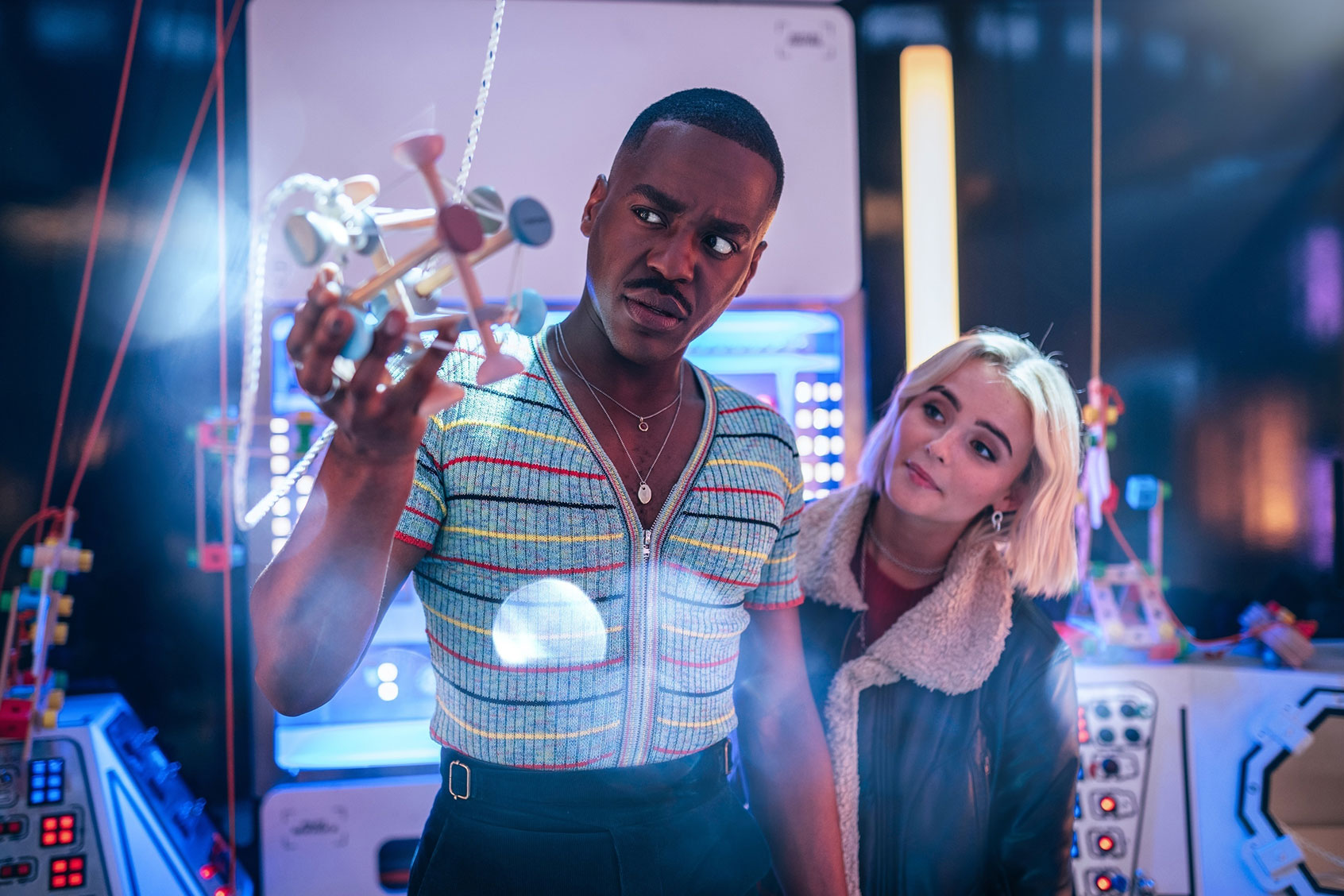
But these characters note are just part of the world, not even subtext. Davies' focus during this second time around with the franchise, and his first working for and with Disney, is to prioritize the Doctor and Ruby’s pursuit of joy across the universe. 

Good thing too, given the easy radiance of Gatwa’s smile and the ebullient spark with which his Time Lord moves through the universe. His predecessors had joie de vivre, especially Tennant and his successor Matt Smith, but Gatwa’s Doctor can find the fun in anything, including the snot trail left behind by a particularly grotesque monster.

"It’s a lot of work, joy. It's very hard to achieve on screen,” Davies said. “Anyone can cry in the rain. Sadness is comparatively easy: thunder, it rains, cry, that's all done. I believe in reaching and pushing for the greatest emotions that you can possibly get. Pushing towards joy . . . am I alone in that? I don’t think so, but there's not many doing that.”

Especially in sci-fi and fantasy. Speculative TV and film plots in the modern age are ruled by dystopian themes or drumbeat buildup toward massive battles between dueling powers – maybe good versus evil, but usually competing forces representing a bit of both. 

We need your help to stay independent

“Doctor Who,” in contrast, has always cast its Time Lord as the two-hearted man who rights wrongs and re-establishes balance. His main adversary in this chapter has yet to be revealed, but a recurring citation is the rule of fair play.

You might call these elementary ideas to which Davies would agree. Although the most vocal “Doctor Who” fans online tend to be middle-aged men, this is a family show above all. Hence Davies’ doubling down on that three-letter word dominating every episode. 

“Joy, I think, is important. Life doesn’t. Life is terrible. The world is falling into hell. So I do think it's the very good role of fiction to find hope, to find some inspiration, to find the strength to push through and to say, ‘Actually, it can be alright,’ even if in the real world that's not happening.”

He adds, “And I speak as we re-enter the ‘Years and Years’ timeline. With the elections coming up in America, I'm terrified to join where we could have been in 2018.”

Doctor WhoNcuti Gatwa as The Doctor and Millie Gibson as Ruby Sunday in "Doctor Who" (James Pardon/Bad Wolf/BBC Studios)

He’s referring to the miniseries he made after leaving “Doctor Who” – another time-traveling tale of a sort, only set on Earth and bound by gravity’s rules. 

In “Years and Years,” Davies imagines what life would look like if the British government were to slide into authoritarianism from the perspective of a middle-class family he depicts in a series of five-year jumps. They weather climate disasters and political derangement well enough, although society’s deterioration is unignorable.

He received more acclaim for 2021’s “It’s a Sin,” a period piece spanning 1981 and 1991 and follows a group of friends living through the AIDS crisis. Dire as both of those series could be, Davies insisted on preserving a sense of jubilation in their characters’ endurance.

“So when you ask what I've learned from making those other shows, I mean, what you're describing is the way I write, really,” he tells me. He’s also aware of what it means to resume writing for “Doctor Who” in a darkly political and socially polarized time catalyzed in no small part by a social media cycle he calls toxic. “I’ve forgotten my Twitter password,” he darkly quips.

"I do think it's the very good role of fiction . . . to find the strength to push through and to say, ‘Actually, it can be alright,’ even if in the real world that's not happening."

“Nevertheless, like you, we were rather delighted by the joy with which Ncuti was received. It was a phenomenal moment. But we're not daft. We know there are different voices out there as well,” he said. 

Still, the welcoming response to Gatwa’s casting given his status as a relative newcomer — Netflix’s “Sex Education” was his TV breakout – made Davies ponder the nature of our cultural rifts more closely. 

When we lament a fandom’s alleged resistance to inclusion, he asks, “Are we actually talking about society now? Or are we talking about a single platform that is very noisy? None of us knows the answer to that,” he said, “So it feels like we're having a conversation into an echoing box. Unless you lift your head, and then the world is very different. Or you have to hope that the world is very different.”

He continued, “So what do we do except keep on fighting? And I think it is a fight. I'm conscious of being part of it. It’s a tough old battle . . . but I simply will not back down.” 


Want a daily wrap-up of all the news and commentary Salon has to offer? Subscribe to our morning newsletter, Crash Course.


Davies’ means of fighting the good fight is to preserve the gleefulness in the message. Take “Space Babies” as an example, an adorable space action episode with a monster that rivals any horror movie. The reason the babies are in space, however, is one scenario of what could happen when a society strips people of their reproductive autonomy.

“The most important thing to remember about ‘Doctor Who’ is to have a good story. So I would never let [politics] hold up the telling of a great yarn,” Davies said, explaining that the point is for a six-year-old to watch these episodes and enjoy them with a blissful unawareness of any societal turbulence.

“Along with the writing has come over the years the responsibility to stand forward and speak for these rights, which is something others don’t like to do because they'd just like the work to speak for itself,” he added. “Nonetheless, as you can see, I can have a talk.”

His devotion to listening, though, might be what finally got a Black Doctor the keys to the TARDIS. But we shouldn’t downplay Gatwa’s all-conquering charisma, either – he was the last actor to read for the part.

“We auditioned people of color, white people, nonbinary people, women, every sexuality. We really went across the board,” Davies enthusiastically recalled, “and then he came in and stole it. He stole it.”

"Doctor Who" premieres with two new episodes Friday, May 10, at 4 p.m. PT/ 7 p.m. ET on Disney+. 


“These people are f***ing children!”: Jon Stewart torches GOP freakout over Biden’s Israel ultimatum

Comedian Jon Stewart on Thursday's edition of "The Daily Show" called out Republican hypocrisy in their reactions to President Joe Biden's vow to stop providing Israel with offensive weapons in the event of a full-scale invasion of the city of Rafah.

Stewart began the discussion by highlighting clips of Fox News anchors who called Biden's foreign policy decision "a moral failing we can't even begin to calculate."

Stewart mocked the response by comparing it to the right-wing freakout over alleged liberal efforts to go after home appliances. 

"Maybe it's an appliance that changed its name to be more inclusive now? Is Mr. Coffee They/Them Coffee? Is that the danger we now face?" he quipped.

However, Stewart highlighted that the ultimatum Biden has given Israel to not invade the city isn't as dramatic as they are making it out to be. 

"Oh my God!” Stewart said in a fake outrage, “The Biden administration has paused one shipment of 3,500 munitions, of the over 300,000 munitions Israel has already dropped on Gaza, to try and prevent the Israelis from attacking the area where all the refugees of this war are currently sheltered.”

But that hasn't stopped conservatives like Sen. Ted Cruz, R-Texas, from perpetuating claims that "Joe Biden has been the greatest friend to Hamas and Hezbollah that there is on planet Earth."

"You people are f***ing children! That came out wrong. . ." he said.

"I am curious why would Biden halt that shipment now?" Stewart questioned before playing an interview with the president on CNN, in which he said that he has made it clear to Israel's Prime Minister Benjamin Netanyahu that Israel will not receive U.S. support if the country goes into densely populated centers in Gaza.

"If they got into the population centers? The whole place is a population center. They've been in a population center for six months. Gaza's all population center. You know what you never hear around Gaza? Yeah, I don't live in the populated area. I live in upstate Gaza," Stewart countered.

We need your help to stay independent

Stewart questioned: "Is there no one who can offer a more nuanced analysis of our newly formulated position in this conflict, preferably in some type of catacomb or echoey tunnel?"

Then the show swiftly transitions to a clip of former President Donald Trump, clearly outside the courtroom where he is on trial in New York, "What Biden is doing in respect to Israel is disgraceful. if any Jewish person votes for Joe Biden, they should be ashamed of themselves."

Stewart began laughing and said, "My apologies to you, rabbi. Thank you so much for taking time off of your condomless porn star hush-money trial to deliver a shame lecture to Jews. I will reflect on your moral standing next Yom Kippur.”

"The Daily Show" airs Monday through Thursday at 11 p.m. on Comedy Central and streams on Paramount+

Martinelli’s Gold Medal Apple Juice has been recalled over high levels of arsenic

Martinelli's has issued a voluntary recall for a single lot of its apple juice due to elevated levels of arsenic that surpassed the standard set by the U.S. Food and Drug Administration (FDA). In a recall notice dated April 16, 2024, S. Martinelli & Company said the recall was issued after the State of Maryland found samples from one production lot of Martinelli’s apple juice “tested above the guidance action level for inorganic arsenic in apple juice set by the FDA in June 2023.”  

Exposure to high levels of arsenic can lead to serious health problems, including an increased risk of skin cancer along with bladder and lung cancers. The FDA issued guidance that lowered the industry action level for inorganic arsenic in apple juice from 23 parts per billion (ppb) to 10 ppb, which is in line with the requirements for water.

Per the Maryland Department of Health, the recalled apple juice showed 11.6 ppb for inorganic arsenic — 1.6 ppb higher than the industry action level set in the guidance.

Martinelli’s Apple Juice has a “Best By” date of March 9, 2026, or March 10, 2026, on the front of the bottle above its label. The product was shipped between March 13, 2023, and September 27, 2023, with the majority of the product shipped before July 28, 2023, the company specified. It was also distributed to five major retailers, including Whole Foods and Kroger.

At this time, no illnesses or complaints have been reported in connection with the recalled product.

Judge scolds Trump’s lawyers, asking “why on Earth” they didn’t object to Stormy Daniels’ testimony

Judge Juan Merchan on Thursday scolded Donald Trump’s lawyer, Susan Necheles, for failing to raise more objections during adult film star Stormy Daniels’ testimony. He then denied Trump’s motion for a mistrial for the second time this week.

Merchan said his rejection of the mistrial motion was based on his observation of the defense team’s action, or inaction, when Daniels was on the stand. There were “many times Ms. Necheles could have objected but didn’t,” Merchan said.

As he had on Tuesday, the judge acknowledged that he did not approve of certain parts of Daniels' testimony. However, he didn’t seem to approve of Necheles’ performance either, questioning why the defense wouldn’t object to Daniels' allegations on Tuesday that Trump did not use a condom when they had sex.

“Why on Earth she wouldn’t object to the mention of a condom, I don’t understand,” Merchand said, The Washington Post reported.

Trump’s legal team pushed for a mistrial on Thursday based on Daniel’s testimony where she didn’t explicitly say her sexual encounter was rape but expressed it was unexpected. One of the former president's lawyers, Todd Blanche, claimed her testimony amounted to a “dog whistle for rape.” Denying the request, Merchan said prosecutors had the right to “rehabiliate” Daniels’ credibility to the jury as Blache, in his opening statement, denied that their alleged sexual encounter ever took place.

Trump did not take kindly to Merchan's comments or his decision not to partially lift the gag order to allow him to attack Daniels in public (Trump could respond to her if he took the stand in his defense).

“JUAN MERCHAN, IS PRESIDING OVER THE DEATH OF THE NEW YORK CITY AND STATE SYSTEM OF JUSTICE. THE WORLD IS WATCHING!!!” Trump wrote on his website, Truth Social.

A major sriracha shortage is on the horizon as severe drought conditions threaten pepper production

Huy Fong Foods is halting production of its world-famous Huy Fong Sriracha amid severe weather that is threatening the brand’s supply of spicy hot peppers. 

News of yet another sriracha shortage made headlines Wednesday, after the Washington Post published a dismal report on the iconic condiment that’s best known for its deep red hue and sweet yet garlicky taste. Turns out, the extreme drought conditions in Mexico — where Huy Fong’s red winter jalapeño peppers are grown — are causing pepper plants to stop ripening and preventing the crop from achieving their signature red color. According to a letter sent to wholesale buyers, the company said its peppers are still too green, which would alter the color of its brand name sriracha. Huy Fong has decided to cancel all shipments and pause production of its sriracha and related products (including the brand’s Chili Garlic and Sambal Oelek) until the next chili harvesting season begins. That means production will be on pause until after Labor Day.

“It’s a double-edged sword when the success of this particular sauce comes from a jalapeño that can only be produced in California or Mexico,” climate scientist Guillermo Murray-Tortarolo told the Post.

For longtime Huy Fong Sriracha fans and consumers, the shortage — though unfortunate — isn’t anything new. Huy Fong’s sriracha hoopla can be traced back to 2016, when Huy Fong demanded its former pepper grower, the California-based Underwood Ranches, return more than $1 million the company said was overpaid to the farm for growing costs, per court documents obtained by the L.A. Times. Huy Fong’s relationship with Underwood Ranches eventually grew bitter, compelling the former to file a breach of contract lawsuit against the latter in 2017. Underwood Ranches filed a cross-complaint in February 2018, claiming that Huy Fong caused the breach in their partnership. The matter was finally settled in 2019 when a civil jury determined that Huy Fong breached its contract and “committed fraud by intentionally misrepresenting and concealing information,” the L.A. Times reported. The jury awarded Underwood Ranches $23.3 million.

Huy Fong has since been receiving its chillies from other growers in California, New Mexico and Mexico. Amid the COVID pandemic, the sriracha experienced mass shortages due to supply chain issues and a drought that affected pepper production. Then in 2022, Huy Fong announced that it would stop production of its products due to a shortage of hot peppers caused by extreme drought conditions in Mexico. The company cited “weather conditions affecting the quality of chili peppers” and a “megadrought that studies link to human-caused climate change” as specific causes for the shortages.


Want more great food writing and recipes? Subscribe to Salon Food's newsletter, The Bite.


Sriracha production remained scant in 2023. Huy Fong said it was now experiencing an “unprecedented inventory shortage” and was unsure when the sauce would return to store shelves. “Although some production did resume this past fall season, we continue to have a limited supply that continues to affect our production,” the company said in a statement, per USA Today. “At this time, we have no estimations of when supply will increase.”

Consumers have turned to other brands of sriracha in the wake of Huy Fong’s absence. Many said Huy Fong’s new formula (sriracha made using peppers from the company’s new growers) was more “mild” in taste and instead, praised Roland Sriracha, Yellowbird’s Organic Sriracha, Ninja Squirrel Sriracha and Three Mountains’ Three Sriracha Chili Sauce as tasty alternatives. 

Underwood Ranches also makes and sells its own brand of sriracha along with sambal and chili garlic. The sauce garnered much acclaim from sriracha-loving Redditors. However, The Takeout’s Luke Gralia (who has been covering the sriracha drama extensively) described the sauce as “bland” and “far more vinegary” than Huy Fong’s.

Rick Scott’s one-man rally for Trump exposes GOP abandonment

There have been a lot of raised eyebrows over the fact that with the exception of one appearance by his son Eric, Donald Trump's family is not present to support him at his criminal trial in Manhattan. Normally you would see the wife and the adult kids lined up behind the defendant to show a united front, even if the subject at hand was uncomfortable.  There really isn't such a thing as a pleasant criminal trial but it's something that is commonly done and I would certainly have thought that it would be wise in this case, since he's running for president and all. It would have been especially useful to at least see Melania and Ivanka playing the trad-wife and loyal daughter, suggesting by their presence that their man can do no wrong in their eyes. They're supposed to be Republicans, after all. 

Why MAGA hasn't turned up to support him in his moment of need when there always seems to be a few thousand who like to go to his rallies is a mystery but it clearly has Trump feeling down in the dumps.

But how could they? Everyone knows that his cultivated image of a wealthy playboy who wined and dined beautiful women like he was some kind of matinee idol is another one of his lies. This man had a casting couch routine more in the mold of a creepy Harvey Weinstein than a glamorous Tony Stark and they know it. 

Trump is intensely frustrated over the fact that because of the judge's gag order, he is no longer allowed to verbally assault and threaten the witnesses or the jury. But since the judge told him this week that he will have no choice but to jail him for contempt if he violates it one more time, he's managed to keep it together and confine his insults and threats to the judge, the prosecutors and Joe Biden. But you can feel the tension in Trump when he makes his frequent forays into the strange echo chamber hallway where he rants about the proceedings and reads clippings from Fox News personalities saying the trial is a travesty. 

One can imagine how the thought of going to jail petrifies him. This is a man who has been pampered his entire life. His elaborate morning ablutions with the hair and the make-up routine alone make any kind of imprisonment unthinkable. But he really, really wants to go after Stormy Daniels, so much so that he had his lawyers ask the judge to lift the gag order for her specifically since she is now finished testifying. (The judge said no, that he was preserving the integrity of the court.) 

For Trump this goes against every fiber of his being, as was not so coincidentally conveyed to the jury yesterday afternoon when one of his book publishers testified and was asked to read aloud some passages from his books, including this charming commentary:

"For many years I've said that if someone screws you, screw them back. If somebody hurts you you just go after them as viciously and as violently as you can. Like it says in the Bible, an eye for an eye." 

Trump will just have to let his allies in the right-wing media do that for him for the moment — and they are more than eager to comply. 

It's doubtful that Trump wanted his family to be there to hear all these sordid details in person anyway. But he reportedly was quite upset that his political allies weren't in attendance during the first two weeks of the trial. According to NBC News, he whined "no one is defending me" and pouted over the fact that there wasn't a big crowd of protesters outside. He lied about that, of course, and said on camera that there were hundreds of people blocked from protesting.

We need your help to stay independent

He actually called for his followers to come to the trial on his Truth Social platform — “GO OUT AND PEACEFULLY PROTEST. RALLY BEHIND MAGA. SAVE OUR COUNTRY!” — but other than a dozen or so kooks, they haven't shown up. From the very beginning of his legal travails he's issued threats that his people "won't stand for it" saying as far back as 2022, “If these radical, vicious racist prosecutors do anything wrong, I hope we are going to have in this country the biggest protest we have ever had … in Washington, D.C, in New York, in Atlanta and elsewhere because our country and our elections are corrupt." 

Why MAGA hasn't turned up to support him in his moment of need when there always seems to be a few thousand who like to go to his rallies is a mystery but it clearly has him feeling down in the dumps. So now he's got some of his employees, political cronies and right-wing media personalities attending the trial to give him a little boost. 

Texas Attorney General Ken Paxton, who Politico reports hangs around Trump as much as possible, was among the first to heed the call. Also showing up despite having much more important things to do were campaign managers Susie Wiles and Chris LaCivita along with advisor Boris Epshteyn and Natalie Harp, who the New York Times describes this way:

Called “the human printer” by colleagues, Ms. Harp often carries a portable device so she can quickly provide Mr. Trump with hard copies of mood-boosting news articles and social media posts by people praising him.

That's just pathetic. 


Want a daily wrap-up of all the news and commentary Salon has to offer? Subscribe to our morning newsletter, Crash Course.


The lawyer who has lost several cases for Trump but who defends him vociferously on TV, Alina Habba, has appeared in the courtroom. And on Thursday former judge and current Fox News member of "The Five," Jeanine Pirro was in attendance. The big name of the day, however, was Florida Senator Rick Scott who went the extra mile and held a press conference where he compared Trump to himself:

Scott's company paid $1.7 billion in fines to settle charges of rampant Medicare fraud, at the time the largest ever imposed, and Scott has previously said, “I take responsibility for what happened on my watch as CEO.” Today he says he's a victim of the deep state. 

The ambitious senator is said to be angling for the VP slot or Senate majority leader and he knows that whining like a five-year-old about being victimized is the quickest way to Donald Trump's heart. Scott's the first contender to be there in his time of need and I'm sure Trump noticed. If the rest of them haven't figured out by now that job one is defending Dear Leader and singing his praises then they'd better just take their names off the list right now. Look for the whole crew to traipse up there over the next few weeks. Donald Trump needs cheering up and nothing makes him happier than lackeys begging for his favor. 

“Complete disaster”: Legal experts say lawyer grilling Stormy Daniels “made it worse” for Trump

Hindsight is 2020, but as Judge Juan Merchan explained to Donald Trump’s defense team on Thursday: If you didn’t want a problematic alleged sexual encounter with your client openly discussed in a Manhattan courtroom, you shouldn’t have brought it up on the first day of trial by denying any such interaction ever took place. And when Stormy Daniels began testifying, recounting in excruciating detail her claimed hotel-room rendezvous with the former president, it was the defense counsel’s job to stand up and say what they believed was out of bounds, Merchan said.

“For the life of me,” Merchan said at the end of Thursday’s proceedings, per ABC News, “I don’t know why Ms. [Susan] Necheles didn’t object.”

Those failures led the judge in Trump’s criminal hush money case from granting a defense motion for a mistrial. But observers of the cross examination that took place earlier in the day can understand why the former president’s lawyers would try.

As former U.S. Attorney Joyce Vance commented, the defense interrogation of Daniels was a “master class in how not to do” a cross examination.

For one, Daniels, an adult film star whose $130,000 hush payment is at the heart of the case, could not possibly know whether Trump engaged in a conspiracy to falsify business records in order to evade campaign finance laws.

But Necheles didn’t get around to pointing that out until nearly the end of her more than two hours of cross examination. Instead, she leaned into what analysts referred to as an almost archaic, pre-#MeToo “nutty and slutty” attack, suggesting that Daniels was a promiscuous and prolific fabulist.

“You have a lot of experience making phony stories about sex,” Necheles said at one point. At another, she was quizzing Daniels on her claim that Trump never provided her dinner at their alleged 2006 encounter.

What Necheles should have done, in the view of her critics, is just stick to what Daniels couldn’t know – the alleged conspiracy, after the claimed incident, that prosecutors claim amounts to nearly three dozen felonies – instead of re-litigating an evening of bad sex that the defendant denies ever happened.

But the defendant in this case is Donald Trump or, as conservative attorney George Conway phrased it on CNN: Necheles’ client “is a narcissistic sociopath who is obsessed with proving the lie that he didn’t have anything to do with Stormy Daniels. And so they went off on this whole tangent.”

It was, Conway concluded, “a complete disaster and a fiasco.”

We need your help to stay independent

MSNBC legal analyst Lisa Rubin said Daniels performed better under the defense team’s constant stream of attack – she quickly rebutted the accusation she’s a grifter for selling merchandise by pointing the finger back at a man selling his own Bible – than she did on her first day of testimony, when even the judge thought she went too far in describing her alleged encounter with Trump.

"Stormy Daniels is the rare witness who's better on cross-examination than she is on direct," Rubin commented. "She really held her ground.”

That has much to do with Daniels’ ability to respond under pressure, but the defense enabled it, choosing, for example, to interrogate her about her claimed reaction to seeing Trump in his underwear, which she had previously described as a shock and surprise.

"The most that Susan Necheles did was say that it was incredulous to her that Stormy Daniels, having acted in 150 to 200 pornography movies, would be scared or surprised to come out of the bathroom and find Donald Trump on the bed for her," Rubin said. "Daniels had a nice retort to that, which is to say, 'Look, if it had been my husband, I see my husband naked all the time, but to open that bathroom door and to find Donald Trump lying on the bed for me at 60 years old, more than twice my age, and much larger than me, yeah, that was surprising.’”


Want a daily wrap-up of all the news and commentary Salon has to offer? Subscribe to our morning newsletter, Crash Course.


That exchange was also singled out as damaging by CNN legal analyst Norm Eisen.

“Instead of the question undermining Daniels, she got the better of the exchange,” Eisen wrote in an analysis of Thursday’s hearing. “It also reinforced Daniels’ Tuesday testimony that she felt a power imbalance with Trump at the time of the encounter. Instead of improving Trump’s situation, I thought the exchange made it worse.”

Jim Trusty, an attorney who previously represented Trump in his classified documents case, said he believed the cross examination of Daniels was a failure for the defense – and a product of a “shift in strategy” sought by a “fairly opinionated” client. “It kind of spiraled into a different case for a few hours with this cross examination,” he told CNN. “I don’t think that was particularly helpful.”

Trusty said that even if the defense thought it could score points going after Daniels, it was besides the point: save the venom for Michael Cohen, he argued, who is actually in a position to validate the prosecution’s charges – which relate to business records, not sex.

“They spent too much time dignifying her as a witness for a case that’s about paper entries,” Trusty said.

Fireflies populations are dwindling, but it doesn’t take much to provide spaces for them to thrive

At the end of May, dusk yawns deep over the bayou, spinning orange-pink gold across summer-green front lawns, softening the day-bleached glare of pearlshell gravel roads. The sharp fuss of grown-ups, issued from porches at the rowdy barefoot yarding of neighborhood kids, rises over the chatter of rocking chairs, to contend with manic squeals and out-of-breath laughter. One fuzzy blink after another — and always just an inch from the grasp of sticky fingers — the lightning bugs begin to fill the air. Each one’s momentary glow pulses alive and fades in syncopated rhythm with the drowsy croaks of bullfrogs.

“The presence of fireflies indicates a diverse habitat … essential to ensuring future generations are able to enjoy the natural wonder of skies lit up by them,” said Virginia Tech’s Eric Day, an entomologist and manager of the school’s Insect ID Lab, in a recent release. “Where you see them all depends on location. Old hay fields near creeks will have normal populations, but highly manicured lawns rarely have fireflies.” 

The lightning bugs flicker less these days. They start a little later, end a little sooner, glow a little less. There are fewer each year in the Mason jars of wide-eyed children. But that perennial summertime lesson about the impossibility of capturing the ephemeral — about the terrible guilt of killing a fairy with a screw-tight lid — is one the grown-ups must learn a shameful second time.

One fuzzy blink after another — and always just an inch from the grasp of sticky fingers — the lightning bugs begin to fill the air.

It’s climate change and urban development, Day said. It’s the expansion of commercial and residential properties, the simmering poison of pesticides and herbicides, the near-bald lawns over-mowed to sterility, the noxious blasts of hateful-white LED streetlights. It’s the warm summers, reliable rain seasons and cold hibernation periods — all becoming more unpredictable in timing and intensity.

“This is why we’re seeing less and less each year. The more development there is, the less room there is for them to thrive,” Day said, though cautioning against fret. “I would say fireflies are threatened due to habitat loss, but they are not going extinct, some are adapting in different regions.”

To keep it that way, Day is asking us something simple: to leave just a little bit of the wild left in our own corners of the world. Such an easy thing to do, to keep a dwindling group of magical creatures safely away from words like “extinction.” Just a few less poisons on the ground. Just a few more weeds unmowed. Tiny fireflies ask us only for a small space, left wild for the fleeting — something larger and safer than a glass jar, where a six-legged fairy can hide and come aglow to a child’s delight. Will we let them die in glass-jar houses and incurious lawns? Or is there space still wilded enough for fleeting magic in suburban sprawl?

What gets lost in the campus protests

Student protests against Israel’s war in Gaza have taken place at colleges and universities in at least 45 states, as well as in Mexico and Canada. There are also protests and acts of solidarity in dozens of countries in Europe, Central and South America, Australia and Asia. Given that Israel appears not willing to stop its war in Gaza — this week escalating their operation, launched in retaliation for the horrific terrorist attacks committed by Hamas on Oct. 7, into Rafah — the student protests will likely continue and evolve.

The student protests currently involve a range of actions such as teach-ins and rallies, encampments, and in a few examples occupying buildings and other spaces. The protests have been overwhelmingly peaceful. Nonetheless, it is estimated that at least 2,400 people have been arrested. Some of these arrests have involved what clearly appears to be a disproportionate use of force by police. Because of so-called security concerns, commencement ceremonies have been canceled or significantly altered at a small number of institutions such as Columbia, Emory, and the University of Southern California (USC).

"There is a continuum to activism, and the protests against Israel's war on the people of Gaza and the surrounding region are part of that."

For a variety of reasons, most notably, the global democracy crisis and the rise of illiberalism and the Age of Trump, the student protests against Israel’s war in Gaza have become a focal point for larger debates and tensions about free speech, antisemitism, identity politics, American foreign policy, the relationship of colleges and universities to the public sphere and society, and other issues of public concern here in the United States.

In an attempt to better understand the student protest movement, how the mainstream news media is misunderstanding and distorting these events, and balancing the right to free speech with reasonable concerns about antisemitism, I recently spoke with Alex Vitale, a professor of sociology at Brooklyn College where he is also the Coordinator of the Policing and Social Justice Project. His books include “The End of Policing” and “City of Disorder: How the Quality of Life Campaign Transformed New York Politics and The End of Policing.”

This is the first of a two-part conversation.

How are you making sense of the protests across the United States at colleges and universities in response to Israel's war in Gaza following the terrorist attacks on October 7?

It's very dramatic to see how quickly an international student movement has materialized here. And just as dramatic has been the level and intensity of repression by university administrators and police. It is also dramatic to see how quickly these protests have become part of a larger culture war narrative that in many ways is divorced from any real analysis of the situation in the Middle East. The polling data shows that young people in the United States harbor much more skepticism about America's relationship with Israel and have a greater level of concern about the human rights abuses occurring in Gaza. This explains why we have seen so many of these protests and encampments at so many universities here in the United States and also in other countries such as Canada, the United Kingdom, France, and in the Netherlands. None of this should be surprising given what we know about young people and politics and the Middle East.

As someone who interacts with college students on a near daily basis in your role as a professor, how are the protests you are seeing firsthand complicating the common stereotypes and narratives about America's young people and politics?

It's very clear to me that over the last 25 or so years that I've been teaching, college students are much more politically tuned in and engaged now. This includes events in the Middle East, but also climate change, reproductive rights, racial justice and the expansion of the civil and human rights of LGBTQ people. For me, this has been something very powerful to witness develop. The protests right now at colleges and universities also make sense in relation to the movements we've seen emerge in the last decade or so such as the Occupy movement and the Black Lives Matter movement, and other progressive attempts at social change through organizing on a large scale.

In terms of youth movements, we did not see this level of activity in the early 2000s.

The mainstream American news media with its superficial coverage and emphasis on the sensational, has really missed the larger and more important story of institution building, resource mobilization and these questions of social movement activity and how people actually become socialized into politics when they are young.

There's been a lot of hand-wringing by an older generation of establishment talking heads and pundit types that these young people don't know what they're talking about and that they are poorly informed. As I see it, these pundits and media personalities have not actually talked to any young people who are involved in these protests. Sure, they have seen the signs and graffiti and watched the news coverage of the protests and encampments. Maybe they have actually walked past an encampment one day and listened to some of the chanting. But these pundit types have not actually engaged in a serious and critical way with the protesters or taken part in the actual conversations that are happening in the tents in the middle of the night. If these pundits were actually involved and paying close attention, they would know about the intensity of the intellectual debates and discussions that are taking place among the young people who are participating in this protest movement about Israel's treatment of the people in Gaza.

"When people are denied access to deliberative channels of decision-making, they will then turn to street protests."

One of the most interesting things about the protests that took place as part of the Black Lives Matter movement in response to the police murder of George Floyd was how racially diverse they were, how many young people were involved, and how those protesters and organizers had built on the experience of previous movements. There is a continuum to activism, and the protests against Israel's war on the people of Gaza and the surrounding region are part of that.

We need your help to stay independent

For example, if we look at Columbia University, initially there were attempts to have forums and to bring in speakers. The Columbia administration banned the organizations trying to do that work. They ruled that these organizations were out of bounds because of the content of their speech and banned them from campus. They couldn't get rooms; they couldn't hold events; they couldn't raise money. The administration then acts surprised when those organizations decided that direct action was necessary, which involved taking over buildings and occupying the quads. When people are denied access to deliberative channels of decision-making, they will then turn to street protests.

What is actually happening at the protests and encampments versus how the mainstream news media is depicting these events? What narrative frame is the mainstream news media imposing on the student protests?

One of the main problems is that the news media tends to look to officials and designated institutional authority figures as the only relevant sources of information. In this case that means college administrators, police officials, and mayors to tell them what is happening. The media in turn, for the most part, ignores the voices of the young people who are actually engaging in the protest activity. As a result, so much of the narrative has focused on so-called violent confrontations — which in reality are the police attacking these encampments and protesters. The news media is also focusing on a relatively small group of students who are expressing feelings of discomfort and a lack of safety because of the protests and encampments. To me, what is most disturbing is how the news media's focus on the mechanisms of the protest movement and its repression has taken the focus off of what is actually occurring in Gaza.

How do we locate these protests relative to illiberalism and the larger debates about free speech and antisemitism?

I think it's really interesting to see the way in which the extreme right of the United States, which has been historically associated with deeply antisemitic ideas, is somehow rallying to the side of Israel. These groups don't actually care at all about the well-being of Jewish people. What these right-wing groups are really concerned about is advancing a culture war that's rooted in Islamophobia, the expansion of U.S. power in the Middle East, and a kind of broad disdain for student protests about any issue. The right-wing groups are especially aroused by and hostile to any student movement that includes language about anticolonialism, liberation and racial justice. The level of disingenuousness on the part of politicians like House Speaker Mike Johnson, R-La., rushing up to Columbia to condemn antisemitism, while enabling exactly the kinds of social forces that blame all the country's troubles on George Soros and "Jewish media elites" is just the height of opportunistic hypocrisy.


Want a daily wrap-up of all the news and commentary Salon has to offer? Subscribe to our morning newsletter, Crash Course.


We also need to listen more carefully to voices of dissent within the Jewish community, and to talk with them about what is really in the interests of Jewish people around the world. You will find a growing number of Jewish people who feel that the behavior of the Netanyahu government in Israel may turn out to unleash deep resentments toward Jewish people more broadly. That includes against those Jewish people who have spoken out for peace and oppose what the Israeli government is doing in Gaza. Ultimately, we need to make more central those voices who are deeply rooted in care and concern for the Jewish community internationally and have spoken out about Netanyahu’s policies.

The Age of Trump has seen a great increase in antisemitism and white supremacy. This also includes hate crimes and violence, some of which has been lethal. In that context, how should Jewish students, faculty, and other members of the college and university community be protected from antisemitism while also allowing free speech and protest activity — some of which may be experienced as being very threatening and uncomfortable considering October 7 and the history of existential threat and danger Jewish people have survived and triumphed over?

Any acts of violence should be treated as a very serious matter, and we should try to get to the root of who is committing that violence. Are they actually part of the university community? Are they students? I am of the belief that in some cases this violence was not something done by actual students. Disciplinary actions should most certainly be taken against students involved in that kind of behavior. We have to be careful, though, not to confuse feelings of discomfort from being on the opposite side of strongly held views with being physically threatened. Yes, we should understand that the sensitivity of some Jewish students may be heightened because of the history of attacks against Jewish peoples throughout history. We must be mindful of that, but we must insist that there be a distinction made between the expressing of what may be perceived as distasteful, unpleasant, and even, in some cases, threatening ideas, and the actual mobilization of violence and intense harassment or preventing people from having access to classes and other such behavior. Obviously, action must be taken to prevent that from happening.

“Reaching her expiration date”: How Marjorie Taylor Greene fell so fast from MAGA stardom

Making an Icarus allusion is tempting, except it would go right over MAGA heads. Plus the Greek myth of the ambitious young man who flies too close to the sun and falls to his death is a tragic story. But there was nothing sad about watching Rep. Marjorie Taylor Greene, R-Ga., faceplant on live TV late Wednesday. Earlier in the day, it seemed that Greene was backing off her ongoing threat to move to oust Speaker of the House Mike Johnson, R-La. Republicans in Congress repeatedly made it clear to Greene that there was no chance of success if she tried this. Not only did most Republicans oppose her efforts, but even most Democrats were ready to block her motion. Even Donald Trump, the not-so-secret actual leader of House Republicans, issued condescending social media posts warning her this "will negatively affect everything!"

This was more about Republicans and Democrats joining hands to tell Marjorie Taylor Greene to take a seat already.

Faced with certain defeat, Greene made noises on Tuesday suggesting that she was finally backing down. New York Times reporting suggests, however, that her ego simply could not allow her to admit that she's not the head honcho of the House GOP. By calling for the vote and failing spectacularly — she only got 11 Republicans to join her — Greene only proved how little power she actually holds. Now she's running around accusing Democrats and Republicans of being a "uniparty." In reality, the two sides agree on very little, except a shared belief that Greene should shut up and go away. 

Heaven knows this moment of bipartisanship is not about any great love for Johnson, a far-right Christian fundamentalist whose religious faith doesn't stop him from smoothly lying into every microphone put in front of his face. (Recently, for instance, he falsely claimed Trump's 88 felony indictments are a "sham." As a lawyer, however, he knows this is not true because four separate grand juries had to sign off on every one of those charges.) Minority Leader Hakeem Jeffries, D-N.Y., indicated to reporters that Democrats have no plans to come riding to Johnson's rescue in the future. Even Republicans, the Washington Post reported last week, "have ruled him out for any leadership position in the next Congress."


Want more Amanda Marcotte on politics? Subscribe to her newsletter Standing Room Only.


No, this was more about Republicans and Democrats joining hands to tell Marjorie Taylor Greene to take a seat already. As former editor-in-chief of The Bulwark Charlie Sykes told MSNBC after Greene's failed motion, one doesn't have to like Johnson to enjoy this moment. This is about Greene "basically reaching her expiration date." 

Greene's belief that she is a major power player who can force the GOP to bend to her will didn't come out of nowhere. It wasn't that long ago that her conspiracy theory-heavy brand of MAGA trolling made her a rising star in the GOP. Her unique ability to "trigger" liberals made her a sought-after guest on right-wing media outlets and a powerhouse fundraiser for the party. During the 2022 midterms, the Daily Beast reported, Republican politicians were practically begging her for endorsements, viewed as second only to getting Trump's public blessing. 

Now, however, she is getting the cold shoulder from Republican colleagues. They booed and heckled her on the House floor Tuesday. Some have even started to call her "Moscow Marjorie," because she opposes military aid to Ukraine, as they fend off a Russian invasion. Fox News and other outlets owned by Rupert Murdoch also turned on Greene, with the New York Post echoing the "Moscow Marjorie" nickname. 

Greene broke the cardinal rule laid out by the late Biggie Smalls in 1997: "Never get high on your own supply." Because of all the attention and praise she was getting from Republicans in her first couple years in the House, she thought she could leverage her loud-mouthed crank act into a role as a real leader on Capitol Hill. After all, Trump had gone pretty far on nothing but a big mouth and hate in his heart, so why couldn't she?

"She" is the explanation here. The Christian right-controlled GOP sees women as support staff, not leaders. Greene was beloved when she paid little mind to legislative work and spent all her time spewing invective to rally the MAGA troops. She was playing the part of a cheerleader, albeit one from a right-wing hell dimension. When she jumped in the huddle and started trying to call plays, however, that's where they drew the line.

Greene's GOP detractors don't even pay her the respect of dismissing her as an adversary. They talk about her like a bratty child. When asked by a reporter for The Hill if Greene is a serious lawmaker, Johnson dismissed her with, "Bless her heart," the traditional Southern way of saying someone is a joke. Nor does the MAGA base really care for her. Even in early 2023, she only had a 30% approval rating with Republican voters, which Aaron Blake at the Washington Post notes, "was better only than now-former congressman George Santos (N.Y.) and Senate Minority Leader Mitch McConnell (Ky.) among a list of 11 high-profile Republicans."

Not that anyone should feel sorry for Greene, who happily regurgitates misogynist talking points to pander to a MAGA audience all the time. 

We need your help to stay independent

It's just crucial to understand that Greene isn't being pushed aside for being "too" MAGA, as much of the press coverage implies. After all, Johnson is just as far-right as she is, and is even worse on some issues. For instance, he takes a dim view of divorce and what he calls "sexual anarchy." Greene is a divorceé who runs around with a boyfriend she is very much not married to. The GOP turned on her because, simply put, she got too big for her britches. Or, in more old-fashioned terms, she wanted to wear the britches, while they wanted her to stay in skirts. 

That said, Democrats still did the right thing by voting to table Greene's motion. It's not like the House GOP will cough up someone less awful than Johnson as speaker, after all. Going into the 2024 election, it's crucial for Democrats to position themselves not just as a reasonable alternative to Trump, but to the MAGA movement in general. Being seen publicly smacking down a politician who has become the face of MAGA is just smart politics in that environment. 

With so many terrible things happening in politics, it's nice to see this particular chicken coming home to roost. Greene is emblematic of the empty-headed fascism Trump has brought to life in American politics, where "leadership" is about trolling to build up a politician's brand, and responsible governance is the furthest thing from their minds. But by making herself a right-wing celebrity who doesn't care much about policy, Greene painted a target on her back. There's much to be gained, for Democrats and Republicans, by throwing her overboard, and little to be had in keeping her around. She's in a safe district, so it's possible — likely even — Greene sticks around in Congress for many more years yet. But her relevance just took a big blow she may never recover from. 

Inadequate bird flu testing is making pandemic experts concerned we’re “flying blind” with H5N1

After public health officials confirmed H5N1, the virus also known as bird flu, jumped from poultry to cows and recently infected an American, they’ve warned that if the virus strain made its way to pigs, it could be a time to press the panic button. That's because swine are closer to humans in genetic terms, acting as a prime reservoir for viruses to mutate into something that could turn into a far-reaching pandemic in people.

But now, a new study suggests that dairy cows might have the same potential as pigs, which could improve the bird flu’s capability of being more human-to-human transmission. 

As reported by Nature, preliminary data shows that the flu virus can jump back and forth between cows and birds thanks to a specific receptor. This specific trait might allow the virus to spread more widely and develop more mutations along the way. If a single cow can be a host to multiple types of influenza over time, it could evolve to more readily infect humans. 

“The biggest question is whether cows are mixing vessels like pigs; pigs are well-known mixing vessels for influenza because they have both avian and human receptors and that allows a virus to mutate pretty easily and to make it more susceptible to humans,” Katelyn Jetelina, an epidemiologist and author of the newsletter Your Local Epidemiologist, told Salon. “And this preprint said that cows have both avian and human receptors in the mammary glands as well as other areas of the cow, which may suggest that they're a mixing vessel.”

Jetelina emphasized that “may” is a key word.

"That means that if you let the virus collect in cows a lot, then soon you’re going to see an adaptation that's going to pick it up in humans and other mammals."

“Because although they have the receptor it doesn't necessarily mean it's active, it doesn't necessarily mean it's exactly how we see the dynamics playing in pigs,” she said. “So it really opens up more questions and answers at this point.”

Dr. Rajendram Rajnarayanan of the New York Institute of Technology campus in Jonesboro, Ark., told Salon this preliminary report “changes things a lot.”

“That means that if you let the virus collect in cows a lot, then soon you’re going to see an adaptation that's going to pick it up in humans and other mammals,” he said. Pigs can get infected with multiple viruses at a time. This could make it easier for the virus to mutate into a new one that could more easily jump from mammal to mammal, like say, from one human to another. If that’s the case with cows, as Rajnarayanan said, “that's going to be a problem.”

According to data from the U.S. Department of Agriculture (USDA), at least 42 dairy cattle farms have been infected in at least nine states. But infectious disease experts highly suspect there are more since testing is voluntary, unless they are being moved between state lines. The USDA also reported this week more confirmed cases of H5N1 in poultry and wild birds, including pigeons at a Michigan dairy where an outbreak has occurred. Meanwhile, the Centers for Disease Control and Prevention (CDC) has also urged state health officials to provide personal protective equipment for livestock workers.

On Thursday, the CDC announced the launch of a dashboard to track wastewater samples of the virus and confirmed the presence of influenza A in wastewater samples. But as Reuters reports, "The wastewater tests are capable of detecting many types of influenza A, including the H5N1 subtype, but the findings do not indicate the source of the virus or whether it came from a bird, cow, milk or from farm runoff or humans."


Want more health and science stories in your inbox? Subscribe to Salon's weekly newsletter Lab Notes.


Notably, bird flu is not a new virus like SARS-CoV-2, which causes COVID-19, was when it first began spreading in late 2019. H5N1 has been spreading in birds since at least 2021, killing hundreds of millions of them around the world. It has also infected other mammals, including seals and bears. However, this outbreak is the first time officials have confirmed that the virus has jumped from a cow to a human, and the line of transmission suggests it’s easily passed between cows. 

The last time a human tested positive for H5N1 was in April 2022 in Colorado, when an individual got infected from poultry. Recently, a report published in the New England Journal of Medicine shed more light on the one confirmed human case where someone got infected from an infected cow. A photo in the journal showed the patient with conjunctivitis in both eyes, also known as pink eye, with a subconjunctival hemorrhage, which is like a bruise, making them appear bloody. The patient was treated with an antiviral right away, and close contacts were given post-exposure prophylaxis. Notably, the patient didn’t have any respiratory symptoms, and household contacts remained in good health, according to the report. 

"There's not really an incentive for them to test."

“I think they acted quickly on that person, and that was good,” Rajnarayanan said. “But the only thing is, we haven't really heard about anything else.” He added it’s likely that there have been more cases that haven’t been recorded. Jetelina agreed she wouldn’t be surprised to hear of more human cases either. As noted in Nature, there have been anecdotal reports of farm workers being infected. One expert told the publication that they suspect the exposure is widespread. 

Jetelina said it’s important to note “the social context” in which this situation is unfolding. Primarily, a majority of farmer workers are undocumented, Spanish-speaking immigrants.

“There's not really an incentive for them to test,” Jetelina said. “If they test positive that means they're out of work for two weeks, which has huge implications to their family and there's a lot of language barriers as well.”

In order to move forward, Jetelina said there needs to be better data transparency and communication. 

We need your help to stay independent

“And this isn't just disease-based, this is working with humans and all the behaviors and values that those humans possess,” she said. “And I think all we can do is try to explain why we want them to be tested, protect them with incentives for example, paid time-off would be great.”

But as it stands, Jetelina said “we’re flying blind.” 

Rajnarayanan said at the moment, he’s at his “highest level of concern.” 

“We are running blind, we don't really have a lot of data,” he said. “The data is coming here and there, but it's [difficult] to connect the dots sometimes when you have dots that are so far from each other.”

Youth transgender care policies should be driven by science

In the U.S., 23 states have passed legislation to ban medicalized care for minors with gender dysphoria, or the experience of distress that can occur when a person’s gender identity does not match the sex they were assigned at birth. On the other hand, 12 state legislatures have introduced laws to protect access to youth transgender care. Such care can include puberty blockers, which are medications that suppress the body's production of sex hormones, and cross-sex hormones like testosterone or estrogen that alter secondary sex characteristics. It also may include sexual reassignment surgery in rare instances.

U.S. policies on both ends of the spectrum are not science-driven but rather emanate from polar-opposite ideologies. Unlike in Europe, there doesn’t appear to be room for a non-ideological process for determining what the best care is that weighs the emerging clinical evidence and adjusts policies accordingly.

As reported in Axios, state efforts to restrict various forms of transgender medicine are being fueled by religious groups that aim to shape policy based on their strongly held beliefs around the immutability of gender and family. Faith-based objections to transgender care come from a worldview in which God created humans as male or female. Here, the role of parents’ rights features prominently, as well as a conviction that adolescents are insufficiently mature to decide on trans alterations to their bodies. Moreover, lawmakers point out that some young people later regret having had irreversible body-altering treatment.

To take a more rational approach, the U.S. ought to adopt the European perspective and look to the forerunners in gender care — the Dutch.

The bans on care can be driven by extreme religious views. In one example, The Associated Press reported last year that Oklahoma state Sen. David Bullard introduced what he called the “Millstone Act” — a bill that would make the act of providing gender transition procedures to anyone under the age of 26 a felony — by citing a Bible passage that suggests those who cause children to sin should be drowned. The age limit was later lowered to 18.

Proponents, however, see the idea behind gender-affirming care as offering medical treatment so that a person can live as the gender with which they identify. A frequently heard argument is that children who can’t access care are at significantly higher risk of worse mental health outcomes. There is evidence that gender-affirming care for youth yields short-term improvements in terms of less depression and suicidality. However, a review of the literature shows it suffers from a lack of methodological rigor by not adequately controlling for the presence of other psychological conditions, substance use, and factors that enhance or reduce suicide risk. This greatly enhances the possibility of misinterpreting the data, leading researchers to cite significant differences between groups being compared when in fact there are no differences.

U.S. policies on both ends of the spectrum are not science-driven but rather emanate from polar-opposite ideologies.

A critique in The Economist assessed apparent political motivations underlying the presumed consensus among U.S. health care providers, including groups like the American Academy of Pediatrics, or AAP, that gender-affirming care is invariably beneficial and should be made as accessible as possible. But an empirical basis for relatively easy access is lacking. In 2020, the British National Institute for Health and Clinical Excellence published two systematic reviews — one on puberty blockers, the other on cross-sex hormones — which indicated no clear clinical benefit of such treatments regarding gender-dysphoria symptoms. The review found that analyses regarding the impact of puberty blockers were “either of questionable clinical value, or the studies themselves are not reliable.” On cross-sex hormones, the institute identified short-term benefits but said these “must be weighed against the largely unknown long-term safety profile of these treatments.”

Furthermore, based on a four-year review led by Hilary Cass, the National Health Service in England declared in March that puberty blockers will not be available to children and young people, unless they’re enrolled in clinical research trials. In April, the final report was released which reinforced the NHS policy change.

To take a more rational approach, the U.S. ought to adopt the European perspective and look to the forerunners in gender care — the Dutch. Caution is at the heart of the Dutch model of care for those presenting with gender dysphoria. Over a period spanning two decades, gender specialists in the Netherlands methodically compiled a comprehensive set of guidelines for providing trans care for minors, known as the Dutch protocol. The protocol outlines prerequisites for care, which include documented onset of gender dysphoria during early childhood, an increase of the experience of gender incongruence after puberty, the absence of other significant psychiatric illnesses, and a demonstrated knowledge and understanding of the consequences of medical transition.

After a youth enters a clinic, they undergo a diagnostic phase that lasts at least six months, during which time there’s an intensive work-up involving detailed questionnaires and dialogue between the young person and a mental health support team. After that, youths who want to pursue a medical transition are prescribed puberty blockers, and it may be a couple more years before they become eligible for cross-sex hormones.

Treatment with puberty blockers typically begin around age 12. Irreversible and partially irreversible interventions, which include cross-sex hormones and surgery, cannot be given until the person reaches 16 and 18, respectively. Patients who go through with the transitioning process are provided with psychotherapy throughout.

To take a more rational approach, the U.S. ought to adopt the European perspective and look to the forerunners in gender care.

This watchful waiting approach to helping gender-diverse children is rejected by the AAP, psychologist James M. Cantor wrote in an analysis of the AAP’s policy. U.S. clinicians have criticized the Dutch process for being too slow and erecting unnecessary obstacles on the path of gender transition. They tend to favor quicker access to puberty blockers, cross-sex hormones, and even surgeries for young people. Although sex reassignment surgeries are relatively rare in the U.S., recent research using data from 2016 to 2020 show that 3,678 (7.7 percent) of them were in the 12 to 18 age group. In Europe, such surgeries for youth are mostly inaccessible.

And a growing number of European countries are reevaluating their approach to pharmaceutical care for gender-incongruent minors, indicating the need for even more caution than the Dutch Protocol provides. Medical experts point to the dearth of rigorous high-quality evidence to support the use of drugs. They base their assessments on a series of systematic evidence reviews conducted by public health authorities in Finland, Sweden, and England to determine the risks and benefits of puberty blockers and cross-sex hormones. The data collected and analyzed in the reviews suggest a risk-benefit ratio that is characterized as unknown, unfavorable, or insufficient on a scientific basis.

A landmark study published this year examined deaths from all causes and from suicide in Finnish adolescents and young adults who were seen at specialized gender identity clinics between 1996 and 2019. It found that pharmaceutical intervention or surgery was not linked to a reduction in suicide when researchers took psychiatric treatment history into account.

Study findings have informed changes in policy regarding treatment of gender incongruence in minors. Besides England, most health authorities are not instituting bans on treatment. However, currently in European countries that have traditionally been leaders in youth gender medicine — such as Sweden, Denmark, France and Finland, — patients under 18 typically only receive puberty blockers and cross-sex hormones if they meet strict eligibility requirements. Health authorities suggest that key questions remain unanswered, including the long-term effects of puberty blockers and hormones on bones, brain, sexual function, and fertility. In the meantime, clinicians are prioritizing approaches which seek to address possible psychological conditions that might accompany gender dysphoria and explore the psychological and other possible determinants of trans identity.

Despite these findings and the changing viewpoints in Europe, there’s intransigence on the part of AAP and other U.S. medical professional societies to alter course. Although after years of balking, AAP finally called for a review of the medical research, it continues to advocate for its position. In what amounts to a politically charged statement, the an editorial in the AAP journal Pediatrics stated that withholding gender-affirming care is “harmful to children and amounts to state-sanctioned medical neglect and emotional abuse.”

Europe’s approach of not banning but instead restricting medicalized transgender care for minors stands in stark contrast to the U.S. Changes in policies are dictated by emerging clinical evidence, not gender-identity politics or theological ideology.

Joshua Cohen is an independent healthcare analyst and freelance writer based in Boston.

This article was originally published on Undark. Read the original article.

Scandal in the pageant world: Why did Miss USA and Miss Teen USA both quit?

The world of pageants is seemingly never without controversy, but this week's news that both the reigning Miss USA and Miss Teen USA relinquished their crowns for unclear reasons has caused wider speculation about the state of the Miss USA Organization.

On May 6, Noelia Voigt announced that she was resigning as Miss USA, saying she had to do what was best for her mental health. Only two days later, UmaSofia Srivastava, the current Miss Teen USA, wrote on Instagram that she would also resign from the role, saying that her “personal values no longer fully align with the direction of the organization.” Both winners are Latina women: Voigt is of Venezuelan heritage while Srivastava is of both Mexican and Indian ancestry.

Their cryptic Instagram statements and lack of any clear context for their sudden resignations have granted a peek behind the scenes of their parent organization amid mounting public scrutiny on pageants as a whole.

So why are people theorizing that Voigt's Instagram statement spelled out "I AM SILENCED" with the first letters of the first 11 sentences? And why did Srivastava's resignation start with an improbable quote from Friedrich Nietzsche, perhaps alluding to the tumultuous underbelly of pageantry? 

Here's what we know so far about the controversy and previous controversies that may be connected:

Voigt and Srivastava resign just days apart from one another

Voigt won the Miss USA title last September at age 24, representing her home state of Utah. She described her seven years of pageant competition as the fulfillment of "a lifelong dream." She expressed her gratitude for her career and platform and also praised her "darling beloved, Miss Teen USA UmaSofia," but also said, "Never compromise your physical and mental well-being."

She wrote at the time: "Deep down I know that this is just the beginning of a new chapter for me, and my hope is that I continue to inspire others to remain steadfast, prioritize your mental health, advocate for yourself and others by using your voice, and never be afraid of what the future holds, even if it feels uncertain," Voigt wrote.

https://www.instagram.com/p/C6oIKIYLDGG/

Srivastava shared similar sentiments when she was crowned Miss Teen USA in September, at age 17. But she opened her resignation statement this week with the Nietzsche quotation, "There are no beautiful surfaces without a terrible depth." She wrote that she had spent "months of grappling with this decision."

"I will always look back on my time as Miss NJ Teen USA fondly, and the experience of representing my state as a first generation, Mexican-Indian American at the national level was fulfilling in itself," she continued. "After careful consideration, I've decided to resign as I find that my personal values no longer fully align with the direction of the organization."

Srivastava said she is excited about heading into 11th grade and starting the college application process while also focusing on her advocacy. She said that working with education and literacy-centered nonprofits and working on a multilingual children's book about acceptance was "my true purpose."

After both top titleholders abruptly abandoned their crowns, the Miss USA and Miss Teen USA Instagram accounts posted statements acknowledging both resignations. 

The Miss USA Instagram account said "Thank you, Noelia, for your service as Miss USA. We wish you the best in this next chapter."

The statement said, "We respect and support Noelia’s decision to step down from her duties. The well-being of our titleholders is a top priority, and we understand her need to prioritize herself at this time. We are currently reviewing plans for the transition of responsibilities to a successor, and we will soon announce the crowning of the new Miss USA."

The Miss Teen USA account echoed similar sentiments, in virtually identical language. None of this has done anything to quell online theories about hidden messages or some kind of hidden scandal. NBC News reports that TikTok posts with millions of views, numerous Reddit threads and long-form online essays have aired all sorts of speculation. 

In one such post, TikTok creator AnnaNoel Olsen said, “We need to listen carefully, because someone is trying to tell us something important. . . I can’t even imagine how many contracts, NDAs, all the things she is under. Her putting this in there" — meaning the alleged hidden message — "was so someone would find out.”

Miss USA's social media director had resigned days before Voigt and Srivastava

Days before Voigt and Srivastava's resignations, Miss USA social media director Claudia Michelle also resigned, writing in an Instagram post that she, Voigt and Srivastava had been mistreated by the Miss USA Organization. Michelle wrote that although the gig was her "dream job" she had worked without pay for two months and experienced "workplace toxicity." She said she was able to share that information because she had not signed an NDA.

"This is a women's empowerment organization and my hope in making this statement is to restore some of the empowerment back to these titleholders that was so deeply lost in their year," Michelle stated.

She continued, "I have had the privilege of getting to work with Noelia closely and have unfortunately seen a decline in her mental health since we first met. I feel like her ability to share her story and her platform have been diminished. I have firsthand seen the disrespect towards Uma and her family." 

"I've first hand seen Noelia and Uma be unable to share about their personal advocacies on social media and be threatened by [organizational] 'social media rules and guidelines' that I still have yet to see," Michelle said. "I feel the way current management speaks about their titleholders is unprofessional and inappropriate; I disavow workplace toxicity and bullying of any kind."

https://www.instagram.com/p/C6hYijkv5w7/

The organization responded to Michelle's claims by saying it was "troubled to hear the false accusations made by a former Miss USA employee."

"Miss USA is committed to fostering a safe, inclusive, and supportive environment, and we take these allegations seriously," it added. "Indeed, we have and will continue to prioritize the well-being of all individuals involved with Miss USA," the organization told USA Today.

We need your help to stay independent

Controversies before Voigt and Srivastava's resignations 

For the last several years, the Miss USA organization has struggled with an apparent mental health crisis and allegations of favoritism.

In 2022, the 2019 Miss USA winner, Cheslie Kryst, died by suicide. Soon after, R'Bonney Gabriel was crowned Miss USA, but other contestants accused organizers of rigging the competition in her favor.

An investigation was opened in response, and Miss USA's national director, Crystle Stewart, was suspended. Not long after that, Stewart's husband, Max Sebrechts, resigned as Miss USA vice president after multiple 2021 contestants accused him of sexual harassment.

In 2023, Gabriel won Miss Universe and her Miss USA title went to runner-up Morgan Romero of North Carolina. Months later, the Miss Universe Organization said that its internal investigation had found no evidence of rigging. 

After news of Voigt's resignation, several of her fellow 2023 Miss USA class issued a joint statement on Wednesday supporting Voigt's decision to step away from her crown.

The post urged that the organization "release Noelia from the confidentiality NDA clause of her contract, in perpetuity, so that she is free to speak on her experiences and time as Miss USA. We request a response within 24 hours."

"Our goal is to give Noelia her voice back. We are asking for full transparency for contestants in the class of 2024 and beyond."

https://www.instagram.com/p/C6t-so4r8KF/

“We are so innocent”: Trump fumes after judge denies 2nd motion for mistrial

Donald Trump spoke to reporters on his way out of the courtroom on Thursday, fuming over Judge Juan Merchan's decision to deny a second motion for mistrial in the ongoing Stormy Daniels hush-money trial, bemoaning that it's keeping him from campaigning.

"Everybody saw what happened today — I don't think we have to do any expert explaining," Trump said in a quote obtained from ABC News. "I'm not allowed to anyway because this judge is corrupt . . . I got to get back on the campaign trail. I'm not supposed to be here. We are so innocent."

Prior to breaking for the day, Merchan slammed defense attorney Susan Necheles for not objecting to a line of inquiry regarding whether or not Trump used a condom during the alleged sexual encounter with Daniels, which, by not doing so, added credibility to testimony of the encounter happening in the first place.

"These details add a sense of credibility if the jury chooses to believe them," Merchan said. "Your motion for a mistrial is denied."

Speaking to Trump's attorney, Todd Blanche, Merchan said more of the same

“Following your motion for a mistrial on Tuesday, I went back to chambers, I pulled out my decisions on both motions for limine, the omnibus decision, and the transcript from Tuesday. I went back to make sure that there were guidelines and no inconsistencies and after having done  so, I came away satisfied, let me back up – Going back to opening statements, Mr. Blanche in your opening statement, you denied there was ever a sexual encounter between your defendant and Stormy Daniels. Your denial puts the jury in a position of having to choose who they believe: Donald Trump, who denies that there was an encounter, or Stormy Daniels, who claims that there was. The more specificity Daniels provides the better than can weigh her credibility.

In addition to denying attempts at a mistrial, Merchan also shot down a request to modify a court-imposed gag order to allow Donald Trump to respond to testimony from Daniels, saying, "The nature, the vitriol … your client’s track record speaks for itself here. I can’t take your word for it that he says I’m just going to speak the facts."


Barron Trump officially in the mix, repping Florida at Republican National Convention

Barron Trump — the youngest of Donald Trump's brood, who turned 18 on March 20 — is joining his siblings in the family's political endeavors as a newly selected at-large delegate, representing Florida at the Republican National Convention in July.

Having yet to even receive his high school diploma, the newly legal Trump has enjoyed a relatively private life, until now, but a Trump campaign official told ABC News that an interest in the family biz has always been there.

"Yes, he's on the delegation roster and Barron is very interested in our nation's political process," the campaign official said.

NBC News was the first to spread the word that the Florida GOP tapped young Trump for the slot, sharing a statement from Florida GOP chairman Evan Power, saying, “We have a great delegation of grassroots leaders, elected officials and even Trump family members. Florida is continuing to have a great convention team, but more importantly we are preparing to win Florida and win it big.”

Lara Trump, Trump's daughter-in-law, was named co-chair of the RNC back in March.

In a clip circulating online, Trump commented, "It's cute," when asked what he thought about his youngest son getting into politics. 

Yes, adults can develop food allergies. Here are 4 types you need to know about

If you didn't have food allergies as a child, is it possible to develop them as an adult? The short answer is yes. But the reasons why are much more complicated.

Preschoolers are about four times more likely to have a food allergy than adults and are more likely to grow out of it as they get older.

It's hard to get accurate figures on adult food allergy prevalence. The Australian National Allergy Council reports one in 50 adults have food allergies. But a US survey suggested as many as one in ten adults were allergic to at least one food, with some developing allergies in adulthood.


What is a food allergy

Food allergies are immune reactions involving immunoglobulin E (IgE) – an antibody that's central to triggering allergic responses. These are known as "IgE-mediated food allergies".

Food allergy symptoms that are not mediated by IgE are usually delayed reactions and called food intolerances or hypersensitivity.

Food allergy symptoms can include hives, swelling, difficulty swallowing, vomiting, throat or chest tightening, trouble breathing, chest pain, rapid heart rate, dizziness, low blood pressure or anaphylaxis.


IgE-mediated food allergies can be life threatening, so all adults need an action management plan developed in consultation with their medical team.

Here are four IgE-mediated food allergies that can occur in adults – from relatively common ones to rare allergies you've probably never heard of.


1. Single food allergies

The most common IgE-mediated food allergies in adults in a US survey were to:

  • shellfish (2.9%)
  • cow's milk (1.9%)
  • peanut (1.8%)
  • tree nuts (1.2%)
  • fin fish (0.9%) like barramundi, snapper, salmon, cod and perch.

In these adults, about 45% reported reacting to multiple foods.

This compares to most common childhood food allergies: cow's milk, egg, peanut and soy.

Overall, adult food allergy prevalence appears to be increasing. Compared to older surveys published in 2003 and 2004, peanut allergy prevalence has increased about three-fold (from 0.6%), while tree nuts and fin fish roughly doubled (from 0.5% each), with shellfish similar (2.5%).

While new adult-onset food allergies are increasing, childhood-onset food allergies are also more likely to be retained into adulthood. Possible reasons for both include low vitamin D status, lack of immune system challenges due to being overly "clean", heightened sensitization due to allergen avoidance, and more frequent antibiotic use.


2. Tick-meat allergy

Tick-meat allergy, also called α-Gal syndrome or mammalian meat allergy, is an allergic reaction to galactose-alpha-1,3-galactose, or α-Gal for short.

Australian immunologists first reported links between α-Gal syndrome and tick bites in 2009, with cases also reported in the United States, Japan, Europe and South Africa. The US Centers for Disease Control estimates about 450,000 Americans could be affected.

The α-Gal contains a carbohydrate molecule that is bound to a protein molecule in mammals.

The IgE-mediated allergy is triggered after repeated bites from ticks or chigger mites that have bitten those mammals. When tick saliva crosses into your body through the bite, antibodies to α-Gal are produced.

When you subsequently eat foods that contain α-Gal, the allergy is triggered.
These triggering foods include meat (lamb, beef, pork, rabbit, kangaroo), dairy products (yoghurt, cheese, ice-cream, cream), animal-origin gelatin added to gummy foods (jelly, lollies, marshmallow), prescription medications and over-the counter supplements containing gelatin (some antibiotics, vitamins and other supplements).

Tick-meat allergy reactions can be hard to recognise because they're usually delayed, and they can be severe and include anaphylaxis. Allergy organisations produce management guidelines, so always discuss management with your doctor.


3. Fruit-pollen allergy

Fruit-pollen allergy, called pollen food allergy syndrome, is an IgE-mediated allergic reaction.

In susceptible adults, pollen in the air provokes the production of IgE antibodies to antigens in the pollen, but these antigens are similar to ones found in some fruits, vegetables and herbs. The problem is that eating those plants triggers an allergic reaction.

The most allergenic tree pollens are from birch, cypress, Japanese cedar, latex, grass, and ragweed. Their pollen can cross-react with fruit and vegetables, including kiwi, banana, mango, avocado, grapes, celery, carrot and potato, and some herbs such as caraway, coriander, fennel, pepper and paprika.

Fruit-pollen allergy is not common. Prevalence estimates are between 0.03% and 8% depending on the country, but it can be life-threatening. Reactions range from itching or tingling of lips, mouth, tongue and throat, called oral allergy syndrome, to mild hives, to anaphylaxis.


4. Food-dependent, exercise-induced food allergy

During heavy exercise, the stomach produces less acid than usual and gut permeability increases, meaning that small molecules in your gut are more likely to escape across the membrane into your blood. These include food molecules that trigger an IgE reaction.

If the person already has IgE antibodies to the foods eaten before exercise, then the risk of triggering food allergy reactions is increased. This allergy is called food-dependent exercise-induced allergy, with symptoms ranging from hives and swelling, to difficulty breathing and anaphylaxis.


Common trigger foods include wheat, seafood, meat, poultry, egg, milk, nuts, grapes, celery and other foods, which could have been eaten many hours before exercising.

To complicate things even further, allergic reactions can occur at lower levels of trigger-food exposure, and be more severe if the person is simultaneously taking non-steroidal inflammatory medications like aspirin, drinking alcohol or is sleep-deprived.

Food-dependent exercise-induced allergy is extremely rare. Surveys have estimated prevalence as between one to 17 cases per 1,000 people worldwide with the highest prevalence between the teenage years to age 35. Those affected often have other allergic conditions such as hay fever, asthma, allergic conjunctivitis and dermatitis.


Allergies are a growing burden

The burden on physical health, psychological health and health costs due to food allergy is increasing. In the US, this financial burden was estimated as $24 billion per year.

Adult food allergy needs to be taken seriously and those with severe symptoms should wear a medical information bracelet or chain and carry an adrenaline auto-injector pen. Concerningly, surveys suggest only about one in four adults with food allergy have an adrenaline pen.

If you have an IgE-mediated food allergy, discuss your management plan with your doctor. You can also find more information at Allergy and Anaphylaxis Australia.

Clare Collins, Laureate Professor in Nutrition and Dietetics, University of Newcastle

This article is republished from The Conversation under a Creative Commons license. Read the original article.

“This is embarrassing”: Law professors skewer Trump lawyer’s “lying women” defense

What the Manhattan jury weighing the case against Donald Trump makes of adult film star and director Stormy Daniels’ testimony this week could hinge on societal perception of “lying women,” according to a leading feminist legal theorist and former Manhattan prosecutor.

“All of us are shaped by a culture that casts accusers as unreliable sources of information,” Deborah Tuerkheimer, also a professor at Northwestern Law, told Salon.

Tuerkheimer, the author of the book “Credible: Why We Doubt Accusers and Protect Abusers,” said female caricatures such as the gold-digger seeking fortune above all, the scorned woman seeking revenge or the regretful woman ruing consensual sex are ubiquitous.

“The ready availability of certain stock representations of lying women makes it easy for us to disbelieve,” Tuerkheimer wrote in her book.

On Thursday, Daniels faced additional cross-examination by Trump’s defense team and a round of questions from prosecutors — with the defense seeking to portray Daniels as having entirely invented the story of the sexual encounter on the basis of her salacious background, her efforts to make money off the tryst and her animus toward Trump.

“They're obviously going to try to shame her in front of the jury the best they can,” Matt Cameron, a Massachusetts criminal defense lawyer and co-host of the podcast “Opening Arguments,” said. “They were really pushing to try to get her to say that she was doing this for money or that this was all about money. They're going to try to do whatever they can to undermine it."

He added: “I hate to see witnesses treated that way. That approach makes me uncomfortable, but it's been used for as long as we've had courts."

Trump’s defense lawyer, Susan Necheles, questioned Daniels at length about alleged discrepancies in various accounts of her 2006 sexual encounter with Trump in his Lake Tahoe hotel suite. 

“You made all this up, right?” Necheles asked Daniels, according to The New York Times.

Daniels responded: “No.”

Daniels has recounted her story of the tryst in her memoir and numerous interviews, dating back to a 2011 interview for In Touch magazine. 

She’s repeatedly said that Trump appeared in pajamas, and that the two did not eat in the hotel room even though she was invited for dinner.

But Necheles questioned why Daniels would have described the episode as “dinner” if they never ate, and why Daniels has said Trump was watching television when she entered his suite.

"Your words don’t mean what they say, do they?” Necheles asked Daniels

According to The New York Times, Necheles pointed out that Daniels wrote in her memoir that she'd made Trump her "b**ch" at the start of the 2006 encounter, which contrasts to Daniels’ testimony Tuesday that she felt intimidated by Trump. 

“You’re trying to make me say it’s changed, but it hasn’t changed,” Daniel said later, defending her account to Necheles.

As part of the defense effort to impugn Daniels’ credibility and background, Necheles also pointed to Daniels’ work in the porn industry and her work as a medium. 

Necheles also honed in on the idea that Daniels is lying to extort Trump for money and fame, pointing to her merchandise lines. 

Daniels in turn defended her ventures: “Not unlike Mr. Trump.”

On Tuesday, she defended her interview with In Touch Magazine, saying: "I would rather make money than people make money off of me, and at least I could control the narrative."

We need your help to stay independent

Daniels also defended her tweets insulting Trump, pointing out that he had called her names like “horseface” first.

Daniels insisted she wanted to get her story out — even as Necheles questioned her about why she earned nearly $100,000 and kept her story quiet from 2016 to 2018.

Trump is charged with 34 felony counts of falsifying business records, with prosecutors saying that audio recordings, internal business records and witness testimony prove he was scheming to kill damaging stories ahead of his 2016 campaign in violation of state and federal election law and state tax law. 

Each count is punishable by up to four years behind bars. Trump denies those charges, as well as the affairs.

New York Law School professor Anna Cominsky, director of the school’s Criminal Defense Clinic, said that despite all the focus on the particulars of Daniels’ account, jurors will be asked to focus on whether Trump falsified business records to cover up a damaging story and boost his election bid in violation of election and tax laws.

“She's necessary from the standpoint of — if they're saying that there was a conspiracy to unlawfully affect the election, that's the underlying felony and why the business records were falsified,” Cominsky said. “If they're saying that's the underlying crime, they have to have some facts to support that crime.” 


Want a daily wrap-up of all the news and commentary Salon has to offer? Subscribe to our morning newsletter, Crash Course.


Cominsky said that Daniels’ importance comes down to explaining Trump’s motivation for the alleged scheme. Daniels’ lawyer Keith Davidson, in an audio recording, said that Daniels was worried she’d lose leverage for a payout if Trump lost the 2016 election as she presumed he would.

“And so part of that is painting the picture as to why would Trump do this, right?” Cominsky said. “Why would he want to keep this under wraps — and she provides the why, right? This is embarrassing. He was cheating on his wife, supposedly. And also, how will the public view all of this? The voting public, that's the prosecutors theory. And the only person that can provide that part of the story is her.”

Cominsky said she’s not sure how the defense strategy will work with jurors. 

“We've seen through the cross-examination that the defense is trying to make her out to be a liar,” Cominsky said. “I'm not sure how effective that's going to be with the jury, and I'm not really sure why that matters, because she knows nothing about the documents that are at the heart of this case.”

Cominsky said the defense strategy of “making everyone look like a liar” could strain credibility with the jury.

“At a certain point, the jury's going to say, ‘Yeah, I don't buy that every single person involved was a liar,’” Cominsky said. 

Cameron called Daniels’ testimony “compelling” and said it will be an uphill battle for the defense to convince a juror to dismiss her account entirely, adding that Daniels’ testimony does not itself show that she has enriched herself off Trump.

Daniels testified this week that she cannot, and will not, pay the half-million-dollar judgment she owes Trump: “I don't have the means to pay and I didn't think it was fair.”

She also testified that the impact of telling her story has had a harrowing effect on her personal life and damaged her financially. 

Cameron said Daniels had “not only [said] that it didn't make her money really, but it cost her a lot of money. She's got a half-million-dollar judgment pending. She can't really say that came out very well for her.”

Prosecutor Susan Hoffinger asked Daniels at one point whether "telling the truth about Trump" has been a positive or negative in her life.

"Negative," Daniels said.

This potato salad — with secret ingredients — is the ideal side dish for your upcoming summer BBQs

I am a potato aficionado and can live up to that brag any day of the week.

First, I have an inordinate amount of love in my heart for all potatoes — yes, all — and that has to be criteria number one for my self-appointed title. Secondly, neither my enthusiasm nor my appreciation for them has ever waned, never: not when they were overly revered in the 1980s and '90s, not when they were vilified by Adkins and his ilk in the early Aughts, and certainly not now in the era of "expert" recommendations differing so dramatically and shifting so frequently. 

Sure, I pick a favorite now and again and go through spells where I get a little obsessed with a certain kind, like a child latching on to a favorite cereal, but I snap out of it. All it takes is a change of season or a shift in the weather, or to catch sight of those lovely multi-hued, darling little heirloom fingerlings at the market, and I am back to enjoying all the seemingly endless varieties available.  

Simply stated, potatoes never let me down. They are my go-to when nothing sounds particularly appetizing or when I have a crowd to feed, especially when I need a gluten-free or grain-free option, and they are as unfussy as can be. Like my sweet cat, Zulu, they do not require my constant attention, and that alone I appreciate more than I can say. 

I have never met a potato that — once fried, baked, roasted, whipped or boiled — I could not turn into something delicious, satisfying and, every so often, over-the-top fantastic. Am I gifted? Perhaps, but potatoes make it pretty easy.

Now, you will hear me sing a different tune when it comes to potato salad. I do enjoy it on occasion, but at its best, it is boring. At its worst and least inspired, it is as bland as a slice of white sandwich bread just pulled out of the bag and laid on the side of your plate. It is the elevator music, the Muzak, of potato dishes. 

That said, my mother made good potato salad, and I have enjoyed other “good” potato salad. Here is the thing: if you make good potato salad, there are certain meals that call for it. It is just the thing alongside fried chicken or messy barbecue or most anything pulled off the grill on a hot summer day, but you would be hard pressed to convince me that plain ol’ potato salad — mostly white, soupy with mayonnaise — is something all that special on its own.


Want more great food writing and recipes? Subscribe to Salon Food's newsletter, The Bite.


Artichoke Potato Salad, on the other hand, is ladies' luncheon, serve in a pretty bowl, snip some fresh dill, bring on the flavor, bring on the texture, pizzaz-y potato salad. It breaks with tradition, has a big personality and in no way will you relegate it to the backyard picnic table. 

Wine vinegar, Dijon mustard and fresh dill give the dressing punchy high notes. The quartered artichoke hearts and briny chopped olives (or dill pickles) add texture and additional pops of flavor. It is not a pretentious salad, but it is lighter, fresher and endlessly more interesting than typical potato salad. 

With the weather warming, having a flavorful, mixed salad ready and waiting in the refrigerator for me is all I am craving. Used as part of a salad plate with mixed greens as the base, your evening meal is ready in a snap. Last night, I had a spoonful of leftover Radish and Chickpea Salad on one side and Artichoke Potato Salad on the other, and I was in salad heaven. 

We need your help to stay independent

Artichoke Potato Salad
Yields
6 servings
Prep Time
5 minutes
Cook Time
25 minutes (plus 4 hours cooling time)
 

Ingredients

1 1/2 pounds small new potatoes, unpeeled and scrubbed 

1 small sweet onion (like Vidalia), finely minced

1 12-ounce jar or can quartered artichoke hearts, drained 

1/3 to 1/2 cup mayonnaise

2 to 3 tablespoons sherry vinegar (or wine vinegar of choice), divided

1 tablespoon Dijon mustard

Extra virgin olive oil, if needed

1 to 2 teaspoons dried dill or 1 to 2 tablespoons fresh dill, chopped

2 hard boiled eggs, roughly chopped

Zest of 1 to 2 lemons

1 to 1 1/2 cups chopped stuffed green olives or drained muffuletta olive salad (like Davinia brand) —OR— chopped dill pickles

Black pepper, to taste


Directions

  1. Cook potatoes in salty water for about 20 minutes until just tender. Drain and chill.

  2. While potatoes are cooling, finely mince onion and place in bottom of bowl large enough to hold all ingredients easily.

  3. Add 1 tablespoons sherry vinegar and stir to coat. Set aside.

  4. Drain artichoke hearts, gently squeeze to remove excess liquid and place on top of minced onion.

  5. In a small bowl, mix mayonnaise, the remaining tablespoon of sherry vinegar, Dijon mustard, dill, and black pepper. Add a swirl of olive oil for flavor or to thin mixture a bit if desired. Set aside.

  6. Add chopped eggs to mixing bowl then add lemon zest.

  7. Once potatoes are chilled, cut into small bite sized pieces and add to mixing bowl.

  8. Add either 1 cup of chopped, stuffed olives or (my preference) drained muffuletta mix OR a 1/2 cup or more of finely chopped dill pickles to bowl. (I drain and use the entire 13 oz jar when using muffuletta olive salad. See Cook’s Notes for more.)

  9. Add mayonnaise mixture and gently fold in until all is coated well. 

  10. Taste and add additional olives, olive salad, or pickles.

  11. Sometimes I stir in a squeeze of fresh lemon juice if I feel there is enough vinegar, but would like more zing. 

  12. Cover and chill several hours before making additional adjustments to seasonings.   


Cook's Notes

What to use—olives or pickles?

You know, I am going to say they are both good, but I prefer olives and the addition of extra olive oil. In fact, if your preferred mayonnaise has a strong flavor, like many of the “healthier” mayos on the market now, you may want to reduce the amount and add in olive oil (or another neutral oil) to make up the difference. My sister, whose taste I trust more than my own for most things, prefers the dill pickle route for this recipe. Let what you have on hand be the deciding factor. If you go with pickles, go a bit heavier with the dill, use fresh if you can, and use a lighter touch (or omit) the olive oil.

What to do if you have marinated artichokes on hand instead of plain?

Drain the artichoke hearts well, omit or reduce the olive oil, and reduce the vinegar by half until you taste the final product. If it is not punchy enough once all is incorporated, add more vinegar.

By the way, do you have a mini-chopper?

I am not a kitchen gadget sort of person, but I am a fan of the manual mini-chopper (not electric, which feels like too much of a commitment). If you use it for nothing more than to finely mince fresh onion for homemade salad dressings, it is worth the $20 investment.

“They were never going to pick me”: John Leguizamo on how rejection made him

"I've been rejected my whole life," actor John Leguizamo told me. After starring in over 100 movies, earning a Special Tony Award, an Emmy Award, and building a prolific body of work in entertainment, Leguizamo still calls himself a "scrappy kid from Queens." And after 40 years in Hollywood, he is taking on his first leading role in a TV series, "The Green Veil." He also wrote and executive produced on it.

The historical drama, set in the '50s, is about the U.S. government's role in stealing Native American land. He stars as Gordon Rogers, a hyper-ambitious immigrant-turned-government-agent who will do anything for the American dream, including selling out his people. Episodes of "The Green Veil" are available on a new, free streaming platform called The Network, which was created by Leguizamo's longtime friend and collaborator on the project, Aram Rappaport.

All of the major streaming networks rejected the show, Leguizamo shared, because the series is a Latino and Native American story. "They keep saying that they want to be inclusive and have us on board, but they don't green-light," he said. "They don't green-light our stories."

For clearly one of the hardest workers in show business with one of the longest resumes I've ever seen, it's hard to believe that rejection is still ever-present for Leguizamo. "They were never going to pick me — no matter how talented I was," he said, recalling his career in Hollywood. "I could act like Brando, James Dean. I could write like Shakespeare and William Goldman. I was not going to get cast. My scripts were not going to be selected because of the content and because of my appearance."

He continued, "At first I thought, oh man, I'm a little too rough. But it paid off because Hollywood rejected me. And that was OK with me because I've been rejected my whole life, so it's fine.” Watch my "Salon Talks,” episode with John Leguizamo here on YouTube or read a Q&A of our conversation below to hear more about his role in "The Green Veil," guest hosting "The Daily Show" and why he calls the current state of America "terrifying."

The following interview has been lightly edited for clarity and length.

You are a living legend. I don't use that word lightly. I don't throw it around.

I don't take it lightly. I take it very honorably.

You have starred in over 100 films.

Not all good.

You have a brand new drama series, “The Green Veil.” It is historical fiction, but a lot of these events actually happened. Bring us into this world.

Well, the filmmaker, Aram Rappaport, who's an incredible, brilliant man, was doing some research and found out that in the 1950s, the U.S, government was coming up with excuses and going into Native American people's homes and taking their children from them, putting them up for adoption so they couldn't inherit the land. So why? So they can give it to oil companies. And that went on from the ‘50s to the ‘80s. When I heard that, I go, "Yo, I'm in. I'm in."

So we started creating this character, a self-hating Latin man, a person of color. People of color sometimes, when we're trying to pass and trying to fit into society, can be even worse to our own people. And so that's why this guy goes around snatching Native American babies from their homes.

We just started to recently hear about Native American children being taken to early 1900s and put into boarding schools and then “Killers of the Flower Moon” and then this, you're like, wait a minute. It didn't stop there? They continued to assault Native Americans.

You said self-hating. You play Gordon. He’s a government agent.

Right. He's trying to pass so desperately. He's got the white wife, the white child that he had to adopt, obviously because they couldn't have a white child, and he's trying to be the best in the department, be perfect for the FBI so they'll be accepted in this community. And what happens to people like that? They get used up and spit out.

Gordon is very opposite of you. You're outspoken. You're an advocate. What is it like coming to work every day and having to play that person?

Ooh, it's rough. I mean, I understand this character. I don't need people to love him or like him because he is disgusting, but I need them to understand why somebody turns like that. 

Why somebody from our own community can turn against us. You know what I mean? That's what I want to understand, how damaged they are, how psychologically twisted they are. That's what I want people to understand, the makings of an individual like that.

Do you feel like it's the fear, or you feel like it’s self-preservation, or . . .

Oh, yeah. Self-preservation. Obviously it's fear-based, but it's self-preservation too. Those two ingredients together that make them so insidious.

You have touched on it already, but this whole idea of whiteness in this country is often associated with success. Whiteness is a success, and he's chasing that success.

Assimilating and passing. And we Latin people are finally getting to an intersection, a crossroads where we're accepting and embracing our indigenous side, our Afro-Latino side and loving it — finally.

It’s wild because even in my own family . . .  for us Latin people, we understand colorism is alive and well in our families. My mom is lighter skinned, so she always thought she was the pretty one. My aunt is darker skinned, so she doesn't think she's as beautiful as my mom. And my mom has mad curly hair, but my aunt has straight indigenous hair. All these things since colonialism we valued European features, lighter skin, and people are always in denial in the Latin community.

Where do you think the shift comes from?

I think it's Black culture fighting so hard to accept themselves.

I'll take credit. Thank you. I'm just joking.

"I like being against the system. I'm just used to fighting it. Now I have to try to save it too."

No, no, but for real, but for real. Black culture fought so hard against American assimilation because they didn't let you assimilate. They didn’t let us assimilate either, but the lighter skin you are . . . There are white Latinos and that's who's always been in movies — white Latinos or white passing Latinos. But I think now we're starting to accept our being indigenous and finding pride and beauty in it.

You not only star in this series, but you write and executive produce.

And we started this platform because this content didn't sell to the regular streamers.

The Network.

Yes, The Network. You can get it, thenetwork.stream. It's free. And if you're like me, anything free is for me.

So you went out to all of the big streamers?

And they loved it. They flipped out and they go well . . . and then they start offering my friend, the director, creator, tons of projects to direct, but not this one.

But not this one.

Because the content — Native American, Latino. They keep saying that they want to be inclusive and have us on board, but they don't green-light. They don't green-light our stories. We’re 30% of the box office in America — Latin people — 30% of subscribers on streaming, 30% of the sports fans, and you're not going to have our stories.

"We Latin people got to get louder. We got to start using our power. We got to start organizing a lot more and getting more assertive about it."

It's crazy, man. They're taxing us without representation. We have to do it ourselves. Tyler Perry said it. They're not going to give us a seat to the table. We got to make our own table. I agree.

You've also been one of our favorite guest hosts on "The Daily Show."

Thank you.

You're great at bringing fun and understanding to some of these scary political times. What was that experience like for you?

Oh dude, it was like, it was incredible being on "The Daily Show." First of all, I'm such a huge fan of Trevor Noah and Jon Stewart, huge and what they're doing, like bringing comedy like you're saying, to really difficult subject matter, making it fun and interesting.

Here I am in a writers' room of 25 of the smartest, funniest people in America who are writing for me. Five of the top producers producing for me. You're like driving a Ferrari where I was used to driving a Toyota and all of a sudden you're in this hot rod. It's incredible, man. I never want to leave.

Would you take that gig? Could you see yourself doing that? Like a three-year run?

I don't know if I could do it as good as Jon Stewart, man. I watched him, now that he's back and I'm like, dude, he's funnier than ever and braver than ever.

Time off makes you a little more funnier. He had some time.

Yeah, it gets you sharp.

You wrote that op-ed for the New York Times in 2016 about Trump, and my favorite line was, "Donald Trump has done one good thing. He's galvanized a conflicted and diverse community." Do you feel like we have that energy now? It just doesn't feel like election season.

Right now, I mean, the world is such a mess. We're in such a conflicted world all of a sudden and we've been through this crazy massive election cycle. It feels like the election cycle never stopped from 2016 to now. It just feels like it's been on full blast 24/7 since 2016. So it doesn't feel like it's fresh because we've been in it for so long trying to save our country.

I like being against the system, but now I have to play it saving the system that I'm against. It's crazy. I'm just used to fighting it. Now I have to try to save it too. It's like a double, double job now that I got to do.

Trump is polling better with Latinos right now than Biden. You have any reason why?

Yeah, because Latinos, they're blaming him for the economy, which they shouldn't be because COVID was the culprit and Trump not handling COVID was the culprit in damaging our economy. But our economy is doing great. It's just inflation that's messing up everybody's paycheck. So I understand that. 

"It's terrifying. It feels like our democracy is in grave danger."

But also Latinos are not monolithic. Just like the Black community's not monolithic, just like white folks. You got to come at us from all kinds of different angles and you got to come for us. The Democrats messed up in 2020 and did nothing. Did not spend dollars on us, did not have Latin consultants, did not fund our grassroots organizations, and our grassroots organizations gave us Arizona. They tried to give us Texas and they got close. 

Florida was difficult, but Republicans spent money, assets. They came at us through WhatsApp in Arizona and Texas and Florida, went to our radio stations, Spanish-speaking stations, gave them the right trigger words. Democrats need to step it up, need to fund our grassroots organizations.

What kind of emotions come up for you when you think about the political future of our country right now in this moment?

It's terrifying, man. It's terrifying. It feels like our democracy is in grave danger. The Supreme Court seems like it's a puppet for Trump. I mean, they're stalling on immunity. Come on, you can't give a president total immunity because then they can do criminal stuff and they'd be above the law. That's not OK. And they're hemming and hawing and saying, what if they use it as . . . Nobody's going to use it as a weapon. They can't.

And it's just crazy. I mean, I hope by November 4th everybody gets a clear head and maybe they don't want to vote for Biden, but vote against Trump and vote for Biden. I mean, even if you can't wrap your mind around Joe who's not much older than Trump, he's only four years older or three.

They were in high school at the same time.

Right, right. So they're not that much older.

It's colonial times, but it was still a time.

Right. And Trump is making gaffes and tripping on himself, not being able to walk up ramps or down, farting on himself. Yo, go for the lesser evil.

It's scary times. But I feel like what you said, like regardless of what happens, those of us who care, who love our communities and who love this country will get together and we'll figure out what the new normal is.

We who love the idea of this country because I love the idea of this country, that we're all equal, but it's never really been that. But I love the promise of that, and that's what I fight for.

Absolutely.

That someday we're all going to be incredibly equal and all be respected and there's decency in this country. That's what I fight for. America still has a lot of work to do.

That's a good clip. Maybe you should run.

If you're my vice president, I'm in, I'm in.

One of the reasons why you're one of my favorite artists is because you have so many credits. You're constantly working. Traditionally, minorities, we have to work so much more. I read that Giancarlo Esposito said he contemplated suicide before he got “Breaking Bad” as a way to take care of his family.

Get that insurance policy.

Late last year, Taraji P. Henson broke down in tears during "The Color Purple" press run over pay disparity. When or how can we push the conversation forward? I mean, even your show, you had to start your own network.

Disparity is huge. Obviously we're not getting the same amount of money, but it's not just Hollywood, it's everywhere. Latin women are the lowest-paid workers in America and they are the number one small business start-ups in America at 80%. And what drives America? Small businesses. But they are the least to get bank loans. The least to get venture capital. And that's where the problem is. 

"My scripts were not going to be selected because of the content and because of my appearance, not because of the quality of my work."

Here we are, Latino people have reached another crossroads, which we add $3.2 trillion to the GDP every year. That's crazy amount of our contribution. And then where are we in the corporate boards? Where are we as CEOs in companies and banks, in tech? Invisible. We're not there. That's where the real discrepancy happens. I mean, that's where it starts. We're not getting promoted. 

I talk to a lot of executives, Latino executives, and they go, "Yo, they're asking me to train all these people coming in. They get promoted, they move up, they become CEOs and I'm still not being promoted, but I'm good enough to train though. So I got the abilities, but why am I not getting promoted?" We know why. Because he's a person of color and he's Latino.

I think being vocal about it is more important than anything.

And we Latin people got to get louder. We got to start using our power. We got to start organizing a lot more and getting more assertive about it. We got to start using all the tools that are available to us. We got to boycott, protest, call out, write letters, and just not stop and calling them on their lack of inclusion. 

A lot of my white friends are feeling like, "Oh, it's not my decade anymore. Oh, they're only hiring people of color." I go, "Well, welcome to my life." That's been my whole life. They were never going to pick me no matter how talented I was. I could act like Brando, James Dean. I could write like Shakespeare and William Goldman. I was not going to get cast. My scripts were not going to be selected because of the content and because of my appearance, not because of the quality of my work.

Your work has changed the industry, so congratulations on that.

Thank you.

Do you feel like you ever been underestimated just coming out as a kid from Queens, making all these waves?

Oh, yeah. Absolutely. First of all, I never thought I'd be at this level, so that's crazy. But I'm a fighter, man. I've been a scrappy kid from Queens forever, and it paid off. At first I thought, oh man, I'm a little too rough. But it paid off because Hollywood rejected me. And that was OK with me because I've been rejected my whole life, so it's fine. Come on, keep coming. Bringing that. Bring that to me because it doesn't deter me. It doesn't stop me. It only makes me stronger and better.

Well, you're here making it happen. The first episodes of “The Green Veil” are now streaming on The Network.

Thenetwork.stream.

“Not unlike Mr. Trump”: Stormy Daniels hits back at lawyer’s suggestion that she’s cashing in

It was a curious approach, given the client. On Thursday, defense attorney Susan Necheles, during more than two hours of cross-examination, sought to paint adult film star Stormy Daniels as a merch-hawking grifter.

In particular, Necheles highlighted a social media post that Daniels penned the day that Manhattan District Attorney Alvin Bragg indicted Donald Trump on 34 counts of falsifying business records. In the March 2023 post, Daniels thanks fans for offering their support, saying she doesn't "want to spill my champagne" and noting that "merch/autograph orders are pouring in."

Among items for sale on Daniels' website is a faux-votive candle, dubbed "Stormy, Saint of Indictments," and a comic book that celebrates her story.

"You’re celebrating the indictment by selling things from your store?" Necheles asked Thursday.

"Not unlike Mr. Trump," Daniels responded.

CNN's Kaitlin Collins noted that Trump has indeed fundraised off his legal troubles, selling merchandise, for example, that features his Georgia mug shot.

"They brag about how much money he has made and raised when he has been indicted, each time he has been indicted," Collins said, "and so it is notable that now the defense is going after Stormy Daniels because she was also trying to make money."

MSNBC legal analyst Katie Phang likewise noted the projection from a lawyer whose client sells his own version of the Bible.

"What's nuts about this strategy is the fact that Trump is the King of Grift (see Trump Steaks, Trump University, Trump Vodka, Trump Wine, Trump Water, Trump Airlines, etc.)," Phang wrote on social media, "and that hasn't been lost on anyone."

Panera says it will finally stop serving its Charged Lemonade following wrongful death lawsuits

Panera Bread is officially discontinuing its infamous Charged Lemonade months after the highly caffeinated beverage was tied to several wrongful death and negligence lawsuits. 

A spokesperson for the restaurant chain told NBC News Tuesday that the nationwide discontinuation of the Charged Lemonade comes after a “recent menu transformation.” 

“We listened to more than 30,000 guests about what they wanted from Panera, and are focusing next on the broad array of beverages we know our guests desire — ranging from exciting, on-trend flavors, to low sugar and low-caffeine options,” the spokesperson said.

The beverage first sparked controversy in October after a wrongful death lawsuit was filed against Panera by the family of Sarah Katz, a 21-year-old University of Pennsylvania student with Long QT Type 1 Syndrome, a heart condition. Katz died in September 2022 after drinking the Charged Lemonade; her parents claimed that Katz likely thought the beverage was safe to drink because Panera didn’t mention the beverage’s high caffeine content in its marketing.  

A second wrongful death and negligence lawsuit was filed in December by the family of Dennis Brown, a 46-year-old Florida man who had a chromosomal deficiency disorder and developmental delays and suffered from high blood pressure. Brown drank three of the Charged Lemonade at a local Panera on October 9 before suffering a fatal cardiac arrest while walking home, according to the suit.

A third and final lawsuit was filed in January by Lauren Skerritt, a 28-year-old Rhode Island woman, who claimed the beverage left her with “permanent cardiac injuries.”

Panera’s Charged Lemonade was advertised as “Plant-based and Clean with as much caffeine as our Dark Roast coffee.” However, according to the New York Times, a large, 30-fluid-ounce Charged Lemonade contains a whopping 390 milligrams of caffeine, which is well over the amount in Panera’s Dark Roast coffee. A large size of the beverage also contains more caffeine than a 12-ounce Red Bull and a 16-ounce Monster Energy Drink combined. Panera has since updated the nutrition information of its Charged Lemonade to show how much caffeine is actually in the drink. Per Panera’s menu, a Blood Orange Charged Splash contains between 178 mg to 302 mg of caffeine (depending on size), a Strawberry Lemon Mint Charged Lemonade contains between 155 mg to 233 mg and a Mango Yuzu Citrus Charged Lemonade contains between 158 mg to 237 mg. Each drink even includes a warning that says the drink should be used in “moderation” and is not recommended for “children, people sensitive to caffeine, pregnant or nursing women.”

We need your help to stay independent

Following the wrongful death lawsuits, Panera expressed sympathy for both the Katz and Brown families. The company said in a statement that it felt the customers’ “unfortunate passing was not caused by one of the company’s products” and asserted that it stood “firmly by the safety of our products.” Panera did not comment on the third lawsuit.

Many have since questioned why Panera failed to promptly remove the drinks off their menu. Per a CNN report, if Panera had discontinued its Charged Lemonade in the wake of the lawsuits, then consumers would think the company was in fact guilty and admitting that the drinks were at fault. “It’s a cost-benefit analysis…the loss of reputational value will often outweigh anything that occurs in the courtroom,” crisis PR expert James Haggerty told the outlet.


Want more great food writing and recipes? Subscribe to Salon Food's newsletter, The Bite.


In recent months, Panera has seemingly avoided the controversy surrounding its Charged Lemonade by releasing a slew of eccentric — and often, viral — food-themed apparel. Panera previously made headlines with its twice sold-out BAGuette purse — a bright green, bread-shaped bag that was later resold on eBay for up to an astounding $3,290 — along with its “Swim Soups: the You Pick 2 Collection” swimwear. Last week, the company debuted an outlandish yet aptly named “Bread Hat” in anticipation of the Kentucky Derby. The hat, which featured a 3D-printed replica of a bread bowl adorned with colorful ostrich feathers, also came with a $100 Panera gift card.

Two unnamed Panera employees told NBC News that they received memos, one from a manager and another from a regional manager, saying the company would no longer be ordering ingredients to make Charged Lemonade. One of the memos said the Charged Lemonade would be replaced within two weeks.

Not all ultra-processed foods are bad for your health, whatever you might have heard

In recent years, there's been increasing hype about the potential health risks associated with so-called "ultra-processed" foods.

But new evidence published this week found not all "ultra-processed" foods are linked to poor health. That includes the mass-produced wholegrain bread you buy from the supermarket.

While this newly published research and associated editorial are unlikely to end the wrangling about how best to define unhealthy foods and diets, it's critical those debates don't delay the implementation of policies that are likely to actually improve our diets.


What are ultra-processed foods?

Ultra-processed foods are industrially produced using a variety of processing techniques. They typically include ingredients that can't be found in a home kitchen, such as preservatives, emulsifiers, sweeteners and/or artificial colours.

Common examples of ultra-processed foods include packaged chips, flavoured yoghurts, soft drinks, sausages and mass-produced packaged wholegrain bread.

In many other countries, ultra-processed foods make up a large proportion of what people eat. A recent study estimated they make up an average of 42% of total energy intake in Australia.

How do ultra-processed foods affect our health?

Previous studies have linked increased consumption of ultra-processed food with poorer health. High consumption of ultra-processed food, for example, has been associated with a higher risk of type 2 diabetes, and death from heart disease and stroke.

Ultra-processed foods are typically high in energy, added sugars, salt and/or unhealthy fats. These have long been recognised as risk factors for a range of diseases.


It has also been suggested that structural changes that happen to ultra-processed foods as part of the manufacturing process may lead you to eat more than you should. Potential explanations are that, due to the way they're made, the foods are quicker to eat and more palatable.

It's also possible certain food additives may impair normal body functions, such as the way our cells reproduce.


Is it harmful? It depends on the food's nutrients

The new paper just published used 30 years of data from two large US cohort studies to evaluate the relationship between ultra-processed food consumption and long-term health. The study tried to disentangle the effects of the manufacturing process itself from the nutrient profile of foods.

The study found a small increase in the risk of early death with higher ultra-processed food consumption.

But importantly, the authors also looked at diet quality. They found that for people who had high quality diets (high in fruit, vegetables, wholegrains, as well as healthy fats, and low in sugary drinks, salt, and red and processed meat), there was no clear association between the amount of ultra-processed food they ate and risk of premature death.

This suggests overall diet quality has a stronger influence on long-term health than ultra-processed food consumption.


When the researchers analyzed ultra-processed foods by sub-category, mass-produced wholegrain products, such as supermarket wholegrain breads and wholegrain breakfast cereals, were not associated with poorer health.

This finding matches another recent study that suggests ultra-processed wholegrain foods are not a driver of poor health.

The authors concluded, while there was some support for limiting consumption of certain types of ultra-processed food for long-term health, not all ultra-processed food products should be universally restricted.


Should dietary guidelines advise against ultra-processed foods?

Existing national dietary guidelines have been developed and refined based on decades of nutrition evidence.

Much of the recent evidence related to ultra-processed foods tells us what we already knew: that products like soft drinks, alcohol and processed meats are bad for health.

Dietary guidelines generally already advise to eat mostly whole foods and to limit consumption of highly processed foods that are high in refined grains, saturated fat, sugar and salt.

But some nutrition researchers have called for dietary guidelines to be amended to recommend avoiding ultra-processed foods.

Based on the available evidence, it would be difficult to justify adding a sweeping statement about avoiding all ultra-processed foods.

Advice to avoid all ultra-processed foods would likely unfairly impact people on low-incomes, as many ultra-processed foods, such as supermarket breads, are relatively affordable and convenient.

Wholegrain breads also provide important nutrients, such as fibre. In many countries, bread is the biggest contributor to fibre intake. So it would be problematic to recommend avoiding supermarket wholegrain bread just because it's ultra-processed.


So how can we improve our diets?

There is strong consensus on the need to implement evidence-based policies to improve population diets. This includes legislation to restrict children's exposure to the marketing of unhealthy foods and brands, mandatory Health Star Rating nutrition labelling and taxes on sugary drinks.


These policies are underpinned by well-established systems for classifying the healthiness of foods. If new evidence unfolds about mechanisms by which ultra-processed foods drive health harms, these classification systems can be updated to reflect such evidence. If specific additives are found to be harmful to health, for example, this evidence can be incorporated into existing nutrient profiling systems, such as the Health Star Rating food labelling scheme.

Accordingly, policymakers can confidently progress food policy implementation using the tools for classifying the healthiness of foods that we already have.

Unhealthy diets and obesity are among the largest contributors to poor health. We can't let the hype and academic debate around "ultra-processed" foods delay implementation of globally recommended policies for improving population diets.

Gary Sacks, Professor of Public Health Policy, Deakin University; Kathryn Backholer, Co-Director, Global Centre for Preventive Health and Nutrition, Deakin University; Kathryn Bradbury, Senior Research Fellow in the School of Population Health, University of Auckland, Waipapa Taumata Rau, and Sally Mackay, Senior Lecturer Epidemiology and Biostatistics, University of Auckland, Waipapa Taumata Rau

This article is republished from The Conversation under a Creative Commons license. Read the original article.

“Jurors won’t like it”: Experts say Trump lawyer’s victim-shaming of Stormy Daniels was a “disaster”

Trump defense attorney Susan Necheles did not listen to her critics. Instead of dialing back the aggressiveness she showed Tuesday, when she first began cross-examining Stormy Daniels, she leaned into it on Thursday, deploying what an NBC legal analyst referred to as the "nutty and slutty" attack.

Daniels earlier in week discussed in at-times mortifying detail an alleged sexual encounter she had with Donald Trump in 2006. Her account was in fact so detailed as to upset the judge, who said some of her testimony went beyond what should have been said in the courtroom.

Necheles could have moved on, content to show that Daniels has no idea whether the former president falsified business records to cover up the $130,000 hush payment received. Instead, as NBC's Lisa Rubin noted, she engaged in a "constant" effort to paint Daniels as promiscuous and unreliable, quizzing her about everything from sexual partners to a side hustle involving tarot cards.

"You claimed to be able to speak with people’s dead relatives, right?" Necheles asked, to which Daniels responded: "I make clear it's all entertainment."

It didn't end there. Nechels also accused Daniels of having an affair, saying she slept with a cameraman on her documentary (the two are now married). Daniels responded by saying she and her ex-husband were separated at the time.

Necheles also pressed Daniels about her decision to talk about her alleged tryst with the Republican candidate. "Even though you had agreed that you would not discuss this supposed story and you had received a lot of money for that agreement, you then decided that you wanted to publicly say that you had sex with Donald Trump," she charged.

Daniels rejected that accusation, saying she only spoke out to correct the record. "Nobody would ever want to publicly say that," she said, per CNN. "I wanted to publicly defend myself."

Renato Mariotti, a former federal prosecutor, warned that the aggressive approach was likely to backfire.

"Trump is his lawyers' worst enemy," he wrote on social media. It would have been smarter, legally, he argued, to concede that a sexual encounter transpired rather than dispute it and have a public fight about the details in front of a jury. "Instead, they're heeding his wish, going after her hard on cross-examination. Jurors won't like it."

Conservative attorney George Conway, an outspoken Trump critic, was more blunt. "[T]his cross is a disaster for the defense," he wrote, taking particular issue with the defense choosing to question Daniels about her alleged hotel room meeting with Trump and why she stayed if he didn't serve her dinner.

"Now we are getting into the geography of South Lake Tahoe, as Necheles contests how far Stormy's claim of how far she walked in 2006 after she left [the hotel]," Conway noted. "This ain't helping the defense. It's stupid."