Spring Offer: Get 1 Year, Save 58%

“Predatory and dishonest behavior”: A new “Scandoval” lawsuit highlights the impact of revenge porn

The explosive fallout of Scandoval continues to be felt as "Vanderpump Rules” alum Rachel Leviss filed a lawsuit on Thursday in Los Angeles against Ariana Madix and Tom Sandoval for revenge porn, eavesdropping and invasion of privacy, Deadline reported.

The Bravo reality stars' lives exploded last year when it was revealed that Leviss and Sandoval had been having a year-long affair and keeping it a secret while Sandoval was still with Madix, his partner of nine years. The affair came to a boiling point when Madix found an intimate recording of Leviss, which was taken by Sandoval without her knowledge or consent, on Sandoval’s phone. Madix sent the video to herself and then to Leviss to indicate she knew about the affair. 

However, the chain of events has led to Leviss suing both Madix and Sandoval, in a suit that alleges “Leviss was a victim of the predatory and dishonest behavior of an older man, who recorded sexually explicit videos of her without her knowledge or consent, which were then distributed, disseminated, and discussed publicly by a scorned woman seeking vengeance, catalyzing the scandal."

Madix and Sandoval have not responded to the lawsuit, however, it reinforces just how damaging revenge porn can be — and serves as a reminder that Leviss isn’t the only celebrity who has been impacted by it. 

While the lawsuit acknowledged the role Leviss played in the affair and "that her actions were morally objectionable and hurtful to Madix,” it states that the fallout of the affair has taken a toll on her mental health, forcing her to check into an in-patient mental health facility and leave "Vanderpump Rules." More troubling, however, are claims that there could be "additional illicit videos and/or photographs of [Leviss] that she has not yet seen."

Leviss further believes that "Madix has obtained at least two illicit videos of Leviss and distributed them and/or showed them to others with Leviss' knowledge or consent.” According to the suit, Levis is asking the court to issue an order so that all copies of the video are destroyed and an injunction to shut down anyone from ever viewing it again.

There are no federal laws against revenge porn, but each state across the U.S. has its own statute on revenge porn. In California, the state's laws have criminalized spreading videos of intimate sex acts without a person's consent. Additionally, the state's invasion of privacy laws covers both photos and footage that were initially taken with consent, but later distributed without a person's knowledge or consent, The Hollywood Reporter stated. 

“Rachel has apologized for her part in an affair,”  Leviss' attorney said in a statement to NBC News. “That’s not a crime. Tom and Ariana are alleged here to have engaged in criminal acts.” 

The statement continued: "They then doubled down and used those actions to shame, bully, belittle, and intentionally try to destroy Rachel’s mental health. The law makes it clear that recording someone without their consent and distributing that illegal recording is punishable by law.” 

While Leviss' actions sparked national outrage, the exploitation of her personal and intimate moments with someone she trusted, from her own words, led to the deterioration of Leviss' mental health, further crystallizing just how damaging revenge porn can be to a person. However, she isn’t the only celebrity who has faced the very public fallout of revenge porn. 

We need your help to stay independent

Technically, revenge porn isn't always revenge-driven as its name suggests. It includes a broader definition of non-consensual pornography. Icon Pamela Anderson, reality television mogul Kim Kardashian, Grammy-winning singer Rihanna and victims of the infamous 2014 "celebgate" — wherein celebrities like Jennifer Lawrence and Kate Upton had their iCloud accounts hacked — have all had their personal and intimate photos and videos leaked and distributed by third parties without consent.

Anderson’s sex tape with then-husband Tommy Lee, which was stolen from a safe in their California home and sold to a video distribution company in 1995, really kickstarted the frenzy for similar content. Anderson told CBS This Sunday Morning that the leaking of the tape was "very hurtful" and “that it was stolen property, that it was two crazy naked people in love. . . Those tapes were not meant for anybody else to see.”

Eventually, the couple sued, won and then signed an agreement with the distribution company, NJ.com reported.

A little over a decade later, Kardashian and then-boyfriend rapper Ray J, was released without the couple's consent in 2007. Kardashian then sued Vivid Entertainment for ownership of the tape. She later dropped the lawsuit and settled for $5 million, NJ.com reported.

In episodes of the reality show "The Kardashians," the beauty mogul attempted to gain control of the nonconsensual footage. Eventually, her then-husband, rapper Kanye West, gave her the computer and hard drive on which the original recording had been stored. Kardashian’s statements about the gift really encapsulate how dehumanizing being the victim of revenge porn is and what it means to regain autonomy over one’s most private moments. 

“I want to shield [my kids] from [this] as much as I can,” Kardashian said. “If I have the power to or if Kanye has the power to, that is just the most important thing to me and I am so emotional because of it. It just means a lot to me.

Bias hiding in plain sight: Decades of analyses suggest US media skews anti-Palestinian

News organizations are often accused of lacking impartiality when covering the Israeli-Palestinian conflict. In November 2023, over 750 journalists signed an open letter alleging bias in U.S. newsrooms against Palestinians in the reporting of the ongoing fighting in the Gaza strip.

More recently, two articles in respected U.S. newspapers highlight the debate over bias.

A Feb. 2, 2024, op-ed in The Wall Street Journal described a Michigan city, where many Arab immigrants live, as a center of antisemitic terrorism sympathizers. On the same day, another op-ed in The New York Times depicted the U.S. as a lion engaged in combat with Iran – characterized as a “parasitoid wasp” – and Hamas – portrayed as a “trap-door spider,” executing rapid, predatory maneuvers. The pieces were attacked by critics as being Islamaphobic and falling back on racist tropes.

Broadcast media is similarly being scrutinized for bias. According to the Guardian, CNN has faced scrutiny for its alleged pro-Israel bias, with claims that Israeli official statements receive expedited clearance and trustful on-air portrayal. Conversely, statements from Palestinians, including those not affiliated with Hamas, are frequently delayed or remain unreported. A notable instance cited by the Guardian involved former Israeli intelligence official Rami Igra asserting on CNN that the entire Palestinian population of Gaza could be considered combatants, a statement allowed to go unchallenged.

From the other side, Jonathan Greenbatt, CEO of the Anti-Defamation League, has accused U.S. media of a bias that dehumanizes Israelis while sanitizing Hamas. During an appearance on MSNBC’s “Morning Joe” in October 2023, he raised concerns over the networks framing of Hamas, asking, “Who’s writing the scipts?”

The issue of bias isn’t confined to the U.S. In the U.K.,the state-funded BBC has received complaints on its Gaza coverage from both sides as well.

With accusation of bias being levied by both sides in the conflict, what does academic research say about newsroom prejudice?

Support for the assertion of anti-Israeli bias in media occasionally emerges in research. A 2016 study uncovered anti-Israeli bias in German and British newspapers, although results for U.S. publications were mixed. However, when scholars look at media coverage data as a whole, rather than pick and choose, they demonstrate that leading U.S. outlets tend to be more sympathetic toward the Israeli perspective than that of Palestinians.

As a scholar of media bias and the Arab world, in my own research, I have found that anti-Palestinian bias in the U.S. and other countries’ media is often subtle, albeit in plain view.

Measuring bias

Typically, scholars examine this form of media bias using both quantitative and qualitative measures of the framing, selection and portrayal of news. Content analyses of news articles, headlines and images are common methodologies, seeking patterns that may favor one perspective over the other.

Additionally, scholars examine the sources cited and the prominence given to different voices. Historical context, the overall tone and language, how often the media talks about suffering on one side compared with the other – all are indicators used to analyze media bias.

Historical bias in language and reporting

Several studies scrutinizing U.S. media coverage during the first Palestinian uprising, or intifada, spanning from 1987 to 1993, consistently revealed pronounced biases.

The analyses indicated a propensity to emphasize Israeli deaths despite higher Palestinian casualties. The media’s reliance on Israeli sources shaped the narrative, omitting crucial context such as the illegality of Israeli settlements on occupied Palestinian lands under peace agreements. Overlooking this fact obscured the correlation between increasing settlements and a rise in Palestinian attacks, thus compromising a comprehensive understanding.

Throughout the second intifada from 2000 to 2005, the prevalence of bias in media coverage persisted.

A study conducted by the independent media watchdog FAIR highlighted a notable instance concerning NPR’s reporting during the initial six months of 2001. While NPR initially presented similar figures of Israeli and Palestinian deaths — 62 versus 51 — FAIR’s comprehensive analysis revealed a stark disparity. When considering the total six-month death toll of 77 versus 148, NPR reported on eight out of 10 Israeli deaths but only three out of 10 Palestinian deaths, creating a skewed impression of balance.

NPR’s ombudsman, Jeffrey Dvorkin, responded to this assessment saying that numerical equivalence doesn’t always equate to journalistic fairness.

Selective coverage

Protestors hold a banner which reads 'In Gaza, the State of Israel also kills journalists,' while displaying names and photographs of those killed on the ground.,

A large number of journalists have been killed in Palestinian territories. Dimitar Dilkoff/AFP via Getty Images

Selective coverage has the potential to align with Israeli claims of self-defense, as scholars Howard Friel and Richard Falk highlighted in their 2007 analysis of the New York Times’ coverage of the second intifada. The framing of attacks in Palestinian territories appeared to reflect a narrative that supported Israel’s stance.

The portrayal of Palestinian suffering, encompassing deaths, home destruction and daily humiliation, tends to be downplayed both in the language used in coverage and by its reduced frequency compared with Israeli experiences. Media law scholar Susan Dente Ross underscored in her 2003 study how the U.S. media often labeled Palestinians as aggressors rather than victims, thereby normalizing their losses and suffering.

Echoing this perspective, media studies scholar Mohamad Elmasry argued in 2009 that the U.S. media rationalizes Israeli violence as a reluctantly understandable aspect of war, framing Israel’s actions as “retaliatory and legitimate” while depicting Palestinian violence as “barbaric and senseless.”

The displacement of around 750,000 Palestinians in 1948 remains a top Palestinian concern, because it turned about 80% of Palestinians into stateless refugees.

“Rarely, however, is the history of how these people became refugees incorporated into the reporting,” and neither is the body of international law and consensus on their rights, states journalism scholar Marda Dunsky, who conducted the analysis. An analysis of 30 major U.S. print and broadcast outlets over four years – from 2000 to 2004 – found that the coverage lacked this important context during the second intifada.

The issue of sources is also contentious. Three in every four major U.S. outlets consistently favor Israeli sources over Palestinian and accord Israeli officials more positive media coverage, according to a 2006 study by scholars Kuang-Kuo Chang and Geri Alumit Zeldes. For the most part, U.S. outlets avoid quoting Palestinian officials, the study noted.

AI confirms anti-Palestinian bias

Recently, experts have started to study big data on the media portrayals of the conflict with the help of artificial intelligence. For example, in 2023, MIT’s Holly Jackson conducted a study of 33,000 news articles from 1987-1993 and 2000-2005 – that cover the two intifadas – with the help of state-of-the-art AI technology that provides large-scale historical data.

Jackson confirmed that there was anti-Palestinian bias that persisted during the first and second intifadas. The discernible bias was manifested in the level of objectivity and the tone of language employed by outlets such as The New York Times. The bias was further underscored by the manner in which media outlets attributed sentiments of violence to either side involved in the conflict.

For instance, an article highlighted that “They [Jews] threw rocks at hotels housing Arabs, who hurled objects from their windows in return.” Notably, the article employs the more neutral verb “throw” to portray Israeli violence and the less neutral verb “hurl” to describe Palestinian violence. Journalists sometimes use synonyms; however, the cumulative effect of repeatedly using more negative synonyms for Palestinians and more positive ones for Israelis implies the existence of bias, Jackson noted.

Jackson’s findings revealed a significant disparity, with more than 90% of articles focusing on Israelis compared with less than 50% covering Palestinians. Additionally, the articles used negative language and the passive voice to refer to Palestinians twice as often as Israelis. For example, she reveals that the passive construction “killed” is used in “Palestinian killed as clashes erupt with troops” to avoid specifying the perpetrators of the violence, contrasting with the active “slay” in “Palestinians slay 2 Israeli hikers,” used to emphasize the perpetrators.

The anti-Palestinian sentiment increased from the first intifada to the second, the same study showed. As an illustration, Palestinian deaths surged from 1,422 to 4,916, a stark increase of three and a half times. They were also four and a half times greater than the 1,100 Israeli casualties. Yet, their reporting failed to correspond proportionately to the heightened occurrences.

How the media reports on events can greatly influence public perceptions of what is really going on. Reporting can prime audiences to see a Palestinian fighter in a mask as either an icon of terrorism or a hero resisting occupation, depending on how the news is presented.


Natalie Khazaal, Associate Professor of Arabic and Arab Culture, Georgia Institute of Technology

This article is republished from The Conversation under a Creative Commons license. Read the original article.

25 years later, “Office Space” explains the Gen X worker’s deflated spirit

Lately, I’ve encountered a slew of stories promising to decode the psychology of Gen Z workersWhat motivates them? Which common assumptions about them are false? How can companies best avail themselves of this cohort’s native talents?

I don’t recall Generation X receiving proportional amounts of survey-driven empathy, but true to my age group’s stereotype, I probably wasn’t paying attention. Still, if my nostalgia-clouded memory serves me correctly, our alleged aimlessness and “whatever” philosophy is amply romanced in movies. Other generations seeking to understand us need only turn to John Hughes, who captured our glum teens, or any filmmaker who rosily chronicled our wasted 20s.

To this day, there remains no better Rosetta stone for deciphering the Nirvana generation’s view of work than 1999’s “Office Space,” Mike Judge’s paean to the plight of the X-er cubicle drone. To call the public’s response to its theatrical release tepid would be kind. The 25 years that transpired since have yielded plenty of theories as to why it didn’t hit bigger.

To this day, there remains no better Rosetta stone for deciphering the Nirvana generation’s view of work than 1999’s “Office Space.”

Let’s start with the obvious lack of marquee headliners in the cast: Jennifer Aniston was in it, but America’s favorite “Friend” wasn’t the main star. The story hangs on Ron Livingston’s Peter Gibbons, an unremarkable 20-something slouching through a McJob at a generically named bank software company called Initech.

Peter’s life is a sprawling stretch of bland. He works in an office plaza, lives in a shoebox apartment with vellum-thin walls and socializes at his choice of nearby casual dining establishments with names like Flingers and Chotchkie’s Bar & Grill.

The setting and main character’s lack of specificity might have been another box office damper at first. In the long run, however, they’ve contributed to the movie’s status as a cult hit. Peter is a blank space to whom any desk jockey can relate, which doesn’t take much if you subscribe to the idea of an average-looking white guy as the default white-collar worker.

Every other major character is a more familiar type. Stephen Root brings Milton to life, a quivering, stapler-obsessed oddball who Judge featured in a series of animated shorts. Peter prefers to hang out with Samir (Ajay Naidu), the underappreciated immigrant who is obligated to stuff down his irritation every time his coworkers butcher his last name, and a nebbish with the misfortune of sharing a moniker with Michael Bolton (David Herman).

They’re young, hard-working and capable in a workplace full of mid-career employees coasting through their late 40s and early 50s, half of whom are either demonstrably paranoid or barely conscious. It’s not hard to see why.

Peter faces redundant, infantilizing warnings from multiple managers over forgetting to put the right cover page on his TPS reports (which are a real thing!). Initech’s unctuous overlord, Lumbergh (Gary Cole), creepily pressures him to increase output without improved compensation. Plus, there’s a disregard for downtime, including weekends.

“Hello, Peter, what’s happening? Ummm, I’m gonna need you to go ahead and come in tomorrow,” Lumbergh tells him at quitting time on a Friday. “So, if you could be here around nine, that would be great, mmmkay? . . . Oh, and I almost forgot. Uhhhhh, I’m also gonna need you to go ahead and come in on Sunday, too, ‘kay? We, ahh, lost some people this week and, uhh, we sorta need to play catch up.”

Office SpaceRon Livingston in “Office Space” (Getty Images)Now, working on weekends is considered normal, or even expected at some companies.

“Office Space” and its endless slideshow of quotes and memes tell us exactly what we need to know about the American work experience then, as well as now.

Lumbergh, in his two-toned buttoned-down shirt and with his ever-present coffee mug, drooling a series of “mmmkays” and “yeeeahs,” is every middle manager masking their incompetence while lording their authority over deflated subordinates.

https://www.instagram.com/p/Cd1J1RXppOY/?img_index=1

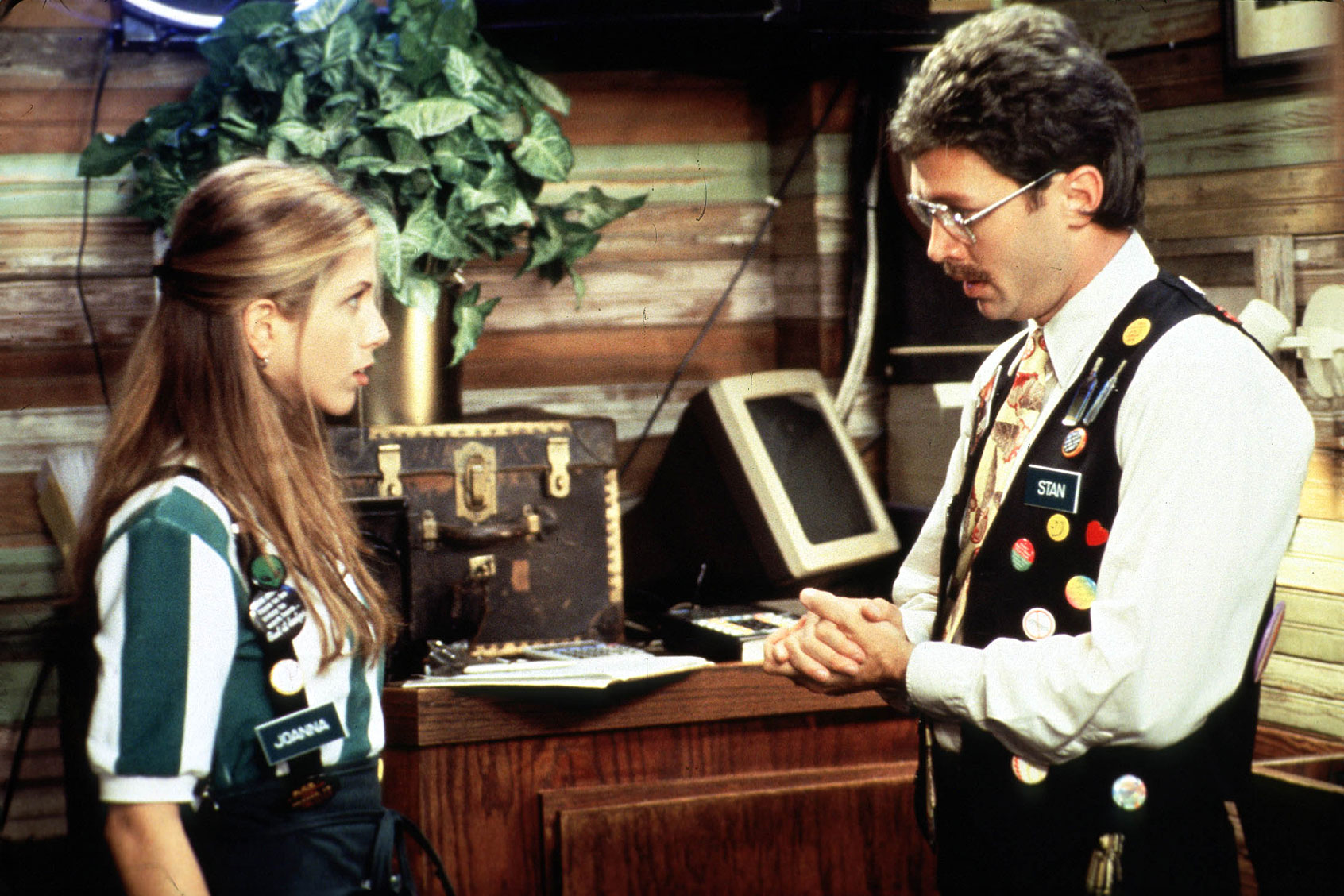
Aniston’s Joanna, a tortured Chotchkie’s server, stands for any of us who simply wants to be paid for doing their job well instead of penalized for insufficiently faking enthusiasm. Her nitpicking boss chastises her for not overloading her uniform with incongruent buttons, or “flair,” insisting she needs to “express herself.” (“Here’s your flair,” Joanna says when she reaches her breaking point, giving her notice with two upturned middle fingers.)

In the years since, Initech’s TPS reports (whatever those are for!) have come to represent time-wasting busywork and process for process’ sake, referenced in shops as far away as an Imperial outpost featured on “The Mandalorian.” So too has the poor malfunctioning printer, which Samir, Michael and Peter bludgeon to pieces in a field as a Geto Boys’ track eggs them on with its refrain of “‘Die motherf**kas, die motherf**kas’ still fool!”

Now, we have rage rooms for these things.

Office SpaceJennifer Aniston in “Office Space” (Getty Images)To early-generation tech workers not fortunate enough to land a job at Microsoft or Apple, which were pretty much the biggest names in the game back then, this rang true. These were people with vision who learned to code as a means of charting their destiny, believing themselves to be rare digital innovators in an analog nation.

Many a glamorous startup imploded after the tech boom went bust, shortly after “Office Space” was released, in 2001 and 2002. Afterward, the lucky ones either got jobs in some legacy conglomerate’s IT department or absorbed by a Silicon Valley giant.

“Human beings were not meant to sit in little cubicles staring at computer screens all day filling out useless forms and listening to eight different bosses drone on about mission statements!” Peter seethes.

We need your help to stay independent

In 1999, that amounted to a cry to throw off our shackles. Now, it’s a reminder of what laborers slowly gave up in the years that followed.

“Office Space” falls apart in its third act when the trio clumsily conspires to rip off Initech. Most viewers, however, care less about the ridiculousness that ensues than the motivating factor that drives them to this choice, a rebellious response to Samir and Michael’s nonsensical downsizing. They gave the company their youth; they’re the most skilled programmers on the staff, while Peter is merely skating by and, following a hypnosis session, tries to quiet quit. Instead of reporting for weekend duty, he sleeps in. When Peter deigns to show up to the office, it’s to flagrantly show his refusal to work by playing Tetris or gutting a fish at his desk.

He wants to be fired. Instead, a pair of efficiency experts (i.e. the ax men) tasked to spearhead Initech’s layoffs give Peter a promotion and Samir and Michael both pink slips. Of course!

Corporate“Corporate” (Comedy Central)

The institutional soullessness portrayed in “Office Space” was mitigated in future takes on work life. The American remake of “The Office” transformed the blank environs of an office supplies wholesaler into an adorable terrarium.

That NBC comedy ran through the Great Recession, in which the tech industry shed around 65,000 jobs in 2008 and in 2009, or slightly higher than the number of job cuts expected in the sector this year. Depicting workplaces as warm, collegial spaces may have been their way of soothing widespread fears of job loss or catering to the desire to find one.

From there, Comedy Central’s Millennial-centered “Workaholics” and the short-lived “Corporate” took a sharp turn, leaning into the lunacy of pointless meetings and meaningless goal setting among the Dockers class.


Want a daily wrap-up of all the news and commentary Salon has to offer? Subscribe to our morning newsletter, Crash Course.


When “Office Space” came out, Judge was mainly known for creating MTV’s “Beavis and Butthead.” His movie became the forerunner of “Silicon Valley,” which captured the tech industry’s evolution away from cubicle austerity into open floor plans, beanbag furniture and the idea of work becoming a second home. That is, provided one’s work hadn’t already invaded their home life.

Recent survey findings listing young workers’ de-prioritization of company loyalty over personal fulfillment and a better life outside the office can’t be stunning. “Gen Z Wants More Money“? Duh-doy, Newsweek! You would, too, if you grew up watching movies and shows that taught you how much an eventual employer would leach from your bones if you let it, or until the powers that be found others willing to give more blood for less money and with fewer resources.

Recent survey findings listing young workers’ de-prioritization of company loyalty over personal fulfillment and a better life outside the office can’t be stunning.

But this goes both ways. Along with elder Millennials, Gen X is becoming a dominant force in boardrooms and government, two sectors long ruled by Boomers.

With so many popular depictions of work emerging in the wake of “Office Space,” younger grunts shouldn’t be taken aback by their late 40- and 50-something colleagues’ stubborn work ethic despite their low expectations of getting rewarded for it given all they’ve survived.

If we rewatch “Office Space” a quarter of a century after it first came out and still share clips now and then, it’s because it reminds us that we’ve all lived some version of Peter’s frustration and thus relate to his dream of doing nothing. If we don’t anymore, it may be because we’ve never stopped living it and have instead conditioned ourselves against expecting that we ever will. And if our greener associates struggle to understand, maybe a mandatory screening is in order. Hey, that is a better release valve than Hawaiian Shirt Day ever could be.

“Office Space” is currently steaming on Max.

Joe Biden says climate change deniers are “Neanderthals” — that’s not fair to Neanderthals

President Biden described climate change deniers as "Neanderthals" during a speech on Thursday in Brownsville, Texas, near the U.S.-Mexico border. Fox News and other conservative media appear to be depicting this as an unacceptable insult — but perhaps it was most unfair to the Neanderthals.

“I’ve been [in] helicopters in the West, in the Southwest and Northwest, flown over more land burned to the ground, all the vegetation gone, than the entire state of Maryland,” Biden told his audience, partly referring to the wildfires now raging in Texas. “The idea there’s no such thing as climate change, I love that, man," the president added with evident sarcasm. "I love some of my Neanderthal friends who still think there’s no climate change.”

As Biden suggested, those who either deny that our planet's climate is changing with potentially catastrophic results or who claim that the changes are not primarly caused by human activity have been discredited by science. Empirical evidence clearly shows that the world is warming to an unprecedented degree and that carbon dioxide emissions from burning fossil fuels are the primary cause. Greenhouse gases like carbon dioxide trap the Sun's heat after it reaches Earth, which has caused elevated temperatures, increasingly extreme wildfiresintensified stormsworsened flooding and rising sea levels.

Biden's implication that Neanderthals, an archaic and now extinct human species, were unintelligent is factually dubious. There is considerable evidence that Neanderthal humans created art, practiced some form of herbal medicine, used tools and performed burial rituals. Although the Neanderthals are no longer with us, many modern humans have small amounts of Neanderthal DNA.

There is no doubt that modern humans, rather than Neanderthals, are responsible for climate change, which Dr. Michael E. Mann of the University of Pennsylvania described in a Salon interview as a "'new abnormal' … now playing out in real time. … It will only get worse and worse as long as we continue to burn fossil fuels and generate carbon pollution."

US blocks UN Security Council statement condemning IDF killing of Gazans seeking aid

The United States on Thursday unilaterally blocked a United Nations Security Council statement that would have expressed "deep concern" over the Israeli military's killing of Gazans seeking food aid earlier in the day, an attack that drew global condemnation.

According to Riyad Mansour, the Palestinian U.N. ambassador, the U.S. was alone among the Security Council's 15 members in opposing the statement, which Algeria put forth during an emergency session called after Israeli forces opened fire on a crowd gathered near a convoy of aid trucks in Gaza City.

Robert Wood, deputy U.S. ambassador to the U.N., indicated that the U.S. objected to the statement's assignment of blame to the Israel Defense Forces (IDF). A draft of the statement pointed to reports that "over 100 individuals have lost their lives, with approximately 750 others sustaining injuries due to opening fire by Israeli forces at a large gathering awaiting food aid."

"We don't have all the facts yet on the ground," Wood told reporters on Thursday. "We want to get that, and we want to find language that in some ways can make sure that we speak on this issue but in a way that ensures that we have done the necessary due diligence with regard to culpability on all this."

Witnesses, including medics who arrived on the scene, described horrifying carnage, with dozens killed or wounded by gunshots lying near blood-soaked sacks of flour. Others were likely hit by aid trucks as they sped away, and one journalist reporting from the scene in northern Gaza said Israeli tanks ran over many injured people.

Israeli officials have attempted to blame the deaths on a "mob" of Palestinians that "stormed" the aid trucks.

"When you say mob, do you mean starving people who have been deprived of food because you haven't let the aid in?" Channel 4 anchor Cathy Newman asked an Israeli military spokesperson on Thursday.

In an attempt to bolster its version of events, the U.S.-backed IDF released drone footage showing people surrounding aid trucks on a road in northern Gaza.

But as The New York Times observed, the footage "was edited by the Israeli military with multiple clips spliced together, leaving out a key moment before many in the crowd start running away from the trucks, with some people crawling behind walls, appearing to take cover."

Separate footage posted to social media by Al Jazeera shows the moment Israeli forces started opening fire early Thursday morning:

Omar Shakir, Israel and Palestine director at Human Rights Watch, said Friday that while a "full accounting" of the incident is needed, Israel's military "can't evade responsibility by saying order broke down—they're obliged as occupier to restore public order."

"Israel is starving Palestinians—a war crime," Shakir said, adding that there is "no doubt Israel [is] responsible for creating catastrophic conditions that led to yesterday's killings."

Médecins Sans Frontières (MSF), also known as Doctors Without Borders, echoed that assessment, saying in a statement Thursday that "we consider Israel responsible for the situation of extreme deprivation and despair which prevails in Gaza, particularly in the north, which led to today's tragic events."

"This situation is the direct result of the string of unconscionable decisions taken by Israeli authorities while waging this war: a relentless bombing and shelling campaign, a complete siege imposed on the enclave, the bureaucratic hurdles and lack of security mechanisms to ensure safe food distribution from southern to northern Gaza, the systematic destruction of livelihood capacities such as farming, herding, and fishing," the group said.

Humanitarian aid deliveries to the besieged Gaza Strip have declined sharply in recent weeks as malnutrition and infectious diseases have spread rapidly across the territory. Human rights organizations have accused the Israeli government of deliberately obstructing aid shipments, a blatant violation of the International Court of Justice's binding interim ruling last month.

Ramesh Rajasingham, deputy chief of the U.N. Office for the Coordination of Humanitarian Affairs, told Security Council members earlier this week that "if nothing is done, we fear widespread famine in Gaza is almost inevitable and the conflict will have many more victims."

Martin Griffiths, the U.N.'s emergency relief coordinator, said Thursday that he was "appalled at the reported killing and injury of hundreds of people during a transfer of aid supplies."

"This comes as the death toll across Gaza since October 7 hits the 30,000 mark," Griffiths added. "Life is draining out of Gaza at terrifying speed."

Samin Nosrat’s 5 best plant-based, spring-friendly dishes (with or without cheese!)

Aside from her iconic buttermilk roast chicken, Samin Nosrat has tons and tons of plant-based, vegan and vegetarian recipes. "Salt, Fat, Acid, Heat: Mastering the Elements of Good Cooking," the massively popular cookbook and subsequent Netflix show of the same name, may have introduced her to the masses, but Samin's reliable and outrageously flavorful recipes have kept her in the upper echelon of the culinary stratosphere. 

Try these stellar recipes and you'll soon see why.

An Iranian-American chef, writer, host and podcaster, Nosrat also helmed a New York Times food column, her own website and even "cut her teeth" at Chez Panisse in the early 2000s. 


Want more great food writing and recipes? Subscribe to Salon Food's newsletter, The Bite.


As always, feel free to mix and match and customize: Remove dairy here, add some grilled protein there, switch it up so that it matches you and your family's needs.

I'm sure you'll love all of these recipes.

Many of Samin's fans are fervent about this recipe — and for good reason.
 
Totally vegan (sans the honey), this is the quintessential focaccia: Pillowy, toothsome and deliciously flavored, rich with olive oil and salt. Interestingly enough, it's also brined, which is typically a technique saved for protein, so applying it to a bread is rather fascinating.
 
This is a perfect weekend recipe, which will then allow you to enjoy the focaccia for the rest of the week.
With radish, cucumber, walnuts, and an amazing variety of herbs, this salad is magnificent for any sort of spring get-together. It's also a crowd-pleaser and a recipe that can be customized or expanded depending on how many you're feeding. Its fresh, bright and incredibly light. Omit the feta to make it entirely vegan. 
Samin takes the customary butternut soup up a notch with lemongrass, coconut oil, fish stock and green curry, which emboldens the latent flavors of the squash. It's the kind of dish that'll make friends and family beguiled, wondering, "Hmm . . . what was that flavor?"
 
It should also go without saying that it's perfect for a rainy night.

We need your help to stay independent

Prepare yourself for what might become your new ultimate comfort food. Encompassing all of your favorite flavor nuances of French onion soup in a more crowd-friendly capacity, this dish doesn't reinvent the wheel, but instead sharpens and clarifies the flavors that define one of the world's most iconic soups. This application is truly something special and it allows your entire dish to mimic the magic of the browned, perfectly bronzed French Onion top we all know and love. It's truly a magnificent dish, transferring the essence of the soup to a casserole. 
This is super simple, doesn't have a ton of ingredients and is almost similar to a cheesecake in preparation. The mango flavor elevates this beyond any normal or traditional pie, though. The custard is so rich, flavorful and velvety that this might become your go-to dessert for any and all gatherings going forward. The crust also adds an interesting note by incorporating cardamom in with the graham cracker and butter, lending a warming spice that perfectly complements the mango. It's truly chef's kiss.


My Nana’s macaroni and cheese set the foundations for my love of comfort food

One of my earliest food memories — and earliest memories in general — is sitting at the dining room table in my Nana’s apartment, barely able to see over the table, where a jaw-dropping amount of food is spread out in front of me. I couldn’t have been older than five. 

My parents, my Nana and other relatives are boisterous, chatting and laughing while serving up heaping amounts of the two side-by-side dishes that make up the piece de resistance: my Nana’s macaroni and cheese, and alongside, the same elbow noodles, but instead draped in her tomato sauce. Both dishes were baked just slightly, until the edges were barely crisped but the middle remained soft and rich.

It was a formative moment in my grasp of food and cooking at large, as well as my understanding of family, as each person dove right into their food, eating both variations with vigor. There was also meatloaf on the table, which has always been the de facto pairing with my Nana’s (and my mom’s) traditional macaroni and cheese, which we’ve eaten a few times per year in the proceeding 30 years. It’s reliable, dependable comfort food in its purest essence. In my household, "macaroni and meatloaf" are inextricable, akin to "peanut butter and jelly" or other immutable pairings. You just don't mess with that combination. 

Since culinary school or so, though, I’ve experimented with these cherished recipes. From the the choice of macaroni to changes to the bechamel; from switching up the the cheeses to adding breadcrumbs; from broiling until the top is nearly burnt to adding varying mix-ins or different ideas. The changes have run the gamut, but truthfully, they never seemed to add much. 

As far as the meatloaf, I’ve tried everything and anything, from swapping out different ground poultries or vegan soy “meats”, to trying different glazes, to throwing apple cider vinegar and brown sugar into the meat mixture (I advise that you do not do that).


Want more great food writing and recipes? Subscribe to Salon Food's newsletter, The Bite.


So, as with many things, I’ve realized that there really is no need to mess with perfection. 

So here’s my Nana’s original no-frills recipe, without any fuss, any tweaks or anything to gild the lily. She knew what she was doing and I thank her for setting the standard for all macaroni and cheeses for me. Serve with the meatloaf of your choosing, obviously – or, like she did back in the early 90s as I sat at her table, cook up a pot of tomato or marinara and some extra elbows and offer up a secondary macaroni dish for your friends and family. No matter how you approach it, there's no questioning how wholly rich, comforting and cozy this dish is.

I’m sure that everyone will love it as much as we all did — and still do.

We need your help to stay independent

My Nana's Macaroni and Cheese (by-way-of my Mom's version)
Yields
8 servings
Prep Time
5 minutes
Cook Time
60 minutes

Ingredients

1 16-ounce box elbow macaroni

2 tablespoons corn starch

2 tablespoons margarine

1 1/2 teaspoon salt

¼ teaspoon pepper

3 cups milk, ideally at room temperature

1 teaspoon ground dry mustard

12 ounces cheddar, shredded


Directions

  1. Preheat oven to 375 degrees fahrenheit.
  2. Bring a large pot of water to a boil. Salt well and then cook elbows according to package directions, draining just short of the intended time, slightly shy of al dente (you don't want to overcook the pasta since it'll soften further when it's baked).  
  3. In a large pan over medium-low heat, melt margarine. Add cornstarch, salt and pepper and stir or whisk until well combined. After 2 or 3 minutes, the mixture should look a bit sandy and start to toast slightly. 
  4. Gradually whisk in the milk, slowly and surely, stopping here and there but continually whisking or stirring, until all of the milk has been added. Raise the heat to medium, whisking sporadically, until the sauce has thickened. 
  5. When the sauce coats the back of a spoon, you're ready to add the cheese.
  6. Season again with ground mustard, salt and pepper. 
  7. Don't add all the cheese at once, stirring or whisking in between additions until it's fully melted. 
  8. Mix the elbows and the sauce together well and then add to a baking dish. If you'd like, top with some extra shredded cheddar and seasoned breadcrumbs.
  9. Bake for about 30 minutes or until the edges are slightly browning and the center is slightly bubbling. You can also broil for the last 3 to 5 minutes or so if you like a crisp crust (like me), but be mindful not to burn it.
  10. Remove from oven and let cool for 5 minutes before serving.
  11. Serve with meatloaf. 

Cook's Notes

-I kept the original recipe intact, but you can feel free to replace the cornstarch with all-purpose flour or some gluten-free flour and unsalted butter instead of margarine.

-Elbows are unbeatable, but I've had an obsession with using cavatappi in my macaroni and cheese in recent years. Up to you!

-I like adding a touch of freshly-ground nutmeg to any Bechamel (courtesy of a Rachael Ray tip I remember from a "30 Minute Meals" episode I saw years and years ago).

-I sometimes throw in parmesan or gruyere or fontina, but really, cheddar alone truly is top tier

-My Nana and I both liked topping our macaroni and cheese with breadcrumbs and extra cheddar before baking or broiling to ensure a delicious crust. My mother inexplicably never did that. Your mileage may vary (but my Nana's iteration is certainly the superior option).

How the response to the latest Diddy lawsuit exposed homophobia within the Black community

The number of sexual assault lawsuits against rapper and Bad Boy Entertainment founder Sean "Diddy" Combs keeps growing. 

On Monday, Rodney “Lil Rod” Jones, a producer and videographer for Combs with whom he worked on his Grammy-nominated album “The Love Album: Off the Grid,” filed a lawsuit against the music mogul. The lawsuit alleged that Combs sexually and physically harassed him, and drugged and threatened him for over a year, while also engaging in sex trafficking and running his inner circle as a “RICO enterprise” that functioned like a criminal organization, according to the Los Angeles Times

This is the fifth assault lawsuit filed against Combs since November and while he and his attorney have wholesale denied the allegations, the accusations are distinct in that they come from a male producer, which has sparked homophobia — and serious discussions about the homophobic rhetoric being used — within the Black community.

As reported by People, Jones produced nine songs on Diddy's “The Love Album.” During the album-making process, Jones said that he lived with Combs and “witnessed, experienced, and endured many things that went far beyond his role as a producer on the Love album.”

The lawsuit said since Jones was a videographer, he was “required” to “constantly” record Combs which resulted in securing "hundreds of hours of footage and audio recordings of Mr. Combs, his staff, and his guests engaging in serious illegal activity,” the court document said.

“Throughout his time living with Mr. Combs, Mr. Jones was the victim of constant unsolicited and unauthorized groping and touching of his anus by Mr. Combs,” the lawsuit alleged. Jones further claimed that he was subjected to work in Combs' bathroom while Combs “walked around naked and showered in a clear glass enclosure.”

Alongside Jones’ claims that he worked in a violent and abusive environment, he alleged that the cousin of Combs’ girlfriend and rapper, Yung Miami, sexually assaulted him in front of Combs and his employees. Jones also claims that he saw Combs bring sex workers to his Miami home and, on one occasion, suspects that he was drugged and possibly sexually assaulted by said sex workers. Also, Jones said in the lawsuit that he has footage of Combs "providing laced alcoholic beverages to minors and sex workers at his homes."

The lawsuit also names celebrities like Cuba Gooding Jr., whom Jones claims made sexual advances on him at the behest of Combs, who allegedly groomed Jones "to pass him off to his friends." Music industry moguls like former Motown Records CEO, Ethiopia Habtemariam and Universal Music group CEO Lucian Grainge, are also named in the suit as some of the other high-profile figures who allegedly witnessed misconduct by Combs, the Los Angeles Times reported.

In his suit, Jones also alluded to “a Philadelphia Rapper who dated Nicki Minaj” as one of the men in the music industry with whom Diddy allegedly said he had sex. 

In a statement to People, Combs' attorney denied the claims, saying, “Lil Rod is nothing more than a liar who filed a $30 million lawsuit shamelessly looking for an undeserved payday. His reckless name-dropping about events that are pure fiction and simply did not happen is nothing more than a transparent attempt to garner headlines."

We need your help to stay independent

The statement continued: "We have overwhelming, indisputable proof that his claims are complete lies. Our attempts to share this proof with Mr. Jones’ attorney, Tyrone Blackburn, have been ignored, as Mr. Blackburn refuses to return our calls. We will address these outlandish allegations in court and take all appropriate action against those who make them."

Following the lawsuit's digital circulation, people have made distasteful memes about Diddy's alleged sexual relationships with men. One post on X, formerly Twitter, showed an edited picture of Combs and rapper Rick Ross, looking like they were about to kiss with the caption “no way diddy got ross too.” It had 20 million views. 

Online commentators have similarly attacked Meek Mill —the Philadelphia rapper and Niki Minaj’s former fiancé — for allegedly having sex with Combs, with tweets like “meek mill was in nicki's closet like this when she left the house” being viewed millions of times. 

In response, Mill has lashed out online. 

In a long online diatribe, Mill wrote: "Every black blog site enhanced that post to make me seem gay…. I change laws for our people I donate millions … they are designed to destroy the image of black leaders! It can’t work with me tho you gotta really kill me and I still will get bigger after death! This god not me lol."

Several other of Mill's posts conveyed the same sentiment: He was furious that his reputation had now been tarnished by rumors about his sexuality and how this was just a way to "expose who's behind try to kill the black image of the most influential artists!"

However, other online commenters have pointed out that these memes — and Mill’s online rant — perpetuate some insidiously homophobic rhetoric, namely the idea that it is more shameful to be gay than to be an abuser. One person paralleled the response to the latest Combs allegations to those surrounding convicted sex trafficker R. Kelly, writing, "homophobia is a bigger sin in the black community over pedophilia, we saw this exact same s**t happen with r. kelly."

"Homophobia helps Diddy & others get away with this (alleged) behavior,” another said, “It’s unrealistic statistically that ALL rappers are heterosexual yet the mere rumor of being gay is still enough to sink careers. So blackmail is easy."

Another commenter pointed out that there seems to be more outrage surrounding this assault lawsuit against Combs than the four prior, which were filed by women. “Now that Diddy is accused of assaulting a man, you know that’s going to make people ‘care’ more,”they wrote. “Because people’s homophobia [is greater than] supporting all victims in general.”


Oprah Winfrey will leave WeightWatchers board after nearly 10 years

Oprah Winfrey will exit the board of Weight Watchers after almost 10 years. The entertainment mogul told the company this week that she wouldn’t stand for re-election at its annual shareholders meeting to be held in May 2024. Winfrey has served on the company’s board since 2015 when she acquired a 10% stake in WeightWatchers.

“I look forward to continuing to advise and collaborate with WeightWatchers and CEO Sima Sistani in elevating the conversation around recognizing obesity as a chronic condition, working to reduce stigma, and advocating for health equity,” Winfrey said in a statement, per Variety.

According to WeightWatchers’ filings with the SEC, Winfrey’s agreement with the company states that she “will not engage in any other weight loss or weight management business, program, products or services” while she’s with the company and for an additional year afterward. Following Winfrey’s recent announcement, shares of WW International fell more than 20% Friday. WeightWatchers specified that Winfrey’s decision to leave “was not the result of any disagreement with the company on any matter relating to the company’s operations, policies or practices.”

Winfrey said she will donate all her shares in WeightWatchers to the National Museum of African American History and Culture: “I have been a long-time supporter of this worthy organization, and I am proud to continue my support.”

Despite her departure, Winfrey will still host an event on weight health with WeightWatchers in May. The event will feature “industry experts coming together to un-shame our relationship with weight,” according to the company. “Weight health is a critically important topic and one that needs to be addressed at a broader scale,” Winfrey said in the statement. “I plan to participate in a number of public forums and events where I will be a vocal advocate in advancing this conversation.”

Western wolves have made a comeback — now Western states want to kill them

Andrea Zaccardi had just moved to Idaho Falls, a city of roughly 70,000 people not far from Yellowstone National Park, when she was startled by the shadowy creature that darted in front of her. This was roughly a decade ago and Zaccardi was up early in the morning to drive to her new job. Suddenly a "black figure" ran in front of her car, "so quick it was just a flash," she said. Zaccardi stopped the car, looked to her left and saw it: A large, majestic gray wolf, staring at her from the top of a nearby hill.

Today, Zaccardi is carnivore conservation legal director at the Center for Biological Diversity, a nonprofit focused on protecting endangered species. So part of her job is to protect the Mountain West's population of wild wolves, like the one who caught her by surprise more than a decade ago. That task has become increasingly complicated: Earlier this month, the U.S. Fish & Wildlife Service denied a listing petition from a coalition of wildlife conservation groups (including the Center for Biological Diversity) that sought to expand the Endangered Species Act to protect northern Rocky Mountain gray wolves. According to a press statement by Kristine Akland, northern Rockies program director at the CBD, the decision amounted to "turning a blind eye to the cruel, aggressive wolf-killing laws in Montana and Idaho." Officials at the Fish & Wildlife Service, a federal agency under the Department of the Interior, declined to respond.

The coalition's next move, according to Zaccardi, is to sue the FWS in federal court unless the agency remedies what the CBD calls its "legal violations" in failing to protect wolves in the northern Rocky Mountains. 

"The main players in the way of relisting are the states," Zaccardi said, primarily referring to the Republican-dominated state governments of Idaho, Montana and Wyoming. "They are very aggressive in terms of wanting to manage their own wildlife, and that doesn't only apply to wolves. We're seeing the same path right now for grizzly bears as well."

Those state governments, like those of many other Western states, tend to be hostile to what they consider excessive federal oversight, and are also strongly aligned with hunters, trappers and especially ranchers, who all have their own reasons for allowing unrestricted hunting of wolves. Those interest groups and their allies in state government have pressured FWS to deny wolves protections from the Endangered Species Act, while conservation groups have accused FWS officials of following bad science and relying on overly generous estimates of local wolf populations. 

Many of the groups in favor of delisting wolves rely on negative stereotypes about these impressive native canids rather than actual data, Zaccardi told Salon. "The livestock industry, of course, doesn't like wolves on the landscape because they sometimes prey on livestock that's using public lands at a extremely subsidized rate," she said. "That impact is blown out of proportion in the news — way less than one percent of livestock are actually killed by wolves." But the facts don't much matter, she continued; the livestock industry is "does not want federal protection of wolves because it limits their ability to go to the states and ask them to kill wolves that are anywhere near their livestock."


Want more health and science stories in your inbox? Subscribe to Salon's weekly newsletter Lab Notes.


Would-be wolf-hunters do not lack opportunities. Current laws in Idaho allow year-round hunting of wolves without limits and even permits private contractors to kill wolves. In Wyoming, wolves have been labeled as a predatory species and can be killed by anyone, with or without a hunting license. This marks a major change from the 1970s, when wolves were near extermination in the Mountain West and perceived by the public with great sympathy, contributing to the 1978 decision to include wolf species in the Endangered Species Act.

"The states can't be trusted to manage [wolves]. They're just trying to wipe them out in every possible way."

This was a success story of sorts, in the sense that by 2011, the wolf population had recovered enough that public sentiment in Western states had shifted, and Congress took Northern Rocky Mountain gray wolves off the list. In 2021, during the final weeks of Donald Trump's administration, all gray wolves in the lower 48 states were stripped of protection under Endangered Species Act protections. That decision was later reversed and is currently under appeal by the FWS. Until then, however, humans who want to kill northern Rocky Mountain gray wolves can easily find ways to do so legally. (According to FWS and conservation groups, there are roughly 2,800 wolves in the Northern Rockies and 4,500 in the Great Lakes region, with much smaller populations in the Pacific Northwest, the Southwest and rural North Carolina.) 

The CBD also recently announced that it had joined more than 30 other wildlife conservation groups in protesting the state of Idaho's decision to pay private contractors to shot wolves from aircraft, apparently at the behest of ranching interests. The conservationist groups' petition argues that "gunning down wolves from helicopters risks harm to other wildlife like grizzly bears and Canada lynx, as well as public safety and wilderness values." 

But CBD's primary goal, Zaccardi said, is to ensure that Western wolves are relisted under the Endangered Species Act, because "the states can't be trusted to manage them. They're just trying to wipe them out in every possible way." She expects CBD's lawsuit, filed with co-petitioners the Humane Society and the Sierra Club, to reach court within 60 days.

We need your help to stay independent

There are probably places that Zaccardi and her fellow conservationists would rather be. One of them is out with the wolves themselves, who as Zaccardi reminded Salon are quite fascinating characters.

Along with her sighting in Idaho Falls, Zaccardi says she has seen groups of wild wolves twice inside Yellowstone National Park, which has a large resident population. The first time, she was camping near a "pretty well known" den site. "I got up at 5 in the morning and went out and sat across the street from the den for hours," she recalled. "It was finally 10 a.m. when they had apparently made a kill, so you could hear them howling. Then we watched all of them run through the field to the left of us, across the street and up toward their den. Every single one of them, even though they were spaced probably three to five minutes apart, took the exact same path to the den."

Arizona Republicans advance bill allowing property owners to kill migrants

Republicans in the Arizona state legislature have advanced a bill that would grant property owners the right to shoot and kill anyone who trespasses on their property, so long as they claim they were doing so in self-defense.

House Bill 2843 expands the state’s current “Castle Doctrine” law. That statute allows individuals to shoot and kill any person who breaks into their home. Under the new proposal, however, anyone who walks onto the land of an Arizona property owner could similarly be killed.

The bill is largely seen as a means to allow ranchers and farmers, whose property lines up with the U.S.-Mexico border, to shoot and kill migrants who may be crossing over to seek asylum, unaware that they’re entering private property. Indeed, the bill’s sponsor, state Rep. Justin Heap (R), specifically said the bill was meant to address migrants on people’s properties.

The bill also appears to be a direct response to such a situation. Last year, a 73-year-old rancher named George Alan Kelly shot what he called “warning shots” in the direction of a group of migrants whom he claimed were armed, saying he felt threatened by their presence. Kelly was around 100 yards away from the migrants. One of Kelly’s shots killed Gabriel Cuen-Buitimea; when his body was examined, it was determined that he was unarmed.

The proposal passed the state House earlier this week along party lines by a vote of 31-28. Although the bill has a good chance of passage in the Republican-run state Senate, it’s expected to be vetoed by Democratic Gov. Katie Hobbs.

Republicans across the U.S. are pushing forward a slew of xenophobic anti-immigration bills, likely out of a desire to bolster their chances of winning several key races in the 2024 election cycle. However, recent polling shows that most Americans do not list immigration as their top issue at this time, with a Reuters/Ipsos poll published this week showing that the topic is third behind the issues of the economy and threats to democracy.

Americans overall appear to favor at least some immigration policies that treat migrants humanely. While a majority now support cruel and harmful measures like building a border wall, most voters also want to prioritize expanding protections for immigrants in the U.S. as well.

According to a Data for Progress poll published last month, 56 percent of voters say the government should make it easier for migrants to make their case before an immigration judge and to avoid sending asylum seekers back into dangerous situations. In contrast, only 35 percent said migrants should be immediately deported.

Furthermore, the same poll found that 62 percent of voters agreed with eliminating a six-month waiting period for asylum seekers in the U.S. to apply for work authorization. Only 30 percent of voters oppose that idea.

Donations pour in to animal shelter after Jon Stewart tearfully announces his dog passed away

After comedian Jon Stewart shared the emotional news that his cherished tripod, Dipper, had passed away, a deluge of donations flooded the New York City no-kill shelter where Stewart adopted the dog twelve years ago. 

“Dipper passed away yesterday,” Stewart tearfully said during a Monday episode of "The Daily Show." “He was ready. He was tired. But I wasn’t," Stewart added. "And the family, we were all together — thank goodness. We were all with him. But boy, my wish for you is that one day you find that dog — that one dog that is just the best." Stewart followed by sharing a "moment of zen" — a video clip of Dipper, a brindle pitbull mix, romping around in the snow.

Following the segment, more than $35,000 in donations was sent to Animal Haven, where Stewart rescued Dipper, according to the shelter's executive director, Tiffany Lacey. Lacey also said that many people have also purchased supplies from the shelter's wish list and inquired about adopting animals.

Lacey shared Stewart's announcement in a Facebook post. “Our hearts break alongside Jon and his entire family with the loss of Dipper,” read the post, according to The Washington Post. “Dipper went through so much early in his life after being hit by a car and losing his leg but Jon and his family gave him a brand new life that started unwittingly on that fateful day at Animal Haven selling cupcakes with his kids.” The post continued: “It really was magic and quickly became obvious that Jon wasn’t going to leave without Dipper. Dipper lives on now in our hearts and minds as a powerful reminder of the importance of pet adoption and the love that an animal can bring into your life.”

Tired of wasting food? 8 long-lasting fruits and vegetables that you need to stock up on right now

Fresh fruits and vegetables can be expensive, so we’re always looking for ways to preserve our produce for as long as possible. Last week, Salon Food shared five ways to use winter produce before it goes bad. This week, we’re sharing a few long-lasting produce options that are more bang for your buck.

In the United States, people waste 80 million tons of food every year, which equals to 149 billion meals, according to Feeding America. Over $444 billion worth of food is thrown away annually and approximately 38% of all food goes either unsold or uneaten. An easy way to reduce food waste is to start in your own kitchen. Track your trash and note what kind of foods are frequently being thrown out, recommended James Beard Award-winning chef Andrew Zimmern. Shop for a few days of food, instead of a whole week to help you be more mindful of your purchases. And finally, reduce your refrigerator space by taking out one shelf or removing one drawer. This will force you to buy less and be more aware of what you already have in the fridge.

An easy way to choose what produce is worth stocking up on is to pick items that can last for an extended period of time. That being said, it’s also important to know how to properly store and use them so they don't go bad.

01
Apples
According to the University of Maine, apples and pears have the longest storage life of the tree fruits, and can be kept for up to four months under the right conditions. Most apple varieties can be stored at temperatures near 32ºF. Honeycrisps, however, are “prone to chilling injury when stored at temperatures below 36ºF” so they should be stored at a temperature of 37ºF.
02
Potatoes

Potatoes generally last one to two months when stored in a cool, dry, dark and well-ventilated space, like the pantry, according to FoodSafety.gov's FoodKeeper app. Potatoes stored at colder temperatures lower than 50 degrees (like the refrigerator) will cause “a potato's starch to convert to sugar, resulting in a sweet taste and discoloration when cooked,” per the United States Potato Board. However, raw potatoes stored in the freezer may last up to 10 to 12 months. EatingWell recommended blanching potatoes before freezing them to prevent a  sweeter flavor and discoloration. Blanching also cuts down on cooking time after potatoes have thawed fully.

03
Onions
Onions will keep for up to a year if they are stored in a dry area where the temperature stays between 30-50°F. They can also be kept in mesh bags and stored in a dark cabinet, which will keep them fresh for up to a month, and perhaps longer.
04
Garlic
Garlic will also keep for a long time if they are stored in a cool, dry place, away from light and with ventilation. Separated unpeeled cloves can last up to two months, while whole bulbs can last as long as six months, said EatingWell. Garlic that has gone bad will typically contain brown spots or turn yellow in color.
05
Carrots

Fresh carrots can last four to five weeks if they are stored in a breathable bag in the crisper drawer. Be sure to remove any leafy green tops, which draw moisture away from the root and make them dry out faster. You can also place a dry paper towel inside a carrot bag to absorb moisture and help them last longer. Simply replace the towel when it gets saturated.


It’s important to note that baby carrots don’t last as long as full-size carrots.

06
Cabbage
A whole head of cabbage can last up to two months when it’s wrapped in plastic and stored in the refrigerator. Once cut, cabbage needs to be used within a few days.
07
Pomegranates
Although the whole fruit can last as long as two months in the fridge, the seeds will only keep for about a week. The seeds, however, can be frozen for up to three months. Pomegranate is bad once it turns brown and soft — brown seeds are also a sign that pomegranate has gone bad.
08
Citrus
Citruses — like lemons, limes, oranges, grapefruit and other citrus fruits — can last as long as two months. Whole citrus can be stored loose in the refrigerator crisper. The zest of citrus fruits can also be frozen for up to three months.

“Conjured out of thin air”: CNN calls out bizarre Trump lie about “people who don’t speak languages”

Former President Donald Trump on Thursday went on a bizarre rant about migrants during a speech at the U.S.-Mexico border in Eagle Pass, Texas.

“Nobody can explain to me how allowing millions of people from places unknown, from countries unknown, who don’t speak languages,” Trump said during his speech. “We have languages coming into our country. We have nobody that even speaks those languages. They’re truly foreign languages. Nobody speaks them, and they’re pouring into our country, and they’re bringing with them tremendous problems, including medical problems, as you know.”

CNN anchor Kaitlan Collins cut into Trump’s speech to note that he “told several lies about the border.”

CNN fact-checker Daniel Dale noted that Trump has previously made a similar claim “about people arriving speaking languages that no one‘s ever heard.”

“He said in a previous, recent speech, ‘We didn‘t even have one translator who could understand this language,” Dale said. “I‘ve looked into this, seems to be just conjured out of thin air. It‘s nonsense.”

“Look me in the eye”: Hunter Biden turns the tables on Matt Gaetz over question about drug use

The Republican-led House Oversight Committee on Thursday released the full transcript of Hunter Biden’s closed-door testimony that included eyebrow-raising exchanges between Biden and members of the committee.

The partially redacted 229-page document “underscores the disconnect” between Republicans’ criminal allegations against Hunter and President Joe Biden and the actual evidence they have, NBC News reported.

During the questioning, Rep. Matt Gaetz, R-Fla., asked Hunter Biden if he was “on drugs” while serving as a board member of the Ukrainian energy firm Burisma, drawing an objection from Biden’s attorney.

“Mr. Gaetz, look me in the eye. You really think that’s appropriate to ask me?” Biden asked Gaetz, according to the transcript.

“Absolutely,” Gaetz replied.

“Of all the people sitting around this table, do you think that’s appropriate to ask me?” Biden asked.

Gaetz has been accused of using drugs at parties by multiple people, including by a Republican senator, which he has denied.

“Yeah. Are you going to answer it?” Gaetz pressed Biden during the hearing.

“I will answer it this way: I have been absolutely transparent about my drug use,” Biden replied. “Again, I spoke to you all earlier this morning about that. I’m sorry; I’m an addict. I was an addict. I have been in recovery for over four and a half years now, Mr. Gaetz. I work really, really hard at it. Let me answer. I work really hard at it, under an enormous amount of pressure. Was I an addict? Yes, I was an addict. What does that have to do with whether or not you’re going to go forward with an impeachment of my father other than to simply try to embarrass me?”

Prosecutors plan to use Trump’s “Art of the Deal” book against him at hush-money trial: report

Manhattan prosecutors intend to use Donald Trump's words, including quotes from books of his like "Trump: The Art of the Deal," against him in his criminal hush money trial later this month, according to recent court filings. In a defense filing, the Manhattan district attorney's office gave the former president's legal team a list of past remarks he made — including four dozen quotes from books published between 1987 and 2015 — that they plan to introduce as evidence during the trial, ABC News reports

Lawyers for Trump have rebuked the strategy, arguing that it risks prejudicing the jury and is limited in relevance to the case. "Whatever President Trump's style of business operations was in 1987, 2004 and 2007 … is by no means probative for how he would have operated those businesses when he was President of the United States of America," attorney Todd Blanche argued in a filing released this week. But prosecutors will likely use the quotes, which pertain to Trump's business approach, to show how involved he was with his companies, former FBI general counsel Andrew Weissmann predicted. 

“What they want to show is he is a hands-on boss, that he is frugal, he watches every dime — that’s going to be the theory of their case. That’s why these statements are going to be relevant to them,” Weissmann said on MSNBC News Thursday. “Obviously, those are bricks that you use to build a wall … and the defense will have to figure out how they’re going to attack that,” he added. “But that’s the reason for why those statements are going to be something that the prosecution wants to introduce to help build their case.” 

Trump has denied all wrongdoing in the case, which is slated to go to trial March 25. 

Trump’s threats against NATO and a new nuclear arms race

I don't care much about the notion of American "dominance" or "prestige" but I do care a lot about the prospect of the planet being blown up and destroying the institutions and alliances that make it possible to reverse catastrophic climate change. Such a doomsday scenario is becoming closer to reality as Donald Trump continues to dictate American foreign policy from his gaudy social club in Palm Beach. 

One of the best things about the Trump administration was how copiously it leaked to the press. In real time — and later through the many books and articles that were written about that tumultuous term — we had a very detailed understanding of the man's worldview when he went in and now we know that even after four years in the most important job in the world, he didn't learn a thing about world affairs.

According to "A Very Stable Genius" by Carol Leonnig and Philip Rucker, by July 2017, it had become clear to Trump's national security and economic team that he desperately needed some tutoring to understand the importance of America's key alliances. So they prepared a briefing with visual aids to ensure that Trump didn't get bored and assembled the top military brass as well as relevant Cabinet members to instruct Trump about U.S. military and diplomatic alliances. He didn't want to hear it, demanding to know why the U.S. hadn't won the war in Afghanistan, calling it a "loser war," and interrupting the briefing to complain about the Iran nuclear deal and NATO. He yelled, "you’re all losers. You don’t know how to win anymore. I wouldn’t go to war with you people. You’re a bunch of dopes and babies." After Trump stormed out of the meeting, then secretary of state Rex Tillerson famously turned to the room and declared, "He's a f—-ing moron." Tillerson was not wrong. 

This was the same meeting at which Trump asked why South Korea isn't more appreciative of America's military alliance and indicated that he wanted to restore the U.S. nuclear arsenal to 1960s levels. (He later denied that he said that, claiming that he only wanted to completely modernize it, a task that had already started under the Obama administration.) Throughout his term, Trump never understood why the country that he led benefited from the alliances that America had made in the nuclear age, apparently failing to grasp that if you have the most nuclear bombs on the planet, you have a special responsibility to keep a lid on the possibility of WWIII. 

The Europeans are taking all this very seriously.

Despite his insistence that he hated nuclear proliferation (he claimed he knew all about it because his uncle was a nuclear scientist at MIT) Trump was fatalistic about the prospect, telling CNN back in 2016 that he thought that Japan and South Korea might as well develop nuclear weapons for themselves: 

It's going to happen anyway. It's going to happen anyway. It's only a question of time. They're going to start having them or we have to get rid of them entirely. But you have so many countries already, China, Pakistan, you have so many countries, Russia, you have so many countries right now that have them. Now, wouldn't you rather in a certain sense have Japan have nuclear weapons when North Korea has nuclear weapons?

This fatalism stems from the ongoing, puerile obsession that America is being cheated and that the rest of the world should just fend for itself or pay big bucks to the U.S. for protection. This is why he continues to threaten to withdraw from NATO and says that he'd encourage Russia to "do whatever the hell they want." He clearly still fails to grasp the existential threat of nuclear proliferation and simply cannot understand that U.S. security guarantees benefit America largely because they prevent the spread of nuclear weapons — and mitigate the risk of a planet-destroying nuclear war. He still doesn't get it, even now, after being president for four years. 

And it's scaring the hell out of the world, especially our allies. 

We need your help to stay independent

In the Atlantic this week, Anne Applebaum offers the view from abroad and it's sobering. America's European allies are taking Trump's threats very seriously, not because they are new but because they are seeing that he controls the Republican Party even out of office and the Republican Party has now adopted his worldview. The unwillingness to allow Ukraine military aid in this dire moment tells them that America is no longer a reliable ally, even if the Democrats are in charge:

For outsiders, this reality is mind-boggling, difficult to comprehend and impossible to understand. In the week that the border compromise failed, I happened to meet a senior European Union official visiting Washington. He asked me if congressional Republicans realized that a Russian victory in Ukraine would discredit the United States, weaken American alliances in Europe and Asia, embolden China, encourage Iran, and increase the likelihood of invasions of South Korea or Taiwan. Don’t they realize? Yes, I told him, they realize….

Since then, I’ve had a version of that conversation with many other Europeans, in Munich and elsewhere, and indeed many Americans. Intellectually, they understand that the Republican minority is blocking this money on behalf of Trump. They watched first McCarthythen Johnson, fly to Mar-a-Lago to take instructions. They know that Senator Lindsey Graham, a prominent figure at the Munich Security Conference for decades, backed out abruptly this year after talking with Trump. They see that Donald Trump Jr. routinely attacks legislators who vote for aid to Ukraine, suggesting that they be primaried. The ex-president’s son has also said the U.S. should “cut off the money” to Ukrainians, because “it’s the only way to get them to the table.” In other words, it’s the only way to make Ukraine lose.

The Europeans are taking all this very seriously and one has to assume that America's allies elsewhere are as well. This may very well lead to fullscale re-armament — and they are in active discussions to build their own nuclear arsenals. This is a catastrophic consequence of Donald Trump's narcissism and ignorance. 

What's most profoundly disturbing about this is that it's not the result of a serious shift in ideology by the Republican Party. The change from the days of Ronald Reagan and John McCain and even George W. Bush on foreign policy and national security has been abrupt and done without any thought or care at all for implications. It's happened because the party has turned into a cult that worships one man and that man has such staggering character flaws and intellectual defects that it could take the whole world down the road to perdition. 

Expert: Trump filing “one of the most chilling things I’ve seen” — but Judge Cannon can’t ignore it

Donald Trump’s lawyers on Thursday proposed an August trial in the former president’s Florida classified documents case even as they argued the case against him should be delayed until after the election.

Despite arguing to push the trial past November, Trump’s team proposed an August 12 trial to U.S. District Judge Aileen Cannon, three months before Election Day and just weeks following the Republican National Convention, according to The New York Times.

But the attorneys also used the filing to argue that the law, the Constitution and the Justice Department’s policy manual opposes prosecuting the “presumptive Republican nominee” during his campaign.

It’s unclear why Trump’s lawyers proposed a start date before the election but one possibility is that his lawyers are seeking to prevent Trump’s other federal trial — the D.C. election subversion case — from being held before the vote, according to the Times.

Cannon asked both sides to propose new trial schedules. Special counsel Jack Smith’s team on Thursday proposed a July 8 start date. Cannon, who initially set a May 20 trial that has long been in flux due to delays over classified evidence fights, is expected to set a new trial date after a hearing on Friday.

The Supreme Court’s decision this week to hear arguments on Trump’s immunity claim in the D.C. case has put the spotlight on Cannon’s decision even more.

“A decision by Cannon to push back the Florida case could clog the calendar in late summer, making a 2024 trial in Washington on the federal election charges all but impossible, even if the Supreme Court lifts the freeze in the election case soon after it is argued,” Politico reported.

Kenji Yoshino, a professor at New York University School of Law, was stunned by the filing but predicted Cannon won’t be able to ignore Trump’s focus on the campaign.

We need your help to stay independent

"I think in an ideal world, she should not," he told CNN. "I mean, no one is above the law. This is a criminal proceeding. She should just set the dates as it were. But I can't imagine that she, as a human being, she will be able to ignore that. One of the most chilling things that I've seen 25 years of teaching constitutional law is the trial schedule that defense attorneys proposed.

"Just this idea that you have somebody who's saying, here's a pretrial motion, and then here's the Republican National Convention, because it just suggests that this is the very first time in our nation's history that we have an individual who is a frontrunner running for president, who was a former president who's under criminal indictment," he continued. "This has never happened before, this is completely uncharted territory … it did more than anything else to knock my socks off."


Want a daily wrap-up of all the news and commentary Salon has to offer? Subscribe to our morning newsletter, Crash Course.


MSNBC legal analyst Lisa Rubin pointed out that Trump’s lawyers are “complying with the letter of Cannon’s order to submit a proposed schedule — but not its spirit.”

Despite the proposed date, Trump’s lawyers argue that “a fair trial cannot be conducted this year in a manner consistent with the Constitution” and further argue that such a trial would violate DOJ policy.

“And then and only then does Trump [grudgingly] say he respects the Court's direction to submit a proposed schedule, but one that must, of course, also take account of the SCOTUS presidential immunity case,” she tweeted. “Put another way, this is a coded invitation to Judge Cannon to schedule absolutely nothing—or in the alternative, a trial date that would effectively block Judge Chutkan from trying the case before her before the election.”

“Like someone pulled the metaphorical plug”: Dr. John Gartner on Trump’s “accelerating dementia”

Since at least 2016, some of the world’s leading mental health professionals have been sounding the alarm that Donald Trump appears to be emotionally and psychologically unwell – and perhaps even a sociopath or a psychopath. Unfortunately, throughout Trump’s presidency, the COVID pandemic and his willfully negligent response to mass death and suffering, the Jan. 6 coup attempt and the attack on the Capitol by his MAGA forces, and now several years beyond, their warnings have repeatedly proven to be correct. Donald Trump only appears to be getting worse, not better, as he ages, and the pressures of his multiple criminal and civil trials and the 2024 presidential campaign grow heavier.

In a recent conversation with Dr. John Gartner, a prominent psychologist and contributor to the bestselling book "The Dangerous Case of Donald Trump: 27 Psychiatrists and Mental Health Experts Assess a President," the former faculty member at Johns Hopkins University told me that based on Trump's speech, memory, recall, and other behavior, he appears to be “hypomanic” and cognitively deteriorating at a rapid rate:

I had to speak out now because the 2024 election might turn on this issue of who is cognitively capable: Biden or Trump? It's a major issue that will affect some people's votes. Not enough people are sounding the alarm, that based on his behavior, and in my opinion, Donald Trump is dangerously demented. In fact, we are seeing the opposite among too many in the news media, the political leaders and among the public. There is also this focus on Biden's gaffes or other things that are well within the normal limits of aging. By comparison, Trump appears to be showing gross signs of dementia. This is a tale of two brains. Biden's brain is aging. Trump's brain is dementing.

Almost as if on cue, in a series of speeches and interviews at the Conservative Political Action Conference (CPAC) and elsewhere last week — which took place after my conversation with Dr. Gartner — Donald Trump again manifested these symptoms. So I spoke with Dr. Gartner again on Tuesday about Donald Trump’s recent behavior, what comes next if his apparent cognitive challenges and related maladies continue to worsen, the dilemma of having human sympathy and concern for a vile person like Donald Trump, and why so many medical professionals (and members of the news media, political class, and others with a public platform) are continuing to be silent about the corrupt ex-president’s very troubling and dangerous behavior.  

This interview has been lightly edited for clarity and length

We spoke last week about how Donald Trump's apparent mental and emotional challenges and pathologies appear to be getting much worse. That conversation was widely read and circulated — including by the British and other foreign news media. Why do you think your warnings gained so much traction? 

Most of us have known someone, possibly in our own families, who’s had Alzheimer’s or some other form of dementia. The diagnostic signs are not subtle. My warnings and conclusions about Trump simply confirmed what many people had already observed and concluded for themselves but didn’t have the authority to assert. I was giving voice to what ordinary people see with their own eyes, and they were grateful for validation from a mental health professional.

Why do you think so many of your peers who also have expertise in psychology, the brain, aging, and related topics and subjects are remaining silent? 

I've been reaching out to several colleagues who are real experts in this area. They were happy to share observations and diagnostic conclusions about Trump’s severe organic mental decline, privately, but even among colleagues who were once outspoken, there's a new high level of fear, not to mention exhaustion, that we didn’t see before. Each of these experts convinced me they weren’t being paranoid when they believed there was a good chance, they would lose their jobs if they went on the record, not to mention other forms of retaliation, especially for those who live in red states.

How are you processing the reality that if Trump wins, there is going to be retaliation against his critics and anyone else who has dared to oppose him and the MAGA movement and American fascists more broadly? Trump has repeatedly said this. Revenge and punishing “the enemies” of the regime are central to Project 2025 and Agenda 47, for example. They're going to get even; there's going to be score settling for the truth tellers. 

Wow. That is a powerful way of putting it — yes, there is going to be score settling for the truth-tellers. We're really seeing in real time how a people can be beaten down. People who were enthusiastic members of "the resistance" against Trump and the MAGA movement are now saying, "I can't do it. I'm intimidated." The reality and potential for retaliation by Trump and his followers is extremely real. In 2016, what were my peers afraid of? The American Psychiatric Association? What was the worst that could have happened to us? We could have been expelled from the American Psychiatric Association. So what?! With Trump trying to come back to power, people are looking over their shoulders out of a reasonable fear of professional, social economic, and even criminal retaliation, as well as the threat of political violence from the right wing. We weren't making those risk assessments before.

Trump, who is a pathocrat, and what he symbolizes and has channeled and summoned, is impacting all of us. 

"I was giving voice to what ordinary people see with their own eyes."

It's taken a psychological toll on the population, both clinically and non-clinically. Exhaustion. Depression. Fear. Being detached and disengaged mentally and intellectually. The collective trauma of Trumpism has put many Americans in survival mode. 

In our last conversation, you warned that Trump is suffering serious cognitive decline as shown by his speech, memory, and other behavior. Almost on cue, Trump manifests these symptoms at CPAC and at other events over the course of several days. Once you see this pattern of aberrant behavior you can't unsee or otherwise ignore it. 

This weekend, Trump showed more evidence of his accelerating dementia. Trump named the wrong month for the primary, said that Putin would rather see Biden as president and he agreed with him, and that he made Israel the capital of Israel. But most important are the fundamental breakdowns in his ability to use language. Once you become aware of a symptom, you start to notice it, whereas before you might have overlooked it.

Trump manifested a number of phonemic paraphasias. He was trying to say evangelist, for example, but haltingly said "evangelish.” He was trying to say “three years later," but said, “three years, lady, lady, lady.” Trying to spit out the word “lately,” he sounded like a car with a bad battery struggling to turn over. When Trump can't find a word his whole demeanor changes. It’s almost like someone pulled the metaphorical plug. Trump looks blank, stops in mid-sentence (or mid-word), his jaw goes a little slack, and when he starts to talk again, he slurs, speaks haltingly, and often looks confused. Trying to get the word out, he shifts to a non-word that is easier to pronounce. When people are losing their ability to use language they use non-words. They start with the stem of the real word, and then they improvise from there.

We need your help to stay independent

In my family we call sandwiches “slamichs” because that’s what my stepson called them when he was three. It was cute then. It’s not cute watching and adult man regress to the mental age of a three-year-old. It can make you even feel sorry for Trump in those moments when he appears so vulnerable, confused, and disoriented. I asked several highly specialized experts about Trump's use of language, and they told me that what Trump is doing in total, but especially the phonemic paraphasias, were almost certain evidence of brain damage. This is not minor, or within normal limits, like forgetting who the president of Germany is, for example, as Biden has been pilloried for. Trump is evidencing formal thought disorder, where his basic ability to use language is breaking down.

Trump is also showing signs of "semantic aphasia" where he is using words in the wrong way. For example, when Trump talked about "the oranges of the investigation." We saw an example of that this weekend, as well. Trump said, “We’re going to protect pro-God….” In mid-sentence, he goes blank and looks at the ceiling. The words he uses to complete the sentence don’t really make sense: “…context and content.”

Trump is bragging about passing the MOCA, a screening test for dementia, as if it made him MENSA, when it’s a test any kindergartener should pass. Specialists tell me a patient can be in steep diagnosable organic decline for an extended period before they fail the MOCA. Someone with an advanced degree from an Ivy League school, for example, has a lot of IQ points to give before they hit kindergarten level. If you pass the MOCA it certainly does not mean you’re cognitively equipped to be President of the United States. Trump can’t even name the current president of the United States. Seven times he’s said he’s running against Obama. That’s not a gaffe or joke. That’s hard clinical evidence of serious organic brain damage.

When this is happening to Trump, how is he feeling? Does he know what's happening? 

One of the things that's most notable is Trump's lack of awareness when he makes these mistakes. He very rarely corrects himself or goes back, typical for someone with this kind of organic decline. Ironically, Trump boasted that “If I were cognitively impaired, I’d know it,” but actually he wouldn’t, and he doesn’t. Sometimes a patient with organic brain damage will have what we call a "catastrophic reaction," where they suddenly realize "Oh, my God, I can't think!" They'll then have an anxiety attack or begin weeping because their denial has been broken through and suddenly, they realize just how serious their condition is.

As for Trump's MAGA people and other supporters, in a healthy relationship, they would become concerned for Trump and realize that what appears to be his worsening cognition and other behavior actually makes him not qualified for the presidency and that he should seek help. Instead, the worse Trump's behavior becomes the more they seem to adore him. This is textbook collective pathology. 

"Trump looks blank, stops in mid-sentence (or mid-word), his jaw goes a little slack, and when he starts to talk again, he slurs, speaks haltingly, and often looks confused."

Trump’s hypomanic energy gives him power and makes him charismatic to his followers. Trump's behavior has a type of primal appeal to his followers. As I warned in our conversation last week, whatever personality disorder someone has, it gets dramatically worse as their cognitive functions decline. All of Trump's viciousness, hostility, and unpredictable and other pathological behavior is only going to get worse. In the end, Trump and the MAGA movement are a cult, and he is the leader.

Does Donald Trump deserve pity if he is indeed struggling with these types of challenges? 

In psychology, we often try to use our reactions to understand the patient and to develop a diagnostic workup. Trump is someone who many people despise because he is evil. Yet, when Trump acts in what appears to be a demented way, our reflexive reaction is actually sympathy. He seems vulnerable. He seems confused. He reminds you of your relatives. In a way, such a reaction to Trump is a type of confirmation that something may be seriously wrong with him. You're reacting to him in such a protective way, you feel sorry for Trump, and you want to help him because he's a doddering old man. Trump is confused. Seeing Trump or anyone else in such a state brings forth our normal human empathy.

Is there a social taboo, especially among the news media, that is limiting our much-needed discussions of these types of health issues as seen with politicians and other leaders? 

I don’t want to say the mainstream media is covering up Trump’s cognitive disability, but they certainly aren’t covering it like the 5-alarm fire it is. The media will show Trump being combative and saying something outrageous and his audience reacting to it — but they are consistently not showing the parts of Trump’s speeches and interviews where his eyes go blank, his jaw goes slack, he looks confused, and slurs words, uses non-words, can't finish a sentence, rambles, perseverates, confabulates and babbles incoherently. That’s what should make the 6 o’clock news. Doesn’t the media have a duty to warn the public that the man who wants the nuclear codes back (not including the ones he probably stole) is publicly displaying unimpeachable evidence of a broken and deteriorating brain?

The obvious comparison here is Ronald Reagan. I am no fan of Reagan and do not understand the worship of that man. We now have confirmation that towards the end of his presidency that he was basically senile. The United States and the world were very lucky that Reagan was surrounded, mostly, by very serious people who were institutionalists. By comparison, Donald Trump is surrounded by fascists, white supremacists, Christian nationalists, plutocrats, corporatists, and other malign actors who are going to take advantage of the situation to get what they want. That possibility — if not outright certainty — should terrify any reasonable thinking person. 

There will be no guardrails to Trump's absolute most primitive, impulsive, destructive, and insane actions. There will be no pushback from within his inner circle and regime. It is certainly very possible that a person in a state of cognitive decline is in a state where they are highly vulnerable to suggestions and being manipulated by others. I can easily imagine a scenario where Trump is a figurehead and there is a real power behind the throne pulling the strings.

What is the difference between someone being older and getting older, and someone being mentally and emotionally ill? Given how Biden is being unfairly maligned because of his age while Trump's obvious deficits, which are far more serious and dangerous, are being mostly ignored, that distinction needs to be emphasized — repeatedly. 

"Trump’s hypomanic energy gives him power and makes him charismatic to his followers."

They're not the same thing. I feel like older people should take offense to Trump's behavior being explained away by aging. There are natural things that happen with aging such as occasionally using the wrong word or calling someone the wrong name because they remind you of someone you worked with. President Biden is confusing names, not people. The Dementia Care Society says “mixing up people and generations” is a sign of dementia. Recently Trump confused Nikki Haley and Nancey Pelosi, for example. He also mixed up the generations in his own family when he said his father was born in Germany, when it was his grandfather. Michael Wolff said Trump frequently didn’t recognize old friends. And most importantly Biden isn’t showing a fundamental breakdown in his ability to use language. The whataboutism narrative is that this is a race between two old men. True but one has an aging brain, and the other a dementing brain. If Trump were your relative, you would be reaching out to doctors in a state of alarm. If Joe Biden were you’re relative, you might have to remind him of things from time to time. 

How do you think Trump is going to respond to the experts and other such voices who are publicly sharing their concerns about his apparent worsening cognitive and other intellectual and emotional challenges? 

As I said earlier, Donald Trump is going to make theater and spectacle out of it. But Trump will keep betraying his denials through his behavior. He has other symptoms as well. These physical symptoms include a wide base to his gait, his leaning posture, and his loss of fine motor control. A dementia diagnosis is not limited to an interview. To reach a firm conclusion one needs observations, reports from informants and other people around the person in question, and an MRI for example to see exactly what is going on with Trump's brain. In my opinion, Trump is showing a level of symptoms where no real expert would think that there is not something seriously wrong with his mind and brain.

Project 2025 is more than a playbook for Trumpism, it’s the Christian Nationalist manifesto

When Jack Posobiec took the stage at the Conservative Political Action Conference (CPAC) ahead of Donald Trump last week and called for the overthrow of American democracy, he held up a Christian symbol, a cross, making clear that like many on today’s far-right, his goal is to replace democracy with a Christo-fascist regime.

One could argue they’ve already made this goal the Republican Party’s platform. They’ve been generous enough to spell it out in a Christian Nationalist manifesto from the conservative Heritage Foundation called Project 2025.

Mainstream media outlets have begun to expose Project 2025’s radical vision: A gutted federal government; immigrants rounded up in work camps and deported; a military response to peaceful demonstrations; oppression of women, minorities, the poor and the disadvantaged. For the media, it is simply an extreme conservative plan.

When I read Project 2025, I recognized immediately that it is a 1,000-page Christo-fascist screed.

How do I know? I am a product of Christian Nationalism. 

In 1975, my parents joined a southern Christian Nationalist church and enrolled me in their kindergarten. For thirteen years, I was indoctrinated with Christian Nationalist, Moral Majority-era dogma: America is a white, Christian nation; the founders intended for Christianity to be our national religion; it was our responsibility as Christians to compel everyone to live by the truths of the Bible; I might one day have to fight and maybe die to defend my faith.

It has been a 20-year process to deprogram that worldview. As hard as it is to follow the news and read online articles, nothing prepared me for how thoroughly Project 2025 hammers home the religious indoctrination of my earlier life.

From the very beginning, Project 2025 invokes Christo-fascist language. In its preamble, Project 2025’s director Paul Dans calls for plans to “move out upon the President’s utterance of the words ‘so help me God’ on Inauguration Day.”

Dans closes his introduction with: “As Americans living at the approach of our nation’s 250th birthday, we have been given much. As conservatives, we are as much required to steward this precious heritage for the next generation.”

I know from my Bible studies he is channeling Luke 12:48: “From everyone who has been given much, much will be demanded.”

Project 2025 is riddled with this type of Christo-fascist language. Christian Nationalists do not write or speak without referencing the Bible. It is a language American voters would do well to understand before November, or it will be the language of our government.

To help the cause, I have been writing about the religious dogma underpinning Project 2025. Take Project 2025’s opening salvo, their so-called Conservative Promise—which they assert are the “four broad fronts that will decide America’s future.”

Promise 1: Restore the family as the centerpiece of American life and protect our children.

The next conservative President must get to work pursuing the true priority of politics— the well-being of the American family. In many ways, the entire point of centralizing political power is to subvert the family. Its purpose is to replace people’s natural loves and loyalties with unnatural ones.” – Project 2025, page 4

Project 2025’s use of natural and unnatural is deliberate Christo-fascist language, drawn directly from the Bible:

For this cause God gave them up unto vile affections: for even their women did change the natural use into that which is against nature: 27 And likewise also the men, leaving the natural use of the woman, burned in their lust one toward another.” Romans 1:26-27 KJV

We need your help to stay independent

To a Christian Nationalist, marriage can only exist between one man and one unrelated woman. A man’s natural use is as husband and head of the home. He is the breadwinner. A woman’s natural use is to stay home, have and rear children, and submit to her husband. Project 2025 intends to impose this Christian Nationalist view of marriage and family nationwide.

According to their Bibles, a woman’s God-given purpose is to be a wife and mother without human intervention. This is the basis for their opposition to abortion, IVF and even hormonal birth control. It is also the foundation for their goal to end no-fault divorce.

Promise 2: Dismantle the administrative state and return self-governance to the American people.

The next conservative President must possess the courage to relentlessly put the interests of the everyday American over the desires of the ruling elite. Their outrage cannot be prevented; it must simply be ignored. Project 2025, page 9

The media has highlighted Project 2025’s promise to gut the federal government- but they are not explaining its Christo-fascist designs.

Christian Nationalists believe the Bible is God’s infallible law and so it should be the basis for all laws. They will not compromise this position because they believe God commands them to follow his perfect law to the letter.

This is why they disregard unfavorable voting outcomes like the Ohio referendum on abortion. They don’t care about polls or what American voters support. It’s why they are willing to ignore judicial decisions and election results they don’t feel serve God’s commands.They believe their Bibles give them the right to deny anyone and anything that conflicts with their interpretation of God’s law. They are already governing this way in many red states; it is how they will govern nationally if they win in November.

Promise 3: Defend our nation’s sovereignty, borders and bounty against global threats. 

Intellectual sophistication, advanced degrees, financial success, and all other markers of elite status have no bearing on a person’s knowledge of the one thing most necessary for governance: what it means to live well. That knowledge is available to each of us, no matter how humble our backgrounds or how unpretentious our attainments. It is open to us to read in the book of human nature, to which we are all offered the key just by merit of our shared humanity. Project 2025, page 10


Want a daily wrap-up of all the news and commentary Salon has to offer? Subscribe to our morning newsletter, Crash Course.


In Project 2025’s draconian section on immigration, they buried this gem: Their book of human nature is the Bible. It is yet another veiled statement that the Bible should be the basis for our laws.

This is also why Christian Nationalists deplore education and expertise. They believe everything God meant for humans to know is contained in the Bible, so there is no need for any other means of enlightenment.

This is the basis for their attacks on public school classrooms and libraries, as well as secular colleges and universities. These are heretical places that teach humans to question their Bible.

Promise 4: Secure our God-given rights to live freely – what our Constitution calls “the Blessings of Liberty.”

The American Republic was founded on principles prioritizing and maximizing individuals’ rights to live their best life or to enjoy what the Framers called “the Blessings of Liberty.” – Project 2025, page 14

Many Americans might say, “I’m living the good life,” or “I’m living my best life,” to mean career success, financial security, good health, or a relaxing vacation. When Christian Nationalists talk about living a good life or living their best life, they mean the Christian life or a holy life.

By conflating a good life with a holy life, the framers of Project 2025 embedded their idea that America is a Christian nation into Promise 4. They intend to force every American to live their definition of a good life through government edict, a goal they weave throughout Project 2025’s policy recommendations.

Calling Project 2025 a Republican Christo-fascist manifesto seems too aggressive for some people. We are conditioned to avoid confronting the religious passions of others, but I spent years in the pews hearing the sermons, the warnings of Christian persecution. I’m not exaggerating. It’s not hyperbole.

Christian Nationalists believe the Bible is the infallible word of God, his perfect law. That is their right. They are convinced they are called by God to overturn any law that contradicts the Bible. It’s why they seek to override voter referendums, question election outcomes, and ignore polls that indicate the unpopularity of their policies.

Project 2025 is their playbook. They are engaged in Christian warfare, and they will not compromise their positions. If they are empowered by this November’s election, they will force every American to live under Christo-fascist governance and laws drawn from their narrow interpretation of the Bible. Democracy will be replaced with theocracy. For the American experiment to reach 250 years, it is our right—and responsibility—to make sure that does not happen.

There was another Oct. 7, 22 years ago — the one America has forgotten

We Americans have been at war now since Oct. 7, 2001. That was when our military first launched air strikes against the Taliban in Afghanistan in response to al-Qaida’s 9/11 terrorist attacks in New York and Washington, D.C. That’s 22 years and counting. The “war on terror” that began then would forever change what it meant to be an Arab-American here at home, while ending the lives of more than 400,000 civilians — and still counting! — in South Asia, the Middle East and Africa. In the days after those Sept. 11 attacks, the U.S. would enjoy the goodwill and support of countries around the world. Only in March 2003, with our invasion of Saddam Hussein’s Iraq, would much of the world begin to regard us as aggressors.

Does that sound like any other armed conflict you’ve heard about recently? What it brings to my mind is, of course, Israel’s response to the Oct. 7, 2023, terror assault by the Islamic militant group Hamas on its border areas, which my country and much of the rest of the world roundly condemned.

Many Americans now see the destruction and suffering in Gaza and Jewish settler violence against Palestinians in the West Bank as the crises of the day — and I agree. It’s hard even to keep up with the death toll in the Palestinian territories, but you can certainly give it a college try. More than 30,000 Gazans have already been killed, more than 12,000 of them reportedly children. The scale of the loss of civilian life has been breathtaking in what are supposed to be targeted missions. For example, in mid-February, in an ostensible attempt to free two Israeli hostages in the southern Gaza city of Rafah, where more than one million civilians are now sheltering under the worst conditions imaginable, Israeli troops killed 74 Palestinians. Between December 2023 and January 2024, four strikes there had already killed at least 95 civilians. And on and on it goes. Anyone with concerns about Israel’s response to Hamas’ bloody attacks has ground to stand on.

But if war deaths among people of color in particular are really that much of a concern to Americans, especially on the political left, then there are significant gaps in our attention. Look at what’s happening in the 85 countries where the U.S. is currently engaged in “counterterrorism” efforts of one sort or another, where we fight alongside local troops, train or equip them and conduct intelligence operations or even air strikes, all of it in an extension of those first responses to 9/11. Ask yourself if you’ve paid attention to that lately or if you were even aware that it was still happening. Do you have any idea, for instance, that our country’s military continues to pursue its war on terror across significant parts of Africa?

Do you have any idea, for instance, that our country’s military continues to pursue its war on terror across significant parts of Africa?

Given Israel’s Oct. 7 tragedy, my mention of that date in 2001, which marked Washington’s first military response to the worst terrorist attacks on our soil, is more than a play on words. Like Israel, the U.S. was attacked by armed Islamic extremists who sought to make gruesome spectacles of ordinary Americans. Some of them, like the Israeli families smoked out of their safe rooms only to be shot, flung themselves from their office buildings in New York’s Twin Towers, essentially choosing the least awful deaths under the circumstances. Yet after decades of America’s war on terror, whose benefits have been, to say the least, questionable, our tax dollars continue to fund the longest and bloodiest response to terrorism in our history.

Our own Oct. 7 and its seemingly never-ending consequences suggest that something more sinister may be at play in shaping what violence we choose to focus on and condemn, and what violence we choose to overlook.

An international smorgasbord of killings

Too little ink is spilled anymore objecting to the hundreds of thousands of civilians in Afghanistan, Iraq, Pakistan, Syria and Yemen who died in our global war on terror — and, of course, those are just some of the countries where we’ve fought in these years. Consider, for example, how we continue to arm and train Somali government troops in their deadly counterinsurgency war. And remember that the war on terror, as it still plays out, isn’t just President Biden’s war, though he has indeed continued it (though in 2021, he did at least get us out of the longest-running part of it in Afghanistan).

Remember as well when you condemn the Israelis for what they’re doing that, thanks to American bombs and missiles, civilians in our own post-Oct. 7, 2001, war zones died as they slept at home, studied or shopped at marketplaces. Some were run over by our vehicles. Some died in NATO air strikes or in strikes by unmanned American drones, or in fires that erupted in the aftermath of such bombing and shelling. Some were run off the road, gunned down at checkpoints, blown up by bomblets left over from our use of cluster bombs, tortured or executed in U.S.-run prisons, or raped by occupying American troops.

Here are just a few examples: In 2012, an American soldier in Afghanistan shot dead 16 civilians, nine of them children, as they slept in their homes. This was anything but the first such incident of civilian targeting and would be anything but the last. In 2017, after then-President Donald Trump loosened Obama-era air strike restrictions meant to help protect civilians, the U.S. conducted more individually identifiable drone strikes than in any other year except 2012 under — yes! — President Barack Obama.

One January 2017 raid that killed more than a dozen opposition fighters in Yemen also killed Saudi and Yemeni civilians, among them children as young as eight years old. In 2021, two Yemeni families filed a petition with the Inter-American Commission on Human Rights for the unlawful deaths of 34 relatives, including nine children, in U.S. drone strikes between 2013 and 2018, seeking recognition of harm done by the U.S. and its allies. Given that the Pentagon lacks a centralized system for tracking civilian casualties in places where our forces fight and no system at all in areas like Israel where the U.S. only provides military aid, recognition of such horrors has been a rare commodity.

We need your help to stay independent

Each time I write about such examples of how, in those years, my country slaughtered civilians, I need to do something like pet my cat or hug my children. That’s how much hurt I feel, especially as a military spouse, when I think about it. I always remember scholar Elaine Scarry’s insight that having to explain how war kills people (not “just” opposing forces but civilians, too!) ought to unsettle us. Only recently, just a few months late, President Biden did indeed finally caution that Israel needed to come up with a “credible plan to protect civilians” before sending its troops into the city of Rafah, and it certainly should have been a laudable message about preserving life. Unfortunately, it ignored the fact that, when they do so, they’ll be using American weaponry and that funding war — anyone’s war — necessarily means endorsing civilian deaths.

Selective reckoning on armed conflict

I wonder sometimes how many of the Americans now protesting Israel’s incursions into Gaza have ever spoken up about our own country’s endless wars in this century and the human toll that’s gone with them. I suspect most Americans don’t even realize that our war on terror is still ongoing (and younger ones may know little or nothing about what we actually did in all those post-2001 years).

Perhaps such apathy can be attributed in part to the sense of righteous purpose that was first associated with launching a war in Afghanistan on that all-American Oct. 7 of ours, while planning to democratize that country and rid women, in particular, of the Taliban’s oppressive rule. Then came our disastrous 2003 invasion of Iraq, based on President George W. Bush’s spurious claims that its ruler, Saddam Hussein, possessed weapons of mass destruction and the initial protests of so many Americans responding to the grim, if flashy, optics of those first air strikes on Baghdad with countrywide protests that soon faded away.

I wonder how many of the Americans now protesting Israel’s incursions into Gaza have ever spoken up about our own country’s endless wars in this century and the human toll that’s gone with them.

After that, most Americans stopped paying attention to our ongoing mobilization of troops to send abroad, the slow-motion destruction of entire communities in distant lands, and the creation of an estimated 38 million refugees from those conflicts. A case in point: When I do a Google search of the words “Israel, Gaza civilians killed,” I get notice of 13 million articles written on the subject since Oct. 7 of last year. When, however, I search for “War on Terror, civilians killed” without even circumscribing the time range, I get about 850,000 results. Part of the problem undoubtedly lies in semantics and search-engine logistics. After all, in some sense, there was no such thing as the war on terror but instead the war in Iraq, in Somalia, in Pakistan, in Syria and so on. A framing of our foreign wars that called more attention to the specifics might still focus our attention on the policymakers across the political spectrum who continue to vote for bloated military budgets and all the global destruction that goes with them.

Caring about the costs of all wars

Is it possible that one factor in the objections of some Americans to Israel’s war in Gaza isn’t just the ongoing nightmare of civilian deaths, but also a distaste for the nation and people prosecuting this particular war? Consider that the incidence of antisemitic attacks and threats on U.S. soil has exponentially risen in recent years, spiking especially dramatically in the months following the start of Israel’s war, or consider the recent mealymouthed responses of the leaders of Harvard, the University of Pennsylvania and MIT to whether calls for the genocide of Jews should be censured on university campuses, or what is reportedly happening at some of the nation’s most highly ranked social-work schools where certain Jewish students have claimed not to feel safe when some of their peers call them “colonizers.” (When I was in social work school in 2017, I heard a Jewish student told in class that she was demonstrating “white fragility” in speaking up about her family’s experiences of antisemitism in this country.)


Want a daily wrap-up of all the news and commentary Salon has to offer? Subscribe to our morning newsletter, Crash Course.


In light of such examples, it’s easy for me to see why a double standard might be applied here to the Jewish state and the U.S. one and, more to the point, in the wake of a rash of antisemitic verbal threats, physical attacks and harassment, it’s striking how readily so many Americans now blame Israelis generally for the war perpetrated by that country’s right-wing government, but not Americans for our wars, which most of us know all too little about. What’s more, we shouldn’t forget that part of what shaped Israel’s very formation was the refusal of the U.S. government to take in Jewish refugees before, during or after the Holocaust. In the wake of World War II, many Jews needed a safe place to go, so a place needed to be made for them.

Don’t think, by the way, that I’m suggesting we should stop holding Israel accountable for war crimes in Gaza and the West Bank. We shouldn’t. Not for a second. But I’m suggesting that if we care about peace in the Middle East, then we need to focus as well on this country’s foreign policy and the racism that shapes it. If we really care about the costs of war, then we need to be equal-opportunity critics and consider not only the most highly reported conflict of the moment but also the chronic ones fought, whether we realize it or not, distinctly in our names.

Among other tasks, that means we need to think through the long-term consequences of policies that began under the Trump administration, which elevated Israel’s standing in Jerusalem and the Golan Heights and exacerbated Palestinian-Israeli tensions long before the Hamas attack of Oct. 7. It’s also important that we ask ourselves what it means for us to agitate for an Israeli ceasefire (as well we should!) when, since our own Oct. 7, our wars overseas have largely been protected by American silence and so complicity. Otherwise, it’s likely that progressives and moderates alike will continue to be divided by whatever conflict rules the day in our capricious mainstream mediasphere, rather than speaking with one voice about the costs of war and how they drain our economy and our culture.

Republicans hatched a secret assault on the Voting Rights Act in Washington state

ProPublica is a Pulitzer Prize-winning investigative newsroom. Sign up for The Big Story newsletter to receive stories like this one in your inbox.

Republican Paul Graves’ work was about to come undone. In the wee hours of Nov. 15, 2021, he and his fellow Republican on Washington state’s independent redistricting commission had finally prevailed on their Democratic counterparts to agree to the maps voters would use in the upcoming election.

But then Latino voters sued the state, claiming the new legislative maps didn’t give them voting power commensurate with their population. Now, Graves worried, a federal judge was about to force the state to give Democratic-leaning Latinos more voting power.

With the balance of power in Washington up for grabs, he launched a covert attack. He consulted powerful state Republicans. He reached out to national Republicans, including the most influential conservative redistricting lawyer in the country, to discuss funding a lawsuit and get strategic advice. He conferred with a Seattle law firm. And he found a Latino congressional hopeful to act as the face of the lawsuit.

A countersuit was filed — against Graves’ own work. This suit made the opposite argument from the Latino group’s. Yes, the map that Graves and his fellow commissioners had created discriminated. But it had disadvantaged white people and other voters.

Sure enough, as Graves had foreseen, in August of last year the judge sided with the Latino plaintiffs. He determined the Yakima Valley map violated the Voting Rights Act, the landmark 1965 civil rights law that has been the bedrock of voting discrimination cases for over half a century. Section 2 of the VRA prohibits the creation of election districts that deprive voters of color of their full rights. The judge said the maps needed to be redrawn.

Having handed Latinos a win, the judge tossed the lawsuit that Graves had helped generate as moot. Undeterred, the legal team of Benancio Garcia, the Latino congressional hopeful, appealed all the way to the U.S. Supreme Court, asking it to block the new maps until it had weighed the merits of his claim. The court declined to take the case earlier this month, and it is unclear whether lawyers will now appeal to the 9th U.S. Circuit Court of Appeals.

Graves told ProPublica he wanted legal action that would slow down the court because he believed the plaintiffs were about to push through “a naked partisan gerrymander.”

“My singular goal, once a lawsuit was filed, was to defend the maps,” he said in a statement. His work is described in sworn depositions and court documents, including emails and other communications introduced as exhibits.

The Washington state salvo is merely one part of a yearslong national legal assault on laws and policies intended to prevent discrimination. In 2013, in a victory for right-wing activists, the conservative-majority Supreme Court overturned a key aspect of the VRA, lifting federal oversight over maps in areas that had historically discriminated against people of color. Last year, plaintiffs succeeded in getting the high court to make affirmative action illegal at private universities. Conservatives have also targeted school desegregation efforts and diversity initiatives at myriad organizations, including corporations and universities.

The activists are not done. By taking aim at the remaining pillar of the VRA, Section 2, they could substantially reshape U.S. elections. Despite a recent setback at the Supreme Court in an Alabama case, a sprawling, multipronged effort to get the high court to change course continues, supported by key national Republican figures. The Washington state case is one of 38 in 12 states that seek to roll back protections against discrimination by either attacking Section 2 directly or arguing that the constitutional protections of the 14th Amendment, which was passed after the Civil War and extended full citizenship rights to all Americans, trump Section 2.

The underlying premise animating these legal efforts is, in the famous words of Chief Justice John Roberts in another major ruling, that “the way to stop discrimination on the basis of race is to stop discriminating on the basis of race.” The argument, which conservatives have been developing for years, flips what has been traditionally seen as the original intent of the equal protection clause of the 14th Amendment. Instead, they argue, the amendment can be read as prohibiting taking racial and ethnic composition into account — period. Section 2, however, requires states to ensure that voters of color are fairly represented.

Republicans say that these competing mandates confuse state legislators as they try to draw fair maps. Democrats are taking advantage of Section 2 to draw as many districts as possible that will elect Democrats, according to Adam Kincaid, who directs the National Republican Redistricting Trust and its nonprofit affiliate the Fair Lines America Foundation. “That was not what Congress intended and is not what the Constitution permits,” he said.

Victory over Section 2 could stifle the voting power of nonwhite groups nationwide, striking fear in legal experts and activists who say that the country remains scarred by centuries of discrimination and racism.

“Even after serious damage by the Supreme Court, the Voting Rights Act remains one of the country’s most effective civil rights statutes. Every attempt to limit its impact is really an attempt to limit our ability to protect against racial discrimination,” said Justin Levitt, a former Justice Department civil rights official who is now a constitutional law professor at Loyola Law School.

An Urgent Mission

Tracking the course of mapmaking fights is vital to understanding the likely results of the 2024 elections. In Washington state, where partisan gerrymandering is forbidden, Graves and his fellow Republican commissioner came to believe the Democratic members were pushing a map that was overly favorable for their party.

At issue was how to divide Yakima Valley, a rural area that’s home to many of the state’s vineyards and historically has voted Republican. In recent years, the Latino population in the valley has boomed.

By the Democrats’ read of Section 2, the commission was required to create a district that gave Latinos in Yakima a fair chance to elect the candidate of their choice. The commission couldn’t reach a consensus on whether it should hire a consultant to do a racial voting analysis, so Democrats hired their own. He concluded the district needed a 60% Latino voting population to comply with the VRA.

Most Latino voters lean Democratic, so drawing such a map could diminish Republican political power.

Concerned, Graves and another Republican member convinced Republicans in the state Senate to pay for an opinion from a Seattle law firm it used for legal work. It concluded that drawing lines to comply with Section 2 racial mandates could give grounds for a 14th Amendment lawsuit.

“I don’t read Section 2 of the Voting Rights Act to say one party gets to win over another,” Graves later testified.

Partisan arguments dragged on during an all-night meeting the commission held on Nov. 15. Graves at one point asked Democrats what would be a “fair trade” if they got a majority Hispanic district in the Yakima Valley. If Republicans gave up voting strength there, he argued, the GOP should get an adjustment elsewhere.

With all of the haggling, the commission blew its midnight deadline but continued working through the night to reach an agreement that it could forward to the state Supreme Court. Worn down, Democrats finally agreed to the Republican proposals for the new 15th Legislative District.

Graves was in charge of plugging final numbers into computer mapping software. Democrats later complained that his final map put the Latino voter percentage a tad lower than they had expected, at just over 50%. Graves said Democrats were consulted on every mapping adjustment.

The Washington Supreme Court allowed the commission’s work to stand despite its tardiness, and the maps were used in the 2022 elections.

Latino plaintiffs filed the Section 2 lawsuit in January 2022. The commission was not a named defendant, but the panel’s work was at the heart of the case. All the commissioners were expected to be state witnesses.

Graves and some other commissioners were upset when the office of the Democratic attorney general declined to defend the map and told the commission to hire its own attorney. Commission Chair Sarah Augustine resigned in March 2022, criticizing the state’s lack of legal support.

Graves believed that the state’s refusal to defend the map could lead the judge to render a judgment that would invalidate the map, which would have been “a disaster,” he testified.

“I was faced with the prospect of having to raise private funds to defend a public map,” he testified. Graves, a former lawmaker who ran the legal department of a trucking firm, urgently worked the phone. He got in touch with his state and national Republican contacts, including Kincaid, the director of the NRRT and its foundation, who Graves had reached out to soon after his appointment. Graves said he wasn’t sure at first what the appropriate legal strategy should be, but he knew he had to move expeditiously.

Through a GOP contact, Graves connected with Garcia, an Iraq combat veteran and prominent Latino Republican who wanted to run for Congress. Garcia testified that they talked by phone about the map and whether it could be a “racial gerrymander” drawn to favor Latino Democrats. They discussed whether Garcia would quickly file a lawsuit challenging the map, and Graves connected him with two Seattle lawyers and Kincaid. Graves also urged him to bring on a national Latino GOP group as a co-plaintiff. (The group never signed on.)

Graves emailed Garcia that Kincaid’s foundation “can serve as a funding vehicle for this work.” Kincaid declined to comment on foundation spending.

As a commissioner, state ethics rules restricted what Graves could share with outside parties about private commission deliberations. Plaintiffs’ lawyers introduced texts and emails that showed Graves guiding Garcia and questioned how Graves “found it appropriate — as a lawyer — to coordinate the filing of a lawsuit he believed to be meritless in order to interfere with a separate ongoing federal proceeding.”

Graves called the accusations made by plaintiffs’ lawyers false and “scurrilous.”

In a statement, he told ProPublica his “singular goal, once a lawsuit was filed, was to defend the maps.”

For his part, Graves said he never believed his map was an illegal racial gerrymander, as Garcia’s lawsuit asserts. But Graves testified that he thought a 14th Amendment challenge “would at least meet the immediate goal” of delaying a default judgment.

Garcia’s testimony was also damaging. He said in his deposition that he knew little about the case brought by Latino voters until he talked with Graves and that he rarely spoke with his own lawyers. Asked who was paying his legal fees, he could only say, “I don’t know.” The legal team Graves helped arrange included state Rep. Andrew Stokesbary, the new House minority leader and a friend of Graves, and the national law firm of Jason Torchinsky, the NRRT’s chief counsel and a leading GOP redistricting litigator.

Garcia’s deposition harmed the suit so much that his lawyers later tried to have much of it corrected to reverse many of his assertions, including his testimony that his lawyers rarely talked with him. The judge would not allow the corrections.

Stokesbary, Torchinsky and Garcia did not respond to multiple requests for comment.

While the Garcia case was in motion, Stokesbary and Torchinsky agreed to represent three GOP intervenors in a parallel effort to derail the plaintiffs in the original case. This new effort sought to preserve the commission’s map. The intervenors, including a GOP lawmaker and the brother of an aide to a GOP redistricting commissioner, argued that Graves’ map did not violate Section 2 and no remedial map was needed.

The attorney general’s office asked the judge to investigate possible conflicts by Stokesbary and Torchinsky, who were representing clients arguing two opposite legal positions. As a leading Republican in the House, Stokesbary had voted to approve the plan Garcia was challenging. Plaintiffs’ lawyers argued that the conflicts traced back to Graves and his effort to “conjure up nonmeritorious and competing legal claims.” The judge allowed the attorneys to continue after their clients signed waivers.

After a four-day trial, the judge ruled in August 2023 that the Yakima Valley map must be redrawn before the 2024 election. Then a three-judge panel said the decision in the case brought by Latino voters rendered the Garcia case moot.

Graves took the stand during the trial and offered a convoluted defense. He described his fear that the commission’s map would be thrown out and his frantic effort to stop it. “I was trying to make sure the maps have a full-throated legal defense,” he testified.

He argued that the commission did not intentionally violate Section 2. The federal law, he said in a deposition, is “not crystal clear.”

Go Fishing

As the battle against Section 2 has continued, Torchinsky has emerged as one of the most significant GOP lawyers in fights over election mapmaking.

A fierce litigator, Torchinsky and his firm, Holtzman Vogel, have represented Republican congressional and Senate fundraising committees, the Republican National Committee and a long list of leading GOP candidates and PACs. In Texas, his efforts to shield Kincaid from demands that he give a deposition and produce documents in a Section 2 lawsuit brought by Latino plaintiffs dragged on for more than a year. An appeals court is still weighing GOP claims of legislative privilege in the case.

In Florida, Torchinsky worked for more than 100 hours with the staff of Gov. Ron DeSantis in 2022 to create an alternate congressional redistricting map that would be more favorable to Republicans. A circuit court judge ordered the map redrawn, saying it diminished Black voting strength, but an appeals court overturned the decision. The Florida Supreme Court has said it will hear the case.

That same year, Torchinsky weighed in on a Section 2 case before the 8th U.S. Circuit Court of Appeals that many legal experts expect to become the next Supreme Court showdown. The case involves a challenge from the Arkansas NAACP to the state’s 2021 redistricting plan. In a major ruling questioning decades of precedent, a three-judge panel said private parties lack standing to bring Section 2 lawsuits because the law gives enforcement power only to the U.S. attorney general.

Torchinsky had filed a brief on behalf of GOP Sen. Tom Cotton arguing that the courts should not allow private parties to bring lawsuits. The law is specific, he said, and to “infer otherwise would be an act of judicial lawmaking incompatible with the power of the federal judiciary.”

The appeals court recently declined to rehear the case, and the Arkansas NAACP and other plaintiffs are weighing an appeal to the Supreme Court.

Torchinsky’s clients had a setback in June 2023 when the Supreme Court issued an unexpected 5-4 decision upholding Section 2. The case involved a challenge to congressional maps brought by Black voters in Alabama. Representing the GOP congressional delegation in a solidly Republican state, Torchinsky urged justices to reverse the lower court’s order that the map be redrawn. “The Voting Rights Act was never intended to guarantee the success of one political party given the coincidence that the minority group prefers that political party,” he wrote.

Torchinsky explained his reasoning a few weeks later in a podcast interview. He reflected a view shared by the NRRT’s Kincaid, who told ProPublica in a statement that lawyers for the left, funded by vast sums of “dark money,” are turning the VRA “into a vehicle to elect more Democrats rather than to elect minority candidates.”

Torchinsky described the difficulties in many states of separating race and politics. As he put it, “When an African-American can’t win a statewide election in Alabama, is it because they are Black? Or because they are running as a Democrat? And I think that is some of what the courts should be trying to untangle in these cases.”

Torchinsky predicted “substantially more litigation” as state legislatures wrestle with tensions between Section 2 and the 14th Amendment.

Levitt, the former Justice Department official, said several justices have clearly expressed opposition to Section 2, so Republican lawyers in recent years appeal any case that might raise a new issue and have a chance to win over the court’s conservative supermajority.

“You put enough bait in the ocean, and sometimes you catch a fish,” he said.

Looking to 2024

The remedial map-drawing process is close to completion in Washington, with a judge’s decision expected this month. A court-appointed special master is considering five possible fixes. Republican leaders have condemned all the plans as Democratic gerrymanders that could disrupt four to eight GOP districts and change the election districts of hundreds of thousands of residents.

In recent months, GOP state Sen. Nikki Torres has joined the lawsuit brought by Latino voters as a third party with a personal stake in the outcome, arguing that the maps do not need to be redrawn to give Latinos a greater voice. She won election as the first Latina senator from Central Washington in 2022 with about 68% of the vote under the 15th District map drawn by the commission.

Plaintiffs’ lawyers consider her entry into the case just another delaying tactic that, if successful, will leave challenged maps in place for the 2024 election cycle.

Ernest Herrera, of the Mexican American Legal Defense and Education Fund, said: Lawyers for the intervenors are “trying every way they can to delay the Latino plaintiffs from having a map in which they can elect or have the opportunity to elect candidates of their choice.”


Carroll concerned that Trump won’t pay amidst chatter that his property is about to be seized

Amidst rumblings that Attorney General Letitia James may start going after Donald Trump's New York property if he can't pay the $450 million+ judgment in his civil fraud trial, E. Jean Carroll is expressing “very serious concerns” that she'll never see the $83.3 million he owes her.

On Wednesday, a New York appeals court denied Trump's request to freeze the judgement against him in the fraud trial and permit him to post a $100 million bond promising to eventually scrape together the remainder, which Former U.S. Attorney Joyce Vance commented on during an appearance on MSNBC Thursday, saying, "While he is appealing, New York's attorney general is free to go ahead and begin to execute the judgment she's received against him. She may, for instance, try to go after some of his real property."   

Weighing Carroll's judgement against this instability after Trump filed for a delay in enforcing the verdict in her case, lawyer Roberta Kaplan assesses Trump's ability to make good on it, writing in court papers, “He simply asks the Court to ‘trust me’ and offers, in a case with an $83.3 million judgment against him, the court filing equivalent of a paper napkin; signed by the least trustworthy of borrowers."

In a statement made to Truth Social this week, Trump continues to frame all of his legal woes as a "witch hunt," writing, "This is a Weaponized Attack on Joe Biden’s Political Opponent, unlike anything that has happened in the History of the United States . . . We will continue to appeal until Justice prevails!" 

“The View’s” Joy Behar says she’ll miss Mitch McConnell like she misses bird flu

In a segment of "The View" on Thursday, Whoopi Goldberg kicked off a discussion on Senate minority leader Mitch McConnell's decision to step down by asking her co-hosts to weigh-in on whether or not they'll miss him, and Joy Behar was quick with her answer: "I will miss him like I miss bird flu."

From there, Sunny Hostin declined an open opportunity for further comedy to focus on the horror of it all instead, saying, "I think most people understand that Mitch McConnell is singularly responsible for the composition of the Supreme Court. I think most people understand that in a game of unfair political gamesmanship, he denied President Obama the right to seat Merrick Garland. He stole a Supreme Court seat." Highlighting his aiding in the decline of the state of this country, women's reproductive health rights and the way immigrants and undocumented people are being treated, she questioned if his legacy is anything to be proud of at all.

While Alyssa Farah Griffin gave McConnell some credit for managing to "stick it out" as a GOP villain while others around him were taken out by the MAGA crowd, saying it may have been safer to trust the enemy we know rather than hope his replacement will be any better, Goldberg stressed the importance of fighting against what's been put in place by McConnell and others like him by voting, and voting locally. 

"Who you put in locally is everything," she said. "This is a country we go up, we go down, we go sideways . . . we are slip-sliding into these things again that are not good for us as Americans, if we are not paying attention to what's going on."

Watch here: