Spring Offer: Get 1 Year, Save 58%

What ancient farmers can really teach us about adapting to climate change

In dozens of archaeological discoveries around the world, from the once-successful reservoirs and canals of Angkor Wat in Cambodia to the deserted Viking colonies of Greenland, new evidence paints pictures of civilizations struggling with unforeseen climate changes and the reality that their farming practices had become unsustainable.

Among these discoveries are also success stories, where ancient farming practices helped civilizations survive the hard times.

Zuni farmers in the southwestern United States made it through long stretches of extremely low rainfall between A.D. 1200 and 1400 by embracing small-scale, decentralized irrigation systems. Farmers in Ghana coped with severe droughts from 1450 to 1650 by planting indigenous African grains, like drought-tolerant pearl millet.

Ancient practices like these are gaining new interest today. As countries face unprecedented heat waves, storms and melting glaciers, some farmers and international development organizations are reaching deep into the agricultural archives to revive these ancient solutions.

Drought-stricken farmers in Spain have reclaimed medieval Moorish irrigation technology. International companies hungry for carbon offsets have paid big money for biochar made using pre-Columbian Amazonian production techniques. Texas ranchers have turned to ancient cover cropping methods to buffer against unpredictable weather patterns.

But grasping for ancient technologies and techniques without paying attention to historical context misses one of the most important lessons ancient farmers can reveal: Agricultural sustainability is as much about power and sovereignty as it is about soil, water and crops.

I'm an archaeologist who studies agricultural sustainability in the past. Discoveries in recent years have shown how the human past is full of people who dealt with climate change in both sustainable and unsustainable ways. Archaeologists are finding that ancient sustainability was tethered closely to politics. However, these dynamics are often forgotten in discussions of sustainability today.


Maya milpa farming: Forest access is essential

In the tropical lowlands of Mexico and Central America, Indigenous Maya farmers have been practicing milpa agriculture for thousands of years. Milpa farmers adapted to drought by gently steering forest ecology through controlled burns and careful woodland conservation.

The knowledge of milpa farming empowered many rural farmers to navigate climate changes during the notorious Maya Collapse – two centuries of political disintegration and urban depopulation between A.D. 800 to 1000. Importantly, later Maya political leaders worked with farmers to keep this flexibility. Their light-handed approach is still legible in the artifacts and settlement patterns of post-Collapse farming communities and preserved in the flexible tribute schedules for Maya farmers documented by 16th century Spanish monks.

Maya farmers and researchers explain milpa farming.

In my book, "Rooting in a Useless Land: Ancient Farmers, Celebrity Chefs, and Environmental Justice in Yucatán," I trace the deep history of the Maya milpa. Using archaeology, I show how ancient farmers adapted milpa agriculture in response to centuries of drought and political upheaval.

Modern Maya milpa practices began drawing public attention a few years ago as international development organizations partnered with celebrity chefs, like Noma's René Redzepi, and embraced the concept.

However, these groups condemned the traditional milpa practice of burning new areas of forest as unsustainable. They instead promoted a "no-burn" version to grow certified organic maize for high-end restaurants. Their no-burn version of milpa relies on fertilizers to grow maize in a fixed location, rather than using controlled fire ecology to manage soil fertility across vast forests.

The result restricted the traditional practices Maya farmers have used for centuries. It also fed into a modern political threat to traditional Maya milpa farming: land grabs.

Traditional milpa agriculture requires a lot of forested land, since farmers need to relocate their fields every couple of years. But that need for forest is at odds with hotel companies, industrial cattle ranches and green energy developers who want cheap land and see Maya milpa forest management practices as inefficient. No-burn milpa eases this conflict by locking maize agriculture into one small space indefinitely, instead of spreading it out through the forest over generations. But it also changes tradition.

Maya milpa farmers are now fighting to practice their ancient agricultural techniques, not because they've forgotten or lost those techniques, but because neocolonial land privatization policies actively undermine farmers' ability to manage woodlands as their ancestors did.

Milpa farmers are increasingly left to either adopt a rebranded version of their heritage or quit farming all together – as many have done.


Mexico's fragile artificial islands: Threats from development

When I look to the work of other archaeologists investigating ancient agricultural practices, I see these same entanglements of power and sustainability.

In central Mexico, chinampas are ancient systems of artificial islands and canals. They have enabled farmers to cultivate food in wetlands for centuries.

The continuing existence of chinampas is a legacy of deep ecological knowledge and a resource enabling communities to feed themselves.

But archaeology has revealed that generations of sustainable chinampa management could be overturned almost overnight. That happened when the expansionist Aztec Empire decided to re-engineer Lake Xaltocan for salt production in the 14th century and rendered its chinampas unusable.

Today, the future of chinampa agriculture hinges on a pocket of protected fields stewarded by local farmers in the marshy outskirts of Mexico City. These fields are now at risk as demand for housing drives informal settlements into the chinampa zone.


Andean raised fields: A story of labor exploitation

Traditional Andean agriculture in South America incorporates a diverse range of ancient cultivation techniques. One in particular has a complicated history of attracting revival efforts.

In the 1980s, government agencies, archaeologists and development organizations spent a fortune trying to persuade Andean farmers to revive raised field farming. Ancient raised fields had been found around Lake Titicaca, on the border of Peru and Bolivia. These groups became convinced that this relic technology could curb hunger in the Andes by enabling back-to-back potato harvests with no need for fallowing.

But Andean farmers had no connection to the labor-intensive raised fields. The practice had been abandoned even before the rise of Inca civilization in the 13th century. The effort to revive ancient raised field agriculture collapsed.

Since then, more archaeological discoveries around Lake Titicaca have suggested that ancient farmers were forced to work the raised fields by the expansionist Tiwanaku empire during its peak between AD 500 and 1100. Far from the politically neutral narrative promoted by development organizations, the raised fields were not there to help farmers feed themselves. They were a technology for exploiting labor and extracting surplus crops from ancient Andean farmers.


Respecting ancient practices' histories

Reclaiming ancestral farming techniques can be a step toward sustainable food systems, especially when descendant communities lead their reclamation. The world can, and I think should, reach back to recover agricultural practices from our collective past.

But we can't pretend that those practices are apolitical.

The Maya milpa farmers who continue to practice controlled burns in defiance of land privatizers understand the value of ancient techniques and the threat posed by political power. So do the Mexican chinampa farmers working to restore local food to disenfranchised urban communities. And so do the Andean farmers refusing to participate in once-exploitive raised field rehabilitation projects.

Depending on how they are used, ancient agricultural practices can either reinforce social inequalities or create more equitable food systems. Ancient practices aren't inherently good – it takes a deeper commitment to just and equitable food systems to make them sustainable.

Chelsea Fisher, Assistant Professor of Anthropology, University of South Carolina

This article is republished from The Conversation under a Creative Commons license. Read the original article.
Active-duty airman dies after setting himself on fire outside Israeli Embassy in D.C. over Gaza

A 25-year-old man and active-duty airman died on Sunday after setting himself on fire outside the Israeli Embassy in Washington, D.C. in protest of civilian casualties in Gaza, according to the U.S. Air Force.

Aaron Bushnell, a resident of San Antonio, Texas, reportedly live-streamed the filmed protest to social media platform Twitch, though the New York Times indicated it could not confirm who ran the account that posted the video. The video shows a man dressed in military clothing known as fatigues identifying himself as Bushnell and referring to himself as an active-duty Air Force officer. The Times reported that a U.S. Air Force spokeswoman, Ann Stefanek, confirmed on Sunday that Bushnell was an active-duty airman.

“I will no longer be complicit in genocide,” the man in the video says. “I am about to engage in an extreme act of protest, but compared to what people have been experiencing in Palestine at the hands of their colonizers, it’s not extreme at all.” After lighting himself on fire, he continues to yell, "Free Palestine!"

Police officers soon rushed to extinguish the fire. The video has subsequently been removed from Twitch, which swapped it for a message noting that the channel violated the platform's guidelines. A spokesperson for the Israeli Embassy shared that no staff members of the embassy had been harmed.

In December, a person set themselves on fire outside the Israeli Consulate in Atlanta, with police referring to the incident as “likely an extreme act of political protest.”


If you are in crisis, please call the 988 Suicide and Crisis Lifeline by dialing 988, or contact the Crisis Text Line by texting TALK to 741741.

Professor: I went to CPAC as an anthropologist to understand MAGA — what I saw was “shocking”

I went to CPAC as an anthropologist to understand Trump’s base − they believe, more than ever, he is a savior

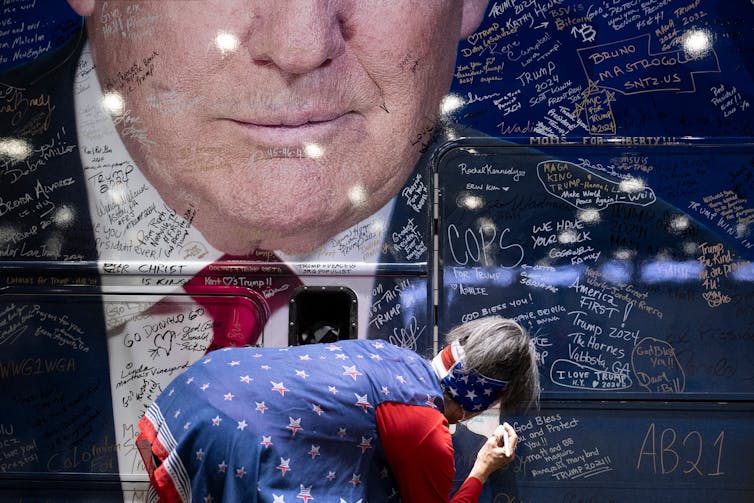
A person signs a bus wrapped with an image of former President Donald Trump during the Conservative Political Action Conference on Feb. 22, 2024.
Brendan Smialowski/AFP via Getty Images

Alexander Hinton, Rutgers University – Newark

What is happening in the hearts of former President Donald Trump’s supporters?

As an anthropologist who studies peace and conflict, I went to the annual meeting of the Conservative Political Action Conference, or CPAC, to find out. I wanted to better understand the Make America Great Again faithful – and their die-hard support for Trump.

The event began on Feb. 21, 2024, in National Harbor, Maryland, with Steve Bannon’s routine, untrue banter about how President Joe Biden stole the 2020 election, and it peaked with an angry speech from Trump three days later. In between, I sat among the MAGA masses listening to speaker after speaker express outrage about American decline – and their hope for Trump’s reelection.

Everywhere I turned, people wore MAGA regalia – hats, pins, logos and patches, many with Trump’s likeness. I spent breaks in the exhibition hall, which featured a Jan. 6 insurrection-themed pinball machine featuring “Stop the Steal,” “Political Prisoners” and “Babbitt Murder” rally modes and a bus emblazoned with Trump’s face. Admirers scribbled messages on the bus such as, “We have your back” and “You are anointed and appointed by God to be the President.”

Those on the left who dismiss the CPAC as a gathering of MAGA crazies and racists who support a wannabe dictator do not understand that, from this far-right perspective, there are compelling and even urgent reasons to support Trump. Indeed, they believe, as conservative politician Tulsi Gabbard stated in her CPAC speech on Feb. 22, that the left’s claims about Trump’s authoritarianism are “laughable.” This is because CPAC attendees falsely perceive President Joe Biden as the one who is attacking democracy.

Here are my top three takeaways from CPAC about Trump supporters’ current priorities and thinking.

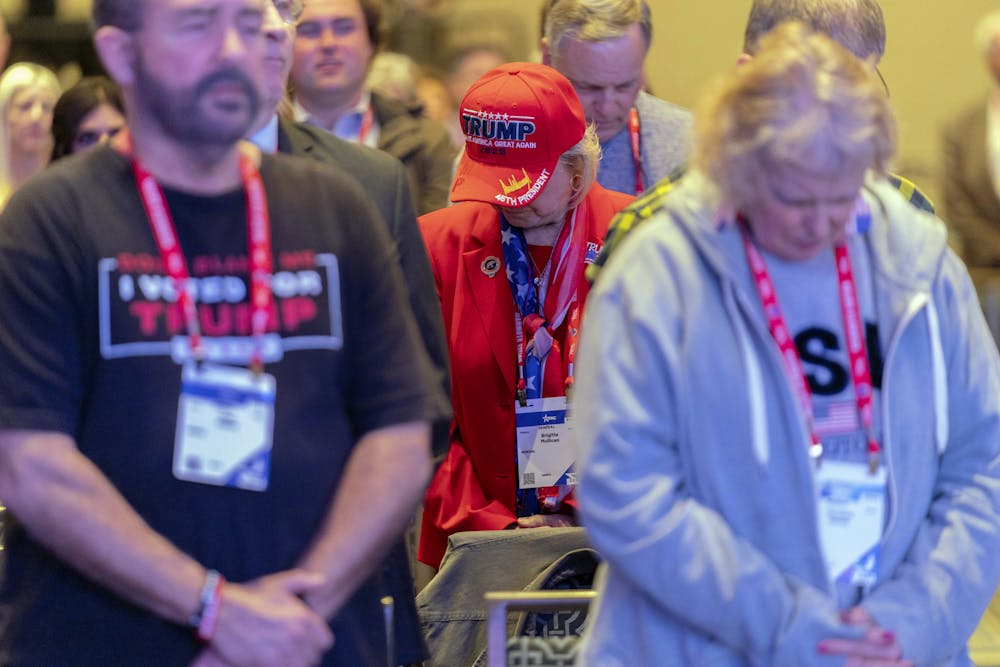
People wear red lanyards, shirts that say 'Trump' or 'USA' and hold their hands in front of them and bow their heads.
People pray during the opening ceremony of the Conservative Political Action Conference on Feb. 22, 2024.
Jose Luis Magana/Associated Press

1. There’s a Reagan dinner – but CPAC is Trump’s party

Former President Ronald Reagan runs in CPAC’s DNA. Reagan spoke at the inaugural CPAC in 1974 and went on to speak there a dozen more times.

In 2019, the conservative advocacy group the American Political Union, which hosts CPAC, published a book of Reagan’s speeches with commentary by conservative luminaries. In the preface, Matt Schlapp, the head of the American Political Union, says he often asks himself, “What would Reagan do?”

CPAC’s pomp gala, held Friday, is still called the “Ronald Reagan Dinner.” But Reagan is otherwise hardly mentioned at the conference.

Reagan’s ideas of American exceptionalism have been supplanted by Trump’s populist story of apocalyptic decline. Reagan’s folksy tone, relative moderation and clear quips are long gone, replaced by fury, grievance and mean-spirited barbs.

2. There’s a method to the madness

Many commentators and critics, including groups like the Southern Poverty Law Center, view CPAC as a frightening or bizarre gathering of white nationalists who have a nativist agenda.

In 2021, commentators said the CPAC stage was shaped like a famous Nazi design called the Othala Rune, which is a hate symbol. Schlapp denied this claim and said that CPAC supports the Jewish community, but various commentators took note of the uncanny resemblance.

This year, CPAC refused to give press credentials to various media outlets, including The Washington Post, despite the organization’s emphasis on free speech.

Some speakers, including Trump, have been known to regularly voice support for white nationalism and right-wing extremism, including speakers who promote the false idea that there is a plot to replace the white population. I discuss this idea in my 2021 book, “It Can Happen Here: White Power and the Rising Threat of Genocide in the US.”

Indeed, the U.S.-Mexico border was a constant topic at this year’s CPAC, which included controversial anti-immigrant speakers such as the head of Spain’s far-right Vox party and a representative of Hungary, whose leader stated at the 2022 CPAC that Europeans should not become “mixed-race.” Hungary will also host a CPAC meeting in April 2024.

Many of the sessions have alarming titles like, “Burning Down the House,” “Does Government Even Matter” and “Going Full Hungarian.” There are right-wing, populist speakers like Bannon and U.S. Rep. Matt Gaetz.

Overall, the program is informed by a conservative logic that largely boils down to God, family, tradition, law and order, defense and freedom.

Of these, God looms largest. As a result, CPAC’s hardcore conservative Christian orientation is anti-abortion rights, homophobic and oriented toward traditional family structure and what it considers morality.

Schlapp co-wrote a book in 2022 that warns of the dangers of “evil forces” – what he considers to be progressives, the radical left and American Marxists. Schlapp’s book title even dubs these forces “the desecrators.” Such inflammatory language is frequently used at CPAC, including by Trump during his Saturday speech.

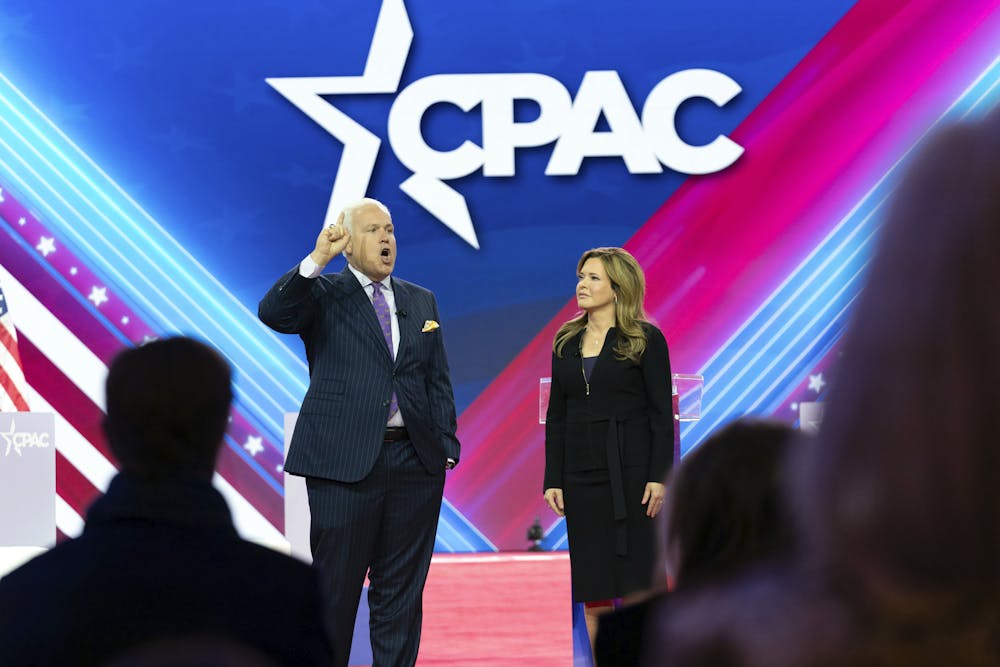
A white man with white hair and a dark suit stands on a stage with a woman in a black long sleeve dress. They stand in front of a large screen that is shades of red and blue and says 'CPAC' in white.
Matt Schlapp, chairman of the American Conservative Union, left, and his wife, Mercedes Schlapp, speak during CPAC on Feb. 22, 2024.
Jose Luis Magana/Associated Press

3. Trump believers think he is their savior

CPAC’s love of Trump is shocking to many on the left. But at CPAC, Trump is viewed as America’s savior.

According to his base, Trump delivered on abortion by appointing Supreme Court justices who overturned Roe v. Wade. They believe that, despite evidence of mixed results, Trump had wide successes at securing the border and creating jobs. For example, during Trump’s time as president, the U.S. economy lost nearly 3 million jobs, and apprehensions of undocumented migrants at the border rose.

Trump’s CPAC speech, like his campaign speeches, harped on such supposed achievements – as well as Biden’s alleged “destruction” of the country.

Conservatives roll their eyes at liberal fears of Trump the despot. Like all of us, they acknowledge, Trump has flaws. They say that some of his comments about women and minorities are cringeworthy, but not evidence of an underlying misogyny and hatefulness, as many critics contend.

Ultimately, CPAC conservatives believe Trump is their best bet to defeat the radical-left “desecrators” who seek to thwart him at every turn – including, as they constantly complained at CPAC, social media bans, “fake news” takedowns, rigged voting, bogus lawsuits, unfair justice, and lies about what they call the Jan. 6, 2021, “protest”.

Despite these hurdles, Trump battles on toward the Republican nomination for presidential candidate – the hero who CPAC conservatives view as the last and best hope to save the USA.

Alexander Hinton, Distinguished Professor of Anthropology; Director, Center for the Study of Genocide and Human Rights, Rutgers University – Newark

This article is republished from The Conversation under a Creative Commons license. Read the original article.
“Oppenheimer” takes home top film prizes at the SAG and PGA awards in anticipation of the Oscars

“Oppenheimer,” Christopher Nolan’s biographical thriller on the career of renowned physicist J. Robert Oppenheimer, is racking up top film awards just weeks before the Academy Awards. At the 30th annual Screen Actors Guild Awards on Feb. 24, the film bested four fellow nominees — Greta Gerwig’s “Barbie,” Cord Jefferson’s “American Fiction,” Blitz Bazawule’s “The Color Purple” and Martin Scorsese’s “Killers of the Flower Moon” — to win the marquee best cast in a motion picture award. The following night, at the Producers Guild of America Awards, the film took home yet another top prize, the PGA’s Darryl F. Zanuck Award for outstanding producer of theatrical motion pictures.

The Zanuck Award winner has also won the best picture Oscar for five of the past six years, including last year with the Daniels’ hit absurdist comedy-drama “Everything, Everywhere All at Once.”  

“Oppenheimer” leads this year’s Oscar nominations with 13 total nods. It is currently the projected winner in the best picture category, which also includes “American Fiction,” “Anatomy of a Fall,” “Barbie,” “The Holdivers,” “Killers of the Flower Moon,” “Maestro,” “Past Lives,” “Poor Things” and “The Zone of Interest.”

“Oppenheimer” also celebrated wins at the Golden Globes and Directors Guild Awards. During Sunday’s showcase, Nolan thanked his fellow producer Charles Royen for giving him “American Prometheus,” the book that inspired “Oppenheimer,” and “starting a chain reaction that’s spread all over the world.” Robert Downey Jr., who plays Lewis Strauss in the film, also called it “the highest-grossing film about theoretical physics yet made.”

Stock up on toothpicks: These soy-glazed meatballs might be the ideal party food

As an Italian-American cook, I always tend to filter meatballs through that cultural lens. Though, in actuality, I know there are slews of uber-famous meatball dishes from all over the world, from Sweden to China, not just meatballs slathered in red sauce and mozzarella like you might get in Italy — or New Jersey. 

As such, a few weeks back, I decided to experiment a bit and diversify my meatball stylings, and reach for soy sauce, sesame oil and fruit preserves. This turned into an "everything but the kitchen sink"-type scenario, in which I also tossed in some ingredients that wouldn't normally be included in a plain ol' soy-glazed meatball. I tend to like to gussy it up a bit.


Want more great food writing and recipes? Subscribe to Salon Food's newsletter, The Bite.


Here, I opted for ground chicken — a personal preference — but free to swap in any type of ground protein or plant-based protein here, or even use a mix. You can also form large meatballs to make this an entree of sorts or form smaller meatballs and serve these on toothpicks if you're having pals over. It's all up to you!  

Also, it must be said: Even when making a decisively Asian-inspired meatball, I still threw Italian cheese into the meat mixture. I can't help it! 

We need your help to stay independent

Soy-glazed chicken meatballs
Yields
6 to 8 servings
Prep Time
10 minutes
Cook Time
20 minutes

Ingredients

For meatballs:

Canola oil 

1/2 onion, peeled and finely minced

4 garlic cloves, peeled and minced

1 pound ground chicken

1/4 cup breadcrumbs

1 tablespoon soy sauce, tamari or coconut aminos

2 tablespoons grated Parm.

1 egg

Dash garlic powder

Dash onion powder

1 teaspoon Worcestershire sauce

1 teaspoon toasted sesame oil

Canola oil

Salt, optional 

For sauce:

1/3 cup soy sauce, tamari or coconut aminos

2 tablespoons balsamic vinegar

1 tablespoon peach or apricot preserves, jam or jelly 

1 teaspoon honey (or more, if you like sweet)

1 tablespoon rice wine vinegar

1 to 2 tablespoons toasted sesame oil

Dash garlic powder

Dash onion powder

Chili sauce or sambal oelek, optional

For garnish:

Toasted sesame seeds

Sliced scallions

Directions

  1. In a large skillet over medium-low heat, warm oil. Add onion, cook until translucent, about 3 to 4 minutes, then add garlic. Cook another minute or two, then turn off heat and let mixture cool slightly. 
  2. In a very large bowl, mix all meatball ingredients together until just combined. Do not overmix! (use a slotted spoon when adding onion and garlic).
  3. Wipe clean the same skillet in which you cooked the onion and garlic. Add oil and heat over medium-low heat until slightly rippling.
  4. Form a tiny tester patty to test for seasoning. Cook in hot pan, tossing often. When finished (should only take a few minutes), drain on paper towel and give it a taste. I omit salt in this recipe because the soy can be super salty, but if you think it needs some, feel free to add. 
  5. Form your meatballs into the desired size. Cook, in batches, until deeply browned and crisp. Drain on a paper-towel lined sheet tray.
  6. Discard used oil. Wipe out pan. Return to stove and heat over medium-low heat. Add all sauce ingredients, whisking gently to incorporate the jam, jelly or preserves. Cook for 5 minutes or so, stirring often, until thick and rich. 
  7. Add meatballs back to sauce, stirring until coated and warmed. Serve immediately: If you're serving as an entree, serve with hot white rice. Otherwise, serve with toothpicks. 

“Ice her”: Trump plots to use Cannon to make it “impossible” for Chutkan to hold pre-election trial

Donald Trump's attorneys may use his Mar-a-Lago unclassified documents case in Florida to create additional challenges in the two criminal cases he is up against, playing a game of legal hopscotch to create advantageous campaign conditions, per a new report from CNN. 

The former president and his lawyers have been transparent in their efforts to prevent him from being tried in federal court before the November election. “The Special Counsel seeks urgently to force President Trump into a months-long criminal trial at the height of campaign season, effectively sidelining him and preventing him from campaigning against the current President,” Trump’s legal team recently wrote to the Supreme Court.

Chief among these efforts is to hamper Judge Tanya Chutkan — the Washington D.C. judge overseeing Trump's election subversion case — from starting the trial before the 2024 presidential election, given that the case poses a significant legal threat to Trump's ability to return to the White House. 

“Meaning, ice her,” said a person close to Trump’s trial strategy told CNN. “Making it impossible for her to jam a trial down before the election, by things that are out of her control.”

The election subversion case, initially slated by Chutkan to begin trial on March 4, has been delayed indefinitely due to appeals. As CNN noted, one method of ensuring that the Supreme Court does not return the case to Chutkan in a timely manner is to persuade Judge Aileen Cannon, the Trump appointee overseeing the documents case, to push the Mar-a-Lago trial into the summer. Sources familiar with the case told CNN that doing so would likely result in even further delays for the documents trial "because of the legal complexities around classified documents that still have to be worked out."

Though both Chutkan and Cannon have declined to push their respective trials they are overseeing past the November elections, Cannon has indicated that she may consider moving the date back from when it is currently set to begin, on May 20. Some experts have hypothesized that Cannon is using the current May trial date as a "blocker" to effectively stymie other cases from going to trial by creating restrictions. The judge has already faced criticism for expressing a bias favoring Trump's defense team and for intentionally dragging out the case. 

Chutkan conversely is an Obama-era appointee who has already ruled against Trump's presidential immunity claim, writing in a December decision that "Former Presidents enjoy no special conditions on their federal criminal liability. Defendant may be subject to federal investigation, indictment, prosecution, conviction, and punishment for any criminal acts undertaken while in office."

One of CNN's sources alleged that the D.C. judge "might have him on trial the day of the election. If she wants to do that, we might as well just make Trump president right now."

We need your help to stay independent

Trump, his lawyers, and co-defendants will appear before Cannon on Friday, along with special counsel Jack Smith and his team of prosecutors. As CNN observed, the hearing will likely cover scheduling challenges and other contentious points related to the case. Sources aware of the ex-president's legal scheme noted that his defense team is planning to ask Cannon to move the trial date back to July, rendering Chutkan potentially unable to schedule the D.C. trial before November. 

Both the special counsel and Chutkan have said they feel Trump's federal election case should be swiftly seen by a jury. “[Trump’s] personal interest in postponing trial proceedings must be weighed against two powerful countervailing considerations: the government’s interest in fully presenting its case without undue delay; and the public’s compelling interest in a prompt disposition of the case,” the Justice Department wrote to the Supreme Court.

“The charges here involve applicant’s alleged efforts to disenfranchise tens of millions of voters,” the special counsel’s office continued. “The national interest in resolving those charges without further delay is compelling.”


Want a daily wrap-up of all the news and commentary Salon has to offer? Subscribe to our morning newsletter, Crash Course.


Judge Juan Merchan, who is overseeing Trump's New York criminal hush money case (set to begin at the end of March) has been in contact with Chutkan to discuss trial timing. 

“There is a lot of moving parts in the DC case. Really nobody knows what’s going to happen and when it’s going to happen,” Merchan said at a recent hearing.

Trump attorney Todd Blanche vocally opposed the New York trial timeline at the hearing, arguing that “We have been faced with extremely compressed and expedited schedules in each and every one of those trials." 

Merchan did note, however, that Trump should not be tried by more than one court at the same time. 

“Mr. Trump does have an absolute right to be present in all of his criminal trials,” the judge said at the hearing. “It’s an important right, and one that he has every right to certainly take advantage of. He’s not going to be in more than one criminal trial at the same time.”

“We need that kind of hero”: “Shogun” star Hiroyuki Sanada on playing a leader who wants peace

This is not your father’s "Shogun."

FX's new adaptation of James Clavell's 1975 bestselling novel challenges the idea of whose story gets told. The 1980s miniseries version of "Shogun" is shown from the point of view of an English sailor (Richard Chamberlain) taken hostage in Japan who eventually helps a daimyo (Toshirô Mifune) rise to the shogunate. The new series, however, re-centers the Japanese perspective of feudal Japan, creating more understanding and relying less on exoticizing. Produced by and starring veteran Japanese superstar Hiroyuki Sanada, the 10-episode limited series streaming on Hulu is rooted in authentic representations of Japan and the Japanese in the 1600s.

"I felt telling the story about his life is important, especially for now. We need that kind of hero."

Sanada stars as Lord Yoshii Toranaga, who must fight both politically and militarily for life as his enemies on the Council of Regents unite against him. Meanwhile, westerner John Blackthorne (Cosmo Jarvis), crashes his ship in a Japanese fishing village, becoming someone who could help Toranaga tip the scales of power. Toranaga’s and Blackthorne’s fates become inextricably tied to their translator, Toda Mariko (Anna Sawai), a Japanese noblewoman whose Christian faith and loyalty to Lord Toranaga play out in complex ways.

Toranaga is loosely inspired by Tokugawa Ieyasu, who began the Tokugawa Shogunate of Japan in 1603 and was considered one of the three "Great Unifiers" of the country. Blackthorne is modeled after William Adams, the first Englishman to reach Japan. Watch a trailer for "Shogun" below:

Salon talks to Hiroyuki Sanada about his vision for the series and his career playing samurais.  

What inspirations did you draw upon to create this new "Shogun" series? 

Very beginning, I thought [of] Toranaga's real-life model, leyasu [who], after the war period finished, created the peaceful era for 260 years until we opened the country to the world. So that's why he became a hero in Japan. And for me, I felt telling the story about his life is important, especially for now. We need that kind of hero. That's why I took this role and then tried my best to put my dream into this show to bring to the world.

Your first Hollywood role was in "The Last Samurai." How do you see your role in "Shogun" differing from that film? 

That was my first experience in Hollywood. And then after that, I decided to come to LA. From Tokyo to LA, I moved in and tried to continue choosing the international project. All the experience I've done in LA, I could use everything in this show. So as an actor, year by year, I feel comfortable to work in Hollywood. And also this time, l've done the producing as well. So l could prepare everything before: I am sitting in front of the camera. So [I am] more confident and relaxing, and I really enjoy to play the character.

You've played various different samurai in your career. How would you say your roles have evolved from the very beginning to this role? 

Yeah, all my experience in this role and the show, which I've learned since l was a child actor. I had a lot of great masters [who] taught me a lot. So I put everything into this show and try to teach young actors on set. All the experience worked to create this character and the show, I believe. 

I read that you do most of your own stunts. 

For me, you know, doing everything by myself is a very important thing. And when I started training, I thought the leading actor doing everything by own self is a good service to the audience, which I felt when I was a kid. That's why I started training. So that was a starting point. And then in the future I want to do everything by myself. So even getting older, as much as possible, I want to do everything by myself.

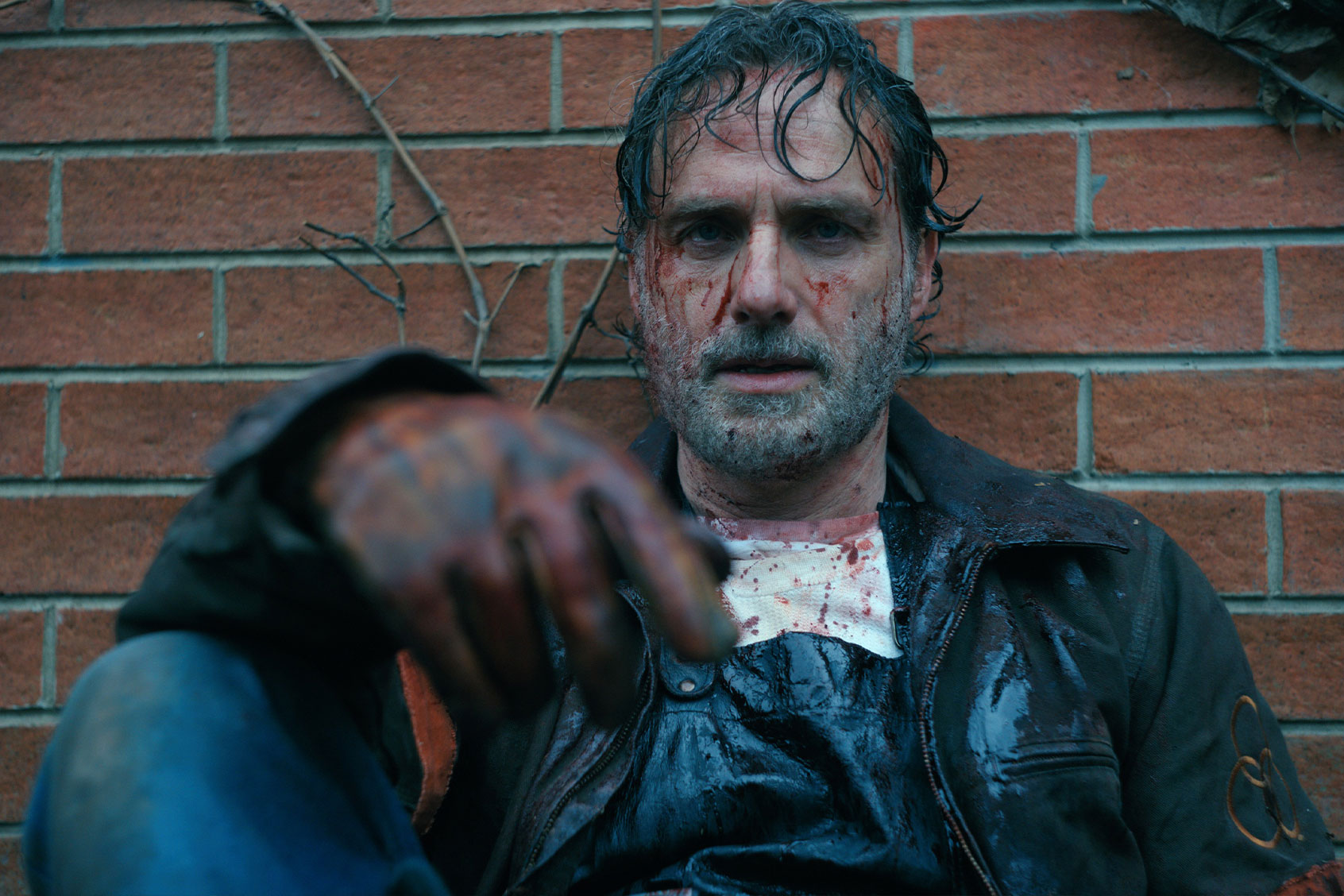
ShogunHiroyuki Sanada as Yoshii Toranaga and Yuki Kura as Yoshii Nagakado in "Shogun" (Katie Yu/FX)
The original "Shogun" television show was more centered on John Blackthorn, whereas your series is more centered on your character, Lord Toranaga, and the Japanese world. Can you talk about the evolution? 

This time, we created the script, not only through the telling [of] the story through the blue eyes, [but] more Japanese lenses to explain our culture or the story. So that's a big difference, I think. Most of the audience will see Feudal Japan, 1600 Japan through [Blackthorn’s] eyes at the beginning. And little by little, they [are] gonna start understanding what I am thinking, what [the] other Japanese characters [are] thinking, what's going on. So Blackthorne, he's learning Japanese words little by little and then wearing kimono, wearing the sword, and he's gonna understand what the Japanese culture is. Like him, the audience will understand, step by step, each episode. So, very important his position is. 

Hollywood has seen the "Shogun" world often through fantasy. I think about your "Westworld" portrayal of swordmaster Musashi in what's literally a fantasy theme park. This series seems much more authentic and centered on the Japanese perspective. Is that something that you really wanted to bring out?

Yes, indeed, but it's case by case. Each production has [its] own world and especially "Westworld" was a theme park. So Western people made our robot and then created for the Western people the image.

"Wigs, costume props and the master of gesture – this is very important."

But this one ["Shogun"] had to be authentic. [The] novel is a fictional entertainment, but to make the story believable or the character, we needed to make authentic [so] nothing’s a bother to the audience to focus on the story, to follow the characters. That’s why this time we need it. But case by case, each production has a different reality level.


Want a daily wrap-up of all the news and commentary Salon has to offer? Subscribe to our morning newsletter, Crash Course.


You bring up the novel, which is written by a white man. How do you bring authenticity to a source material that is from a literal Western perspective? 

Yeah, this time we tried to make the show not too much Westernized, not too much modernized. So just keep authentic as 1600 Japan. That's our goal. As an entertainment, the story or characters [were] original, but [the] background of the history or props, costume, movement, had to be authentic.

We had a Japanese crew [with] experience [in] historical drama. Wigs, costume props and the master of gesture – this is very important. We had a team of professionals, so that helped us a lot.

What do you want audiences, especially Western audiences, to learn about Japanese culture and history through the series? 

More than action, more than just ceremony things, [the] mental thing is most important, I think. Loyalty and [to] serve somebody and sacrifice, patience – all of them we need for now. So we can pick up something important mentally to use in the real world to make a better future together. 

"Shogun" premieres with two back-to-back episodes on Tuesday, Feb. 27 on Hulu and at 7 p.m. ET on FX. New episodes will drop on Tuesdays.

“Cut the partisan games”: How House Republicans could force a choice between SNAP and WIC

After months of deliberation, it appears that Congressional lawmakers may finally be nearing a deal that would provide a very much-needed boost in funding to the Special Supplemental Nutrition Program for Women, Infants, and Children, better known as WIC, which served approximately 6.26 million people a month in 2022. 

However, there’s a pretty big catch. 

In addition to providing an undisclosed amount of extra funding to WIC — whose leadership has said the program needs an additional $1 billion to serve all those who will seek its services this year — three sources familiar with the talks indicate that the possible deal involves adding what’s known as the SNAP-choice pilot program to the Ag-FDA spending bill, as first reported by Politico’s Meredith Lee Hill

Despite the name, the SNAP-choice program would actually restrict what kinds of foods and drinks participants could purchase using their benefits. This addition to SNAP would fly in the face of decades of bipartisan support for maintaining beneficiaries’ autonomy, as well as bipartisan precedent for rejecting proposals for similar programs.

For instance, in 2003, then-Minnesota Governor Tim Pawlenty applied for a waiver from President Bush’s Department of Agriculture, asking that Minnesota be allowed to determine which foods and beverages were eligible for SNAP benefit. This waiver was rejected. Seven years later, in 2010, former New York City Mayor Michael Bloomberg applied for a similar waiver from the Obama administration, eventually followed by Maine’s Governor Paul LePage under the Trump administration. Both these waivers were also rejected. 

The reason these waivers have been overwhelmingly rejected in the past is largely twofold. Policymakers and government workers have raised flags through the decades over how potentially taxing administering state-specific programs would be in terms of both time and resources, especially in the many states where there is already a substantial backlog in fulfilling benefits. Additionally, grocers and food producers have voiced similar concerns. 

“Restricting eligible items to those approved by the U.S. Department of Agriculture will quickly drive-up food costs and strangle the program with needless red tape with no meaningful public health outcome to show in return,” the National Grocers Association wrote in a letter Tuesday to congressional leaders. 

"Grocery store cashiers will become the food police, telling parents what they can and cannot feed their families."

The letter, which was signed by nearly 2,500 businesses and trade groups, continued: “The government will need to categorize more than 600,000 products and update the list each year with thousands more products. Grocery store cashiers will become the food police, telling parents what they can and cannot feed their families.”

The larger concern for food security advocates, however, is that programs like SNAP-choice reinforce damaging long-held stereotypes about the people who need federal nutrition benefits — that they are lazy, uneducated or purposely make poor decisions regarding their health —  which have been standard fare since the Reagan-era when he spun campaign trail stories about "food stamp queens" on welfare buying steaks and lobster with taxpayer dollars.

This is one of the main reasons organizations like the Congressional Hunger Center, a D.C-based nonprofit that trains leaders to combat food insecurity and hunger, have long opposed programs that interfere with SNAP participants’ choices. 

We need your help to stay independent

“CHC opposes limiting food choice for SNAP participants,” they told the organization Center Forward. “Anti-hunger advocates have worked hard to eliminate ‘stigma’ in SNAP by making food purchases through electronic benefit transactions (EBT cards). Eliminating food choice would reinstitute stigma in SNAP. Additionally, USDA research indicates that the diets of SNAP participants are generally comparable to the diets of Americans of similar economic means, and that Americans of all income groups need to improve their diets.”

However, the pressure is really mounting with yet another partial government shutdown looming at the end of the week if Congress can’t agree on four appropriations bills — and because, as CNN reported, WIC advocates are warning that states could start having to turn people away as soon as next month if Congress doesn’t provide additional funding shortly. The impact would be magnified because the estimated $1 billion shortfall will have to be absorbed in the remaining months of the fiscal year, which ends September 30. 

“Congress needs to cut the partisan games and stop gambling with the well-being of families,” 

“The time for political distractions is over. For fifty years, WIC has demonstrated its value as an essential public health resource — positively impacting the health of families across generations,” Georgia Machell, interim CEO of the National WIC Association, said in a statement.

Does the First Amendment apply to social media moderation? The U.S. Supreme Court will decide

Sign up for The Brief, The Texas Tribune’s daily newsletter that keeps readers up to speed on the most essential Texas news.


The U.S. Supreme Court on Monday will consider whether the First Amendment’s freedom of speech clause applies to social media companies’ content moderation. Their decision could render a Texas law unconstitutional.

The lawsuit challenges whether Texas and Florida can legally prohibit large social media companies from banning certain political posts or users. Both states passed laws in 2021 to stop what Republican state leaders considered “censorship” of conservative viewpoints.

The laws came on the heels of the Jan. 6, 2021 attack on the U.S. Capitol, which led Facebook, Twitter and other social media platforms to suspend former president Donald Trump’s social media accounts because his posts were thought to glorify violence.

Tech industry groups then brought a lawsuit in which they argued those laws are unconstitutional because they conflict with the First Amendment, which protects against government infringement of speech.

Tech trade groups NetChoice and Computer & Communications Industry Association sued Texas and Florida and asked a federal court to stop the laws from going into effect, claiming they illegally impede upon private companies ability to regulate the speech on their platforms. The justices put the Texas law on hold last year while the challenges moved through the court system.

The Supreme Court’s review of the laws represents the first major examination of if and how free-speech laws apply to social media companies. Legal experts say that the high court’s decision could have significant implications for statehouses across the country as they begin writing laws to address misinformation online.

“The stakes for free speech online are potentially enormous,” said Scott Wilkens, senior counsel at the Knight First Amendment Institute at Columbia University. “The court here is being presented with diametrically opposed interpretations of the law, and what the court does could, on the one hand, allow the government free rein to regulate social media platforms, or, on the other, prohibit the government from regulating them at all.”

The free speech provisions included in the First Amendment do not mean that private companies are forced to allow certain speech. Instead, the Constitution states that the government cannot compel or prohibit speech from private actors.

Wilkens said he believes the Court should take a middle ground and rule that while the platforms have a right to make editorial judgements, states can still regulate the platforms in ways that would promote democracy. For example, he said the platforms should be required to disclose how they curate their content.

Texas’ social media law, referred to as House Bill 20, would mandate that tech companies publicly disclose how they curate their content. The Supreme Court is not considering the legality of that portion of the law. They are focusing on other provisions of law, including its prohibition on social media companies with more than 50 million active monthly users from banning users based on their viewpoints. The court will also consider the law’s requirement that platforms produce regular reports of removed content and create a complaint system to allow users to raise flags about removed content.

Tech companies argue that giving the government any control over their content opens the door to a flood of misinformation that would be harmful to users.

“What could end up happening is that websites are flooded with lawful but awful content,” said Carl Szabo, vice president and general counsel at NetChoice, one of the groups suing Texas. “That renders our ability to access the information we want and not see the information we don’t want, impossible.”

Szabo said social media companies remove billions of pieces of content from their platforms each month, including sexually explicit material, spam, or other content that violates their terms of services.

Gov. Greg Abbott, who made the bill a priority during a special legislative session in 2021, said after the law was passed that it was intended to protect individuals’ freedom of speech.

“Allowing biased social media companies to cancel conservative speech erodes America's free speech foundations,” Andrew Mahaleris, a spokesperson for Abbott, said in a statement to The Texas Tribune. “Social media websites are a modern-day public square. They are a place for healthy debate where information should be able to flow freely — but there is a dangerous movement by social media companies to silence conservative viewpoints and ideas.”

Disclosure: Facebook has been a financial supporter of The Texas Tribune, a nonprofit, nonpartisan news organization that is funded in part by donations from members, foundations and corporate sponsors. Financial supporters play no role in the Tribune's journalism. Find a complete list of them here.


We can’t wait to welcome you to downtown Austin Sept. 5-7 for the 2024 Texas Tribune Festival! Join us at Texas’ breakout politics and policy event as we dig into the 2024 elections, state and national politics, the state of democracy, and so much more. When tickets go on sale this spring, Tribune members will save big. Donate to join or renew today.

This article originally appeared in The Texas Tribune at https://www.texastribune.org/2024/02/26/texas-social-media-law-supreme-court/.

The Texas Tribune is a member-supported, nonpartisan newsroom informing and engaging Texans on state politics and policy. Learn more at texastribune.org.

Trump throws Truth Social tantrum demanding all cases against him “must be immediately halted”

Donald Trump began his Monday raging about the slew of civil and criminal trials mounting against him, bemoaning specifically local trials like the New York criminal case set to start at the end of March. The former president recently attended a hearing in that case, which was brought by Manhattan District Attorney Alvin Bragg and charges him with 34 felony counts related to alleged hush-money payments he made to an adult film actress in 2016. The presiding judge denied Trump's request to dismiss the case and set a March 25 trial date.

Despite a triumphant Saturday following his win in South Carolina's GOP primary, Trump's slate of legal troubles seemed to take center stage for him Sunday. Just before midnight, he took to Truth Social to praise a Fox News show he was viewing about his New York state fraud case, in which he was ordered to pay $355 million in penalties — now $454 million with interest, and encouraged his followers to watch the rerun at 3 a.m. Eastern time. "Wow! The Mark Levin Show just showed how Unconstitutional and unfair the NYSAG CASE against me is," Trump said in the post. "A TOTAL HOAX — ELECTION INTERFERENCE AT THE HIGHEST LEVEL!"

Trump hopped back on the app at 6:30 am Monday to demand all trials, including Bragg's, be "halted" and falsely saddle President Joe Biden with blame for his prosecution. "Why didn’t they bring these FAKE Charges THREE YEARS AGO? That would have solved all of their problems," the former president wrote in part. "(The answer is that they AIMED for the various trials to come up during my campaign for President, 2024!)."

"In other words, all of these FAKE POLITICAL PROSECUTIONS (PERSECUTIONS!) OF CROOKED JOE BIDEN’S POLITICAL OPPONENT MUST BE IMMEDIATELY HALTED!" he concluded. In addition to the nearly three dozen felony charges against him in New York, Trump faces 57 other criminal charges from two federal cases and a Georgia racketeering case.

“5-alarm fire for the party”: Ex-aide says Trump’s S.C. win exposes his “fundamental weakness”

Former White House director of strategic communications, Alyssa Farah Griffin, argued that former President Donald Trump's victory in South Carolina over Nikki Haley is far from a win for the GOP. 

“Somebody who’s running as virtually an incumbent — Donald Trump — getting 60%, and 40% being against him? That’s not a mandate," Griffin, now a CNN political commentator, said during a Saturday panel for the network. "Especially with the entire Republican Party apparatus behind him, with most elected Republicans behind him.”

Griffin continued: “Now, it’s unclear what a path could look like for Nikki Haley. I think we’re all very open-eyed about that. But she is underscoring the fundamental weakness of Donald Trump, and it should be a five-alarm fire for the party, but for some reason, it is not.”

A recent Politico report similarly noted that with about three-quarters of the South Carolina primary votes tallied, around 40 percent of voters rejected Trump. Though the stat isn't an issue in the primary, as Politico noted, it could pose a threat to Trump's re-election campaign in a general election — exit polls found that he lost moderate and liberal voters to Haley by a large margin, while a little over 1 in 5 Republican voters said they would not vote for Trump in the presidential election, per AP VoteCast. “I’m an accountant. I know 40 percent is not 50 percent,” Haley said on Saturday. “But I also know 40 percent is not some tiny group. There are huge numbers of voters in our Republican primaries who are saying they want an alternative.”

“In for a rude awakening”: McDaniel announces resignation as cash-strapped Trump eyes RNC takeover

Republican National Committee Chairwoman Ronna McDaniel will officially be vacating her post on March 8, paving the way for Donald Trump to handpick a new leader. 

“I have decided to step aside at our spring training on March 8 in Houston to allow our nominee to select a chair of their choosing,” McDaniel told the New York Times. “The R.N.C. has historically undergone change once we have a nominee, and it has always been my intention to honor that tradition. I remain committed to winning back the White House and electing Republicans up and down the ballot in November.” As The Times noted, McDaniel was the first woman to helm the R.N.C. in more than 40 years, assuming the position in 2017 after a stint as chairwoman of the GOP in Michigan. 

The former president has publicly endorsed Michael Whatley, the R.N.C.'s general counsel and a proponent of his fraudulent election claims, to serve in McDaniel's stead. Trump has also backed his daughter-in-law and wife of his son Eric, Lara Trump, to be the organization's next co-chair. 

“The RNC MUST be a good partner in the presidential election,” Trump said in a previous statement, according to the Times. “It must do the work we expect from the national Party and do it flawlessly. That means helping to ensure fair and transparent elections across the country. Lara is an extremely talented communicator and is dedicated to all that MAGA stands for. She has told me she wants to accept this challenge and would be GREAT!”

Lara Trump, during an appearance on conservative network Newsmax earlier this month, pledged to use "every single penny" of R.N.C. funds to see her father-in-law back in the White House if elected to the co-chair role. She also made a separate claim that it is of "big interest" to Republican voters to use R.N.C. finances to cover Trump's mounting legal fees related to his numerous civil and criminal cases, as noted by Reuters. 

Betsy Ankney, a top aide for Nikki Haley — the former governor of South Carolina who is challenging Trump's bid at the GOP presidential nomination — slammed the remark, saying, "I think it's pretty telling that Lara Trump said that the one and only focus of the R.N.C. is Donald J. Trump and has said that there is an appetite among Republican voters to pay his legal bills. I think that they're in for a rude awakening." Ankey continued: “I think that a lot of people do not want the R.N.C. to be paying Trump's legal bills. And I think that a lot of the $5, $10 and $25 donors to his political operation would feel differently about that. So we're focused on the fight ahead."

Byron Donalds defends Trump claiming Black people more likely to vote for him because of indictments

Rep. Byron Donalds, R-Fla., went to bat for Donald Trump over the weekend, jumping to the former president's defense over comments he made suggesting Black voters connect with him because of his slew of indictments. During a South Carolina summit of Black conservatives on Friday, Trump said that people around him cited his bevy of indictments as why "the Black people like me, because they have been hurt so badly and discriminated against. And they actually viewed me as— I’m being discriminated against. It’s been pretty amazing."

Donalds defended the remarks in a tense back-and-forth with NBC's Kristen Welker, who asked the congressman if the former president was implying he could win over Black voters because "they get indicted all the time too."

"I think that's part of it," the Florida Republican replied, before going on to name the economy and border as other top concerns for Black voters. He then dove into a full-fledged defense of Trump's statement. “When you layer on the fact that, yes, this is political persecution from the Department of Justice and from radical DA’s throughout our country, this is something similar that Black people have to deal with, with the justice system themselves,” Donalds told Welker.

The "Meet the Press" host promptly fact-checked the Florida congressman, clarifying that all four Trump indictments were brought by grand juries. "There is no evidence that the indictments are political in nature,” she added, before referencing former congressman Cedric Richmond's, D-La., criticism that Trump's claim is "insulting," "moronic and it's just plain racist." Donalds, however, accused Richmond of "trying to play politics and use racial politics." 

Asked whether Trump's comments offended him, Donalds responded that they didn't "because I understood what the president was talking about.”

Donald Trump’s dominating GOP primary performance doesn’t add up

Of all the 2024 political events I believed were irrelevant, the GOP primary campaign has been at the top of the list. But I was wrong. As it turns out, this cycle's primaries, which have commonly been touted in the media as decisive evidence of the Donald Trump juggernaut going into the fall election, are illustrating a major weakness in his coalition — and it's one that we have been seeing since the day after he won the 2016 election.

There is a substantial faction of Republicans and Republican-leaning voters who simply cannot stand Donald Trump. Yes, he is overwhelmingly popular among his MAGA base which makes up about three-quarters of the GOP and the majority of them are blindly devoted to the man no matter what he does. They are not just enthusiastic about voting for him, they are ecstatic. The media sees this as a sign that he is virtually unbeatable even to the extent of pushing the narrative that he is the frontrunner for the general election and that incumbent President Joe Biden is on the ropes despite the polls saying that the race is very close.

Trump is weaker than the narrative that's been laid out would have us believe. 

It's not that Trump is in any danger of losing the nomination. He is on track to wrap it up very quickly and has won every race so far going away. His last remaining rival, Nikki Haley, insists that she isn't "going anywhere" (always a weird thing for a losing candidate to say) but after her defeat in her home state on Saturday, her biggest donor, the Koch Network, is pulling out and it's only a matter of time before she runs out of money. Trump is going to be the nominee. But we knew that. There was never any doubt from the time he announced his candidacy. He's been the president in exile running the Republican Party from his gaudy social club in Mar-a-Lago from the moment he left Washington on January 20, 2021. And except for a few brief moments after January 6 and the 2022 election, his popularity among the faithful barely waned. It was always his for the taking and if he didn't stand to make a higher profit from fundraising if he declared later in the cycle he would have declared his candidacy immediately, as he did when he first became president. 

Given that the majority of Republicans believe Trump won the 2020 election, he's basically running as an incumbent. Now that we've had the first round of Republican primaries a pattern is emerging that suggests that as an incumbent candidate, Trump is weaker than the narrative that's been laid out would have us believe. 

Donald Trump can't win the general election with just his hardcore MAGA base. He must expand his coalition and he's not getting that done. In every state so far, he has underperformed expectations. Nevada was a very weird situation with both a primary and a caucus so it's hard to discern what the electorate was saying there but in Iowa, New Hampshire and S. Carolina, a solid 40% voted against Trump. It's a primary so that's not unusual. But who makes up that 40% is a problem for Trump. He's completely lost self-identified liberals which isn't surprising. But moderates have abandoned him as well, along with the GOP-leaning independents. And the ongoing shedding of college educated and suburban voters has not abated.

It doesn't matter so much in the MAGA-centric GOP primary, but Trump cannot afford to lose those voters in the general election. His numbers aren't adding up. He dominates rural America but that's it, as Axios put it:

If America were dominated by old, white, election-denying Christians who didn't go to college, former President Trump would win the general election in as big of a landslide as his sweep of the first four GOP contests.

Fortunately, that is not a majority of American voters. 

We need your help to stay independent

One of Trump's biggest liabilities is his ongoing insistence on flogging the Big Lie about the 2020 election. While it's true that 70% of Republicans believe President Biden was not legitimately elected, of the 30% who believe he was, the vast majority have voted against Trump in these primaries. Yet, that remains a huge part of Trump's pitch, even now, and there is a large faction that simply isn't following him down that rabbit hole. 

He won't shut up about it. On Sunday night he did an interview with Fox News' Brett Baier who surprisingly grilled him on the subject, asking him what he would say to the female suburban voter who feels that way. Trump insisted that he won and angrily repeated his usual litany of lies about stuffed ballot boxes and bogus analyses in the face of Baier's attempts to push back with the facts. Baier was trying to give Trump the opening to say something like, "It's fine if someone believes that but I think my record as president and my plans to make America great again will be enough to convince the voters that I'm the best man for the job" — but Donald Trump just couldn't do it. 

Around 20% of GOP primary voters (59% of Haley voters in South Carolina) say they won't vote for Trump in November. Will they vote for him anyway? Who knows? But most of them aren't voting for him in the primaries so far and he's going to need every last one if he wants to win back the White House. 


Want a daily wrap-up of all the news and commentary Salon has to offer? Subscribe to our morning newsletter, Crash Course.


Despite all this it's likely that Nikki Haley will be out of the race after Super Tuesday and everyone is wondering what it is she thinks she's been doing since the writing was on the wall pretty much from the beginning. She's clearly not going to be chosen as Trump's running mate and her recent sharp remarks about him have placed her firmly in the anti-MAGA camp, rendering her future in the current GOP pretty tenuous. But you will notice that aside from her differences with Trump on foreign policy, her critique is simply that he can't win. 

She has said this over and over again and her calculation may be that even if she ends up endorsing him, which is entirely possible, she will still be virtually alone among her peers in going on the record warning the party that he will lose in November. If he wins, it's all over for her anyway and if not, she has some credibility as the one who sounded the alarm. I don't know if the party will reward that but what choice does she have? She's spent the last year with fellow Republicans and Independents who are telling her they will never vote for Trump again. Maybe she's convinced they really mean it. After all, it only takes a handful of voters in a handful of swing states for her to be right. 

Locust swarms will intensify with climate change, threatening food security, study finds

There's a good reason locusts are considered plague-worthy. Despite their size, swarms of these insects can cause considerable damage by shredding plant life to bits like ravenous piranhas.. The bugs destroyed millions of American lives during the so-called "Dust Bowl" of the 1930s and caused massive hardship in East Africa from 2019 to 2020 — perhaps the authors of the Exodus were right to vilify the notoriously gluttonous insects.

"A warming climate will lead to widespread increases in locust outbreaks."

Despite the human tendency to demonize these bugs, they are a natural part of the world and can serve important ecological functions while at the same time being extremely destructive. Nonetheless, locusts pose big risks to human agriculture and food security, as laid bare by a recent study from the journal Science Advances. It details that, as climate change worsens, locusts will expand their ranges in the very same North African and Middle Eastern regions where the Bible is set.

It all comes down to the weather. As humans continue to burn fossil fuels and thereby release greenhouse gases into the atmosphere, Earth's temperature will continue to warm. Researchers from China and Singapore found that this will increase the prevalence of cyclical droughts and heavy rains in North Africa and the Middle East — and those are ideal conditions for locust swarms. Their eggs will thrive in the damp soil, and as vegetation grows sparse, they will congregate into groups with billions of individuals seeking food while flying up to 90 miles every day.

The United Nations has already described locusts as “the most destructive migratory pest in the world," and that will have been the case before climate change encourages even more swarming behavior. According to the authors of the Science Advances paper, their model finds that locusts' range could expand by as much as 13 to 25 percent because of global warming, imperiling food security all over the world.

"A warming climate will lead to widespread increases in locust outbreaks with emerging hotspots in west central Asia, posing additional challenges to the global coordination of locust control," the authors write, noting that locust populations have always relied on climate conditions, thriving or declining from dryness, precipitation and flood frequency to wind speed, air temperature and soil moisture. Everything from how locusts breed and incubate to their migration patterns is shaped by climate and weather conditions. As a result, weather events like the El Niño–Southern Oscillation are crucial in determining whether locusts are abundant or comparatively scarce.

"We find a strong teleconnection between the recurring climate variation and locust dynamics," the authors write. "The transition between the positive (El Niño) and negative (La Niña) phases of [the El Niño–Southern Oscillation] affects the abundance and distribution of locusts. Highly active areas contributing to locust dynamics are 65% larger during El Niño years than La Niña years."


Want more health and science stories in your inbox? Subscribe to Salon's weekly newsletter Lab Notes.


"Global warming could increase insect populations, resulting in earlier infestations and crop damage."

Cyril Piou, an ecologist at France's Center for Biology and Management of Populations, criticized the study to Inside Climate News by arguing that it did not sufficiently collaborate with scientists from that region. Had they done so, Piou argued, they might have taken local conditions like pest control programs into consideration.

“There are many scientists in these countries that actually know a lot about locust ecology and management,” Piou told Inside Climate News. “And [the researchers] could have gotten some grasp of this information to avoid arriving at conclusions… without knowing what’s happening already on the ground.”

Other recent research has indicated the ways in which climate change is helping insect populations that humans wish to see hindered. A December study from the Journal of Agricultural and Food Research found that agricultural insect pests will thrive as climate change worsens. Elevated carbon dioxide concentrations, worsening droughts and higher temperatures will all reduce crop production while working to the advantage of a number of insect pest species.

"Global warming could increase insect populations, resulting in earlier infestations and crop damage," the authors explain. "Optimal temperatures for many insect pests could increase pest infestations under global warming scenarios. However, a uniform increase in pest abundance and crop losses is not guaranteed due to varying needs, tolerances, and temperature effects among insects."

This finding is similar to that from a 2021 article in the journal Insects. The authors of that piece also found that climate change will be a boon to certain types of agricultural insect pests.

"Changes in climate can affect insect pests in several ways," the authors explained. "They can result in an expansion of their geographic distribution, increased survival during overwintering, increased number of generations, altered synchrony between plants and pests, altered interspecific interaction, increased risk of invasion by migratory pests, increased incidence of insect-transmitted plant diseases, and reduced effectiveness of biological control, especially natural enemies."

It is important to note that both of those studies did not claim climate change would be a blanket benefit to insect pests; because species are so different from each other, it is possible that certain ones will falter instead. This point was also made in a 2020 study for the journal Frontiers in Ecology and the Environment, which similarly examined how global insect pests will react to climate change. After analyzing 31 plant-eating insect pest species, they found that for a majority the severity of their threat to humanity was impacted (for better or worse) by climate change.

We need your help to stay independent

"Among these insect species, 41% showed responses expected to lead to increased pest damage, whereas only 4% exhibited responses consistent with reduced effects; notably, most of these species (55%) demonstrated mixed responses," the authors concluded. "This means that the severity of a given insect pest may both increase and decrease with ongoing climate warming."

If one thing is certain, it is that as the Earth continues to overheat, the types of weather conditions that benefit pests and disadvantage crops will become more and more common. As a study last year in the journal PNAS demonstrated, climate change if left unchecked will eventually lead to so-called compound drought and heatwaves (or CDHW events), which will happen roughly twice a year with each one lasting approximately 25 days. This is bad news for humans, but great news for pests like locusts. If our species wishes to avoid this outcome, it must prevent a warmed Earth from becoming a new normal.

Trump’s CPAC speech showed clear signs of major cognitive decline — yet MAGA cheered

Donald Trump was in his full glory over the weekend at the annual Conservative Political Action Committee (CPAC) conference. For his MAGA people, Republicans, and other neofascists and followers, Trump is like a father figure, preacher, teacher, confessor, lover, and god messiah prophet all in one person. In that way, CPAC is Donald Trump’s “church family” – only the church is full of fascism, hatred, wickedness, cruelty, and other anti-human values, beliefs, and behavior. Trump masterfully wields and conducts this energy.

Donald Trump’s speech at this year’s CPAC was truly awesome. As used here, “awesome” does not mean good, but instead draws on the word's origins as in "inspiring awe or dread.” In his keynote speech on Saturday, Trump said that America is on a “fast track to hell” under President Biden and the Democrats and that “If crooked Joe Biden and his thugs win in 2024, the worst is yet to come. Our country will sink to levels that are unimaginable."

Trump is an expert on leveraging everyday people’s pain points and personal fear.

He continued with his Hitler-like threats of an apocalyptic end-times battle between good and evil and that the country would be destroyed if he is not installed in the White House. Of course, Trump continued to amplify the Big Lie about the 2020 election being “stolen” from him and the MAGA people. He also made great use of the classic propaganda technique, as though he learned it personally from Nazi Minister of Propaganda Joseph Goebbels: Accuse your opposition of that which you are guilty of.

The New York Times detailed Trump’s ominous speech as follows:

If Mr. Biden is re-elected for a second four-year term, Mr. Trump warned in his speech, Medicare will “collapse.” Social Security will “collapse.” Health care in general will “collapse.” So, too, will public education. Millions of manufacturing jobs will be “choked off into extinction.” The U.S. economy will be “starved of energy” and there will be “constant blackouts.” The Islamist militant group Hamas will “terrorize our streets.” There will be a third world war and America will lose it. America itself will face “obliteration.”

On the other hand, Mr. Trump promised on Saturday that if he is elected America will be “richer and safer and stronger and prouder and more beautiful than ever before.” Crime in major cities? A thing of the past.

“Chicago could be solved in one day,” Mr. Trump said. “New York could be solved in a half a day there.”

Donald Trump has repeatedly shown himself to be a malignant narcissist and white victimologist. In his CPAC speech, he compared himself to pro-democracy activist Alexei Navalny, who died under the authority of Putin’s regime last week. Trump also continued to threaten his and the MAGA movement’s “enemies” with prison or worse as they meet their “judgment day”:

“I stand before you today not only as your past and future president, but as a proud political dissident….“For hard-working Americans Nov. 5 will be our new liberation day — but for the liars and cheaters and fraudsters and censors and impostors who have commandeered our government, it will be their judgment day…. Your victory will be our ultimate vindication, your liberty will be our ultimate reward and the unprecedented success of the United States of America will be my ultimate and absolute revenge.”

Here, Donald Trump sounded like an evil version of President Thomas Whitmore in the 1996 movie “Independence Day.”

He also used stochastic terrorism to encourage violence by his MAGA followers and other supporters with the lie that they are somehow being “victimized” or “persecuted” in America: “I can tell you that weaponized law enforcement hunts for conservatives and people of faith.” Echoing those themes, Trump, who believes that he is above and outside the rule of law, described his finally being held responsible for his many obvious crimes against American democracy and society as “Stalinist Show Trials," as The Guardian further details:

Facing 91 criminal charges in four cases, Trump projected himself as both martyr and potential saviour of the nation. “A vote for Trump is your ticket back to freedom, it’s your passport out of tyranny and it’s your only escape from Joe Biden and his gang’s fast track to hell,” he continued.

“And in many ways, we’re living in hell right now because the fact is, Joe Biden is a threat to democracy – really is a threat to democracy.”

Speaking days after the death of the Russian opposition leader Alexei Navalny, Trump hinted at a self-comparison by adding: “I stand before you today not only as your past and hopefully future president but as a proud political dissident. I am a dissident.”

The crowd whooped and applauded. Trump noted that he had been indicted more often than the gangster Al Capone on charges that he described as “bullshit”. The audience again leaped to their feet, some shaking their fists and chanting: “We love Trump! We love Trump!”

Trump argued without evidence: “The Stalinist show trials being carried out at Joe Biden’s orders set fire not only to our system of government but to hundreds of years of western legal tradition.

“They’ve replaced law, precedent and due process with a rabid mob of radical left Democrat partisans masquerading as judges and juries and prosecutors.”

We need your help to stay independent

Trump is an expert on leveraging everyday people’s pain points and personal fear. In his CPAC speech, Trump triggered this by focusing on real economic anxieties and feelings of vulnerability and precarity about rising energy costs, the cost of living, and the “American Dream” more broadly.

To this point, President Biden and the Democrats have not been able to effectively counter such attacks by Donald Trump and his spokespeople and other agents. Appeals to the facts about how historically great Biden’s economy is, are no salve for how everyday people are experiencing hardship and increasingly view Donald Trump and Trumpism as a viable alternative to the Democrats and “democracy.”

Trump also spun up a horror story version of the United States as a country overrun by black and brown migrants and “illegal” immigrants who are like the cannibalistic serial killer Hannibal Lecter from the film “Silence of the Lambs.” Trump’s solution: mass deportations and concentration camps.

During his speech, Donald Trump would continue to valorize the Jan. 6 terrorists who attacked the Capitol as fascist saints and martyrs of the MAGA movement – a group who Trump vowed to pardon when/if he takes power in 2025. They will in turn become his personal shock troops. Trump’s megalomania and claims to god-like power, were on full display during his speech on Saturday, where the ex-president, described himself in the third person, telling the audience that “Trump was right about everything.”

In an excellent article at Mother Jones, Stephanie Mencimer shared what she learned from embedding herself at last week’s CPAC conference (she did not attend as a credentialed reporter) and how in the Age of Trump and American neofascism that event is a festival of extreme right-wing politics and the hatred and intolerance that are among its most defining features:

Exiled from the press pen, I was just part of the audience, a space previously off-limits to reporters. To say the least, it was enlightening. On Friday, for instance, I listened to a main-stage speech from Chris Miller, a Republican running for governor of West Virginia. Because of its tax-exempt status, CPAC bans speakers from openly campaigning there, so he was listed on the program simply as “businessman.”

Like virtually every other speaker at the event, Miller devoted several of his allotted five minutes to railing against transgender healthcare. “Woke doctors are literally making boys into girls,” he declared. “They’re practicing mutilation, not medicine. They should be in prison.” At that point, a burly man in a giant black cowboy hat sitting next to me leaned over conspiratorially and proclaimed, “I think we should hang them all! I really do.” And he laughed like we were in on the same joke. I confess that I was too cowardly to tell him I was with the left-wing fake news.

Later, during a speech by South Dakota Governor Kristi Noem, I was sitting next to a woman in full-on MAGA gear. When Noem declared, “There are some people who love America, and there are some people who hate America,” my neighbor gave me a small heart attack. “Get the FUCK OUT!” she yelled furiously, ready to rumble. “Get the FUCK OUT!” Meanwhile, the old man in the camo Trump hat next to her had somehow fallen asleep.


Want a daily wrap-up of all the news and commentary Salon has to offer? Subscribe to our morning newsletter, Crash Course.


Mencimer then reflected on the devolution of CPAC, describing it as, “[W]hat passed for policy discussions at CPAC this year was largely limited to mass deportations and attacks on trans athletes. The sober panels about the national debt, balancing the budget, or Social Security reform that once commanded top billing were a relic of another era before CPAC became an extension of Trump Inc., devoted to all the MAGA grievances like racial equity, the evils of windmills, or bans on gas stoves.”

During his CPAC speech, Trump continued with his often incoherent and confused way of speaking, rambling(s), memory lapses, and extreme tangents. Trump defended his apparent speech challenges, saying that, “And by the way, isn't this better than reading off a fricking teleprompter…'They'll say: he rambled. Nobody can ramble like this….Probably I won't get the best speaker this year because I went off this stupid teleprompter.”

Trump’s CPAC speech appears to be further evidence of what psychiatrist John Gartner concluded “appears to be … gross signs of dementia. This is a tale of two brains. Biden's brain is aging. Trump's brain is dementing.” 

However, one must be cautious and understand that Trump’s apparent mental, emotional, and overall cognitive decline, and other indications of a damaged mind, are largely irrelevant to his followers. Donald Trump is a symbol more than a man. His MAGA people and other loyalists and voters ignore, reconcile, and more generally make sense of Trump’s apparent cognitive and speech difficulties by telling themselves that he is “just like them” and “speaks a language they can understand” because he is “authentic” and “not a traditional politician." By definition, the Dear Leader is infallible. Fake right-wing populism can be bent and shaped to accommodate any absurdity.

Donald Trump’s speech at CPAC is but more evidence that he is giving his MAGA people and other followers and supporters in the Republican Party and the larger right-wing and “conservative” movement what they want. Public opinion polls and other research have consistently shown that there are tens of millions of Americans who yearn for an American dictator or others strongman-type leader, who will “break the rules” to “get things done” for “people like them.” In addition, Republican and other Trump voters specifically support his taking power as a dictator and ending democracy. And as has been widely documented, a significant percentage of white voters do not support democracy if it means that their “racial” group does not have the most influence and power and privilege in American society as compared to black and brown people.

Donald Trump and today’s Republican Party and the larger right-wing and neofascist movement have successfully tapped into what is a centuries-old vein of white supremacist herrenvolk nightmare dreams and white rage in American society and life. The CPAC conference featured speakers and panels that reinforced that today’s Republican Party and “conservative movement” have rejected multiracial pluralistic democracy and seek to replace it with a White Christofascist Apartheid plutocracy.

We need your help to stay independent

In contrast to Donald Trump’s awfully awesome speech at CPAC on Saturday, President Biden solemnly warned reporters, again, that the 2024 Election is an existential battle for the country’s democracy and the soul of the nation where our most fundamental freedoms as Americans are imperiled.

In a recent essay here at Salon, Brian Karem reflected on his personal experience with such peril:

The most disturbing thing I’ve ever heard a president say did not come from Donald Trump.

It came from Joe Biden. Speaking with reporters in California on Thursday, the president said this about Donald Trump. “Two of your former colleagues not at the same network personally told me if he wins, they will have to leave the country because he’s threatened to put them in jail,” Biden told Katie Couric. “He embraces political violence,” Biden said of Trump “No president since the Civil War has done that. Embrace it. Encourages it.”

Perhaps I should have been shocked at the revelation that Trump, should he return to power, would jail reporters. I wasn’t of course. I had to fight him (and beat him) three times in court during his first administration to keep my White House press pass. I had already privately heard Trump’s threats. It was just disturbing to hear Joe Biden confirm it publicly. …

That is why the world cannot see Trump back in the White House. He knows nothing but divisiveness. And Biden was right to point out that Trump wants to jail reporters.

Trump supporters don’t care. But I’ve eaten Texas jail food, so I do.

When Einstein fled Germany he fled the poison of nationalism and longed for a country of civil liberty and tolerance. The closest he found was here in the United States. Where is it today? More importantly, where will it be after the November general election?

As always, believe the autocrat-dictator or other such political thug. He or she – in this case Donald Trump – is not kidding or joking.

Echoing Karem’s experience, I have talked to members of the pro-democracy movement (specifically journalists and reporters), and they have shared with me how they are in the process of deciding if they will stay here in the United States or flee the country if Dictator Trump and his regime takes power in 2025.

On Election Day, which will be here very soon, the American people have a choice to make. Last weekend’s CPAC conference was just one more escalation in the direct and transparent threats and dangerousness of Trumpism and American neofascism. If Trump wins on Election Day, the American people cannot say they were surprised by the hell he and his regime and followers will unleash on the country. The American people were told repeatedly what would happen and through both their active and tacit support for Trumpism and neofascism (indifference or otherwise not voting for President Biden and by implication American democracy in this decisive moment) allowed it to happen. How great is the American people’s drive to self-destruction? We will soon find out in eight or so months.

The case of Carrie Buck and the Supreme Court’s century-old crusade to control women

I’d like to take Alabama’s Chief Justice Tom Parker out for coffee and talk to him about his recent claim that frozen embryos are children, too.  Alabama’s Supreme Court recently and wrongly ruled embryos – in or out of the uterus – are children, and that destroying them is “an affront to God.” 

I’d share with Justice Parker the trauma and expense my own daughter and her husband endured in their efforts to have children. I’d tell him how my daughter had four embryos implanted, yet, she only has two children. I’d explain in the simplest terms possible how it is that every month women all over the world slough off embryos that do not implant. I’d explain how my daughter sloughed off embryos that were surgically implanted at $30,000 a pop. I’d share with him how these sloughed-off embryos are then flushed down the toilet along with urine and the remains of menstrual flow because clearly Parker and the rest of the Alabama Supreme Court have no idea how a woman’s body functions, or how fertility works, or the emotional and financial chaos that results from lawmakers (mostly white men) making reproductive decisions for women. 

The 1927 decision denies women the right to bear children, while the 2022 decision forces women to bear children.

But I doubt that Parker would join me for coffee. He’d mark me, a woman of his same Christian faith, a heretic with a liberal agenda. I wonder whether men like Parker ever listen to women on any matter. 

The reality is that lawmakers like Parker ascribe to a theology that gives them the authority to rule over women in every area of a woman’s life, but particularly when it comes to reproduction. This theology of patriarchy has undergirded our legal system for over a century. 

Consider the case of Carrie Buck.

She was a foster child from Virginia, seventeen and pregnant, the result of a rape by the nephew of her foster parents. To protect their nephew, the foster parents took Carrie to court, had her declared “unfit” to mother, claimed her infant daughter as their own, then had her imprisoned. 

Her only crime? Being born a girl into poverty. That alone ensured her voice would never count in a court of law. So, when then Chief Justice Oliver Wendell Holmes and the U.S. Supreme Court ruled that she should never again bear a child, Carrie was surgically sterilized. 

She never birthed another baby.  

While hers was not the first forced sterilization carried out by the State of Virginia, it was the legal case that would grant all states permission to forcibly sterilize whomever they determined unfit. 

I first read about forced sterilizations in a 2020 article in the Atlanta Journal Constitution. Dawn Wooten, a former nurse at an ICE Detention Center in South Georgia, reported that a doctor working for the center was sterilizing women without their consent or even their knowledge. Wooten’s a former nurse because after becoming a whistleblower, this mother of five lost her job. After human rights groups filed suit on behalf of these detainees, it was discovered that the doctor performing these sterilizations wasn’t even a board-certified OB-GYN.

We need your help to stay independent

People are often shocked to learn that such barbaric treatment of women is still allowable under federal law, but the truth is when it comes to reproductive rights, just as with the recent Alabama ruling, the courts have long treated women as second-class citizens. Abortion was legal and an accepted practice in the U.S. until the latter 1800s when Horatio Storer, a surgeon with a strident concern about Catholic immigrants having more babies than white Protestants, took his convictions to the American Medical Association (AMA) and pushed them to criminalize abortions. The then all-male AMA was keen to target women practitioners and midwives providing abortion care. 

Women would not be granted the liberty to make decisions regarding our own reproductive health until 1973 when the Supreme Court affirmed Roe v. Wade as the law of the land. But in a society where patriarchy undergirds our law-making institutions, such liberties were short-lived. 

I was 17, the same age as Carrie, when I checked into the maternity ward of a Georgia hospital in 1974 to have an abortion. The black woman who shared my room was in her early 50s. Already a mother of eight, she said she could not physically handle another pregnancy. We had choices, choices that women in Georgia today, and many other states no longer have, owing to the Supreme Court’s 2022 Dobbs decision overturning Roe. In rendering that decision, the Supreme Court;s  slight majority determined that the Constitution’s ratifiers (all men of a certain demographic) never intended to grant reproductive liberty to women, otherwise, they would have specifically stated so.

Both the 1927 Buck v. Bell decision and the 2022 Dobbs decision grant state lawmakers rights over women’s reproductive health. These laws, just as with the Alabama ruling, are common in their intent to deny women body autonomy. The 1927 decision denies women the right to bear children, while the 2022 decision forces women to bear children. They are both designed specifically to subjugate women to male authority. 

The Supreme Court of the United States is fallible. History is replete with sorrowful stories like Carrie Buck’s. Who we elect matters. We need to do a better job as voters educating ourselves about the policies our elected leaders support, and how those policies will affect not only our daily lives but the lives of the poorest and most vulnerable among us. 

When we vote, we need to keep in mind girls like Carrie Buck.

Black women are vital to science and health journalism

A quiet panic started happening sometime last summer in the world of science. The root of the issue began long before that, but by October 2023 it could no longer be ignored: People don’t really trust science anymore. More specifically, a growing chunk of Americans who lived through the peak global impact of COVID-19 now steeply distrust western medical sciences, including (you guessed it) public health institutions focused on epidemiology and pharmacology. That’s as dangerous for people’s daily lives as it is for any future public investments toward critical research.

And if you attend any of the major science conferences this year, you’re likely to see at least one panel of predominantly white, male big-wigs nervously wringing their hands over what to do about it all. You’ll probably hear them point to a few unsurprising culprits behind the credibility gap which, to be certain, do have a heavy hand in it: intentional political disinformation campaigns and infodemics, predominantly Republican anti-science stump speeches, private companies angling to profit off the fearful and uninformed and sensationalized headlines that get the story wrong.

Sure, those things all need fixing and the problem isn’t single-faceted. But there’s one culprit missing here that isn’t talked about enough, and I hope they’ll address it first. It's the biggest problem I can see from my crow’s nest view as a professional info-intermediary in the science-to-public pipeline. It’s also the easiest problem to solve, with the highest likelihood of improving outcomes for all other proposed solutions: Put more Black women in charge. Now.

The people you can persuade with facts are already on the side of science and journalism, and they are not impressed with your racial methodology.

The lack of Black women in positions of leadership and executive authority — across all scientific and science communications fields — is the biggest hole in the metaphorical credibility bucket. Public health organizations and journalism outlets can’t ask the world to believe that they’re producing objective science and fair journalism when they can’t even accomplish objective and fair hiring. Likewise, you can’t ask the world to believe this trust problem is simply manufactured by evil political forces outside of their white-led institutions when anyone can see that internal political ideology (or just plain white laziness) is encouraging rightful distrust among those who may otherwise politically champion both science and journalism. 

So white-dominant organizations and media outlets want to restore wider public trust in science? Good. To them I say: The call is coming from inside the house. If you would clean up the world, sweep your own doorstep first. Stop worrying about what Fox News is doing and what their Twitter devotees believe. That’s a red herring designed to make you waste money and time playing Whac-a-Mole against bad-faith spin doctors. All because you think you can persuade right-wing ideologues and their fanclubs to believe in scientific and journalistic facts — by presenting them with more facts.


Want more health and science stories in your inbox? Subscribe to Salon's weekly newsletter Lab Notes.


Well, honey, let me tell you a little secret: That audience is not persuaded by facts, but by feelings. And their feelings are so easy to manipulate that if I wanted to cause a five-alarm riot during family dinner, all I’d have to do is pay a couple GOP operatives to go on a 7 o’clock Fox broadcast and say “masks are the AR-15s in the Republican war on COVID, and Jesus died for my American right to bear them arms in Wal-Mart.”

The people you can persuade with facts are already on the side of science and journalism, and they are not impressed with your racial methodology. Just look at the findings from Pew Research in 2023:

Are we surprised that news and information patterns among Black families during peak COVID-19 had such wide diversion from those of white families? We shouldn’t be.

“Just 14% of Black Americans are highly confident that Black people will be covered fairly in their lifetimes, saying that is extremely or very likely to happen. Far more (38%) think that is not too likely or not at all likely to happen, while an additional 40% say it is somewhat likely … a lack of Black staff at the news outlet (36%) are major reasons for racist or racially insensitive coverage.”

“About a quarter of Black Americans (24%) say they extremely or fairly often get news from Black news outlets” Pew said in its 2024 analysis. “Another 40% of Black adults say they sometimes get news from such outlets.”

40% of Black people surveyed also told Pew that it’s crucial for race-related news to come from a Black writer. 

“Similarly, just 15% of Black Americans say that whether a journalist is Black is extremely or very important to deciding if a news story in general is trustworthy,” the report said. “Substantial shares also say… hiring more Black people as newsroom leaders (53%) and as journalists (44%) at news outlets would be highly effective.”

And how are we doing on the hiring numbers? Black women are only seeing rare wins in science journalism. We have to do better. Newslab has been tracking the stats:

“A 2018 survey by the American Society of News Editors found only 7.19% of full-time newsroom employees were Black. Only about 20% of those Black employees were in leadership positions, and there is no data on how many of those leaders are Black women.”

No data? In 2018? Incorrect. In an archived copy of that 2018 survey, you can see Black women account for only 3.45% of that 7.19% number above. And a table labeled “whites and minority percentages among newsroom leaders” reports that Black women held only 3.13% of leadership roles in 2018 and 2.16% in 2017. Are we surprised that news and information patterns among Black families during peak COVID-19 had such wide diversion from those of white families? We shouldn’t be.

So forget Fox. Start worrying about whether your hiring process and workplace structure is engineered to attract the best talent from anywhere — or whether it's designed to only attract the best talent you can find in a teensy pool of applicants who meet demographically isolated class criteria, and thus almost always end up being as white as a Boston cop.

“Inequality belongs as a subject within science and for science journalists to cover,” said Pulitzer Center grantee Amy Maxmen in 2022.

“It’s often about geopolitics and economics and history and culture — more than science as you might have had it in a classroom,” she said. “But if you believe that the point of science is progress, which is what I believe, then there’s not going to be progress if the fruits of science aren’t widely distributed to people.”

“Science has not simply been a bystander to racial violence, but has, in many ways, created the alibi.”

“Meanwhile,” as Sydette Harry wrote for Wired in 2021, “marginalized young journalists, specifically young Black women, are barely quoted anywhere in the media, even as they are pushed out of newsrooms at an alarming rate … From ethics in AI to abuse on social media, the reality is that none of this can continue without looking at the entire bedrock of not just tech, but those who charged themselves with covering it and the world it is in.”

That’s because science and journalism both have the same Achilles’ heel — a claim to be rooted in seeking objective truth, but then not being objective about who decides what’s true.

“Science has not simply been a bystander to racial violence, but has, in many ways, created the alibi,” said Princeton sociologist Ruha Benjamin in 2020, pointing out how the person completing George Floyd’s preliminary autopsy report said he died of underlying conditions, rather than being killed by officer Derek Chauvin.

The global priority of all science and science journalism right now is (or should be) climate change and its effective coverage. Black women are more impacted by the climate-related fallout in this country than perhaps any other group — because, as we all know, climate-related fallout is either currently hitting, or predicted to hit, every single aspect of our daily lives in one form or another. And thus the groups who already have the short end of the stick right now are bound to feel that fallout first and worst.

We need your help to stay independent


In 2018, Talia Buford talked about how ProPublica came at this issue and why we have to keep at it.

“When we began our environmental coverage as an industry, people weren’t the focus. We talked about acid rain and the hole in the ozone and what’s happening to polar bears, as opposed to the impact on poor or vulnerable communities. Having a different perspective in the newsroom is important because it reminds you that there are different ways to look at stories. Having people of color in the newsroom is important because it changes the conversation,” she said. “I think that Black reporters and, really, reporters of color, are more well-versed in intersectionality and the idea that nothing happens in a vacuum. We’re able to draw from our own experiences  —  or at least things we’ve heard of and understand from our communities  —  to piece together what the different implications could be in a way that may not be apparent to other reporters.”

Enough with the infodemic hand-wringing. Enough with the political fretting. First, do the work that needs done for better science and better journalism: Center Black women in science leadership and communication — or nothing else will matter.

An earlier version of this article originally appeared in Salon's Lab Notes, a weekly newsletter from our Science & Health team.

Clarence Thomas’ new law clerk brings a history of racism accusations

In yet another scandal involving Justice Clarence Thomas, he recently hired a new law clerk set to begin in the upcoming term who has been accused of being a racist.

Crystal Clanton, a 2022 graduate from the Antonin Scalia Law School, was the subject of a 2017 feature by The New Yorker which revealed that while she was working as a field director at Turning Point USA in 2015, she allegedly sent a text message to a fellow employee reading, “I hate black people. Like f**k them all . . . I hate blacks. End of story.” And while at the time of the feature being written she claimed to "have no recollection of these messages," telling the publication in a statement that "they do not reflect what I believe or who I am and the same was true when I was a teenager," it makes her a worrisome choice none the less. 

As The New York Times points out, Clanton has maintained a close relationship with Justice Thomas and his wife, Virginia Thomas — who once served on the advisory board of Turning Point USA — and Thomas maintains that the allegations against his new clerk are "unfounded." But the racist text message previously mentioned is not the only allegation she's tied to. According to Mediaite, who reported on her in 2018, she allegedly also shared a Snapchat photo during her time at TPUSA of a man who appears to be Arab with a caption she wrote that reads, “Just thinking about ways to do another 9/11.”


“The Walking Dead” returns Richonne’s apocalyptic love to us. Will departed viewers come back too?

At some point a horde of “The Walking Dead” audience wandered off, never to return. I can probably guess when that was for most of us. The seventh season premiere did it for me, which was when a beloved original character was gruesomely bludgeoned to death.

Others stuck around long enough to see Rick Grimes (Andrew Lincoln) exit by appearing to sacrifice himself while detonating a bridge, then peaced out with him.

When you reached your limit of the series, grisly violence and suffering may have mattered less than the reason why, which is likely linked to a character. If your favorite one died while you weren’t watching, maybe it would hurt less. Danai Gurira’s Michonne didn’t die, thankfully. Neither did Daryl Dixon (Norman Reedus), Carol Peletier (Melissa McBride), Maggie Greene (Lauren Cohan) or the man who drove millions away in the first place, Negan (Jeffrey Dean Morgan).

Neither did Rick, it turns out, making the post-series spinoffs a palatable alternative to wallowing in the repetitive gristle of “Fear the Walking Dead” and “The Walking Dead: World Beyond" (which is basically “The Walking Dead: College Championship Edition”) and that anthology filling the gaps.

Some people can’t get enough zombies, we know. For the rest of us, short character-driven trips like “Dead City” and its Maggie-Negan team-up, or “Daryl Dixon,” are palatable snacks. Out of all these, the main event was always going to feature the return of Richonne: the magnificent sheriff and the samurai.  

“The Walking Dead: The Ones Who Live” is the culmination of years’ worth of hoping and shipping, both inside the franchise’s apocalypse and our reality, overrun with undead fables as it is. When Lincoln left the main series in 2018, he also split up the only couple worth rooting for at the end of the world.  

Some people can’t get enough zombies, we know. For the rest of us, these short character-driven trips are palatable snacks.

Rick and Michonne are a super couple played by a pair of superb actors who could have left all this behind permanently and have done some extraordinary work since then. Gurira is as widely beloved as Okoye, her Marvel Cinematic Universe warrior, as she is for her katana-wielding ronin. Lincoln’s Rick was and is the heart and soul of “The Walking Dead,” established in the series’ first episode.

The Walking Dead: The Ones Who LiveThe Walking Dead: The Ones Who Live (AMC)Keeping Rick alive was a fuel reserve of hope, teasing that he might reunite with Michonne and the rest of their Alexandria community. Originally that was supposed to unfurl through a movie trilogy. The pandemic transformed that plan into this six-part tale beginning with that postscript from his final appearance, showing him being airlifted to parts unknown by an ally named Jadis (Pollyanna McIntosh).
“The Ones Who Live” picks up some time after that, with Rick uneasy in a new life that demands he forget his family and friends, which is impossible. Michonne could never let go of Rick – and when she finds evidence that he survived the bridge explosion, she starts searching for him in earnest, leaving behind Rick’s daughter Judith and the son Michonne has with him, R.J.

We need your help to stay independent

That means this series travels on parallel tracks that may at some point hit a junction. Who can say when? Not critics complying with AMC’s long list of “do not reveals” that limit us to either confirming that the show is indeed happening or providing lists of what you might need to know.

Those guides are handy for the many viewers who drifted away from “The Walking Dead” without checking in to its offshoots. Without engaging in a bit of review, you might experience a few re-entry difficulties. Not many though. The main change is the prominence of the Civic Republic Military, which is now this world's top antagonist.

The CRM governs the last known bastions of advanced civilization and prioritizes safety and dominance over freedom, which means eliminating other communities instead of trying to work with them. Terry O’Quinn, who plays enigmatic personalities as easily as breathing, is a spot-on casting choice to play Beale, its top general. But the actor whose presence leaves the deepest mark may be Matthew August Jeffers, with whom Gurira performed in “Richard III,” cast here as a skilled and uncharacteristically generous companion Michonne meets along the way.

The Walking Dead: The Ones Who LiveThe Walking Dead: The Ones Who Live (AMC)Time passes differently for her and Rick, and laborious enduring may have shifted their priorities. The best of the episodes made available for review is written by Gurira and delves into that dissonance; true to the style of her plays, the story trades the drama’s emblematic panting and claustrophobia for closeness, including the kind that can be too much to bear.  


Want a daily wrap-up of all the news and commentary Salon has to offer? Subscribe to our morning newsletter, Crash Course.


While “The Ones Who Live” isn’t exactly review proof, if you’ve been pining away for these two, nothing anyone says will stop you from sucking the marrow out of this carcass. The less emotionally invested but curious, though, may also be pleased to see what these two look like now.

By the time “The Walking Dead” ended, it had long passed the threshold at which topping itself with fresh devastation outpaced reasons and relationships to invest in. Apocalyptic fantasies that came after led with heart and hope – first “Station Eleven,” then “The Last of Us.”

This franchise came before those, and that may braid the brain a little when one of our heroes finds themselves in this show’s version of the “Station Eleven” Traveling Symphony. When a turn forces one of its heroes into a very familiar setting, you may find yourself weighing whether that's more reminiscent of “Alice in Borderland.” When a show has been away long enough to tread the same scenery as the stories that sprang up in its absence, a person can't be blamed for wondering what its return is adding.

The answer may simply be closure or continuation. In the same way the grave will not be denied, neither will everyone who clamored for chapters they feel these characters have earned, showing them fully living together instead of constantly evading cannibalistic gristle that never stops coming.

“The Walking Dead: The Ones Who Live” premieres at 9 p.m. Sunday, Feb. 25 on AMC and AMC+.

Gavin Newsom views Biden’s age as a help, not a hindrance

Speaking to "Meet The Press" host Kristen Welker on Sunday morning, California Gov. Gavin Newsom (D-CA) re-framed the ongoing chatter over Joe Biden's age, positioning it as a positive rather than a negative, as Republicans would have us believe.

Whereas Trump has made a habit out of belittling Biden for being up there in years, sharing spoof videos to Truth Social showing the president being shuffled off to an old folk's home, Newsom thinks Biden’s presidency has been a “masterclass” in how to run the country, and that his age only brings more wisdom that the country can benefit from.

"I’ve been out, as you know, on the campaign trail," he said to Welker. "I was just out in California. I’ve seen him up close, I’ve seen him from far. But here’s my point: it’s because of his age that he’s been so successful. It’s because of the wisdom and the character that’s developed over the years . . . so the opportunity to express that for four more years, what a gift it is for the American people.”

Watch here:

To reconnect with food, I’m unplugging my diet

When I first moved back to Chicago after over a decade away, I embraced the city by frequently practicing what English writer Virginia Woolf affectionately termed “street haunting” in a 1927 essay of the same name. Where she turned an errand to buy a new pencil halfway across London into an opportunity for flâneuserie — pausing to note that when “passing, glimpsing, everything seems accidentally but miraculously sprinkled with beauty” — I’d set out purposely hungry, ravenous for both food and some of the human connection stifled by pandemic lockdown. 

As such, many of the restaurants that remain my favorites are the ones I discovered seemingly by happenstance: the empanada stand I found while biking in the shadow of Wrigley Field on game day, its electric blue and hot pink walls lined with glass bottles of Topo Chico and Mexican Coke; the Jewish deli with a ridiculously overloaded pastrami on rye, located just a few blocks north of the commercial stretch where I run weekly errands; the fern-lined neighborhood coffee shop which has transformed one of their two bathrooms into a propagation station for houseplants. 

Of course, though, life sometimes gets in the way of wandering, especially once the gentle luster of getting reacquainted with one’s home begins to fade. Instead of being avenues of wonder, streets slowly become just streets, the thoroughfares we tread to get to grocery stores and dentist offices and train stations, where we can then be shuttled at a faster clip to yet other streets. And so it goes until you see a little detail out in the wild that truly surprises you (like an unexpected flock of clucking urban chickens, or back-alley graffiti written in a loopy, distinctly feminine font, warning, “I was here. I am here. I will hurt you”). 

Or until a college student you know asks: “How did you all find new restaurants before the internet?”

That’s a good question. 

While I’d like to say that I exclusively consult the food section of my local print publications for recommendations for where to eat that weekend, or that I’m more tied into the age-old tradition of solid word of mouth than I actually am, that’s just not the case anymore. It’s maybe a little embarrassing to admit, but outside of searching for places to eat and food trends for work, my relationship to food in my downtime has become increasingly passive — and increasingly digital. Instead of heading out my front door hungry for novelty, I come across a beautifully flaky croissant while doomscrolling Instagram and check to see if it’s local, or a random article pops up in my news feed, or I catch a sponsored restaurant ad on Facebook. 

We need your help to stay independent

This isn’t just about how “organically” I find restaurants or the way in which I discovered that espresso martinis are back (through so, so many tweets); as a child of the early '90s, I often feel a bit like I was born on a cusp between the analogue and digital realms, but have become increasingly tethered to the World Wide Web since my middle school dial-up days. 

I’m not alone. When the Pew Research Center began tracking Americans’ internet usage in early 2000, only about half of all adults were online, compared to the 95% who use the internet today. That said, those numbers don’t necessarily curb some broader concerns I have about how being “plugged in” for so long has impacted my ability to find, think about and create things I really care about, a rapidly growing apprehension that the student’s question had unintentionally pricked. 

Since then, I’ve spent a fair amount of time considering what unplugging my diet would actually look like — and how that would tie to the ways I buy my groceries, how I satisfy my cravings and how I enjoy my community. I think the first step is simply walking out the door, hungry and without a destination.


Putin and the dissident’s body: Greek tragedy and Navalny’s grave

A dictator withholds the body of an enemy from his family in order to further punish them and tighten his control over the citizenry as a whole. Public mourning has been forbidden. There will be no grave to visit or enshrine. The female relatives of the dead man, the only ones left to bury him, are powerless to fight back with anything but rage. Under this regime, law, custom and decency count for nothing. A corpse can be used as a weapon.

This is Alexei Navalny’s story, yes, but not a new story. In 441 B.C., the Athenian playwright Sophocles told a similar tale in “Antigone,” whose plot centers on an autocrat’s weaponization of a corpse killed in battle.

The play is set in a mythical prehistory, in the city of Thebes. (At the time of the play’s production, Athens and Thebes had recently been at war.) Antigone, the teenage heroine who gives the play her name, is a princess of the ruling house. Her parents are dead, and her two brothers have killed each other in a fight to control the kingdom. One of those brothers lies in state: Eteocles, the original claimant to the throne. The other lies unburied and decomposing on the battlefield outside the city gates. This is Polyneices, who brought an army with him, now defeated. 

Because her brothers are dead, Antigone’s uncle, Creon, is the new king of Thebes. His mission, he announces, is to ensure political stability, to right the ship of state, as he says in those now famous words. His first decree is to forbid burial of his nephew Polyneices, who brought a foreign army to fight for his throne and is deemed a traitor. Creon decrees that anyone who tries to even scatter dust over the corpse will be put to death. The chorus of citizens is horrified; not to bury the body of a relative is to offend the gods. 

Antigone and her sister Ismene, as their brothers’ only surviving female relatives, are by tradition entrusted with conducting the rites of mourning. But Creon decrees that even they will not be spared if they get near the body. For Creon, as for Vladimir Putin, it would appear,  the punishment of one’s enemies even in defeat is a necessity, and a way to display one’s power. Ismene is understandably frightened and begs Antigone to suffer in silence. Antigone calls her a coward, and vows to fight on alone.

Creon has posted guards around the body, one of whom complains about the stench. But Antigone evades them and sprinkles dust over her brother’s corpse. By the rules of ritual, even this minimal covering of earth counts as a burial in the eyes of the gods. Creon is furious when he hears about it, and orders the dust removed. This time he threatens the guards with death as well.

Antigone repeats her act of familial piety, but the frightened guards catch her, and she is brought before Creon. The dictator won’t go back on his word, even though she is his dead sister’s child: Anyone who tries to bury the traitor must die. He is particularly enraged that a mere woman dares to defy him, princess or not. He sentences Antigone to death, even as the chorus of citizens implore him to have mercy on her. In defying his decree, Antigone has become a traitor to the state, like her brother. 

Creon’s son, Haemon, is engaged to marry Antigone, but the tyrant, clinging to his role as the one who keeps order, ignores his own son’s anguished pleas. To evade having Antigone’s  blood on his hands — murderers are banished as a source of pollution — Creon orders his niece taken to a cave where she will die of starvation. 

At this point the gods intervene, but indirectly. A prophet tells Creon that the gods are refusing sacrificial offerings, in disgust at seeing Polyneices’ corpse left to rot. The world is turned upside down when the dead are left unburied and the living are consigned to die underground. The prophet’s last warning: The gods will deprive Creon of his own son as punishment for these deeds.

In ancient Athens, refusing burial rites to traitors was not unheard of; that was an accepted means of quashing their sympathizers. But was it right? Did it offend the gods? 

The chorus reminds Creon that this prophet has never been wrong. He frantically tries to stop the chain of events he has set in motion, but too late. Antigone has used her clothing to hang herself. When Haemon finds her, he kills himself with his sword, next to her body. In a final blow to Creon, when his wife, the queen, finds out that her son is gone, she kills herself inside the palace. 

And so the play ends. Creon, wild with grief, takes responsibility for what he has done. In Greek tragedy, choice and fate are the same. Creon chose to designate his nephew’s body as that of a traitor, ignoring their blood relation, thereby sealing his fate and that of his entire family.

“Antigone” was performed during an uneasy respite from war with other Greek city-states. All able-bodied Athenian citizens served in the military, as did Sophocles himself. The original audience of about 15,000 in the Theater of Dionysus included huge numbers of combat veterans. 


Want a daily wrap-up of all the news and commentary Salon has to offer? Subscribe to our morning newsletter, Crash Course.


Sophocles’ particular genius, in every one of his tragedies, is to push his protagonists into the heart of at least one moral quandary. This play may  have presented his living audience with a genuine moral dilemma. In ancient Athens, refusing burial rites to traitors was not unheard of; that was an accepted means of quashing their sympathizers. But was it right? Did it offend the gods? 

Sophocles shows us in all his tragedies that humans are too enmeshed with each other to be ruled with any justice by an autocrat’s commands. Even in this play, where Creon is clearly doomed, there are questions to be considered. Why should you bury a traitor? What if the traitor is your sister’s son? Shouldn’t those who give comfort to the enemy, even the dead enemy, be punished? But what if that person is your sister’s daughter? Is the mistreatment of one enemy body more important than the possibility of anarchy? And after all, shouldn’t women be obedient? The Athenian audience would have answered that question with an unqualified yes – women were not citizens in that patriarchal society, and effectively had no rights. No Athenian woman would have believed she had the freedom to rage at the male head of household and disobey his orders as Antigone did.

We don't have a Theater of Dionysus. But even if we did, and were inclined to listen to each other, we are not practiced as a nation in wrestling with moral quandaries, nor do we see it as our duty as citizens.

The Athenian theater was a public forum unlike any other. There, the playwrights could offer a reflection of the city to itself, albeit at an angle: almost always through the mists of a mythical past, and set someplace that wasn’t Athens. Plays were not simply entertainment. They were written to be performed once, always at a religious festival in honor of Dionysus, god of theater and communal experience. To be sure, the plays were entertaining, with singing and dancing and awards for the best at the end of the festival. More importantly, the theater was where questions about the wisdom of autocratic rule, the nature of the gods, the role of women and, of course, crime and punishment, could be raised without fear of reprisal; playwrights held a special place of honor.

We don’t have a Theater of Dionysus. Unlike Athens, the contemporary United States is a big country sharply divided into factions by religious beliefs, income, education, class and race. Our only public forum is elections, and now it seems that at least half the public has lost faith in them, and almost everyone is disappointed by them. Even if we had a national forum, and were inclined to listen to each other, we are not practiced as a nation in wrestling with moral quandaries, nor do we see it as our duty as citizens.

At this writing, very few major Republicans have spoken out clearly against Putin’s actions. Trump has gone so far as to identify himself with Navalny, claiming to be a victim of political terrorism, having taken an untroubled leap over the sticking point of that comparison: Trump admires Putin, and Putin had Navalny poisoned, then imprisoned and then, we must presume, killed. Putin is immune to moral quandaries; who knows how far he will go. Capturing Ukraine is unlikely to be enough for him. 

So now Navalny’s mother and widow join Antigone in prodding us to remember that the treatment of the dead has consequences for the living — not for Putin, necessarily, but for everyone who gets in his way. It is easy to forget what they are telling us, here in our distant safety. We vow with each fresh disaster never to forget those murdered by authoritarian regimes. At least this time, let us not forget who spoke up for the dead and who remained silent. 

Navalny’s widow, Yulia, has taken up the mantle of the opposition. On Saturday, she denied Putin’s avowed Christian faith, in words so close to Antigone’s that they could have been written by Sophocles. “You mock the remains of the dead," she told the Russian president. "Nothing more demonic can be imagined. You are breaking every law, both human and God’s.”

What will Putin do to silence Russia’s new Antigone?

Joe Biden’s moral collapse on Gaza could help Donald Trump win

Days ago, when the United States cast the only vote in the U.N. Security Council against a resolution for a ceasefire in Gaza, it was yet another move by President Biden to serve as the main enabler for Israel’s ongoing mass murder of Palestinian people. Since early October, nearly 30,000 have been killed by U.S. weaponry and, increasingly, by hunger and disease. The cruelty and magnitude of the slaughter are repugnant to anyone who isn’t somehow numb to the human agony.

Such numbing is widespread in the U.S. Some factors include ethnocentric, racial and religious biases against Arabs and Muslims. The steep pro-Israel tilt of news media runs parallel to the slant of U.S. government officials, with language that routinely conveys much lower regard for Palestinian lives than Israeli lives.

And while the credibility of the Israeli government has tumbled, the brawny arms of the Israel lobby — notably AIPAC and Democratic Majority for Israel — still exert enormous leverage over the vast majority of Congress. Few legislators are willing to vote against the massive military aid that makes the carnage in Gaza possible.

A chilling example is Sen. Chris Van Hollen, a Democrat from Maryland. On the night of Feb. 12, he took to the Senate floor and condemned Israel in no uncertain terms. “Kids in Gaza are now dying from the deliberate withholding of food,” he said. “In addition to the horror of that news, one other thing is true. That is a war crime. It is a textbook war crime. And that makes those who orchestrate it war criminals.”

Watching video from Van Hollen’s impassioned speech, you might assume that he would vote against sending $14 billion in further military aid to those “war criminals.” But hours later, he did just the opposite. As journalist Ryan Grim noted, “the senator’s speech pulsed with moral clarity — until it petered out into a stumbling rationale for his forthcoming yes vote.”


Want a daily wrap-up of all the news and commentary Salon has to offer? Subscribe to our morning newsletter, Crash Course.


Only three senators in the Democratic caucus — Jeff Merkley of Oregon and Peter Welch and Bernie Sanders, both of Vermont — voted no. Sanders delivered a powerful speech calling for decency instead of further moral collapse from the top of the U.S. government.

While the Senate deliberated, the White House again made clear that it wasn’t serious about getting in the way of Israel’s planned assault on the city of Rafah. That’s where most of Gaza’s 2.2 million surviving residents have taken unsafe refuge from the Orwellian-named Israel Defense Forces.

An exchange at a White House news conference underscored that Biden is determined to keep enabling Israel’s continuous war crimes in Gaza:

Reporter: Has the president ever threatened to strip military assistance from Israel if they move ahead with a Rafah operation that does not take into consequence what happens with civilians?

National Security Council spokesman John Kirby: We’re going to continue to support Israel. They have a right to defend themselves against Hamas and we’re going to continue to make sure they have the tools and the capabilities to do that.

Later, Politico summed it up: “The Biden administration is not planning to punish Israel if it launches a military campaign in Rafah without ensuring civilian safety.” Citing interviews with three U.S. officials, the article reported that “no reprimand plans are in the works, meaning Israeli forces could enter the city and harm civilians without facing American consequences.”

We need your help to stay independent

Biden continues to serve as an accomplice while mouthing platitudes of concern about the lives of civilians in Gaza. Month after month, he has done all he can to supply the Israeli military to the max.

Under an apt headline — “Biden Is Mad at Netanyahu? Spare Me.” — Jack Mirkinson of The Nation wrote in mid-February:

In the real world, Biden and his legislative partners have continued to arm Israel; the Democratic leadership in the Senate actually brought people in on Super Bowl Sunday to take a vote on a bill that would, along with rearming Ukraine, send Israel another $14.1 billion for what is euphemistically dubbed "security assistance.”

Ever since October, protests and activism in many parts of the country have challenged U.S. support for Israel’s military assault on Gaza. However, boosted by revulsion at the atrocities that Hamas committed against Israeli civilians on Oct. 7, the usual rationales for supporting Israel’s violence against Palestinians have been hard at work.

The electoral base that Biden will need this fall is heavily against his support for Israel’s war on Gaza. Many have seen through the thin veneer of his weak pleas for Israel to not kill so many civilians.

In this election year, an additional factor looms large. The prospect of Donald Trump returning to power is all too real. And with Biden set to be the Democratic nominee, many individuals and groups are careful to avoid saying anything that might sound overly critical of the president they want to see re-elected.

Instead of candor, the routine choices have been euphemisms and silence. Morally and politically, that’s a big mistake.

The electoral base that Biden will need to win this year's election is heavily against his support for Israel’s war on Gaza. Polling shows that young people in particular are overwhelmingly opposed. Most have seen through the thin veneer of his weak pleas for Israel to not kill so many civilians.

No amount of evasions, silence or doubletalk can make Biden’s policies morally acceptable. But while the administration combines its PR hand-wringing with an endless flow of arms and military supplies, Biden apologists must resort to evasion and verbal gymnastics to defend the indefensible.

A better course of action would be actual candor about current realities: Biden’s moral collapse is enabling the Israeli government to continue, with impunity, its large-scale massacre of Palestinian people. In the process, Biden is increasing the chances that the Republican Party, led by fascistic Donald Trump, will gain control of the White House in January.