Spring Offer: Get 1 Year, Save 58%

NY AG Letitia James threatens to “seize” Trump’s building if he doesn’t have enough money to pay

New York Attorney General Letitia James has said she is prepared to seize Donald Trump's building if he can't cover the $354 million fine he was recently hit with in his civil fraud case. James, who brought the lawsuit, sought $370 million in penalties and a ban on Trump and other defendants from doing business in the state. Trump's ultimate penalty is likely to swell to more than $400 million with interest. 

"If he does not have funds to pay off the judgment, then we will seek judgment enforcement mechanisms in court, and we will ask the judge to seize his assets," James told ABC News. "We are prepared to make sure that the judgment is paid to New Yorkers, and yes, I look at 40 Wall Street each and every day," James said, referring to Trump's building in Manhattan's financial district.

James in the ABC News interview challenged Trump's claim that her case did not have any financial victims, arguing instead that it was representative of an equitable relationship between financial markets and New Yorkers. She also shut down the ex-president's allegation that the fraud case would create a dearth of business activity in the state.

"Financial frauds are not victimless crimes. He engaged in this massive amount of fraud. It wasn't just a simple mistake, a slight oversight, the variations are wildly exaggerated, and the extent of the fraud was staggering," James said. "If average New Yorkers went into a bank and submitted false documents, the government would throw the book at them, and the same should be true for former presidents. Last I checked tourism is up. Wall Street is doing just fine."

James' legal team estimated that the former president inflated the value of various assets to obtain lower insurance premiums and favorable loan terms. According to the Associated Press, New York attorneys alleged that Trump also exaggerated his net worth by as much as $3.6 billion one year. Judge Arthur Engoron ultimately concurred with these claims, ruling against Trump last Friday. 

After Alexei Navalny’s death, Trump’s cowardly groveling looks worse than ever

News came last week of the death of Russian dissident Alexei Navalny last week. He had survived an attempted assassination by poison in 2020 but eventually returned to Russia, where he was immediately detained and sentenced first to two and a half years, then nine years and ultimately 19 years in prison on charges of "extremism." In December he was sent to a distant prison in the Russian Arctic. And now he is gone.

Navalny was the most famous political dissident in the world, probably since Nelson Mandela. Those who care about such things held out hope that he would survive incarceration, as Mandela did, and prevail one day in a new Russia. In this era of rising authoritarianism, the death of this man — and his bravery in embodying a dream of freedom and liberty, now for the moment crushed — adds more fuel to fears of the creeping fascism now gaining traction around the world.

For those of us in the U.S., this is particularly distressing because the timing of Navalny's death feels as though it may be directly connected to the unhinged rhetoric of Donald Trump, the putative presidential nominee of the Republican Party. It's true that an "election" is scheduled soon in Russia in which it is certain that President Vladimir Putin will be triumphant. There has been some speculation that Navalny's death was related to that, although it's hard to understand how that would help Putin domestically. More likely the killing of Navalny is a show of strength following the comments Trump has been making on the campaign trail that if he becomes president again he will give the green light to Russia to invade any NATO country he deems not to have "paid its bills." (This is based upon his unshakably ignorant insistence that NATO is like one of his golf clubs that require members to pay dues — to him — and there's no disabusing him of it.) His exact words were, "I would encourage them to do whatever the hell they want," which were heard all over the world as a sign that America was on the verge of abandoning Europe on a fatuous pretext in favor of Russia.

This fear is not unreasonable, considering that the Republicans in Congress have successfully blocked funding for aid to Ukraine on the explicit orders of Donald Trump. That impasse came after Republicans demanded that Democrats and the White House agree to a draconian immigration bill in exchange. They eventually did, but in the end the GOP refused to back the bill anyway because Trump apparently believes it would help Joe Biden's re-election campaign.

You have to wonder whether that's the real reason he nixed the deal. After all, Biden signing that immigration bill would have further inflamed the left wing of the Democratic Party, which is already upset about the president's policy on Israel. It's a perfect wedge issue. Instead, the Democrats are now able to say they tried, and get to blame the Republicans for refusing to take yes for an answer.

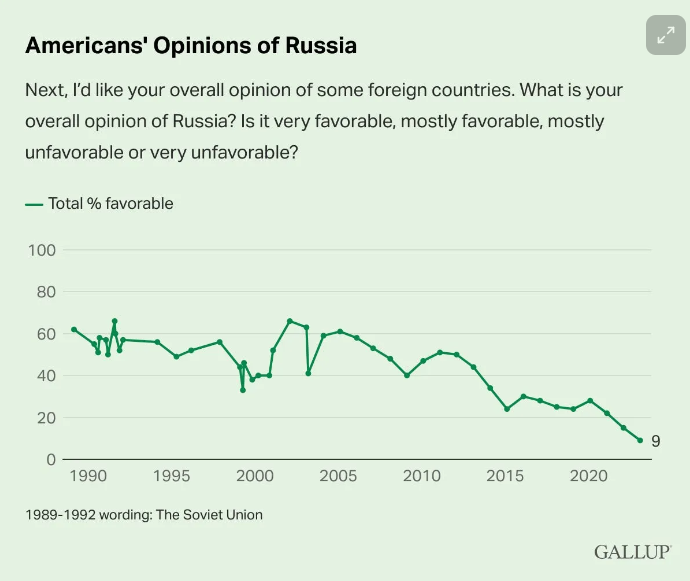
And consider this: a Gallup poll from last year shows that siding with Russia remains extremely unpopular among Americans at large, despite Tucker Carlson's paeans to Moscow's subways and grocery stores and Trump's admiration for Putin.

Pew survey released just last week shows that 74% of Americans view the war in Ukraine as “important to U.S. interests,” and that includes 69% of Republicans. The pro-Putin faction in the GOP is not as big as liberal political observers often believe it is, and it certainly isn't big enough to explain the way Congress is handling the issue in an election year — beyond, that is, their need to show fealty to Trump.

Trump is once again favoring Putin's goals, even at the apparent expense of his own. He's been doing that ever since he came on the political scene, for reasons no one can quite explain.

It's certainly possible that Trump's political judgment is not all it's cracked up to be. He lost the 2020 election by 7 million votes, after all, no matter how loudly he denies it. So it's curious that Trump is once again favoring Putin's goals, even at the apparent expense of his own. He's been doing that ever since he came on the political scene, for reasons no one has ever been able to adequately explain.

When the news broke about Navalny's death, everyone waited with bated breath to see what Trump would say about it. Would he, for the first time, condemn Vladimir Putin? Would he side with America's allies? And what would the Republican Party do?

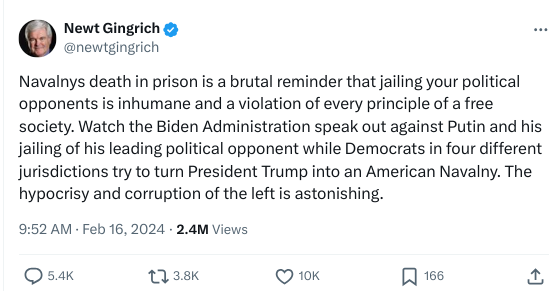
It wasn't long before we got our answers and they were predictably grotesque:

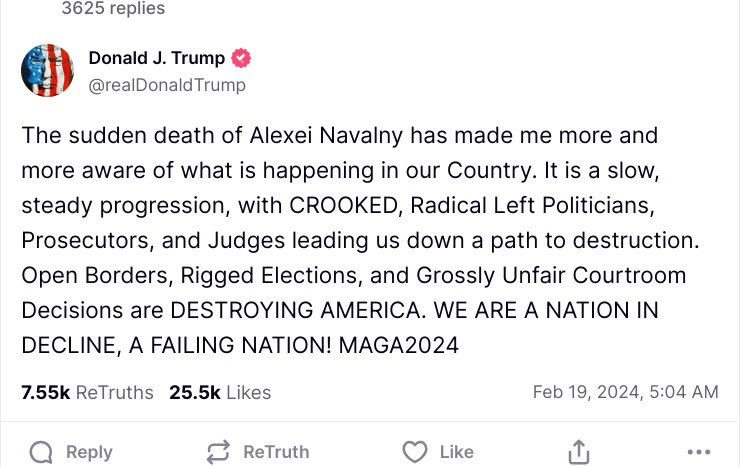
I think Gingrich was one of the first to compare Trump to Navalny but he wasn't the last. It took Trump himself three days before he could bring himself to say anything. When he did, it was to echo what Gingrich said:


Trump has embraced this ludicrous idea that he's the American Navalny, being persecuted by the tyrant Joe Biden. But by doing that he's implicitly admitting that Putin is a tyrant too, which is unusual. If you wanted to give him credit for being clever, you might think Trump was trying to appease the vast number of Republicans who don't admire Putin as much as he does while maintaining his martyr status among his cultish flock. But in reality it was just another excuse for him to whine about how badly he is being persecuted, which is his one and only 2024 campaign message.

On Tuesday night, Trump appeared on Fox News. When asked about Navalny's death, he said it was "sad" but implied that Navalny should have known better than to come back to Russia because he knew what was likely to happen. He never said a word about his pal Putin, perhaps hoping the world wouldn't notice that he was suggesting Putin was as bad as the monstrous Joe Biden.

When asked about the fines he's been ordered to pay in his New York fraud case he replied:

That's gibberish but the point was clear enough. Ordering him to pay up is somehow or other equivalent to being killed in an arctic gulag. In fact, he'd gone further than that in a rally earlier in the day:

Trump insists that he is being treated worse than Navalny — and worse than Abraham Lincoln — because he is a spoiled rich boy who has never been held to account for anything he's done in his life. On some level, I imagine  he believes it. But those two men were murdered. He is being held to account through judicial due process, even as he's running for president, flying around the country in his private jet, hawking gold sneakers and being feted nightly at his gaudy mansion in Palm Beach by his wealthy paying customers.

No one has ever pitied himself more than Donald J. Trump — certainly not Lincoln or Navalny, who were brave leaders trying to change the world for future generations, not whiners who believed everything in the world revolved around them. As former Obama adviser Dan Pfeiffer observed, Trump is no "strongman." He is a very weak man, desperately trying to outrun accountability for a lifetime of failure. The reason he cozies up to the likes of Vladimir Putin is because he's a coward who would rather "preemptively surrender to protect himself than fight to protect others." 

He's exactly the opposite of someone like Alexei Navalny. So, by the way, are the pathetic Republicans politicians who follow Trump like a horde of lemmings as he tries to lead the nation and the world over the cliff.

“Asset of Russian intelligence”: Experts say shocking DOJ filing blows up GOP impeachment sham

An FBI informant charged with lying about the Bidens claimed that "officials associated with Russian intelligence" were involved in passing a story about Hunter Biden, the Justice Department said in a filing on Tuesday.

Alexander Smirnov, a longtime FBI confidential source who was charged last week with fabricating bribery claims against the Bidens that have been hyped by Republicans pushing to impeach President Joe Biden, admitted to extensive ties to Russian intelligence after he was arrested last week, wrote special counsel David Weiss, who previously charged Hunter Biden with gun and tax violations.

“During his custodial interview on February 14, Smirnov admitted that officials associated with Russian intelligence were involved in passing a story about Businessperson 1,” the memo said, referring to Hunter Biden, according to The Washington Post.

Smirnov, who has worked with the FBI since 2010, claimed to have close ties to Russian intelligence and claimed he planned to meet with agents after his trip to the United States, according to the filing.

The filing also says Smirnov claimed that Russian officials intercepted the phone calls of Hunter Biden at a foreign hotel and “may use as ‘kompromat’ in the 2024 election.”

“Smirnov’s efforts to spread misinformation about a candidate of one of the two major parties in the United States continues,” prosecutors wrote. “What this shows is that the misinformation he is spreading is not confined to 2020. He is actively peddling new lies that could impact U.S. elections after meeting with Russian intelligence officials in November. In light of that fact there is a serious risk he will flee in order to avoid accountability for his actions.”

Hunter Biden’s lawyers in a filing accused prosecutors of following Smirnov “down his rabbit hole of lies” and made prosecutors less willing to accept a plea deal they had reached with him in July.

“It now seems clear that the Smirnov allegations infected this case,” Hunter Biden attorney Abbe Lowell wrote.

Smirnov’s claims are also at the heart of the Republican impeachment effort against Joe Biden. Smirnov claimed to his FBI handler that executives at the Ukrainian energy firm Burisma had bribed Hunter and Joe Biden $5 million each to “protect” them.

Sen. Chuck Grassley, R-Iowa, and House Oversight Chairman James Comer, R-Ky., hyped the allegation despite not presenting any corroborating evidence. Former House Speaker Kevin McCarthy, R-Calif., cited the FBI document memorializing Smirnov’s claims as a reason to move forward with impeachment. Fox News host Sean Hannity aired 85 segments on it, according to Politico.

“Based on the indictment and filing, it lays bare how unscrupulous the entire GOP and their enablers in right wing media have become,” a source close to Biden told the outlet. “Republicans in Congress ought to be facing the crushing burden of a massive scandal of their own making right now: An impeachment based on what might be a Russian intelligence operation. If nothing else, a criminal lie, based on the indictment.”

We need your help to stay independent

New York University Law Prof. Ryan Goodman, a former Pentagon special counsel, told CNN that the DOJ sought to block the pre-trial release of Smirnov because it views him as a “present risk” given his “extremely recent” contact with Russian officials trying to spread misinformation into the 2024 election.

Goodman said the new allegation “pulls the rug out” from under the basis for Biden impeachment proceedings.

“It’s really quite incredible,” Goodman said, pointing to McCarthy announcing the impeachment inquiry based on claims from Smirnov, who has since said they came from Russian intelligence officials.

“That’s quite devastating in terms of where it’s even brought us to this point as a country given that this is the source of some of that information,” he said.


Want a daily wrap-up of all the news and commentary Salon has to offer? Subscribe to our morning newsletter, Crash Course.


Rep. Dan Goldman, D-N.Y., who previously served as a Democratic Trump impeachment counsel, called out Comer and the Republicans, arguing that they have touted Smirnov’s allegation as “the best evidence they have.”

“It’s pretty shocking, especially what it means that has been going on for the last four years, which is that, wittingly or unwittingly, House Republicans have been acting as an agent or an asset of Russian intelligence for Vladimir Putin,” Goldman told CNN. “This whole Burisma thing was debunked during the first impeachment investigation in 2019 by numerous witnesses, all of whom were experts on Ukraine and Russia.”

Goldman said the document is “simply evidence that the Republicans “are willing to be used as assets of Russian intelligence, just like Donald Trump.”

“it now appears as if the House Republican majority is being used by Russia to interfere in the 2024 election on behalf of Donald Trump,” he added. “If they continue with this investigation, they are simply doing the work of Vladimir Putin to help Donald Trump win an election in November. That’s where we are.”

Climate change can make some people feel hopeless. Here’s what can be done about it

Given the existential stakes of climate change, it makes sense to feel afraid or depressed about the future of the environment. And it can be easy to feel alone when experiencing climate change-related depression. If a person is suffering through a drought, noticing temperatures are warmer than normal and observing the loss of local animal life, that individual can easily succumb to despair. Most humans do not have the ability to single-handedly eliminate humanity's dependence on fossil fuels, which are the primary cause of climate change. They are literally powerless — and feel that way.

"Policies that strengthen the social safety net are critical to alleviating compounded stressors that worsen mental health."

But many people feel this way. You are not alone. Although your eco-anxiety is all too real, the medical literature still has large gaps in the knowledge needed to provide adequate help.

These are some of the main conclusions of a recent systematic review published in the journal Nature Mental Health and performed by researchers from Harvard University, Yale University, the University of Chicago and the University of Oxford. A systematic review is a study which analyzes a number of studies that contain primary research, which are analyzed for data relevant to the question posed by the scientists.

In this case, the researchers included 57 peer reviewed studies based on whether they "investigated the effects of slow-onset climate change on a range of mental health indicators." The scientists determined that there were three "key findings." First, they determined that there is far less literature on chronic climate change — that is, how people react to events which occur incrementally — than there is literature on reactions to acute climate change-related disasters. This means that people who struggle with their mental health due to developments like droughts or rising temperatures (both common sources of anxiety among patients profiled in medical literature) may not receive as much attention as those who survived tropical storms or wildfires.

In addition, the scientists determined that the most commonly studied mental health conditions included "cases and symptoms of anxiety and depression, suicide, non-specific psychological distress and negative emotions, such as fear, grief and general concern." By contrast, "trauma-related conditions (for example, PTSD or acute stress disorder) were notably absent from most studies."

In this respect, the researchers explored the limitations involved in conducting scientific research: They noted that "the type of mental health outcome studied varied depending on the study design," with quantitative studies focusing on "anxiety and depression symptoms, suicidality and non-specific psychological distress" while disaster mental health literature focused on PTSD.

Qualitative and mixed-methods studies, by contrast, included participants who ultimately did not identify PTSD as a major symptom resulting from climate change. One specific advantage from the qualitative studies is that, because they captured mental health experiences outside of clinical settings, they heard about emotions such as sadness, worry and grief related to climate change that were not considered in the qualitative studies.

Finally, they determined that some aspects of climate change elicited mixed or null responses from participants. This was certainly not true for all aspects of climate change; rising ambient temperatures were linked to a number of serious mental health issues, particularly suicidality. Yet as the authors explain in the study, "it is important to note that a true null association between soil changes or atmospheric conditions and mental health outcomes would not call into question the abundant literature regarding the effects of climate change on global populations; rather, it may indicate that, unlike other chronic climate changes (such as rising temperatures), changes in soil and radiation may not be readily observable in people’s daily lives."


Want more health and science stories in your inbox? Subscribe to Salon's weekly newsletter Lab Notes.


"Despite contributing the least to climate change, vulnerable communities are poised to bear a disproportionate burden of the negative impacts of climate change."

For those who deal with the stress of the observable changes, there is hope — at least, when it comes to being able to better manage in your own life. Salon reached out to Dr. Christy Denckla from the Harvard T.H. Chan School of Public Health, the corresponding author of the study, and asked about mental health advice for people who are struggling due to climate change.

"Policies that strengthen the social safety net are critical to alleviating compounded stressors that worsen mental health," Denckla told Salon by email. "Despite contributing the least to climate change, vulnerable communities are poised to bear a disproportionate burden of the negative impacts of climate change. Policies that reduce health disparities and ensure equitable access to healthcare and material resources are essential. For example, policies that support affordable, safe housing with access to indoor cooling are critical. Finally, policies that expand mental health care by ensuring access for all, regardless of ability to pay, are critical."

When Denckla was asked for advice that applies to people who cannot afford quality mental health care, the scientists was direct about the fact that the mental health care system is "overburdened" and many underprivileged people simply do not have access to the resources that they need.

"But help is out there," Denckla reassured Salon. "Many states have behavioral health telephone helplines to help identify treatment options, including telehealth options. Many cities also have funded behavioral health centers that provide a range of services. Community-based organizations also provide free or low-cost supportive counseling. Affordable care can also be found in educational training centers, where students learning to provide mental health care provide treatment under supervision at low or no cost."

This study is the latest in a long series that chronicle the mental health toll caused by climate change. In addition to prompting the creation of a field of mental health service known as eco-therapy, it has also spawned the term "eco-anxiety" to refer to those who feel a sense of chronic doom due to environmental issues.

Even for people who would not describe themselves as having eco-anxiety (which is not an officially diagnosable condition), climate change can still be a burden. In 2021 The Lancet Planetary Health published a study which found that out of more than 10,000 16-to-25-year-olds surveyed in 10 countries, more than 45 percent felt their daily lives were negatively affected by climate change distress. Three out of four described themselves as "frightened" about the future, with half dealing with feelings of powerlessness, helplessness and guilt.

"The psychosocial demands of the climate crisis also call for an examination of how our clinical formulations and treatments can reinforce counterproductive extracting, hyper individuation, monetizing, producing, consuming, and commodifying self-identities and values," Gary Belkin, the former executive deputy commissioner of the New York City Department of Mental Health and Hygiene, wrote in an editorial for the American Psychiatric Association's newsletter Psychiatric News.

Donald Trump may not believe in God, but he still plans to turn America into a Christian theocracy

If there were only some way to prove it, I would happily bet everything I own that Donald Trump does not believe in God. Not because he's carefully engaged the many philosophical proofs for atheism that are out there, of course. He's simply too much of a sociopathic narcissist to believe in anything higher than himself. He also, as recent court verdicts regarding sexual assault and massive fraud demonstrate, has no moral compass. He's only too happy to be party to attempted murder, in fact, as long as it's someone else who takes the risk of prison for it. 

Alas, there's no way to force Trump to tell the truth about his lack of belief in God, but there are plenty of signs of his deep contempt for religion. Multiple witnesses have described how he laughs at Christians behind their backs, calling their faith "bullshit." When he play-acts belief in public, he struggles to hide his scorn, failing to acknowledge basic precepts of Christianity that even most non-believers understand.

I suspect most Americans, even Republican voters, understand that Trump is not a believer. (He does seem to think he's a god himself, a view his voters are all too willing to endorse.) Unfortunately, this can incline folks to feel that, if re-elected, Trump will govern as a secularist. Focus groups, for instance, regularly show that voters disregard the threat Trump poses to legal abortion, even though he's the reason Roe v. Wade was overturned. They correctly surmise that Trump would be fine with any woman he has sex with aborting an inconvenient pregnancy, but forget that, for Trump, rules are for other people. He'd only be too happy to send every woman who got an abortion to prison, so long as he personally is off the hook. 


Want more Amanda Marcotte on politics? Subscribe to her newsletter Standing Room Only.


The grim reality, however, is that should Trump win (or steal) the White House this November, he will govern as a theocrat. There's a reason that Speaker Mike Johnson, R-La., has attached himself like a suckerfish to Trump's rear end. Johnson wants the U.S. to abandon freedom of religion, and instead run it according to his far-right view of a "biblically sanctioned government." He sees Trump as the single best route to turning the country into a Christian dictatorship. 

The only way to seize power and get the theocratic agenda enacted is through trickery.

On Tuesday, Politico published an exposé of the secret plans of The Center for Renewing America think tank, described as "a leading group in a conservative consortium preparing for a second Trump term." Led by Russell Vought, who once worked as Trump's director of the Office of Management and Budget, the group has drafted a blueprint to turn the U.S. into a "Christian nationalist" country. The group argues that "freedom is defined by God, not man," which is a fancy way of saying that they oppose most human rights. Subsequently, they are calling for an end to free speech, by using the Insurrection Act to quell protests. The coalition also expressed support for "overturning same-sex marriage, ending abortion and reducing access to contraceptives."

Trump, being so obviously irreligious, may initially seem like an odd choice to turn the U.S. into a Christian version of a country like Iran, where laws are based on far-right interpretations of religious texts. But that's why he's so valuable to the Christian right. They know most Americans oppose Christian nationalism, especially the parts where we lose free speech and sexual rights. The only way to seize power and get the theocratic agenda enacted is through trickery. Some percentage of Americans will refuse to accept Trump is the face of Christian theocracy — until, of course, it's too late and he's installed himself in power. Plus, Trump's obvious longer term goal is to make his power permanent, by destroying democracy such that voters can never remove him.  

Trump himself understands the importance of fooling voters into thinking he's more moderate on social issues than he is. That's why Trump's campaign "accidentally" leaked claims that he is pondering a 16-week abortion ban. The hope is that this sounds like a reasonable compromise and helps reinforce the false impression that Trump has no desire to ban abortion. In reality, Trump would almost certainly sign a national abortion ban that is total or near-total, just as he appointed the Supreme Court justices that overturned Roe. In addition, his allies are drafting plans to bring back enforcement of the Comstock Act, a 19th-century law that makes it a crime to mail any materials or information that could be used to prevent or end a pregnancy. This would not only make it illegal to distribute abortion pills anywhere in the country but, in the hands of Trump and his allies, could be used to prosecute the distribution of contraception. Even the sharing of information about birth control could result in criminal penalties, under the law as it's written. 

The Heritage Foundation, which is also busy drafting plans for Trump's possible next term, is also gunning to ban birth control along with abortion.

Keeping voters from knowing about these plans is of utmost importance to the Christian right. As one anti-choice leader told the New York Times, "I think the pro-life groups should keep their mouths shut as much as possible until the election." Notably, he's not too worried about talking to the New York Times about this campaign of deceit. That's because he knows full well that the people who will be fooled by this tactic don't engage articles at major newspapers, preferring to get their news from Facebook memes and snippets overheard on cable news. Similarly, these activists are willing to talk about their sinister plans on their own social media feeds and conferences, knowing that swing voters will never hear about it. 

We need your help to stay independent

Much of the press continues to treat it like a mystery as to why Trump and Republicans keep making googly eyes at Russian President Vladimir Putin. Under Johnson's leadership, House Republicans are blocking aid to Ukraine in their efforts to fend off Russia's illegal invasion. Trump openly encouraged Russia to invade more countries. Former Fox News host Tucker Carlson gave Putin a glowing interview, allowing the Russian dictator to make up elaborate justifications for what sure sounds like a plan to invade Poland. But many in the press continue to resist the obvious conclusion: Trump and his allies are openly rooting for Putin to expand his power by conquering sovereign nations. 

Trump's Christian nationalism, however, unlocks why this is not a mystery at all. Putin's Russia is a model of the Christian dictatorship that MAGA Republicans want. Even though he's a murderous authoritarian, Putin frequently portrays himself as a devoted Christian whose violent and oppressive ways are in service of "protecting" his faith. Like his allies in the U.S., however, Putin's Christianity is not about love and compassion. He regularly murders his critics, and of course, is currently inflicting mass death on Ukrainians. Putin's Christianity is defined by who he hates: Feminists, LGBTQ people, Ukrainians, and anyone perceived as liberal or open-minded. 

Ultimately, this is why Trump and his evangelical supporters are so inextricably tied, even as he mocks them behind their backs. It's not about faith and definitely not about love. Not even for the ones who do go to church, unlike Trump. It is, and always has been, about power. Some of them may sincerely believe and pray. Others don't really think there's a God in heaven, but it benefits them to act otherwise. Either way, however, the priority for the religious right is what it is for Trump: An excuse to exercise domination over others. 

Trump expands Republicans’ big tent of Christian nationalism

Donald Trump is not a “godly” or “Christian” person. He does not regularly attend church. He is currently facing hundreds of years in prison in multiple criminal trials for alleged crimes including paying hush money to an adult film star who he had an affair with, stealing classified government documents, tax fraud and leading a coup attempt on Jan. 6 that included a terrorist attack by his MAGA followers on the Capitol. As determined by a court of law, Trump also sexually assaulted E. Jean Carroll.

Trump is threatening to be a dictator on “day one” of his presidency and to create a concentration camp system to immediately deport hundreds of thousands of migrants and immigrants, breaking up families and sending people back to the very dangerous and life-threatening situations they came to America to escape. In keeping with his Hitler-like language and threats, Trump is also promising to get revenge and retribution against the human “vermin” who are “polluting” his and the MAGA movement’s country. Trump has also repeatedly threatened his enemies and those of the MAGA movement with violence – including death.

Trump idolizes tyrants and dictators such as Russia’s Vladimir Putin and North Korea’s Kim Jong Un. Trump has even gone so far as to tell Putin to attack America’s allies in Europe and that when/if he takes back the White House, he will do nothing to intervene.

In terms of his character, Trump has shown himself to be a megalomaniac, a malignant narcissist, corrupt, greedy and selfish to the extreme, cruel, violent, likely an apparent sociopath if not a psychopath, and the antithesis of being a humble servant to his fellow man or society more generally. In all, for these and many other reasons, Donald Trump can reasonably be described as evil.

Yet, Trump’s strongest base of support and loyalty comes from the Christian right (White Christian supremacists) and other believers in White Christianity. Public opinion and other research have consistently shown that they view Trump as a weapon in their campaign to end multiracial pluralistic democracy and to turn the country into a White Christofascist new Apartheid plutocracy where “Christians” like them will rule unchallenged over all others. The Christian right also justifies its support of a manifestly un-Christian and evil man such as Donald Trump by incorporating him into their magical thinking and mythologies about prophecy, the end of the world, and Armageddon where he is actually some type of emissary and representative of God on Earth.

The various elements of the American “conservative” movement (more accurately described as neofascists) rationalize their elevation of Trump in many different ways. For the Christian right and others so religiously-minded, “God” and their faith can be twisted to justify anything that serves their selfish needs and wants for personal and collective power and to hurt others.

I recently spoke with Paul Djupe, a political scientist at Denison University and the editor of the Religious Engagement in Democratic Politics series at Temple University Press. Djupe is the co-author of "The Full Armor of God: The Mobilization of Christian Nationalism in American Politics," "The Evangelical Crackup? The Future of the Evangelical-Republican Coalition" and other books, and co-editor of the new anthology "Trump, White Evangelical Christians, and American Politics," to be published next month.

In this conversation, he demystifies the Christian right and its relationship to Trump, the MAGA people and American neofascism. Djupe warns that the Christian right and the larger “Christian nationalist” view themselves as being “victims” who are being “persecuted” in “their America”, and as seen on Jan. 6 and beyond increasingly willing to use violence and force to achieve its goals of ending American democracy and replacing it with a White Christian theocracy. At the end of this conversation, Djupe explains that a very large percentage of Americans actually believe that Donald Trump has been chosen by “god” and that supernatural forces influence the country's politics — and that these fantasies and magical thinking are an existential threat to American democracy and society.

This interview has been lightly edited for clarity and length. This is the first of a two-part conversation.

How are you feeling about this election cycle? As an expert on religion and politics?

Not great. Like many paying close attention to American politics and the 2024 election, I have a lot of anxiety.  It is profoundly disturbing that Republican leaders have not repudiated Trump’s prospective abandonment of NATO and walked away from immigration reform at Trump’s behest. But we’ve been living in a hyperpartisan era of the “party of no” for at least 15 years now. What truly scares me is on the ground. A substantial portion of Americans are only interested in democracy if they win and appear willing to accept extreme behavior if they do not. And their views are fenced in by conservative (religious) media and social ties that are amplifying the foundations for extreme, anti-democratic behavior. Many people are seeing wildly inappropriate responses to future events modeled for them.

Here’s an example. Jenny Donnelly, an “apostle” and rising star associated with the New Apostolic Reformation, is organizing state capitol rallies this spring in anticipation of a national gathering in October on The Mall. Nothing is wrong with that, of course, but the basis of the event, the language used, is disturbing. In a speech to the “Esthers” in the audience about flipping school boards (“It is time to protect our kids…”), Donnelly raised the stakes with a tweaked quote from the Book of Esther: “and if we die, we die.” Esther was a biblical queen whose bold approach to the ruler, when she could have been killed for approaching him without invitation, saved her people from persecution and led to the impalement of the king’s adviser. So either the Esthers die for speaking their truth to power or they are victorious and can kill the opposition. She’s not alone, of course, in the use of extreme language. Trump is framing the 2024 election as “our final battle” which will result in retribution against his enemies.

These reactions normalize violence as likely and necessary. And many tend to argue that violence is a calling of the faithful given that the opposition is demonic. Nothing about this is normal and makes me profoundly worried.

The 24/7 American news media structures its narratives around politics as a perpetual crisis stuck in a doom loop of “breaking news” and “emergencies.” More generally, as recent political science research has demonstrated, the crisis frame has come to dominate American political discourse since at least the late 1960s, with a predictably very detrimental impact on our political culture. How do you think about time and trends and these “crises”?

Sometimes enlarging the time perspective is a salve, suggesting we’ve been through this before and will again. In this case, I don’t think that’s true. It’s not like conservative Christianity has ignored politics in the past, or that politicians have ignored conservative Christians. But a rapidly growing segment is being mobilized in a very particular way that will ramp up tensions to the point of violence. It wasn’t that long ago that conservative Christian fellow traveler George W. Bush was pretending that he had never heard of the end times and the apocalypse (in a question about the Iraq War). That certainly isn’t true now with Donald Trump referring to the 2024 election as “our final battle,” “The Seal has been broken,” etc. He is actually articulating or embodying all of the elements of an apocalyptic worldview –  (1) ongoing or imminent war with (2) embodied evil opponents who engage in wanton (3) persecution of Christians, while (4) channeling the power of God through prophecy  –  he is anointed by God for a special role to save Christians. Now we have explicit, overt connections being made between political figures and political events with the end times, which only serves to intensify politics as a zero-sum game. End times belief is clearly nothing new, but the extent of it along with the immediacy for such a large population is new. We have shifted from Judgment Day will occur some day in the future to war with the forces of evil is ongoing. That is, these crises that you mention are now articles of faith.

Who is the “Christian right?” How do we define this movement? What are its factions?

This has been fluid as the organizations have come and gone, the elites change, and the academic terms come in and out of fashion. I am hesitant these days to use ‘the article’ to indicate “the Christian right” –  it’s more amorphous than that. At the same time, there has never been a time in American politics where Christians were more consistently aligned on the right with the Republican Party. The hesitancy comes from a shift in the place of Christian conservatives from insurgents in the Republican Party to the core. As organizations like the Family Research Council appear to have lost their independence, the energy among Christian conservatives has shifted to charismatic entrepreneurs.

Political scientist Napp Nazworth has a nice chapter in our new book about how Christian right organizations once had a measure of power, say, in the George W. Bush Administration to push issues and discipline politicians, but no longer can define their own agenda and the actors they support in the Trump era. At the core of the GOP, they are more concerned with power, which is where the charges of hypocrisy stem from. It is impossible to imagine any organizations or elites on the right calling out Trump for, really, anything.

This is why I tend to resort to public opinion to get a handle on the shape of the movement. The trick is to distinguish those who simply want influence and believe their group should be in power because they think their group would do a better job, which is normal, from those who believe Christians should exercise dominion over the US because God ordained it AND that they need to change the rules to enshrine this outcome.  In one of those rare instances, an academic term  – Christian nationalism – has entered the popular lexicon with some public figures actually embracing the term. Whenever an academic term breaks out of the ivory tower, it is going to lose some meaning and that’s true here. But it’s a useful term for the most problematic forms of the movement. It doesn’t just mean conservative and it’s not just patriotism. Instead, it is an exclusionary conflation of Christian and national identities that entails belief and desire that the US government is to be of, by, and for Christians.

We need your help to stay independent

I get the sense of at least three factions that are largely united in the ends sought, but differ in motivations and justifications. For instance, the mainline Christian right organizations desire power to enact just policies informed by their faith and group interests. New Apostolic Reformation leaders “[D]ecree that we take back and permanently control positions of influence and leadership in each of the Seven Mountains” because “[W]e, the Church, are God’s governing Body on the earth.” Then there are Freedom Caucus Republicans who seem more motivated by threat from racial pluralism. But a general preference for (especially white) conservative Christian control of government appears to be the big tent principle here.

What do we know empirically about “the Christian right” and the “conservative” movement’s relationship with it as measured by public opinion and other data?

Let’s think about this in terms of myths. A common myth is that Christian nationalism is another name for evangelical Protestants. In all of the surveys I have examined, while evangelicals do have the highest rates of Christian nationalist worldviews, but there are many Christian nationalists among mainline Protestant, Catholic, and others. Another prominent myth is that Christian nationalism actually means White Christian nationalism. Actually, African-Americans tend to score higher on typically used measures than Whites, Latinos, and Asians. This is partly a function of more African-Americans identifying as Christians. It also doesn’t necessarily mean African-Americans are opposed to a plural democracy  –  that relationship is more heavily concentrated among Whites. It does mean that there are some very conservative Black people and that their conservatism is linked to a Christian nationalist worldview. It is also common for people to think that exclusionary Christian nationalism is another term for Republicans. Yes, there are more Christian nationalists among Republicans, but we can find adherence to the worldview across the partisan spectrum, even among strong Democrats. Christian nationalist partisans are not just more polarized, expressing ingroup love and outgroup hate. That’s true among Republicans. But Christian nationalist Democrats are actually less polarized  – they like Democrats and Republicans about equally. That is why in our book The Full Armor of God we call Christian nationalism a partisan project. The goal of the movement is to elect Republicans and keep them in power through whatever means necessary.

What did you “see” on Jan. 6 and Trump’s coup attempt and the attack by this MAGA forces on the Capitol in terms of that horrible day (the coup is ongoing) and its relationship to the Christian right and the neofascist movement? Given all that we have learned in the three years since, what do you better understand now?

Outstanding reporting from Jack Jenkins, Emma Green, Tom Edsall, and others documented that “The Capitol Insurrection Was As Christian Nationalist as It Gets” (Edsall’s title). That was clear from the actions of the insurrectionists, such as the Proud Boys praying for God’s blessing, the QAnon Shaman praying in the Senate, and from the symbols, flags, and shouts in the crowd. But it was also true in the public opinion data, where Christian nationalism measured have been strongly and consistently linked to support for the insurrectionists, especially when they were characterized as trying to “stop the steal” – more evidence for the ‘Christian nationalism as partisan project’ tag. I was also aware of the Jericho March, which had participants march around the Capitol and Supreme Court (after the 7th circuit, were the walls to tumble and the marchers to slaughter those inside following the Bible story? Fortunately, we never got the chance to find out).

The one thing I didn’t know at the time was the sizable presence of the New Apostolic Reformation, which set up a stage in front of the Capitol on January 6th. They were clearly in on the planning of that day’s events. I credit the outstanding Charismatic Revival Fury podcast for that nugget (and much more).

Your recent public opinion research and other work on how at least 25 percent of Americans and a higher number of MAGA Trump people actually believe he has been chosen by “God” has gotten much attention in the news media. What are the specifics?  

I remember reading Rick Perry suggesting that Trump was anointed by God (others suggested he was a modern-day King Cyrus) and I just had to find out how many Americans believed such a notion. The first survey I had access to was just among Christians in 2019, so when I wanted to compare those figures with 2020 numbers, I needed to subset the data. Tom Edsall reported these numbers, which I stand by, that a near majority (49.5 percent) of white, weekly, church-attending Protestants believed Trump was anointed by God in March 2020, up from 29 percent a year earlier. I later turned to adult population surveys and found that belief in his anointing peaked in October 2020 at about 30 percent of the adult population (not just Christians) and dropped steadily to 13 percent by March 2023.

A sizable proportion of believers in Trump’s anointing also believe that all presidents are anointed. In March 2023, 11 percent believed all presidents are anointed, just a few points shy of the 13 percent who believed Trump was anointed. These are believers in supernatural forces active in the world in the same way House Speaker Mike Johnson suggested he was anointed by God to be speaker just like all elected representatives are in his view.

This is weird language for a Southern Baptist to use, but Mike Johnson is no ordinary Southern Baptist since he has welcomed ties with the New Apostolic Reformation. In this worldview, wars between good and evil are playing out on the spiritual plane as well as in physical space, which encourages classification of leaders as either godly or of the devil. From this perspective, it is necessary to suggest Trump is anointed since the alternative is evil.

If such a large percentage of the American people actually believe that politics and the larger material world are being driven by supernatural forces – these are pre-Enlightenment, anti-rational and anti-science if not even much older types of primitive beliefs – what does that mean for democracy? Problem solving? Deliberation and consensus? Agree upon reality? These basic requirements for a functioning democracy?

You have a group with extreme status anxiety who believe that their right to rule is God-ordained and that other groups are demonic and persecuting Christians as a result. Odds are that they are not going to have any commitment to decision-making processes that are fair and are not guaranteed to return the ‘right’ answer. And that’s what academics have been finding – Christian nationalists, for instance, are not supportive of scientific findings based on evidence rather than their status. And we’ve found that they are not supportive of democracy and express a willingness to turn to authoritarianism. If democracy hinges on at least a tolerance for pluralism, some parts of the Bible are very clear in opposition to it.

In my data, I’m consistently finding about that at least 40 percent of adult Americans believe that they need to “avoid sinful people.” That number grows among Christians to solid majorities. I’m not sure that democratic politics is possible under these conditions. And that’s what a good number of survey respondents say: “I sometimes wish people like me would secede from the United States to form our own country.” Very few of those who reject Christian nationalism agree with that statement, but a third of ardent Christian nationalists agree.

But the answer to the question also hinges on what we mean by democracy. Without getting too esoteric, democracy needs participants, and Christian nationalists are highly participatory. Since 2016, they indicate on surveys that they engage in more political activities than others. Some of that is due to church involvement, but much seems to come from motivation – motivations that seem downright undemocratic in many cases.

Space is becoming more commercialized. Can regulations keep up?

For hundreds of thousands of dollars, you can purchase tickets to board an aircraft and blast to the limits of the Earth’s atmosphere. While billionaires like Jeff Bezos have already experienced this view from above with his enterprise, Blue Origin, other companies promise to launch their first customers into space by the end of this year. They hope to offer memorial services, off-planet DNA storage and even wedding ceremonies.

While commercial space travel currently carries an expensive price tag, these costs are falling and getting off planet is becoming more accessible all the time. But questions remain about the rules governing space flights and protecting passengers, and some argue the cart is being put before the horse unless a consensus is reached before commercial space flight truly takes off as an industry.

As the commercial sector has emerged, there has been growing recognition that the federal government has to catch up with it, said John Logsdon, a professor emeritus of political science and international affairs at George Washington University who has been studying space policy for 60 years.

As it stands, participant safety on commercial space flights is like “the Wild West,” Logsdon told Salon in a phone interview, noting that federal agencies are currently tied up in bureaucratic conflicts to determine which agency will be responsible for rulemaking.

The Outer Space Treaty of 1967 requires governments to oversee private companies going to space, and in 2004, the Federal Aviation Administration (FAA) under the Department of Transportation was tasked with regulating this activity through the passage of the Commercial Space Launch Amendments Act. The agency published guidelines for companies to follow regarding the launch and re-entry of commercial spacecraft and issues permits required to do so. However, the agency does not have the force or effect of laws.

“There’s really no overall enforcement mechanism,” said Bruce McClintock, a senior policy researcher who runs the RAND Space Enterprise Initiative. “Each agency has its own process for tracking compliance with guidelines.”

"There’s really no overall enforcement mechanism."

Indeed, the FAA isn’t the only agency involved with commercial space flight. The Department of Commerce regulates private remote sensing systems and the Federal Communications Commission regulates satellites. The White House’s National Space Council has also been tasked with creating legislation that grants rulemaking authority to agencies.

Yet this segmented oversight is already leading to conflict: The Navajo Nation, for example, objected to the practice of depositing human remains on the Moon because they see it as sacred. In 1998, the Navajo also objected to NASA sending the remains of geologist Eugene Shoemaker to the Moon for the same reason, and the agency promised to consult the tribe with any similar plans in the future. However, NASA doesn’t have control over commercial enterprises sending remains to the Moon.


Want more health and science stories in your inbox? Subscribe to Salon's weekly newsletter Lab Notes.


It’s up for debate whether moon extraction violates the Outer Space Treaty, which states that lunar resources are "not subject to national appropriation by claim of sovereignty, by means of use or occupation, or by any other means." Due to the uncertainty of whether extracting the moon’s resources would violate this treaty, an additional international treaty called the Moon Agreement was created in 1979, but many countries didn’t sign it, including the three leading space powers: the U.S., China and Russia. Despite questions that remain, companies are already planning for a moon economy anyway, according to Douglas Ligor, a senior social scientist at RAND.

“Social science tells us that powerful first movers act first so that they can set the rules that benefit them,” Ligor told Salon in a video call. “If you allow powerful first movers to act, they will be biased toward forming rules later on that significantly benefit them to the exclusion of others.”

In 2004, Congress issued a moratorium prohibiting the FAA from issuing regulations intended to protect the health and safety of flight participants. It has been reinstated multiple times but is once again set to expire on March 8, 2024. Commercial space flight entities have argued that allowing the moratorium to expire and cracking down on regulations will stifle innovation and that a “learning period” was necessary to understand what regulations would be needed in the first place. 

"We’re at a stage where the current patchwork of regulatory responsibilities across the U.S. government is creating a bottleneck for commercial industry."

Others say the lack of regulations makes it difficult to create any. For example, companies aren’t required to share safety data publicly, making it difficult to create a set of industry standards. Currently, participant safety boils down to the fine print on consent forms, much like skydiving or other “play at your own risk” activities.

Three of the leading companies already operating commercial space enterprises, SpaceX, Axiom Space and Blue Origin, did not respond to a request to comment by the time of this story's publication.

“Right now, space safety for the participant is up to the commercial carrier and the only thing that commercial carrier has to do is provide an individual with informed consent,” Ligor said. “But in terms of the data and information about what the commercial carriers do to keep participants safe — that information is currently considered proprietary information within the companies, and they don’t have to share it with the FAA.”

RAND recommended the moratorium be lifted so that more energy is focused on establishing clear regulations, but others argue the FAA is not ready for more regulation. Should the moratorium expire next month, the FAA does not have a set of proposed rules ready to be implemented, but the agency did launch a rulemaking committee last year to get the ball rolling on creating regulations for human spaceflight occupant safety. 

“We’re at a stage where the current patchwork of regulatory responsibilities across the U.S. government is creating a bottleneck for commercial industry,” McClintock said. “I do think it would help if there were an overarching lead agency that wouldn’t necessarily take on all the responsibilities from the existing agencies but would help to provide a coordinating authority that could help streamline the authorization process.”

Individual safety is at stake, and some are concerned there won’t be enough pressure to finalize regulations and safety protocols until after an accident happens. In the early days of aviation, for example, people could pay pilots directly to take unregulated rides on small biplanes. Accidents were relatively common before industry-wide standards were set, with one analysis from the Smithsonian finding a postal pilot died every 115,325 miles flown in 1919, but that number dropped to one death per 2.5 million miles flown by 1926.

In 2014, Virgin Galactic’s SpaceShipTwo’s pilot was killed in a test flight for the company’s commercial aircraft. Afterward, an investigation by the National Transportation Safety Board revealed that, although the crash was caused by human error, the FAA excused the company that built the spacecraft from some human and software error safety requirements.

“Based on historical analysis, there’s often a lack of regulation until there’s a major mishap, and then government tends to react quickly and sometimes in excess to regulate a sector,” McClintock said. “My recommendation is to take a smaller, more measurable approach now that is going to last several years.”

Companies have generally tended to follow the regulations set by the FAA and other entities, but in 2018, Swarm Technologies made headlines for being the first company to send a satellite into space without permission from U.S. regulations by piggybacking on an Indian rocket. The FCC penalized Swarm Technologies with a $900,000 settlement, but the unprecedented unapproved launch illuminated some of the regulatory gaps in this uncharted territory.

We need your help to stay independent

Satellite collisions are costly and risk becoming more common with more objects being launched into orbit. Abiding by a shared regulatory framework not only protects costly investments but also ensures Earth’s orbits remain clear for future launches. 

Regulations on commercial space travel will also have large implications on future space exploration, including deciding who gets sent to space and what sorts of responsibilities must be considered if anyone does try to colonize it, said Amy McGuire, the director of the Center for Medical Ethics and Health Policy at Baylor College of Medicine.

“One of the concerns is that if the commercial industries are the ones sort of leading the way in this, they may be the ones setting the agenda for what the rules are as opposed to more of a social, democratic process,” McGuire told Salon in a video call. “I’m not sure that there are really clear answers.”

CORRECTION: This story has been updated to reflect that the FAA cannot issue fines and address violations.

Four-part Beatles biopic on Paul McCartney, John Lennon, George Harrison and Ringo Starr announced

The Beatles cinematic universe is coming to a theater near you in 2027.

An expansive four-part biopic film series on each of the Beatles members Paul McCartney, John Lennon, George Harrison and Ringo Starr was announced on Tuesday. The Oscar-winning filmmaker Sam Mendes and his production company are planning on creating separate films from each member's perspective on the rise and fall of the band. According to a press release, the films will intersect to “tell the astonishing story of the greatest band in history." 

This will have been the first time that McCartney, Starr and the families of Lennon and Harrison have all granted the rights to a filmmaker to tell the life of each band member, which includes the music rights for the scripted films.

“I’m honored to be telling the story of the greatest rock band of all time, and excited to challenge the notion of what constitutes a trip to the movies,” Mendes, filmmaker of “American Beauty,” “1917” and “Skyfall” said in a statement, Variety reported.

Sony Pictures Entertainment is financing the ambitious four-part project and will distribute the films in 2027. The studio said that the marketing strategy to release the films will be “innovative and groundbreaking.”

After the news of the films broke, Starr took to X and posted a picture of his fellow band members, "Have you heard the news? Oh boy. We all support the Sam Mendes movie project. Yes, indeed. peace and love."

Trump’s obsessive beef with Snoop Dogg distracted from White House duties during last days in office

Snoop Dogg and Donald Trump's beef goes deep. While the rapper recently made headlines for saying he has nothing but "love and respect" for the former president — that hasn't always been the case for both parties.

In the past, Snoop once said about Trump, "If you like that n***a, you motherf**king racist.”

However, the rapper's tone changed in 2020 and early 2021 when he worked behind the scenes seeking a pardon for his friend and Death Row Records co-founder Michael "Harry-O" Harris. Harris received a life sentence for conspiracy to commit first-degree murder and cocaine trafficking in the '90s.

According to a Rolling Stone report, the former president spent the final days of his term, weeks after the Jan. 6 insurrection, enraged by some of Snoop's comments. He told staffers that “Well, f**k him,” even though his administration had been working with criminal justice activists and Snoop to grant clemency to imprisoned people. 

Trump's anger at Snoop's comments resulted in the then-president telling his aides to reject Harris' clemency as a way to punish Snoop. This set off a last-minute, frenzied attempt by White House staffers to convince Trump that Snoop was no longer anti-Trump. 

The former president was shown the footage of Snoop complimenting him from a documentary chronicling Harris' attempt to gain clemency. A day before Trump was about to turn over his presidency to Biden, Harris was re-added to the list of pardons.

Snoop thanked the president after Harris' release in 2021, saying, “That’s great work for the president and his team on the way out."


Jon Stewart mocks critics deeming his “Daily Show” return a “potential disaster for democracy”

Only two shows into his part-time "Daily Show" return, Jon Stewart is not backing down to criticism, in fact, he's reveling in it.

After nearly a decade away from "The Daily Show" post, Stewart's triumphant homecoming last week resulted in more than 3 million viewers tuning into the half-hour political comedy show. While Stewart has been met with high praise from various critics and fans alike, not all the buzz about the episode was positive.

On Monday's latest episode, the comedian opened with a twist on his usual intro, "I'm your host Jon Stewart. Captain of this dying medium . . ."

He continued, "Television is dying and, in fact, I'm contributing to it. You're welcome," seemingly pointing out that he caused quite the stir in his first show back with commentary on President Joe Biden's age and memory.

Last week, Stewart called out how for yet another election, American people seem to be stuck with two candidates nobody really likes. Then he criticized Biden and Donald Trump for their public gaffes like Biden mistaking President Abdel Fattah El-Sisi as Mexico's president instead of Egypt's. He said the candidates "are both similarly challenged" and "they're objectively old." However, these comments were not met with open arms from liberals online. 

"Quite frankly the response to the first show last Monday was universally galling," he said in his typical sardonic tone.

The show played a clip of the most viral criticisms online, which ranged from former MSNBC host Keith Olbermann, who called Stewart “a bothsidesist fraud” and a local Tennessee state election commissioner Chris D. Jackson who said. "Sorry, but I won't be watching you either."

"OK, maybe not universal," Stewart said of the responses. "But that was on Twitter (X). Everything on Twitter gets a backlash. I've seen Twitter tell labradoodles to go to f**k themselves.

"I just think it's better to deal head-on with what's an apparent issue to people. We're just talking here!" he added.

However, the show then pulled up Trump's staunchly anti-Trump niece, Mary Trump's post about Stewart. 

The writer and psychologist, who has been openly critical of her uncle, said of Stewart, "Not only is Stewart’s 'both sides are the same' rhetoric not funny, it’s a potential disaster for democracy. I have thoughts . . ."

Exasperated, Stewart said, "It was just one f**king show! It was 20 minutes. I did 20 minutes of one f**king show!"

He continued, "I guess as the famous saying goes, 'democracy dies in discussion . . .' But look, I have sinned against you. I'm sorry," he said unseriously in a Southern accent. "It was never my intention to say out loud what I saw with my eyes and then brain. I can do better. I can haz learning. I can haz it!"

"The Daily Show" airs Monday through Thursday at 11 p.m. on Comedy Central and streams on Paramount+.


Camembert and other French cheese on “verge of extinction” due to collapse in microbial diversity

Camembert, brie and various blue cheeses are on the “verge of extinction” due to a collapse in microbial diversity, the French National Center for Scientific Research (CNRS) said. Cheese itself contains its own ecosystem of fungi and bacteria which turn milk fats and proteins into different compounds. Recently, however, specific mold strains are waning in biodiversity, with one specific strain of fungi at risk of dying out completely.

The particular strain in question is Penicillium camemberti, which is hailed as “the gold standard for brie and Camembert” because of its appetizing qualities, Vox explained. Unlike most molds, though, Penicillium camemberti can’t reproduce sexually with other fungi to create new genetic diversity. As a result, cheesemakers have to clone it — but that has become increasingly difficult because of mutations that interfere with the fungi’s ability to produce spores.

“Camembert is not going to disappear tomorrow,” Jeanne Ropars, an evolutionary biologist who works at a lab affiliated with CNRS, told Vox. “But it’s going to be more and more difficult to produce.” At this time, it’s not clear how these challenges will impact cheese supply.

A decline in fungi diversity isn’t just affecting Camembert and brie cheeses, it’s also impacting blue cheeses, like Gorgonzola and Roquefort. That being said, Camembert and brie cheeses aren’t gone for good just yet. To make the cheeses, producers could simply inoculate cow’s milk with other Penicillium biforme molds, which are naturally present in raw milk, Vox said. Per Ropars, Penicillium biforme has a lot of genetic diversity and is able to produce sexually. Cheeses made from that particular strain, however, would be slightly funkier and vary in appearance.

One of America’s most-hated Jews says we’re getting antisemitism wrong

There’s grave danger in conflating legitimate political criticism of Israel with outright antisemitism, according to one man whose family has seen more than its share of the latter. And he sees serious risk in policing anti-Zionism more than antisemitism.

The man issuing this warning is Mikey Weinstein, a Jewish man who probably experiences more antisemitism than any non-famous American. Because he’s quite famous among antisemites.

For the last two decades, Weinstein has fought for the separation of church and state. A veteran of the Air Force and the Reagan White House, Weinstein founded the Military Religious Freedom Foundation (MRFF) to protect men and women in uniform from unconstitutional proselytization.

He spends the vast majority of his time helping Christians. The vast majority of the hate he gets is also from Christians. 

The MRFF claims 87,000 clients, 95% of them Christian. Just not Christian the way some superiors want them to be.

So Weinstein and the MRFF swat down unconstitutional prayer sessions, Bible displays, and other — almost always Christian — violations of the Constitution’s prohibition against government respect for any establishment of religion. These fights make news. Especially Fox News.

If success can be measured by the intensity of the opposition, it’s worth noting that congressional Republicans just tried to ban members of the military from communicating with the MRFF. That effort backfired, but most of the weapons wielded against Weinstein aren’t legislative amendments.

That’s where the antisemitism comes in. At least, the overt antisemitism.

The fact that it’s a Jewish guy thwarting Christian proselytization in the military is too much for some Christians. Thousands of them.

So they target the MRFF and Weinstein and his family with hate mail. And hate speech online. And threats. Violent images too extreme even for the publisher of his wife’s books about the threats they get.

Some MRFF critics have come to the Weinstein home. They come in darkness, but leave their mark. A swastika. Sh*t. Slashed tires. Dead animals. Shots fired through the window.

The rhetorical assaults lack the coy ambiguities of mainstream antisemitism. No globalist dog whistles here; they’re almost refreshingly old-fashioned. “Christ-killer,” they say.

A spokesman for MRFF says he’s worked closely with Weinstein since 2007. He’s seen the messages.

“I personally know Mikey wakes up every day knowing that thousands of Christian Nationalists nationwide would like to see him dead,” he says.

John Allen is the sheriff where Weinstein lives, and confirmed the threats to me. “I know the ongoing threats against the Weinsteins and they are all antisemitic,” Allen says. “Due to what is going on overseas I believe the whole nation has seen an uptick in hate speech and the same applies here.”

Nationally, law enforcement have reported surges in antisemitic hate crimes, but Weinstein cautions that criticism of Israel’s response to the Oct. 7 Hamas massacre is worlds apart from what he experiences. The former, he says, is political speech — with which he happens to agree. 

What Weinstein gets, he says, is genuine antisemitism.

“We get about a dozen to 18 pretty grotesque antisemitic threats on a daily basis,” he says.

I asked him whether the antisemitism he’s seen since Oct. 7 is a response to Israel’s devastation of Gaza or more a continuation of pre-existing Christian nationalism. “[A]lmost exclusively the latter;” he said in an email, “from fundamentalist Christian nationalists emboldened, specifically, by the POS tRump and, generally, by MAGA.”

And Weinstein says it’s not getting enough attention from the politicians policing expressions of support for Palestinian rights.

Even “from the river to the sea,” which has been a slogan for Jewish eradication, can also be and historically has been used as a peaceful call for Palestinian autonomy, Weinstein notes. But that kind of ambiguity is rare in the overt antisemitism on which he’s now a reluctant authority.

The examples can be hard to read. There are posts with subject headings like “F***k you dirty k*kes.” Commenters with handles like “K*ke girl rayper, aka Anti-termite-ism is GOOD” give fake email addresses — F**ktheJews@gmail.com — and URLs like www.thejewsmustdie.com. 

Two days after Christmas, “Jesus is king of kings'' posted a comment with the subject "Scum Jews…Should Have Been Gassed." The comment itself read: “Jews are still evil Christ killing scum blood drinking kids of jewsatan in 2024. john 8.44.”

That Bible verse refers to Jesus telling a group of Jews, “You belong to your father, the devil, and you want to carry out your father’s desires.” It’s a verse Christians share with the Weinsteins a lot more frequently than the Sermon on the Mount.

Some are aware, or correctly assume, that Weinstein lost family in the Holocaust. “All your family and all your kin were wiped out in the furnaces and the ovens by the Nazis and Hitler,” one caller said in a voicemail:

“Is that why you’re so hateful? You know, because your families were killed in masses in concentration camps? You know, they were starved and beaten and burned alive and shot and everything else. Is that why you’re so hateful? Probably. Have a nice day. Unlike your family did.”

The Holocaust references aren’t just stabs at old wounds. They strike at fears about the future.

Weinstein gives the example of an elderly relative, a Holocaust survivor. 

She told Weinstein how German Jews had to get distinct license plates. And could only assemble in smaller and then smaller groups. Everything incrementally. 

She was in her 80s and Weinstein had just started the MRFF. She told him not to stop.

When she was on her deathbed, it fell to Weinstein to ask forgiveness for the family taking away her car keys once she could no longer drive safely. It had been traumatic for the family. And for her.

Weinstein’s voice breaks when he recalls her explaining why it was so hard for her: “Because when you’re Jewish,” she told him, “you always have to be ready to get away.”

Today, Weinstein has bodyguards, weapons, and dogs. The threat is as real as a set of car keys.

“It’s gotta be pretty fucked up when you’re about to die and you’re in your 80s and you wanna still have your keys to your Buick so you can get the fuck out of there if they come back again,” Weinstein says. “Well, they’re back.”

And they envision an America purged of Jews, in the name of Jesus. That was one response after the MRFF objected to a Bible display at a veterans hospital:

“Fun fact—did you know that jews like you all have been kicked out of 115 countries in this world for your meddling complaining and your betraying.  (Sorry but that kind of tells the tale about your brood. You bring this on yourselves by your war on Jesus.)

“Don’t make the United States become #116 to get rid of your tribe.

“Learn your place. Don’t bite the hands or try the patience of Christians who tolerate you.

“Mr. Weinstein and the MRFF are ungrateful and need to shut their bagel holes!

“Praise The Lord Jesus Christ and His Gospel!”

Some commenters advocate worse than exile for Weinstein, his family, all Jews.

One wrote, “Jews deserve nothing less than being gassed and set on fire and raped! F**k the Jews!”

Pictures of Weinstein, his wife, and their children, were posted on a militant far-right website tied to almost 100 murders.

Some say they themselves will kill the Weinsteins. “I have a nice gas chamber for you,” one wrote. “Go ahead and tell the feds Idgaf.”

It’s not just post-Oct. 7. And it predates MAGA. In December 2013, CNET reported, Weinstein got this email, which CNET redacted:

"Hey jewboy Mickey Whinerstein. The Air Force Base in S. Carolina should make a naitivity scene out of your dismembered f——- body parts. You stinking k—- commie athiest liberal d—- sucking Obummer loving Jesus hating f——- lawyer. Who worships satan queers and abortions and muslims sand n——— like Obummer more than your own country. TRAITOR JEW!" 

More recent comments incorporate the right’s current predilections:

“Like all jews, he has a fetish for raping kids and in turn being sodomized by liberal zombies. Jews are inbred sacks of s**t and recent events have put an end to their reign and they can't stand it!”

In fact, Weinstein is far from an advocate for a “reign” of Jews. He supports a two-state solution and Palestinian rights. “Because,” he wrote last year, “Palestinians are FREAKING human beings.”

Weinstein shares the hate speech and threats not in pursuit of pity (he says his crusade for the rights of service members is worth the sacrifice). He shares it to illustrate what actual antisemitism looks like. 

It’s targeting Jews because of their faith, he says. It’s blaming 2024’s Jews for what some Jews ostensibly did when Jerusalem was part of the Roman Empire.

What antisemitism is not, Weinstein emphasizes, is the defense of Palestinian rights or self-governance. Criticizing Israel’s right-wing coalition government or Prime Minister Benjamin Netanyahu is not in and of itself antisemitic.

That distinction is crucial to Weinstein. 

“If you don’t CLEARLY delineate you destroy and fatally diminish the definitional efficacy and credibility of both avenues of criticism,” he told me in an email.

“It drives me nuts.” Weinstein said later, that “if you even have a tacit nuance indicating that maybe we shouldn’t be driving towards 30,000 dead Palestinians by the Israeli Defense Forces, you’re a complete antisemite. And I reject it.”

Weinstein called the Oct. 7 massacre “hideous” and “a war crime.” He also argues that “it’s not wrong to say, ‘Why did that happen?’” Just as it was important to ask why 9/11 happened, Weinstein says, the answers matter and asking doesn’t merit being smeared.

“If you even want a cease-fire, you are an antisemite. You are Adolf Hitler,” Weinstein says. “That is insane.”

And Weinstein sees his position as more than a defense of legitimate anti-Zionism. It’s also a call to focus on the real danger of the rising Christian theocratic right: A dominionist agenda that threatens not just Jews but anyone out of line with their interpretation of God’s will. “Gilead,” says Weinstein, namechecking “The Handmaid’s Tale.”

“It’s ripped me apart,” he says, “to see antisemitism equated to the slightest criticism of Bibi Netanyahu and his government… when we sit here and we get [antisemitism] on an almost hourly basis.”

That conflation, he says, threatens to blind people to the real threat.

A handful of congressional Democrats are starting to resist Christian nationalist incursions. Rep. Jared Huffman, D-Calif., co-chair of the Congressional Freethought Caucus, released a letter pushing back against Speaker Mike Johnson, R-La., tapping a Christian nationalist guest chaplain with a history of hate speech.

But only 25 other members signed on.

Meanwhile, most politicians are “screaming about people that are screaming for justice for the Palestinians and for a cease-fire, and yet…fundamentalist Christian nationalism is so inextricably intertwined into our military, and into our Congress.” Weinstein says.

“These same politicians and other leaders are completely ignoring what we call the fundamentalist Christian nationalist, corporate, congressional parachurch military-proselytizing complex,” he says.

And as Weinstein points out, this strain of Christianity foresees the eradication of Judaism, a precursor to Christ’s return. 

“If these politicians can’t see Christian nationalism and see its dangers, particularly when compared to those that are protesting for a cease-fire,” Weinstein says, “that is completely willful ignorance. They all know better.”


Jonathan Larsen is a journalist who’s worked at CNN, MSNBC, and TYT. He created Up with Chris Hayes, helped launch Anderson Cooper 360, and was a senior producer on Countdown with Keith Olbermann. His original reporting has been cited by members of Congress resisting Christian nationalism. You can support his work by becoming a free or paid subscriber to his newsletter.

The internet is raving over the viral “Sleepy Girl Mocktail.” But does it really help improve sleep?

The internet is obsessed with all things girlhood, especially in the realm of food. First, there was “Tomato Girl Summer,” a rendition of Megan Thee Stallion's “Hot Girl Summer” that’s filled with joie de vivre. A Tomato Girl Summer entails sipping on aperol spritzes by the beach, reading romance novels at local cafés and vacationing by the Mediterranean coast, where tomatoes are a key part of the diet. Then, there was Girl Dinner, an assemblage of small snack plates that are enjoyed as a meal. Now, there’s “Sleepy Girl Mocktail.”

The viral recipe is TikTok’s favorite sleep hack, mainly because it’s supposedly guaranteed to help you get a goodnight’s rest without any medication. It’s also tasty and pretty. The mocktail, which bears a deep red hue, is supposed to be sipped out of a wine glass with a straw.

Sleepy Girl Mocktail was first shared on TikTok in January of last year, but became popular after creator Gracie Norton reshared the recipe. The drink itself contains three simple ingredients: pure tart cherry juice, magnesium powder and prebiotic soda (like Olipop) or sparkling water. Norton claimed the beverage helped improve her nightly routine, saying “pure tart cherry juice and magnesium is a match made in heaven.” Others said the same, swearing by the drink and encouraging those seeking the best sleep of their lives to try it for themselves.

I’m a sucker for tasty, visually-appealing beverages so naturally, I had to try my hand at making the mocktail. I picked up tart cherry juice from my local Whole Foods and settled for POPPI Sparkling Prebiotic Soda after struggling to find a single can of Olipop. I also ordered magnesium glycinate powder off Amazon.

I made my first mocktail an hour before going to bed. Per the recipe, I added crushed ice to a wine glass and filled it with ½ cup tart cherry juice. I then added one tablespoon of magnesium powder and a splash of POPPI before stirring everything together with a straw.

The mocktail’s taste was surprisingly sweet, both from the tart cherry juice (which I thought would be more sour) and the POPPI. It was also incredibly refreshing. In hopes of embodying the “sleepy girl” theme to its fullest, I put on a matching pajama set and an eye mask while savoring my beverage. I can also confidently say that the drink did work. I was knocked out pretty quickly afterwards and enjoyed a deep slumber.

Although TikTok loves hailing the Sleepy Girl Mocktail as some kind of magic potion, much of the drink’s capabilities can be attributed to science. Researchers believe magnesium may reduce cortisol, a stress hormone; increase melatonin, a hormone that promotes the sleep-wake cycle; and help regulate neurotransmitters for the central nervous system, per Medical News Today. Tart cherry juice also contains a high concentration of melatonin, hence why the combination is believed to guarantee better sleep.


Want a daily wrap-up of all the news and commentary Salon has to offer? Subscribe to our morning newsletter, Crash Course.


As for prebiotic soda, there is no concrete evidence suggesting that prebiotics (both in foods and drinks) will help you fall and stay asleep. In fact, they may actually do the opposite, dieticians claim. Prebiotics are great for digestive issues, but they can also induce gaseousness and bloating. Abdominal pain and diarrhea can also occur with high intakes of prebiotics.

That being said, the Sleepy Girl Mocktail is a fun night time beverage to indulge in. It’s fun, it’s girly and, yes, in my experience, it will help you sleep better.

“The math keeps getting worse”: James Comer admits he may have to give up on Biden impeachment probe

The impeachment inquiry House Republicans launched into President Joe Biden may not end with an impeachment vote, House Oversight Chair James Comer, R-Ky., admitted in a recent interview with Spectrum News.

Speaking to the news source last week, Comer indicated that the House holding a vote is decreasingly likely because the "math keeps getting worse" for the GOP, a statement reflecting Republican's narrowing majority and internal skepticism about the merits of the investigation, Mediaite reports

Comer's probe — which is examining allegations that Biden accepted bribes, laundered money and peddled influence in connection to his son's overseas business activities — has yet to yield any substantial evidence of the president committing any wrongdoing, which some Republican representatives have admitted. How the Democrat-controlled Senate addresses the recent impeachment of Homeland Security Secretary Alejandro Mayorkas will be an indication of how their inquiry will go, Comer told Spectrum. 

“I think the conference will get to see what happens with this Mayorkas impeachment in the Senate and how serious the Senate treats that as to whether or not we impeach Joe Biden over here or we just focus on holding him accountable?” Comer said, expressing hope for "accountability." He went on to suggest that Biden could later face a probe from the Justice Department should Trump win back the presidency in November. 

“At the end of the day, my goal is to get the truth out there and hold people accountable for wrongdoing," Comer concluded. "That may encompass impeachment. If it doesn’t, that’s fine with me."

“A nefarious bargain”: Lawsuits, union resistance mounts as Kroger-Albertsons mega-merger stalls

According to a new lawsuit filed by Colorado’s attorney general last week, Kroger and Albertsons — two of the country’s largest supermarket companies, which have been petitioning the Federal Trade Commission to approve a mega-merger for over a year — allegedly illegally colluded to weaken striking workers’ leverage in 2022 by agreeing to “no-poach” and “non-solicitation” agreements. 

“Despite being competitors, Kroger and ACI [Albertsons Companies, Inc] have already colluded to suppress the wages and benefits of workers,” Colorado Attorney General Philip J. Weiser wrote in the suit. “In January 2022, unionized employees at 78 King Soopers stores in Colorado. Fearful that striking workers might flee to ACI, and that concerned customers would too, Kroger reached out to ACI to make a nefarious bargain.” 

Weiser alleges that that an Albertsons labor relations executive reached out to a member of Kroger leadership, informing them they would not hire striking King Soopers’ employees; Kroger manages various supermarket chains across the country, including Mariano’s, Fred Meyer, Harris Teeter, Pick 'n Save and King Soopers, while ACI manages stores including Safeway, Vons and Jewel-Osco. “We don’t intend to hire any King Soupers [sic] employees and we have already advised the Safeway division of our position and the division agrees,” Albertsons’ senior vice president of labor relations wrote in an email quoted in the complaint.

“Kroger and ACI have decided that collusion is more profitable than competition,” Weiser wrote. 

This lawsuit isn’t the only factor complicating the long-planned Kroger and Albertsons merger, which both company leadership and many financial analysts predicted would be completely buttoned up by early 2024. Now, as the deal continues to unfold under FTC and state scrutiny, lawsuits and union resistance also continue to mount — but will it have any impact as detractors continue to warn about the monopolization of America’s grocery landscape? 

The Colorado lawsuit — which is aimed at blocking the merger and uses the allegations of the 2022 strike-time collusion as one example as to why the deal should be curtailed — comes off the heels of a similar suit filed by  Washington state’s attorney general, Bob Ferguson, in early January. That suit, which was filed in King County Superior Court, asserted that “the merger eliminates Kroger’s closest competitor and decreases customer choice by significantly increasing the concentration of stores owned by the same company throughout Washington.”

“This merger is bad for Washington shoppers and workers,” Ferguson said in a statement at the time. “Free enterprise is built on companies competing, and that competition benefits consumers. Shoppers will have fewer choices and less competition, and, without a competitive marketplace, they will pay higher prices at the grocery store. That’s not right, and this lawsuit seeks to stop this harmful merger.”

We need your help to stay independent

Ferguson’s lawsuit was endorsed by United Food & Commercial Workers, Local 3000, which represents Kroger and Albertsons employees in Washington, northeast Oregon and northern Idaho, The Seattle Times reported. Similarly, UFCW Local 7 — which led the King Soopers strike in 2022  — has rallied behind Weiser, indicating widespread national unease about the merger from both workers and state representatives. 

In an interview with HuffPost, Kim Cordova, the president of UFCW Local 7, said that her union only became aware of the emails between Kroger and Albertsons leadership via Weiser’s lawsuit. She told the publication that the “union immediately filed unfair labor practice charges against both companies with the National Labor Relations Board, which investigates union-busting allegations.” The union is also considering suing, she said.

“We will never know what concessions we could have got from these employers” absent the alleged no-poach and no-solicitation pacts, Cordova said. “We did well [with our contracts] but we could have done even better.”

"Free enterprise is built on companies competing, and that competition benefits consumers."

While Albertsons did not return a request for comment, Kroger told HuffPo that the Colorado complaint has mischaracterized the facts surrounding the strike of 2022.“There was not then, and there is not now, non-solicitation or so-called no-poach agreements between Kroger and Albertsons,” the spokesperson said. “Employees at both companies regularly join our teams from — and exit our companies for opportunities to work at — Albertsons, Kroger, Walmart, Amazon, Costco and other retailers.”

While Kroger has maintained that a merger will actually result in lower prices for consumers, the lawsuits do add more pressure to the already-strained proceedings surrounding the deal, which are still in the works. As Reuters reported last month, the FTC has now asked Kroger to supply more information about the proposed merger, while a Washington Analysis, a research firm in Washington, D.C., that focuses on political and regulatory policy, has put the odds of the merger successfully closing at 35%  per the New York Times. 

However, leadership from both supermarket giants seem confident the deal will take place later this year. 

“We believe our merger with Albertsons and the comprehensive divestiture to C&S will result in the best outcomes for customers, associates and our communities,” The Kroger Co. said in a January release. 

“In light of our continuing dialogue with the regulators, we are updating our anticipated closure timeline. We currently anticipate that the closing will occur in the first half of Kroger's fiscal 2024,” it said. “While this is longer than we originally thought, we knew it was a possibility and our merger agreement and divestiture plan accounted for such potential timing.”


Sexual silence: Experts discuss the reality of “Poor Things'” most horrifying scene

“Do you want just clitoral hood or glans as well?”

“The whole infernal packet.”

This gynecological checklist is the focal point of an exchange between Alfie Blessington (Christopher Abbott), the estranged husband of Bella Baxter (Emma Stone,) and a doctor in “Poor Things,” the latest film from director Yorgos Lanthimos. Alfie has summoned the doctor to perform a genital-cutting operation on Bella after learning she had a stint as a sex worker in Paris. A dead woman resurrected by an eccentric surgeon, Bella has returned to Alfie’s sprawling baroque estate after he informs her that they were married in her previous life. However, she quickly finds that he is exceptionally cruel and escapes after overhearing that he’s arranged to remove her clitoris to quell her sexual habits.

“I’m pretty sure people watched it and had no idea it was actually a thing,” Dr. Nicole Warren (Ph.D., MSN, MPH, FAAN, CNM), an associate professor at the Johns Hopkins School of Nursing said of the disturbing scene. “So I was impressed that they [the filmmakers] knew that and wielded it.”

Though the scene is brief, largely buried under other, more drawn-out interactions regarding female genitalia, its significance is undeniable. It’s a reference that speaks to a very real, very horrifying practice that continues to plague millions of women and girls around the world. 

Since it debuted in December, “Poor Things” has garnered 11 Oscar nominations, including best picture, best director and best actress. It’s also left audiences somewhat polarized. Some have feted it as a triumphant take on feminism amid what seems to be Victorian-era Europe, stuffed with steampunk fantasy, velvety colors and quirky charm. Others have dubbed “Poor Things” as gratuitously raunchy, citing its many and motley sex scenes; we get an assortment: bondage, leg humping, instructional (a father hires Bella to teach his two sons about sex.) 

"This was a way – used in the U.S. and the U.K. and other high resource settings – to control women’s sexuality."

Regardless of your thoughts on “Poor Things'" message, and what it does or doesn’t accomplish, there’s no denying that it’s a film steeped in some genuine themes about the female experience. We see Bella engaging in several multi-contextual relationships with men, who almost exclusively exist to exert some level of control over her: the pseudo-father figure who seeks to keep her away from the world; the paramour who shows her how to globetrot but tries to contain her zeal for liberation; the doting fiancé who doesn’t have a clue how to excite her. And though none of these instances of control will likely sit well with the progressive viewer, Alfie’s desire to control Bella by physically mutilating her is the most barbaric. 

Poor ThingsEmma Stone in "Poor Things" (Fox Searchlight)Watching “Poor Things,” Warren said she felt the filmmakers did their due diligence.

“At some point the camera actually cuts to a tool to do the procedure, and it made me think they’d done their homework to recognize that this was a way – used in the U.S. and the U.K. and other high resource settings – to control women’s sexuality,” said Warren, who is also the Associate Director of Women’s Health at the HEAL Clinic. 

The film’s theme of cutting is introduced from its onset. We see Dr. Godwin Baxter (Willem Dafoe) slicing at splayed cadavers for a room full of medical students — “My father once told me, ‘Always carve with compassion,’” he says.

Godwin’s home is inhabited by a menagerie of sutured creatures from past experiments — a chicken with a pig’s head and a goose with a dog’s body, for example — along with Bella, his most treasured work of reanimation. After Godwin swaps her brain for that of her unborn child, he renders her mind childlike, though her anatomy remains the same.

But despite what it retains in realism insofar as it relates to womanhood, “Poor Things” is ultimately a fantastical movie. So what’s the reality of female genital mutilation as it exists today?


"There's an overarching theme of trying to control behavior so that someone can achieve social acceptability."

According to the World Health Organization (WHO), which has a “zero tolerance stance” on female cutting — which is observed annually on Feb. 6, per The United Nations — female genital mutilation (FGM) has no health benefits. It only harms those it is done to via the removal and damage of normal female genital tissue. The WHO adds that more than 200 million girls and women alive presently have been subject to female genital mutilation across 30 countries in Africa, Asia and the Middle East where it is often practiced as a normative ritual or social norm. As seen in “Poor Things,” the Western world also has a history of physically altering girls and women as a consequence of their “undesirable” behavior, as Warren observed. “It’s important for people to understand that clitorectomies — partial or total — were common in the U.S., in the West through the early 19th century and into the 20th century in the U.S.,” she said. 

“It could be a girl who appears to be masturbating too much, could be a girl whose behavior was just considered unacceptable in some way, too rambunctious, maybe too flirtatious.” Warren continued. A woman could also be cut for not responding to her husband’s advances as she was expected to, Warren said, noting how it could be employed to both curb sexuality and align it. For instances of clitorectomies and other forms of female genital mutilation performed in the West, Warren said that it was largely done, not as as routine practice, but in response to behavior deemed to be abnormal or unsavory. 

“The common thread no matter what century you're talking about, no matter what context,” she said, “is there's an overarching theme of trying to control behavior so that someone can achieve social acceptability.”

As Dr. Christina Pallitto, a scientist and the Technical Lead on Female Genital Mutilation at the WHO noted, using the practice as a way to keep young girls and women chaste and virginal is a main reason for its enduring prevalence today. “There are other driver and social norms as well,” Pallitto observed. “It’s very complex why it’s done and why it’s maintained over generations and the pressure of community members on others to maintain the practice.”

Speaking about the medicalization of female genital mutilation, Pallitto clarified, “When we talk about medicalization it's not necessarily that it's done by a doctor.” And it’s largely harmful because it perpetuates the practice by legitimizing it, drawing upon the respect we typically hold for health care providers.

“What we also know is that it may be reported as medicalized FGM, but the people that are considered health providers aren't actually licensed health providers as well,” she said. “So they may wear a white coat. It may be sort of somebody who is helping in a health facility who may you know, then off-site perform FGM but they have absolutely no training. They're not actually any kind of licensed provider.”

“It's still a harmful practice. It still causes harm regardless of who's performing it,” Pallitto added.

Warren also spoke candidly about the stigma surrounding female genital mutilation, both within some of the ethnic communities that practice it and in the U.S., where it is considered a human rights violation and is illegal to perform on a child under the age of 18. “I've heard anecdotes from some women in the places where the cutting is associated with coming of age ceremonies and gifts and new clothes. I have heard anecdotes of women saying, ‘Yes it was painful yes it was horrible but it was also one of the proudest most wonderful days of my life, and I don't know why you're making such a big deal about this. I have other issues that I need help with, so can you please stop talking about the status of my genitals?’”

Poor ThingsEmma Stone in "Poor Things" (Yorgos Lanthimos/Searchlight)“We don't really leave room for that right — certainly not in healthcare interactions — and we need to listen,” Warren continued, noting how the focus of her work has been improving care for people who have already been cut. Primary prevention or stopping cutting altogether, also needs to be met by other techniques, Warren said. Offering therapies is one useful method of providing support to those who have already been adversely affected. Additional difficulties arise, Warren noted, for those people who migrate from countries where cutting is normal to places where it’s not.

“What we are really good at is giving women shock and disgust and horror,” she said. “We traumatize them again, we shame them again, we stigmatize them right back into silence and they are subjected to more harm because they don't have access to these evidence-based therapies that we know could work for them. So we are making a problem worse by not being prepared to care for them. There's the harm of the original cut and then there's the harm of the neglected treatment.”

The consequences of female genital mutilation, which the WHO categorizes into four major types, can be intensely physically damaging. In the immediate aftermath of being cut, women and girls can be subject to hemorrhaging, infection, shock and death, amongst other issues. Long-term effects include keloids and scarring, urinary issues, sexual dysfunction and vaginal and menstrual problems. 

Dr. Ivona Percec, (MD, Ph.D.) a plastic surgeon at the University of Pennsylvania, also noted the potential for survivors of female genital mutilation to develop psychological complications. “There’s not just a personal trauma, but there’s also a generational trauma,” Percec said of women who live in communities where cutting is commonplace. “The older you are, the more you remember, the more traumatic it is.” 

Percec, who developed a reconstructive procedure for survivors of female genital mutilation that can increase sexual function, spoke about the variation in patients she sees. “Everybody comes at a different psychological and physical stage,” she said. “Some women know what it’s like to have an orgasm, some people don’t even know what an orgasm is. So each case is tailored to the woman and what they’re trying to achieve. I have them use vibrators and things like that. Read books and learn about their bodies, learn about what pleasure is.”

Poor ThingsEmma Stone in "Poor Things" (Fox Searchlight)Perhaps equally as important as offering forms of therapy and healing for women affected by female genital mutilation is educating the public on the risks it poses, as well as the significant prevalence of it in today’s world. “I think it’s certainly something that we need to highlight and discuss more openly,” Percec said. “I think talking about it in a very open, non-political but culturally sensitive way is the way it should be done.”

In Warren’s view, this is part of what “Poor Things” has accomplished through Bella’s character. Responding to criticisms of the film’s sexually graphic nature, Warren said, “Bella’s a lot of things but she’s definitely sex-positive.

“Clitoral oppression is just one sort of oppression she was subjected to. [Alfie] didn’t want her to keep reading, he didn’t want her to keep asking questions. I think sexual oppression is just one of many ways in which we try to silence women.”

“Endorsement of the brutal violence”: US alone in vetoing U.N. Gaza ceasefire resolution

As a United Nations agency halted aid deliveries in northern Gaza, where acute malnourishment is rampant among children, citing a "breakdown of social order" fueled by Israel's bombardment of and blockade on the enclave, the United States for a third time on Tuesday vetoed a cease-fire resolution at the U.N. Security Council—saying it was an inopportune time to demand that Israel end its massacre of Palestinians.

U.S. Ambassador to the U.N. Linda Thomas-Greenfield said the cease-fire resolution, proposed by Algeria, would "negatively impact" negotiations for a truce that are ongoing.

Amar Bendjama, Algeria's ambassador to the U.N., said the U.S. ambassador's lone vote against the resolution "implies an endorsement of the brutal violence and collective punishment inflicted upon" Palestinians in Gaza.

Thirteen countries supported the resolution, while the U.K.—which has veto power, like the U.S., China, France, and Russia—abstained from voting.

The vote marked the third time the U.S. has vetoed a cease-fire resolution at the U.N. Security Council (UNSC). Meanwhile, the Biden administration has approved weapons transfers to Israel without the oversight of the U.S. Congress since the assault began in October, and has vehemently defended the bombardment as being focused on defeating Hamas, even as Israel has killed more than 29,000 Palestinians including more than 11,500 children.

"We should ask ourselves: How many innocent lives must be sacrificed before the council deems it necessary to call for a cease-fire?" said Bendjama. "Palestinian lives matter. Each one of us decides where to stand in this tragic chapter of history."

As the U.S. rejected the cease-fire resolution, Al Jazeera reported on the chaos that has erupted in northern Gaza as Israel has blocked aid trucks from reaching starving civilians there.

The World Food Program (WFP) said Tuesday it was pausing deliveries after crowds of desperate people overwhelmed aid workers.

As Al Jazeera reported, children collected flour that spilled from an aid truck in Gaza City, before Israeli forces began firing on the crowd.

"We want to feed our children just like everyone else," one Palestinian man told Al Jazeera, "so we went to get some flour. But then we were shot at, shells were fired, and tanks advanced at us."

The WFP and the U.N. Children's Fund said Monday that starvation is particularly severe in northern Gaza, with 1 in 6 children under age two—more than 15%—acutely malnourished. An estimated 3% of children under two are experiencing a severe form of wasting—being underweight for their age and height.

In December, 15 agencies including the WFP warned that northern Gaza is at risk for a famine by May unless conditions significantly improve.

The United States' veto of Algeria's resolution on Tuesday, said Bendjama, should be understood as "approval of starvation as a means of war against hundreds of thousands of Palestinians."

The U.S. proposed its own resolution calling for a "temporary cease-fire as soon as practicable," and warning Israel not to conduct an expected ground operation in Rafah, where more than 1.5 million people—most of whom have been forcibly displaced from other parts of Gaza—are now sheltering.

The Permanent Mission of Liechtenstein to the U.N. called on the U.N. General Assembly (UNGA) to take action to protect Palestinians.

Under Section A of Resolution 377A of the U.N. Charter, also known as "Uniting for Peace," the UNGA can convene an emergency meeting and make recommendations for collective measures, if members of the UNSC can't reach an agreement and fail to exercise their "primary responsibility for the maintenance of international peace and security."

Hossam Baghat, executive director of the Egyptian Initiative for Personal Rights, suggested the U.S. veto should trigger "mass resignations of U.S. diplomats and public servants from the State Department and across the administration."

Al Jazeera reported that Palestinians in Gaza expressed anger over the United States' latest veto.

"There is a great deal of pessimism and frustration. Palestinians no longer trust the international community, as we have been hearing from locals here in Gaza," correspondent Tareq Abu Azzoum reported from Rafah. "During the Security Council meeting there have been more attacks on the ground here in Gaza. People here are completely frustrated."

Legal expert warns delay by Judge Cannon could badly backfire on Trump

The delays in Donald Trump's Florida classified documents case will come to a head Thursday, the date U.S. District Court Judge Aileen Cannon has set as a deadline for the former president and the case's other defendants to file responses in a discovery dispute with the Justice Department, predicts former U.S. Attorney Joyce Vance.

Writing in her "Civil Discourse" Substack, Vance explained that special counsel Jack Smith's hopes of bringing the case charging Trump with willfully retaining national security documents post-presidency to trial are dwindling as the pre-trial period drags. Whether he will then appeal to the 11th Circuit Court, she said, hinges in part on what unfolds this week. 

"Judge Aileen Cannon continues to string out the timeline, permitting this issue to unnecessarily consume weeks of briefing time," Vance writes, arguing that Cannon must soon decide on issues involving unclassified and classified evidence, while Smith must soon also determine whether to appeal her rulings if they remain "unfavorable." The case going to trial before the presidential election "would take a moon shot," Vance added. "Trump is likely to go into the Republican convention and the election without being held accountable for dangerous mishandling of classified materials—something that should be unthinkable and would have been for Republicans in the pre-Trump era," Vance writes. 

But Trump's efforts to delay the criminal proceedings may backfire, former federal prosecutor Glenn Kirschner argued, pointing to an expected March 1 hearing to address remaining deadlines in the case. 

"We know that Donald Trump and his team of lawyers will try to convince Judge Cannon to try to kick the May 20th trial date," Kirschner told MSNBC Monday, according to Raw Story. "And you may not expect to hear this from me, but I almost hope that she does kick the May 20th trial date. Why? Because if the Supreme Court denies the stay in the absolute immunity issue and returns the case to [Judge] Tanya Chutkan in D.C. in the election interference case — would love to see her take that case and drop it on the docket for May 20th."

“Infuriating”: Kayleigh McEnany fumes after historians rank Trump “dead last” in president survey

Former Trump White House press secretary Kayleigh McEnany condemned a new "Presidential Greatness" survey conducted by American presidency experts that ranked former President Donald Trump in last place. 

“A new ranking — and I’m going to add, in my view a highly questionable ranking — of presidents is turning heads after Biden came in higher than both Donald Trump and Ronald Reagan,” McEnany told Fox News viewers on Monday. 

“The survey was done by the Presidential Greatness Project, who claim to be the foremost organization of social science experts in presidential politics. They may be the foremost example of the disconnect between ivory tower academia and real people,” McEnany said. “That aside, Abe Lincoln ranked first, okay, fair, then comes Obama at seventh and Biden came in fourteenth, actually beating Ronald Reagan who came in sixteenth, and Trump, dead last."

“This is infuriating in so many ways. 154 respondents, they are the ivory tower elites, who in no way represent the view of the American people,” McEnany added.

As noted by The Hill, the 2024 Presidential Greatness Project Expert Survey was conducted from November 15 to December 31 and also factored partisan and ideological discrepancies among respondents — who included current and recent members of the Presidents & Executive Politics Section of the American Political Science Association — into their results. The experts claimed that these differences did not “tend to make a major difference overall" in how presidents ranked. 

Run out of butter or eggs? Here’s the science behind substitute ingredients

It's an all too common situation – you're busy cooking or baking to a recipe when you open the cupboard and suddenly realize you are missing an ingredient.

Unless you can immediately run to the shops, this can leave you scrambling for a substitute that can perform a similar function. Thankfully, such substitutes can be more successful than you'd expect.

There are a few reasons why certain ingredient substitutions work so well. This is usually to do with the chemistry and the physical features having enough similarity to the original ingredient to still do the job appropriately.

Let's delve into some common ingredient substitutions and why they work – or need to be tweaked.


Oils versus butter

Both butter and oils belong to a chemical class called lipids. It encompasses solid, semi-solid and liquid fats.

In a baked product the "job" of these ingredients is to provide flavor and influence the structure and texture of the finished item. In cake batters, lipids contribute to creating an emulsion structure – this means combining two liquids that wouldn't usually mix. In the baking process, this helps to create a light, fluffy crumb.

One of the primary differences between butter and oil is that butter is only about 80% lipid (the rest being water), while oil is almost 100% lipid. Oil creates a softer crumb but is still a great fat to bake with.

You can use a wide range of oils from different sources, such as olive oil, rice bran, avocado, peanut, coconut, macadamia and many more. Each of these may impart different flavors.

Other "butters", such as peanut and cashew butter, aren't strictly butters but pastes. They impart different characteristics and can't easily replace dairy butter, unless you also add extra oil.


Aquafaba or flaxseed versus eggs

Aquafaba is the liquid you drain from a can of legumes – such as chickpeas or lentils. It contains proteins, kind of how egg white also contains proteins.

The proteins in egg white include albumins, and aquafaba also contains albumins. This is why it is possible to make meringue from egg whites, or from aquafaba if you're after a vegan version.

The proteins act as a foam stabilizer – they hold the light, airy texture in the product. The concentration of protein in egg white is a bit higher, so it doesn't take long to create a stable foam. Aquafaba requires more whipping to create a meringue-like foam, but it will bake in a similar way.

Another albumin-containing alternative for eggs is flaxseed. These seeds form a thick gel texture when mixed with a little water. The texture is similar to raw egg and can provide structure and emulsification in baked recipes that call for a small amount of egg white.


Lemon plus dairy versus buttermilk

Buttermilk is the liquid left over after churning butter – it can be made from sweet cream, cultured/sour cream or whey-based cream. Buttermilk mostly contains proteins and fats.

Cultured buttermilk has a somewhat tangy flavor. Slightly soured milk can be a good substitute as it contains similar components and isn't too different from "real" buttermilk, chemically speaking.

One way to achieve slightly soured milk is by adding some lemon juice or cream of tartar to milk. Buttermilk is used in pancakes and baked goods to give extra height or volume. This is because the acidic (sour) components of buttermilk interact with baking soda, producing a light and airy texture.

Buttermilk can also influence flavor, imparting a slightly tangy taste to pancakes and baked goods. It can also be used in sauces and dressings if you're looking for a lightly acidic touch.


Honey versus sugar

Honey is a complex sugar-based syrup that includes floral or botanical flavors and aromas. Honey can be used in cooking and baking, adding both flavor and texture (viscosity, softness) to a wide range of products.

If you add honey instead of regular sugar in baked goods, keep in mind that honey imparts a softer, moister texture. This is because it contains more moisture and is a humectant (that is, it likes to hold on to water). It is also less crystalline than sugar, unless you leave it to crystallize.

The intensity of sweetness can also be different – some people find honey is sweeter than its granular counterpart, so you will want to adjust your recipes accordingly.


Gluten-free versus regular flour

Sometimes you need to make substitutions to avoid allergens, such as gluten – the protein found in cereal grains such as wheat, rye, barley and others.

Unfortunately, gluten is also the component that gives a nice, stretchy, squishy quality to bread.

To build this characteristic in a gluten-free product, it's necessary to have a mixture of ingredients that work together to mimic this texture. Common ingredients used are corn or rice flour, xanthan gum, which acts as a binder and moisture holder, and tapioca starch, which is a good water absorbent and can aid with binding the dough.

Paulomi (Polly) Burey, Associate Professor (Food Science), University of Southern Queensland

This article is republished from The Conversation under a Creative Commons license. Read the original article.

Anti-privacy giants want you to surrender hope. Don’t give up without a fight

I’m often guilty of it myself. Letting defeat creep in when I see all of us getting stomped on by tech-enabled jackboots in an unregulated corporate panopticon. Even heeding the spectrum of privilege on which we each sit closer or further from the brunt of the surveillance state, it’s still hard not to be exhausted into apathy by the seemingly inescapable data-gaze of internet billionaires. The jötunn of Silicon Mountain hurl down cold, hard lobbying cash and seem to bury every pro-privacy bill we can muster — it’s hard, then, not to feel hopeless about digital rights, privacy and freedom of speech. 

But our hopelessness — and the surrender it inevitably yields — is what those metaphorical frost giants want most from us. It’s been called “Privacy Nihilism.” Those who profit at the expense of our privacy, by abusing public infrastructure and dodging corporate taxes, want us fooled into thinking we’ve already lost. It’s easier to sell us new data-Hoovering tchotchkes if we’re already so dejected that the steady social-media drip of dopamine micro-hits is the only thing letting us forget about the feds staring back from the other side of every screen. 

Well, too damn bad. This ain’t over until we say it is. And right now there’s less reason than ever to believe the battle for data privacy is lost. Just ask the Electronic Frontier Foundation, one of the dozens of privacy-focused advocacy organizations for digital rights. 

“Sometimes people respond to privacy dangers by comparing them to sci-fi dystopias. But be honest: most science fiction dystopias still scare the heck out of us because they are much, much more invasive of privacy than the world we live in,” the EFF’s Jason Kelley reminds us in a recent essay

The EFF has grown leaps and bounds in the past decade, according to Kelley. He points out that, while its work involves rallying for causes on a federal level also, a good deal of the successes it’s seen have involved putting easily accessed tools and browser extensions like Privacy Badger in the hands tens of millions of people. Practical moves, person-to-person, can win too.

“For starters, remember that none of us are fighting alone,” Kelley writes, adding that the organization “has over 30,000 dues-paying members who support that fight — not to mention hundreds of thousands of supporters subscribed to our email lists and social media feeds. Millions of people read EFF’s website each year, and tens of millions use the tools we’ve made.”

In the smug faces of the world’s monopolists, spite will often get you back on your feet and throwing punches when even hope feels too frail.

Kelley also draws on another critical reason not to abandon legislative efforts: they’re working. And he’s right. The California Consumer Privacy Act, the Illinois Biometric Information Privacy Act, and the growing body of state regulations aimed at health-sensitive and kid-focused data protections — these laws may be imperfect and fall short of national goals, but they’ve forced watered-down federal legislation off the stage and simultaneously raised the bar. 

And it’s not just U.S. interests in this fight. A paper from Open Future breaks down the needs and aims of the growing movement toward an open internet in Europe, untangling corporate bias from the privacy protections in European Union policy.

“In 2024, the next European Commission’s mandate will give an important opportunity for the EU to frame a new vision for what could become the future of the European Open Internet agenda,” writes author Clément Perarnaud, “[The report] contributes to the emerging body of work, supported in part by the Open Future Foundation, aiming at re-imagining the internet and building infrastructures for the public good.”

Among the paper’s policy goals are some familiar themes to state-side advocacy organizations and grassroots lobbying groups — like strengthening encryption, and ditching privately controlled internet traffic hubs for publicly maintained ones to reduce corporate interference with free-flowing information. 

“It is commonly admitted that the policy approach of the EU in relation to the digital economy, and more broadly to the internet, can have a great impact worldwide,” Perarnaud writes. “The much-commented on ‘Brussels Effect’ popularized by Anu Bradford is a testimony to the fact that EU norms can have a significant influence well beyond European borders.” 

But if you're still feeling hopeless, I understand. And maybe you don't actually need it. Hear me out: Some days, when hope isn’t enough to keep your spirits up, you have to turn to the harder stuff. And I don’t mean whiskey. I’m talking about pure spite. In the smug faces of the world’s monopolists, spite will often get you back on your feet and throwing punches when even hope feels too frail. For me, there’s one thing in particular that fuels my sense of spite.  

To coercively surveil a people is not just an unconstitutional attack on their privacy, but an assault on their human dignity

It’s not just the fact that it’s been more than a decade since we discovered the Fourth Amendment had been gutted by a massive domestic spying operation. It’s not just the way the Department of Homeland Security undermines the effectiveness of Sanctuary State laws. Nor is it just the secret courts givings the feds warrants for data you didn’t even know was being collected on you. In fact, it’s not any one particular bad actor or corporate attack which fuels my spite, but the affront which underlies the whole: It’s the humiliation of it all. 

Privacy is dignity. To coercively surveil a people is not just an unconstitutional attack on their privacy, but an assault on their human dignity. It’s a degradation of the spirit through psychological terrorism. And to be treated like digital livestock by companies, skillfully herding the public into social media click-farms, is perhaps the most insulting humiliation of all.

There’s reason to hope, yes. There are wins on the table. There are growing calls for action and allies in the movement. The war is not yet over — no matter what the billionaires say. But I’m staying in this one not just because I have hope for our rights to dignity, privacy and free speech. I’m staying in it for the satisfaction of knowing that if the jötunn ever do fall, I’ll have lent my hand to hurl them down to our level from the heights of Silicon Mountain.

An earlier version of this article originally appeared in Salon's Lab Notes, a weekly newsletter from our Science & Health team.

“We’re watching”: E. Jean Carroll’s lawyer says she may sue Trump for a third time after $83M ruling

E. Jean Carroll's legal team is "watching" and "listening" for any murmurs about their client from former President Donald Trump after his latest attempt to deny knowing the ex-Elle columnist, Carroll's attorney Shawn Crowley told MSNBC Monday.

Host Jen Psaki argued that Trump "came awfully close to defaming" Carroll over the weekend when he said to supporters, "Who the hell is she? Who is the woman?"

The former president "knows exactly who your client is," Psaki told the attorney, asking whether Carroll's lawyers pay attention to Trump's comments and whether they could lead to a third lawsuit.

“We certainly watch them. It’s hard not to,” Crowley replied. “Every time Donald Trump speaks, you know, I think as we said at trial many times, he has the biggest megaphone in the world, and so everyone hears them, including us and including our client, E. Jean Carroll. And as you said, what he said was absolutely a lie.”

Crowley went on to note the rulings in Carroll's two lawsuits against Trump as evidence he knows her. A jury last spring found the former president liable for sexually abusing Carroll in the mid-90s and defaming her, ordering him to pay her $5 million in damages. Another New York jury in January ordered Trump to pay the writer an additional $83 million in damages for defaming her when she went public with the accusations in 2019. "Everything he said about her over the last five years has been a lie and has been defamatory," Crowley said. 

“So we’re watching, we’re listening. We had really hoped that, as I think the jury found, that $83 million would maybe be enough to convince him to keep E. Jean Carroll’s name out of his mouth," she added. "Apparently, he showed us this weekend that he really cannot control himself and that maybe it wasn’t. But, you know, we’ll see what happens as this continues to play up.”

“Grotesque”: Trump torched for “despicable” statement making Alexei Navalny’s death about himself

Donald Trump on Monday finally spoke out on the sudden death of jailed Russian opposition leader Alexei Navalny, several days after the news was reported. However, the former president in his message did not acknowledge the potential role that Russian President Vladimir Putin played in Navalny's death and instead conflated his perceived political plight with it. 

“The sudden death of Alexei Navalny has made me more and more aware of what is happening in our Country,” the former president wrote on his Truth Social platform. “It is a slow, steady progression, with CROOKED, Radical Left Politicians, Prosecutors, and Judges leading us down a path to destruction."

Trump continued, alleging that "Open Borders, Rigged Elections, and Grossly Unfair Courtroom Decisions are DESTROYING AMERICA. WE ARE A NATION IN DECLINE, A FAILING NATION. MAGA2024."

Trump, who faces ever-mounting legal woes — including four criminal indictments, numerous felony counts, and millions of dollars worth of fines and damage payments — has repeatedly and baselessly tried to make President Joe Biden his legal scapegoat, as the New York Times pointed out. 

The ex-president drew sharp criticism for his post and for likening himself to the anti-Kremlin activist. 

“Donald Trump could have condemned Vladimir Putin for being a murderous thug,” former South Carolina governor and Trump's rival in the GOP primary, Nikki Haley, wrote on X/Twitter. “Trump could have praised Navalny’s courage. Instead, he stole a page from liberals’ playbook, denouncing America and comparing our country to Russia.”

Bill Kristol, director of Defending Democracy Together, a conservative, anti-MAGA political group, noted how, "During the Cold War, many fellow travelers at least pretended to condemn the 'excesses' of the Soviet Union."

"But Trump isn't equivocating. He's all in for Putin," Kristol added.

"Whenever you think Trump can’t get any lower, there’s a knock on the floorboards," tweeted Garry Kasparov, co-founder of World Liberty Congress and the Renew Democracy Initiative. "He aggrandizes himself, slanders Navalny, and compares his lifelong criminality and the US justice system with dictator Putin's persecution of political opposition."

CNN political analyst and founder of the University of Chicago's Institute of Politics, David Axelrod wrote on X/Twitter, "After saying nothing about the assassination of Navalny for days, Trump finally comments—not to honor the fallen hero; not to condemn Putin for the murder—but to improbably liken HIMSELF to the martyr, drawing false equivalences and running down our own democracy."

"Just despicable," tweeted Former White House Director of Strategic Communications and Trump aide Alyssa Farrah Griffin.

MSNBC's Joe Scarborough slammed Trump's "grotesque" message, also calling out the "freaks, weirdos, insurrectionists, radicals on the far, far right."

"They're not even the right now. They're in the Trump death cult for American democracy," Scarborough argued.

We need your help to stay independent

"To make those comparisons is so grotesque," he continued. "To compare America to Russia is so grotesque. To compare Trump to Navalny, Trump who flies around in a 757, who lives in a golden skyscraper, who lives in Mar-a-Lago, when you have Navalny dead, poisoned in a penal colony. All of this is so grotesque. What is so shocking is, this isn't one freak legislator, right-wing freak legislator from Louisiana or Iowa. This is the next Republican nominee for president of the United States in 2024."

"Republicans are falling in line," Scarborough added. "They're saying, 'The hell with America, we will trash America, we'll say it's just like Russia.' Just like Trump's been doing since 2015, just to elect this con artist who wants to undermine America's rule of law and American democracy."


Want a daily wrap-up of all the news and commentary Salon has to offer? Subscribe to our morning newsletter, Crash Course.


Navalny was reported dead on Friday by Russia's Federal Penitentiary Service, which indicated that Navalny "felt unwell after a walk" and "almost immediately" fell unconscious. The prison service also noted that it was investigating Navalny's "sudden death," according to CNN. Navalny's widow, Yulia Navalnaya, has already accused Putin of killing her husband, saying, “I want them to know that they will be punished for what they have done with our country, with my family, and with my husband.” 

Michael McFaul, a former United States Ambassador to Russia and friend of Navalny, during a recent appearance on MSNBC, said that "Putin killed Navalny. Let's be crystal clear about that."

"Putin killed Navalny because Navalny was the one opposition leader in Russia that Putin feared the most," McFaul added. "This is a really tragic day for me, and it should be a tragic day for anybody who cares about democracy."

“Really ironic”: Analyst warns Trump’s $400 golden sneaker drop “could be a lawsuit in the making”

The red soles of Donald Trump's new sneaker line, a golden pair of which went for up to $400 a pop, could land the former president in deeper legal trouble than he's already in, a CNN analyst argued Monday. Political commentator Maria Cardona, a self-described "shoe diva" with knowledge of high-end shoe designer Christian Louboutin's recent trademark lawsuits over his signature red sole, told CNN's Wolf Blitzer that upon seeing the shoe, "I said, this is yet another lawsuit in the making."

"Louboutin, who is a hugely famous top-line designer of women's shoes … his shoes famously have a red sole," Cardona said. "He has been in some lawsuits before where the court at the European Union, the court in India have said this red sole is a trademark of this shoe designer."

She added: "It would be really ironic for this thing that Donald Trump did in order to make money to pay his lawsuits to accrue yet another additional lawsuit."

The former president's shoe drop comes on the heels of his nearly $355 million plus interest fraud judgment last week as an effort to abate his mounting legal fees, which also include the $83 million in damages he owes to defamed writer E. Jean Carroll. In addition to the red rubber soles, the gilded "Never Surrender High-Top" features matching gold laces, an American flag on the collar and an embossed "T" on the side. According to The New York Times, two low-top sneakers in red or white are for sale for just under $200 as well as  $100 "Victory47" fragrances. The shoes sold out just hours after their launch, Axios reported