Spring Sale: Get 1 Year, Save 58%

How Iceland is bracing for its biggest volcanic eruption in decades

The tremors we felt were minor but ominous. On November 9, the Icelandic Meteorological Office registered roughly 1,400 earthquakes, including a 4.8 magnitude one in the southern peninsula area, near the famed Blue Lagoon. The quakes had been triggered by an increasing uptick in movement of the magma under the surface in the area.

Soon, the resort announced a temporary shutdown, the nation had declared a state of emergency, and on November 10, the town of Grindavik was issued an evacuation order. That evening, in Reykjavik, my group of friends and I had been settling in to our hotel when a flurry of activity began, little rumbles that caused the door of my room's mini safe to swing slowly open. For the past few days, we'd been walking on black beaches formed by lava, driving past enormous craters left by dormant volcanos. But Iceland's unique geological profile is never a thing of the past.

We need your help to stay independent

For a small country with 32 active volcanos, Iceland does an efficient job of keeping its populace and its tourists as safe from harm as possible. A sparse population of just 372,000 people, combined with a well-monitored and communicated emergency system, help explain why there have been few fatalities in the country's entire history. When the Eyjafjallajökull volcano erupted in 2010, scattering ash caused a backlog of delayed flights but no fatalities. When the Eldfell volcano erupted over a period of several months in 1973, the small town of Vestmannaeyjar sustained massive damage — and just one death.

But with new seismic activity over the past two years, concerns about the potential damage of a major eruption are becoming more serious.

"Nobody knows what will happen the next hours or next days or weeks," Hanna, the adroit and knowledgable Icelander who'd been our guide throughout our trip, told me via message earlier this week. "This is nothing like the last three eruptions since this time, the earthquakes are now in and around the town of Grindavik. A lot of houses and roads are already damaged just because of the earthquakes, and we will not know what will happen if the eruption happens in the town itself."

Earlier this week, France24 reported that "With massive crevices ripping roads apart and buildings' concrete foundations shattered, the once picturesque Grindavik now resembles a warzone."


Want more health and science stories in your inbox? Subscribe to Salon's weekly newsletter Lab Notes.


"All the people have moved from Grindavik and nobody knows for how long," said Hanna, "and on the news that is the hardest part of everything — not knowing if they will go home in few days or maybe never."

"People were allowed to go home today and get few more things from the houses," she explained. "I think that everyone is worried about what is going to happen, and if there will be eruption in the town, close by or even in the sea."

She added, "The good thing about the last eruptions in Iceland this year and the last year is that where the eruptions came up it was not close to roads and houses. They were in the highlands or in the mountains."

With an eruption seemingly imminent, over 3,000 Icelanders have been evacuated from their homes, and the Grindavik region now faces what University of Iceland geophysicist Freysteinn Sigmundsson told Agence France-Presse will be "a difficult period of uncertainty." In the meantime, an entire country waits and watches.

"We just now cross our fingers," Hanna told me, "and hope this will be over soon." 

Mary Trump and Kathy Griffin mock Joe Rogan’s “IQ of a turnip”

Mary Trump, the niece and ardent critic of Donald Trump, sat down with comedian Kathy Griffin to roast controversial podcaster Joe Rogan and his “terrifying” influence.

In a video conversation, available only for paid subscribers to her “The Good In Us” newsletter, the two mocked Rogan’s ardent listeners for “believing Joe Rogan is the news” before attacking his career trajectory.

“I have to wonder, because when I first met him back in the day, he was a freaking road comic. He had a good act,” Griffin said. “He was the best of the best. I don’t think he would even say that. But he wasn’t horrible.”

She continued, “And then something happened where he decided to get all like, roided up. And I haven’t seen him in many years, but the last time I saw him, I didn’t even recognize him. And he became a UFC announcer, which is just.”

Griffin touched on the absurdity of Rogan’s $100 million a year contract with Spotify, the platform where his podcast currently resides. “I’ve read in my newspapers that nobody reads anymore, but it’s maybe 200 million!” she said.

Trump chimed in, claiming that Rogan attained his fanbase by spreading disinformation: 

“So, you know, there’s no competing narrative, there’s nothing challenging. And also people want to hear what they want, what fits in with their beliefs,” she said. “Yeah. Anyway, yes. The idea that somebody like Joe Rogan, who, you know, has like the IQ of a turnip. Is so influential [and] is kind of terrifying.”

Elephants may have names for each other, study suggests

If you want to hear elephants gossip about each other in Kenya, you can either travel south to the Amboseli National Park or explore the greater Samburu ecosystem in the north. In both areas, you will find herds of the African savannah elephants that — according to a new study — have become the first animals outside of humans to give each other actual names.  

The groundbreaking new study, which has not been peer-reviewed, comes from eight researchers across the U.S., Kenya and Norway and offers promising insight into how non-human species communicate with conspecifics, or other members of the same species. 

“Here, we show that wild African elephants address one another with individually specific calls,” the authors wrote. “Our findings offer the first evidence for a non-human species individually addressing conspecifics without imitating the receiver.”

Researchers described a unique element of the elephants’ naming behavior which sets the species apart. Other animals with similar behavior — like bottlenose dolphins and parrots — have specific, name-like calls for individual members of their groups. But those name-like calls are just imitations of any unique or signature sound that the individual member makes most frequently. The other members of the group are just mimicking a group member’s unique sound back to it. 

"If non-imitative name analogs were found in other species, this could have important implications for our understanding of language evolution."

The elephants, however, don’t appear to be mimicking a call-receiving member. Rather, they appear to be creating an entirely new name for the group member — one that the group member didn’t choose for themself, and which has nothing to do with any individual vocal quirks it might have.

“Labeling objects or individuals without relying on imitation of the sounds made by that object or individual is key to the expressive power of language,” the researchers wrote. “Thus, if non-imitative name analogs were found in other species, this could have important implications for our understanding of language evolution.”


Want more health and science stories in your inbox? Subscribe to Salon's weekly newsletter Lab Notes.


But how can you tell which elephant words are names when you don’t speak elephant? Much the same as you might identifying personal names among humans whose language you don’t speak — by looking for unique sounds that all members use when referring to an individual, but which none use when referring to other things in the world. 

To isolate those specific sounds requires significant data collection, however. Analyzing that amount of data also requires an ear keener than what humans possess. The vocabulary of elephants is found in the nuances of the animals’ complex low-frequency rumbling sounds, which register at just 1 to 20 hertz, but which can be heard by other elephants as far as six miles away. (Those giant ears are good for something.) And the rumbles for food, for example, are subtly different than their rumbles for predator warnings or for referencing nearby objects. 

The team recorded 625 elephant calls in their cross-country research, then leveraged a machine learning algorithm to analyze the collection, sorting the recordings by matching elephant behaviors to unique sounds. When a female elephant and her offspring were separated from a group, then came back to the group when they heard a unique call from other group members, the scientists were able to pinpoint her name. This technique led them to identify 119 individual elephant names, or about 20% of the recordings. 

Even more remarkably, 17 of the elephants appeared to recognize their own names when lead study author Michael Pardo, of Colorado State University, played recordings of other elephants calling for them. 

We need your help to stay independent

“We predicted that they would act more quickly and call more in response to calls that were originally addressed to them,” Pardo said in a research presentation. “And that’s exactly what we found.”

The elephants were also quicker to talk back when the recordings were of others calling their names, as opposed to when researchers played recordings of non-name elephant chatter.  

So how close are we to getting some juicy elephant gossip? 

“I think it would be also fascinating to know, if we can identify these names and isolate them, to know if elephants are using names to talk about other individuals in their absence,” Pardo said. “It would be very interesting to know if elephants use vocal labeling or naming outside of the context of personal individuals. For example, they might use names to refer to places.”

But for now, Pardo said, the key lies in getting better data sets for further vetting of the team’s initial findings.

Expert admits his “optimism has proved flawed” as Trump case falls “four months behind” under Cannon

Donald Trump's Florida case on federal charges that he willfully retained classified documents at his Mar-a-Lago club and obstructed justice is running approximately "four months behind" schedule, The Guardian reports. U.S. District Court Judge Aileen Cannon has pushed setting a critical deadline for Trump to submit a notice declaring what classified information he intends to use at trial — which is currently slated for May — until after a hearing next year that almost certainly prevents the pre-trial process from concluding by that time. 

Cannon earlier this month signaled that she was inclined to delay the start of the trial over the potential for scheduling conflicts with Trump's criminal cases in New York and Washington. She issued a delayed pre-trial schedule last week and cemented the delays in her latest order Thursday. The new timetable delays a series of important Classified Information Procedures Act-related hearings, most notably pushing the CIPA Section 4 hearing — to determine whether the special counsel can redact certain information from certain materials turned over to Trump — until February rather than the original October date. 

On Thursday, Cannon also rejected a request from the special counsel that she establish a deadline for Trump to submit his CIPA Section 5 notice to state which classified materials he plans to use at trial, declaring that she would only address that at a March 1 hearing to decide future scheduling matters. "My past optimism has proven flawed," national security attorney Bradley Moss acknowledged after previously giving Cannon the benefit of the doubt. "Now I'm concerned," Moss tweeted on Thursday. "This was always going to be the concern, that Judge Cannon would exercise her discretionary trial authority in small ways that when added up would cause delays," fellow national security lawyer Mark Zaid tweeted. "Nothing to really do about that unfortunately."

Sean “Diddy” Combs accused of rape and physical abuse in lawsuit filed by ex-partner Cassie

Sean “Diddy” Combs has been sued by his longtime ex-girlfriend Casandra Ventura (stage name Cassie), who claimed the music mogul raped and beat her throughout their 11-year relationship.

Ventura claimed in a lawsuit filed in New York federal court Thursday that Combs brought her into his “ostentatious, fast-paced, and drug-fueled lifestyle” shortly after she met him and signed onto his label Bad Boy Records in 2005. At the time, Ventura was 19 while Combs was 37. 

The suit alleges that Combs plied Ventura with drugs and alcohol, “causing her to fall into dangerous addictions that controlled her life,” per Variety. Combs “was a serial domestic abuser, who would regularly beat and kick Ms. Ventura, leaving black eyes, bruises, and blood,” according to a statement.

The suit also claims Combs forced Ventura to engage in sexual intercourse with male prostitutes, while Combs allegedly masturbated and filmed them. When Ventura attempted to end the relationship in 2018, she was forcibly raped by Combs in her Los Angeles home, the suit adds.

“After years in silence and darkness, I am finally ready to tell my story, and to speak up on behalf of myself and for the benefit of other women who face violence and abuse in their relationships,” Ventura said in a statement. “With the expiration of New York’s Adult Survivors Act fast approaching, it became clear that this was an opportunity to speak up about the trauma I have experienced and that I will be recovering from for the rest of my life.”

Combs’ lawyer said his client “vehemently denies” the allegations.

Maybe “The Marvels” performed poorly because the MCU and its fanbase are getting old. Literally

Maybe the subpar box office performance for “The Marvels,” to echo Thanos’ high opinion of himself, was inevitable. It is a sequel to a movie that came out not just in the previous decade, but in an altogether different era for the Marvel Cinematic Universe.

Captain Marvel,” which represents Brie Larson’s MCU debut as Carol Danvers, grossed $153.4 million over its opening weekend in 2019. It would eventually top $1 billion in worldwide box office sales. This was to be expected at a time when even middling MCU efforts could easily clear $57 million in the first few days of their release, as “Ant-Man” did months before “Captain Marvel” jetted into theaters.  

Four years later, “The Marvels” has the lowest opening weekend in the MCU’s history, with its $47 million domestic take underperforming even readjusted projections. It was originally predicted to take in $75 to 80 million over its premiere weekend, but that bar was lowered to expect a range between $60 million and $65 million.

In the days following industry experts weighed in with theories as to why it flopped. The SAG-AFTRA strike barred the cast from promoting the movie until literally a day before it came out. Some bomb sniffers confidently cited superhero fatigue, a term that’s been bandied about for years. A stronger hypothesis is that the anemic box office opener for “The Marvels” is the inevitable result of brand overextension. (I’ve dug into this in previous stories.)  Marvel theatricals are no longer especially distinct, quality-wise, from its TV series. Many of the MCU's latest shows don’t qualify as must-see material. (“Ms. Marvel” which introduced the always-enjoyable Iman Vellani’s Kamala Khan, is an exception, and 2021’s “WandaVision,” in which Teyonah Parris’ Monica Rambeau co-stars, received near-universal critical acclaim.)

Still, there’s more accuracy in those than the right’s eternally disprovable brays of “go woke, go broke,” insisting that its low returns as a result of casting three women,  two of them women of color, as leads in a male-skewing genre. 

That doesn't explain how “Spider-Man: Across the Spider-Verse,” whose main heroes are an Afro-Latino boy and a teenage white girl, raked in just under $120.7 million on its opening weekend. "Across the Spider-Verse" went on to earn $690.5 million worldwide and is outpacing “Guardians of the Galaxy: Vol. 3” in Box Office Mojo’s year-to-date domestic totals (at $381.3 million to Star-Lord's $359 million). So: not exactly broke.

Spider-Man: Across the Spider-VerseSpider-Man: Across the Spider-Verse (Sony Pictures)Minus the far-right's troll grunting, "The Marvels” was likely kneecapped by some combination of all these things along with a less-discussed factor that's likely to become more obvious as future releases experience diminishing returns.
Marvel hasn’t figured out how to pass the torch to the next generation of superheroes and fans. Neither has DC; witness the empty reception for "Blue Beetle."

Marvel is famous for planning its movie releases years into the future, but in terms of understanding the audience's appetite after the original "Avengers" saga ended, it is in uncharted territory. Maybe one could see that in the abysmal showing for "Ant-Man and the Wasp: Quantumania" earlier this year; that movie was also not worth the price of a movie theater ticket. The struggles "The Marvels" is enduring, though, makes is especially apparent. 

For a decade and a half, the MCU's movies have worked like TV lineups. “Captain Marvel” flew higher, further and faster in 2019 aided by the momentum of 2018’s “Avengers: Infinity War.” which previewed her impending arrival in a post-credits sequence.

Hollywood has long operated under the assumption that geek culture is overwhelmingly male…and your fathers and grandfathers are still the main audience for these movies.

But “The Marvels” benefitted from no such launchpad. "Quantumania" didn't generate excitement for it, and “WandaVision” debuted nearly three years ago. "Ms. Marvel,” despite being one of the franchise’s best-reviewed TV titles, was the least-watched Disney+ premiere in 2022 based on overall audience.

The imbalanced gender skew of these movies may be part of the problem although, again, it doesn’t tell the whole story. A 2019 CBR.com article found that over the decade leading up to “Captain Marvel,” her studio’s superpowered women received around 10% of screen time compared to their male counterparts. And yet, as 2021 data analyzed by business intelligence company Morning Consult shows, Marvel’s female fanbase adds up to 47%, meaning women aren’t significantly outnumbered by male MCU fans (53%).

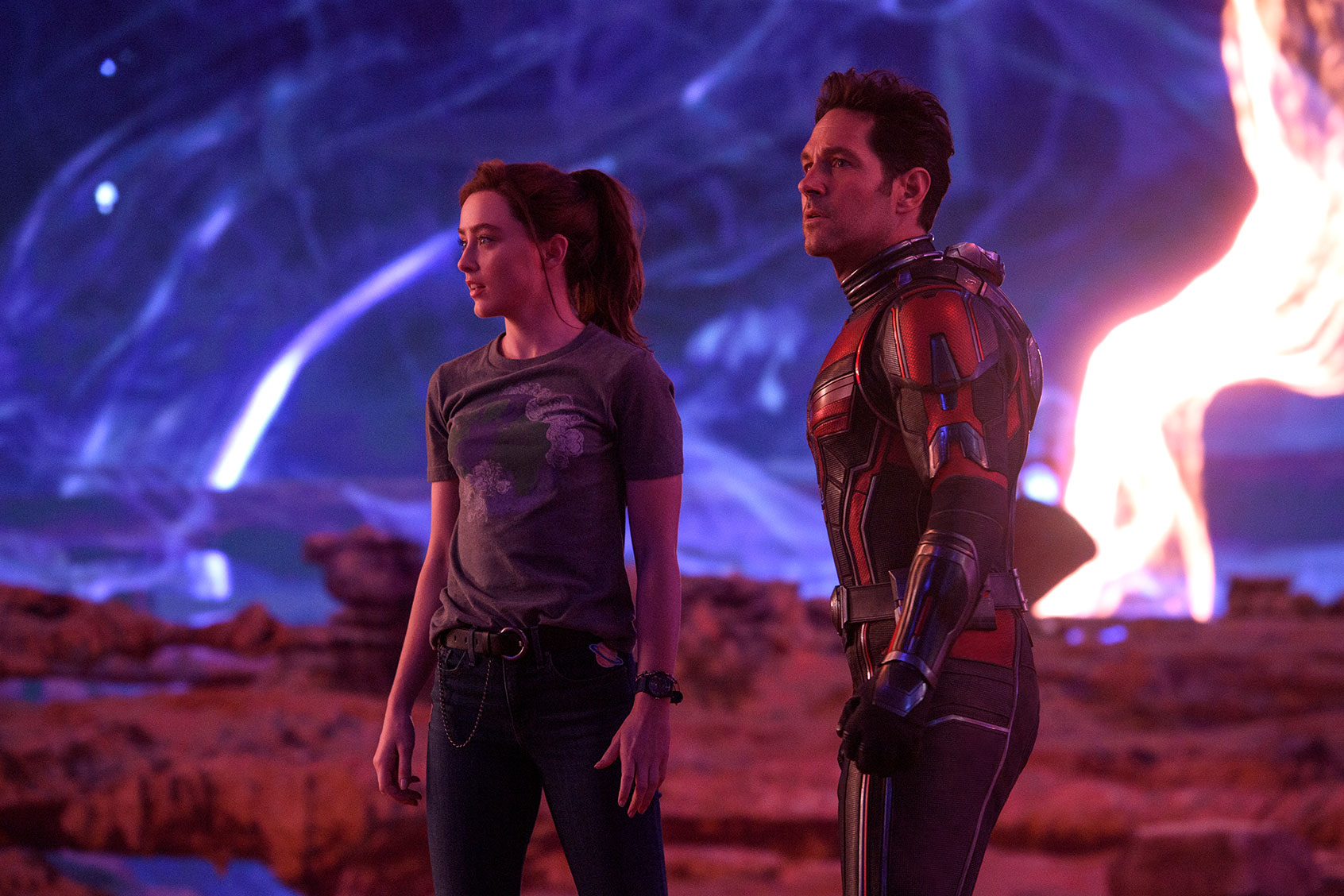
Ant-Man and the Wasp: QuantumaniaKathryn Newton as Cassandra "Cassie" Lang and Paul Rudd as Scott Lang/Ant-Man in "Ant-Man and the Wasp: Quantumania" (Photo by Jay Maidment/Marvel Studios)Hollywood has long operated under the assumption that geek culture is overwhelmingly male and content with a limited breadth of stories, many of them either starring or related to Batman or Superman. It’s easy to understand why that is — they’re classic, reliable figures. Your father’s and grandfather’s guys.

And your fathers and grandfathers are still the main audience for these movies. Consider the demographic breakdown for “The Marvels” opening weekend, as reported in the Wrap: the audience skewed 61% male and 39% female. (Where were the ladies? Probably home on the couch.)

The age breakdown of “The Marvels” audience, as reported in Deadline’s post-mortem, is more telling. The trade says 45% of the movie’s opening weekend audience were men over 25, with 22% made up of women over 25.

Unknown is how many people in the older audience that showed up in force for most of the “Avengers” saga know who Ms. Marvel and Monica Rambeau are. It’s not as if they needed to watch any TV shows as a prerequisite to enjoying Marvel’s previous blockbusters. So, for example, when Kamala showed up to propose a partnership with Hailee Steinfeld’s Kate Bishop at the end of “The Marvels,” the anticipatory "oooh" of that tease only sparks if you recognized Steinfeld’s archer from “Hawkeye,” Jeremy Renner's Disney+ vehicle.

HawkeyeHailee Steinfeld as Kate Bishop in "Hawkeye" (Photo by Chuck Zlotnick/Marvel Studios)Marvel plugging Harry Styles into the end of "Eternals" makes more sense; most of the audience might not know who Starfox is but most Olds recognizes Styles as a Millennial foxy star who the children are here for, and who is here for the children.
We need your help to stay independent

Here is where we could dive into the argument that audience size doesn’t often correlate with quality – and in the view of many critics, including this one, “The Marvels” is a lot of fun and worth seeing. Opinion is subjective, so let’s look at another pertinent data point instead. When “Ms. Marvel” debuted last year, technology analytics company Samba TV found it to be the most popular MCU series to date (in 2022) among viewers between the ages of 20 and 24, and in Black, Hispanic and Asian households.

Then consider that men under 25 made up only 20% of the audience for “The Marvels,” with women under 25 comprising 14% of the bodies in theater seats, per Deadline. As to why Gen Z didn’t show up to theaters in force last weekend, there could be a few answers. For one, most younger consumers prefer to stream their screen content on personal devices, whether that means their phones, tablets, computers or TVs. These days they’re also as likely to consume them in bites on TikTok as they are to sit in front of a TV screen.

The core audience to whom Marvel and DC aggressively catered over the last 20 years probably hasn’t spent time much with these women.

That Morning Consult poll gives additional context, in that it found that while Gen Z may be the second most engaged Marvel fans after Millennials, they are far fewer of them. Its Gen Z poll respondents topped out at 9% compared to  Millennials (40 %), Boomers (26%) and Gen Xers (25%). No shock there. Older generations have been worshipping at Marvel’s altar to varying degrees of passion since childhood. Spider-Man, The Incredible Hulk and Thor were introduced in its comics in 1962, followed by Tony Stark and Iron Man in 1963. Spidey and The Hulk also starred in TV shows in the '70s and '80s.

Captain Marvel is only a few years younger than the other Avengers in concrete chronological terms, in that Carol Danvers was introduced in 1968. (All the Avengers are children next to DC’s Superman, a character that’s been flying since 1938, with DC introducing Batman in 1939 and Wonder Woman in 1941.)

Kamala Khan is only 10, first appearing in 2013. Monica Rambeau, the second sister in “The Marvels,” is middle-aged by comparison having debuted in 1982. In effect, the core audience to whom Marvel and DC aggressively catered over the last 20 years probably hasn’t spent time much with these women.

Moviegoers between the ages of 25-34 made up the largest share of the audience for “The Marvels” at 33%, according to Deadline. And while most of that audience is white, 58% of the movie’s opening weekend audience identifies as Latino or Hispanic, Black or Asian.


Want a daily wrap-up of all the news and commentary Salon has to offer? Subscribe to our morning newsletter, Crash Course.


People are indeed tired of being served the same kinds of tights-and-flights stories several times a year – which “The Marvels” is not, to be clear – but that doesn’t mean we won’t eventually watch them. At home.

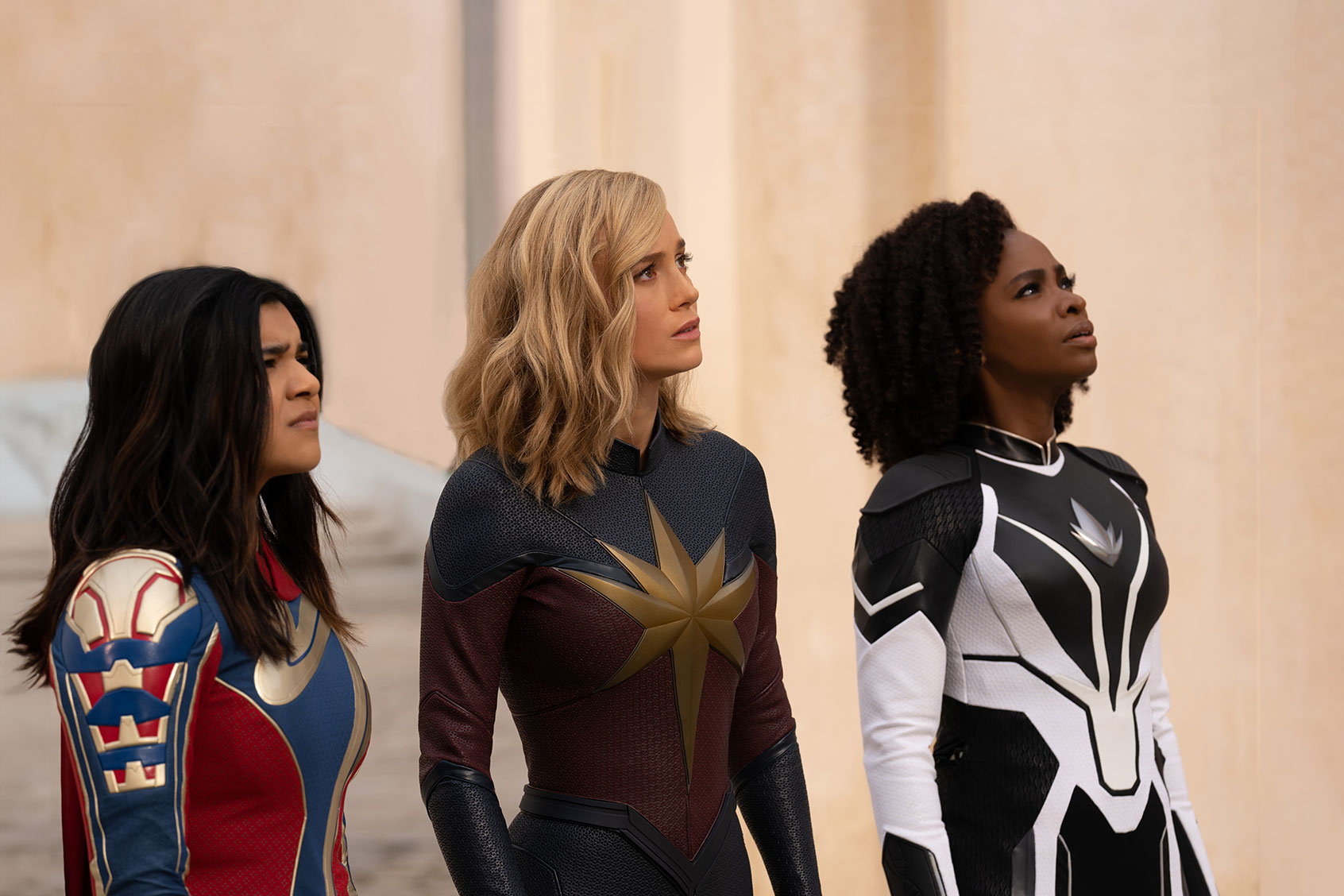
The MarvelsIman Vellani as Ms. Marvel/Kamala Khan, Brie Larson as Captain Marvel/Carol Danvers, and Teyonah Parris as Captain Monica Rambeau in "The Marvels" (Laura Radford/Marvel)Based on numbers beyond box office totals, it would be foolhardy to write off “The Marvels” entirely a week after its release. While it may not turn a huge profit for Marvel, word of mouth may coax more people into theaters in the coming weeks, and it's sure to find a warmer welcome in the video on demand market.
What we may be seeing is the turning point at which the studio realizes that the same gravitation pull that drew Marvel fans to theaters over the last quarter century is getting old, quite literally, and flying past filmgoers who have more in common with Kamala than Carol or even Monica.

One day “The Marvels” may be viewed as an early bet on the future whose dividends eventually paid off. But that can only come true if this genre’s keepers have the patience and will to meet the next generation on its turf instead of reheating predictable battles using old tactics.

"The Marvels" is out in theaters now.


Experts: Audio of Trump interview for new book could backfire in court — especially if he testifies

A newly released recording of Donald Trump discussing his interactions with his Secret Service detail as his supporters stormed the Capitol on Jan. 6, 2021, could be entered into evidence in special counsel Jack Smith's federal election interference case, a former federal prosecutor says.

In the audio, which comes from a March 2021 interview with ABC News' Jonathan Karl for his new book, Trump brags that he would have been "very well-received" by the crowd of rioters that showed up on the day the results of the 2020 presidential election were to be certified.

"Don’t forget, the people that went to Washington that day, in my opinion, they went because they thought the election was rigged," Trump told Karl per HuffPost. "That’s why they went.”

Speaking with CNN's John Berman, former federal prosecutor Jennifer Rogers predicted the new audio would lend support to special counsel Smith's federal criminal case against the ex-president in Washington, D.C.

"They have charged him, of course, with this vast conspiracy to effectively steal the election," Rogers told Berman. "They didn't charge him with the insurrection itself per se, but this is all evidence of that conspiracy, right, because the insurrection of course was the last ditch effort to stop Congress from certifying the vote.

"So the fact that he's recorded saying, basically, I knew that these were my supporters — they were there to do what I wanted them to do to stop the certification, is good evidence of his participation," she continued.

Berman agreed, explaining that Trump seemed to have a solid grasp of the violence occurring at the Capitol on Jan. 6 considering that he suggested he could have quelled the insurrection. Berman also underscored the political impact of Trump's apparent understanding and prompted Rogers to dive into its legal value.

"Yeah, I mean, the notion that he sat on his hands while watching TV and did absolutely nothing, knowing that they were there to do what he wanted them to do, and didn't do anything to stop the violence going on at the time is a pretty persuasive point about his bad actions," Rodgers responded.

The former president ultimately ended up in the White House at the time of the Capitol attack and did nothing to stop or intervene in the riot for 187 minutes, instead opting to view the insurrection via TV coverage.

In the recording, Trump also lamented how the Secret Service did not allow him to go to the Capitol while falsely claiming that his Jan. 6 rally ahead of the insurrection was the largest crowd he had spoken to "by far."

"I was going to, and then Secret Service said you can’t, and then by the time… I would have, and then when I get back, I saw… I wanted to go back. I was thinking about going back during the problem to stop the problem, doing it myself,” said Trump, who told his supporters to go to the Capitol.

“Secret Service didn’t like that idea too much,” he added of his attempt to attend.

We need your help to stay independent

His newly released comments come after accounts that claim he tried to go to the Capitol personally in an effort that included an alleged physical altercation between him and Secret Services where he attempted to grab the wheel of his presidential limousine following the rally.

“I’m the f***ing president. Take me up to the Capitol now,” Trump said, according to ex-White House aide Cassidy Hutchinson's testimony before the House Jan. 6 committee.

Hutchinson also told the committee that Trump was angry about Secret Service magnetometers arranged at the rally site to keep armed supporters away. 

MSNBC legal analyst Lisa Rubin on Friday noted that the recording "is not evidence in the case yet, nor has it been brought to any court's attention" and it's unclear if special counsel Jack Smith would seek to use it as evidence.

"This not only corroborates Cassidy Hutchinson but, if you listen to what he said at the end of that, when he says 'When I got back to the White House, I wanted to go back,' we know, thanks to timelines and thanks to evidence that the January 6th committee brought out, that at 1:24 that afternoon, when he arrived back at the White House, he was informed that the Capitol had been breached," she said.


Want a daily wrap-up of all the news and commentary Salon has to offer? Subscribe to our morning newsletter, Crash Course.


"For him to say now that he wanted to go back, and yet there's 187 minutes of inaction, is somewhat at odds with itself," Rubin added. "If Donald Trump were to take the stand in this case, I would expect prosecutors to use that tape to impeach the credibility of his testimony."

Karl's book, “Tired of Winning: Donald Trump and the End of the Grand Old Party,” was released earlier this week and came with new revelations about the Trump administration, including that an ex-senior Trump official criticized the former president, deeming him a "traitor" and a "clear and present danger."

The ABC News Chief Washington correspondent also described in the book that Trump believed a conspiracy theory claiming he'd be reinstated as president in the months after his first term in office, a theory that his former attorney Jenna Ellis shut down in 2021

The 8 biggest Kardashian family bombshells from Peacock’s “House of Kardashian” docuseries

In 2007, the Kardashian-Jenner family first stepped into the entertainment arena with their reality television series “Keeping Up with the Kardashians.”  It followed the daily (albeit extravagant and ridiculous) lives of sisters Kim, Kourtney, and Khloé Kardashian; their half-sisters, Kendall and Kylie Jenner; their parents, Kris and Caitlyn Jenner; and, occasionally, their brother, Rob. “Keeping Up” was a huge success, and so were the Kardashians and Jenners.

Much of that success can be credited to the family’s 68-year-old matriarch, who married into wealth and later, spent years chasing fame and stardom. Kris always had an eye for high fashion, glitz and glamour. After all, she opened her own children's boutique in 2004, launched her own clothing line in 2011 and currently runs her own production company, called Jenner Communications. But she also had a knack for stirring up the hottest gossip. The Kardashians have always been at the center of controversy, which proved more beneficial than detrimental for them.

The rise of the Kardashian-Jenner dynasty is explored in Peacock’s three-part docuseries “House of Kardashian,” which examines the family’s key players (notably Kris and Kim) and features interviews with Caitlyn Jenner along with the Kardashians' closest acquaintances. 

None of the Kardashians nor the Jenner offspring agreed to be featured in the documentary.

Here are the eight biggest bombshells from “House of Kardashian”:

01
Kris Jenner was more concerned about finding an eligible bachelor than joining the workforce
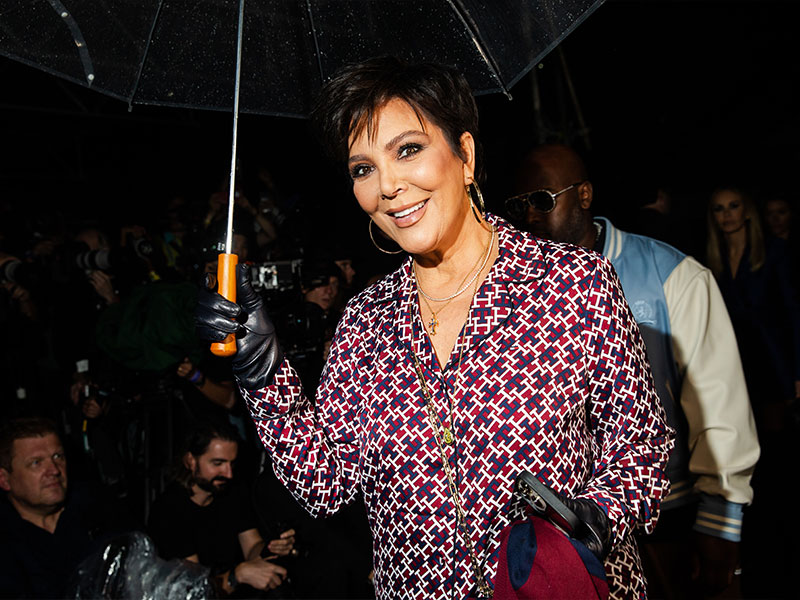
Kris JennerKris Jenner at Tommy Hilfiger Fall 2022 ready to wear runway front row at the Skyline Drive-In on September 11, 2022 in Brooklyn, New York. (Lexie Moreland/WWD via Getty Images)
Amid the women’s liberation movement, more women were breaking into the workplace. But Kris remained focused on finding an eligible bachelor, the documentary said when discussing her early life. 


According to Heather McDonald, a friend of Kris, the Kardashian/Jenner matriarch always “wanted a really fabulous life” and was “always looking for eligible guys” to marry.  


“People would perceive her being wealthier than what she was because she dressed nice and she always looked good,” said Alfred Garcia, Kris’ ex-boyfriend and professional photographer. “And she was stylish in her clothing, even back then. Her set goal was to find that person who had the connections and had the money ready.”


While working as a flight attendant for American Airlines, Kris met her first husband, high-profile attorney and businessman Robert Kardashian. The couple tied the knot on July 8, 1978 and had four children together: daughters Kourtney (born 1979), Kim (born 1980), Khloé (born 1984), and son Rob (born 1987).


In March 1991, the pair called it quits after Robert Kardashian hired a private detective and discovered that Kris was having an affair with a 24-year-old soccer player.


“She told me Robert didn’t want to be generous and didn’t want to keep her in the lifestyle that she had become accustomed to,” McDonald said. “There was no prenup to protect her, and he was a very smart lawyer. It was not pleasant.


“That time was very scary for her.”

02
Kris married Caitlyn Jenner a month after her divorce from Robert Kardashian
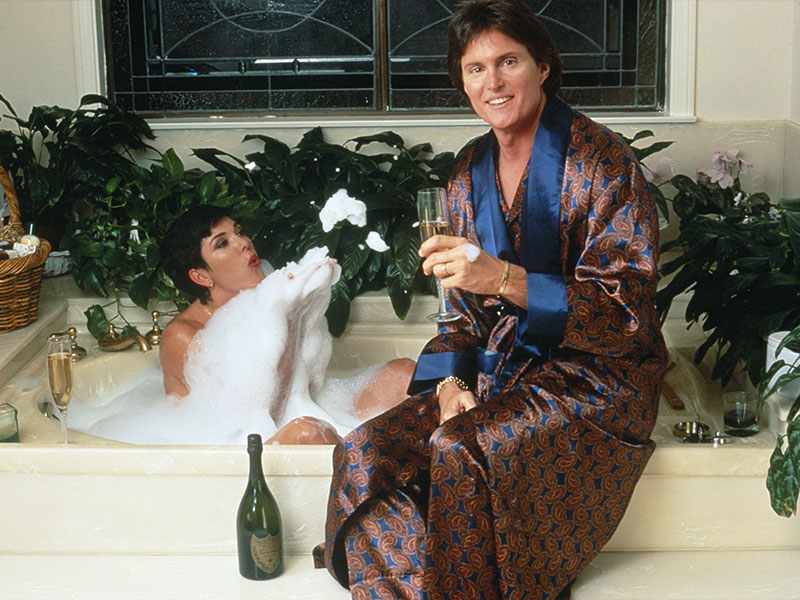
Bruce Jenner; Kris JennerUS athlete Bruce Jenner and his partner Kris Jenner, formerly Kris Kardashian, share a bottle of Dom Perignon over a bubble bath, circa 1991. (Maureen Donaldson/Getty Images)
The retired Olympian tied the knot with Kris in April 1991, just one month after Kris’ divorce from her first husband. Together, the couple have two daughters: Kendall (born 1995) and Kylie (born 1997). Kris also has four stepchildren: Burt, Cassandra "Casey," Brandon and Brody.


The Jenners announced their split in Oct. 2013, and on Sept. 22, 2014, Kris filed for divorce, citing “irreconcilable differences” as the reason for the breakup.


During a 2015 “20/20” interview with Diane Sawyer, Caitlyn Jenner publicly came out as a transgender woman and officially changed her name.

03
The Kardashians' ex-nanny once walked in on Caitlyn wearing nothing but women’s lingerie
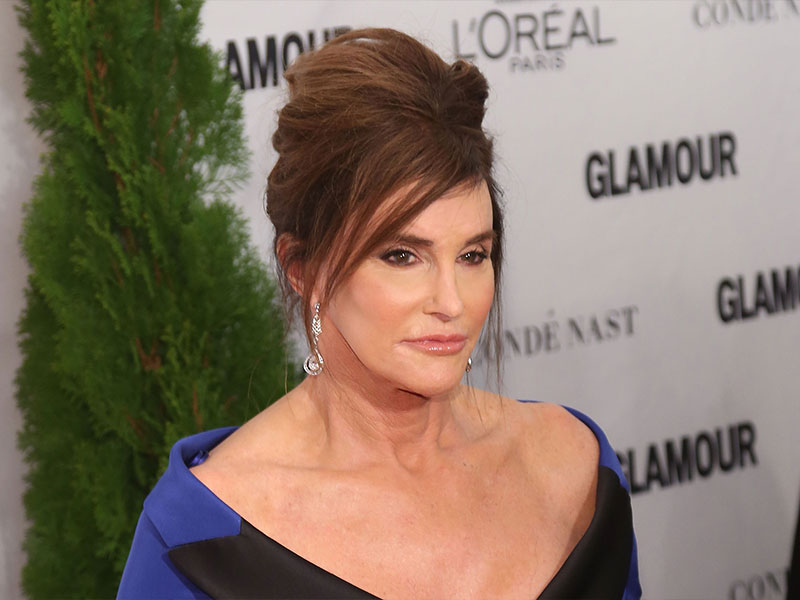
Caitlyn JennerOlympic gold medalist Caitlyn Jenner attends Glamour's 25th Anniversary Women Of The Year Awards at Carnegie Hall on November 9, 2015 in New York City. (Taylor Hill/Getty Images)
During the 1981 HIV/AIDS epidemic, rumors about Caitlyn's sexuality began circulating. Caitlyn said she struggled with gender dysphoria and found it difficult to keep that aspect of her personal life a secret from the public.


Members of Caitlyn’s inner circle witnessed firsthand the lengths that Caitlyn went to hide her true self and identity. In one instance, the Kardashians' former nanny Pam Behan recalled walking in on Caitlyn wearing nothing but a pair of women’s panties.


“When I was working for [them], one day when I poked my head in  . . . [they were] in nothing but women’s lacy underwear. Now, keep in mind I’m 19, I’m fresh off the farm, I was like, ‘What is going on here?’ I was very confused,” Behan said. 


She continued, “This is my all-American hero. I went to the bathroom just to collect myself, and on the counter was fake eyelashes. Moments later, [they were] right behind me and . . . more or less said, ‘Basically Pam, inside I feel more like a woman than a man and I have ever since I was about five years old.’”

04
Kourtney Kardashian’s ex-fling made millions off of exploiting women
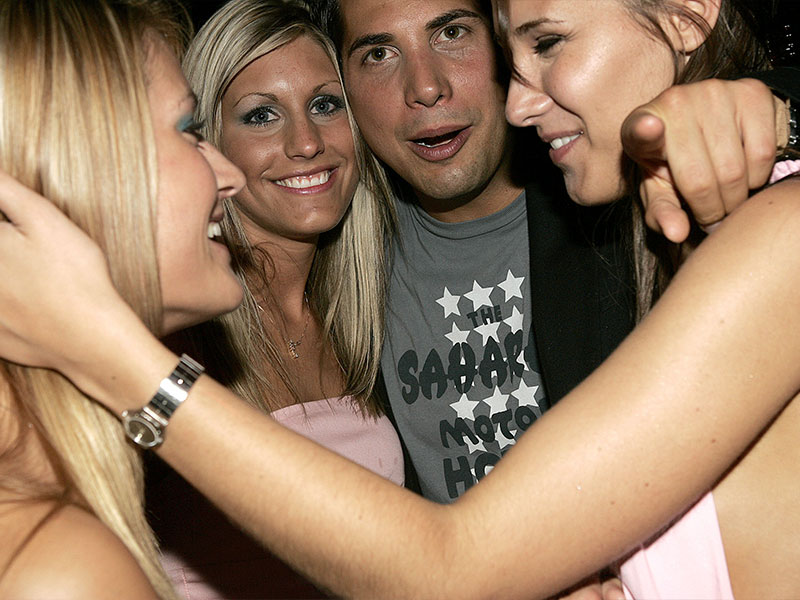
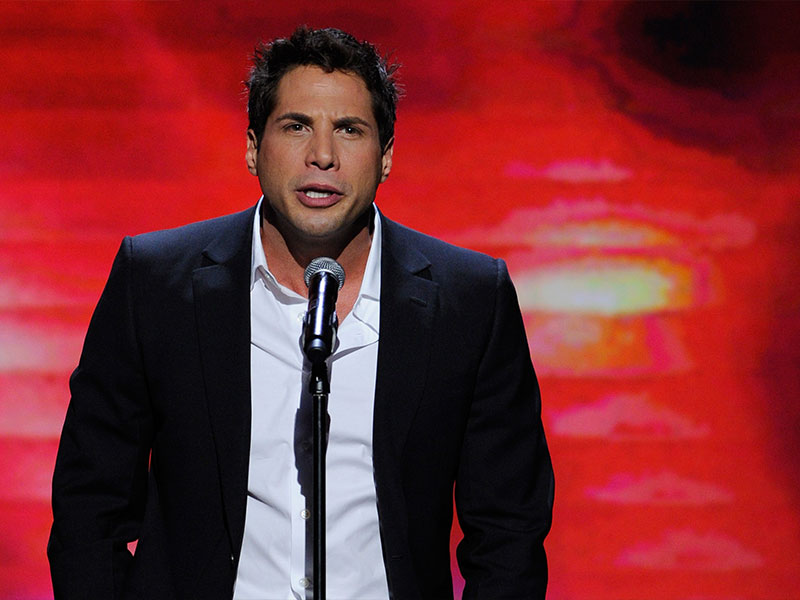
Joe FrancisJoe Francis and guests during Maxim Magazine Hot 100 Party at Hard Rock Hotel & Casino in Las Vegas, Nevada, United States. (Chris Weeks/WireImage for Bragman Nyman Cafarelli/Getty Images)
Kourtney was once romantically linked with Joe Francis, who created the infamous adult entertainment franchise "Girls Gone Wild," which posted videos of its film crew interacting with women who willingly took off their clothes, engaged in sexual acts or participated in wet T-shirt contests at parties, the club or other public events. Those who took part in "Girls Gone Wild" were occasionally invited to be filmed on an exclusive Girls Gone Wild tour bus.


"Girls Gone Wild" gained popularity through its late-night infomercials that first aired in 1997. According to Francis himself, "Girls Gone Wild" sales were “astonishing” because the company’s videos and DVDs were “outselling Disney titles.”


“'Girls Gone Wild' is girls doing things that they definitely regret when they’re older. A lot of men made a lot of money off of literally the backs of young women,” said Rachel Sterling, a former friend of Kim Kardashian. “And then they all tell us that we’re empowering ourselves.”


Sterling added, rather sarcastically, “I love when men decide what is empowering for women! That’s so amazing that we have someone like Joe Francis to shine the way for us. So, thank you Joe, thank you so much because otherwise, I wouldn’t know what to do with my bits.”

05
Kim’s bombshell sex tape was allegedly leaked by both Kim and her mother
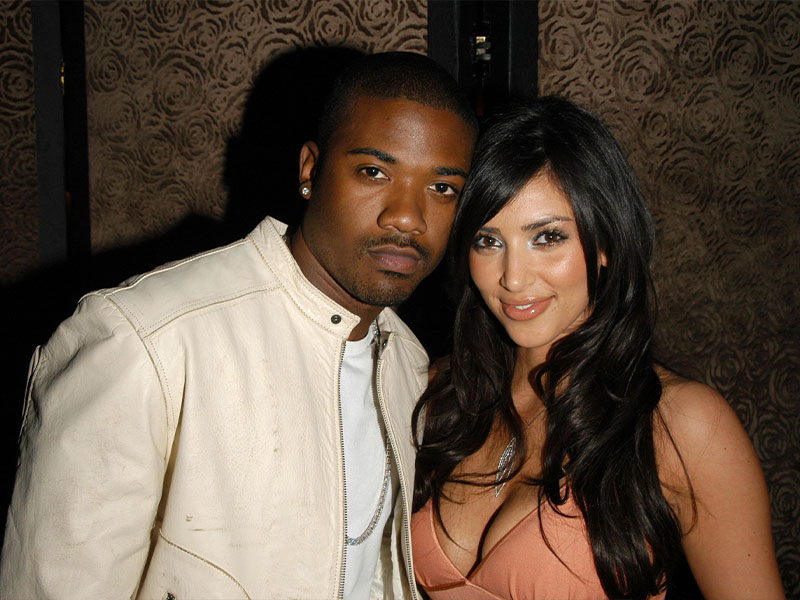
Ray J and Kim KardashianRay J and Kim Kardashian attend Charlotte Ronson Fall/Winter 2006 Collection at Library Bar on March 22, 2006. (Stefanie Keenan/Patrick McMullan via Getty Images)
Kim’s sex tape with R&B singer Ray J became public knowledge when Kim and Kris were in the process of pitching a reality show to TV executives. Although Kim and Kris alleged the tape was leaked, members of the Kardashians' innermost circle alleged that the mother-daughter duo willingly released the tape to catapult their family name and business to the next level.


David Weintraub, an executive producer, celebrity manager and family friend of the Kardashians, claimed that Kim told her mother that she was thinking about releasing a sex tape. Kris was on board with the idea and later, became the sole person to put together a deal and manage the release of the tape.


Kris also reached out to "Girls Gone Wild" creator Joe Francis, who deliberately circulated the tape per Kris’ instructions. Francis asserted that the tape was ultimately leaked by both Kim and Kris, who he said were “a consenting couple.”


“This was the first celebrity, interracial sex tape,” Francis said. “That could be seen as taboo today! There’s nothing like controversy to create an empire.”


Kim and Kris confronted rumors about the leaked sex tape in a prime time interview with Oprah Winfrey. They both denied any involvement in leaking the tape.

06
Amid Rob Kardashian’s revenge-porn saga, his sisters didn’t speak out about #MeToo
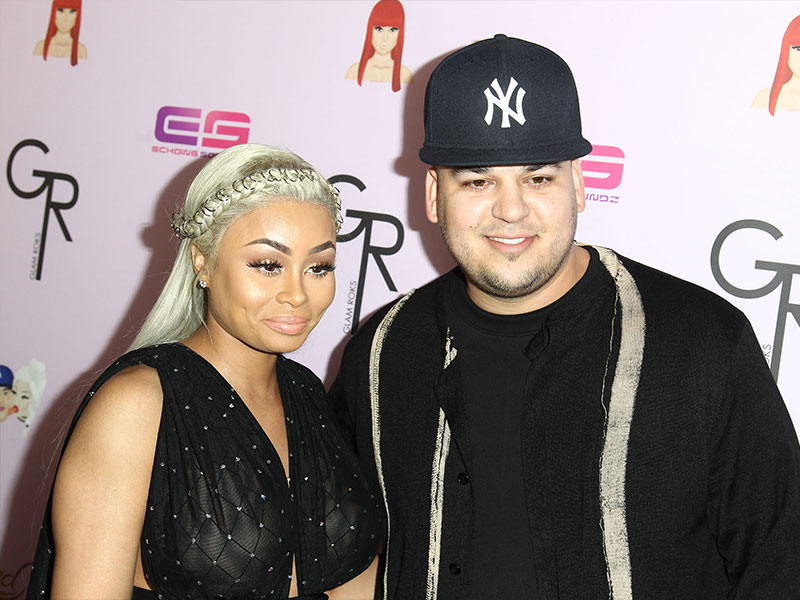
Model Blac Chyna and Rob KardashianModel Blac Chyna and Rob Kardashian attends Birthday Celebration on May 10, 2016 in Hollywood, California. (Leon Bennett/FilmMagic/Getty Images)
In July 2017, model and television personality Blac Chyna obtained a restraining order against her ex-partner Rob Kardashian after he leaked explicit images of her on social media. Chyna’s lawyer at the time accused Rob of violating California’s revenge porn laws. Her lawyer once again brought up the explicit photos amid her defamation case against the Kardashian family. Chyna accused Kris, Kim, Khloé and Kylie of playing a role in canceling her reality series “Rob & Chyna.”


Rob’s revenge porn lawsuit and defamation case took place in the wake of the #MeToo social movement. The Kardashian women, who were always in the limelight, were mum during the viral movement. 


“The Kardashian case probably stopped the Kardashian women from speaking out about Me Too. And they didn’t. It’s not really their brand,” said Chyna’s attorney Lisa Bloom. “They may see it as unsexy, unappealing. How are you gonna sell makeup and underwear if you’re talking about sexual abuse? 


“But also, the other explanation may be they just don’t care. I don’t see them necessarily as feminists. I don’t see them as advocates for women. I see them as advocates for themselves.”

07
Joe Francis has been convicted of a slew of crimes
Joe Francis"Girls Gone Wild" founder Joe Francis presents an award during the 29th annual Adult Video News Awards Show at The Joint inside the Hard Rock Hotel & Casino January 21, 2012 in Las Vegas, Nevada. (Ethan Miller/Getty Images)
When asked to list all his criminal offenses, Francis refused to do so. The documentary listed them all out instead. 


“Joe Francis has been convicted of the following crimes: Child abuse and prostitution, criminal contempt, false imprisonment, dissuading a witness and assault causing great bodily injury.” 


All Francis had to say was this: “Any allegation about me that’s out there, it’s not true. They’re allegations.” He added that the Kardashian family chose to stand by him for years because he had done the same for them.


“There’s no taking them down,” Francis said.

08
Caitlyn Jenner said no one else can do what her family has done
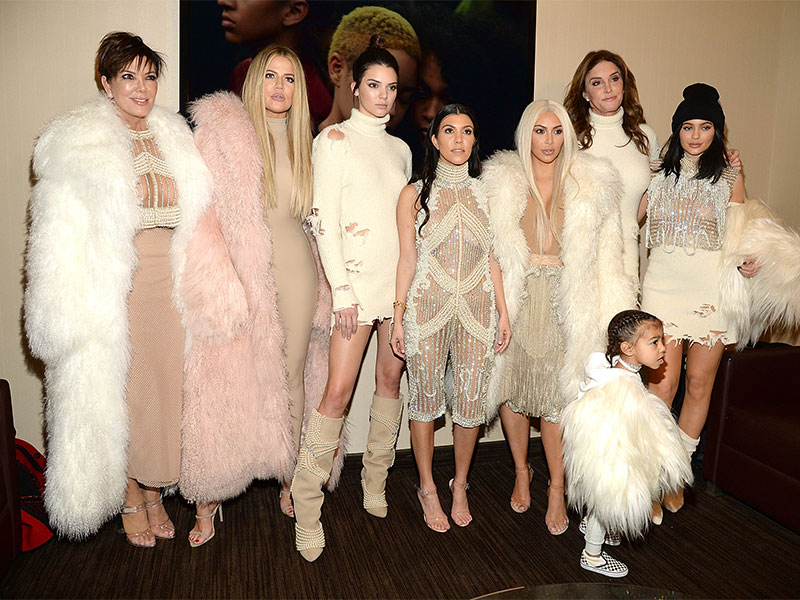
Kardashian family womenKhloe Kardashian, Kris Jenner, Kendall Jenner, Kourtney Kardashian, Kim Kardashian West, North West, Caitlyn Jenner and Kylie Jenner attend Kanye West Yeezy Season 3 at Madison Square Garden on February 11, 2016 in New York City. (Kevin Mazur/Getty Images for Yeezy Season 3)

“They’re like a team . . . a team to be reckoned with,” Caitlyn said of her children and ex-spouse. “Could any family do what our family has done? No.”


The Kardashian-Jenner dynasty’s net worth is currently over $2 billion, the documentary noted.

"House of Kardashian" is currently available for streaming on Peacock. Watch a trailer for it below, via YouTube:


Scientists warn of catastrophic sea level rise, unless major climate change action is taken

As the world's ice sheets melt, they cause the Earth's sea levels to rise, putting billions of people at risk for flooding and displacement. The only question is how much time humanity has to arrest climate change and thereby halt or even reverse this process. Now a group of policy experts and researchers known as the International Cryosphere Climate Initiative have released a report that offers a disturbing answer to that question: People have much less time than initially thought.

The report warns that ice sheets and ice shelves are melting much more rapidly than previously believed and concludes that if the average global temperature winds up landing at 2º Celsius above preindustrial levels, sea levels may rise by more than 40 feet.

“We might be reaching these temperature thresholds that we’ve been talking about for a long time sooner than we were thinking about years ago,” Rob DeConto, the director of the University of Massachusetts Amherst School of Earth & Sustainability and an author of the report, told NBC News. He added that thresholds are lower than was first assumed. Even if this outcome is avoided, a certain degree of climate change-caused sea level rise is baked into humanity's future.

"Sea level rise from our past of heat trapping emissions is really baked in for the next few decades," climatologist Dr. Twila Moon, the deputy lead scientist at NASA's National Snow and Ice Data Center, told Salon in August. "We are going to be seeing sea levels rise for the next several decades."

“These indictments are critical to our history”: MSNBC’s Ali Velshi talks Donald Trump

MSNBC host Ali Velshi really wants you to read the 91 criminal counts in the four indictments against Donald Trump. In fact, he has edited and introduced an entire book about them, with the straightforward title, “The Trump Indictments: The 91 Criminal Counts Against the Former President of the United States.”

Full disclosure: Velshi is a longtime friend, and we recently had a conversation for "Salon Talks" where he made a compelling argument aimed at every American: “Take a few hours out of your life” to read the Trump indictments so you can fully “understand the narrative, the granularity and the number of people involved.” Obviously Velshi understands that some people won't read his book or the underlying court documents — Trump's core supporters, first and foremost — but he hopes that ultimately even some of them will begin to grasp the scope of the charges against their hero, even if they don’t agree with any of them.

Velshi and I also discussed the role the media will, and should, play in the 2024 election. We are all aware of the role played by mainstream media, and cable news in particular, in lavishing attention on Trump in 2016. Velshi says his philosophy, with regard to his own MSNBC show, is that it's irresponsible to ignore Trump entirely, but “you have to curate” video clips from Trump's interminable speeches so that the multiply-indicted former president doesn't just get free air time to spew his talking points. Velshi says he's committed to spotlighting the moments when Trump “says something that sounds like Mussolini." And he's doing that, as we both agree, more and more. 

Velshi has been among the most consistent media voices highlighting the GOP’s efforts to ban books in various states and localities — or at least to remove them from school libraries and curricula — with a reoccurring segment dedicated to this subject. One silver lining to the GOP’s efforts to restrict academic freedom, he says, is that many citizens have been inspired to get involved in school board elections, largely in order to stop the efforts of Moms for Liberty and other groups that seek to impose their right-wing belief system on public education and the entire society.

Returning to the subject of his book, Velshi told me that “no matter what the outcome of these Trump trials will be, America should be stronger at the end.” If you have your doubts about that, he feels those too: “Not all of me believes that," he said, "but some of me believes that.” As with the outcomes of Donald Trump’s various criminal and civil trials, we won’t know the outcome for some time. Watch my "Salon Talks" interview with Ali Velshi here or read a transcript of our conversation below, edited for length and clarity.

I should note that this interview took place shortly before the Oct. 7 Hamas attacks in Israel, which is why we didn't discuss that event or the current war in Gaza.

You wrote the introduction to a new book that describes the indictments of Donald Trump in various jurisdictions. What compelled you to do this?

When the first indictment came out, the Manhattan indictment, one of my colleagues suggested that we read it as a podcast, as part of the "Prosecuting Donald Trump" series we have. I certainly didn't think it was going to become a thing, and it really became a thing. There are a lot of people in this country who use podcasts and audio to get their information, so if they're driving or running or whatever, they wanted to hear it. As the other three indictments came down, I started reading them the same way. They did very well. 

We realized that people need a reference point. There are four criminal trials at the moment, 91 indictments, and you're going to want to see what they are as these things go along. So it's a guidebook. It's a roadmap. 

"This wasn't Rudy Giuliani booking the wrong place for a press conference with hair dye streaming down his face, looking like they all got out of a clown car. This was much more serious."

I am not one to think most people need to read legal documents, but these days I am. I think these indictments are critical to our history. Whatever the outcome is, it will affect our history. I even read the Constitution, by the way, for my "Banned Books" podcast. Because while the Constitution isn't banned, Donald Trump, you will recall, suggested suspending it. 

My general view is: Just read these documents. It'll take a few hours out of your life, but at least you will understand what is charged, you'll understand the narrative, you'll understand the granularity, you'll understand the number of people involved and you'll come away understanding that this wasn't Rudy Giuliani booking the wrong place for a press conference with hair dye streaming down his face, looking like they all got out of a clown car, because that's the impression you might have. This was much more serious. This was a real effort to undermine democracy and not count votes and make votes not matter. The underpinning of our democracy was actually threatened by the people who have been charged. That's why I wanted to put my name on this and have it out there.

Do you think Trump supporters will ever read this?

I don't know. I hope so. I mean, in the introduction I certainly didn't write anything that should offend anybody. No matter your sensibilities or who you think is right or wrong, these are just indictments. There has not been a trial. There have not been jurors selected. The trial may go in Donald Trump's favor. He is to be presumed innocent until tried by a jury of his peers, and I'm worried, on a daily basis, that the prosecution or the judge will have a misstep that will allow people to say, this isn't fair. If you are going to try the former president of your country who wants to be the president again, this needs to be super, super fair. 

So many people lose faith in the idea that it's a terrible thing for America that we've had to do this. This means our democracy is coming apart. Actually, in countries that have tried leaders, presidents, political leaders or former leaders, studies have indicated that they've come out stronger in the end for having tested the justice system and the political system, for having demonstrated that people will be held to account. No matter what the outcome of these trials will be, America should be stronger at the end. Not all of me believes that, but some of me believes that.

You write in your introduction that America is the gold standard in terms of democracy.

Or at least there are many people in the world who believe that to be true, including Americans. This is the test of whether that's actually going to be true.

Do you think the fact that Donald Trump has been charged with attempting a coup makes people around the world go, “OK, they take this seriously”? Because before that, what was the message to the world?

I think there are two views of this. You've got Vladimir Putin, who is sort of saying America is the laughing stock, but most people who watched the Trump years wondered about accountability. I would go to the Arab world where people would say, “This business about making your daughter this and your son-in-law that, that happens all the time here. We didn't think it happened for you.” 

"This is nowhere close to accountability for a lot of the bad things that Donald Trump did. These were the 91 counts that sophisticated prosecutors were able to say, we can probably win in court. That's it."

Remember, this is nowhere close to accountability for a lot of bad things that Donald Trump did. These were the 91 counts that sophisticated prosecutors were able to say, we can probably win in court. That's it. When you read these things, you'll realize there's stuff he's not charged with. There's also one very important thing he's not charged with, and it's on the second page of Jack Smith's indictment in the Jan. 6 case. He says that Donald Trump had every right to deny the outcome of the election. He had every right to lie about the outcome of that election. He had every right to challenge it in court, to ask for recounts, to have audits done, and he did all those things. Then it became something else. Then it became an effort to undermine democracy. This went from a “I'm protecting my rights as a candidate” into something entirely different, and only in reading these documents will that transition be clear.

You make a point that I think is so important. At first, on the right, people were defending him by saying, “Well, he was just talking about stuff.” But it became clear that this had nothing to do with words, it had to do with actions.

If he was just talking about this, there wouldn't be indictments.

You’ve also talked about section 3 of the 14th Amendment, which would disqualify anyone who's engaged in an insurrection from holding federal or state office. You've harped on a lot for a while. You've had a lot of different experts on your show to talk about it. What interested you in that?

I'm still talking about it, because I think at this point we have to exhaust all avenues for determining whether people who are involved in an insurrection can hold office. There's an interesting qualifier in the 14th Amendment, section 3, and that is if you have sworn an oath to the country, to the Constitution — and by the way, if you're American-born and were not in the military and don't have a government job, you may have never sworn an oath, so this might not apply to you. I am a naturalized citizen, so I swore an oath and I guess it applies to me.

We need your help to stay independent

The trick here is that it can only be enforced by someone who makes the decision to put your name on the ballot or not, which in most states is the secretary of state. Most secretaries of state with whom we've spoken have said, “I'm clearly not going to be the last word on how this goes down.” So it's going to go to court. It'll probably end up at the Supreme Court. There are a lot of people in this country who do not have faith that this Supreme Court will act in the best interests of this nation.

"We do not require people to go to the front and die for the preservation of their democracy. We only require people to know what's going on and vote, or help somebody else register to vote."

It is my view that we should dispense with this sooner than later. If this is going to be a thing, I don't want it being a thing next September or October as the election's coming up. I'd rather it be a thing before the first primary takes place. That's part of why I'm in on it, and I'm getting people like you and Judge Michael Luttig and Lawrence Tribe, who are all opining about where and how these things should happen. I think that it's not worth assuming that this is all going to work out in the courts and that someone's going to read the Constitution and say that Donald Trump is disqualified, or assuming that he runs and he loses.

I think all those things are pipe dreams. I think they're Democratic fever dreams. We have a tool that the Ukrainians do not have. We do not require Patriot missiles for incoming missiles. We do not require people to go to the front and die for the preservation of their democracy. We only require people to know what's going on and vote, or help somebody else register to vote. We need little things to be done, and I think everybody has to understand that it's battle stations on all fronts for democracy: voting, organizing to vote, understanding what's going on, reading the indictments.

You've just got to be smart about this. Every one of us knows somebody who thinks this is a witch hunt against Donald Trump, and you are not going to be equipped to argue with them unless you know about this. And you're right, I did mention the 14th Amendment because it's going to turn out to be an important discussion. Will Donald Trump be able to run for president? If he runs for president and wins, will he be able to assume office? It's a big, open question that still has to be determined.

On the 14th Amendment, people are going to say, "Well, let's not enforce it now." Then what happens with the 22nd Amendment, which says he can't do another term? Because that's not self-executing either.

Right. That is correct.

No one has ever litigated that. It's going to be a fight if he gets back in. Nothing in my being says he'll leave peacefully in 2029. He didn't leave peacefully in 2020.

He's told you about the things he's going to do. He has talked about doing away with the Constitution. He has talked about the things that he would do, including suggesting that Gen. Mark Milley, the former chairman of the Joint Chiefs of Staff, who is a witness in one of these cases,  because he was in the room where it happened, is guilty of treason and should be executed. Without any trial, he has decided that someone's guilty of treason and decided what the penalty for that should be, despite the fact that there have been people convicted of sedition who worked for him on Jan. 6.

Donald Trump's cognitive dissonance is amazing, but the rest of us shouldn't have it. The rest of us should not imagine that this is the year that it all changes, that Donald Trump, who has avoided accountability for all his life, is suddenly going to face the music on several fronts.

Let me ask you some questions about the media, because you and I are part of it. A lot of my listeners, and as you have mentioned, some of your viewers, don't want to hear about Donald Trump. For the longest time, I adhered to that. I didn't want to hear him either. But I don't think wishing him away, or wishing away any social ill, will cure it. At this point, how do you see your obligation or responsibility to your viewers?

I think you have to curate it. I play it every time Donald Trump says something that sounds like Mussolini. Where he says, “I am your retribution.” Mussolini said, “I am your avenger.” When he talks, he used to say, “Lock her up,” which I thought was well out of bounds in talking about somebody who hadn't been charged with a crime. “Lock her up” is almost quaint now. He talked about Milley getting capital punishment for treason. He talks about suspending the Constitution. He talks about the fact that there shouldn't be a speaker of the House who's unwilling to stop all funding for Ukraine, an ally fighting our greatest adversary. 

"Trump used to say, 'Lock her up,' which I thought was well out of bounds in talking about somebody who hadn't been charged with a crime. That's almost quaint now. He talks about Gen. Milley getting capital punishment for treason. He talks about suspending the Constitution." 

Donald Trump is saying all these things. "Draining the swamp" used to mean the deep state, the people who he claims existed in the civil service to serve their own interests. That was a lot of BS. Now it means something else. Now it means going after critics, people who are not sufficiently loyal, opposition members and the media and pretty soon everybody else.

It always starts this way. It starts with high-profile people. Rahul Gandhi, who is running against Narendra Modi, the prime minister of India, has been charged with some financial crime. In most of these countries, it's a tax thing. Maria Ressa, Nobel Prize winner, tax crimes. It's all tax crimes. That's how it goes. Because the average person doesn't know: If they charge me with a tax crime, well, maybe he didn't do his taxes right, maybe he did something wrong. That's how it starts. It's stochastic. It's the idea that you don't have to get the government to take Dean Obeidallah out. You just tell enough people where Dean Obeidallah lives and how he's not sufficiently patriotic and maybe he's an Arab and a Muslim and whatever. You just throw it all out there and let people do your dirty work. 

We have seen, in America, that people will do that dirty work. It's not an American thing, by the way. This happened everywhere. It happened in Italy under Mussolini. It happened in Germany under Hitler. It happened in Rwanda. It happened in the Balkans. You let people form their own opinions and make sure they have weaponry and they'll take care of it.


Want a daily wrap-up of all the news and commentary Salon has to offer? Subscribe to our morning newsletter, Crash Course.


I had very personal attacks when Trump was in office. I wrote an article criticizing his failure to denounce white supremacist terrorism in Charlottesville, and neo-Nazis fabricated tweets and said, “Go get him,” suggesting that I was involved in a terrorist attack in England because I'm Muslim, that kind of stuff. I sued them, because that's what you do to Nazis.

Well, you're good at that, you don't get scared by it. But the problem is people who see that may say, “I don't want to go through what Dean's gone through,” so people who have views protected by the First Amendment in this country, critical of Trump or supportive of Trump or whatever, who are going to make decisions to not run for office, to not be a journalist, to not ask questions, to not bring things up, to not write things, to not say them, to not tweet them. That's where democracy dies.

Is there a way that the average person can have an impact on media content and how issues are framed? 

There are lots of ways to frame an issue, and it might not be the one you use every time. I often refer to Donald Trump as the “twice-impeached, quadruply-indicted, failed former president of the United States.”

Understanding that is important, because reminding people that he's out on bail would make the penny drop when his staff seemed to be bragging about how he bought a gun. I don't know that many of my viewers or most people watching or reading this have been arrested or are on bail, but we watch “Chicago PD” or “Law & Order,” and you know that you probably can't buy a gun while you are under indictment, which is a fact. So you do have to curate and not normalize craziness. 

"You can't tune somebody out who is deliberately pushing the norms of your society, to the extent that it would have undermined democracy. You actually have to know that it's happening and say that it's happening."

That's the same thing with what's going on in Congress right now. With Donald Trump, you have to find ways because he's numbing. We're all numb to it. Nobody cares. I said to people, “Did you see that Donald Trump bought a gun or tried to buy a gun or said he bought a gun?” Most people hadn't because they've tuned Donald Trump out. You can't tune somebody out who is deliberately pushing the norms of your society, to the extent that it would have undermined democracy. You actually have to know that it's happening and say that it's happening. My view is, Donald Trump doesn't need to be on TV all the time. I get it: He grates on people. But he could be the next president of the United States, and at the moment he's becoming a martyr. We have to ensure that people understand the vitriol that comes out of his mouth, what it means and what he could do with it if he actually had power once again. I say power once again, but he seems to be the boss of Congress at the moment, right?

He almost seems to be president when you watch media coverage to be blunt, because Joe Biden is on, like, a little bit and then it's Trump, Trump, Trump, Trump, Trump. And then back to Biden, like, a story about him being old. 

People often say to me, “You should do more on Biden.” Now here's the thing: It's not the media's job to carry water for anybody. I am very clear on the fact that for the moment, there appear to be two people running for president. There's a whole bunch of Republicans and some independents, but basically it's Donald Trump and Joe Biden. It's not 340 million Americans. This is not a "choose your own adventure." It's one person who seems to be doing his presidential duties, and if we want to examine that, we can examine all the ways in which he seems to be doing them quite well, and another guy who doesn't seem to believe in democracy. That is entirely a binary choice. That's it.

You can talk about who you'd like for president. Those do not appear to be your options right now, so that's what you've got. I don't need to do PR for Joe Biden for you to understand that one of these guys is for democracy and the other one's not. That should be enough for an American to make their mind up. I'm not sure it will be, but it should be.

Do you think, in this day and age that the old ways for a president to get media coverage have faded because of the world we live in?

Yeah. Sure.

We've been changed by Trump. A president holding a press conference, like in the old days, doesn't get much press.

No, it's like the old days. That never got press. It only got press during Donald Trump's time because he was going to fire his secretary of state in that press conference accidentally or ban transgender people in the military. Donald Trump couldn't stay on message for anything. When he launched "infrastructure week," I don't know, three or four times, and we would cover it thinking that he was going to talk about infrastructure week, but then Kanye West would be involved. You never knew what was going to happen. With Joe Biden, you fully know how it's going to go.

So does Biden have to be more creative? Do Democrats in general have to be more creative in trying to get media coverage in this landscape?

I think Democrats have got to acknowledge the elephant in the room, and that is that Joe Biden's having trouble despite what he's doing. I can outline a lot of important things that he's doing on the economy and specifically with respect to Ukraine and dealing with international alliances and walking a tightrope with Israel and Saudi Arabia and India, three countries where I think we should be taking very strong lines, but he is smarter than I am and more experienced than I am, so he's doing it a different way.

"Joe Biden is an older gentleman who comes across to some people as older than he is. He's just a few years older than Donald Trump, but I think we can't ignore it. We have got to discuss what that means."

The elephant in the room is that he's an older gentleman who comes across to some people as older than he is. He's just a few years older than Donald Trump, but I think we can't ignore it. We have got to discuss it. We've got to discuss what that means and what the implications are. I think the choice remains binary, but it would behoove Democrats to figure out what a good answer is to that because I keep on meeting people who definitely don't want Donald Trump to be president, but say things like, "I'm worried about Joe Biden." Now, my general view is that Joe Biden comes across that way mostly when he is reading a prompter. When Joe Biden's talking one-on-one about things he knows about, he says what he believes.

Often the White House tries to walk hat back because he sometimes seems to say too much, but he's usually right when he talks about Putin being a war criminal, when he talks about what Xi Jinping is going to face, when he talks about Modi. So I would sooner see a little bit more Joe Biden unplugged because the most unplugged he's ever going to be is never going to be a problem when you're dealing with somebody like Donald Trump. I also think it doesn't pay for Joe Biden to get involved in any Donald Trumpy stuff. Trump will shoot himself in the foot or not, all by himself.

Right. It does seem like Biden is going to make the threat to democracy posed by MAGA his central theme in 2024. That's important.

He believes that. That's in his bones. That's not about Donald Trump specifically. Donald Trump is a piece of that, but the threat to democracy, I believe, is central. I think if he leans into that, that's important.

The MAGA movement, or the Republican Party in general, is doing something we haven't seen before, and that's banning books. You've been covering it on your show week after week, you have a podcast on that topic. First of all, can you believe where we are now? And how do you amplify this so people get that this is not normal?

Yeah, no. It is 1933 Germany, and I think people need to remember history, that when you start making people ignorant, you are shepherding them towards something dangerous. You know, my family's from South Africa. My father, when he first saw my banned book club — he texts me after every show — he said, growing up in South Africa, he didn't even know there were public libraries, because for nonwhite people, there simply weren't. They didn't bother to ban books. You just didn't get a library at all. You got what they told you you could read at school, and that was the beginning and the end of it. 

I will say this: Thank you to anybody from Moms for Liberty who is listening to this, because you have ignited people. You have caused regular people to understand their responsibilities as citizens, which is not all that complicated. As I said: Vote, register to vote. Show up at your parent-teacher meetings, show up at your school board meetings, run for school board, see who's running for school board and maybe give them 25 bucks or 50 bucks so someone else will know their name.

That's where it begins. They got smart by banning books at the very local level, and now people are getting smart by fighting banning books at the local level. I think the book-banners don't win this one.

“Wow!”: Trump gets schooled after whining that Biden won’t face charges over classified docs

Special counsel Robert Hur is not expected to charge anyone in his investigation into the mishandling of classified documents at two locations connected to President Joe Biden, two sources close to the investigation told CNN. Hur and his team are crafting a detailed report about the year-long probe that is expected to be critical of Biden and his staff for their handling of sensitive materials and go into extensive detail about the special counsel's findings. Investigators on Hur's team have informed other Department of Justice officials that they aim to complete the report by the end of the year, but that timeline could change. 

Former President Donald Trump raged on social media after learning of the CNN report, bemoaning a supposed double standard. "WOW! FAKE NEWS CNN, THROUGH A LEAK FROM THE DEPARTMENT OF INJUSTICE, HAS JUST REPORTED THAT NO CHARGES WILL BE FILED IN THE (MUCH BIGGER THAN MINE!!!) CROOKED JOE BIDEN DOCUMENTS CASE. WE ARE LIVING IN A VERY CORRUPT COUNTRY!" he wrote on Truth Social Friday morning.

Former U.S. Attorney Joyce Vance notes, however, that Biden's case — and that of former Vice President Mike Pence, who was also investigated for mishandling classified documents but left unscathed  — are very different from Trump's. "Trump was given every chance to return the documents after the National Archives realized they were missing. Biden & Pence both self-reported," Vance wrote on X/Twitter. "The biggest problem for Trump is his lengthy history of trying to hold onto documents when asked, even subpoenaed, for them."

“Kill people’s jobs? I don’t want to do that:” Kid Rock walks back on explosive Bud Light boycott

Following Bud Light’s short-lived social media partnership earlier this year with transgender influencer and activist Dylan Mulvaney, singer Kid Rock was one of the brand’s swiftest and harshest critics. His bombastic boycott of the beer, which launched a national whirlwind of transphobic rhetoric, inspired other conservative public figures — from politicians to other musicians — to condemn the brand. 

There were signs in the ensuing months that Rock’s stance on drinking Bud wasn’t perhaps as hardline as he publicly declared. In July, CNN reported that Kid Rock's Big Ass Honky Tonk & Rock 'n' Roll Steakhouse in Nashville was quietly serving the brand again. In August, the singer was seen drinking it himself. However, it appears he’s now publicly backing off the boycott.

On Nov. 16, according to Newsweek, Kid Rock told “Fox News” host Sean Hannity that he “didn't want to be in the party of cancel cultures and boycotts that ultimately hurt working-class people.” He said he’d reconsidered the boycott in light of his religious beliefs: “As a God-fearing man, as a Christian, I have to believe in forgiveness. They made a mistake, all right. What do you want, hold their head under water and drown them and kill people's jobs? I don't want to do that.” 

Kid Rock’s interview came just hours after it was announced that Anheuser-Busch InBev’s US chief marketing officer, Benoit Garbe, is stepping down at the end of the year amid a continued decline in Bud Light sales.

Trump takes victory lap on Truth Social by attacking judge and clerk right after gag order paused

A New York state appellate court on Thursday temporarily paused the gag order on Donald Trump and his legal team that barred them from attacking the principal law clerk of the judge overseeing his civil fraud trial — a move that prompted the former president to unleash his wrath on social media. According to The Messenger, New York Appellate Division Associate Justice David Friedman granted the stay on the gag orders considering the "constitutional and statutory rights" at issue, which Trump's legal team referenced to back their argument against the orders.

Not even an hour after the gag order was lifted, Trump's senior advisor called the law clerk a "Democrat Operative" on X/Twitter. The former president himself later derided her and New York Supreme Court Justice Arthur Engoron on Truth Social. "Judge Arthur Engoron has just been overturned (stayed!) by the New York State Appellate Division (Appeals Court), for the 4th TIME (on the same case!)," Trump wrote in part on Truth Social Thursday evening. "His Ridiculous and Unconstitutional Gag Order, not allowing me to defend myself against him and his politically biased and out of control, Trump Hating Clerk, who is sinking him and his Court to new levels of LOW, is a disgrace."

The former president went on to assail Engoron again in another, late-night post, also taking aim at New York Attorney General Letitia James, who brought the $250 million fraud lawsuit against him. Engoron imposed the initial gag order after Trump blasted his law clerk on Truth Social early in the trial and fined Trump a total of $15,000 for later violating the order. Trump's lawyers requested that the fines be struck down alongside the gag order, but only the order was paused. Trump maintains he committed no wrongdoing in the civil fraud case.

House GOP can’t do anything right — but they’re still on course to impeach Joe Biden

House Speaker Mike Johnson called an early recess for the Thanksgiving break on Thursday. Republicans need a rest. They were so punchy from all the infighting and name-calling that they just allowed a short term continuing resolution with no budget cuts to pass, mostly with Democratic votes, and couldn't even work up a good old-fashioned cry. There are a few diehards still shaking their fists on the Capitol steps and vowing never to let this happen again but nobody has the energy to cheer them on at this point:

The GOP obsession with "individual spending bills" instead of packaging it all together in "omnibus" legislation doesn't seem like the greatest idea at the moment: They can't even get their own draconian spending bills to the floor, much less pass them. So I'm not sure why a decent number of Republican hard-liners thought a government shutdown was going to shake anything loose. Not that it really matters. They haven't done any actual legislating since this Congress convened nearly a year ago. Why start now?

America is tired too — tired of their inane, infantile behavior. Many people are no doubt grateful to be spared any more of it for at least the next week or so. Unfortunately, these Republicans are ready to hit the ground running when they come back, with the only thing they actually know how to do: put on a circus sideshow to own the libs.

Johnson issued a statement this week suggesting that it's time to put the finishing touches on the most important priority of this Congress, impeaching Joe Biden:

At this stage, our impeachment inquiry has already shown the corrupt conduct of the President’s family, and that he and White House officials have repeatedly lied about his knowledge and involvement in his family’s business activities. It has also exposed the tens of millions of dollars from foreign adversaries being paid to shell companies controlled by the president’s son, brother, and their business associates. Now, the appropriate step is to place key witnesses under oath and question them under the penalty of perjury, to fill gaps in the record.

Well, except that in the realm of reality the impeachment inquiry has been a total bust. Most of what Republicans claim has been "exposed" was already known before they started. None of it showed corrupt behavior then, and it doesn't now. This business about "shell companies" has been debunked over and over again. The companies the Republicans imply are shady money-laundering entities, described by House Oversight Committee Chair James Comer, R-Ky., as "fake" companies that "don’t make anything … don’t produce anything … [and] don’t provide a good or service" are actual businesses with employees and everything. It may sound impressive to sling those important-sounding words around on Sean Hannity's show, but that doesn't make them true or meaningful.

Comer's committee has already subpoenaed thousands of documents and bank records. As far as we know, the only thing they've turned up is a $200,000 check from James Biden, paying back a loan to his brother — who held no public office at the time — which the House GOP would like to claim as evidence of some sort of criminal scheme. Apparently, Comer and company forgot to mention that the same bank documents show that Joe Biden's loan to James was made and then paid back within a matter of weeks, undermining any suggestion that it reflected some sinister plot concocted years earlier, when Joe Biden was vice president. (Indeed, it turns out that Comer himself has a history of six-figure transactions with his own brother, which have potentially significant tax implications, and Comer was infuriated when that was pointed out during a hearing on Tuesday.)

Last week the committee sent voluntary interview requests to several members of Biden's family, including Sara Biden, the wife of James Biden; Hallie Biden, the widow of Beau Biden, the president's late son; Elizabeth Secundy, Hallie Biden's sister; and. Melissa Cohen, the wife of Hunter Biden.

It has also summoned Tony Bobulinski, a shadowy former associate of Hunter Biden. He's the guy who, according to former Trump White House staffer Cassidy Hutchinson, wore a ski mask for a clandestine meeting with White House chief of staff Mark Meadows. We don't know if or when any of these people may appear before the committee.

We need your help to stay independent

Comer has also authorized subpoenas of Hunter Biden, James Biden and Rob Walker, another of Hunter Biden's business associates. They want Walker to appear on Nov. 29, James Biden on Dec. 4 and Hunter Biden the following week, perhaps as an early Christmas present to Donald Trump.

But if this testimony goes as poorly for Republicans as did the first and only hearing they have held, I won't be surprised if we end up with another brawl in the committee room. One Republican staffer called that event "an unmitigated disaster" and another said they had "botched this bad."

Even their biggest fans were not impressed:

In case you missed the excitement, Democrats on the committee ran circles around the GOP's so-called expert witnesses, who ended up admitting that there wasn't anywhere near enough evidence for impeachment and once again recited all the exonerating facts about Hunter Biden's business dealings in Ukraine. It got so bad that Comer said afterward that he didn't think there'd be a need for any more public hearings.

Speaker Johnson said recently, in a closed door meeting, that he wasn't sure it was necessary to continue with the inquiry at all, since Biden's popularity was already low, proving beyond a doubt that this whole enterprise is a purely partisan effort to damage the president's re-election chances. (You may recall that Kevin McCarthy's very first bid for the speakership fell apart, way back in 2014, for admitting the same thing about the Benghazi hearings and Hillary Clinton.)


Want a daily wrap-up of all the news and commentary Salon has to offer? Subscribe to our morning newsletter, Crash Course.


But House Judiciary Committee Chair Jim Jordan, R-Ohio, is refusing to give up, which is certainly on brand. He wants the chance to browbeat Hunter and James Biden on TV, so they're going to try to launch this overloaded rocket one more time. I wouldn't expect it to be any more convincing than the first, though it will get huge ratings on Fox News, where the prime-time hosts will be frothing at the mouth. And that, in the end, is the most important part of the job description for Republicans in Congress.

When all is said and done, Joe Biden will almost certainly be impeached. Of course they don't have enough evidence, but that really doesn't matter. It's conceivable that a few GOP members in swing districts, who fear losing their seats next year, might bail out and the vote will fall short, but I wouldn't count on it:

House Republicans may not be able to perform the most basic functions of governing, but they know that their de facto leader, down in Mar-a-Lago, demands his retribution. And they will do his bidding if they possibly can.


Chrissy Teigen and David Chang join forces in Hulu’s new food series “Chrissy & Dave Dine Out”

Chrissy Teigen and Momofuku restaurateur David Chang are gearing up to embark on a food adventure across Los Angeles. The duo, along with Joel Kim Booster, will star in the new unscripted series “Chrissy and Dave Dine Out,” in which they visit several acclaimed restaurants and engage in lighthearted conversations with their A-lister friends.

Teigen, Chang and Booster “will take viewers to must-try restaurants in Los Angeles that are unexpected and, at times, off the beaten path,” according to a press release for the show obtained by Billboard. “While David gets his hands dirty in the back of house with the restaurant’s chef, Chrissy and Joel will hold court in the front of house, hosting an always loose, unexpected and entertaining dinner party with undeniably delicious food and great conversation.”

Joining the trio will be a slew of handpicked celebrity guests, including John Legend, Teigen’s husband; Kumail Nanjiani, Regina Hall, Simu Liu and plenty more. 

The show’s first episode will spotlight Teigen, Chang and Booster enjoying pizzas and small plates at Pizzeria Bianco. Jimmy Kimmel will also guest star on the premiere alongside his wife, writer Molly McNearney.

“Chrissy and Dave Dine Out” is slated to premiere on Hulu on Jan. 24 at 10 a.m. ET.

Watch a teaser for the series below, via YouTube:

Red Cup Rebellion: Starbucks workers at hundreds of locations stage strike, walkout

Thousands of workers at more than 200 Starbucks locations nationwide went on strike Thursday in what organizers describe is the largest-ever strike in Starbucks history. Dubbed the “Red Cup Rebellion,” the day-long walkout took place on the company’s “Red Cup Day” promotion, which is one of the most infamously understaffed days for Starbucks baristas.  

Starbucks Workers United said workers at the multinational coffee chain are demanding improved staffing and fair labor practices. The union added that it was expecting more than 5,000 workers to participate in the strike, according to the Associated Press. Around 30 stores also staged walkouts on Wednesday.

Nearly two years after the union won its first representation vote at a New York-based Starbucks store, it has won more votes at 368 company-operated stores in more than 41 states. Starbucks, however, has yet to reach a collective bargaining agreement with any of the stores that have voted to unionize.

“We remain committed to working with all partners, side-by-side, to elevate the everyday, and we hope that Workers United’s priorities will shift to include the shared success of our partners and negotiating contracts for those they represent,” Starbucks said in a statement obtained by the Associated Press.

Last month, Starbucks’ relations with Workers United grew more tense after the company sued the union over a pro-Palestine post made on the union’s social media account. Starbucks claimed the post angered several of its loyal customers and damaged its reputation. Workers United, in turn, filed its own lawsuit, saying Starbucks defamed the union by suggesting that it supports terrorism and violence.

Legal experts question Judge Cannon’s “ability to serve” over “caginess” in new order

The Trump-appointed judge overseeing his Mar-a-Lago documents trial faced criticism after her scheduling order set up a likely delay of the trial currently set for May 2024.

U.S. District Judge Aileen Cannon on Thursday rejected a request from special counsel Jack Smith to set a routine deadline for former President Donald Trump’s legal team to provide notice of what classified materials they plan to use at trial.

Cannon issued an order rejecting the special counsel’s request before Trump’s legal team even filed their opposition to the motion.

"CIPA Section 5 deadlines, and all other pre-trial deadlines not included in the first batch of pre-trial deadlines contained in the Court's revised schedule…will be set following the March 1, 2024, scheduling conference," Cannon wrote.

Cannon previously signaled that she would also revisit the trial date at the March 1 conference.

Cannon’s order was a “clear indication” the trial won’t happen by May even though Smith’s request was “very reasonable,” tweeted Brandon Van Grack, a former prosecutor on special counsel Bob Mueller’s team.

Legal experts expressed surprise that Cannon put off the key CIPA deadline.

“I’m questioning Judge Cannon’s ability to preside over a case involving CIPA,” tweeted MSNBC legal analyst Katie Phang.

“I’m just questioning Judge Cannon’s ability to serve-full stop,” responded Eric Segall, a law professor at Georgia State University.

New York University Law Prof. Andrew Weissmann, another former Mueller prosecutor, told MSNBC that he is "concerned about the judge's bias."

"Judge Cannon has, in the last week, issued two separate decisions. She's keeping, for now, the trial date. So she's sort of blocking any judge — eg. Georgia — she's blocking the May trial date. She's sitting there with that date,” he said. “But she said she'll revisit on March 1st whether she's gonna keep that date. But everything she's doing with the classified documents and the schedule was pushing that way off. The government asked her yesterday to schedule a particular hearing, it's a very routine hearing and she basically said, 'denied.' And so she's pushed off all these internal dates of when things are due and when she'll hold hearings.”

Weissmann added that “it’s clear there’s no way this could possibly go on May 20.”

“But by not moving the trial date, she's also preventing any other trial from being scheduled,” he said. “So I think this is something to keep your eye on — her gamesmanship."

We need your help to stay independent

Former U.S. Attorney Harry Litman told MSNBC that it was a “very routine motion that she denied with no reason.”

“And as she has done repeatedly now, she's not just denying it but there's an element of pique toward the [prosecution] and I think there's something even worse here. There's a kind of caginess about it,” he said.

Litman argued that it’s “very telling” that Cannon “made these interior delays” but didn’t change the trial date because it prevents Smith from being able to challenge her in an appeal.


Want a daily wrap-up of all the news and commentary Salon has to offer? Subscribe to our morning newsletter, Crash Course.


“It all sounds just like process and scheduling, and they don't really have the opening to go to the 11th Circuit,” he explained. “And remember, she came into this case with a misadventure in the search warrant litigation that means she has a strike against her. If she does something really out there, the U.S. can go and recuse her now, 11th Circuit. But what she is doing instead is going to the edge of delaying things but not pulling the trigger on it, and that doesn't give the DOJ great fodder to fight her."

Litman added: "It's not just she is continually going for Trump but that she is now doing it almost strategically. So there's a brooding question: Is she in the tank for Trump or not — I don't even think it matters. I think she is regularly calling it a delay that he wants and all indications are she will push it at least many months now."

Recent research suggests we are overlooking the role of fathers in fetal alcohol syndrome

Men drink more, are more likely to binge drink and are almost four times more likely to develop alcohol use disorder than women, according to the Centers for Disease Control and Prevention.

Yet when it comes to diagnosing babies born with birth defects associated with alcohol consumption, such as fetal alcohol syndrome, historically only the mother’s drinking habits are taken into consideration.

Research clearly shows that sperm carry a vast amount of epigenetic information – meaning heritable shifts in the way genes are expressed that don’t result from changes in the DNA sequence – that strongly influences fetal development and child health. Yet most doctors and other health care providers do not take into account the influence of paternal health and lifestyle choices on child development.

I am a developmental physiologist, and my research explores the ways that male drinking affects fetal development.

While most of the attention is given to the mom’s drinking while pregnant, my team and I focus on male drinking in the weeks and months before conception. Our studies are the first to demonstrate that male drinking before pregnancy is a plausible yet completely unexamined factor in the development of alcohol-related craniofacial abnormalities and growth deficiencies.

The intense focus on mom

In 1981, the U.S. surgeon general issued a public health warning that alcohol use by women during pregnancy was the cause of physical and mental birth defects in children.

This warning came in response to growing recognition that a group of severe physical and mental impairments in children, now commonly known as fetal alcohol syndrome, were correlated with maternal alcohol use during pregnancy.

Today, doctors and scientists recognize that as many as 1 in 20 U.S. schoolchildren may exhibit some form of fetal alcohol spectrum disorders, a term referring to a wide range of alcohol-related physical, developmental and behavioral deficits, many of which cause lifelong challenges for those affected.

According to the CDC, this syndrome can occur when alcohol in the mother’s blood passes to the baby through the umbilical cord. This has led to the firmly accepted belief that alcohol-related birth defects are caused only by maternal alcohol use during pregnancy and are the woman’s fault.

The medical community reinforces this perception by requiring pediatricians to compel mothers to confirm and document their prenatal alcohol use before they can formally diagnose children with alcohol-related birth defects or neurobehavioral disorders associated with prenatal alcohol exposure. Nonetheless, there are multiple documented instances in which children diagnosed with fetal alcohol syndrome were born to mothers who denied that they consumed alcohol during pregnancy.

Fetal alcohol syndrome disorder can take a variety of forms. For instance, some may struggle with hand-eye coordination, while others have difficulties with emotional regulation.

For example, in one study, 41 mothers denied having consumed alcohol during pregnancy despite their child receiving a diagnosis of fetal alcohol syndrome. In this circumstance and others like it over the past 40 years, the commonly accepted assumption and explanation is that these mothers lied about their alcohol use during pregnancy.

According to the CDC, there is no known safe amount of alcohol use during pregnancy or while trying to get pregnant. Despite this recommendation, alcohol use during pregnancy is widely reported.

However, reported drinking levels do not directly correlate with a child developing alcohol-related birth defects, and not all women who drink give birth to children with fetal alcohol syndrome. This contradiction has resulted in conflicting public messaging.

Although differences in how much and when pregnant women drink can contribute to the variation in how fetal alcohol syndrome develops, these factors alone cannot explain the wide range and severity of symptoms. Therefore, unknown factors beyond maternal alcohol use must contribute to this debilitating disorder.

Dad is the missing piece

Alcohol is a social drug, so when women drink, they often do so with their male partner. Building from this perspective, my laboratory used a mouse model to determine what happens if mom, dad or both parents drink.

Fetal alcohol syndrome is associated with three core birth defects: facial abnormalities, including small eyes and malformations in the middle of the face; reduced growth of the head and brain; and fetal growth restriction, a condition that occurs when babies are born smaller than average. Building on a previous study in humans, we used facial recognition software to study the effects of alcohol consumption on the faces of mice born to mothers, fathers or both parents who consumed alcohol before conception.

In a study published early this year, we captured a digital image of the mouse’s face. We then digitally assigned facial landmarks, including specific parts of the eyes, ears, nose and mouth. The computer program then determined if maternal, paternal or dual parental alcohol exposures changed the proportional relationships between each of these landmarks.

Our study using this mouse model revealed that chronic male alcohol exposure affects the formation of the offspring’s brain, skull and face. We also observed microcephaly, the underdevelopment of the head and brain, as well as lower birth weight, which became worse the more the male parent drank.

Therefore, our studies demonstrate that chronic male alcohol exposure – defined as consuming more than five drinks per day in a four-hour window – could drive all three of the core fetal alcohol syndrome birth defects.

Using this same mouse model, we also determined that these craniofacial changes persist into later life. Specifically, we identified abnormalities in the jaw and the size and spacing of the adult teeth. Abnormal alignment of the upper and lower teeth is another recognized symptom of fetal alcohol syndrome in humans.

Besides our research, other studies have identified behavioral changes in the offspring of male mice who regularly consume alcohol. In addition, clinical studies suggest that paternal drinking increases the risk of heart defects in people.

Effects on male fertility and pregnancy

Our studies also support more immediate impacts of alcohol consumption on male fertility and the ability of couples to achieve a healthy pregnancy. These observations may be especially relevant for couples struggling to have children.

The CDC estimates that about 2% of all babies born in the U.S. are conceived using assisted reproductive technologies. While the focus of in-vitro fertilization treatments remains maternal health and lifestyle choices, our studies reveal that male alcohol exposure decreases the chance of becoming pregnant after undergoing IVF.

Significantly, our research showed that the more a man drinks before providing sperm, the lower the chances of his partner becoming pregnant – in some cases, by almost 50%.

Looking ahead

Annual estimates suggest that the cumulative costs of fetal alcohol spectrum disorders to the health care and educational systems range from US$1.29 billion to $10.1 billion annually. Given these exorbitant costs and the devastating lifelong effects on affected individuals, ignoring paternal drinking habits in public health messaging overlooks a significant contributing factor.

The first published investigations into the effects of maternal exposure to toxins on birth defects in the 1950s and ’60s were met with skepticism and disbelief. Today, it is widely accepted that maternal exposures to certain drugs cause birth defects.

I fully anticipate that some within the medical and scientific communities, as well as the public, will forcefully deny that paternal drinking matters. However, until doctors start asking the father about his drinking, we will never fully know the contributions of paternal alcohol exposure to birth defects and child health.The Conversation

So much for “small government”: Budget fight reveals GOP main issue is culture war

When Rep. Mike Johnson, R-La., ascended to his new role as speaker of the House, word among the punditry's smart set was that he faced the same uphill battle as the last Republican speaker, Kevin McCarthy of California. McCarthy had to suffer through 15 ballots to get elected last January, and had held the gavel for just nine months when he decided to pass a short-term funding bill in September, avoiding a government shutdown through a compromise that won some Democratic votes. To McCarthy's Republican opponents, this was supposedly an outrageous offense against "conservative" values, and an intra-GOP coup spearheaded by Rep. Matt Gaetz of Florida led to his ouster as speaker within days. Johnson, who only got the job after weeks of GOP infighting — and three other failed candidates! — faced the same challenge: Keeping the government open with a slim Republican majority so deeply at odds with each other they keep getting into physical altercations. So he did the exactly same thing McCarthy did: He passed a short-term spending bill with Democratic votes — in fact, mostly with Democratic votes. 

But while there's been plenty of performative bellyaching from some Republicans who voted against the bill — and 93 GOP members did so — there's a sense that Johnson can probably avoid McCarthy's fate. That's true even though, as Georgetown political scientist Matt Glassman told Politico, traditional Republican priorities got dumped: "You don’t see any spending cuts, you don’t see any policy riders." In fact, Glassman called this a "clean" spending bill that resembled those "written by Democratic majorities" in previous sessions. 

In other words, McCarthy and Johnson did exactly the same thing, pushing through a bipartisan bill that supposedly offends "fiscal conservatives." Yet only McCarthy went to the guillotine, metaphorically speaking, for doing that. Theories abound as to why things played out that way: "exhaustion" among Republicans, a desire to get out of Washington for the Thanksgiving holiday, a lack of personal animosity toward Johnson. 


Want more Amanda Marcotte on politics? Subscribe to her newsletter Standing Room Only.


I would offer an alternative explanation: This whole episode signals the death knell of a venerable conservative totem, the supposed commitment to "small government." Sure, they're still for cutting spending (mostly on social programs that might benefit poor and nonwhite people), but it's not a pressing concern the way it used to be. This is wholly and entirely Donald Trump's party now, which means it's primarily focused on MAGA-fied whining about culture-war grievances. Republicans no longer have the bandwidth to give a hoot about old-school Republican concerns like cutting the budget. 

Kevin McCarthy came straight out of the playbook of traditional Republican leaders. He was fine happy backing the culture warriors on their pet issues, from banning abortion to denying the legitimacy of the 2020 election. But his fellow Republicans correctly perceived that all that was just box-checking to achieve power and do what he really wanted, which was to enact the low-tax, deregulated environment his corporate benefactors desire. 

Mike Johnson, on the other hand, comes straight out of the deepest swamps of fervent Christian fundamentalism. He built his career attacking reproductive rights and promoting the idea that dinosaurs got a ride on Noah's ark. The GOP pivot from McCarthy to Johnson marks a real shift in power and focus within the party, from the corporate-friendly Chamber of Commerce wing to the folks whose true cause is turning the U.S. into a Christian nationalist state. 

Rep. Matt Gaetz, R-Fla., laid this out clearly on Steve Bannon's podcast after Johnson's election, saying it showed that "MAGA is ascendant" and that Johnson's victory illustrates "where the power of the Republican Party truly lies." Gaetz is a self-promoting jackass, but he's not entirely stupid and he's definitely not wrong. In truth, for decades now most Republican voters have not been much interested in the "small government" ideology left over from Ronald Reagan. They like the GOP because it panders to their bigotry, and often to their incoherent conspiracy theories. And they're getting sick of playing second fiddle to the economic hawks, when in fact the culture warriors are now the Republican majority. 

For decades now, most Republican voters haven't been much interested in the "small government" ideology left over from Ronald Reagan. They like the GOP because it panders to their bigotry and their incoherent conspiracy theories.

For decades, the party's business wing was able to maintain power by selling their economic ideas as a way for the base to stick it to people they don't like. Cutting social spending, for instance, was packaged with highly unsubtle racist propaganda about "welfare queens." Deregulation was promoted by demonizing environmentalists as a bunch of tree-hugging hippies and latte-sipping elitists. But with Trump out there promising to "root out" the "vermin" and the Supreme Court ending abortion rights, the Republican base has lost interest in these roundabout, bureaucratic ways of hurting the people they hate. Why hit your perceived foes in the wallet when you can take a hammer to their kneecaps? 

The GOP's decades-long fixation with forcing government shutdowns has been rooted in its alleged economic conservatism. The idea was basically a form of hostage-taking, creating one damaging crisis after another in order to force Democrats to agree to deep spending cuts. The ingrained assumption was that because Republicans hold all kinds of hostile ideas about government, they wouldn't be much bothered if it stopped functioning for weeks or months. Democrats, according to this theory, would ultimately pay any ransom demanded to open their beloved bureaucracies back up. This never worked as intended — all the way back to Bill Clinton, Democrats learned not to give in — but such was the power of the anti-government wing of the GOP that they kept on trying. 


Want more Amanda Marcotte on politics? Subscribe to her newsletter Standing Room Only.


These days, there's little doubt that shutting down the government is bad politics. It hurts Republicans with swing voters, but it's not all that great with their base voters either. MAGA voters don't care about that stuff; they want to hear about immigrants being deported, feminists crying and trans people being grotesquely punished for being who they are. All this talk about shutting down government to force spending cuts is boring. Furthermore, lots of people in the MAGA demographic rely on government support in various ways, and don't love it when Republicans threaten to take their Medicaid, Social Security and disability checks away. 

I suspect Johnson dodged a government shutdown because he really is, as Gaetz put it, "MAGA Mike." The endless and mostly fruitless battles to force Democrats into budget cuts aren't Johnson's motivation for getting out of bed in the morning. Sure, he claims to want the same spending cuts that Republicans always want. But his heart's not in it, and he's happier dragging the topic back to his personal priority: forcing his rigid religious beliefs on everyone else. He has actually argued, for instance, that a national abortion ban would soon produce enough "able-bodied workers" to "cover the bases of Social Security and Medicare and Medicaid."

That quote got a lot of attention for its cruelty and misogyny, but let's note that it also signals a shift away from rejecting social spending on grounds of fiscal or ideological purity. On the contrary, he's claiming that Republicans would be all for robust social spending if, gosh darn it, the ladies would just agree to settle down and have more babies. He's almost certainly lying about that, of course, but this rhetorical flimflam is still quite revealing. Johnson and his base aren't much invested in "small government" as a sacred concept. If anything, he's using the (likely false) promise of increased social spending as a way to justify what he really wants, which is a theocratic state where abortion is illegal everywhere.

It's not that Republicans have entirely given up on slashing taxes and spending. If they regain control over the Senate and the White House next year, we can certainly expect more tax cuts for the rich and further slashing of social programs ordinary people rely on. But by electing a House speaker who is a culture warrior first and a "small government" ideologue second (if at all), Republicans have signaled an important shift in priorities. They're not much interested in investing political capital in widely unpopular government shutdowns. Their energies are shifting towards the cultural preoccupations of the MAGA base: Banning abortion, gutting LGBTQ rights, undermining racial equality, and generally seeking revenge against disadvantaged groups, liberals and people who went to college. The switch from McCarthy to Johnson was never about the budget fight. It was about MAGA's final conquest of the Republican Party.  

Legal experts: Complicated Trump Fulton trial may take “many months” — and stretch past election

Fulton County District Attorney Fani Willis said in an interview Tuesday that the sprawling racketeering case against Trump and his co-defendants could extend past the presidential election into early 2025.

“I believe in that case there will be a trial,” Willis said during an interview at the Washington Post global women's summit. “I believe the trial will take many months. And I don’t expect that we will conclude until the winter or the very early part of 2025.”

There are several areas where delays are likely to happen and could cause the trial to be extended beyond the 2024 election, Bennett Gershman, a former New York prosecutor and law professor at Pace University, told Salon. 

“I am thinking of potential leaks of evidence and proceedings to investigate and remedy the leaks, claims that witnesses are being intimidated and the need to investigate such claims, ongoing discovery motions and the considerable litigation involving those motions,” Gershman said.

Other factors that could impact the case may include the possibility of more defendants pleading guilty and the need to reshape the case and the evidence that’s presented to the jury as a result of that, he added.

“And of course the problems that will attend the need to select an impartial jury in the midst of one of the most controversial and consequential elections in American history,” Gershman said. 

Legal experts have questioned why the D.A. has raised the possibility of the case likely going into 2025 since she said last month that they were ready to go to a four-month trial. 

But the “sheer number” of defendants and the range of RICO charges will make this case longer than most, Laurie Levenson, a law professor at Loyola Marymount University, told Salon.

“Each defendant is likely to file motions, examine witnesses, and even seek appeals that could delay the trial,” Levenson said. “By its nature, RICO is a charge that includes multiple conspiracies and schemes. Therefore, this case will be a combination of many different conspiracies, each of which will take time to present to the jury.”

Trump, who is the front-runner for the 2024 Republican nominee for president, has pleaded not guilty and repeatedly tried to delay his different legal cases until after the 2024 presidential election.

It is “hard” to determine what impact Trump’s Georgia trial will have on the presidential election since it depends on several unknown factors, Levenson pointed out. These include the possibility of additional defendants pleading guilty and cooperating, how strong the prosecution's evidence be, if Trump is convicted in another case and how much the trial sidelines Trump from campaigning.

We need your help to stay independent

“It is not abnormal that a sprawling RICO trial, such as the one facing Trump, would take many months to reach a verdict,” Temidayo Aganga-Williams, white-collar partner at Selendy Gay Elsberg and former senior investigative counsel for the House Jan. 6 committee, told Salon. “What is odd is that the Trump legal team has been pushing to delay all of his criminal trials past Election Day. Trump clearly sees winning the White House and thereafter obstructing the completion of the criminal cases against him as the best way for him to avoid prison time.”

Trump has accused Willis of being influenced by politics, “but to alter the trial schedule to subordinate the criminal justice system to the presidential campaign schedule would do just that,” he added, arguing that Trump cannot have it both ways.

The public’s right to have criminal cases of significant importance adjudicated quickly should not be disregarded because a private citizen made the choice to run for office, Aganga-Williams said.  “A voluntary campaign for political office is not a shield from accountability.”


Want a daily wrap-up of all the news and commentary Salon has to offer? Subscribe to our morning newsletter, Crash Course.


The trial start date has not yet been set in the case. So far, four defendants have pleaded guilty to reduced charges in exchange for their cooperation.

“We’ve also seen many of the most culpable defendants already plead guilty and we can be sure that more guilty pleas will be forthcoming,” Aganga-Williams said. “This will only ease the pressure on the trial schedule by making it more likely that there will be one trial in Georgia and not multiple.”

The former president is expected to follow his “typical playbook and lie” about why he is on trial, the reason for the trial schedule as well as the conduct of Willis and President Joe Biden, he added.

“It is of utmost importance that the focus remains on why Trump is in the situation he is in—multiple grand juries of his peers found probable that he engaged in extensive criminal conduct to intentionally undermine the integrity of our elections,” Aganga-Williams said.

The only thing that blocks adoption of more sustainable plastics is our obsession with fossil fuels

When the San Francisco sea lion named Blonde Bomber made one of his regular appearances at the city's Pier 39, residents were alarmed at the plastic strap wrapped around his neck. Alarmed, but also not surprised: Plastic pollution is so ubiquitous in the ocean that there are activists who devote hours each week to saving wildlife from such debris. Fortunately for Blonde Bomber, a local organization known as The Marine Mammal Center was ultimately able to rescue him. The vast majority of ocean wildlife is not so lucky when it encounters plastic pollution.

 Plastic pollution has been linked to infertility, and therefore could present a serious existential crisis for humanity in its future.

The problem with plastic pollution, as the continent-sized Great Pacific Garbage Patch indicates, is that the type of plastic better known as "synthetic polymers" never biodegrades. Of course, that's part of the appeal. But now plastics are everywhere and too much of a useful thing is causing toxic problems on a global scale. These dangerous plastics include polyethylene, the most widely used plastic in the world (look for it in clear food wrap, shopping bags and automobile fuel tanks); polylactic acid (PLA), which is used in food packaging, clothing fibers and medical implants (it can be biodegradable, but not in all contexts); polystyrene, which is used in foam packaging peanuts, egg cartons and electrical insulators; and polypropylene, which can be used in making upholstery, carpets and ropes. 

Plastic is incredibly durable and versatile, but it does slowly break down, producing smaller microplastics, which are now literally everywhere on Earth. Anywhere humans have searched for them, whether in clouds or at the bottom of the ocean, they've been found. They've also entered our bodies thanks to the foods we eat, the water we drink and the air we breathe; it is unclear whether these chemicals are hazardous, and if so to what extent.

Nonetheless, plastic pollution has been linked to infertility, and therefore could present a serious existential crisis for humanity in its future. It is also linked to cancer and, in microscopic form, plastic is even present in human blood and breast milk.

As such, there is an urgent need for biodegradable alternatives to plastics, particularly if they are biologically-based and safer if consumed by humans. The good news is these materials already exist. The question is why haven't they replaced most mainstream plastics, especially for so-called single-use packaging?


Want more health and science stories in your inbox? Subscribe to Salon's weekly newsletter Lab Notes.


"From the moment plastics are made, they are contributing to climate change and habitat degradation."

Part of the problem stems with defining what a "bioplastic" even is.

"There is no real clear definition of the term," Dr. Frederik Wurm, a professor for polymer chemistry at the University of Twente in the Netherlands and one of the world's foremost experts on bioplastics, told Salon. "What most people mean with 'bioplastics' can either be bio-based plastic — so meaning either fully bio-based or partly bio-based, meaning biomaterials [like seaweed] that are chemically modified — or they can be synthetic but biodegradable. They can also be fully bio-based, but not biodegradable."

For example, there is bio-polyethylene. Although it is like normal polyethylene, its monomer comes from ethanol instead of fossil fuels like petroleum and natural gas. Or there is lignin, a material produced in trees similar to the cellulose that makes up wood. Roughly 30% of a tree is actually lignin, which makes wood both hard and brown. Although it is usually burned away when paper is produced, since consumers often prefer white paper, it has unique qualities such as being biodegradable (with the help of certain fungi) and remaining stable when exposed to water.

"It also is brown, so it limits its application, and you can't use it for transparent things, so that might be a drawback. But the brown color also has benefits," Wurm said. Presumably, these limitations are workable and even replacing some plastics with biodegradable versions could be significant. So why aren't these alternatives flooding the market? The answer, according to Alix Grabowski, the senior director of plastic and materials science at the World Wildlife Fund, mainly comes down to one thing: Money.

"We know that conventional fossil fuel-based plastics are subsidized by taxpayers footing the bill for waste management."

"Biobased plastics are significantly more expensive than fossil-based plastics," Grabowski pointed out. "This has to do with both the incentives that exist for fossil fuels, which keeps them artificially cheaper, and the cost associated with the start-up of these new, complex supply chains. The playing field needs to be leveled with similar incentives or other cost-leveling solutions order for biobased plastic to be scaled." She also observed that it takes more time to establish supply chains for biobased feedstocks than for petroleum-based plastics, since the former are made by a different type of raw material and are sensitive to many external forces.

"Realizing the potential benefits of biobased materials requires attention to responsible sourcing, which requires due diligence and transparency — steps that are not generally taken with fossil-based plastic," Grabowski said.

Dr. Marcus Eriksen, the lead researcher at the 5 Gyres Institute, a non-profit organization that focuses on reducing plastic pollution, said that there are other factors which work against bioplastics in the marketplace.

"We know that conventional fossil fuel-based plastics are subsidized by taxpayers footing the bill for waste management," Eriksen told Salon. "Plastic producers, product and packaging manufacturers rely on cities to pay for cleanup of roadsides, beaches, rivers, pulling bags out of trees and off fences — and they pay for waste collection, recycling programs and landfills. Companies that make biodegradable materials are absorbing those externalities in the upstream cost of their production. It's hard for a bioplastics company to meet the price point of conventional plastics."

As a result, Eriksen advocates for extended producer responsibility (EPR) legislation in which "producers pitch in for End-Of-Life waste management, which levels the playing field."

Of course, this does not mean that there aren't hazards with involved certain bioplastics. "Some bioplastic materials have challenges with maintaining their properties over time, under UV light and [in] humid environments," Eriksen pointed out. "For example, in hot climates PLA can warp. The holy grail is a bioplastic that meets consumer needs, but decomposes when lost to the environment. Some materials, like biodegradable films for food packaging made from PHA or PHB, would be a good replacement material. Again, we need EPR to make sure everyone is contributing to waste management either by design or paying a fee."

Grabowski also observed that there can be ecological costs to bioplastics.

We need your help to stay independent

"Responsible production of renewable materials is an important piece of the circular economy," Grabowski told Salon. "However, agriculture has serious impacts on our planet and biobased plastics today are largely made from agricultural commodities. Their production can have complex effects on landscapes. Responsible sourcing ensures that biomass is grown, processed and delivered in a way that protects our natural resources so that we can continue to depend upon them in the future."

Additionally, when bioplastics are responsibly sourced, Grabowski said, it "protects the future ability of the agricultural system to operate successfully and builds resilience against climate change, supply shocks, and price volatility. Responsible sourcing depends on the feedstock used, local conditions, and the technology and process of production."

Yet for all of the challenges posed by bioplastics, economic and environmental alike, there is little question that a sustainable economy rests on alternatives to the environment-destroying standard.

"Ninety-nine percent of new plastics are made from fossil fuels," Grabowski observed. "This means, from the moment plastics are made, they are contributing to climate change and habitat degradation."

Researchers “sound alarms” as more parents are giving kids melatonin

Among school-aged children and pre-teens, an estimated one in five of them are taking melatonin routinely to help them sleep, according to a new study published in JAMA Pediatrics. Researchers surveyed about 1,000 parents in the first half of 2023 and found that 18.5 percent of the children between 5 and 9 had been given melatonin in the previous 30 days. For kids between 10 to 13, that percentage rose to 19.4 percent. Six percent of kids surveyed between the ages of 1 and 4 also used melatonin in the previous 30 days. In a previous study conducted between 2017 and 2018, 1.3% of parents reported that their children used melatonin. Pediatricians are concerned because melatonin isn’t closely regulated by the U.S. Food and Drug Administration. 

The authors highlighted this lack of regulation as a "particular concern because the amount of melatonin present in over-the-counter supplements can vary drastically. In a recent examination of 25 commercial supplements, actual melatonin quantity ranged from 74% to 347% of the labeled content." Meanwhile, they noted "incidence of melatonin ingestion reported to poison control centers increased 530% from 2012 to 2021,4 largely occurring among children younger than 5 years."

“We hope this paper raises awareness for parents and clinicians, and sounds the alarm for the scientific community,” said lead author Lauren Hartstein in a press statement. “We are not saying that melatonin is necessarily harmful to children. But much more research needs to be done before we can state with confidence that it is safe for kids to be taking long-term.”


“From the river to the sea”: Palestinian historian on the meaning and intent of scrutinized slogan

What does the call “From the river to the sea, Palestine will be free” mean to Palestinians who say it? And why do they keep using the slogan despite the controversy that surrounds its use?

As both a scholar of Palestinian history and someone from the Palestinian diaspora, I have observed the decades-old phrase gain new life – and scrutiny – in the massive pro-Palestinian marches in the U.S. and around the world that have occurred during the Israeli bombing campaign in the Gaza Strip in retaliation for Hamas’ Oct. 7 attack on Israel.

Pro-Israel groups, including the U.S.-based Anti-Defamation League, have labeled the phrase “antisemitic.” It has even led to a rare censure of House Rep. Rashida Tlaib, the only Palestinian-American member of Congress, for using the phrase.

But to Tlaib, and countless others, the phrase isn’t antisemitic at all. Rather, it is, in Tlaib’s words, “an aspirational call for freedom, human rights and peaceful coexistence.”

I cannot speak to what is in the heart of every person who uses the phrase. But I can speak to what the phrase has meant to various groups of Palestinians throughout history, and the intent behind most people who use it today.

Simply put, the majority of Palestinians who use this phrase do so because they believe that, in 10 short words, it sums up their personal ties, their national rights and their vision for the land they call Palestine. And while attempts to police the slogan’s use may come from a place of genuine concern, there is a risk that tarring the slogan as antisemitic – and therefore beyond the pale – taps into a longer history of attempts to silence Palestinian voices.

An expression of personal ties

One reason for the phrase’s appeal is that it speaks to Palestinians’ deep personal ties to the land. They have long identified themselves – and one another – by the town or village in Palestine from which they came.

An old map shows a land mass next to a sea.

A 1902 map of Palestine. The Print Collector/Getty Images

And those places stretched across the land, from Jericho and Safed near the Jordan River in the east, to Jaffa and Haifa on the shores of the Mediterranean Sea in the west.

These deeply personal ties were passed down over generations through clothing, cuisine and subtle differences in Arabic dialects that are specific to locations within Palestine.

And those ties continue today. Children and grandchildren of Palestinian refugees often feel a personal connection to the specific places their ancestors hailed from.

A demand for national rights

But the phrase is not simply a reference to geography. It’s political.

“From the river to the sea” also seeks to reaffirm Palestinians’ national rights over their homeland and a desire for a unified Palestine to form the basis of an independent state.

When Palestine was under British colonial rule from 1917 to 1948, its Arab inhabitants objected strongly to partition proposals advocated by British and Zionist interests. That’s because, buried deep in the proposals, were stipulations that would have forced hundreds of thousands of Palestinian Arabs off their ancestral lands.

In 1946, the Delegation of Arab Governments proposed instead a “unitary state” with a “democratic constitution” that would guarantee “freedom of religious practice” for all and would recognize “the right of Jews to employ the Hebrew language as a second official language.”

The following year, the United Nations instead approved a partition plan for Palestine, which would have forced 500,000 Palestinian Arabs living in the proposed Jewish state to choose between living as a minority in their own country or leaving.

It’s in this context that the call for a unified, independent Palestine emerges, according to Arabic scholar Elliott Colla.

During the 1948 war that led to the formation of the state of Israel, around 750,000 Palestinian Arabs fled or were expelled from their villages and towns. By the end of the war, Palestine was split into three: 78% of the land became part of the Jewish state of Israel, while the remainder fell under Jordanian or Egyptian rule.

Palestinian refugees believed they had a right to return to their homes in the new state of Israel. Israeli leaders, seeking to maintain the state’s Jewish majority, sought to have the refugees resettled far away. Meanwhile, a narrative emerged in the West in the 1950s claiming that Palestinians’ political claims were invalid.

Future vision

Palestinians had to find a way to both assert their national rights and lay out an alternative vision for peace. After Israel occupied the West Bank, East Jerusalem and Gaza Strip in the 1967 Arab-Israeli War, the call for a free Palestine “from the river to the sea” started to gain traction among those who believed that all the land should be returned to the Palestinians.

But it soon also came to represent the vision of a secular democratic state with equality for all.

In 1969, the Palestinian National Council, the highest decision-making body of the Palestinians in exile, formally called for a “Palestinian democratic state” that would be “free of all forms of religious and social discrimination.”

This remained a popular vision among Palestinians, even as some of their leaders inched toward the idea of establishing a truncated Palestinian state alongside Israel in the West Bank, Gaza Strip and East Jerusalem.

Many Palestinians were skeptical of this two-state solution. For refugees exiled since 1948, a two-state solution would not allow them to return to their towns and villages in Israel. Some Palestinian citizens of Israel feared that a two-state solution would leave them even more isolated as an Arab minority in a Jewish state.

Even Palestinians in the West Bank and Gaza Strip – those who stood the most to gain from a two-state solution – were lukewarm to the idea. A 1986 poll found that 78% of respondents “supported the establishment of a democratic-secular Palestinian state encompassing all of Palestine,” while only 17% supported two states.

That helps explain why the call for a free Palestine “from the river to the sea” became popular in the protest chants of the First Intifada, or Palestinian uprising, from 1987 to 1992.

Notably, Hamas, an Islamist party founded in 1987, did not initially use “from the river to the sea,” likely due to the phrase’s long-standing ties to Palestinian secular nationalism.

Two states or one?

The 1993 signing of the Oslo Accords led many to believe that a two-state solution was just around the corner.

But as hopes for a two-state solution dimmed, some Palestinians returned to the idea of a single, democratic state from the river to the sea.

Meanwhile, Hamas picked up the slogan, adding the phrase “from the river to the sea” to its 2017 revised charter. The language was part of Hamas’ broader efforts to gain legitimacy at the expense of its secular rival, Fatah, which was seen by many as having failed the Palestinian people.

Today, broad swaths of Palestinians still favor the idea of equality. A 2022 poll found strong support among Palestinians for the idea of a single state with equal rights for all.

Offensive phrase?

Perhaps colored by Hamas’ use of the phrase, some have claimed it is a genocidal call – the implication being that the slogan’s end is calling for Palestine to be “free from Jews.” It’s understandable where such fears come from, given the Hamas attacks on Oct. 7 that killed 1,200 people, according to the Israeli foreign ministry.

But the Arabic original, “Filastin hurra,” means liberated Palestine. “Free from” would be a different Arabic word altogether.

Other critics of the slogan insist that by denying Israel’s right to exist as a Jewish state, the phrase itself is antisemitic. Under such thinking, protesters should instead be calling for a Palestinian state that exists alongside Israel – and not one that replaces it.

But this would seemingly ignore the current reality. There is strong scholarly consensus that a two-state solution is no longer viable. They argue that the extent of settlement building in the West Bank and the economic conditions in Gaza have eaten away at the cohesion and viability of any envisioned Palestinian state.

Further demonization

There is another argument against the slogan’s use: That while not antisemitic in itself, the fact that some Jewish people see it that way – and as such see it as a threat – is enough for people to abandon its use.

But such an argument would, I contend, privilege the feelings of one group over that of another. And it risks further demonizing and silencing Palestinian voices in the West.

Over the last month, Europe has seen what pro-Palestine advocates describe as an “unprecedented crackdown” on their activism. Meanwhile, people across the U.S. are reporting widespread discrimination, retaliation and punishment for their pro-Palestinian views.

On Nov. 14, George Washington University suspended the student group Students for Justice in Palestine, in part because the group projected the slogan “Free Palestine From the River to the Sea” on the campus library.

Principle, not platform

None of this is to say that the phrase “From the river to the sea, Palestine will be free” doesn’t have multiple interpretations.

Palestinians themselves are divided over the specific political outcome they wish to see in their homeland.

But that misses the point. Most Palestinians using this chant do not see it as advocating for a specific political platform or as belonging to a specific political group. Rather, the majority of people using the phrase see it as a principled vision of freedom and coexistence.


Maha Nassar, Associate Professor in the School of Middle Eastern and North African Studies, University of Arizona

This article is republished from The Conversation under a Creative Commons license. Read the original article.

22 facts you actually didn’t know about “Love Actually”

“Love Actually” has made quite a name for itself over the years, and it’s not hard to see why that’s so.

Helmed by Richard Curtis (“Four Weddings and a Funeral,” “Notting Hill,” and “Bridget Jones's Diary”), the quintessential British rom-com spotlights the nature of love — whether that’s romance, friendships or familial relationships — through nine separate stories beginning five weeks before Christmas and interconnected in various ways. Some revel in the joys of falling in love while others suffer from its consequences, namely heartbreak, grief and guilt. Regardless of each character's fate, the film ends on a hopeful note that love is truly all around us.

Here’s a breakdown of all the couples and their storylines:

A rock-and-roll legend and his loyal manager

Billy Mack (Bill Nighy) is an aging rock-and-roll star who produces a hit single after recording a Christmas rendition of the Troggs' 1967 song “Love Is All Around.” By his side is his longtime manager Joe (Gregor Fisher), who he gloriously celebrates the holidays with. 

The love triangle: the newlyweds and the unrequited best man

The infamous trio includes newlyweds Juliet (Keira Knightley) and Peter (Chiwetel Ejiofor) along with Peter’s best man Mark (Andrew Lincoln). Things get pretty awkward when Juliet, who insists on being friends with Peter, sees that the video he shot at her wedding includes just close-ups of herself. Peter eventually confesses his feelings for Juliet silently, using cue cards and a boombox while pretending to be carollers at her front door. As he walks away, Juliet runs after him, gives him a quick kiss and runs back home to her husband.

The lonely writer and his Portuguese housekeeper

After learning that his girlfriend is having an affair with his brother, a heartbroken Jamie (Colin Firth) retreats to his French cottage, where he falls in love with his Portuguese housekeeper Aurélia (Lúcia Moniz). Jamie eventually returns to England and begins learning Portuguese in hopes of rekindling his relationship with Aurélia. After some time, Jamie travels back to France to find Aurélia and asks for her hand in marriage.

The stay-at-home mother and her cheating husband

Karen (Emma Thompson), a stay-at-home mother, is happily married to her husband Harry (Alan Rickman), the managing director of a London-based design agency. During the company Christmas party, Harry dances closely with his secretary Mia (Heike Makatsch), who makes sexual advances toward him at work and at the party. When Karen learns that Harry secretly bought an expensive Christmas present for Mia, she confronts her husband about his infidelity.

The prime minister and his assistant

David (Hugh Grant) is the newly elected Prime Minister of the United Kingdom who falls in love with his assistant Natalie (Martine McCutcheon). What was once a cordial relationship soon turns uncomfortable after David catches Natalie sharing an intimate moment with the U.S. President (Billy Bob Thornton). Despite the awkwardness, the pair eventually professes their love for each other at a multi-school Christmas pageant.

The grieving father and his lovestruck stepson

Daniel (Liam Neeson) mourns the recent death of his wife, Joanna, while taking care of his stepson Sam (Thomas Brodie-Sangster). Sam confesses to Daniel that he’s in love with his American classmate Joanna (Olivia Olson), who is singing at their school's Christmas pageant. In an attempt to impress Joanna, Sam successfully learns to play the drums and earns a kiss from his school crush. Meanwhile, Daniel gets a second chance at love after meeting Carol (Claudia Schiffer), the mother of Sam’s schoolmate.

The shy co-workers

Sarah (Laura Linney) works at Harry's graphic design company and is in love with the creative director Karl (Rodrigo Santoro). The two share a moment at the company Christmas party and go home together afterwards. Unfortunately, their relationship never becomes anything more, and they part ways.

The unsuccessful Brit and his American girlfriends

Struggling to find love in his home country, Colin (Kris Marshall) travels to America where he meets three incredibly attractive women who fall for his English accent. They invite him to stay at their home, which they share with their fourth roommate Harriet (Shannon Elizabeth). Colin eventually returns to London with Harriet and her sister Carla (Denise Richards).

The professional stand-ins-turned-lovers

John and Judy (Martin Freeman and Joanna Page) meet while standing in for actors who perform sex scenes in a film. During production, the pair engage in casual conversation and soon begin a relationship.

Twenty years after its debut on Nov. 14, 2003, the "Love Actually" remains a beloved but also controversial watch due to its blatant sexism and outdated jokes. Here are 22 things you might not know about “Love Actually”:

01
Richard Curtis’ original concept for the film included 14 different love stories

“This film is my Pulp Fiction. I love multiple storylines, but I soon realized how tricky they are,” Curtis said in 2013, during the 10th anniversary of “Love Actually.” “At first, we had 14 different love stories, but the result was too long, so four ended up going, including two we'd actually shot.”


Curtis initially began writing with two distinct films in mind. The first featured Hugh Grant and the other featured Colin Firth. The films featured expanded versions of what would become actual storylines in “Love Actually," so when Curtis became frustrated with both projects, he meshed the storylines into one cohesive film.

02
One scene was originally written for “Four Weddings and a Funeral”
In Curtis’ 1994 film “Four Weddings and a Funeral,” there was originally a scene where Hugh Grant’s character Charles attempts to flirt with a woman at a wedding by insulting the terrible catering (which turns out to be actually made by her). That scene was cut in the final edits, according to IMDb and repurposed for “Love Actually.”
03
The actors basically created their own trailer park village while on set
With so many big-name stars, the amount of trailers needed was massive. This became a plus, however, as the actors what became a mini neighborhood of honey wagons.
 
“We didn’t all film together, but we had a big trailer park for all the cast,“ Bill Nighy (who plays rockstar Billy Mack) told The Guardian.
 
“There were so many famous people in there, we used to talk about being on Liam Neeson Way or Emma Thompson Road or Hugh Grant Avenue. And it was a masterpiece of diplomacy, too; we all had the same size and type of trailer.”
04
The actress who plays Colin Firth's love interest was never supposed to be in the film
Lúcia Moniz, who plays Colin Firth’s love interest, got the part after her friends sent the film’s casting director her photos as part of a joke. According to IMDb, Moniz went to the casting and ended up being chosen.
05
The erotic drama actors' plot had to be edited out for TV
Although all of Martin Freeman and Joanna Page’s steamy scenes are simulations of simulated sex, their entire storyline is entirely cut in ABC Family’s broadcast, according to IMDb.
06
Bill Nighy didn’t realize he had auditioned for “Love Actually”
“I did a rehearsal reading of the script as a favor to the great casting director, Mary Selway, who had been trying to get me into a film for a long time,” Nighy told The Daily Beast on the film’s 10-year anniversary. “I thought it was simply to help her hear the script aloud, and to my genuine surprise I was given the job.”
07
Kiera Knightley plays a character who is much older than her actual age
Kiera Knightley, who plays Julie, was only 17 years old when she filmed “Love Actually,” even though she plays Julie is a newly married, adult woman. In fact, she was closer in age to Thomas Brodie-Sangster, who plays Sam the stepson with a schoolboy crush, who was 13 at the time of filming.
08
The "deep" lake that Colin Firth swam in was incredibly shallow

In one scene, Firth’s Jamie and Moniz’s Aurélia are “swimming” in a lake to recover the loose pages of Jamie’s work-in-progress novel. Turns out, there was no swimming involved as the lake was only 18 inches deep, according to IMDb. Both Firth and Moniz had to kneel down to make the water seem much deeper.


To make matters worse, the lake was also riddled with mosquitoes. During filming, Firth got bitten so badly that his elbow swelled up to the size of an avocado and required medical attention.

09
Aurélia’s choice of underwear was subject to a lengthy debate
Right before Aurélia jumps into the lake, she strips down to nothing but a pale blue matching bra and underwear set. In the film’s DVD commentary, Curtis explained that Aurélia’s undergarments took 45 minutes to decide on. Curtis, along with his team of producers, considered 20 different sets of bras and panties before they settled on the pale blue ensemble.
10
Hugh Grant “didn’t fancy” doing his now-iconic dance scene

The scene in question features Grant’s David dancing around 10 Downing Street as The Pointer Sisters' 1983 single “Jump (For My Love)” plays in the background. 


Speaking with Diane Sawyer for the 2022 ABC News special “The Laughter & Secrets of Love Actually: 20 Years Later,” Grant said, “I saw it in the script and I thought, ‘Well, I’ll hate doing that.’ “I didn’t fancy doing the dance at all, let alone rehearsing it.”


Grant described the dance sequence as “a contractual guillotine” and pointed out that he was off beat “at the beginning when I wiggle my ass.” Grant also said it was actually his idea to have the prime minister’s secretary interrupt the dancing as a way to end the scene.


“And to this day, there’s many people, and I agree with them, who think it’s the most excruciating scene ever committed to celluloid. But then some people like it,” Grant joked.

11
Bernard is a running joke in every Richard Curtis screenplay

When Curtis was in college, his crush Anne fell for a young man named Bernard. So as payback, Curtis includes one character named “Bernard” who is always the butt of a joke in every one of his films. In “Love Actually,” Bernard is Thompson and Alan Rickman's “horrid son.”


The real-life Bernard is Sir Bernard Christison Jenkin, a British Conservative Party politician serving as a member of Parliament since 2010. Lo and behold, Bernard’s wife is Anne Jenkin, Baroness Jenkin of Kennington.


Bernard was also the name of Rickman's father, who died when he was just eight years old. 

12
Kris Marshall, the Brit who goes to the U.S., filmed his sexy scene for free
Marshall refused to collect a check for filming the scene where he’s undressed by three American girls who he meets at a bar. The actor had such a wonderful time being undressed by multiple women several times (the scene required 21 takes!), that he was willing to do it free of charge. It’s worth noting that Marshall didn't film the whole movie for free.
13
Those loving signs were actually handwritten by Andrew Lincoln

The infamous cue cards that Lincoln's Mark holds up to tell Knightley's character that he loves her were actually written by the actor himself:


“It’s funny, because the art department did it, and then I said, ‘Well, can I do it?’ because I like to think that my handwriting is really good,” Lincoln told Entertainment Weekly. “Actually, it ended up with me having to sort of trace over the art department’s, so it is my handwriting, but with a sort of pencil stencil underneath."

14
Claudia Schiffer earned a boat load of money for her one-minute cameo
Specifically, Schiffer received a reported £200,000 (roughly $300,000 U.S.) for her brief scene alongside Liam Neeson.
15
The dolls that Emma Thompson holds up are actually drag queens
The two Barbie dolls that Thompson's Karen holds up for her daughter's friends Christmas presents were Ken dolls dressed in drag. Thompson recalled having a difficult time shooting the scene because she “could not lift the dolls knowing that they were Ken in drag,” per IMDb. But eventually, she accepted the dolls and shot the scene.
16
Emma Thompson wore a fat suit to portray a stay-at-home mother

“I wore a fat suit for ‘Love Actually’ — and I knew just how to play that part (of a wife who has stumbled across evidence of what might be her husband’s infidelity), I’ve had so much practice at crying in a bedroom and then having to go out and be cheerful, gathering up the pieces of my heart and putting them in a drawer,” Thompson told The Telegraph in 2005.


Years later, Thompson told Jimmy Fallon that she doesn’t really enjoy watching “Love Actually.” It isn’t because of the blatant sexism or the recurring fat jokes but rather, issues regarding her pay and nasty work conditions:


“You just think . . . I don’t think I was very well paid for that, and that was that terrible trailer with the loo that really stank . . . these are the things that you remember,” Thompson said during an appearance on “The Tonight Show.”

17
Richard Curtis regrets the lack of diversity and fat-shaming in the film

In the ABC News special with Sawyer years after the movie's release, Curtis said he felt "uncomfortable and a bit stupid" about the film’s "lack of diversity."


“There are things you'd change but, thank God, society is changing, so my film is bound, in some moments, to feel out of date,” he said.


In a 2023 interview with his daughter at The Times and Sunday Times Cheltenham Literature Festival, Curtis also regretted the fat-shaming of Martine McCutcheon’s character Natalie:  


“I remember how shocked I was five years ago when Scarlett said to me, 'You can never use the word 'fat' again,'" he said. "Wow, you were right. In my generation calling someone chubby [was funny] — in ‘Love Actually’ there were jokes about that. Those jokes aren't any longer funny."

18
Those were real friends and families greeting each other at the airport and shot with hidden cameras
Turns out the film’s opening and closing montages are all 100% real. Footage of friends and family being welcomed and embraced by loved ones was shot using hidden cameras that were set up at Heathrow Airport's arrivals lounge. In the film’s DVD commentary, Curtis explained that when a heartwarming moment was caught on camera, a crew member would quickly approach those involved and ask them to sign a waiver so they could be featured in the film.
19
School kids Joanna and Sam reunited as love interests in 2007
Olivia Olson went on to play another love interest of Brodie-Sangster on the hit television series “Phineas and Ferb.” Olson was the voice of Vanessa Doofenshmirtz while Brodie-Sangster was the voice of the laconic Ferb Fletcher.
20
The word “actually” is said more than 20 times throughout the film
According to IMDb, the word was used 22 times in the film. Actually, there’s an additional “actually” in the opening monologue, so the word is really used an astounding 23 times.
21
The film has already been remade four times

The first two remakes arrived in 2007, with the Dutch film “Love Is All” and India’s “Salute to Love” (better known as “Salaam-E-Ishq”). Four years later, Poland released “Letters to Santa.” And in 2013, Japan joined the bandwagon with “It All Began When I Met You,” which also follows the original film’s poster layout.


In the same vein as “Love Actually,” the remakes include a star-studded cast list and features multiple interconnected love stories.

22
There’s a “Love Actually” sequel that premiered in 2017

Titled “Red Nose Day Actually,” the sequel is 10 minutes long and includes a handful of the film’s original cast, including Hugh Grant, Liam Neeson, Colin Firth, Andrew Lincoln, Chiwetel Ejiofor, Keira Knightley and plenty more. The short film was first broadcasted on BBC One on March 24, 2017 as part of Red Nose Day.


Set 13 years after the events of the original film, “Red Nose Day Actually” gives updates on a few of our favorite characters. There’s Mark, who is married to British supermodel Kate Moss, and David, who regained his position as Prime Minister. Billy Mack’s rock-and-roll career continues to persevere following the release of his charity single. And Jamie and Aurélia are happily expecting their fourth child.