Spring Sale: Get 1 Year, Save 58%

What makes humans intelligent? These unique neurons might hold the key

You probably have a general understanding of the human brain: a network of nerve cells connected by synapses. Complex or abstract ideas emerge as a result of the firing of many of these nerve cells, or neurons. This means that a concept or memory or idea is the result of a distributed pattern of neural activity. In contrast to computer memory, which always follows the same pattern of 1s and 0s, it's more like networks in our brain weave a new tapestry every time we think about something. This understanding is common to most of us lay people who know a little about neurology and the brain, or who are interested in AI and the attempts to replicate human intelligence. 

Unfortunately, you may be badly out of date. As it turns out, in human brains, we also have a specialized type of cell called a concept neuron, which does what was long thought to be impossible: each of these cells encodes entire concepts, so that that single neuron fires whenever you’re exposed to a stimulus relating to that concept, or even when you think about it without an external stimulus. This would be like having a single neuron that fires when you see a photograph of your grandmother, hear her voice, read her name or perhaps even smell her familiar perfume. This single neuron thus has semantic invariance for the concept of your grandmother. This means that it fires whenever your grandmother is the topic of thought, regardless of the context or medium or the sense that stimulates your thought of her.

Dr. Florian Mormann, a physician and researcher who heads a working group on cognitive and clinical neurophysiology at the University of Bonn, told Salon in a video interview that “textbooks of neuroscience that still exist today often mention the grandmother neuron as an example of something you would never find in a brain. Because clearly, it would be so much more efficient to simply have a network of eight neurons if it can do the same job as 70 different neurons. So it seemed a no-brainer for everyone that there shouldn’t be grandmother neurons in any brain”. 

And yet, the no-brainer is seemingly wrong about the brain. As it turns out, grandmother neurons, or concept cells as they’re now known (or Jennifer Aniston neurons as they were called for a bit, as we’ll see) have been right there in our brains all along. And some scientists have known they are there, gradually learning more about them and their implications, over the past 20 years. It’s not a conspiracy: the news just hasn’t really trickled out to the rest of us. That’s partly because most scientists who physically get right inside skulls to study the brains inside them do so with the brains of non-human animals, so most brain research we hear about still doesn’t involve these neurons, which it seems exist exclusively in the human brain. 

Dr. Rodrigo Quian Quiroga, the director of the Centre for Systems Neuroscience at the University of Leicester, discovered concept cells twenty years ago. In research published in January, a team led by Quian Quiroga showed for the first time the way they respond to a given concept regardless of the context. This is in contrast to everything that is known about how memories are encoded in non-human animals, and it suggests that this might be a key adaptation behind human intelligence.

It’s not ethical to carry out invasive procedures on human brains. For this reason, we don’t often conduct single neuron recordings, a type of research that requires access right inside the skull, on humans. 

“So in the past 50 years [single neuron recordings have] been done on a huge scale in especially rodents and also in monkeys, plus a few other mammals. But it’s mainly those two species,” Mormann, who, like Quian Quiroga, is one of very few researchers to conduct single neuron studies on humans, told Salon. 

Individual neurons could be extremely selective, with a single neuron firing predictably in response to images of a single animal, individual or place.

“And of course, the multi-million dollar industry of rodent research does not exist because we’re all so fascinated by what the rodent brain can do. Not at all. It is because we believe it could serve as a valid model of the human brain for human episodic memory,” Mormann added.

Instead, neuroscience has relied on the data gathered from doing such procedures on mouse and primate models. The assumption that underlies this is that a mouse or monkey brain serves as an adequate, if simplified, proxy for the human. And indeed, that’s been good enough to fuel decades of brain science. 

Single neuron recordings in humans 

Single neuron recordings are otherwise only done in rodent or primate models because brain surgery is never without risks, and those are not risks we usually ask humans to take without extremely good reason. A diagnostic procedure to ensure the surgeons don’t resect the wrong hippocampus when considering surgery for patients with epilepsy is something most of us would consider an extremely good reason.

So Mormann’s team, and a small number of other research groups, study the firing of individual neurons by inserting fine microwires inside the hollow tube of the depth electrodes that have to be implanted anyway in order to diagnose the location of a patient's seizures in hopes of curing their epilepsy. 

Two decades ago, shortly after single neuron recordings started to be used by scientists to take advantage of this rare opportunity to engage in ethical neurological research in human beings, Dr. Rodrigo Quian Quiroga, who now heads up the Neural Mechanisms of Perception and Memory Research Group at the Hospital del Mar Research Institute in Barcelona, showed that individual neurons could be extremely selective, with a single neuron firing predictably in response to images of a single animal, individual or place. 


Want more health and science stories in your inbox? Subscribe to Salon's weekly newsletter Lab Notes.


“Twenty years ago … I was doing experiments with a patient, and then I showed many pictures of Jennifer Aniston, and I found a neuron that responded only to her and to nothing else,” Quian Quiroga told Salon in a video interview. "And as I found this one, I found many others later on, and basically it was very clear that in an area called the hippocampus that is known to be critical for memory, we have neurons that represent, in this case, specific people, or in general, specific concepts. It can be a person, it can be an object, it can be a place — whatever is relevant to the person or to the patient."

In that first work, described in 2005, UCLA neurosurgeon Itzhak Fried, Quian Quiroga, then his mentee, and other colleagues showed that a subset of neurons in the hippocampal formation, and more generally, in an area of the brain called the medial temporal lobe (MTL) that includes the hippocampus, fire in response to the subjects being shown pictures of a particular person under strikingly different conditions: at different ages, poses or contexts. A given neuron would even fire in response to reading the person’s name. Confusion is possible: for example, a Jennifer Aniston neuron might fire if you show the subject a picture of Lisa Kudrow, who played Phoebe on "Friends" alongside Aniston’s Rachel.

“Nobody expected that this neuron type could exist but we show very clearly that they do exist,” Quian Quiroga said. They dubbed these brain cells Jennifer Aniston neurons.

Whatever you call them, these neurons have not yet been found in rats, nor in monkeys, nor in any other mammal or organism — only in humans, despite Quian Quiroga challenging anyone, anywhere to find another creature with concept cells. But in the last two decades, no one has found them in anyone but humans, where they are reliably easy to find by testing neurons at random in the MTL.

A brief history of concept cells

Quian Quiroga’s team and others, like Mormann’s, conducted further studies that gradually revealed different properties of concept neurons in the MTL, primarily in the hippocampus, and how they behave in different conditions. Semantic concept neurons have also been found in different parts of the MTL, such as the amygdala and the entorhinal cortex. Recently, Mormann and his team identified smell-specific concept cells in the piriform cortex, which they dubbed olfactory concept cells. In fact, of 1,856 neurons tested in the piriform cortex in that study, 66 responded to both images and odors, meaning that they had semantic invariance with respect to the concept of the odor in question, firing in response to an image associated with the smell as well as the smell itself. 

Concepts encoded by concept neurons can be an animal, an article of clothing, a place, or a person. The concept can be evoked, and the associated neuron made to fire, by a direct stimulus such as seeing the person or hearing their voice; or without a stimulus, by imagery, free recall, or comparisons that reference the concept. 

“We show explicitly that [concept cells are] involved in forming and storing memories,” Quian Quiroga explained. “We had a series of experiments [where] we showed that these neurons are involved in the forming of memories, and they can do this very quickly. I mean, in just one shot, they can change the way they respond, and with this, they are encoding new experiences.”

He further argued that concept cells were fundamental components, or building blocks, of declarative memory. It’s not surprising, he felt, that we have neurons responding to concepts in an area of the brain associated with memory — after all, we do tend to remember concepts and forget details. The human way of remembering is very abstract. Most of us don’t remember precisely what a person looks like, what they are wearing, or the words they say in a conversation; rather, we focus more on the basic ideas. 

As the authors (including Mormann) of a 2020 study of how single neurons in the MTL are able to code abstract meaning write, “Although semantic abstraction is efficient and may facilitate generalization of knowledge to novel situations, it comes at the cost of a loss of detail and may be central to the generation of false memories.”

Still, that cost may well be the price of human intelligence.

“I started arguing,” Quian Quiroga recalled, “that this is a trait of human intelligence, and … one of the key aspects that distinguishes us from other animals: the fact that we just don’t focus on details, but we’re able to extract what is the important information and focus on that. And this is the way we store our memories, and this is the way we think so we are not bombarded with details.”

For humans, unlike our fellow animals, we just want the key point, the essential abstraction. That, Quian Quiroga maintains, is the way we remember, and the way we think. And that’s what he shows with the new study, published in Cell Reports. The research team recorded the activity of individual neurons while patients learned and then recalled two stories that described different situations but featured the same character or place. Nearly all of the neurons that fired initially did so without regard to the context, such that, as the authors explain, “taking all neurons together it is possible to decode the person/place being depicted in each story, but not the particular story.” 

The brain cells that fire during learning and memory are firing in response to the concept of that character and will fire in any context in which that concept features. Quian Quiroga believes that the development of language involved adaptation of neurons, common to all mammals, to this specialized purpose. Still, we don't know exactly when this arose, but perhaps it evolved gradually, Quian Quiroga theorized.

"I think in the last 100,000 years, the moment that [Homo] sapiens started uttering words and attributing meaning to things in terms of words,” Quian Quiroga said. "Then the sapiens started thinking in terms of words instead of pictures. I think that created the big phase transition of intelligence, the fact that we started thinking in terms of words. I think this created concept cells, because once you attribute the word into something then you get completely rid of the details. And that’s exactly what concept cells do."

A new frontier in neuroscience

“The striking thing that also since 2005 has gone largely ignored [by] rodent electrophysiologists is that this degree of semantic invariance, plus also context independence, is something we observe only in the human. There’s no other species in the animal kingdom where this has been convincingly reported, and even in humans, we only find them in the medial temporal lobe and not any other brain region,” Mormann explained. “To me, [it’s] one of the most seminal discoveries of the last 50 years, at least, but has been largely ignored. And the reason why it’s been largely ignored is, in my opinion, because this type of electrophysiological research traditionally cannot be done in humans, for obvious ethical constraints.” 

But as we've seen, there is one very particular circumstance in which it’s necessary to carry out such invasive procedures. Patients with seizures as a result of epilepsy may require exploratory surgery — invasive seizure diagnostics, it’s called — to determine if they would be good candidates for a neurosurgical resection where the seizure-generating area of the brain would be removed, taking away the condition and any neurological or cognitive deficits associated with it. 

"I think there’s a paradigm shift involved in all this."

“Our job is to make sure that we found the seizure-generating area so that we can then provide the patient with three pieces of information. One, their chances of becoming permanently seizure-free if we resect that area of the brain, which reflects how certain we are that we’ve identified the epileptic focus. Two is what price they’ve got to pay, because there is often some residual function that might be gone once we remove [the epileptic tissue]. And the third one is the complication risk,” Mormann explained to Salon with evident care. The history of lobotomy is such that no one would want to be associated with reckless brain surgery.

For a small proportion of this group of epilepsy patients, less than 10%, recording seizures using scalp EEG is enough to provide the necessary information. But in cases where they cannot reach a conclusion on those risks and benefits non-invasively, his team offers the patients diagnostic surgery in which they implant electrodes and use them to record seizures exactly where they are happening. The implants may be in for a week or more.

“The area that is being implanted the most [or used to be] is the medial temporal lobe, simply because it’s very well-shielded from the outside on both sides, and also because that is the region that’s mandatory for episodic memory formation,” Mormann said.

Henry Molaison — known for decades only as H.M. — became one of the most famous patients in neuroscience after losing his ability to form memories entirely in 1953. That incident, so unfortunate for him and so interesting for our understanding of memory, occurred due to a bilateral resection to control epileptic seizures that had blighted his life since the age of 10, possibly resulting from a minor bicycle accident. To say he had a bilateral resection means that the surgeons removed these structures on both hemispheres of the brain. The surgery was successful at curing the epilepsy, but left him with the inability to form new memories. (Interestingly, attempts to replicate the effects of Molaison’s surgery on memory in monkeys were unsuccessful at first, revealing that humans and monkeys use different parts of the brain for learning certain tasks.)

So it’s safer to resect just one hemisphere. But if you choose the wrong one to remove, the patient will still have seizures, and now may have impaired memory as well.

“That is why … it has become customary to be careful not to resect the wrong hippocampus, because simply, there’s no second attempt,” Mormann explained. 

So, Mormann believes, the research in humans has been largely ignored. In his view, semantic concept cells in humans are thought of as “a fancy version of place cells” at best. Place cells are cells found, so far, only in rodents, that fire at certain spots as a mouse or rat moves through a linear track, indicating a cell specific to certain locations. (As Mormann’s own recent research has affirmed, humans do also have location-specific neurons that play similarly specialized roles in spatial awareness.)

“I think there’s a paradigm shift involved in all this,” said Quian Quiroga. While colleagues have been teaching his work to undergraduates for years now, “there might be some inertia not to take this paradigm shift because … we assume that the human brain is kind of like an extrapolated version of the workings of the animal brain."

He added that neuroscientists, have described certain principles in animal models, "assume that these principles will also apply to humans, although maybe with a bit of a higher complexity. And I think what we’re showing is that … we shouldn’t take this for granted.”

We need your help to stay independent

Not that this invalidates the use of animal models in neurology. But it means that, rather than expecting a rat’s brain or a monkey’s brain to tell us all about how things work in humans, the differences between their brains and ours may be what’s really of interest. In fact, Quian Quiroga is busy with experiments aimed at quantifying the differences between the way humans process information in the hippocampus or in the memory system in general compared to what’s been described over the last fifty years of memory research using other animal models.

“This paper we just published is the first that I expect to be a series of studies because this is just showing the tip of the iceberg,” Quian Quiroga said. 

What concept cells could mean for AI

Of course, all those years of focus on mouse and monkey brains as models for how we think have also informed our work in artificial intelligence. Might this explain why, impressive though it is, we have not yet replicated the way humans really think? It wasn't until 2020, after fifteen years of experimental evidence supporting the existence of concept cells, that three researchers writing in Scientific Reports set out a theoretical justification for the possibility of such structures existing, and in fact for the likelihood of the existence of such cells in the hippocampus. "Three fundamental conditions, fulfilled by the human brain, ensure high cognitive functionality of single cells," the authors write.

Till now though, it was the very different, prevailing understanding of the brain that has guided our development of artificial brains: that the coordinated action of countless neurons — a neural network — is what allows for the representation of abstract concepts. Although of course we do use a distributed neural network for many aspects of our cognition, now it seems that representing entire concepts using specific cells with semantic invariance might be a key difference between human intelligence and that of other animals.

Perhaps also of interest to those hoping to build artificial brains, what Quian Quiroga’s work suggests is a possible explanation for how it is that anatomically, the brain of a human and that of a chimpanzee is not all that different. The human’s is bigger, but not so much as to explain the very considerable difference in intelligence. 

“So my point is not that the human brain is different,” Quian Quiroga said. “It’s that the human brain must be working differently. It is just the fact that in the chimpanzee brain, you will have a visual stimulus going all the way from visual processing areas into your memory system. So you form memories based on pictures, based on images. In the human brain, the visual system comes to a point, and then you extract a meaning from it, and it’s only the meaning and not the stimulus itself that goes into the memory system”

Our anatomy has barely changed from our common ancestor with chimpanzees. But language, it seems, has drastically changed how we use it.
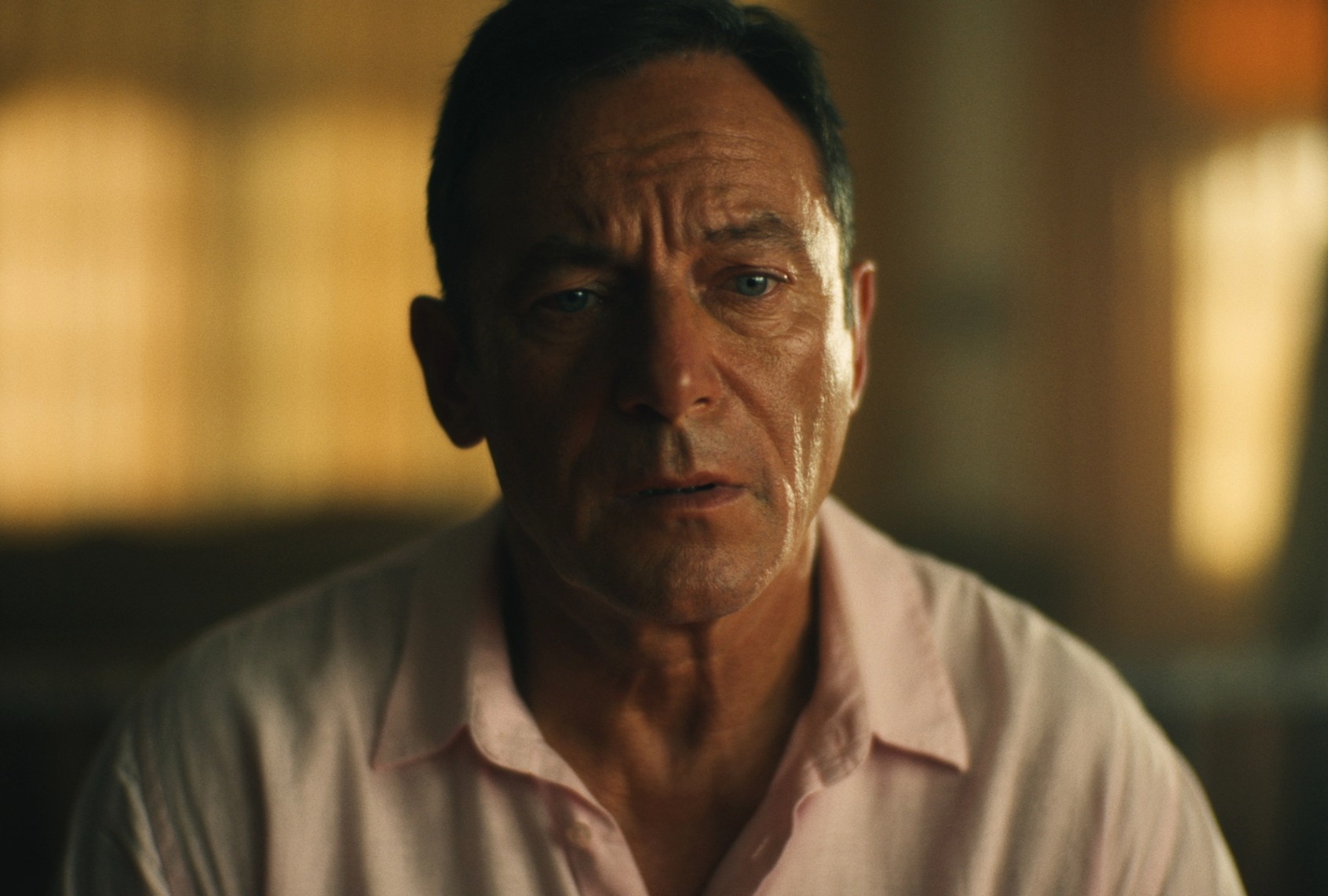
“Nobody was texting war plans”: Hegseth denies Yemen leaks, calls Atlantic editor “garbage-peddler’

We all know that old adage: when caught sending plans for American military operations through a platform you got off the app store, deny deny deny.

Defense Secretary Pete Hegseth revived the era of alternative facts on Monday, outright refusing to admit that he had leaked plans for U.S. airstrikes on Yemen in a group chat that accidentally included the editor-in-chief of The Atlantic.

Jeffrey Goldberg shared the wild story of the extreme breach in national security on Monday, along with screenshots of the conversations on the encrypted messaging app Signal. In addition to Hegseth, the group chat included Trump administration officials ranging from Secretary of State Marco Rubio up to Vice President JD Vance. When asked about the slip, Hegseth accused Goldberg of "peddling hoaxes."

"You’re talking about a deceitful and highly discredited so-called journalist who’s made a profession of peddling hoaxes time and time again," he said. "This is a guy that peddles in garbage. This is what he does."

When pressed on the story, Hegseth flatly denied that any information was shared outside of official channels.

"I’ve heard how it was characterized. Nobody was texting war plans. And that’s all I have to say about that," he said. 

On MSNBC's "Inside with Jen Psaki," Goldberg pushed back on Hegseth's denial. He called Hegseth's messages "a minute-by-minute accounting" of the attack as it happened.

The defense secretary's outright "nuh-uh" was slightly more composed than the response from President Donald Trump. When asked about the bombshell report, Trump said the reporter was "telling [him] about it for the first time" before attacking the magazine.

"I don’t know anything about it. I’m not a big fan of The Atlantic," he said. "To me, it’s a magazine that’s going out of business. I think it’s not much of a magazine, but I know nothing about it."

Shortly after that press conference, Trump shared a screenshot of an Elon Musk post on social media. In the post, Musk was repeating a joke shared by the satirical conservative outlet The Babylon Bee.

"Best place to hide a dead body is page 2 of The Atlantic magazine because no one ever goes there," Musk said.

At least a few people inside the Beltway have read the story, as Politico reports that National Security Adviser Mike Waltz might be on the outs for his role in cobbling together the group chat. Anonymous White House officials said that Trump would base Waltz's future in his administration on the "coverage of the embarrassing episode."

“Even the Oscar can’t protect you”: “No Other Land” director reportedly attacked by Israeli settlers

Oscar-winning Palestinian director Hamdan Ballal was reportedly attacked by Israeli settlers in the West Bank on Monday. 

Activist groups and left-wing Israeli politicians claimed that the co-director of "No Other Land" was attacked by the settlers in the village of Susya. Video shared by the Center for Jewish Nonviolence on social media appears to show masked settlers attacking activists who were on the scene to document their actions. The clip shows two masked people shoving members of the group before other assailants attack the group's vehicle, shattering the car's windshield with a rock.

"Hamdan Ballal was attacked by Israeli settlers and arrested by the Israeli army in his home village of Susiya in Masafer Yatta. We do not know his current whereabouts or condition," the group shared. "The group of assailants arrived at approximately 6 PM with batons, knives, and at least one assault rifle; many were also masked."

Israeli politician Ofer Cassif shared that he has been unable to confirm where Ballal was being held.

"Not only was he wounded severely, he was kidnapped directly out of the ambulance during his medical evacuation, and arrested by the Israeli military. All attempts to receive official confirmation of his location, including personally by me (a member of Parliament) have failed," he shared on X. "His whereabouts are still unknown and his life and liberty are in grave danger. Under the tyrannical occupation, even the Oscar can't protect you from harm."

Ballal was one of four directors of the Oscar-winning doc, which followed the forced displacement of Palestinians in Masafer Yatta, the same region of the West Bank where Monday's attack occurred. Co-director Yuval Abraham, an Israeli investigative journalist, said Ballal was "lynched" by settlers in a post to X.

"They beat him and he has injuries in his head and stomach, bleeding," he wrote. "Soldiers invaded the ambulance he called, and took him. No sign of him since."

Masafer Yatta, a rural area in the South Hebron Hills, was declared off-limits to civilians by the Israeli military in the 1980s. The area has been designated a "firing zone," ostensibly to be used as a training ground for the Israeli military. However, many Palestinians remain in the area, under constant risk of displacement from settlers or the military.

“My hope to my daughter [is that] she will not have to live the same life I’m living now, always fearing settler violence, home demolitions and forced displacement that my community faces under Israeli occupation,” Director Basel Adra said during his victory speech at the 2025 Oscars. “‘No Other Land' reflects the harsh reality that we’ve been enduring for decades and still resist as we call on the world to take serious actions to stop the injustice and stop the ethnic cleansing of Palestinian people.” 


“Incompetence is staggering”: Trump admin accidentally leaked Yemen war plans to Atlantic editor

The early months of President Donald Trump's second term have been characterized by a sort of weaponized bumbling: an oafishness and lack of care that has made his administration no less effective at dismantling the checks on the executive branch. However, knowing that the administration will approach all sensitive situations with disdain and disregard doesn't make the latest story from The Atlantic Editor-in-Chief Jeffrey Goldberg any less shocking. 

Goldberg reports that he was accidentally added to a group chat on the messaging app Signal by Trump Security Adviser Mike Waltz earlier this month. In the chat, Waltz spoke with Vice President JD Vance, Secretary of Defense Pete Hegseth and Secretary of State Marco Rubio about their then-upcoming attacks on Houthi rebels in Yemen.

Goldberg initially believed that the message was a cleverly orchestrated hoax, a ploy put forth by press-hostile actors to embarrass journalists by getting them to report false information. Goldberg's reluctance came from the belief that high-level officials would be more careful with sensitive data like the movements of the American military.

"I had very strong doubts that this text group was real, because I could not believe that the national-security leadership of the United States would communicate on Signal about imminent war plans," he wrote. 

Those doubts were put aside when Hegseth shared detailed info about the then-upcoming airstrikes on Houthi-held targets. Goldberg said he waited on the news from Yemen to confirm that the chat, hosted well outside of established security protocols for government officials, was legitimate. When Yemen's health ministry reported that 53 people had been killed by U.S. strikes on March 15, Goldberg knew that he had inadvertently been given the genuine article.

Goldberg did not share specifics on the operational information that Hegseth shared, for fear that the messages' content could endanger American operations.

"The information contained in them, if they had been read by an adversary of the United States, could conceivably have been used to harm American military and intelligence personnel, particularly in the broader Middle East, Central Command’s area of responsibility," he wrote. "What I will say, in order to illustrate the shocking recklessness of this Signal conversation, is that the Hegseth post contained operational details of forthcoming strikes on Yemen, including information about targets, weapons the U.S. would be deploying, and attack sequencing."

The news of the leak shocked lawmakers in Washington. Rep. Pramila Jayapal, D-Wash., called the "incompetence" of Trump officials "staggering" in a post to social media. Sen. Chris Coons, D-Del., said on X that such carelessness with government secrets "would normally involve a jail sentence." 

"Every single one of the government officials on this text chain have now committed a crime," Coons wrote. "We can’t trust anyone in this dangerous administration to keep Americans safe."

Sen. Mark Warner, D-Va., said that the administration was "playing fast and loose with our nation's most classified info" and chastised the Trump officials in a series of posts to X.

"Make no mistake: our allies are reading this war-plan-disclosure story too, and it’s making it less and less likely that they’ll want to share sensitive intel with us," he wrote.

Greenland builds up police presence ahead of “highly aggressive” US visit

A planned visit to Greenland by U.S. officials, including second lady Usha Vance and the secretary of energy, has sparked outcry  amid President Donald Trump's push to annex the Danish territory.

Vance is set to visit Greenland from Thursday through Saturday to watch the island's national dogsled race and "celebrate Greenlandic culture and unity," the White House told CNN in a statement. National Security Adviser Mike Waltz and Energy Secretary Chris Wright will be joining Vance on the trip, according to Greenlandic news organization Sermitsiaq. The travel is not an official visit, and several Greenlandic politicians have refused to meet with the second lady, the outlet noted. 

Danish national police sent additional officers and police dogs to the territory on Sunday as part of regular security measures taken during visits by dignitaries — and in possible anticipation of protests. A police spokesperson declined to give details, but local media reported dozens of personnel were flown in. The move follows citizens' demonstrations earlier this month against Trump's vow to annex the island, which has a wealth of rare minerals.

Since taking office, Trump has repeatedly voiced interest in seizing Greenland, despite both Denmark and Greenland's firm rejections of the idea. Trump's desire mounts another threat to the territory's security as other world powers, including Russia and China, seek influence in the Arctic. 

In a Sunday interview with local media, Greenland's Prime Minister characterized the officials' trip as "highly aggressive." He took particular issue with Waltz's expected presence.

“What is the national security adviser doing in Greenland? The only purpose is to demonstrate power over us,” Egede said. “His mere presence in Greenland will no doubt fuel American belief in Trump’s mission — and the pressure will increase.”

On “The White Lotus,” the Ratliffs ooze the kind of idle rich ignorance that’s killing us

Versions of Timothy Ratliff’s death wish fantasy play out over several episodes of “The White Lotus,” but each involves a gun. Having received news that the feds may be waiting to arrest him at the end of this vacation, the stressed-out financier daydreams about putting a pistol to his head and pulling the trigger.

 There may be no Earthly creature more dangerous than a white man with so much wealth that he can lose billions of dollars of his net worth, doom millions of people and not break his stride.

Since this third season of the resort fantasy opens with the sounds of shots fired and a body floating in one of the property’s many water gardens, these asides are designed to make us wonder whether Timothy, played by Jason Isaacs, is the shooter.

Mike White's reveals haven’t been that obvious in previous seasons, though. Besides, one gets the sense that if our suicidal patriarch were to follow through on his exit strategy, he would keep the body count within the family.

Timothy heads a family of entitled, maladjusted narcissists co-led by his Lorazepam-addled wife Victoria (Parker Posey). She raised her annoyingly named children Saxon (Patrick Schwarzenegger), Lochlan (Sam Nivola) and Piper (Sarah Catherine Hook) to want for nothing. From the moment they arrive at the resort, she can’t stop yammering about the inane details of their lives in North Carolina.

Jason Isaacs in "The White Lotus" (Courtesy of HBO)Saxon works with his father, gambling on the stock market with other people’s money, as his sister Piper puts it. He’s also squeamishly invested in shaping his siblings’ sexuality, especially Lochlan’s, an awkward and skinny high school senior. Big bro decides he must lose his virginity while they’re vacationing in Koh Samui.
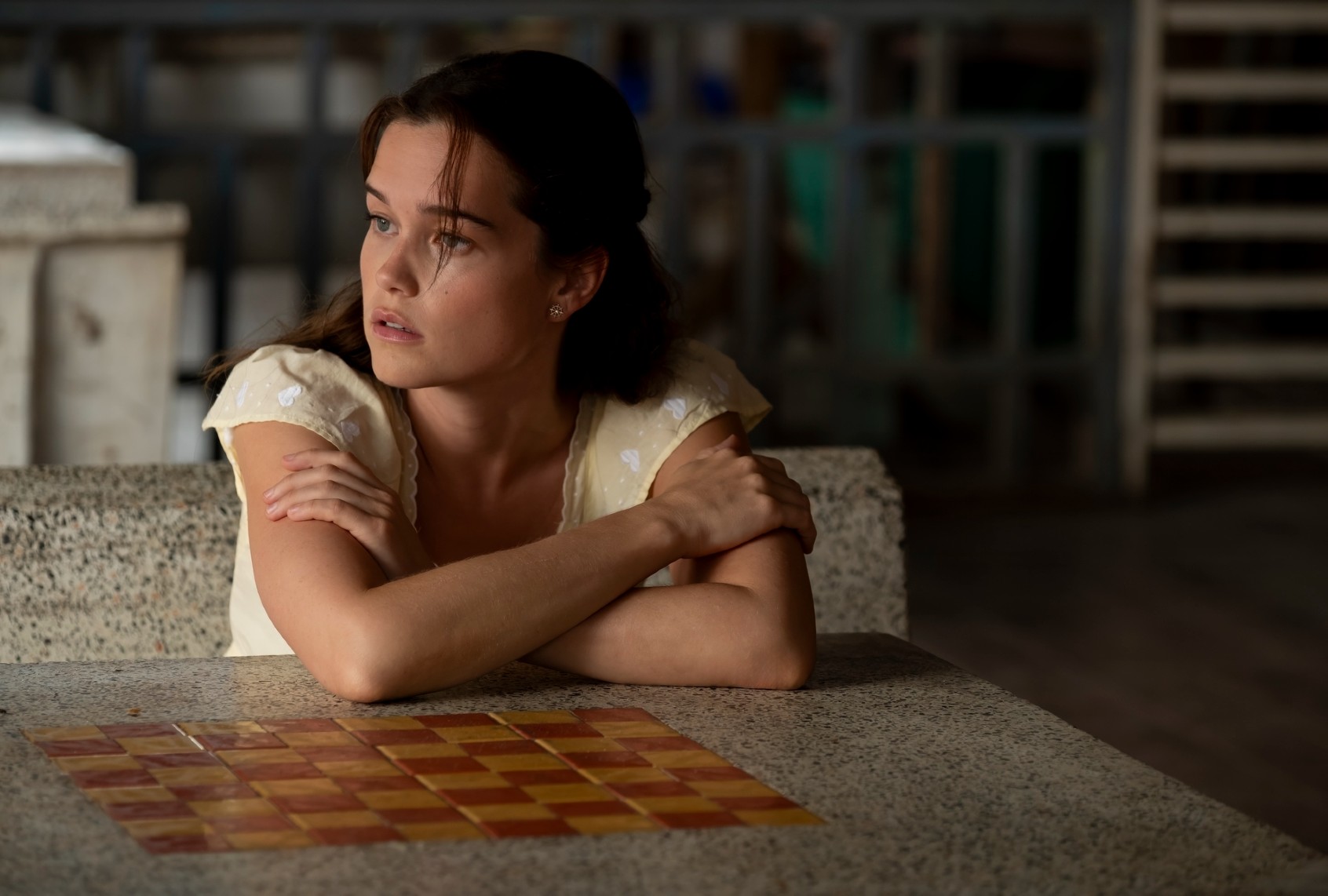
But Piper is why they’ve come to Thailand, although she says she didn’t want the fuss. But since she’s writing her senior thesis on Buddhism, or so she says, the Ratliffs decide to make “a road trip” of it, as Timothy tells hotel staff that neither asked nor cares.

“Did we have to go halfway around the world?” Victoria complains the moment her prescription-induced holiday convalescence begins. “Why couldn’t she write her thesis on her own religion? She could have interviewed the archbishop of Canterbury. We could have stayed at Claridge's.”

The Kardashians they are not.  

It would seem that the world is in an "eat the rich" mood, but recent polls tell a slightly different story. Many still approve of the world’s wealthiest man dismantling the government in the name of reducing wasteful spending.

The Ratliffs are a class unto themselves – isolationists on a micro-scale, casually racist and blisteringly ignorant. 

That’s because Elon Musk and his DOGE bros tout their supposed and largely inflated wins while remaining quiet on the topic of business subsidies (aka “corporate welfare”) going untouched, a $181 billion expenditure in 2024 according to a Cato Institute official. And the thing about Musk, along with midlife crisis-edition Mark Zuckerberg and other tech bros, is that they’re styling themselves as entertainers instead of robber barons.

Some things about the wealthy class never change, as the Ratliffs exemplify. Like the rich families that vacation together in past seasons of “The White Lotus,” the North Carolina brood is a collection of insufferable personalities. In one unit, we get the parent who can’t keep their mind off work, the child who believes himself to be God’s gift, and the misfit who tries to balance their family’s out-of-control grossness by trying to be good, sometimes failing spectacularly.

Sarah Catherine Hook in "The White Lotus" (Courtesy of HBO)Piper may be aiming to fill that slot, but she has some distance to travel on the road to empathy. When her father numbs his pain with his wife’s prescription and sadly croons a song from when he was an altar boy, Piper can only roll her eyes and excuse herself from the room. Mind you, the guy looks pitiful.
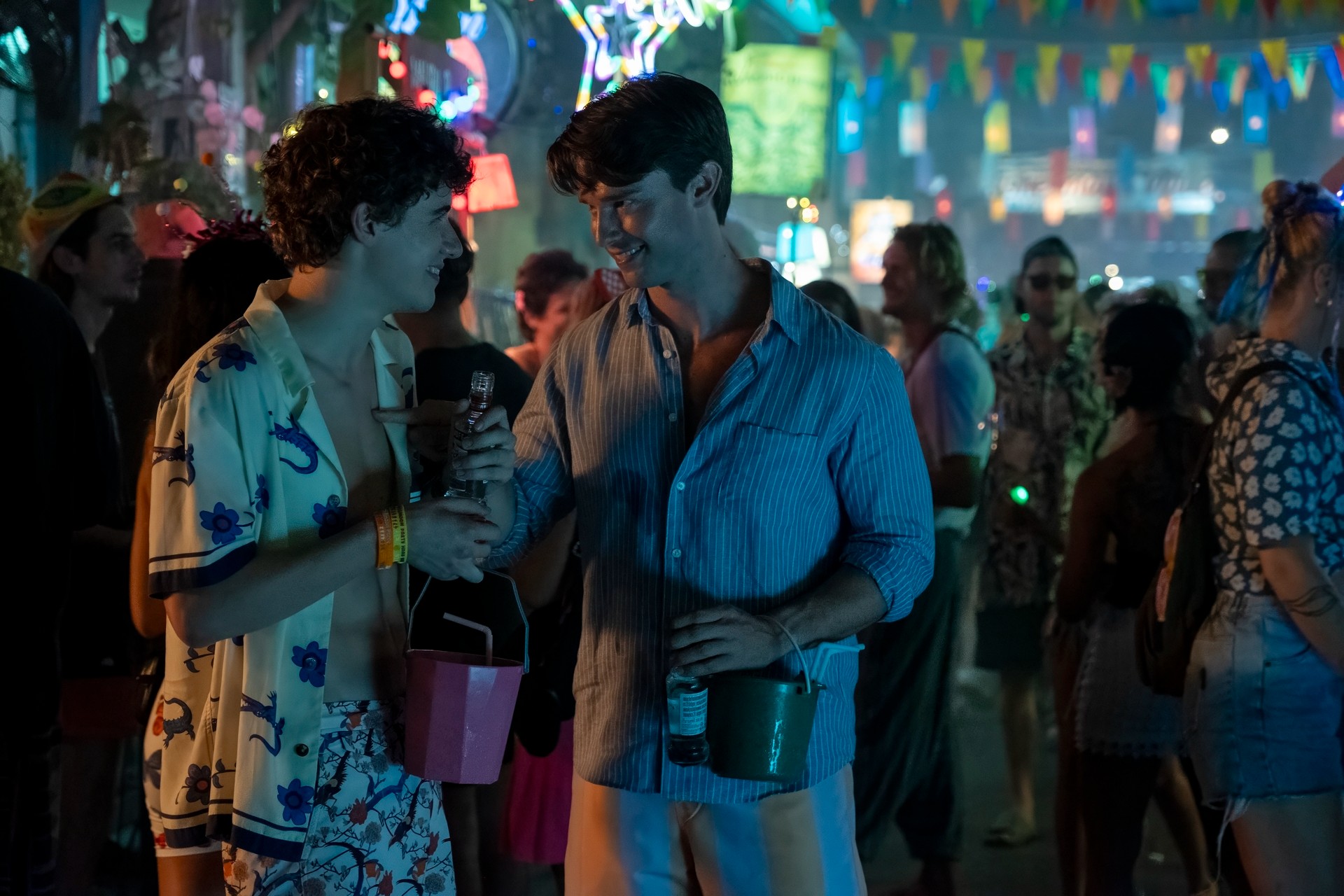
As recent events attest, there may be no Earthly creature more dangerous than a white man with so much wealth that he can lose billions of dollars of his net worth, doom millions of people and not break his stride.

His rampage is bad for the planet, whereas a common millionaire on the verge of banishment from his community country club is primarily dangerous to those in his sight line. But the Ratliffs are a class unto themselves – isolationists on a micro-scale, casually racist and blisteringly ignorant. Victoria is so zonked out of her mind that she doesn’t even know where in the world she is. When Piper tells her parents she intends to spend a year at the monastery she initially purported to simply be visiting, an astounded Victoria blurts, “You want to move to Taiwan?”

We need your help to stay independent

To Victoria, Buddhism is a Chinese cult and other rich people are trashy.

She’s not entirely wrong in that second opinion; among the guests the Ratliffs fall in with are Jon Gries’ Greg, who now goes by Gary since the mysterious death of his wealthy wife Tanya (Jennifer Coolidge) left him her fortune. He’s hiding out with his much younger girlfriend Chloe (Charlotte Le Bon), who might be a sex worker. Greg – er, Gary – is pretty trashy. Victoria’s no paragon of civility herself, though.

After brushing off Leslie Bibb’s Kate, a member of the girls’ trip trio who recognizes her, Victoria responds to the news that Kate’s friend Jaclyn (Michelle Monaghan) is a famous actress by declaring all actresses to be “basically prostitutes.” “If they’re lucky. Am I right?”

That clears Saxon to make a few racist jokes, like lamenting that his massage didn’t have a happy ending. “What? Aren’t they all supposed to be a little speshy-speshy?” His mom roars with laughter.

You have to feel a little something for Timothy, a desperate man with a tacky wife, a horny scion with an inflated sense of self and a pair of junior children who will either escape, as Piper is trying to do, or be consumed by their family’s corruption, which may be Lochlan’s future.

At least he seems to know that he and his will get rolled over first when the peasants take up pitchforks, regardless of whether they deserve it, simply because they can be touched. The .01% live on compounds under armed protection. The Ratliffs are one donut-loving gated community security guard away from wreck and ruin. And their false sense of being above it all extends to their consideration of others, including each other.

Sam Nivola and Patrick Schwarzenegger in "The White Lotus" (Courtesy of HBO)Saxon may be the one who openly comments on his sister’s lack of sexual history and “hotness,” chiding Piper for suggesting Lochlan could share a bedroom with her, “because brothers and sisters don’t sleep together after they have full grown, you know, genitals.” But it’s not her body Lochlan has feelings about.  

When Saxon and Lochlan head off to party with their resort friends Chloe and Chelsea ( Aimee Lou Wood), they end up in a drug-fueled sex tangle on Greg’s/Gary’s yacht . . . and remember the next day that they were intimate with each other.

Simply alluding to what happens isn’t enough. As Saxon’s memory reassembles in the morning, White — who wrote and directed the episode — shows the brothers kissing and Lochlan handling Saxon’s privates while he’s with Chloe. Those scenes return to Saxon before the blackout clears for Lochlan. Unfortunately for him, that happens during a meditation session with the monk Piper wants to study with.


Want a daily wrap-up of all the news and commentary Salon has to offer? Subscribe to our morning newsletter, Crash Course.


Timothy and Victoria aren’t aware that their sons have slipped into the type of libertine excess European aristocrats once indulged in. Yet. As things stand, these dumb parents are proud of their messy issue, which means the kids are probably safe from their father’s impending breakdown. But that understanding only goes so far. The recently aired sixth episode shows Timothy and Victoria visiting the local monastery, where Timothy has a comforting conversation with its head monk about, what else, death.

This actually makes him feel better about his daughter spending a year at such an orderly, simple place. But Victoria only sees dirty cots and unbathed children — privation. “I don’t want her thinking she'll be just fine if she's poor. She needs to fear poverty, Tim, like everyone else we know,” she says. “That way, she'll make good decisions.”

The joke is that Victoria has no clue that her long run on Easy Street is about to hit a dead end. She blithely tells her husband that if they were to lose all their wealth, she wouldn’t want to keep living. The real tragedy, if you can call it that, is that not many would see that development as a huge loss.

“I just don't think at this age, I'm meant to live an uncomfortable life,” Victoria says in a drawl pulled from the depths of North Carolina’s sunken place. “I don't have the will. No, I just don't have it in me.”

Then she pulls out a fancy perfume bottle and wafts it under her nose, inhaling a chemical approximation of the scented flora surrounding them.

“Grass,” Victoria sighs brainlessly, and she checks out from reality again, unaware that vapid admission has cast her in the grim two-hander playing in her frantic husband's head.

Gut-friendly fizz: How Coke and Pepsi are reinventing the soda wars

For decades, the cola wars played out in Super Bowl commercials and fast food soda fountains, in taste tests and vending machine allegiances. Coke was classic, Pepsi was cool — and both were unapologetically, thrillingly bad for you. But in 2025, the battle lines have shifted. The two soda giants aren’t fighting over who makes the better sugar bomb. They’re squaring off over a new frontier: prebiotic soda, the fizzy, gut-friendly darlings of the wellness-industrial complex.

Coke’s entry into the prebiotic soda wars, which was announced in February, comes with a familiar face: Simply, the juice brand that has occupied grocery store shelves and breakfast tables for decades. Simply Pop leans hard on that trust factor, positioning itself as the safe, everyday choice for the health-conscious consumer who still wants a little indulgence. The branding is bright and approachable, its fruit-forward flavors — Strawberry, Pineapple-Mango, Lime and Citrus Punch — designed to feel more like an extension of the juice aisle than a foray into gut health.

The message is clear: You already know us. You already love us. Why not let us fix your microbiome?

"Gen Z grew up with this brand," said Terika Fasakin, North America Brand Senior Director of Simply and Kids, in a press statement. "They don't remember a world where Simply doesn’t exist, and it’s the juice they’ve seen in the fridge throughout their lives, so it has a particular tug on their heartstrings."

Pepsi, on the other hand, isn’t bothering with familiarity. It doesn’t need to, because, as announced last week, it already has poppi. The indie darling of the prebiotic world, poppi built its following on vibrant branding, influencer hype and a health-conscious narrative that felt effortlessly appealing. A splashy Shark Tank debut in 2018, a billion-dollar valuation by 2024 — the brand’s trajectory reads like a startup fairytale, and Pepsi’s acquisition is less about introducing a new player and more about supercharging an existing one.

“More than ever, consumers are looking for convenient and great-tasting options that fit their lifestyles and respond to their growing interest in health and wellness,” said Pepsi CEO Ramon Laguarta. “Poppi is a great complement to our portfolio transformation efforts to meet these needs."

If Simply Pop is trying to make prebiotic soda normal, poppi is making sure it stays cool.

We need your help to stay independent

But beyond the branding, there’s a larger shift at play. Twenty years ago, “functional beverages” meant protein shakes and sports drinks, stuff designed for bodybuilders and marathoners. Today, they’re for everyone. Kombucha is in gas stations. Adaptogens are in coffee. Water, plain and un-bubbly, suddenly feels like it’s underperforming. Soda was always an easy villain in the wellness wars — but now, with the right blend of fiber, fruit and friendly bacteria, it’s trying to buy its way into virtue.

This broader trend toward functional beverages sets the stage for prebiotic sodas, which now fit neatly into the wellness narrative, offering a fizzy alternative that promises both taste and digestive health benefits. This shift makes sense in the context of a growing awareness around sugar’s health impacts.

Between 2003 and 2016, soda consumption dropped significantly in the U.S. According to a 2020 report from the Journal of the Academy of Nutrition and Dietetics, the percentage of children who were “heavy consumers” — defined as those who drank more than 500 calories of sugary beverages daily, or about 3 1/2 cans of soda — fell from 11% to just 3%. For adults, the percentage dropped from 13% to 9%.

"Twenty years ago, 'functional beverages' meant protein shakes and sports drinks, stuff designed for bodybuilders and marathoners. Today, they’re for everyone."

“This is promising,” said Kelsey Vercammen, a doctoral student at Harvard T.H. Chan School of Public Health at the time, “because we know that excessive consumption of sugar-sweetened beverages is linked to poor health.”

Vercammen also pointed to the impact of public health campaigns and policies: “Greater awareness about the harms of sugary drinks, along with actions like beverage taxes and healthy beverage ordinances, is shifting public preferences,” she said. “More and more, people are seeking out healthier alternatives.”

Coke and Pepsi’s respective forays into prebiotic soda also come at a time when there is growing political discussion about what it means to “Make America Healthy Again,” a slogan and accompanying movement now associated with Robert F. Kennedy Jr., the recently confirmed health and human services secretary.

Kennedy has been a frequent critic of soda, calling it “poison” and suggesting it be removed from the items that are allowed to be purchased using Supplemental Nutrition Assistance Program, or SNAP, benefits, emphasizing that he believes taxpayers should not fund unhealthy choices for children or low-income families.

According to nutrition experts, prebiotic sodas, with their blend of gut-friendly fibers and plant-based compounds, can offer some real benefits, especially for digestion and gut health. Ingredients like chicory root and inulin feed the good bacteria in your microbiome, helping to promote balance and support digestion. Many of these sodas also contain added fiber, which supports regularity, heart health and blood sugar control.

Compared to traditional sodas, they often have lower sugar content or use alternative sweeteners, making them a healthier option for those trying to reduce their sugar intake.

That said, the health benefits of prebiotic sodas depend on the quality of the ingredients. Not all of them are created equal — some may still contain added sugars or artificial sweeteners that counteract their potential benefits. And while prebiotic sodas may offer an upgrade from their sugary counterparts, they should still be consumed in moderation. Whole foods like fruits, vegetables, and legumes remain the best source of prebiotics, and these beverages should be part of a broader, balanced approach to health.

As the soda aisle continues its slow, bubbly march toward wellness, the true test will be whether these gut-friendly drinks can deliver on their promises — not just for our microbiomes, but for our taste buds, too.

Rescue is a shame for the teens on “Yellowjackets” because wherever they go, there they are

If I were stranded in the woods and something happened that resulted in me breaking my glasses, I'd have to just sit there and hope for a tree to fall on me in the night; periodically calling out, "Not to be a b***h here, but can anyone help me?" — on the off chance that a friendly face would appear to guide my visually impaired self to safety and not a roaming pack of hormonal cannibals emerging from the darkness making animal noises, assessing my vulnerability to determine how easy of a next meal I'd make. 

Nothing dissipated once they were out of those woods, their shame only rooted deeper, making it so that even after rescue, there was no "saving" them.

When Misty's (Samantha Hanratty) glasses break in "Croak" — the episode of "Yellowjackets" that sees the teens in the wilderness timeline weighing the potential for rescue over the ramifications of their savagery coming to light — I first thought of the above, putting myself in Misty's shoes, as someone who couldn't make it out of the bathroom without my specs. Then I immediately thought of "Lord of the Flies," the 1954 book by William Golding that "Yellowjackets" creators Ashley Lyle and Bart Nickerson were heavily inspired by when coming up with the idea for this show. 

For those familiar with the book, this moment, where Misty's glasses get knocked from her face during the hunt for Kodi (Joel McHale) — a wilderness expert guiding two unsuspecting frog scientists on a research expedition that ends with them chancing upon the teen Yellowjackets, mouths full of their former soccer coach, doing a ritualistic dance around a bonfire — was a true "Golding has entered the chat" moment. As were the moments that precede it in the wilderness timeline, kicked off at the end of episode 6, "Thanksgiving (Canada)," where, when surprised by the sight of three adults who got to them safely somehow and could, therefore, presumably take the teens back to the safety from which they came, the first word yelled — after waiting a year for rescue — was "No!" And, judging by the teens' faces lit by the fire they used to cook Coach Ben (Steven Krueger), the first thing they felt was not relief or happiness, but shame.

At the end of "Lord of the Flies" — which centers on a group of British schoolboys surviving a plane crash and, in short time, going murderously feral on a deserted island — their reaction to a naval officer finding them after seeing the smoke from their fire in the distance is, like the young girls in "Yellowjackets," not to jump for joy, but to fall to their knees in shaking sobs, ashamed of the signs of depravity displayed around them which included the dead bodies of two of their classmates.

One of the kids killed in the book — described as an overweight, intellectual and talkative boy with asthma — is given no name other than what his cruel classmates refer to him as, "Piggy." Similar to teen Misty, his presence had been merely tolerated by his peers, beyond being made useful as the butt of jokes or, after his glasses break in a tussle, snatching what remained of them — leaving him blind — to start fires with. And as a self-governed group breaking into two opposing sides: the very savage and the not so savage . . . yet, the boys were mostly numb to the death of Piggy, until they were rescued or, in other words, "caught." 

Samantha Hanratty as Teen Misty in "Yellowjackets" (Colin Bentley/Paramount+ with Showtime)Stranded for 15 months on their island, just short of the length of time the Yellowjackets were stranded, which we're told was 19 months, the boys in "Lord of the Flies" murdered two of their friends, sure, but they didn't eat them — although some readers would say that was implied. One could still imagine these boys folding themselves back into society and growing up to lead fairly normal lives despite the indiscretions of their pasts as murderers and accessories to murder. Many men do. Some are even rich and famous.
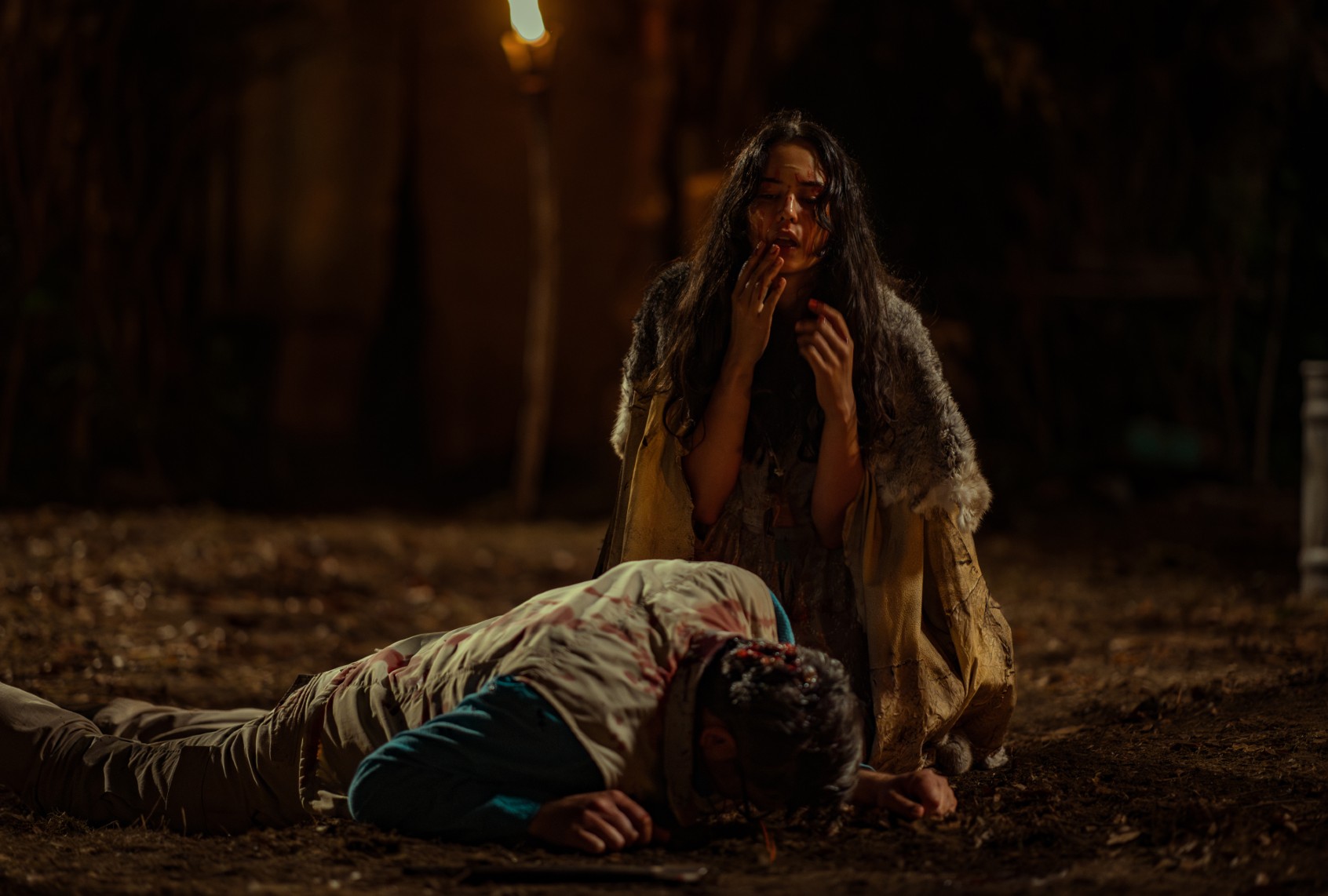
The shame they felt at the time of their rescue would, you could imagine, dissipate the further they got from the island where their crimes took place — perhaps aided by months or years of court-ordered therapy and time's ability to soften all blows. But, worse off than them, the Yellowjackets had a lot more blood on their hands and, well, we've seen what "going home" looked like in their cases. Nothing dissipated once they were out of those woods, their shame only rooted deeper, making it so that even after rescue, there was no "saving" them.


Want a daily wrap-up of all the news and commentary Salon has to offer? Subscribe to our morning newsletter, Crash Course.


Fascinated by the themes in "Lord of the Flies" and "Yellowjackets," they jump out at me in other things I watch and read. For the past month or so — almost as long as Season 3 of "Yellowjackets" has been on — I joyously made my way through the 1,074 pages of Stephen King's 2009 book, "Under the Dome," and couldn't help but notice similarities to the boys on their island and the girls in their woods.

Although rescue was always in the cards for the teens who were stranded, it probably would have been better for them if those cards had never been dealt.

Nobody eats anyone in "Under the Dome," or chases anyone around a fire while threatening them with a stick sharpened at both ends, but they do inhabit a small area that gets trapped under a massive dome by (sorry for the spoiler here . . . aliens) and some of them like it because, like teen Shauna (Sophie Nélisse) and Lottie (Courtney Eaton) in "Yellowjackets," having the freedom to go hog-wild nuts in a self-governing place has an appeal that a certain kind of person could really sink their teeth in. An appeal that's hard to relinquish, once you get a taste for it.

Courtney Eaton as Teen Lottie and Nelson Franklin as Edwin in "Yellowjackets" (Kailey Schwerman/Paramount+ with Showtime)In "Under the Dome," the Shauna of that trapped town is a character named Big Jim who uses the panic of the less evil-minded around him to instill himself, and those who follow him, as leadership. And the Lottie of that town would be Big Jim's son, referred to as "Junior," who gets migraines so bad that his eyes bleed and, in only a few days cut off from society, kills two girls and has sex with their corpses. Both of these characters in King's book die before an alien is convinced to raise the dome and free everyone but, had they survived, imagine them trying to explain all of THAT. At least Lottie can blame the tree spirits — which she did, up until her own death — and Shauna can pretend that the woman she grew up to be isn't exactly, if not worse than, the girl in the woods who ate her best friend and scribbled in her journal about not being appreciated enough for being the best at carving up a body.
With the story of "Yellowjackets" told in a split timeline we see, more and more, how although rescue was always in the cards for the teens who were stranded, it probably would have been better for them if those cards had never been dealt. Watching the miserable, broken lives of the girls as adults — especially Shauna (Melanie Lynskey) and Lottie (Simone Kessell), the two who worked against their rescue 25 years ago the most — it's evident that they didn't find their way back home, they left it behind them. And past the shame that fact will always bring them, their every action was and is an attempt to return to it. 

Trump resurrects George W. Bush’s rendition regime

Among all the political atrocities committed by the second Trump administration — and there are many — perhaps the most egregious, so far, is the plane loads of Venezuelan men sent to an infamous mega-prison in El Salvador called the Center for Terrorism Confinement (aka Cecot) in direct contravention of a federal judge's order. The men have disappeared into the prison and no one is even sure who all of them are much less if they are actually members of the Venezuelan Tren de Aragua gang that President Trump claims has "invaded" the United States. But reports are starting to emerge that this was a sloppy operation that swept up some innocent people. One can only imagine what's happening to them in that dystopian hellhole of a prison.

Over the weekend TIME published a first-person account by photojournalist Philip Holsinger of the Venezuelans' arrival and processing in El Salvador the week before. We had seen the grotesque propaganda video produced by the Salvadoran government (and celebrated by the White House) but this is the first time we've heard about their treatment from someone who was on the ground. It is harrowing, to say the least.

The intake began with slaps. One young man sobbed when a guard pushed him to the floor. He said, “I’m not a gang member. I’m gay. I’m a barber.” I believed him. But maybe it’s only because he didn’t look like what I had expected—he wasn’t a tattooed monster.

The men were pulled from the buses so fast the guards couldn’t keep pace. Chained at their ankles and wrists, they stumbled and fell, some guards falling to the ground with them. With each fall came a kick, a slap, a shove. The guards grabbed necks and pushed bodies into the sides of the buses as they forced the detainees forward. There was no blood, but the violence had rhythm, like a theater of fear. 

Inside the intake room, a sea of trustees descended on the men with electric shavers, stripping heads of hair with haste. The guy who claimed to be a barber began to whimper, folding his hands in prayer as his hair fell. He was slapped. The man asked for his mother, then buried his face in his chained hands and cried as he was slapped again.

There is good evidence that this young man is who he says, a barber and make-up artist from Texas, not a gang member. How he got caught up in this we have no idea. I cannot even imagine what he's going through in this prison full of hardcore gang members.

It was not entirely unexpected. Trump has reportedly been angry at the pace of deportations and told his henchmen to speed it up. By invoking the Alien Enemies Act of 1789, the very rarely used wartime power to remove non-citizens without following the usual immigration laws, Trump was able to finally get the satisfaction he'd been desperate to achieve. The case is currently being heard in federal court, where the judge is beside himself at the government's uncooperative behavior. It will almost certainly end up before the Supreme Court before too long.

It became a lot harder to accept our "shining city on a hill" myth once we saw how our powerful country discarded its values the minute we faced a serious threat. Now we don't even pretend anymore.

It shocks the conscience to see America completely abandoning any semblance of due process to kidnap people and take them to another country to be dealt with by governments that have no respect for human rights. But let's be honest. It's not the first time, and I'm not talking about the Palmer raids in WWI or the Japanese Internment in WWII, both of which were shameful episodes in which the president used this obscure wartime power to detain, imprison and deport people based solely on their ancestry or national origin under the suspicion that they might commit sabotage or espionage. America perpetrated something this ugly in this century, only 20 years ago.

During the presidency of George W. Bush, the U.S. government kidnapped hundreds of people around the world and sent them to black sites in foreign countries where they were tortured by the CIA. They were also sent to countries notorious for their lack of human rights where they were also tortured. It was called "Extraordinary Rendition" and what was so extraordinary about it was that it required no due process.

Rendition has been used since the 1880s to grab suspected criminals on foreign soil to bring them to America to stand trial. Grabbing them to torture them (or what they euphemistically called "enhanced interrogation") in secret prisons in ways that were beyond our imaginations was on a whole other level.

We know what we know about all this from great reporting in the media and some dogged investigations by the U.S. Congress. (They even made a movie about the Senate investigation starring Annette Bening and Adam Driver.) But the country has never seen the full Senate report, only the summary which was pretty damning, because the White House under Barack Obama, Donald Trump and Joe Biden all refused to release it. I think that says something very disturbing about what must be in it.

We need your help to stay independent

The torture regime under the Bush administration was one of the most shameful moments in our history. We've let it go down the memory hole as we do with virtually everything we hate about ourselves. But that cruel, unnecessary and counterproductive set of policies along with Guantanamo, Abu Ghraib and all the rest of the gruesome acts of overkill committed in the wake of 9/11 set the table for what Donald Trump is doing today.

However, while the Bush policies were barbaric and un-American, they were in response to an actual attack on the United States. The reaction was insanely excessive and motivated by some longstanding policy goals that had little to do with the attack but the casus belli wasn't conjured up out of thin air.

On the other hand, Trump's rationale for dredging up wartime powers to render foreigners to a foreign prison notorious for its inhumane treatment is completely made up. Crime is down. Illegal immigration is down. To the extent that these Venezuelan gang members are dangerous criminals (assuming they are gang members at all) it's nothing that can't be dealt with through the American justice system.

Trump's immigration crisis is, and always has been, a campaign strategy to scratch the ids of his racist base. They are all too happy to believe it and he and his GOP accomplices are all too happy to take advantage of that to seize more and more power. It's as if Hitler made up the fact that the Reichstag was on fire and his Nazi followers all nodded their heads and insisted they smelled the smoke.

20 years ago the U.S. government completely lost its bearings and began the process of finally destroying our society's belief that while it often fails, America still believed in the ideals set forth in the founding documents. It became a lot harder to accept our "shining city on a hill" myth once we saw how our powerful country discarded its values the minute we faced a serious threat. Now we don't even pretend anymore. The president simply proclaims that we have been invaded without any evidence at all and seizes the powers that come with that, all to give his followers the strongman spectacle he promised.  

How our public schools are tied to the health of our democracy

Donald Trump is following the dictator’s playbook as he uses his shock and awe campaign against American democracy and society. Little of what Trump and his agents and allies are doing is a surprise. One only has to look at Orban’s Hungary or Putin’s Russia (or Germany in the 1930s) as warnings and predictions for what the United States is quickly on the road to becoming. For Trump and his forces to succeed they will need compliant and obedient authoritarian subjects who either through surrender, agreement, self-interest, indifference, exhaustion or for some other reason(s) agree to the “legitimacy” of such a regime in America.

By the very nature of how power is concentrated around the Leader and their inner circle, autocracies and authoritarian regimes are almost always kleptocracies and plutocracies. Here, corrupt political power is a means to amass even more corrupt financial and economic power. The United States in the Age of Trump is closely following this model as well. The plutocrats and kleptocrats will also need compliant subjects who see themselves first as consumers and workers — most of whom will be stuck in a state of perpetual survival mode and economic precarity as they try to endure cannibal capitalism — and not primarily as citizens and responsible members of a humane society with any obligation or responsibility to other human beings beyond their immediate family and “community.”

In total, the new MAGA America that the Trump administration and its forces are trying to impose on the American people will need “citizens” who lack the ability to imagine other possibilities and a better and more just society and fulfilled life, cannot tell the difference between fact and fiction, truth and lies or good and evil. Control over America’s educational system and schools is essential for creating compliant subjects who will internalize and normalize these autocratic and authoritarian (and outright fascist) values, beliefs, and ways of living and thinking. Control over the country’s schools and education system will also mean denying young people and the larger public the means to understand and contextualize the present by distorting the past.

In an attempt to better understand how America’s educational system is under siege in the Age of Trump and how the lessons of the long Black Freedom Struggle can be applied today in the struggle to defend American democracy and freedom, I recently spoke with Derek W. Black. He is the Ernest F. Hollings Chair in Constitutional Law at the University of South Carolina and one of the country’s leading experts in education, law and public policy. Derek Black’s essays and other writing have appeared in the New York Times, Wall Street Journal, USA Today, Washington Post, The Atlantic and elsewhere. His research has been published in the Yale Law Journal, Stanford Law Review, NYU Law Review, California Law Review, Cornell Law Review, Northwestern University Law Review, Vanderbilt Law Review and dozens of others. His new book is “Dangerous Learning: The South’s Long War on Black Literacy.”

This is the second part of a two-part conversation

The Trump administration is trying to destroy the Department of Education. Why does the right-wing hate the Department of Education so much?

Most people think of the Department of Education and the federal role in education as an invention of 1979. The truth is that the federal government has been instrumental in getting public education off the ground since the nation’s founding. Before we even had a Constitution, Congress was putting structures in place to ensure that all new territories and states provided public education. Congress redoubled that effort following the Civil War, requiring the states to guarantee public education in their state constitutions and establish the first Department of Education. Those post-war efforts brought public education to a region that previously had very little. White illiteracy rates, for instance, were four times higher in the South than in the North. Jim Crow and objections to federal overreach, of course, cut that legacy short.

"When the current administration talks about returning education decision-making to states, you have to ask what exactly is being returned to states, because as we currently stand, anti-discrimination is the only real area where the federal government plays a huge decision-making role."

Modern objections are not too far detached from that legacy. It was the Department of Justice and the Office for Civil Rights (OCR) at the Department of Health, Education, and Welfare that forced southern schools to desegregate. That office would later move to the Department of Education. It has been instrumental in ensuring equal opportunity based on race, sex, disability, language status, and other categories. And the general Department of Education’s testing and accountability standards are likewise focused on closing achievement gaps for those students. In short, the Department has always stood for expanding opportunity and closing equity gaps.

It, however, has never stood for curriculum, never dictated what is on the tests, how the teachers are trained or any of that stuff. Those things have always remained with the states. In fact, federal law specifically prohibits the department from dictating curriculum to states. So, when the current administration talks about returning education decision-making to states, you have to ask what exactly is being returned to states, because as we currently stand, anti-discrimination is the only real area where the federal government plays a huge decision-making role.

We need your help to stay independent

This past week the administration sadly made good on its promises, firing half of the Department of Education’s staff. OCR was actually among the hardest hit at the Department, seeing over half of its regional offices closed. Those offices were already overworked and begging for more staff for the last decade. With these new losses, families hoping to secure equal access for their children in school may find that when they reach out to the federal government there is simply no one on the other end to help them anymore.

The move to give public money to private charter schools — and in particular Christian schools is central to the right wing’s decades-long war on America’s public schools. What does the empirical research tell us about the comparative outcomes of charter schools versus public schools?

There is a lot of misguided, fanciful thinking around these topics. When you compare apples to apples, public schools, on average, have long outperformed charter schools. The difference between private and public schools is only marginal, with public schools just slightly outperforming private schools. People don’t understand this because all they see is that the average SAT at a private school may be higher than the average SAT at the local public school. This doesn’t tell you much, however, because the “average” student doesn’t attend private school. You have to look at whether the child from a high-income family, both of whose parents have advanced degrees, is performing better at the private school than the public school. The truth is that that student does very well in either school, so the private school is not actually improving education for that student.

The reason why some private schools have higher average scores isn’t because they are teaching something special but because they don’t have any or many low-income students. And even if there was something special about those schools, they do not actually want to enroll more low-income or harder-to-teach students. Vouchers are not going to open those schools up to a new set of students.

If you understand this, you understand that private school vouchers are really about breaking up public schools, giving rebates to private school families who don’t need them, and further facilitating the fracturing of public schools that serve everyone into demographic private silos. Vouchers came into existence in the 1960s as a way to avoid racial desegregation.

Poor and working-class Black and brown parents whose children attend “failing urban schools” have been made the spokespeople and symbols of the school privatization and school charter movement. The school privatization industry and its public relations and marketing people are very skilled. What would you tell those parents who just want the best for their kids?

I have always said that I am in no position to tell Black and brown parents what to do. Many live in communities that have never for one moment in this nation’s history fully met the needs of students of color. I get it when those families say they feel compelled to try something new, that they are tired of waiting. I can’t second-guess that. However, with that said, I am confident that we as a society will not find our educational promised land anywhere but in our public schools. And if we give up on public schools, that land will only become more and more distant. I think the onus, however, cannot fall just on students of color to get us there. White families have to see our common interests with families of color and their children and step up — in a hurry.

Even in the 21st century, the pernicious lie that Black Americans do not value education still persists. What are some of the broad strokes of this lie and myth?

It was illegal for Black enslaved people to learn to read. As a practical matter, it was official state policy for Black people to remain an illiterate population through the end of Jim Crow (and beyond). Black people resisted this at every turn.

As I detail in my new book, the Black struggle for literacy is the closest thing we have to a holy testament to the connection between literacy and our humanity. People were willing to risk their lives to learn to read and write long before they ever thought about voting, and they protected literacy over the course of decades, passing it on in the dark of the night to their children and friends. That passion then fueled the fire of public education after slavery. As Du Bois wrote, public education in the South was a Black idea.

I think David Walker’s words are as true today as they were in 1829. He saw Black people and democracy itself laboring under the burden of oppression, delusion and ignorance. He called on Black people to rise up and seize their freedom. At the time, the ultimate goal was physical freedom. But he was very clear that the first step to physical freedom was mental freedom and that would be had through education. Those words still ring true today. He also called on America to live up to its highest ideals, which required a hard look in the mirror and an unvarnished appreciation of facts.

To borrow from Faulkner, "The past is never dead. It's not even past." That certainly resonates today as we are seeing the decades of hard-won progress along the color line being literally whitewashed and erased by the Trump administration, the MAGA movement and the larger White Right. They are attempting to push American society back to the Gilded Age if not before with all of the horrors that will be bring, not just for Black and brown people but for anyone who is not a rich white heterosexual man.

I think that we have gotten to this moment of imperiled democracy not because the forces of regression are so much stronger than those of the past. I would posit that they may very well be weaker. We have gotten to this point because our society recently pushed for more justice, particularly in our schools, and that push summoned our demons and now they are lashing out more violently. Yet, I do believe our democracy is more imperiled than in the past because we fail to take the moment seriously and those sleepwalking alongside the assault on democracy think our institutions are immune to collapse.


Want a daily wrap-up of all the news and commentary Salon has to offer? Subscribe to our morning newsletter, Crash Course.


Many of our elected officials and leaders see the current moment as simply a policy dispute over vouchers, charters, or curricular topics. They do not appreciate how these issues are tied to a long war on equality and opportunity in education, nor do they appreciate how our public schools have always been tied to the health of our democracy. As a result, they are willing to tinker with a sacred public institution, not realizing that if they break the one institution that pulls us together, we may never pull ourselves together again — or as I often say, if public schools become the place where only low-income students go, the public education project as we know it is over and it is hard to imagine it coming back. And if you think our democracy is struggling now, imagine a day when our schools are segregated by race, religion, wealth, and political party. I don’t know how we move forward as a people at that point.

In doing the research for “Dangerous Learning: The South’s Long War on Black Literacy”, what surprised you the most about the role of education as resistance in the long Black Freedom Struggle?

This book is first and foremost in honor of the Black heroes who used literacy to propel freedom. The secret schools that managed to operate under white people’s noses for decades impressed and inspired me the most. But maybe I was most surprised by the diversity of thought in the South in the early 1800s. I had always assumed that the South was of one simple mind on questions of slavery. I found that there were more than just a few enslavers who questioned the system. There were more than just a couple of religious leaders who resisted the status quo. I am not suggesting that those folks would have ever turned the South in a different direction, but I do know that when the South silenced those folks in the 30s and 40s, the South radicalized and became unsafe for anyone who did not espouse the new party line. In the 1820s, for instance, the North Carolina Manumission Society had 1,600 members.

Eight years later, only twelve people attended the annual meeting, the last it would ever hold. In 1831-32, the Virginia General Assembly debated the abolition of slavery for several weeks. A year later it had ended that debate and turned toward a more repressive agenda. No serious talk of abolition would ever be uttered in polite company again.

What will America’s schools, including colleges and universities, look like if the Trump administration and larger right-wing’s “reforms” as detailed in Project 2025, Agenda 47, and elsewhere are put in place?

They clearly want to dramatically expand private school choice and end what they call the “public school monopoly.” The result will be the end of public education as we know it. Kids will sort into socioeconomic, religious, racial, and other enclaves. And if our public schools become the place where only low-income students attend school, the public education project is over. We tried a system like that in the 1800s. It never worked and we abandoned it for common schools that would serve everyone. That is the backbone upon which we moved to a more perfect union.

At the higher education level, they are also going directly after universities and colleges that remain committed to diverse and inclusive environments. I believe that some of our higher education leaders are going to stand their ground and ultimately prevail in court. But in the meantime, I fear that a lot of others are going to be afraid and the composition of our college campuses and the instruction they offer may dramatically change.

What role does America’s schools and educational system play in what will be a very long struggle in defense of and to rehabilitate and renew America’s democracy in the aftermath of the Trump years (and the years and decades prior that spawned the disaster)?

The expansion of public education and access to the ballot box have walked hand in hand across the long arc of American history. Each time one expanded, so did the other. At the same time, attempts to restrict democracy have run through the ballot box and education. I think this is, again, what people miss. I am hoping that relatively few Americans think it is a good idea to deny people the right to vote or to intentionally make it hard for particular people to vote. That same group should be equally concerned about policies that will shrink the one institution perpetually committed to the expansion of educational opportunity and equality — and that is our public schools.

There are many models of schooling and education that exist outside of the formal public school system. Black and brown and other marginalized communities have created these parallel institutions for centuries. How can those models and lessons be applied today?

I think we should look back at our secret schools and freedmen schools for inspiration. Those communities did not allow larger circumstances to define the stories they would tell or the opportunities they would share. So now may very well be the time for our religious and other communities of good faith to start freedom schools, or whatever they want to call them, to keep the flames of freedom and truth alive and well. I know some communities in Florida did exactly that in the aftermath of the first anti-CRT bills.

Your new book will likely be banned by Trump’s administration per its thoughtcrime regime. How does that feel?

I honestly had never considered that until you and a few others mentioned it. I tried to tell as honest and complete a story as I could. While the introduction and conclusion involve some editorializing, the 15 internal chapters of the book are straight historical facts that leave the readers to draw whatever conclusions they like. If we start banning historical facts, I don’t know what is left of American freedom. I suppose that would put us back to something close to the censorship of the 19th century that I write about in the book.

Where do we go from here? 

I will just say that we have seen worse than this. When I say I believe we can get past this moment, it is not just wishful thinking. But those before us came at the challenge with a level of determination. They didn’t overcome it by sitting on the sideline. Those of us who believe in public education must be active and in the game. I will leave the plays we call for another day.

The climate movement is talking about carbon all wrong, a new book argues

Burning oil, gas, and coal — literal fossil fuels, made from the compressed remains of ancient plants and plankton — has released carbon into Earth’s atmosphere, where it traps heat and alters the climate. That process has caused massive destruction and loss of life, and it will continue to do so. As a result, carbon came to be seen as something to “fight,” “combat,” and “capture.” 

Paul Hawken, the author of the new book "Carbon: The Book of Life," argues that the climate movement is thinking about its work, and messaging, all wrong. “Those who call carbon a pollutant might want to lay down their word processor,” Hawken writes. Carbon, he notes, is after all the building block of life, the animating force behind trees, rhinos, eyelashes, hormones, bamboo, and so much more. Without it, Earth would just be a lonely, dead rock. So much for decarbonizing. 

Hawken has come to believe that treating carbon as something to tackle, liquefy, and pump into geological formations not only reflects the same mindset that caused climate change in the first place, but also further alienates people from the living world. There is no “climate crisis,” he argues, but a crisis of human thinking and behavior that’s degrading the soil, wiping out entire species, and changing the weather faster than people can adapt. “From a planetary view,” he writes in "Carbon," “the warming atmosphere is a response, an adjustment, a teaching.”

The book records a shift in his thinking. In 2017, Hawken published "Drawdown: The Most Comprehensive Plan Ever Proposed to Reverse Global Warming," a book that ranked 100 climate solutions by how much they could reduce carbon emissions, from refrigerant leaks to food waste. The nonprofit Project Drawdown, which he launched, continues to implement these kinds of fixes around the world. But now, Hawken is forgoing straightforward metrics to focus on what he sees as a deeper cultural problem. “The living world is a complex interactive system and doesn’t lend itself to simple solutions,” he said.

The new book frames carbon as a flow — a cycle that moves through the atmosphere, oceans, soil, with the element absorbed by growing plants and exhaled in every animal breath. Hawken’s book is a lesson in what’s sometimes called “unlearning,” or letting go of old assumptions, like the idea that nature is something to fix or control. The book explores ways to repair a broken relationship with the natural world, drawing inspiration from Indigenous cultures and new scientific discoveries. Hawken marvels at how much remains unknown about carbon, which he dubs “the most mysterious element of all.”

"Insert Quote"

The book’s poetic language offers a stark contrast to the warlike terms climate advocates tend to use to describe carbon. Hawken argues that the typical metaphors are not only inaccurate — how exactly do you battle an element? — but also provide fuel for right-wing narratives that carbon has been unfairly demonized. Last week, E&E News reported that the Trump administration is planning a federal report making the case that a warming world would be a good thing, a pretext for weakening climate regulations. 

“Carbon dioxide is not an evil gas,” David Legates, a former Trump official, said in a recent video put out by the Heartland Institute, a conservative think tank. “Rather, it’s a gas beneficial to life on Earth. It’ll increase temperatures slightly, and warmer temperatures are certainly better than colder temperatures.”

Hawken wants a broad shift in how people talk about the natural world, though, not just a rethinking of the climate movement’s metaphors. He points to how financial institutions increasingly refer to nature as a commodity. In January, BlackRock, the world’s largest asset manager, declared “natural capital” an investment priority. In February, Goldman Sachs launched a “biodiversity bond fund” turning ecosystems into investment products. The jargon used in scientific reports and global climate conferences also creates a sense of detachment that dulls the living things it refers to. Hawken describes the word “biodiversity” as “a bloodless term” and “carbon neutrality” as an absurd “biophysical impossibility.” 

“We are numbed by the science, puzzled by jargon, paralyzed by predictions, confused about what actions to take, stressed as we scramble to care for our family, or simply impoverished, overworked, and tired,” Hawken writes. “Most of humanity doesn’t talk about climate change because we do not know what to say.”

Even plainspoken terms like “nature” are suspect, in Hawken’s view: The concept only seems to exist to mark a separation between humans and the rest of the world. He points out that the Chicham language of the Achuar people in the Amazon doesn’t have a word for nature, nor do other Indigenous languages. “Such words would only be needed if the Achuar experienced nature as distinct from the self,” he writes. English, by contrast, he describes as a “rootless” language, borrowing terms from so many places that it struggles to teach the kind of deep, reciprocal relationships that are born from living in one place and caring for it over many generations. 

Hawken hopes to mend that separation by helping people discover the flow of carbon in their daily lives and kindle a sense of wonder about it. Carbon delves into mind-bending scientific discoveries about the kind of marvels that carbon makes possible. Bees, with their two-milligram brains, appear able to count, learn by observation, feel pain and pleasure, and even recognize their own knowledge. The rye plant senses the world around it with more than 14 million roots and root hairs, a network that one plant neurobiologist described as a type of brain. Hawken’s book is a reminder that carbon — despite all the problems caused by releasing too much of it into the atmosphere — is actually a gift.

The goal of Carbon isn’t to map out a plan for saving the Earth, but to rekindle a sense of relationship with it. 

Where Hawken lives in California, his community recently restored a salmon stream, breaking down a concrete barrier under a bridge that had blocked the fish on their final journey up the stream to spawn. “The core of it is about care, and kindness, and connection, and compassion, and generosity,” Hawken said. “That’s where regeneration starts.”

This article originally appeared in Grist at https://grist.org/language/paul-hawken-book-climate-movement-carbon/.

Grist is a nonprofit, independent media organization dedicated to telling stories of climate solutions and a just future. Learn more at Grist.org

"This story was originally published by Grist. Sign up for Grist's weekly newsletter here."


From “Mar-a-Lago face” to uncanny AI art: MAGA loves ugly in submission to Trump

Left, right, center: Regardless of partisan identity, the common wisdom is that some qualities and aspirations unite us all. We all want to be healthy and prosperous. We all want to be loved. And, in theory, we all prefer beauty over ugliness. That last proposition, however, has been seriously challenged in the era of Donald Trump.

The reality TV host has always embraced an aesthetic that is as hideous as it is expensive, from gold-plated everything to his vile haircut to his ill-fitted suits. It's only grown worse in the decade since he first ran for president, as both the leader and followers compete to inject as much unsightliness as possible into the American field of vision. Eye-bleeding internet memes have given way to uncanny AI-generated images of Trump or Elon Musk dressed as ubermensch. It's always with a grotesque shiny overdone quality, the visual equivalent of a burned steak covered in ketchup (a favorite Trump meal).

MAGA men range from T-shirt guys to expensive suit dudes, but regardless of where they fall on the spectrum, it's vital to look bad. T-shirt guys, now joined by Meta CEO Mark Zuckerberg, favor a gold chain over a wrinkled shirt. The suit guys prefer the Jordan Peterson practice of clashing patterns and a poor fit. What holds it together is looking so terrible as to be, as Gareth Watkins described in the New Socialist, "a small act of cruelty" towards anyone who gazes upon the man. 

Then there is the "Mar-a-Lago face," created by a combination of aggressive plastic surgery, fake tan, and make-up spackled on so thick that it would crack — if the fillers hadn't already paralyzed their faces. As Inae Oh noted in Mother Jones, most people who get plastic surgery seek subtlety, but Mar-a-Lago face is "ridiculously blunt." As one plastic surgeon told her, it's "[o]ver the top, overdone, ridiculous." The effect is to turn real human faces — mostly women, but some men — so fake-looking it's uncanny, as if an AI image generator had replaced a person with an exaggerated version of themselves. 


Want more Amanda Marcotte on politics? Subscribe to her newsletter Standing Room Only.


I was going to post exactly this! Besides pining over the Trump reject, the fact that she considers these to be “glow-ups” is telling. It turns out being a racist s— on the inside makes you look equally as appealing on the outside

[image or embed]

— Tiffany⸆⸉ 🌐 (@tiffanyclay.dev) September 22, 2024 at 2:34 PM

Homeland Security Secretary Kristi Noem is an especially painful-to-see example. She even recorded a video of herself getting extensive dental cosmetics, lest anyone mistake her blazing white teeth for the real thing.

Kristi Noem has two looks–sad housewife and Real Housewife–but only one blazer.

[image or embed]

— mamaspinkytoe.bsky.social (@mamaspinkytoe.bsky.social) November 25, 2024 at 6:13 PM

But let's not leave out former Rep. Matt Gaetz of Florida, whose filler abuse helped get him the nod for Attorney General from Trump, before he became one of few nominees so annoying even Senate Republicans had to nix him. 

Matt Gaetz’s first order of business as AG? prosecuting those damn bees that stung him before his RNC speech!

[image or embed]

— Jake Christie (@jakechristie.bsky.social) November 13, 2024 at 4:24 PM

It would be unwise to believe that it's just that all these people lack self-awareness, especially as many of them looked just fine before they started kissing up to Trump. I agree with Barnard professor Anne Higonnet, who told Mother Jones it's "a sign of physical submission to Donald Trump." After all, the look requires doing everything wrong, in a way so thorough that self-abasement seems a big part of the point. 

@itssuzannelambert


Dont miss the surprise at the end! Let me know how i did 🤩🤩

♬ Redneck Woman – Gretchen Wilson

But why is this so appealing to the right? First, there is no doubt that a frightful visage captures attention, and in this political environment, attention matters more than anything. Looking like a normal human being is boring, but being a grotesque version of yourself is a guaranteed way to get people looking. Call it the "car crash" principle of aesthetics. As a bonus, the weirdness "triggers" the liberals, which is the goal above all others in Trumpland. But there's also an ideological project, however unwitting, in the uncanniness. Fascism, especially the 21st-century version practiced by the MAGA movement, is at war with reality. The hyperreality of the MAGA aesthetic is about power. Unable to create good or beautiful things, they express dominance by turning everything ugly. Journalist Kat Tenbarge argued Sunday on Bluesky that "looking 'better' is often not the point" of extreme plastic surgery. Instead, "It’s about looking different, looking strange, because it causes people to pay more attention."

A lot of people have said that the women in particular looked better before the surgery. I’ve done a fair bit of reporting on modern plastic surgery culture and looking “better” is often not the point. It’s about looking different, looking strange, because it causes people to pay more attention

— Kat Tenbarge (@kattenbarge.bsky.social) March 23, 2025 at 7:37 PM

It is also, crucially, about gender. Despite insisting that gender is both inborn and immutable, the right's behavior reveals a fear that men and women aren't as different as their ideology holds. So there's pressure to perform gender in hyperbolic ways, to the point where they look like cartoon versions of "man" and "woman," instead of regular people. It would be campy if it weren't so humorless. There's a lot of vitriol aimed at drag queens from Republicans, and no wonder. Drag queens also embrace outlandish gender performance, but it's to subvert rigid gender roles instead of reinforcing them. That, plus your typical drag queen knows how to make five pounds of make-up look cool instead of gross, but they won't share their secrets with the ladies of the GOP. 

Despite the gendered exaggeration, the aesthetic impact is anti-sex.

The explosion of ugly AI art on right-wing social media accounts is more of the same. As the hosts of "In Bed With The Right" explained on a recent podcast, MAGA loves to use AI to generate images of their heroes like Trump and Musk dressed as over-the-top masculine stereotypes: Roman gladiators, cowboys, oiled-up and armored-up comic book superheroes. It's very Village People, but without the sense of fun, much less eroticism. As with the Mar-a-Lago face, despite the gendered exaggeration, the aesthetic impact is anti-sex. It's too plastic and strange to square with the fleshy realities of human sex. And that is no doubt the point. Sexuality is too human and vulnerable. Fascists want to project an image of invulnerability. It's telling that, when he was last on Joe Rogan's podcast, Musk and Rogan fantasized about replacing human sex partners with robots designed to look like cartoon characters. 

Musk's slide into MAGA has manifested in this increasing enthusiasm for the hideous. Tesla cars, whatever else their flaws, used to be designed to look attractive, a vehicle a normal person might wish to drive. The Tesla Model S, first released in 2012, isn't special, but few people would be embarrassed to be seen driving it. 

The Cybertruck, which came out after Musk had slid into right-wing troll territory, is so ugly that, even two years after its release, most people can't see one without making fun of it. 

We need your help to stay independent

Musk has also MAGAified his personal style. He was never a movie star, but he passed for a normal person back when he was having public meetings with President Barack Obama.

Now he dresses as if he looks in his closet, asks what would most repulse women, and throws that on to speak in public. His chainsaw accessory got the most attention at his Conservative Political Action Conference (CPAC) appearance, but the whole outfit was terrible, from the long coat to the chains to the odd square, flat sunglasses. 

He's a Cybertruck in human form, and that is almost certainly the point. As Watkins writes of the similar sartorial shift to awful seen in Zuckerberg, it signals Musk feels "liberated to ignore what does and doesn’t look good, choosing instead to display that he is wealthy and powerful enough to look terrible if he wants." Musk was especially incoherent during that appearance, but I think that's what he meant when he said, "I am become meme." He's dehumanized himself, becoming a garish caricature of fascist longing instead.

Ultimately, this is why ugliness is so central to the MAGA aesthetic. So much of fascism is about shunning those human qualities traditionally thought of as good, but are viewed as getting in the way of power. This is the aesthetic version of Musk's declaration that the "fundamental weakness of Western civilization is empathy." Being deliberately ugly, for MAGA, is an act of contempt. It's polluting other people's field of vision just to make their day worse, in a petty display of dominance. 

“We’re not being honest”: Sen. Curtis says GOP is deceiving voters about Social Security cuts

Republicans are dancing around the third rail of American politics and at least one GOP lawmaker has had enough. 

During a stop by NBC's "Meet the Press" on Sunday, Sen. John Curtis, R-Utah, accused his own party of playing dumb around potential cuts to Social Security. Curtis said he wouldn't go as far as Donald Trump adviser Elon Musk, who raised eyebrows by calling the program a "Ponzi scheme" earlier this month. However, he did think the Republican Party needed to be truthful about their plans for Social Security.

"We’re not being honest when we look people in the eye and say we’re not going to touch it," Curtis said. "We can't be afraid of this conversation."

Curtis said that the question of Social Security's long-term solvency is very much up in the air and advocated for addressing the problem sooner rather than later. 

“The sooner we do it, the less dramatic it has to be,” he said. “If we don’t do it, we have worse decisions thrust upon us."

Curtis' plea for transparency comes after weeks of attacks on Social Security from the Musk-helmed Department of Government Efficiency. Musk and Trump have shared baseless accusations that the program is rife with fraud, in what can only be seen as the groundwork for the eventual shrinking, privatizing or outright axing of the safety net for retirees. 

Musk, in particular, hasn't been shy in his disdain for the benefits. His willingness to call for a shrinking of the workforce that administers the payments, as well as proposed closings of regional offices, has caused no end of agita among Republican politicians. 

Sen. Lisa Murkowski, R-Alaska, told The Hill that Musk's prattling "doesn't help" advance GOP goals.

“It worries Americans all over the country,” she said. “This is why Social Security has been kind of viewed as the untouchable from a political perspective, and why the president made very clear we’re not dealing with Social Security.”

“The White House isn’t a stadium”: Shock as Trump admin seeks corporate sponsors for Easter event

From questionable real estate seminars to mail-order steaks, President Donald Trump has never met a branding opportunity he didn't love. It follows that our commander-in-deals would see the facade of the White House as nothing but wasted ad space. 

According to a report from CNN, the Trump administration is seeking corporate sponsors for the annual Easter Egg Roll on the White House lawn, a first for the event that has run since 1878.A pitch document obtained by the outlet said that sponsorship costs range from $75,000 to $200,000. For their money, sponsors were offered naming rights, branded signage and Easter baskets and mentions by the Trump administration in press releases and on social media. 

Richard Painter, an attorney who served as President George W. Bush's chief counsel on ethics, told the outlet that such a deal should never have made it out into the world. 

"That would have been vetoed in about 30 seconds in my day," he said. "We’re not running this like a football stadium where you get all logos all over the place for kicking in money."

The sponsorship document was put together by the aptly named events production company Harbinger. It promises that all proceeds from the event will go to the White House Historical Association.

The push to create the Tositos Easter Egg Roll isn't the first time that the Trump administration has used the White House as the backdrop for an advertisement. Earlier this month, Trump hawked Teslas from the driveway of the White House. The sop to Department of Government Efficiency figurehead and campaign financier Elon Musk came after the automaker's stock took a nosedive

The shocking twist of “Dolores Claiborne”? Being a difficult woman isn’t a crime

In the frantic opening scene of "Dolores Claiborne" — released 30 years ago — a violent scuffle unfolds just offscreen at the top of a staircase, before an elderly woman topples backward from a wheelchair and careens down a flight of stairs, where she lands with an audible crunch of balusters and bones. Moments later, a frantic housekeeper rifles through the kitchen drawers, then returns to raise a heavy marble rolling pin over the disheveled and bloodied figure, who is by all appearances pleading for her life.

This was not merely a murderous rampage. It was the spectacle of the lethally unhinged b***h—and it was exactly what audiences were primed to expect. A slew of thrillers in the early 1990s—"Basic Instinct," "The Hand That Rocks the Cradle," "Final Analysis," "Single White Female," "Disclosure," among others—all centered on the conceit of the libidinous, deranged b***h who spirals into homicidal mayhem. This was a decade, after all, when unruly women both onscreen and in the public eye were routinely relegated to the malign category of the “b***h,” where their downfall and humiliation could be gleefully savored.

At its outset, "Dolores Claiborne" seemed poised to double down on this formula by doling out red-meat b***hery from Kathy Bates, until an unsettling possibility creeps over the story: what if being a b***h isn’t actually a crime?

"I did not murder that b***h"

The plot picks up after the tempest of the first scene with Dolores implausibly insisting on her innocence: “I did not murder that b***h any more than I’m wearing a diamond tiara.” Even Dolores’ long-estranged daughter, Selena (Jennifer Jason Leigh), a spitfire journalist from New York, can’t quite swallow these denials because—here the noose tightens—she’s apparently done it before. Years ago, Selena’s father, a Scotch-swilling deadbeat named Joe St. George (David Strathairn), tumbled down a well to his death during a solar eclipse. The investigator, Detective Mackey (Christopher Plummer), was convinced Dolores pulled off a pre-meditated homicide, but he couldn’t nail the case shut, and it’s eaten at him for 20 years. Now, Dolores has apparently slain her invalidic employer, Vera Donovan (Judy Parfitt), so Mackey is on the hunt again for his white whale.

The film project got rolling when screenwriter Tony Gilroy picked up Stephen King's bestselling novel of 1992—and came away dismayed. He tells Salon, “It had some really fascinating angles, but the whole narrative was one long slog of a monologue from Dolores, which made it feel one dimensional, and to be honest, raw and unrevised.” Worse, he was stopped cold by some of King’s more stomach-turning flourishes—in the novel, Vera flings and smears her own excrement around the bedroom to torment Dolores—but when novelist and family friend William Goldman suggested he should be the one to draft the screenplay, Gilroy pressed past his misgivings.

The breakthrough for the screen adaptation came to Gilroy on the plane to Castle Rock for the pitch meeting: They could bring Selena into adulthood, but tormented and spiraling through substance addictions, meaning her mother’s harrowing sacrifices never truly ferried her to safety. Castle Rock bought the project on the spot. Gilroy set to work meticulously highlighting the Maine-area colloquialisms and metaphors and building out Detective Mackey as a Javert-type villain, echoing the relentless inspector in Victor Hugo’s "Les Misérables."

A slew of thrillers in the early 1990s all centered on the conceit of the libidinous, deranged b***h who spirals into homicidal mayhem.

Development and production were rife with mishaps. Hackford came on board as director and was far into pre-production only to be told that no one had secured King’s sign-off on a radically revised script, the one that brought Selena into adulthood. Hackford recalls feeling the sword of Damocles hanging over his head when he phoned King, who replied, “I wish I’d thought of that.” Weeks later, a bemused Hackford called King again to confess they’d been unable to locate Little Tall Island, notwithstanding the hand-drawn map in the book’s front matter. King broke the news: “I made it up.” 

Plummer’s physique presented its own problem. Hackford instructed the costume designer to outfit him in the disheveled clothes of a provincial cop, but every time Plummer emerged, “He looked like he’d just stepped out of the pages of GQ Magazine.” When Hackford finally raged that his instructions weren’t being followed, Plummer told him, “It’s simply impossible to make me look bad in clothes, but wait a moment—I’ll break my nose.” Plummer retreated to the makeup trailer and drew an ugly scar across his nose with an eyebrow pencil. The effect, Hackford says, was transformative: “Suddenly, he was the dour, dogged, disheveled curmudgeon I’d envisioned.”

Jennifer Jason Leigh and Christopher Plummer in a scene from the film "Dolores Claiborne," 1995. (Castle Rock/Getty Images)Hackford scouted a location in Nova Scotia called Blue Rocks on a desolate tract of coastline that was experiencing its coldest temperatures in a century. “Even patches of seawater along the shoreline froze,” Hackford recalls, “and it fit Dolores perfectly: a woman totally isolated at the end of the earth, savagely weathered and tough as nails.” 

To achieve the special effects of the solar eclipse, the house was reassembled on the largest blue screen sound stage in the world, constructed ad hoc at a hockey arena in Nova Scotia. The neophyte effects company bungled the pricing from the storyboards, however, not understanding they had to cut back several times to the same shots, sending the sequence 500% over budget. “I was livid,” Hackford recalls.  


Want a daily wrap-up of all the news and commentary Salon has to offer? Subscribe to our morning newsletter, Crash Course.


Other special effects came off brilliantly. Flashbacks were shot with Fuji film stock, which produced bright, vivid pastels, and the present was captured with cold, blue Kodak film, made grimmer by desaturating the codec. In another subtle effect, Hackford incorporated images taken from paintings by Belgian artist René Magritte, so that when Dolores shatters her window with an ax and when Selena stands before the mirror on the ferryboat, uncanny surrealist imagery signals the eruption of repressed memories. These effects gave tonal clues that Selena was struggling with mind-warping accretions of buried trauma.

Bates would ultimately garner unstinting praise for her performance as the prickly, foul-mouthed housekeeper—a role, in fact, she would retrospectively call her favorite of her career, in part because director Taylor Hackford set aside time for meticulous preparations: a dialect coach to master Maine’s soft “r” and elongated vowels, a movement expert to stiffen her deportment for the later time frame, and top-of-the-line wig and makeup artists brought in from Italy. But it was also a performance haunted by a past success. 

"Sometimes being a b***h is the only thing a woman has to hold on to"

Five years before the release of "Dolores Claiborne," Castle Rock Entertainment, co-founded by Rob Reiner in 1987 after helming "Stand By Me" to great acclaim, struck gold with its 1990 adaptation of "Misery." The film earned more than $61 million at the box office and catapulted Bates to an Oscar win. Bates delivered a virtuosic performance as Annie Wilkes, a sweet-as-pie ex-nurse who rescues her favorite novelist, Paul Sheldon (James Caan), from a car crash in the mountains, only to torture and mutilate him in retaliation for killing off the heroine of his pulp romance series. The "hobbling" scene—she uses a sledgehammer to break Paul’s ankles—elevated her to canonical b***h status: a cunning, brutal and mercurial harridan who hides her malice behind a folksy façade. In his review, Roger Ebert marveled at Bates’ talent for oscillating from “sweet solicitude to savage scorn.”

"Dolores Claiborne" would up the ante by unleashing a firehose of b***hery. The novel’s 65 uses of “b***h” in all its variations got paired down to about a dozen for the film, but each utterance hit with blunt force. Hooligans spray paint “B***H” across the door to Dolores’ house. Vera herself revels in rumors of her b***hery, telling a rejected housemaid: “At least you can tell you husband what a b***h Vera Dona is,” only for Dolores’ voiceover to confirm that she endured “three square meals of b***hery all summer long.” When Dolores finally learns Vera has bequeathed her the entire estate, instead of expressing wistful gratitude, she breaks into a rage: “B***h! That malicious, high-flown, harping b***h.” Selena’s b***hery, meanwhile, has a wrathful sexual edge, as when she fires back at her magazine editor who is withholding an assignment: “So not only are you not f**king me, you’re f**king me.”

We need your help to stay independent

The seeds of all this b***hery are traceable to a singular piece of advice that becomes the core refrain (repeated word-for-word by Dolores and Selena) about why some women behave the way they do: “Sometimes you have to be a high-flying b***h to survive. Sometimes, being a b***h is the only thing a woman has to hold on to.”

To welcome the appellation of "b***h" is confounding on the face of it, since it was by and large recognized as a profane term of abuse. In her 2018 book "'90s Bitch: Media, Culture, and the Failed Promise of Gender Equality," Allison Yarrow traces how the term “b***h” was weaponized in the '90s as a rhetorical scythe to cut down ambitious women. Trailblazers like Hillary Clinton, Anita Hill and Marcia Clark were relentlessly framed as power-hungry b***hes. Of course, this gendered insult was nothing new—the ancient Greeks regularly insulted women as dogs in heat—but the 1990s brought what Yarrow calls an unprecedented epidemic of b***hification. Controversial newsmakers—Monica Lewinsky, Tonya Harding, Lorena Bobbitt among them—had the term pinioned to them like a scarlet letter, stripping away their accomplishments and leaving only scorned husks of their real selves.   

"Dolores Claiborne" hit like a battering ram into a cultural space that offered only two conceptions of b***hery—vile monster and bada** renegade—both of which grossly failed to represent real women living hardscrabble lives.

With women underrepresented in front of and behind the camera, male storytellers often shaped '90s narratives about women in insidious ways. The TV show "Friends" relentlessly mocked Monica Geller’s past as a fat woman. On "90210" and "Melrose Place," women were reduced to sexy vamps whose ambitions never extended beyond wreaking havoc or exacting revenge. Murphy Brown was the redoubtable b***h boss who tyrannized over her assistants. Roseanne was the crude, loudmouth b***h who belted the National Anthem like an “obnoxious pig.” In "Mrs. Doubtfire," Sally Field played a humorless executive and absentee mom who failed to monitor her children. From myriad vectors, media outlets put women in their place for being uppity, incompetent, or vulgar.

Dinged by this hailstorm of misogyny, some women fought back by brashly claiming the mantle of the b***h. Naomi Campbell became the self-anointed “b***h” of the fashion industry, and Madonna claimed the same crown in pop music, even as Meredith Brooks’ anthem “B***h” soared to number two on the Billboard charts in 1997. At a grassroots level, inspired by the reclamation of queer by the gay rights movement, B***h Magazine launched in 1996 in Portland, Oregon, as a feminist riposte to demeaning stereotypes. Meanwhile, in Britain, the Sunday Times elbowed into these debates with Camille Paglia’s saucy 1992 piece, “Kind of a B***h: Why I like Hillary Clinton,” and Julie Burchill’s cheeky 1995 article, “I’m a b***h and I’m proud.” 

Still, as Yarrow points out, many of these efforts were caught in a feedback loop of consumerism that involved being tarted up in a bad-girl aesthetic to sell merchandise or goose sales. Or worse, they dabbled in a spectacle of degradation—raunch culture epitomized by "Girls Gone Wild"—that was bizarrely packaged as liberation.

Jennifer Jason Leigh and Kathy Bates in a scene from the film "Dolores Claiborne," 1995. (Castle Rock/Getty Images)What this means is that "Dolores Claiborne" hit like a battering ram into a cultural space that offered only two conceptions of b***hery—vile monster and bada** renegade—both of which grossly failed to represent real women living hardscrabble lives. The twist of the film is, after all, wrenching. Dolores really did murder her husband, but only after discovering an unbearably horrific crime: he was subjecting Selena to incest—a trauma Selena had psychologically buried by adulthood. In Dolores’ moment of abject paralysis, it was Vera who had the spine to tell Dolores to kill her husband—the same Vera, it turns out, who, ailing and miserable, was pleading with Dolores in the opening scene to end her monotonous agony, as a tragic act of mercy. On the frigid coast of Maine, hard-bitten b***hes turn out to be the battered survivors in a brutal world of tradeoffs.

For his part, Hackford describes the thematic arc of the film as, “exploding the whole notion of a so-called ‘b***h’, because you come to understand that those bristling, icy exteriors are their defense mechanisms for surviving and coping with abuse until finally, the social performance of b***hery becomes their whole persona. But there’s so much pain and humanity flowing beneath those exteriors.”

Embracing b***hery, for both Vera and Dolores, is also a way to repudiate the immense social pressure to be amiable and compliant. Colleen Dolan, an education expert with expertise in Stephen King film adaptations, tells Salon, “B***hery gets them out of the straightjacket of respectability, what Betty Friedan had called the ‘feminine mystique.’ Remember, Dolores, by law, can’t even open her own bank account. The law is outrageous, but to even express outrage is to make yourself a b***h in the eyes of society. So they choose b***hery, freeing themselves to become avenging angels against those who’ve wronged them, and, frankly, avatars for the militant rage of second-wave feminism.”

The origins of Dolores herself may explain why b***hery is so intensely valorized by the narrative. The central character was conjured out of a deeply personal source—namely, the travails of Stephen King’s mother, Nellie Ruth Pillsbury King. Nellie’s husband abandoned the family when Stephen was a child, leaving her to bring up him and his brothers on paltry wages from menial jobs. For nine years, she rarely saw her children. When King has Dolores murder her deadbeat husband, you don’t have to squint to see some measure of authorial wish-fulfillment. 

In an uncanny mirroring, Hackford tells Salon his own parents divorced when he was nine months old, and his mother had to keep the family afloat as a waitress: “She struggled to put food on the table, and then she got cancer and underwent a radical mastectomy. She survived, but she couldn’t lift trays after that. It was hard, and it hardened her in a sense.”

Hackford dedicated the film to his mother as a deeply personal homage: “I knew what it meant to have a long-suffering mother who frankly looked to others like a cold, hard b***h. So, when Selena has the agonized revelation that her mom is the hero, my god, that’s the payoff of the whole film.”

"It sold out, every last seat"

"Dolores Claiborne" earned just over $46 million on a $13 million budget, and reviews, while generally positive, featured various barbs about its strengths being balanced against, as one review put it, “a whopping list of shortcomings.” Notwithstanding praise for Bates’ “powerhouse of a performance,” the film seemed on a glide path to obscurity.

But as Judy Parfitt tells Salon, “Years after I’d made the film, I was at a department store in New York, minding my own business, when from behind me I heard a man snarl, ‘Sometimes being a b***h is the only thing a woman has to hold on to.’ I was taken aback, naturally, but when I had my wits about me again, I thought, oh wow, this film has some traction, some real staying power.”

Parfitt’s own memories of the film are attached to a highly recognizable memento. In the scene where the elderly, dementia-stricken Vera venomously demands of Dolores: "I want my china pig!" Dolores fetches the trinket, bringing Vera to slow sobs of grief. Parfitt suspected the scene would become iconic, and asked if she could keep the prop. "And they sniffed, ‘No, you can’t have it.’ Well, that night, I heard a knock at my door, and there was Kathy Bates’ niece, delivering the gift of the china pig. I still have it, of course.”

Like the women it portrays, the film’s fervent admirers have often gone overlooked. Gilroy recalls being invited to the Austin Screenwriters Festival in 2018, where he suggested they screen "Dolores Claiborne." “The organizers balked. They said no one would come. We screened it anyway, and, lo and behold, it sold out, every last seat, and I kept hearing scraps of dialogue being bandied about from all over the auditorium—they’d all seen it multiple times before.”

Gilroy says he was reminded of parallels with a precursor film, "Mildred Pierce," which features Joan Crawford as a scrappy, working-class mother whose sacrifices go unappreciated. “And I realized then that, like 'Mildred Pierce,' this film had attracted an ardent following, mostly women and a lot of gay men, people who felt maligned and marginalized and whose struggles get overlooked. Watching the intensity of the reaction, I remember thinking, damn, we really created something important here.” 

For her part, Colleen Dolan says the legacy of "Dolores Claiborne" is one of defiance: “For once, a movie tried to kill off the myth of the psychopathic b***h instead of the b***h herself. That was a true stroke of genius.”

Fennel is the most criminally overlooked vegetable

I came to love fennel by way of happenstance; it wasn't love at first bite. But through culinary school, some chance explorations of the produce aisle of my grocery store and lots of relentless kitchen experiments — it became the ingredient I can't cook without. 

About a decade ago, I was inexplicably talking about my love of fennel with a room full of people at a gender reveal party when one of the partygoers then blurted out “I hate finocchio!” Finocchio, or finocchiona, means fennel in Italian. 

Now, for many years, I have seen myself as the world’s foremost defender of fennel. Keep in mind, I was born and bred in North Jersey. Fennel is inescapable here, dotting the tables of nearly every Italian-American household, often served raw as a palate cleanser. 

The aforementioned partygoer was singularly referencing fennel's raw form when she told me how much she hated it. This led to my going into a screed about all the wonderful aspects of fennel and how “it tastes so much different cooked!” which is a line I usually use when trying to defend the oft-maligned vegetable.

But why? Fennel is magnificent no matter how it's cooked (or not). One of the most multifaceted ingredients, it's a multi-layered bulb around a dense core with sprouting stalks and frilly fronds. 

Raw, it has a crisp bite, with a licorice flavor that is somewhere between anise and the effervescence of a lemon-lime soda: refreshing, cool, neutralizing. It is the perfect bite between heavy meals. Cooked, it mellows into some like a sautéed onion: soft, loose, languorous, curling in on itself as its flavor deepens.

Atop the bulb are the fronds, which are leafy and subtly anise-flavored. They’re terrific when used just as you would with herbs. Of course, fennel seeds and fennel pollen must also be touched on when discussing fennel, but they’re not the stars of the show here.

There’s a certain Italian or Italian-American sensibility to fennel  and while it is beloved in these cultures, but it belongs to everyone. 

Somehow, though, even living in North Jersey, fennel somehow managed to elude me until my early twenties, when I went to culinary school. There, fennel initially came up as a component of an aromatic base in fish dishes, often along with leek and celery sort of like a version of mirepoix for French fish dishes (traditional mirepoix is celery, onion and carrot)

At this point, fennel and I were mere acquaintances. The love affair was soon to begin. 

One of my culinary school exams was where two soon-to-be-obsession  frico and fennel — collided, on the same sheet tray, by pure accident. As I wrote, “I accidentally let some fennel tossed with gruyere and Parmesan go a little longer in the oven than I had initially intended.” I was sort of gobsmacked when I first tasted it, it was an ideal dish: "The vegetable was bronzed, the cheese melted and browned, perfect curlicues of crisped cheese enveloping each strand of roasted fennel.”

From then on, I made the dish near-constantly and also shared the recipe a few years back. I would make it for friends who came over and incessantly pushed them to eat it, even when it was evident that I was the only person at the table still eating the dish. I would bring it to Friendsgiving events. It felt like mine, this intertwining of fennel and gruyere, two magnificent ingredients, becoming something even better than the sum of the parts. At some point, my family said, in an unspoken manner,  “Uh…I think we’re good on fennel for a little?”

During this time, I also became fascinated with lesser-known produce and would often go to my local Fairway Market and purchase whatever ephemeral, unusual produce they had: pluots, rutabaga, celeriac, pomelo, rambutam and, of course, I’d inevitably buy numerous heads of fennel. My kitchen was endlessly churning out dishes (some far better than others), but what I found in all of this toiling with random produce was that I always just kept going back to fennel.

My next discovery of the joy of fennel was after culinary school, during an externship at an Italian restaurant in Manhattan. I was tasked with “supreming” oranges for their simple fennel salad. The dish itself was a true parade of textures and flavors: the sheer, shattering crunch of toasted hazelnut contrasted the bite of raw fennel, the aromatic burst of fresh orange segment, all tossed and glistening in orange juice and olive oil, finished with salt and fennel fronds. It was astonishing, to say the least.

There was nothing glaring or ostentatious, just a raw, stunning preparation that was an exquisite way to start a meal. 

So what did I do from there? You guessed it: I started making that salad alongside my roasted fennel and gruyere nearly every weekend. The transformation was complete. I was the foremost fennel adorer. 

One of my favorite things to do in the kitchen is double-down. Some ingredients (Parmigiano-Reggiano, fresh mozzarella, fennel) are perfect; why not use them in multiple manners? 

When combining fennel in all of its disparate forms raw, clean and punchy; gentle and soft and savory; bright and herbal and anise-centric you can land on a dish that is astounding. 

Fennel has followed me from culinary school to restaurant kitchens to my own home kitchen, always revealing something new about itself (and me, too!) Here are two of my other favorite ways to showcase the odd, misshappen root vegetable — and perhaps you'll possibly start to love it, too. For the best one-two punch, serve them both in the same meal, either side-by-side or with the salad as a starter. 

Fennel salad with black plums, manchego and Marcona almonds
Yields
04 servings
Prep Time
15 minutes

Ingredients

2 ripe black plums, thinly sliced

1 fennel burb, cored and thinly sliced, stalks removed and fronds reserved

4 ounces manchego cheese, crumbled, divided

2 to 3 tablespoons Marcona almonds, toasted, divided

2 oranges, supremed*, juiced and zested

Olive oil

Kosher salt

Freshly ground black pepper

Directions

  1. In a bowl, combine fennel with orange juice and zest, a drizzle of olive oil and salt and pepper. Stir well, ensuring no fennel is undressed.
  2. Add plums, orange segments, half of the almonds and half of the manchego. Toss lightly. 
  3. Top with the remaining manchego and almonds, as well as a handful of chopped reserved fronds. Serve immediately.

Cook's Notes

  • I love the way the orange juice and olive oil help to soften the fennel, turning it from a sharp, crunchy bite into something a bit lighter. But be careful not to overdo it with the juice and oil; you don't want anything to get soggy here.
  • I prefer to leave the skin on for color and textural differentiation, slice the plum thinly — but if you’d rather peel and cube, that totally works, too.
  • You want to aim for incredibly light, paper-thin slices of fennel, almost gossamer. The best way to achieve this is with a mandoline but please be careful! It’s one of the most dangerous kitchen tools because people use it very nonchalantly without realizing just how harmful it can be. Otherwise, use a super-sharp knife and try to cut as thinly as possible.
  • To "supreme" is to hold the fully peeled orange in your hand – over a bowl – and carefully, meticulously cut between the membranes of each orange segment, allowing each to fall into the bowl, along with the juice. Supreme your oranges entirely and then squeeze as hard as you can to get out every drop of juice. 
  • I like to crumble the cheese for a more rustic feel, but you can totally use a knife to cut shards or slices, if you prefer.
  • You should definitely toast the nuts, or at least be sure to buy buttered or salted Marcona almonds to get the most out of its flavor.
  • Be sure to serve this right away! Texturally, it's perfect the instant it's put together — but will begin to wither a bit and get "moushad" the longer it sits. 

We need your help to stay independent

Fennel and garlic gratin with Gruyere, Parmigiano-Reggiano and breadcrumbs
Yields
4 to 6 servings
Prep Time
5 minutes
Cook Time
45 minutes

Ingredients

Unsalted butter

3 to 4 fennel bulbs, cored and cut into thick slices, stalks removed, fronds reserved

Kosher salt

Freshly ground black pepper

3/4 cup heavy cream

4 cloves garlic, peeled

4 ounces Gruyere, shredded, divided

4 ounces Parmegiano-Reggiano, grated, divided

Freshly ground nutmeg

Fennel pollen, optional

1/2 cup breadcrumbs (not panko)


Directions

  1. Preheat oven to 425 degrees.
  2. Butter a large casserole or baking dish. Add fennel and jiggle the dish until the fennel has filled in each nook and cranny. Lightly season with salt and pepper.
  3. In a medium pot over medium-low heat, warm cream, a touch of salt and garlic together. Don't let boil. 
  4. Turn to low heat and add half the cheeses to the garlic-cream mixture. Let melt and remove from heat immediately. Season with a touch of freshly ground nutmeg and a sprinkle of fennel pollen, if using.
  5. Pour cream sauce over fennel. Top with remaining cheeses. Add to oven and cook for 35 minutes or so, until fennel is fork tender.
  6. Remove from oven and add breadcrumb. You can then either broil the dish for 2 minutes or add back to oven for another 7 minutes or so. 
  7. Remove from oven and let cool for 5 to 10 minutes. Finish with chopped fennel fronds and serve. 

Cook's Notes

  • This is by no means a light dish, so lean into that: you want everything here to be a bit ostentatious. Don’t skimp on anything, from the cream to the breadcrumbs. You’ll thank me later.
  • I like to toast the breadcrumbs in some unsalted butter before adding to the top of the dish and baking, but that's totally an extra step that you don't need to take. 

Containing multitudes: Why feeling mixed emotions can actually be healthy

When you see a butterfly touch down on a flower, you might feel a sense of joy because it reminds you of how delicate our world is. At the same time, you might feel a deep sadness well up realizing that butterfly populations are dwindling around the world due to climate change, pesticides and urban development.

Is your brain switching back and forth between the two emotions like a dizzying game of tug-of-war, depending on what you are thinking about or experiencing at the time? Or are we capable of holding two seemingly conflicting emotions at once?

According to Dr. Lisa Feldman Barrett, a neuroscientist at Northeastern University and longtime emotion researcher, trying to divide the brain’s emotional response into separate feelings of joy and rage is already a flawed premise for posing these questions.

That’s because the brain is constantly receiving signals from the world, drawing on past experiences and cultural influences to produce emotions, Feldman Barrett said. In other words, the formation of our emotions involves a complex association of memory, sensory inputs, and personal differences. Before we have enough memories to draw from to name our experiences, we learn from adults around us that help us label the pleasant and unpleasant sensations that arise.

This helps explain why some cultures have words for mixed emotions that don’t exist in English. For example, “saudade,” in Portuguese and Galician is similar to nostalgia, but doesn’t have the same connotations with memory, such that it can be felt with things that have not been experienced before.

"It’s one unified feeling, but it has complex elements, including features of different sources of emotion and knowledge."

“Every action you take, every experience you have is a combination of the remembered past and the sensory present,” Feldman Barrett told Salon in a phone interview. “Without the remembered past, you are experientially blind and basically what you experience is a bunch of noise.”

Just as emotions are made up of a multitude of signals, so too do they involve various systems all across the brain. In one 2019 study, participants had their brains scanned while experiencing a wide range of scary stimuli. While there were the strongest associations in the amygdala, sometimes called the “fear center” of the brain, the study found fear was actually experienced across a “broad, distributed network” including several different areas of the brain. In other research, even people who did not have a working amygdala still experienced fear.

“What this tells you is that there's no one brain signature for fear, and no matter what you measure about emotion, it works like this,” Barrett said.

So what is happening in the brain when we feel both positive and negative emotions at once? The majority of research in the field suggests that there are not two independent feelings occurring at the same time, but rather a single unique feeling produced by multiple sources of information at the moment, Barrett said.


Want more health and science stories in your inbox? Subscribe to Salon's weekly newsletter Lab Notes.


“It’s not like you’re feeling multiple things at once,” Barrett said. “It’s one unified feeling, but it has complex elements, including features of different sources of emotion and knowledge.”

It could also be that the brain does have separate systems related to processing feelings of aversion and negativity versus pleasure and positivity, but these systems end up blocking each other, in a sense, to produce a single emotion, said Kent Berridge, a neuroscientist at Michigan University. 

“They mutually inhibit each other, so that if you turn on the pleasure generating mechanism, it's going to inhibit the disgust and aversion and displeasure mechanism, and vice versa,” Berridge told Salon in a phone interview. “So we experience it often as though it's a point along the line [rather than two separate emotions].”

Some evidence suggests we might be able to use complex emotions that have both positive and negative qualities to feel better.

To better understand this question, Anthony Gianni Vaccaro, who researches cognition and brain science at the NEST Lab of the University of Southern California, conducted a study published last year in which participants watched a bittersweet movie while in an MRI machine and reported when they felt positive, negative and mixed emotions during the film. 

Across the amygdala and the insular cortex, typically associated with emotional processing, he found that brain scans showed consistent patterns for positive and negative emotions, but not mixed emotions. Higher levels of the brain typically associated with cognition, on the other hand, did show a consistent pattern when participants experienced mixed emotions.

“We interpreted that to mean that on these kinds of lower levels of the brain … there is some kind of mutual inhibition between positive and negative [emotions],” Vaccaro told Salon in a phone interview. 

But in higher levels of the brain, that did not seem to be the case for mixed emotions, which could mean the part of the brain responsible for abstract thinking and resolving conflicts could be holding two distinct emotions at once, he said.

We need your help to stay independent

“His data really suggests that at some lower levels of the brain we are experiencing more of this oscillatory, univalent emotion that maybe switches between [happy and sad],” explained Sarah Hennessy, who studies cognitive sciences at the University of Arizona. “At the higher levels of the brain … where we’re representing this abstract information, that is where this mixed feeling is represented as one combined feeling state.”

Fully proving one theory over another is complex because the experience of emotions is so subjective to the individual. But understanding mixed emotions is important because some evidence suggests we might be able to use complex emotions that have both positive and negative qualities to feel better.

Hennessy conducted a study to test mixed emotions in which participants listened to music that was personally nostalgic and music that was similar but didn’t make them feel wistful about the past. She found that nostalgic music activated an area of the brain typically associated with remembering personal experiences and narratives called the ventromedial prefrontal cortex, along with the reward networks of the brain.

But whether this was experienced as something positive or negative varied depending on the person, with people who were more prone to feeling nostalgia in their everyday lives interpreting the experience more positively, and people who tended to experience more sadness in their everyday lives interpreting the nostalgia more negatively, she said. 

“In the real world, this is interpreted as this idea that negative feeling elicits nostalgia sometimes because nostalgia is this adaptive mechanism that we have created to help us kind of shift the lens on this negativity to add a little bit more of this positive feeling,” Hennessy told Salon in a phone interview. “So if you’re feeling negative, maybe it helps to think of a time in the past when you were surrounded by people you loved to get this nostalgic feeling to help alleviate this.”

In general, the capacity to hold more granular emotions — like feeling anguished, frustrated or irritable instead of simply “angry” — has been shown to have health benefits. Some studies have shown that people who have a higher rate of this emotional granularity, one form of emotional intelligence, report a greater life satisfaction and well-being, a stronger ability to develop coping mechanisms, and reduced rates of depression and anxiety.

“There is a wealth of research to show that it is really good for you in many ways to have a really flexible emotional life where you can feel emotions that are combinations of different concepts,” Barrett said.

As the brain is constantly learning from sensory inputs we experience, we also have the power to change the way our brain emotionally reacts to things. For example, if you start calling a loved one on your commute home to work, the time spent in traffic that used to infuriate you may instead become a source of joy. Practices like psychotherapy are also designed to rewire the memories in your brain triggering anxiety, fear, sadness or other unpleasant feelings based on past negative experiences.

After all, research suggests developing the capacity to experience mixed emotions is something that we learn in childhood, coinciding with the development of brain regions that handle more complex thought.

“In these higher level brain regions, what we're seeing is massive variability in outputs, and we can get all these new and weird kinds of responses that develop,” Vaccaro said. “I think mixed emotions is one of those things, where we learn that we can be faced with information that suddenly starts to conflict with itself, and we have to figure out a new response to that.”

“There was no leverage”: Schumer says voting to avoid shutdown sidestepped harm from “evil people”

Senate Minority Leader Chuck Schumer faced some tough questions during a stop by NBC's "Meet the Press" on Sunday. A week after his controversial decision to break with his party and approve a GOP resolution to fund the federal government, the New York Democrat is still convinced he did the right thing. 

Schumer said a shutdown would have been catastrophic for Democrats policy goals, giving President Donald Trump's administration carte blanche to dismantle portions of the federal government they dislike.

"I knew when I cast my vote against the government shutdown that there would be a lot of controversy, and there was," he said. "The [continuing resolution] was certainly bad..but a shutdown would be 15 or 20 times worse. Under a shutdown, the executive branch has sole power to determine what is 'essential.'"

Schumer painted a picture of the Trump administration slashing federal programs without the backstop of the judiciary. He said that Department of Government Efficiency head Elon Musk would have even more power to wipe agencies out of existence.

"With Musk and DOGE and Trump and this guy [Russell] Vought, they would eviscerate the federal government," he shared. "They could say, 'Oh, SNAP? Feeding hungry children? Not essential'…Their goal is to eviscerate the federal government so they can get more tax cuts." 

Schumer viewed a government shutdown as a Pandora's box, unleashing chaos with no guarantee that the federal government would ever be set right again.

"There's no off-ramp. Who determines how long the shutdown would last? Only those evil people," he said. "I thought that would be so devastating to the republic." 

The Senate leader brushed off calls from the Democratic Party base, who feel that his lack of fight shows he's not the man for the moment. Host Kristin Welker directly asked if Schumer was digging in his heels in a manner similar to former President Joe Biden, leading Schumer to wax about the hard decisions that come with leadership. 

"It was a vote of principle. Sometimes when you're a leader, you have to do things to avoid a real danger," he said. "There was no leverage point. We could have asked for things, they just would have said 'no.'" 

In the long-awaited sequel to “Wolf Hall,” mortality stalks Cromwell’s conscience

Here's Thomas Cromwell at New York's Frick Collection, trapped in canvas by the Tudor court painter Hans Holbein: thick fingers gripping a secret missive, thin lips curled into a truculent frown, shrewd little eyes seeming to bore into the portrait of Saint Thomas More, who is sitting just across the other side of a mantelpiece.

More, the humanist scholar and short-lived Lord Chancellor of England under Henry VIII, famously martyred himself on the scaffold at Tower Hill for refusing to sign the Oath of Supremacy, which would have been an intolerable concession by him that king, not Pope, was God's vicegerent on Earth. Less well-known is that as early as 1563, long before the late Hilary Mantel embarked on her own rehabilitation of the tough-minded Tudor statesman, Cromwell too was named a martyr by the influential Protestant theologian John Foxe, who in his "Actes and Monuments" described him as one whose "worthy acts and other manifold virtues" engineered the restoration of the "true church of Christ" in England.

In Mantel's Tudor trilogy, adapted first in "Wolf Hall" (2015) and then in its long-awaited sequel, "Wolf Hall: The Mirror and the Light” (now airing on PBS), Cromwell (Mark Rylance), long regarded as the oily creature of an aging tyrant and a ruthless persecutor of men with conscience, is instead a forward-thinking intellectual who uses his power to transform a backwater of feudal particularism into a prototype for a unified, modern nation-state. (How transformational was he actually? Historians still argue, as they always do.) While some critics have accused Mantel of promoting anti-Catholic propaganda and treating Cromwell a little too kindly, she, unlike Foxe, does not shy away from the blood that trails Cromwell's ascent. And it's not just Catholics like More (Anton Lesser) who must die for Cromwell to rise, but also a fellow Protestant martyr from "Actes and Monuments": the "most virtuous and noble lady" Anne Boleyn (Claire Foy), Henry's (Damian Lewis) second queen. Her death, largely contrived by Cromwell at the behest of his prince, bookends the 2015 adaptation and opens the 2025 sequel, creating a kind of illusion that the ten years separating them never existed.

Rylance, Mantel's on-screen Cromwell, has aged somewhat in those ten years, adding yet more gravity to his solemn, tactful portrayal of a man who, in other adaptations and even in Mantel's books, cuts a more domineering figure unafraid to play up his "ruffian" background. But while the trajectory of Master Secretary Cromwell in "Wolf Hall" resembles a triumphant swagger from dirty old Putney to the heart of royal power, the arc of the Lord Privy Seal in "Wolf Hall: The Mirror and the Light" bends towards the chopping block, and is haunted throughout by the ghosts of those he has deposed.


Want a daily wrap-up of all the news and commentary Salon has to offer? Subscribe to our morning newsletter, Crash Course.


Cromwell, indeed, spends several scenes in "Wolf Hall: The Mirror and the Light" staring off into his past and future: of Anne's death; of the nun Dorothea (Hannah Khalique-Brown) accusing him of betraying his former patron, the late Cardinal Wolsey (Jonathan Pryce); of the Princess Mary (Lilit Lesser) pondering the joy of daughters, a joy he once had before their lives were blotted out by the sweating sickness; of retirement in the abbey of Launde, where he can observe the friars collecting honey — perhaps a merciful (or brief and unconscious) exemption from Cromwell's plans to throw all of England's monks and nuns out onto the road. And yet Cromwell seems to understand, on some level, that he cannot truly retire safely, for he has offended too many people in his pursuit of power, political reform, and the work of the gospel.

“Every day Master Secretary deals with grandees who, if they could, would destroy him with one vindictive swipe, as if he were a fly," Cromwell thinks in "Bring Up the Bodies," the second book of Mantel's trilogy. That the king has elevated him to the peerage, made him Lord Privy Seal, and later, bestowed on him The Most Noble Order of the Garter, does not scrub out his base origins nor temper the perplexed rage that England's old aristocracy bears towards this upstart. At times, he appears to let his newfound status get the better of his good sense, like when he boasts to a group of mostly unreliable "allies" that in persuading Princess Mary to sign the Oath, he had fulfilled a pledge not to Henry, but to his first queen, Catherine of Aragon (portrayed by Joanne Whalley in the first series). 

Mark Rylance as Thomas Cromwell in "Wolf Hall: The Mirror and the Light" (Playground Television/PBS)More often, Rylance's Cromwell seems as fey as a martyr. In one moment he falters, just slightly, under the glare of a king whose goodwill and patience dissipate further with each passing episode. In another, he tells his slippery lieutenant, Thomas Wriothesley (Harry Melling), of his religious reformation: "[The Catholics] know Henry's afraid of excommunication. They think a show of force will bring him back to Rome, but they're wrong. Henry won't turn. Let me live another year or two, and I will make sure that what we've done can never be undone, and even if Henry does turn, I will not turn… I'm not too old to take a sword in my hand."

In both books and show, one gets the sense that Mantel pulls too many punches because she does not trust that Cromwell will retain her audience's sympathy.

After Cromwell is forced to publicly condemn John Lambert (Tim Scragg), a Protestant whom Henry wants burned for heresy, Thomas Cranmer (Will Keen), the Archbishop of Canterbury, urges the Lord Privy Seal to "maintain your rule, for the gospel's sake, as long as you can… I shall do the same."

“What good is my rule if I can’t save John?" Cromwell replies. "If he can burn John Lambert, he can burn any of us. Any of us."

Weighed down by accumulating stress, Cromwell falls ill, and in his delirium sees in the shadows Anne's ladies-in-waiting, hands covered in their mistress' blood. Perhaps the visions remind Cromwell that he too can suffer, fatally, from Henry's displeasure; or that in his moment of political peril — which in the Tudor court also means mortal peril — he is now by his own actions bereft of an influential Protestant ally; or that he had blotted his conscience by arranging the death of an innocent woman and the four men accused of laying with her. Neither the traumatic effects of Cromwell's campaign to dissolve England's monastic houses — which he accused of harboring corruption and sinful excess — nor the human cost of his role in suppressing a furious popular reaction, however, are thoroughly explored in "Wolf Hall: The Mirror and the Light." In both books and show, one gets the sense that Mantel pulls too many punches because she does not trust that Cromwell will retain her audience's sympathy. Nevertheless, some of his more proximate misdeeds are effectively used to make clear that Mantel's antihero is, in the denouement of his life, fully alert to his sinful state.

We need your help to stay independent

The purpose of earthly life for a good 16th-century Christian was to prepare for life with God in heaven, their soul cleansed of mortal sin. Few people believed that anyone but the saints could walk through their waking years fully immaculate, and so holy amnesty was granted to those who showed remorse for their wrongdoing and a genuine desire to return to the Lord's grace. For some, procrastination until the precipice of death inevitably led to a rather stressful process of deathbed absolution. For others, like Mantel's Cromwell, the more distant smell of mortality is apparently enough to trigger feelings of guilt, self-reflection, and a renewed desire to make right what is wrong. 

For Mantel's Cromwell, the more distant smell of mortality is apparently enough to trigger feelings of guilt, self-reflection, and a renewed desire to make right what is wrong.

Religion, it should seem obvious, is not a prerequisite for moral conscience in life and near death — one might argue that rather than religion acting as the sole source of conscience, it is conscience inherent in man that acts as a source of religiosity. Among modern-day atheists, agnostics and deists alike, stories often emerge of late-arriving regrets, both over a dying person's treatment of others and their treatment of themselves. In some cases, they even confess to crimes like murder. Whether something or nothing lies beyond, there comes a time when the motion of life is suspended forever, the consciousness trapped in its final internal state even as it wanders in realms detached from Earth. The human impulse to leave behind a clean account, expressed in such pedestrian routines like sweeping a house before a long journey away, galls them one more time, their last chance to adjust their mark on the world before the ink settles.

Cromwell in Mantel's retelling is a man of genuine conviction who not only puts his faith in God, but also in the people of England to take charge of their own souls and salvation by reading bibles in their vernacular tongue. In "Wolf Hall: The Mirror and the Light," that conviction is tested by a king who remains steadfastly conservative in his theological beliefs and continues to burn radical Protestants alongside Catholics suspected of papist sympathies. Cromwell, usually so pragmatic and hard-headed, but now distracted by an unsettlingly potent conscience and perhaps some acceptance of his fate, imitates Thomas More in his less directly obstinate way, stonewalling the king's demands for an annulment of his marriage to the Protestant Anne of Cleves (Dana Herfurth). If he fails, Henry will fall into the 17-year-old honeypot (Summer Richards) set up by the grasping Duke of Norfolk (Timothy Spall), Cromwell's hated enemy, and potentially undo the evangelical cause in England forever.

Henry will brook no defiance, no matter how allusive, and so Cromwell must die under the shadow of an axe. Mantel has faulted the lopsided portrayal of the heroic More and villainous Cromwell in Robert Bolt's "A Man for All Seasons," and then received criticism in turn for a radical reversal of roles that portrayed More as a religious zealot and hypocrite. But in the end, Mantel has both men die in much the same manner: a faithful servant discarded by a king whose capricious whims, finally, abrased too roughly on the immortal soul.

Here’s the key to Trump’s foreign policy: What would McKinley do?

The magnitude of the global geopolitical earthquake unleashed by the second Donald Trump administration has been stunning, both to the dismay of the foreign policy establishment, and the cheers of Trump’s anti-establishment acolytes. Until recently, the U.S. boasted the most robust economic recovery from the COVID pandemic, anchoring global economic growth and stability. In two months under Trump, this nation has become the largest source of economic uncertainty and geopolitical instability. He has trashed America’s long-standing alliances with Canada and Europe to curry favor with indicted war criminal Vladimir Putin.

The whiplash of self-defeating, on-again, off-again trade wars, abandoning allies for foes and undermining the entire architecture of international politics and economics has left politicians, pundits and laypeople alike scrambling for a framework to make sense of it all. Some suggest that the return of Trumpism is merely a reversion to international-relations realism, in which states flex their own power even ahead of alliances, legal constraints or morality. Yet even realist apologists such as Andrew Byers and Randall Schweller expected that a multipolar world would constrain Trump’s “America First” policies, producing an “inclination for restraint” and a propensity for “avoiding military entanglements,” and reserving bombast, bluster and threats to extract concessions from countries “that the United States does not share many values with,” like Russia, China and Iran. Wrong.

While laying bare the hollowness of realism, Trump is loudly and unabashedly proclaiming a new era of American imperialism: rather than being constrained by relative power considerations, the U.S. will use all levers of power at its disposal to expand its dominance globally. Smashing the institutions of the post-World War II economic and political order are necessary to permit a return to an earlier — and far more dangerous — multipolar international order of the 19th century, in which great powers battled economically and militarily for geopolitical supremacy. If we want to better understand Trump’s neo-imperial foreign policy, we’d be best to place it in the context of the history of American overseas imperialism.

The U.S. has always had a Jekyll-and-Hyde relationship to empires and imperialism. American identity was forged in the anti-imperial freedom struggle of 13 colonies rebelling against British imperial domination. But then again, the entire territory of the United States was swindled and seized from its original Native American inhabitants, and its wealth built in part on the unpaid labor of African slaves; perhaps Trump’s neo-imperial ambitions are less a deviation and more a return to history.

Still, you needn’t take my word for it: Donald Trump has himself been clear in stating his aims. When it comes to “making America great again,” he has been remarkably consistent in citing the Gilded Age of “1870 to 1913” as the era of American greatness he’d most like to return us to. Not coincidentally, this was also the height of American imperialism.

“When we were a smart country, in the 1890s,” Trump claimed, “is when the country was relatively the richest it ever was. It had all tariffs. It didn’t have an income tax,” which was introduced with the ratification of the 16th Amendment in 1913.

This confirmation of Trump’s long-held fetish with tariffs and trade wars has manifested in a peculiar obsession with William McKinley and his own disastrous tariff policies.

At a recent White House event, Trump said:

McKinley — and I just — by the way, I just renamed Mount McKinley “Mount McKinley.” I hope you’re happy about that. [Applause.] But McKinley was a president. He was a tariff guy, and he believed that countries should not be allowed to come in and plunder. He would see — he had beautiful language on tariffs. Plunder our wealth, plunder our jobs, steal our companies, and take without paying a very fair price. … And we became very rich. He was assassinated. And, as you know, Roosevelt took over — Teddy. And he spent … a lot of the money that McKinley made.

I am not the first to point out Trump’s unusual obsession with Gilded-Age aristocracy. New York Times columnist David Brooks recently plumbed the depths of Trumpian psychology through his “11th grade history textbook.” Brooks describes Trump’s Gilded Age fixation as reflecting the growth of “a boisterous, arriviste nation … bursting with energy, bombast and new money.”  We were “materialistic, mechanical and voracious for growth,” and  the Wild West “braggadocio,” money seeking, jingoist ultra-nationalism and anti-establishment populism fits MAGA like a glove.

The problem — for Brooks, Trump and all of us — is that our historical knowledge of the Gilded Age is so shallow that we’re primed to believe any fictitious imagery or cherry-picked data points, simply because we don’t know any better.

When it comes to "making America great again," Trump has been remarkably consistent in citing the Gilded Age of 1870 to 1913 as the era of American greatness he'd most like to return us to.

The Gilded Age of American politics was marked by unparalleled political cronyism and corruption at home, and self-defeating tariffs, trade wars and wars of colonial domination abroad. Scratching the surface, the history of the Gilded Age reveals massacres, ethnic cleansing and inhumanity on an unthinkable scale. Consequently — as historian James A. Field Jr. wrote in the flagship American Historical Review in 1978 — the chapter on Gilded-Age American imperialism is “the worst chapter in almost any book,” presumedly including David Brooks’ from the 11th grade. 

Perhaps because the era clashes so completely with our collective self-image of what it means to be an American, we’ve long simply ignored the uncomfortable reality, which is that when America was “greatest” according to Trump, it was also at its cruelest. If Trump, Elon Musk and their Republican supporters are bent on building a new American empire in order to “make America great again,” we should be clear-eyed about the historical era we’re returning to.

Let’s start with Trump’s newfound idol — William McKinley — especially since the current administration seems less like Trump 2.0 and more eerily like McKinley 3.0.

As a Republican congressman from Ohio, McKinley was the architect of the 1890 Tariff Act that bears his name: Raising protective tariffs nearly 50 percent on a whole host of American-made goods, it created the highest barriers to imports in U.S. history. As tariffs (like Trump’s) generally do, the McKinley Tariff backfired in spectacular fashion, contributing to both the financial panic of 1890 and the larger panic of 1893. Correctly perceiving that the tariff was in effect a giveaway to wealthy industrialists, voters swept away the Republican majority in the midterm elections, including voting out McKinley himself.

After his humiliating defeat as an incumbent, McKinley (like Trump) orchestrated an amazing political comeback: winning the race for Ohio’s governor in 1891 and 1893, catapulting him to the presidency in 1896.

His first order of business was to call a special session of Congress to pass the even more protectionist Dingley Tariff of 1897, which raised the cost of living in the United States by 25 percent over the next decade. It again shielded wealthy industrialists and robber barons from free-market competition, expanding their wealth accordingly. That was another parallel to Trump’s tariff policies, in which politically well-connected billionaires are more likely to have their products and businesses exempted from tariff considerations.

President McKinley is probably best known for the Spanish-American War, which — in our historical memory — began with the 1898 explosion on the USS Maine in Havana Harbor, and ended with Teddy Roosevelt’s “Rough Riders” charging up San Juan Hill to defeat the Spanish Empire. The U.S. would occupy Cuba militarily off and on until the 1920s, and kept it squarely within America’s sphere of influence until Fidel Castro’s Cuban Revolution of 1959. McKinley also purchased the Spanish colony of the Philippines for $20 million, with Puerto Rico and Guam thrown in for free.

Here again, the historical framework of American imperialism makes better sense of Trump’s seemingly bizarre foreign policy moves than realism or other theoretical approaches. His repeated attempts to buy the island of Greenland from Denmark seem ridiculously anachronistic in 2025, but purchasing islands was common practice in the Gilded Age, including the Philippines, Puerto Rico and Guam. Some 40 percent of current American territory was purchased from other European powers, and most of the rest was nominally purchased with annuity payments in (oft-violated) treaties with Native American tribes.

That Trump’s Greenland proposal is so jarring to our modern sensibilities just underscores one of the most basic tenets of constructivist international relations: Norms change, and commonly accepted standards of what is right or wrong, appropriate or inappropriate, vary throughout history.

Trump's repeated attempts to buy Greenland from Denmark seem ridiculously anachronistic in 2025, but purchasing islands was common practice in the Gilded Age, including the Philippines, Puerto Rico and Guam.

As part of the transatlantic slave trade, human beings were once considered to be a legitimate item of commerce; now they are not. Before the Nuremberg tribunals, genocide and crimes against humanity were just seen as normal — however lamentable — products of warfare. Now these are considered crimes of unimaginable severity. Likewise, purchasing territories (and the people on them!) was once a normal part of the standard diplomatic toolbox. It has been well over a century since the last time the U.S. purchased territory (the Virgin Islands from Denmark for $25 million in 1916), so it’s no wonder that norms have changed, and countries and peoples around the globe scoff at the idea of purchasing Greenland, which seems as ridiculous a suggestion as returning to chattel slavery or ethnic cleansing as government policy. (We’ll get to that.)

At any rate, with the purchase of Spain’s overseas islands, the McKinley administration suddenly had the trappings of an overseas empire dropped in its lap with no idea what to do with it. And with Puerto Rico’s continuing neither/nor situation — populated by U.S. citizens but lacking representation and statehood — it’s clear that we still have no idea what to do with it.

Naturally, the Gilded Age was also the heyday of American race and gender hierarchies, with white men reigning supreme. Women were disenfranchised, economically subordinate and politically powerless; Jim Crow laws segregated the South and even Native Americans weren’t even considered citizens. So the idea of annexing some 8 million Puerto Ricans and Filipinos — roughly equivalent to the entire African-American population of the U.S. — posed its own challenges for the white political establishment.

“I supposed we had n***ers enough in this country without buyin’ any more of ‘em,” responded Republican congressman Thomas Brackett Reed, “and here we are buyin’ 10 million of ‘em at two dollars a head, and yaller-bellied n****ers at that.”

It is worth underscoring that Reed was speaker of the House of Representatives — second in line to succeed the president — back when America was “greatest,” according to Trump.

Uncertain about how to confront this racial conundrum, McKinley prayed to “Almighty God for light and guidance.” Apparently God told him that, since they were “unfit for self-government,” the only option was to “take them all and to educate the Filipinos, and uplift and Christianize them” in a colonial process called “benevolent assimilation.”

As with generations of Native Americans, the U.S. government reneged on agreements with Filipino revolutionaries that they would work together to overthrow the Spanish. Instead they simply replaced brutal Spanish colonial rule with an even more inhuman American colonial rule, introducing to the Philippines profit-driven saloons, brothels and opium dens, all with the explicit authorization of Uncle Sam.

While the U.S. controlled the capital of Manila, there was no way to subdue the other 7,000 islands of the Philippines. The army adopted the Spanish colonial practice of “reconcentration”: herding the “pacified” populations into camps to be monitored, and torching the crops and villages, and torturing and murdering the people who remained outside.

In response to a guerrilla attack on a U.S. outpost on Samar Island, Gen. “Hell Roaring Jake” Smith commanded his men: “The more you kill and burn the better it will please me. I want all persons killed who are capable of bearing arms in actual hostilities against the United States.” When his subordinates asked for clarification, he declared “kill everyone over 10 years old.” And so they did, gunning down every Filipino man or woman they could find. While Smith and his officers would face court martial, over the ensuing decade between 250,000 and one million civilians — one out of every eight Filipinos — died in the massacres, starvation and disease of McKinley’s “benevolent assimilation.” 

Of course, it’d be foolish to suggest that Donald Trump’s neocolonial ambitions with regards to Panama, Greenland, Canada or Ukraine would end with war crimes, mass atrocities and “civilizing” hundreds of thousands of brown-skinned folks off the face of the earth. In this context, however, Trump’s plan for the ethnic cleansing of Gaza seems less outlandish — though no less horrific — against the backdrop of America’s imperial history. One just has to go backward a century in order to find a time when the forced displacement and killing of an ethnic community was not considered one of the most heinous international crimes imaginable.

But the similarities don’t end there.

Trump's plan for the ethnic cleansing of Gaza seems less outlandish — though no less horrific — against the backdrop of America's 19th-century imperial history.

State control of information is another contextual similarity. Understanding that the American public would rightly be appalled by the crimes against humanity that were being done in their name, the U.S. military imposed strict censorship about the horrors of the Philippine campaign. By controlling information, distorting narratives and discrediting the news media, the McKinley administration ensured that even those few truthful reports of the scale of the brutality would be met with widespread skepticism, even scorn and derision, in a haunting parallel with our current “post-fact” social media landscape.

“The McKinley administration mastered the latest communication technology to shape the portrayal of the war by the media of the day,” writes historian Susan Brewer. He expanded the presidential staff from six to 80, largely to monitor public opinion on the war. To manipulate press coverage on his behalf, McKinley’s staff timed press releases so that reporters on deadline only had access to the administration’s version of events. “Through news management,” Brewer concluded, “the McKinley administration disseminated war propaganda based on facts, lies, ideas, patriotic symbols, and emotional appeals,” which reads like a direct antecedent to our current era of image-crafting and online political spin to distract from the horrific realities wrought by government policy. 

If that wasn’t enough, politically inconvenient truths had to then somehow overcome the air of ultranationalist public sentiment, in which the government’s most ardent supporters marinated. In Trump’s America, we’d refer to it as MAGA white nationalism, stoking drastic and even military solutions to America’s problems, both foreign and domestic. In McKinley’s time, it was known as “jingoism” — the same brand of ends-justify-the-means, America-can-do-no-wrong ultra-patriotism.

Indeed, the words of New York Police Commissioner Teddy Roosevelt in 1895 today sound downright Trumpian: “If by ‘jingoism’ they mean a policy in pursuance of which Americans will with resolution and common sense insist upon our rights being respected by foreign powers, then we are ‘jingoes.’”


Want a daily wrap-up of all the news and commentary Salon has to offer? Subscribe to our morning newsletter, Crash Course.


Then, as now, the administration’s foreign policy decisions are couched in terms of “respect” for American interests, without questioning the morality or legality of those actions, much less taking responsibility for them.

In the end, though, jingoistic patriotism won out over the horrific truths in the Philippines. McKinley easily won re-election in 1900, with the up-and-coming Teddy Roosevelt as his running mate. His triumph was not to last long.

Shortly after his inauguration, McKinley visited the Pan-American Exposition in Buffalo, where a dapper, 28-year-old anarchist named Leon Czolgosz — the Luigi Mangione of his day — shot the president twice in the abdomen, killing him. Seated in the electric chair, Czolgosz’s last words were: “I killed the president because he was the enemy of the good people — the good working people. I am not sorry for my crime.” Fellow anarchist (and supposed inspiration) Emma Goldman went further, suggesting that Czolgosz had killed the president because “he saw in McKinley the willing tool of Wall Street and the new American imperialism that flowered under his administration.” 

The assassination brought to power 42-year-old Teddy Roosevelt, who instituted his own kinder, gentler, “speak softly and carry a big stick” brand of American imperialism. Nevertheless, Roosevelt was moved by the assassination, ultimately backing more progressive, pro-labor and antitrust reforms — in part to tamp down the widespread poverty and hopelessness of the Gilded Age, which had fomented the anti-establishment upheaval and political violence in the first place.

In the end, one can only wonder whether the 2024 assassination attempt on Donald Trump brought him into greater affinity with  William McKinley, whose life was ended by an assassin’s bullet. It seems clear that if we want to better understand the motivations of foreign policy decisions in the second Trump administration, we only have to ask: What would McKinley do?

Dark leprechaun Conor McGregor: MAGA’s latest manfluencer

During the ritual humiliation of Irish prime minister Micheál Martin’s pre-St. Patrick’s Day visit to the White House — which I wrote about here last week — Donald Trump was asked to name his favorite Irish person. The president appeared briefly baffled, and witticisms flowed for the next day or so on both sides of the Atlantic. (Does Sean Hannity count as “Irish”? Does Shaquille O’Neal?) His eventual response was “Conor,” meaning mixed martial arts fighter Conor McGregor.

Martin winced and chuckled, but said nothing, which was the basic principle of his entire performance. As he and Trump were both aware, former MMA champion McGregor was recently found liable in a Dublin civil suit for sexually assaulting a longtime acquaintance in December 2018 — the same charge for which Trump was found liable in the E. Jean Carroll case. Although the cases are broadly similar, the two men’s versions of events are different: McGregor admits he had sex with the woman in a hotel room but says it was consensual; Trump says the Carroll incident, in a department-store changing room, never happened at all.

In retrospect, the “Conor” moment in the Oval Office on March 12 looks like a set-up — or, more to the point, like a devious and especially petty work of MAGA-world chicanery. Five days after Martin’s visit, on St. Patrick’s Day itself, McGregor himself showed up at the White House — looking rather too much like an evil leprechaun in his overly tight pinstripe suit — for a series of photo-ops with Trump and Elon Musk and supposed “meetings” with Defense Secretary Pete Hegseth and other functionaries. Three days after that, McGregor announced his intention to run in Ireland's presidential election this fall, something he’s been threatening for months. 

That’s a bizarre and terrible idea from every point of view, and it almost certainly won’t work — we’ll get to that. (Given recent history, categorical predictions are unwise.) McGregor’s appearance in Washington was framed to look like an unscheduled or spontaneous event, and the White House press corps was only told about it a day earlier, but as later reporting by the Irish Times has made clear, it was nothing of the kind.

McGregor’s visit had evidently been scheduled weeks earlier, long before Martin even received an invitation for the traditional St. Patrick’s meeting between the Irish taoiseach (literally, “leader”) and the American president, which is meant to celebrate the intimate historical relationship between the two countries. In other words, Trump knew he’d be seeing “Conor” in a few days, and his administration had already selected a MAGA-friendly tough-guy celebrity with no official status and a permanently tarnished public image as its preferred avatar of Irishness, over the Republic of Ireland’s democratically elected leader. 

Conor McGregor's presidential campaign is likely to end before it begins, but not because he’s an ignoramus and a liar and a misogynist. We now understand those are not impediments.

Given the Trump regime’s all-out assault on freedom of speech, higher education, the legal profession and the courts, the McGregor affair wasn’t even the biggest story in Washington on the day it happened, let alone of last week. It’s not even slightly surprising that McGregor — like Andrew Tate, another accused rapist, “manfluencer” and caricature of toxic masculinity — appeals to Trump and, no doubt, to many of his followers. But the fact that Trump or Musk or someone close to them bothered to stage this event serves to illustrate the MAGA vision of full-spectrum dominance in action. 

First of all, this was a transparent attempt to Trump-wash the reputation of a fading global superstar (who remains a highly recognizable figure to millions of MMA fans) by associating him with right-wing “issues.” It’s not clear what McGregor and Hegseth may have discussed in their so-called meeting — perhaps their impressive tattoos, which seem to light Donald Trump’s fire a bit — but the Pentagon later issued an empty-words press release headlined “U.S., Ireland Both Suffer Impacts of Illegal Immigration.” (I couldn't tell you what the defense secretary and a semi-retired fighter have to do with that, even hypothetically. But nothing makes sense anymore.)

We need your help to stay independent

That points us toward the second goal of the Trump-McGregor tryst, which was to undermine the elected government of a small nation that is almost entirely dependent on U.S. trade and is clearly considered insufficiently subservient and overly woke. It would have been absurd to make the latter claim about Ireland even 15 to 20 years ago, but it’s now clearly true: In the aftermath of the sexual abuse scandals surrounding the Roman Catholic church, Ireland has legalized divorce, abortion and a full range of LGBTQ+ rights. Of course racism, misogyny and homophobia exist, but expressing such views is generally seen as socially unacceptable; in broad strokes, Ireland has become one of the most open and tolerant societies in Europe.

Over the past few years, Conor McGregor has tried to position himself as the spokesman for “common sense” (i.e., reactionary) pushback against those dramatic changes, and especially as a spokesman for anti-immigrant sentiment, the greatest source of social friction everywhere in the Western world. Ireland is virtually unique among European countries in having no far-right, anti-immigrant political movement of any consequence, largely because Irish nationalism is historically associated with anti-colonial and anti-imperialist attitudes, and often with socialism. McGregor would like to be the guy who creates and leads such a movement; the Trump-Musk team, it would appear, is eager to help. 

The secondary goal of the Trump-McGregor tryst was to undermine the government of a small nation that is almost entirely dependent on U.S. trade, and is clearly considered insufficiently subservient and overly woke.

That said, McGregor’s presidential campaign is likely to end before it begins, not because he’s an ignoramus and a liar and a misogynist — we now understand those are not impediments — but for baked-in structural reasons. It’s probably a media play aimed at the American market more than anything else. First of all, the Irish presidency is a largely ceremonial and nonpartisan position with little or no political power; it’s a retirement gig for eminent figures, more like being the queen of Denmark than the president of France. The current and widely beloved president, Michael Higgins, was known more as a poet and academic than as a politician. 

Secondly, Irish citizens can’t just decide to run for president and then pour millions in dark money into scary attack ads about trans people (just for instance). It simply doesn’t work that way. The presidential election is effectively a closed shop; candidates must be nominated by at least 20 members of the Oireachtas, or national legislature, or by at least four of Ireland’s 31 elected local councils. It’s almost impossible to imagine the amount of Trumpian transatlantic arm-twisting, coupled with a catastrophic loss of Irish national confidence, that could make that happen for McGregor.


Want a daily wrap-up of all the news and commentary Salon has to offer? Subscribe to our morning newsletter, Crash Course.


Social scientist Clare Moriarty noticed an important theme in McGregor’s White House remarks, one which suggested his true audience wasn’t the people of Ireland — for whom he’s very close to persona non grata these days — but their distant cousins on this side of the pond. McGregor has a standard spiel about how Ireland has been so swamped with immigrants that it doesn’t feel “Irish” anymore (a categorically false statement, by the way), but added a particular twist for St. Paddy’s Day in D.C.:

There are rural towns in Ireland that have been overrun in one swoop, that have become a minority in one swoop, so issues need to be addressed and the 40 million Irish Americans need to hear this because if not there will be no place to come home and visit.

As Moriarty acridly notes, the argument here amounts to “we should stop immigration so the descendants of immigrants can have an appropriately nostalgic-feeling holiday destination to visit.” But in a sense, that’s precisely the point: Conor McGregor is only pretending to run for president of Ireland, which is a job he can’t have, doesn’t want and definitely couldn't perform. He’s really running to be the symbolic president of Irish America, or at least of the millions of conservative Irish Americans who are deeply uncomfortable with both contemporary Ireland and contemporary America, and who dream of reverse-engineering a past that never existed. This syndrome, I hardly need to add, is far more general, and is in danger of reducing what remains of our civilization to self-parody and self-destruction.

Tulsi Gabbard’s new anti-leak hysteria is exactly what she once warned against

I’ve represented a number of national security and intelligence officials across the Obama, Trump, and Biden administrations in “leak” investigations and prosecutions. I have criticized the fact that many of those cases transpired under the draconian, antiquated Espionage Act and targeted government employees for alleged press disclosures made in the public interest. And I have also condemned those cases for being politicized against people who exposed America’s darkest (and often illegal) secrets, including torture, warrantless domestic surveillance, and civilian drone strikes.

Defendants included U.S. Army whistleblower Chelsea Manning; CIA whistleblowers Jeffrey Sterling and John Kiriakou; and NSA whistleblowers Thomas Drake, Edward Snowden and Daniel Hale. In my opinion, these cases were politicized against leaks that embarrassed the government, exposed its ineptitude, or revealed illegal conduct. But that is a far cry from what Director of National Intelligence Tulsi Gabbard is threatening to do. She recently announced that she has ordered an investigation into "politically motivated leaks." 

There’s a big difference between politicizing prosecutions against leakers versus prosecuting politically motivated leaks. Politically motivated prosecutions against leakers, largely brought under the problematic Espionage Act, have at least contained the fig leaf of allegations that defendants mishandled national defense information, communicated it to someone not authorized to receive it, and wanted to (or knew that they would or could) harm national security. The government said Espionage Act defendants endangered American troops (Drake), compromised covert operatives (Kiriakou) and put American lives at risk and caused irreparable harm to national security and diplomacy (Manning). Even though these claims were mostly shown to be hyperbolic and false, the government perpetuated them in public statements and in court.

Ironically, in Espionage Act cases, a defendant’s motivation does not come into play until the sentencing phase. It doesn’t matter if someone leaked to score political points, or whether they did so because it was in the public’s interest to know what their government was doing in secret. Thus, while the government was not typically required to prove an intent to harm national security (or actual harm to national security), in order to win an Espionage Act conviction, the government still clung to the “damage to national security” narrative. To abandon that narrative would imply that the leak prosecutions were simply an attempt to silence whistleblowers and chill the journalists who published their stories.

As a member of Congress, Gabbard took principled and controversial positions opposing mass surveillance, opposing the prosecution of Wikileaks’ Julian Assange, supporting a pardon of my client Edward Snowden, and introducing legislation to reform the Espionage Act.

Gabbard’s pursuit of politically motivated leaks, however, flies directly in the face of the First Amendment. The First Amendment actually elevates political speech above all other forms of individual expression. While there are a number of categories of unprotected speech (obscenity, true threats, incitement, defamation, etc.), political speech — no matter how outrageous or offensive — is still protected from government action.

Her new anti-leak fervor also flies in the face of her previous positions, which adds to the sting of her recent proclamations. As a member of Congress, she took principled and controversial positions opposing mass surveillance, opposing the prosecution of Wikileaks’ Julian Assange, supporting a pardon of my client Edward Snowden, and introducing legislation to reform the Espionage Act. While conceding that Snowden broke the law, she repeatedly and poignantly refused to call him a traitor during her confirmation hearing — and pointed out that he exposed illegality by the government.

We need your help to stay independent

Now, she erroneously and disingenuously claims that “such leaks have become commonplace with no investigation or prosecution.” As a member of the U.S. House of Representatives for Hawaii from 2013-2021, she was clearly aware of the investigations and charges against Snowden (2013), Reality Winner (2017), Julian Assange (2018), Terry Albury (2018), Joshua Schulte (2020) and Hale (2021) — as well as the upward trend of their sentences and actual time in prison.

Sadly, the one consistency in Gabbard’s new position on punishing leaks is the degree to which it falls in line with the anti-leak hysteria recently exhibited by her cohorts in the military and national security arenas. For example, look no further than the Department of Homeland Security’s Kristi Noem, who leads the sisterhood of the unraveling rants on leak paranoia. The most recent example is White House adviser Elon Musk threatening Pentagon employees with prosecution for leaking information about a meeting in which Musk would be briefed on U.S. military plans for any potential war with China. Both the Pentagon and Trump confirmed the meeting. Trump denied it was about China, though further leaks revealed that, in fact, it was. In any event, Musk’s theoretical basis for prosecution was to claim that it was “maliciously false information,” which sounds more like a sloppy formulation of defamation law than a crime.

As with Noem, I suspect Gabbard and Musk’s tough talk on leaks is really driven not by the fear that leaked information is ipso facto dangerous, but rather that the person wanting to hide it is. Following Trump’s propensity for projection, perhaps it is Gabbard and Musk’s newfound positions that are politically motivated, not the leaks they are promising to plug.

“People are terrified”: Fear over Medicaid cuts across rural America could sway some Republicans

With expected deep cuts to Medicaid looming over Americans who rely on the program, advocates say that the entrenchment of the program across both Democratic and Republican-leaning states has left Republicans vulnerable to pressure from a public that overwhelmingly opposes cuts and which could potentially sway some in the GOP conference.

Kerry Adelmann, an SEIU member and home care worker, told Salon that, in her experience, “people are terrified” about the anticipated cuts to Medicaid. What makes it worse is the uncertainty over what exactly may be slashed in the GOP's quest to cut some $880 million in federal spending, a sum that experts say would almost certainly require reduction in Medicaid funding.

“Anytime you’re doing any kind of check-in, people are like, ‘I'm afraid,’” Adelmann said. “I keep going to the internet. Everybody’s trying to brace themselves for what it might mean. How could they take that big of a cut and have it not affect us in some way?”

In addition to her job, Adelman is one of the millions of Americans who rely on Medicaid herself. Her son was injured in an accident in 2015 and was left unable to work. Without Medicaid, she said their family wouldn’t be able to pay for the care he needs or even the basics, like a wheelchair or access to a handicap-accessible van.

Last month, congressional Republicans passed a budget blueprint that calls for $880 billion in cuts from programs managed by the House Energy and Commerce Committee, with Medicaid being far and away the biggest budget item on the chopping block. That has left Americans like Adelmann anxious as they await further details on the Republicans' plans for Medicaid. Republicans, meanwhile, have fanned out across the country to promise that they won’t cut Medicaid benefits, despite their agreement to cut hundreds of billions of dollars.

GOP promises not to cut benefits, combined with their promise to find $880 billion in savings for the federal government, has led analysts to suspect that the party may be eyeing a change to federal funding for Medicaid expansion. This would allow Republicans to technically not directly cut Medicaid benefits, instead pushing the hard decisions on what benefits to cut to the states. Reporting in Axios and The New York Times has validated this theory. 

“I think it's time that we reform [the] entitlement program, particularly in the expansion area,” Rep. Brett Guthrie, R-Ky., chair of the House Energy and Commerce Committee, told Axios.

Edwin Park, a research professor at the Center for Children and Families at Georgetown University, told Salon that there are several approaches the House GOP could take. One is a per capita maximum on federal Medicaid funding for the states, which would mean capping the amount the federal government will spend per beneficiary in each state. Another avenue is eliminating the current matching rate for Medicaid expansion under the Affordable Care Act. Currently, the federal matching rate is 90%, meaning that the federal government pays 90% of the costs for Medicaid expansion enrollees.

“If you have those kinds of proposals with states having to balance their budget, unlike the federal government, states either have to kick in a lot more of their own funding through higher income taxes, sales tax or other taxes,” Park said. “Or you have to cut other parts of their budget, principally education. Or, they're gonna have to make big cuts to the Medicaid program. If they do make cuts there's eligibility, there's benefits, and there is provider payment rates and Medicaid payments.”

We need your help to stay independent

In real terms, a per capita cap on federal spending on Medicaid would shift around $532 billion of cost from the federal government to the states over 10 years, according to one KFF model. Likewise, changing the federal mapping rate could shift $626 billion in costs from the federal government to the states, according to another KFF model.

Both of these scenarios, however, assume that states would maintain their current Medicaid expansion programs as is; this isn’t likely to be the case. While 41 states have a Medicaid expansion program, nine states — Montana, Utah, Arizona, Arkansas, Illinois, Indiana, Virginia, North Carolina and New Hampshire — have trigger laws that would end their Medicaid expansion programs if there is any reduction in federal funding.

Ted Ruger, a University of Penn Carey Law professor focusing on health law, told Salon that in practical terms this means states, which don’t have the same budgetary resources as the federal government, will have to make decisions about who to cut off the Medicaid rolls and how to cut reimbursement rates for doctor and hospitals.

“It's estimated that a state like Pennsylvania, which has a big healthcare industry, is going to lose over $2 billion a year in just lost payments to providers and such. So it's a big deal and a big problem, and there doesn't seem to be any plan to how to make up the deficits,” Ruger said. 

Robin Rudowitz, the vice president at KFF and director of the Program on Medicaid and the Uninsured, told Salon that if national Republicans put states in this position the states “don't have great options.”

“States largely need to balance their budgets each year, and they could either make up the lost federal dollars. So that would mean cutting other parts of their program or raising revenue. Both of those are difficult decisions. States don't like to increase taxes, and the largest piece of state funding for their budgets is education,” Rudowitz said. “The other piece is that they can look to reduce spending on Medicaid. The levers there are reducing coverage, reducing provider rates or reducing services and access.”

Rudowtiz added that, when you look at the breakdown of who enrollees are, about half are qualified adults and children “but over half of the spending on the program is for people who qualify on the basis of age or disability.”

Beyond just the direct enrollees, Rudowitz said, many community health centers, especially in rural areas, are financially dependent on Medicaid and Medicaid expansion. A big reduction in funding could undermine the financial feasibility of healthcare centers in these communities.

Kelly Hall, executive director of the Fairness Project, a union-back advocacy group that campaigns for progressive ballot initiatives, told Salon that even though the situation looks dire, the fact that 41 states have made Medicaid expansion a key part of their healthcare system gives residents there a way to fight back.

Hall pointed to Sen. Josh Hawley, R-Mo., as an example of a Republican who has been forced to support Medicaid expansion over time. As attorney general of Missouri, Hawley fought to have the Affordable Care Act ruled unconstitutional. In 2025, however, he was one of the first Republicans to come out against Medicaid cuts. 

While one Republican senator saying that they don’t want to cut Medicaid won’t be enough to sink the GOP budget, which only requires a simple majority in the Senate, Hall said that his movement on the issue is instructive.

“To me, the key thing that I'm paying attention to and happy to talk about is what: What is changing the minds and the calculus for these Republicans, not just in swing districts, but also in safe seats like Josh Hawley's, who are suddenly realizing the implications of cutting Medicaid, both for their constituents and also in the case of Missouri, their state budget?” Hall said. “Medicaid expansion is in the state constitution there they cannot easily undo Medicaid expansion, even if federal funding declines, and so it's really just a cost shift to the state, and that is a really different dynamic than we had when people were previously trying to repeal or a gut Medicaid expansion in the first Trump administration.”

Hall went on to note that other states, like South Dakota and Oklahoma, directly inserted Medicaid expansion into their state constitution, meaning that the GOP budget at the national level could have disastrous effects back home. 

Sen. Mike Rounds, R-S.D., for example, has been arguing against some of the proposals to shift Medicaid costs to the states. 

“That’s not a cost cutting measure — that’s a cost transfer,” Rounds told Politico. “And when you’ve got partnerships with the states, you shouldn’t be doing that without having them involved in the discussion.”

Hall explained that this sort of political exposure for Republicans is a secondary effect of efforts to expand Medicaid across the United States. She said that “expanding Medicaid anywhere helps protect Medicaid everywhere, and that's what we're seeing play out right now.”

“The program has expanded radically across the country, so that there are so many people in red districts, in red states that also have something to lose if a chainsaw is taken to the Medicaid budget. That doesn't just help people in those red states. Having a broader political constituency that cares about Medicaid protects it everywhere,” Hall said. 

It’s clear too, that there is a broad constituency for preventing cuts to Medicaid expansion across party lines. A recent KFF survey found that, even among Republicans, 67% of respondents wanted to see Congress either increase Medicaid spending or keep it about the same. Among rural Republicans, this number was 65%.

In terms of the federal matching rate for Medicaid expansion, 59% opposed any reduction in the federal government's contribution, including 65% of independents and 35% of Republicans.

In Hall’s opinion, this majority coalition is the sort of force that can put the breaks on the GOP’s budget plan, especially if advocates are able to effectively communicate how “The ripple effects of Medicaid being cut or Medicaid expansion being repealed will extend way beyond the people who actually are enrolled in the program.”

When asked whether she's observed the sort of political consciousness needed to fight back against these cuts yet, Adelmann, the home care worker whose family relies on Medicaid, told Salon that in her experience with patients and other workers, told Salon that "I don't know if its that evolved." What she did say, however, is that there seems to be an appetite for information about these cuts and for organizing against them: "People like me are asking questions like 'who can I talk to?'” 

Cutting the consumer watchdog keeps billions from Americans

Every year, Americans lose billions to unfair financial practices. For Debra, that abstract number became a shocking reality with an alert for nearly $2,000 in unauthorized charges. She immediately contacted her credit card company, like you’re supposed to. Months went by before she got another shock: The company was holding her responsible. She reached out again, but their fraud department seemed uninterested, adversarial and focused on passing blame.

That’s when Debra asked the Consumer Financial Protection Bureau to join the fight, filing a claim with the agency. In about one day, the CFPB had stepped in. In about one week, the company dropped the charges from her bill.

Millions of people have been helped by the CFPB, the government partner for consumers navigating the financial marketplace. Despite that vital role, we’ve seen several recent acts to gut the agency. With its mission helping so many, our leaders must stand up for this critical consumer watchdog.

The CFPB is a small agency with a big mission: cracking down on scammers, keeping banks and lenders from cheating you and making sure the rules of our financial world work for consumers, not against us.

Since its start, the agency has handled over 4 million complaints and gotten more than $21 billion back to Americans — over a billion dollars a year. That’s likely one reason it's so popular across the political spectrum: A survey from the nonpartisan Center for Responsible Lending and Americans for Financial Reform shows that over 80% of voters strongly or somewhat favor the CFPB’s mission, including 77% of Republicans.

Despite that popularity, some members of Congress have introduced bills to undermine its independence and consumer work — and even defund it. And some White House officials have ordered a halt to practically all of the agency’s efforts, promised dramatic funding cuts and systemically fired many of its staff.

We need your help to stay independent

These combined attacks will likely prevent the CFPB from finishing the important work it started, from keeping your credit score from crashing because you became deathly ill to stopping data brokers from selling your Social Security number and other personal data.

These attacks also undermine a number of ways the agency is trying to put money into people’s pockets:

Limiting fees. For example, the CFPB started restricting multiple fees that financial institutions place on us. Its bank overdraft rule caps fees at $5. Some congressional leaders are threatening to overturn that, even though it would save consumers about $5 billion a year. Another protection limits credit card late fees to $8 dollars a month, saving people an estimated $10 billion a year. A 2023 Consumer Reports nationally representative survey of U.S. adults shows that more than 80% support lowering these late fees. But the administration’s actions suggest they won’t defend the rule from banking groups attacking it.

Guardrails for new products. Over the last few years, new tech products like "buy now, pay later" services have developed to help Americans pay for things. But guardrails haven't kept up with innovation. The CFPB had begun creating protections, but in threatening its budget, the White House seems ready to dismiss this work. Consumers will lose millions without recourse, whether to companies overcharging or scammers taking advantage.

Without this agency, millions of Americans will face similar fights — and millions will lose

Penalizing companies for taking advantage of people. Earlier this year, the CFPB had more than two dozen active enforcement cases against companies mistreating consumers. For example, one lawsuit accused Capital One of the bank misleading customers about the interest rates they would receive in their savings accounts. These cases had at least $3 billion in reimbursements on the line. Those billions will now likely never get to consumers, as the administration is already dropping enforcement of multiple lawsuits, including the one against Capital One. 

But it’s not too late to take action. President Trump promised to lift up working and middle-class families. The CFPB is an agency that costs a fraction of what it gives back to Americans. We urge him to reconsider the administration’s recent decisions, as undercutting this important agency only hurts Americans who, as the president argued, need more financial relief, not less.

But if we want leaders to listen, we need to speak up now. That’s why Consumer Reports is asking everyone to join our call to action, urging Congress to abandon its attacks on the CFPB and defend its consumer-driven mission.

Debra and her husband know what would have happened without the CFPB. “We’d still be fighting” — against the unfair charges, the risk to their credit and a company that didn’t seem to care.

Without this agency, millions of Americans will face similar fights — and millions will lose. That’s why we must act: speaking out for our financial wellbeing, calling on leaders to stand up for us and demanding they step up for this loyal watchdog.

Because the CFPB isn’t some government waste. It’s government at some of its highest worth — standing by our side in every financial fight.