Spring Sale: Get 1 Year, Save 58%

Rainforest study: Scientists now know the temperature at which photosynthesis stops

This story is part of Record High, a Grist series examining extreme heat and its impact on how — and where — we live.

Around the world, leaves play a critical central role in staving off the worst impacts of climate change. Their ability trap CO2 and combine it with water and sunlight to make food and oxygen is a critical part of what keeps life on Earth going. But according to a new study published in Nature, some tropical forests — including the Amazon rainforest — could become too hot for leaves to photosynthesize.

The Amazon rainforest was once one of the world’s most powerful carbon sinks, largely a result of its uniquely dense tree cover. But deforestation has slowly eaten away at its edges, and drought and fire have limited rainforests’ ability to withstand extreme temperatures. The Amazon was even a net carbon emitter for the first time in 2021. Still, the Amazon covers a land area roughly twice the size of India, and is among the most biodiverse ecosystems on Earth, with over 3 million species of flora and fauna.  

All that could be lost if temperatures continue to increase, potentially turning once-lush tropical forests into a savannah-like plain. According to the study, photosynthesis in tropical trees begins to fail at about 46.7º degrees C (116º degrees F). In addition to monitoring the canopy using both research towers and high resolution images from the International Space Station, the research team heated leaves up in order to test the effects of higher temperatures, identifying the critical threshold at which the enzymes necessary for photosynthesis break down. The data was collected every few days from forests all over the world.

“Until now, we really didn’t know what that number was,” said Gregory Goldsmith, a professor of biology at Chapman University who worked on the study.  

Though it doesn’t happen instantaneously, lengthy hot spells increase stress on the leaves, eventually killing them. If enough leaves die, the tree dies with them. And if enough trees die, so does the forest.

According to the study, photosynthesis in tropical trees begins to fail at about 46.7º degrees C (116º degrees F).

But so far, that tipping point remains mostly theoretical. The authors found that canopy temperatures between 2018 and 2020 peaked at around 34º degrees C (93.2º degrees F) on average. In a typical year, only around 0.01 percent of the leaves in the upper canopies surpass the temperature at which photosynthesis starts to fail. The global temperature increase that is associated with these changes is around 4 degree Celsius, which is currently in line with worst-case scenario projections. 

“As a group, we do not feel that this is our fate,” said Goldsmith. Though he and other researchers emphasized the importance of reducing emissions and caring for the planet’s tropical forest ecosystems. 

Tipping points are complex, though, and there may be more factors to consider than heat alone It’s still unclear how drought and wildfire could take its toll on tropical forests, though some appear to be more vulnerable than others, The Amazon shows the clearest signs of heat stress among forests spanning South America, central Africa, the Gulf of Mexico, and Southeast Asia. Fragmentation, or the breaking of large swaths of forest into smaller patches through logging and development, also appears to be a major stressor, mostly because, Goldsmith says, forest edges are hotter and drier than the interior.

Fragmentation, or the breaking of large swaths of forest into smaller patches through logging and development, also appears to be a major stressor.

Researchers say political stability in rainforest countries plays a major role in ensuring forest protection, which could go a long way towards increasing forest resilience to catastrophic outcomes. In July of this year, deforestation in the Amazon fell by 66 percent, hitting a six-year low. Brazil’s new president, Luiz Inácio Lula da Silva, has led initiatives to discourage deforestation and illegal ranching. His administration has set a goal to stop deforestation entirely by 2030.

Joshua Fisher, another researcher who worked on the Nature paper, said the international collaboration that went into the study made him hopeful for similar results on the political level.

“In some ways, you know, it doesn’t seem that daunting, because we’re all on spaceship Earth together,” he said.

This article originally appeared in Grist at https://grist.org/extreme-heat/rainforest-study-scientists-now-know-the-temperature-at-which-photosynthesis-stops/.

Grist is a nonprofit, independent media organization dedicated to telling stories of climate solutions and a just future. Learn more at Grist.org


FDA greenlights maternal RSV vaccine, representing a major step in protecting young babies

With the Food and Drug Administration’s Aug. 21, 2023, approval of the first vaccine against respiratory syncytial virus, or RSV, for use during late pregnancy, the U.S. will soon have a major new tool at its disposal to protect infants against the highly contagious virus.

RSV is the most common cause of lower respiratory infections in young children and can be especially severe for infants under 6 months of age. It is the leading cause of infant hospitalization in the U.S., according to the Centers for Disease Control and Prevention. Each year, RSV is associated with half a million emergency room visits, nearly 100,000 hospitalizations and 300 deaths in young U.S. children.

The vaccine, sold under the brand name Abrysvo, is approved for use between 32 and 36 weeks of pregnancy to protect infants from birth through 6 months of age.

The CDC plans to meet in October to set recommendations for the use of Abrysvo. That means this vaccine could become available for use during pregnancy in a matter of months.

In mid-July, the FDA also approved a long-acting, single-dose monoclonal antibody, called nirsevimab, which is sold as Beyfortus, for newborns and young children up to the age of 2 years old.

We are an infectious disease epidemiologist and pediatric infectious disease physician. We have experienced the frustration of previously limited options available for the prevention of RSV, especially during the heavier-than-usual RSV season in late 2022. The approval of a maternal vaccine and monoclonal antibody signals a major milestone in the medical profession’s ability to prevent RSV disease in children.

With these two new options soon to be available, parents of young children, along with people who are currently expecting, are likely wondering about the pros and cons of each and which to take to best protect their child from RSV.

A game-changer in the fight against RSV

The newly approved protein-based vaccine takes a similar approach as the Tdap, or whooping cough, vaccine, which is given between 27 and 36 weeks of pregnancy to protect babies against tetanus, diphtheria and pertussis (whooping cough). Abrysvo stimulates the mother’s immune system to produce antibodies that cross the placenta and offer protection to the newborn against RSV illness, starting at birth.

The FDA based its approval on clinical trial data from more than 7,000 participants across 18 countries who either received the RSV vaccine between 24 and 36 weeks of pregnancy or received a placebo shot. In the trial, the maternal RSV vaccine prevented 82% of severe lower-respiratory illnesses caused by RSV in infants in the first 3 months of life, and 69.4% through 6 months of age.

While there were no vaccine-related safety concerns raised in the trial, including preterm birth, low birth weight, birth defects, developmental delay or death, the vaccine will come with a warning about a less-than-1% increase in preterm birth that was seen in the group that received the RSV vaccination in the clinical trial. There is currently no proof that the vaccine is causally linked with preterm birth, and the 1% increase was not significant.

The FDA also requires the vaccine manufacturer to continue monitoring the safety of the vaccine for use during pregnancy.

Abrysvo was also approved by the FDA in May 2023 to prevent RSV illness in adults 60 years and older.

There are now tools available to protect the most vulnerable members of the population – infants and older Americans – against RSV.

Monoclonal antibodies also provide protection

For those who are unable to get the RSV vaccine during their pregnancy, there is also an option to provide ready-made antibodies to protect the baby.

Nirsevimab, also known as Beyfortus, is a monoclonal antibody approved for babies up to 8 months of age during the RSV season and children up to 24 months of age who are at high risk of severe RSV. Beyfortus is given as a single shot of laboratory-made human antibodies. These antibodies help protect against lower-respiratory tract disease, including bronchiolitis and pneumonia, caused by RSV.

Clinical trial data from 350 sites across 31 countries showed that Beyfortus was 75% effective against RSV-associated lower respiratory illness and 62% effective against RSV-associated hospitalization in the first 5 months after birth. Mild adverse reactions associated with Beyfortus included rashes and swelling or pain at the place where the injection was made.

There are some children who should not receive Beyfortus or should be cautious about receiving Beyfortus, including those with a history of serious reactions to the ingredients in that medication and children with bleeding disorders.

Parsing the differences

Both the maternal vaccine and the monoclonal antibody have been shown to work in reducing the risk of severe RSV disease in young infants, and the efficacy and duration of protection appears to be similar. Clinical trials showed that the vaccine was protective up to 6 months of age and the antibody up to 5 months of age.

While Abrysvo stimulates the production of the mother’s own antibodies that get passed on to the baby, Beyfortus is not actually a vaccine. It instead provides ready-made antibodies given as an injection to protect the child. Beyfortus will go to work immediately after administration, and babies of mothers who are vaccinated during pregnancy will be protected from birth, but Abrysvo takes approximately 14 days after the shot to build up effective antibodies in the mother. The vaccine should be taken at least 14 days before expected delivery – and ideally even before then – in order to adequately protect the baby.

Both the vaccine and the monoclonal antibody target the F-protein of the virus, the protein that helps the virus enter cells and spread infection. However, the vaccine creates antibodies that target all sites on the F-protein, while Beyfortus antibodies target a single site – known as “site zero” – of the F-protein. Both result in passive immunity to the baby, providing protection during a time that babies are most susceptible to severe RSV disease.

When mothers are vaccinated within the specified window and babies are born at term, the protection from Abrysvo is sufficient for the babies. When the mother is not vaccinated in pregnancy, then Beyfortus is available for infants from birth.

Beyfortus can prevent RSV in children up to age 2.

Another big difference between the two products is cost. Pre-prepared antibodies like Beyfortus can be expensive to produce and carry a higher cost compared to the Abrysvo vaccine – about US$395 to $500 per Beyfortus shot compared to $180 to $295 per Abrysvo shot. The cost of Abrysvo and how it will be covered by insurance will depend on what the CDC says in October. Regardless, both shots need to be given by a health care professional, which will require a medical visit.

While both provide a substantial opportunity to prevent severe illness associated with RSV in newborns and young infants, most children will not need both.

In special cases, Beyfortus could be offered to an infant of a mother who received the vaccine. For example, this might be appropriate if birth occurs less than 14 days after the administration of the vaccine, or if the baby is born prematurely. In addition, the monoclonal antibody can be given to protect infants with high-risk conditions for RSV, such as immune deficiency and chronic lung or heart disease, through their second year of life.

The bottom line

Both products are safe and effective, and it is important to protect young infants and children at risk from RSV.

Until now, effective monoclonal antibodies were only available for the most premature babies. But many of the infants who get RSV are born full term.

Families should discuss their options for RSV prevention with their pregnancy care provider and pediatrician.

Fani Willis proves the skeptics wrong: 18 co-defendants is a big problem for Donald Trump

As soon as it became apparent that Fulton County District Attorney Fani Willis was likely to charge Donald Trump under RICO statutes for his efforts to steal the 2020 presidential election in Georgia, the hand-wringing began. Many observers feared that charging a whole bunch of people — in this case, 19! — for an alleged conspiracy typically described as “sprawling” would make things needlessly complicated, creating multiple legal pitfalls and potential failure points. 

“Willis might want to consider a simple rule of thumb for all prosecutors: Less is more,” wrote Jennifer Rubin of the Washington Post before the 98-page Fulton County indictment came down. Rubin worried that Willis was “heading for an overstuffed case that would take far longer than any of the other Trump indictments (or frankly, all indictments combined) to get to trial and then to a verdict.”


Want more Amanda Marcotte on politics? Subscribe to her newsletter Standing Room Only.


These fears are reasonable. Justice Department special counsel Jack Smith indicted Trump on similar charges on a federal level, but went in the opposite direction: Limiting the indictment to four charges and keeping the focus on Trump, with his alleged co-conspirators unindicted, at least for now. Legal experts applauded this decision, arguing that the case would move faster. Indeed, it is now set to go to trial on March 4, 2024. Meanwhile, Willis’ own experience shows that RICO cases can sometimes drag on forever: Her prosecution of an alleged organized crime group in Atlanta kicked off in January, and jury selection hasn’t even started. 

Yet recent developments suggest that Willis knew what she was doing in the Trump case, and may be wilier than her critics assume. Her long experience with RICO seems to have taught her another lesson, one which is already manifesting within the ranks of the Georgia 19: A conspiracy is only as strong as its weakest members. Yes, Trump and most of his fellow coup plotters tried to put on brave faces for their mug shots, hoping to raise funds for their criminal defense. But these people are not hardened criminals, prepared to go to prison rather than flip on the boss. This is a well-heeled and coddled crowd, distinctly unfamiliar with facing serious consequences for their behavior. The scarier this gets for them, the more they’re going to consider the possibility that going to prison on behalf of Donald J. Trump is not a good use of their one wild and precious life. 

Already, cracks are forming in the Georgia 19’s alliance. It didn’t take long for some of the lower level people in the alleged “criminal enterprise” to start pointing fingers at Trump. David Shafer, the former chair of Georgia’s Republican Party, has already filed documents alleging that he was just acting on Trump’s orders when he tried to interfere in the election. Two other defendants quickly followed suit, blaming the former president for their alleged or apparent misdeeds. While those people haven’t yet become prosecution witnesses, it sure sounds like they’re warming to the idea. Add to this the number of people who are angry they have to pay for their own lawyers because their notoriously cheap ex-boss won’t do it, and you’ve got a rapidly thickening baseline of discontent toward the conspiracy’s head honcho. 

Things have gotten even more complicated than that. Two of the lawyers involved in the “fake elector” scheme, Kenneth Chesebro and Sidney Powell, have insisted on their right to a speedy trial, which Willis says is just fine. Chesebro has already had his trial date set for Oct. 23. This directly conflicts with Trump’s well-known strategy of trying to delay every legal proceeding as long as possible, until it becomes moot. Chesebro has already gotten his case severed from Trump’s with this request, but that will create pressure to move the rest of the cases along. 

Former White House chief of staff Mark Meadows has requested that his case be moved to federal court, in a motion argued before a judge on Monday. In a Washington Post analysis, Aaron Blake argues that this, along with the demands for speedy trials, creates a whole new set of headaches for Trump. For one thing, all these early trials and hearings will put a lot more evidence out in public, further underscoring how strong the case against Trump is. Other defendants may well decide they have to throw Trump under the bus to save themselves. If either Chesebro or Powell (or both) is convicted, that could well scare other defendants into trying to cut a deal. 

We need your help to stay independent

And all this is just the tip of the iceberg. In innumerable ways, the Georgia 19 face a “hang together or hang separately” situation. Even if no one starts out by seeking a deal, self-interest will inevitably pit them against each other as their various defense attorneys argue that their client is the innocent one who got caught up in another conspirator’s evil plans. It’s hard to imagine that any of these folks are cut out for this situation. Trump is already complaining that these court proceedings are interfering with his golf schedule. Wait till he and the other 18 find out that you can’t play golf in prison! Some are bound to start feeling the need to sing upon learning that information. 


Want more Amanda Marcotte on politics? Subscribe to her newsletter Standing Room Only.


Of course, what is especially critical is how many of these defendants will wise up and listen to Trump’s former lawyer, Michael Cohen. “Donald doesn’t care about you,” he warned recently on MSNBC. “He will use you as the scapegoat,” he added, explaining that he would know, since he personally did prison time after taking the fall for an earlier Trump crime. Admittedly, Trump has a knack for convincing people that somehow they’ll be the exception to the “Trump doesn’t care about you” rule. But with this many people in the mix, it’s very likely that friends, family members and competent attorneys can convince them that it’s unwise to risk your future on a man who literally doesn’t care whether you live or die. 

None of which is to say that Jack Smith made a poor decision by limiting his federal indictment to just Trump, for now. Although they deal with the same set of crimes, the Georgia case and the D.C. case are very different, and even serve different purposes. The federal case is more explicitly about protecting civil rights, right down to the law Trump is being tried for breaking, which was written in the 19th century to stop the KKK. Under the circumstances, Smith has good reasons to want his case against Trump to be quick and uncomplicated, and to go to trial relatively soon. 

But Willis is also playing an important part, and not just against Trump but also against anyone who wants to conspire against democracy. From reading both all the reporting on the coup conspiracy and all the evidence in the indictments, you get the impression that many of Trump’s lackeys got involved because they had a romantic view of participating in a coup, which sounded full of clever intrigue and derring-do. Now they’re being exposed as a bunch of clowns, whose fantasies of a populist insurrection didn’t match up with the uglier realities. For others who might be considering their own seditious schemes, watching these rodents scramble trying to save themselves, is likely an instructive image. The Republican Party has long made a virtue out of selfishness, after all. This crew is likely to default to the core GOP message of “screw other people and save yourself.”


The GOP’s suicide pact with Big Oil — and how climate victims are fighting back

Anyone who watched the first Republican presidential debate last week watched the candidates — minus Donald Trump, of course —punt on climate. Ron DeSantis, who angrily deflected the issue, has called climate change “left-wing stuff,” while Vivek Ramaswamy exuberantly declared that “climate change is a hoax.” Nikki Haley, whose debate performance was otherwise borderline-reasonable, thinks the U.S. should wait for China and India to reduce their carbon output first.  

In fact, it was surprising that Fox News moderators asked a question about climate at all, given that over the last couple of decades Republicans, with few exceptions, have consistently denied climate science and worked to increase reliance on fossil fuels. In a sense, this was predictable: Politicians who are financed by coal, oil and gas donors will fight to protect those industries as long as corporations are allowed to fund their campaigns under Citizens United. It’s a nihilistic and dangerous symbiosis that in all likelihood will only be neutralized by an increasing number of voters under 35 making their voices heard.   

Project 2025: The GOP’s promise to end clean energy 

Two weeks before the debate, as wildfires incinerated Lahaina on the island of Maui and parts of the American South baked in uninhabitable heat, conservatives quietly unveiled their plan to kill off climate progress for good. Taking aim at Joe Biden’s 2022 Inflation Reduction Act, Project 2025 proposes to erase clean energy programs from the federal government entirely while boosting the production of fossil fuels.

Republicans are still chafed over Biden’s trademark legislation of last year, which is by far the most significant climate act passed in U.S. history, and is meant to incentivize and hasten the transition to a clean energy economy. The IRA only took effect in January, and it will take at least a year before its economic benefits are felt in any significant way. Anxious to prevent that from happening, conservatives have promulgated Project 2025, which proposes shredding any and all regulations designed to curb greenhouse gas emissions from cars, power plants, and oil and gas wells.  

Formulated by the Heritage Foundation and distributed to all Republican presidential hopefuls ahead of the first debate, the plan would dismantle virtually all federal efforts at reducing the nation’s carbon footprint in a blatant effort to bolster the fossil fuel industries, which are rapidly losing market share to greener, cleaner alternatives that in many cases are already more cost-effective, or soon will be. 

No candidate in last week’s debate discussed the realities of climate destruction or how rising global temperatures are fueling the migrant crisis or worsening problems on the U.S.-Mexico border. Nor did anyone acknowledge that the GOP’s rejection of atmospheric science is really about campaign finance.  That the Heritage Foundation, and Project 2025, are financed by the Charles G. Koch Charitable Foundation and Koch Industries, among the deepest fossil fuel pockets in the world, also went unmentioned.  

But the courts step in 

As oil and coal continue to generate formidable wealth for fossil fuel titans, the costs of extreme weather events are falling on people who can little afford them, and who had little to do with causing them. In the absence of legislative action, climate victims, including cities and states facing financially ruinous floods and fires, are turning to the courts.

We need your help to stay independent

Climate plaintiffs have begun a wave of climate litigation targeting fossil fuel interests, including BP, Shell, ConocoPhillips and API, ExxonMobil and Chevron. At least 20 cities and states, including Baltimore, Honolulu and Oakland, California, are suing Big Oil, armed with evidence that these corporations have known about the causal link between carbon emissions and rising temperatures all along.

Asserting claims under a variety of laws, including liability, consumer protection, trade practices, failure to warn and nuisance legislation, these plaintiffs aim to establish that fossil fuel companies knew about climate change, understood the causal link between their product and the environmental damage it can produce, and deliberately concealed those harms from the government as well as the public. They are producing evidence that fossil fuel companies have long disputed climate science in an effort to discredit it and thereby protect their profits, just as essentially the entire Republican Party is doing now.     

A surprising assist from SCOTUS

In almost every case filed in state court, Big Oil defendants have sought to remove climate-related litigation from state court to federal court, in an effort to get such cases dismissed under varying procedural and legal doctrines. To date, every court that has issued a decision on removal has ruled against the fossil fuel defendants and determined that these cases do, indeed, belong in state court.  


Want a daily wrap-up of all the news and commentary Salon has to offer? Subscribe to our morning newsletter, Crash Course.


This April, in fact, climate claims received an unexpected assist from the U.S. Supreme Court when the justices declined a request by oil companies to transfer a series of state lawsuits to federal court. After severely limiting the EPA’s federal climate efforts last year in West Virginia v. EPA, this year’s decision to allow climate claims to remain in state court came as a welcome surprise. As a result, climate cases brought by city and state governments against fossil fuel interests are not precluded by federal law, opening the door to a wide range of potential suits under state statutory and common law.

Essentially, these cases can now go forward in state court as other consumer fraud and deceptive practices lawsuits do. Climate plaintiffs seek to impose liability based on the major oil companies’ deceptive marketing, including their historic disinformation campaigns and their failure to warn consumers about the dangers of climate damage, which those companies have understood for decades was coming. 

None of these pending cases has yet proceeded to trial, but their impact on the energy future could be enormous.

Can we untangle our humanity from the artificial intelligence ouroboros?

Every generative AI tool, from ChatGPT to Midjourney, is linked in the same unfortunate way. The Text with Jesus app is inextricably linked to the deepfake nudes generated by supercharged tools from Microsoft and Google — in that they share one foolish premise at core. It's this: The creative ideas and beauty that exist as expressions of our uniquely human experience are capable of existing without the humans who express or experience them, and not only should this beauty and these ideas be treated as commercial products but the act of creation itself should be a product.

Talk about separating the art from the artist. It's rich, then, that the answer to whether any particular version of generative AI is sophisticated enough now depends on whether it can produce something uniquely human, like poetry and art. But the question that is never answered is this: Sophisticated enough for what exactly? Who wants to live in a society that devalues human creative art, the one thing we've been compelled to do (besides mating and murdering) since the dawn of time?

As Spalding University's Lynnell Edwards put it recently: "When did poetry become the new Turing test?"

With all the fumbling haste of AI's emergence, it's easy to laugh and deride companies like Microsoft when outlandish AI-generated tourist guides recommend food banks as a destination. It's harder when entire faux-news propaganda websites appear to be generated out of thin air, and The New York Times mulls its capitulation strategy over OpenAI's alleged copyright infringement.

Who wants to live in a society that devalues human creative art, the one thing we've been compelled to do (besides mating and murdering) since the dawn of time?

The money's no joke either. Some projections expect the global generative AI market will be worth $51.8 billion by 2028. And per Gartner's latest estimates, AI-ready hardware like semiconductors and high-performance graphics processors will reach $53.4 billion this year — an estimate updated from the firm's 2022 projection of $558 million, largely driven by the spread of generative AI.

The AI-generated rot of history's first draft and its splash in a mercurial market both have surface-level impacts; news moves as fast as money and can course-correct just as quickly. More worrisome is that AI is now sneaking into academic journals, with one recent poll even finding that 20% of post-graduate students have used AI to complete coursework. In a recent interview with Toronto Life, Tulane University PhD candidate Joseph Keegin nailed the heart of the AI crisis on modern campuses.

People teach, Keegin said, "because they believe in the ennobling of the human soul through encounters with the great minds of the past."

And that is the thing about generative AI and language learning models: They exist only by feeding on the ennobled human soul. Generating isn't the same as creating, after all. Without our original data, our artistic creations, our uniquely flawed opinions and stumbling iterations of truth, generative AI just starves to death.

Without our original data, our artistic creations, our uniquely flawed opinions and stumbling iterations of truth, generative AI just starves to death.

We know this because when that fresh human-created data isn't readily accessible to feed a large language model (LLM), some developers have turned to training new AI on another AI's output. At increasing risk of spreading a contagion of AI-generated hallucinations across the interneted wilds, they are creating the great digital ouroboros — feeding the snake its own tail. Some theorize this incestuous recursion could be the beginning of the end for generative AI. Some of us hope so.

Whether that falls heads or tails, though, generative AI isn't going to be what kills the arts and humanities. Politically motivated people with power over public education — who gut entire humanities departments while claiming to be STEM and business proponents — are the more immediate threat to writing, arts, history, linguistics and philosophy.

At West Virginia University — a state land-grant flagship school — state legislators bled funding from the college by nearly 36% from 2013 to 2022, amounting to more than $99 million in budget cuts. When declines in enrollment took hold, controversial WVU president E. Gordon Gee went on an unsuccessful recruitment spending-spree aimed at out-of-state students that further saddled the university with $810 million in liabilities. And when the rubber met the road? Gee announced that WVU's department of world languages, literatures, and linguistics would be cut entirely — despite generated operating profits of more than $800,000 in each of the last three years.

We need your help to stay independent

"To be honest, I don't know if anything that we can do will help the situation. The leadership of the university has made up its mind, they have the backing of state politicians and the board they appointed to oversee the university, and they will not be swayed by appeals to reason or ideals," wrote WVU associate linguistics professor Jonah Katz in his August remarks to the university.

"What they may respond to is public pressure, and to that end I am asking my colleagues to share what is happening here as widely as you can through all available media and professional networks. Sunlight is the best disinfectant, and we need a whole lot of disinfectant at my institution."


Want more health and science stories in your inbox? Subscribe to Salon's weekly newsletter Lab Notes.


Just as much as their AI tech-baron counterparts, the kinds of powerful people who gut humanities department also fail to realize the obvious: Science and technology can't exist without the humanities. From Shakespearean sonnets eaten by LLMs to the mythology obsession behind Newtonian physics, the humanities are the cradle from which all sciences are born, the driving aspiration behind every scientific pursuit and the final stewards of every scientist's history.

Those who seek to kill the creative and thinking arts, or abandon them for cheap digital counterfeits, are doomed to starve their own machines. And those who cut history classes are doomed to learn that the hard way. For those people, I have only one piece of cautionary advice: Eat tail and die.

An earlier version of this article originally appeared in Salon's Lab Notes, a weekly newsletter from our Health & Science team. 

Why is Ayo Edebiri everywhere these days? Because we need her awkward sincerity more than ever

Ayo Edebiri‘s big brown eyes and soft, mile-a-minute cadence and goofy smile are enchanting — almost like when she appears on any screen she casts a spell on the audience to watch, trancelike as she cooks an omelet with potato chips sprinkled on it, tells a joke about having a panic attack on edibles or just be her proclaimed anxiety-prone self. She dares us to fall in love with her, and we do because she is obviously so loveable. There’s a reason she’s showing up everywhere on our screens.

Her charisma lies in her ability to make even the most dire, uncomfortable situations in a film into something optimistic and humorous.

Edebiri is in the new age of upcoming breakout millennial/zoomer cusp stars like her “Bottoms” co-star and real-life best friend comedian, writer and actress Rachel Sennott. The comedy duo went to New York University at the same time and also joined the local standup comedy circuit while they lived there. They both even starred in a digital series called “Ayo and Rachel are Single,” which aired on Comedy Central in 2020.

Their raunchy and bloody teen comedy “Bottoms” is pegged as a queer, high school “Fight Club.” Edebiri plays Josie, a bumbling, awkward nerd who is in love with her polar opposite, hot cheerleader Isabel (Havana Rose Liu) and helps best friend PJ (Sennott) start a fight club for their female classmates to supposedly learn self-defense. In fact, that’s a cover for their real agenda: to lose their virginities to hot girls before they head off to college. Even with all the blood, black eyes and straight-up broken noses — Josie is the sweetest character in the film. At the same time, she’s also wildly funny in her anxious rambling moments as a self-proclaimed “gay, untalented and ugly” girl.

When everything in the film spirals out of control – you know, beyond starting a fight club for kids – like it does in high school, Josie steps up and realizes she has to rally her friends. She’s pretty convincing and wins them over, chalk that up to most Edebiri’s bewitching nature that’s borne of honesty. One of her winning lines: “Annie, even though you’re a Black Republican you’re the smartest one.” But she also has star power as a romantic lead in the film, yearning for an unattainable Isabel, who also can’t seem to resist the earnest charms that Edibiri brings to the role.

What Edebiri showcases in “Bottoms” and her other roles — big, small, in front of the camera or behind it in a writer’s room — can’t really be taught or bottled into a vial and sold to recreate. Her charisma lies in her ability to make even the most dire, uncomfortable situations in a film into something optimistic and humorous. Maybe it’s because she finds the lightness in her anxiousness and awkwardness. But somehow it’s portrayed as inherently cool and original.

The star’s other credits range from writing and reccurring in Apple TV+’s period comedy “Dickinson,”  writing “Big Mouth” while also voicing the sweet Missy during the fourth season after Jenny Slate pulled out of the role, playing Janet, an aloof camp counselor in Molly Gordon’s “Theater Camp,” and voicing plucky journalist April who helps her new reptile friends see the truth in “Teenage Mutant Ninja Turtles: Mutant Mayhem.” She also plays Janine’s flaky, pothead older sister Ayesha in the second season of “Abbott Elementary” and serves as a writer for the FX comedy “What We Do In The Shadows.”

But most importantly, Edebiri’s allure with niche parts of the internet and the general public hit its peak magnetism when the high-stress, anxiety-inducing, half-hour restaurant dramedy “The Bear” dropped on Hulu last year. The show landed with critics and audiences across the country, with Edebiri receiving her first Emmy nomination for best supporting actress in a comedy series for her role of ambitious, anxious sous chef and now restaurateur, Sydney.

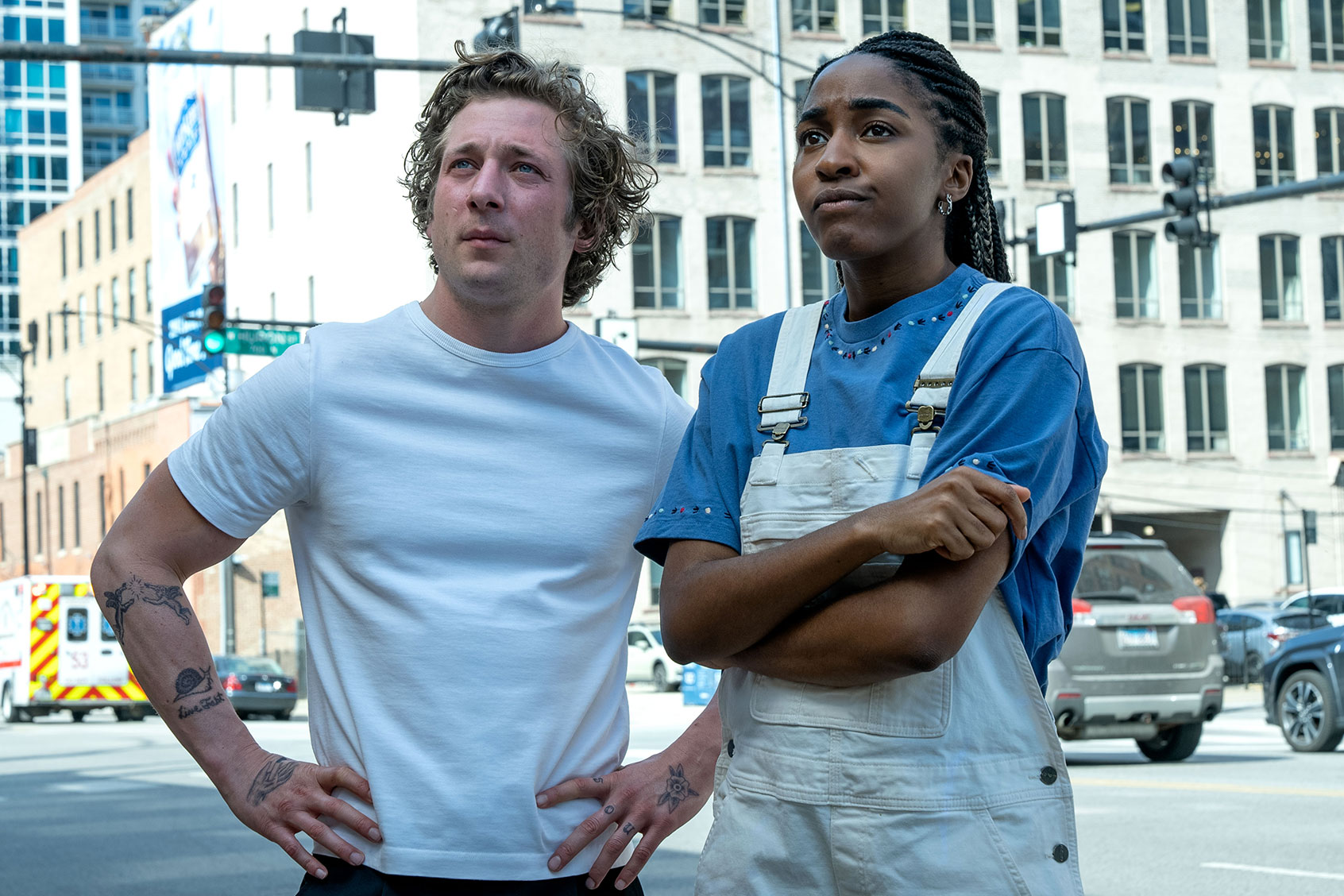
The BearJeremy Allen White as Carmen “Carmy” Berzatto and Ayo Edebiri as Sydney Adamu in “The Bear” (Chuck Hodes/FX)Passionate about cooking and food, Sydney is a professionally trained chef who is almost like a fish out of water in the first season of the show. She struggles to connect to the other older, untrained staff in the kitchen at The Beef restaurant and they rightfully find her condescending. But throughout the course of the two seasons, she is able to break through and showcase her ability to connect to people through the art of food, her vision for a successful restaurant and an elevated, supported staff. That is shown through a beautiful, loving scene of Syd cooking an omelet for her pregnant co-worker Natalie (Abby Elliott) in the second season. The character’s methodical nature, her passion for food and her care for the people eating made the audience feel like Syd (and Edebiri) was cooking for them, caring for them too. 

We need your help to stay independent

In the second season, Syd becomes second-in-command to Carmy, the lead chef and her co-partner played by the wonderful Jeremy Allen White. Edebiri’s chemistry with White also has launched a larger shipping discourse around the two characters. It is impossible to be in Edebiri’s line of sight without shipping her characters with someone because she screams romantic lead.

Her universality makes it easy to imagine her as a friend, sister or love interest, and that is what I call star presence. 

Did I mention that while Edebiri handles playing the co-lead in “The Bear” magnificently, she also serves as a co-executive producer on the critical and fan-favorite show? Her range of roles does not exclude that she is an incredibly talented person who exists outside of how she is portrayed in a scene — she is also part of making major decisions behind the scenes. She has only been in the industry for a handful of years. At 27, she wears multiple hats including actor, standup comedian, and writer with an ease that is almost comical. It’s even more impressive when you look at how there aren’t many young Black women in the industry who juggle this many roles while also being on the big screen in successful films and television shows. The only recent two that come to mind are Quinta Brunson of “Abbott Elementary” and Issa Rae of “Insecure.”

Edebiri’s starhood is shining bright right now because in her words “I’m employable!” She’s even joined the Marvel train, playing a role in the upcoming 2024 film “Thunderbolts.” But the larger context of her success this year is that she plays really sincere and loveable characters and while each one is different from one another — something about her charm and wit peeks through regardless of who she is playing. Her universality makes it easy to imagine her as a friend, sister or love interest, and that is what I call star presence. 

Students from these 8 states can now enjoy free school meals

After an especially challenging few years, it looks as though the "looming hunger cliff" might be slightly less steep.

Currently, going into the new 2023-2024 school year, there are eight states that are now offering "permanently free" school breakfast and lunch: California, Maine, Massachusetts, Michigan, Vermont, Colorado, New Mexico and Minnesota. As Susan Montoya Bryan writes for The Associated Press, federal aid's end in spring 2022 resulting in myriad issues for "families that weren't poor enough, stigmatized those who were, and added to growing school meal debt." This will undoubtedly bolster the fight against hunger, both in those eight states — and hopefully beyond.

Minnesota "allocated over $440 million for first two years of the program," according to AP. Alexis Bylander, senior policy analyst for the nonprofit Food Research and Action Center in Washington, D.C., told AP that "momentum is building" in regards to more and more states beginning to adapt similar policies. 

"Don't we want kids to be able to perform well in school and get good, nutritious, healthful meals throughout their learning?" Annette Nielsen asked, who is the executive director of New York City's Hunter College NYC Food Policy Center. Hopefully, this is just the start of a shift in how hunger is handled going forward. 


Green Day is selling Donald Trump’s mugshot T-shirts labeled “Nimrod”

Green Day is poking fun at Donald Trump and his recent arrest with new merchandise for a good cause. On Friday, the pop-punk band took to Instagram to announce the release of their new T-shirt featuring Trump’s mugshot covered by the signature yellow “nimrod” sticker seen in their 1997 “Nimrod” album logo. 

“Good Riddance. The ultimate Nimrod shirt is available for 72 hours only,” Green Day wrote in the caption. The band also used the opportunity to take a jab at Rudy Giuliani, one of Trump’s alleged conspirators, by jokingly referring to Giuliani’s legal defense fund: “Limited edition shirt proceeds will be donated to T̶h̶e̶ ̶G̶i̶u̶l̶i̶a̶n̶i̶ ̶L̶e̶g̶a̶l̶ ̶D̶e̶f̶e̶n̶s̶e̶ ̶F̶u̶n̶d̶ @greatergoodmusiccharity, which brings food to those affected by the Maui wildfires.”

https://www.instagram.com/p/CwYPScDpZGR/?hl=en

Trump and 18 other co-defendants were indicted on charges of racketeering and related offenses by a Fulton County, Georgia, grand jury on Aug. 14. The ex-president ultimately surrendered to authorities in Georgia, where he was arrested, booked and later released on a $200,000 bond. Trump’s mugshot, which made history as the first ever presidential mugshot, was taken less than two weeks later on Aug. 24.

This isn’t the first time Green Day has blatantly expressed their dislike for Trump and his cronies. In a 2017 interview with Rolling Stone, frontman Billie Joe Armstrong condemned Trump’s political views a few months after his inauguration: “I feel like the government is trying to create a culture war between us in a lot of ways. They’re trying to get between your average citizens based on red and blue. I think we’re in a crisis mode right now.”

He added, “I want people to feel unity when they come to a show. At the same time, I’m not going to p*** out on saying what I feel about [Trump] and his administration.”


Ultra-processed food is even more dangerous than originally thought, according to new studies

While there's been lots of press in recent years about the harms of ultra-processed food (UPFs), a new study might be more damning than ever: As reported by Andrew Gregory at The Guardian, "ultra-processed food significantly raises the risk of high blood pressure, heart disease, heart attacks and strokes," according to two new separate studies presented at this month's annual European Society of Cardiology conference in Amsterdam. 

One study — which monitored 10,000 women over the course of 15 years — found that those who consumed a higher amount of UPFs were 39% more likely to have high blood pressure than those who weren't. Another study, overseeing over 325,000 men and women, reported that those who consumed the most ultra-processed foods were 24% "more likely to have cardiovascular events" like strokes, angina and heart attacks. 

Also interesting? While many associate ultra-processed foods with "junk food," it also encompasses lots and lots of other foods, some of which might appear "healthy" — but actually be anything but. "For some, especially people who are younger, poorer or from disadvantaged areas, a diet comprising as much as 80% UPF is typical," Gregory reports. Some ideas for handling UPFs going forward are adding black warning labels, restricting sales or putting an even bigger emphasis on healthy, "natural" foods.

Ex-US attorney thinks Trump may “fire” his lawyer after “thoroughly unprofessional” court stunt

U.S. District Judge Tanya Chutkan on Monday scheduled the trial in former President Donald Trump’s election subversion case for March 4, 2024, in Washington, D.C.

Jury selection in the trial is set to begin on March 4, under Chutkan’s schedule, commencing one day before Super Tuesday, as NBC reported. Though Chutkan argued the trial lead-up period would be a sufficient amount of time for the ex-president’s defense team to prepare themselves, attorney John Lauro opposed the date, saying he does not feel he can adequately defend Trump in that amount of time. Lauro and co-counsel Todd Blanche had previously requested that Chutkan set the trial for April 2026, which the judge called “far beyond what is necessary.”

Lauro during the Monday hearing argued that there was no way he could be ready for the trial without years of preparation, according to Politico, which noted the staggering amount of evidence special counsel Jack Smith’s team of prosecutors has already assembled and shared with Trump’s lawyers: “12.8 million pages or files, drawn from grand jury interviews, the National Archives, the House Jan. 6 select committee’s evidence and Trump’s campaign and PACs.”

“This is an enormous, overwhelming task,” Lauro said, also stating that he has begun drafting a number of motions in an effort to see Trump’s case diminished or altogether dismissed. 

The attorney went on to accuse the federal government of putting on a “show trial,” claiming that he intends to file a specific motion alleging that the Justice Department is targeting Trump because he is a political adversary of President Joe Biden. 

“This man’s liberty and life is at stake,” Lauro said. “He’s no different than any American.”

Lauro also vowed to file a motion contending that Trump possesses “‘executive privilege” for his effort to subvert the 2020 election, as well as motions that will seek to dismiss each of Trump’s charges.

Politico noted that Chutkan “sympathized” with Lauro’s undeniable “burden” in preparing for the trial; however, she was also twice forced to ask the attorney to “take the temperature down” after Lauro raised his voice to harangue against the “outrage to justice” he saw as Smith’s expedited trial proposal of Jan 2, 2024. 

The judge added that Trump would be treated the same as any other defendant and that she would not show him “more or less deference.” Trump’s political obligations and campaigning, Chutkan emphasized, would not play a part in her decision-making process. 

“Setting a trial date does not depend and should not depend on the defendant’s personal and professional obligations,” she said. “Mr. Trump, like any defendant, will have to make the trial date work regardless of his schedule.”

We need your help to stay independent

Trump on Truth Social vowed to appeal the judge’s ruling but former federal prosecutor Renato Mariotti pointed out that a judge’s scheduling order is not subject to appeal.

Lauro after the ruling told Chutkan that while the legal team would abide by the schedule, “the trial date will deny President Trump the opportunity to have effective assistance of counsel.”

“This talk by Trump’s attorney, is meant to set up a potential motion to attack the verdict later — and make the judge think twice about pushing the trial forward quickly. The March trial date set by the judge will make it extremely hard for Trump’s team to push past the election,” Mariotti tweeted

The former prosecutor added that Lauro’s “heated outburst attacking Judge Chutkan would have a big downside.”

“But [Lauro] has calculated that she is ruling against them anyway, so he is putting on a big show for his client (Trump) and trying to set up a public narrative that he is being railroaded,” he wrote.


Want a daily wrap-up of all the news and commentary Salon has to offer? Subscribe to our morning newsletter, Crash Course.


Former federal prosecutor Andrew Weissmann, who served on special counsel Bob Mueller’s team, criticized Lauro’s complaint about the trial date as a “thoroughly unprofessional statement.”

“Chutkan hearing could’ve been worse for Trump, but I’m not sure how,” wrote former U.S. Attorney Harry Litman. “She called his lawyers misleading, obviously took their proposal as a stunt, and set a trial date about as early as she might have. Does [T]rump now fire Lauro?”

“I’m all for zealous defense of a client but if you’re already being warned not once but twice by a federal judge (who used to be a criminal defense attorney) to calm down, maybe, just maybe, you should rethink your approach,” wrote national security attorney Bradley Moss.

“It is now entirely possible Donald Trump takes the stage at the RNC in Summer 2024 having been convicted not once but twice in federal court,” he added.

Plant-based meat sales are stagnating. Could amplifying its green benefits help change that?

It’s difficult to tell if the recent wave of anti-vegan sentiment has affected the plant-based meat market, but denigrating the image of vegans has certainly gone mainstream.

Alongside negative comments about people who don’t eat meat by figures like Piers Morgan and Jeremy Clarkson, anti-vegan rhetoric has even slipped into political discourse: Suella Braverman recently referred to supporters of Just Stop Oil campaigners as “Guardian-reading, tofu-eating wokerati“. It seems our protein choices have become a surprisingly loaded issue.

These days, consumers are faced with a dizzying array of choices when it comes to protein, particularly since US plant-based producer Beyond Meat started its quest to disrupt the market in 2012. Since then, its innovative take on the veggie burger, made from pea protein to mimic the taste and texture of meat, has helped the company become a runaway success.

But despite sustained growth for several years, sales of plant-based meat products are now stagnating. Even market leaders like Beyond Meat are hitting significant lows.

The environmental benefits of adopting a diet that is less reliant on meat have been well-established. As UK nature presenter David Attenborough has pointed out: “We must change our diet. The planet can’t support billions of meat-eaters.”

So, working out why consumers are cooling towards this once-hot product is crucial, not only from a business point of view but to support the environmental benefits of low- or no-meat diets.

Price and healthiness are important. However, a growing ideological divide over the environment means traditional ways of encouraging people to eat plant-based meat — promoting its green credentials — could be harming sales, according to research.


Criticism of plant-based meat

The plant-based meat market has certainly been criticized for high prices compared with animal meat. It also tends to be more expensive than traditional vegan protein sources, such as beans, lentils and tofu. Given the cost of living crisis, consumers are forced to make frugal choices when it comes to their shopping basket and may reject what could be seen as a premium product.

Others have questioned the healthiness of meat substitutes. As plant-based meat is a relatively new product, the long-term health implications of directly replacing animal meat with it are unknown. Research also warns against assuming that plant-based meat is nutritionally equivalent to animal meat.

But alongside price and healthiness, image also plays an important role in the success of plant-based brands, according to my research with Krista Hill Cummings of Babson College, Massachusetts. In particular, how brands present the environmental benefits of plant-based meat can have a significant impact on the kinds of consumers that buy this type of food.

The issue of climate change and environmental concern is politically polarizing, however. Since the 1990s, environmentalism has been depicted as a left-wing ideological issue, particularly in the US. So, our study sought to examine the role of political beliefs in driving sales of plant-based meat by, first, establishing a link between a person’s ideology (either conservative or liberal) and their desire to engage with the plant-based meat market. This means everything from becoming aware of the product and developing opinions on it, right through to buying and eating plant-based meats.

A different survey shows that more than half (53%) of US consumers who have not bought or tried plant-based meat may be reluctant to buy a product they view as “woke”. Our study further highlights the political divide in views about plant-based meat, with the conservative consumers we polled less likely than liberals to try it and generally less interested in even considering it.

We analyzed press releases from Beyond Meat to understand how the benefits of plant-based meat are being communicated to consumers, to see if this could be a driver of the ideological divide over plant-based meat. We found that taste, health and the environment are the main messages used by the firm.

Taste and health are product benefits that appeal to both liberal and conservative consumers, according to other research. However, the environment emerged as a more controversial topic. This issue polarized liberal and conservative consumers when it came to perceiving climate change as a problem that could or should be addressed by eating plant-based meat.


Testing ads about the environment

To further test the idea that the environment could cause problems when advertising to conservative consumers, we created different messages, varying the environmental content. We developed mock Facebook ads that described either the health and environmental benefits of plant-based meat, or just the health benefits. We found that advertising content based on the environment turned off the conservative consumers involved in our study.

Of course, our study was carried out among US consumers. But the trend of political polarization seen across Europe and recent comments about the vegan “wokerati” lifestyle from UK public figures, means we could see similar results in other countries.

For an advertising message to successfully resonate and change either a consumer’s attitude or behavior, “congruence” is required. This is when the message content aligns with the characteristics of its recipient. We found that environmental messaging is incongruent to conservative consumers, meaning these ads don’t spark either their curiosity or interest. Without that spark, you can’t engage consumers.

More research into, and development of, alternative meats could no doubt improve the
nutritional profile, taste and texture of these products, but the environmental case for reducing meat consumption in our diets is clear. Plant-based brands need to change the way they speak to consumers about this issue to better engage steadfast meat-eaters.

Jennifer Yule, Lecturer in Marketing, The University of Edinburgh

This article is republished from The Conversation under a Creative Commons license. Read the original article.

“I was just following orders”: Ex-prosecutor calls out Trump co-defendants for using “Nazi defense”

Three defendants facing charges alongside Donald Trump in a sprawling Fulton County racketeering indictment are pointing their fingers at the former president and his campaign for their role in the fake electors scheme, signaling that they may be willing to cooperate with the prosecution in attempts to score a “sweetheart deal,” according to legal experts.

Former Georgia GOP Chair David Shafer, former Coffee County GOP chair Cathy Latham and state Rep. Shawn Still argued in court filings last week that their actions were carried out under the guidance of the Trump campaign, according to The Wall Street Journal. The three defendants stated that when they submitted documentation claiming their ability to legitimately cast Electoral College votes for Trump, they were acting according to the campaign’s instructions.

“Mr. Still, as a presidential elector, was also acting at the direction of the incumbent president of the United States,” an attorney for Still argued in a court filing. “The president’s attorneys instructed Mr. Still and the other contingent electors that they had to meet and cast their ballots on Dec. 14, 2020.”

Latham has similarly asserted that she was acting “at the direction of the President of the United States” and so has Shafer, who contended that he “and the other Republican Electors in the 2020 election acted at the direction of the incumbent President and other federal officials.”

The Georgia Republicans could also claim at trial that they acted at the direction of Trump or his close aides, which would be “bad news” for Trump, as such testimony would serve to draw the sprawling scheme alleged in the indictment more tightly together, with Trump at the top, former federal prosecutor Kevin O’Brien told Salon.

“At the same time, though, while such testimony could be a mitigating circumstance for the three defendants at sentencing, it’s not a legal defense that would prevent their conviction,” O’Brien said. “Each is properly charged with acting knowingly in violation of state law, especially since each held a position of responsibility either within the state Republican Party (Shafer) or within the state elections system (Latham and Still).”

Contending that they operated under the approval of the then-president and a team of his attorneys, the three Republicans are arguing that they should essentially be shielded from state prosecution, as they believed their actions were aligned with a federal role.

Shafer and a group of 15 fellow Republican electors convened at the state capitol on Dec. 14, 2020, and signed a document falsely declaring that Trump had won Georgia. Trump and his allies are now facing charges relating to their alleged roles in trying to overturn the results. 

“Their individual arguments are that they were acting as federal officers performing federal duties,” former San Francisco prosecutor Lateef Gray told Salon. “As such, they feel that they are immune from prosecution in state court.”

The defendants want their cases removed to federal court, Gray added, explaining that if this happens, they would then likely argue that they are immune from prosecution because they were acting “under color of their federal positions,” meaning they were doing what their federal positions allow them to do.

There’s no defense to a “blatantly illegal action,” like falsely passing oneself off as duly elected presidential electors, who say that Trump directed or asked them to do it, O’Brien said. “They should have known better.”

Former federal prosecutor Neama Rahmani agreed and said that “this is essentially the ‘Nazi defense’ of ‘I was just following orders.'”

“Legally, you can’t just direct someone to break laws,” Rahmani said. “On the other hand, if the most powerful person in the free world, or their attorney, is telling you to do something, you’ll probably do it. So this comes down to a question of whether jurors buy their argument. The legal term is mens rea, or ‘guilty mind.’ If the defendant persuades the jury that they genuinely thought they were doing something lawful, there isn’t a basis for criminal liability.”

We need your help to stay independent

Former Trump White House chief of staff Mark Meadows and a former Justice Department official Jeffrey Clark have also asked for their charges to be moved to federal court.

But neither of them have strong enough arguments to move their cases to federal court, especially the false electors, Mai Ratakonda, an attorney at the election rights group States United Democracy Center, told Salon. 

“I don’t really see their attempts to remove the federal court being successful,” Ratakonda said. “If a federal court judge decides that one or more of these co-defendants could have their trials moved to federal court, [this would raise the question of] does only that defendant get to move their case to federal court, or does the entire case against all of the defendants get moved to federal court?”

​​If the case is moved to federal court, the defendants could benefit from drawing a jury pool from more rural and conservative parts of Georgia, rather than predominantly liberal Fulton County. There’s also the possibility of drawing a federal judge who Trump appointed. 


Want a daily wrap-up of all the news and commentary Salon has to offer? Subscribe to our morning newsletter, Crash Course.


The defendants in the Georgia election interference case are accused of pressuring elected officials into overturning Trump’s defeat, arranging for individuals to declare him as the president through false “electors” in Georgia, tampering with voting machines and engaging in various actions aimed at undermining democracy, according to the indictment. These efforts were allegedly taken in an attempt to maintain Trump’s presidency, despite his loss to President Joe Biden in the election.

But if one of the co-defendants decides to cooperate with the prosecution, they are likely to get “a sweetheart deal,” meaning their charges will be “dismissed or minimized” in exchange for providing testimony against their co-defendants, Gray said.

That is the strategy that Fulton County District Attorney Fani Willis is employing here, Rahmani said. 

“Willis took the ‘kitchen sink’ approach, indicting 19 co-conspirators with RICO charges, putting maximum pressure on them to flip and cooperate,” Rahmani said. “She doesn’t want to try 19 people at once. With all of these defendants, there’s no way the case is going to trial before November because they’re going to raise all kinds of issues. The more defendants, the more difficult a case becomes.”

He added that in Georgia, “it’s a ‘prisoner’s dilemma’ situation.” While It’s best for all of the defendants to collectively stick together with none of them flipping, individually, it’s better for each person to cooperate. And “usually, the ones who cooperate first get the best deal.”

King Charles wants to welcome Prince Andrew back into royal family, per new report

More than a year after he lost his royal and military titles, Prince Andrew is being welcomed back into the royal family by none other than his older brother, a source close to the monarch told The Daily Beast. King Charles III invited his disgraced brother to stay in Scotland’s Balmoral Castle, where Andrew was seen carpooling with Prince William and Kate Middleton on Sunday.

“Andrew won’t ever have the same ceremonial role within the family, he is no longer and never will be a working royal. That is clear,” the source, described as a friend of the king, said. “But he is part of the family. He is the king’s brother. He has not been found guilty of any crime, and I think it’s fair to say that the king is making it clear that he won’t turn his back on his brother.” The recent revelation is especially shocking considering that Charles previously played a huge role in his brother’s expulsion from the royal’s inner circle. Amid the final months of the late Queen Elizabeth’s reign, Andrew was barred from performing royal duties after he justified his close friendship with Jeffrey Epstein in an infamous BBC interview. He was ultimately stripped of his royal patronages in the wake of a sex-abuse lawsuit brought forward by Virginia Giuffre, a victim of Epstein’s sex-trafficking ring. 

As for Andrew’s recent sighting with the Prince and Princess of Wales, British biographer Andrew Lownie explained to The Daily Beast that the royal family have been using the couple “to get [the royals] out of trouble a lot lately, and once again, they are doing the heavy lifting here, fixing problems not of their creation.” 

Lownie continued, “Until now, the family have been trying to distance themselves from Andrew, but Sunday’s ballet suggests that there’s been a change of strategy. The question is, why? Andrew is still very toxic . . . So, why have they apparently decided they need to be showing some sort of support for him and that they’re all in this together?”


Britney, Pamela and pumpkin spice: What the PSL hatred was always really about

Language, ever-shifting, has moved in such a way that we are now all in an “era,” whether one realizes it or not. Couch potatoes are in their “lazy era,” while the more bold are in their “main character era” (which is actually how fashion brand Worth Collective has characterized their collection of flouncy, pastel dresses that practically beg for a rom-com-worthy meet-cute). Acting a little curt at work? You’re probably in your villain era. Taylor Swift fans? They’re certainly in their “Eras” era. 

It’s one of those linguistic developments that was both born and flourished on TikTok, where data shows that the majority of consumers and creators are young women. Overexposure has rendered it a little grating at this point, but the use of the term “era,” as opposed to “phase” or even “routine,” gives both heft and ownership to something pretty complex in a relatively short format: the ways in which we perform femininity

This is something that I’ve been thinking about a lot as the pumpkin spice latte turns 20 and, looking back over the last two decades, considering just how much of a symbol of a particular kind of femininity it became; something for which the drink then became equal parts adored and seemingly reviled. 

Fittingly, this anniversary comes at a time during which pop culture continues to remind us through projects like “Framing Britney Spears” and “Pam and Tommy” just how complicated our relationship with symbols of girlhood and womanhood (and the labyrinthine spaces in between) actually are.

Just as Britney Spears and Pamela Anderson became icons and faced unwarranted scrutiny, the PSL has also been dissected, debated and disdained in a way that reveals the complex intersection of gender, culture and identity in American society —  and emphasizes just how much our preconceived notions about those things may be worth revisiting. 

The pumpkin spice latte debuted in the fall of 2003, just a few months before Britney Spears released her fourth studio album “In the Zone” and Pamela Anderson began to star in Stan Lee’s adult animated series “Stripperella” following a rocky relationship with Kid Rock and an even rockier marriage to Tommy Lee. 

Just as Britney Spears and Pamela Anderson became icons and faced unwarranted scrutiny, the PSL has also been dissected, debated and disdained in a way that reveals the complex intersection of gender, culture and identity in American society

Superficially at least, the two women very much represented a particular “type” of woman: a caricature of the blonde, bubbly girl next door, dressed in a cheeky red one-piece or perhaps a pleated uniform skirt accessorized with baby pink pom-pom hair ties. By virtue of their careers on-stage and on-screen, Anderson and Spears quickly ceased to be people in the mind of the public; they were commodities and regarded as sex objects. Every time someone bought “…Baby One More Time” or watched “Baywatch,” customers were buying into the act.  

However, much like another very famous bombshell (Marilyn Monroe received her own gritty reconsideration in the 2022 film “Blonde“) with the accolades came the now-predictable barbs. Through a tornado of breathless tabloid stories, TMZ features and Perez Hilton’s bitchy blind items, they were reduced to dumb, messy and vapid creatures that the paparazzi hunted for sport. Misogyny has always existed, but as a tween in the mid-2000s, I remember how particularly vicious the landscape felt for women at the time. 

We need your help to stay independent

Those attitudes are, of course, not just applied to actual, living and breathing women — but also to the things girls and women like, from boy bands to how they take their coffee. In her essay “Women Aren’t Ruining Food,” Jaya Saxena writes: “When men enjoy something, they elevate it. But when women enjoy something, they ruin it.”

“When those foods blow up, we judge women for falling for the marketing or trying to jump on the bandwagon, and we assume that because they like something other women like, they don’t have minds of their own,” Saxena wrote. “And on top of that, women are asked to reckon with, consciously or unconsciously, the perceived psycho-sexual symbolism attached to seemingly innocuous foods.” 

Herein lies the reason that the PSL has managed to inspire such hatred both online and in the real world. More so than concerns about corporate cringe or seasonal creep, people came to hate the pumpkin spice latte simply because lots of women loved it, thereby rendering it obviously and irreparably “basic.” 

Those attitudes are, of course, not just applied to actual, living and breathing women — but also to the things girls and women like, from boy bands to how they take their coffee

“Basic girls love the things they do because nearly every part of American commercial media has told them that they should,” culture writer Anne Helen-Peterson reported for Buzzfeed in 2014. These things include most of the things I can buy in the sprawling suburban stripmalls near my childhood home: Lululemon yoga pants, Ugg boots, infinity scarves and a pumpkin spice latte, likely retrieved from a Starbucks inside a Target. 

According to the internet, to be basic is to be predictable, to be vapid, to have no sense of subversion or irony in how you view the world — which is why the term was eventually leveled as an insult and why the PSL became its badge. 

I’m not quite sure when exactly the tides began to change for the PSL, but they have; the tendrils of the #MeToo movement has inspired a reconsideration of how women throughout pop culture history have been treated, which perhaps extends to how we’ve traditionally viewed the trappings of femininity. I also think that a lot of our collective angst surrounding superficial things like how people choose to spice up their morning cup of coffee began to dissipate during the pandemic when we all had bigger things on our minds. 

Regardless, even the impossibly cool cafe down the street from me has relented and listed their version of the PSL on their seasonal specials board, made with frothy oat milk and freshly toasted warm baking spices. 

Twenty years on, the PSL has undoubtedly cemented itself as an autumn staple. Now that it has, maybe we can finally unpack why we turned it into a stereotype in the first place.


Idalia, a tropical storm heading toward Florida, may strengthen into a hurricane this week: experts

Experts have predicted for years that as climate change worsens, extreme weather events will become both more intense and more frequent. Among other things, scientists observe that tropical storms will more often turn into hurricanes as they hit warmer waters while heading to the shore. That very thing appears to now be happening with Tropical Storm Idalia. As the super-storm barrels through Cuba en route to Florida, it is heading toward warmer-than-usual waters that are expected to turn it into a full-fledged hurricane that will hit the mainland later this week.

“Idalia is now forecast to become a major hurricane before it reaches the Gulf coast of Florida,” explained the National Hurricane Center in a post on X (formerly Twitter). “The risk continues to increase for life-threatening storm surge and dangerous hurricane-force winds along portions of the west coast of Florida and the Florida Panhandle beginning as early as late Tuesday.”

The Biden-Harris Administration urged residents to start preparations Monday in a release by the Federal Emergency Management Agency. The underlying problem is that Idalia — which is currently projected to be a Category 3 tropical storm when it hits Florida between Tampa and Tallahassee — is forecast to pass over parts of the ocean where the sea surface temperatures average close to 90 F. The warmer ocean water could fuel the tropical storm and intensify its features.

This is not the only occasion in which climate change has worsened bad weather. Earlier this month, the National Oceanic and Atmospheric Administration warned that this year’s hurricane season could be more aggressive thanks to warmer ocean temperatures. Meanwhile, the June 2023 Canadian wildfires are likewise believed to have been exacerbated by climate change. More broadly, the combination of heatwaves and droughts are expected to cause more severe weather events like wildfires, a “new abnormal.”

“High-risk gamble”: Experts warn Mark Meadows’ surprise testimony could blow up in his face

Former White House chief of staff Mark Meadows made a surprise appearance on the witness stand Monday as he seeks to move his Fulton County charges to federal court, according to The Wall Street Journal. Meadows testified during an evidentiary hearing that his actions following the 2020 election were part of his official White House duties. At one point Meadows said he didn’t want to reveal any classified information during his testimony. “I’m in enough trouble as it is,” he said.

MSNBC legal analyst Lisa Rubin pointed out that most former prosecutors did not expect Meadows to testify because the risks on cross-examination “would simply be too great.” That Meadows’ experienced attorney, George Twelliger, allowed his client to testify shows that “Meadows and his team believe moving his case to federal court is so critical that it’s worth the risk of his being cross-examined” and that they’ve concluded that “they had no other way of shouldering their burden of proof that he was acting as a federal officer beyond Meadows’s own testimony,” she wrote on X, formerly Twitter. That suggests that Meadows’ team was unable to convince any of his allies to testify on his behalf “or that because of the secrecy with which they operated, no such witnesses exist. Either one is not a good look,” she added.

“Why did all the lawyer commentators get it wrong predicting Meadows wouldn’t testify? Because the risks of cross-examination are huge. Why did Meadows decide to testify? Because they’ve concluded the consequences of trial in Georgia are more huge,” agreed former U.S. Attorney Harry Litman. New York University Law Prof. Ryan Goodman called the move a “high-risk gamble,” noting that Meadows during his testimony also admitted he had “no reason to doubt” former Attorney General Bill Barr’s conclusion that Trump’s fraud claims were baseless. “I have long said Meadows in some respects has even more criminal exposure than Trump,” he wrote. “That’s because Meadows confided in people he knew the election was lost. Now he has admitted in testimony he had no reason to doubt Barr’s assessment.”

Why do I crave sugar and carbs when I’m sick?

Your nose is running, your head hurts and you feel like you’re coming down with a cold. You’re settling in on the couch for a sick day. Then you reach for the snacks.

When you’re sick, your appetite often decreases. So why, at other times, do you crave sugary treats and carbohydrate-loaded comfort foods?

A food craving goes beyond a mere desire to eat, it encompasses a complex mix of emotional, behavioral, cognitive and physiological processes. Whether it’s the need for a quick energy source or a temporary relief from discomfort, our bodies and minds work in tandem to drive our food preferences.

Here we’ll explore the science behind why our bodies crave sugar and carbs — especially when we’re sick.


Fueling the immune system

When sickness strikes, our immune system springs into action, requiring additional energy to combat invaders.

This heightened activity often leads to an increase in our metabolic rate, energy demands and nutritional requirements.

Sugary treats and carbs are quick sources of energy, satisfying this increased demand.  

But while a high sugar diet during times of illness may help meet increased metabolic demands, it could also exacerbate the immune and inflammatory response, potentially impeding recovery.

In the longer term, high-sugar diets promote chronic inflammation, alter gut microbiota composition and are associated with chronic disease. For a well-functioning immune system, aim for a balanced intake of fruits, vegetables, fiber, protein  and low-glycemic carbohydrates.


The stress response

Being sick is stressful for the body. Acute mild or intense stress, like we’d see if we’re sick, boosts the “flight or fight” hormones adrenaline and cortisol. This mobilizes stored energy to meet increased demands, but it can also curb appetite.

Prolonged stress can disrupt energy balance and cause nutritional deficiencies and alterations in gut and brain functions. This can reduce a person’s threshold for craving sugar and salt, increasing their preferences towards energy-dense foods.

The stress hormone cortisol can also increase your preference for high-calorie, comfort foods, which can temporarily alleviate stress.


The brain’s reward system

Comfort foods trigger your brain’s reward system, releasing feel-good neurotransmitters like dopamine and serotonin.

But “sugar rushes” are often short-lived and can lead to decreased alertness and heightened fatigue within an hour of consumption.

The link between carbohydrates (which the body converts to sugar) and serotonin can be traced back to 1971 when researchers found elevated tryptophan levels (serotonin’s precursor) in rats’ plasma and brains after a carbohydrate-rich diet.

Subsequent studies in humans established connections between carbohydrates and mood, especially in relation to obesity, depression and seasonal affective disorder. Therapies enhancing serotonin have since been shown to reduce carbohydrate intake.

Remarkably, around 90% of serotonin production occurs in the gut. The vast microbial population in our gut exerts a potent influence on immunity, metabolism and appetite.

Recent mouse studies have even identified specific microbes linked to sugar binges after antibiotic treatment.


Some people eat less when they’re sick

Not everyone craves sugar and carbs when they are sick. Some people eat less for a few reasons:

  • they have less of an appetite. While ghrelin (the “hunger” hormone) levels might initially rise, prolonged illness can suppress appetite due to nausea, fatigue and discomfort. Critically ill patients have reduced food intake and are at risk of malnutrition

  • metabolic adaptation. The body might slow specific metabolic processes to conserve energy, reducing overall calorie requirements

  • altered taste perception. Taste is an important component that affects both appetite and energy intake. Alterations in taste and smell is a common symptom when we are sick and was common with COVID

  • consuming fluids like water, tea or broths might be more appealing and manageable than solid foods. These fluids provide hydration but contribute minimally to calorie intake.

Hayley O’Neill, Assistant Professor, Faculty of Health Sciences and Medicine, Bond University

This article is republished from The Conversation under a Creative Commons license. Read the original article.

Fox News apologizes to family of fallen Marine for “disgusting” false story it didn’t correct

Fox News has issued an apology to the family of a fallen Marine after publishing an erroneous July 25 report saying that they had to pay $60,000 to transport the body of 23-year-old Sgt. Nicole Gee from California to Arlington National Cemetery. Gee was among 13 U.S. service members killed in a bombing in Kabul during the U.S. withdrawal from Afghanistan.

The Marine Corps contacted the conservative network repeatedly, asking to have the story, written by Michael Lee and founded on false allegations made by Rep. Cory Mills, R-Fla. Marine Corps spokesman Maj. James Stenger emailed Fox News executives not long after the article was published, writing, “The allegations originally published turned out to be false, which I suspect Mr. Lee knew in the first place, and was the reason he did not seek comment from the Marine Corps.” Fox first amended the story’s headline and changed the opening paragraph; however, Stenger followed up, stating that the piece was still incorrect. “Using the grief of a family member of a fallen Marine to score cheap clickbait points is disgusting,” he wrote. 

“The now unpublished story has been addressed internally and we sincerely apologize to the Gee family,” a Fox News spokesperson said in a statement after the network removed the post in its entirety. The Washington Post reported that Fox has not corrected the false report, nor has it clarified its reasons for deleting it. 

From “Parasite” to “Squid Game,” America of course exploited South Korea’s anti-capitalist content

K-drama fans, brace yourselves. The Korea Broadcasting Actors Union is trying to meet with Netflix to address labor issues, but unsurprisingly the streaming conglomerate is refusing to meet with the union. Amidst the still ongoing Writers Guild and SAG-AFTRA strike in the U.S., Netflix has turned to South Korean actors, screenwriters and directors to continue creating original shows. All that could change, however, as the union’s demands continue to go ignored. (Salon’s unionized employees are represented by the WGA East.)

At least “Squid Game” made the show’s creator Hwang Dong-hyuk rich, right? Wrong.

The Korean union is attempting to meet with Netflix over labor concerns that are similar to the issues of currently striking actors. This includes the topic of pay and residuals. According to the union, Netflix does not pay its Korean actors any residuals whatsoever and pays its South Korean employees significantly less than their American counterparts. Union president Song Chang-gon says that Korean actors earn less when working on Netflix productions compared to Korean shows, as they are paid per episode (beginning at $300 for each) for fewer episodes — despite the work being more labor-intensive. 

The pay discrepancy is particularly foul given how much Netflix has benefited from its South Korean content. Around 60% of the platform’s streamers watch Korean titles, a fact that Netflix plans to capitalize on by investing $2.5 billion for South Korean content over the next four years. This is in addition to the $500 million it invested in Korean titles in 2021 and the $700 million it invested in 2016. 

Squid Game” – the hit South Korean show that follows poor and financially challenged contestants competing in deadly children’s games for the chance to win $40 million cash prize – remains the platform’s most-watched show, bringing the streaming giant 4.38 million additional subscribers in its third quarter and rose revenue by 16% per The L.A. Times.

At least it made the show’s creator Hwang Dong-hyuk rich, right? Wrong.

In an interview, the director revealed that his contract forfeited intellectual property and residuals, making enough “to put food on the table,” but only a fraction of the wealth he garnered the platform and its executives. This means he’s also unlikely to profit from the show’s upcoming second season, which he never intended to create in the first place given that making the first season was so stressful he lost six teeth.

Squid GameSquid Game (YOUNGKYU PARK/Netflix)A show about a capitalist hellscape is being exploited by a large corporation who is refusing to fairly pay its employees and creatives. Life really imitates art. Unfortunately, this is not a phenomenon confined to Netflix: America as a whole has been profiting off of South Korea’s on-screen depiction of anti-capitalism over the last couple of years, nevermind the fact that the U.S. played a crucial role in shaping the country’s corrupt economy.

Is it a coincidence that after the standout success of “Squid Game” and “Parasite” so many U.S. shows would portray the same message? Maybe, maybe not.

After “Squid Game,” Bong Joon-Ho’s “Parasite” became the next big Korean title on U.S. screens. The tragicomedy follows the Kim family, a poor and scrappy bunch who seize an opportunity to con an uber-wealthy family, the Parks, after Kim Ki-woo (Choi Woo-shik) gets a job tutoring the Parks’ young daughter. But as greed and lies catch up to the families, horror ensues. When the scathing depiction of South Korean capitalism won a slew of awards (including Golden Globe and Palme d’Or), America did what America does best: make money off of it. HBO confirmed it won the rights to the movie in order to create an American TV adaption of the film in 2020.

We need your help to stay independent

Enter America’s “Eat the rich” era. After the motion picture took home the Oscar for best picture in 2020, a slew of shows and movies released in the U.S. thereafter began to take its own shots at capitalism. Later that year, “White Lotus” began production. In 2022, “Triangle of Sadness,” “The Menu” and “Glass Onion” all debuted surrounding the same theme that rich people are evil. Is it a coincidence that after the standout success of “Squid Game” and “Parasite” so many U.S. shows would portray the same message? Maybe, maybe not.

ParasiteThe Kim Family (Woo-sik Choi, Kang-ho Song, Hye-jin Jang, So-dam Park) in Parasite. (Courtesy of NEON + CJ Entertainment)

Whether or not more and more directors jumped on South Korea’s anti-capitalism bandwagon, it’s clear that Hollywood has capitalized off of the success of productions that touch on this. The most glaring example of this being “Squid Game: The Challenge,” an upcoming reality TV show sequel to the original which not only capitalizes on the success of South Korea’s hit, but also misses the point of the show: to critique the ways capitalism has pushed people to desperate places for survival. The live action remake laughs in the face of this message by turning the dystopian game show premise into reality. 

Even Disney got in on this trend, releasing the surprisingly progressive “Andor.” As Patrick Sproull in The Face puts it, “The fact that a company worth $203.63 billion feels comfortable parroting anti-capitalist talking points shows that something has gone seriously wrong. Anti-capitalist art is now a genre, one safe enough to be reproduced by the very people it’s supposed to target.”

All this set the stage for South Korea’s hypercapitalism.

For America to capitalize off of South Korea’s onscreen struggles with capitalism is ironic considering how the U.S. played a role in creating the very economic situation the country finds itself in. Professor of economics at Lewis and Clark and author of The “Rush to Development: Economic Change and Political Struggle in South Korea,” Martin Hart-Landsberg makes this argument, noting how the U.S. pressured South Korea to shift to a export-oriented growth strategy in place of a self-reliant economy in the mid ’60s. They backed this up with financial assistance (in the vein of almost $5 billion in the eights years South Korea helped support the U.S. in the Vietnam War), as well as provided an open market for South Korean exports

But just as Victor Frankenstein grew resentful of the product of his own making, so too did the U.S. who then had to compete with the now successful South Korean market. They proceed to bully South Korea back into an economically inferior position. In 1983, they pressed South Korea to drop its tariffs, began anti-dumping suits against their color TV exports and forced them to agree to restrictions on steel exports. When the 1997 Asian financial crisis hit South Korea, the U.S. took the opportunity to weaken them further. A team from the International Monetary Fund (IMF) was sent to Seoul to discuss a bailout package in 1997, and the U.S.’s Treasury Undersecretary, David Lipton, went with them. Uncoincidentally, the agreed-upon package was favorable to the U.S., forcing South Korea to agree to open the country’s market up to foreign investors, deregulate the foreign exchange market, raise interest rates and slash labor rights in a way that allows companies more power in terminating its employees. 

All this set the stage for South Korea’s hypercapitalism. While the country is of course still responsible for their own actions and treatments of its workers, the U.S. has still played a significant role in manipulating this outcome. This result of which includes the current Hallyu, or Korean wave, of cultural exports like K-dramas and K-pop that have risen in popularity across the world stage, including in America. It makes sense that the country takes its shows and music so seriously, religiously churning out new pop bands (no, seriously, there are schools for it), because this provides them a hot, international commodity and lucrative market they crucially have control over.

It should come as no surprise then that the recently remastered and re-released 2003 film, “Oldboy” by Park Chan-wook, is back in theaters and absolutely killing it. According to Deadline, it slated to top $1 million in its first week back. Ironically, the gruesome revenge thriller is heralded by critics as an allegory of . . . wait for it . . . capitalism. 

Choi Min-sik “Oldboy” poster for 2023 re-release (Neon)The movie follows average salaryman Oh Dae-su (Choi Min-sik) after he’s kidnapped and imprisoned in a hotel room only to be released 15 years later, beginning his quest for vengeance. While this may not sound very capitalistic, the country’s deal with the IMF plays (literally) in the background of the movie as Dae-su watches the news in his room every day from 1988 to 2003, the same period of South Korea’s economic upheaval. 


Want a daily wrap-up of all the news and commentary Salon has to offer? Subscribe to our morning newsletter, Crash Course.


Just as the IMF deal sold false promises of financial freedom, Dae-su is released from his imprisonment only to find his release is part of a more elaborate and nefarious plan orchestrated by the American-educated and wealthy businessman, Lee Woo-jin (Yoo Yeon-seok). Woo-jin, who believes Dae-su spread a rumor about him having sex with his sister and thus inadvertently got her killed, has exported his imprisonment of Dae-su to a third-party company as a part of a grand plan to exact ultimate revenge.

In other words, Dae-su’s bleak fate is, as Annabelle Johnston writes, “an avatar for South Korea, a nation that has been pillaged, conquered, occupied and torn apart by regimes much larger and more developed than itself for centuries.” Countries like America – who unknowingly and unironically continue to rewatch – replay and repeat this exploitation again and again.

Trump lawyer complains after Judge Chutkan sets March 4 trial date — but she’s not having it

Judge Tanya Chutkan on Monday set a March 4 trial date for former President Donald Trump’s election conspiracy case in Washington D.C., The Associated Press reports. Chutkan denied Trump lawyers’ bid to push the trial until April 2026 but set a date later than the January 2 start date proposed by special counsel Jack Smith. “These proposals are obviously very far apart,” she said. “Neither of them is acceptable.”

Trump attorney John Lauro argued that the date was unfair to the former president. “We will certainly abide by your honor’s ruling, as we must. We will not be able to provide adequate representation … the trial date will deny President Trump the opportunity to have effective assistance of counsel,” he said, according to Politico’s Kyle Cheney. Chutkan agreed that Trump needs more than five months to prepare, referring to the DOJ’s recommendation, but said that the date proposed by Trump is “far” too long, arguing that the public has a right to a speedy trial in the case. “Mr. Trump is represented by a team of zealous, experienced attorneys.  And has the resources necessary to review the discovery… I’ve seen many cases delayed because the defendant lacks adequate representation. That is not the case here,” Chutkan said, according to CBS News’ Scott MacFarlane.

Chutkan earlier in the hearing told the Trump attorney that his presidential campaign would have no bearing on the schedule. “Setting a trial date does not depend and should not depend on the defendant’s personal and professional obligations. Mr. Trump, like any defendant, will have to make the trial date work regardless of his schedule,” she said, according to The Guardian’s Hugo Lowell. 

“Not a great statement”: Legal experts say Trump lawyer just destroyed his argument to delay trial

Trump attorney Alina Habba claimed that the former president will not need any preparation ahead of his numerous overlapping trials because he is “incredibly intelligent” unlike the “average person.” Habba told Fox News host Shannon Bream that “if this was a normal person… I could understand the concern” but Trump is “incredibly intelligent and he knows the ropes.” She questioned, “What is he going to have to be prepped for? The truth? You don’t have to prep much when you’ve done nothing wrong.”

Some legal experts cautioned that Habba undercut Trump’s argument that he needed extensive time to prepare for his trials. “Trump’s lawyer tells FOX her client ‘knows all the facts’ and doesn’t need time to prep for the coup trial — while his other lawyer says he needs till April 2026 because it’s so complex,” noted longtime Harvard legal scholar Laurence Tribe. “Wow,” marveled attorney George Conway, writing that Habba “really did” destroy Trump’s lawyers’ argument. “Not a great statement to make just prior to DC Judge anticipated ruling tomorrow on DC trial date,” warned former Mueller prosecutor Andrew Weissmann. “The more his lawyers speak for political purposes, the more they harm/impact the legal case,” tweeted national security attorney Mark Zaid.

“Blood on his hands”: Ron DeSantis booed at vigil for victims of racist Jacksonville shooting

Florida Gov. Ron DeSantis faced an onslaught of boos from the crowd at a Sunday vigil for the three victims of a racially motivated shooting on Saturday in Jacksonville. 

A 21-year-old white gunman fatally shot three Black people at a Jacksonville Dollar General store after he was denied entry to a historically Black college nearby, according to authorities. The gunman used an AR-15-style rifle inscribed with Nazi insignia, according to police, which said the shooter left behind evidence that he “hated Black people.”

DeSantis arrived at a vigil for the victims to jeers on Saturday, escalating to the point that Jacksonville County Councilwoman Ju’Coby Pittman asked the crowd to quiet the heckling. 

“It ain’t about parties today,” she said. “A bullet don’t know a party.”

In April, DeSantis signed a bill allowing state residents who legally own a firearm to carry concealed guns without a permit, legislation that was met with contempt by many Democrats. Florida has been the site of several of the country’s worst mass shootings in recent years, including the ones at Pulse nightclub in Orlando in 2016 at Marjory Stoneman Douglas High School in Parkland in 2018.

Aside from his lax gun laws, DeSantis has faced public scrutiny from progressives for his culture war crusades and condemnation of anything deemed “woke,” such as his defense of the blocking of an Advanced Placement class on African American studies in state schools. 

“This divide exists because of the ongoing disenfranchisement of Black people and a governor, who is really propelling himself forward through bigoted, racially motivated, misogynistic, xenophobic actions to throw red meat to a Republican base,” Rudolph McKissick, senior pastor of the Bethel Church in Jacksonville, told the Associated Press.

We need your help to stay independent

DeSantis at the vigil announced that on Monday, a state-led initiative would go into effect to provide financial support for the affected families, as well as to bolster security at Edward Waters University, the historically Black college near where the shooting took place. The governor called the shooter, who took his own life following the attacks, a “major league scumbag.”

“What he did is totally unacceptable in the state of Florida,” DeSantis said. “We are not going to let people be targeted based on their race.”

Florida state Rep. Angie Nixon, a Democrat, lambasted DeSantis on Saturday, telling MSNBC that “at the end of the day, the governor has blood on his hands.”

“He has had an attack, an all-out attack on the Black community with his anti-woke policies, which we know very well was nothing more than a dog whistle to get folks up and riled up in the way in which it just happened yesterday. As I listened to him for the first time with that statement, my blood is literally boiling,” she continued.


Want a daily wrap-up of all the news and commentary Salon has to offer? Subscribe to our morning newsletter, Crash Course.


Nixon also referred to DeSantis’s 2018 controversial and racially imbued comment about then-opponent Andrew Gillum, who is Black, saying in a television interview that voters should not “monkey this up” by electing Gillum.

“This is absurd, it’s ridiculous. He is one of the causes to this. This is an agenda that he has been pushing since he has gotten into office,” Nixon said. 

“We have Republican leadership across this state who are doing everything to continually attack Black lives. They are doing everything to erase Black history. They are feeding our children propaganda. All that does is lead to the devaluation of Black lives,” she added.

“It’s the audacity for me,” Nixon tweeted on Sunday from the vigil, writing that DeSantis “is here and needs to apologize for his part in this.”

President Biden on Sunday decried the shooting.

“Even as we continue searching for answers, we must say clearly and forcefully that white supremacy has no place in America,” he said in a statement.

“We must refuse to live in a country where Black families going to the store or Black students going to school live in fear of being gunned down because of the color of their skin. Hate must have no safe harbor. Silence is complicity and we must not remain silent,” Biden continued. “Jill and I are praying for the victims and their families, and we grieve with the people of Jacksonville.”

“On Saturday, our nation marked the 60th Anniversary of the March on Washington — a seminal moment in our history and in our work towards equal opportunity for all Americans,” he added. “But this day of remembrance and commemoration ended with yet another American community wounded by an act of gun violence, reportedly fueled by hate-filled animus and carried out with two firearms.”

Rise of the Republican edgelord: If Trump is the GOP’s present, Vivek Ramaswamy is its future

There’s a lot of talk these days about what will become of the Republican Party once Donald Trump is gone. That seems a bit premature: Trump is still very much with us, and whether he wins or loses next year, he’s not going anywhere until he’s six feet under. Still, the man is 77 years old, so it’s natural to consider what’s going to be left of the hulking wreck of the GOP once he leaves this mortal coil.

The fact that Trump remains the runaway favorite to win the 2024 Republican nomination despite the 91 felony charges he faces in four different cases really says it all about where the party is today. Polling over the past couple of weeks confirms that most Republicans still claim to believe the Big Lie and say that that Trump’s legal troubles are trumped-up charges made by a Democratic “deep state” conspiracy. How many Republican voters actually believe that this is unknowable, but it’s clear that for now they’re sticking with their man regardless. Criminal or not, they like what he’s selling. No, actually they love it. And what he’s selling, essentially, is transgression. 

They love Trump’s crude defiance of all social norms, and the way he acts as if those norms don’t even exist. They love that he doesn’t follow the rules, or even the law, if that’s what it takes to get what he wants. They love it that their enemies can’t make Trump capitulate even when he’s caught red-handed. They believe that he is being persecuted — just as they believe they themselves are persecuted — for saying or thinking things that aren’t “woke” or politically correct, and they love that he won’t stop doing it no matter what. They love that he will do literally anything to “own the libs,” even when that seems self-destructive or senseless, because that is what it will take to make America “great again,” or at least to feel like it’s theirs again.

Are the underlying attitudes that fuel this love for Trump the new ideology (if you want to call it that) of the Republican Party? I hope not, but I really don’t know. The sinking of the good ship DeSantis shows that it takes more than “anti-woke” policies to capture these voters’ attention. Trump has proved that policy in general is pretty much an afterthought in today’s GOP. After all, the party didn’t even bother to publish a platform in 2020, just opting for a statement that essentially said, “We’ll have whatever Trump is having.” He has no ideology and holds no fixed political positions, and neither do his MAGA followers. It’s all about defiance, disobedience and breaking the rules. He makes it OK for his followers to let their freak flags fly (or at least the giant Trump flags on their F-150s), just as he does.

There’s a term for people who do this: “edgelords,” defined as those who “intentionally expresses opinions that are likely to shock or offend people, especially on the internet, as a way of making others notice or admire them.” I’m reminded of one young fellow who joined the white supremacists and neo-Nazis marching at Charlottesville in 2017 who explained what that was all about for him:

It’s kind of a fun idea. Just being able to say, like, “Hey man, white power!” You know? To be quite honest, I love to be offensive. It’s fun.

Don’t underestimate the fun factor in the Trump phenomenon. A recent New York Times/Siena poll of likely Republican voters actually asked whether Trump or DeSantis rated as more “fun” — and it wasn’t close. When it comes to traditional personal qualities one might seek in a president, such as being “likable” and “moral,” the two were rated about even. But when asked who was more “fun,” Trump led by 53% to 16%, closely matching his overall position in the race. That’s what makes him stand out: He makes owning the libs feel like a good time.

So where does all this go from here? We caught a glimpse this past week of how that might play out in a Trump-free world. At last week’s Republican debate the nation was introduced to a charismatic gadfly named Vivek Ramaswamy, a previously unknown biotech entrepreneur who has made a surprising surge in the polls after impressing audiences in Iowa.

Even in that one appearance, you could see that Ramaswamy has a flair for the dramatic and cared nothing for the usual rules and norms of these political events. Like Trump in the 2016 debates, he insulted the other candidates, calling them all “bought and paid for” and launching obnoxious unprovoked attacks, all while pledging undying fealty to Donald Trump. He backed the idea of invading Mexico, denied the significance climate change (even agitating for more use of fossil fuels) and promised to pardon Trump if he wins the election. And all of that was delivered with a big, playful smile that gave the audience permission to enjoy the edgelord fun.


Want a daily wrap-up of all the news and commentary Salon has to offer? Subscribe to our morning newsletter, Crash Course.


Most of the stuff Ramaswamy says is frankly bizarre, seemingly designed for the express purpose of going viral. He talks a lot and he talks fast and most of the time it makes no sense. Here’s one example that will make your head spin:

This is a guy who graduated from Harvard and then Yale Law School, and who says he wants all students to pass a civics test. Not that any of that matters: The Republican base doesn’t care that what he says is nonsense, they just like the sound of it.

Ramaswamy was called to task on the Sunday shows for a couple of particularly odious comments he made on the issue of race. As CNN reported, he once declared:

I’m sure the boogeyman white supremacists exist somewhere in America. I have just never met him. Never seen one. Never met one in my life, right? Maybe I will meet a — maybe I will meet a unicorn sooner. And maybe those exist too.

Ramaswamy has also described Rep. Ayana Pressley, D-Mass., a Black progressive, as a “modern grand wizard of the KKK” and then complained that he was offended when journalist Kara Swisher referred to him as “Rama-smarmy,” citing that racist. That’s a quintessential edgelord trick: Make a heinous comment and then cry victim over something much less egregious, laughing all the way. CNN’s Dana Bash and NBC’s Chuck Todd pushed him hard but he just kept on talking, spouting gibberish and right-wing buzzwords until there was nothing left to say.

There isn’t much good news in all this, I’m afraid. Ramaswamy certainly isn’t going to become the 2024 nominee — not while they still have Trump, anyway — but he’s the only other candidate who gets what the new crop of Republican voters respond to. He’s a smart, highly educated, savvy, modern hustler with sharp political instincts. I’m afraid that the era of the GOP edgelord is already here, and there’s a lot more right around the corner. That’s not likely to be much fun for the rest of us. 

“Fatally sabotaged”: Legal experts say concession in Mark Meadows’ filing could backfire in court

Former White House chief of staff Mark Meadows may have “fatally sabotaged” his effort to remove his Fulton County case from Georgia court to federal court, legal experts say.

Meadows is set to face U.S. District Judge Steve Jones on Monday in an evidentiary hearing on his bid to move the case to federal court but faces a “seemingly insurmountable barrier,” legal analysts Walt Shaub, Norm Eisen and Joshua Kolb wrote in a piece published at Just Security.

To remove the case to federal court, Meadows would have to show that he was charged under conduct related to his official duties as a federal official. “Even though the legal hurdle is low and the law is favorable to federal officers,” the analysts wrote, Meadows’ lawyers have “remarkably conceded” that all the “substantive allegations in the Indictment concern unquestionably political activity,” which may prove “fatal” to Meadows’ removal bid.

“A proper and straightforward understanding of the Hatch Act – which prohibits executive branch employees from interfering in elections–indicates that Meadows will not be able to meet his burden of showing the alleged conduct was connected to his official duties,” they explained, pointing to a federal law barring activity that could influence an election by federal personnel.

Because Meadows was subject to the Hatch Act, he had “no authority” to engage in the charged conduct, they argued.

The experts cited a provision of the Hatch Act that bars a federal officer from using “his official authority or influence for the purpose of interfering with or affecting the result of an election.”

“To stitch together the severed thread between his conduct and his former role, Meadows tries in vain to pretend that the Hatch Act does not exist — or that it is inapplicable, unconstitutional, or amenable to violation by presidential aides. But that thread cannot be mended,” they wrote.

Fulton County District Attorney Fani Willis similarly argued in a court filing that Meadows’ defense is undercut by the Hatch Act. Meadows in a reply filing argued that the “state is wrong” to assert that political activity was not part of his official duties.

“The very purpose of the Hatch Act was to place political acts of the kind charged here beyond the reach of the office of Chief of Staff to the President,” the analysts noted, adding that as a matter of established law, the Fulton charges “allege acts that could have only been committed in a personal capacity.”

Though Meadows’ attorney argued that his “conduct was actually required or properly considered part of his official duties,” prosecutors are not concerned with what was “properly considered” part of his job but with “what the law prohibited,” the column continued, adding that the law “flatly prohibits” the chief of staff from committing the charged acts.

Meadows’ attorney has also argued he has “a colorable defense arising out of [his] duty to enforce federal law” and that the Constitution’s Supremacy Clause “provides immunity from ‘suits under state law against federal officials carrying out their executive duties.”

But the experts argued that the conduct did not “arise out of his duty to enforce federal law” but his “failure to comply” with it.

We need your help to stay independent

“Put simply, Meadows cannot meet his burden of demonstrating a connection between the conduct and his duties because his duty was specifically to avoid committing the conduct. He cannot show he was ‘carrying out’ his “executive duties” because his duty was to carry out a law prohibiting that conduct,” they wrote.

Meadows cannot “plead ignorance” of the Hatch Act since he “revealed his contempt for the law” in an Office of Special Counsel investigation into repeated Hatch Act violations in the Trump administration, the experts continued.

“Nobody outside of the Beltway really cares,” he told investigators.

“Moreover, Meadows’ attempt to get the case dismissed by raising federal defenses may have fatally sabotaged his removal effort,” the analysts added, because he “admits that all of the alleged activity was fundamentally political.”

“Meadows, in essence, has admitted that he cannot clear the first prong of the removal test; he has undermined any potential for showing that the charged conduct was for, or related to, any act under the ‘color of his office,'” the analysis concluded.


Want a daily wrap-up of all the news and commentary Salon has to offer? Subscribe to our morning newsletter, Crash Course.


Palm Beach County State Attorney Dave Aronberg told Newsweek that he agrees that the Hatch Act “specifically barred Meadows’ conduct and should prove fatal for his attempt to remove the case to federal court.”

“His removal request made a crucial concession that all of the ‘substantive allegations in the Indictment concern unquestionably political activity,'” he said. “That should be enough under the Hatch Act for Judge Jones to reject Meadows’ Motion.”

Jonathan Turley, a George Washington University law professor, told the outlet that the Hatch Act is a “legitimate objection” to a removal motion and that Meadows conceded that the allegations focus on “unquestionably political activity.”

“However, the decision of Willis to include over 160 different acts, tweets, and statements in the indictment could come back to haunt the prosecution,” he said. “Some of the acts do seem to fall into Meadows’ role as chief of staff. There are good arguments on both sides. However, it could require an appellate process to fully sort out. It will require not only an interpretation of the scope and applicability of the Hatch Act as well as the scope of the duties of the chief of staff.”

Former U.S. Attorney Harry Litman agreed that a denial of Meadows’ motion is appealable to appellate courts and possibly the Supreme Court, which could potentially help former President Donald Trump “delay” the proceedings.