Spring Sale: Get 1 Year, Save 58%

Future Europe will be hot, dry, and on fire

Back in July, a heat wave in the Mediterranean fried the storied nations of Turkey and Greece. With temperatures above 100 degree Fahrenheit spurring deaths, hospitalizations and wildfires, the countries that literally created modern Western culture were burning up as they had not done since the mid-1980s. In Balkan nations like Bosnia, Serbia and Bulgaria, authorities warned citizens to avoid direct exposure to sunlight during midday. Pregnant women and those older than 60 were temporarily excused from work in northern Macedonia because the heat put them in danger.

For these Mediterranean and Balkan nations, these developments are far from normal. Yet these devastating heat waves continue trends that have existed for several years: The series of droughts and heat waves that has persisted since 2014 is the worst experienced by Europe in roughly 2,000 years, in total causing thousands of early deaths and wreaking havoc on the continent’s agricultural industries.

If a recent study from the journal Frontiers in Water is to be believed, such conditions will become normal in the near future. The authors project a “clear overall increase in the duration, number and intensity of droughts toward the far future horizon” including “a distinct increase in summer droughts and a decrease in winter droughts in most regions.” They identify “the Alps, the Mediterranean, France and the Iberian Peninsula” as likely hot spots for droughts.

With the World Health Organization (WHO) already saying that droughts are the biggest threat to crops and livestock throughout the world, it is clear that this report remains relevant today. To project future precipitation rates in different areas of the continent, the researchers divided Europe into eight areas — the Iberian Peninsula, France, the Mediterranean, mid-Europe, the Alps, the British Isles, Scandinavia and Eastern Europe — and analyzed historic and current precipitation data. They concluded, among other things, that precipitation will be even greater during the winter and even lesser during the summer; that the four drought hot spots could witness an increase in the frequency of extreme summer droughts by more than 50 percent; and that in mid-Europe it is significantly more likely that there will be extreme droughts during the summer months.

It is particularly notable that the researchers used data from pre-industrial Europe; by doing so, they account for how early climate change impacted modern Europe, and extrapolate to today — in which the climate change situation is far more dire.

“We showed that for most drought characteristics this present day period is already affected by climate change,” the authors write. “As previously discussed, this is a good reason for using a pre-industrial reference period. By doing this, we have two perspectives from the present day period: we show recent, comparably small climate changes since the pre-industrial period that are already inherent nowadays, and we can relate them with what is projected for a far future horizon.”

This study is far from the first to project a sizzling future if humanity fails to curb climate change. The United Nations made that same point in a recent report, and a number of climate change experts warned during the 2021 heat wave that those conditions will be a new normal if we do not reduce greenhouse gas emissions and adopt other anti-global warming measures.

It has been established for years that, if global warming continues at its current pace, heat waves and droughts will decimate world agriculture and lead to severe food shortages. Much of the planet is also expected to become too hot and/or dry to inhabit, causing millions to overheat in their own bodies while millions more will have to become climate refugees. And that does not even take into account how wildfires will become more common, destroying homes and exacerbating air pollution issues.


Want more health and science stories in your inbox? Subscribe to Salon’s weekly newsletter The Vulgar Scientist.


Two reasons for Hurricane Ida’s record-shattering rainfall long after the winds weakened

Record downpours from Hurricane Ida overwhelmed cities across the Northeast on Sept. 1, 2021, hitting some with more than 3 inches of rain an hour. Water poured into subway stations in New York City, and streets flooded up to the rooftops of cars in Philadelphia. The storm had already wreaked havoc on the Gulf Coast after hitting Louisiana three days earlier as a Category 4 hurricane.

Ida had weakened well below hurricane strength by the time it reached the Northeast, so how did it still cause so much rain?

Two major factors likely contributed to its extended extreme rainfall.

First, Ida’s tropical moisture interacted with developing warm and cold fronts.

Second, evidence is mounting that, as the climate warms, the amount of precipitation from heavy rainstorms is increasing, especially in the central and eastern U.S.

Map with 24-hour rainfall totals showing extreme rainfall from Pennsylvania to Massachusetts.

Rainfall totals over 24 hours, Sept. 1-2, 2021. CoCoRaHS Mapping System, CC BY-ND

From tropical to extratropical

As hurricanes move northward from the tropics, they often transition from their characteristic circular shape to become “extratropical cyclones” with warm and cold fronts extending outward from the low pressure at the center. Even though they no longer have the intense winds that they did in the tropics, they still bring tropical humidity. That moist air is lifted along the fronts, and long-lasting, very heavy rain can result. That was happening as Ida’s remnants moved toward the Northeast.

Weather forecasters saw the disaster coming.

Forecasters emphasized the threat of flash flooding well ahead of its arrival, and the National Oceanic and Atmospheric Administration’s Weather Prediction Center issued a rare “high risk” of excessive rainfall outlook for parts of the Northeast a day in advance.

The widespread, intense rainfall overwhelmed rivers and drainage systems in the highly populated corridor from Philadelphia to New York to Boston. That led to major flash flooding and at least 50 deaths in the region, in addition to at least 17 deaths earlier along the Gulf Coast. Newark, New Jersey, recorded 8.41 inches of rain, their most ever in a single day, shattering the old record by over 1.5 inches. Weather stations in New York City saw rain rates over 3 inches per hour. The extreme rainfall arrived with tornadoes in several states, including Maryland and New Jersey.

Warmer climate, heavier rainfall

Extreme rain and flash flooding aren’t new to the Northeast, and they often result from hurricanes or their remnants. The remains of Hurricanes Agnes (1972), Floyd (1999), Irene (2011), Lee (2011) and Sandy (2012), among others, all brought widespread rainfall and flooding through the area.

Yet, heavy downpours are becoming more common in the region as the climate warms.

The reasons are fairly simple: Warmer air can have more water vapor in it. With every 1 degree Celsius (1.8 F) increase in temperature, there can be about 7% more moisture in the air. This is formally known as the Clausius-Clapeyron relation.

Because the amount of rain that a storm produces is closely connected to the amount of water vapor in the air, this means that, all else being equal, heavy downpours are more likely in a warmer climate. It explains why heavy rain occurs year-round in the tropics, whereas it is much more likely in summer than winter in the U.S.

This is also why the intensity of rainfall is expected to increase as the climate warms. When weather patterns that bring together the ingredients for heavy rainfall, like hurricanes, occur in a warmer world, more moisture is available, and more rain falls. Unfortunately, this is not a linear process: A small bit of added moisture can lead to a lot more rain.

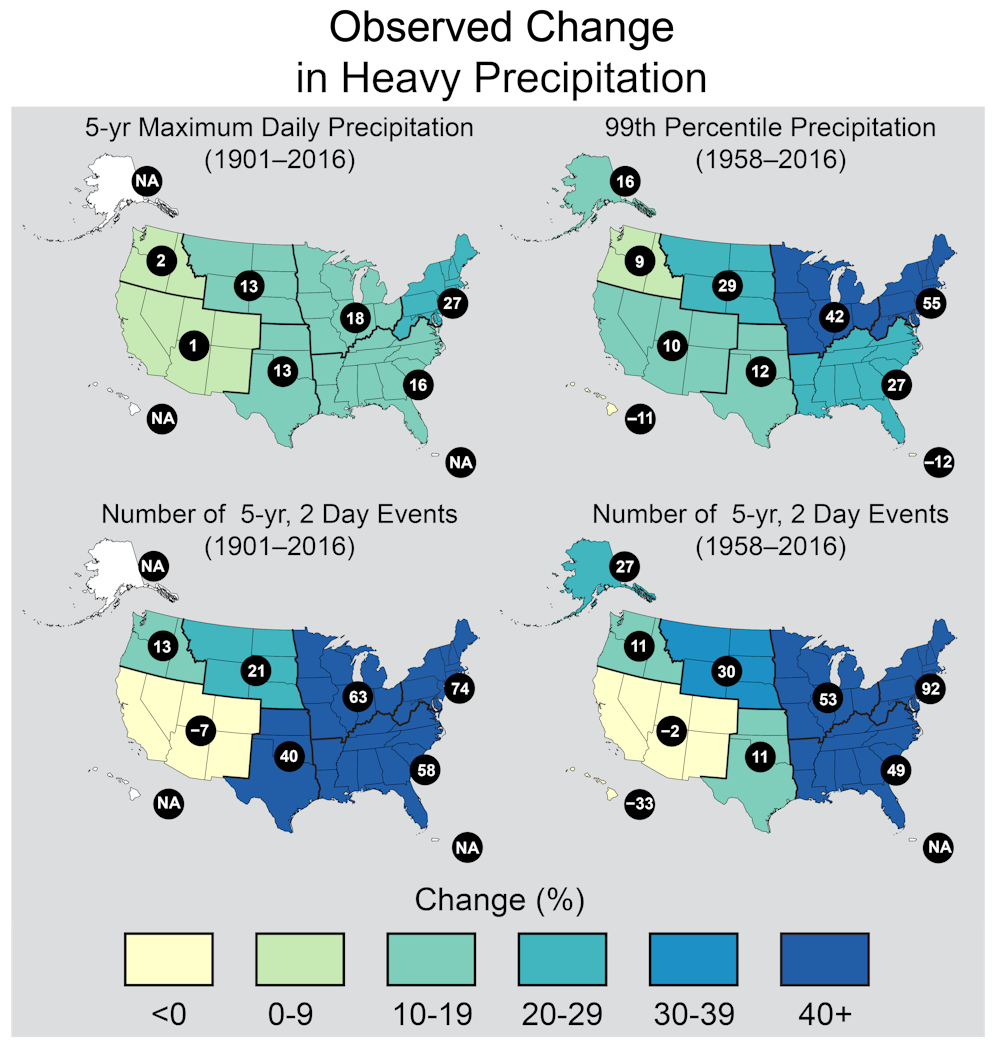
The latest National Climate Assessment, in 2018, described a trend toward increasing precipitation in the Northeast and also warned that aging infrastructure in the region isn’t prepared to handle the water.

Observed changes in heavy precipitation across the U.S., from the 4th National Climate Assessment. This figure shows four different metrics of heavy precipitation change. For example, the upper right panel shows that in the northeastern U.S., the amount of rain in the heaviest precipitation events increased by 55% from 1958-2016. 4th National Climate Assessment

Hurricanes are limited to certain areas, but extreme rainfall from other types of storms can occur just about anywhere — think of intense cloudbursts during the summer monsoon in the Desert Southwest, or organized thunderstorm systems like the one that caused deadly flooding in Tennessee in August 2021.

Many communities are already highly vulnerable to the type of extreme precipitation that has been observed historically. Floods have always been a hazard, and intense rainfall can test the infrastructure even in places where it happens often. But as the climate changes, these risks will only increase further.

This article was updated Sept. 3 with the Northeast death toll rising.

Russ Schumacher, Associate Professor of Atmospheric Science and Colorado State Climatologist, Colorado State University

This article is republished from The Conversation under a Creative Commons license. Read the original article.

Why my father fasted on Yom Kippur: On survival, memory, and the power of a family story

“I never prayed or fasted on Yom Kippur,” said my father in his lilting Yiddish yarn voice. Back from shul, he was breaking fast with a bagel and cream cheese, holding forth at the head of the table in our Michigan dining room. “I couldn’t wait to escape your grandfather’s traditions. But then, one September when you were little and your mom was pregnant a third time, I got the call I’d been dreading…”

 “To go to Vietnam, we know,” I interrupted, able to recite by heart the spiel he shared each High Holy day. 

In sixth grade, I was a leftwing confessional poet suspicious of all parental indoctrination. Hurt by my father’s preference for my three science brain brothers, I’d already given up on his religion, sexist politics and approval. I wasn’t into hearing another version of his ancient war fable that fascinated the boys.

I preferred their backstory. According to Shapiro lore, my parents met as teens on the Lower East Side. Mom — a redheaded orphan who feared Dad was a thug — was impressed when his scientific acuity landed him at Stuyvesant High. Not so Grandpa Harry, who’d made a “Shapiro & Son Window Shades” sign, hoping for a partner — the only Jewish father in history unhappy his son would be a doctor. Pre-med at NYU, Dad deferred the Korean War draft to finish his degree. “Just got into med school in the Midwest. Ya coming or not?” was his proposal to my Mom at 19. As a secretary, she put him through grad study and internships. 

“I was in the Navy Medical Corps, Inactive Reserves, at St. Louis’s Public Health Service, where I stamped out syphilis by giving free beers at bars if you got a penicillin shot.” Dad and my brothers laughed. 

Another favorite dinner topic of theirs: venereal disease. I rolled my eyes.

“By my residency, I thought I’d escaped the military. But 32, the call came,” he continued. “Turned out, they could send you overseas until 35 if U.S. forces needed more physicians.”


Want a daily wrap-up of all the news and commentary Salon has to offer? Subscribe to our morning newsletter, Crash Course.


Downing my own bagel with cream cheese though I didn’t fast or pray, I half-listened as Dad recalled how, in 1964, he was director of the internal medicine residency program at Highland Park General Hospital, near our Oak Park apartment. While surprisingly anti-war for a conservative, he was a family man who wouldn’t lie and cheat (claiming “bone spurs”) or flee 15 miles to Canada as a conscientious objector. If called, he’d do his duty.

“I was ordered to Fort Knox in Kentucky on a September Sunday,” he said. “I had to take three small planes to get there. I hate small planes.”

Stuck in Louisville for basic training for more than a week, he couldn’t call Mom to let her know where he was. On his ninth night, learning his fate would be decided the next morning, he couldn’t stomach dinner. “What if I was wounded, or died, leaving Mom a widow with three kids to feed?” 

On day ten, awoken before dawn, he lined up with hundreds of men outside the barracks. The commander shouted names, giving each recruit marching papers for training centers in San Francisco, South Carolina, Georgia, Hawaii, Guam, Frankfurt. One guy left on a transport plane directly to Vietnam. 

“I was sweating, trying not to shake,” Dad confessed. 

It was not a cause worth fighting for like World War II. A history buff, he blamed “the goddamn ignorant government for idiotically getting us into another nonsensical battle in Asia I’d have to sacrifice everything for,” he said in typically blunt fashion as mom served her noodle kugel with raisins.

“I was a man of science, I never prayed,” he added. “But as each soldier was sent to a different camp, I heard myself bargaining with God: Please don’t take me. Let me go back to my family. I’ll be a better person, husband, doctor, Jew. Finally, hours later, I was the last one standing by myself. I was starving. I’d been out there all day.”

“What’s your name?” Dad yelled gruffly, imitating the general.

“Jack Shapiro, sir,” he answered, timidly.

This part I secretly liked, when he did both voices, sounding scared.

“You a surgeon?” the general asked my father.

“No. An internist sir,” Dad said. “With two kids. Another on the way.”

The general checked the list again, shook his head and said, “I have no orders for you. What do you want to do?”

Dad was stunned. Was it a trick question? 

“Go home, sir,” my father said.

Relieved to catch three small planes back to Michigan, he had no time for a phone call. Arriving at sundown, he hugged my mother tightly at the door.  

Mom piped in. “He yelled, ‘Thank God I’m here,’ kneeling down to kiss the ground outside.”

This was a new detail. He really put his lips to the dirt?  

“He was starved. He hadn’t eaten in 24 hours. He had no idea it was the end of Yom Kippur,” she recalled. “He was shocked he’d inadvertently fasted on the holiest day of the year. He saw it as a sign. A bunch of his colleagues wound up in Vietnam. Some never came back.”

We had no idea why he’d been spared. We speculated endlessly over the decades as he reiterated his tale.

“After that, I promised God I’d go to temple with your mother and fast every Yom Kippur,” he concluded.

“I have to go finish my homework,” I said, heading upstairs.

“First help your mother clear the table,” he told me (but not the boys).

I swore under my breath it was the last time he’d push me into the role of Mommy’s Little Helper. Dad kept his word, for 50 years. So did I, leaving early for college to study creative writing at NYU, staying East.

His proudest feat was putting his kids and grandkids through undergrad and graduate school, producing two physician sons. He was less thrilled by my freelance writing career. (If I revealed anything about our family, he’d email, “Stop running naked through the streets!”) Or so I thought, until I overheard him telling his doctor he was proud of his daughter the author “who stuck to her guns,” words I didn’t know I’d waited half a century for.

This August, working on a project with a war refugee and reading comparisons of the heartbreaking fall of Kabul to what happened in Saigon sparked my curiosity.

“When was Dad called up for Vietnam? September ’64, right?” I texted my mother and brothers. 

“No, that doesn’t make sense,” said Mike, the youngest, a cardiologist at the VA hospital in Chicago.

Looking up dates, I saw Yom Kippur in 1964 fell on Wednesday, September 16. That fit.

Mike was dubious about the timing. “They weren’t ordering many doctors to Vietnam in the fall of ’64,” he said. “There were way more sent in 1968, right before I was born.”

Could details of Dad’s famous fasting mystery be mistaken? I went Google crazy but couldn’t find the answer. 

“Dad said it was ’64. She was pregnant with me when he got called up,” insisted Eric, a computer programmer who’d wired the Shapiros across five states. 

“Or maybe it was the fall after Eric was born?” Mike asked. “I can apply online to the National Military Archives for Dad’s service record. Reserve records may require a different application.”

“I thought they let him go because he was a married father?” I threw out.

“Because he wasn’t a surgeon,” wrote Brian, a trauma surgeon with two pre-med sons, who of course focused on that. “Though Dad told me he thought Mom was really kind to a military clerk he worked with and that could be why.” 

“I think it was just a government screwup. Why the hell would they call up a 32-year-old married doctor with kids anyway?” asked my mother. I’d always seen her as the romantic one.

Was there a different Dr. Shapiro, a surgeon they’d confused him with?

“You didn’t see the timing as a spiritual omen?” I phoned to ask Mom.

“No, but I believe he believed it,” she said.

All I knew for sure was that each Yom Kippur, Dad — the Shapiro storyteller — recounted why he took up fasting and praying. His annual cantorial chronicle ended three years ago, when his heart gave out and we lost him at 85. In his final week, delirious from medication, he’d recited Edgar Allen Poe’s “The Raven” to the nurses, reminding me he was the one who’d first taught me poetry, singing me stanzas as a baby instead of lullabies, the die cast. 

“Your words have force and direction, just like his,” his physician whispered after my eulogy at the funeral. “No hair on your tongue either.”

I never noticed that I’d mirrored Dad’s verbal intensity, forgoing small talk. Had I unconsciously recreated his speech patterns, becoming what was missing?

This week, lighting a white Yizkor memorial candle for my father, I’ve decided to fast in downtown Manhattan, his old haunt, remembering how lucky we were that he came home to us that night, repeating his story which is now my story —  and prayer.

“This is idiotic”: Mayors defy Ron DeSantis’ threat to fine cities “millions” for vaccine mandates

Florida Gov. Ron DeSantis on Monday threatened to punish cities and counties if they require vaccines for public employees. Some mayors are vowing to impose mandates anyway.

DeSantis, who has staked his 2024 presidential aspirations on pushing back against medical experts amid a pandemic that has wracked his state, vowed to go after local governments that require employees to be vaccinated, calling the Biden administration’s plan to require large businesses to require employee vaccinations “very intrusive” and “illegal.” DeSantis said that any local governments that require employees to get shots would face fines under a law passed by the state legislature banning so-called vaccine passports, though it did not ban local governments from requiring employees to be vaccinated.

The governor said that any city or county that requires their employees to be vaccinated will face a $5,000 fine for each violation, which he said could result in “millions and millions” of dollars in penalties for areas that have already announced vaccine mandates.

“So if you look at places here in Alachua County, like the city of Gainesville, I mean that’s millions and millions of dollars potentially in fines. Orange County — many, many more than that,” DeSantis said at a news conference, adding that “the net result of Biden’s policy is you’re going to have good, hardworking people lose their jobs, and they’re going to lose their jobs in very key industries.”

DeSantis’ office told the South Florida Sun-Sentinel that the state’s health department would begin enforcing the rule on Thursday.

But big-city mayors vowed to keep their vaccine requirements despite the governor’s threat.

“He’s spreading these conspiracies about vaccines and now stopping major employers from getting their employees, who deal with the public every day, vaccinated. This is really horrible,” Miami Beach Mayor Don Gelber, a Democrat, said Monday. “You do not need a law degree to know this is idiotic and we’re not going to let somebody, including unfortunately our own governor, put our residents in danger,” he added.


Want a daily wrap-up of all the news and commentary Salon has to offer? Subscribe to our morning newsletter, Crash Course.


Orange County Mayor Jerry Demings said the fines could be a “lot of money” but the government would “protect the greater collective of the people in our community.”

“I’m not going to take actions that would adversely impact the safety of our community. Sometimes, quite frankly, I question whether or not the governor really sees it that way,” said Demings, a Democrat. “He may say that he does, but I believe that many of the decisions he makes are purely politically motivated.”

Gainesville, which required all public employees to be vaccinated by October or face termination, also plans to keep its vaccine mandate.

“The health, safety and welfare of our city’s workforce and those we serve is our number one priority. The city has taken the steps necessary to achieve that priority and stand by that decision,” Democratic Mayor Lauren Poe said in a statement. “It is our belief that as an employer, we retain the right and responsibility to require vaccinations as a condition of employment.”

Leon County also plans to keep its vaccine requirement in place for employees.

“Unfortunately, and despite the tireless efforts of public health professionals, political rhetoric continues to dangerously exacerbate the fear and confusion about vaccinations,” County Administrator Vincent Long said in a statement.  “In a public health emergency, clarity of information remains critical. This is why it is necessary that I clarify that vaccinations as a condition of employment in Leon County is legal and will remain in effect. We will continue to act responsibly to ensure our operational readiness to respond to the needs of our community and to keep our employees safe.”

Some officials who plan to allow unvaccinated employees to submit to weekly testing argued the governor’s threat did not apply to them.

“The policy he announced are for governments requiring vaccines,” a spokesperson for Miami-Dade Mayor Daniella Levine Cava told the Miami Herald. “If that’s the case, it shouldn’t have any impact on our policy, which is just requiring testing with the option to opt out if you are vaccinated and choose to present the information that you are vaccinated.”

It’s unclear if the state can punish local governments under the vaccine passport law. Some legal experts say it only applies to businesses requiring proof of vaccination from customers, but Florida’s attorney general filed a brief in a lawsuit over Gainsville’s vaccine mandate arguing that the law also applies to local governments and their employees. It’s also not clear whether the law is even enforceable after a federal judge issued a preliminary injunction last month allowing Norwegian Cruise Line to require proof of vaccination from passengers.

At his news conference, DeSantis accused President Biden of “not following the science” on COVID because his vaccine mandate ignores “natural immunity” among those who have already been infected. DeSantis also stood by as a city employee falsely claimed that the COVID vaccine “changes your RNA” to cheers from the audience.

There is no evidence that the vaccine “changes your RNA,” and the Centers for Disease Control and Prevention recommends vaccination for people who have already had COVID because “research has not yet shown how long you are protected from getting COVID-19 again after you recover.” One recent study found that people who’ve had COVID are more than twice as likely to get the disease again than people who are fully vaccinated.

Dr. Joanna Drowos, the associate chair of the Integrated Medical Science Department at Florida International University, urged businesses to “follow the science” by listening to the CDC, not the governor.

“It’s not the same as being vaccinated,” Drowos told the Sun-Sentinel. “When you get infected, you get a specific strain and your body makes antibodies for the virus you saw … People are getting Covid more than once.”

DeSantis previously banned school districts from requiring masks in classrooms and moved to punish officials who defied the order. A state judge blocked that order, ruling that DeSantis had overstepped his authority, but an appeals court later allowed the order to remain in place while the case is appealed. The Biden administration has vowed to direct grants to school districts whose funds were withheld by the governor over their mandates and the Education Department last week opened a civil rights investigation into whether the mask policy violates the rights of students with disabilities.

In a letter to the state’s education chief, acting Assistant Secretary of Civil Rights Suzanne Goldberg expressed concern that Florida’s policy allowing parents to opt out of mask mandates “may be preventing schools in Florida from meeting their legal obligations not to discriminate based on disability and from providing an equal educational opportunity to students with disabilities who are at heightened risk of severe illness from COVID-19,”

Win or lose, California recall embodies the GOP’s embrace of Trump’s anti-democracy politics

The stakes of the California recall election of Democratic Gov. Gavin Newsom couldn’t be higher. Voting, either by mail or in person, ends Tuesday, and if Newsom is recalled, the bluest state in the country will not just have a Republican governor, but Larry Elder, a right-wing talk radio host who is a loon even by the standards of the party that elected Donald Trump.

If Elder wins, he threatens California’s fragile recovery from the pandemic, since, like most Republicans these days, he’s running interference for the virus. Plus, he would have the power to replace Sen. Dianne Feinstein, who is literally 88 years old, if she were to leave office — and one name that’s being floated is Elder’s protege and white nationalist former Trump advisor Stephen Miller. 

In a normal circumstance, someone like Elder — he suggested Women’s March participants are too ugly to rape and argued that it’s the descendants of slave owners and not slaves that deserve reparations — would never have a chance of winning the governorship of a deep blue state like California. Unable to win in a free and fair election, however, Republicans in the state have turned to dirty tricks and shenanigans. The entire Republican strategy is built around suppressing voter turnout through confusing and demoralizing the public. The recall ballots are confusing, and may lead voters to not understand that voting yes on recalling Newsom automatically means voting yes on his replacement being a Republican. Republicans are also counting on pandemic-induced disillusionment to keep Democratic voters from bothering to mail in ballots at all. 

In other words, the California recall is a microcosm of what has become the GOP’s national strategy. 


Want more Amanda Marcotte on politics? Subscribe to her newsletter Standing Room Only.


Republicans have given up entirely on the basic premise of democracy. They no longer think that politicians should try to appeal to a majority of citizens to win power. Instead, their focus is entirely on finding ways to circumvent public will and gain power anyway. In some states, this manifests as gerrymandering, outright voter suppression and even a new slate of laws meant to allow Republican officials to simply vacate the results of elections they don’t like. In California, it’s about forcing an off-year election in the most confusing way possible, hoping to hoodwink voters into accidentally giving themselves a Republican governor. 

Regardless of the state-specific method, what holds all of this together is a widespread rejection within the Republican Party of the right of the people to choose their own leaders. Republicans feel entitled to rule, no matter what, and therefore feel entitled to lie, cheat, and steal their way to power. The technical legality of the California recall election doesn’t change this reality. The spirit of the whole enterprise is driven by a willingness of Republicans to find some backhanded way to force a governor on the state that they know very well the majority of Californians do not want. 

Ultimately, it comes down to the increasingly rigid Republican belief that most Americans are not legitimate citizens and therefore have no right to vote Republicans are bound to respect. This belief manifests most commonly in the Big Lie, which is metastasizing beyond Trump’s false claims that he lost the 2020 election due to “fraud”. Already, right-wing pundits and Republican politicians are prepping their followers for the possibility that Newsom survives the recall with an updated version of the Big Lie, claiming the election is “rigged” and that Newsom will only win through “voter fraud.”

No real evidence of actual fraud that could swing an election is ever produced with these relentless Big Lie claims, but then again, it doesn’t need to be.

“Voter fraud” is not really a literal belief among Republicans, but more a code phrase to convey the larger belief that most legal voters shouldn’t have the right to vote at all. To call these legal voters “frauds” is to contest the legitimacy of their citizenship. It functions in the same way as conspiracy theories about Barack Obama’s birth certificate did, as a way for conservatives to signal to each other a belief that the first Black president is not a “real” American. With the Big Lie, the group of people who conservatives refuse to admit are legitimate citizens has grown to encompass pretty much anyone who votes for the Democrats. 

This notion that most Americans aren’t “real” Americans and therefore are “fraud” voters has become a majority belief among Republican voters. A recent CNN poll, which found that 6 in 10 Republican voters said that affirming the Big Lie — which again, is code for the belief that Democratic votes are inherently illegitimate — is an important part of being a Republican. We see this in the support for the January 6 insurrection that has been quietly solidifying among the GOP base. It all goes back to a belief that if Republicans can’t win a fair election, they should be able to cheat their way into power — or, if that fails, use violent force. 


Want more Amanda Marcotte on politics? Subscribe to her newsletter Standing Room Only.


As Igor Derysh reported last week for Salon, Democratic Gov. Gretchen Whitmer is facing down a similarly sleazy power grab by Republicans in Michigan. Republicans in the state legislature are trying to pass an anti-voting bill to keep those voters they see as illegitimate — particularly urban residents and Black voters — from casting ballots. To get around Whitmer’s veto, they’re using the same tactic that California Republicans used to force a recall, exploiting an ill-advised loophole that allows a shockingly small number of petitioners to force the issue. In this case, it’s not a recall, but even worse, the ability simply overrule the decision of a duly elected governor. Democrats in the state are accusing Republicans of using a “playbook of losing, lying, and attempting to cheat their way into office.”

It’s not just a fair accusation, but such an obvious observation that it’s verging on banal. It’s the playbook that fueled Trump’s failed coup and is currently fueling Elder’s attempt to seize the California governor’s office through the back door. Elections are increasingly not going to be contests of two candidates trying to appeal to voters, but a Democratic candidate appealing to voters while a Republican candidate tries to find some way to get around that pesky “democracy” problem. Newsom will probably survive this recall effort, but the country is going to have a much harder time surviving the relentless GOP assault on democracy. 

“Ted Cruz is the Zodiac killer”: Texas GOP website hacked over new abortion ban

The Texas Republican Party’s website is back up after being penetrated and commandeered over the weekend by hacktivist group Anonymous, who used the site to protest the state’s embattled abortion ban. 

According to the Dallas Morning News, members of Anonymous replaced the site’s webpages with pro-choice and anti-Republican rhetoric, posting the words “Planned Parenthood” and “Ted Cruz is the Zodiac killer,” an internet meme that first surfaced back in 2015. 

Anonymous also inserted images of various Pokémon, linked their YourAnonNews Twitter account, and provided the party with a new mission statement: “F***ng Over Women.”

The attack is apparently part of a long-term crusade dubbed “Operation Jane,” launched earlier this month to disrupt the enforcement of the Texas’ new abortion law. The measure makes it illegal for Lone Star residents to provide or recieve an abortion past six weeks into pregnancy – before most women even know they are pregnant – and deputizes private citizens to sue offenders for at least $10,000. 

“Texas: Taking voices from women to promote theocratic erosion of church/state barriers,” the site read for several hours, according to an Internet Archive screenshot. “We are committed to taking away all the rights of women so we can live our prosperous, Bible-thumping dream.”

The Texas Republican Party reportedly regained partial control of their website by Monday, releasing a statement on its website:  “While the nation paused over the weekend in remembrance of the 20th anniversary of 9/11 the Republican Party of Texas website was hacked.”


Want a daily wrap-up of all the news and commentary Salon has to offer? Subscribe to our morning newsletter, Crash Course.


“Pro-abortion activists targeted us because of our strong support for the Heartbeat Act,” the party added. “This attack adds to a growing list of actions by the radical left who tries to silence anyone that disagrees with them.”

The cyberattack comes just after right-wing group Texas Right to Life’s website “https://prolifewhistleblower.com” – which allows Texas citizens to report anyone who receives or aids abortion – was flooded with a deluge fake tips, an effort ostensibly led by users on Reddit, TikTok, and and Twitter. 

Many submitted names of fictional characters from the Marvel Cinematic Universe as well as the entire script of Bee Movie. One TikTok user developed a script that automatically generated fake reports, according to The New York Times

The site https://prolifewhistleblower.com was reportedly dropped by domain hosts like GoDaddy and Epik, but has since reportedly found one as of last week, according to the Dallas Morning News

Despite the cyber efforts against the bill, abortion clinics have by and large complied with the state’s new law, mass-cancelling appointments and denying their services after six weeks into pregnancy

Nicki Minaj’s vaccine skepticism wins her praise from Fox News, right-wing pundits

Rapper Nicki Minaj triggered a social media meltdown on Monday night when she sowed doubt over the safety of the COVID-19 vaccine, earning her unlikely plaudits from right-wing media personalities.   

The debacle was set off during Monday’s Met Gala, when Minaj tweeted that she wasn’t attending the event due to its vaccination requirement. “They want you to get vaccinated for the Met,” she wrote in a since-deleted tweet. “If I get vaccinated it won’t for the Met. It’ll be once I feel I’ve done enough research. I’m working on that now.”

Later, she suggested that the vaccine might be linked to impotence, a suspicion that she said arose from her cousin’s friend’s testicular condition. 

“My cousin in Trinidad won’t get the vaccine cuz his friend got it & became impotent. His testicles became swollen,” she wrote on Twitter. “His friend was weeks away from getting married, now the girl called off the wedding. So just pray on it & make sure you’re comfortable with ur decision, not bullied.”


Want a daily wrap-up of all the news and commentary Salon has to offer? Subscribe to our morning newsletter, Crash Course.


Her tweet was met with a wave of scorn and pushback from her 22.6 million followers, with some medical professionals personally offering to discuss the matter with her.

Right-wing media, however, seized on post to hammer home the channel’s months-long anti-vaccine messaging. 

On Monday, Fox New host Carlson commended Minaj’s remarks, saying they seemed “sensible,” with the channel’s chyron read: “NICKI MINAJ: COUSIN’S TESTICLES BECAME SWOLLEN.” (Minaj’s original tweet was about her cousin’s friend.) 

“​​This is everything. Real queens do not act because of peer pressure. It’s not about fitting in or being cool,” echoed conservative commentator Candace Owens. “We all know someone who has had a bad reaction to the vaccine and yet these stories are being censored by Big Tech. Thank you, @NICKIMINAJ for speaking truth.”

Following her tweets, the rapper quickly became embroiled in a social media feud with MSNBC’s Joy-Ann Reid, garnering Minaj even more plaudits by right-wing pundits. 

“You have a platform, sister, that is 22 million followers,” Reid said during a Monday broadcast. “For you to use your platform to put people in the position of dying from a disease they don’t have to die from? Oh, my God. As a fan, as a hip-hop fan, as somebody who was your fan, I am so sad that you did that.”

Minaj responded by accusing Reid of pushing a “false narrative.”

In response to the controversy, the Centers for Disease Control and Prevention updated its website to reflect that there is “currently no evidence that any vaccines, including COVID-19 vaccines, cause fertility problems in women or men.” Independent medical experts have also substantiated similar claims, The Washington Post noted

According to the Kaiser Family Foundation, roughly 40% of Black Americans are vaccinated. However, the Post noted that White Americans still make up the largest demographic of unvaccinated citizens, with 57% still unvaccinated. 

Since tweeting about her cousin’s friend, Minaj appears to be toning down her vaccine skepticism. 

“I’d def recommend they get the vaccine,” she later wrote to a fan. “They have to feed their families. I’m sure I’ll b vaccinated as well cuz I have to go on tour, etc.”

“Which vaccine would you recommend?” she added

A 2-ingredient marinade for never-dry chicken breasts

Big Little Recipe has the smallest-possible ingredient list and big everything else: flavor, creativity, wow factor. Psst — we don’t count water, salt, black pepper, and certain fats (specifically, 1/2 cup or less of olive oil, vegetable oil, and butter), since we’re guessing you have those covered. Today, we’re getting the most out of a fridge staple.

* * *

Greek yogurt is one of the hardest working ingredients in my fridge — the sort of staple that can bounce between sweet and savory recipes without blinking an eye. Top with granola for breakfast or mix into chocolate mousse for dessert. Or put it toward dinner: pasta, or potato salad, or a dunking sauce for chicken.

In this recipe, Greek yogurt works double-duty — both as a marinade and a salad dressing.

If you’ve ever marinated meat before, you already know that you need a few components in addition to salt — something fatty (like olive oil) for better browning, something acidic (like vinegar) to tenderize, and something flavorful (like a spice or herb) for seasoning. Effortlessly, Greek yogurt accomplishes two out of three, thanks to its milk fat and live cultures.

So it’s easy to see why this technique has been around for centuries: “It was a common practice during the Mongol Empire, which spanned the 13th and 14th centuries, to ferment mare’s milk (that would be from the horse) into yogurt and use this to marinate meat,” writes Priya Krishna in her yogurt column for Taste.

While chicken breasts are infamous for drying out, yogurt’s lactic acid boosts their cooking confidence, yielding meat that’s tender and juicy enough to compete with thighs. You’ll salt the marinade more than you’d think is necessary — the yogurt will taste too salty on its own, but modest chicken appreciates this, just like it would a brine.

Marinate for at least one hour, or up to 12. (Any longer in the fridge, and the meat will turn mealy.) If you’re a planner, scale up the recipe and freeze portions of chicken right in its marinade — a smart trick I learned from cookbook author Nik Sharma.

Besides the yogurt and salt, the marinade only needs one other ingredient: ground sumac. With a purplish color and lemony flavor, sumac is a staple spice in Middle Eastern cuisines. In Bottom of the Pot (a Piglet winner!), Naz Deravian writes: “Sumac also symbolizes the color of sunrise—a new day.” Which sounds wonderful right about now, doesn’t it?

If you don’t have sumac and are sheltering in place, let your spice cabinet lead the way. Try black pepper, cumin, caraway, garam masala, chili powder, whatever makes you go, “Ooh!” And add enough to be able to really taste it.

But maybe you’re wondering about the second way we’re using yogurt? Often, cucumbers get tossed with sour cream or créme fraîche or Greek yogurt as a dressing. Here, you’re going to salt smashed cucumbers and some slivered red onion until they both weep, then sob — then we’ll spoon them and their juices onto a downy yogurt blanket. Separating the dressing from the salad may seem strange, at first, but this way each ingredient is heard more clearly.

The rest of that red onion gets thrown in the skillet with the chicken. So, yes, we have yogurt two ways. And red onion two ways. And even sumac two ways (after the marinade, you’ll sprinkle more on the salad). And salt more ways than that. Because if the ingredient is around already, why not use up every last drop?

Sumac Chicken With Yogurty Cucumber Salad

Prep time: 1 hour 30 minutes
Cook time: 15 minutes
Serves: 2

Ingredients

Sumac chicken and sautéed onions

  • 1 cup whole-milk Greek yogurt
  • 2 teaspoons kosher salt, plus more to taste
  • 2 teaspoons ground sumac
  • 2 boneless, skinless chicken breasts (about 1/2 pound each), halved horizontally
  • 2 tablespoons extra-virgin olive oil, divided
  • 3/4 red onion, roughly chopped

Yogurty cucumber-onion salad

  • 4 Persian cucumbers
  • 1/4 red onion, thinly sliced
  • 1/4 teaspoon kosher salt
  • 1 tablespoon extra-virgin olive oil
  • 3/4 cup whole-milk Greek yogurt
  • 1 pinch ground sumac

Directions

  1. Combine the yogurt, salt, and sumac in a medium bowl or container. Add the chicken and make sure each piece is totally coated. Cover and refrigerate for at least 1 hour or up to 12. 
  2. When you’re ready to cook the chicken, make the cucumber salad. Place the cucumbers on a cutting board and smack each one with the side of a chef’s knife or rolling pin until it splits like someone sat on them. Now roughly chop. Add to a bowl with the onion and salt, and toss to combine. 
  3. Heat a large cast-iron skillet over medium heat. Add 1 tablespoon oil, then the chopped onion and a pinch of salt. Sauté, stirring occasionally, until the onions are mostly translucent and beginning to brown, about 5 minutes. 
  4. While the onions are cooking, remove the chicken from its marinade and scrape away any yogurt clinging to the meat (this can cause the chicken to burn or stick in the pan). Discard the marinade. 
  5. When the onions are done, transfer them to a plate, then, immediately add the remaining tablespoon olive oil to the pan. Now add the chicken (it should sizzle). Cook for 3 to 5 minutes per side until the chicken is browned all over and cooked through (about 165°F internal temp). If the chicken feels stuck when you go to flip it, give it a little more time to form a crust; a spatula versus tongs also helps. 
  6. While the chicken is cooking, spread the ¾ cup of yogurt around on a serving plate — this is where you’ll build the cucumber salad. 
  7. By now, the cucumber salad should have accumulated a lot of cucumbery juices. Good! Add the olive oil and stir. Taste and adjust the salt if needed. Pour the cucumber-onion salad on top of the swirled yogurt. Sprinkle some sumac on top. 
  8. Plate the cooked chicken on top of the onions, and serve both dishes together.

* * *

More Big Little Chicken

Buttery Balsamic Chicken

Balsamic chicken can mean a lot of things, and many of them involve a lot of ingredients. Not this recipe. All you need is chicken, butter, balsamic, and salt. The trick is to use the balsamic not one, not two, but three different ways.

3-Minute Chicken With Burrata & Mint

For those nights when you don’t think you have time to make dinner: You do! The supporting ingredients are happy to be futzed with. Try mozzarella or labneh instead of burrata, basil or dill instead of mint. And let me know your favorite combo in the comments.

Quinoa-Chicken Meatballs With Garlicky Greens

Meatballs without eggs, herbs, spices, even bread crumbs. Instead? Fluffy quinoa teams up with ground chicken for a few-ingredient winner-winner. And by ground, I mean pulsed in a food processor. This allows you to start with dark meat which means way, way more flavor.

Lemoniest Roast Chicken

Finely grated lemon zest in the dry brine. More finely grated lemon zest in the butter rub. Lemon halves in the chicken cavity. More lemon halves in the roasting skillet. And — this is the best part — a schmaltz slash lemon juice gravy that’s as easy as making a vinaigrette.

Chunky Chicken Chili

Inspired by the chicken chilis my mom made when I was a kid, in this version, sweet yellow onions and spicy poblanos do most of the heavy lifting. Like Marcella Hazan’s famous sauce, butter enriches the tomato-y broth, mimicking the richness of beef or pork. Highly recommended with also-buttered cornbread.

This post contains products independently chosen (and loved) by Food52 editors and writers. As an Amazon Associate and Skimlinks affiliate, Food52 earns an affiliate commission on qualifying purchases of the products we link to.

The Supreme Court’s right-wing Catholics are destroying true religious freedom

“The government of the United States of America is not, in any sense, founded on the Christian Religion.”

What forthright American declared such words? Bill Maher? Christopher Hitchens? Emma Goldman? No. They come from the Treaty of Tripoli, negotiated under George Washington, approved unanimously by the U.S. Senate and signed by President John Adams in 1797.

This early declaration — along with the First Amendment, which Thomas Jefferson solemnly revered “as building a wall of separation between church and state” — illustrates the unprecedented experiment our founders sought to test: a secular republic ruled by democratic laws, not sectarian faith; a nation whose government based its authority upon “we, the people” and not commandments handed down by distant gods. It is a brilliant endowment, given that in a pluralistic democracy such as ours, with people of many faiths and no faiths at all, we purposefully govern ourselves via secular legislation, not religious decrees. 

But today, this bold pillar of American democracy is rotting fast. It is under attack by theocrats, especially those who sit on our Supreme Court. Their recent ruling making it nearly illegal for a woman to get an abortion in Texas is the latest terrifying case in point. 

The problem is not religion, or even Catholicism. After all, many of our leaders, such as President Biden, Speaker Nancy Pelosi and Justice Sonia Sotomayor, are themselves Roman Catholics, and they all affirm reproductive choice as a constitutional right. In fact, 56% of Catholics in the United States support this right. Heck, Mexico — a nation of more than 130 million people, over 80% of them Catholic — just legalized abortion last week. And Mexico is only the latest in a long line of heavily Catholic countries to do so, including Argentina in 2020, Ireland in 2018 and Uruguay in 2012, along with Italy, Spain, Portugal, Austria, Rwanda and others before them. 

So again, the problem isn’t religion, per se. Rather, it is the kind of religion at play. The kind that a majority of our Supreme Court embraces: a crusading, activist, theocratic religious fundamentalism that prioritizes fealty to a particular conservative interpretation of God’s supposed will over the democratically-sustained rights of American citizens. It’s the lethal mix of religion and politics that our founders sought to restrain. It’s Christian nationalism.

Justice Brett Kavanaugh, a staunch Catholic and a regular lector at his church, opposed the Affordable Care Act because it included a mandate on the provision of birth control. Justice Samuel Alito is a man of strong faith and darling of the Federalist Society, who has consistently ruled in favor of the religious — even supporting their desire to defy data-driven, medically-endorsed, life-saving mandates to thwart COVID-19. Justice Clarence Thomas always goes to Mass before doing his work at the Supreme Court and declared in a 2018 commencement speech at Christendom College, “I am decidedly and unapologetically Catholic.”  

Thomas might have been the most devout Catholic to ever sit on the bench — at least until Mitch McConnell and Donald Trump foisted Amy Coney Barrett on the country. Barrett has written that Catholic judges must not take any action that conflicts with the dogma of the church. Instead of upholding her secular oath, when such a conflict arises, Barrett has recommended that judges should “conform their own behavior to the [Catholic] Church’s standard.” When invited to repudiate this statement at her confirmation hearing in 2017, Barrett declined to do so.

Barrett also is (or at least was) also a member of People of Praise, a charismatic Catholic group which teaches that “a married woman is … under her husband’s authority … the husband is ‘head of the home’ or head of the family; he is, in fact, her personal pastoral head. Whatever she does requires at least his tacit approval.” Furthermore, People of Praise members take a loyalty oath, which says “We agree to obey the direction of the Holy Spirit manifested in and through these ministries in full harmony with the church.” Barrett’s opposition to abortion has been public for many years, and she has declared that her “legal career is but a means to an end … and that end is building the Kingdom of God.” This wasn’t an off-the-cuff remark; it was said at the Notre Dame Law School commencement in 2006. If there is any singular motto of an activist theocrat, surely that is it. 

The separation between state and church our founders established guarantees true religious liberty because there is no freedom of religion without a government that is free from religion. And while many religious people — Catholics and others — find deep meaning, solace and inspiration in their faith by exercising that religious freedom in personal ways, they admirably do so without imposing the dictates of that faith onto others. Unfortunately, that is not the kind of faith driving those who now rule on the constitutionality of our laws — even laws that turn citizens into vigilantes, instituting mob rule over the womb.

Our judges certainly have a right to their personal religious faith. But when they impose that faith on all of us, the wall of separation between church and state is truly undermined. Texans’ rights to bodily autonomy is but the most recent casualty. With this court, it won’t be the last.

Wildfire smoke claims more than 33,000 lives each year, new study finds

Wildfires are no longer local affairs. Smoke from California has colored sunsets in New York, Australian bushfires have polluted Santiago, Chile, and people in Vancouver have inhaled the burnt remnants of Siberian forests. As a byproduct of these megafires, the world is watching a natural experiment in the effects of exposing a significant portion of the global population to wildfire smoke.

Researchers are starting to see just how much damage this pollution is doing. A team of more than 70 scientists from all around the world tallied up the death toll in a first-of-its-kind study published Wednesday in the journal Lancet Planet Health. Their estimate? Smoke from the world’s worsening wildfires is now killing 33,510 people every year.

It’s important to know this number because if societies don’t react, it’s likely to grow worse, said Yuming Guo, a biostatician at Australia’s Monash University and one of the authors of the paper. “Wildfire smoke is predicted to increase in the future because of climate change,” said Guo. “We should understand the relationship between smoke and human health.”

The scientists collected data on wildfire smoke exposure and deaths in 749 cities between 2000 and 2016. Their estimate of deaths is lower than the likely total number because the study only counted mortality in the three days immediately following blanketing smoke — not the more insidious damage that accumulates from long-term exposure. 

Air pollution research tends to start with deaths immediately following a single severe event before trying to pick apart the effects of chronic exposure. That is when it’s easiest to see a relationship between pollutants and mortality, said Joel Kaufman, an environmental epidemiologist at the University of Washington. Decades ago, for instance, researchers took notice of the Great Smog of 1952, when a coal-induced haze swathed London for four days. “You saw these huge levels of pollution and then people died. It’s acute events like that that triggered the realization that air pollution was dangerous,” Kaufman said.

Now we are seeing the same sequence of scientific inquiry into the effects of wildfire smoke. It’s a crucial area of study in places like the West Coast of the United States, where a decline in fossil fuel pollution is happening at the same time that forests are increasingly going up in flames. Forest fires, Kaufman said, could become a dominant driver of air pollution in the region. 

For a long time people have assumed that fossil fuels were the main source of the particles we should worry about, while wood smoke was somehow more benign. But this study suggests that the opposite is true: The risk from wildfire smoke was greater than the risk from the same amount of urban pollution. That’s because wood smoke is generally composed of smaller particles that can worm their way into human cells, and it contains things like “polycyclic aromatic hydrocarbons” and “aldehydes,” which trigger inflammation and damaging oxidation. “Wildfire smoke has more hazardous materials than other materials,” Gao said. 

Risk of death by wildfire smoke varied by country, depending on how susceptible people were to the pollution, and how deftly healthcare systems were able to respond with treatments. Researchers determined that wildfire pollution caused 2 percent of all deaths in Thailand, Guatemala, and Paraguay, versus just 0.26 percent in the United States and 0.09 percent in Ireland.

When smoke swathes big chunks of the globe, exposing millions to dangerous particles, those seemingly small percentages can result in a lot of deaths. Without adaptation, wildfires could undo nations’ health gains from cleaning up diesel fumes and coal ash.

Barrett’s remarks about judges not being “partisan hacks” were “straight-up trolling”: legal analyst

Speaking to MSNBC on Monday, legal analysts attacked Justice Amy Coney Barrett for her “partisan hackery” while she was speaking to Mitch McConnell’s political school in Kentucky.

Dahlia Lithwick, Slate’s legal correspondent, related Coney Barrett’s speech to being like something out of “The Onion.” She noted it was like the “Casablanca” police officer pretending he didn’t know gambling was going on in the place he’d been gambling.

“That’s just straight-up trolling,” said Lithwick. “One thing I really noticed and I think kind of got lost in the irony today is the way in which she went to an event, as you said, it was a Mitch McConnell event, and the press was not advised that it was happening. There are no recordings of it. The handful of reporters that were there were allowed to take notes.”

She noted a local reporter and her colleagues were moved to the back of the room while complaining the press misreports what the Supreme Court does.

“It is the most astonishing lack of self-knowledge to get up and say that you shouldn’t listen to reporters, you should read our incredibly nuanced opinion that was a page-and-a-half last week in the abortion case, and just don’t trust the press because they’re lying to you, trust me, we’re non-partisan. It is next-level cynical,” she said.

Elie Mystal unleashed on the Associated Press for essentially taking Coney Barrett’s speech notes and curating it into an article instead of calling out the hypocrisy of her comments.

The AP “just dutifully copied her notes, sent out her press release, put out that headline without the context of her dripping hypocrisy in the headline. That headline should have been ‘Partisan Hack Afraid People Might Notice Hackery,'” he suggested. “That would have been an accurate headline. But the press didn’t do that, did they?”

He went on to attack Coney Barrett for her entire career being built on the press’ unwillingness to call her out or even accurately report her.

“In her first year on the Supreme Court, as you pointed out, she’s taken away labor rights, she’s taken away voting rights, she’s taken away abortion rights,” Mystal continued. “She promised to do this to get the job! And yet the mainstream media refused to call her out on it then and even today as she stands there and basically spits in their face they still write the headline that she required — that she desired them to write. That’s the real — you know, those people need to also like grow up and take some personal responsibility for what they’re doing to the country.”

After showing a video of Justice Stephen Breyer claiming he doesn’t want to “die on the court,” Lithwick asked if the justices are so far removed from reality that they believe they’re magic because they can have lunch with each other without stabbing another justice in the eye with a shrimp fork.

“Why do we have to collude with that?” she asked. “And why is it that we’re expending energy talking about that instead of the fact that the Court is just decimating, as Elie has said, voting rights, reproductive rights, union rights in front of our very eyes? Isn’t that the conversation we should be having?”

Mystal agreed, noting that it isn’t that complicated to get correct.

“Do you require a duck to be self-aware that it’s a duck before you call it a duck?” he asked. “I mean, is that really the level that we’re at? Because that’s where the press seems to be. Unless the duck says ‘Quack quack, I’m a duck,’ then we can’t call it that. If the duck thinks he’s actually rich and is a media mogul like Scrooge, then the media has to say Scrooge today, you know, wanted some bread. Like that’s how they report it. It’s very frustrating.”

You can watch the video below via YouTube:

Is Trump running in 2024? Key allies Roger Stone and Jason Miller say yes

While it appears that Donald Trump is likely to drag out his 2024 decision as long as possible, like the reality-TV host he used to be, close allies and advisers of the twice-impeached former president are increasingly signaling that Trump plans to step back in the ring and run for president a third time — even at risk of losing the popular vote three elections in a row.

Last Thursday, veteran GOP operative and Trump confidant Roger Stone told far-right conspiracy theorist Alex Jones that his “communications” with the former president suggest he will be running in 2024. “Until recently, I was not sure the president was going to run,” Stone said. “I have now not only come to the view he must run, I think it’s essential for the country. Based on my communications with him, I now believe that he will be a candidate.”

“I believe that he has crossed that Rubicon in his mind,” Stone added. “I think that’s proved that he’s headed to Iowa and Georgia — two of the earliest contests — and I’m on board.” 

Similarly, in a recent interview with Cheddar News, former Trump campaign spokesperson Jason Miller said that Trump is “definitely” running to regain the Oval Office, placing the odds of a 2024 campaign at “somewhere between 99 and 100 percent.”

“He has not said the magical words to me, but if you talk to him for a few minutes, it’s pretty clear that he’s running,” Miller added. 

Trump himself has said very little about a possible campaign, at least since his false claim that it would be “illegal” to announce whether or not he plans to run. One unnamed source described as close to Trump told Vanity Fair that the ex-president is likely to tease the idea of a 2024 run until the last possible minute. “Knowing Trump, he’ll dangle it right up to the New Hampshire primary filing deadline,” the source was quoted as saying. 

Stone did not return Salon’s request for comment regarding his conversations with Trump. 

Last week, Trump told Fox News host Greg Gutfeld that his eventual decision on a 2024 campaign will make people “very happy.” Given his admittedly self-centered worldview, it’s difficult to view that as anything other than a thinly veiled announcement that he’s running. “I think you’ll be very happy. I would say two, three years ago you might not have been that happy, but now I think you’d be happy,” Trump said. “I’ll make a decision in the not-so-distant future.”

You can watch the Stone segment below, via YouTube: 

Does this internet-trendy plant food actually work?

TikTok has brought us some of the greatest life hacks including cleaning tips, cheesy, creamy pasta recipes (feta pasta, anyone?), and all-around entertainment (raise your hand if you’re still scarred by #bamarush!). But today I’m not here to talk about Kendra Scott earrings or the Lululemon Align Tank that every 18-year-old freshman at ‘Bama rocked on the Tok. I’m here to exercise my green thumb and get down and dirty with plant TikTok.

How to make TikTok plant fertilizer 

A few weeks ago, Armen Adamjen, aka creative_explained, shared a video on TikTok demonstrating how to use just three basic household ingredients — spent coffee grounds, cinnamon, and seltzer water — to create an instant plant fertilizer for indoor and outdoor plants. Armen’s instructions? Just combine 4-6 tablespoons of coffee grounds with 1 teaspoon of cinnamon and 1 cup of club soda in a large measuring cup. Mix together until combined. Pour the mixture over the soil of your plants once every two weeks and watch as your plants thrive. At first glance, it seems like the perfect way to get a second life out of used coffee grounds — but was it more than that? “What we have here is a super powerful mixture with potassium, phosphorus, nitrogen, and more minerals,” says Adamjen, adding that this combination of minerals is natural plant food. But does this combination actually benefit your plants?

Does coffee help plants grow? 

In short, yes. Nitrogen-rich coffee doesn’t just work as a fertilizer, but it also improves the soil structure, explains Nadia Hassani, a Home52 contributor and gardening expert. “However, brewed coffee is acidic (unlike used coffee grounds, which are close to pH neutral), so coffee should only be added to acid-loving plants such as hydrangeas, and in moderate amounts,” says Hassani. Fresh unused coffee grounds vary in their acidity but they are generally too acidic for plants; plus, Hassani adds that it’s a waste of delicious fresh coffee. Of course, you can always add spent coffee grounds to a compost pile. However, if you’re going to repurpose coffee grounds as a fertilizer, do so with a light hand. Because coffee is acidic, you should only apply a thin layer of used grounds atop the soil to ensure that the plants are still able to absorb as many nutrients as possible.

If you want to make the TikTok plant fertilizer, keep in mind that when adding coffee grounds directly to the soil, whether in outdoor or indoor plants, you need to also add additional nitrogen fertilizer. “Coffee grounds boost the growth of microorganisms in the soil and those (good guys) use nitrogen when they grow and reproduce” explains Hassani. Therefore it’s important to make sure that the soil can handle the boost of nitrogen.

Does this fertilizer work?

So, we know that coffee is good for plants, but what about cinnamon and seltzer water? “While cinnamon has antifungal and antibacterial properties, I do not think there is any scientific evidence of it being beneficial for soil,” says Hassani. The same can be said for carbonated or seltzer water, which she calls an “internet fad.” Tap water or chlorinated city water is preferable in order to encourage the quick growth of microorganisms.

We now know your chances of getting “long Covid” from a breakthrough infection

Studies have consistently shown that while being vaccinated against COVID-19 doesn’t always prevent breakthrough cases, those that do contract COVID-19 will be far less likely to have serious symptoms. 

Still, breakthrough cases — even serious ones — do occasionally occur among the vaccinated. One open question for the fully vaccinated is whether such infections can still have long-term side effects. Colloquially known as “long Covid” by its sufferers, many COVID-19 patients have reported ongoing side effects from COVID-19 months or even years after clearing an infection.

Until recently, the degree to which breakthrough cases can cause long Covid was unknown, largely due to a lack of studies on the topic. Now, a new study published  in The Lancet Infectious Diseases journal found that fully vaccinated people are about 50 percent less likely to experience long Covid than unvaccinated people.

It is the most substantial study to date to indicate that at immunization significantly decreases the risk of long Covid.

“We found that the odds of having symptoms for 28 days or more after post-vaccination infection were approximately halved by having two vaccine doses,” researchers wrote. “This result suggests that the risk of long Covid is reduced in individuals who have received double vaccination, when additionally considering the already documented reduced risk of infection overall.”

Long Covid, which is a patient-coined term, describes symptoms from a COVID-19 infection that last for more than one month. Previously, in studies of unvaccinated individuals, long Covid patients reported symptoms that included (but are not limited to) fatigue, brain fog, confusion, shortness of breath, headaches and chest pain. In some cases, it is nearly impossible for people with long Covid to resume their regular daily activities.

Notably, not everyone who gets long Covid had a severe infection or was hospitalized after their COVID-19 diagnosis. Some eventually experience full recoveries, while others do not. Up to 10 percent of those who contract COVID-19 have long Covid after the virus has cleared their body, according to University of Alabama researchers. But until now, little was known about long Covid and the fully vaccinated.

The study based its findings on data from more than 1.2 million people participating in the Covid Symptom Study. Volunteers of the study use a mobile app to log their symptoms, test results and vaccination records. The study looked at participants who received at least one dose of the Pfizer, Moderna or AstraZeneca vaccines between Dec. 8, 2020, and July 4, 2021, in addition to a control group of unvaccinated people. Of the nearly 1 million people who were fully vaccinated, 0.2 percent reported a breakthrough infection. Notably, those who did get a breakthrough infection were twice as likely to be asymptomatic, and the odds of being hospitalized were 73 percent lower than the unvaccinated control group.

The researchers also found that the likelihood of having symptoms that persisted beyond one month were 49 percent lower in the breakthrough infection group.

The study does have one big limitation, as the researchers noted: all the data is self-reported.

Notably, a previous study of Israeli healthcare workers published in the New England Journal of Medicine attempted to quantify the potential risk of long Covid after an infection despite vaccination and landed on a similar conclusion. Thirty-nine people out of 1,497 fully-vaccinated healthcare workers got COVID-19. While most of the cases were mild or asymptomatic, 7 (or 19 percent) had persistent symptoms of prolonged loss of smell, persistent cough, fatigue, weakness, muscle pain, or labored breathing that lasted for more than a month. Notably, this study took place before the delta variant caused a surge in breakthrough infections in Israel. 

he new study out of the United Kingdom includes a stretch of time when the delta variant was part of the story, but it does not distinguish the risk of long Covid by variant.

As Salon reported last month, scientists suspected long Covid is biologically possible with breakthrough infections. Specifically, in breakthrough infections caused by the delta variant, high levels of viral genetic material appear in the upper respiratory tract. According to a study by scientists at the University of Oxford scientists, people who contract the delta variant after being fully vaccinated carry a similar amount of the coronavirus as those who are unvaccinated and get infected.

But data continues to show the vaccines reduce the risk of being hospitalized from COVID-19— and now, having long Covid.

“In terms of the burden of long Covid, it’s good news that our research has found that having a double vaccination significantly reduces the risk of both catching the virus and, if you do, developing long-standing symptoms,” lead researcher Dr. Claire Steves from King’s College London said in a statement.


Want more health and science stories in your inbox? Subscribe to Salon’s weekly newsletter The Vulgar Scientist.


“No time for idiots”: Howard Stern slams Joe Rogan for taking “horse dewormer” over COVID-19 vaccine

Right-wing libertarian comedian/podcast host Joe Rogan recently became infected with COVID-19 after refusing to take a vaccine, and he is now crediting the drug ivermectin with his recovery. But veteran shock jock Howard Stern is saying that Rogan should have received a COVID-19 vaccine in the first place.

Although Ivermectin is primarily used as an anti-parasitic drug for animals, conspiracy theorists have been claiming that animal-grade Ivermectin should be used to prevent or treat COVID-19. But medical experts, including immunologist Dr. Anthony Fauci, have been warning that taking animal-grade Ivermectin could be dangerous; in fact, Fauci strongly advises against it. But the 54-year-old Rogan is claiming that Ivermectin was beneficial for him after he was infected with COVID-19.

Mediaite’s Ken Meyer explains, “Upon his recovery, Rogan lashed out at CNN and other critics who called out his promotions of an unproven COVID remedy. This was noticed by Stern, who remarked that Rogan could have also gotten a vaccine — which Stern heralded as a ‘cure’ — and skipped the whole ordeal.”

On his show, Stern — whose program airs on SiriusXM — told long-time co-host Robin Quivers, “I heard Joe Rogan was saying, ‘What are you busting my balls (for)? I took horse dewormer, and a doctor gave it to me.’ Well, a doctor would also give you a vaccine; so, why take horse-dewormer?”

Stern was vehemently critical of anti-vaxxers during the broadcast, slamming them as “idiots” who are “anti-science.”

The 67-year-old shock jock told Quivers, “There’s never been one that said, ‘I’m so glad I refused. I’m so happy that I can’t breathe. This is a wonderful way to die. It was worth it because I didn’t take the vaccine.'”

According to the Centers for Disease Control and Prevention, 75% of U.S.-based adults have been at least partially vaccinated for the COVID-19 coronavirus. Nonetheless, many U.S. hospitals are being overwhelmed by unvaccinated COVID-19 patients, and Stern obviously no patience with anti-vaxxers at this point.

“We have no time for idiots in this country anymore,” Stern angrily told Quivers. “We don’t want you. We want you to all, either go to the hospital, and stay home, die there with your COVID. Don’t take the cure, but don’t clog up our hospitals with your COVID when you finally get it. Stay home, don’t bother with science, it’s too late. Go f**k yourself — we just don’t have time for you.”

As we remember 9/11, we too easily forget victims of the gruesome drone war

As the mainstream press spent this past weekend once again ensuring that Americans never forget the fear and anger of 9/11, which prompted 20 years of war, 10 of the latest victims of 9/11 were being wiped from historical memory. Just two weeks before the 20th anniversary of 9/11, a U.S. drone killed the Ahmadi family, including seven children. In the America-centric writing of history, they have already been forgotten.

The U.S. military apparently surveilled 43-year-old Zemari Ahmadi throughout his final day. He went about his normal routine as a Kabul-based employee of the aid group Nutrition and Education International. Ahmadi dropped off his co-workers at various locations throughout Kabul, filled water cartons at his office, and drove home to a residential compound where he lived with his family and his brother’s family. As his own children and his brother’s children ran to greet him, a U.S. Air Force Reaper drone launched a missile at his car, incinerating him and the nine loved ones gathered around him.

That’s the story that the New York Times uncovered through extensive interviews with Ahmadi’s neighbors and colleagues, as well as medical experts. The Washington Post did its own extensive reporting and reached the same conclusions about the events. The story that Gen. Mark Milley, chairman of the Joint Chiefs of Staff, told the public in order to justify the strike is very different.

Milley claimed that the attack was a “righteous strike” against ISIS-K members. Our military fed the lie to reporters that there was a second blast following the drone strike, proving that Ahmadi had explosives in his car, which he was planning to use in a second terrorist attack on the Kabul airport. Those “explosives” were, in fact, the cartons of water Ahmadi was bringing to his family. The Times and the Post both found that there was no second blast, just the one directed by the U.S. military that incinerated seven kids.

Responding to the Times’ reporting on Twitter, Matthew Hoh, a disabled combat veteran and antiwar activist, put it best: “This very well sums up the last 20 years: fear, barbarism, ineptitude and lying.”

This drone strike follows the same logic that 20 years ago turned 9/11 from a day of tragedy and violence into two decades of tragedy and violence.

Twenty years ago, Americans were justifiably terrified and grief-stricken over 2,996 lives being snuffed out. What was never justifiable or correct was the idea — pushed by politicians in the highest positions of power and media outlets with the largest platforms — that in exchange for those 2,996 lives, hundreds of thousands more needed to be taken. It was never justifiable, but it was possible because the U.S. lives taken on 9/11 were seen as inherently more valuable than the lives of Afghans or Iraqis.

Two decades later, as U.S. troops were finally leaving Afghanistan for good, an attack on the Kabul airport killed 13 U.S. troops. At least 170 Afghans were also killed in the attack, as well as in weapons fire by U.S. forces in the immediate aftermath. As with 9/11, however, the smaller number of American lives lost are what seems significant to the corporate press and politicians.

It was because the lives of those 13 American troops matter more to certain sections of the American public that President Biden vowed “revenge.” In exchange for the lives of these 13 troops, 10 Afghan civilians, including seven children, became easy targets for retribution. Then our government lied about these victims, claiming they were terrorists. American troops may no longer be occupying Afghanistan, but if the devaluing of Afghan lives, the violence of the U.S. war machine, and the lies from our leaders continue. It could only be a matter of time before we’re dragged back into war again: Biden has already made clear his commitment to keep bombing Afghanistan.

For those who have been paying attention, it is not surprising that Biden’s drone strike killed a family in a grotesque mistake. It will not be surprising if additional bombing of Afghanistan kills more civilians. This is the very nature of the drone program, which became a norm of U.S. policy under the Obama administration. From January 2012 to February 2013, the US terrorized Afghanistan with Operation Haymaker, a military campaign of drone warfare in which 90% of victims were not the intended targets.

No one from the Obama administration has faced any consequences for the terror of the drone program. Nor have any members of the Trump administration faced consequences for waiving the rules of engagement for airstrikes in Afghanistan, resulting in a spike in civilian casualties.

Former Air Force intelligence analyst Daniel Hale, however, was sentenced to four years in prison for having the courage to provide the public with information about the drone program and its disregard for civilians. If voices like his were not silenced behind bars, maybe there would be more public outrage, or at least public acknowledgement of the civilian toll of U.S. bombs and drones.

The war on Afghanistan will not be over until the drone program has been shut down, the Afghan people have been paid reparations with money taken directly out of the Pentagon’s budget, and prison cells have swapped out whistleblowers for war criminals. To make that fuller kind of ending possible, the U.S. would also need a reckoning with the militaristic culture that first made war on Afghanistan a popular demand and later turned it into background noise that most Americans could ignore. That militaristic culture is still packed into American entertainment and news commentary, simmering until the next reason for war allows it to boil once again into a frenzy of xenophobic vengeance.

Boebert calls for Biden to be removed from office: “We are sons and daughters of revolutionaries”

Rep. Lauren Boebert, R-Colo., called for the immediate removal of President Joe Biden and replacing him with “righteous men and women of God.”

The Colorado Republican spoke Saturday at a conference hosted by the right-wing Truth & Liberty Coalition at Charis Bible College, where she called for the impeachment of Biden and Vice President Kamala Harris as part of a conservative Christian revolution against democratically elected leaders, reported Right Wing Watch.

“When we see Biden address the nation and the world and show more contempt and aggravation and aggression towards unvaccinated Americans than he does terrorists, we have a problem,” Boebert said, “and that’s why I have articles of impeachment to impeach Joe Biden, Kamala Harris.”

“We cannot take another 18 months. We cannot take another three years of this poor, failed leadership,” she continued. “We are sons and daughters of revolutionaries. They went to battle for a lot less. They took a stand for a lot less, and it’s time we get involved. I need you involved in every local level. I need you speaking up. I need the world to hear your voice. You know the word of God, and you know that there is power in your words — that the world was framed by words. You have the Lord God Almighty on your side. I need you to use your voice and speak.”

The first-year lawmaker told attendees the Bible had given them permission to impose their views on their political rivals.

“What if Jesus showed up today and said, ‘From this point forward, everything you say you will have it?'” Boebert said. “He said it! That’s exactly what he said to us, so what are we saying? Are we going to sit and agree with the enemy? Are we going to agree with what the enemy is doing? Are we going to sit back and complain and murmur? Or are we going to speak life into this nation? Are we going to speak victory? Are we going to declare that God removes these unrighteous politicians — these corrupt, crooked politicians — and installs righteous men and women of God?”

Boebert then explained that the church should have authority over the government.

“It’s time the church speaks up,” she said. “The church has relinquished too much authority to government. We should not be taking orders from the government; the government needs to be looking at the church and saying, ‘How do we do this effectively?'”

“Y: The Last Man” presents a fascinating dystopia that probes the artifacts of our gendered world

Unless you’re familiar with the way Brian Vaughn and Pia Guerra designed Yorick Brown, the titular protagonist of “Y: The Last Man,” this guy will probably work your nerves.

Ben Schnetzer, the actor who plays Yorick in the TV adaptation of the graphic novels, isn’t to blame for that impression. In fact, he deserves credit for making Yorick about as tolerable as a late-20s professional magician could possibly be.

Yorick is a self-employed tutor who can’t pay his rent without parental help, and who refuses to teach his clients basic card tricks because he thinks they’re beneath him. When an apocalyptic event wipes out every living creature on the planet with a Y chromosome, he’s the only cisgender human male left alive. He’s also the living, breathing definition of entitled mediocrity.

Thankfully the TV adaptation of the comics isn’t entirely constructed around Yorick, although his survival is central to answering one key question at the heart of this story. Instead, showrunner Eliza Clark and the writers forgo flashiness to wisely and meticulously construct the narrative around the women and trans men left alive to put this broken world back together. 


Want a daily wrap-up of all the news and commentary Salon has to offer? Subscribe to our morning newsletter, Crash Course.


There is a giant explosion in its opening hour but it is intentional, planned and coldly executed by the chameleonic Agent 355 (Ashley Romans), who may be series’ most capable person next to Diane Lane’s President Jennifer Brown.

It’s Yorick who’s the odd being out during all of this, which 355 calls out in a stunning outburst skewering his gender privilege.

“From the goddamn day you were born, the whole world has told you you’re the most important thing in it. You know, you f**k around all you want with no consequences! An entire life of just being given s**t like, I don’t know, the benefit of the f*****g doubt!” she fumes. “You just walk into any room and you take it for granted.”

Now that Yorick is the most important person in the room, he could not care less about anything besides getting back to his girlfriend. If we care about Yorick at all it’s because Schnetzer doesn’t hide his internalized shame at his helplessness, which he displays by acting out and disregarding 355.

And if we care about 355, which Romans’ passionate, furious performance ensures, it is because many of us have been forced to put up with and placate some version of Yorick and watched that guy fail upward.

Her and Yorick’s fates entwine early on: Agent 355 is assigned to infiltrate the Secret Service under an assumed identity for reasons that aren’t made clear. This means she’s in the room where and when it happens, along with then-congresswoman Brown, Yorick’s mother. The agent steps up to assist the newly anointed President Brown in the aftermath, correctly assuming the leader will require someone to do a bit of dirty work.

At first 355 is assigned to track down President Brown’s estranged daughter Hero (Olivia Thirlby), but she stumbles across Yorick and his pet capuchin monkey Ampersand instead — another male survivor. Their discovery should provide a light of hope for humanity but, acknowledging the realpolitik of the situation, the president and the agent aptly realize Yorick’s presence creates a host of other problems.

Through this and other subplots the series invites the audience to ruminate on which commonly held ideas about conflict, tribalism, and survival itself are implicitly gendered. This doesn’t merely refer to the fallacy often posited by feminists that a world dominated and run by women would indeed be a more peaceful place. There’s a common assumption — or there used to be, it is less prevalent in our partisan age — that women are inherently more likely to bridge their ideological divisions and work together for the common good.

In a reality that never experienced the Judeo-Christian strain of patriarchy, that may be the case. “Y: The Last Man” doesn’t picture that world. It is a speculative fiction product co-created by a man (Guerra was the lead artist) operating from the perspective of what would happen if an androcidal cataclysm suddenly removes nearly all mammals born with Y-chromosomes not merely from the planet but from a patriarchal society.

This would not instantly eliminate its oppressive structuring.

Quite the opposite – it would bring the ramifications of longstanding inequities into relief. Within what’s left of the government structure ideological factions emerge almost instantaneously; the former and now very dead president was a McCain-like conservative figure whose daughter Kimberly Campbell Cunningham (Amber Tamblyn) dedicates herself to preserving his legacy and securing a future for conservative women.

Beyond the halls of power, others who were once closer to the action like the former president’s advisor Nora Brady (Marin Ireland) are left to fend for themselves. Through them we see firsthand how thin the mask of polite society is and how quickly it falls away when resources become scarce, starting with a consequential betrayal.

Confrontations with other armed and hungry groups come soon afterward, part of the usual chronology of decline and fall. Besides this, and other typical signposts of the world ending like planes dropping from the sky and cars crashing, watching the tangible effects of systemic gender inequality kick in provides the meat and mead of this drama’s fascination.

For a preview of what that implies, look at recently recorded statistics about women in government and women working in the arenas of science, technology, engineering and math – which is to say, the people who run things, and the people who know how to keep things running.

If such a disaster befell us today or tomorrow approximately three quarters of Congress would be wiped out. Thanks to Kamala Harris’ historical election to the vice presidency, the line of succession would not be as thoroughly obliterated as it is in “Y: The Last Man.”

We all know Harris would be confronted with her own backlash in such an event, but having the office fall to Lane’s congressional representative presents a different struggle. President Brown is quickly able to organize a team around her, but she’s also a Democrat inheriting the office from a Republican administration.  Actors who play presidents on TV have a tendency to draw their own constituencies, and the way Lane balances confidence and warmth in her performance ensures she’ll continue that tradition.

Helpfully Tamblyn’s Kimberly, while not entirely unsympathetic, is marvelously two-faced; she’s the adversary who claims to only want to be useful while angling for a clean target on our hero’s back. There’s a whiff of camp to this equation, but if you miss Meghan McCain on “The View” Tamblyn steps into that gap quite nicely.

For those keeping count, the consistent lack of women in the STEM fields is more concerning than our political vacuum. In our reality women comprise only 13% of working engineers and about 26% of computer scientists, according to a 2019 report from the Society of Women Engineers. Imagine what would happen if most of that workforce blinked out of the equation.

Vaughn and Guerra did, but Clark (who took over for previous showrunner Michael Green) realizes that scenario in a way that centralizes its women as competent, strategic and complex. Other elements of the original story crying out for an update involve its binary view of gender.

The drama’s writers rectify this somewhat with Sam, Elliot Fletcher’s transgender character who joins Hero on her escape from a sinking Manhattan. Through his character the writers provide a window into the discrimination trans people face right now and in such a disaster where cisgender women are dominant, while Allison Mann (Diana Bang) a geneticist tasked with solving the puzzle of Yorick and Ampersand, breaks down common misperceptions of gender succinctly.

“Not everyone with a Y chromosome is a man,” she says before speaking the core truth of that tragedy, one that speaks to the obstacle getting in the way of understanding each other even now. “We lost so many people that day.”

As post-apocalyptic series go, “Y: The Last Man” builds in a relatively staid fashion. A less kindly evaluation would describe its progression as slow, even plodding at points. Compared to the nervous dread that defines the first hours of, say, “The Walking Dead” or “Battlestar Galactica,” the lead-in to the end of everything is much calmer.

However, this dystopian drama isn’t about the spectacle of chaos but how that chaos brings out the best and worst of those enduring it. You can say the same of any show about the end of the world, but here the reliance on character feels much more essential.

No series works if the viewer doesn’t find some portion of accuracy and honesty to connect with in its characters. Rather than drawing our focus to overwhelmingly visible, tangible signs of society’s dissolution like flaming buildings and gore, “Y: The Last Man” invests all of its power in getting us to care about the people navigating the devastation.

There are no zombies chasing down survivors, only other humans angling for power. That makes it a dystopian tale one piece of genetic material away from being real, which is both fascinating and frightening and perhaps worth experiencing as a simmer instead of a full burn.

“Y: The Last Man” is currently streaming on FX on Hulu.

Changing your mind about vaccines: People can do it, for a number of reasons

Last week, President Joe Biden announced a series of new policies intended to pressure unvaccinated Americans into getting their COVID-19 shots. There was no pretense of patience; indeed, in addition bemoaning the “pandemic of the unvaccinated,” Biden’s most memorable line of the night was when he warned holdouts that “our patience is wearing thin.”

The subtext to Biden’s words were simple: If the unvaccinated would simply change their minds and get vaccinated, many harsh public health measures would not be necessary.

But can someone change their mind about something as charged and sensitive as COVID-19 vaccines? And will Biden’s “stick” approach actually encourage people to do that, or merely make the vaccine-hesitant dig their heels in more? 

Salon spoke to psychologists as well as individuals who had been vaccine-hesitant, but who later change their minds. The answer to the aforementioned question seems to be, yes — but with some caveats.

Notabaly, for many, the choice of vaccination is not a choice at all. Pharmaceutical companies’ abuse of patent laws has made it more difficult for people in poorer countries to access vaccines, while many in the United States struggle to access vaccines for economic reasons or because they cannot get the time off. America also has a long history of oppression that makes many marginalized groups understandably cautious about whether the government acts in their best interest.

Yet the social calculus is different for Americans who simply choose to ignore the science about COVID-19, quite often for political reasons. In many cases, government pressure may cause this demographic to double-down on vaccinate hesitance. 

Why? The answer lies in psychology. Part of the problem is that people will contort logic in seemingly absurd ways to maintain a high opinion of themselves. According to cognitive dissonance theory, humans instinctively need their beliefs to be in harmony with one another, and will work to correct perceived “dissonance” (inconsistencies) in their beliefs. Since most prefer to avoid lowering their self-regard, people are more likely to come up with elaborate rationalizations to maintain a current position than acknowledge that view may be in error. This is especially true when the position is important to them, such as the millions of Americans who view being anti-vaccination as crucial to their identity.

This is the driving force behind much of the vaccine stubbornness that, as Biden put it, is wearing his patience thin.


Want more health and science stories in your inbox? Subscribe to Salon’s weekly newsletter The Vulgar Scientist.


According to developmental psychological Howard Gardner, there are six things that can break through this wall of stubbornness and change a person’s mind. He refers to them as the six ‘r’s: real-world events, reason, representational re-description, research, resonance and resources. At the same time, he notes that people should not expect so-called “Damascene moments,” or a situation when a person is suddenly convinced after being presented with incontrovertible evidence in a compelling way.

“One of the things I do believe about changing minds is that Damascene moments are very rare. Changes happen gradually. You’re not even aware of it,” Gardner told Harvard University. “At a certain point you find yourself saying something or doing something you haven’t done before and you say, ‘Gee, you know, this is not the way I was a few years ago.'”

Experts say that it is important to de-escalate the intense emotions that can arise during conversations about touchy subjects. When people are stressed, they are more likely to dig in their heels for neurological reasons. As neuroanatomist Dr. Jill Bolte Taylor told Salon in June, “When we dig our heels into something that we are emphatic and passionate about, we are using our limbic system, our emotional system.” To change someone’s mind, you have to do so in a way that does not crash into these psychological impulses.

As pediatric neuropsychologist and parent coach Dr. Sarah Levin Allen told Salon in June, “when trying to change the mind of someone who is stressed, we actually need to do one of two things: either reduce the stress hormone in the brain by making a connection and reducing negative emotion first or slow down the process delivering ideas in very short bursts that the brain can slowly process.”

This is why, quite often, the people who change their minds tell stories in which they did so at their own pace and in a supportive environment.

“My wife and I have differing opinions on the vaccine,” Ravi Davda, a marketing CEO, told Salon by email. Both of them travel extensively and, last year, both were diagnosed with COVID-19. Although they recovered, only his wife supported getting the COVID-19 vaccine. As Davda pointed out, she was partially motivated by a desire to resume extensive traveling and being able to visit their families in the United Kingdom.

“For a long time, I refused,” Davda said. “We actually had vaccinations booked in twice in Bulgaria, and I said no. So we cancelled them. Naturally, this caused some disagreements between us. I could see her side. She could see mine. But neither of us were getting what we wanted.”

Eventually, he relented, “partly because I was able to get a one-shot Johnson vaccine, but also because I changed my point of view. If I wasn’t traveling, I probably wouldn’t have. But it’s easier to live life now with a vaccine. It also means I can go back to see my family this year, which is great. I haven’t seen them for a year.”

In keeping with Gardner’s observations, sometimes people will change their minds because on their own they decide it is the logical and moral thing to do. This happened to Steve Henson, CFO of a vintage collectibles store.

“At the beginning of the epidemic, I refused to wear a mask,” Henson explained in writing. “I couldn’t breathe easily with a mask, and most importantly, I suspected that wearing a mask would not solve the problem at all! Again, when the vaccine was first produced, I was afraid to get the vaccine. I wasn’t sure how much of a side effect this vaccine would have and if it would threaten my life.”

Henson changed his mind as he saw just how much people’s lives were being threatened. As he put it, he eventually concluded that he was not being asked to do very much, and that the reward of protecting people was more than worth it.

“Masks can reduce the spread of viruses from person to person,” Henson explained. “For everyone’s safety, we just need to do the small thing of wearing a mask and getting vaccinated. So why not? The change in my mind has also had a big impact on my life, as I no longer fear being infected every day. But I will still wear a mask until the day the epidemic ends.”

Of course, the same tendencies that can push someone in the direction of science can also move them away from it. This seems to have been the case with Buford Stevenson (not his real name), a British medical student who admitted that he has changed his views on COVID-19 but does not wish to come forward by name due to fear of reprisals.

“I thought masks were probably a good idea, but now I can’t seem to find a supporting evidence base,” he said. “I was originally unsure about the vaccines but thought I would probably get them, but I now feel that I would not get them unless forced.”

In urgent situations where one’s patience is rightly wearing thin, psychology tells us that people who need other people to quickly change their minds are likely to be disappointed. Indeed, the process of changing minds takes time, however, and it is unlikely that this can be done on a mass scale without thousands more needlessly dying.

Gov’t and charitable actions likely kept millions of Americans out of food insecurity during COVID

Despite the profound impact of the COVID-19 pandemic on the vulnerable in the United States, the percentage of Americans in food-insecure households held steady in 2020 at 10.5%, figures released on Sept. 8, 2021, show.

Although unchanged from 2019, the new numbers are important for two main reasons.

First, food insecurity – the state of being unable to adequately provide food for yourself or your family – has become one of the leading, if not the leading, indicator of well-being for vulnerable Americans. And with 38.3 million food-insecure Americans, the number of people affected is still high.

Second, the fact that the overall rate did not increase despite a serious economic downturn underscores the importance of government intervention when it comes to getting food to Americans who need it.

That food insecurity stayed stable was due to various government actions. The Trump administration and Congress funded economic relief and stimulus packages that supplemented the incomes of millions of Americans.

For some households, these measures meant their income was higher than it was before the COVID-19 pandemic. As a consequence, these families had enough money to pay for a food-secure diet. Meanwhile, the U.S. Department of Agriculture provided the maximum Supplemental Nutrition Assistance Program (SNAP) benefit for all recipients on a temporary basis. This policy change represented a huge increase for many families – up to roughly $620 a month for a family of four.

And the agricultural supply chain was enormously successful in the face of a global pandemic. This success meant there were few shortages of food and only small increases in prices.

The importance of charitable food assistance also can’t be overstated. Food banks and food pantries responded nimbly and quickly to an unprecedented increase in demand and provided assistance to at least 60 million Americans in 2020. This was a 50% increase from 2019.

It isn’t all good news, though. The food insecurity gap between white- and Black-led households widened from 2019 to 2020. In 2019, the rates were 7.9% of white-led households and 19.1% of Black-led households; in 2020, they were 7.1% and 21.7%. That means Black Americans are around three times more likely to be food-insecure than white people.

But everything would have been much, much worse both during the COVID-19 pandemic and before the pandemic were it not for the existence of SNAP. This nutrition program has been shown to alleviate food insecurity in study after study.

As the government’s response to the COVID-19 pandemic has demonstrated, the United States can, I believe, assure a “right to food” in the United States through government interventions, especially through expansions in benefits and SNAP eligibility.

Craig Gundersen, Professor of Economics, Baylor University

This article is republished from The Conversation under a Creative Commons license.

The agony of rewatching “Everybody Loves Raymond” reminds me of my family’s damaging dysfunction

Most people watch “Everyone Loves Raymond” and smile. As I binged the beloved sitcom in anticipation of its 25th anniversary on Sept. 13, I cried. 

Over the course of nine seasons, studio audiences laughed, while I watched the patterns of my highly dysfunctional family being played out scene by scene. 

In one episode, Ray Barone (Ray Romano) and his brother Robert (Brad Garrett) argue in the back of a car on their way to play golf. The grown men punch, push and hurl insults like children.

“It’s like you said: Mom loves me more,” Ray says. 

“She can love you all you want because I love her more than you do,” Robert retorts. “You take her for granted. I cherish every ounce of affection that woman gives me because I have to fight for it like a dirty dog on the street.”

Well said, Robert, I thought, as tears welled, watching the essence of my upbringing play out onscreen.

Parental favoritism, also known as parental differential treatment occurs when one or both parents consistently favor one child over another. 

All parents have a favorite child, Psychologist Ellen Weber Libby, author of “The Favorite Child: How A Favorite Impacts Families for Life,” argues, because they are human, and humans have preferences. Parents may love their children equally, but when children perceive consistent unbalanced treatment, heightened sibling rivalry and emotional damage often follow. Libby says favored children often feel entitled and later struggle as adults because they no longer feel special. A non-favored child can suffer low self-esteem and experience depression. I certainly have. 

For most of my life, as I watched my parents shower my brother with love and favor, I asked myself, “Why aren’t I good enough? How come my parents love me less?”


Want a daily wrap-up of all the news and commentary Salon has to offer? Subscribe to our morning newsletter, Crash Course.


Like Robert, I was labeled the black sheep of the family. Ray and my brother were granted golden boy status. As a result, Robert and I were stuck in the quagmire that is sibling rivalry, always striving to earn parental love and attention. 

Sportswriter Ray lives with his wife Debra (Patricia Heaton) and their three children across the street from his parents. Unmarried, Robert still lives with his parents. In one episode, Ray and Robert argue because Robert was promoted to police lieutenant, while a publisher turned down Ray’s book. They slug it out on their parents’ plastic-covered sofa and rug, making a huge mess.

Afterward, they nurse the wounds on their middle-aged bodies. Ray says, “We have to stop this. Debra’s right. This competition, it’s stupid. And your feet stink.”

“Why are we like this? Where does this come from?” Robert asks.

On cue, their mother Marie (Doris Roberts) walks in with a broom and duster to sweep up the broken lamp and other debris. Recognizing the irony, the studio audience laughs.

Sadly, the emotional fallout from parental favoritism isn’t easily swept away, nor is it funny to me. A child conferred non-favored status notices every slight — real or perceived. I did.

Growing up in suburban Detroit in the 1960s and 1970s, my brother and I would eagerly wait on the floor of our green-carpeted family room for our dad to return from a business trip. He would produce a model airplane or a miniature Eiffel Tower for my brother. From dozens of business trips over the years, he gave me one gift: a cloisonné Japanese compact, an odd gift for a 10-year-old. My mother quickly absconded with it, declaring it a perfect regift. It became clear to me later that the compact was a token my father received from a Japanese businessperson. It was painful to realize he had not chosen it for me.

For as long as I lived at home, I would smile and greet my father expectantly at the door when he came home, just like a dog. I hoped he would ask me how my day went, simply acknowledge my existence. He rarely gave me so much as a smile. 

There are many photos of my father and brother smiling together. In some, my brother wears a cowboy outfit or space suit, costumes that were purchased especially for the photos. In others, our dad cradles my brother in his arms, their faces inches apart as they gaze at a star atop a Christmas tree. I took many of these photos. In later years, my brother would invite me to be in the photos. Not a single Christmas photo exists of my father and me alone.

On my first day of high school, my mother declared, “We won’t pay for your college because we need to save for your brother’s medical school.” My brother was only a high school junior, but my parents were already hell-bent on supporting him financially and emotionally to become a doctor. I threw myself into my studies, determined and desperate to earn an academic scholarship so that I could live on a college campus. After missing out on football games and dances throughout high school, I finally attended a graduation party. I could finally breathe because I graduated as valedictorian of my class and would soon attend a work-study college where I earned enough money to pay tuition, room and board.

Initially, I thought my parents favored my brother because they subscribed to traditional Chinese beliefs that boys were more valuable than girls. They believed their son would carry on the family name, take care of them in their old age — like all good Chinese sons. This cultural preference for boys resulted in millions of Chinese female infants being aborted, killed or discarded when the country’s One-Child policy was in effect from 1980-2016.

Yet, I didn’t see other Chinese-American parents relegating their daughters to a lower rung. 

Parental favoritism sometimes arises because one child is easy or displays traits and interests that a parent identifies positively with.

In the TV show, Marie personifies this because she thought she was more cultured than her husband Frank (Peter Boyle) and encouraged Ray to apply his artistic talents to writing fiction.

When Marie compliments Ray, Robert would often declare bitterly, “Everyone loves Raymond.”

Sadly, Marie and my parents never recognized or admitted they treated their children unequally. 

My parents are both dead. I cried at their funerals, mourning the relationships we didn’t have. Through therapy, I realized that my father losing his father when he was a child propelled him to shower my brother with love and affection. There simply wasn’t enough love left for me. As a result, I’ve been a classic overachiever, driven to succeed at whatever I set my sights on. I was hungry for validation — from my parents, from anyone.

Finally, in my 40s, my husband and I were in the throes of raising three children. I made the decision to give up on my parents — to save my own family. I simply didn’t have the emotional bandwidth (or energy) to vie for their affection. Interactions with my parents were kept to a minimum. 

Fortunately, my brother and I have a close, loving relationship. Looking back, I realize it wasn’t a bed of roses for him. Until my father died, my brother was the peacemaker, driving home from college and medical school many times to stop horrific battles that at times became physical. He also shouldered the burden of knowing that our parents’ hopes and dreams rested on him. 

My brother and his wife took care of my parents in their old age. For that, I am grateful.

Recently, I sat with two of my adult children as we ate dinner around our kitchen table. They were leaving for their respective universities. My daughter said, “You and Dad never treated one of us better than the other like your family did.”

I let out a long-held breath, smiling at this affirmation that we did not repeat my parents’ favoritism practices.

In the “Everybody Loves Raymond,” series finale, there’s a perfect picture of the Barone family gathered around Ray and Debra’s kitchen table, smiling as if love conquers all. Parental favoritism doesn’t seem to matter.

Believe me, it does. Parental favoritism can ruin a true family picture.

“Vaccination works”: CDC study shows unvaxxed 11 times more likely to die of COVID-19

A study published Friday by the Centers for Disease Control and Prevention shows that people across the U.S. who were not fully vaccinated this spring and summer were 11 times more likely to die of COVID-19 — and over 10 times more likely to be hospitalized — than those who were fully inoculated.

“During April 4-July 17, a total of 569,142 (92%) COVID-19 cases, 34,972 (92%) hospitalizations, and 6,132 (91%) COVID-19-associated deaths were reported among persons not fully vaccinated, and 46,312 (8%) cases, 2,976 (8%) hospitalizations, and 616 (9%) deaths were reported among fully vaccinated persons” in the 13 states examined as part of the new study, according to the CDC.

In Alabama, Utah, Colorado, and the 10 other states included in the analysis, “rates of COVID-19 cases, hospitalizations, and deaths were substantially higher in persons not fully vaccinated compared with those in fully vaccinated persons,” the CDC summarized, findings that underscore the effectiveness of the available coronavirus vaccines in preventing serious illness and fatalities.

Rochelle Walensky, the director of the CDC, said during a media briefing Friday that the new research “offers further evidence of the power of vaccination.”

“Looking at cases over the past two months when the Delta variant was the predominant variant circulating in this country, those who were unvaccinated were about four and a half times more likely to get COVID-19, over 10 times more likely to be hospitalized, and 11 times more likely to die from the disease,” said Walensky. “As the president reiterated yesterday, and as we have shown study after study, vaccination works.”

“The bottom line is this: We have the scientific tools we need to turn the corner on this pandemic,” she continued. “Vaccination works and will protect us from the severe complications of COVID-19.”

The new CDC study was released a day after President Joe Biden signed an executive order requiring the vast majority of federal workers to get vaccinated against COVID-19, a step that public health experts applauded. The president also announced new rules that would compel businesses with 100 or more employees to mandate that their workers either get vaccinated or face weekly COVID-19 testing.

“The Department of Labor will require employers with 100 or more workers to give those workers paid time off to get vaccinated,” Biden said in a speech on Thursday. “No one should lose pay in order to get vaccinated or take a loved one to get vaccinated.”

According to the latest CDC data, just over 53% of the U.S. population is fully vaccinated and nearly 63% of Americans have received at least one dose.

As the Washington Post reported last month, policy experts and survey results have suggested that the lack of paid sick leave in the U.S. is “playing a role in deterring low-wage workers from taking time off to get vaccinated.”

“Workers who do not get paid time off to get the shot or deal with potential side effects are less likely to get the vaccine, research by a Kaiser Family Foundation study shows,” the Post noted. “Three vaccine clinic representatives said in interviews that the time-off issue was one of a handful they commonly hear from vaccine hesitant people.”

“The doomed French queen”: Former top aide describes Melania Trump’s refusal to act on Jan. 6

Stephanie Grisham, a former White House press secretary notorious for refusing to hold any press conferences, is now gearing up to spill beans on her behind-the-scenes stint working for the Trump administration. 

In her much-anticipated book “I’ll Take Your Questions Now: What I Saw in the Trump White House,” experts of which were obtained by Politico, Grisham is expected to unleash a wave of bad publicity around her time in government, with particularly unflattering portrayal of the former president and his wife, Melania. 

“There isn’t enough water on earth to contain the fire she could set to all of Trumpworld, including parts like the first lady’s orbit,” a source close to the publication told Axios. “It’s hard to articulate how much anxiety this is going to cause.”

Another source echoed this point to Politico, saying that “Stephanie has secrets about Trump that even the first lady doesn’t know. Secrets that he doesn’t want her to know. They will be in this book.”

Donald and Melania Trump’s relationship has been the subject of much ridicule and rumor, with many speculating that Melania Trump never had any interest in assuming her former title as first lady.


Want a daily wrap-up of all the news and commentary Salon has to offer? Subscribe to our morning newsletter, Crash Course.


In her book, Grisham reportedly describes Melania Trump as “the doomed French queen,” adding that she was “dismissive,” “defeated,” and “detached.”

According to Politico, Grisham resigned from her post following Melania Trump’s response to the Capitol riot, when Grisham asked the former first lady: “Do you want to tweet that peaceful protests are the right of every American, but there is no place for lawlessness and violence?”

“No,” Melania Trump responded, reportedly more concerned with a photoshoot for a rug. She instead instructed her aide to  “see what the West Wing does.” It was “within hours” of this response that Grisham stepped down. 

Politico also reported that Melania Trump whole-heartedly believed in her husband’s baseless claims of widespread election fraud, so much so that she rejected an opportunity to meet with then-incoming first lady Jill Biden. 

A spokesperson for Melania Trump told Politico that Grisham’s book is “an attempt to redeem herself after a poor performance as press secretary, failed personal relationships, and unprofessional behavior in the White House.” The jab is particularly noteworthy in light of Politico’s reporting on the relationship in reference: 

Her mention of “failed personal relationships” appears likely to be a reference to Grisham’s past relationship with former Trump aide MAX MILLER. Citing three people familiar with the incident, POLITICO Magazine reported in July that the relationship “ended when he pushed her against a wall and slapped her in the face in his Washington apartment after she accused him of cheating on her.” He denied the allegation.

“Through mistruth and betrayal,” Trump’s spokesperson added, “she seeks to gain relevance and money at the expense of Mrs. Trump.”

Grisham served as Trump’s White House press secretary for just under a year, starting back in July 2019. She came third in line just after Sean Spicer and Sarah Huckabee Sanders.

Steve Bannon reportedly “coached” Jeffrey Epstein on responses to sex abuse allegations

Former Trump adviser Steve Bannon coached convicted sex offender Jeffrey Epstein for a “60 Minutes” interview months before he was arrested on child sex trafficking charges, according to a passage from a new book by Michael Wolff first reported by The New York Times’ Ben Smith.

Bannon conducted more than a dozen hours of practice interviews with Epstein in 2019, aimed at making the latter appear less “creepy” ahead of the interview — which ultimately never happened — according to Wolff’s forthcoming book “Too Famous.” Wolff is best known for his recent trilogy of books on the Trump administration, “Fire and Fury,” “Siege” and “Landslide.”  

Bannon, who led former President Donald Trump’s first campaign and briefly served as his chief White House strategist before being fired, in part because of critical comments he made to Wolff, encouraged Epstein to speak to “60 Minutes” and recorded more than 15 hours of practice interviews with him at his Manhattan estate, according to Wolff.

Bannon interviewed Epstein while giving him tips, such as urging him to avoid looking at the camera so he doesn’t come across as “stupid” and “advising him not to share his racist theories on how Black people learn,” according to the report. Bannon reportedly also told Epstein to “stick to his message, which is that he is not a pedophile.”

“You’re engaging, you’re not threatening, you’re natural, you’re friendly, you don’t look at all creepy, you’re a sympathetic figure,” Bannon told Epstein toward the end of the session, according to interview transcripts obtained by Wolff.


Want a daily wrap-up of all the news and commentary Salon has to offer? Subscribe to our morning newsletter, Crash Course.


Bannon confirmed to the Times that he had encouraged Epstein to talk to “60 Minutes” and had recorded more than 15 hours of interview footage with the deceased financier, but insisted he had “never trained anyone.” Bannon told the Times he had recorded the interviews for an “previously unannounced eight- to 10-hour documentary” that was intended to show how Epstein’s “perversions and depravity toward young women were part of a life that was systematically supported, encouraged and rewarded by a global establishment that dined off his money and his influence.”

It’s unclear how Wolff obtained the transcripts, though the author told the Times that Epstein wanted him to write a book about him.

“He wanted me to write something about him — a kind of a book — it wasn’t clear why,” Wolff said.

It’s also unclear how Bannon and Epstein connected. Epstein, a millionaire financier who regularly socialized with wealthy businessmen, academics and even former presidents, was arrested months later on federal child sex trafficking charges. He had previously pleaded guilty to soliciting a person under 18 for prostitution in a controversial and remarkably lenient plea deal involving infamous attorneys Alan Dershowitz and Ken Starr and future Trump Labor Secretary Alex Acosta, who ultimately resigned after new details of the Epstein deal were reported. Epstein later died by suicide in a Manhattan jail cell while awaiting trial. His alleged accomplice, Ghislaine Maxwell, has pleaded not guilty to charges that she recruited and groomed underage girls for him to sexually abuse and sometimes participated in the abuse.

It’s not the first time Bannon has been linked to Epstein, a longtime friend of Trump’s that the former president touted as a “terrific guy” who enjoys women “on the younger side.” Page Six reported in 2018 that Bannon was seen entering Epstein’s Manhattan mansion, where Epstein and Maxwell are accused of repeatedly abusing underage girls.

“Bannon needs money to bankroll his political agenda,” a source told Page Six at the time, just months after Bannon had left the White House. “Epstein has plenty of money, and craves power and access.”

Epstein’s former butler at his Paris estate also claimed in 2019 that Bannon had stayed at Epstein’s apartment in the fall of 2018, which a spokesperson for Bannon denied at the time.

New York Times columnist James Stewart also wrote in 2019 that Epstein invited him, Bannon and Wolff to a dinner in 2018 but it’s unclear whether the dinner ever happened and Bannon has denied that he attended.

Wolff, who regularly writes about disgraced powerful figures, has his own extensive ties to Epstein. In 2003, the Times reported that Wolff organized a bid to buy New York magazine with investors that included Epstein as well as disgraced Hollywood mogul Harvey Weinstein. Wolff later continued to see Epstein at his office, New York reported in 2007. Wolff told the outlet at the time that he had first met Epstein in the late ’90s, recalling how the millionaire was followed around by “three teenage girls” who were “not his daughters.” In fact, it appears that Wolff coached Epstein himself when the millionaire first faced charges before his 2005 guilty plea.

“He has never been secretive about the girls,” Wolff told New York. “At one point, when his troubles began, he was talking to me and said, ‘What can I say, I like young girls.’ I said, ‘Maybe you should say, ‘I like young women.'”

Even after Epstein’s 2005 conviction, Wolff continued to try to help Epstein.

“A few years ago the journalist Michael Wolff wrote a profile of him for New York magazine that was meant to ‘rehabilitate’ Epstein’s image and would tell of all the billionaires who still, secretly, hung out with Epstein,” The Daily Beast’s Vicky Ward reported in 2019. “The piece had ‘fact-checking’ issues and never ran.”