Spring Sale: Get 1 Year, Save 58%

“Hit him where it hurts”: Corporate America dumping Trump and GOP after deadly Capitol riot

Major corporations are taking steps to cut ties with President Donald Trump and his allies after they pushed false conspiracy theories about the election that fueled last week’s deadly Capitol riot.

The PGA announced on Sunday that it would strip Trump’s Bedminster golf course of a major tournament in response to the riot, which left five dead, including a Capitol Police officer. The payment processor Stripe says it will no longer process donations to the president’s campaign. Every mainstream social network has locked or restricted the president’s accounts. A growing number of companies vowed to stop funding other Republicans who backed Trump’s attempt to disenfranchise millions of legal voters and overturn his election loss.

While Trump faces a potential impeachment and legal liability for his role in fomenting Wednesday’s siege, many journalists noted that the financial consequences “hit him where it hurts.”

The PGA Board of Directors voted on Sunday to “terminate the agreement to play the 2022 PGA Championship at Trump Bedminster,” Jim Richerson, the president of the PGA, said in a statement. Richerson said in a video accompanying the statement that it became clear that holding the event at Bedminster “would be detrimental” for the organization.

“Our feeling was given the tragic events of Wednesday that we could no longer hold it at Bedminster,” Seth Waugh, the CEO of the PGA, told the Associated Press. “The damage could have been irreparable. The only real course of action was to leave.”

The PGA previously canceled an event at Trump’s National Los Angeles Golf Club in 2015 after he made racist comments about Mexican immigrants on the campaign trail, but the PGA Championship was a particular source of pride for the president.

“Certainly when you have courses, when you get acknowledged to have one of the majors … having the PGA is a very, very big deal,” Trump said after the PGA announced the event in 2014. “So it’s very important to me. It’s a great honor for me and it’s a tremendous honor for both of those clubs.”

The Trump Organization told the AP that it has “a beautiful partnership with the PGA of America and are incredibly disappointed with their decision.” The company said it had already invested “many, many millions” into the event and accused the PGA of a “breach of a binding contract.”

Stripe, the payment processing company, is also cutting off the Trump campaign for violating its policies against “encouraging violence,” sources told The Wall Street Journal. Shopify, an e-commerce platform, also took down two online stores affiliated with the president for violating a similar policy.

“Shopify does not tolerate actions that invite violence,” a spokesperson told The Financial Times. “Based on recent events, we have determined that the actions by President Donald J. Trump violate our acceptable Use Policy, which prohibits promotion or support of organizations, platforms or people that threaten or condone violence to further a cause.”

Numerous online platforms have banned or restricted the president in response to Wednesday’s violence. Twitter announced that it permanently banned him from publishing on the platform “due to the risk of further incitement of violence,” citing plans proliferating on the platform of a “proposed secondary attack on the US Capitol and state capitol buildings on January 17.”

Facebook and Instagram also banned Trump from posting indefinitely, and at least until President-elect Joe Biden takes office. Facebook CEO Mark Zuckerberg said the “risks of allowing the President to continue to use our service during this period are simply too great.”

Twitch, the livestreaming platform, disabled Trump’s channel, citing the president’s “incendiary rhetoric” and the “shocking attack on the Capitol.” SnapChat also disabled the president’s account.

Reddit banned the “r/DonaldTrump” sub-reddit on Friday, citing violations of policies against “content that promotes hate, or encourages, glorifies, incites, or calls for violence against groups of people or individuals.” YouTube and TikTok said they would crack down on videos that circulate “false claims” of election fraud pushed by Trump.

The far-right social network Parler, which promoted itself as an alternative to mainstream social networks, was also removed from the Apple and Google app stores over the weekend. Amazon, which hosted the website, said it would no longer work with the social network due to a “steady increase” of violent content and the company’s refusal to police it, according to BuzzFeed News. Parler CEO John Matze bragged that the site would only be down for about a week because it was well-prepared for the situation, but later acknowledged that the service will “likely be down longer than expected” because “most of our other vendors” and “most people with enough servers to host us have shut their doors to us.”

Cumulus Media, a radio giant whose lineup includes Mark Levin, Ben Shapiro, and Dan Bongino, also warned its pro-Trump hosts against pushing Trump’s baseless fraud conspiracy theories.

“We need to help induce national calm NOW,” Cumulus executive Brian Phillips said in a memo obtained by The Washington Post. “[Cumulus and its syndication partners] will not tolerate any suggestion that the election has not ended. The election has been resolved and there are no alternate acceptable ‘paths’…If you transgress this policy, you can expect to separate from the company immediately.”

Republican lawmakers who backed Trump’s futile bid to overturn his election loss on January 6 are increasingly facing blowback as well. Last week, Simon & Schuster announced that they canceled Sen. Josh Hawley’s, R-Mo., upcoming book about the “tyranny” of big tech because it could not support him “after his role in what became a dangerous threat.” One of Hawley’s top donors also disavowed the senator, who was the first in the chamber to announce plans to object to the Electoral College results.

The hotel giant Marriott will temporarily cut off donations to Republicans who voted against certifying the Electoral College results.

“We have taken the destructive events at the Capitol to undermine a legitimate and fair election into consideration and will be pausing political giving from our Political Action Committee to those who voted against certification of the election,” a spokesperson told Business Insider.

Financial giants Goldman Sachs, Citigroup, JPMorgan Chase, and Morgan Stanley said they will pause all political contributions after what Democrats have described as an “attempted coup.”

“We want you to be assured that we will not support candidates who do not respect the rule of law,” Citi official Candi Wolff said in a memo to employees, according to Bloomberg.

The insurer network BlueCross Blue Shield and Commerce Bank owner Commerce Bankshares said they will cut off donations to lawmakers who objected to the results as well, according to Popular Information. Bank of America, Ford, AT&T, CVS, Exxon Mobil and Wells Fargo were among the companies that told the outlet they would review their political donation policies.

The riot may have caused some major individual Republican donors to rethink things as well. Blackstone CEO Stephen Schwarzman, a longtime supporter of Trump, told Business Insider that the “insurrection that followed the President’s remarks … is appalling.”

“I am shocked and horrified by this mob’s attempt to undermine our constitution,” he said.

The National Association of Manufacturers, an industry group that has supported Trump for years, condemned the president and called for his Cabinet to invoke the 25th Amendment to remove him from office.

“Throughout this whole disgusting episode, Trump has been cheered on by members of his own party, adding fuel to the distrust that has enflamed violent anger,” NAM CEO Jay Timmons said in a statement. “This is not law and order. This is chaos. It is mob rule. It is dangerous. This is sedition and should be treated as such. The outgoing president incited violence in an attempt to retain power, and any elected leader defending him is violating their oath to the Constitution and rejecting democracy in favor of anarchy. Anyone indulging conspiracy theories to raise campaign dollars is complicit.”

A tale of two Americas: Before Trump’s deadly coup, Georgia voters changed the country

While life in America has gone on over the past five days — football games are still being played, people are having cookouts, kids are going sledding — much of the country is still in a state of shock over what happened on January 6th in Washington D.C. As more and more of the video footage from that day becomes available, it’s clear that what happened was far more violent and dangerous than we knew. The pictures we saw on television and social media as it was unfolding looked bad, but what has emerged since then shows that something feral, ugly and deadly was afoot in that crowd that day:

The police officer beaten in that video by a Trump-motivated mob was not Capitol Police Officer Brian Sicknick, who died of wounds from a different incident. It was another officer from the Metropolitan Police Department. That comment by Radley Balko may sound arch, but it isn’t. That is exactly what happened and it’s clear that there were many in the crowd also prepared to commit violence against elected leaders, presumably in order to force the illegal installation of Donald Trump as president on Jan. 20. That is what they came for. It’s what Donald Trump sent them there to do.

Some people on the right have tried to rationalize this by saying that violence that ensued after the George Floyd murder this summer sent the message that the best way to resolve political differences is through violence. This is beyond sophistry. Violent protests have been part of American history since the beginning, starting with the revolution itself. Violent civil unrest has happened in every decade since. The idea that liberals invented it last summer is completely absurd.

To enable screen reader support, press ⌘+Option+Z To learn about keyboard shortcuts, press ⌘slash

But that’s not the point. There is a difference between protests, peaceful and otherwise, which people do all over the world, and an attempt to violently overturn an election. To do that by storming a joint session of Congress, with all the representatives present, as it ceremonially certified an election is beyond anything we’ve ever seen before in this country. In all the protests, riots and uprisings, no one ever took over the U.S. Capitol and marauded through it looking for leaders chanting “we’re coming for you” and threatening to hang them. It was no protest, it was an attempted putsch, a violent overthrow of a democratic government on the basis of a Big Lie that the election was fraudulent.

Plenty of people saw it coming. Many of the ringleaders had planned the violence in plain sight and they were incited by the President of the United States and several of his henchmen. People had been pouring into DC for days, ready to rumble. The day before the riot, they held a rally in which The Big Lie was broadcast over and over:

Everyone knew the city was filling up with far right extremists yet for reasons that are still unexplained, the authorities were unprepared at best, complicit at worst. Perhaps they believed that this group of Real Americans from around the nation (and in the Congress) were just blowing smoke when they shared their little #1776 hashtags and plotted their “Stop the Steal” insurrection. But anyone who was paying attention knew that they were focused on the Capitol where the certification ceremony would take place. Why it was left so thinly guarded is still a mystery.

We still haven’t had an official briefing from any law enforcement agency on the status of the investigations or analysis of what happened, which is unprecedented. We’ve had nothing from the Capitol Police, the city police, the FBI, the Department of Justice, no one. The worst violent attack on U.S. government property since the plane hit the Pentagon on 9/11 and there has been no communication from the federal government.

What we are left with are accounts from those who were reporting on the event both inside and outside the Capitol and from those who were inside, terrified that they were about to be taken hostage or worse. Perhaps the most heart-rending is this Buzzfeed account from some Black Capitol policemen who had to deal with the grotesque racism of these insurrectionists, (many of them flying “blue lives matter” flags) including being repeatedly called the n-word:

At the end of the night, after the crowds had been dispersed and Congress got back to the business of certifying president-elect Joe Biden’s victory, the veteran officer was overwhelmed with emotion, and broke down in the Rotunda.”I sat down with one of my buddies, another Black guy, and tears just started streaming down my face,” he said. “I said, ‘What the fuck, man? Is this America? What the fuck just happened? I’m so sick and tired of this shit.'”

Soon he was screaming, so that everyone in the Rotunda, including his white colleagues, could hear what he had just gone through.”These are racist-ass terrorists,” he yelled out.

One of the heroes to have emerged from this riot is this man:

Reading these stories from the Black officers and seeing the footage of that lone cop facing the angry mob and luring them away from the Senators who were still being evacuated made me think about the other story of last week, the one that would have been an earthquake of its own, in a good way, if this hideous violence hadn’t happened. I’m speaking, of course, of the wonderful outcome in the two Senate races in Georgia. For the first time in American history, this Southern state voted for a Black man and a Jew for the U.S. Senate.

Considering its fraught racial history — including being the home of the Moore’s Ford lynchings, which the New York Times noted “is considered by many to be the last mass lynching in American history,” and the earlier lynching of Leo Frank, a famous case of anti-semitic violence — this was a singular moment that we didn’t have time to savor and analyze. For all of its politically reactionary, racist violence and conspiracy-mongering, the country is progressing anyway. It usually does, much too slowly and backsliding often, but inexorably nonetheless. In the midst of all this horror, we shouldn’t forget that.

I’m sure there will be hours of commentary and analysis of the Capitol Insurrection and rightly so. This Trump cult has gone further than any group of Americans since the civil war to assault our government institutions and the democratic process. The big question now is if anyone in power will face consequences for what they did, starting with Trump and going all the way down the line. If there is no price to be paid for this you can bet that there will be more political violence from this faction down the road. If there is one thing in the footage that is crystal clear it’s that they’ve tasted blood — and they liked it.

Officer Brian Sicknick was an Iraq vet who criticized Bush’s war — and died defending democracy

In the immediate aftermath of the storming of the U.S. Capitol by thousands of angry supporters of President Trump, there’s been much speculation about how the very seat of our democracy was left so vulnerable to an attack that resulted in the murder of U.S. Capitol Police Officer Brian Sicknick, a 42-year-old New Jersey native.

“Officer Sicknick was a South River native, and proud graduate of Middlesex County Vocational Technical Schools in East Brunswick,” said New Jersey Senate President Stephen Sweeney in a statement of condolence. “Before serving with distinction with the Capitol Police, Staff Sergeant Sicknick bravely served six years with the New Jersey National Guard, including twice being deployed to the Middle East.”

In addition to Sicknick, an Iraq war veteran, police shot and killed Ashli Babbitt, 35, an ardent Trump supporter who served for several years in the Air Force and had also been deployed overseas.

Three other people died in medical emergencies that played out during the melee that forced the House and Senate to suspend their proceedings as members of the Congress had to be moved to secure locations. Another Capitol Police officer has died subsequently under unclear circumstances, reportedly by suicide. Fifty police officers were injured.

Capitol Police Chief Steven Sund was forced to resign, as were the top security officials in both houses of Congress. Senate Majority Leader Mitch McConnell asked for the resignation of Senate sergeant-at-arms Michael Stenger, and House Speaker Nancy Pelosi announced the departure of Paul Irving, her chamber’s sergeant-at-arms.

We should be troubled by the fact that the Capitol was not apparently treated like the homicide scene that it was, and by the lengthy delay in getting the necessary law enforcement backup on the scene to restore order. Indeed, it’s critical not to see the events of Jan. 6 in isolation, as a one-off. We must ask who knew what, and when, and treat it as potentially an ongoing criminal conspiracy executed by numerous individuals who may want to cover their tracks.

On Thursday, Maryland Gov. Larry Hogan told reporters that as soon as he became aware the Capitol was under assault, he “immediately offered support to the District of Columbia, which submitted a direct request for law enforcement support through the emergency management assistance compact.”

Under federal law, approval for sending Maryland’s National Guard troops onto a federal property like the Capitol rests with the Defense Department and the president, not the mayor of Washington.

“I was ready, willing and able to immediately deploy [National Guard] to the Capitol, however we were repeatedly denied approval to do so,” Hogan told reporters.

While Hogan was waiting, he got a phone call from House Majority Leader Steny Hoyer, D-Md., who according to Hogan was hiding from the mob in an “undisclosed bunker” with Speaker Nancy Pelosi and Senate Minority Leader Chuck Schumer (who will soon trade jobs with McConnell).

Hogan said Hoyer told him “that the U.S. Capitol Police was overwhelmed, that there was no federal law enforcement presence and that the leaders of Congress were pleading with me, as the governor of Maryland, for assistance from Maryland’s National Guard and state police.” Ninety minutes later, according to Hogan’s timeline, he finally got a call from the Pentagon authorizing the deployment. During that interval, rioters were permitted to ransack the Capitol, essentially at will.

The New York Times has previously reported that Trump did not authorize the deployment of the National Guard. Instead, it was apparently Vice President Mike Pence, who had been presiding over the Senate when he was rushed to a secure location.

In addition to the delayed backup to the assault in, multiple news outlets, including the New York Times, have reported instances where individual Capitol Police officers were videotaped opening up the barricades to the mob and even posing for selfies with the rioters.

No less an expert then retired Lt. Gen. Russel Honoré told MSNBC’s Brian Williams that he was “surprised the Pentagon did not have the National Guard on standby” and that there had been a “major failure in intelligence” by the FBI.

Honoré, who was widely acclaimed for his effective leadership after the Bush administration’s botched response to Hurricane Katrina in 1995, even raised the possibility that the Capitol Police Department’s decision to turn down assistance leading up to the assault was evidence of “complicity” at the highest levels of the department’s command structure.

The FBI is now investigating the Capitol invasion and there have already been dozens of arrests. Ironically, the very social media streams which helped give these malefactors so much traction is providing law enforcement their identities, along with an inventory of what they were able to carry away.

So how was it that a “superpower” that spends hundreds of billions of dollars a year on defense and security, including a $500 million on the Capitol Police, could not protect the home of the U.S. Congress?

To answer that you have to revisit the deliberations of the 9/11 Commission, which asked a similar question about why the World Trade Center and the Pentagon were so vulnerable on that fateful day 20 years ago.

One of the most troubling questions was why the North American Aerospace Defense Command, which is supposed to protect U.S. and Canadian air space, was so oblivious as to what was happening that day. What the 9/11 Commission learned was that NORAD was structured to look outward, as if the only threat worth tracking was external, coming from beyond our borders.

“It’s important to understand that the job of NORAD at the time, on 9/11, was to look for threats from outside our countries,” explained a NORAD official in an agency newsletter in 2011. “We were tasked to provide warning of attacks both missile and aircraft as it occurred, coming into the United States and Canada. And because of that mission, all of our radars were located along the periphery of the United States and Canada. We had quite a few radars, numbering over 100 radars looking outward. On 9/11, what we found out was that we needed radar coverage in the interior of the United States.”

In the years after 9/11, we reorganized numerous large federal agencies into the Department of Homeland Security and then embarked on what turned out to be a global “war on terrorism,” continuing until further notice. In retrospect, it actually proliferated terror, collapsed governments and helped set in motion the biggest refugee crisis since World War II.

In a 2004 letter to the editor, Brian Sicknick, who gave his life protecting democracy, warned that George W. Bush’s “foreign policies are one reason the world has become as dangerous as it is. I don’t know why everyone is brainwashed that only Bush can protect us.”

In another letter to the editor, Sicknick wrote, “[O]ur troops are stretched very thin, and morale is dangerously low among them. I’m starting to see an increasing trend of soldiers asking, ‘Why are we still here?'”

For nearly two decades, America’s overseas body count grew as the civilian casualties mounted and the number of nations ablaze expanded. Yet across three presidents we have not fully withdrawn, repeatedly told that we were fighting “them over there” so we did not have to fight them here.

So, on Jan. 6, 2021, just like on Sept. 11, 2001, we did not see the clear and present danger until it was upon us.

We were still looking for Arab terrorists, even as an angry mob of thousands of white supremacists, flying Trump banners and the Confederate Star and Bars, seized the cockpit of democracy.

To prevent a Trump campaign in 2024, impeach him again

Now that Donald Trump has gone full Lukashenko in his now-violent plot to retain power, we have to ask whether this time, finally, the nation will muster the collective will to hold him responsible for his malfeasance. The future of American democracy may depend on how the question is answered.

Even before Trump supporters stormed the U.S. Capitol on January 6 to disrupt the joint session of Congress that had convened to certify Joe Biden’s Electoral College victory, Trump had committed a variety of fresh federal and state criminal offenses in his hour-long telephone conversation with Georgia Secretary of State Brad Raffensperger on January 2. In the call, the sitting president of the United States pressured Raffensperger and Ryan Germany, the secretary’s general counsel, to “find” him enough votes to overturn Biden’s win in the state.

As two recounts and a signature audit have confirmed, Trump lost Georgia by precisely 11,779 ballots. Nonetheless, Trump made it clear toward the latter part of his talk with Raffensperger that he wasn’t just asking for an outlandish favor. Rather, he was making a demand, and serving notice in his official capacity that both Raffensperger and Ryan could face federal prosecution if they refused to comply.

Don’t accept this interpretation of the conversation from me. Take it from Trump himself. Trump has acknowledged on his Twitter accountthat he made the call, and the Washington Post, which broke the story, has published a complete transcript of the conversation, in which Trump was joined by White House Chief of Staff Mark Meadows and several lawyers, including prominent conservative attorney Cleta Mitchell.

The Washington Post has also released the complete audio recording of the conversation and you can listen to Trump’s own words:

“That’s a criminal offense,” Trump can be heard saying, accusing Raffensperger of reporting false election results. “And you can’t let that happen. That’s a big risk to you and to Ryan, your lawyer.… And you can’t let it happen, and you are letting it happen. You know, I mean, I’m notifying you that you’re letting it happen. So look. All I want to do is this. I just want to find 11,780 votes, which is one more than we have, because we won the state.”

Realizing the need for action, two Democratic members of the House of Representatives—Ted Lieu of California and Kathleen Rice of New York—have written FBI Director Christopher Wray, asking for a criminal investigation into Trump’s threats. Citing two federal statutes and a Georgia law, Lieu and Rice wrote that they believe Trump has “engaged in solicitation of, or conspiracy to commit, a number of [federal and state] election crimes.”

Lieu and Rice might also have added treason and sedition to the list, but they drafted their letter before Trump supporters rioted at the Capitol.

Unfortunately, there is still little chance that Trump actually will be prosecuted for the phone call. Federally, as Biden’s inauguration approaches, Trump can be preemptively pardoned for any crimes, either by resigning and permitting Mike Pence, as his successor for the few days remaining in the lame-duck period, to do the honors or by issuing a pardon to himself. And as for Georgia, no one should expect an indictment as long as the levers of state government remain in Republican hands.

There is another way to hold Trump accountable, however—by means of a second impeachment.

The goal of a second impeachment would not be to remove Trump from the White House, unless, of course, he somehow manages to pull off a coup d’état before January 20. The goal would be to disqualify Trump from ever holding federal office again.

Under Article I, Section 3 of the Constitution, judgment in cases of impeachment extends to both sanctions—removal from current office and disqualification from holding future office. Since Trump reportedly has floated the idea of running for president again in 2024, a second impeachment would be designed to deal a death blow to another Trump campaign with hearings in the House and a trial in the Senate focused on the “high crimes and misdemeanors”—the phrase used in Article II of the Constitution to define impeachable offenses, along with treason and bribery—that Trump committed in his first term in office. Impeachable offenses, moreover, are not subject to the pardon power.

A second set of impeachment articles returned against Trump could allege a bundle of serious crimes in addition to the phone call to Raffensperger, ranging from obstruction of justice in connection with former Special Counsel Robert Mueller’s probe into Russian interference in the 2016 election to conspiracy to defraud the United States by subverting the entire 2020 election.

Nor would the fact that Trump was no longer president legally bar a second impeachment. In 1876, the Senate conducted an impeachment trial of Secretary of War William Belknap even though he had resigned before the House voted to impeach him for financial corruption. Although the Senate failed to muster the two-thirds majority needed to convict Belknap, a majority of senators found him guilty. His impeachment trial lasted nearly four months and featured more than 40 witnesses.

While Richard Nixon escaped impeachment via resignation, the current House and Senate would not be bound by Nixon’s example. Both chambers would be free instead to follow the Belknap precedent in the case of impeaching a former president, as several leading constitutional scholars indicated in interviews with the Washington Post in 2019.

If he were faced with a second impeachment, Trump wouldn’t get off as easily as he did the first time around. He would still have to be convicted of an impeachable offense by a two-thirds Senate majority, but as Amherst College professor Austin Surat argued in a USA Today column published January 4, only a simple majority vote would be needed for disqualification. The National Review’s Kevin D. Williamsonhas also called for a second impeachment.

The bottom line is that Donald John Trump, our 45th commander in chief, must be brought to justice by any legitimate means. With the House in Democratic hands and with enough Republicans in the Senate fed up with Trump’s sedition, a second impeachment is not only possible—it is a necessity.

This article was produced by the Independent Media Institute.

America the undead: Trump’s mob attacked a democracy already weakened by his war on reality

What do we see in the images of Wednesday’s bloody and lethal attack by Trump’s terrorist mob on the Capitol Building and American democracy?

There is the superficial. The tens of thousands of rage-filled white people running amok and defiling the Capitol Building as they looted, destroyed public property and attacked police officers in a lethal white supremacist insurrection and mob action. Many of those same police even went so far as to allow the pro-Trump terrorists to enter the Capitol Building and the surrounding area. After the coup attempt, the Capitol police then allowed most of them to leave without being detained or otherwise stopped.

There are now iconic and infamous images of Trump’s terrorists in their MAGA regalia — including one traitor dressed up as a buffalo. Trumpists broke into House Speaker Nancy Pelosi’s office and sat in her chair, mocking her. Other Trumpists urinated on the floor of the Capitol Building. It was all a party or some type of right-wing fascist Saturnalia, with Donald Trump in the role of Pan or Dionysus. Of course, Trump’s mob of terrorists carried weapons. Congresspeople and their staffs and others who work in the Capitol Building were under siege. To say that the Capitol police and other security forces were on the “defense” is a polite way of saying that they were overrun and routed. Five people are now dead because of Trump’s coup attempt, including a police officer. A member of Trump’s mob was shot by the Capitol police. Broadcasters were aghast at the images of her bloody body. 

When one looks more deeply, slowly, and more meditatively at the images of Trump’s coup attempt we can see something else — if we so choose.

Breathless media coverage makes contemplation and such viewing and thinking more difficult — this is especially true during the long moment of never-ending crises that is the Age of Trump. So-called “hot takes” by the news media and other observers fill the bottomless hunger of the 24/7 news cycle, but almost by design such writing and thinking is ephemeral and almost a type of journalism and reporting as planned obsolescence.

It is that type of writing and thinking which helped to enable and normalize Donald Trump and his Republican Party and their fascist movement. The controversies were exhilarating and exciting — however horrible and vile their substance was and is — but the news media’s tenet “if it bleeds it leads” all too often denied the American people a critical framework and the knowledge to explain exactly why these horrible things were happening to them. In total, the myopia caused by the real and imagined controversy of the day or week (or perhaps even month) all too often hides more than it reveals.

And in that way, fascism and authoritarianism get and retain power and control by creating a society-wide feeling of disorientation and exhaustion. The result is more than just the feeling that reality itself is broken, because in the ways that matter reality itself is in fact broken in Trump’s America. We can try to counter that force by engaging in acts of critical self-reflection. Who are we? What do we represent? What are our values? Who am I in this society? How do we and I see the world? What of our relationships to and responsibilities for others?

I am a working-class Black American. For me this is a declaration of my first allegiances, description of my material realities, and mission statement for how I make my way through the world. Thus, when I reflect upon and look deeply at the images of Trump’s fascist riot and coup attempt, I see another of the many temper tantrums of white supremacy and white entitlement and white aggrievement which have occurred throughout American history. I see the enemies of Black and brown strivers like myself. I see the people who denied Black and brown people the ability to accrue intergenerational wealth and income. I see the people who tried to take away the dignity of Black and brown people — and yet we succeeded over and over again nonetheless. I see the enemies of a better and more inclusive American Dream. 

I also see Trump’s favorite president, Andrew Jackson, a literal white supremacist slave driver and a man who led a genocidal campaign against First Nations people. In 1829, Jackson’s populist supporters (of course this version of populism mostly excluded Black people) ran amok in the White House on Inauguration Day. Almost 200 years later, Trump’s fake populist white fascist mob attempted a coup against America’s multiracial democracy by invading the Capitol Building.

Because images do not exist in isolation but rather in relation to one another, in the rage-filled faces of Trump’s goons I also see the reflections of the Black and brown folks (and white brothers and sisters) in the old Jim Crow state of Georgia who the day before bravely overcame voter suppression, vote theft, voter purges and the coronavirus plague to elect a Black man and a Jewish man to the United States Senate. 

Many Black folks were lynched in Georgia during Jim and Jane Crow. A Jewish brother was lynched in Georgia during Jim and Jane Crow too.

Trump’s fascist goons who defiled the Capitol Building and sought out congresspeople to put on trial — and perhaps even execute — were not just attacking the idea of democracy in the abstract, but purposefully trying to smother multiracial democracy.

As such, the Trump mob’s fascist rampage was much more than a political “protest”: it was the physical manifestation of death anxieties about being “replaced” by non-whites. Such fears are the heart of Whiteness since its invention in the 15th century. These anxieties of Whiteness are the fuel which sustain and fuel Trumpism, the Republican Party, and other forms of American fascism and white supremacy both historically and through to the present.

On Trump’s fascist mob and the overall threat to America’s multiracial democracy historians Rhae Lynn Barnes and Keri Leigh Merritt offer this historical context in a new essay at CNN:

“The helpless white minority.”

That simple lie lays bare so much of America’s misery and suffering. The far-right and White supremacists’ purported fear of losing status, wealth and most importantly, political power, in the face of mass Black voter turnout has always been part of what animated racial violence in this country, from riots to lynchings to police brutality.

There are many other images and moments made clearer through contemplative viewing and thinking about Trump’s fascist siege of the Capitol Building on Wednesday.

I felt waves of sickness at the images of Black Capitol policeman being chased by a mob of racist white Trump terrorists. Many of the latter were armed. Those Black Capitol police were granted power by the State to use deadly force. They did their best to protect the congresspeople, staff members, others there, and the Capitol Building itself. But they were limited in their power to do so. White police would have showed little if any hesitation at shooting a mob of Black and brown people chasing him down with the intent of causing them harm. But Black or brown police must always show restraint in how they use force against white people. In a racist society Whiteness and white people are to always be given deference.

Trump’s white thugs were having fun chasing away an armed Black cop because they were secure in the fact, either consciously or subconsciously, that Whiteness empowered and protected them. Watching those Black Capitol police do battle with, flee, and eventually be run over by Trump’s mob, I could hear the white slave driver singing in the movie “12 Years a Slave.” In another year not too long ago, Trump’s mob would have been out in the night hunting down Black people to hang from the lynching tree. Several Black Capitol police officers were quoted in a recent feature at BuzzFeed News where they shared the following:

“I sat down with one of my buddies, another Black guy, and tears just started streaming down my face,” he said. “I said, ‘What the fuck, man? Is this America? What the fuck just happened? I’m so sick and tired of this shit.'”

Soon he was screaming, so that everyone in the Rotunda, including his white colleagues, could hear what he had just gone through.

“These are racist-ass terrorists,” he yelled out.

In the seven years since Black Lives Matter has become a rallying cry, the image of a white cop deciding how and when to enforce law and order has become ubiquitous. On Wednesday, Americans saw something different, as Black officers tried to do the same, as they attempted to protect the very heart of American democracy. And instead of being honored by the supporters of a man who likes to call himself the “law and order” president, Black Capitol officers found themselves under attack.

“I got called a nigger 15 times today,” the veteran officer shouted in the Rotunda to no one in particular. “Trump did this and we got all of these fucking people in our department that voted for him. How the fuck can you support him?”

“I cried for about 15 minutes and I just let it out.”

White men walked throughout the Capitol Building as though they were on vacation, entitled to be there because in their minds at least, the world is theirs and America is theirs for they are the “Real Americans.” In the collective imagination of the so-called Real American, non-white people are just guests in the United States.

Trumpists proudly carried the Confederate Flag, a symbol of white supremacist treason. That evil cause was defeated by the Union. But in the 21st century that hateful and traitorous flag and those who rally beneath it had a moment of revenge as they rampaged throughout the Capitol Building. Not to be forgotten, the Confederates believed themselves to be real “patriots” and to be carrying on the legacy of George Washington. This is the same thinking that animates Trump’s fascist mob and larger movement.

There were the Black janitors and other maintenance people cleaning up after Trump’s coup rampage. I am the child of a janitor. I saw my father’s face in theirs. Both literally and symbolically, Black people are always cleaning up White America’s messes. That is true in the Capitol Building. It is true for the so-called “essential workers.” It is true in Georgia. It is true on Election Day. It is true from before the Founding and through to the present.

When they look at the images from the Capitol Building, what do Trump’s followers and other members of the right-wing see?

The right-wing media and other fascist myth-makers are claiming that the Trump traitors are “victims” who have been “misrepresented.” Donald Trump is also a victim of the “liberal media” and did not attempt to incite violence and lead a coup.

Some of the most deranged members of TrumpWorld and the right-wing echo chamber more broadly even believe that the mob which attacked the Capitol Building and democracy were actually antifascists in disguise. Therefore, Trump’s coup is imagined as being some type of “false flag” operation.  

And for those in TrumpWorld who acknowledge the incontrovertible fact that Trumpists overran the Capitol Building, such an act was “patriotic” and was mostly “peaceful,” as dishonestly compared to Black Lives Matter, for example.

In total, TrumpWorld is a “reality” of lies, conspiracism and other distortions and delusions where reality itself is not just realistically and reasonably mediated through experience but instead wholly made into something grotesque and deranged.

What Nazi propagandist Joseph Goebbels described as “the big lie” is the foundation of TrumpWorld and its coup attempt.

In a series of posts on Twitter, historian Timothy Snyder explained this in the following way:

The claim that Trump won the election is a big lie.

A big lie changes reality. To believe it, people must disbelieve their senses, distrust their fellow citizens, and live in a world of faith.

A big lie demands conspiracy thinking, since all who doubt it are seen as traitors. A big lie undoes a society, since it divides citizens into believers and unbelievers. A big lie destroys democracy, since people who are convinced that nothing is true but the utterances of their leader ignore voting and its results. A big lie must bring violence, as it has. A big lie can never be told just by one person. Trump is the originator of this big lie, but it could never have flourished without his allies on Capitol Hill.

The Age of Trump and all the societal and other evils and ills that it has unleashed, legitimated, and empowered has left America a type of undead nation. Sacred civic myths have been shattered about the country’s democratic institutions and the inherent goodness of its people. Even with Trump removed from the White House, his cult members and other deplorables will be a mass of tens of millions of fascist zombie followers that he will control with shaman-like powers.

Ultimately, Trumpism and the forces which made it possible have transformed the United States even more into a type of fun house mirror society ruled by twisted images and confusion about the very nature of reality and truth — and without such a consensus a healthy democracy is impossible.

Trump won’t attend Biden’s inauguration: Why that’s ominous after his Capitol siege

Donald Trump is not breaking precedent by refusing to attend President-elect Joe Biden’s upcoming inauguration — but he is the first to do so after trying to foment a coup so he could stay in power despite losing his reelection campaign. That is an absolutely crucial distinction between Trump and his predecessors.

First, a quick look at the other outgoing presidents who boycotted the inauguration of the next-in-line. This list excludes those who did not attend for non-malicious reasons. Martin Van Buren missed William Henry Harrison’s inauguration for unknown reasons, Woodrow Wilson was medically unable to attend Warren Harding’s swearing-in after suffering a stroke and Richard Nixon skipped Gerald Ford’s inauguration because he had just resigned in disgrace due to the Watergate scandal.

There are, however, three other presidents who boycotted their successors’ inaugurations for personal reasons.

To enable screen reader support, press ⌘+Option+Z To learn about keyboard shortcuts, press ⌘slash

John Adams, America’s second president, was angry at what he perceived as a vicious campaign by his opponent Thomas Jefferson. His son, John Q. Adams, refused to go to Andrew Jackson’s inauguration both out of contempt for his rival and because he feared for his life. Finally, there is Andrew Johnson, who had been impeached the previous year (the first American president to experience impeachment) and felt unwelcome at the inauguration of the successor whose party had impeached him, Ulysses S. Grant.

Yet it is essential to realize that Adams, Adams and Johnson all accepted the legitimacy of their opponents’ victory. Indeed, while the first Adams may have been ungracious by skipping Jefferson’s inauguration, he did something of tremendous historical consequence by handing over power at all. The 1800 election was the first in American history in which a sitting party was defeated and as such was a critical test for the democratic experiment: It could only work if a party that sought to stay in power and lost would willingly give up that power to their rival. Jefferson later praised Adams’ acceptance of the voters’ verdict as “revolution of 1800” because it established that the American government would be controlled “by the rational and peaceable instrument of reform, the suffrage of the people.”

While neither the younger Adams nor Johnson did anything as historically noble as the first Adams, they still did not question their rivals’ right to serve. John Q. Adams deplored Jackson as a foul-mouthed, dishonest and ignorant bigot (and he was absolutely right), but accepted that he had been shellacked in the 1828 election and ultimately found post-presidential solace in being elected to the House of Representatives. Johnson, by contrast, was put off by the fact that Grant refused to share the carriage that would have transported both of them to the swearing in, and between that and his recent impeachment decided to close his presidency by working from his office rather than honoring Grant.

Trump, on the other hand, has always insisted that he will not accept an election’s results unless he is the winner. He did this on numerous occasions during the 2016 Republican presidential primaries, the 2016 general presidential election and the 2020 general election campaign. On its own, this does not necessarily make Trump’s refusal to join Biden especially ominous; Trump has as much of a right to embarrass himself with a petulant display as did Adams, Adams and Johnson. Yet the symbolic import of that petulance was radically changed on Wednesday after Trump egged on thousands of his supporters to storm the Capitol, telling them that “you’ll never take back our country with weakness. You have to show strength and you have to be strong.” By all accounts, he deliberately delayed calling off the riot because he was angry at Congress and Vice President Mike Pence (who is attending Biden’s inauguration) for not overturning the 2020 election (which they did not have the authority to do).

Context matters. If Trump had never encouraged his supporters to riot in the Capitol and had instead conceded after Congress certified Biden’s victory, his refusal to attend Biden’s inauguration could be perceived as mere shameful spite rather than an overt display of anti-democratic symbolism. Yet he did encourage them to riot, and they followed his lead, marking the first time the Capitol has been overrun by hostile actors since the British invaded Washington in 1814.

The only question that remains now is whether Trump, like dozens of the other rioters, will face criminal charges for his actions. His refusal to attend Biden’s inauguration is not a crime on its own — and it is not unprecedented — but the fact that it caps off his effort to reverse a legitimate and democratic election with a violent coup makes it an undeniable attempt to further delegitimize Biden’s presidency. It is the rotten cherry on top of the fascist sundae that is Trumpism.

Trump signals his coup isn’t over

The violent mob Donald Trump sent to attack and loot our Capitol receded during the night, but his efforts to overthrow our government continue. Trump signaled in a Tweet that even after he leaves office his criminally seditious behavior will persist.

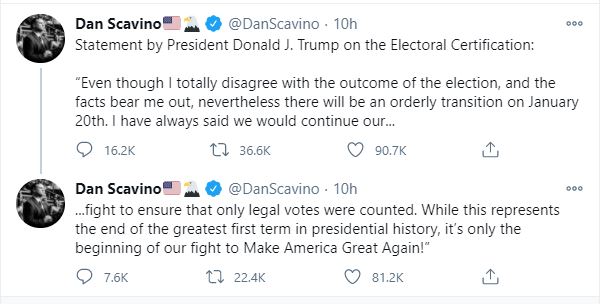
This is “only the beginning of the fight to make America Great Again!” Trump declared at 3:49 a.m. Thursday an aide Tweeted after Twitter locked Trump’s own account for spreading dangerous lies.

While Trump’s middle of the night statement also promised a peaceful transition of power when Joe Biden is inaugurated on Jan. 20, it came without a critical word about the chaos and violence Wednesday by fanatical Trumpians in California, Kansas, Georgia, Oregon, Washington and Utah.

Republican Sen. Josh Hawley of Missouri, among others, defended or excused Trump’s solicitation of mob violence. Eight senators and a majority of House Republicans voted to reject the certified election results from two states. Hawley should be ousted by the rest of the Senate, not the least because Hawley gave a raised fist in solidarity with the mob as he entered the Capitol Wednesday.

Support for rioters

Trump’s baseless claims that he won by a landslide in November—for which he produced no evidence in 60 failed lawsuits—are believed by a large share of Republicans. A poll during the siege found that 45% of Republicans support the mob attack while more than two-thirds of the GOP believe the violence and looting pose no threat to our democracy.

If other polls support this finding it is a powerful measure of how much enduring damage Trump has inflicted on our democracy by promoting disrespect for the rule of law. That Republicans, of all people, would support lawlessness and violence after decades of “law and order” sloganeering shows their fervor for authoritarian rule.

Propaganda favoring Trump plays a major role in the willingness of many Republicans to excuse Trump’s criminal behavior and contemptuous violation of his oath of office.

Primetime hosts on Rupert Murdoch’s Fox News repeatedly told the lie Wednesday evening that Capitol invaders were not Trumpian thugs, but Antifa posing as Trump supporters or at least some of them were Antifa. Fox News even posted a story excusing Trump’s attempted coup. Fox politics writer Brooke Singman wrote:

“Trump said ‘these are the things and events that happen,’ referring to violent protests that sent the U.S. Capitol Building into lockdown when a ‘landslide victory’ is ‘vicously [sic] stripped away from great patriots,’ while urging America to ‘remember this day forever’. “

Trump’s felonies

Trump’s remarks at the rally, where he told the mob to go to the Capitol while he headed in the other direction to the security of the White House, make him liable for prosecution for at least three federal crimes: inciting insurrection, sedition and advocating the violent overthrow of the government. He could be liable for criminal conspiracy charges and local District of Columbia criminal charges.

Adding to the liability for criminal charges over the attack were the words used to rile up the crowd by his son Don Jr. and his lawyer, Rudy Giuliani, who called for “trial by combat.”

While some Capitol Police engaged in combat with the attackers, and one lone uniformed agent was forced to retreat up stairways as a menacing crowd closed in on him, some Capitol Police held doors open for the invaders and others smiled at them, video showed.

Had the invaders been Black instead of white it is likely the attack would have been met with batons, handcuffs and even indiscriminate gunfire by Capitol Police. As CNN reporter Omar Jimenez tweeted: “I saw more arrests during protests in Minneapolis this summer than I have watching people storm the US Capitol.”

Racists in the Capitol police?

That conduct raises questions about whether racist and fascist groups have infiltrated the Capitol Police, just as they have many local and state police agencies.

Extensive video, including Congressional security cameras, can be used to identify the perpetrators of the first sacking of our Capitol since the British attacked in 1814. Every one of these insurrectionists must be identified, arrested, indicted, tried and if convicted given long prison sentences.

The most important question that should be asked of Merrick Garland, the federal appeals court judge Biden is nominating to be attorney general, is whether he will commit to ensuring the prosecution of every one of these criminals.

Other than making deals to leverage some perpetrators into admitting guilt to the most serious crimes in return for very slight reductions in sentences, these enemies of America should be shown no mercy by our Justice Department. They also should all be tried in Washington, D.C., where they committed their many felonies.

Beyond D.C.

A variety of actions by Trumpians from Atlanta to the Pacific Northwest on Wednesday showed how deeply the Trumpian desire to overthrow our government permeates American society. Posing as patriots, these people spout conspiracy theories, make remarks showing they lack even a junior high school civics understanding of our Constitution and many call for violence against minorities, notably Muslims and Black Americans.

Some of what these American brown shirts did Wednesday:

  • Armed Trumpians marshaled outside the Utah Capitol in Salt Lake City.
  • In Sacramento police arrested 12 Trumpians for illegal possession of pepper spray during protests at the California State Capitol.
  • In Salem, Ore., Trump’s Proud Boy thugs fought outside the state Capitol, prompting police to declare an unlawful assembly. A woman burned in effigy Gov. Kate Brown, a Democrat.
  • In Olympia, Wash., Trumpian thugs broke down the fence at the governor’s official mansion while Gov. Jay Inslee and his family were inside.
  • In Atlanta, armed Trump thugs gathered outside the Capitol, prompting state police to hustle Brad Raffensperger, the top state elections official, out of the building, partly out of concern about the presence of a former KKK leader who now directs one of Trump’s faux patriot support groups. Officials in Fulton County, which surrounds much of Atlanta, suspended vote counting because of safety concerns.
  • Trump’s thugs also harassed random people. In Los Angeles, a Black woman walking down the street was surrounded by a score of Trump’s thugs who menacingly demanded she declare who she voted for in the November elections.
  • In Topeka, Kan., some demonstrators, echoing Trump’s baseless claims he really won the November election by a landslide, entered the state Capitol, but were peaceful.
  • On an American Airlines flight from Texas to Washington, “flight attendants are struggling to control a plane full of Trump supporters as they display a pro-Trump projection and harass others passengers bound for D.C.,” freelance journalist Maranie R. Staab reported, posting a video to authenticate her story.

That a poll found many Trumpers support the insurrection Wednesday is not surprising if they rely only on supposed new organizations that act as propaganda arms of Team Trump.

Fox News hosts on Wednesday evening described the violent mob not as Trump supporters, but leftists posing as Trumpians, a conspiracy theory with even less factual basis than Trump’s delusional claims of election fraud.

What Trump made clear early Thursday morning is that after his term ends on Jan. 20, he will continue his efforts to overthrow the government he swore on oath to defend.

The question of the day is what will Democrats, now that they control the House, Senate and White House, do to protect our democracy? Will they decide to let bygones be bygones and move ahead, or will they do their duty and bring Trump and those who committed crimes on his behalf to justice?

Was it a coup? No, but siege on U.S. Capitol was the election violence of a fragile democracy

Did the United States just have a coup attempt?

Supporters of President Donald Trump, following his encouragement, stormed the U.S. Capitol building on Jan. 6, disrupting the certification of Joe Biden’s election victory. Waving Trump banners, hundreds of people broke through barricades and smashed windows to enter the building where Congress convenes. One rioter died and several police officers were hospitalized in the clash. Congress went on lockdown.

While violent and shocking, what happened on Jan. 6 wasn’t a coup.

This Trumpist insurrection was election violence, much like the election violence that plagues many fragile democracies.

What is a coup?

While coups do not have a single definition, researchers who study them – like ourselves – agree on the key attributes of what academics call a “coup event.”

Coup experts Jonathan Powell and Clayton Thyne define a coup d’etat as “an overt attempt by the military or other elites within the state apparatus to unseat the sitting head of state using unconstitutional means.”

Essentially, three parameters are used to judge whether an insurrection is a coup event:

1) Are the perpetrators agents of the state, such as military officials or rogue governmental officials?

2) Is the target of the insurrection the chief executive of the government?

3) Do the plotters use illegal and unconstitutional methods to seize executive power?

Coups and coup attempts

A successful coup occurred in Egypt on July 3, 2013, when army chief Abdel Fattah al-Sisi forcefully removed the country’s unpopular president, Mohamed Morsi. Morsi, Egypt’s first democratically elected leader, had recently overseen the writing of a new constitution. Al-Sisi suspended that, too. This qualifies as a coup because al-Sisi seized power illegally and introduced his own rule of law in the ashes of the elected government.

Coups don’t always succeed in overthrowing the government.

In 2016, members of the Turkish military attempted to remove Turkey’s strongman president, Reçep Erdogan, from power. Soldiers seized key areas in Ankara, the capital, and Istanbul, including the Bosphorus Bridge and two airports. But the coup lacked coordination and widespread support, and it failed quickly after President Erdogan called on his supporters to confront the plotters. Erdogan remains in power today.

What happened at the US Capitol?

The uprising at the Capitol building does not meet all three criteria of a coup.

Trump’s rioting supporters targeted a branch of executive authority – Congress – and they did so illegally, through trespassing and property destruction. Categories #2 and #3, check.

As for category #1, the rioters appeared to be civilians operating of their own volition, not state actors. President Trump did incite his followers to march on the Capitol building less than an hour before the crowd invaded the grounds, insisting the election had been stolen and saying “We will not take it anymore.” This comes after months of spreading unfounded electoral lies and conspiracies that created a perception of government malfeasance in the mind of many Trump supporters.

Whether the president’s motivation in inflaming the anger of his supporters was to assault Congress is not clear, and he tepidly told them to go home as the violence escalated. For now it seems the riot in Washington, D.C., was enacted without the approval, aid or active leadership of government actors like the military, police or sympathetic GOP officials.

American political elites are hardly blameless, though.

By spreading conspiracy theories about election fraud, numerous Republican senators, including Josh Hawley and Ted Cruz, created the conditions for political violence in the United States, and specifically electoral-related violence.

Academics have documented that contentious political rhetoric fuels the risk of election-related violence. Elections are high-stakes; they represent a transfer of political power. When government officials demean and discredit democratic institutions as a simmering political conflict is underway, contested elections can trigger political violence and mob rule.

So what did happen?

The shocking events of Jan. 6 were political violence of the sort that too often mars elections in young or unstable democracies.

Bangladeshi elections suffer from perennial mob violence and political insurrections due to years of government violence and opposition anger. Its 2015 and 2018 elections looked more like war zones than democratic transitions.

In Cameroon, armed dissidents perpetrated violence in the 2020 election, targeting government buildings, opposition figures and innocent bystanders alike. Their aim was to delegitimize the vote in response to sectarian violence and government overreach.

The United States’ electoral violence differs in cause and context from that seen in Bangladesh and Cameroon, but the action was similar. The U.S. didn’t have a coup, but this Trump-encouraged insurrection is likely to send the country down a politically and socially turbulent road.

Clayton Besaw, Research Affiliate and Senior Analyst, University of Central Florida and Matthew Frank, Master’s student, International Security, University of Denver

This article is republished from The Conversation under a Creative Commons license.

Trump campaign attorney suddenly repudiates the president — says he was used to “perpetrate a crime”

In Philadelphia, one of the cities where President Donald Trump’s legal team has been making baseless and debunked claims of widespread voter fraud, Trump campaign attorney Jerome Marcus has asked to withdraw from one of the campaign’s Pennsylvania-related election lawsuits.

Marcus made that request following the violence that occurred on Wednesday in Washington, D.C., where a violent mob of far-right Trump supporters stormed the U.S. Capitol Building hoping to prevent the counting of President-elect Joe Biden’s Electoral College win. Although a joint session of Congress was delayed and members of the U.S. Senate and the U.S. House of Representatives feared for their safety, it resumed on Wednesday evening — and the Electoral College results were affirmed by Congress. Biden’s inauguration is set for January 20.

Bloomberg News reporter Erik Larson previously reported the motion.

On Thursday in Philadelphia, Marcus told U.S. District Judge Paul Diamond his client “used the lawyer’s services to perpetrate a crime and the client insists on taking action that the lawyer considers repugnant and with which the lawyer has a fundamental disagreement.”

Larson quotes Marcus as saying, “I believe that the filing of that and other cases was used by President Trump yesterday to incite people to violence. I refer specifically to his urging people to come to Washington for a ‘wild’ protest.”

Marcus has been representing Trump’s campaign in a lawsuit against city election officials in Philadelphia, a Democratic stronghold that played a key role in Biden’s victory in Pennsylvania. Philadelphia City Commissioner Al Schmidt, a Republican, received death threats after Pennsylvania was called for Biden in November.

“The campaign lost its emergency motion for an injunction,” Larson notes, “but the case wasn’t dismissed and didn’t go to trial. It remains active, seeking a court finding that election officials violated the law.”

Penny dreadfuls were the true crime podcasts of their time

A young man named Rob hears a voice in his earbuds. It belongs to his favourite true-crime podcast host, Matthias. Like all good podcast hosts, Matthias takes pride in addressing his audience as individuals, developing a rapport and a trustworthy intimacy. So when Matthias tells Rob to murder women, Rob obeys.

This isn’t a true story but the plot of the 2017 audio drama “Monster’s Game.” But like all good fiction, this horror story has a basis in reality: our contemporary, sometimes ghoulish fascination with true-crime podcasts. The 19th century had a similar macabre popular fascination, the penny dreadful.

In the 19th century, people enjoyed a tale of murder and woe as much as we do now. From their complicated relationship with journalism to their love of sensationalism, the two forms have a lot in common.

Fake murders and violent crimes

Penny dreadfuls arose in Britain the 1830s due to a growing number of readers and improved printing technology. The penny post and railway distribution also played a part. While literacy levels are hard to establish, by the 1870s, most of the working class could read well enough to read a newspaper.

This explosion of crime literature gave a bewildered populace the erroneous impression that violent crime (especially murder) was increasing, as historian Christopher A Casey notes. This led to many believing that cities had never been more dangerous to live in and had startling implications for criminal justice in Britain. For instance, capital punishment, which had almost disappeared in the 1840s and 1850s, was reinstated in 1863.

With so much printed material on violent crime, it’s perhaps not surprising that the penny bloods (renamed penny dreadfuls in the 1860s) were so incredibly popular. The name change is thought to have happened because of the shift from tales of highwaymen and Gothic adventure to true crime, especially murder. And if there weren’t enough real crimes, the writers invented them, as with, most famously “The String of Pearls,” which was the first story to introduce the demon barber of Fleet Street, Sweeney Todd.

Serialised, short, printed on flimsy paper, cheap and luridly illustrated, penny dreadfuls were issued weekly to a large eager audience. There were a 100 publishers,) of penny-fiction and magazines between 1830 and 1850 and by the 1880s there were 15 periodicals competing simultaneously.

Casey links the newspaper era that parallels the rise of the penny dreadful with the gestation of the 19th century idea of “new journalism.” Coined by cultural critic, the term refers to a wide range of changes in British newspaper and magazine content, which sought to make print culture more accessible to working class and female readers. This included a shift away from political news coverage to wider reporting on crime, which focused on the journalist putting themselves in the story and often shaping it.

While this idea of “new journalism” arose in the 19th century, it has links with our current era. Observing the wide range of subjects for podcasts, the journalism academic Mia Lindgren has discerned how investigative journalism podcasts (a genre identified with true crime) quickly became very popular. This swift rise is similar to that of penny bloods.

Moral outrage

The true crime genre, of course, predates podcasts, but its recent renaissance is, in part, due to award-winning productions like “Serial.” In 2019, 22 of the top 100 podcasts on iTunes were true crime.

Like penny dreadfuls, these podcasts are about real murder and mayhem and naturally blur the line between news and entertainment.

Like penny dreadfuls, true crime podcasts tend to be serialised, short, of variable quality and drop weekly or bi-weekly. They may not have the lurid illustrations associated with penny dreadfuls, but the supplementary visual assets on their websites are arguably just as visually arresting — and necessary to the format. Readers of penny dreadfuls wanted to see an illustration of what the murderers and victims looked like; modern podcast listeners also enjoy having their aurally stimulated storytelling supplemented with colourful podcast logos, images and videos of the podcast hosts, and pictorial evidence of crimes.

Penny dreadfuls were developed to cater to a specific youth audience. They generated a moral panic and were held responsible for inspiring real acts of violence as juveniles exposed to such “trash” were thought to be morally corrupted. For example, in 1895, Robert and Nattie Coombes, aged 13 and 12, admitted to stabbing their mother to death. The police discovered a collection of penny dreadfuls in the house, which the coroner argued had led the boys to commit the heinous act.

True crime podcasts haven’t been accused of corrupting the young and contributing to juvenile delinquency (yet) but the consequences for real people involved in real investigations have been felt. One example comes from Serial. As the podcast’s investigations threw doubt onto whether Adnan Syed was responsible for the murder of his high school girlfriend, a crime for which he had been jailed, avid listeners began searching and stalking Jay, the person Adnan says is responsible for the murder.

Podcasts seem to be, at worst, tolerated as escapist entertainment, and at best, able to influence the criminal justice system — in a more socially progressive way than crime reporting did in the 19th century. The charity the Innocence Project has seen increased donations as a result of podcasts and listeners appear in court to support defendants. Judges even cite podcasts as reasons for changing their decisions on defendants’ motions for post-conviction relief.

The economic historian John Springhall noted that “often-reprinted serials about low-life crime and mystery … would have held a vicarious appeal for young metropolitan readers seeking a romantic escape from uneventful daily lives”. True crime podcasts have also been a welcome escape from the monotony of life in lockdown during the pandemic. Investigative podcasts like The Washington Post’s “Canary,” a seven-part series about women who refused to stay silent about sexual assault, and “CounterClock,” which investigates two unsolved murders, have made it on to lists of the best podcasts for 2020. Both podcasts and penny bloods satisfy a lurid fascination in all that is dark and violent. A fascination that is sure to push the true crime genre to even greater heights in years to come.

Leslie McMurtry, Lecturer in Radio Studies, University of Salford and Adam Fowler, Lecturer in Creative Audio, University of Salford

This article is republished from The Conversation under a Creative Commons license. Read the original article.

The iconic American inventor is still a white male — that’s an obstacle to race and gender inclusion

When President Barack Obama signed the America Invents Act in 2011, he was surrounded by a group of people of diverse ages, genders and races. The speech he delivered about the legislation, which changed the technical requirements for filing a patent, highlighted this diversity by emphasizing that today anyone can become an inventor in the United States.

Despite Obama’s optimism about women and people of color inventing and patenting the nation’s new and innovative technologies, both groups still lag considerably behind their white male counterparts in being recognized as inventors and owning patents, in the U.S. and globally. Women and people of color possess the same intellectual capacities as their white male counterparts. Yet empirical studies consistently show that patent law overwhelmingly rewards white men for their labor and skill.

This is in part because women and people of color join science, technology, engineering and math (STEM) fields in much lower numbers than white men. In 2017, women made up over half of the workforce, but held only 29% of STEM jobs. But even women and people of color who go into STEM fields invent and patent far less often than their white male counterparts.

The question is why.

As a researcher who studies race, rhetoric and intellectual property law, I can say that the U.S.’s race and gender invention and patent gap results partly from a failure of imagination. The stories that people tell about invention in the U.S. continue to focus on white men – the Benjamin Franklins, Thomas Edisons and Elon Musks – without affording women and people of color the same larger-than-life status.

National myths about inventorship and political barriers to patenting set up women and people of color for failure by normalizing entrenched discrimination even when they join STEM fields.

The stories we tell about inventors

Critical race theorists show how legal terms and everyday narratives can look as if they create a level playing field while allowing implicit bias to thrive. In my new book, “The Color of Creatorship,” I look at how intellectual property law has evolved racially over 200 years.

Black and brown people are no longer legally prohibited from owning patents and copyrights, as they were in the 1700s and 1800s. However, seemingly colorblind patent and copyright laws continue to practically favor white male inventors and creators by using legal definitions and tests that protect inventions and creations that tend to match Western conceptions and expectations of, for instance, expertise and creativity.

From the now cliché “think outside the box” to Apple’s slogan “think different,” innovation, a central component of invention, is associated with breaking limits. Yet Americans have largely failed to change the ways that they think and talk about invention itself.

Even Obama’s speech about the America Invents Act begins by explaining how Thomas Jefferson epitomized the nation’s mythic spirit of invention and innovation. Yet Jefferson held the racist view that Black people lacked the capacity to be truly imaginative creators, let alone citizens of the nation. Breaking limits, it turns out, is most often a privilege afforded to white people.

The current historical moment, in which facts are negotiable, white nationalism is on the rise and the nation is weathering a pandemic, is an important time to redefine American mythologies of invention. Celebrating the inventive capacity of women and people of color matters. Recognizing their innovative genius, in films like “Hidden Figures,” helps transform what had been marginalized stories into narratives that are central to history.

Obama’s reference to Jefferson reinforced powerful, limiting conventional wisdom about invention and innovation. Popular cultural narratives frequently invoke the contributions of white men while erasing those of women and people of color. For example, the History Channel’s The Men Who Built America focuses on the inventions and innovations of Cornelius Vanderbilt, John D. Rockefeller, Andrew Carnegie and Henry Ford, business titans who achieved tremendous success via dubious ethics.

The show’s use of the Great Man theory of inventorship and entrepreneurship leaves out the many women and people of color, including Thomas Jennings, Elijah McCoy, Miriam E. Benjamin and Sarah E. Goode who, as legal scholar Shontavia Johnson shows, not only invented and patented during the same period but, as legal scholar Kara Swanson shows, used their work to lobby for suffrage rights for women and people of color.

A brief listing of notable Black American inventors.

Attacking Asian innovation

America’s white-male-centered imaginings of inventorship and patenting extend beyond the nation’s borders, in xenophobic pronouncements frequently directed at Asian nations. Apple co-founder Steve Wozniak recently proclaimed: “Success in India is based on studying, having a job . . . where’s the creativity?”

Similarly, President Trump claimed to be “protecting the innovations, creations, and inventions that power our country” from Chinese graduate students, who are part of a racial group that has long boosted America’s economy, fueled global innovation and offered pandemic assistance.

Refusal to recognize diversity in inventorship is a bipartisan affair. Then-presidential candidate and current President-elect Joseph Biden made a shocking assertion about innovation in China: “I challenge you, name me one innovative project, one innovative change, one innovative product that has come out of China.”

Inventing new ways to talk about invention

Racist, sexist and xenophobic inventorship and patenting norms are not immutable facts. They are practices built on exclusionary stories and feelings, transformed into familiar myths, including that of the American dream. These exclusionary stories frequently function as dog whistles that have long been used to fuel white anxieties about people of color and men’s anxieties about women. They make it difficult for women and people of color to prove they have the expertise needed to invent and patent.

However, as films like “Hidden Figures” emphatically show, it’s possible to tell inclusionary stories. I argue that telling them is an ethical act because it ensures that society recognizes the genius of people of all identities – race, gender, nationality, religion, ability, age – in contributing to invention and innovation, current and historical.

Rhetoricians frequently proclaim that “words mean things.” This is certainly true when imagining who has the capacity to perform certain tasks, such as inventing and patenting. At a moment in which the U.S. faces threats to democracy, environment and economy, it is more important than ever to invent new ways of talking about invention. People of all identities deserve the opportunities to create and own their innovative solutions for solving the world’s most pressing problems. More importantly, they deserve to be treated as full citizens in the realm of intellectual property and innovation.

Anjali Vats, Associate Professor of Communication and African and African Diaspora Studies and Associate Professor of Law (By Courtesy), Boston College

This article is republished from The Conversation under a Creative Commons license.

“Cautious optimism” about fighting climate change: Salon talks with author of “The New Climate War”

I have had the pleasure of interviewing Dr. Michael E. Mann, a distinguished professor of atmospheric science at Penn State University, on many occasions, and for good reason: he’s affable, sincere, and good at explaining things. Indeed, you don’t become one of the world’s foremost authorities on climate change without those kinds of traits. In his career, Mann has repeatedly worked to break down the science of global warming in comprehensive but accessible ways. His efforts to raise public awareness have always struck a balance between emphasizing the gravity of the situation facing the planet and expressing cautious optimism that, if we implement the right policies, we can stave off ecological catastrophe.

This is the goal of his new book, “The New Climate War: The Fight To Take Back Our Planet.” Mann’s thesis is clear: We must fight the people who lie about the threat of man-made global warming, whether out of financial self-interestideological dogmatism, or because they have been duped by others. At the same time, we must also avoid succumbing to the temptation to assume that all is lost. Instead it is necessary to push for bold policies that will address climate change in a meaningful way, from a revised version of the Green New Deal and effective carbon pricing to making it so that renewable energy can compete fairly against fossil fuels.

All of this can — and must — be done, Mann argues. Citizens have the power to demand change.

Below is my conversation with Mann. The transcript has been lightly edited for clarity and context.

What inspired you to write “The New Climate War”?

It’s the fact that we see this nefarious, and in many ways more insidious, attack on climate action today, even as the impacts of climate change become so obvious to the person on the street that it’s not credible to deny that it is happening. The same powerful vested interests in the fossil fuel industry and those who do their bidding, I call them inactivists because their agenda is one of climate inaction. For decades they’ve been denying that climate change is real, attacking the science, trying to undermine public understanding of the problems. And now that that’s really not possible, they have turned to a whole new set of tactics in their efforts to block progress on climate. And that’s really what the book is about. I felt it was important to talk about that as one who had sort of been in the cross hairs of climate change deniers for decades and witnessed firsthand their tactics and how they’ve evolved, sort of as a warning to people.

The battle isn’t won yet. The forces of inaction are no longer denying the basic science, but they’re doing all these other things to prevent action. And that’s what the book is about. [There is a] deflection of attention from the needed policies and systemic changes to individual behavior — as if it’s just about us and our diet and how we travel, and the way to solve the climate problem is for us to just be better people. Of course, individual action is important. We should all do things that serve to decrease our environmental footprint and often they make us healthier. They save us money. There are lots of good reasons to do them, but they’re no substitute for the needed policies at the very top, the massive decarbonization of our economy, which is necessary.

Now also by focusing attention on individual behavior, they get us fighting with each other, shaming people, pointing fingers at each other about their carbon impurity, and that divides the community. So they get climate advocates arguing with each other. That means there is no longer a unified voice calling for action. There is doom and despair-mongering, an attempt to convince some that it’s too late to do anything about it anyway, so why even bother? Unfortunately a lot of climate advocates of good intentions and of goodwill have been hoodwinked and taken in and weaponized in that effort to despirit them to the point of disengagement, so they’re no longer on the frontlines demanding action. There is also the promotion of false solutions like geoengineering or carbon capture, basically anything but solving this problem at its source, which is getting off fossil fuels, because that’s inconvenient to the fossil fuel industry. So they’d rather have the discussion of solutions focus on all these distracting, fake solutions to the problem.

I’ve interviewed you many times before. I’ve read your book. I’ve read other things you’ve written. The science that you present is incontrovertible. There really is no debate among scholars as to whether or not climate change is real or as to whether or not we need to take very bold steps in order to reduce greenhouse gas emissions and save the planet. The problem is the people who argue against you aren’t doing so in good faith. This isn’t a situation where you have two sides that are looking at the same information and just happen to draw different conclusions. This is a situation in which one side has an ulterior motive and is lying to millions, if not billions, of people about the truth, because of that motive. How do you address that? I almost feel like on some level, this isn’t a climate change issue. This is a psychological issue. How do you get people who are being hoodwinked by bad faith arguments to realize that?

It’s a great question. And that is something I try to accomplish in the book. The first challenge is to just get people to recognize it. ‘Look, they’re pulling the wool over your eyes. They’re manipulating you.’ And I use, for example, the classic tale now of the ‘Crying Indian‘ public service announcement from the early 1970s that we all thought was empowering about cleaning up our environment. But it turns out we ultimately learned that it was a propaganda campaign hatched on Madison Avenue by Coca-Cola and the beverage industry to defeat bottle bills, to focus on individual behavior. ‘We just have to pick up those bottles and cans ourselves or unleash the Boy Scouts to clean up the bottles and cans. We don’t need a deposit. We don’t need a systemic solution to this problem.’

So in telling some of those stories, my hope is that sort of this storytelling approach to describing the problem will really help people understand what is happening and how they’re being manipulated. Because that’s really ultimately the solution — to recognize these tactics, to push back against them, to make sure other people are aware of them, and to not be distracted from the matter at hand, from the prize, which is climate action.

And we’re now, literally today, we’ve seen political developments — not the mob we’ve seen in the Capitol — but the election of two Democrats now turning over the Senate to Democratic hands means there’s a real opportunity for meaningful policy progress. We’ve got a president who’s on board, we’ve got a Congress controlled by Democrats who are on board. There’s a real opportunity now for meaningful climate action. Let’s not be distracted or fooled. Let’s focus on the matter at hand, which is making progress.

I completely agree, but I actually do want to focus for a moment on the mob in Washington, because here is the thing: I would assume that people would get that passionately angry about the fact that a handful of wealthy people are emitting all of these greenhouse gasses, and are pushing for policies that make it harder for us to restrict greenhouse gas emissions, and that is gradually destroying the planet. My nephew is going to grow up in a world that is very different from the one that I grew up in as a result. Do you think that would be the sort of thing that makes people angry, and instead they’re angry because President Donald Trump isn’t allowed to steal an election?

It’s a mnemonic, not a precise, scientific model, but sort of the reptilian brain and the way that Republicans are particularly effective at tapping into the circuitry of the reptilian parts of the human brain, preying on all of our worst instincts — selfishness, prejudice, all of that — to weaponize this mob that we’re watching on television right now to do their bidding for them. And just as you alluded to earlier, Matt, the irony being that they are mobilizing, weaponizing, this army rabble to engage in actions that are completely detrimental to their own interests, in the present and ultimately down the road. I like to think that even these mob protesters in DC  care about their children, they care about their grandchildren. They want a better life for them.

And so in a sense, they’ve been manipulated. They are victims of a misinformation campaign. It’s a disinformation campaign, enticed by red meat thrown out by Republican operatives to prey on their worst instincts. Sadly in many cases they are beyond help at this point, and we have to fight on knowing that for many cases they’re not to be on the right side of this issue, but we don’t need them. They’re a fringe, they’re not a majority. We can solve this problem without them. We just can’t allow them to get in the way.

With the favorable change in winds and in Washington DC, we’ll see what happens. I think that we’re going to move away from this over the next couple of years. It will be rocky. It won’t be easy, but I see the reason for cautious optimism that we’re steering the ship in a different direction now.

I do want to have a bit of a lighter note. I noticed that you have blurbs on the back of your book jacket from Leonardo DiCaprio, Don Cheadle, Greta Thunberg and Al Gore. Was that cool, being able to get them to read your book and offer this commentary?

Well, as you know, I hang out with them at cocktail parties most of the time, and so it was easy to! I was just kidding. It obviously feels great to be able to engage opinion leaders, people who have a reach as well beyond your own. and I very much support forging alliances with people in the entertainment and in media who have an opportunity to really get that message out, who can reach a much larger audience than you can. And many of these folks are sort of personal heroes of mine — Thunberg, Leo. You know, he could have easily spent his life doing nothing but exploiting the excesses of wealth and fame that he’s achieved, but instead he takes a beating from fossil fuel interests and climate change deniers because he’s focused on actually trying to do something about this and other problems. 

So I have a lot of respect for the folks that you mentioned. It makes it very meaningful when obviously when they have nice things to say about the books. I see this really as an ecosystem of sorts, and scientists and science communicators play a role, and opinion leaders and celebrities play a role. And when we can sort of pool our resources and work together, it just makes it that much easier to achieve the changes that we need to see. It was very gratifying to me, in short.

We were talking about how celebrities have this platform in which they can draw attention to these important issues. I remember growing up and all I would hear from conservatives is, “Oh my God, if I hear one more liberal celebrity preach…” and then they elect a president whose resume is literally nothing but being a celebrity. No political, no military experience whatsoever. Leonardo DiCaprio has a comparable resume in terms of if he wanted to run for president. And he has better policy ideas!

Leo actually has some brains! I’ve met him and talked with him and he’s a sharp, intelligent, thoughtful, good, honest person. Everything you would want actually in a politician. You’re so right, and what it exposes is just the fundamental hypocrisy of sort of the right-wing noise machine that we’ve seen that in spades during the Trump years, engaging in extreme examples of the very vices they like to attribute to progressives. Part of it is the diversionary. It’s projection. They’re masters. Trump is a master of projection and Republicans become masters of projection.

That’s how they’ve been able to manipulate this rabble into supporting an agenda, the right-wing conservative profits agenda that goes against their own interests. That can only happen when you’re able to sort of master the arts of projection and deflection. And that’s the reality. And it’s why I spend some time talking about that part of it. For example, this idea of getting us fighting with each other about individual behavior, it divides us, but also deflects attention from the needed causes toward changes in individual behavior. But another aspect of that, it’s a great way to cynically, to try to target celebrities like Leo DiCaprio and thereby sort of reduce their effectiveness as spokespeople by accusing them of hypocrisy, as a great way to discredit them and their message. And it’s almost always based on distortion and outright fabrication.

The prized Uzbeki dumplings I’d bike across the country for

Every summer in New York, I bike to Beach 92nd Street in Far Rockaway and rush to lock up my bike in front of a large wood sign with bright primary letters spelling out “Uma’s.” Inside, under a bright tin ceiling, my eyes devour the Uzbeki specials on the board and follow each dish bustling out of the kitchen, my veggie-loving and meat-loving sides tug-of-warring over my order.

But the veggie-loving side of me wins every time. A round blue-rimmed plate clatters onto my table bearing the sweet, savory fruits of Uma’s labor: squash manti. These little purses of steamed dough from heaven, their edges gathered around sweet, tender cubes of squash, drizzled with oil and sprinkled with onions, are worth biking 20 treacherous miles over bumpy foot bridges and bike lane-less Brooklyn boulevards.

The rich heartiness of these manti had my tongue searching for butter, or even vegan butter — of which there isn’t a single pat in Uma’s recipe. That fulfilling richness purely comes from the butternut squash Uma chops up, the vegetable oil she sautés with, and the hearty dough she rolls out.

Uma’s opened in July 2013 and was part of the post-Superstorm Sandy rebuilding of Far Rockaway. Maybe it’s partially Uma and her husband Conrad’s vote of confidence in the resilience of the neighborhood, but this small sit-down restaurant has become one of the most popular and beloved dining establishments in Far Rockaway, a beach community known for its closeness.

Before opening the restaurant, Uma and Conrad hosted a series of Uzbeki dinner parties to rave reviews. Inspired and aided by Uma’s aunt, an expert cook visiting from Uzbekistan, the couple perfected their menu and leaped at the sale of an empty storefront on Beach 92nd Street and Rockaway Beach Boulevard. There weren’t many full-service restaurants on the street yet, and on their first day, they had a line out the door.

Uma’s customers are a colorful bunch — longtime locals, transplanted young families, surfers, tourists, and day-trippers like myself (whom locals term “DFD,” or “Down for the Day”). Everyone falls under the spell of Uma and her food, watching her sculpt her manti through the kitchen window. “What are those?” I’d often hear a customer sitting next to me implore their server, gazing at the plate of perfect dumplings as it goes steaming by.

But those origami-like manti weren’t always as artfully shaped as they are today. “I remember my manti were really ugly when I was a kid,” Uma, who learned how to make the dumplings from her mother, said. “You have to have a skill doing it, and it takes a little bit of practice, but then you make enough of them — and you just learn.”

Growing up, pumpkin manti were an autumnal treat for Uma. Her mother made these special manti only once a year, during the fall pumpkin harvest. “The squash manti are so special because they’re from this fresh harvest,” Uma said. “Instead of beef [manti], I would always reach for the pumpkin dumplings and eat them — they were so soft and buttery. It’s still my favorite. I just love the taste.”

Uma’s menu also includes several Korean dishes, inspired in part by a Korean-Uzbeki friend from her youth. In Uzbekistan, which has a large and growing Korean immigrant population, Korean dishes were traditionally sold in outdoor bazaars, but are now available in most supermarkets. The Uzbeki-Korean connection fascinated me, and I wondered if there was a relationship between Uzbeki manti and Korean mandu.

Like most food history, the story of the Korean mandu I grew up with is disputed. It’s likely they descended from manti — and the word “mandu” probably came from “mantou,” or “manta” in Chinese. Chinese mantou dumplings most likely migrated along the Silk Road east, finally reaching Korea via Mongolia. Traditionally, mandu are made with ground pork or beef, while traditional Uzbeki manti are made with ground lamb or beef. My husband’s ancestral nation of Armenia also makes manti—ones that hew small, spicy, and meaty.

Mandu — and by extension, manti — are part of a cultural heritage I hope to teach to our son and pass on to him, so I experimented with making the dough. Now that I have my mom’s pasta machine from the eighties and a glut of dan-hobak (kabocha) from her garden, I’m making my version of vegan squash manti for my vegetarian husband, but with one trick—with seasoned vegan ground beef or tofu.

Like the manti and the mandu’s ancestral link, we find our commonalities in food traditions. For the staff at Uma’s, community has kept their food traditions going and their business open.

“We stayed open during the pandemic, and people kept coming and ordering takeout and giving us enough business to stay open,” she says, adding that she and her family moved to the Rockaways in 2008 from Bay Ridge. “We’ve become such good friends with so many people, and we are now part of this community. They’re what’s kept our restaurant alive.”

***

Recipe: Squash Manti With Gochujang Onions

Will the PGA keep 2022 championship at Trump’s golf club? Unlikely, says columnist

The PGA of America has hinted at plans to prevent President Donald Trump’s National Bedminster golf club from holding the 2022 PGA Championship, NJ.com reported.

The organization made the move after the president incited a deadly riot on Capitol Hill.

According to Golfweek’s Eamon Lynch, the PGA will officially strip Bedminster of the championship after Trump leaves office.

Lynch explains:

The odds that ’22’s PGA Championship will happen as scheduled in New Jersey are about as good as the chances of you or I winning it. Seth Waugh, the PGA of America’s CEO, was a banker and has an alert eye for high-risk exposure. He knows that Trumpism is likely to be an equally incendiary force in the ’22 midterm elections and that any affiliation is poisonous. Waugh will be forced to move the event and face down a small but vocal faction of his membership who remain true believers. Moving its major from Trump National has been debated internally at the PGA for more than two years, but executives have been reluctant to antagonize a famously vindictive man who controls the Internal Revenue Service. Such concerns melt away in 10 days, if not sooner.

But Lynch argues that golf’s reputation has been hurt by the president.

“The game will instead be portrayed as Trump’s refuge,” he writes, “something he did while ignoring a pandemic that has claimed 365,000 lives, refusing to acknowledge a resounding electoral defeat, and inciting feeble-minded fascists to violence that left five people dead at the opposite end of Pennsylvania Avenue.”

Archeologists just uncovered food stalls in Pompeii. I recreated a stew inspired by their findings

On Dec. 26, archeologists finished excavating a complete thermopolium — a Roman food counter — in the ancient city of Pompeii, which was buried in ash and stone when Mount Vesuvius erupted in A.D. 79. 

“As well as being another insight into daily life at Pompeii, the possibilities for study of this Thermopolium are exceptional, because for the first time an area of this type has been excavated in its entirety, and it has been possible to carry out all the analyses that today’s technology permits,” said Massimo Osanna, the interim director general of the Archaeological Park of Pompeii, in a statement. 

As a classical studies nerd and lover of food history, I was absolutely consumed by this discovery. According to Osanna, a team of experts — including anthropologists, geologists and zoologists — have already started to assess the food stall to gain a better “understanding of what was sold and what the diet was like.” 

In many ways, the site looked like a modern food court; images of roosters and ducks were painted on the exterior of a stall, serving as a kind of menu board or advertisement. In the wreckage, there were also several dolia, large earthenware jars, that upon being opened, still smelled strongly of wine. 

But what exactly were they eating? The specific details are admittedly still a little murky. But as Chiara Corbina, the archaeozoologist involved in the dig, told the New York Times, there was evidence of a dish involving snails, fish and sheep. Further analysis is expected to determine whether vegetables were part of the ancient recipe, but for now she thinks the “thermopolium probably served a stew or soup that included all these animals together.”

At that moment, I knew I had to make that stew. Or at least a version of it with modern ingredients and cooking techniques. Here was my new pandemic project — a welcome distraction from the ever-burning dumpster fire that is our current reality. Forget baking sourdough, let’s taste history. 

I immediately emailed Dr. Duncan MacRae, an associate professor of Classics at University of California, Berkeley, who specializes in Roman cultural and social history. He was game to help field my questions, though offered the disclaimer that “it is difficult to overstate how ignorant all we historians and archaeologists are about Roman life. It was a long time ago and the evidence is always patchy and hard to interpret.” 

That said — as the sage Carl Weathers would suggest on “Arrested Development” — let’s get ourselves a stew going. 

What sources did I reference? 

In addition to MacRae’s insight about the dietary habits of the Ancient Romans, as well as the news release from the dig site, I referenced “Apicius,” a collection of Roman cookery recipes. These were likely compiled sometime between the first and fourth centuries, and while the collection is named for Marcus Gavius Apicius, a Roman gourmet who flourished during Tiberius’ reign in the first century, there’s probably not a single author. 

There are a number of lamb and kid stews in the text (you can check them out here) which served as a backbone for my experiment. 

I also took a deep dive into materials belonging to several museums and archives that have hosted exhibitions about Ancient Rome. 

What meats did I use? 

Perhaps unsurprisingly, aged mutton wasn’t readily available at my supermarket meat counter and the specialty butcher I typically go to with these kinds of requests had limited inventory due to the pandemic, so I went with ground lamb as the next best thing. As mentioned before, there is a precedent for using lamb in Roman cuisine. 

Snails — well, tinned escargot — I actually had on hand thanks to a friend. While I’d intended to just drown them, along with my sorrows, in butter and garlic, I sacrificed those plans for this more noble cause.

Finally, the findings at Pompeii mention that fish may have been part of this soupy dish, but we’ll address that in the condiments section. 

What about vegetables and grains? 

“The ancients farmed all sorts of grains, herbs and vegetables,” MacRae said. “Though not maize and potato — those are New World plants!” In “Apicius,” several vegetables are mentioned often: fennel, onions and leeks. Lovage, a leafy herb, is also mentioned, but I substituted in celery leaves because they have a similar flavor and are easier to find at the supermarket. 

“Naturalis Historia,” an encyclopedia written circa A.D .77 by Pliny the Elder, mentions wild carrots  — a distinct point of pride, FYI, for the World Carrot Museum.

According to MacRae, “bread was very important to the Romans, and was probably the main source of calories, at least in a town like Pompeii.” Great! Love some bread with a bowl of stew. 

Lentils are surprisingly popular in “Apicius,” and legend has it that Emperor Heliogabalus, who was assassinated in A.D. 222 and known for his decadence, revered lentils so much he would mix them with onyx and pearls. 

Let’s go, lentils.

What spices and condiments made it into the mix? 

The Ancient Romans did have access to Indian Ocean trade routes, which enabled them to source spices. Per MacRae, they seemed to have been especially keen on black pepper. There is also evidence of large-scale imports of cinnamon.

“A study done in the late 1960s found over 140 different spices mentioned in ancient texts, so there was some access sometimes and for some people to quite a wide range of spice,” he said. “But again, the simple fact of the immense costs of importing goods without fossil fuel for vehicles to Italy from the Indian Ocean in antiquity means that there must have been limitations in how common they were.” 

As a result, there is quite a bit of evidence that the Romans relied on sauces — including a famous fermented fish sauce called garum — and honey to hide or enhance flavor, rather than spices. Wine was a big flavoring and cooking agent, too. 

Honey, white whine, black pepper and some anchovies dissolved in oil — a reference to both garum and the fish found in the Pompeii pots — went on my list. While spices would have likely been prohibitively expensive, to the point that street vendors wouldn’t use them regularly, I decided to bend the rules a touch and add two spices that are mentioned in the lamb stew in “Apicius”: cumin and coriander. 

How was this dish likely cooked? 

While olive oil could have been a possible cooking fat, as it was used in Ancient Roman dishes, MacRae speculates that many dishes were simply boiled and stewed over open flames. I guess my electric stovetop would have to do. 

Putting the dish together

It all started with the anchovies. To mimic the savory, fishy flavor that garum would have had (but without aging the fish guts in the sun for several months), I added half a tin of anchovies in olive oil to a large stock pot over medium heat. Once the anchovies were fully dissolved, in went very finely-chopped fennel bulb, carrots, leeks and celery leaves to soften in the flavored oil. 

Meanwhile, in a separate bowl I combined the ground lamb with a tablespoon of honey, coriander and black pepper, and half a tablespoon of cumin; you could absolutely use a lamb shoulder roast, dressed with the same spices. I just worked with what was readily available. 

Once the vegetables softened, in went the lamb to be sautéed until browned. I followed it with half a cup of dry white wine and three cups of water, bringing the whole mixture to a boil. Then I reduced the heat and allowed it to simmer for about an hour. 

The green lentils were the last ingredient to go in the pot, and I cooked them until just softened, about 20 minutes. I served it, obviously, with a hunk of bread. And I have to say — it was absolutely delicious. The complexity of flavor was outstanding, between the licorice-bite of the fennel, the subtle sweetness of the honey and the umami of the anchovy oil (which isn’t overwhelmingly fishy). 

Is it “authentic”? Eh, probably not. But I found a lot of joy in deeply researching a dish and puzzle-piecing it together. The fact that it came out as well as it did was a big bonus. I took one more liberty and added a quick zest of lemon over the whole thing. 

As I found out during my research, lemons were a status symbol in Ancient Rome, and wouldn’t become commonplace until the 19th century. During the first century, they would have been coveted, even by the ruling class. Adding them to my stew felt like an unexpected luxury. 

Here’s how to make it in your own kitchen: 

* * *

RECIPE: Pompeii-Inspired Lamb and Lentil Stew
Serves 6 to 8

  • 1 fennel bulb, finely chopped
  • 2 leek stalks (the white and light green portion), finely chopped
  • 3 carrots, finely chopped
  • ½ cup of celery leaves, finely chopped
  • 3 tablespoons of olive oil, divided
  • ½ tin of anchovies
  • 1 pound of ground lamb
  • 1 tin of snails, meat removed from shells, rinsed and diced
  • 1 tablespoon of honey
  • 1 tablespoon of black pepper, plus more to taste
  • 1 tablespoon of coriander
  • ½ tablespoon of cumin
  • ½ cup of white wine 
  • 3 cups of water, plus more as needed
  • 1 cup of dried lentils
  • Salt to taste
  • Lemon zest and fennel fronds for garnish
  • Hearty bread for serving

1. In a large stock pot, dissolve half a tin of anchovies in two tablespoons of olive oil over medium heat. Once dissolved, add the fennel, leeks, carrots and celery leaves and sauté until slightly softened. 

2. Meanwhile, add the ground lamb, honey, black pepper, coriander and cumin to a large bowl and mix until fully combined. 

3. Add an additional tablespoon of olive oil to the stock pot and add the lamb mixture, as well as the snails, stirring until browned. 

4. Top the mixture with the wine and three cups of water and bring to boil. Reduce to a gentle simmer, then cover for an hour. 

5. Add the lentils to the stew; if the cooking liquid has cooked down too much, add an additional cup of water. Cook until just softened, about 20 minutes. Add salt and pepper to taste. 

6. Divide the soup into individual bowls and garnish with fennel fronds and fresh lemon zest. Serve with hearty bread. 

Nadiya Hussain’s PB&J Sheetpan Pancake is the key to a cozy, but quick weekend breakfast

We love American pancakes but sometimes feel limited as to how often we can have them. Pouring and flipping can take time, so I have taken everything we love about American flavors and Elvis and made this recipe for peanut butter and jelly pancakes, baked all in one and then cut into squares. You can serve them with an extra dollop of jam, some Greek yogurt, and fresh raspberries on the side, if you like. 

***
RECIPE: Peanut Butter and Jelly Sheetpan Pancake 
Makes 20 squares

  • 3 heaped tablespoons jam of your choice (I like a berry jam, because of the deep color and tang, or I just use whatever  happen to have knocking around the house)
  • 3 tablespoons crunchy or smooth peanut butter
  • Cooking oil spray
  • 2 cups/250g all-purpose flour
  • 1 teaspoon baking powder
  • ½ teaspoon salt
  • 3 tablespoon granulated sugar
  • ½ cup/170ml whole milk
  • 2 large eggs
  • 2 tablespoons vegetable oil
  • Confectioners’ sugar, for dusting (if you can be bothered, always looks lovely, takes so little time too)

1. Start by putting the jam into a microwave-safe bowl and heating it in 10-second bursts, stirring each time until the mixture is simply liquid enough to swirl around — we’re not trying to warm it up. Repeat this process with the peanut butter (make sure to avoid putting in too much oil from the jar as this will just make the pancakes greasy). Set both aside. 

2. Preheat the oven to 350℉/180℃. Spray an 8-inch/200cm square baking pan with cooking oil.

3. Put the flour, baking powder, salt and sugar into a bowl and whisk together. Make a well in the center and add milk, along with the eggs and oil. Whisk together until you have a thick batter. If time is even shorter, you can make the batter in advance and store it in the fridge overnight. 

4. Pour the batter into the prepared brownie pan and spread out evenly. Take dollops of the jam and spoon them in sporadically, then do the same or the peanut butter. With the end of a spoon, swirl the  dollops together slightly to create the marbled effect. 

5. Bake in the oven for about 25 minutes. As soon as the surface of the pancake looks matte and is not wobbly anymore, it is ready. Remove from the oven and cut into squares. Dust with confectioners’ sugar, if desired, and serve. These are great on the go, but you can also freeze any leftover squares in plastic wrap.


If you like this recipe as much as we do, be sure to buy Nadiya Hussain’s “Time to Eat: Delicious Meals for Busy Lives.”  You can also watch Hussain’s 2020 Salon Talks interview here


PBS’ idyllic “All Creatures Great and Small” restores our sorely tested faith in humanity

Even as I watched the animated introduction to PBS Masterpiece’s “All Creatures Great and Small,” which features a small automobile zipping through rolling green hills dotted with fleecy sheep, I felt my jaw unclench and my shoulders drop just a bit. The series, which is based on the beloved books by Alf Wight (under the nom de plume James Herriot), promises from the outset to be tremendously cozy — the television equivalent of a chunky sweater knit from oatmeal-colored yarn. 

But “All Creatures” doesn’t just stop at being pleasant in a wholesomely British kind of way. Coursing through the entire seven-episode series is such an amount of heart, the kind that ensures that goodness and decency inevitably win the day, that it will leave you yearning for better times, especially amid the unprecedented stress the last year has brought us. 

The story, like the 1978 television adaptation, centers on James Herriot (played in this version by newcomer Nicholas Ralph), a young and optimistic Scottish man who finds himself working as a veterinarian assistant in a quaint Yorkshire town in the late 1930s. His boss, Siegfried Farnon (Samuel West), typically comes off as stubbornly curmudgeonly, except when he occasionally shows a hidden vulnerable streak to his housekeeper, the ever-capable Mrs. Aubrey Hall (Anna Madeley). 

James and Siegfried don’t always see eye-to-eye — Siegfried enjoys putting James through his paces, especially when the more challenging calls come in — but they soon develop a relationship built on mutual respect. Together they traipse through the country and tackle calls about cows that can’t stand up and horses with injured front hooves. 

Busting in to shake up the idyllic countryside is Siegfried’s indolent, but extroverted brother Tristan (Callum Woodhouse), who returns home after failing his veterinary school examinations. After a competitive start, he and James form a brotherly bond, kind of a joint “us against him” eye roll when Siegfried is in one of his moods. 

There is a parade of distinctive clients whose animals need attending. Gruff farmers, persnickety racehorse owners, townspeople who aren’t quite sure what to make of Siegfried’s new assistant (the fifth in recent memory). Speaking of wanting to return to better times, this series marks Dame Diana Rigg’s final on-screen role; here, she embodies the wealthy, eccentric Mrs. Pumphrey who dotes on her absurdly high-maintenance Pekingese, Tricki Woo 

To that point, while the stories have always largely focused on the antics of and dynamics between Siegfried, James and Tristan, this version of “All Creatures” thankfully expands to give the women in their lives much heftier backstories and motivations. Mrs. Hall isn’t just a nurturing, but flat, matriarch — rather her estrangement from her son is what seems to drive her care for others. James’ main love interest, Helen (Rachel Shenton), is established as an independent farmhand whose energies are largely devoted to caring for her young young sister (Imogen Clawson). 

That said, the series doesn’t otherwise deviate too much from the formula set forth by the original BBC “All Creatures Great and Small,” which is honestly welcome. Producer Colin Callender, writer Ben Vanstone and director Brian Percival — known for his work on “Downton Abbey” — zero in on the elements that made its predecessor so beloved and capture them anew for modern audiences: the stunning pastoral landscapes, the light British banter, the gorgeous animals (So many sweet baby cows with big black eyes! So many very good dogs! ). 

Underpinning that is this idea that, as the title would suggest, there’s something deeply edifying about caring for the most helpless creatures around us — that our society would be better off if more people went out of their way, even just a little bit, to see after the comfort of others. In that way, “All Creatures Great and Small” is kind of a period-specific extension of what I’d call the “Ted Lasso effect.” 

The Apple TV+ show, which stars Jason Sudeikis as the title character, so appeals to viewers because it takes place in a universe where good work and kindness is actually rewarded. As Salon’s Melanie McFarland wrote, “What it preaches is taking comfort in who we are and how we are, and having faith that we can become better.”

“All Creatures Great and Small” imparts a similar message — and as such, perhaps it will leave viewers in a space where they aren’t just longing for better times, but inspired to make the future better, too. 

“All Creatures Great and Small” comes to PBS’ “Masterpiece” on Jan. 10th at 9 p.m. EST.

Sanders says “first order of business” for Biden, Congress must be COVID bill with $2,000 checks

Sen. Bernie Sanders late Thursday implored President-elect Joe Biden and the incoming Democrat-controlled Congress to make a robust coronavirus relief bill containing $2,000 direct payments the “first order of business” upon taking power, warning that failure to quickly deliver real material aid in the midst of devastating crises could lead to electoral backlash on the scale of the 2010 midterms.

“Remember what happened in 2010? Democrats got wiped out,” Sanders (I-Vt.), the incoming chairman of the Senate Budget Committee, said in an appearance on CNNThursday evening. “They had the power, but they did not deliver for the American people.”

To avoid a repeat of 2010—when Republicans won control of the House and gained seats in the Senate, ending a brief period of unified Democratic control during the Obama presidency—Sanders said the new Congress must urgently pursue “an aggressive agenda that says we understand that millions of people… are lining up in their cars in order to get emergency food, people can’t pay their medical bills, people are going deeper and deeper into debt, people are facing eviction.”

“We have to act and act now,” Sanders said, arguing that Democrats must be “bold in a way that we have not seen since FDR in the 1930s.”

“The first order of business, by the way,” the Vermont senator continued, “is to pass an emergency Covid-19 bill which, among many other things, says to working-class Americans, ‘We know you’re in pain, and we’re gonna get you a $2,000 check… We are on your side.'”

Watch:

Sanders’ remarks came days after Raphael Warnock and Jon Ossoff won their runoff races in Georgia, positioning Democrats to take control of the U.S. Senate by the narrowest possible margin.

The Democratic victories in Georgia were credited in part to a last-minute push for $2,000 direct payments in the days leading up to the pivotal runoffs, an effort led by Sanders and members of the Congressional Progressive Caucus.

While Senate Republicans ultimately blocked Sanders’ attempt to force a vote on a House-passed bill that would have provided one-time $2,000 payments to most Americans, Warnock and Ossoff both embraced the checks on the campaign trail and slammed their GOP opponents for standing in the way of desperately needed relief. President-elect Joe Biden also backed the demand, promising that the election of Warnock and Ossoff would “put an end to the block in Washington on that $2,000 stimulus check.”

Following the Democrats’ victories, soon-to-be Senate Majority Leader Chuck Schumer (D-N.Y.) told reporters Wednesday that “one of the first things that I want to do when our new senators are seated is deliver the $2,000 checks to the American families.”

The Washington Post reported Wednesday that “it’s unclear how quickly Congress could actually vote on the checks. That depends on when the elections in Georgia are certified, which could be delayed by GOP challenges, making the timing uncertain.”

The certification deadline for Georgia counties is January 15, and the state deadline is January 22—two days after Biden’s inauguration.

“Additionally, it’s not clear whether the House and Senate would vote on the checks as stand-alone legislation, or as part of a larger package that could also include items like state and local aid and an extension of unemployment benefits,” the Post noted. “Congressional aides cautioned that discussions with the Biden team over how to proceed were in early stages.”

Multiple coronavirus strains are now circulating. Here’s what that means

Last month’s good news about the distribution of multiple coronavirus vaccines are punctuated by a sour note. After pharmaceutical companies Moderna and Pfizer announced their approved vaccines for the novel coronavirus, it was reported in December that the virus had mutated in the United Kingdom and become more infectious. Then, earlier this month it came out that a mutant strain in South Africa, 501Y.V2, altered the spike protein which the virus uses to enter human cells — and which the mRNA vaccine was specifically designed to combat.

Mutations are, to some extent, inevitable: every living and evolving thing mutates as it reproduces, from spiders to humans to viruses. But if a vaccine is tailored to a specific RNA sequence of a virus, mutations threaten to stunt their ability to work, depending on the mutation. 

For now, scientists think the vaccines will still work on these new strains. But that doesn’t make their appearance less alarming. 

Dr. Dylan Morris, a postdoctoral research scholar at UCLA, told Salon that the new British strain, known as B.1.1.7, was more “transmissible” but probably not more “severe.” “I think transmissible is definitely the word to go with because that highlights what we do know and what we don’t know,” Morris said. “Even if the disease severity isn’t increased or even if it decreases by a small amount, ‘more transmissible’ is still a very scary thing at this point in the pandemic, because that could result in faster spread and faster exponential growth.”

Having a more transmissible variant going around creates a new race against time, Morris said, for vaccination: The faster that vaccines are distributed, the less potential the new strain has to spread. 

Dr. Russell Medford, Chairman of the Center for Global Health Innovation and Global Health Crisis Coordination Center, said that the “mutations in the spike protein” on the new variants in South Africa and the United Kingdom “do not confer any resistance to the vaccines that are currently developed and being developed.” He said the data suggests that these mutations won’t affect the vaccines’ effectiveness. 

Regarding the South African strain, Dr. Georges Benjamin, executive director of the American Public Health Association, provided a visual analogy.

“The way to think about the way the vaccine works is it recognizes the shape of the virus, and right now, particularly the part of the virus that we’re talking about is the spike protein . . .  you should think of it as kind of a lock and a key,” Benjamin told Salon. 

“So that spike at the point of it is not actually a point. It actually has a shape to it. And that shape is like a key and it fits into a receptor like a lock on the cell surface. And when it does that, that’s how that helps it get into your cells.”

As Benjamin put it, the COVID-19 vaccine “attaches itself to the virus and in doing so, it also stimulates your body to create more antibodies to basically attack the spikey thing. And that’s how they recognize the virus. And then they basically drag it off to be destroyed.”

With that in mind, Benjamin argued that while the South African mutation makes it possible that the novel coronavirus will be able to escape detection from your immune system, public health experts have already dealt with situations where diseases evolve.

“These viruses mutate frequently, and sometimes those changes have no big deal at all, and sometimes they change so they either become more likely to be able to attach to your body or they can escape the vaccine because they changed their shape so that the vaccine doesn’t recognize it,” Benjamin explained. If that happens, we may have to follow the example we already use in treating the flu — a virus that changes every year, Benjamin said, just enough so that a new vaccine is needed.

As for the British mutation, Morris used a metaphor to explain how we should approach handling that in a way that will save lives.

“The bad news is we might need to do more,” Morris told Salon. “The good news is that this isn’t magic. We know that the same things that worked before should still work. It’s just a question of, we may need to be that much more careful, have that many fewer little leaks. You may have seen the Swiss cheese model, is one way people put it. You can think about it as a series of leaky plugs to try to stop the flow, and each one isn’t perfect, but the more you put in place, the less is going to get all the way through all of them.”

He added, “The problem is when you’re dealing with something that’s a little bit easier to transmit, each little leak needs to be that much less leaky.”

Dr. Justin Lessler, an associate professor of epidemiology at Johns Hopkins Bloomberg School of Public Health, expressed a similar view.

“If we are going to control the virus, you may have to heighten our control measures in addition, which include people taking more precautions while in public,” Lessler told Salon. “So wearing a mask and social distancing at six feet is not enough. I think those are still the best things you can do, and avoiding poorly ventilated, enclosed areas, and washing your hands, etc. are still the right control measures. It’s just we need to increase the vigilance on that. Nothing’s changed about how the virus spreads. It’s just more effective at doing it.”

How to cook perfectly fluffy quinoa (every single time)

Learn how to cook quinoa to fluffy perfection, and you’ll open the door to a world of wholesome, delicious recipes that call for this nutrient-rich seed (that’s right, it’s a seed!) If you can cook rice, you can cook quinoa. And if you can’t cook rice but can follow simple step-by-step instructions, you’re just a few simple steps away from whipping up a pot of quinoa that’s as welcome in a salad or soup as it is in cookiesmeatballs, or burgers.

What is quinoa?

Quinoa is a seed (or pseudo-cereal) native to the Andes Mountains. It’s closely related to amaranth, and contains all nine amino acids, which makes it a complete food on its own. While you can absolutely enjoy quinoa on its own, it takes very well to any savory preparation that calls for whole grains like bulgur, brown rice, buckwheat, and farro. Quinoa can also be added to sweet recipes like cookies and cakes, and made into sweet or savory porridge for a rib-sticking breakfast.

How to rinse quinoa

Quinoa seeds are coated with a small amount of a bitter, soapy-tasting substance called saponin that’s commonly rinsed off before cooking (though it’s not absolutely necessary and is unlikely to cause stomach upset). Many cooks choose to wash quinoa before preparing it. To do this, place the quinoa in a sieve, place it under the tap, and run water over it until all the seeds have been thoroughly saturated. Alternately, place the quinoa in a large bowl of water, swish around with your hands, and drain off the water.

How to toast quinoa

For a firm, fluffy texture (rather than soggy or mushy) it’s best to toast quinoa after rinsing it, and before cooking. Drain the rinsed quinoa until no more water comes out of the sieve, and transfer to a pre-heated pan over a medium flame. Allow any remaining water to evaporate, then watch closely as the quinoa goes from dry to lightly golden-brown. This will add a toasty, slightly nutty flavor and sturdier texture that holds up well in salads, soups, and patties.

How to look quinoa

Once the quinoa is dry and toasted (or just rinsed or straight out of the box, depending on how much time you have), add the cooking liquid. Use water, stock, or a half-and-half mixture of water and coconut milk. For every cup of quinoa, use about 1 1/2 to 1 3/4 cups of liquid — slightly more if it’s right out of the package and slightly less if it’s been rinsed or soaked. If using water, add a generous pinch of salt to the pot. Bring to a boil, then reduce to a simmer, cover with a tight-fitting lid, and cook for 15 minutes or until the liquid has been completely absorbed. Remove from heat and let the cooked quinoa sit covered in the pot for about 15 minutes, then fluff by gently raking through the pot with a fork.

If the quinoa’s texture is cooked through (with some bite remaining) before the liquid has been absorbed, strain off the remainder in the sieve and allow the quinoa to cool, or return the quinoa to the pot to keep warm if serving hot.

Refrigerate cooked, cooled quinoa in a container with a tight-fitting lid or zip-top bag for up to a week, or freeze for up to six months and defrost on the counter before using.

* * *

Made too much quinoa? You’re in luck!

Recipe: What to Do with Leftover Quinoa

Trump pardoning Capitol rioters would be “egregious, unjust, unfair, inappropriate”: Ex-prosecutor

There is a multitude of reasons why President Donald Trump is at the center of heightened controversy following his “Save America” rally that, subsequently, contributed to his supporters storming the U.S. Capitol on Wednesday, Jan. 6.

While many legal experts have expressed concern about Trump pardoning himself, one ex-prosecutor has expressed concern about another possibility: how the president could grant pardons to his supporters who are facing criminal charges for their involvement in the U.S. Capitol siege.

According to NBC4-Washington, the U.S. Attorney for the District of Columbia has brought charges against more than 50 people but former Assistant U.S. Attorney Glenn Kirschner is not sure how that will play out.

“With Donald Trump, one never knows,” Kirschner said.

Kirschner went on to explain the distinct difference in Trump’s pardon powers in Washington, D.C., compared to other state and local jurisdictions across the country. In D.C., the president’s pardon power actually extends to cases on the state and local level which means he could grant pardons to the so-called “patriots” who stormed the Capitol. Another issue centers on the government structure of D.C. The publication notes that since “the District [of Columbia] is not a state, there is no elected district attorney to answer to local voters.”

Given all that Trump and his allies have done over the last two months to damage America’s democratic system, Kirschner is putting nothing past the embattled president. “It doesn’t get any more democracy-damaging than not being able to hold those folks accountable,” Kirschner said.

He went on to express concern about the next several days. While First Amendment cases are typically more challenging for prosecutors, the difference with this instance is that the incident occurred inside a federal building. According to Kirschner, “Disorderly conduct in a federal building, it makes it much easier.”

However, one of the main concerns centers on the overwhelming number of people who managed to leave the premises without being arrested. “I have no doubt that more people will get away with the crimes they committed than will be held accountable for the crimes they committed,” said Kirschner.

Although there are many different charges rioters could face including “rioting, destruction of property, disorderly conduct and unlawful entry into a federal building” Kirschner is concerned about whether or not anyone will face consequences given Trump’s history of pardoning his supporters.

“If he pardons people who directly attacked our democratic process, committing crimes while they were doing it,” Kirschner explained, adding, “How much more egregious, unjust, unfair, inappropriate does a presidential pardon get?”

The publication did contact the White House for comment but no response has been provided, as of yet.

Democrats can save themselves with this One Weird Trick: Reject the Trump census

On election night 2020, there was a path — ultimately not taken — that could have made all the difference. The one that, in the months leading up to Nov. 3, excited all the Nates in ways only numbers can and was single-handedly able to recharge Steve Kornacki’s battery pack with merely a thought.

That path was Joe Biden’s narrowest route, a harrowing one that went through Wisconsin and Arizona and Nebraska’s 2nd congressional district to exactly 270 electoral votes. You know, the map that might have broken our democracy, and the result you’d get if Rudy Giuliani could substitute his vote for all Pennsylvanians and if Lindsey Graham could personally do signature matching for all black Georgians.

That 270-268 victory might just have held up, through recounts, Brooks Brothers riots, legal challenges, state legislature shenanigans, suborning faithless electors and an invasion of the Capitol. But like our teetering democratic norms and institutions, it won’t survive the next time. In the 2024 election, the 23 states plus D.C. and that one district around Omaha that currently get Democrats to 270 will no longer suffice. Our decennial reapportionment will foreclose it. Unless Democrats fight it — with this One Weird Trick.

Let’s imagine, if you will, a United States in turmoil, divided, 20 years into a century that began with optimism but quickly descended into a world of war and a global pandemic. We don’t have to, of course, because such was the state of our union in 1920.

In the previous decade, the American agrarian idyll had given way to a majority urban population. More than 100,000 Americans died in Europe, and as World War I wound down, the U.S. imported a Spanish flu that would kill 675,000 here, as well as millions of people fleeing Europe. It was against this chaotic backdrop that rural representatives balked at the results of the 1920 census. Their official reason involved a change to the census calendar, with the count beginning on Jan. 1, when farmworkers were in the cities (here I’m relying on Margo Anderson’s “The American Census: A Social History“), but the gist was that America ought to be for Real Americans.

And why wouldn’t white rural interests feel entitled to keep their federal power? A nation that had declared all men to be created equal only let white men vote. It created a Senate designed to appease the farming states. It let those farmers buy and sell black people, and then count three-fifths of them for federal representation. And when that system was threatened, those rural states started a Civil War, and after losing, unchastened, ignored the 14th Amendment to impose Jim Crow.

So they didn’t accept the 1920 census, and reapportionment based on it never occurred. Immigrants and people who lived near other people were underrepresented throughout that entire decade until the Reapportionment Act of 1929 set forth permanent rules for all future censuses.

But that poisonous strain of thought lives on today in the GOP, the embodiment of and representatives of rural America’s entitlement. Washington Republicans see power as a means to more power, not to actually helping people. In the 2017-2018 period of unified GOP control, they did not pass a positive bill to improve our lives. They did not try to build or reinforce an institution or program, only aiming to destroy the tax base and the Affordable Care Act. Building things is hard and leaves you open to criticism and second guessing. It’s easier to be the Party of No, lobbing spitballs at the go-getters. So they used their minority rule in the Senate and minority rule in the Electoral College to stack the federal judiciary with more agents of minority rule, ready to strike down any laws the Democratic suckers are able to pass in the future.

Republicans were, however, proactive in one endeavor. They frontloaded their census fuckery. Americans may not have realized in 2016, when they voted for Donald Trump or voted third-party or sat out the election, that his term would include a year divisible by 10. Or that his Commerce Department would be conducting that census. Or that his pick for commerce secretary would be, as John Madden might put it, a person willing to work for Donald Trump. Wilbur Ross and Donald Trump share the same ethical plane.

They also share the same outlook as those aggrieved congressmen of 1920. They see a world where people who look like them (or slightly less orange) make up an ever-dwindling percentage of the electorate, down to 67 percent in 2018. Trump’s response was to try to curtail illegal immigration, legal immigration and even visitors from certain places “until our country’s representatives can figure out what the hell is going on.” Ross was no subtler, although certainly more secretive. From the beginning he wanted a citizenship question on the census, an addition that experts warned would lead to a significant undercount of minorities, and the Washington Post estimated would move two congressional seats from blue to red. In 2017 and 2018, Ross was in contact with confirmed racists Steve Bannon and Kris Kobach on how to get that question inserted. Both worked for the White House, Bannon as a senior adviser and Kobach on the president’s “voter fraud” panel that disbanded without finding evidence. Ross stated in court that he’d had no White House contacts, an easily provable lie, then claimed it was his idea to add the citizenship question to enforce the Voting Rights Act. Even Chief Justice John Roberts, noted voting rights suppressor, couldn’t stomach such a pretext, joining a 5-4 decision in 2019 that removed the question.

Then there was the actual administration of the census starting on April 1, 2020. NPR has a good timeline, with career civil servants asking for more time almost immediately due to the pandemic. At first the Trump administration agreed, but the necessary legislation went nowhere, and by the summer the White House committed itself to delivering numbers on time on Dec. 31 that would have excluded undocumented immigrants. Then, in October, Trump officials stopped the count a few weeks early. It’s a count that would violate the 14th Amendment, and according to multiple bureau officers, be incomplete.

At this point, nearly two weeks into the new year, no results have been sent to the House. Last week, the Justice Department stated in court that the final report won’t be done until Feb. 9, according to the Washington Post, which also quoted a former staff director of the House census oversight subcommittee warning of further improper meddling. “President Trump could still try to pressure the bureau to rush the process, skip steps that would help ensure accurate results, and give Secretary Ross what is essentially incomplete data for apportionment before he leaves office on January 20,” Terri Ann Lowenthal told the Post.

The potential electoral consequences of our decennial census could not be made any clearer than by our recent presidential elections. The map that George W. Bush used to win the 2000 election by a count of 271-266 would have been a 271-267 Al Gore victory, using the previous map that had ushered out by the 1990 census. When Bush increased his number of electors by 15 in 2004, seven of the 15 were direct results of the 2000 census. A close look at the 2010 census shows that an undercount of just 9,000 people in Minnesota would have sent a House district and an additional electoral vote to North Carolina. If that had been the case, that narrow Biden backstop to exactly 270 would not have existed. Instead, that hypothetical election would have ended up in the dreaded 269-269 Electoral College tie, and an eventual Trump win in the House of Representatives. On Election Day and the days after, as Pennsylvania and Georgia slogged to a final tally, we would have had quite a bit more reason to worry. We might even have had to take Rudy and Lindsey seriously.

The population shifts that gave Bush 43 the initial victory and nearly gave Trump a lifeline are part of an established trend, with the percentage of people living in the South and West increasing at the expense of the Northeast and Midwest. Eleven House seats made that journey after 2010, building on the 10 seats from ten years prior. Estimates for this time vary, but it appears that 10 states will lose a district: Alabama, California, Illinois, Michigan, Minnesota, New York, Ohio, Pennsylvania, Rhode Island and West Virginia. In this scenario Texas would gain three seats, Florida two, and Arizona, Colorado, Montana, North Carolina and Oregon would pick up one each.

A little quick math shows that the states Trump carried in 2020 will quite likely be worth four more electors in 2024. In other words, the path to victory by winning Wisconsin, Arizona, and Nebraska’s 2nd district definitely won’t work. Depending on the final numbers, Wisconsin plus Georgia probably wouldn’t work either. If you’re hopeful that Georgia will continue to trend toward Democrats, but also believe that Pennsylvania’s long-term track is in the other direction and that Arizona might have been a one-off, correlated to Trump’s disdain for John and Cindy McCain, the new math is scary. If that’s not enough, The Hill reported last month that the 435th (and final) seat to be apportioned might come down to a choice between Alabama and New York. If that’s the case, rural interests might win out because in this case, the count started on April 1, when 2,000 people had died from COVID in New York State and thousands more had fled from a virus that the president did nothing about — in part, because he thought it only attacked blue states. Just a few thousand people gone could be decisive. That 9,000-person difference in 2010 in Minnesota was actually not historically close; in 2000, Utah lost out on a seat to North Carolina by less than 900 people.

Moving those four hypothetical House seats from blue states to red would also affect the House itself: In the new Congress, Democrats hold a bare majority, just four or five seats more than the 218 needed for control. In the next year, state legislatures will draw new lines for their districts, and in the states where one party has unified control, there will be aggressive gerrymanders, similar to those engineered by Wisconsin and North Carolina Republicans after 2010 in order to maintain power, no matter what the voters wanted. (The Supreme Court has since ruled that political gerrymandering is not justiciable.) Two of the states with unified GOP control are Texas and Florida. Any extra seats they may get will be kept safely away from Democratic hands.

Their ability to do so stems from the same 1929 law that ended the lost census decade of the 1920s. As Anderson writes, “The 1929 law removed the standard language from the reapportionment stature requiring ‘compact,’ ‘contiguous,’ and equally sized congressional districts. Effectively, Congress kicked the reapportionment problem to the state level.” The Supreme Court eventually curtailed further chicanery regarding district imbalances, but the states are still in charge, and some districts are definitely not compact.

It was in Section 22b of that 1929 law that Congress set out the procedure for future reapportionment, later cleaned up in 1941 and now comprising Title 2, Chapter 1 of the U.S. Code. The Census Bureau, under the Commerce Department, sends its results to the president by Dec. 31, and within a week of the Jan. 3 start of the next session, the president sends that report to Congress. And then, “It shall be the duty of the Clerk of the House of Representatives, within fifteen calendar days after the receipt of such statement, to send to the executive of each State a certificate of the number of Representatives to which such State is entitled under this section. In case of a vacancy in the office of Clerk, or of his absence or inability to discharge this duty, then such duty shall devolve upon the Sergeant at Arms of the House of Representatives.”

Those last two sentences are a circuit breaker. The Republicans in the executive branch and in the state legislatures all want the new numbers to be transmitted. But Democrats still hold a slim majority in the House, and the majority determines who the speaker is, who the clerk is and who the sergeant-at-arms is. If the clerk of the House, Cheryl L. Johnson, doesn’t send a certificate to the governors, then reapportionment doesn’t happen. That duty would not fall to the sergeant-at-arms (a post that is currently vacant anyway, following the resignation of Paul D. Irving one day after the Jan. 6 Capitol invasion) because the office of the clerk is not vacant. She would not be unable to perform the duty, in this scenario, merely unwilling to do so.

There are, of course, three major problems with this idea. The first is that the Democratic majority cannot control the clerk. Johnson, a lawyer and member of the D.C. bar, will make her own decisions based on how she views her job, and there’s no reason to believe she is likely to go off-book. But Democratic leadership or even backbenchers could make their feelings known, in the same mob-boss manner Donald Trump uses when insinuating that people should commit crimes for him. Speaker Nancy Pelosi could simply bring in a few more candidates for Johnson’s job and ask plaintively, “Who will rid me of this meddlesome census?”

The second problem is that Democrats just don’t do this sort of thing. They are the party of good government, responsible government. That old Mitch McConnell tactic of withholding support for the thing everyone agrees on so that he can get the thing that 1 percent of the public wants? Democrats don’t fight that way. They use reason, they compromise with themselves. Republicans are the ones who threaten a debt default and swindle Barack Obama into getting everything they want. Democrats see an expiring tax law that will hit the rich hard and the middle class a little bit and lose their nerve.

The third is the word “shall.” For most of us it’s a word of promise from a period drama or Pete Seeger. But to lawyers, it basically means “must.” That’s how it was interpreted for centuries in our law. When the relevant statute was written 79 years ago, that’s almost certainly how it was intended. But over time, and certainly in the last two years of the Gas Leak Term, the word has lost its meaning. 

Whatever “shall” meant in 1941, it probably meant about the same in 1924. That’s when a law was passed giving the House Ways and Means Committee the power to view any citizen’s tax return. Committee chairman Richard Neal asked for Trump’s returns in April of 2019. At first Treasury Secretary Steve Mnuchin delayed. Then he refused. House Democrats took the matter to court, where it has bounced around, never to be resolved in any useful timeframe. In fact, “shall” occurs and is ignored all over the federal code. For instance, the Budget and Impoundment Control Act of 1974 requires a resolution by April 15 that hasn’t been met in 10 years. There’s also the part of the Constitution that says the President “shall take care that the laws be faithfully executed,” which probably wasn’t originally intended as the farce it is today.

This is not a call for Cheryl L. Johnson, or whoever the Democratic majority may install in the job at any moment, to do anything illegal. It’s not a call to do anything. It’s a call for Johnson to see her duty as more than just her job, and to accomplish that duty by doing less. It’s a time-honored American tradition akin to the filibuster. Rural politicians accomplished their goals in the 1920s by not agreeing to reduce their numbers. The Assault Weapons Ban no longer exists because it was allowed to expire by Republicans. The Violence Against Women Act met the same fate. The Supreme Court delayed as long as possible and ran out the clock on the Trump tax issue. 

In that light, a refusal to transmit the census information by Johnson would not be out of line. She would have her pick of any number of justifications: The census is incomplete, and not have been delivered to her within a week of the new congressional session, as required; any count that excises unauthorized immigrants violates the Constitution; all states that engage in voter suppression need to have their population count reduced, in accordance with the 14th Amendment; the Commerce Department engaged in practices to suppress the count; the commerce secretary who supervised the count had previously, as vice president of the Bank of Cyprus, had exceedingly dubious business dealings with agents of the Russian government, whose interference in the 2016 election is a major reason he has that job.

On that last point, and in light of the extensive and possibly continuing Russian hack of several U.S. government agencies, including the Commerce Department, Johnson could just state that she’s withholding the certificates “until our country’s representatives can figure out what is going on.” Just a complete shutdown. It might take months or even years. 

There will be blowback, certainly. Some Democrats, especially in states that stand to gain seats and federal funding, may balk. Republicans will scream. A few will risibly say it’s worse than anything Trump ever did. But even if the Trump administration miraculously sends its report to Congress this Monday, more or less in line with the statute, Trump’s term will end before the clerk’s 15-day reporting period ends. When that period ends without her sending certificates, some entity could take her to court. Whether she could be compelled to act is unclear.

Before any challenge could be made, Democrats will hold the presidency and, thanks to last week’s Georgia runoff elections, a 50-50 majority in the Senate. Theoretically, they could then pass a bill to complete the census through reconciliation or by removing the filibuster. Or, since the legislative majorities in both houses of Congress rely on centrist Democrats, they could try to fashion a larger fix that might attract moderates on both sides of the aisle. Reapportionment is something all believers in our democracy agree on, but that doesn’t mean Democrats can’t employ the McConnell tactic of withholding it for something they want. 

They could write a House and Senate bill that includes reapportionment as well as all their other governance priorities: H.R. 1, which includes automatic voter registration, restoration of voting rights for former felons, mandatory early voting, guaranteed access to mail voting, independent redistricting committees, various provisions to clean up campaigns and several ethics reforms; a permanent repeal of the debt ceiling; an end to political gerrymanders; an end to political “burrowing” into agencies, even retroactively; statehood for the District of Columbia, so its citizens can have representation, as well as security forces that a governor could use, let’s say, to help protect the Capitol from ransacking when the president foments a mob uprising; self-determination for Puerto Rico; reforms to restore the independence of the Justice Department; and the John Lewis Voting Rights Act. They could even add in other broadly-supported ideas like universal background checks on gun purchases, automatic stabilizers, renewable subsidies and a break-up of Big Tech.

Republicans would get the thing they care about the most. Reapportionment gets them a better electoral map, which increases the chance they can win back the presidency, which will allow them to appoint more “conservative” judges. The only thing they have actually tried to build in this century is a right-wing federal judiciary, and the prospect of continuing that project in the future is a great big juicy carrot Democrats can offer them

It won’t be easy. The two most moderate Democrats in the Senate are Joe Manchin of West Virginia and Kyrsten Sinema of Arizona, and both of them would have to be on board in a situation where their interests diverge. Manchin’s state is likely to lose a House seat; Sinema’s is likely to gain one. Any legislative solution might end with them.

But it all begins with Cheryl Johnson, clerk of the House, possibly as soon as this week. This is not a call to action. It’s a call to inaction.

Mitch McConnell would be proud.

“You were one of the yes men”: Fox News’ Chris Wallace tears into Mick Mulvaney for resigning now

Fox News host Chris Wallace grilled former acting White House Chief of Staff Mick Mulvaney, who was serving as special envoy for Northern Ireland, for resigning only after President Donald Trump incited a deadly riot on Capitol Hill.

During an interview on Fox News Sunday, Wallace asked Mulvaney if he felt any responsibility for the insurrection.

“I feel a lot of emotions this week, I was shocked, I was angered, I was sad, I was embarrassed, I was frustrated,” Mulvaney opined. “And I’m still trying to figure out what I could have done differently. I’ve been out of the White House for eight months.”

“What I do know, Chris, is there are things that are different,” he continued. “I’ve seen the president be presidential before and I know that he has the ability to do it. He did it every single day. I don’t know what’s different, if it’s different about him now, if it’s different about his advisers.”

“Something is very different now than we saw than when I worked there,” Mulvaney insisted.

Wallace, however, wasn’t satisfied with the former official’s answer.

“There are people who say he isn’t different,” Wallace said. “This is the Donald Trump you worked for.”

The Fox News host then suggested that Mulvaney “didn’t have the spine to tell the president no.”

“It’s not true,” Mulvaney replied. “It’s not good to surround yourself with yes men.”

“You were one of the yes men,” Wallace charged.

Mulvaney offered a defense: “It’s easy now, Chris, for people who don’t like the president, who never liked the president, who always thought the president was a monster, who wanted him to be that, people who saw him through the filter of the media, to say, ‘Oh, look, we told you so, we knew it was always going to be like this.’ But those of us who worked with him every single day knew that the exact opposite was true, knew that he was into the policy, he was excited about what we had done for the country.”

“But again, Mick, a lot of people say it didn’t change on Wednesday,” Wallace observed before reminding Mulvaney that he had defended the president after he cut off aid to Ukraine in an effort to force the country to dig up dirt on then-presidential candidate Joe Biden.

“Why didn’t you resign over that?” Wallace wondered. “Why not resign over what I know you don’t think was a proper thing for the president to do, cutting off aid to Ukraine.”

“No, no, no,” Mulvaney objected. “That original impeachment — and I didn’t realize we were going to get into this today — had absolutely nothing to do with anything that was actually wrong. It was the Democrats looking for an excuse and they found one line in a transcript.”

Wallace pressed: “You were a top member of the administration when the president offered a defense of white supremacists in Charlottesville. You were a top member of the administration, not chief of staff, when the Trump administration separated parents coming across the border from their children. Why not resign over those?”

“These are policy differences,” Mulvaney scoffed. “Things you think the country should look one way, we think it should look another. These are differences of style, the way the president speaks. Did he misspeak at Charlottesville? Yes. Should he have corrected it? Yes. Did he handle it poorly? Yes. But it was not something that people resign over.”


Watch the video below from Fox News.

Unless “Cobra Kai” learns new moves, it may be time for Netflix to sweep the leg

There’s simply too much decent-to-good TV out there for critics to write about any show that doesn’t elicit passion, be it positive or furious.  This means that if a critic returns to write about subsequent seasons of a show, regardless of what their verdict on that season may be, take it as a sign that they – I – actually care about that show, or I know you care.

With me? Great. Now let’s talk about ending “Cobra Kai.

That sent a few of you straight to the comments section to air your rage, didn’t it? But why so serious? This discussion is theoretical at best. Currently “Cobra Kai” is one of Netflix’s most popular titles. It was picked up for a fourth season before the third one premiered on Jan. 1 – ergo, it is in no danger of ending right now or even after the fourth season. So why even theorize about shutting it down?

Because when a show like this slips from great to good to “Where is this headed?” it’s time to sit down and pull out the road map before the car flips into a ditch. And “Cobra Kai” really was exciting and thought-provoking in its first season for the same reasons that are tangling it up right now.

The first season picks up where “The Karate Kid” left off, dropping us into the lives of high school bad boy Johnny Lawrence (William Zabka) and lovable underdog Daniel LaRusso (Ralph Macchio, blessed with an ageless face) decades after the All-Valley Karate Tournament where Daniel defeated Johnny . . . permanently, it turns out.

Resuming the story in 2018 turned the dynamics on its head while drawing upon components that made “The Karate Kid” a classic: Johnny is down and out and takes his own skinny underdog Miguel (Xolo Maridueña) under his tutelage, resurrecting his old dojo in the process.

Daniel is now wealthy and a famous car dealer in the Valley, and by way of a few plot turns ends up taking in Johnny’s estranged son Robby (Tanner Buchanan) and passing on the late Mr. Miyagi’s teachings to him. This setup favors Zabka more than Macchio in that it grants us a window into his versatility. Macchio’s popped up on plenty of TV shows over the years, but Zabka’s flown under the radar. This series lets his comedy actor out to play while also showing that he wears anguish well, too.

Plot-wise “Cobra Kai” follows very similar katas to Daniel and Johnny’s original 1984 journey, down to pitting Miguel and Robby against each other over the same sweet-as-pie girl . . . who happens to be Daniel’s daughter Sam (Mary Mouser).

The first season ends in a tournament – like the first movie – the outcome of which helps both Johnny and Daniel grow as fathers and mentors, and sets up Season 2.

Enter John Kreese, Johnny’s malicious sensei played by Martin Kove. Kreese’s resurrection is a welcome surprise . . . to a point.  Steering his entry into the story is a plot that telegraphs every twist, partly because the season takes many of its cues from “The Karate Kid III” (save for the unsanctioned “Brawl in the Halls” that rips apart the local high school).

But wait – in case you worried that series creators Jon Hurwitz, Josh Heald, and Hayden Schlossberg decided to skip “The Karate Kid II” trip to Japan, don’t!  They saved that for this current season, while also incorporating the threequel’s leftovers. Basically every episode of “Cobra Kai” is a remix of the original films in some way, and that isn’t doing it any favors. (Although Tamlyn Tomita did an admirable reprise of Kumiko, her character from “II,”  despite the Magical Minority subplot mission that brings her back.)

And its overreliance on past glories that decrease with each new outing is epitomized by Kreese. Kove does a fine job playing him; the problem is that there isn’t much to the character, as I stated in my original review. Instead of relitigating that point, though, let’s discuss why Kreese is a glaring symptom of the larger affliction debilitating this series.

In short, he’s a movie villain dropped into an episodic story. And when a villain is a main focus of a story, we’d better know why he’s so committed to his path.

Movie audiences give writers a pass to paint their boss-level antagonists with the broadest strokes because we know they only a have a couple of hours to tell a story. The best movies give its adversaries profundity and a goal we can understand, but “The Karate Kid” and “The Karate Kid III” do not qualify as cinematic epics.

Such lowered expectations mean we don’t have to care about the why of Kreese in the first flick – the classic “sweep the leg” line is simple, sociopathic prose that pretty much lets us know what he’s about. Ten episodes of television and about five hours of runtime demand a bit more explanation. The movies never say why Kreese is so bent on petty vengeance and small stakes; the cliffhanger threat at the end of the current season is that he challenges Johnny and Daniel to a duel by, what else, tournament.

And this is the plainest example of a larger problem with “Cobra Kai.” What began as a tribute to an adored film franchise remolded to explore broader discussions about fatherhood, toxic masculinity, partisanship and the perils of living in the past has become a wayback machine stuck in a loop.

Daniel and Johnny spend three seasons clashing before uniting to stave off a common enemy. Kreese spends two seasons goading his kids into committing criminal acts and never explains his motivation or his endgame – and those gratuitous, cringe-inducing flashbacks to Vietnam do very little to place a stopper in this void.

The kids are alright until they’re not. Eventually a few of them go full psycho, including former geek Hawk (Jacob Bertrand), until suddenly and with very little notice, he enacts a face turn.

This is what happens when writers marry themselves to a middling premise. When you realize that Hurwitz and Schlossberg are behind the “Harold and Kumar” films, a trilogy that went from outstanding to meh to “I want my money back” in three films flat, that adds to the understanding of why an intervention might be helpful at this juncture.

That franchise, like this one, is blessed with memorable characters played by likable actors that initially presents itself as a weed farce but blossoms into a commentary on othering and the first-generation immigrant experience in America. That’s “Harold and Kumar Go to White Castle” I’m describing. After that the writers failed to mature and complicate a storyline anchored by an odd but wonderful pair. Now we enjoy the memory of the first movie as opposed the reality of the subsequent two.

“Cobra Kai” can be great again, however, if the writers ditch the old scripts and pave a path that isn’t paved with stale (if good) memories. That’s worked for plenty of series adaptations of films whose makers take advantage of TV’s expansiveness to produce an altogether different and more profound experience.

 “Fargo” is both a tribute to the Coen Bros.’ original creation and very much an original vision. There’s one. “Westworld” is pretty great. “Buffy the Vampire Slayer” threw the movie script out the window and started fresh. (It helps that “Buffy”‘s creator realized his story as he intended to tell it through the TV series).  “M*A*S*H” sits on the throne in TV Valhalla. “Hannibal” is stunning, as is “Friday Night Lights,” “The Odd Couple” – all successful adaptations with moves worth studying.

Critics tend to be hardest on the shows we (used to) love, and that’s the case here. Vexing and humor-deficient as the current season is relative to the previous, there’s enough going for it to make it worthwhile to ride out the slack, beyond any completist urges. Johnny Lawrence, Daniel LaRusso and all their students can be great again, but only if their creators take the advice given to Johnny by an old friend.

“Sometimes it’s good to visit the past to know where you are now,” she says. “But you can’t live in the past.”

“No. We have to live for today,” Johnny agrees. 

“And the future,” she finishes, “whatever that might bring.”

Yes, exactly this. And hopefully it doesn’t look anything like what we’ve already seen.

Otherwise, somebody needs to sweep the leg.

All seasons of “Cobra Kai” are streaming on Netflix.