Spring Sale: Get 1 Year, Save 58%

Brian Williams held our hand, giving us a way to check out from cable news – and the election

For a little while on Tuesday evening “Election Night with Brian Williams” was the breaking political news equivalent of a meditation app. As CNN's John King and MSNBC's Steve Kornacki poked at states and districts on their respective touchscreen maps, Williams calmly emceed a polite conversation about the election from the center of a gigantic Los Angeles soundstage. 

Behind him sprawled a digital backdrop which, from a straight-on camera angle, made him look like his desk was sitting in the middle of a highway dotted with American flags. 

Two muscle cars were parked in the carpet of prairie brush over his shoulder. Elsewhere a long table populated with party strategists, consultants and media figures such as Puck founding partner Baratunde Thurston and “The View” alumnus Abby Huntsman debated the merits of red and blue mirages, in front of a classic red barn. 

In another section of the set – which, again, looks like the inside of a warehouse – more experts chilled out quietly on couches that looked like they were procured from another Amazon warehouse. Somewhere else in the room Meta public affairs executive Erin McPike circled states and finger-painted numbers on a TV touchscreen that looked like something you’d find in any corporate meeting room.

When you don’t have a Decision Desk breaking your flow, as Williams assured his audience at the top of the streaming broadcast, you don’t have to worry about such things. The ragtag crew at “Election Night” was keeping an eye on everything for us – meaning, Williams received updates from other networks’ decision desks on his phone. 

“Election Night” returned the longtime NBC and MSNBC anchor to the desk for a marathon night of gabbing about politics. Politely. So what if it looked slightly better produced than a local TV station’s public affairs program? It is merely an experiment in something passing for nonpartisan coverage, possibly helping Amazon to figure out how to get a foothold in the live, non-sports streaming events space where Disney and Netflix have always made inroads.  

Williams opened the night with a voiceover narration of a letter to the nation's first leaders. "Dear Founding Fathers, first of all, about that more perfect union thing. We're not quite there yet, but we're working on it." That's one way to put it. From there Williams walked through all we achieved and had yet to achieve, and gamely included the acknowledgment that some of America's first heroes enslaved the ancestors of Black people who, against all the media hype, showed up in force.

Along the way Williams neglected to say the words, "Oh, and a bunch of folks supporting the Republican nominee for president mounted an insurrection on January 6, 2021" because this was not that kind of jamboree. 

Instead he put it this way: "Last time we did this, it was far from the peaceful process you envisioned. No one ever said striving to be a more perfect union would be easy.

"Whatever happens tonight," he said in closing, "we'll have a republic tomorrow and the next day."

Who says live election coverage (on a platform founded by Jeff Bezos) can't be optimistic?

Prime Video made “Election Night” freely available, even to users without a subscription to Amazon Prime. For cable news junkies, it was a reunion of stars who left the business by choice or force, including former Fox anchor Shepard Smith, former CNN host Don Lemon and CNN’s longtime chief political correspondent Candy Crowley

To the left was James Carville, hanging out in his polo shirt and looking increasingly glum as the evening wore on. From the conservative side of the fold were the likes of Kristin Davison of Axiom Strategies.

Most noticeable, though, were the absences. “Election Night” was free of blingy graphics, screeching chyrons and doom-soaked gongs and bells at the top of each hour. There was some of that whenever a result was called, which wasn’t as often as MSNBC, Fox News and CNN tolled throughout their telecasts. 

Its calls were slightly behind their establishment news counterparts. Still, given the overall hesitancy to call most races aside from the obvious deep red and blue states, and Fox's early call of the entire race for Donald Trump, there wasn’t a great feeling that we were missing anything. Eventually, Democrats and those who voted with them realized their doom was upon them – but since that was the case, why rush into it?

Coming into this election night it was natural for one’s brain to feel . . . scrambled. Within months, the Democratic presidential campaign remade itself from President Joseph Biden who quit because his party believed he couldn’t win into a run for Vice President Kamala Harris who, the popular and misguided thinking went, couldn’t lose. 

Anyone who dreaded another four years of Trump vacillated from hopelessness to euphoria to quiet dread. Joy spiked anew a day or two before the election when Iowa pollster J. Ann Selzer saw a blip in the data placing Harris three points ahead in the Hawkeye state. 

Even so, all indicators pointed to a race that looked close to a panic attack-triggering degree. That sentiment isn’t conducive to a night spent with an information delivery system designed to keep the audience straining on tenterhooks. Some viewers live for this stress, grant you. 
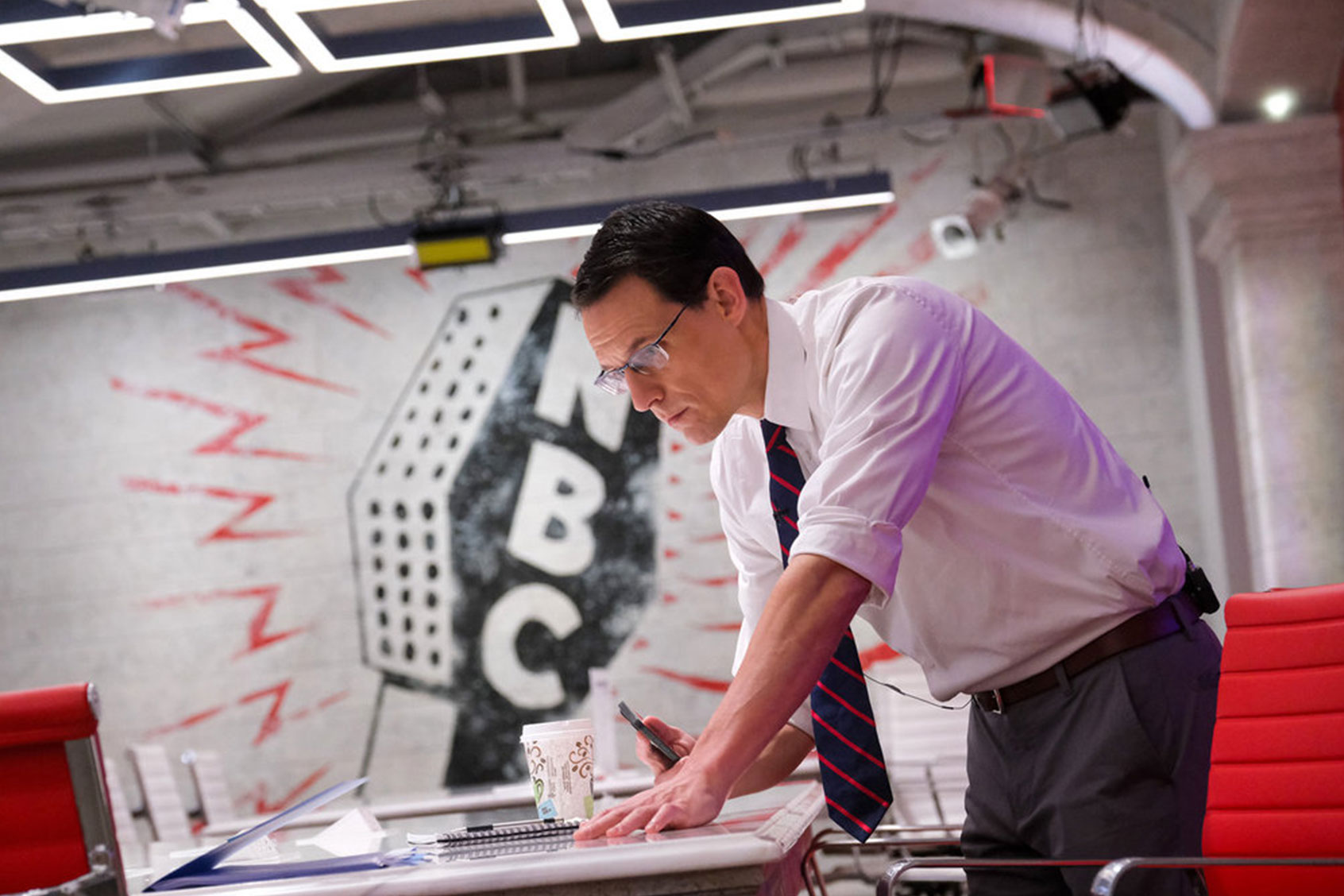
Meet The Press Steve KornackiNBC News National Political Correspondent Steve Kornacki (William B. Plowman/NBC)Kornacki had an entire online cheering section memeing his entry to the election night fray on social media, marveling at his delicate dance and monologuing around the big board.

Even that had its limits. A few hours into Kornacki doing what he does best, TV writer Sierra Ornelas posted on X what I and surely many others were thinking. “I’ve reached the point where I wanna kiss Kornacki and I also want to punch him,” she said. “Does that make sense?” The post has since disappeared.

We need your help to stay independent

The cable news landscape has long been a locus of information overload, which only accelerated during Trump’s first presidency. Election night coverage on the three major cable news networks further highlighted how stark the split has become between left-leaning reporting on MSNBC and Fox’s right-wing coverage. 

On MSNBC, Rachel Maddow and its election team were sanguine about the Democrats’ odds, reflecting the sunnier side of the polls which, yet again, misjudged several key factors, including the extent to which Latinos and Gen Z white men broke for Trump. On Fox, Jesse Watters was calling Elon Musk, Tulsi Gabbard, Robert F. Kennedy, Jr. and Megyn Kelly “a murderers row of intellects” backing the former president. 

As for their view of Harris as the night began, Fox star Greg Gutfeld had this nugget of exit poll insights. “It is interesting that 70% say this country is going in the wrong direction. Isn't it ironic that it's the woman who refuses to ask for directions?”

The expected position of CNN in all this is center, allegedly – and certainly King and Jake Tapper did their straitlaced best to lead us into an obviously unexpected turn of events, greased by terms like “slippage” and fluffed by interrupting gongs heralding “too close to call” non-alerts.

Within that ranking, “Election Night” was the perfect combination of checking in and checking out. Many, including me, described it as lo-fi, and definitely lower budget, like that nice dive down the street that says it offers food but actually features a nearby joint's takeout menu and a barback willing to pick up your order. 


Want a daily wrap-up of all the news and commentary Salon has to offer? Subscribe to our morning newsletter, Crash Course.


But honestly, spending time with Williams’ news cave jamboree wasn’t terrible. With polling analyses from Nate Silver and FiveThirtyEight entirely whacked and social media echo chambers devolving from steady to utterly freaked out as the evening wore on, Williams’ election information missile silo was a bastion of calm. 

There was no gleeful chuckling or smiles masking malaise, only respectful discussion between people on either side of the political fence, or straddling it, about what this outcome tells us about who we are and how we, as a nation, should process these results. 

If Nov. 5 ends up representing the grand finale for American democracy – then “Election Night” will be remembered as that weird companion holding our hands as the first flashes went off on the distant horizon. It may end up being a one-time affair. But if it does come back, I hope it doesn’t change anything besides, maybe, a screen upgrade. 
Donald Trump won the vibes. Now America’s anti-democratic coalition seeks vengeance

Donald Trump has once more won the presidency. It's as shocking as it was the first time and even more terrifying. We should have seen this coming from all the polling which showed that the race was tied nationally and in the swing states. Of course it was possible. But I think a lot of us, myself included, once again fell for the illusion that America is too fundamentally decent to elect someone like Trump. We were wrong.

In 2016 that starry-eyed naivete led to the deep despair that we all felt when Trump eked out a win over Hillary Clinton. And in 2020 we believed that dream was vindicated when Joe Biden turned the tables and eked out a win over Trump. And here we are again, caught in a swirling vortex from which we can't seem to escape.

This anti-democratic coalition has a deep, entrenched grievance with the modern world and they use politics to express it.

The funny thing is that until recently I had assumed that the contest was going to be political trench warfare again and the result would be very close. It has seemed to me for a while that we're in an ongoing war between two coalitions that can be defined as pro-democracy and anti-democracy and they have roughly equal political strength. The razor-thin margins in Congress and these incredibly tight presidential races bear that out.

Yes, Donald Trump is the leading figure in this fight as the man who best articulates the anti-democratic coalition's impulses but he also hinders them with his crudeness and lack of discipline. Meanwhile, the pro-democracy coalition is diffuse and leaderless but is helped by the fact that it's less crazy. Joe Biden managed to pull it out in 2020 in the middle of a global pandemic when there were just enough people in the right states to recognize that Trump wasn't up to dealing with it. He was also a white man, which clearly makes that choice easier for some people. (It cannot be a coincidence that the rank misogynist brute, Donald Trump, beat the two highly qualified Democratic women he ran against.)

I knew all this. And I assumed 2024 would be a tough race for Biden to win although I thought he would probably be able to do it because he managed to "deliver" on so many of his promises, particularly on the economy, which many smart people assured me was the key to winning over voters. Surely, the people would start to see that inflation had abated, the job market was great and that interest rates were coming down, right? All that new manufacturing in the swing states had to count for something. But when it became clear that he could not campaign effectively and he turned it over to his vice president, who seemed to electrify the pro-democracy coalition, I began to believe that this time it would win decisively. I was fooling myself.

Donald Trump bungled the worst health crisis in a century, was found guilty of fraud and civilly liable for defamation and sexual assault. He is currently under indictment for stealing classified documents and attempting a coup in 2020. He acted deranged and demented on the campaign trail and it changed nothing. When he said he could shoot someone on 5th Avenue and not lose any votes, he was right. There is literally nothing he can do to make his faithful followers move away. And that's because it's really not about him — it's about them.

Trump has solidified his grip on nearly half the voters in this country because, as journalist Lindsay Beyerstein tweeted last night, "he created a conspiracist permission structure to ignore or deny all the facts and focus on hate." Our modern information ecosystem, the social media and cable news silos have allowed him to construct an alternate reality for the Republican Party and they eagerly accept it because it feeds their sense of fear and loathing of the other. And it isn't just the kooky QAnon conspiracy types — Trump managed through sheer repetition to convince otherwise normal people that his first term was a golden age of peace and prosperity and that the country today is a dystopian hellscape because the price of eggs is higher than it was five years ago.

On some level, these people know that's all nonsense and Trump knows it too. This anti-democratic coalition has a deep, entrenched grievance with the modern world and they use politics to express it. "This is happening all over the world," The Atlantic's Tom Nichols wrote of the anti-incumbent wave elections, "among people who think that others are *unjustly* living better than they are – even while they themselves are living well."

Nichols added, "resentment and false nostalgia (and affluence and boredom) are deadly threats to democracy, as we're about to learn."

It's not about policy no matter how much people insist that it is. We know this because in places like Missouri voters just passed initiatives for abortion rights, an increase in the minimum wage, and paid sick leave, all Democratic policies, while overwhelmingly voting for a Republican senator and president who both strongly oppose these things. This is about aesthetics and attitudes. A majority of Americans want an autocratic strongman show and Trump and the Republicans are happy to give it to them.

The anti-democracy coalition under Trump is on the verge of fascism. He and many in his party are already there. We know this because we know their plans. We've all been discussing Project 2025 and Agenda 47 and Schedule F for months now. Trump's mass deportation policy may never come to full fruition but they will certainly make an example of some people if only to entertain the base. Recall how much they loved those migrant flights to Martha's Vineyard and the like a year or so ago. Some televised knocking down of doors and throwing crying women and children onto buses ought to give them a thrill (a double thrill when the Democrats get hysterical about it.)

Here's Trump promising RFK Jr. "a good time" messing around with the public health system:

We need your help to stay independent

We know about Trump's plans for the economy and since his tariff obsession is his only economic and foreign policy idea, it's unlikely that even his business buddies will be able to talk him out of it. Foreign allies are no doubt meeting with their national security people as we speak, implementing plans to distance themselves from the United States, knowing Trump's affinity for autocrats like Russia's Putin and Hungary's Orbán. America's adversaries are licking their chops. They know Trump is a pushover.

But the vengeance policy is what's going to animate Trump the most. His enemies list is long and he will make sure they pay. It's what he lives for:

Here's a message from one of the people mentioned as a possible attorney general or White House counsel in a second Trump term:

We survived Trump's first term, (although his erratic rhetoric and policies during COVID did result in many unnecessary deaths.) But everyone knows by now that this second term is not going to be the same. The Republican establishment has been purged of dissenters and Trump will have only MAGA loyalists in his inner circle. Trump's new "government gfficiency" czar Elon Musk is already promising that there will be "hardship" (not for him, of course) as they slash the government safety net that so many Americans depend upon. Everything from environmental regulations to abortion rights to free speech is on the chopping block. And who will stop them?

Can we survive it again? Probably. But it's going to be much harder. The question is whether the Resistance has the energy to do it all again or will it pull back and just watch it all burn out of sheer exhaustion? After all, they tried their best. They ground out many wins between 2016 and today. But in the end they lost it all again. What's next? 

President-elect Trump widely expected to shut down legal cases against him

Once President-elect Donald Trump enters the White House next year, he will have the power to summarily dismiss the the remaining legal cases arrayed against him — and has said he would use that power.

With control of the Justice Department, Trump can fire special counsel Jack Smith, who is managing two federal cases against Trump: one regarding the then-president's role in subverting the 2020 election, and another regarding his alleged mishandling of classified documents after leaving office and then obstructing the government's attempts to retrieve them. Doing so would effectively end the cases against him. Because the documents case is currently being appealed after first being dismissed by Judge Aileen Cannon, Trump can also order the Justice Department to simply abandon the appeal.

Trump has made no secret of his intentions. "It's so easy. I would fire [Smith] within two seconds. He'll be one of the first things addressed," he told conservative radio host Hugh Hewitt, adding that he also planned to sue the special counsel. It's unclear on what grounds Trump plans to sue, though he has characterized the federal cases as a corrupt and politically motivated "witch-hunt."

Firing Smith might not even be necessary to earn his get-out-of-jail-free card: He could just ask his attorney general to drop the case. And according to longstanding department policy and the Office of Legal Counsel, a sitting president cannot face indictment of criminal prosecution as it "would impermissibly undermine the capacity of the executive branch to perform its constitutionally assigned functions."

Trump could also consider pardoning himself; the only explicit guidance against that is a Watergate-era Justice Department memo. Without any existing precedent, he would be well within his rights to litigate that before the Supreme Court.

Shutting down the pending state-level cases against him will be a less straightforward task. Trump cannot directly fire Manhattan District Attorney Alvin Bragg, who convicted the president-elect on 34 counts of falsifying business records to cover up hush money payments to adult film actress Stormy Daniels. Nor can he fire Fulton County District Attorney Fani Willis, who is prosecuting Trump on charges of election racketeering, including an attempt to pressure Georgia officials into "finding" him votes during the 2020 election.

We need your help to stay independent

But his lawyers are signaling that his victory will preclude any federal or state-level sentencing against him, at least until he presumably leaves office again in January 2029.

“If your client does win the election in 2024, could he even be tried in 2025?” Georgia Judge Scott McAfee asked at a hearing last December.

“The answer to that is, I believe, that under the Supremacy Clause and his duties as president of the United States, this trial would not take place at all until after he left his term of office,” replied Trump attorney Steve Sadow.

Judge Juan Merchan, who oversaw Trump's hush-money case, delayed the sentencing until Nov. 26 to avoid any entanglements with the election campaign. If Merchan proceeds and sentences Trump to up to four years in prison, the president-elect will almost certainly escape that sentence until at least January 2029. Even a lighter sentence, like community service or home confinement, will be challenged by his lawyers, who could argue that logistical challenges and constitutional duties should shield any president from having to serve such a sentence. It's also possible that the sentencing does not move forward at all.

There's already a drumbeat of Republicans calling for the removal of all cases, citing Trump's sweeping election victory as a popular rejection of prosecuting him. "The American people have rendered their verdict on President Trump and decisively chosen him to lead the country for the next four years. They chose him to lead us with full knowledge of the claims against him by prosecutors around the country," Bill Barr, Trump's former attorney general, said in a statement. "I think Attorney General [Merrick] Garland and the State prosecutors should respect the people's decision and dismiss the cases against President Trump now."

With certain GOP backing, Trump will reclaim a presidency recently empowered by the Supreme Court's decision to grant him immunity for official acts, in effect giving him a blank check to justify any illegal conduct under the guise of carrying out his duties. “Ironic isn’t it?" snapped Justice Sonia Sotomayor, reading aloud her dissent at the time of the decision. "The man in charge of enforcing laws can now just break them."

Trump, critics say, has given clear signals that he will.

Most abortion ballot measures pass, but it didn’t translate to a victory for Democrats

This week, abortion was on the ballot in 10 states, but even in places where it wasn't, Democrats were hoping the fight for reproductive rights could give them an edge. The hope was to galvanize non-partisan voters to not only vote in favor of abortion access but also vote for the Democrats down the ticket. But once Donald Trump snagged the presidential spot again, with Republicans also taking the Senate majority, it became clear that while abortion access was prioritized in some red states, like Missouri and Montana, that didn’t render a blue victory. 

Still, pro-abortion advocates aren’t necessarily calling Tuesday night an entire loss for reproductive rights in America. For example, Amendment 3 passed in Missouri, which will enshrine the right to an abortion in the state constitution, overturning the state’s current abortion ban. Missouri has one of the most restrictive abortion bans in the country where abortion is mostly entirely prohibited but only allowed "in cases of medical emergency.” 

“Missouri has been labeled a ‘red’ state, but tonight’s results clearly demonstrate that abortion is not a partisan issue – it’s a personal health care issue that Missourians from every political background agree should be left to women, their families and their doctors,” Kelly Hall, executive director of the Fairness Project, which backed Missouri’s Yes on 3 campaign, said in a media statement. 

Rachel Sweet, campaign manager of Missourians for Constitutional Freedom, the organization behind the Yes on 3 campaign, said Democrats, Republicans and independents “resoundingly declared that they don’t want politicians involved in their private medical decisions.” 

"Floridians stand with abortion rights, but Governor DeSantis’ anti-democratic campaign against Amendment 4 has prevented the voices of his own constituents from being heard and enforced minority rule."

At the same time, Missouri voters picked Trump overall — who has bragged about overturning Roe v. Wade — instead of Kamala Harris, to be president. While the abortion ballot measure, Amendment 4, in Florida didn’t pass, a similar story unfolded. If passed, Amendment 4 would have amended the Florida state constitution to prohibit government interference with the right to abortion before viability. Florida’s post-Dobbs abortion law makes it a felony to perform or actively participate in an abortion six weeks after gestation. Technically, the ban has exceptions for rape, incest and human trafficking up to 15 weeks, and to save a woman’s life or prevent “substantial and irreversible” impairment. Fifty-eight percent of Florida voters wanted it to pass, but the measure required a 60 percent majority to pass — the highest threshold of all abortion amendments on the ballots. Notably, Trump grabbed 56 percent of the vote in Florida.

“Floridians stand with abortion rights, but Governor DeSantis’ anti-democratic campaign against Amendment 4 has prevented the voices of his own constituents from being heard and enforced minority rule,” Hall said. “In the face of the state government’s unrelenting interference with the ballot measure process, an extraordinary number of Florida voters stood up against a cruel and dangerous abortion ban – and we are incredibly proud to have supported the advocates on the ground who made that possible.”

Lauren Brenzel, campaign manager of Yes on 4 Florida, said the news confirmed what advocates observed on the ground during the campaign.  


Want more health and science stories in your inbox? Subscribe to Salon's weekly newsletter Lab Notes.


“Florida’s deadly abortion ban is out of line with the values of our state,” Brenzel said. “Florida voters sent that message loud and clear today, and despite the fact that only a minority of voters voted to retain the abortion ban, our extremist government will exploit the situation to deny its own constituents the right to decide on our bodily autonomy.”

Other abortion measures failed to pass, including South Dakota’s Constitutional Amendment G. While it was seen as a more restrictive proposal than others — as it would have only enshrined rights in the state constitution for an abortion in the first trimester of pregnancy — the measure did not get a majority of the vote. In Nebraska, Initiative 434 passed, banning abortion after 12 weeks of pregnancy with limited exceptions. Its dueling initiative, which would have expanded abortion access, did not pass.

We need your help to stay independent

In Arizona, voters passed Proposition 139 amending the state constitution to provide a fundamental right to abortion. The measure is seen as a victory and will allow abortion after fetal viability to be accessible in cases to protect the life, physical or mental health of the pregnant woman. It also would prevent the state from penalizing anyone who assists another person in exercising their right to abortion. Earlier this year, the Arizona Supreme Court upheld an 1864 law that banned nearly all abortions in the state. After a protracted back-and-forth between courts, abortion remains accessible up to 15 weeks of pregnancy in the state.

Maryland, Montana, Colorado and Nevada all voted in favor of enshrining the right to abortion in their respective state constitutions. New York also passed a measure that will protect “against unequal treatment based on reproductive health care and autonomy.”

“Abortion access isn't just a winning issue with voters; it's a fundamental right that impacts every aspect of their lives,” Mini Timmaraju, Reproductive Freedom for All president and CEO, said in a statement. “This is a huge victory that reaffirms that voters across the political spectrum in red, blue and purple states will mobilize to protect their freedoms.”

Karla Gonzales Garcia, Gender, Sexuality and Identity Director with Amnesty International USA, called Arizona’s successful proposition a “win for human rights" in a media statement.

“Since the fall of Roe v. Wade, many states across the U.S. are facing a human rights crisis when it comes to abortion access that has created stigma, fear and lack of vital health care for far too many people,” Gonzales Garcia said. “But, with this vote, the people of Arizona have fought back and protected their human right to abortion.”

Hope in the face of Kamala Harris’ loss: Men failed America, but women will not give up so easily

WASHINGTON D.C. — I woke up on Election Day wearing fuzzy feline headgear. My brown tabby, Joey, had wrapped his paws around my head and was purring in my ear as I remembered my plan to go to Washington D.C. to attend the watch party at Howard University for Vice President Kamala Harris. But with a cat draped across my skull, my mind drifted to a previous trip I'd made to D.C. in January 2017, when I covered the Women's March to protest the inauguration of Donald Trump. That day had been the one bright spot amid the years of MAGA hell, witnessing hundreds of thousands of people streaming in every direction, vowing to resist the fascist urges of a man who had bragged about sexually assaulting women. The symbol of the day: the ubiquitous p***y hats, cheerful pink knitted confections worn by women reclaiming control over a body part that Trump memorably boasted about grabbing against his victims' wills. 

It looks now like my sweet cat was an ominous omen. With Trump's win, it's time for women to dig those hats out of storage, grab their "resistance" wine glasses, and get back to work. Trump's victory came at the hands of a majority of male voters, while most women once again turned out hoping to stop him. It will be up to women, again, to save America from this glowering fascist menace. 

In 2017, the pink cat ears atop the Women's Marchers were often accompanied by signs adorned with angry cats declaring "p***y grabs back." Eight long years later, the common housecat continued to symbolize female resistance. Trump's running mate, Sen. JD Vance of Ohio, complained extensively of "cat ladies," a favorite MAGA insult for independent women. However, women, including pop star Taylor Swift, wore the term like a badge of honor, pointing out, correctly, that thinking for yourself is a point of pride. 

Even in defeat, we must be grateful to Harris for a tremendous job embodying a different vision: one in which Americans can be kind, cooperative, and, yes, joyful.

Spirits were high at Howard around 9 p.m. as the event filled up. Students decked out in university gear or their Greek letters crowded in. As hip-hop blared over the speakers, groups of women gleefully line-danced to Ciara and Missy Elliot tunes under giant American flags. By 10, the mood was flagging, as it became clear that, once again, American voters were showing themselves unable to make the correct and obvious choice between a good-hearted, competent woman and a screaming, hateful fascist. I snuck out demoralized at 11 p.m. and woke to find the worst had happened.

But even as it dawned on people that Trump could, once again, win this thing, it didn't feel quite as soul-crushing as it did in 2016. Perhaps it is because we are no longer surprised that so many of our fellow Americans harbor so much spite that they would rather burn down this country than share its bounty with others who helped build it. But part of it is that this crowd knows what they couldn't have eight years ago: They can pick up and keep fighting. We know that even when most men fail this country, most women square their shoulders and fight. In November 2016, we hadn't seen the Women's March. We hadn't witnessed the #MeToo movement. We haven't seen how women would rise up against abortion bans, forcing multiple states to protect the right even as Republican leadership tries to outlaw it. 


Want more Amanda Marcotte on politics? Subscribe to her newsletter Standing Room Only.


Some of the richest men in the world, such as Elon Musk and Rupert Murdoch, dumped billions of dollars into drowning Americans in far-right propaganda. The internet is awash in mind-melting conspiracy theories and people barely pay attention to real news anymore. The forces of basic decency are truly a David facing a Goliath. And yet, because women continue to turn out for the Democrats, they fought this election to a near draw. That is a sign of true strength. The MAGA movement has resorted to a tsunami of lies and distractions and even violence to win, because they never could compete in a fair fight. 

As Harris herself said when she first announced her run for president, "I know Donald Trump's type." With a massive propaganda apparatus built on lies and the intrinsic unfairness of the Electoral College, the MAGA movement has carved out more power than they have earned through popular will. The thumb has long been on the scale for rapists, misogynists and bigots. But the crowd at Howard on Tuesday night was a reminder that the MAGA movement will not win so easily. The culture is shifting toward the people there that night: young, diverse and heavily female. They will not crawl back to the kitchen just because some bitter weirdos call them "cat ladies" on Twitter. They will keep on living. 

Harris very deliberately downplayed both her gender and racial identity this campaign, in sharp contrast to Hillary Clinton's 2016 run, centered around soaring rhetoric about the candidate breaking the final glass ceiling. But somehow it still turned into what some pundits called a "boys vs. girls" election, in no small part because polls predicted the largest gender gap ever in a presidential election. In truth, it was more of a "boys vs. adults" election. Despite Vance's grumbling about "childless cat ladies," the Harris campaign brought strong mom energy: cheerful but determined. Both male and female supporters embodied the vibe of any adult woman who smiles as she checks off her lengthy to-do list, busy but grateful to have such a full life. 

Despite the advanced age of the candidate, the Trump campaign was characterized by petulance and immaturity, adopting the countenance of a spoiled rich kid sneering at his mom for telling him to do his homework. The premise undergirding the campaign was that lazy, childish men should be the leaders of society, not just despite but because they won't do the work to earn it. Men like Elon Musk, RFK Jr. and Joe Rogan wore their ignorance like a badge of honor, scorning those who put in years of effort to become experts, rather than just lazily spouting off conspiracy theories. The Proud Boys, whose name hat-tips their arrested development, re-emerged to threaten poll workers with violence. Trump and Vance spent the last days on the campaign trail awash in schoolyard sexism, calling female leaders "trash" and the b-word, while fantasizing openly about sending a convicted rapist after Harris. 

Even the field operations of the two campaigns reflected this divergence. The Harris campaign tackled get-out-the-vote operations with the diligence of a straight-A student who always has her hand in the air, knocking over 800,000 doors in Pennsylvania on Saturday. Musk handled the ground game for Trump, resulting in an anemic canvassing presence. Instead, in the tradition of lazy frat daddies paying someone else to take tests for them, Musk purchased Trump voters with a $1 million-a-day lottery. This contrast has an unmistakably gendered flavor to it, as girls everywhere know they have to study hard and show up to get ahead, while rich white boys all too often coast on privilege. 

Even the locations of the candidates on Election Day highlighted the difference. Harris set up camp at her alma mater, showcasing not just her personal industriousness, but the historical determination Black people have put into education and labor in a country that has often worked against their aspirations. Trump kicked back at a country club he bought with inherited wealth. And yet, there is no doubt that Howard was the more fun place to be, simply because the people were more pleasant to be around. Even in the face of a crushing defeat, the Harris supporters who turned out knew it was not due to any lack of effort on their part. It's only because the nation is too sexist and racist still to deserve the sweat this crowd — racially diverse and majority female — put into the fight. And will continue to put into it. They have no other choice. Their lives and their freedoms depend on it. 

Trump has done real damage to the American psyche, especially when it comes to his supporters, who have become angrier, more paranoid and more sadistic over the past nine years. Even in defeat, we must be grateful to Harris for a tremendous job embodying a different vision: One in which Americans can be kind, cooperative, and, yes, joyful. Even sticking with the journalistic practice of holding a campaign at arm's length, it's been a relief to attend Harris events, such as the rally at Temple University in August or the Democratic National Convention. It honestly has less to do with the candidates, and more to do with the people on the ground, who are funny, gentle, smart and, well, just plain normal, instead of bristling with the weird and hateful energy that Trump breeds in his followers. Despite the fear that is now settling over the country again, there's strength in seeing all these reasonable people come together, men and women both, who believe that women deserve better. That we all deserve better.

The women who voted for Harris aren't giving up. Vance and Musk and their army of Twitter trolls can fling the term "cat lady" around as much as they want, but voting for Trump will not make women en masse give up their jobs to play at being a "tradwife." Trump can and likely will usher in more restrictions on abortion and even contraception, but women have already shown they will respond with networks of mutual aid to smuggle care to those who need it. MAGA men keep telling a story where, if they hate and punish women enough, women will just lie down and take it. They're just making women angrier and more determined. Women understand they cannot depend on men's goodness to protect us. American women know: The only people who will save us are us.

IRS boosts 401(k) contribution limits for 2025, adds “super catch-up” for 60-63 year olds

Saving for retirement? You can put more money in your workplace plan next year. The IRS has increased the 401(k) contribution limit to $23,500 in 2025 from $23,000 in 2024, according to a Friday announcement

The $500 increase also applies to other workplace retirement vehicles such as the 403(b), 457 plan, and Thrift Savings Plan. 

Each year, the IRS can make changes to contribution limits due to cost-of-living adjustments. The agency also announced a big boost to catch-up contributions for workers who are 60 to 63 years old. 

Catch-up contributions 

Catch-up contributions aim to help employees nearing retirement. These have set limits, but allow employees of a certain age to save even more than the traditional limit. 

“The catch-up is designed to allow older workers who were not able to put away enough money in their younger years to put larger contributions away now, thereby catching up,” said Lawrence Sprung, certified financial planner, founder of Mitlin Financial and author of "Financial Planning Made Personal."

If you’re 50 and over, you can save an additional $7,500 in your 401(k), an amount unchanged for 2025. In other words, 50+ savers can max out their 401(k) by contributing up to $31,000 in 2025. 

But thanks to the SECURE 2.0 Act, those between 60 and 63 years old have a higher catch-up contribution limit of $11,250 in 2025. That’s a significant hike, allowing these employees to contribute a total of $34,750 into their 401(k) plan in 2025. 

We need your help to stay independent

“Employees, especially if they are currently maxing out or are turning 50, 60, 61, 62, or 63 should make sure they are taking advantage of the new limits available to them,” said Sprung. “They may want to update their contributions beginning on Jan. 1, 2025, to reflect the new increased limits. Waiting later into 2025 may require the employee to put in too much each paycheck to hit the newly raised limit.”

The struggles of maxing out a 401(k) 

Despite the higher contribution limits, only a small percentage of workers end up maxing out their 401(k), leaving them vulnerable and with few resources for retirement

“Only about 14% of the people are maxing out their 401(k) and that is the problem. If people really are paying attention, pensions are disappearing, Social Security's got a big mess coming up in about 10 years. And if people are going to have a real meaningful retirement, they better start saving,” said Steve Azoury, chartered financial consultant and owner of Azoury Financial

When broken down to monthly payments, to max out your 401(k) in 2025 and contribute  $23,500 you’d need to save approximately $1,958 per month. That’s a big chunk of change for most people and could be equivalent to their housing payment. 

For those with more discretionary income, contributing up to the limit can offer the most tax benefits and also set them on the right path to building their nest eggs.

Others with limited resources still have options. 

What to do if you can’t max out 

Depending on your income and expenses, contributing up to the limit to your 401(k) may be out of reach. But that doesn’t mean you shouldn’t invest in your 401(k) or take advantage of your employer match — funds that are an integral part of your compensation package. Not taking advantage epitomizes the phrase “leaving money on the table.”

So if you can swing it, contribute enough to your 401(k) to get the full company match. Employers may match a specific percentage. For example, the median employer match is 4%, according to the How America Saves Report 2024 by Vanguard. So let’s say you put in 4%, and your employer matches that amount with another 4%. In this case, you double the contribution to 8% of your salary. 

Even if you can’t do 4%, contributing something on a consistent basis is better than nothing. It helps you pad your 401(k) and allows it to grow. 

However, note that not all employers provide a match, or they may not provide a full one. According to the Vanguard report, 16% of plans had a match formula of 50% on first 6% of pay, making it the most popular option. Coming in the second spot, 10% of plans had a match formula of 100% on the first 6% of pay.

Forty percent or more of small-business employers don’t offer retirement benefits, according to analysis by The Pew Charitable Trusts.

Why you should invest in your 401(k) 

If you have access to a 401(k) and a match, there are some major tax benefits that you can take advantage of by contributing. 

“The money is on a pre-tax basis. So let's say I made $50,000 and I put in $5,000. Well, I only pay income taxes on $45,000. So whatever I put in reduces my taxable income,” said Azoury.

So you can be rewarded for saving in your 401(k) with tax benefits for the current year. But you can’t avoid the tax man forever. Instead, you pay taxes on 401(k) withdrawals when you retire. But that may work in your favor. 

“You pay no taxes now, it can earn interest in an investment. You don't pay taxes on the gain yet. And then when you retire and you're in a lower tax bracket, that's when you want to pay your taxes. You don't want to pay them now when you're in the highest tax bracket. And if your income is the same retired as working, God bless you. You win,” said Azoury. 

Making the most out of your 401(k)

To make sure you’re getting the most out of your 401(k), understand your personal risk tolerance while investing and your ideal time horizon. How much risk you can stomach will determine the course of your investments, and so will the amount of time you have until retirement. 

“For effective ways to invest periodic contributions, seek the help of the plan’s adviser or a personal financial adviser. Diversification is very important,” said certified financial planner William Bevins.

You want your 401(k) to work for you while you’re working for them so that eventually, one day, you have the option to retire. 

Kamala Harris’ loss breaks my heart — for my wife and daughter, and for America

Vice President Kamala Harris lost her campaign for president overnight, breaking the hearts of many, including my wife Caron and four-year-old daughter Cross, who have both fiercely advocated for her victory from the beginning. They are gutted, their spirits are down; my spirit is down. America's decision is nauseating. But we are still America. We are still here, and the fight for freedom must go on. We must push forward. 

To be completely honest, seeing a man who is proudly against women having the right to choose what to do with their own bodies in 2024 win a national election is beyond devastating. It proves that our country has no interest in loving women. To think, women in America are CEOs, top physicians at elite medical institutions, judges, mechanics, bodybuilders and astronauts –– women birth us, they raise us and have proved they have the power to do anything a man can do. That they still can't claim the title of president is beyond me. The only word that comes to mind is sad

While I watch my wife and daughter process the results, I hurt for them. I’m reminded of what the significance of having a Black woman claim her seat in the White House would have meant for them. What it would have meant to me. Because I’ll admit, I didn't always understand the power of symbolism. 

As a boy born in the 1980s, I wasn’t taught to pay attention to the chokehold that the patriarchy has on women. We boys were taught to exist as men and defend that, to hold onto the idea that we are leaders and authority figures, even if we didn't earn it. Questions about qualifications didn’t even cross our minds. 

And even as we grew up and some of us began identifying as good guys, we probably still talked over women or questioned the things we learned from them — treated them in ways we just wouldn’t a man. There's a good chance our positions at work could have been given to more qualified women. But these things don’t cross our minds because they don’t have to. I began learning about the role gender plays in my place in society in high school. Trump is in his 70s and he still doesn't get it, but he gets to be president — if privilege were a person, he’d be it. 

While I watch my wife and daughter process the results, I hurt for them. I’m reminded of what the significance of having a Black woman claim her seat in the White House would have meant for them.

As I've grown, I have been actively working to unlearn this inherited behavior. It wasn’t until I settled down with my wife Caron and began to build a home that I realized the problem was worse than I imagined. Watching Caron navigate her profession opened my eyes to how the patriarchy can affect a woman every day of her life.

Like Harris, Caron is a lawyer, HBCU graduate and Alpha Kappa Alpha sorority sister. She has been talking about what was on the other side of that glass ceiling since the day the vice president announced her candidacy. Like Harris, Caron has led organizations, directed large staffs and earned her way to the top, but her accomplishments have not been recognized in the same ways a man’s would. It’s a reality she shares with many women — always being called to solve the problem and rarely getting credit after she does. 

Harris represented the idea of overcoming all of that, and I pray we don't lose that feeling. Seeing Caron’s enthusiasm for Harris trickling down to our four-year-old daughter, Cross, was magic. Throughout the campaign season, Cross marched around the house, saying, “Don Trumpet is a bad boy. He will lose. Comma-la will win, win, win!” 

The first time we heard our daughter’s anti-Trump rant earlier in the year, around the time VP Harris became the presumptive nominee, we laughed, not knowing where it came from. Maybe her feisty grandmas on both sides, who were also anticipating this day, taught her that. As November 5 approached, Cross’ convictions grew stronger.

“Donald Trumpet is a nasty man, he’s trashy,” Cross screamed in her sweet little voice. “Comma-la will win!” 

And now we have to sit her down and tell her that America chose a person who is anti-woman. What hurts more is that I hear men — so-called progressives — champion women every day while doing nothing meaningful to help propel them through sexist spaces. Male leaders from every demographic talk about the power of women, but do they hold space for them? They champion women in leadership as an idea, but what do they do to make it a reality? I saw Black and Brown men, from my own community, who were raised by their single mothers and single grandmas, scream for “ Trump!” I don’t get it. Are they delusional, or do they hate women, or both? 

This loss is even more personal for me, considering the battles I watched many women in my life take on. 

As a teenager, I watched my mother, a talented phlebotomist, be robbed of promotions at Johns Hopkins Hospital where she worked for 20 years. She was often responsible for training the person who would be supervising her. I watched my grandma run our family full of dysfunctional men who were completely lost after she died. While alive, she was never acknowledged for her leadership. They both had to find a way to survive in Trump’s America. Sadly, we are still there. What’s even more sad is that I was not surprised. 

What hurts more is that I hear men — so-called progressives — champion women every day while doing nothing meaningful to help propel them through sexist spaces.

Throughout this entire campaign, Caron and Cross remained beyond confident. The two were delicate like bombs whenever they witnessed anyone displaying the slightest bit of uncertainty. I couldn't help being skeptical, though, because I remember in 2016, thinking Hillary Clinton was going to have this moment. Her skill set says she should have won, but America has a history of getting it wrong. In 2016, we got it very wrong. So yes, I was terrified. 

I was terrified because America has a way of ignoring blatant racism. As if Trump never took out that ad advocating for the Central Park 5 to be executed; as if he hasn't flirted with Nazi-style imagery and references; as if he never said there were good people on both sides in Charlottesville even though one side united to celebrate and praise hate; as if he never called countries that were full of proud people of color sh**holes. I was terrified. 

The low morale of Democrats while Biden ran for reelection was haunting. There was no energy, little celebrity movement, few campaign signs and cheeky bumper stickers. It felt like we weren't in election season and that was terrifying. Political conversations in my friend groups, which are filled with hard-working people who care about the progress of this country, ended with nothing more than shrugs about voting for Biden again. No one was offering to host a campaign dinner, no one was rocking a Biden hoodie, and definitely no one was sending out emails or knocking on any doors.

But smart people know excitement wins elections. And Trump had all of the excitement until the Kamala effect.

It was telling when Harris announced her candidacy and a collection of blue and white campaign signs flooded every liberal district, seemingly overnight. She delivered a taste of that 2008 Obama feeling—hope. An endless amount of hope. I matched my wife and daughter on energy and bought in. 

When Obama was elected, I was naive about political power. I believed that his election would erase racism and force oppressors to see the errors of their ways. I foolishly thought his acceptance meant we were all being accepted, but that could not have been farther from the truth. The country accepted him, but not us. He was special. We were exactly the same. He experienced a revolution in his own home, life and legacy that we celebrate from the same places of uncertainty where we remain. 

That’s the feeling I walked away with as a man. I can only imagine how Black women, who have to deal with double oppression, felt. 

I can only imagine how Black women, who have to deal with double oppression, felt. 

I was equally naive after Trump's first term, thinking his presidency would cause our country to collapse. Even though his mismanagement of COVID and hateful, divisive rhetoric left us eternally scarred, we are still here. We made it. Hopefully, my wife and I can show our daughter that she will make it to. 

Eight years of President Obama and four years of Trump have taught me that the goals I expected from my leader had to be realistic, not some dreamy left-wing utopia full of reparations, and universal freedom or instant destruction, as a result of chaotic racism. 

No leader will ever be too bad or too good. The only thing guaranteed is that we have to show up and fight. We will rally, we will vote and we will continue to champion women as a family. 

I don't want to lose this special moment by becoming lost in the reality of surviving Trump. Kamala Harris was elected Vice President. That is proof we are moving in the right direction, even as we prepare to navigate this setback. 

Her journey and leadership will continue to inspire my family as we prepare for whatever is next. And until we figure out what that is, we will be fighting — for you, for us and for America. 

“A wounding disappointment”: Why Kamala Harris’ defeat cuts so deep for women

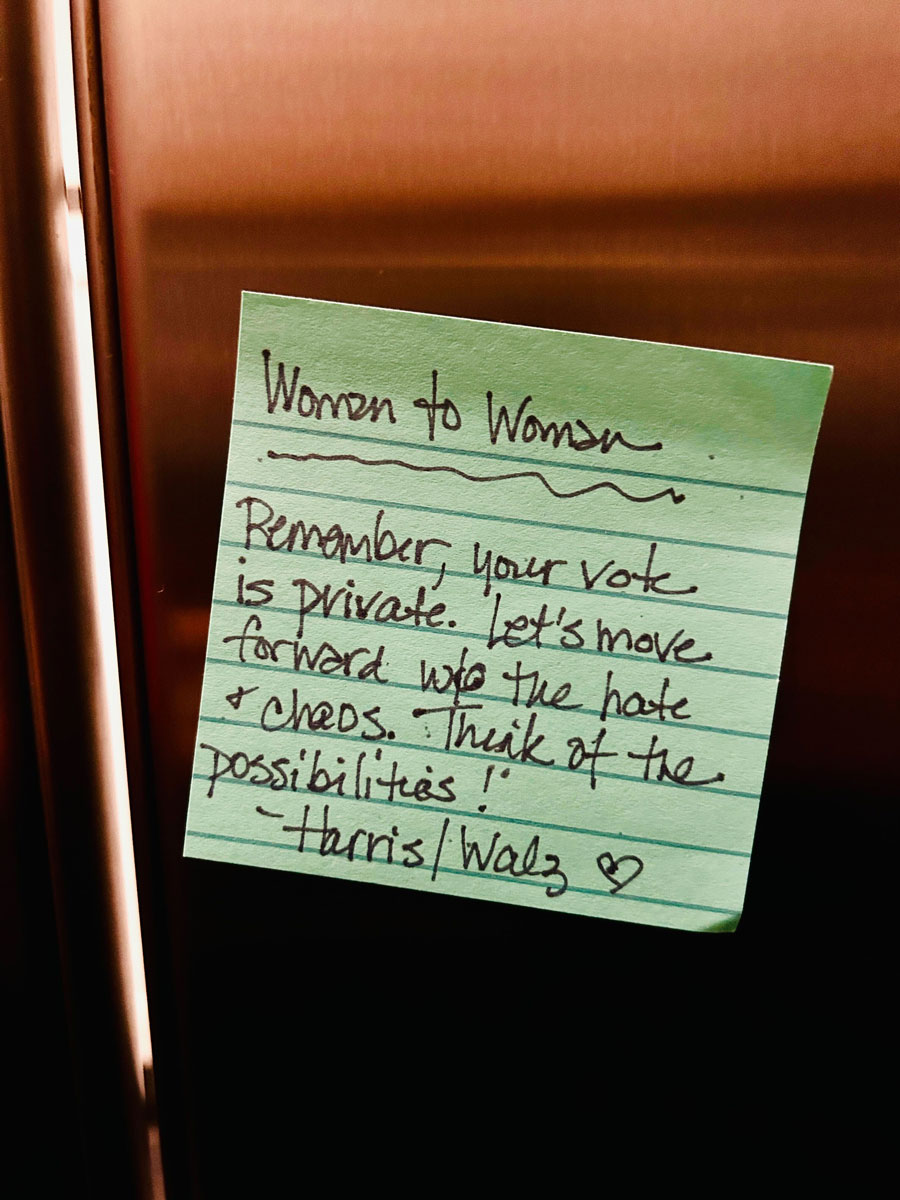
I was in a Manhattan museum on a recent October weekend when I noticed the Post-It tacked inside the stall in the ladies' room. "Woman to woman," it read, "Remember, your vote is private. Harris/Walz!" The message was one of encouragement, but it made my heart sink. Never in my lifetime have I lived through an election campaign in which this needed to be shared

But in the devastating aftermath of Trump winning another presidential election, we find ourselves in a reality marked by fear and intimidation so intense it's little wonder that women have been exchanging secret messages in the few private spaces we have left. 

And the threat of — to use Donald Trump's own favorite word, "retribution" — looms so heavily over us we can only brace for what comes after November 5 or January 20, "whether the women like it or not." We women have been robbed of what could have been a momentous campaign and a historic victory. 

We've normalized weird for so long that it seems impossible to suggest that it didn't have to be this way. Just a scant few election cycles ago, the tenor of political debate featured losers who conceded, voters who didn't storm the Capitol and representatives who didn't try to overturn elections. 

In an alternate reality, Harris might have faced a Republican opponent who didn't question her racial identity and routinely mispronounce her first name. She might not have had mainstream pundits accuse her of being "a DEI hire" or of sleeping her way to the top. The fact that she doesn't have biological children might not have been weaponized as a rebuke of her "humbleness." And her opponent's former aide wouldn't be joking about overturning the 19th Amendment.

But civil discourse has been ground down to a useless nub at this point, and a presidential candidate can share crude jokes about his opponent with barely a blip in the news cycle. A candidate who has also been convicted of felonies, who has been found liable by a civil jury of sexual assault. Meanwhile, once reputable newspapers now run by billionaires refused to endorse a competent, coherent woman for president. 

Hey, guys — because I guess the last eight years of women's marches and #MeToo didn't make it clear — how do you think this has made women feel? Women of color? Women who have endured sexual harassment and survived sexual assault? What do you think the lesson we've been gleaning here has been about our worth in our own country? 

Last week, I asked some women to reflect on those questions and this campaign. 

"Throughout my whole family's history, people in my family have reached a place where white male society said, 'OK, that's far enough,'" my friend Celeste Headlee, author of "We Need to Talk," told me. "Most women, but every woman of color, has had their intelligence underestimated, has been called angry, has been called aggressive, has been called intimidating. I've lost two jobs where they specifically told me it was because I was 'an angry person.'"

"Watching Kamala Harris run for president is like watching all of the disappointments and heartaches of your life playing out in real time, except this time the stakes aren't me losing a job," Headlee observed. "The stakes are losing democracy, losing all reproductive rights, losing bodily autonomy in a way that hasn't happened to women of color, really since the end of the Civil War." 

The complacent political sexism of those near to us has been a wounding disappointment. 

Journalist and workplace equity expert Farai Chideya viewed this moment similarly. "When you look at this race, you can't underestimate the impact of misogyny," she said.

"There are many different ways in which Kamala Harris is taken to be less viable because of her gender, and the combination of her gender and race. She is dealing with not just sexism, but also specifically misogynoir."

I have been trying, for the sake of my daughters and their generation, to stay positive, even while grieving that they have fewer reproductive rights today than I did at their ages. I can recognize the gains we've made despite and because of staggering setbacks. Would we have had #MeToo without the anguish of Hilary Clinton's 2016 defeat? Would we now have a record number of women in Congress? Heck, would we have had "Barbie"?

"When it comes to social justice, you can't put the genie back in the bottle," Lily Burana, author of "Grace for Amateurs," told me. "Women and Gen Alpha girls have an awareness of systemic misogyny, of queer issues, of their value, in a way that would be literally unthinkable to me as a Gen X girlie. Once you've turned over the rock, and people have seen these systems of oppression, you cannot unsee them." 

It's undeniable that the last several years have been a cataclysmic era of significant advancements for gender equality. They've also undeniably been a spectacular bummer, on a macro and micro scale. 

The insight that Burana speaks of is painfully omnidirectional, and we can also never unsee what we now know about some of the people closest to us — or the agenda they're willing to support. The toxicity and polarization have broken up friendships and divided families, on a profoundly wounding level. 

"I just don't know if the [election] result will change the feeling in society," said comedian and writer Micaela Fagan. "It's starting to feel like you don't know who you can trust." 

I remember the last time I spoke to a particular family member, and being told firmly that we could "agree to disagree." I can agree to disagree on plenty: tax rates, arts funding, even the nuances and limits of gun control. I can't agree to disagree with a side that's fine with a sexual assailant in the Oval Office. I can't agree to disagree with the dismantling of women's health and privacy.

I can't agree to disagree about doctors refusing medical attention for ectopic pregnancies, and women being arrested for their miscarriages. Have you ever had a miscarriage? I have. It's physically and emotionally devastating enough without the fear that you and your healthcare provider may be questioned, scrutinized, penalized, that you may have your life endangered, for how it's managed. And we can lay all this suffering at the feet of the pitiful carcass of what used to be the Republican party. 

Misogyny cuts to the heart of the home and family. 

Now that so many of us know exactly which people in our lives are unbothered by the punitive backlash against our sex, how much can ever be right ever again? How can we just be chill at Thanksgiving when on the other side of the table are people who are fully on board for a dystopian Project 2025 future? The patriarchy really counts on women keeping it comfortable and unchallenged, and it counts on it most especially under its own roof.

Of course, there are Dudes for Kamala and MAGA women, but the power dynamics of gender are unique. Soraya Chemaly, author of the appropriately named "Rage Becomes Her," pointed out to me that other forms of oppression, like racism and homophobia, rely on marginalization. But misogyny cuts to the heart of the home and family. She called it "the most intimate inequality." That's what makes it so distressing — and so dangerous. 

"Most families are the same race, same ethnicity, same religion, so the pressure point in those families will be gender," she said.

The complacent political sexism of those near to us has been a wounding disappointment. But for other women, the resentment against our gender is far more overt.

The patriarchy wants us afraid. And good job, patriarchy, because I sure am! But more than I'm afraid, I'm angry. And more than I'm angry, I'm determined. 

The United States far outpaces its peer nations in maternal mortality. A leading cause of death among pregnant American women, more than hypertensive disorders, hemorrhage, or sepsis, is homicide. So don't talk to me about how dangerous immigrants are, how valued mothers are, when the party that claims it wants to make America great again is so conspicuously silent about intimate partner violence. And the threat of post-election retribution in both public and private settings is real enough to give all of us pause. 

"I feel very strongly that either way, it's going to be bad, and it will be bad in different ways," said Chemaly. "Frankly, women, particularly impoverished, Black and brown women, are going to suffer the consequences of either entrenched male supremacist power consolidation or backlash against the idea that the 'women's' party won." 

"Maybe it's a choice between being f**ked quickly or being f**ked slowly over time," she said. "In my mind, you're f**ked either way."

I can't persuade anybody of anything. I can just express what I know a lot of women have been feeling: exhausted sadness that any sliver of joy this campaign season had has been sucked away by a vindictive, babbling old man and his crybaby minions. 

"Ten years ago, we would have been like, 'Yeah!'" Fagan said. "Everyone would have gotten behind this." Instead, we're passing notes in restrooms. We're cautiously leveraging not just our voices but our stealth.

Your Vote Is PrivateA note left in a New York City bathroom stall in late October 2024. (Photo courtesy of Mary Elizabeth Williams)

"I feel that we are in the middle of a global women's refusal movement," Chemaly observed. "We don't call it a protest, because it's not the typical protest led by a charismatic leader in the streets. Women are quiet quitting from heteropatriarchy."

The patriarchy wants us afraid. And good job, patriarchy, because I sure am! But more than I'm afraid, I'm angry. And more than I'm angry, I'm determined. The next few years are going to be ugly and upsetting for women in a lot of ways. It will also no doubt be good in others. 

"The patriarchy is not going to go quietly, but that doesn't mean that it's not on the way out," said Burana.

And in the meantime — at least for now — our vote is private.

This is the motto Donald Trump says he will govern by

In the wee hours of Wednesday morning, Donald Trump took the stage at his election headquarters in West Palm Beach, Fla. While the race had yet to be officially called, Trump was only four electoral votes shy of the 270 needed to win the Electoral College.

In the early victory speech, Trump said his campaign had "made history" by overcoming "obstacles that nobody thought possible."

"This was a movement like nobody's ever seen before, and frankly, this was, I believe, the greatest political movement of all time," Trump told a crowd of supporters. "There's never been anything like this in this country, and now it's going to reach a new level of importance because we're going to help our country heal."

The U.S. is a country that needs "help," and its borders need to be "fixed," Trump added. He was accompanied on stage by his family, running mate Sen. JD Vance, R-Ohio, and additional supporters.

Trump declared that his next presidential term would "truly be the golden age of America." Also, he noted that Republicans had taken back the Senate, claiming the MAGA movement had helped win key state races.

In his speech, Trump thanked other notable supporters such as Elon Musk — dubbed "a new star" — and Robert F. Kennedy Jr. The latter, he said, would help "make America healthy again." UFC CEO Dana White, who appeared on stage, said Trump's victory was "karma" for the past few years.

"This is what happens when the machine comes after you," White told the crowd. "He keeps going forward. He doesn't quit. He's the most resilient, hard-working man I've ever met in my life."

Trump closed his speech by asserting that his impending reelection was a "massive victory for democracy and for freedom."

"I will govern by a simple motto: Promises made, promises kept," he said.

"It's time to put the divisions of the past four years behind us."

Lawrence O’Donnell likens Electoral College to voter suppression in safe red and blue states

MSNBC anchor Lawrence O’Donnell slammed voter apathy in solidly red and blue states resulting from the Electoral College, deriding the president-electing procedure as voter suppression. 

In an analysis of vote shares in Pennsylvania counties by data whiz Steve Kornacki, O’Donnell voiced his issues with a focus on a handful of swing states in a country of over 300 million.

“I would like to issue an apology to all of those states we have not mentioned,” O’Donnell said. “It is not our fault, it is the founding fathers. They decided on this thing called the Electoral College. Which interestingly, no other country in the world decided to copy.”

The Electoral College has a misfire rate of five out of the 59 presidential elections in American history, delivering the Oval Office to the popular vote loser twice this century. The system, which largely grants plurality winners in each state the bulk of its electors, keeps some voters home, O’Donnell argued.

“In effect on nights like this, you have a right to think that it feels like no one cares about your vote,” the anchor said. “If you are in California or if you’re in New York, and when you think about how enormous a force that can be in voter suppression, there may be nothing quite like it.”

O’Donnell questioned the system which makes voting feel pointless for tens of millions.

“There are seven million people in California who don’t vote, they are registered, they don’t vote today,” he added, citing the tendency to stay home amongst voters whose voice won’t move the needle.

Trump lost the popular vote in 2016 and 2020, as results for 2024 are still trickling in, but if he were to win, a lack of motivation amongst non-swing-state voters would be a major factor.

“Most of those, if they voted, would add millions to Kamala Harris. This Electoral College problem is one that bedevils us in the 21st Century as it never has before,” O’Donnell said.

In a recent interview with Salon, O’Donnell spoke at length about the election — the results of which are still out of reach, as of late Monday night — and specifically called out how many journalists haven't landed on the right way to cover Trump.

"More than 90% of the news media was never around idiots like Trump," he said. "They didn't grow up in those kinds of streets, in those kinds of urban sectors where those guys are all over the place."


Jon Stewart scolds John Fetterman for last-minute cancellation: “Not like I just have to sit here”

“The Daily Show’s” election night special started off rocky on Tuesday, as Pennsylvania Democratic Senator John Fetterman canceled an appearance just seconds before it was slated to begin.

Pennsylvania is the site of an incredibly narrow and potentially decisive count in the presidential race, where Harris’ campaign is considering it and its two fellow blue-wall states must-wins.

“He is unable to join us, but because we are a professional and venerated news show, it’s not like I just have to sit here,” Stewart said, later joking that he was left with “nothing to do, just because somebody said [he couldn’t make it] 30 seconds before we were supposed to have him as a guest.”

In between jabs, he allowed silence to build before awkward chuckles from the audience broke it.

The senator, who won his seat in 2022, previously expressed confidence in a Harris win and a smoother counting process in 2020.

“It’s certainly not going to be like it was in 2020,” Fetterman told the Pittsburgh Post-Gazette on Sunday.

Stewart made his frustration clear but pivoted on a dime, quickly moving on to an interview with Arizona Democratic Governor Katie Hobbs, which the governor noted was a fill-in gig.

“Unfortunately, because I have trouble pivoting, I am only gonna ask you questions about Pennsylvania,” Stewart joked at the outset of the interview.

It took the host through the commercial break to get over the last-minute pull-out, looping back around for a blow at the senator.

“In the race to be my best friend between Senator Fetterman and Governor Hobbs, Governor Hobbs wins by a jillion,” Stewart jabbed.

Stewart, whose tenure at “The Daily Show” has been extended through December of next year, has headlined a live election night broadcast in nearly every presidential race since 2000, navigating nail-biter nights including the 2016 race in which Trump outperformed expectations.


“It isn’t capturing the story of this election”: Nate Silver takes down model favoring Harris

Nate Silver took down his election model Tuesday night after it continued to project Vice President Kamala Harris as the winner of this year's election, despite her falling behind in the popular vote.

“UPDATE: We are taking the model down for two reasons. One, it isn’t capturing the story of this election night well. It’s based only on called states and the timing of those calls,” Silver wrote on his Substack.

“But no swing states have been called, and there is a lot of information it doesn’t capture, information that is mostly good for Donald Trump and bad for Kamala Harris — not the 50/50 race the “called” states might imply. Something like the New York Times Needle is a much better product,” Silver added, referring to The New York Times’ election prediction model

Just after 9 p.m. ET on Tuesday night, Silver’s model projected Harris had a 53% chance of winning the electoral college vote. It also showed Harris winning Wisconsin, Michigan and Pennsylvania, with Trump winning Arizona, Georgia and North Carolina.

But with most of the polls closed, things look far better for Trump than Harris, whose final hopes lay in the blue states of the Midwest. Pennsylvania and Georgia, two crucial battleground states, are yet to be called, but Trump leads the vote count in both.

Exit polls also project a grim outcome for the Vice President, as does The New York Times needle, which predicts Trump has a 91% chance of victory.

The small team behind the Silver’s model was struggling to fix the code for the model in real-time, which ultimately led to the decision to shut the model down. “We think we took on one too many things, and we appreciate your patience,” Silver wrote on Substack.

Earlier on Tuesday, Silver predicted this year's election would be "as close as you can possibly get to 50/50." 


“It would be a miracle”: Exit polls show grim outlook for Kamala Harris

As election results trickled in throughout Tuesday night, exit polls painted a grim picture of Vice President Kamala Harris' electoral chances in key swing states.

CNN exit polls found that the approval ratings of Joe Biden's administration were well below the national average in Arizona, Michigan and Wisconsin. Anchors Dana Bash and Jake Tapper called Biden's numbers "brutal" as they waited for results from the states his vice president needed to win to stay in the race.

“Six in ten in Wisconsin say that they don’t approve of the president,” Bash said. “There’s no other way to look at it. That is, no question, a big headwind for Kamala Harris."

Host Audie Cornish agreed, noting that the Trump campaign has "done an effective job in tying her" to Biden's record.

"You were in the room. You were always there," Cornish said, characterizing the Trump message. "You could have made a difference, and you didn't."

Bash and Tapper weren't alone on their network in pointing out the hill that Harris had to climb. Pointing to a 3-to-1 disapproval of the job Biden has done in office, Chris Wallace said a Harris win would be "a miracle."

“I got to say, I think that with the present conditions in the country – I mean, in conventional terms, it would be a miracle that Kamala Harris could win with that kind of headwind,” he said. “If she is able to overcome those numbers and still win this election, then she has done a remarkable job of somehow separating herself."

In another segment, Wallace also criticized Harris for not doing more to separate herself from the Biden administration. He brought up the vice president's visit to "The View," in which she balked at offering any differences between herself and Biden.

"She said, 'Nothing comes immediately to mind,' which might not have been the best answer," he said.

Citing lower-than-expected margins of victory in suburban D.C., Democratic strategist James Carville was also not holding his breath for a Harris win. Stopping by Amazon's live election coverage and speaking to host Brian Williams, the Clinton campaign adviser said that "early indications here are not sterling."

On MSNBC, Steve Kornacki flagged some troubling results on a county level in Michigan. He said that Harris' performance so far looked  "an awful lot" like Hillary Clinton's loss in 2016. Harris was winning suburban Detroit's Oakland County at the time of Kornacki's analysis, but with less of a margin than Joe Biden did in 2020. Biden carried the state in the last election.

The New York Times' vaunted (and occasionally maligned) "needle" forecast has shifted toward Trump as polls have closed in western states. As of this writing, Harris needs to sweep Pennsylvania, Michigan and Wisconsin, though Trump holds a slight edge in the paper's forecasts for all three states.


“No truth to the allegation”: Trump claims “cheating” in Pennsylvania as voters brave bomb threats

PHILADELPHIA — Standing beside a table on the edge of campus adorned with "Hotties for Harris" signs, University of Pennsylvania student Olivia West explained that she was worried about her freedom. As a teenager, West saw Supreme Court justices appointed by former President Donald Trump take away a right that had existed for decades before she was born. In this, the first presidential election in which she can participate, West said she's doing her part, in arguably the most important swing state, to ensure no more of her liberties are lost.

"I feel like now I can use my voice to protect my rights, and every single vote counts, especially in Pennsylvania," the 21-year-old Connecticut native told Salon.

Working with a group called Project 26 Pennsylvania, so named for the constitutional amendment that set the national voting age at 18, West spent her Tuesday afternoon passing out stickers and encouraging students walking by to cast a ballot, too — preferably for Vice President Kamala Harris. Her friends are engaged this year, West said, and likewise eager to shut the door on the Trump era.

"I think people are anxiously excited right now," she said. "There's a lot of worry and concern," she added, but also intense interest. "A lot of my friends were not old enough to vote in the last election, so it's exciting that they finally get to use their voice."

Democrats hope to attract a lot of voters similar to West: women angered by the 2022 Dobbs decision and Trump's role in overturning Roe v. Wade, who aren't convinced Republicans will stop there. Abortion bans in more than 20 states have been followed by horrific stories of people dying after hospitals, wary of their legal liability, refused to provide medical care to women suffering miscarriages and other complications from pregnancy.

At a polling station in North Philly, an outside DJ played upbeat EDM as a steady stream of residents flowed into an elementary school's gymnasium Tuesday morning to cast their ballots. In order to submit a straight Democratic ticket, per the flyer handed out by a party activist outside, voters now have to manually select each candidate, for each office.

Before 2019, voting straight ticket was easy and generally seen as benefiting Democrats, who have more registered voters in Pennsylvania, outnumbering Republicans by some 285,000 people. But Pennsylvania's Republican-led legislature banned the practice as part of a compromise bill that also legalized "no excuse" mail-in ballots. The next year, many of the same Republicans who voted for that reform turned around and baselessly decried it as enabling fraud; this, after it became clear that Democrats, more cautious about COVID-19, were far more likely than Republicans to cast their ballot via the U.S. Postal Service.

This year, Republicans have largely abandoned their mail-in fraud rhetoric and encouraged their supporters to vote early, seeking to cut in Democrats' margins and bank votes ahead of Nov. 5. At the same time, some Pennsylvania Democrats are wary of mail-in ballots post-2020, fearing they could be disenfranchised by post-election litigation.

That is reflected in the 2024 numbers: As of Tuesday morning, nearly 1.9 million Pennsylvanians had voted by mail out of more than 2.1 million people who had requested a ballot, about a third of them Republicans, according to the Pennsylvania secretary of state — a drop from the 2.6 million who voted by mail four years ago, when less than a quarter of such votes came from Republicans and President Joe Biden carried the commonwealth by just more than 80,000 votes.

As of 7 p.m. ET, with an hour to go before polls closed, city officials had yet to provide turnout figures. Anecdotally, however, in-person turnout appeared on track to exceed 2020, poll workers and local Democrats said. That would be a good sign for Harris, who hopes women's anger at Trump, the Dobbs decision and democratic backsliding will help propel her to be the first woman elected as president.

Most early votes were cast by women, according to an analysis by The Philadelphia Inquirer, suggesting a 13% gender cap in turnout. That would also be encouraging to Democrats, who have made a concerted effort to appeal to Republican women; an NBC News poll released on the eve of the election showed Harris with a 16% advantage among women voters, who typically turn out at a higher rate than men (who favored Trump by 18% in the same survey).

The reduced mail-in voting could also mean a quicker call: In 2020, it took Philadelphia more than four days to count all the ballots it received, time that Trump and his allies used to spread disinformation. In large part, that delay was due to Republicans in the state legislature, who refused to allow election officials to count mail-in ballots before 7 a.m. local time on Election Day.

Republicans lost control of the Pennsylvania state house in 2022, but they still control the state senate, where the party has refused to pass legislation allowing the early count of mail-in ballots. That means Trump could still exploit a day-of Republican advantage in turnout — if there is one — to once again claim a premature victory and potentially suggest there is something nefarious about the count continuing.

To suppress Democratic turnout, Trump allies appeared to send some Philadelphia voters an antisemitic text message, reviewed by Salon, that was intended to appear as if it were sent by the Harris campaign. The vice president, per the text, allegedly "supports Israel 100%" and would be joined in the White House by "her husband and top advisor, Doug Emhoff . . . Who would be the 1st Jewish presidential spouse ever!"

Identical language was used in a YouTube ad from the Future Coalition PAC, funded in part by the billionaire Elon Musk, who has been leading the former president's get-out-the-vote efforts and contributed tens of millions of dollars to his election campaign. A separate text, sent from the same number Tuesday afternoon, contradicted the original message, warning that a "vote for Harris is a vote to continue Biden's failed Israel First agenda."

That was the same tactic, with clumsy implementation, that the super PAC employed earlier in the election cycle. According to 404 Media, the pro-Trump group, seeking to exploit tensions over the war in Gaza and sow discord among the Democratic coalition, sent pro-Israel texts to areas with lots of Muslim voters while seeking to convince Jewish voters that Harris actually "stands with Palestine."

By Election Day, it appeared, the group gave up on tailoring its messages and decided to send some voters both versions.

That wasn't the only apparent effort at discouraging turnout that voters faced in the City of Brotherly Love. On Tuesday afternoon, Philadelphia authorities said they also received reports of voter intimidation, including calls about people blocking entrances to polling stations, CBS News reported. There had also been reports of partisan poll watchers using hidden cameras to film election workers; one Republican-affiliated poll watcher was also caught filming outside a polling station, in violation of state law.

But the biggest threat to a free and fair election may not have been on the ground Tuesday. Posting from his residence in Florida, Trump claimed on his website Tuesday afternoon, just hours before polls closed, that there was a "lot of talk about massive CHEATING in Philadelphia," adding: "Law Enforcement coming!!!"

An hour later, Trump, possibly seeking to discourage voters wary of the police, continued lying on Truth Social: "Philadelphia and Detroit! Heavy Law Enforcement is there!!!"

As in 2020, the Republican candidate provided no evidence of wrongdoing. Local officials said he was simply making it up.

"The only talk about massive cheating has come from one of the candidates, Donald J. Trump," Philadelphia District Attorney Larry Krasner said in a statement to Salon. "There is no factual basis whatsoever within law enforcement to support this wild allegation. We have invited complaints and allegations of improprieties all day. If Donald J. Trump has any facts to support his wild allegations, we want them now. Right now. We are not holding our breath."

We need your help to stay independent

That response was echoed by Philadelphia's city commissioners, who oversee local elections.

"We have evidence and proof to show that everything's on the up and up right now," City Commissioner Omar Sabir told reporters outside a new secure ballot-counting facility in Northeast Philadelphia. Trump's allegation is "nothing new," he said. "This playbook has been played since 2020."

Seth Bluestein, Philadelphia's lone Republican commissioner, echoed that assessment.

"There is absolutely no truth to the allegation," he said, noting he has reached out to the Republican National Committee to request support for their candidate's claims.

Prior to the election, Bluestein told Salon that he hoped the addition of new ballot-counting machines would speed up the time it takes Philadelphia to count votes and possibly stop claims of fraud from spreading. On Tuesday night, Salon witnessed those machines whirring through more than 175,000 mail-in ballots, though officials had not yet said when the count might end: At a press conference just after 9:15 p.m., they said they expected a total of around 200,000 mail-in ballots to be received overall, down from 375,000 in 2020.

"There is absolutely no truth to the allegation," said Seth Bluestein, Philadelphia's lone Republican commissioner.

As of 9:45 p.m. local time, election workers had processed nearly 170,000 mail-in ballots, according to the commissioners' office. Anecdotally, the commissioners told reporters, turnout appears to be up compared to previous presidential elections, though they said actual figures would not be available until just before midnight.

In 2020, a multi-day delay provided ample time for Trump and his allies to spread false claims and threaten officials whom they accused of rigging the vote. At the old ballot-counting site, in Center City, some Trump supporters showed up with guns; the new facility is far less accessible, surrounded by metal fencing and, on Tuesday, a good deal of police.

But what worries some experts isn't the speed at which ballots are counted but that Trump demonstrably does not need any evidence to convince his followers — which number in the millions — that he is, again, a victim of fraud. Doubt alone could be enough for his allies to claim the election is fraudulent and ultimately seek to put forward an alternate slate of electors in Pennsylvania. That these electors would lack legal standing — Gov. Josh Shapiro, a Democrat, is the only person who can legally certify the commonwealth's electors — may not be an obstacle in an increasingly politicized judiciary.

"What keeps me up at night is the worry that there are all sorts of legal questions that we don't know the answers to, that are undecided and that a court would be either unable or unwilling to step in last minute to resolve,” Claire Finkelstein, founder of the Center for Ethics and the Rule of Law at the University of Pennsylvania, said in an interview Tuesday afternoon.

Finkelstein pointed to hoax bomb threats at polling stations in several battleground states that resulted in several brief closures, potentially disenfranchising would-be voters (the FBI and Georgia Secretary of State Brad Raffensperger, a Republican, attributed the threats to Russia). As Shapiro noted at a press conference Tuesday night, "high turnout" in the commonwealth was greeted, in the final hour of in-person voting, with "multiple bomb threats." None of the threats were deemed credible, and Philadelphia officials said voters there were not affected.

"There is grave concern around the Supreme Court getting involved in what could end up being a highly, highly contested election."

In a tight race, however, litigation over the threats and measures taken to address them, such as extended polling hours, could conceivably end up in the federal court system. That is a cause for concern, Finkelstein said.

Many Democrats fear that unresolved questions could land before a Supreme Court that has already shown deference to Trump, granting him immunity and effectively delaying his 2020 election interference trial until after Nov. 5. Earlier this month, the justices let stand a Pennsylvania court decision that allowed voters with botched mail-in ballots to cast provisional ballots in person, which Finkelstein said was reassuring. But will they likewise refuse to intervene if legal challenges persist well after Election Day? In 2000, a less conservative court, in a 5-4 decision, halted a recount in Florida, handing George W. Bush the presidency.

"Bush v. Gore set a precedent for the Supreme Court to get involved. It's not clear that they ever should have, or that they should have stopped that recount," Finkelstein said. "And there is grave concern around the Supreme Court getting involved in what could end up being a highly, highly contested election."

It's not that it's likely, per se, but it is no doubt a possibility.

"Donald Trump has already told us that he will contest the election if he loses — and they're already preparing to do that," she added. "So yeah, I think it's a very substantial concern that the court will play politics with this. I hope they won't."

Delaware elects Sarah McBride, first openly transgender person to Congress

Delaware state Sen. Sarah McBride made history Tuesday night as she became the first out transgender person to be elected to Congress. The Democrat won her state’s open House seat with 58% of the vote, the Associated Press calledMcBride defeated Republican John Whalen III after the House seat was vacated by outgoing Rep. Lisa Blunt Rochester, D-Del., who chose to run for Senate this election, which she also won. Rochester was the first woman and first African American to represent Delaware in Congress and is now the first Black woman to represent Delaware in the Senate.

Though McBride hasn’t emphasized the historic nature of her candidacy, her campaign emphasized respect and inclusion. The 34-year-old has pushed to pass paid family and medical leave, as well as raising the minimum wage. She’s also been credited with helping shape President Joe Biden’s LGBTQ policy. 

The Delaware native began her gender transition at 21, but was adamant that her identity would not prevent her from pursuing a career in politics, NBC reported.

“Something became abundantly clear to me as I read my history books: No one like me had ever made it very far. Or, at least, no one who had come out and lived their truth,” McBride told NBC.

Gender and sexuality have been a contentious issue throughout this year’s election. Anti-transgender ads have dominated the political airwaves as former President Donald Trump and his running mate JD Vance made their opposition to transgender rights a central part of their closing arguments, repeatedly positioning the population as a threat to American identity. Less than 1% of the U.S. population openly identifies as transgender.

“We will get … transgender insanity the hell out of our schools, and we will keep men out of women’s sports,” Trump said at his inflammatory rally at Madison Square Garden last week. 

McBride shared her excitement and enthusiasm on Tuesday after her win was confirmed. Delaware’s representative seat has been Democratic since 2010.

“Thank you, Delaware! Because of your votes and your values, I am proud to be your next member of Congress,” she wrote on X.  “Delaware has sent the message loud and clear that we must be a country that protects reproductive freedom, that guarantees paid leave and affordable child care for all our families, that ensures that housing and health care are available to everyone and that this is a democracy that is big enough for all of us.”

@salonofficial Salon reporter Russell Payne explains why this election’s House and Senate races matter more than ever. #salon #houserace #election2024 #politics ♬ original sound – Salon

Josh Stein defeats Mark Robinson in North Carolina governor’s race following “Black Nazi” scandal

Democrat Josh Stein has bested scandal-plagued Republican Mark Robinson to become the next governor of North Carolina, according to a call from the Associated Press.

Stein has served as the state's attorney general since 2017. He focused his campaign on Lt. Gov. Robinson's penchant for hateful speech and rhetoric, saying that he was unfit to lead the state. He will replace term-limited Democratic Governor Roy Cooper.

The race between Stein and Robinson polled close as recently as July, but the daylight between the candidates began to grow as more of Robinson's history of inflammatory comments came to light. The lieutenant governor had called LGBTQ+ people "filth" and advocated for brushing up on Adolf Hitler quotes.

The true break in the race came after CNN unearthed comments they claim were made by Robinson on a pornographic website's forum over a decade ago. In the comments — which were connected to Robinson via a commonly used handle and an email address belonging to the Republican politician — Robinson called himself a "Black Nazi," praised Hitler and said that slavery was "not bad."

Robinson denied the posts came from him, but that didn't stop the fallout. Republicans moved to distance themselves from his campaign, and his staff abandoned ship. He sued CNN for defamation last month, comparing their report to a "digital lynching."

@salonofficial

Let’s see how Fox News spins Trump’s recent comments about “German Generals.”

♬ original sound – Salon

Fox’s Brit Hume stews over “BS issue” of democracy taking lead in network’s exit poll

Fox News election night anchor Brit Hume dismissed the single top concern of 50% of voters surveyed by the network – democracy – as a “BS issue,” but warned that the numbers as they are could spell bad news for Donald Trump on Tuesday night. 

“Fully half of all voters said the future of democracy is the most important factor in their vote. That’s a big number, I mean, that’s a lot of people worried about that,” Hume told co-anchor Bret Baier.

NBC News’ exit polls also found that democracy was the top issue on voters’ minds, as did ABC News’ polls.

The commentator conceded the numbers were bad news for Trump, who the Harris campaign has called a threat to democracy after he attempted to overturn the results of the 2020 race, an effort for which he still faces multiple criminal prosecutions.

“Now, Trump gets some of those voters, but 60% of them or more are going for Harris. I think that issue, democracy, is about one thing: about Trump and fear of Trump,” Hume said.

But Hume gave his co-anchors something to cope with, adding that Trump has historically been able to clear the electoral hurdle of refusing to commit to respecting votes. Trump on Tuesday claimed he would concede if he lost in a “fair election.”

“As you know, the Trump factor in this race is, is he able to overcome the resistance to him, which has been so dominant in three previous cycles. And that’s what that vote is about,” he added.

But the anchor still managed to downplay voters’ concern, waving off Trump’s assault on the Capitol on Jan. 6 as a “BS issue.”

“In many ways, it's a BS issue when you think about it . . .Go back to January 6, which was supposed to be the moment when we all thought we should fear this, that our democracy was fragile,” Hume said. “It's ridiculous. I mean, our democracy is pretty sturdy. Our checks and balances worked. The thing was over in a matter of hours. And yet, here we are, it's still a factor.”

Since Jan. 6, 2021, multiple of those checks, including the Supreme Court and an impeachment effort in Congress, failed to or delayed holding Trump to account over the plot to toss out election results.

@salonofficial

Play along on Election Night with Salon’s Election Night Bingo Cards, available to download at www.salon.com!

♬ original sound – Salon

Abortion rights amendment in Florida fails by three percentage points

Florida voters declined to reinstate abortion rights into the state's Constitution on Tuesday, leaving in place restrictive six-week abortion ban that makes it nearly impossible to get an abortion in the South.

The state's abortion ballot initiative, Amendment 4, fell just short of the necessary 60% approval required to pass, with 58% of Floridians voting "yes" and 42% voting "no."

Florida was one of 10 states to vote on abortion this election. All other ballot measures required just 50% of the vote to pass.

The initiative sought to prohibit any laws that “penalize, delay, or restrict abortion” before fetal viability. Florida previously had a 15-week abortion ban and was a refuge for women seeking abortions in the South. But the state enacted a six-week abortion ban in May, joining neighboring states Georgia and North Carolina. The ban has exceptions for rape, incest and human trafficking up to 15 weeks, but are difficult to access

The outcome marks a major victory for Gov. Ron DeSantis, who deployed a number of state resources to defeat the bill including a taxpayer funded website and an investigation into signees of the bill’s petition. He also spent two weeks touring the state criticizing Amendment 4 alongside anti-abortion doctors. 

Abortion-rights advocates raised nearly $100 million to get Amendment 4 on the ballot, the most of any abortion-rights ballot initiative this election. Before this year, abortion ballot measures have been successful in every state since the overturning of Roe v. Wade in 2022.

@salonofficial Real change starts at the local level. In our latest edition of "Make It Better," we explore why young leaders, with the help of organizations like Run for Something, are stepping up to run for office and transforming their communities from the ground up. #salon #makeitbetter #amandalitman #runforsomething #christinahines #macombcounty #elections #elections2024 #localelections ♬ original sound – Salon

House election results: Congressional races in New York and California could decide control

GARDEN CITY, N.Y. — Democrats flipped their first seat late Tuesday as John Mannion unseated Rep. Brandon Williams in New York's 22nd District in a battle for control of the House of Representatives. Early Wednesday morning, the balance of power in the lower chamber was yet to be determined.

New York and California were expected to play a pivotal role with at least 13 competitive House races between the two states. But the catch is that both states could be slow to report final results, especially in close races.

In New York, at least six House races appeared highly competitive in the state's 1st and 4th Districts on Long Island, as well as in the 17th, 18th, 19th and 22nd Districts upstate. 

Democrats were looking to retake seats they lost in 2022, and they dedicated significant resources and the attention of party leadership, with House Minority Leader Hakeem Jeffries, D-N.Y., barnstorming the state last week.

Republicans aimed to hold onto gains they posted in 2022, a challenge given New York's Democratic tilt and the high turnout environment of a presidential election. They have, however, increased their support relative to previous election cycles, especially in the Hudson Valley and on Long Island. House Speaker Mike Johnson, R-La., spent some of his final days on the campaign trail in the Empire State, looking to boost candidates in some of the most competitive races.

A few hours after polls closed in the 18th District, Rep. Pat Ryan, the sole swing district Democrat to hold on in 2022, fended off Republican challenger Alison Esposito. 

In New York's 1st District, GOP Rep. Nick LaLota retained his Long Island seat against a challenge from John Avlon, a Democrat. In the 4th District, also on Long Island, GOP Rep. Anthony D'Esposito was in a tight race against Democrat Laura Gillen in a rematch of their 2022 battle.

At the Nassau County Democrats election night watch party, the crowd seemed anxious yet optimistic as presidential election results rolled in. The mood soured when the swing state of North Carolina was called for former President Donald Trump. 

The crowd rejoiced, however, when Rep. Tom Suozzi took the stage fresh off a win in the 3rd District. Gillen also spoke, thanking the crowd for electing her as their next representative. Though the race had not yet been called, Gillen maintained a lead with 98% of the vote reporting and the results trending in her direction.

Suozzi and Gillen thanked organized labor and other constituencies for their support. Suozzi said he was "sick and tired of the extremism," potentially a nod to the looming presidential results and the prospect of divided government. Labor leaders at the event expressed concern at a potential second Trump administration.

A singer closing out the lineup belted a chorus ending with "We're not going back," a reference to Vice President Kamala Harris' campaign and one that hung in the air as the crowd continued to thin and the media filed out.

On his way out of the venue, attendee Dan Gerous told Salon that "If nights like this get you discouraged, it's not the business for you."

"You know that nights like tonight make the coalition stronger," Gerous said. "They make them more motivated and we're in it for the long game."

Staffers said they felt good about the campaigns they worked on but declined to comment on the national election. It was clear the Democrats at the event had mixed feelings but were happy to have turned back Republican advances, at least on Long Island.

Upstate, in New York's 17th District, former Rep. Mondaire Jones, a Democrat, sought to stage a political comeback against Rep. Mike Lawler, the incumbent Republican. After midnight on Wednesday, Lawler led with 75% of the vote counted.

In New York's sprawling 19th District, GOP Rep. Marc Molinaro and Democrat Josh Riley were in a rematch in one of the closest races in the country. Riley led in the 19th after midnight, with 97% of the vote counted.

Other bellwethers around the country — Virginia's 7th and 2nd Districts as well as in North Carolina's 1st — were up in the air early Wednesday, suggesting that it could take days or potentially longer to determine which party would control the House.

In California, Democrats were pushing to retake five seats they have lost to Republicans since 2020 — four in 2020 and another in 2022 — which could prove decisive for control of the House.

California and New York alone could determine which party leads the lower chamber, though there is a scattered collection of swing districts outside the two states.

We need your help to stay independent

While statewide races in New York are typically called fairly early in the night, sometimes just shortly after polls close at 9 p.m. local time, officials this year declined to specify when they expect full results.

New York also accepts mail ballots as late as a week after Election Day, so long as they are postmarked by Election Day. This means that the statewide Senate and presidential elections will likely be called early in the night, but the marquee House races could take days or even a week or so to call.

California is known for its lengthy ballot-counting procedure, and it could take days or weeks to learn who won close House races or control of the House.

Amazon Prime’s “lo-fi” election night special with Brian Williams draws mixed reactions

A newcomer on the election night broadcasting scene, Amazon Prime’s “Election Night Live” with Brian Williams, is a novel effort to disrupt the big-network monopoly on unpacking race results. The free, online broadcast is drawing mixed reactions, though, with its fever-dream-esque soundstage and divisive on-air talent.

The light-on-production stream is especially fielding criticism for its “budget” equipment.

“Election Night Live With Brian Williams has some budget tech,” one user wrote on X, in a jab at the household-sized TV powering state-by-state analysis.

Media commentator Max Tani of Semafor described the broadcast as “weirdly lo-fi,” questioning the who’s-who of “ex-cable news regulars whose contracts didn't get renewed.”

Amazon touted the sparsely furnished studio and un-flashy graphics as a refreshing departure from the typical horse-race network trappings, on the other hand, focusing instead on discussion and other media round-ups.

“We are not encumbered by a Decision Desk tonight,” Williams said early in the broadcast. “We are watching everything so you need only watch us.”

But perhaps most striking is the broadcast's difficult-to-describe “cursed vibe,” social media users say. Williams’ desk in front of a “middle of the road” AI-generated rural American scene sparked confusion, for example.

“They created some type of election Thunderdome with Americana scenes painted on the walls. About 20 pundits appear awkwardly trapped on live stream,” another X user said.

“The Brian Williams election night spectacular is a 500mg gummy that mentioned in the 4-minute orchestral founding fathers montage intro that there was an eclipse this year,” comedy writer Matt Negrin said in a post to Bluesky.

Williams, who left MSNBC in 2015 several months following a scandal over his wartime exaggeration, is being met with mixed reactions, too.

“OY Brian Williams is so awful,” columnist Amy Dickinson wrote on Bluesky. “He's like that carpool dad who is trying really hard to be cool.”


More states hit with Russian-linked bomb threats

Update (9:09 PM ET): More threats were reported at polling places in Arizona, Michigan and Wisconsin.

Original story: More polling places in the metro Atlanta area had to be evacuated late on Tuesday evening after another round of bomb threats. 

DeKalb County Police Department searched five polling places in the towns of Decatur, Lithonia and Chamblee in the final hour of voting in the state.  

Georgia Secretary of State Brian Raffensperger said the affected polling places in DeKalb, Fulton and Gwinnett Counties would stay open late to account for the lost time. DeKalb County CEO Michael Thurmond stressed the integrity of elections in the area in a statement

"Every asset we have will be deployed to ensure that every citizen that wants to vote will be given that opportunity and every vote cast will be counted," Thurmond said.

It was the second time that bomb threats had disrupted voting in the Atlanta area on Election Day. At a press conference discussing those earlier threats, Raffensperger said that at least one of the threats was Russian in origin.

“They’re up to mischief, it seems,” Raffensperger said. “They don’t want us to have a smooth, fair and accurate election.” 

The FBI's Atlanta office seemed to support Raffensperger's findings, saying that many of the bomb threats "appeared to originate from Russian email domains" and that "none of the threats have been determined to be credible."

The bomb threats came on the same day that a federal judge tossed a lawsuit from the Republican National Committee that hoped to "segregate" absentee ballots returned in person over the weekend in several metro Atlanta counties. 


Exit poll: The state of democracy matters most to Americans as they cast their ballots

The state of democracy was the top concern for voters as they cast their ballots, according to preliminary results from NBC News’ exit poll.

Thirty four percent of voters said democracy mattered most to their vote, while 31% of voters said the economy was most important. Abortion was ranked third most important to voters (14%), followed by immigration (11%) and foreign policy (4%). 

The breakdown was different among those who back Vice President Kamala Harris and those who back former President Donald Trump. The majority of Harris supporters said the state of democracy was most important to them and abortion was the next most important issue. Over half of Trump supporters said the economy was most important, followed by immigration. Democracy was most important to just 12% of Trump backers. 

Women voters are twice as likely as men to rank abortion as their top issue, while immigration ranked slightly higher among men. 

The poll reflects a cynical mood among the American constituency. Three-quarters of respondents feel negatively about the direction of the country. Almost half of voters said they are dissatisfied with the current state of affairs and 45% said they are financially worse off now than they were four years ago, the highest economic dissatisfaction rate since 2008.

When it comes to a candidate’s characteristics, a person who has the ability to lead is most important to voters (30%). A quarter of voters said they want a candidate who will bring change, while 21% prioritized voting for a candidate who has good judgment. Nearly 6 out of 10 voters disapprove of President Joe Biden's performance over the last four years, underscoring the importance of Harris' separation from the President's term.


“Parade of horribles”: Georgia judge tears into RNC lawsuit seeking to “segregate” ballots

A federal judge on Tuesday struck down a lawsuit filed by the Republican National Committee that sought to "segregate" certain ballots from Georgia's Democratic strongholds.

The RNC filed suit on Saturday against seven Democratic-leaning counties that opened their election offices over the weekend to accept absentee ballots in person, alleging that the practice violated the Equal Protection Clause of the 14th Amendment.

State law allows offices to accept absentee ballots up until Election Day and Georgia's Republican Secretary of State Brad Raffensperger noted on X that the practice was perfectly legal. In his ruling on Tuesday, U.S. District Judge Stan Baker agreed, saying that Republicans' claims were a "parade of horribles" that were "factually and legally incorrect."

Baker tore into the RNC in a brutal oral ruling, saying that their case contained “no supporting facts” and cherry-picked counties based on their past voting records. 

Baker said the lawsuit, filed by pro-Donald Trump attorney Alex Kaufman, was an attempt to “tip the scales of this election by discriminating against [counties] less likely to vote for their candidate.” Kaufman sat in on Trump's infamous calls to Raffensperger, in which the former president encouraged the secretary of state to "find 11,780 votes."

Baker did not reprimand Kaufman and the RNC's other attorneys on Tuesday when he ruled from the bench, but he did stop just short of accusing them of lying. The judge brought up the attorneys' "duty of candor," which is their obligation to tell the truth to the court. 

“It’s dangerous when a non-lawyer makes claims that are factually or legally incorrect about the right to vote,” he said, per Lawfare. “But a lawyer, it’s even more dangerous…That’s why we have serious repercussions for those who violate the duty of candor.”


“Stop talking about that”: Trump snaps at reporter when asked about Florida’s abortion ban

Former President Donald Trump snapped at a reporter on Election Day when asked about Florida’s abortion ballot measure.

The measure, Amendment 4, would prohibit laws preventing abortion and reverse the state’s strict six-week abortion ban that went into effect earlier this year. Florida is one of ten states where abortion rights are on the ballot this election. Currently, Florida’s post-Dobbs abortion law makes it a felony to perform or actively participate in an abortion six weeks after gestation. Technically, the ban has exceptions for rape, incest and human trafficking up to 15 weeks, and to save a woman’s life or prevent “substantial and irreversible” impairment. However, as experts have pointed out to Salon — and previous reports have shown —  these exceptions are difficult to access.

After Trump cast his ballot in Palm Beach, Florida, he answered a variety of questions from reporters alongside his wife Melania Trump.

When Trump was first asked about how he voted on Amendment, he dodged the question. Trump instead responded that "we did a great job on that, we brought it back to the states,” referring to the Supreme Court Justices he appointed that were responsible for overturning Roe v. Wade in 2022 with the Dobbs decision.

Asked a second time, Trump shut the reporter down.

“Just stop talking about that,” the 78-year-old responded with a wave of his hand. 

Trump has gone back and forth on his stance on Amendment 4. In August, he told NBC he would vote to extend Florida’s restrictive six week ban. Just a day later, he told Fox News' Bryan Llenas that he would not vote in favor of the ballot measure. The bill has been a contentious issue in Florida and Republican Governor Ron DeSantis has thrown all his political power into ensuring it doesn't pass.