Help keep Salon independent

Stephen King has choice words for his books being banned in Florida

Horror master Stephen King did not mince words in responding to the news that 23 of his books had been banned from school libraries in Florida, a state that has seen increasingly stringent rules around book bans in recent years.

"Florida has banned 23 pf [sic] my books. What the f**k?" the author wrote in a succinct social media post over the weekend. 

The banning of several of King's titles — including "Carrie," "It," "The Long Walk" and more — stems from House Bill 1069, which Florida Gov. Ron DeSantis inked into law in 2022. The legislation, which stemmed from complaints leveled by far-right group Moms for Liberty, seeks to eradicate books deemed to be sexually explicit from grade schools. The bill, first introduced by Republican state Rep. Stan McClain, also mandates that schools instruct on the "benefits of monogamous heterosexual marriag" and require educators to teach that "sex is determined by biology and reproductive function at birth . . . and that these reproductive roles are binary, stable, and unchangeable."

As noted by The Independent, a number of prominent publishing houses — including Penguin Random House, Simon & Schuster, Hachette Book Group, HarperCollins Publishers, Macmillan Publishers and Sourcebooks — have banded together to combat the influence of House Bill 1069. “HB 1069 requires school librarians to remove books that contain anything that can be construed as ‘sexual conduct,’ with no consideration of the educational value of the work as a whole. If ‘a parent or a resident of the county’ objects to a book, the book must be removed within five days and remain unavailable until the objection is resolved," the publishers wrote in a statement published last month. "There is no requirement to review a book within a reasonable time frame — or even to return it if it has been found not to violate the statute. If a book is returned to the library, an objector may request a review by a state-appointed special magistrate at the expense of the school district.”


“Psychological warfare”: Russian government spent $10 million on new US election influence campaign

Two Russian nationals were indicted in Manhattan federal court for acting in a “massive scheme” to push Russian interests to the American public leading up to the election, the Department of Justice announced Wednesday. 

Russian nationals Kostiantyn Kalashnikov and Elena Afanasyeva are employees of RT, a state-controlled media company funded by the government of Russia. RT reportedly paid a Tennessee-based content company $10 million to “create and distribute to U.S. audiences with hidden Russian government messaging” on TikTok, Instagram, X and YouTube," according to a DOJ statement.

The Tennessee company, which was not named by the DOJ, posted more than 2,000 videos featuring commentary on issues “such as immigration, inflation, and other topics related to domestic and foreign policy,” the indictment states. 

“The Justice Department will not tolerate attempts by an authoritarian regime to exploit our country’s free exchange of ideas in order to covertly further its own propaganda efforts, and our investigation into this matter remains ongoing,” Attorney General Merrick B. Garland said in a statement. 

Both Kalashnikov and Afanasyeva operated under fake identities, posing as editors at the Tennessee company. 

They were charged with conspiracy to violate the Foreign Agents Registration Act (FARA), which requires foreign agents to publicly disclose the nature of their activities. They were also charged with conspiracy to commit money-laundering. 

“The Russian government has long sought to sow discord and chaos in the United States through propaganda and foreign malign influence campaigns,” Assistant Attorney General Matthew Olsen said in a statement. “As alleged, the covert operations by RT employees exploited our free and open press and targeted millions of Americans as unwitting victims of Russia’s psychological warfare."

Kalashnikov and Afanasyeva are both at-large. If convicted, they could face up to 25 years in prison.

News of the indictment comes the same day the DOJ announced it will seize 32 internet domains that the Russian government has used to influence U.S. elections and spread anti-Ukraine talking points, including websites that purported to be mainstream media outlets such as The Washington Post.

Tackling food insecurity needs more than charity — governments must also act

As more households in Canada experience food insecurity, food banks and other organizations are struggling to meet demand for their services. In 2023 alone, around 23 per cent of Canadian households experienced some form of food insecurity. That translates to 8.7 million people, including 2.1 million children, who struggled to access sufficient, safe and nutritious food.

Researchers and food-centered organizations have had long-standing concerns that food charity alone cannot effectively respond to this growing demand. Community food groups across Canada have been advocating for a more systemic, structural approach to addressing food insecurity, rather than relying on reactive, short-term solutions like food banks.

For example, Food First NL and Community Food Centres Canada are pushing for income-based solutions; the Regroupement des cuisines collectives du Québec is working on a framework bill legislating the right to food; and the Maskwacîs Education Schools Commission in Alberta has developed and implemented a Universal School Food Strategy called Nanâtohk Mîciwin.

These groups draw on decades of research on food insecurity, as well as their on-the-ground observations, to develop solutions that address food insecurity more fairly and effectively.

Along with colleagues, we recently organized the event Food insecurity: Let's move beyond charity!, focused on how efforts to address food insecurity can move beyond charity. Academic research and the collective efforts of non-profit organizations highlight the urgent need to move beyond short-term fixes and adopt long-term, equitable strategies that address the root causes of food insecurity.


The limits of charity

Decades of research, exemplified by PROOF, the food insecurity research group at the University of Toronto, make it clear that food insecurity cannot be solved by relying on charity alone. Charity is important for helping vulnerable people.

However, the root causes of food insecurity are systemic issues like inadequate income, social inequalities and insufficient social support; food donations alone fail to tackle these underlying problems.

Not everyone is equally at risk of food insecurity. The latest data from Statistics Canada confirms that, as of 2022, Indigenous and Black households, lone-parent families (women-headed families, in particular) and people living with disabilities are disproportionately affected by food insecurity.

Researchers argue that food charity may even reinforce the problem by giving the impression that food insecurity is being addressed, and dulling the political imperative to seek lasting solutions. Indeed, since the 1980s, governments have persistently favoured the charity model to address hunger over developing adequate social policies and welfare programs.

Only a fraction of those who experience food insecurity use food banks, often due to stigma associated with poverty, the insufficient quality, quantity or appropriateness of donated food, or the absence of food banks in their communities.

Meanwhile, community food programs struggle to meet the increasing demand from those who do use them. A recent Food First NL report documents the community food programs' many challenges, including limited resources (funding, food, volunteers). The report highlights the inherent limitations of a model dependent on donations and scarce resources; it is unable to effectively and sustainably meet people's specific and household needs, such as dietary restrictions.


What are the proposed alternatives?

Food First NL and Community Food Centres Canada are two non-profit organizations pushing for income-based solutions. In Newfoundland and Labrador, Food First NL advocates for a basic income program to provide unconditional financial support. This is a proposed solution that has garnered significant attention in the province.

At the national level, Community Food Centres Canada advocates for federal income and social policy changes, including targeted income programs with revised benefit thresholds, to ensure adequate financial assistance for those most at risk.

These income-based solutions resonate with the income- and policy-based approach favoured by PROOF. Research has identified inadequate income as the key cause leading to food insecurity.

The Maskwacîs Education Schools Commission showcases an inspiring model that the federal government, having recently announced a new national school food program, should pay attention to. Nanâtohk Mîciwin, the commission's Indigenous-led Universal School Food Strategy, goes beyond offering free, nutritious and culturally appropriate breakfast, lunch and snacks for all students and staff in 10 schools.

The commission has created a collection and distribution system to supply traditional foods to schools, built partnerships with producers and harvesters strengthening the local food system, and enhanced connections to traditional foods and practices. Students learn about food in their Cree classes and participate in land-based food activities and harvests.

The program is an approach to food provisioning that considers cultural and environmental dimensions of food security. Based on Cree values and a commitment to Indigenous food sovereignty, it provides a rich example of a systemic and structural solution to addressing food insecurity at a more local level.

For its part, the Regroupement des cuisines collectives du Québec's is proposing a provincial framework bill on the right to food, based on the work of the United Nations Office of the High Commissioner for Human Rights. Such efforts are vital. They drive home the point that addressing food insecurity is the government's responsibility, and food security as a fundamental human right.

They also approach food insecurity as a food-systems issue as much as a social inequality one, taking into account the sustainability of food production, processing and distribution. This is all the more relevant in light of the detrimental impacts of climate change on food production and access, which predominantly affect marginalized communities.


Moving forward

Systemic approaches to food insecurity must be focused on giving back agency and dignity to individuals and communities. Such initiatives develop long-term solutions informed by both research and the lived experiences of people struggling with food insecurity.

Food charity may still play some role in those solutions, but it must not be the main response to the challenge of food insecurity. It's time for all levels of government to move beyond food charity, heed the advice of those working on the front lines of this crisis, and respond with fair and sustainable social policies and programs.

This piece benefited from the support of UBC assistant professor Tabitha Robin, co-lead of the Food insecurity: Let's move beyond charity! research initiative, and Alannah Exelby, a research assistant on the project and health science undergraduate student at Carleton University.

Myriam Durocher, Postdoctoral Researcher in Food, Health and Inequities, Carleton University; Annika Walsh, Master's Student, Research Assistant, University of British Columbia; Irena Knezevic, Associate Professor in Communication, Culture, and Health, Carleton University, and Madison Hynes, Program Assistant, Food First NL; PhD candidate in social psychology, Memorial University of Newfoundland


This article is republished from The Conversation under a Creative Commons license. Read the original article.
At least 4 people reported dead after school shooting outside Atlanta

A person is in custody following a shooting Wednesday morning at a high school outside Atlanta that left at least four people dead and possibly dozens more injured, according to police and local news reports.

Officers began responding to a report of a mass shooting at around 10:20 a.m. at Apalachee High School in Winder, Georgia, located about an hour's drive from downtown Atlanta, according to Channel 2 Action News, a local television station. The first call reporting an "active shooter" came at around 9:30 a.m., according to NBC News.

Students were directed to flee to the school's football field.

“I want to give our sympathies to our community, our school system, our kids, our parents that had to witness this today," Barrow County Sheriff Jud Smith told reporters, The Atlanta Journal Constitution reported.

In a separate statement, the Barrow County Sheriff's Office declined to share information on the number of casualties, noting that there have been reports of multiple deaths and injuries but "the number or their conditions is not available at this time."

But, citing unnamed sources, Channel 2 Action News reported that at least four people were dead. Law enforcement sources provided the same figure to CNN, which reported that "approximately 30 more" were also injured in the shooting.

In a statement, President Joe Biden mourned "those whose lives were cut short due to more senseless gun violence." He urged Republicans in Congress to quit blocking "common-sense gun safety legislation," including bans on assault weapons and high-capacity magazines.

"These measures will not bring those who were tragically killed today back, but it will help prevent more tragic gun violence from ripping more families apart," Biden said.

Trump lies about Afghanistan troop deaths in TikTok video from Arlington National Cemetery

Former President Donald Trump, already facing criticism over an aide pushing aside an official at Arlington National Cemetery, has been caught misleading Gold Star families over troop deaths during his administration, according to a Washington Post analysis that gave him two Pinocchios.

In the TikTok video Trump's campaign filmed at the cemetery, marking the third anniversary of a suicide bombing that killed 13 U.S. military personnel during the evacuation of Afghanistan in 2021, Trump attempts to make the case that he has been a far better commander in chief of the armed forces than President Joe Biden.

"We lost 13 great, great people, what a horrible day it was," Trump said in the video, with clips of him laying wreaths at soldiers' gravestones and talking to members of Gold Star families. "We didn't lose one person in 18 months and then took over that disaster, the leaving of Afghanistan."

Trump's phrasing suggests that no troops were killed in Afghanistan during the last 18 months of his presidency, which an analysis of the Defense Casualty Analysis System, a Department of Defense database, proves to be false. The Washington Post confirmed that there was no 18-month period in Trump's presidency that did not see combat fatalities in Afghanistan; during the last 18 months of his presidency before Biden took over, the database shows 12 deaths from hostile action in that period.

The last two deaths were Javier Jaguar Gutierrez of San Antonio and Antonio Rey Rodriguez of Las Cruces, New Mexico, who were killed in February 2020. Trump and then-Vice President Mike Pence greeted the returning bodies at Dover Air Force Base. Those deaths occurred 11 months before the end of his presidency, while the suicide bombing at Kabul Airport took place in August 2021, seven months after Biden took office. That adds up to 18 months, but it's not what Trump was claiming in the video.

Trump, who negotiated the withdrawal from Afghanistan that Biden later implemented, has bragged about the 18-month claim at rallies across the country.

“You know, they were executing a lot of our soldiers. And I spoke to him, I said, ‘Abdul, don’t do it anymore. There’ll be no more,'" he said at a rally in Wilkes-Barre, Pennsylvania, referring Abdul Rahman al-Logari, the Islamic State-Khorasan member who an investigative report by the Department of Defense identified as the suicide bomber. "Anyway, I said it pretty tough. And you know what? For 18 months, we didn’t have one American soldier killed in Afghanistan. And then I left, and then I left, and there’s a bunch of incompetent people took over, and it all started up again.”

“Would this happen to a man?”: Hope Solo doc filmmaker on the US soccer trailblazer turned outcast

Hope Solo. It's a complicated name, punctuated with controversy. Like the taste of cilantro and the two-party system, Solo is a topic steeped in deep division. Now, a new film about the legendary former goalkeeper of the U.S. Women's National Soccer Team endeavors to illuminate the woman beyond the headlines. 

"Hope Solo is undeniably the best goalkeeper in the history of U.S. soccer,  man or woman."

"Hope Solo vs. U.S. Soccer," the latest installment in Netflix's "Untold" anthology documentary series, seeks to challenge the greater public's understanding of the beleaguered soccer player. First came Solo's misdemeanor assault charges in 2015 after an altercation with family members. Then, the once-premier goalkeeper of U.S. Women's soccer suffered a career-killing blow when the USWNT's governing body, the U.S. Soccer Federation, suspended her and terminated her contract in 2016. The reason was chalked up to comments Solo made about Sweden's team following the U.S. final match against the country at the 2016 Summer Olympics in Brazil. Solo, somewhat of a league firebrand, had called the Swedes "cowards" while speaking about the team's style of play in a press conference after the game. 

But according to the film, director Nina Meredith and Solo herself, that career-altering decision stemmed from Solo's staunch and vocal stance in demanding equal pay from the Federation, an organization that legal counsel and film participant Rich Nichols refers to as "draconian."

"When her career ended by U.S. soccer and not by her own accord, that was incredibly difficult for her and a very difficult period for her," Meredith told Salon. "But I believe that's possibly one of the reasons she did sit down with us, to reclaim some of her narrative and get some closure."

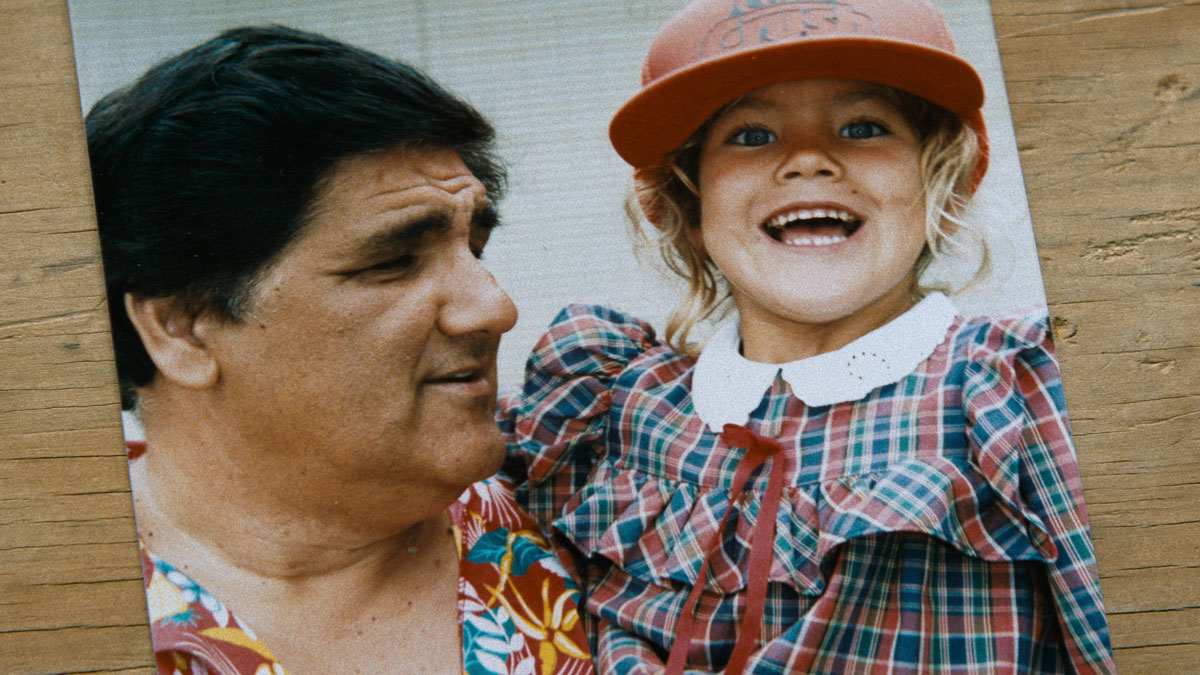
Closure in Solo's life isn't isolated to soccer alone, either. For all her woes on and off the field, (including a highly publicized DWI arrest in 2022), perhaps the most revelatory aspect of "Hope Solo v.s. U.S. Soccer" is the player's past. Her complicated family life largely centered around her father, a mysterious man with two identities and two families who spent much of his later life living in the woods in and around where the Solo family lived in Washington state. As the documentary shows, the volatility that culminated in Solo's ousting from her professional career ultimately began years earlier, in her personal life. 

Untold: Hope Solo vs. U.S. SoccerUntold: Hope Solo vs. U.S. Soccer (Netflix)Now, Solo lives with her husband and twins in rural Asheville, North Carolina, where Meredith says she "found a sense of peace and closeness to her father."
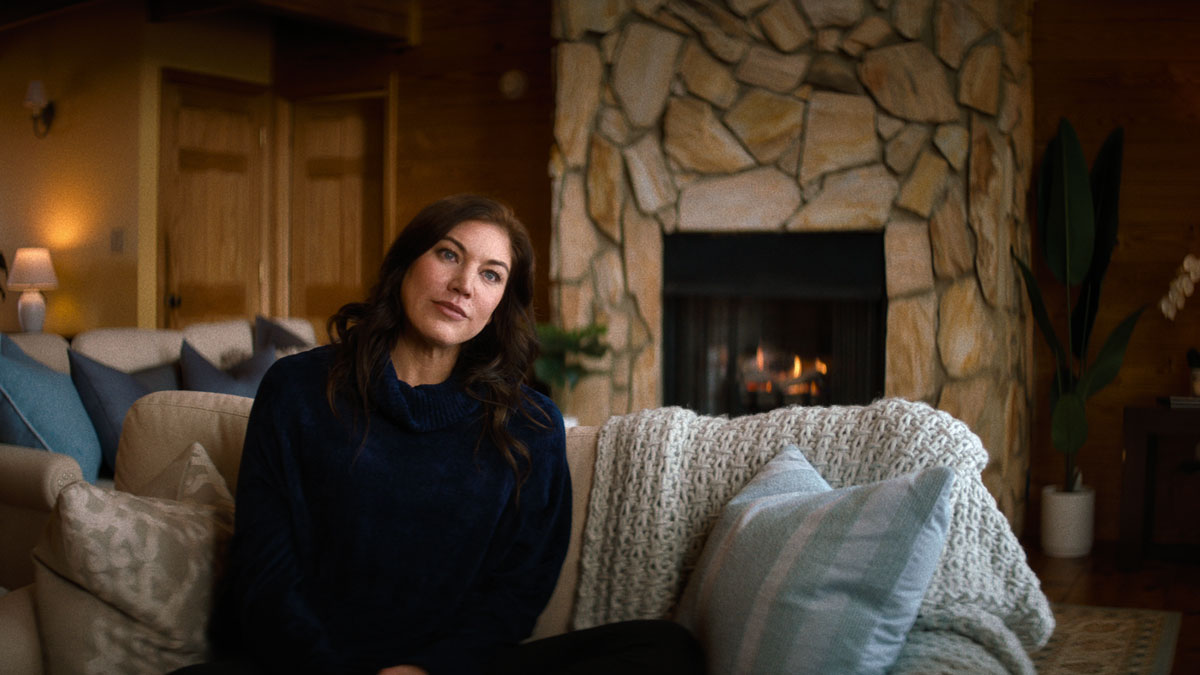
"I think they wanted to get away from it all," Meredith says. "To cancel out the noise and to just start focusing on what really matters for her now, which is her family and being a mother."

Check out the interview with Meredith, where she elaborates on Solo's trailblazing fight for equity in professional sports, and why she may not have faced as much public and professional scrutiny had she been a male athlete. 

The following interview has been lightly edited for length and clarity.

What would you say is so compelling about Hope Solo that it warranted a documentary about her?

Oh man, I'm not sure where to start. Hope Solo is undeniably the best goalkeeper in the history of U.S. soccer,  man or woman. I think we know that if we followed her career — her name was always in the headlines, she always had a spotlight on her — and I think a lot of people judged her or had a preconceived notion based on what the headline stated. There were a lot of controversies that overshadowed her greatness as a goalkeeper, so we wanted to tell this story because people don't know the Hope Solo behind the headlines. There's a really complicated and beautiful story behind the headlines and there's a lot more depth to her and her backstory, and we just felt like it would be a great episode in "Untold's" franchise.

Untold: Hope Solo vs. U.S. SoccerUntold: Hope Solo vs. U.S. Soccer (Netflix)How willing was Hope to do this project, and what did you do to make her feel heard and more open?
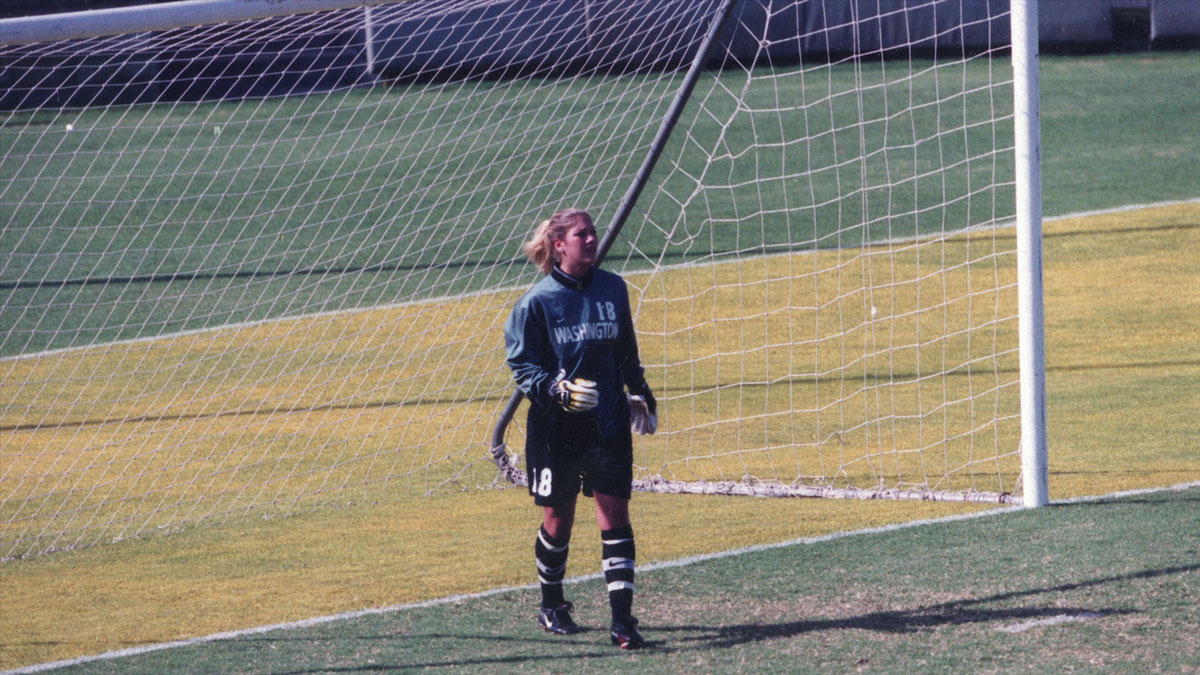
"Her name is Hope Solo. You have a lot of hope when she's in the goal, but ultimately, she is solo."

She was hesitant at first, for sure. She has not sat down to do a documentary or interview, I believe ever or in a very very long time since her career was ended in 2016. So I think Hope ultimately wanted to — you'd have to ask her — but I believe she wanted to participate to get a sense of closure and also to tell people her side of the story. Hope is a trailblazer, especially when it came to the fight for equal pay and that's something not many people know or understand. So I think she really wanted the opportunity to sit down and share her perspective and her truth. It was for sure difficult at times for her, but I think ultimately she was able to share what she wanted to.

The U.S. women's soccer team just won their first Olympic gold medal in 12 years. What does it mean to you to have this film drop now, and have you spoken to Hope about how she feels about that?

I think having the documentary drop right now is incredibly timely. There's been a lot of progress in women's sports and in women's soccer, but there's also — from Hope's perspective — a lot more that people don't know that's going on behind the scenes. And so I think it will have a strong reaction. I think women's soccer has come a very long way, especially when it comes to gender equity. But there still can be a lot more done in the sport.

As we're talking about pay equality, it's a cause that Hope champions. The economics of pay in professional sports had been an ongoing conversation, if you look at conversations around WNBA standout rookie Caitlin Clark, for example. Do you think Hope's position as a so-called pariah of the U.S. women's national team helps or hinders her mission to see equal pay enacted?

I think I'm going to answer that with, you have to watch the documentary to hear her perspective. It's a really complicated subject matter, and again, with Hope, there's a lot more to the headlines that you see and read. And I hope people can have a new perspective on Hope, when it comes to pariah, after watching this documentary. I believe people will have a little bit more empathy towards what she went through.

At one point in the film, journalist Roger Bennett refers to goalkeeping as a "deeply lonely" soccer position. At several points in the film Hope is described by close friends and coaches as lonely, as a result of her volatile upbringing and what transpired professionally. Can you speak about that?

Hope went in with great big dreams to be the best goalkeeper in the world, and she thought she was reaching that dream in her career. In 2007, when she was benched [at the World Cup in China] ultimately for Brianna Scurry resulted in a lot of that trust and sisterhood being broken for Hope. So I think she retreated, as she states in the documentary. She went to a very lonely and dark place and it has taken her many, many years to face some of these women, face the U.S. Soccer Federation. And as you see in the film, it culminates with her being finally inducted into the Hall of Fame. But you know, her name is Hope Solo. You have a lot of hope when she's in the goal, but ultimately, she is solo.

Untold: Hope Solo vs. U.S. SoccerUntold: Hope Solo vs. U.S. Soccer (Netflix)Hope has no swan song to close out her career after being suspended and having her contract terminated in 2016.  This was obviously hugely affecting for her. After speaking with her extensively how would you say she views this unfortunate situation now, nearly 10 years on? At one point in the film, she comments on how after it all went down, she was free of all of this red tape and bureaucracy, and she's able to go out in the world and speak her truth.
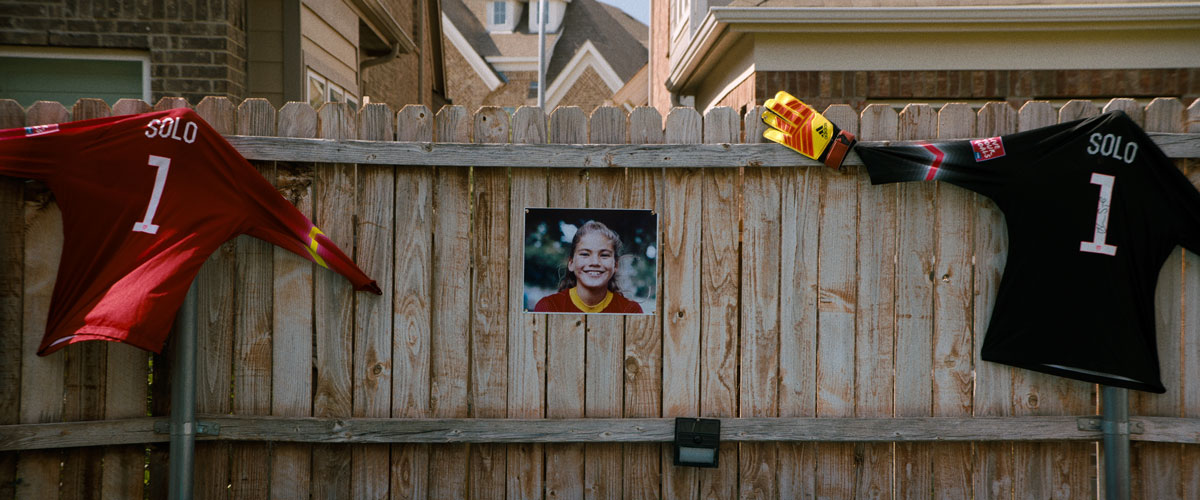
Absolutely, I think that quote from the film really summarizes it. When her career ended by U.S. soccer and not by her own accord, that was incredibly difficult for her and a very difficult period for her. But I believe that's possibly one of the reasons she did sit down with us, to reclaim some of her narrative and get some closure. Ultimately she was inducted into the Hall of Fame last year in 2023 and I believe that also put a period at the end of the sentence. So she's letting go. She's still a trailblazer in the fight for equality and she's continuing to do work for women and the next generation of soccer players as best she can. But I think there is some salt in that wound.

A huge list of Hope's former teammates declined to be interviewed for the film. As her college coach Leslie Gallimore says, "When you support Hope or you stand up for her, you're automatically seen as being in her camp and not in someone else's camp." Can you speak about that?

When I started this project, I thought so many women who have been vocal in the soccer community would hands down participate. I personally called Jill Ellis, Briana Scurry, emailed Carly Lloyd who is her [Hope's] good friend. But we were faced with rejection over and over and over again, until the very last day of filming. I think that was a huge surprise and wake-up call for me as a filmmaker, and also for Hope as the subject in being the central figure of this movie. She thought at least one of her teammates would sit down with us. So it was certainly somewhat of an elephant in the room that we had to address off the bat in the movie because otherwise, I believe viewers would be speculating as to why her teammates are not in the film.

We see footage of Hope's DWI arrest in 2022, but the film doesn't linger on that moment in time aside from Hope acknowledging that she had kind of finally given everyone a reason to hate her. Can you discuss how you went about deciding how much of that incident to show?

It's very uncomfortable footage to watch. It's a very sensitive and difficult subject matter. But when I first sat down with Hope to interview her, I asked the question, "Is there anything off limits?" thinking this might be one of those subjects. And she said no. I believe she wanted to talk about it to take responsibility because all the other controversies off the field during Hope's career were a bit gray. However this was very black and white, and she did take ownership over the terrible incident.

As former U.S. soccer player Michelle Akers observes, if Hope had been a man, the consequences she faced for her comments and general wild-child attitude would have been far less punitive. How would you describe sexism in the world of U.S. soccer and U.S. professional sports more broadly?

Hope's a trailblazer. Hope's very progressive when it comes to the fight for equal pay and other subject matter she finds to be unfair and unequal. She always stuck by her truth and she faced severe consequences for that. But I think there has been incredible movement and progress since Hope's career ended, so we all thought. One of the themes we spoke about with our subjects was Hope was ahead of her time, and would this happen to a man? And often, the answer was no. So it did feel like there was a lot of gender inequity in terms of how Hope was treated versus how a man was treated. There was a big comparison in the media during Hope's career hope to Ray Rice, and I was just incredibly appalled at that footage and those articles because what Hope did is incomparable to what Ray Rice did.

I loved this one quote from her, even though it was coming from a place of frustration, where she says, "We weren't in it for a settlement, we were in it to change the landscape for women across the country, for the rest of time, for the rest of history." You really get that pain and frustration coming through I think this sort of artifice of that settlement being a huge moment of progress when in actuality, as she describes it, it wasn't in the way that she was hoping for it to be.

Absolutely. I think that was my biggest learning, and I hope one of the largest learnings people viewers take after watching this film is that the pay is not equal. It was a settlement with the promise to get there, but from what [legal counsel] Rich Nichols tells us, it was a settlement. It was not a win, and I hope people begin to understand that.

Untold: Hope Solo vs. U.S. SoccerUntold: Hope Solo vs. U.S. Soccer (Netflix)I loved the inclusion of "Daughter" by Pearl Jam near the end of the film when things feel pretty uplifting. My parents are huge Pearl Jam fans. Why did you choose that specific song?
I think it felt like a good place, a good soundtrack to mirror the closure and where Hope is in her current life. It also has, like you mentioned a bit of nostalgic quality, and the film ends with this somewhat full-circle moment from her dad being this free-spirited man who lived in the woods to now Hope who in a way lives a similar lifestyle with her beautiful family.

That was actually my last question, regarding how the film ends on a very poignant note with Hope talking about how living in Asheville makes her feel close to her father who spent much of his life in the woods. Can you elaborate on the decision to end there?

Hope and her family moved shortly after her career ended. I think they wanted to get away from it all — to cancel out the noise and to just start focusing on what really matters for her now, which is her family and being a mother. So we wanted to end on that note. That's often a question we get asked as documentarians: "Where is she now? What is she doing now?" And I think it's pretty clear from that final scene that she has found a sense of peace and closeness to her father.

"Hope Solo vs. U.S. Soccer" is streaming on Netflix.

Karine Jean-Pierre shuts down “ridiculous” Fox News question accusing Harris of faking an accent

White House Press Secretary Karine Jean-Pierre quickly shutdown a Fox News correspondent’s question accusing Kamala Harris of faking a Southern accent.

“Since when does the vice president have what sounds like a Southern accent?” asked Peter Doocy of Fox News at a press conference on Tuesday.

“I have no idea what you’re talking about,” Jean-Pierre responded.

As Harris campaigns across battleground states, right-wing social media accounts claim she is faking an accent in some of her speeches.On Monday, Republican presidential candidate Donald Trump’s campaign X account shared two different videos of Harris speaking at rallies in Detroit and Pittsburgh, noting the differences in her voice between the two speeches.

When Doocy explicitly referenced Harris’ remarks in the two different cities, Jean-Pierre didn't entertain the query, instead asking Doocy if he thinks Americans “seriously think this is an important question?”

“You know what they care about? They care about the economy. They care about lowering costs. They care about healthcare. That’s what Americans care about,” Jean-Pierre said. 

“Is that how she talks in meetings here?” Doocy pressed. 

“Peter, we’re moving on. We’re so moving on,” Jean-Pierre responded.

Rachael Ray once thought she “almost killed” Tony Bennett while serving him osso bucco

In a sweet Instagram video shared Wednesday, television cook and host Rachael Ray shared a humorous anecdote about the late Tony Bennett.  Ray said she invited Tony Bennett — referencing him by his full name, Tony Benedetto — over for dinner one night and while the legendary singer "ate two portions of osso bucco," Ray shared another joking admission: "I almost killed him." 

Ray shared how she may have "gone a little overboard" with the floor polishing. When she pulled out Bennett's chair when serving aperitivo, the chair slid out from under him and Bennett "hit his head on my marble counter."

"He fell to the floor and I thought I killed Tony Bennett," Ray said.

In response, Bennett's wife Susan, whom Ray calls "glorious," said the singer would be fine. She told Ray, "He'll pop back up, just let him be." After sharing the story, said she "misses [her] friend so much," calling him the most beautiful man "maybe ever." She then went on to explain what osso bucco is — also differentiating between traditional, Milanese and Florentine styles — before she launches into making the Florentine iteration.

The caption of the video, which was shared in conjunction with the Instagram account home.made.nation, notes that Ray served the Bennetts osso bucco with creamy polenta and bread.


CNN poll shows Harris with narrow leads over Trump in most battleground states

With just over two months until November’s presidential election, the race for Georgia and Pennsylvania continues as Donald Trump and Kamala Harris remain neck and neck among voters, a new CNN polls find. 

The poll, released Wednesday, found Trump ahead of Harris 49% to 44% in Arizona, while Harris is ahead of Trump 50% to 44% in Wisconsin and 48% to 43% in Michigan. In Georgia and Nevada, Harris narrowly leads 48% to 47%, while the two are tied at 47% in Pennsylvania.

An average of 15% of voters across each state said they were unsure of their final decision.

Georgia and Pennsylvania are crucial states for each candidates’ respective path to winning the required 270 electoral college votes to claim presidency, CNN noted. 

Pennsylvania has the most electoral votes available of all swing states, at 19, and Georgia is not far behind at 16 electoral votes.

“There are two pivot points for the election: Pennsylvania and Georgia. If Trump can win Pennsylvania or Harris can win Georgia, I think they are then overwhelming favorites to win the election,” Doug Sosnik, a Democratic strategist told the Wall Street Journal. “It’s still possible for Trump to win without Georgia, it’s still possible for Harris to win without Pennsylvania, but it’s a lot more difficult.”

With the stakes mounting, both candidates are pouring their efforts into both states. Harris spent part of the Labor Day holiday in Pittsburgh, where she is remaining to prepare for next week's debate, following a bus tour through rural Georgia.

Trump, meanwhile, is spending more on advertising in Pennsylvania and Georgia than in any other states, according to the political data firm AdImpact.

“Sort of a liberal guy”: Trump says he hasn’t been invited on Joe Rogan’s podcast

Donald Trump in a recent interview shared that he had not been invited as a guest on Joe Rogan's podcast, a fan favorite amongst many conservatives. 

Speaking to podcast Lex Fridman, the former president and Republican presidential candidate remained relatively reticent on any tension between himself and Rogan, who helms the popular podcast, "The Joe Rogan Experience."

“I don’t think there was any tension. And I’ve always liked him, but I don’t know him,” Trump said when Fridman asked about the reported beef between the ex-president and Rogan. "I only see him when I walk into the arena with Dana [White] and I shake his hand. I see him there and I think he’s good at what he does, but I don’t know about doing his podcast. I guess I’d do it but I haven’t been asked and I’m not asking them. I’m not asking anybody.”

Last month, Trump took to his Truth Social platform to take a shot at Rogan over the podcaster's endorsement of Robert F. Kennedy Jr. in the 2024 election. Rogan had previously stated that Kennedy — who has since suspended his presidential campaign — was the only candidate who "made sense" to him, leading Trump to sound off. 

“I wonder how loudly Joe Rogan gets BOOED the next time he enters the UFC ring???” Trump wrote.

Trump in his discussion with Fridman also referred to Rogan as “sort of a liberal guy, I guess, from what I understand."

“But he likes [Robert F.] Kennedy. This was before I found this out, before Kennedy came in with us. He’s going to be great,” the MAGA leader added, in a seeming effort to dispel any lingering tension. “Bobby’s going to be great. But I like that he likes Kennedy.”

We need your help to stay independent

Rogan in previous interviews with Fridman indicated that he's "said no more than once" when the opportunity to have Trump on his show has arisen, a contradiction of Trump's assertion that his team has never reached out to Rogan to host him. “I’ve had the opportunity to have him on my show more than once. I’ve said no every time. I don’t want to help him. I’m not interested in helping him," Rogan said during a 2022 sit down.

It remains unclear whether Rogan will be endorsing Trump as the election looms nearer, with the hotly anticipated debate between the former president and Vice President Kamala Harris scheduled to take place next week, on September 10. 

On last week's episode of "The Joe Rogan Experience," the host alleged that MSNBC had doctored a clip of him speaking about former Democratic congresswoman Tulsi Gabbard to make it seem as though he was supporting Harris. 

“I’m not suing MSNBC, but this is what MSNBC did. They took a clip of me talking about Tulsi Gabbard and they edited it up and made it look like I was saying great things about Kamala Harris,” Rogan said.

“They just deceptively edited the things I was saying," Rogan continued. "They took it completely out of context where I was talking about — first of all, I was talking about Tulsi Gabbard and then I was talking about the media behind Kamala Harris, all this surge and all these people deciding that she can win and they put the two of those together and made it seem like I was praising Kamala Harris."

“Unfinished Beef”: Joey Chestnut and Takeru Kobayashi face off in an epic hot dog eating showdown

Following a 15-years-long rivalry, Joey Chestnut and Takeru Kobayashi reunited last weekend to face off in what may be the greatest showdown in competitive eating history. 

Chestnut and Kobayashi — both hailed as the strongest competitive eaters in the world — took part in “Chestnut vs. Kobayashi: Unfinished Beef,” a Netflix showcase that settled the question of who is the true champion amongst the two.

The latest showdown comes after the infamous 2007 Nathan’s Hot Dog Eating Contest, in which Chestnut fueled rumors that Kobayashi’s jaw injury at the time was a sham. Kobayashi was officially barred from competing in the annual contest after he ran up on stage during a 2010 competition that he wasn’t participating in. Since then, Chestnut has dominated every year (except in 2015), thus intensifying his growing feud with Kobayashi and heightening his own status as one of the best eaters in the world.      

“Chestnut vs. Kobayashi: Unfinished Beef” also marks Kobayashi’s final hot dog eating contest. Earlier this year, Kobayashi announced in the Netflix documentary, Hack Your Health, that he plans to retire from competitive eating.

“This isn’t just any match. This is the match of my rival,” Kobayashi said in a press conference, per Food & Wine. “I came here to win, and I would love to eat more than Chestnut.”

In the end, Chestnut took home the winning title. He also set a new world record, eating an astounding 83 hot dogs in 10 minutes.

Judge rejects Trump’s latest attempt to move his hush-money case to a federal court

A federal judge denied Donald Trump’s request to move his New York hush-money case to federal court on Tuesday after his attorneys cited the Supreme Court immunity ruling that granted him immunity for “official acts” taken as president.

U.S. District Judge Allen Hellerstein ruled that there were no new facts that would warrant the case being moved, despite the immunity ruling. He added that Trump’s actions were “private, unofficial acts” that do not warrant immunity from criminal prosecution.

Trump’s attorneys first asked that the case be moved to federal court last week, but they needed Hellerstein’s approval to do so. Just hours after they requested his approval on Tuesday, Hellerstein denied the request.

“Nothing in the Supreme Court’s opinion affects my previous conclusion that the hush money payments were private, unofficial acts, outside the bounds of executive authority,” Hellenstein wrote in the four-page ruling.

This is Trump’s second unsuccessful attempt to move the case to federal court after he pleaded not guilty to 34 counts of falsifying business records last spring. In May, he was convicted on all 34 counts.

Trump’s attorneys also argued the case should be moved to federal court because the New York judge presiding over the case, Judge Alan Merchan, is biased, they claimed.

Hellerstein shot down the argument and wrote that it is not his role as a federal judge to evaluate the New York case.

“It would be highly improper for this Court to evaluate the issues of bias, unfairness or error in the state trial,” Hellerstein wrote.

Trump has separately asked Merchan to drop the jury’s verdict in his case, arguing that his actions were “official” under his presidential duties and therefore make him immune from criminal prosecution. He has also requested the sentencing be postponed until after November’s election.

Merchan is expected to rule on the former request on Sept. 16, just two days before Trump’s scheduled sentencing on Sept. 18.

Some “high-level” Republicans secretly hope Harris beats Trump, but they won’t do anything to help

For a few hours after January 6, it seemed like the Republican Party might finally be ready to quit Donald J. Trump. It happened again after the 2022 midterms: When the red wave never materialized, with ultra-MAGA candidates under-performing their more traditional GOP peers, some optimistic pundits and Never-Trump Republicans believed the spell was finally, truly breaking.

Then 2024 came and Trump, not even bothering to appear for debates, easily defeated his opponents in the Republican primary, reminding Florida Gov. Ron DeSantis and his supporters in conservative media that candidates are ultimately chosen by Republican voters — and they, generally speaking, are not interested in a more disciplined version of the man they voted for in 2016 and 2020.

Republican voters, by an overwhelming margin, want Trump to be president again; many are unwilling to consider the possibility that he could ever legitimately lose. That he is 78 and clearly lost a step does not appear to matter to people who quite like the idea of a 1980s insult comic as commanderinchief.

Elected Republicans and top GOP operatives, however, are well aware that their candidate is unfit for office. Half the people who served in Trump’s cabinet are refusing to support him today; the guy had to find a new running mate after encouraging a mob to attack his last one. But Republican voters like Trump not in spite of his moral failings, but because of them; that a serial liar is regarded by the GOP base as “honest” is in part a reflection of the candidate’s open racism and misogyny, which reads among bigots as him “saying what we’re all thinking.”

Fantasies of a post-Trump Republican Party, if they are to be grounded at all in reality, must confront the fact that the former president is the unquestioned leader of the GOP, today and for the last nine years, because his voters — seeing what the rest of us do — actually like all the stuff that their betters in conservative media view as an unhelpful sideshow.

As Terry Sullivan, a former GOP strategist who worked for Sen. Marco Rubio, told Politico columnist Jonathan Martin, the Republican Party does not have a “top of the ticket problem” but a “voter base problem.”

“It’s not like our leaders have been leading the voters to the wilderness against the voters’ judgment,” Sullivan said.

The hope among some in the party is that those voters will now cost the GOP another election, after which their time will come again. According to Martin, this view is openly espoused by some “high-level” Republicans: that Trump losing in November best positions the party, then in opposition to a President Kamala Harris, to make gains in the 2026 midterm elections, enabling the party to block her agenda and field a morally palatable candidate for president in 2028.

“Those conditions, along with a diminished, twice-defeated Trump, would make it easier for Republicans to recruit Senate candidates,” Martin wrote.

We need your help to stay independent

Politico’s Playbook newsletter separately reported Wednesday that this take isn’t shared just by out-and-out Trump haters in the GOP. “Some of the Republicans wishing for a Trump loss include long-standing GOP figures throughout the nation who bleed red and wouldn’t dare say this publicly but who are more than ready to move on from the Trump era," the outlet reported, highlighting the fact that the former president's intra-party critics still live in fear of his posts on Truth Social.

That this is all rather preposterous is revealed by asking one question: You think a soundly, twice-defeated Trump will just slither away — and not seek the nomination again when he’s in his 80s? It’s also reflected in Politico’s reporting, a GOP source musing to the outlet about the possibility that a President Harris would make their job easier by actually pardoning a defeated Trump (along with Hunter Biden), removing the former president’s “persecution complex” and accompanying grip on the party while enabling Republicans to “get on with the business of winning elections.”

But Harris is not Gerald Ford and Trump is not Richard Nixon and this is not 1974, when leaders of both parties were at least willing to say — publicly — that it’s bad when a president commits crimes to undermine democracy. Some 50 years later, elected Republicans were only willing to say that for about 48 hours, and even then only in the immediate aftermath of a Trump-endorsed assault on the U.S. Capitol "("Count me out. Enough is enough," Sen. Lindsey Graham said that evening. "It is my hope that we can now all rally around President Trump as the Republican nominee," he said three years later).

If Republicans really want to move past the Trump era, they need to dig deep and find that which has been sorely lacking since he first secured the party’s nomination in 2016: the courage to say so, openly, and to act on one’s purported convictions, even if it’s only the service of attaining power. While silence in the face of an authoritarian threat is understandable, if not laudable, it won't convince any Republican voters to back away from the abyss. Party elites privately complaining to the mainstream media? That’s what we saw throughout his presidency, furthering a billionaire's claim to be fighting an establishment cabal — and if he loses again, it's how we'll get a “Trump 2028.”

This Asheville restaurant seamlessly blends Appalachian ingredients with Italian flavors

Since I was young, I've had a deep affinity for pepperoni rolls and bread. In recent years, I've given up pork, but that adoration for the pepperoni breads of my youth hasn't waned. I was especially partial to a local Italian stalwart called Vitamia which made the absolute best pepperoni bread imaginable (along with practically everything else on display in their storefront), as well as my cousin's pepperoni bread that she made every Christmas Eve, which I would eat with vigor.

Something I did not know, though, was that some trace the origins of pepperoni rolls to the Italian immigrants who lived in the Appalachain region, usually within North Carolina, Kentucky and West Virginia.

For some, it can often be inferred or assumed that the Northeast has a monopoly of sorts, if you will, on Italian-American identity, culture and cuisine. In actuality, though, that couldn't be further form the truth; the Appalachian region was the place that many Italians settled in when they immigrated to the U.S. hundreds of years ago. 

Beyond the tri-state area, many Italian immigrants moved to the Appalachian region, primarily for mining jobs. (This was also exemplified in the horribly tragic event in which many of Italian immigrants lost their lives in a mine collapse; the Monogah coal mine explosion in 1907 killed over 300 miners  almost all migrant workers  nearly half of which were from Italy, many of which hailed from San Giovanni in Fiore, in Southern Italy.)

Many of those coal miners would often eat pepperoni rolls on their lunch breaks, which garnered the name "coal miner's lunch." 

While Appalachian and Italian cultures may initially seem inherently distinct, there is much more of an overlap there than some might initially think. Italian immigrants left their mark on the region and now, years later, Luminosa in Asheville is honoring those who came before us, fusing Appalachian and Italian-American fare. The restaurant blends Appalachian ingredients and ingenuity with Italian-American grit and flavor profiles, harnessing an intrepid hybrid of culture and cuisine that is simultaneously inspiring and absolutely delicious.

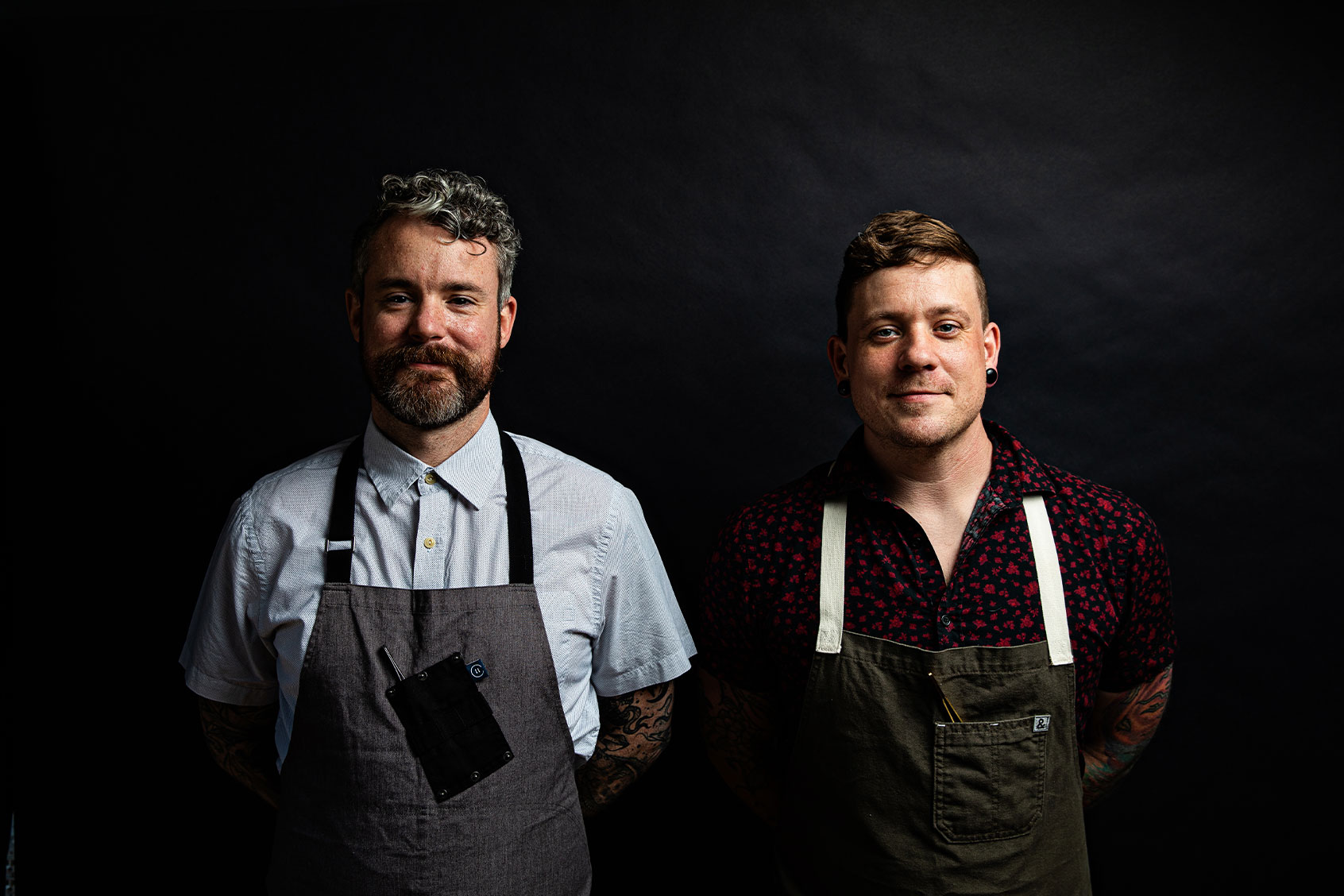
A "hyperlocal" Italian restaurant in the Flat Iron Hotel — helmed by executive chef Graham House and Chef de Cuisine Sean McMullen — Luminosa seamlessly combines the two seemingly disparate categories into something holistic and cohesive.

Salon Food had the opportunity to to speak with House and McMullen to ask about the restaurant, Asheville and North Carolina on the whole, the menu, what originally got them into cooking and much more.

The following interview has been lightly edited for clarity and length. Questions 1-5 were answered by Executive Chef Graham House and questions 6-11 were answered by Chef de Cuisine Sean McMullen.  

Luminosa Executive Chef Graham House and Chef de Cuisine Sean McMullenLuminosa Executive Chef Graham House and Chef de Cuisine Sean McMullen (Photo by Andrew Cebulka)

Hello! I love the line on the website that says "Modern-Appalachian Meets Italian Inspiration." Can you speak a bit to that? 

GH: I've always referred to my style of cooking here in Asheville as "Modern Appalachian". Using only ingredients grown here with different modern techniques I've learned over the years in different regions and settings in my career. With I was hired to lead the kitchen at The Flat Iron Hotel, learning I'd get to work with a pizza oven, live fire grill and pasta extruder made it extra special for me. I was so excited to dig back into how Appalachian ingredients could be used in an Italian menu at Luminosa. 

Can you tell me a bit about your come-up or 'pedigree' in the industry and what came before Luminosa for you? 

GH: I was born and raised in Brevard, just outside of Asheville and I left the area in 2005 to dive into the culinary industry. I started in Atlanta, Georgia working in my first Italian restaurant in Buckhead, then had the opportunity to move just outside of Lake Como to work in a very old family osteria where my love for fresh pasta and pizza-making really took off.

After a short stint back in Atlanta, I moved out to Napa Valley, California where my obsession pivoted to vegetables and how to treat them as a main component of a dish and not just an afterthought. Taking my newfound love for produce and shopping local at farmers markets, I moved to San Francisco where the elite farmers markets aren't just for supplying restaurants but also a meeting place for local chefs to talk shop and bounce ideas off each other. This is where I really changed my style of food to a veggie-focused way of cooking.

At the end of 2016, I moved back to Asheville where my menus were very welcomed and I was able to reestablish close relationships with local farmers and makers of the area. I developed from the ground up a food program at a local cocktail bar and rooted myself in the dining scene of Asheville. In 2020 at the cusp of opening my own restaurant in town I, like many others, was forced to pivot. I dove into the art of whole animal butchery at The Chop Shop here in Asheville and was their culinary director building up a live fire catering program as well as a food truck in the River Arts District.

In March of 2023, I had the opportunity to put my hat in the ring for Executive Chef at the new Flat Iron Hotel with the Indigo Road Hospitality Group and the rest was history.

The menu is stunning. I'm so intrigued by the inclusion of a few ingredients: country ham, daylily shoots, Harueki turnips, blackberries in a pasta dish, cornbread crumb, garum caramel, etc. How do you normally approach menu development? Also, I must ask: What is a serviceberry? I'd never heard of it. 

GH: Working with so many local farmers can be hard coordinating with their availability, delivery days, etc. Chef Sean and I have made a working detailed document outlining what each farmer has available every week. When you are only using local ingredients, it makes it really easy to change something when an ingredient goes out of season.

Sean and I stand in the walk-in cooler and look around and talk through dishes together. We are almost always both on the same page when it comes to playing around with flavors and textures and thinking outside of normal flavor combinations, while substituting ingredients that are local to us that serve the same purpose.

We also have a whole animal butchery program at Luminosa, which allows us to harvest very specific cuts from both cows and pigs and then get even more granular when offering unique dishes to our guests. Service Berries are a local perennial shrub that fruit only for a couple weeks in mid spring. They look like a blueberry, but kind of taste like a plum.


Luminosa Pizza DishLuminosa Pizza Dish (Photo by Carrie Turner)

I am forever and always obsessed with chicken skin jus, so seeing a caramelized one on your menu made me very excited. How do you prepare it?

GH: Our chicken skin jus starts with a whole load of chicken skins in a hotel pan placed in our pizza oven for a really long time. We stir it constantly until the skins are deeply caramelized. We then deglaze with white wine and add mirepoix that’s been buried in hot embers to soak up all that smokey flavor.

Once the wine has cooked out, we add more aromatics and transfer the pan to a 350-degree oven to reduce to the thick and sticky jus that glazes the chicken on the plate. When the jus is cooled, we harvest the rendered chicken fat and infuse green herbs to make a green fat which we then drizzle over the chicken before it goes out to the guest. 

Seems like North Carolina has become all the rage in recent years — what do you attribute that to? 

GH: North Carolina is a very special place in regard to agriculture. Having access to both old growth mountains as well as unique shellfish habitats like the Outer Banks is a gift. It was only a matter of time before the right talent would move here and recognize all the bounty of our state. I love where I live and how versatile our region is in regard to variety of produce that can be grown here. 

Why do you cook? 

SM: I've always been passionate about cooking. It's a means of expression and a way to tell a story about your journey and the history that shaped that path. It's always been a way to connect with others and one way I can show people that I care for them. It's a field where you can constantly improve while striving for excellence. There's always more to learn and that makes it fun and exciting.

Luminosa InteriorLuminosa Interior (Photo by Carrie Turner) What stands out for you as a formative moment that got you into cooking or food at large? 

SM: Being in my grandmother's home with family with everyone gathered in or around the kitchen. It's the feeling of community and how food brings people together. This has always felt important to me.

 What is your favorite cooking memory? 

SM: I've made so many great memories cooking and traveling for food. I’ve met so many amazing people along the way. I'd have to say being a part of opening Luminosa with Graham is my favorite. It's been so much fun working with this amazing group of people. Getting to work with Graham to achieve this vision feels really special and important in this moment.

 Luminosa Bone Marrow Tater TotsBone Marrow Tater Tots (Photo by Carrie Turner)
Do you have a number one favorite ingredient to cook with? 

SM: I'd have to say the amazing produce from our farmers/friends that we get to work with every day. It's summertime, so the abundance of peak season produce is super fun and exciting. We're big on showcasing all of the outstanding fruits and vegetables that the nearby local farmers cultivate.

We need your help to stay independent


How do you practice sustainability in your cooking?

SM: Sustainability really starts by working with local ingredients while they are in season – this is something that is very near and dear to how Graham and I cook. Not just the vegetables but also the whole animals that make up a part of our menu. The agnolotti right now is filled with a farce made from the pork shanks we have from the weekly hog delivery. We take often neglected cuts of meat and find ways to showcase them on our menus.

We make all our stocks from the bones of those meat cuts every week. The beef tallow we produce is used in one of our Luminosa fryers during service. When it comes to vegetables, the whole thing can be used in one way or another. Fermentation is a big part of what excites me about sustainability. We pickle a lot of the veggies during the season and start vinegars with trimmings. We strive to have the least amount of waste possible.

 What are some tips you'd give to home cooks for cutting down on food waste?

SM: One of the easiest tips is to use vegetable scraps to make stocks for cooking. Getting into fermentation also helps and fruit that looks less than perfect can be used to create some truly amazing vinegars. Composting is also huge for cutting down on food waste. 

California becomes 14th state to detect bird flu in dairy cows

On Monday, California became the 14th state to report outbreaks of bird flu in dairy cows. Some have wondered how the Golden State avoided an outbreak thus far in the bird flu crisis, after nearly 200 outbreaks have been reported from Colorado to Texas to Michigan. It’s especially puzzling given that California is the nation’s largest dairy producer. "It seemed like it might be only a matter of time,” Terry Lehenbauer, a bovine disease epidemiologist and professor emeritus at the University of California, Davis, told Stat News last week. Now that time has arrived.

In late August, cows at three dairy farms in the Central Valley displayed symptoms for highly pathogenic avian influenza and later tested positive, according to the California Department of Food and Agriculture. No humans have been reported infected.

Bird flu concerns public health experts because the H5N1 virus poses pandemic potential just like swine flu (H1N1) and COVID-19. It is very contagious and can be deadly. The virus has been rapidly spreading in birds and other wild animals for several years now, but has now spread to dairy cows, alarming experts who fear zoonotic transmission from birds to mammals could make humans more susceptible to illness.

The Centers for Disease Control and Prevention still report that the current public health risk is low, though farmworkers are at greatest exposure risk. Since 2022, 14 people have become infected with H5N1, with 10 of these cases resulting from exposure to poultry and the rest from dairy cows. None of the cases were fatal. Some research suggests the true number of cases is going undetected. This year’s multi-state outbreak is unprecedented, with the U.S. Department of Agriculture reporting 197 cases so far, including those in California. Experts warn if we don’t properly surveil this virus via testing and quarantining dairy herds, it could lead to bigger problems.

Watchdog group CREW says Judge Aileen Cannon should be kicked off the Trump documents case

Judge Aileen Cannon should be removed from former President's Donald Trump's government documents case should the 11th Circuit Court of Appeals reverse her ruling to dismiss it, according to an amicus brief filed by Citizens for Responsibility and Ethics in Washington (CREW), a federal watchdog group that alleges she was biased in favor of Trump throughout the process.

“At every possible opportunity, Judge Cannon has demonstrated her apparent bias in favor of Donald Trump,” said CREW President Noah Bookbinder in a statement. “She has at every stage made this case more difficult than the law mandated, and she then dismissed it on largely unprecedented grounds, delivering a significant win to Trump. Should the Court reverse her decision, it must also ensure that the case is reassigned to allow it to proceed fairly and expeditiously and to help restore the credibility of the federal court system.”

The document CREW filed with the 11th Circuit pointed out that if the higher court reverses Cannon's decision, it would be the third time in less than three years that they've had to do so in a “seemingly straightforward case about a former president’s unauthorized possession of government documents.”

We need your help to stay independent

“A reasonable member of the public could conclude, as many have, that the dismissal was the culmination of Judge Cannon’s many efforts to undermine and derail the prosecution of this case,” CREW argued in its amicus brief.

While CREW has filed plenty of amicus briefs to highlight what it sees as ethical lapses by legal, political and moneyed actors, the group has rarely gone so far as to call for a judge's outright removal from a case. The request for the 11th Circuit to remove Cannon is part of a cascade of criticism aimed at holding her accountable for what many legal experts say are unprecedented, legally dubious decisions that they say reflect either her incompetence, her bias in favor of the president who appointed her, or both.

Those decisions, which included allowing outside attorneys to argue in her court against the appointment of a special counsel, ultimately resulted in the case's dismissal on the grounds that Attorney General Merrick Garland unlawfully chose Jack Smith to lead the case.

Smith filed an 81-page document with the 11th Circuit at the end of August seeking to reverse Cannon's decision, highlighting that no court since 1974 has denied the right of an attorney general to appoint an outside prosecutor, a right upheld by four separate statutes and the Supreme Court case, U.S. v. Nixon.

Some legal experts worry now that the Supreme Court could uphold Cannon's decision. “And with this Supreme Court, there’s no ceiling,” former U.S. District Judge Nancy Gertner and CREW friend of the court told ProPublica. “All precedents are up for grabs.”

Why Donald Trump thinks he doesn’t have to campaign against Kamala Harris

One of the articles of faith about the 2020 election among the MAGA crowd is that Joe Biden couldn't possibly have won the election because he "campaigned from his basement" and never spoke before the big crowds, as Donald Trump did. Biden didn't campaign from his basement, of course, but he did run a very non-traditional campaign because the whole country was under a modified lockdown due to the COVID-19 pandemic. Large indoor gatherings that did take place, such as the one Trump held in Tulsa during that summer, were super-spreader events that ended up with many people getting sick and some dying. That fall, Donald Trump himself showed up at a presidential debate knowingly infected. He soon ended up in the hospital and came close to dying himself.

Unlike Trump, Biden followed the advice of the scientists and found ways to campaign without unnecessary exposure to the virus. Despite all that, Trump and the right-wing media insisted that Biden must have cheated because he didn't barnstorm all over the country.

So what are we to make of the fact that in this campaign Trump can barely rouse himself to leave his cushy surroundings at Mar-a-Lago and is more likely to be found on the golf course than giving a speech or holding a rally?

Sure, Trump does some campaigning, but at a much slower pace than he did in his first two runs. He's doing some non-traditional media, appearing on podcasts and giving interviews over the phone or at Mar-a-Lago. And he's appeared at some right-wing media confabs and made a foray to a plant in Pennsylvania last week. But the events are few and far between compared to the past. He even skipped the traditional Labor Day blitz that every presidential candidate does as the kick-off to the fall campaign. Even if they have nothing positive to say about unions, Republican candidates always take advantage of the fact that people have a day off and are waking up to the fact that the campaign has begun. They usually fly around to various venues and hold rallies or show up at the state fair, as Kamala Harris and Tim Walz did on Monday.

It's the ultimate power play to make the Democrats lose through a post-election ploy that's engineered by Trump and his cronies. In his twisted mind, I think that would even validate his Big Lie.

Trump did nothing. He didn't hold even one public event and while UPI reported that he was to hold a video call with current and retired members of the United Auto Workers I can find no record of it happening. His only campaign event this whole week isn't scheduled until Saturday in Wisconsin.

As mentioned, he is doing media but even that is far less energetic than what we're used to seeing from him. Last night he did an obscure X interview show and seemed desultory and depressed. If it were anyone else I would have thought he'd popped a Xanax before he went on. And the rallies he is doing are boring rehashes of the same old tunes. One could almost say that Trump is campaigning from his basement. The question is, why? He knows what it takes to campaign for president. It's been his life's work for the past decade.

We need your help to stay independent

I might guess that he's still very spooked by the assassination attempt and is resistant to going before the public. I can't say that I would blame him. It was a very close call and it would freak anyone out. (He would never admit that, of course.) Or maybe it's just that his heart isn't really in it now that he thinks the Supreme Court has given him a get-out-of-jail-free card with its immunity ruling. It's also possible that his age has caught up with him and he just doesn't have the "strength and the stamina" to campaign properly anymore. He has never looked so frail —- and some of the things he is saying are simply delusional. For instance, at a recent Moms for Liberty gathering he made an insane claim that schools are performing transgender surgery on kids:

Before Biden withdrew there was a lot of loose talk coming from the campaign that Democratic states like New Jersey and New Mexico were in play. That was always hype but Trump's team were extremely confident that they had the election in the bag. Today, not so much. The Boston Globe reported that a top volunteer in New Hampshire had informed the staff that the campaign had determined that the state is no longer a battleground state. (That volunteer has been fired.) And AdImpact, which tracks political advertising, released some startling numbers on Monday that seem to confirm his disclosure:


Want a daily wrap-up of all the news and commentary Salon has to offer? Subscribe to our morning newsletter, Crash Course.


You will notice that the Trump campaign is only competing in Pennsylvania and Georgia. All the other swing states are apparently being left to their own devices. This is surprising, to say the least. They do have less money to play with than the Democrats but you'd think they'd at least try to hedge their bets. But the consensus is that they have decided that if they can hold all their 2020 states they will put all their money on picking up those two states which will bring them to exactly 270. If they lose either one (or N. Carolina) that's the ballgame.

Just as likely they're really just planning on a post-election legal challenge in any or all of those states, claiming that the Democrats stole the election. You can certainly bet they'll do it in Pennsylvania and Georgia where they are already plotting with local officials. Trump himself has said repeatedly that "our primary focus is not to get out the vote, it is to make sure they don’t cheat."

If they can find a way to throw the election to the House, as they wanted to do in 2020, they will win, and I kind of suspect that Trump would actually prefer to do it that way. It's the ultimate power play to make the Democrats lose through a post-election ploy that's engineered by Trump and his cronies. In his twisted mind, I think that would even validate his Big Lie.

All of this probably explains why Trump isn't really bothering to campaign much. He'll spend some time in Pennsylvania and Georgia and make some perfunctory stops in some of the other swing states just to keep it close enough to contest. He'll keep doing right-wing media, the purpose of which is as much to keep his followers charged up about the alleged stealing as anything else. But unless he wins those two big states, which he might, he's preparing for the post-election Big Lie 2.0. He's old and tired and at this point, I think he'd actually rather whine than win.

Ginni Thomas privately praised group opposing Supreme Court reform: “Thank you so, so, so much”

ProPublica is a Pulitzer Prize-winning investigative newsroom. Sign up for The Big Story newsletter to receive stories like this one in your inbox.

Ginni Thomas, the wife of Supreme Court Justice Clarence Thomas, privately heaped praise on a major religious-rights group for fighting efforts to reform the nation’s highest court — efforts sparked, in large part, by her husband’s ethical lapses.

Thomas expressed her appreciation in an email sent to Kelly Shackelford, an influential litigator whose clients have won cases at the Supreme Court. Shackelford runs the First Liberty Institute, a $25 million-a-year organization that describes itself as “the largest legal organization in the nation dedicated exclusively to defending religious liberty for all Americans.”

Shackelford read Thomas’ email aloud on a July 31 private call with his group’s top donors.

Thomas wrote that First Liberty’s opposition to court-reform proposals gave a boost to certain judges. According to Shackelford, Thomas wrote in all caps: “YOU GUYS HAVE FILLED THE SAILS OF MANY JUDGES. CAN I JUST TELL YOU, THANK YOU SO, SO, SO MUCH.”

Shackelford said he saw Thomas’ support as evidence that judges, who “can’t go out into the political sphere and fight,” were thankful for First Liberty’s work to block Supreme Court reform. “It’s neat that, you know, those of you on the call are a part of protecting the future of our court, and they really appreciate it,” he said.

On the same call, Shackelford attacked Justice Elena Kagan as “treasonous” and “disloyal” after she endorsed an enforcement mechanism for the court’s newly adopted ethics code in a recent public appearance. He said that such an ethics code would “destroy the independence of the judiciary.” (This past weekend, Justice Ketanji Brown Jackson said she too was open to an enforceable ethics code for the Supreme Court.)

After the call, First Liberty sent a recording of the 45-minute conversation to some of its supporters. ProPublica and Documented obtained that recording.

Ginni Thomas did not respond to repeated requests for comment.

First Liberty Institute did not directly respond to ProPublica and Documented’s questions about the recording. Hiram Sasser, executive general counsel at First Liberty Institute, said in a statement: “First Liberty is extremely alarmed at the Leftist attacks on our democracy and judicial independence and is fighting to bring attention to this dangerous threat. It’s shameful that the political Left seems perfectly fine destroying democracy to achieve the court decisions they favor instead of working through democratic and constitutional means.”

The July 31 call led by Shackelford came shortly after President Joe Biden had announced support for a slate of far-reaching Supreme Court changes. Biden endorsed term limits for justices, a constitutional amendment reversing the court’s recent presidential immunity decision and a binding ethics code for the court’s nine members. Kagan’s comments came before Biden’s. She did not mention any of the structural proposals Biden endorsed.

On the donor call, Shackelford voiced strong opposition to various court reform proposals, including the ones floated by Biden, as well as expanding the size of the court. All of these proposals, Shackelford said, were part of “a dangerous attempt to really destroy the court, the Supreme Court.” This effort was led by “people in the progressive, extreme left” who were “upset by just a few cases,” he said.

This is not the first time that a spouse of a Supreme Court justice injected themselves into controversial political matters. Ginni Thomas sent dozens of messages after the 2020 election that echoed then-President Donald Trump’s baseless claims of election fraud. In messages to then-White House chief of staff Mark Meadows, Thomas said “Biden and the Left is attempting the greatest Heist of our History” and urged Trump to not concede the election. In emails to Arizona and Wisconsin lawmakers, she pleaded with them to fight back against supposed fraud and send a “clean slate of Electors.” She later wrote, “The nation’s eyes are on you now. … Please consider what will happen to the nation we all love if you do not stand up and lead.” (Thomas said in 2022 she regretted sending the inflammatory messages to Meadows.)

Martha-Ann Alito, the wife of Justice Samuel Alito, faced scrutiny for flying an upside-down American flag at the family’s Virginia home — a symbol used by the Stop the Steal movement that claimed the 2020 election had been stolen from Trump. The flag flew outside the Alito home as the Supreme Court was deciding whether to hear a case related to the 2020 election. (Samuel Alito told The New York Times he had no role in flying the flag. He said his wife did it in response to “a neighbor’s use of objectionable and personally insulting language on yard signs.”)

The push to change how the court functions grew after a series of ProPublica stories showed that wealthy Republican donors have showered Thomas and Alito with free gifts and travel that they failed to disclose. Following ProPublica’s reporting, Thomas amended past disclosure reports, and the Supreme Court adopted the ethics code, its first ever.

Thomas and Alito have said they weren’t required to disclose free flights or hospitality from friends.

First Liberty has been at the forefront of a decadeslong and successful effort to expand the First Amendment rights of religious groups, even as those interests can collide with other constitutional principles like maintaining the separation of church and state or providing equal protection for protected classes.

In the last several years, First Liberty has notched big victories. In June 2022, the Supreme Court’s six conservatives ruled in favor of several Maine families represented by First Liberty and the Institute for Justice, a libertarian-leaning legal advocacy group, when it struck down the state’s ban on using public funding to pay for religious schooling. Days later, the six conservatives ruled again in favor of a First Liberty plaintiff — in this case, a former football coach at a Washington state public high school who had been fired for praying on the field after games. The conservative majority said the coach had been wrongly removed from his job, a decision hailed by religious groups and criticized by some experts who said it would now be more difficult for public schools to keep education separate from religion.

First Liberty has also represented a bakery in Oregon whose owners refused to make a cake for a same-sex wedding, citing their religious beliefs; religious groups that opposed the Biden administration’s COVID-19 vaccine mandate; and nearly three dozen Navy SEALs and military members who refused to be vaccinated for the virus on the basis of their faith. In all the cases, First Liberty’s plaintiffs won partial or full victories in lower courts or at the Supreme Court.

Shackelford, who is First Liberty’s president and CEO, has led the group for nearly three decades. His influence extends into the broader conservative movement. House Speaker Mike Johnson, a former First Liberty attorney, once called Shackelford a mentor. Shackelford has served as vice president of the Council for National Policy, an umbrella group that brings together conservative leaders and deep-pocketed donors. He also works closely with Ziklag, the secretive network of ultrawealthy conservative Christians that aims to “take dominion” over every major sphere of influence in American culture. According to internal Ziklag newsletters obtained by ProPublica and Documented, Shackelford has participated in Supreme Court prep sessions and appeared on strategy conference calls organized by the group.

On the July 31 donor call, Shackelford kept the focus squarely on the mounting calls to reform the Supreme Court. In addition to Biden’s proposals, several groups, including prominent liberal legal outfits, have proposed other changes including term limits and stronger ethics guidelines. And earlier in July, the Brennan Center for Justice at NYU Law said it had received a $30 million gift from the private-equity investor Jim Kohlberg to create a new project that will “seek reform of the Supreme Court.”

Shackelford described all of this — Kagan’s speech, Biden’s announcement, the $30 million donation — as if it was a coordinated effort. “They’re doing everything in their power,” he told the donors. “They’re hitting from every direction.” The “extreme left,” he explained, was “upset by just a few cases, but that’s all they need to say, ‘We’re ready to totally’ — they would call ‘reform’ or ‘restructure’ the court — but almost everything they propose would actually destroy the court.”

He aimed his fiercest criticism on the donor call at Kagan. “That is incredible, somewhat treasonous, what Kagan did,” Shackelford said. “The chief justice rules the court. They’re trying to keep the other branches’ hands off of them. And then you’ve got Kagan from the inside really being somewhat disloyal and somewhat treasonous in what she’s doing.”

Shackelford accused ProPublica of being part of a campaign to “delegitimize or get rid of the court.” He said that the ethics lapses unearthed by ProPublica’s reporting were “false” and “baseless,” even though they helped spark the creation of a new ethics code and led to Thomas filing new financial disclosure forms, in effect admitting that he had failed to disclose certain gifts.

ProPublica stands behind all of the stories in its “Friends of the Court” series. Donors do not have access to stories ahead of their publication, and they have no say over coverage decisions.

Turning to what his donors could do to help, Shackelford said that prayer was at the top of the list. “This is a spiritual battle,” he said. “Because the evil that will occur if we lose the rule of law is beyond, I think, what any of us can even think through.”

But First Liberty needed more than prayer — it also needed money. “We need resources to be able to do a bunch of the things that will make a difference between now and the next six months. And that turned out to be key last time,” he said, referring to a similar instance in 2021 and 2022.

Near the start of the Biden presidency, he said, First Liberty raised $3 million to run a campaign that sought to block efforts to add more justices to the high court and to reform or eliminate the filibuster in the U.S. Senate. Getting rid of the filibuster then would’ve removed the 60-vote procedural hurdle that currently exists for most types of legislation.

According to Shackelford, First Liberty conducted polling, ran advertisements, worked with social media influencers and urged Congress to oppose these changes. In particular, Shackelford said, his group focused its activities on convincing Democratic Sens. Joe Manchin and Kyrsten Sinema to oppose filibuster reform.

In the end, both senators did just that. “We stopped this from happening,” Shackelford said. (Spokespeople for Manchin and Sinema did not respond to requests for comment.)

But now, he went on, First Liberty needed more money if it wanted to mount a similar campaign to stop Supreme Court reform. He mentioned the Brennan Center’s recent $30 million gift and then asked, “Where’s our, you know, $10 million guy or gal?”

And to anyone who wondered about the odds that Supreme Court reform would actually happen, Shackelford responded: “I don't know. I mean, 25%? 30%? Whatever it is, it’s amazing how big that is when you consider that our country will be over and the rule of law will be over.”

Before the call ended, Shackelford wanted his “very top supporters” to know that they had the support in this fight from key figures in high places. He said that a First Liberty staffer based in Washington, D.C., had recently been in a meeting with Ginni Thomas. Afterward, Thomas sent the email that praised First Liberty for joining the fight against Supreme Court reform.

“‘Great to meet through the meetings today,’” Thomas wrote, according to Shackelford, who read the email aloud to the donors. “‘I cannot adequately express enough appreciation for you guys pulling into reacting to the Biden effort on the Supreme Court,” she said, adding, “Many were so depressed at the lack of response by R’s and conservatives” to recent court-reform proposals. The rest of Thomas’ email, Shackelford said, was the all-caps gratitude.

Do you have any information about the Supreme Court and efforts to block court reform that we should know? Andy Kroll can be reached by email at andy.kroll@propublica.org and by Signal or WhatsApp at 202-215-6203.

Trump wants men to believe he’s a “fun” misogynist — but JD Vance gives up the game

Donald Trump's been flipping and flopping like a panicked fish these days on the issue of abortion. Trump recently recently made the specious claim on Truth Social that he would be "great for women and their reproductive rights." On Thursday, the Republican candidate caused a commotion amongst conservatives when he seemed to signal disapproval of Florida's abortion ban, claiming "we need more than six weeks" and implying that he plans to vote for an amendment that would repeal the state's new law in November. Even though he was almost certainly lying, Trump swiftly got heat from anti-choice activists. So on Friday, he flipped yet again and affirmed that he plans to vote against the amendment — which means he's voting to keep a near-total abortion ban in place in Florida.

It's impossible to track from minute to minute what Trump is saying about abortion, but the one constant, of course, is that he's lying. We know from Project 2025, which was created to handle Trump's policy agenda in lieu of a traditional transition team, that the goal is to ban abortion nationally, either through an act of Congress or by fiat, with an executive order making it a crime to transport drugs or other materials to be used in an abortion. Trump doesn't want Americans to know this. Abortion bans aren't just wildly unpopular. Polls show anger over abortion bans are motivating voters, especially women. They are now registering to vote at astonishing rates

"Trump wants young men to view him as a 'playboy' to look up to, though the details of his encounter with Daniels suggest that his sexual prowess is about as real as his orange-hued skin tone. Vance, however, tells the real story of MAGA government's plans for young men: trapping them in hasty marriages alongside the women who are being forced to bear all those children."

But Trump's dodging and weaving around this issue isn't just about women. Abortion bans aren't popular with men either, especially the kind of male voters Trump has been heavily marketing to in recent weeks: bro voters. They are the younger, more secular crowd of men that Trump has been courting by appearing on podcasts ranging from generically dudely ones to those hosted by far-right bigots. Not all younger men are interested in demonizing feminism, of course. But, as journalist Max Read explained in his newsletter, the "d*ps**t outreach strategy" is premised on the idea that "a consistent media campaign among them might increase turnout" with "low-propensity voters." 

It's an evil strategy, but one with some logic to it. Trump is a loudmouthed misogynist who was proven in court to have committed sexual assault against journalist E. Jean Carroll. These facts can't be changed, but the Trump campaign believes they can spin Trump's hatred of women as an asset, marketing him to men who resent women's social and economic progress. In this view, Trump is presented as a "fun" misogynist, offering permission to men to be oinking pigs who sexually harass without apology and expect to be indulged at every turn just for their wise choice to be born male. Male voters are led to believe that, in Trump's world, women have to shut up and serve, while men get to do whatever they want without consequences. 


Want more Amanda Marcotte on politics? Subscribe to her newsletter Standing Room Only.


The problem for Trump is that "fun" misogyny is hard to square with abortion bans, which stem from a more puritanical sexism, one which seeks to constrain the sexual expression of both men and women. Even the dimmest of dudebros knows that forced childbirth doesn't just trap women. Men can and should be worried about how an unwanted pregnancy can affect their social lives and their pocketbooks. It's a lot harder to be a carefree cad about town when you have child support payments or even, as the religious right hopes, a shotgun marriage. It's likely why the latest Washington Post-ABC News-Ipsos poll found that 1 in 5 men called abortion a top voting issue for them. In 2019, prior to the Supreme Court's overturning of Roe v. Wade, the same poll found that fewer than 10% of men said abortion was a top priority.

Trump's history of compulsive adultery and even his 34 felony convictions — which stemmed from an illegal "hush money" payment to adult film actress Stormy Daniels — help burnish his image as a hedonistic misogynist. But that can only go so far in distracting voters from the fact that he did more than any other person to end the right to legal abortion. Trump may occasionally bristle when people point out that the religious right wholly owns him, but at every turn, he proves how true that accusation is. When he even pretended to be moderate on abortion with his weasel words around the Florida ban, anti-choice activists threw a fit. It wasn't even 24 hours before Trump was back to toeing the hard-right line of standing by a state law that makes almost all safe abortions illegal. 

The choice of Sen. JD Vance of Ohio as his running mate underscores how impossible it is to strike the balance Trump wants. Vance was clearly picked as a play for the bro vote. He may be awkward in most ways, but Vance channels both the male entitlement and unvarnished loathing of women that defines the angry male voter the Trump campaign wants. The problem is that Vance has a long history of arguing that the government's job is frogmarching young people into marriage and parenthood, the sooner the better. Vance has spoken out against reproductive rights and divorce. And he has advocated for policies that punish people who don't produce biological children. While much of his vitriol against single and/or childless people is aimed at women, most men grasp that you can't have forced motherhood without forcing fatherhood, as well. Vance doesn't help the case by talking about marriage and parenthood more as a duty than a joy. 

Trump wants young men to view him as a "playboy" to look up to, though the details of his encounter with Daniels suggest that his sexual prowess is about as real as his orange-hued skin tone. Vance, however, tells the real story of MAGA government's plans for young men: trapping them in hasty marriages alongside the women who are being forced to bear all those children. 

For a wealthy man like Trump, being married with lots of kids doesn't interrupt the womanizing. Wives and children can be safely stored out of sight at second homes or penthouse apartments, while the men run off to golf tournaments to commit adultery. For middle-class men, however, marriage and fatherhood mark the end of youth and usher in an era of adult responsibilities. It's not that they never want to get married, but most want to enjoy their youth first. Few fantasize about settling down for life with the first girl they ever get naked with. 

The chaos in the polling data shows why Trump is so worried about this. With young women, the polling is stable: most hate Trump and plan to vote for Vice President Kamala Harris. But some polls show Trump has strong support with young men, while others show much less enthusiasm for the Republican candidate. I suspect this volatility depends on how Trump's misogyny is playing out in any given week. If Trump is successfully spinning himself as a womanizer who winks at women aborting inconvenient pregnancies, then he can probably keep those young men. If, however, the Vance faction is winning out and young men are reminded that Project 2025 is also a threat to their freedom, they could start peeling away.

Trump's tendency to lie about his radically anti-abortion views could do a lot to keep him in the good graces of the bro voters. But the anti-choice community demands fealty from Trump, both privately in assurances he will ban abortion and publicly in reaffirmation of support for abortion bans. Keeping his dudely base from learning he will force fatherhood upon them is key to Trump winning in November. So it's crucial that Harris pull out every stop to make sure those voters know Trump is happy to throw them to the wolves alongside the women they resent. 

“He’s one of us”: Trump defends political violence against the press, while the press remains silent

At Donald Trump’s weekend hatefest in Pennsylvania, when he got to the obligatory mainstream-media-is-the-enemy part, a devoted MAGA follower got so inspired he vaulted over the protective barrier surrounding the media in attendance. Sandwiched between the I-am-your-retribution section and God-chose-me, Trump’s anti-media speech inspired the man to jump up, run toward the press barrier, and sail over it, prepared to wale—physically— on members of the media. Hired security fortunately followed the man and tased him mid-assault. 

During the melee, Trump cooed from the pulpit. “Beautiful, that’s beautiful, that’s alright, that’s okay, no, he’s on our side. We get a little itchy, David, don’t we? No, no, he’s on our side.”

Minimizing political violence as "getting a little itchy," even from Trump’s micro-vocabulary, signaled approval, while “He’s on our side” urged us vs. them lenience for the attacker. As in, it’s normal to physically assault reporters because reporters say mean things about me.  

It’s a fool’s game to expect Trump to embrace the First Amendment (or any other tenet of Constitutional law), or the historical underpinnings of protecting the free press. Trump’s inability to hold either nuance or history isn’t surprising, but the mainstream media’s complicity in letting him get away with it is.

We need your help to stay independent

Few major media outlets have picked up the story of the assault or Trump’s delight in it, despite videos of the exchange circulating on social media. One outlet even presented the story as an attack on Trump, and used it to remind viewers of Trump’s alleged assassination attempt.  

How can Trump defending political violence in real time, as his follower assaults the media in attendance at his rally, not be a story? Is it because the real story is that the media is afraid of Trump, afraid they will lose access, afraid they will lose clicks?

Even after he tried to overthrow the last election through violence, Republicans want Trump back in power, and, if anything, the media is helping them. The Washington Post recently issued an editorial comparing the policy platforms of Trump and Kamala Harris. Their conclusion? Harris needs to go deeper on policy details, even though, after campaigning for two years, Trump has never provided policy specifics. Harris has been campaigning for six weeks, and yet she, not he, is expected to deliver intricate proposals, complete with subparagraphs and subparts. (Trump’s promise of tax gifts to the rich, ending environmental protections, and mass deportations are not policies, they are political platitudes, and there are no subparts.) 

It’s not just the Washington Post; finer minds than mine have been tracking the media's Trump bias in headlines and coverage for some time. In attempting to appear politically neutral, major outlets are refusing to cover Trump’s dangerous rhetoric, which has the effect of normalizing it.

Maybe Trump is right and MSM is the enemy of the people after all. 

The point of Trump’s dishonor: Why the Arlington debacle is about more than the fallen

Much has been written about Donald Trump’s utter contempt for American patriotism as displayed at Arlington cemetery last week. Trump's desecration of the hallowed ground where the bodies of recently fallen soldiers lay has generated disgust in most Americans. Yet, what makes the moment so significant goes beyond his politicizing sacred ground in self-service. The debacle encapsulates the craven elements of his lust for power:  

  1. His disregard not only of norms but also of the rule of law that protects all of us.
  2. The bullying use of force to get his way, always by others not himself.
  3. Leveraging the threat of further violence to intimidate those who can hold him to account.
  4. His dependence on Republican enablers without whom he cannot succeed. In this case, the key enabler was House Speaker Mike Johnson, the highest-ranking elected Republican in the nation. 

Let’s briefly recount what happened. On August 26, Trump went to a wreath-laying ceremony at Arlington with the family of a service member killed during the U.S. withdrawal from Afghanistan. Federal regulation has long prohibited partisan campaign activity, including photographs and videography, at Arlington, as Army officials informed the Trump team. The rule protects all families:

Partisan activities are inappropriate in Arlington National Cemetery, due to its role as a shrine to all the honored dead of the Armed Forces of the United States and out of respect for the men and women buried there and for their families.

There is no exception for the politicization of a memorial service, even if sanctioned by a grieving family.

When Trump campaign photographers and videographers accompanied the former president to the gravesites, a female Army official attempted to enforce the law.  As she attempted to stop them, she was pushed aside by a Trump campaign aide. They proceeded to video Trump at the grave site, including grotesquely inappropriate hand gestures – Trump grinning with his thumbs up next to a tombstone, and a woman next to him apparently holding her hand in the shape of a known white supremacy symbol. The campaign posted the video on TikTok.

You don’t need a docent to describe the fine points of each element of Trumpism. First, once Trump saw the opportunity for personal interest, he could not have cared less about norms or rules that safeguard the feelings of others. At least one of the other grief-stricken Gold Star families expressed their strong displeasure with Trump’s misconduct. 

Second, is there anything familiar sounding about Trump’s backers resorting to force when following the law doesn’t get them what they want? January 6 was an event of a completely different order, but Trump’s MO doesn’t change, whatever the setting or scale: Law and order be damned, do what it takes to dominate. 

Then there was the third element described above: the disempowering through intimidation of those who might hold an authoritarian to account. The Army has reported that the federal official who sought in vain to prevent a violation of Arlington’s rules has declined to press charges. 

Who can be surprised by someone who apparently fears retaliation from a mob boss’ violent soldiers? Their previous targets have included judges and prosecutors, journalists who dare to criticize the former president, and election officials doing their jobs. Trump understands the future intimidation value of weaponizing his base’s brownshirts — it allows him to break glass with impunity.

We need your help to stay independent

Now let’s focus on enabler Mike Johnson. On August 28, the right-wing Daily Caller quoted an anonymous source proudly proclaiming that Trump being at Arlington “would not have happened without Speaker Johnson.” He had apparently intervened with the military to ensure that Trump could be present despite hesitation from Arlington authorities who foresaw the abuse of sacred ground that would occur.

The takeaway is familiar, even if all the details are yet to emerge. Trump only gets by with a little help from his MAGA friends. The House Speaker carries no portfolio for enforcing or bypassing military regulations; but the House does control the Pentagon’s purse strings. Political strong-arming carries a strong smell.

The Daily Caller reported the events as if Johnson got involved only through a series of calls from the Trump-friendly family stating that Trump was being excluded from the service. But let’s not be naive. This was a leaked story with the look of what former Marine Ben Kesling called out in the Columbia Journalism Review as the Trump campaign “successfully mudd[ying] the waters by alleging that the photographer had been invited to the event by family members of soldiers buried there.”

The Army’s moral and law-based objection to making partisan hay out of a sacred ceremony was surely made known to Johnson, as it was made known to Trump. Ultimately, as Kesling put it, “The sacred was profaned.”

If you hope in the next four years for some small measure of respect for those who serve the country in uniform, or regard for law and order, keep in mind the image of Trump’s team pushing over a female officer to get their way. If he becomes commander-in-chief again, we are all in for an unparalleled reign of self-interest and cruelty that is unlikely to end in 2028. A candidate who would track cheap political mud across the hallowed grounds at Arlington is capable of anything.

Yes, dogs understand words from soundboard buttons, study finds

Bunny, TikTok's beloved "talking" Sheepadoodle, never fails to amaze her millions of followers. From asking for play dates with dog friends on her augmentative and alternative communication (AAC) device to posing existential questions and reporting her dreams, it appears that the more Bunny talks, the more insight we gain into the minds of dogs. But a question has always lingered: how much does she really understand? What is learned behavior and what is Bunny's understanding? 

Understandably, there have been skeptics believing that dogs who use soundboards don’t understand the words they’re using, but instead are responding to cues from their owners. However, a new study published in PLOS One by researchers from the University of California, San Diego, and other institutions, concluded that dogs do understand words and use soundboard buttons to produce appropriate responses.

“What we can show now is that, at the very least for the participants in this study, is that the dog seems to be paying attention to the words and not with any kind of behavioral cueing from the experimenter,” Federico Rossano, associate professor in the Department of Cognitive Science at the University of California–San Diego and co-author of the study, told Salon. “This is reassuring because it shows that it's not simply a matter of Clever Hans [a fake animal intelligence stunt] effect, and this a good first step towards assessing how far the animals are learning words and what kind of use they can make of them.”

The study consisted of two experiments. In the first, researchers went to the homes of 30 dogs across the country to test their responses to soundboard buttons. In this experiment, the researcher placed the dog in a location of the house other than where the soundboard was located. Once the dog was out of sight, one researcher placed three large colored stickers over three buttons containing one of each of the words of interest — such as “eat,” “outside,” “toy” or “play.” A second researcher, unaware of which button was which and unable to hear the words they produced, pressed one of these buttons and recorded the dog’s behavior.

In the second experiment, the dogs’ owners conducted a similar analysis on their own, but switched between pressing one of the buttons or saying the word themselves.

Amalia Bastos and Patrick Wood with dog study subjectAmalia Bastos and Patrick Wood with dog study subject (Courtesy of Comparative Cognition Lab at UC San Diego)

The results found that dogs were seven times more likely to display play-related behavior when the play/toy button was pressed compared to the other buttons being pressed. The dogs didn't exhibit food-related behaviors in response to relevant words, but as the authors note, "this may have occurred because several of the dogs taking part in the study may have been satiated before the start of test trials, or because dogs did not expect that they would be served a meal outside of their usual feeding times."

“Our study suggests that dogs were more likely to perform play-related behaviors after an experimenter or their owner produced a play-related word, and were more likely to exhibit outside-related behaviors in response to an experimenter or their owner producing an outside-related word,” the researchers wrote in the study. “This demonstrates that dogs are, at the very least, capable of learning an association between these words or buttons and their outcomes in the world.”

"This demonstrates that dogs are, at the very least, capable of learning an association between these words or buttons and their outcomes in the world."

The researchers elaborated that their results “demonstrate that dogs’ contextually appropriate responses to button presses were comparable regardless of the identity of the person using the soundboard.” 

In other words, they have some sort of comprehension. Rossano said this is a critical first step to move on to more insightful research. 


Want more health and science stories in your inbox? Subscribe to Salon's weekly newsletter Lab Notes.


“We have papers under review that look at how intentionally they seem to be using these buttons,” Rossano said. “How do they seem to combine them, whether, when confronted with a certain situation, they seem to select the appropriate button to request for help, for example.” 

When asked if this study will put public skepticism to rest, Rossano said such skepticism is a normal part of science. 

“All I can tell you is, the reviewers we have for this paper said we appreciate you pre-registered the study,” he said. “We can see that you've done it thoroughly, and you have controlled for a bunch of things, and so while we're not surprised by the finding, it's good that you did it and you did it the right way.”

We need your help to stay independent

Overall, the goal of these studies and the use of the soundboard, Rossano said, is to help dog owners understand their pets better. For example, if a dog can tell you they are in pain, there could be immense benefit to the dog’s well-being. 

“Ideally, this training helps us understand our dogs better, opens a little window into their cognitive ability and their minds,” he said. “And by being able to learn more about what they're thinking, what they care about, or what they're going through, hopefully we can better care for them.”

Serena Williams and I both drank the Honey Deuce for the first time – with mixed results

Even if you haven’t heard of every player participating in the U.S. Open, the grand slam tournament that takes place in Flushing, Queens at the end of every summer, you’ve definitely heard about its signature cocktail: the Honey Deuce. 

Coincidentally, Serena Williams . . . also lost her Honey Deuce virginity this year.

It’s nearly impossible to scroll through your social media feed between the last week of August and the first week of September without seeing the famed drink, which combines Grey Goose vodka with lemonade and a dash of Chambord raspberry liquor. The speared trio of green honeydew melons — shaped to resemble tennis balls — is the most obvious giveaway, as is the complimentary plastic cup the drink comes in. The cocktail’s influence on the event is so ubiquitous, in fact, that CNN reported it will surpass $10 million in sales before the Open ends on Sept. 8. 

“You can’t have a U.S. Open without the Honey Deuce,” Aleco Azqueta, vice president of marketing for Grey Goose, told the outlet. “It really is what the Mint Julep is to the Kentucky Derby but even more of a cultural phenomenon.”

“What’s unique about the Honey Deuce is that it’s something that people really look forward to since you can only have the original at the U.S. Open,” he added. 

As a first-time U.S. Open attendee, I was one of those people. My background in tennis stays more or less contained to the summer days of my youth, listening to an older German woman named Ingrid instruct me on how to serve alongside my younger siblings. Admittedly, I haven’t kept up with the sport since then, both as a player and a fan — as with many other Open attendees, I was simply there because I love live sporting events and anything that lets me imbibe delicious food and drink at a New York-based venue. 

Coincidentally, Serena Williams, a multi-time U.S. Open winner who was in attending the tournament as a spectator, also lost her Honey Deuce virginity this year. In a recent video shared on Instagram, the phenom shared how she had never tried the cocktail because she’d “always been playing.” As one social media user observed, Williams' name was stamped on the side of the very cup she was drinking out of six times.

“I like my Honey Deuce with Cincoro,” Williams shared in the clip, noting how she’d swapped the drink’s signature vodka for tequila. “Honey — that’s not deuce. That’s called honey add-in, or Honey Ace. Let’s rename that, it is good. Yum!” she added after taking a sip. “Try it with tequila.”

https://www.instagram.com/p/C_ZgaKBJ12A/?igsh=MzRlODBiNWFlZA%3D%3D&img_index=3

On Sunday night, a group of three friends and I jostled with thousands of other Open-goers — the most in the tournament’s 142-year history — as we made our way to the line for drinks before finding our seats. We waited for roughly 15 minutes before finding ourselves in front of a cheery woman with blonde braids and a baseball cap emblazoned with the words “Honey Deuce.” While the menu also featured Aperol Sprtizes and Palomas, it went without saying who the head honey honcho was.

"I think it’s mid."

Deuces in hand, we began to muscle our way through throngs of people walking upstairs, all looking for their seats, all precariously clutching their own ‘Deuce. No one dared risk taking a sip and spilling a single cent of their $23 drink. Once seated, we cheers'd each other and brought our cups to our mouths after what felt like hours of anticipation.  We gulped and then blinked at each other. One of my friends offered an appreciative, “Hmm.” I took another slow drag, searching for a glimmer of my money’s worth in the pinkish concoction, its ice chips diluting it further with every second.

My other friend didn’t mince words. “It tastes like basic fruit juice. I can hardly taste the vodka. I think it’s mid,” she said with a straight face. As the realization of the Honey Duece’s undeniably average taste sunk in, I too sank lower in my seat. The cocktail wasn’t bad by any means, but the amount of hype it’s received led me to believe that it would have been a strong level up from some of the better well-drinks I’d been poured in college. 

A refreshing bite of a melon ball — which my friends and I all agreed was the drink’s highlight in taste and aesthetic — did little to redeem the Honey Deuce. It only got worse when I inadvertently knocked my remaining balls clean off the top of my drink, leaving them to sit sadly in the aisle until an attendant swept them away at some point over the next three hours in change. 

So if you’re planning to go to the U.S. Open at any point over its remaining five days of play, and if don’t mind spending the money on the Honey Deuce (a price which is largely on par with most Manhattan cocktails anyway), I’d still recommend getting one. They’re a fun part of Open’s atmosphere. But if I could go back in time, I would have certainly tried the Honey Deuce à la Serena, with tequila. Or simply pregamed a bit more.

“I will not see you for an incredibly long time”: Adele announces lengthy hiatus

Adele will be saying goodbye to performing soon . . . 

The British singer announced she will be going on a hiatus from performing after she finishes her Las Vegas residency in November. During the final night of her monthlong residency in Munich, Germany, the singer told her fans that she only has "10 shows to do" in Las Vegas, Entertainment Weekly reported. Her stint in Las Vegas will finish out years of performing her album "30" and her other albums. She said, "But after that, I will not see you for an incredibly long time. And I will hold you dear in my heart for that whole length of my break.”

She continued, "I'm not the most comfortable performer. I know that, but I am very comfortably good at it, and I really enjoyed performing for nearly three years now, which is the longest I've ever done, and probably the longest I would ever do."

The singer's Munich residency was supposed to bookend her Las Vegas residency but Adele was forced to postpone her Vegas dates after falling ill for months. The residency began in November 2022 spanning over 100 live shows. 

“I just need a rest," the singer said on the verge of tears. "I have spent the last seven years building a new life for myself, and I want to live it now . . . I will remember these shows for eternity because they have been spectacular."