Spring Sale: Get 1 Year, Save 58%

The Trump administration has all but stopped enforcing environmental laws

Protecting the nation from polluters is a core function of the Environmental Protection Agency. But in the last few months, federal enforcement of major violations of environmental laws appears to have ground to a halt. A Grist review of data from the Department of Justice and EPA found that the Trump administration has not filed any new cases against major polluters in its first three months. Similarly, the number of minor civil and criminal enforcement cases has also significantly declined since President Donald Trump took office on January 20. 

The hands-off approach to environmental enforcement comes amid Trump’s repeated pledges to go easier on polluters. His administration has begun rolling back dozens of regulations; granting exemptions from federal air quality requirements to coal plants; and rewriting pollution standards for cars and trucks. Federal environmental enforcement declined during Trump’s first term, but the decrease during the first three months of his second term has been more drastic. 

“The future is grim for environmental protection,” said Gary Jonesi, a former top EPA enforcement attorney who now runs the nonprofit CREEDemocracy, which promotes clean energy and democracy globally. “The risk will be most felt in overburdened communities, but this will hurt red and blue districts alike,” he added. “If the EPA cop is not on the beat, then people are going to be harmed.”  

Environmental enforcement varies from state to state. In some cases, state agencies take the lead on enforcing environmental laws. In other cases, the EPA does. The federal agency typically uncovers violations through routine inspections or tips. If the offense is minor, the EPA handles it as a civil administrative case. The polluter is issued a notice of violation, and most often a settlement is reached in which the two sides agree to a remedy and potentially a fine. 

However, when the agency uncovers major violations such as chemical discharge in drinking water, poorer air quality from fracking pollution, and large chemical spills like the East Palestine catastrophe, it refers the cases to the DOJ. As the chief litigator for federal agencies, the DOJ files cases against polluters. 

"It’s critically important to keep politics out of enforcement. Enforcement should be about upholding the rule of law and protecting communities from harmful pollution."

A review of publicly available data and press releases suggests the DOJ has not initiated any new major cases since Trump took office. Meanwhile, the Trump administration has been filing or closing nearly 100 fewer civil cases per month on average than the Biden administration during its last fiscal year, which ended in October. It’s also initiating or closing about 200 fewer cases per month than the first Trump administration did during the same time period in 2017. These trends were confirmed by five current and former enforcement officials and an analysis of publicly available data.

The Biden administration averaged 288 cases per month during the last fiscal year — about 100 per month more than the Trump administration so far. During its first three months, the administration has filed or closed at least 567 cases or an average of 189 per month, records show. 

But that figure may be distorted in favor of Trump by civil cases that were started, investigated, and negotiated under Biden but have only recently been finalized. For example, the EPA cited the SilverEdge Cooperative trucking supply company in Iowa for a minor Clean Air Act violation in June 2024. A settlement of $5,000 was reached, though it is unclear when, and the case was finalized on April 14. 

The Trump administration has also closed some larger cases. The Biden EPA, DOJ, and Hino Motors, a Toyota subsidiary, reached a $1.6 billion settlement on January 15 after the automaker was accused of lying about emissions controls on its engines. A federal court entered the sentence on March 19. 

A DOJ spokesperson told Grist the department had no comment, and an EPA spokesperson said in an email that the administration is “committed to enforcing all aspects of the law from inspection to informal and formal administrative and judicial actions.” When asked to provide evidence of new judicial cases filed by the Trump administration, the EPA spokesperson sent cases opened, investigated, and litigated under Biden but closed under Trump, including the Hino Motors case. When asked to provide new cases filed under Trump, the spokesperson did not respond.

Two current EPA enforcement staffers told Grist they were informed “through the chain of command” that there would be a higher bar for initiating cases against major polluters — a decision that would now go through the agency’s political appointees. They cited a March 12 EPA memo noting that enforcement actions will no longer “shut down any stage of energy production” as effectively granting energy companies a license to pollute because they are not being prosecuted for breaking environmental laws. 

Newly appointed EPA officials are reviewing every major case in progress, the current EPA staffers said. The agency typically handles hundreds of cases at any given point. All of them were on hold as of early April, though some have since begun to advance through the review process. Polluters accused of violations by the EPA were also using the administration change as leverage in negotiations with EPA enforcement, and some major polluters were visiting political appointees in an effort to scuttle cases, one official said.

Grist’s analysis looked for civil administrative, criminal, and major civil cases listed in six public databases for the first three months of the new administration, as well as press releases on the EPA and DOJ website. It compared the new administration’s monthly average to the Biden administration’s monthly average during fiscal year 2024, as well as the first Trump administration’s first three months. Grist assessed enforcement trends by fiscal year to align with how federal agencies report data. 

The review may not include every case because enforcement details aren’t always promptly entered into public databases, two former top EPA enforcement officials who reviewed the data said. But they added that the vast majority of cases should be accounted for in each database, and the findings broadly provide an accurate picture that tracks with their observations.

“Things are definitely slower,” a current enforcement employee said. “Even the settlements happening now were mostly done under Biden, they just needed to get them over the finish line.”

The difference raises questions about the politicization of enforcement, said David Uhlmann, a Biden appointee who ran the EPA’s enforcement office from 2022 to 2024. 

“It’s critically important to keep politics out of enforcement,” he added. “Enforcement should be about upholding the rule of law and protecting communities from harmful pollution.”

The slowdown does not appear to be related to the administration’s transition. The EPA under the first Trump administration was far more active, initiating or completing at least 1,179 civil cases during the same time period in early 2017 or about 200 more per month than the current administration. 

Uhlmann said career enforcement officials were able to convince political appointees during the first Trump administration that it wasn’t appropriate to pause or reduce enforcement cases across the board. But as the first Trump administration became more hostile toward career staff, an exodus occurred and enforcement steadily slowed, hitting a low point in fiscal year 2020. That figure increased steadily during the Biden administration. 

“It’s only been three months, but the EPA has taken such a hard turn away from protecting public health and the environment,” Uhlmann said. “It’s breathtaking and sad.”

"This story was originally published by Grist. Sign up for Grist's weekly newsletter here."

Grist is a nonprofit, independent media organization dedicated to telling stories of climate solutions and a just future. Learn more at Grist.org

“Nothing to sustain that”: Biden denies reports of cognitive decline, trashes Trump on “The View”

Joe Biden slipped into the background months before the end of his lone presidential term, so it's a bit jarring to see him come out fighting on "The View." 

Biden suspended his presidential campaign last year, bowing to pressure from strategists and party officials who believed he had lost a step. Speaking to the hosts of the long-running talk show on Thursday, the former president vehemently denied reports that his cognitive abilities had declined.

"They are wrong," Biden said. "There is nothing to sustain that."

Former First Lady Jill Biden backed her husband up, saying that several tell-all books were written by people who were "not in the White House with us."

"They didn’t see how hard Joe worked every single day," she said. "I mean, it was nonstop."

Biden added that his decision to step aside for former Vice President Kamala Harris was not an admission that he couldn't handle the gig. 

"The only reason I got out of the race was because I didn’t want to have a divided Democratic Party. It’s a simple proposition. And so that’s why I got out of the race," he said. "I thought it was better to put the country ahead of my interest, my personal interest. I’m not being facetious. I’m being deadly earnest about that."

Elsewhere in the interview, Biden criticized President Donald Trump's first 100 days in office. He said the president was carelessly destroying the United States' standing on the global stage.

"I think he has done, quite frankly, a very poor job in the interest of the United States of America," Biden shared.

Trump has been notably fixated on Biden during the first few months of his second term, attacking the ex-president's use of an autopen and floating the idea of reversing presidential pardons that Biden granted to his family members. When asked why Trump held such a grudge, Biden offered a pat answer.

“I beat him,” he said.

Watch the entire interview below: 

“Lawmakers twiddle their thumbs”: Trump administration rants as Democrats stop crypto bill

A Trump-backed bill to regulate cryptocurrencies failed to advance in the Senate on Thursday after Republicans couldn't find enough Democrats to overlook the president's growing crypto empire and go along with it. 

The so-called GENIUS Act would provide a federal framework for stablecoins, a type of crypto pegged to the U.S. dollar. The industry spent tens of millions of dollars on pro-crypto candidates in the 2024 election who would support such a bill. 

It had bipartisan support and was on track to advance until Trump's crypto conflicts caused Democrats to put the brakes on it. They cited a New York Times investigation of a crypto business affiliated with Trump and his three sons and its $2 billion deal with a foreign government-backed venture fund. The business, World Liberty Financial, has begun offering stablecoins that could generate tens of millions of dollars a year in revenue for the Trumps and their business partners, The Times reported. One of their partners is Steve Witkoff, Trump's longtime friend and Middle East special envoy. 

Democrats said they also wanted the bill to address “anti-money laundering, foreign issuers, and national security," CNBC reported. Two Republicans — Josh Hawley and Rand Paul — also rejected the bill, which needed 60 votes to advance.

After the 48-49 vote, Treasury Secretary Scott Bessent posted that lawmakers "missed a once-in-a-generation opportunity to expand dollar dominance and U.S. influence in financial innovation." 

"The world is watching while American lawmakers twiddle their thumbs," he added. "Senators who voted to stonewall U.S. ingenuity today face a simple choice: Either step up and lead or watch digital asset innovation move offshore."

Trump, who embraced crypto on the campaign trail in 2024 after criticizing it as "not money" in 2019, wants to deliver the landmark legislation to the industry by this summer. 

In the meantime, he continues promoting his own crypto ventures. On Monday, he hawked his $TRUMP meme coin and an upcoming gala that offers the top coin holders access to him. 

Those with the biggest balances can attend an “intimate private dinner” with Trump at his golf club outside Washington, D.C., this month and tour the White House, according to the coin's website. The news prompted the coin to surge over 50% and boosted its total market value to $2.7 billion, NBC News reported. The Trump Organization and its affiliates control most of the token supply, according to the website.

Around 54,000 wallets have bought the coin since the promotion began, according to CNBC. Bloomberg reported that more than half of the top holders used foreign exchanges, suggesting they are based outside the U.S. 

The coin hasn't been profitable for most of the 2 million accounts that have purchased it since it launched in January. Around 764,000 have lost money, while 58 accounts made more than $10 million apiece, media outlets reported on Wednesday. Melania Trump announced her own meme coin a few days after her husband's.

The president's crypto interests extend into other investments. Trump Media & Technology needs his administration's approval to move forward with its plan to offer bitcoin exchange-traded funds as part of Truth.Fi, its new financial services firm.

Trump started delivering on his pro-crypto pledges soon after he was inaugurated. He issued an executive order and created a task force to boost crypto, appointed a crypto advocate as head of the Securities and Exchange Commission — the regulatory agency that oversees crypto — and proposed a "strategic crypto reserve" for the government to purchase and hold digital tokens. 

His administration has stripped federal agencies charged with investigating crypto firms and enforcing rules, and it has dropped Biden-era cases against top crypto firms including Coinbase, Ripple and others.  

He has dismissed ethical concerns, telling NBC's "Meet the Press" on Sunday that he started his crypto business "long before the election." 

"I haven't even looked," Trump said when asked if he's profiting from it. 

“Look, if I own stock in something and I do a good job, and the stock market goes up, I guess I’m profiting,” he added. 

“What a great honor”: Trump congratulates American pope who has previously chastised administration

President Donald Trump congratulated Pope Leo XIV on being chosen to lead the Catholic Church on Thursday.

In a post to Truth Social, Trump called former Cardinal Robert Prevost's elevation to the role a "great honor" and marveled at the papal conclave's selection of the first American pope in history. 

"Congratulations to Cardinal Robert Francis Prevost, who was just named Pope. It is such an honor to realize that he is the first American Pope," he wrote. "What excitement, and what a Great Honor for our Country. I look forward to meeting Pope Leo XIV. It will be a very meaningful moment!"

Leo is just the second pope in history to hail from the Americas. His immediate predecessor, Pope Francis, was originally from Argentina. And that's not the only way that Leo appears poised to follow in Francis' footsteps. Like the former church leader, he has been critical of the Trump administration's treatment of migrants

On social media, Leo has repeatedly shared articles taking Trump and Catholic convert Vice President JD Vance to task for their deportation program. Earlier this year, he shared multiple articles challenging Vance's belief in "ordo amoris," the idea that it is spiritually correct to prioritize love for God and immediate family over love for the rest of mankind.

"It's a framework that makes sense in a world governed by scarcity and fear, where protection comes at the expense of others. But Jesus never speaks of love as something to be rationed," an essay from the National Catholic Reporter shared by Leo states. "He speaks of love as abundance — a table where there is enough for everyone."

His most recent repost on X was an article from Bishop Evelio Menjivar of Washington, D.C, that asked officials working in the Trump administration to "reclaim [their] conscience" and oppose ongoing deportations and detentions of migrants.

Vance shared a post from the official White House account congratulating Leo before adding a statement of his own.

"Congratulations to Leo XIV, the first American Pope, on his election! I’m sure millions of American Catholics and other Christians will pray for his successful work leading the Church," he wrote on X. "May God bless him!"

Pope Leo XIV: Robert Prevost, an American, is the new head of the Catholic Church

For the first time, an American will lead the Catholic Church.

On Thursday, the Vatican revealed that Cardinal Robert Prevost has been elected by the papal conclave. He soon after addressed a jubilant crowd at St. Peter's Square by his new adopted name: Pope Leo XIV.

"May we all work together towards the place where God has prepared for us," he said, according to a translation from NBC News. He stressed the need to "build bridges" with "dialogue" and "love."

Originally born in Chicago, the 69-year-old Prevost previously served as the bishop of Chiclayo, in Peru. In February, his predecessor, Pope Francis, promoted him to the position of cardinal-bishop and handed him responsibility over the historically significant Diocese of Albano outside Rome.

Prevost was elected pontiff on the second day of the papal conclave, chosen on the sixth ballot by a two-thirds majority of the 133 cardinals assembled.

The throwback comfort of “Poker Face” returns

America is in its throwback era! People tend to mention that these days in the context of concern rather than celebration, but, looking on the bright side, this reacharound to the past brings with it the return of flared jeans, and those look good on just about everybody!

Old-school network TV is back—retrofitted for the streaming age. It’s not just the return of weekly releases, but of familiar formats. New shows that look like classic ones—like “Poker Face,” returning for its second season on Throwback Thursdays, no less.

Streaming ignited a career resurgence for its star Natasha Lyonne ("Russian Doll"), whose citizen detective Charlie Cale is a walking, talking encyclopedia of ‘60s and ‘70s iconography, tooling the country in her worn but still handsome 1969 Plymouth Barracuda. She smokes, she drinks and she can’t resist trouble despite her determination to avoid it.

Lyonne naturally channels the late Peter Falk’s halting way of speaking, but her crime solver’s innate talent for picking out lies makes her unique. In a wide-open land founded and fueled by grifters and fabulists, the woman who is allergic to B.S. is  . . . not exactly queen, but a welcome visitor and useful friend.

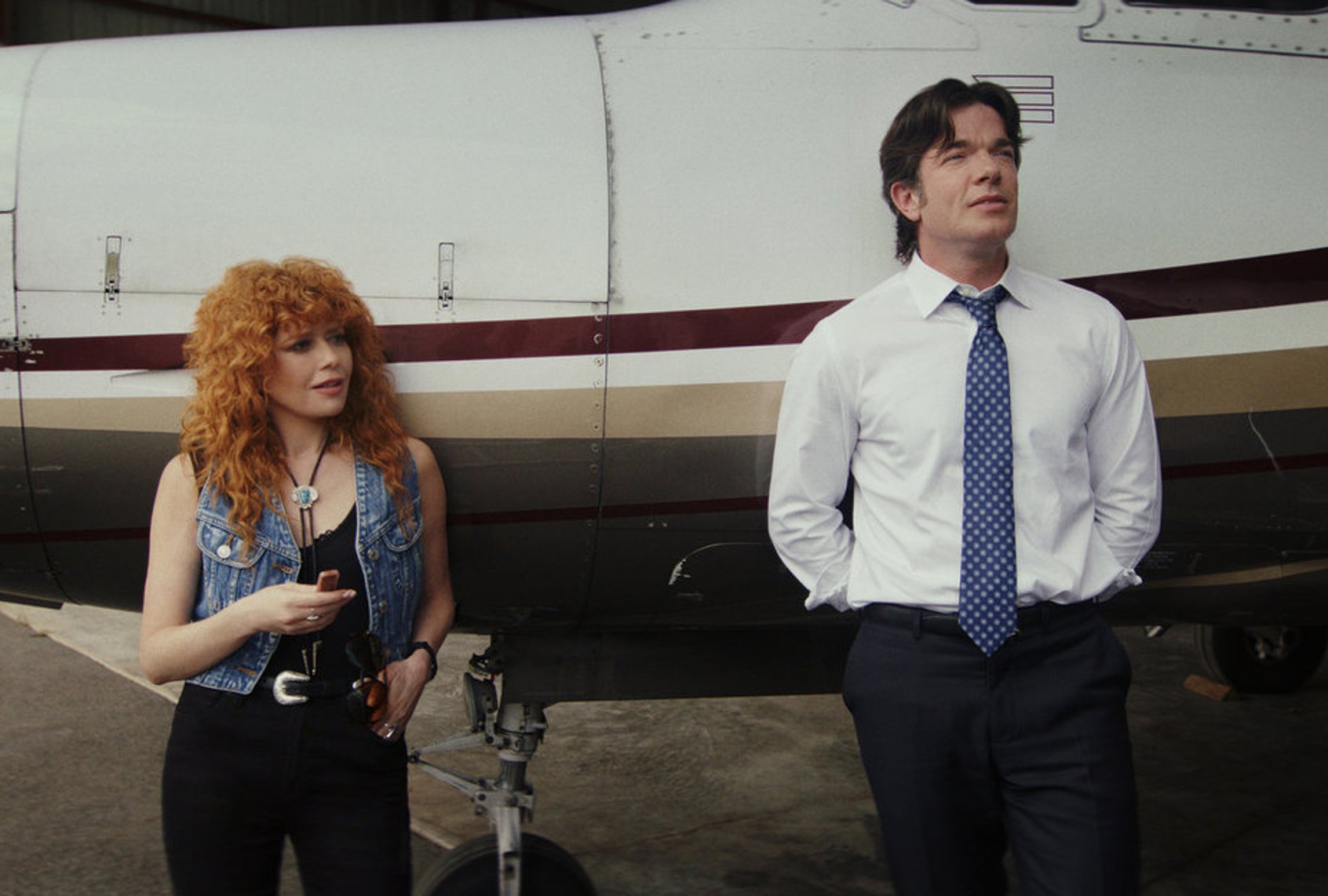
Natasha Lyonne and John Mulaney in "Poker Face" (Peacock). “Poker Face” pleasurably honors the timeless utility of the one-and-done procedural format even as its creator Rian Johnson (“Knives Out”) uses each episode's mysteries to pay tribute to great films and film greats. Lyonne’s gravel quarry of a voice and hipster-hunched posture are the only cast regulars in a show that draws all the big names to play.
Within the first three episodes, Cynthia Erivo, Katie Holmes, Giancarlo Esposito, Rhea Perlman and John Mulaney all land on Charlie’s map, continuing last season’s A-lister parade. Star caliber is nice and all, but the guest cast’s notoriety primarily makes for good promotion. One of the oldest rules in the medium is that TV makes its stars, not the other way around. Of course, fewer of them would agree to do this show if it weren’t good and a good time.

This makes “Poker Face” a creative coup in the post-prestige television age, especially when so many series trying to approximate premium auteur storytelling only look the part. Johnson’s show respects the audience and what they want from the small screen, and Lyonne’s grungy heroine.

While Season 2 picks up after the more serialized first season’s cliffhanger, newcomers can easily get the gist of what’s going on. In summary, Charlie is a Las Vegas cocktail waitress who goes on the lam after she calls B.S. on the wrong person: her mobbed-up boss. By the end of Season 1, she’s run afoul of five rival crime bosses, particularly her dead former boss’ rival Beatrix Hasp (Perlman).

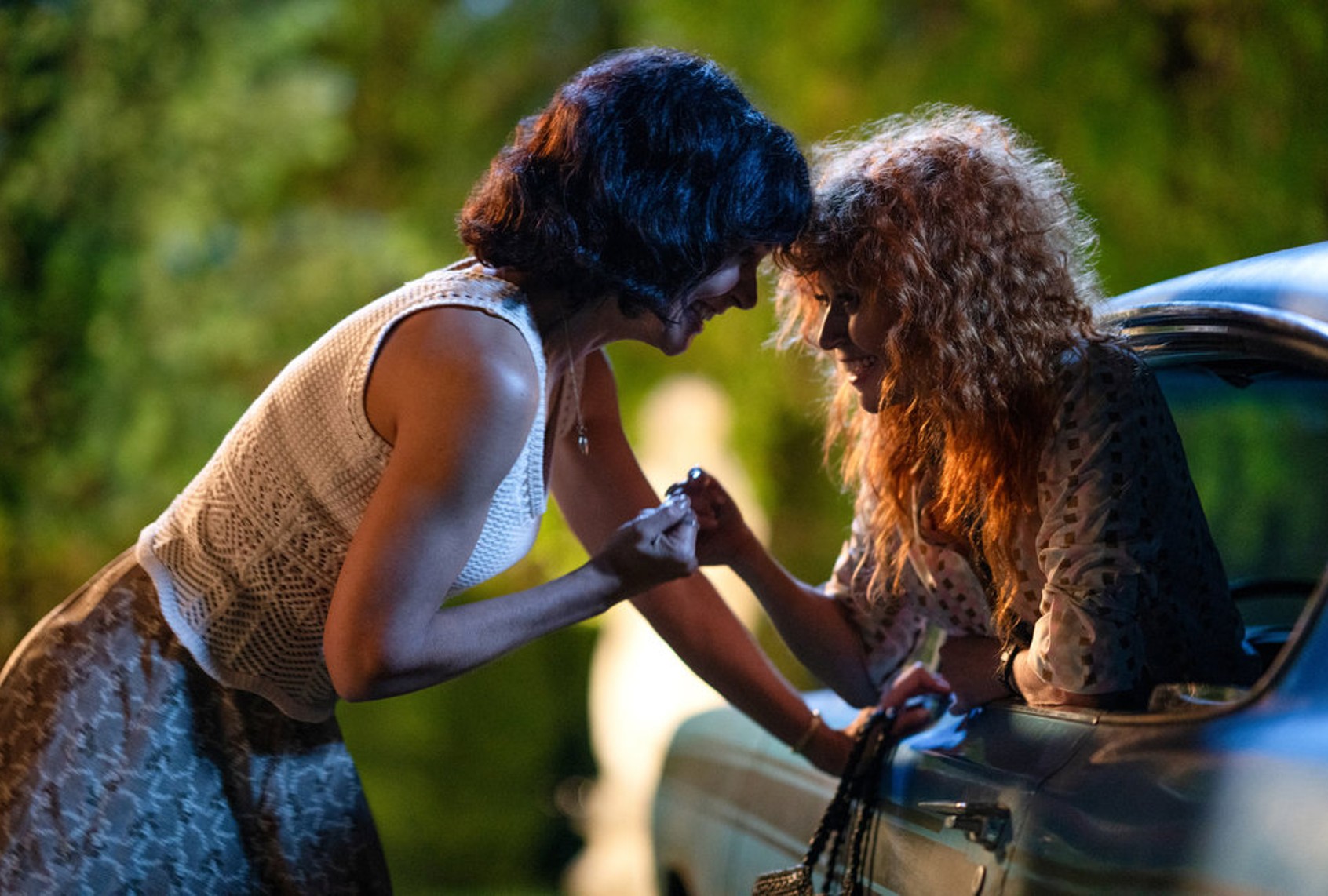
Katie Holmes and Natasha Lyonne in "Poker Face" (Sarah Shatz/Peacock). The second season premiere finds Charlie still living in her car and scraping by on odd jobs, only now she’s dodging Beatrix's hitmen and their bullets. (In one of the season's funnier moments, she complains about that to her tormentor, who replies, “Ah Jesus, you Millennials – b**ch, b**ch, b**ch!”)
Watching Lyonne’s heroine tap dance away from strafing fire gets old pretty fast, but at least Johnson and his writers realize that. Within the first three episodes, which premiere in a single drop, the holdovers from Charlie’s old life resolve, and her story becomes as open as the country is wide.

We need your help to stay independent

It’s been a very long while since a show featuring a rootless protagonist managed to keep its edge and relatability without doing itself in with narrative drift. But then, Charlie Cale also fulfills a benevolent kind of fantasy of real freedom. She's debt-free, has few possessions, gets along with decent people and doesn’t need much to be happy. Charlie has much in common with Jack Reacher, minus his penchant for extralegal slaughter.

This show uses its stars to affectionately poke at roadside Americana with a winking artistic intellect.

Instead, the murders happen around her, and for quotidian reasons. The game of “Poker Face” allows us to see who commits the crimes and how; it’s up to Charlie to figure out what happened based on what people tell her. She favors helping working-class grunts and tends to take down killers who knock off people for entirely average reasons — money, fame or property.

One late-season episode gratifyingly breaks the mold, centering on an overly eager elementary school apple-polisher who . . . well, let’s not spoil it. But it’s worth singling out Eva Jade Halford for her comedic and unsettling turn as the episode's main guest star, playing a coddled devil child. Her performance is just one of many surprises that highlight the show’s ability to flaunt its cleverness without smothering it in celebrity schmaltz.


Want a daily wrap-up of all the news and commentary Salon has to offer? Subscribe to our morning newsletter, Crash Course.


On the contrary, this show uses its stars to affectionately poke at roadside Americana with a winking artistic intellect. “Poker Face” doesn’t just take us to a cop conference, but makes sure we notice its cover band is called Yolo Tomassi, a parodic “L.A. Confidential” reference to a name that sparks one of the best poker face reactions in all of cinema.

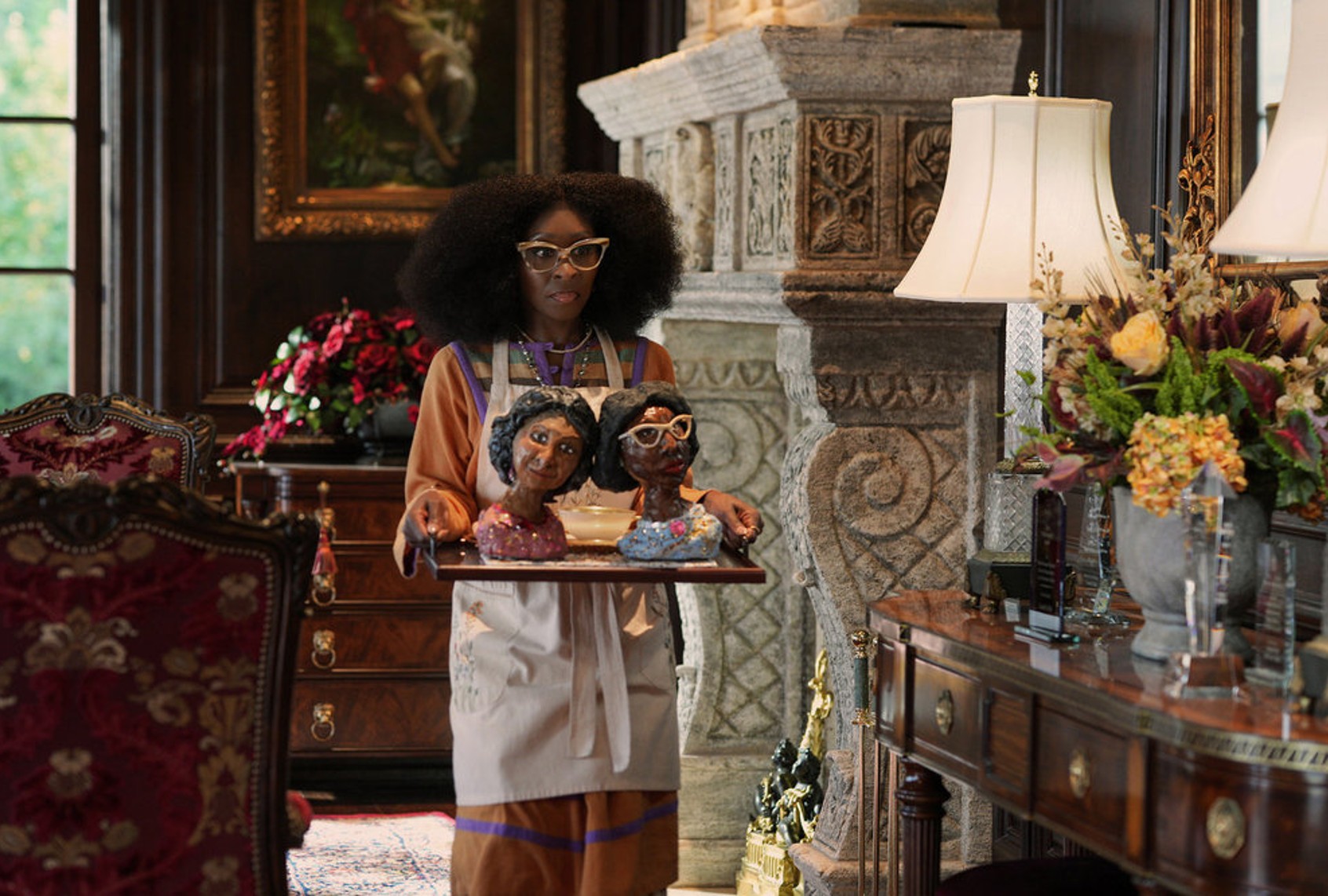
Cynthia Erivo in "Poker Face" (Sarah Shatz/Peacock). Then again, maybe that’s a popcorn kernel for critics and other nerds, like another episode’s throwaway line from a former journalist who says she got blackballed for sucker-punching Rex Reed. Other jokes trade in more broadly-appealing cleverness; for example, that same brief frame at the cop con show featuring Yola Tomassi singing “Frisk and Shout” in the style of The Beatles.

It's the little cues that make “Poker Face” a TV comfort quilt, joining highbrow humor and an accessible tone, with Lyonne’s benevolent energy and rumpled chic holding it all together. You may want Charlie to stay on her summer road trip forever, and she just might. For now, it is enough that the show gives us 10 superb reasons to sit with it, appreciating how sturdy some entertainment styles and mechanics that worked decades ago remain even now, when the right hands are on the wheel.

Season 2 of "Poker Face" premieres with three episodes Thursday, May 8, on Peacock.

Inside the new regime: Source says Team Trump is growing “disillusioned”

It is time to stop examining the chaos and time to do something about it.

I have a source inside the Trump regime who feels, in their own words, “a little disillusioned.” This person says they signed on to the Trump team because of “DEI going too far” and because “woke culture was dividing the country,” but is now concerned about the “blatant criminal behavior” of Donald Trump. Really? His last administration didn’t show you that? Well, OK.

This source first approached me by saying, “I can provide you bonafides to show you I’m serious.” That impressed me because I didn’t think many people inside the Trump regime knew what bonafides were, let alone how to be serious.

This source’s concerns about Trump are indeed legitimate, and deserve to be heard. “Not all of us are buying everything he says,” this person told me. “We understand the problem, but we see no solution. You guys in the press, with very few exceptions, are not trustworthy. Congress can’t be trusted and the judiciary so far hasn’t been able to stop him.” 

So what about the Democrats, I asked? “They hate us and won’t accept us. And if they don’t change their attitude, Trump and MAGA will keep winning.”

That was echoed by former Republican congressman Joe Walsh, who regularly speaks out about this. “If there’s not room for center-right former Republicans in today’s Democratic Party, then today’s Republican Party will remain victorious and our democracy will disappear,” Walsh told me.

To the point about the many failures of so-called reporting on Trump, this week we in the press continue to concentrate on the laughable comic-book aspects of his presidency while asking him meaningless questions about largely irrelevant issues. There is very little real reporting on the dire results of his failed policies.

If you want to laugh about a picture of Trump holding a red lightsaber on May 4, or about that AI-generated photo of Trump as the pope, join the millions who think it’s all lowbrow comedy. If you want to laugh about Trump reopening Alcatraz, go for it. I know I did. But there is something we’re missing by simply mocking the tragic and demented character who once again resides at 1600 Pennsylvania Avenue.

Trump told an ABC News reporter that the Declaration of Independence was a "beautiful" statement of "unity," and that nonsensical description got far less ink and airtime. For the record, the Declaration includes a description of the king of England that Trump should memorize, and perhaps recognize: “A prince whose character is thus marked by every act which may define a tyrant is unfit to be the ruler of free people.”

If you want to laugh about the picture of Trump holding a red lightsaber, or about that AI-generated photo of Trump as the pope, go for it. But there's something we're missing by simply mocking him.

Trump told another reporter he was unsure if everyone should be provided due process, although the U.S. Constitution explicitly says so. He also said he was unsure whether he was responsible for upholding the Constitution, although the oath of office he swore on Jan. 20 is entirely about that: "I do solemnly swear (or affirm) that I will faithfully execute the Office of President of the United States, and will to the best of my ability, preserve, protect and defend the Constitution of the United States." 

“I  don't know. I'm not, I'm not a lawyer. I don't know," Trump told NBC News' Kristen Welker on "Meet the Press" after she asked him whether everyone on U.S. soil is entitled to due process in a court of law. When asked whether he has to uphold the Constitution as president, he again said, "I don't know,” followed by this: "I have to respond by saying again, and I have brilliant lawyers that work for me, and they are going to obviously follow what the Supreme Court said." 

Some have suggested this was a brilliant maneuver, giving himself some degree of plausible deniability. Others, like his niece Mary Trump, say it is just another indication of his mental decline: “There is no worst with Donald Trump. Every day is just worse than the day before.” 

While I tend to agree with Mary on that point, my White House source says we are all missing the point. "You want to know who is influencing him and you want to talk about the destabilizing results of this man in the White House," my source said. "If you want to know who's influencing him, then take a look at who has walk-in privileges in the Oval Office."

We need your help to stay independent

So this isn’t just about Trump’s mental decline, “which is a given,” as my source put it. Rather, it’s about who is able to prod him into pushing their own private agenda. Trump is well known to be most influenced by the last person he spoke with, and to have that privilege one must be able to walk into the Oval Office without an appointment. There’s one administration official who recently told reporters he can do this: deputy chief of staff Stephen Miller.

“He is very good at getting the president’s ear by telling him things Trump wants to hear,” I was told. “And he doesn’t mind waiting — and being the last in the room to talk.”

That's frightening. It implies that Trump has no idea what to do and relies on others for validation of his actions — and since those people have their own agendas, our nation is a rudderless ship.

One prime public example of Trump bowing to Miller came during a recent Oval Office meeting with the press. Trump asked Miller whether the administration had won a case before the Supreme Court — one in which the court ruled 9-0 against the president.

“Miller said we’d won when Trump had lost,” my source explained. “No one pushed back on that, and Trump loves to hear Miller defend him. Trump believes him.”

Stephen Miller "is very good at getting the president’s ear by telling him things Trump wants to hear," I was told. "He doesn’t mind waiting — and being the last in the room to talk."

Most reporters left in the press pool at the White House are not confronting Trump because they are propagandists pretending to be reporters. They are delighted to have access to the president and love to make fun of the remnants of corporate media. With the wire services kicked out of the pool, and the subsequent loss of experience and professional acumen those reporters represent — I especially regret the absence of Jeff Mason and Steve Holland from Reuters — quite a few of the so-called journalists left in the pool are unqualified to do their jobs. Trump, of course, benefits from that.

So, what passes for journalism these days? Here’s an excerpt from a recent report from the travel pool. “Pool has been assembled and our gear has been sniffed for explosives by a very gorgeous girl named Kora. Pool was also scanned with a magnetometer, but this was outside Kora’s area of responsibility as she lacks the opposable thumbs needed to hold that particular instrument.”

Cheesy? Yes. Funny? No. Cute? No. Reporting? Absolutely not.

One recent story about from the Pentagon has taken on a life of its own, posing the question of how bad it will be if Trump arbitrarily reduces the number of military generals by 20 percent, as Secretary of Defense Pete Hegseth has decreed. “Trying to achieve these cuts wholesale through a contrived and meaningless quota could deprive the military of significant operational acumen at a dangerous time in our history,” a Pentagon source told me on background. “Why 20 percent? Where did that figure come from? They should be made to explain it and, just as critically, how they aim to achieve it.”

So far, Trump hasn’t done that and reporters are too busy taking their time writing drivel to ask him. They ask where he’s taking Melania to dinner, or how he’s able to shoot rainbows out of his butt day after day. We did, of course, ask how Trump felt about Canadian Prime Minister Mark Carney telling him that the nation up north is “not for sale.” (One Trump insider called him “Art Carney,” who played Ed Norton the sewer worker on “The Honeymooners” — that’s even before my time.)


Want a daily wrap-up of all the news and commentary Salon has to offer? Subscribe to our morning newsletter, Crash Course.


Those most trapped at this moment, I believe, are the handful of people inside the administration — and it may be a growing handful — who haven’t completely followed Trump down his insane rabbit hole of hate, global conquest, greed, crypto-scam, racism, misogyny, voter suppression and delusions about ruling the world. There just isn’t any place for those people to air their grievances and reach out for help, and that almost guarantees that the dissenters will be few in number, and very quiet. 

Miller shows up in the briefing room to tell us that schools are teaching communism and claim that teachers are trying to turn five-year-olds transgender and they must be barred from girls’ basketball teams. Robert F. Kennedy Jr. tells us he doesn’t believe in germ theory but does believe in “chemtrails,” while suggesting that the measles vaccine contains aborted fetuses.

While literally painting the White House gold and spending every weekend at the golf course of his choice, Trump has half-acknowledged that the country may be headed for a recession, complete with empty shelves in shopping centers. We may all have to learn to do with less while he has more — and to  drive that point home, he wants to erect a ballroom on the South Lawn of the White House.

Meanwhile, Elon Musk is still slashing federal jobs and putting our national security at risk, while Vice President JD Vance and Secretary of State Marco Rubio praise the neofascist party in Germany. Those who have Trump’s ear definitely include Musk and Rubio. The former, who was ridiculed as “Liddle Marco”  during the 2016 Republican primaries, has become one of the most powerful players in Trump’s Cabinet. Not to mention that he’ll probably have six titles before the end of the week.

Rending of hair and gnashing of teeth may be picking up speed behind the scenes in what’s left of the Republican Party — but right now that anguish has no outlet.

Rending of hair and gnashing of teeth may be picking up speed behind the scenes in what’s left of the Republican Party — but right now that anguish has no outlet. Meanwhile, with a compromised press and Trump ignoring any judicial ruling he dislikes, the Democrats are still no help. They’re nearly as crazy as Trump if they think that Alexandria Ocasio-Cortez could be a viable presidential candidate. No matter what they think of her policies, very few Republicans who despise Trump would vote for her. “I wouldn’t,” my White House source told me. “I’m not crazy. The far left is as bad as the far right, and they’re the reason I voted for Trump.” There are plenty of moderate Democrats who agree.

Meanwhile, Senate Minority Leader Chuck Schumer promises to write another stern letter to Trump.

Those of us who’ve covered this comic-book nonsense before are in lockstep with my disgruntled source inside the White House: We want to get past all the deflections and concentrate on how Trump is destroying the country and how, just maybe, the United States can be reunited. “United we stand. divided we fall” — remember that one? 

Someone has got to start talking about “inclusion” instead of division. I believe Joe Walsh nails that point. There are those on the right who would vote for a Democrat after all this trauma, or who might, if they felt like they’d be heard. At the very least, they might be willing to come forward and speak on the record, if they weren’t afraid they’d be prosecuted by Trump and ignored by everyone else.

Young people can’t save democracy by themselves: A new vision is required

Right-wing thought leaders and strategists have long understood that their radical revolutionary project is multigenerational. They must win the “hearts and minds” of young people in the present (and control how young people conceptualize the past) for their revolutionary project to succeed in the long term.

Under the guise of "patriotic education" and countering the supposedly pernicious influence of "DEI," the Trump administration and its allies are working to impose a thought-crime regime targeting the country's schools, including its leading universities and colleges. As part of this thought-crime regime, the Trump administration and its forces are also reshaping public memory by literally Whitewashing the country’s museums such as the National Museum of African American History and Culture. The ultimate goal of this campaign to control public memory is to normalize the dominance of white men over all aspects of American society. 

On this distorted and grossly inaccurate version of history and reality, historian Heather Cox Richardson writes: “The erasure of Indigenous, Black, Hispanic, and female veterans from our military history is an attempt to elevate white men as the sole actors in our history. It is also an attempt to erase a vision of a nation in which Americans of all backgrounds come together to work—and fight—for the common good.” In a separate essay, Richardson neatly explains the goal of Donald Trump’s political vision as “Trump is demonstrating that he intends to create a country dominated by the right-wing, white men who supported him."

Meanwhile, mainstream liberals and progressives almost obsessively look to young people as their hope for the future. After their defeat in the 2024 Election, many still assume that younger voters will lead an inevitable triumph over Donald Trump's MAGA movement and the larger authoritarian right. This logic seems sensible, at first: Young people tend to be more liberal, open-minded, and receptive to change. More specifically, liberal or progressive policies broadly associated with the Democratic Party — whether on race, gender and sexuality or on education, environmental issues and economic inequality — are generally more attractive to young people than the retrograde policies offered by today’s Republicans.

This is related to the Democrats' longtime faith in the presumed effects of the “browning of America”: Demographics are believed to be destiny, and generational replacement — as older, predominantly white cohorts are replaced by increasingly diverse and tolerant younger generations — is sure to defeat the authoritarian MAGA upsurge. Democrats, in this reading, may not have a compelling message or brand but do not need one. They earnestly believe that the actuarial tables will act as a force multiplier for their side.

Time to think again. This model of political change rests on underlying assumptions that are being fundamentally challenged, if not disproved, by the Age of Trump and the rise of authoritarian populism, both in the U.S. and around the world.

In the 2024 presidential election, young people as a group moved noticeably to the right; far more than expected, they supported Donald Trump and his brand of authoritarian populism. There was an increase in the percentage of young men aged 30 or below, both white and nonwhite, supporting Trump over the Democratic Party nominee Kamala Harris, while Black and brown young women overwhelmingly supported Harris. For the second election in a row, a majority of white women voted for Trump. (Trump also carried white women against Hillary Clinton in 2016, if only by a narrow plurality.)

Perhaps the most striking finding of Yale's new poll: The youngest voters, aged 18 to 21, supported Republicans by 11.7 percentage points in the 2026 election. Among slightly older voters, aged 22 to 29, the Democrats led by 6.4 points.

A new poll from Yale University provides more evidence that the iron grip that Democrats believe they have on younger voters may actually not be that strong. The Yale Youth Poll is an undergraduate-led research project that compares a group of voters under 30 to the general population. It sampled 4,100 registered voters, just under half of them aged 18 to 29.

One of its more striking findings is that the youngest group of voters, aged 18 to 21, supported the Republicans by 11.7 percentage points in the 2026 election. Among slightly older voters, aged 22 to 29, the Democrats led by 6.4 points.

Many of these younger GOP voters appear to be true believers: The Yale Youth Poll reports that when asked "what is most important for Republicans in the next election," just over 51 percent, across age groups favored “energizing and turning out the base, by running on conservative, America-first policies" rather than trying to “appeal to the swing voters and independents.”

Intriguingly, a similar split emerged among Democrats, with a large majority of both younger voters and all Democrats saying the party should run on be “progressive policies that give their voters something to vote for” rather than "moving to the middle to appeal to swing voters."

We need your help to stay independent

I emailed Yale political science professor Josh Kalla, faculty adviser to the Yale Youth Poll, who offered additional context. Younger people as a whole, he said, "tend to hold many pro-democracy views." While a strong two-thirds of voters in the poll supported "checks and balances where courts can constrain unilateral presidential action," 76 percent of young voters support this. On some issues, younger voters indeed appear more progressive, Kalla continued, while on others there isn't much difference. He sees "evidence of a divide within younger voters" which has been described as "the theory of two Gen Z's":

The student researchers … are finding that different experiences with COVID-19 and technology might be leading the youngest voters to lean more conservative than older Gen Z voters.

Consistent with evidence from Yair Ghitza and Andrew Gelman, young voters have not always leaned Democratic. Driven by political events in young people’s formative years (ages 14-24), sometimes young people lean Democratic, but other times they lean Republican. For example, young people born in the 1940s and 1970s tended to vote Republican, even when they were 20 years old. Differential experiences with COVID-19, the first Trump and Biden Administrations, and technology could explain why the student-researchers behind the Yale Youth Poll find this gap within Gen Z.

I also asked Milan Singh, founder and director of the Yale Youth Poll and a current Yale undergraduate, why he believes younger voters may be drifting toward Trump and the right. He also responded by email, identifying "several possible reasons": 

One is ideological polarization, particularly among younger nonwhite voters. If you look at the data from 2024, Kamala Harris won a large majority of Black voters over 65 who self-identified as conservative. But she lost self-identified Black conservatives under 28. Similarly, Harris did worse with younger Black moderates than older Black moderates, and with younger Hispanic moderates/conservatives than older Hispanic moderates/conservatives. Older nonwhite voters tend to vote heavily Democratic regardless of ideology; younger nonwhite voters are increasingly voting in line with their ideological views. Generational churn means that the net effect is that Democrats are losing ground with nonwhite voters. 

Another well-attested factor is continuing gender polarization. College-educated women between 22 and 29 leaned strongly Democratic in a generic ballot, Singh said, while non-college women did so only slightly less. In that same age group, however, college-educated men were only slightly Democratic, while non-college men leaned strongly Republican.

"Different experiences with COVID-19 and technology might be leading the youngest voters to lean more conservative than older Gen Z voters."

But among the youngest quadrant, voters 18 to 21, came the surprise: Both men and women favored Republicans, although young men did so to a much greater degree. "Among men 18 to 21, Donald Trump's net favorability was +7," Singh said, while "Kamala Harris' was -48. Young men are much more right-leaning than young women are left-leaning, so the net effect drags young people overall to the right. … [T]he youngest women are also more right-leaning than older Gen Z women." He continued: 

It's not quite clear what is driving this level of gender polarization. If I had to guess, I would say social media. Social media platforms like Instagram or TikTok increasingly create gender-segregated media spaces. If you're a man under 25, you've probably heard of Andrew Huberman; none of my female friends have. Online environments that are this gender-segregated can easily become echo chambers where young men are exposed to extreme views; there is some evidence that the youngest cohort of men is more likely to believe things like "gender equality has gone too far."

As to why young women are more right-wing than older Gen Z women, I think the best explanation is that COVID-19 was a uniquely disruptive event, which made people who were teenagers during it much less trusting of government and institutions. In particular, many of the excesses of the pandemic era — lockdown orders, mask and vaccine mandates, inflation, "wokeness" — were attributed to the left (fairly or not). It probably also did not help that a visibly aged and elderly man was the public face of the party. 

Public opinion polls are a snapshot in time and do not predict the future. They should be interpreted in the context of other polls, data, research and evidence. In a new essay, data journalist G. Elliott Morris offers these observations about young people's purported levels of support for Trump and the MAGA project. He cites the Cooperative Election Survey's finding that Kamala Haris actually won "all subgroups of young people":

There has been some debate online about who is right here…. Let's start with the newsy data. According to a new poll published by the Pew Research Center on April 23, 2025, only 36% of adults between the ages of 18-29 approve of the job Trump is doing as president today, vs 63% who disapprove. That's a net gap of 27 points against Trump, compared to an exit poll estimate in 2024 of Harris +4.

Comparing Trump's approval directly to the results of the 2024 election, that's a pretty huge (23-point!) shift. This means there's a large group of young people out there who do not like Trump, but voted for him last year because either (a) they did like him then or (b) they liked Trump more than Harris. There are also a lot of young people who didn't vote at all.

Morris concludes that his answer is simpler: "My theory is that young people weren't very 'Trumpy' to begin with, and they're not particularly pro-Democratic now. Instead, they're anti-incumbent." The logical conclusion to draw from "vote choice among young people in 2024" and Trump's declining approval ratings now is to see them as "two compatible votes against the status quo."


Want a daily wrap-up of all the news and commentary Salon has to offer? Subscribe to our morning newsletter, Crash Course.


I asked sociologist Randolph Hohle, an expert on race, culture and political economy, for his thoughts on the Yale Youth Poll and the conundrum of young people’s shape-shifting politics in this era of crisis. By email, Hohle responded that "Any reaction to polls indicating that 18 to 21-year-olds favor Republicans is an overreaction. Generation is a marketing slogan, not a meaningful social group":

We have to remember that the young adults sampled in the Yale poll are the first to come of age politically after the Great Recession and during the pandemic. They don’t know what a functioning and fully-funded social institution is. Those in the 18-21 category were teenagers when the pandemic started. The most meaningful institution in their life, education, has been a mess. If we disaggregate the education data a bit, boys are suspended from schools way more than girls are. Black boys are suspended the most, prompting critics to point out a racialized school-to-prison pipeline. Fourteen percent of 25-year-old men are not in the labor force, a statistic that has been on the rise for decades. The 22 to 29-year-olds who are still “liberal” entered college after the recession. Basically, every state took advantage of the Great Recession to reduce public funding to state schools while increasing tuition, fees and housing costs.

"The young adults sampled in the Yale poll are the first to come of age politically after the Great Recession and during the pandemic. They don’t know what a functioning and fully-funded social institution is."

Between increased student debt and failures in K-12 education, Hohle continued, "A majority of the nation’s 36 million workers ages 25 to 34 have not completed a four-year college degree. The media’s unhealthy obsession with the Ivy League … has young people conflating status with success and happiness. Broken institutions make broken people, and the Republican Party excels in telling stories about reclaiming an imaginary greatness that will fix them."

I asked Eric Schnurer, an expert on public policy and government effectiveness, for his thoughts about the Democratic Party and its relationship to young Americans, a group that is clearly foundational to the party’s base and essential to its electoral fortunes:

It's a mistake to conceive of politics in one era as simply an extension of that in another. Tropes about younger Americans being liberal, or the future belonging to Democrats because that’s who today’s youth are, start turning upside down: What it means to be liberal or conservative is changing, and Republicans are simply doing a better job of recognizing and adapting to that than are Democrats. Over the last two or three decades, the Democratic Party and progressivism have become the domain of more highly educated, higher-income Americans; they no longer speak to the needs and interests of most working Americans, and they rather determinedly don’t want to do so. More importantly, Democrats represent the status quo in an era when just about everyone thinks the status quo is failing and they want dramatic change — and this is even more true amongst younger voters.

Trump has done a good job of articulating “a populist economic agenda … that unites large numbers across current party lines," Schnurer said, even if he has no intention of enacting it.

"I’m not particularly optimistic about the ability of the Democratic Party leadership to reorient itself and seize those possibilities," he continued, "because it’s too wedded to the inherited status quo in an age that craves a dramatic break with the past — especially amongst the young who will inherit the future. Trump gives them that, if a dystopian version of it: Where’s the completely innovative liberal version?”

Social theorist Henry Giroux is a leading expert on the relationship between young people, culture, education and politics. He highlighted the troubling implications of the Yale Youth Poll and what the potential right-wing drift of the youngest Americans may mean for the future of the country’s democracy and civic life.

"I'm not particularly optimistic about the ability of the Democratic Party leadership to reorient itself and seize those possibilities. … It's too wedded to the inherited status quo in an age that craves a dramatic break with the past."

“The Yale Youth Poll confirms what some of us have long insisted: Youth alone will not rescue a democracy hollowed out by gangster capitalism and ruled by demagogues who traffic in white Christian nationalism, white supremacy, cruelty and corruption….The fantasy that generational replacement will automatically yield justice is a dangerous illusion — one that absolves adults of their moral and political responsibilities while rooted in an essentialist notion of politics.”

Giroux continued:

The deeper truth is this: education is not the handmaiden of politics — it is its lifeblood. In an age where culture is the primary battlefield, authoritarianism thrives on ignorance, historical amnesia and the brutal aesthetics of cruelty normalized as common sense. Reclaiming education and public space is no longer optional — it is the condition of survival. We must cultivate a critical consciousness rooted in attentiveness: to history, to the structures of power, to the unseen and the silenced. This means connecting ideas to action in ways that dismantle forms of ideological and economic domination and nourish an ethical imagination bold enough to think what the present declares impossible.

Young people need more than slogans; they need a political vocabulary shaped by the lessons of history, alert to how fascism masquerades as freedom while delivering repression, how it weaponizes the rhetoric of order to erase the memory of resistance.

It took many decades for the Age of Trump and American neofascism to become a reality. It may well take decades of political struggle and hard work to unmake or escape resurgent American fascism and remedy the deep institutional and cultural failings that allowed and nurtured such political formations to take hold so quickly.

Younger people will of course play a central role in any such project of democratic renewal. On the other hand, that cohort could may also play an equally important role in cementing the Age of Trump and locking down authoritarian populism as the governing mode of American society.

Trumpism, authoritarianism and other forms of extremism are offering too many alienated younger people apparent answers and a compelling narrative, along with community and a sense of meaning. In the end, all that will prove toxic, but so far the Democratic Party and other mainstream elites and opinion leaders who believe in “the system” and ‘the institutions” are not offering an equally compelling narrative. The future must be won in the present. Unfortunately for the future of American democracy and freedom, the current Democratic Party is still looking backward to a vanished status quo and an obsolete understanding of politics.

Investors are still asking female founders about their future kids — even at a Gates startup

Phoebe Gates, 22, is not a typical entrepreneur. She’s the daughter of Bill and Melinda Gates and a Stanford University graduate navigating the minefield of Silicon Valley fundraising. 

Yet even with her last name, she has had to field the same tired questions that have plagued women for decades — questions like how having kids will impact their careers.

Gates and Sophia Kianni co-founded Phia, an AI-powered app that compares fashion prices for shoppers. According to Fortune, when investors pressed her and her co-founder Sophia Kianni about their plans for starting families, Gates turned to her mother for advice.

“Get up or get out of the game,” was Melinda Gates’ response.

While you may not have a Melinda Gates in your life to call on, recent studies show that gender stereotypes continue to persist far beyond the rarefied world of fundraising conversations between founders and investors. At a time when even some of the most privileged women in America are still forced to play by rules written in another era, experts say it’s up to the rest of us to rewrite those rules, one uncomfortable conversation at a time.

“Despite the progress we’ve made, outdated assumptions about women’s long-term commitment to work — particularly around motherhood — continue to surface in subtle and not-so-subtle ways,” Eloïse Eonnet, head career coach at The Muse, told Salon. “In my work with women leaders, I still hear stories of being asked in interviews how they’ll ‘manage it all,’ or being passed over for roles based on the possibility they might have children.”

We need your help to stay independent

The data backs her up: The Muse’s 2024 Women’s Workplace Experience Report found that 42% of women have encountered gender-biased or inappropriate questions during the hiring process, with C-suite women facing it at even higher rates. 

“These questions aren't driven by true curiosity, they’re about bias in disguise and they often stem from narrow definitions of leadership and rigid assumptions about what success looks like,” Eonnet said. “If we want to build inclusive organizations, we have to interrogate not just what’s being asked but why it’s still being asked in the first place.”

The so-called “motherhood penalty” is well documented, according to Iris Bohnet, professor and co-director of the Women and Public Policy Program at Harvard Kennedy School. 

“Research by sociologist Shelley Correll and colleagues shows that mothers are perceived as less competent and less committed to their jobs, less likely to be hired or promoted and paid less than women without children or men,” Bohnet said.

79% of women believe that recent moves by companies and the federal government to roll back DEI initiatives will negatively impact their opportunities

The broader trend is not encouraging. According to Fairygodboss’s 2025 Women in the Workplace Survey, 79% of women believe that recent moves by companies and the federal government to roll back diversity, equity and inclusion initiatives will negatively impact opportunities for women, according to the data shared by the company with Salon. The same survey found that women with higher education levels are especially concerned that leadership and mentorship opportunities will dwindle.

What’s the way forward? Bohnet’s advice is blunt. 

“First, I would give the employer advice not to ask such personal, and often illegal and discriminatory, questions,” she said. “Our first priority has to be to build workplaces where all can thrive.” 

"Our first priority has to be to build workplaces where all can thrive"

When it comes to female students, she advises them to prepare well. 

“Be aware of the stereotypes that are still out there, and come well-prepared for pitches, salary negotiations and the like. It is good to know and demonstrate one’s worth through an outside offer, past accomplishments or brilliant ideas — and stay focused on what you bring to the table.”

While documenting your accomplishments is solid advice, Eonnet takes this advice a step further, encouraging women to remain committed to their values in the face of persistent bias and be discerning about where — and with whom — they choose to invest their talents.

“If you’re in an environment that routinely questions your commitment or potential because of your gender or life choices, that’s not a reflection of your capability — it’s a reflection of that person or organization’s limitations,” she noted. “Surround yourself with spaces and people who recognize that leadership is expansive — not defined by outdated norms, but shaped by impact, integrity and vision.”

More than a plague: How colonialism, class and incarceration feed disease outbreaks

For a historian with an interest in the intersection of factors that propel an epidemic, 2020 offered a living case study. Edna Bonhomme, a historian of science with a PhD from Princeton, was living at the time in shared housing in Berlin, one of 11.7 million foreigners in Germany. As a person of Haitian descent, she is acutely aware of the complexities of Black life in a country where racism has its own face, similar but also different from anti-Black racism in the U.S. 

She began speaking to Black women with different experiences from hers: a kink-positive sex worker from the U.K., an asylum seeker, a cancer survivor, exploring the strange ways that the COVID-19 pandemic and resulting lockdowns interacted with a wide variety of privileges and privations, histories of oppression and struggle against it. 

From Berlin, she watched the Black Lives Matter demonstrations after the murder of George Floyd, and she read Virginia Woolf, and histories of plagues: on plantations in the U.S. south; in Liberia, where a crisis of resources for public health exacerbated a 2014 outbreak of what turned out to be Ebola; in German-colonized East Africa. "From Berlin," she wrote, "I was afforded the space to write, breathe, and be debt free." And to write "A History of the World in Six Plagues," a new book which traces human history through our relationship with illness.

Delving into childhood memories and the history of her family, migrants to Miami from Haiti, literature of all kinds, and historical accounts of plague, Bonhomme's account is indeed structured around six historical and modern plagues, but in each section she follows where the subject takes her. This approach results in nuanced, grounded examinations of the actual, material conditions in which the epidemics of sleeping sickness, cholera, influenza, HIV, Ebola and COVID-19 she describes took (or continue to take) place. Not leaning on any one interpretive framework that might exclude relevant factors, Bonhomme considers the highly intersecting and variable impact of colonialism, racialization, gender roles and attitudes towards the human body, and, most strikingly perhaps, class, specifically in its intersection with race.

Bonhomme weaves in engaging and poignant personal experiences as well. Her traumatic experience of quarantine in an extended hospital stay in Miami as a four-year-old with typhoid fever becomes a motif as she addresses the infection-limiting benefits of isolation and confinement — and the loneliness, dislocation and even chaos to which confinement can lead. Connecting forced and chosen quarantines with experiences of incarceration, she explores also the solidarity that can arise in situations of the greatest difficulty and oppression. Also woven through the text is that surreal experience of living through the early pandemic years in Berlin, of leaving shared housing to live more traditionally with her partner (a kind of chosen quarantine at the time), of being Black in Berlin (a different kind of isolation), of choosing to get married — an impulsive and rebellious choice, at a time when isolation was the rule — and of experiencing a miscarriage minutes before they were expected at Copenhagen City Hall, where they'd absconded to wed.  

This interview has been edited for clarity and length.

How did you settle on the six examples of illnesses you chose? 

I decided to focus on epidemics that were also tied to important historical events and institutions. And so I started off with the plantation as a site that, on the one hand, I would describe as a torture camp, a site in which people were forced to work, and it was quite difficult, and it was also profitable for some people, but it was also a site that made people sick [with cholera.] Various scholars have looked at that and unpacked [questions like] what was happening to Black lives on plantations, and how do we make sense of people's ability to survive? 

Part of the reason that I wanted to think about sleeping sickness is because it was considered a massive epidemic, and specifically because it interfered with, or at least Europeans thought that the disease interfered with, labor. The other diseases — the flu, HIV, Ebola and COVID — are ones that we live with today. With each of the epidemics that I chose, it wasn't just a case of thinking about what was the most popular, or perhaps even what had the most impact, but rather, how did people who were tied to these various institutions, in which confinement was very much part of perpetuating some form of oppression at different times… how do people figure out ways to survive in spite of those various forms of oppression and those various institutions?

You talk about the labor impact of sleeping sickness. That immediately made me think of the intersecting issues with COVID of frontline workers who would typically be racialized, and often women who have had to assume higher levels of risk, and often without a lot of clarity or ability to confront the fact that they're at higher risk for a whole other range of structural reasons. So I wonder if you could could address those parallels.

Yeah, so I think they are two very different diseases. COVID is a highly infectious airborne disease that was quite novel to us in terms of when it emerged in 2019 and it's something that we're still living with and still learning from. With long COVID, there are the studies suggesting that [sufferers are] more likely to have cognitive difficulties and so forth. So COVID is still fresh. It's still new. It was quite global in terms of its impact. 

By contrast, something like sleeping sickness is spread through a fly, the tsetse fly. And it was quite regional in the sense that it has mostly been something that has impacted people in sub-Saharan Africa. I wanted to differentiate the two in terms of not just the biology and the modes of transmission, as well as the regions they come from, but also to point out that the vulnerability and the risk are fundamentally different. 

Ultimately, for people who are marginalized in some capacity, those who are frontline workers, essential workers, those who don't have the ability to have paid rest and time off, or to be able to self-isolate for whatever reason, and have the freedom both to move and to be still, a disease can be more formidable than for those who do have the privilege to have a safer space to rest.

So I was also thinking about policy. The decision to confine people in the case of sleeping sickness, and with COVID-19, the decision to move people back to work in high-risk situations, knowing that it's only certain people who actually had to do that. In other policy-making relating to pandemics, is that a common theme? One of the things I really appreciated in this book is the combination of class, which is something that is so rarely frankly discussed in North American discourse, with racialization and gender issues. So I'm just curious about how often that question of whether people of people as productive labor plays a role through the other examples that you saw.

"Confinement was very much part of perpetuating some form of oppression at different times… how do people figure out ways to survive in spite of those various forms of oppression?"

Absolutely. In fact, the slavery question is a question of labor, and it's a question of racialization of a particular form, a set of laborers who didn't have much of a choice or agency outside of escaping or attempting to escape, or in some cases, inflicting physical harm to the body and the self, or suicide. Being sick and not having the care that was needed to recover, is essential to the question around how we think about epidemics. 

Beyond that, particularly with the slavery chapter on cholera, there's also this: for some plantation owners and enslavers, it was kind of acceptable for there to be a poor quality of life, so long as there wasn't a major threat to the enslaved subjects, because all they needed is to make the market profit margins. And so the question around workers having to move through their labor even when they're sick, whether it's something as mild as the common cold, the flu, or as major as COVID, is a major issue.

Beyond infectious diseases, one of the major issues in the U.S. context … What does it mean that, especially in the U.S., where there's not a universal health care system, if the person, even if they have health care through their job — what does it mean for them to have to continue working while receiving chemotherapy, and how does that impact their ability to survive post-treatment, post-chemotherapy? 

Unfortunately, I know how that impacts someone quite well. Someone in my family was diagnosed with cancer in the early stages of the pandemic, had to continue working in order to maintain their insurance and at one point passed out and had a brain aneurysm while working, and that really made it difficult. And then a couple of years later, they died. So that's America, ultimately. And that is something that we have to think about, like how forced labor, or even just like forced labor through what Marx would call wage slavery, continues and does a number on and damages the body's ability to heal. 

Speaking of public health, we're right now witnessing this massive attack on it in the U.S. You've discussed private communities of care, there's the Black Panthers, there are COVID-cautious groups, there was mutual aid through the HIV/AIDS crisis, and it sort of relates to the other question: to what extent can these be an adequate alternative to public health?

These mutual aid networks, in which people are providing direct action, direct services, direct resources, even just circulating funds and redistributing it within a social network, can be quite vital for a community, and such an important indication of how people are ultimately good and want to help each other. Like, I don't want to discount the power and beauty of communities coming together, especially during crisis. We've seen this with the Los Angeles fires and how people have been helping with that. Nevertheless, obviously, I would say there's a limitation to what people, especially with their heavy hearts, can provide, and that there's a limit to also the money and the resources that can be distributed. 

To an extent it can be a lot more effective for governments to do that work of distributing resources and so forth because of the infrastructure that governments have. Nevertheless, we're currently witnessing the temerity of the U.S. Department of Health and Human Services, which is not an opinion that is unique to me, but it's something that we're seeing in real time, with one of the most prime examples of that recklessness — the measles outbreak — which, as we know, is a very contagious disease, extremely preventable, there's a vaccine that's highly effective, and yet what we're seeing is that vaccine skepticism is becoming normalized, and the number of cases has exacerbated. 

And while the current secretary for the Department of Health and Human Services has promised to support vaccines, one of the top vaccine regulators, I think it was, Dr Peter Marks, has said that he's not doing enough, and that is indicative of, I would say a callousness [toward] human life. Because ultimately, when one then says that the government is not responsible and people have to be on their own, whether or not they have the capacity to do so or not, it means that ultimately those who are the most "fit" will be able to survive, those with the most money, the resources and so forth, as opposed to ensuring that everyone has an equal opportunity to survive, to be cared for. Again, I'm always moved and impressed and content by the love and the care that people can provide within a community structure. And people should continue to do that — but it's not enough, and hopefully people can come together collectively to demand that the government should also be providing that care work.

You've also talked a lot about carceral societies and a wide variety of carceral situations. Right now we're seeing the open rise of some of things that have existed and affected some communities for years, but now are becoming blatant and very open. That is to say that a profoundly carceral and punitive society, with punishment based on class and racial lines, has always been a thing, but now we're seeing the open rise of deportation, isolation, surveillance and very strict punishment. You write in the book, "a world without prisons has become a far off possibility." You wrote that before the second Trump administration, I think. So what does this mean for plagues you've already described, like measles, and the effect there?

If I were writing another book and I wanted to expand what plague and epidemics mean, then I would actually think about non-infectious diseases as well. And I alluded to this in one of my previous answers by pointing to cancer. But of course, there are other epidemics that we are living with, particularly the opioid epidemic, which is very much an epidemic that is perpetuated by poverty, that is tied to desperation, that is tied to the ways in which communities have been devastated in a post-industrial context of jobs being gone and so forth, and that that epidemic is something that people are living with, and I would say, is something that various communities, particularly in the Appalachians and Midwest, are still struggling with.

In the book, when I talk about the prison question, it's how chronic diseases, early aging, specifically, tuberculosis, airborne diseases, are very much more likely to be present in a prison system than for a non-incarcerated population. Beyond that, if we think about this current moment in the United States, where there's an open war on migrants. Migrants who, in some cases are speaking about Palestine, students, what I would consider to be babies. These are young, idealistic, in some cases teenagers, and if anything, we should be commending them for being brave, and yet they're being hunted down by the U.S. government, or, most recently, people being taken by the U.S. government, accused of being part of gangs without any type of due process, suddenly deported to El Salvador

What implications does that have, not just for people's mental and physical state, but just for others who might also be fearing, "will I be next?" I think that ultimately, the question around deportations, with the question around anti-immigrant policies, is really a chaotic process that is also tearing apart, in some cases, the members of families that have multinational citizenship and/or resident statuses. And so in a sense, it's not purely about infectious diseases and epidemics per se, but rather the kind of the fear that it stokes within communities.

I think one thing that people have been writing about, and I'm also doing some research on right now, is how U.S. foreign policy is going to, especially with the cuts to USAID, impact the spread of epidemics currently in Latin America, Africa and elsewhere. What various countries of the African continent are doing, luckily, is they had realized back in 2014 with the Ebola crisis that they could not rely on the U.S., and so the formation of the African CDC since then has meant that there's far more coordination between African nations. I actually attended an online press conference that they had last week, because they do regular press conferences just to answer questions posed to the African CDC in a way that I'm like, "Oh, wow. This is great. Like, this is what should be done." 

But the reason I point this out is just to say that in the short term, and actually even medium term, it costs lives for us not to continue to fund the USAID, especially with specific programs around antiretroviral therapy. And at the same time, people are making do, particularly on the African continent, because they had already had a little taste of bigotry and exclusions more than a decade before. 

You describe how social networks play a role in survival under duress. You mentioned Palestine, which reminds me of resistance that has often emerged, specifically within the prison system in Israel. You said TB, and I think of Nelson Mandela. In some of the other examples you talk about, groups for both mutual aid and more long term resistance to oppressive systems have come from prison systems. I wonder if you could describe where it's relevant to dealing with the plague, perhaps the HIV example, how those sites of either very strict quarantine and isolation or actual formal prison systems, how those can also spawn resistance?

So one thing I would say is that I was lucky enough to organize and learn so much from formerly incarcerated people when I used to live in New York City and being involved in reading groups for people where we discussed the New Jim Crow. And beyond that, the kind of prison literature that helped inform me, everything from Antonio Gramsci's prison letters and notes to George Jackson's letters as well, helped to show me and even beyond that, just like Malcolm X, his autobiography as someone who was incarcerated. I had a political education that allowed me to see the power, strength and intellectual prowess of people who have been incarcerated, even though I would say mainstream U.S. society would suggest that those who have been incarcerated should be disposed of. 

In thinking about the prison and that education that I had, I also wanted to see how it was connected to the HIV/AIDS epidemic and how people in prison were coping with that. When I studied public health, there was this particular way of thinking about the prison as a "vector of disease." And I put this in quotes because so often people could be perceived as just potentially highly infectious without thinking about the human stories, about who they were, their names and so forth. I think that I wanted to have a perspective and a case study in my book about survival and about women coming together in one of the most oppressed spaces to do the work of not just theorizing what the prison can do to the body and the harm it causes, but also how mutual aid is happening and how people can exercise agency even under duress. 

The case of Bedford Hills Women's Correctional Facility in upstate New York, and how they formed the AIDS Counseling and Education Program during the height of the HIV/AIDS epidemic is also, in my opinion, a continuation of freedom fighters who are incarcerated and try to make do in these spaces, people who become part of a community, in some cases, and try to ensure the survival of the collective. I would say we can often move inside and outside of various forms of marginalization, but we can also exercise our own privilege, particularly when we form collectives.

We need your help to stay independent

What would an anti-oppressive but also effective response to infectious plague look like?

What I thought about this question is, how do we build systems of public health and public health policy more specifically, that don't feel oppressive, that aren't just a top-down approach where people feel like they can't trust authorities? And part of what people are thinking about is participatory observation, where public health officials actually work alongside communities. They have town halls, there's active surveys and so forth, asking people what they know or don't know and that they are also part of making decisions, in a sense, and a non-oppressive public health policy would be one in which it could be a democratic perspective. 

Unfortunately, there's a lot of mistrust in the United States, and in other countries as well, when it comes to public health officials, because the government doesn't provide — it feels like the government doesn't provide — much to society. And so in order to have an anti-oppressive system, one actually has to start building trust within communities and to really make things far more democratic, so that at least people's basic needs are taken care of, but that people's questions could also be answered, and that there could be active debates, not online, but actually in person. Even beyond that, I think that basic education in biology would also be helpful.

There's a clear love of literature, of diverse sources of knowledge and thinking, that runs through the book that's really lovely. I've always had a fascination with both prison literature and plague literature, which are very intersecting, overlapping things. I wonder if you could talk about those, about literature, and how those two types of literature played out in your writing of the story.

During the early portion of the COVID-19 lockdowns, I fell in love with literature again, and I wanted an opportunity to think about how being home, turning inwards, and just taking the time to reflect on what was happening outside also meant that I was okay and reveled in being able to enter into a space of fiction, into a literary world where I could suspend everything that was happening outside these walls. Literature, especially when the prose was enlightening and also jumped from the page, I felt would inspire me. But beyond that, I also wanted to get a sense of how writers, especially those that lived through wars, crises, outbreaks, how they made sense of it, and to an extent, some of the writers that I mentioned in the book, whether it's Virginia Woolf, Susan Sontag, even W.E.B Dubois, they exercise some type of privilege by virtue of having the time, the space to sit in silence and to write and to think and to be respected, once they were celebrated. 

And so I wanted to be able to be in conversation with these people, most of whom are dead, and have a way of, of not just referencing them, but showing that their words, the philosophical purchase, matters. And hopefully, for those who read the book, they can also be inspired to pick up some of that literature and find themselves thinking, Oh, wait, this perspective on the sick bed might help me during a time when I find myself dealing with surgery and so forth. So yeah, it's the literature that is what carried me through, but it's also something that's carrying me through life right now, especially as a parent now. My book is not a COVID book per se, but it's really a book about survival and how people make sense of outbreaks no matter where they are.

“Likely to generate inflation”: Fed Chair Powell paints bleak picture of US under Trump tariffs

Jerome Powell hasn't offered Donald Trump any slack during his second term, but he's certainly giving the president enough rope. 

The Federal Reserve chair once again refused to lower key interest rates as economic uncertainty around Trump's tariff scheme has slowed the American economy. Powell cited that very same uncertainty as his reasoning for keeping rates consistent during a press conference on Wednesday.

The wide-ranging tariffs promised by President Trump could cause a nightmare scenario where prices rise and the economy stumbles, a process that was commonly called "stagflation" during the crises that roiled the global economy in the 1970s. The straightforward Fed logic of lowering borrowing costs when the economy is struggling and raising them to counter rapid inflation is put in a double bind by the hypothetical, and Powell admitted as much.

"It's really not at all clear what it is we should do," Powell said. "There's so much uncertainty."

Powell offered a bleak idea of the future under Trump's tariffs as proposed, saying that the U.S. could see "a rise in inflation, a slowdown in economic growth, and an increase in unemployment."

Powell added that inflationary effects of tariffs could be a one-time price spike in reaction to the new duties or a "persistent" problem.

"Avoiding that outcome will depend on the size of the tariff effects [and] on how long it takes for them to pass fully into prices," Powell shared.

Powell's doggedness around interest rates has made him an enemy in the Oval Office. The Fed is set up to be independent of the White House, and Powell does not serve at the pleasure of the president, but he's still felt consistent pressure from Trump. 

In April, the president said that the end of Powell's term "cannot come fast enough" and seemed confident that he could get the chairman to vacate his post. 

"He'll leave. If I ask him to he'll be out of there," Trump told reporters. "I'm not happy with him. If I want him out, he'll be out of there real fast. Believe me."

Judiciary pushes back against Trump deportation regime in Khalil, Öztürk rulings

The judiciary pushed back against Donald Trump's deportation regime again on Wednesday, ordering officials to take action in ongoing cases against pro-Palestinian activists. 

A federal appeals court ordered immigration officials to move detained Tufts University student Rümeysa Öztürk to Vermont, giving the government 10 days to comply.

Plainclothes officers arrested Öztürk in Somerville, Mass. in March and quickly moved to detention facilities in Vermont and then Louisiana, in a blatant attempt to bring her immigration case in a venue friendly to the Trump administration. Öztürk has not been charged with a crime and filed a habeas petition to question her detention in Vermont. Öztürk's attorneys maintain that she was arrested for her part in an opinion piece criticizing Tufts' response to the war in Gaza, while the Trump administration has accused her of "engag[ing] in activities in support of Hamas."

Öztürk's petition has moved forward even as she has been held in Louisiana. In their Wednesday ruling, the court said that Öztürk's need to attend these hearings outweighs any logistical concerns of the government.

"Today's ruling does not prevent the continued detention of Ms. Ozturk, and we will continue to fight for the arrest, detention, and removal of aliens who have no right to be in this country," Department of Homeland Security Spokesperson Tricia McLaughlin told NPR after the ruling.

In another high-profile deportation case, a federal judge ordered the Trump administration to lay out their precedent for deporting Mahmoud Khalil. The former Columbia University grad student was arrested by plainclothes ICE agents in March over his participation in pro-Palestine protests at the university.

Authorities are seeking to deport Khalil, who is a permanent U.S. resident, as a threat to U.S. foreign policy. District Court Judge Michael Farbiarz ordered Trump officials to supply every deportation that has been carried out under similar reasoning, setting a deadline of Thursday morning. Farbiarz had previously blocked the removal of Khalil, allowing claims that his rights to free speech were being violated to be heard by the courts. 

The path to the Death Star is paved with lies: On “Andor,” as on Earth, disinformation defeats truth

Two years is not very long, especially when you suspect your time is running out. This is how much time the people of Ghorman have to wake up to the inevitability of their destruction — two years, which translates to eight episodes in “Andor” terms.

This is also how long it takes for the Empire to persuade enough of the galaxy to believe that 800,000 Ghorman citizens deserve to be displaced or eradicated. As Imperial Security Bureau (ISB) head Major Partagaz (Anton Lesser) mentions in “One Year Later,” the second season premiere, this is no easy task. Ghorman, Partagaz warns, is not without political power.

As for why that is, he doesn’t say. Instead, series creator and showrunner Tony Gilroy shows us, in what appears to be a tourism film, that Ghorman is a cosmopolitan fashion mecca reminiscent of Paris. People dream of visiting, and if not that, owning clothing made of its famous fabric, woven from fiber spun by spiders.

But the Empire needs a mineral in the planet’s soil that not even its people, the Ghor, know about. Hence, on faraway Coruscant, it dedicates a secret task force devoted to ensuring that when the time comes, the planet’s people won’t be able to get in its way, and that few will desire to help them.

This is where the Ministry of Enlightenment’s propaganda weavers enter the picture.

“Andor” (Lucasfilm/Disney+)“Hasn’t there always been something slightly arrogant about the Ghor? Oh, we all feel it – what is that?” one purrs during the group’s first pitch meeting. He and his partner are, you know, just asking a few questions. What gives them the right to put themselves first? And, did a “dedicated Imperial naval inspector” really have to die to protect Ghorman pride?

“We did that,” a second Enlightenment specialist proudly states. “We made the story. We shaped it, we blew it up. We decided when it was over. With the right ideas, planted in the right markets, in the right sequence, we can now weaponize this galactic opinion.”

Season 2’s disinformation storyline isn’t predictive but reflective. These actions join a saga long in progress, culminating in an America riven by fundamentally disparate versions of the truth.

There is a Ghorman resistance, but it is small and manipulated by ISB supervisor Dedra Meero (Denise Gough), who relocates to the planet with her lover Syril Karn (Kyle Soller) and plants him within the insurgents’ ranks. Syril believes he’s simply keeping tabs on them, while his overbearing mother Eedy (Kathryn Hunter) swallows every lie about the Ghor that the Imperial News pours into her ears.

“They won’t get another credit of mine! I’m not buying Ghorman again. I’m sick of it,” she harrumphs. “They were always too good for the rest of us!”

A few episodes later, we see reporters on the ground in Ghorman speaking as if they’re in a war zone instead of a place trying to go about its business during an Imperial occupation that grows more visible every day. One speaks of “the continued and inexplicable Ghorman resistance to Imperial norms.” Another talks about the unknown number of Imperial casualties in a series of fire bombings at terminals.

By the time the mining equipment and black-clad shock troops drop on the planet without warning, it’s too late for anyone to turn back – including Syril, who realizes at the 11th hour that Dedra used him to facilitate mass murder. Partagaz blithely describes it another way in his one-on-one meeting with Dedra, his star employee: “It’s bad luck, Ghorman.” The thought makes her a little sick, but her boss has the cure for that bout of conscience, too.

“Let the image of professional ascendance settle your nerves,” he coos.

Arguments are the “Star Wars” universe’s conversation stimulant, but they tend to concern trivial matters. With “Andor,” debates revolve around what it’s trying to say or do, which is more a matter of timing and societal circumstance than anything else. Gilroy maintains in every interview that his show does not specifically take aim at Trumpism and its policies.

“The sad truth is, I did not write this with a newspaper,”  he told Rolling Stone before the new season premiered, adding that he and the writers started sketching out its two-season arc four or five years ago. “History has its own relevancy, and the repetition and the rinse and repeat of history is something that a lot of people don’t really seem to be aware of.”

Sure. Many speculative fiction writers say some version of this whenever people point out disturbing similarities in their shows and movies to current events. In the same way that 2016’s “Rogue One: A Star Wars Story” arrived in theaters just as the nation officially embraced the Dark Side, the first season of “Andor” debuted just in time to confirm that America was well on its way to becoming an autocracy.


Want a daily wrap-up of all the news and commentary Salon has to offer? Subscribe to our morning newsletter, Crash Course.


Even back then, its writers didn’t have to consult dead tree pulp to recognize the ways the right-wing media has warped so many people’s views to a degree that the morally indefensible is acceptable.

For instance, recently, far-right YouTube influencer Nick Shirley shared a video from inside a Salvadoran prison titled “The El Salvador Prison the Media Doesn’t Want You to See.” It shows a bright white room full of prisoners hunched over sewing machines as Shirley sings the praises of its “pretty amazing” system.

What “Andor” does particularly well is remind its audience that fascism can only succeed if everyday people make it acceptable.

The prisoners’ free labor, he says, provides clothing for law-abiding Salvadoreans, versus having to import it from the United States or China, “helping create a more self-sufficient El Salvador.” In March, when Fox News enthusiastically interviewed Shirley about his visit, the interviewer didn’t question his opinion that the prison, which stuffs around 80 people into one cell, is housing “some of the worst people roaming the Earth right now.”

That conversation took place around the same time that the major news outlets picked up the story that 238 Venezuelan migrants were deported to El Salvador’s Terrorism Confinement Center —“a place so harsh that El Salvador’s justice minister once said the only way out is in a coffin,” CBS News describes.

The network obtained a list of those migrants’ identities by examining internal government documents and found that an overwhelming majority have no apparent criminal convictions or even criminal charges. Among those listed are a makeup artist, a soccer player and a food delivery driver, CBS reported.

“Andor” viewers can believe it, having seen this plot play out in its hero’s unjust imprisonment in Narkina 5’s manufacturing facility in its first season. Hence, Shirley’s Central American vacation video generated many versions of a meme superimposing his image on stills from the show’s prison arc.

Diego Luna as Cassian Andor in “Andor” (Lucasfilm/Disney+). Likewise, Season 2’s disinformation storyline isn’t predictive but reflective.

These actions join a saga long in progress, culminating in an America riven by fundamentally disparate versions of the truth.

A hapless, pliable corporate media abetted that outcome, as “Daily Show” correspondent Desi Lydic satirizes on the series’ April 30 episode via a montage of conflicting descriptions of the opening 100 days of Donald Trump’s second term as president. “As we all know, the American media is just as divided as the country itself,” she says, “So depending on which cable news network you watch, Trump’s first 100 days were either . . . sick,” she says, emphasizing that descriptor with sharp indignance before switching to a dumb bro drawl to finish, “or … siiiiiiiiick.”

The net effect is an alarming percentage of Americans who fear their fellow citizens and foreigners, and a congressional body split between Republican enablers parroting the administration’s propaganda and hapless Democrats rubberstamping Trump’s agenda. We’ve watched ICE agents grab international students with legal status off the street and throw them into vans, and FBI agents arrest a Milwaukee judge, accusing her of allegedly obstructing immigration officers trying to arrest a man who was scheduled to appear in her courtroom.

We’ve been heading in this direction since Fox News’ cable conquest after 9/11 and the resultant ascent of far-right news outlets like Breitbart and Newsmax. But what “Andor” does particularly well is remind its audience that fascism can only succeed if everyday people make it acceptable.

We need your help to stay independent

The current trio of episodes, directed by Janus Metz and written by Dan Gilroy, hits us in time for the Ministry of Enlightenment’s masterstroke to coincide with our president’s clamp-down on a free press, including an executive order to cut funding for the Corporation for Public Broadcasting.

The war Russia instigated in Ukraine in 2022 is still hot, and more than half of Americans have been hypnotized into believing that the United States doesn’t have a responsibility to help Ukraine defend itself, according to Pew Research. Influencers like Shirley assisted in shaping that opinion, too.

The slaughter in Gaza, where the Israeli government has created a humanitarian crisis by cutting off all food imports and medical aid, is ongoing. Meanwhile, Americans are ticked off that groceries are still expensive. Many contentedly swallow Trump’s excuse that former President Joe Biden is to blame for our tanking economy, not his senseless import tariffs.

Disney+ is rolling out this season of “Andor” in weekly three-episode drops, with each covering a year before Luke Skywalker enters the picture in the Battle of Yavin. This has proven dissatisfying to those who would rather see the show’s eponymous hero, Cassian Andor (Diego Luna), returned to the spotlight instead of using him as a guide through a rebellion struggling to find itself.

But making Cassian the main focus would obscure the show’s larger point about free societies being hustled off a cliff by mass complacency, facilitated by falsehoods.

In the Ghorman arc, Luna’s spy primarily serves as a witness. He’s at the scene of the massacre that occurs not as part of the cause, but to satisfy a vendetta that the violence’s outbreak delays. Not long after Cassian escapes, he’s rushed to Coruscant to chaperone Mon Mothma (Genevieve O’Reilly) to her destiny as the Rebel Alliance’s leader on Yavin. The Galactic Senate has obeyed in advance, and its politicians make a show of supporting Palpatine’s lies about Ghorman. So Mon knows that she must summon the nerve to speak out against the Ghorman genocide, and doing so will mark the end of the life she knows.

“Andor” (Lucasfilm/Disney+). This legislative last stand also realizes the woeful hopes of American constituents who wish their legislators would effectively rise against this administration instead of writing strongly worded letters. If only our congressional officials and senators had Mon’s courage or the long-term vision of Alderaan’s Bail Organa (Benjamin Bratt, an acceptable recast of a role previously played by Jimmy Smits), who helps make her speech and hasty exit possible.

Once totalitarianism gains momentum, it doesn’t wait for the opposition to catch up.

“Of all the things at risk, the loss of an objective reality is perhaps the most dangerous,” Mon says as her fellow legislators boo her. “The death of truth is the ultimate victory. When truth leaves us, when we let it slip away, when it is ripped from our hands, we become vulnerable to the appetite of whatever monster screams the loudest.” Then she calls the monster, Emperor Palpatine, by name as the Empire cuts off the Senate’s version of a C-SPAN feed, and Cassian swoops in to help her run for her life.

Elsewhere, Dedra has a panic attack once the gravity of her role in the Empire’s sanctions mass murder sets in, but that’s not enough to jumpstart her conscience. Syril nearly strangles Dedra for deceiving him, but backs off when she reminds him he didn’t seem to mind all the promotions. His final reward for risking everything for a raise is a shot to the dome right after Cassian, his white whale, looks him in the eye and doesn’t recognize him. “Who are you?” Cassian asks. Syril is dead before he can answer.

“Andor” (Lucasfilm/Disney+)Prior to Mon Mothma’s flight from her apathetic political class, she watches as Ghorman’s senator is dragged off by Imperial officers despite not having committed any crime. “It’s my people today and yours tomorrow!” he warns, and the events of “Star Wars: Episode IV — A New Hope” tell us he’s right. Once totalitarianism gains momentum, it doesn’t wait for the opposition to catch up. Yet none of the Ghorman politicians’ colleagues intervene. How many of us would? How many of us are?

Oddly, some people still stop short of characterizing “Andor” as commentary on fascism, although parallels between the Empire and Adolf Hitler’s Third Reich abound. They always have. (Those white armored guys who can’t shoot straight aren’t called stormtroopers coincidentally.) Maybe this was a matter of discomfort with how similar America’s corporatized society looks to that of the Galactic Republic.

“Fascist isn’t quite the right category for the Empire,” opined a commenter on a 2022 think piece posted on the Online Library of Liberty. “Fascism emphasizes the unity of the people under the Leader. It has heavy propaganda campaigns to promote loyalty. All economic activity is closely controlled,” they said, clearly not suspecting what the second season of “Andor” or 2025 would have in store.

New episodes of “Andor” premiere Tuesdays on Disney+.

“Come and join us”: The new resistance welcomes apologetic Trump voters

Just over three months into his President Donald Trump's second term, protests against his administration appear to be growing in size, frequency and composition, reflecting a new wave of resistance. This time, it's open to Republicans and others who have not previously identified with progressive causes as organizers and demonstrators recognize the need to siphon support from the plurality of voters who put Trump back in office. 

"Be compassionate," Laura Ahmadian, a nurse from Worthington, Ohio, said in an interview. "You can't have fallen into a cult and leave a cult if everyone still believes that you're a monster." 

Ahmadian spoke to Salon at a protest she attended with her father in the Ohio capital of Columbus earlier this month. She cut ties with a once-close friend, she said, after learning they had voted against protecting abortion rights in her home state of Florida despite knowing she herself had received lifesaving treatment for an unviable pregnancy in Ohio just months earlier. But she recognizes that any movement against Trump will require appealing to at least some of his voters.

Attending a May Day demonstration promoted by the First Unitarian Universalist Church, she said everyone who opposes the Trump administration should continue appealing to those friends and family members whom one "can still reach with reason."

Ahmadian was one of more than a thousand protesters gathered before the William McKinley Monument on the western side of the Ohio Statehouse, many displaying handmade signs to honking cars whizzing along High Street before marching the block from Broad to State. Most signs, provided by organizers, addressed the fight for public education that brought teachers' unions from across Ohio to protest Senate Bill 1 and the proposed cuts to education in the state budget. But also among them were jabs directed at the federal government, particularly Trump and his entourage of billionaires.

She and others told Salon that, this time around, they want their actions to be more inclusive. That means making explicit appeals to disaffected voters on the center and right of the political spectrum. The hope is that Americans who either didn't vote or voted for Trump in the 2024 election — and now regret their choice — will recognize that they are not only welcome at these protests but are needed voices against what many feel is an increasingly antidemocratic federal government.

One woman, who declined to provide her name out of fear for her safety, lamented what she called the administration's "bulldozer of rights" and "taking people off the streets without due process." Dressed in a gown and cape as the Lady Justice statue, the woman called on all Americans to fight for the U.S. Constitution and for every resident of the country no matter who they voted for. 

"I want people who voted for this administration and thought they were going to get something different, and are seeing what's happening and feeling that it's not right to come join us. You're welcome, and we need them, too," she told Salon. 

"This is about America," she continued. "This is about all of us. We've all been fooled before. We've all made decisions we later looked back and said, 'That was not the best decision.' That's okay. It's called learning and growing as a person, and they're welcome — everyone is welcome." 

Despite demonstrators' hopes for attracting disaffected Trump supporters, polling suggests that his 2024 voters aren't as disillusioned as those on the left might wish. Trump's approval rating following his first 100 days is now the lowest for any president in decades, but he continues to enjoy strong support from his 2024 voters. A University of Massachusetts-Amherst poll of 1,000 people from early April found that just 2% of Trump voters say they regret their choice and wish they had voted differently.

We need your help to stay independent

Ryan Wynia, a central Ohio product and design consultant, attended the May 1 protest at the request of his 11-year-old daughter, Vivian, who wanted to attend for her birthday. He told Salon that in the face of the Trump administration's "brazenness" and how it "emboldens Ohio politicians," he struggles to empathize with the few Trump voters who may be regretful. Still, the 43-year-old said he recognized their efforts to effect change can't be about making the point that those voters were wrong. 

"It has long been indefensible to support Donald Trump, but the coalition to regalvanize the need for some representative democracy — it's going to require more than people willing to show up at a protest," he said. 

But Dean Kessler, a former cross-country coach and EMT who also attended the action, suggested that he's more forgiving. Holding a sign that read, "Eggs are expensive because all the chickens are in Congress," Kessler told Salon that Trump's "trampling of the rule of law," disregard for due process, elimination of USAID and Congress's proposed cuts to Medicaid have galvanized him. As a lifelong moderate and registered Independent, he said that protesting — along with aligning more consistently with Democrats in recent elections — is not something he ever saw himself doing. 

"There are plenty of criticisms for the Democrats as well. But we feel as though, at this point, you have to pick a side," he told Salon, noting that he and his wife, Nancy, have "kind, loving" friends who don't share their concerns about the administration. "You can't say, 'Well, when the Democrats are in power, they do dumb things too.' It seems like we've gone beyond that point. We are now at a point where — choose a side because this could be the end of democracy in our country."

Nancy Kessler, echoing her husband's sentiments, noted her opposition to the president's approach to women's rights, the environment and, most notably, immigration. The former substitute teacher said they felt so strongly that they had to do something about Trump's then-proposed immigration policy that it led them to host a Venezuelan family for roughly six months until earlier this year and help them obtain a temporary legal status, which the Trump administration has since rescinded.

"I never thought I was a liberal. I thought I was a very — and still feel like — moderate person," she told Salon. "But I feel like the extremism of the current administration is pushing me to more extreme positions."

Since Trump took office, the Kesslers have driven down from Carey, Ohio, at least four separate times to participate in Columbus protests. They said they hope to have a greater impact taking to the streets in the state capital than in their roughly 3,500-person village some 78 miles north, and they already feel they've been successful in influencing others' thoughts about the power of voicing their opposition and demonstrating. 

Lauren Engler, a 72-year-old attendee of the May 1 protest, told Salon that Trump's tariff policy and the federal and state governments' attacks on education and threats to defund it, in part, drove her to demonstrate this year, though she's long since participated in protests. While, as a Jewish woman whose father escaped the Holocaust, she said she felt the Trump administration is transforming the country into an authoritarian state not unlike the one he fled, she also hoped to appeal to Trump's supporters. 


Want a daily wrap-up of all the news and commentary Salon has to offer? Subscribe to our morning newsletter, Crash Course.


"Normal people are pissed off, and the Republican staunch supporters — it's their fault. But if they would just say, 'OK, we'll join you' — come and join us," said Engler, who had earlier pointed out her bright red "This pussy grabs back" T-shirt, a reference to the president's infamous Access Hollywood tape. "It takes all of us to change." 

A masked college student, who declined to provide her name out of fear for her safety amid the Trump administration's recent arrests of student activists, said that canvassing during the 2024 election taught her just how uneducated many voters are about voting, their rights and what's at stake.

In the face of what she called a "crumbling" democracy, she also made an appeal to Trump voters. She invited people across the political spectrum to join protests, get to know their communities and unite. 

"No matter what side of the political spectrum you're on, you are getting hurt right now. It feels like a lot of people want to be in denial because they're the one who voted for these things," she told Salon. "But it's OK to be aware you are getting hurt right now, and there's still a place for you out here." 

This piece has been updated to reflect that one of the protesters received an abortion in Ohio, not Florida.

764,000 lost money on Trump meme coins, while 58 profited

Days before he was inaugurated for a second term, President Trump launched a meme coin brandishing the words “fight, fight, fight." But most of those who invested in it might feel like giving up. 

Of the 2 million accounts that have purchased the $TRUMP coin, 764,000 have lost money on it, according to data that blockchain analysis firm Chainalysis shared with CNBC. Most invested in smaller amounts of the token, the media outlet reported.

Fifty-eight accounts — known as crypto "wallets" — made more than $10 million apiece, totaling roughly $1.1 billion in profits, per CNBC.

Meme coins, based on internet jokes or fast-moving cultural trends, are a highly volatile form of cryptocurrency. Trump's token gained billions of dollars in value overnight — at least on paper — after he announced it. The value fell after Melania Trump launched her own meme coin a few days later. 

On Monday, Trump promoted his coin on social media and a contest associated with it that offers access to him. People who hold the largest balance can attend an “intimate private dinner” with Trump at his golf club outside Washington, D.C., on May 22 and take a tour of the White House, according to the coin's website. The news prompted the coin to surge over 50% and boosted its total market value to $2.7 billion, NBC News reported. The Trump Organization and its affiliates control most of the token supply, according to the website.

Around 54,000 wallets have bought the coin since the promotion began, according to CNBC. Bloomberg reports that more than half of the top holders used foreign exchanges, suggesting they are based outside the U.S. 

CNBC reports the Senate’s Permanent Subcommittee on Investigations is investigating the token’s ownership structure and revenue model — as well as World Liberty Financial, a crypto business Trump is affiliated with — to determine whether they pose a direct conflict.

Trump, who in 2019 said he was "not a fan" of crypto, downplayed the conflicts on Sunday during an interview with "Meet the Press." “I haven’t even looked,” Trump said when asked if he is profiting from his token. “If I own stock in something, and I do a good job, and the market goes up, I guess I’m profiting," he added.

As president, Trump oversees the federal government's regulation of crypto, which has become friendlier since the Biden administration's crackdown. 

Federal agencies charged with investigating crypto firms and enforcing rules have been stripped, and cases against top crypto firms including Coinbase, Ripple and others have been dropped.  

Trump issued an executive order and created a task force to boost the industry, appointed a crypto advocate as head of the regulatory agency that oversees crypto and proposed a "strategic crypto reserve" for the government to purchase and hold digital tokens.

Additionally, Trump Media & Technology needs the Trump administration's approval to move forward with its plan to offer bitcoin exchange-traded funds as part of Truth.Fi, its new financial services firm.

Meanwhile a crypto bill Trump wants to sign has hit a roadblock in the Senate. Democrats balked at advancing it after The New York Times investigated World Liberty Financial and its $2 billion deal with a foreign government-backed fund.

The business, launched by Trump and his three sons last year, has begun offering stablecoins that could generate tens of millions of dollars a year in revenue for them and their business partners, The Times reports. One of their partners is Steve Witkoff, Trump's longtime friend and Middle East special envoy. 


Trump’s DC prosecutor now seems doomed — and it couldn’t happen to a nicer fellow

I've been feeling a bit sorry for the good old-fashioned conservative movement of yore lately. You remember those people who fought for Ronald Reagan's "three legged stool" of Republican ideology: small government, strong national defense and "traditional values," right? I'm thinking about folks like Richard Viguerie, Morton Blackwell and Phyllis Schlafly, the movement O.G.'s who slaved for years in the trenches training Republicans to embrace such arcane subjects as "free trade," "individual liberty" and "limited government" — only to have a billionaire demagogue throw that all out the window for libertinism, central planning and vendetta by police state.

But there's really no need to feel sad for them. Blackwell and Viguerie are still around and now peddling Trumpism, as did Schlafly before she died in 2016. And we know that later Reagan revolutionaries like Ralph Reed and Roger Stone have been all-in on Donald Trump from the beginning. Still, they deserve more credit than they're getting for the ghastly state of American conservatism and the toxic politics we are living in today. Without them there would be no Trump.

Trump's 2016 presidential campaign was a ramshackle affair with only a few advisers. Stone had been friends with him for years and had advised Trump on his aborted Reform Party campaign back in 2000. He was Trump's window into the right-wing movement that he was going to need to leverage if he wanted to win. Since Trump was more a CNN guy than a Fox News guy in those days, he needed some schooling. Stone did that for him, along with a fellow named Sam Nunberg who provided Trump with right-wing radio talking points in the early days. He quickly picked up important jargon that signaled his membership in the looney-tunes tribe. (Remember his blathering about military deserter Bowe Bergdahl and "common core" during that campaign? Those obscure topics came right out of right-wing talk radio.)

There was a considerable battle during that campaign between more traditional conservative movement types who wanted someone like Texas Sen. Ted Cruz and grassroots voters dazzled by Trump's star power. Ultimately, the trad-cons couldn't compete. While a few of them peeled off into Never-Trump land, for the most part the whole movement morphed into MAGA without a second thought. Those operatives who had previously followed the tutelage of O.G. conservatives flipped immediately, and put their training to work for the blustery, billionaire demagogue whose only ideology was about what was good for him.

Ed Martin was ejected from Phyllis Schlafly's Eagle Forum after her death — and then started a rival organization he called "Phyllis Schlafly's Eagles." We're talking about a class act here.

A case in point is the current acting U.S. attorney for Washington, D.C., Ed Martin. He had spent his adult life trying to succeed in conservative politics, working with right-to-life groups and other activists, as well as repeatedly running for office and failing. He got his law degree at Saint Louis University, a Jesuit school that has acknowledged the names and stories of enslaved Black Americans who built the university. Such DEI-style actions can only be an embarrassment to a MAGA true believer like Martin.

Martin got his first break in politics after being hired as chief of staff to Missouri Gov. Matt Blunt in 2006, but was almost immediately enmeshed in an email scandal and was forced to resign after revelations that he'd lied about doing political work on the government's dime. That scandal ended Blunt's career, but Martin kept going. 

After several failed attempts at elective office, Martin became the head of the Missouri Republican Party in 2013 and shortly after that got involved with Schlafly's Eagle Forum. Schlafly was elderly and in failing health; her daughter and other members of the board accused Martin of coercing her into endorsing Trump and co-authoring a volume called "The Conservative Case for Trump" which, by ironic coincidence, was published one day day after Schlafly's death. Martin was ejected from Eagle Forum but started a rival organization he called "Phyllis Schlafly's Eagles." Yeah, we're talking about a class act here.

From the moment of Trump's first victory, Martin has been a true-blue MAGA follower, appearing on any radio or TV show that will have him. He famously emerged as one of the most vociferous defenders of the Jan. 6 insurrection and its perpetrators, and finally got his reward by being named as acting U.S. attorney in D.C. and nominated for the permanent position, although he has no previous experience as a prosecutor or a judge.

Martin's brief tenure has given him a reputation as the worst Trump appointment of 2025 — and that's really saying something. He has fired or demoted prosecutors who worked on Jan. 6 cases and dropped one prosecution for which he was still the government's attorney of record. Since he was a participant in the U.S. Capitol festivities that day, and tweeted through it as if it were Mardi Gras, I guess that was the least he could do. He has threatened several elected Democrats, including Senate Minority Leader Chuck Schumer, over issuing alleged threats and has sucked up to Elon Musk with sycophantic public letters promising to protect him from his enemies. He now claims he "forgot" to tell the Senate Judiciary Committee that he has appeared on Russian state media more than 150 times.

His defamatory claims against former Biden officials are just par for the course:

Martin has also taken it upon himself to intimidate Georgetown University, saying he won't hire any of the school's law graduates because of its DEI program, which garnered a strong "mind your own business" retort from the dean. He's even been sending weird threats to Wikipedia and medical journals, demanding that they drop their alleged liberal bias.


Want a daily wrap-up of all the news and commentary Salon has to offer? Subscribe to our morning newsletter, Crash Course.


The attacks on medical journals may provide some context for an odd Truth Social post Trump sent out the other night, touting his lap-dog prosecutor's supposed commitment to making America — wait for it — healthy again. It seems that Martin is in cahoots with one of the other most-terrible Trump appointees, Robert F. Kennedy Jr.

1. President Trump has reportedly been making calls to GOP senators, urging them to vote to confirm his pick for U.S. Attorney in D.C., Ed Martin, who has been facing controversy on multiple fronts.

And now, he's rallying the troops via Truth Social by invoking RFK Jr and MAHA.

[image or embed]

— Yashar Ali 🐘 (@yasharali.bsky.social) May 5, 2025 at 8:21 PM

On Tuesday, Sen. Thom Tillis, R-N.C., announced he would not vote for Martin's confirmation in the Judiciary Committee, citing his participation in the Jan. 6 riot. (Pretty gutsy, since we know that's a major trigger for Trump.) If Tillis stands firm, Martin's nomination won't make it to the floor. His 120-day interim appointment ends on May 20, so if Trump doesn't name someone else, the 24 judges of the D.C. District Court can name another interim choice until someone is confirmed or the president makes another interim appointment himself.

So Ed Martin's brief and bizarre tenure in the spotlight may be coming to a close soon, but the old-school conservative movement should get credit for all the other operatives, saboteurs and radical henchmen they trained over the last few decades who now carrying out Trump's sweeping vision to turn America into a Christian nationalist autocracy and global pariah. Maybe that's what they really wanted all along.

DEA once touted body cameras for their “enhanced transparency.” Now the agency is abandoning them

The Drug Enforcement Administration has quietly ended its body camera program barely four years after it began, according to an internal email obtained by ProPublica.

On April 2, DEA headquarters emailed employees announcing that the program had been terminated effective the day before. The DEA has not publicly announced the policy change, but by early April, links to pages about body camera policies on the DEA’s website were broken.

The email said the agency made the change to be “consistent” with a Trump executive order rescinding the 2022 requirement that all federal law enforcement agents use body cameras.

But at least two other federal law enforcement agencies within the Justice Department — the U.S. Marshals Service and the Bureau of Alcohol, Tobacco, Firearms and Explosives — are still requiring body cameras, according to their spokespeople. The FBI referred questions about its body camera policy to the Justice Department, which declined to comment.

The DEA did not respond to questions about its decision to stop using the cameras, saying that the agency “does not comment on tools and techniques.” Reuters reported on the change as part of a story about budget cuts for law enforcement offices.

One former federal prosecutor expressed concern that the change would make life more difficult for DEA agents.

"Eliminating these videos is really taking away a tool that we’ve seen be of benefit to law enforcement practices."

“The vast majority of times I viewed body camera footage is based on allegations from a defense attorney about what a cop did,” said David DeVillers, former U.S. attorney for the Southern District of Ohio. “And I would say 95% of the time it absolves the cop of wrongdoing.”

The Justice Department started requiring that its federal agents wear the devices in 2021 in the wake of the protests over George Floyd’s death the previous summer.

“We welcome the addition of body worn cameras and appreciate the enhanced transparency and assurance they provide to the public and to law enforcement officers working hard to keep our communities safe and healthy,” then-DEA Administrator Anne Milgram said in a Sept. 1, 2021, press release announcing the use of the cameras.

In May 2022, then-President Joe Biden issued an executive order expanding the use of body cameras to all federal law enforcement officers.

In January, the incoming Trump administration rescinded that order, along with almost 100 others it considered “harmful.”

In early February, U.S. Immigration and Customs Enforcement, which is part of the Department of Homeland Security, was one of the first agencies to get rid of its body cameras. Subsequent videos show plainclothes immigration agents making arrests with no visible body cameras.

The DOJ wrote in a 2022 Office of Inspector General management report that the cameras were a “means of enhancing police accountability and the public’s trust in law enforcement.” Studies have consistently shown that departments that use body cameras experience a drop in complaints against officers, according to the nonprofit Police Executive Research Forum, though it’s not clear if the drop is due to improvements in officer behavior or to a decrease in frivolous complaints.

“Eliminating these videos is really taking away a tool that we’ve seen be of benefit to law enforcement practices,” said Cameron McEllhiney, executive director of the National Association for Civilian Oversight of Law Enforcement. “It’s also a great teaching tool, besides keeping community members safe from the potential misconduct that could occur.”

The DOJ put a lot of money into the body camera initiative. In August of 2021, it awarded Axon, the company that dominates the body camera market, a $30.4 million contract for cameras and the software to handle the evidence they created. The contract, according to Axon, remains active. But only about one-sixth of it has been paid out, according to federal contracting data.

The most recent publicly available version of the DEA’s body camera policy dates to December 2022. It only required agents to wear the devices when they were conducting preplanned arrests or searches and seizures that required a warrant. It also only required DEA officers to wear their body cameras when they were working within the United States.

Agents had 72 hours after the end of an operation to upload their video evidence, unless there was a shooting, in which case they were instructed to upload the video evidence as soon as possible. The policy laid out in detail how and by whom evidence from the cameras should be handled in the event officers used force, and it authorized the DEA to use the video evidence when investigating its own officers.

The DEA had planned to implement the policy in phases so that eventually its officers nationwide would be wearing the devices when serving warrants or carrying out planned arrests. In its 2025 fiscal year budget request to Congress, the agency asked for $15.8 million and 69 full time employees, including five attorneys, “to enable the DEA’s phased implementation plan of nationwide use of Body Worn Cameras.”

Records obtained via Freedom of Information Act request by Citizens for Responsibility and Ethics in Washington show that the Biden-era DOJ had an ambitious plan to capture agencywide metrics and data about the efficiency and use of body cameras by its law enforcement officers.

Laura Iheanachor, senior counsel at CREW, said that before federal law enforcement started wearing body cameras, several local police agencies had declined to participate in federal task forces because doing so would have forced their officers to remove their cameras.

“It’s a protective measure for officers, for the public,” Iheanachor said. “And it allows state and federal law enforcement to work together in harmony.”

ProPublica is a Pulitzer Prize-winning investigative newsroom. Sign up for The Big Story newsletter to receive stories like this one in your inbox.

Conspiracy theories: “Warning lights on the dashboard of democracy”

A wave of authoritarian populism has flooded many parts of the world. It has common attributes while simultaneously being specific to a given country’s political culture, society and vulnerabilities.

In the United States, the great flooding wave of authoritarian populism manifests in the form of Trumpism, MAGA and the larger neofascist anti-democracy movement. Its origins include but are not limited to (much earned) rage at the elites and the ruling class, extreme wealth and income inequality. There is also sclerotic social mobility, a society that is undergoing rapid demographic and other changes, globalization and the neoliberal gangster capitalist order, a sense that the American Dream for most is dying if not dead, future shock and the rise of social media, AI, and other digital culture(s), technofeudalism, loneliness and social atomization, a decline in happiness, a larger crisis of personal meaning and aggrieved entitlement.

And of course, the central role played by conspiracism and conspiracy theories in the Age of Trump and the country’s democracy crisis cannot be minimized. The feeling that there are sinister forces who are manipulating the country’s politics and society in secret and that the everyday American has little to no defense against them except to embrace demagogues who promise “I alone can fix it!” is both a cause and effect of America’s democracy crisis and rising authoritarianism (and increasingly naked fascism).

The forces that summoned up the Age of Trump are not new; they have much deeper, decades- and centuries-old origins in some of the worst aspects of American political life, society, and national character.

As historian Richard Hofstadter warned in his seminal 1964 essay “The Paranoid Style in American Politics”:

American politics has often been an arena for angry minds. In recent years we have seen angry minds at work mainly among extreme right-wingers, who have now demonstrated in the Goldwater movement how much political leverage can be got out of the animosities and passions of a small minority. But behind this I believe there is a style of mind that is far from new and that is not necessarily right-wing. I call it the paranoid style simply because no other word adequately evokes the sense of heated exaggeration, suspiciousness, and conspiratorial fantasy that I have in mind….The paranoid style is not confined to our own country and time; it is an international phenomenon….

This glimpse across a long span of time emboldens me to make the conjecture—it is no more than that—that a mentality disposed to see the world in this way may be a persistent psychic phenomenon, more or less constantly affecting a modest minority of the population. But certain religious traditions, certain social structures and national inheritances, certain historical catastrophes or frustrations may be conducive to the release of such psychic energies, and to situations in which they can more readily be built into mass movements or political parties.

In an effort to better understand the relationship between conspiracy culture and America’s democracy crisis, why such beliefs are so compelling (and radicalizing) to so many people, and how the rise of Trumpism and MAGA can be tracked back to the Oklahoma City Bombing 30 years ago and the conspiracist culture of the 1990s (and before) I recently spoke with Phil Tinline.

Looking back, it’s not difficult to see some of the roots of today’s politics in the 1990s, and it’s a worthwhile exercise, but the roots go much deeper than that.

The author of "The Death of Consensus," which was chosen as The Times (London)’s Politics Book of the Year, Tinline spent 20 years working for the BBC, where he made and presented many acclaimed documentaries about how political history shapes our lives. Tinline's new book is "Ghosts of Iron Mountain: The Hoax of the Century, Its Enduring Impact, and What It Reveals About America Today."

How are you feeling right now in this time of global democracy crisis and authoritarian populism, specifically the rise of Trumpism? How are you making sense of this?

Trying to keep up with the new Trump administration and the implications of its actions is disorientating and exhausting. I’ve spent a lot of time over the last 20 years researching the history of the fear that democracy is about to die, mainly in the UK but also in the U.S. Historically, we have worried about this many times without our nightmares coming to life. This led me to be very wary of people airily predicting that democracy was finished, and made me alive to the way that, paradoxically, such nightmares can actually damage democracy.

But since Trump’s speech at the airport in Waco, Texas, two years ago, and especially since January this year, I’ve been forced to the conclusion — as many others have — that constitutional democracy in America really is now under severe threat. I hope that, as has happened before, this crisis will force politicians to break free from old taboos and find more effective ways to restore ordinary Americans’ trust that democracy can make their lives better — and then to actually deliver on that.

[Last] month [was] the 30th anniversary of the Oklahoma City bombing. I remember watching the news on that horrible afternoon when the Oklahoma City bombing took place. It was beautiful outside, and the “breaking news” alert flashed. I remember exactly where I was and what I was doing. 9/11 evoked similar feelings. The reporters and commentators immediately concluded it was a foreign attack. I told one of my friends, “No way. This is American-made. These are domestic terrorists."

I grew up listening to late-night AM Talk Radio and shows such as Art Bell’s Coast to Coast AM, reading ‘zines and the alternative and underground media, and chasing down other such sources of information. In some key ways, the Oklahoma City bombing and the right-wing conspiracy culture that birthed it connect directly to the Age of Trump.

I remember that day too. I also remember reading a long article about the Branch Davidians and Waco two years earlier — at the time, it was one of the creepiest things I’d ever read. It was striking that the Oklahoma City bombing happened on the second anniversary, which was April 19 and the anniversary of the start of the American Revolution with the Battles of Lexington and Concord.

Because of your knowledge of conspiracist texts, you immediately thought that it was a homegrown attack. That was also the first thought of both an FBI profiler and Milton William Cooper, the author/compiler of the conspiracy theory compendium, "Behold a Pale Horse." Or rather, Cooper thought that it was a "false flag" attack staged on the anniversary of Waco to smear the militia movement.

I’m struck by how the conspiracy theories which contended that the federal government played some sort of role in the Oklahoma City attack — which of course killed some of its own employees — do not seem to have stuck as hard as the equivalent theories about the assassination of JFK.

Looking back, it’s not difficult to see some of the roots of today’s politics in the 1990s, and it’s a worthwhile exercise, but the roots go much deeper than that.

How does your expertise in politics and conspiracy theories inform your understanding of America’s current democracy crisis and the Age of Trump and MAGA?

I try not to get too stuck on party labels. I try to focus on the broad ideological traditions and the abiding fears that shape them. With that in mind, I think it’s sometimes useful to read U.S. politics as not simply left versus right, or Democrats vs. Republicans, so much as a three-way split between alienated elements on the left and the right who dislike each other, but also have a shared antipathy to the center.

I’d argue that political conspiracy theories are generally stories about power. People invest in them as a way to process and explain why they feel disempowered or defeated, especially when that defeat is a shock. I think this helps make sense of why left-wing conspiracy theories about the state in the 1960s and 1970s have something in common with right-wing conspiracy theories about the state in the 1990s and ever since.

However, I wouldn’t want to overdo this. There are huge differences as well between the fears of the left and right, and it’s demonstrably clear that right-wing extremists have killed far more of their fellow citizens. It’s also striking that the phenomenon of conspiracy theory beliefs being triggered by shocking defeats is not something from which the political center is immune, as we were reminded after both Trump’s first election and Brexit in the UK.

I have copies of many of the “classic” conspiracy theory texts. Your new book examines one of those classics from the 1960s, "Report from Iron Mountain." What compelled you to write a book on the origins and cultural and political impact of that conspiracy theory? Why now?

"Report from Iron Mountain" is a 1967 anti-war satire that claimed to be a leaked top-secret Pentagon-commissioned report — the subject of my new book, "Ghosts of Iron Mountain." The Report warned that if permanent global peace broke out, it would wreck the U.S. economy, and that the social effects of war would have to be replaced with eugenics, slavery, fake UFO scares, polluting the environment and “blood games.” When this was published, many people thought it was real. The satirists eventually confessed, but the hoax fitted so convincingly with how many people felt American power really worked that they refused to believe it wasn’t real.

"Conspiracy theories are one of the warning lights on the dashboard of democracy."

Ever since the 1990s, "Iron Mountain" has been embraced by some on the far-right and in the militia movement as “proof” of the evil of what we now call the “deep state;” videos from the 1990s insisting that the Iron Mountain report was real still circulate online today. And as I argue in my new book, this case reveals how falling for stories that confirm your prior beliefs doesn’t just make you look like a fool. It can do serious political damage too. The Iron Mountain story revealed a shared left-right anger at the way the powerful treat ordinary Americans because it made sense of their feelings of disempowerment.

The story of "Report from Iron Mountain" and its strange afterlife caught my imagination for two reasons. First, because we know for certain that it is fiction. I have a copy of the contract, which refers to it as the ‘"EACE HOAX BOOK." And second, because it slipped from being a 1960s left-wing satirical hoax to being the basis of 1990s right-wing conspiracy theories.

We need your help to stay independent

This was an enticing way to explore three things at once, all through telling what I hope is a compelling story. There were similarities and differences between left- and right-wing fears of centralized power. Then the slippery borderland between fact and fiction, and the perils of ignoring just how slippery it is. Finally, it also brought back my memories of the way that the 1990s were absolutely haunted by the 1960s, as the boomers took power, the end of the Cold War left some Americans politically disoriented, and the memory of Vietnam still refused to fade.

And the fact that some people still believe it’s real, even now, just clinched it.

What makes for a "good" i.e. enduring and believable conspiracy theory?

Enduring and believable conspiracies are the ones that play on our fears, the stories we tell ourselves, and how far we are willing to go to accept what “feels as if” versus what actually “is.”

As I write in "Ghosts of Iron Mountain," “the tale of 'Report from Iron Mountain' offers a warning about the consequences that await if you don’t keep an eye on the line between your deep story about how power works, and what the facts support.” And conspiratorial thinking that’s appropriated "the Report" drew on what was already a longstanding nightmare on the American Right: the fear of one-world government, and how it might take over the US. Their fears were incredibly detailed and specific, and they power a deep undercurrent of paranoia that has resurfaced today. 

"Report from Iron Mountain" is an example of a co-opting of a satire as “evidence” of government evil, which offers unusually clear evidence of just how powerful narrative can be. Of how it facilitates the triumph of what “feels real” over what we know to be factually true. And of how hard it can be to overcome this — even long before the advent of social media. It’s an inarguable case of a clear, proven hoax being taken as truth, meaning it allows us to trace the exact logical leaps its promoters made and offers a template for how conspiracy theorists think about the power of federal government. And that’s why it’s remained such an important and telling example of American conspiratorial thinking today.

What is the difference between conspiracy theories and conspiracism? Too often, the news media and other political commentators and public voices (and the general public) talk about conspiracies when what they really mean is conspiracism. The distinction matters. How does this relate to the Age of Trump and authoritarian populism?

It is vital not to use "conspiracies" as a synonym for "conspiracy theories," or for "conspiracism." Real conspiracies often occur, but they tend to be structurally quite different from what the theories claim. As the scholar of folklore Timothy Tangherlini and his colleagues at UCLA showed in a research paper in 2020, actual conspiracies tend to involve strong bonds between a relatively few players, whereas conspiracy theories tend to be much more loose and sweeping. This makes real conspiracies hard to investigate, which means they often emerge gradually through painstaking reporting, whereas conspiracy theories are often constructed very swiftly in reaction to a shocking event.


Want a daily wrap-up of all the news and commentary Salon has to offer? Subscribe to our morning newsletter, Crash Course.


Conspiracism is the way of thinking that underpins belief in conspiracy theories, centered on the belief that there is a malignant, all-powerful, invisible force controlling crucial aspects of our lives.

Trump has long drawn on this to play on Americans’ sense of disempowerment and direct it against the supposedly tyrannical “deep state.” Trump won by claiming to be the populist champion of the rage that many ordinary Americans feel against the uncaring, distant elites who have humiliated them for years. This feeds into the fear of dark forces at the core of the state that have spread since the 1960s. The great ironic twist is that having drawn on conspiracist narratives about the centralization and misuse of power, he is now moving aggressively to centralize and misuse power himself.

Contrary to what those outside of that community, the normal politics types, would like to believe, people who have a serious belief in conspiracy theories/conspiracism are not necessarily dumb or stupid. Moreover, there is social psychology and other research that shows that they tend to be of above-average intelligence and have some college training because internalizing and making sense of conspiracy theories is cognitively demanding. Mockery is not an effective way of intervening against conspiracy theories/conspiracism and those who are seriously committed to them.

I agree that conspiracy theorists may well be highly intelligent, committed and hard-working — though that’s clearly not always so. I also agree that mockery is unlikely to help coax a person out of this kind of belief, though it’s legitimate, and I do think it can be useful in putting people off early on.I think that the reason that mockery is often ineffective is that it reinforces the conspiracist’s sense of exclusion, disempowerment and humiliation, particularly if that is then countered with warmth and affirmation from fellow believers.

I suspect it’s more effective to focus on the underlying structural logic of conspiracy theory, summarized by one of the leading experts on conspiracism, Michael Barkun, as “everything is connected,” “nothing is accidental,” and “nothing is as it seems.” Most people would accept that in their own lives, accidents and coincidences happen, and some things really are just as they seem. That strikes me as a more useful place to start, though I have never had to try to rescue someone from a rabbit hole.

Did you see the recent film The Order? Justin Kurzel’s film (which is based on Kevin Flynn and Gary Gerhardt’s 1989 book "The Silent Brotherhood") is critically important given where America is right now. The film did not do well commercially. In my opinion, it told too much uncomfortable truth in an era when most people are trying to avoid the horrible reality. Denial will not save them. The screening I went to was basically empty. I saw "The Order" three times, and only in one screening were there more than 10 people in it.

I went to see the film by myself during its opening week in London, on a freezing night between Christmas and New Year. The cinema I saw it in was almost empty too. I thought The Order was a solid piece of work, and I was glad that it didn’t flinch from having the characters articulate their horrible racist ideology that drove them to kill. My main doubt was whether the film did enough to dramatize the broader sense of economic disempowerment that it implied was part of their motivation, because the more we understand what drives people toward the violent extremes of the right, the more likely we are to be able to divert them.

The Order is based on the murder in 1984 of the radio personality Alan Berg. Watching Kurzel’s film sent me back to Oliver Stone’s 1988 movie "Talk Radio," which was also inspired, in part, by that story. Much as I’m critical of Stone’s later movie JFK, he deserves a lot of credit being so swift to tackle the story of Berg’s murder and the vicious ideology that drove the killers. Stone’s "Talk Radio" was warning about The Turner Diaries seven years before it helped to inspire Timothy McVeigh to murder 168 people with his truck bomb in Oklahoma City.

Where do we go from here?

Towards the end of last year, I went to a presentation of the results of some polling conducted in the wake of the presidential election. It pointed to a troubling finding: when disaffected voters heard Democratic politicians ask for their votes to “save democracy,” what many of those voters heard was “please vote for me to save my job, and the status quo.” This chimed with my experience talking to people in the week before the election, which I spent travelling westward through Pennsylvania.

What I think this points to is conspiracy theories are one of the warning lights on the dashboard of democracy. They express how people feel about power. More people who care about democracy should have seen those lights flashing red and acted accordingly much earlier. But now here we are. The only way that I can see America recovering from this situation is for democratically elected politicians to show that they can and do make ordinary people’s lives better. The problem is that, meanwhile, conspiracy theories are a very useful way for other politicians to stoke distrust and division in pursuit of power.

“Two dolls” for Christmas: Trump resorts to sexism to sell tariffs

The first time Donald Trump opined about how many dolls a little girl should have, it seemed he was speaking off the cuff, as he often does, about a subject he knows nothing about. During one of his fake "Cabinet meetings" — which are better described as mandatory praise provision from his underlings — Trump defended his trade-destroying tariffs by lecturing parents about not spoiling their daughters.

"Well, maybe the children will have two dolls instead of 30 dolls, you know?" argued the billionaire who flies on a private jet to play in rigged golf games at one of his many estates most weekends. 

The doll thing is evidently a preplanned talking point, because Trump keeps returning to the subject. "I don't think a beautiful baby girl that's 11 years old needs to have 30 dolls. I think they can have three dolls or four dolls," Trump told Kristen Welker of NBC News, revealing that this father of five is unaware that 11-year-olds aren't babies. He repeated the talking point, showcasing his total lack of understanding of how children age, the next day to reporters. "All I’m saying is that a young lady, a 10-year-old-girl, 9-year-old girl, 15-year-old-girl, doesn’t need 37 dolls," he said, not knowing that high schoolers don't usually play with dolls. "She could be very happy with two or three or four or five," asserted this self-appointed expert in child psychology.

Now Trump's Cabinet members are picking up the claim that the problem isn't rising prices, but parents who need to be sterner with whiny little girls.

Bessent says that little girls who are sad about having fewer dolls should just have it explained to them that they will have a better life for it

[image or embed]

— Aaron Rupar (@atrupar.com) May 6, 2025 at 7:15 PM

However poor his execution, it seems obvious that Trump is working off instructions, likely given by his ever-present aide/manager Stephen Miller, to keep the focus on dolls and maybe "pencils," which he brought up with Welker. Either way, the telling detail is that the only children Trump will talk about are girls. Boys aren't mentioned. Neither are toys more stereotypically associated with boys, like Legos or toy trucks. This is likely not an accident, but part of a larger effort to sell the otherwise indefensible tariffs to the MAGA base by invoking the same misogynist resentment that helped Trump get elected. 


Want more Amanda Marcotte on politics? Subscribe to her newsletter Standing Room Only.


 A little over a month ago, Trump superfans on X started arguing that the tariffs were the key to restoring male dominance. They falsely claim that tariffs will drive women out of the workforce and force them to get married to survive. The argument wasn't made using customary tactics like reason or evidence, so much as incoherent rage at women with desk jobs. One silly video of some women dancing for a moment in their office drew special rage and claims that tariffs are needed to destroy this unsightly display of female joy. 

Fox News picked it up, and tried to argue that tariffs will restore the patriarchal gender order by bringing back manly manufacturing jobs, while destroying "email jobs" that are primarily held by women in MAGA fantasy version of reality. The opposite, however, is what's happening: Trump's trade war is shutting down American factories that need foreign-sourced materials, as well as devastating other "manly" blue-collar jobs like truck driving and farming. But the gender resentments Trump taps into were never about facts, but about giving Trump's male supporters a scapegoat for all their self-inflicted woes: women. Or, with the "doll" gambit, girls. Guardian columnist Moira Donegan joked about this on Bluesky,  "As we all know, the only workers who ever produce anything are men, and all women are exclusively parasitic consumers (men do not consume). This is how the economy works in the right wing symbolic order. "

The "doll" talk, like the anger at the dancing video, dials into the same tired, sexist stereotype: that women and girls are inherently frivolous. The narrative in the manosphere is that young women have too much self-esteem, due to allegedly being spoiled by parents and educators who allowed them to believe their gender should be no limit on their ambitions. When parents and teachers tell girls they're worth something, the argument goes, they grow up to be egotistical "cat ladies," too busy pursuing their own goals to settle into their proper role as an uncomplaining helpmeet for a man. The image of "too many" dolls taps right into this ugly worldview that overly indulged girls are growing into "selfish" women who think they're too good to settle for Mr. Tweeting Incel. 

The White House leans heavily on the unjustified grievances of the Elon Musk fanboys of X to develop their talking points, but it's not at all certain this is a smart strategy. Last month's go-round of trying to spin tariffs as a restoration project for American male dominance did little to raise public trust in the trade war, with polls showing large and growing majorities of Americans oppose the tariffs. It would be nice if it were because Americans have embraced gender equality, but truthfully, most don't seem to be picking up on the gender grievance behind all this "doll" talk. All they hear is Trump admitting prices are going up — and most people are smart enough to know it won't be limited to dolls. 

The narrative in the manosphere is that young women have too much self-esteem, due to allegedly being spoiled by parents and educators who allowed them to believe their gender should be no limit on their ambitions.

Tariffs are especially threatening to parents of young children, because they will raise the price of daily necessities that are already too expensive. As USA Today documented, prices on diapers, clothes, car seats, and strollers are expected to rise dramatically, as these are either manufactured in countries hit with high tariffs or the American manufacturers import supplies from overseas. Trump may not be able to tell the difference between a baby and a 6th-grader, but most Americans understand kids grow quickly and need new clothes. Forget those tradwife fantasies that women can be strong-armed into making clothes for kids —  the price of fabric is already high and will be rising with tariffs, too. 

The "doll" talk may have been intended to provoke gender resentments, but it's mostly just a reminder that Trump doesn't care about the economic struggles of young parents. That's especially aggravating in light of the reports that the White House is entertaining condescending policy pitches aimed at "persuading" women to have more children. Proposals include giving mothers of big families "medals" for child-bearing or even paying new moms a $5,000 baby bonus. None of this will work, of course. Five grand is not enough to cover health and child care costs for a baby, much less all the stuff that needs to be bought, most of which will be more expensive from this trade war. Trump just sounds like he's even more out of touch with the daily lives of ordinary people. 

What’s it like to be a baby? Scanning their brains can help us find out

Anyone who has tried to entertain a baby knows sitting in stillness and silence is probably not the best way to keep them engaged, which presents a challenge for neuroscientists who want to study the developing brain.

Yet with the help of some TV, attentive parents and a lot of patience, researchers have designed protocols that help them keep babies awake and still in an fMRI machine. Doing so is important: Getting a clear reading on these brain scans can reveal never-before-seen details about what parts of the brain are active at a young age, helping researchers answer questions about memory, perception and cognition.

“The goal of this research is to try to understand the human mind, and a really valuable perspective on that question is understanding how it develops,” said Dr. Nick Turk-Browne, a psychology professor at Yale University studying infant cognition. 

Scientists are still discovering new parts of the brain, and what happens in the developing mind has historically been hard to pin down in neuroscience research. Most information we know about the infant brain has traditionally been based on behavioral measures of where babies look or what they reach for in experiments. Other data extrapolates from animal experiments or cases in which people have undergone brain damage to infer what is happening in functional brain regions. 

However, using an fMRI machine is considered the gold standard for mapping brain function, said Dr. Tristan Yates, a cognitive neuroscientist at Columbia University who studies perception and memory in early life.

“The reason why is it gives you whole brain coverage … including access to really deep brain regions,” Yates told Salon in a phone interview. This technology gives researchers access to more detailed information about certain brain regions that could answer some major questions about cognition, she added.

"We’re excited that we’re going to be able to start to disentangle what is going on here."

When fMRI machines came online in the 1990s, researchers did use them to look at infant brains, but these scans were typically conducted when babies were sleeping, Yates said. This means they couldn’t study how aspects of the waking brain like cognition were impacted by various stimuli.

But in 2002, a research team in France successfully captured fMRI images of awake infants to measure how their brains responded to language. Another research team in Italy performed a similar experiment in 2015, and the first study scanning the brains of awake babies in the U.S. was published in 2017. In the near-decade since, various research teams have begun to explore what is going on in the infant mind to better understand neural development.

“This fMRI work is also in its infancy, and it’s only really a handful of labs around the world that are doing it,” Yates said. “We’re excited that we’re going to be able to start to disentangle what is going on here.”

At birth, a baby’s brain is roughly one-third the size of an adult brain. It nearly doubles in size in the first year of life, making millions of neural connections each second in an endless process of learning. 

Still, an infant brain’s relatively small size doesn’t mean that it is necessarily underdeveloped: Surprisingly, fMRIs have shown that baby brains in many ways remarkably resemble adult brains, said Dr. Cameron Ellis, a psychology professor at Stanford University who researches what it’s like to be an infant.

“When I started this work over 10 years ago … I expected it to be an alien landscape where many of the assumptions that we had and many of the things that are true about the adult brain wouldn’t apply,” Ellis told Salon in a phone interview. “I have been proven wrong time and time again: Actually, the infant brain looks a lot like the adult brain.”


Want more health and science stories in your inbox? Subscribe to Salon's weekly newsletter Lab Notes.


Although baby fMRIs have been helpful in highlighting what regions of the brain are operating in infancy, one limitation with this data is that activity in certain brain regions does not necessarily translate to the same thing in infants as it does in adults, Ellis noted.

“It’s something we have to be careful in this field of not over-interpreting similarity between infants and adults as meaning something about their cognitive capacity in its own self,” Ellis said.

Nevertheless, this research has changed the way researchers think about the developing mind in many ways. For example, neuroscientists often have the intuition that earlier in development, the infant experience is limited to more sensory processes like vision, hearing and touch, but that things that require one to attribute meaning or connect two things occur later in development, said Dr. Rebecca Saxe, a professor of brain and cognitive sciences at the Massachusetts Institute of Technology.

However, in a study Saxe authored last month in the journal Current Directions in Psychological Science, she and her colleagues found something that challenges previous assumptions about how infant brains develop. Specifically, the areas of the medial prefrontal cortex responsible for processing social environments were active when infants were exposed to faces. In adults, this region is also active with ideas of the self, like when you see your own phone number versus a random phone number, Saxe explained.

“Maybe it’s not that first babies do visual processing and only later are connected to social meaning,” Saxe told Salon in a phone interview. “Maybe these brain regions are active because babies are responding to the social meaning of people and faces as early on as we can measure their brains.”

In one study Turk-Browne, Ellis and Yates authored in Neuron in 2021, fMRI data showed activity in infants’ visual cortex when presented with different visual cues, indicating that babies are able to map out the world in front of them in their minds in a process called retinotopy as early as five months old. This is impressive that their process so closely resembles the adult brain’s considering a baby’s vision is still developing in the first few months of life.

In another study, a research team found that parts of infants’ brains in charge of shifting attention in the frontal parietal cortex were activated in infants as young as three months old. 

“What’s surprising about that is these are some of the parts of the brain that are thought to be the slowest to develop,” Turk-Browne told Salon in a phone interview. “You’ve probably heard about this idea that our frontal lobe continues developing through adolescence, and that’s true, but what we were showing is that some of the more rudimentary kinds of things like how we shift our attention and control our minds may be supported by those brain regions even in infancy.”

However, there are important differences between infant and adult brains. In one 2022 study published by Turk-Browne, Ellis and Yates, infants were shown to process events on longer time scales than adults. This could be an important learning tool to help infants absorb more information about their environment before making a judgment about it based on their past experience, Yates said. 

For example, infants can distinguish between sounds made in various languages at birth, but at around six to 12 months, they start to narrow in on the language they are around most often and lose the ability to distinguish between sounds made in other languages. 

"We found that the adult mechanisms for statistical learning may be functional in babies."

“We haven't related this to learning yet, but it makes sense that it might be helpful to start kind of a big picture and then narrow it down,” Yates said. “One thing that happens in infancy is this process of perceptual narrowing, where babies in some ways have broader perceptual abilities than adults.”

There also seems to be a difference in processing memories in infancy and adulthood. After all, people don’t remember their infancy, with the first memories typically reported around the age of three or four. 

The hippocampus is the brain structure responsible for memory, and it helps us remember specific memories of events that occurred at a certain time and place, as well as a more general sense of memory called statistical learning, where the brain detects patterns in the environment. For example, as children start going to different kinds of restaurants, statistical learning helps them understand what kinds of foods are served at a Mexican restaurant, a Thai restaurant and so on.

Infants have been shown to be good statistical learners. After all, that’s how they pick up language, learn to recognize their family members and begin to understand the subtleties of their cultures. But it wasn’t clear if this type of memory also happened in the hippocampus in infants, especially because the hippocampus doubles in size across infancy.

To investigate this question, the research team showed infants a series of random and structured images while they were hooked up to the fMRI machine to see whether these areas of the brain were active when infants remembered the structured images over time. What they found was that these same regions of the brain were indeed active in infants as young as three-months old. 

“That’s a surprising finding because the alternative was that maybe in infants, the rest of the brain, or another part of the brain, is important for that kind of learning,” Turk-Browne said. “But in fact, we found that the adult mechanisms for statistical learning may be functional in babies.”

This finding didn’t explain why we can’t remember being babies, but it did help researchers narrow down what questions they needed to ask to find out. Memories were activating the same regions in the brain in infants as they were in adults, but it could be that these memories cannot be stored in infancy. Or, it could be that the memories are stored in infancy but that they become inaccessible to us later on in life.

In another study, published in March in Science, the research team studied the hippocampus of infants hooked up to an fMRI machine was able to store specific episodic memories — not just statistical patterns — as early as 12 months of age. This suggests that the reason we don’t remember our earliest years is related to how they are encoded in the brain.

“There may be some of our early memories present in our brain, at least for some of our life, despite the fact that we can’t access them,” Turk-Browne said. 

Turk-Browne’s research lab is currently conducting studies to better understand how long those memories last in an infant’s mind and how detailed they are. This could help explain the disconnect between how we experience memories as infants and as adults.

We need your help to stay independent

What they find could help prove or disprove several theories on why we don’t remember being babies. It could be, for example, that the way infants experience the world is different before they learn how to talk, and that labeling things with words and language helps shape our memories with more longevity. 

For example, a six-month old child may remember being at a birthday party and hearing their family members talking, but if they can’t make sense of the words and haven’t yet learned about birthdays, they might not sort this memory with the kind of detail that their older self would use to recollect it later on.

“It’s like the memory is there, but you don’t know how to find it, like an indexing problem,” Ellis said. “It’s as if you went to the library and then someone changed all of the numbers so the book are not where they used to be.”

Nevertheless, understanding why could help us better understand how things like early childhood experiences can be so influential later in life, even if they cannot be explicitly recalled, Yates said. It could also help us better understand how memory conditions like dementia or Alzheimer’s develop, Ellis said.

“For patients with Alzheimer’s, the breakdown that might be happening in their brain could perhaps be repaired by implementing some of the changes that the infant brain goes through as it acquires learning and memory,” Ellie said. “It’s entirely speculative at this point because we don’t know what those changes are, but that is a potential hope in the future.”

Amazon blows off its poorest shoppers

On the centennial day of President Donald Trump’s second administration, a D.C. tabloid dropped a turd in the oligarchs’ punchbowl by reporting Amazon would start listing the cost of Trump's tariffs alongside higher prices. The kerfuffle that followed isn’t a fraction as discombobulating as most other Trump-related news such as the horrifically disturbing saga of Kilmar Abrego Garcia, or the dissociative moment the president deemed foreign films “a national security threat.”

Unfortunately, this makes an overlooked dimension of the Amazon Haul story that much easier to miss: the poorest Americans, increasingly reliant on these supercheap discount retailers, which themselves are reliant on China’s supercheap costs. As Trump’s tariffs stand to raise prices, these consumers are left with few other options in the private market for affordable, readily available goods — something that should be seen as a monstrous failure of our current capitalist system.

In the predictable hours that followed the tabloid’s story, the turd was dealt with. The president called Jeff Bezos while the White House called the proposal “a hostile and political act.” Amazon issued two statements, the first clarifying that the plan “was never a consideration for the main Amazon site" and the second saying the idea “was never approved and is not going to happen.”

“The team that runs our ultra low cost Amazon Haul store had considered the idea,” the spokesperson said in Amazon’s first statement, referring to the company’s new Temu-style megamall it launched in November.

After Amazon’s emphatic clarification, Trump called Bezos a “good guy,” “very nice” and “terrific” before heading to an event in Michigan to celebrate his 100th day. “He solved the problem very quickly,” the president said. And as he jetted off to the Midwest, the oligarchs’ party was back on track.

Amazon’s word choice, in its statement that its Haul team had the idea, is what first caught my eye. To be fair, a lot of wording caught my eye in that exchange, including Trump’s identification of “the problem” not as his tariffs raising our prices, but Amazon publicly disclosing that his tariffs are raising prices. But in Amazon’s first statement, it described Haul as hawking “ultra low cost” goods — not “imported” goods, or goods “uniquely reliant on global supply chains.” And it’s easy to imagine Amazon choosing to use the words “ultra low cost” to capitalize on some Trump-related press and boost awareness of its new Temu-like offering — that would make sense, considering that in its first three months, most people hadn’t once tried Amazon Haul. 

We need your help to stay independent

But the cynic in me – and I’m typically OK with cynicism toward people and corporations demonstrating no limit to their personal greed or avarice for the common good — sees the word choice as capitalistically Freudian, a dark reminder that both Amazon and Trump know those price increases were only going to be seen by the company’s lowest-income shoppers, most of whom have little other choice in the market. 

It’s a billionaire’s dogwhistle, flagging that there’s nothing to see here, and there never was, because those price increases weren’t going to be seen by Amazon’s flagship demo: white, high-consumption women in their 30s and 40s who earn around $60,000 per year and spend nearly $2,660 on Amazon in a given year. Take away even 25% of that income for taxes, and that Amazon spending amounts to nearly 6% of their annual income. 

Instead, Haul’s disclosure was going to be seen by consumers whose annual spend on the site might be closer to $300, and whose economic security is, to people like Trump and corporations like Amazon, an abstract thought experiment. 

For America’s most financially vulnerable shoppers, Trump’s tariffs make a dire situation wholly unsustainable. Dollar stores like Dollar General and Dollar Tree are culling the number of products priced at $1, while others like 99 Cents Only and Family Dollar have shuttered hundreds of stores. In 2023, the discount retailer Five Below went full cognitive dissonance with its new “Five Beyond” brand, featuring items priced above $5. And the discount grocery Aldi’s prices have gone up in the last year, too. 

Walmart and Target, the two most popular retailers among low-income Americans, imported extra inventory before Trump’s tariffs took effect and have so far managed not to raise prices. But over a week ago, executives from those companies, as well as from Home Depot, told Trump that they can’t hold on much longer without raising prices. 

Christopher Wimer, director of the Center on Poverty and Social Policy at Columbia University, told Salon "anything that's driving up prices further is going to directly harm those living close to the edge of poverty and make an already untenable situation even worse.” He said the number of Americans living below the poverty line has been “really rapidly increasing in recent years,” as the costs of food, housing and every other basic necessity rise.

"Anything that's driving up prices further is going to directly harm those living close to the edge of poverty and make an already untenable situation even worse"

More than one in 10 Americans, or around 37.9 million people, were living below the poverty line in 2022. In 2023, the most recent year such data is available, the share of Americans living below that line increased again, Wimer said.

Amazon Haul was created to compete with Temu, the digital megamall that sells directly from Chinese manufacturers, translating to cartoonishly low prices: $5 sneakers, a $6 foam mattress topper. Just one year after Temu launched in the U.S. in 2022,  Reuters reported the website had already gobbled up 17% of the discount e-commerce market.

Temu’s success didn’t happen in a vacuum, and it may mirror the remarkable financial insecurity fueling demand for crappy, $3 table lamps. To be fair, Temu’s popularity isn’t totally tied to how broke everybody is — Temu’s hyperactive interface is a masterclass in gamified consumption, rendering a purchase of new socks a trip to the digital casino. 

But it’s also fair to say that if American shoppers weren’t so desperate for a break from high prices, Temu wouldn’t have grabbed a fifth of the discount market in under a year. More than half of the app’s regular users earn less than $50,000 a year. 

And while these supercheap retailers are a bigger part of the problem than they are the solution, their absence in the U.S. retail marketplace leaves America’s poorest with virtually no reliable provider of their most basic goods. 

“Looking at the broader picture, it’s hard to pinpoint any major retailer or chain stepping up to truly serve the needs of low-income Americans right now,” George Carrillo, a former director in Oregon’s state health office and expert on health’s social determinants, told Salon. “This leaves families in an impossible position, forced to make tough choices about cutting back on essentials like groceries, medical care or even utilities.”

If we’re living in an era of late-stage capitalism, and if every dimension of the human experience – culture, dating, art, everything — has been commodified, monetized or become inextricable from spending and consumption, then what does it say about capitalism when the poorest Americans still can’t afford basic goods? Adam Smith might think it’s failed. 

“For Smith, a good measure of national wealth was how readily available, how plentiful and how cheap and how accessible basic necessities are. So, he really cared about whether you have enough food to live on and to survive — not just survive, but actually live a meaningful life.”

"Looking at the broader picture, it’s hard to pinpoint any major retailer or chain stepping up to truly serve the needs of low-income Americans right now"

That’s Glory Liu, the author of "Adam Smith’s America: How a Scottish Philosopher became an Icon of American Capitalism," speaking with Sean Illing on Vox’s "The Gray Area" podcast. Her book is aimed at correcting the modern understanding of Smith, an 18th century moral philosopher widely regarded as the ideological father of modern-day capitalism. But Smith’s best-known works and ideas — the 1776 book "The Wealth of Nations," his invisible hand theory — have been misappropriated over the years, twisted into support for capitalism as some sort of morally good, biologically determined atom-smashing that takes place anytime two or more humans exchange goods or services. 

In reality, Smith was first and foremost a philosopher, and someone you might even call a spiritual thinker. His interest in capitalism, ultimately, was rooted in his interest in morality — and how a rapidly-industrializing society could do so justly. 

Liu said Smith acknowledged “there are certain kinds of goods that we might consider superfluous, or maybe more than basic, like a linen shirt.” But Smith also said that “if, in our society, a person who doesn't have a linen shirt cannot go about in public life without facing shame and ridicule, that's a basic necessity,” Liu said. “And people should be able to access these basic necessities cheaply and plentifully.”

She continued: “When the kind of lowest members of society have cheap and ready and plentiful access to basic goods so that they not only can survive, but also live in public life without fear of shame or ridicule, that is when a nation is prosperous.”

Shop like a billionaire: That’s Temu’s now-ubiquitous slogan, offering folks the chance to experience life as a consumer without restrictions. And when you remember that those words, and all those other businesses shilling the same fantasy, are coming from billionaires who experience that reality every day, it’s insulting, isn't it? 

Cynically, it would’ve been a smart move by Amazon to publish Trump’s tariffs on its Haul offering. By doing so, Amazon might’ve been to spin it as sensitivity to its poorest customers’ financial woes, and critics may not have flagged that the company was being transparent only with consumers with little other choice. Trump would’ve been pissed, of course — but that, too, might’ve given him another chance to rail against how reliant American companies have become on cheap Chinese manufacturing. Point being, Amazon wasn’t strong-armed into submitting to Trump’s will, anymore than activists are forced to protest in the streets. Amazon made a choice. And it’s a choice that should remind all consumers, but especially those with the fewest choices, that corporations purporting to serve you don’t see you as fully human, or at least not as human as themselves.  

“Have to talk to Secretary Noem”: Vance jokes about siccing ICE agents on World Cup tourists

Vice President JD Vance is fresh off of a Forrest Gump-ing the death of the pope and war between India and Pakistan, and he's only just begun to blunder.

During a task force meeting on the upcoming U.S.-hosted World Cup, and at a time when the country's tourism industry is facing steep declines, Vance decided to strike fear into the hearts of millions of would-be tourists hoping to catch their national squad.

The veep joked that any visitors who overstayed their visas would "have to talk to Secretary [Kristi] Noem," conjuring the image of Immigration and Customs Enforcement agents rounding up die-hard fans of El Tri.

"Everybody is welcome to come and see this incredible event. We'll have visitors from close to 100 countries. We want them to come, we want them to celebrate, we want them to watch the games," Vance said on Tuesday. "But when the time is up we want them to go home."

Secretary of Transportation Sean Duffy echoed Vance's comments later in the meeting, encouraging visitors to "go on a road trip" and "see this beautiful country," before warning against running afoul of immigration officers. 

"Don't overstay your visa. Don't stay too long," he said. "Again, we welcome everyone."

As legal residents are being snatched off the street and detentions at points of entry are on the rise, many international tourists seem (somewhat reasonably) terrified of taking a trip to the U.S. Tourism industry researchers are predicting a nearly 10% drop in international travel to the U.S. in 2025, as uncertainty about immigration and negative reaction to tariffs push travelers elsewhere. California's tourism bureau is forecasting a similar drop in visitors from abroad.

"We definitely are collateral damage and part of the domino effect. We’re just caught in a chain reaction of broader economic and political decisions,” Visit California CEO Caroline Beteta said in April, per Politico.

“I am the shopkeeper”: Trump compares US to “beautiful store” while dodging question about tariffs

Listen to Donald Trump talk long enough, and he'll give you an answer to a question you didn't know you had. 

On Tuesday, the president disclosed what vital position he'd take up if he ever woke up inside Richard Scarry's Busytown books. (Surprisingly, it's not a dashing worm inside an apple shaped like a Mack truck.) Asked about potential trade deals and his still-looming global tariffs, Trump explained that he sees himself as the "shopkeeper" of the United States.

"I could announce 50-100 deals right now," he said, while avoiding any concrete details about new trade deals. "I'm the shopkeeper and I keep the store…I can set those terms and they can go shopping, or they don't have to."

Trump's shop talk came after weeks of the administration being deliberately vague about promised trade deals. The number of trade deals that are in the process of being struck, the countries that are party to them and the progress of those talks has changed from day to day and Trump official to Trump official

Trump compared the U.S. to a "beautiful store" like the ones operated by LVMH, the world's largest luxury goods company. 

"[They have] the greatest stores in the world. They want to shop. Our country is the greatest store in the world, of that kind," he said. "Everybody wants a piece of it." 

Trump's comments came after the U.S. failed to reach a trade deal with Canada during a meeting with that country's new prime minister, Mark Carney, earlier in the day. The president grew frustrated with questions about possible deals, saying that he's in no rush to circumvent tariffs on imports from our biggest trade partners.

"We don’t have to sign deals. They have to sign deals with us," he said. "They want our market. We don’t want a piece of their market. We don’t care about their market."

“Devastating blow”: SCOTUS allows Trump admin to carry out ban of transgender people from military

The Supreme Court allowed President Donald Trump's blanket ban on transgender people serving in the military to take effect on Tuesday, overturning a lower court's injunction in a brief order.

Trump's executive order banning all active-duty members with a diagnosis of "gender dysphoria" was one of his first acts in office. Seven trans servicemembers sued almost immediately, and U.S. District Court Judge Benjamin Settle issued a stay on the ban, saying trans members of the military faced the "irreparable harm of losing the military service career they have chosen" and that any arguments of hardship from the government "pale[d] in comparison."

Trump's admin sent an emergency petition to the Supreme Court last month, requesting a stay of the injunction. In that application, Solicitor General John Sauer argued that the stay affected "military readiness and the Nation’s interests.”

The conservatives on the high court agreed. Liberal Justices Ketanji Brown Jackson, Sonia Sotomayor and Elena Kagan opposed the order. As with most orders of the type, no reasoning was given for overturning the stay.

"Today’s Supreme Court ruling is a devastating blow to transgender service members who have demonstrated their capabilities and commitment to our nation’s defense," Lambda Legal and Human Rights Campaign Foundation shared in a joint statement

The two groups, which represent the seven service members currently suing the Trump admin, said the ban "has nothing to do with military readiness and everything to do with prejudice."